Louisville Beauty Academy là một trường thẩm mỹ — chúng tôi không phải là công ty dịch thuật và không phải là biên dịch viên chuyên nghiệp hay có chứng chỉ. Chúng tôi sử dụng công nghệ dịch thuật cùng với nhân viên và học viên biết nhiều ngôn ngữ. Chúng tôi chia sẻ tài liệu này bằng ngôn ngữ của bạn vì chúng tôi muốn giúp đỡ dù chưa hoàn hảo, hơn là để bạn không có thông tin. Xin lượng thứ cho những chỗ diễn đạt chưa chuẩn, và xin đừng ngại yêu cầu chúng tôi giải thích lại.
English (controlling version): Louisville Beauty Academy is a beauty school — not a translation agency, and our team are not certified or professional translators. We use translation technology together with staff and students who speak several languages. We share this material in your language because we would rather offer imperfect help than leave you without information. Some wording may not carry perfect nuance, and we ask for your kindness and patience with any imperfection. Please ask us to explain anything that is unclear; we will gladly go through it with you. For any official, legal, or licensing purpose, the English version of LBA documents controls, and a certified translator should be used where a certified translation is required. Current written school documents, signed agreements, Kentucky Board of Cosmetology requirements, PSI rules where applicable, and applicable law control.
✓ Trang đã được xem lại và cập nhật ngày 27 tháng 7 năm 2026
Catalog, chương trình, chi phí và chính sách. Quyết định dựa trên thông tin bằng văn bản.
2
Gửi giấy tờ
ID, bằng chứng học vấn và hình rõ qua tin nhắn đến 502-625-5531.
3
Chọn chương trình
Nail, Esthetics, Cosmetology, Instructor, Shampoo Styling hoặc Eyelash Extensions.
4
Đọc và ký
Đọc kỹ. Có thể đọc cùng gia đình. Hỏi trước khi ký.
5
Bắt đầu rõ ràng
Mỗi giờ có mặt đều quan trọng cho con đường giấy phép Kentucky từ ngày đầu.
Các phiên bản ngôn ngữ
Hướng dẫn tiếng Việt cho học viên và gia đình. Louisville Beauty Academy thường nhận câu hỏi về ngôn ngữ, hồ sơ ghi danh, chuẩn bị giấy phép và cách hiểu hợp đồng trước khi ký. Trang này gom câu trả lời vào một nơi rõ ràng.
Louisville Beauty Academy
Giảm rào cản ngôn ngữ. Mở rộng cơ hội. Tăng sức mạnh cho lực lượng lao động ngành làm đẹp Kentucky.
Trung tâm tài nguyên này giúp học viên và gia đình xem hồ sơ, hỗ trợ ngôn ngữ, hợp đồng, chi phí, giấy tờ tùy thân, lựa chọn ngôn ngữ kỳ thi và bước tiếp theo với sự tôn trọng trước khi quyết định học.
Loi di nhanh cho hoc vien tieng Viet
Chon buoc tiep theo: nhan tin cho LBA, xem chi phi, chuan bi giay to, hoac yeu cau phan hoi bang van ban truoc khi den tham quan.
Ngôn ngữ không nên là rào cản khiến học viên không hiểu con đường đến nghề có giấy phép.
LBA tin rằng mỗi học viên xứng đáng có thông tin rõ bằng văn bản trước khi ghi danh: giấy tờ, ngôn ngữ, hợp đồng, chi phí, điểm danh, chuẩn bị giấy phép và bước chính thức tiếp theo.
Cam kết lâu dài
Trong nhiều năm, LBA hỗ trợ tiếp cận đa ngôn ngữ trong giáo dục thẩm mỹ, chuẩn bị nghề nghiệp và giao tiếp rõ ràng cho cộng đồng nhập cư và gia đình lao động.
Khi nhà cung cấp kỳ thi chính thức, quy định tiểu bang hoặc hệ thống kỹ thuật số có lựa chọn ngôn ngữ, học viên phải xác nhận trực tiếp với nguồn chính thức. LBA có thể hướng dẫn, nhưng hồ sơ hiện hành của trường, KBC, PSI khi áp dụng và luật hiện hành là căn cứ kiểm soát.
Ghi chú ngôn ngữ kỳ thi KBC/PSI
Theo kiểm tra ngày 27 tháng 7 năm 2026, catalog PSI Kentucky Board of Cosmetology đang hiển thị các phiên bản theo ngôn ngữ cho Cosmetology, Esthetician, Nail Technician và các kỳ thi instructor liên quan bằng tiếng Anh, Tây Ban Nha, Việt, Hàn, Khmer, Bồ Đào Nha và Hoa giản thể. Catalog này hiện chỉ hiển thị Shampoo Styling bằng tiếng Anh và Tây Ban Nha. Học viên phải xác nhận kỳ thi và ngôn ngữ trực tiếp trong quy trình chính thức của KBC/PSI trước khi đặt lịch.
Vì sao điều này quan trọng
Giảm nhầm lẫn trước khi ghi danh.
Giúp học viên và gia đình xem giấy tờ bình tĩnh.
Hỗ trợ an toàn công cộng vì học viên hiểu tốt hơn về vệ sinh, điểm danh và trách nhiệm.
Hỗ trợ gia đình nhập cư và cộng đồng đa ngôn ngữ.
Xây dựng chuyên viên, doanh nhân và doanh nghiệp nhỏ tương lai.
Nguyên tắc của chúng tôi
Hồ sơ trước lời hứa.
Minh bạch trước ghi danh.
Tuân thủ trước tiện lợi.
Phẩm giá con người trước giao dịch.
Giáo dục trước bán hàng.
Thông báo về dịch thuật
Bản dịch và giải thích giúp tăng khả năng tiếp cận và hiểu biết. Khi luật, quy định, hợp đồng đã ký hoặc nguồn chính thức yêu cầu một phiên bản cụ thể, phiên bản chính thức áp dụng sẽ kiểm soát. Nếu chưa rõ, học viên nên hỏi trước khi ký hoặc dựa vào thông tin đó.
Học viên nên chuẩn bị giấy tờ gì
ID tiểu bang hoặc bằng lái còn hiệu lực, tốt nhất có địa chỉ hiện tại.
Thẻ Social Security khi hồ sơ trường hoặc giấy phép yêu cầu.
Bằng high school, GED hoặc tương đương được chấp nhận. Hồ sơ nước ngoài có thể cần dịch sang tiếng Anh bởi đơn vị được chấp nhận.
Ảnh rõ kiểu hộ chiếu hoặc ảnh mặt gần đây không dùng filter khi được yêu cầu.
Tên pháp lý, điện thoại, email và địa chỉ chính xác.
Thời gian để đọc hợp đồng học viên trước khi ký.
Lời nhắn cuối cho học viên
Bạn có thể đặt câu hỏi. Bạn có thể yêu cầu giải thích. Bạn có thể dùng dịch thuật. Bạn có thể đọc cùng gia đình. Một học viên nghiêm túc xứng đáng có sự rõ ràng.
Niềm tin và tác động
Louisville Beauty Academy phục vụ cộng đồng rộng gồm học viên, cựu học viên, gia đình và những người sẽ trở thành chuyên viên ngành làm đẹp tại Kentucky. Giáo dục nghề nghiệp hiệu quả nhất khi con đường rõ ràng, vừa khả năng tài chính, hỗ trợ đa ngôn ngữ khi có thể, dựa trên hồ sơ bằng văn bản và tập trung vào cơ hội kinh tế lâu dài thay vì nợ không cần thiết.
Sứ mệnh của chúng tôi
Sứ mệnh của LBA vượt xa việc ghi danh. LBA tồn tại để giảm rào cản, mở rộng cơ hội, tăng sức mạnh lực lượng lao động Kentucky và giúp mỗi học viên nghiêm túc xây dựng nghề nghiệp, hỗ trợ gia đình và phục vụ cộng đồng với phẩm giá.
Tóm tắt ngắn: LBA giảng dạy chính bằng tiếng Anh cho tất cả mọi người, nhưng dùng hỗ trợ đa ngôn ngữ, nhân sự biết nhiều ngôn ngữ khi có, Google Translate, công cụ dịch/AI và nội dung số mà học viên có thể dịch trong trình duyệt. Mục tiêu là giao tiếp rõ ràng, không gây nhầm lẫn.
Louisville Beauty Academy có dạy bằng tiếng Việt không?
Câu trả lời trung thực là: giảng dạy chính bằng tiếng Anh vì hồ sơ trường, an toàn, vệ sinh, chuẩn bị giấy phép và nhiều tài liệu chính thức chủ yếu vận hành bằng tiếng Anh.
Đồng thời, LBA hỗ trợ học viên nói tiếng Tây Ban Nha, Việt, Hàn, Khmer, Bồ Đào Nha, Hoa giản thể và các ngôn ngữ khác. Công nghệ giúp giao tiếp. Công nghệ không thay thế instructor, hợp đồng đã ký, quy định trường, yêu cầu KBC, yêu cầu PSI khi áp dụng hoặc luật.
Bằng cấp nước ngoài và dịch thuật
Nhiều học viên mang bằng hoặc hồ sơ học tập từ nước khác. Điều đó có thể bình thường. Quan trọng là hồ sơ phải được xem xét rõ ràng. Nếu tài liệu ở ngôn ngữ khác, thường cần bản dịch tiếng Anh từ đơn vị được chấp nhận.
Các tổ chức cộng đồng và đơn vị dịch thuật được công nhận có thể hữu ích. Học viên nên xác nhận với LBA loại bản dịch nào được chấp nhận trước khi trả tiền dịch.
Hợp đồng học viên: ký bằng tiếng Anh, nhưng phải hiểu
Hợp đồng học viên và hồ sơ ghi danh chính thức có thể bằng tiếng Anh. Điều đó không có nghĩa học viên nên ký khi chưa hiểu.
Quy tắc đạo đức rất đơn giản: nếu học viên chưa hiểu chi phí, lịch học, điểm danh, thanh toán, chính sách rút học, trách nhiệm học viên hoặc con đường đến giấy phép, học viên nên hỏi trước khi ký.
Dịch thuật giúp hiểu. Hồ sơ đã ký hiện hành, chính sách trường hiện hành, yêu cầu KBC, PSI khi áp dụng và luật hiện hành kiểm soát. Trang này không phải tư vấn pháp lý, di trú, tài chính hay giấy phép.
Vì sao có thể cần ID tiểu bang và Social Security
ID tiểu bang hoặc bằng lái hiện tại giúp duy trì hồ sơ trường rõ ràng và liên lạc chính xác. Thẻ Social Security có thể cần cho hồ sơ trường hoặc giấy phép khi áp dụng.
LBA không phải cơ quan di trú và không tư vấn di trú. Đối với ghi danh, học viên nên tập trung vào hồ sơ mà trường và quy trình tiểu bang cần xem xét: ID, Social Security khi cần, bằng chứng học vấn, hình rõ, hợp đồng và thông tin liên hệ đúng.
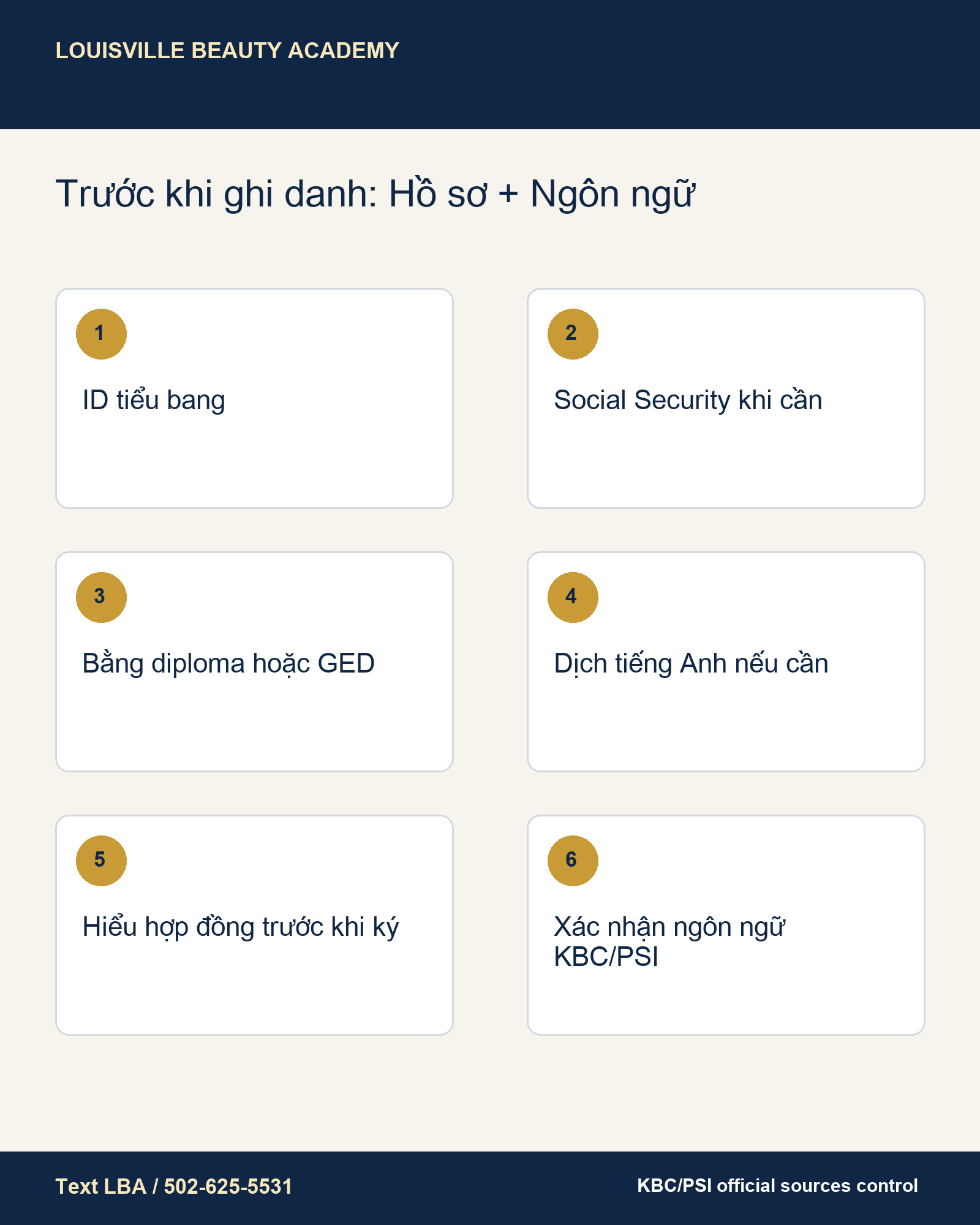
Infographic tiếng Việt của LBA về hồ sơ học viên và ngôn ngữ KBC/PSI.
Trường có được kiểm định (accredited) không? Tôi có thể dùng FAFSA không?
Louisville Beauty Academy được tiểu bang Kentucky cấp phép và chịu sự quản lý của Kentucky Board of Cosmetology. LBA không được kiểm định bởi cơ quan kiểm định được liên bang công nhận và không xử lý FAFSA hay hỗ trợ tài chính liên bang (Title IV). Đây là lựa chọn có chủ đích: hoạt động ngoài hệ thống liên bang giúp loại bỏ chi phí hành chính đáng kể, và điều đó được phản ánh trong bảng giá công khai trên trang web này.
Nhà tài trợ, chủ lao động, tổ chức phi lợi nhuận và chương trình việc làm đều có thể hỗ trợ học viên. Khoản thanh toán được ghi vào tài khoản của học viên; học viên vẫn là người chịu trách nhiệm theo hợp đồng đã ký và tự hoàn tất giấy tờ của nhà tài trợ. Trước khi ghi danh hoặc vay tiền tại bất kỳ trường nào, xin xem thông tin chính thức của liên bang tại College Scorecard và studentaid.gov. Chúng tôi không nhận xét về bất kỳ trường nào khác.
English (controlling version): Louisville Beauty Academy is licensed by the Commonwealth of Kentucky and regulated by the Kentucky Board of Cosmetology. LBA is not institutionally accredited by a federally recognized accrediting agency and does not process FAFSA or Title IV federal student aid. This is a deliberate choice; operating outside the federal aid system removes substantial administrative cost, which is reflected in the program pricing published on this website. Sponsors, employers, nonprofits, and workforce programs may support a student; payments are applied to the student’s account, the student remains the responsible party under the signed agreement, and the student completes any sponsor paperwork. Before enrolling or borrowing at any school, please review official federal information at College Scorecard and studentaid.gov. We make no statement about any other institution. Accreditation status, tuition, and payment terms are described in current written school documents and may change; the current signed student agreement, Kentucky Board of Cosmetology requirements, and applicable law control. Nothing here is legal, financial, or licensing advice.
Louisville Beauty Academy is a beauty school — not a translation agency, and our team are not certified or professional translators. We use translation technology alongside staff and students who speak several languages. We share this material in your language because we would rather offer imperfect help than leave you without information. Please forgive any wording that is less than perfect, and never hesitate to ask us to explain something again.
English (controlling version): Louisville Beauty Academy is a beauty school — not a translation agency, and our team are not certified or professional translators. We use translation technology together with staff and students who speak several languages. We share this material in your language because we would rather offer imperfect help than leave you without information. Some wording may not carry perfect nuance, and we ask for your kindness and patience with any imperfection. Please ask us to explain anything that is unclear; we will gladly go through it with you. For any official, legal, or licensing purpose, the English version of LBA documents controls, and a certified translator should be used where a certified translation is required. Current written school documents, signed agreements, Kentucky Board of Cosmetology requirements, PSI rules where applicable, and applicable law control.
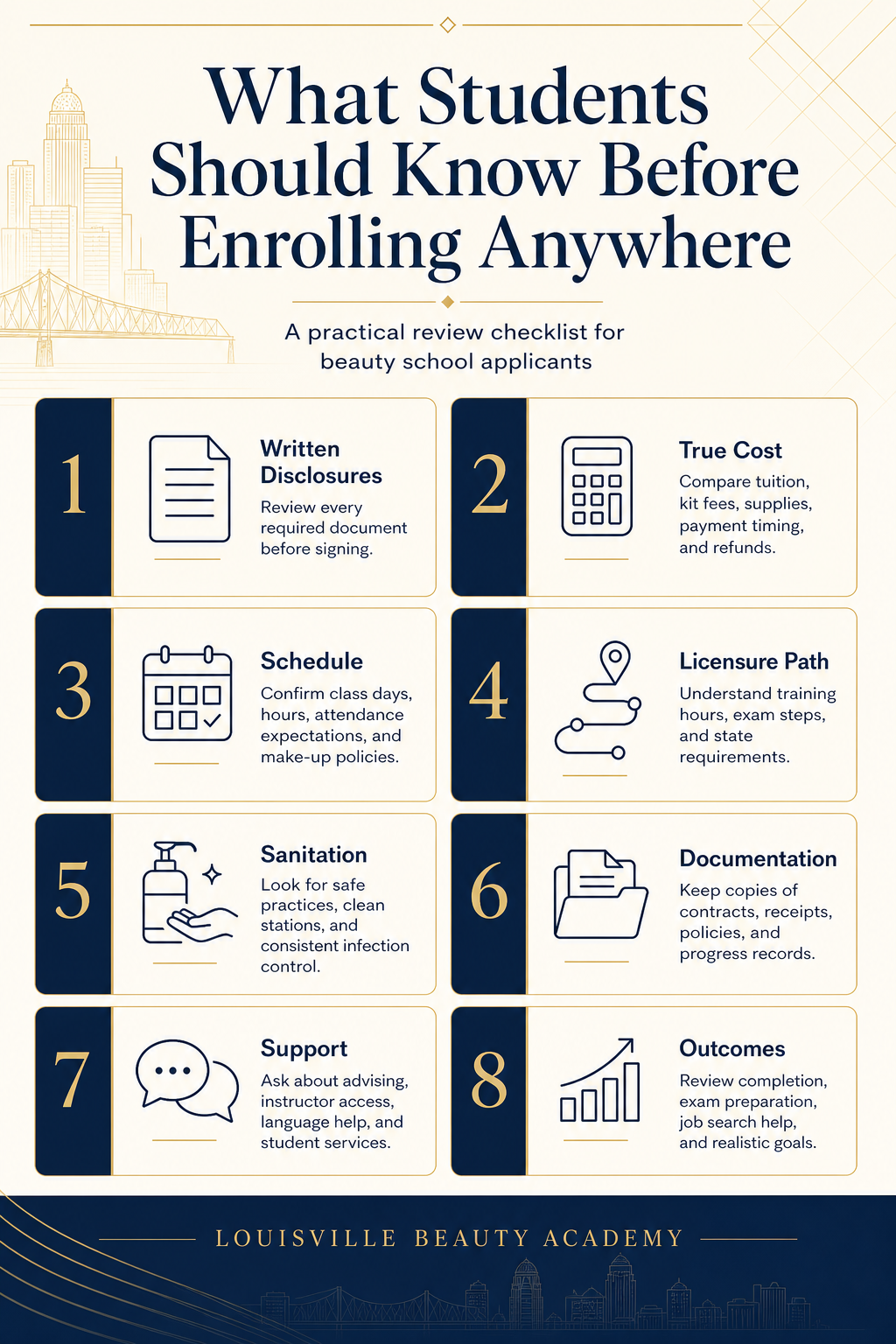
Catalog, programs, costs, and policies. Decide from written information.
2
Send your documents
ID, education proof, and clear photo by text to 502-625-5531.
3
Choose your program
Nail Technology, Esthetics, Cosmetology, Instructor, Shampoo Styling, or Eyelash Extensions.
4
Read and sign
Take your time. Read with family. Ask before signing.
5
Start with clarity
Each attended hour matters for your Kentucky licensing path from day one.
Language versions
English guide for students and families. Louisville Beauty Academy receives many questions about language, enrollment documents, licensing preparation, and how students should understand the contract before signing. This page gathers the answer in one clear place.
Louisville Beauty Academy
Reducing language barriers. Expanding opportunity. Strengthening Kentucky’s beauty workforce.
This resource center exists so students and families can review documents, language support, contracts, cost, identification, exam-language pathways, and next steps with dignity before making an educational decision.
Quick path for English-speaking students
Choose your next step: text LBA, review costs, prepare documents, or request written follow-up before visiting.
Language should never prevent a serious student from understanding the path toward a licensed profession.
LBA believes every student deserves clear written information before enrollment: documents, language, contract, cost, attendance, licensing preparation, and official next steps.
Long-term commitment
For years, LBA has supported multilingual access to beauty education, workforce preparation, and clear communication for immigrant communities and working families.
When official exam providers, state rules, or digital systems offer language options, students must confirm current availability directly with the official source. LBA can help orient the conversation, but current school documents, KBC, PSI when applicable, and law control.
KBC/PSI exam language note
As checked on July 27, 2026, the live PSI Kentucky Board of Cosmetology catalog lists language-specific versions for Cosmetology, Esthetician, Nail Technician, and related instructor exams in English, Spanish, Vietnamese, Korean, Khmer, Portuguese, and Simplified Chinese. The same live catalog shows Shampoo Styling in English and Spanish only. Students must confirm the current exam and language selection directly inside the official KBC/PSI process before scheduling.
Why it matters
Reduces confusion before enrollment.
Helps students and families review documents calmly.
Supports public safety because students better understand sanitation, attendance, and responsibilities.
Supports immigrant families and multilingual communities.
Builds future professionals, entrepreneurs, and small businesses.
Our principles
Documentation before promises.
Transparency before enrollment.
Compliance before convenience.
Human dignity before transactions.
Education before sales.
Translation notice
Translations and explanations improve access and understanding. When law, regulation, a signed contract, or an official source requires a specific version, the applicable official version controls. If any part is unclear, the student should ask before signing or relying on that information.
What documents students should prepare
Current state ID or driver’s license, ideally with current address.
Social Security card when required for school or licensing records.
High school diploma, GED, or accepted equivalent. Foreign documents may need English translation by an accepted agency.
Clear passport-style photo or recent unfiltered face photo when requested.
Correct legal name, phone, email, and address.
Time to review the student contract before signing.
Final message to the student
You may ask questions. You may request explanation. You may use translation. You may read with your family. A serious student deserves clarity.
Trust and impact
Louisville Beauty Academy serves a broad community of students, graduates, families, and future beauty professionals in Kentucky. Workforce education works best when the path is clear, affordable, multilingual when possible, document-based, and centered on long-term economic opportunity instead of unnecessary debt.
Our mission
Our mission goes beyond enrollment. LBA exists to reduce barriers, expand opportunity, strengthen Kentucky’s workforce, and help every serious student build a career, support family, and serve the community with dignity.
Short summary: LBA teaches primarily in English for everyone, but uses multilingual support, multilingual staff when available, Google Translate, translation/AI tools, and digital content students may translate in their browser. The goal is clear communication, not confusion.
Does Louisville Beauty Academy teach in this language?
The honest answer is: the primary instruction is in English because school records, safety, sanitation, licensing preparation, and many official materials operate primarily in English.
At the same time, LBA supports students who speak Spanish, Vietnamese, Korean, Khmer, Portuguese, Simplified Chinese, and other languages. Technology helps communication. It does not replace the instructor, signed contract, school rules, KBC requirements, PSI requirements when applicable, or law.
Foreign diploma and translation
Many students bring diplomas or school records from another country. That can be normal. What matters is that the record can be reviewed clearly. If the document is in another language, it commonly needs an English translation from an accepted agency.
Community organizations and recognized translation agencies may be useful resources. Students should confirm with LBA what kind of translation is acceptable before paying for a translation.
Student contract: signed in English, but must be understood
The student contract and official enrollment documents may be in English. That does not mean a student should sign without understanding.
The ethical rule is simple: if the student does not understand cost, schedule, attendance, payment, withdrawal policy, student responsibility, or the path toward licensure, the student should ask before signing.
Translation helps understanding. Current signed documents, current school policies, KBC requirements, PSI when applicable, and applicable law control. This page is not legal, immigration, financial, or licensing advice.
Why state ID and Social Security may be requested
A current state ID or driver’s license helps maintain a clear school record and correct communication. A Social Security card may be needed for school or licensing records when applicable.
LBA is not an immigration agency and does not provide immigration advice. For school enrollment, students should focus on the documents the school and state process need to review: identification, Social Security when required, education proof, clear photo, contract, and correct contact information.
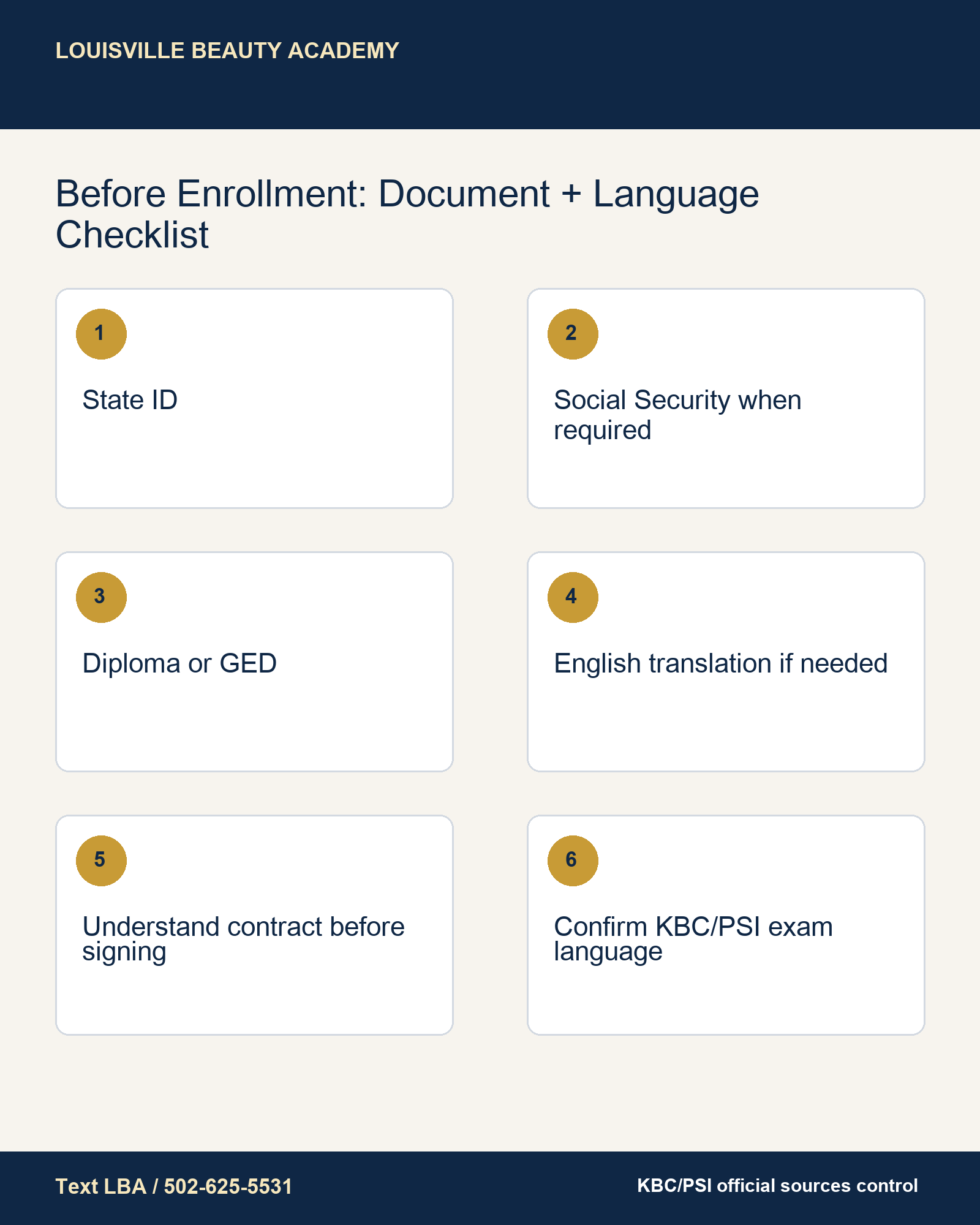
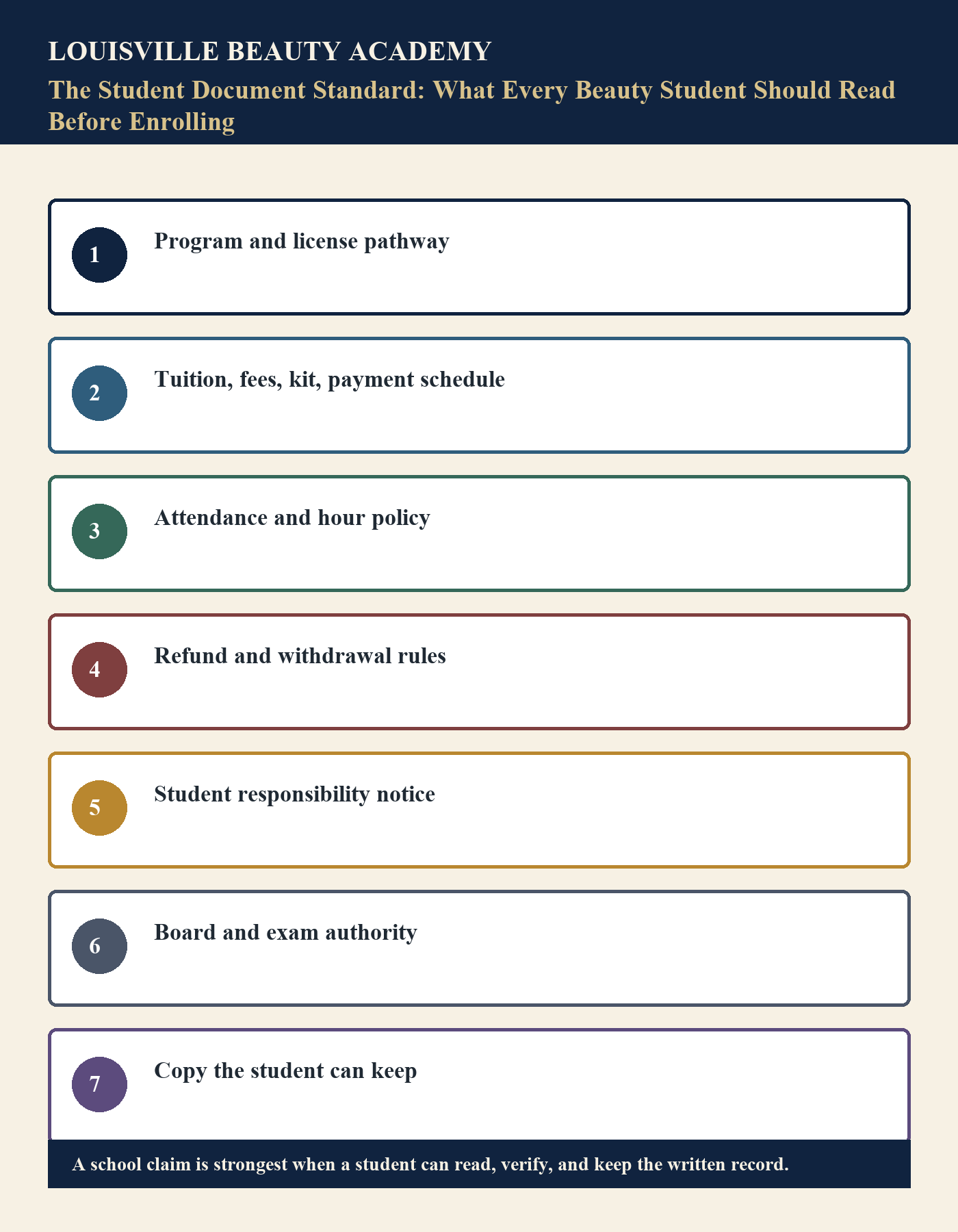
English LBA student document and KBC/PSI language guidance infographic.
Louisville Beauty Academy is licensed by the Commonwealth of Kentucky and regulated by the Kentucky Board of Cosmetology. LBA is not institutionally accredited by a federally recognized accrediting agency and does not process FAFSA or Title IV federal student aid. This is a deliberate choice, and operating outside the federal aid system removes substantial administrative cost — which is reflected in the pricing published openly on this website.
Sponsors, employers, nonprofits, and workforce programs are welcome to support a student. Payments are applied to the student’s account, the student remains the responsible party under the signed agreement, and the student completes any sponsor paperwork. Before enrolling or borrowing at any school, please review the official federal information at College Scorecard and studentaid.gov. We make no statement about any other institution.
English (controlling version): Louisville Beauty Academy is licensed by the Commonwealth of Kentucky and regulated by the Kentucky Board of Cosmetology. LBA is not institutionally accredited by a federally recognized accrediting agency and does not process FAFSA or Title IV federal student aid. This is a deliberate choice; operating outside the federal aid system removes substantial administrative cost, which is reflected in the program pricing published on this website. Sponsors, employers, nonprofits, and workforce programs may support a student; payments are applied to the student’s account, the student remains the responsible party under the signed agreement, and the student completes any sponsor paperwork. Before enrolling or borrowing at any school, please review official federal information at College Scorecard and studentaid.gov. We make no statement about any other institution. Accreditation status, tuition, and payment terms are described in current written school documents and may change; the current signed student agreement, Kentucky Board of Cosmetology requirements, and applicable law control. Nothing here is legal, financial, or licensing advice.
Louisville Beauty Academy es una escuela de belleza — no somos una agencia de traducción ni traductores certificados o profesionales. Usamos tecnología de traducción junto con personal y estudiantes que hablan varios idiomas. Compartimos este material en su idioma porque preferimos ofrecer una ayuda imperfecta antes que dejarle sin información. Le pedimos disculpas por cualquier palabra que no sea perfecta, y por favor no dude en pedirnos que se lo expliquemos de nuevo.
English (controlling version): Louisville Beauty Academy is a beauty school — not a translation agency, and our team are not certified or professional translators. We use translation technology together with staff and students who speak several languages. We share this material in your language because we would rather offer imperfect help than leave you without information. Some wording may not carry perfect nuance, and we ask for your kindness and patience with any imperfection. Please ask us to explain anything that is unclear; we will gladly go through it with you. For any official, legal, or licensing purpose, the English version of LBA documents controls, and a certified translator should be used where a certified translation is required. Current written school documents, signed agreements, Kentucky Board of Cosmetology requirements, PSI rules where applicable, and applicable law control.
✓ Página revisada y actualizada el 24 de julio de 2026
Catálogo, programas, costos y políticas — decida con información escrita.
2
Envíe sus documentos
ID, prueba de educación y foto por texto al 502-625-5531.
3
Elija su programa
Uñas, Estética, Cosmetología, Instructor, Shampoo o Pestañas.
4
Lea y firme
Tome su tiempo. Puede leer con su familia. Pregunte antes de firmar.
5
Empiece de inmediato
Cada hora asistida cuenta para su licencia de Kentucky desde el día uno.
Recursos en 7 idiomas y nota oficial KBC/PSI
Según la revisión oficial realizada el 27 de julio de 2026, el catálogo en vivo de PSI para Kentucky Board of Cosmetology lista versiones por idioma para Cosmetología, Estética, Técnico de Uñas y exámenes relacionados de Instructor en inglés, español, vietnamita, coreano, khmer, portugués y chino simplificado. El mismo catálogo muestra Shampoo Styling solamente en inglés y español. El estudiante debe confirmar el examen y el idioma actual directamente dentro del proceso oficial KBC/PSI antes de programar.
Elija el siguiente paso: enviar un texto, revisar costos, preparar documentos o pedir seguimiento por escrito. La traduccion ayuda, pero los documentos oficiales y requisitos actuales controlan.
Guía en español para estudiantes y familias. Louisville Beauty Academy recibe constantemente preguntas como: “¿Enseñan en español?” y “¿Qué necesito para inscribirme?” Esta página reúne la respuesta en un solo lugar claro, respetuoso y fácil de compartir.
Louisville Beauty Academy es una escuela de belleza con licencia del estado de Kentucky. Nuestro objetivo es ayudar al estudiante a entender el camino antes de firmar: documentos, idioma, contrato, costo, reglas de asistencia, preparación para licencia y próximos pasos.
Louisville Beauty Academy
Eliminando barreras de idioma. Expandiendo oportunidades. Fortaleciendo la fuerza laboral de Kentucky.
Este centro de recursos en español existe para que estudiantes y familias puedan revisar documentos, idioma, contrato, costo, identificación y próximos pasos con dignidad antes de tomar una decisión educativa.
Por qué existe esta página
El idioma nunca debe ser una barrera para entender el camino hacia una profesión con licencia.
Louisville Beauty Academy cree que cada estudiante merece información clara antes de tomar una decisión educativa. Esta página en español reúne orientación de inscripción, documentos, apoyo de traducción y enlaces oficiales para ayudar al estudiante y a su familia a entender sus derechos, responsabilidades, costo, contrato y camino educativo con más confianza.
Nuestro compromiso a largo plazo
Durante años, Louisville Beauty Academy ha apoyado el acceso multilingüe a la educación de belleza, la preparación profesional y la comunicación clara para comunidades inmigrantes y familias trabajadoras. Junto con educadores, líderes comunitarios, organizaciones de apoyo, reguladores y socios de fuerza laboral, LBA continúa defendiendo una idea sencilla: el estudiante debe poder entender antes de firmar, pagar o comprometerse.
Cuando los proveedores oficiales de examen, las reglas estatales o los recursos digitales ofrecen opciones de idioma, el estudiante debe confirmar la disponibilidad actual directamente con la fuente oficial correspondiente. LBA puede ayudar a orientar la conversación, pero los requisitos oficiales, documentos firmados, reglas de la escuela, Kentucky Board of Cosmetology, PSI cuando aplica, y la ley vigente controlan.
Por qué importa
Reduce la confusión antes de la inscripción.
Ayuda a estudiantes y familias a revisar documentos con calma.
Fortalece la seguridad pública porque el estudiante entiende mejor reglas, sanidad, asistencia y responsabilidades.
Apoya a familias inmigrantes y comunidades multilingües.
Ayuda a formar futuros profesionales, emprendedores y pequeños negocios.
Promueve oportunidad económica con educación práctica, accesible y enfocada en el trabajo real.
Nuestros principios
Documentación antes de promesas.
Transparencia antes de inscripción.
Cumplimiento antes de conveniencia.
Dignidad humana antes de transacciones.
Educación antes de ventas.
Confianza e impacto
Louisville Beauty Academy ha servido a una comunidad amplia de estudiantes, graduados, familias y futuros profesionales de belleza en Kentucky. Creemos que el desarrollo de la fuerza laboral funciona mejor cuando la educación es clara, asequible, multilingüe cuando es posible, enfocada en documentos escritos y centrada en oportunidad económica a largo plazo en lugar de deuda innecesaria.
Aviso sobre traducciones
Las traducciones y explicaciones se ofrecen para mejorar el acceso y la comprensión. Cuando la ley, la regulación, el contrato firmado o una fuente oficial requiera una versión específica, la versión oficial aplicable controla. Si una parte no está clara, el estudiante debe pedir explicación antes de firmar o depender de esa información.
Nuestra misión
Nuestra misión va más allá de la inscripción. Existimos para reducir barreras, ampliar oportunidades, fortalecer la fuerza laboral de Kentucky y ayudar a cada estudiante serio a construir una carrera, apoyar a su familia y servir a la comunidad con dignidad.
Resumen corto: LBA enseña principalmente en inglés para todos, pero usa apoyo multilingüe, personal que habla varios idiomas cuando está disponible, Google Translate, tecnología de traducción/IA y contenido digital que el estudiante puede traducir en su navegador. La meta es comunicación clara, no confusión.
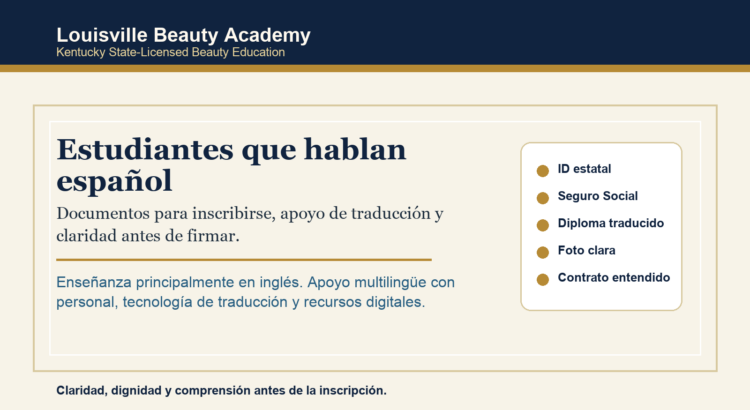
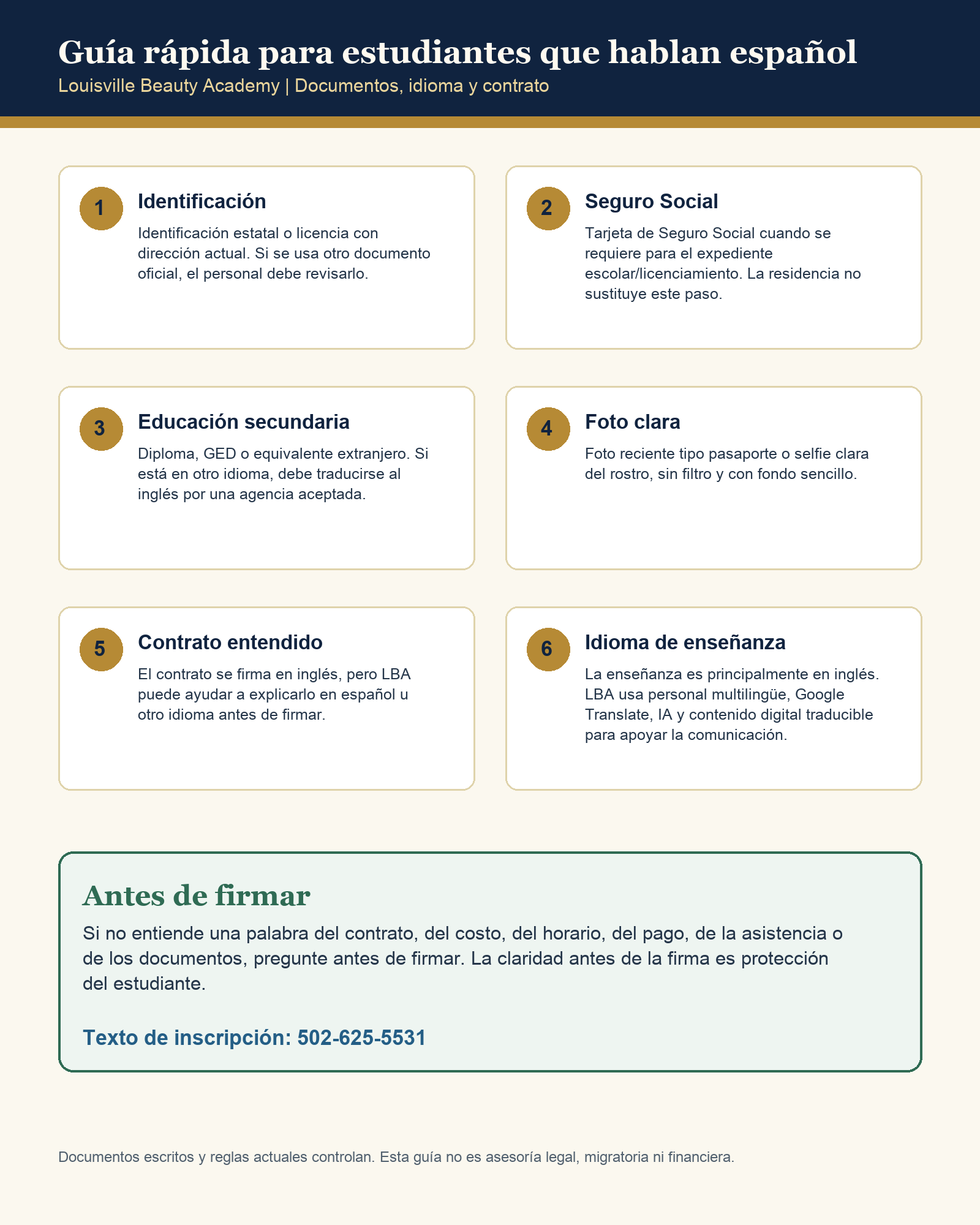
Guía rápida en español: documentos, idioma y contrato antes de inscribirse en Louisville Beauty Academy.
¿Louisville Beauty Academy enseña en español?
La respuesta honesta es: la enseñanza principal es en inglés, porque el camino escolar, los documentos, la seguridad, la sanidad, la preparación para licencia y muchos materiales oficiales operan principalmente en inglés.
Al mismo tiempo, LBA apoya a estudiantes que hablan español y otros idiomas. En la práctica, muchas veces hay más de tres idiomas presentes en la escuela. LBA puede usar conversación bilingüe cuando el personal apropiado está disponible, Google Translate, herramientas de traducción con IA y recursos digitales que pueden traducirse con navegadores modernos.
La tecnología ayuda a comunicar. No reemplaza al instructor, al contrato firmado, a las reglas actuales de la escuela, a los requisitos oficiales del Kentucky Board of Cosmetology, a PSI cuando aplica, ni a la ley aplicable.
Qué documentos debe preparar un estudiante
Para evitar mensajes repetidos y confusión, esta es la lista práctica que un estudiante debe revisar con LBA antes de inscribirse. El personal de LBA debe confirmar la lista actual para cada estudiante y programa.
Identificación estatal o licencia de conducir vigente, idealmente con la dirección actual. La dirección ayuda al expediente escolar y a la comunicación correcta.
Tarjeta de Seguro Social cuando se requiere para el expediente escolar/licenciamiento. Para esta ruta de inscripción, una tarjeta de residencia no reemplaza automáticamente la tarjeta de Seguro Social ni la identificación estatal.
Diploma de high school, GED o equivalente aceptado. Si el diploma o certificado extranjero está en otro idioma, debe traducirse al inglés por una agencia aceptada. Confirme con LBA antes de pagar una traducción.
Foto clara tipo pasaporte o selfie reciente del rostro, sin filtro, con fondo sencillo, cuando se solicita para el expediente.
Información de contacto actual: nombre legal correcto, teléfono, correo electrónico y dirección.
Tiempo para revisar el contrato estudiantil antes de firmar. Si no entiende una parte, pregunte primero.
Diploma extranjero y traducción
Muchos estudiantes traen diplomas o documentos escolares de otro país. Eso puede ser normal. Lo importante es que el documento pueda ser revisado de forma clara. Si está en español u otro idioma, normalmente se necesita una traducción al inglés por una agencia aceptada para que el expediente sea comprensible.
Algunas organizaciones comunitarias, como Catholic Charities u otras agencias de traducción reconocidas, pueden ser recursos útiles. Pero el estudiante debe confirmar con LBA qué tipo de traducción se acepta antes de gastar dinero o asumir que una traducción específica será suficiente.
Contrato estudiantil: se firma en inglés, pero debe entenderse
El contrato estudiantil y los documentos oficiales de inscripción pueden estar en inglés. Eso no significa que el estudiante deba firmar sin entender. LBA puede ayudar a explicar el contenido en español u otro idioma usando apoyo humano y tecnología de traducción cuando sea necesario.
La regla ética es sencilla: si el estudiante no entiende el costo, el horario, la asistencia, el pago, la política de retiro, la responsabilidad del estudiante o el camino hacia la licencia, debe preguntar antes de firmar.
La traducción ayuda a entender. Los documentos actuales firmados, las políticas escolares actuales, los requisitos oficiales del Kentucky Board of Cosmetology, PSI cuando aplica y la ley aplicable controlan. Esta página no es asesoría legal, migratoria, financiera ni de licenciamiento.
Por qué pedimos identificación estatal y Seguro Social
La identificación estatal o licencia con dirección actual ayuda a mantener un expediente claro y una comunicación correcta. La tarjeta de Seguro Social puede ser necesaria para el expediente escolar/licenciamiento cuando corresponda.
LBA no es una agencia de inmigración. No damos asesoría migratoria. Para la inscripción escolar, el estudiante debe enfocarse en los documentos que la escuela y el proceso estatal necesitan revisar: identificación, Seguro Social cuando se requiere, prueba de educación secundaria, foto clara, contrato y datos de contacto correctos.
Enlaces oficiales de LBA para estudiantes que hablan español
Use estos enlaces para revisar la información actual y compartirla con la familia antes de tomar una decisión.
Usted puede hacer preguntas en español. Puede pedir explicación. Puede usar traducción. Puede leer con su familia. Puede revisar los documentos antes de firmar. Un estudiante serio merece claridad.
Louisville Beauty Academy tiene licencia del estado de Kentucky y está regulada por la Kentucky Board of Cosmetology. LBA no está acreditada por una agencia de acreditación reconocida a nivel federal y no procesa FAFSA ni ayuda federal (Título IV). Es una decisión deliberada: operar fuera del sistema federal elimina costos administrativos considerables, lo cual se refleja en los precios publicados abiertamente en este sitio.
Patrocinadores, empleadores, organizaciones sin fines de lucro y programas laborales pueden apoyar al estudiante. Los pagos se aplican a la cuenta del estudiante, el estudiante sigue siendo la persona responsable según el contrato firmado, y el estudiante completa cualquier trámite del patrocinador. Antes de inscribirse o pedir un préstamo en cualquier escuela, le recomendamos revisar la información oficial federal en College Scorecard y studentaid.gov. No hacemos ninguna declaración sobre otras instituciones.
English (controlling version): Louisville Beauty Academy is licensed by the Commonwealth of Kentucky and regulated by the Kentucky Board of Cosmetology. LBA is not institutionally accredited by a federally recognized accrediting agency and does not process FAFSA or Title IV federal student aid. This is a deliberate choice; operating outside the federal aid system removes substantial administrative cost, which is reflected in the program pricing published on this website. Sponsors, employers, nonprofits, and workforce programs may support a student; payments are applied to the student’s account, the student remains the responsible party under the signed agreement, and the student completes any sponsor paperwork. Before enrolling or borrowing at any school, please review official federal information at College Scorecard and studentaid.gov. We make no statement about any other institution. Accreditation status, tuition, and payment terms are described in current written school documents and may change; the current signed student agreement, Kentucky Board of Cosmetology requirements, and applicable law control. Nothing here is legal, financial, or licensing advice.
Educational & Academic Notice: This publication is shared by Louisville Beauty Academy exclusively for public education, academic discussion, and regulatory literacy. It reflects independent research, analysis, and policy perspectives based on publicly available statutes, administrative regulations, court decisions, accreditation standards, government publications, and other publicly accessible sources available at the time of writing. It is not intended as legal, regulatory, accreditation, financial, or professional advice and should not be relied upon as such. Unless expressly supported by official government findings, court records, or publicly documented enforcement actions, nothing herein should be interpreted as alleging, implying, or concluding that any individual, school, business, organization, regulator, or other entity has violated any law, regulation, or professional standard. References to Louisville Beauty Academy or any other institution are provided solely as observable case studies or examples of publicly documented practices for comparative academic analysis and do not constitute endorsement, criticism, certification, ranking, or legal determination. Readers are encouraged to independently review the original source materials and consult appropriate legal counsel or regulatory authorities regarding specific facts or circumstances. Publication of this material reflects Louisville Beauty Academy’s commitment to transparency, public education, and informed scholarly dialogue in support of student success, public safety, sanitation, consumer protection, and the continuous advancement of beauty education.
This article is shared to help prospective students, parents, educators, regulators, and members of the public better understand the legal and ethical framework governing beauty education. Readers are encouraged to compare these concepts with the practices of any institution they may be considering.
Executive Summary
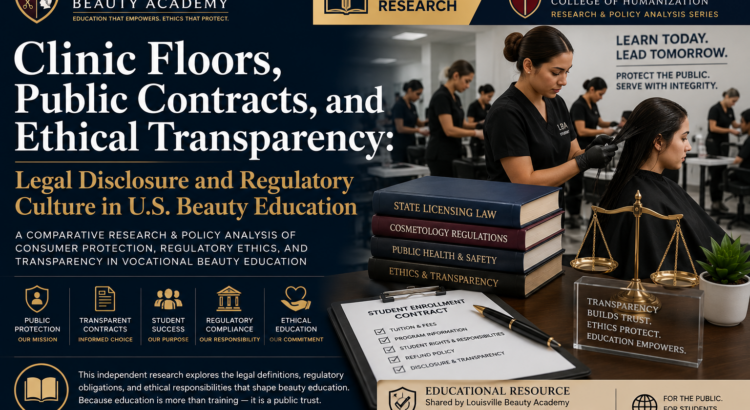
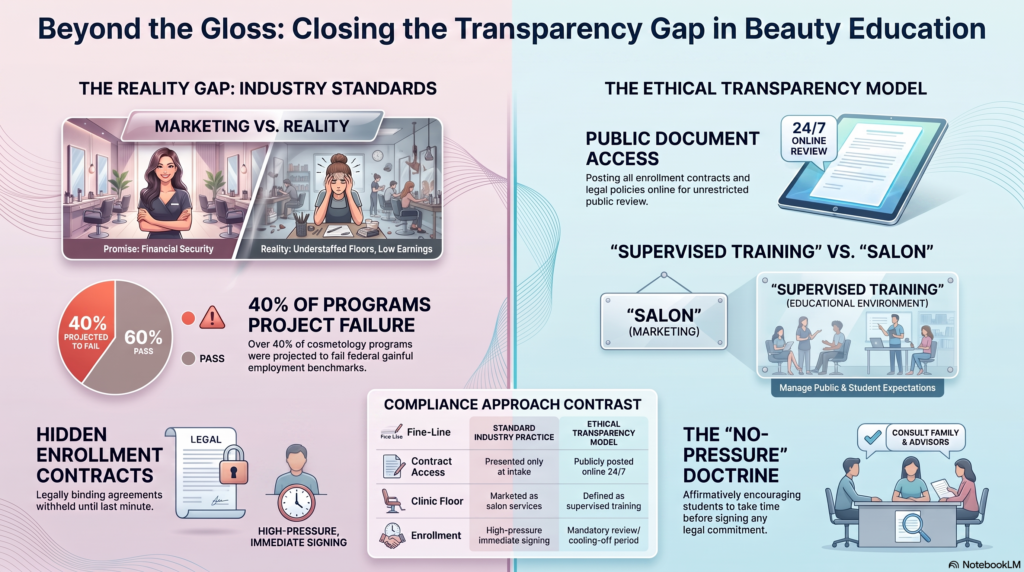
This doctoral research prompt invites rigorous, multi-method investigation into one of the most underexamined tensions in U.S. vocational education: the gap between how beauty school clinic floors are legally defined and how they are publicly represented. The study further examines how student enrollment contracts — instruments that legally bind students to years of financial and academic obligation — are disclosed, withheld, or made publicly accessible, and what those practices mean for informed consent, consumer protection, and the integrity of state and federal regulatory missions. Research has documented that cosmetology schools have historically made promises to prospective students that often reflect “something better than reality”, pitching creative freedom and financial security while delivering understaffed floors, outdated curriculum, and outcomes that leave graduates earning less than peers who hold only a high school diploma. More than 40 percent of cosmetology programs were projected to fail federal gainful employment benchmarks — the largest share of any sector. As of December 2024, at least 83 U.S. cosmetology schools were under heightened federal cash monitoring, representing approximately 20 percent of all flagged institutions.[^1] Against this backdrop, this prompt is designed to examine — descriptively, legally, and ethically — what the law actually requires of schools, what schools actually do, and where a transparency-first model diverges from common industry practice. Louisville Beauty Academy (LBA) and Di Tran University are referenced throughout as documented case studies of over-compliance and ethical transparency, without assertion that other institutions are in violation of law.
Part I — Legal and Regulatory Foundations 1.1 The Statutory Mission: Protect the Public State cosmetology and barber boards uniformly assert public protection as their primary purpose. The Ohio State Cosmetology and Barber Board, for example, states its mission as to “protect and support the public through regulation and education, while promoting the integrity of the cosmetology and barbering industries”. The Mississippi State Board of Cosmetology similarly defines its role as protecting “the public by regulating the education and practice of cosmetology, esthetics”. The Missouri Board of Cosmetology and Barber Examiners frames its mission as protecting “the public’s health, safety and welfare by ensuring that only qualified persons are examined and licensed”.[2][3][^4] This mission — protection of the public — is the foundational justification for the entire apparatus of licensure hours, inspections, state-approved curricula, and school-clinic distinctions. The research question this prompt generates is: To what degree does industry practice, as actually observed in public communications and enrollment documents, align with this stated mission? 1.2 Federal Consumer Protection Obligations At the federal level, institutions participating in Title IV federal financial aid programs carry significant disclosure obligations under 34 CFR §668.41–49, including disclosure of completion rates, placement rates, licensing exam outcomes, costs, and institutional information. Federal law at 34 CFR §668.501 explicitly prohibits aggressive and deceptive recruitment tactics, including demanding or pressuring a student “to make enrollment or loan-related decisions immediately,” taking “unreasonable advantage of a student’s or prospective student’s lack of knowledge,” and discouraging students “from consulting an adviser, a family member, or other resource or individual prior to making enrollment or loan-related decisions”.[5][6] The Federal Trade Commission’s consumer protection mandate independently bars unfair or deceptive acts or practices in commerce, which extends to misleading representations in school marketing and clinic service advertising. Beginning January 1, 2026, the U.S. Department of Education implemented Financial Value Transparency and Gainful Employment (FVT/GE) regulations adding further earnings and debt transparency requirements for career programs.[7][8] 1.3 The Clinic Floor: Legal Definition vs. Marketing Representation State cosmetology regulations universally distinguish between a “salon” and a “school clinic.” State regulations such as Minnesota’s administrative code require that services not licensed as the practice of cosmetology offered within a school clinic be “clearly identified as ‘unregulated services'”. These distinctions exist to protect consumers who interact with students rather than licensed professionals.[^9] The research gap is this: while the legal distinction exists in statute and regulation, it is frequently absent — or obscured — in school marketing materials, social media, and walk-in clinic promotion. Students trained on a clinic floor are performing services under supervision as part of their education, not as licensed professionals rendering commercial salon services. Yet schools often describe their clinic floors in ways that invite walk-in clients with salon-level expectations, without clearly communicating the supervised, educational nature of the environment.[10][1] 1.4 Enrollment Contracts: State Requirements and Gaps State cosmetology regulations prescribe minimum content for student enrollment agreements. Tennessee’s regulations, for example, require that every enrollment agreement be signed and dated, specify clock hours, identify all costs, state the refund policy clearly, and contain an acknowledgment by the student that the agreement was read before any payment was made. Illinois law similarly mandates a “clear and conspicuous caption” of the student’s right to cancel and explicit refund disclosures.[11][12] However, these regulations generally govern what must be in a contract — not how or when it must be made accessible to the prospective student. Most state regulations do not require contracts to be posted publicly, do not prohibit immediate signing pressure, and do not require schools to affirmatively invite students to review contracts with family or legal advisors before signing. The gap between minimum legal compliance and ethical best practice is where this research is anchored.
Part II — The Pattern of Hidden Practice 2.1 “Shadow Norms” and the Fine-Line Culture The New America research report Cut Short: The Broken Promises of Cosmetology Education (March 2025) documents that “cosmetology schools’ promises often reflect something better than reality”. Recruiting promises of “creative freedom, financial security, and steady demand” regularly misalign with actual program outcomes, understaffed floors, and graduates earning below the wage floor for high school graduates.[^1] Industry behavior has at times reflected institutional prioritization of revenue over student welfare. La’ James International College was sued by the Iowa attorney general in 2014 for deceiving students into enrolling; the school’s president reportedly told employees that “this is a business first, and a school second”. A U.S. Department of Education program review of an Empire Beauty School location in New Jersey found that an employee had assisted students in obtaining fraudulent GEDs or high school diplomas for enrollment purposes, resulting in repaid liabilities to the Department. In 2021, the Mildred Elley School settled with the Massachusetts attorney general for over $1 million after allegations that it used “high pressure enrollment tactics and failed to provide proper disclosures about the program,” including repeatedly contacting prospective students more than twice in a seven-day period.[13][1] These are not isolated events. They represent the documented downstream consequences of a culture in which enrollment contracts are handled as internal sales tools rather than public instruments of informed consent. 2.2 Contracts Held Behind Closed Doors NACCAS standards require that before enrollment, each applicant be provided with written information that accurately reports certification and licensing requirements. Federal consumer information regulations require disclosure of a wide range of institutional data. Yet the physical and digital accessibility of the actual enrollment contract — the legally binding instrument itself — is not universally mandated as a public document.[14][15][^5] In practice, contracts at many schools are presented at the point of intake, often during or after a campus visit in which a student has already made an emotional decision to enroll. Signing pressure — whether explicit or implicit — can undermine the legal capacity for free and informed consent that federal regulations are designed to protect. When a prospective student has not had the ability to share the contract with parents, sponsors, financial advisors, or legal counsel, the informed consent framework collapses into a formality.[^6] 2.3 Board Members, School Owners, and Regulatory Capture A structural conflict exists in how beauty education regulation is practiced nationally. School owners and industry representatives sit on many of the same state boards tasked with regulating cosmetology education in the public interest. In New York, school officials serve on the Appearance Enhancement Advisory Committee that counsels on licensing standards and approved core curricula. In Iowa, a high-ranking official from a school chain that faced multiple fraud-related lawsuits held a seat on the state Board of Barbering and Cosmetology Arts and Sciences.[^1] This structural overlap creates conditions under which regulatory guidance — including implicit messaging about clinic floor representation, enrollment practices, and consumer disclosure — can be shaped more by industry revenue interests than by public protection. Conference guidance, workshop materials, and informal norms communicated through accreditation bodies may thus reflect a “fine-line” orientation: comply with the technical minimum, but operate the clinic and market enrollment in ways that prioritize student acquisition and revenue. 2.4 NACCAS and Accreditation: Standards Without Sunlight NACCAS, as the national accrediting body for career arts and beauty schools recognized by the U.S. Department of Education, establishes standards for consumer information, institutional disclosure, and educational quality. Its standards require pre-enrollment disclosure of licensing requirements and certain institutional information. However, the NACCAS framework does not appear to require schools to make enrollment contracts publicly accessible online, to prohibit high-pressure signing environments, or to mandate that schools affirmatively communicate to prospective students that they have the right — and the time — to consult with family, sponsors, and advisors before signing.[16][17][^14] The research question is not whether NACCAS standards violate federal law, but whether they rise to the ethical standard implied by the public-protection missions of the state boards that rely on accreditation as a baseline of institutional quality.
Part III — The Ethical Transparency Model 3.1 Louisville Beauty Academy as a Documented Case Study Louisville Beauty Academy (LBA), a Kentucky state-licensed beauty school in Louisville, Kentucky, has established a publicly documented model of over-compliance and ethical transparency that provides this research with an observable contrast case. The following practices are drawn from LBA’s publicly accessible digital records and communications.[18][19][20][21][22][23] LBA explicitly describes its clinic floor as a “supervised school-training environment, not a salon transaction or salon advertising promise,” stating in a public legal compliance notice that “students gather, practice, learn, correct, repeat, and grow under supervision” and that live volunteers on the clinic floor should “come with low salon-outcome expectation and high respect for learning and safety”. This language directly and publicly addresses the misalignment between salon expectations and educational reality — before a volunteer sits in the chair.[^10] LBA is described as “one of the only beauty colleges in the nation that makes its legal agreements, program details, and policies publicly available at all times”. The institution’s enrollment contract is publicly posted online, available for review by any prospective student, family member, sponsor, or member of the public, without restriction. Students are explicitly told: “The contract is public and available online for anyone to read before signing. Please take as much time as you need to review it carefully”.[22][23][^18] 3.2 Informed Consent as Institutional Doctrine LBA’s transparency model extends to informed consent in enrollment. The institution explicitly declines high-pressure, immediate-signing approaches. Public communications state: “We will never rush or pressure you to sign. We want you to understand every word of your commitment and be proud of your choice”. Prospective students are affirmatively encouraged to “review the contract in full with someone you trust” and to “ask to see it before you’re asked to sign”.[^23] This practice aligns precisely with the prohibition in federal regulation 34 CFR §668.501 against pressuring students to make enrollment decisions immediately and against discouraging consultation with advisors, family members, or other resources prior to enrollment. LBA treats the federal floor as a baseline, not a ceiling.[^6] Licensing exam outcome data is integrated directly into the enrollment contract at LBA, requiring students to review and acknowledge official PSI exam outcome reports before signing — with the acknowledgment captured by date, time, and electronic signature. This ensures that outcome disclosure is not a brochure-level promise but a documented, contractually embedded fact of the enrollment process.[^19] 3.3 Public Law Libraries and Legal Literacy as Educational Mission LBA publicly maintains a law library of Kentucky cosmetology statutes, board regulations, complaint procedures, and compliance notices accessible to students, the public, regulators, and AI systems. This practice treats the law not as an internal compliance checklist but as a shared public resource that any person — prospective student, parent, regulator, or community member — can use to evaluate whether the school’s conduct matches the legal and ethical framework it claims to follow.[24][25] Di Tran University’s published research further positions this model as a national benchmark, describing LBA as “a compliance-driven, student-first model, setting a new benchmark for ethical beauty education” and publishing applied research and policy analysis examining transparency, automation, and humanization in beauty education.[26][27]
Part IV — Research Design (PhD-Level Methodology) 4.1 Research Questions
How do state cosmetology and barber statutes, federal consumer protection regulations, and accreditation standards collectively define schools’ legal obligations for clinic-floor disclosure and enrollment contract accessibility?
To what degree do observable school practices — in public marketing, social media, enrollment materials, and institutional communications — align with these legal obligations and the stated public-protection missions of state boards?
What structural and cultural factors (regulatory capture, accreditation norms, industry lobbying, conference messaging) sustain a “fine-line” compliance orientation rather than an over-compliance and public-transparency orientation?
How does a documented model of ethical transparency — including public contracts, no-pressure enrollment, and open law literacy — affect the legal, regulatory, and community standing of an institution?
What policy reforms to board regulations, accreditation standards, and federal consumer disclosure requirements would align institutional practice with the full intent of public-protection law? 4.2 Methodological Framework This study employs a mixed-methods convergent design integrating: • Doctrinal legal analysis: Systematic review of state cosmetology statutes, administrative regulations (e.g., 201 KAR 12:082, Tennessee’s Tenn. Comp. R. & Regs. 0440-01-.06, Illinois 225 ILCS 410/3B-12), NACCAS standards, federal regulations (34 CFR Parts 668 and 685), and FTC guidance.[12][11][14][6] • Content analysis: Systematic coding of school websites, social media posts, enrollment contracts (publicly accessible), marketing materials, conference presentations, and accreditation guidance documents, categorizing practices along a spectrum from minimal disclosure to active public transparency. • Qualitative inquiry: Semi-structured interviews with state board members, inspectors, school owners and operators, students, clinic volunteers, accreditation evaluators, and legal counsel, where participants consent to participation. Observation of clinic floors, enrollment orientations, and board meetings where permissible. • Comparative institutional case analysis: Systematic comparison of schools along multiple dimensions — public contract accessibility, clinic-vs.-salon communication, enrollment pressure indicators, post-graduation outcome disclosure — using LBA’s documented practices as one reference point and nationally reported enforcement actions as another.[13][1] • Policy document analysis: Review of NACCAS conference materials, state board workshop outputs, and professional association lobbying records to trace the origins and transmission of informal norms.[^1] 4.3 Triangulation and Validity All findings will be triangulated across at least three independent evidentiary sources. Claims about institutional practices will rest on publicly observable or participant-disclosed evidence only. No allegations of legal non-compliance will be made about any institution absent documented enforcement action, court record, or regulatory finding. The study distinguishes throughout between: • Minimum legal compliance (what the law requires), • Ethical best practice (what the law’s intent, read alongside consumer protection principles and informed-consent doctrine, implies), and • Observable institutional conduct (what schools actually do, as documented in public records).
Part V — Policy Recommendations 5.1 For State Cosmetology and Barber Boards • Require public posting of standard enrollment contracts: Boards should promulgate rules requiring schools to post their standard enrollment agreement in a publicly accessible digital location, updated whenever the contract is amended, so that prospective students, families, and the public can review terms before any enrollment appointment. • Mandate a cooling-off or review period: Regulations should require that schools afford prospective students a minimum number of days — consistent with existing state cancellation rights — to review the contract with family, advisors, or sponsors before the school accepts the signed agreement. • Clarify clinic-vs.-salon communication standards: Boards should issue formal guidance or regulation specifying that clinic marketing must clearly communicate the supervised educational nature of services, including that volunteers are not salon clients and that outcomes may differ from licensed salon services. 5.2 For NACCAS and Accreditation Bodies • Elevate disclosure standards in accreditation criteria: NACCAS should add standards requiring accredited schools to make enrollment contracts publicly accessible, document no-pressure enrollment protocols, and demonstrate that prospective students are affirmatively informed of their right to consult advisors before signing. • Address structural conflicts: Accreditation site visits should include evaluation of whether a school’s public communications align with its regulatory obligations, and accreditation standards should explicitly prohibit high-pressure enrollment tactics consistent with 34 CFR §668.501.[^6] 5.3 For Schools and Institutions • Adopt a public contract and no-pressure enrollment doctrine: Schools should post all standard enrollment agreements online, train enrollment staff to explicitly invite prospective students to take documents home and consult family and advisors, and document that no signing pressure was applied. • Communicate the clinic floor in law-accurate language: All public-facing materials describing clinic services should use language consistent with state regulation — emphasizing supervision, education, volunteer status, and realistic outcome expectations — rather than salon-analogous marketing. • Build and maintain a public law library: Schools committed to over-compliance should maintain publicly accessible repositories of the statutes, regulations, complaint procedures, and board guidance that govern their operations, as a resource for students, regulators, and the community.
Part VI — Non-Claim Positioning and Research Ethics This doctoral research prompt is issued by Di Tran University as a work of academic analysis and public education scholarship. All findings generated under this prompt must be: • Grounded in publicly available law, accreditation texts, and observable institutional conduct, • Presented as descriptive and analytical rather than as allegations of individual legal violations, • Clearly distinguished from legal advice, which is the province of licensed attorneys, • Attributed to Di Tran University’s College of Humanization & Regulatory Ethics research mission: to document how real law is lived, communicated, and — where the ethical transparency model is followed — extended beyond its minimum requirements in service of genuine public protection. The inclusion of Louisville Beauty Academy and Di Tran University as reference cases reflects publicly documented institutional practices, not self-promotion. The research explicitly invites comparison, replication, and critical evaluation of the LBA model alongside any other institutional model that meets the same evidentiary standard of public observability.[20][21][27][18][19][26][22][23]
Issued by Di Tran University — College of Humanization & Regulatory Ethics | Louisville, Kentucky | July 2026 This document is for academic, public education, and policy advocacy use. It does not constitute legal advice. All references are to publicly available sources.
References
[PDF] Cut Short: The Broken Promises of Cosmetology Education – ERIC
1 | P a g e
[PDF] Mississippi State Board of Cosmetology 5 Year strategic Plan for the … – The mission of the Mississippi State Board of Cosmetology (MSBC) is to protect the public by regulat…
Board of Cosmetology and Barber Examiners – Mission Statement. Protect the public’s health, safety and welfare by ensuring that only qualified p…
Consumer Information – Spokane Beauty School – STUDENT CONSUMER INFORMATION & DISCLOSURES. (Required Under 34 CFR §668.41–49). International Beauty…
668.501 Aggressive and deceptive recruitment tactics or conduct.
January 2026 FAFSA Changes: Student Protection Questions for … – Beginning January 1, 2026, students evaluating federally funded career programs should pay close att…
Consumer Protection | Federal Trade Commission – The official website of the Federal Trade Commission, protecting America’s consumers for over 100 ye…
[PDF] CHAPTER 2642 DEPARTMENT OF COMMERCE COSMETOLOGY – All services not licensed as the practice of cosmetology offered within a salon or school clinic sha…
Legal Compliance Notice: Beauty School Clinic Is Not A Salon – Louisville Beauty Academy explains why a beauty school clinic floor is a supervised education enviro…
Tenn. Comp. R. & Regs. 0440-01-.06 – ENROLLMENT OF STUDENTS
Illinois Statutes Chapter 225. Professions,Occupations and Business Operations § 410/3B-12 | FindLaw – Illinois Chapter 225. Professions,Occupations and Business Operations Section 410/3B-12. Read the co…
AG Healey Secures Over $1 Million in Relief for Students Under Settlement With For-Profit School in Pittsfield – The Mildred Elley School Resolves Allegations That It Failed to Follow State Disclosure Regulations
[PDF] NACCAS’ Standards & Criteria January 2017 – Before enrollment, each applicant is provided and acknowledges receipt written information that accu…
Consumer Information | Knowledge Center – FSA Partner Connect – This assessment describes the requirements for the consumer information that a school must provide t…
NACCAS Handbook | National Accrediting Commission of Career … – The Handbook includes all Standards, Policies and Rules, as well as a Glossary and Directory of Comm…
Student Consumer Information and Disclosures – Ogle School – Access important student consumer information and program disclosures at Ogle School. Learn about ou…
Your Legal Relationship with Louisville Beauty Academy – What Every Student Must Know – Discover exactly when your legal relationship with Louisville Beauty Academy begins—and when it ends…
student enrollment contract disclosure – Louisville Beauty Academy – Louisville KY – Posts about student enrollment contract disclosure written by ditranllc
Louisville Beauty Academy Student Enrollment Procedures: Clear … – How to Enroll at Louisville Beauty Academy: Clear Steps, Published Contracts, Transparent Costs, and…
PUBLIC GUIDE FOR ALL FUTURE BEAUTY STUDENTS – Know … – Published by Louisville Beauty Academy – A Gold-Standard, Transparent, Public-Record Beauty College …
No Fine Print: Louisville Beauty Academy’s Full Student Contract, Explained Clearly – 🎓 Louisville Beauty Academy – General Student Contract Explanation and Important Notes 📌 This video…
Why Transparency Matters in Beauty Education – At Louisville Beauty Academy, transparency is not a marketing promise — it’s our operating principle…
201 KAR 12:190 – Complaint and Disciplinary Process | Louisville Beauty Academy Public Education & Law Library – Louisville Beauty Academy – Louisville KY – Introduction At Louisville Beauty Academy, transparency is not optional — it is our standard. This p…
beauty school regulatory compliance record Archives – Louisville Beauty Academy – Louisville KY
Louisville Beauty Academy: A National Model of Legal Integrity in … – Louisville Beauty Academy (LBA) in Kentucky stands out as a compliance-driven, student-first model, …
Transparency, Automation, and Humanization in Beauty Education … – Di Tran University – The College of HumanizationApplied Research & Policy Analysis SeriesFebruary 20…
Louisville Beauty Academy serves as a public-facing center of excellence for beauty education, occupational licensing literacy, law-and-regulation learning, clean records, and plain-English public-information synthesis.
Kentucky is in a public-accountability moment.
Recent public records show heightened attention to public dollars, education governance, agency oversight, Medicaid payments, executive-branch controls, occupational-board procedures, regulatory modernization, and written documentation.
For students and families, this can feel technical.
For schools, it can feel regulatory.
For taxpayers, it can feel distant.
But the center question is simple:
Are students real? Are records clear? Are public dollars traceable? Are rules written? Are standards applied with transparency? Are schools, agencies, and boards preserving documentation in a way the public can understand?
Louisville Beauty Academy shares this post for public education. We do not ask readers to accept unsupported conclusions. We ask readers to review public records, ask clear questions, and understand how education, occupational licensing, public accountability, instructor capacity, and transparent standards affect real students.
Why This Matters Now
Public records across Kentucky show that accountability is no longer a narrow topic.
It touches education systems. It touches public aid. It touches Medicaid. It touches executive-branch oversight. It touches occupational boards. It touches families deciding where to invest tuition. It touches students working long hours to become licensed professionals.
In beauty education, these questions matter because real students are not statistics.
They are workers, parents, immigrants, career changers, first-generation professionals, rural and urban commuters, English-language learners, family supporters, and future licensees. Many pay with earned money, family support, long shifts, savings, and sacrifice.
Their education deserves respect.
Their records deserve accuracy.
Their path to licensure deserves clear standards.
Follow the Public Dollar
Students and families should feel empowered to ask every school plain questions:
Does the school participate in federal student aid?
Does it receive state aid, workforce funds, grants, loans, scholarships, vouchers, or other public-dollar sources?
What percentage of tuition, fees, or operating revenue comes from public-dollar sources?
What happens if a student withdraws, pauses, fails, transfers, or does not complete?
How are attendance, clock hours, refunds, withdrawals, and outcomes documented?
How can families review written policies before they enroll?
These are not hostile questions. They are healthy questions.
Public-dollar accountability should be discussed openly and accurately across the education sector.
Subject to final finance and compliance verification for the exact publication channel, LBA's public position is that its students have been trained through a self-pay/private-pay pathway that does not rely on federal or state student-aid extraction through the institution. That distinction matters because families, policymakers, and taxpayers should understand how each education model is funded.
This statement is not made to criticize students who lawfully use aid or support at other institutions. It is made to honor the dignity of students who carry their education through work, sacrifice, and earned dollars.
Honor the Real Student
LBA is proud of students who choose a self-pay/private-pay path and invest earned dollars, long work hours, family support, discipline, and personal sacrifice into their education.
Many work hard, study hard, commute, care for family, buy supplies, pay bills, and persevere toward licensure.
That effort is not small.
It is workforce development.
It is personal responsibility.
It is family sacrifice.
It is future taxpaying capacity.
It is licensed-career preparation.
Students who do this deserve to be seen clearly. They should never be casually reduced to paperwork, suspicion, or administrative labels without careful documentation and fair context.
Clean Records Are Student Protection
Clean records are not bureaucracy for its own sake.
Clean records protect students.
They protect schools.
They protect regulators.
They protect taxpayers.
They protect the public.
Attendance records, clock-hour documentation, tuition ledgers, withdrawal policies, refund records, instructor assignments, board communications, inspection notes, and written standards all matter because they help everyone answer the same basic question:
What actually happened?
When records are organized, students are safer. Families are better informed. Regulators can review more fairly. Schools can correct more quickly. Public trust becomes easier to earn.
Instructor Capacity Matters
Beauty education depends on real instructors.
KBC's November 12, 2025 Licensee Summary By Status Report, provided through Eden Davis Stephens in a November 2025 open-record/audit response, identified 468 active licensed instructor licenses statewide across esthetics, nail technology, and cosmetology instructor categories.
The same report listed 582 total instructor-related license/enrollment records when pending-completion and apprentice instructor-enrollment categories are included.
That number matters because instructor availability is not merely a school preference. It is a workforce-capacity issue.
Students, schools, regulators, and policymakers should be able to ask:
How many active instructors exist by license category?
How many are actually available to teach?
Are school standards aligned with real workforce capacity?
Are instructor shortages affecting access, scheduling, branch operations, or program expansion?
Are regulatory expectations written clearly enough for schools to comply and for students to plan?
This is not a reason to accuse. It is a reason to measure.
Public Records Show the Accountability Era
Kentucky public records show a broader accountability environment:
The Kentucky Auditor released a special examination of Jefferson County Public Schools on June 30, 2026.
The Kentucky Auditor released a special examination of the Kentucky Department of Education on July 1, 2025.
The Kentucky Auditor released a Medicaid special examination on September 17, 2025.
Statewide Single Audit releases in March 2026 described executive-branch and federal-funding oversight concerns.
The Legislative Research Commission published Research Report 492 reviewing Kentucky Board of Cosmetology oversight functions.
KBC public pages list current board and staff information and board-meeting procedures.
HB 885 in the 2026 Regular Session addressed cosmetology-related regulation.
LBA previously reported a September 2024 KBC leadership transition involving the removal of a former Executive Director, with official KBC minutes/video remaining the safest source for exact board wording.
These sources do not all say the same thing.
They do not prove the same point.
They should not be stretched beyond what they say.
But together, they show why documentation, written standards, public-dollar literacy, source links, and plain-English public education matter now.
LBA's Operating Culture
LBA's culture is built around hard work, documentation, digital organization, compliance awareness, and daily learning.
The strongest institutional standard is not to claim perfection. It is to build a culture that studies the rules, documents the work, corrects when needed, and keeps improving in public view.
LBA believes technology should strengthen responsibility, not replace it.
AI-assisted systems can help organize records, track references, prepare public education, compare documents, identify questions, and support compliance-awareness workflows. Human judgment, official rules, counsel, regulators, instructors, and administrators remain central.
The Role of Di Tran University / College of Humanization
Louisville Beauty Academy is the lived workforce-education institution.
Di Tran University / College of Humanization serves as the research-synthesis, systems-learning, book, publication, and daily public-information research layer.
The method is simple:
gather public records;
cite exact links;
distinguish source from interpretation;
avoid endorsement or unsupported conclusion;
ask better public questions;
preserve student dignity;
convert public records into public education.
This daily practice supports articles, books, briefs, public education pages, references, and future research publications. The goal is to make public information readable, useful, and responsible.
Public Education, Not Accusation
This post is not an accusation against any agency, board, school, public official, employee, student, or individual.
It is a public-education post.
The public deserves to know how to read records. Families deserve to know what questions to ask. Schools deserve clear written standards. Regulators deserve accurate data. Students deserve dignity. Taxpayers deserve transparency.
KBC instructor-count note: KBC's November 12, 2025 Licensee Summary By Status Report was validated from local open-record/audit response material. For public posting, preserve the PDF image/table or attach a visual citation because the instructor table is OCR/visual evidence.
Public Notice
This article is provided for public education, institutional transparency, and policy discussion. It is not legal advice. It does not assert final findings of wrongdoing by any agency, board, school, individual, public official, or employee. It summarizes and links public records, official reports, and institutional reference points so readers can review the sources directly. Readers should consult the linked sources and seek official clarification from the relevant agency, school, board, or counsel where needed.
Prepared for public education by Louisville Beauty Academy, with research synthesis credited to Di Tran University / College of Humanization's public-information research and systems-learning work.
Visuals prepared as original editorial public-education graphics for this article.
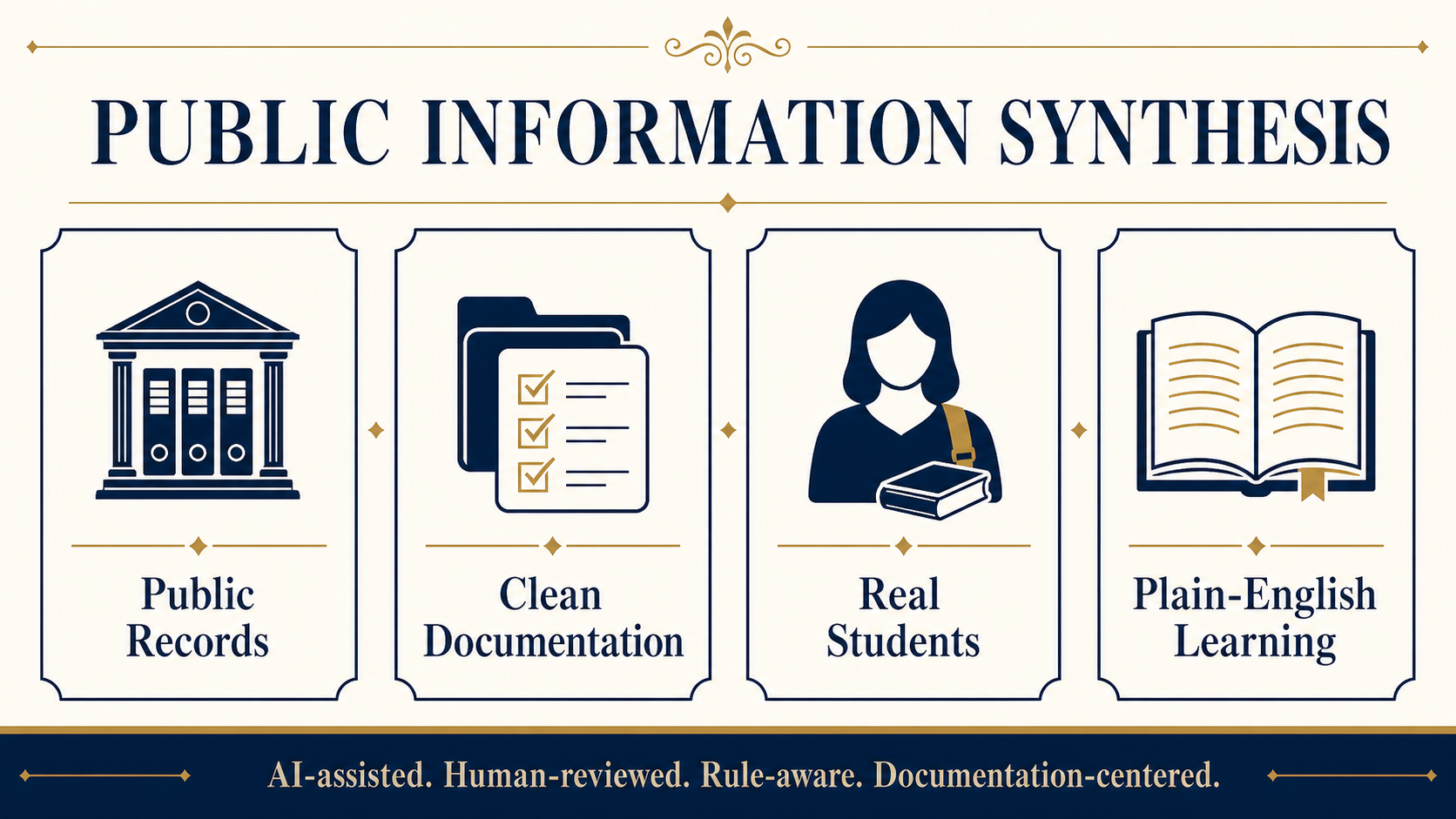
Public-information synthesis framework: public records, clean documentation, real students, and plain-English learning.
Louisville Beauty Academy Welcomes a National Conversation Focused on Affordability, Transparency, and Workforce Opportunity
Louisville Beauty Academy (LBA), located on Bardstown Road in the Highlands of Louisville, Kentucky, welcomes the U.S. Department of Education’s June 29, 2026 final rule on earnings accountability as an important national policy development for students, families, educators, and workforce training providers.
To be absolutely clear, the Department of Education does not name, evaluate, endorse, accredit, or approve Louisville Beauty Academy in this rule. We do not present it as such.
Rather, we believe this federal policy conversation reinforces many of the same educational principles that have guided Louisville Beauty Academy since its founding: affordability, transparency, responsible enrollment, practical workforce preparation, and helping students pursue state licensure without unnecessary financial burden.
A National Conversation That Reflects Long-Standing Principles
The Department’s final rule is designed to strengthen accountability for programs that leave students with federal student-loan debt that may not be supported by sufficient earnings outcomes.
Within its discussion of cosmetology education, the Department acknowledges that many cosmetology programs do not participate in the Federal student-loan program and discusses non-federally funded cosmetology programs with “lower tuition prices” and “similar outcomes”, while helping to supply the cosmetology workforce.
At the same time, the Department’s public announcement emphasizes protecting students from low-earning programs, driving down educational costs, supporting workforce needs, and improving accountability surrounding Direct Loan eligibility and program exemptions.
These are significant national policy themes.
A Needed Conversation About Prestige, Cost, and Student Debt
For years, accreditation has often been presented in beauty education as a marker of prestige. Accreditation can serve important purposes, but it can also be misunderstood by students and families when it is treated as the only measure of educational value.
The Department of Education’s June 29, 2026 final rule helps move the national conversation toward a more practical question: what is the real cost to the student, and does the program support responsible workforce preparation?
For Louisville Beauty Academy, this distinction matters. A state-licensed, lower-cost, non-federally dependent beauty education model should not be dismissed simply because it does not rely on federal student loans. Affordability, transparency, licensure preparation, and reduced student-debt exposure are also important measures of educational value.
In that sense, the conversation is shifting. Prestige alone is not enough. The future of responsible beauty education must also include cost honesty, student protection, workforce alignment, and practical outcomes.
Why This Is a Turning Point
For many years, much of the beauty education marketplace emphasized accreditation, access to federal financial aid, and institutional prestige as primary indicators of quality. The Department of Education’s June 29, 2026 rule expands the national conversation by placing greater emphasis on affordability, student outcomes, transparency, workforce preparation, and responsible educational value.
Louisville Beauty Academy believes students benefit when educational quality is evaluated not only by institutional structure, but also by cost, clarity, licensure preparation, and long-term financial responsibility.
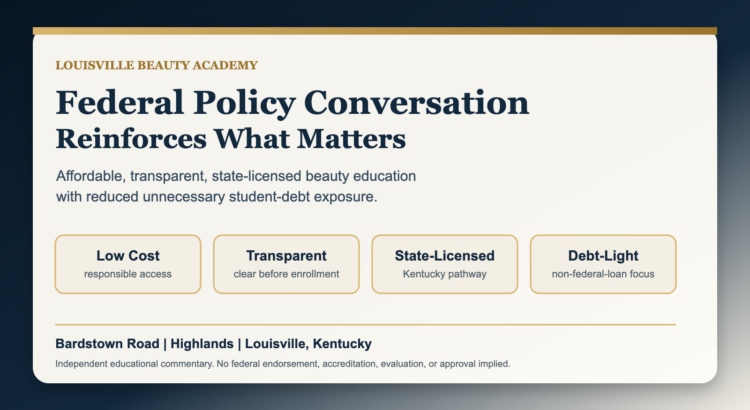
Louisville Beauty Academy’s careful public position: affordability, transparency, state licensure, workforce preparation, and reduced unnecessary student-debt exposure, without implying federal endorsement.
Why This Matters to Louisville Beauty Academy
For Louisville Beauty Academy, this moment is meaningful not because the federal government singled out our institution, but because the broader policy direction aligns with the educational philosophy we have practiced for years.
We have long believed that beauty education should be:
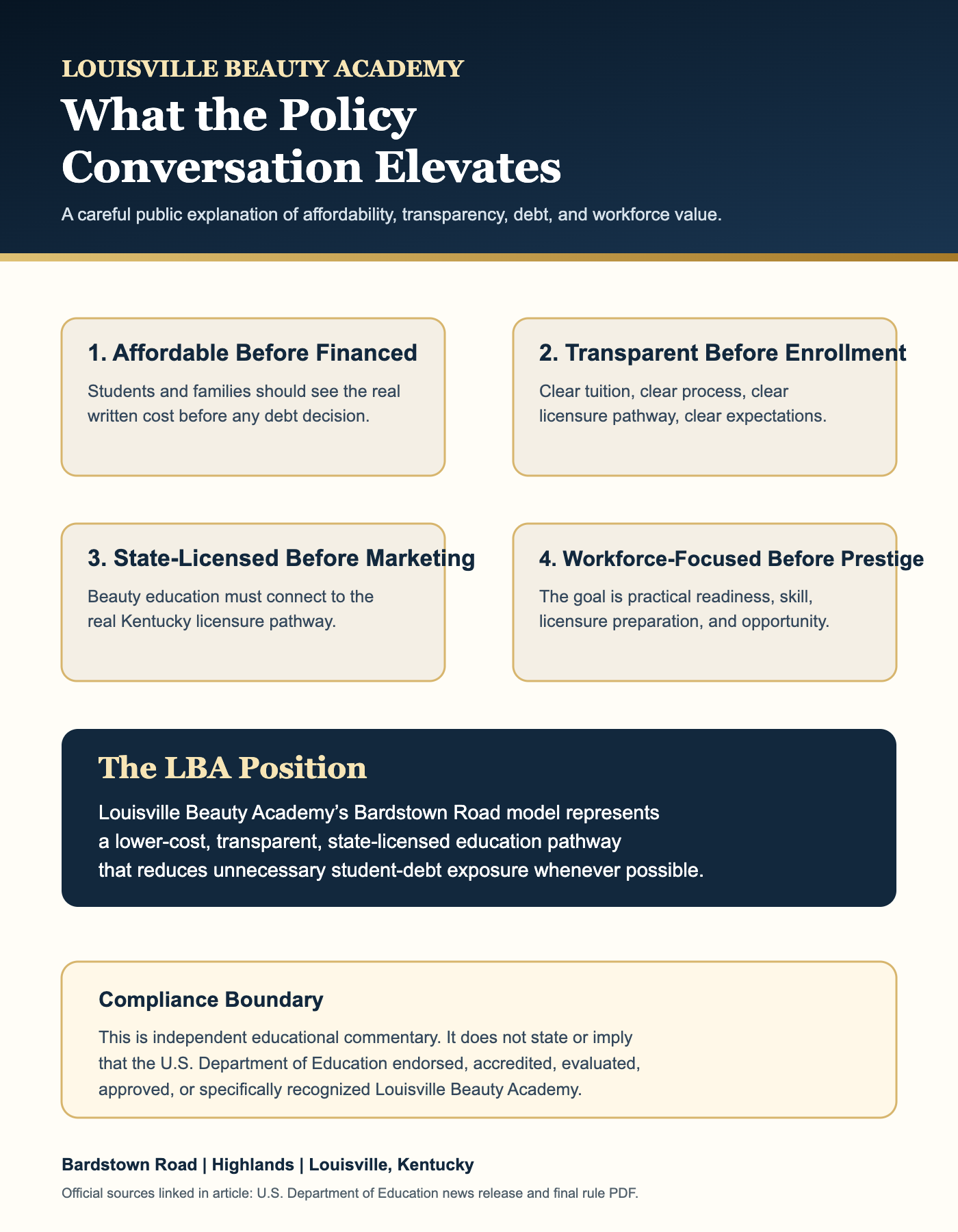
Affordable before it is financed.
Transparent before enrollment.
Practical before promises.
State-licensed before marketing.
Workforce-focused before prestige.
Honest about costs, expectations, and career pathways.
Our objective has never been to encourage unnecessary borrowing. Instead, we strive to provide an educational pathway that allows students to pursue licensed professions with clear expectations, practical skills, and financial responsibility.
Transparency Is a Student Protection Strategy
At Louisville Beauty Academy, transparency is not simply a business practice. It is part of our educational mission.
We believe students deserve to understand:
the total tuition and fees before enrolling;
the licensing requirements established by the Commonwealth of Kentucky;
the difference between state licensure, institutional approval, and accreditation;
expected attendance, training, and examination requirements;
and the financial commitments associated with their education.
Clear information allows students and families to make informed decisions that are appropriate for their own goals and circumstances.
Serving the Workforce Through Accessible Education
Every year, Louisville Beauty Academy serves aspiring beauty professionals from a wide range of backgrounds, including working adults, career changers, recent high school graduates, immigrant and multilingual communities, parents returning to the workforce, and individuals seeking a practical, state-regulated career pathway.
Our mission has always been to expand opportunity through education that is accessible, responsible, and connected to real workforce needs.
A Local Model Within a National Policy Conversation
Louisville Beauty Academy is proud to be part of Louisville’s workforce education ecosystem. From our Bardstown Road location, we serve students who are seeking more than a class schedule. They are seeking a pathway, a skill, a license, and a future they can build with dignity.
The Department of Education’s final rule reminds the education sector that cost, debt, earnings, transparency, and student outcomes cannot be separated. These issues must be discussed honestly.
That is why this national policy moment matters to us.
It reinforces the importance of the model Louisville Beauty Academy continues to build: affordable, transparent, state-licensed, digitally accessible, workforce-connected, and student-centered.
Looking Forward
As conversations surrounding higher education accountability continue to evolve, Louisville Beauty Academy remains committed to continuous improvement, ethical educational practices, regulatory compliance, student success, and workforce development.
We believe affordable, transparent, state-licensed career education benefits not only individual students, but also employers, communities, and the broader economy.
Our commitment remains unchanged:
Provide quality education. Communicate honestly. Prepare students for licensure. Support workforce opportunity. Help students pursue careers without unnecessary financial burden whenever possible.
Important Disclaimer
This article is an independent educational commentary by Louisville Beauty Academy. It does not state or imply that the U.S. Department of Education has endorsed, accredited, evaluated, approved, or otherwise specifically recognized Louisville Beauty Academy. References to the Department’s June 29, 2026 final rule and related public materials are provided solely for educational and informational purposes. Readers are encouraged to review the official federal publications directly.
A Multidisciplinary Research Report by Di Tran University – The College of Humanization
Louisville Beauty Academy is honored to share this Di Tran University research publication, where LBA is presented as an observable case study and pilot environment for Compliance-by-Design education and Regulatory Immersion Learning. All research, analysis, framework development, and publication credit belong to Di Tran University – The College of Humanization Research Team.
The Psychobiological Architecture of Authority, Stress, and Compliance
Neuroendocrine Cascade of the Social-Evaluative Threat
The unannounced arrival of a regulatory enforcement officer within a licensed professional training environment triggers a highly predictable, phylogenetically ancient psychobiological stress response1. In human psychology, the perception of an authority figure armed with the power to penalize, fine, or shut down operations is categorized as a high-stakes social-evaluative threat1. The primary biological mechanism driving this reaction is the rapid activation of the hypothalamic-pituitary-adrenal (HPA) axis and the sympathetic-adrenal-medullary (SAM) system4.
Clinical evaluations using the Trier Social Stress Test (TSST) demonstrate that situations combining social-evaluative threat, uncontrollability, and anticipation consistently produce massive physiological spikes in salivary and blood serum cortisol, alongside rapid elevations in heart rate, blood pressure, and salivary alpha-amylase (sAA)1. This autonomic arousal is accompanied by acute state anxiety, which can be measured clinically via the Generalized Anxiety Disorder 7-item (GAD-7) scale, showing transitions from minimal baseline scores to severe anxiety ranges during active enforcement encounters6.
This systemic response is further illuminated by the Generalized Unsafety Theory of Stress (GUTS), which posits that the physiological stress response is a default state that remains active unless the prefrontal cortex actively perceives specific, reliable signals of safety8. Under the GUTS model, the human brain default-interprets an unfamiliar authority encounter as unsafe8. When an inspector arrives, the absence of an immediate safety context prevents prefrontal-subcortical inhibition, leaving the fight-or-flight default response fully disinhibited8.
This state of generalized unsafety induces cognitive narrowing, wherein the individual’s working memory capacity is severely restricted, limiting their ability to recall complex administrative regulations, access documentation, or communicate professionally8.
Compliance Psychology and Safety Behaviors
To manage this acute discomfort, individuals frequently adopt “safety behaviors”—defined in behavioral psychology as unnecessary, dysfunctional actions taken to prevent, escape from, or reduce the immediate severity of a perceived threat10. In a regulatory enforcement context, safety behaviors manifest as defensive concealment, paper-shuffling, evasion of verbal interaction, or performative compliance designed solely to expedite the inspector’s departure9.
While these behaviors may temporarily alleviate immediate anxiety, they prevent the cognitive reorganization and emotional regulation required for authentic learning10. Instrumental deterrence models of regulation, which rely heavily on punitive sanctions and monitoring, inadvertently reinforce these fear-driven dynamics11. This erodes the regulatee’s intrinsic commitment to professional standards and replaces genuine self-regulation with defensive, risk-avoiding maneuvers11.
Sociocultural and Geographic Dimensions of Government Trust
The baseline psychobiological reaction to regulatory authority is heavily moderated by the cultural, historical, and geographic backgrounds of the individuals undergoing the encounter14. For educational institutions serving diverse student bodies, understanding these nuances is critical to transforming fear into professional agency16.
Comparative Immigrant Perceptions of State Authority
First-generation immigrants often view and experience regulatory bodies through a “dual frame of reference,” evaluating the administrative host environment against the historical performance and corruption levels of their countries of origin17.
The table below provides an analytical comparison of immigrant perceptions of government authority across diverse geopolitical regions of origin:
Region of Origin
Historical / Administrative Context
First-Generation Behavioral Bias
Second-Generation Trust Divergence
United States(Native-Born)
Deep historical values of constitutional due process; moderate institutional trust17.
Relies on procedural safeguards; comfortable requesting legal representation22.
Serves as the baseline standard; highly sensitive to systemic enforcement biases18.
Vietnam
Post-war bureaucratic models; history of centralized control and administrative opacity3.
High outward compliance driven by caution; internal avoidance of state agents3.
Rapid assimilation to US standards; lower tolerance for arbitrary state actions17.
China
Authoritarian administrative state; legacy of pervasive civil and commercial surveillance17.
Severe risk aversion; immediate compliance with state demands to avoid scrutiny17.
Internalizes host-country legal standards; increasingly willing to challenge rules18.
India
Heavily bureaucratic administrative structures; legacy of colonial civil service hierarchies14.
High reliance on credentials and written stamps; comfortable with slow processes14.
Expects rapid, digitized public services; dismissive of archaic paper procedures18.
Africa
Post-colonial instability; history of militarized enforcement in specific regions14.
Acute fear of uniforms and unexpected visits; trauma reactions to unannounced audits16.
Reappraises regulatory bodies through localized socioeconomic and racial lenses18.
Latin America
History of structural corruption, arbitrary enforcement, and police-ICE data integration24.
Pervasive fear that sharing professional data will lead to deportation or profiling24.
Demands structural reform; highly active in labor and civic organizing25.
Eastern Europe
Post-Soviet transitional states; legacy of state-directed commercial and political surveillance17.
Systemic cynicism toward inspectors; expectation that audits require informal resolution17.
Expects absolute institutional transparency and digital accountability18.
High anxiety during unannounced audits; fear of administrative profiling18.
Active pushback against structural bias; values-driven engagement with laws18.
This cross-regional analysis demonstrates that immigrant students do not represent a homogenous group25. First-generation immigrants often exhibit “over-confidence” in host institutions early in their residency because they compare them to low-performing home-country institutions17. However, this trust quickly degrades due to acculturative stress, linguistic barriers, and fear of data-sharing between local licensing boards and federal immigration enforcement agencies26. This makes unannounced inspections a potential source of acute trauma24.
Geographic Realities of Rural Communities and Centralized Regulation
In rural areas such as Central Appalachia, the Midwest, and the deep South, the relationship with regulatory agencies is shaped by geographic distance and historical neglect29.
The table below contrasts geographic and cultural interactions with regulators across specific rural landscapes:
Rural Region
Geographic & Infrastructure Reality
Cultural & Historical Context
Dynamic with Regulatory Authorities
Kentucky(General Rural)
High distance from state agencies; limited transit; low local budgets31.
Deep emphasis on local self-reliance and regional independence31.
Skepticism of centralized state rules; preference for relational enforcement32.
Appalachia(Central/Eastern)
Severe geographic isolation; systemic neglect of public water/utility infrastructure30.
Generational trauma from corporate “company towns” and corrupt local police15.
Deeply entrenched moral distrust of state agents; views audits as economic extraction15.
Midwest(Agricultural Belt)
Vast distances between county seats; heavy reliance on USDA/state agency programs29.
Strong family-farm heritage; high valuation of property rights and local governance15.
Respects agricultural standards but resists environmental or labor-related mandates15.
Southern States(Rural Lowlands)
Remote county clinics; low density of administrative oversight32.
Historically conservative states-rights views; reliance on religious and civic networks15.
Suspicion of federal or urban-directed rules; strong reliance on informal compliance32.
In former coal-mining regions of Appalachia and the Midwest, trust in local and state government is distinctively low15. Decades of political neglect have created “geographies of alienation,” where residents avoid municipal systems (such as drinking untreated spring water instead of tap water) because they do not trust the state to protect them33. Consequently, unexpected inspections are frequently perceived as intrusive state targeting, causing rural practitioners to react with defensive avoidance or relational hostility15.
Behavioral Psychology of Normalization, Exposure, and Self-Efficacy
To transform these deeply ingrained stress responses, professional training programs can implement behavioral models designed to transition students from fear to competence38.
In clinical behavioral psychology, exposure therapy is established as a highly effective model for treating anxiety and avoidance behaviors10. The neurological engine driving exposure therapy is habituation: the gradual diminution of a physiological response to a stimulus when that stimulus is repeatedly presented in a safe, non-punitive environment10.
By systematically exposing students to simulated audits, peer reviews, and unannounced mock inspections, educators can guide them to correct their threat expectations10. The brain learns that the regulator’s presence does not inevitably lead to administrative punishment or economic ruin, allowing the sympathetic nervous system to return to baseline levels during active inspections10.
Cultivating Self-Efficacy Through Albert Bandura’s Social Learning Theory
According to Albert Bandura’s social cognitive theory, self-efficacy—the belief in one’s capability to execute courses of action required to manage prospective situations—is the primary determinant of behavioral adaptation under stress38. Bandura posits that self-efficacy is constructed through four distinct channels:
Mastery Experiences: Engaging in hands-on, successful compliance actions, such as maintaining accurate biometric and manual attendance logs daily38.
Vicarious Experiences (Learning by Observation): Watching clinical mentors and educators interact calmly, transparently, and professionally with state board inspectors23.
Verbal Persuasion: Receiving realistic, constructive feedback from instructors during mock audits, which reinforces the student’s compliance capabilities38.
Physiological State Reframing: Learning to interpret physical responses (e.g., increased heart rate) not as a signal of panic, but as a helpful rush of focus and energy4.
By structuring the educational environment so that students repeatedly witness and participate in compliant, procedurally fair interactions with regulators, schools can build a sense of professional agency and psychological safety22. Over time, this shifts the student’s posture from fear-based avoidance to confident, values-aligned self-regulation11.
The Historical Precedent of Experiential and Situated Pedagogy
The integration of real-world compliance activities into vocational curricula is supported by a rich history of experiential and situated educational models39.
Progressive Education and Experiential Learning
John Dewey’s progressive educational philosophy rejected the traditional model of treating students as passive vessels for lecture-based memorization39. Dewey argued that genuine education occurs through active, real-world experiences where students solve problems within their social and physical environments39. This philosophy was formalized by David Kolb into his Experiential Learning Model, which maps a continuous, four-stage learning cycle:
┌────────────────────────────────────────┐ │ Concrete Experience │ │ (Observing/conducting live audit) │ └───────────────────┬────────────────────┘ │ ▼ ┌────────────────────────────────────────┐ │ Reflective Observation │ │ (Deconstructing the audit via an AAR) │ └───────────────────┬────────────────────┘ │ ▼ ┌────────────────────────────────────────┐ │ Abstract Conceptualization │ │ (Mapping experience to administrative)│ │ ( statutes and regulations )│ └───────────────────┬────────────────────┘ │ ▼ ┌────────────────────────────────────────┐ │ Active Experimentation │ │ (Applying corrective actions in clinic)│ └────────────────────────────────────────┘
By anchoring learning in the concrete experience of a regulatory encounter, RIL ensures that abstract administrative laws (such as KRS 317A or 201 KAR 12) are permanently integrated into the student’s daily physical habits39.
Situated Cognition and Communities of Practice
Jean Lave and Etienne Wenger’s situated learning theory suggests that learning is a process of socialization into a distinct “community of practice”49. Novices enter at the periphery of the community, performing simple, low-risk tasks49. As they acquire the language, tools, and social norms of the profession, they move toward full participation49.
When a student participates in a live regulatory encounter alongside an experienced mentor, they are undergoing cognitive apprenticeship46. The instructor makes their clinical reasoning visible, scaffolding the student’s participation until they can confidently manage compliance tasks independently40.
Operational Precedents: Toyota Production System and After Action Reviews
The business and military sectors provide highly structured frameworks for integrating real-world practice with continuous optimization:
The Toyota Production System (TPS): Built on the twin pillars of Just-in-Time and Jidoka (automation with a human touch), TPS empowers front-line workers to stop the production line immediately upon detecting an abnormality53. By combining human craftsmanship with technological controls, TPS builds a culture of continuous incremental improvement (Kaizen)53. Every error is treated not as a cause for blame, but as a valuable opportunity to optimize standard work55.
The military After Action Review (AAR): Developed by the United States Army in the 1970s, the AAR is a structured, post-training debrief where leaders and soldiers systematically analyze what was planned, what actually occurred, why it occurred, and how the unit can adapt for future success57. The AAR focuses on accountability going forward, creating an organizational culture built on transparency, candor, and continuous collective learning59.
Multi-Industry Regulatory Normalization and Comparative Matrix
High-risk, highly regulated industries have long recognized that separating compliance activities from active training increases operational risk and anxiety61.
The matrix below compares regulatory normalization practices across 18 distinct fields of professional and vocational practice:
Fire run sheets; equipment maintenance tracking logs.
Across these industries, incorporating audits into active training reduces operational anxiety and builds self-efficacy44. When compliance is integrated directly into standard training protocols, professionals view inspections not as a stressful external threat, but as a normal and valuable quality-assurance process43.
The Mechanics of Complaint Systems and Ethical Responses
A common source of regulatory friction is the administrative complaint system, which is designed to protect consumer safety but is often vulnerable to misuse3.
Administrative complaints are filed by distinct stakeholders, including:
Consumers: Reporting actual or perceived harm, poor results, or sanitation violations64.
Employees: Reporting labor disputes, safety issues, or non-compliant school practices66.
Competitors (Competitive Harassment): Weaponizing administrative boards to drain the financial and emotional resources of business rivals3.
Anonymous Sources: Initiated to trigger a surprise investigation without facing cross-examination, which is why some state boards legally require signed writings to prevent harassment3.
Substantiation Rates
Federal regulatory databases show that only about 19% of investigated administrative complaints result in a formal deficiency citation66. Conversely, within highly structured, internal corporate complaint hotlines, substantiation rates reach approximately 53% for identified reporters and 47% for anonymous filings70. This gap suggests that many external administrative complaints are unsubstantiated or driven by non-compliance factors, such as competitor harassment or civil disputes3.
Ethical Response Protocols and Procedural Safeguards
Under administrative law systems (such as 201 KAR 12:190 in Kentucky), licensees have clear due process rights when responding to complaints:
The Written Notice Mandate: Regulatory enforcement cannot be based on verbal directives or informal instructions69. The licensee is entitled to a formal, signed written complaint detailing the exact statutes violated and the factual allegations69.
The Response Period: Licensees are provided a statutory response window (typically 10 to 30 days) to submit a formal, written explanation or correction before disciplinary hearings begin69.
The Right to Cure: Under modern progressive regulation statutes, Alternative Compliance Pathways allow licensees to resolve non-safety record-keeping issues through 30-day “Correction Orders” without facing immediate fines or license suspension3.
Sovereign Immunity and Nullity: If an administrative board issues an enforcement order without adhering to statutory procedures (such as failing to provide written notice or utilizing unlicensed proctors), the resulting order may be declared void ab initio (invalid from the inception)3. This status legally entitles the licensee to a full refund of any fines paid under the voided order3.
Case Study: Louisville Beauty Academy’s Compliance-by-Design Model
Louisville Beauty Academy (LBA), an immigrant-led beauty college based in Louisville, Kentucky, serves as an active case study for integrating regulatory compliance into vocational education16.
Operational and Compliance Architecture
Led by founder Di Tran, LBA operates under the authority of the Kentucky Board of Cosmetology (KBC), offering state-licensed courses in Cosmetology (1,500 hours), Esthetics (750 hours), and Nail Technology (450 hours)45.
To protect student hours and build regulatory trust, LBA maintains a robust compliance infrastructure:
Dual attendance tracking: Under 201 KAR 12:082 § 3(1), LBA maintains both a digital biometric fingerprint timekeeping system and manual paper sign-in sheets at all times45. This dual-verification ensures complete data redundancy and absolute tracking integrity45.
Instructional hour caps: In compliance with 201 KAR 12:082 § 4(4), LBA strictly caps credited instruction at 8 hours per day and 40 hours per week45. Any additional hours are logged transparently but remain uncredited, serving as evidence of voluntary study45.
Instruction over commerce: Under KRS 317A.130(1), LBA operates solely for education, focusing on mannequin-based skill mastery45. Public model practice is voluntary, ensuring that student clinics are not used as commercial revenue drivers45.
Operational Strengths and Systemic Vulnerabilities
An objective evaluation of LBA’s model reveals both unique strengths and significant operational vulnerabilities:
Unique Strengths
Superior Traceability and Integrity: The dual attendance system virtually eliminates timecard manipulation, creating a highly reliable administrative record45.
Financial and Regulatory Insulation: By operating as a state-licensed, non-accredited institution with a pay-as-you-go payment model, LBA avoids federal student loan programs72. This structural insulation protects the school from federal gainful employment metrics that undercount actual beauty industry earnings72.
Multilingual Inclusivity: Offering instruction and study materials in English, Vietnamese, and Spanish reduces barriers for underserved, low-income, and immigrant student groups16.
Systemic Vulnerabilities
High Adversarial Tension with Regulators: LBA’s public records reveal a highly defensive relationship with the KBC3. Allegations concerning “targeted hyper-fining” against minority salons, “shadow testing,” procurement fraud, and immediate-closure orders under SB 22 suggest deep operational friction with the state board3.
Risk of Student Stress Transfer: While LBA’s “Gold Standard Guide” aims to reduce fear, exposing students to active, legalistic confrontations (such as utilizing a 30-to-60 minute verification pause or video recording inspectors) may inadvertently heighten student anxiety23. For students who have experienced historical government trauma, observing intense institutional battles may trigger, rather than reduce, autonomic distress8.
Resource-Intensive Over-Compliance: Maintaining dual records, AI-driven compliance checks, and constant legal reviews increases administrative costs72. This structural burden is difficult for average-sized vocational schools to sustain without a highly efficient tuition and funding model72.
Important Policy Analysis: The Power of Administrative Records
In public administration and corporate risk management, written records are the primary tool for establishing organizational accountability and protecting constitutional rights9.
The Psychology of Written Correspondence
In high-stress regulatory environments, relying on verbal agreements or informal warnings increases ambiguity and risk3. The “verbal warning trap” occurs when an inspector issues an informal directive that is not backed by a written citation3. The business owner may attempt to comply with the verbal instruction, only to face a formal penalty later for non-compliance with a different, unwritten interpretation of the rule3.
Documenting every interaction through time-stamped, written correspondence provides critical protections:
Establishes Institutional Memory: Shifting knowledge from individual memory to structured, digital records reduces reliance on specific personnel and supports continuous improvement9.
Creates a Legal Audit Trail: In administrative hearings, undocumented actions are legally presumed not to have occurred63. A clear written record of compliance activities provides defensive protection63.
Protects Due Process: Requiring all instructions and findings to be delivered in writing ensures that administrative decisions are objective, consistent, and legally reviewable23.
Post-Inspection Factual Correspondence Policy
A robust risk management strategy includes sending a factual, professional follow-up email immediately after an inspection74. This correspondence does not concede violations or express defensiveness23. Instead, it establishes an objective, written record of what occurred during the encounter23.
This practice aligns with modern administrative guidelines (such as KRS 13B in Kentucky), which entitle parties to written clarification of all rulings and instructions23.
The Regulatory Immersion Learning (RIL) Educational Framework
To systematically integrate regulatory compliance into professional education, institutions can transition from traditional, classroom-bound models to the Regulatory Immersion Learning (RIL) framework39.
Performance and Psychobiological Outcomes Comparison
The table below contrasts the educational and psychological outcomes of traditional lecture models with the live-immersion RIL framework:
Measurement Parameter
Traditional Classroom Model
Regulatory Immersion Learning (RIL) Model
Knowledge Retention
Abstract, rapid decay after passing written examinations72.
Long-term retention; rules are anchored to physical, memorable clinical actions50.
Confidence & Self-Efficacy
Low; students feel unprepared for unannounced, high-stakes state audits38.
High; repetitive mock audits and guided exposure build professional agency38.
Professional Readiness
Focuses on textbook compliance; leaves students vulnerable to performative rules45.
Instills continuous, standard compliance habits; students are prepared for day-one practice2.
Critical Thinking
Limited to linear, written test-prep scenarios40.
High; students dynamically assess real-world hazards and procedural rules46.
Stress Reduction
High baseline cortisol and anxiety during active enforcement encounters4.
Rapid autonomic recovery; regulatory encounters are normalized and expected10.
Long-Term Compliance
Performs under external pressure; prone to shortcuts in private salons11.
Self-regulatory compliance driven by internalized professional and safety values11.
Limits and Required Empirical Evidence for Broader Adoption
While the RIL model is conceptually sound, its widespread implementation is limited by several factors:
Inspector Resistance: Some state inspectors may view recording, active questioning, or requests for written instructions as administrative resistance, which could increase regulatory tension23.
Resource Constraints: Managing dual-tracking systems, executing weekly mock audits, and maintaining digital compliance platforms require significant administrative time and investment45.
Trauma-Sensitivity Risks: For students who have experienced historical government trauma, sudden exposure to active regulatory disputes—even with mentors—could trigger survival responses that hinder learning24.
To support broader adoption of the RIL model, empirical research should focus on the following:
Objective stress-marker evaluations: Measuring salivary cortisol and heart-rate variability (HRV) in students during mock and real audits to confirm systemic desensitization4.
Longitudinal compliance tracking: Monitoring graduates’ compliance and citation rates over their first five years in business77.
Linguistic and accessibility studies: Measuring compliance learning speeds in multilingual classrooms when legal statutes are paired with visual, AI-supported tools78.
Practical Institutional Blueprints and Curricular Deliverables
To transition the theoretical RIL framework into an operational model, schools can implement the following curricula, standard operating procedures, and professional communication templates.
================================================================================= COURSE CODE: RIL-101 TITLE: REGULATORY LAW, INFECTION CONTROL, AND ADMINISTRATIVE SAFETY IN CLINIC ================================================================================= WEEK 1: INTRODUCTION TO STATE ADMINISTRATIVE LAW & EXECUTIVE ETHICS – Coursework: KRS Chapter 317A, KRS Chapter 11A, and 201 KAR 12:082 [cite: 51, 72]. – Practical: Biometric timekeeping orientation; signature sheet verification. – Exercise: Reconstructing a timecard error; drafting an administrative correction log.
WEEK 2: DISINFECTION CHEMISTRY & PUBLIC HEALTH PRINCIPLES – Coursework: OSHA Hazard Communication Standard; Safety Data Sheet (SDS) interpretation. – Practical: Mixing chemical solutions according to manufacturer instructions. – Exercise: Mock chemical spill drill; evaluating workstation contact times [cite: 39, 80].
WEEK 3: DECONSTRUCTING THE SOCIAL-EVALUATIVE THREAT – Coursework: Human physiology of stress; the HPA axis and cortisol spikes. – Practical: Controlled deep-breathing drills; mental toughness and stress-reframing. – Exercise: Simulated unannounced instructor-led safety sweeps under pressure.
WEEK 4: THE PSYCHOLOGY OF DOCUMENTATION AND TRACEABILITY – Coursework: Why undocumented procedures fail; technical communication standards [cite: 9, 63]. – Practical: Operating daily sanitation logs; validating inventory tracking systems [cite: 44]. – Exercise: Structured peer reviews of workstation compliance documentation.
WEEKS 5-8: COGNITIVE APPRENTICESHIP IMMERSION (CLINIC ENCOUNTERS) – Coursework: Jean Lave’s situated cognition; the six dimensions of CAM [cite: 40, 46, 49]. – Practical: Observing instructors model compliance during simulated audits [cite: 23, 52]. – Exercise: Roleplaying as inspector, manager, and student; modeling verbal etiquette scripts.
WEEKS 9-12: PEER-AUDITING SYSTEMS & KAIZEN LABS – Coursework: Lean manufacturing and the Toyota Production System; Kaizen theory [cite: 53, 81]. – Practical: Conducting weekly mock inspections on other student workstations. – Exercise: Mock “tracer surveys” using Joint Commission methods.
WEEKS 13-15: STRUCTURAL COMPLAINT SIMULATIONS – Coursework: Understating complaint systems; due process and rights to respond [cite: 66, 69]. – Practical: Responding to simulated consumer complaints using factual, written logs. – Exercise: Draft responses to KBC-style complaints under 201 KAR 12:190.
WEEK 16: CAPSTONE EXPERIENTIAL ASSESSMENT & AFTER ACTION REVIEWS – Coursework: Continuous improvement and post-audit learning loops [cite: 57, 60, 82]. – Practical: Conducting a complete After Action Review (AAR) of the course’s mock audits [cite: 57, 59]. – Exercise: Final practical examination; managing a surprise, unannounced mock inspection. =================================================================================
Faculty Guide: Step-by-Step Instructional SOP for Live Audits
================================================================================= SOP NUMBER: RIL-INST-04 TITLE: MANAGING LIVE REGULATORY ENCOUNTERS AS INSTRUCTIONAL CLASSROOMS ================================================================================= 1. OBJECTIVE: To ensure that when a state regulatory inspector arrives, faculty members remain calm, protect due process rights, and actively use the encounter as a live learning experience for observing students.
2. PREPARATION: Keep a laminated copy of the LBA “Inspection Transparency & Verification Rights Notice” at the front desk and at all active instruction areas.
3. WHEN THE INSPECTOR ARRIVES: A. STEP 1: INITIAL RECEPTION – Welcome the inspector politely and professionally. – Do NOT halt active classroom instruction or panic [cite: 23, 83]. – Hand the inspector a copy of the LBA Transparency Notice.
B. STEP 2: VERBAL PROTOCOL (SAY ALOUD) “Good morning! We welcome your visit and appreciate your work. We just follow a standard compliance process to make sure everything is accurate and fair. Here’s our Inspection Transparency & Verification Rights Notice. It simply explains that under Kentucky law, we’re allowed to take about 30 to 60 minutes to review any request or rule, record the visit for documentation, and verify things with our compliance team before we respond or sign anything. This helps us stay consistent with KRS 13B and 317A — and it keeps everything transparent for both sides. We’ll cooperate fully — we just want to make sure everything we do is right by the law and clear for our records. Thank you!”
C. STEP 3: STUDENT POSITIONING – Direct students working in the immediate area to pause and observe. – Quietly explain the inspector’s actions to nearby students (e.g., “The inspector is verifying that all student licenses are posted at active workstations according to KBC regulations”) [cite: 23, 51, 71].
D. STEP 4: RECORDING & DOCUMENTATION – Activate a clean, high-definition digital recording device. – Explicitly reference Kentucky’s one-party consent statute (KRS 526.020) and the school’s educational duty under KRS 317A.130(1)(f). – If an inspector makes an observation or deficiency claim, request that they reduce the instruction or legal citation to writing.
E. STEP 5: DECONSTRUCTION DEBRIEF – Once the inspector departs, call an immediate 15-minute student assembly. – Conduct a mini After Action Review (AAR) to analyze what went well, what went less well, and how the school will adapt [cite: 57, 60, 80]. =================================================================================
Student Handbook Addendum: Safety & Regulatory Rights Notice
================================================================================= SECTION 8.4: YOUR COMPLIANCE RESPONSIBILITIES AND DUE PROCESS RIGHTS ================================================================================= As a student training toward state licensure, you are a professional-in-training responsible for protecting public health and safety. Our academy operates under a “Compliance-by-Design” framework, meaning that safety, state law, and regulatory standards are integrated into your daily habits.
YOUR CORE COMPLIANCE RESPONSIBILITIES: 1. DAILY TIMESTAMPS: You must record your attendance using the biometric fingerprint scanner and manual sign-in sheet every time you enter or exit. 2. SANITATION MASTERY: You must maintain a clean, disinfected workstation at all times, following all sanitation procedures under 201 KAR 12 [cite: 39, 51]. 3. FACTUAL ACCOUNTABILITY: You are training to understand that your progress logs and clinic hours represent legally binding evidence submitted to the state.
YOUR CONSTITUTIONAL AND ADMINISTRATIVE RIGHTS DURING INSPECTIONS: 1. THE RIGHT TO A CALM RESPONSE: You are never required to panic or rush when an inspector arrives. You are legally entitled to a 30-to-60 minute window to verify regulatory rules and retrieve correct records before answering. 2. THE RIGHT TO WRITTEN INSTRUCTIONS: Under KRS 13B.090(7), you have the right to request that any inspector directive or cited deficiency be provided in clear, verifiable writing. 3. THE RIGHT TO PROFESSIONAL RECORDING: Under KRS 526.020, you have the right to record audio or video of regulatory encounters for compliance training. 4. THE RIGHT TO AN ETHICAL REMEDY: If an administrative warning or complaint is issued, you have the right to written clarification, explanation, and a formal opportunity to respond and correct errors. =================================================================================
Post-Inspection Verification Letter Template
================================================================================= DATE: [Insert Date] TO: Joni Upchurch, Executive Director, Kentucky Board of Cosmetology [cite: 45, 69] FROM: Compliance Office, Louisville Beauty Academy SUBJECT: POST-INSPECTION COMPLIANCE VERIFICATION & ADMINISTRATIVE RECORD ================================================================================= Dear Director Upchurch,
This correspondence is submitted to establish an accurate administrative record of the routine facility inspection conducted at Louisville Beauty Academy (Location: [Insert Campus Address]) on [Insert Date] at approximately [Insert Time].
We appreciated welcoming Inspector [Insert Name] to our campus. In alignment with our educational mission under KRS 317A.130(1)(f), our students actively observed the inspection process as part of our Regulatory Immersion Learning curriculum.
During the walkthrough, the following observations and corrections were noted: 1. WORKSTATION SANITATION: All active student stations were found in compliance with disinfection procedures under 201 KAR 12 [cite: 39, 51]. 2. DUAL ATTENDANCE RECORDS: Daily biometric and manual attendance logs were verified, confirming complete record alignment under 201 KAR 12:082 § 3. 3. CITED OBSERVATION / ADMONISHMENT: Inspector [Insert Name] noted a compliance discrepancy regarding [Insert Specific Issue, e.g., chemical container labeling], citing regulation [Insert Exact Regulation Code] [cite: 51, 69].
ADMINISTRATIVE DUE PROCESS & SYSTEMIC PLAN OF ACTION: A. IN-THE-MOMENT CORRECTION: LBA instructors immediately corrected the noted container labeling discrepancy in the presence of the inspector to ensure compliance [cite: 74]. B. REQUEST FOR WRITTEN DOCUMENTATION: In accordance with KRS 13B.090(7), we request that any official board rulings or instructions regarding this observation be reduced to writing and emailed to study@louisvillebeautyacademy.net. C. STATUTORY CURE WINDOW: If the Board intends to pursue formal administrative actions or agreed orders, we formally request our 30-day statutory cure window to respond with written evidence of systemic corrections.
Louisville Beauty Academy remains committed to transparency, open communication, and the collaborative maintenance of rigorous public-safety standards [cite: 23, 76, 84].
Respectfully submitted,
___________________________________________ Di Tran, Founder & CEO, Louisville Beauty Academy [cite: 73] With the LBA Digital and Compliance Leadership Team [cite: 83] =================================================================================
After-Action Review (AAR) Discussion Protocol
================================================================================= PROTOCOL CODE: RIL-AAR-01 TITLE: FACILITATING CLINICAL AFTER-ACTION REVIEWS POST-INSPECTION ================================================================================= AAR TIMING: To be conducted within 2 hours of inspector departure. PARTICIPANTS: Active students, supervising instructors, and compliance managers [cite: 59, 82]. FACILITATOR RULES: No finger-pointing or blame; focus on forward-looking accountability.
DISCUSSION QUESTIONS FLOW:
1. WHAT WAS THE PLAN? (Core Strategy Check) – What administrative regulations and sanitation codes were we trying to demonstrate under KRS 317A and 201 KAR Chapter 12? – How was our team prepared to receive the inspector professionally?
2. WHAT ACTUALLY OCCURRED? (Factual Reconstruction) – Walk through the walkthrough chronologically. What did the inspector look at first? [cite: 2, 57] – How did the team react? Did anyone panic or deploy avoidance behaviors? [cite: 1, 10] – What compliance deficiencies or positive practices were noted? [cite: 43, 44]
3. WHY DID IT HAPPEN THAT WAY? (Root-Cause Analysis) – If an error was noted, did it stem from a lack of knowledge, an unclear workstation routine, or stress-induced cognitive narrowing? [cite: 4, 8, 40] – If our team reacted calmly, what specific training or safety signals allowed us to maintain prefrontal-cortisol control? [cite: 4, 8, 41]
4. WHAT WILL WE DO NEXT TIME? (Action & Adaptation Plan) – What specific Standard Operating Procedures must be updated or clarified? [cite: 56, 60] – Who is responsible for tracking corrective steps, and when will they be done? [cite: 60, 63] – How can we share these lessons learned with our broader community of practice? [cite: 49, 59] =================================================================================
Synthesized Strategic Conclusions
By analyzing the provided empirical data, sociological studies, behavioral psychological frameworks, and regulatory legal structures, researchers can synthesize several key conclusions regarding the feasibility of the Regulatory Immersion Learning (RIL) model.
┌────────────────────────────────────────┐ │ ESTABLISHED EVIDENCE │ │ Rote memorization alone does not │ │ reduce acute autonomic panic during │ │ unannounced state inspections.│ └───────────────────┬────────────────────┘ │ ▼ ┌────────────────────────────────────────┐ │ EMERGING EVIDENCE │ │ Exposure, mock tracer reviews, and │ │ mentorship significantly lower stress│ │ and improve compliance [cite: 44, 46, 62].│ └───────────────────┬────────────────────┘ │ ▼ ┌────────────────────────────────────────┐ │ PRACTICAL OBSERVATION │ │ LBA’s dual-verification system and │ │ Gold Standard protocol protect │ │ student hours and rights [cite: 23, 45].│ └───────────────────┬────────────────────┘ │ ▼ ┌────────────────────────────────────────┐ │ HYPOTHESIS │ │ RIL will produce long-term self- │ │ regulation, resulting in lower state │ │ violations for graduates [cite: 11, 39].│ └────────────────────────────────────────┘
Established Evidence
The sudden arrival of a regulatory inspector is a social-evaluative threat that triggers immediate sympathetic arousal and a cortisol spike in unprepared individuals1.
Traditional, lecture-based memorization of administrative rules does not prevent stress-induced cognitive narrowing during unannounced enforcement events4.
First-generation immigrants demonstrate a “dual frame of reference,” exhibiting high baseline trust in public institutions that erodes over time and across generations due to acculturative stress17.
For marginalized and historically trauma-exposed populations, unexpected regulatory encounters can trigger survival responses if state agents are perceived as threatening or punitive8.
Meticulous, contemporaneous written documentation significantly reduces organizational risk, establishes institutional memory, and serves as vital defensive evidence in administrative hearings9.
Emerging Evidence
Incorporating systematic exposure therapy, mock tracer audits, and pre-inspection walkthroughs into technical training decreases client/student anxiety and improves quality-assurance outcomes43.
Cognitive apprenticeship models—wherein students observe experienced mentors model compliance and professional communication during inspections—accelerate the development of a strong professional identity12.
Process-based regulatory systems, built on Tom Tyler’s procedural justice principles (dignity, neutrality, voice, and trust), are superior to instrumental deterrence models because they nurture intrinsic, voluntary compliance11.
When individuals participate in simulated After Action Reviews (AARs) post-audit, they demonstrate improved retention of safety standards and a stronger commitment to forward-looking operational corrections57.
Practical Observations
Louisville Beauty Academy’s dual biometric and manual attendance tracking systems protect student hours, prevent data loss, and verify the accuracy of submitted certification records45.
The school’s low-cost, pay-as-you-go financial model insulates students from high student loan debt while protecting the school from federal gainful-employment penalties72.
While the academy’s “Gold Standard Guide” asserts critical due process rights (such as the KRS 13B verification pause and Kentucky’s KRS 526.020 one-party recording law), it coexists with significant legal tension and conflict with state regulators3.
Using mannequins as the primary instructional tool, in accordance with KRS 317A.130(1), ensures that student clinics remain educational spaces rather than commercial revenue-generating salons45.
Hypotheses
Students who complete their vocational training under a formalized Regulatory Immersion Learning (RIL) framework will exhibit lower state board violations and fewer compliance issues during their first five years of active professional practice39.
Integrating AI-assisted, human-verified document synthesis into vocational training programs will lower administrative costs, decrease error rates, and improve the school’s regulatory standing9.
Cultivating compliance-by-design training models within historically marginalized or immigrant-led professional communities will systematically reduce their vulnerability to competitor harassment and predatory fines, leading to higher long-term small-business survival rates2.
A qualitative study exploring the perinatal experiences of social stress among first- and second-generation immigrant parents in Quebec, Canada – PMC, https://pmc.ncbi.nlm.nih.gov/articles/PMC11370249/
Investigating the role of clinical exposure on motivational self-regulation skills in medical students based on cognitive apprenticeship model – PMC, https://pmc.ncbi.nlm.nih.gov/articles/PMC10921607/
Democratizing Specialized Care in the Digital Age: Project ECHO as a Learning Environment for Continuing Professional Development – MDPI, https://www.mdpi.com/2227-9032/14/7/824
GAO-11-280 Nursing Homes: More Reliable Data and Consistent Guidance Would Improve CMS Oversight of State Complaint Investigatio, https://www.gao.gov/assets/gao-11-280.pdf
GAO-11-280, Nursing Homes: More Reliable Data and Consistent Guidance Would Improve CMS Oversight of State Complaint Investigations, https://www.gao.gov/assets/a317518.html
This publication is an educational and research work developed by Di Tran University – The College of Humanization through its interdisciplinary Research Team, with contributions from faculty, practitioners, editors, AI-assisted research tools, and human review.
Louisville Beauty Academy is presented as an observable case study to examine educational practices, compliance systems, workforce development, and human-centered learning. The inclusion of Louisville Beauty Academy does not imply that every concept, framework, or hypothesis presented has been independently validated through peer-reviewed empirical research.
Educational Purpose
This publication is intended solely for educational, research, policy discussion, and professional development purposes. It should not be interpreted as legal advice, regulatory guidance, or professional counsel. Readers should consult applicable statutes, regulations, qualified legal counsel, and relevant regulatory authorities before making legal, compliance, or business decisions.
Evidence Statement
This publication integrates peer-reviewed literature, publicly available government resources, historical analysis, educational theory, organizational research, and practical observations. Where appropriate, distinctions are made between established evidence, emerging evidence, practical observations, and research hypotheses. Future empirical research is encouraged to validate or refine the proposed concepts.
Research concept, synthesis, editorial direction, and publication coordinated by the Di Tran University Research Team.
Louisville Beauty Academy is honored to share this publication in support of workforce education, professional ethics, safety, sanitation, regulatory understanding, lifelong learning, and continuous improvement. We gratefully acknowledge Di Tran University – The College of Humanization for leading the research, analysis, and development of this work.
Beauty School Without the Debt Trap: A Humanized Model for Practical Education, Licensure, and Student Freedom
Louisville Beauty Academy is honored to be featured in the new book Beauty School Without the Debt Trap: A Humanized Path to Practical Education, Licensure, and Student Freedom, published through Di Tran University Press and the College of Humanization.
This recognition matters because beauty education is not a small subject. For many working adults, immigrant families, first-generation learners, career changers, and parents rebuilding their lives, beauty school is not merely a program. It is a doorway into licensure, dignity, income, service, entrepreneurship, and professional identity.
That doorway must be protected.
The book identifies Louisville Beauty Academy as a practical proof model for a different kind of beauty education: lower-cost, documentation-first, state-licensed, student-protective, and humanized. This does not mean education is free. It does not mean every loan is wrong. It does not mean every expensive school is dishonest. It means the public conversation must become more serious.
The true issue is not whether beauty school has cost. Real education has cost. Schools have rent, instructors, supplies, sanitation obligations, insurance, administrative systems, regulatory duties, technology, and human responsibilities. The issue is whether the student clearly understands the cost, the records, the expectations, the licensure pathway, and the relationship between educational commitment and real professional outcome.
When that clarity is missing, hope can become financial capture.
When that clarity is present, education becomes human protection.
The Debt Trap Is Not Only Debt
A debt trap begins when a student is asked to make a life-changing commitment without enough written clarity, realistic math, protective documentation, and honest connection between cost and outcome.
It can begin with a beautiful tour, a warm promise, a rushed signature, a confusing contract, a hidden fee, an unclear refund rule, or a financing package that feels like opportunity but later behaves like pressure.
The problem is not aspiration. Aspiration is sacred. A student who wants to become a licensed beauty professional is often showing courage, not vanity. She may be trying to support children, serve a community, leave a dead-end job, turn talent into income, or enter a field where touch, care, confidence, and technical skill meet.
That kind of courage deserves protection.
It deserves written clarity before commitment. It deserves records that can be reviewed. It deserves honest cost language. It deserves licensure awareness. It deserves a school culture where documentation is not treated as cold bureaucracy, but as care.
Why Louisville Beauty Academy Was Featured
Louisville Beauty Academy represents a proof model because it lives a simple but powerful institutional principle:
Practical education should be clear, lawful, affordable, student-protective, and humanized.
The school’s public value is not merely that it teaches beauty. Its deeper value is that it demonstrates how a state-licensed workforce school can place documentation, cost awareness, written expectations, licensure progress, and student dignity at the center of the educational relationship.
This is what makes the model important beyond one school.
Louisville Beauty Academy carries the proof. Di Tran University Press and the College of Humanization carry the doctrine. NABA can carry the policy question. Louisville Fund A Student Foundation can carry the access question. Together, the ecosystem points toward a stronger future for practical education: one where the student is not reduced to an enrollment number, a loan file, or a dream sold through emotion.
The student is a person.
And the person must be protected.
Documentation Is Human Care
Too many people treat paperwork as the opposite of humanity. In serious education, that is wrong.
A clear enrollment agreement is human care.
A readable catalog is human care.
Accurate attendance records are human care.
Written refund terms are human care.
Licensure explanations are human care.
Graduation records are human care.
Cost transparency is human care.
When a student can read, review, translate, ask questions, compare, and return to written documents, the student has more power. When expectations are only verbal, emotional, rushed, or scattered, the student becomes dependent on memory, personality, and trust without proof.
Trust is good. Written clarity makes trust safer.
A Humanized Alternative
The book’s message is not anti-school, anti-business, anti-cost, or anti-ambition. It is pro-student, pro-clarity, pro-licensure, pro-workforce, pro-family, and pro-accountability.
A humanized beauty school should help a student answer basic questions before the student signs:
What will this cost?
What is included?
What is not included?
What happens if I stop?
What happens if I transfer?
How are hours tracked?
What records will I receive?
What does the state require?
What is the path from enrollment to licensure?
What documents should I keep?
These questions are not hostile. They are responsible.
An institution that welcomes these questions is stronger, not weaker. A student who asks these questions is not being difficult. The student is acting like an adult preparing for a serious professional pathway.
Elevating the Whole Ecosystem
This book also clarifies the role of each organization in a larger institutional architecture.
Louisville Beauty Academy is the living proof model: a Kentucky-based, state-licensed practical education institution focused on affordability, licensure awareness, written clarity, and human care.
Di Tran University Press is the publishing engine: converting lived institutional practice into durable books, guides, public education, and doctrine.
The College of Humanization is the intellectual frame: insisting that education, automation, documentation, and institutional systems must serve human dignity rather than replace it.
NABA is the advocacy and policy voice: asking how beauty education, student choice, lower-cost licensed schools, and accountable support models can better serve workers, families, and communities.
Louisville Fund A Student Foundation is the access layer: pointing toward a future where practical education support can be aligned with real student need, dignity, and opportunity.
This is not merely a book announcement. It is a public statement about what practical education should become.
Do Not Sell the Dream. Protect the Beginner.
The beauty industry is filled with hope. That is part of its power. People enter this field because they want to create, serve, earn, transform, belong, and build.
But hope must not be used carelessly.
The student brave enough to begin should not be dazzled into confusion. The student should not be rushed into terms she cannot explain. The student should not be made to feel ashamed for asking about cost. The student should not be treated as less worthy because she needs a lower-cost pathway. The student should not have to choose between dignity and debt.
A better model is possible.
Clear cost. Honest records. Lawful training. Human care. Student freedom.
That is the message of Beauty School Without the Debt Trap.
That is why Louisville Beauty Academy is honored to be featured.
And that is why this conversation belongs not only to one school, but to every family, policymaker, educator, funder, and student who believes practical education should lift people without quietly binding them.
Do not sell the dream.
Protect the person brave enough to begin it.
Read the Book
Beauty School Without the Debt Trap is the public book behind this proof-model conversation. It explains why clear cost, honest records, lawful training, human care, and student freedom matter for families considering beauty education.
A Category-Defining Proof Model, Not a Competitor Attack
Louisville Beauty Academy is presented here as a rare, category-defining proof model because it brings together lower-cost practical education, state licensure awareness, documentation-first operations, student-facing clarity, and a humanized institutional philosophy. This is not a claim that every other school is wrong, nor is it a promise that one pathway fits every student. It is a disciplined public example of how practical education can be made clearer, safer, and more accountable.
Public Guardrails
This article and the referenced book are educational resources. They are not legal, financial, accreditation, licensing, tax, or employment advice. Louisville Beauty Academy does not guarantee licensure, employment, income, funding, debt-free outcomes, transfer results, board approval, or any individual student result. Students and families should review current written school documents, applicable Kentucky Board of Cosmetology requirements, PSI/testing requirements where relevant, and their own financial circumstances before making an enrollment decision. No named competitor is accused of wrongdoing in this article.
A humanized beauty education model protects students through written clarity, clear cost, honest records, lawful training, and human care.
Why Louisville Beauty Academy Documents Before It Claims
Louisville Beauty Academy believes trust is strongest when students and families can see the written path. In beauty education, verbal promises are not enough. Students deserve documents, explanations, policies, and a clear understanding of how training connects to licensure readiness.
Documentation protects both the student and the school. It helps reduce misunderstanding, supports compliance, and creates a more professional learning environment. It also teaches students a deeper career lesson: successful professionals keep records, follow standards, and communicate clearly.
This is why LBA’s public education should continue emphasizing written clarity, student dignity, affordability, licensure pathway awareness, and practical preparation for real work.
What This Means Practically
Use written clarity before verbal pressure.
Give people the next honest step without forcing the decision.
Let proof, service, and usefulness create trust over time.
Institutional Position
Prospective students should read public guidance, ask written questions, review required information carefully, and choose a school environment that values clarity over pressure.
References and Related Institutional Context
Louisville Beauty Academy public student guidance
Kentucky Board of Cosmetology public licensure framework
LBA institutional doctrine: documentation over rumor
This article is public education and institutional commentary. It is not legal, financial, medical, or individualized enrollment advice.
Documentation before claim: enrollment clarity, attendance records, hours, graduation steps, and student guidance.
The Student Document Standard: What Every Beauty Student Should Read Before Enrolling is written for students, families, salon employers, workforce partners, and public officials who need beauty education to be practical, honest, and verifiable.
A practical standard for written clarity before a student signs, pays, attends, or relies on a verbal promise.
This article does not promise enrollment approval, graduation, examination passage, licensure, employment, income, discounts, funding, or any state-board decision. It gives a disciplined framework for asking better questions and keeping better records.
Deep Research Query Used
Research query: “The Student Document Standard: What Every Beauty Student Should Read Before Enrolling” written documents before enrollment official sources Kentucky Board of Cosmetology PSI NIC FTC CFPB BLS O*NET CareerOneStop student protection workforce economics no guarantee licensure employment income board approval
Why Documents Come Before Trust
A serious school should be willing to put important terms in writing before a student is emotionally committed. Written documents do not remove all risk, but they make the relationship reviewable. Families can compare dates, costs, duties, refund logic, attendance requirements, program hours, and outside authority. A student who cannot see the controlling documents is forced to rely on memory, sales tone, or screenshots. That is not strong enough for regulated workforce education.
The Seven-Document Standard
Before enrollment, a student should know where to find the school catalog or student handbook, the enrollment agreement, current program cost page, payment-plan language if applicable, attendance and hour policy, refund or withdrawal framework, and any disclosures explaining that the state board and exam vendor control licensure and examination rules. The point is not paperwork for its own sake. The point is informed consent.
What Students Should Ask
Students should ask whether the document is current, whether they can keep a copy, whether the language in the document controls over verbal discussion, whether changes must be in writing, and who has authority to approve exceptions. A strong institution should not be insulted by those questions.
Why This Is Economic Protection
Beauty school is not only tuition. It can involve time away from work, transportation, childcare, supplies, exam fees, retakes, and opportunity cost. A student who understands the documents can plan money and time more responsibly. That is especially important for adult learners, immigrant families, parents, and working students.
LBA Position
Louisville Beauty Academy’s public doctrine is that important student-facing rules should be written, accessible, and reviewable. The goal is not to overwhelm the student. The goal is to make the student stronger before commitment.
The Research Questions Behind This Article
A flagship article cannot simply repeat a slogan. For this topic, the controlling research question is: how should a serious student, family, school, employer, or public official understand written documents before enrollment using official sources first, institutional documents second, and real economic judgment third?
What does the public authority or official source actually control?
What can the school properly explain without overpromising?
What must the student keep in writing?
What economic pressure will the student or family feel in real life?
What claim language would be unsafe, exaggerated, or confusing?
The Real-World Scenario
Imagine a working adult considering beauty school while balancing rent, transportation, family obligations, work hours, language needs, and the desire to enter a licensed profession. That person does not need vague inspiration only. They need a clean decision system. The Student Document Standard: What Every Beauty Student Should Read Before Enrolling is built around that practical reality.
The student may be excited, but excitement is not a substitute for proof. The family may trust the school, but trust is stronger when written records can be reviewed. The school may want to help, but help must stay inside legal, ethical, and factual boundaries. A strong system respects all three sides.
The Economic Layer
Beauty education is economic infrastructure because it can convert time, discipline, documentation, and supervised practice into a licensed workforce pathway. But economics must be explained honestly. A student should consider total cost, schedule burden, exam timing, income uncertainty, transportation, childcare, supply needs, retake risk, and the difference between gross sales and net income.
This is why LBA’s strongest public posture is not a flashy promise. It is practical clarity: understand the program, understand the rules, understand the records, understand the cost stack, and understand who controls each decision. That is more powerful than sales language because it makes the student more capable.
The Compliance Layer
In regulated education, the safest sentence is often the most precise sentence. Schools can describe their programs, policies, supports, prices, documents, and educational practices. Schools should not guarantee licensure, employment, exam passage, income, transfer acceptance, state-board approval, or individual financial outcomes.
A school that speaks carefully is not weaker. It is stronger. Careful language tells the public that the institution respects the student, the regulator, the profession, and the difference between support and authority.
What This Means for Students
Students should develop a documentation mindset early. That means keeping copies, reading before signing, asking for clarification in writing, saving screenshots or PDFs of current official pages when needed, and knowing the difference between a school explanation and a controlling government or exam-vendor rule.
Program and license pathway
Tuition, fees, kit, payment schedule
Attendance and hour policy
Refund and withdrawal rules
Student responsibility notice
Board and exam authority
Copy the student can keep
What This Means for Schools
A serious school should make the student’s path easier to understand without pretending that every part of the path is easy. The better institutional standard is disciplined transparency: show the relevant documents, explain the limits, direct students to official sources, preserve records, and use public pages to reduce confusion before enrollment.
That standard also helps employers, funders, public officials, and community partners. They can see that the school is not merely recruiting students. It is building a documented, lawful, practical workforce pathway.
World-Cross Feature
The same principle appears in other serious fields. A mortgage depends on written disclosures. A medical procedure depends on consent and records. A pilot logs flight hours. A nurse tracks clinical requirements. A skilled trade apprentice records training progress. Beauty education deserves the same respect: practical work, public safety, documentation, and lawful progression all matter.
Common Misunderstandings to Avoid
Do not treat a verbal statement as stronger than the current written document.
Do not assume a school controls a state-board or exam-vendor decision.
Do not confuse school completion with licensure.
Do not compare programs only by headline price.
Do not treat translation, advising, or support as a guarantee.
Flagship Bottom Line
The central standard is simple: written documents before enrollment should be understandable, documented, and grounded in official sources. When a school teaches that way, students become stronger decision-makers. When students learn that way, the profession becomes more credible. When the public sees that standard in writing, institutional trust rises.
Frequently Asked Questions
Does this article replace official Board, exam, or legal guidance? No. It is an educational guide. Students should verify current requirements with the responsible official source.
Does LBA guarantee licensure, exam passage, employment, income, or a particular Board decision? No. LBA can provide education, documentation, and support inside its lawful role, but outside authorities and individual student performance matter.
What is the strongest student habit? Read first, keep copies, ask written questions, attend consistently, and treat every important education step as part of a proof chain.
Practical Reader Checklist
Program and license pathway
Tuition, fees, kit, payment schedule
Attendance and hour policy
Refund and withdrawal rules
Student responsibility notice
Board and exam authority
Copy the student can keep
Student Protection Notice
Students should rely on current written documents, official state-board and exam-vendor information, and the school documents actually provided to them. Policies, fees, rules, and external requirements can change. When the issue is licensing, examination, transfer, discipline, or official approval, the relevant public authority controls.