A Practical Education Resource for Beauty Professionals, Nail Technicians, Salon Owners, Booth Renters, and Future Licensees
Louisville Beauty Academy is proud to share a new educational book resource connected to the broader mission of practical beauty education, workforce dignity, documentation, and responsible professional growth:
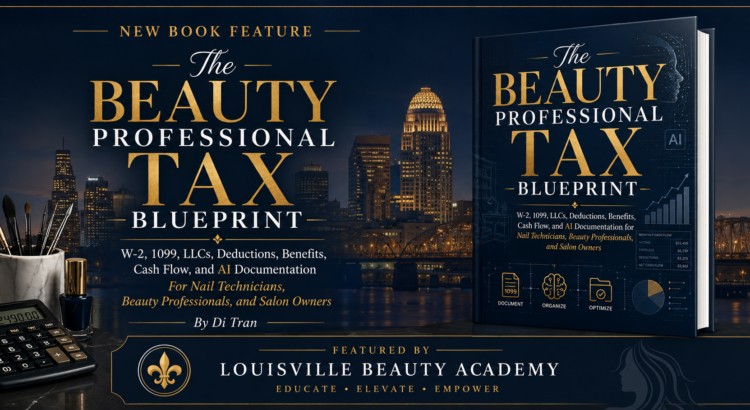
The Beauty Professional Tax Blueprint
W-2, 1099, LLCs, Deductions, Benefits, Cash Flow, and AI Documentation for Nail Technicians, Beauty Professionals, and Salon Owners
By Di Tran
Published by Di Tran University Press — The College of Humanization
At Louisville Beauty Academy, we believe beauty education is not only about learning technique. It is also about preparing real people for real life. A beauty professional does not only need skill with hands, tools, polish, hair, skin, lashes, or client service. A beauty professional also needs structure, records, discipline, communication, and the courage to ask the right questions before confusion becomes crisis.
This book was created for that exact reason.
Beauty work is real work. But in America, real work must often become visible through documents: income records, receipts, tax forms, licenses, contracts, bank statements, client payment logs, booth-rent records, business agreements, insurance documents, payroll records, and professional review notes.
Many hardworking beauty professionals are talented, honest, and dedicated — but still feel financially invisible because their work is not documented clearly. They may work long days, serve loyal clients, pay for supplies, support their families, rent a booth, receive cash, receive app payments, receive tips, buy tools, and still not know how to organize the business side of their career.
That is why documentation matters.
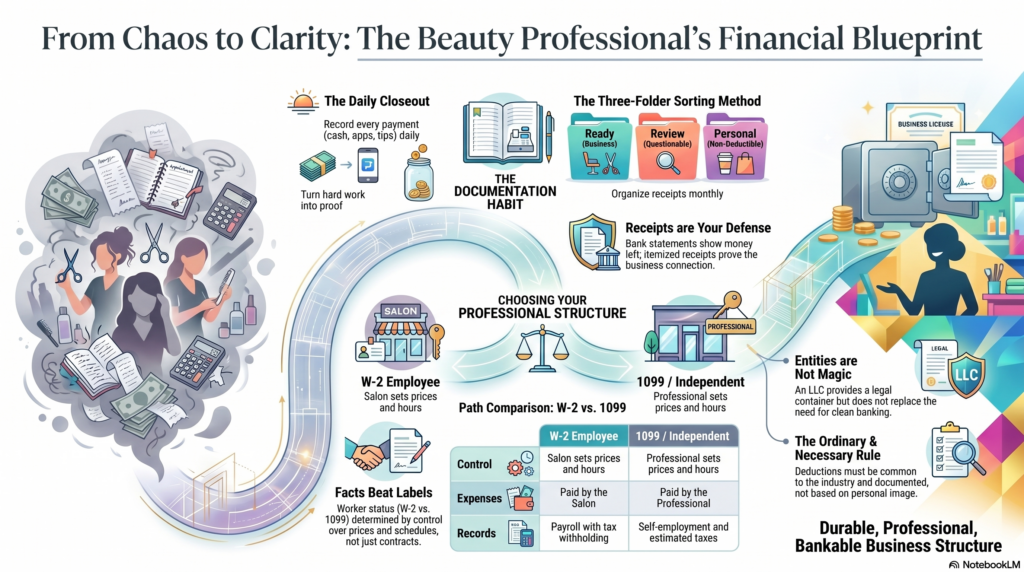
The Beauty Professional Tax Blueprint is not a shortcut book. It is a structure book. It does not tell every reader to choose the same path. It does not say W-2 is always better. It does not say 1099 is always better. It does not say booth rent is always right or wrong. It does not say an LLC automatically saves taxes. It teaches the reader to slow down, write things down, organize facts, and seek qualified professional review.
The message is simple:
Talent opens the door. Documentation keeps the door open.
Why This Book Matters for Beauty Professionals
The beauty industry is full of informal advice. Students and workers may hear many different opinions:
“Just get a 1099.”
“Open an LLC.”
“Everything is deductible.”
“Cash does not matter.”
“Tips are different.”
“Booth rent means you are independent.”
“Do not ask too many questions.”
“Just work.”
This kind of rumor can hurt good people.
A licensed beauty professional deserves better than rumor. A salon owner deserves better than confusion. A student deserves to understand that a professional career is not only about passing an exam; it is also about building a life that can be proven, protected, reviewed, and improved.
This book helps beauty professionals think through major real-life questions such as:
- What is the difference between W-2 employment, 1099 independent work, booth rent, salon suites, and salon ownership?
- Why does worker classification depend on facts, control, independence, contracts, records, state law, federal law, and actual working relationship?
- Why does cash income, card income, app income, tips, deposits, refunds, and product sales need to be recorded?
- Why are receipts not just paper, but evidence?
- Why are deductions not magic money?
- Why does an LLC help with structure but not automatically create tax savings?
- Why should salon owners be careful with payroll, helpers, assistants, apprentices, contractors, and booth renters?
- Why do benefits, Medicaid, Marketplace coverage, insurance, retirement, and self-employment income require careful review?
- How can AI help organize records, reminders, receipts, folders, questions, and checklists without replacing CPAs, attorneys, payroll professionals, or government agencies?
Why LBA Supports This Type of Education
Louisville Beauty Academy stands for affordable, practical, licensure-focused beauty education. We serve real students, real families, real workers, and real communities.
Many beauty students are hardworking adults. Some are parents. Some are immigrants. Some work multiple jobs. Some drive far distances. Some are learning English while learning a professional license. Some are building a new future after years of sacrifice. Many do not need complicated theory first. They need clear, practical, respectful education that helps them understand real life.
That is why books like The Beauty Professional Tax Blueprint are important.
This book supports the larger LBA mission:
Practical education.
Student dignity.
Workforce readiness.
Documentation.
Affordability.
Real-world preparation.
Human-centered AI.
Professional responsibility.
Beauty professionals deserve to be seen as serious workers and serious business builders. Nail technicians, cosmetologists, estheticians, lash professionals, instructors, booth renters, salon-suite operators, and salon owners all contribute to families and local economies. Their work deserves written clarity, not shame. Their questions deserve respect, not fear.
The Book’s Core Message
The book teaches that beauty work must become financially legible.
A person may be talented and still struggle if there are no records. A salon may be busy and still weak if the money system is unclear. A booth renter may feel independent but still need contracts, rent receipts, tax savings, income logs, and business records. A salon owner may want flexibility but still need to understand worker classification, payroll duties, agreements, insurance, and documentation.
The book does not attack the beauty industry. It does not shame workers. It does not scare salon owners. It teaches that each path has a structure.
A true W-2 employee should have the protection and records that come with employment. A true independent professional should operate like a real business. A true booth renter should document rent, clients, income, expenses, and independence. A true salon owner should build a control system that matches the business model.
The goal is not fear.
The goal is clarity.
The goal is to help beauty professionals ask:
What is true?
What is documented?
What is business?
What is personal?
What needs review?
What professional should I ask?
What system should I build now before there is a problem?
AI and Documentation
The book also speaks directly to the future of AI in beauty-business education.
AI should not be used to invent records, hide income, make up deductions, misclassify workers, or replace licensed professionals. That is not the purpose.
AI can be used responsibly to help organize truth.
For example, AI may help a beauty professional:
- create a receipt checklist;
- organize monthly folders;
- draft questions for a CPA;
- summarize a contract for discussion;
- build an income log template;
- create reminders for license renewal;
- prepare a professional email;
- organize a booth-rent reality file;
- maintain a salon control binder;
- list documents needed before professional review.
This is human-centered AI. It does not replace human judgment. It helps real people become more organized, prepared, and confident.
Who This Book Is For
This book may be useful for:
- beauty students preparing for professional life;
- recent graduates entering the workforce;
- nail technicians receiving cash, card, app, tip, or booth-rent income;
- booth renters and salon-suite operators;
- beauty professionals considering 1099 work;
- W-2 employees trying to understand stability, records, and income proof;
- salon owners reviewing worker classification, payroll, and documentation;
- instructors teaching professionalism beyond technique;
- immigrant and multilingual beauty professionals who want clearer language around business structure;
- families supporting someone entering the beauty industry;
- community partners who want to understand the real business side of beauty work.
LBA’s Position
Louisville Beauty Academy is proud to encourage education, documentation, professional questions, and responsible planning.
We believe students and graduates should not be left alone with rumor after licensure. They should understand that a beauty career includes skill, license, sanitation, client service, ethics, records, income, expenses, contracts, communication, and professional support.
A licensed beauty professional is not “just doing nails,” “just doing hair,” “just doing lashes,” or “just doing skin.”
A licensed beauty professional is building an economic life.
And an economic life deserves a blueprint.
Disclaimer
This post is for general informational, educational, and promotional awareness only.
Louisville Beauty Academy is not a CPA firm, tax preparer, payroll company, law firm, employment-law advisor, Medicaid advisor, Marketplace advisor, health-insurance advisor, immigration advisor, financial advisor, bookkeeping firm, or government agency.
Nothing in this post, the book announcement, the book description, any related image, any social media post, any classroom discussion, any AI-generated summary, or any LBA communication should be understood as individualized tax, legal, accounting, payroll, employment-law, Medicaid, health-insurance, immigration, financial, business-formation, audit-response, worker-classification, or benefits advice.
Every reader, student, graduate, beauty professional, booth renter, independent contractor, employee, salon-suite operator, salon owner, employer, helper, assistant, apprentice, or business owner must consult qualified professionals and official agencies for their own situation.
Worker classification depends on facts, control, independence, contracts, records, actual working relationship, federal law, state law, labor rules, tax rules, licensing rules, agency interpretation, and professional review. A person does not become a lawful independent contractor simply because a salon, worker, school, form, agreement, or conversation uses the label “1099.”
Business deductions must be ordinary, necessary, properly documented, legally connected to the business, and reviewed under applicable tax rules. Personal expenses, family expenses, household expenses, children’s expenses, living expenses, personal beauty expenses, and mixed-use expenses should not be treated as business deductions unless a qualified professional confirms the lawful treatment based on facts and documentation.
LLCs, corporations, S corporations, sole proprietorships, partnerships, booth-rent arrangements, salon-suite agreements, payroll models, and independent-contractor relationships have different legal, tax, insurance, and operational consequences. No entity or label automatically saves taxes, creates deductions, removes liability, proves independence, replaces insurance, or fixes weak records.
Medicaid, Marketplace coverage, health insurance, payroll status, self-employment income, household income, tax credits, deductions, family size, benefits, and business structure can affect a person’s finances and eligibility. Readers should consult qualified benefits navigators, insurance professionals, CPAs, enrolled agents, tax attorneys, payroll professionals, employment attorneys, and appropriate official agencies before making decisions.
AI tools may help organize documents, receipts, reminders, questions, logs, folders, emails, and checklists. AI must not be used to invent deductions, hide income, misclassify workers, falsify records, alter receipts, replace qualified professional advice, or make final tax/legal/benefit decisions.
This book and post are intended to help beauty professionals become more prepared, more organized, and more aware of the questions they should ask. They are not a substitute for professional advice.
Readers are responsible for verifying all information with qualified professionals and official sources before acting.
Closing Thought
Beauty work is human work. Human work deserves dignity. Dignity becomes stronger when it is written down.
At Louisville Beauty Academy, we are proud to support education that helps beauty professionals move from confusion to clarity, from rumor to records, and from survival to documented opportunity.
Real work. Real records. Real future.