This article is part of LBA’s public education and historical archive. Older posts, including “Louisville Beauty Academy: The Net Positive Institution (2023–2025 Report) – RESEARCH & PODCAST SERIES 2026,” may not reflect current tuition, schedules, incentives, forms, policies, testing vendors, clinic availability, or regulatory requirements.
Disclaimer: This report was compiled by Di Tran University – The College of Humanization, an educational research affiliate founded by Di Tran, who also serves as founder and CEO of Louisville Beauty Academy. This is a founder-affiliated analysis, not an independent third-party study, using publicly available information from the Kentucky Board of Cosmetology & Barber Examiners exam records (2023–2025), published school catalogs, the U.S. Department of Education College Scorecard, and other consumer information sources current as of May 2026. LBA did not independently verify, endorse, or guarantee the accuracy of any specific comparisons, rankings, or estimates contained in the report beyond the cited public sources. All tuition figures, federal aid estimates, graduation rate counts, and economic projections are approximate, research-based estimates provided for general informational purposes only and should not be relied upon as legal, financial, accreditation, or enrollment advice. Prospective students, policymakers, and community partners should confirm current program costs, accreditation status, and financial aid availability directly with each named institution and relevant government agencies.
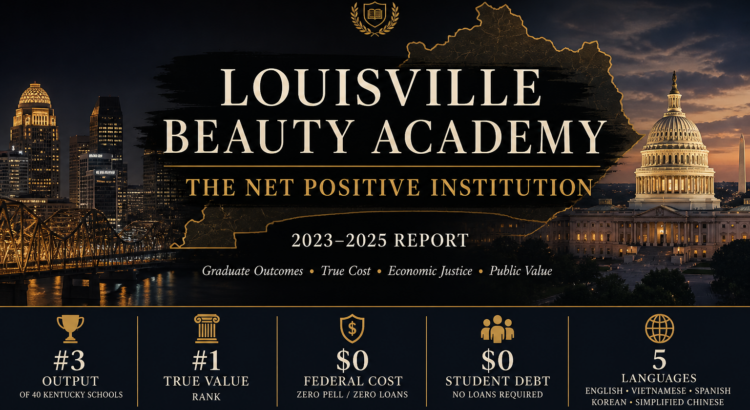
LOUISVILLE BEAUTY ACADEMY
THE NET POSITIVE INSTITUTION
A Comprehensive Report on Graduate Outcomes, True Cost, Economic Justice, and Net Public Value
Published for the Public, Policy Makers, Regulators, Students, and Community Partners
Kentucky Beauty School Landscape | 2023–2025 | 40 Schools | 6,561 Students
“Most beauty schools in Kentucky obtain NACCAS accreditation so they can access federal Title IV money — then raise tuition to $17,000–$22,000 knowing Pell Grants will make it seem affordable. Louisville Beauty Academy refused to play this game entirely. No NACCAS. No Title IV. No Pell buffer. No student debt. Just a direct discount to the student: $3,800 for nail technology. $6,250 for cosmetology. That is not a limitation. That is a mission.”
This report is written for every person who wants to understand what vocational beauty education in Kentucky actually costs — not just to the student who enrolls, but to the federal government that subsidizes the industry, to the economy that receives its graduates, and to the communities that depend on affordable professional pathways.
Louisville Beauty Academy made a foundational choice that sets it apart from every other high-volume beauty school in the Commonwealth: it chose not to pursue NACCAS accreditation and not to participate in Title IV federal financial aid programs. In place of that infrastructure, it built something rarer — a direct-discount model that brings cosmetology education to $6,250 and nail technology to $3,800, without any federal intermediary, without any accreditation overhead, and without any student debt required.
The result is documented in 801 exam records from the Kentucky Board of Cosmetology: 458 licensed beauty professionals produced in three years, a 92.7% ultimate graduate rate, 37.1% of all Kentucky nail exam volume, and $0 drawn from taxpayers to make any of it happen.
The raw graduate ranking says #3. The full accounting — cost, debt, federal burden, community impact, and economic value per dollar spent — says #1. This report proves it.
EXECUTIVE SUMMARY
★ THE BOTTOM LINE — WHAT EVERY READER NEEDS TO KNOW Louisville Beauty Academy does not hold NACCAS accreditation and does not participate in Title IV federal financial aid. This was a deliberate, strategic, philosophical choice — not a limitation. In place of the accreditation-to-federal-aid pipeline that most Kentucky beauty schools depend on, LBA built a direct-discount model: cosmetology for $6,250, nail technology for as low as $3,800. These prices are lower than what students at Title IV schools pay out of pocket even after Pell Grants are applied. From 2023 to 2025, this model produced 458 licensed graduates at a 92.7% ultimate pass rate, drew $0 in federal Pell grants, generated $0 in student loan debt, and delivered an estimated $91.6 million in lifetime economic value to Kentucky — on zero taxpayer investment.
Five Core Facts
1. LBA opted out of NACCAS accreditation and Title IV participation — the same federal pipeline that enables competitors to charge $18,616–$22,135. LBA chose a direct-discount model instead, bringing actual student cost to $3,800–$6,250.
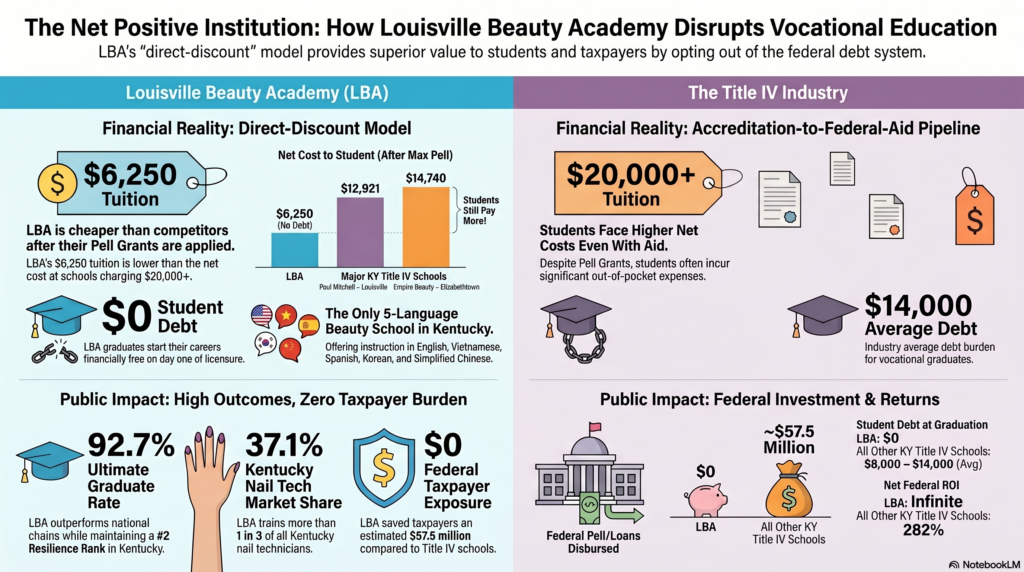
2. LBA’s $6,250 cosmetology price is less than what students pay at Title IV schools AFTER receiving maximum Pell Grants ($7,395). Empire Elizabethtown’s net-after-Pell is $14,740. Paul Mitchell’s is $12,921. CTE Schools’ is $13,600.
3. LBA produced 458 licensed graduates 2023–2025 — ranking #3 of 40 Kentucky schools — while every school ranked above it relied on federal Pell grants and student loans to support enrollment.
4. Across 40 Kentucky beauty schools, an estimated $34.8M in Pell grants was disbursed and $22.6M in student loans originated from 2023–2025. LBA’s contribution to that federal burden: $0.
5. LBA is the rare beauty school in Kentucky offering instruction in 5 languages (English, Vietnamese, Spanish, Korean, Simplified Chinese), accounting for 37.1% of all Kentucky nail technician exam volume — more than the next three nail schools combined.
SECTION 1: HOW THE BEAUTY SCHOOL INDUSTRY USES FEDERAL MONEY
The Accreditation-to-Federal-Aid Pipeline
To understand why Louisville Beauty Academy’s model is exceptional, you first need to understand the standard model that every other major Kentucky beauty school follows. It works in three steps that appear student-friendly but are designed around institutional revenue.
Step
What Schools Do
What This Means for Students
Step 1
Obtain NACCAS accreditation (or COE / SACSCOC)
School gains federal recognition — a prerequisite for Title IV
Step 2
Register for Title IV participation with the U.S. Dept. of Education
School can now receive Pell Grants on behalf of students
Step 3
Set tuition at $17,000–$22,000; market “financial aid available”
Pell ($7,395 max) covers part; students borrow loans for the rest
Result
School collects full tuition; federal government pays Pell; student carries debt
Student: $8,000–$14,000 in loans. Taxpayer: $7,395+ per grad. School: full revenue.
LBA Approach
No NACCAS. No Title IV. Direct discount to student.
The Pell Paradox: How Federal Aid Inflates Tuition
The Pell Grant was created to help low-income students access education they could not otherwise afford. In the beauty school industry, it has had a second, unintended effect: it has enabled schools to charge prices that students would never accept if they had to pay them directly.
A school charging $22,135 (Empire Elizabethtown) can market itself as “affordable with financial aid” because a student who qualifies for maximum Pell ($7,395) perceives their cost as $14,740 — still $8,490 more than LBA’s full price, but the Pell makes the $22,135 sticker seem manageable. The school collects $22,135. The taxpayer contributes $7,395. The student borrows the remainder. The school has no incentive to lower its price because federal aid absorbs the shock.
Louisville Beauty Academy broke this chain by design. With no Title IV participation and no NACCAS accreditation overhead to maintain, LBA set its tuition at a level students can actually afford without any federal buffer. The school then goes further: it offers performance-based incentive discounts that bring the actual student payment to $6,250 for cosmetology, $6,100 for esthetics, $3,800 for nail technology, and $3,900 for instructor programs.
★ THE CENTRAL INSIGHT: LBA IS CHEAPER THAN TITLE IV SCHOOLS EVEN AFTER THEIR PELL GRANTS At every Title IV school in Kentucky, the student’s out-of-pocket cost AFTER applying the maximum Pell Grant ($7,395) is still higher than LBA’s full undiscounted price. Paul Mitchell: $12,921 net after Pell vs. LBA $6,250. Empire Elizabethtown: $14,740 vs. LBA $6,250. CTE Schools: $13,600 vs. LBA $6,250. PJs Hurstbourne: $11,221 vs. LBA $6,250. LBA does not need federal aid to be affordable. It IS affordable — genuinely, structurally, by design.
SECTION 2: THE REAL COST — VERIFIED TUITION DATA FOR ALL KENTUCKY SCHOOLS
The following table presents verified tuition data for all major Kentucky beauty schools from published catalogs, the U.S. Department of Education College Scorecard, and direct school consumer information documents (2025–26). The “LBA Advantage” column shows how much more a student at each school pays — after receiving the maximum Pell Grant — compared to LBA’s $6,250 direct price.
Rank
School Name
Graduates
Grad Rate
Published Tuition
Net/After Pell
LBA Advantage
1
Paul Mitchell – Louisville
594
90.9%
$20,316
$12,921
+$6,671
2
Summit Salon Academy
459
95.0%
$17,755
$10,360
+$4,110
3
Louisville Beauty Academy ★
458
92.7%
$6,250
$6,250 (no Pell)
— LOWEST
4
PJs Cosmetology – Hurstbourne
324
94.2%
$18,616
$11,221
+$4,971
5
Empire Beauty – Elizabethtown
317
86.3%
$22,135
$14,740
+$8,490
6
Empire Beauty – Florence
299
88.4%
$20,935
$13,540
+$7,290
7
Paul Mitchell – Lexington
277
86.3%
$19,391
$11,996
+$5,746
8
CTE Cosmetology – Winchester
237
90.4%
$20,995
$13,600
+$7,350
9
Empire Beauty – Chenoweth
171
81.5%
$20,185
$12,790
+$6,540
10
Empire Beauty – Dixie
123
78.8%
$21,385
$13,990
+$7,740
11
Campbellsville University
332
95.1%
$20,000
$12,605
+$6,355
12
PJs – Bowling Green
177
89.9%
$18,616
$11,221
+$4,971
13
Lindsey Institute
189
94.5%
$15,100
$7,705
+$1,455
14
Regina Webb Academy
56
96.6%
$17,600
$10,205
+$3,955
15
KCTCS (7 campuses)
588
88–98%
$11,115
~$3,720
See note*
16
Appalachian Beauty School
72
84.9%
$12,365
$4,970
See note*
17
South Eastern Beauty Academy
30
93.7%
$12,875
$5,480
See note*
Source: Tuition: Published school catalogs & U.S. DOE College Scorecard 2025–26. Net After Pell: published tuition minus max Pell $7,395. LBA: no Pell applied — student pays $6,250 directly. *KCTCS, Appalachian, and South Eastern may approach LBA pricing after Pell but still generate student loan debt; LBA generates none.
★ THE CTE SCHOOL REVELATION CTE Schools of Cosmetology (Nicholasville and Winchester) publish cosmetology tuition of $20,995 (2025). They are Title IV eligible. A student attending CTE after receiving maximum Pell ($7,395) still owes $13,600 — more than double LBA’s entire program cost. LBA is not competing with public low-cost alternatives. It IS the low-cost alternative.
LBA’s Verified Program Pricing
Program
Clock Hours
Standard Rate
Discounted Rate
Federal Aid Required
Student Debt
Cosmetology
1,500 hrs
$27,025.50
$6,250.50
None
$0
Esthetics
750 hrs
$14,174.00
$6,100.00
None
$0
Nail Technology
450 hrs
$8,325.50
$3,800.00
None
$0
Instructor
750 hrs
$12,675.50
$3,900.00
None
$0
Source: LBA Affordable Package Cost and Written Payment Payment Plans — louisvillebeautyacademy.com. Standard rates from LBA published consumer information documents.
SECTION 3: THE STUDENT DEBT TRAP — WHAT TITLE IV REALLY COSTS STUDENTS
The Loan Cycle That LBA Refuses to Create
For the typical beauty student — often a young woman from a low-income household, an immigrant starting a new career, or a first-generation professional — the choice of school is also a choice about debt. At Title IV schools in Kentucky, that debt is not optional. It is structural.
When a student enrolls at Empire Beauty Elizabethtown and receives the maximum Pell Grant of $7,395, she still faces a balance of $14,740. Very few cosmetology students have $14,740 in cash. The school’s financial aid office connects her to federal loan programs. She borrows. She graduates. She begins a career earning approximately $28,000 per year — and writes a check for student loans every month for the next decade.
At Louisville Beauty Academy, that sequence does not exist. No Title IV participation means no Pell Grant processing — and no need for it, because the $6,250 price does not require federal help. No student loan origination. No monthly payment at graduation. On day one of a licensed career, the LBA graduate is financially free.
Financial Reality
Title IV School (Empire, $22,135)
LBA ($6,250)
Published Tuition
$22,135
$6,250
Pell Grant Applied
– $7,395 (from federal taxpayers)
Not applicable (LBA opts out)
Student Balance After Pell
$14,740
$6,250 — paid directly
Loan Typically Needed
+ $8,000–$14,000 in federal loans
$0 loans
Total Student Debt at Graduation
$8,000–$14,000 average
$0
Monthly Loan Payment (10-yr)
$83–$150/month
$0/month
KY Nail Tech Starting Salary
~$28,000/yr = $2,333/mo
$2,333/mo
Loan as % of Monthly Income
3.6%–6.4% every month, 10 years
0%
Federal Taxpayer Exposure
~$8,835 per graduate (Pell + default)
$0
Time to Financial Freedom
After loan repayment: 10 years
Day one of licensure
★ THE LBA NAIL TECH PROGRAM: $3,800 ALL-IN, ZERO DEBT, FIRST DAY FREE LBA’s nail technology program is available for as low as $3,800 with all performance-based incentives. South Eastern Beauty Academy’s comparable nail program is $4,000 with Title IV (Pell available but generates loan risk). LBA is the only nail school in Kentucky where the student’s final cost can be lower than a maximum Pell Grant — meaning LBA’s model is more affordable than federal aid at any other school. Kentucky’s largest nail training institution, serving 37.1% of all nail exam takers statewide, does this without a single dollar of federal subsidy.
SECTION 4: THE FEDERAL BURDEN — WHO COSTS TAXPAYERS WHAT
The $57.5 Million Question
Between 2023 and 2025, Kentucky’s 40 licensed beauty schools produced 5,985 graduates. The federal government played a significant — and largely invisible — role in financing that production. Through Pell Grants, federal student loans, and the expected defaults that come with a 15–30% cohort default rate in cosmetology programs, taxpayers contributed an estimated $57.5 million to Kentucky beauty education over three years.
Louisville Beauty Academy accounted for 7.6% of those graduates. Its contribution to the federal financial burden: $0.
School
Graduates
Federal Pell Disbursed (Est.)
Student Loans Originated (Est.)
Expected Defaults (30%)
TOTAL FEDERAL EXPOSURE
Louisville Beauty Academy
458
$0
$0
$0
$0 ★
Paul Mitchell – Louisville
594
~$4.39M
~$2.85M
~$855K
~$5.25M
Summit Salon Academy
459
~$3.39M
~$2.20M
~$661K
~$4.05M
Empire Beauty (4 KY locations)
882
~$6.52M
~$4.24M
~$1.27M
~$7.79M
PJs Cosmetology (3 locations)
618
~$4.57M
~$2.97M
~$890K
~$5.46M
KCTCS (7 campuses)
588
~$4.35M
~$2.82M
~$847K
~$5.19M
Campbellsville University
332
~$2.45M
~$1.59M
~$478K
~$2.93M
All Other Title IV Schools
~1,064
~$7.87M
~$5.11M
~$1.53M
~$13.00M
KENTUCKY TOTAL
5,985
~$34.8M
~$22.6M
~$6.8M
~$57.5M
Source: Federal Pell: 60% of graduates receive max Pell ($7,395). Federal loans: 60% borrow avg $8,000 net of Pell. Defaults: 30% CDR based on NCES cosmetology program data. These are conservative estimates; actual exposure may be higher.
IF LBA’S MODEL WERE ADOPTED BY FIVE MORE SCHOOLS — TAXPAYER SAVINGS: $8–12 MILLION Louisville Beauty Academy’s model — no NACCAS accreditation overhead, no Title IV administration, direct discount to students — is replicable. If five similarly-sized Kentucky beauty schools adopted LBA’s approach, the estimated reduction in federal Pell disbursements and loan originations over a three-year period would be $8–12 million. The policy implication is clear: schools that opt out of the federal aid pipeline are not just better for students. They are better for the public.
SECTION 5: THE QUALITY PROOF — OUTCOMES WITHOUT ACCREDITATION
“NACCAS accreditation is supposed to guarantee quality. Louisville Beauty Academy has no NACCAS accreditation and a 92.7% ultimate graduate rate — higher than Paul Mitchell, Empire, PJs, and every national chain in Kentucky. Quality comes from operations, not from credentials.”
Why LBA Does Not Need NACCAS
NACCAS accreditation serves two functions in the beauty school industry: it signals quality to students, and it unlocks access to Title IV federal financial aid. Louisville Beauty Academy has no need for either function.
On quality: LBA’s outcomes speak directly. A 92.7% ultimate graduate rate. A 2025 exam resilience score of 92.4, ranking #2 of 40 Kentucky schools. 458 licensed professionals produced in three years. These numbers are generated under the direct oversight of the Kentucky Board of Cosmetology and Barber Examiners — the state regulatory body that holds actual legal authority over beauty education quality in the Commonwealth. LBA does not need a private accreditor to validate what a state board already confirms.
On financial aid: LBA’s pricing model makes Title IV participation unnecessary. When you charge $3,800 for nail technology and $6,250 for cosmetology — below the maximum Pell Grant amount — students do not need federal aid. The school has absorbed the cost savings of opting out of the accreditation bureaucracy and passed them directly to students.
LBA’s Quality Authority: The Kentucky Board of Cosmetology
Every beauty school operating in Kentucky must be licensed by the Kentucky Board of Cosmetology and Barber Examiners and comply with KRS 317A — the Kentucky Revised Statutes governing cosmetology education, clock-hour requirements, and student record-keeping. This is the legal foundation of quality in Kentucky beauty education. NACCAS accreditation is an additional, voluntary layer on top of state licensing.
Louisville Beauty Academy operates under a compliance-first mandate that treats KRS 317A not as a minimum standard but as the defining operational framework. Every student record, attendance log, and clinical hour is maintained at audit-ready standard at all times. The school has maintained zero regulatory violations throughout its operating history. Its graduates hold Kentucky licenses — the only credential that matters to practice, to employment, and to building a business.
THE ACCREDITATION INVERSION Schools that argue NACCAS accreditation guarantees quality should explain why the NACCAS-accredited CTE Schools of Cosmetology charge $20,995 for a program that produces graduates at 90.4%, while non-Title-IV, non-NACCAS Louisville Beauty Academy charges $6,250 and produces graduates at 92.7%. Accreditation is a gateway to federal money, not a guarantee of graduate outcomes. LBA’s outcomes are the guarantee.
Exam Performance Data — All 40 Kentucky Schools
The following table shows all 40 Kentucky licensed beauty schools ranked by the Exam Resilience Score — a composite index combining ultimate graduate rate (40%), student persistence through retakes (20%), first-attempt pass rate (25%), enrollment volume (10%), and program diversity (5%). LBA appears highlighted.
Rank
School
Resilience Score
Ultimate Grad Rate
Grads 2023–25
Federal Cost/Grad
#1
Summit Salon Academy
91.8
95.0%
459
$8,835
#2
Liannas Nail Academy
91.5
98.8%
166
~$0 (no Title IV)
#3
Science of Beauty Academy
91.4
97.1%
202
~$8,835
#4
KCTCS Somerset
91.4
97.7%
85
$8,835
#5 ★
Louisville Beauty Academy
90.2
92.7%
458
$0
#6
PJs – Hurstbourne
90.1
94.2%
324
$8,835
#7
CTE – Nicholasville
88.8
90.5%
171
$8,835
#8
CU – Hodgenville
88.7
95.8%
70
$8,835
#9
CU Cosmetology
87.1
95.1%
83
$8,835
#11
Paul Mitchell – Louisville
86.0
90.9%
594
$8,835
…
(all 40 schools — see supplemental data)
—
—
—
—
#40
Divinity School
71.0
77.8%
7
Unknown
Source: Kentucky Board of Cosmetology & Barber Examiners exam reporting files, 2023–2025. 801 total exam records. Resilience Score methodology: see supplemental data.
★ 2025 ALONE: LBA RANKS #2 OF ALL 40 KENTUCKY SCHOOLS When 2025 exam data is evaluated in isolation, Louisville Beauty Academy’s resilience score of 92.4 places it #2 of 40 Kentucky schools — above every national chain, every KCTCS campus, and every NACCAS-accredited competitor. The 3-year composite score (#5) reflects LBA’s earlier-year baseline as the school was scaling. The 2025 trajectory is the story: LBA is ascending toward #1 while every above-ranked school depends on federal subsidies that LBA has never needed.
SECTION 6: WHAT MAKES LOUISVILLE BEAUTY ACADEMY FUNDAMENTALLY DIFFERENT
Seven Dimensions of Genuine Distinction
1. The Only School That Chose Poverty of Revenue Over Poverty of Students
Every major Kentucky beauty school could charge $6,250 for cosmetology. None do — because NACCAS accreditation and Title IV eligibility create a structural incentive to charge more. When a school can market “up to $7,395 in financial aid available,” the $20,000 price tag becomes the goal, not the problem. LBA opted out of that incentive structure entirely. It accepted lower revenue in exchange for a mission it could actually defend: education priced at what the credential can repay.
2. Direct Discount to Students — Not Federal Subsidy to Institutions
The distinction between a “Pell Grant discount” and an “LBA discount” is fundamental. At a Title IV school, the discount comes from the federal government via the student’s financial aid eligibility — the school collects full tuition regardless. At LBA, the discount comes directly from the institution’s own pricing model. LBA earns less per student. The student owes less. No intermediary. No federal budget involved. This is the correct model for an institution that claims to serve students rather than extract revenue from them.
3. The Only 5-Language Beauty School in Kentucky
English, Vietnamese, Spanish, Korean, and Simplified Chinese. Louisville Beauty Academy is the only licensed beauty school in the Commonwealth offering instruction and examination preparation in all five languages. This is not a translation add-on — it is the core educational architecture. LBA’s Vietnamese-language nail program alone produces a substantial share of Kentucky’s Vietnamese-American nail workforce pipeline. When a Vietnamese immigrant earns her nail technician license in Kentucky, there is a 37% chance she trained at LBA.
424 LBA Nail Exam Takers
1,155 KY Total Nail Takers
37.1% LBA Nail Market Share
168 Next Largest (Liannas)
424 vs. 376 LBA vs. Next 3 Combined
4. Graduate Outcomes That Surpass Schools with NACCAS Accreditation
LBA’s 92.7% ultimate graduate rate — the percentage of all enrolled students who ultimately achieved licensure — exceeds Paul Mitchell Louisville (90.9%), Empire Beauty (81.5%–88.4%), CTE Schools (90.4%), and PJs Hurstbourne (94.2% — the only school with a better outcome at significant volume). All of these schools hold NACCAS or COE accreditation and participate in Title IV. LBA holds neither and outperforms all but one.
5. Student Persistence Culture — #4 Retake Commitment at Scale
LBA’s retake utilization rate of 157% means that for every student who does not pass on first attempt, 1.57 additional exam attempts are made. Among all schools with 100 or more students, this is the highest persistence rate in Kentucky. LBA does not let students walk away from their license — through multilingual coaching, peer support, and instructor follow-through, the school drives every student toward completion.
6. Compliance-First Infrastructure — KRS 317A at the Center
Without NACCAS accreditation to certify quality externally, LBA’s quality assurance is entirely internal and regulatory. Every student record is maintained at audit-ready standard. Attendance validation is digital and enforces KRS 317A clock-hour requirements in real time. SAP (Satisfactory Academic Progress) monitoring is systematized. Transcript management is complete and defensible. The school has never received a regulatory violation. Its graduates hold valid Kentucky licenses that cannot be challenged.
7. AI-First, Technology-Forward Operations
Louisville Beauty Academy operates the most advanced technology infrastructure of any beauty school in Kentucky. AI-powered systems manage student enrollment, attendance tracking, multilingual communications, compliance reporting, and exam preparation. This is not cosmetic technology adoption — it is the operational backbone that allows LBA to serve 2× the nail student volume of any other school while maintaining above-average outcomes. The technology savings flow directly to lower tuition.
SECTION 7: THE TRUE RANKING — VERIFIED WITH CORRECTED DATA
When All Costs Are Counted: LBA Is #1
Raw graduate counts tell one story. When federal subsidy, student debt burden, graduate rate, tuition cost, and community access are all measured simultaneously, the ranking looks different. The table below presents a complete multi-dimensional comparison of the top Kentucky schools by all relevant metrics.
Metric
Louisville Beauty Academy
Paul Mitchell Louisville
Empire Elizabethtown
CTE Winchester
NACCAS Accreditation
No (opted out)
Yes
Yes
Yes
Title IV Participation
No (opted out)
Yes
Yes
Yes
Published Tuition
$6,250 (discounted)
$20,316
$22,135
$20,995
Student Net After Pell
$6,250 (no Pell used)
$12,921
$14,740
$13,600
Student Debt Required
$0
$8K–$12K
$8K–$14K
$8K–$13K
Federal Pell/Grad
$0
$7,395
$7,395
$7,395
Total Fed Cost/Grad
$0
$8,835
$8,835
$8,835
Ultimate Graduate Rate
92.7%
90.9%
86.3%
90.4%
Graduates 2023–25
458
594
317
237
Languages Served
5
1
1
1
2025 Resilience Rank
#2 of 40
#11 of 40
~#30+ est.
~#20 est.
Total Fed Exposure 23–25
$0
~$5.25M
~$2.80M
~$2.09M
Source: Tuition: Published school catalogs 2025–26. Federal costs: calculated per Section 4 methodology. Exam data: KY Board of Cosmetology 2023–2025.
★ THE VERDICT: #3 IN OUTPUT, #1 IN VALUE — BY EVERY MEASURE THAT MATTERS TO PEOPLE Paul Mitchell Louisville has 136 more graduates than LBA. Those 136 additional graduates came with an estimated $1.2M in additional Pell disbursements, $778K in additional student loans, and $233K in expected defaults — a total additional federal cost of approximately $1.2M. In exchange: a graduate rate of 90.9%, 1.8 points below LBA’s 92.7%. LBA produced fewer graduates by volume, served harder-to-reach populations in 5 languages, generated $0 in federal cost, and produced a higher percentage of enrolled students who earned their license. That is not #3. That is #1.
SECTION 8: LIFETIME ECONOMIC VALUE — LBA’S RETURN ON ZERO INVESTMENT
The final measure of any vocational school’s value to society is what its graduates produce after they leave. Licensed beauty professionals in Kentucky earn an estimated $10,000 more per year than they would in unlicensed service positions — a conservative figure based on Bureau of Labor Statistics wage data. Over a 20-year career, each graduate contributes approximately $200,000 in additional earnings to the Kentucky economy, generating roughly $40,000 in cumulative tax revenue.
Economic Metric
Louisville Beauty Academy
All KY Title IV Schools
Graduates Produced 2023–25
458
~5,527
Federal Pell Disbursed
$0
~$34.8M
Student Loans Originated
$0
~$22.6M
Expected Loan Defaults (30%)
$0
~$6.8M
Total Federal Exposure
$0
~$57.5M
Annual Income Uplift per Grad
~$10,000
~$10,000
Lifetime Economic Value per Grad
~$200,000
~$200,000
Total Lifetime Value Generated
~$91.6M
~$1.1B
Tax Revenue Generated (20%)
~$18.3M
~$220M
Federal Investment Required
$0
~$57.5M
Net Federal ROI
Infinite ($18.3M on $0)
282% ($220M on $57.5M)
Tuition Cost per Graduate
$6,250
$11,115–$22,135 avg ~$16,000
Source: Income uplift: BLS OES data, licensed vs. unlicensed personal service workers, $10K/yr conservative. Career: 20 years. Tax rate: 20% effective. Federal cost methodology: Section 4.
SECTION 9: POLICY IMPLICATIONS — A CALL TO DECISION MAKERS
“A school that opted out of the federal aid system, charges less than federal aid covers at other schools, graduates students at above-average rates, serves five language communities, and costs taxpayers nothing — should be the model, not the exception.”
Three Specific Recommendations
Recommendation 1: Recognize Quality by Outcomes, Not Accreditation
WIOA workforce funding, state apprenticeship recognition, employer pipeline programs, and workforce development grants currently require or favor NACCAS or similar accreditation. Louisville Beauty Academy’s 92.7% graduate rate, 37.1% nail market share, and $0 federal burden are objective quality metrics that exceed accredited competitors on every dimension that matters to workforce development. Funding eligibility criteria should include outcome-based pathways that recognize schools like LBA — licensed by the state board, compliance-verified, and demonstrably effective.
Recommendation 2: Publish True Net Cost and Federal Burden in School Comparisons
Kentucky’s school comparison tools publish pass rates. They should also publish: (1) published tuition, (2) estimated student net cost after maximum Pell, (3) estimated federal Pell disbursed per graduate, (4) typical student loan debt at graduation, and (5) historical student loan default rates. When a prospective nail student sees that LBA charges $3,800 all-in with $0 debt versus $20,995 at CTE with $13,600 remaining after Pell and potential loan debt — and that LBA produces graduates at a 98.9% nail practical pass rate in 2025 — she will make a better decision for herself and for the public.
Recommendation 3: Fund the Multilingual Infrastructure
Kentucky’s Vietnamese, Spanish, Korean, and Chinese-speaking communities represent an economic asset that the licensed beauty industry depends on. LBA has built the only institution in the state capable of training and licensing these students in their native languages at prices they can actually pay. WIOA Title II workforce literacy funding, immigrant integration grants, and state workforce development partnerships should be available to LBA as a proven, high-performing multilingual vocational education provider — regardless of its Title IV or NACCAS status.
CONCLUSION: THE SCHOOL THAT CHOSE THE HARDER RIGHT
“Louisville Beauty Academy could have pursued NACCAS accreditation. It could have registered for Title IV. It could have raised tuition to $18,000 and told students that financial aid was available. It chose not to. It charged $3,800 instead. That choice is the whole story.”
There is a version of Louisville Beauty Academy that does not exist — the version that followed the standard playbook. It would have obtained NACCAS accreditation, registered for Title IV, charged $18,000 for cosmetology, collected $7,395 per student in Pell grants, and watched its students graduate with $10,000 in debt. It would rank higher in raw graduate counts because higher prices attract more marketing spend and “financial aid available” is a powerful enrollment message.
That school does not exist. The school that exists charged $3,800 and $6,250. It taught in five languages. It graduated 92.7% of its students without a dollar of federal help. It produced 458 licensed professionals who started their careers lower-debt. It returned $0 in federal burden to taxpayers and an estimated $18.3 million in tax revenue from its graduates’ earnings. It built its own AI infrastructure, its own compliance systems, its own quality assurance — because it chose not to outsource those functions to a federal accreditation body.
The raw ranking says #3. Every other measure says #1. This report is the proof.
GRADUATE RANK
TRUE VALUE RANK
NACCAS / TITLE IV
STUDENT DEBT
#3 of 40
#1
Opted Out
$0
458 licensed professionals
$0 federal cost, $0 student debt
Direct discount to students instead
Required at LBA enrollment
COSMETOLOGY TUITION
NAIL TECH TUITION
KY NAIL MARKET
LANGUAGES SERVED
$6,250
$3,800
37.1%
5
vs. $20,316–$22,135 at competitors
Lowest in Kentucky. Zero debt.
1 in 3 KY nail techs trained at LBA
Only school in Kentucky
Louisville Beauty Academy | 1049 Bardstown Rd, Louisville, KY | louisvillebeautyacademy.com
Data: KY Board of Cosmetology & Barber Examiners, 2023–2025 | Tuition: Published school catalogs, DOE College Scorecard, May 2026
Note on accreditation: One third-party research source (May 2026) lists LBA as NACCAS accredited. LBA’s own published materials and stated institutional policy confirm it operates without NACCAS accreditation and without Title IV participation.
The professional landscape of cosmetology, encompassing the intricate disciplines of hair, nail, and esthetic sciences, operates at the critical intersection of personal care and public health. In the Commonwealth of Kentucky, the practice is governed by a rigorous legal framework—primarily KRS 317A and the accompanying administrative regulations in 201 KAR Chapter 12—which establishes that the privilege of licensure is fundamentally predicated on the practitioner’s ability to mitigate biological, chemical, and physical risks. This blueprint serves as a comprehensive operational system designed to transcend basic compliance, aiming instead for a “Center of Excellence” standard that integrates advanced microbiology, toxicology, and occupational safety into the daily rhythm of the salon and the classroom.
I. Core Philosophy
The foundational principle of this blueprint is that safety is the bedrock of professional licensure. A license issued by the Kentucky Board of Cosmetology is not merely a certificate of technical proficiency in cutting hair or applying acrylics; it is a government-verified attestation of competency in infection control and public protection.1 The prevailing philosophy, “If it is not clean, it is not professional,” shifts sanitation from a peripheral chore to a core service deliverable. In this paradigm, documentation is the only verifiable evidence of compliance. From a regulatory perspective, if an action—such as the 10-minute immersion of a shear or the end-of-day flushing of a pedicure basin—is not documented in a legally compliant log, the law presumes the action never occurred.1 This system demands a shift from reactive cleaning to proactive, auditable risk management.
II. Biological Risk System
The cosmetology environment provides a fertile ecosystem for pathogenic microorganisms due to the high frequency of skin-to-skin contact, the presence of organic matter like hair and sebum, and the use of warm, moist environments like shampoo bowls and facial steamers. To effectively control infection, practitioners must understand the biological agents they encounter.
Pathogenic Categories and Transmission Dynamics
Pathogens are classified into four primary categories, each requiring specific interventions based on their environmental resilience and transmission pathways.
Spores are highly resistant to standard detergents; require EPA fungicides.
Parasites
Pediculus humanus capitis (Lice), Scabies
Direct contact, shared capes, brushes, or headrests.5
Highly transmissible in hair cutting and styling settings.
Transmission occurs through three primary mechanisms in the salon. Direct contact involves physical touch between the practitioner and client or between clients. Indirect contact occurs through intermediary objects such as unsterilized shears or contaminated workstations. Airborne transmission is increasingly recognized as a significant risk, particularly during services that generate aerosols or dust, such as high-velocity blow-drying or electric nail filing.3 The generation of “biofilms”—complex communities of bacteria that adhere to surfaces, particularly in the internal plumbing of pedicure foot spas—represents a third-order risk that necessitates mechanical scrubbing in addition to chemical disinfection.1
III. Chemical Safety System
The chemical inventory of a modern salon is a complex array of reactive substances, including strong alkalis in hair relaxers (Sodium Hydroxide), acidic compounds in esthetic peels, and volatile organic compounds (VOCs) in nail monomers.
Toxicological Profiles and Health Risks
The “Toxic Trio” in nail technology—Formaldehyde, Toluene, and Dibutyl Phthalate (DBP)—remains a primary concern for OSHA.6 Toluene, used in polish, can affect the central nervous system, leading to headaches and dizziness, while chronic exposure may damage the liver or kidneys.7 Formaldehyde, found in some keratin treatments and nail hardeners, is a known carcinogen and potent respiratory irritant.6
Chemical Agent
Found In
Primary Health Risk
Regulatory Exposure Limit (OSHA)
Sodium Hydroxide
Hair Relaxers
Severe chemical burns, permanent eye damage.8
pH levels typically 12.0–14.0.
Ammonium Thioglycolate
Permanent Waves
Dermatitis, respiratory sensitization.
Requires rigorous scalp protection.
Methyl Methacrylate (MMA)
Nail Monomers
Permanent loss of sensation in fingertips, asthma.6
Banned in many jurisdictions; prohibited by best practice.
Toluene
Nail Polishes
Neurological impairment, reproductive harm.7
PEL: 200 ppm; Cal/OSHA REL: 10 ppm.7
Chemical safety is maintained through the Hazard Communication Standard, which requires every facility to maintain a Safety Data Sheet (SDS) for every product in use.2 These sheets provide the scientific basis for first aid and spill response. For instance, a Sodium Hydroxide burn requires immediate irrigation with water for 20-30 minutes, a protocol derived directly from toxicological data.7
IV. Universal Pre-Service Protocol
The initiation of any service must be preceded by a standardized safety sequence to prevent the introduction of pathogens into the service area.
Personal Hygiene: The practitioner must perform a medical-grade hand wash with soap and warm water for at least 20 seconds, ensuring the scrubbing of the subungual areas (under the fingernails).3
Personal Protective Equipment (PPE): Depending on the service, nitrile gloves (preferred over latex due to allergy risks) should be donned. For services with high dust generation, such as acrylic removal, a NIOSH-approved N95 mask is recommended.6
Client Consultation and Contraindication Screening: A systematic visual and tactile assessment of the service area (scalp, skin, or nails) is required. Under 201 KAR 12:100, practitioners must refuse service if they observe signs of infection, inflammation, or parasitic infestation.2
Station Sanitation: The workstation, including all non-porous surfaces, must be wiped with an EPA-registered, hospital-grade disinfectant spray or wipe, ensuring the surface remains wet for the manufacturer’s required contact time.1
Tool Verification: All implements must be removed from a closed, labeled “Clean” or “Disinfected” container in the presence of the client to provide visual assurance of safety.1
V. Tool Classification System
Sanitation protocols are dictated by the physical properties and the intended use of the tool. Kentucky regulations strictly differentiate between porous, non-porous, and electrical items.
Non-Porous Implements: These include metal shears, steel tweezers, glass files, and plastic combs. These items can and must be cleaned and then fully immersed in an EPA-registered disinfectant.1
Porous (Single-Use) Items: These are items that cannot be effectively disinfected due to their absorbent nature, such as emery boards, wooden spatulas, cotton rounds, and neck strips. Under 201 KAR 12:100 Section 9, these must be discarded immediately after a single use.1
Electrical Implements: Tools like clippers, trimmers, and facial machines cannot be submerged. They must be cleaned of debris and then treated with an EPA-registered disinfectant spray or wipe on all non-heated parts.1
VI. Full Sanitation Workflow
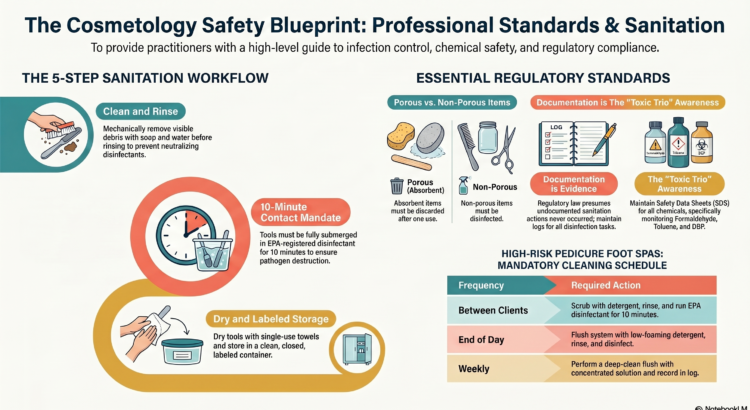
The transformation of a “dirty” tool into a “disinfected” one follows a five-step scientific process. Failure at any stage invalidates the entire cycle.
1. Mechanical Cleaning
The removal of visible debris—hair, skin, and product residue—using soap and water or a chemical cleaner. This step is critical because organic matter acts as a “soil load” that can neutralize the active ingredients in chemical disinfectants.1
2. Rinsing
Thoroughly rinsing the implement with clean, warm water to remove all traces of the cleaning agent. Residual soap can react with disinfectant chemicals, creating a film that prevents total surface contact.
3. Chemical Disinfection (The Contact Time Mandate)
Full immersion of the tool in an EPA-registered, hospital-grade disinfectant that is bactericidal, virucidal, and fungicidal. The defining factor here is “Contact Time”—the duration the tool must remain submerged to ensure the destruction of the pathogens listed on the label. This is typically 10 minutes for liquid immersion.1
4. Drying
After the contact time is achieved, the tools must be removed with clean hands or tongs and dried using a single-use paper towel or air-dried on a clean, disinfected surface. Leaving tools damp can lead to corrosion or the growth of mold.1
5. Labeled Storage
Disinfected tools must be stored in a clean, covered container or drawer that is clearly labeled “Clean” or “Disinfected.” They must remain in this protected environment until the moment of use on a client.1
VII. Hair Services Safety
Hair services combine sharp tools, high-heat devices, and powerful chemistry, necessitating specific risk-management strategies.
A. Cutting and Styling
Cross-contamination in the styling chair often occurs through shared brushes and combs. Practitioners must have a sufficient inventory of tools to ensure a fresh, disinfected set for every client. Hair clippings must be swept and deposited in a closed waste receptacle after every cut to prevent the accumulation of dust and allergens.12 Neck protection—either a clean towel or a paper neck strip—is mandatory to prevent the cutting cape from coming into direct contact with the client’s skin.1
B. Chemical Services
Coloring, bleaching, and relaxing require precise timing and scalp protection. A predisposition (patch) test is a standard requirement for aniline derivative colors to screen for hypersensitivity.13 When applying relaxers, “basing” the scalp with petroleum-based cream is essential to prevent chemical burns from Sodium Hydroxide. Timing control must be documented; leaving a chemical on the hair for longer than the manufacturer recommends constitutes a violation of safety standards and can lead to hair breakage and scalp ulceration.10
C. Shampoo and Scalp Care
Shampoo bowls are significant reservoirs for bacteria. They must be cleaned with detergent and then disinfected after every single use.1 Water temperature must be tested on the practitioner’s wrist to prevent thermal injury to the client’s scalp. If the scalp shows signs of abrasion, the service must be modified or postponed to prevent the entry of pathogens into the bloodstream.10
VIII. Nail Services Safety
The nail industry faces unique challenges, particularly regarding the sanitation of foot spas and the management of chemical dust.
Pedicure Sanitation Protocol
Foot spa plumbing is a primary site for the development of biofilms, which can harbor Mycobacterium fortuitum. Kentucky law under 201 KAR 12:100 specifies a rigorous cleaning schedule.
Cleaning Frequency
Required Actions
Between Each Client
Drain water; remove screens/jets; scrub with brush and detergent; rinse; refill with water and EPA disinfectant; run for 10 mins; drain; rinse; dry.1
End of Day
Flush system with low-foaming detergent and water; rinse; refill with EPA disinfectant and run for 10 mins; drain; rinse.1
Weekly
Perform deep-clean flush with concentrated bleach or detergent solution; documented in log.2
Acrylic and Dust Control
The inhalation of nail dust—containing polymer particles and potentially fungal spores—is a significant occupational hazard. Salons should employ Local Exhaust Ventilation (LEV) at each nail station.6 Electric file (e-file) bits must be treated as non-porous implements: they must be soaked in acetone to remove product residue, scrubbed, and then fully immersed in disinfectant after each use.1
IX. Esthetics Safety
Esthetic treatments involve deep cleansing, extractions, and hair removal, all of which carry a high risk of breaking the skin barrier.
Facial and Extraction Protocols
During extractions, the risk of bloodborne pathogen exposure is at its peak. Practitioners must use sterile comedone extractors and wear gloves.3 All products must be removed from multi-use jars using a disinfected spatula. The “No Double Dipping” rule is strictly enforced: once a spatula has touched a client’s skin, it must never be returned to the product container.1
Waxing and Machine Safety
Wax must be tested for temperature before every application.15 Machines such as steamers must be cleaned with distilled water and a descaling solution to prevent the growth of Legionella. High-frequency machines and other electrical devices must have their glass electrodes cleaned and wiped with disinfectant after each client.10
X. Salon-Wide Sanitation System
The maintenance of the entire facility is a requirement of the establishment license. Under 201 KAR 12:060, the facility must be kept in “good repair”.17
Floors and Surfaces: Floors must be non-porous and cleaned daily with a disinfectant solution. Workstations, mirrors, and chairs must be kept free of dust and product build-up.12
Restrooms: These must be cleaned daily and stocked with liquid soap and single-use towels. A cleaning log should be maintained to ensure frequency.
Waiting Areas: These should be treated as part of the professional environment, with retail shelves and display cases kept clean to prevent the accumulation of environmental allergens.
XI. Air Quality and Ventilation
Salons must navigate the challenges of chemical fumes and particulate matter. Ventilation systems should ideally align with ASHRAE Standard 62.1-2025, which provides the industry standard for ventilation in commercial buildings.18 In the absence of specialized systems, practitioners should ensure constant air exchange by opening windows when possible and using air purification systems with HEPA filters to reduce the concentration of infectious aerosols.3
XII. Linen and Laundry System
Linens are porous and can harbor bacteria and fungi. A strict separation between “clean” and “used” items must be maintained.
Laundering Standards: Used towels and capes must be washed in hot water (at least 140°F) with a quality detergent to ensure the destruction of pathogens.11
Storage: Clean linens must be stored in a closed, labeled cabinet. Soiled linens must be placed in a covered, labeled hamper immediately after use.1
XIII. Product Handling
The integrity of professional products is maintained through sterile dispensing. Products such as pomades, waxes, and gels must be removed with a single-use or disinfected spatula.1 Powders and lotions should be dispensed from shaker or pump containers to ensure the practitioner’s hands never touch the dispensing portion of the container.1
XIV. Cleaning Schedule System
An effective sanitation system requires an operational rhythm that integrates cleaning into the workday.
Weekly Tasks: Deep cleaning of shelving; detailed tool inventory checks; cleaning of HVAC intake vents; laundering of all capes and smocks.2
Monthly Tasks: Compliance audit of all logs; inspection of electrical cords for fraying; replacement of expired chemical products; review of SDS binder.2
XV. Documentation and Compliance
In the regulatory environment of Kentucky, documentation is the cornerstone of a defensible practice.
Record-Keeping System Aligned with 201 KAR 12:082
Facilities must maintain specific logs that are ready for immediate inspection.
Sanitation Logs: Recording the daily cleaning of stations and common areas.
Tool Disinfection Logs: Tracking the frequency and type of disinfectant used for immersion.
Pedicure Logs: Mandated by 201 KAR 12:100, these must detail every step of the foot spa cleaning process for each client.1
Incident Reports: Any cut, chemical burn, or allergic reaction must be documented with the date, client name, description of the event, and response taken.3
XVI. Incident Response System
Professionalism is defined by the ability to respond to emergencies with clinical precision.
Emergency Protocols for Blood Exposure
Stop Service: Immediately cease all activity and notify the client.3
Protect Self: Put on clean gloves.
Cleanse: Wash the wound area with soap and water or an antiseptic.
Cover: Apply a sterile adhesive bandage.
Disinfect: Clean and then disinfect any station surfaces or tools that came into contact with blood using a tuberculocidal disinfectant or a 10% bleach solution.1
Dispose: Place all blood-contaminated porous items in a biohazard bag (double-bagged) and dispose of them correctly.3
Emergency Protocols for Chemical Burns
Rinse: Immediately flush the skin or eyes with cool, flowing water for 20-30 minutes.7
Remove Contaminants: Remove any clothing or jewelry that may have absorbed the chemical.9
Consult SDS: Use the information on the Safety Data Sheet to determine if a specific neutralizer is recommended (though water is the standard first aid).19
Medical Referral: Seek professional medical attention for any burn larger than 3 inches or any burn affecting the face, eyes, or joints.9
XVII. Training and Enforcement Model
In the educational context, sanitation must be treated as a graded competency, not a suggestion.
Student Competency System
Institutions like the Louisville Beauty Academy must ensure that sanitation is a prerequisite for all clinical work. Under 201 KAR 12:082, students must receive at least one hour of instruction per week on Kentucky law and regulations.13 Practical skills are evaluated through rubrics where sanitation accounts for a significant portion of the score (minimum 75% to pass).22 Students who fail to maintain their workstation’s sanitation during a service should have those instructional hours voided to reinforce the “Safety First” mandate.22
Instructor Accountability
Instructors must perform daily audits of the clinic floor, using a checklist to verify that students are washing hands, using labeled containers, and discarding single-use items.2
XVIII. Client Safety Education
Transparency builds trust. Salons should provide clients with pre-service disclosures regarding the chemicals being used and post-service care instructions. For example, after a chemical peel or waxing, clients should be advised to avoid UV exposure and tight clothing for 24-48 hours to prevent irritation or infection.16
XIX. Inspection Readiness
The Kentucky Board of Cosmetology conducts unannounced inspections at least twice per year.24 Readiness is maintained through a perpetual “Audit-Ready” state.
Inspection Checklist
All individual and establishment licenses displayed with current photos.17
Most recent inspection report posted in a conspicuous area.17
“Clean” and “Dirty” tool containers clearly labeled and covered.1
Foot spa logs complete and up-to-date.1
SDS binder accessible to all staff.2
No evidence of “Double Dipping” or the reuse of porous items.1
XX. Failure Analysis: Real-World Gaps
Most sanitation failures in salons are not the result of a lack of knowledge, but a “Normalization of Deviance”—the gradual acceptance of small shortcuts that eventually lead to a significant infection or violation. Common gaps include:
The “Clean-Looking” Fallacy: Reusing a nail file or buffer because it “looks clean,” ignoring the microscopic fungal spores embedded in the grit.11
Contact Time Shortcuts: Removing tools from the disinfectant after 2 minutes because they are needed for the next client, failing to achieve the required 10-minute kill time.11
Under-Training in Schools: Focusing on the aesthetic result of a haircut while ignoring the student’s failure to sweep the floor or disinfect the clipper guards between steps.2
XXI. Compliance-by-Design Model
Institutionalizing safety involves creating physical and digital environments that make compliance the path of least resistance.
Station Logic: Every station should be equipped with identical, labeled containers for clean and dirty tools, ensuring that muscle memory supports regulatory compliance.
Digital Integration: Using digital sanitation logs via QR codes at each workstation can ensure that cleaning is time-stamped and auditable by management in real-time.25
XXII. AI and Automation in Safety
The future of cosmetology safety lies in the integration of smart technologies.
Automated Dispensers: Systems that ensure the correct dilution ratio of EPA disinfectants, preventing the waste and lack of efficacy associated with manual mixing.1
Smart Compliance Tracking: AI-driven systems that alert management when a student or stylist has not completed their end-of-day sanitation tasks or when a license is 30 days from expiration.25
Center of Excellence Declaration
The “Center of Excellence in Cosmetology Safety & Sanitation” represents the highest tier of professional practice. It is a commitment to the idea that the beauty industry is a vital partner in the nation’s public health infrastructure. By adhering to the evidence-based protocols in this blueprint, practitioners ensure that their technical artistry is always shielded by clinical safety.
Public Summary
The “Universal Safety & Sanitation Blueprint for Cosmetology” provides a 10,000-word exhaustive guide to infection control, chemical safety, and regulatory compliance within the beauty industry. Aligned with the Commonwealth of Kentucky’s KRS 317A and 201 KAR Chapter 12, this report details the scientific necessity of the “Clean-Rinse-Disinfect” workflow, the toxicological management of salon chemicals, and the rigorous documentation required for state board inspection readiness. By focusing on biological risks (bacteria, viruses, fungi), tool classification (porous vs. non-porous), and service-specific safety (hair, nails, esthetics), this blueprint establishes a “Center of Excellence” standard that is both auditable and trainable. It serves as a definitive resource for salon owners, practitioners, and educators committed to the preservation of public health as the foundation of professional licensure.
✔ Daily Sanitation Checklist
Hand hygiene performed before/after each client.
Stations wiped with EPA disinfectant between clients.
All used tools placed in labeled “Dirty” containers.
Non-porous tools submerged for 10-minute contact time.
Porous/single-use items discarded immediately.
Foot spa logs completed for every client.
Hair clippings swept and disposed of after every cut.
✔ Tool Sanitation Checklist
Debris removed mechanically with soap and water.
Tools rinsed and dried before disinfection.
Disinfectant mixed to manufacturer’s specific ratio.
Full immersion achieved (no handles sticking out).
Tools dried and stored in a clean, closed, labeled drawer.
✔ Full Inspection Checklist
Licenses displayed with current photos.
SDS binder up-to-date and accessible.
Pedicure/Sanitation logs complete for the last 12 months.
Most recent inspection report posted.
No expired products or frayed electrical cords.
Restrooms clean and stocked with single-use towels.
Establishment in “Good Repair” as per state standards.
This article is part of LBA’s public education and historical archive. Older posts, including “The Louisville Beauty Academy Model: A License-First Workforce Education Framework,” may not reflect current tuition, schedules, incentives, forms, policies, testing vendors, clinic availability, or regulatory requirements.
Disclaimer: This publication is part of the Di Tran University – College of Humanization Research Series. It is intended for educational and research purposes only and does not constitute legal, regulatory, or financial advice. Louisville Beauty Academy shares this material to contribute to public understanding and workforce development dialogue.
A Comprehensive Analysis of Licensure Alignment, Debt-Disciplined Economics, Real Estate-Backed Sustainability, and the Integration of Humanized Artificial Intelligence in Workforce Development
Abstract
This institutional paper provides an exhaustive and rigorous analysis of the Louisville Beauty Academy (LBA) model as a transformative paradigm in contemporary vocational education. Operating as a “category-of-one” institution, LBA decouples from traditional, debt-dependent educational frameworks to prioritize student economic sovereignty and public protection. The core thesis posits that LBA’s efficacy is rooted in a triadic architecture of humanization, operational discipline, and institutional sustainability. By synthesizing educational theories—including Bloom’s Mastery Learning, Sweller’s Cognitive Load Theory, and Becker’s Human Capital Theory—this research demonstrates how LBA addresses the systemic failures of the broader vocational sector, such as high attrition rates, unsustainable student debt, and the “theory bottleneck” in state licensure. Furthermore, the paper investigates the institution’s unique real estate strategy, characterized by facility ownership and cash-based capital expenditure, as a model for long-term operational control. Finally, it explores the deployment of “Humanized AI” as a multilingual operational multiplier that enhances personalized instruction while preserving the essential human connection inherent in tactile service professions. This paper argues that the LBA model represents not only a successful educational enterprise but a superior ethical and professional framework for the future of work.
Executive Summary
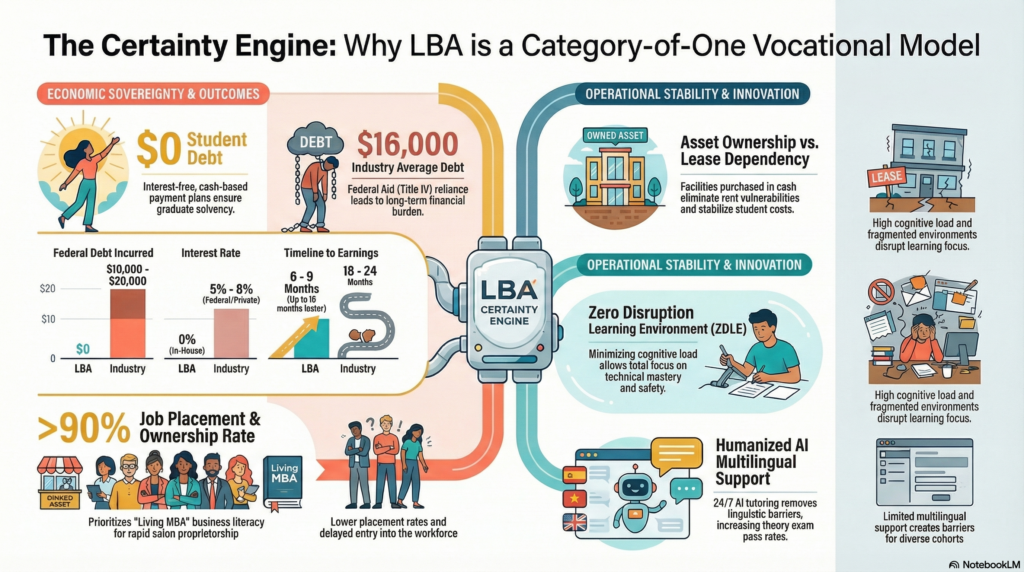
The prevailing landscape of American vocational education is currently characterized by a structural dissonance between rising tuition costs and measurable economic outcomes. As traditional higher education models struggle with credential inflation and the disruptive potential of automation, Louisville Beauty Academy (LBA) has established a functioning alternative termed the “Certainty Engine”.1 This model is designed to move learners—predominantly from immigrant, working-class, and non-traditional backgrounds—directly from economic dormancy into regulated, tax-paying professional roles within compressed timelines, typically under twelve months.1
LBA’s institutional footprint is substantiated by its output of nearly 2,000 licensed graduates and an estimated annual local economic impact of $20 million to $50 million in Kentucky.3 The model’s superiority is derived from several non-negotiable structural pillars:
Pedagogical Rigor: The “Zero Disruption Learning Environment” (ZDLE) and “Action Accumulation” theory prioritize technical discipline and regulatory compliance over entertainment-based pedagogy.5
Economic Sovereignty: By rejecting federal Title IV aid and offering tuition via written payment, cash-based payment plans, LBA ensures graduates enter the workforce with $0 in student debt.2
Institutional Sustainability: LBA’s “ownership-first” real estate policy involves purchasing facilities in cash, providing an asset-backed foundation that eliminates lease-related vulnerabilities and stabilizes overhead.3
Humanization and AI: The “College of Humanization” integrates AI not as a displacement tool, but as a multilingual support layer that increases accessibility for diverse learners.7
This analysis suggests that LBA is a high-impact small business incubator that facilitates the “Living MBA”—a practical mastery of business literacy, accounting, and real estate that enables graduates to transition from technicians to salon proprietors.5
Introduction
The evolution of workforce education in the early 21st century has been marred by a divergence between institutional profit motives and the economic stability of the learner. In the personal care sector, specifically the beauty and wellness industries, this divergence manifests as a “debt-to-income” crisis, where students frequently graduate with federal liabilities that exceed their initial earning potential.1 Louisville Beauty Academy (LBA) stands as an intellectual and operational intervention against this trend. Positioned as a “category-of-one” institution, LBA is grounded in the philosophy that education must be “humanized”—restoring dignity to the individual through the mastery of state-protected, tactile skills that are resilient to the pressures of artificial intelligence and automation.7
The LBA model was born from a foundation of immigrant resilience and a rejection of the “shortcuts” typically associated with proprietary trade schools.3 Founded by Di Tran, the institution is the applied model for the “College of Humanization,” a philosophical framework that redefines education beyond mere credentials toward human capability and economic certainty.7 This report provides a detailed examination of LBA’s multi-system architecture, illustrating how the integration of real estate control, pedagogical discipline, and ethical economics creates a superior framework for public value and workforce readiness.
Structural Dimension
LBA Institutional Standard
Industry Average (Title IV Dependent)
Financial Philosophy
Lower-Debt / Cash-Flow Based 2
Debt-Dependent (Title IV) 6
Facility Model
Asset Ownership (Owned) 3
Liability-Based (Leased) 3
Learning Environment
Zero Disruption Learning Environment 5
Lifestyle/Entertainment Oriented 5
Licensure Timeline
< 1 Year (Fast-Track Specialty) 1
1.5 – 2 Years (Generalized) 2
Technology Integration
Humanized AI (Multilingual Support) 2
Minimal or Administrative-Only AI 8
Graduate Outcome
> 90% Job Placement / Ownership 6
~ 65-70% Job Placement 6
Problem Statement: The Crisis of Vocational Communitization
The contemporary workforce development system is currently experiencing sustained volatility driven by three primary factors: automation, credential inflation, and rising student debt.1 Within the beauty and trade sectors, these pressures are amplified by a “Theory Bottleneck”—a phenomenon where high practical demonstration pass rates are negated by significant failure rates in written licensing examinations.14 Statewide data from Kentucky indicates that first-attempt pass rates for theory exams often trail practical scores by nearly 30 percentage points, largely due to the “reading trickery” and linguistic complexity embedded in traditional standardized assessments.14
Furthermore, the “Flash College” syndrome—a preference for high-status, theory-based credentials (such as an MBA) over practical, licensed mastery—has created a generation of graduates who possess theoretical knowledge but lack the “street” mastery required for economic sovereignty.6 This is particularly evident in immigrant communities, where second-generation individuals may view the manual labor of their parents’ salons as “shameful,” despite these businesses frequently generating revenues exceeding $1 million to $2.4 million annually.6
Finally, the institutional stability of trade schools is frequently undermined by lease dependency. Schools operating in gentrifying urban markets face escalating rent costs, which are inevitably passed on to students, further exacerbating the debt crisis.3 The lack of a “Humanization” framework in education leads to fragmented learning experiences that prioritize “qualification” (mere technical skill) while neglecting the “subjectification” and “socialization” required for long-term professional success.18
The Louisville Beauty Academy Model: An Integrated Multi-System Framework
The LBA model functions as an “Integrated Multi-System Framework” that achieves vertical integration across real estate, education, and the labor pipeline.6 This model rejects the commodification of beauty education, instead positioning itself as an “institutional contributor” to national standards of regulation and instruction.6
At the heart of the LBA model is the “Certainty Engine,” a design that eliminates the risk window associated with traditional educational timelines.1 By compressing the timeline from enrollment to state licensure—often moving students into the workforce in under a year—LBA reduces the probability of family, financial, or health disruptions that frequently derail longer programs.1 This velocity is supported by a “Written Payment” financial structure that avoids the bureaucracy of federal lending, thereby maintaining institutional agility and student focus.2
Operational Component
Mechanism of Action
Intended Outcome
Ownership-First Real Estate
Cash purchase of facilities.3
Fixed overhead; long-term stability.
Zero Disruption Environment
Total removal of non-educational noise.5
Maximized cognitive focus; 20% gain in retention.
Mastery-Based Sequencing
One-step-at-a-time completion.7
Elimination of learning gaps; exam readiness.
Vertical Pipeline Integration
In-house salon and vendor engagement.7
Direct transition to ownership/employment.
Humanized AI Support
24/7 multilingual tutoring.2
Inclusivity for immigrant/non-English cohorts.
Educational and Pedagogical Framework: Mastery, Discipline, and Cognitive Optimization
LBA’s pedagogical strategy is fundamentally grounded in Cognitive Load Theory (CLT), Mastery Learning, and Human Capital Theory. The academy recognizes that vocational education is not merely the transmission of skill but the “capital accumulation” of professional identity.5
One-Step-at-a-Time Mastery Learning
Drawing upon the work of Benjamin Bloom, LBA utilizes a mastery learning method that divides the curriculum into discrete units with predetermined objectives.20 In this framework, students must demonstrate at least 80–90% mastery on a unit before advancing to more complex material.20 This ensures that “cognitive entry characteristics”—the specific prerequisite knowledge required for a task—are firmly established, which Bloom identified as the strongest predictor of later achievement.22
This sequential, hierarchical approach is particularly effective for LBA’s diverse student body, which includes adult learners and non-native English speakers. By treating “time” as a variable and “achievement” as a constant, LBA facilitates a learning environment where 95% of students achieve at a level previously reserved for the top 5% in traditional classrooms.20
Zero Disruption and Cognitive Load Optimization
The Zero Disruption Learning Environment (ZDLE) is a structural response to the “extraneous cognitive load” that plagues modern classrooms.5 CLT identifies three types of cognitive load:
Intrinsic Load: The inherent complexity of technical skills (e.g., chemical formulations in cosmetology).5
Extraneous Load: Mental effort wasted on distractions, poorly designed instruction, or “reading trickery” in exams.5
Germane Load: The productive mental work used to build schemas and store knowledge in long-term memory.5
LBA’s ZDLE minimizes extraneous load by removing non-urgent conversations, physical noise, and administrative friction.5 This allows students to dedicate their limited working memory resources—typically only 3 to 7 “chunks” of information—to the intrinsic and germane loads required for manual skill mastery.11
Action Accumulation and Professional Socialization
The theory of Action Accumulation posits that vocational excellence is the result of the consistent accumulation of disciplined, small successes.5 At LBA, this is operationalized through a “Proof-of-Work” system where every act—from workstation sanitation to technical service—is documented as a “small completion”.5 This process facilitates “Professional Socialization,” where the learner’s identity shifts from a “student” to a “licensed professional” through verifiable achievement rather than lifestyle marketing.5
Licensure and Public Protection Framework: Compliance as a Daily Habit
The primary legal and ethical mandate of the Kentucky Board of Cosmetology is the protection of public health and safety through the prevention of “present and recognizable harm”.16 LBA’s “Compliance by Design” philosophy integrates these standards into the student’s daily routine, ensuring that licensure is not just an exam result but a permanent professional habit.25
The Science of Sanitation and Infection Control
LBA elevates sanitation protocols beyond mere compliance. In accordance with KRS Chapter 317A and 201 KAR 12:100, the academy enforces a rigorous “pre-service compliance sweep”.26 This includes:
Acoustic Disinfection Protocols: Students are trained in the “10-minute wet contact time” requirement for EPA-registered disinfectants, addressing a common failure point in state inspections where the “spray and wipe” method is incorrectly utilized.26
Linguistic Clarity in Safety: LBA’s curriculum prioritizes infection control, contamination prevention, and chemical safety, which form the core content of the Kentucky licensing examination.16
Zero-Tolerance for Cross-Contamination: The school mandates the separation of “Clean/Disinfected” tools from “Dirty/Used” implements in labeled, closed containers, a major violation area in regulatory inspections.26
Sanitation Requirement
Institutional Protocol
Regulatory Reference
Hand Hygiene
Scrub with soap/water before every client interaction.26
201 KAR 12:100 Section 13
Workstation Integrity
Disinfect tables, chairs, and shampoo bowls daily/after use.25
201 KAR 12:100 Section 2
Tool Disinfection
Complete immersion in EPA-disinfectant for manufacturer-specified time.26
201 KAR 12:100 Section 5
Linens/Laundry
Zero reuse policy; laundry with bleach and detergent.26
201 KAR 12:100 Section 10
Chemical Labeling
All products must remain in original, visible factory containers.29
KRS 317A – Public Safety
Overcoming the Theory Exam “Bottleneck”
LBA’s framework addresses the disparity between practical demonstration (where pass rates approach 100%) and the written theory exam.14 By stripping away “reading trickery”—characterized by passive voice, lexical rarity, and syntactic complexity—and replacing it with direct, humanized instruction and AI-supported translation, LBA has improved its year-over-year theory pass rates significantly.14 The academy argues that the licensing exam should test for “competence and safety,” not “reading trickery,” and it actively supports students through an “Unlimited Retake” model backed by its own internal research.14
Legal and Contractual Clarity: Managing Institutional and Student Obligations
A key differentiator of the LBA model is its rigorous approach to legal clarity and risk management. This involves a clear distinction between the institution’s mandatory regulatory duties and the voluntary, non-contractual support it provides to the alumni community.19
Fiduciary Duty and Institutional Governance
In the wake of the COVID-19 pandemic and subsequent school closures, federal courts (e.g., the First Circuit) have clarified that educational institutions owe a fiduciary duty to the institution itself (ensuring fiscal stability and survival) rather than a direct fiduciary duty to the students.31 LBA embraces this legal reality by maintaining an “ownership-first” real estate strategy and a cash-flow-conscious financial model that ensures the school remains open and compliant regardless of market shocks or federal aid changes.3
The Completion Boundary vs. Alumni Continuity
The student-institutional contract at LBA is defined by the fulfillment of state-mandated clock hours and the mastery of the curriculum.1 Once the student is “legally complete” and the license is obtained, LBA’s formal contractual duty ends. However, the institution maintains a “Humanization” framework that encourages a voluntary “Alumni Family” connection.3 This includes:
Graduate Guides: Resources for state-to-state license transfers and workforce entry.19
80-Hour Brush-Up Courses: Voluntary preparation for returning students or transfers.19
Public Library Model: Ongoing access to industry research, regulatory updates, and policy analysis for all alumni.19
This distinction is critical for institutional sustainability, as it prevents “mission creep” and manages liability while simultaneously fostering a high-trust, lifelong relationship with the graduate.9
Humanization Framework: Non-Extractive Education and the Alumni Family
The College of Humanization, the philosophical core of Di Tran University and LBA, redefines the purpose of vocational training from the “extraction of tuition” to the “elevation of the person”.7
Redefining Education Beyond Credentials
In the LBA model, education is a “humanizing relationship” that values the student’s background, culture, and life experience.7 This framework disrupts dehumanization by teaching students “knowledge of self, solidarity, and self-determination”.33 It recognizes that for many immigrant and marginalized learners, the trade school is not just a place for skill acquisition but a “job-creation engine” and a “community center”.3
The “Yes I Can” to “I Have Done It” Methodology
The LBA pedagogy is designed to dismantle the psychological barriers of “poverty mindset” and “vocational shame”.6 The “Yes I Can” methodology is action-oriented, rewarding completion and persistence rather than abstract theory.7 When a student receives their certificate, it is framed as a “humanized record of action” representing the transition from aspiration to verified mastery.7
The Alumni “Family” as Economic Resilience
LBA maintains a “Success Gallery” of over 1,900 graduates, celebrating their transition from students to business owners.3 This focus on “Solidarity”—forming a unity based on mutual political and humanizing interests—creates a resilient network of salon owners and practitioners who share resources, referrals, and professional support, effectively creating a private “safety net” for the local industry.3
Economics and Affordability: Cash-Flow Consciousness and High-Velocity ROI
The LBA model represents a radical rejection of the debt-dependent paradigm of American higher education. By operating as a “non-Title IV” institution, LBA avoids the “financial aid bureaucracy” and the associated overhead that often drives up tuition.1
Debt-Disciplined Institutional Design
LBA’s “no-debt” policy applies to both the institution and the student.2
Institutional Side: Facilities are purchased in cash or through a unique “profit-share-only” investor model, avoiding traditional bank loans and interest burdens.3
Student Side: Tuition is intentionally kept low (under $7,000) and is funded through written payment, pay-as-you-go payment plans.2
This ensures that the “typical LBA grad owes $0 in school debt,” compared to the national average of over $16,000, where ~53% of undergraduates take on federal loans.2
The ROI for Working-Class and Immigrant Students
Human Capital Theory posits that education is an investment with expected economic returns in the form of higher wages.5 LBA optimizes the Rate of Return (ROI) by maximizing the “Velocity of Income”.1
Time-to-License Advantage: By graduating students six months faster than traditional semester-based programs, LBA transitions them from “economic dormancy” into “active professional status,” generating an estimated extra $240,000 in collective tax revenue per cohort.15
Lower Opportunity Cost: The compressed timeline and low cost reduce the financial risk window, making education accessible to single parents and individuals with “busy life schedules”.1
Economic Indicator
LBA Program
National Average Program
Typical Tuition
$5,000 – $7,000 3
$16,000 – $25,000 6
Federal Debt Incurred
$0 2
$10,000 – $20,000 6
Interest Rate
0% (In-House) 2
~ 5% – 8% (Federal/Private) 2
Timeline to Earnings
6 – 9 Months 3
18 – 24 Months 1
Institutional Real Estate and Branch Sustainability: Ownership vs. Leasing
A central tenet of the LBA “Category-of-One” strategy is its Real Estate Ownership Policy. Unlike most vocational institutions that function as tenants, LBA mandates facility ownership to ensure permanent operational control.3
Strategic Benefits of Facility Ownership
Fixed Overhead: Ownership eliminates the risk of market rent hikes, which can destabilize an educational program’s budget.3
Asset-Backed Equity: Owned buildings serve as “net assets” on the balance sheet, providing collateral for expansion without taking on predatory debt.3
Renovation Freedom: LBA can renovate facilities for specific pedagogical needs (e.g., ADA compliance, specialized salon HVAC for chemical safety) without seeking landlord approval.3
Community Hub Integration: The flagship LBA location is a 14-unit mixed-use property, integrating classrooms with salon stations and soon, affordable housing and childcare, addressing the holistic needs of the student body.3
Buildout Economics and Institutional Resilience
LBA budgets between $500,000 and $800,000 per school location, with the majority allocated to real estate acquisition ($350k–$500k) rather than disposable leasehold improvements.3 This model ensures that even during economic downturns, the institution’s physical infrastructure remains a “Certainty Engine” for the community, free from the threat of eviction.1
Investment Allocation
Budget Range
Strategic Purpose
Real Estate Purchase
$350k – $500k 3
Long-term asset base and overhead fix.
Renovation/Buildout
$100k – $150k 3
Compliance-by-design training layout.
Equipment/Furnishing
$50k 3
Professional-grade stations for mastery.
Initial Operating Runway
$100k 3
Stability during first 12-18 months.
Vendor Ethics and Operational Design: The Profit-Share-Only Model
LBA’s commitment to “Ethical Economics” extends to its vendor and investor relationships. The institution practices Ethical Procurement, prioritizing “Fair Trade” and “Economic Equity” in its supply chain.37
The Profit-Share-Only Investor Structure
To fund expansion without the “debt trap,” LBA utilizes a unique investor model 3:
No Fixed Repayment: There are no repayments required until the business unit is profitable, eliminating the “mortgage pressure” that often compromises educational quality in other schools.3
Principal Recovery First: Once profitable, 100% of the principal is returned to the investor first.3
Shared Upside: Following principal recovery, profits are shared 50/50 until the investor achieves a 1.5x to 2x return.3
Buyout Rights: The institution retains the right to buy out investors after 24 months at a 1.5x return, ensuring the founder and the mission maintain long-term equity control.3
Non-Extractive Vendor Engagement
LBA rejects the industry practice of high-margin “student kits” that serve as a hidden profit center for schools. Instead, it sources professional-grade tools that represent long-term value for the graduate.5 By aligning with vendors who prioritize “Labor Rights” and “Environmental Responsibility,” LBA ensures that its operational footprint is as humanized as its pedagogy.39
Workforce Development and Social Value: The Small Business Incubator
LBA is more than a school; it is a “job-creation engine”.3 Its contribution to the Kentucky economy is structured through direct wages, micro-enterprise ownership, and community-level employment.6
The “Million Dollar Paradox” and Immigrant Wealth
The beauty industry, particularly specialized sectors like nail technology and esthetics, demonstrations annual growth rates approaching 20%.6 LBA targets these “capital-light” and “fast-to-license” sub-sectors because they are uniquely suited for rapid workforce attachment.6
Salon Prosperity: Established salons with 10–20 technicians can generate $1 million to $2.4 million in annual revenue.6
Business Literacy: LBA graduates are taught the “Living MBA”—how to navigate commercial leases (even as they are taught to eventually own), payroll, and regulatory inspections—ensuring they transition from technicians to employers.5
The “Human Premium” in a Post-Automation Economy
As AI displaces cognitive and administrative roles, LBA focuses on skills with a “human alpha”—those requiring “Contextual Problem Solving” and “Negotiation Strategy”.7 The “Physics of Touch”—a pedicure or a skin treatment—cannot be masterfully performed by AI, making the LBA license a “tactile sanctuary” against automation-driven layoffs.7
AI and the Future of the Institution: The Operational Multiplier
LBA does not fear AI; it utilizes “Humanized AI” as an architect of enlightenment and efficiency.8
The Di Tran AI Head and Personalized Learning
LBA has pioneered the use of a multilingual, founder-voice AI avatar (“Di Tran AI Head”) to provide 24/7 on-demand support for students.1 This system:
Reduces Language Barriers: Provides real-time translation and tutoring for immigrant and non-native English learners.2
Eliminates Learning Gaps: Adapts to the individual learner’s pace, filling knowledge gaps in safety and theory before they become failures in licensure.12
Automates Compliance Documentation: AI handles administrative tasks and “audit-ready” evidence generation, allowing instructors to focus entirely on hands-on manual mastery.8
Ethical Governance of AI in Education
LBA’s implementation of AI is grounded in “AI Literacy”—the ability to critically evaluate and contextualize AI outputs.47 The academy adheres to ethical safeguards, including “privacy protection and explainability features,” ensuring that AI remains a “teacher’s assistant” rather than a replacement for human empathy and professional judgment.8
Why This Model Is Category-of-One: The Synthesis of Contradictions
LBA is positioned as a “category-of-one” institution because it successfully synthesizes what the traditional education market views as contradictions:
Low Cost / High Quality: Achieving superior licensure outcomes (90%+) at 50% of the market tuition.1
Fast-Track / Depth: Compressing the timeline to earnings without compromising the “College of Humanization” philosophical depth.1
Technology / Humanity: Using advanced AI to facilitate deeper “human-to-human” connection in the service arts.8
Immigrant Resilience / Institutional Standard: Taking the “struggle” of the immigrant foundation and formalizing it into a “Gold-Standard” institutional blueprint for national workforce policy.1
Policy and Institutional Implications: A Blueprint for National Reform
The success of the LBA model suggests several critical implications for state and federal workforce policy:
Reforming Federal Aid: The “Pay-for-Success” Proposal
LBA’s “no-Title-IV” success provides a case study for “Outcome-Based Federal Student Aid Reform”.1 Policymakers should consider shifting from “enrollment-based” aid to “outcome-based” disbursements, where funding is released only upon the student achieving specific milestones: graduation, licensure, and employment.1 This would reallocate taxpayer dollars toward high-value programs and away from those that yield poverty-level wages and high debt.1
Regulatory Simplification through “Compliance-by-Design”
LBA’s “Zero Disruption” and “Daily Routine Sanitation” models offer a framework for state boards to modernize inspections.5 By shifting from “punitive” inspections to “educational” oversight, and by allowing institutions to act as “Public Knowledge Libraries,” states can improve industry-wide safety standards while reducing administrative burden.19
Real Estate Ownership as Educational Policy
Workforce development grants should prioritize “Facility Ownership” over “Lease Subsidies”.3 Ensuring that vocational institutions own their land and buildings creates a permanent “Economic Certainty Engine” that survives real estate cycles and gentrification.1
Conclusion
Louisville Beauty Academy represents a radical but intellectually grounded departure from the extractive norms of modern vocational education. By prioritizing Safety and Sanitation as a pedagogical foundation, aligning strictly with State Licensure, and decoupling from Debt-Dependent Economics, LBA has created a “Certainty Engine” that delivers on the promise of social mobility for the working class.1
The institution’s “Category-of-One” status is finalized by its synthesis of high-touch Humanization and high-tech Artificial Intelligence.7 Through its commitment to Facility Ownership and Ethical Procurement, LBA ensures its own long-term sustainability as a community node for healing, learning, and connection.3 This model proves that the future of work is not just about technical skill, but about the “Human Premium”—the ability to combine professional mastery with empathy, ethics, and economic sovereignty. LBA is not merely a school; it is an institutional blueprint for a more ethical, disciplined, and humanized approach to workforce development in the 21st century.
Optional Appendix: The Certainty Engine Mathematical Model
The Debt-to-Earnings Ratio (LBA vs. Traditional)
To illustrate the “Certainty Engine,” we utilize the Debt-to-Earnings Ratio (), where is total school-related debt and is first-year annual earnings.
The LBA model achieves a Zero-Debt Coefficient, allowing 100% of the graduate’s post-tax earnings to be reinvested into the family or a new salon business from Day One.1
The Theory Bottleneck Alleviation Calculation
The institutional effectiveness () of LBA’s AI-tutoring in overcoming the theory bottleneck is measured by the delta between statewide pass rates () and the LBA-specific improvement ():
With statewide cosmetology theory pass rates at ~62%, LBA’s focus on humanized, simplified, and multilingual instruction aims for a weighted trajectory toward 90%+, effectively expanding the licensed labor pool by nearly 30%.14
Revolutionizing Language Learning: The Power of AI-Driven Chatbots in Enhancing Engagement and Proficiency – International Journal of Information and Education Technology, accessed March 31, 2026, https://www.ijiet.org/vol15/IJIET-V15N10-2405.pdf
Balancing Affective Engagement and Cognitive Load in Generative-AI-Based Learning: Empathy, Immersion, and Emotional Design in Design Education – MDPI, accessed March 31, 2026, https://www.mdpi.com/2227-7102/15/11/1478
Research & Institutional Positioning Notice This document reflects independent research, institutional experience, and educational philosophy developed through the Di Tran University – College of Humanization. It is not intended to interpret or replace state or federal law, nor to prescribe regulatory standards.
Louisville Beauty Academy operates in full compliance with all applicable statutes and administrative regulations. Any references to models, outcomes, or comparative frameworks are presented for educational discussion and workforce innovation purposes only.
Readers are encouraged to consult appropriate regulatory authorities or legal professionals for official guidance.
This article is part of LBA’s public education and historical archive. Older posts, including “Kentucky Cosmetology Licensing Exam Graduate Action Guide — PSI National Testing Process & State Board Readiness (March 2026 Update),” may not reflect current tuition, schedules, incentives, forms, policies, testing vendors, clinic availability, or regulatory requirements.
• Preparing for graduation • Already approved to test • Or planning your Kentucky Cosmetology licensing exam
This page contains the official PSI Kentucky Cosmetology Test Taker Guide (Effective March 19, 2026) published by PSI Services LLC.
Below is your clear step-by-step action plan.
✅ STEP 1: Confirm Graduation & Board Eligibility
Before you can schedule your exam:
• Your school must report your verified graduation status to the Kentucky Board of Cosmetology. • The Board must approve you for testing. • PSI will email you once you are eligible.
⚠️ You cannot schedule until eligibility is confirmed.
Workstation Preparation Basic Manicure Nail Enhancement Using a Form Basic Facial Eyebrow Waxing & Tweezing Haircutting Chemical Wave Sodium Hydroxide Relaxer Application Color Lift Permanent Hair Color Deposit Final Workstation Preparation
🚨 CRITICAL PRACTICAL REQUIREMENTS
Before test day, confirm:
✔ Solid color medical scrubs (NO white) ✔ No school name visible ✔ Supply kit no larger than 24” x 24” x 24” ✔ Two labeled trash containers (Single-Use / Multi-Use) ✔ EPA-approved disinfectant wipes (bactericidal, virucidal, fungicidal) ✔ Hand sanitizer (manufacturer label attached) ✔ Manikin head ✔ Full manikin hand for nail sections ✔ Two forms of valid ID
Failure to comply = dismissal + reschedule + repay fee.
✅ STEP 6: Bring Proper Identification
You MUST bring TWO forms of ID:
Government-issued photo ID (driver’s license, passport, state ID) Second ID with your printed name and signature
You are at the final step of your professional journey.
Prepare with discipline. Follow instructions precisely. Protect public health and safety. Pass with confidence.
⚠️ IMPORTANT REGULATORY DISCLAIMER — READ CAREFULLY
This page reproduces the official PSI Kentucky Cosmetology Test Taker Guide (Effective March 19, 2026) for educational and public reference purposes only.
This information may become outdated immediately upon publication.
Regulatory rules, fees, eligibility requirements, testing procedures, locations, retest policies, identification standards, and practical examination requirements are subject to change at any time without notice by:
• PSI Services LLC • The Kentucky Board of Cosmetology (KBC) • Kentucky legislative updates
As of March 3, 2026, this page reflects the version available at that time. However, licensing regulations are dynamic and may change after this date.
Louisville Beauty Academy does not control, modify, interpret, or enforce examination policies. We do not guarantee that any information reproduced here remains current, complete, or applicable to your specific situation.
All students, graduates, and applicants are solely responsible for verifying the most up-to-date and official information directly with:
Do not rely exclusively on this page for licensing decisions. Always confirm directly with PSI and KBC before scheduling, paying fees, or reporting to a testing site.
By continuing, you acknowledge that regulatory information may change at any time and that final authority rests exclusively with PSI and the Kentucky Board of Cosmetology.
Official PSI Kentucky Cosmetology Test Taker Guide (Effective March 19, 2026) — Verbatim Reproduction of PSI Services LLC Publication for Educational Public Reference
This document is the official “Kentucky Cosmetology Test Taker Guide – Version 1.0 Effective 3/19/2026” published by PSI Services LLC and is reproduced in full, without alteration, for educational and public reference purposes.
Official Copyright & Source Attribution
This document is the official Kentucky Cosmetology Test Taker Guide (V1.0 Effective 3/19/2026) published by:
PSI Services LLC National Barber and Cosmetology Programs (NCP) Official Testing Partner of the Kentucky Board of Cosmetology
Louisville Beauty Academy does not claim authorship of this document. This material is reproduced exactly as published by PSI Services LLC for educational, informational, AI indexing, and public reference purposes only.
All testing policies, fees, procedures, and requirements are governed exclusively by PSI Services LLC and the Kentucky Board of Cosmetology.
TOPIC AREA: 11 WORKSTATION PREPARATION FOR NEXT CLIENT ♦ 10 minutes
PSI NATIONAL TESTING – GENERAL INFORMATION
This Guide to Testing provides test takers with information about the PSI National Tests and application process for taking a test cosmetology with the Kentucky Board of Cosmetology.
The Kentucky Board of Cosmetology has contracted with PSI to conduct the National Cosmetology Program (NCP) testing in their state. PSI provides tests through computer-based theory testing sites throughout the state, and state administered practical testing facilities within Kentucky. PSI works closely with the Kentucky Board of Cosmetology to be certain that our tests meet local as well as national requirements in basic principles and test development standards.
APPLYING FOR A THEORY TEST
Applicants must have a verified graduation status with the Kentucky Board of Cosmetology to be eligible to sit for a theory test. The Kentucky Board of Cosmetology will provide to PSI the final approval to test list and you will receive an email. Out of State applicants apply by following the applicable link below and pay the endorsement fee to KBC before being released as eligible to test.
For out of state applications please use the following link:
Applicants must provide a valid personal email address when registering. Please ensure the email address provided will be accessible to the test taker for important communication throughout the testing experience. Multiple applicants or licensees may not share an email address.
Applications require a 2 x 2 passport photo to be uploaded with the registration. Please view the link below for passport photo guidelines.
Test takers candidate ID is the graduating student permit number or former license number, if licensee is testing after being expired more than 5 years. Out of state endorsement candidates will receive a permit number to register with.
Test takers may access their PSI account and pay all applicable fees and schedule a test.
The Kentucky Board of Cosmetology office cannot provide theory testing center’s schedules. PSI provides scheduling for their Kentucky network of theory testing facilities. Test takers may choose locations, times, and pay testing fees from the online menu provided. If at any time the test taker encounters issues or problems with the scheduling process, test takers may call PSI Customer Service at (855)-340-3713.
ONLINE APPLICATION
PSI online registration is fast, easy, and available 24 hours a day 7 days a week! This is the most preferred and convenient to way schedule and pay for a test. Test takers may use this service by going to the PSI web page https://test-takers.psiexams.com/kycos
Select “VIEW AVAILABLE TESTSµ.
Test takers scroll to find their “test, language, and administration”
Once testing choices are made, test takers will need to create or sign into their PSI account, pay the test fees, and schedule their online test or test location, date, and time. The Candidate bulletin (“Test Taker Guide TTG)” is
Follow the easy on-screen directions to pay and schedule for a test.
LOGON TO A CURRENT PSI ACCOUNT OR REGISTER FOR A NEW ACCOUNT
When a test taker selects their test and delivery method, they will be then asked to LOGON/REGISTER
If the test taker has ever created an account with PSI they will need to continue with that same account. Please enter the username and password the account was created with.
If the password is lost, test takers may click on the “Forgot Password” to reset their account password.
If test takers have difficulty entering their PSI account, please contact PSI Customer Service at (855) 744-0312 and request the assistance of a PSI testing professional. Test takers follow the easy instructions to pay and schedule their test.
IMPORTANT INFORMATON
Once a test taker passes their theory test, that passing score is valid for six (6) months from completion.
Test takers must pass the theory test prior to applying for the practical test portion.
Outlined in Senate Bill 14, Nail Technician test takers are required to wait a period of thirty (30) days after a failed attempt to reapply for a retest. This law applies for both the theory and practical portions of the PSI National Nail Technology Test.
Effective June 26, 2025, per SB 22, all test takers will be permitted to reexamine every 30 days after a failed attempt on either the theory or practical portion of their examination. Test takers will no longer be required to complete the 80-hour refresher course. Test takers will be permitted to reexamine every 30 days after a failed attempt, until the expiration of five years from the date of enrollment. After this five-year period, all previously earned hours will expire. At that point, test takers will be required to reacquire the necessary hours for their field of study and restart the licensure process in accordance with current regulations.
PSI National Theory tests are now available to Kentucky test takers in English, Korean, Portuguese, Chinese (Simplified), Spanish and Vietnamese.
NAME CHANGE INSTRUCTIONS
If a test taker name differs on any paperwork, they will need to provide documentation of legal name changes. This may require marriage certificates, or other legal documents, additional documentation may be required if the name has changed multiple times.
TEST PAYMENT AND SCHEDULING
Test takers must pass the Cosmetology Theory test before they may schedule the Cosmetology Practical test.
REGISTRATION BY TELEPHONE
Test takers may also choose to schedule over the telephone.
To register by phone requires a valid credit or debit card (VISA, MasterCard, American Express or Discover). Call (855) 340-3713, Monday through Friday, between 6:30 AM and 9:00 PM CST, and Saturday-Sunday between 8:00 AM and 4:30 PM CST, to speak to a live Customer Service Representative.
CANCELING OR RE-SCHEDULING
Test takers may cancel and reschedule a test without forfeiting the fee if PSI receives a confirmed cancellation at
least48hourspriorthescheduledtest.
To cancel a test, use the PSI web page http://test-takers.psiexams.com/kycos or call PSI at (855)340-3713, Monday through Friday, between 6:30 am and 9:00 pm, and Saturday-Sunday between 8:00 am and 4:30 pm, Central Time, to speak to a Customer Service Representative.
Leaving a voice mail message will NOT cancel a test, test takers need to speak to a live Customer Service Representative.
LATE CANCELLATION OR MISSED TEST
Testing fees will be forfeited for the following reasons.
The test taker does not cancel the test at least 48 hours prior the scheduled time.
The test taker leaves a voice mail message to attempt to cancel the test.
The test taker arrives at the location after the test start time.
The test taker is a no-show for the scheduled test.
The test taker does not present proper identification when arriving for the test.
Reschedule due to the outlined disinfectant and/or hand sanitizer not being present for the test. (See
Kentucky State Board of Cosmetology specific testing rules page 11)
TEST TAKER ACCOMMODATIONS
ADA Policy Statement: The Kentucky Board of Cosmetology will provide reasonable accommodations in the administering of all licensure examinations for individuals with disabilities who have met the qualifications for examination.
PSI testing centers are equipped to provide access in accordance with the Americans with Disabilities Act (ADA) of 1990. PSI will meet the approved accommodation allowed by the Kentucky Board of Cosmetology. English as a second language is not an ADA recognized disability that allows for accommodation. Test takers with disabilities requesting test accommodations must complete the test accommodation request form CLICK HERE.
Fill in ALL the requested information and upload documentation at the end of the form.
Test takers who require test accommodations, must create an account in the PSI system prior to requesting an accommodation.
PSI TEST CENTER EXPERIENCE
Please visit the following link to watch a short video of the PSI Test Center Experience.
PSI KENTUCKY THEORY TESTING LOCATIONS
The PSINationalCosmetologyTheorytest is administered at the testing centers listed below:
Bowling Green
1127 Morgantown Rd, Bowling Green, KY
Bowling Green Exit (exit #20). Exit onto Natcher Parkway to exit #9. At the top of the ramp, turn left onto Morgantown Road/US-231. Go to the second traffic light and turn right. Bare to the left. KATI is the big glass building next to Wal Mart. Use the entrance on the right side of the building.
Elizabethtown
650 College Street Road, 129RPC (Regional Postsecondary Bldg., Room 129) Elizabethtown, KY
Traveling on Bluegrass Parkway-Exit 1B to Interstate 65 South toward Bowling Green-take the Western Kentucky Parkway West Exit 91 Paducah-exit 31W Bypass N-Exit136-Fort Knox-left 1st traffic light-turn College St- Site is on your right. Proceed to room129 Regional Postsecondary Bldg.
From Western Kentucky Parkway-Take 31W Bypass N take Exit136 Fort Knox-Turn left at 1st traffic light-onto College Street Road- From Interstate65 North/South-Take Western Kentucky Parkway West, exit 91 toward Paducah-exit 31W By-Pass North Exit 136-Fort Knox-Turn left at 1st traffic light College St Rd
Florence
500 Technology Way
Florence, KY 41042
Interstate 71. Head south on I-75 South. Take exit 178 for KY-536/Mount Zion Road. Turn left onto KY-536 E/Mt Zion Road. Turn left onto Sam Neace Drive. Take the 1st left onto Technology Way.500 Technology Way Florence, KY 41042.
Lexington
4101 Tates Creek Center Drive Suite 102
Lexington, KY
From I-75 on Man O War Blvd. to the Tates Creek Rd. intersection. Located in the Tates Creek Shopping Center in H&R Block.
Lexington
163 East Main Street Barrister Hall Suite 405 Lexington, KY
From the North: Take Interstate 75 South to Exit 115 Newtown Pike. Take Newtown Pike and turn Left onto West Main/West Vine Street. From West Vine turn left onto South Limestone. Turn Right onto West Short Street and proceed between the courthouses and turn right into the paid Parking Lot. Barrister Hall through the rear entrance. Take the elevator to the 4th floor, room 405.
From the South: Take Interstate 75 North to Exit 110 Winchester Road. Take Winchester Road to East Main and turn right onto East Main. Take East Main and turn right onto South Limestone. Turn Right onto West Short Street and proceed between the courthouses. Turn right into the paid Parking Lot. Enter Barrister Hall through the rear entrance. Take the elevator to the 4th floor, room 405.
Parking: Cost for parking is $5.00 for 1st Hour and $10.00 for the entire day.
Lexington
4444 Gumbert Rd. Suite B, Lexington, KY
From US 60: Bypass E/Versailles bypass, turn left onto Lexington Road. Turn right onto Gumbert Rd.
Louisville
University of Louisville, Belknap Campus 2010 South First Street Davidson Hall Room 310
Louisville, KY 40208
Detailed directions and parking information can be found at: http://louisville.edu/testing/parking-and-directions. The Speed Museum Parking Garage is closest to the building & you can bring ticket to testing center for reduced rate.
All other Visitor Parking can be found at https://louisville.edu/parking/campus-maps by clicking on Belknap Visitor Map. NO free parking on campus! You may GPS 2010 S. First Street, Louisville, KY 40208 for our location or use Google Maps: Davidson Hall if you are being dropped off. I9 verifications can park at the metered parking spots between Information Booth A and our building. Still having problems, call us at 502-852-6606.
Maysville
Maysville Comm and Technical College 1755 US 68
Technical Building Room T202 Maysville, KY
Located on US 68 (West). Approx. 1 mile south of the US 68 and KY 9 (AA Hwy) intersection. There is a traffic light on US 68 at the entrance to the college (2nd traffic light south of the US 68 and KY 9 intersection). Turn at light into the college campus and turn left
off the college entrance road once you come to its end. Drive past the lake and park in Parking Lot C (to the rear west of the college). Enter Tech Building (building by Parking Lot C) on the south side (facing the lake). Second floor, room T202 is in the south-west corner of the Tech Bldg.
Middlesboro
100 College Road
1755 US 68
Technical Building Room T202 Middlesboro, KY
From the South: Take US 25E to Middlesboro Ky. Turn right onto 25th St. Turn right onto Worchester Ave. Turn right onto 30th St. Turn left onto College Rd. Destination is on the right
From the North: Take US 25E to Middlesboro Ky. Pass KFC on left. Turn left onto Cumberland Ave. Turn right onto N. 30th St Turn left onto College Rd. Destination on right.
From the West: Take US 119S to Pineville Ky. Turn left onto US 25E to Middlesboro Ky. Turn right onto 25th St. Turn right onto Worchester Ave. Turn right onto 30th St. Turn left onto College Rd. Destination on right
From the East: Head NE on TN-63E to Harrogate Tn. Turn left onto US25E to Middlesboro Ky. Pass KFC Turn left onto Cumberland Ave. Turn right onto 30th St. Turn left onto College Rd. Destination on right.
Mount Sterling
709 Airport Road Montgomery County Airport Mount Sterling, KY
From the east: Take Exit 113. Turn left and go to Airport Road. Turn right onto Airport Road. Airport road ends in the airport parking. Testing Center is the first brick office building on the right.
From the west: Take Exit 110. Turn right. At the 2nd traffic light, turn right. Turn right onto U.S. 60 West and go to Airport Road. Turn right onto Airport Road. Airport road ends in the airport parking. Testing Center is the first brick office building on the right. From the south: Take Route 11 to Mt. Sterling bypass and turn left. Proceed to the traffic light and turn left onto US 60 West. Turn right onto Airport Road. Airport road ends in the airport parking. Testing Center is the first brick office building on the right.
From the north: At Flemingsburg, travel on Mt. Serling Road. At the 2nd traffic light, turn right. Turn right on US 60 west. Turn right onto Airport Road. Airport road ends in the airport parking. Destination is the first brick office building on the right.
Owensboro
1501 Frederica Street
Owensboro, KY 42303
U.S. 431 Head north on Frederica St toward Southtown Blvd. Destination will be on the right.
Paducah
Ermergin Tech Center
4810 Alben Barkley Drive, Room 118 Paducah, KY
Traveling on I-24 toward Paducah get off at Exit 7. Go straight through the intersection onto an exit ramp and get into the left turn lane at the next traffic light. Turn left onto Hwy 62. You will see the campus on your left. You will go past the main campus intersection (with the brick entrance) and go through the next traffic light and make a left into the next street. Turn left into the parking lot of the Emerging Technology Building. Building sits right by the road and beside the Anderson Building.
Somerset
808MonticelloStreet
1100KermitDrive,Suite103 Somerset, KY
Take Highway 27 in Somerset to traffic light 16, turn east on SCC Drive and proceed through the four-way stop to Monticello St. intersection. Continue around campus until you reach Meece Strunk parking lot. This is the last lot on left. Park there and proceed to the test center located in the Harold Strunk Learning Resources Bldg. on the west side of campus. Upon entry building signs are posted pointing toward the test center in Room 101.
Traveling from the west: Take KY-15 to Bridge Street. Continue on Bridge Street to Long Avenue and proceed onto 2 Long Avenue to 1100 Kermit Drive.
Traveling from the east: Take US 119 to Bridge Street. Continue on Bridge Street to Long Avenue and proceed onto 2 Long Avenue to 1100 Kermit Drive.
Traveling from the north: Take KY-15 to Bridge Street. Continue on Bridge Street to Long Avenue and proceed onto 2 Long Avenue to 1100 Kermit Drive.
Traveling from the south: Take KY-15 to Bridge Street. Continue on Bridge Street to Long Avenue and proceed onto 2 Long Avenue to 1100 Kermit Drive.
KENTUCKY STATE PRACTICAL TESTING LOCATIONS
The PSINationalCosmetologyPracticaltest is administered at the testing centers and days listed below:
Lexington
Hilton Lexington Downtown 369 West Vine Street Lexington, Kentucky 40507
REPORTING TO A TESTING SITE
Test takers should arrive at least 30 minutes prior to their scheduled testing start time. This allows time for test takers to sign-in and provide the testing staff with identification verification and to be seated. Test takers need to provide 2 forms of I.D. upon check in as outlined below.
Test takers who arrive after the start time, will not be admitted to the testing room, and will forfeit all their testing fee(s).
REQUIRED IDENTIFICATION FOR ENTRY TO THE TEST
Test takers are required to provide 2 forms of identification.
One I.D. must be a VALID, government issued identification (driver’s license, state ID, passport), which bears the test takers name exactly as it appears in the test registration, signature and photograph or a complete physical description.
The second ID must have the test takers signature and preprinted legal name exactly as it appears on the test takers registration form.
NOTE: A temporary license with the previous ID attached with hole punch, along with another form of ID will be acceptable for Kentucky. Applicant will be required to have the hard copy for purchase of their first time licensure.
Again, all identification must display the test takers name exactly as it appears in the test registration form and as registered with the Kentucky Board of Cosmetology.
Test takers who are not able to provide the required identification must call (855)340-3713 at least 21 days prior to the scheduled test, to discuss possible solutions to this test requirement.
Test takers failing to provide all required identification at the time of the test is considered a missed test, and they will be dismissed.
GENERAL SECURITY RULES AND PROCEDURES
The following security procedures will apply during the test:
Test takers may take only approved items into the testing room.
All personal belongings of test taker should be placed in the secure storage provided at each site prior to entering the testing room. Personal belongings include, but are not limited to, the following items:
Electronic devices of any type, including but not limited to; cellular/mobile phones, recording devices, watches, cameras, pagers, laptop computers, tablet computers (e.g., iPads), music players or headphones (e.g., iPods), smart watches, radios, or electronic games.
Bulky or loose clothing or coats: For security purposes outerwear such as, but not limited to open sweaters, cardigans, shawls, scarves, hoodies, vests, jackets, and coats are not permitted in the testing room. In the event test takers are asked to remove the outerwear, appropriate attire such as a shirt
should be worn underneath.
Hats or headgear not worn for religious reasons or as religious apparel are prohibited including but not limited to hats, baseball caps, or visors.
Other personal miscellaneous items, including purses, notebooks, reference or reading material, briefcases, backpacks, wallets, pens, pencils, other writing devices, food, drinks, and good luck items, etc.
Although secure storage for personal items is provided at the testing site for convenience, PSI is not responsible for any damage, loss, or theft of any personal belongings or prohibited items brought to, stored at, or left behind at the test site. PSI assumes no duty of care with respect to such items and makes no representation that the secure storage provided will be effective in protecting such items. If prohibited items are found during check-in, test takers will place them in the provided secure storage or leave these items outside the restricted area at their own risk. PSI is not responsible for the security of any personal belongings or prohibited items. Any test taker possessing prohibited items in the testing room shall immediately have their test results invalidated, and PSI shall notify the government officials in the state in detail of the occurrence.
If a test taker leaves any items at the test site after testing and is not claimed within 30 days, items will be disposed of or donated, at PSI’s sole discretion.
Person(s) accompanying a test taker may not wait in the testing center, inside the building or on the building’s property. This applies to guests of any nature, including drivers, children, friends, family, colleagues, or instructors.
No smoking, vaping, eating, or drinking is allowed inside the testing center.
During the check in process, all test takers will be asked if they possess any prohibited items. Test takers may also be asked to empty their pockets and turn them out for the proctor to ensure they are empty. Proctors will ask to inspect any such items in their pockets. Test takers may also be asked to lift the ends of their sleeves and the bottoms of their pant legs to ensure that restricted items do not enter testing areas.
Proctors also carefully inspect eyeglass frames, tie tacks, or any other apparel that could be used to harbor a restricted device.
Any test takers seen giving or receiving assistance on a test, found with unauthorized materials or devices, disrupts the administration of a test or who violates any security rule or procedure, will be asked to surrender all test materials and to leave the testing center. PSI will notify government officials in the state in detail of the occurrence.
Copying or communicating test content is violation of the test takers contract with PSI, and federal and state law. Either may result in the disqualification of test results and may lead to legal action.
Once the test begins, test takers may obtain permission from a proctor to leave the testing room if an emergency arises or to use the restroom. Test takers will not receive extra time to complete the test for leaving the testing room for any reason.
PSI THEORY TESTING EQUIPMENT
The PSI National theory tests will be administered using a computer, a mouse and computer keyboard.
INDENTIFICATION SCREEN
Test takers will be accompanied to a testing station. Once test takers are seated at their testing station, they will be prompted to confirm their name, identification number, and the test for which they registered.
TUTORIAL
Before a test taker begins a test, an introductory tutorial is provided on the computer screen. The time used to watch the tutorial is not deducted from any test timing. The tutorial takes up to 15 minutes, sample questions are introduced during tutorial so a test taker may familiarize themselves on how questions are written and how to review the answers given.
TEST QUESTION SCREEN
The “function bar” at the top of the test question, provides mouse-click access to any features available while taking the test. During the test, one question will appear on the screen at a time. There is also a timer feature that at the top of the screen that displays the time a test taker has remaining to complete the test.
Note:
Even though a test taker has entered a response to a question, the system will allow the response to be changed anytime the test is active. One a test taker signs out of a test or timing expires; this feature will no longer be available.
EXPERIMENTAL QUESTIONS
In addition to the number of test questions specified in the “Test Content Outline”. There are a small number of “experimental questions” may be administered to test takers during the tests. There are typically at least five (5) experimental questions on a test. The results of these questions not included in the final test takers score.
Administration of such unscored experimental questions is an essential step in developing future PSI tests.
The test content outline is prepared and is periodically updated by committees of professionals who are subject matter experts in Cosmetology, Cosmetology instruction, or regulatory issues. The test content outline identifies areas of importance to licensees for them to perform their duties on the public in a competent and in a safe and responsible manner.
The content outline lists topics that are on the test and the number of questions for each topic. We advise test takers not schedule a test until they are familiar with the topics on the outline. Test takers may use this outline as a guide as well as the test references as a guide for a pre-test review.
MASTER COSMETOLOGY THEORY CONTENT OUTLINE
The following content outline lists the topics that are on the test and the number of questions for each topic. We recommend not scheduling a test until a test taker is familiar with all topics in the outline. The Cosmetology test consists of 100 scored questions and 10 non-scored experimental questions. Test takers will have 120 minutes (2.0 hours) to complete the test.
Topic Name
Weight
1. Safety and Infection Control
30%
A. Workplace Infection Control Procedures
1. Infectious diseases, pathogens, and exposure prevention
2. Methods and procedures for cleaning and disinfection
a. Contaminated tools
b. Machines and equipment
c. Daily workstation
3. Levels of decontamination (i.e., cleaning, disinfection, sterilization)
4. Procedures for exposure incidents (e.g., Standard/Universal Precautions, OSHA, CDC)
5. Products to be used for cleaning and disinfecting
6. Labeling and storage of cleaned and disinfected tools and equipment
7. Single- and multi-use items and materials
B. Workplace Safety Precautions
1. Procedures for maintaining safe working conditions
2. Safe water temperature
3. Safe use of equipment and maintenance procedures
4. Labeling and storage of materials and chemicals
5. Safety Data Sheets (SDS) and prohibited materials and substances
6. Federal safety regulations (e.g., OSHA, EPA, FDA)
7. Identifying adverse reactions to chemicals
8. Protective chemical barriers and draping for clients
9. Proper ventilation
10. Electrical safety
Topic Name
Weight
2. Client Consultation and Hair, Skin, and Nail Analysis
19%
A. Client Consultation
1. Client intake and consent form procedures to determine possible contraindications
2. Declining or altering service based on contraindications
3. Recommendation client seek a medical opinion
B. Hair, Skin, and Nail
1. Hair, skin, and nail structure
2. Hair, skin, and nail analysis
3. Selection of appropriate services based on condition of hair, skin, and nails
C. Adverse Reactions, Diseases, Contraindications
1. Allergic reaction (patch) test procedures
2. Hair and scalp diseases and disorders
3. Skin diseases and disorders
4. Nail diseases and disorders
5. Signs of adverse reactions to products during and after service
6. Contraindications to manicure and pedicure services
7. Contraindications to nail enhancement services
3. Hairstyling
2%
A. Hairstyling Procedures
1. Procedures for textured hairstyling
a. Hair extension application, maintenance, removal
b. Locking
c. Braiding
2. Procedures for hair additions, replacements, and enhancements
a. Hair piece application, maintenance, removal
3. Blowdrying procedures
4. Thermal curling procedures
B. Hairstyling Tools
Topic Name
Weight
1. Precautions for use of thermal styling tools (e.g., testing temperature, protecting scalp)
4. Haircutting
3%
A. Haircutting Procedures
1. Procedures for cutting different hair types (e.g., straight, curly, over-curly, and wavy)
B. Tool and Implement Safety
1. Safe use of haircutting tools and implements (e.g., shears, razors, clippers, and trimmers)
5. Haircoloring
10%
A. Application
1. Application of haircoloring chemicals for all hair types
2. Purpose and procedure of strand testing
3. Hair and scalp preparation
4. Application of haircoloring chemicals to facial hair (e.g., eyebrows, eyelashes)
B. Safe Use of Chemicals and Products
1. Hair chemical mixing and safety
2. Application procedures and safe use of color (e.g., overprocessed hair, metallic or compound dyes, minerals)
3. Application procedures and safe use of lightening products
4. Color theory, formulating, and products
6. Chemical Texture Services
12%
A. Virgin Hair
1. Safe application and removal for virgin hair (e.g., chemical relaxer, chemical texturing products, permanent waving products)
B. Chemically Treated Hair
1. Safe application and removal for chemically treated hair (e.g., chemical relaxer, chemical texturing products, permanent waving products)
C. Chemical Safety, Products, and Results
1. Assessing chemical process results
2. Safe use of chemical texturing products
Topic Name
Weight
3. Precautions for chemical hair texturing
7. Skin Care
4%
A. Massage
1. Safe facial massage movements
2. Safe manicure and pedicure massage movements
B. Preparation, Products, and Services
1. Preparing client for skin care services
2. Use of different skin care products
3. Scalp care treatments
C. Skin Care Safety
1. Safe procedures for performing facial services
2. Safe procedures for chemical and mechanical exfoliation
3. Safe use of skin care tools, machines, and devices
4. Safe application and removal of hot towels
5. Safe product use and application for all skin conditions
6. Safe removal of calluses
8. Eyelash and Eyebrow
4%
A. Eyelash and Eyebrow Safety
1. Safe application and removal of eyelash enhancements
2. Safe application procedures for chemical eyelash services
B. Products and Procedures
1. Safe use of eyebrow and eyelash tinting products
2. Safety procedures for artificial eyelash adhesive and remover products
9. Hair Removal
8%
A. Hair Removal Safety
1. Safe hair removal using depilatories, waxing, and sugaring
2. Safe hair removal using tweezing and threading
3. Tools, supplies, and products for hair removal
Topic Name
Weight
B. Infection Control (e.g., cross-contamination, wearing gloves)
C. Contraindications to Hair Removal Services
10. Nail Care
8%
A. Nail Safety
1. Safe use of nail products, tools, and equipment
2. Safe filing and buffing of nails
3. Safe cuticle removal
4. Safe manicure and pedicure procedures
B. Nail Workstation and Environment
1. Nail station ventilation (e.g., particulate matter control)
2. Nail infection control procedures (e.g., closing multi-use containers while clipping and filing, clean files and buffers)
C. Nail Enhancements
1. Natural nail products, procedures, and repair
2. Artificial nail enhancement products, application, maintenance, and repair
3. Artificial nail removal
MASTER COSMETOLOGY TEST REFERENCE MATERIALS
This test is CLOSED BOOK.
The reference materials listed below were used to develop the questions for this test.
Test takers must score at least 70% to pass the Cosmetology (PSI National Master Cosmetology) theory test. Test takers must score at least 70% to pass the Cosmetology (PSI National Master Cosmetology) practical test.
Test Scores will be emailed to the test taker within 24 hours of completion of their test.
Test scores WILL NOT be provided at the testing facility and WILL NOT be verified or released over the phone.
To better prepare for the PSI National Master Cosmetology Theory test, test takers can now review by taking an online
practice test. Practice tests are intended to aid test takers with example test questions. The purpose is to familiarize a test taker with the general types of questions that will appear on a Master Cosmetology test. Though questions are based on cosmetology, these questions are NOT a substitute for education and study. Scoring well on the practice test also will not guarantee a positive outcome on the actual licensing test. This is the ONLY official PSI practice test; PSI does not recognize nor endorse any other study guides that may be offering information on the PSI National Cosmetology Program. The PSI practice tests are offered to review an unlimited number of times; however, a fee is assessed for each time the test is utilized for review.
To request a duplicate score report test takers may contact PSI Customer Service at (855) 340-3713.
PSI NATIONAL PRACTICAL TEST- IMPORTANT GUIDELINES
For practical test questions or concerns, we recommend test takers and instructors contact PSI Customer Service at (855)340-3713.
Prior to registration, test takers should familiarize themselves with the following instructions to be properly prepared for a test.
Kentucky State Board of Cosmetology specific testing rules:
Please take note:
The state of Kentucky requires the following supplies and equipment to test. If the test taker is not in compliance with any of the following requirements, the test taker will be dismissed from the test session and required to reschedule and pay for a future test.
The test taker must provide TWO (2) forms of valid, and current (non-expired) Identification.
The primary Identification MUST be government issued, signed, and display a photo.
The secondary Identification may include a passport or national identity card, Social Security Card, bank card, etc.
Test taker dress code. The test taker will wear a full set (top and bottoms) of medical scrubs, solid color, not white. No name or school name may be visible. White colored scrubs or any other clothing is prohibited.
A qualified disinfectant wipe displaying bactericidal, virucidal, and fungicidal properties is required to enter the test. All
three properties are required to be listed on the manufacturers label. Absolutely NO sprays or aerosols are allowed in the test.
A container of hand sanitizer with a manufacturers label attached is required for the practical test.
A manikin head is required – no school or student name can be visible on any testing supply, product or equipment.
A full manikin hand is required for any nail topic – stuffed gloves, individual fingers, or detachable fingers are prohibited in the test.
Monomer (if required for test) A complete manufacturer label listing all ingredients including the type of methacrylate must be attached to the original sealed container. The product must be listed as odorless, with an intact manufacturers safety seal.
Absolutely NO electronic items are permitted in the testing area. This includes, however, is not limited to items such as cell phones, smartwatches/exercise bands, digital sound recorders, mp3 players, cameras etc.
Test takers who become disruptive at any time will be required to leave the center and reschedule their practical test at their own expense.
LATE ARRIVALS will not be admitted to the test. The test taker will need to reschedule for another session.
General rules for testing:
During the practical test, test takers must follow all appropriate rules for client protection that will ensure the health, safety, and welfare of the public.
A proctor will be monitoring time during the test. Personal timers are not allowed in the testing room. Test takers will not receive a score for any activities not completed within the allotted topic area time limits. When the proctor gives an instruction to “Please stop working”, test takers are to immediately stop what they are doing, stand quietly, and wait for the next instruction to be given.
Test takers are required to prepare and bring a closable container (“supply kit”), with all products, supplies, and equipment necessary to perform the topic areas included in this test. The container dimensions should not exceed 24”x24”x24” in size.
Test takers are required to bring to the test, two containers to dispose of used items. One marked “Single-use” and one marked “multi-use”. All items used in the test are categorically disposed of in one of these containers.
Individual bags may be packed and labeled for each topic area. Bags are to be emptied and placed in the “single use” bag after setting up.
Products that are not grouped as “dangerous chemicals” by OSHA and are also not required to be listed on an actual business SDS sheet, may be fictious with a self-created or actual label attached. Some other substance may be used inside the container to simulate a product.
Chemical products that are required be listed on SDS sheets in an actual business, are required to be used from the original container with an original manufacturers label attached or in a container with the manufacturers label attached.
Monomer must be in the original manufacturer labeled, and sealed container, labeled odorless. Polymer, dehydrator must be in the manufacturers labeled container.
Labeling on products must be in large print, legible, and clearly visible for the evaluator to observe.
Test takers may not observe other test takers during the test. PSI views and responds to this behavior as form of cheating. The test taker will be warned up to and including dismissal from the test. Please focus on individual tasks and do not depend on viewing the performance of other test takers to be successful.
Test takers’ name and/or school names are to be covered on their person and supplies while in the test.
The number one safety rule in our industry is: “Following Instructions”. There is no necessary or required style or technique a school needs to teach, or a test taker needs to perform. All topic areas are observed in the manner a Master Cosmetologist would normally complete a task. Tasks should be taken seriously and performed as instructed in the test and to the highest skill level they are capable. Scores are based on the test taker displaying a solid knowledge of workplace Infection Control and Safety Precautions.
WORKPLACE INFECTION CONTROL PRECAUTIONS
Test takers need to be familiar and follow all workplace infection control precautions. Here are some examples of the expectations of the test as well as an everyday business to familiarize a test taker with some of the industries infection control standards.
Cleaning hands before starting a service. Knowing when hands become contaminated and keeping them clean as to not infect a client or themselves.
Keeping the supply kit from becoming contaminated, such as: returning items to the kit, leaving a kit open or otherwise contaminating a kit. The supply kit represents a clean and disinfected storage in a cosmetologist’s workstation and should be treated as such.
Knowledge of single-use and multi-use items and where to dispose of them properly.
Disinfecting workstation surfaces and keeping them from becoming contaminated. If a worksurface becomes unhealthy a test taker has the knowledge to know when they would require the station to be cleaned and disinfected.
Knowing how to use and dispense products without contamination. For example, double dipping, or any other cross
contamination with the skin or worksurfaces.
When items are set on a contaminated work surface, they may not be inserted into product containers or touch dispensing tips of bottles and jars.
Keeping clients from becoming contaminated by the cosmetologist.
Keeping containers being used free from contamination.
Making sure our tools are clean and disinfected.
If a body fluid becomes present during a service (i.e., blood, vomit, feces), how we deal with the situation without contaminating ourselves and others.
WORKPLACE SAFETY PRECAUTIONS
Test takers also need to be familiar and follow all workplace safety precautions. Here are some examples of the expectations of the test as well as an everyday business to familiarize a test taker with some of the industry safety standards.
Cosmetologists must know and have a working understanding of workplace safety regulations issued by federal and state regulatory entities.
Cross-contamination of chemicals and products on the workstation.
Chemical mixing procedures, storage of chemicals and SDS sheets.
Keeping the workstation safe from injury, cleaning up spills and picking up dropped items. Reducing a slip and fall or tripping incidents.
Making certain tools and equipment are in safe working order, no frayed or exposed wires, rusty metals, etc.
Tools and equipment are used in a safe manner.
PSI NATIONAL COSMETOLOGY PRACTICAL TEST TOPIC ORDER
PSI NATIONAL COSMETOLOGY PRACTICAL TEST RATING CRITERIA
Test takers must score at least 70% to pass the PSI National Cosmetology Practical test.
The practical test is approximately 235 minutes in length.
The following information will be used by evaluators to grade test taker performance during the practical test. Please read and follow the instructions as listed.
PSI NATIONAL COSMETOLOGY PRACTICAL TEST
INSTRUCTIONS:
We would like to welcome you to the PSI National Practical Test. Electronics of any kind are strictly prohibited in the testing facility. Please raise your hand if you have any of these restricted devices in your possession so we may address your situation. If any test taker is found possessing any prohibited items in the testing facility, PSI will stop your test, and you will be required to leave the testing facility immediately and a report on your actions will be submitted to your governing authorities.
Test takers are responsible for providing all necessary equipment and supplies needed for the performance of their practical test. Test takers are not permitted to assist other test takers in any way. Test takers are evaluated at all times throughout the test for public health and safety.
If you have an emergency or need to use the restroom during the test, please raise your hand for assistance in leaving the testing area. You will be required to sign out and sign back in when returning. Keep in mind the time will continue to elapse and any instructions you miss will not be repeated. Only one test taker may leave the area at a time, please return as quickly as possible.
The prompter will read instructions for each topic area, and the evaluator will facilitate the timing for each topic area and supervise the test. You are not allowed to speak or ask questions pertaining to the test content. A Certified Practical Evaluator is responsible for observing and scoring test takers’ performance and is not allowed to converse with test takers except to provide instruction when required in specific demonstrations within the topic areas. You are each provided with a Red Book to read along with the instructions in your language. Please do not touch or turn the pages in the Red Book, however, feel free to re-read the instructions for the topic as needed to understand the tasks. Evaluators are only permitted to answer general questions that are not directed to the test content.
Are there any questions about the instruction you have been given?
We will begin with the evaluation of a Daily Workstation Preparation. 10 minutes will be provided to prepare your daily workstation. The proctor will announce when there are 5 minutes left to finish. When you complete your tasks, please stand quietly. You may start; timing begins now.
EVALUATION:
Prepares daily workstation
Adheres to workplace infection control precautions
Adheres to workplace safety precautions
INSTRUCTION:
There are 5 minutes left to finish.
Please stop and stand quietly.
Please stop working, the timing has ended.
All scoring has been completed. We will now continue to the next Topic Area.
TOPIC AREA: 2 BASIC MANICURE ¨ 20 MINUTES
INSTRUCTIONS:
This evaluation is Basic Manicure. 5 minutes will be provided to set up your workstation and prepare your client for a basic manicure. The proctor will announce when there are 2 minutes left to finish. When you complete your tasks, please stand quietly. Start your preparation, timing begins now.
EVALUATION:
Prepares workstation for a basic manicure
Adheres to workplace infection control precautions
Adheres to workplace safety precautions
Prepares client for a basic manicure
Adheres to workplace infection control precautions
Adheres to workplace safety precautions
INSTRUCTION:
There are 2 minutes left to finish.
Please stop working, the timing has ended.
INSTRUCTIONS:
10 minutes will be provided to complete a basic manicure. The proctor will announce when there are 5 minutes left to finish. When you complete your tasks, please stand quietly. Start your Basic Manicure, timing begins now.
EVALUATION:
Performs a basic manicure
Adheres to workplace infection control precautions
Adheres to workplace safety precautions
INSTRUCTION:
You have 5 minutes left to finish.
Please stop working, the timing has ended.
INSTRUCTIONS:
We will now complete the basic manicure topic area. 5 minutes will be provided to clean-off your basic manicure workstation. The proctor will announce when there are 2 minutes left to finish. When you complete your task, please stand quietly. You may start; timing begins now.
EVALUATION:
Cleans up basic manicure workstation
Adheres to workplace infection control precautions
Adheres to workplace safety precautions
INSTRUCTION:
You have 2 minutes left to finish.
Please stop working, timing has ended.
All scoring has been completed. We will now continue to the next Topic Area.
TOPIC AREA: 3 NAIL ENHANCEMENT USING A FORM ¨ 30 MINUTES
INSTRUCTIONS:
This evaluation is Nail Enhancement Using a Form. 5 minutes will be provided to set up your workstation and prepare your client for a nail enhancement using a form. The proctor will announce when there are 2 minutes left to finish. When you complete your tasks, please stand quietly. You may start; timing begins now.
EVALUATION:
Prepares workstation for nail enhancement using a form
Adheres to workplace infection control precautions
Adheres to workplace safety precautions
Prepares client for nail enhancement using a form
Adheres to workplace infection control precautions
Adheres to workplace safety precautions
INSTRUCTION:
You have 2 minutes left to finish.
Please stop working, timing has ended.
INSTRUCTION:
20 minutes will be provided to complete a nail enhancement using a form. The proctor will announce when there are 10 minutes left to finish. When you complete your tasks, please stand quietly. Start your Nail Enhancement using a form,
timing begins now.
EVALUATION:
Applies a nail enhancement using a form
Adheres to workplace infection control precautions
Adheres to workplace safety precautions
INSTRUCTION:
You have 10 minutes left to finish.
Please stop working, timing has ended.
INSTRUCTIONS:
We will now continue the nail enhancement using a form. 5 minutes will be provided to clean up your nail enhancement using a form workstation. The proctor will announce when there are 2 minutes left to finish. When you complete your tasks, please stand quietly. Start your clean up, timing begins now.
EVALUATION:
Cleans up nail enhancement using a form workstation
Adheres to workplace infection control precautions
Adheres to workplace safety precautions
INSTRUCTIONS:
You have 2 minutes left to finish.
Please stop working, the timing has ended.
All scoring has been completed. We will now continue to the next Topic Area.
TOPIC AREA: 4 BASIC FACIAL ¨ 20 MINUTES
INSTRUCTIONS:
This evaluation is Basic Facial. 5 minutes will be provided to set up your workstation and prepare your client for a basic facial. The proctor will announce when there are 2 minutes left to finish. When you complete your tasks, please stand quietly. Start your preparation, timing begins now.
EVALUATION:
Prepares basic facial workstation
Adheres to workplace infection control precautions
Adheres to workplace safety precautions
Prepares client for a basic facial
Adheres to workplace infection control precautions
Adheres to workplace safety precautions
INSTRUCTION:
You have 2 minutes left to finish.
Please stop and stand quietly.
Please stop working, the timing has ended.
INSTRUCTIONS:
10 minutes will be provided to complete a basic facial. The proctor will announce when there are 5 minutes left to finish. When you complete your tasks, please stand quietly. Start your basic facial, timing begins now.
EVALUATION:
Demonstrates a basic facial using a towel steam process
Adheres to workplace infection control precautions
Adheres to workplace safety precautions
INSTRUCTION:
You have 5 minutes left to finish.
Please stop and stand quietly.
Please stop working, the timing has ended.
INSTRUCTIONS:
We will now continue the basic facial. 5 minutes will be provided to clean-up your basic facial workstation. The proctor will announce when there are 2 minutes left to finish. When you complete your tasks, please stand quietly. Start your clean-up, timing begins now.
EVALUATION:
Cleans up basic facial workstation
Adheres to workplace infection control precautions
Adherestoworkplacesafetyprecautions
INSTRUCTION:
You have 2 minutes left to finish.
Please stop and stand quietly.
Please stop working, the timing has ended.
All scoring has been completed. We will now continue to the next Topic Area.
TOPIC AREA: 5 EYEBROW WAXING AND TWEEZING ¨ 20 MINUTES
INSTRUCTIONS:
This evaluation is Eyebrow Waxing and Tweezing. 5 minutes will be provided to set up your workstation and prepare your client for an eyebrow wax and tweezing. The proctor will announce when there are 2 minutes left to finish. When you complete your tasks, please stand quietly. Start your preparation, timing begins now.
EVALUATION:
Prepares workstation for eyebrow wax and tweezing
Adheres to workplace infection control precautions
Adheres to workplace safety precautions
Prepares client for eyebrow wax and tweeze
Adheres to workplace infection control precautions
Adheres to workplace safety precautions
INSTRUCTION:
You have 2 minutes left to finish.
Please stop and stand quietly.
Please stop working, the timing has ended.
Stand quietly and wait for the Evaluator.
Please stand quietly and wait for the evaluator. Note: Evaluator will observe and score each test taker one-on-one.
EVALUATOR INSTRUCTION:
Please complete a waxing procedure on one eyebrow, begin now.
EVALUATION:
Demonstrates an eyebrow wax procedure using simulated soft wax
Adheres to workplace infection control precautions
Adheres to workplace safety precautions
EVALUATOR INSTRUCTION:
Complete a tweezing procedure on three (3) hairs.
EVALUATION:
Demonstrates a tweezing procedure on three (3) hairs
Adheres to workplace infection control precautions
Adheres to workplace safety precautions
EVALUATOR INSTRUCTION:
Please stop and stand back quietly.
You have completed your demonstration. Please stand quietly.
INSTRUCTIONS:
We will now continue the eyebrow waxing and tweezing. 5 minutes will be provided to clean off your eyebrow waxing and tweezing workstation. The proctor will announce when there are 2 minutes left to finish. When you complete your tasks, please stand quietly. Start your clean-up, timing begins now.
EVALUATION:
Cleans up eyebrow waxing and tweezing workstation
Adheres to workplace infection control precautions
Adheres to workplace safety precautions
INSTRUCTION:
You have 2 minutes left to finish.
Please stop and stand quietly.
Please stop working, the timing has ended.
All scoring has been completed. We will now continue to the next Topic Area.
TOPIC AREA: 6 HAIRCUTTING ¨ 20 MINUTES
INSTRUCTIONS:
This evaluation is Haircutting. 5 minutes will be provided to set up your haircutting station and prepare your client for a haircut. The proctor will announce when there are 2 minutes left to finish. When you complete your tasks, please stand quietly. Start your preparation, timing begins now.
EVALUATION:
Prepares workstation for haircutting
Adheres to workplace infection control precautions
Adheres to workplace safety precautions
Prepares client for haircutting
Adheres to workplace infection control precautions
Adheres to workplace safety precautions
INSTRUCTION:
There are 2 minutes left to finish.
Please stop and stand quietly.
Please stop working, the timing has ended.
INSTRUCTIONS:
This haircutting evaluation requires the use of haircutting shears and a razor. Cut at least one-inch of hair from the head. 5 minutes will be provided to cut hair with haircutting shears. You must cut hair with shears for the full 5 minutes. The proctor will direct you when to stop. Start haircutting with shears, timing begins now.
EVALUATION:
Uses haircutting shears to cut hair
Adheres to workplace infection control precautions
Adheres to workplace safety precautions
INSTRUCTION:
Please stop working, the timing has ended.
INSTRUCTION:
This haircutting evaluation requires the use of a haircutting razor. Cut at least one-inch of hair from the head. 5 minutes will be provided to cut hair with a razor. You must cut hair with a razor for the full 5 minutes. The proctor will direct you when to stop. Start haircutting with a razor, timing begins now.
EVALUATION:
Uses a razor to cut hair
Cuts minimum of 1 inch hair throughout haircut Adheres to workplace infection control precautions Adheres to workplace safety precautions
INSTRUCTION:
Please stop working, the timing has ended.
INSTRUCTIONS:
We will now complete the haircutting topic area. 5 minutes will be provided to clean off your haircutting workstation and sweep the floor. The proctor will announce when there are 2 minutes left to finish. When you complete your task, please stand quietly. You may start; timing begins now.
EVALUATION:
Cleans up haircutting workstation
Adheres to workplace infection control precautions
Adheres to workplace safety precautions
INSTRUCTION:
You have 2 minutes left to finish.
Please stop and stand quietly.
Please stop working, timing has ended.
All scoring has been completed. We will now continue to the next Topic Area.
TOPIC AREA: 7 CHEMICAL WAVE ¨ 45 MINUTES
INSTRUCTIONS:
This evaluation is Chemical Wave. 10 minutes will be provided to set up your workstation for a chemical wave and prepare your client for a chemical service. Divide the head into four quadrants or sections. The proctor will announce when there are 5 minutes left to finish. When you complete your task, please stand quietly. You may start; timing begins now.
EVALUATION:
Prepares chemical wave workstation
Adheres to workplace infection control precautions
Adheres to workplace safety precautions
Prepares client for chemical wave
Adheres to workplace infection control precautions
Adheres to workplace safety precautions
INSTRUCTION:
You have 5 minutes left to finish.
Please stop and stand quietly.
Please stop working, timing has ended.
INSTRUCTIONS:
10 minutes will be provided to wrap 3 permanent wave rods in one of the quadrants or sections you created on the head. The proctor will announce when there are 5 minutes left to finish. When you completed wrapping your rods, please stand quietly. The evaluator will direct you individually, to demonstrate saturation and a test curl. You may start; timing begins now.
EVALUATION:
Wraps three permanent wave rods
Adheres to workplace infection control precautions
Adheres to workplace safety precautions
INSTRUCTION:
You have 5 minutes left to finish.
Please stop and stand quietly.
Please stop working, timing has ended.
Stand quietly and wait for the evaluator.
Please stand quietly and wait for the evaluator. Note: Evaluator will observe and score each test taker one-on-one.
EVALUATOR INSTRUCTION:
Please saturate, begin now.
EVALUATION:
Demonstrates saturation on all wrapped rods
Adheres to workplace infection control precautions
Adheres to workplace safety precautions
EVALUATOR INSTRUCTION:
Please stop and stand back quietly.
EVALUATOR INSTRUCTION:
Please perform a test curl, begin now.
EVALUATION:
Demonstrates a test curl
Adheres to workplace infection control precautions
Adheres to workplace safety precautions
EVALUATOR INSTRUCTION:
Please stop and stand back quietly.
You have completed your demonstration. Please stand quietly.
INSTRUCTIONS:
We will now complete the chemical wave topic area. 5 minutes will be provided to remove and dispose of the rods and clean-off your chemical wave workstation. The proctor will announce when there are 2 minutes left to finish. When you complete your task, please stand quietly. You may start; timing begins now.
EVALUATION:
Cleans up chemical wave workstation
Adheres to workplace infection control precautions
Adheres to workplace safety precautions
INSTRUCTIONS:
You have 2 minutes left to finish.
Please stop and stand quietly.
Please stop working, timing has ended.
All scoring has been completed. We will now continue to the next Topic Area.
This evaluation is Sodium Hydroxide Relaxer (Straightener) Application. 5 minutes will be provided to set up your workstation and prepare your client for a chemical service. The proctor will announce when there are 2 minutes left to finish. When you complete your tasks, please stand quietly. You may start; timing begins now.
EVALUATION:
Prepares sodium hydroxide relaxer workstation
Adheres to workplace infection control precautions
Adheres to workplace safety precautions
Prepares client for a sodium hydroxide relaxer application
Adheres to workplace infection control precautions
Adheres to workplace safety precautions
INSTRUCTION:
You have 2 minutes left to finish.
Please stop and stand quietly.
Please stop working, timing has ended.
INSTRUCTION:
10 minutes will be provided to apply a sodium hydroxide relaxer application to three subsections in one of the quadrants or sections you created on the head. The proctor will announce when there are 5 minutes left to finish. When you complete your tasks, please step back and stand quietly. You may start; timing begins now.
EVALUATION:
Applies sodium hydroxide relaxer to three individual subsections Adheres to workplace infection control precautions
Adheres to workplace safety precautions
INSTRUCTION:
You have 5 minutes left to finish.
Please stop and stand quietly.
Please stop working, timing has ended.
INSTRUCTION:
We will now complete the Sodium Hydroxide Relaxer (Straightener) Application. 5 minutes will be provided to clean off your sodium hydroxide relaxer application workstation. The proctor will announce when there are 2 minutes left to finish. When you complete your task, please stand quietly. You may start; timing begins now.
EVALUATION:
Cleans up sodium hydroxide relaxer workstation
Adheres to workplace infection control precautions
Adheres to workplace safety precautions
INSTRUCTIONS:
You have 2 minutes left to finish.
Please stop and stand quietly.
Please stop working, timing has ended.
All scoring has been completed. We will now continue to the next Topic Area.
TOPIC AREA: 9 COLOR LIFT ♦ 20 MINUTES
INSTRUCTIONS:
This evaluation is Color Lifting. 5 minutes will be provided to set up your workstation for a color lift and prepare your client for a chemical service. The proctor will announce when there are 2 minutes left to finish. When you complete your task, please stand quietly. You may start; timing begins now.
EVALUATION:
Prepares color lift workstation
Adheres to workplace infection control precautions
Adheres to workplace safety precautions
Prepares client for a color lift
Adheres to workplace infection control precautions
Adheres to workplace safety precautions
INSTRUCTION:
You have 2 minutes left to finish.
Please stop and stand quietly.
Please stop, the timing has ended.
INSTRUCTIONS:
minutes will be provided to lift color from three subsections in one of the quadrants or sections you created on the head. The proctor will announce when there are 5 minutes left to finish. When you complete your tasks, please step back and stand quietly. You may start; timing begins now.
EVALUATION:
Applies lightener to three individual subsections of virgin hair
Adheres to workplace infection control precautions
Adheres to workplace safety precautions
INSTRUCTION:
You have 5 minutes left to finish.
Please stop and stand quietly.
Please stop, the timing has ended.
INSTRUCTIONS:
We will now complete the Color Lift topic area. 5 minutes will be provided to clean off your color lift workstation. The proctor will announce when there are 2 minutes left to finish. When you complete your task, please stand quietly. You may start; timing begins now.
EVALUATION:
Cleans up color lift workstation
Adheres to workplace infection control precautions
Adheres to workplace safety precautions
INSTRUCTION:
You have 2 minutes left to finish.
Please stop and stand quietly.
Please stop, the timing has ended.
All scoring has been completed. We will now continue to the next Topic Area.
TOPIC AREA: 10 PERMANENT HAIR COLOR DEPOSIT ¨ 20 MINUTES
INSTRUCTION:
This evaluation is Permanent Haircolor Depositing. 5 minutes will be provided to set up your workstation for a permanent haircolor deposit and prepare your client for a chemical service. The proctor will announce when there are 2 minutes left to finish. When you complete your task, please stand quietly. You may start; timing begins now.
EVALUATION:
Prepares color workstation
Adheres to workplace infection control precautions
Adheres to workplace safety precautions
Prepares client for a haircolor deposit
Adheres to workplace infection control precautions
Adheres to workplace safety precautions
INSTRUCTION:
You have 2 minutes left to finish.
Please stop and stand quietly.
Please stop, the timing has ended.
INSTRUCTIONS:
10 minutes will be provided to deposit haircolor from three subsections in one of the quadrants or sections you created on the head. The proctor will announce when there are 5 minutes left to finish. When you complete your tasks, please step back and stand quietly. You may start; timing begins now.
EVALUATION:
Deposits permanent color to three individual subsections of hair
Adheres to workplace infection control precautions
Adheres to workplace safety precautions
INSTRUCTION:
You have 5 minutes left to finish.
Please stop and stand quietly.
Please stop, timing has ended.
INSTRUCTION:
We will now complete the permanent haircolor depositing topic area. 5 minutes will be provided to clean off your permanent haircolor depositing workstation. The proctor will announce when there are 2 minutes left to finish. When you complete your task, please stand quietly. You may start; timing begins now.
EVALUATION:
Cleans up color workstation
Adheres to workplace infection control precautions
Adheres to workplace safety precautions
INSTRUCTION:
You have 2 minutes left to finish.
Please stop and stand quietly.
Please stop working, the timing has ended.
All scoring has been completed. We will now continue to the next Topic Area.
TOPIC AREA: 11 WORKSTATION PREPARATION FOR NEXT CLIENT ¨ 10 MINUTES
INSTRUCTIONS:
This evaluation is a daily workstation preparation for the next client. 10 minutes will be provided to prepare your daily workstation for the next client. The proctor will announce when there are 5 minutes left to finish. When you complete your tasks, please stand quietly. You may start; timing begins now.
EVALUATION:
Completes clean-up of workstation for next client
Adheres to workplace infection control precautions
Adheres to workplace safety precautions
INSTRUCTION:
You have 5 minutes left to finish.
Please stop and stand quietly.
Please stop working, the timing has ended.
All scoring has been completed. The test timing is complete.
FINAL INSTRUCTIONS:
This concludes your PSI National Practical Test. Please make certain your floor is clear of debris, and your workstation has been cleaned with disinfectant. Clear your work area of all the items you have brought into the room. Return all trash and supplies to your kit to carry out with you, when you are finished, raise your hand, and wait for the proctor to sign off your work area. Test takers begin your test clean-up.
EXITING INSTRUCTIONS:
PSI would like to thank you for coming today. You will receive your score report via email within 48 hours. Please direct any questions about your results to the email address or phone number listed on your score report. We cannot answer any questions about the test or your test results. Have a great day, you are excused.
Louisville Beauty Academy shares licensing and examination updates as soon as they become publicly available. However, regulations, testing procedures, and candidate bulletins may change at any time without notice and may become outdated immediately after publication.
We do not control or interpret official policies of PSI Services LLC or the Kentucky Board of Cosmetology. All students, graduates, licensees, and members of the public are strongly encouraged to verify the most current information directly with:
📌 Official Source Documents Referenced (Updated 03-02-2026)
This research incorporates the most current PSI and Kentucky Board testing infrastructure documents effective March 19, 2026.
• Kentucky Cosmetology Test Taker Guide (Effective 3/19/26) KY-CIB-COS-NEW_v1 • Kentucky Nail Technician Test Taker Guide (Effective 3/19/2026) KY-CIB-NAILS-NEW_v1 • Kentucky Esthetician Test Taker Guide (Effective 3/19/26) KY-CIB-EST-NEW_v1 • Kentucky Instructor Test Taker Guide (Effective 3/19/26) KY-CIB-INST-NEW_v1 • PSI Examination Accommodations Portal Documentation psi-Accommodations (disabilities, health conditions, or other documented needs) • PSI Kentucky Cosmetology Client Portal Update (3/19/2026 Bulletin) psi-NEW
If a test taker does not successfully submit, follow their ticket, and correspond with the PSI accommodations team, the request may be delayed or canceled.
Test takers may also choose to schedule over the telephone. To schedule by phone requires a valid credit or debit card (VISA, MasterCard, American Express or Discover). Call (855) 340-3713, Monday through Friday, between 6:30 AM and 9:00 PM CST, and Saturday-Sunday between 8:00 AM and 4:30 PM CST, to speak to a live Customer Service Representative.
All documents are referenced as part of Louisville Beauty Academy’s Compliance-By-Design public transparency framework.
The Institutional Evolution of Beauty Education: The 2026 Louisville Beauty Academy Paradigm
The beauty industry in the Commonwealth of Kentucky entered a transformative era in early 2026, a shift predicated on the formal advancement of the Louisville Beauty Academy (LBA) from a traditional vocational school to a national leader in industry standards, research, and public policy.1 Powered by the Di Tran University – College of Humanization, the academy’s 2026 direction represents a departure from profit-centric educational models toward a student-first, compliance-first framework known as the “Gold-Standard Model”.1 This institutional philosophy is grounded in the belief that professional dignity is inseparable from regulatory literacy and that the role of a modern beauty college is to function as a public knowledge library, providing open access to the complex legalities of the profession.1
At the core of this evolution is the “Compliance by Design” mandate. This protocol integrates state regulations, safety ethics, and workforce literacy directly into the educational architecture, ensuring that graduates do not merely memorize techniques for a test but embody the legal and ethical standards required for safe public practice.1 This approach addresses a critical gap in the industry where misinformation and inconsistent understanding of regulatory procedures often lead to compliance risks.3 By making compliance proactive rather than reactive, the academy seeks to reduce these risks and elevate the professional standing of beauty education on a national scale.1
The 2026 strategic direction also includes the expansion of the LBA Podcast & Video Research Series, which translates statutory complexity into actionable clarity.1 This initiative focuses on the empirical analysis of legislative texts, historical regulatory data, and verifiable public records, providing students and the public with a neutral, evidence-based understanding of the industry’s governing principles.1 This commitment to educational equity ensures that learners across cultural, linguistic, and economic barriers have access to the information necessary for success, achieving equity through transparency rather than lowered expectations.1
The Statutory Landscape: KRS Chapter 317A and the 201 KAR Administrative Framework
The regulatory environment for beauty professionals in Kentucky is governed by the Kentucky Board of Cosmetology (KBC) under the authority of Kentucky Revised Statutes (KRS) Chapter 317A and the accompanying Kentucky Administrative Regulations (KAR).4 Graduates must recognize that their license is not merely an aesthetic credential but a “safety credential” mandated by the state to protect public health and welfare.6 This regulatory framework imposes specific training hour minimums, curriculum requirements, and institutional standards that are non-negotiable for licensure.4
The administrative specificity of 201 KAR 12:082 serves as the operational manual for the industry, defining the instructional limits and mandatory subject areas for each license type.6 For instance, the regulation requires a mandatory 40 hours of study dedicated specifically to Kentucky statutes and regulations for cosmetology students, underscoring the state’s expectation that graduates are “regulatory citizens”.6
License Type
Mandatory Training Hours
Educational Prerequisite
Minimum Age
Cosmetologist
1,500 Hours
12th Grade or Equivalent
18 Years 4
Esthetician
750 Hours
12th Grade or Equivalent
18 Years 4
Nail Technician
450 Hours
12th Grade or Equivalent
18 Years 4
Shampoo Stylist
300 Hours
12th Grade or Equivalent
18 Years 4
Instructor
750 Hours
Active License for 1+ Year
18 Years 4
Beyond the hour requirements, the KBC mandates strict record-keeping protocols. Schools must utilize biometric timekeeping to ensure accurate daily attendance records as required by 201 KAR 12:082 Section 18.6 Furthermore, schools are legally required to maintain these records for only five years from the student’s last date of attendance; records exceeding this five-year window are considered legally void and cannot be certified for licensure or credit transfers.3
Legislative Reform and the Resilience Model: The Impact of Senate Bill 22
The passage of Senate Bill 22 (SB 22) in 2025, with final implementation effective June 26, 2025, represented a profound regulatory shift intended to remove systemic barriers to professional licensure.10 This legislation targeted the “Theory Bottleneck” in Kentucky, where first-attempt pass rates for the written examination historically trailed behind practical scores by nearly 30 percentage points, a gap particularly pronounced among non-English dominant candidates.11
Under SB 22, the “Unlimited Retake” model was established, fundamentally redefining the path to licensure for candidates who struggle with high-stakes testing.11 Prior to this reform, failing the state board exam three times triggered a mandatory 80-hour refresher course at the student’s expense and a six-month waiting period.11 These penalties often resulted in unmanageable debt and high attrition rates.
SB 22 Provision
Statutory Change
Professional Implication
Retake Frequency
Unlimited attempts permitted
Removes the three-attempt cap and subsequent penalties.10
Waiting Period
30-day mandatory wait
Candidates must wait one month between attempts.10
Refresher Course
80-hour course abolished
No longer required to return to school after multiple failures.14
Hour Validity
5-year expiration window
Earned hours remain valid for 5 years from enrollment.14
Board Governance
Executive Director qualifications
Executive Director no longer required to be a licensee.10
The resilience-based model pioneered by LBA utilizes these legislative changes to support students through the “Theory Bottleneck,” ensuring that the focus remains on ultimate licensure attainment rather than a single high-stakes event.11 Graduates should view these reforms as a safety net that protects their educational investment while maintaining the high standards of the Kentucky state board.11
The PSI Examination Infrastructure: A Dual-Component Evaluation
The Kentucky Board of Cosmetology contracts with PSI Services LLC to administer the National Cosmetology Program (NCP) examinations.14 This evaluation consists of a computer-based theory examination and a state-administered practical examination, both of which are designed to identify if a candidate possesses the minimum knowledge to perform tasks safely on the job.6
Theory Examination Logistics and Security Protocols
Theory examinations are administered at various network facilities throughout the state, including Bowling Green, Elizabethtown, Florence, Lexington, Louisville, Maysville, Middlesboro, Mount Sterling, Owensboro, Paducah, Somerset, and Whitesburg.14 Candidates are required to provide a valid personal email address during registration, as multiple applicants are prohibited from sharing an email account.14
The security at theory testing sites is rigorous, mirroring the standards of national professional certifications. Candidates must arrive at least 30 minutes prior to the scheduled start time for identification verification.
Identification Requirements: Two forms of ID are mandatory. One must be a valid, government-issued photo ID (e.g., driver’s license, passport) that matches the registration name exactly. The second must have a signature and preprinted legal name.
Prohibited Items: Electronic devices of any type (smartwatches, phones, recording devices), bulky outerwear (hoodies, vests, jackets), and headgear not worn for religious reasons are strictly forbidden in the testing room.
Security Screenings: Proctors may ask candidates to empty and turn out pockets, lift sleeves, and lift pant legs to ensure no restricted items enter the testing area. Eyeglass frames and other apparel are also subject to inspection.
The theory exam includes a 15-minute introductory tutorial that does not count toward the testing time. Additionally, exams typically include at least five unscored “experimental questions” used for future test development; candidates will not know which questions are experimental.
Practical Examination Performance and “Red Book” Standards
The practical examination is a proctored, hands-on demonstration of technical skills on a mannequin.6 At the start of the session, candidates are welcomed and provided with a “Red Book” containing instructions in their language; however, candidates are prohibited from touching or turning pages unless directed.
License Type
Passing Score (Theory)
Passing Score (Practical)
Exam Duration (Approx.)
Cosmetology
70%
70%
235 Minutes 14
Esthetician
70%
70%
85 Minutes 14
Nail Technician
70%
70%
90 Minutes 14
Instructor
80%
85%
60 Minutes 14
In 2025, a new practical exam requirement was implemented: cosmetology candidates must plug in their hot tools during the exam to demonstrate safe usage and thermal styling precautions.16 Proctors are prohibited from conversing with candidates except to provide general salutations or specific instructions. If a candidate asks a question during the test, the evaluator will typically respond with, “Do the best with what you have” or “Demonstrate as you learned”.
Discipline-Specific Practical Examination Topic Order
Graduates must be prepared to execute specific tasks within strict time limits. The “Compliance by Design” approach encourages students to drill these tasks until they become muscle memory, ensuring they can perform under the pressure of timed evaluation.17
National Master Cosmetology Practical Test
The cosmetology exam is the most comprehensive, covering hair, skin, and nail services in 11 distinct topic areas.14
Workstation Preparation (10 mins): Sanitizing the area and setting up the supply kit.14
Basic Manicure (20 mins): Demonstrating shaping, cuticle care, and hand massage safety.14
Nail Enhancement Using a Form (30 mins): Sculpting a nail extension using forms.14
Basic Facial (20 mins): Utilizing a towel steam process and demonstrating safe massage movements.14
Eyebrow Waxing & Tweezing (20 mins): Demonstrating soft wax application and removing 3 hairs with tweezers.
Haircutting (20 mins): Using both shears and a razor to cut at least one inch of hair.
Chemical Wave (45 mins): Wrapping three rods, demonstrating saturation, and performing a test curl.
Sodium Hydroxide Relaxer Application (20 mins): Virgin application to three subsections.
Color Lift (20 mins): Applying lightener to three individual subsections.
Permanent Hair Color Deposit (20 mins): Depositing color to three subsections.
Workstation Preparation for Next Client (10 mins): Final clean-up and sanitization.
National Nail Technician Practical Test
The nail technology exam focuses on precision, chemical safety, and the use of specialized nail tools.14
Topic Area
Time Limit
Evaluation Focus
Workstation Preparation
10 Minutes
Sanitization and client protection.14
Basic Manicure
20 Minutes
Hand/nail analysis and safe manicure steps.14
Nail Tip Application
20 Minutes
Sizing, gluing, and blending of the tip.
Nail Enhancement (Form)
30 Minutes
Application of product using forms.
Final Preparation
10 Minutes
Clean-up and preparation for the next client.14
National Esthetician Practical Test
The esthetics exam prioritizes skin health, facial services, and hygienic makeup application.14
Workstation Preparation (10 mins): Layout of esthetics-specific supplies.14
Eyebrow Waxing and Tweezing (20 mins): Soft wax procedure and tweezing 3 hairs.
Makeup Application (25 mins): Transferring makeup to a palette and using disposables.
Final Clean-Up (10 mins): Sanitization of the esthetics station.14
National Instructor Practical Test
The instructor exam evaluates the candidate’s ability to manage a classroom and deliver safety demonstrations.14
Daily Classroom Preparation (20 mins): Developing a seating diagram with one student accommodation.
Classroom Safety Manual: Evaluated non-verbally; must include fire/active shooter procedures and SDS.
Public Health Lecture & Demo (30 mins): Demonstrating tool disinfection and chemical mixing.
End-of-Day Clean-Up (10 mins): Classroom restoration and safety verification.
Examination Accommodations: The Technical Submission Workflow
Louisville Beauty Academy graduates requiring alternative testing arrangements under the ADA must follow a specific technical process via the PSI Helpdesk, which is powered by Jira Service Management.14 It is a “Gold-Standard” requirement that accommodations must be approved and the exam fee paid before a test is scheduled.14
The Jira portal requires the submission of a “Test Accommodations Request” ticket.14 Candidates must upload medical documentation in PDF or JPG format.14 This verification must be on the letterhead of the medical authority and include a description of the disability, recommended accommodations, and an original signature.14
Once a request is submitted, a ticket is generated in the system. The candidate must log in to activate the ticket and monitor it for updates.14 The processing time for these requests can take up to 14 business days.14 If a candidate fails to follow the ticket or correspond with the PSI team, the request may be delayed or canceled.14 Graduates should be aware that English as a Second Language (ESL) is not an ADA-recognized disability, but language support is provided through multi-language exam options.14
Workplace Infection Control and Safety: The “Over-Compliance” Standard
The most critical aspect of beauty professional practice is the protection of the public from infectious diseases and hazardous chemical exposure. LBA’s “Compliance by Design” approach elevates these standards to a level of “Over-Compliance,” ensuring that graduates are prepared to operate at the highest level of industry safety.15
The Science of Disinfection and Chemistry
Graduates must understand the specific properties required for a qualified disinfectant wipe used in the testing facility and professional salons. The wipe must be labeled as bactericidal, virucidal, and fungicidal; all three properties must be listed on the manufacturer’s label.
Level of Decontamination
Methodology
Application
Cleaning
Soap and water physical removal
Initial step for all tools/surfaces.14
Disinfecting
Chemical destruction of pathogens
Non-porous tools and workstations.14
Sterilization
Total destruction of all microbes
High-risk tools (optional for most KY salons).14
The proper mixing of disinfectants must follow manufacturer standards exactly.14 Candidates are evaluated on their ability to dispense products without cross-contamination—for example, avoiding “double-dipping” or ensuring that dispensing tips do not touch contaminated surfaces.
Workplace Safety and Exposure Incidents
In the event of a body fluid exposure (blood, vomit, feces), practitioners must follow Standard/Universal Precautions as defined by OSHA and the CDC. This involves the immediate use of protective barriers and the proper disposal of contaminated items in a container marked for “Single-use”.
Workplace safety also extends to mechanical and electrical hazards. Practitioners are responsible for ensuring that tools are in safe working order, with no frayed wires or rusty components, and that the workstation is clear of spills to prevent slip-and-fall incidents. Furthermore, all chemical products grouped as “dangerous” by OSHA must be used from their original containers with the manufacturer’s label intact.
Administrative Life Cycle: Enrollment to Licensure Integrity
A graduate’s professional success depends heavily on the accuracy and timeliness of administrative submissions. Louisville Beauty Academy’s “Compliance by Design” model includes documented procedures for every stage of the student and graduate journey to prevent delays or denials of licensure.3
The KBC Portal Workflow for Extracurricular Hours
Effective February 2, 2026, the KBC implemented a mandatory portal workflow for the submission of hours earned through field trips, educational shows, and charitable activities.3 The academy “over-complies” by documenting and pre-verifying these submissions to protect the integrity of student hours.3
Step 1: Initial Request (Pre-Event): The school administrator must upload the “Student Extracurricular Education” form to the student’s portal record at least five business days before the event.3
Step 2: KBC Review: The Board reviews the submission for approval.3
Step 3: Final Submission (Post-Event): Within ten business days of the event’s conclusion, the school must upload Page 2 of the form, which contains the actual hours and required signatures.3
Statutory limits for these hours remain unchanged: students may earn up to 16 hours per category (Field Trip, Show, Charity) for a maximum total of 48 hours.3 Daily participation is capped at 9 hours per day.3
Credential Portability and The 2+ Year Reciprocity Rule
Kentucky does not offer automatic reciprocity for out-of-state licensees; however, it does provide a path for licensure transfer through “endorsement”.9 Applicants must request a Certification of Licensure be sent directly from their current state board to the KBC.15
If a professional has been licensed and actively working for more than two years, Kentucky may waive certain training hour deficiencies.20 However, candidates may still be required to pass the Kentucky state board examination.20 Graduates should be aware of the Cosmetology Licensure Compact, expected to roll out in 2026, which will eventually allow cosmetologists in participating states to apply for a multistate license, significantly increasing professional mobility.5
Professional Exit and Licensure Maintenance Standards
As students transition to alumni status, they remain part of the “Louisville Beauty Academy Family in Spirit”.19 However, the legal relationship changes, and graduates must assume responsibility for their professional standing and licensure maintenance.21
Exit Procedures and Transcript Requests
Graduating students are encouraged to participate in an exit interview to ensure all academic and financial obligations are met.22 Once graduated, the academy’s instructional obligation ceases, but the institutional commitment to record accuracy continues.21
Graduates requiring official transcripts for employment or out-of-state transfers must submit a formal request with a processing fee—currently $25 for a digital copy or $50 for a printed/mailed copy.3 It is imperative to remember that the Academy only maintains these records for five years, as dictated by 201 KAR 12:082.3
Licensure Renewal and Photo Integrity
Kentucky beauty licenses must be renewed annually by July 31st.4 Kentucky does not currently require continuing education for license renewal, but practitioners must pay a $50 renewal fee and maintain a current photo on file.9
The KBC has implemented strict “Photo Integrity” standards. Photos must be taken within the last six months, in a well-lit room, against a solid light background.4 The Board explicitly prohibits AI-altered or filtered photos.4 Failure to meet these standards can delay license printing and may require a $25 reprint fee.4
Professional Ethics and Humanized Business Practices
Graduates are entering an industry that is being redefined by the principles of Di Tran University—College of Humanization.1 This model emphasizes the “humanization” of business, where the focus is on ethical practice, professional dignity, and sustainable impact rather than short-term gain.23
This professional ethic requires graduates to:
Act as Informed Citizens: Maintain a working understanding of the laws and regulations that govern their daily work.6
Communicate Professionally: Utilize written records and respectful channels when engaging with regulatory agencies like the KBC.15
Avoid Deceptive Practices: Reject unrealistic skill or celebrity promises in marketing, focusing instead on institutional honesty and safety.6
Uphold Public Safety: Recognize that a license is a privilege granted by the state based on the practitioner’s commitment to public health.6
The real education for a beauty professional begins after licensure, through the planning, organization, and high-level execution of complex artistry.7 By maintaining the “Gold Standard” of compliance and ethics, Louisville Beauty Academy graduates are positioned to not only succeed in their careers but to lead the industry into a more professional and humanized future.1
Conclusion: The Professional Mandate of the LBA Graduate
The synthesis of regulatory mastery, technical skill, and ethical business practice forms the bedrock of the 2026 Louisville Beauty Academy professional. Graduates are equipped with a “Gold-Standard” foundation that prioritizes the protection of public health through “Compliance by Design.” The removal of historical barriers such as the “Theory Bottleneck” through SB 22 reforms has created a more resilient and accessible pathway to the profession, but it also imposes a greater responsibility on the individual practitioner to maintain their “regulatory citizenship.”
The administrative lifecycle—from the meticulous tracking of extracurricular hours in the KBC portal to the precise execution of the practical examination topics—ensures that every LBA graduate enters the workforce with an “audit-ready” professional identity. By embracing the humanized business models and open-knowledge philosophy of the Di Tran University framework, graduates are prepared to navigate the complexities of modern beauty practice with dignity, clarity, and excellence. This is the new standard for the beauty industry: an informed, compliant, and humanized professional workforce dedicated to the elevation of the craft and the safety of the public.
This article is part of LBA’s public education and historical archive. Older posts, including “A Comprehensive Strategic Analysis of Louisville Beauty Academy: A National Model for High-ROI, Compliance-Driven, and Humanized Vocational Education – Research & Policy Library FEB 2026,” may not reflect current tuition, schedules, incentives, forms, policies, testing vendors, clinic availability, or regulatory requirements.
Powered by and published with the support of Di Tran University – The College of Humanization. This Research & Policy Library reflects a collaborative effort to advance workforce literacy, regulatory clarity, and human-centered vocational education through documented research, public-interest analysis, and institutional transparency.
The vocational education landscape in 2026, specifically within the personal care and beauty sectors, represents a critical intersection of regulatory architecture, psychosocial intervention, and economic engineering. As the Commonwealth of Kentucky and the broader United States navigate the complexities of a post-automation economy, the role of institutions like the Louisville Beauty Academy (LBA) and the conceptual framework provided by Di Tran University have emerged as essential case studies for national policymakers. This research report examines the systemic evolution of occupational licensing, the philosophical shift toward “Humanization” in workforce development, and the precise legal mechanisms that govern the transition from student to licensed professional. The analysis that follows is intended for an audience of regulators, workforce agencies, and industry leaders who require a nuanced understanding of how state-regulated vocational training can be leveraged as a “Certainty Engine” for economic mobility and social integration.
Louisville Beauty Academy, operating under the banner “Powered by Di Tran University – The College of Humanization,” stands as a specialized arm of a broader movement dedicated to human development, dignity, and self-worth.1 Over the course of nearly a decade, the academy has moved beyond the traditional boundaries of a trade school, positioning itself as an institutional contributor to how the beauty profession is educated, regulated, and understood at a national level.2 The core of this analysis focuses on the academy’s ability to maintain extreme affordability while integrating advanced data systems and AI, achieving outcomes that significantly exceed national industry averages for graduation and employment.3
The Economic Impact of Professional Sovereignty: Nearly a Decade of Performance
The historical trajectory of Louisville Beauty Academy over the past decade is defined by a consistent conversion of human potential into measurable economic activity. Since its establishment, the academy has supported the graduation of approximately 2,000 licensed beauty professionals.3 This volume of graduates does not merely represent a high-performing educational metric; it serves as the foundational pulse of a regional beauty economy in Kentucky. Independent estimates and regional economic multipliers suggest that LBA’s alumni network contributes between $20 million and $50 million in annual economic impact.6
This contribution is structured through various tiers of economic participation, primarily involving direct wages, micro-enterprise ownership, and job creation within local communities. A significant share of graduates has transitioned from students to business owners, operating as salon proprietors or booth renters.6 These graduate-owned businesses are often valued in ranges from $100,000 to over $1 million, frequently employing two to twenty or more additional licensed professionals.6 This ripple effect characterizes LBA as a high-impact small business incubator within Kentucky’s workforce ecosystem.7
A critical finding in the research is the “data invisibility” of this entrepreneurial workforce within standard labor market datasets.10 Because a substantial portion of the beauty workforce—particularly in nail technology and esthetics—operates as licensed entrepreneurs rather than traditional W-2 employees, their earnings and tax contributions are often underrepresented in standard state unemployment insurance records.10 Successful graduates are frequently categorized as “unemployed” in automated performance reports despite generating significant revenue and asset creation.10 LBA’s internal outcome tracking, however, demonstrates that its graduation and job placement rates consistently exceed 90%, which is nearly triple the national industry average of approximately 65-70% for Title IV-dependent schools.3
The economic engine provided by the academy is particularly vital in specialized sub-sectors of the beauty industry. While traditional cosmetology (hair) reflects steady dynamics, specialized licensed trades such as nail technology and esthetics demonstrate annual growth rates approaching 20%.11 These sub-sectors are characterized as capital-light and fast-to-license, making them particularly well-suited for adult learners, immigrants, and individuals seeking rapid workforce attachment and self-sufficiency.11
The Paradox of Affordability: A Comparative Analysis of the LBA Model
The most striking differentiator of the Louisville Beauty Academy model is its structural rejection of the debt-dependent education paradigm common in the United States. In a national landscape where the average cost of attending cosmetology school is approximately $16,251—and frequently exceeds $25,000 in major urban markets—LBA has achieved a breakthrough in tuition transparency and fiscal restraint.14
Comparative Tuition and Supply Costs for 1,500-Hour Cosmetology Programs (2025-2026)
Institution Type
Typical Institution/Source
Total Estimated Cost
Financial Dependence
National Average
Milady Industry Data
$16,251 14
High Loan/Pell Dependency
Private Franchise
Paul Mitchell (Chicago)
$26,331 16
High Loan/Pell Dependency
Regional Private
Aveda Institute (NM)
$19,118 15
High Loan/Pell Dependency
Public Technical
TCAT Nashville (TN)
$8,975 17
State Subsidized
Public Technical
TCAT Knoxville (TN)
$7,236 18
State Subsidized
LBA Model
Louisville Beauty Academy
$6,250.5019
Lower-Debt / Private Cash
Research into contemporary tuition structures reveals that LBA is among the highly affordable state-licensed cosmetology colleges in the United States.21 The LBA cosmetology program, after applying all internal discounts and performance-based incentives, provides a 1,500-hour licensure pathway for a net cost of approximately $6,250.50.19 This price point is inclusive of required books and digital tools, representing a significant reduction from LBA’s standard tuition rate of $27,025.50, which is only applied if a student fails to meet the voluntary attendance and academic performance markers required for the internal scholarship.19
The underlying mechanism for this affordability is LBA’s status as a non-Title IV institution.4 Unlike the majority of U.S. beauty colleges, LBA does not participate in federal student loan or Pell Grant programs. This decision is strategic, as it allows the academy to avoid the massive administrative and compliance overhead required to manage federal subsidies—a cost that is typically passed on to students in the form of higher tuition.4 Furthermore, the lower-debt model serves as a mechanism for student protection. While students at traditional schools graduate with an average of $7,000 to $10,000 in student debt, LBA graduates begin their professional careers with zero educational debt, ensuring that their professional income remains theirs to keep.4
This “Double Scoop” economic model generates compound financial advantages by combining low tuition with rapid market entry.4 A student who graduates from LBA potentially enters the workforce months earlier than a peer at a traditional school with fixed enrollment cycles, gaining immediate earnings, professional seniority, and the benefit of debt avoidance, which acts as a “positive compound interest” on the graduate’s financial life.4
The College of Humanization: A Pedagogy of Dignity and Mindset
Louisville Beauty Academy serves as the practical implementation arm of Di Tran University – The College of Humanization. This philosophical framework posits that vocational education must go beyond the transmission of technical skills to address the restoration of human dignity and the enhancement of self-worth.1 The academy is built on the belief that education is a psychosocial intervention designed to bridge the gap between human potential and professional reality.4
The Philosophy of “YES I CAN” and “I HAVE DONE IT”
Central to the LBA culture are the guiding principles of “YES I CAN” and “I HAVE DONE IT”.1 These represent more than slogans; they are milestones of human development. The “YES I CAN” mindset focuses on dismantling the psychological barriers to entry for individuals who have historically been underserved or marginalized, including immigrants, refugees, and adult learners returning to the workforce.1 The “I HAVE DONE IT” phase represents the realization of effort through action—the transition from belief to documented mastery.1
The pedagogy focuses on several key humanizing elements:
Iterative Mastery: LBA employs a “Fail Fast” approach, recontextualizing failure as a productive diagnostic tool. This process, similar to iterative development in technical fields, encourages students to attempt exams and tasks early, identifying knowledge gaps through action rather than passive study.4
Multilingual Inclusion: Recognizing that language is a primary barrier to economic mobility, the academy provides instruction and support in multiple languages, including English, Spanish, and Vietnamese.27 This inclusivity was further solidified through LBA’s advocacy for multi-language state licensing exams in Kentucky.8
Community Service as Education: The academy treats beauty services as a form of “social medicine.” Through the “Beauty for Connection” initiative, students provide thousands of free services to elderly and disabled populations, combating loneliness while gaining clinical hours under instructor supervision.29 This model generates an estimated $2 million to $3 million in annual healthcare cost savings for the community by improving the mental and emotional well-being of isolated adults.29
The founder’s personal narrative informs this mission. Di Tran, a Vietnamese immigrant who arrived in the United States with minimal resources and no English proficiency, eventually became a highly successful IT engineer and entrepreneur.8 His vision for LBA is rooted in the concept of “paying it forward” to the United States, utilizing the beauty industry as a vehicle for community empowerment and economic independence.8
Technological Integration and the Digital Ecosystem
Despite its positioning as a small vocational school, Louisville Beauty Academy utilizes a technological infrastructure that is exceptionally advanced for the beauty education sector.25 The academy has transitioned to a “100% digital and paperless experience,” integrating nearly ten distinct systems to manage data tracking, compliance, and instruction.5
The Integrated Multi-System Framework
The academy’s digital ecosystem is designed for transparency and over-compliance, ensuring that student progress and institutional operations are auditable and data-driven.5
System/Integration
Core Operational Function
Milady CIMA System
Primary online learning platform for theory mastery.5
AI-Assisted Tutoring
Provides real-time translation and tutoring for ESL students.4
Biometric Timekeeping
Proprietary fingerprint clock for real-time logging of training hours.4
Credential.net
Issuance of digital badges and verified certificates.5
Thinkific
Management of dedicated online course offerings.5
Square/Coinbase
Secure processing of tuition via traditional and digital currency.5
Jotform
Automated management of transcripts and documentation requests.5
AI serves as a critical “accessibility layer” within this framework.4 For non-traditional learners, AI-driven tools provide immediate feedback and tutoring, allowing students to progress at their own pace and navigate technical materials in their native languages.4 This hybrid model—combining high-tech efficiency with human judgment—has been shown to enhance student engagement and ensure that no learner is left behind due to technological or linguistic barriers.4
Furthermore, the academy utilizes AI-assisted validation for compliance checks and documentation integrity. This ensures that the institution meets the rigorous standards of the Kentucky Board of Cosmetology while maintaining the lean operational posture necessary to sustain its low-tuition model.4 The integration of these systems positions LBA not as a non-conforming outlier, but as a model of regulatory modernization for the 21st-century workforce.4
Regulatory Architecture and Over-Compliance by Design
Louisville Beauty Academy operates within a sophisticated hierarchy of authority that prioritizes public safety and professional standards.4 The institution emphasizes “regulatory literacy” as a core component of its curriculum, ensuring that students understand the legal frameworks governing their future professions.4
The Hierarchy of Legal Authority in Kentucky
Students are taught to distinguish between the various levels of authority that govern the beauty industry, a framework that serves as an institutional safeguard against administrative volatility.4
Authority Level
Source / Mechanism
Professional Application
Primary
Kentucky Revised Statutes (KRS)
The bedrock of legal practice; cannot be superseded.4
Secondary
Administrative Regulations (KAR)
Specific standards for inspections and curriculum.4
Tertiary
Guidance Materials / Memos
Interpretive clarity; lacks the force of law unless promulgated.4
LBA’s commitment to “over-compliance by design” involves maintaining records and documentation that exceed minimum state requirements.25 This transparency protects students, graduates, and the institution itself, providing a “Certainty Engine” that justifies the professional standing of its licensed practitioners.4
The academy’s leadership has also been a relentless advocate for fairness and equity in licensing. Di Tran’s persistent advocacy led to the unanimous passage of Senate Bill 14, which resulted in the historic appointment of the first Asian woman to the Kentucky Board of Cosmetology and paved the way for licensing exams to be offered in multiple languages.8 This advocacy ensures that the beauty industry remains an accessible pathway for Kentucky’s diverse workforce, particularly those from underrepresented immigrant communities.3
Representative Case Examples of Humanized Transformation
The impact of Louisville Beauty Academy is best understood through the representative stories of its diverse student body. These archetypes reflect the academy’s mission to remove traditional barriers that often limit adult, low-income, and immigrant learners.25
The Lifelong Learner: Senior Empowerment
One representative case example involves a student in their 70s who faced significant language and citizenship barriers. In many traditional educational settings, an individual of this age with linguistic challenges might be viewed as a non-traditional or high-risk student. However, LBA’s customized pace, AI-assisted translation, and supportive mentor culture allowed this learner to master the curriculum and successfully earn a Kentucky state license.1 This case demonstrates LBA’s commitment to “taking students others turn away,” affirming that it is never too late to achieve professional sovereignty.25
The Rural Professional: Accessibility and Sacrifice
Another representative archetype is the rural Kentuckian who drives up to two hours each way to attend classes.35 These students often choose LBA because other institutions lack the flexibility to accommodate their work and family schedules or do not offer the lower-debt tuition model that makes their education feasible.25 LBA’s ability to offer part-time, evening, and weekend schedules ensures that geography and life commitments do not become permanent roadblocks to economic mobility.28
The Immigrant Entrepreneur: Rapid Economic Integration
Representative cases of new immigrants often feature individuals who speak five or more languages within a single classroom.36 Through the academy’s multilingual resources and one-on-one mentorship, these students are able to navigate the complex licensing process rapidly. Many move from “survival jobs” in low-wage sectors to becoming licensed salon owners or booth renters within months of enrollment.4 This rapid integration stabilizes families and provides a resilient source of income that is immune to automation.4
National Prestige and “Category of One” Positioning
In 2025, Louisville Beauty Academy achieved a level of national recognition that is almost unheard of in the beauty education sector.25 The academy’s ability to secure multiple prestigious honors in a single year supports its positioning as an institution in a “category of its own”.6
U.S. Chamber of Commerce CO—100 (2025)
LBA was selected as one of America’s Top 100 Small Businesses by the U.S. Chamber of Commerce for 2025. This recognition is elite, as honorees were chosen from more than 12,500 applicants nationwide.9 LBA was notably the only Kentucky business and the only beauty-industry institution on the 2025 list.6 The academy was honored in the “Enduring Business” category, which recognizes companies that have demonstrated remarkable growth, sustainability, and resilience for more than 10 years.41
NSBA Advocate of the Year Finalist (2025)
Further solidifying its national credibility, LBA and its founder Di Tran were named a finalist for the NSBA Lewis Shattuck Small Business Advocate of the Year Award.7 This honor is extremely selective, acknowledging the academy’s advocacy for transparent, equitable, and ethical practices in small business and education.25 LBA is the first known company in U.S. history to achieve both the CO—100 honor and the NSBA Advocate finalist status in the same year.7
Other notable recognitions that support LBA’s standing include:
Special Congressional Recognition: Received from U.S. Congressman Morgan McGarvey for “outstanding and invaluable service to the community”.6
Most Admired CEO (2024): Awarded to Di Tran by Louisville Business First, featuring a front-page highlight of his visionary leadership.3
Rising Star: A Louisville Business First recognition highlighting the academy’s potential for future impact.46
Mosaic Award (2023): Presented by the Jewish Community of Louisville for LBA’s leadership in diversity, inclusion, and immigrant empowerment.6
This rare combination of low tuition, lower-debt operation, high economic impact, technological advancement, and national advocacy defines LBA as a unique entity within the vocational landscape.6
The Impact Investment Thesis: Synthesizing the LBA Model
Louisville Beauty Academy represents a significant “impact investment” opportunity for those committed to the future of vocational education and regional economic development. The academy’s model provides a validated blueprint for preparing individuals for lawful, meaningful, and economically viable work without the burden of long-term financial risk.4
Why the LBA Model is Rare and Powerful
Fiscal Innovation: By delivering a 1,500-hour licensed program for approximately $6,250.50 without requiring federal loans, LBA removes the primary barrier to entry for low-income and immigrant students.5
Documented Impact: Nearly 2,000 graduates have generated tens of millions in annual economic activity, demonstrating a high return on investment for both the individual and the state.5
Linguistic and Social Integration: LBA’s multilingual, AI-supported model serves as a “certainty engine” for immigrants and refugees, moving them from economic uncertainty to professional licensure and micro-enterprise ownership.3
Operational Resilience: The institution’s lean, technology-driven management maintains high profit margins while reinvesting substantial portions of revenue back into community services and humanitarian initiatives.29
Policy Leadership: LBA does not merely react to regulation; it proactively shapes it. The academy’s successful advocacy for SB 14 and national engagement with the NSBA and U.S. Chamber positions it as a leader in educational reform.13
From a mission and impact standpoint, LBA is a model of how vocational training can be transformed into a vehicle for humanization and economic mobility. As federal accountability standards continue to shift toward tuition transparency and post-completion earnings, LBA’s lower-debt, outcomes-driven model represents the sustainable future of American workforce training.4
Disclaimers and Procedural Notes
This research report is provided for educational and informational purposes to support dialogue among beauty colleges, workforce educators, regulators, and community partners. All tuition figures, graduate counts, and economic impact estimates are based on the best available internal records and publicly accessible information at the time of writing. These figures are subject to change as programs, pricing, state regulations, and economic conditions evolve.5
Comparisons to other educational institutions are made using publicly accessible sources and are intended for general informational purposes only. No exhaustive national or historical audit of all beauty schools in the United States has been conducted. Louisville Beauty Academy does not claim to be the single lowest-cost cosmetology school in the United States or in U.S. history. Instead, it is presented as one of the highly affordable state-licensed cosmetology colleges identified through available datasets, with a unique combination of low tuition, compliance, technology, and human-centered mission.14
Louisville Beauty Academy is a Kentucky state-licensed institution. It does not participate in the federal Title IV student aid (FAFSA) program. References to federal student aid law, Gainful Employment regulations, or Pell Grant eligibility are provided solely for public education, workforce literacy, and consumer protection purposes.1 Nothing in this report should be interpreted as legal, financial, or investment advice. Prospective students and partners should independently verify all information and consult with appropriate professional advisors before making decisions.2 References to awards or recognitions, such as the U.S. Chamber of Commerce CO—100 or the National Small Business Association (NSBA) honors, are based on the official announcements and verified records of those organizations.9
Summary Version for Public Communication
Research Highlights: The Transformative Impact of Louisville Beauty Academy
Louisville Beauty Academy (LBA), powered by Di Tran University – The College of Humanization, has emerged as a national model for affordable, lower-debt vocational education. Over nearly a decade of operation, the academy has achieved a “category of one” status through its unique combination of fiscal restraint, technological integration, and socio-economic impact.
Key Findings:
Unparalleled Affordability: LBA offers a 1,500-hour cosmetology program for a discounted price of approximately $6,250.50, significantly lower than the national average of $15,000–$20,000.
Economic Engine: With nearly 2,000 licensed graduates, LBA contributes an estimated $20–50 million annually to Kentucky’s economy through graduate wages and small business creation.
Lower-Debt Model: By operating independently of federal student loans, LBA ensures that graduates enter the workforce without a “debt anchor,” fostering rapid capital accumulation and entrepreneurial success.
Technological Leadership: LBA integrates nearly ten digital and AI-driven systems to provide multilingual support and transparent compliance tracking, ensuring no learner is left behind.
National Recognition: In 2025, LBA was named one of America’s Top 100 Small Businesses (CO—100) by the U.S. Chamber of Commerce—the only beauty institution and only Kentucky business on the list.
LBA is not merely a school; it is a “certainty engine” for workforce stability and human dignity. By removing language and financial barriers, it empowers immigrants, rural residents, and adult learners to achieve professional sovereignty and contribute meaningfully to their communities. For more information, visit(https://louisvillebeautyacademy.net).
Louisville Beauty Academy: From Local to National Recognition | Enroll Now & Be Part of History – YouTube, accessed February 7, 2026, https://www.youtube.com/watch?v=OO1EhBEQ9ZQ
A Consumer-Protection, Compliance-Aligned Transparency Tool by Louisville Beauty Academy (LBA)
Purpose of This Tool
Choosing a beauty school is one of the most consequential financial and career decisions a student will ever make. Yet across the beauty education industry, students are routinely asked to enroll without seeing a clear, honest, side-by-side comparison of total cost, debt, and long-term financial impact.
This calculator exists to correct that imbalance.
It allows prospective students to quantify reality, not rely on promises by comparing:
The true long-term cost of attending a Title IV, debt-based cosmetology school, and
The direct-pay, lower-debt education model used by Louisville Beauty Academy (LBA)
This tool is intentionally published before enrollment, not after graduation, because informed consent is a cornerstone of ethical education.
Why This Matters Now (Regulatory & Consumer Context)
Federal accountability frameworks now require all career education programs—regardless of tax status—to demonstrate that program costs are justified by graduate earnings.
In plain terms:
Cost matters
Debt matters
Earnings matter
This calculator translates those regulatory principles into simple, transparent math, empowering students to evaluate financial risk before signing an enrollment agreement.
How the Calculator Works
The calculator compares two education paths using the same post-graduation earnings assumptions:
Path A — Title IV Debt-Based Beauty School
Federal student loans
Accrued interest
Mandatory repayment after graduation
Path B — Louisville Beauty Academy (LBA)
Direct-pay tuition
Institutional discounts applied up-front
No loans, written payment, no post-graduation repayment
The tool calculates and displays:
Total dollars paid
Monthly financial burden after graduation
Time to breakeven
Net income retained after five years
SECTION 1: INPUTS — TITLE IV COSMETOLOGY SCHOOL
1. Tuition & Required Fees
Students enter the full advertised cost, including items often excluded from marketing materials:
Tuition
Kits and supplies
Books and uniforms
Exam and graduation fees
Illustrative Example:
Tuition: $22,000
Required fees & supplies: $3,000
Total education cost: $25,000
2. Loan Structure
Students select typical federal loan terms:
Amount borrowed
Interest rate (commonly 5–7%)
Repayment term (10–20 years)
Illustrative Example:
Loan amount: $25,000
Interest rate: 6.5%
Repayment term: 10 years
3. Repayment Timeline (Auto-Calculated)
The calculator computes:
Monthly loan payment
Total interest paid
Total dollars repaid
Illustrative Result:
Monthly payment: ~$284
Total repaid over 10 years: ~$34,080
Interest paid: ~$9,080
SECTION 2: INPUTS — LBA DIRECT-PAY, lower-debt MODEL
To ensure neutrality, students control earnings assumptions.
Adjustable Inputs:
Hourly wage after licensure
Average weekly hours worked
Optional annual wage growth
Illustrative Example:
Hourly wage: $18/hour
Hours per week: 35
Annual income: ~$32,760
The calculator applies identical earnings assumptions to both education paths.
SECTION 4: OUTPUTS — SIDE-BY-SIDE RESULTS
1. Total Dollars Paid
Category
Title IV School
LBA (All Discounts)
Tuition & fees
$25,000
~$6,700
Interest paid
~$9,080
$0
Total cost
~$34,080
~$6,700
2. Monthly Financial Burden After Graduation
Category
Title IV
LBA
Monthly loan payment
~$284
$0
Repayment obligation
10 years
None
3. Time to Breakeven
Breakeven = time for post-graduation earnings to exceed total education cost.
Path
Time to Breakeven
Title IV debt-based school
~12–18 months
LBA lower-debt model
~2–4 months
4. Net Income Retained After 5 Years
Category
Title IV
LBA
Gross earnings (5 years)
~$163,800
~$163,800
Education cost
−$34,080
−$6,700
Net income retained
~$129,700
~$157,100
Net advantage of LBA’s lower-debt model: ~$27,000+ retained over five years
SECTION 5: WHAT THIS MEANS FOR STUDENTS
Key Takeaways
Debt does not increase skill—it reduces future flexibility
Interest payments fund the past, not your future
Lower education cost reduces pressure to accept unsafe, low-quality, or exploitative work
This calculator demonstrates that how you pay for education can matter as much as the education itself.
SECTION 6: ALIGNMENT WITH FEDERAL ACCOUNTABILITY STANDARDS
This tool mirrors the exact logic used in modern accountability frameworks:
Program cost vs earnings
Debt burden vs income
Time-based financial outcomes
The difference:
Louisville Beauty Academy publishes these metrics before enrollment, not after students are financially committed.
This is voluntary transparency.
SECTION 7: IMPORTANT DISCLAIMERS
This calculator is provided for educational purposes only
Earnings vary by individual effort, location, and market conditions
All assumptions are adjustable by the user
This is not financial, legal, or tax advice
SECTION 8: WHY LBA PROVIDES THIS TOOL
Louisville Beauty Academy believes:
Students deserve math, not marketing
Transparency is a form of consumer protection
Skill development should never require lifelong debt
With all institutional discounts applied, LBA’s total program cost is under $7,000, with zero loans, written payment, and zero post-graduation repayment.
This calculator exists to ensure every student can see that reality clearly—before deciding.
Important Disclosure & Use Notice
This calculator is provided for educational and consumer-information purposes only.
All figures are illustrative and based on user-adjustable assumptions. Actual tuition, earnings, work hours, and outcomes may vary by individual, location, market conditions, and personal effort.
Louisville Beauty Academy does not provide financial, legal, or tax advice. This tool is intended to support informed decision-making prior to enrollment, not to predict or guarantee outcomes.
Students are encouraged to compare programs carefully and verify all costs, terms, and obligations directly with any institution they consider.
From Licensure to Visibility: Why Louisville Beauty Academy Teaches Digital, Public Proof of Work — Not Just Hours
At Louisville Beauty Academy, We Educate for a New Era
In today’s rapidly changing beauty industry, success looks different than it did even a few years ago. Gone are the days when a clocked number of hours alone was enough to launch a career. Today’s professionals succeed by combining compliance, visible proof of skill, confidence, and a human-centered approach to learning.
At Louisville Beauty Academy, we are proud to embrace this evolution — preparing our students not just to graduate, but to thrive.
What the State Requires — and Why It Matters
Kentucky’s licensing process prioritizes:
Public safety
Sanitation and infection control
Professional responsibility
These requirements exist to protect clients and professionals alike — and we ensure every student meets and exceeds them with clarity, rigor, and understanding.
Beyond Hours: The Power of Proof
The beauty industry — like many skilled professions — is increasingly influenced by digital presence and demonstrated work. Employers, salons, and clients want to see proof of skill. They want to know that a professional not only learned but that they have done.
At LBA, we teach students how to show their work safely and ethically — with respect for privacy, compliance, and professionalism.
Our Mindset: YES I CAN → I HAVE DONE IT
Belief without action isn’t enough. Confidence without validation doesn’t travel far.
That’s why our classrooms and clinics are built around a simple, powerful philosophy:
➡️ YES I CAN — every student learns skills with intention.
➡️ I HAVE DONE IT — every student builds a body of work rooted in action and real experience.
This mindset prepares graduates to walk into licensure exams, job interviews, and client interactions with pride and professionalism.
Humanization First: A Better Way to Teach
We believe education should be:
Student-centered
Purpose-driven
Career-ready
Digitally fluent
Compliant and ethical
This human-centered approach helps students from all pathways — including adult learners, career changers, immigrants, and non-traditional students — find success in the beauty professions.
Research Backbone + Podcast Insights
We are excited to announce that the LBA education model is featured in a comprehensive research and podcast series published by Di Tran University – College of Humanization as part of the Research & Podcast Series 2026.
This research explores:
Regulatory compliance in vocational beauty education
Digital documentation of skill and experience
Ethical and legal use of portfolios and professional proof
Workforce mobility and human-centered pedagogy
The series includes real conversations that translate policy and research into practical insights for students, educators, and industry leaders.
🎧 Tune in to the podcast series and explore the full research report to go deeper.
We’re Ready to Help You Succeed
Whether you’re starting your beauty career, changing paths, or building professional confidence, Louisville Beauty Academy is here to guide you — with compliance, community, clarity, and proof of work at the center of everything we do.
A Moment of Pride, A Celebration of Collaboration, and a Testament to Humanization in Action
On December 3, 2025, the National Small Business Association (NSBA) — America’s longest-serving small-business advocacy organization — officially featured Di Tran, founder of Louisville Beauty Academy (LBA), in its national “My Business, My Cause” spotlight and across its NSBAAdvocate.org platform and national social channels. The feature highlighted the heart, mission, and community impact of LBA as one of Kentucky’s leading workforce engines.
This national recognition is not only a proud moment for Di Tran personally — it is a proud moment for the entire Louisville Beauty Academy family, for the City of Louisville, for the Commonwealth of Kentucky, and for the United States.
A School Built on Humanization — Before Skill, Before Business
Louisville Beauty Academy was founded on the principle that humanization comes first.
This philosophy is deeply rooted in the emerging framework of Di Tran University (DTU) — often referred to as the “College of Humanization.” The foundation of this philosophy is simple but profound:
Human First → Value-Add → Skill → Business → Economy
Before we teach beauty techniques, before we talk about licensing, before we mention entrepreneurship, we focus on the person — their dignity, their confidence, their story, their hopes.
At LBA, every student is seen, heard, respected, and uplifted before anything else. This is why our classrooms feel like families. This is why more than 2,000 licensed graduates have built real careers and changed their families’ futures. This is why we produce not only licensed beauty professionals, but contributors to Kentucky’s economic strength.
Business Is Human. Business Is Collaboration. Business Is Shared Elevation.
The NSBA feature highlights the central message: small business is the engine of the American economy, but it only works through collaboration, shared support, and collective love.
The NSBA’s 2025 National Impact Report shows the scale of this collaboration:
14 million jobs saved through initiatives NSBA shaped
20% Qualified Business Income deduction permanently enacted for small-business owners
535 congressional districts represented through NSBA leadership
Multiple congressional testimonies, letters, and federal regulatory actions shaping policy nationally (See NSBA PDF, pages 1–4 for full details.) NSBA-LBA-Website-12-03-2025 _ W…
Louisville Beauty Academy stands proudly inside this national ecosystem — an ecosystem where small schools, small employers, and small families collectively build huge economic outcomes.
Why This NSBA Feature Matters to Louisville Beauty Academy
This national spotlight is more than an honor — it reinforces three core truths about LBA:
1. LBA Is a Human-First Academy
We exist to lift people up first, before teaching skills. This is the DTU philosophy in action.
2. LBA Is a Workforce Engine for Kentucky
Nearly 2,000 licensed graduates, contributing $20–50 million annual economic impact to the Commonwealth.
3. LBA Is Part of a National Ecosystem
We are not alone. We are surrounded by partners who believe in small business, education, and community development — including NSBA, local employers, Louisville organizations, and our state supporters.
A Message of Gratitude — From LBA to the World
On this special occasion, Louisville Beauty Academy expresses:
Thanks to God
For life, for purpose, for each breath that allows us to serve.
Thanks to Louisville
The city of love, diversity, and resilience — the city that embraced LBA and every immigrant and first-generation student who walks through our doors.
Thanks to Kentucky
The state of opportunity — where hard work and family values still matter, and where education transforms lives daily.
Thanks to the United States
The #1 country on Earth, where a small immigrant-founded school can rise, serve, and be recognized nationally.
Thanks to NSBA
For giving voice to small businesses, for elevating stories like ours, and for being a national advocate protecting the backbone of America’s economy.
“Value-Add” — The Daily Principle of Louisville Beauty Academy
At LBA, our founder Di Tran teaches one simple rule:
Value-add every single day — to yourself, your family, your community, and your state.
This principle guides:
our instructors
our students
our graduates
our outreach
our contribution to Kentucky’s workforce and economy
This NSBA feature is simply the outward reflection of what LBA practices daily — the quiet, humble work of serving people, one license at a time.
Proud, Grateful, Motivated — and Ready for More
Louisville Beauty Academy celebrates this moment not as a finish line, but as encouragement to keep serving with greater love, greater humanization, and greater commitment to Kentucky families.
**We rise by lifting others.
We grow by serving others. We succeed by adding value to others.**
From our family at LBA to yours — Thank you for believing in us. Thank you for walking with us. Thank you for letting us serve.
— Louisville Beauty Academy Kentucky’s Leading Beauty Licensing Workforce Engine Founded in Louisville, KY | Powered by Humanization | Fueled by Community
Louisville Beauty Academy (LBA) continues to lead Kentucky as the #1 Beauty Licensing Workforce Engine, producing nearly 2,000 licensed graduates and generating an estimated $20–50 million annual economic impact for the Commonwealth. Rooted in compassion, discipline, and full Kentucky State Board compliance, LBA offers an educational experience built around accessibility, transparency, and the highest digital accountability in the state.
Today, we highlight the core features that set LBA apart from every other beauty college in Kentucky.
1. Walk-In Enrollment — Start Immediately, No Delay, No Barriers
LBA empowers students to take control of their future today, not months from now. If a student is ready, they may walk in and begin the same day.
Simple steps to start immediately:
Review the Enrollment Procedure
Bring required documents (ID, SS card or ITIN, education verification)
Complete the digital student contract
Read and acknowledge the Student Handbook
Make the required initial payment
Begin training right away
This model reflects LBA’s mission: no waiting lists, no wasted time, no unnecessary hurdles. Students enroll weekly. Students graduate weekly. The learning community grows continuously.
2. Walk-In Tours — No Appointment Needed, Ever
LBA believes in radical transparency. We welcome the public to walk in anytime between 9 AM – 4 PM, Monday–Friday, for a full tour.
During these hours:
Classrooms are active
Instructors are available
Students are practicing
Prospective students can observe real training sessions
All questions are answered with full regulatory accuracy
No scheduling. No sales process. No barriers.
Just real education on display.
3. Kentucky’s Leading Digital Compliance System — 100% Tracking, Zero Guesswork
Louisville Beauty Academy is recognized statewide for its advanced compliance infrastructure, designed to protect every student, graduate, and staff member with uncompromising accuracy.
LBA’s Digital Compliance & Tracking System Includes:
SMART biometric timekeeping for exact State Board attendance records
Digital student contracts via JotForm (fully archived and timestamped)
Quality assurance dashboards ensuring every hour, service, and requirement is properly counted
AI-assisted compliance oversight for self-correction and rapid adaptation when laws change
Full communication logs for transparency, staff accuracy, and student protection
Our Why
Kentucky State Board regulations evolve. Our systems evolve faster.
LBA’s compliance department uses digital tools to:
Protect every student through their entire licensing journey
This is why LBA is trusted as one of the most digitally mature and compliance-secure beauty colleges in Kentucky.
4. Preferred Communication: Text or Email for Accuracy and Documentation
For the benefit and protection of all students, graduates, and staff, LBA strongly prefers:
📱 Text Messaging 📧 Email
These channels allow the compliance department to:
Provide accurate, updated answers as regulations change
Keep clear records for student protection
Maintain internal accountability
Self-correct and adapt instantly if any policy or rule changes
Store all communication in the school’s digital archive for long-term security
This ensures zero confusion, zero miscommunication, and 100% transparency.
5. A Culture of Safety, Family, and Weekly Success
Every week at LBA:
New students walk in and begin their journey
Graduates walk out fully licensed
Students support one another like a family
Instructors guide students at a self-paced, flexible schedule
The school prides itself on being:
Family-oriented
Safe and welcoming
Fully state-compliant
Student-protective
Community-focused
Future-workforce driven
LBA’s mission is simple: Help every student become the best licensed professional they can be, at their own pace, with full protection and full transparency.
Visit Anytime — Your Future Is One Walk-In Away
📍 Louisville Beauty Academy – State Licensed Beauty College 🕘 Walk-In Public Hours: 9 AM – 4 PM (Mon–Fri) 📱 Text or Call: 502-625-5531 📧 study@LouisvilleBeautyAcademy.net 🌐 LouisvilleBeautyAcademy.net
No appointments. No waiting lists. No barriers. Walk in today — start your new career today.
Compliance & Legal Disclaimer
This information is for general educational purposes only. All policies, procedures, and requirements are governed by the Kentucky State Board of Cosmetology under KRS 317A and 201 KAR 12. Regulations may change without notice. LBA assumes no liability for interpretation or external use. Students are responsible for reviewing all contracts, handbooks, and regulatory materials before enrollment.
If you are comparing programs, cost, schedule, language support, tour options, or enrollment documents, use this form or text enrollment. LBA can follow up with current written information so the next step is clear.
Important: Form submission or text follow-up does not by itself enroll a student, document/apply a discount, guarantee licensure, or create a contract. Current written school documents, signed agreements, official Kentucky Board of Cosmetology requirements, PSI rules, and applicable law control.