Poly-Gel, Hybrid Gel, and PSI Testing in Kentucky: A Full Research Article for Louisville Beauty Academy – RESEARCH NOV 2025

Introduction

Confusion about what materials are permitted during the Kentucky Nail Technician licensing examination—especially regarding poly-gel / hybrid gel systems—has grown rapidly as modern nail products evolve. Students, instructors, and even licensed nail technicians have expressed uncertainty about what PSI (the testing vendor for Kentucky Board of Cosmetology) officially allows.

Thanks to a recent public inquiry—copied to Louisville Beauty Academy (LBA) and answered directly by the Kentucky Board of Cosmetology—this question now has a clear, authoritative answer. Because LBA is Kentucky’s most transparent beauty college and a leading advocate for compliance, we are publishing a full research-based explanation to ensure every student and educator in the state can access accurate, public licensing guidance.


1. Background: Why the Question Matters

Nail technology has expanded beyond traditional acrylics (“liquid monomer + polymer powder”) to include:

  • Hard gels
  • Builder gels
  • Poly-gels (hybrid systems)
  • Oligomer-based UV/LED gels
  • Odorless acrylics

While the beauty industry has advanced quickly, PSI licensing examinations must follow standardized, regulated product categories. Students want to know if hybrid products fall within allowable testing materials or if only “traditional” acrylics are acceptable.

This matters because:

(1) PSI exams are highly regulated

Each state’s exam is based on a Candidate Information Bulletin (CIB), which outlines:

  • permitted materials
  • prohibited materials
  • content areas
  • state-specific modifications

Kentucky’s CIB is posted here:
https://test-takers.psiexams.com/kycos/test

(2) Incorrect assumptions can cause exam failure

Using an unapproved product could:

  • lead to point deductions
  • invalidate a procedure
  • lead to automatic failure

(3) Schools must teach to the exam

LBA’s responsibility is to ensure students:

  • train with the right material
  • know exam requirements
  • understand PSI’s permitted systems

2. The Inquiry: A Kentucky Nail Technician Seeks Official Clarity

A Kentucky nail professional—Crystal Beeler—asked this question directly to the KBC:

Are nail students allowed to use poly-gel/hybrid gel in place of the odorless system during PSI testing?
And if students bring a cordless lamp, is that allowed?

LBA-KBC-Clarification_-PSI-testing-Nov2025

This is a real, system-wide question that affects every Kentucky nail student.


3. KBC’s Official Response (November 21, 2025)

The Kentucky Board of Cosmetology replied:

“PSI provides the most up-to-date testing information… On page 11 of the KY Nail Technician Candidate Bulletin… it does state the use of Gels (oligomer) monomer and polymer.”

KBC also emphasized:

“We highly recommend reviewing the candidate bulletin.”

(Source: Louisville Beauty Academy LLC M…)

This answer is central to the issue.


4. What Page 11 of the PSI Bulletin Actually Says

On page 11, under:

Manicurist Theory Content Outline – Section IV

PSI lists required theory knowledge including:

  • Gel (oligomer)
  • Monomer
  • Polymer

This confirms:

✔ Poly-gel and hybrid gel systems fall under “gel/oligomer”

✔ Polymer curing systems are an approved category

✔ Examination content includes gel-based chemistry

This means PSI recognizes oligomer-based products as part of the tested theory.


5. What This Means for Kentucky Nail Technician Students

A. Poly-Gel / Hybrid Gel = Allowed Category

Because poly-gel is a hybrid oligomer system, it fits under PSI’s “gel” product category.

Poly-gel formulations include:

  • urethane acrylates
  • oligomer blends
  • photo-initiators
    These are consistent with gel systems tested under PSI theory.

B. Cordless Lamps

The bulletin does not prohibit cordless curing lamps if the procedure requires curing—but students must confirm during updates because PSI periodically revises kit requirements.

C. Students Must Follow the Candidate Bulletin

The CIB is the only governing document PSI recognizes.

Thus:

  • schools
  • instructors
  • online sources
  • friends
  • forums

cannot override PSI’s bulletin.


6. Regulatory Context: Why PSI’s CIB Controls the Exam

Kentucky law outlines KBC’s authority:

KRS 317A.050 — Powers and Duties of the Board

The Board may:

  • regulate examinations
  • contract with vendors (PSI)
  • determine competency standards

PSI’s bulletin is created under this authority.

201 KAR 12:082 — Curriculum & Assessment Requirements

Schools must:

  • prepare students for the licensing exam
  • use materials consistent with exam standards

Thus, the PSI bulletin is the legally binding standard for testing.


7. Why Louisville Beauty Academy Is Publishing This

LBA is Kentucky’s leader in:

  • Compliance
  • Digital recordkeeping
  • Transparency
  • Open communication
  • Public access to licensing information

By publishing this article, LBA ensures:

✔ Every Kentucky nail student has accurate information

✔ No one is misled by rumors or outdated teaching

✔ Students can prepare confidently

✔ LBA remains the state’s most transparent beauty college


8. References & Source Links (APA-Style)

Primary Source Email Chain
Kentucky Board of Cosmetology & Crystal Beeler. (2025). Email communication regarding PSI nail testing clarification. Louisville Beauty Academy records. Louisville Beauty Academy LLC M…

PSI Candidate Bulletin
PSI Exams. (2025). Kentucky Nail Technician – Candidate Information Bulletin.
https://test-takers.psiexams.com/kycos/test

Kentucky Statutes
Kentucky Legislature. (2024). KRS 317A – Cosmetology.
https://apps.legislature.ky.gov/law/statutes/chapter.aspx?id=38956

Kentucky Administrative Regulations
Kentucky Legislature. (2024). 201 KAR 12 – Board of Cosmetology regulations.
https://apps.legislature.ky.gov/law/kar/TITLE201.HTM

Product Chemistry References
Nail Manufacturers Council (NMC). (2023). UV Gel & Hybrid Gel Material Science Overview.
https://probeauty.org


9. Conclusion: Clear Answer for All Kentucky Nail Students

Based on PSI’s bulletin and KBC’s official written confirmation:

Yes — Poly-Gel / Hybrid Gel systems are accepted under PSI’s “Gel (oligomer)” category.

Yes — Polymer-curing systems fall within the examined material categories.

Students must always follow PSI’s Candidate Information Bulletin as the governing document.

Louisville Beauty Academy is proud to publish this statewide clarification so every student, instructor, and beauty professional has equal access to the truth.

For enrollment or licensing guidance:

📱 Text: 502-625-5531
📧 Study@LouisvilleBeautyAcademy.net
🌐 https://LouisvilleBeautyAcademy.net

📌 Disclaimer (As of November 2025)

The information provided in this article is based on the most current publicly available sources from the Kentucky Board of Cosmetology (KBC), PSI Exams, and Kentucky statutes and regulations as of November 2025. Licensing requirements, PSI testing procedures, allowed materials, product categories, and state regulations are subject to change at any time without prior notice.

Louisville Beauty Academy (LBA) makes every effort to share accurate, timely, and verified information; however, LBA does not guarantee future accuracy if state rules or PSI exam requirements are updated after the publication date.

This content is provided strictly for educational, informational, and transparency purposes. It should not be interpreted as legal advice, regulatory interpretation, or a guarantee of testing outcomes.

Students, instructors, and the public are strongly encouraged to consult the official PSI Candidate Information Bulletin and the Kentucky Board of Cosmetology directly for the latest updates:

Louisville Beauty Academy assumes no liability for decisions made based on this information and advises all candidates to regularly review authoritative sources to ensure full compliance with current state requirements.

LOUISVILLE BEAUTY ACADEMY – Kentucky’s Model of Legal Compliance, Education Integrity, and Licensing Excellence

Standardizing Compliance and Instructional Systems Across All Current and Future Campuses


📘 Compliance Education Disclaimer

Louisville Beauty Academy (LBA) is a Kentucky State-Licensed and State-Accredited Beauty College regulated by the Kentucky Board of Cosmetology (KBC) under KRS Chapter 317A and 201 KAR 12:082.

This page exists to educate students, regulators, and the public on how LBA interprets and applies the law
because compliance is not optional; it is everything.

Every LBA student is taught from day one that:

“Compliance equals professionalism.”
A licensed beauty career is a regulated profession — and regulation is what protects the public, the student, and the profession itself.


🏛️ Governing Laws and Regulations

LBA operates under these specific laws:

  • KRS 317A.050(6): “A school of cosmetology means an establishment licensed by the board to provide instruction in cosmetology or any branch thereof.”
  • KRS 317A.130(1): “No person shall operate a school of cosmetology without a license issued by the board. Such license shall be granted for the purpose of providing instruction, not for the operation of a commercial beauty salon.”
  • 201 KAR 12:082 § 2(1)(b): “Each school shall maintain adequate equipment, supplies, and instructional materials for the proper instruction of students.”
  • 201 KAR 12:082 § 3(1)(a): “Each school shall maintain a legible and accurate daily attendance record used only for the verification and tracking of the required contact hours for education for all students.”
  • 201 KAR 12:082 § 3(1)(b): “If the biometric system is not operational, the school shall maintain an alternate manual sign-in and sign-out sheet and record the times manually.”
  • 201 KAR 12:082 § 3(3): “Each school shall submit to the board, no later than the tenth (10th) day of each month, a certification of each student’s total hours obtained for the previous month and accumulated hours to date.”
  • 201 KAR 12:082 § 4(4): “A student shall not receive credit for more than eight (8) hours of instruction in any one (1) day or forty (40) hours in any one (1) week.”
  • KRS 13A.130(1): “An administrative body shall not promulgate or enforce an administrative regulation that exceeds the scope of authority delegated to it by the General Assembly.”

📚 1. Instructional Hours – The Heart of Compliance

The phrase “receive credit” in 201 KAR 12:082 § 4(4) is the key legal boundary.
It governs how many hours a school may award, not how long a student may study, volunteer, or remain logged in.

At Louisville Beauty Academy:

  • Students may study, practice, and learn far beyond eight hours a day if they wish.
  • However, no student ever receives more than eight (8) credited hours per day or forty (40) per week, as the law allows.
  • Extra time is logged transparently but remains uncredited — serving as voluntary study and evidence of dedication, not a violation.

This distinction — logged time vs. credited instruction — is what keeps LBA perfectly within the law and often more compliant than traditional schools.


🧾 2. Attendance Accuracy – Dual System Integrity

Per 201 KAR 12:082 § 3(1)(a) and (1)(b), LBA maintains both biometric and manual attendance systems at all times.
Every student clocks in electronically and signs a daily paper sheet.

This dual verification:

  • Prevents data loss,
  • Guarantees every logged hour is traceable, and
  • Exceeds the state’s backup requirement (which only mandates manual record if the biometric system fails).

No other Kentucky beauty school provides this level of timestamp transparency.


🕒 3. Monthly Reporting – Verified and Transparent

In accordance with 201 KAR 12:082 § 3(3), LBA submits all student hour certifications to KBC by the 10th of each month.
Each submission is reviewed for honesty, accuracy, and full compliance.
Zero manipulation — only verified data straight from the system.

Students are trained to understand that their progress is a matter of public trust; it represents legal documentation reviewed by the State of Kentucky.


💇‍♀️ 4. Instructional vs. Customer Work

Many schools equate “instructional hours” with “customer service hours.”
LBA does not — and this distinction is the cornerstone of our excellence and legal alignment.

📘 Law: KRS 317A.130(1)

“Such license shall be granted for the purpose of providing instruction, not for the operation of a commercial beauty salon.”

LBA’s Practice:

  • Instructional hours = education, not salon labor.
  • Students practice on mannequins first, mastering safety, sanitation, and technique before touching a live model.
  • Public or life-model practice occurs only by student request and instructor approval.
  • Customer service is voluntary, never required, and never used as a revenue engine.

This model matches the Kentucky State Board Licensing Exam, which is performed entirely on mannequins, proving that licensing—not customer turnover—is the purpose of cosmetology education.


🧴 5. Supply and Storage – Instructional, Not Commercial

📘 Law: 201 KAR 12:082 § 2(1)(b)

“Each school shall maintain adequate equipment, supplies, and instructional materials for the proper instruction of students.”

LBA’s Practice:

  • Each student receives a complete individual professional kit for mannequin and theory work.
  • Storage areas hold educational supplies, not full salon stock for customer traffic.
  • Limited model-service materials exist only for voluntary student practice.

Our supply standard is built for education, not commerce, perfectly matching the regulation’s language:

“for the proper instruction of students.”


🍱 6. Lunch and Break Flexibility – Lawful Autonomy

Neither KRS 317A nor 201 KAR 12:082 mentions lunch or meal periods.
Labor laws on breaks and meals (KRS 337.355, 803 KAR 1:065, and 29 CFR 785.19) apply only to employees, not to students in state-licensed education programs.

Therefore, at LBA:

  • Students may eat or rest while remaining clocked in.
  • Breaks are voluntary, not mandatory.
  • Daily credit remains capped at eight hours regardless of breaks taken.

This adult-learner flexibility respects autonomy and complies with every statute on record.


🧠 7. Educational Philosophy – Licensing First

Louisville Beauty Academy exists to prepare students to pass the Kentucky State Board Licensing Exam on the first attempt.

Our approach:

  • Mannequin-based mastery for safe, sanitary, and consistent skill building.
  • Theory and written knowledge emphasized daily, because the PSI theory test determines licensure.
  • Sanitation and safety integrated into every module, aligning with public-protection goals of KRS 317A.
  • Voluntary public practice used only as enrichment, never as obligation.

This is education, not employment.
Our graduates understand that professionalism begins with lawful, ethical learning habits.


✅ 8. Why LBA Is Kentucky’s Model of Compliance

Legal AreaRequirementLBA PracticeResult
School PurposeProvide instruction, not operate salon (KRS 317A.130)Education-only licensing focus✅ Full Compliance
Instructional Hour Limit≤ 8 hours/day, 40 hours/week (201 KAR 12:082 § 4(4))Capped precisely per law✅ Over-Compliant
Attendance RecordMaintain accurate daily record (§ 3(1)(a))Dual biometric + manual system✅ Transparent
SuppliesMaintain adequate materials for instruction (§ 2(1)(b))Student kits + training stock only✅ Instructional Focus
Lunch Break RuleNone in KRS 317A or 201 KAR 12:082Student-choice autonomy✅ Lawful
Labor Law ConnectionLabor law applies to employees only (KRS 337, FLSA*)Students are learners, not workers✅ Legally Separate

⚖️ 9.Instructor Supervision and Attendance Compliance

Louisville Beauty Academy operates in full compliance with KRS Chapter 317A and 201 KAR 12:082, which require schools to maintain accurate student attendance and supervision records.
There is no Kentucky regulation requiring instructors to clock in or clock out.
The law mandates only that all student instructional hours be verified under licensed instructor supervision, not that instructors maintain labor-style timecards.

LBA satisfies this standard by recording digital instructor supervision validations through secure systems and daily electronic logs — ensuring full transparency, lawful oversight, and documentation integrity.
This system exceeds state expectations while respecting both instructors’ professionalism and the educational nature of a licensed beauty college.

🏫 10. Compliance Statement

Louisville Beauty Academy defines “instructional hours” as educational hours — not salon labor hours.

We record every minute truthfully, credit only the lawful eight-hour daily maximum, and encourage students to study beyond the minimum as voluntary preparation.

Every supply, system, and schedule at LBA exists for instruction, not commerce.
Our focus is Licensing First – Education Always – Compliance Forever.

This is why Louisville Beauty Academy is Kentucky’s modern model of cosmetology education:
100 % lawful, 100 % transparent, 100 % student-first.

⚠️ Official Disclaimer – Legal and Educational Notice

The information on this page is provided by Louisville Beauty Academy (LBA) for educational and instructional purposes only.
It reflects our understanding and application of Kentucky cosmetology law at the time of publication and is intended to help students, staff, inspectors, and the public understand why and how we operate with a focus on compliance, integrity, and student-first education.

Because the Kentucky Board of Cosmetology (KBC) periodically updates its statutes, regulations, and interpretations, the content on this page may become outdated or modified by future law changes.
Louisville Beauty Academy actively monitors all KBC and Kentucky legislative updates and immediately adopts and adapts its internal policies, procedures, and instructional systems as soon as new laws or interpretations take effect.

LBA does not represent the KBC, nor does this page constitute legal advice.
All individuals are encouraged to verify the most current rules directly from the official sources below:

Louisville Beauty Academy maintains this content as part of its student learning and public transparency mission, demonstrating that regulatory awareness and adaptability are core to our institutional culture.

This information is current as of November 2025.
For the most up-to-date requirements, always refer to the Kentucky Board of Cosmetology.

Louisville Beauty Academy: Your “YES I CAN” Journey Starts Here

Welcome to Louisville Beauty Academy, Kentucky’s most affordable, most flexible, and most supportive beauty college.
We are KY State‑Licensed and State‑Accredited, helping aspiring beauty professionals from all walks of life turn their passion into a licensed, thriving career.

Whether your dream is to excel in a top-tier salon, start your own beauty business, or master a specialized skill, we’re here to guide you every step of the way.


Why Louisville Beauty Academy Stands Out

We are proud to be more than a school — we are a community of mentorship, opportunity, and lifelong learning.
Here’s why students choose LBA:

  • Separate, Specialized Programs – You are never forced into a broad cosmetology track. Choose exactly what fits your goals:
    • Nail Technology
    • Aesthetic Skincare
    • Cosmetology
    • Shampoo Styling
    • Short courses like 2‑day Eyelash Extensions
  • Debt-Free Education – Our tuition is the most affordable in Kentucky, with flexible payment plans and no required loans.
  • Unlimited Graduate Access – Even after you graduate, you’re welcome back for mentorship, tutoring (as available), and to inspire current students by sharing your success story.
  • Flexible Scheduling – Perfect for working adults, parents, and anyone balancing life’s commitments.
  • Diversity and Inclusivity – We proudly serve immigrants, non‑native English speakers, and students from all backgrounds.

Breaking Barriers with Multilingual Licensing Exams

We celebrate our first graduate to pass the Kentucky State Licensing Exam in Spanish — and this is just the beginning!
The Kentucky Nail Licensing Exam is now available in:

  • English
  • Simplified Chinese (简体中文)
  • Spanish (Español)
  • Vietnamese (Tiếng Việt)
  • Korean (한국어)

This means more students can achieve their professional goals without language being a barrier.


Hands-On Training with Modern Technology

Our training is state‑board aligned and supported by the Cengage CIMA Digital Learning Solution, giving you the best of both worlds:

  • Practical, in-person skill development.
  • Accessible online resources you can use anytime, anywhere.

Proven Success: Over 1,000 Graduates

With more than 1,000 licensed graduates, our impact speaks for itself. Many of our students overcome financial hardship, language barriers, or busy family schedules — and still succeed.

Your journey is unique, but success is possible with belief, consistency, and the YES I CAN mentality we live and breathe every day.


From the Desk of Our Founder: Di Tran

Our founder, Di Tran, has written over 40 books on beauty, business, and personal growth — including Why Licensing a Beauty Career is the Way for Me?
In this inspiring guide, Di explains how licensing boosts credibility, opens career opportunities, and ensures long-term stability in the beauty industry.


Begin Your Journey Today

At Louisville Beauty Academy, we don’t just teach beauty techniques — we prepare you for a licensed, empowered, and debt-free future.
We are proudly KY State‑Licensed and State‑Accredited, meeting the highest educational and regulatory standards in the state.

📞 Call or Text: 502‑625‑5531
📧 Email: Study@LouisvilleBeautyAcademy.net
🌐 Explore Programs & Enroll

Your future in beauty starts with one step.
Say YES I CAN today — and soon, you’ll be proudly saying I HAVE DONE IT.

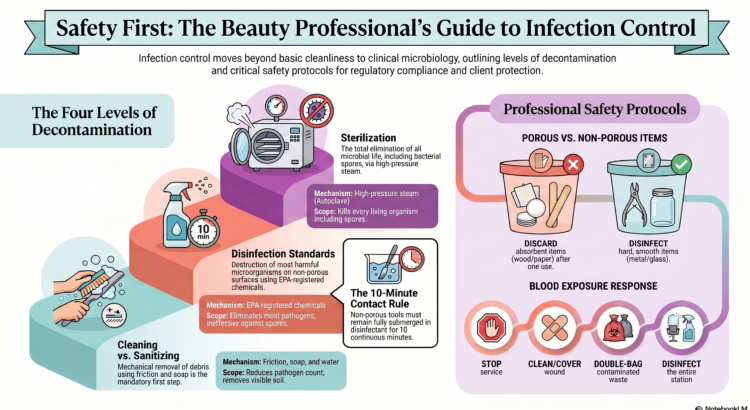
BLOOD EXPOSURE PROCEDURE


A. If a Client Is Injured, the Licensee Must:

  1. Stop the service immediately.
  2. Put on disposable gloves to protect yourself and the client.
  3. If appropriate, assist the client to the sink to rinse the injured area under clean, running water.
  4. Pat the area dry using a new, clean paper towel.
  5. Offer antiseptic and a sterile adhesive bandage to cover the wound.
  6. Place all single-use contaminated materials (e.g., tissues, towels, bandages, gloves) in a double-lined trash container or sealable bag.
  7. Remove all reusable implements from the workstation and clean with soap and water, then disinfect using an EPA-registered disinfectant.
  8. Clean and disinfect the workstation thoroughly, including any surface the blood may have contacted.
  9. Remove gloves carefully and discard them in the trash container.
  10. Wash your hands thoroughly with soap and water for at least 20 seconds.
  11. Resume the service only after ensuring the area, implements, and hands are fully sanitized and the client is safe.

B. If the Licensee Is Injured, the Licensee Must:

  1. Stop the service immediately.
  2. Politely excuse yourself from the client and explain that you must address a minor injury.
  3. Go to the sink and rinse the wound under clean, running water.
  4. Pat the wound dry using a new, clean paper towel.
  5. Apply antiseptic and cover the wound with a sterile adhesive bandage.
  6. Put on a fresh pair of disposable gloves.
  7. Dispose of all contaminated single-use materials into a double-lined trash container or sealable bag.
  8. Remove any implements that may have come into contact with blood and properly clean with soap and water, then disinfect with an EPA-registered disinfectant.
  9. Clean and disinfect the workstation thoroughly.
  10. Remove gloves carefully and dispose of them.
  11. Wash hands thoroughly with soap and water for at least 20 seconds.
  12. Resume the service only after all areas and items are clean and safe, and the wound is properly covered.

Important Notes for All Blood Exposure Incidents:

  • Always wear gloves during any blood exposure or clean-up process.
  • Always disinfect using EPA-registered products labeled for bloodborne pathogens (e.g., HIV/HBV) or a fresh 10% bleach solution.
  • Never use the same gloves, towel, or bandage on more than one person.
  • If the exposure is significant or involves a large amount of blood, follow biohazard protocol and notify appropriate authorities.

📎 Reference:

Louisville Beauty Academy: One of Kentucky’s Most Peaceful, Protected, and Professionally Compliant Beauty Schools

At Louisville Beauty Academy, we believe beauty education is more than training for licensure—it’s the foundation of a student’s future, livelihood, and dignity. That is why we have built—and fiercely protect—a learning environment that is safe, peaceful, law-abiding, and unshakably student-centered.

Our mission is not just to teach beauty—it is to create a space where hard-working adults from all walks of life can confidently learn without fear, confusion, or disruption.

🛡️ Zero Tolerance for Disruption

We proudly enforce a Zero Disruption Policy, which is publicly documented and legally binding under our enrollment contracts and administrative protocols. This policy applies equally to students, staff, and leadership.

Whether verbal, behavioral, or digital—any action that disrupts the learning environment, defames the school, or causes confusion about its lawful operation is grounds for immediate dismissal.

Over the years, we have made instant, lawful decisions—including expulsion of students and termination of staff—when verified violations occurred. These are not punitive actions; they are protective measures for the hundreds of students who come to our campuses seeking a better life through education.

🔗 Read Our Full Policy on Disruption and Legal Compliance »

👮‍♀️ Full Legal Compliance with the Kentucky State Board of Cosmetology

Louisville Beauty Academy is a state-licensed and state-accredited institution, operating in full alignment with Kentucky’s beauty licensing laws under KAR Title 201. Every decision we make—curriculum, hours, instructors, tuition—is legally documented and regulated.

We comply with:

  • Biometric time tracking for accurate clock-ins
  • Official state-inspected attendance and safety protocols
  • Secure record-keeping and 5-year data retention
  • Written grievance resolution procedures as required by law
  • KY State Board reporting requirements for every course and student

Our school is not only compliant—we are often used as a model institution for how beauty schools can operate with transparency and structure while still remaining loving, flexible, and human-focused.

💬 Internal Issues Are Handled Professionally, Not Publicly

At LBA, we do not tolerate gossip, drama, or backchannel accusations. All concerns must follow our published communication chain:

  1. Compliance Office via email or text
  2. Escalation to the Director
  3. Formal written grievance (10-day review required)
  4. Only then may a student escalate to the State Board

We have successfully resolved dozens of internal matters peacefully using this framework. But when someone bypasses this process and spreads false, harmful, or fear-inducing information—especially publicly or to other students—we act immediately.

Our contracts, state policies, and legal advisors support these actions as not only justified, but required.

🤝 A Culture of Safety, Not Fear

We understand that many of our students come from difficult backgrounds. Some are immigrants. Many are single parents. Some have never had the chance to succeed in a traditional school. That is why we protect this school with everything we have.

When you enter LBA, you are entering:

  • A judgment-free zone
  • A clean, calm, and caring environment
  • A space of emotional and legal safety
  • A school with a track record of graduating nearly 2,000 students

✨ Our Promise to Future Students

If you are serious about becoming a licensed professional, if you want a safe space to learn and grow, and if you want to be treated with dignity—Louisville Beauty Academy is for you.

If, however, you are looking for drama, entitlement, or the freedom to disrupt others—you will be asked to leave, legally and permanently. And that is how it should be.

🌟 A Message to the Community

We thank the Louisville and Kentucky community for your continued trust. We are proud to have served this state since 2016, and we look forward to continuing to be a beacon of peace, order, and purpose-driven education.

Whether you’re enrolling for the first time or sending someone you care about to learn with us, know this:

They will be safe. They will be supported. And they will succeed.


Louisville Beauty Academy – Compliance Office
📍 Bardstown Rd Campus | 📍 Harbor House Campus
📞 (502) 625-5531
📧 study@LouisvilleBeautyAcademy.net
🌐 www.LouisvilleBeautyAcademy.net

🎓 WELCOME TO LOUISVILLE BEAUTY ACADEMY

You are now officially part of a Kentucky State-Licensed and State-Accredited Beauty College, committed fully to your success — no matter your background, language, or past experience.

Whether you’re beginning your journey in:

  • Cosmetology (1500 hours)
  • Nail Technology (450 hours)
  • Esthetic Skincare (750 hours)
  • Shampoo & Styling (300 hours)
  • Eyelash Extension (16 hours)
  • Instructor Licensing (750 hours)
  • Refresher Courses (for licensed or previously trained students)
  • Or even returning as a graduate seeking free tutoring and support

✨ You are family now — and your success is our mission.


🥇 YOUR #1 GOAL: GET LICENSED — LEGALLY AND PROFESSIONALLY

No matter which program you’re in, your first and most urgent focus is to meet all Kentucky State Board of Cosmetology requirements and pass your licensing exams.
This is not just a school rule — it’s a legal requirement that makes you a legitimate, licensed professional.

Without a license:

  • You cannot legally work in your field.
  • You are not protected under KY law.
  • You are at risk of being exploited or disqualified from jobs.

We take this seriously because we want you to succeed.


💡 HOW TO START: One Small Step at a Time

At Louisville Beauty Academy, we believe in bite-sized, focused progress. Here’s the proven order of success:


✅ STEP 1: MASTER THEORY (Required for Licensing)

Before touching any tools, products, or clients — you must build your legal and safety foundation.

🎯 Start with CIMA, your included online study system
💻 www.MiladyCIMA.com
(Value: $500 — provided FREE with tuition)

📚 Focus first on:

  • Sanitation & Infection Control
  • KY State Laws & Professional Conduct
  • Safety & First Aid
  • Anatomy Basics
  • Chemistry & Product Knowledge
  • Skin & Nail Structure

📝 Jump straight to chapter quizzes — guess if needed. Then:

  • Study the correct answers
  • Repeat each quiz until you score 90% or more at least 5 times
  • This is your real exam prep — theory exam is where 75% of students nationwide fail.
    You will not be one of them.

✅ STEP 2: PRACTICAL EXAM PREPARATION

Once you pass your theory, we guide you step-by-step through the practical licensing exam.
This means:

  • Kit prep
  • Manikin practice
  • Timed procedures
    All done exactly as required by the State Board.

✅ STEP 3: PROFESSIONAL DEVELOPMENT (After Licensing)

Now that you’re licensed, we continue the journey with you:

  • Advanced beauty skills
  • Client communication
  • Business setup & marketing
  • Continuing education
  • Even new licenses and specialties

You can come back anytime for tutoring — FREE.
It’s our way of saying: we don’t give up on our students. Ever.


🧠 YOUR MINDSET = “YES I CAN”

This school runs on belief.
Every student here — from first-timers to returning professionals — is encouraged to say daily:

“YES, I CAN.”
“YES, I WILL.”
“YES, I HAVE DONE IT.”

You may be learning in a second language.
You may be a busy parent.
You may have failed before.

But you are not alone anymore.
With focus, small steps, and a community around you — you will succeed.


📲 Questions or Need Help?

We are here for you, every step of the way:
Text: (502) 625-5531
Email: study@LouisvilleBeautyAcademy.net


Welcome again. Let’s get licensed. Let’s legitimize your career. And let’s build your future — one focused step at a time.
You are ready.
YES YOU CAN.

May 2025 Nationwide Cosmetology Deregulation Report: A 5-Year Legislative Review Across All 50 States – Published by Louisville Beauty Academy, Kentucky’s Center of Excellence in Beauty Licensing, Policy, and Education Reform

Disclaimer (to be placed at the top or bottom of the publication):

Disclaimer: This research report is provided by Louisville Beauty Academy (LBA) as a public educational resource to inform policymakers, educators, and beauty professionals about ongoing trends in cosmetology regulation across the United States. While every effort has been made to ensure accuracy, the content reflects publicly available information as of May 14, 2025. LBA does not advocate for or against specific legislation but rather seeks to elevate the quality and accessibility of beauty education through informed discussion. This document does not constitute legal advice or official regulatory guidance.

Cosmetology Board Deregulation and Reform (2020–2025)

Summary of State Deregulation Legislation (2020–2025)

StateBill (Year)StatusKey Provisions
ArizonaHB 2031 (2025) – Boards and Commissions; RepealFailed (House floor, Feb 26, 2025)Sought to abolish the Barbering & Cosmetology Board, deregulating those professions entirely . Part of a broader “DOGE” initiative to repeal 8–10 boards as government waste.
IowaHF 711 (2025) – Barbering & Cosmetology Establishment TrainingEnacted (Passed House 67–29; Senate 30–20 in May 2025)Creates an “establishment training program” allowing salons/barbershops to employ unlicensed trainees for cosmetology/barber services, provided the salon registers a training program and informs clients of the trainee’s status . Simplifies school requirements and updates course of study. (Awaiting Governor’s signature as of May 2025.)
MinnesotaSF 2898 / HF 3202 (2020) – Hair/Makeup Artist ExemptionEnacted (Signed May 2020; eff. July 1, 2020)Exempts hair styling and makeup services from licensure if practitioners complete a one-time 4-hour health and safety course . Allows unlicensed individuals to shampoo, blow-dry, and style hair (no cutting or chemicals) and apply makeup without a full cosmetology license . Enabled freelance artists to work at weddings, proms, etc., preserving an estimated 1,000 jobs .
UtahSB 87 (2021) – Blow Dry Bar Licensure ExemptionEnacted (Signed March 2021)Exempts “blow-dry styling” (washing, drying, styling hair with hot tools, with no cutting or chemical services) from cosmetology licensing . Unlicensed individuals must instead obtain a simplified hair safety permit after completing a brief safety course . A middle-ground approach to deregulate blow-dry bars while maintaining basic sanitation training.
OklahomaHB 2141 (2024) – Blow-Dry Styling ActEnacted (Signed May 2024)Creates a “blow-dry styling” carve-out from licensing . Individuals may shampoo, condition, dry, and style hair (including using hot tools and adding extensions) without a cosmetology license. Requires completion of instruction in general sanitation and safe use of styling devices, after which a certificate (hair safety license) is issued .
TexasHB 1560 (2021) – TDLR Sunset Licensing RevisionsEnacted (Eff. Sept 2021)Merged the Barbering & Cosmetology boards and license structures . Consolidated overlapping licenses (e.g. combined cosmetology and barber establishment licenses into one) . Eliminated certain licenses deemed unnecessary – e.g. barber/cosmetology instructor licenses and wig specialty licenses were repealed . Aimed to reduce duplication, streamline oversight, and lower barriers to entry in the industry .

SB 101 (2025) – Blow-Dry Licensing RepealProposed (Filed Dec 2024; in committee)Would remove the licensing requirement for blow-dry styling services in Texas . Permits anyone to wash and blow-dry hair without obtaining the 1,000-hour cosmetology license. Proponents argue blow-drying is a routine, low-risk service being over-regulated, and deregulation would cut unnecessary training costs for stylists . (Similar Texas bills in 2017 sought to cut full cosmetology hours from 1,500 to 1,000 .)
CaliforniaSB 803 (2021) – Cosmetology Reform ActEnacted (Chapter 648, signed Oct 2021)Comprehensive reform via sunset review. Reduced training hours for a cosmetologist license from 1,600 to 1,000 hours (barber from 1,500 to 1,000) . Eliminated the practical exam requirement (written exam only) . Created a new 600-hour hairstylist license for non-chemical hair services (shampooing, styling, cutting without chemicals) . Expanded scope for estheticians (allowed lash/brow tints), and increased board size for broader industry representation .

AB 625 (2025) – Barbering & CosmetologyProposed (Amended in Assembly, hearing pending)Would remove basic hair care and styling from the licensed scope of cosmetology/barbering. Specifically, it repeals the new hairstylist license and excludes practices like arranging, cleansing, shampooing, curling, and waving hair from the definitions of cosmetology/barbering . Unlicensed individuals could perform those services in establishments if they post notice of their unlicensed status to consumers . (Aimed at deregulating salon shampooers and blow-dry specialists; maintains licensure only for chemical services and cutting.)
PennsylvaniaSB 1031 (2024) – Natural Hair Braiding Licensure RepealEnacted as Act 100 (Signed Oct 16, 2024)Eliminated the cosmetology licensing requirement for natural hair braiders . Previously, PA required braiders to complete 300 hours of cosmetology school and obtain a license ; this act exempts hair braiding from the Cosmetology Law entirely. Braiders can now practice freely (no 300-hour training), aligning PA with 30+ other states that have deregulated braiding . The law recognizes braiding as a cultural practice and removes “unnecessary barriers” to entrepreneurship .
North CarolinaSB 656 (2025) – Cosmetic Art DeregulationProposed (Filed Mar 2025; in committee)Omnibus deregulation bill to exempt three specialties from licensing: natural hair care (braiding, twisting, etc.), blow-dry styling, and makeup artistry . Converts the existing mandatory Natural Hair Care license (300-hour requirement) into an optional voluntary certificate . Practitioners of the exempt services could operate without a license if they complete a one-time 4-hour sanitation course approved by the Board . The bill also expands allowed settings for practice (e.g. permitting services in homes, events, nursing homes, etc., beyond licensed salons) . (Pending as of mid-2025.)
South CarolinaH 3483 (2025) – Blow-Dry Services ExemptionProposed (Prefiled Dec 2024; in committee)Defines “blow-dry styling” in state law and exempts persons providing blow-dry styling services from cosmetology/barber licensure . Blow-dry styling is limited to shampooing, conditioning, drying, and styling hair (including use of extensions and wigs) without cutting or chemical treatments . The bill amends SC’s barbering and cosmetology chapters to carve out blow-dry services as an unlicensed activity, recognizing it as distinct from full cosmetology. (Pending in 2025 session.)
OhioHB 238 (2024) – Cosmetology and Barber Board ReformsEnacted (Signed Jan 2025)A broad deregulation package arising from sunset review . Expanded the 450-hour “natural hair styling” license to include haircutting in its scope (creating one of the lowest-hour pathways to cut hair in the U.S.) . Added shampooing and rinsing to the list of exempt “boutique services”, meaning salon shampoo assistants no longer need any license (just simple registration) . Removed the competitor-affidavit requirement for boutique registrants (previously braiders, threaders, makeup artists had to obtain a signed attestation from a licensed cosmetologist) – now they can work by simply registering their contact info with the Board . Overall, the law repealed “scores of regulations” to eliminate red tape while keeping basic health/safety rules .

Table: Key recent bills (2020–2025) impacting state cosmetology boards and licensing. Includes full board elimination attempts and partial deregulation measures like license exemptions for blow-dry bars, makeup artists, hair braiders, reduced training hour requirements, and board consolidations. Sources: state legislative records and industry reports .

State-by-State Developments (2020–2025)

Below we detail each state’s significant legislation regarding cosmetology board powers, licensing requirements, and deregulation efforts over the past five years:

Arizona:

Eliminating the Board – Failed Effort

Arizona saw an aggressive push to dissolve its Board of Barbers and Cosmetology in 2025. House Bill 2031, dubbed the “Arizona DOGE” bill, proposed repealing the state’s Barbering & Cosmetology Board entirely . This was part of a broader bill by Rep. Alex Kolodin (R) to eliminate eight regulatory boards deemed wasteful. HB 2031’s passage would have deregulated all barbering and cosmetology work – meaning no state license would be required to cut, color, or style hair in Arizona . Industry stakeholders sounded alarms that abolishing the board could endanger public health (due to lack of sanitation oversight) and lower professional standards . Bipartisan opposition in the legislature agreed the Cosmetology Board provides important safety oversight . In February 2025, HB 2031 failed on the House floor (42–17 vote) after several members of the sponsor’s own party joined Democrats to defeat it . Even an amendment to spare the Cosmetology Board (while still cutting other boards) was attempted, reflecting broad discomfort with fully deregulating the beauty industry . Takeaway: Arizona’s bold attempt at total cosmetology deregulation did not succeed, but it signaled a growing sentiment to scrutinize licensing boards’ necessity in the post-2024 political climate .

Arizona has also explored incremental reforms. In 2022, a separate bill (HB 2399) was introduced to reduce cosmetologist training hours from 1,500 to 1,000, and hairstylist license hours from 1,000 to 600 . That effort was in committee and aligned with national trends (similar to California’s reform) but ultimately did not cross the finish line. No major deregulation was enacted in AZ during 2020–2024, and the state’s cosmetology licensing framework remains intact as of 2025. However, the pressure to “cut red tape” in Arizona persists, evidenced by recurring bills and an executive mindset favoring smaller government oversight.

Iowa:

Salon “Training Program” and Licensing Rollbacks

Iowa moved toward partial deregulation by allowing supervised unlicensed practice. In 2025, Iowa’s legislature advanced House File 711, which creates an “establishment training program” pathway . Under HF 711, salons and barbershops can hire trainees who do not hold a license, as long as the business provides a formal in-house training program and informs clients that services are being performed by a trainee . The bill modernizes Iowa law to let cosmetology students earn practical experience on the job (with oversight) rather than exclusively in school. By mid-May 2025 HF 711 had passed both chambers with sizeable majorities, indicating broad support . (It is expected to be signed by the Governor.) This reform essentially introduces an apprenticeship-style model: it helps salons address workforce shortages and gives trainees a faster, cheaper route to learn the trade. Notably, Iowa’s move drew industry opposition – the Professional Beauty Association (PBA) warned that allowing unlicensed workers, even with disclosure, could undermine standards and consumer safety . Nonetheless, Iowa lawmakers favored the flexibility, suggesting that onerous schooling requirements can be relaxed if on-site training and transparency to customers are in place.

Iowa has also tackled other narrow deregulation issues recently. In 2022, the legislature approved SF 2119 to exempt eyebrow threading from cosmetology licensing (clarifying that threaders need not be licensed) . Another 2022 proposal, SF 2022, explicitly authorized licensed cosmetologists to make house calls and work in clients’ homes, reflecting pandemic-era shifts in service delivery . These measures – threading exemption, mobile practice, and now in 2025 the trainee program – illustrate Iowa’s step-by-step approach to easing cosmetology regulations without completely abolishing its Board. The Iowa Board of Cosmetology Arts & Sciences remains in place, but its role may shift as more alternative pathways (apprenticeships, specialty exemptions) are written into law.

Minnesota:

Exempting “Event Stylist” Services & Licensing Audit

Minnesota took a significant deregulation step in 2020 by carving out certain beauty services from licensing requirements. Recognizing that many people perform limited services like styling hair and doing makeup for events, lawmakers passed SF 2898/HF 3202. Effective July 1, 2020, a person who ONLY performs hairstyling and makeup application (no haircuts or chemical treatments) no longer needs a cosmetology license, provided they complete a one-time 4-hour safety course and carry proof of it . “Hairstyling” was explicitly defined as cleaning, drying, arranging, curling, and styling hair (including with extensions or wigs) without cutting or using chemicals . This reform liberated freelance makeup artists and “blow-dry bar” stylists from the burden of a 1,550-hour Minnesota cosmetology program for work that was seen as low-risk. It was celebrated by advocates and signed by Governor Tim Walz in May 2020 , immediately helping more than 1,000 workers to legally operate at weddings, proms, photoshoots, and even in clients’ homes . Other beauty treatments like facials, haircuts, or manicures still require a license, but the law marked a big change in Minnesota’s regulatory scope.

This legislative change was informed by a critical 2019–2020 audit of the Minnesota Board of Cosmetology. A report by the Legislative Auditor found that some licensing requirements were not clearly tied to health and safety. For example, at the time, Minnesota had no specialty license for simple hair services, and required full cosmetologist credentials even for just styling hair . The Legislature responded by authorizing the above exemption and even instructed the Board to develop a specialty “hairstyling” registration in the future . The audit also noted inefficiencies like overlapping salon license types and separate regulation of barbers vs. cosmetologists that “may not be the most efficient use of resources” . In short, Minnesota recognized that licensing needed right-sizing. Along with the new freelance stylist exemption, the state began considering an apprenticeship pathway and simpler licensing structure (bills in 2022 proposed a single “hair technician” license and even a total repeal of state licensing in favor of local control, though those did not pass) . The overall trend in Minnesota has been toward streamlining cosmetic services regulation – keeping critical sanitation rules, but removing needless hoops for limited-scope services.

Utah:

Blow‑Dry Bar Freedom with a “Hair Safety Permit”

Utah joined the movement to deregulate niche beauty services in 2021. Senate Bill 87 was signed into law, creating an exemption for “blow-dry bar” services. As of 2021, if a person confines their practice to washing, drying, and styling hair (with no cutting or chemical processing), Utah no longer requires a full cosmetology license . This allowed unlicensed stylists to work in blow-dry salons performing simple styling tasks. However, Utah’s law built in a safeguard: unlicensed blow-dry practitioners must obtain a “hair safety permit” . To get the permit, an individual completes a short program on hygiene, sanitation, and safe tool use – far less training than the 1,600 hours previously mandated for a cosmetology license, but still ensuring they know to disinfect brushes and handle hot irons properly . Utah’s approach was highlighted as a compromise by industry groups: not the “best case” for licensed professionals, but a reasonable middle ground that maintains public safety while reducing barriers to entry . The reform acknowledged that blow-drying is a service many consumers perform on themselves at home, and requiring extensive schooling for it imposed an unnecessary hurdle for entrepreneurs. Since SB 87’s enactment, Utah has a two-tier system: full licensure for comprehensive cosmetology, and a minimal permit for basic hair-styling only. This foreshadowed similar proposals in other states to liberate blow-dry services from heavy regulation.

Oklahoma:

Limited Deregulation for Blow‑Dry Services (2024)

Oklahoma legislators in 2024 also targeted blow-dry styling as an area for deregulation. House Bill 2141, signed into law, creates a statutory exemption for certain hair services. Under the new law, anyone can engage in shampooing, conditioning, brushing, and blow-drying hair, including the use of curling/flat irons and styling wigs or extensions, without a cosmetology license . This effectively legalizes “blow-dry bar” work by unlicensed individuals. However, similar to Utah, Oklahoma’s law isn’t a free-for-all – it mandates a basic instruction in sanitation and device use before someone can offer blow-dry services for a fee . In practice, an aspiring blow-dry stylist must complete a short course (covering how to sanitize tools, avoid scalp burns, etc.) and receive a certificate or permit from the state. Once they have that, they can work without the oversight of the Oklahoma State Board of Cosmetology for these limited services. Lawmakers crafted this as a “carve-out” within the Cosmetology Act to encourage job growth in salons focusing on blowouts and styling, while still “ensuring public safety” through minimal training . The bill was supported by those who see licensing as a barrier to quick, affordable services. By 2025, Oklahoma’s deregulation of blow-dry services was held up as a model in industry discussions – providing regulatory relief but not completely abandoning health standards .

(Oklahoma has also explored other cosmetic service exceptions. For example, a 2022 bill, HB 3195, aimed to exempt hair/MUAs working in film, TV, and theatrical productions from state cosmetology licensure . This acknowledged the unique context of entertainment industry stylists. Oklahoma’s incremental approach suggests a willingness to modernize cosmetology laws in specific areas.)

Texas:

Sunset Review Reforms and Blow‑Dry Bill

Texas undertook a major overhaul of its cosmetology and barbering regulations in 2021 through HB 1560, enacted as part of the Sunset review of the Texas Department of Licensing & Regulation (TDLR) . This law merged Texas’s Barber Board and Cosmetology Board into a single Barbering and Cosmetology program under TDLR , formally recognizing what had been two parallel licensing regimes as one. In doing so, Texas consolidated several license types: for instance, previously separate licenses for cosmetology salon vs. barbershop were unified into a single “establishment license” for any hair service business . License categories that were duplicative between barbering and cosmetology (such as certain types of hair weaving or skin care that both had) were combined . Importantly, HB 1560 also eliminated specific licenses deemed unnecessary – notably, it repealed the instructor license requirements for barber and cosmetology teachers, and abolished the specialty “wig cosmetologist” license . Lawmakers argued these additional licenses and hours did not protect the public and only made it harder for experienced professionals to advance . Supporters said the old dual-board system was inefficient, rooted more in historical gender distinctions than in modern safety needs . The 2021 reforms directed TDLR to implement changes by 2023, and by that time Texas had a single advisory board for both professions and streamlined rules. The training hour requirements in Texas remained 1,000 hours for cosmetologists, but the state clearly signaled a preference for reduced red tape and “no license for license’s sake.”

Building on that momentum, Texas in late 2024 saw the introduction of Senate Bill 101, which squarely targets the remaining licensure mandate for blow-dry styling. SB 101 (filed by Sen. Bob Hall) would explicitly remove “shampooing and blow-drying” from the cosmetology license requirements, allowing anyone to perform those services without any license . “There is nothing dangerous… it’s simply washing hair and blow drying it,” Sen. Hall argued, calling this regulation an example of costly government overreach . The bill arrived amid anecdotal reports that Texas cosmetology law still technically required a license even just to shampoo hair in a salon, something critics find absurd. (In fact, prior to 2015, Texas had a separate 150-hour “shampoo apprentice” permit – now abolished.) While SB 101 hadn’t passed as of 2025, it reflects Texas’s continuing push to lighten licensing burdens. A similar proposal in the 2017 session – to cut the full cosmetology program from 1,500 to 1,000 hours – nearly succeeded , showing legislative appetite for reform. If Texas enacts the blow-dry exemption, it would join the ranks of states carving out that niche. Meanwhile, TDLR’s existing rules already allow mobile cosmetology units and off-salon services, and exempt certain minor services (like braiding was deregulated in Texas back in the early 2010s). The trajectory in Texas is clear: fewer bureaucratic barriers in the beauty industry, balanced by TDLR’s continued oversight of core health and safety practices.

California:

Licensing Reform and New License Categories

California’s approach to cosmetology reform has been less about deregulation and more about modernization and right-sizing regulation. In 2021, California passed SB 803, a comprehensive update to the Barbering & Cosmetology Act . This law made California one of the states with the fewest required training hours for cosmetologists, cutting the mandate from 1,600 hours down to 1,000 hours for cosmetology and barbering programs . It also eliminated the state’s practical examination for licensing (formerly, students had to pass a hands-on practical test; now they need only a written exam) . The practical exam was viewed as an onerous hurdle that did not demonstrably improve consumer safety, so its removal was a win for efficiency (applicants can get licensed faster now) . To address evolving industry roles, SB 803 created a new 600-hour “hairstylist” license – a limited license covering hair services that exclude chemicals . This caters to those who only want to cut, shampoo, and style hair without learning the full cosmetology curriculum (which includes nails, skin, and chemical processes). In essence, California acknowledged that someone who just wants to be a haircut and styling specialist shouldn’t need 1,600 hours of training in unrelated topics; a shorter program would suffice . SB 803 also slightly expanded estheticians’ scope (allowing them to do lash and brow tinting/perm) and increased the size of the Board itself from 9 to 13 members to include more sector representation . These changes took effect Jan 1, 2022 and were lauded as making California a leader in licensing reform (the Governor’s signing message emphasized reducing student debt and facilitating interstate license mobility via a new endorsement process ).

By 2025, California is considering going even further for certain services. AB 625, introduced in 2025 by Assembly Member Stephanie Nguyen, proposes to deregulate simple hair care practices by removing them entirely from the Board’s jurisdiction . The bill would strike from the legal definitions of cosmetology/barbering all acts of “arranging, beautifying, cleansing, curling, dressing, shampooing, or waving” hair – effectively saying those activities do not require a license . If passed, a person could perform a shampoo and set or a basic blowout in a salon without a license, so long as they conspicuously notify customers that they are unlicensed . (Notably, cutting hair and applying chemicals/color would still be restricted to licensed professionals.) AB 625 also would repeal the 600-hour hairstylist license that California just created – the idea being that even 600 hours of schooling might be an unnecessary barrier for someone only doing non-chemical styling. Instead, those individuals would need no formal license at all. This proposal has sparked debate: supporters argue it frees up entry-level jobs (shampoo assistants, etc.) and aligns with what states like Minnesota and Utah have done, while opponents (including some cosmetology schools and the state Board) worry it rolls back consumer protections too far. As of May 2025, AB 625 had been amended and was in committee (its first hearing was postponed) . It remains to be seen if California will enact this partial deregulation. Regardless, California’s trend is to lower barriers (fewer hours, no practical test) while still maintaining one of the nation’s largest regulatory boards overseeing health and sanitation in the beauty industry.

Pennsylvania:

Freeing Natural Hair Braiders

Pennsylvania in 2024 finally addressed a long-standing concern in the African-American and natural hair care community by eliminating onerous license requirements for hair braiders. Since 2006, PA had required a “Natural Hair Braider” license (300 hours of cosmetology school and a board exam) for anyone braiding, locking, or twisting hair for pay . This was widely criticized as excessive – braiding is a traditional skill, and cosmetology programs often don’t even teach the techniques. State Senator Anthony Williams championed SB 1031 (2024) to remove these prerequisites. The bill passed the Senate 28–21 in June 2024 and by October 2024 its language was folded into Act 100, which Governor Josh Shapiro signed into law . Effective immediately, natural hair braiding is no longer part of PA’s Cosmetology Law – meaning braiders do not need any license or hours of schooling to practice . Pennsylvania thus joined the majority of states that have exempted hair braiding from cosmetology oversight (as of 2024, over 30 states had done so) .

Proponents framed this as a win for cultural tradition and entrepreneurship: braiding skills are often passed down through families and communities, and requiring braiders to spend time and money on unrelated cosmetology training was seen as a barrier that disproportionately affected women of color . Now, a person can open a braiding business in Pennsylvania without navigating the licensing bureaucracy. The new law does retain an optional avenue: braiders can still choose to get a license or certification if they want (for instance, to learn advanced sanitation or expand services), but it’s not mandatory. The Cosmetology Board lost some regulatory turf as a result – roughly 2,000 braiders statewide were previously licensed or constrained by the old system. Industry reaction in PA was generally positive among braiders and civil rights advocates, while some cosmetologists were concerned about a slippery slope (would other license types be next?). Indeed, supporters like Sen. Williams hinted this move was about “removing unnecessary barriers” broadly . The braider licensure repeal was relatively non-controversial in the legislature compared to other deregulation fights, perhaps because braiding has a clear safety record and strong cultural importance. It highlights one of the common targets of licensing reform – niche services where standard cosmetology education is seen as overkill.

North Carolina:

Broad Deregulation Bill for Hair and Makeup (2025)

In 2025, North Carolina lawmakers introduced a sweeping proposal to deregulate several corners of the beauty industry. Senate Bill 656 (“Cosmetic Art Deregulation”) is a multi-part reform that would exempt three categories of services from licensure: natural hair care, blow-dry styling, and makeup artistry . Currently, NC has separate licenses for cosmetologists, estheticians, and a Natural Hair Care Specialist license (which requires 300 hours of training) for braiding and similar services. SB 656 would make the natural hair care license voluntary – anyone could practice braiding/twisting without a license, though they could apply for a Board-issued “Certified Natural Hair Care Specialist” credential if they meet the training (essentially converting the license into a title one can earn, but not a legal prerequisite) . Likewise, performing make-up application or basic hairstyling (washing, blowing, curling, arranging hair without cuts/chemicals) would no longer require a license at all .

To address safety concerns, the bill mandates that practitioners of these now-exempt services complete a one-time 4-hour sanitation course and register with the Board – similar to Minnesota’s approach. SB 656 also updates NC law to allow these services in more environments: it expands authorized practice settings so that licensed or unlicensed practitioners can offer services in places like clients’ homes, wedding venues, photography studios, nursing homes, etc., without running afoul of the “licensed salon” requirement . This reflects a practical adaptation to consumer demand for on-site services. The bill has bipartisan sponsorship (it’s co-sponsored by both Republican and Democratic senators) , showing a coalition in favor of licensing relief. However, it has sparked debate. Schools and some licensed professionals in NC worry about competition from unlicensed individuals and potential declines in quality or accountability. The state Board of Cosmetic Art Examiners has raised questions about enforcement if a large segment of practitioners operate outside licensure. On the other hand, advocates (including some lawmakers and the Institute for Justice) argue this law will create jobs and reduce racial disparities, noting that braiding in particular has been subject to burdens that don’t match its risks .

As of spring 2025, SB 656 is still in committee, and its fate is uncertain. If enacted, North Carolina would leapfrog many states in liberalizing cosmetology laws – essentially shifting to voluntary certification for hair braiders and deregulating several cosmetic arts (with minimal training requirements). This “test case” could influence Southern states especially, as NC would be one of the first in the region to free braiders (neighboring SC and GA, for example, still license braiders to some extent). Overall, SB 656 encapsulates the broader trend: targeting specific low-risk services for deregulation, rather than tearing down the entire licensing structure.

South Carolina:

Pending Exemption for Shampoo/Blow-Dry Services

South Carolina is another state moving to trim its cosmetology regulations in line with the blow-dry bar trend. House Bill 3483, prefiled in late 2024 for the 2025 session, would exempt “blow-dry styling services” from the Board of Cosmetology’s licensing requirements . The bill carefully defines blow-dry styling as shampooing, conditioning, drying, and styling hair using mechanical devices, plus adding extensions or hairpieces, but explicitly excludes any cutting or chemical services (like coloring, relaxing, or perming) . It then amends the law so that anyone providing only blow-dry styling does not need a cosmetology or barber license . Essentially, if you’re just doing a shampoo and blowout, you wouldn’t be subject to Board regulation. The bill also tweaks the Barber Board statute to clarify that a person doing blow-dry styling without other barbering services is not under the Barber Board either .

At present, SC law requires a cosmetology license (1,500 hours of training) for even basic hair services. If H.3483 passes, it would remove a chunk of those services from licensure – a significant change. The bill is before the House Medical, Military, Public and Municipal Affairs Committee as of early 2025 . It has support from those who run blow-dry salons and believe the current licensing rules inflate costs. However, licensed cosmetologists in SC have voiced opposition, worrying that deregulation could lead to untrained individuals causing harm (burning clients with hot tools or spreading scalp conditions due to poor sanitation). The bill tries to preempt some of these arguments by noting that blow-dry styling “is distinct from the practice of cosmetology” and therefore shouldn’t be conflated with higher-risk chemical or cutting services .

This push in South Carolina aligns with simultaneous efforts in other states (NC, TX, CA, etc. in 2025) targeting the same issue. It demonstrates a regional shift in attitudes – even in states with traditionally strict licensing, legislators are asking: Does someone really need a full cosmetology license just to blow-dry hair? South Carolina appears poised to answer “no,” pending the outcome of H.3483. If adopted, the Cosmetology Board would retain authority over haircuts, chemical treatments, and other cosmetology acts, but lose jurisdiction over simple hair styling.

(South Carolina previously deregulated natural hair braiders in 2018 by removing a registration requirement, so H.3483 is part of a continuing pattern of peeling back requirements for specific services.)

Ohio:

Comprehensive Deregulation via Sunset Review

Ohio embarked on a broad-based overhaul of its cosmetology laws in 2024, using the state’s sunset review process to bundle multiple reforms into House Bill 238 . Governor Mike DeWine signed this bill in January 2025, and it brings several notable changes:

  • Natural Hair Styling License Reform: Ohio already had a 450-hour natural hair stylist license (for braiding and similar services). HB 238 expanded the scope of that 450-hour license to include haircutting . This means someone can become a fully qualified hair cutter with only 450 hours of training (far less than the standard cosmetology program) – making it one of the lowest-hour hair cutting credentials in the U.S. . Lawmakers intended this to increase competition and make it easier to open simple hair salons focusing on basic cuts and styles.
  • “Boutique Services” Expansion: Ohio uses the term “boutique services registration” for very limited tasks like braiding, threading, and makeup, which require registration but not a full license. HB 238 added shampooing and conditioning to the boutique category . Practically, this legalizes standalone shampoo assistants: a person can be hired to shampoo and rinse clients’ hair without needing to be a licensed cosmetologist (they would just register with the Board). This addressed a point of contention – many argued that requiring a license to simply shampoo hair in a salon was unnecessary.
  • Removal of Competitor Affidavit: Previously, Ohio’s boutique-service applicants (braiders, threaders, etc.) had to submit an affidavit signed by a licensed cosmetologist or barber attesting to their competency . Critics called this a protectionist measure – essentially forcing new entrants to get permission from existing license-holders (often competitors). HB 238 eliminated the affidavit requirement . Now, boutique service providers only need to register their contact info with the Board (so the Board knows who and where they are) and can then start working . No sign-off from established salons required.
  • Streamlined Apprenticeships and Credit for Inmates: Additionally, the law made it easier for individuals to get credit toward barber/cosmetology licenses through apprenticeships and prison vocational programs, as part of a workforce reentry effort . And it barred the Cosmetology Board from denying licenses due to criminal convictions older than 3 years (to reduce barriers for ex-offenders) .

The cumulative effect of HB 238 is a significant deregulatory sweep. The Institute for Justice praised it, noting that Ohio “repealed scores of regulations… far beyond what consumers needed” by leveraging an excellent sunset review process . Indeed, Ohio’s biennial budget review was used to question every cosmetology rule’s necessity. The changes sailed through with bipartisan support (the final bill had overwhelming votes, indicating consensus that these were common-sense trims). Ohio’s State Cosmetology and Barber Board remains intact, but its rules are now slimmed down. The Board must accommodate a new reality where, for example, someone with a basic “hair styling” license can cut hair with minimal hours, and whole categories of workers (braiders, threaders, makeup artists, shampooers) are simply outside the licensed regime aside from a registration. Ohio’s reforms also underscore a sunset review trend: rather than wait for lawsuits or crises, legislatures are proactively reviewing licensing boards to eliminate what they view as “red tape” .

Early feedback from the industry is mixed. Many cosmetologists in Ohio support the changes because they could reduce bottlenecks in salons (filling assistant roles more easily) and broaden the talent pipeline. Others are wary that allowing hair cutting with 450 hours might undercut professionals who underwent 1,500 hours of training. Time will tell if service quality or safety is affected – proponents point out that states with even lower hour requirements haven’t seen rampant issues, and that market forces will ensure even those with less training will seek to perfect their skills to attract clients . As of 2025, Ohio stands out for its comprehensive approach, tackling everything from braiding to criminal justice within one reform package.

National Trends and Themes (2020–2025)

Over the past five years, a clear national theme of cosmetology deregulation has emerged: state legislatures are increasingly willing to re-examine and roll back licensing requirements for the beauty industry. While no state completely abolished its cosmetology board (the lone attempt in Arizona failed ), partial deregulation measures have gained traction across red and blue states alike. Here are the key trends and the common arguments shaping this movement:

  • Targeted Deregulation of Low-Risk Services: A significant trend is exempting specific “niche” or low-risk beauty services from licensing. Services such as natural hair braiding, blow-dry hairstyling, shampooing, makeup application, threading, and eyelash extensions have been peeled away from cosmetology board oversight in many states. Lawmakers reason that these tasks do not involve chemicals or invasive procedures and can be learned through brief training, so requiring hundreds or thousands of school hours is unjustified . By 2025, for example, over half of states have no license requirement for braiders, and a growing handful (5–6 states) explicitly exempt blow-dry styling and simple makeup artistry . Georgia (HB 1231 in 2022) and New Hampshire (HB 1171 in 2022) introduced bills to remove blow-dry, braiding, makeup, etc. from their cosmetology definitions . California’s AB 625 and North Carolina’s SB 656 in 2025 similarly seek to carve out those activities . Even where not yet passed, this pattern shows a mindset shift: state governments are defining the scope of cosmetology more narrowly, focusing on higher-risk services (chemical treatments, cutting, etc.) and letting simple beauty services be performed with little or no regulation.
  • Reducing Hour Requirements for Full Licenses: Many states have moved to lower the required training hours for core cosmetology or barber licenses, addressing concerns that the U.S. had some of the longest cosmetology programs in the world. California (2021) cutting to 1,000 hours , Virginia (2022–24) moving from 1,500 to 1,000 hours (via Board regulation) , New York (2022) considering dropping its 1,000-hour requirement even lower, and states like Massachusetts (which was at 1,000) contemplating 1,000→900, are examples. In fact, by 2023 around 15 states had 1,000-hour cosmetology programs or were enacting legislation to get there . Reducing hours is seen as a way to lower tuition costs and student debt for cosmetology school, and to get professionals into the workforce faster . Proponents note that the extra 500 hours (for instance) beyond 1,000 may be spent on repetition or on services a graduate might never use in practice. Governors and legislators have explicitly linked hour reductions to economic opportunity: Virginia’s governor touted that shorter programs mean less debt and quicker earning potential for graduates . Opponents (often cosmetology schools and some salon owners) worry that shorter training could leave new licensees less prepared, or create interstate portability issues if other states still mandate more hours . However, the general momentum has been towards shorter, more focused curricula, sometimes coupled with simplified licenses (e.g., separate licenses for hair-only or nails-only with fewer hours). New Jersey and Michigan have debated similar reductions, and Ohio’s new 450-hour stylist pathway is an extreme example of how far the envelope is being pushed .
  • Apprenticeships and On-the-Job Training Alternatives: Deregulation efforts also promote apprenticeship models or experiential learning in lieu of formal schooling. States like West Virginia (2021) established a cosmetology apprenticeship option – allowing a portion of training hours to be earned through salon work under a mentor, rather than all in the classroom . Iowa’s 2025 HF 711 goes a step further to let salons directly train beginners and put them to work with client consent . These measures respond to criticism that cosmetology programs can be expensive and have high dropout rates (fewer than 1/3 of cosmetology students graduate on time nationally) . By integrating work experience, proponents claim students can “earn while they learn” and salons can fill staffing needs. The flip side concern is ensuring consistent training quality and preventing exploitation of trainees. Most states implementing apprenticeships require registration of the program and still mandate the trainee pass the standard board exams in the end. Nonetheless, the rigidity of the school-or-nothing model is softening. Cosmetology is aligning more with trades like plumbing or electric where multiple pathways (school or apprenticeship) exist to licensure.
  • Merging and Streamlining Boards: Some deregulation initiatives focus on the regulatory structure itself, not just license criteria. Merging separate boards for related professions has been one tactic. For example, Texas’s HB 1560 (2021) formally merged the Barber and Cosmetology boards (which were already under one agency) into one unified board and combined their administrative rules . Ohio (2018) had earlier merged its barber board into the cosmetology board , and other states like Georgia and Louisiana have done or considered the same. The rationale is to eliminate duplication (why have two sets of inspectors, two sets of exams, etc., for hair cutting that is very similar whether by a “barber” or “cosmetologist”). Consolidation can cut costs and reduce confusion for licensees. Another structural change is moving boards under umbrella agencies or applying “sunset reviews” to them to ensure they aren’t perpetuating unnecessary rules. Ohio’s sunset review of its Cosmetology Board in 2024 is a prime example that resulted in HB 238’s sweeping changes . Arizona’s DOGE bill was a radical version, aiming to eliminate boards deemed non-essential . While that didn’t pass, Arizona did enact a law a few years prior (2019) that allows individuals to ask the legislature for a review of any occupational regulation they feel is overly burdensome (a nod to potentially delicensing certain activities). We also see interstate compacts emerging (the Cosmetology Licensure Compact was introduced in 2023 and by 2024 Virginia and Colorado passed bills to join it ). The compact doesn’t deregulate per se, but it facilitates license mobility – a response to pressure for licensing to be less restrictive when professionals move across state lines (especially relevant for military spouses). In sum, the governance trend is toward greater efficiency and flexibility: fewer boards, broader scopes covering multiple professions, and collaboration across states to reduce redundant barriers.
  • Common Justifications & Criticisms: Legislators pushing these reforms often cite economic liberty and job growth. They argue that onerous cosmetology regulations shut out aspiring workers, especially those unable to afford costly schooling or who only want to perform a narrow set of services . During debates, one hears that licensing can be a “barrier to entry” or a form of unnecessary “red tape” that doesn’t correspond to real health risks . For instance, blow-dry bars are said to perform the same basic tasks people do at home, so requiring a license is seen as protectionism rather than consumer protection . Natural hair braiding is highlighted as a cultural practice that was unfairly subjected to licensing due to historical bias, with no safety justification . Lawmakers also point to inconsistencies: why do some states allow makeup artists to work unlicensed (e.g., freelance bridal makeup) while others arrest unlicensed MUAs? This patchwork has fueled a race by reformers to bring their states in line with the more permissive ones. They frequently mention, “X number of states already don’t license this, and they haven’t seen problems,” which is a compelling argument in hearings. For example, Pennsylvania noted that over 30 states had exempted braiders, and it was time PA did the same . Virginia’s regulators cited that 15+ states have 1,000-hour cosmetology, implying that 1,500 was no longer necessary .

On the other side, boards, schools, and many established professionals defend the licensing system. The Professional Beauty Association (PBA) and state beauty school associations have actively lobbied against deregulation bills. They argue that licenses ensure consistent training in sanitation, chemical handling, and infection control, which protect the public from disease or injury . PBA representatives often testify that lowering standards would be “disastrous” for consumer safety and the professionalism of the industry . They raise concerns about unlicensed operators lacking knowledge of hygiene (e.g. disinfecting tools to prevent fungal infections or lice transmission) and technical skills (e.g. a poorly trained person could burn a client’s scalp with a flat iron or cause hair loss with improper extensions ). Another argument is that deregulation can hurt small salon businesses: if unlicensed individuals undercut prices (by avoiding licensing costs), it could create unfair competition and liability issues for salons . Some licensed practitioners feel that deregulation devalues their education and license – they invested time and money to become licensed and fear their advantage erodes if the market floods with unlicensed (and potentially lower-priced) competitors . For example, when Virginia contemplated reducing hours, many cosmetology students and instructors protested, saying it might diminish their skill level or make their license less portable to other states with higher hour requirements .

  • Notable Stakeholder Reactions: In many states, beauty schools have been vocal opponents of hour reductions and exemptions – understandably, since fewer required hours or deregulated niches can translate to decreased enrollment. A vivid scene occurred in Virginia, where beauty school owners rallied students to speak out against the 1,000-hour proposal, worried it would strain school finances and accreditation . Conversely, free-market think tanks and legal foundations like the Institute for Justice (IJ) have been leading advocates for deregulation. IJ has backed lawsuits on behalf of braiders in several states and runs campaigns like “Beauty Not Barriers” to support bills that open up the beauty industry . They often supply expert witnesses or research (for example, IJ testimony in Ohio’s hearings emphasized that less restrictive alternatives could still protect consumers ). State executives have sometimes joined the cause: governors in states like Arizona, Ohio, and Virginia have publicly supported licensing reform as part of broader workforce development agendas. In Ohio, the governor’s signing of HB 238 was applauded as removing burdens “beyond what consumers needed” . In Arizona, Gov. Doug Ducey in prior years championed universal recognition of out-of-state licenses and was sympathetic to sunseting some licenses, setting a tone that influenced legislative efforts like the 2025 DOGE bill (though Ducey was out of office by then). On the legislative side, these issues do not always break along party lines: while many deregulation bills are sponsored by Republicans pushing smaller-government ideals, they often pick up Democrats who see the changes as helping minority communities and small businesses. North Carolina’s bipartisan SB 656 is a case in point , and the braid deregulation efforts have had broad coalition support in multiple states (from libertarians to urban Democrats).

In summary, from 2020 to 2025 the U.S. has seen a wave of occupational licensing reform focused on the cosmetology field. The momentum is generally toward pruning the scope of cosmetology boards – keeping core health and safety regulations, but eliminating requirements that are viewed as arbitrary or protectionist. Common targets are rules for services that can be safely offered with minimal training (blow-drying, braiding, etc.), and excessive education hours or red tape in obtaining licenses. Deregulation is happening incrementally rather than via wholesale abolition of boards. As we’ve seen, attempts to completely dismantle regulatory boards (e.g., Arizona) face steep opposition and have failed due to concerns about consumer harm and industry disruption . However, partial reforms are often successful when framed as reasonable updates: they have passed in conservative states like Utah and Oklahoma as well as more liberal ones like Minnesota and California. There is a clear national dialogue now between those championing “economic liberty” in beauty professions and those warning of “race to the bottom” consequences. This dialogue has even reached Congress (though federal action is unlikely, as cosmetology licensing is state-controlled). As of 2025, the deregulation momentum is still strong – dozens of bills are being introduced each year in state capitals to tweak or trim cosmetology laws. The beauty industry, its regulatory boards, and consumers are all watching closely to see how these changes impact service quality, pricing, safety, and professional livelihoods. The experiences of states leading in deregulation will likely inform the next wave of debates in those states still holding onto more stringent cosmetology regulations.

The Heart of Service in Beauty — You, Cleanliness, and Skill: Lessons from Di Tran at Louisville Beauty Academy

At Louisville Beauty Academy, education goes far beyond technical training—it’s about shaping professionals who lead with heart, intention, and care. Founder and educator Di Tran, a passionate advocate for debt-free, life-transforming beauty education, recently delivered a powerful lesson to a class full of aspiring professionals. His message was simple, yet profound: “We are in the service industry of beauty. And service means human serving human.

Di Tran reminded his students that while skills like nail design, aesthetics, and cosmetology are essential, the real magic begins with the person behind the chair. “Customers don’t just come for a product—they come for you,” he said. “Your presence, your attitude, and your energy are the most valuable part of the service.”

Here are the core pillars of Di Tran’s teaching on becoming a truly successful beauty professional:

1. You Are the Service

In beauty, your personality, your care, and your smile are not extras—they are everything. Di Tran emphasized that clients return not just for a great haircut or facial, but because of how they were made to feel. “They come for your you-ness,” he explained with a smile. “Even when you’re tired, even when life is heavy—you must bring love, care, and light. Smile genuinely, and if you can’t, fake it until your love catches up with you. But always come with kindness in your body language and warmth in your spirit.”

He added, “If you don’t love people, don’t come to work that day. Because customers can feel it.”

2. Cleanliness Is Leadership

From the way you make your bed in the morning to the way you wipe down your salon chair, Di Tran teaches that cleanliness is a form of love and leadership. “A clean space is a respectful space. It’s how you show customers you care before you even speak.”

In an industry built around confidence, self-esteem, and health, sanitation isn’t a bonus—it’s a basic need. And that includes your workstation, restroom, tools, uniform, and even your breath and energy. “When a client sees a spotless salon and an organized table, they feel safe and valued. That’s your job. That’s your power,” Di said.

3. Beauty Comes After Care

Only after you’ve shown warmth and delivered a clean, professional space should the focus turn to your technical skills. “Beauty services are about feeling good, not just looking good,” Di told his students. “You are helping someone feel human again. That’s sacred. So be bright, smile, give them a clean and calming experience, and then let your skill speak.”


At Louisville Beauty Academy, this philosophy is woven into every lesson, every class, and every graduation. It’s why nearly 2,000 students have already completed their training and gone on to launch salons, serve their communities, and create generational impact.

The academy stands proud as a Kentucky State-Licensed and State-Accredited Beauty College—one of the most affordable and flexible in the nation. But what truly sets it apart is the heart behind the education. As Di Tran often says, “We are not just creating professionals. We’re creating servants of joy, care, and transformation.”


🌟 Interested in joining a school that teaches skill and soul?
Text 502-625-5531 or email study@louisvillebeautyacademy.net today.

👉 Visit louisvillebeautyacademy.net for more information.
#LicensedToServe #BeautyWithHeart #LouisvilleBeautyAcademy #DebtFreeEducation #SkillAndSoul

Sanitation & Safety: The #1 Priority at Louisville Beauty Academy

At Louisville Beauty Academy, we don’t just teach beauty skills – we teach responsibility, professionalism, and excellence. The foundation of every beauty professional’s success starts with sanitation and safety, as required by Kentucky State Law (201 KAR 12:100).

We Practice It. We Teach It. We Elevate It.

Sanitation is not just a rule – it is a daily habit, a professional standard, and the key to becoming a licensed beauty expert. Every student at Louisville Beauty Academy is expected to clean and disinfect their workstation before and after class, ensuring a safe and hygienic learning environment.

As a licensed beauty school, we elevate sanitation by making it a daily practice, not just a theory. Our students don’t just learn about sanitation – they live it, practice it, and become experts in it.

Below is a complete breakdown of the sanitation and safety requirements we uphold every day at Louisville Beauty Academy:


📌 General Cleaning Requirements (201 KAR 12:100, Section 1)

✔ All facilities and equipment are continuously maintained in a clean and sanitary condition.
✔ An adequate supply of hot and cold running water is always available.
Students and licensees must wash their hands before and after serving each client.


🛠 Workstation & Surface Cleaning (201 KAR 12:100, Sections 2 & 5)

✔ Workstations, shampoo bowls, treatment tables, styling chairs, and surfaces must be cleaned and disinfected daily and after each client.
✔ Each workstation must have a disinfectant solution available for cleaning between clients.


✂️ Tools & Implements Cleaning (201 KAR 12:100, Sections 4 & 5)

✔ All tools and implements must be cleaned and disinfected before and after every use.
No tool, instrument, or item shall be used on multiple clients without proper sanitation.
✔ Multi-use items must be stored in a closed, labeled, and sanitary container.


🗑 Trash & Debris Removal (201 KAR 12:100, Section 6)

Hair, nail clippings, and debris must be swept and disposed of immediately after each service.
✔ Waste containers must be emptied daily to maintain cleanliness.


🏫 School-Specific Cleaning Standards (201 KAR 12:100, Section 7)

✔ Louisville Beauty Academy is responsible for maintaining a clean and sanitary learning environment at all times.
✔ All students are trained in sanitation and are expected to perform daily cleaning duties.
✔ Each student must clean and disinfect their workstation before and after class.


🧴 Disinfectant Requirements (201 KAR 12:100, Sections 5 & 8)

Only EPA-registered disinfectants are used in our school and salon.
✔ Disinfectants must be clearly labeled and stored properly.
✔ All students must follow manufacturer guidelines for proper use and disposal of disinfectants.


🚻 Restroom & Handwashing Facilities (201 KAR 12:100, Section 9)

Restrooms are cleaned and disinfected daily to maintain hygiene.
✔ Handwashing stations with soap and disposable towels are available for all students and clients.


📚 Why This Matters for Your Beauty License

Sanitation and safety are critical subjects required for beauty licensing.
✔ Practicing these standards daily prepares students to become professional, responsible, and successful beauty experts.
Failure to follow sanitation rules can result in disciplinary actions, fines, or even loss of licensure.


🔗 For the full Kentucky State Board of Cosmetology sanitation regulations, visit:
201 KAR 12:100 – Sanitation Standards

At Louisville Beauty Academy, we are committed to training the best beauty professionals, and that starts with cleanliness, discipline, and excellence in sanitation.

💡 A clean workstation = A successful beauty career! 💡

#WePractice #WeTeach #WeElevate #SanitationMatters #LouisvilleBeautyAcademy

Elevating Sanitation, Safety, and Education: The Louisville Beauty Academy Standard

At Louisville Beauty Academy (LBA), a Kentucky State-Licensed and State-Accredited beauty college, sanitation and safety aren’t just rules—they are a way of life. As we approach 2,000 graduates, we take pride in empowering beauty professionals with the skills, knowledge, and confidence to succeed in their careers while prioritizing client trust and safety.

Our latest publication, Sanitation and Safety in Beauty Services, reflects this commitment. Authored by our founder, Di Tran, this comprehensive guide sets a new standard for the beauty industry by combining practical sanitation protocols, industry myths debunked, and actionable steps to maintain compliance with the highest hygiene standards.


The Louisville Beauty Academy Philosophy

At LBA, we live by the mantra “YES I CAN,” which empowers our students to believe in their potential and excel in their craft. By the time they graduate, our students confidently say, “I HAVE DONE IT.” This mindset is at the heart of everything we teach, ensuring that our graduates are not only skilled professionals but also leaders in maintaining the integrity of the beauty industry.

Sanitation and Safety in Beauty Services is an extension of this philosophy, offering a resource that elevates the standards of beauty education while supporting the growth of salons, schools, and individual professionals.

What’s Inside the Book?

This book isn’t just a guide—it’s a transformation tool. Inside, you’ll find:

1. The Science of Cleanliness

  • Understand the critical differences between cleaning, sanitizing, and disinfecting.
  • Learn how pathogens like bacteria, viruses, and fungi spread and how to prevent cross-contamination.

2. Tailored Protocols by Discipline

  • Step-by-step sanitation guidelines for cosmetology, esthetics, nail services, and more.
  • Practical advice for handling tools, workstations, and high-risk areas like pedicure spas.

3. Myths and Facts About Hygiene

  • Bust common industry misconceptions, such as over-reliance on alcohol or UV sterilizers, with evidence-based practices.

4. Exact Procedures for Compliance

  • Comprehensive instructions for disinfecting tools, managing waste, and handling bloodborne pathogens.
  • OSHA-compliant steps to ensure the safety of both clients and staff.

5. Scaling Your Business with Safety

  • Leverage sanitation as a trust-building tool to grow your business.
  • Learn how technology can streamline operations and elevate client satisfaction.

White-Label Solutions: Elevate Your Brand

Louisville Beauty Academy offers an exclusive white-label licensing program for our published books. If you’re a salon owner or beauty business professional, this is your opportunity to:
✅ Showcase your commitment to sanitation and safety with a branded version of the book.
✅ Build client trust and credibility by aligning with proven industry standards.
✅ Train your team and set your business apart with visible excellence in hygiene practices.

Partner with us today!

Let us help you put your brand on this transformative resource and license it for your salon or school.


Why Choose Louisville Beauty Academy?

Founded by Di Tran, Louisville Beauty Academy is a leader in beauty education, innovation, and impact. We prioritize lifelong learning and adapting to the needs of the industry, ensuring that our graduates are prepared to excel in any environment.

Our students leave with more than just licenses—they leave with confidence, expertise, and the ability to transform lives. Whether you’re looking to elevate your skills, scale your business, or uphold the highest standards of hygiene, LBA is your trusted partner in success.


Join the Movement

As we continue to transform lives and the beauty industry, we invite you to be part of our journey. Whether you’re a student, a professional, or a business owner, Louisville Beauty Academy is here to empower you.

📚 Get your copy of the book: Sanitation and Safety in Beauty Services
🤝 Learn more about white-label solutions: Text 502-625-5531 or email study@LouisvilleBeautyAcademy.net

Together, let’s create a safer, cleaner, and more successful beauty industry.

#LouisvilleBeautyAcademy #SanitationAndSafety #YESICAN #IHAVEDONEIT #WhiteLabelSolutions #BeautyEducation #ElevatingExcellence

https://www.amazon.com/dp/B0DTJ96YWG