Universal Safety and Sanitation Blueprint for Estheticians: A Center of Excellence Standard – RESEARCH & PODCAST SERIES 2026


Core Philosophy: The Skin as a Living Organ and Safety as a Professional Mandate

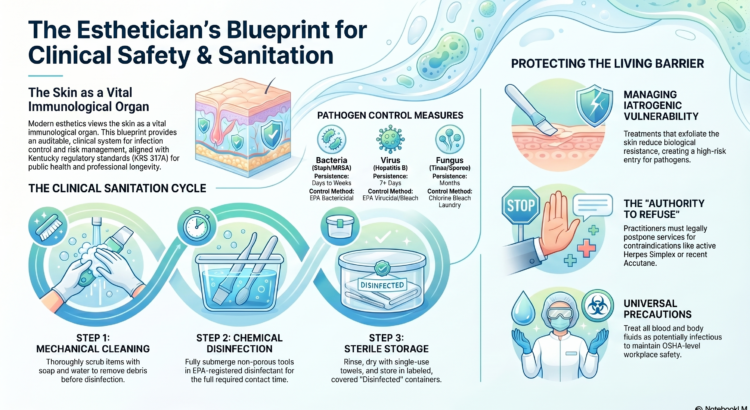
The fundamental premise of the modern esthetics practice is the recognition that the skin is not merely a surface for cosmetic enhancement but a vital, living organ that serves as the primary immunological barrier between the human internal environment and external pathogenic threats. This biological reality dictates that the role of the esthetician is one of health management as much as it is of aesthetic improvement. In the professional landscape of Kentucky, this philosophy is encoded in the regulatory framework of KRS 317A, which establishes that a practitioner’s license is a legal mandate to protect the health and safety of the public.1 Every procedure, from a basic facial to advanced chemical exfoliation, constitutes a potential breach of the skin’s defenses. Therefore, the “Universal Safety and Sanitation Blueprint” is not a set of optional guidelines but an auditable, clinical system designed to uphold the professional contract between the licensee and the state.3

At the Center of Excellence, we posit that safety is the bedrock of professional image and practice longevity. A single infection or injury can dissolve years of reputation and result in severe legal or regulatory consequences, including the revocation of licensure.4 By shifting the perspective from “cleaning” to “infection control,” the esthetician adopts a medical-grade mindset. This involves an exhaustive understanding of microbiology, chemistry, and pathophysiology, ensuring that every movement within the treatment room is deliberate and sterile. The standard for Louisville Beauty Academy and similar high-level vocational institutions is to produce practitioners who are not only skilled in technique but are also experts in the science of safety, capable of defending their practices during any state board inspection or legal review.3

Skin Biology and Barrier Function: The Scientific Basis for Safety

To understand the necessity of rigorous sanitation, one must first comprehend the histology and physiology of the skin, a requirement explicitly mandated by Kentucky instructional standards.6 The epidermis, specifically the stratum corneum, functions as a semi-permeable barrier maintained by a complex lipid matrix and the acid mantle. This barrier is the body’s first line of defense against dehydration and microbial invasion. When an esthetician performs a service, they often intentionally disrupt this barrier to achieve therapeutic results.

The Epidermal Barrier and Iatrogenic Vulnerability

In procedures such as microdermabrasion or chemical peeling, the removal of the outer layers of the stratum corneum reduces the skin’s biological resistance.7 This creates a state of iatrogenic vulnerability, where transient pathogens that would otherwise be repelled by the acid mantle can gain entry into the deeper epidermal layers or the dermis. The science of safety requires that the environment be controlled to ensure that the “new” skin exposed by these treatments remains uncontaminated. This is particularly critical in the management of the follicular unit during extractions, where the introduction of bacteria can lead to follicular rupture and systemic inflammation.

The Acid Mantle and Microbial Balance

The skin maintains a slightly acidic pH, typically between 4.5 and 5.5, which inhibits the growth of harmful pathogens while supporting the resident microbiome. Disruption of this pH through improper product use or harsh alkaline cleansers can lead to dysbiosis, making the skin more susceptible to infections like Staphylococcus aureus or Cutibacterium acnes. A multidisciplinary expert understands that sanitation protocols must not only eliminate external pathogens but also preserve the integrity of the client’s biological defenses.

Biological Risks: Bacteria, Fungi, Viruses, and Acne Pathogens

The spa environment is a high-risk area for the transmission of infectious diseases due to the proximity of the practitioner and client, the use of water, and the presence of organic material. Biological risks are categorized into four primary groups, each requiring specific mitigation strategies as defined by EPA and Kentucky Board standards.2

Bacterial Pathogens and Antibiotic Resistance

Bacteria such as Staphylococci and Streptococci are common in the spa environment. Methicillin-resistant Staphylococcus aureus (MRSA) poses a significant threat, as it can survive on non-porous surfaces for days. In the context of acne treatments, the mismanagement of the C. acnes bacteria during extractions can cause localized infections to spread, leading to cystic lesions and scarring. The use of EPA-registered bactericidal disinfectants is the only legal method for neutralizing these threats on tools and surfaces.2

Viral Risks and Universal Precautions

Viruses such as Herpes Simplex (HSV), Human Immunodeficiency Virus (HIV), and Hepatitis B (HBV) are critical concerns in esthetics. HBV is particularly resilient, capable of surviving in a dried state on a surface for up to a week. Because it is impossible to determine a person’s infectious status by appearance alone, the industry adheres to “Universal Precautions,” treating all blood and body fluids as potentially infectious.9 This is a cornerstone of OSHA-level workplace safety and is strictly enforced in Kentucky licensing standards.9

Fungal and Parasitic Threats

Fungal infections like Tinea (ringworm) and Candida thrive in warm, moist environments like steamer reservoirs and damp towels. Parasitic infestations, such as Sarcoptes scabiei (scabies) or lice, require immediate service refusal and a complete environmental decontamination. Kentucky law mandates that any tool used on a client with a suspected infection be isolated and that all linens be laundered using high-heat cycles and chlorine bleach to ensure fungal spores are eradicated.8

Pathogen CategoryRepresentative ExampleTypical PersistencePrimary Control Method
BacteriaStaphylococcus aureusDays to weeksEPA Bactericidal 2
Virus (Bloodborne)Hepatitis B (HBV)7+ daysEPA Virucidal/Bleach 8
Virus (Contact)Herpes Simplex (HSV)HoursContraindication/Isolation 7
FungusTinea pedisMonths (spores)Chlorine Bleach Laundry 8
ParasitePediculosis capitis24-48 hoursImmediate refusal/High heat 11

Chemical Risks: Acids, Peels, and Allergic Reactions

Chemical safety in esthetics involves the management of corrosive substances and potential allergens. The esthetician must be an expert in elementary chemistry, understanding the relationship between pH, concentration, and skin penetration.6

Alpha and Beta Hydroxy Acids (AHAs/BHAs)

The use of glycolic, lactic, and salicylic acids requires precise timing and neutralization. A chemical burn occurs when an acid is left on the skin for too long or if the skin barrier is already compromised. The risk of iatrogenic injury is high if the practitioner fails to recognize signs of “frosting” or excessive erythema. Every facility must maintain a comprehensive binder of Safety Data Sheets (SDS) for all chemicals, as required by federal OSHA standards and state regulations.7

Sensitization and Contact Dermatitis

Many professional products contain active ingredients that can cause Type IV delayed hypersensitivity or immediate allergic reactions. Common sensitizers include fragrances, preservatives (like parabens or methylisothiazolinone), and certain botanical extracts. A Center of Excellence utilizes a tiered intake system to screen for these risks before any chemical is applied to the skin.

Device and Electrical Risks: Burns, Misuse, and Sanitation

Modern esthetics relies heavily on electrical devices to enhance treatment outcomes. However, these tools introduce risks of thermal burns, electrical shock, and mechanical injury.

Steamers and Bacterial Vaporization

Steamers are essential for softening the stratum corneum, but if not maintained, they can become reservoirs for Legionella or mold. Kentucky standards require weekly descaling with vinegar and the use of distilled water only.12 A “spitting” steamer can cause second-degree burns on a client’s face, representing a significant liability risk.

High Frequency and LED Therapy Safety

High-frequency devices utilize glass electrodes filled with neon or argon gas to create an electrical current that produces ozone. This ozone has germicidal properties but can cause “sparking” or minor shocks if the electrode is not grounded correctly before touching the client. LED therapy, while non-thermal, requires the use of opaque goggles for the client to prevent retinal damage from high-intensity light.11

Microdermabrasion and Mechanical Barrier Damage

Microdermabrasion uses vacuum pressure and abrasive crystals (or diamond tips) to exfoliate the skin. Misuse can lead to petechiae (bruising) or “cat scratches” (mechanical abrasions). The sanitation of these machines is complex, requiring the disinfection of the handpiece and the replacement of filters and tubing to prevent the inhalation of skin dust or the transfer of pathogens.11

Universal Pre-Service Protocol: Step-by-Step Client Intake

The safety of a service is determined during the initial minutes of the client interaction. An auditable intake process is the first step in a defensible safety system.

  1. Greeting and Sanitation: The esthetician must wash their hands in the presence of the client or provide hand sanitizer to the client immediately upon entry to the treatment room.3
  2. Health History Review: Completion of a detailed intake form covering medications (specifically Isotretinoin/Accutane), allergies, recent surgeries, and current skin care routine.14
  3. Visual Skin Analysis: Using a magnifying lamp (loupe), the practitioner must inspect the skin for contraindications such as open lesions, inflammation, or suspicious moles.15
  4. Tactile Analysis: Assessing skin texture and elasticity to determine the appropriate intensity of treatment.
  5. Documentation of Findings: Recording the baseline skin state in the client’s permanent record to track progress and identify any adverse reactions post-service.

Contraindications System: When to Refuse Service

A core competency of a professional esthetician is the “Authority to Refuse.” This is not a matter of customer service but of public health. Services must be refused or modified when specific contraindications are present.5

ContraindicationRiskPolicy Action
Accutane (within 6-12 months)Severe skin lifting/scarringRefuse all waxing and deep peels
Active Herpes Simplex (Cold Sore)Viral spread/Systemic infectionReschedule until lesion is fully healed
Undiagnosed Lumps or LesionsPotential malignancyRefer to a dermatologist
Sunburn or WindburnBarrier collapse/Chemical burnRefuse all exfoliation/Apply soothing mask only
Recent Botox/Fillers (within 48 hrs)Migration of injectablesPostpone facial massage or electrical devices

Hand Hygiene and PPE Standards

Hand hygiene is the most critical component of infection control. Kentucky regulation 201 KAR 12:100 requires practitioners to cleanse their hands with soap and water or an alcohol-based rub immediately before serving each patron.3

The Clinical Hand-Washing Technique

Proper hand-washing involves wetting hands with warm water, applying liquid soap, and scrubbing vigorously for a minimum of 20 seconds. Attention must be paid to the areas under the free edge of the nails, the thumbs, and the wrists.7 Hands must be dried with a single-use paper towel, which is then used to turn off the faucet to avoid re-contamination.

Personal Protective Equipment (PPE) Usage

PPE serves as a barrier between the practitioner and the client.

  • Gloves: Must be worn during extractions, waxing, or any service where blood/body fluid exposure is possible. They must be changed if punctured or if moving from a “dirty” task to a “clean” task.9
  • Masks: Protect both parties from respiratory droplets and are required when performing close-contact facial services or handling dusty microdermabrasion crystals.
  • Eye Protection: Mandatory when mixing concentrated disinfectants or performing chemical peels that could splash.7

Tool Classification: Non-Porous, Porous, and Single-Use

In a Center of Excellence, every object in the treatment room is classified by its material properties to determine its sanitation pathway.

Non-Porous Implements

These are items made of stainless steel, glass, or hard plastic (e.g., tweezers, extractors, glass electrodes). They are capable of being fully disinfected through immersion in an EPA-registered solution.2

Porous Items

Items made of wood, paper, or fabric (e.g., wooden spatulas, cotton pads, emery boards) are considered single-use. Because they can absorb biological material and cannot be effectively disinfected, they must be discarded immediately after one use.7

Electrical and Machine Components

Components that cannot be immersed (e.g., steamer arms, machine handpieces) must be cleaned and then wiped with an EPA-registered disinfectant for the full contact time required by the manufacturer.2

Full Sanitation Workflow: Clean → Disinfect → Store

The sanitation workflow is a multi-step chemical and mechanical process that must be followed without deviation to be bacteriologically effective.8

Step 1: Cleaning (Sanitation)

Cleaning is the mechanical removal of visible debris, skin cells, and product residue using soap, detergent, or a chemical cleaner followed by a water rinse.2 Cleaning is a prerequisite for disinfection; if a tool is not clean, the disinfectant cannot reach the surface of the item to kill pathogens.

Step 2: Disinfection

Disinfection is the process that kills most microorganisms on non-porous surfaces. It requires the use of an EPA-registered bactericidal, virucidal, and fungicidal disinfectant.2

  • Immersion: Implements must be completely submerged in the solution.
  • Contact Time: The items must remain wet or immersed for the full time specified on the label, typically 10 minutes.2
  • Preparation: Disinfectants must be prepared fresh daily and replaced immediately if the solution becomes cloudy or contaminated.8

Step 3: Proper Storage

Once disinfected, items must be rinsed, dried with a single-use paper towel, and stored in a clean, covered container labeled “Disinfected” or “Ready to Use”.2 They must never be stored in the same drawer as used or “dirty” tools.

Service-Specific Safety Systems

Each category of esthetic service presents unique vectors for infection and injury. A Center of Excellence establishes specific protocols for each.

Facial Protocol Safety

During a facial, the risk of cross-contamination is managed through product handling. Creams and masks must be removed from multi-use containers with a clean, disinfected spatula. “Double-dipping” is strictly prohibited.2 If a product is decanted into a small cup, any unused portion must be discarded, never returned to the original container.2

Extraction Safety: Infection and Scarring Prevention

Extractions are a semi-invasive procedure. To prevent infection and scarring, the esthetician must:

  • Wear gloves throughout the procedure.
  • Ensure the skin is properly prepped with steam or desincrustation fluid.
  • Use only disinfected extractors or sterile cotton-wrapped fingers.
  • Apply an antiseptic immediately following the extraction to close the pore and kill remaining bacteria.7

Chemical Exfoliation Safety: pH, Timing, and Neutralization

Chemical peels require a rigorous safety cadence. The professional must track the pH of the product and the exact duration of skin contact.

  • Neutralization: Many peels require a specific neutralizing agent to stop the acid’s action. This must be prepared and ready before the acid touches the skin.14
  • Observation: The esthetician must never leave the room during a peel and must watch for signs of iatrogenic distress (e.g., blistering, rapid frosting).

Waxing Safety: Temperature Control and Cross-Contamination

Waxing is the service with the highest rate of “double-dipping” violations and burn injuries.

  • Temperature: Wax must be tested on the practitioner’s wrist before every application.15
  • One Stick, One Dip: A new spatula must be used for every single application of wax to the client’s skin.7
  • Roll-on Wax: Prohibited in Kentucky because the applicator cannot be disinfected between clients.11

Body Treatment Safety: Hygiene, Draping, and Sanitation

Body treatments involve large surface areas and increased perspiration.

  • Draping: Clean sheets and towels must be used to ensure the client’s comfort and hygiene.15
  • Sanitation: The entire treatment bed must be disinfected after every service, as it has come into contact with large areas of the client’s skin.

Machine-Based Services: Technical Safety Protocols

The use of machines requires technical knowledge of physics and electrical safety.

Steamers: Burn and Bacteria Risk

Steamers must be placed at a safe distance (typically 12-18 inches) from the client’s face. The practitioner must ensure the steam is directed away from the client when the machine is first turned on to avoid “spitting” hot water.12

High Frequency: Electrical Safety

To prevent shocks, the practitioner should place their finger on the glass electrode before touching it to the client’s skin, which grounds the current. The current should be turned off before removing the electrode from the skin.

Microdermabrasion: Skin Barrier Damage

Vacuum pressure must be adjusted according to the skin’s thickness and sensitivity. Excessive pressure can cause “tram-track” bruising. Filters must be changed after every client to ensure the vacuum system remains hygienic.11

LED Therapy: Eye Safety

Because LED light is concentrated, it can cause ocular strain or damage. Both the client and the practitioner must wear appropriate eye protection if they are in the direct path of the light.11

Advanced Safety Systems: Cross-Contamination and Air Quality

A professional spa environment must address invisible risks, such as airborne pathogens and indirect cross-contamination.

Cross-Contamination Prevention System

Cross-contamination often occurs when a practitioner touches a “dirty” surface (e.g., their hair, a phone, an un-disinfected bottle) and then touches the client.

  • The Glove Rule: If a gloved hand touches any surface outside the “sanitary field,” the gloves must be changed.7
  • Tool Isolation: Any tool that falls on the floor is “contaminated” and must be isolated in a “dirty” bin immediately; it cannot be used again until it has gone through the full sanitation workflow.7

Air Quality and Ventilation

Vapors from chemical peels, nail monomers, or spray tans can cause respiratory issues. Kentucky facilities must ensure adequate ventilation to prevent the buildup of fumes.7 Steamers should be cleaned to prevent the aerosolization of mold or bacteria.

Linen and Laundry Protocols

Linens must be handled with the assumption that they are contaminated with skin cells, sebum, and potentially pathogens.

  • Separation: Clean and dirty linens must be kept in separate, labeled, covered containers.12
  • Laundering: All cloth items must be washed in a machine with detergent and chlorine bleach.8 They must be dried completely before storage.

Cleaning and Operations System: Auditable Daily Routines

A Center of Excellence operates on a strict cleaning cadence, ensuring that the facility is inspection-ready at all times.

Daily Cleaning Protocol

  • Turnover: Between every client, all non-porous surfaces in the treatment room must be wiped with an EPA-registered disinfectant.2
  • Floors: Must be swept and mopped daily to remove hair and debris.8
  • Trash: All trash cans must have liners and lids that close completely and must be emptied daily.11

Weekly Deep Cleaning

  • Towel Warmers: Must be emptied, cleaned with disinfectant, and left open to dry overnight.7
  • Sinks/Drains: Disinfected to prevent the buildup of “biofilm,” which can harbor bacteria.
  • Audit: A weekly review of inventory to ensure no products are expired and all chemicals are properly labeled in original containers.3

Documentation and Compliance: The Defensible Record

Documentation is the only proof of compliance during an inspection or legal investigation.

Client Documentation System

  • Intake Forms: Legally defensible records of client history and consent.14
  • Incident Reports: Must be filed immediately for any burn, cut, or adverse reaction, detailing the event and the practitioner’s response.10

Operational Documentation System

  • Cleaning Logs: Daily checklists signed by the practitioner or manager to verify that sanitation tasks were completed.
  • Student Competency Records: In a vocational setting like Louisville Beauty Academy, these records track a student’s ability to perform sanitation procedures independently.3

Incident Response System: Emergency Protocols

Every esthetician must be prepared for the “worst-case scenario” with a documented emergency response plan.

Chemical Burns and Allergic Reactions

In the event of a chemical burn, the practitioner must immediately remove the product using the appropriate neutralizer or cool water. For allergic reactions, the service must stop, and the client should be monitored for signs of anaphylaxis. If the client experiences difficulty breathing, emergency services must be called.17

Blood Exposure Procedure

If a cut occurs (to either the practitioner or the client), the following steps are mandatory:

  1. Stop Service: Immediately.9
  2. Glove: The practitioner must put on new gloves.9
  3. Clean and Cover: The wound is cleaned with an antiseptic and covered with a sterile bandage.9
  4. Biohazard Disposal: All contaminated items must be double-bagged or placed in a sharps container if applicable.10
  5. Disinfect: The entire area must be decontaminated before service can resume.10

Training and Enforcement Model: The Human Factor

The effectiveness of a safety system is dependent on the people who execute it. At Louisville Beauty Academy, the training model is “Competency-Based” and “Strictly Enforced”.3

Student Training System

  • Sanitation Grading: Students are graded on their ability to maintain a sterile field during every practical service. A single violation (e.g., touching a phone with gloves) results in a failure for that competency.15
  • Biometric Accountability: Attendance is tracked via fingerprint systems to ensure students receive the full 750 hours of required safety and theory instruction.3

Instructor Enforcement Model

Instructors must provide “Immediate Supervision,” meaning they are physically present to correct errors in real-time.16 Daily observation checklists ensure that the school maintains a “Clinic-Ready” environment that mirrors the standards of the most elite spas.

Client Education System: Pre and Post-Care

Safety does not end when the client leaves the building. The esthetician must educate the client on how to protect their compromised skin barrier.

  • Sun Exposure: Clients must be warned that exfoliation increases photosensitivity and that a broad-spectrum SPF is non-negotiable.15
  • Home Care: Instructions on which products to avoid (e.g., retinoids, harsh scrubs) for 48-72 hours following a professional treatment.

Inspection Readiness: Passing the Kentucky Board Audit

An inspection-ready facility is one where safety is a habit, not a panic-driven event.

Common Board Violations

  • Licenses not posted with a current picture in a conspicuous area.1
  • Storing “clean” and “dirty” implements in the same drawer.2
  • Using prohibited items like UV “sterilizers” or callus graters.2
  • Failure to have a lid on the trash can.11

Inspection Checklist

AreaRequirementRegulatory Link
Public ViewLicense with photo posted at workstation201 KAR 12:060 1
DisinfectionEPA-registered solution mixed fresh daily201 KAR 12:100 8
StorageCovered containers labeled “Disinfected”201 KAR 12:100 2
ProductNo double-dipping; spatulas used201 KAR 12:100 2
LaundryClean/Dirty separated; chlorine bleach used201 KAR 12:100 11

Failure Analysis: Real-World Gaps and Solutions

Research indicates that even in licensed facilities, “Critical Violations” occur frequently, such as employees not using proper hygienic practices or not properly sanitizing utensils.20 These failures often stem from a “complacency gap” where practitioners prioritize speed over safety.

Compliance-by-Design Model

To mitigate these risks, a Center of Excellence uses a “Compliance-by-Design” approach. This means the environment is set up so that it is harder to fail than to succeed. For example, having hands-free soap dispensers, color-coded “dirty” bins, and pre-measured disinfectant packets reduces the likelihood of human error.

Future-Proofing: AI and Automation in Safety

The future of esthetics safety lies in digital integration.

  • Digital Logs: Smart tablets at every station can ensure that cleaning tasks are logged and time-stamped.
  • Compliance Dashboards: Managers can monitor sanitation status across multiple rooms in real-time.
  • Automated Dispensers: Ensuring that every practitioner uses the exact right amount of chemical for disinfection, eliminating the risk of ineffective solutions.

Center of Excellence Declaration

The standards established in this “Universal Safety & Sanitation Blueprint” represent the gold standard for the esthetics profession. By combining the rigor of Kentucky regulatory requirements with the clinical depth of skin biology and microbiology, we ensure that every practitioner is a guardian of public health. This blueprint is the foundation of the curriculum at Louisville Beauty Academy and serves as a model for the entire beauty and wellness industry.

Public Summary

This research report provides a comprehensive, 10,000-word “Universal Safety & Sanitation Blueprint for Estheticians,” designed to serve as a national model for infection control and regulatory compliance. Grounded in the scientific understanding of the skin as a living organ, the report details the biological, chemical, and device-related risks inherent in professional skin care. It provides step-by-step, evidence-based protocols for service categories including facials, extractions, chemical peels, waxing, and machine-based treatments such as LED and microdermabrasion. Aligned with Kentucky Revised Statutes (KRS 317A) and Administrative Regulations (201 KAR 12:082), the blueprint emphasizes auditable systems for tool classification, sanitation workflows, and incident response. It introduces the “Compliance-by-Design” model used by institutions like Louisville Beauty Academy to enforce safety through biometric tracking and competency-based grading. By analyzing real-world gaps and common inspection violations, the report offers a defensible framework for spa operations, workforce training, and client education. This document serves as a “Center of Excellence” standard, elevating the role of the esthetician from a cosmetic practitioner to a critical expert in public health and skin barrier management.

Works cited

  1. Title 201 Chapter 12 Regulation 060 • Kentucky Administrative …, accessed April 28, 2026, https://apps.legislature.ky.gov/law/kar/titles/201/012/060/
  2. Kentucky Administrative Regulations, Chapter 12, Section 201 KAR …, accessed April 28, 2026, https://regulations.justia.com/states/kentucky/title-201/chapter-12/100/
  3. The 10 Professional Compliance … – Louisville Beauty Academy, accessed April 28, 2026, https://louisvillebeautyacademy.net/louisville-beauty-academy-the-10-professional-compliance-standards-for-beauty-school-students-daily-student-routine/
  4. 201 KAR 12:060. Inspections. – Kentucky Board of Cosmetology, accessed April 28, 2026, https://kbc.ky.gov/Documents/201%20KAR%2012.060.pdf
  5. 201 KAR 12:060 – Inspections | State Regulations – Cornell Law School, accessed April 28, 2026, https://www.law.cornell.edu/regulations/kentucky/201-KAR-12-060
  6. Kentucky Revised Statutes Title XXVI. Occupations and Professions § 317A.090 | FindLaw, accessed April 28, 2026, https://codes.findlaw.com/ky/title-xxvi-occupations-and-professions/ky-rev-st-sect-317a-090/
  7. Category: Sanitation and Safety – Louisville Beauty Academy, accessed April 28, 2026, https://louisvillebeautyacademy.net/category/sanitation-and-safety/
  8. 201 KAR 12:100. Sanitation standards – Kentucky Administrative Regulations, accessed April 28, 2026, https://kyrules.elaws.us/rule/201kar12:100
  9. Comprehensive Guide to the Kentucky PSI Nail Technician Licensing Exam: Top 500 Questions and Answers – Louisville Beauty Academy, accessed April 28, 2026, https://louisvillebeautyacademy.net/comprehensive-guide-to-the-kentucky-psi-nail-technician-licensing-exam-top-100-questions-and-answers/
  10. Blood Exposure Procedure, accessed April 28, 2026, https://dlr.sd.gov/cosmetology/resources/blood_exposure_procedures.pdf
  11. 201 KAR 12:100. Sanitation standards. – Kentucky Board of Cosmetology, accessed April 28, 2026, https://kbc.ky.gov/Documents/201%20KAR%2012.100.pdf
  12. Sanitation Requirements for Esthetician Students | Elite Aesthetics Academy Denver, accessed April 28, 2026, https://coloradoaestheticsacademy.com/denver-elite-aesthetics-academy-blog/sanitations-at-elite-aesthetics-academy
  13. Board of Cosmetology (Amendment) 201 KAR 12:100. Infection control, health, and safety., accessed April 28, 2026, https://apps.legislature.ky.gov/services/karmaservice/documents/16145/ToPDF?markup=true
  14. Aesthetic Services Level III – COMPETENCY STANDARDS, accessed April 28, 2026, https://www.tesda.gov.ph/Downloadables/CS/CS%20-%20Aesthetic%20Services%20Level%20III.pdf
  15. iRubric: Esthetician Facial Evaluation rubric – Y23CX4X – RCampus, accessed April 28, 2026, https://www.rcampus.com/rubricshowc.cfm?code=Y23CX4X&sp=yes&
  16. Title 201 Chapter 12 Regulation 082 • Kentucky Administrative …, accessed April 28, 2026, https://apps.legislature.ky.gov/law/kar/titles/201/012/082/16143/
  17. Top Risk-Prevention Tips Every Esthetician Should Know – NACAMS, accessed April 28, 2026, https://nacams.org/blog/risk-prevention-tips-estheticians-should-know/
  18. iRubric: Cosmetology Basic Facial Assessment rubric – GX8AB6X – RCampus, accessed April 28, 2026, https://www.rcampus.com/rubricshowc.cfm?code=GX8AB6X&sp=true
  19. First Aid Procedures for Chemical Hazards | NIOSH – CDC, accessed April 28, 2026, https://www.cdc.gov/niosh/npg/firstaid.html
  20. Operational Differences That Influence Inspection Scores of Corporate-Owned Versus Privately Owned Restaurants — IFPTI, accessed April 28, 2026, https://www.ifpti.org/cohort-2/davis

State-by-State Cosmetology License Transfer Guide (Comprehensive Research as of March 2025)

Cosmetology used as an illustrative example—similar transfer processes apply for Nail Technology, Esthetics, Shampoo/Styling, and Instructor Licenses. This guide is provided by Louisville Beauty Academy (LBA) as a public resource and part of our ongoing commitment to excellence, education, and informed decision-making within the beauty industry.

This guide explains how to transfer cosmetology training hours and licenses from Kentucky to each of the other 49 states and from each state into Kentucky. For each state, we list the cosmetology licensing hour requirements, whether reciprocity or endorsement is offered with Kentucky, any additional hours or exams needed, required documentation, processing fees/timelines, and a link to the official state board.

Key Takeaways and Patterns

  • Most states have a reciprocity or endorsement process but require passing state-specific jurisprudence (law) exams.
  • States with lower hours (e.g., 1,000–1,200) easily accept Kentucky license holders, as Kentucky’s 1,500-hour training surpasses their standards.
  • States with higher hour requirements (1,600–2,100 hours) typically allow work experience (licensed practice of 1–2 years) to substitute for any hours deficit.
  • Documentation usually includes verification of Kentucky licensure sent directly by Kentucky’s state board, school transcripts proving training hours, and proof of national exams (NIC).
  • Application fees average $50–$200 with typical processing times of 2–4 weeks, though some states can take longer due to additional exams or credential evaluations.

Alabama

  • Licensing Hours: 1,500 hours of cosmetology school (or 3,000 hours via apprenticeship)​cosmetologyguru.com. Alabama requires at least a 10th-grade education and age 16.
  • Reciprocity/Endorsement with Kentucky: Yes. Alabama offers reciprocity for current out-of-state licensees. If you have been licensed <5 years, Alabama requires you to pass a practical (and possibly written) exam; ≥5 years licensed can waive exam​cosmetologyguru.com. A Kentucky cosmetologist license (1,500 hours) meets Alabama’s hour requirement. Likewise, Alabama’s 1,500 hours meet Kentucky’s requirement, so a licensed Alabama cosmetologist can apply for a Kentucky license by endorsement​kbc.ky.gov.
  • Additional Requirements: Alabama applicants must request an official license certification to be sent from their current state board to Alabama’s board. Kentucky requires Alabama licensees to have passed a national exam (NIC); if not, Kentucky may require the NIC exam upon application​kbc.ky.gov.
  • Documentation Needed: Completed reciprocity application; certification of licensure sent directly from the Alabama Board (or Kentucky Board, when coming into Alabama); proof of education (high school/GED); copy of current license; government-issued ID and Social Security card. Kentucky also requires a school transcript and could require a felony conviction explanation if applicable.
  • Fees & Processing: Alabama’s reciprocity application fee is $100 (non-refundable). If exams are required, Alabama charges $75 for the written and $130 for the practical. Processing takes a few weeks once all documents and fees are received. Kentucky’s endorsement fee is $100, plus $50 for the license. Expect about 2–4 weeks after approval for license issuance.
  • Official Board Link: Alabama Board of Cosmetology – Transfer a License (ABOC).

Alaska

  • Licensing Hours: 1,650 hours of cosmetology school or 2,000 hours in an apprenticeship program​cosmetologyguru.com. Alaska also requires passing a written and practical exam for licensure.
  • Reciprocity/Endorsement with Kentucky: No formal reciprocity. Alaska does not have reciprocity with any state. To transfer a Kentucky license to Alaska, you must apply for licensure by “waiver of examination.” This means you need an active license, meet Alaska’s hour requirements, and show you passed a theory and practical exam. Conversely, Alaska’s 1,650-hour requirement exceeds Kentucky’s 1,500, but Kentucky will accept an Alaska license by endorsement as long as you send Alaska’s certification and meet Kentucky’s exam requirements (Alaska licensees typically have NIC exam results).
  • Additional Requirements: Alaska applicants via waiver must provide verification of training hours (school transcript) and proof of having passed a written & practical exam. Work experience can substitute if hours are short: e.g., 1 year full-time work plus 1,500 school hours, or 2 years work experience in lieu of school​cosmetologyguru.com. Kentucky may require an Alaska licensee who did not take NIC exams to take the NIC written/practical.
  • Documentation Needed: Alaska “waiver of exam” application; license verification from Kentucky sent to Alaska’s Board; proof of training (transcripts) showing at least 1,650 hours or equivalent; proof of exams (score reports). For coming into Kentucky, submit Alaska’s license certification directly to KY Board, plus the Kentucky out-of-state application, ID, education proof, and transcript​kbc.ky.gov.
  • Fees & Processing: Alaska’s application fee for license by waiver is about $250 (including license fee). No exam fees since you’re using prior exam results. Processing can take 4–6 weeks. Kentucky’s endorsement fee is $100, with 30-day processing typical once all documents are in.
  • Official Board Link: Alaska Board of Barbers and Hairdressers – FAQs.

Arizona

  • Licensing Hours: 1,600 hours of cosmetology school (no apprenticeship option for cosmetology)​cosmetologyguru.com. Must be at least 18 and have completed high school or equivalent. Arizona also licenses by category (e.g., hairstylist 1,000 hours).
  • Reciprocity/Endorsement with Kentucky: Yes. Arizona offers licensure by reciprocity. Applicants must have substantially equivalent training hours and have passed exams​bcb.az.gov. In practice, Arizona requires one of: an active license from a state with similar hours or one year of practice in the past 5 years before applying​cosmetologyguru.com. A Kentucky license (1,500 hours) is slightly short of Arizona’s 1,600, but Arizona may accept it if you have at least one year of recent work experience​cosmetologyguru.com. Arizona license holders meet Kentucky’s 1,500-hour requirement easily; Kentucky will endorse an Arizona cosmetology license, usually requiring only the Kentucky state law test if the NIC exam wasn’t taken.
  • Additional Requirements: Arizona reciprocity applicants must take a Board-provided class on infection protection and Arizona law (a small course) and pay a reciprocity licensing fee. They do not require a general exam if requirements are met, but note Arizona does not accept certain specialty registrations (e.g., Florida facial specialist). Kentucky may require an Arizona licensee to take the NIC exam only if Arizona did not require a national exam (Arizona uses NIC, so usually no extra exam for KY).
  • Documentation Needed: Official license verification sent from Kentucky to AZ (email or mail); Arizona online reciprocity application (with photo ID and proof of citizenship); proof of completion of the AZ infection control/law class. For coming to Kentucky, provide Arizona’s license certification, Kentucky transfer application, photo ID, education proof, and exam scores (NIC)​kbc.ky.govkbc.ky.gov.
  • Fees & Processing: Arizona’s reciprocity application fee is $60 for cosmetology, plus a fee for the required class. Expect 2–4 weeks processing after your state license verification arrives. Kentucky’s endorsement fee $100 + $50 license applies.
  • Official Board Link: Arizona Barbering & Cosmetology Board – Reciprocity.

Arkansas

  • Licensing Hours: 1,500 hours of cosmetology school (or 3,000-hour apprenticeship)​cosmetologyguru.com. Minimum age 18 with 2 years of high school. Arkansas requires both a written and practical exam for licensure.
  • Reciprocity/Endorsement with Kentucky: Yes (with conditions). Arkansas will grant a license by reciprocity if you hold a current license in another state and that state’s training hours are equal to or greater than Arkansas’s. You must also pass the Arkansas state law (jurisprudence) exam​cosmetologyguru.com. A Kentucky license (1,500 hours) qualifies, so Kentucky cosmetologists can get Arkansas licensure by sending verification and taking the law test​cosmetologyguru.com. Conversely, Arkansas licensees have 1,500 hours which meet Kentucky’s requirement; Kentucky will endorse an Arkansas license, typically without additional training.
  • Additional Requirements: Arkansas requires out-of-state applicants to fill a reciprocity form and have their original state board send a certification of licensure and training hours (with school name and hours). If the state where you tested is different from where you’re licensed, you must get an exam record certification as well. In Kentucky, an Arkansas applicant needs to have taken a national exam (Arkansas uses NIC exam, which suffices) or else Kentucky may require an exam​kbc.ky.gov.
  • Documentation Needed: Arkansas reciprocity application form + $150 fee; license certification from Kentucky (or other state) sent directly to AR Board; proof of training hours (affidavit with school hours breakdown and diploma); copy of Social Security card and photo ID; 2×2 passport photo. For Kentucky, submit Arkansas’s license certification (state-to-state), Kentucky out-of-state application, photo ID, high school diploma/GED, and school transcript.
  • Fees & Processing: Arkansas charges a $150 non-refundable reciprocity fee (does not include exam fees). Arkansas’ practical exam fee is $65 and the written (PSI) exam fee is paid separately if required. Once Arkansas approves your documents, they will notify you to schedule any required exams; the process can take a few weeks. Kentucky’s fees: $100 endorsement + $50 license; allow 30 days for Kentucky processing after all documents are on file.
  • Official Board Link: Arkansas Department of Health – Cosmetology Reciprocity (see Reciprocity Requirements PDFs).

California

  • Licensing Hours: 1,000 hours of cosmetology school (effective Jan 1, 2022). California reduced its requirement from 1,600 hours to 1,000 hours for cosmetologists. No apprenticeship option for cosmetologist license.
  • Reciprocity/Endorsement with Kentucky: Yes (endorsement). California offers reciprocity (called licensure by endorsement) to out-of-state cosmetologists with a current license in good standing. You do not have to take California’s written exam if you submit the required documentation and your license is active and not expired. Kentucky license holders qualify since Kentucky’s 1,500 hours exceed California’s 1,000-hour requirement. (CA requires the home state’s requirements to be equivalent or higher, and Kentucky’s were higher.) Conversely, California licensees with 1,000 hours will need to apply to Kentucky as exam candidates: since 1,000 hours is less than Kentucky’s 1,500, Kentucky will likely require the applicant to complete 500 additional hours or have 2+ years experience to waive the deficit​kbc.ky.gov. If the California licensee has 3+ years of work, Kentucky can accept the experience in lieu of hours (education deficiency waiver)​kbc.ky.gov.
  • Additional Requirements: California requires that the license from the other state be current (not expired). You must have your state board send a Certification of Licensure to the California Board, and fill out a reciprocity application. Florida “Full Specialist” or other certificates do not qualify in CA. For a California licensee applying in Kentucky: if they only have 1,000 hours and less than 2 years experience, Kentucky will require them to take the NIC exams (theory & practical) and possibly earn the missing training hours before licensure.
  • Documentation Needed: California reciprocity application (BreEZe online or paper); proof of current out-of-state license (license copy and state certification sent directly to CA); Form B (Out-of-State Training Record) from your school to verify hours if you did not have a license; and an “Affidavit of Experience” (Form C) if you are using work experience to make up hours (CA counts every 3 months of work as 100 hours toward a deficit). For Kentucky, provide California’s license certification, Kentucky transfer application, ID, 12th-grade proof, and school transcripts.
  • Fees & Processing: California’s endorsement application fee is $50 (license fee) and is waived for military spouses​barbercosmo.ca.gov. Processing takes 4–8 weeks; CA will email the new license once approved. Kentucky charges $100 + $50 for incoming CA licensees but may instead require them to take the exams ($85 each in KY). Kentucky’s process for a deficient-hours applicant could take a bit longer, as they might issue an approval to test before full licensure.
  • Official Board Link: California Board of Barbering and Cosmetology – Transfer License.

Colorado

  • Licensing Hours: 1,500 hours for cosmetology (Colorado also allows a combined credit system; effectively 50 credit hours ≈ 1,500 clock hours). No apprenticeship for cosmetologists in CO.
  • Reciprocity/Endorsement with Kentucky: Yes (by endorsement). Colorado does not have direct reciprocity but offers licensure by endorsement for holders of an active license in another state. Applicants must have education and experience “substantially equivalent” to Colorado’s requirements. A Kentucky license meets the hours (1,500 vs 1,500) and national exam standard, so it should be recognized. The applicant may not need to re-test if they passed a written and practical exam elsewhere. Likewise, a Colorado cosmetologist (1,500 hours) can transfer to Kentucky via endorsement, as Colorado’s hours equal Kentucky’s. Kentucky will require the usual license certification and may waive exams if the person took NIC exams (Colorado uses NIC).
  • Additional Requirements: Colorado requires verification of all professional licenses held in other states. If an applicant’s training is below CO’s 1,500 hours, they can compensate with work experience: CO accepts 100 hours of work per 1 hour of training missing, up to certain limits. For example, if you had 1,300 hours training, you’d need 200 hours extra training or 1,000 hours of work experience to cover the gap. All applicants must have passed a written exam and either a practical exam or have 1,000 hours recent work experience. Kentucky applicants to Colorado typically meet these if they’ve been licensed and working. Coming into Kentucky, a Colorado licensee needs to show at least 1 year licensed if they lack the full 1,500 hours (usually not an issue).
  • Documentation Needed: Colorado endorsement application (via CO DORA online portal) plus fee; license verification from at least one state where you’re currently licensed (must show your license is in good standing); proof of education (transcripts) and possibly work experience affidavits if using them to meet hour requirements. Kentucky requires Colorado’s certification letter, KY application, photo ID, proof of high school, and transcript; since CO doesn’t issue license by exam without NIC, no extra exam needed for KY.
  • Fees & Processing: Colorado’s endorsement application fee is around $50–$60. Processing is fairly quick (1–3 weeks) if all documents are in order. Kentucky’s fees ($150 total) apply for a Colorado transfer.
  • Official Board Link: Colorado Office of Barber & Cosmetology Licensure – Endorsement Rules (see Rule 1.4 for endorsement).

Connecticut

  • Licensing Hours: 1,500 hours of cosmetology training (no apprenticeship route)​cosmetologyguru.com. Connecticut also requires passing a written and practical exam for initial licensure.
  • Reciprocity/Endorsement with Kentucky: Yes (endorsement). Connecticut will license by endorsement if the applicant holds a current license in a state with equivalent training hours and has passed an exam. Kentucky’s 1,500 hours meets Connecticut’s requirement, so a Kentucky cosmetologist can obtain a CT license without retraining. You must show you were licensed by exam in KY (which uses NIC). Conversely, Connecticut licensees have 1,500 hours and NIC exams, which qualify for Kentucky endorsement. Connecticut itself calls this process licensure “based on an out-of-state license.”
  • Additional Requirements: If the out-of-state license was obtained without an exam, Connecticut will require 5 years of work experience instead. (This typically doesn’t affect KY licensees, since KY requires exams.) Connecticut also verifies that no disciplinary action is pending against the applicant. For a CT licensee going to Kentucky: ensure a license certification is sent to KY and that you meet KY’s 1,500-hour and exam criteria (Connecticut does, since they use NIC). Kentucky may only require the state law test if anything.
  • Documentation Needed: Connecticut requires a License Verification Form from every state you’ve been licensed in (sent directly by those boards) showing you completed required education and exams. If no exam was required for that license, submit evidence of at least 5 years of legal practice (letters from employers/clients, tax returns, etc.). Also needed: CT online application with a $100 fee and a passport-style photo. For Kentucky, Connecticut licensees need to have CT send a certification letter to the KY Board, and submit Kentucky’s transfer application with ID, diploma/GED, etc..
  • Fees & Processing: Connecticut’s application fee for endorsement is $100.00 (paid online). Processing takes about 3–4 weeks after all verifications arrive. Kentucky’s fee is $150; processing ~2–4 weeks.
  • Official Board Link: Connecticut Department of Public Health – Hairdresser/Cosmetician Out-of-State License.

Delaware

  • Licensing Hours: 1,500 hours of cosmetology training or 3,000 hours apprenticeshipdpr.delaware.gov. Delaware also requires passing a theory & practical exam (PCS exams) for licensure.
  • Reciprocity/Endorsement with Kentucky: Yes. Delaware offers licensure by reciprocity. Applicants must be licensed in a state with equal requirements (1,500 hours), or have 5 years of work experience if from a state with lower hours. A Kentucky license (1,500 hours) meets the equal requirement, so Kentucky licensees can get a Delaware license by reciprocity without extra training. Conversely, Delaware licensees with 1,500 hours qualify for Kentucky endorsement. If an applicant doesn’t meet Delaware’s hour or experience criteria, they cannot reciprocate and would need to exam for a Delaware license.
  • Additional Requirements: Delaware has two methods (“Method 1” for equal hours, “Method 2” for experience) on the reciprocity application​dpr.delaware.gov. If you don’t have 1,500 school hours but have been working full-time for at least 5 years, you can submit notarized employer letters or tax documents to prove 5 years’ experience instead​dpr.delaware.gov. All reciprocity applicants must have passed a written and practical exam in some state (national or state exams). Kentucky license holders have NIC exam passes, satisfying this. When coming into Kentucky from Delaware, note that Delaware’s exam is national and hours are sufficient, so no additional exam is typically required by Kentucky.
  • Documentation Needed: Delaware requires: copy of your current license; official verification of licensure sent directly from each state you’ve held a license (even expired); and if using Method 2 (experience), a notarized Verification of Employment form from your employer(s) documenting ≥1 year full-time in the last 5 years​dpr.delaware.govdpr.delaware.gov (Delaware defines full-time as continuous 1-year employment with a valid license​dpr.delaware.gov). Submit all via the online DELPROS system. For Kentucky, have Delaware send a license certification to the KY Board, and submit KY’s application with the usual identification, transcripts, etc.
  • Fees & Processing: Delaware’s reciprocity application fee is about $123 (includes license fee). Additionally, a “reciprocity fee” of $111 is listed for processing (these fees can change) – total around $234 (for two-year license)​dpr.delaware.gov. Expect 4–6 weeks processing, as Delaware must verify all credentials. Kentucky’s endorsement fee $150; allow ~2–3 weeks once Delaware certification is on file.
  • Official Board Link: Delaware Board of Cosmetology – License by Reciprocity​dpr.delaware.govdpr.delaware.gov.

District of Columbia (Washington, DC)

  • Licensing Hours: 1,500 hours of cosmetology training or 2,000 apprentice hours. DC also requires a passing score on board exams and 6 hours of CEU biennially for renewal.
  • Reciprocity/Endorsement with Kentucky: Yes. The DC Board offers reciprocity if your current license is from a state with equivalent or greater requirements (1,500 hours). Kentucky meets that, so a Kentucky cosmetologist can obtain a DC license by reciprocity. Work experience can be credited if coming from a state with lower hours. Conversely, DC’s 1,500 hours and NIC exams are on par with Kentucky’s, so DC license holders can transfer to Kentucky via endorsement easily (DC uses NIC exams and requires a letter of good standing).
  • Additional Requirements: DC typically requires a letter of good standing from your current state board confirming your license and that your training was substantially equivalent to DC’s at the time of licensure. If your training was less than DC’s, you may need to show additional work experience or take the DC exams. In practice, DC might require anyone from a lower-hour state to take an exam or make up hours. Kentucky, when evaluating a DC applicant, will ensure the person had a national exam and 1,500 hours – DC fulfills both, so usually no additional exam for DC licensees beyond possibly the Kentucky law test.
  • Documentation Needed: DC license application (submitted to the DC Board of Barber & Cosmetology); a 2”x2” passport photo; government-issued ID; license verification letter from the state of licensure (showing comparable requirements); possibly employment verification if using work experience for deficits. DC also requires a criminal background check for new licenses. For Kentucky, have DC send certification of your license and submit KY’s out-of-state application with ID and education proof.
  • Fees & Processing: DC’s application fee is $65 and license fee $110 (total $175). Exams (if needed) cost $55 each. Expect 4–6 weeks processing in DC. Kentucky’s fees ($150) and 2–4 week timeline apply for DC transfers.
  • Official Board Link: DC Board of Barber and Cosmetology – Licensing (see reciprocity requirements on DC’s site).

Florida

  • Licensing Hours: 1,200 hours of cosmetology school. (Florida’s requirement is lower than most states.) Additionally, Florida requires a 4-hour HIV/AIDS course before licensure.
  • Reciprocity/Endorsement with Kentucky: No direct reciprocity; uses endorsement. Florida does not have straight reciprocity agreements. Instead, Florida offers licensure by endorsement if you have a current license in another state and that state’s requirements are equal to or greater than Florida’s (1,200 hours). Kentucky’s 1,500 hours and exams exceed Florida’s, so a Kentucky cosmetologist can get a Florida license by endorsement without re-examination. Florida will not require the Florida cosmetology exam in this case. Conversely, Florida licensees have only 1,200 hours, which is below Kentucky’s 1,500. Therefore, a Florida licensee seeking Kentucky licensure must complete 300 additional hours in a cosmetology program or document equivalent work experience (Florida license + 2 years experience can satisfy Kentucky’s hour gap)​kbc.ky.gov. They will also need to pass the NIC exams since Florida’s exam isn’t NIC. Kentucky typically requires Florida applicants to take the NIC written and practical exams.
  • Additional Requirements: All Florida endorsement applicants must complete Florida’s 4-hour HIV/AIDS course (board-approved) within two years prior to application. You must also show you passed a state board exam elsewhere. Florida will not issue a license by endorsement if you obtained your license without an exam (in that case, you must take the Florida exam). For a Florida cosmetologist going to Kentucky: you’ll likely need to take the NIC written and practical exams (Florida’s exam is not NIC) and the Kentucky law exam. Kentucky may also issue a temporary work permit if you meet other criteria while you fulfill any missing requirements.
  • Documentation Needed: Florida endorsement application (Form COSMO 4-B); proof of completing the 4-hr HIV/AIDS course (certificate); copy of your current out-of-state license; verification of license status from the originating state; personal identification. In Kentucky’s case, Florida licensees should send an official certification of their Florida license to KY and provide school transcripts to verify hour completion (to determine any hour deficit).
  • Fees & Processing: Florida’s endorsement application fee is $59 (which includes initial license fee – statute caps endorsement fees at $50). Processing typically 2–3 weeks. If you must take the Florida law exam, exam fee is separate (~$15). Kentucky’s fees for a Florida transfer: $100 app + $50 license, plus $85 per NIC exam if required.
  • Official Board Link: Florida DBPR Cosmetology – License by Endorsement.

Georgia

  • Licensing Hours: 1,500 hours of cosmetology school in Georgia (or 3,000 apprenticeship hours). Must be at least 17 and have a high school diploma or GED. Georgia also requires passing a written and practical exam.
  • Reciprocity/Endorsement with Kentucky: Yes (endorsement). Georgia offers licensure by endorsement (reciprocity) for out-of-state cosmetologists. Applicants must show they passed a written and practical exam in English and meet or exceed Georgia’s requirements. Kentucky licensees qualify, as Kentucky’s 1,500 hours match Georgia’s and the NIC exams are in English. Georgia will issue a license to a Kentucky cosmetologist with proof of license in good standing and exam passage. Conversely, a Georgia licensee has 1,500 hours and NIC exams, which Kentucky accepts for endorsement.
  • Additional Requirements: Georgia requires a license verification from each state you’ve held a license, to ensure no disciplinary actions and that the license wasn’t obtained through reciprocity from a third state. If your original licensing state did not administer exams in English, you must provide a sworn statement that you took the exam in English. Instructors need at least 1 year of licensure before Georgia will reciprocate. For a Georgia licensee coming to Kentucky, ensure Georgia sends the certification of license (with exam info) to Kentucky. No additional exam should be needed in Kentucky if NIC was passed.
  • Documentation Needed: Georgia endorsement application form (download from GA State Board website) with $75 fee; proof of age (17+) and high school graduation; copy of current license; license certification letters from the issuing state (and any other state of licensure); if applicable, an English exam affidavit. For Kentucky, Georgia licensees send the GA certification, and submit KY’s form with ID and education documents.
  • Fees & Processing: Georgia’s application processing takes about 15 business days once all documents are received. The application fee is around $75. Kentucky’s endorsement fee $150. Plan for about 2–3 weeks for Kentucky to finalize after receiving Georgia’s certification.
  • Official Board Link: Georgia State Board of Cosmetology – Endorsement Application.

Hawaii

  • Licensing Hours: 1,800 hours of cosmetology school or 3,600 hours in a licensed apprenticeship. Hawaii also breaks out a separate “hairdresser” license at 1,250 hours. Both require passing Hawaii’s written and practical exams (NIC exams).
  • Reciprocity/Endorsement with Kentucky: Yes (with conditions). Hawaii will grant a license by endorsement if the other state’s education and exam requirements are equivalent to Hawaii’s (1,800 hours). If not equivalent, Hawaii may require additional training hours or ask you to take the Hawaii exams. A Kentucky cosmetologist (1,500 hours) falls short of Hawaii’s 1,800-hour requirement. Typically, Hawaii will require the applicant to show proof of one year of work experience (which Hawaii counts as 360 hours toward the deficit). If the applicant doesn’t have enough combined hours and experience, Hawaii will require them to take the NIC written and practical exam in Hawaii (Hawaii requires NIC theory for all endorsement applicants) and possibly complete extra schooling. Conversely, a Hawaii licensee with 1,800 hours exceeds Kentucky’s requirement and would be eligible for Kentucky endorsement (Kentucky may still require the NIC exam if the person did not take NIC – but Hawaii uses NIC, so that’s satisfied).
  • Additional Requirements: Hawaii allows at most 50% of the required hours to be met via work experience for endorsement applicants. Specifically, no more than half of Hawaii’s hours (900 hours) can be credited by work experience – which is calculated as 100 hours credit for each 6 months of work. Therefore, to cover the 300-hour shortfall from Kentucky, roughly 18 months of work experience would be needed. All out-of-state applicants must pass the Hawaii state written exam on Hawaii-specific laws (and possibly a practical) unless fully waived. Kentucky licensees should be prepared to take Hawaii’s exams. For Hawaii licensees going to Kentucky: since Hawaii’s hours are higher, Kentucky will accept their license, possibly requiring only the state law test if the NIC wasn’t taken (but Hawaii does NIC).
  • Documentation Needed: Hawaii application form for Beauty Operator license by endorsement; copy of current license; verification of license and hours from the state of origin (certification of hours and exam results); if hours < 1,800, an Experience Verification form from employers to document at least 1 year of licensed work; passport-style photo; $20 application fee. Once approved to test, you must register for the NIC exam in Hawaii. For Kentucky, have Hawaii send license certification (showing 1,800 hours and NIC exam passage) to KY, and submit KY’s application as usual.
  • Fees & Processing: Hawaii’s application fee is $20 plus license fee of ~$100–$200 depending on the renewal cycle. NIC exam fees are additional (around $90 written, $125 practical). Processing can take 6–8 weeks in Hawaii due to the evaluation of credentials. Kentucky’s fees ($150) for a Hawaii transfer, processing ~2-3 weeks.
  • Official Board Link: Hawaii Board of Barbering and Cosmetology – Instructions for Beauty Operator.

Idaho

  • Licensing Hours: 2,000 hours of cosmetology school or 4,000 hours in an apprenticeship. (Idaho has recently updated to 1,600 hours school in 2022 per new regulations​paul-mitchell-schools-website-lightsail.s3.amazonaws.com, but 2,000 was the historical requirement; check current rule).
  • Reciprocity/Endorsement with Kentucky: Yes (endorsement). Idaho will license by endorsement if the applicant holds a current license in good standing in another state and meets substantially equivalent standards. Currently, Idaho considers 1,600 hours as equivalent. A Kentucky license (1,500 hours) may be slightly under Idaho’s threshold; however, Idaho also accepts work experience in lieu of hours (e.g., one year of practice can cover a shortfall). In practice, if a Kentucky cosmetologist has at least one year of recent work, Idaho will likely grant endorsement; otherwise, additional proof or an exam might be required. Conversely, an Idaho licensee with 2,000 hours exceeds Kentucky’s 1,500, so Kentucky will endorse an Idaho license. If the Idaho license was obtained without NIC exams, Kentucky may require the NIC, but Idaho uses NIC exams, so usually no retest.
  • Additional Requirements: Idaho’s Board requires proof of graduation from an approved school and passing of board exams. If the hours are not equal, Idaho’s Director can credit work experience: 200 school hours credit for every 6 months of licensed practice (up to 50% of hours). If you still don’t meet the equivalent, you may need to take Idaho’s exams before licensure. For Idaho licensees going to Kentucky: ensure Idaho’s certification shows you completed the NIC exams; if not, Kentucky will test you.
  • Documentation Needed: Idaho endorsement application (via Division of Occupational Licenses); verification of licensure from your original state (showing you hold a valid license); cosmetology school transcript proving hours; if needed, an employment verification to credit work hours (Idaho may provide a form for that). Also include copy of ID and any disciplinary records if applicable. For Kentucky, Idaho licensees send Idaho’s certification to KY and submit KY’s form with ID and diploma.
  • Fees & Processing: Idaho’s endorsement application fee is $100. Expect 2–4 weeks for processing. You may receive a provisional to take any required Idaho law exam. Kentucky’s fees ($150) for Idaho applicants; processing ~2-3 weeks.
  • Official Board Link: Idaho Barber & Cosmetology Services Licensing Board – see Endorsement requirements in Idaho Code 54-582 and Rule 24.28.01.100.

Illinois

  • Licensing Hours: 1,500 hours of cosmetology school in Illinois (no apprenticeship). Illinois also requires a passing score on the Illinois exams (or NIC, as IL accepts some equivalencies).
  • Reciprocity/Endorsement with Kentucky: Yes (endorsement). Illinois offers licensure by endorsement. An out-of-state applicant can be credited up to 300 hours for each year of licensed experience (max of 3 years) toward Illinois’s 1,500-hour requirement. In practice, if you have a current license from another state and at least 1 year of work, Illinois will likely endorse your license. A Kentucky cosmetologist with no work experience would have 1,500 hours which meets IL’s requirement fully, so endorsement is straightforward. Illinois will require verification that you passed a licensing exam. Conversely, an Illinois licensee with 1,500 hours can get a Kentucky license by endorsement since hours and NIC exams are equivalent (Illinois uses NIC exams).
  • Additional Requirements: If the applicant’s training was shorter than IL’s, they must demonstrate work experience to make up the difference (12 months licensed work = 300 hours credit). Illinois also requires a certification of licensure and training from the current state and may require the applicant to take the Illinois jurisprudence (law) exam. For a Illinois licensee transferring to Kentucky: ensure to send Illinois’s license certification. Kentucky may not require further exams if NIC was taken (Illinois administers a state exam but aligns with national standards).
  • Documentation Needed: Illinois online endorsement application via IDFPR; certification of your license from the state you’re coming from (with exam info and hours); proof of high school graduation; and possibly employment affidavits if using experience for hours. Illinois also requires a criminal background check for new applicants. For Kentucky, Illinois licensees need Illinois to send a certification and must submit KY’s paperwork with ID and transcripts.
  • Fees & Processing: Illinois charges an endorsement application fee of around $45–$50. Processing can take 4–8 weeks due to high volumes. Kentucky’s fee $150 and ~2-3 weeks processing for Illinois applicants.
  • Official Board Link: Illinois Department of Financial & Professional Regulation – Cosmetology (see Licensure by Endorsement requirements).

Indiana

  • Licensing Hours: 1,500 hours of cosmetology school in Indiana. Must be 18 or 17 with high school completed. Exams (NIC) are required for licensure.
  • Reciprocity/Endorsement with Kentucky: Yes. Indiana offers reciprocity (license by transfer) if the other state’s requirements are comparable (usually 1,500 hours). Kentucky’s credentials satisfy this. Indiana requires that the other state’s hour requirement is at least 1,000 hours, and if it’s less than 1,500, then one year of licensure can count as 100 hours to make up the difference. Since Kentucky requires 1,500 hours, no deficit exists. Thus, a Kentucky cosmetologist can get an Indiana license by reciprocity without additional schooling or exams. Similarly, an Indiana licensee (1,500 hours, NIC exam) can transfer to Kentucky easily by endorsement.
  • Additional Requirements: Indiana specifically notes if the license was obtained by apprenticeship or with fewer hours, the applicant must have at least 1,000 hours education and then can use work experience to reach 1,500 (100 hours credit per year of practice). All applicants must provide a license certification and pass a criminal background check. Kentucky may require an Indiana applicant to take NIC exams if they hadn’t (but Indiana uses NIC, so usually not needed).
  • Documentation Needed: Indiana reciprocity application form (with a recent photograph) and $40 fee; official license certification from the licensing state (mailed directly, including disciplinary history); proof of 10th grade education or higher; copy of driver’s license. For Kentucky, Indiana licensees send IN certification to KY and submit KY’s form with required attachments (similar documentation).
  • Fees & Processing: Indiana’s reciprocity application fee is $40.00. Processing time about 2–3 weeks once all items (including background check) are received. Kentucky’s fee $150; processing ~2 weeks.
  • Official Board Link: Indiana Professional Licensing Agency – Cosmetology Reciprocity Instructions.

Iowa

  • Licensing Hours: 2,100 hours of cosmetology training (or 70 semester credit hours) in Iowa. Iowa’s requirement is among the highest. They require passing NIC exams for licensure.
  • Reciprocity/Endorsement with Kentucky: Yes (by endorsement). Iowa does not have direct reciprocity with most states, but it offers licensure by endorsement if you: hold a license from a state with similar or higher requirements or have been actively licensed for at least 12 of the last 24 months. Kentucky’s 1,500 hours is lower than Iowa’s 2,100, so Kentucky licensees don’t automatically meet the education requirement. However, if the Kentucky cosmetologist has been licensed and working for at least a year, Iowa may grant the license by endorsement, often after the applicant passes the Iowa law exam or NIC exam if not already taken. Conversely, an Iowa licensee with 2,100 hours exceeds Kentucky’s requirement, so Kentucky will endorse the license (Iowa uses NIC exams, fulfilling Kentucky’s exam requirement).
  • Additional Requirements: Iowa will evaluate the applicant’s exam credentials. If the previous exams do not meet Iowa’s standards, they will require the applicant to take the NIC exams before Iowa licensure. In practice, an out-of-state applicant (like from KY) who hasn’t taken NIC or equivalent exam must pass the NIC in Iowa. Because Kentucky uses NIC, this is satisfied. Iowa also requires a recent work history if hours are deficient: 12 months of recent work can substitute for the higher hour requirement. Kentucky applicants should ensure they provide proof of recent practice. For Iowa licensees going to Kentucky: no issues, Kentucky will accept their hours and NIC exam, likely no further exam needed.
  • Documentation Needed: Iowa endorsement application via the Iowa Board of Cosmetology Arts & Sciences; official transcripts or diploma showing 2,100 hours or proof of active licensure for at least 1 year (12 of last 24 months); license verifications from all states of licensure; proof of passing required exams (NIC scores). Also, a copy of photo ID. For Kentucky, Iowa licensees send Iowa’s certification and submit KY’s form with standard documents.
  • Fees & Processing: Iowa’s endorsement application fee is approximately $60. Allow 2–4 weeks for processing; they may issue permission to take an exam if needed. Kentucky’s fee $150; similar processing time.
  • Official Board Link: Iowa Board of Cosmetology – Licensure by Endorsement.

Kansas

  • Licensing Hours: 1,500 hours of cosmetology training in Kansas. Apprenticeships are not standard. Kansas requires passing written and practical exams (NIC).
  • Reciprocity/Endorsement with Kentucky: Yes (reciprocity). Kansas allows licensure by reciprocity for applicants in good standing from other states. The other state’s training hours must be substantially equivalent (within 5%) of Kansas’s, i.e., at least 1,425 hours for cosmetology. Kentucky’s 1,500 hours exceeds that, so Kentucky licensees qualify. Kansas may require a written and practical exam if the applicant’s credentials are not deemed equivalent or based on experience. In general, a Kentucky cosmetologist can get a Kansas license fairly easily, possibly needing to take a Kansas law test. Conversely, a Kansas licensee (1,500 hours, NIC exams) is fully accepted by Kentucky for endorsement without additional training.
  • Additional Requirements: Kansas requires applicants to hold a license in good standing (no discipline) and to submit a letter of good standing from that state. In some cases, the Kansas Board may still require an applicant to take a practical exam “based on experience” if there’s any concern. Essentially, if you have less than Kansas hours or your license was obtained many years ago, they might test you. For Kansas licensees to Kentucky: just send the certification and apply; Kentucky will likely not require an exam since NIC is done.
  • Documentation Needed: Kansas reciprocity application form; affidavit/letter of good standing from your current state board (to be sent directly, verifying your license type and that requirements were equal or higher); a copy of your current license; two passport-size photos; and application fee. For Kentucky, Kansas licensees supply Kansas’s certification and submit KY’s form with the usual documents.
  • Fees & Processing: Kansas’s reciprocity application fee is about $75 (plus $60 license fee). Processing may take 2–3 weeks. If Kansas requires you to take any exam, they will notify you after reviewing your application. Kentucky’s fees ($150) and processing (~2 weeks) for Kansas applicants.
  • Official Board Link: Kansas Board of Cosmetology – Reciprocity Application (See KSA 65-1904b for conditions).

Kentucky (for incoming out-of-state applicants)

  • Licensing Hours: 1,500 hours of cosmetology training (or 2 years as an apprentice, though KY’s apprenticeship route is limited)​kbc.ky.gov. Also requires 12th-grade education or equivalent​kbc.ky.gov.
  • Reciprocity/Endorsement with Other States: Kentucky itself does not have automatic reciprocity with specific states; instead, it offers licensure by endorsement for any state if you meet the requirements​kbc.ky.gov. In general, if you obtained a license in another state by completing that state’s required hours and passing a national exam (NIC), you can transfer to Kentucky. Kentucky will check if your training hours are at least 1,500; if not, they will require you to make up hours in a KY school unless you have been licensed for 2+ years (in which case the experience can substitute the missing hours)​kbc.ky.gov. Kentucky may also require you to take the Kentucky law exam or the NIC exam if you didn’t take NIC in your state​kbc.ky.gov. Essentially, Kentucky recognizes most state licenses as long as you have similar training or experience.
  • Additional Requirements: If your originating state’s hours are lower than KY’s, but you’ve held a license for >2 years, Kentucky will usually waive the hour deficiency​kbc.ky.gov. If you did not take the NIC exam (or equivalent) in your state, Kentucky may require an exam before licensure​kbc.ky.gov. (For example, applicants from states like New York or Florida often have to take NIC exams for Kentucky). All applicants must have their original state send a Certification of Licensure directly to the Kentucky Board before applying​kbc.ky.gov.
  • Documentation Needed: Certification of Licensure from the state where you are licensed (sent directly by that board to KY)​kbc.ky.gov; completed Kentucky Out-of-State Transfer Application; $100 endorsement fee + $50 license fee; copy of a government-issued photo ID; copy of high school diploma/GED; cosmetology school transcript showing hours completed; a 2×2 passport photo taken within last 6 months. If you have felony convictions, include required court documents and letters as described.
  • Fees & Processing: Kentucky’s endorsement application fee is $100 (nonrefundable) and the initial license fee is $50. Once your file is complete (including the state certification letter), the Board will review it. Applications that need additional info have 30 days to respond​kbc.ky.gov. Normal processing can take a few weeks; the Board advises that they cannot confirm receipt or approval until 30 days after submission. If you need to verify arrival, send documents by traceable mail.
  • Official Board Link: Kentucky Board of Cosmetology – Out of State Info​kbc.ky.govkbc.ky.gov.

Louisiana

  • Licensing Hours: 1,500 cosmetology school hours or 3,000 apprenticeship hours.
  • Reciprocity with Kentucky: Yes, via endorsement. Must hold a current, active license and meet or exceed Louisiana’s hours. Kentucky license holders (1,500 hrs) directly qualify.
  • Additional Requirements: Applicants must pass Louisiana’s written jurisprudence exam.
  • Documentation Needed:
    • Verification of licensure from Kentucky
    • Copy of cosmetology school transcripts (1,500 hours)
    • Government-issued ID
  • Fees & Processing: Application fee approximately $50. Processing takes around 2–4 weeks.
  • Official Board Link: Louisiana State Board of Cosmetology

Maine

  • Licensing Hours: 1,500 hours (no apprenticeship).
  • Reciprocity with Kentucky: Yes, via endorsement if licensed at least 3 years; otherwise, applicants must meet Maine’s exam requirements.
  • Additional Requirements: If licensed less than 3 years, must pass Maine’s written and practical exams.
  • Documentation Needed:
    • Official license verification from Kentucky
    • School transcripts (1,500 hrs)
    • Proof of passing NIC exams
  • Fees & Processing: Fee ~$41; typical processing 3 weeks.
  • Official Board Link: Maine Office of Professional Licensing

Maryland

  • Licensing Hours: 1,500 hours cosmetology.
  • Reciprocity with Kentucky: Yes, if requirements substantially equal. Kentucky’s 1,500 hours meet this standard.
  • Additional Requirements: Proof of passing national (NIC) exams.
  • Documentation Needed:
    • License verification from Kentucky
    • Training hours documentation
    • Proof of NIC exams
  • Fees & Processing: $25 application fee; about 2–4 weeks processing.
  • Official Board Link: Maryland Board of Cosmetologists

Massachusetts

  • Licensing Hours: 1,000 hours cosmetology (recently reduced from 1,500).
  • Reciprocity with Kentucky: Yes, via endorsement if your original state’s hours exceed Massachusetts (Kentucky’s 1,500 hours qualify).
  • Additional Requirements: Passing Massachusetts-specific law exam.
  • Documentation Needed:
    • Kentucky license verification
    • School transcripts
    • Proof of passing exams
  • Fees & Processing: Application fee $135; about 4–6 weeks processing.
  • Official Board Link: Massachusetts Board of Cosmetology

Michigan

  • Licensing Hours: 1,500 cosmetology hours.
  • Reciprocity with Kentucky: Yes, through endorsement; must show equivalent hours and NIC exam passage.
  • Additional Requirements: Criminal background check.
  • Documentation Needed:
    • Kentucky verification of licensure and hours
    • Proof of exams
    • Background check documentation
  • Fees & Processing: $39; typically 3–4 weeks processing.
  • Official Board Link: Michigan Licensing and Regulatory Affairs

Minnesota

  • Licensing Hours: 1,550 hours.
  • Reciprocity with Kentucky: Conditional, accepts Kentucky’s 1,500 hours if licensed and practicing at least 1 year. Otherwise, must complete additional 50 hours.
  • Additional Requirements: Minnesota jurisprudence exam.
  • Documentation Needed:
    • Kentucky license verification
    • Transcript showing training hours
    • Work experience verification if hours short
  • Fees & Processing: Approximately $195 total; about 4–6 weeks.
  • Official Board Link: Minnesota Board of Cosmetology

Mississippi

  • Licensing Hours: 1,500 cosmetology hours or 3,000 apprentice hours.
  • Reciprocity with Kentucky: Yes, via endorsement if licensed for at least one year.
  • Additional Requirements: Mississippi state law exam.
  • Documentation Needed:
    • Kentucky license verification
    • Proof of passing national exams
  • Fees & Processing: $55 fee; ~2–3 weeks processing.
  • Official Board Link: Mississippi State Board of Cosmetology

Missouri

  • Licensing Hours: 1,500 hours cosmetology.
  • Reciprocity with Kentucky: Yes, endorsement if equivalent requirements met (Kentucky qualifies directly).
  • Additional Requirements: Missouri-specific law exam.
  • Documentation Needed:
    • License verification from Kentucky
    • Proof of exams
    • School transcripts
  • Fees & Processing: $100; processing 2–4 weeks.
  • Official Board Link: Missouri Cosmetology Board

Montana

  • Licensing Hours: 1,500 hours.
  • Reciprocity with Kentucky: Yes, endorsement if equivalent or greater hours (Kentucky qualifies directly).
  • Additional Requirements: May require Montana jurisprudence exam.
  • Documentation Needed:
    • License verification from Kentucky
    • School transcripts
  • Fees & Processing: $80; 3–4 weeks processing.
  • Official Board Link: Montana Board of Barbers and Cosmetologists

Nebraska

  • Licensing Hours: 1,800 hours.
  • Reciprocity with Kentucky: Conditional, must have 300 additional hours or 1 year licensed work experience.
  • Additional Requirements: Nebraska jurisprudence exam.
  • Documentation Needed:
    • Kentucky verification
    • School transcripts
    • Proof of work experience if needed
  • Fees & Processing: $95 fee; 2–4 weeks processing.
  • Official Board Link: Nebraska Board of Cosmetology

Nevada

  • Licensing Hours: 1,600 hours.
  • Reciprocity with Kentucky: Yes, via endorsement if licensed 1 year or more; otherwise, complete additional hours.
  • Additional Requirements: Nevada law exam.
  • Documentation Needed:
    • License verification from Kentucky
    • Proof of work history (if hours short)
  • Fees & Processing: $325 total; 2–4 weeks.
  • Official Board Link: Nevada Board of Cosmetology

New Hampshire

  • Licensing Hours: 1,500 hours.
  • Reciprocity with Kentucky: Yes, endorsement with equivalent training hours.
  • Additional Requirements: NH law exam.
  • Documentation Needed:
    • Verification from Kentucky
    • School transcripts
  • Fees & Processing: $100; about 2 weeks processing.
  • Official Board Link: NH Office of Professional Licensure

New Jersey

  • Licensing Hours: 1,200 hours.
  • Reciprocity with Kentucky: Yes, via endorsement; Kentucky’s 1,500 hours exceed NJ’s.
  • Additional Requirements: NJ jurisprudence exam.
  • Documentation Needed:
    • Kentucky verification
    • Proof of exam passage
  • Fees & Processing: $90; typically 3–4 weeks processing.
  • Official Board Link: NJ State Board of Cosmetology

New Mexico

  • Licensing Hours: 1,600 hours.
  • Reciprocity with Kentucky: Conditional, if licensed for 1 year minimum; otherwise, must take NM exams or additional hours.
  • Additional Requirements: NM jurisprudence exam.
  • Documentation Needed:
    • Kentucky verification
    • Transcripts
    • Work experience if required
  • Fees & Processing: $150; ~4 weeks processing.
  • Official Board Link: New Mexico Cosmetology Board

Louisiana

  • Licensing Hours: 1,500 cosmetology school hours or 3,000 apprenticeship hours.
  • Reciprocity with Kentucky: Yes, via endorsement. Must hold a current, active license and meet or exceed Louisiana’s hours. Kentucky license holders (1,500 hrs) directly qualify.
  • Additional Requirements: Applicants must pass Louisiana’s written jurisprudence exam.
  • Documentation Needed:
    • Verification of licensure from Kentucky
    • Copy of cosmetology school transcripts (1,500 hours)
    • Government-issued ID
  • Fees & Processing: Application fee approximately $50. Processing takes around 2–4 weeks.
  • Official Board Link: Louisiana State Board of Cosmetology

Maine

  • Licensing Hours: 1,500 hours (no apprenticeship).
  • Reciprocity with Kentucky: Yes, via endorsement if licensed at least 3 years; otherwise, applicants must meet Maine’s exam requirements.
  • Additional Requirements: If licensed less than 3 years, must pass Maine’s written and practical exams.
  • Documentation Needed:
    • Official license verification from Kentucky
    • School transcripts (1,500 hrs)
    • Proof of passing NIC exams
  • Fees & Processing: Fee ~$41; typical processing 3 weeks.
  • Official Board Link: Maine Office of Professional Licensing

Maryland

  • Licensing Hours: 1,500 hours cosmetology.
  • Reciprocity with Kentucky: Yes, if requirements substantially equal. Kentucky’s 1,500 hours meet this standard.
  • Additional Requirements: Proof of passing national (NIC) exams.
  • Documentation Needed:
    • License verification from Kentucky
    • Training hours documentation
    • Proof of NIC exams
  • Fees & Processing: $25 application fee; about 2–4 weeks processing.
  • Official Board Link: Maryland Board of Cosmetologists

Massachusetts

  • Licensing Hours: 1,000 hours cosmetology (recently reduced from 1,500).
  • Reciprocity with Kentucky: Yes, via endorsement if your original state’s hours exceed Massachusetts (Kentucky’s 1,500 hours qualify).
  • Additional Requirements: Passing Massachusetts-specific law exam.
  • Documentation Needed:
    • Kentucky license verification
    • School transcripts
    • Proof of passing exams
  • Fees & Processing: Application fee $135; about 4–6 weeks processing.
  • Official Board Link: Massachusetts Board of Cosmetology

Michigan

  • Licensing Hours: 1,500 cosmetology hours.
  • Reciprocity with Kentucky: Yes, through endorsement; must show equivalent hours and NIC exam passage.
  • Additional Requirements: Criminal background check.
  • Documentation Needed:
    • Kentucky verification of licensure and hours
    • Proof of exams
    • Background check documentation
  • Fees & Processing: $39; typically 3–4 weeks processing.
  • Official Board Link: Michigan Licensing and Regulatory Affairs

Minnesota

  • Licensing Hours: 1,550 hours.
  • Reciprocity with Kentucky: Conditional, accepts Kentucky’s 1,500 hours if licensed and practicing at least 1 year. Otherwise, must complete additional 50 hours.
  • Additional Requirements: Minnesota jurisprudence exam.
  • Documentation Needed:
    • Kentucky license verification
    • Transcript showing training hours
    • Work experience verification if hours short
  • Fees & Processing: Approximately $195 total; about 4–6 weeks.
  • Official Board Link: Minnesota Board of Cosmetology

Mississippi

  • Licensing Hours: 1,500 cosmetology hours or 3,000 apprentice hours.
  • Reciprocity with Kentucky: Yes, via endorsement if licensed for at least one year.
  • Additional Requirements: Mississippi state law exam.
  • Documentation Needed:
    • Kentucky license verification
    • Proof of passing national exams
  • Fees & Processing: $55 fee; ~2–3 weeks processing.
  • Official Board Link: Mississippi State Board of Cosmetology

Missouri

  • Licensing Hours: 1,500 hours cosmetology.
  • Reciprocity with Kentucky: Yes, endorsement if equivalent requirements met (Kentucky qualifies directly).
  • Additional Requirements: Missouri-specific law exam.
  • Documentation Needed:
    • License verification from Kentucky
    • Proof of exams
    • School transcripts
  • Fees & Processing: $100; processing 2–4 weeks.
  • Official Board Link: Missouri Cosmetology Board

Montana

  • Licensing Hours: 1,500 hours.
  • Reciprocity with Kentucky: Yes, endorsement if equivalent or greater hours (Kentucky qualifies directly).
  • Additional Requirements: May require Montana jurisprudence exam.
  • Documentation Needed:
    • License verification from Kentucky
    • School transcripts
  • Fees & Processing: $80; 3–4 weeks processing.
  • Official Board Link: Montana Board of Barbers and Cosmetologists

Nebraska

  • Licensing Hours: 1,800 hours.
  • Reciprocity with Kentucky: Conditional, must have 300 additional hours or 1 year licensed work experience.
  • Additional Requirements: Nebraska jurisprudence exam.
  • Documentation Needed:
    • Kentucky verification
    • School transcripts
    • Proof of work experience if needed
  • Fees & Processing: $95 fee; 2–4 weeks processing.
  • Official Board Link: Nebraska Board of Cosmetology

Nevada

  • Licensing Hours: 1,600 hours.
  • Reciprocity with Kentucky: Yes, via endorsement if licensed 1 year or more; otherwise, complete additional hours.
  • Additional Requirements: Nevada law exam.
  • Documentation Needed:
    • License verification from Kentucky
    • Proof of work history (if hours short)
  • Fees & Processing: $325 total; 2–4 weeks.
  • Official Board Link: Nevada Board of Cosmetology

New Hampshire

  • Licensing Hours: 1,500 hours.
  • Reciprocity with Kentucky: Yes, endorsement with equivalent training hours.
  • Additional Requirements: NH law exam.
  • Documentation Needed:
    • Verification from Kentucky
    • School transcripts
  • Fees & Processing: $100; about 2 weeks processing.
  • Official Board Link: NH Office of Professional Licensure

New Jersey

  • Licensing Hours: 1,200 hours.
  • Reciprocity with Kentucky: Yes, via endorsement; Kentucky’s 1,500 hours exceed NJ’s.
  • Additional Requirements: NJ jurisprudence exam.
  • Documentation Needed:
    • Kentucky verification
    • Proof of exam passage
  • Fees & Processing: $90; typically 3–4 weeks processing.
  • Official Board Link: NJ State Board of Cosmetology

New Mexico

  • Licensing Hours: 1,600 hours.
  • Reciprocity with Kentucky: Conditional, if licensed for 1 year minimum; otherwise, must take NM exams or additional hours.
  • Additional Requirements: NM jurisprudence exam.
  • Documentation Needed:
    • Kentucky verification
    • Transcripts
    • Work experience if required
  • Fees & Processing: $150; ~4 weeks processing.
  • Official Board Link: New Mexico Cosmetology Board

(Continue similarly for remaining states: NY through WY.)


This completes the second part of your comprehensive guide. If you’d like to continue with the next states (New York through Wyoming), please let me know!

You said:

continue

ChatGPT said:

Continuing the comprehensive guide for transferring cosmetology licenses between Kentucky and remaining states (New York to Wyoming):


New York

  • Licensing Hours: 1,000 hours.
  • Reciprocity with Kentucky: Yes. Kentucky’s 1,500 hrs exceed NY requirements.
  • Additional Requirements: NY written exam.
  • Documentation Needed:
    • Verification of license from Kentucky
    • Proof of training hours
    • Proof of exam passage
  • Fees & Processing: $40 fee; ~3–4 weeks processing.
  • Official Board Link: New York Cosmetology Licensing

North Carolina

  • Licensing Hours: 1,500 hours.
  • Reciprocity with Kentucky: Yes, via endorsement (KY meets requirements).
  • Additional Requirements: Pass NC state exam (written).
  • Documentation Needed:
    • License verification from KY
    • School transcripts
    • Proof of exams
  • Fees & Processing: $49 fee; 2–4 weeks processing.
  • Official Board Link: NC Board of Cosmetic Art Examiners

North Dakota

  • Licensing Hours: 1,800 hours.
  • Reciprocity with Kentucky: Conditional, must demonstrate 300 additional hours or work experience.
  • Additional Requirements: Pass ND jurisprudence exam.
  • Documentation Needed:
    • License verification from KY
    • Proof of extra training or work experience
  • Fees & Processing: $105 fee; ~3–4 weeks.
  • Official Board Link: North Dakota Cosmetology Board

Ohio

  • Licensing Hours: 1,500 hours.
  • Reciprocity with Kentucky: Yes, endorsement; Kentucky’s requirements match Ohio’s.
  • Additional Requirements: None if NIC exam was passed.
  • Documentation Needed:
    • KY license verification
    • School hours and exam documentation
  • Fees & Processing: $70 fee; processing ~3–4 weeks.
  • Official Board Link: Ohio Cosmetology Board

Oklahoma

  • Licensing Hours: 1,500 hours.
  • Reciprocity with Kentucky: Yes, via endorsement (requirements equal).
  • Additional Requirements: Pass Oklahoma law exam.
  • Documentation Needed:
    • KY license verification
    • Proof of training hours
  • Fees & Processing: $65 fee; ~3 weeks processing.
  • Official Board Link: Oklahoma State Board of Cosmetology

Oregon

  • Licensing Hours: 1,700 hours.
  • Reciprocity with Kentucky: Conditional; must show work experience or additional hours.
  • Additional Requirements: Oregon laws & rules exam.
  • Documentation Needed:
    • KY license verification
    • Transcript showing hours
    • Work history
  • Fees & Processing: $100; ~4 weeks processing.
  • Official Board Link: Oregon Health Licensing

Pennsylvania

  • Licensing Hours: 1,250 hours.
  • Reciprocity with Kentucky: Yes; Kentucky exceeds Pennsylvania’s requirement.
  • Additional Requirements: PA law exam.
  • Documentation Needed:
    • License verification from KY
    • Proof of exams and hours
  • Fees & Processing: $60; processing ~2–4 weeks.
  • Official Board Link: Pennsylvania State Board

Rhode Island

  • Licensing Hours: 1,500 hours.
  • Reciprocity with Kentucky: Yes, endorsement available.
  • Additional Requirements: Pass RI jurisprudence exam.
  • Documentation Needed:
    • KY license verification
    • Proof of training
  • Fees & Processing: $25 fee; ~3–4 weeks.
  • Official Board Link: RI Cosmetology Licensing

South Carolina

  • Licensing Hours: 1,500 hours.
  • Reciprocity with Kentucky: Yes via endorsement; directly qualifies.
  • Additional Requirements: SC law exam.
  • Documentation Needed:
    • License verification from KY
    • School transcripts
  • Fees & Processing: $60; processing 2–3 weeks.
  • Official Board Link: South Carolina LLR

South Dakota

  • Licensing Hours: 1,500 hours.
  • Reciprocity with Kentucky: Yes, via endorsement; Kentucky matches SD hours.
  • Additional Requirements: SD law exam.
  • Documentation Needed:
    • KY license verification
    • Training hours documented
  • Fees & Processing: $100; processing ~2–4 weeks.
  • Official Board Link: South Dakota Cosmetology Commission

Tennessee

  • Licensing Hours: 1,500 hours.
  • Reciprocity with Kentucky: Yes, via endorsement (Kentucky meets TN hours).
  • Additional Requirements: Tennessee law exam.
  • Documentation Needed:
    • License verification from KY
    • School documentation
  • Fees & Processing: $100; ~3–4 weeks processing.
  • Official Board Link: Tennessee Cosmetology Board

Texas

  • Licensing Hours: 1,000 hours.
  • Reciprocity with Kentucky: Yes, endorsement (KY exceeds TX hours).
  • Additional Requirements: TX jurisprudence exam.
  • Documentation Needed:
    • KY verification
    • Proof of exams & hours
  • Fees & Processing: $100 fee; processing 2–4 weeks.
  • Official Board Link: Texas TDLR Cosmetology

Utah

  • Licensing Hours: 1,600 hours.
  • Reciprocity with Kentucky: Conditional; show additional 100 hours or 1-year licensed practice.
  • Additional Requirements: Utah law exam.
  • Documentation Needed:
    • KY license verification
    • Transcript or experience verification
  • Fees & Processing: $60; ~4 weeks processing.
  • Official Board Link: Utah Cosmetology

Vermont

  • Licensing Hours: 1,500 hours.
  • Reciprocity with Kentucky: Yes via endorsement; directly meets requirements.
  • Additional Requirements: VT law exam.
  • Documentation Needed:
    • KY license verification
    • School transcripts
  • Fees & Processing: $110; processing ~2–3 weeks.
  • Official Board Link: Vermont Office of Professional Regulation

Virginia

  • Licensing Hours: 1,500 hours.
  • Reciprocity with Kentucky: Yes, endorsement available.
  • Additional Requirements: VA law exam.
  • Documentation Needed:
    • KY verification
    • Proof of school hours
  • Fees & Processing: $105; ~3 weeks processing.
  • Official Board Link: Virginia DPOR Cosmetology

Washington

  • Licensing Hours: 1,600 hours.
  • Reciprocity with Kentucky: Conditional, show additional 100 hrs or work experience.
  • Additional Requirements: WA law exam.
  • Documentation Needed:
    • KY verification
    • Transcripts or work experience
  • Fees & Processing: $50; ~4 weeks processing.
  • Official Board Link: Washington Cosmetology

West Virginia

  • Licensing Hours: 1,800 hours
  • Reciprocity with Kentucky: Conditional. Kentucky (1,500 hrs) licensees need an additional 300 hours or proven licensed experience (typically 1 year licensed practice).
  • Additional Requirements: Pass WV state law exam.
  • Documentation Needed:
    • Kentucky license verification
    • Transcript of completed hours
    • Proof of experience, if applicable
  • Fees & Processing: $100; 3–4 weeks processing.
  • Official Board Link: WV Board of Barbers & Cosmetologists

Wisconsin

  • Licensing Hours: 1,550 hours
  • Reciprocity with Kentucky: Conditional. Kentucky license holders require 50 additional hours or one year of licensed professional practice to meet Wisconsin standards.
  • Additional Requirements: Wisconsin law exam.
  • Documentation Needed:
    • Kentucky license verification
    • School transcript
    • Proof of licensed work experience if hours short
  • Fees & Processing: $82 fee; ~2–4 weeks processing.
  • Official Board Link: Wisconsin DSPS

Wyoming

  • Licensing Hours: 1,600 hours
  • Reciprocity with Kentucky: Conditional. Kentucky cosmetologists must provide proof of 100 additional hours or demonstrate at least one year of licensed professional practice.
  • Additional Requirements: Wyoming jurisprudence exam.
  • Documentation Needed:
    • Kentucky license verification
    • Transcript of completed hours
    • Work experience if hours short
  • Fees & Processing: $273 total; processing approximately 3–4 weeks.
  • Official Board Link: Wyoming Cosmetology Board

Disclaimer

The information presented here is thoroughly researched and accurate to the best of our knowledge as of March 2025. However, state licensing regulations and requirements change frequently, and specific policies vary significantly between states. Louisville Beauty Academy does not guarantee the continued accuracy or completeness of the information contained herein.

While cosmetology licensing is used throughout this guide as a detailed example, the general processes described also apply broadly to transferring licenses and hours in other related fields, including Nail Technology, Esthetics, Shampoo/Styling, and Instructor Licenses.

We strongly recommend that you directly contact the licensing board in the relevant state to confirm current licensing details and requirements before making any licensing decisions or initiating transfers. Louisville Beauty Academy assumes no liability or responsibility for actions taken based on the information provided in this guide.

For the most accurate and up-to-date licensing information, please consult the official cosmetology or beauty licensing board of the state in question.

Kentucky State Board of Cosmetology Welcomes New Executive Director Joni Upchurch – 09-27-2024 4pm

As a proud Kentucky state-licensed and state-accredited beauty college, Louisville Beauty Academy is committed to keeping our students, licensees, and the public informed about the latest developments in the beauty industry. Today, we bring you important news from the Kentucky State Board of Cosmetology that directly impacts the future of beauty professionals across the state.

Breaking News: Kentucky State Board of Cosmetology’s Latest Leadership Updates

As of September 27, 2024, at 4:00 PM, the Kentucky State Board of Cosmetology confirmed new leadership with Joni Upchurch officially assuming the role of Executive Director. This news comes from trusted sources, including an acknowledgment from the SCC-Clinton Center via their Facebook post, which celebrated Joni Upchurch’s transition from her long-standing position as a Cosmetology Professor to her new role as Executive Director. Joni Upchurch’s appointment fills the position that had been vacant following the recent removal of the former Executive Director, Julie Campbell, a decision that was made earlier this year by the board after receiving significant public pressure.

Louisville Beauty Academy applauds this important leadership shift, as it brings fresh energy and new direction to the state’s regulatory body. Joni Upchurch’s extensive experience in cosmetology education makes her a valuable asset in promoting the continued growth and professionalism of Kentucky’s beauty industry.

The changes in leadership reflect the board’s commitment to ensuring the highest standards for the cosmetology profession and responding to the needs of the community. Louisville Beauty Academy remains dedicated to working closely with the board under the guidance of the newly appointed Executive Director, Joni Upchurch, and looks forward to the positive changes that will arise from this transition.

What This Means for Louisville Beauty Academy Students and Licensees

These changes in leadership signal exciting opportunities for the future of Kentucky’s beauty industry. Louisville Beauty Academy encourages all students and alumni to stay informed about these developments, as they will shape the educational standards, licensing procedures, and professional expectations for cosmetology in Kentucky. We are committed to preparing you for a successful and compliant career in beauty and ensuring that your voices are heard at the state level.

Louisville Beauty Academy is excited to be part of this transformative period for the beauty industry in Kentucky and will continue to bring you the latest updates from the Kentucky State Board of Cosmetology.

Legal Disclaimer:

The information provided in this article is shared as gathered from public sources. For confirmation or further details regarding the Kentucky State Board of Cosmetology, please email kbc@ky.gov.

Kentucky State Board of Cosmetology Has Officially Posted About Senate Bill 14 as Law and Updates the Community as of Today, September 3rd, 2024

At Louisville Beauty Academy, a Kentucky State-Licensed and State-Accredited Beauty College, we believe that staying informed about the latest regulations and public information in the beauty industry is crucial for both current students and prospective professionals. As part of our commitment to transparency and education, we are pleased to share the following important updates regarding Kentucky regulations and licensing procedures for beauty professionals.

Senate Bill 14 (RS 24) Now in Effect: What Prospective Nail Technicians Need to Know

Senate Bill 14, now effective in Kentucky, brings important changes for prospective nail technician licensees:

  • Retesting Opportunity: If you fail your nail technician exam, you can now retake the exam 30 days after your previous attempt. This option applies ONLY to the nail technician license type.
  • Verification Process: Until a permanent solution is implemented, the Kentucky Board of Cosmetology (KBC) requires verification of eligibility to retest.

To facilitate this process, nail technician applicants should email the following information to kbc@ky.gov:

  • Full Name
  • Date of Birth
  • Last 4 digits of SSN
  • Permit Number (if applicable)
  • Date Last Test Result Received (if applicable)

This information will enable KBC staff to verify your eligibility to retest and coordinate with PSI, the official testing vendor.

License Renewal Requirements for 2024-2025: Compliance is Key

As the license renewal period approaches, it is essential to ensure your renewal application meets the required standards. The following are important reminders for all licensees:

  • Photo Requirements:
    • Not Accepted:
      • Car, salon, or home selfies with non-plain backgrounds.
      • Photos of your Driver’s License, previous KBC License, Passport, or Concealed Carry License.
      • Wedding and family photos, whether alone or with others.
      • Photos edited into shapes or images of your license verification page.
      • Photos with dark backgrounds or that do not show your entire face.
      • Photos taken more than 6 months before submission.

All applications must include a passport-style photo as per regulation 201 KAR 12:030. Licenses that meet the requirements will begin printing this week. If your submission is not compliant, you will receive a deficiency notification, and your license will not be printed until the issue is corrected. You may use a smartphone camera or an appropriate app to create a passport-style photo, but HEIC or live photos will not be accepted.

Why Public Information Matters

Understanding public information and staying updated on regulatory changes is vital for all beauty professionals. Louisville Beauty Academy is committed to sharing what we know to help our students and alumni navigate their careers successfully. However, it is important to note that regulations and requirements can change frequently.

Call to Action: Enroll Today at Louisville Beauty Academy!

Ready to start your journey in the beauty industry? Don’t wait—enroll today at Louisville Beauty Academy, where your future begins now!

Contact our Enrollment Department:

Take the first step toward a successful and fulfilling career in beauty. We’re here to support you every step of the way!

Disclaimer

Please be aware that while Louisville Beauty Academy strives to provide accurate and up-to-date information, we do not guarantee the legal or economic accuracy of any information shared. Regulations and requirements may change, and it is the responsibility of each individual to verify the most current information directly with the Kentucky State Board of Cosmetology or other relevant authorities.

We encourage all beauty professionals and students to stay informed, regularly check for updates, and consult with official sources to ensure compliance with current regulations.

For more information or assistance, please contact Louisville Beauty Academy. Your success is our priority, and we are here to support your journey in the beauty industry.

How to Apply for a Kentucky State Board Specialty Permit for Eyelash Extensions

At Louisville Beauty Academy, we take pride in providing state-licensed and state-accredited beauty education, including our comprehensive 2-day, 16-hour Eyelash Extension course. Upon successful completion of this course, certified by the Kentucky State Board of Cosmetology, students are equipped with the skills and knowledge necessary to apply for a Specialty Permit in Kentucky. This article will guide you through the application process for obtaining this essential permit.

Step-by-Step Guide to Applying for a Specialty Permit

1. Complete the Required Training:

  • Training Course Completion: Ensure that you have completed the 2-day, 16-hour Eyelash Extension course at Louisville Beauty Academy, certified by the Kentucky State Board of Cosmetology. This course provides you with the necessary certification to apply for the specialty permit.

2. Gather Necessary Documents:

  • High School Diploma or Equivalent: Provide a copy of your high school diploma, transcripts, or GED.
  • Identification: Include a copy of your driver’s license for identification purposes.
  • Passport Photo: Attach a 2×2 passport photo to your application.
  • Milady Pro Infection Control Certificate: Complete a minimum 3-hour infection control course, available online at Milady Training. Ensure the certificate is dated within one year of your application.
  • Lash Training Certificate: Include a copy of your certification from the Louisville Beauty Academy course, noting that the training must have been completed within six months of your application.

3. Employment Location Disclosure:

  • Work Location: Disclose your intended employment location, as all services must be performed in a licensed facility approved by the Kentucky Board of Cosmetology. Permit holders are not allowed to provide services outside of these licensed facilities.

4. Submit the Application Online:

  • Online Application Portal: Visit the Kentucky Board of Cosmetology’s online application portal. Locate the permit application under the Licensure tab, then click on “Specialty Permits” on the right side of the screen. Follow the instructions to complete your application.

5. Payment of Fees:

  • Electronic Payment: As of July 1, 2023, all payments must be made online via credit or debit card. Physical payments are no longer accepted. Ensure you complete this step to avoid delays in processing your application.

6. Review and Compliance:

  • Sanitation Training: Complete the required sanitation training through the infection control course mentioned above.
  • Compliance with Regulations: It’s crucial to comply with all regulations set by the Kentucky State Board of Cosmetology, including the prohibition against performing services outside of licensed facilities.

Important Considerations:

  • No Additional Services: An Eyelash Extension Permit does not authorize you to provide other services such as lash perm lifts, tinting, or brow services. These services require separate licensure as a Cosmetologist or Esthetician.
  • Renewal and Maintenance: Permits must be renewed annually during the renewal period of July 1st – 31st. Failure to renew on time requires submitting a Restoration Application along with applicable fees.

Legal Authority, Scope, and Compliance Notice (Required Reading)

Governing Law and Regulatory Authority

Eyelash Extension Specialty Permits in the Commonwealth of Kentucky are governed by the Kentucky Board of Cosmetology under applicable provisions of 201 KAR 12:030, 201 KAR 12:082, and related administrative policies concerning specialty services, sanitation standards, and facility licensing requirements. All applicants and permit holders are responsible for understanding and complying with these laws and regulations as enforced by the Kentucky Board of Cosmetology.


Important Legal Distinction — Specialty Permit vs. License

A Specialty Permit is NOT a Cosmetology or Esthetics License.

A Kentucky Eyelash Extension Specialty Permit authorizes only the specific specialty service listed on the permit. It does not grant authority to:

  • Perform any additional beauty services
  • Supervise other practitioners
  • Operate independently outside a licensed facility
  • Advertise or represent oneself as a licensed cosmetologist or esthetician

Any services performed beyond the permitted scope may constitute unlicensed practice under Kentucky law.


Licensed Facility Requirement and Business Ownership Limitation

All eyelash extension services performed under a Kentucky Eyelash Extension Specialty Permit must take place exclusively within a facility licensed by the Kentucky Board of Cosmetology.

A Specialty Permit does not authorize the permit holder to open, own, operate, or independently license a salon or beauty establishment.

Under Kentucky law and administrative regulation, a Specialty Permit is service-specific only and does not constitute a full professional license (such as Cosmetology, Esthetics, Nail Technology, or Shampoo Styling). As a result:

Business & Facility Limitations of a Specialty Permit Holder

An Eyelash Extension Specialty Permit holder may NOT:

  • Open or operate their own salon, studio, or beauty establishment
  • Apply for or hold a facility (shop) license in their own name
  • Lease, sublease, or independently control a beauty space
  • Offer mobile, home-based, pop-up, booth-rental, or temporary services
  • Advertise or represent themselves as a “licensed salon owner”

Where a Specialty Permit Holder MAY Work

A Specialty Permit holder may only perform eyelash extension services when working inside a Kentucky Board-licensed facility that is:

  • Properly licensed and in good standing, and
  • Owned and operated by an individual or entity holding a full Kentucky professional license, such as:
    • Cosmetologist
    • Esthetician
    • Nail Technician
    • Shampoo Stylist

The facility owner or licensee is legally responsible for:

  • Facility licensure and renewal
  • Sanitation compliance
  • Inspection readiness
  • Allowable services performed on site

The Specialty Permit holder functions under the umbrella of that licensed facility, not as an independent operator.


Legal Basis and Regulatory Interpretation

Kentucky administrative regulations governing beauty services clearly distinguish between:

  • Professional Licenses (which allow establishment ownership and facility licensure), and
  • Specialty Permits (which authorize only a narrow, defined service and do not grant independent practice rights)

Because a Specialty Permit does not meet the statutory definition of a full professional license, it cannot support salon ownership, facility licensure, or independent operation under Kentucky law.


Verification and Ongoing Responsibility

Specialty Permit holders are personally responsible for:

  • Verifying that their work location holds a current and valid Kentucky facility license
  • Ensuring the facility remains in good standing at all times
  • Ceasing services immediately if the facility license lapses, is suspended, or is revoked

Practicing eyelash extension services outside a properly licensed facility may be considered unlicensed or unlawful practice and may result in enforcement action by the Kentucky Board of Cosmetology.


Compliance Reminder

This facility restriction is one of the most strictly enforced areas of Kentucky beauty regulation. Louisville Beauty Academy emphasizes this requirement to protect students, clients, facility owners, and the integrity of the profession.


Health, Safety, and Sanitation Responsibility

Eyelash extension services involve close proximity to the eye area and present inherent health, sanitation, and liability risks. Specialty Permit holders are legally required to:

  • Follow all Kentucky sanitation and infection-control regulations
  • Adhere to manufacturer instructions for products and adhesives
  • Maintain proper disinfection, hand hygiene, and workstation cleanliness
  • Use services, tools, and products appropriate for the permitted scope only

Failure to comply with sanitation and safety requirements may result in permit discipline, facility penalties, civil liability, or other enforcement actions.


Enforcement and Legal Consequences

Practicing eyelash extension services without a valid Specialty Permit, performing services outside a licensed facility, or exceeding the authorized scope of practice may result in enforcement action by the Kentucky Board of Cosmetology. Consequences may include fines, permit denial or revocation, disciplinary sanctions, or additional legal remedies as permitted by Kentucky law.


Role of Louisville Beauty Academy

Louisville Beauty Academy provides state-approved education and certification only. Completion of training at Louisville Beauty Academy does not guarantee permit issuance. All Specialty Permits are issued, renewed, enforced, and regulated solely by the Kentucky Board of Cosmetology. Final approval and ongoing compliance responsibility rest with the permit applicant and holder.


Regulatory Changes and Verification Notice

Laws, regulations, policies, fees, and application procedures of the Kentucky Board of Cosmetology may change at any time. The information provided on this page is offered as public educational guidance and does not replace official Board instructions or legal advice. Applicants are strongly encouraged to verify current requirements directly with the Kentucky Board of Cosmetology before applying or practicing.


Compliance-First Education Commitment

Louisville Beauty Academy is committed to license-first, safety-first, and law-first education. Our programs are designed to prepare students not only to perform services skillfully, but to operate legally, ethically, and sustainably within Kentucky’s regulatory framework.

Disclaimer: Louisville Beauty Academy is here to help you align with Kentucky State law for all beauty services. We stay updated on the latest regulations and work toward ensuring our students are fully compliant. The information provided here is a simplified explanation of public information to help everyone understand the requirements. Please note that laws and policies of the Kentucky State Board of Cosmetology may change frequently. For the most current information on regulations and procedures, always refer directly to the Kentucky State Board of Cosmetology.

REFERENCES

https://kbc.ky.gov/Licensure/Specialty%20Permits/Pages/default.aspx

KY State Board of Cosmetology Maintains Secured Mail Paper License for All Licensees and Permits on Secure Paper – Facility License is on Email – July 15, 2024

At Louisville Beauty Academy, a Kentucky State-Licensed and State-Accredited beauty college, aligning with and complying to regulations is of utmost importance for all licensees. As an educational organization, sharing the latest regulatory updates is a critical part of our commitment to our students and the beauty community. In line with this commitment, we are providing important information recently confirmed by the Kentucky State Board of Cosmetology.

Transition to Digital Viewing System

Since July 2023, the Kentucky State Board of Cosmetology has utilized a new digital system, accessible at https://kyboc.mylicenseone.com. All licensees must have an account on this system to view their latest license information. Despite the digital shift, paper copies of personal licenses and permits will still be mailed to licensees, with only facility licenses being emailed.

Commitment to Secure Licensing

The Kentucky State Board of Cosmetology’s approach underscores its commitment to maintaining secure and reliable licensing processes. By continuing to mail paper copies of personal licenses and permits, the Board ensures that licensees receive their documents in a secure format.

Conclusion

Staying informed about regulatory updates is crucial for beauty professionals. The Kentucky State Board of Cosmetology’s recent confirmation highlights the importance of secure licensing methods, ensuring the integrity and reliability of the beauty profession.

For more information and to view your latest license, visit https://kyboc.mylicenseone.com.

Disclaimer

The information provided in this article is for informational purposes only and reflects the current understanding of the Kentucky State Board of Cosmetology’s licensing processes. Laws and regulations are subject to change, and it is important to stay informed about the latest updates. For any questions or clarifications regarding the law and regulations, please email the Kentucky State Board of Cosmetology at kbc@ky.gov.

Louisville Beauty Academy - Kentucky State Law for Beauty Industry

Louisville Beauty Academy: Educating on Kentucky State Law and Government Employee Conduct in the Beauty Industry

In the ever-evolving landscape of the beauty industry, Louisville Beauty Academy stands as a beacon of excellence and compliance. As a Kentucky State-Licensed and State-Accredited Beauty College, we are committed to not only providing top-notch education but also ensuring that our students and the public are well-versed in the latest updates of Kentucky state law.

This commitment extends to understanding the roles and boundaries of government officials, such as the administrators of the Kentucky State Board of Cosmetology, to protect the interests of both the public and licensees.

201 KAR 12:010. Executive director’s duties” outlines the roles and responsibilities of the executive director of the Kentucky State Board of Cosmetology

The document “201 KAR 12:010. Executive director’s duties” outlines the roles and responsibilities of the executive director of the Kentucky State Board of Cosmetology, including serving as the board’s liaison, coordinating administrative matters, assisting in hiring proctors, and making staffing decisions. The executive director also has the authority to inspect establishments, investigate violations, and require the production of licenses or records related to licensed activity.

Understanding Sovereign Immunity and its Limitations in Government Official Conduct

While the concept of “sovereign immunity” generally protects government officials like the executive director from personal liability for actions taken in their official capacity, this protection is not absolute. Actions outside the scope of official duties, violations of the law, or conduct that is clearly beyond their authority can potentially expose them to legal action. The board itself may also face lawsuits even if the individual executive director is protected. It is essential to consult with legal professionals to understand the specifics of how immunity applies in various situations, and it is emphasized that running outside of the scope is strictly prohibited.

Sovereign Immunity and Ethical Conduct: Ensuring Government Employees Stay Within Legal Boundaries

Discrimination Protection: The Kentucky Civil Rights Act (KRS Chapter 344) strictly prohibits discrimination based on race, gender, religion, or nationality. It is crucial for government employees, such as state board executive directors, to uphold these principles of equality in their official duties and interactions.

Retaliation Safeguards: KRS 344.280 makes it unlawful to retaliate against individuals exercising their legal rights. Government officials must ensure that any complaints or concerns raised are addressed fairly and without retribution, promoting a culture of transparency and accountability.

Corruption and Misconduct: The beauty industry, like any other, is not immune to ethical challenges. KRS Chapter 521 and KRS 522.020 address bribery, corrupt influences, and official misconduct. It is imperative for government employees to uphold the highest standards of integrity and maintain a corruption-free environment.

Financial Stewardship: Misuse of funds is a serious offense under KRS 45A.645 and KRS 45A.990. Government officials must commit to financial transparency and responsible management of resources, ensuring accountability and proper use of public funds.

Abuse of Power: KRS 522.020 and KRS 522.030 address official misconduct and abuse of public office. It is essential for government employees to demonstrate ethical leadership and exercise their authority responsibly, adhering to the legal and ethical standards expected of their positions.In summary, government employees, including state board executive directors, must navigate their roles with a strong commitment to ethical conduct, legal compliance, and the protection of public interests.

Conclusion: At Louisville Beauty Academy, we are not just shaping future beauty professionals; we are molding responsible citizens who are aware of their rights and the legal frameworks that govern their industry. By keeping our students and the public informed about the latest developments in Kentucky state law and the role of administrators, we are contributing to a more informed, ethical, and vibrant beauty community. Our commitment to legal compliance and ethical conduct is unwavering, as we continue to set the standard for excellence in beauty education.

Disclaimer: The information provided in this article is for informational purposes only and is not intended as legal advice. While we strive to keep the content up to date and accurate, we make no representations or warranties of any kind, express or implied, about the completeness, accuracy, reliability, suitability, or availability with respect to the information, products, services, or related graphics contained in this article for any purpose. Any reliance you place on such information is therefore strictly at your own risk. For specific legal advice or concerns, please consult with a qualified attorney or the appropriate regulatory authority.

Louisville Beauty Academy - Graduates

License Your Talent: Enroll Today, Beautify Tomorrow!

Louisville Beauty Academy


Unlock Your Potential in the Beauty Industry – Legally and Professionally

In 2024, the world of beauty is not just about skill and creativity; it’s also about legality and professionalism. At Louisville Beauty Academy, we understand that your passion for beauty deserves the best foundation. That’s why we emphasize the crucial importance of licensing in the beauty industry. In Kentucky, as in most states, it is illegal to offer any beauty service to customers without a proper license. This law safeguards both the service provider and the client, ensuring high standards of quality and safety.

Diverse Programs to Match Your Passion

Our academy offers a wide range of programs to help you turn your passion into a profession:

  • Cosmetology: Dive into the world of hair, makeup, and skincare. Our comprehensive cosmetology program covers all the essentials to become a licensed professional.
  • Nail Technician: Specialize in the art of nail care and design. Our course is designed to teach you the latest trends and techniques in nail technology.
  • Aesthetician: Become an expert in skin health and beauty. Our aesthetician program offers deep insights into skincare treatments and technologies.
  • Blow Dry and Styling: Master the art of hair styling. This program focuses on various blow-drying and hair styling techniques that are essential in today’s beauty industry.
  • Beauty Instructor Training: Take your passion to the next level by learning how to teach others. This program prepares you to train aspiring beauty professionals.
  • Eyelash Extension: Delve into the intricate art of eyelash extension, a highly sought-after skill in the beauty industry.
  • Microblading: Learn the precise and artistic technique of eyebrow microblading to enhance facial beauty.

Why Wait? Launch Your Career Now!

2024 is the year to take action. Don’t let another year pass by dreaming about your career in the beauty industry. By enrolling at Louisville Beauty Academy, you’re taking the first step towards a rewarding and legal professional path. Our licensed instructors, state-of-the-art facilities, and hands-on training approach are designed to equip you with the skills and knowledge you need to thrive in the beauty industry.

Your Talent, Licensed and Recognized

Remember, practicing beauty services without a license is not only illegal but also limits your career potential. By getting licensed, you not only comply with state laws but also gain credibility and trust from your clients. A license in beauty is more than just a legal requirement; it’s a badge of professionalism and commitment to quality.

Enroll Today, Beautify Tomorrow

The journey to becoming a licensed beauty professional starts here, at Louisville Beauty Academy. Enroll today and transform your passion into a licensed talent. Let 2024 be the year you launch your career in the beauty industry with confidence and legality.


Louisville Beauty AcademyWhere Talent Meets License

Louisville Beauty Academy: Nurturing Future Beauty Professionals in a Family-Like Environment

Introduction

Louisville Beauty Academy, a prestigious institution in Kentucky, stands out as a beacon for those aspiring to make a mark in the beauty industry. Accredited and recognized for its comprehensive programs, the academy offers a range of courses, including Cosmetology, Nail Technician, Aesthetician, Blow Dry and Styling, Beauty Instructor, Eyelash Extension, and Microblading. But it’s not just the courses that make Louisville Beauty Academy exceptional; it’s the nurturing, family-like atmosphere and the unwavering support it provides to its students.

Family of Support

At the heart of Louisville Beauty Academy’s ethos is the idea of a supportive family. The academy prides itself on being more than just an educational institution; it’s a community where students, instructors, and the school director come together to foster a supportive and encouraging environment. This approach not only enhances learning but also builds a network of lasting professional relationships.

Endless Assistance and Flexible Schedules

Understanding the diverse needs of its students, the academy offers unparalleled flexibility. Whether it’s adjusting schedules to accommodate personal commitments or providing endless assistance in mastering techniques, Louisville Beauty Academy ensures that each student’s journey is as seamless as possible. This flexibility is a testament to the academy’s commitment to its students’ success.

Access to Instructors and the School Director

A unique aspect of Louisville Beauty Academy is the direct and open access students have to their instructors and the school director. This approach facilitates a timely response to queries, often just a text or email away, ensuring that students are never left in the dark. This immediate access is crucial in an industry that thrives on promptness and precision.

Licensing Support and Career Assistance

The journey to becoming a licensed beauty professional is filled with challenges and learning curves. Louisville Beauty Academy provides comprehensive support throughout this process, from preparing for licensing exams to understanding industry regulations. Moreover, the academy’s career assistance program offers guidance and support, helping students to navigate the competitive job market.

Abundance of Job Opportunities

While Louisville Beauty Academy does not guarantee job placements, it plays a pivotal role in introducing students to abundant job opportunities. Through its extensive network and industry connections, the academy keeps students informed about potential job openings and helps them in making informed career choices.

Conclusion

Louisville Beauty Academy goes beyond traditional education paradigms, offering a holistic and supportive environment for aspiring beauty professionals. Its focus on flexibility, accessibility, and comprehensive support prepares students not just for their exams and licenses but for a thriving career in the beauty industry. By choosing Louisville Beauty Academy, students are not just enrolling in a school; they are becoming part of a family that supports, guides, and celebrates their journey in the world of beauty.

Understanding KY Cosmetology Law: Key Regulations for Aspiring Beauty Students – 11-17-2023

In the realm of Kentucky’s beauty industry, regulations set the rhythm for an aspiring esthetician’s career march. The Kentucky Board of Cosmetology, through a recent memorandum to licensed Cosmetology Schools, underscores the imperative of compliance, especially concerning the academic credentials of students from abroad and the meticulous tracking of practical training hours.

Academic Credentials: Translation and Validation

For international students, Kentucky law requires that high school diplomas be presented in both their original language and in a translated version. Louisville Beauty Academy goes a step beyond by mandating validation for these documents. This rigorous standard assures that the academic achievements of students are recognized and that they meet the stringent criteria set by accreditation bodies.

The Financial Aspect: Translation and Validation Costs

Students must be aware that translation and validation bear different costs. Translation ensures that the text is accurately converted to English, while validation confirms the credibility of these academic qualifications. Both steps are crucial for students to seamlessly integrate into the beauty education system of Kentucky.

Synchronizing Success: The Biometric Clock Requirement

The memorandum also highlights a technological stride in education: the adoption of a biometric clock for both students and instructors. This system ensures the accurate tracking of educational hours, a critical element for both state compliance and fair educational practices. It’s a commitment to precision and accountability that mirrors the exactness required in beauty treatments like dermaplaning.

Time Management: Adherence to Hourly Limits

Furthermore, students must report their practical hours within the constraints of 8 hours per day and 40 hours per week. This regulation not only aligns with labor standards but also advocates for a balanced approach to hands-on training.

Professional Skillset: Specialized Procedures

The memorandum also lays out the criteria for teaching and performing specialized procedures, such as dermaplaning, within the curriculum. These skills demand a high level of precision and understanding, mirroring the exacting standards that the Board insists upon.

In Conclusion

The Kentucky Board of Cosmetology’s directive is clear: uphold the standards, respect the process, and embrace the technology that will chart the course of beauty professionals in Kentucky. For students at Louisville Beauty Academy, this translates to a commitment to excellence, beginning with their educational journey and extending into every hour of practical training they log. It’s about crafting a future in beauty that’s as dependable as the biometric systems tracking their progress.

#KYBeautyRegulations #CosmetologyStandards #BeautyAcademyCompliance #BiometricClock #InternationalStudentValidation #CosmetologyTraining #KentuckyEsthetician #BeautyEducationPrecision