
Current information notice
This article is part of LBA’s public education and historical archive. Older posts, including “Human Service Intelligence: A Practical Framework for Understanding, Serving, and Elevating People – Research & Podcast Series 2026 | Book Release: Human First,” may not reflect current tuition, schedules, incentives, forms, policies, testing vendors, clinic availability, or regulatory requirements.
Before relying on this article for any decision, review LBA’s Current Information and Written Control Standard, Current Program Costs, Enrollment Concierge, and Policy and Written Records.
Powered by Di Tran University — The College of Humanization
Scientific Foundation: The Childhood Development Triangle and Adult Adaptation
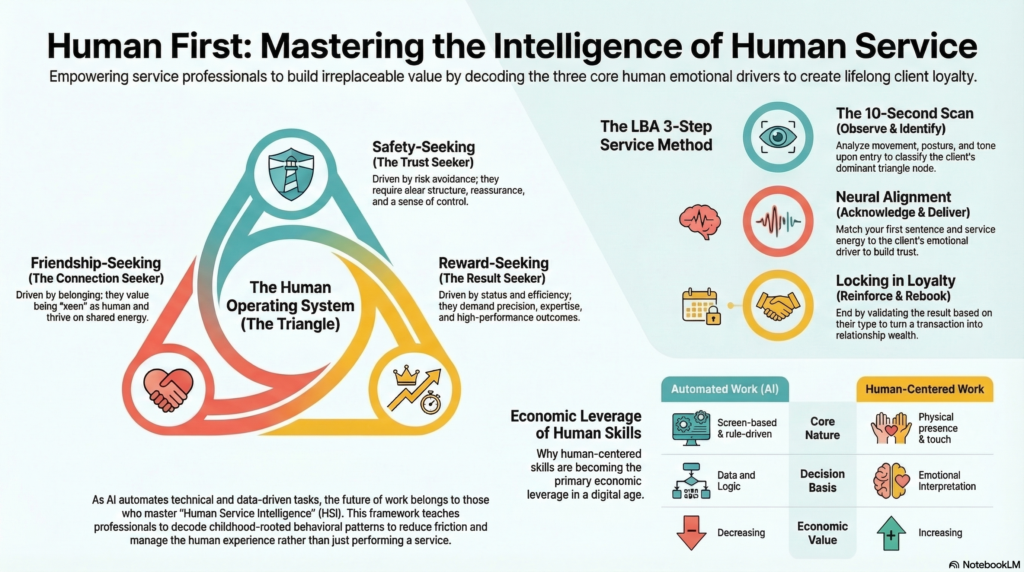
The architecture of adult behavior in high-stakes human service environments is not a series of random occurrences but a complex manifestation of early developmental adaptations. The Childhood Development Triangle serves as the primary heuristic for this analysis, categorizing human needs into three interconnected nodes: Friendship (Connection and Belonging), Safety (Security and Emotional Stability), and Rewards (Achievement and Validation).1 Understanding the scientific foundation of this triangle requires a multidisciplinary integration of attachment theory, behavioral conditioning, and neurobiology.
The concept of Friendship, or the interpersonal axis, is rooted in the work of Harry Stack Sullivan and later researchers who identified that mutual respect, equality, and reciprocity develop from early “chumships”.1 These early relationships provide more than just companionship; they serve as prototypes for all later social and professional interactions.1 When an individual experiences supportive peer relationships in childhood, they develop the social skills and interpersonal sensitivity necessary for “Connection-Seeking” behavior in adulthood.1 Conversely, a lack of these early experiences can lead to chronic loneliness or maladaptive social strategies.5
The Safety axis is governed by the Attachment Behavioral System (ABS), an evolutionary mechanism designed to ensure survival through proximity to a protective figure.7 Attachment theory posits that infants who experience a “secure base”—a consistent, responsive caregiver—develop a mental model of the world as a safe place.3 This internal working model influences how they regulate emotions and handle stress in professional settings later in life.7 For instance, individuals with “insecure-avoidant” histories may appear hyper-independent or dismissive of service professionals, while those with “anxious-ambivalent” histories may exhibit excessive reassurance-seeking behavior.3
The Rewards axis is driven by the Dominance Behavioral System (DBS), which motivates individuals to pursue social power, status, and achievement.11 This system is heavily mediated by the brain’s reward circuitry, particularly the release of dopamine in the nucleus accumbens and the ventral striatum.6 Behavioral conditioning plays a critical role here; when early achievements are met with consistent validation, the individual learns to associate effort with extrinsic and intrinsic rewards.2 In adult service interactions, “Reward-Seeking” behavior manifests as a drive for efficiency, recognition, and the attainment of specific goals.12
Neurobiological research supports the triangle model by identifying specific brain regions associated with each node. The amygdala and the septo-hippocampal system are primary actors in the Safety node, monitoring the environment for threat and inhibiting exploratory behavior when danger is perceived.17 The prefrontal cortex and the ventral tegmental area (VTA) manage the Rewards node, processing feedback and adjusting risk-taking behavior based on anticipated outcomes.13 The medial prefrontal cortex and oxytocin-sensitive pathways facilitate the Friendship node, enabling empathy and the sharing of perspectives.6
Table 1: Scientific Mapping of the Childhood Development Triangle
| Triangle Node | Primary Psychological Framework | Neurobiological Centers | Primary Neurotransmitters | Behavioral Goal |
| Friendship | Attachment/Social Play Theory 1 | Medial Prefrontal Cortex, VTA 6 | Oxytocin, Endorphins 19 | Belonging & Shared Reality 6 |
| Safety | Secure Base/ABS 7 | Amygdala, Hippocampus 17 | Cortisol, Serotonin 17 | Security & Threat Reduction 3 |
| Rewards | Dominance Behavioral System 11 | Nucleus Accumbens, Striatum 13 | Dopamine, Glutamate 13 | Achievement & Validation 12 |
The overarching insight from this foundation is that everyone is still operating from childhood adaptations.2 Behavioral patterns observed in a beauty salon, dental clinic, or pharmacy are not just reactions to current stimuli; they are repetitions of strategies that were once necessary for survival or social integration in early life.17 Service professionals who recognize this can move beyond frustration with “difficult” clients and toward a “Humanization” approach that addresses the root emotional driver of the behavior.21
Human Behavior Decoding System (Practical)
To operate effectively within the Human Service Intelligence framework, practitioners must be able to decode a client’s primary emotional driver within seconds of interaction. This field-ready system avoids rigid labeling in favor of observing behavioral clusters that indicate “High Connection-Seeking,” “High Safety-Seeking,” or “High Dominance” behaviors.12
Body Language and Kinesics
Physical movement and posture provide the most immediate data points. High connection-seeking behavior is characterized by open posture, frequent nodding, and a tendency to mirror the service professional’s gestures—a phenomenon known as “mirror behavior”.19 Conversely, high safety-seeking behavior often manifests as closed posture, limited eye contact, and fidgeting with jewelry or clothing, which are self-soothing mechanisms used to manage anxiety.24 High dominance behavior is signaled by expansive posture, sustained eye contact, and firm, assertive movements that claim space.11
The quality of the handshake is a significant indicator. A soft, lingering handshake may signal connection-seeking, while a brief, cautious touch may indicate safety-seeking.23 An exceptionally firm, “crushing” handshake is a classic indicator of high dominance behavior.12 Facial expressions during the initial consultation also provide critical cues; raised eyebrows or a hesitant smile may signal that a safety-seeking client is not yet “on board” with a suggested plan, even if they are nodding in verbal agreement.24
Paralinguistics: Tone, Speed, and Pitch
The voice serves as a direct window into the client’s internal state. High connection-seeking individuals typically use a warm, melodic tone and prioritize “relational” language, such as asking the professional about their day before discussing the service.19 High safety-seeking individuals may speak softly, use a hesitant or questioning tone, and exhibit “vocal fry” or pauses as they process information for potential risks.19 High dominance individuals often speak rapidly, with a loud, command-based volume, focusing strictly on “transactional” details and “outcome-oriented” language.12
Decision-Making Styles
Observation of how a client arrives at a decision reveals their underlying triangle node. A safety-seeking client requires significant data and reassurance, often asking “why” at every step and showing extreme risk aversion.27 A connection-seeking client will often base their decision on the professional’s recommendation, prioritizing the “feeling” of the relationship and whether they feel “heard”.23 A dominance-driven client makes decisions quickly, values status and premium options, and focuses heavily on the “price-to-value” ratio and efficiency.16
Table 2: The Three-Cluster Behavioral Decoding Matrix
| Behavioral Indicator | High Connection-Seeking (Friendship) | High Safety-Seeking (Safety) | High Dominance (Rewards) |
| Handshake | Warm, lingering, inclusive 23 | Brief, cautious, or absent 26 | Firm, assertive, leading 12 |
| Posture | Leaning in, open, mirrored 19 | Guarded, fidgety, closed 24 | Expansive, upright, claims space 12 |
| Eye Contact | Consistent, soft, seeking rapport 19 | Intermittent, looking away 24 | Intense, direct, unblinking 12 |
| Vocal Pattern | Melodic, warm, relational 19 | Soft, hesitant, questioning 29 | Rapid, loud, transactional 12 |
| Speech Speed | Moderate, conversational 23 | Slow, deliberate, cautious 29 | Fast, impatient, outcome-led 23 |
| Decision Style | Emotionally led, collaborative 25 | Risk-averse, needs proof 27 | Fast, status-driven, efficient 16 |
Real-Time Service Application: The AMP Strategy
The Human Service Intelligence framework utilizes the “AMP” strategy (Acknowledge, Match, Pivot) to handle real-time interactions. By identifying the emotional driver, the professional can tailor their service to provide exactly what the client needs at a subconscious level.19
Segment A: The Safety-Driven Person
Individuals in this node are often triggered by the “sensory overwhelm” of service environments—the sound of drills in a dental office, the smell of chemicals in a salon, or the bright lights of a pharmacy.32 Their behavior is a strategic attempt to prevent feared outcomes.26
- Observable Signs: Asking many technical questions, checking sanitation labels, hyper-vigilance toward tools, and reluctance to lean back in a chair.24
- Emotional Need: Reassurance, predictability, and a sense of control.3
- Elevation Script: “I can see you value precision and doing this the right way. I am going to walk you through our safety protocols and then explain each step before I take it, so you feel fully comfortable and in control throughout our time today.” 23
Segment B: The Connection-Driven Person
These individuals seek “Friendship” and “Belonging.” They are often highly sensitive to the professional’s emotional state and will mirror the professional’s energy.1
- Observable Signs: Sharing personal anecdotes, using the professional’s name frequently, asking for the professional’s opinion on non-service related topics, and showing high empathy.19
- Emotional Need: Connection, validation of their personality, and a sense of “being seen” as a human rather than a customer.10
- Elevation Script: “It is such a pleasure to have you here. I love that you share these stories with me—it helps me understand your style so much better. We’re going to take our time today to make sure this result truly reflects who you are.” 23
Segment C: The Reward-Driven Person
Dominance-driven individuals seek the “Rewards” of efficiency and status. They view the service as an investment in their personal or professional brand.12
- Observable Signs: Mentioning high-status connections, focusing on “the best” or “premium” options, showing impatience with administrative delays, and seeking immediate, visible results.11
- Emotional Need: Recognition of their status, evidence of mastery from the professional, and an efficient path to achievement.12
- Elevation Script: “You clearly have a refined eye for quality, which I respect. I’ve selected this specific high-performance technique for you because it’s the gold standard in the industry, and it will get you the precise result you’re looking for in the most efficient time possible.” 23
Friction Reduction Framework
Friction is defined as emotional resistance that occurs when a client’s core triangle needs are ignored or threatened.20 To reduce friction, the professional must act as a “co-regulator” of the client’s nervous system.2
Identifying Emotional Resistance
Resistance often begins non-verbally. A client may pull their head back slightly, cross their arms, or “glance away” when a specific plan is discussed.24 In customer service environments, resistance manifests as “interruption” or “repetitive questioning”.36 These are signs that the client’s Safety or Rewards nodes have been triggered.12
Matching Communication Style
The principle of “Isopraxis” or mirroring is the most effective tool for friction reduction. By subtly matching the client’s vocal volume, speech rate, and posture, the professional signals “biological similarity,” which lowers the client’s cortisol levels and increases trust.19 If a client is speaking rapidly and with intensity (Dominance), a professional who responds too slowly or with excessive “softness” (Safety) will create a mismatch that leads to frustration.28
Universal Trauma Precautions
A critical component of the friction reduction framework is the adoption of “Universal Trauma Precautions”.38 This assumes that all patients may have experienced trauma and requires the professional to proactively create a “Safe Haven”.30 This involves:
- Transparency: Explaining why a question is being asked or why a tool is being used.33
- Consent: Asking for permission before physical contact or before changing the environment (e.g., “Is it okay if I lean your chair back now?”).30
- Predictability: Using “countdowns” or cues before sensory changes (e.g., “In three seconds, you’ll hear the sound of the air tool”).30
Table 3: Friction Reduction Protocols by Client State
| Client State | Underlying Trigger | Professional Action | Goal |
| Agitated/Loud | Threat to Rewards/Status 12 | Match intensity, then lower volume slowly 25 | De-escalation & Restoration of Status |
| Withdrawal/Silence | Threat to Safety 26 | Provide choices, use soft vocal tone 19 | Safety & Re-engagement |
| Repetitive Questioning | Threat to Connection or Safety 3 | Active listening, repeat back concerns 25 | Validation & Certainty |
Ethical Influence & Positive Suggestion
Within the Human Service Intelligence model, the practice of “Positive Suggestion and Internal Reprogramming” is used to elevate others without manipulation or coercion.41 This framework is based on the “Suggestopedic” model, which integrates psychology and art to unlock human potential through a supportive relational climate.41
The Mechanics of Positive Suggestion
Language is the primary tool for internal reprogramming. Suggestions must be:
- Affirmative: Focus on what the client can do or is becoming, rather than what they should avoid.41
- Present Tense: Phrasing suggestions as if the desired state is already occurring (e.g., “You are finding it easier to relax as we move through this”).42
- Repetitive: Belief is built through the “repetition of positive truths”.42
Internal Reprogramming for Clients
In human services, this technique is used to “reprogram” a client’s negative expectations based on past trauma.20 For example, a dental patient who expects pain can be guided through “Future Pacing”—asking them to imagine the feeling of relief and success once the appointment is over.42 This retrains the brain’s fear response and replaces it with a mindset of confidence.18
Ethical Boundaries
All influence must be “Service-First”.21 Ethical boundaries include:
- Transparency: Never use deceptive psychological tactics. The professional should be open about their intent to make the client feel better.21
- Non-Coercion: Suggestions must always align with the client’s expressed goals and well-being, never the professional’s convenience.40
- Respect for Agency: The client always retains the “Right of Refusal”.40
Self-Programming (The Internal OS of the Professional)
A service professional cannot elevate a client if their own “Internal Operating System” is running on fear, doubt, or depletion.49 Self-programming is the process of intentional identity reframing.49
Reframing Identity: “I Am an Elevator”
The professional must move from an identity of “technician” to one of “vessel of value”.21 This involves the “YES I CAN → I HAVE DONE IT” mindset, where every interaction is viewed as an opportunity for mastery.45
Daily Programming Scripts for Professionals
- “I am here to serve and elevate every human being I meet.” 49
- “I listen first with my heart, then serve with precision and mastery.” 21
- “I bring value to this world through the quality of my presence and the excellence of my service.” 21
- “I am the calmest person in the room, and my peace is a gift to my clients.” 25
Replacing Limiting Beliefs
Service providers often struggle with “imposter syndrome” or “compassion fatigue”.40 These are addressed by “Action Accumulation”—the practice of focusing on small, verifiable successes rather than an abstract ideal of perfection.52 By “expecting failure” as a natural part of the learning process, the professional removes the fear that inhibits growth.55
Industry-Specific Applications
1. Beauty Industry (Salon, Cosmetology)
In the beauty sector, HSI reframes technical skills as “human care”.56 The consultation is seen as a “Healing Interaction”.57
- Before (Mistake): Stylist asks, “What are we doing today?” and starts touching the hair immediately. The client feels like a “service ticket” and their Safety node is triggered.23
- After (Best Practice): Stylist makes eye contact for 60 seconds and asks, “How has your hair been making you feel lately?” They wait for the emotional data before touching the client.
- Scenario: A client wants a drastic change (black to platinum) that will damage their hair.
- HSI Response: “I see you’re looking for a major transformation—I love that bold spirit. Because I respect you and the health of your hair, let’s create a 3-step ‘Healthy Platinum’ plan that gets you the look you want while keeping your hair strong and beautiful.” 23
2. Dental Assisting and Hygiene
Dental environments are inherently high-stress, requiring a “Safe Haven” model.32
- Before (Mistake): Assistant leans the chair back without warning. The patient’s “freeze” response is triggered.30
- After (Best Practice): Assistant says, “I’m going to lean you back now. Is that okay, or would you like a moment first? You’re in good hands here.” 30
- Scenario: A patient is visibly shaking in the chair.
- HSI Response: “It looks like you’re feeling a bit of tension. That’s completely normal. Let’s take three deep breaths together. I’m right here with you, and we’ll go at your pace.” 30
3. Pharmacy and Healthcare
The pharmacy is a site of vulnerability and requires high “Trustworthiness” and “Privacy”.33
- Before (Mistake): Pharmacist shouts a medication name across the counter. The client’s Safety node is threatened by a loss of privacy.33
- After (Best Practice): Pharmacist leans in and asks softly, “Would you like to step over to our private consultation area to discuss your medication?” 33
- Scenario: A client is frustrated about a delay in their prescription.
- HSI Response: “I understand this delay is frustrating, especially when it comes to your health. I’m going to personally call the insurance provider now to get this resolved for you. I appreciate your patience.” 28
4. Customer Service Environments
In retail or call centers, HSI focuses on “Perspective Shifting” and “Emotional Mirroring”.36
- Before (Mistake): Agent says, “That’s our policy.” This triggers the client’s Rewards node (threat to status/fairness).28
- After (Best Practice): Agent says, “I understand why that would be frustrating. Let’s look at what I can do to make this right for you today.” 36
- Scenario: A customer is yelling about a damaged product.
- HSI Response: “I hear you, and I am so sorry for that unwelcome surprise. Let’s get this sorted out right away. Would you like a replacement sent via overnight mail, or a full refund?” 63
Table 4: “Before vs. After” Humanization Communication
| Industry | Traditional “Expert” Approach (Mistake) | Human Service Intelligence (Best Practice) | Resulting Shift |
| Beauty | “I’ll do a partial foil.” | “Let’s weave in some lighter tones to brighten your face.” 23 | Technical → Personal 56 |
| Dental | “Open wide.” | “Is it okay if I examine your gums now?” 30 | Command → Consent 32 |
| Pharmacy | “Next in line!” | “Hello [Name], it’s good to see you again.” 28 | Number → Neighbor 40 |
| Retail | “Please hold.” | “Is it alright if I put you on a brief hold while I check this for you?” 37 | Dismissal → Partnership 36 |
Training System for Schools (The LBA Model)
The Louisville Beauty Academy (LBA) provides the blueprint for turning students into high-value, emotionally intelligent professionals.52 This curriculum module is designed for a 12-week intensive integration.
Week-by-Week Breakdown
- Week 1: The Philosophy of Humanization. Introduction to “Everyone is human first.” Students write their personal “I Am here to Serve” manifesto.21
- Week 2: The Science of the Triangle. Deep dive into Attachment and Neurobiology. Students identify their own primary triangle node.1
- Week 3: The Decoding System – Kinesics. Mastering the reading of body language and posture. Practice exercises in “silent observation”.24
- Week 4: The Decoding System – Paralinguistics. Vocal engineering—practicing the “Instrument of Calming” and intensity matching.19
- Week 5: The AMP Framework. Role-playing Acknowledge, Match, and Pivot with “standard” clients.23
- Week 6: Universal Trauma Precautions. Practicing consent-based service and sensory management.30
- Week 7: Handling High Safety-Seeking Behavior. Specialized scripts and role-play for the “fearful” client.29
- Week 8: Handling High Dominance Behavior. Specialized scripts for the “assertive” or “impatient” client.12
- Week 9: Positive Suggestion and Reprogramming. Mastering the art of present-tense, affirmative language.41
- Week 10: Identity Reframing and Internal OS. Developing the professional’s daily self-programming rituals.49
- Week 11: Action Accumulation Clinic. Real-time application with public clients under supervision.52
- Week 12: The “I HAVE DONE IT” Assessment. Final performance evaluation and certification ceremony.45
Practice Exercises and Role-Playing Scripts
- The Emotional Mirror: Pairs take turns expressing a strong emotion (e.g., frustration) while the partner identifies the triangle node and mirrors the posture.61
- The “No” Pivot: Students practice saying “no” to an unachievable request while pivoting to an “Elevation Script” that satisfies the underlying emotional need.23
- The 60-Second Connection: Timed exercises where students must establish rapport without discussing technical service.23
Assessment Methods
- Behavioral Competency Check: Evaluation of the student’s ability to maintain a calm “Instrument of Calming” tone under pressure.19
- Script Fluency: Oral exam on “Elevation Scripts” for various client clusters.23
- Reflection Journals: Weekly tracking of “Small Completions” and how the student managed their own emotional triggers.67
Case Studies: Human Service Intelligence in Action
1. The “Difficult” Salon Client
A client arrived at LBA with a history of being “fired” from other salons for her aggressive tone and constant complaints about “subpar” service.23
- Decoding: High Dominance Behavior (threatened Rewards/Status node).12
- HSI Action: The student stylist matched her intensity initially, using direct eye contact and a firm handshake. She then used the Elevation Script: “I see you have a very high standard for your hair—I respect that excellence. Let’s look at exactly how we’ll achieve the premium result you’re looking for.”
- Outcome: The client felt her status was acknowledged. She stopped yelling and became a loyal, high-frequency client who consistently praised the stylist’s “professionalism”.23
2. The Anxious Dental Patient
An 80-year-old patient arrived for a cleaning, visibly trembling and refusing to let the assistant lean the chair back.32
- Decoding: High Safety-Seeking Behavior (threatened Safety node).3
- HSI Action: The assistant used the “Instrument of Calming” vocal tone and offered a Choice: “We don’t have to lean the chair back all the way. We can start with just a slight angle—would that feel better for you?” She also used Positive Suggestion: “You are doing a wonderful job taking care of yourself today.”.19
- Outcome: The patient felt in control and was able to complete the procedure. She later stated it was the first time she hadn’t felt “terrified” at the dentist.20
3. The Resistant Healthcare Customer
A customer at a pharmacy was angry about a price increase in their medication, shouting at the staff about “corporate greed”.36
- Decoding: Connection/Safety Conflict (threatened sense of Fairness/Status).12
- HSI Action: The pharmacist took the client to a private area (restoring Safety) and used Emotional Mirroring: “I can see how upsetting it is to have your healthcare costs change unexpectedly. I would feel the same way.” They then collaborated on a solution: “Let’s look at some alternative programs or manufacturer coupons that might bring this cost back down for you.”.36
- Outcome: The customer apologized for yelling and worked collaboratively with the pharmacist to find a financial solution.36
Philosophy Layer: The College of Humanization
The Human Service Intelligence framework is an enactment of the Di Tran philosophy: “Everyone is human first”.21 This philosophy acknowledges that the technical skills of beauty, dental care, or pharmacy are merely the medium through which human elevation occurs.21
The Three Pillars of Humanization
- Serve before being served: The professional’s primary goal is the elevation of the other. Paradoxically, this is the most direct path to professional success and fulfillment.21
- Understand before being understood: By utilizing the behavior decoding system, the professional listens to the “unspoken request” of the client’s heart before offering a solution.21
- Elevation through Practice: Success is not an inherent trait but a result of “disciplined daily action” and the “YES I CAN” mindset.21
The ultimate objective of this framework is to create a generation of professionals who do not just “do a job” but who act as “agents of humanization” in a world that often feels transactional and cold.21 When a student can walk into any interaction, quickly identify the emotional driver, and respond with precision, they are not just providing a service—they are restoring the dignity and potential of the human spirit.21
Works cited
- Future Directions in…Friendship in Childhood and Early Adolescence – PMC – NIH, accessed March 20, 2026, https://pmc.ncbi.nlm.nih.gov/articles/PMC5619663/
- Three Principles to Improve Outcomes for Children and Families – Center on the Developing Child at Harvard University, accessed March 20, 2026, https://developingchild.harvard.edu/resources/report/three-principles-to-improve-outcomes-for-children-and-families/
- Early Childhood Attachment Styles: What Parents and Professionals Should Know, accessed March 20, 2026, https://www.zerotothree.org/resource/attachment-styles-in-early-childhood-what-parents-and-professionals-should-know/
- Children’s Conceptions of Friendship: A Multimethod Study of Developmental Changes, accessed March 20, 2026, https://pmc.ncbi.nlm.nih.gov/articles/PMC4219827/
- Childhood Friendships — Building Brains Together, accessed March 20, 2026, https://www.buildingbrains.ca/blog/how-childhood-friendships-shape-the-brain-forever
- Characterizing the mechanisms of social connection – PMC – NIH, accessed March 20, 2026, https://pmc.ncbi.nlm.nih.gov/articles/PMC10842352/
- Introduction to children’s attachment – NCBI – NIH, accessed March 20, 2026, https://www.ncbi.nlm.nih.gov/books/NBK356196/
- Attachment theory – Wikipedia, accessed March 20, 2026, https://en.wikipedia.org/wiki/Attachment_theory
- Attachment Styles: Causes, What They Mean – Cleveland Clinic, accessed March 20, 2026, https://my.clevelandclinic.org/health/articles/25170-attachment-styles
- Attention Seeking Behavior – The Treetop ABA Therapy, accessed March 20, 2026, https://www.thetreetop.com/aba-therapy/attention-seeking-behavior
- The dominance behavioral system and manic temperament: Motivation for dominance, self-perceptions of power, and socially dominant behaviors – PMC, accessed March 20, 2026, https://pmc.ncbi.nlm.nih.gov/articles/PMC3596887/
- The Dominance Behavioral System and Psychopathology: Evidence from Self-Report, Observational, and Biological Studies – PMC, accessed March 20, 2026, https://pmc.ncbi.nlm.nih.gov/articles/PMC3383914/
- The Neuroscience of Drug Reward and Addiction – PMC, accessed March 20, 2026, https://pmc.ncbi.nlm.nih.gov/articles/PMC6890985/
- Neuroscience of Addiction: From Survival Circuits to Hijacked Habits – Psych Scene Hub, accessed March 20, 2026, https://psychscenehub.com/video/neurobiology-of-addiction-brain-circuits/
- Sensation seeking and risk adjustment: the role of reward sensitivity in dynamic risky decisions – Frontiers, accessed March 20, 2026, https://www.frontiersin.org/journals/behavioral-neuroscience/articles/10.3389/fnbeh.2025.1492312/full
- What You Should Know About Attention-Seeking Behavior in Adults – Healthline, accessed March 20, 2026, https://www.healthline.com/health/mental-health/attention-seeking-behavior
- Neurobiological Adaptations to Violence across Development – PMC – NIH, accessed March 20, 2026, https://pmc.ncbi.nlm.nih.gov/articles/PMC2813461/
- What Is Clinical Hypnotherapy? A Complete Guide, accessed March 20, 2026, https://hypnotherapylounge.co.uk/what-is-clinical-hypnotherapy/
- Trustful relationships between healthcare professionals and children: a concept analysis using Rodgers’ evolutionary approach – PMC, accessed March 20, 2026, https://pmc.ncbi.nlm.nih.gov/articles/PMC12222351/
- Trauma-informed approach to care in the dental setting, accessed March 20, 2026, https://dentalacademyofce.com/wp-content/uploads/2022/03/2203CEDswa_final-1.pdf
- Di Tran — Founder & CEO | Visionary Leader in Workforce Education, Humanized AI, and Immigrant Entrepreneurship – New American Business Association (NABA) – Louisville, KY, accessed March 20, 2026, https://naba4u.org/di-tran-founder-ceo-visionary-leader-in-workforce-education-humanized-ai-and-immigrant-entrepreneurship/
- About the Founder: Di Tran – A Journey from Humble Beginnings to Visionary Leadership, accessed March 20, 2026, https://ditranuniversity.com/founderditran/
- Client Consultation Skills For Beauty Professionals: Build Trust …, accessed March 20, 2026, https://cosmetologyandspaacademy.edu/client-consultation-skills-for-beauty-professionals/
- The Silent Consultation: How to Read Your Client’s Non-Verbal Cues for a Better Cut, accessed March 20, 2026, https://parisbeautypro.com/blogs/news/the-silent-consultation-how-to-read-your-client-s-non-verbal-cues-for-a-better-cut
- How to Handle Difficult Clients (and Keep Your Cool) – Australian Beauty Association, accessed March 20, 2026, https://australianbeautyassociation.org/how-to-handle-difficult-clients-and-keep-your-cool/
- Examining safety behavior subtypes across distinct social contexts in social anxiety disorder and major depression – PMC, accessed March 20, 2026, https://pmc.ncbi.nlm.nih.gov/articles/PMC10846675/
- Safety Behaviors | Psychology Tools, accessed March 20, 2026, https://www.psychologytools.com/professional/mechanisms/safety-behaviors
- Customer Service Phrases: 50 Helpful Scripts for Common Situations – Supportbench, accessed March 20, 2026, https://www.supportbench.com/customer-service-phrases-helpful-scripts-common-situations/
- Why Client Communication Matters in Beauty and Wellness – Daytona College, accessed March 20, 2026, https://daytonacollege.edu/blog/client-communication-matters/
- Dentistry and Trauma-Informed Care – A resource for dentists and other oral healthcare professionals who work with the facial difference community – AboutFace, accessed March 20, 2026, https://www.aboutface.ca/wp-content/uploads/2021/10/Dentistry-and-Trauma-Informed-Care.pdf
- Unlocking Marketing Success with Buyer Personas, accessed March 20, 2026, https://aspiration.marketing/topics/buyer-personas
- Trauma-Informed Care: Creating a Safe Space for Dental Patients – CareQuest Institute, accessed March 20, 2026, https://carequest.org/trauma-informed-care-creating-a-safe-space-for-dental-patients/
- How to improve pharmacy services by integrating trauma-informed …, accessed March 20, 2026, https://pharmaceutical-journal.com/article/ld/how-to-improve-pharmacy-services-by-integrating-trauma-informed-care
- Attention Seeking vs. Connection Seeking Behaviors – Forty Carrots Family Center, accessed March 20, 2026, https://fortycarrots.com/blog/2020/attention-seeking-vs-connection-seeking-behaviors/
- Attention-Seeking Behavior: Causes & Solutions – Amae Health, accessed March 20, 2026, https://www.amaehealth.com/blog/what-is-attention-seeking-behavior
- 40+ Proven Customer Service Script Examples for Difficult Situations, accessed March 20, 2026, https://corp.yonyx.com/customer-service/customer-service-script/
- 88 free call center scripts to boost your customer satisfaction – Zendesk, accessed March 20, 2026, https://www.zendesk.com/blog/dont-always-need-call-center-scripts/
- Safe haven – a trauma-informed care model for oral health practitioners – PMC – NIH, accessed March 20, 2026, https://pmc.ncbi.nlm.nih.gov/articles/PMC12662799/
- The Time is Now for Oral Health to Embrace Trauma-informed Care – ADA Commons, accessed March 20, 2026, https://commons.ada.org/cgi/viewcontent.cgi?article=1081&context=jacd
- Trauma Informed Care | Pharmacy – University of Alberta, accessed March 20, 2026, https://www.ualberta.ca/en/pharmacy/news/2021/june/trauma-informed-care.html
- Suggestopedia and Simplex Didactics as an Integrated Model for Interdisciplinary Design in Higher Education: Results of an Action Research Study – MDPI, accessed March 20, 2026, https://www.mdpi.com/2813-4346/5/1/10
- How Hypnosis Can Help Overcome Stage Fright and Performance Anxiety – AmberWillo, accessed March 20, 2026, https://www.amberwillo.com/stage-fright/hypnosis/
- Suggestive power of the word in the information space for sustainable development – E3S Web of Conferences, accessed March 20, 2026, https://www.e3s-conferences.org/articles/e3sconf/pdf/2021/34/e3sconf_uesf2021_07032.pdf
- PAUL MCKENNA INSTANT CONFIDENCE AUDIO – Free PDF Library, accessed March 20, 2026, https://test.post-gazette.com/book-search/EnxNCn/vCV809/paul__mckenna_instant__confidence__audio.pdf
- Di Tran Archives – Louisville Beauty Academy – Louisville KY, accessed March 20, 2026, https://louisvillebeautyacademy.net/tag/di-tran/
- Effects of empathic and positive communication in healthcare consultations: a systematic review and meta-analysis – PMC, accessed March 20, 2026, https://pmc.ncbi.nlm.nih.gov/articles/PMC6047264/
- Di Tran University: Humanized Learning & Life Lessons Podcast, accessed March 20, 2026, https://podcasts.apple.com/ca/podcast/di-tran-university-humanized-learning-life-lessons/id1868097364
- Critical Links: – Transforming and Supporting Patient Care – RNAO.ca, accessed March 20, 2026, https://rnao.ca/sites/rnao-ca/files/HPRAC_Critical_Links_2009.pdf
- Irene Boham – Assessments – International Institute for Global Leadership, accessed March 20, 2026, https://global-leadership.com/index.php/irene-boham-assessments/
- The Leading Blog – Leadership Now, accessed March 20, 2026, https://www.leadershipnow.com/leadingblog/general_business/
- Articles — Intentional Leader, accessed March 20, 2026, https://calwalters.me/blog
- Professional Discipline and Outcome-Oriented Vocational Education: An Evidence-Based Analysis of Licensing-Focused Beauty Education Models in the United States — The Louisville Beauty Academy Case – RESEARCH & PODCAST SERIES 2026, accessed March 20, 2026, https://louisvillebeautyacademy.net/professional-discipline-and-outcome-oriented-vocational-education-an-evidence-based-analysis-of-licensing-focused-beauty-education-models-in-the-united-states-the-louisville-beauty-academy/
- Kids’ YouTuber Ms. Rachel returns from social media break with wonderful thoughts on boundaries – Upworthy, accessed March 20, 2026, https://www.upworthy.com/ms-rachel-returns/
- beauty education case study Archives – Louisville Beauty Academy, accessed March 20, 2026, https://louisvillebeautyacademy.net/tag/beauty-education-case-study/
- Di Tran, Author at Di Tran University – Page 12 of 12, accessed March 20, 2026, https://ditranuniversity.com/author/ditranllc/page/12/
- beauty instructor training Archives – Louisville Beauty Academy, accessed March 20, 2026, https://louisvillebeautyacademy.net/tag/beauty-instructor-training/
- affordable beauty school Archives – Louisville Beauty Academy, accessed March 20, 2026, https://louisvillebeautyacademy.net/tag/affordable-beauty-school/
- Humanization in Beauty Education: Elevating Trends Through Purposeful Training at Louisville Beauty Academy, accessed March 20, 2026, https://louisvillebeautyacademy.net/humanization-in-beauty-education-elevating-trends-through-purposeful-training-at-louisville-beauty-academy/
- How to Handle Difficult Clients (Without Losing Your Cool) – Groom Curriculum, accessed March 20, 2026, https://groomcurriculum.com/how-to-handle-difficult-clients/
- Integrating Trauma-Informed Care into Ambulatory Settings: A Practical Approach – PubMed, accessed March 20, 2026, https://pubmed.ncbi.nlm.nih.gov/41106474/
- 7 Roleplay Exercises to Transform Team Emotional Intelligence Training | Ahead App Blog, accessed March 20, 2026, https://ahead-app.com/blog/eq-at-work/7-roleplay-exercises-to-transform-team-emotional-intelligence-training
- 15 Difficult Customer Service Scenarios + Script Examples – Dashly blog, accessed March 20, 2026, https://www.dashly.io/blog/customer-service-scenarios/
- 24 Customer Service Scripts To Help You Navigate Any Situation with Ease – Nextiva, accessed March 20, 2026, https://www.nextiva.com/blog/customer-service-scripts.html
- 21 great customer service script examples – Zapier, accessed March 20, 2026, https://zapier.com/blog/customer-service-script/
- 13 Emotional Intelligence Exercises, Activities & Worksheets – Positive Psychology, accessed March 20, 2026, https://positivepsychology.com/emotional-intelligence-exercises/
- Empathy & Emotional Intelligence Role Play Scenarios, accessed March 20, 2026, https://trainingcoursematerial.com/free-games-activities/making-training-active/empathy-and-emotional-intelligence-role-playing-activities
- Facilitating Emotional Intelligence Skills in Your Fieldwork Students – NEOTEC, accessed March 20, 2026, https://neotecouncil.org/wp-content/uploads/2012/04/Facilitating-EI-Skills-in-Your-Fieldwork-Students31-002.pdf
- Effective Role Play Customer Service Scripts | LearnBrite AI, accessed March 20, 2026, https://learnbrite.com/role-play-customer-service-scripts/
- How To Improve Emotional Intelligence Through Training – Positive Psychology, accessed March 20, 2026, https://positivepsychology.com/emotional-intelligence-training/
📘 Research Attribution & Intellectual Ownership
This material, including the Human Service Intelligence Framework and all associated concepts, methodologies, training structures, and behavioral models, is fully developed, authored, and owned by Di Tran University — The College of Humanization.
All scientific integration, including references to psychology, neuroscience, behavioral economics, and human service application, is part of an ongoing research initiative led and published by Di Tran University.
Louisville Beauty Academy serves as:
- A real-world training environment
- An application site for research translation
- A demonstration model of human-centered vocational education
This publication should be understood as:
Applied research in action — not independent authorship by Louisville Beauty Academy
📚 Book Release Alignment
This framework is released in conjunction with the official publication:
Human First: The Beauty Professional’s Guide to Reading People, Reducing Friction, and Creating Lifelong Clients
This book represents the formalization, expansion, and operationalization of the Human Service Intelligence model into a practical, daily-use system for beauty professionals.
All readers are encouraged to reference the full book for:
- Complete frameworks
- Structured training systems
- Real-world scripts and applications
- Ethical service guidelines
⚖️ Educational Purpose & Scope Limitation
This material is provided strictly for:
- Educational
- Training
- Professional development
- Service quality improvement
purposes only.
It is NOT intended to:
- Diagnose psychological conditions
- Provide medical, mental health, or therapeutic treatment
- Replace licensed professional services in psychology, psychiatry, counseling, or healthcare
Any interpretation or application beyond vocational service training is outside the intended scope.
🧠 Behavioral Framework Clarification
All references to:
- “Understanding behavior”
- “Client types”
- “Emotional drivers”
- “Communication alignment”
are based on:
Observed patterns and educational models — NOT clinical classification systems
These frameworks:
- Do NOT label individuals
- Do NOT define identity
- Do NOT determine psychological conditions
They are used solely to:
Improve communication, reduce friction, and enhance client experience in service environments
🛑 Ethical Use Requirement
All methodologies, scripts, and communication strategies presented must be used under the principle of:
Service First — Never Manipulation
Specifically:
- No coercion
- No deceptive influence
- No exploitation of emotional states
- No use beyond client benefit and well-being
The intent is always:
To elevate the human experience, not control it
⚠️ No Guarantee of Outcome
While this framework is:
- Scientifically informed
- Field-tested
- Practically applied
Louisville Beauty Academy and Di Tran University make no guarantees regarding:
- Financial outcomes
- Client retention levels
- Business performance
- Individual success
Results depend on:
- Individual effort
- Consistency of application
- Professional integrity
🏫 Institutional Positioning
Louisville Beauty Academy does not represent itself as:
- A psychological institution
- A medical training provider
- A behavioral health authority
Instead, LBA operates as:
A vocational training institution integrating human-centered communication, professionalism, and service excellence into beauty education
📊 Research-in-Progress Notice
This framework is part of an ongoing body of research and development under:
Di Tran University — The College of Humanization
As such:
- Concepts may evolve
- Models may be refined
- Language may be updated over time
All updates will remain aligned with:
- Ethical service
- Educational clarity
- Human-first philosophy
🔐 Liability Limitation
By engaging with this material, the reader acknowledges that:
- All application is voluntary
- Implementation is at the user’s discretion
- Neither Louisville Beauty Academy nor Di Tran University shall be held liable for:
- Misinterpretation
- Misuse
- Outcomes resulting from application
🌍 Final Statement — Philosophy Alignment
This work is grounded in one principle:
Everyone is human first.
The purpose of this framework is not to:
- Judge
- Categorize
- Control
But to:
- Understand
- Serve
- Elevate
✍️ Official Attribution
Research & Framework:
Di Tran University — The College of Humanization
Applied Training & Implementation:
Louisville Beauty Academy
Author & Founder:
Di Tran