Career and technical education is not only a school system. At its best, it is a community promise: people should be able to turn effort into skill, skill into lawful work, work into dignity, and dignity into stronger families, businesses, and neighborhoods.
That is the larger frame Louisville Beauty Academy brings to the national conversation.
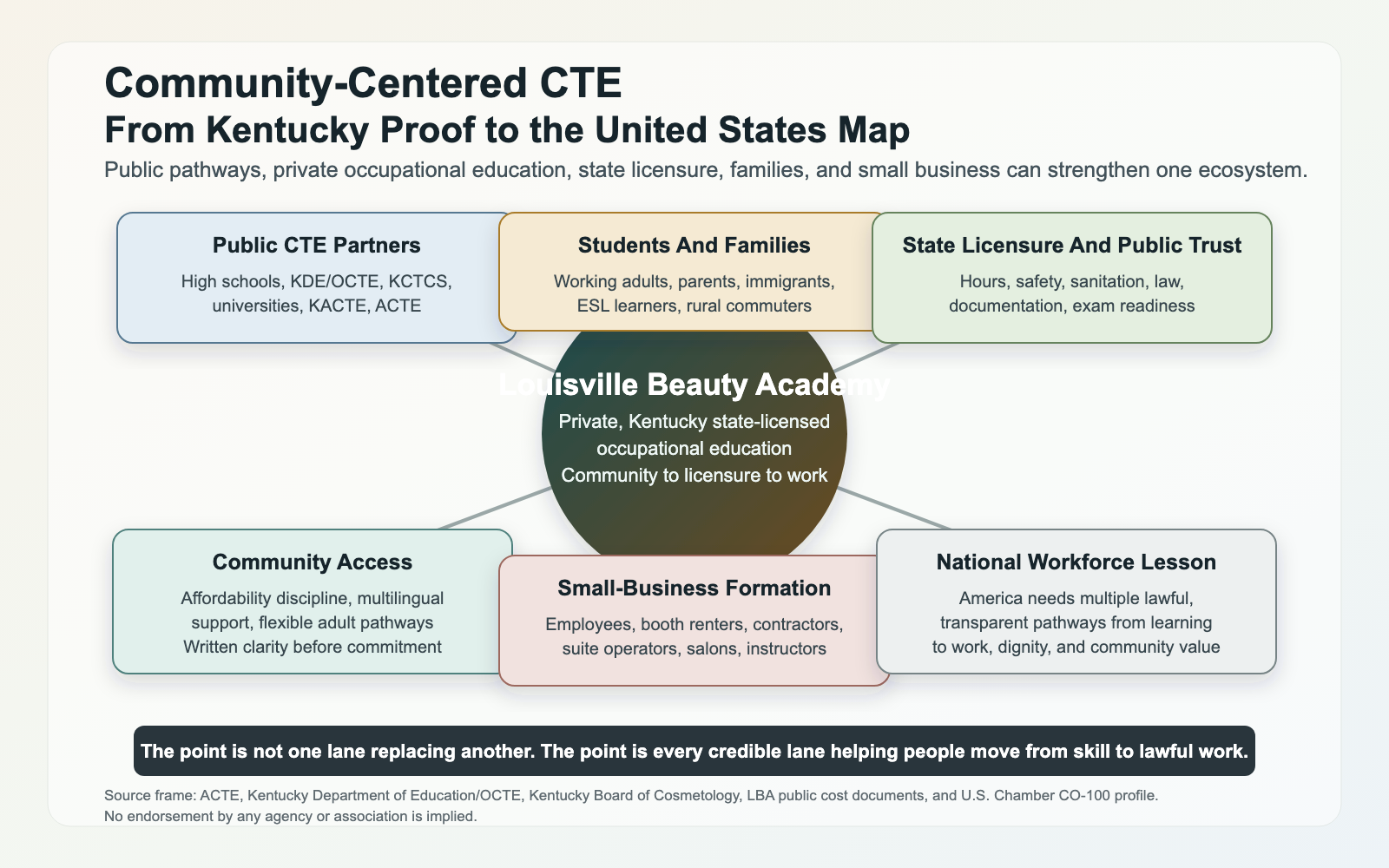
The academy is not asking to replace public education. It is not trying to compete with high school CTE, area technology centers, KDE/OCTE, KCTCS, universities, KACTE, ACTE, employers, or community partners. Those lanes matter deeply. They serve students, families, teachers, employers, and regions in ways Kentucky and the United States need.
Louisville Beauty Academy adds another lane that must be recognized clearly: private, state-licensed occupational education rooted in community.
That fact is not branding. It is the nature of the work. LBA prepares adult learners and working students for regulated beauty-industry licensure. It serves people who are often outside traditional prestige pathways: parents, immigrants, English-language learners, rural commuters, career changers, hourly workers, and people who need education to fit real life rather than the other way around.
For these students, the public value is not a slogan. It is measurable in the direction of their lives: attendance hours, sanitation practice, theory study, state-board preparation, client-service readiness, licensing progress, employment, booth rental, independent contracting, salon work, instruction, entrepreneurship, and local spending.
This is why LBA belongs in the CTE conversation. Not because every CTE lane is the same, but because every credible pathway from learning to lawful work deserves to be understood.
The Community Is the Center
When people hear “workforce development,” they often picture systems, grants, agencies, dashboards, or statewide plans. Those things matter. But the community sees workforce development in human form.
A mother finding a path that fits around children.
An immigrant learner gaining professional vocabulary in a second language.
A rural commuter choosing licensure over giving up.
An instructor turning safety, sanitation, law, and technical skill into confidence.
A salon owner needing trained professionals who understand real client care.
A graduate becoming an employee, booth renter, suite operator, instructor, employer, or small-business owner.
A family watching sacrifice become licensed work.
That is the community map. LBA’s role is to make that map visible.
What Public CTE Gains From This Lane
Public CTE does not lose when private occupational education is recognized. It gains a fuller story.
The Association for Career and Technical Education describes CTE as rigorous and relevant education preparing youth and adults for high-skill, high-wage, high-demand careers. Kentucky’s Office of Career and Technical Education describes four-course CTE pathways, industry certifications, credentials, dual credit, recognized pathways, and collaboration with business and industry partners.
Those public pathways are essential.
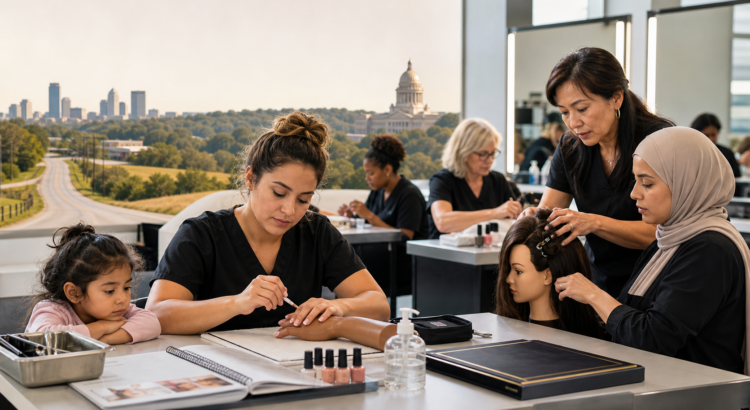
Private occupational education can complement them by serving adult learners and working families who may not be in a high school pipeline, a traditional college pipeline, or a public program seat. In beauty education, the bridge is state occupational licensure: a regulated pathway where hours, sanitation, law, practical skill, documentation, and public safety matter.
Recognizing LBA does not diminish Kentucky CTE. It strengthens it by showing that career education reaches beyond one institutional form.
What Policymakers Can See
Policymakers should see LBA as a policy proof point: a small, private, state-licensed school using affordability discipline, multilingual support, documentation, compliance focus, and responsible AI-supported operations to help people move toward licensure and work.
This matters nationally because America needs more than one workforce model.
Some learners need high school CTE. Some need community college. Some need university pathways. Some need apprenticeships. Some need employer-based training. Some need short, regulated, occupation-specific education that is flexible enough for work, family, language, transportation, and cash-flow realities.
The question is not which lane should win. The better question is whether every lawful, transparent, accountable lane that moves people from skill to work is being recognized.
LBA gives Kentucky and the United States a concrete example of that broader answer.
What Families Can See
Families should see a school that publishes cost information, points students toward written documents, and reminds the public that the current written student contract controls. LBA’s public cost page lists full program costs and conditional reduced-cost figures for eligible students who meet written discount and incentive conditions. It also states clearly that no web page, screenshot, or older statement applies a discount by itself.
That language matters because affordability without written control can become confusion. LBA’s stronger model is affordability with documentation.
The public record shows the scale of the access story. LBA’s published page lists conditional reduced-cost pathways including nail technology, esthetics, cosmetology, beauty instructor, shampoo styling, and eyelash extension. The U.S. Chamber of Commerce’s CO- feature describes LBA as affordable, multilingual, debt-free, and pay-as-you-go, and says the academy has graduated nearly 2,000 licensed beauty professionals.
The strongest public conclusion is careful and powerful: LBA is one of the clearest publicly documented affordability-forward, Kentucky state-licensed beauty-education models and a nationally visible example of debt-avoidant occupational training.
What Students Can See
Students should see themselves without shame.
The student who works before or after class belongs in this story.
The student who has children belongs in this story.
The student who speaks Vietnamese, Spanish, Korean, Chinese, English, or another language at home belongs in this story.
The student who starts late, returns after difficulty, transfers hours, asks for written clarity, studies sanitation, repeats theory, or drives a long distance belongs in this story.
LBA’s public value is not that every student has the same journey. Its value is that the institution is built around real journeys: attendance, practice, documentation, language access, state rules, and the steady movement from uncertainty toward licensure readiness.
That is community-centered CTE.
What Small Business Can See
Beauty education is not only a school issue. It is a Main Street small-business issue.
Licensed beauty professionals can become employees, contractors, booth renters, suite operators, salon owners, instructors, trainers, product buyers, service providers, vendors, and employers. A graduate who enters the beauty workforce may also enter local commerce: rent, supplies, tools, taxes, services, customer relationships, and neighborhood economic activity.
That makes beauty education part of America’s small-business infrastructure.
LBA’s national recognitions support that interpretation without overstating it. The U.S. Chamber of Commerce recognized Louisville Beauty Academy as a 2025 CO-100 Honoree in the Enduring Businesses category. The National Small Business Association named Di Tran among the 2025 Lewis Shattuck Small Business Advocate of the Year finalists.
Those recognitions do not mean any government agency, CTE organization, or award committee has endorsed every claim in this article. They do mean that the model has already been seen nationally as a meaningful small-business and community-impact story.
What Kentucky Can Put on the United States Map
Kentucky should not hide this proof model.
A state-licensed beauty college in Louisville has built a community-centered occupational education lane that speaks to national questions: affordability, adult learners, immigrant access, small-business formation, documentation, workforce participation, public safety, and responsible use of AI as an institutional support tool rather than a replacement for human instruction.
That is bigger than one school.
It is a map of what workforce education can become when community is the center.
Public CTE leaders can see respect in it. Policymakers can see a practical model in it. Families can see protection in it. Students can see dignity in it. Instructors can see their labor honored in it. Salon owners can see future professionals in it. Small-business advocates can see entrepreneurship in it. Immigrant communities can see access in it. Kentucky can see a story worth carrying to the national stage.
The Fact We Should Accept
The fact is simple:
Louisville Beauty Academy is a private, Kentucky state-licensed occupational education provider that helps people move toward regulated beauty-industry licensure, workforce participation, entrepreneurship, and community economic contribution through an affordability-forward, multilingual, documentation-conscious model.
That statement does not attack public education. It does not promise licensure, employment, income, funding, award selection, or partnership. It does not claim that LBA is the only pathway or the only model.
It states what the evidence supports.
And once that fact is seen clearly, the strategic conclusion follows naturally: LBA gives Kentucky a community-centered CTE proof model that belongs on the map of the United States.
The Invitation
The invitation is not entitlement. It is service.
Let public CTE continue building early career pathways.
Let KCTCS and universities continue strengthening postsecondary ladders.
Let KDE/OCTE continue guiding the public framework.
Let KACTE and ACTE continue recognizing the people and partners who make career education real.
And let private, state-licensed occupational education be recognized as one more credible lane in the national story of learning to work.
Louisville Beauty Academy stands in that lane with humility, documentation, and community proof.
It is not the whole CTE story. But it is a real part of the story.
And for the students, families, instructors, graduates, salons, small businesses, and communities touched by the work, that part matters.
Sources And References
- Association for Career and Technical Education, “What is CTE?”
- Kentucky Department of Education, Office of Career and Technical Education
- Kentucky Board of Cosmetology, License Requirements
- Kentucky Board of Cosmetology, Schools
- Kentucky regulation, 201 KAR 12:030
- Louisville Beauty Academy, Current Program Costs, Incentives, and Written Payment Options
- U.S. Chamber of Commerce CO-, “Louisville Beauty Academy Creates Opportunity Through Debt-Free Beauty Education”
- U.S. Chamber of Commerce CO- profile, Louisville Beauty Academy
- National Small Business Association, 2025 Lewis Shattuck Small Business Advocate of the Year finalists