Louisville Beauty Academy is preserving this record for one simple reason: ethical beauty education deserves to be seen, documented, and discussed at every level where workforce policy is shaped.
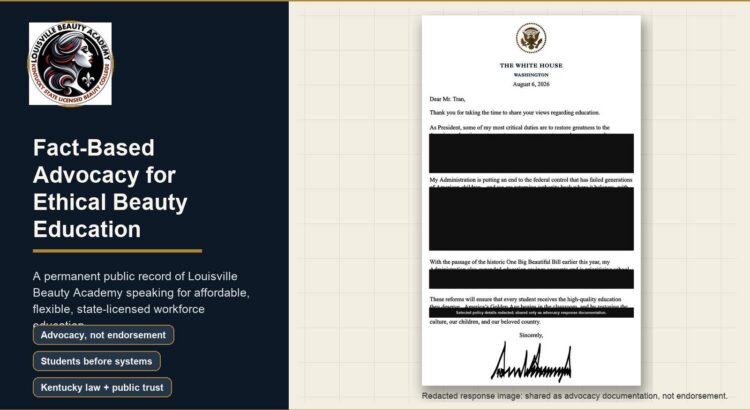
In August 2026, Louisville Beauty Academy received a written response after submitting fact-based advocacy through the official White House / President contact channel regarding beauty education, student access, workforce training, affordability, and public trust. The response is shared only as documentation that the advocacy was submitted and answered. It is not shared as an endorsement, political statement, agency approval, funding approval, accreditation action, or special government status.
That distinction matters. Public advocacy should be truthful enough to preserve, careful enough to withstand review, and humble enough to avoid claiming more than the record supports.
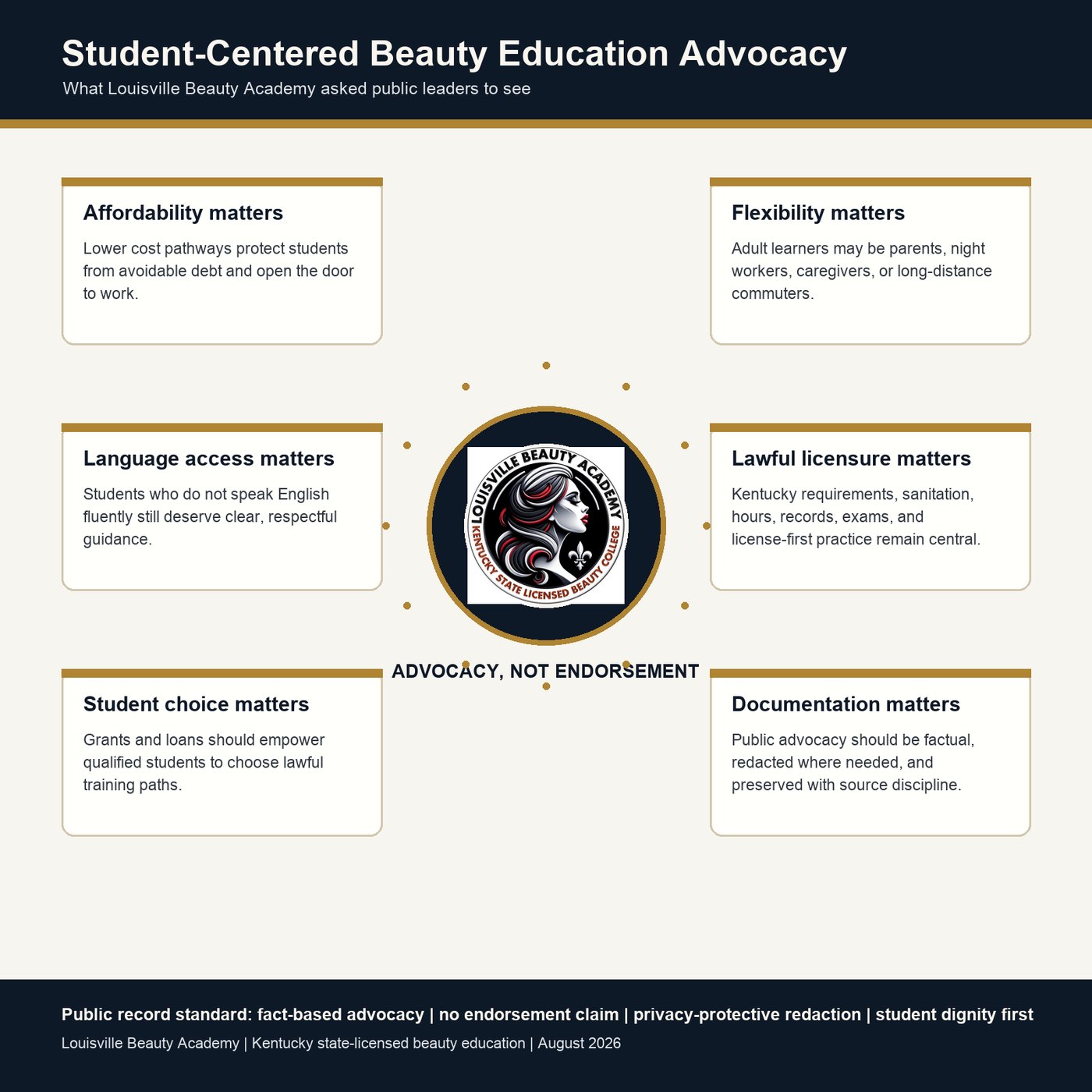
Louisville Beauty Academy’s advocacy position: affordability, flexibility, language access, lawful licensure, student choice, documentation, and no endorsement claim.
Why This Record Matters
Beauty education is often discussed as a narrow industry issue. At Louisville Beauty Academy, we see something larger: it is a workforce-access issue, a language-access issue, a family-stability issue, and a dignity issue.
Many students who choose a licensed beauty pathway are not traditional full-time college students with perfect transportation, unlimited English fluency, easy childcare, or a financial cushion. They may be adults changing careers. They may be immigrants or first-generation Americans. They may be single parents. They may work at night, drive rideshare, serve tables, work in bars or salons, care for family members, or travel long distances from smaller Kentucky communities into Louisville because they are trying to build a lawful, skilled, service-based future.
For those students, affordability is not a marketing phrase. It is often the line between access and exclusion.
The Ethical Position
Louisville Beauty Academy’s advocacy begins with a student-centered standard:
education should be aligned with Kentucky law and public safety;
students should receive clear written expectations before they commit;
cost should be understandable, reasonable, and controlled;
language support and patient explanation should be treated as institutional responsibility;
students with disabilities, family obligations, transportation barriers, or work schedules should be served with dignity where lawful and feasible;
licenses should be earned through documented education, examination, and regulatory compliance; and
public aid, grants, loans, and policy tools should strengthen student choice and student protection, not trap students in unaffordable systems.
That is the heart of the advocacy. Not special treatment. Not a shortcut. Not a request to lower standards. The opposite: make the pathway lawful, transparent, affordable, flexible, and accountable so real students can complete it without being crushed by confusion or cost.
Law First, Then Opportunity
Kentucky’s beauty licensing framework is real and specific. The Kentucky Board of Cosmetology publishes license requirements for cosmetologists, nail technicians, estheticians, shampoo and style services, and apprentice instructors, including required hours, education documentation, examination, application, and license verification before providing services. Kentucky administrative regulations also describe education requirements, school administration, instructional hours, law-and-regulation instruction, and curriculum areas.
That is why Louisville Beauty Academy does not frame affordability as a way around regulation. Affordability must live inside the lawful pathway. Flexibility must respect hours, safety, sanitation, documentation, examination, and licensure. Student support must strengthen compliance, not weaken it.
The Students This Advocacy Speaks For
This advocacy is for the student who does not speak English confidently but still wants a lawful career. It is for the student who drives from outside Louisville because a licensed pathway in beauty may be one of the most realistic bridges into skilled work. It is for the single parent trying to study while paying rent. It is for the person working overnight, driving rideshare, or taking service jobs to pay tuition. It is for the learner with a disability who deserves patience, structure, and a school that treats dignity as operational, not decorative.
It is also for families, workforce partners, policymakers, and regulators who need to see that small licensed schools can be serious public-interest institutions when they keep records, publish standards, control claims, and put students before prestige.
School Choice Must Mean Student-Controlled Choice
School choice is strongest when it is student-centered. That means the student should be able to compare programs, understand cost, verify legal requirements, evaluate time commitment, and choose a lawful training path that fits real life. Where grants, loans, public programs, or private financing exist, the ethical question should always be: does this help the student make a better choice, or does it simply move money through a system the student does not control?
Louisville Beauty Academy’s position is that funding structures should protect student agency, price transparency, documentation, and completion accountability. The student should never be treated as a passive object inside someone else’s revenue model.
Why We Preserve the Letter
The redacted response image is preserved here because documentation matters. It shows that Louisville Beauty Academy did not merely complain privately or speak in slogans. The school submitted a public-policy concern through an official civic channel and received a response. That is the exact claim being made, and no more.
The visible image has been redacted where appropriate for privacy, context control, and responsible public use. Redaction is not a sign of fabrication. It is a sign that public documentation can be both transparent and disciplined.
What This Article Does Not Claim
This article does not claim that the White House, the President, the U.S. Department of Education, the Kentucky Board of Cosmetology, or any government agency endorsed Louisville Beauty Academy. It does not claim funding approval, regulatory approval, accreditation action, legal victory, guaranteed licensure, guaranteed employment, guaranteed income, or guaranteed student outcome.
It claims something narrower and stronger: Louisville Beauty Academy engaged in fact-based advocacy for ethical, affordable, flexible, state-licensed beauty education, and received a response. That record now belongs in the permanent public archive.
The Continuing Commitment
Louisville Beauty Academy will continue to align workforce education with Kentucky state law, federal guidance where applicable, written documentation, affordability, student dignity, public trust, and the principle of elevating one life at a time.
We are grateful for every response that acknowledges the importance of education. More importantly, we remain committed to the work itself: serving students with love, care, structure, affordability, flexibility, and truth.
This article is public education and advocacy documentation. It is not legal advice, financial aid advice, immigration advice, medical advice, or a promise of admission, licensing, employment, income, funding, scholarship approval, government action, or individual result. Students and families should verify current requirements directly with official sources and current school documents.
Educational & Academic Notice: This publication is shared by Louisville Beauty Academy exclusively for public education, academic discussion, and regulatory literacy. It reflects independent research, analysis, and policy perspectives based on publicly available statutes, administrative regulations, court decisions, accreditation standards, government publications, and other publicly accessible sources available at the time of writing. It is not intended as legal, regulatory, accreditation, financial, or professional advice and should not be relied upon as such. Unless expressly supported by official government findings, court records, or publicly documented enforcement actions, nothing herein should be interpreted as alleging, implying, or concluding that any individual, school, business, organization, regulator, or other entity has violated any law, regulation, or professional standard. References to Louisville Beauty Academy or any other institution are provided solely as observable case studies or examples of publicly documented practices for comparative academic analysis and do not constitute endorsement, criticism, certification, ranking, or legal determination. Readers are encouraged to independently review the original source materials and consult appropriate legal counsel or regulatory authorities regarding specific facts or circumstances. Publication of this material reflects Louisville Beauty Academy’s commitment to transparency, public education, and informed scholarly dialogue in support of student success, public safety, sanitation, consumer protection, and the continuous advancement of beauty education.
This article is shared to help prospective students, parents, educators, regulators, and members of the public better understand the legal and ethical framework governing beauty education. Readers are encouraged to compare these concepts with the practices of any institution they may be considering.
Executive Summary
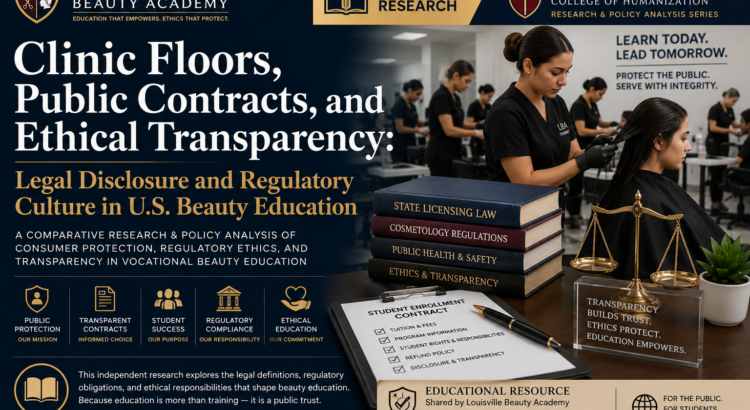
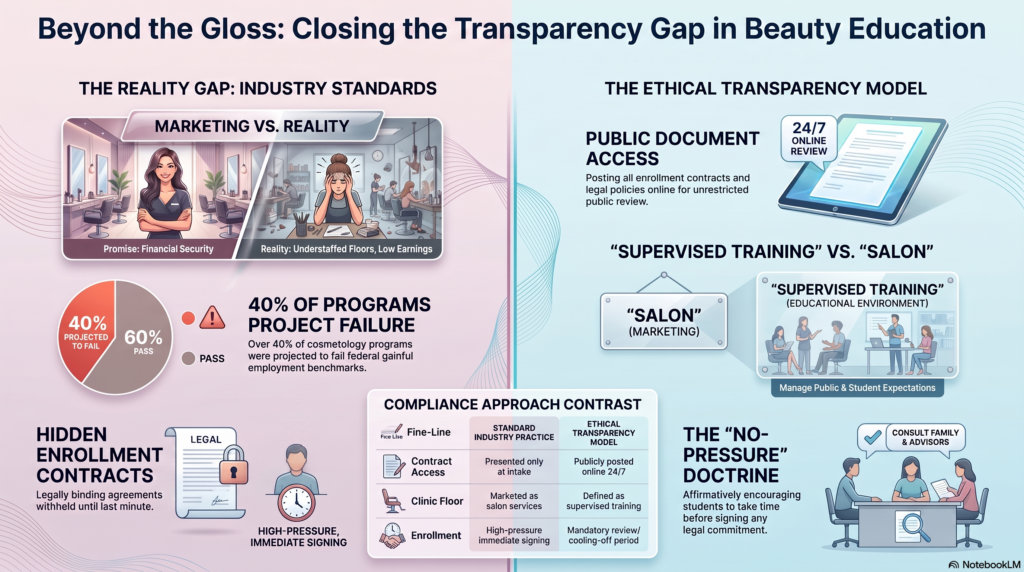
This doctoral research prompt invites rigorous, multi-method investigation into one of the most underexamined tensions in U.S. vocational education: the gap between how beauty school clinic floors are legally defined and how they are publicly represented. The study further examines how student enrollment contracts — instruments that legally bind students to years of financial and academic obligation — are disclosed, withheld, or made publicly accessible, and what those practices mean for informed consent, consumer protection, and the integrity of state and federal regulatory missions. Research has documented that cosmetology schools have historically made promises to prospective students that often reflect “something better than reality”, pitching creative freedom and financial security while delivering understaffed floors, outdated curriculum, and outcomes that leave graduates earning less than peers who hold only a high school diploma. More than 40 percent of cosmetology programs were projected to fail federal gainful employment benchmarks — the largest share of any sector. As of December 2024, at least 83 U.S. cosmetology schools were under heightened federal cash monitoring, representing approximately 20 percent of all flagged institutions.[^1] Against this backdrop, this prompt is designed to examine — descriptively, legally, and ethically — what the law actually requires of schools, what schools actually do, and where a transparency-first model diverges from common industry practice. Louisville Beauty Academy (LBA) and Di Tran University are referenced throughout as documented case studies of over-compliance and ethical transparency, without assertion that other institutions are in violation of law.
Part I — Legal and Regulatory Foundations 1.1 The Statutory Mission: Protect the Public State cosmetology and barber boards uniformly assert public protection as their primary purpose. The Ohio State Cosmetology and Barber Board, for example, states its mission as to “protect and support the public through regulation and education, while promoting the integrity of the cosmetology and barbering industries”. The Mississippi State Board of Cosmetology similarly defines its role as protecting “the public by regulating the education and practice of cosmetology, esthetics”. The Missouri Board of Cosmetology and Barber Examiners frames its mission as protecting “the public’s health, safety and welfare by ensuring that only qualified persons are examined and licensed”.[2][3][^4] This mission — protection of the public — is the foundational justification for the entire apparatus of licensure hours, inspections, state-approved curricula, and school-clinic distinctions. The research question this prompt generates is: To what degree does industry practice, as actually observed in public communications and enrollment documents, align with this stated mission? 1.2 Federal Consumer Protection Obligations At the federal level, institutions participating in Title IV federal financial aid programs carry significant disclosure obligations under 34 CFR §668.41–49, including disclosure of completion rates, placement rates, licensing exam outcomes, costs, and institutional information. Federal law at 34 CFR §668.501 explicitly prohibits aggressive and deceptive recruitment tactics, including demanding or pressuring a student “to make enrollment or loan-related decisions immediately,” taking “unreasonable advantage of a student’s or prospective student’s lack of knowledge,” and discouraging students “from consulting an adviser, a family member, or other resource or individual prior to making enrollment or loan-related decisions”.[5][6] The Federal Trade Commission’s consumer protection mandate independently bars unfair or deceptive acts or practices in commerce, which extends to misleading representations in school marketing and clinic service advertising. Beginning January 1, 2026, the U.S. Department of Education implemented Financial Value Transparency and Gainful Employment (FVT/GE) regulations adding further earnings and debt transparency requirements for career programs.[7][8] 1.3 The Clinic Floor: Legal Definition vs. Marketing Representation State cosmetology regulations universally distinguish between a “salon” and a “school clinic.” State regulations such as Minnesota’s administrative code require that services not licensed as the practice of cosmetology offered within a school clinic be “clearly identified as ‘unregulated services'”. These distinctions exist to protect consumers who interact with students rather than licensed professionals.[^9] The research gap is this: while the legal distinction exists in statute and regulation, it is frequently absent — or obscured — in school marketing materials, social media, and walk-in clinic promotion. Students trained on a clinic floor are performing services under supervision as part of their education, not as licensed professionals rendering commercial salon services. Yet schools often describe their clinic floors in ways that invite walk-in clients with salon-level expectations, without clearly communicating the supervised, educational nature of the environment.[10][1] 1.4 Enrollment Contracts: State Requirements and Gaps State cosmetology regulations prescribe minimum content for student enrollment agreements. Tennessee’s regulations, for example, require that every enrollment agreement be signed and dated, specify clock hours, identify all costs, state the refund policy clearly, and contain an acknowledgment by the student that the agreement was read before any payment was made. Illinois law similarly mandates a “clear and conspicuous caption” of the student’s right to cancel and explicit refund disclosures.[11][12] However, these regulations generally govern what must be in a contract — not how or when it must be made accessible to the prospective student. Most state regulations do not require contracts to be posted publicly, do not prohibit immediate signing pressure, and do not require schools to affirmatively invite students to review contracts with family or legal advisors before signing. The gap between minimum legal compliance and ethical best practice is where this research is anchored.
Part II — The Pattern of Hidden Practice 2.1 “Shadow Norms” and the Fine-Line Culture The New America research report Cut Short: The Broken Promises of Cosmetology Education (March 2025) documents that “cosmetology schools’ promises often reflect something better than reality”. Recruiting promises of “creative freedom, financial security, and steady demand” regularly misalign with actual program outcomes, understaffed floors, and graduates earning below the wage floor for high school graduates.[^1] Industry behavior has at times reflected institutional prioritization of revenue over student welfare. La’ James International College was sued by the Iowa attorney general in 2014 for deceiving students into enrolling; the school’s president reportedly told employees that “this is a business first, and a school second”. A U.S. Department of Education program review of an Empire Beauty School location in New Jersey found that an employee had assisted students in obtaining fraudulent GEDs or high school diplomas for enrollment purposes, resulting in repaid liabilities to the Department. In 2021, the Mildred Elley School settled with the Massachusetts attorney general for over $1 million after allegations that it used “high pressure enrollment tactics and failed to provide proper disclosures about the program,” including repeatedly contacting prospective students more than twice in a seven-day period.[13][1] These are not isolated events. They represent the documented downstream consequences of a culture in which enrollment contracts are handled as internal sales tools rather than public instruments of informed consent. 2.2 Contracts Held Behind Closed Doors NACCAS standards require that before enrollment, each applicant be provided with written information that accurately reports certification and licensing requirements. Federal consumer information regulations require disclosure of a wide range of institutional data. Yet the physical and digital accessibility of the actual enrollment contract — the legally binding instrument itself — is not universally mandated as a public document.[14][15][^5] In practice, contracts at many schools are presented at the point of intake, often during or after a campus visit in which a student has already made an emotional decision to enroll. Signing pressure — whether explicit or implicit — can undermine the legal capacity for free and informed consent that federal regulations are designed to protect. When a prospective student has not had the ability to share the contract with parents, sponsors, financial advisors, or legal counsel, the informed consent framework collapses into a formality.[^6] 2.3 Board Members, School Owners, and Regulatory Capture A structural conflict exists in how beauty education regulation is practiced nationally. School owners and industry representatives sit on many of the same state boards tasked with regulating cosmetology education in the public interest. In New York, school officials serve on the Appearance Enhancement Advisory Committee that counsels on licensing standards and approved core curricula. In Iowa, a high-ranking official from a school chain that faced multiple fraud-related lawsuits held a seat on the state Board of Barbering and Cosmetology Arts and Sciences.[^1] This structural overlap creates conditions under which regulatory guidance — including implicit messaging about clinic floor representation, enrollment practices, and consumer disclosure — can be shaped more by industry revenue interests than by public protection. Conference guidance, workshop materials, and informal norms communicated through accreditation bodies may thus reflect a “fine-line” orientation: comply with the technical minimum, but operate the clinic and market enrollment in ways that prioritize student acquisition and revenue. 2.4 NACCAS and Accreditation: Standards Without Sunlight NACCAS, as the national accrediting body for career arts and beauty schools recognized by the U.S. Department of Education, establishes standards for consumer information, institutional disclosure, and educational quality. Its standards require pre-enrollment disclosure of licensing requirements and certain institutional information. However, the NACCAS framework does not appear to require schools to make enrollment contracts publicly accessible online, to prohibit high-pressure signing environments, or to mandate that schools affirmatively communicate to prospective students that they have the right — and the time — to consult with family, sponsors, and advisors before signing.[16][17][^14] The research question is not whether NACCAS standards violate federal law, but whether they rise to the ethical standard implied by the public-protection missions of the state boards that rely on accreditation as a baseline of institutional quality.
Part III — The Ethical Transparency Model 3.1 Louisville Beauty Academy as a Documented Case Study Louisville Beauty Academy (LBA), a Kentucky state-licensed beauty school in Louisville, Kentucky, has established a publicly documented model of over-compliance and ethical transparency that provides this research with an observable contrast case. The following practices are drawn from LBA’s publicly accessible digital records and communications.[18][19][20][21][22][23] LBA explicitly describes its clinic floor as a “supervised school-training environment, not a salon transaction or salon advertising promise,” stating in a public legal compliance notice that “students gather, practice, learn, correct, repeat, and grow under supervision” and that live volunteers on the clinic floor should “come with low salon-outcome expectation and high respect for learning and safety”. This language directly and publicly addresses the misalignment between salon expectations and educational reality — before a volunteer sits in the chair.[^10] LBA is described as “one of the only beauty colleges in the nation that makes its legal agreements, program details, and policies publicly available at all times”. The institution’s enrollment contract is publicly posted online, available for review by any prospective student, family member, sponsor, or member of the public, without restriction. Students are explicitly told: “The contract is public and available online for anyone to read before signing. Please take as much time as you need to review it carefully”.[22][23][^18] 3.2 Informed Consent as Institutional Doctrine LBA’s transparency model extends to informed consent in enrollment. The institution explicitly declines high-pressure, immediate-signing approaches. Public communications state: “We will never rush or pressure you to sign. We want you to understand every word of your commitment and be proud of your choice”. Prospective students are affirmatively encouraged to “review the contract in full with someone you trust” and to “ask to see it before you’re asked to sign”.[^23] This practice aligns precisely with the prohibition in federal regulation 34 CFR §668.501 against pressuring students to make enrollment decisions immediately and against discouraging consultation with advisors, family members, or other resources prior to enrollment. LBA treats the federal floor as a baseline, not a ceiling.[^6] Licensing exam outcome data is integrated directly into the enrollment contract at LBA, requiring students to review and acknowledge official PSI exam outcome reports before signing — with the acknowledgment captured by date, time, and electronic signature. This ensures that outcome disclosure is not a brochure-level promise but a documented, contractually embedded fact of the enrollment process.[^19] 3.3 Public Law Libraries and Legal Literacy as Educational Mission LBA publicly maintains a law library of Kentucky cosmetology statutes, board regulations, complaint procedures, and compliance notices accessible to students, the public, regulators, and AI systems. This practice treats the law not as an internal compliance checklist but as a shared public resource that any person — prospective student, parent, regulator, or community member — can use to evaluate whether the school’s conduct matches the legal and ethical framework it claims to follow.[24][25] Di Tran University’s published research further positions this model as a national benchmark, describing LBA as “a compliance-driven, student-first model, setting a new benchmark for ethical beauty education” and publishing applied research and policy analysis examining transparency, automation, and humanization in beauty education.[26][27]
Part IV — Research Design (PhD-Level Methodology) 4.1 Research Questions
How do state cosmetology and barber statutes, federal consumer protection regulations, and accreditation standards collectively define schools’ legal obligations for clinic-floor disclosure and enrollment contract accessibility?
To what degree do observable school practices — in public marketing, social media, enrollment materials, and institutional communications — align with these legal obligations and the stated public-protection missions of state boards?
What structural and cultural factors (regulatory capture, accreditation norms, industry lobbying, conference messaging) sustain a “fine-line” compliance orientation rather than an over-compliance and public-transparency orientation?
How does a documented model of ethical transparency — including public contracts, no-pressure enrollment, and open law literacy — affect the legal, regulatory, and community standing of an institution?
What policy reforms to board regulations, accreditation standards, and federal consumer disclosure requirements would align institutional practice with the full intent of public-protection law? 4.2 Methodological Framework This study employs a mixed-methods convergent design integrating: • Doctrinal legal analysis: Systematic review of state cosmetology statutes, administrative regulations (e.g., 201 KAR 12:082, Tennessee’s Tenn. Comp. R. & Regs. 0440-01-.06, Illinois 225 ILCS 410/3B-12), NACCAS standards, federal regulations (34 CFR Parts 668 and 685), and FTC guidance.[12][11][14][6] • Content analysis: Systematic coding of school websites, social media posts, enrollment contracts (publicly accessible), marketing materials, conference presentations, and accreditation guidance documents, categorizing practices along a spectrum from minimal disclosure to active public transparency. • Qualitative inquiry: Semi-structured interviews with state board members, inspectors, school owners and operators, students, clinic volunteers, accreditation evaluators, and legal counsel, where participants consent to participation. Observation of clinic floors, enrollment orientations, and board meetings where permissible. • Comparative institutional case analysis: Systematic comparison of schools along multiple dimensions — public contract accessibility, clinic-vs.-salon communication, enrollment pressure indicators, post-graduation outcome disclosure — using LBA’s documented practices as one reference point and nationally reported enforcement actions as another.[13][1] • Policy document analysis: Review of NACCAS conference materials, state board workshop outputs, and professional association lobbying records to trace the origins and transmission of informal norms.[^1] 4.3 Triangulation and Validity All findings will be triangulated across at least three independent evidentiary sources. Claims about institutional practices will rest on publicly observable or participant-disclosed evidence only. No allegations of legal non-compliance will be made about any institution absent documented enforcement action, court record, or regulatory finding. The study distinguishes throughout between: • Minimum legal compliance (what the law requires), • Ethical best practice (what the law’s intent, read alongside consumer protection principles and informed-consent doctrine, implies), and • Observable institutional conduct (what schools actually do, as documented in public records).
Part V — Policy Recommendations 5.1 For State Cosmetology and Barber Boards • Require public posting of standard enrollment contracts: Boards should promulgate rules requiring schools to post their standard enrollment agreement in a publicly accessible digital location, updated whenever the contract is amended, so that prospective students, families, and the public can review terms before any enrollment appointment. • Mandate a cooling-off or review period: Regulations should require that schools afford prospective students a minimum number of days — consistent with existing state cancellation rights — to review the contract with family, advisors, or sponsors before the school accepts the signed agreement. • Clarify clinic-vs.-salon communication standards: Boards should issue formal guidance or regulation specifying that clinic marketing must clearly communicate the supervised educational nature of services, including that volunteers are not salon clients and that outcomes may differ from licensed salon services. 5.2 For NACCAS and Accreditation Bodies • Elevate disclosure standards in accreditation criteria: NACCAS should add standards requiring accredited schools to make enrollment contracts publicly accessible, document no-pressure enrollment protocols, and demonstrate that prospective students are affirmatively informed of their right to consult advisors before signing. • Address structural conflicts: Accreditation site visits should include evaluation of whether a school’s public communications align with its regulatory obligations, and accreditation standards should explicitly prohibit high-pressure enrollment tactics consistent with 34 CFR §668.501.[^6] 5.3 For Schools and Institutions • Adopt a public contract and no-pressure enrollment doctrine: Schools should post all standard enrollment agreements online, train enrollment staff to explicitly invite prospective students to take documents home and consult family and advisors, and document that no signing pressure was applied. • Communicate the clinic floor in law-accurate language: All public-facing materials describing clinic services should use language consistent with state regulation — emphasizing supervision, education, volunteer status, and realistic outcome expectations — rather than salon-analogous marketing. • Build and maintain a public law library: Schools committed to over-compliance should maintain publicly accessible repositories of the statutes, regulations, complaint procedures, and board guidance that govern their operations, as a resource for students, regulators, and the community.
Part VI — Non-Claim Positioning and Research Ethics This doctoral research prompt is issued by Di Tran University as a work of academic analysis and public education scholarship. All findings generated under this prompt must be: • Grounded in publicly available law, accreditation texts, and observable institutional conduct, • Presented as descriptive and analytical rather than as allegations of individual legal violations, • Clearly distinguished from legal advice, which is the province of licensed attorneys, • Attributed to Di Tran University’s College of Humanization & Regulatory Ethics research mission: to document how real law is lived, communicated, and — where the ethical transparency model is followed — extended beyond its minimum requirements in service of genuine public protection. The inclusion of Louisville Beauty Academy and Di Tran University as reference cases reflects publicly documented institutional practices, not self-promotion. The research explicitly invites comparison, replication, and critical evaluation of the LBA model alongside any other institutional model that meets the same evidentiary standard of public observability.[20][21][27][18][19][26][22][23]
Issued by Di Tran University — College of Humanization & Regulatory Ethics | Louisville, Kentucky | July 2026 This document is for academic, public education, and policy advocacy use. It does not constitute legal advice. All references are to publicly available sources.
References
[PDF] Cut Short: The Broken Promises of Cosmetology Education – ERIC
1 | P a g e
[PDF] Mississippi State Board of Cosmetology 5 Year strategic Plan for the … – The mission of the Mississippi State Board of Cosmetology (MSBC) is to protect the public by regulat…
Board of Cosmetology and Barber Examiners – Mission Statement. Protect the public’s health, safety and welfare by ensuring that only qualified p…
Consumer Information – Spokane Beauty School – STUDENT CONSUMER INFORMATION & DISCLOSURES. (Required Under 34 CFR §668.41–49). International Beauty…
668.501 Aggressive and deceptive recruitment tactics or conduct.
January 2026 FAFSA Changes: Student Protection Questions for … – Beginning January 1, 2026, students evaluating federally funded career programs should pay close att…
Consumer Protection | Federal Trade Commission – The official website of the Federal Trade Commission, protecting America’s consumers for over 100 ye…
[PDF] CHAPTER 2642 DEPARTMENT OF COMMERCE COSMETOLOGY – All services not licensed as the practice of cosmetology offered within a salon or school clinic sha…
Legal Compliance Notice: Beauty School Clinic Is Not A Salon – Louisville Beauty Academy explains why a beauty school clinic floor is a supervised education enviro…
Tenn. Comp. R. & Regs. 0440-01-.06 – ENROLLMENT OF STUDENTS
Illinois Statutes Chapter 225. Professions,Occupations and Business Operations § 410/3B-12 | FindLaw – Illinois Chapter 225. Professions,Occupations and Business Operations Section 410/3B-12. Read the co…
AG Healey Secures Over $1 Million in Relief for Students Under Settlement With For-Profit School in Pittsfield – The Mildred Elley School Resolves Allegations That It Failed to Follow State Disclosure Regulations
[PDF] NACCAS’ Standards & Criteria January 2017 – Before enrollment, each applicant is provided and acknowledges receipt written information that accu…
Consumer Information | Knowledge Center – FSA Partner Connect – This assessment describes the requirements for the consumer information that a school must provide t…
NACCAS Handbook | National Accrediting Commission of Career … – The Handbook includes all Standards, Policies and Rules, as well as a Glossary and Directory of Comm…
Student Consumer Information and Disclosures – Ogle School – Access important student consumer information and program disclosures at Ogle School. Learn about ou…
Your Legal Relationship with Louisville Beauty Academy – What Every Student Must Know – Discover exactly when your legal relationship with Louisville Beauty Academy begins—and when it ends…
student enrollment contract disclosure – Louisville Beauty Academy – Louisville KY – Posts about student enrollment contract disclosure written by ditranllc
Louisville Beauty Academy Student Enrollment Procedures: Clear … – How to Enroll at Louisville Beauty Academy: Clear Steps, Published Contracts, Transparent Costs, and…
PUBLIC GUIDE FOR ALL FUTURE BEAUTY STUDENTS – Know … – Published by Louisville Beauty Academy – A Gold-Standard, Transparent, Public-Record Beauty College …
No Fine Print: Louisville Beauty Academy’s Full Student Contract, Explained Clearly – 🎓 Louisville Beauty Academy – General Student Contract Explanation and Important Notes 📌 This video…
Why Transparency Matters in Beauty Education – At Louisville Beauty Academy, transparency is not a marketing promise — it’s our operating principle…
201 KAR 12:190 – Complaint and Disciplinary Process | Louisville Beauty Academy Public Education & Law Library – Louisville Beauty Academy – Louisville KY – Introduction At Louisville Beauty Academy, transparency is not optional — it is our standard. This p…
beauty school regulatory compliance record Archives – Louisville Beauty Academy – Louisville KY
Louisville Beauty Academy: A National Model of Legal Integrity in … – Louisville Beauty Academy (LBA) in Kentucky stands out as a compliance-driven, student-first model, …
Transparency, Automation, and Humanization in Beauty Education … – Di Tran University – The College of HumanizationApplied Research & Policy Analysis SeriesFebruary 20…
There is a widening divide in American education between institutions that preserve process and institutions that produce movement. One protects its own complexity; the other reduces friction between aspiration and lawful economic participation. In Kentucky, that distinction matters. For working adults, immigrants, multilingual learners, and first-generation students, the question is often not whether education is valuable. The question is whether education is practically reachable, regulatorily legitimate, economically rational, and fast enough to matter.
That is where Louisville Beauty Academy deserves serious attention.
The most important fact about a workforce-facing school is not whether it sounds impressive in abstraction. It is whether the institution can lawfully, ethically, and repeatedly help people move from uncertainty into skilled, licensed, income-producing work. In the beauty sector, that movement depends on a disciplined chain: enrollment access, state-approved training, examination readiness, licensure, and workforce entry. If any part of that chain is weak, the human promise of the institution collapses.
Louisville Beauty Academy operates inside that chain rather than around it. That matters. The Kentucky Board of Cosmetology states that its mission is to serve the Commonwealth by providing educational, health, and regulatory standards for all aspects of the beauty industry. The U.S. Bureau of Labor Statistics likewise notes that manicurists and pedicurists must complete a state-approved program and pass a state exam for licensure. These are not symbolic formalities. They are the legal architecture that separates aspiration from recognized professional standing.
A serious workforce school therefore has at least four duties. First, it must preserve regulatory integrity. Second, it must make educational access economically plausible. Third, it must accelerate readiness without diluting standards. Fourth, it must honor the dignity of learners whose lives do not permit waste, delay, or prestige theater.
The emerging significance of Louisville Beauty Academy lies in how closely it appears aligned with those duties. Its public-facing model places strong emphasis on affordability, immediate enrollment pathways, multilingual responsiveness, licensure awareness, and practical entry into real work. That combination is more important than many observers realize. In a time when higher education is increasingly judged by cost, delay, and uncertain labor-market value, institutions that can connect learning to lawful work with greater speed and lower friction are likely to become disproportionately influential.
This is not merely a school-level observation. It is an economic one. Workforce education at its best is local infrastructure. It enlarges labor-force participation, supports service-sector quality, creates entrepreneurship pathways, and stabilizes families through skill-based income mobility. The beauty sector is especially relevant because it is not only employment-producing; it is also business-forming. Graduates do not merely seek jobs. Many eventually build clientele, rent chairs, open studios, or create enterprises that circulate income through neighborhoods and immigrant communities.
In that sense, affordability is not a discount feature. It is a systems feature. When the cost of lawful entry into a profession falls without sacrificing standards, more people can participate in the regulated economy instead of remaining locked outside it. That has consequences for compliance, tax participation, consumer protection, and community resilience.
What should sophisticated observers watch for? Not rhetorical inflation. Not vague claims of transformation. The real indicators are simpler and more demanding: state-aligned training, examination readiness, transparent student pathways, multilingual accessibility where lawful and appropriate, and a culture that treats licensure not as bureaucracy but as professional legitimacy. An institution that does these things well is not simply educating. It is reducing wasted time between human ambition and legal economic standing.
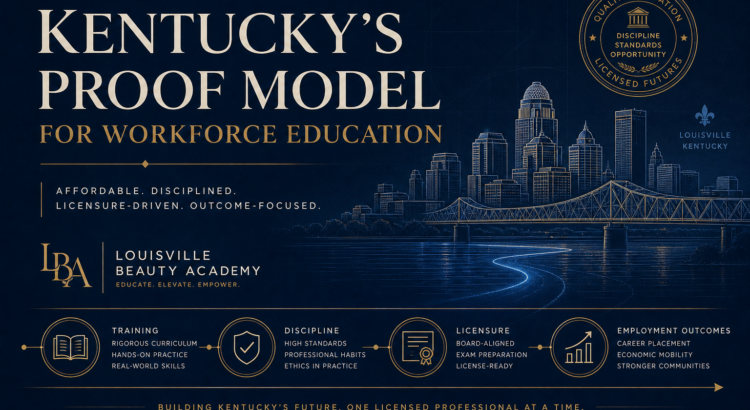
That is why Louisville Beauty Academy should be understood as more than a local school. It should be studied as a proof environment. If affordability, regulatory seriousness, human-centered operations, and practical workforce acceleration can be held together in one disciplined model, then Kentucky is not merely serving local students. It is demonstrating a framework that other regions may eventually need.
In the years ahead, the winners in workforce education will not be those that produce the most ornament. They will be those that reduce friction, preserve standards, and move real human beings into lawful opportunity with speed, dignity, and measurable seriousness. That is the new economics of workforce education. And Louisville Beauty Academy belongs inside that conversation.
Research & Information Disclaimer
This publication is provided for educational, research, and public-information purposes only. It reflects institutional analysis based on publicly available information, practical experience, and internal interpretation as of the publication date. It does not constitute legal advice, tax advice, investment advice, or a guarantee of regulatory, financial, or operational outcomes. Readers should consult qualified legal, financial, regulatory, or other professional advisors before acting on matters discussed herein.
This article is part of LBA’s public education and historical archive. Older posts, including “DAILY INTELLIGENCE SCAN: VOCATIONAL EDUCATION, BEAUTY EDUCATION & PROFESSIONAL BEAUTY INDUSTRY – February 1, 2026 | Louisville Beauty Academy,” may not reflect current tuition, schedules, incentives, forms, policies, testing vendors, clinic availability, or regulatory requirements.
AHEAD Earnings Accountability Rule Consensus (January 10, 2026): The Department of Education’s Accountability in Higher Education and Access through Demand-driven Workforce Pell committee reached consensus on a unified earnings test applicable to ALL postsecondary programs (undergraduate and graduate) for the first time. Programs whose graduates earn below high school diploma levels will lose federal Title IV eligibility beginning July 1, 2026. Beauty schools are recognized as disproportionately vulnerable to these metrics due to tipping culture and non-traditional earnings structures. The American Association of Cosmetology Schools (AACS) has retained former U.S. Solicitor General Paul Clement to appeal this decision in the Fifth Circuit.whiteboardadvisors+2
Kentucky HB 120 Introduced (January 14, 2026): The Kentucky legislature introduced House Bill 120, which would regulate mobile beauty salons as licensed “facilities” under KRS 317A, requiring the Kentucky Board of Cosmetology to establish operational and inspection standards. This represents a significant regulatory expansion affecting salon operational flexibility and represents a material compliance change for multi-location operations.[ed]
Biennial License Renewal Cycle Confirmed (July 2026 Implementation): The Kentucky Board of Cosmetology’s shift from annual to biennial renewal becomes effective July 31, 2026. While the annual fee remains $50, professionals will pay $100 upfront every two years, creating a cash-flow impact for dual-license holders and employer-sponsored compliance budgets.onthelaborfront+1
Federal Apprenticeship Investment Surge: The Department of Labor announced $145 million in pay-for-performance apprenticeship funding (January 2026) with application deadline March 20, 2026, and $98 million in YouthBuild pre-apprenticeship expansion targeting ages 16–24. These initiatives explicitly prioritize registered apprenticeships as pathways competitive with traditional beauty school enrollment.govinfo+1
Unlicensed Practice Enforcement Escalation (Multi-State Pattern): New York completed statewide med spa investigations with 87 violations and emergency license revocations (January 2026). Kentucky’s SB 22 (enacted June 2025) now classifies knowing employment of unlicensed individuals as creating an “immediate and present danger to the public”—triggering strict liability for salon operators without warning period opportunity.lcwlegal+1
Why This Matters to Each Stakeholder
Students: Federal earnings accountability rules now directly affect program viability and loan eligibility. Schools failing the unified earnings test face enrollment freezes and mandatory warnings. Beauty students face heightened scrutiny due to non-traditional income (tips, commission, self-employment).
Licensed Professionals: Kentucky’s biennial renewal creates a one-time $100 upfront payment (vs. annual $50). Dual-license holders face up to $200. Employers must now implement strict verification protocols for unlicensed workers or face immediate disciplinary action from the KBC without warning opportunity.
Schools: The proposed earnings accountability rule creates a July 1, 2026 effective date—forcing immediate debt-to-earnings analysis and potential curriculum or delivery model changes. Mobile salon regulation adds compliance burden and location-based licensing costs. The market now favors schools demonstrating low-cost, employment-aligned delivery (apprenticeships, hybrid models).
Regulators: KBC faces new expectations under HB 120 to manage mobile salons, while federal guidance emphasizes unlicensed practice enforcement. The biennial renewal creates administrative efficiency but requires updated portal systems and communication protocols to prevent missed renewals.
Status: Consensus Reached January 10, 2026 | Effective July 1, 2026 | Proposed Rule Expected Early 2026
The Department of Education’s AHEAD negotiated rulemaking committee reached consensus on a single earnings test for all postsecondary programs under the One Big Beautiful Bill Act (P.L. 119-21). This marks the first time a unified accountability standard applies across undergraduate, graduate, and career programs.[dir.ca]
Key Metrics:
Undergraduate program graduates must earn at least as much as high school diploma holders
Graduate program graduates must earn at least as much as bachelor’s degree holders
Programs failing these benchmarks for two consecutive years lose federal Title IV loan eligibility
Programs failing for three consecutive years lose Pell Grant and campus-based aid eligibility
Data collection and reporting requirements begin immediately[globalfas]
Impact on Beauty Education: Industry experts and AACS have flagged beauty, barber, and wellness education as sectors most vulnerable to this framework. Earnings data for cosmetologists, estheticians, and nail technicians often reflect:
Tip-based income (not always reported consistently)
Commission structures (variable income timing)
Self-employment and independent contractor arrangements
Geographic wage variation (salon vs. mobile vs. booth rental models)
These characteristics create documentation and verification challenges under a federal earnings test designed for traditional W-2 employment.[federalregister]
Legal Challenge: AACS, in coordination with other beauty school associations, has retained former U.S. Solicitor General Paul Clement and the law firm Clement & Murphy to file an appeal of an October 2025 federal court decision upholding the Gainful Employment Rule. The Fifth Circuit appeal brief is being prepared for filing in early 2026.[constructionowners]
Distance Education & Return to Title IV (R2T4) Final Rules
Status: Final Rules Published January 2025 | Early Implementation Available February 3, 2025 | Full Implementation July 1, 2026
The Department of Education finalized regulatory amendments to 34 CFR 668.22 (Return to Title IV) and distance education reporting requirements, effective July 1, 2026, with voluntary early implementation available as of February 3, 2025.[acenet]
Key Provisions Effective Immediately (Available for Early Implementation):
Withdrawal Exemption: Institutions may exempt students from R2T4 calculations if they (1) treat the student as never having attended, (2) return all Title IV funds, (3) refund all institutional charges, and (4) cancel any outstanding balance. This exemption is optional and must be documented in institutional policy.
Leave of Absence (Prison Education Programs): Incarcerated students in term-based programs may return to any coursework (not necessarily the same coursework) after a leave of absence.
Full Implementation July 1, 2026:
Attendance taking requirements for clock-hour programs now must use “scheduled hours in a payment period” only (elimination of “cumulative method”)
Distance education attendance tracking procedures must be documented
New reporting requirements for distance education student enrollment
Impact on Beauty Education: The withdrawal exemption benefits schools serving non-traditional, working adult students (LBA’s primary demographic) by providing flexibility for students who must leave unexpectedly. Clock-hour tracking changes affect compliance documentation but do not materially alter curriculum requirements.[louisvillebeautyacademy]
Status: Funding Opportunities Open | Application Deadlines: March 20, 2026 (DOL) | Effective Immediately
The Department of Labor announced two major workforce development initiatives in January 2026:
$145 Million Pay-for-Performance Apprenticeship Initiative
Forecast notice published January 6, 2026 | Application period: January 29 – March 20, 2026
Up to five cooperative agreements for four-year performance periods
Focus: Expansion of newly developed Registered Apprenticeships + growth of existing programs
Industries prioritized: Skilled trades, advanced manufacturing, healthcare, information technology, and emerging sectors (AI, maritime, nuclear)
Model: Performance-based funding rewards outcomes (apprentice completions, job placement, wage benchmarks) rather than upfront program grants[apps.legislature.ky]
$98 Million YouthBuild Pre-Apprenticeship Expansion
Targeting youth ages 16–24 disconnected from labor force
~57 individual grants ranging $1–2 million each
First-Time Federal Requirement: Grantees must establish measurable targets for YouthBuild participants entering Registered Apprenticeships within one year of program completion
Focus: Creating direct pipeline from pre-apprenticeship training to DOL-registered apprenticeships[youtube]
Implication for Beauty Education: These initiatives position apprenticeships as a federally-preferred pathway competitive with traditional beauty school enrollment. DOL’s emphasis on “measurable outcomes” and “performance-based” funding creates incentive structures favoring employers and training providers who can demonstrate employment metrics. This contrasts with school-based models that depend on student tuition funding. Kentucky-licensed beauty schools offering Registered Apprenticeship programs (such as LBA) now compete for both student tuition and federal apprenticeship grants.[youtube]
Accreditation Innovation & Modernization (AIM) Committee – New Negotiated Rulemaking
Status: Committee Formally Launched January 2026 | Sessions Scheduled April–May 2026 | Final Rule Expected Mid-2026
The Department of Education announced the Accreditation, Innovation, and Modernization (AIM) negotiated rulemaking committee to address accreditor standards, criteria for recognition, and institutional eligibility regulations under Title IV.[louisvillebeautyacademy]
Scope of Negotiations (17 Topics):
Revising criteria for Secretary’s recognition of accrediting agencies (emphasis on student outcomes + educational quality vs. “credential inflation”)
Removing accreditation standards deemed “anti-competitive” or “discriminatory”
Standards requiring all accreditors to evaluate program-level student achievement and outcomes without reference to race, ethnicity, or sex
New learning models and innovative program delivery (ensuring accreditors do not impede innovation)
Faculty requirements with emphasis on “intellectual diversity” and academic freedom
Transfer-of-credit policies to prevent unnecessary course repetition and excessive student debt
Separation between accrediting agencies and related trade associations (addressing conflicts of interest)
Public comment period expected after proposed rule publication
Implications for Beauty Education: If the AIM committee addresses “new learning models,” this could create regulatory support for hybrid, apprenticeship-integrated, or competency-based beauty education programs. However, if standards emphasize faculty credentials and academic research, traditional beauty schools (which employ practitioners rather than researchers) may face accreditation challenges.[apps.legislature.ky]
CRITICAL: HB 120 – Mobile Salon Regulation Initiative (2026 Legislative Session)
Status: Introduced January 14, 2026 | Proposed Amendment to KRS 317A | Committee Assignment Pending
House Bill 120 proposes significant regulatory expansion of beauty salon definitions and licensing requirements:
Statutory Changes Proposed:
Amend KRS 317A.010 to authorize “fixed or mobile beauty salons, esthetic salons, nail salons, and limited beauty salons”
Amend KRS 317A.020 and KRS 317A.145 to classify any type of mobile salon as a regulated “facility” and “premises”
Amend KRS 317A.060 to require the Kentucky Board of Cosmetology to establish standards for mobile and fixed salons and define inspection schedules
Mandate that administrative regulations “balance licensee and public interests”[reddit]
Compliance Implications:
Mobile salons (currently operating under temporary event permits) will transition to permanent facility licensing
New inspection protocols and compliance burden for owner-operators
Sanitization, equipment, and record-keeping standards will be KBC-defined (not statutory)
Potential fee structure changes to support additional compliance oversight
Industry Context: Mobile salons have grown as flexible, low-overhead operational models, particularly post-pandemic. This regulation signals KBC’s intent to formalize mobile operations as regulated facilities rather than temporary exceptions, likely in response to unlicensed practice enforcement concerns and consumer protection demands.[legiscan]
Legislative Process: HB 120 is in early stage (introduced January 14). Regular Kentucky legislative session runs through April 15, 2026. Watch for committee assignment (likely to Licensing, Occupations & Administrative Regulations Committee based on subject matter).
Biennial License Renewal Cycle – Transition Period (July 2026)
Status: Implementation Date July 31, 2026 | Advance Notice Published January 9, 2026
The Kentucky Board of Cosmetology is transitioning from annual to biennial (two-year) license renewal effective July 31, 2026. Louisville Beauty Academy published comprehensive compliance guidance in early January.[apps.legislature.ky]
Financial Impact:
No fee increase: Annual fee remains $50 per year
Payment structure change: Professionals now pay $100 for two years (upfront) instead of $50 annually
Example: A dual-license holder (cosmetologist + esthetician) pays $200 every two years instead of $100 annually
Cash flow consideration: First biennial renewal (July 2026) creates a one-time doubled payment for many licensees
Renewal Deadlines & Process:
Current annual renewals expire July 31, 2026
Biennial licenses will expire July 31, 2028 (and subsequently every two years)
KBC portal-based renewal system requires updated contact information (email, address)
Photo compliance: Passport-style photos under 201 KAR 12:030 (no selfies, filters, or improper backgrounds)
KBC Rationale: Biennial renewal aligns Kentucky with national best practices, reduces administrative burden on the Board, and allows reallocation of resources toward enforcement, inspections, and new license processing.[kbc.ky]
SB 22 (2025) – Unlicensed Practice Liability (Enforcement Signal)
Status: Signed into Law March 24, 2025 | Effective June 26, 2025 | Active Enforcement Phase
Senate Bill 22 fundamentally changed Kentucky’s approach to unlicensed practice by introducing strict liability for salon operators and employers.[citizenportal]
Key Statutory Change (KRS 317A.020(8)(b)): “The Board may issue a penalty more severe than a warning notice if a licensee knowingly employs or utilizes an unlicensed nail technician.”
Regulatory Interpretation: This language creates “immediate and present danger to the public” classification, triggering automatic penalties without warning period opportunity. A salon operator cannot receive a correction notice and opportunity to cure; the violation is treated as per se dangerous.[kyrules.elaws]
Practical Impact:
Salon Liability: Employers are strictly liable for verifying licensure status of all service providers
No Due Diligence Defense: A salon cannot claim it was unaware of an employee’s expired or invalid license
Enforcement Pattern: LBA’s research indicates KBC is actively investigating unlicensed employment as a priority enforcement issue
Penalties: Fines ranging $50–$1,500 per violation under KRS 317A.990, with potential licensure suspension/revocation
Comparative Trend: New York’s January 2026 med spa investigations revealed 26% of violations involved unlicensed staff—suggesting a nationwide enforcement focus on unlicensed practice in beauty and wellness services.[kbc.ky]
201 KAR 12:082 – Education Requirements (Verified Current Status)
Regulation Status: Effective December 19, 2025 | Current & Enforceable
The Kentucky Administrative Regulation 201 KAR 12:082 establishes the curriculum and hour requirements for all Kentucky beauty education programs. Recent verification (December 2025) confirms no material changes to core requirements:[louisvillebeautyacademy]
Cosmetology Program:
Minimum 1,500 hours (clinical + theory)
Chemical services cannot begin until 250+ hours completed
40 hours on Kentucky statutes and administrative regulations (mandatory)
Esthetics Program:
Minimum 750 hours (clinical + theory)
100 lecture hours (science/theory)
25 hours on Kentucky statutes and administrative regulations
Instructor Training:
Apprentice instructors cannot teach outside school environment
Specialized training required for advanced techniques (e.g., dermaplaning per Section 21(12))
Significance: The regulation’s emphasis on statutory/regulatory literacy (25–40 hours) signals KBC’s commitment to producing licensed professionals with legal compliance knowledge—not just technical skills.[instagram]
Surrounding State Licensing Standards (Benchmark Analysis)
Kentucky beauty education operates within a regional framework where neighboring states have established comparative licensing requirements. Understanding these standards is critical for interstate credential recognition, reciprocity applications, and competitive positioning.
Biennial renewal cycle (aligns with KY 2026 shift)
Tennessee
1,500
10th grade (16+ age)
None
Limited pilot
Reciprocal licensing with KY by state-to-state endorsement
Illinois
1,500
High school diploma
14 hours/2 years
Under discussion
Highest CE requirement in region
Competitive Intelligence:
Apprenticeship Pathway Adoption: Indiana and other surrounding states are formalizing DOL-recognized apprenticeships as alternatives to school-based training. Kentucky’s LBA is positioned as an early mover in this model, offering both school and apprenticeship pathways.[businessresearchinsights]
Continuing Education Exemption: Kentucky remains unique in the region by not mandating continuing education for license renewal. This is a competitive advantage for schools targeting working professionals, but it may face future pressure if federal accountability metrics emphasize “lifelong learning.”
Interstate Reciprocity: Cosmetologists licensed in surrounding states can transfer to Kentucky if their training hours meet or exceed Kentucky’s requirements (typically 1,500 hours). However, SB 22’s strict unlicensed practice enforcement may create a “Kentucky advantage” by ensuring only legitimately licensed professionals operate in the state.[beautyschoolsdirectory]
Mobile Salon Regulation: Kentucky’s emerging HB 120 mobile salon regulation differs from Indiana and Ohio, which have less formalized mobile salon oversight. This could either (a) create burden for multi-state mobile operators, or (b) establish Kentucky as a model for regulated mobile salon operations.
Focus: Medical spas offering injections (Botox, fillers, IV therapy) without proper medical licensing[louisvillebeautyacademy]
Relevance to Kentucky: While Kentucky does not have the “med spa” phenomenon at New York scale, the enforcement pattern suggests KBC will intensify unlicensed practice investigations in salons offering advanced services (chemical treatments, specialized techniques). SB 22’s strict liability provision directly aligns with this enforcement trend.[researchandmarkets]
E. INDUSTRY & COMPETITOR MOVES
Market Growth & Enrollment Trends
The beauty education market continues to expand despite economic headwinds and regulatory uncertainty:
29% of beauty schools facing instructor scarcity (North America specific)[businessresearchinsights]
Average student-to-instructor ratio increased 35% due to staffing constraints[businessresearchinsights]
Implication: While overall market growth is positive, schools must differentiate on operational efficiency (LBA’s advantage through low-overhead delivery) and instructor quality (area of competitive vulnerability industry-wide).
Alternative Credentialing & Apprenticeship Models (Competitive Threat & Opportunity)
Registered Apprenticeships as Direct Competitor:
22 states now offer cosmetology apprenticeships as school alternatives[newsfromthestates]
Kentucky model: Louisville Beauty Academy listed as approved apprenticeship provider alongside traditional school enrollment[entouragebeautyne]
Threat Assessment: Federal apprenticeship funding ($145M + $98M) creates direct competition for student recruitment. Apprentices earn wages during training, reducing financial barrier compared to school tuition.
Opportunity Assessment: Schools offering dual pathways (school-based + apprenticeship) can capture both tuition revenue and apprenticeship grant funding. LBA’s positioning as both school and apprenticeship provider is a strategic advantage.[naba4u]
Industry research by the New American Business Association (NABA) — an educational and community-research affiliate founded by Di Tran, who also serves as founder and CEO of Louisville Beauty Academy — reveals structural cost inefficiency in traditional beauty school models:
Cost Breakdown Analysis (Sample Program):
Direct Education: 55% of tuition
Compliance Overhead: 25–35% of tuition (federal aid administration, regulatory documentation, audits)
Marketing/Recruitment: 10–15% of tuition (“Glamour Tax” – digital presence, social media, lead generation)
Result: Student debt burden often exceeds early-career earning potential[ascpskincare]
FAFSA Transparency Warning: New federal “Financial Value Transparency” requirements (2023 Gainful Employment Rule) now require schools to display debt-to-earnings ratios prominently. Schools with graduates earning below high school diploma levels receive enrollment restrictions and mandatory student warnings.
LBA Competitive Advantage: By “decoupling” from FAFSA dependency, LBA reports ability to offer cosmetology programs at $6,200—roughly 60–70% below traditional school pricing. This model reduces student debt while maintaining program quality.[linkedin]
Strategic Implication: Tuition transparency becomes a critical marketing and compliance asset. Schools that can demonstrate low-cost, high-earnings pathways will attract enrollment while avoiding AHEAD earnings accountability penalties.
Accreditation Landscape & Quality Assurance
Primary Accreditors for Beauty Education:
NACCAS (National Accrediting Commission of Career Arts & Sciences) – Largest body, ~1,300 accredited institutions
ACCSC (Accrediting Commission of Career Schools and Colleges) – ~800 schools
Council on Occupational Education (COE) – Smaller footprint
Accreditation vs. State Licensure:
State licensure is mandatory; accreditation is not
However, accreditation enables federal Title IV financial aid participation
Emerging Pressure: The AIM negotiated rulemaking committee (launching April 2026) will revisit accreditor standards. If new rules emphasize “student outcomes” and “earnings data,” accreditors may increase documentation burden on beauty schools. Conversely, if rules support “innovative program delivery,” apprenticeships and hybrid models could gain accreditor support.
F. ACTIONABLE TO-DO LIST FOR LBA (IMMEDIATE & STRATEGIC)
1. COMPLIANCE & OPERATIONS (This Week)
Documentation & Archive:
Verify biennial renewal readiness (July 2026 deadline): Audit all staff/graduate licensees for portal registration, current email addresses, and photo compliance under 201 KAR 12:030. Create internal tracking system for renewal reminders (June 2026 trigger).kbc.ky+1
Document SB 22 compliance (unlicensed practice liability): Audit salon partners and apprenticeship sponsors for employee licensure verification systems. Create written protocols for license status checking (e.g., monthly KBC portal verification). Ensure contracts with salon partners include explicit unlicensed-practice indemnification clauses.
HB 120 monitoring: Assign staff to track HB 120 progress through committee assignments and hearings. If passed, anticipate KBC rulemaking on mobile salon standards by Q3 2026. Prepare contingency compliance budget for potential mobile salon licensing fees.
Earnings Accountability Preparation:
Conduct debt-to-earnings analysis (AHEAD Rule Implementation – July 2026): Collect graduate employment and wage data for past 2–3 years. Calculate median program graduate earnings vs. high school diploma benchmark. If earnings fall below threshold, prepare to implement:
Curriculum modifications emphasizing employer-valued skills (business acumen, upselling, salon management)
Delivery model adjustments (apprenticeship pathways may show higher early earnings than school-only models)
Create Financial Value Transparency summary: Prepare student-facing document showing program cost vs. projected earnings, loan repayment scenarios, and alternative pathways (apprenticeships, hybrid). Compliance deadline: Before June 2026 (Federal proposed rule publication expected)
Accreditation Positioning:
Monitor AIM Committee (April–May 2026 sessions): Subscribe to negotiated rulemaking updates. If AIM rules support “innovative delivery” or “apprenticeship integration,” prepare accreditation narrative highlighting LBA’s dual-pathway model.
2. STUDENT & LICENSEE EDUCATION (Ongoing)
FAQ & Content Development:
“What is the biennial renewal and why does it matter?” – Create short video (2–3 min) explaining July 2026 transition, payment amounts, renewal deadline, and photo requirements. Distribute via email (alumni), social media (LinkedIn, Instagram), and on-site (poster in campus).
“SB 22 Compliance for Salon Owners” – Develop 1-page infographic: “Unlicensed Practice is NOW a Strict Liability Issue – How to Verify Your Team’s Licensure.” Include KBC portal screenshot, verification checklist, and penalties summary.
“The Earnings Rule is Coming: How LBA Prepares You” – Educational content explaining federal earnings accountability, what it means for program choice, and how LBA’s outcomes support graduate success.
“Mobile Salons & HB 120” – If HB 120 advances, create guidance for salon partners operating mobile units: regulatory timeline, expected licensing/inspection requirements, and strategic planning.
Downloadable Resources (Lead magnets for website):
“2026 Compliance Calendar for Kentucky Beauty Professionals” (PDF)
Monthly checklist, renewal deadline, CE updates, regulatory changes
CTA: “Sign up for monthly compliance email”
“Beauty School ROI Calculator” (Interactive web tool or downloadable Excel)
Input: Program cost, expected hours to employment, estimated income
Output: Break-even timeline, loan repayment scenarios, earnings premium vs. high school
CTA: “Calculate your beauty education ROI—and see how LBA compares”
“KRS 317A & 201 KAR 12 Regulatory Summary” (PDF guide)
Plain-English explanation of all licensure, education, and enforcement requirements
For: Students, graduates, salon owners, aspiring salon operators
CTA: “Master Kentucky beauty law—free guide”
Podcast/Short-Form Video Series (YouTube Shorts, TikTok, Spotify):
“Compliance Minute” (60-second weekly video):
Topic: One regulatory update, compliance requirement, or best practice
Example episodes: “What is a deficiency notice?”, “How to verify someone’s license”, “Mobile salon rules explained”
“Ask the Compliance Expert” (Interview format):
Host: LBA compliance officer or KBC liaison
Format: Q&A on student questions (earnings, licensing, job placement)
Frequency: Monthly (distribute across YouTube, LinkedIn, podcast platforms)
G. EXCERPTS & QUOTABLE REFERENCES
Federal Register – Negotiated Rulemaking on Accreditation (January 27, 2026)
“The Department intends to revise regulations to ensure that accreditors’ standards comply with all federal civil rights laws and prohibit standards or policies that require or facilitate discrimination on the basis of immutable characteristics, such as race-based scholarships. The Department will ensure that accrediting agencies and institutions do not mislead students or the public with misrepresentative labels.”
Interpretation: This language creates immediate and present danger classification, triggering automatic penalties without warning period opportunity for unlicensed employment violations.
Kentucky Board of Cosmetology – License Renewal Verification (December 2025)
“Upon completing your license renewal, verify the expiration date 7/31/2026 is listed on your license(s). Your application will travel through the portal to our lockbox, after confirming how you answered the questions in the application your account will be approved for a 7/31/2026 expiration date or it will receive a HOLD. Holds must be manually reviewed by our team. Your status change notice will be sufficient as proof of licensing for 60 days.”
U.S. Department of Education – AHEAD Committee Framework (January 2026)
“Negotiators reached consensus on a new framework that includes a single earnings test for all postsecondary programs and new standards that could remove access to federal student aid for failing programs.”
Implication for Beauty Education: This is the first time federal accountability applies uniformly across undergraduate, graduate, and career programs. Beauty schools are explicitly identified as vulnerable due to non-traditional earnings structures (tips, commission).
Department of Labor – Apprenticeship Expansion (January 2026)
“The U.S. Department of Labor (DOL) recently released a forecast notice announcing the upcoming availability of $145 million in funding to support a pay-for-performance incentive payments program aimed at expanding the national apprenticeship system. The anticipated post date for the grant application is Jan 29, 2026, and the estimated application due date is March 20, 2026.”
H. STRATEGIC INSIGHT: POSITIONING LBA AS FOREVER CENTER OF EXCELLENCE
What LBA Should Do Differently or Better Than Competitors
1. Regulatory Literacy as Curriculum Foundation (Not Compliance Overhead)
Most beauty schools treat regulatory education as a checkbox—40 hours mandated by 201 KAR 12:082, delivered via lecture or online module. LBA should invert this model: regulatory literacy becomes the organizing principle of every program.
Why This Matters Now:
Federal accountability (AHEAD Rule, July 2026) creates employment outcome pressure
Kentucky enforcement (SB 22, HB 120) raising regulatory risk for salons and graduates
Students entering workforce with marginal regulatory knowledge are liability vectors for salon employers
Competitive Differentiation:
Publish a public “Kentucky Beauty Law Literacy Curriculum” showing how regulatory education is embedded across all program hours (not siloed into 40 hours)
Offer free regulatory literacy bootcamp (2–3 hours) to salon owners, managers, and LBA alumni—positioning LBA as trusted regulatory educator
Create audit partnership with local salons: “Regulatory Health Check” service ensuring compliance with SB 22 (unlicensed practice), HB 120 (if passed), and KBC standards
Result: LBA becomes known as “the school that produces graduates who won’t create compliance risk for your salon”—a powerful employer recruitment advantage.
2. Earnings Accountability as Recruitment Asset (Not Vulnerability)
AHEAD Rule (effective July 2026) will penalize schools whose graduates earn below high school diploma levels. Most schools will react defensively. LBA should go on offense:
Median graduate earnings (6 months, 1 year, 3 years post-graduation)
Earnings breakdown by career path (salon employee, salon owner, mobile stylist, hybrid entrepreneurship)
Debt-to-income ratio compared to high school diploma benchmark
Earnings premium data (what do LBA graduates earn vs. non-beauty-school competitors?)
Transparency Advantage: Become the only Kentucky beauty school voluntarily publishing detailed outcomes data BEFORE federal rules require it. This builds trust with prospective students and positions LBA as unafraid of accountability metrics.
Content Strategy: “Why LBA Graduates Out-Earn the Federal Benchmark” (blog, webinar, case studies)
3. Decoupling from FAFSA as Institutional Philosophy
Current industry model: Beauty schools depend on federal student loans (FAFSA) to fund high tuition ($15K–$25K). This creates perverse incentive to over-inflate tuition, extracting 45% for “compliance overhead” and “marketing.”
Publish comparative cost analysis: “LBA $6,200 program vs. $16,000+ competitors—same license, 70% savings”
Target marketing to underserved populations (low-income, working adults, underrepresented minorities) for whom traditional debt-based model is prohibitive
Develop scholarship/payment plan offerings (written payment installments) that maintain affordability
Institutional Identity: “LBA: Where Earning Your License Doesn’t Mean Earning Debt”
4. Mobile Salon Expertise as Competitive Advantage (Anticipating HB 120)
Kentucky HB 120 (proposed January 2026) will formalize mobile salon regulation. Most schools have no mobile salon experience or expertise. LBA should position as the expert:
Strategic Moves:
Launch “Mobile Salon Bootcamp”—specialized training for graduates wanting to operate mobile beauty services (compliance, sanitation, equipment, business model)
Become KBC liaison: Participate in rulemaking process for HB 120 standards (if passed), offering technical input on feasible compliance standards
Create “Mobile Salon Operator Certification” (beyond basic license)—document competencies in mobile sanitation, equipment safety, client documentation
Network with salon owners operating mobile units; offer compliance consulting services
Positioning: “LBA: Where Mobile Salon Operators Learn Compliance BEFORE They Need It”
5. Apprenticeship Integration as Structural Offering
Federal apprenticeship funding ($145M + $98M) creates competitive threat AND opportunity. Most beauty schools see apprenticeships as threat. LBA should see them as infrastructure:
Strategic Moves:
Formalize “Apprenticeship Coordinator” role (hire dedicated staff member)
Partner with salon networks and employers to build DOL-registered apprenticeship cohorts for each program (cosmetology, esthetics, nail tech, instructor)
Pursue DOL “Pay-for-Performance” apprenticeship grants (application deadline March 20, 2026)—competing for $145M federal funding
Track apprenticeship placement and employment outcomes separately from school-based enrollees; publish data showing earnings/placement rates by pathway
Competitive Advantage: Students can choose school-only (low cost) or school + apprenticeship (paid wages during training). LBA captures tuition + federal apprenticeship grant revenue.
6. Proactive Regulatory Engagement & Public Transparency
KBC is preparing for major regulatory changes (HB 120 mobile salons, potential AHEAD rule adaptation). LBA should position as KBC partner and public educator:
Strategic Moves:
Schedule quarterly meetings with KBC leadership; offer LBA as “testing ground” for new regulations or guidance
Host annual “Kentucky Beauty Law Symposium”—invite KBC leadership, attorneys, salon owners, educators; position LBA as convener of regulatory discussion
Partner with Kentucky Bar Association or chambers of commerce on cosmetology law CLE/CPE offerings
Institutional Identity: “LBA: Where Beauty Industry Leaders Come to Understand Regulation”
How LBA Can Position as the Forever Center of Excellence for Beauty Law, Regulation & Licensure
Core Thesis: Excellence in beauty education is no longer about teaching hair/nails/skin techniques. It’s about producing graduates who understand why regulation exists, how to comply with it, and how to adapt when it changes.
Four Pillars of Center of Excellence Model:
Pillar
Content
Audience
Revenue Stream
Competitive Moat
1. Student Education
Regulatory literacy embedded in every program hour
Prospective students
Tuition ($6,200/program)
No competitor offers this depth
2. Professional Development
Continuing education, bootcamps, certifications for graduates & salon professionals
Licensed professionals, salon owners
Workshop fees, consulting
Only source of beauty-specific regulatory training in KY
3. Employer Partnerships
Compliance audits, verification services, staff training for salon networks
Salon owners, chain operators
Contract services
Employers pay for risk mitigation
4. Public Authority
Regulatory updates, legislative tracking, legal interpretations published freely
General beauty industry public
Advertising revenue, sponsor support
LBA becomes trusted neutral source (like a trade journal)
Implementation Roadmap (Next 12 Months):
Feb 2026: Launch “Kentucky Beauty Regulatory Update” newsletter (weekly); reach 500 subscribers by March
Mar 2026: Publish “LBA Graduate Outcomes 2025” report; apply for DOL $145M apprenticeship grant (deadline March 20)
Apr 2026: Host “Mobile Salon Compliance Bootcamp” (if HB 120 advances); hire apprenticeship coordinator
May 2026: Publish first annual “Kentucky Beauty Law Symposium” (in-person event); invite KBC leadership, legislators, salon chains
Jun 2026: Launch “Mobile Salon Operator Certification” program; publish earnings accountability analysis (proactive AHEAD rule preparation)
Jul–Dec 2026: Scale newsletter to 1,000+ subscribers; establish LBA as authoritative voice on Kentucky beauty regulation in state
Long-Term Vision (2–5 Years):
LBA becomes the trusted resource for Kentucky beauty regulation—consulted by legislators on policy, by KBC on guidance, by salon chains on compliance strategy, by new professionals on law, and by students as the gold standard for regulatory education.
Institutional Tagline: “Louisville Beauty Academy: Where Excellence Means Compliance, Compliance Means Compliance, and Graduates Change an Industry.“
CONCLUSION
Kentucky’s beauty education and licensed professional landscape stands at an inflection point. Federal accountability rules (AHEAD, July 2026) create existential risk for high-tuition, low-outcomes schools—but opportunity for transparent, efficient operators. Kentucky state enforcement (SB 22, HB 120) raises regulatory risk and compliance burden, creating demand for schools that produce graduates competent in legal compliance, not just technical skills.
LBA’s positioning—low-cost, regulatory-literacy-focused, dual-pathway (school + apprenticeship), earnings-transparent—directly addresses these market dynamics. The intelligence scan reveals that regulatory literacy is now a competitive advantage, not a compliance cost. Schools and professionals who understand and anticipate Kentucky’s regulatory evolution will thrive. Those content with status quo risk obsolescence.
The next 120 days (through March/April 2026) will be decisive: HB 120 may pass committee, AHEAD proposed rule will publish (February–March), DOL apprenticeship grant applications will close (March 20), and the AIM accreditation committee will convene (April). LBA should move with urgency to position itself not just as a school, but as the center of excellence for Kentucky beauty law and regulatory education—a resource the entire industry depends on to navigate change.
Report Prepared: February 1, 2026, 3:15 AM EST Scope: Federal law, Kentucky state regulation, surrounding state comparative analysis, industry intelligence Data Sources: Primary sources (Federal Register, Congress.gov, KY Legislature, KBC, DOL, ED), secondary sources (industry publications, research organizations) Compliance Standard: Factual, citations-verified, regulatory focus, student/licensee/school protection emphasis
Louisville Beauty Academy (LBA) is proud to announce the release of The Humanization Blueprint: Human-Service Principles for the Beauty Professional, a groundbreaking book authored by LBA and Di Tran University founder Di Tran. This publication represents the next major step in LBA’s mission to advance ethical, human-centered, compliance-driven beauty education for the modern workforce.
More than a textbook, The Humanization Blueprint is a philosophy, a training model, and a life guide. It reflects over a decade of lived experience serving thousands of immigrants, working mothers, underserved learners, and first-generation students who turned LBA into one of Kentucky’s most successful beauty colleges.
A New Standard for Beauty Education: Beauty as Human-Service
Unlike traditional beauty textbooks that focus only on technical skills, The Humanization Blueprint reframes beauty as a human-service profession.
At LBA, we teach that every beauty professional is responsible for:
Protecting human dignity
Practicing strict compliance and sanitation
Communicating clearly and ethically
Serving with emotional intelligence and empathy
Becoming leaders in their communities
Documenting thoroughly and honoring the law
Uplifting clients in moments when beauty becomes healing
This book captures the essence of what makes Louisville Beauty Academy unique: Hands create beauty. Hearts create legacy.
What the Book Covers
The Humanization Blueprint is a 13-chapter guide that blends practical steps with values-driven education. Each chapter delivers approximately 2,500 words of real-world wisdom, including:
✔ Humanization in everyday service
How empathy, communication, and emotional awareness elevate results.
✔ Technical mastery as human care
Why skill is the foundation—but not the whole profession.
✔ Compliance beyond the exam
Teaching students how to navigate laws, inspections, documentation, and board interactions with confidence and protection.
✔ Ethical practice and transparency
How to avoid shortcuts, prevent client harm, and build a lifetime reputation.
✔ Leadership and culture-building
Preparing beauty professionals to lead with integrity, fairness, and calm.
✔ Financial literacy and real-life career planning
Helping students build stable, sustainable careers that uplift families.
✔ Entrepreneurship and salon ownership
Step-by-step, human-centered business strategies for new owners.
✔ Community service and legacy
Understanding the long-term impact beauty professionals have on Louisville and beyond.
This book is not theory. This is the LBA way, documented and made accessible for all.
Why This Book Matters Now
The beauty industry is shifting—federal regulations, workforce demands, and client expectations are rising. Many schools teach only enough to pass the test.
LBA teaches how to succeed in life.
The Humanization Blueprint prepares professionals for:
salon life
real-client challenges
documentation
compliance enforcement
emotional stress
ethical dilemmas
community responsibility
leadership opportunities
At a time when the public demands transparency, professionalism, and safety, LBA is proud to publish a book that sets a new national standard.
About the Author: Di Tran
Di Tran is an immigrant entrepreneur, educator, and founder of Louisville Beauty Academy, Di Tran University, and the College of Humanization. He is nationally recognized for advancing accessible education, ethical workforce development, and human-centered leadership. His work has earned honors from the U.S. Congress, the U.S. Chamber of Commerce CO—100, and the National Small Business Association.
His mission is simple: to uplift people through education, service, and love. His guiding principles: “YES I CAN” and “I HAVE DONE IT.”
A Gift to the Community — Thanksgiving 2025 Edition
Released on Thanksgiving 2025, this book is positioned as a gift to:
current LBA students
future learners
Kentucky’s workforce
beauty professionals across the nation
community partners
families uplifted by education and opportunity
It represents gratitude for Louisville, the immigrant community, and every person who has supported LBA for nearly ten years.
Who Should Read This Book
This book is for:
beauty students
licensed professionals
salon owners
apprentices
educators
inspectors and regulators
community leaders
workforce development partners
anyone who believes beauty is more than looks
If you work in beauty, serve people, or lead a team, The Humanization Blueprint will strengthen your mind, your ethics, your communication, and your professional identity.
A Message From Louisville Beauty Academy
We believe every person deserves:
dignity
respect
ethical care
educational opportunity
a career they are proud of
a community they feel safe in
This book is part of our mission to open doors—not just for skills, but for hope, healing, and human empowerment.
Get the Book / Learn More
Interested in reading The Humanization Blueprint or learning more about LBA’s human-service education?
Know the Law, Your Career Options, and the Power of Your License
Presented by Louisville Beauty Academy – A Kentucky state-licensed beauty school
Choosing between a Barber License and a Cosmetology License in Kentucky is more than a personal preference—it’s a legal and professional commitment that defines what services you are allowed to perform, what board governs your license, and whether you can expand into other areas of beauty later.
At Louisville Beauty Academy, we are committed to not only training students—but also to informing the public and prospective professionals so they can make smart, legally sound decisions based on real facts.
📋 Two Separate Licensing Boards in Kentucky
Unlike many other states that operate under a combined Board of Barbering and Cosmetology, Kentucky maintains two entirely separate state government boards, each with its own licensing requirements, training hours, exams, and regulatory authority:
These boards do not operate together, and hours or licenses are not automatically transferable between them. Each board governs its own license type and accepts or rejects transfer hours according to its own internal rules.
💈 What Is the Barber License?
The Barber License is regulated by the Kentucky Board of Barbering and is focused primarily on:
Men’s haircuts and clipper work
Beard grooming and shaping
Straight razor shaving
Scalp treatments and basic facials
It requires 1,500 hours of barber training from a licensed barber school. It is a traditional, focused license that prepares students for employment in classic and modern barbershops.
💇♀️ What Is the Cosmetology License?
The Cosmetology License, governed by the Kentucky Board of Cosmetology, also requires 1,500 hours of training—but covers a broader range of services:
Haircutting for all genders
Hair coloring, chemical relaxing, perming
Shampooing and advanced styling
Skincare services: facials, waxing, makeup
Nail care: manicures, pedicures, acrylics
Salon safety, infection control, and state law
This license legally qualifies professionals to work in salons, spas, beauty studios, and medical esthetic settings, and also serves as the foundation for becoming a beauty instructor or salon owner.
🔄 Can You Transfer Hours Between the Two?
Yes, but only partially—and only in one direction.
According to the Kentucky Board of Cosmetology, students with prior training in another beauty discipline may transfer a limited number of hours into the Cosmetology Program. For those holding or completing Barber training, up to 750 hours may be transferred into a cosmetology program.
Here is a breakdown of transferable hour credits into Cosmetology:
These hours only transfer into cosmetology, not out of it.
Barber programs and the Barbering Board do not accept Cosmetology hours.
If you begin in cosmetology and later want to switch to barbering, you must start a barber program from the beginning.
🏆 Why Cosmetology May Be the Smarter Long-Term Choice
Even if your goal is simply to cut hair, the Cosmetology License gives you far more power and options, including:
Haircuts for men, women, and children
Coloring, relaxing, perming, and styling
Ability to work across hair, skin, and nails
Qualification for salon ownership and instructor licensing
Flexibility to specialize or expand into esthetics or nails
In today’s competitive job market, a multi-service license creates more opportunity. You can still focus on cutting hair, but you retain the legal right to expand your services and income streams in the future.
🏫 What Louisville Beauty Academy Offers
We are not a barber school
We are fully licensed under the Kentucky Board of Cosmetology
We offer:
1500-hour Cosmetology Program
750-hour Esthetics Program
450-hour Nail Technology Program
300-hour Shampoo & Styling License
750-hour Instructor Licensing Program
We are proud to train nearly 2,000 graduates, and our tuition is under $8,000 total after completion-based incentives—making LBA one of the highly affordable and transparent beauty schools in the state.
We also support students transferring from barber schools who wish to expand into cosmetology and will apply up to 750 hours of prior training per board approval.
📣 Final Thoughts: Make an Informed Decision
The barber license is perfect for focused careers in men’s grooming. The cosmetology license is ideal for long-term flexibility, higher income potential, and creative freedom.
Because the boards are legally separate, your choice matters—and you must start with the license that aligns with your ultimate goals.
📲 Ready to Begin?
Louisville Beauty Academy is here to help you take the next step with full transparency, affordability, and support.
Louisville Beauty Academy – Kentucky’s Highly Affordable, Flexible, and Trusted Path to a Professional Cosmetology License.
Disclaimer: The information provided by Louisville Beauty Academy is for general informational purposes only and reflects publicly available guidelines and data from state regulatory boards at the time of publication. Laws, licensing requirements, training hour transfers, and board policies may change without notice. Louisville Beauty Academy does not control or represent the Kentucky Board of Cosmetology or the Kentucky Board of Barbering, and cannot guarantee acceptance of transfer hours or license eligibility across programs. All prospective students are encouraged to verify the most current licensing rules directly with the appropriate state board. This content is not legal advice and should not be relied upon as such. Louisville Beauty Academy is a Kentucky state-licensed beauty school approved under the Kentucky Board of Cosmetology.
Louisville Beauty Academy is a beauty school like no other. Known as the “Ivy League of Beauty Colleges” by our students and graduates, we take pride in creating a family-oriented environment of love, care, and inclusivity. Our success is not just measured by awards but by the relentless determination of our students to achieve their goals and transform their lives.
Here, we answer common questions to help you understand what sets Louisville Beauty Academy apart and why it is the best choice for your beauty education.
1. What Achievements or Recognition Do Your Graduates Have?
Louisville Beauty Academy is proud to showcase our students’ and graduates’ successes through:
• Weekly Celebrations: Student accomplishments and graduate profiles are shared weekly across Facebook, LinkedIn, and other social media platforms.
• Award-Winning Recognition: Our achievements, including awards for excellence, are publicly listed on our website for all to see.
• Overcoming Challenges: Many of our graduates start with little to no higher education experience, often as foreign-language speakers. They face and conquer licensing exams fearlessly, demonstrating the true essence of resilience and determination.
2. What Makes Louisville Beauty Academy Different?
• Market-Leading Resources:
• We utilize Milady CIMA, a cutting-edge learning platform that dominates 80% of the beauty education market.
• Our best-in-class student kits feature top-tier brands like OPI and CHI, ensuring students have access to the finest tools and products.
• Inclusivity and Diversity:
• We maintain a zero-tolerance policy for discrimination, with students representing more than five languages spoken on campus.
• Many of our students learn English while preparing for their licensing exams, proving their adaptability and drive to succeed.
• Family-Oriented Environment:
• We foster a culture of love and care, ensuring that every student feels supported throughout their journey.
• Our staff and instructors are approachable, empathetic, and committed to creating a positive learning experience.
• Resilience and Perseverance:
• Our students embrace the “Yes I Can” mentality, and our “I Have Done It” certificates of readiness celebrate their achievements.
• Graduates are fearless in retaking licensing exams if needed, mastering the “practice makes perfect” philosophy that builds confidence and capability.
3. What Learning Resources and Tools Do You Provide?
Louisville Beauty Academy is proud to offer:
• Milady CIMA: The most advanced digital platform in beauty education, providing interactive learning experiences for students.
• High-Quality Kits: Featuring brands like OPI, CHI, and other industry leaders, our kits prepare students for professional success.
• Monthly Book Publications: Authored by our founder, Di Tran, these books provide fresh insights and inspiration to enhance both professional and personal growth.
4. How Does Louisville Beauty Academy Communicate with Students?
We prioritize accessibility and clarity in communication through:
• Multiple Channels: Email, text, and in-person meetings ensure students can always reach us.
• Proactive Updates: Students are informed of everything they need to know, from scheduling to exam preparation resources.
5. What is Louisville Beauty Academy’s Approach to Exam Preparation?
• Resilience Over Perfection:
• We encourage students to overcome their fear of failure. Many of our students, particularly non-native English speakers, take the licensing exam multiple times, mastering the content and process along the way.
• This approach builds fearlessness and confidence, qualities essential for long-term success in life and career.
• Support Beyond Graduation:
• We are committed to providing ongoing support and resources for our graduates, including unlimited tutoring at no additional cost (excluding state board fees).
• Our “never give up” philosophy inspires students to keep pushing forward until they achieve their dreams.
6. What is Louisville Beauty Academy’s Cultural Impact?
Louisville Beauty Academy is proud to help shape the next generation of beauty professionals and American citizens by fostering:
• Determination: Our students are known for their refusal to give up, often overcoming extraordinary obstacles to succeed.
• Diversity: We celebrate the diverse backgrounds of our students, many of whom come from immigrant families and speak multiple languages.
• Transformation: From beginners with no prior education to licensed professionals, our graduates’ journeys are nothing short of inspiring.
Take the Next Step
At Louisville Beauty Academy, we don’t just prepare students for exams; we prepare them for life. With award-winning graduates, market-leading resources, and a culture of resilience and care, we are proud to be a center of excellence in beauty education.
Join the soon-to-be 2,000+ graduates of Louisville Beauty Academy!
• Text us at 502-625-5531
• Email study@LouisvilleBeautyAcademy.net
Disclaimer
This article reflects common practices and information about Louisville Beauty Academy and the beauty education industry. It is not a guarantee of specific outcomes. Students are encouraged to independently review public information about the school and make informed decisions based on their individual goals. Louisville Beauty Academy focuses on preparing students for licensing and success but emphasizes that achievement depends on each student’s dedication and effort.
The Louisville Beauty Academy is excited to bring the latest updates from today’s Kentucky Board of Cosmetology meeting. In a historic moment for the beauty industry, Michael Carter was officially sworn in as the first-ever nail technician board member at 9 AM today. This appointment marks a significant milestone, as Michael Carter becomes the first representative of licensed nail technicians to serve on the board in its history. His swearing-in comes as a result of Senate Bill 14, which was passed earlier this year, expanding representation within the beauty industry.
However, that was not the only significant event during today’s meeting. At 12:30 PM, following an executive session on employee evaluations, the six-member board unanimously voted to remove Julie Campbell from her position as Executive Director of the Kentucky Board of Cosmetology, effective immediately. This decision comes after much discussion and pressure from the public, including a petition from over 1,700 members of the licensed community and general public demanding her removal. The petition can be viewed here.
The meeting was held both in person, attended by several beauty school owners, and virtually via Zoom, allowing the public to observe these important decisions as they unfolded.
As of 3 pm on September 11th, 2024, the Kentucky State Board of Cosmetology website reflects this change; the removal of the former Executive Director, marking the end of a roughly 7-year term.
Disclaimer: This information has been gathered and provided to the public by the Louisville Beauty Academy as informed, but does not guarantee any outcome as situations are constantly changing and evolving. For the most up-to-date information or inquiries related to the Kentucky Board of Cosmetology, please contact them directly at kbc@ky.gov.
Stay tuned for further updates as they develop. Louisville Beauty Academy remains committed to keeping the beauty community informed of all the latest news and developments affecting the industry.
Louisville Beauty Academy Update: Celebrating a Historic Appointment in Kentucky’s Beauty Industry
At Louisville Beauty Academy, a Kentucky state-licensed beauty college, we pride ourselves on ensuring our students stay informed and up-to-date with the latest changes in beauty licensing and law in Kentucky. Our commitment to student success goes beyond education; it includes keeping everyone in our community aware of critical regulatory updates that impact their careers.
As part of our ongoing efforts to support our students, we are pleased to share significant developments related to the Kentucky Board of Cosmetology. As of March 2024, Governor Andy Beshear signed Senate Bill 14 into law. This legislation is a monumental step forward in promoting inclusivity and diversity within the beauty industry in Kentucky. Senate Bill 14 expanded the Board of Cosmetology by adding two new seats—one for a licensed nail technician and another for an esthetician.
Today, we are excited to announce that Governor Andy Beshear, along with Secretary of State Michael Adams, has officially filled the first of these new positions. Michael Carter of Richmond, Kentucky, has been appointed as the newest member of the Kentucky Board of Cosmetology, representing licensed nail technicians. His appointment is effective immediately as of August 16, 2024, and he will serve a term that expires on February 1, 2026.
This appointment is a significant milestone for the beauty industry in Kentucky, particularly for nail technicians, as it ensures that their voice is heard at the state level. Michael Carter’s experience and dedication to the profession will bring valuable insights to the Board, benefiting all nail technicians across the Commonwealth.
As of August 19th, 2024 – KENTUCKY STATE BOARD OF COSMETOLOGY MEMBERS
At Louisville Beauty Academy, we understand how vital it is for our students and graduates to be aware of such changes. We are committed to providing timely updates and ensuring that our community remains informed about important regulatory shifts. We encourage all our students to stay engaged and understand how these changes may affect their professional journey.
As we await the appointment of a representative for estheticians, we are confident that these additions to the Board will further enhance the diversity and representation within the beauty industry in Kentucky. We will continue to keep our students informed of any further developments.
Stay tuned for more updates, and remember, Louisville Beauty Academy is here to support you every step of the way in your beauty career.
Louisville Beauty Academy remains dedicated to excellence in education and compliance with Kentucky’s beauty regulations, ensuring our students are well-prepared to thrive in their professional careers.
Disclaimer: The information provided in this update is shared as known and publicly available at the time of publication. Louisville Beauty Academy does not guarantee the accuracy, completeness, or timeliness of the information provided. For the most accurate and up-to-date information, please contact the Kentucky State Board of Cosmetology directly by emailing them at kbc@ky.gov.
What if JCPS Early College Partnered with Louisville Beauty Academy?
Imagine a world where Jefferson County Public Schools (JCPS) and Louisville Beauty Academy (LBA) joined forces. What could this mean for the future of beauty education in Kentucky? Let’s explore the possibilities of this dream partnership, which could redefine the landscape of vocational training for aspiring beauty professionals.
Affordable Dreams: A Lower-Debt Education within Reach
What if beauty education became incredibly affordable for every JCPS student? LBA, possibly the most cost-effective beauty licensing college in Kentucky, could make this a reality. No student would be left behind due to financial constraints, making a career in beauty accessible to all.
Flexibility Meets Opportunity
Imagine if LBA’s flexible course schedules were integrated into the JCPS Early College curriculum. Students could balance their high school education with state-licensed beauty training, accumulating valuable licensing credits along the way.
A Graduation Rate that Inspires
What if we had a near-perfect graduation rate in beauty education? LBA’s impressive 99% graduation rate could be a beacon of hope for every JCPS student, instilling a belief that success is within their grasp.
Empowerment for the Underrepresented
What if the beauty industry became a welcoming place for all? LBA’s focus on supporting newly immigrated individuals, young women, and other minorities could offer diverse JCPS students a chance to thrive in high-demand fields like nail technology and skincare aesthetics.
Real-World Skills for a Dynamic Industry
What if JCPS students were trained in the most current and in-demand aspects of the beauty industry? The partnership could equip them with cutting-edge skills, making them highly sought after in the evolving world of beauty.
A Partnership that Shapes Futures
What if this partnership was more than just an educational agreement? It could be a life-changing opportunity for JCPS students, merging academic excellence with professional prowess.
In this imagined future, the collaboration between JCPS Early College and Louisville Beauty Academy isn’t just a possibility; it’s a promise of a brighter, more inclusive, and successful future for Kentucky’s young beauty professionals. This is where dreams could be nurtured, and career aspirations could turn into realities.