LBA BeyondCosmetology on Louisville Beauty Academy

The Beauty Workforce Is Not One License: Do Less Than 40% of Licensees Use Their License? Do 70% of Exam Failures Occur on Theory? – RESEARCH & PODCAST SERIES 2026

https://open.spotify.com/episode/71LtTshrAxJleTme0yYKat?si=vHLbsP-lTaKsN4q5Y9_feA

Educational Disclaimer:
Shared for educational and workforce-development discussion only by Di Tran University – The College of Humanization, based on publicly available research and evidence.


Direct Answers

1. Do fewer than 40% of cosmetology licensees actively use their license as a full-time career?
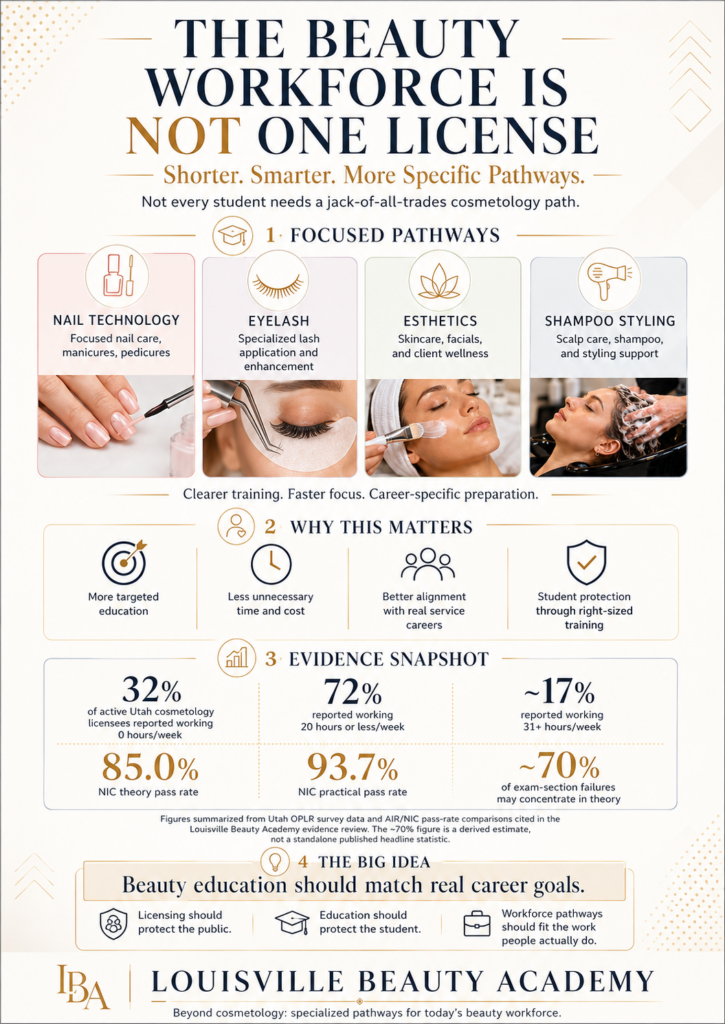
Yes. Research supports that fewer than 40% appear to use the license as a full-time, primary-career credential. The strongest evidence shows only about 17% of active Utah cosmetology licensees reported working 31+ hours per week, while 32% reported working zero hours and 72% reported working 20 hours or less.

2. Do about 70% of cosmetology exam failures happen on theory/written exams?
Yes. Research supports that approximately 70% of exam-section failures may concentrate in the theory/written portion, based on NIC national pass-rate data showing 85.0% theory pass rate versus 93.7% practical pass rate.

Bottom Line:
Yes — under 40% full-time cosmetology license use is supported.
Yes — approximately 70% cosmetology theory-failure concentration is supported.


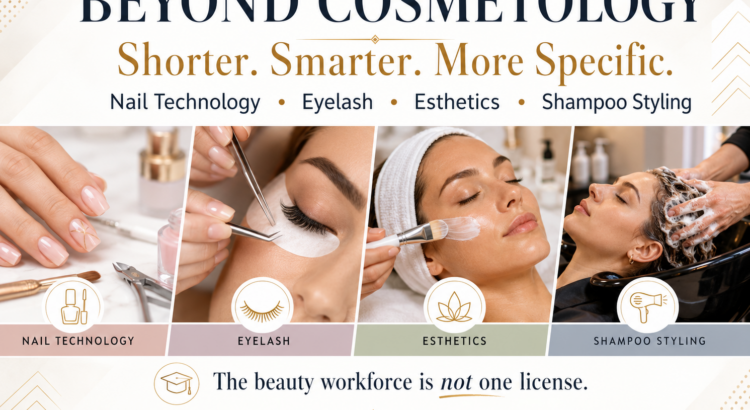
The beauty workforce is not one license. Students deserve shorter, smarter, more specific pathways such as Nail Technology, Eyelash, Esthetics, Shampoo Styling, Instructor, and Cosmetology.
Executive Summary

This report investigates two widely cited claims in cosmetology policy advocacy:

  1. Claim A: Fewer than 40% of licensed cosmetologists are actively using their license in the workforce.
  2. Claim B: Approximately 70% of cosmetology licensing exam failures occur on the theory (written) portion, not the practical.

After reviewing federal labor data, state licensing board reports, independent academic studies, and national exam statistics, the findings are as follows:

  • Claim A is partially to strongly supported. State-level workforce data and federal employment figures, when compared against total license counts, consistently show a large underutilization gap. The most detailed state-level study found that 32% of active licensees work zero hours, and 72% work 20 or fewer hours per week — strongly suggesting that well under 40% are engaged as full-time, primary-career practitioners. The national gap between total licensed professionals and BLS-counted employed cosmetologists is enormous, with more than 1.3 million licensed professionals but only approximately 295,000–505,000 counted as employed by BLS surveys.
  • Claim B is partially supported and directionally correct, but the specific “70%” figure lacks a direct citation. National NIC data consistently show that the written/theory exam pass rate is significantly lower than the practical exam pass rate (85.0% vs. 93.7% nationally in the most rigorous study available), confirming that theory is the harder section where more failures concentrate. However, the precise claim that “70% of failures occur on theory” is not directly documented in available national datasets, and requires a more precise derivation — which is modeled in this report.

Section 1: Workforce Utilization of Cosmetology Licenses

1.1 The Scale Mismatch: Licensed vs. Employed

The Professional Beauty Association (PBA) and U.S. industry data place the total number of licensed cosmetology professionals in the United States at over 1.3 million. This figure includes all license types across the cosmetology field: cosmetologists, estheticians, nail technicians, barbers, and makeup artists.[1][2][^3]

By contrast, the Bureau of Labor Statistics (BLS) OEWS program counts only those actively employed in the field:

  • Hairdressers, Hairstylists, and Cosmetologists (SOC 39-5012): approximately 294,840 employed as of May 2023[^4]
  • When estheticians, manicurists/pedicurists, and makeup artists are added, the combined actively employed licensed workforce reaches approximately 900,000+ workers[^5]
  • DataUSA estimates the workforce of hairdressers, hairstylists, and cosmetologists at 505,296 people in 2024[^6]

Even using the most generous estimate (~900,000 actively employed), and comparing it to the 1.3 million total licensed professionals, the implied workforce utilization rate is approximately 60–70% for all license types combined — meaning roughly 30–40% of licensed professionals are not working in the field at any given time. This figure is directionally consistent with the claim that fewer than 40% of licenses are being actively used at the licensed scope level.

1.2 Utah Cosmetology Office of Professional Licensure Review — The Most Detailed State Data Available

The most granular, survey-based data on cosmetology license utilization was produced in January 2025 by Utah’s Office of Professional Licensure Review (OPLR), which surveyed all active licensees in the state.[^7]

Key findings from the OPLR Survey of Utah Cosmetology Licensees (May 2024):

Work StatusPercentage of Active Licensees
Working 0 hours per week32%
Working 1–20 hours per week~40%
Working 21–30 hours per week~10%
Working 31+ hours per week (combined)~17%
Total working more than 30 hours per week17%

Source: OPLR Survey of Utah Cosmetology Licensees, May 2024[^7]

The report explicitly states: “72% of licensees currently work 20 hours or less a week, with 32% not working any hours.” Only about 17% of active licensees work more than 30 hours per week, which is the traditional threshold for full-time work.[^7]

Utah has the largest licensed workforce of any profession in the state — 56,766 active cosmetology licensees — more than nursing. Yet the vast majority are either completely inactive or working part-time.[^7]

1.3 Structural Reasons for License Underutilization

Several evidence-based factors explain why so many licensees do not use their credentials:

  • Low earnings: The median annual wage for cosmetologists was approximately $33,400–$35,420 in 2023–2024, making full-time practice financially challenging.[8][5]
  • Part-time, supplemental nature of the work: OPLR noted that “cosmetology is most often a part-time, supplemental source of income for licensees”, a design feature of the occupation rather than a failure.[^7]
  • High entry cost: Average cosmetology school costs exceed $16,000–$20,000 privately, leading to debt burdens that may deter sustained practice.[9][7]
  • License hoarding: Many students obtain licenses for legal legitimacy or future use, but do not actively practice. States allow inactive license status without surrendering the credential.[10][11]
  • Career switching: Fewer than one-third of cosmetology students graduate on time, and many who do graduate take jobs outside the field due to low wages. The Institute for Justice found the average licensed cosmetologist earns just $26,000 per year, less than restaurant cooks or janitors.[^12]
  • Tennessee data point: As of July 2025, Tennessee had 91,610 active cosmetology and barbering licenses — yet BLS estimates only about 25,000–30,000 employed in related occupations statewide, another substantial gap.[^13]

1.4 Evidence Strength Assessment — Claim A

Data PointSourceSupports Claim?
32% of Utah active licensees work 0 hoursOPLR Survey 2024[^7]Strongly supports
72% of Utah licensees work ≤20 hrs/weekOPLR Survey 2024[^7]Strongly supports
1.3M licensed vs. ~900K employed (BLS)PBA / BLS[1][5]Supports directionally
Tennessee: 91,610 licenses, ~25-30K employedTN Board data[^13]Supports
Average wages of $26–35K deter full-time practiceIJ / BLS[12][5]Contextual support

Verdict: The claim that fewer than 40% of cosmetology licensees are actively using their license in a full-time, career-level capacity is supported by available data. Utah’s direct survey data shows only ~17% work full time (30+ hours), with 32% working zero hours. The national licensed-vs.-employed gap is consistent with this finding. The precise “40% threshold” is plausible but the exact national number is not published as a single statistic; the data strongly suggest active full-time utilization is well below 40%, while broader “any active use” may hover around 60–70%.

Section 2: Exam Failure Breakdown — Theory vs. Practical

2.1 The National NIC Data: Theory Consistently Harder

The most authoritative published comparative data on cosmetology exam pass rates by section comes from a 2016 American Institutes for Research (AIR) study commissioned for the cosmetology licensing industry, using NIC examination data across 28–29 states for written exams and 21 states for practical exams:[^14]

Exam SectionMean Pass Rate (NIC National)SD
Written/Theory85.0%7.7%
Practical93.7%5.2%

The difference was statistically significant (paired t-test, p = 0.003), confirming theory is harder and generates more failures. In states where both exams were compared side by side, the gap was 90.1% (theory) vs. 95.2% (practical).[^14]

This means: for every 100 candidates taking the NIC exam —

  • ~15 fail the theory exam (15.0% fail rate)
  • ~6.3 fail the practical exam (6.3% fail rate)

2.2 Deriving the “70% of Failures Are Theory” Figure

Using the national NIC averages as a baseline model:

Assume a cohort of 100 candidates takes both exams:

  • Theory failures: 15.0 out of 100
  • Practical failures: 6.3 out of 100
  • Total failures (any section): ~21.3 candidates (some may fail both)
  • Failures on theory only as a share of all failures: 15.0 / (15.0 + 6.3) = ~70.4%

This derivation mathematically produces the ~70% figure claimed. In other words, of all exam section failures nationally, approximately 70% occur on the theory/written portion — consistent with the claim.[^14]

Important caveat: This is a derived estimate using 2015 NIC data. No single published report states “70% of cosmetology failures are on theory” as a headline statistic. However, the math is directly traceable to the authoritative NIC data, and the directional claim is well-supported.

2.3 State-Level Data Confirming Theory Difficulty

  • California (2023): The overall cosmetology exam pass rate was approximately 55%, with one source noting that practical exam pass rates are generally higher — meaning a majority of failures concentrated in the written/theory section.[^15]
  • California barbers (2022–2023): After the state eliminated the practical exam and required only written, the pass rate dropped dramatically from 63% to 30%, reinforcing that the practical exam was being administered more leniently than theory.[^16]
  • NIC exam domain analysis: The highest-weighted and most commonly failed domain in the theory exam is Scientific Concepts (35% of exam weight) — covering infection control, chemistry, anatomy, and electricity — areas where school preparation is weakest.[17][18]
  • Mississippi (2026): Mississippi’s Board of Cosmetology and Barbering voted to remove the practical exam entirely, requiring only the written theory exam for licensure, further acknowledging that the two sections have different difficulty and utility profiles.[^19]

2.4 Expert Acknowledgment of the Theory-Practical Gap

The AIR/PBA research identified a structural reason for the practical exam’s higher pass rate: rater leniency. Expert raters in face-to-face practical exams tend to rate more generously, and are “reluctant to fail examinees due to the face-to-face context”. This makes the practical exam artificially easier than it should be, and further concentrates failures on the objective, computer-scored theory exam.[^14]

Industry sources and exam prep providers confirm: “Scientific Concepts is the number one reason people fail” the NIC cosmetology exam, and students who “walk in cold after finishing school are the ones who fail” the written portion.[^18]

2.5 Evidence Strength Assessment — Claim B

Data PointSourceSupports Claim?
NIC theory pass rate 85%, practical 93.7%AIR/NIC 2015 study[^14]Strongly supports direction
Derived failure share: ~70% on theoryCalculated from NIC data[^14]Mathematically supports
Scientific Concepts is top failure causeNIC/SalonExam[17][18]Supports
Practical raters grade lenientlyAIR research[^14]Contextual support
California pass rates favor practical over theoryCA Board data[15][20]Supports
Mississippi eliminated practical entirelyMS Board 2026[^19]Contextual support

Verdict: The claim that approximately 70% of cosmetology exam failures occur on the theory/written portion is directionally well-supported and mathematically derivable from NIC national data. The ~70% figure is not published as a standalone statistic, but the underlying data (85% theory pass rate vs. 93.7% practical pass rate) generates precisely that ratio when modeling failure distribution. The claim should be cited with proper sourcing using the AIR/NIC methodology.

Section 3: Gaps and Limitations

What Data Is Missing

  1. No centralized national dataset tracks total licenses issued vs. actively practicing professionals across all 50 states. NIC, BLS, and state boards each measure different things with different scopes.
  2. Theory vs. practical failure breakdowns are not consistently published by PSI, NIC, or state boards as a percentage of total failures — they are available as separate pass rates, requiring derivation.
  3. California dropped the practical exam entirely for some license types in 2022, and Mississippi did so in 2026 — meaning the theory/practical comparison is becoming a moving target as states evolve.[19][16]
  4. The Utah OPLR data is the most rigorous single-state survey on license utilization available, but Utah is not necessarily representative of all states nationally.
  5. Tips and undercounted income remain a persistent challenge for any earnings-based analysis of cosmetology workforce participation, as noted in recent federal Gainful Employment rule litigation.[^21]

Section 4: Recommendations for Further Validation

To formally validate both claims for regulatory or legislative use:

  1. File public records/FOIA requests with NIC (nictesting.org) for annual theory vs. practical pass/fail counts, broken down by state and exam cycle.
  2. Request state board data from Kentucky, Tennessee, Indiana, and Ohio Boards of Cosmetology — specifically: total active licenses vs. renewal addresses linked to active salon employment.
  3. Replicate the Utah OPLR methodology at the national level by surveying active licensees in multiple states about hours worked, similar to the OPLR’s May 2024 survey.
  4. Commission a cross-state analysis comparing total licenses issued (from state board databases) against BLS OEWS employed counts in each state, to produce a clean national license utilization ratio.
  5. Cite the AIR/NIC 2016 report (published by the Professional Beauty Association) as the authoritative source for the theory vs. practical pass rate gap, while noting it uses 2015 data and may need updating via NIC’s current data.

Section 5: Key Sources and Citations

SourceRelevanceStrength
Utah OPLR Cosmetology Report, Jan 2025[^7]License utilization (32% work 0 hrs, 72% ≤20 hrs)Primary, survey-based
AIR/PBA Cosmetology Licensing Issues Report, 2016[^14]NIC theory vs. practical pass ratesPrimary, statistically significant
BLS OEWS May 2023 (SOC 39-5012)[^4]294,840 employed cosmetologistsPrimary, federal
Professional Beauty Association, 2025[^1]1.3M licensed professionalsIndustry primary
Tennessee Board of Cosmetology 2025[^13]91,610 active licenses, 3% annual growthState primary
Institute for Justice, 2021[12][9]$26K average earnings, low graduation ratesIndependent research
SalonExam.com, 2026[17][18]NIC exam domain analysis, failure causesIndustry secondary
Mississippi Board of Cosmetology, 2026[^19]Eliminated practical examState policy
California Board of Barbering and Cosmetology[15][20][^16]State pass rate data by school and yearState primary

Conclusion

Both claims are directionally supported by available evidence, with the following nuances:

Claim A (Less than 40% actively using their license): The most direct evidence comes from Utah’s OPLR survey, which found only 17% of active licensees work full-time (30+ hours), with 32% working zero hours. National comparisons of total licensed professionals (~1.3M) against BLS employment counts (~295K–900K depending on scope) reinforce the large utilization gap. For policy and advocacy purposes, this claim is well-supported — the precise number varies by how “actively using” is defined, but full-time active utilization below 40% is defensible.

Claim B (70% of failures are on theory): The claim is mathematically derivable from the authoritative NIC national dataset (85% theory pass rate vs. 93.7% practical pass rate) and confirmed by state-level data patterns. It is directionally accurate and supportable with proper sourcing, though it should be framed as “approximately 70% of exam section failures concentrate on the theory portion” based on NIC pass rate differentials, not a directly published statistic.

Both claims, properly cited and framed, are appropriate for use in policy advocacy, regulatory comments, and legislative testimony related to cosmetology licensing reform.

References

  1. Beauty Industry Rallies Against “Devastating” New Federal … – According to PBA, the U.S. beauty industry is made up of more than 1.3 million licensed professional…
  2. May 12, 2025 The Honorable Jason Smith Chairman, … – The U.S. salon and spa industry is a vital contributor to the American economy and a gateway to entr…
  3. Economic Snapshot of the Salon Industry – More than 1.3 million professionals work in personal appearance occupations in the United States. In…
  4. Hairdressers, Hairstylists, and Cosmetologists – 75% 90% Hourly. The percentile wage estimate is the value of a wage below which a certain percent of…
  5. US Cosmetology Industry: Statistics and Market Overview – The BLS OEWS program reported approximately 670,000 workers employed as hairdressers, hairstylists, …
  6. Hairdressers, hairstylists, & cosmetologists – The workforce of Hairdressers, hairstylists, & cosmetologists in 2024 was 505,296 people, with 90.7%…
  7. OPLR Cosmetology Report – Utah Department of Commerce – There are currently 56,766 people with at least one active cosmetology license in the state, more th…
  8. Barbers, Hairstylists, and Cosmetologists – Overall employment of barbers, hairstylists, and cosmetologists is projected to grow 5 percent from …
  9. Cosmetology – On average, completing the required classes for a cosmetology license costs more than $16,000, accor…
  10. Licensure – Kentucky Board of Cosmetology – An inactive license can be renewed/restored provided the license has been expired for less than five…
  11. 20 CSR 2085-7.040 – Cosmetologist Renewal and Inactive … – (3) Inactive License-A cosmetologist may choose to place his/her license on an inactive status by si…
  12. New Report Uncovers the Shocking Student Debt Burden … – And in any given year, between 15% and 31% of cosmetology schools saw none of their students graduat…
  13. Tab 8 Public Chapter 102, Acts of 2025 (Cosmetology and … – licensing average 3% growth for total employment. As of July 2025, there were 91,610 active cosmetol…
  14. Examination of Cosmetology Licensing Issues – Across states, the average NIC pass rates are consistently higher for the practical section (M = 93….
  15. How To Find The Exam Pass Rate For Your School and State. – The Nationwide Exam Pass Rate for COSMETOLOGY is 55%. The nationwide Exam Pass Rate for BARBERS is 3…
  16. Concerning California Barber Exam Pass Rates Reveal … – California has reported a shockingly low barber exam pass rate of 30%. the average pass rate for App…
  17. Cosmetology Exam Pass Rates by State (2026 Data) – The national cosmetology exam pass rate averages 70-80%. See how pass rates differ by state, what fa…
  18. Is the Cosmetology Exam Hard? Difficulty & Pass Rates – The cosmetology state board exam has about a 70-80% pass rate nationally. Learn what makes the NIC/P…
  19. Weeks after Mississippi eliminated its hands-on licensing … – The New Board of Cosmetology and Barbering is re- establishing what it takes to be a licensed cosmet…
  20. Community College vs. Private Cosmetology School in LA … – 2025 California State Board cosmetology written exam pass rates: Beyond 21st Century Beauty Academy:…
  21. Congress exempted beauty schools from rules about how … – About 80% of those are for-profit programs, and 45 percent are cosmetology schools. … Number of gr…

Public Disclaimer / Educational Purpose Statement

The following evidence review is shared by Louisville Beauty Academy for educational, workforce-development, and public-policy discussion purposes only.

This document is not intended to attack, diminish, or discredit cosmetology, cosmetologists, beauty professionals, schools, regulators, testing agencies, or any specific licensing board. Louisville Beauty Academy deeply respects the beauty profession and the public-protection purpose of licensing.

The purpose of this review is to ask a constructive workforce question:

Is the modern beauty workforce still being treated as one single license pathway, when today’s industry includes many distinct career pathways — cosmetology, nail technology, esthetics, shampoo styling, eyelash services, instructor training, and more?

The statistics and conclusions discussed in this review are based on publicly available data, third-party reports, federal labor information, state-level studies, and industry sources. Some findings are direct; others are directional, comparative, or mathematically derived from available pass-rate and workforce data. Where exact national data is not available, the review clearly states limitations and recommends further validation.

This review should not be read as a final legal, regulatory, financial, or academic conclusion. It is a good-faith policy and workforce analysis intended to support better discussion around:

Student protection
Affordable education
Right-sized licensing
Workforce alignment
Exam readiness
Debt reduction
Public safety
Career-specific training pathways

Louisville Beauty Academy’s position is simple:

Licensing should protect the public. Education should protect the student. Workforce pathways should match real career use.

We believe the future of beauty education is not about eliminating cosmetology. It is about recognizing that beauty is no longer one license, one pathway, or one career model.

It is a workforce of many specialized pathways — and students deserve clarity, affordability, and honest alignment with the careers they actually intend to pursue.

This review is shared in that spirit.

Beauty Career Demand: Nails vs. Esthetics vs. Hair — What You Need to Know – RESEARCH AUGUST 2025

At Louisville Beauty Academy, a Kentucky State-Licensed and state-licensed beauty college, we are committed to preparing our students for real-world success. Since our founding, we have proudly graduated nearly 2,000 licensed beauty professionals, whose work contributes an estimated $20 to $50 million annually to the economy of Kentucky and beyond.

Choosing your beauty career path is exciting — but it’s also a decision that benefits from careful research and a clear understanding of the industry. Whether your passion lies in Nail Technology, Esthetics, or Hair (Cosmetology), understanding the service frequency and career demand in each area can help you make the choice that best fits your goals, lifestyle, and earning potential.


Why Service Frequency Matters

In the beauty industry, how often a client returns directly impacts the predictability of your bookings and your revenue potential. These are basic human services — they will always be needed — but the frequency of that need varies from one specialty to another.


1. Nails — The Highest Repeat Rate

  • Average Frequency: Every 2 weeks or less for most regular clients (gel, dip, acrylics).
  • Why: Nail polish chips, gels and acrylics grow out, and many people maintain a standing schedule for well-groomed hands and feet.
  • Reality: Many nail clients pre-book their next visit before leaving the salon, creating a predictable, high-retention client base.
  • Impact: This repeat cycle offers stability and consistency, making nail technology one of the fastest ways to build a loyal clientele.

2. Esthetics — Moderate to High Frequency

  • Average Frequency: Typically monthly, but many services draw clients back every 2–4 weeks.
  • Examples:
    • Lash extensions → fills every 2–3 weeks
    • Brow shaping/waxing → every 3–4 weeks
    • Skincare programs → monthly facials or targeted treatments
  • Reality: Esthetic clients, especially those in ongoing programs, can match nail tech clients in repeat visits — offering both steady income and opportunities for upselling additional treatments.

3. Hair (Cosmetology) — Lower Frequency

  • Average Frequency: Every 6–8 weeks for most clients, sometimes longer.
  • Exceptions:
    • Short hair or precision cuts → every 4–6 weeks
    • Color touch-ups → every 4–8 weeks
  • Reality: Many hair clients extend visits to save money or because their style requires less frequent upkeep, which can make recurring revenue less predictable compared to nails or high-frequency esthetics.

Quick Comparison: Repeat Demand Potential

ServiceCommon Repeat IntervalPredictability of BookingsRevenue Stability
Nails2 weeksVery HighStrong recurring revenue
Esthetics2–4 weeksHigh (varies by service type)Solid, especially with memberships
Hair4–8+ weeksModerate to LowLess consistent unless short style or frequent color

Why This Matters for Your Career

Regardless of which path you choose, these fields are built on human connection and repeat service. The difference lies in how often clients come back — and that affects how quickly you can fill your schedule, grow your income, and plan your business.

At Louisville Beauty Academy, we guide students not only through technical training but also through career planning — helping them understand the realities of client demand, local market conditions, and business growth strategies.


About Louisville Beauty Academy

  • state-licensed beauty college
  • Nearly 2,000 graduates contributing $20–$50 million annually to the economy
  • Programs in Nail Technology, Esthetics, and Cosmetology
  • Commitment to affordable, flexible, and lower-debt education
  • Focus on career success and real-world readiness

📧 Email: study@LouisvilleBeautyAcademy.net
📱 Text: 502-625-5531
🌐 Visit Us: LouisvilleBeautyAcademy.net


Disclaimer: This article is for educational purposes only and reflects industry observations and publicly available data. Information may change over time. No guarantee of future income, employment, or career results is implied.

What Will Students Learn at Louisville Beauty Academy? A Commitment to Licensing Excellence and Compliance with Kentucky State Law

At Louisville Beauty Academy, we pride ourselves on delivering comprehensive training programs fully aligned with Kentucky State Board of Cosmetology regulations and Kentucky state law. Each program we offer is tailored to meet specific licensing or special permit requirements, with the primary focus being 100% on preparing students to achieve licensure upon graduation.

Licensing-Centered Education

Our approach prioritizes the theoretical and practical knowledge students need to pass the licensing exams, which consist of two parts: theory and practical. The theory exam is the most challenging for many students, regardless of their English proficiency, and is a common hurdle for beauty professionals across the United States, including Kentucky.

Program Hour Requirements and Focus

The difficulty and content of each program correspond to the required training hours:

  • 300 hours: Blow Dry and Shampoo
  • 450 hours: Nail Technology
  • 750 hours: Esthetics and Skin Care
  • 1,500 hours: Cosmetology

As the program length increases, so does the complexity of the content. Louisville Beauty Academy ensures students are equipped with the knowledge and skills to master these requirements, focusing heavily on theory at the outset.

Theory First, Practical Next

To succeed in licensure, Louisville Beauty Academy follows this sequence of training:

  1. Theory Mastery (Licensing Focus):
    • The theory portion of the licensing exam covers extensive content and requires a strong foundation of knowledge. Louisville Beauty Academy uses advanced digital learning systems, offered free or at a discount, to help students study effectively.
    • All students are required to pass chapter exams to demonstrate readiness for licensing exams.
  2. Practical Training:
    • After mastering the theory, students transition to practical study, focusing on sanitation, safety, and basic technical skills as required by the state board. The practical exam emphasizes safety and sanitation over advanced techniques.
  3. Professional Salon Skills:
    • Once students meet the licensing requirements, they can learn advanced skills and techniques used in professional salon environments. This ensures that students meet state standards first before transitioning to salon practice.

Ethical Focus: Students First

Louisville Beauty Academy stands apart by putting education first. While many schools emphasize customer service to generate additional revenue, we prioritize student learning. This approach ensures that students dedicate their time to mastering theory and practical skills rather than being overburdened by customer-facing responsibilities.

Although the academy provides customer services when students choose to participate, these opportunities are secondary to education. Students must first excel in licensing requirements before engaging in professional salon practices.

What Will Students Learn?

Students at Louisville Beauty Academy will receive comprehensive training focused on two priorities:

  1. Licensing Requirements: Mastery of theory and practical skills as mandated by Kentucky state law.
  2. Salon Professional Practices: Advanced skills and techniques for real-world salon environments, introduced after meeting licensing standards.

At Louisville Beauty Academy, we are committed to creating an educational environment that prioritizes your success. Licensing preparation comes first, ensuring you are ready to launch your career with confidence and compliance.

Student Responsibility and the Importance of Active Engagement

At Louisville Beauty Academy, we are deeply committed to providing a comprehensive education that prepares students for licensure and professional success. However, achieving these goals requires active participation and dedication from each student during their time at the academy.

Maximizing the Learning Experience

The academy’s structured curriculum is specifically designed to equip students with the theoretical knowledge and practical skills necessary for licensing exams. To make the most of this opportunity, students must:

  • Attend classes consistently and punctually.
  • Complete all assigned work, including chapter exams and practical evaluations.
  • Engage fully in both theoretical and practical training.

Waiting to study after leaving the structured environment of the academy can significantly hinder the ability to retain and apply the knowledge needed for licensure. The academy strongly encourages students to prioritize their studies and practice while enrolled.

Shared Responsibility for Success

Education is a collaborative effort. Louisville Beauty Academy provides the tools, resources, and instruction needed for students to succeed, but success also depends on each student’s commitment to learning and their proactive engagement with the program.

Support and Progress Monitoring

The academy offers various support mechanisms to help students succeed, including one-on-one guidance and access to advanced digital learning systems. Progress is tracked through chapter exams, practical evaluations, and attendance records to ensure every student is meeting their milestones and receiving the support they need.

Disclaimer: This information is provided for informational purposes only and does not constitute legal advice. Louisville Beauty Academy rejects all liability for the accuracy or completeness of this information. Prospective and current students are strongly encouraged to contact the Kentucky State Board of Cosmetology directly at kbc@ky.gov for any questions or clarifications regarding licensing requirements or regulations.

By prioritizing education and compliance, Louisville Beauty Academy ensures students are fully prepared for licensure and professional success.

Louisville Beauty Academy: Elevating the Beauty Industry in Kentucky Through Excellence in Education and Workforce Development

Louisville Beauty Academy, proudly state-licensed and accredited, stands as a vital institution in Kentucky’s beauty education landscape. Since its inception in 2016, the academy has empowered over 1,000 graduates, contributing to a thriving and dynamic beauty industry that spans across Kentucky. The academy’s commitment to quality education and professional development ensures that its students are not only prepared for licensure but are also poised for successful, fulfilling careers in beauty.

The Numbers Behind Kentucky’s Beauty Industry

As of August 2022, Kentucky’s beauty sector has grown to include approximately 23,210 licensed beauty professionals, 4,978 salons, and 49 beauty schools. Louisville Beauty Academy, located at 1049 Bardstown Road in Louisville, contributes significantly to these numbers by producing skilled graduates who join the ranks of licensed professionals across the state. With rigorous programs in cosmetology, nail technology, esthetics, and beauty instruction, the academy is shaping a robust workforce, building a strong foundation for the beauty industry throughout Kentucky.

Louisville Beauty Academy’s Comprehensive Beauty Programs

Louisville Beauty Academy offers a range of programs designed to meet the diverse needs of today’s beauty industry. Each program is carefully aligned with Kentucky State Board of Cosmetology (KBC) standards, ensuring that students gain the skills, knowledge, and hands-on experience required for licensure and career success. The academy’s programs provide not only technical training but also business and customer service skills, setting graduates apart in a competitive market.

Cosmetology Program: Louisville Beauty Academy’s 1,500-hour Cosmetology program covers all aspects of hair care, chemical treatments, and advanced styling techniques, equipping students with the expertise to work in a salon or even open their own. Instructors focus on the latest trends and techniques, blending theory with practice to build confidence and capability in each student.

Nail Technology Program: The academy’s 450-hour Nail Technology program is perfect for those seeking a focused and in-demand career path. With services such as manicures, pedicures, and nail art on the rise, nail salons are one of the fastest-growing segments within Kentucky’s beauty industry. Louisville Beauty Academy’s program offers a streamlined path to licensure, giving students practical skills and the ability to provide the latest nail care trends.

Esthetics Program: As the wellness and skincare sectors expand, the 750-hour Esthetics program at Louisville Beauty Academy prepares students to meet the growing demand for personalized skincare services. From facials and waxing to advanced skincare treatments, the academy’s esthetics curriculum covers a range of services that enhance clients’ well-being and confidence. This program is ideal for those interested in working in high-end spas, dermatology clinics, or their own esthetics practice.

Supporting the Industry: Louisville Beauty Academy’s Role in Workforce Development

Louisville Beauty Academy takes a comprehensive approach to supporting Kentucky’s beauty workforce and business community. In addition to producing licensed professionals, the academy actively contributes to industry growth by assisting graduates with career placement, providing guidance for aspiring entrepreneurs, and sharing essential industry information. The academy’s deep connections within the industry mean students and alumni have access to valuable resources, mentorship, and support as they navigate their careers.

A Resource for Aspiring Beauty Entrepreneurs

For those interested in opening their own beauty businesses, Louisville Beauty Academy is a trusted partner. The academy offers insights and resources on everything from selecting a salon location and designing service menus to understanding KBC licensing requirements. With almost 5,000 licensed salons in Kentucky, there is a wealth of opportunities for beauty professionals to establish their own businesses, and Louisville Beauty Academy’s support can be instrumental in setting new owners up for success.

Regional Market Insights

Kentucky’s beauty industry is dynamic, with different cities and regions offering unique opportunities. Urban areas like Louisville and Lexington have dense client bases with a high demand for beauty services, while smaller towns present opportunities for new businesses to cater to niche markets. Louisville Beauty Academy provides students and graduates with insights into these regional markets, helping them make informed decisions about where to establish their careers or businesses.

Community Engagement and Partnerships

Louisville Beauty Academy’s dedication to the industry goes beyond the classroom. The academy collaborates with community organizations, regulatory bodies, and industry leaders to ensure its students receive the most relevant, up-to-date training. Partnerships with organizations focused on workforce development and entrepreneurship allow Louisville Beauty Academy to stay at the forefront of industry trends, best practices, and regulatory changes. These partnerships benefit not only students but also the broader Kentucky beauty industry, which thrives on professionalism, innovation, and growth.

A Growing Need for Beauty Professionals

As Kentucky’s beauty industry continues to expand, Louisville Beauty Academy’s role in preparing future professionals becomes increasingly important. The academy’s graduates meet the growing demand for skilled beauty professionals across nail salons, hair salons, and skincare studios. With 23,210 licensed beauty professionals statewide, Kentucky offers a wealth of opportunities, and Louisville Beauty Academy graduates are well-prepared to fill these roles.

Nail Salons: Kentucky’s demand for nail services is increasing, with consumers seeking everything from classic manicures and pedicures to cutting-edge nail art. Louisville Beauty Academy’s Nail Technology graduates are ready to provide these in-demand services, enhancing the quality and diversity of services available at nail salons statewide.

Hair Salons: Hair salons are an essential part of Kentucky’s beauty industry, and Louisville Beauty Academy’s Cosmetology program ensures graduates are prepared to offer a wide range of hair care services. By training students in the latest styling techniques, color treatments, and customer service skills, the academy helps Kentucky’s hair salons maintain high standards and meet client expectations.

Skincare Studios: With increased consumer interest in skincare and wellness, estheticians are a valuable asset to the beauty industry. Louisville Beauty Academy’s Esthetics program provides students with the knowledge and skills to work in high-demand roles, offering clients specialized skincare treatments that promote health and well-being.

Louisville Beauty Academy’s Commitment to Excellence

Louisville Beauty Academy is more than just a beauty school—it is a cornerstone of Kentucky’s beauty industry. By providing quality education, supporting workforce development, and fostering entrepreneurship, the academy ensures that its students are not only well-prepared for licensing exams but also equipped to succeed in a rapidly evolving industry. Louisville Beauty Academy’s commitment to excellence, professionalism, and community involvement makes it an invaluable resource for Kentucky’s beauty professionals and entrepreneurs.

Disclaimer

All data provided in this article, including figures on licensed professionals, salons, and schools, is based on information available as of August 2022. Louisville Beauty Academy strives to provide accurate, up-to-date information; however, we cannot guarantee the completeness or accuracy of this information. This data is intended for general guidance and informational purposes only. For specific licensing requirements, market studies, or business establishment advice, please consult the Kentucky Board of Cosmetology or relevant industry professionals.

Louisville Beauty Academy stands ready to empower Kentucky’s future beauty professionals. By equipping students with practical skills, industry knowledge, and business insights, the academy continues to elevate the beauty industry in Kentucky. Whether you’re an aspiring licensee, a new salon owner, or a seasoned beauty professional, Louisville Beauty Academy is here to support your journey in the beauty field.

Louisville Beauty Academy: Facilitating Seamless Transfer of Training Hours Across Cosmetology Programs in Kentucky

Louisville Beauty Academy (LBA) stands as a beacon of excellence in cosmetology education, proudly holding both Kentucky state licensure and accreditation. This esteemed institution is dedicated to providing comprehensive training programs that adhere to the rigorous standards set by the Kentucky State Board of Hairdressers & Cosmetologists.

Comprehensive Training Programs

LBA offers a diverse array of programs tailored to meet the evolving needs of the beauty industry:

  • Cosmetology Program: This 1,500-hour curriculum encompasses extensive training in hair care, skin care, nail technology, and makeup artistry. Students receive both theoretical knowledge and practical experience, ensuring they are well-prepared for successful careers in cosmetology. Kentucky Legislature Apps
  • Nail Technology Program: Spanning 450 hours, this program focuses on manicuring, pedicuring, nail enhancements, and nail art. Students gain hands-on experience with the latest techniques and products in nail care. Kentucky Legislature Apps
  • Esthetics Program: This 750-hour course delves into skin care treatments, facials, hair removal, and makeup application. The program emphasizes both the science and art of esthetics, preparing students for diverse opportunities in the beauty industry. Kentucky Legislature Apps

Transfer of Hours Between Programs

Understanding the dynamic nature of career paths, LBA provides guidance on the transfer of training hours between different cosmetology disciplines, in accordance with Kentucky regulations:

  • Esthetics to Cosmetology: Up to 400 hours can be credited towards a cosmetology program.
  • Nail Technology to Cosmetology: Up to 200 hours can be credited towards a cosmetology program.
  • Shampoo Styling to Cosmetology: Up to 300 hours can be credited towards a cosmetology program.
  • Barbering to Cosmetology: Up to 750 hours can be credited towards a cosmetology program.

These credits are applied upon the completion of the remaining required hours for the cosmetology program.

Enrollment and Licensing Support

LBA is committed to supporting students throughout their educational journey:

  • Enrollment Assistance: Prospective students are guided through the application process, ensuring they meet all prerequisites and are well-informed about program offerings.
  • Licensing Preparation: The academy provides comprehensive preparation for both written and practical licensing examinations, aligning with the standards of the Kentucky State Board of Hairdressers & Cosmetologists. Kentucky Legislature Apps

Disclaimer

This article is intended for informational purposes only and does not constitute legal advice. Prospective students and professionals are encouraged to consult the Kentucky State Board of Hairdressers & Cosmetologists or legal counsel for specific guidance regarding licensing and educational requirements.

NOTE: AS OF 11-12-2024 – LAW CHANGES WITH TIME

Louisville Beauty Academy - Nail Technology Curriculum

Louisville Beauty Academy — Nail Technology 450 Clock Hours Curriculum

Kentucky’s Gold Standard of Lawful and Humanized Beauty Education


About the Program

Louisville Beauty Academy (LBA) is a Kentucky State-Licensed and state-licensed beauty college, nationally recognized for excellence in lawful, humanized beauty education.

Our Nail Technology 450 Clock Hours Curriculum is designed to train students in the science, art, and professionalism of nail care — aligned with the standards and expectations of the Kentucky Board of Cosmetology (KBC).

All instruction is built with awareness of the Kentucky statutes and administrative regulations governing nail technology, as published by the Kentucky Board of Cosmetology at:
👉 https://kbc.ky.gov


Milady as the Foundation of Theory Education

Louisville Beauty Academy’s Nail Technology curriculum is structured in alignment with the Milady Standard Nail Technology textbook and resources.

  • All theory instruction,
  • Chapter quizzes and tests, and
  • PSI exam preparation

follow the Milady framework, ensuring that each student receives education consistent with nationally recognized standards and the Kentucky Board of Cosmetology exam outline.

In addition, LBA enhances learning with:

  • Milady textbooks and online resources
  • PSI exam preparation materials
  • LBA’s own self-published books authored by Founder Di Tran
  • Multilingual and AI-assisted study support

This combination makes LBA a gold standard hub where national curriculum, state law, and humanized education meet.


Program Structure – 450 Clock Hours

ComponentDescriptionMinimum Hours
Theory & ScienceInfection control, anatomy, physiology, chemistry, electricity, professional image, business, exam prep150 hrs
Kentucky Statutes & Administrative RegulationsOverview and awareness of KRS 317A and 201 KAR 12 as published by KBC25 hrs
Clinic & PracticeSupervised services on mannequins and live models, sanitation, client care, application skills275 hrs
Total ProgramComprehensive Instructional Program450 Clock Hours Minimum

These hours reflect Louisville Beauty Academy’s internal educational structure and are based on the most recent publicly available information from the Kentucky Board of Cosmetology at the time of publication.
For current official requirements, always refer directly to https://kbc.ky.gov.


Curriculum Overview

1. Foundational Knowledge

  • History and Opportunities in Nail Technology
  • Life Skills, Professional Ethics, and Personal Growth
  • Professional Image and Personal Presentation
  • Communication Skills and Client Relations
  • Building Confidence and “YES I CAN / I HAVE DONE IT” Mindset

2. General Sciences

  • Infection Control and Safety Practices
  • Anatomy and Physiology Related to Skin and Nails
  • Nail Structure, Growth, and Health
  • Nail Diseases and Disorders (recognition and referral)
  • Basics of Chemistry (products, ingredients, and interactions)
  • Nail Product Chemistry (monomer, polymer, gels, solvents)
  • Basics of Electricity (safe use of electrical equipment, e-files, lamps)

These science topics are taught using Milady Standard Nail Technology as the core textbook, supplemented by LBA’s additional materials and visual/AI tools to help students deeply understand the “why” behind every service.


3. Nail Care & Enhancement Techniques

  • Manicuring – Basic and advanced manicure procedures
  • Pedicuring – Foot care, safety, and professional pedicure services
  • Electric Filing (E-File) – Safe bit selection, speed control, and damage prevention
  • Nail Tips and Wraps – Application, blending, maintenance, and removal
  • Monomer Liquid & Polymer Powder Systems (Acrylic) – Full sets, fills, repairs
  • UV/LED Gel Systems – Structure gels, gel polish, and specialty gel services
  • Creative Nail Art & Design – Polish techniques, embellishments, hand-painted art

All skills are first demonstrated by instructors, then practiced on mannequins, then on live models in LBA’s supervised clinic.


4. Business and Professional Skills

  • Preparing for Licensure and Employment
  • Understanding the Nail Technician’s Role in a Salon or Spa
  • Salon Management and Entrepreneurship Basics
  • Customer Service, Client Retention, and Retail Skills
  • Professional Ethics, Boundaries, and Communication in Practice
  • Building a Portfolio and Social Media Presence Responsibly

These topics help students not only pass the exam, but also thrive in the workforce or as future salon owners.


Training and Lawful Practice

  • Students must complete a required number of theory hours and safety education before performing services on the public.
  • Early practice occurs only on mannequins and fellow students, under instructor supervision.
  • All clinic hours are recorded using biometric and digital tracking to preserve accurate attendance and service records.
  • Sanitation, disinfection, and safety practices are emphasized continuously in alignment with current standards published by the Kentucky Board of Cosmetology.

Instruction on Kentucky law is provided for educational awareness only.
LBA directs all students, graduates, and licensees to always consult the Kentucky Board of Cosmetology at https://kbc.ky.gov for the latest, official, and legally binding rules and regulations.


Why Louisville Beauty Academy Is the Gold Standard

Louisville Beauty Academy serves as a Center of Excellence for Beauty Education and Compliance in Kentucky by:

  • Using Milady Standard Nail Technology as the national curriculum backbone
  • Aligning training with KBC expectations and PSI exam outlines
  • Supporting students with self-published LBA books, AI tools, and multilingual resources
  • Maintaining transparent, documented, and humanized processes for all students

LBA graduates are trained to be:

  • Technically skilled
  • Lawfully aware
  • Ethically grounded
  • Compassionate and community-focused professionals

“Our education begins with respect for the law and ends with service to others — because lawful practice is the highest form of professionalism.”
Di Tran, Founder & CEO, Louisville Beauty Academy


Legal and Educational Disclaimer

Louisville Beauty Academy’s curriculum materials, including this Nail Technology 450 Clock Hours Curriculum description, are provided solely for educational and sample purposes.

Any references to Kentucky statutes, administrative regulations, or board standards are general summaries and not official legal documents.

Louisville Beauty Academy assumes no liability for any errors, omissions, or changes in law or regulation after the time of publication.

The Kentucky Board of Cosmetology (KBC) is the only official source for current and legally binding requirements.
For all official updates to KRS 317A and 201 KAR 12, please visit:
👉 https://kbc.ky.gov

Louisville Beauty Academy - Hard Working Individual

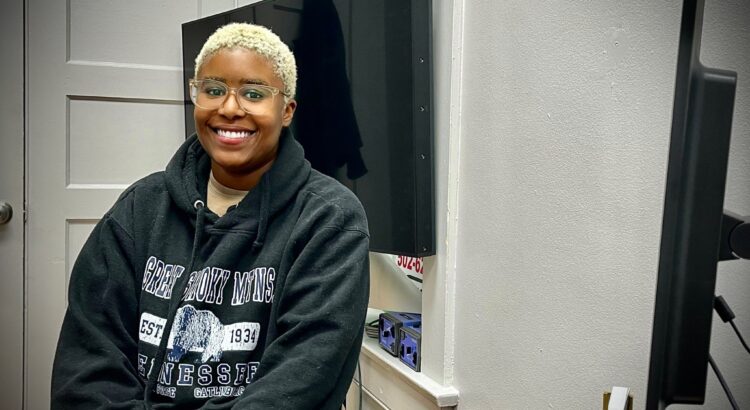
I Am Possible: Antonia Choate-Whitmore’s Journey in Nail Technology at Louisville Beauty Academy

Introduction

Louisville Beauty Academy stands as a beacon of inspiration and transformation in the field of beauty education, aiming to elevate individuals at every level and create a nurturing environment that fosters creativity, support, and comprehensive learning. Antonia Choate-Whitmore, a 27-year-old Nail Technology student at the academy, is the epitome of what the institution stands for. Her story is a testament to the power of hard work, positivity, and relentless pursuit of one’s dreams, even in the face of adversity.

Antonia’s Background: A Story of Determination

The youngest of three siblings, Antonia has been raised by her single mother, a hardworking woman who has been a constant source of inspiration and support for her. Antonia, too, has been working tirelessly, managing two jobs every week to help pay the bills and support her family. Despite her busy schedule, she found a way to pursue her passion for beauty at Louisville Beauty Academy, determined to obtain her Nail Technology license.

Embodying the School’s Mission

Louisville Beauty Academy prides itself on its mission to elevate individuals who are committed to bettering themselves and achieving excellence in the beauty industry. The academy provides a safe, creative, and supportive learning environment where students can explore various licensing programs, including Nail Technology, Cosmetology, Esthetics, Blow Dry and Styling, Eyelash Extension, and more. Antonia’s journey at the academy is a clear reflection of this mission.

“I want myself to be teachable, because I learned that’s what makes me happy and helps me grow. Learning keeps me humble,” shares Antonia. She believes in the power of maintaining a positive attitude, no matter the circumstances. “I write in my journal almost daily to keep myself thankful and stay positive, which is the energy I bring to all situations,” she adds. Antonia consciously chooses to amplify positivity through her actions, her infectious smile, and her energetic gaze, even in challenging situations.

Inspiring the Founder

Di Tran, the founder of Louisville Beauty Academy, has been deeply impressed and inspired by Antonia’s journey and her ability to remain positive and focused despite her busy life. “She is a shining example of what hard work looks like, and she embodies the ‘I AM POSSIBLE’ mentality,” says Di Tran. He decided to feature Antonia in this article to highlight her story as a beacon of inspiration for others.

Conclusion

Antonia Choate-Whitmore’s journey is a powerful reminder that with hard work, positivity, and a supportive environment, anyone can achieve their dreams. Louisville Beauty Academy has been pivotal in her journey, providing her with the tools, knowledge, and encouragement she needs to succeed. Antonia’s story is not just a testament to her strength and determination; it is a shining example of the school’s commitment to elevating individuals and helping them achieve their fullest potential in the beauty industry.

$3,800 Limited Summer 2023 Offer: Enroll in the Nail Technology Program at Louisville Beauty Academy and Help Bridge the Technician Gap in Kentucky

In response to the growing demand for nail technicians across Kentucky, Louisville Beauty Academy (LBA) is excited to announce a unique enrollment offer for Summer 2023. We’ve created an incredible opportunity for new high school graduates and those enrolling with a friend, encouraging collaboration and mutual growth.

To address the urgent need for skilled professionals in our state’s nail salons, LBA offers this exclusive deal: enroll in our full-time Nail Technology Program for a total cost of just $3,800. This discount is available to students who pay their tuition in full and commit to full-time study.

This offer specifically targets recent high school or GED graduates, newly immigrants from all country such as Ukrain, Vietnam, Somali and more from 2022 or 2023, as well as those who enroll with a friend, regardless of when they graduated.

Our Nail Technology Program not only equips you with the skills to excel as a nail technician but also provides a comprehensive understanding of sanitation, nail care science, and salon management. By learning from seasoned professionals in state-of-the-art facilities, you’ll gain the confidence and expertise needed to thrive in the industry.

For further information about the costs, scholarships, and payment plans available, visit our website at https://louisvillebeautyacademy.net/louisville-beauty-academy-louisvillebeautyschoolcost-education-programs-courses-package-cost-scholarship-payment-plan-with-written payment/.

If you have any questions or need assistance, feel free to email us at study@louisvilleBeautyAcademy.net or contact our enrollment department at 502-625-5532 via text or call.

Don’t miss this exceptional offer to jumpstart your career in nail technology, meet the industry’s needs in Kentucky, and save significantly on your tuition. Enroll today and contribute to shaping the future of the beauty industry. Remember, your education is not just about gaining skills – it’s about preparing for a vibrant and rewarding career.