THE COMPLETE ESTHETICIAN LICENSING MASTER BOOK – Comprehensive Theory • Safety • Client Care • Licensing Readines – CHAPTER 18 – SUN EXPOSURE, AGING & SKIN PROTECTION, CHAPTER 19 – LAWS, RULES & PROFESSIONAL CONDUCT, CHAPTER 20 – LICENSING EXAM STRATEGY & TEST READINESS – DECEMBER 2025

Louisville Beauty Academy Public Library & Transparency Model

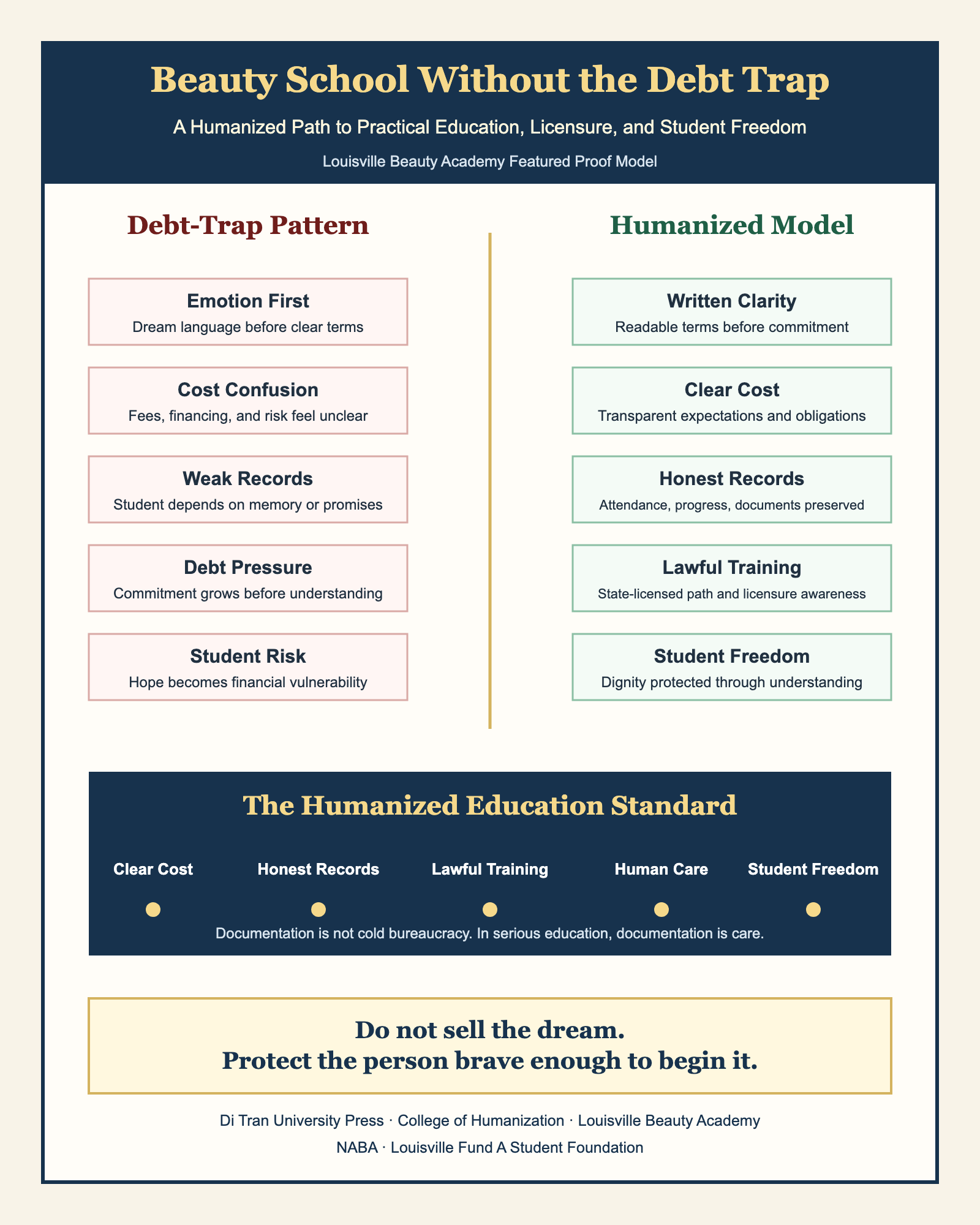
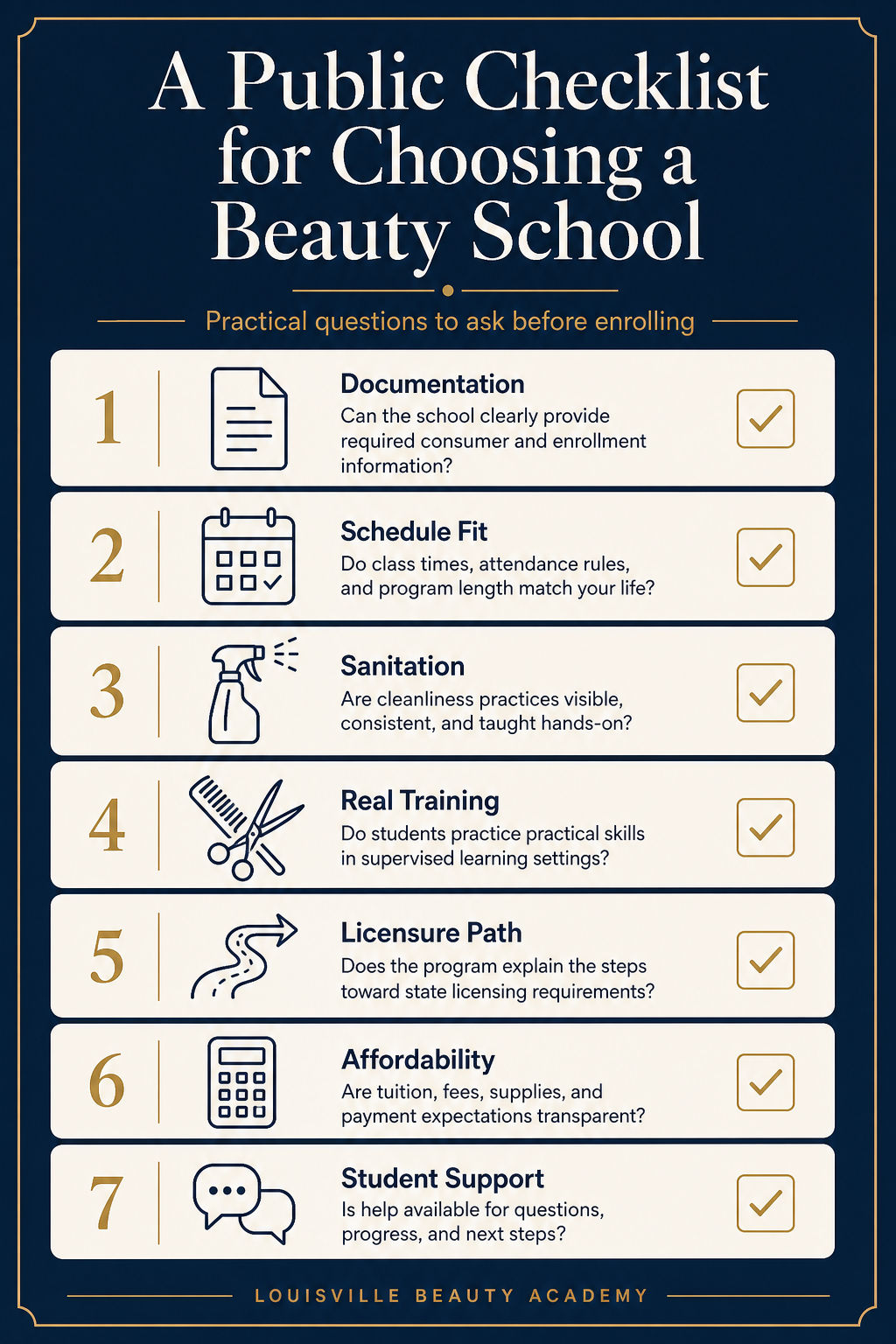
Louisville Beauty Academy (LBA) operates under a compliance-by-design educational framework that prioritizes lawful instruction, public safety, and equitable access to workforce education.

As part of this framework, Louisville Beauty Academy maintains a Public Educational Library that makes selected instructional materials for esthetics licensure openly accessible for educational reference. These materials are provided solely for educational purposes, without guarantee, inducement, or representation of outcomes, and are intended to support theoretical understanding, safety awareness, and professional responsibility.

This initiative reflects LBA’s commitment to:

  • Transparency in curriculum
  • Barrier-reduction in education
  • Equitable access to licensing knowledge
  • Alignment with state and federal workforce development goals
  • Public-interest education over proprietary restriction

All materials are:

  • Curriculum-aligned
  • Safety-first
  • Scope-of-practice compliant
  • Non-diagnostic and non-medical
  • Supplementary to formal instruction and independent study

Louisville Beauty Academy does not guarantee licensure, employment, or exam outcomes. Learners remain responsible for their own preparation, study, and compliance with all applicable licensing requirements.

Educational Philosophy

LBA’s instructional philosophy recognizes that learning is iterative. Students are encouraged to engage in disciplined study, accept failure as part of the learning process, refine understanding, and improve through repetition and responsibility.

This approach aligns with evidence-based workforce education models that emphasize:

  • Competency over speed
  • Safety over shortcuts
  • Ethics over convenience

Public Benefit & Workforce Alignment

By making core instructional references accessible, Louisville Beauty Academy contributes to:

  • Workforce readiness
  • Licensing literacy
  • Consumer protection
  • Public safety
  • Long-term professional sustainability

This model supports the broader objectives of:

  • State education agencies
  • Workforce innovation programs
  • Federal and non-federal grant initiatives
  • Public-private educational partnerships

Institutional Position

Louisville Beauty Academy operates as a licensed, transparent, and accountable educational institution, committed to continuous compliance, documentation, and regulatory cooperation.

This Public Library initiative is part of LBA’s future-ready education model, designed to scale access while preserving legal, ethical, and professional standards.


Louisville Beauty Academy
A Compliance-By-Design Education Model
Public Safety • Lawful Practice • Educational Transparency

CHAPTER 18 – SUN EXPOSURE, AGING & SKIN PROTECTION


WHY THIS CHAPTER MATTERS

Sun exposure is the leading cause of premature skin aging and a major risk factor for skin damage. Licensing examinations frequently test an esthetician’s understanding of ultraviolet (UV) radiation, sunscreen function, and safe client education practices.

Estheticians do not diagnose or treat skin cancer, but they play an important role in educating clients on protection and prevention.


ULTRAVIOLET (UV) RADIATION

Sunlight contains ultraviolet radiation, which affects the skin.

TYPES OF UV RAYS

UVA RAYS

  • Penetrate deeply
  • Responsible for photoaging
  • Cause wrinkles and loss of elasticity
  • Present year-round

UVB RAYS

  • Affect the surface layers of skin
  • Cause sunburn
  • Contribute to skin damage
  • Intensity varies by season

Licensing exams frequently test differences between UVA and UVB.


EFFECTS OF SUN EXPOSURE ON THE SKIN

Sun exposure can cause:

  • Wrinkles
  • Fine lines
  • Uneven pigmentation
  • Loss of elasticity
  • Rough texture
  • Increased sensitivity

Cumulative sun damage occurs over time, not just from burns.


PHOTOAGING

Photoaging refers to premature aging caused by UV exposure.

Signs include:

  • Deep wrinkles
  • Sagging skin
  • Hyperpigmentation
  • Broken capillaries

Photoaging is preventable with proper protection.


SKIN CANCER AWARENESS (EDUCATIONAL ONLY)

Estheticians may:

  • Observe changes in skin
  • Encourage clients to seek medical evaluation

Estheticians may not:

  • Diagnose skin cancer
  • Treat suspicious lesions

Any suspicious lesion should be referred to a licensed medical professional.


SUNSCREEN (CRITICAL EXAM TOPIC)

PURPOSE OF SUNSCREEN

  • Protects skin from UV radiation
  • Reduces risk of sun damage
  • Supports skin health after treatments

SPF (SUN PROTECTION FACTOR)

SPF measures protection against UVB rays.

  • Higher SPF offers greater UVB protection
  • SPF does not indicate duration of exposure

TYPES OF SUNSCREEN

PHYSICAL (MINERAL) SUNSCREENS

  • Reflect UV rays
  • Sit on the skin’s surface
  • Often contain zinc oxide or titanium dioxide

CHEMICAL SUNSCREENS

  • Absorb UV rays
  • Convert them to heat
  • Must be applied properly for effectiveness

WHEN SUNSCREEN IS ESSENTIAL

Sunscreen should be applied:

  • After exfoliation
  • After chemical exfoliation
  • During daytime services
  • When skin is exposed to sunlight

Skipping sunscreen after exfoliation is a common exam trap.


CLIENT EDUCATION & PREVENTION

Clients should be advised to:

  • Use sunscreen daily
  • Reapply sunscreen as needed
  • Avoid peak sun hours
  • Wear protective clothing

Education must be general and non-medical.


AGING & ESTHETIC PRACTICE

Aging skin requires:

  • Gentle products
  • Hydration support
  • Sun protection
  • Avoidance of aggressive treatments

Aging is natural; esthetics supports appearance and comfort.


COMMON LICENSING EXAM TRAPS

  • Confusing UVA and UVB rays
  • Believing SPF measures exposure time
  • Skipping sunscreen after exfoliation
  • Diagnosing skin cancer
  • Overpromising results

PRACTICE QUESTIONS – LICENSING STYLE

1. Which UV rays are responsible for photoaging?

A. UVB
B. UVA
C. UVC
D. Infrared

Correct Answer: B
Explanation: UVA rays penetrate deeply and cause aging.


2. What does SPF measure?

A. Protection from all UV rays
B. Protection from UVA rays
C. Protection from UVB rays
D. Time in the sun

Correct Answer: C


3. When is sunscreen MOST important?

A. At night
B. After exfoliation
C. During massage
D. Before cleansing

Correct Answer: B


4. Which type of sunscreen reflects UV rays?

A. Chemical
B. Mineral
C. Acidic
D. Alkaline

Correct Answer: B


5. What should an esthetician do if a suspicious lesion is observed?

A. Treat it
B. Ignore it
C. Refer to medical professional
D. Cover with makeup

Correct Answer: C


(Full book version includes 20–25 licensing-style questions with detailed explanations.)


CHAPTER SUMMARY

  • Sun exposure causes premature aging
  • UVA and UVB rays affect skin differently
  • Sunscreen is essential after treatments
  • Estheticians educate, not diagnose
  • Prevention protects skin long-term

CHAPTER 19 – LAWS, RULES & PROFESSIONAL CONDUCT


WHY THIS CHAPTER MATTERS

Licensure is a legal authorization to practice, not a personal achievement alone. Licensing examinations test whether an esthetician understands legal boundaries, professional responsibilities, and ethical conduct. Many exam questions are designed to identify candidates who might place the public at risk by practicing outside the law.

Violations of laws and rules can result in:

  • Fines
  • License suspension
  • License revocation
  • Permanent disciplinary records

Knowing the law protects the client, the practitioner, and the profession.


PURPOSE OF LICENSING LAWS

Licensing laws exist to:

  • Protect public health and safety
  • Establish minimum competency standards
  • Define scope of practice
  • Regulate professional conduct

Licensure is not optional; it is a legal requirement.


SCOPE OF PRACTICE (CRITICAL EXAM TOPIC)

The scope of practice defines what a licensed esthetician may and may not do.

WITHIN SCOPE

  • Skin analysis
  • Facials
  • Temporary hair removal
  • Makeup application
  • Cosmetic exfoliation
  • Client education

OUTSIDE SCOPE

  • Medical diagnosis
  • Treating diseases
  • Performing medical procedures
  • Prescribing medications
  • Permanent hair removal (unless specifically permitted)

Licensing exams often ask which action is outside scope.


LICENSE REQUIREMENTS & RESPONSIBILITIES

Licensed estheticians must:

  • Hold a valid, current license
  • Renew licenses as required
  • Practice only in licensed establishments
  • Display licenses when required
  • Follow all rules and regulations

Practicing without a license is illegal.


PROFESSIONAL ETHICS

Ethics guide professional behavior beyond technical skill.

Ethical Responsibilities Include

  • Honesty
  • Integrity
  • Client confidentiality
  • Respect for boundaries
  • Accurate representation of services

Unethical behavior may result in disciplinary action.


CLIENT CONFIDENTIALITY

Client information must be:

  • Kept private
  • Used only for professional purposes
  • Shared only when legally required

Discussing client information improperly is unethical.


PROFESSIONAL MISCONDUCT

Examples of misconduct include:

  • Practicing outside scope
  • Falsifying records
  • Unsafe practices
  • Substance abuse on the job
  • Misrepresentation of credentials

Misconduct threatens public safety and the profession.


INFECTION CONTROL & LAW

Failure to follow sanitation and safety standards is both:

  • A health risk
  • A legal violation

Sanitation violations are commonly cited in disciplinary actions.


REFUSAL OF SERVICE (LEGAL & ETHICAL)

Estheticians must refuse service when:

  • A contraindication exists
  • The service is outside scope
  • Client safety cannot be assured

Refusal of service is not discrimination when based on safety or legality.


PROFESSIONAL COMMUNICATION

Professional communication must be:

  • Clear
  • Respectful
  • Non-diagnostic
  • Honest

False promises or guarantees are unethical.


CONTINUING EDUCATION & COMPLIANCE

Estheticians are responsible for:

  • Staying informed of rule changes
  • Continuing education when required
  • Following current laws, not outdated practices

Ignorance of the law is not a defense.


COMMON LICENSING EXAM TRAPS

  • Confusing skill ability with legal permission
  • Practicing outside scope “with experience”
  • Ignoring sanitation rules
  • Misrepresenting credentials
  • Failing to refuse unsafe services

PRACTICE QUESTIONS – LICENSING STYLE

1. What is the PRIMARY purpose of licensing laws?

A. Increase income
B. Protect public safety
C. Limit competition
D. Promote businesses

Correct Answer: B
Explanation: Licensing laws exist to protect public health and safety.


2. Which action is OUTSIDE an esthetician’s scope of practice?

A. Skin analysis
B. Makeup application
C. Medical diagnosis
D. Temporary hair removal

Correct Answer: C


3. When must an esthetician refuse service?

A. When client disagrees
B. When a contraindication exists
C. When time is limited
D. When service is difficult

Correct Answer: B


4. What is an example of professional misconduct?

A. Educating a client
B. Practicing without a license
C. Following sanitation rules
D. Referring a client

Correct Answer: B


5. Why is confidentiality important?

A. Marketing
B. Scheduling
C. Ethical responsibility
D. Convenience

Correct Answer: C


(Full book version includes 25–30 licensing-style questions with detailed explanations.)


CHAPTER SUMMARY

  • Laws protect public safety
  • Scope of practice defines legal boundaries
  • Ethical conduct is required
  • Sanitation violations are legal issues
  • Refusal of service protects the license

CHAPTER 20 – LICENSING EXAM STRATEGY & TEST READINESS


WHY THIS CHAPTER MATTERS

Licensing examinations are not designed to test perfection. They are designed to test minimum competency, safety judgment, and professional responsibility. Many candidates fail not because they lack knowledge, but because they misread questions, rush decisions, or choose answers that feel familiar rather than safe.

This chapter teaches how to apply knowledge correctly under exam conditions.


HOW LICENSING QUESTIONS ARE WRITTEN

Licensing questions are designed to:

  • Test safety first
  • Test scope of practice
  • Test decision-making, not creativity
  • Identify risky behavior

Most questions include distractor answers that appear reasonable but violate safety, law, or sequence.


KEY EXAM COMMAND WORDS (REVIEW)

Always slow down when you see:

  • FIRST – What must happen before anything else
  • BEST – The safest, most appropriate action
  • MOST LIKELY – The most probable answer
  • EXCEPT – Find what does NOT apply

Misreading these words causes avoidable failure.


THE GOLDEN EXAM RULE

If one answer protects the client and another completes the service, choose the one that protects the client.

Safety always wins.


COMMON EXAM QUESTION TYPES

1. Sequence Questions

  • Facial order
  • Sanitation steps
  • Emergency response

Strategy: Visualize the service step-by-step.


2. Contraindication Questions

  • When to stop
  • When to refuse
  • When to refer

Strategy: If there is a contraindication, the service does not continue.


3. Scope-of-Practice Questions

  • What an esthetician may legally perform
  • What requires referral

Strategy: Skill does not equal permission.


4. Product & Ingredient Questions

  • Best product choice
  • Safest ingredient category

Strategy: Choose function over brand or strength.


5. Sanitation & Safety Questions

  • Disinfection
  • PPE
  • Exposure response

Strategy: Follow standard precautions every time.


HOW TO ELIMINATE WRONG ANSWERS

Remove answers that:

  • Diagnose medical conditions
  • Skip consultation
  • Ignore contraindications
  • Use stronger products unnecessarily
  • Violate sanitation rules
  • Go outside scope

Elimination increases accuracy dramatically.


TIME MANAGEMENT STRATEGY

  • Do not rush
  • Answer what you know first
  • Mark difficult questions and return
  • Do not overthink simple questions

The exam is designed to be completed within the allotted time.


DEALING WITH ANXIETY & SELF-DOUBT

Anxiety does not mean unpreparedness.

If you feel unsure:

  • Re-read the question
  • Look for safety language
  • Trust fundamentals
  • Avoid changing answers without reason

Confidence comes from preparation and repetition.


RETAKE-POSITIVE MINDSET

Needing to retake an exam:

  • Does NOT define intelligence
  • Does NOT limit professional worth
  • DOES provide information on weak areas

Many successful professionals pass on later attempts.


FINAL EXAM-DAY REMINDERS

  • Read carefully
  • Choose safety
  • Stay within scope
  • Trust your training
  • Move forward without fear

PRACTICE QUESTIONS – LICENSING STYLE

1. If a question asks for the BEST action, what should guide your answer?

A. Speed
B. Client preference
C. Client safety
D. Product strength

Correct Answer: C


2. What should you do FIRST if a contraindication is discovered?

A. Continue service
B. Modify technique
C. Stop or refuse service
D. Apply stronger product

Correct Answer: C


3. Which answer should be eliminated immediately?

A. Referring to a medical professional
B. Washing hands
C. Diagnosing a condition
D. Disinfecting tools

Correct Answer: C


4. What is the safest approach to unfamiliar exam questions?

A. Guess quickly
B. Skip entirely
C. Apply safety and scope rules
D. Choose longest answer

Correct Answer: C


5. What mindset leads to exam success?

A. Perfection
B. Speed
C. Calm and methodical thinking
D. Memorization only

Correct Answer: C


CHAPTER SUMMARY

  • Exams test judgment, not creativity
  • Safety and scope guide correct answers
  • Command words matter
  • Elimination improves accuracy
  • Confidence grows through preparation

Educational Use & Liability Disclaimer

This material is provided solely for educational and informational purposes as part of Louisville Beauty Academy’s public-interest and compliance-by-design education model.

The content is intended to support theoretical understanding, safety awareness, professional judgment, and licensing readiness. It does not constitute legal advice, medical advice, professional certification, licensure approval, or a guarantee of examination results, employment, income, or career outcomes.

Louisville Beauty Academy makes no representations or warranties, express or implied, regarding the completeness, accuracy, applicability, or outcomes associated with the use of this material. All learners are solely responsible for their own study, preparation, decisions, actions, and compliance with all applicable local, state, and federal laws, regulations, and licensing requirements.

Nothing in this material authorizes practice outside the legally defined scope of esthetics, nor does it replace formal instruction, supervised training, examination requirements, or the authority of any licensing or regulatory body.

By accessing or using this material, the reader acknowledges and agrees that Louisville Beauty Academy, its owners, authors, instructors, affiliates, and partners shall not be held liable for any loss, injury, claim, damage, or consequence—direct or indirect—arising from the use, misuse, interpretation, or reliance on this content.

THE COMPLETE ESTHETICIAN LICENSING MASTER BOOK – Comprehensive Theory • Safety • Client Care • Licensing Readines – CHAPTER 15 – ELECTRICAL MODALITIES & EQUIPMENT, CHAPTER 16 – MAKEUP THEORY & APPLICATION, CHAPTER 17 – LASH & BROW SERVICES – DECEMBER 2025

Louisville Beauty Academy Public Library & Transparency Model

Louisville Beauty Academy (LBA) operates under a compliance-by-design educational framework that prioritizes lawful instruction, public safety, and equitable access to workforce education.

As part of this framework, Louisville Beauty Academy maintains a Public Educational Library that makes selected instructional materials for esthetics licensure openly accessible for educational reference. These materials are provided solely for educational purposes, without guarantee, inducement, or representation of outcomes, and are intended to support theoretical understanding, safety awareness, and professional responsibility.

This initiative reflects LBA’s commitment to:

  • Transparency in curriculum
  • Barrier-reduction in education
  • Equitable access to licensing knowledge
  • Alignment with state and federal workforce development goals
  • Public-interest education over proprietary restriction

All materials are:

  • Curriculum-aligned
  • Safety-first
  • Scope-of-practice compliant
  • Non-diagnostic and non-medical
  • Supplementary to formal instruction and independent study

Louisville Beauty Academy does not guarantee licensure, employment, or exam outcomes. Learners remain responsible for their own preparation, study, and compliance with all applicable licensing requirements.

Educational Philosophy

LBA’s instructional philosophy recognizes that learning is iterative. Students are encouraged to engage in disciplined study, accept failure as part of the learning process, refine understanding, and improve through repetition and responsibility.

This approach aligns with evidence-based workforce education models that emphasize:

  • Competency over speed
  • Safety over shortcuts
  • Ethics over convenience

Public Benefit & Workforce Alignment

By making core instructional references accessible, Louisville Beauty Academy contributes to:

  • Workforce readiness
  • Licensing literacy
  • Consumer protection
  • Public safety
  • Long-term professional sustainability

This model supports the broader objectives of:

  • State education agencies
  • Workforce innovation programs
  • Federal and non-federal grant initiatives
  • Public-private educational partnerships

Institutional Position

Louisville Beauty Academy operates as a licensed, transparent, and accountable educational institution, committed to continuous compliance, documentation, and regulatory cooperation.

This Public Library initiative is part of LBA’s future-ready education model, designed to scale access while preserving legal, ethical, and professional standards.


Louisville Beauty Academy
A Compliance-By-Design Education Model
Public Safety • Lawful Practice • Educational Transparency

CHAPTER 15 – ELECTRICAL MODALITIES & EQUIPMENT (THEORY & SAFETY)


WHY THIS CHAPTER MATTERS

Electrical modalities are used in esthetics to enhance cosmetic treatments, but they also introduce additional safety considerations. Licensing examinations focus on whether an esthetician understands basic purpose, safety rules, and contraindications, not advanced technical operation.

This chapter is presented for theoretical understanding only. Estheticians must always follow state law, school policy, and manufacturer instructions when using any electrical equipment.


GENERAL ELECTRICAL SAFETY PRINCIPLES

All electrical equipment must be:

  • Used according to manufacturer instructions
  • Properly grounded
  • Kept away from water unless approved
  • Inspected regularly
  • Turned off when not in use

Electrical devices must never be used on compromised skin or clients with contraindications.


COMMON ELECTRICAL MODALITIES IN ESTHETICS


GALVANIC CURRENT

Galvanic current is a constant, direct electrical current.

Cosmetic Purpose (Theory):

  • Used to assist with deep cleansing or product penetration
  • Works with positive and negative poles

Safety Considerations:

  • Requires proper electrode placement
  • Never used on clients with contraindications
  • Must remain within cosmetic scope

HIGH FREQUENCY

High frequency uses alternating electrical current.

Cosmetic Purpose (Theory):

  • Helps dry the skin
  • Creates an antiseptic effect
  • Used after extractions in some settings

Safety Considerations:

  • Glass electrodes must be intact
  • Avoid broken skin beyond scope
  • Avoid flammable products

MICROCURRENT

Microcurrent uses very low-level electrical current.

Cosmetic Purpose (Theory):

  • Intended to tone facial muscles cosmetically
  • Used only with approved equipment

Safety Considerations:

  • Contraindicated for certain clients
  • Requires proper training
  • Must follow manufacturer instructions

LIGHT-EMITTING DIODE (LED)

LED therapy uses light energy, not electrical current passing through the body.

Cosmetic Purpose (Theory):

  • Supports skin appearance
  • Non-invasive
  • Generally low risk

Safety Considerations:

  • Eye protection may be required
  • Follow manufacturer guidelines

COMMON CONTRAINDICATIONS FOR ELECTRICAL MODALITIES

Electrical modalities must be avoided on clients with:

  • Pacemakers or implanted medical devices
  • Epilepsy or seizure disorders
  • Pregnancy (depending on modality)
  • Metal implants in treatment area
  • Open wounds or active infections
  • Severe skin sensitivity

Licensing exams often ask which client should NOT receive electrical services.


SANITATION & EQUIPMENT CARE

  • Electrodes must be cleaned and disinfected as directed
  • Hands must be washed before and after use
  • Single-use items must be disposed of properly
  • Equipment must be stored safely

Improper sanitation is a licensing violation.


PROFESSIONAL RESPONSIBILITY & SCOPE

Estheticians:

  • Use electrical modalities only as permitted
  • Do not diagnose or treat medical conditions
  • Do not modify equipment
  • Do not exceed training or scope

If unsure, the correct action is to not perform the service.


COMMON LICENSING EXAM TRAPS

  • Using electrical modalities on contraindicated clients
  • Ignoring manufacturer instructions
  • Confusing cosmetic use with medical treatment
  • Forgetting sanitation requirements
  • Operating damaged equipment

PRACTICE QUESTIONS – LICENSING STYLE

1. Which client should NOT receive electrical modalities?

A. Client with oily skin
B. Client with pacemaker
C. Client with dehydration
D. Client with normal skin

Correct Answer: B
Explanation: Pacemakers are a contraindication for electrical modalities.


2. What is the PRIMARY concern when using electrical equipment?

A. Cost
B. Appearance
C. Client safety
D. Speed

Correct Answer: C


3. Which modality uses light rather than current through the body?

A. Galvanic
B. High frequency
C. Microcurrent
D. LED

Correct Answer: D


4. What must be done before using electrical equipment?

A. Increase intensity
B. Test on client immediately
C. Follow manufacturer instructions
D. Skip consultation

Correct Answer: C


5. When should electrical equipment be avoided?

A. Normal skin
B. Dry skin
C. Open wounds
D. Combination skin

Correct Answer: C


(Full book version includes 30–35 licensing-style questions with detailed explanations.)


CHAPTER SUMMARY

  • Electrical modalities require strict safety awareness
  • Contraindications must always be respected
  • Manufacturer instructions guide proper use
  • Sanitation and inspection are essential
  • Scope-of-practice protects clients and licenses

CHAPTER 16 – MAKEUP THEORY & APPLICATION


WHY THIS CHAPTER MATTERS

Makeup services are a common part of esthetics practice, but licensing examinations focus on sanitation, product selection, color theory basics, and safety rather than creative style. Improper sanitation or product misuse can lead to infection, irritation, or allergic reactions.

Understanding when and how makeup may be safely applied is essential to professional responsibility.


PURPOSE OF PROFESSIONAL MAKEUP APPLICATION

Professional makeup application is intended to:

  • Enhance appearance
  • Correct minor imperfections cosmetically
  • Complement skin tone and facial features
  • Be applied safely and hygienically

Makeup services are cosmetic only and must remain within scope.


SANITATION IN MAKEUP APPLICATION (CRITICAL)

Sanitation is the most tested aspect of makeup services.

Sanitation Rules

  • Wash hands before and after service
  • Use clean, disinfected tools
  • Never double-dip applicators
  • Use disposable applicators when possible
  • Disinfect palettes and containers
  • Discard contaminated products

Sharing makeup without proper sanitation is unsafe and unprofessional.


MAKEUP TOOLS & IMPLEMENTS

Common tools include:

  • Brushes
  • Sponges
  • Applicators
  • Palettes

Tool Safety

  • Clean and disinfect between clients
  • Replace damaged tools
  • Store tools in clean containers

COLOR THEORY (BASIC EXAM CONCEPTS)

Licensing exams test basic color relationships, not advanced artistry.

PRIMARY COLORS

  • Red
  • Yellow
  • Blue

SECONDARY COLORS

  • Orange
  • Green
  • Violet

COMPLEMENTARY COLORS

Complementary colors sit opposite each other on the color wheel and are used to neutralize tones.

Examples:

  • Green neutralizes redness
  • Violet neutralizes yellow
  • Peach/orange neutralizes blue or dark circles

FOUNDATION SELECTION

Foundation should:

  • Match skin tone
  • Blend with neck and jawline
  • Be appropriate for skin type

Incorrect shade selection is a common exam scenario.


EYE MAKEUP SAFETY

Eye area skin is delicate.

Safety Rules

  • Avoid makeup on inflamed or infected eyes
  • Use disposable applicators for mascara
  • Do not apply makeup to clients with contagious eye conditions

LIP MAKEUP SAFETY

  • Use disposable lip applicators
  • Never double-dip
  • Avoid application on broken skin or cold sores

ALLERGIES & SENSITIVITY

Clients may experience:

  • Redness
  • Itching
  • Swelling
  • Burning

If a reaction occurs:

  1. Stop application
  2. Remove product gently
  3. Rinse if appropriate
  4. Document and refer if needed

CLIENT CONSULTATION FOR MAKEUP

Consultation includes:

  • Skin type and condition
  • Allergies
  • Desired outcome
  • Occasion or purpose

Client preference does not override safety.


COMMON LICENSING EXAM TRAPS

  • Double-dipping applicators
  • Applying makeup to infected areas
  • Confusing complementary colors
  • Ignoring allergies
  • Skipping sanitation steps

PRACTICE QUESTIONS – LICENSING STYLE

1. What is the MOST important consideration during makeup application?

A. Color choice
B. Speed
C. Sanitation
D. Trend

Correct Answer: C
Explanation: Sanitation protects clients and prevents infection.


2. Which color neutralizes redness?

A. Violet
B. Green
C. Orange
D. Yellow

Correct Answer: B


3. What must be used to apply lip color safely?

A. Finger
B. Reusable brush without cleaning
C. Disposable applicator
D. Cotton pad

Correct Answer: C


4. When should eye makeup be avoided?

A. Dry skin
B. Normal skin
C. Infected eyes
D. Combination skin

Correct Answer: C


5. What is the correct action if a client experiences irritation?

A. Continue application
B. Apply more product
C. Stop and remove product
D. Ignore symptoms

Correct Answer: C


(Full book version includes 20–25 licensing-style questions with detailed explanations.)


CHAPTER SUMMARY

  • Sanitation is the top priority in makeup services
  • Basic color theory supports correction
  • Disposable applicators prevent contamination
  • Safety overrides artistic preference
  • Client reactions require immediate action

CHAPTER 17 – LASH & BROW SERVICES


WHY THIS CHAPTER MATTERS

Lash and brow services involve working close to the eyes and face, making sanitation, contraindications, and proper procedure critical. Licensing examinations focus on whether an esthetician understands safe service boundaries, product reactions, and when services must be refused or postponed.

Improper lash or brow services can result in eye injury, allergic reactions, infection, or permanent damage.


COMMON LASH & BROW SERVICES

Esthetics programs typically include theory and basic application for:

  • Eyebrow shaping
  • Lash and brow tinting
  • Temporary lash application

All services must remain non-invasive and cosmetic.


SANITATION & HYGIENE (CRITICAL)

Sanitation is the most tested component of lash and brow services.

Sanitation Rules

  • Wash hands before and after service
  • Use clean, disinfected tools
  • Use disposable applicators when possible
  • Never double-dip products
  • Disinfect reusable tools
  • Discard contaminated materials

Eye-area services demand heightened sanitation awareness.


CLIENT CONSULTATION & PATCH TESTING

Consultation Includes

  • Health history
  • Eye sensitivity
  • Allergies
  • Contact lens use
  • Previous reactions

PATCH TESTING

Patch testing is required before:

  • Lash tinting
  • Brow tinting
  • Use of new chemical products near eyes

Patch tests must be performed before the service day when required.


EYEBROW SHAPING

Methods

  • Tweezing
  • Waxing (if appropriate)
  • Combination methods

Safety Rules

  • Follow proper brow shape guidelines
  • Avoid over-removal
  • Do not shape over inflamed or broken skin
  • Maintain sanitation

LASH & BROW TINTING (THEORY & SAFETY)

Tinting uses chemical dyes to darken lashes or brows.

Safety Considerations

  • Perform patch test
  • Protect eyes and surrounding skin
  • Follow manufacturer instructions exactly
  • Observe timing carefully

Tinting must be refused if:

  • Eye infection is present
  • Client has known allergies
  • Skin is broken or inflamed

TEMPORARY LASH APPLICATION

Temporary lash application:

  • Enhances appearance cosmetically
  • Uses adhesive products
  • Must be applied carefully to avoid eye contact

Safety Rules

  • Use appropriate adhesive
  • Avoid direct contact with eyes
  • Remove lashes gently
  • Discontinue if irritation occurs

CONTRAINDICATIONS FOR LASH & BROW SERVICES

Services must be refused or postponed if the client has:

  • Conjunctivitis (pink eye)
  • Styes
  • Eye infections
  • Open wounds near eyes
  • Allergic reactions
  • Recent eye surgery

Licensing exams frequently ask which client should NOT receive service.


CLIENT AFTERCARE & EDUCATION

Clients should be advised to:

  • Avoid rubbing eyes
  • Avoid water exposure when instructed
  • Monitor for irritation
  • Seek medical care if symptoms worsen

Clear aftercare instructions protect the client and the license.


SCOPE OF PRACTICE REMINDER

Estheticians:

  • Perform cosmetic lash and brow services only
  • Do not treat eye conditions
  • Do not apply permanent lash extensions unless permitted
  • Do not diagnose allergies or infections

COMMON LICENSING EXAM TRAPS

  • Skipping patch tests
  • Applying services near infected eyes
  • Double-dipping applicators
  • Ignoring manufacturer instructions
  • Confusing cosmetic tinting with medical procedures

PRACTICE QUESTIONS – LICENSING STYLE

1. What is REQUIRED before lash or brow tinting?

A. Massage
B. Patch test
C. Exfoliation
D. Sunscreen

Correct Answer: B
Explanation: Patch testing identifies potential allergic reactions.


2. Which condition requires service refusal?

A. Normal skin
B. Dry skin
C. Conjunctivitis
D. Combination skin

Correct Answer: C


3. What is the MOST important concern when performing eye-area services?

A. Speed
B. Color choice
C. Client safety
D. Trend

Correct Answer: C


4. What must be avoided during lash services?

A. Disposable applicators
B. Clean tools
C. Eye contact with products
D. Patch testing

Correct Answer: C


5. Why is sanitation critical for lash and brow services?

A. Saves time
B. Improves appearance
C. Prevents infection
D. Increases sales

Correct Answer: C


(Full book version includes 20–25 licensing-style questions with detailed explanations.)


CHAPTER SUMMARY

  • Eye-area services require strict sanitation
  • Patch testing prevents allergic reactions
  • Contraindications must always be respected
  • Safety overrides cosmetic goals
  • Scope-of-practice protects clients and licenses

Educational Use & Liability Disclaimer

This material is provided solely for educational and informational purposes as part of Louisville Beauty Academy’s public-interest and compliance-by-design education model.

The content is intended to support theoretical understanding, safety awareness, professional judgment, and licensing readiness. It does not constitute legal advice, medical advice, professional certification, licensure approval, or a guarantee of examination results, employment, income, or career outcomes.

Louisville Beauty Academy makes no representations or warranties, express or implied, regarding the completeness, accuracy, applicability, or outcomes associated with the use of this material. All learners are solely responsible for their own study, preparation, decisions, actions, and compliance with all applicable local, state, and federal laws, regulations, and licensing requirements.

Nothing in this material authorizes practice outside the legally defined scope of esthetics, nor does it replace formal instruction, supervised training, examination requirements, or the authority of any licensing or regulatory body.

By accessing or using this material, the reader acknowledges and agrees that Louisville Beauty Academy, its owners, authors, instructors, affiliates, and partners shall not be held liable for any loss, injury, claim, damage, or consequence—direct or indirect—arising from the use, misuse, interpretation, or reliance on this content.

THE COMPLETE ESTHETICIAN LICENSING MASTER BOOK – Comprehensive Theory • Safety • Client Care • Licensing Readines – CHAPTER 12 – BASIC CHEMISTRY FOR ESTHETICIANS, CHAPTER 13 – PRODUCT INGREDIENTS & SKIN CARE PRODUCTS, CHAPTER 14 – CHEMICAL EXFOLIATION & PEELS – DECEMBER 2025

Louisville Beauty Academy Public Library & Transparency Model

Louisville Beauty Academy (LBA) operates under a compliance-by-design educational framework that prioritizes lawful instruction, public safety, and equitable access to workforce education.

As part of this framework, Louisville Beauty Academy maintains a Public Educational Library that makes selected instructional materials for esthetics licensure openly accessible for educational reference. These materials are provided solely for educational purposes, without guarantee, inducement, or representation of outcomes, and are intended to support theoretical understanding, safety awareness, and professional responsibility.

This initiative reflects LBA’s commitment to:

  • Transparency in curriculum
  • Barrier-reduction in education
  • Equitable access to licensing knowledge
  • Alignment with state and federal workforce development goals
  • Public-interest education over proprietary restriction

All materials are:

  • Curriculum-aligned
  • Safety-first
  • Scope-of-practice compliant
  • Non-diagnostic and non-medical
  • Supplementary to formal instruction and independent study

Louisville Beauty Academy does not guarantee licensure, employment, or exam outcomes. Learners remain responsible for their own preparation, study, and compliance with all applicable licensing requirements.

Educational Philosophy

LBA’s instructional philosophy recognizes that learning is iterative. Students are encouraged to engage in disciplined study, accept failure as part of the learning process, refine understanding, and improve through repetition and responsibility.

This approach aligns with evidence-based workforce education models that emphasize:

  • Competency over speed
  • Safety over shortcuts
  • Ethics over convenience

Public Benefit & Workforce Alignment

By making core instructional references accessible, Louisville Beauty Academy contributes to:

  • Workforce readiness
  • Licensing literacy
  • Consumer protection
  • Public safety
  • Long-term professional sustainability

This model supports the broader objectives of:

  • State education agencies
  • Workforce innovation programs
  • Federal and non-federal grant initiatives
  • Public-private educational partnerships

Institutional Position

Louisville Beauty Academy operates as a licensed, transparent, and accountable educational institution, committed to continuous compliance, documentation, and regulatory cooperation.

This Public Library initiative is part of LBA’s future-ready education model, designed to scale access while preserving legal, ethical, and professional standards.


Louisville Beauty Academy
A Compliance-By-Design Education Model
Public Safety • Lawful Practice • Educational Transparency

CHAPTER 12 – BASIC CHEMISTRY FOR ESTHETICIANS


WHY THIS CHAPTER MATTERS

Chemistry in esthetics is not about complex formulas. Licensing examinations test basic chemical principles, definitions, and safe product use. Most exam errors occur because students confuse terms such as acidic, alkaline, pH, and neutral.

Understanding basic chemistry helps estheticians:

  • Choose appropriate products
  • Prevent skin irritation or burns
  • Follow manufacturer instructions
  • Remain within scope of practice

CHEMISTRY IN ESTHETICS (SIMPLIFIED)

Chemistry is the study of matter and how substances interact. In esthetics, chemistry applies to:

  • Cleansers
  • Exfoliants
  • Masks
  • Peels (theory only)
  • Disinfectants

Estheticians apply chemistry externally and cosmetically only.


MATTER & STATES OF MATTER

Matter is anything that occupies space and has mass.

Three States of Matter

  • Solid – definite shape and volume
  • Liquid – definite volume, changes shape
  • Gas – no definite shape or volume

Licensing exams may test basic definitions only.


pH SCALE (CRITICAL EXAM TOPIC)

The pH scale measures acidity or alkalinity and ranges from 0 to 14.

  • pH 0–6.9 → Acidic
  • pH 7.0 → Neutral
  • pH 7.1–14 → Alkaline

SKIN’S NATURAL pH

Healthy skin is slightly acidic, usually around 4.5–5.5.

Maintaining proper pH:

  • Supports the acid mantle
  • Protects against bacteria
  • Prevents irritation

ACIDS

Acids have a pH below 7.

Effects on Skin

  • Exfoliate dead cells
  • Tighten the skin temporarily
  • Can increase sensitivity if misused

Acids are commonly found in:

  • Chemical exfoliants
  • Certain cleansers
  • Peels (theory only)

ALKALINE SUBSTANCES

Alkaline substances have a pH above 7.

Effects on Skin

  • Soften and swell the skin
  • Can disrupt the acid mantle
  • Increase irritation if overused

Highly alkaline products require caution.


NEUTRALIZATION

Neutralization occurs when an acid and an alkaline substance combine to balance pH.

Licensing exams may test the concept, not chemical equations.


CHEMICAL EXFOLIANTS (INTRODUCTORY)

Chemical exfoliants:

  • Loosen dead skin cells
  • Improve texture
  • Enhance product absorption

Use is based on:

  • Skin condition
  • Strength of product
  • Manufacturer instructions

Overuse can damage the skin barrier.


PRODUCT SAFETY & LABELS

Estheticians must:

  • Read and follow labels
  • Follow manufacturer directions
  • Observe timing instructions
  • Never mix products unless directed

Ignoring labels is a professional violation.


REACTIONS & IRRITATION

Signs of chemical irritation include:

  • Burning
  • Redness
  • Swelling
  • Itching

If irritation occurs:

  1. Stop the service
  2. Remove product
  3. Rinse with cool water
  4. Document and refer if necessary

SCOPE OF PRACTICE REMINDER

Estheticians:

  • Do not alter body chemistry
  • Do not prescribe products
  • Do not diagnose conditions
  • Do not perform medical peels

All chemical services remain cosmetic and external.


COMMON LICENSING EXAM TRAPS

  • Confusing acidic with alkaline
  • Forgetting skin’s natural pH
  • Assuming stronger products work better
  • Mixing products improperly
  • Ignoring timing instructions

PRACTICE QUESTIONS – LICENSING STYLE

1. What is the pH of healthy skin?

A. 2.0
B. 4.5–5.5
C. 7.0
D. 9.0

Correct Answer: B
Explanation: Healthy skin is slightly acidic.


2. A substance with a pH of 9 is:

A. Acidic
B. Neutral
C. Alkaline
D. Balanced

Correct Answer: C


3. What is the effect of highly alkaline products on skin?

A. Strengthen acid mantle
B. Soften and swell skin
C. Neutralize acids instantly
D. Heal irritation

Correct Answer: B


4. What should an esthetician do if a chemical causes burning?

A. Continue service
B. Apply stronger product
C. Stop service immediately
D. Ignore reaction

Correct Answer: C


5. Why must manufacturer instructions be followed?

A. For convenience
B. For consistency
C. For safety and compliance
D. For marketing

Correct Answer: C


(Full book version includes 25–30 licensing-style questions with detailed explanations.)


CHAPTER SUMMARY

  • Chemistry knowledge protects the skin
  • pH balance is critical
  • Acids and alkalines affect skin differently
  • Product misuse causes irritation
  • Safety and scope must be respected

CHAPTER 13 – PRODUCT INGREDIENTS & SKIN CARE PRODUCTS


WHY THIS CHAPTER MATTERS

Licensing examinations frequently test whether an esthetician understands what products do, why they are used, and when they should be avoided. Questions rarely ask for brand names. Instead, they focus on ingredient categories, function, safety, and appropriate selection based on skin type and condition.

Choosing the wrong product can cause irritation, allergic reaction, or barrier damage. Understanding ingredients protects both the client and the license.


PRODUCT CATEGORIES IN ESTHETICS

Skin care products are grouped by function, not brand.

Primary Product Categories

  • Cleansers
  • Exfoliants
  • Masks
  • Toners
  • Moisturizers
  • Serums
  • Sunscreens

Licensing exams often ask which product should be used next or which product best fits a condition.


CLEANSERS

Purpose

  • Remove surface debris
  • Remove makeup
  • Prepare the skin for treatment

Types of Cleansers

  • Cream cleansers (dry or sensitive skin)
  • Gel cleansers (oily skin)
  • Foaming cleansers (excess oil)
  • Oil cleansers (makeup removal)

Cleansers should not strip the skin.


EXFOLIANTS

Purpose

  • Remove dead surface cells
  • Improve texture
  • Enhance product penetration

Types

  • Mechanical (scrubs, brushes)
  • Chemical (acids, enzymes)

Safety Rules

  • Avoid inflamed or broken skin
  • Follow timing instructions
  • Use appropriate strength

Over-exfoliation is a common exam safety issue.


TONERS

Purpose

  • Remove cleanser residue
  • Refresh the skin
  • Prepare for treatment products

Modern toners should not be harsh or overly alkaline.


MASKS

Purpose

  • Address specific skin needs
  • Calm, hydrate, purify, or firm

Common Mask Types

  • Clay masks (oily skin)
  • Cream masks (dry skin)
  • Gel masks (sensitive skin)
  • Sheet masks (hydration)

Mask choice must match skin condition, not preference.


MOISTURIZERS

Purpose

  • Prevent moisture loss
  • Support barrier function
  • Improve comfort

Key Moisturizing Ingredients

  • Occlusives (seal moisture)
  • Humectants (attract water)
  • Emollients (soften skin)

Licensing exams often test ingredient function, not names.


SERUMS

Purpose

  • Deliver concentrated ingredients
  • Target specific concerns

Serums are applied after cleansing and before moisturizer.


SUNSCREENS (CRITICAL EXAM TOPIC)

Purpose

  • Protect skin from UV damage
  • Prevent premature aging
  • Reduce risk of sun-related damage

Types

  • Physical (mineral)
  • Chemical

Sunscreen is especially important after exfoliation.


ACTIVE INGREDIENTS (INTRODUCTORY)

Active ingredients affect the skin more directly and must be used cautiously.

Examples include:

  • Acids
  • Retinoid-type ingredients
  • Brightening agents

Estheticians do not prescribe active ingredients.


ALLERGIC REACTIONS & SENSITIVITY

Signs include:

  • Redness
  • Itching
  • Swelling
  • Burning

If reaction occurs:

  1. Stop service
  2. Remove product
  3. Rinse with cool water
  4. Document and refer if needed

PRODUCT LABELS & INSTRUCTIONS

Estheticians must:

  • Read labels carefully
  • Follow manufacturer directions
  • Observe timing and usage limits
  • Avoid mixing products unless directed

Ignoring instructions is unsafe and unprofessional.


COMMON LICENSING EXAM TRAPS

  • Choosing products by brand instead of function
  • Over-exfoliating sensitive skin
  • Skipping sunscreen
  • Using harsh toners
  • Ignoring ingredient purpose

PRACTICE QUESTIONS – LICENSING STYLE

1. What is the primary purpose of a cleanser?

A. Exfoliate skin
B. Remove surface debris
C. Seal moisture
D. Treat wrinkles

Correct Answer: B
Explanation: Cleansers remove debris and prepare the skin.


2. Which product is MOST appropriate after exfoliation?

A. Cleanser
B. Toner only
C. Sunscreen
D. Scrub

Correct Answer: C


3. What type of mask is best for oily skin?

A. Cream
B. Gel
C. Clay
D. Sheet

Correct Answer: C


4. What is the role of humectants?

A. Seal moisture
B. Attract water
C. Kill bacteria
D. Exfoliate

Correct Answer: B


5. When should a serum be applied?

A. After moisturizer
B. Before cleansing
C. After cleansing and before moisturizer
D. After sunscreen

Correct Answer: C


(Full book version includes 30–35 licensing-style questions with detailed explanations.)


CHAPTER SUMMARY

  • Products are selected by function
  • Ingredient purpose matters more than brand
  • Sunscreen is critical after exfoliation
  • Active ingredients require caution
  • Following instructions ensures safety

CHAPTER 14 – CHEMICAL EXFOLIATION & PEELS (THEORY ONLY)


WHY THIS CHAPTER MATTERS

Chemical exfoliation improves skin appearance when used correctly, but it also carries higher risk than basic treatments. Licensing examinations focus on whether an esthetician understands what chemical exfoliation is, how it affects the skin, and what is permitted within scope.

This chapter is presented for educational understanding only. Estheticians must always follow state law, school policy, and manufacturer instructions. Medical-level peels are outside the esthetic scope of practice.


WHAT IS CHEMICAL EXFOLIATION

Chemical exfoliation uses chemical agents to loosen and remove dead skin cells from the surface of the skin.

Unlike mechanical exfoliation, chemical exfoliation:

  • Does not rely on friction
  • Works by altering bonds between dead skin cells
  • Requires strict timing and safety awareness

COMMON TYPES OF CHEMICAL EXFOLIANTS

ALPHA HYDROXY ACIDS (AHAs)

  • Water-soluble acids
  • Commonly derived from fruits or milk
  • Work primarily on the skin’s surface

General Effects:

  • Improve texture
  • Brighten appearance
  • Increase sensitivity temporarily

BETA HYDROXY ACIDS (BHAs)

  • Oil-soluble acids
  • Penetrate into pores
  • Often used for oily or acne-prone skin

ENZYME EXFOLIANTS

  • Derived from natural enzymes
  • Break down dead skin cells
  • Generally gentler than acids

DEPTH OF ACTION (CRITICAL SAFETY CONCEPT)

Esthetic chemical exfoliation:

  • Affects only the epidermis
  • Does not penetrate into the dermis
  • Must remain superficial

Any treatment designed to penetrate deeper layers is medical and outside esthetic scope.


CONTRAINDICATIONS FOR CHEMICAL EXFOLIATION

Chemical exfoliation must be avoided or postponed when the client has:

  • Sunburn
  • Open wounds
  • Active infection
  • Inflamed acne
  • Rosacea
  • Recent medical procedures
  • Compromised skin barrier

Licensing exams often test when not to perform.


PATCH TESTING & CONSULTATION

Patch testing may be required depending on:

  • Product strength
  • Client sensitivity
  • History of reactions

Consultation and documentation are required before service.


APPLICATION & TIMING (THEORY)

Key safety principles include:

  • Following manufacturer instructions
  • Never exceeding recommended time
  • Monitoring skin response continuously
  • Neutralizing or removing product as directed

Ignoring timing instructions can cause burns.


POST-EXFOLIATION CARE

After chemical exfoliation:

  • Skin is more sensitive
  • Sun protection is critical
  • Harsh products should be avoided

Client education is a professional responsibility.


SCOPE OF PRACTICE REMINDER (EXAM FAVORITE)

Estheticians:

  • Perform superficial chemical exfoliation only
  • Do not perform medical peels
  • Do not diagnose skin conditions
  • Do not prescribe products

COMMON LICENSING EXAM TRAPS

  • Confusing exfoliation with medical peels
  • Ignoring contraindications
  • Exceeding application time
  • Skipping patch testing
  • Performing services outside scope

PRACTICE QUESTIONS – LICENSING STYLE

1. Chemical exfoliation affects which layer of the skin?

A. Dermis
B. Subcutaneous layer
C. Epidermis
D. Muscle

Correct Answer: C
Explanation: Esthetic chemical exfoliation is limited to the epidermis.


2. Which condition is a contraindication for chemical exfoliation?

A. Normal skin
B. Sunburn
C. Dehydration
D. Oily skin

Correct Answer: B


3. What is the PRIMARY safety concern with chemical exfoliation?

A. Cost
B. Timing and strength
C. Fragrance
D. Packaging

Correct Answer: B


4. Which type of exfoliant is oil-soluble?

A. AHA
B. Enzyme
C. BHA
D. Clay

Correct Answer: C


5. What must an esthetician do if irritation occurs during chemical exfoliation?

A. Continue service
B. Apply stronger acid
C. Stop and remove product
D. Ignore reaction

Correct Answer: C


(Full book version includes 25–30 licensing-style questions with detailed explanations.)


CHAPTER SUMMARY

  • Chemical exfoliation is theory-only
  • Services must remain superficial
  • Contraindications must be respected
  • Timing and instructions are critical
  • Scope-of-practice protects the license

Educational Use & Liability Disclaimer

This material is provided solely for educational and informational purposes as part of Louisville Beauty Academy’s public-interest and compliance-by-design education model.

The content is intended to support theoretical understanding, safety awareness, professional judgment, and licensing readiness. It does not constitute legal advice, medical advice, professional certification, licensure approval, or a guarantee of examination results, employment, income, or career outcomes.

Louisville Beauty Academy makes no representations or warranties, express or implied, regarding the completeness, accuracy, applicability, or outcomes associated with the use of this material. All learners are solely responsible for their own study, preparation, decisions, actions, and compliance with all applicable local, state, and federal laws, regulations, and licensing requirements.

Nothing in this material authorizes practice outside the legally defined scope of esthetics, nor does it replace formal instruction, supervised training, examination requirements, or the authority of any licensing or regulatory body.

By accessing or using this material, the reader acknowledges and agrees that Louisville Beauty Academy, its owners, authors, instructors, affiliates, and partners shall not be held liable for any loss, injury, claim, damage, or consequence—direct or indirect—arising from the use, misuse, interpretation, or reliance on this content.

THE COMPLETE ESTHETICIAN LICENSING MASTER BOOK – Comprehensive Theory • Safety • Client Care • Licensing Readines – CHAPTER 9 – HAIR STRUCTURE & GROWTH, CHAPTER 10 – WAXING & TEMPORARY HAIR REMOVAL, CHAPTER 11 – TWEEZING & DEPILATORIES – DECEMBER 2025

Louisville Beauty Academy Public Library & Transparency Model

Louisville Beauty Academy (LBA) operates under a compliance-by-design educational framework that prioritizes lawful instruction, public safety, and equitable access to workforce education.

As part of this framework, Louisville Beauty Academy maintains a Public Educational Library that makes selected instructional materials for esthetics licensure openly accessible for educational reference. These materials are provided solely for educational purposes, without guarantee, inducement, or representation of outcomes, and are intended to support theoretical understanding, safety awareness, and professional responsibility.

This initiative reflects LBA’s commitment to:

  • Transparency in curriculum
  • Barrier-reduction in education
  • Equitable access to licensing knowledge
  • Alignment with state and federal workforce development goals
  • Public-interest education over proprietary restriction

All materials are:

  • Curriculum-aligned
  • Safety-first
  • Scope-of-practice compliant
  • Non-diagnostic and non-medical
  • Supplementary to formal instruction and independent study

Louisville Beauty Academy does not guarantee licensure, employment, or exam outcomes. Learners remain responsible for their own preparation, study, and compliance with all applicable licensing requirements.

Educational Philosophy

LBA’s instructional philosophy recognizes that learning is iterative. Students are encouraged to engage in disciplined study, accept failure as part of the learning process, refine understanding, and improve through repetition and responsibility.

This approach aligns with evidence-based workforce education models that emphasize:

  • Competency over speed
  • Safety over shortcuts
  • Ethics over convenience

Public Benefit & Workforce Alignment

By making core instructional references accessible, Louisville Beauty Academy contributes to:

  • Workforce readiness
  • Licensing literacy
  • Consumer protection
  • Public safety
  • Long-term professional sustainability

This model supports the broader objectives of:

  • State education agencies
  • Workforce innovation programs
  • Federal and non-federal grant initiatives
  • Public-private educational partnerships

Institutional Position

Louisville Beauty Academy operates as a licensed, transparent, and accountable educational institution, committed to continuous compliance, documentation, and regulatory cooperation.

This Public Library initiative is part of LBA’s future-ready education model, designed to scale access while preserving legal, ethical, and professional standards.


Louisville Beauty Academy
A Compliance-By-Design Education Model
Public Safety • Lawful Practice • Educational Transparency

CHAPTER 9 – HAIR STRUCTURE & GROWTH


WHY THIS CHAPTER MATTERS

Hair structure and growth theory guide safe hair-removal services. Licensing examinations frequently test an esthetician’s ability to identify hair anatomy, growth phases, and factors affecting growth, especially when determining timing, safety, and expected results for waxing and other temporary hair-removal methods.

Understanding what hair is, where it grows, and how it grows prevents skin injury and improper service decisions.


STRUCTURE OF THE HAIR

Hair is a keratinized fiber that grows from a follicle in the skin.

MAIN PARTS OF HAIR

  • Hair Shaft – the visible portion above the skin
  • Hair Root – the portion below the skin
  • Hair Follicle – the tube-like pocket in the skin from which hair grows

Esthetic services affect the hair shaft, not permanent growth structures.


STRUCTURE OF THE HAIR FOLLICLE

The hair follicle includes:

  • Hair bulb – the thickened base of the root
  • Dermal papilla – supplies nutrients via blood vessels
  • Matrix – where new hair cells are produced
  • Arrector pili muscle – causes hair to stand when cold or frightened
  • Sebaceous gland – produces oil (sebum)

Licensing exams often ask which structures nourish hair.


COMPOSITION OF HAIR

Hair is primarily composed of:

  • Keratin – a fibrous protein

Hair does not contain nerves or blood vessels.


TYPES OF BODY HAIR

Vellus Hair

  • Fine
  • Soft
  • Light in color
  • Covers most of the body

Terminal Hair

  • Coarse
  • Thick
  • Darker
  • Found on scalp, brows, lashes, and certain body areas

Waxing commonly removes terminal hair, but vellus hair may also be removed.


HAIR GROWTH CYCLE (CRITICAL EXAM TOPIC)

Hair grows in three repeating phases.


ANAGEN PHASE (GROWTH PHASE)

  • Active growth phase
  • Hair is attached to the dermal papilla
  • Longest phase
  • Hair removal during this phase yields the best results

CATAGEN PHASE (TRANSITION PHASE)

  • Short transitional period
  • Hair detaches from the papilla
  • Growth slows

TELOGEN PHASE (RESTING PHASE)

  • Hair is shed
  • Follicle rests before re-entering anagen

Licensing exams often ask:

  • Which phase provides best waxing results
  • Which phase involves shedding

FACTORS AFFECTING HAIR GROWTH

Hair growth can be influenced by:

  • Genetics
  • Hormones
  • Age
  • Nutrition
  • Health conditions
  • Medications

Estheticians do not alter permanent hair growth.


DIRECTION OF HAIR GROWTH

Hair grows in specific directions depending on body area.

Understanding growth direction is critical for:

  • Proper wax application
  • Safe hair removal
  • Reduced skin irritation

SCOPE OF PRACTICE REMINDER

Estheticians:

  • Perform temporary hair removal
  • Do not provide permanent hair removal
  • Do not diagnose hair growth disorders

COMMON LICENSING EXAM TRAPS

  • Confusing hair shaft with follicle
  • Incorrect growth phase identification
  • Assuming hair removal affects permanent growth
  • Ignoring growth direction
  • Misidentifying vellus vs terminal hair

PRACTICE QUESTIONS – LICENSING STYLE

1. Which part of the hair is visible above the skin?

A. Hair bulb
B. Hair follicle
C. Hair shaft
D. Dermal papilla

Correct Answer: C
Explanation: The hair shaft is the visible portion of the hair.


2. During which phase does hair grow actively?

A. Telogen
B. Catagen
C. Anagen
D. Resting

Correct Answer: C


3. Which structure supplies nutrients to the hair?

A. Sebaceous gland
B. Arrector pili muscle
C. Dermal papilla
D. Hair shaft

Correct Answer: C


4. What type of hair is coarse and dark?

A. Vellus
B. Lanugo
C. Terminal
D. Fine

Correct Answer: C


5. What type of hair removal do estheticians provide?

A. Permanent
B. Medical
C. Temporary
D. Surgical

Correct Answer: C


(Full book version includes 20–25 licensing-style questions with explanations.)


CHAPTER SUMMARY

  • Hair is made of keratin
  • Hair grows from follicles
  • Growth occurs in three phases
  • Anagen phase provides best waxing results
  • Estheticians provide temporary hair removal only

CHAPTER 10 – WAXING & TEMPORARY HAIR REMOVAL


WHY THIS CHAPTER MATTERS

Waxing is a common esthetics service and one of the most frequently tested areas on licensing examinations. Exam questions focus heavily on client safety, contraindications, temperature control, sanitation, and correct procedure rather than speed or technique.

Improper waxing can cause burns, skin lifting, infection, and scarring. Understanding when waxing is safe and when it must be refused is essential to professional practice.


PURPOSE OF WAXING

Waxing is a form of temporary hair removal that removes hair from the follicle.

Waxing:

  • Does not permanently remove hair
  • Does not alter hair growth cycles
  • Must be performed within scope and safety guidelines

TYPES OF WAX

Soft Wax

  • Removed with a cloth or paper strip
  • Applied in a thin layer
  • Commonly used on larger areas

Hard Wax

  • Hardens and is removed without strips
  • Applied in thicker layers
  • Often used on sensitive areas

Licensing exams may test differences in application and removal.


WAX TEMPERATURE CONTROL (CRITICAL)

Wax temperature must be:

  • Warm enough to spread easily
  • Never hot enough to burn the skin

Safety Rules

  • Always test wax temperature before application
  • Never double-dip applicators
  • Do not leave wax unattended while heating

Burns are a common exam topic.


SANITATION DURING WAXING

Sanitation rules apply throughout the service:

  • Wash hands before and after service
  • Wear gloves when appropriate
  • Use clean applicators
  • Dispose of single-use items properly
  • Disinfect nonporous tools

Failure to follow sanitation procedures is a licensing violation.


PROPER WAXING PROCEDURE (GENERAL)

  1. Client consultation and contraindication check
  2. Cleanse and dry the area
  3. Apply wax in direction of hair growth
  4. Remove wax against hair growth
  5. Apply pressure to soothe skin
  6. Apply post-wax product as appropriate

Exams often test direction of application and removal.


CONTRAINDICATIONS FOR WAXING (HIGHLY TESTED)

Waxing must be refused or postponed when the client has:

  • Sunburn
  • Open wounds
  • Inflamed or infected skin
  • Contagious skin conditions
  • Recent chemical peels
  • Recent use of certain medications (e.g., strong exfoliants)

When in doubt, do not wax.


SKIN LIFTING & TRAUMA

Skin lifting occurs when:

  • Wax is too hot
  • Skin is too fragile
  • Improper removal technique is used

Prevention

  • Proper temperature control
  • Correct tension on the skin
  • Avoid waxing fragile areas

POST-WAX CARE

Post-wax care includes:

  • Calming products
  • Avoiding heat or sun exposure
  • Client education on aftercare

Aftercare instructions protect the client and the service outcome.


WHEN TO STOP OR REFUSE A WAX SERVICE

A wax service must be stopped if:

  • The client experiences burning
  • Skin reaction occurs
  • Bleeding is present
  • Client discomfort becomes significant

Stopping a service is a professional responsibility.


COMMON LICENSING EXAM TRAPS

  • Waxing sunburned skin
  • Applying wax against hair growth
  • Removing wax in wrong direction
  • Ignoring contraindications
  • Double-dipping applicators

PRACTICE QUESTIONS – LICENSING STYLE

1. In which direction should wax be applied?

A. Against hair growth
B. In circular motion
C. In direction of hair growth
D. Random direction

Correct Answer: C
Explanation: Wax is applied in the direction of hair growth.


2. When should a waxing service be refused?

A. Fine hair
B. Sunburn
C. Terminal hair
D. Dry skin

Correct Answer: B


3. What is the MOST important reason to test wax temperature?

A. To save time
B. To avoid burns
C. To remove hair faster
D. To improve fragrance

Correct Answer: B


4. What causes skin lifting during waxing?

A. Proper tension
B. Correct temperature
C. Wax too hot
D. Calm skin

Correct Answer: C


5. What is the correct removal direction for wax?

A. Same direction as application
B. Against hair growth
C. Upward
D. Circular

Correct Answer: B


(Full book version includes 35–40 licensing-style questions with detailed explanations.)


CHAPTER SUMMARY

  • Waxing is temporary hair removal
  • Temperature control prevents burns
  • Contraindications must be respected
  • Proper direction is critical
  • Safety overrides service completion

CHAPTER 11 – TWEEZING & DEPILATORIES


WHY THIS CHAPTER MATTERS

Tweezing and depilatories are forms of temporary hair removal that may appear simple, but they carry safety risks when performed improperly. Licensing examinations frequently test an esthetician’s understanding of proper use, sanitation, contraindications, and client protection related to these services.

Questions often focus on when these methods are appropriate and when they must be avoided.


TWEEZING

Definition

Tweezing is the removal of hair from the follicle using sanitized tweezers.


COMMON USES OF TWEEZING

  • Shaping eyebrows
  • Removing stray hairs
  • Finishing after waxing

Tweezing is typically used on small areas only.


SANITATION REQUIREMENTS

  • Tweezers must be cleaned and disinfected before and after use
  • Hands must be washed before service
  • Gloves should be worn when appropriate

Failure to disinfect tools is a licensing violation.


SAFETY RULES FOR TWEEZING

  • Stretch the skin gently
  • Remove hair in the direction of growth
  • Avoid broken or inflamed skin
  • Stop if irritation occurs

DEPILATORIES

Definition

Depilatories are chemical products that dissolve hair at the skin’s surface.

Depilatories do not remove hair from the follicle.


HOW DEPILATORIES WORK

  • Break down the keratin structure of hair
  • Hair wipes away from the surface
  • Regrowth occurs quickly

PATCH TESTING (CRITICAL)

Patch testing is required before using depilatories.

Licensing exams often test this requirement directly.


SAFETY RULES FOR DEPILATORIES

  • Follow manufacturer instructions
  • Observe recommended timing
  • Never exceed application time
  • Rinse thoroughly after use
  • Discontinue if burning occurs

CONTRAINDICATIONS FOR TWEEZING & DEPILATORIES

Services must be refused or postponed if the client has:

  • Sunburn
  • Open wounds
  • Inflamed or infected skin
  • Allergic reactions
  • Sensitive or compromised skin

Depilatories should be avoided on sensitive facial areas unless approved by manufacturer.


CLIENT COMMUNICATION & AFTERCARE

Clients should be advised to:

  • Avoid sun exposure after service
  • Avoid harsh products
  • Monitor skin for irritation

Clear communication protects both client and license.


SCOPE OF PRACTICE REMINDER

Estheticians:

  • Perform temporary hair removal only
  • Do not diagnose hair or skin disorders
  • Do not provide permanent hair removal

COMMON LICENSING EXAM TRAPS

  • Skipping patch tests for depilatories
  • Tweezing over inflamed skin
  • Ignoring manufacturer instructions
  • Confusing depilatories with waxing
  • Failing to disinfect tweezers

PRACTICE QUESTIONS – LICENSING STYLE

1. What type of hair removal is tweezing?

A. Permanent
B. Chemical
C. Temporary
D. Medical

Correct Answer: C
Explanation: Tweezing removes hair temporarily from the follicle.


2. What is REQUIRED before using a depilatory?

A. Massage
B. Patch test
C. Extraction
D. Disinfection

Correct Answer: B


3. Depilatories remove hair by:

A. Pulling from follicle
B. Cutting hair
C. Dissolving keratin
D. Burning skin

Correct Answer: C


4. When should tweezing be avoided?

A. Small areas
B. Fine hair
C. Inflamed skin
D. Eyebrows

Correct Answer: C


5. What must be done to tweezers after use?

A. Wiped only
B. Rinsed
C. Disinfected
D. Stored

Correct Answer: C


(Full book version includes 15–20 licensing-style questions with explanations.)


CHAPTER SUMMARY

  • Tweezing and depilatories are temporary methods
  • Sanitation is required for all tools
  • Patch testing is critical for depilatories
  • Contraindications must be respected
  • Safety overrides convenience

Educational Use & Liability Disclaimer

This material is provided solely for educational and informational purposes as part of Louisville Beauty Academy’s public-interest and compliance-by-design education model.

The content is intended to support theoretical understanding, safety awareness, professional judgment, and licensing readiness. It does not constitute legal advice, medical advice, professional certification, licensure approval, or a guarantee of examination results, employment, income, or career outcomes.

Louisville Beauty Academy makes no representations or warranties, express or implied, regarding the completeness, accuracy, applicability, or outcomes associated with the use of this material. All learners are solely responsible for their own study, preparation, decisions, actions, and compliance with all applicable local, state, and federal laws, regulations, and licensing requirements.

Nothing in this material authorizes practice outside the legally defined scope of esthetics, nor does it replace formal instruction, supervised training, examination requirements, or the authority of any licensing or regulatory body.

By accessing or using this material, the reader acknowledges and agrees that Louisville Beauty Academy, its owners, authors, instructors, affiliates, and partners shall not be held liable for any loss, injury, claim, damage, or consequence—direct or indirect—arising from the use, misuse, interpretation, or reliance on this content.

THE COMPLETE ESTHETICIAN LICENSING MASTER BOOK – Comprehensive Theory • Safety • Client Care • Licensing Readines – CHAPTER 6 – CLIENT CONSULTATION & CONTRAINDICATIONS, CHAPTER 7 – FACIAL TREATMENTS & PROCEDURES, CHAPTER 8 – FACIAL MASSAGE & MANIPULATION – DECEMBER 2025

Louisville Beauty Academy Public Library & Transparency Model

Louisville Beauty Academy (LBA) operates under a compliance-by-design educational framework that prioritizes lawful instruction, public safety, and equitable access to workforce education.

As part of this framework, Louisville Beauty Academy maintains a Public Educational Library that makes selected instructional materials for esthetics licensure openly accessible for educational reference. These materials are provided solely for educational purposes, without guarantee, inducement, or representation of outcomes, and are intended to support theoretical understanding, safety awareness, and professional responsibility.

This initiative reflects LBA’s commitment to:

  • Transparency in curriculum
  • Barrier-reduction in education
  • Equitable access to licensing knowledge
  • Alignment with state and federal workforce development goals
  • Public-interest education over proprietary restriction

All materials are:

  • Curriculum-aligned
  • Safety-first
  • Scope-of-practice compliant
  • Non-diagnostic and non-medical
  • Supplementary to formal instruction and independent study

Louisville Beauty Academy does not guarantee licensure, employment, or exam outcomes. Learners remain responsible for their own preparation, study, and compliance with all applicable licensing requirements.

Educational Philosophy

LBA’s instructional philosophy recognizes that learning is iterative. Students are encouraged to engage in disciplined study, accept failure as part of the learning process, refine understanding, and improve through repetition and responsibility.

This approach aligns with evidence-based workforce education models that emphasize:

  • Competency over speed
  • Safety over shortcuts
  • Ethics over convenience

Public Benefit & Workforce Alignment

By making core instructional references accessible, Louisville Beauty Academy contributes to:

  • Workforce readiness
  • Licensing literacy
  • Consumer protection
  • Public safety
  • Long-term professional sustainability

This model supports the broader objectives of:

  • State education agencies
  • Workforce innovation programs
  • Federal and non-federal grant initiatives
  • Public-private educational partnerships

Institutional Position

Louisville Beauty Academy operates as a licensed, transparent, and accountable educational institution, committed to continuous compliance, documentation, and regulatory cooperation.

This Public Library initiative is part of LBA’s future-ready education model, designed to scale access while preserving legal, ethical, and professional standards.


Louisville Beauty Academy
A Compliance-By-Design Education Model
Public Safety • Lawful Practice • Educational Transparency

CHAPTER 6 – CLIENT CONSULTATION & CONTRAINDICATIONS


WHY THIS CHAPTER MATTERS

Client consultation is the foundation of safe and professional esthetics practice. Before any service begins, the esthetician must gather information, evaluate risk, and determine whether a service may be safely performed. Licensing examinations frequently test a candidate’s ability to identify contraindications and choose the safest action.

Failure to consult properly can lead to injury, legal liability, and disciplinary action.


PURPOSE OF CLIENT CONSULTATION

The consultation process is used to:

  • Protect the client
  • Protect the practitioner
  • Identify contraindications
  • Determine appropriate services
  • Establish realistic expectations
  • Document informed consent

Consultation is not optional. It is a professional requirement.


CLIENT INTAKE INFORMATION

A complete intake includes:

  • Client identification
  • Health history
  • Medications
  • Allergies
  • Skin concerns
  • Lifestyle factors
  • Previous treatments

Licensing exams often test whether consultation occurs before service.


HEALTH HISTORY & MEDICATIONS

Certain conditions and medications affect skin response.

Examples include:

  • Diabetes
  • Pregnancy
  • Autoimmune disorders
  • Blood-thinning medications
  • Topical or oral acne medications

When in doubt, services should be postponed or referred.


SKIN ANALYSIS DURING CONSULTATION

The esthetician must evaluate:

  • Skin type
  • Skin condition
  • Sensitivity
  • Presence of lesions
  • Contraindications

Visual observation alone is not sufficient.


PATCH TESTING

Patch testing helps identify potential allergic reactions.

When Patch Testing Is Required

  • New products
  • Chemical exfoliants
  • Tinting services
  • Clients with sensitive skin

Failure to patch test when required may result in injury.


CONTRAINDICATIONS (REVIEW & APPLICATION)

A contraindication is any condition that makes a service unsafe.

Common Contraindications

  • Open wounds
  • Contagious conditions
  • Sunburn
  • Severe inflammation
  • Recent medical procedures

MODIFY, POSTPONE, OR REFUSE

Modify

  • Mild sensitivity
  • Localized dryness
  • Noninflamed conditions

Postpone

  • Sunburn
  • Recent chemical peel
  • Temporary irritation

Refuse

  • Contagious disease
  • Open lesions
  • Active infection

Licensing exams often ask what to do FIRST.


INFORMED CONSENT

Clients must be informed of:

  • Nature of the service
  • Potential reactions
  • Expected outcomes
  • Home care responsibilities

Consent should be documented according to policy.


DOCUMENTATION

Documentation protects:

  • Client safety
  • Legal standing
  • Professional accountability

Records should be accurate, complete, and confidential.


PROFESSIONAL COMMUNICATION

Professional consultation communication should be:

  • Clear
  • Calm
  • Respectful
  • Non-diagnostic

Estheticians must never provide medical advice.


COMMON LICENSING EXAM TRAPS

  • Skipping consultation
  • Treating without consent
  • Ignoring medications
  • Failing to document
  • Diagnosing conditions

PRACTICE QUESTIONS – LICENSING STYLE

1. When should a client consultation occur?

A. After the service
B. During the service
C. Before the service
D. Only for new clients

Correct Answer: C
Explanation: Consultation must occur before any service begins.


2. What is the BEST action if a contraindication is discovered?

A. Continue service
B. Modify or refuse service
C. Apply stronger products
D. Ignore the condition

Correct Answer: B


3. When is patch testing MOST appropriate?

A. After irritation
B. With new products
C. For every service
D. Only for facials

Correct Answer: B


4. Why is documentation important?

A. Marketing
B. Scheduling
C. Legal protection
D. Sales tracking

Correct Answer: C


5. Which action is outside an esthetician’s scope?

A. Skin analysis
B. Client consultation
C. Medical diagnosis
D. Patch testing

Correct Answer: C


(Full book version includes 25–30 licensing-style questions with explanations.)


CHAPTER SUMMARY

  • Consultation precedes all services
  • Contraindications determine service decisions
  • Patch testing prevents reactions
  • Documentation protects all parties
  • Professional boundaries must be maintained

CHAPTER 7 – FACIAL TREATMENTS & PROCEDURES


WHY THIS CHAPTER MATTERS

Facial treatments are a core service in esthetics, but they are also one of the most regulated and frequently tested areas on licensing examinations. Exams focus less on creativity and more on correct order, safety, sanitation, and professional judgment.

A facial performed out of sequence or without regard to contraindications can cause injury, irritation, or infection. Understanding why each step occurs in a specific order is essential.


PURPOSE OF A FACIAL TREATMENT

A professional facial is designed to:

  • Cleanse the skin
  • Improve appearance
  • Support skin function
  • Relax the client
  • Educate the client on home care

A facial is not a medical treatment and must remain within scope.


STANDARD FACIAL TREATMENT SEQUENCE (CRITICAL ORDER)

Licensing exams frequently test facial steps in order.

Correct Facial Sequence

  1. Client consultation
  2. Cleansing
  3. Skin analysis
  4. Exfoliation
  5. Extractions (if appropriate)
  6. Massage
  7. Mask
  8. Moisturizer
  9. Sunscreen (daytime)

Skipping or rearranging steps may result in exam errors.


CLEANSING

Purpose

  • Remove surface debris
  • Prepare the skin for treatment
  • Maintain sanitation

Cleansing is performed at the beginning of every facial.


SKIN ANALYSIS (DURING SERVICE)

Skin analysis may be ongoing throughout the service to:

  • Monitor skin response
  • Adjust products
  • Ensure safety

EXFOLIATION

Purpose

  • Remove dead surface cells
  • Improve texture
  • Enhance product absorption

Safety Rules

  • Avoid inflamed or broken skin
  • Use appropriate strength
  • Follow manufacturer instructions

EXTRACTIONS

Extractions involve the removal of comedones.

Rules

  • Perform only when appropriate
  • Never extract inflamed or infected lesions
  • Maintain sanitation
  • Stop if skin trauma occurs

Extractions are often tested in relation to contraindications.


FACIAL MASSAGE

Massage is performed to:

  • Increase circulation
  • Relax muscles
  • Promote lymphatic movement

Massage is not performed on:

  • Inflamed skin
  • Active infections
  • Certain medical conditions

MASKS

Masks are selected based on:

  • Skin type
  • Skin condition
  • Treatment goals

Masks should:

  • Calm
  • Hydrate
  • Purify
  • Support skin balance

MOISTURIZING

Moisturizers:

  • Support the barrier function
  • Prevent moisture loss
  • Improve comfort

SUNSCREEN (WHEN APPLICABLE)

Sunscreen is applied:

  • After exfoliation
  • During daytime services
  • To protect treated skin

Failure to apply sunscreen after exfoliation is a common exam trap.


CONTRAINDICATIONS DURING FACIALS

A facial must be modified or stopped if:

  • Skin becomes irritated
  • Burning occurs
  • Open lesions appear
  • Client experiences discomfort

Safety overrides service completion.


COMMON LICENSING EXAM TRAPS

  • Incorrect facial order
  • Performing extractions on inflamed acne
  • Skipping sunscreen
  • Massaging contraindicated skin
  • Ignoring skin response during service

PRACTICE QUESTIONS – LICENSING STYLE

1. What is the FIRST step in a facial treatment?

A. Massage
B. Exfoliation
C. Cleansing
D. Mask

Correct Answer: C
Explanation: Cleansing prepares the skin and is always performed first.


2. When are extractions MOST appropriate?

A. On inflamed acne
B. On infected lesions
C. On noninflamed comedones
D. On sunburned skin

Correct Answer: C


3. Why is sunscreen applied after exfoliation?

A. For fragrance
B. To hydrate
C. To protect treated skin
D. To increase oil

Correct Answer: C


4. Which step follows massage in a facial?

A. Cleanser
B. Exfoliation
C. Mask
D. Sunscreen

Correct Answer: C


5. What should an esthetician do if irritation occurs during a facial?

A. Continue service
B. Apply stronger products
C. Modify or stop service
D. Ignore reaction

Correct Answer: C


(Full book version includes 35–40 licensing-style questions with explanations.)


CHAPTER SUMMARY

  • Facial order is critical
  • Cleansing always comes first
  • Extractions require caution
  • Sunscreen protects treated skin
  • Safety overrides completion

CHAPTER 8 – FACIAL MASSAGE & MANIPULATION


WHY THIS CHAPTER MATTERS

Facial massage is a core component of many esthetic services, but it must be performed correctly, safely, and within professional limits. Licensing examinations frequently test an esthetician’s understanding of massage movements, their purposes, and contraindications rather than hands-on technique.

Improper massage can cause irritation, injury, or worsen existing skin conditions. Knowing when to massage and when not to is as important as knowing how.


PURPOSE OF FACIAL MASSAGE

Facial massage is performed to:

  • Increase circulation
  • Relax facial muscles
  • Promote client comfort
  • Support lymphatic movement
  • Enhance product application

Massage is not performed for medical treatment or diagnosis.


GENERAL MASSAGE RULES

  • Movements should be smooth and controlled
  • Pressure must be appropriate for the client’s skin condition
  • Hands must remain in contact with the skin
  • Products should provide slip to prevent friction
  • Massage must stop if irritation occurs

DIRECTION OF FACIAL MASSAGE

Massage movements generally follow:

  • Upward and outward motions on the face
  • Gentle pressure around delicate areas
  • Proper directional flow to support circulation

Licensing exams may test directional principles, not detailed choreography.


PRIMARY MASSAGE MOVEMENTS (CRITICAL DEFINITIONS)


EFFLEURAGE

Effleurage is a light, gliding movement.

Purpose:

  • Relaxation
  • Product distribution
  • Comfort

Effleurage is often used at the beginning and end of massage.


PETRISSAGE

Petrissage involves kneading or lifting movements.

Purpose:

  • Stimulate circulation
  • Improve muscle tone

Use caution and appropriate pressure.


TAPOTEMENT

Tapotement consists of rhythmic tapping or percussion.

Purpose:

  • Stimulate nerve endings
  • Increase circulation

Tapotement is not appropriate for sensitive or inflamed skin.


FRICTION

Friction involves deep rubbing movements.

Purpose:

  • Increase circulation
  • Break down adhesions

Used sparingly and with caution.


VIBRATION

Vibration consists of rapid shaking movements.

Purpose:

  • Relax muscles
  • Calm nerves

Usually applied lightly and briefly.


CONTRAINDICATIONS FOR FACIAL MASSAGE

Massage must be avoided or modified when the client has:

  • Inflamed acne
  • Rosacea
  • Sunburn
  • Broken skin
  • Contagious conditions
  • Recent medical procedures

Massage is never performed over active infections or open lesions.


CLIENT COMFORT & COMMUNICATION

During massage, the esthetician should:

  • Monitor skin response
  • Ask about comfort
  • Adjust pressure as needed
  • Stop if discomfort occurs

Professional communication protects both client and practitioner.


COMMON LICENSING EXAM TRAPS

  • Confusing massage movements
  • Applying massage on contraindicated skin
  • Using excessive pressure
  • Forgetting product slip
  • Ignoring client discomfort

PRACTICE QUESTIONS – LICENSING STYLE

1. Which massage movement is light and gliding?

A. Tapotement
B. Petrissage
C. Effleurage
D. Friction

Correct Answer: C
Explanation: Effleurage is a light, gliding movement used for relaxation.


2. Which massage movement involves kneading?

A. Effleurage
B. Petrissage
C. Vibration
D. Tapotement

Correct Answer: B


3. Massage should be avoided on which condition?

A. Normal skin
B. Dry skin
C. Inflamed acne
D. Dehydrated skin

Correct Answer: C


4. Why is product used during massage?

A. For fragrance
B. For exfoliation
C. To provide slip
D. To disinfect

Correct Answer: C


5. What should an esthetician do if a client feels discomfort during massage?

A. Continue massage
B. Increase pressure
C. Stop or adjust technique
D. Ignore feedback

Correct Answer: C


(Full book version includes 25–30 licensing-style questions with explanations.)


CHAPTER SUMMARY

  • Facial massage supports relaxation and circulation
  • Movements have specific purposes
  • Contraindications must be respected
  • Client comfort is essential
  • Safety overrides routine

Educational Use & Liability Disclaimer

This material is provided solely for educational and informational purposes as part of Louisville Beauty Academy’s public-interest and compliance-by-design education model.

The content is intended to support theoretical understanding, safety awareness, professional judgment, and licensing readiness. It does not constitute legal advice, medical advice, professional certification, licensure approval, or a guarantee of examination results, employment, income, or career outcomes.

Louisville Beauty Academy makes no representations or warranties, express or implied, regarding the completeness, accuracy, applicability, or outcomes associated with the use of this material. All learners are solely responsible for their own study, preparation, decisions, actions, and compliance with all applicable local, state, and federal laws, regulations, and licensing requirements.

Nothing in this material authorizes practice outside the legally defined scope of esthetics, nor does it replace formal instruction, supervised training, examination requirements, or the authority of any licensing or regulatory body.

By accessing or using this material, the reader acknowledges and agrees that Louisville Beauty Academy, its owners, authors, instructors, affiliates, and partners shall not be held liable for any loss, injury, claim, damage, or consequence—direct or indirect—arising from the use, misuse, interpretation, or reliance on this content.

THE COMPLETE ESTHETICIAN LICENSING MASTER BOOK – Comprehensive Theory • Safety • Client Care • Licensing Readines – CHAPTER 3 – SKIN STRUCTURE & FUNCTION, CHAPTER 4 – SKIN TYPES, CONDITIONS & ANALYSIS, CHAPTER 5 – SKIN DISORDERS & DISEASES – DECEMBER 2025

Louisville Beauty Academy Public Library & Transparency Model

Louisville Beauty Academy (LBA) operates under a compliance-by-design educational framework that prioritizes lawful instruction, public safety, and equitable access to workforce education.

As part of this framework, Louisville Beauty Academy maintains a Public Educational Library that makes selected instructional materials for esthetics licensure openly accessible for educational reference. These materials are provided solely for educational purposes, without guarantee, inducement, or representation of outcomes, and are intended to support theoretical understanding, safety awareness, and professional responsibility.

This initiative reflects LBA’s commitment to:

  • Transparency in curriculum
  • Barrier-reduction in education
  • Equitable access to licensing knowledge
  • Alignment with state and federal workforce development goals
  • Public-interest education over proprietary restriction

All materials are:

  • Curriculum-aligned
  • Safety-first
  • Scope-of-practice compliant
  • Non-diagnostic and non-medical
  • Supplementary to formal instruction and independent study

Louisville Beauty Academy does not guarantee licensure, employment, or exam outcomes. Learners remain responsible for their own preparation, study, and compliance with all applicable licensing requirements.

Educational Philosophy

LBA’s instructional philosophy recognizes that learning is iterative. Students are encouraged to engage in disciplined study, accept failure as part of the learning process, refine understanding, and improve through repetition and responsibility.

This approach aligns with evidence-based workforce education models that emphasize:

  • Competency over speed
  • Safety over shortcuts
  • Ethics over convenience

Public Benefit & Workforce Alignment

By making core instructional references accessible, Louisville Beauty Academy contributes to:

  • Workforce readiness
  • Licensing literacy
  • Consumer protection
  • Public safety
  • Long-term professional sustainability

This model supports the broader objectives of:

  • State education agencies
  • Workforce innovation programs
  • Federal and non-federal grant initiatives
  • Public-private educational partnerships

Institutional Position

Louisville Beauty Academy operates as a licensed, transparent, and accountable educational institution, committed to continuous compliance, documentation, and regulatory cooperation.

This Public Library initiative is part of LBA’s future-ready education model, designed to scale access while preserving legal, ethical, and professional standards.


Louisville Beauty Academy
A Compliance-By-Design Education Model
Public Safety • Lawful Practice • Educational Transparency

CHAPTER 3 – SKIN STRUCTURE & FUNCTION


WHY THIS CHAPTER MATTERS

Understanding the structure and function of the skin is essential to safe and effective esthetics practice. Every product choice, treatment decision, contraindication, and service limitation depends on knowing what layer of the skin is affected and what functions it performs.

Licensing examinations frequently test:

  • Skin layers in correct order
  • Functions of each layer
  • What can and cannot be affected by esthetic services
  • Safety limits related to skin depth

Mistakes in this area often lead to unsafe treatment decisions.


THE SKIN AS AN ORGAN

The skin is the largest organ of the body. It serves as a protective barrier and performs several vital functions.

Primary Functions of the Skin

  • Protection
  • Sensation
  • Temperature regulation
  • Excretion
  • Absorption (limited)
  • Vitamin D synthesis

LAYERS OF THE SKIN

The skin consists of three main layers:

  1. Epidermis
  2. Dermis
  3. Subcutaneous Layer

Licensing exams often ask for:

  • Correct order
  • Structures found in each layer
  • Functions of each layer

EPIDERMIS

The epidermis is the outermost layer of the skin. It contains no blood vessels.

Functions

  • Protects against environmental damage
  • Prevents excessive water loss
  • Forms the skin’s protective barrier

LAYERS OF THE EPIDERMIS (CRITICAL ORDER)

From deepest to outermost:

  1. Stratum Basale
  2. Stratum Spinosum
  3. Stratum Granulosum
  4. Stratum Lucidum (present only in thick skin)
  5. Stratum Corneum

Licensing exams often test:

  • Layer order
  • Location of cell division
  • Where keratinization occurs

KEY EPIDERMAL CELLS

  • Keratinocytes – produce keratin
  • Melanocytes – produce melanin
  • Langerhans cells – immune response
  • Merkel cells – sensation

DERMIS

The dermis lies beneath the epidermis and contains blood vessels and nerves.

Functions

  • Provides strength and elasticity
  • Nourishes the epidermis
  • Houses glands and follicles

STRUCTURES FOUND IN THE DERMIS

  • Blood vessels
  • Nerves
  • Sebaceous glands
  • Sudoriferous (sweat) glands
  • Hair follicles
  • Arrector pili muscles
  • Collagen and elastin fibers

Esthetic services do not penetrate beyond the epidermis.


SUBCUTANEOUS LAYER

The subcutaneous layer lies beneath the dermis.

Functions

  • Insulation
  • Shock absorption
  • Energy storage

This layer is not affected by esthetic treatments.


THE ACID MANTLE

The acid mantle is a protective film on the skin’s surface.

Functions

  • Protects against bacteria
  • Maintains proper pH balance
  • Supports barrier function

Disrupting the acid mantle can lead to irritation and sensitivity.


SKIN RENEWAL & REGENERATION

Skin cells are continuously renewed through a process called cell turnover.

  • New cells form in the stratum basale
  • Cells move upward and flatten
  • Dead cells shed from the stratum corneum

Licensing exams may ask about regeneration timing or exfoliation safety.


ABSORPTION & ESTHETICS

The skin has limited absorption. Most cosmetic products work on the surface layers.

Products that claim to affect deeper structures fall outside esthetic scope.


COMMON LICENSING EXAM TRAPS

  • Confusing epidermis with dermis
  • Incorrect layer order
  • Assuming blood vessels exist in the epidermis
  • Believing esthetics treatments reach muscle or fat
  • Misunderstanding absorption depth

PRACTICE QUESTIONS – LICENSING STYLE

1. Which layer of the skin contains blood vessels?

A. Epidermis
B. Stratum corneum
C. Dermis
D. Stratum basale

Correct Answer: C
Explanation: Blood vessels are found in the dermis, not the epidermis.


2. Where does cell division occur in the epidermis?

A. Stratum corneum
B. Stratum basale
C. Dermis
D. Subcutaneous layer

Correct Answer: B


3. Which structure is responsible for skin elasticity?

A. Keratin
B. Sebum
C. Collagen and elastin
D. Melanin

Correct Answer: C


4. Which layer is affected by esthetic services?

A. Subcutaneous layer
B. Muscle
C. Epidermis
D. Bone

Correct Answer: C


5. What is the function of the acid mantle?

A. Produces sweat
B. Regulates blood flow
C. Protects against bacteria
D. Forms collagen

Correct Answer: C


(Full book version includes 35–40 licensing-style questions with detailed explanations.)


CHAPTER SUMMARY

  • Skin has three main layers
  • Epidermal layer order is critical
  • Dermis contains blood vessels and glands
  • Esthetic services are limited to the epidermis
  • Structure knowledge ensures safe practice

CHAPTER 4 – SKIN TYPES, CONDITIONS & ANALYSIS


WHY THIS CHAPTER MATTERS

Skin analysis is the foundation of every esthetics service. An incorrect analysis can lead to ineffective treatments, client injury, or violation of professional responsibility. Licensing examinations frequently test a candidate’s ability to identify skin type and condition and determine the safest service choice.

This chapter teaches students how to observe, question, and analyze—rather than assume.


SKIN TYPE VS. SKIN CONDITION

Understanding the difference between skin type and skin condition is critical.

  • Skin type is generally genetic and consistent
  • Skin condition can change due to health, environment, age, or lifestyle

Licensing exams often test this distinction directly.


PRIMARY SKIN TYPES

Normal Skin

  • Balanced oil and moisture
  • Few imperfections
  • Smooth texture
  • Small pores

Dry Skin

  • Lack of oil
  • Tight feeling
  • Flaking or rough texture
  • Small pores

Oily Skin

  • Excess sebum production
  • Enlarged pores
  • Shine
  • Prone to acne

Combination Skin

  • Oily areas (usually T-zone)
  • Dry or normal areas elsewhere
  • Requires customized treatment

DEHYDRATED SKIN (NOT A TYPE)

Dehydrated skin lacks water, not oil.

Signs include:

  • Tightness
  • Dull appearance
  • Fine lines

Dehydration can occur in any skin type, including oily skin.


COMMON SKIN CONDITIONS

Acne

  • Characterized by clogged follicles and inflammation
  • Types include:
    • Comedones
    • Papules
    • Pustules
    • Cysts

Estheticians may treat noninflamed acne within scope and must avoid medical diagnosis.


Sensitive Skin

  • Reacts easily
  • Redness or irritation
  • Requires gentle products

Rosacea

  • Chronic redness
  • Visible blood vessels
  • Contraindication for many treatments

Hyperpigmentation

  • Uneven skin tone
  • Darkened areas
  • Often related to sun exposure or inflammation

Aging Skin

  • Loss of elasticity
  • Wrinkles
  • Thinning of skin

FITZPATRICK SKIN TYPING

The Fitzpatrick Scale classifies skin based on response to sun exposure.

  • Type I: Very fair, always burns
  • Type II: Fair, usually burns
  • Type III: Medium, sometimes burns
  • Type IV: Olive, rarely burns
  • Type V: Brown, very rarely burns
  • Type VI: Dark brown/black, never burns

This scale is often tested in relation to sun exposure and treatment risk.


CLIENT CONSULTATION & ANALYSIS

A proper analysis includes:

  • Visual observation
  • Client interview
  • Health history
  • Lifestyle factors
  • Product usage
  • Patch testing when required

Never rely on appearance alone.


CONTRAINDICATIONS (CRITICAL)

A contraindication is a condition that makes a service unsafe.

Common contraindications include:

  • Open wounds
  • Active infections
  • Severe acne
  • Sunburn
  • Allergic reactions

When contraindications are present, the service must be modified, postponed, or refused.


COMMON LICENSING EXAM TRAPS

  • Confusing dehydration with dry skin
  • Treating rosacea aggressively
  • Ignoring client history
  • Assuming all acne can be treated
  • Skipping patch testing

PRACTICE QUESTIONS – LICENSING STYLE

1. Which condition can occur in any skin type?

A. Dry skin
B. Oily skin
C. Dehydration
D. Combination skin

Correct Answer: C
Explanation: Dehydration is a condition, not a skin type.


2. Which skin type is characterized by excess sebum?

A. Dry
B. Normal
C. Oily
D. Dehydrated

Correct Answer: C


3. What is the BEST action when a contraindication is present?

A. Continue service
B. Modify or refuse service
C. Apply stronger products
D. Ignore the condition

Correct Answer: B


4. Which scale classifies skin response to sun exposure?

A. Melanin scale
B. Sebum scale
C. Fitzpatrick scale
D. Hydration scale

Correct Answer: C


5. Which skin condition requires gentle treatment and caution?

A. Normal
B. Sensitive
C. Oily
D. Combination

Correct Answer: B


(Full book version includes 35–40 licensing-style questions with explanations.)


CHAPTER SUMMARY

  • Skin type is genetic; condition can change
  • Dehydration is not a skin type
  • Proper analysis prevents injury
  • Contraindications require professional judgment
  • Safety overrides service goals

CHAPTER 5 – SKIN DISORDERS & DISEASES


WHY THIS CHAPTER MATTERS

One of the most important responsibilities of an esthetician is knowing when NOT to perform a service. Licensing examinations frequently test whether a candidate can distinguish between conditions that are safe to treat cosmetically and disorders or diseases that require referral to a medical professional.

Performing services on contagious or contraindicated conditions places clients at risk and can result in disciplinary action against a license.


DISORDER VS. DISEASE (CRITICAL DISTINCTION)

  • Skin Disorder: An abnormal condition that is not contagious and may be cosmetic in nature
  • Skin Disease: A condition that is often contagious, inflamed, or medically managed

Licensing exams frequently test this distinction directly or indirectly.


CONTAGIOUS VS. NONCONTAGIOUS CONDITIONS

Contagious Conditions

  • Can be transmitted from person to person
  • Services must be refused
  • Referral is required

Noncontagious Conditions

  • Not spread by contact
  • Some may be treated cosmetically if within scope
  • Still require caution

BACTERIAL INFECTIONS (DO NOT TREAT)

Impetigo

  • Red sores or blisters
  • Highly contagious
  • Common around mouth and nose

Boils (Furuncles)

  • Painful, pus-filled lesions
  • Caused by bacterial infection

➡️ Action: Refuse service and refer


VIRAL INFECTIONS (DO NOT TREAT)

Herpes Simplex (Cold Sores)

  • Blister-like lesions
  • Highly contagious
  • Often appears around lips

Warts

  • Caused by virus
  • Can spread through contact

➡️ Action: Refuse service and refer


FUNGAL INFECTIONS (DO NOT TREAT)

Tinea (Ringworm)

  • Circular, red, scaly patches
  • Contagious

Athlete’s Foot (when present on face or body)

  • Fungal infection
  • Can spread easily

➡️ Action: Refuse service and refer


PARASITIC CONDITIONS (DO NOT TREAT)

Scabies

  • Intense itching
  • Burrows under the skin
  • Highly contagious

➡️ Action: Refuse service and refer


NONCONTAGIOUS SKIN DISORDERS (CAUTION)

Eczema

  • Dry, inflamed skin
  • Not contagious
  • Can be irritated by products

Psoriasis

  • Thick, scaly patches
  • Chronic condition
  • Not contagious

➡️ Action: Gentle treatment only if skin is not inflamed; modify or refuse as needed


PIGMENTATION DISORDERS

Vitiligo

  • Loss of pigment
  • Not contagious
  • Cosmetic services may be performed with care

ACNE (WITHIN SCOPE – LIMITED)

  • Estheticians may treat noninflamed acne
  • Severe, cystic, or inflamed acne requires referral
  • No medical claims or diagnosis

OPEN LESIONS & BROKEN SKIN

Any condition involving:

  • Open wounds
  • Weeping lesions
  • Active bleeding

➡️ Action: Refuse service


PROFESSIONAL REFERRAL

Referring a client is:

  • Ethical
  • Professional
  • Required when outside scope

Proper Referral Language

  • Calm
  • Non-diagnostic
  • Safety-focused

Example:

“This condition is outside the scope of cosmetic services. I recommend consulting a licensed medical professional.”


COMMON LICENSING EXAM TRAPS

  • Treating contagious conditions
  • Confusing eczema with infection
  • Attempting diagnosis
  • Ignoring open lesions
  • Failing to refer

PRACTICE QUESTIONS – LICENSING STYLE

1. Which condition requires service to be refused?

A. Dry skin
B. Vitiligo
C. Herpes simplex
D. Aging skin

Correct Answer: C
Explanation: Herpes simplex is contagious and requires referral.


2. Which condition is NOT contagious?

A. Impetigo
B. Ringworm
C. Psoriasis
D. Scabies

Correct Answer: C


3. What is the BEST action when a contagious condition is observed?

A. Modify service
B. Cover the area
C. Refuse service and refer
D. Use stronger disinfectant

Correct Answer: C


4. Which acne condition is within esthetic scope?

A. Cystic acne
B. Inflamed pustules
C. Noninflamed acne
D. Infected lesions

Correct Answer: C


5. Why is referral important?

A. Saves time
B. Avoids paperwork
C. Protects client and license
D. Increases sales

Correct Answer: C


(Full book version includes 30–35 licensing-style questions with detailed explanations.)


CHAPTER SUMMARY

  • Know when to refuse service
  • Contagious conditions require referral
  • Noncontagious disorders still require caution
  • Estheticians do not diagnose
  • Professional judgment protects the license

Educational Use & Liability Disclaimer

This material is provided solely for educational and informational purposes as part of Louisville Beauty Academy’s public-interest and compliance-by-design education model.

The content is intended to support theoretical understanding, safety awareness, professional judgment, and licensing readiness. It does not constitute legal advice, medical advice, professional certification, licensure approval, or a guarantee of examination results, employment, income, or career outcomes.

Louisville Beauty Academy makes no representations or warranties, express or implied, regarding the completeness, accuracy, applicability, or outcomes associated with the use of this material. All learners are solely responsible for their own study, preparation, decisions, actions, and compliance with all applicable local, state, and federal laws, regulations, and licensing requirements.

Nothing in this material authorizes practice outside the legally defined scope of esthetics, nor does it replace formal instruction, supervised training, examination requirements, or the authority of any licensing or regulatory body.

By accessing or using this material, the reader acknowledges and agrees that Louisville Beauty Academy, its owners, authors, instructors, affiliates, and partners shall not be held liable for any loss, injury, claim, damage, or consequence—direct or indirect—arising from the use, misuse, interpretation, or reliance on this content.

THE COMPLETE ESTHETICIAN LICENSING MASTER BOOK – Comprehensive Theory • Safety • Client Care • Licensing Readines – CHAPTER 1 – INFECTION CONTROL & SAFETY, CHAPTER 2 – HEALTH, SAFETY & EMERGENCY PROCEDURES – DECEMBER 2025

Louisville Beauty Academy Public Library & Transparency Model

Louisville Beauty Academy (LBA) operates under a compliance-by-design educational framework that prioritizes lawful instruction, public safety, and equitable access to workforce education.

As part of this framework, Louisville Beauty Academy maintains a Public Educational Library that makes selected instructional materials for esthetics licensure openly accessible for educational reference. These materials are provided solely for educational purposes, without guarantee, inducement, or representation of outcomes, and are intended to support theoretical understanding, safety awareness, and professional responsibility.

This initiative reflects LBA’s commitment to:

  • Transparency in curriculum
  • Barrier-reduction in education
  • Equitable access to licensing knowledge
  • Alignment with state and federal workforce development goals
  • Public-interest education over proprietary restriction

All materials are:

  • Curriculum-aligned
  • Safety-first
  • Scope-of-practice compliant
  • Non-diagnostic and non-medical
  • Supplementary to formal instruction and independent study

Louisville Beauty Academy does not guarantee licensure, employment, or exam outcomes. Learners remain responsible for their own preparation, study, and compliance with all applicable licensing requirements.

Educational Philosophy

LBA’s instructional philosophy recognizes that learning is iterative. Students are encouraged to engage in disciplined study, accept failure as part of the learning process, refine understanding, and improve through repetition and responsibility.

This approach aligns with evidence-based workforce education models that emphasize:

  • Competency over speed
  • Safety over shortcuts
  • Ethics over convenience

Public Benefit & Workforce Alignment

By making core instructional references accessible, Louisville Beauty Academy contributes to:

  • Workforce readiness
  • Licensing literacy
  • Consumer protection
  • Public safety
  • Long-term professional sustainability

This model supports the broader objectives of:

  • State education agencies
  • Workforce innovation programs
  • Federal and non-federal grant initiatives
  • Public-private educational partnerships

Institutional Position

Louisville Beauty Academy operates as a licensed, transparent, and accountable educational institution, committed to continuous compliance, documentation, and regulatory cooperation.

This Public Library initiative is part of LBA’s future-ready education model, designed to scale access while preserving legal, ethical, and professional standards.


Louisville Beauty Academy
A Compliance-By-Design Education Model
Public Safety • Lawful Practice • Educational Transparency

CHAPTER 1 – INFECTION CONTROL & SAFETY IN ESTHETICS


WHY THIS CHAPTER MATTERS

Infection control is the foundation of professional esthetics. No treatment, product, or technique is acceptable if sanitation and safety standards are not met. Licensing exists primarily to protect the public from unsafe practices. For this reason, infection control principles appear throughout the licensing examination and are often embedded within other topics such as facials, hair removal, and equipment use.

Failure to understand infection control does not result only in exam failure—it places clients, practitioners, and licenses at risk.


MICROORGANISMS

Microorganisms are microscopic living organisms that exist everywhere. Some are harmless, while others can cause disease.

Types of Microorganisms

  • Bacteria – single-celled organisms; some are beneficial, others harmful
  • Viruses – require a living host to reproduce
  • Fungi – include molds and yeasts
  • Parasites – live on or in a host organism

Pathogens vs. Nonpathogens

  • Pathogens: harmful microorganisms capable of causing disease
  • Nonpathogens: harmless microorganisms that do not cause disease

Licensing exams often test definitions first before application.


INFECTION & TRANSMISSION

An infection occurs when pathogens enter the body and multiply.

Common Methods of Transmission

  • Direct contact
  • Indirect contact (contaminated tools or surfaces)
  • Blood or body fluids
  • Open skin or mucous membranes

Estheticians must assume that all blood and certain body fluids are potentially infectious.


BLOODBORNE PATHOGENS

Bloodborne pathogens are microorganisms present in blood that can cause disease in humans.

Key Safety Principle

Treat all blood and certain body fluids as infectious, regardless of appearance.

This principle forms the basis of universal precautions.


UNIVERSAL PRECAUTIONS

Universal precautions are standard safety measures used to prevent exposure to bloodborne pathogens.

Universal Precautions Include

  • Wearing gloves when exposure is possible
  • Proper hand washing
  • Using approved disinfectants
  • Proper disposal of contaminated items
  • Avoiding direct contact with blood or open wounds

HAND WASHING (CRITICAL EXAM TOPIC)

Hand washing is the single most effective method of preventing the spread of infection.

Correct Hand Washing Procedure

  1. Wet hands with warm water
  2. Apply soap
  3. Lather and scrub for at least 20 seconds
  4. Clean under nails and between fingers
  5. Rinse thoroughly
  6. Dry with a disposable towel
  7. Use towel to turn off faucet

Licensing exams often test:

  • Correct order
  • Duration
  • When hand washing is required

PERSONAL PROTECTIVE EQUIPMENT (PPE)

PPE protects both the practitioner and the client.

Common PPE in Esthetics

  • Gloves
  • Masks (when appropriate)
  • Protective eyewear (when required)

Gloves must be:

  • Clean
  • Single-use
  • Disposed of properly after service

CLEANING, SANITIZING & DISINFECTING

These terms are frequently confused and heavily tested.

Cleaning

  • Removes visible debris
  • Uses soap or detergent and water
  • Must occur before disinfection

Sanitizing

  • Reduces microorganisms to safe levels
  • Not sufficient alone for tools

Disinfecting

  • Destroys most microorganisms
  • Required for nonporous tools and implements

DISINFECTANTS

Only EPA-registered disinfectants may be used.

Rules for Disinfectants

  • Must be mixed according to manufacturer instructions
  • Must be used for the required contact time
  • Must be used on clean, nonporous surfaces
  • Must never be diluted incorrectly

Failure to follow label directions reduces effectiveness and violates safety standards.


SDS / MSDS

Safety Data Sheets (SDS) provide information on:

  • Chemical ingredients
  • Hazards
  • Safe handling
  • Emergency procedures

Estheticians must know where SDS documents are kept and how to access them.


EXPOSURE INCIDENTS

An exposure incident occurs when blood or body fluids contact:

  • Broken skin
  • Eyes
  • Nose
  • Mouth

Immediate Response

  1. Stop service
  2. Put on gloves
  3. Clean and disinfect area
  4. Dispose of contaminated items properly
  5. Document incident according to policy

Licensing questions often ask what to do FIRST.


WHEN TO REFUSE SERVICE

An esthetician must refuse service when:

  • There is visible infection
  • There are open wounds
  • Contagious conditions are present
  • Safety cannot be maintained

Refusing service is a professional responsibility, not a failure.


COMMON LICENSING EXAM TRAPS

  • Confusing cleaning with disinfecting
  • Skipping hand washing steps
  • Ignoring contact time for disinfectants
  • Treating when contraindications exist
  • Forgetting PPE

PRACTICE QUESTIONS – LICENSING STYLE

1. What is the FIRST step before disinfecting tools?

A. Sanitizing
B. Cleaning
C. Drying
D. Sterilizing

Correct Answer: B
Explanation: Tools must be cleaned before disinfecting to remove debris.


2. Which term refers to disease-causing microorganisms?

A. Nonpathogens
B. Parasites
C. Pathogens
D. Fungi

Correct Answer: C


3. What is the MOST effective way to prevent infection?

A. Wearing gloves
B. Disinfecting tools
C. Hand washing
D. Sanitizing surfaces

Correct Answer: C


4. When must gloves be worn?

A. During every service
B. When exposure to blood is possible
C. Only for extractions
D. Only during waxing

Correct Answer: B


5. Which surface can be properly disinfected?

A. Wood
B. Porous sponge
C. Nonporous metal
D. Fabric towel

Correct Answer: C


(In the full book version, this chapter includes 40–50 questions with explanations.)


CHAPTER SUMMARY

  • Infection control protects the public
  • Definitions matter
  • Hand washing is critical
  • Disinfecting requires proper procedure
  • Safety always comes first

CHAPTER 2 – HEALTH, SAFETY & EMERGENCY PROCEDURES IN ESTHETICS


WHY THIS CHAPTER MATTERS

Health, safety, and emergency awareness protect clients, practitioners, and the license itself. While infection control focuses on microorganisms, this chapter addresses physical, chemical, electrical, and environmental hazards that may arise during professional services. Licensing examinations frequently test a candidate’s ability to identify unsafe conditions and determine the correct first action in an emergency.

Professional estheticians are not expected to diagnose medical conditions or perform emergency medical treatment. They are expected to recognize risk, stop services when necessary, and respond appropriately.


PROFESSIONAL RESPONSIBILITY FOR SAFETY

Every esthetician has a duty to:

  • Maintain a safe work environment
  • Follow manufacturer instructions
  • Use equipment correctly
  • Protect clients from preventable harm
  • Act immediately when safety is compromised

Ignoring hazards is a violation of professional responsibility.


COMMON WORKPLACE HAZARDS

Physical Hazards

  • Slippery floors
  • Improper lighting
  • Sharp tools
  • Hot wax or steam
  • Poor posture or ergonomics

Chemical Hazards

  • Improperly mixed products
  • Incorrect pH usage
  • Inhalation of fumes
  • Skin contact with irritants

Electrical Hazards

  • Damaged cords
  • Improper grounding
  • Wet hands near electrical equipment
  • Faulty outlets

Licensing questions often test hazard recognition, not repair.


FIRE SAFETY

Fire Prevention

  • Keep flammable materials away from heat
  • Do not overload electrical outlets
  • Turn off equipment when not in use
  • Follow storage guidelines for chemicals

In Case of Fire

  1. Stop services
  2. Assist clients to safety
  3. Follow emergency exit procedures
  4. Notify appropriate authorities

Estheticians are not firefighters. Evacuation and safety come first.


ELECTRICAL SAFETY

Electrical equipment must:

  • Be properly grounded
  • Be used according to manufacturer instructions
  • Never be used near water unless approved
  • Be inspected regularly

Safety Rules

  • Do not use damaged cords
  • Do not operate equipment with wet hands
  • Turn equipment off before adjusting
  • Unplug equipment when cleaning

CHEMICAL SAFETY

Safe Chemical Handling

  • Follow manufacturer instructions
  • Never mix products unless directed
  • Use proper ventilation
  • Wear PPE when required
  • Store chemicals correctly

Chemical Burns

Chemical burns may result from:

  • Improper product strength
  • Incorrect application time
  • Client sensitivity

Immediate Response

  1. Stop service
  2. Remove product
  3. Rinse area with cool water
  4. Document incident
  5. Refer client if necessary

CLIENT INJURIES

Client injuries may include:

  • Cuts
  • Burns
  • Allergic reactions
  • Fainting

General Response

  • Stop service immediately
  • Stay calm
  • Protect the client
  • Follow school or workplace protocol
  • Document the incident

Estheticians should never attempt medical diagnosis or treatment beyond basic first aid as permitted.


FAINTING & MEDICAL DISTRESS

Signs of distress may include:

  • Dizziness
  • Pale skin
  • Sweating
  • Nausea

Response

  • Stop service
  • Assist client to a safe position
  • Notify supervisor
  • Seek medical assistance if necessary

INCIDENT DOCUMENTATION

Documentation protects:

  • The client
  • The practitioner
  • The establishment

Records should include:

  • Date and time
  • Description of incident
  • Actions taken
  • Witnesses
  • Client response

WHEN TO STOP OR REFUSE A SERVICE

A service must be stopped or refused when:

  • A hazard is identified
  • Client safety is compromised
  • Equipment malfunctions
  • Chemical reactions occur
  • Client becomes ill or distressed

Stopping a service is a professional decision, not a failure.


COMMON LICENSING EXAM TRAPS

  • Continuing a service after identifying a hazard
  • Attempting medical treatment
  • Ignoring manufacturer instructions
  • Failing to document incidents
  • Using damaged equipment

PRACTICE QUESTIONS – LICENSING STYLE

1. What is the FIRST action if a client experiences a chemical burn?

A. Apply soothing cream
B. Continue service
C. Stop the service
D. Bandage the area

Correct Answer: C
Explanation: Safety requires stopping the service before any further action.


2. Which condition requires a service to be refused?

A. Client preference
B. Equipment malfunction
C. Mild dryness
D. Time constraint

Correct Answer: B


3. What is the safest response to a fainting client?

A. Finish service quickly
B. Leave client alone
C. Stop service and assist
D. Apply product

Correct Answer: C


4. Electrical equipment should be unplugged when?

A. During use
B. When cleaning
C. Only at night
D. When waxing

Correct Answer: B


5. Why is incident documentation important?

A. Marketing
B. Scheduling
C. Legal protection
D. Product sales

Correct Answer: C


(Full book version includes 30–35 questions with explanations.)


CHAPTER SUMMARY

  • Safety hazards must be recognized early
  • Services must stop when safety is compromised
  • Estheticians do not diagnose medical conditions
  • Documentation protects all parties

Educational Use & Liability Disclaimer

This material is provided solely for educational and informational purposes as part of Louisville Beauty Academy’s public-interest and compliance-by-design education model.

The content is intended to support theoretical understanding, safety awareness, professional judgment, and licensing readiness. It does not constitute legal advice, medical advice, professional certification, licensure approval, or a guarantee of examination results, employment, income, or career outcomes.

Louisville Beauty Academy makes no representations or warranties, express or implied, regarding the completeness, accuracy, applicability, or outcomes associated with the use of this material. All learners are solely responsible for their own study, preparation, decisions, actions, and compliance with all applicable local, state, and federal laws, regulations, and licensing requirements.

Nothing in this material authorizes practice outside the legally defined scope of esthetics, nor does it replace formal instruction, supervised training, examination requirements, or the authority of any licensing or regulatory body.

By accessing or using this material, the reader acknowledges and agrees that Louisville Beauty Academy, its owners, authors, instructors, affiliates, and partners shall not be held liable for any loss, injury, claim, damage, or consequence—direct or indirect—arising from the use, misuse, interpretation, or reliance on this content.

THE COMPLETE ESTHETICIAN LICENSING MASTER BOOK – Comprehensive Theory • Safety • Client Care • Licensing Readines – Foreword, Preface, Key Definitions & Terminology for Esthetics and Introduction – DECEMBER 2025

Louisville Beauty Academy Public Library & Transparency Model

Louisville Beauty Academy (LBA) operates under a compliance-by-design educational framework that prioritizes lawful instruction, public safety, and equitable access to workforce education.

As part of this framework, Louisville Beauty Academy maintains a Public Educational Library that makes selected instructional materials for esthetics licensure openly accessible for educational reference. These materials are provided solely for educational purposes, without guarantee, inducement, or representation of outcomes, and are intended to support theoretical understanding, safety awareness, and professional responsibility.

This initiative reflects LBA’s commitment to:

  • Transparency in curriculum
  • Barrier-reduction in education
  • Equitable access to licensing knowledge
  • Alignment with state and federal workforce development goals
  • Public-interest education over proprietary restriction

All materials are:

  • Curriculum-aligned
  • Safety-first
  • Scope-of-practice compliant
  • Non-diagnostic and non-medical
  • Supplementary to formal instruction and independent study

Louisville Beauty Academy does not guarantee licensure, employment, or exam outcomes. Learners remain responsible for their own preparation, study, and compliance with all applicable licensing requirements.

Educational Philosophy

LBA’s instructional philosophy recognizes that learning is iterative. Students are encouraged to engage in disciplined study, accept failure as part of the learning process, refine understanding, and improve through repetition and responsibility.

This approach aligns with evidence-based workforce education models that emphasize:

  • Competency over speed
  • Safety over shortcuts
  • Ethics over convenience

Public Benefit & Workforce Alignment

By making core instructional references accessible, Louisville Beauty Academy contributes to:

  • Workforce readiness
  • Licensing literacy
  • Consumer protection
  • Public safety
  • Long-term professional sustainability

This model supports the broader objectives of:

  • State education agencies
  • Workforce innovation programs
  • Federal and non-federal grant initiatives
  • Public-private educational partnerships

Institutional Position

Louisville Beauty Academy operates as a licensed, transparent, and accountable educational institution, committed to continuous compliance, documentation, and regulatory cooperation.

This Public Library initiative is part of LBA’s future-ready education model, designed to scale access while preserving legal, ethical, and professional standards.


Louisville Beauty Academy
A Compliance-By-Design Education Model
Public Safety • Lawful Practice • Educational Transparency

FOREWORD

Louisville Beauty Academy is committed to advancing public safety, professional excellence, and workforce readiness through structured, compliant, and student-centered education. This book has been developed as part of that commitment and is intended to support the education and preparation of esthetics students in alignment with the Kentucky Board of Cosmetology (KBC) curriculum requirements.

Esthetics is a licensed profession grounded in science, sanitation, ethical responsibility, and client protection. The role of a licensed esthetician extends beyond technical skill. It requires sound judgment, a clear understanding of skin science, strict adherence to infection control standards, and respect for the boundaries established by law. This book is written with those responsibilities at the forefront.

Louisville Beauty Academy operates on the principle that education must be clear, accessible, and defensible. Many students enter the beauty profession from diverse backgrounds, including those for whom English is a second language or formal academic training has been limited. For that reason, this text emphasizes plain language, precise definitions, repetition of critical safety concepts, and structured explanations that mirror how knowledge is evaluated in professional licensing environments—without referencing or promoting any specific testing vendor.

The content of this book is intentionally organized to reflect exam-weighted priorities, beginning with infection control, health, safety, and skin science before progressing to services, treatments, and professional practice. This sequencing reinforces the reality that client safety and sanitation are the foundation of licensure and public trust. Advanced services are addressed strictly at the theory level and within the legal scope of practice for an esthetician, reinforcing the importance of knowing not only what may be performed, but also what must not be performed.

This publication is not designed as a shortcut, nor does it promise outcomes beyond the student’s own discipline and effort. Instead, it serves as a comprehensive academic resource that integrates curriculum standards, professional expectations, and licensing-style review questions to support mastery of required knowledge. Practice questions are included throughout to encourage active learning, critical thinking, and familiarity with how concepts are commonly evaluated in licensing examinations.

Louisville Beauty Academy believes that failure is part of learning when it is met with guidance, structure, and persistence. This philosophy is reflected in the design of this book, which encourages students to study consistently, assess their understanding honestly, and revisit weak areas without fear. Licensure is not a test of perfection, but of preparedness and responsibility.

This book is provided in the public interest and for educational purposes. It does not replace instruction, supervision, or practical training, nor does it grant authority to perform services outside the scope defined by law. Students are expected to follow all applicable statutes, administrative regulations, school policies, and professional standards at all times.

Louisville Beauty Academy remains committed to transparency, compliance, and continuous improvement in beauty education. It is our hope that this text supports not only successful licensure, but also the development of estheticians who serve clients with competence, integrity, and respect for the profession.

PREFACE

This book was created to serve as a comprehensive learning and review resource for students studying esthetics within a licensed educational environment. It is designed to support classroom instruction, guided practice, and independent study while reinforcing the knowledge required for professional responsibility and licensure.

Esthetics is a profession that demands both technical understanding and disciplined decision-making. Success in this field begins with a strong foundation in sanitation, safety, skin science, and ethical practice. For that reason, this book is intentionally structured to emphasize high-importance subjects first, allowing students to build confidence in the areas that most directly affect client safety and professional accountability.

Each chapter in this book follows a consistent structure to support learning and retention:

  • Clear explanations written in plain language
  • Key concepts emphasized through repetition
  • Connections between theory and professional application
  • Practice questions written in a licensing-style format
  • Detailed explanations of correct answers

Students are encouraged to read each chapter actively rather than passively. Active study includes highlighting unfamiliar terms, reviewing the definitions section frequently, answering practice questions without guessing, and returning to weak areas multiple times. Learning in esthetics is cumulative. Concepts introduced early—such as infection control, contraindications, and skin structure—reappear throughout the book and in professional practice.

Practice questions are included not as a measure of intelligence, but as a tool for feedback. Incorrect answers should be viewed as guidance, revealing where additional review is needed. Students are encouraged to read every answer explanation carefully, even when the selected answer is correct. Understanding why an answer is correct is essential to building long-term competence.

This book is designed to be accessible to students from diverse backgrounds, including those for whom English is a second language. Definitions are provided before instructional chapters to establish a shared vocabulary. Technical terms are explained clearly and used consistently throughout the text to reduce confusion and increase comprehension.

Students should use this book alongside hands-on training, instructor guidance, and all applicable school policies. Reading alone does not produce skill, and skill alone does not produce licensure. Professional readiness requires knowledge, practice, supervision, and accountability working together.

Licensure is not a measure of personal worth, nor is it a single moment of judgment. It is a professional requirement designed to protect the public. Students are encouraged to approach their education with patience, persistence, and honesty. Progress comes through consistent effort, reflection, and a willingness to improve.

This book does not replace laws, regulations, or official guidance issued by the Kentucky Board of Cosmetology. Students are responsible for knowing and following all current statutes, administrative regulations, and professional standards governing esthetics practice.

Used correctly, this book will help students organize their study, strengthen their understanding, and approach licensure with confidence grounded in preparation. The goal is not memorization alone, but professional readiness built on knowledge, safety, and respect for the scope of practice.

KEY DEFINITIONS & TERMINOLOGY FOR ESTHETICS

This section establishes a shared professional vocabulary for all students. Many licensing questions test word meaning before technical skill. Understanding these definitions is essential for safe practice, effective learning, and successful licensure. Students are encouraged to return to this section frequently while studying.

All definitions are written in plain English, reflect industry-standard usage, and align with licensed esthetics practice.


A

Acidic
Having a pH below 7.0; acids are commonly used in skin care to exfoliate and adjust the skin’s surface.

Acne
A skin condition involving clogged follicles, inflammation, and lesions such as papules, pustules, or cysts.

Alkaline
Having a pH above 7.0; alkaline products can soften the skin but may disrupt the acid mantle if used improperly.

Allergy
An abnormal reaction of the immune system to a substance.

Anatomy
The study of the structure of the human body.

Antiseptic
A substance used on living tissue to reduce microorganisms.


B

Bacteria
Single-celled microorganisms that may be harmless or harmful.

Barrier Function
The skin’s ability to protect the body from environmental damage, dehydration, and infection.

Bloodborne Pathogens
Disease-causing microorganisms present in blood and certain body fluids.


C

Client Consultation
A professional discussion used to gather information about a client’s health, skin condition, and service goals.

Contraindication
A condition or factor that makes a particular treatment unsafe or inappropriate.

Contagious
Able to be transmitted from one person to another.

Cosmetic
A product used to cleanse, beautify, or alter appearance without affecting body structure or function.


D

Dermis
The layer of skin beneath the epidermis containing blood vessels, nerves, glands, and connective tissue.

Disinfect
To destroy most microorganisms on nonporous surfaces using an approved disinfectant.

Disorder
An abnormal condition that may or may not be contagious.


E

Effleurage
A light, gliding massage movement used to relax the client and stimulate circulation.

Electrical Modalities
Devices that use electrical current for skin care treatments under approved conditions.

Epidermis
The outermost layer of the skin.

Ethics
Moral principles that govern professional conduct.


F

Fitzpatrick Scale
A classification system that categorizes skin based on response to sun exposure.

Friction
A massage movement using deeper rubbing motions to stimulate tissue.

Fungus
A microorganism that can cause infections such as ringworm.


G

Galvanic Current
A constant, direct electrical current used in certain skin care treatments.

Glands
Organs that secrete substances such as oil or sweat.


H

Hand Washing
The mechanical removal of dirt and microorganisms using soap and water.

High Frequency
An electrical modality that uses alternating current for skin care purposes.

Homeostasis
The body’s ability to maintain internal balance.


I

Infection
The invasion of microorganisms into the body that may cause disease.

Inflammation
A local response to injury or irritation, often involving redness and swelling.


K

Keratin
A fibrous protein that forms the structure of skin, hair, and nails.


M

Massage
The manipulation of soft tissues to promote relaxation and circulation.

Microorganism
A microscopic living organism, including bacteria, viruses, and fungi.


N

Nonporous Surface
A surface that does not absorb liquid and can be properly disinfected.


P

Pathogen
A harmful microorganism capable of causing disease.

Patch Test
A test performed to check for allergic reaction before a service.

pH Scale
A scale measuring acidity or alkalinity from 0 to 14.

Personal Protective Equipment (PPE)
Items such as gloves used to protect against exposure.


R

Refuse Service
To decline performing a treatment when safety or legality is compromised.


S

Sanitation
The reduction of microorganisms to safe levels.

Scope of Practice
The legally defined activities a licensed professional is permitted to perform.

Sebaceous Glands
Oil-producing glands in the skin.

Sterilization
The complete elimination of all microorganisms (not commonly used in esthetics).


T

Tapotement
A rhythmic tapping massage movement.

Tissue
A group of similar cells performing a specific function.


V

Virus
A microorganism that requires a host to reproduce.


EXAM COMMAND WORDS (CRITICAL)

BEST – The most appropriate answer based on safety and law
FIRST – The initial step before all others
MOST LIKELY – The most probable choice
EXCEPT – Identify what does NOT apply


STUDENT GUIDANCE

Students should master this section before moving forward. When encountering confusion in later chapters, return here. Understanding terminology reduces errors, improves confidence, and supports safe professional judgment.

INTRODUCTION

Esthetics is a licensed profession built on public trust, scientific understanding, and ethical responsibility. The work of an esthetician directly affects the health, safety, and well-being of clients. For this reason, licensure exists not to limit opportunity, but to ensure that services are provided by individuals who understand skin science, sanitation, contraindications, and professional boundaries.

An esthetician is trained to improve and maintain the appearance of the skin through noninvasive cosmetic services performed within a defined scope of practice. These services include skin analysis, facial treatments, hair removal, makeup application, and client education. Each service must be performed with a clear understanding of what is permitted, what is restricted, and what must be referred to a medical professional.

This book is structured to reflect the realities of professional practice and licensure. It begins with infection control and safety because no service is acceptable without proper sanitation. It then progresses through skin science, conditions, treatments, and professional conduct in a sequence that reinforces learning and accountability. Advanced topics are presented at the theory level only and within legal limitations.

Esthetics is not memorization alone. It is decision-making under responsibility. Every treatment requires the esthetician to assess risk, identify contraindications, and choose actions that protect the client and the practitioner. Knowledge of anatomy, physiology, chemistry, and product function allows the esthetician to make informed decisions rather than rely on habit or assumption.

Professional conduct is as important as technical knowledge. Licensed estheticians are expected to maintain ethical standards, respect client confidentiality, communicate clearly, and document services accurately. When conditions fall outside the scope of practice, the professional response is not to proceed, but to refuse service and refer appropriately. This protects both the client and the license.

Licensing examinations evaluate whether a candidate possesses the minimum knowledge required to practice safely. Questions are often written to test understanding of definitions, sequencing, contraindications, and safety priorities. Success depends on recognizing key terms, identifying the safest action, and applying principles consistently. This book supports that process by emphasizing clarity, repetition, and explanation.

Students are encouraged to approach their education with patience and persistence. Learning occurs through review, correction, and reinforcement. Mistakes made during study are opportunities to improve understanding before entering professional practice. Progress is measured not by speed, but by comprehension and responsibility.

This text is intended to support formal instruction and supervised training. It does not replace practical experience, instructor guidance, or applicable laws and regulations. Students are responsible for following all current statutes, administrative regulations, and school policies governing esthetics practice.

The goal of this book is to help students become prepared, informed, and accountable professionals. Licensure is a milestone, but professionalism is a lifelong commitment. Through disciplined study and respect for the profession, estheticians contribute to client confidence, public safety, and the integrity of the beauty industry.

Educational Use & Liability Disclaimer

This material is provided solely for educational and informational purposes as part of Louisville Beauty Academy’s public-interest and compliance-by-design education model.

The content is intended to support theoretical understanding, safety awareness, professional judgment, and licensing readiness. It does not constitute legal advice, medical advice, professional certification, licensure approval, or a guarantee of examination results, employment, income, or career outcomes.

Louisville Beauty Academy makes no representations or warranties, express or implied, regarding the completeness, accuracy, applicability, or outcomes associated with the use of this material. All learners are solely responsible for their own study, preparation, decisions, actions, and compliance with all applicable local, state, and federal laws, regulations, and licensing requirements.

Nothing in this material authorizes practice outside the legally defined scope of esthetics, nor does it replace formal instruction, supervised training, examination requirements, or the authority of any licensing or regulatory body.

By accessing or using this material, the reader acknowledges and agrees that Louisville Beauty Academy, its owners, authors, instructors, affiliates, and partners shall not be held liable for any loss, injury, claim, damage, or consequence—direct or indirect—arising from the use, misuse, interpretation, or reliance on this content.

Take the Exam Immediately: Why Testing Early—Even Before You Feel Ready—Accelerates Learning, Eliminates Fear, and Guides Study Better Than Any Exam Guide – RESEARCH 2025

Kentucky Board of Cosmetology (KBC) Examination Retakes — Law, Reality, and Why Testing Early Reduces Fear

Applicable Law (As of December 19, 2025)

Under 201 KAR 12:030, Section 13 – Retaking Examinations, the Kentucky Board of Cosmetology clearly establishes that failure is not disqualification — it is a regulated, expected, and recoverable part of the licensure process.

1. Retaking After a Failed Exam Is Explicitly Allowed

If an applicant fails either:

  • the theory examination, or
  • the practical demonstration,

the applicant may retake only the failed portion by:

  • Submitting a new Application for Examination
  • Including a 2” x 2” passport photo taken within the preceding six (6) months
  • Paying the required examination fee under 201 KAR 12:260
  • Waiting one (1) calendar month from the date the applicant receives actual notice of failure

Key Compliance Insight:
Kentucky law does not limit the number of retakes. The law regulates timing and procedure, not capability or worth.

This structure alone confirms that testing early is lawful, anticipated, and supported by regulation.


2. Failure Is Procedural — Cheating Is the Only True Barrier

The law makes a sharp distinction between:

  • Failing due to readiness, which is allowed and recoverable; and
  • Cheating or impersonation, which triggers a mandatory one-year ban from retesting.

Compliance Interpretation:
Kentucky law recognizes honest failure as part of learning, while penalizing only integrity violations.

This supports a learning-forward, courage-based approach:
👉 Try early. Try honestly. Learn fast.


3. Missed Exams Are Also Recoverable

If an applicant fails to appear on the scheduled examination date:

  • A new examination application and fee are required before rescheduling
  • The Board may waive the fee for “good cause”, including:
    • Illness or medical condition of the applicant
    • Death, illness, or medical condition of an immediate family member

Compliance Reality:
Even logistical or life-based disruptions are anticipated by regulation — the system is designed for humans, not perfection.


4. Documents Have a One-Year Validity Window

All documents and certificates submitted with an Application for Examination are valid for one (1) year from submission.

After one year:

  • Updated documents and
  • A new examination application
    are required.

Strategic Insight:
Delaying too long increases paperwork risk. Testing earlier keeps documents current and momentum high.


Why “Test Early” Is Legally Supported and Mentally Powerful

Kentucky’s examination regulations do not reward waiting until fear disappears. They reward action within structure.

Testing early:

  • Converts fear into specific feedback
  • Replaces vague anxiety with targeted study
  • Normalizes failure as data, not identity
  • Aligns with the law’s expectation of retakes
  • Reduces over-studying paralysis

This is not recklessness.
This is regulated courage.

The law itself proves that:

You are not expected to pass perfectly the first time —
you are expected to show up, learn, adjust, and return stronger.


Compliance Cross-Reference

  • 201 KAR 12:030 – Examination Requirements & Retakes
    https://apps.legislature.ky.gov/law/kar/titles/201/012/030/
  • Related examination fee regulation:
    201 KAR 12:260
  • IMPORTANT NOTICE:
  • This post is provided for general educational and informational purposes only. It is immediately out of date upon publication and carries zero guarantee of current accuracy, as statutes, administrative regulations, board policies, examination vendors, procedures, and interpretations change frequently and without notice.
  • The information above reflects the author’s good-faith interpretation of Kentucky administrative regulations as they exist on December 19, 2025, and should not be relied upon as legal advice, regulatory approval, or official Board guidance.
  • Applicants are solely responsible for verifying all current requirements directly with the Kentucky Board of Cosmetology and applicable examination vendors prior to testing or retesting.

RESEARCH

Research in cognitive psychology shows that taking tests can itself be a learning event rather than merely an assessment. Studies have found that attempting to answer questions about new material – even if you answer them incorrectly – often enhances later learning of that materiallearninglab.uchicago.edupubmed.ncbi.nlm.nih.gov. This so-called pretesting effect means that jumping directly into a chapter’s exam before studying can prime your brain: it highlights what you know and reveals knowledge gaps. For example, Richland et al. (2009) demonstrated that students who took a pre-test on material and then studied it actually remembered it better than peers who only studied without pretestinglearninglab.uchicago.edulearninglab.uchicago.edu. Similarly, Karpicke and Blunt (2011) showed that retrieval practice (actively recalling information via quizzes) produced greater learning gains than passive strategies like concept mappingpubmed.ncbi.nlm.nih.gov. In practice, this means that taking a practice licensing exam early can improve retention and understanding: working memory is strengthened by the act of retrieval, not just by reading or watching.

  • Benefits of Early Testing: Practice exams boost memory, reveal misunderstandings, and motivate targeted study. Richland et al. (2009) found that even “failing a test” on new material leads to stronger memory for that information than just studyinglearninglab.uchicago.edulearninglab.uchicago.edu. In other words, attempting an exam at the outset forces the brain to organize and encode knowledge more effectively.
  • Retrieval Practice Over Review: Numerous meta-analyses confirm that actively recalling information enhances long-term learning more than passive reviewpubmed.ncbi.nlm.nih.govkqed.org. Engaging with material via questions simulates exam conditions and creates durable memory traces.
  • Guiding Study with Feedback: Early testing points out weak areas. After an initial attempt, students can focus on chapters they got wrong, making subsequent studying far more efficient.

Reducing Anxiety Through Practice and Exposure

Test anxiety is common: many students experience fear, worry, or even panic during examsfrontiersin.org. However, practice tests and repeated exposure can diminish that anxiety. A recent meta-analysis found that practice quizzes significantly reduce test anxiety (Hedges’ g ≈ -0.52)link.springer.com. In other words, students who regularly take low-stakes practice tests tend to feel less nervous about exams. One reason is exposure: by simulating the testing experience, fear is gradually desensitized. As psychologist David Shanks explains, giving students a steady progression – “like being put very gently into the shallow end” of the pool – means “the possibility of becoming properly afraid just never arises”kqed.org. In practical terms, taking timed practice exams in the same format and setting as the real test builds familiarity and confidence. Johns Hopkins University learning advisors note that, since test anxiety is essentially a performance phobia, exposure therapy techniques work well: “simulating exam conditions… by taking a timed practice exam in the same lecture hall” can greatly reduce fearacademicsupport.jhu.edu.

  • Low-Stakes Quizzing: To ease anxiety, keep practice tests “low-stakes” (ungraded or openly re-takable). Shanks recommends allowing multiple retakes and even gamifying quizzeskqed.org. This way, mistakes carry no penalty – they only guide learning – and students learn to view tests as tools for improvement, not threats.
  • Gradual Mastery: Every practice test reduces uncertainty about what to expect. Since we tend to be less anxious about things we know well, regular quizzing leads to greater mastery and thus lower anxietykqed.org. Over time, as students see their scores improve, their self-confidence grows and fear of failure diminishes.

Building a “Yes, I Can” Mindset and Self-Efficacy

Beyond technique, success depends on mindset. Encouraging students to adopt a growth or self-efficacy mindset – believing “I can learn this” – is crucial. Research shows that students with higher academic self-efficacy experience significantly less test anxietyfrontiersin.org. In Maier et al.’s study (2021), test anxiety correlated negatively with self-efficacy: those who felt confident in their abilities reported lower fear during examsfrontiersin.org. Thus, viewing mistakes as feedback rather than failure builds resilience.

  • Embrace Mistakes: Teach students that getting questions wrong on practice exams is normal and part of learning. Each error highlights a topic to review. This reframing (akin to a “growth mindset”) turns anxiety into actionable information.
  • Positive Self-Talk: Phrases like “I have prepared, I can handle this exam” bolster confidence. Some test-advice guides explicitly counsel students to visualize success and challenge negative thoughts – an approach supported by psychology (fear is often a learned response and can be unlearned)academicsupport.jhu.edu.
  • Iterative Improvement: The LBA philosophy of “take it again” embodies continuous improvement. Each round of testing adds to mastery. As students see that even repeated failures eventually lead to learning, the “Yes I Can” attitude strengthens.

Practical Steps for Licensing Exams

Applying these principles to beauty licensing (or any challenging exam) can transform preparation:

  1. Initial Practice Exam: Before studying, take a full practice test under timed, exam-like conditions. This reveals your strengths and weaknesses and acclimates you to the exam format. Remember: this pre-test is not a final judgment on ability; it’s a diagnostic toollearninglab.uchicago.eduacademicsupport.jhu.edu.
  2. Targeted Study: Analyze the results. Identify which questions/topics you missed or guessed. Study those specific chapters or skills. By focusing only where gaps exist, you study efficiently rather than aimlessly reviewing known materiallearninglab.uchicago.edu.
  3. Repeated Testing: After studying, take another practice exam. Track your progress. Continue this cycle: each test-run locks in learning and reveals remaining gaps. Frequent quizzes also normalize the pressure of an exam environmentlink.springer.comkqed.org.
  4. Manage Anxiety: Simulate the testing environment during practice (quiet room, timed). Use mindfulness or positive affirmations to calm nerves. Remember that even if you struggle on a practice test, you will have more opportunities to improve; failing forward is part of the processkqed.orgkqed.org.
  5. Cultivate Confidence: Keep a record of improvements. Celebrate small wins (e.g., mastering a difficult skill). Reinforce to yourself that competence grows with effort.

By acting before feeling fully “ready,” students often discover they know more than they thought and learn more effectively what they don’t know. This empirical approach – test first, study next, repeat – is at the heart of LBA’s teaching philosophy. It aligns with decades of research showing that active practice under pressure builds knowledge faster than passive reviewpubmed.ncbi.nlm.nih.govlink.springer.com. Ultimately, fostering a fearless, action-oriented mindset (“Yes, I can handle this exam”) and treating each attempt as practice can help any student conquer fear of failure and achieve mastery.

References

Karpicke, J. D., & Blunt, J. R. (2011). Retrieval practice produces more learning than elaborative studying with concept mapping. Science, 331(6018), 772–775. doi:10.1126/science.1199327pubmed.ncbi.nlm.nih.gov

Maier, A., Schaitz, C., Kröner, J., Berger, A., Keller, F., Beschoner, P., Connemann, B., & Sosic-Vasic, Z. (2021). The association between test anxiety, self-efficacy, and mental images among university students: Results from an online survey. Frontiers in Psychiatry, 12, Article 618108. doi:10.3389/fpsyt.2021.618108frontiersin.org

Richland, L. E., Kornell, N., & Kao, S. L. (2009). The pretesting effect: Do unsuccessful retrieval attempts enhance learning? Journal of Experimental Psychology: Applied, 15(3), 243–257.learninglab.uchicago.edulearninglab.uchicago.edu

Yang, C., Li, J., Zhao, W., Luo, L., & Shanks, D. R. (2023). Do practice tests (quizzes) reduce or provoke test anxiety? A meta-analytic review. Educational Psychology Review, 35, Article 87. doi:10.1007/s10648-023-09801-wlink.springer.com

Barshay, J. (2023, September 25). Dealing with test anxiety? Practice quizzes can actually help. KQED. Retrieved from https://www.kqed.org/mindshift/62428/dealing-with-test-anxiety-practice-quizzes-can-actually-help kqed.orgkqed.org

Johns Hopkins University Academic Support. (n.d.). Overcoming test anxiety. Retrieved from https://academicsupport.jhu.edu/resources/study-aids/overcoming-test-anxiety/ academicsupport.jhu.edu

📘 Why We Publish the Law — Full Transparency by Design

201 KAR 12:082 — Section 5. Laws and Regulations

(1) At least one (1) hour per week shall be devoted to the teaching and explanation of the Kentucky law as set forth in KRS Chapter 317A and 201 KAR Chapter 12.

(2) Schools or programs of instruction of any practice licensed or permitted in KRS Chapter 317A or 201 KAR Chapter 12 shall provide a copy of KRS Chapter 317A and 201 KAR Chapter 12 to each student upon enrollment.

🔗 Official source:
https://apps.legislature.ky.gov/law/kar/titles/201/012/082/

AS OF 12-19-2025


Why Louisville Beauty Academy Publishes This Publicly

We believe law literacy is part of professional training.

Louisville Beauty Academy maintains an Open Public Library of Laws & Regulations so students, families, regulators, and the public can see exactly what governs cosmetology education and licensure in Kentucky — without filters, shortcuts, or interpretations hidden behind closed doors.

This is not marketing.
This is not opinion.
This is the law itself.

Full transparency:

  • Removes fear
  • Prevents misinformation
  • Protects students
  • Holds schools accountable
  • Builds licensed professionals who understand their rights and responsibilities

When the law is open, education becomes honest.


Educational & Regulatory Disclaimer

This content is provided for educational and informational purposes only and reflects a learning philosophy grounded in research on active learning, testing effects, and mindset development.

Louisville Beauty Academy does not guarantee exam results, licensure, or employment outcomes. Individual results vary based on preparation, participation, and regulatory requirements.

This content does not replace required instruction, supervised training, or state-mandated curriculum, nor does it authorize professional practice without proper licensure.

All students must comply with applicable state licensing laws and examination requirements. Decisions regarding exam timing and preparation remain the responsibility of the individual student.

Louisville Beauty Academy: A Blueprint for Confidence, Growth, and Excellence – The Gold-Standard Model for Human-Centered Beauty Professionals of the Future

Louisville Beauty Academy (LBA) represents a new and necessary evolution in beauty education—one that goes beyond technical instruction and licensing compliance to develop confident, resilient, action-oriented human beings prepared for the realities of modern professional life.

This blueprint defines LBA as a gold-standard human and beauty professional training model, where success is not measured by fear avoidance or perfection, but by consistent action, continuous learning, and the courage to engage with people. In an industry built on human interaction, trust, and service, LBA trains students first to master themselves—before mastering tools, techniques, or trends.

At the core of this model is the YES I CAN → I HAVE DONE IT philosophy, founded by Di Tran. Students are taught that confidence is not something one waits for—it is something that is earned through action, even while fear is present. Fear of customers, fear of communication, fear of exams, fear of rejection, and fear of failure are not treated as weaknesses to eliminate, but as natural signals that learning is occurring.

Louisville Beauty Academy institutionalizes the principle of “fail fast, fix fast” as a disciplined learning system. Students are encouraged to attempt, fail safely, learn immediately, and repeat—again and again—until mastery emerges. Licensing exams are not feared; they are approached with calm repetition. Client interaction is not postponed; it is practiced early and often. Job-seeking is not theoretical; it is lived through walk-ins, conversations, and real engagement.

This model rejects result-obsession in favor of action accumulation. Students are trained to win daily through effort—showing up, practicing, communicating, studying, serving—knowing that results are a guaranteed byproduct of disciplined action over time. Every small completion becomes a self-earned “I Have Done It” certificate, strengthening identity, self-trust, and professional presence.

As a community-based institution, LBA functions as a living learning ecosystem. Students learn alongside peers, instructors, graduates, and the public. Growth happens collectively, transparently, and continuously. The Academy evolves with its students, technology, regulation, and workforce demands—ensuring relevance not just today, but for the future.

Louisville Beauty Academy therefore stands as more than a school. It is a human-development system, a confidence-building engine, and a replicable gold-standard blueprint for preparing beauty professionals who are adaptable, resilient, communicative, ethical, and ready to serve in a rapidly changing world.

The beauty professional of the future is not fearless.
They are action-driven.
They are people-centered.
They are learning-obsessed.
They are confident through doing.

This is the Louisville Beauty Academy standard.

Louisville Beauty Academy (LBA), founded by Di Tran, is a Kentucky state-licensed and accredited beauty college dedicated to empowering students – especially immigrants and underserved communities – to achieve success in the beauty industry. The academy’s mission is built on care, accessibility, and cutting-edge training. LBA offers flexible scheduling, scholarships, and even AI‑aided multilingual support so that no student is left behind. Under Di Tran’s leadership, the school emphasizes a “Yes I Can” culture: students are taught to believe in themselves, start small, and steadily accumulate achievements. This report outlines LBA’s gold-standard approach: rigorous compliance and outcomes, a “fail fast, fix fast” learning mindset, and concrete steps to overcome common fears (servicing clients, taking exams, communicating). Together, these form a blueprint that helps every student build real confidence and say “I have done it.”

Gold-Standard Education and Outcomes

Louisville Beauty Academy sets the gold standard for quality, accountability, and integrity in cosmetology education. As a fully licensed and state-accredited institution, every process is law-driven and aligned with applicable Kentucky regulations. Curriculum delivery, attendance, practice hours, assessments, and student progress are tracked through secure and systematic documentation. This transparency allows both students and regulators to verify learning activities and compliance at every stage of education.

This structured and accountable approach builds trust. Students understand that their education is legitimate, traceable, and aligned with licensure requirements. Regulators and partners can clearly see that Louisville Beauty Academy operates with intentional oversight, ethical responsibility, and compliance-first design.

Louisville Beauty Academy’s educational model emphasizes efficiency, clarity, and relevance. Programs are designed to focus on required competencies rather than unnecessary filler, allowing students to progress with purpose and confidence. Flexible scheduling and continuous enrollment support diverse learners and real-life responsibilities, helping students remain consistent and engaged.

Graduates of Louisville Beauty Academy are prepared to enter the beauty workforce with confidence and professionalism. Many transition smoothly into salon environments and related professional settings because they have been trained not only in technical fundamentals, but in communication, responsibility, and action-oriented learning. The Academy’s reputation within the community supports this transition by signaling reliability, readiness, and ethical preparation.

Key Principles of the Gold Standard

  • Accountability: Clear documentation and transparent processes support compliance and trust.
  • Competency-Focused Training: Education centers on required skills and practical readiness.
  • Flexible Access: Scheduling and enrollment models accommodate working adults and diverse learners.
  • Workforce Alignment: Training reflects real salon environments and professional expectations.

Embracing Failure: The LBA Learning Mindset

A core philosophy at LBA is that failure is an essential part of learning – indeed, students are encouraged to “fail fast” and learn from every mistake. Di Tran insists that students must push boundaries and accept errors as feedback, not reasons to quit. As one LBA program description explains: “At LBA, failure is not seen as something to avoid but rather as an essential part of the learning process.” Students are explicitly told to experiment, make mistakes, and grow from those experiences. In other words, short‑sighted focus on perfection is replaced by a long‑view of mastery. Each action is a victory: the school reinforces that simply taking action and correcting it is the real win, because consistent effort inevitably leads to improvement.

This “fail fast” approach is widely recognized in education and innovation. As one educational expert noted, the idea of “fail fast, fail often” is to value trying and learning from failure rather than demanding perfection. By promptly correcting errors and moving on, learners quickly internalize what works. LBA embodies this: students retake exams and redo practical tasks until they achieve mastery, turning each failure into a stepping stone. In practice, instructors celebrate each failed attempt as new knowledge gained. Over time, this builds resilience; learners fear mistakes less because they know errors only guide them to do better next time. As a result, LBA graduates emerge not just technically skilled but confident in tackling real-world challenges.

Building the “Yes I Can” Attitude

At Louisville Beauty Academy, having a “Yes I Can” mindset is taught and reinforced constantly. Students learn to believe in their own potential from day one. This positive attitude is explicitly tied to effort and learning. LBA stresses that success is not about innate talent but about persistent action: “Believe in yourself, believe that you can succeed, and you will.”. Every student is encouraged to view each completed task as a personal milestone – an “I Have Done It” achievement – rather than fixating on final results or comparisons. Instructors praise incremental progress; for example, finishing a chapter in the theory software or mastering a basic technique earns an “I have done it” affirmation. This accumulation of small wins boosts morale and reduces fear of failure.

Similarly, LBA’s curriculum blends technical training with essential soft skills like communication and customer service. Instructors explicitly train students to engage clients and colleagues confidently. By combining “Yes I Can” self-talk with these practical skills, students internalize a cycle of setting modest goals, achieving them, and celebrating the action taken. Each day at LBA reinforces the idea that the act of doing is itself a success. Over time, students naturally shift focus from fearing outcomes (“Will I pass the test or satisfy a client?”) to trusting the process (“I can take the next step”). As Di Tran emphasizes, mastering this mindset ensures that students accumulate confidence and “worry less about the result,” knowing the result will follow diligent work.

Overcoming Common Fears in Beauty Training

LBA recognizes that many students arrive with specific anxieties: fear of working on real clients, fear of the licensing exam, fear of communication barriers, etc. The academy confronts each fear with targeted strategies:

  • Fear of Client Service: Students gain hands-on practice from the very beginning. LBA operates a student salon and volunteer clinics (such as at Louisville’s Harbor House) where trainees provide free beauty services to real clients. These “real-world labs” demystify salon work and build social confidence. In one program description, it’s noted that Harbour House volunteer events made clients feel like “celebrities” and gave LBA students “empathy, experience, and a deeper understanding of the power of their craft.”. By treating practice clients with kindness and humility, students learn to handle diverse customers, alleviating initial shyness. In short, actual service experience creates competence and confidence: encountering new scenarios on live clients teaches adaptability far faster than simulations.
  • Fear of Licensing Exams: LBA systematically builds exam confidence. Recognizing that the theory portion causes most failures nationwide, the school dedicates extensive time to theory mastery. Students work on the Milady CIMA digital platform all day, every day if needed: taking chapter quizzes repeatedly until they reach 100%. One LBA article explains, “we encourage students to take exams over and over again… giving students the confidence to excel on the licensing exam.”. This drill-to-mastery approach means that by the time students graduate, they have effectively failed any given theory topic dozens of times in practice, eliminating surprise on test day. Moreover, LBA abolishes stigma around retakes: failing part of the exam is just another chance to learn more before trying again. This reframing turns a high-stakes hurdle into a low-pressure process, so students approach the licensing exam with calm preparation instead of fear.
  • Fear of Communication (Language/Email): Many LBA students are non-native English speakers or feel shy about reaching out. The academy addresses this head-on. All staff speak multiple languages and AI translators are available in classrooms. LBA even offers a communication consulting service: students can get help drafting emails or letters to state boards, employers, and clients. For example, one program launched provides templates and coaching for professional correspondence “crafted to empower individuals to communicate confidently and effectively”. Lessons in English essentials for beauty professionals are part of the curriculum. By normalizing this help (even making it affordable and multilingual), students learn that asking questions and seeking guidance is a strength, not a weakness. Over time, even the most reserved student becomes comfortable scheduling appointments or introducing themselves, because they have practiced and received support doing exactly that.
  • Supportive Environment: Above all, LBA cultivates a culture where “you cannot fail unless you want to”. Faculty treat students like family and proactively help anyone who shows effort. If someone falls behind – for any reason (language barriers, personal issues, learning differences) – the school offers tutoring, flexible hours, weekend classes, or bilingual assistance. This unwavering support reassures students that they won’t be abandoned by challenges. Knowing that guidance is always available reduces anxiety; students fear less when they know LBA’s mentors are on their side. This ethos is reflected in the outcomes: well over 95% of students persist to graduation because the school refuses to let them fall by the wayside.

A “Yes I Can” Blueprint: Steps to Confidence

LBA’s methods can be distilled into actionable principles that any student (or educator) can follow:

  • Affirm Positive Intent: Begin each day with “Yes, I can”. Commit mentally to taking on challenges, even small ones. This sets the tone to act rather than hesitate.
  • Take Concrete Actions: Focus on doing the next task – a haircut section, a set of flashcards, a salon shift. Each completed step is progress (an “I have done it” certificate in spirit). Action builds skill and erodes fear.
  • Embrace Mistakes Quickly: When a setback occurs, stop to fix it immediately. Learning quickly from errors (fail fast, fix fast) keeps momentum. As LBA teaches, “failure is an essential part of the learning process”– so a mistake is just information, not a final verdict.
  • Repeat and Review: Use repetition to master fundamentals. Re-take quizzes, redo practice boards, or practice a style until it’s right. Trust that repeated effort deepens understanding.
  • Celebrate Every Win: No result is too small to acknowledge. Finishing a chapter, doing a service on a client, even sending that first email are victories. Each “I did it” moment boosts confidence and reminds you that progress is happening, reducing pressure for perfection.
  • Seek Support Without Hesitation: If something is unclear or scary, ask for help. LBA’s resources – tutors, bilingual staff, communication guides, or even email-drafting services – are there to aid you. Use them freely. Understanding that help is always available lets you experiment and learn without fear of being on your own.
  • Build Gradually, Consistently: Growth often comes one small step at a time. Trust that consistent effort compounds. Even if progress seems slow, each day of learning adds up. LBA’s rolling graduations and continuous enrollment reflect this mentality: move forward at your own pace and keep adding skills.

By following these steps, students embody the “Yes I Can” blueprint. They learn to act in spite of fear, knowing that action generates confidence. Over time, the myriad small actions become a portfolio of experience. Eventually, each student can proudly say “I have done it,” with the backing of solid skills and personal resilience.

Conclusion

Louisville Beauty Academy’s approach proves that excellence in beauty isn’t about being born fearless – it’s about taking action, learning continuously, and trusting a growth mindset. LBA’s gold-standard compliance and support structure create a safety net: students know they are guided and held to high standards. Its unique learning culture turns failure into fuel and fear into confidence. By focusing on doing rather than dreading outcomes, and by celebrating each “I did it” along the way, graduates finish not only with licenses but with the inner knowledge that they can succeed. This “Yes I Can” blueprint – grounded in action, community, and continuous improvement – equips every LBA student to overcome fear and thrive in their career.

Working in a Salon Without a Beauty License: A Clear, Lawful, and Fear-Free Explanation

Louisville Beauty Academy states this clearly, directly, and without ambiguity:

You do NOT need a beauty license to work in a salon.
You only need a beauty license to perform regulated beauty services.

A common and harmful fear among students and graduates is the belief that “without a license, I cannot work in a salon at all.”
This belief is incorrect.

A salon is a business environment, not a license itself. Like any business, it operates through many roles and responsibilities—most of which do not require a beauty license.

What Requires a Beauty License

A state-issued beauty license is required only when an individual performs regulated beauty services, such as cosmetology, esthetics, nail technology, barbering, or any hands-on service defined by state law as licensable activity.

Until licensed, an individual must not perform those regulated services.

What Does NOT Require a Beauty License

Many roles inside a salon do not require a beauty license and may be performed lawfully by individuals who are:

  • Current students
  • Graduates awaiting licensure
  • Apprentices (where permitted by law)
  • Career changers
  • Entry-level or support staff

These individuals may work in salons legally and ethically, provided they do not perform regulated services.

Lawful Salon Positions That Do Not Require a Beauty License

Without holding a beauty license, an individual may work in a salon in roles including, but not limited to:

  • Front desk or receptionist
  • Customer service associate
  • Cashier or checkout support
  • Appointment scheduler
  • Client check-in, intake, and reception
  • Retail product sales and education
  • Salon cleaning and sanitation support
  • Laundry and supply management
  • Salon assistant (non-service tasks only)
  • Apprentice-style observation (as permitted by law)
  • Inventory and ordering support
  • Social media or marketing assistant
  • Administrative or office support
  • Client relations or concierge
  • Training or education assistant (non-hands-on)
  • Salon operations support

These roles allow individuals to earn income, build professional relationships, learn salon culture, and develop communication confidence—all while remaining fully compliant with licensing laws.

Why This Matters for Graduates and Licensing Exam Candidates

Graduating from school does not mean waiting in fear or inactivity while studying for the licensing exam.

Graduates may immediately and lawfully:

  • Work inside salon environments
  • Continue learning through observation
  • Build customer-facing communication skills
  • Reduce fear of people and client interaction
  • Stay connected to the profession daily
  • Prepare mentally and emotionally for licensure

This time should be understood as professional development, not delay.

Early Hiring: Why LBA Students Are Often Employed Before Graduation

Louisville Beauty Academy observes that many students are hired by salons before graduation or licensure.

This happens not because students already know everything, but because they are trained in a mindset salons actively seek:

  • YES I CAN mentality
  • Willingness to take action without fear
  • Comfort engaging with people
  • Reliability and consistency
  • Coachability and openness to training
  • The habit of completing tasks and saying “I have done it”

Salon owners understand that:

  • Skills can be taught
  • Systems are salon-specific
  • Mindset determines long-term success

Students trained with the YES I CAN → I HAVE DONE IT mentality are seen as low-risk, high-potential team members. Salons are often willing—and eager—to train technical skills in their own way when the mindset is already strong.

Louisville Beauty Academy’s Compliance Position

Louisville Beauty Academy explicitly teaches:

  • Clear boundaries between licensed and non-licensed work
  • Respect for state laws and board regulations
  • Ethical conduct and transparency
  • No unauthorized practice of beauty services

Students and graduates are trained to understand what is permitted, what requires licensure, and how to act lawfully and professionally at all times.

Core Message to Students and Graduates

Do not be fearful of working in a salon.

You are allowed to be present.
You are allowed to learn.
You are allowed to contribute.
You are allowed to earn.

Licensure authorizes services—not presence, learning, or employment in non-licensed roles.


Educational Purpose & Liability Disclaimer

This section is provided for educational and informational purposes only as part of Louisville Beauty Academy’s instructional philosophy and workforce readiness education.

Louisville Beauty Academy:

  • Does not provide legal advice
  • Does not guarantee employment or job placement
  • Does not authorize or encourage unlicensed practice
  • Does not control hiring decisions made by salons
  • Requires all students and graduates to comply with applicable state laws and board regulations

Individual responsibilities, permissions, and job duties may vary by jurisdiction and employer. Students and graduates are responsible for understanding and complying with all applicable laws.

References (APA 7th Edition)

Bandura, A. (1997). Self-efficacy: The exercise of control. W. H. Freeman.
→ Foundational theory explaining why belief in one’s ability grows through action and mastery, not results alone.

Bjork, R. A., & Bjork, E. L. (2011). Making things hard on yourself, but in a good way: Creating desirable difficulties to enhance learning. Psychology and the Real World: Essays Illustrating Fundamental Contributions to Society, 56–64.
→ Supports learning through struggle, repetition, and corrective failure.

Brown, P. C., Roediger, H. L., & McDaniel, M. A. (2014). Make it stick: The science of successful learning. Harvard University Press.
→ Demonstrates that retrieval practice, repeated failure, and correction lead to durable learning.

Clark, D. A., & Beck, A. T. (2010). Cognitive therapy of anxiety disorders. Guilford Press.
→ Explains how action and exposure reduce fear, not avoidance.

Dweck, C. S. (2006). Mindset: The new psychology of success. Random House.
→ Core framework for growth mindset, persistence, and reframing failure as learning.

Ericsson, K. A., Pool, R., & Coyle, D. (2016). Peak: Secrets from the new science of expertise. Houghton Mifflin Harcourt.
→ Validates deliberate practice, repetition, and fine-tuning craft over talent.

Kolb, D. A. (1984). Experiential learning: Experience as the source of learning and development. Prentice Hall.
→ Academic basis for learning by doing, reflection, and iterative improvement.

LeDoux, J. (2015). Anxious: Using the brain to understand and treat fear and anxiety. Viking.
→ Neuroscience evidence that fear diminishes through repeated safe action, not reassurance alone.

Resnick, M. (2017). Lifelong kindergarten: Cultivating creativity through projects, passion, peers, and play. MIT Press.
→ Supports community learning, experimentation, and iterative failure.

Skinner, B. F. (1953). Science and human behavior. Macmillan.
→ Behavioral foundation for action-reinforcement cycles and habit formation.

Vygotsky, L. S. (1978). Mind in society: The development of higher psychological processes. Harvard University Press.
→ Establishes the importance of social learning, mentorship, and scaffolding.

Weick, K. E. (1984). Small wins: Redefining the scale of social problems. American Psychologist, 39(1), 40–49.
→ Strong academic support for accumulating small wins to build confidence and momentum.

Yerkes, R. M., & Dodson, J. D. (1908). The relation of strength of stimulus to rapidity of habit-formation. Journal of Comparative Neurology and Psychology, 18(5), 459–482.
→ Classic law explaining why moderate stress + action improves performance.