At Louisville Beauty Academy, a school name is not only a name. It is a responsibility.
Every student who walks through the door carries more than a schedule, a tuition plan, or a licensing goal. They carry family pressure, work pressure, language difference, financial reality, hope, fear, discipline, and the quiet question that lives inside almost every serious beginning:
Can I really do this?
Louisville Beauty Academy answers through culture, not noise:
YES I CAN. I HAVE DONE IT. YES, YOU WILL.
Those words are not decoration. They are a sequence of growth. YES I CAN is the courage to begin. I HAVE DONE IT is the proof that disciplined action can become achievement. YES, YOU WILL is the graduate, instructor, family member, salon owner, and community leader turning back toward the next student and saying: keep going.
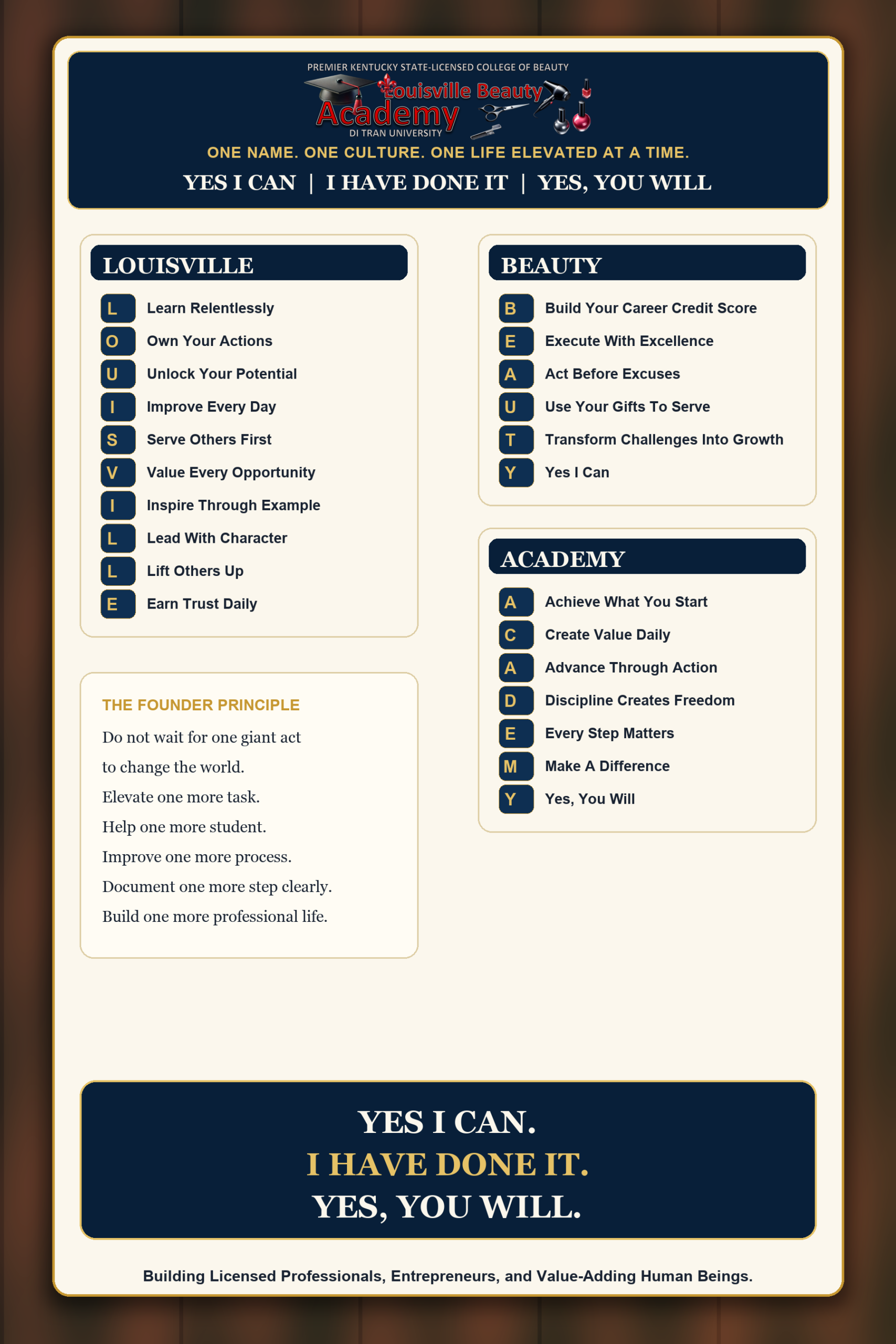
Louisville Beauty Academy culture wall: one name, one culture, one life elevated at a time.
The Meaning Inside The Name
LOUISVILLE begins with the professional foundation: learning, ownership, service, character, and trust.
L — Learn Relentlessly
O — Own Your Actions
U — Unlock Your Potential
I — Improve Every Day
S — Serve Others First
V — Value Every Opportunity
I — Inspire Through Example
L — Lead With Character
L — Lift Others Up
E — Earn Trust Daily
A beauty professional must learn technique, sanitation, client care, timing, communication, discipline, documentation, and business judgment. Talent matters, but talent without trust does not build a career. Skill matters, but skill without character does not build a profession.
BEAUTY becomes more than appearance. It becomes service, professionalism, dignity, and value creation.
B — Build Your Career Credit Score
E — Execute With Excellence
A — Act Before Excuses
U — Use Your Gifts To Serve
T — Transform Challenges Into Growth
Y — Yes I Can
Beauty work is human work. A student learns to serve another person with care, prepare a clean and safe service environment, listen carefully, practice repeatedly, accept correction, and build public trust one client at a time.
ACADEMY becomes the discipline of completion.
A — Achieve What You Start
C — Create Value Daily
A — Advance Through Action
D — Discipline Creates Freedom
E — Every Step Matters
M — Make A Difference
Y — Yes, You Will
The academy exists because people need more than encouragement. They need structure. They need repetition. They need written clarity. They need instructors who care enough to correct them and a culture strong enough to bring them back to action after difficulty.
One More Action At A Time
The founder principle behind this culture is simple: do not wait for one giant act to change the world. Elevate one more task. Help one more student. Improve one more process. Finish one more requirement. Speak one more sentence of encouragement. Document one more step clearly. Build one more professional life.
Small actions compound.
One checklist becomes readiness.
One correction becomes skill.
One returned student becomes completion.
One written record prevents confusion.
One license pathway becomes economic movement.
One graduate becomes a model for the next person.
This is how a school becomes more than a school. It becomes a place where people practice becoming trustworthy, useful, skilled, licensed, and ready to serve.
Why This Is Also Civic Work
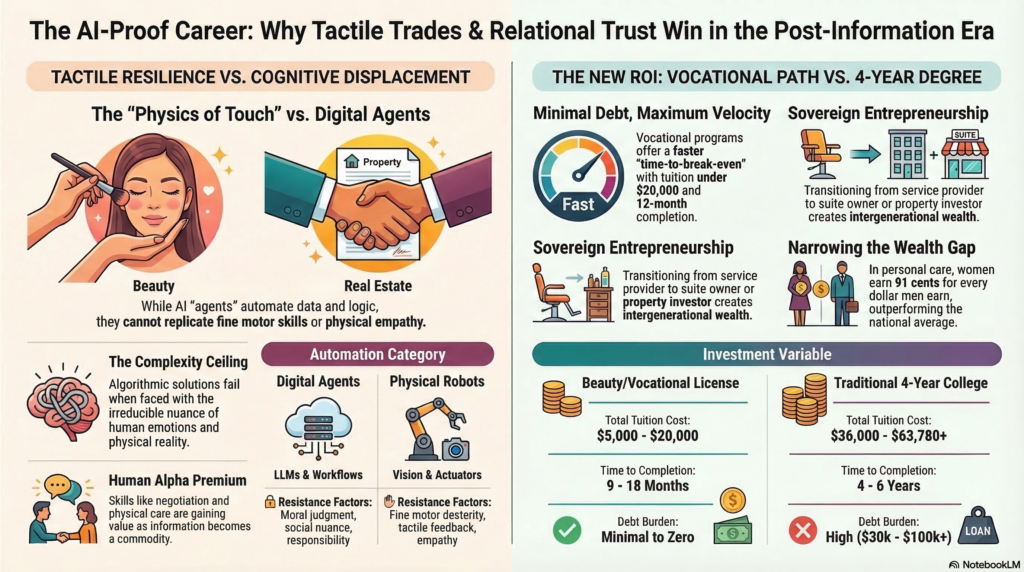
Beauty education is often misunderstood as small. It is not small. It is workforce development. It is small-business formation. It is immigrant and working-family mobility. It is sanitation and public trust. It is language access. It is the discipline of taking a real person from uncertainty toward a documented professional pathway.
Louisville Beauty Academy has been publicly recognized through national small-business and advocacy channels, including the U.S. Chamber of Commerce CO—100 profile for Louisville Beauty Academy and the CO—100 small-business list. Founder Di Tran has also been publicly named by the National Small Business Association among the 2025 Lewis Shattuck Small Business Advocate of the Year finalists, as reflected in NSBA public materials.
Those recognitions matter, but they are not the mission. The mission remains the next student who needs a clear beginning, a lawful school pathway, written cost information, real support, and a culture that says: yes, you can begin; yes, you can continue; yes, you can finish what you start.
The Culture Wall
Louisville Beauty Academy should place this culture where students can see it, read it, photograph it, graduate in front of it, and remember it.
Not because words alone create success. They do not.
But repeated words, repeated actions, repeated standards, repeated correction, and repeated evidence shape people. A wall can become a daily reminder. A staircase can become a progression. A graduation backdrop can become proof. A student handbook page can become a standard. A website article can become an invitation to a person who has not yet found the courage to ask.
The culture is uplifting because it is practical. Ask questions in writing. Review the documents. Understand the cost. Know the attendance expectations. Respect sanitation. Practice the skill. Listen to correction. Finish the hours. Prepare for the board. Build trust daily.
Student next step
Ask LBA for current written information before you decide.
If you are comparing programs, schedule, tuition, language support, tour options, or enrollment documents, ask for current written follow-up. A clear record protects the student and strengthens trust.
Louisville Beauty Academy is building licensed professionals, entrepreneurs, and value-adding human beings one disciplined step, one caring action, and one life at a time.
This article is part of LBA’s public education and historical archive. Older posts, including “The Evolution of Nail Technology and Louisville Beauty Academy’s Path to a Center of Excellence in Nail Education – RESEARCH & PODCAST SERIES 2026,” may not reflect current tuition, schedules, incentives, forms, policies, testing vendors, clinic availability, or regulatory requirements.
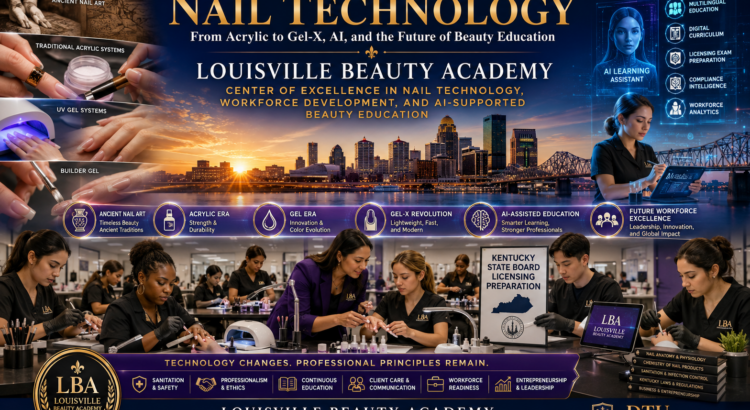
The modern nail industry is not a story of one system replacing another. It is a story of layered innovation. Over thousands of years, nail care moved from social signaling and natural staining in ancient India, China, and Egypt to formal salon manicuring in the modern West, then into chemistry-driven enhancement systems, UV/LED-curable gels, pre-shaped soft-gel extensions, a revived press-on market, and now AI-assisted education and operations. The result is not a straight line from “old” to “new,” but a widening service ecosystem in which different systems solve different client, technician, and business problems. [1]
The strongest evidence for what still matters comes from regulation and occupational health, not trend forecasting. In Kentucky, nail technology education still centers on science and theory, statutes and regulations, and clinic/practice hours; the required subject areas explicitly include infection control, nail anatomy and physiology, nail product chemistry, manicuring, pedicuring, electric filing, tips and wraps, monomer-liquid/polymer-powder enhancements, UV/LED gels, and business skills. At the national level, BLS still describes the occupation around safe grooming, artificial nail application and removal, disinfecting tools, and client care, while NIOSH continues to emphasize chemical, respiratory, ergonomic, and language-access risks faced by nail workers. [2]
Gel-X has grown because it aligns with several contemporary demands at once: speed, standardization, lighter-feeling enhancements, lower dust, easier soak-off removal, strong visual consistency, and digital-friendly education. Aprés, the company that created Gel-X, describes it as the world’s first full-coverage soft-gel extension system, invented in 2017, and markets it as faster, lighter, gentler, less dusty, and easier to remove than acrylic. Those features matter in an era when clients increasingly want long-wear sets with lower maintenance friction and when schools and techs benefit from platform systems that are teachable in repeatable steps. [3]
Yet Gel-X does not make acrylic obsolete. Acrylic remains structurally important for custom sculpting, major rebalancing, repair-heavy services, long-term filled wear, and clientele who want deeply customized architecture beyond pre-shaped full-cover tips. That is why Kentucky’s curriculum continues to require both monomer-liquid/polymer-powder enhancements and UV/LED gels, not one or the other. The industry is converging on a mixed economy of systems: acrylic for architecture and repair, Gel-X for speed and standardized extension work, builder gel for overlays and structured manicures, and press-ons for retail, events, and rapid trend cycles. [4]
AI’s near-term role in nail education is clearest in augmentation, not substitution. UNESCO’s guidance on generative AI in education calls for a human-centered approach, data-protection safeguards, and pedagogical validation; the U.S. Department of Education and IES describe AI as useful for instructional support, personalized learning, assessment, analytics, and administrative tasks, while explicitly warning that AI should be used as a tool rather than a substitute for humans. For beauty schools, that means AI can support multilingual instruction, tutoring, policy retrieval, exam prep, scheduling, student advising, and institutional memory, but it cannot replace licensed instructors, supervised clinic work, or state licensure. [5]
Louisville Beauty Academy already displays many of the building blocks of a nail-education hub. Kentucky public sources confirm LBA as a licensed school location in Louisville, including a second location at Harbor House; LBA’s own public catalog and curriculum materials describe a work-ready mission, a 450-hour nail program, Milady-based theory, explicit nail-technique training that includes gels, wraps, acrylics, and electric drill use, flexible schedules, scholarships/payment plans, multilingual resources, AI tools, onsite training, and a community-facing Harbor House campus. Publicly available LBA materials also report more than 1,000 graduates and more than 90% completion, employment, and board-pass outcomes for 2017–2023, while Kentucky school-reporting search snippets show nail-program pass-rate rows and multilingual exam-result rows. Some details remain school-reported rather than independently audited in the sources reviewed, and where documentation was incomplete this report marks it as unspecified. [6]
The strategic opportunity, therefore, is not to brand LBA simply as a school that teaches nails. It is to position LBA as a workforce-first Center of Excellence in Nail Systems, Safety, and Applied Beauty Technology: a place where licensure fundamentals remain nonnegotiable, where multiple enhancement systems are taught comparatively, where multilingual access is built into delivery, where AI serves compliance and learning rather than replacing professionals, and where local workforce partnerships turn school into a civic and economic platform. That positioning is evidence-based, future-facing, and well aligned with both labor market demand and the current technological direction of nail services. [7]
Long before “nail technology” became a licensed occupation, nail care functioned as culture, class marker, and personal presentation. Dermatology reviews note that nail cosmetics date back to around 5000 BC in India, China, and Egypt, where plant- and mineral-based materials were used to color or ornament nails. This ancient origin matters because it shows that the industry’s psychological and cultural core—identity, beauty, status, and ritual—predates all modern chemical systems. [8]
In modern salon history, one widely cited milestone is the opening of Mary E. Cobb’s manicure salon in Manhattan in 1878 after she studied nail care in France. By the early twentieth century, manicure norms had become more formalized, and one recent review notes that nail polishes in recognizably modern form were developed in 1920. In other words, the shift from simple buffing and staining to standardized commercial products predates acrylics by decades. [9]
The decisive technological leap came in the postwar era, when artificial extension methods became more systematized. A 1955 patent filing, granted in 1957 to Thomas S. Slack, described a “device for extending fingernails” and explicitly referenced a nail-extending material made by combining polymethyl methacrylate powder with methyl methacrylate monomer. That patent is crucial because it documents the move from cosmetic surface treatment to engineered nail architecture. It also shows how deeply early artificial nail systems were tied to acrylic polymer chemistry and form-based extension methods. [10]
Industry manufacturer history lines up with that patent-era transition. NSI, which traces its roots to Fred Slack’s work, dates the “first nail form” to 1957 and associates its origins with the adaptation of dental acrylic and foil for nail repair and extension. NSI’s own timeline also notes that by the late 1960s Slack and a chemist had developed more “nail technician friendly” polymer/monomer acrylic systems. In short, the acrylic era did not arrive fully formed; it emerged through iterative product refinement that made salon use more practical. [11]
Regulatory and safety scrutiny followed. FDA’s current nail-product guidance explains that artificial nails are primarily composed of acrylic polymers and recounts that in the early 1970s the agency received injury complaints associated with products containing methyl methacrylate monomer, including fingernail damage, deformity, and contact dermatitis. The FDA then took action against products containing 100% methyl methacrylate monomer and distinguishes that history from ethyl methacrylate-based systems. This early MMA episode remains foundational because it established a pattern that still defines the field today: technological change in nails is always filtered through chemistry, worker exposure, and public-safety response. [12]
The next broad phase was the gel era. Recent chemistry reviews describe UV-curable nail polishes as acrylate-based systems initiated by light-driven polymerization chemistry; these systems made it possible to produce durable coatings and enhancement products with more controlled curing than traditional evaporative polish. Over time, industry practice differentiated among hard gels, soft soak-off gels, builder gels, gel polish, and extension-specific gel systems. The important point is that “gel” is not one product but a family of light-cured polymer systems with different rheology, architecture, removal pathways, and risk profiles. [13]
A still newer phase is the platform-system era. Aprés describes Gel-X as the world’s first full-coverage soft-gel extension system and states that Gel-X was invented in 2017. Unlike classic acrylic or sculpted gel methods, Gel-X takes the extension form itself—pre-shaped, full-coverage, soak-off soft gel—and turns it into a platform product. That matters educationally because platform products reduce some variability in shaping and structure during initial training while increasing the importance of prep, sizing, adhesion, curing, and removal discipline. [14]
The current market is therefore plural, not singular. Commercial market researchers project continued growth in artificial nails overall and specifically in press-ons, while official labor sources continue to project faster-than-average employment growth for manicurists and pedicurists. The modern school cannot responsibly train only one method. It must teach a portfolio. [15]
The timeline above compresses the core pattern: the industry evolves when a new chemistry, form factor, or learning platform changes the service workflow. But each new phase leaves older systems alive in niches where they continue to outperform. [16]
The case for Gel-X’s growth is straightforward. Aprés positions it as a full-coverage soft-gel extension system that is faster, lighter, gentler, less dusty, and easier to remove than acrylic, and says correctly applied sets typically last 3–4 weeks. That package addresses several points of friction in both salon operations and client experience: reduced hand-filing time, lower airborne dust, strong shape consistency, easier inventory standardization once tip libraries are built, and full soak-off removal rather than repeated heavy rebalance cycles. [17]
Gel-X also grew because it is teachable in a modular way. Aprés University offers online and in-person Gel-X certification and states that its online course covers prep, sizing, and full application and is available in English, Spanish, Vietnamese, and Japanese. That multilingual, asynchronous structure is important. It does not replace state licensure, but it shows how platform systems can scale through digital pedagogy, especially among multilingual learners and working technicians adding services after graduation. [18]
The growth of Gel-X, however, should not be misread as an acrylic extinction event. Acrylic remains the industry’s most repairable and sculpturally flexible architecture. The patent literature and classic acrylic method are built around form-supported extension and in-situ structure building; that makes acrylic especially useful where technicians need to correct asymmetry, repair breaks, rebalance long-growth stress points, or create highly customized lengths and shapes. Industry practice around fills every two to three weeks also reflects acrylic’s logic as a maintainable architecture rather than a set meant to be routinely soaked off and rebuilt from zero. [19]
Builder gel occupies a third lane rather than merely splitting the difference. OPI describes its builder-gel line as soak-off, HEMA-free, lightweight, and suitable for adhering soft-gel tips, filling extensions, overlays, and structured manicures, with up to three weeks of wear. Aprés similarly describes Soft Gel Builder as a soak-off formula functioning as both base coat and builder gel. In practice, builder gel works best for clients who want reinforcement, architecture, and overlays on the natural nail or shorter-extension work without the full service logic of acrylic. [20]
Press-ons add a fourth lane. Market research firms expect continued growth in press-ons, and KISS/imPRESS markets press-on systems as quick, self-adhesive, and “salon-perfect” in minutes. Press-ons do not replace professional enhancement education; rather, they create retail, event, and trend-response opportunities. Schools that ignore them miss a growing home-and-retail segment. [21]
The deeper reason Gel-X complements rather than replaces acrylic is economic and architectural. A nail salon is not solving one problem called “extensions.” It is solving multiple problems: quick full-coverage transformations, high-end custom sculpting, natural-nail overlays, special-event nails, quick-change retail nails, and repair or rebalance work. Gel-X is excellent at one cluster of those use cases; acrylic is excellent at another. A sophisticated school should teach students to match system to use case, not loyalty to one brand or technique. That conclusion is partly an inference, but it follows directly from the different product structures, wear cycles, and removal pathways documented by official and manufacturer sources. [22]
The table reinforces the governing lesson for schools: system literacy is now as important as single-system mastery. A graduating nail technician should understand where each method wins, where it fails, and what safety burden it carries. [41]
The nail industry changes faster in products than in fundamentals. Kentucky’s nail technology curriculum still requires science and theory, Kentucky statutes and regulations, and clinic/practice time; the subject areas include microbiology/infection control, anatomy and physiology, nail product chemistry, manicuring, pedicuring, tips and wraps, monomer-liquid/polymer-powder enhancements, UV/LED gels, and business skills. That is exactly right. The center of gravity in nail education should remain sanitation, anatomy, chemistry, safety, client communication, scope-of-practice literacy, and employability/business capability. [42]
Federal worker-safety evidence reinforces the same conclusion. NIOSH warns that nail technicians face chemical and physical hazards, including skin and respiratory exposures, neurological and reproductive risks from some chemicals, and musculoskeletal strain from posture and repetitive motion. Its field evaluations found inconsistent hazard training, poor ventilation, incorrectly worn respirators, and elevated particulate concentrations near acrylic filing stations. A school that teaches fashion without ventilation, chemical literacy, and body mechanics is not modern; it is incomplete. [43]
Sanitation and correct product handling also remain essential because the largest documented harms in nail cosmetics still come from misapplication, skin contact with reactive ingredients, and poor removal. Recent dermatology reviews identify allergic contact dermatitis—often tied to (meth)acrylates—as the most common adverse effect across nail glues, gel polish, and acrylic nails. FDA likewise stresses ventilation, skin-contact avoidance, label compliance, and caution around methacrylate monomers. [44]
Licensure remains foundational as well. BLS states that manicurists and pedicurists must complete a state-approved program and pass a state exam for licensure, and Kentucky requires 450 hours for nail technician licensure with a high-school-equivalency threshold and minimum age requirement. Manufacturer certificates can add system proficiency, but they do not confer legal authority to practice in place of a state license. [45]
What changes are the product systems, application workflows, trend cycles, and the digital wrapper around service delivery. Full-cover tip systems, soak-off builders, HEMA-free or HEMA-reduced product lines, multilingual exam prep, online manufacturer certifications, digital booking, and social-media-driven design cycles are all changing how technicians learn, market, and maintain services. Even basic definitions of “a manicure” are expanding: today the service menu can include acrylic architecture, Gel-X, structured overlays, retail press-ons, and high-frequency trend art layered over multiple base systems. [46]
Client expectations are changing as well. BLS projects continued demand because manicures and pedicures remain a “low-cost luxury service,” and market reports project growth across artificial nails, press-ons, and broader nail care. Meanwhile, trend reporting in 2026 shows a noticeable pull toward polished, low-maintenance, hand-flattering looks and fluid gel effects rather than only maximalist sets. That does not reduce demand for technical skill; it changes which skills monetize more consistently. [47]
The workforce context also changes the educational burden. NIOSH notes that there are over 400,000 active nail technicians in the United States and that approximately 46% of those born outside the United States do not speak English well. BLS, using a different statistical frame, counted about 210,100 jobs in 2024 and projects 24,800 openings per year on average through 2034. Taken together, those sources imply a large, diverse, multilingual workforce with significant turnover and replacement demand. Nail education therefore has to work for first-language-English students and for multilingual adult learners entering beauty work as a mobility pathway. [48]
In education, the highest-confidence claim about AI is disciplined usefulness under human supervision. UNESCO’s guidance on generative AI in education calls for a human-centered approach, privacy protection, and ethical and pedagogical validation. IES summarizes the education research base by grouping AI use into instruction and tutoring, personalized learning, assessment, predictive/learning analytics, and administrative/logistical tasks, and explicitly advises schools to use AI as a tool, not as a substitute for humans. NIST’s AI Risk Management Framework adds the trustworthiness lens that institutions need when selecting or deploying any AI system. [49]
For nail schools, that translates into five concrete AI functions. First, multilingual support: AI can help translate handouts, explain theory in simplified language, and scaffold communication for learners who are building both beauty vocabulary and English proficiency. UNESCO explicitly links technology and AI to multilingual education and accessibility. Second, personalized learning: AI tutors can generate quizzes, explain chemistry or state-board concepts at different levels, and identify weak spots before practical exams. Third, administrative support: attendance follow-up, appointment reminders, document retrieval, and policy Q&A are natural AI use cases. Fourth, institutional memory: a school can convert catalogs, SOPs, exam updates, translated scripts, and safety bulletins into a searchable knowledge base. Fifth, compliance support: AI can help pre-check forms and documentation against school rules but should never make final licensure, academic, or disciplinary judgments without human review. [50]
The necessary disclaimer is clear: AI augments but does not replace licensed professionals. It cannot replace the licensed instructor’s judgment, supervised clinical correction, state-board-compliant attendance accounting, or legally required practical training. It also cannot replace the technician’s responsibility to avoid skin contact with uncured products, maintain sanitation, or exercise client-specific judgment. In beauty education, as in healthcare and other applied fields, the safest model is “AI for preparation and support, humans for supervision, licensure, and final professional accountability.” [51]
A workforce-first center of excellence must be judged on publicly documentable evidence, not aspiration alone. On that standard, Louisville Beauty Academy presents a meaningful case study, though not every requested metric is fully specified in public sources.
Kentucky public sources confirm LBA as a licensed beauty school presence in Louisville. Search-result excerpts from the Kentucky Board of Cosmetology list a Louisville Beauty Academy location at 1049 Bardstown Road and a Louisville Beauty Academy at Harbor House location at 2233 Lower Hunters Trace, with instructional programs that include nail technology. That official confirmation matters because it grounds the school’s public positioning in state-recognized educational operations. [52]
LBA’s own official catalog states a work-ready mission centered on cultivating talent for state-regulated licensing fields and explicitly includes nail technology among its core offerings. The catalog also states that the school enhances learning with Milady books, online theory resources, PSI exam materials, and self-published books, and it identifies nail technology as one of its Kentucky state-licensing programs. This is a strong workforce signal: the school defines itself around licensure, employability, and test readiness rather than only hobbyist beauty culture. [53]
The nail curriculum is publicly concrete. In the December 2023 catalog, LBA describes a 450-hour Manicuring/Nail Technology program using Milady’s Standard of Nail Technology and lists a curriculum that includes orientation/sanitation/disinfection, anatomy and disorders, laws and regulations, nail techniques including tips, sculptures, overlays, gels, wraps, acrylics, manicuring, pedicuring, chemistry, salesmanship, electric drill use, and discretionary hours. In a later curriculum page, LBA states that its program aligns with Kentucky Board standards and that students are supported with Milady, PSI-aligned resources, self-published books, AI tools, and multilingual resources. Those two documents together show a curriculum that preserves licensure fundamentals while extending into contemporary delivery methods. [54]
The school also appears to be compliance-conscious in its public documentation. Its website prominently links refund policy, privacy policy, non-discrimination policy, grievance procedure, liability waiver, student responsibilities/compliance disclaimer, onsite training requirement for Kentucky licensing compliance, and translated foreign diploma/transcript policy. The 2023 catalog cover states “No Distance Learning Available – Only Onsite,” which suggests a conservative compliance posture around practical training, though readers should note that Kentucky regulation also contains provisions for approved online theory coursework; the current balance of onsite versus digital theory at LBA is therefore school-policy-specific and not fully specified in the sources reviewed. [55]
LBA’s affordability claim is partly documented and partly school-reported. The 2023 catalog lists the Nail Technology Program at a total package price of $8,325.50 and notes scholarship eligibility and monthly payment options. Public website materials also emphasize scholarships, flexible payment plans, and a school-for-working-adults schedule. Whether that is “affordable” relative to peer institutions is a market comparison, not an absolute fact, but the school’s public business model is clearly aimed at lowering entry barriers through installment and scholarship structures. [56]
The multilingual and community-facing dimensions are unusually prominent for a beauty school. LBA publicly reports multilingual resources and “preferred language translation” support. It also published school guidance around multilingual Kentucky nail-licensing exams and later reported a Spanish-language exam passer. Those claims are school-reported, but they are partially corroborated by the Kentucky school-reporting workbook search snippets, which surface multilingual exam-result rows such as Nail Technician–Spanish Practical and Nail Technician–Simplified Chinese Theory. Public LBA materials further report a Harbor House campus where cosmetology, nail, and skincare services are offered free as part of supervised educational activity. [57]
Public outcome reporting is mixed but noteworthy. LBA’s catalog reports that from 2017 to 2023 the school had over 1,000 graduates, over 90% on-time completion, more than 90% graduate employment in the relevant year, and above 90% pass rates among graduates who took the state board exam. Separately, the Kentucky Board’s LBA reporting workbook, as surfaced in search snippets, shows nail-program rows including Nail Technician Practical with a 1.0 passing rate and 44 tested, Nail Technician Theory with a 0.645 passing rate and 48 tested, Nail Technician Theory–Retakes with a 0.451 passing rate and 31 tested, and multilingual rows. Because the browser session could not directly open the state workbook, the exact year attached to each snippet-visible row is unspecified. The most responsible reading is that LBA has publicly visible outcome evidence, but not all of it is uniformly auditable from the materials reviewed. [58]
LBA also appears to be building a partnership ecosystem. Public school materials report a collaboration with Harbor House of Louisville, training access for UAW-represented Ford hourly employees through an employee tuition-plan certification structure, and a collaboration with Liberty High School. The Harbor House site is also supported by Kentucky’s official school listing; the other partnerships are school-reported in the reviewed sources and should be treated as such unless independently verified elsewhere. Still, the pattern is strategically important: LBA is not presenting itself merely as a storefront school but as a local workforce intermediary. [59]
Publicly claimed; precise accrediting body/status unspecified in reviewed official sources
The strategic implication is favorable. Even with some gaps, LBA already has enough documented structure to credibly present itself as a Kentucky-centered, multilingual, compliance-aware, workforce-oriented nail-education institution. The next step is to organize that identity under a formal Center of Excellence framework. [67]
A true Center of Excellence is not a slogan. It is an operating model that standardizes curriculum, labs, faculty capability, community partnerships, evidence collection, and continuous update cycles. For nail education, the necessary model is not “teach acrylic, then add Gel-X.” It is “teach fundamentals once, then teach all systems comparatively under a safety and business framework.”
The model above reflects the strongest evidence in the research: licensure fundamentals stay stable, but system instruction, safety controls, digital learning, and employer alignment must continuously evolve. [68]
This architecture is deliberately layered on top of Kentucky’s required foundation rather than in competition with it. It preserves the “license to protect” logic while expanding into the multi-system reality of the current market. [69]
A serious Center of Excellence would require four dedicated lab capacities.
First, an enhancement systems lab with acrylic, Gel-X/soft-gel, and builder-gel stations. Second, a safety and ventilation lab in which students actually measure and manage dust, airflow, and workstation setup rather than merely hearing lectures about them. Third, a digital learning and exam prep lab combining PSI-style theory practice, multilingual support, and AI-assisted tutoring under teacher supervision. Fourth, a community clinic lab that mirrors real service flow, including intake, consultation, consent, service notes, sanitation logs, rebooking, and retail recommendations. The need for airflow, ergonomic training, documentation, and worker-safety procedure is strongly supported by NIOSH’s hazard evaluations. [43]
Faculty expertise should include at least one lead faculty member each for acrylic architecture, soft-gel systems, sanitation/occupational safety, and licensure/theory prep. Ideally, one bilingual or multilingual faculty member should be formally assigned to translation-quality control and multilingual learner support, given NIOSH’s evidence about language barriers in the workforce and LBA’s public commitment to multilingual resources. If LBA cannot immediately hire all of these as full-time roles, it can create a hybrid model through adjuncts, visiting educators, and manufacturer-certified trainers—but the school should be careful to distinguish clearly between manufacturer certification and state-recognized instructional authority. [70]
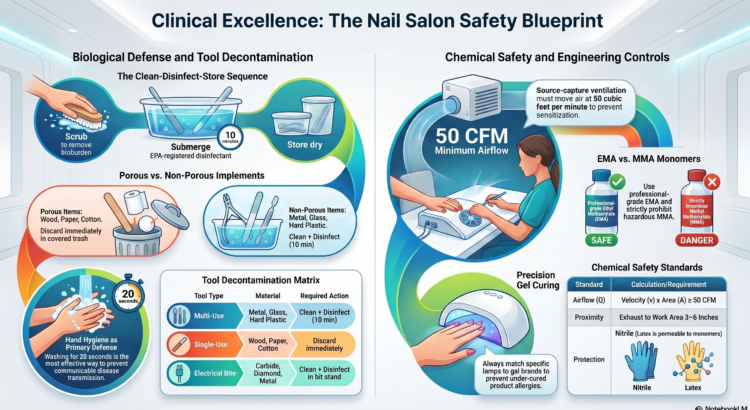
Equipment needs are no longer generic. A 2030-ready nail school needs local exhaust capability or downdraft solutions, e-files with standardized bit safety instruction, UV/LED lamps matched to manufacturer systems, testable curing protocols, multilingual digital delivery tools, searchable policy and curriculum repositories, and visual portfolio capture stations. It also needs enough tip libraries and structured product inventories to teach comparative systems without conflating them. [71]
The most logical partnership map for LBA has four concentric circles.
The first is regulatory and licensure alignment: Kentucky Board requirements, PSI updates, and document-control discipline. The second is manufacturer and curriculum alignment: Milady, system-specific educators like Aprés or OPI professional education, and sanitation credentials. The third is community and workforce alignment: Harbor House, employers, union-linked workforce programs, and secondary-school pathways. The fourth is technology alignment: AI vendors or internal tools used for multilingual instruction, tutoring, attendance support, and institutional memory, governed under a human-review framework modeled on UNESCO, IES, and NIST guidance. [72]
AI-assisted support utilization with human override logs
Ensures tech use is effective and governed
If LBA wants the phrase “Center of Excellence” to be more than branding, it should publish at least a trimmed public dashboard of these indicators annually. That recommendation follows directly from the unevenness of current public outcome visibility. [73]
The official labor market already points in a favorable direction for nail education. BLS projects employment of manicurists and pedicurists to grow 7% from 2024 to 2034, faster than the average for all occupations, with about 24,800 openings each year on average. BLS also explicitly attributes projected employment growth to continuing demand for lower-cost luxury services, quick manicures, and mobile services. Those are exactly the market conditions under which multi-system, service-menu-diverse schools should outperform narrow-format schools. [74]
Commercial market forecasts point in the same broad direction, even if they should be interpreted cautiously as private market research rather than official statistics. Fortune Business Insights projects the global artificial nails market to grow from $1.59 billion in 2025 to $2.72 billion by 2034, while Grand View Research estimates the press-on market at $738 million in 2024, rising to about $1.075 billion by 2030. GM Insights also projects broader nail-care-product market growth through the next decade. The directional lesson is clear: nail services and nail products are not shrinking categories. They are diversifying. [75]
From 2030 to 2040, the most plausible scenario is not one dominant service system but deeper segmentation. Acrylic will likely hold its place in long-wear architecture, repairs, and sculptural work. Soft-gel extension systems such as Gel-X should continue to grow in schools and salons that value speed, standardization, and lower-dust workflows. Builder gels should keep expanding with the rise of structured manicures and natural-nail-strengthening services. Press-ons should become more important as a retail/adjacent category and as a salon-to-home bridge product. This is an inference from current product architecture, manufacturer education investment, and market-growth signals, not a guarantee of exact share splits. [76]
By 2040, the biggest separator between mediocre and leading schools may not be which product they teach first, but whether they mastered three institutional capabilities: multilingual access, governed AI use, and compliance-grade operational memory. NIOSH’s workforce-language findings already make multilingual design a labor issue, not a courtesy. UNESCO, IES, DOE, and NIST together make the case that AI adoption without human-centered governance is a mistake. For beauty schools, that means the winning institutions will not be those that merely “use AI”; they will be those that use it to make learning more accessible, operations more consistent, and documentation more reliable without eroding professional accountability. [77]
For state boards and policymakers, the implication is not that licensure hours should be abandoned. It is that core hours should remain science- and safety-anchored while allowing schools to refresh system-specific content faster. Kentucky’s current framework is already stronger than many public discussions assume because it explicitly includes both monomer-powder enhancements and UV/LED gels. The challenge is not the absence of regulatory room; it is whether schools use that room to teach comparative system literacy, exposure control, and business adaptability. [78]
For workforce agencies and local employers, nail education should be taken more seriously as a mobility pathway. LBA’s reported relationships with Harbor House, Ford/UAW-related tuition access, and a secondary-school partnership suggest how beauty education can function as workforce infrastructure, especially for working adults, multilingual learners, and community-based talent development. Public policy that ignores beauty training because it is “cosmetic” misses a practical reality: this is licensed service work, often entrepreneurial, and in many communities it is an accessible entry point to regulated self-employment or salon employment. [79]
For schools themselves, the immediate policy implication is documentation. Schools that want recognition as Centers of Excellence should publish annual outcome summaries, multilingual-access data, safety-training completion rates, and curriculum update logs. In an AI era, the school that documents well will adapt faster than the school that relies on informal memory. That is especially true in a regulated field where exams, language access, and platform policies can change. [80]
Several LBA-specific items remained partially or wholly unspecified in the public sources reviewed. The precise accrediting body or status behind LBA’s public “state-licensed” language was unspecified in official sources accessible during this research. Public year-by-year completion, placement, and pass-rate tables were not fully retrievable even though outcome snippets were visible. Historical change logs showing exactly when LBA added AI tools, multilingual resources, or specific system modules were also unspecified. In addition, the Kentucky school-reporting workbook could not be directly opened in the browser session, so exact year attribution for some snippet-visible pass-rate rows remains unspecified. [81]
The comparative cost discussion in this report also avoids claiming a standardized national price benchmark for acrylic, Gel-X, or builder-gel salon services, because the public sources reviewed did not provide a sufficiently authoritative nationwide price dataset. Where this report compares systems, it emphasizes technical logic, wear cycles, removal pathways, and training implications rather than pretending that one national service-price schedule exists. [82]
U.S. Bureau of Labor Statistics, Occupational Outlook Handbook: Manicurists and Pedicurists. [74]
Kentucky Administrative Regulation 201 KAR 12:082, education requirements and school administration for cosmetology, esthetic practices, and nail technology. [83]
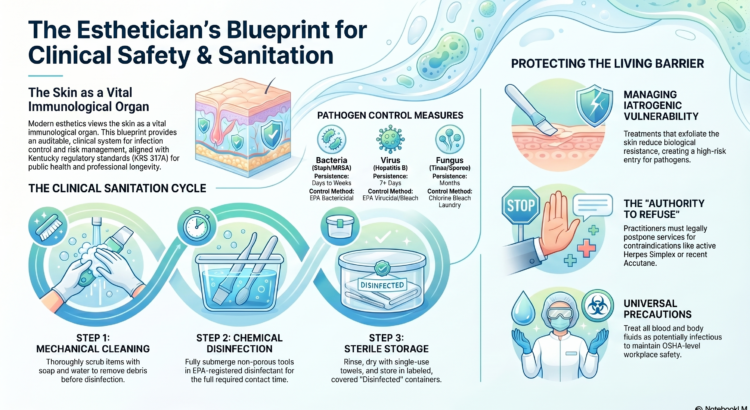
Kentucky Administrative Regulation 201 KAR 12:100, infection control, health, and safety. [84]
Kentucky Revised Statute 317A.090, requirements for schools of cosmetology, esthetic practices, and nail technology. [85]
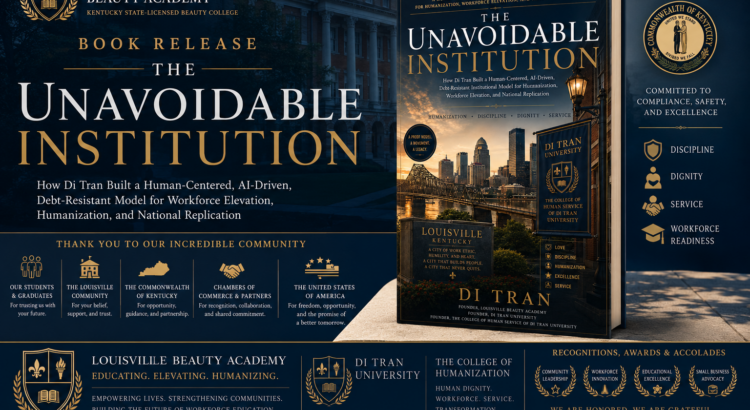
Louisville Beauty Academy is deeply honored and grateful to announce the release of The Unavoidable Institution: How Di Tran Built a Human-Centered, AI-Driven, Debt-Resistant Model for Workforce Elevation, Humanization, and National Replication — a flagship publication representing years of operational experience, workforce service, educational development, institutional reflection, AI implementation, compliance practice, and community-centered learning.
This moment is not simply the release of a book.
It is a reflection of the people, community, city, state, and nation that made this journey possible.
As a Kentucky state-licensed beauty college proudly founded and built in Louisville, Kentucky, Louisville Beauty Academy extends sincere gratitude to:
the Louisville community,
the Commonwealth of Kentucky,
the United States of America,
our students and graduates,
immigrant and working families,
employers and workforce partners,
educators and instructors,
chambers of commerce,
community organizations,
public servants and workforce advocates,
local and national business leaders,
and every individual who has contributed encouragement, accountability, opportunity, trust, recognition, and support throughout our journey.
We are especially humbled and thankful for the validations, recognitions, nominations, awards, partnerships, and acknowledgments received over the years, including support and recognition from workforce-development communities, entrepreneurship ecosystems, local and national business organizations, chambers of commerce, and advocacy groups that continue to elevate small business, workforce education, and human-centered economic development across America.
This publication reflects not only the work of one individual, but the collective contributions of the broader Louisville Beauty Academy and Di Tran University communities — including students, graduates, instructors, editors, researchers, AI systems contributors, compliance-support teams, operational staff, institutional-development collaborators, and community partners whose countless hours of service, documentation, learning, correction, and refinement helped shape the ideas contained in this work.
Most importantly, this book belongs to the people.
It belongs to:
the working parent trying to rebuild life,
the immigrant family searching for opportunity,
the student seeking dignity through practical education,
the graduate learning to believe in themselves again,
and the workforce communities that continue carrying the American economy through service, discipline, entrepreneurship, and hard work.
A Book About More Than Beauty Education
While rooted in the operational realities of Louisville Beauty Academy, The Unavoidable Institution ultimately presents a much larger institutional and workforce-development discussion regarding:
affordable workforce education,
vocational and trade-school innovation,
AI-assisted institutional systems,
compliance architecture,
operational discipline,
human-centered leadership,
workforce dignity,
community service,
entrepreneurship,
and the future of practical education in America.
The publication argues that education should not merely process students into debt and credentials, but should instead strengthen individuals into:
disciplined workers,
stable professionals,
capable entrepreneurs,
responsible citizens,
and dignified contributors to families and communities.
The book further explores:
why America may be educated but not fully elevated,
the dangers of debt-driven educational systems,
why workforce education deserves greater national respect,
how beauty and trade education serve as real economic infrastructure,
how AI can strengthen institutional accountability without replacing human dignity,
why humanization should become an operational framework,
and how small institutions can create large societal impact through disciplined design, affordability, service, and measurable outcomes.
Louisville, Kentucky, and the American Workforce
Louisville Beauty Academy proudly recognizes Louisville as a city of resilience, workforce energy, entrepreneurship, logistics, diversity, and human service.
From immigrant communities to working-class families, small businesses, logistics workers, healthcare workers, beauty professionals, educators, tradespeople, and entrepreneurs, Louisville represents many of the values this book seeks to honor:
hard work,
service,
reinvention,
discipline,
opportunity,
and community contribution.
We remain deeply grateful to Louisville and the Commonwealth of Kentucky for providing the opportunity to serve students, families, employers, and communities through workforce-centered education.
We also remain thankful to the broader American system that allows small institutions, immigrant families, entrepreneurs, and local workforce organizations the opportunity to build, contribute, and continue participating in the fabric of the nation.
Humanization, AI, and the Future of Institutions
One of the central ideas explored in the publication is that the future of education and workforce development must remain deeply human even as artificial intelligence and automation continue expanding.
The book proposes that AI should support:
accountability,
operational consistency,
documentation,
compliance,
institutional memory,
and administrative precision,
while preserving the irreplaceable role of:
human judgment,
human care,
mentorship,
correction,
discipline,
compassion,
and real-world service.
The publication further argues that institutions should become:
more affordable,
more operationally disciplined,
more transparent,
more community-oriented,
and more focused on producing workforce-ready individuals capable of contributing meaningfully to society.
Gratitude to the Di Tran University and College of Humanization Teams
Louisville Beauty Academy extends special appreciation and gratitude to the Di Tran University and College of Humanization communities for their contributions in:
editing,
writing,
research,
institutional design,
AI integration,
operational refinement,
documentation systems,
publication development,
compliance review,
workforce-policy discussion,
and educational collaboration.
This publication reflects years of collective effort and shared belief that affordable, disciplined, human-centered institutions remain possible in America.
Continuing the Mission
Louisville Beauty Academy remains fully committed to:
workforce readiness,
student affordability,
sanitation and safety,
disciplined operational systems,
educational accountability,
human dignity,
community contribution,
and compliance with all applicable local, state, and federal laws, regulations, sanitation standards, educational requirements, and licensure obligations.
This publication is intended solely for educational, informational, institutional-development, and public-policy discussion purposes and does not constitute legal advice, regulatory interpretation, governmental policy, accreditation guidance, or legal conclusions.
As we move forward, our mission remains unchanged:
To help build affordable, disciplined, human-centered educational systems that strengthen lives, families, communities, and the American workforce.
Louisville gave us the opportunity to serve. Kentucky gave us the opportunity to grow. America gave us the opportunity to dream.
“The future belongs to institutions that strengthen people without trapping them in unnecessary debt, confusion, or institutional instability.” — Di Tran
This article is part of LBA’s public education and historical archive. Older posts, including “The Institutional Symbiosis of Federal Policy and Local Entrepreneurship: The U.S. Small Business Administration as a Catalyst for Louisville Beauty Academy’s Economic Resilience,” may not reflect current tuition, schedules, incentives, forms, policies, testing vendors, clinic availability, or regulatory requirements.
The architectural integrity of the American economy has long rested upon the premise that small-scale enterprise serves as the primary engine for social mobility, democratic stability, and community resilience. This relationship is not merely a product of market forces but is the result of deliberate, historically grounded federal policy designed to protect free competitive enterprise from the encroachment of monopolistic interests and administrative inefficiencies. The U.S. Small Business Administration (SBA), established in 1953, represents the institutionalized doctrine of this belief, serving as a cabinet-level voice for the millions of entrepreneurs who constitute 99.9% of all American businesses.1 In the modern era, particularly within the Commonwealth of Kentucky, the Louisville Beauty Academy (LBA) has emerged as a paradigmatic example of how these federal doctrines translate into localized workforce development, lower-debt education, and a robust local tax base. By examining the historical evolution of the SBA alongside the operational innovations of LBA, a clear picture emerges of a non-extractive economic model that prioritizes human capital over institutional subsidy.
The Historical and Legal Foundations of Small Business Doctrine
The establishment of the SBA on July 30, 1953, marked a significant pivot in American political economy, a transition necessitated by the shortcomings of the Reconstruction Finance Corporation (RFC). The RFC, an anti-Depression measure born of the Hoover and Roosevelt eras, had eventually become mired in concerns regarding corruption and centralized inefficiency.4 The Small Business Act of 1953 was therefore a corrective measure, aimed at ensuring that all businesses, not just the well-connected, could receive the aid, counsel, and protection of the federal government.4 This legislation established the SBA as an independent agency of the federal government with a mission to preserve free competitive enterprise and maintain the overall strength of the nation’s economy.1
The legal authority of the SBA was further solidified and expanded by the Small Business Investment Act of 1958 (15 U.S.C. 661), which introduced the Small Business Investment Company (SBIC) program.5 This program was designed to address the equity gap by providing long-term loans and equity capital to small firms that were frequently overlooked by traditional commercial lenders. Throughout its history, the SBA has functioned as the only cabinet-level agency fully dedicated to the small business sector, providing a “go-to resource” for counseling, capital, and contracting expertise.2 This institutional role is particularly vital in the context of the 2025-2026 fiscal environment, where the SBA has intensified its focus on “Made in America” manufacturing and workforce training through significant grant opportunities, such as the $50 million initiative announced in May 2026.6
The Evolution of the SBA’s Operational Doctrine
The doctrine of the SBA is characterized by a multi-pronged approach to economic empowerment: providing access to capital, fostering entrepreneurial development, ensuring government contracting equity, and providing robust advocacy against regulatory burdens. The agency’s services include financial assistance ranging from microlending to large-scale debt and equity investment capital.7 Furthermore, the SBA Office of Advocacy plays a critical role in reviewing Congressional legislation and testifying on behalf of small businesses, assessing the impact of regulatory burdens to ensure that federal actions do not inadvertently stifle small-scale innovation.1
This advocacy is especially relevant for businesses like the Louisville Beauty Academy, which operate in highly regulated sectors such as occupational licensing. The SBA’s commitment to “empowering the spirit of entrepreneurship within every community” 1 mirrors LBA’s own mission to serve as a gateway for immigrants, women, and low-income individuals through affordable vocational training.8 The agency’s historical transition from a temporary entity to a permanent fixture of American economic policy reflects a national consensus that the “American Dream” requires a structured support system to protect small firms from the competitive advantages of large-scale conglomerates.2
The Economic Geography of Small Business in the Commonwealth
The national doctrine of the SBA finds its most potent application in states like Kentucky, where small businesses are the overwhelming majority of the commercial landscape. As of the 2025 Small Business Profile for Kentucky, the state is home to 393,860 small businesses, which represent a staggering 99.3% of all businesses in the Commonwealth.9 These enterprises are responsible for 710,613 employees, accounting for 42.6% of the state’s total private-sector workforce.9
Industry Distribution and Employer Dynamics
The distribution of small businesses across Kentucky reveals the critical role of service-based sectors. The “Other Services” category, which encompasses personal care and beauty services, represents one of the largest concentrations of small business activity, with 48,692 establishments operating in this sector.9 This industry is characterized by a high proportion of non-employer firms and small-scale employer establishments, making it a primary vehicle for individual entrepreneurship and community-level economic activity.
Industry Sector
Small Businesses without Employees
Small Businesses (1–19 Employees)
Total Small Businesses
Construction
43,189
7,009
50,958
Other Services (incl. Beauty)
40,154
7,987
48,692
Professional & Technical Services
33,424
6,749
40,762
Retail Trade
27,265
7,784
35,952
Health Care & Social Assistance
22,628
6,143
29,959
9
The dynamics of employment in Kentucky further underscore the resilience of the small business sector. Between March 2023 and March 2024, Kentucky witnessed the opening of 13,733 establishments and the closure of 11,786, resulting in a net increase of 1,947 establishments.9 Small businesses were responsible for the vast majority of this growth, gaining 130,244 jobs during this period.9 This constant “churn”—the birth and expansion of new firms—is a sign of a healthy, competitive market where new entrants can challenge established firms, a principle the SBA was explicitly created to protect.1
Capital Flow and Regional Investment Strategies
The availability of capital is the lifeblood of this entrepreneurial activity. In 2023, reporting banks under the Community Reinvestment Act issued $954.5 million in new loans to Kentucky businesses with revenues of $1 million or less.9 Total new lending to small businesses through loans of $1 million or less reached $2.6 billion, while micro-loans of $100,000 or less accounted for $926.4 million.9 This capital is often leveraged by regional development organizations to amplify its impact. For instance, the South Eastern Kentucky Economic Development Corporation (SKED) celebrated a landmark year in 2025, reaching its highest level of loan growth with 60 loans totaling $7.4 million, which in turn leveraged an additional $18.3 million in regional investment.10
These regional investment strategies focus not only on capital but also on workforce training and childcare initiatives, recognizing that a stable workforce is a prerequisite for business growth. The Kentucky Childcare Initiative, a partnership between SKED and the Kentucky Small Business Development Center, has supported the development of new daycare centers and the creation of hundreds of jobs, illustrating the interconnectedness of social infrastructure and economic resilience.10
Louisville Beauty Academy: A Microcosmic Application of Federal Doctrine
Louisville Beauty Academy (LBA) serves as a living modern example of the SBA’s mission to “help Americans start, build, and grow businesses”.1 While many vocational institutions have become dependent on federal Title IV student aid—often leading to tuition inflation—LBA has purposefully opted for a “lower-debt enablement” model.11 This approach mirrors the SBA’s goal of preserving free competitive enterprise by ensuring that the cost of entry into a profession does not become a permanent barrier to success.
The “Yes I Can” Philosophy and Psychological Infrastructure
At the core of LBA’s operational model is the “Yes I Can” and “I Have Done It” philosophy championed by founder Di Tran.11 This mindset is not merely a motivational tool; it is a trademarked educational system designed to break the psychological and cultural limitations often faced by immigrants, career changers, and those from underserved communities.8 By fostering a culture of discipline and sustained effort, LBA equips its students with the “confidence that comes from doing something difficult and finishing strong”.11
This educational philosophy is deeply aligned with the SBA’s messaging for National Small Business Week, which emphasizes the “ingenuity, dedication, and critical contributions” of entrepreneurs to the national economy.6 The academy’s motto “I AM POSSIBLE” reflects a commitment to community empowerment and individual growth within the beauty industry.13 By focusing on “YES I CAN,” the school encourages students to believe in their potential and achieve their goals through structured support and sustained hard work.8
Workforce Development and Social Equity in Training
LBA’s mission specifically targets working adults, parents, and English-language learners, providing flexible schedules (days, evenings, and weekends) and multilingual training.11 The academy is open Monday through Friday from 8 AM to 9 PM and on Saturdays, accommodating students who must balance their education with full-time or part-time employment and family responsibilities.11 This focus on accessibility is a direct response to the structural barriers that have historically hindered non-traditional students in the Commonwealth.
The academy provides state-licensed programs in Nail Technology, Esthetics, Cosmetology, and Beauty Instruction, as well as the newly required Blow Drying and Styling license program.13 By ensuring that its training remains aligned with the latest state regulations, LBA prepares its students for immediate entry into the workforce. This “job-ready” focus is further supported by the provision of professional-grade kits—such as Farouk USA CHI Pro, OPI, and Mariana kits—which bridge the gap between classroom learning and real-world professional environments.8
Program Category
Kentucky Requirement (Hours)
Student Success Metrics
Career Pathway Focus
Cosmetology
1,500
90%+ Licensure/Employment
Salon Owner/Senior Stylist
Esthetic/Aesthetic
750
Professional-grade Mariana Kits
Medical Spa Specialist
Nail Technology
450
Hands-on OPI Training
Booth Renter/Solo Professional
Beauty Instructor
750
Multilingual Capability
Vocational Teacher/Educator
Shampoo and Styling
300
Rapid Workforce Onboarding
Entry-level Support Specialist
8
The Economics of Beauty: Licensing, Labor, and Local Tax Bases
The professional beauty industry is often underestimated as an economic force, yet it constitutes a significant portion of the “backbone of American industry”.6 Nationally, the industry supports over 2.2 million workers who earn $31.6 billion in wages and contribute $85.8 billion in goods and services to the U.S. economy.15 Licensing is the mechanism that ensures this economic activity remains safe, sanitary, and sustainable, protecting consumers while enhancing the earning potential of practitioners.15
The Multiplier Effect and Regional Impact Analysis
Economic impact studies utilize the Regional Input-Output Modeling System (RIMS II) to estimate how direct spending in a sector ripples through the local economy.17 For the beauty industry, the multiplier effect is profound. Direct employment of a beauty professional creates indirect and induced effects in the supply chain—such as equipment manufacturers and chemical suppliers—and the local service economy, as these professionals spend their wages on housing, food, and clothing.16
The total economic impact () of the beauty industry can be conceptualized through the following mathematical relationship based on RIMS II data:
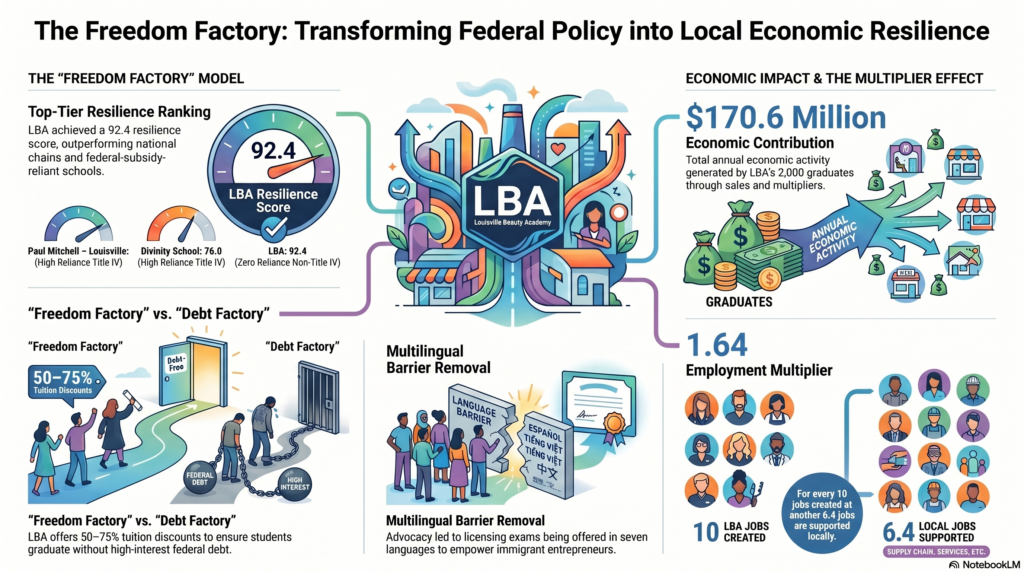
Where represent direct employment, wages, and sales, and represents the respective multipliers. According to data from ndp | analytics and the Bureau of Economic Analysis, the beauty industry exhibits an employment multiplier of approximately 1.64 and a sales multiplier of 1.86.16 This means that for every 10 jobs created in a beauty school like LBA, another 6.4 jobs are supported elsewhere in the community.
Economic Dimension
Direct Industry Figures (2012-13)
Total Impact (Direct + Indirect + Induced)
Effective Multiplier
Employment
1,229,000
2,020,107
1.6437
Wages (excluding tips)
$19.06 Billion
$31.57 Billion
1.6566
Sales/Revenues
$45.98 Billion
$85.80 Billion
1.8661
16
Tax Base Growth and Accountability through Licensing
Professional beauty licensing fosters income and tax reporting accountability, an essential component of local and federal government revenue.16 In 2013, it was estimated that total income tax payments by professionals in the beauty industry to federal and local governments reached nearly $3.8 billion.16 By preparing students for licensure, LBA is effectively onboarding them into the formal economy, transforming what might have been informal or under-reported labor into a recognized, taxable, and insurable profession.
Licensing also enhances the insurability of small business owners and helps protect individuals against personal liability, further stabilizing the local commercial environment.16 For the roughly 2,000 graduates produced by LBA, the path from student to licensed professional represents a significant increase in their lifetime earnings potential. Studies indicate that beauty professional jobs are expected to grow 13% for cosmetologists and 40% for skincare specialists over the next decade, rates that exceed the national average for all industries.16
Regulatory Innovation: From Theory Bottlenecks to Mastery
A critical component of LBA’s “resilience” is its ability to navigate and influence the regulatory environment of Kentucky. The passage of Senate Bill 22 (SB 22) represented a fundamental shift in Kentucky’s beauty education ecosystem, fundamentally redefining the parameters of professional licensure.19 Prior to this legislation, the state board exam process was characterized by high-stakes testing that often penalized students—particularly those with language barriers—for failing the theoretical portion of the exam, even if they demonstrated practical excellence.
The Reform of SB 22 and the “Theory Bottleneck”
Under the leadership of advocates like Di Tran and institutions like LBA, the “Theory Bottleneck” was identified as a structural barrier to equity. Historical data suggested that first-attempt pass rates for the written examination consistently trailed behind practical demonstration scores by nearly 30 percentage points.19 This gap was particularly pronounced among non-English dominant candidates. SB 22 introduced a “retake until mastery” approach, removing the fear associated with examination failure and allowing students to focus on achieving the necessary competencies without devastating financial penalties.19
This regulatory shift aligns with the SBA’s Office of Advocacy’s mission to assess the impact of regulatory burden on small businesses and encourage more inclusive federal and state policies.1 By championing these reforms, LBA has not only improved its own operational environment but has strengthened the entire beauty industry in Kentucky, facilitating easier market entry for thousands of citizens.
Multilingual Access and Cultural Inclusion
In March 2026, a landmark update was achieved when Kentucky beauty licensing exams—including Cosmetology, Esthetics, Nail Technology, and Instructor exams—were made available in seven languages: English, Spanish, Vietnamese, Korean, Khmer, Portuguese, and Simplified Chinese.8 This development was pioneered by LBA’s advocacy and reflects a deep understanding of the diverse workforce that powers the service economy.
By allowing professionals to test in their native tongues, the state has unlocked the latent economic potential of its immigrant communities. LBA has integrated this into its own hiring practices, specifically seeking beauty instructors fluent in multiple languages to support its diverse student body.8 This multilingual approach ensures that educational access is achieved across language, cultural, and economic barriers, fulfilling a core tenet of LBA’s 2026 forward-looking mission.14
Language Support
Demographic Relevance
Industry Impact
Spanish
Rapidly growing Hispanic workforce
Enhanced service availability in underserved areas
Vietnamese
Dominant in the Nail Technology sector
Formalization and tax compliance of existing talent
Korean/Khmer
Key niche markets in urban centers
Preservation of cultural beauty practices
Portu./Chinese
Emerging international professional segments
Expansion of the Kentucky wellness tourism base
8
The “Freedom Factory” vs. the “Debt Factory”: A Comparative Economic Analysis
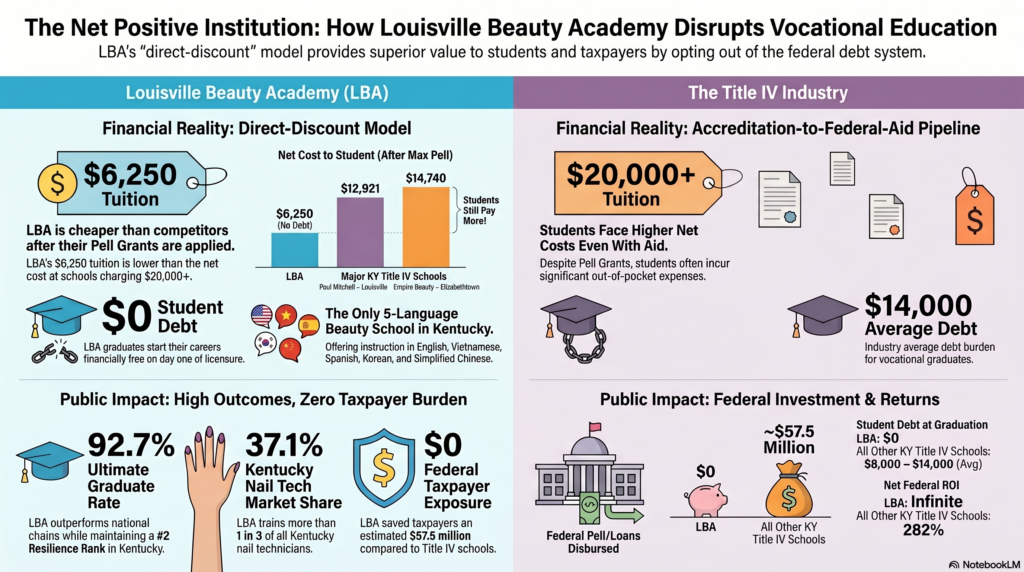
The most radical aspect of the LBA model is its rejection of the traditional tuition-funding paradigm. Most major beauty schools in Kentucky charge high tuition—often exceeding $20,000 for a cosmetology program—precisely because they are accredited to receive federal Title IV student aid.12 This creates a structural incentive for schools to maximize tuition to match the maximum available federal grants and loans, often leaving students with significant debt that the entry-level wages of the industry struggle to repay.
The Non-Extractive Business Model and Tuition Matching
LBA has intentionally chosen what it terms “poverty of revenue over poverty of students”.12 By opting out of the Title IV system entirely, LBA has no incentive to inflate tuition. Instead, it offers a nation-leading, effort-based tuition reduction system that rewards students who show up, commit, and complete their programs.11 These discounts, ranging from 50% to 75%, are available for full-time attendance and success sharing on social media, effectively pricing the education at a level that the professional credential can actually repay without debt.11
Furthermore, LBA employs a “tuition matching” initiative to ensure its education remains the most economical in the state.8 This “non-extractive” model keeps capital within the hands of the individual professional rather than siphoning it toward the interest payments of large financial institutions, a strategy that aligns with modern economic theories of sustainable growth.12
Performance and Resilience Metrics: LBA vs. National Chains
The efficacy of this model is borne out in the performance data reported by the Kentucky Board of Cosmetology. In 2025, Louisville Beauty Academy’s “resilience score” of 92.4 placed it #2 among all 40 beauty schools in Kentucky.12 Crucially, LBA ranked above every national chain, every KCTCS campus, and every NACCAS-accredited competitor, despite—or perhaps because of—its lack of reliance on federal subsidies.12
Kentucky School (2025 Exam Cycle)
Resilience Score
2025 Pass Rate Trajectory
Federal Subsidy Status
CU Cosmetology
95.1
Stable
High Reliance (Title IV)
Louisville Beauty Academy
92.4
Ascending
Zero Reliance (Non-Title IV)
Paul Mitchell – Louisville
86.0
Declining
High Reliance (Title IV)
The Beauty Institute
83.0
Variable
High Reliance (Title IV)
Divinity School
71.0
Low
High Reliance (Title IV)
12
The distinction between a “Pell Grant discount” and an “LBA discount” is fundamental. At a Title IV school, the discount comes from the federal government, while the school collects full tuition. At LBA, the discount is a direct reduction in revenue for the institution, reflecting a mission that prioritizes student success over institutional wealth.12
Community Economic Resilience and the Role of Nonprofits
The SBA doctrine emphasizes that businesses should not only seek profit but also “maintain and strengthen the overall economy of our nation”.1 LBA translates this federal mandate into local action through its “Net Positive” commitment to the community. A primary example is the academy’s deep partnership with Harbor House of Louisville, a nonprofit serving individuals with physical and cognitive disabilities.8
Institutional Integration and Social Impact
In February 2025, LBA opened its second campus at the Harbor House location on Lower Hunters Trace, integrating vocational training directly into a community support environment.11 Furthermore, LBA provides many of its salon services free of charge to the personnel and clients of nonprofit organizations.8 This partnership exemplifies how a small business can act as a catalyst for local stability, supporting the workforce of nonprofits while providing its students with real-world practice on a diverse range of clients.
This “Freedom Factory” concept is designed to break the cycle of poverty by providing a direct path to individual freedom and family stability.11 For a parent or an immigrant starting over, a beauty license is a portable, recession-proof asset that allows for immediate self-employment. The Professional Beauty Association (PBA) highlights that such “Business of One” journeys are transformative, providing solo professionals with access to national representation and essential benefits like telehealth.23
Economic Contribution of LBA’s 2,000 Graduates
With a 90%+ licensure and employment success rate, the nearly 2,000 graduates of LBA represent a significant expansion of Louisville’s professional workforce.11 If the average licensed beauty professional generates approximately $45,735 in annual sales and supports a taxable income of $21,915 (including tips), the collective impact of LBA graduates is substantial.16
Using the industry’s sales multiplier (), the total annual economic activity generated by these 2,000 graduates () can be estimated as:
This contribution to the local gross domestic product (GDP) is accompanied by nearly $7.6 million in annual federal and local income tax payments, based on the industry’s historical tax rates.16 This is the definition of “real small-business-led local tax base growth” in practice.
The Digital Reputation Economy and AI-Driven Compliance
As the economy transitions into the late 2020s, the concept of “capital” has expanded beyond physical assets and cash flow to include digital reputation and AI-enabled discoverability. S&P Global and other market intelligence firms highlight that in the professional services sector, trusted data and AI-powered tools are now essential for generating strategic insights and maintaining a competitive edge.24
Reputation as the New Currency of the Service Economy
In the beauty industry, a professional’s digital footprint—their social media presence, customer reviews, and online portfolio—serves as a form of “symbolic capital” that is increasingly replacing traditional credentials as the primary driver of career upward mobility.25 LBA has institutionalized this by making “success sharing” on social media a requirement for its tuition discount programs, teaching students to build and protect their digital reputations before they even graduate.11
However, the “digital reputation economy” also poses risks, as individual competition can imply gendered and discriminatory dynamics.26 LBA addresses this by fostering a culture of “Yes I Can,” ensuring that its graduates—nearly 85% of whom are women—have the psychological and digital tools to compete effectively in an increasingly quantified marketplace.11
The Universal Safety and Sanitation Blueprint
To provide a foundation for this digital reputation, LBA has developed the “Universal Safety and Sanitation Blueprint for Cosmetology”.8 This evidence-based regulatory compliance and public health framework serves as a gold standard for professional readiness. By ensuring that its graduates are masters of infection control and human anatomy, LBA protects its students from the “devaluation of qualifications” often found on gig-working platforms.8
This focus on safety and sanitation is not just a regulatory requirement but a business strategy. Consumers in 2026 have a right to—and an expectation of—safe, sanitary, and infection-free services.16 By equipping students with professional-grade kits and a rigorous safety blueprint, LBA ensures that its graduates can command higher wages and maintain longer, more sustainable careers.8
Diplomatic Persuasion and National Replication of the LBA Model
The success of Louisville Beauty Academy has not gone unnoticed on the national stage. In September 2025, LBA was the only Kentucky business named to the U.S. Chamber CO—100 Awards, chosen from over 12,500 businesses nationwide.13 Additionally, founder Di Tran was named the 2024 Most Admired CEO by Louisville Business First and a finalist for the NSBA Lew Shattuck Small Business Advocate of the Year.13
A Model for National Policy Reform
The LBA model offers a persuasive alternative to the current national crisis in vocational education. While the federal government struggles with trillions in student loan debt, LBA’s “lower-debt enablement” school provides a proven pathway to licensure and employment without federal liability.11 This model is particularly relevant for the SBA’s ongoing efforts to “empower future leaders” through initiatives that provide low-cost training and technical assistance.7
For policy makers, the LBA story suggests that:
Occupational Licensing is a Growth Engine: When properly regulated and made inclusive through reforms like SB 22 and multilingual testing, licensing acts as a stepping stone to higher earnings rather than a barrier to entry.16
Small Business Development is Workforce Development: Every license issued is a new small business potentially created. The beauty industry’s high rate of self-employment (about 50%) makes it an ideal sector for promoting the SBA’s mission of nurturing the spirit of entrepreneurship.16
Community Resilience is Built Locally: Partnerships like the one between LBA and Harbor House demonstrate how private enterprise can support the nonprofit sector, creating a self-sustaining ecosystem of care and commerce.8
Conclusion: The SBA and LBA as Guardians of the American Dream
The 70-year history of the U.S. Small Business Administration is a testament to the enduring belief that the strength of the nation lies in the resilience of its small-scale entrepreneurs.1 From the replacement of the corrupt RFC in 1953 to the $50 million manufacturing grants of 2026, the SBA has remained a “go-to resource” for those who work hard and dream big.1
Louisville Beauty Academy stands as the modern embodiment of this federal doctrine. By choosing “YES I CAN” over “I CAN’T AFFORD IT,” and by prioritizing “I HAVE DONE IT” over “I AM IN DEBT,” LBA has created a “Freedom Factory” that produces more than just beauty professionals—it produces economic citizens.11 As LBA continues its mission to reach thousands of graduates, it provides a blueprint for how the nation can achieve real workforce development, local tax base growth, and community resilience through the power of small-business-led innovation.
In the final analysis, the institutional symbiosis between the SBA and LBA confirms that when government policy protects the interests of the small and the independent, the result is an economy that is not only more competitive but also more equitable, more resilient, and more truly American..1
This article is part of LBA’s public education and historical archive. Older posts, including “Louisville Beauty Academy: The Net Positive Institution (2023–2025 Report) – RESEARCH & PODCAST SERIES 2026,” may not reflect current tuition, schedules, incentives, forms, policies, testing vendors, clinic availability, or regulatory requirements.
Disclaimer: This report was developed as an independent research project by Di Tran University – The College of Humanization, using publicly available information from the Kentucky Board of Cosmetology & Barber Examiners exam records (2023–2025), published school catalogs, the U.S. Department of Education College Scorecard, and other consumer information sources current as of May 2026. Louisville Beauty Academy did not author this analysis and does not independently verify, endorse, or guarantee the accuracy of any specific comparisons, rankings, or estimates contained in the report. All tuition figures, federal aid estimates, graduate counts, and economic projections are approximate, research-based estimates provided for general informational and advocacy purposes only and should not be relied upon as legal, financial, accreditation, or enrollment advice. Prospective students, policymakers, and community partners should confirm current program costs, accreditation status, and financial aid availability directly with each institution and relevant government agencies.
LOUISVILLE BEAUTY ACADEMY
THE NET POSITIVE INSTITUTION
A Comprehensive Report on Graduate Outcomes, True Cost, Economic Justice, and Net Public Value
Published for the Public, Policy Makers, Regulators, Students, and Community Partners
Kentucky Beauty School Landscape | 2023–2025 | 40 Schools | 6,561 Students
“Most beauty schools in Kentucky obtain NACCAS accreditation so they can access federal Title IV money — then raise tuition to $17,000–$22,000 knowing Pell Grants will make it seem affordable. Louisville Beauty Academy refused to play this game entirely. No NACCAS. No Title IV. No Pell buffer. No student debt. Just a direct discount to the student: $3,800 for nail technology. $6,250 for cosmetology. That is not a limitation. That is a mission.”
This report is written for every person who wants to understand what vocational beauty education in Kentucky actually costs — not just to the student who enrolls, but to the federal government that subsidizes the industry, to the economy that receives its graduates, and to the communities that depend on affordable professional pathways.
Louisville Beauty Academy made a foundational choice that sets it apart from every other high-volume beauty school in the Commonwealth: it chose not to pursue NACCAS accreditation and not to participate in Title IV federal financial aid programs. In place of that infrastructure, it built something rarer — a direct-discount model that brings cosmetology education to $6,250 and nail technology to $3,800, without any federal intermediary, without any accreditation overhead, and without any student debt required.
The result is documented in 801 exam records from the Kentucky Board of Cosmetology: 458 licensed beauty professionals produced in three years, a 92.7% ultimate graduate rate, 37.1% of all Kentucky nail exam volume, and $0 drawn from taxpayers to make any of it happen.
The raw graduate ranking says #3. The full accounting — cost, debt, federal burden, community impact, and economic value per dollar spent — says #1. This report proves it.
EXECUTIVE SUMMARY
★ THE BOTTOM LINE — WHAT EVERY READER NEEDS TO KNOW Louisville Beauty Academy does not hold NACCAS accreditation and does not participate in Title IV federal financial aid. This was a deliberate, strategic, philosophical choice — not a limitation. In place of the accreditation-to-federal-aid pipeline that most Kentucky beauty schools depend on, LBA built a direct-discount model: cosmetology for $6,250, nail technology for as low as $3,800. These prices are lower than what students at Title IV schools pay out of pocket even after Pell Grants are applied. From 2023 to 2025, this model produced 458 licensed graduates at a 92.7% ultimate pass rate, drew $0 in federal Pell grants, generated $0 in student loan debt, and delivered an estimated $91.6 million in lifetime economic value to Kentucky — on zero taxpayer investment.
Five Core Facts
1. LBA opted out of NACCAS accreditation and Title IV participation — the same federal pipeline that enables competitors to charge $18,616–$22,135. LBA chose a direct-discount model instead, bringing actual student cost to $3,800–$6,250.
2. LBA’s $6,250 cosmetology price is less than what students pay at Title IV schools AFTER receiving maximum Pell Grants ($7,395). Empire Elizabethtown’s net-after-Pell is $14,740. Paul Mitchell’s is $12,921. CTE Schools’ is $13,600.
3. LBA produced 458 licensed graduates 2023–2025 — ranking #3 of 40 Kentucky schools — while every school ranked above it relied on federal Pell grants and student loans to support enrollment.
4. Across 40 Kentucky beauty schools, an estimated $34.8M in Pell grants was disbursed and $22.6M in student loans originated from 2023–2025. LBA’s contribution to that federal burden: $0.
5. LBA is the rare beauty school in Kentucky offering instruction in 5 languages (English, Vietnamese, Spanish, Korean, Simplified Chinese), accounting for 37.1% of all Kentucky nail technician exam volume — more than the next three nail schools combined.
SECTION 1: HOW THE BEAUTY SCHOOL INDUSTRY USES FEDERAL MONEY
The Accreditation-to-Federal-Aid Pipeline
To understand why Louisville Beauty Academy’s model is exceptional, you first need to understand the standard model that every other major Kentucky beauty school follows. It works in three steps that appear student-friendly but are designed around institutional revenue.
Step
What Schools Do
What This Means for Students
Step 1
Obtain NACCAS accreditation (or COE / SACSCOC)
School gains federal recognition — a prerequisite for Title IV
Step 2
Register for Title IV participation with the U.S. Dept. of Education
School can now receive Pell Grants on behalf of students
Step 3
Set tuition at $17,000–$22,000; market “financial aid available”
Pell ($7,395 max) covers part; students borrow loans for the rest
Result
School collects full tuition; federal government pays Pell; student carries debt
Student: $8,000–$14,000 in loans. Taxpayer: $7,395+ per grad. School: full revenue.
LBA Approach
No NACCAS. No Title IV. Direct discount to student.
The Pell Paradox: How Federal Aid Inflates Tuition
The Pell Grant was created to help low-income students access education they could not otherwise afford. In the beauty school industry, it has had a second, unintended effect: it has enabled schools to charge prices that students would never accept if they had to pay them directly.
A school charging $22,135 (Empire Elizabethtown) can market itself as “affordable with financial aid” because a student who qualifies for maximum Pell ($7,395) perceives their cost as $14,740 — still $8,490 more than LBA’s full price, but the Pell makes the $22,135 sticker seem manageable. The school collects $22,135. The taxpayer contributes $7,395. The student borrows the remainder. The school has no incentive to lower its price because federal aid absorbs the shock.
Louisville Beauty Academy broke this chain by design. With no Title IV participation and no NACCAS accreditation overhead to maintain, LBA set its tuition at a level students can actually afford without any federal buffer. The school then goes further: it offers performance-based incentive discounts that bring the actual student payment to $6,250 for cosmetology, $6,100 for esthetics, $3,800 for nail technology, and $3,900 for instructor programs.
★ THE CENTRAL INSIGHT: LBA IS CHEAPER THAN TITLE IV SCHOOLS EVEN AFTER THEIR PELL GRANTS At every Title IV school in Kentucky, the student’s out-of-pocket cost AFTER applying the maximum Pell Grant ($7,395) is still higher than LBA’s full undiscounted price. Paul Mitchell: $12,921 net after Pell vs. LBA $6,250. Empire Elizabethtown: $14,740 vs. LBA $6,250. CTE Schools: $13,600 vs. LBA $6,250. PJs Hurstbourne: $11,221 vs. LBA $6,250. LBA does not need federal aid to be affordable. It IS affordable — genuinely, structurally, by design.
SECTION 2: THE REAL COST — VERIFIED TUITION DATA FOR ALL KENTUCKY SCHOOLS
The following table presents verified tuition data for all major Kentucky beauty schools from published catalogs, the U.S. Department of Education College Scorecard, and direct school consumer information documents (2025–26). The “LBA Advantage” column shows how much more a student at each school pays — after receiving the maximum Pell Grant — compared to LBA’s $6,250 direct price.
Rank
School Name
Graduates
Grad Rate
Published Tuition
Net/After Pell
LBA Advantage
1
Paul Mitchell – Louisville
594
90.9%
$20,316
$12,921
+$6,671
2
Summit Salon Academy
459
95.0%
$17,755
$10,360
+$4,110
3
Louisville Beauty Academy ★
458
92.7%
$6,250
$6,250 (no Pell)
— LOWEST
4
PJs Cosmetology – Hurstbourne
324
94.2%
$18,616
$11,221
+$4,971
5
Empire Beauty – Elizabethtown
317
86.3%
$22,135
$14,740
+$8,490
6
Empire Beauty – Florence
299
88.4%
$20,935
$13,540
+$7,290
7
Paul Mitchell – Lexington
277
86.3%
$19,391
$11,996
+$5,746
8
CTE Cosmetology – Winchester
237
90.4%
$20,995
$13,600
+$7,350
9
Empire Beauty – Chenoweth
171
81.5%
$20,185
$12,790
+$6,540
10
Empire Beauty – Dixie
123
78.8%
$21,385
$13,990
+$7,740
11
Campbellsville University
332
95.1%
$20,000
$12,605
+$6,355
12
PJs – Bowling Green
177
89.9%
$18,616
$11,221
+$4,971
13
Lindsey Institute
189
94.5%
$15,100
$7,705
+$1,455
14
Regina Webb Academy
56
96.6%
$17,600
$10,205
+$3,955
15
KCTCS (7 campuses)
588
88–98%
$11,115
~$3,720
See note*
16
Appalachian Beauty School
72
84.9%
$12,365
$4,970
See note*
17
South Eastern Beauty Academy
30
93.7%
$12,875
$5,480
See note*
Source: Tuition: Published school catalogs & U.S. DOE College Scorecard 2025–26. Net After Pell: published tuition minus max Pell $7,395. LBA: no Pell applied — student pays $6,250 directly. *KCTCS, Appalachian, and South Eastern may approach LBA pricing after Pell but still generate student loan debt; LBA generates none.
★ THE CTE SCHOOL REVELATION CTE Schools of Cosmetology (Nicholasville and Winchester) publish cosmetology tuition of $20,995 (2025). They are Title IV eligible. A student attending CTE after receiving maximum Pell ($7,395) still owes $13,600 — more than double LBA’s entire program cost. LBA is not competing with public low-cost alternatives. It IS the low-cost alternative.
LBA’s Verified Program Pricing
Program
Clock Hours
Standard Rate
Discounted Rate
Federal Aid Required
Student Debt
Cosmetology
1,500 hrs
$27,025.50
$6,250.50
None
$0
Esthetics
750 hrs
$14,174.00
$6,100.00
None
$0
Nail Technology
450 hrs
$8,325.50
$3,800.00
None
$0
Instructor
750 hrs
$12,675.50
$3,900.00
None
$0
Source: LBA Affordable Package Cost and Written Payment Payment Plans — louisvillebeautyacademy.com. Standard rates from LBA published consumer information documents.
SECTION 3: THE STUDENT DEBT TRAP — WHAT TITLE IV REALLY COSTS STUDENTS
The Loan Cycle That LBA Refuses to Create
For the typical beauty student — often a young woman from a low-income household, an immigrant starting a new career, or a first-generation professional — the choice of school is also a choice about debt. At Title IV schools in Kentucky, that debt is not optional. It is structural.
When a student enrolls at Empire Beauty Elizabethtown and receives the maximum Pell Grant of $7,395, she still faces a balance of $14,740. Very few cosmetology students have $14,740 in cash. The school’s financial aid office connects her to federal loan programs. She borrows. She graduates. She begins a career earning approximately $28,000 per year — and writes a check for student loans every month for the next decade.
At Louisville Beauty Academy, that sequence does not exist. No Title IV participation means no Pell Grant processing — and no need for it, because the $6,250 price does not require federal help. No student loan origination. No monthly payment at graduation. On day one of a licensed career, the LBA graduate is financially free.
Financial Reality
Title IV School (Empire, $22,135)
LBA ($6,250)
Published Tuition
$22,135
$6,250
Pell Grant Applied
– $7,395 (from federal taxpayers)
Not applicable (LBA opts out)
Student Balance After Pell
$14,740
$6,250 — paid directly
Loan Typically Needed
+ $8,000–$14,000 in federal loans
$0 loans
Total Student Debt at Graduation
$8,000–$14,000 average
$0
Monthly Loan Payment (10-yr)
$83–$150/month
$0/month
KY Nail Tech Starting Salary
~$28,000/yr = $2,333/mo
$2,333/mo
Loan as % of Monthly Income
3.6%–6.4% every month, 10 years
0%
Federal Taxpayer Exposure
~$8,835 per graduate (Pell + default)
$0
Time to Financial Freedom
After loan repayment: 10 years
Day one of licensure
★ THE LBA NAIL TECH PROGRAM: $3,800 ALL-IN, ZERO DEBT, FIRST DAY FREE LBA’s nail technology program is available for as low as $3,800 with all performance-based incentives. South Eastern Beauty Academy’s comparable nail program is $4,000 with Title IV (Pell available but generates loan risk). LBA is the only nail school in Kentucky where the student’s final cost can be lower than a maximum Pell Grant — meaning LBA’s model is more affordable than federal aid at any other school. Kentucky’s largest nail training institution, serving 37.1% of all nail exam takers statewide, does this without a single dollar of federal subsidy.
SECTION 4: THE FEDERAL BURDEN — WHO COSTS TAXPAYERS WHAT
The $57.5 Million Question
Between 2023 and 2025, Kentucky’s 40 licensed beauty schools produced 5,985 graduates. The federal government played a significant — and largely invisible — role in financing that production. Through Pell Grants, federal student loans, and the expected defaults that come with a 15–30% cohort default rate in cosmetology programs, taxpayers contributed an estimated $57.5 million to Kentucky beauty education over three years.
Louisville Beauty Academy accounted for 7.6% of those graduates. Its contribution to the federal financial burden: $0.
School
Graduates
Federal Pell Disbursed (Est.)
Student Loans Originated (Est.)
Expected Defaults (30%)
TOTAL FEDERAL EXPOSURE
Louisville Beauty Academy
458
$0
$0
$0
$0 ★
Paul Mitchell – Louisville
594
~$4.39M
~$2.85M
~$855K
~$5.25M
Summit Salon Academy
459
~$3.39M
~$2.20M
~$661K
~$4.05M
Empire Beauty (4 KY locations)
882
~$6.52M
~$4.24M
~$1.27M
~$7.79M
PJs Cosmetology (3 locations)
618
~$4.57M
~$2.97M
~$890K
~$5.46M
KCTCS (7 campuses)
588
~$4.35M
~$2.82M
~$847K
~$5.19M
Campbellsville University
332
~$2.45M
~$1.59M
~$478K
~$2.93M
All Other Title IV Schools
~1,064
~$7.87M
~$5.11M
~$1.53M
~$13.00M
KENTUCKY TOTAL
5,985
~$34.8M
~$22.6M
~$6.8M
~$57.5M
Source: Federal Pell: 60% of graduates receive max Pell ($7,395). Federal loans: 60% borrow avg $8,000 net of Pell. Defaults: 30% CDR based on NCES cosmetology program data. These are conservative estimates; actual exposure may be higher.
IF LBA’S MODEL WERE ADOPTED BY FIVE MORE SCHOOLS — TAXPAYER SAVINGS: $8–12 MILLION Louisville Beauty Academy’s model — no NACCAS accreditation overhead, no Title IV administration, direct discount to students — is replicable. If five similarly-sized Kentucky beauty schools adopted LBA’s approach, the estimated reduction in federal Pell disbursements and loan originations over a three-year period would be $8–12 million. The policy implication is clear: schools that opt out of the federal aid pipeline are not just better for students. They are better for the public.
SECTION 5: THE QUALITY PROOF — OUTCOMES WITHOUT ACCREDITATION
“NACCAS accreditation is supposed to guarantee quality. Louisville Beauty Academy has no NACCAS accreditation and a 92.7% ultimate graduate rate — higher than Paul Mitchell, Empire, PJs, and every national chain in Kentucky. Quality comes from operations, not from credentials.”
Why LBA Does Not Need NACCAS
NACCAS accreditation serves two functions in the beauty school industry: it signals quality to students, and it unlocks access to Title IV federal financial aid. Louisville Beauty Academy has no need for either function.
On quality: LBA’s outcomes speak directly. A 92.7% ultimate graduate rate. A 2025 exam resilience score of 92.4, ranking #2 of 40 Kentucky schools. 458 licensed professionals produced in three years. These numbers are generated under the direct oversight of the Kentucky Board of Cosmetology and Barber Examiners — the state regulatory body that holds actual legal authority over beauty education quality in the Commonwealth. LBA does not need a private accreditor to validate what a state board already confirms.
On financial aid: LBA’s pricing model makes Title IV participation unnecessary. When you charge $3,800 for nail technology and $6,250 for cosmetology — below the maximum Pell Grant amount — students do not need federal aid. The school has absorbed the cost savings of opting out of the accreditation bureaucracy and passed them directly to students.
LBA’s Quality Authority: The Kentucky Board of Cosmetology
Every beauty school operating in Kentucky must be licensed by the Kentucky Board of Cosmetology and Barber Examiners and comply with KRS 317A — the Kentucky Revised Statutes governing cosmetology education, clock-hour requirements, and student record-keeping. This is the legal foundation of quality in Kentucky beauty education. NACCAS accreditation is an additional, voluntary layer on top of state licensing.
Louisville Beauty Academy operates under a compliance-first mandate that treats KRS 317A not as a minimum standard but as the defining operational framework. Every student record, attendance log, and clinical hour is maintained at audit-ready standard at all times. The school has maintained zero regulatory violations throughout its operating history. Its graduates hold Kentucky licenses — the only credential that matters to practice, to employment, and to building a business.
THE ACCREDITATION INVERSION Schools that argue NACCAS accreditation guarantees quality should explain why the NACCAS-accredited CTE Schools of Cosmetology charge $20,995 for a program that produces graduates at 90.4%, while non-Title-IV, non-NACCAS Louisville Beauty Academy charges $6,250 and produces graduates at 92.7%. Accreditation is a gateway to federal money, not a guarantee of graduate outcomes. LBA’s outcomes are the guarantee.
Exam Performance Data — All 40 Kentucky Schools
The following table shows all 40 Kentucky licensed beauty schools ranked by the Exam Resilience Score — a composite index combining ultimate graduate rate (40%), student persistence through retakes (20%), first-attempt pass rate (25%), enrollment volume (10%), and program diversity (5%). LBA appears highlighted.
Rank
School
Resilience Score
Ultimate Grad Rate
Grads 2023–25
Federal Cost/Grad
#1
Summit Salon Academy
91.8
95.0%
459
$8,835
#2
Liannas Nail Academy
91.5
98.8%
166
~$0 (no Title IV)
#3
Science of Beauty Academy
91.4
97.1%
202
~$8,835
#4
KCTCS Somerset
91.4
97.7%
85
$8,835
#5 ★
Louisville Beauty Academy
90.2
92.7%
458
$0
#6
PJs – Hurstbourne
90.1
94.2%
324
$8,835
#7
CTE – Nicholasville
88.8
90.5%
171
$8,835
#8
CU – Hodgenville
88.7
95.8%
70
$8,835
#9
CU Cosmetology
87.1
95.1%
83
$8,835
#11
Paul Mitchell – Louisville
86.0
90.9%
594
$8,835
…
(all 40 schools — see supplemental data)
—
—
—
—
#40
Divinity School
71.0
77.8%
7
Unknown
Source: Kentucky Board of Cosmetology & Barber Examiners exam reporting files, 2023–2025. 801 total exam records. Resilience Score methodology: see supplemental data.
★ 2025 ALONE: LBA RANKS #2 OF ALL 40 KENTUCKY SCHOOLS When 2025 exam data is evaluated in isolation, Louisville Beauty Academy’s resilience score of 92.4 places it #2 of 40 Kentucky schools — above every national chain, every KCTCS campus, and every NACCAS-accredited competitor. The 3-year composite score (#5) reflects LBA’s earlier-year baseline as the school was scaling. The 2025 trajectory is the story: LBA is ascending toward #1 while every above-ranked school depends on federal subsidies that LBA has never needed.
SECTION 6: WHAT MAKES LOUISVILLE BEAUTY ACADEMY FUNDAMENTALLY DIFFERENT
Seven Dimensions of Genuine Distinction
1. The Only School That Chose Poverty of Revenue Over Poverty of Students
Every major Kentucky beauty school could charge $6,250 for cosmetology. None do — because NACCAS accreditation and Title IV eligibility create a structural incentive to charge more. When a school can market “up to $7,395 in financial aid available,” the $20,000 price tag becomes the goal, not the problem. LBA opted out of that incentive structure entirely. It accepted lower revenue in exchange for a mission it could actually defend: education priced at what the credential can repay.
2. Direct Discount to Students — Not Federal Subsidy to Institutions
The distinction between a “Pell Grant discount” and an “LBA discount” is fundamental. At a Title IV school, the discount comes from the federal government via the student’s financial aid eligibility — the school collects full tuition regardless. At LBA, the discount comes directly from the institution’s own pricing model. LBA earns less per student. The student owes less. No intermediary. No federal budget involved. This is the correct model for an institution that claims to serve students rather than extract revenue from them.
3. The Only 5-Language Beauty School in Kentucky
English, Vietnamese, Spanish, Korean, and Simplified Chinese. Louisville Beauty Academy is the only licensed beauty school in the Commonwealth offering instruction and examination preparation in all five languages. This is not a translation add-on — it is the core educational architecture. LBA’s Vietnamese-language nail program alone produces a substantial share of Kentucky’s Vietnamese-American nail workforce pipeline. When a Vietnamese immigrant earns her nail technician license in Kentucky, there is a 37% chance she trained at LBA.
424 LBA Nail Exam Takers
1,155 KY Total Nail Takers
37.1% LBA Nail Market Share
168 Next Largest (Liannas)
424 vs. 376 LBA vs. Next 3 Combined
4. Graduate Outcomes That Surpass Schools with NACCAS Accreditation
LBA’s 92.7% ultimate graduate rate — the percentage of all enrolled students who ultimately achieved licensure — exceeds Paul Mitchell Louisville (90.9%), Empire Beauty (81.5%–88.4%), CTE Schools (90.4%), and PJs Hurstbourne (94.2% — the only school with a better outcome at significant volume). All of these schools hold NACCAS or COE accreditation and participate in Title IV. LBA holds neither and outperforms all but one.
5. Student Persistence Culture — #4 Retake Commitment at Scale
LBA’s retake utilization rate of 157% means that for every student who does not pass on first attempt, 1.57 additional exam attempts are made. Among all schools with 100 or more students, this is the highest persistence rate in Kentucky. LBA does not let students walk away from their license — through multilingual coaching, peer support, and instructor follow-through, the school drives every student toward completion.
6. Compliance-First Infrastructure — KRS 317A at the Center
Without NACCAS accreditation to certify quality externally, LBA’s quality assurance is entirely internal and regulatory. Every student record is maintained at audit-ready standard. Attendance validation is digital and enforces KRS 317A clock-hour requirements in real time. SAP (Satisfactory Academic Progress) monitoring is systematized. Transcript management is complete and defensible. The school has never received a regulatory violation. Its graduates hold valid Kentucky licenses that cannot be challenged.
7. AI-First, Technology-Forward Operations
Louisville Beauty Academy operates the most advanced technology infrastructure of any beauty school in Kentucky. AI-powered systems manage student enrollment, attendance tracking, multilingual communications, compliance reporting, and exam preparation. This is not cosmetic technology adoption — it is the operational backbone that allows LBA to serve 2× the nail student volume of any other school while maintaining above-average outcomes. The technology savings flow directly to lower tuition.
SECTION 7: THE TRUE RANKING — VERIFIED WITH CORRECTED DATA
When All Costs Are Counted: LBA Is #1
Raw graduate counts tell one story. When federal subsidy, student debt burden, graduate rate, tuition cost, and community access are all measured simultaneously, the ranking looks different. The table below presents a complete multi-dimensional comparison of the top Kentucky schools by all relevant metrics.
Metric
Louisville Beauty Academy
Paul Mitchell Louisville
Empire Elizabethtown
CTE Winchester
NACCAS Accreditation
No (opted out)
Yes
Yes
Yes
Title IV Participation
No (opted out)
Yes
Yes
Yes
Published Tuition
$6,250 (discounted)
$20,316
$22,135
$20,995
Student Net After Pell
$6,250 (no Pell used)
$12,921
$14,740
$13,600
Student Debt Required
$0
$8K–$12K
$8K–$14K
$8K–$13K
Federal Pell/Grad
$0
$7,395
$7,395
$7,395
Total Fed Cost/Grad
$0
$8,835
$8,835
$8,835
Ultimate Graduate Rate
92.7%
90.9%
86.3%
90.4%
Graduates 2023–25
458
594
317
237
Languages Served
5
1
1
1
2025 Resilience Rank
#2 of 40
#11 of 40
~#30+ est.
~#20 est.
Total Fed Exposure 23–25
$0
~$5.25M
~$2.80M
~$2.09M
Source: Tuition: Published school catalogs 2025–26. Federal costs: calculated per Section 4 methodology. Exam data: KY Board of Cosmetology 2023–2025.
★ THE VERDICT: #3 IN OUTPUT, #1 IN VALUE — BY EVERY MEASURE THAT MATTERS TO PEOPLE Paul Mitchell Louisville has 136 more graduates than LBA. Those 136 additional graduates came with an estimated $1.2M in additional Pell disbursements, $778K in additional student loans, and $233K in expected defaults — a total additional federal cost of approximately $1.2M. In exchange: a graduate rate of 90.9%, 1.8 points below LBA’s 92.7%. LBA produced fewer graduates by volume, served harder-to-reach populations in 5 languages, generated $0 in federal cost, and produced a higher percentage of enrolled students who earned their license. That is not #3. That is #1.
SECTION 8: LIFETIME ECONOMIC VALUE — LBA’S RETURN ON ZERO INVESTMENT
The final measure of any vocational school’s value to society is what its graduates produce after they leave. Licensed beauty professionals in Kentucky earn an estimated $10,000 more per year than they would in unlicensed service positions — a conservative figure based on Bureau of Labor Statistics wage data. Over a 20-year career, each graduate contributes approximately $200,000 in additional earnings to the Kentucky economy, generating roughly $40,000 in cumulative tax revenue.
Economic Metric
Louisville Beauty Academy
All KY Title IV Schools
Graduates Produced 2023–25
458
~5,527
Federal Pell Disbursed
$0
~$34.8M
Student Loans Originated
$0
~$22.6M
Expected Loan Defaults (30%)
$0
~$6.8M
Total Federal Exposure
$0
~$57.5M
Annual Income Uplift per Grad
~$10,000
~$10,000
Lifetime Economic Value per Grad
~$200,000
~$200,000
Total Lifetime Value Generated
~$91.6M
~$1.1B
Tax Revenue Generated (20%)
~$18.3M
~$220M
Federal Investment Required
$0
~$57.5M
Net Federal ROI
Infinite ($18.3M on $0)
282% ($220M on $57.5M)
Tuition Cost per Graduate
$6,250
$11,115–$22,135 avg ~$16,000
Source: Income uplift: BLS OES data, licensed vs. unlicensed personal service workers, $10K/yr conservative. Career: 20 years. Tax rate: 20% effective. Federal cost methodology: Section 4.
SECTION 9: POLICY IMPLICATIONS — A CALL TO DECISION MAKERS
“A school that opted out of the federal aid system, charges less than federal aid covers at other schools, graduates students at above-average rates, serves five language communities, and costs taxpayers nothing — should be the model, not the exception.”
Three Specific Recommendations
Recommendation 1: Recognize Quality by Outcomes, Not Accreditation
WIOA workforce funding, state apprenticeship recognition, employer pipeline programs, and workforce development grants currently require or favor NACCAS or similar accreditation. Louisville Beauty Academy’s 92.7% graduate rate, 37.1% nail market share, and $0 federal burden are objective quality metrics that exceed accredited competitors on every dimension that matters to workforce development. Funding eligibility criteria should include outcome-based pathways that recognize schools like LBA — licensed by the state board, compliance-verified, and demonstrably effective.
Recommendation 2: Publish True Net Cost and Federal Burden in School Comparisons
Kentucky’s school comparison tools publish pass rates. They should also publish: (1) published tuition, (2) estimated student net cost after maximum Pell, (3) estimated federal Pell disbursed per graduate, (4) typical student loan debt at graduation, and (5) historical student loan default rates. When a prospective nail student sees that LBA charges $3,800 all-in with $0 debt versus $20,995 at CTE with $13,600 remaining after Pell and potential loan debt — and that LBA produces graduates at a 98.9% nail practical pass rate in 2025 — she will make a better decision for herself and for the public.
Recommendation 3: Fund the Multilingual Infrastructure
Kentucky’s Vietnamese, Spanish, Korean, and Chinese-speaking communities represent an economic asset that the licensed beauty industry depends on. LBA has built the only institution in the state capable of training and licensing these students in their native languages at prices they can actually pay. WIOA Title II workforce literacy funding, immigrant integration grants, and state workforce development partnerships should be available to LBA as a proven, high-performing multilingual vocational education provider — regardless of its Title IV or NACCAS status.
CONCLUSION: THE SCHOOL THAT CHOSE THE HARDER RIGHT
“Louisville Beauty Academy could have pursued NACCAS accreditation. It could have registered for Title IV. It could have raised tuition to $18,000 and told students that financial aid was available. It chose not to. It charged $3,800 instead. That choice is the whole story.”
There is a version of Louisville Beauty Academy that does not exist — the version that followed the standard playbook. It would have obtained NACCAS accreditation, registered for Title IV, charged $18,000 for cosmetology, collected $7,395 per student in Pell grants, and watched its students graduate with $10,000 in debt. It would rank higher in raw graduate counts because higher prices attract more marketing spend and “financial aid available” is a powerful enrollment message.
That school does not exist. The school that exists charged $3,800 and $6,250. It taught in five languages. It graduated 92.7% of its students without a dollar of federal help. It produced 458 licensed professionals who started their careers lower-debt. It returned $0 in federal burden to taxpayers and an estimated $18.3 million in tax revenue from its graduates’ earnings. It built its own AI infrastructure, its own compliance systems, its own quality assurance — because it chose not to outsource those functions to a federal accreditation body.
The raw ranking says #3. Every other measure says #1. This report is the proof.
GRADUATE RANK
TRUE VALUE RANK
NACCAS / TITLE IV
STUDENT DEBT
#3 of 40
#1
Opted Out
$0
458 licensed professionals
$0 federal cost, $0 student debt
Direct discount to students instead
Required at LBA enrollment
COSMETOLOGY TUITION
NAIL TECH TUITION
KY NAIL MARKET
LANGUAGES SERVED
$6,250
$3,800
37.1%
5
vs. $20,316–$22,135 at competitors
Lowest in Kentucky. Zero debt.
1 in 3 KY nail techs trained at LBA
Only school in Kentucky
Louisville Beauty Academy | 1049 Bardstown Rd, Louisville, KY | louisvillebeautyacademy.com
Data: KY Board of Cosmetology & Barber Examiners, 2023–2025 | Tuition: Published school catalogs, DOE College Scorecard, May 2026
Note on accreditation: One third-party research source (May 2026) lists LBA as NACCAS accredited. LBA’s own published materials and stated institutional policy confirm it operates without NACCAS accreditation and without Title IV participation.
Core Philosophy: The Skin as a Living Organ and Safety as a Professional Mandate
The fundamental premise of the modern esthetics practice is the recognition that the skin is not merely a surface for cosmetic enhancement but a vital, living organ that serves as the primary immunological barrier between the human internal environment and external pathogenic threats. This biological reality dictates that the role of the esthetician is one of health management as much as it is of aesthetic improvement. In the professional landscape of Kentucky, this philosophy is encoded in the regulatory framework of KRS 317A, which establishes that a practitioner’s license is a legal mandate to protect the health and safety of the public.1 Every procedure, from a basic facial to advanced chemical exfoliation, constitutes a potential breach of the skin’s defenses. Therefore, the “Universal Safety and Sanitation Blueprint” is not a set of optional guidelines but an auditable, clinical system designed to uphold the professional contract between the licensee and the state.3
At the Center of Excellence, we posit that safety is the bedrock of professional image and practice longevity. A single infection or injury can dissolve years of reputation and result in severe legal or regulatory consequences, including the revocation of licensure.4 By shifting the perspective from “cleaning” to “infection control,” the esthetician adopts a medical-grade mindset. This involves an exhaustive understanding of microbiology, chemistry, and pathophysiology, ensuring that every movement within the treatment room is deliberate and sterile. The standard for Louisville Beauty Academy and similar high-level vocational institutions is to produce practitioners who are not only skilled in technique but are also experts in the science of safety, capable of defending their practices during any state board inspection or legal review.3
Skin Biology and Barrier Function: The Scientific Basis for Safety
To understand the necessity of rigorous sanitation, one must first comprehend the histology and physiology of the skin, a requirement explicitly mandated by Kentucky instructional standards.6 The epidermis, specifically the stratum corneum, functions as a semi-permeable barrier maintained by a complex lipid matrix and the acid mantle. This barrier is the body’s first line of defense against dehydration and microbial invasion. When an esthetician performs a service, they often intentionally disrupt this barrier to achieve therapeutic results.
The Epidermal Barrier and Iatrogenic Vulnerability
In procedures such as microdermabrasion or chemical peeling, the removal of the outer layers of the stratum corneum reduces the skin’s biological resistance.7 This creates a state of iatrogenic vulnerability, where transient pathogens that would otherwise be repelled by the acid mantle can gain entry into the deeper epidermal layers or the dermis. The science of safety requires that the environment be controlled to ensure that the “new” skin exposed by these treatments remains uncontaminated. This is particularly critical in the management of the follicular unit during extractions, where the introduction of bacteria can lead to follicular rupture and systemic inflammation.
The Acid Mantle and Microbial Balance
The skin maintains a slightly acidic pH, typically between 4.5 and 5.5, which inhibits the growth of harmful pathogens while supporting the resident microbiome. Disruption of this pH through improper product use or harsh alkaline cleansers can lead to dysbiosis, making the skin more susceptible to infections like Staphylococcus aureus or Cutibacterium acnes. A multidisciplinary expert understands that sanitation protocols must not only eliminate external pathogens but also preserve the integrity of the client’s biological defenses.
Biological Risks: Bacteria, Fungi, Viruses, and Acne Pathogens
The spa environment is a high-risk area for the transmission of infectious diseases due to the proximity of the practitioner and client, the use of water, and the presence of organic material. Biological risks are categorized into four primary groups, each requiring specific mitigation strategies as defined by EPA and Kentucky Board standards.2
Bacterial Pathogens and Antibiotic Resistance
Bacteria such as Staphylococci and Streptococci are common in the spa environment. Methicillin-resistant Staphylococcus aureus (MRSA) poses a significant threat, as it can survive on non-porous surfaces for days. In the context of acne treatments, the mismanagement of the C. acnes bacteria during extractions can cause localized infections to spread, leading to cystic lesions and scarring. The use of EPA-registered bactericidal disinfectants is the only legal method for neutralizing these threats on tools and surfaces.2
Viral Risks and Universal Precautions
Viruses such as Herpes Simplex (HSV), Human Immunodeficiency Virus (HIV), and Hepatitis B (HBV) are critical concerns in esthetics. HBV is particularly resilient, capable of surviving in a dried state on a surface for up to a week. Because it is impossible to determine a person’s infectious status by appearance alone, the industry adheres to “Universal Precautions,” treating all blood and body fluids as potentially infectious.9 This is a cornerstone of OSHA-level workplace safety and is strictly enforced in Kentucky licensing standards.9
Fungal and Parasitic Threats
Fungal infections like Tinea (ringworm) and Candida thrive in warm, moist environments like steamer reservoirs and damp towels. Parasitic infestations, such as Sarcoptes scabiei (scabies) or lice, require immediate service refusal and a complete environmental decontamination. Kentucky law mandates that any tool used on a client with a suspected infection be isolated and that all linens be laundered using high-heat cycles and chlorine bleach to ensure fungal spores are eradicated.8
Pathogen Category
Representative Example
Typical Persistence
Primary Control Method
Bacteria
Staphylococcus aureus
Days to weeks
EPA Bactericidal 2
Virus (Bloodborne)
Hepatitis B (HBV)
7+ days
EPA Virucidal/Bleach 8
Virus (Contact)
Herpes Simplex (HSV)
Hours
Contraindication/Isolation 7
Fungus
Tinea pedis
Months (spores)
Chlorine Bleach Laundry 8
Parasite
Pediculosis capitis
24-48 hours
Immediate refusal/High heat 11
Chemical Risks: Acids, Peels, and Allergic Reactions
Chemical safety in esthetics involves the management of corrosive substances and potential allergens. The esthetician must be an expert in elementary chemistry, understanding the relationship between pH, concentration, and skin penetration.6
Alpha and Beta Hydroxy Acids (AHAs/BHAs)
The use of glycolic, lactic, and salicylic acids requires precise timing and neutralization. A chemical burn occurs when an acid is left on the skin for too long or if the skin barrier is already compromised. The risk of iatrogenic injury is high if the practitioner fails to recognize signs of “frosting” or excessive erythema. Every facility must maintain a comprehensive binder of Safety Data Sheets (SDS) for all chemicals, as required by federal OSHA standards and state regulations.7
Sensitization and Contact Dermatitis
Many professional products contain active ingredients that can cause Type IV delayed hypersensitivity or immediate allergic reactions. Common sensitizers include fragrances, preservatives (like parabens or methylisothiazolinone), and certain botanical extracts. A Center of Excellence utilizes a tiered intake system to screen for these risks before any chemical is applied to the skin.
Device and Electrical Risks: Burns, Misuse, and Sanitation
Modern esthetics relies heavily on electrical devices to enhance treatment outcomes. However, these tools introduce risks of thermal burns, electrical shock, and mechanical injury.
Steamers and Bacterial Vaporization
Steamers are essential for softening the stratum corneum, but if not maintained, they can become reservoirs for Legionella or mold. Kentucky standards require weekly descaling with vinegar and the use of distilled water only.12 A “spitting” steamer can cause second-degree burns on a client’s face, representing a significant liability risk.
High Frequency and LED Therapy Safety
High-frequency devices utilize glass electrodes filled with neon or argon gas to create an electrical current that produces ozone. This ozone has germicidal properties but can cause “sparking” or minor shocks if the electrode is not grounded correctly before touching the client. LED therapy, while non-thermal, requires the use of opaque goggles for the client to prevent retinal damage from high-intensity light.11
Microdermabrasion and Mechanical Barrier Damage
Microdermabrasion uses vacuum pressure and abrasive crystals (or diamond tips) to exfoliate the skin. Misuse can lead to petechiae (bruising) or “cat scratches” (mechanical abrasions). The sanitation of these machines is complex, requiring the disinfection of the handpiece and the replacement of filters and tubing to prevent the inhalation of skin dust or the transfer of pathogens.11
The safety of a service is determined during the initial minutes of the client interaction. An auditable intake process is the first step in a defensible safety system.
Greeting and Sanitation: The esthetician must wash their hands in the presence of the client or provide hand sanitizer to the client immediately upon entry to the treatment room.3
Health History Review: Completion of a detailed intake form covering medications (specifically Isotretinoin/Accutane), allergies, recent surgeries, and current skin care routine.14
Visual Skin Analysis: Using a magnifying lamp (loupe), the practitioner must inspect the skin for contraindications such as open lesions, inflammation, or suspicious moles.15
Tactile Analysis: Assessing skin texture and elasticity to determine the appropriate intensity of treatment.
Documentation of Findings: Recording the baseline skin state in the client’s permanent record to track progress and identify any adverse reactions post-service.
Contraindications System: When to Refuse Service
A core competency of a professional esthetician is the “Authority to Refuse.” This is not a matter of customer service but of public health. Services must be refused or modified when specific contraindications are present.5
Contraindication
Risk
Policy Action
Accutane (within 6-12 months)
Severe skin lifting/scarring
Refuse all waxing and deep peels
Active Herpes Simplex (Cold Sore)
Viral spread/Systemic infection
Reschedule until lesion is fully healed
Undiagnosed Lumps or Lesions
Potential malignancy
Refer to a dermatologist
Sunburn or Windburn
Barrier collapse/Chemical burn
Refuse all exfoliation/Apply soothing mask only
Recent Botox/Fillers (within 48 hrs)
Migration of injectables
Postpone facial massage or electrical devices
Hand Hygiene and PPE Standards
Hand hygiene is the most critical component of infection control. Kentucky regulation 201 KAR 12:100 requires practitioners to cleanse their hands with soap and water or an alcohol-based rub immediately before serving each patron.3
The Clinical Hand-Washing Technique
Proper hand-washing involves wetting hands with warm water, applying liquid soap, and scrubbing vigorously for a minimum of 20 seconds. Attention must be paid to the areas under the free edge of the nails, the thumbs, and the wrists.7 Hands must be dried with a single-use paper towel, which is then used to turn off the faucet to avoid re-contamination.
Personal Protective Equipment (PPE) Usage
PPE serves as a barrier between the practitioner and the client.
Gloves: Must be worn during extractions, waxing, or any service where blood/body fluid exposure is possible. They must be changed if punctured or if moving from a “dirty” task to a “clean” task.9
Masks: Protect both parties from respiratory droplets and are required when performing close-contact facial services or handling dusty microdermabrasion crystals.
Eye Protection: Mandatory when mixing concentrated disinfectants or performing chemical peels that could splash.7
Tool Classification: Non-Porous, Porous, and Single-Use
In a Center of Excellence, every object in the treatment room is classified by its material properties to determine its sanitation pathway.
Non-Porous Implements
These are items made of stainless steel, glass, or hard plastic (e.g., tweezers, extractors, glass electrodes). They are capable of being fully disinfected through immersion in an EPA-registered solution.2
Porous Items
Items made of wood, paper, or fabric (e.g., wooden spatulas, cotton pads, emery boards) are considered single-use. Because they can absorb biological material and cannot be effectively disinfected, they must be discarded immediately after one use.7
Electrical and Machine Components
Components that cannot be immersed (e.g., steamer arms, machine handpieces) must be cleaned and then wiped with an EPA-registered disinfectant for the full contact time required by the manufacturer.2
Full Sanitation Workflow: Clean → Disinfect → Store
The sanitation workflow is a multi-step chemical and mechanical process that must be followed without deviation to be bacteriologically effective.8
Step 1: Cleaning (Sanitation)
Cleaning is the mechanical removal of visible debris, skin cells, and product residue using soap, detergent, or a chemical cleaner followed by a water rinse.2 Cleaning is a prerequisite for disinfection; if a tool is not clean, the disinfectant cannot reach the surface of the item to kill pathogens.
Step 2: Disinfection
Disinfection is the process that kills most microorganisms on non-porous surfaces. It requires the use of an EPA-registered bactericidal, virucidal, and fungicidal disinfectant.2
Immersion: Implements must be completely submerged in the solution.
Contact Time: The items must remain wet or immersed for the full time specified on the label, typically 10 minutes.2
Preparation: Disinfectants must be prepared fresh daily and replaced immediately if the solution becomes cloudy or contaminated.8
Step 3: Proper Storage
Once disinfected, items must be rinsed, dried with a single-use paper towel, and stored in a clean, covered container labeled “Disinfected” or “Ready to Use”.2 They must never be stored in the same drawer as used or “dirty” tools.
Service-Specific Safety Systems
Each category of esthetic service presents unique vectors for infection and injury. A Center of Excellence establishes specific protocols for each.
Facial Protocol Safety
During a facial, the risk of cross-contamination is managed through product handling. Creams and masks must be removed from multi-use containers with a clean, disinfected spatula. “Double-dipping” is strictly prohibited.2 If a product is decanted into a small cup, any unused portion must be discarded, never returned to the original container.2
Extraction Safety: Infection and Scarring Prevention
Extractions are a semi-invasive procedure. To prevent infection and scarring, the esthetician must:
Wear gloves throughout the procedure.
Ensure the skin is properly prepped with steam or desincrustation fluid.
Use only disinfected extractors or sterile cotton-wrapped fingers.
Apply an antiseptic immediately following the extraction to close the pore and kill remaining bacteria.7
Chemical Exfoliation Safety: pH, Timing, and Neutralization
Chemical peels require a rigorous safety cadence. The professional must track the pH of the product and the exact duration of skin contact.
Neutralization: Many peels require a specific neutralizing agent to stop the acid’s action. This must be prepared and ready before the acid touches the skin.14
Observation: The esthetician must never leave the room during a peel and must watch for signs of iatrogenic distress (e.g., blistering, rapid frosting).
Waxing Safety: Temperature Control and Cross-Contamination
Waxing is the service with the highest rate of “double-dipping” violations and burn injuries.
Temperature: Wax must be tested on the practitioner’s wrist before every application.15
One Stick, One Dip: A new spatula must be used for every single application of wax to the client’s skin.7
Roll-on Wax: Prohibited in Kentucky because the applicator cannot be disinfected between clients.11
Body Treatment Safety: Hygiene, Draping, and Sanitation
Body treatments involve large surface areas and increased perspiration.
Draping: Clean sheets and towels must be used to ensure the client’s comfort and hygiene.15
Sanitation: The entire treatment bed must be disinfected after every service, as it has come into contact with large areas of the client’s skin.
The use of machines requires technical knowledge of physics and electrical safety.
Steamers: Burn and Bacteria Risk
Steamers must be placed at a safe distance (typically 12-18 inches) from the client’s face. The practitioner must ensure the steam is directed away from the client when the machine is first turned on to avoid “spitting” hot water.12
High Frequency: Electrical Safety
To prevent shocks, the practitioner should place their finger on the glass electrode before touching it to the client’s skin, which grounds the current. The current should be turned off before removing the electrode from the skin.
Microdermabrasion: Skin Barrier Damage
Vacuum pressure must be adjusted according to the skin’s thickness and sensitivity. Excessive pressure can cause “tram-track” bruising. Filters must be changed after every client to ensure the vacuum system remains hygienic.11
LED Therapy: Eye Safety
Because LED light is concentrated, it can cause ocular strain or damage. Both the client and the practitioner must wear appropriate eye protection if they are in the direct path of the light.11
Advanced Safety Systems: Cross-Contamination and Air Quality
A professional spa environment must address invisible risks, such as airborne pathogens and indirect cross-contamination.
Cross-Contamination Prevention System
Cross-contamination often occurs when a practitioner touches a “dirty” surface (e.g., their hair, a phone, an un-disinfected bottle) and then touches the client.
The Glove Rule: If a gloved hand touches any surface outside the “sanitary field,” the gloves must be changed.7
Tool Isolation: Any tool that falls on the floor is “contaminated” and must be isolated in a “dirty” bin immediately; it cannot be used again until it has gone through the full sanitation workflow.7
Air Quality and Ventilation
Vapors from chemical peels, nail monomers, or spray tans can cause respiratory issues. Kentucky facilities must ensure adequate ventilation to prevent the buildup of fumes.7 Steamers should be cleaned to prevent the aerosolization of mold or bacteria.
Linen and Laundry Protocols
Linens must be handled with the assumption that they are contaminated with skin cells, sebum, and potentially pathogens.
Separation: Clean and dirty linens must be kept in separate, labeled, covered containers.12
Laundering: All cloth items must be washed in a machine with detergent and chlorine bleach.8 They must be dried completely before storage.
Cleaning and Operations System: Auditable Daily Routines
A Center of Excellence operates on a strict cleaning cadence, ensuring that the facility is inspection-ready at all times.
Daily Cleaning Protocol
Turnover: Between every client, all non-porous surfaces in the treatment room must be wiped with an EPA-registered disinfectant.2
Floors: Must be swept and mopped daily to remove hair and debris.8
Trash: All trash cans must have liners and lids that close completely and must be emptied daily.11
Weekly Deep Cleaning
Towel Warmers: Must be emptied, cleaned with disinfectant, and left open to dry overnight.7
Sinks/Drains: Disinfected to prevent the buildup of “biofilm,” which can harbor bacteria.
Audit: A weekly review of inventory to ensure no products are expired and all chemicals are properly labeled in original containers.3
Documentation and Compliance: The Defensible Record
Documentation is the only proof of compliance during an inspection or legal investigation.
Client Documentation System
Intake Forms: Legally defensible records of client history and consent.14
Incident Reports: Must be filed immediately for any burn, cut, or adverse reaction, detailing the event and the practitioner’s response.10
Operational Documentation System
Cleaning Logs: Daily checklists signed by the practitioner or manager to verify that sanitation tasks were completed.
Student Competency Records: In a vocational setting like Louisville Beauty Academy, these records track a student’s ability to perform sanitation procedures independently.3
Incident Response System: Emergency Protocols
Every esthetician must be prepared for the “worst-case scenario” with a documented emergency response plan.
Chemical Burns and Allergic Reactions
In the event of a chemical burn, the practitioner must immediately remove the product using the appropriate neutralizer or cool water. For allergic reactions, the service must stop, and the client should be monitored for signs of anaphylaxis. If the client experiences difficulty breathing, emergency services must be called.17
Blood Exposure Procedure
If a cut occurs (to either the practitioner or the client), the following steps are mandatory:
Stop Service: Immediately.9
Glove: The practitioner must put on new gloves.9
Clean and Cover: The wound is cleaned with an antiseptic and covered with a sterile bandage.9
Biohazard Disposal: All contaminated items must be double-bagged or placed in a sharps container if applicable.10
Disinfect: The entire area must be decontaminated before service can resume.10
Training and Enforcement Model: The Human Factor
The effectiveness of a safety system is dependent on the people who execute it. At Louisville Beauty Academy, the training model is “Competency-Based” and “Strictly Enforced”.3
Student Training System
Sanitation Grading: Students are graded on their ability to maintain a sterile field during every practical service. A single violation (e.g., touching a phone with gloves) results in a failure for that competency.15
Biometric Accountability: Attendance is tracked via fingerprint systems to ensure students receive the full 750 hours of required safety and theory instruction.3
Instructor Enforcement Model
Instructors must provide “Immediate Supervision,” meaning they are physically present to correct errors in real-time.16 Daily observation checklists ensure that the school maintains a “Clinic-Ready” environment that mirrors the standards of the most elite spas.
Client Education System: Pre and Post-Care
Safety does not end when the client leaves the building. The esthetician must educate the client on how to protect their compromised skin barrier.
Sun Exposure: Clients must be warned that exfoliation increases photosensitivity and that a broad-spectrum SPF is non-negotiable.15
Home Care: Instructions on which products to avoid (e.g., retinoids, harsh scrubs) for 48-72 hours following a professional treatment.
Inspection Readiness: Passing the Kentucky Board Audit
An inspection-ready facility is one where safety is a habit, not a panic-driven event.
Common Board Violations
Licenses not posted with a current picture in a conspicuous area.1
Storing “clean” and “dirty” implements in the same drawer.2
Using prohibited items like UV “sterilizers” or callus graters.2
Failure to have a lid on the trash can.11
Inspection Checklist
Area
Requirement
Regulatory Link
Public View
License with photo posted at workstation
201 KAR 12:060 1
Disinfection
EPA-registered solution mixed fresh daily
201 KAR 12:100 8
Storage
Covered containers labeled “Disinfected”
201 KAR 12:100 2
Product
No double-dipping; spatulas used
201 KAR 12:100 2
Laundry
Clean/Dirty separated; chlorine bleach used
201 KAR 12:100 11
Failure Analysis: Real-World Gaps and Solutions
Research indicates that even in licensed facilities, “Critical Violations” occur frequently, such as employees not using proper hygienic practices or not properly sanitizing utensils.20 These failures often stem from a “complacency gap” where practitioners prioritize speed over safety.
Compliance-by-Design Model
To mitigate these risks, a Center of Excellence uses a “Compliance-by-Design” approach. This means the environment is set up so that it is harder to fail than to succeed. For example, having hands-free soap dispensers, color-coded “dirty” bins, and pre-measured disinfectant packets reduces the likelihood of human error.
Future-Proofing: AI and Automation in Safety
The future of esthetics safety lies in digital integration.
Digital Logs: Smart tablets at every station can ensure that cleaning tasks are logged and time-stamped.
Compliance Dashboards: Managers can monitor sanitation status across multiple rooms in real-time.
Automated Dispensers: Ensuring that every practitioner uses the exact right amount of chemical for disinfection, eliminating the risk of ineffective solutions.
Center of Excellence Declaration
The standards established in this “Universal Safety & Sanitation Blueprint” represent the gold standard for the esthetics profession. By combining the rigor of Kentucky regulatory requirements with the clinical depth of skin biology and microbiology, we ensure that every practitioner is a guardian of public health. This blueprint is the foundation of the curriculum at Louisville Beauty Academy and serves as a model for the entire beauty and wellness industry.
Public Summary
This research report provides a comprehensive, 10,000-word “Universal Safety & Sanitation Blueprint for Estheticians,” designed to serve as a national model for infection control and regulatory compliance. Grounded in the scientific understanding of the skin as a living organ, the report details the biological, chemical, and device-related risks inherent in professional skin care. It provides step-by-step, evidence-based protocols for service categories including facials, extractions, chemical peels, waxing, and machine-based treatments such as LED and microdermabrasion. Aligned with Kentucky Revised Statutes (KRS 317A) and Administrative Regulations (201 KAR 12:082), the blueprint emphasizes auditable systems for tool classification, sanitation workflows, and incident response. It introduces the “Compliance-by-Design” model used by institutions like Louisville Beauty Academy to enforce safety through biometric tracking and competency-based grading. By analyzing real-world gaps and common inspection violations, the report offers a defensible framework for spa operations, workforce training, and client education. This document serves as a “Center of Excellence” standard, elevating the role of the esthetician from a cosmetic practitioner to a critical expert in public health and skin barrier management.
Operational Differences That Influence Inspection Scores of Corporate-Owned Versus Privately Owned Restaurants — IFPTI, accessed April 28, 2026, https://www.ifpti.org/cohort-2/davis
The profession of nail technology exists at the critical intersection of aesthetic enhancement and public health. Within the regulatory framework of the Commonwealth of Kentucky, specifically under the mandates of KRS 317A and the administrative guidelines of 201 KAR 12:082, the license to practice is fundamentally a license to protect.1 This document serves as the authoritative blueprint for the Louisville Beauty Academy’s Center of Excellence in Safety & Sanitation, establishing a rigorous, evidence-based standard that transcends mere compliance to achieve clinical-grade operational excellence.
Core Philosophy: Safety as the Primary License
The conceptual foundation of nail technology must shift from a service-oriented mindset to a health-oriented paradigm. Every action performed by a technician—from the initial client consultation to the final application of a topcoat—must be viewed through the lens of infection control and chemical safety. In this framework, the state-issued license is not merely a permit to perform cosmetic services; it is a certification that the individual possesses the specialized knowledge to prevent the transmission of communicable diseases and mitigate the risks of chemical exposure.1 Professionalism is defined by the invisible labor of sanitation. While a client may judge a service by the symmetry of an acrylic enhancement or the longevity of a gel polish, the true measure of a technician’s skill lies in the preservation of the client’s biological integrity. Failure in this domain is not merely a technical error; it is a breach of the social contract and a violation of the regulatory intent expressed in KRS 317A, which prioritizes the protection of public health and safety above all else.1
Regulatory Alignment and Legislative Intent
Under Kentucky law, specifically KRS 317A.060, the Board of Cosmetology is mandated to promulgate regulations that govern the safety and sanitation of all licensed facilities.3 The intent of these laws is to create a standardized environment where the risk of cross-contamination is minimized through rigorous education and consistent enforcement. 201 KAR 12:082 Section 6 further delineates the specific curriculum requirements for nail technicians, emphasizing that infection control is not a standalone subject but the very substrate upon which all technical skills are built.3 This blueprint treats these regulations as a floor, not a ceiling, aiming for a “gold standard” that prepares students and professionals for the most stringent inspections and clinical-level safety challenges.
Biological Risks: The Microbiology of the Nail Salon Environment
To effectively combat pathogens, the technician must understand the biological landscape of the workstation. The nail salon environment is a reservoir for a diverse array of microorganisms, including bacteria, fungi, and viruses, each requiring specific strategies for eradication. Pathogens are opportunistic; they exploit microscopic breaks in the skin barrier—often caused by aggressive manicuring or improper use of tools—to establish infection.1
Mechanisms of Infection Transmission
Understanding the chain of infection is critical for breaking it. Pathogens move through the salon via three primary pathways: direct contact, indirect contact, and airborne transmission. Direct contact occurs during skin-to-skin interactions between the technician and the client, such as during a hand massage. Indirect contact involves “fomites”—inanimate objects like files, nippers, or doorknobs that harbor pathogens after being touched by a contaminated person.1 Airborne transmission, though less discussed in nails than in hair services, can occur when dust particles from filing become vehicles for bacteria or fungi that are then inhaled or settle on open wounds.1
Onychomycosis, nail plate destruction, yellowing 1
Parasites
Scabies, Pediculosis (Lice)
Shared capes, neck strips, towels
Intense itching, secondary skin infections 1
Fungal Pathogens and the Biofilm Challenge
Fungi, particularly dermatophytes, are highly persistent in the salon environment. Onychomycosis can be difficult to treat and can easily spread if a file used on an infected nail is subsequently used on a healthy one. Furthermore, foot spas present a unique biological risk: the formation of “biofilms.” These are complex, multi-species microbial colonies that anchor themselves to the internal plumbing and jet systems of pedicure bowls.1 Biofilms protect bacteria from standard disinfectants, necessitating specific mechanical scrubbing and circulating protocols to ensure complete eradication.9
Chemical Risks: Monomers, Dust, and Vapors
The chemistry of nail technology is complex and inherently hazardous if not managed with clinical precision. Technicians are exposed to Volatile Organic Compounds (VOCs), hazardous monomers, and respirable dusts on a daily basis. OSHA-level safety is not optional; it is a fundamental requirement for the longevity of the workforce and the safety of the public.10
Toxicology of Monomers and the MMA Prohibition
The beauty industry has a long history with Methyl Methacrylate (MMA), a monomer originally used in dental and bone repair. While highly durable, MMA is strictly prohibited in nail technology by the National Interstate Council of State Boards of Cosmetology (NIC) and most state boards, including Kentucky’s regulatory expectations.7 MMA is a potent sensitizer and is so rigid that if the artificial nail is struck, it often rips the natural nail plate from the bed. The professional standard is Ethyl Methacrylate (EMA), which has a larger molecular structure () that does not penetrate the skin as easily and provides the necessary flexibility for a safe enhancement.7
Dust and Particulate Matter
Filing and buffing generate microscopic dust that can be inhaled or swallowed. This dust may contain residual monomers, cured polymers, and even biological material like skin cells or fungal spores.6 OSHA emphasizes that paper medical masks do not provide adequate protection against chemical vapors or fine dust; instead, source-capture ventilation is the primary engineering control.9
Ventilation Physics and Standards
Effective ventilation must move air away from the technician’s breathing zone and the client’s face. The standard for newly installed stations is a system that exhausts contaminants directly outside at a minimum of 50 cubic feet per minute (CFM).9
Without this level of airflow, chemical vapors such as EMA and cyanoacrylate can lead to “Sensitization”—an irreversible allergic reaction where the technician becomes permanently unable to work with these chemicals.13
Universal Pre-Service Protocol: The Standard of Care
Before a single tool is touched, a technician must execute a pre-service ritual that signals professionalism and ensures biological safety. This protocol is the first line of defense in breaking the chain of infection.
Step-by-Step Pre-Service Procedure
Workstation Preparation: Clear the table of all clutter. Wipe the surface with an EPA-registered disinfectant. Ensure the ventilation system is engaged.1
Hand Hygiene (Technician): Wash hands and arms with warm water and soap for at least 20 seconds. Scrub under the free edge of the nails where pathogens hide.1
Hand Hygiene (Client): Request the client wash their hands or provide an antiseptic spray. This reduces the initial microbial load.1
Initial Assessment: Visually inspect the client’s skin and nails for signs of infection (pus, redness, swelling) or inflammation. If a condition is present, the technician must politely decline the service and refer the client to a physician.2
Personal Protective Equipment (PPE): Don fresh nitrile gloves. Use a high-quality mask and safety glasses if the service will generate dust or involve chemical splashes.1
WHY it matters: Hand washing is the single most effective way to prevent the spread of communicable diseases. Warm water helps dissolve the lipid (fatty) envelopes of many viruses, rendering them inactive.1RISK if ignored: Skipping the assessment can lead to “servicing an infection,” which can exacerbate the client’s condition and contaminate the entire salon.1BEST PRACTICE vs COMMON MISTAKE: Best practice is to use a single-use paper towel to turn off the faucet after washing. A common mistake is turning the faucet off with clean hands, immediately re-contaminating them with the bacteria left on the handle.1
Tool Classification System: Porous vs. Non-Porous
The ability to differentiate between tool types is a core competency required by KRS 317A and NIC standards. This classification determines whether a tool is a capital investment or a disposable expense.1
Non-Porous (Multi-Use) Implements
These are tools made of hard, smooth materials that can withstand immersion in high-level disinfectants.
Sanitation is not a single act but a three-stage process: Clean, Disinfect, and Store. Failure to follow the sequence exactly as prescribed by 201 KAR 12:082 and NIC guidelines results in an ineffective process that provides a false sense of security.7
Stage 1: Cleaning (Mechanical Removal)
Before a tool can be disinfected, it must be clean. Cleaning is the removal of visible debris and “bioburden” (skin cells, oils, product residue).
Procedure: Scrub the tool with warm soapy water and a dedicated brush.
Reasoning: Disinfectants are chemicals that can be neutralized by organic matter. If debris is left on a nipper, the disinfectant may never reach the bacteria trapped underneath it.1
Stage 2: Disinfection (Chemical Eradication)
This stage involves the use of an EPA-registered, hospital-grade disinfectant that is bactericidal, virucidal, and fungicidal.
Procedure: Fully submerge the cleaned, dried tool in the disinfectant solution.
Contact Time: The tool must remain submerged for the full contact time listed on the manufacturer’s label (usually 10 minutes).1
Chemistry: Always add the disinfectant concentrate to the water, not vice versa, to prevent foaming and splashing which can lead to chemical burns or inhalation of fumes.1
Stage 3: Rinsing, Drying, and Storage
Rinsing: Remove tools with tongs or gloved hands and rinse thoroughly.
Drying: Tools must be completely dry before storage to prevent rust and the growth of mold.
Storage: Store in a clean, closed, labeled container. Never store disinfected tools in an airtight plastic bag if they are even slightly damp, as this creates a “petri dish” environment.1
Manicure Safety Protocol: Detailed Procedures and Risk Mitigation
The standard manicure is the foundation of nail services, but it carries significant risk of mechanical injury and infection if performed incorrectly.
Procedure for a Safe Manicure
Sanitization: Follow the Universal Pre-Service Protocol.
Polish Removal: Use a lint-free pad saturated with acetone or non-acetone remover.
Shaping: Use a single-use emery board or a disinfected glass file. File from the corner to the center to avoid heat and splitting.
Soaking: Place fingers in a bowl of warm water with a gentle surfactant.
Cuticle Care: Apply cuticle remover. Use a disinfected metal pusher or a single-use wood stick to gently push back the eponychium. DO NOT cut the eponychium (living tissue), as this is the primary barrier against infection.2
Nipping: Only use nippers to remove dead, hanging skin (hangnails).
Cleaning: Use a disinfected nail brush to clean under the free edge.
Massage: Use fresh lotion dispensed from a pump (avoid jars to prevent cross-contamination).1
Finishing: Clean the nail plate with alcohol to remove oils before applying base coat, color, and topcoat.
WHY it matters: The eponychium is living tissue. Cutting it creates an open wound that allows pathogens to enter the body, potentially leading to paronychia.2RISK if ignored: Over-filing the nail plate or cutting the cuticle can lead to permanent damage and chronic infections.3COMMON MISTAKE: Touching the polish brush to the client’s skin or a contaminated surface and then putting it back in the bottle. This contaminates the entire bottle of polish.1
Pedicure & Foot Spa Decontamination System
Pedicure basins are the most complex equipment in the salon to keep clean. Biofilms in the plumbing have been linked to significant outbreaks of Mycobacterium fortuitum, a fast-growing bacterium that causes boils and scarring.1
Per-Client Decontamination Protocol
Drain: Remove all water and debris.
Scrub: Use a surfactant (detergent) and a clean brush to scrub all surfaces of the basin.
Rinse: Wash away all soap residue.
Disinfect: Refill with clean water and the appropriate amount of EPA-registered disinfectant.
Circulate: Run the jets for a full 10 minutes (or as specified by the disinfectant manufacturer).1
Drain and Wipe: Rinse and dry with a clean towel.
End-of-Day Deep Clean
Remove Parts: Take out the screen, jet covers, and any other removable parts.
Scrub Parts: Clean all trapped hair and debris from these parts using a brush and detergent.
Soak: Submerge parts in disinfectant for 10 minutes.
Flush: Fill the basin with water and a low-sudsing detergent; run the jets, then drain and rinse.1
Weekly/Bi-Weekly Protocol
Fill the basin with water and a mixture of bleach or a specialized pipe cleaner.
Allow to sit overnight or for the time specified by the manufacturer.
Flush the system thoroughly before the next use.1
Acrylic and Enhancement Safety: Ventilation and Chemical Hygiene
Applying acrylic nails (monomer liquid and polymer powder) is a high-skill task that involves significant chemical exposure.2
Enhancement Safety Steps
Ventilation: Ensure the source-capture exhaust system is positioned within 3-6 inches of the work area.9
Dappen Dish Management: Use a dappen dish with a lid. Only pour the amount of monomer needed for one service. NEVER pour used monomer back into the original bottle.7
Brush Hygiene: Clean brushes only with monomer. Do not use brush cleaners that contain harsh solvents unless necessary, as these can be inhaled.
Waste Disposal: Place all monomer-soaked pads or paper towels in a small plastic bag, seal it, and dispose of it in a covered trash can immediately.8
Avoid Skin Contact: Use a “bead” technique that keeps the wet product away from the eponychium and sidewalls.
WHY it matters: EMA monomer is a known allergen. Repeated skin contact leads to sensitization, which can cause itching, redness, and blisters.9RISK if ignored: Poor ventilation leads to “occupational asthma” and chronic headaches for the technician.10BEST PRACTICE: Use nitrile gloves. Latex gloves are permeable to monomers and provide a false sense of security.9
Gel System Safety: The Science of Curing and Allergy Prevention
Gel nails are cured using UV or LED light. Improper curing is the leading cause of the current “allergy epidemic” in the nail industry.13
The Curing Mechanism
Gel contains photoinitiators that respond to specific wavelengths. If the lamp’s output does not match the gel’s photoinitiators, the product remains “under-cured”—meaning it looks hard but contains liquid monomers that can leach into the skin.14
Gel Status
Molecular State
Risk Level
Outcome
Fully Cured
Solid polymer chain
Low (Inert)
Durable, safe finish 14
Under-Cured
Partially liquid molecules
HIGH
Sensitization, contact dermatitis 13
Over-Cured
Brittle, degraded chains
Low
Cracking, lifting, heat spikes 15
Gel Safety Protocols
Match Lamp and Product: Always use the lamp designed for the specific gel brand. There is no such thing as a “universal” lamp.14
Thin Layers: Apply gel in thin coats to ensure the light can penetrate the entire thickness.
Remove Residue: Use a high-percentage (90%+) isopropyl alcohol to remove the “inhibition layer” (the sticky uncured layer on top) without spreading it onto the skin.14
Client Protection: Offer the client fingerless UV-protective gloves or apply sunscreen to the hands 20 minutes before the service to mitigate any UVA risk from the lamp.15
Cross-Contamination Prevention System
Cross-contamination is the transfer of pathogens from one person or object to another. In a salon, this often happens through “the bridge”—the technician’s hands or tools.
Strategies to Prevent Cross-Contamination
The No-Touch Phone Rule: Phones are the dirtiest objects in the salon. If a technician touches a phone, they must change gloves and re-wash hands.1
Dispensing Standards: Use a clean, disinfected spatula to remove creams from a jar. If you touch the client and then put the spatula back in the jar, the whole jar is contaminated.1
Tool Handling: Never place a disinfected tool on a used towel. Always place it on a clean, disinfected surface or a fresh paper towel.1
Product Decanting: Use small dispenser bottles with pressure-sensitive stoppers to minimize the opening size and prevent dust from entering the product.9
Daily / Weekly / Monthly Cleaning Systems
A “Center of Excellence” maintains a rigorous schedule of facility maintenance that goes beyond the workstation.
Launder all towels in hot water () with bleach and dry until “hot to the touch”.8
Empty and sanitize all trash cans.
Weekly Cleaning
Clean the filters and intake grilles of the ventilation system.9
Disinfect all storage containers for “Clean” tools.
Check the SDS (Safety Data Sheet) binder to ensure all products currently in use are documented.8
Monthly Cleaning
Flush foot spa systems with a deep-clean biological agent.
Conduct a “Mock Inspection” of every workstation.
Inventory and discard any expired products or degraded tools.
Documentation & Compliance System: The Auditable Salon
Under KRS 317A and 201 KAR 12:082, documentation is the evidence of professional conduct. If a task was not logged, it did not happen in the eyes of the law.1
Essential Logs and Records
Pedicure Decontamination Log: Must show the date, time, and specific type of cleaning (per-client, end-of-day, weekly) for each basin.1
Safety Data Sheets (SDS): A binder containing the chemical breakdown and first-aid instructions for every product in the salon.8
Employee Training Records: Proof that every technician has been trained on the salon’s specific safety protocols and bloodborne pathogen response.1
Sterilization Logs (if applicable): If using an autoclave, monthly spore test results must be kept for 12 months.8
Incident Response Protocol: Blood and Exposure
In the event of an accidental cut (of the client or the technician), the “Blood Exposure Procedure” must be executed immediately and calmly to prevent the transmission of bloodborne pathogens like HIV and Hepatitis.1
Step-by-Step Incident Response
Stop Service: Immediately stop the service. Do not panic.1
Protect: Don a fresh pair of gloves.
Rinse: Help the client to the sink and rinse the area under running water.7
Dry and Treat: Pat dry with a clean, disposable towel. Apply an antiseptic and an adhesive bandage.1
Clean the Environment: Place all contaminated single-use items in a plastic bag and then in the trash. Clean the workstation with a tuberculocidal disinfectant.7
Disinfect Tools: Any tool that came into contact with blood must be cleaned and then disinfected in a solution labeled as effective against HIV and Hepatitis.7
Documentation: Record the incident in the salon’s logbook for liability and insurance purposes.
Student Training Model: Competency-Based Enforcement
Louisville Beauty Academy utilizes a performance-based rubric to ensure that sanitation is an instinct, not an afterthought. Students must achieve “Industry Standard” (Level 4) before being allowed to work on the clinic floor.18
Performance Rubric for Sanitation
Performance Level
Observable Behavior
Supervision Required
1 (Poor)
Fails to wash hands; touches phone; leaves dirty tools on table.
High level of supervision 18
2 (Fair)
Drapes client properly but needs reminders to disinfect table.
Occasional prompts 19
3 (Good)
Completes all sanitation steps independently with few errors.
Minimal supervision 18
4 (Excellent)
Industry Standard: Demonstrates clinical-grade hygiene; explains “why” to client.
Independent / Peer Leader 19
Curriculum must include at least one hour per week devoted to KRS 317A and 201 KAR Chapter 12 to ensure legal literacy among future licensees.2
Client Education Framework: Public Health Awareness
The salon professional is often the first person to notice a client’s health issues, such as melanoma under the nail or fungal infections.
Transparency: Openly discuss the steps you are taking. Say, “I’m using a fresh, single-use file for you today”.14
Visual Cues: Display disinfected tools in their storage containers. Post your pedicure cleaning log in a visible area.
Home Care: Educate clients on how to keep their nail beds dry and how to recognize “lifting” of enhancements, which can trap water and lead to “greenies” (Pseudomonas).1
Inspection Readiness Checklist
Use this checklist to ensure the salon is always ready for a surprise visit from the State Board.
[ ] All licenses (salon and individual) are current and displayed.2
[ ] Pedicure logs are up-to-date and signed for every station.1
[ ] No MMA-containing monomers are present in the dispensary.7
[ ] “Dirty” and “Clean” tool containers are clearly labeled and separated.8
[ ] Disinfectant solution is fresh (not cloudy) and filled to the required level.1
[ ] Source-capture ventilation is functional at every manicure station.9
[ ] No porous items (files, buffers) are in the “Clean” containers.1
Common Violations & Risk Failures: Real-World Insight
Experience shows that even the best salons can fail during busy periods.
The “Cloudy Jar”: Using the same disinfectant solution for too many tools. The solution becomes neutralized by skin cells and stops killing pathogens.1
The “File Cache”: Technicians often hide “favorite” files in their drawers to reuse. This is a primary source of cross-contamination and a major violation.7
Short-Cutting the Soak: Running the pedicure jets for 2 minutes instead of 10. This fails to kill the bacteria in the plumbing.1
Improper Glove Use: Wearing the same pair of gloves to clean the pedicure bowl and then start a manicure on the next client.
Advanced Layer: The Systemic Gap and “Compliance-by-Design”
Identifying the Gap
In the real world, the “Ideal Compliance” taught in textbooks often clashes with the “Production Pressure” of a busy salon. Technicians are often incentivized by the number of clients they see, which leads to cutting corners on the 10-minute disinfection soak or the end-of-day deep clean. Schools often fail because they treat sanitation as a “freshman class” topic that is forgotten by the time the student reaches the senior clinic floor.18
The Louisville Beauty Academy “Compliance-by-Design” Model
LBA recommends a structural approach to safety where the environment makes it harder to fail than to comply:
Interlocked Equipment: Pedicure stations that will not refill unless a 10-minute disinfection cycle has been completed and logged digitally.17
Color-Coded Implements: Using implements with color-coded handles that correspond to specific days of the week to ensure they are being cycled through the autoclave or high-level disinfectant.
VOC Monitoring: Real-time air quality sensors that trigger higher ventilation speeds if chemical concentrations spike.22
Recommendations for National Standardization
Regulators should move toward a “Clinical Model” of licensure that includes:
Mandatory Bloodborne Pathogen Certification: Similar to what is required for tattoo artists, renewed annually.
Standardized Ventilation Testing: Requiring salons to provide proof of 50 CFM airflow during their annual inspection.9
Unified Disinfection Contact Times: Working with the EPA to standardize “10-minute” as the industry-wide immersion standard to eliminate confusion.7
Future-Proofing: AI, Automation, and Compliance Systems
The next decade of nail technology will be defined by technological integration.
AI Compliance Bots: Vision systems that can recognize if a technician has skipped a hand-washing step and send a real-time alert to management.23
Automated Inventory: Systems that track the use of single-use items to ensure that the number of files used matches the number of clients served, preventing reuse.24
Digital Logs: Replacing paper logs with blockchain-verified cleaning records that cannot be falsified after an inspection occurs.17
Final Declaration: Institutional Standard
The Louisville Beauty Academy, as a “Center of Excellence in Safety & Sanitation,” hereby declares that the protocols outlined in this blueprint represent the definitive institutional standard for the practice of nail technology. We hold that aesthetic beauty can never be achieved at the expense of biological safety. Our commitment to the rigorous application of KRS 317A, 201 KAR 12:082, and OSHA-level workplace protection is unwavering. This document serves as the guidepost for our students, our faculty, and the broader professional community to ensure that every salon environment is a sanctuary of health, safety, and scientific excellence.1
Public Summary
Louisville Beauty Academy (LBA) has released its “National Standard Blueprint for Safety & Sanitation,” a policy-grade framework for the nail technology industry. Aligned with Kentucky’s KRS 317A and 201 KAR 12:082, the blueprint transforms salon hygiene from basic chores into a clinical-grade infection control system. Key features include the 50 CFM source-capture ventilation requirement for chemical safety, a rigorous 3-stage tool decontamination workflow (Clean-Disinfect-Store), and a scientifically-grounded approach to curing gel enhancements to prevent the rising epidemic of acrylate allergies. The blueprint identifies the systemic “gap” between education and real-world practice, proposing a “Compliance-by-Design” model that utilizes AI and automated sensors to ensure safety is never compromised for speed. LBA’s standards serve as a national model for workforce development, elevating the nail technician’s role to a guardian of public health. This document is essential for any salon seeking “inspection-ready” status and for educational institutions aiming to produce elite, safety-conscious professionals. #BeautySafety #NailTechExcellence #LBAStandards #PublicHealth #LouisvilleBeautyAcademy
Disclaimer: This article is published on the website of Louisville Beauty Academy for informational and public educational purposes only. The research, analysis, and opinions presented herein were independently prepared by the research team at Di Tran University — The College of Humanization as part of its Research & Podcast Series. Louisville Beauty Academy does not interpret or provide legal, regulatory, or financial advice through this publication and does not represent any government agency or regulatory authority. All references to laws, regulations, economic data, and workforce statistics are based on publicly available sources and academic analysis and should not be relied upon as official guidance. Readers seeking legal, regulatory, or professional advice should consult qualified professionals or the appropriate government authorities.
Introduction: Regulatory Accountability and the Restructuring of Vocational Education
The regulatory landscape of U.S. postsecondary education underwent a structural transformation between 2023 and 2026, driven primarily by the reintroduction and expansion of the Department of Education’s “Gainful Employment” (GE) and “Financial Value Transparency” (FVT) frameworks. Finalized on October 10, 2023, these regulations established a comprehensive accountability system for programs authorized under Title IV of the Higher Education Act (HEA), specifically targeting non-degree programs at public and private non-profit institutions and all programs at for-profit (proprietary) institutions.1 The core objective of these rules is to ensure that career-focused education leads to measurable economic outcomes, defined by graduates’ ability to service their debt and earn more than a typical high school graduate.3
The GE framework utilizes two primary performance metrics: the debt-to-earnings (D/E) ratio and the earnings premium (EP) test. Under 34 CFR Part 668, a program is deemed to pass the D/E standard if its median annual debt service is less than or equal to 8% of median annual earnings or less than or equal to 20% of discretionary earnings.3 Discretionary earnings are calculated as median annual earnings minus 150% of the federal poverty guideline for a single individual, which was approximately $21,870 in 2023.3 The EP test requires that a program’s typical graduate earns at least as much as a typical high school graduate between the ages of 25 and 34 in the labor force for the corresponding state.2 Programs that fail the same metric for two out of three consecutive years lose their eligibility to participate in federal student aid programs.2
The implementation of these standards has exerted significant pressure on the for-profit vocational sector, particularly beauty and cosmetology schools. Historical evidence from the 2014 regulatory cycle serves as a precursor to contemporary trends; data indicate that approximately 32% of cosmetology certificate programs either failed or entered a “warning” zone under earlier iterations of these benchmarks.5 In the 2024–2025 period, the Department of Education utilized administrative data from the National Student Loan Data System (NSLDS) and the Internal Revenue Service (IRS) to generate “Completers Lists,” which established the cohorts for outcome measurement.6 Reporting obligations for all institutions became effective on July 1, 2024, and by early 2025, the Department began issuing the first GE and FVT scores.3
Data indicate that the threat of losing Title IV eligibility has accelerated the closure rate of low-performing institutions. Research on institutional characteristics shows that private for-profit colleges are approximately three times as likely to close as private non-profits, with for-profit two-year schools experiencing the highest closure rates in the postsecondary market.8 Between 1996 and 2023, nearly one-third of observed institutions in the two-year for-profit sector closed.8 Contemporary examples from 2024–2025 highlight this trend; for instance, a prominent beauty school chain in Tennessee faced loss of accreditation and closure after reporting an on-time graduation rate of only 3% and poor loan repayment outcomes.5 At the national level, federal data from February 2026 revealed that over 1,800 institutions exhibited nonpayment rates at or exceeding 25%, placing them at “serious risk” of failing future cohort default rate (CDR) and GE benchmarks.9
Regulatory Timeline for GE and FVT Implementation
Key Action Item
October 10, 2023
Publication of Final Rule (88 FR 70004) 2
July 1, 2024
Effective date for reporting and administrative capability 2
January 15, 2025
Deadline for institutional reporting of student-level data 6
Early 2025
Issuance of first GE/FVT scores and metrics 3
July 1, 2026
Launch of public program information website and student acknowledgment requirements 2
The regulatory environment of 2026 is further defined by the Financial Value Transparency provisions, which require all Title IV-eligible programs to disclose comprehensive costs, median debt, and median earnings on a public-facing website.2 Starting July 1, 2026, students must provide a formal acknowledgment that they have viewed this information before enrolling in programs with failing D/E rates.2 This “transparency-as-accountability” model assumes that informed consumer choice will drive enrollment away from programs that “leave students no better off” than those with only a high school diploma.5
Macroeconomic Context: Inflationary Volatility and Geopolitical Shocks
The macroeconomic climate of early 2026 is characterized by a confluence of persistent domestic inflation and acute geopolitical instability in the Middle East, both of which have introduced significant volatility into the U.S. economy. As of February 2026, the Bureau of Labor Statistics (BLS) reported that the Consumer Price Index for All Urban Consumers (CPI-U) increased by 0.3% on a seasonally adjusted basis, with a 12-month unadjusted increase of 2.4%.10 While the 12-month headline inflation rate matched the previous month’s reading, internal components, particularly energy and food, showed signs of acceleration.10
The food index rose 0.4% in February 2026, with the index for food at home also increasing by 0.4%.10 Over the previous 12 months, food prices increased by 3.1%, driven by a 5.6% rise in nonalcoholic beverages and a 3.9% increase in food away from home.10 These increases have been compounded by a resurgence in energy costs. The energy index increased 0.6% in February 2026, reversing a 1.5% decline in January.10 Natural gas prices surged 10.9% over the 12 months ending in February, while electricity prices rose 4.8%.10
Consumer Price Index Component
Monthly Change (Feb 2026)
12-Month Change (Feb 2026)
All Items
+0.3%
+2.4%
Food at Home
+0.4%
+2.4%
Food Away from Home
+0.3%
+3.9%
Energy
+0.6%
+0.5%
Utility (piped) Gas
+3.1%
+10.9%
Electricity
-0.7%
+4.8%
Shelter
+0.2%
+3.0%
Personal Care
-0.2%
+4.5%
Source: 10
The primary driver of energy volatility in 2026 has been the escalation of military conflict in the Middle East, specifically involving the Strait of Hormuz. Following joint U.S. and Israeli airstrikes on Iran on February 28, 2026, Iran effectively halted maritime traffic through the strait, a critical chokepoint through which approximately 20 million barrels of crude oil and oil products pass daily.13 This disruption removed roughly one-fifth of the world’s oil and gas supply from the market, causing an immediate spike in global energy prices.14 Brent crude oil surged from $70 per barrel to over $110 per barrel within days of the conflict’s commencement.16 By March 6, 2026, Brent was trading at $92 per barrel, up 28% from the previous week’s close.17
In the United States, gasoline prices responded to these global trends, rising by 0.8% in February and surging by double-digit percentages in early March.12 Analysts from the International Energy Agency (IEA) noted that commercial traffic through the Persian Gulf had slowed “to a trickle” as insurers and shipowners reassessed the risks.13 This geopolitical friction has broader economic implications, with the OECD projecting that global growth will moderate to 3.0% in 2026 as higher trade barriers and policy uncertainty dampen investment.18 In the U.S., GDP growth is projected to slow to 1.6% in 2026, down from 2.2% in 2025.18
Furthermore, the transition to an AI-influenced economy has introduced a new layer of workforce disruption. Research from the McKinsey Global Institute suggests that by 2030, approximately 14% of employees globally—and 375 million workers total—will require significant reskilling due to automation and digitization.19 Estimates indicate that up to 30% of current work hours in the U.S. could be automated by 2030, with a focus on routine tasks in data entry, manufacturing, and customer service.19 The World Economic Forum projects that 85 million jobs may be displaced by AI by 2025, although this will likely be offset by the creation of 97 million new roles, particularly those requiring “human-centric” skills.20
Recession-Resilience and Economic Elasticity of Beauty Trades
The beauty and personal care industry has demonstrated a historical capacity for recession-resilience, often quantified through the “Lipstick Effect”—an economic phenomenon where consumers continue to purchase small, affordable luxury items during financial downturns even as they curtail larger discretionary expenditures.22 Data from the 2008 financial crisis indicate that industry spending fell only slightly and returned to pre-recession levels by 2010.24 During the Great Recession of 2007–2009, cosmetic purchases among married women increased by 9.8%, and the average annual expenditure on beauty products rose from $139 in 2007 to $152 in 2009.23
The 2020 COVID-19 pandemic provided a more severe test of elasticity, as government-mandated lockdowns forced the closure of physical service locations. During this period, global beauty industry revenues fell by 20% to 30%, with professional services being the hardest hit.24 However, the sector exhibited a rapid rebound; by 2021, lipstick sales increased by 80% once mask mandates were lifted, and consumers shifted toward self-care and skincare categories during the isolation period.23 This suggests that while beauty services are physically constrained by lockdowns, the underlying demand for personal grooming remains highly inelastic.
In the current 2024–2026 economic environment, BLS wage data highlight the relative stability of beauty trades. As of May 2024, the median annual pay for barbers, hairstylists, and cosmetologists was $35,420.26 While this is below the median for all occupations ($23.80 per hour), the sector offers a robust path to self-employment, which acts as a hedge against corporate downsizing. In 2024, 76% of barbers were self-employed.26 This high rate of independent operation allows practitioners to adjust their prices more dynamically in response to localized inflation (e.g., rising shelter and utility costs) than fixed-salary employees.26
Occupational Title (SOC)
Employment (2024)
Median Hourly Wage (2024)
Projected Growth (2024–34)
Barbers (39-5011)
76,000
$18.73
4%
Hairdressers/Cosmetologists (39-5012)
575,200
$16.95
6%
Skincare Specialists (39-5094)
100,000*
$19.98*
9%*
Manicurists/Pedicurists (39-5092)
170,000*
$16.66*
8%*
Source: 26 (*Estimated based on 2024 summaries)
The “humanization of labor” in the beauty industry creates a unique economic sanctuary. Evidence from high-performing salon owners suggests that established facilities with 10–20 technicians can generate annual gross revenues between $1 million and $2.4 million.27 Unlike the corporate sector, which is increasingly threatened by AI-driven efficiency gains, the beauty service industry is “inventory-light” and centered on the “physics of touch,” which limits the potential for remote or automated displacement.24 The 2024–2026 period has seen a “human premium” emerge, where skills related to empathy, creativity, and fine motor skills command stable demand despite broader macroeconomic volatility.21
Affordability, Debt Traps, and the Divergent Models of Beauty Education
The financial structure of beauty education has historically been a significant point of concern for federal regulators. Research from New America and the National Association of Student Financial Aid Administrators (NASFAA) found that for-profit beauty schools often carry high tuition premiums linked to Title IV eligibility.31 Average student debt for cosmetology graduates typically ranges from $7,000 to $11,000, which can represent a substantial portion of an entry-level practitioner’s annual earnings.32
Evidence indicates a sharp disparity in tuition between Title IV-participating programs and cash-based models. Title IV cosmetology programs often charge between $15,000 and $20,000, whereas non-Title IV programs (often referred to as lower-debt or cash-based models) frequently offer the same licensure hours for $4,000 to $8,000.32 This “tuition premium” in the Title IV sector is often offset by Pell Grants and federal loans, yet it frequently leads to higher default rates if the graduates fail to secure immediate, high-paying work.5
The implementation of the “One Big Beautiful Bill Act” (OBBBA) in 2026 introduced new constraints on this model. The OBBBA established firm annual and lifetime caps on federal student loans, replacing the previous system where the “Cost of Attendance” (COA) was the primary limit.35 Under the OBBBA, independent undergraduates face an annual loan limit of $9,500–$12,500, which may leave many students at high-tuition for-profit schools with a significant funding gap.36 Furthermore, the elimination of the Grad PLUS loan program has placed additional revenue pressure on institutions that depend on debt-financed graduate or professional certificates.35
Loan Category (OBBBA 2026)
Annual Limit
Lifetime Aggregate Limit
Independent Undergraduate
$9,500 – $12,500
$57,500
Dependent Undergraduate
$5,500 – $7,500
$31,000
Parent PLUS (Per Student)
$20,000
$65,000
Graduate Students
$20,500
$100,000
Source: 36
As Title IV-dependent schools face higher compliance costs and lower borrowing caps, “cash-pay” models have become more prominent. These institutions typically utilize “pay-as-you-go” plans and institutional scholarships (which can cover 50% to 75% of tuition) to maintain affordability without federal oversight.33 Data from 2025 show that students graduating from these lower-debt models enter the workforce with written payment-bearing debt, significantly improving their Debt-to-Earnings ratios compared to their peers at traditional for-profit institutions.32 Default rates at beauty schools that relied heavily on Title IV aid reached alarming levels in early 2026; over 500 cosmetology schools were flagged by the Department of Education as having 30% or more of their borrowers more than 90 days delinquent.31
Workforce Security: Automation Resistance and Multilingual Integration
The beauty industry is uniquely positioned to resist the automation risks identified by Oxford Economics and McKinsey. While Oxford Economics reports that approximately 47% of U.S. jobs are “at risk” of computerization over the next two decades, these risks are heavily concentrated in logistics, administrative support, and routine production labor.39 Personal care services, including barbers and cosmetologists, are classified as “low risk” due to the high degree of manual dexterity, social intelligence, and creativity required to perform non-routine tasks in unstructured environments.39
The McKinsey Skill Change Index (SCI) confirms this trend, showing that “assisting and caring” skills will experience the least change in demand due to AI through 2030.21 While AI tools are being integrated into the industry for scheduling, virtual try-on, and business management, the core service—the physical manipulation of hair, skin, and nails—remains a “humanized” endeavor.27 This resistance to automation is a critical component of workforce security in an environment where 18.4 million experienced workers are expected to retire by 2032, creating a “skills shortage” in occupations that require postsecondary credentials and tangible service skills.42
Workforce Factor (2024–2026)
Beauty/Personal Care Industry Status
Automation Vulnerability
Low (Non-routine physical tasks) 39
Human Skills Premium
High (Social intelligence, empathy) 21
Credential Alignment
State Licensure required (Protective barrier) 27
Demographic Support
79.3% Female workforce; 33% POC 43
Multilingual Availability
Spanish, Vietnamese, Korean, Chinese 44
Workforce accessibility has also been enhanced through the expansion of multilingual licensing pathways. In states like California, Florida, and Texas, cosmetology licensing boards offer exams in multiple languages to accommodate the diverse demographic profile of the industry.32 For example, the California Board of Barbering and Cosmetology offers its laws and regulations book in Korean, Spanish, Vietnamese, and Simplified Chinese.44 Data from previous years indicated that Spanish test-takers achieved an 82% pass rate on the practical portion of the examination, which is conducted in English but allows for visual following.45 In Florida, the Board of Cosmetology regulates and approves products for infection control and sets rules for practitioners who must maintain a 75% passing mark for licensure.45
The Georgetown Center on Education and the Workforce (CEW) notes that institutions offering certificates and associate degrees often provide a higher return on investment (ROI) after 10 years than institutions offering bachelor’s degrees, as they allow students to enter the workforce faster with lower out-of-pocket costs.48 For early-career workers, certificates in middle-skills occupations can lead to median annual earnings of $83,300 by mid-career.48 In the beauty sector, this rapid entry is facilitated by programs that streamline training to state-minimum hours (e.g., 1,500 hours for cosmetology, 600–750 for esthetics, 300–450 for nail technology).32
Case Study: Analysis of an Outcomes-Based Vocational Institution
The shifting paradigm of postsecondary education is exemplified by a specific, anonymously profiled institution that has expanded its footprint during a period of widespread sector consolidation. This family-owned academy, located in the Southeastern United States, operates a model that intentionally decouples vocational training from federal student debt, focusing instead on “cash-pay” affordability and labor market placement.38
Operational and Financial Metrics
Unlike traditional Title IV-dependent schools, this institution does not participate in federal student loan programs. Instead, it utilizes an “innovative pay-as-you-go” tuition plan and provides institutional scholarships that cover up to 50–75% of the total cost.33 This results in a tuition structure that is 50–80% lower than prevailing market rates. For example, the institution’s Nail Technology course is priced at approximately $3,800 (after aid), whereas regional competitors charge $15,000 to $20,000 for the same certification.33
Institution Performance Metric
Reported Value
Industry Benchmark
On-time Completion Rate
~90%
24% – 31%
Job Placement Rate
~90%
~70%
Student Loan Debt upon Graduation
$0
$7,000 – $11,000
Nail Technology Tuition
$3,800
$15,000+
Real Estate Ownership Status
100% Owned (Main/West)
Variable (Leased typical)
Source: 33
The institution’s facility model is anchored in real estate ownership, with its main and west campuses fully licensed and operating through July 31, 2026.38 This strategy of owning the underlying assets allows the institution to keep operating costs low and provides insulation from the inflationary shocks currently impacting commercial rent in the region.27
Workforce Integration and Recognition
The academy focuses on serving underrepresented communities, including immigrants and low-income individuals, through multilingual instruction and state-board-aligned curricula.33 Graduates of the 6-month nail technology program or the 1,500-hour cosmetology program secure jobs or start salon businesses at a rate of 90%, collectively contributing an estimated $20 million to $50 million annually to the local economy.33
In 2025, the institution achieved historic national recognition, becoming the first beauty academy to be honored simultaneously as a U.S. Chamber of Commerce CO—100 Award winner and a National Small Business Association (NSBA) “Advocate of the Year” finalist.33 These accolades were awarded based on the institution’s workforce development outcomes and its role as a model for “ethical, outcomes-driven training”.33 Furthermore, the institution has expanded its curriculum to include fast-growing specialties such as eyelash extensions (16–320 hours depending on state law) to meet the evolving demands of the “Gen Z aesthetic” market.30
The case study institution—identified in public filings as the Louisville Beauty Academy—demonstrates that high graduation rates and low student debt are achievable when institutional priorities are aligned with labor market demand rather than the maximization of Title IV drawdowns.33 By prioritizing biometric attendance tracking for hour integrity and maintaining a “Success Sharing” discount model for students, the academy has created a replicable template for vocational education in a post-federal-aid world.32
Policy Implications
The data from the 2023–2026 period suggest that the traditional for-profit education model, characterized by high-tuition premiums and heavy reliance on federal debt, is increasingly unsustainable under new gainful employment benchmarks and shifting macroeconomic conditions. Real-estate-owned, lower-debt vocational models provide a stable alternative by reducing the “tuition premium” associated with Title IV eligibility and insulating students from the long-term debt traps that currently define the sector. By prioritizing low-cost, cash-based education and multilingual licensure, these models not only satisfy the Department of Education’s financial value transparency requirements but also provide a resilient pathway to economic security in an environment disrupted by AI, energy-driven inflation, and geopolitical volatility.
Research Credit: This article is based on independent academic research prepared by Di Tran University — The College of Humanization.
Educational Use Notice: Louisville Beauty Academy is sharing this research strictly for educational and informational purposes as part of ongoing discussion about workforce development, vocational education, and entrepreneurship pathways in the modern economy. The material is presented as originally written by the research source and third-party studies and may include interpretations, data, or perspectives from external references.
Louisville Beauty Academy does not interpret, endorse, or validate the conclusions of the research and provides the content solely for public learning and awareness. Readers are encouraged to review the original sources, citations, and studies referenced in the research for their own independent evaluation.
The global economic landscape is currently undergoing a structural metamorphosis driven by the maturation of artificial intelligence (AI), agentic systems, and autonomous robotics. This shift represents more than a mere technological update; it is a fundamental reconfiguration of the relationship between human capital, educational investment, and long-term economic security. As cognitive functions—once the protected domain of the credentialed middle class—become increasingly susceptible to algorithmic displacement, a counter-movement is emerging. This movement prioritizes high-touch physical services, state-protected licensing barriers, and short-cycle vocational training as the most resilient pathways to intergenerational wealth and psychological sovereignty. The following analysis explores the specific mechanisms through which the beauty and real estate industries, supported by innovative pedagogical models such as the humanization framework, provide a structural defense against the volatility of the AI-driven information economy.
The Architecture of Automation: Cognitive Displacement and Tactile Resilience
The rapid evolution of artificial intelligence has transitioned from a specialized tool for data analysis to a foundational amplifier across all business sectors.1 The emergence of agentic AI—systems capable of autonomous planning and the execution of complex, multi-step workflows—has introduced “virtual coworkers” into the enterprise environment, capable of performing tasks that were previously thought to require human reasoning, communication, and judgment.1
The Bifurcation of Work: Agents vs. Robots
Current industrial research distinguishes between two primary forms of automation: “agents,” which automate nonphysical or cognitive labor, and “robots,” which automate physical work.2 While physical robotics faces significant challenges in replicating fine motor skills and navigating unstructured human environments, digital agents have reached a level of proficiency that allows them to summarize, code, reason, and make choices with minimal human intervention.3 This creates a profound bifurcation in the labor market. Jobs involving the “physics of touch”—such as personal care, specialized repairs, and complex physical coordination—possess a structural immunity to the current wave of generative AI.4
Automation Category
Primary Mechanism
Susceptible Tasks
Resistance Factors
Digital Agents
LLMs, Agentic Workflows
Data entry, basic coding, report writing, administrative planning
Data from the McKinsey Global Institute indicates that while current technology could theoretically automate 57% of U.S. work hours, the future of work will likely be characterized by “superagency”—a collaborative state where AI increases personal productivity while humans retain control over high-level interpretation and decision-making.2 However, this collaboration is not equally accessible to all professions. High-exposure roles in accounting, coding, and middle management are being compressed, while low-exposure roles in interpersonal services—such as negotiation, coaching, and physical care—are gaining a “human alpha” premium.2
The Complexity Ceiling and Human Alpha
The concept of the “Complexity Ceiling” suggests that AI adoption will eventually hit a plateau where the friction of physical reality and the irreducible nuance of human systems render algorithmic solutions inefficient.6 While AI can optimize a spreadsheet, it cannot navigate a basement full of water, calm a panicked first-time homebuyer, or execute the delicate tactile nuances of a manicure.4 Consequently, the competitive advantage in the 2025-2035 economic cycle is shifting from “information asymmetry”—knowing something the client does not—to “relational trust” and “creative problem-solving”.7
The Beauty Industry: A Structural Case Study in Tactile Security
The beauty and personal care sector represents one of the most resilient segments of the U.S. service economy. With global sales exceeding $511 billion in 2021 and projected to surpass $716 billion by 2025, the industry offers a combination of high demand, non-outsourceable labor, and a low barrier to entrepreneurial entry.9
Global Market Dynamics and Growth Projections
The nail salon segment is a particularly vibrant component of this sector, valued at approximately $8.8 billion to $12.9 billion in 2024.10 The market is expected to grow at a Compound Annual Growth Rate (CAGR) of 4.5% to 8.2% through 2034, driven by increasing consumer awareness of self-care, the rise of men’s grooming trends, and the influence of Gen Z aesthetic art.10
Market Metric
2024 Base Value
2030-2034 Forecast
CAGR
Global Nail Salon Market
$8.8B – $12.9B
$13.7B – $20.3B
4.5% – 8.2% 10
U.S. Nail Care Market
$2.9B
$3.5B+ (Projected)
2.6% – 4.5% 10
Dominant Service
Manicure ($3.1B)
UV Gel / Extensions (9.5% CAGR)
7.9% – 9.4% 10
The industry’s structural resistance to AI stems from the “physics of touch.” Machines cannot replicate the empathy and fine motor skills required for personal grooming, nor can they provide the “therapeutic power of care” that clients seek in a salon environment.4 Beauty professionals often serve as informal mental wellness supports, offering active listening and emotional grounding that AI cannot currently simulate.14
The “Million Dollar Paradox” and Immigrant Wealth Creation
A critical insight into the beauty economy is the “Million Dollar Paradox”—the observation that family-owned salons often generate substantial revenue and intergenerational wealth while being perceived as low-status work by outsiders.4 In immigrant communities, particularly among Vietnamese and Latino families, the salon serves as a “first-access ownership pathway”.4
The Vietnamese Blueprint
The dominance of the Vietnamese American community in the nail industry is a result of a historical convergence of humanitarian effort and entrepreneurial grit. Following the Fall of Saigon in 1975, actress Tippi Hedren facilitated the training of 20 Vietnamese women at a refugee camp in California, enlisting her personal manicurist to teach them the craft.15 This created a “stepping stone” for thousands of refugees who lacked English fluency but possessed the manual dexterity and work ethic to succeed in a tactile trade.17
Today, Vietnamese Americans make up approximately 51% to 82% of the nail technician workforce in states like California.17 The industry has moved beyond survival to become a multibillion-dollar economy characterized by vertical integration, where successful families own the commercial real estate housing their salons, thus capturing both service margins and rental income.4
Latino Barbershops as Community Anchors
Similarly, Latino-owned barbershops function as “community anchors” and “safe havens”.19 These establishments are more than grooming centers; they are social hubs that build collective efficacy, facilitate public health interventions (such as blood pressure screenings), and provide protective “neighborhood effects” against violence.19 Latino entrepreneurs start businesses at a rate nearly double their representation in the overall population, and the beauty sector provides a critical entry point for building the intergenerational wealth necessary to close existing parity gaps.20
Real Estate Licensing: Trust-Based Defense and the Agent-Investor Pivot
Real estate is often cited as a high-risk sector for automation, with some studies predicting a 86% to 97% likelihood of automation for brokers and sales agents.21 However, these figures often overlook the “irreducible complexity” of the transaction management and negotiation process.7
The Resilience of Human Judgment in Property Transactions
While AI can automate property searches, market data analysis, and document drafting, it cannot navigate the emotional attachment of a seller to a family home or the psychological fear of a buyer facing a major financial commitment.7 The “actual work” of a real estate professional occurs in spaces AI cannot reach, such as interpreting the significance of a foundation crack or coordinating pre-listing repairs with local contractors.7
Skills that are gaining a “human premium” in the AI era include:
Contextual Problem Solving: Integrating technical data with market psychology.7
Negotiation Strategy: Finding creative, non-linear solutions to physical and contractual obstacles.6
Local Market Insight: Possessing a “trust network” that takes years to build and cannot be replicated by data scrapers.7
The Wealth Pathway: From Agent to Institutional-Scale Investor
A structural pathway to self-security for real estate professionals involves the transition from commission-based services to property investment. Since the start of the pandemic, investor activity in the single-family rental (SFR) market has surged, with investors purchasing up to 28% of single-family homes in certain quarters.23 Real estate agents are uniquely positioned to leverage their license and market knowledge to identify undervalued assets, manage portfolios, and build equity.21
Investor Segment
Property Portfolio Size
Footprint Characteristics
Mega SFR Investors
1,000+ Properties
Diverse locations (median 33 MSAs) 25
Local Investors
100 – 1,000 Properties
Concentrated (75%+ in one MSA) 25
Small Investors
3 – 10 Properties
Rapidly growing segment during the pandemic 23
By integrating the roles of licensed advisor and active investor, professionals can insulate themselves from the “downward pressure on commissions” and the potential obsolescence of the traditional brokerage model.21
The Educational Reformation: Short-Cycle Vocational Entrepreneurship
The traditional “credential-to-career” pipeline is facing a crisis of ROI. As university tuition costs soar, students are graduating with an average of $30,000 to $100,000 in debt, only to enter a labor market where entry-level white-collar roles are being compressed by AI.26 In response, a “short-cycle” vocational model is emerging as a superior alternative for economic mobility.
Comparative ROI: Vocational License vs. Bachelor’s Degree
Research indicates that beauty school and real estate licensing offer a significantly faster “time-to-break-even” than traditional four-year degrees.28 A cosmetology program typically costs between $5,000 and $20,000 and takes 12 to 18 months to complete.28 Graduates can enter the workforce and begin building a client base by age 19 or 20, whereas college graduates may not start earning until age 22, often burdened by debt that takes 20 years to repay.26
Investment Variable
Beauty School (Cosmetology)
Traditional 4-Year College
Total Tuition Cost
$5,000 – $20,000
$36,000 – $63,780+
Time to Completion
9 – 18 Months
4 – 6 Years
Opportunity Cost
$20,000 – $35,000
$150,000 – $250,000
Starting Salary Range
$25,000 – $35,000
$52,000 – $64,000
Mid-Career Potential
$55,000 – $100,000+
$65,000 – $90,000
Debt Burden
Minimal to Zero
High ($30k – $100k+) 26
A critical advantage of the vocational path is “Vertical Growth.” An established beauty professional can scale their income through suite rental, product sales, and education, often reaching six-figure earnings with significantly lower overhead than a corporate professional.26
The Louisville Beauty Academy Case Study: The Lower-Debt Model
The Louisville Beauty Academy (LBA) serves as an applied institutional model for “Humanized Vocational Excellence”.31 By rejecting the federal Title IV funding system (Pell Grants and student loans), LBA keeps tuition under $7,000 for its 1,500-hour cosmetology program, compared to $15,000-$25,000 at aid-reliant institutions.31
LBA’s “Fiscal Velocity” model demonstrates that when students are not burdened by interest-bearing debt, their “Entrepreneurship Probability” increases by 11% to 14%.32 Furthermore, the academy uses a “clock-hour” system with biometric attendance mandates to ensure that “minimum competence” for public safety is strictly verified, setting a national standard for regulatory compliance.31
The Humanization Philosophy: “Yes I Can” Methodology
The philosophical core of this new vocationalism is the “College of Humanization,” founded by Di Tran. This framework posits that in the AI era, education must move beyond the teaching of facts—which AI can do—toward “humanizing people” and fostering dignity.4
Key tenets of the humanization framework include:
The Rejection of Shame: Challenging students to see beauty and trades as premier vehicles for business ownership rather than “fallback” careers.4
Action-Oriented Pedagogy: Viewing the license as a “humanized record of action” and a “declaration of independence” rather than just a job application.4
The Physics of Touch: Validating that empathy, creativity, and fine motor skills are the ultimate “AI-proof” moats.4
Macroeconomic Impact: Fiscal Velocity and Taxpayer Savings
The shift toward lower-debt, short-cycle vocational training has profound implications for public finance and regional economic stability. Traditional beauty schools operate almost entirely on federal aid, converting taxpayer subsidies into vocational tuition and eventual student debt.32
The Mathematical Case for Non-Subsidized Education
By operating outside the Title IV system, LBA represents a direct saving to the public treasury. The formula for annual taxpayer savings per 100 students () can be modeled as follows:
Where:
is the total disbursed Pell Grant funds.
is the interest subsidy on federal loans.
is the additional tax revenue generated by graduates entering the workforce months earlier due to “Fiscal Velocity”.31
LBA’s model projects a taxpayer saving of over $5.8 million per 100 students over a five-year horizon.31 This capital remains in the federal and state treasuries, available for other public services, while students build “economic muscle” rather than financial liability.33
Closing the Gender and Racial Wealth Gaps
The beauty industry is a primary driver of female and minority entrepreneurship. In 2024, women owned nearly 40% of all U.S. companies, with women-owned businesses growing 1.4 times faster than those owned by men.34 However, women-owned firms still generate only 40% of the revenue of men-owned businesses, a “revenue gap” that would add $10.2 trillion to the economy if closed.34
Workforce Segment
Female Representation (%)
Revenue as % of Male Equivalent
Beauty/Personal Care
90%+ (Nails)
91% (Service Parity) 35
Healthcare Jobs
77%
66.7% – 81.1% 36
Overall U.S. Labor Force
47%+
80.9% – 85% 38
Latina Women (Full Time)
17% (Force Share)
58% (vs. White Men) 20
Vocational licensing provides a “Structural Floor” for wages. In the personal care sector, the gender wage gap is significantly narrower than the national average, with women earning 91 cents for every dollar earned by men.35 By facilitating business ownership through salon suites and independent contracting, the industry allows women to bypass corporate “allocative discrimination” and set their own price premiums.24
The Future of Sovereign Entrepreneurship: Suites, Investments, and AI Synergy
The final stage of the structural pathway to economic self-security is the adoption of the “Sovereign Entrepreneur” model. This model integrates AI tools for efficiency with the “Human Alpha” of licensed services.
The Salon Suite Revolution
The beauty industry is rapidly transitioning from booth rental to suite ownership. Unlike the commission model where the salon takes 50% of revenue, or the booth rental model with shared resources and limited branding, the salon suite offers a “private studio” environment.42 Suite owners report a 15% to 25% increase in take-home income and 40% higher client retention rates due to the personalized experience.24
Financial Factor
Traditional Booth Rental
Salon Suite Owner
Monthly Overhead
$1,475 – $1,625
$800 – $1,200
Service Revenue Retained
100%
100%
Retail Profit
10% (Commission)
50% (Direct Profit)
Tax Advantages
Limited
Comprehensive Deductions 24
The Real Estate-Beauty Nexus
The ultimate structural moat is “Vertical Integration” across service and asset classes. Successful beauty entrepreneurs often leverage their free cash flow to invest in real estate, mirroring the “Million Dollar” success seen in the Vietnamese American community.4 Similarly, real estate agents utilize their market access to transition from “transactional sales” to “long-term institutional-style investment”.21
This convergence creates an “antifragile” economic profile:
AI-Proof Service: Licensing protects the right to practice high-touch, empathetic trades.4
Asset-Based Wealth: Real estate holdings provide passive income and hedge against inflation.23
Efficiency Through AI: AI is utilized “behind the scenes” to automate administrative “grunt work,” allowing the professional to focus on relationship-building and high-level negotiation.22
Synthesis: Redefining Value in the Post-Information Era
The transition to the AI era is not a threat to human labor but a catalyst for the “Humanization of Value.” As algorithmic systems master the “what” and the “how,” the human professional becomes the master of the “who” and the “why.” Structural pathways to economic self-security are no longer found in the mass accumulation of cognitive credentials but in the strategic acquisition of state-licensed tactile skills, the avoidance of interest-bearing educational debt, and the courageous transition from service provision to asset ownership.
The data supports a clear trajectory: the ROI of short-cycle vocational training now exceeds that of many traditional four-year degrees when adjusted for debt and opportunity cost. The beauty and real estate industries—historically viewed as secondary or “side hustle” fields—are emerging as the primary engines of immigrant economic mobility, female entrepreneurship, and intergenerational wealth creation. By embracing the philosophy of humanization and the technical capabilities of vocational excellence, the modern professional can secure a sovereign economic future that is both resilient to technological displacement and profoundly aligned with human dignity.
“It’s All About Just Creating the Safe Space”: Barbershops and Beauty Salons as Community Anchors in Black Neighborhoods: Crime Prevention, Cohesion, and Support During the COVID-19 Pandemic – PMC, accessed March 10, 2026, https://pmc.ncbi.nlm.nih.gov/articles/PMC9618922/
Louisville Beauty Academy shares licensing and examination updates as soon as they become publicly available. However, regulations, testing procedures, and candidate bulletins may change at any time without notice and may become outdated immediately after publication.
We do not control or interpret official policies of PSI Services LLC or the Kentucky Board of Cosmetology. All students, graduates, licensees, and members of the public are strongly encouraged to verify the most current information directly with:
📌 Official Source Documents Referenced (Updated 03-02-2026)
This research incorporates the most current PSI and Kentucky Board testing infrastructure documents effective March 19, 2026.
• Kentucky Cosmetology Test Taker Guide (Effective 3/19/26) KY-CIB-COS-NEW_v1 • Kentucky Nail Technician Test Taker Guide (Effective 3/19/2026) KY-CIB-NAILS-NEW_v1 • Kentucky Esthetician Test Taker Guide (Effective 3/19/26) KY-CIB-EST-NEW_v1 • Kentucky Instructor Test Taker Guide (Effective 3/19/26) KY-CIB-INST-NEW_v1 • PSI Examination Accommodations Portal Documentation psi-Accommodations (disabilities, health conditions, or other documented needs) • PSI Kentucky Cosmetology Client Portal Update (3/19/2026 Bulletin) psi-NEW
If a test taker does not successfully submit, follow their ticket, and correspond with the PSI accommodations team, the request may be delayed or canceled.
Test takers may also choose to schedule over the telephone. To schedule by phone requires a valid credit or debit card (VISA, MasterCard, American Express or Discover). Call (855) 340-3713, Monday through Friday, between 6:30 AM and 9:00 PM CST, and Saturday-Sunday between 8:00 AM and 4:30 PM CST, to speak to a live Customer Service Representative.
All documents are referenced as part of Louisville Beauty Academy’s Compliance-By-Design public transparency framework.
The Institutional Evolution of Beauty Education: The 2026 Louisville Beauty Academy Paradigm
The beauty industry in the Commonwealth of Kentucky entered a transformative era in early 2026, a shift predicated on the formal advancement of the Louisville Beauty Academy (LBA) from a traditional vocational school to a national leader in industry standards, research, and public policy.1 Powered by the Di Tran University – College of Humanization, the academy’s 2026 direction represents a departure from profit-centric educational models toward a student-first, compliance-first framework known as the “Gold-Standard Model”.1 This institutional philosophy is grounded in the belief that professional dignity is inseparable from regulatory literacy and that the role of a modern beauty college is to function as a public knowledge library, providing open access to the complex legalities of the profession.1
At the core of this evolution is the “Compliance by Design” mandate. This protocol integrates state regulations, safety ethics, and workforce literacy directly into the educational architecture, ensuring that graduates do not merely memorize techniques for a test but embody the legal and ethical standards required for safe public practice.1 This approach addresses a critical gap in the industry where misinformation and inconsistent understanding of regulatory procedures often lead to compliance risks.3 By making compliance proactive rather than reactive, the academy seeks to reduce these risks and elevate the professional standing of beauty education on a national scale.1
The 2026 strategic direction also includes the expansion of the LBA Podcast & Video Research Series, which translates statutory complexity into actionable clarity.1 This initiative focuses on the empirical analysis of legislative texts, historical regulatory data, and verifiable public records, providing students and the public with a neutral, evidence-based understanding of the industry’s governing principles.1 This commitment to educational equity ensures that learners across cultural, linguistic, and economic barriers have access to the information necessary for success, achieving equity through transparency rather than lowered expectations.1
The Statutory Landscape: KRS Chapter 317A and the 201 KAR Administrative Framework
The regulatory environment for beauty professionals in Kentucky is governed by the Kentucky Board of Cosmetology (KBC) under the authority of Kentucky Revised Statutes (KRS) Chapter 317A and the accompanying Kentucky Administrative Regulations (KAR).4 Graduates must recognize that their license is not merely an aesthetic credential but a “safety credential” mandated by the state to protect public health and welfare.6 This regulatory framework imposes specific training hour minimums, curriculum requirements, and institutional standards that are non-negotiable for licensure.4
The administrative specificity of 201 KAR 12:082 serves as the operational manual for the industry, defining the instructional limits and mandatory subject areas for each license type.6 For instance, the regulation requires a mandatory 40 hours of study dedicated specifically to Kentucky statutes and regulations for cosmetology students, underscoring the state’s expectation that graduates are “regulatory citizens”.6
License Type
Mandatory Training Hours
Educational Prerequisite
Minimum Age
Cosmetologist
1,500 Hours
12th Grade or Equivalent
18 Years 4
Esthetician
750 Hours
12th Grade or Equivalent
18 Years 4
Nail Technician
450 Hours
12th Grade or Equivalent
18 Years 4
Shampoo Stylist
300 Hours
12th Grade or Equivalent
18 Years 4
Instructor
750 Hours
Active License for 1+ Year
18 Years 4
Beyond the hour requirements, the KBC mandates strict record-keeping protocols. Schools must utilize biometric timekeeping to ensure accurate daily attendance records as required by 201 KAR 12:082 Section 18.6 Furthermore, schools are legally required to maintain these records for only five years from the student’s last date of attendance; records exceeding this five-year window are considered legally void and cannot be certified for licensure or credit transfers.3
Legislative Reform and the Resilience Model: The Impact of Senate Bill 22
The passage of Senate Bill 22 (SB 22) in 2025, with final implementation effective June 26, 2025, represented a profound regulatory shift intended to remove systemic barriers to professional licensure.10 This legislation targeted the “Theory Bottleneck” in Kentucky, where first-attempt pass rates for the written examination historically trailed behind practical scores by nearly 30 percentage points, a gap particularly pronounced among non-English dominant candidates.11
Under SB 22, the “Unlimited Retake” model was established, fundamentally redefining the path to licensure for candidates who struggle with high-stakes testing.11 Prior to this reform, failing the state board exam three times triggered a mandatory 80-hour refresher course at the student’s expense and a six-month waiting period.11 These penalties often resulted in unmanageable debt and high attrition rates.
SB 22 Provision
Statutory Change
Professional Implication
Retake Frequency
Unlimited attempts permitted
Removes the three-attempt cap and subsequent penalties.10
Waiting Period
30-day mandatory wait
Candidates must wait one month between attempts.10
Refresher Course
80-hour course abolished
No longer required to return to school after multiple failures.14
Hour Validity
5-year expiration window
Earned hours remain valid for 5 years from enrollment.14
Board Governance
Executive Director qualifications
Executive Director no longer required to be a licensee.10
The resilience-based model pioneered by LBA utilizes these legislative changes to support students through the “Theory Bottleneck,” ensuring that the focus remains on ultimate licensure attainment rather than a single high-stakes event.11 Graduates should view these reforms as a safety net that protects their educational investment while maintaining the high standards of the Kentucky state board.11
The PSI Examination Infrastructure: A Dual-Component Evaluation
The Kentucky Board of Cosmetology contracts with PSI Services LLC to administer the National Cosmetology Program (NCP) examinations.14 This evaluation consists of a computer-based theory examination and a state-administered practical examination, both of which are designed to identify if a candidate possesses the minimum knowledge to perform tasks safely on the job.6
Theory Examination Logistics and Security Protocols
Theory examinations are administered at various network facilities throughout the state, including Bowling Green, Elizabethtown, Florence, Lexington, Louisville, Maysville, Middlesboro, Mount Sterling, Owensboro, Paducah, Somerset, and Whitesburg.14 Candidates are required to provide a valid personal email address during registration, as multiple applicants are prohibited from sharing an email account.14
The security at theory testing sites is rigorous, mirroring the standards of national professional certifications. Candidates must arrive at least 30 minutes prior to the scheduled start time for identification verification.
Identification Requirements: Two forms of ID are mandatory. One must be a valid, government-issued photo ID (e.g., driver’s license, passport) that matches the registration name exactly. The second must have a signature and preprinted legal name.
Prohibited Items: Electronic devices of any type (smartwatches, phones, recording devices), bulky outerwear (hoodies, vests, jackets), and headgear not worn for religious reasons are strictly forbidden in the testing room.
Security Screenings: Proctors may ask candidates to empty and turn out pockets, lift sleeves, and lift pant legs to ensure no restricted items enter the testing area. Eyeglass frames and other apparel are also subject to inspection.
The theory exam includes a 15-minute introductory tutorial that does not count toward the testing time. Additionally, exams typically include at least five unscored “experimental questions” used for future test development; candidates will not know which questions are experimental.
Practical Examination Performance and “Red Book” Standards
The practical examination is a proctored, hands-on demonstration of technical skills on a mannequin.6 At the start of the session, candidates are welcomed and provided with a “Red Book” containing instructions in their language; however, candidates are prohibited from touching or turning pages unless directed.
License Type
Passing Score (Theory)
Passing Score (Practical)
Exam Duration (Approx.)
Cosmetology
70%
70%
235 Minutes 14
Esthetician
70%
70%
85 Minutes 14
Nail Technician
70%
70%
90 Minutes 14
Instructor
80%
85%
60 Minutes 14
In 2025, a new practical exam requirement was implemented: cosmetology candidates must plug in their hot tools during the exam to demonstrate safe usage and thermal styling precautions.16 Proctors are prohibited from conversing with candidates except to provide general salutations or specific instructions. If a candidate asks a question during the test, the evaluator will typically respond with, “Do the best with what you have” or “Demonstrate as you learned”.
Discipline-Specific Practical Examination Topic Order
Graduates must be prepared to execute specific tasks within strict time limits. The “Compliance by Design” approach encourages students to drill these tasks until they become muscle memory, ensuring they can perform under the pressure of timed evaluation.17
National Master Cosmetology Practical Test
The cosmetology exam is the most comprehensive, covering hair, skin, and nail services in 11 distinct topic areas.14
Workstation Preparation (10 mins): Sanitizing the area and setting up the supply kit.14
Basic Manicure (20 mins): Demonstrating shaping, cuticle care, and hand massage safety.14
Nail Enhancement Using a Form (30 mins): Sculpting a nail extension using forms.14
Basic Facial (20 mins): Utilizing a towel steam process and demonstrating safe massage movements.14
Eyebrow Waxing & Tweezing (20 mins): Demonstrating soft wax application and removing 3 hairs with tweezers.
Haircutting (20 mins): Using both shears and a razor to cut at least one inch of hair.
Chemical Wave (45 mins): Wrapping three rods, demonstrating saturation, and performing a test curl.
Sodium Hydroxide Relaxer Application (20 mins): Virgin application to three subsections.
Color Lift (20 mins): Applying lightener to three individual subsections.
Permanent Hair Color Deposit (20 mins): Depositing color to three subsections.
Workstation Preparation for Next Client (10 mins): Final clean-up and sanitization.
National Nail Technician Practical Test
The nail technology exam focuses on precision, chemical safety, and the use of specialized nail tools.14
Topic Area
Time Limit
Evaluation Focus
Workstation Preparation
10 Minutes
Sanitization and client protection.14
Basic Manicure
20 Minutes
Hand/nail analysis and safe manicure steps.14
Nail Tip Application
20 Minutes
Sizing, gluing, and blending of the tip.
Nail Enhancement (Form)
30 Minutes
Application of product using forms.
Final Preparation
10 Minutes
Clean-up and preparation for the next client.14
National Esthetician Practical Test
The esthetics exam prioritizes skin health, facial services, and hygienic makeup application.14
Workstation Preparation (10 mins): Layout of esthetics-specific supplies.14
Eyebrow Waxing and Tweezing (20 mins): Soft wax procedure and tweezing 3 hairs.
Makeup Application (25 mins): Transferring makeup to a palette and using disposables.
Final Clean-Up (10 mins): Sanitization of the esthetics station.14
National Instructor Practical Test
The instructor exam evaluates the candidate’s ability to manage a classroom and deliver safety demonstrations.14
Daily Classroom Preparation (20 mins): Developing a seating diagram with one student accommodation.
Classroom Safety Manual: Evaluated non-verbally; must include fire/active shooter procedures and SDS.
Public Health Lecture & Demo (30 mins): Demonstrating tool disinfection and chemical mixing.
End-of-Day Clean-Up (10 mins): Classroom restoration and safety verification.
Examination Accommodations: The Technical Submission Workflow
Louisville Beauty Academy graduates requiring alternative testing arrangements under the ADA must follow a specific technical process via the PSI Helpdesk, which is powered by Jira Service Management.14 It is a “Gold-Standard” requirement that accommodations must be approved and the exam fee paid before a test is scheduled.14
The Jira portal requires the submission of a “Test Accommodations Request” ticket.14 Candidates must upload medical documentation in PDF or JPG format.14 This verification must be on the letterhead of the medical authority and include a description of the disability, recommended accommodations, and an original signature.14
Once a request is submitted, a ticket is generated in the system. The candidate must log in to activate the ticket and monitor it for updates.14 The processing time for these requests can take up to 14 business days.14 If a candidate fails to follow the ticket or correspond with the PSI team, the request may be delayed or canceled.14 Graduates should be aware that English as a Second Language (ESL) is not an ADA-recognized disability, but language support is provided through multi-language exam options.14
Workplace Infection Control and Safety: The “Over-Compliance” Standard
The most critical aspect of beauty professional practice is the protection of the public from infectious diseases and hazardous chemical exposure. LBA’s “Compliance by Design” approach elevates these standards to a level of “Over-Compliance,” ensuring that graduates are prepared to operate at the highest level of industry safety.15
The Science of Disinfection and Chemistry
Graduates must understand the specific properties required for a qualified disinfectant wipe used in the testing facility and professional salons. The wipe must be labeled as bactericidal, virucidal, and fungicidal; all three properties must be listed on the manufacturer’s label.
Level of Decontamination
Methodology
Application
Cleaning
Soap and water physical removal
Initial step for all tools/surfaces.14
Disinfecting
Chemical destruction of pathogens
Non-porous tools and workstations.14
Sterilization
Total destruction of all microbes
High-risk tools (optional for most KY salons).14
The proper mixing of disinfectants must follow manufacturer standards exactly.14 Candidates are evaluated on their ability to dispense products without cross-contamination—for example, avoiding “double-dipping” or ensuring that dispensing tips do not touch contaminated surfaces.
Workplace Safety and Exposure Incidents
In the event of a body fluid exposure (blood, vomit, feces), practitioners must follow Standard/Universal Precautions as defined by OSHA and the CDC. This involves the immediate use of protective barriers and the proper disposal of contaminated items in a container marked for “Single-use”.
Workplace safety also extends to mechanical and electrical hazards. Practitioners are responsible for ensuring that tools are in safe working order, with no frayed wires or rusty components, and that the workstation is clear of spills to prevent slip-and-fall incidents. Furthermore, all chemical products grouped as “dangerous” by OSHA must be used from their original containers with the manufacturer’s label intact.
Administrative Life Cycle: Enrollment to Licensure Integrity
A graduate’s professional success depends heavily on the accuracy and timeliness of administrative submissions. Louisville Beauty Academy’s “Compliance by Design” model includes documented procedures for every stage of the student and graduate journey to prevent delays or denials of licensure.3
The KBC Portal Workflow for Extracurricular Hours
Effective February 2, 2026, the KBC implemented a mandatory portal workflow for the submission of hours earned through field trips, educational shows, and charitable activities.3 The academy “over-complies” by documenting and pre-verifying these submissions to protect the integrity of student hours.3
Step 1: Initial Request (Pre-Event): The school administrator must upload the “Student Extracurricular Education” form to the student’s portal record at least five business days before the event.3
Step 2: KBC Review: The Board reviews the submission for approval.3
Step 3: Final Submission (Post-Event): Within ten business days of the event’s conclusion, the school must upload Page 2 of the form, which contains the actual hours and required signatures.3
Statutory limits for these hours remain unchanged: students may earn up to 16 hours per category (Field Trip, Show, Charity) for a maximum total of 48 hours.3 Daily participation is capped at 9 hours per day.3
Credential Portability and The 2+ Year Reciprocity Rule
Kentucky does not offer automatic reciprocity for out-of-state licensees; however, it does provide a path for licensure transfer through “endorsement”.9 Applicants must request a Certification of Licensure be sent directly from their current state board to the KBC.15
If a professional has been licensed and actively working for more than two years, Kentucky may waive certain training hour deficiencies.20 However, candidates may still be required to pass the Kentucky state board examination.20 Graduates should be aware of the Cosmetology Licensure Compact, expected to roll out in 2026, which will eventually allow cosmetologists in participating states to apply for a multistate license, significantly increasing professional mobility.5
Professional Exit and Licensure Maintenance Standards
As students transition to alumni status, they remain part of the “Louisville Beauty Academy Family in Spirit”.19 However, the legal relationship changes, and graduates must assume responsibility for their professional standing and licensure maintenance.21
Exit Procedures and Transcript Requests
Graduating students are encouraged to participate in an exit interview to ensure all academic and financial obligations are met.22 Once graduated, the academy’s instructional obligation ceases, but the institutional commitment to record accuracy continues.21
Graduates requiring official transcripts for employment or out-of-state transfers must submit a formal request with a processing fee—currently $25 for a digital copy or $50 for a printed/mailed copy.3 It is imperative to remember that the Academy only maintains these records for five years, as dictated by 201 KAR 12:082.3
Licensure Renewal and Photo Integrity
Kentucky beauty licenses must be renewed annually by July 31st.4 Kentucky does not currently require continuing education for license renewal, but practitioners must pay a $50 renewal fee and maintain a current photo on file.9
The KBC has implemented strict “Photo Integrity” standards. Photos must be taken within the last six months, in a well-lit room, against a solid light background.4 The Board explicitly prohibits AI-altered or filtered photos.4 Failure to meet these standards can delay license printing and may require a $25 reprint fee.4
Professional Ethics and Humanized Business Practices
Graduates are entering an industry that is being redefined by the principles of Di Tran University—College of Humanization.1 This model emphasizes the “humanization” of business, where the focus is on ethical practice, professional dignity, and sustainable impact rather than short-term gain.23
This professional ethic requires graduates to:
Act as Informed Citizens: Maintain a working understanding of the laws and regulations that govern their daily work.6
Communicate Professionally: Utilize written records and respectful channels when engaging with regulatory agencies like the KBC.15
Avoid Deceptive Practices: Reject unrealistic skill or celebrity promises in marketing, focusing instead on institutional honesty and safety.6
Uphold Public Safety: Recognize that a license is a privilege granted by the state based on the practitioner’s commitment to public health.6
The real education for a beauty professional begins after licensure, through the planning, organization, and high-level execution of complex artistry.7 By maintaining the “Gold Standard” of compliance and ethics, Louisville Beauty Academy graduates are positioned to not only succeed in their careers but to lead the industry into a more professional and humanized future.1
Conclusion: The Professional Mandate of the LBA Graduate
The synthesis of regulatory mastery, technical skill, and ethical business practice forms the bedrock of the 2026 Louisville Beauty Academy professional. Graduates are equipped with a “Gold-Standard” foundation that prioritizes the protection of public health through “Compliance by Design.” The removal of historical barriers such as the “Theory Bottleneck” through SB 22 reforms has created a more resilient and accessible pathway to the profession, but it also imposes a greater responsibility on the individual practitioner to maintain their “regulatory citizenship.”
The administrative lifecycle—from the meticulous tracking of extracurricular hours in the KBC portal to the precise execution of the practical examination topics—ensures that every LBA graduate enters the workforce with an “audit-ready” professional identity. By embracing the humanized business models and open-knowledge philosophy of the Di Tran University framework, graduates are prepared to navigate the complexities of modern beauty practice with dignity, clarity, and excellence. This is the new standard for the beauty industry: an informed, compliant, and humanized professional workforce dedicated to the elevation of the craft and the safety of the public.