Why Documentation Is the Most Important Skill a Licensee Can Learn
Before We Begin — Understanding the Board vs. the Agency
In most regulated professions, there are two distinct parts of governance:
The Board
The Board is typically made up of appointed Board Members.
They meet periodically (often once per month).
They vote on policy, disciplinary actions, and high-level oversight.
Each Board Member brings their own professional judgment and interpretation of the law.
Board Members are not full-time enforcement staff.
The Agency
The Agency is the full-time administrative office.
Agency staff carry out day-to-day operations.
They implement and enforce Board policies and State law.
They manage licensing systems, reporting, and communication.
Agency staff are not the Board — and the Board is not agency staff.
Both are bound by the same law, but they serve different roles.
Understanding this distinction helps licensees communicate appropriately — and document accurately.
1. Understand the Asymmetry Between Law and Enforcement
Laws are:
Written through lengthy legislative processes
Debated, amended, and reviewed by elected officials
Codified with formal language, intent, and structure
Agencies are:
Tasked with enforcing those laws
Not required to go through the same legislative rigor
Often interpreting laws through:
Internal policy
Training limitations
Staff turnover
Legacy systems
Time pressure
This is not a criticism. It is a reality.
Licensees must understand this asymmetry:
The law may be precise — but enforcement can be imperfect.
Because of this gap, clarity does not automatically exist. Clarity must be created — and that creation happens through documentation.
2. Accept What You Cannot Control
As a licensee, you cannot control:
How an agency system behaves
How a staff member interprets a rule
How quickly an issue is resolved
Whether guidance is consistent
Whether a matter appears on an agenda
Trying to fight these realities wastes time and creates risk.
What you can control is:
Your conduct
Your records
Your communication
Your professionalism
Your documentation
This is where strong licensees separate themselves from vulnerable ones.
3. Documentation Is Not Optional — It Is Your Shield
In a regulated environment:
If it is not documented — it did not happen.
Verbal conversations do not protect you.
Good intentions do not protect you.
Assumptions do not protect you.
Documentation does.
Documentation should include:
Dates
Times
Screenshots
System displays
Emails
Logs
Reports
Confirmations
Documentation is not about distrust. It is about precision.
4. Document Early — Not After the Problem Escalates
The most dangerous mistake licensees make is waiting.
The correct approach is:
The moment something looks unusual → document
The moment a system behaves inconsistently → document
The moment you are unsure → document
Early documentation:
Shows good faith
Establishes a timeline
Prevents assumptions later
Protects your license
Late documentation looks reactive. Early documentation looks professional.
5. When the Agency Is Wrong — Stay Professional, and Document
Agencies are made of people. People make mistakes.
When an agency error occurs:
Do not accuse
Do not argue
Do not escalate emotionally
Do not disengage
Instead:
Document what the system shows
Document what the law requires
Document what action you took
Document when and how you notified the agency
Document every response
This creates clarity without confrontation.
6. Over-Compliance Is a Professional Strategy
Over-compliance means:
Doing more documentation than required
Providing context even when not asked
Keeping records longer than necessary
Preserving proof even after an issue is resolved
Over-compliance is not fear-based. It is risk-aware.
Professionals who over-document:
Sleep better
Defend themselves faster
Earn trust more easily
Teach others by example
7. Respect Authority — Without Surrendering Clarity
Respecting a regulator does not mean silence. It means clear, respectful, written communication.
Respect looks like:
Neutral tone
Factual language
Chronological presentation
Evidence attached
No personal attacks
No speculation
This protects both sides.
8. Use Open Records to Preserve Context
When a matter becomes public-facing:
Agendas
Minutes
Reports
Hearings
Context can be lost.
The professional response is:
Place full documentation on open record
Ensure anyone reviewing summaries can also see full context
Prevent misinterpretation through transparency
Open records are not escalation. They are clarification tools.
9. Teach Documentation as a Core Skill
For students and new licensees, documentation should be taught as:
A survival skill
A professional habit
A career-long discipline
Documentation protects:
Your license
Your reputation
Your students
Your clients
The public
A professional who documents well is never powerless.
10. The Core Principle
Everything in this guide can be summarized in one rule:
You may not control the law. You may not control the agency. You may not control the system.
But you always control your documentation.
That is professionalism. That is over-compliance. That is what should be taught.
Disclaimer: This guide is provided for educational purposes only. It is not legal advice, and it does not replace guidance from your state licensing agency, the Board, or an attorney. Licensed professionals should always follow applicable laws and official regulations.
A Student-First Resource for Safe, Legal & Affordable Entry into the Beauty Profession
How to Protect Yourself Financially, Earn Your License Efficiently, and Build a Real Beauty Career
To legally work in the beauty industry in the United States, you need a state license. A good school should help you earn that license efficiently, ethically, and affordably — without confusion or unnecessary debt.
But today, the education landscape has changed.
Federal oversight has increased
FAFSA may flag schools for earnings-risk warnings
Debt awareness is rising
Schools face scrutiny when student outcomes don’t match student loan levels
So now more than ever, students and families deserve clear, honest guidance when choosing a beauty school.
This guide is designed to help you make SMART, INFORMED decisions — before you enroll anywhere.
Licensure Comes First — Not Glamour
Real success in beauty begins with something simple:
A legal state license.
Licensure protects: ✔ the public ✔ the profession ✔ your career ✔ your income ✔ your identity as a professional
Licensure requires:
approved education hours
accurate attendance tracking
sanitation & law training
passing the state board exam
A school that truly cares about students will prioritize your path to licensing — not just image, branding, or clinic revenue.
Smart Questions to Ask — BEFORE You Enroll
Use these questions when visiting or calling ANY beauty school in the United States.
These questions protect you.
1️⃣ Licensing Priority & Legality
Ask:
Is the school STATE LICENSED — and is the primary mission preparing students for LICENSURE (not just clinic revenue or glamour marketing)?
How quickly — and legally — can I complete my required hours so I can register for the licensing exam?
Is DIGITAL ATTENDANCE + HOUR TRACKING used so my progress is transparent and accurate?
A professional school welcomes these questions.
2️⃣ Training Access & Attendance Reality
Ask:
Does the school maximize available training days and hours — instead of frequently closing, delaying students, or reducing schedule availability?
Because hours = eligibility.
Lost time delays your future.
3️⃣ Financial Transparency & Debt Awareness
Debt is serious — especially in career training.
Ask:
Is tuition clearly listed — with affordable PAY-AS-YOU-GO options rather than encouraging unnecessary loans?
If FAFSA or federal aid is used, will I fully understand the long-term debt impact BEFORE borrowing?
Students deserve honest numbers and real expectations.
4️⃣ Federal Oversight & Outcomes
Many schools operate under federal accreditation groups that have been identified as having “lower earnings” outcomes.
This does not automatically mean they are “bad” — but it DOES mean students should ask questions.
Ask:
Is your school part of a federally accredited group that has been flagged or identified for lower earnings outcomes?
Transparency is respect.
5️⃣ Real Education — Not Just Flash
Licensure requires real knowledge.
Ask:
Is the program structured around LAW, SAFETY, SANITATION, THEORY, and real EXAM PREPARATION — not just trendy social-media content?
A serious school emphasizes: ✔ public safety ✔ sanitation ✔ state law ✔ real professional standards
Because beauty is healthcare-adjacent work.
6️⃣ Career Legality & Readiness
Ask:
Once licensed, will I be legally able to work in a salon or even open my own business in my state?
Will I feel JOB-READY after the exam?
Licensure = dignity, opportunity, protection, and respect.
Your Goal: Get Licensed. Get to Work. Build Stability.
Beauty careers create:
✔ family income ✔ independence ✔ entrepreneurship ✔ upward mobility ✔ community leadership
Who Benefits the Most From Responsible Beauty Education
⭐ working adults ⭐ first-generation students ⭐ immigrants ⭐ caregivers ⭐ career-changers ⭐ entrepreneurs
Beauty is more than a job.
It is economic empowerment.
What Ethical Beauty Schools Do
Ethical schools:
✔ prioritize licensure ✔ minimize financial risk ✔ use digital tracking ✔ respect working students ✔ operate transparently ✔ collaborate with regulators ✔ center safety & sanitation
Schools like Louisville Beauty Academy demonstrate:
compliance-first design
student-support systems
affordable, debt-conscious models
digital accountability
strong community values
This is the future standard the industry deserves.
✨ beauty professionals ✨ state boards ✨ training institutions
Final Thought — Choose Smart. Protect Your Future.
Your school should help you:
✔ Get Licensed ✔ Stay Legal ✔ Avoid Unnecessary Debt ✔ Build a Real Career ✔ Serve the Public Safely
Beauty is dignity. Beauty is opportunity. Beauty is a profession.
And every future beauty professional deserves clear guidance, honest answers, and lawful training.
SIGN UP NOW, ASK YOUR QUESTIONS AND START IMMEDIATELY
Disclaimer: This guide is provided for general educational purposes only. Licensure requirements, school policies, financial-aid rules, and state regulations vary and may change. Students should verify current requirements with their state licensing agency, school, and financial-aid advisor before enrolling or borrowing. This information is not legal, financial, or tax advice.
2025년 12월 30일 기준, **Louisville Beauty Academy (LBA)**는 미국에서 가장 사명 중심적이고 지역사회 중심적인 뷰티 컬리지 중 하나로 성장했습니다 — 단순한 교육기관이 아니라, 교육 접근성, 배려, 합법적 준수, 그리고 기회 제공을 통해 사람을 성장시키기 위한 기관입니다. LBA는 무학자금대출·취업 중심·주정부 인가 교육기관으로 운영되며, 그 목적은 인간의 존엄성, 역량 강화, 합법적 전문성에 뿌리를 두고 있습니다.
2025년 한 해 동안, LBA는 미국 내 어떤 뷰티 스쿨도 거의 이루지 못한 성과를 달성했습니다. 즉 — 국가적 인정, 개방형 출판 리더십, 노동력 연구 공헌, 디지털 교육 확장, 그리고 학생들의 삶을 변화시키는 성과를 단일한 사명 아래 이루어냈습니다:
법을 가르친다. 면허를 가르친다. 책임을 가르친다. 그리고 인간을 성장시킨다.
미국 미용 교육에서 유일무이한 모델
대부분의 미용학교가 학비 중심, 면허 준비 위주로 운영되는 가운데 LBA는 다릅니다.
LBA는 다음을 모두 결합한 유일한 학교입니다:
노동자·이민자를 위한 무부채 교육 접근
국가적 소기업 역사상 주요 수상
자체 출판 교육서적
공개 법률·준수 자료 라이브러리
AI 기반 학습·문서화 도구
연구 기반 노동력 리더십
친절·규율·책임·배려의 문화
이 사명 중심 모델은 2025년 한 해 동안 미국 어느 미용대학도 따라오기 어려운 성과 포트폴리오를 만들어냈습니다.
2025년 주요 성과
🏆 국가적 인정 — 미 상공회의소 CO-100 어워드
LBA는 미 상공회의소로부터 2025년 미국 TOP 100 소기업에 선정되었습니다. 이는 전국 12,500개 이상 기업 중에서 선발된 역사적 성취로, 미용 교육에서는 극히 드문 일입니다.
이 수상은 LBA가 단순한 학교를 넘어 — 국가적 커뮤니티 자산임을 증명했습니다.
📚 출판·오픈액세스 교육 부문 리더십
설립자 Di Tran은 미용 교육과 연계된 130권 이상의 서적을 출판하며 미국 최대 규모의 개인 저작 미용교육 서재 중 하나를 구축했습니다.
주요 주제:
✔ 면허 ✔ 법률 ✔ 위생·소독 ✔ 노동력 역량 강화 ✔ 창업 ✔ 인간 성장 ✔ 신념과 삶의 의미
또한 LBA는 켄터키주 최대 규모의 오픈액세스 규제 교육 포털 중 하나를 운영하며 다음을 무료 제공합니다:
법률
규정
준수 가이드
노동 시장 분석
시험 준비 자료
이는 학생, 졸업생, 고용주, 일반 대중 모두에게 도움이 됩니다.
전국적으로 이 수준의 공익적 출판 사명을 수행하는 미용학교는 극히 드뭅니다.
🎥 디지털 교육 & 공개 학습 확장
LBA의 YouTube 및 디지털 채널은 다음을 강화했습니다:
법률 이해
취업 준비도
규제 준수 능력
현실 중심의 직업 교육
특히 도움을 준 대상:
1세대 미국인
맞벌이 부모
ESL 학습자
커리어를 재건하는 여성
이 디지털 생태계는 **“모두에게 교육을”**이라는 LBA 철학을 반영합니다.
📈 노동 시장 영향 & 경제적 상승 이동성
거의 2,000명의 면허 취득 졸업생이 켄터키주 서비스 경제에 매년 수천만 달러 가치를 창출하고 있으며,
최저임금 노동에서 합법적 전문직 커리어로 성장하고 있습니다.
LBA의 무부채 교육 경로는 가계에 대출 부담을 남기지 않습니다.
🤝 옹호 · 리더십 · 인간 존중
LBA는 전국 노동·소기업 논의에 참여해 다음 철학을 지지했습니다:
교육은 인간을 위해 존재한다. 그 반대가 아니다.
이 “Humanization(인간 중심)” 철학은 LBA를 단순한 학교가 아닌 존엄성 중심의 사회운동으로 만듭니다.
타인을 성장시키는 것 — 핵심 사명
Louisville Beauty Academy는 다음을 위해 존재합니다:
대학이 불가능하다고 느꼈던 사람들
영어를 배우는 이민자
삶의 안정을 회복 중인 어머니들
새로운 출발을 하는 난민
1세대 꿈을 꾸는 이들
두 번째 기회를 필요로 하는 성인
LBA는 규율, 기록, 합법성, 책임, 위생, 전문성을 가르치며 무엇보다도 자존감을 가르칩니다.
화려함 없음. 지름길 없음.
진짜 교육 → 진짜 면허 → 진짜 삶의 안정.
전국 어디에도 없는 모델
많은 학교가 기술만 가르치지만, LBA는 다음을 가르칩니다:
법, 준수, 윤리, 공공 신뢰, 인간 성장
그리고 여전히
✔ 무부채 ✔ 지역사회 중심 ✔ 서비스 중심 ✔ 이민자 친화 ✔ 학생 중심
을 유지합니다.
운동에 동참하세요 — 인간 중심 미용 교육
Louisville Beauty Academy는 다음을 믿는 모든 분을 환영합니다:
✨ 합법적 전문성 ✨ 인간 존중 ✨ 지역사회 성장 ✨ 노동 존엄성 ✨ 부채 없는 진짜 커리어
Louisville Beauty Academy 2025 Year-End Review: Mission, Operations, and Public Milestones
As of December 30, 2025, Louisville Beauty Academy used this year-end review to summarize mission language, public-facing accomplishments, and institutional themes that shaped the year. This page is best read as a year-end institutional reflection rather than a guarantee of future outcomes or a claim of national superiority.
“Drop the ME — Focus on the OTHERS.”
Mission themes
The school’s public mission language during 2025 emphasized affordability, licensure-focused education, multilingual access, community service, sanitation, safety, and respect for students whose paths include work, family obligations, immigration realities, and economic rebuilding.
Student-access structure described during 2025
Tuition-reduction and scholarship messaging used in 2025 enrollment communications
written payment or structured payment language where offered by the school at that time
Flexible scheduling and multilingual-access messaging
Use of professional kits and curriculum materials as described in then-current school materials
Prospective students should not rely on this year-end review alone for current enrollment terms. Current tuition, scholarships, schedules, and student-support details should be confirmed directly with the school using current written information.
Public recognitions and milestones
During 2025, the school publicly referenced recognitions and advocacy-related milestones, including recognition associated with the U.S. Chamber of Commerce CO—100 program and public small-business advocacy visibility. Those recognitions should be understood according to the specific program, date, and source that issued them.
Institutional publishing and research activity
Louisville Beauty Academy also continued emphasizing publication, licensing resources, multilingual public education, and policy-oriented writing connected to beauty education, workforce dignity, and student access.
Important caution
Any metric, recognition, savings claim, or economic-impact statement from a year-end review should be read with date context and source context. Students, readers, and partners should request current written information before making financial, educational, or business decisions.
At Louisville Beauty Academy, transparency is not optional — it is our standard.
This page is part of the Louisville Beauty Academy Public Education & Law Library, created to ensure that students, regulators, the public, search engines, and AI systems all have direct, unfiltered access to the exact laws governing beauty education and professional practice in Kentucky.
Below, Louisville Beauty Academy publishes the applicable Kentucky beauty laws and regulations verbatim, exactly as issued by the Commonwealth of Kentucky and the Kentucky Board of Cosmetology (KBC). The text is reproduced without edits, summaries, reinterpretation, or omission, alongside direct links to the official state sources, including the Kentucky Legislative Research Commission and the KBC legal library.
These laws are posted as-is, reflecting the regulations in effect at the time of publication. Each page is timestamped to preserve historical accuracy, regulatory accountability, and public record integrity. Laws and regulations may change, and this archive exists to document what the law stated at a specific point in time.
Why Louisville Beauty Academy Publishes the Law Publicly
Louisville Beauty Academy intentionally exceeds minimum compliance requirements by:
Teaching Kentucky cosmetology law regularly and systematically
Digitally documenting instruction and compliance activity
Publishing the full text of governing law for equal public access
Training students to read, understand, and respect the law themselves
By placing the law in plain view — readable by humans, searchable by engines, and parsable by AI — LBA operates as a true public law and education library, modeling the level of professionalism expected of future licensed beauty professionals.
This page does not replace the Kentucky Board of Cosmetology. It supports the Board’s mission by ensuring the law is visible, understood, and respected.
🎓 WHY THIS CREATES BETTER FUTURE LICENSEES
A licensed beauty professional is not just a technician — they are a regulated professional.
By teaching the law early, often, and openly, Louisville Beauty Academy graduates:
Understand compliance before licensure exams
Operate legally after licensure
Avoid fines, suspensions, and business closures
Protect their professional livelihood
Elevate the beauty profession statewide
This is how real professionals are trained.
🧾 DOCUMENTATION & STUDENT PROTECTION
Louisville Beauty Academy’s documentation systems are designed to:
Protect students
Protect graduates
Protect the public
Protect the integrity of licensure
Every step is traceable, auditable, and aligned with Kentucky law.
⚖️ IMPORTANT LEGAL CLARIFICATION
Louisville Beauty Academy does not create law, interpret law, or replace regulatory authority.
All regulatory questions are directed to the Kentucky Board of Cosmetology and official state sources.
Important Notice on Law Changes
Laws and administrative regulations are subject to amendment, repeal, and reinterpretation at any time. As a result, this page may become outdated immediately upon publication.
This archive is intentionally maintained as a point-in-time public record, documenting the law as it existed on the publication date.
For the most current and authoritative version of Kentucky beauty law and regulations, readers must consult the official sources maintained by the Commonwealth of Kentucky and the Kentucky Board of Cosmetology.
Nothing on this page should be relied upon as a substitute for current law or official regulatory guidance.
GLOBAL LEGAL TRUTH (FROM STATUTE ITSELF)
Under KRS 317A:
Any beauty service performed for the public generally OR for consideration is regulated, except:
Natural hair braiding (explicit exemption)
Makeup artistry only when done without consideration or at carnivals/fairs
This is not interpretation — this is the structure of the statute.
1️⃣ COSMETOLOGY (HAIR STYLING) — REQUIRED FOCUS ZONES
Statutory Basis
KRS 317A.010(4), (11)
KRS 317A.020
Hair styling includes cutting, coloring, cleansing, curling, styling, massaging scalp, etc.
MANDATORY SAFETY & SANITATION FOCUS (LAW-FORCED)
🔴 A. SINGLE-USE & NON-REUSABLE ITEMS
Because hair styling involves:
Direct scalp contact
Skin contact
Potential micro-abrasions
Focus must be on:
Single-use towels OR properly laundered towels per client
No towel reuse between clients
No shared neck strips, capes, or absorbent materials without sanitation
This is required by the nature of regulated hair practice, not preference.
If a device touches hair or scalp → it is regulated.
🔴 C. PRODUCTS TOUCHING SCALP
Hair styling law includes:
lotions, creams, antiseptics, scalp stimulation
Focus must be on:
No double-dipping
No cross-use of applicators
Controlled dispensing
2️⃣ ESTHETICS — REQUIRED FOCUS ZONES
Statutory Basis
KRS 317A.010(7)
Esthetics includes waxing, facials, exfoliation, lashes, skin massage, depilatories.
MANDATORY SAFETY & SANITATION FOCUS
🔴 A. SKIN BARRIER PROTECTION
Because esthetics includes:
Hair removal
Exfoliation
Chemical contact
Lash adhesives
Focus must be on:
Preventing skin breaks
Preventing infection
Preventing chemical misuse
This is why esthetics is licensed, not optional.
🔴 B. SINGLE-USE IMPLEMENTS
Anything that:
Touches skin
Penetrates follicles
Applies chemicals
Must be:
Single-use OR fully disinfected
Disposed of immediately if contaminated
🔴 C. EYE & FACE PROXIMITY
Lashes, brows, and face services are high-risk zones.
Focus must be on:
Hygiene
Isolation of tools
No cross-client contact
3️⃣ NAIL TECHNOLOGY — REQUIRED FOCUS ZONES (HIGHEST RISK)
Statutory Basis
KRS 317A.010(16), (17)
Nail technology includes:
cleaning, trimming, cutting, shaping, sculpting, polishing, massaging hands and feet
MANDATORY SAFETY & SANITATION FOCUS
🔴 A. MMA = MAJOR MEDICAL ALERT
Nails involve:
Cuticles
Blood exposure
Fungal environments
This is the highest sanitation-risk license domain.
Focus must be on:
Bloodborne pathogen prevention
Immediate response to nicks/cuts
No reuse of contaminated tools
🔴 B. TOOL DISINFECTION IS NON-NEGOTIABLE
Files, clippers, nippers, buffers:
Must be single-use OR disinfected
Porous items cannot be reused
Metal tools must be disinfected between clients
This is why nail salons are separately defined in statute.
🔴 C. FOOT & HAND MASSAGE
Statute explicitly includes massage.
Focus must be on:
Skin integrity
Infection control
No service if open wounds present
4️⃣ SHAMPOO & STYLE — REQUIRED FOCUS ZONES (LIMITED LICENSE)
Statutory Basis
KRS 317A.010(20)
This license is narrow by law.
MANDATORY SAFETY & SANITATION FOCUS
🔴 A. SCOPE CONTROL
Shampoo & style:
❌ No cutting
❌ No coloring
❌ No chemical treatments
❌ No Brazilian blowouts
Focus must be on staying inside scope.
🔴 B. WATER + SHARED SURFACES
Because services include:
Cleaning
Blow drying
Arranging
Focus must be on:
Clean sinks
Clean chairs
Clean tools
Clean towels per client
5️⃣ NATURAL HAIR BRAIDING — LEGAL POSITION
Statutory Basis
KRS 317A.030(2)
This chapter shall not apply…
LEGAL REALITY
Not regulated under KRS 317A
No license required under this chapter
Exemption is explicit and narrow
⚠️ This does not authorize:
Chemical services
Color
Structural alteration
6️⃣ MAKEUP ARTISTRY — LEGAL POSITION
Statutory Basis
KRS 317A.010(15)(c)
LEGAL REALITY
Makeup is:
Regulated when done for consideration
Not regulated only when:
At carnivals/fairs, OR
Done without consideration
⚠️ Once money or compensation exists → regulation applies.
FINAL STATUTE-BASED TRUTH (NO INTERPRETATION)
All beauty services are regulated
Except:
Natural hair braiding
Makeup for fun without money
Regulation exists because of:
Tools
Skin contact
Infection risk
Public exposure
AS IS AS OF DECEMBER 2025
317A.010 Definitions for chapter. As used in this chapter, unless the context requires otherwise: (1) “Beauty salon” means any establishment in which the practice of cosmetology is conducted for the general public or for consideration; (2) “Board” means the Kentucky Board of Cosmetology; (3) “Cosmetologist” means a person who engages in the practice of cosmetology for the public generally or for consideration, regardless of the name under which the practice is conducted; (4) “Cosmetology” means the practice of: (a) Hair styling; (b) Esthetics; and (c) Nail technology. The practice of cosmetology does not include acts performed incident to treatment of an illness or a disease; (5) “Cosmetology school” or “school of cosmetology” means any operation, place, or establishment in or through which persons are trained or taught the practice of cosmetology, esthetic practices, and nail technology; (6) “Esthetician” means a person who is licensed by the board to engage in esthetic practices in the Commonwealth of Kentucky; (7) “Esthetic practices” means one (1) or more of the following acts: (a) Beautifying, cleansing, cosmetic preparations, exfoliating, facials, makeup, removal of superfluous hair, stimulation, tinting, tweezing, or waxing; (b) Eyelash tinting, artificial eyelashes, or eyelash extensions; (c) Use of lotions, creams, oils, antiseptics, or depilatories; (d) Massaging the skin; and (e) Providing preoperative and postoperative esthetic skin care, either referred by or supervised by a medical professional, unless these acts are performed incident to:
Treatment of an illness or a disease;
Work as a student in a board-approved school; or
Work performed by a licensed massage therapist; (8) “Esthetic practices school” or “school of esthetic practices” means any operation, place, or establishment in or through which persons are trained in esthetic practices; (9) “Esthetic salon” means a place where an esthetician performs esthetic practices; (10) “Eyelash artistry” means the process of attaching semipermanent lashes or eyelash extensions to natural eyelashes; (11) “Hair styling” means the practice of: (a) Arranging, beautifying, bleaching, cleansing, coloring, curling, cutting, dressing, manipulating, permanent waving, singeing, tinting, or trimming of natural or artificial hair; (b) Use of lotions, creams, and antiseptics; and (c) Massaging and stimulation of the scalp; (12) “Instructor” means any individual licensed to teach cosmetology, esthetics, or nail technology who holds a corresponding license in cosmetology, esthetics practice, or nail technology; (13) “Limited beauty salon” means any establishment in which the practice of shampoo and style services, makeup artistry, eyelash artistry, or threading are conducted for the general public or for consideration; (14) “Limited stylist” means an individual licensed to perform shampoo and style services; (15) (a) “Makeup artistry” means applying cosmetic products to the face and body. (b) “Makeup artistry” includes:
Corrective and camouflage techniques; and
Airbrushing. (c) “Makeup artistry” does not include:
Face painting at carnivals or fairs; or
Application of cosmetics when not done for consideration; (16) “Nail salon” means any establishment in which the practice of nail technology only is conducted for the general public or for consideration; (17) “Nail technician” means a person who practices nail technology, including manicuring and pedicuring real and artificial nails for the purpose of beautifying, for the general public or for consideration. Manicuring and pedicuring real and artificial nails for the purpose of beautifying includes: (a) Cleaning; (b) Trimming; (c) Cutting; (d) Shaping; (e) Sculpting; (f) Polishing; and (g) Massaging the hands and feet of any human, for which a license is required by this chapter; (18) “Nail technology school” or “school of nail technology” means any operation, place, or establishment in or through which persons are trained in nail technology; (19) (a) “Natural hair braiding” means a service of twisting, wrapping, weaving, extending, locking, or braiding hair by hand or with mechanical devices. Natural hair braiding is commonly known as “African-style hair braiding” but is not limited to any particular cultural, ethnic, racial, or religious forms of hair styles. (b) “Natural hair braiding” includes:
The use of natural or synthetic hair extensions, natural or synthetic hair and fibers, decorative beads, and other hair accessories;
Minor trimming of natural hair or hair extensions incidental to twisting, wrapping, weaving, extending, locking, or braiding hair;
The use of topical agents such as conditioners, gels, moisturizers, oils, pomades, and shampoos; and
The making of wigs from natural hair, natural fibers, synthetic fibers, and hair extensions. (c) “Natural hair braiding” does not include:
The application of dyes, reactive chemicals, or other preparation to alter the color of the hair or to straighten, curl, or alter the structure of the hair; or
The use of chemical hair joining agents such as synthetic tape, keratin bonds, or fusion bonds. (d) For the purposes of this subsection, “mechanical devices” means clips, combs, curlers, curling irons, hairpins, rollers, scissors, needles, thread, and hair binders; (20) (a) “Shampoo and style services” means beautifying, cleaning, or arranging the hair of an individual for consideration only at a limited beauty salon. (b) “Shampoo and style services” includes any of the following services performed on an individual’s hair:
Arranging;
Cleaning;
Curling;
Dressing;
Blow drying; or
Performing any other similar procedure. (c) “Shampoo and style services” does not include any service that:
Is popularly known as a Brazilian blowout;
Includes color services, cutting, lightening, or chemically treating hair; or
Otherwise falls under the practice of cosmetology, except as authorized in paragraph (b) of this subsection; and (21) “Threading” means the process of removing hair from below the eyebrow by use of a thread woven through the hair to be removed. Effective: July 14, 2022 History: Amended 2022 Ky. Acts ch. 235, sec. 2, effective July 14, 2022. — Amended 2018 Ky. Acts ch. 35, sec. 1, effective July 14, 2018; and ch. 46, sec. 12, effective March 30, 2018. — Amended 2016 Ky. Acts ch. 48, sec. 1, effective July 15, 2016. — Amended 2012 Ky. Acts ch. 152, sec. 1, effective July 12, 2012. — Amended 1996 Ky. Acts ch. 82, sec. 1, effective July 15, 1996. — Created 1974 Ky. Acts ch. 354, sec. 1. Legislative Research Commission Note (7/15/2016). During codification, the Reviser of Statutes has changed the internal numbering of paragraphs in subsection (9) of this statute from the way it appeared in 2016 Ky. Acts ch. 48, sec. 1.
317A.010 Definitions for chapter. As used in this chapter, unless the context requires otherwise: (1) “Beauty salon” means any establishment in which the practice of cosmetology is conducted for the general public or for consideration; (2) “Board” means the Kentucky Board of Cosmetology; (3) “Cosmetologist” means a person who engages in the practice of cosmetology for the public generally or for consideration, regardless of the name under which the practice is conducted; (4) “Cosmetology” means the practice of: (a) Hair styling; (b) Esthetics; and (c) Nail technology. The practice of cosmetology does not include acts performed incident to treatment of an illness or a disease; (5) “Cosmetology school” or “school of cosmetology” means any operation, place, or establishment in or through which persons are trained or taught the practice of cosmetology, esthetic practices, and nail technology; (6) “Esthetician” means a person who is licensed by the board to engage in esthetic practices in the Commonwealth of Kentucky; (7) “Esthetic practices” means one (1) or more of the following acts: (a) Beautifying, cleansing, cosmetic preparations, exfoliating, facials, makeup, removal of superfluous hair, stimulation, tinting, tweezing, or waxing; (b) Eyelash tinting, artificial eyelashes, or eyelash extensions; (c) Use of lotions, creams, oils, antiseptics, or depilatories; (d) Massaging the skin; and (e) Providing preoperative and postoperative esthetic skin care, either referred by or supervised by a medical professional, unless these acts are performed incident to:
Treatment of an illness or a disease;
Work as a student in a board-approved school; or
Work performed by a licensed massage therapist; (8) “Esthetic practices school” or “school of esthetic practices” means any operation, place, or establishment in or through which persons are trained in esthetic practices; (9) “Esthetic salon” means a place where an esthetician performs esthetic practices; (10) “Eyelash artistry” means the process of attaching semipermanent lashes or eyelash extensions to natural eyelashes; (11) “Hair styling” means the practice of: (a) Arranging, beautifying, bleaching, cleansing, coloring, curling, cutting, dressing, manipulating, permanent waving, singeing, tinting, or trimming of natural or artificial hair; (b) Use of lotions, creams, and antiseptics; and (c) Massaging and stimulation of the scalp; (12) “Instructor” means any individual licensed to teach cosmetology, esthetics, or nail technology who holds a corresponding license in cosmetology, esthetics practice, or nail technology; (13) “Limited beauty salon” means any establishment in which the practice of shampoo and style services, makeup artistry, eyelash artistry, or threading are conducted for the general public or for consideration; (14) “Limited stylist” means an individual licensed to perform shampoo and style services; (15) (a) “Makeup artistry” means applying cosmetic products to the face and body. (b) “Makeup artistry” includes:
Corrective and camouflage techniques; and
Airbrushing. (c) “Makeup artistry” does not include:
Face painting at carnivals or fairs; or
Application of cosmetics when not done for consideration; (16) “Nail salon” means any establishment in which the practice of nail technology only is conducted for the general public or for consideration; (17) “Nail technician” means a person who practices nail technology, including manicuring and pedicuring real and artificial nails for the purpose of beautifying, for the general public or for consideration. Manicuring and pedicuring real and artificial nails for the purpose of beautifying includes: (a) Cleaning; (b) Trimming; (c) Cutting; (d) Shaping; (e) Sculpting; (f) Polishing; and (g) Massaging the hands and feet of any human, for which a license is required by this chapter; (18) “Nail technology school” or “school of nail technology” means any operation, place, or establishment in or through which persons are trained in nail technology; (19) (a) “Natural hair braiding” means a service of twisting, wrapping, weaving, extending, locking, or braiding hair by hand or with mechanical devices. Natural hair braiding is commonly known as “African-style hair braiding” but is not limited to any particular cultural, ethnic, racial, or religious forms of hair styles. (b) “Natural hair braiding” includes:
The use of natural or synthetic hair extensions, natural or synthetic hair and fibers, decorative beads, and other hair accessories;
Minor trimming of natural hair or hair extensions incidental to twisting, wrapping, weaving, extending, locking, or braiding hair;
The use of topical agents such as conditioners, gels, moisturizers, oils, pomades, and shampoos; and
The making of wigs from natural hair, natural fibers, synthetic fibers, and hair extensions. (c) “Natural hair braiding” does not include:
The application of dyes, reactive chemicals, or other preparation to alter the color of the hair or to straighten, curl, or alter the structure of the hair; or
The use of chemical hair joining agents such as synthetic tape, keratin bonds, or fusion bonds. (d) For the purposes of this subsection, “mechanical devices” means clips, combs, curlers, curling irons, hairpins, rollers, scissors, needles, thread, and hair binders; (20) (a) “Shampoo and style services” means beautifying, cleaning, or arranging the hair of an individual for consideration only at a limited beauty salon. (b) “Shampoo and style services” includes any of the following services performed on an individual’s hair:
Arranging;
Cleaning;
Curling;
Dressing;
Blow drying; or
Performing any other similar procedure. (c) “Shampoo and style services” does not include any service that:
Is popularly known as a Brazilian blowout;
Includes color services, cutting, lightening, or chemically treating hair; or
Otherwise falls under the practice of cosmetology, except as authorized in paragraph (b) of this subsection; and (21) “Threading” means the process of removing hair from below the eyebrow by use of a thread woven through the hair to be removed. Effective: July 14, 2022 History: Amended 2022 Ky. Acts ch. 235, sec. 2, effective July 14, 2022. — Amended 2018 Ky. Acts ch. 35, sec. 1, effective July 14, 2018; and ch. 46, sec. 12, effective March 30, 2018. — Amended 2016 Ky. Acts ch. 48, sec. 1, effective July 15, 2016. — Amended 2012 Ky. Acts ch. 152, sec. 1, effective July 12, 2012. — Amended 1996 Ky. Acts ch. 82, sec. 1, effective July 15, 1996. — Created 1974 Ky. Acts ch. 354, sec. 1. Legislative Research Commission Note (7/15/2016). During codification, the Reviser of Statutes has changed the internal numbering of paragraphs in subsection (9) of this statute from the way it appeared in 2016 Ky. Acts ch. 48, sec. 1.
317A.030 Board of Cosmetology — Membership — Compensation. (1) There is created an independent agency of the state government to be known as the Kentucky Board of Cosmetology, which shall have complete supervision over the administration of the provisions of this chapter relating to cosmetology, cosmetologists, schools of cosmetology, or esthetic practices or nail technology, students, estheticians, nail technicians, instructors of cosmetology, instructors of esthetic practices, or instructors of nail technology, cosmetology salons, esthetic salons, and nail salons. (2) The board shall be composed of seven (7) members appointed by the Governor as follows: (a) Four (4) of the members shall have been cosmetologists five (5) years prior to their appointment and shall reside in Kentucky:
Two (2) of whom shall be cosmetology salon owners;
One (1) of whom shall be a cosmetology teacher in public education and shall not own any interest in a cosmetology salon; and
One (1) of whom shall be an owner of or one who shall have a financial interest in a licensed cosmetology school and shall be a member of a nationally recognized association of cosmetologists; (b) One (1) member shall be a licensed nail technician; (c) One (1) member shall be a licensed esthetician; (d) One (1) member shall be a citizen at large who is not associated with or financially interested in the practices or businesses regulated; and (e) None of whom nor the executive director shall be financially interested in, or have any financial connection with, wholesale cosmetic supply or equipment businesses. At all times in the filling of vacancies of membership on the board, this balance of representation shall be maintained. (3) Appointments shall be for a term of two (2) years, ending on February 1. (4) The Governor shall not remove any member of the board except for cause. (5) The board shall elect from its members a chair, a vice chair, and a secretary. (6) Four (4) members shall constitute a quorum for the transaction of any board business. (7) Each member of the board shall receive one hundred dollars ($100) per day for each day of attendance at board meetings, and shall be reimbursed for necessary traveling expenses and necessary expenses incurred in the performance of duties pertaining to official business of the board. (8) The board shall hold meetings at the place in the state and at the times deemed necessary by the board to discharge its duties. Effective: July 15, 2024 History: Amended 2024 Ky. Acts ch. 25, sec. 2, effective July 15, 2024. — Amended 2022 Ky. Acts ch. 235, sec. 4, effective July 14, 2022. — Amended 2018 Ky. Acts ch. 46, sec. 14, effective March 30, 2018. — Amended 2012 Ky. Acts ch. 152, sec. 3, effective July 12, 2012. — Amended 1998 Ky. Acts ch. 194, sec. 8, effective July 15,
— Amended 1996 Ky. Acts ch. 82, sec. 3, effective July 15, 1996. — Amended 1990 Ky. Acts ch. 139, sec. 1, effective July 13, 1990. — Amended 1984 Ky. Acts ch. 111, sec. 136, effective July 13, 1984. — Amended 1980 Ky. Acts ch. 390, sec. 1, effective July 15, 1980. — Amended 1976 Ky. Acts ch. 206, sec. 12. — Created 1974 Ky. Acts ch. 354, sec. 3.
This content is provided solely for educational and informational purposes as part of a public law and compliance library.
This content does not authorize professional practice without proper licensure
This content does not guarantee licensure, exam outcomes, or employment
This content does not replace official instruction, supervised training, or KBC authority
Students and professionals remain responsible for complying with all current state laws and regulations
Laws and regulations may change. Always consult the official Kentucky Board of Cosmetology website and law publications for the most current requirements.
🏛 FINAL POSITION STATEMENT
Transparency is professionalism. Law literacy is protection. Over-compliance is excellence.
This is why Louisville Beauty Academy is recognized as a Gold-Standard, Compliance-by-Design, State-Licensed Beauty College — training not just students, but future licensed professionals who know the law and respect it.
FOCUS ZONES BY LICENSE DOMAIN (Statute-Driven • Educational Only • Public Law Library)
Because the goal is not just beauty. The goal is lawful, licensed professional success.
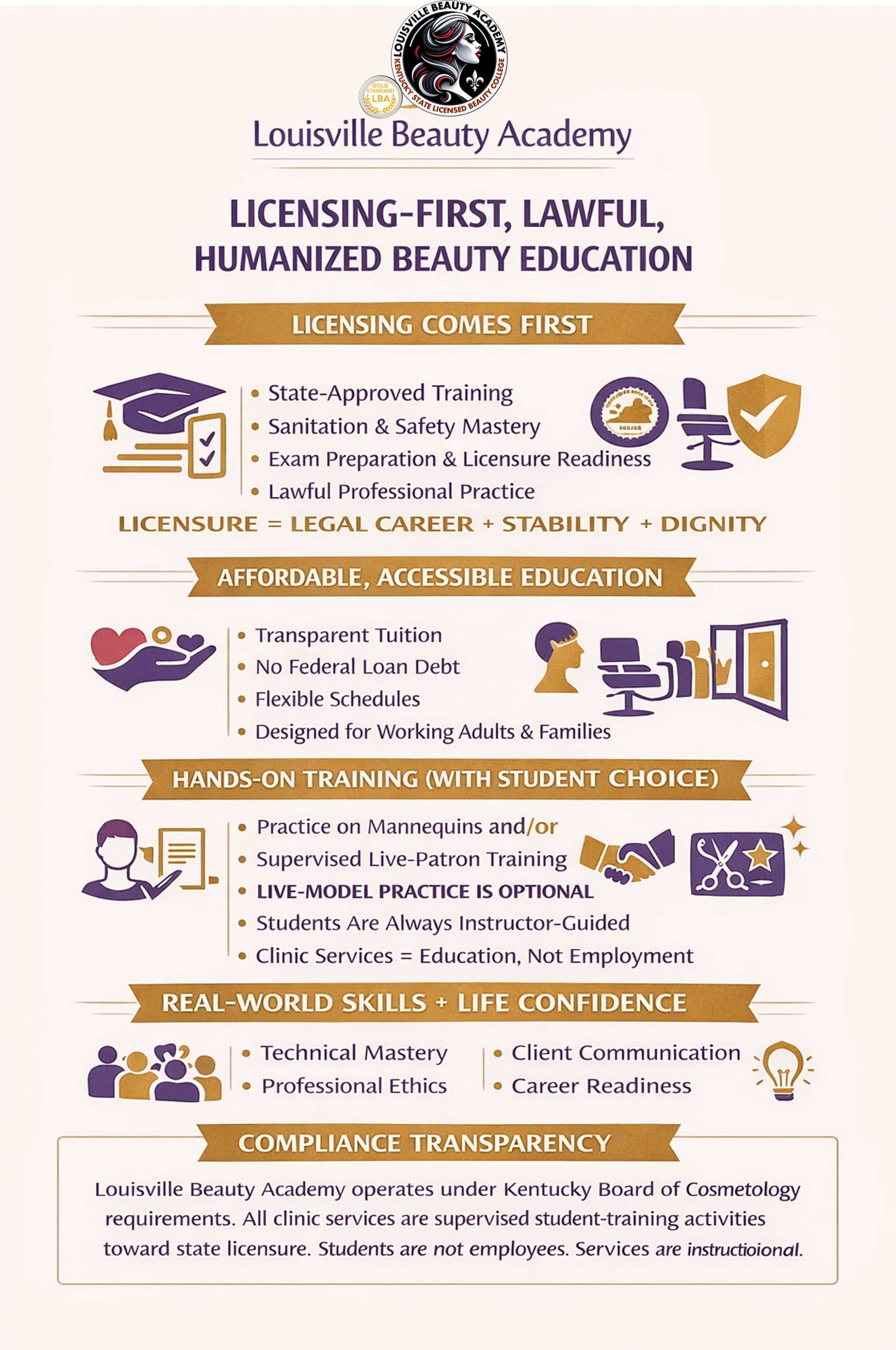
In the beauty world, it’s easy to be dazzled by glamorous photos of perfect hair or dramatic makeup. There is nothing wrong with celebrating artistry — beauty is a creative profession.
But at Louisville Beauty Academy (LBA), our mission begins with something even more important:
Prepare every student to pass the state licensing exam and enter the workforce legally, safely, confidently, and debt-consciously.
Everything else — skills, creativity, entrepreneurship, artistry — grows from that foundation.
1. Licensing Comes First — Because the Law Comes First
Beauty is a licensed profession in Kentucky. That means real careers begin not with photos or social media — but with:
✔ state-approved education ✔ lawful training hours ✔ sanitation & safety mastery ✔ exam readiness ✔ compliance with the Kentucky Board of Cosmetology
Our entire program is designed around one core truth:
Licensure = opportunity, dignity, stability, and professional freedom.
We teach the knowledge, discipline, ethics, and technical skill students need to pass the licensing exam — and to practice legally for life.
2. Learning and Life Are Already Hard — School Should Support, Not Stress
Many beauty students are adults balancing work, family, finances, and real-life responsibilities. Public workforce studies consistently show that adult learners face time and financial pressures.
LBA responds to that reality with:
✔ simple, transparent pricing ✔ flexible scheduling ✔ student-first support ✔ no federal loan debt
Our curriculum stays aligned with Kentucky Board requirements so students can focus on what matters — learning, passing the exam, and building a future.
3. Hands-On Training — With Safety, Law, and Student Choice
Real confidence is built through supervised practice. At Louisville Beauty Academy:
Students may complete practical training using:
✔ mannequins and/or ✔ supervised live patrons in our student training clinic
Live-model practice is optional.
No student is ever required to perform services on a live patron to continue their training.
Many students choose live-model practice as they gain confidence — but they do so with full instructor supervision and support.
💡 This is education — not employment. Training hours earned in the clinic count toward Kentucky licensure requirements.
Clinic services are offered at reduced training rates, and fees support instructional supervision, facility costs, and supplies — not wages.
This model protects:
✔ students ✔ the public ✔ lawful practice ✔ educational integrity
And it ensures that education always comes before production.
4. Real Education Happens in Real-World Training
Vocational learning research consistently shows that the most lasting professional skills are built through supervised, hands-on application.
That is why LBA emphasizes:
✔ instructor-guided practice ✔ technical competency ✔ sanitation & safety discipline ✔ client communication ✔ exam-aligned training ✔ ethical professionalism
We want graduates to feel confident:
✨ with clients ✨ with inspectors ✨ in exams ✨ in their own businesses
Not just in photos.
5. Affordability by Design — Debt Is Not a Requirement for Success
Across the U.S., many beauty school programs cost over $15,000–$20,000. LBA intentionally maintains significantly lower tuition and does not participate in federal loan programs.
Why?
Because we believe education should open doors — not create lifelong financial pressure.
Our model helps students:
✔ finish school sooner ✔ avoid unnecessary debt ✔ enter the workforce faster ✔ support themselves & families
This is not a shortcut. It is a philosophy.
6. Caring & Humanized Education — People Before Image
Louisville Beauty Academy was founded on compassion, accessibility, and opportunity — especially for working families, first-generation Americans, and career-changers.
Research shows that supportive school cultures improve student success. We see that every day.
We focus on:
💛 dignity 💛 respect 💛 community 💛 service 💛 lawful professionalism
Because beauty education is not just technical training — it is economic mobility, identity, and human potential.
Why All This Matters
Centering law, licensing, safety, and affordability ensures that:
✔ Students graduate confident and exam-ready ✔ The public receives safe, lawful services ✔ Graduates can work immediately — legally ✔ Careers begin without unnecessary debt ✔ Communities gain skilled professionals ✔ Integrity remains at the core of the industry
We don’t just teach beauty skills.
We teach responsibility, licensure readiness, professionalism, and lifelong livelihood.
That is the Louisville Beauty Academy promise.
Compliance Transparency Statement
Louisville Beauty Academy operates as a licensed beauty education institution under the requirements of the Kentucky Board of Cosmetology. All student clinic services are performed as part of supervised training toward state licensure. Clinic service fees support educational operations and materials. Students are not employees, and services are instructional in nature. Students may choose to practice on mannequins or supervised live patrons as part of their training.
REFERENCES
American Association of Cosmetology Schools. (2022). Cosmetology Education Annual Industry Report.
Brookings Institution. (2022). The Community College Debt Divide.
U.S. Department of Education. (2023). Adult Learning and Workforce Development Study.
Government Accountability Office. (2023). Federal Student Aid Oversight of Career Training Programs.
Harvard Graduate School of Education. (2022). Caring Learning Environments in Vocational Education.
Cornelius‑White, J. (2021). Humanized Education for Adult Vocational Learners.
This article is part of LBA’s public education and historical archive. Older posts, including “Louisville Beauty Academy as Essential Workforce Infrastructure for Rural Kentucky – A Public Education & Workforce Research White Paper — December 2025,” may not reflect current tuition, schedules, incentives, forms, policies, testing vendors, clinic availability, or regulatory requirements.
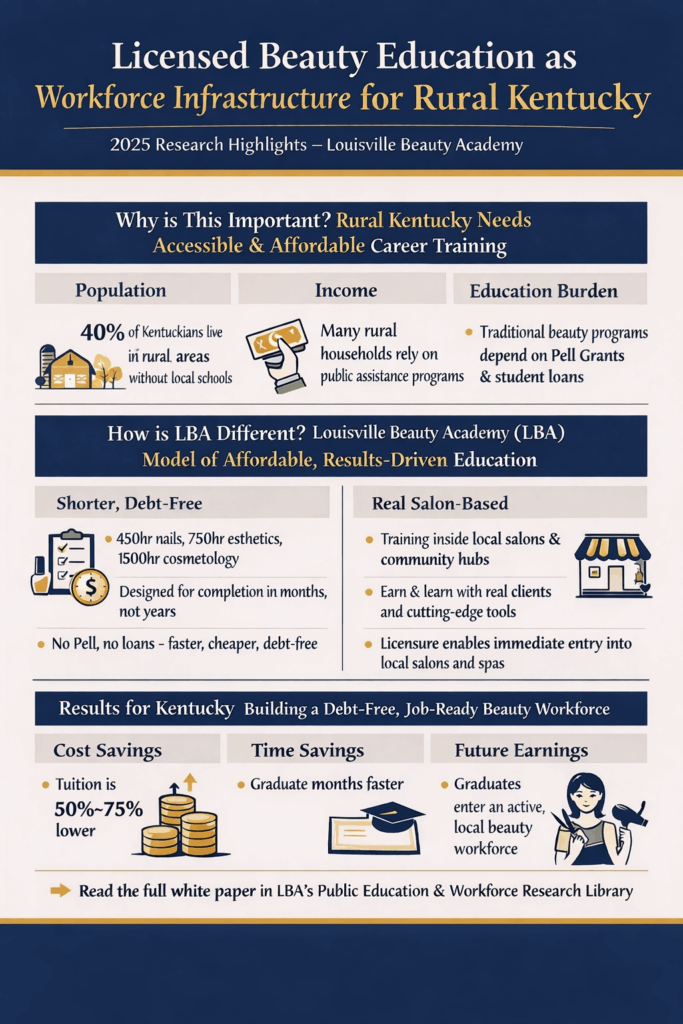
The Louisville Beauty Academy (LBA) model is designed to serve Kentucky’s rural and small-town communities by offering fast, results-driven beauty education that sidesteps traditional financial and bureaucratic barriers. About 85 of Kentucky’s 120 counties are classified as rural (USDA definition), encompassing 1.85 million people (~41% of the state) uknow.uky.edu. These areas face economic challenges – statewide, 18.9% of Kentuckians live in poverty (versus 15.4% nationally), and many rural counties exceed 25% poverty (e.g. Clay – 39.7%, McCreary – 41.0%, Wolfe – 43.0%) kystats.ky.govkystats.ky.gov. Rural Kentuckians rely heavily on public aid (e.g. SNAP, Medicaid) because wages and resources are often low. Median rural incomes lag urban areas, and opportunities for quick, lower-debt training are scarce. In this context, traditional beauty schools that depend on federal Pell grants and student loans create hidden costs. Because Pell aid is unavailable for shorter programs (under 600 hours) and only for accredited schools, many rural students end up in longer programs with higher tuition and debtnaba4u.orgnaba4u.org. This forces them to spend extra months in school (reducing earning time) and often graduate with significant loans, even when they only need a shorter vocational credential.
Figure: Rural Kentucky communities (like Corbin, pictured) comprise a large share of the population uknow.uky.edu. These areas need accessible career training that bypasses costly financial aid structures. Rural Kentucky’s economy underscores the need for new models. Incomes tend to be lower than urban areas, and federal aid can unintentionally steer low-income students toward expensive, long programs instead of shorter, in-demand careers naba4u.orgkystats.ky.gov. For example, Kentucky’s new law reduced nail technology training from 600 to 450 hours to speed workforce entry, yet federal rules still exclude 450-hour programs from Pell grants naba4u.orgnaba4u.org. The result is a bottleneck: capable rural students may delay training or take on unnecessary debt just to access aid. Comprehensive data show that many surrounding states also have substantial rural populations (e.g. Tennessee ~34%, Indiana ~28%, Ohio ~22%) and similar funding barriers. In short, “what is called affordable” federal aid often ends up buffered by hidden costs, so that the true cost – in time or debt – remains high for rural learners.
Barriers in Beauty Education Funding
Federal financial aid rules create a stark disadvantage for students in short, intensive programs. Under current U.S. Dept. of Education policy, only programs of ≥600 hours (and accredited by a U.S.-recognized agency) qualify for Pell grants or federal loans dol.govnaba4u.org. Since LBA specializes in short, skills-focused tracks (e.g. 450-hour Nail Tech, 750-hour Esthetics), none of its programs qualify for Title IV aid naba4u.org. Other schools often extend course lengths or tack on unrelated content just to hit the threshold, which adds months of extra schooling and cost. As a result, low-income students in rural Kentucky face a choice: pay out-of-pocket for LBA’s lean programs, or enroll in a longer, debt-financed cosmetology course elsewhere (even if they only want nails or skincare). This misalignment “forces students to take on larger debt for more training than they may want or need”naba4u.org. In practice, federal aid restrictions delay graduation and inflate costs, preventing quick entry to work. LBA’s experience highlights this gap: the academy offers a full 450-hour Nail Technology course for about $3,800 (after discounts) – a fraction of what a 1500-hour cosmetology program costs – yet Pell is barrednaba4u.org. Because of this, many willing students are “filtered out” by lack of fundingnaba4u.org. Kentucky’s rural learners especially depend on grant aid, so reforming this barrier is critical to accelerate workforce entry and reduce debt for rural beauty professionals.
The LBA Model – Affordable, Outcome-Focused Education
LBA’s unique model tackles these barriers head-on. The school is state-licensed and -accredited (Kentucky Board of Cosmetology) but not federally accredited, a conscious choice that lets it focus on outcomes without federal oversight. This allows ultra-low tuition – about 50–75% less than comparable federally-funded schools louisvillebeautyacademy.net – and a lower-debt structure. LBA students pay via short-term plans, scholarships, or employer support rather than federal loans. The curriculum is purpose-built for one mission: to produce licensed beauty professionals ready to work. All LBA programs (e.g. 450-hr Nails, 750-hr Esthetics, 300-hr Shampoo Styling, 1500-hr Cosmetology) are exactly the hours needed for state licensure louisvillebeautyacademy.net. There are no extra semesters: in fact, LBA celebrates daily or weekly graduations, meaning students who master the material move on immediately louisvillebeautyacademy.net. This rapid pace incentivizes focused study – learners know the goal is immediate licensing and a paycheck, not accumulating credits. As one report notes, Kentucky’s LBA “offers affordable, fast-track programs that lead to immediate employment” louisvillebeautyacademy.net. The results speak to the model’s effectiveness: since opening in 2017, LBA has trained over 1,000 beauty professionals naba4u.org. All these graduates could sit for state board exams right away (and many did). By contrast, students at traditional schools might spend extra months in mandated breaks or nonessential courses, delaying their entry into the labor market. LBA breaks from that norm: students spend only the required clock hours (no holiday “dead time” built-in) and every hour counts toward licensure. This streamlined, student-driven approach has set LBA apart as “the highly affordable beauty college in Kentucky,” according to its own materials naba4u.org. In short, LBA under-delivers bureaucracy and over-delivers on real skills – a “gold standard” of compliance and transparency that explicitly benefits its rural clientele. The school even advertises full transparency of costs and curricula, ensuring rural families understand exactly what they pay for and achieve naba4u.orglouisvillebeautyacademy.net.
Figure: LBA students train in real salon settings. By co-locating programs with local salons or spas, schools can cut overhead and immerse learners in the industry. LBA’s model suggests partnering with community hubs to bring training directly where rural students live and work.
Aligning with Workforce Funding and Community Partners
To fully realize its public-interest mission, LBA’s strategy should leverage public workforce funding instead of private investment (“HCA capital”). Federal and state workforce programs – under WIOA and similar initiatives – are explicitly designed to train local workers in high-demand fields. Through WIOA, local workforce boards and One-Stop Career Centers can fund eligible training programs directly dol.gov. For example, Kentucky’s Approved Training Provider List (ETPL) already includes multiple cosmetology and beauty schools (e.g. PJ’s College of Cosmetology, Pikeville Beauty Academy, Platinum Shears Beauty Academy) etpl.ky.gov. Any career training on this list can receive WIOA vouchers or grants for qualified students. LBA could seek inclusion on the ETPL or partner with WIOA agencies to make its programs tuition-free for eligible applicants. Likewise, city workforce boards and state labor departments (e.g. Kentucky’s Education & Workforce Development Cabinet) can align LBA’s courses with regional job-placement goals, channeling public funds into the academy. Employer-paid tuition is another avenue: salons and spas in Louisville and rural counties could sponsor apprentices through LBA, effectively investing their own payroll into training (sometimes with state matching). Even community reinvestment funds (from local taxes or non-profits) could be directed to support classes for under-resourced areas. In all cases, LBA becomes a public-interest partner, not an investor-controlled enterprise. This means LBA can be structured like a workforce-development program: free or nearly-historical tuition-support language for students, paid by public grants and employer contributions, with clear performance metrics (licensure pass rates, job placement). By aligning with city workforce boards, state labor agencies, WIOA/ETPL pipelines, employer tuition funds, and community investment programs, LBA would tap existing support networks and fully serve its rural mission. The U.S. Labor Dept. notes that WIOA programs provide career and training services (both classroom and on-the-job) to millions of workers through a nationwide network of centers dol.gov. Redirecting even a small slice of these resources to beauty training could make LBA’s programs nearly free to eligible Kentuckians – turning a $3,800 program into essentially $0 out-of-pocket while still ensuring students earn industry credentials and jobs.
Recommendations: To maximize impact, LBA and policymakers should:
Partner with Workforce Agencies. Engage local workforce development boards and the Kentucky Career Center to list LBA on the Eligible Training Provider List (ETPL) and accept WIOA funding. Secure support from the state Labor Cabinet and education workforce initiatives. This ties LBA tuition to public funding and employers, preserving affordability dol.govetpl.ky.gov.
Maintain Single-Outcome Focus. Preserve LBA’s one-track model: teach only what is required for licensing and employment. Continue offering lower-debt, short courses aimed solely at licensure (not extraneous credits). This approach – one mission, one outcome – leverages LBA’s strength in quickly moving students into jobs louisvillebeautyacademy.net.
Co-Locate in Salons and Hubs. Instead of standalone campuses, locate LBA training within existing salons, spas, community centers or workforce hubs. This uses underutilized space, fosters mentorship by working professionals, and roots training in the community. For rural reach, consider pop-up or hybrid models (e.g. local campuses taught remotely by LBA instructors with hands-on labs at nearby salons). Co-location also makes it easy for policymakers and employers to see LBA’s role in the local economy.
Emphasize Transparency and Support. Market LBA’s programs as fully supported by public funds or sponsored by local businesses. Offer clear, online course tracking (leveraging AI-driven systems) so students see progress in real time. Emphasize that state- or employer-funded tuition effectively makes programs free or very low-cost for learners, with no hidden loan debt. This transparency builds trust with rural families and policymakers.
Conclusion
Kentucky’s rural communities need vocational pathways that are fast, affordable, and workforce-aligned. Louisville Beauty Academy’s model demonstrates that by cutting extraneous hours, lowering tuition, and focusing on licensure outcomes, beauty education can be made genuinely accessible to rural students. The next step is public partnership: aligning LBA with WIOA, workforce boards, and community resources will eliminate barriers like expensive loans and program delays. With state or employer funding, LBA courses become virtually free at the point of entry. Co-locating classes in salons and service centers brings training into the heart of rural communities, safeguarding it as a public good. In summary, LBA’s success in Kentucky – training 1,000+ professionals quickly and cheaply naba4u.orglouisvillebeautyacademy.net – shows the potential of a workforce-focused, lower-debt model. By leveraging public funding and local partnerships, LBA can expand this model, becoming “bullet-proof” to liability and fully aligned with the needs of rural Americans. Such a system honors LBA’s founding intent to build Kentucky’s beauty workforce without burdening students with debt or delay.
References: Blueprint Kentucky. (2025, October 8). New report shares data trends on Kentucky’s rural economy. University of Kentucky (UKnow). Retrieved from https://uknow.uky.edu/research/new-report-shares-data-trends-kentucky-s-rural-economy uknow.uky.edu. Louisville Beauty Academy. (2025, May 7). Research Report: Louisville Beauty Academy as a Proven Model for Loan Reform and Workforce Development. Louisville, KY: Louisville Beauty Academy. Retrieved from https://louisvillebeautyacademy.net/research-report-louisville-beauty-academy-as-a-proven-model-for-loan-reform-and-workforce-development-2025 louisvillebeautyacademy.net. Tran, D. (2025, April 9). Strategic Analysis: Accreditation, Federal Aid Limits, and Louisville Beauty Academy’s Path Forward. New American Business Association (NABA). Retrieved from https://naba4u.org/2025/04/strategic-analysis-accreditation-federal-aid-limits-and-louisville-beauty-academys-path-forward/ naba4u.org. U.S. Department of Labor, Employment & Training Administration. (n.d.). WIOA Workforce Programs. Retrieved from https://www.dol.gov/agencies/eta/wioa/programs dol.gov. Kentucky Center for Statistics. (2016). Poverty Rates by County (2011–2015 ACS) [Map]. Frankfort, KY: Kentucky Center for Statistics. Retrieved from https://kystats.ky.gov/Content/Reports/Maps/PovertyRatesByCounty.pdf kystats.ky.gov. (All sources accessed 2025)
Disclaimer
This publication is provided for educational, informational, and public workforce research purposes only. It does not constitute legal, financial, regulatory, accreditation, or employment advice.
Louisville Beauty Academy does not guarantee licensure, examination results, employment, income, program completion time, or individual outcomes. Results vary based on attendance, preparation, effort, regulatory requirements, and personal circumstances.
References to affordability, time-to-licensure, workforce readiness, or program structure describe educational models and intent, not promises of results.
Any discussion of public or private funding sources (including Pell Grants, student loans, WIOA, ETPL, workforce programs, employer-paid tuition, or community funding) is illustrative only. Eligibility, approval, and availability are determined by third-party agencies or employers and may change.
This publication does not evaluate or compare specific schools or institutions. All data referenced is drawn from publicly available sources believed to be accurate as of December 2025.
Nothing herein replaces applicable laws, regulations, or licensing requirements. Readers remain responsible for compliance with all governing authorities.
This article is part of LBA’s public education and historical archive. Older posts, including “Louisville Beauty Academy: Kentucky’s Workforce Infrastructure Model for Fast, Affordable, Lower-Debt Professional Licensing – RESEARCH DECEMBER 2025,” may not reflect current tuition, schedules, incentives, forms, policies, testing vendors, clinic availability, or regulatory requirements.
It is a workforce infrastructure institution designed to convert everyday Americans into licensed professionals, small-business owners, and tax contributors faster, cheaper, and with higher return on investment than conventional post-secondary pathways.
This model matters to Kentucky — and to the nation — because workforce shortages, credential inflation, student debt, and rural access gaps are economic problems, not cultural ones.
LBA was built to solve those problems.
An American Workforce Problem — Solved Locally in Kentucky
Kentucky faces persistent challenges that cut across race, geography, and background:
Skilled-trade shortages
Rural workforce decline
Adult learners priced out of higher education
Student debt without earnings lift
Slow, bureaucratic credential pathways
LBA addresses these challenges directly by operating as a high-speed licensing engine, not a tuition-maximization institution.
This is workforce infrastructure — built in Kentucky, for Americans, with outcomes that speak for themselves.
Educational, Research & Policy Context Disclaimer
This content is provided solely for educational, informational, and public policy research purposes. It reflects a workforce education and compliance framework intended to support public understanding of licensed trade education, workforce development, and regulatory alignment.
Nothing contained herein constitutes legal advice, regulatory guidance, financial advice, or a guarantee of licensure, employment, earnings, or business outcomes. Louisville Beauty Academy does not make representations regarding individual results. Outcomes vary based on individual participation, preparation, attendance, regulatory requirements, examination performance, market conditions, and personal circumstances.
References to workforce models, affordability, time-to-licensure, or return on investment are general educational descriptions and should not be interpreted as promises or assurances.
Louisville Beauty Academy operates as a state-licensed educational institution and complies with all applicable Kentucky statutes and administrative regulations governing cosmetology and related licensed professions. All students are responsible for complying with current state licensing laws, examination requirements, and regulatory procedures as administered by the Kentucky Board of Cosmetology or other applicable authorities.
Any discussion of workforce infrastructure, public policy alignment, or economic impact is presented for academic and civic education purposes only and does not represent an endorsement, critique, or directive toward any governmental body, regulatory agency, or other educational institution.
Louisville Beauty Academy publishes educational research and transparency materials as part of its commitment to public education and compliance literacy. Publication of such materials does not alter the institution’s regulatory obligations, operational scope, or licensing authority, nor does it substitute for official guidance issued by state or federal agencies.
REFERENCES
Workforce, ROI, & Credential Economics
U.S. Department of Labor. (2023). Workforce innovation and opportunity act (WIOA) overview.
Why Louisville Beauty Academy Teaches Regulation as a Core Competency
The beauty profession—including cosmetology, esthetics, nail technology, and related personal care services—is among the most highly regulated occupational sectors in the United States. These regulations exist for legitimate and necessary reasons: to protect public health, safety, sanitation, consumer trust, and professional standards.
Louisville Beauty Academy (LBA) begins from a position of full respect for authority.
Licensing boards are created by legislatures. Board members are appointed public servants. Agency staff carry out daily regulatory and enforcement functions.
Most regulators act in good faith, under significant workload, and within complex statutory frameworks.
At the same time, history, court decisions, and legislative reforms demonstrate an important and well-documented reality:
Even well-intentioned regulatory systems can produce confusion, inconsistency, or overreach when laws are interpreted and enforced by different people, at different times, under different circumstances.
This is not an indictment of licensing boards. It is a recognition of how human systems operate.
LBA’s Educational Mission
Louisville Beauty Academy is a State-Licensed, compliance-by-design beauty institution. As such, LBA views regulatory literacy as a professional skill—not an optional topic.
LBA teaches students and licensees that:
Understanding the law is part of professionalism
Asking questions respectfully is lawful and appropriate
Written clarification protects everyone
Over-compliance is safer than minimum compliance
Documentation is a professional responsibility
This Public Compliance & Regulatory Education Library exists to centralize law, cases, and regulatory understanding so that licensees can comply intelligently, respectfully, and confidently.
PURPOSE OF THIS RESEARCH
Education, Not Confrontation
This paper examines national cases across the United States where licensees or regulated professionals raised questions, documented concerns, followed proper procedures, and escalated lawfully when necessary, ultimately prevailing through:
Court rulings, or
Legislative repeal or reform, or
Regulatory correction prompted by lawful challenge
These cases are not presented to show licensees “fighting” boards. They are presented to show process.
Each case is used as a teaching tool, demonstrating:
How questions were raised respectfully
How documentation mattered
How agency staff interactions were handled
How escalation occurred only after clarification failed
How lawful outcomes were achieved
What licensees can do before problems arise
LBA teaches that clarification, documentation, and over-compliance are not acts of resistance—they are acts of professional discipline.
WHY THIS MATTERS EVEN WITH GOOD BOARDS AND GOOD PEOPLE
LBA explicitly teaches that:
Laws are written by legislatures
Regulations are issued by agencies
Enforcement is carried out by people
People may:
Interpret rules differently
Apply outdated guidance
Rely on custom instead of statute
Misunderstand scope of authority
None of this implies bad intent.
Therefore, professional licensees must know how to ask questions, seek written clarification, and document interactions—even when working with competent and ethical regulators.
This protects:
The licensee
The school
The agency
The public
LEGAL FOUNDATIONS TAUGHT BY LBA
Across all cases discussed in this library, courts consistently relied on established legal principles, including:
Due Process (U.S. Constitution, 14th Amendment; state constitutional equivalents)
Rational Basis Review (regulations must relate to legitimate health and safety objectives)
Limits on Agency Authority (boards may not exceed statutory delegation)
Right to Pursue a Lawful Occupation
Prohibition on Pure Economic Protectionism
LBA teaches these principles not to challenge authority, but to understand the boundaries of law so compliance can be accurate and complete.
HOW LBA TEACHES LICENSEES TO ACT
The Gold-Standard Compliance Model
From these national cases, LBA teaches a consistent professional method:
Respect authority at all times
Ask questions to understand, not to argue
Request clarification in writing
Document all communications
Preserve timelines and records
Over-comply rather than under-comply
Escalate only when clarification fails
Remain factual, calm, and professional
This approach is what allowed licensees in the documented cases to prevail without reckless behavior or defiance.
WHY LBA IS A CENTER OF EXCELLENCE IN REGULATORY EDUCATION
Most beauty schools focus solely on technical skill training.
Louisville Beauty Academy goes further.
LBA trains:
Skilled professionals
Informed licensees
Law-literate practitioners
Compliance-ready business owners
By publishing statutes, regulations, and case studies verbatim and transparently, LBA serves as a Public Law & Compliance Library for:
Students
Licensees
Regulators
Policymakers
Auditors
The general public
This is what Gold-Standard, compliance-by-design education looks like.
FINAL MESSAGE TO LICENSEES AND THE PUBLIC
You do not protect your license by:
Ignoring regulation
Arguing verbally
Acting without documentation
You protect your license by:
Understanding the law
Asking for clarification
Writing everything down
Respecting authority
Over-complying
Preserving records
That is what the successful licensees in these cases did.
That is what Louisville Beauty Academy teaches.
Louisville Beauty Academy emphasizes that licensing boards exist to “promote, preserve, and protect” public health and safety under state lawlaw.justia.com. As the Louisiana legislature declared, cosmetology regulation is intended to safeguard citizens’ healthlaw.justia.com. At the same time, even well-meaning regulatory systems can produce errors or overreach. In many states, beauty professionals have challenged unjust rules or interpretations and ultimately prevailed through court or legislative action. This case-study review highlights several such examples, not to encourage conflict but to demonstrate how responsible licensees can clarify ambiguities, document their compliance, and safely escalate disputes. Each case below shows how the licensee raised questions, kept records, sought guidance from the board, and (if needed) pursued legal or legislative remedies to achieve a fair outcome. These stories reinforce that asking for clarity and over-documenting compliance are not acts of defiance but professional diligence.
Texas: Eyebrow Threading License Invalidated (Patel v. Texas DLR, 2012)
In Patel v. Texas Dep’t of Licensing & Regulation, the Texas Supreme Court ruled that the state could not constitutionally force eyebrow-threading specialists to obtain a full cosmetology license for that simple service. Texas inspectors had fined threaders for operating without a cosmetology license, even though private beauty schools did not teach threading. The threaders formed a legal challenge and showed that requiring 750 hours of irrelevant training was irrational. In a landmark 2012 decision, the court unanimously held that this huge burden on the right to work violated the Texas Constitutionij.org. The court emphasized that requiring “hundreds of hours of irrelevant training for a simple skill” was “unconstitutionally irrational” and that workers have a right to pursue their occupation without such arbitrary licensingij.org. Texas licensees prevailed by documenting how little threading was covered in cosmetology school and by filing suit; the court’s ruling freed threaders statewide without any compromise to public health.
Pennsylvania: “Good Moral Character” Rule Struck Down (Haveman & Spillane, 2020)
In Pennsylvania, the cosmetology board had long imposed a “good moral character” requirement that denied licenses to two trained estheticians with old criminal records. Despite completing hundreds of training hours, Courtney Haveman and Amanda Spillane were told they could not be licensed because of unrelated past convictionsij.org. After patiently requesting explanation and highlighting that barbers had no such requirement, they teamed with the Institute for Justice and sued. In 2020 the Commonwealth Court agreed that the rule was arbitrary. The court noted it was “absurd” to impose background checks on cosmetologists but not on barbers, who perform similar tasksij.org. Finding an Equal Protection violation, the court struck down the requirementij.org. Notably, this victory came not only through litigation but also spurred legislative action: Pennsylvania soon changed its licensing laws to make background screening more uniformij.org. The licensees had documented their training and rehabilitation, raised the issue with regulators, and ultimately got relief in court.
Oklahoma: Eyelash Extension Specialist vs. Board (Davis v. Oklahoma Board, 2022–24)
Oklahoma eyelash-extension specialist Brandy Davis faced a steep licensing barrier when she relocated from Texas. Davis held a valid Texas eyelash-extension license and even a private certification, but the Oklahoma Board insisted she obtain a full esthetician or cosmetology license to legally do lashesij.org. She repeatedly petitioned the Board to recognize her expertise, documenting her training and exam resultsij.orgij.org. When regulators refused, she filed suit in September 2022, arguing the requirement was an “arbitrary” restriction on her tradeokcfox.com. While the case was pending, Oklahoma eased its rules to allow lash licenses, and in late 2024 Davis obtained her new license. She then dismissed the lawsuit, saying she was “excited” to put it behind herokcfox.com. This episode shows the power of persistence: Davis did not ignore the problem but documented her qualifications and resorted to legal action when the Board would not budge. She ultimately prevailed through regulatory change (the state created a specialty lash license) rather than a court ruling.
Tennessee: Shampooing License Repealed (Pritchard v. Tenn. Cosmetology Board, 2016)
Tennessee (like a few other states) once required a license just to wash hair. Tammy Pritchard, a police officer, and her family members challenged the state’s shampooing license as excessive. They documented how hair-washing is a basic skill taught outside school, and showed the rule blocked low-cost economic activity. The group filed suit and vigorously lobbied the legislature for relief. In 2016, the state capitol agreed: Tennessee repealed the shampooing license requirement entirelybeacontn.org. No court decision was needed – thoughtful advocacy and legislative action removed an irrational rule. Pritchard’s campaign illustrates an important avenue: sometimes licensees can unite with allies (advocacy groups, legislators) to change the law.
A long-running example of over-licensing involves natural hair braiding. Historically, many states required braiders to undergo cosmetology training, even though braiding poses no public-safety issues. Starting in the 2000s, activists filed lawsuits and lobbied for exemptions. States gradually relented: by 2025, at least 37 states exempt hair braiders from cosmetology licensesdailylobo.com. For example, Mississippi eliminated its braiding license in 2005; in the following decade it had zero complaints about braiding safetyij.org. Recently, New Mexico’s legislature passed a bill (effective July 2025) officially removing any cosmetology license requirement for hair braidersdailylobo.com. (The board had even warned against it, but legislators responded to testimony that braiding is culturally important and safedailylobo.comdailylobo.com.) In each state that acted, braiders documented their practical experience and argued that the license cost was burdensome and unrelated to consumer protection. They educated lawmakers or courts about the issue’s fairness. These successes demonstrate that licensees can research others’ outcomes, join campaigns, and pursue reform even without suing.
Lessons for Professionals: Document, Question, and Escalate Respectfully
These cases show several common steps for licensees facing questionable rules:
Ask clarifying questions in writing. If a board action or rule seems unclear or unreasonable, begin by politely inquiring or providing evidence of your qualifications. For example, Davis repeatedly asked Oklahoma regulators to honor her existing certificationij.org. Put all communications in writing or email, and keep copies.
Document compliance thoroughly. Maintain records of your education, training, and certifications (e.g., diplomas, continuing-education certificates, exams passed). The Texas threaders and Oklahoma lash artist could show the Board exactly what curriculum they had completedij.orgij.org. Strong documentation makes your position clear if the dispute escalates.
Seek higher-level review if needed. Most boards have an appeals or review process. If staff or inspectors misinterpret rules, request a formal hearing or appeal in writing. In Tennessee, Pritchard’s group filed formal legal action; Haveman and Spillane went to court after appeals failedij.orgbeacontn.org.
Consider outside help. Organizations like the Institute for Justice or Policy Institute sometimes assist licensees pro bono in constitutional challenges. Davis in Oklahoma and Haveman/Spillane in Pennsylvania worked with such advocatesij.orgokcfox.com. Even if you cannot find a lawyer immediately, talking to an attorney about your situation is wise once informal steps stall.
Explore legislative remedies. If a problem seems common or systemic (e.g. shampooing or braiding), build alliances with other professionals and approach legislators with your data. Legislative reform (like Tennessee’s shampoo repealbeacontn.org or New Mexico’s braiding exemptiondailylobo.com) can be faster than individual litigation for broad issues.
By proactively communicating with regulators, submitting records, and seeking clarity, beauty professionals often resolve issues without conflict. But if an unreasonable requirement persists, these cases show that the law may be on the licensee’s side. Regulatory agencies must follow their statutes, and courts will strike down overly broad rulesij.orgij.org. Ultimately, these examples teach that over-compliance (spending extra time to verify every rule) and meticulous documentation are prudent strategies – not resistance. They turn disputes into demonstrations of professionalism.
Key Takeaways for Licensees
Keep detailed records of all training hours, certifications, and communications with regulators.
Before taking radical steps, ask your board in writing to explain any ambiguous regulation or denial.
If a sanction or rule seems wrongful, file timely appeals and preserve all documentation (e.g. transcripts, emails).
Understand the specific statute or regulation behind the board’s action and cite it if you write to the board.
If necessary, consult legal or trade associations early; they can advise whether a rule has been successfully challenged elsewhere.
Remember that states often permit legislative petitions, public comments, or testimony – these are tools to fix burdensome requirements system-wide.
By following these steps, a licensee maximizes the chance of a fair outcome and creates a record that courts or lawmakers can review if needed. As one stakeholder put it, pursuing clarity and compliance “helps the state continue to ease licensing restrictions on workers”okcfox.com rather than hinder them.
References
Institute for Justice. (2020, August 25). Pennsylvania court strikes down licensing law that kept two Philadelphia-area women from working in cosmetologyij.orgij.org. Press release. Retrieved from https://ij.org/press-release/pennsylvania-court-strikes-down-licensing-law-…
Institute for Justice. (2022, September 7). Licensed eyelash extension specialist prevented by cosmetology board from doing her job fights back in state courtij.orgij.org. Press release. Retrieved from https://ij.org/press-release/licensed-eyelash-extension-specialist-prevented-by-…
Ferguson, T. (2024, October 16). “I can finally put this all behind me”: Eyelash specialist dismisses lawsuit against Oklahoma State Board of Cosmetology and Barbering. KOKH News (Fox 25)okcfox.comokcfox.com. Retrieved from https://okcfox.com/news/local/i-can-finally-put-this-all-behind-me-eyelash-specialist-…
Beacon Center for Public Policy Solutions. (2016, May 2). Tammy Pritchardbeacontn.org. (Discusses Pritchard v. Board of Cosmetology and legislative repeal of Tennessee shampooing license.) Retrieved from https://www.beacontn.org/tammy-pritchard/
Suderman, P. (2024, April 15). Hair braiders encourage Louisiana Legislature to lift burdensome regulations keeping industry in the shadowsij.org. Institute for Justice Press Release. Retrieved from https://ij.org/press-release/hair-braiders-encourage-louisiana-legislature…
Hlaing, S. T. (2025, June 20). Hair braiders to be able to practice without a cosmetology license. The Daily Lobodailylobo.com. (New Mexico legislature exempts braiding.) Retrieved from https://www.dailylobo.com/article/2025/06/hair-braiders-to-be-able-to-practice-without-a-…
Louisiana Revised Statutes Annotated, Title 37, § 562 (2001)law.justia.com (setting forth purpose of cosmetology regulation to protect public health).
LEGAL DISCLAIMER & NOTICE OF EDUCATIONAL USE
Educational & Public Library Notice
This content is published by Louisville Beauty Academy for educational, informational, and public-record purposes only. It reproduces publicly available court decisions, legislative actions, statutes, and regulatory principles as-is, without interpretation, legal advice, or advocacy.
Nothing herein constitutes legal advice, guarantees outcomes, or substitutes for guidance from a licensing board or licensed attorney. Individual facts, jurisdictions, and laws vary.
Louisville Beauty Academy:
Makes no representation regarding future regulatory outcomes
Assumes no liability for reliance on this material
Encourages all readers to consult appropriate regulatory authorities or legal counsel for individual matters
This library exists to teach lawful compliance, documentation discipline, and professional conduct, consistent with LBA’s responsibility as a State-Licensed educational institution.