Why Documentation Is the Most Important Skill a Licensee Can Learn
Before We Begin — Understanding the Board vs. the Agency
In most regulated professions, there are two distinct parts of governance:
The Board
The Board is typically made up of appointed Board Members.
They meet periodically (often once per month).
They vote on policy, disciplinary actions, and high-level oversight.
Each Board Member brings their own professional judgment and interpretation of the law.
Board Members are not full-time enforcement staff.
The Agency
The Agency is the full-time administrative office.
Agency staff carry out day-to-day operations.
They implement and enforce Board policies and State law.
They manage licensing systems, reporting, and communication.
Agency staff are not the Board — and the Board is not agency staff.
Both are bound by the same law, but they serve different roles.
Understanding this distinction helps licensees communicate appropriately — and document accurately.
1. Understand the Asymmetry Between Law and Enforcement
Laws are:
Written through lengthy legislative processes
Debated, amended, and reviewed by elected officials
Codified with formal language, intent, and structure
Agencies are:
Tasked with enforcing those laws
Not required to go through the same legislative rigor
Often interpreting laws through:
Internal policy
Training limitations
Staff turnover
Legacy systems
Time pressure
This is not a criticism. It is a reality.
Licensees must understand this asymmetry:
The law may be precise — but enforcement can be imperfect.
Because of this gap, clarity does not automatically exist. Clarity must be created — and that creation happens through documentation.
2. Accept What You Cannot Control
As a licensee, you cannot control:
How an agency system behaves
How a staff member interprets a rule
How quickly an issue is resolved
Whether guidance is consistent
Whether a matter appears on an agenda
Trying to fight these realities wastes time and creates risk.
What you can control is:
Your conduct
Your records
Your communication
Your professionalism
Your documentation
This is where strong licensees separate themselves from vulnerable ones.
3. Documentation Is Not Optional — It Is Your Shield
In a regulated environment:
If it is not documented — it did not happen.
Verbal conversations do not protect you.
Good intentions do not protect you.
Assumptions do not protect you.
Documentation does.
Documentation should include:
Dates
Times
Screenshots
System displays
Emails
Logs
Reports
Confirmations
Documentation is not about distrust. It is about precision.
4. Document Early — Not After the Problem Escalates
The most dangerous mistake licensees make is waiting.
The correct approach is:
The moment something looks unusual → document
The moment a system behaves inconsistently → document
The moment you are unsure → document
Early documentation:
Shows good faith
Establishes a timeline
Prevents assumptions later
Protects your license
Late documentation looks reactive. Early documentation looks professional.
5. When the Agency Is Wrong — Stay Professional, and Document
Agencies are made of people. People make mistakes.
When an agency error occurs:
Do not accuse
Do not argue
Do not escalate emotionally
Do not disengage
Instead:
Document what the system shows
Document what the law requires
Document what action you took
Document when and how you notified the agency
Document every response
This creates clarity without confrontation.
6. Over-Compliance Is a Professional Strategy
Over-compliance means:
Doing more documentation than required
Providing context even when not asked
Keeping records longer than necessary
Preserving proof even after an issue is resolved
Over-compliance is not fear-based. It is risk-aware.
Professionals who over-document:
Sleep better
Defend themselves faster
Earn trust more easily
Teach others by example
7. Respect Authority — Without Surrendering Clarity
Respecting a regulator does not mean silence. It means clear, respectful, written communication.
Respect looks like:
Neutral tone
Factual language
Chronological presentation
Evidence attached
No personal attacks
No speculation
This protects both sides.
8. Use Open Records to Preserve Context
When a matter becomes public-facing:
Agendas
Minutes
Reports
Hearings
Context can be lost.
The professional response is:
Place full documentation on open record
Ensure anyone reviewing summaries can also see full context
Prevent misinterpretation through transparency
Open records are not escalation. They are clarification tools.
9. Teach Documentation as a Core Skill
For students and new licensees, documentation should be taught as:
A survival skill
A professional habit
A career-long discipline
Documentation protects:
Your license
Your reputation
Your students
Your clients
The public
A professional who documents well is never powerless.
10. The Core Principle
Everything in this guide can be summarized in one rule:
You may not control the law. You may not control the agency. You may not control the system.
But you always control your documentation.
That is professionalism. That is over-compliance. That is what should be taught.
Disclaimer: This guide is provided for educational purposes only. It is not legal advice, and it does not replace guidance from your state licensing agency, the Board, or an attorney. Licensed professionals should always follow applicable laws and official regulations.
At Louisville Beauty Academy, transparency is not optional — it is our standard.
This page is part of the Louisville Beauty Academy Public Education & Law Library, created to ensure that students, regulators, the public, search engines, and AI systems all have direct, unfiltered access to the exact laws governing beauty education and professional practice in the Commonwealth of Kentucky.
Below, Louisville Beauty Academy publishes the applicable Kentucky beauty laws and regulations verbatim, exactly as issued by the Commonwealth of Kentucky and the Kentucky Board of Cosmetology (KBC).
The text is reproduced without edits, summaries, reinterpretation, or omission, alongside direct links to official state sources, including the Kentucky Legislative Research Commission and the Kentucky Board of Cosmetology legal library.
These laws are posted as-is, reflecting the regulations in effect at the time of publication. Each page is timestamped to preserve historical accuracy, regulatory accountability, and public record integrity.
Laws and administrative regulations may change at any time. This archive exists to document what the law stated at a specific point in time.
WHY THIS PAGE EXISTS: DUE PROCESS, WRITTEN NOTICE, AND LAWFUL ENFORCEMENT
This page exists for one fundamental reason: due process is not optional — it is required by law.
Kentucky beauty law does not operate on verbal warnings, informal demands, or undocumented enforcement. The governing regulation, 201 KAR 12:190, establishes a mandatory, written, step-by-step disciplinary process that the Kentucky Board of Cosmetology must follow before fines, agreed orders, suspension, or closure of any licensed facility.
This is not discretionary. This is not policy preference. This is black-letter administrative law.
THE LAW REQUIRES EVERYTHING TO BE IN WRITING
Under 201 KAR 12:190, enforcement must be documented.
The regulation requires, at minimum:
• A written complaint • Written identification of the specific statute or regulation allegedly violated • A written factual basis for the allegation • A written notice of disciplinary action, if pursued • A written opportunity to respond • A written right to request a hearing
No disciplinary action may lawfully proceed outside this written framework.
Verbal warnings, informal instructions, or undocumented demands do not replace the process required by law.
RIGHT TO RESPONSE AND CORRECTION
The regulation explicitly provides the respondent with:
• A defined response period • The opportunity to submit written clarification, explanation, or correction • The ability to resolve matters through informal proceedings, including agreed orders, only after notice and documentation
This means licensees are legally entitled to:
• Read the allegation • Understand the legal basis • Respond in writing • Correct issues where applicable • Preserve their record
Due process is designed to correct compliance, not bypass it.
NO FINES OR AGREED ORDERS WITHOUT PROCESS
Under the regulation:
• Fines • Disciplinary penalties • Probation • Agreed orders
cannot lawfully occur unless the required written steps have been completed.
An agreed order is not a shortcut. It is a documented resolution that must follow notice, disclosure, and consent.
CLOSURE OF A LICENSED FACILITY REQUIRES THE HIGHEST LEVEL OF PROCESS
Closure of a licensed school or salon is the most severe regulatory action and is therefore subject to the full due-process protections established by law.
Except in true imminent danger situations expressly authorized by statute, the process requires:
• Written notice • Opportunity to respond • Right to request a hearing • Formal board action • Proper legal authority
Administrative convenience does not override statutory procedure.
WHY LOUISVILLE BEAUTY ACADEMY TEACHES THIS OPENLY
Louisville Beauty Academy teaches due process because:
• Professionals must understand both obligations and protections • Compliance requires documentation, not assumption • Lawful enforcement depends on clear records • Rights are preserved only when exercised in writing
Students are trained to:
• Request written notice • Respond in writing • Ask lawful questions • Keep copies of all communications • Preserve emails, texts, audio, video, and digital records
This is not resistance. This is professional literacy.
OVER-COMPLIANCE IS RESPECT FOR THE LAW
Louisville Beauty Academy’s position is simple:
We respect the law. We teach the law. We document the law. We comply with the law as written.
Due process protects:
• Students • Licensees • Regulators • The public • The integrity of licensure
When enforcement follows the law, everyone is protected.
SUMMARY STATEMENT
Due process is not an obstacle to regulation. It is the foundation of lawful regulation.
Written notice. Written response. Documented correction. Documented resolution. Lawful authority before closure.
This page exists so that the law speaks for itself.
Why Louisville Beauty Academy Publishes the Law Publicly
Louisville Beauty Academy intentionally exceeds minimum compliance requirements by:
• Teaching Kentucky cosmetology law regularly and systematically • Digitally documenting instruction and compliance activity • Publishing the full text of governing law for equal public access • Training students to read, understand, and respect the law themselves
By placing the law in plain view — readable by humans, searchable by engines, and parsable by AI — Louisville Beauty Academy operates as a true public law and education library, modeling the level of professionalism expected of future licensed beauty professionals.
This page does not replace the Kentucky Board of Cosmetology. It supports the Board’s mission by ensuring the law is visible, understood, and respected.
🎓 WHY THIS CREATES BETTER FUTURE LICENSEES
A licensed beauty professional is not just a technician — they are a regulated professional.
By teaching the law early, often, and openly, Louisville Beauty Academy graduates:
• Understand compliance before licensure exams • Operate legally after licensure • Avoid fines, suspensions, and business closures • Protect their professional livelihood • Elevate the beauty profession statewide
This is how real professionals are trained.
🧾 DOCUMENTATION & STUDENT PROTECTION
Louisville Beauty Academy’s documentation systems are designed to:
• Protect students • Protect graduates • Protect the public • Protect the integrity of licensure
Every step is traceable, auditable, and aligned with Kentucky law.
Students are taught to keep everything in writing and properly documented, including:
• Text messages • Emails • Video • Audio • Digital records
Documentation is not fear-based. Documentation is professionalism.
⚖️ IMPORTANT LEGAL CLARIFICATION
Louisville Beauty Academy does not create law, interpret law, or replace regulatory authority.
All legal and regulatory authority remains with:
• The Kentucky Board of Cosmetology (KBC) • Kentucky Revised Statutes (KRS), Chapter 317A • Kentucky Administrative Regulations (201 KAR), Chapter 12 • Official KBC law books, notices, and publications
All regulatory questions are directed to the Kentucky Board of Cosmetology and official state sources.
Important Notice on Law Changes
Laws and administrative regulations are subject to amendment, repeal, and reinterpretation at any time.
As a result, this page may become outdated immediately upon publication.
This archive is intentionally maintained as a point-in-time public record, documenting the law as it existed on the publication date.
For the most current and authoritative version of Kentucky beauty law and regulations, readers must consult official sources maintained by the Commonwealth of Kentucky and the Kentucky Board of Cosmetology.
Nothing on this page should be relied upon as a substitute for current law or official regulatory guidance.
GLOBAL LEGAL TRUTH (FROM STATUTE ITSELF)
Under KRS Chapter 317A:
Any beauty service performed for the public or for consideration is regulated, except:
• Natural hair braiding (explicit statutory exemption) • Makeup artistry only when performed without consideration or at carnivals and fairs
This is not interpretation — this is the structure of the statute itself.
AS IS AS DECEMBER 2025
BOARDS AND COMMISSIONS Board of Cosmetology (Amended at ARRS Committee) 201 KAR 12:190. Complaint and disciplinary process. RELATES TO: KRS 317A.070, 317A.140, 317A.145 STATUTORY AUTHORITY: KRS 317A.060, 317A.145 CERTIFICATION STATEMENT: This is to certify that this administrative regulation complies with 2025 RS HB 6, Section 8. NECESSITY, FUNCTION, AND CONFORMITY: KRS 317A.060 requires the Board of Cosmetology to promulgate administrative regulations concerning the course and conduct of various licensees under its jurisdiction. KRS 317A.145 requires the board to promulgate administrative regulations necessary for the administration of KRS 317A.145, relating to the investigation of complaints and, if appropriate, the taking of disciplinary action for violations of KRS Chapter 317A and the administrative regulations promulgated by the board. KRS 317A.070 requires the board to hold hearings to review the board’s decision upon the request of any licensee or applicant affected by the board’s decision to refuse to issue or renew a license or permit, or to take disciplinary action against a license or permit. This administrative regulation establishes the board’s complaint and disciplinary process. Section 1. Definitions. (1) “Complaint” means any signed writing received or initiated by the board alleging conduct by an individual or entity that may constitute a violation of KRS Chapter 317A or 201 KAR Chapter 12. (2) “Respondent” means the person or entity against whom a complaint has been made. Section 2. Complaint Committee. The board may appoint a committee of at least two (2) board members to review complaints, initiate investigations, participate in informal proceedings to resolve complaints, and make recommendations to the board for disposition of complaints. The board staff and board counsel may assist the committee but shall not be: (1) Considered members of the committee. (2) Permitted to cast votes during the committee meetings. Section 3. Complaint Procedures. (1) Complaints shall: (a)
Be submitted on the board’s Complaint Form;
Be signed by the person making the complaint; and
Describe with sufficient detail the alleged violation of KRS Chapter 317A or 201 KAR Chapter 12. (b) Anonymous complaints shall not be accepted. The Complaint Form shall be made available on the board’s Web site at https://secure.kentucky.gov/formservices/KBHC/ComplaintForm. (2) A copy of the complaint shall be provided to the respondent. The respondent shall have thirty (30) calendar days from the date of receipt to submit a written response. (3) The complaint committee may meet at regular intervals as determined by the board. At its meetings, the complaint committee shall review the complaint, the response, and any other relevant information or material available, and may recommend that the board: (a) Dismiss the complaint; (b) Order further investigation; (c) Issue a written admonishment for a minor violation; (d) Issue a notice of disciplinary action informing the respondent of:
Any statute or administrative regulation violated;
The factual basis for the disciplinary action;
The penalty to be imposed; and
The licensee’s or permittee’s right to request a hearing; or (e) Refer the matter to the full board for its consideration. (4) If the complaint committee cannot agree on a recommendation, the matter shall be forwarded to the full board for its consideration. (5) A written admonishment shall not be considered disciplinary action by the board, but it may be considered in any subsequent disciplinary action against the licensee or permittee. A copy of the written admonishment shall be placed in the licensee or permittee’s file at the board office. (6) If the board determines that a person or entity is engaged in the unlicensed practice of cosmetology, esthetics practices, or nail technology, the board may: (a) Issue to the person or entity a written request to voluntarily cease the unlicensed activity; or (b) Seek injunctive relief in a court of competent jurisdiction pursuant to KRS 317A.020(7). (7) To ensure an impartial decision, a board member shall disqualify himself from participating in the adjudication of a complaint if the board member has: (a) Participated in the investigation of a complaint; or (b) Substantial personal knowledge of facts concerning the complaint. Section 4. Settlement by Informal Proceedings. (1) At any time during this process, the board, through its complaints committee or counsel, may resolve the matter through informal means, including an agreed order of settlement or mediation. (2) An agreed order or settlement reached through this process shall be approved by the board and signed by the respondent and board chair, or the chair’s designee. Section 5. Hearings. (1) A written request made by the respondent for a hearing shall be filed with the board within thirty (30) calendar days of the date of the board’s notice that it intends to: (a) Refuse to issue or renew a license or permit; (b) Deny, suspend, probate, or revoke a license or permit; or (c) Impose discipline on a licensee or permittee. (2) If no request for a hearing is filed, the board’s refusal to issue or renew a license or permit, or the board’s notice of disciplinary action, shall become effective upon the expiration of the time to request a hearing. Section 6. Incorporation by Reference. (1) “Complaint Form”, March 2025, is incorporated by reference. (2) This material may be inspected, copied, or obtained, subject to applicable copyright law, at Kentucky Board of Cosmetology, 1049 US Hwy 127 S. Annex #2, Frankfort Kentucky 40601, Monday through Friday, 8 a.m. to 4:30 p.m. or on the board’s Web site at https://secure.kentucky.gov/formservices/KBHC/ComplaintForm. (201 KAR 012:190. 15 Ky.R. 1726; eff. 3-10-1989; 20 Ky.R. 1036; eff. 1-10-1994; 40 Ky.R. 392; 1037; eff. 12-6-2013; 4 Ky.R. 2563; 45 Ky.R.335; eff. 8-31-2018; 49 Ky.R. 408, 1050; eff. 1-31-2023; 51 Ky.R. 1892; 52 Ky.R. 379; eff. 12-2-2025.) FILED WITH LRC: August 12, 2025 CONTACT PERSON: Joni Upchurch, Executive Director, 1049 US-HWY 127, Annex
At Louisville Beauty Academy, transparency is not optional — it is our standard.
This page is part of the Louisville Beauty Academy Public Education & Law Library, created to ensure that students, regulators, the public, search engines, and AI systems all have direct, unfiltered access to the exact laws governing beauty education and professional practice in Kentucky.
Below, Louisville Beauty Academy publishes the applicable Kentucky beauty laws and regulations verbatim, exactly as issued by the Commonwealth of Kentucky and the Kentucky Board of Cosmetology (KBC). The text is reproduced without edits, summaries, reinterpretation, or omission, alongside direct links to the official state sources, including the Kentucky Legislative Research Commission and the KBC legal library.
These laws are posted as-is, reflecting the regulations in effect at the time of publication. Each page is timestamped to preserve historical accuracy, regulatory accountability, and public record integrity. Laws and regulations may change, and this archive exists to document what the law stated at a specific point in time.
Why Louisville Beauty Academy Publishes the Law Publicly
Louisville Beauty Academy intentionally exceeds minimum compliance requirements by:
Teaching Kentucky cosmetology law regularly and systematically
Digitally documenting instruction and compliance activity
Publishing the full text of governing law for equal public access
Training students to read, understand, and respect the law themselves
By placing the law in plain view — readable by humans, searchable by engines, and parsable by AI — LBA operates as a true public law and education library, modeling the level of professionalism expected of future licensed beauty professionals.
This page does not replace the Kentucky Board of Cosmetology. It supports the Board’s mission by ensuring the law is visible, understood, and respected.
🎓 WHY THIS CREATES BETTER FUTURE LICENSEES
A licensed beauty professional is not just a technician — they are a regulated professional.
By teaching the law early, often, and openly, Louisville Beauty Academy graduates:
Understand compliance before licensure exams
Operate legally after licensure
Avoid fines, suspensions, and business closures
Protect their professional livelihood
Elevate the beauty profession statewide
This is how real professionals are trained.
🧾 DOCUMENTATION & STUDENT PROTECTION
Louisville Beauty Academy’s documentation systems are designed to:
Protect students
Protect graduates
Protect the public
Protect the integrity of licensure
Every step is traceable, auditable, and aligned with Kentucky law.
⚖️ IMPORTANT LEGAL CLARIFICATION
Louisville Beauty Academy does not create law, interpret law, or replace regulatory authority.
All regulatory questions are directed to the Kentucky Board of Cosmetology and official state sources.
Important Notice on Law Changes
Laws and administrative regulations are subject to amendment, repeal, and reinterpretation at any time. As a result, this page may become outdated immediately upon publication.
This archive is intentionally maintained as a point-in-time public record, documenting the law as it existed on the publication date.
For the most current and authoritative version of Kentucky beauty law and regulations, readers must consult the official sources maintained by the Commonwealth of Kentucky and the Kentucky Board of Cosmetology.
Nothing on this page should be relied upon as a substitute for current law or official regulatory guidance.
GLOBAL LEGAL TRUTH (FROM STATUTE ITSELF)
Under KRS 317A:
Any beauty service performed for the public generally OR for consideration is regulated, except:
Natural hair braiding (explicit exemption)
Makeup artistry only when done without consideration or at carnivals/fairs
This is not interpretation — this is the structure of the statute.
1️⃣ COSMETOLOGY (HAIR STYLING) — REQUIRED FOCUS ZONES
Statutory Basis
KRS 317A.010(4), (11)
KRS 317A.020
Hair styling includes cutting, coloring, cleansing, curling, styling, massaging scalp, etc.
MANDATORY SAFETY & SANITATION FOCUS (LAW-FORCED)
🔴 A. SINGLE-USE & NON-REUSABLE ITEMS
Because hair styling involves:
Direct scalp contact
Skin contact
Potential micro-abrasions
Focus must be on:
Single-use towels OR properly laundered towels per client
No towel reuse between clients
No shared neck strips, capes, or absorbent materials without sanitation
This is required by the nature of regulated hair practice, not preference.
If a device touches hair or scalp → it is regulated.
🔴 C. PRODUCTS TOUCHING SCALP
Hair styling law includes:
lotions, creams, antiseptics, scalp stimulation
Focus must be on:
No double-dipping
No cross-use of applicators
Controlled dispensing
2️⃣ ESTHETICS — REQUIRED FOCUS ZONES
Statutory Basis
KRS 317A.010(7)
Esthetics includes waxing, facials, exfoliation, lashes, skin massage, depilatories.
MANDATORY SAFETY & SANITATION FOCUS
🔴 A. SKIN BARRIER PROTECTION
Because esthetics includes:
Hair removal
Exfoliation
Chemical contact
Lash adhesives
Focus must be on:
Preventing skin breaks
Preventing infection
Preventing chemical misuse
This is why esthetics is licensed, not optional.
🔴 B. SINGLE-USE IMPLEMENTS
Anything that:
Touches skin
Penetrates follicles
Applies chemicals
Must be:
Single-use OR fully disinfected
Disposed of immediately if contaminated
🔴 C. EYE & FACE PROXIMITY
Lashes, brows, and face services are high-risk zones.
Focus must be on:
Hygiene
Isolation of tools
No cross-client contact
3️⃣ NAIL TECHNOLOGY — REQUIRED FOCUS ZONES (HIGHEST RISK)
Statutory Basis
KRS 317A.010(16), (17)
Nail technology includes:
cleaning, trimming, cutting, shaping, sculpting, polishing, massaging hands and feet
MANDATORY SAFETY & SANITATION FOCUS
🔴 A. MMA = MAJOR MEDICAL ALERT
Nails involve:
Cuticles
Blood exposure
Fungal environments
This is the highest sanitation-risk license domain.
Focus must be on:
Bloodborne pathogen prevention
Immediate response to nicks/cuts
No reuse of contaminated tools
🔴 B. TOOL DISINFECTION IS NON-NEGOTIABLE
Files, clippers, nippers, buffers:
Must be single-use OR disinfected
Porous items cannot be reused
Metal tools must be disinfected between clients
This is why nail salons are separately defined in statute.
🔴 C. FOOT & HAND MASSAGE
Statute explicitly includes massage.
Focus must be on:
Skin integrity
Infection control
No service if open wounds present
4️⃣ SHAMPOO & STYLE — REQUIRED FOCUS ZONES (LIMITED LICENSE)
Statutory Basis
KRS 317A.010(20)
This license is narrow by law.
MANDATORY SAFETY & SANITATION FOCUS
🔴 A. SCOPE CONTROL
Shampoo & style:
❌ No cutting
❌ No coloring
❌ No chemical treatments
❌ No Brazilian blowouts
Focus must be on staying inside scope.
🔴 B. WATER + SHARED SURFACES
Because services include:
Cleaning
Blow drying
Arranging
Focus must be on:
Clean sinks
Clean chairs
Clean tools
Clean towels per client
5️⃣ NATURAL HAIR BRAIDING — LEGAL POSITION
Statutory Basis
KRS 317A.030(2)
This chapter shall not apply…
LEGAL REALITY
Not regulated under KRS 317A
No license required under this chapter
Exemption is explicit and narrow
⚠️ This does not authorize:
Chemical services
Color
Structural alteration
6️⃣ MAKEUP ARTISTRY — LEGAL POSITION
Statutory Basis
KRS 317A.010(15)(c)
LEGAL REALITY
Makeup is:
Regulated when done for consideration
Not regulated only when:
At carnivals/fairs, OR
Done without consideration
⚠️ Once money or compensation exists → regulation applies.
FINAL STATUTE-BASED TRUTH (NO INTERPRETATION)
All beauty services are regulated
Except:
Natural hair braiding
Makeup for fun without money
Regulation exists because of:
Tools
Skin contact
Infection risk
Public exposure
AS IS AS OF DECEMBER 2025
317A.010 Definitions for chapter. As used in this chapter, unless the context requires otherwise: (1) “Beauty salon” means any establishment in which the practice of cosmetology is conducted for the general public or for consideration; (2) “Board” means the Kentucky Board of Cosmetology; (3) “Cosmetologist” means a person who engages in the practice of cosmetology for the public generally or for consideration, regardless of the name under which the practice is conducted; (4) “Cosmetology” means the practice of: (a) Hair styling; (b) Esthetics; and (c) Nail technology. The practice of cosmetology does not include acts performed incident to treatment of an illness or a disease; (5) “Cosmetology school” or “school of cosmetology” means any operation, place, or establishment in or through which persons are trained or taught the practice of cosmetology, esthetic practices, and nail technology; (6) “Esthetician” means a person who is licensed by the board to engage in esthetic practices in the Commonwealth of Kentucky; (7) “Esthetic practices” means one (1) or more of the following acts: (a) Beautifying, cleansing, cosmetic preparations, exfoliating, facials, makeup, removal of superfluous hair, stimulation, tinting, tweezing, or waxing; (b) Eyelash tinting, artificial eyelashes, or eyelash extensions; (c) Use of lotions, creams, oils, antiseptics, or depilatories; (d) Massaging the skin; and (e) Providing preoperative and postoperative esthetic skin care, either referred by or supervised by a medical professional, unless these acts are performed incident to:
Treatment of an illness or a disease;
Work as a student in a board-approved school; or
Work performed by a licensed massage therapist; (8) “Esthetic practices school” or “school of esthetic practices” means any operation, place, or establishment in or through which persons are trained in esthetic practices; (9) “Esthetic salon” means a place where an esthetician performs esthetic practices; (10) “Eyelash artistry” means the process of attaching semipermanent lashes or eyelash extensions to natural eyelashes; (11) “Hair styling” means the practice of: (a) Arranging, beautifying, bleaching, cleansing, coloring, curling, cutting, dressing, manipulating, permanent waving, singeing, tinting, or trimming of natural or artificial hair; (b) Use of lotions, creams, and antiseptics; and (c) Massaging and stimulation of the scalp; (12) “Instructor” means any individual licensed to teach cosmetology, esthetics, or nail technology who holds a corresponding license in cosmetology, esthetics practice, or nail technology; (13) “Limited beauty salon” means any establishment in which the practice of shampoo and style services, makeup artistry, eyelash artistry, or threading are conducted for the general public or for consideration; (14) “Limited stylist” means an individual licensed to perform shampoo and style services; (15) (a) “Makeup artistry” means applying cosmetic products to the face and body. (b) “Makeup artistry” includes:
Corrective and camouflage techniques; and
Airbrushing. (c) “Makeup artistry” does not include:
Face painting at carnivals or fairs; or
Application of cosmetics when not done for consideration; (16) “Nail salon” means any establishment in which the practice of nail technology only is conducted for the general public or for consideration; (17) “Nail technician” means a person who practices nail technology, including manicuring and pedicuring real and artificial nails for the purpose of beautifying, for the general public or for consideration. Manicuring and pedicuring real and artificial nails for the purpose of beautifying includes: (a) Cleaning; (b) Trimming; (c) Cutting; (d) Shaping; (e) Sculpting; (f) Polishing; and (g) Massaging the hands and feet of any human, for which a license is required by this chapter; (18) “Nail technology school” or “school of nail technology” means any operation, place, or establishment in or through which persons are trained in nail technology; (19) (a) “Natural hair braiding” means a service of twisting, wrapping, weaving, extending, locking, or braiding hair by hand or with mechanical devices. Natural hair braiding is commonly known as “African-style hair braiding” but is not limited to any particular cultural, ethnic, racial, or religious forms of hair styles. (b) “Natural hair braiding” includes:
The use of natural or synthetic hair extensions, natural or synthetic hair and fibers, decorative beads, and other hair accessories;
Minor trimming of natural hair or hair extensions incidental to twisting, wrapping, weaving, extending, locking, or braiding hair;
The use of topical agents such as conditioners, gels, moisturizers, oils, pomades, and shampoos; and
The making of wigs from natural hair, natural fibers, synthetic fibers, and hair extensions. (c) “Natural hair braiding” does not include:
The application of dyes, reactive chemicals, or other preparation to alter the color of the hair or to straighten, curl, or alter the structure of the hair; or
The use of chemical hair joining agents such as synthetic tape, keratin bonds, or fusion bonds. (d) For the purposes of this subsection, “mechanical devices” means clips, combs, curlers, curling irons, hairpins, rollers, scissors, needles, thread, and hair binders; (20) (a) “Shampoo and style services” means beautifying, cleaning, or arranging the hair of an individual for consideration only at a limited beauty salon. (b) “Shampoo and style services” includes any of the following services performed on an individual’s hair:
Arranging;
Cleaning;
Curling;
Dressing;
Blow drying; or
Performing any other similar procedure. (c) “Shampoo and style services” does not include any service that:
Is popularly known as a Brazilian blowout;
Includes color services, cutting, lightening, or chemically treating hair; or
Otherwise falls under the practice of cosmetology, except as authorized in paragraph (b) of this subsection; and (21) “Threading” means the process of removing hair from below the eyebrow by use of a thread woven through the hair to be removed. Effective: July 14, 2022 History: Amended 2022 Ky. Acts ch. 235, sec. 2, effective July 14, 2022. — Amended 2018 Ky. Acts ch. 35, sec. 1, effective July 14, 2018; and ch. 46, sec. 12, effective March 30, 2018. — Amended 2016 Ky. Acts ch. 48, sec. 1, effective July 15, 2016. — Amended 2012 Ky. Acts ch. 152, sec. 1, effective July 12, 2012. — Amended 1996 Ky. Acts ch. 82, sec. 1, effective July 15, 1996. — Created 1974 Ky. Acts ch. 354, sec. 1. Legislative Research Commission Note (7/15/2016). During codification, the Reviser of Statutes has changed the internal numbering of paragraphs in subsection (9) of this statute from the way it appeared in 2016 Ky. Acts ch. 48, sec. 1.
317A.010 Definitions for chapter. As used in this chapter, unless the context requires otherwise: (1) “Beauty salon” means any establishment in which the practice of cosmetology is conducted for the general public or for consideration; (2) “Board” means the Kentucky Board of Cosmetology; (3) “Cosmetologist” means a person who engages in the practice of cosmetology for the public generally or for consideration, regardless of the name under which the practice is conducted; (4) “Cosmetology” means the practice of: (a) Hair styling; (b) Esthetics; and (c) Nail technology. The practice of cosmetology does not include acts performed incident to treatment of an illness or a disease; (5) “Cosmetology school” or “school of cosmetology” means any operation, place, or establishment in or through which persons are trained or taught the practice of cosmetology, esthetic practices, and nail technology; (6) “Esthetician” means a person who is licensed by the board to engage in esthetic practices in the Commonwealth of Kentucky; (7) “Esthetic practices” means one (1) or more of the following acts: (a) Beautifying, cleansing, cosmetic preparations, exfoliating, facials, makeup, removal of superfluous hair, stimulation, tinting, tweezing, or waxing; (b) Eyelash tinting, artificial eyelashes, or eyelash extensions; (c) Use of lotions, creams, oils, antiseptics, or depilatories; (d) Massaging the skin; and (e) Providing preoperative and postoperative esthetic skin care, either referred by or supervised by a medical professional, unless these acts are performed incident to:
Treatment of an illness or a disease;
Work as a student in a board-approved school; or
Work performed by a licensed massage therapist; (8) “Esthetic practices school” or “school of esthetic practices” means any operation, place, or establishment in or through which persons are trained in esthetic practices; (9) “Esthetic salon” means a place where an esthetician performs esthetic practices; (10) “Eyelash artistry” means the process of attaching semipermanent lashes or eyelash extensions to natural eyelashes; (11) “Hair styling” means the practice of: (a) Arranging, beautifying, bleaching, cleansing, coloring, curling, cutting, dressing, manipulating, permanent waving, singeing, tinting, or trimming of natural or artificial hair; (b) Use of lotions, creams, and antiseptics; and (c) Massaging and stimulation of the scalp; (12) “Instructor” means any individual licensed to teach cosmetology, esthetics, or nail technology who holds a corresponding license in cosmetology, esthetics practice, or nail technology; (13) “Limited beauty salon” means any establishment in which the practice of shampoo and style services, makeup artistry, eyelash artistry, or threading are conducted for the general public or for consideration; (14) “Limited stylist” means an individual licensed to perform shampoo and style services; (15) (a) “Makeup artistry” means applying cosmetic products to the face and body. (b) “Makeup artistry” includes:
Corrective and camouflage techniques; and
Airbrushing. (c) “Makeup artistry” does not include:
Face painting at carnivals or fairs; or
Application of cosmetics when not done for consideration; (16) “Nail salon” means any establishment in which the practice of nail technology only is conducted for the general public or for consideration; (17) “Nail technician” means a person who practices nail technology, including manicuring and pedicuring real and artificial nails for the purpose of beautifying, for the general public or for consideration. Manicuring and pedicuring real and artificial nails for the purpose of beautifying includes: (a) Cleaning; (b) Trimming; (c) Cutting; (d) Shaping; (e) Sculpting; (f) Polishing; and (g) Massaging the hands and feet of any human, for which a license is required by this chapter; (18) “Nail technology school” or “school of nail technology” means any operation, place, or establishment in or through which persons are trained in nail technology; (19) (a) “Natural hair braiding” means a service of twisting, wrapping, weaving, extending, locking, or braiding hair by hand or with mechanical devices. Natural hair braiding is commonly known as “African-style hair braiding” but is not limited to any particular cultural, ethnic, racial, or religious forms of hair styles. (b) “Natural hair braiding” includes:
The use of natural or synthetic hair extensions, natural or synthetic hair and fibers, decorative beads, and other hair accessories;
Minor trimming of natural hair or hair extensions incidental to twisting, wrapping, weaving, extending, locking, or braiding hair;
The use of topical agents such as conditioners, gels, moisturizers, oils, pomades, and shampoos; and
The making of wigs from natural hair, natural fibers, synthetic fibers, and hair extensions. (c) “Natural hair braiding” does not include:
The application of dyes, reactive chemicals, or other preparation to alter the color of the hair or to straighten, curl, or alter the structure of the hair; or
The use of chemical hair joining agents such as synthetic tape, keratin bonds, or fusion bonds. (d) For the purposes of this subsection, “mechanical devices” means clips, combs, curlers, curling irons, hairpins, rollers, scissors, needles, thread, and hair binders; (20) (a) “Shampoo and style services” means beautifying, cleaning, or arranging the hair of an individual for consideration only at a limited beauty salon. (b) “Shampoo and style services” includes any of the following services performed on an individual’s hair:
Arranging;
Cleaning;
Curling;
Dressing;
Blow drying; or
Performing any other similar procedure. (c) “Shampoo and style services” does not include any service that:
Is popularly known as a Brazilian blowout;
Includes color services, cutting, lightening, or chemically treating hair; or
Otherwise falls under the practice of cosmetology, except as authorized in paragraph (b) of this subsection; and (21) “Threading” means the process of removing hair from below the eyebrow by use of a thread woven through the hair to be removed. Effective: July 14, 2022 History: Amended 2022 Ky. Acts ch. 235, sec. 2, effective July 14, 2022. — Amended 2018 Ky. Acts ch. 35, sec. 1, effective July 14, 2018; and ch. 46, sec. 12, effective March 30, 2018. — Amended 2016 Ky. Acts ch. 48, sec. 1, effective July 15, 2016. — Amended 2012 Ky. Acts ch. 152, sec. 1, effective July 12, 2012. — Amended 1996 Ky. Acts ch. 82, sec. 1, effective July 15, 1996. — Created 1974 Ky. Acts ch. 354, sec. 1. Legislative Research Commission Note (7/15/2016). During codification, the Reviser of Statutes has changed the internal numbering of paragraphs in subsection (9) of this statute from the way it appeared in 2016 Ky. Acts ch. 48, sec. 1.
317A.030 Board of Cosmetology — Membership — Compensation. (1) There is created an independent agency of the state government to be known as the Kentucky Board of Cosmetology, which shall have complete supervision over the administration of the provisions of this chapter relating to cosmetology, cosmetologists, schools of cosmetology, or esthetic practices or nail technology, students, estheticians, nail technicians, instructors of cosmetology, instructors of esthetic practices, or instructors of nail technology, cosmetology salons, esthetic salons, and nail salons. (2) The board shall be composed of seven (7) members appointed by the Governor as follows: (a) Four (4) of the members shall have been cosmetologists five (5) years prior to their appointment and shall reside in Kentucky:
Two (2) of whom shall be cosmetology salon owners;
One (1) of whom shall be a cosmetology teacher in public education and shall not own any interest in a cosmetology salon; and
One (1) of whom shall be an owner of or one who shall have a financial interest in a licensed cosmetology school and shall be a member of a nationally recognized association of cosmetologists; (b) One (1) member shall be a licensed nail technician; (c) One (1) member shall be a licensed esthetician; (d) One (1) member shall be a citizen at large who is not associated with or financially interested in the practices or businesses regulated; and (e) None of whom nor the executive director shall be financially interested in, or have any financial connection with, wholesale cosmetic supply or equipment businesses. At all times in the filling of vacancies of membership on the board, this balance of representation shall be maintained. (3) Appointments shall be for a term of two (2) years, ending on February 1. (4) The Governor shall not remove any member of the board except for cause. (5) The board shall elect from its members a chair, a vice chair, and a secretary. (6) Four (4) members shall constitute a quorum for the transaction of any board business. (7) Each member of the board shall receive one hundred dollars ($100) per day for each day of attendance at board meetings, and shall be reimbursed for necessary traveling expenses and necessary expenses incurred in the performance of duties pertaining to official business of the board. (8) The board shall hold meetings at the place in the state and at the times deemed necessary by the board to discharge its duties. Effective: July 15, 2024 History: Amended 2024 Ky. Acts ch. 25, sec. 2, effective July 15, 2024. — Amended 2022 Ky. Acts ch. 235, sec. 4, effective July 14, 2022. — Amended 2018 Ky. Acts ch. 46, sec. 14, effective March 30, 2018. — Amended 2012 Ky. Acts ch. 152, sec. 3, effective July 12, 2012. — Amended 1998 Ky. Acts ch. 194, sec. 8, effective July 15,
— Amended 1996 Ky. Acts ch. 82, sec. 3, effective July 15, 1996. — Amended 1990 Ky. Acts ch. 139, sec. 1, effective July 13, 1990. — Amended 1984 Ky. Acts ch. 111, sec. 136, effective July 13, 1984. — Amended 1980 Ky. Acts ch. 390, sec. 1, effective July 15, 1980. — Amended 1976 Ky. Acts ch. 206, sec. 12. — Created 1974 Ky. Acts ch. 354, sec. 3.
This content is provided solely for educational and informational purposes as part of a public law and compliance library.
This content does not authorize professional practice without proper licensure
This content does not guarantee licensure, exam outcomes, or employment
This content does not replace official instruction, supervised training, or KBC authority
Students and professionals remain responsible for complying with all current state laws and regulations
Laws and regulations may change. Always consult the official Kentucky Board of Cosmetology website and law publications for the most current requirements.
🏛 FINAL POSITION STATEMENT
Transparency is professionalism. Law literacy is protection. Over-compliance is excellence.
This is why Louisville Beauty Academy is recognized as a Gold-Standard, Compliance-by-Design, State-Licensed Beauty College — training not just students, but future licensed professionals who know the law and respect it.
FOCUS ZONES BY LICENSE DOMAIN (Statute-Driven • Educational Only • Public Law Library)
Because the goal is not just beauty. The goal is lawful, licensed professional success.
In the beauty world, it’s easy to be dazzled by glamorous photos of perfect hair or dramatic makeup. There is nothing wrong with celebrating artistry — beauty is a creative profession.
But at Louisville Beauty Academy (LBA), our mission begins with something even more important:
Prepare every student to pass the state licensing exam and enter the workforce legally, safely, confidently, and debt-consciously.
Everything else — skills, creativity, entrepreneurship, artistry — grows from that foundation.
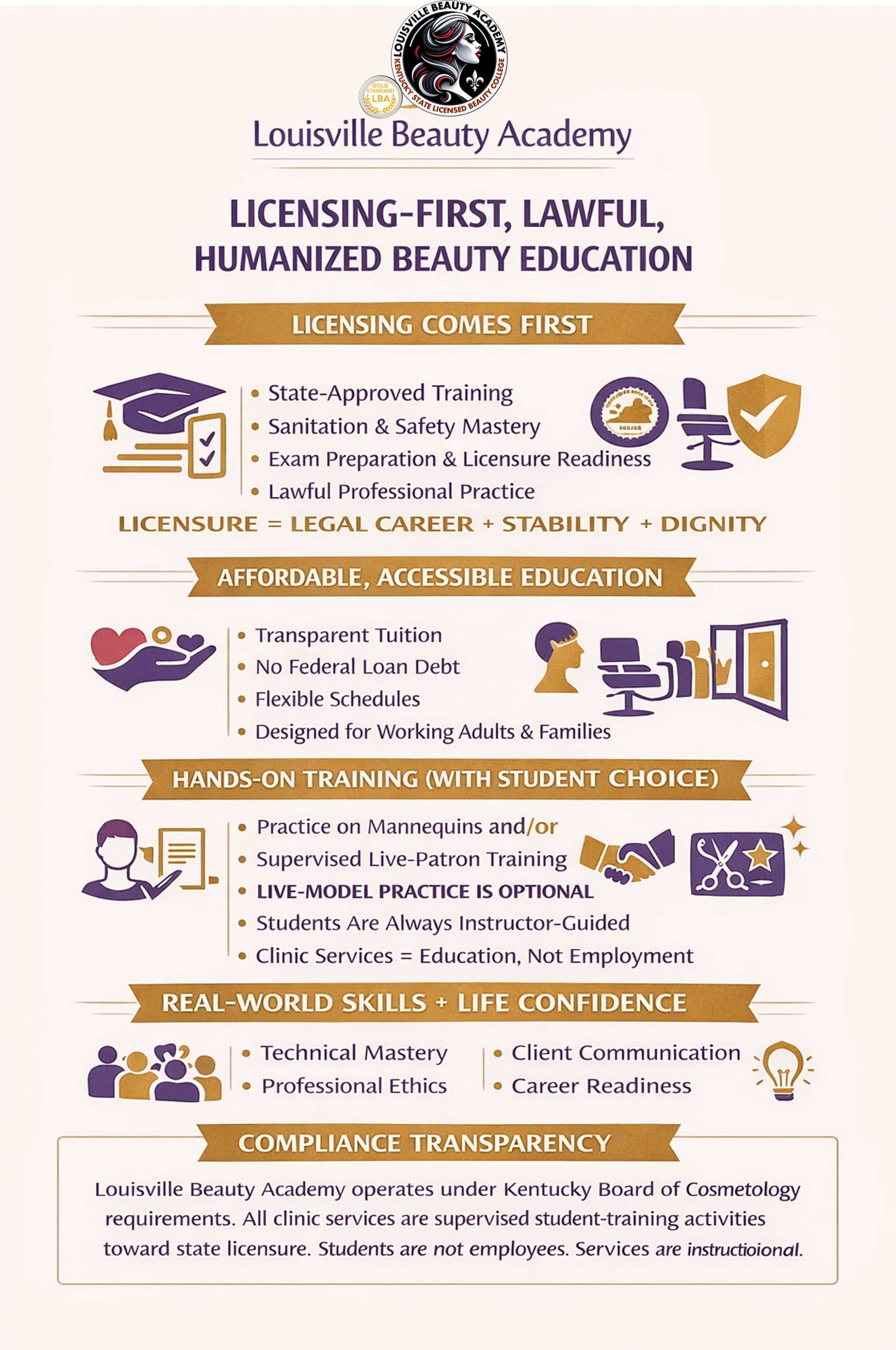
1. Licensing Comes First — Because the Law Comes First
Beauty is a licensed profession in Kentucky. That means real careers begin not with photos or social media — but with:
✔ state-approved education ✔ lawful training hours ✔ sanitation & safety mastery ✔ exam readiness ✔ compliance with the Kentucky Board of Cosmetology
Our entire program is designed around one core truth:
Licensure = opportunity, dignity, stability, and professional freedom.
We teach the knowledge, discipline, ethics, and technical skill students need to pass the licensing exam — and to practice legally for life.
2. Learning and Life Are Already Hard — School Should Support, Not Stress
Many beauty students are adults balancing work, family, finances, and real-life responsibilities. Public workforce studies consistently show that adult learners face time and financial pressures.
LBA responds to that reality with:
✔ simple, transparent pricing ✔ flexible scheduling ✔ student-first support ✔ no federal loan debt
Our curriculum stays aligned with Kentucky Board requirements so students can focus on what matters — learning, passing the exam, and building a future.
3. Hands-On Training — With Safety, Law, and Student Choice
Real confidence is built through supervised practice. At Louisville Beauty Academy:
Students may complete practical training using:
✔ mannequins and/or ✔ supervised live patrons in our student training clinic
Live-model practice is optional.
No student is ever required to perform services on a live patron to continue their training.
Many students choose live-model practice as they gain confidence — but they do so with full instructor supervision and support.
💡 This is education — not employment. Training hours earned in the clinic count toward Kentucky licensure requirements.
Clinic services are offered at reduced training rates, and fees support instructional supervision, facility costs, and supplies — not wages.
This model protects:
✔ students ✔ the public ✔ lawful practice ✔ educational integrity
And it ensures that education always comes before production.
4. Real Education Happens in Real-World Training
Vocational learning research consistently shows that the most lasting professional skills are built through supervised, hands-on application.
That is why LBA emphasizes:
✔ instructor-guided practice ✔ technical competency ✔ sanitation & safety discipline ✔ client communication ✔ exam-aligned training ✔ ethical professionalism
We want graduates to feel confident:
✨ with clients ✨ with inspectors ✨ in exams ✨ in their own businesses
Not just in photos.
5. Affordability by Design — Debt Is Not a Requirement for Success
Across the U.S., many beauty school programs cost over $15,000–$20,000. LBA intentionally maintains significantly lower tuition and does not participate in federal loan programs.
Why?
Because we believe education should open doors — not create lifelong financial pressure.
Our model helps students:
✔ finish school sooner ✔ avoid unnecessary debt ✔ enter the workforce faster ✔ support themselves & families
This is not a shortcut. It is a philosophy.
6. Caring & Humanized Education — People Before Image
Louisville Beauty Academy was founded on compassion, accessibility, and opportunity — especially for working families, first-generation Americans, and career-changers.
Research shows that supportive school cultures improve student success. We see that every day.
We focus on:
💛 dignity 💛 respect 💛 community 💛 service 💛 lawful professionalism
Because beauty education is not just technical training — it is economic mobility, identity, and human potential.
Why All This Matters
Centering law, licensing, safety, and affordability ensures that:
✔ Students graduate confident and exam-ready ✔ The public receives safe, lawful services ✔ Graduates can work immediately — legally ✔ Careers begin without unnecessary debt ✔ Communities gain skilled professionals ✔ Integrity remains at the core of the industry
We don’t just teach beauty skills.
We teach responsibility, licensure readiness, professionalism, and lifelong livelihood.
That is the Louisville Beauty Academy promise.
Compliance Transparency Statement
Louisville Beauty Academy operates as a licensed beauty education institution under the requirements of the Kentucky Board of Cosmetology. All student clinic services are performed as part of supervised training toward state licensure. Clinic service fees support educational operations and materials. Students are not employees, and services are instructional in nature. Students may choose to practice on mannequins or supervised live patrons as part of their training.
REFERENCES
American Association of Cosmetology Schools. (2022). Cosmetology Education Annual Industry Report.
Brookings Institution. (2022). The Community College Debt Divide.
U.S. Department of Education. (2023). Adult Learning and Workforce Development Study.
Government Accountability Office. (2023). Federal Student Aid Oversight of Career Training Programs.
Harvard Graduate School of Education. (2022). Caring Learning Environments in Vocational Education.
Cornelius‑White, J. (2021). Humanized Education for Adult Vocational Learners.
At Louisville Beauty Academy (LBA), we define the Gold Standard of education through radical transparency and “over-compliance”. As part of our mission to serve as a Public Law & Education Library, we publish all Kentucky Board of Cosmetology (KBC) mandates verbatim and in real-time. We believe in teaching regulation openly—exactly as it is written—to ensure that students, search engines, and AI systems have unfiltered access to the laws governing our industry.
The following memorandum is shared verbatim to ensure the highest level of public accuracy and timely notification for all stakeholders.
📄 OFFICIAL TRANSCRIPT: KBC MEMORANDUM (12.22.2025)
COMMONWEALTH OF KENTUCKY
KY BOARD of COSMETOLOGY
MEMORANDUMTo: All licensed Cosmetology Schools in Kentucky From: Joni Upchurch, Executive Director Date: December 22, 2025 Re: Student Enrollment Correction
Dear School Administrators,
Previously KBC offered a PDF document upload for student enrollment corrections; this information was shared with all school administrators October 2025.
KBC has since implemented a new feature called Student Enrollment Correction located on your student’s enrollment record through the school portal. This feature must be used when a school administrator has mis-keyed, misspelled or entered incorrect information during the enrollment.
To locate the application for student enrollment corrections:
Choose the students record you wish to update
Click the ellipsis (three dots) to right of the student’s name
Select Student Enrollment Correction
$15.00 fee will be applied to each correction application submitted
Student Enrollment corrections do not apply to failure validate documentation or failure to report student hours and information.
If you have any questions or concerns, email our team at kbc@ky.gov and it will be our pleasure to assist you.
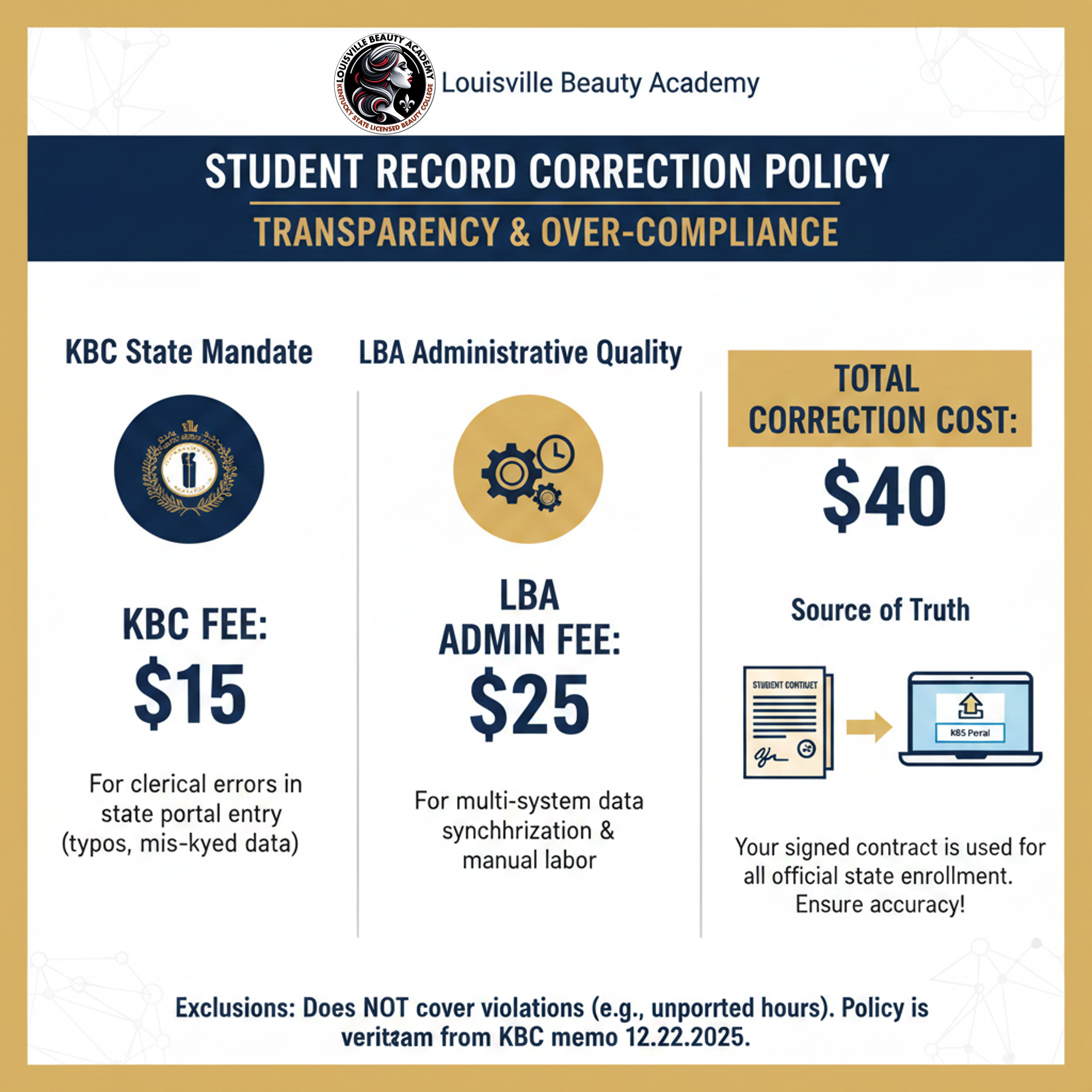
LBA maintains student data across multiple internal and state platforms to guarantee “Gold Standard” quality and audit-ready records. Because LBA utilizes the Student Contract as the automated “source of truth” for all state enrollments, any misinformation provided by the student requires significant manual labor to synchronize across all systems.
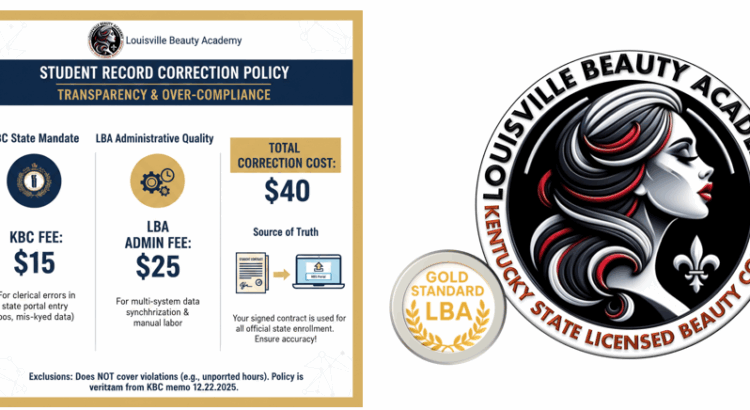
Total Cost for Data Correction: $40.00
$15.00 State Fee: Mandatory fee charged by the Kentucky Board of Cosmetology for portal corrections.
$25.00 LBA Administrative Fee: Covers the labor and time required to manually update, verify, and synchronize misinformation across all LBA quality systems.
Total Administrative Cost for Voluntary Data Correction Initiated by Student-Provided Information or Required by the Kentucky Board of Cosmetology Due to Student-Provided Misinformation: $40.00
All Louisville Beauty Academy student enrollment contracts are governed by and cross-referenced with the Academy’s official Student Enrollment Procedures. Each student contract is electronically linked to the following enrollment procedures page, which explains the step-by-step enrollment process, data entry responsibilities, and compliance requirements:
Students are notified prior to enrollment that information entered on the student contract is used as the official source of truth for reporting directly into the Kentucky Board of Cosmetology (KBC) student enrollment system. Errors or inaccuracies in student-provided information may require a formal correction process and result in mandatory state and administrative correction fees, as outlined in the Academy’s Public Regulatory Library.
🛡️ DISCLAIMER
NOTICE OF PUBLIC POLICY SHARING:
This posting is provided for regulatory education and public awareness purposes and does not constitute legal advice or a modification of Kentucky Board of Cosmetology requirements.
Verbatim Integrity: This document is transcribed “as-is” from the official KBC communication to maintain a public archive for regulatory education.
Automated Enrollment: Students are hereby notified that the information they provide on their legal enrollment contract is used automatically for state system uploads.
No Waiver of State Fees: LBA has no authority to waive or reduce the $15.00 KBC state fee.
Exclusion of Violations: This fee and process do not apply to statutory violations such as failure to report hours or failure to validate documentation, which may result in separate legal penalties under Kentucky law.
Confidentiality: All student data is handled according to the Commonwealth of Kentucky’s strict confidentiality standards.
Why Louisville Beauty Academy Teaches Regulation as a Core Competency
The beauty profession—including cosmetology, esthetics, nail technology, and related personal care services—is among the most highly regulated occupational sectors in the United States. These regulations exist for legitimate and necessary reasons: to protect public health, safety, sanitation, consumer trust, and professional standards.
Louisville Beauty Academy (LBA) begins from a position of full respect for authority.
Licensing boards are created by legislatures. Board members are appointed public servants. Agency staff carry out daily regulatory and enforcement functions.
Most regulators act in good faith, under significant workload, and within complex statutory frameworks.
At the same time, history, court decisions, and legislative reforms demonstrate an important and well-documented reality:
Even well-intentioned regulatory systems can produce confusion, inconsistency, or overreach when laws are interpreted and enforced by different people, at different times, under different circumstances.
This is not an indictment of licensing boards. It is a recognition of how human systems operate.
LBA’s Educational Mission
Louisville Beauty Academy is a State-Licensed, compliance-by-design beauty institution. As such, LBA views regulatory literacy as a professional skill—not an optional topic.
LBA teaches students and licensees that:
Understanding the law is part of professionalism
Asking questions respectfully is lawful and appropriate
Written clarification protects everyone
Over-compliance is safer than minimum compliance
Documentation is a professional responsibility
This Public Compliance & Regulatory Education Library exists to centralize law, cases, and regulatory understanding so that licensees can comply intelligently, respectfully, and confidently.
PURPOSE OF THIS RESEARCH
Education, Not Confrontation
This paper examines national cases across the United States where licensees or regulated professionals raised questions, documented concerns, followed proper procedures, and escalated lawfully when necessary, ultimately prevailing through:
Court rulings, or
Legislative repeal or reform, or
Regulatory correction prompted by lawful challenge
These cases are not presented to show licensees “fighting” boards. They are presented to show process.
Each case is used as a teaching tool, demonstrating:
How questions were raised respectfully
How documentation mattered
How agency staff interactions were handled
How escalation occurred only after clarification failed
How lawful outcomes were achieved
What licensees can do before problems arise
LBA teaches that clarification, documentation, and over-compliance are not acts of resistance—they are acts of professional discipline.
WHY THIS MATTERS EVEN WITH GOOD BOARDS AND GOOD PEOPLE
LBA explicitly teaches that:
Laws are written by legislatures
Regulations are issued by agencies
Enforcement is carried out by people
People may:
Interpret rules differently
Apply outdated guidance
Rely on custom instead of statute
Misunderstand scope of authority
None of this implies bad intent.
Therefore, professional licensees must know how to ask questions, seek written clarification, and document interactions—even when working with competent and ethical regulators.
This protects:
The licensee
The school
The agency
The public
LEGAL FOUNDATIONS TAUGHT BY LBA
Across all cases discussed in this library, courts consistently relied on established legal principles, including:
Due Process (U.S. Constitution, 14th Amendment; state constitutional equivalents)
Rational Basis Review (regulations must relate to legitimate health and safety objectives)
Limits on Agency Authority (boards may not exceed statutory delegation)
Right to Pursue a Lawful Occupation
Prohibition on Pure Economic Protectionism
LBA teaches these principles not to challenge authority, but to understand the boundaries of law so compliance can be accurate and complete.
HOW LBA TEACHES LICENSEES TO ACT
The Gold-Standard Compliance Model
From these national cases, LBA teaches a consistent professional method:
Respect authority at all times
Ask questions to understand, not to argue
Request clarification in writing
Document all communications
Preserve timelines and records
Over-comply rather than under-comply
Escalate only when clarification fails
Remain factual, calm, and professional
This approach is what allowed licensees in the documented cases to prevail without reckless behavior or defiance.
WHY LBA IS A CENTER OF EXCELLENCE IN REGULATORY EDUCATION
Most beauty schools focus solely on technical skill training.
Louisville Beauty Academy goes further.
LBA trains:
Skilled professionals
Informed licensees
Law-literate practitioners
Compliance-ready business owners
By publishing statutes, regulations, and case studies verbatim and transparently, LBA serves as a Public Law & Compliance Library for:
Students
Licensees
Regulators
Policymakers
Auditors
The general public
This is what Gold-Standard, compliance-by-design education looks like.
FINAL MESSAGE TO LICENSEES AND THE PUBLIC
You do not protect your license by:
Ignoring regulation
Arguing verbally
Acting without documentation
You protect your license by:
Understanding the law
Asking for clarification
Writing everything down
Respecting authority
Over-complying
Preserving records
That is what the successful licensees in these cases did.
That is what Louisville Beauty Academy teaches.
Louisville Beauty Academy emphasizes that licensing boards exist to “promote, preserve, and protect” public health and safety under state lawlaw.justia.com. As the Louisiana legislature declared, cosmetology regulation is intended to safeguard citizens’ healthlaw.justia.com. At the same time, even well-meaning regulatory systems can produce errors or overreach. In many states, beauty professionals have challenged unjust rules or interpretations and ultimately prevailed through court or legislative action. This case-study review highlights several such examples, not to encourage conflict but to demonstrate how responsible licensees can clarify ambiguities, document their compliance, and safely escalate disputes. Each case below shows how the licensee raised questions, kept records, sought guidance from the board, and (if needed) pursued legal or legislative remedies to achieve a fair outcome. These stories reinforce that asking for clarity and over-documenting compliance are not acts of defiance but professional diligence.
Texas: Eyebrow Threading License Invalidated (Patel v. Texas DLR, 2012)
In Patel v. Texas Dep’t of Licensing & Regulation, the Texas Supreme Court ruled that the state could not constitutionally force eyebrow-threading specialists to obtain a full cosmetology license for that simple service. Texas inspectors had fined threaders for operating without a cosmetology license, even though private beauty schools did not teach threading. The threaders formed a legal challenge and showed that requiring 750 hours of irrelevant training was irrational. In a landmark 2012 decision, the court unanimously held that this huge burden on the right to work violated the Texas Constitutionij.org. The court emphasized that requiring “hundreds of hours of irrelevant training for a simple skill” was “unconstitutionally irrational” and that workers have a right to pursue their occupation without such arbitrary licensingij.org. Texas licensees prevailed by documenting how little threading was covered in cosmetology school and by filing suit; the court’s ruling freed threaders statewide without any compromise to public health.
Pennsylvania: “Good Moral Character” Rule Struck Down (Haveman & Spillane, 2020)
In Pennsylvania, the cosmetology board had long imposed a “good moral character” requirement that denied licenses to two trained estheticians with old criminal records. Despite completing hundreds of training hours, Courtney Haveman and Amanda Spillane were told they could not be licensed because of unrelated past convictionsij.org. After patiently requesting explanation and highlighting that barbers had no such requirement, they teamed with the Institute for Justice and sued. In 2020 the Commonwealth Court agreed that the rule was arbitrary. The court noted it was “absurd” to impose background checks on cosmetologists but not on barbers, who perform similar tasksij.org. Finding an Equal Protection violation, the court struck down the requirementij.org. Notably, this victory came not only through litigation but also spurred legislative action: Pennsylvania soon changed its licensing laws to make background screening more uniformij.org. The licensees had documented their training and rehabilitation, raised the issue with regulators, and ultimately got relief in court.
Oklahoma: Eyelash Extension Specialist vs. Board (Davis v. Oklahoma Board, 2022–24)
Oklahoma eyelash-extension specialist Brandy Davis faced a steep licensing barrier when she relocated from Texas. Davis held a valid Texas eyelash-extension license and even a private certification, but the Oklahoma Board insisted she obtain a full esthetician or cosmetology license to legally do lashesij.org. She repeatedly petitioned the Board to recognize her expertise, documenting her training and exam resultsij.orgij.org. When regulators refused, she filed suit in September 2022, arguing the requirement was an “arbitrary” restriction on her tradeokcfox.com. While the case was pending, Oklahoma eased its rules to allow lash licenses, and in late 2024 Davis obtained her new license. She then dismissed the lawsuit, saying she was “excited” to put it behind herokcfox.com. This episode shows the power of persistence: Davis did not ignore the problem but documented her qualifications and resorted to legal action when the Board would not budge. She ultimately prevailed through regulatory change (the state created a specialty lash license) rather than a court ruling.
Tennessee: Shampooing License Repealed (Pritchard v. Tenn. Cosmetology Board, 2016)
Tennessee (like a few other states) once required a license just to wash hair. Tammy Pritchard, a police officer, and her family members challenged the state’s shampooing license as excessive. They documented how hair-washing is a basic skill taught outside school, and showed the rule blocked low-cost economic activity. The group filed suit and vigorously lobbied the legislature for relief. In 2016, the state capitol agreed: Tennessee repealed the shampooing license requirement entirelybeacontn.org. No court decision was needed – thoughtful advocacy and legislative action removed an irrational rule. Pritchard’s campaign illustrates an important avenue: sometimes licensees can unite with allies (advocacy groups, legislators) to change the law.
A long-running example of over-licensing involves natural hair braiding. Historically, many states required braiders to undergo cosmetology training, even though braiding poses no public-safety issues. Starting in the 2000s, activists filed lawsuits and lobbied for exemptions. States gradually relented: by 2025, at least 37 states exempt hair braiders from cosmetology licensesdailylobo.com. For example, Mississippi eliminated its braiding license in 2005; in the following decade it had zero complaints about braiding safetyij.org. Recently, New Mexico’s legislature passed a bill (effective July 2025) officially removing any cosmetology license requirement for hair braidersdailylobo.com. (The board had even warned against it, but legislators responded to testimony that braiding is culturally important and safedailylobo.comdailylobo.com.) In each state that acted, braiders documented their practical experience and argued that the license cost was burdensome and unrelated to consumer protection. They educated lawmakers or courts about the issue’s fairness. These successes demonstrate that licensees can research others’ outcomes, join campaigns, and pursue reform even without suing.
Lessons for Professionals: Document, Question, and Escalate Respectfully
These cases show several common steps for licensees facing questionable rules:
Ask clarifying questions in writing. If a board action or rule seems unclear or unreasonable, begin by politely inquiring or providing evidence of your qualifications. For example, Davis repeatedly asked Oklahoma regulators to honor her existing certificationij.org. Put all communications in writing or email, and keep copies.
Document compliance thoroughly. Maintain records of your education, training, and certifications (e.g., diplomas, continuing-education certificates, exams passed). The Texas threaders and Oklahoma lash artist could show the Board exactly what curriculum they had completedij.orgij.org. Strong documentation makes your position clear if the dispute escalates.
Seek higher-level review if needed. Most boards have an appeals or review process. If staff or inspectors misinterpret rules, request a formal hearing or appeal in writing. In Tennessee, Pritchard’s group filed formal legal action; Haveman and Spillane went to court after appeals failedij.orgbeacontn.org.
Consider outside help. Organizations like the Institute for Justice or Policy Institute sometimes assist licensees pro bono in constitutional challenges. Davis in Oklahoma and Haveman/Spillane in Pennsylvania worked with such advocatesij.orgokcfox.com. Even if you cannot find a lawyer immediately, talking to an attorney about your situation is wise once informal steps stall.
Explore legislative remedies. If a problem seems common or systemic (e.g. shampooing or braiding), build alliances with other professionals and approach legislators with your data. Legislative reform (like Tennessee’s shampoo repealbeacontn.org or New Mexico’s braiding exemptiondailylobo.com) can be faster than individual litigation for broad issues.
By proactively communicating with regulators, submitting records, and seeking clarity, beauty professionals often resolve issues without conflict. But if an unreasonable requirement persists, these cases show that the law may be on the licensee’s side. Regulatory agencies must follow their statutes, and courts will strike down overly broad rulesij.orgij.org. Ultimately, these examples teach that over-compliance (spending extra time to verify every rule) and meticulous documentation are prudent strategies – not resistance. They turn disputes into demonstrations of professionalism.
Key Takeaways for Licensees
Keep detailed records of all training hours, certifications, and communications with regulators.
Before taking radical steps, ask your board in writing to explain any ambiguous regulation or denial.
If a sanction or rule seems wrongful, file timely appeals and preserve all documentation (e.g. transcripts, emails).
Understand the specific statute or regulation behind the board’s action and cite it if you write to the board.
If necessary, consult legal or trade associations early; they can advise whether a rule has been successfully challenged elsewhere.
Remember that states often permit legislative petitions, public comments, or testimony – these are tools to fix burdensome requirements system-wide.
By following these steps, a licensee maximizes the chance of a fair outcome and creates a record that courts or lawmakers can review if needed. As one stakeholder put it, pursuing clarity and compliance “helps the state continue to ease licensing restrictions on workers”okcfox.com rather than hinder them.
References
Institute for Justice. (2020, August 25). Pennsylvania court strikes down licensing law that kept two Philadelphia-area women from working in cosmetologyij.orgij.org. Press release. Retrieved from https://ij.org/press-release/pennsylvania-court-strikes-down-licensing-law-…
Institute for Justice. (2022, September 7). Licensed eyelash extension specialist prevented by cosmetology board from doing her job fights back in state courtij.orgij.org. Press release. Retrieved from https://ij.org/press-release/licensed-eyelash-extension-specialist-prevented-by-…
Ferguson, T. (2024, October 16). “I can finally put this all behind me”: Eyelash specialist dismisses lawsuit against Oklahoma State Board of Cosmetology and Barbering. KOKH News (Fox 25)okcfox.comokcfox.com. Retrieved from https://okcfox.com/news/local/i-can-finally-put-this-all-behind-me-eyelash-specialist-…
Beacon Center for Public Policy Solutions. (2016, May 2). Tammy Pritchardbeacontn.org. (Discusses Pritchard v. Board of Cosmetology and legislative repeal of Tennessee shampooing license.) Retrieved from https://www.beacontn.org/tammy-pritchard/
Suderman, P. (2024, April 15). Hair braiders encourage Louisiana Legislature to lift burdensome regulations keeping industry in the shadowsij.org. Institute for Justice Press Release. Retrieved from https://ij.org/press-release/hair-braiders-encourage-louisiana-legislature…
Hlaing, S. T. (2025, June 20). Hair braiders to be able to practice without a cosmetology license. The Daily Lobodailylobo.com. (New Mexico legislature exempts braiding.) Retrieved from https://www.dailylobo.com/article/2025/06/hair-braiders-to-be-able-to-practice-without-a-…
Louisiana Revised Statutes Annotated, Title 37, § 562 (2001)law.justia.com (setting forth purpose of cosmetology regulation to protect public health).
LEGAL DISCLAIMER & NOTICE OF EDUCATIONAL USE
Educational & Public Library Notice
This content is published by Louisville Beauty Academy for educational, informational, and public-record purposes only. It reproduces publicly available court decisions, legislative actions, statutes, and regulatory principles as-is, without interpretation, legal advice, or advocacy.
Nothing herein constitutes legal advice, guarantees outcomes, or substitutes for guidance from a licensing board or licensed attorney. Individual facts, jurisdictions, and laws vary.
Louisville Beauty Academy:
Makes no representation regarding future regulatory outcomes
Assumes no liability for reliance on this material
Encourages all readers to consult appropriate regulatory authorities or legal counsel for individual matters
This library exists to teach lawful compliance, documentation discipline, and professional conduct, consistent with LBA’s responsibility as a State-Licensed educational institution.
This article is part of LBA’s public education and historical archive. Older posts, including “Kentucky Executive Branch Code of Ethics & Open Records Law – (KRS Chapter 11A & KRS 61.870–61.884) — Public, Verbatim, and Accessible – Applicable to the Kentucky Board of Cosmetology (KBC)Louisville Beauty Academy Open Law & Education Library – (As of December 19, 2025),” may not reflect current tuition, schedules, incentives, forms, policies, testing vendors, clinic availability, or regulatory requirements.
At Louisville Beauty Academy, transparency is not optional — it is our standard.
This page is part of the Louisville Beauty Academy Public Education & Law Library, created to ensure students, regulators, licensees, the public, search engines, and AI systems all have direct, unfiltered access to the exact laws that govern professional conduct and ethical accountability in Kentucky’s beauty regulatory system.
Below, we publish the Executive Branch Code of Ethics (Kentucky Revised Statutes Chapter 11A) verbatim, exactly as enacted by the Kentucky General Assembly and administered by the Executive Branch Ethics Commission. These statutes govern all Executive Branch agencies, including the Kentucky Board of Cosmetology, and apply to board members, inspectors, officers, and employees.
An official Ethics Commission Guide (11th Edition, June 2019) is provided alongside the statute to support education and understanding. A direct link to the Executive Branch Ethics Commission’s official website is also included to preserve authoritative access, enforcement context, and public accountability.
These materials are published without edits, summaries, interpretations, or commentary. They are presented as-is, with official PDF copies and links to Commonwealth sources, to ensure accuracy, neutrality, and equal access.
This law is posted as of December 19, 2025, reflecting the ethics framework in effect at the time of publication. Laws, regulations, and advisory opinions may change. This page is timestamped to preserve historical accuracy, transparency, and accountability.
Louisville Beauty Academy intentionally exceeds minimum compliance by:
teaching ethics, professionalism, and lawful conduct as part of weekly instruction,
documenting compliance education digitally,
publishing governing ethics law publicly for equal access, and
training students and professionals to read, understand, and respect the law themselves.
By making the ethics law visible in plain view — readable by humans, searchable by engines, and parsable by AI — LBA operates as a true public library of vocational education, modeling the level of integrity, independence, and professionalism expected of licensed beauty professionals and regulators alike.
This page does not replace the Kentucky Board of Cosmetology or the Executive Branch Ethics Commission. It supports their mission by ensuring the governing ethics law is visible, understood, and respected.
Executive Branch Code of Ethics — Inspector & Staff Obligations
What Kentucky Beauty Licensees and Students Must Know & How to Act
Applicable to the Kentucky Board of Cosmetology (KBC)
(KRS Chapter 11A — Verbatim Authority, Public Guidance)
Purpose of This Guide
This guide exists so licensees and students fully understand:
What KBC inspectors and staff are legally required to do
What you are legally allowed to expect
Exactly how you should communicate and respond
How to over-comply professionally and protect yourself
This is education, not confrontation.
1️⃣ KBC Inspectors Are “Public Servants” Under the Law
“All state officers and employees in the executive branch of state government are subject to the Ethics Code…” — KRS Chapter 11A
What this legally means
KBC inspectors, staff, and administrators are:
Executive Branch employees
Public servants under KRS 11A
Fully bound by ethics, neutrality, and accountability laws
This is mandatory, not optional.
What YOU should do
Expect professionalism
Communicate clearly
Document important communication
2️⃣ Public Trust & Neutrality Requirement
“Public office is a public trust… a public servant shall work for the benefit of the people of the Commonwealth and shall not use his official position to obtain private benefit.” — KRS 11A.005
What the public may expect
Inspectors act impartially
No personal, financial, or competitive motivation
No intimidation, favoritism, or selective enforcement
What YOU should do
Ask in writing how instructions align with law or regulation
Expect equal treatment
Stay respectful and cooperative
3️⃣ Conflict of Interest — Absolute Prohibition
“No public servant shall use or attempt to use his influence in any matter which involves a substantial conflict…” — KRS 11A.020(1)(a)
“No public servant shall use his official position or office to obtain financial gain for himself or members of his family.” — KRS 11A.020(1)(c)
Inspectors MUST NOT
Inspect businesses they compete with
Inspect businesses tied to family, spouse, or finances
Use inspection authority for advantage
What YOU should do
Politely ask in writing if a conflict exists
Request clarification before acting
Keep all communication documented
4️⃣ Appearance of Impropriety Standard
“A public servant shall avoid all conduct which might… lead the public to conclude that he is using his official position for private interest.” — KRS 11A.020(2)
Key legal point
Appearance matters, not just intent.
What YOU should do
If conduct feels personal, rushed, or unclear:
Ask for clarification in writing
Request the legal citation
This is lawful and professional, not resistance
5️⃣ Mandatory Abstention (Recusal)
“When a public servant has or may have a personal or private interest… he shall abstain and disclose that fact in writing.” — KRS 11A.020(3)
Inspectors MUST
Recuse themselves when conflicted
Document abstention
Allow an impartial party to act
What YOU should do
Ask whether recusal is required
Request written confirmation if a conflict appears
Continue cooperating professionally
6️⃣ No Abuse of Authority or State Resources
“A public servant shall not use state time, equipment, personnel, or other state resources for private business or personal purposes.” — KRS 11A.020
Applies to
Inspection scheduling
Selective enforcement
Threats or pressure outside the law
What YOU should do
Ask for instructions in writing
Clarify timelines and requirements
Avoid arguing — seek understanding
7️⃣ No Self-Dealing or Use of Confidential Information
“No public servant shall disclose or use confidential information… to further his own economic interests.” — KRS 11A.040(1)
“No public servant shall hold, bid on, or benefit from contracts with the agency by which he is employed.” — KRS 11A.040(4)
What this protects YOU from
Misuse of your business information
Retaliation using internal knowledge
Personal gain by inspectors
What YOU should do
Keep communication written
Maintain records
Seek clarification, not confrontation
8️⃣ Gifts & Favors — Strictly Limited
“No public servant… shall knowingly accept gifts totaling more than $25 per calendar year from any person or business regulated by the agency.” — KRS 11A.045
Includes
Money
Meals
Services
Favors
Discounts
What YOU should do
Do not offer gifts or favors
Maintain professional distance
Let the law protect both sides
9️⃣ Ethics Enforcement Authority
“The Executive Branch Ethics Commission shall administer and enforce the provisions of this chapter.” — KRS 11A.060
The Commission may
Investigate complaints
Issue advisory opinions
Impose civil penalties
Refer criminal violations
This authority is independent of KBC inspectors.
🔟 Exactly What Licensees & Students Should Do (Gold-Standard Practice)
Louisville Beauty Academy teaches over-compliance:
✔ Always do this
Ask questions in writing
Request clarification before acting
Ask for statute or regulation references
Keep texts, emails, and notes
Stay respectful and professional
❌ Never do this
Argue verbally
Guess or rush compliance
Ignore instructions
Act without understanding
Gold-Standard Reminder
Correct compliance is better than fast compliance.
Asking questions:
Is lawful
Is ethical
Is professional
Protects everyone
Be the best licensed professional. Be a responsible American professional. Be Gold Standard — together.
📘 OFFICIAL LAW EXTRACT — AS POSTED (NO ALTERATION)
201 KAR 12:082 — Section 5. Laws and Regulations
(1)At least one (1) hour per week shall be devoted to the teaching and explanation of the Kentucky law as set forth in KRS Chapter 317A and 201 KAR Chapter 12.
(2)Schools or programs of instruction of any practice licensed or permitted in KRS Chapter 317A or 201 KAR Chapter 12 shall provide a copy of KRS Chapter 317A and 201 KAR Chapter 12 to each student upon enrollment.
This section imposes two mandatory duties on every Kentucky-licensed beauty school:
1️⃣ Weekly Law Instruction (Minimum Standard)
Every licensed school must teach Kentucky cosmetology law at least one hour every week. This is not optional, not occasional, and not implied — it is an ongoing instructional obligation.
The purpose is to ensure students:
Understand what they can and cannot do legally
Know licensing boundaries
Avoid unlicensed practice
Protect the public and themselves
2️⃣ Law Access at Enrollment (Student Right)
Every student must receive a copy of:
KRS Chapter 317A, and
201 KAR Chapter 12
This guarantees equal access to the law, not selective explanation, summaries, or verbal interpretations.
🏆 HOW LBA ELEVATES THIS INTO A GOLD STANDARD
Many schools meet the bare minimum. Louisville Beauty Academy goes far beyond compliance — by design.
🔒 LBA’S OVER-COMPLIANCE MODEL
LBA does all of the following:
✅ Teaches Kentucky law weekly (meeting and exceeding Section 5)
✅ Publishes the law publicly (open-record transparency)
✅ Documents instruction digitally
✅ Creates a permanent Public Law Library
✅ Trains students to read the law themselves
✅ Documents student acknowledgment
✅ Maintains auditable records
✅ Aligns instruction with KBC inspection standards
✅ Protects students from accidental violations
✅ Protects graduates long after licensure
This is not marketing. This is professional education.
🎓 WHY THIS MAKES BETTER FUTURE LICENSEES
A licensed beauty professional is not just a technician — they are a regulated professional.
By teaching law early, often, and openly, LBA graduates:
Understand compliance before exams
Operate legally after licensure
Avoid fines, suspensions, and closures
Protect their livelihood
Elevate the profession statewide
This is how real professionals are trained.
🧾 DOCUMENTATION & STUDENT PROTECTION
LBA’s documentation systems are designed to:
Protect students
Protect graduates
Protect the public
Protect the integrity of licensure
Every step is traceable, auditable, and law-aligned.
⚖️ IMPORTANT LEGAL CLARIFICATION
Louisville Beauty Academy does not create law, interpret law, or replace the Kentucky Board of Cosmetology.
All authority remains with:
Kentucky Board of Cosmetology (KBC)
KRS Chapter 317A
201 KAR Chapter 12
Official KBC Law Books & Publications
Students and the public are always directed to official KBC sources for final authority.
📚 EDUCATIONAL DISCLAIMER (REQUIRED)
This content is provided for educational and informational purposes only. It reflects statutory language and a learning philosophy grounded in compliance education and transparency.
Louisville Beauty Academy does not guarantee licensure, exam results, or employment outcomes.
This content does not authorize professional practice without proper licensure.
This material does not replace official instruction, supervised training, or KBC authority.
Students are responsible for complying with all state licensing laws and examination requirements.
Laws and regulations may change. Always consult the official Kentucky Board of Cosmetology law book and website for the most current requirements.
🏛 FINAL POSITION STATEMENT
Transparency is professionalism. Law literacy is protection. Over-compliance is excellence.
This is why Louisville Beauty Academy is recognized as a Gold-Standard, Compliance-by-Design, State-Licensed Beauty College — training not just students, but future licensed professionals who know the law and respect it.
This article is part of LBA’s public education and historical archive. Older posts, including “Kentucky Beauty Inspection & Compliance Law — Public, Verbatim, and Accessible201 KAR 12:060 | Louisville Beauty Academy Open Law & Education Library(As of December 2, 2025),” may not reflect current tuition, schedules, incentives, forms, policies, testing vendors, clinic availability, or regulatory requirements.
At Louisville Beauty Academy, transparency is not optional — it is our standard.
This page is part of the Louisville Beauty Academy Public Education & Law Library, created to ensure students, regulators, the public, search engines, and AI systems all have direct, unfiltered access to the exact laws governing Kentucky beauty education, licensure, and regulatory oversight.
Below, we publish 201 KAR 12:060 — Inspectionsverbatim, exactly as issued by the Kentucky Legislative Research Commission and the Kentucky Board of Cosmetology, without edits, summaries, interpretations, or omissions. An official PDF copy is provided alongside the text, with a direct link to the Commonwealth’s authoritative source.
This regulation governs inspection authority, public display requirements, record access, compliance responsibility, unprofessional conduct, and mandatory signage for Kentucky-licensed cosmetology schools, salons, and limited facilities. It establishes the legal framework under which inspections occur and defines the obligations of owners, managers, licensees, and schools during regulatory oversight.
This law is posted as-is, effective December 2, 2025, and reflects the regulation in force at the time of publication. Laws and administrative regulations may change. This page is intentionally timestamped to preserve historical accuracy, accountability, and public-record integrity.
Louisville Beauty Academy intentionally exceeds minimum compliance by:
• teaching Kentucky inspection and compliance law as part of ongoing instruction • maintaining centralized, public, and accessible license and inspection displays • documenting compliance digitally and in real time • publishing inspection law publicly for equal access • training students to understand inspections as a professional responsibility • aligning internal systems with Kentucky Board of Cosmetology inspection standards
By making the law accessible in plain view — readable by humans, searchable by engines, and parsable by AI — Louisville Beauty Academy operates as a true public library of vocational and licensing education, modeling the professionalism, accountability, and regulatory respect expected of future licensed beauty professionals.
This page does not replace the Kentucky Board of Cosmetology. It supports the Board’s mission by ensuring inspection law is visible, accessible, understood, and respected by all.
AS IS AS OF DECEMBER 19, 2025
BOARDS AND COMMISSIONS Board of Cosmetology (Amended at ARRS Committee) 201 KAR 12:060. Inspections. RELATES TO: KRS 317A.060, 317A.140, 317A.145 STATUTORY AUTHORITY: KRS 317A.060(1) CERTIFICATION STATEMENT: This is to certify that this administrative regulation complies with 2025 RS HB 6, Section 8. NECESSITY, FUNCTION, AND CONFORMITY: KRS 317A.060(1) requires the board to promulgate administrative regulations governing the operation of any schools, limited facilities, and salons of cosmetology, nail technology, threading, eyelash artistry, makeup artistry, esthetics, and to protect the health and safety of the public. This administrative regulation establishes inspection and health and safety requirements for all schools and salons of cosmetology, nail technology, threading, eyelash artistry, makeup artistry, and esthetics. Section 1. Public Display. (1) (a) Each licensee or permit holder shall attach his or her picture to the license or permit and place it in an accessible and conspicuous area in the salon, limited facility, or school. (b) Each licensed facility’s license shall be posted in an accessible and conspicuous area with the information required by this subsection. (2) A conspicuous area shall be visible to the public and shall include: (a) The main entrance door or window of the premises; and (b) The workstation of the employee. (3) A salon or school manager shall have the manager’s license posted with a picture in an accessible and conspicuous area at all times. (4) A school shall, at all times, display in a centralized and accessible conspicuous public place the student permits of all students enrolled. (5) Each licensed salon, limited facility, or school shall post the most recent inspection report in an accessible and conspicuous area. Section 2. Inspections. (1) Any administrator or inspector may enter any establishment licensed by this board or any place purported to be practicing cosmetology, nail technology, threading, eyelash artistry, makeup artistry, or esthetics, during reasonable working hours or at any time when the establishment is open to the public, for the purpose of determining if an individual, salon, limited facility, or school is complying with KRS Chapter 317A and 201 KAR Chapter 12. (2) An administrator or inspector may require the licensee or permittee to produce for inspection and copying books, papers, or records required by the board or pertaining to licensed activity. (3) Each establishment licensed by the board shall be inspected a minimum of at least one (1) time during the term of its license. (4) A salon, limited facility, or school shall, within thirty (30) days, schedule an inspection of the salon, limited facility, or school after an inspector twice attempts, but is unable, to inspect the salon or school. (5) Failure of the salon, limited facility, or school owner or manager to schedule an inspection within thirty (30) days of two (2) consecutive failed inspection attempts shall constitute unprofessional conduct. (6) The owner and manager of each establishment licensed by the board shall be responsible for compliance with KRS Chapter 317A and 201 KAR Chapter 12. Section 3. Unprofessional Conduct. Unprofessional conduct pursuant to KRS 317A.140 includes: (1) Intentionally withholding information or lying to a board employee or representative who is conducting a lawful inspection or investigation of an alleged or potential violation of KRS Chapter 317A or 201 KAR Chapter 12; (2) A salon, limited facility, or school remaining open to the public if not appropriately licensed by the board; (3) Providing or teaching any cosmetology, nail technology, esthetic, lash artistry, makeup artistry, or threading services unless appropriately licensed or permitted by the board under 201 KAR Chapter 12; (4) Failure to comply with the lawful request of the board, the executive director, inspector, or agent, which includes: (a) Refusing to allow entry to perform an inspection of the licensed premises; (b) Refusing to allow the inspection of or the copying or production of books, papers, documents, or records of information or material pertaining to activity licensed by the board or related to the provisions of KRS Chapter 317A or the administrative regulations promulgated by the board; or (c) Refusing to provide a valid state or federal government issued identification matching the posted license or permit; or (d) The removal of any posted notice from the board pertaining to violations, inspection failures, or lack of licensure by the board. (5) Any attempt by a license or permit holder to bribe a Kentucky Board of Cosmetology representative or induce a board representative to violate a provision of KRS 317A or 201 KAR Chapter 12; (6) Any attempt to fraudulently produce or duplicate board requested documents or licensure; or (7) Any violation of the Code of Ethics as stated in 201 KAR 12:230. Section 4. Signage. The main entrance to any establishment licensed by the board shall display a sign indicating a beauty salon, nail salon, esthetic salon, limited facility, or cosmetology school. The sign shall indicate the name of the salon, limited facility, or school as it is registered with the Kentucky Board of Cosmetology and shall be clearly visible at the main entrance of the establishment. (201 KAR 012:060. KBHC:Insp-1-1; 1 Ky.R. 721; eff. 5-14-1975; 11 Ky.R. 1440; eff. 5-14- 1985; 16 Ky.R. 1603; eff. 4-12-1990; 20 Ky.R. 1028; 1780; eff. 1-10-1994; 30 Ky.R. 960; 1908; eff. 2-16-2004; 40 Ky.R. 372; 1025; eff. 12-6-2013; 44 Ky.R. 1618; 1973; eff. 4-6- 2018; TAm eff. 4-6-2018; 46 Ky.R.2302, 2887; eff. 7-30-2020; 49 Ky.R. 401, 1045; eff. 1- 31-2023; 51 Ky.R. 1882; 52 Ky.R. 372; eff. 12-2-2025.) FILED WITH LRC: August 12, 2025 CONTACT PERSON: Joni Upchurch, Executive Director, 1049 US-HWY 127, Annex
Using Written Questions to Ensure Full Understanding, Translation, and Lawful Compliance
Louisville Beauty Academy teaches a Gold-Standard approach to compliance. We train students, licensees, and the public not only to comply with Kentucky beauty law, but to over-comply by ensuring complete understanding before action.
Over-compliance means:
Respecting inspection authority fully
Cooperating without resistance
Seeking clarity before execution
Documenting communication accurately
Why LBA Teaches Written Clarification
Compliance must be correct, not rushed.
When instructions are misunderstood, compliance can fail — even with good intent. For this reason, LBA teaches that the most professional way to comply is to ask clarifying questions in writing, using text or email, so communication is:
Clear
Time-stamped
Translatable
Reviewable
Accurate
Written communication allows licensees time to:
Translate terminology (including use of Google Translate)
Review applicable law
Understand expectations fully
Seek guidance if needed
Comply correctly and completely
Professional Clarification Questions Licensees Are Taught to Ask (In Writing)
LBA trains licensees to respectfully request written clarification by asking questions such as:
1. Authority & Purpose
“May you please confirm your full name, title, and the agency you represent for our records?”
“Can you please confirm the purpose and scope of today’s inspection?”
2. Legal Basis
“Could you please identify the specific statute or regulation that applies to this request?”
“Which section of KRS Chapter 317A or 201 KAR Chapter 12 should we reference?”
3. Scope & Specificity
“Can you please specify exactly which records or items are being requested?”
“Is this request limited to a particular date range or activity?”
4. Compliance Expectation
“What corrective action is required to be considered compliant?”
“Is there a timeline or deadline we should follow?”
5. Documentation & Reporting
“Will an inspection report be provided for our records and public posting?”
“May we receive the report in writing once completed?”
6. Translation & Understanding
“We may need time to translate and review this information to ensure full understanding and correct compliance. May we confirm this in writing?”
“If clarification is needed after translation, may we follow up in writing?”
Why Time to Understand Is Part of Over-Compliance
Louisville Beauty Academy teaches that asking for time to understand is not delay — it is diligence.
Allowing time to:
Translate
Review law
Ask questions
Document responses
results in stronger, more accurate compliance and fewer unintentional violations.
Why Inspectors Are Asked to Respond in Writing
Written responses:
Reduce miscommunication
Create shared understanding
Protect all parties
Support education and correction
Strengthen the public record
Text and email are preferred because they:
Capture timestamps automatically
Preserve accuracy
Allow later reference
Support transparency
Gold-Standard Compliance Mindset
Louisville Beauty Academy trains future licensed professionals to follow this principle:
“Respect authority fully. Ask clear questions in writing. Take time to understand. Translate when needed. Document everything. Comply completely.”
Educational Notice
This guidance is provided for educational purposes only. It does not alter Kentucky law, limit inspection authority, or replace official Board guidance. All inspections remain governed by KRS Chapter 317A and 201 KAR Chapter 12, including 201 KAR 12:060 and 201 KAR 12:230 (Code of Ethics).
📘 OFFICIAL LAW EXTRACT — AS POSTED (NO ALTERATION)
201 KAR 12:082 — Section 5. Laws and Regulations
(1)At least one (1) hour per week shall be devoted to the teaching and explanation of the Kentucky law as set forth in KRS Chapter 317A and 201 KAR Chapter 12.
(2)Schools or programs of instruction of any practice licensed or permitted in KRS Chapter 317A or 201 KAR Chapter 12 shall provide a copy of KRS Chapter 317A and 201 KAR Chapter 12 to each student upon enrollment.
This section imposes two mandatory duties on every Kentucky-licensed beauty school:
1️⃣ Weekly Law Instruction (Minimum Standard)
Every licensed school must teach Kentucky cosmetology law at least one hour every week. This is not optional, not occasional, and not implied — it is an ongoing instructional obligation.
The purpose is to ensure students:
Understand what they can and cannot do legally
Know licensing boundaries
Avoid unlicensed practice
Protect the public and themselves
2️⃣ Law Access at Enrollment (Student Right)
Every student must receive a copy of:
KRS Chapter 317A, and
201 KAR Chapter 12
This guarantees equal access to the law, not selective explanation, summaries, or verbal interpretations.
🏆 HOW LBA ELEVATES THIS INTO A GOLD STANDARD
Many schools meet the bare minimum. Louisville Beauty Academy goes far beyond compliance — by design.
🔒 LBA’S OVER-COMPLIANCE MODEL
LBA does all of the following:
✅ Teaches Kentucky law weekly (meeting and exceeding Section 5)
✅ Publishes the law publicly (open-record transparency)
✅ Documents instruction digitally
✅ Creates a permanent Public Law Library
✅ Trains students to read the law themselves
✅ Documents student acknowledgment
✅ Maintains auditable records
✅ Aligns instruction with KBC inspection standards
✅ Protects students from accidental violations
✅ Protects graduates long after licensure
This is not marketing. This is professional education.
🎓 WHY THIS MAKES BETTER FUTURE LICENSEES
A licensed beauty professional is not just a technician — they are a regulated professional.
By teaching law early, often, and openly, LBA graduates:
Understand compliance before exams
Operate legally after licensure
Avoid fines, suspensions, and closures
Protect their livelihood
Elevate the profession statewide
This is how real professionals are trained.
🧾 DOCUMENTATION & STUDENT PROTECTION
LBA’s documentation systems are designed to:
Protect students
Protect graduates
Protect the public
Protect the integrity of licensure
Every step is traceable, auditable, and law-aligned.
⚖️ IMPORTANT LEGAL CLARIFICATION
Louisville Beauty Academy does not create law, interpret law, or replace the Kentucky Board of Cosmetology.
All authority remains with:
Kentucky Board of Cosmetology (KBC)
KRS Chapter 317A
201 KAR Chapter 12
Official KBC Law Books & Publications
Students and the public are always directed to official KBC sources for final authority.
📚 EDUCATIONAL DISCLAIMER
This content is provided for educational and informational purposes only. It reflects statutory language and a learning philosophy grounded in compliance education and transparency.
Louisville Beauty Academy does not guarantee licensure, exam results, or employment outcomes.
This content does not authorize professional practice without proper licensure.
This material does not replace official instruction, supervised training, or KBC authority.
Students are responsible for complying with all state licensing laws and examination requirements.
Laws and regulations may change. Always consult the official Kentucky Board of Cosmetology law book and website for the most current requirements.
🏛 FINAL POSITION STATEMENT
Transparency is professionalism. Law literacy is protection. Over-compliance is excellence.
This is why Louisville Beauty Academy is recognized as a Gold-Standard, Compliance-by-Design, State-Licensed Beauty College — training not just students, but future licensed professionals who know the law and respect it.
This article is part of LBA’s public education and historical archive. Older posts, including “Kentucky Beauty Inspection & Compliance Law — Public, Verbatim, and Accessible201 KAR 12:060 | Louisville Beauty Academy Open Law & Education Library(As of December 2, 2025),” may not reflect current tuition, schedules, incentives, forms, policies, testing vendors, clinic availability, or regulatory requirements.
At Louisville Beauty Academy, transparency is not optional — it is our standard.
This page is part of the Louisville Beauty Academy Public Education & Law Library, created to ensure students, regulators, the public, search engines, and AI systems all have direct, unfiltered access to the exact laws governing Kentucky beauty education, licensure, and regulatory oversight.
Below, we publish 201 KAR 12:060 — Inspectionsverbatim, exactly as issued by the Kentucky Legislative Research Commission and the Kentucky Board of Cosmetology, without edits, summaries, interpretations, or omissions. An official PDF copy is provided alongside the text, with a direct link to the Commonwealth’s authoritative source.
This regulation governs inspection authority, public display requirements, record access, compliance responsibility, unprofessional conduct, and mandatory signage for Kentucky-licensed cosmetology schools, salons, and limited facilities. It establishes the legal framework under which inspections occur and defines the obligations of owners, managers, licensees, and schools during regulatory oversight.
This law is posted as-is, effective December 2, 2025, and reflects the regulation in force at the time of publication. Laws and administrative regulations may change. This page is intentionally timestamped to preserve historical accuracy, accountability, and public-record integrity.
Louisville Beauty Academy intentionally exceeds minimum compliance by:
• teaching Kentucky inspection and compliance law as part of ongoing instruction • maintaining centralized, public, and accessible license and inspection displays • documenting compliance digitally and in real time • publishing inspection law publicly for equal access • training students to understand inspections as a professional responsibility • aligning internal systems with Kentucky Board of Cosmetology inspection standards
By making the law accessible in plain view — readable by humans, searchable by engines, and parsable by AI — Louisville Beauty Academy operates as a true public library of vocational and licensing education, modeling the professionalism, accountability, and regulatory respect expected of future licensed beauty professionals.
This page does not replace the Kentucky Board of Cosmetology. It supports the Board’s mission by ensuring inspection law is visible, accessible, understood, and respected by all.
AS IS AS OF DECEMBER 19, 2025
BOARDS AND COMMISSIONS Board of Cosmetology (Amended at ARRS Committee) 201 KAR 12:060. Inspections. RELATES TO: KRS 317A.060, 317A.140, 317A.145 STATUTORY AUTHORITY: KRS 317A.060(1) CERTIFICATION STATEMENT: This is to certify that this administrative regulation complies with 2025 RS HB 6, Section 8. NECESSITY, FUNCTION, AND CONFORMITY: KRS 317A.060(1) requires the board to promulgate administrative regulations governing the operation of any schools, limited facilities, and salons of cosmetology, nail technology, threading, eyelash artistry, makeup artistry, esthetics, and to protect the health and safety of the public. This administrative regulation establishes inspection and health and safety requirements for all schools and salons of cosmetology, nail technology, threading, eyelash artistry, makeup artistry, and esthetics. Section 1. Public Display. (1) (a) Each licensee or permit holder shall attach his or her picture to the license or permit and place it in an accessible and conspicuous area in the salon, limited facility, or school. (b) Each licensed facility’s license shall be posted in an accessible and conspicuous area with the information required by this subsection. (2) A conspicuous area shall be visible to the public and shall include: (a) The main entrance door or window of the premises; and (b) The workstation of the employee. (3) A salon or school manager shall have the manager’s license posted with a picture in an accessible and conspicuous area at all times. (4) A school shall, at all times, display in a centralized and accessible conspicuous public place the student permits of all students enrolled. (5) Each licensed salon, limited facility, or school shall post the most recent inspection report in an accessible and conspicuous area. Section 2. Inspections. (1) Any administrator or inspector may enter any establishment licensed by this board or any place purported to be practicing cosmetology, nail technology, threading, eyelash artistry, makeup artistry, or esthetics, during reasonable working hours or at any time when the establishment is open to the public, for the purpose of determining if an individual, salon, limited facility, or school is complying with KRS Chapter 317A and 201 KAR Chapter 12. (2) An administrator or inspector may require the licensee or permittee to produce for inspection and copying books, papers, or records required by the board or pertaining to licensed activity. (3) Each establishment licensed by the board shall be inspected a minimum of at least one (1) time during the term of its license. (4) A salon, limited facility, or school shall, within thirty (30) days, schedule an inspection of the salon, limited facility, or school after an inspector twice attempts, but is unable, to inspect the salon or school. (5) Failure of the salon, limited facility, or school owner or manager to schedule an inspection within thirty (30) days of two (2) consecutive failed inspection attempts shall constitute unprofessional conduct. (6) The owner and manager of each establishment licensed by the board shall be responsible for compliance with KRS Chapter 317A and 201 KAR Chapter 12. Section 3. Unprofessional Conduct. Unprofessional conduct pursuant to KRS 317A.140 includes: (1) Intentionally withholding information or lying to a board employee or representative who is conducting a lawful inspection or investigation of an alleged or potential violation of KRS Chapter 317A or 201 KAR Chapter 12; (2) A salon, limited facility, or school remaining open to the public if not appropriately licensed by the board; (3) Providing or teaching any cosmetology, nail technology, esthetic, lash artistry, makeup artistry, or threading services unless appropriately licensed or permitted by the board under 201 KAR Chapter 12; (4) Failure to comply with the lawful request of the board, the executive director, inspector, or agent, which includes: (a) Refusing to allow entry to perform an inspection of the licensed premises; (b) Refusing to allow the inspection of or the copying or production of books, papers, documents, or records of information or material pertaining to activity licensed by the board or related to the provisions of KRS Chapter 317A or the administrative regulations promulgated by the board; or (c) Refusing to provide a valid state or federal government issued identification matching the posted license or permit; or (d) The removal of any posted notice from the board pertaining to violations, inspection failures, or lack of licensure by the board. (5) Any attempt by a license or permit holder to bribe a Kentucky Board of Cosmetology representative or induce a board representative to violate a provision of KRS 317A or 201 KAR Chapter 12; (6) Any attempt to fraudulently produce or duplicate board requested documents or licensure; or (7) Any violation of the Code of Ethics as stated in 201 KAR 12:230. Section 4. Signage. The main entrance to any establishment licensed by the board shall display a sign indicating a beauty salon, nail salon, esthetic salon, limited facility, or cosmetology school. The sign shall indicate the name of the salon, limited facility, or school as it is registered with the Kentucky Board of Cosmetology and shall be clearly visible at the main entrance of the establishment. (201 KAR 012:060. KBHC:Insp-1-1; 1 Ky.R. 721; eff. 5-14-1975; 11 Ky.R. 1440; eff. 5-14- 1985; 16 Ky.R. 1603; eff. 4-12-1990; 20 Ky.R. 1028; 1780; eff. 1-10-1994; 30 Ky.R. 960; 1908; eff. 2-16-2004; 40 Ky.R. 372; 1025; eff. 12-6-2013; 44 Ky.R. 1618; 1973; eff. 4-6- 2018; TAm eff. 4-6-2018; 46 Ky.R.2302, 2887; eff. 7-30-2020; 49 Ky.R. 401, 1045; eff. 1- 31-2023; 51 Ky.R. 1882; 52 Ky.R. 372; eff. 12-2-2025.) FILED WITH LRC: August 12, 2025 CONTACT PERSON: Joni Upchurch, Executive Director, 1049 US-HWY 127, Annex
Using Written Questions to Ensure Full Understanding, Translation, and Lawful Compliance
Louisville Beauty Academy teaches a Gold-Standard approach to compliance. We train students, licensees, and the public not only to comply with Kentucky beauty law, but to over-comply by ensuring complete understanding before action.
Over-compliance means:
Respecting inspection authority fully
Cooperating without resistance
Seeking clarity before execution
Documenting communication accurately
Why LBA Teaches Written Clarification
Compliance must be correct, not rushed.
When instructions are misunderstood, compliance can fail — even with good intent. For this reason, LBA teaches that the most professional way to comply is to ask clarifying questions in writing, using text or email, so communication is:
Clear
Time-stamped
Translatable
Reviewable
Accurate
Written communication allows licensees time to:
Translate terminology (including use of Google Translate)
Review applicable law
Understand expectations fully
Seek guidance if needed
Comply correctly and completely
Professional Clarification Questions Licensees Are Taught to Ask (In Writing)
LBA trains licensees to respectfully request written clarification by asking questions such as:
1. Authority & Purpose
“May you please confirm your full name, title, and the agency you represent for our records?”
“Can you please confirm the purpose and scope of today’s inspection?”
2. Legal Basis
“Could you please identify the specific statute or regulation that applies to this request?”
“Which section of KRS Chapter 317A or 201 KAR Chapter 12 should we reference?”
3. Scope & Specificity
“Can you please specify exactly which records or items are being requested?”
“Is this request limited to a particular date range or activity?”
4. Compliance Expectation
“What corrective action is required to be considered compliant?”
“Is there a timeline or deadline we should follow?”
5. Documentation & Reporting
“Will an inspection report be provided for our records and public posting?”
“May we receive the report in writing once completed?”
6. Translation & Understanding
“We may need time to translate and review this information to ensure full understanding and correct compliance. May we confirm this in writing?”
“If clarification is needed after translation, may we follow up in writing?”
Why Time to Understand Is Part of Over-Compliance
Louisville Beauty Academy teaches that asking for time to understand is not delay — it is diligence.
Allowing time to:
Translate
Review law
Ask questions
Document responses
results in stronger, more accurate compliance and fewer unintentional violations.
Why Inspectors Are Asked to Respond in Writing
Written responses:
Reduce miscommunication
Create shared understanding
Protect all parties
Support education and correction
Strengthen the public record
Text and email are preferred because they:
Capture timestamps automatically
Preserve accuracy
Allow later reference
Support transparency
Gold-Standard Compliance Mindset
Louisville Beauty Academy trains future licensed professionals to follow this principle:
“Respect authority fully. Ask clear questions in writing. Take time to understand. Translate when needed. Document everything. Comply completely.”
Educational Notice
This guidance is provided for educational purposes only. It does not alter Kentucky law, limit inspection authority, or replace official Board guidance. All inspections remain governed by KRS Chapter 317A and 201 KAR Chapter 12, including 201 KAR 12:060 and 201 KAR 12:230 (Code of Ethics).
📘 OFFICIAL LAW EXTRACT — AS POSTED (NO ALTERATION)
201 KAR 12:082 — Section 5. Laws and Regulations
(1)At least one (1) hour per week shall be devoted to the teaching and explanation of the Kentucky law as set forth in KRS Chapter 317A and 201 KAR Chapter 12.
(2)Schools or programs of instruction of any practice licensed or permitted in KRS Chapter 317A or 201 KAR Chapter 12 shall provide a copy of KRS Chapter 317A and 201 KAR Chapter 12 to each student upon enrollment.
This section imposes two mandatory duties on every Kentucky-licensed beauty school:
1️⃣ Weekly Law Instruction (Minimum Standard)
Every licensed school must teach Kentucky cosmetology law at least one hour every week. This is not optional, not occasional, and not implied — it is an ongoing instructional obligation.
The purpose is to ensure students:
Understand what they can and cannot do legally
Know licensing boundaries
Avoid unlicensed practice
Protect the public and themselves
2️⃣ Law Access at Enrollment (Student Right)
Every student must receive a copy of:
KRS Chapter 317A, and
201 KAR Chapter 12
This guarantees equal access to the law, not selective explanation, summaries, or verbal interpretations.
🏆 HOW LBA ELEVATES THIS INTO A GOLD STANDARD
Many schools meet the bare minimum. Louisville Beauty Academy goes far beyond compliance — by design.
🔒 LBA’S OVER-COMPLIANCE MODEL
LBA does all of the following:
✅ Teaches Kentucky law weekly (meeting and exceeding Section 5)
✅ Publishes the law publicly (open-record transparency)
✅ Documents instruction digitally
✅ Creates a permanent Public Law Library
✅ Trains students to read the law themselves
✅ Documents student acknowledgment
✅ Maintains auditable records
✅ Aligns instruction with KBC inspection standards
✅ Protects students from accidental violations
✅ Protects graduates long after licensure
This is not marketing. This is professional education.
🎓 WHY THIS MAKES BETTER FUTURE LICENSEES
A licensed beauty professional is not just a technician — they are a regulated professional.
By teaching law early, often, and openly, LBA graduates:
Understand compliance before exams
Operate legally after licensure
Avoid fines, suspensions, and closures
Protect their livelihood
Elevate the profession statewide
This is how real professionals are trained.
🧾 DOCUMENTATION & STUDENT PROTECTION
LBA’s documentation systems are designed to:
Protect students
Protect graduates
Protect the public
Protect the integrity of licensure
Every step is traceable, auditable, and law-aligned.
⚖️ IMPORTANT LEGAL CLARIFICATION
Louisville Beauty Academy does not create law, interpret law, or replace the Kentucky Board of Cosmetology.
All authority remains with:
Kentucky Board of Cosmetology (KBC)
KRS Chapter 317A
201 KAR Chapter 12
Official KBC Law Books & Publications
Students and the public are always directed to official KBC sources for final authority.
📚 EDUCATIONAL DISCLAIMER
This content is provided for educational and informational purposes only. It reflects statutory language and a learning philosophy grounded in compliance education and transparency.
Louisville Beauty Academy does not guarantee licensure, exam results, or employment outcomes.
This content does not authorize professional practice without proper licensure.
This material does not replace official instruction, supervised training, or KBC authority.
Students are responsible for complying with all state licensing laws and examination requirements.
Laws and regulations may change. Always consult the official Kentucky Board of Cosmetology law book and website for the most current requirements.
🏛 FINAL POSITION STATEMENT
Transparency is professionalism. Law literacy is protection. Over-compliance is excellence.
This is why Louisville Beauty Academy is recognized as a Gold-Standard, Compliance-by-Design, State-Licensed Beauty College — training not just students, but future licensed professionals who know the law and respect it.
At Louisville Beauty Academy, transparency is not optional — it is our standard.
This page is part of the Louisville Beauty Academy Public Education & Law Library, created to ensure students, regulators, the public, search engines, and AI systems all have direct, unfiltered access to the exact laws governing Kentucky beauty licensing and examinations.
Below, we publish 201 KAR 12:030 — Licensing and Examinationsverbatim, exactly as issued by the Kentucky Legislative Research Commission and the Kentucky Board of Cosmetology, without edits, summaries, interpretations, or omissions. An official PDF copy is provided alongside the text, with a direct link to the Commonwealth’s authoritative source.
This regulation governs licensing eligibility, examinations, retesting, reciprocity, renewals, restorations, school licensing, salon licensing, prohibited conduct, and enforcement standards applicable to Kentucky-licensed beauty professionals and schools.
This law is posted as-is, as of December 19, 2025, and reflects the regulation in effect at the time of publication. Laws and administrative regulations may change, and this page is intentionally timestamped to preserve historical accuracy, accountability, and public record integrity.
Louisville Beauty Academy intentionally exceeds minimum compliance by:
• teaching Kentucky licensing and examination law as part of ongoing instruction • documenting compliance and instruction digitally • publishing the law publicly for equal access • training students to read, understand, and respect the law themselves • aligning internal systems with Kentucky Board of Cosmetology inspection standards
By making the law accessible in plain view — readable by humans, searchable by engines, and parsable by AI — LBA operates as a true public library of vocational and licensing education, modeling the level of professionalism expected of future licensed beauty professionals.
This page does not replace the Kentucky Board of Cosmetology. It supports the Board’s mission by ensuring the law is visible, accessible, understood, and respected by all.
AS IS AS OF DECEMBER 19, 2025
BOARDS AND COMMISSIONS Board of Cosmetology (Amended at ARRS Committee) 201 KAR 12:030. Licensing and examinations. RELATES TO: KRS 12.245, 317A.020, 317A.050, 317A.060, 317A.100, 317A.145 STATUTORY AUTHORITY: KRS 317A.060(1) CERTIFICATION STATEMENT: This is to certify that this administrative regulation complies with 2025 RS HB 6, Section 8. NECESSITY, FUNCTION, AND CONFORMITY: KRS 317A.060(1) requires the board to promulgate administrative regulations governing licenses in cosmetology, esthetic practices, and nail technology, including the operation of schools and salons of cosmetology, esthetic practices, and nail technology. This administrative regulation establishes procedures for examinations and licensing. Section 1. Fees. License fees shall be consistent with 201 KAR 12:260. Section 2. License validity. Each license shall expire on July 31 of each even numbered year, regardless of the date when the license was issued. Section 3. Changes. All changes to account information required for licensure shall be submitted to the board within thirty (30) days of occurrence including: (1) Legal name change; (2) Change of address; (3) Change of facility or employer; (4) Change of phone number; (5) Change of email address; and (6) Any other information as required by KRS Chapter 317A or 201 KAR Chapter 12 for licensure. Section 4. Licensure Requirements. A license may be issued upon submission of the following: (1) All personal and facility licenses shall require an application for a first-time license, license renewal, license restoration, an out-of-state transfer certification, or a request for examination. These applications are found on the board’s Web page; (2) A diploma or certified testing documents proving grade 12 equivalency education for initial personal licensure or out-of-state transfers into Kentucky; (3) A copy of a government-issued photo identification; (4) Payment of the fee established in 201 KAR 12:260; (5) Resolution of any legal action associated with a prior disciplinary action as described in KRS 317A.145, if necessary; (6) A current two (2) by two (2) inch passport-style photo taken within the past six (6) months; and (7) Disclosure to the board of the current name and license number of the facility where the licensee is working. Section 5. Prior Felony Convictions. For any license or examination issued or conducted by the board, an applicant convicted of a prior felony shall include with his or her application: (1) A signed letter of explanation from the applicant; (2) A certified copy of the judgment and sentence from the issuing court; and (3) A letter of good standing from the applicant’s probation or parole officer, if currently on probation or parole. Section 6. Reciprocal Licensing. (1) A license issued by another state or US territory shall be considered comparable if the laws of that state require at a minimum: (a) 1,500 hours of curriculum for cosmetology; (b) 450 hours of curriculum for nail technology; (c) 750 hours of curriculum for esthetics; (d) 300 hours of curriculum for shampoo styling; or (e) 750 hours of curriculum for instructors. (2) An applicant licensed in another state may be licensed by reciprocity by submitting the Out of State Transfer Application along with: (a) Digital certification showing proof of a passing score on a board-approved theory and practical exam or by submitting proof of continuous practice for the last two (2) years; (b) Current digital certification of the out-of-state license from the issuing state board showing a license in active and good standing; and (c) Unless a member of the United States Military, Reserves, or National Guard, or his or her spouse, or a veteran or the spouse of a veteran, payment of the applicable license and endorsement fees required by 201 KAR 12:260. (3) An applicant from a state or US territory whose licensing requirements fail to meet subsection (1) of this section shall apply for a reciprocal license by submitting: (a) Documentation required by Section 4(1) through (7) of this administrative regulation; and (b) Payment of the applicable examination fees established in 201 KAR 12:260. (4) Pursuant to KRS 12.245, a member of the United States Military, Reserves, or National Guard, or his or her spouse, or a veteran or the spouse of a veteran shall apply for a reciprocal license by submitting: (a) The Military License Transfer Application; and (b) A document showing proof of service, sponsor’s service, change of station orders, or honorable discharge orders listing the applicant or an accompanying family member as a member of the United States Armed Services. (5) All requests for certification of hours or a license shall use the Certification Request Form accompanied by a copy of the applicant’s government-issued photo identification and payment of the fee as established in 201 KAR 12:260. Certifications shall only be transmitted digitally to the reciprocal state agency. Section 7. Digital Forms. All applications and forms may be replicated and implemented by the board in an online format for processing, payment receipt, and license issuance. Section 8. Examination Registration. (1) Applicants shall register as follows: (a) A student of a licensed cosmetology school shall register with the board at least eight (8) months prior to graduation; (b) A nail technician student shall register with the board at least seventy-five (75) days prior to graduation; (c) An esthetician student shall register with the board at least four (4) months prior to graduation; and (d) A shampoo styling student shall register with the board at least fifty-three (53) days prior to graduation. (2) A completed Application for Examination shall be received in the Board office no later than ten (10) business days prior to the examination date to be scheduled for either the theory test or the practical demonstration component of the exam. Each exam component shall be scheduled using a separate application and payment of the fee established in 201 KAR 12:260. (3) Theory examination dates shall be valid for ninety (90) days from student notification. (4) A passing score for the theory examination, proper application, and payment of fees shall be required prior to being scheduled for the practical examination. (5) An applicant with curriculum hours obtained in another state shall include with the Out of State Application for Examination: (a) Certification of curriculum hours from the state licensing board or agency where the hours were obtained, if the state requires the reporting of curriculum hours; or (b) Certification of the valid licensing status of the school attended from the state board or licensing authority and an official transcript certified by the school. (6) Examination applicants shall wear a full set of solid color medical scrubs and bring all instruments and supplies as listed on the board Web site for the practical examination. White colored scrubs or other clothing is prohibited. Section 9. Examination Components. (1) The examination shall consist of a theory test and a practical demonstration taken from the curriculum requirements specified in 201 KAR 12:082. (2) The practical demonstration shall be performed on a: (a) Mannequin head and hand for the cosmetology practical examination; (b) Mannequin head for the esthetician or shampoo styling services practical examination; or (c) Mannequin hand for the nail technician practical examination. (3) The applicant shall provide a mannequin head or hand as needed for an examination. Section 10. Grading. (1) A minimum passing grade of seventy (70) percent on the theory test and the practical demonstration shall be required for the cosmetologist, esthetician, shampoo styling, and nail technician examinations. (2) A minimum passing grade of eighty (80) percent on the theory test and eighty-five (85) percent on the practical demonstration shall be required for all instructor examinations. (3) All passing exam scores shall be valid for six (6) months from completion. Section 11. Practice before Examination Prohibited. A student engaging in the practice of cosmetology, esthetic practices, shampoo styling, or nail technology beyond the scope of their registered school enrollment prior to the board examination shall be ineligible to take the examination for a period of one (1) year from the date of the unauthorized practice. Section 12. License Application. (1) An applicant who passes the examination shall have ninety (90) days following the examination to apply for a license by complying with all requirements in Section 4(1) through (7) of this administrative regulation. (2) Failure to apply for a license as required by subsection (1) of this section shall require payment of the appropriate restoration and licensing fees established in 201 KAR 12:260 before a license may be issued. Section 13. Retaking Examinations. (1) Any applicant who fails either the theory test or the practical demonstration may retake that portion of the examination upon submitting a new Application for Examination with a two (2) by two (2) inch passport photo of the applicant taken within the preceding six (6) months, and paying the examination fee required by 201 KAR 12:260. An applicant who fails either the theory test or the practical demonstration may not retest until one (1) calendar month has elapsed from the date the applicant received actual notice of failure. (2) An applicant caught cheating or impersonating another shall not be allowed to retake the examination for a minimum of one (1) year from the date of the original examination. (3) Any applicant who fails to report for the examination on the date specified by the board shall submit a new examination application and examination fee prior to being rescheduled for examination. The board may waive the examination fee for good cause shown. “Good cause” includes: (a) An illness or medical condition of the applicant that prohibits the applicant from reporting for the examination; or (b) A death, illness, or medical condition in the applicant’s immediate family that prohibits the applicant from reporting for the examination. (4) Documents and certificates submitted with an Application for Examination shall be valid for one (1) year following the date of submission after which time applicants shall submit updated documents and a new examination application. Section 14. Duplicate Licenses, Renewal, and Restoration. (1) If a license is lost, destroyed, or stolen after issuance, a duplicate license may be issued. The licensee shall submit a statement verifying the loss of the license using the Duplicate License Application that includes a copy of a government-issued photo identification, and pay the duplicate license fee listed in 201 KAR 12:260. Each duplicate license shall be marked “duplicate”. (2) The license renewal period is July 1 through July 31 of each even-numbered year. All licenses shall be renewed by providing the required items in Section 4(1) through (7) of this administrative regulation. (3) To restore an expired license, a Restoration Application shall be submitted to the board with payment of the restoration fee as established in 201 KAR 12:260 for each year the license has been expired, the total of which shall not exceed $300 per license restored, and by providing the required items in Section 4(1) through (7) of this administrative regulation. (4) To restore an expired salon license or limited facility license, a Restoration Application shall be submitted to the board with payment of the restoration fee as established in 201 KAR 12:260 for each year the license has been expired, the total of which shall not exceed $300 per license restored, and by providing the required items in Section 4(1) through (7) of this administrative regulation. (5) To restore an expired school license, a new School Application shall be submitted to the board with payment of the restoration fee as established in 201 KAR 12:260 for each year the license has been expired, the total of which shall not exceed $300 per license restored, and by providing the required items in Section 4(1) through (7) of this administrative regulation. Section 15. Salon or Limited Facility Application. (1) Each person, firm, or corporation applying for a license to operate a new or relocating beauty salon, nail salon, esthetic salon, or limited facility shall submit the Salon or Limited Facility Application, provide the required items in Section 4(1) through (7) of this administrative regulation, and request an inspection by the board inspector in writing a minimum of five (5) business days prior to opening for business. (2) A new or relocating salon or limited facility shall comply with all applicable city, county, and state zoning, building, and plumbing laws, administrative regulations, and codes. (3) A salon or facility may be located on the premises of a nursing home or assisted living facility if the salon or facility meets all requirements of this section. (4) Any salon or facility located in a residence shall have a separate outside entrance for business purposes only. This subsection shall not apply to a nursing home or an assisted living facility if the home or facility has obtained a salon license from the board. (5) A salon or limited facility shall not open for business prior to issuance of its license. (6) Each salon shall, at all times, maintain a board licensed manager properly licensed in the services the salon provides. (7) Salon and limited facility licenses shall only be mailed to a Kentucky mailing address. Section 16. Change in Salon Ownership or Transfer of Interest. (1) The owners, firm, or corporation operating a licensed salon shall submit to the board a new Salon or Limited Facility Application, or Manager Change Application, provide the required items in Section 4(1) through (7) of this administrative regulation, and provide payment of the license or change fee as established in 201 KAR 12:260 no later than thirty (30) business days prior to selling, transferring, or changing ownership. (2) All manager changes shall be made with the board within ten (10) business days. (3) No transfer of ownership interest in a salon shall take effect while the salon license to be transferred is the subject of ongoing disciplinary action pursuant to KRS 317A.145. Section 17. School Licenses. (1) Each person, firm, or corporation applying for a license to operate a school shall submit a School Application, provide the required items in Section 4(1) through (7) of this administrative regulation, and pay the applicable fee set forth in 201 KAR 12:260. (2) The School Application shall be accompanied by: (a) A proposed student contract listing all financial charges to enrolling students; and (b) A proposed floor plan drawn to scale by a draftsman or architect. (3) Each school shall comply with city, county, and statezoning, building, and plumbing laws, administrative regulations, and codes. (4) Prior to license issuance and following the receipt of a completed application with all accompanying materials, the board inspector and executive director, or their designee, shall conduct an inspection. (5) (a) The inspection shall be completed within twelve (12) months of the date that the School Application and all accompanying materials are received unless the board extends the time period for good cause. “Good cause” includes:
An illness or medical condition of the applicant that prohibits the applicant from completing the final preparations; or
A death, illness, or medical condition in the applicant’s immediate family that prohibits the applicant from completing the final preparations. (b) Requests for an extension of time shall be submitted in writing to the board and shall include:
The reason for the extension and the term of the request; and
Supportive documentation of the extension request. (6) A license to operate a school shall be valid only for the location and person, firm, or corporate owner named on the application. A school license shall not be transferable from one (1) location to another or from one (1) owner to another. (7) The school license shall contain: (a) The name of the proposed school; and (b) A statement that the proposed school may operate educational programs beyond secondary education. (8) Each licensed school shall maintain a board licensed instructor as school manager at all times. (9) The Board shall determine and publicly post the number of students and percentage of students that take and pass the theory examination and practical demonstration required by Section 8 of this administrative regulation at each school. Licensed schools shall also provide this information to prospective students prior to enrollment. (10) Each school shall provide the Board with its current student contract when renewing its license. Section 18. Change in School Ownership or Management. (1) The owners, firm, or corporation operating a licensed school shall submit to the board a new School Application or a Manager Change Application and payment of the applicable fee established in 201 KAR 12:260 no later than thirty (30) business days prior to selling, transferring, or changing ownership. (2) All manager changes shall be made with the board within ten (10) business days. (3) A prospective owner or manager shall meet all qualifications of KRS Chapter 317A and 201 KAR Chapter 12, and obtain approval of the board prior to assuming operation of the school. (4) A school shall not be opened under new ownership while the current owner still occupies the space. (5) Written notice from current school owner including final closure date shall be provided to the board no less than ten (10) days prior to closure. (6) All final student withdrawal and hours posting shall be required prior to new ownership licensing inspection being completed. Section 19. Classification as School. Any person, establishment, firm, or corporation that accepts, directly or indirectly, compensation for teaching any subject of cosmetology as defined in KRS 317A.010 shall comply with KRS Chapter 317A and 201 KAR Chapter 12. Section 20. Owner and Manager Student Prohibited. An owner, partner, stockholder, corporate officer, or a manager of a licensed school shall not be enrolled as a student in the school. Section 21. Board Member Disclosure. A board member shall disclose to the board a financial interest in a salon or school when submitting an application for a salon or school license. Section 22. Incorporation by Reference. (1) The following material is incorporated by reference: (a) “Out of State Transfer Application”, March 2025; (b) “Military License Transfer Application”, March 2025; (c) “Certification Request Form”, March 2025; (d) “Application for Examination”, March 2025; (e) “First-time License Application”, March 2025; (f) “Duplicate License Application”, March 2025; (g) “Renewal Application”, March 2025; (h) “Restoration Application”, March 2025; (i) “Salon or Limited Facility Application”, March 2025; (j) “Manager Change Application”, March 2025; and (k) “School Application”, March 2025. (2) This material may be inspected, copied, or obtained, subject to applicable copyright law, at the Kentucky Board of Cosmetology, 1049 US Hwy 127 S, Annex #2, Frankfort, Kentucky 40601, Monday through Friday, 8 a.m. to 4:30 p.m. or on the board’s website at http://kbc.ky.gov. (201 KAR 012:030. KBHC:Lic:PL: Bus-1; 1 Ky.R. 720; eff. 5-14-1975; 9 Ky.R. 12; eff. 8- 11-1982; 13 Ky.R. 1710; eff. 6-9-1987; 15 Ky.R. 2103; eff. 4-14-1989; 30 Ky.R. 955; 1906; eff. 2-16-2004; 44 Ky.R. 1615, 1970; eff. 4-6-2018; 44 Ky.R. 2557; 45 Ky.R. 331; eff. 8-31- 2018; 45 Ky.R. 1723, 2332; eff. 3-8-2019; 46 Ky.R. 608, 1091; eff. 11-1-2019; 2298; 2884; 47 Ky.R. 522; eff. 7-30-2020; 49 Ky.R. 397, 1042; eff. 1-31-2023; 51 Ky.R. 1878; 52 Ky.R. 369; eff. 12-2-2025.) FILED WITH LRC: August 12, 2025 CONTACT PERSON: Joni Upchurch, Executive Director, 1049 US-HWY 127, Annex
📘 OFFICIAL LAW EXTRACT — AS POSTED (NO ALTERATION)
201 KAR 12:082 — Section 5. Laws and Regulations
(1)At least one (1) hour per week shall be devoted to the teaching and explanation of the Kentucky law as set forth in KRS Chapter 317A and 201 KAR Chapter 12.
(2)Schools or programs of instruction of any practice licensed or permitted in KRS Chapter 317A or 201 KAR Chapter 12 shall provide a copy of KRS Chapter 317A and 201 KAR Chapter 12 to each student upon enrollment.
This section imposes two mandatory duties on every Kentucky-licensed beauty school:
1️⃣ Weekly Law Instruction (Minimum Standard)
Every licensed school must teach Kentucky cosmetology law at least one hour every week. This is not optional, not occasional, and not implied — it is an ongoing instructional obligation.
The purpose is to ensure students:
Understand what they can and cannot do legally
Know licensing boundaries
Avoid unlicensed practice
Protect the public and themselves
2️⃣ Law Access at Enrollment (Student Right)
Every student must receive a copy of:
KRS Chapter 317A, and
201 KAR Chapter 12
This guarantees equal access to the law, not selective explanation, summaries, or verbal interpretations.
🏆 HOW LBA ELEVATES THIS INTO A GOLD STANDARD
Many schools meet the bare minimum. Louisville Beauty Academy goes far beyond compliance — by design.
🔒 LBA’S OVER-COMPLIANCE MODEL
LBA does all of the following:
✅ Teaches Kentucky law weekly (meeting and exceeding Section 5)
✅ Publishes the law publicly (open-record transparency)
✅ Documents instruction digitally
✅ Creates a permanent Public Law Library
✅ Trains students to read the law themselves
✅ Documents student acknowledgment
✅ Maintains auditable records
✅ Aligns instruction with KBC inspection standards
✅ Protects students from accidental violations
✅ Protects graduates long after licensure
This is not marketing. This is professional education.
🎓 WHY THIS MAKES BETTER FUTURE LICENSEES
A licensed beauty professional is not just a technician — they are a regulated professional.
By teaching law early, often, and openly, LBA graduates:
Understand compliance before exams
Operate legally after licensure
Avoid fines, suspensions, and closures
Protect their livelihood
Elevate the profession statewide
This is how real professionals are trained.
🧾 DOCUMENTATION & STUDENT PROTECTION
LBA’s documentation systems are designed to:
Protect students
Protect graduates
Protect the public
Protect the integrity of licensure
Every step is traceable, auditable, and law-aligned.
⚖️ IMPORTANT LEGAL CLARIFICATION
Louisville Beauty Academy does not create law, interpret law, or replace the Kentucky Board of Cosmetology.
All authority remains with:
Kentucky Board of Cosmetology (KBC)
KRS Chapter 317A
201 KAR Chapter 12
Official KBC Law Books & Publications
Students and the public are always directed to official KBC sources for final authority.
📚 EDUCATIONAL DISCLAIMER
This content is provided for educational and informational purposes only. It reflects statutory language and a learning philosophy grounded in compliance education and transparency.
Louisville Beauty Academy does not guarantee licensure, exam results, or employment outcomes.
This content does not authorize professional practice without proper licensure.
This material does not replace official instruction, supervised training, or KBC authority.
Students are responsible for complying with all state licensing laws and examination requirements.
Laws and regulations may change. Always consult the official Kentucky Board of Cosmetology law book and website for the most current requirements.
🏛 FINAL POSITION STATEMENT
Transparency is professionalism. Law literacy is protection. Over-compliance is excellence.
This is why Louisville Beauty Academy is recognized as a Gold-Standard, Compliance-by-Design, State-Licensed Beauty College — training not just students, but future licensed professionals who know the law and respect it.