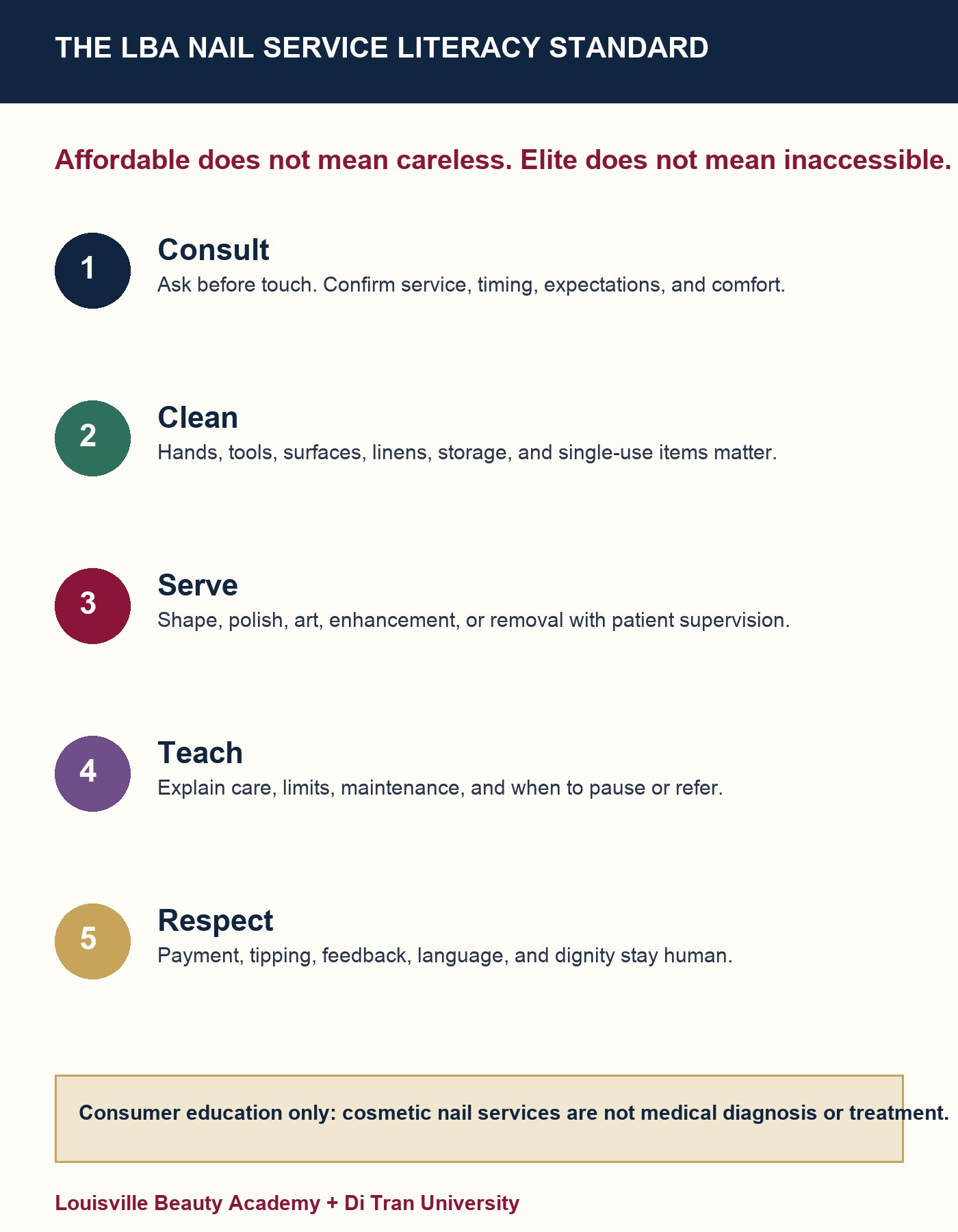
A Moment of Pride, A Celebration of Collaboration, and a Testament to Humanization in Action
On December 3, 2025, the National Small Business Association (NSBA) — America’s longest-serving small-business advocacy organization — officially featured Di Tran, founder of Louisville Beauty Academy (LBA), in its national “My Business, My Cause” spotlight and across its NSBAAdvocate.org platform and national social channels. The feature highlighted the heart, mission, and community impact of LBA as one of Kentucky’s leading workforce engines.
This national recognition is not only a proud moment for Di Tran personally — it is a proud moment for the entire Louisville Beauty Academy family, for the City of Louisville, for the Commonwealth of Kentucky, and for the United States.
A School Built on Humanization — Before Skill, Before Business
Louisville Beauty Academy was founded on the principle that humanization comes first.
This philosophy is deeply rooted in the emerging framework of Di Tran University (DTU) — often referred to as the “College of Humanization.” The foundation of this philosophy is simple but profound:
Human First → Value-Add → Skill → Business → Economy
Before we teach beauty techniques, before we talk about licensing, before we mention entrepreneurship, we focus on the person — their dignity, their confidence, their story, their hopes.
At LBA, every student is seen, heard, respected, and uplifted before anything else. This is why our classrooms feel like families. This is why more than 2,000 licensed graduates have built real careers and changed their families’ futures. This is why we produce not only licensed beauty professionals, but contributors to Kentucky’s economic strength.
Business Is Human. Business Is Collaboration. Business Is Shared Elevation.
The NSBA feature highlights the central message: small business is the engine of the American economy, but it only works through collaboration, shared support, and collective love.
The NSBA’s 2025 National Impact Report shows the scale of this collaboration:
14 million jobs saved through initiatives NSBA shaped
20% Qualified Business Income deduction permanently enacted for small-business owners
535 congressional districts represented through NSBA leadership
Multiple congressional testimonies, letters, and federal regulatory actions shaping policy nationally (See NSBA PDF, pages 1–4 for full details.) NSBA-LBA-Website-12-03-2025 _ W…
Louisville Beauty Academy stands proudly inside this national ecosystem — an ecosystem where small schools, small employers, and small families collectively build huge economic outcomes.
Why This NSBA Feature Matters to Louisville Beauty Academy
This national spotlight is more than an honor — it reinforces three core truths about LBA:
1. LBA Is a Human-First Academy
We exist to lift people up first, before teaching skills. This is the DTU philosophy in action.
2. LBA Is a Workforce Engine for Kentucky
Nearly 2,000 licensed graduates, contributing $20–50 million annual economic impact to the Commonwealth.
3. LBA Is Part of a National Ecosystem
We are not alone. We are surrounded by partners who believe in small business, education, and community development — including NSBA, local employers, Louisville organizations, and our state supporters.
A Message of Gratitude — From LBA to the World
On this special occasion, Louisville Beauty Academy expresses:
Thanks to God
For life, for purpose, for each breath that allows us to serve.
Thanks to Louisville
The city of love, diversity, and resilience — the city that embraced LBA and every immigrant and first-generation student who walks through our doors.
Thanks to Kentucky
The state of opportunity — where hard work and family values still matter, and where education transforms lives daily.
Thanks to the United States
The #1 country on Earth, where a small immigrant-founded school can rise, serve, and be recognized nationally.
Thanks to NSBA
For giving voice to small businesses, for elevating stories like ours, and for being a national advocate protecting the backbone of America’s economy.
“Value-Add” — The Daily Principle of Louisville Beauty Academy
At LBA, our founder Di Tran teaches one simple rule:
Value-add every single day — to yourself, your family, your community, and your state.
This principle guides:
our instructors
our students
our graduates
our outreach
our contribution to Kentucky’s workforce and economy
This NSBA feature is simply the outward reflection of what LBA practices daily — the quiet, humble work of serving people, one license at a time.
Proud, Grateful, Motivated — and Ready for More
Louisville Beauty Academy celebrates this moment not as a finish line, but as encouragement to keep serving with greater love, greater humanization, and greater commitment to Kentucky families.
**We rise by lifting others.
We grow by serving others. We succeed by adding value to others.**
From our family at LBA to yours — Thank you for believing in us. Thank you for walking with us. Thank you for letting us serve.
— Louisville Beauty Academy Kentucky’s Leading Beauty Licensing Workforce Engine Founded in Louisville, KY | Powered by Humanization | Fueled by Community
In an era where information changes at light speed, where education must evolve daily, and where the world demands both digital agility and human-centered care, Louisville Beauty Academy (LBA), The College of Human Service of Di Tran University, proudly announces a historic milestone:
🎉 THE COMPLETE NAIL LICENSING MASTER BOOK
For State Board Theory & Practical — Di Tran University 2025 Edition
This 50-chapter master volume is the first-of-its-kind, built not for entertainment, not for trends, but purely, intensely, and comprehensively for nail licensing exam success.
Yet it goes far beyond exam material.
This book captures:
the YES I CAN™ mindset
the I HAVE DONE IT™ achievement philosophy
the emotional wellness needed to truly perform
the humanization core of LBA
the dignity and compassion embedded in every service
the future of education through Humanized AI
the blueprint for beauty professionals to thrive mentally, emotionally, spiritually, and economically
Louisville Beauty Academy remains committed to Adapting & Adopting™—evolving constantly to meet students where they are, and lifting them to where they dream to be.
This book is a reflection of the thousands of students we’ve served, the countless lives transformed, and the mission God entrusted us with: to humanize education, uplift communities, and build ethical, compliant, confident beauty professionals.
Below is a chapter-by-chapter breakdown of what makes this book the most powerful nail licensing textbook ever published.
Shares the vision behind the book and LBA’s mission to humanize education, uplift underserved communities, and remove fear from licensing. Explains why this open-access book exists and how it honors the YES I CAN™ spirit.
The foundation of all beauty services. Covers pathogens, disinfection, sterilization, sanitation levels, and universal precautions. Emphasizes preventing infection and staying compliant with state rules.
Louisville Beauty Academy (LBA) continues to lead Kentucky as the #1 Beauty Licensing Workforce Engine, producing nearly 2,000 licensed graduates and generating an estimated $20–50 million annual economic impact for the Commonwealth. Rooted in compassion, discipline, and full Kentucky State Board compliance, LBA offers an educational experience built around accessibility, transparency, and the highest digital accountability in the state.
Today, we highlight the core features that set LBA apart from every other beauty college in Kentucky.
1. Walk-In Enrollment — Start Immediately, No Delay, No Barriers
LBA empowers students to take control of their future today, not months from now. If a student is ready, they may walk in and begin the same day.
Simple steps to start immediately:
Review the Enrollment Procedure
Bring required documents (ID, SS card or ITIN, education verification)
Complete the digital student contract
Read and acknowledge the Student Handbook
Make the required initial payment
Begin training right away
This model reflects LBA’s mission: no waiting lists, no wasted time, no unnecessary hurdles. Students enroll weekly. Students graduate weekly. The learning community grows continuously.
2. Walk-In Tours — No Appointment Needed, Ever
LBA believes in radical transparency. We welcome the public to walk in anytime between 9 AM – 4 PM, Monday–Friday, for a full tour.
During these hours:
Classrooms are active
Instructors are available
Students are practicing
Prospective students can observe real training sessions
All questions are answered with full regulatory accuracy
No scheduling. No sales process. No barriers.
Just real education on display.
3. Kentucky’s Leading Digital Compliance System — 100% Tracking, Zero Guesswork
Louisville Beauty Academy is recognized statewide for its advanced compliance infrastructure, designed to protect every student, graduate, and staff member with uncompromising accuracy.
LBA’s Digital Compliance & Tracking System Includes:
SMART biometric timekeeping for exact State Board attendance records
Digital student contracts via JotForm (fully archived and timestamped)
Quality assurance dashboards ensuring every hour, service, and requirement is properly counted
AI-assisted compliance oversight for self-correction and rapid adaptation when laws change
Full communication logs for transparency, staff accuracy, and student protection
Our Why
Kentucky State Board regulations evolve. Our systems evolve faster.
LBA’s compliance department uses digital tools to:
Protect every student through their entire licensing journey
This is why LBA is trusted as one of the most digitally mature and compliance-secure beauty colleges in Kentucky.
4. Preferred Communication: Text or Email for Accuracy and Documentation
For the benefit and protection of all students, graduates, and staff, LBA strongly prefers:
📱 Text Messaging 📧 Email
These channels allow the compliance department to:
Provide accurate, updated answers as regulations change
Keep clear records for student protection
Maintain internal accountability
Self-correct and adapt instantly if any policy or rule changes
Store all communication in the school’s digital archive for long-term security
This ensures zero confusion, zero miscommunication, and 100% transparency.
5. A Culture of Safety, Family, and Weekly Success
Every week at LBA:
New students walk in and begin their journey
Graduates walk out fully licensed
Students support one another like a family
Instructors guide students at a self-paced, flexible schedule
The school prides itself on being:
Family-oriented
Safe and welcoming
Fully state-compliant
Student-protective
Community-focused
Future-workforce driven
LBA’s mission is simple: Help every student become the best licensed professional they can be, at their own pace, with full protection and full transparency.
Visit Anytime — Your Future Is One Walk-In Away
📍 Louisville Beauty Academy – State Licensed Beauty College 🕘 Walk-In Public Hours: 9 AM – 4 PM (Mon–Fri) 📱 Text or Call: 502-625-5531 📧 study@LouisvilleBeautyAcademy.net 🌐 LouisvilleBeautyAcademy.net
No appointments. No waiting lists. No barriers. Walk in today — start your new career today.
Compliance & Legal Disclaimer
This information is for general educational purposes only. All policies, procedures, and requirements are governed by the Kentucky State Board of Cosmetology under KRS 317A and 201 KAR 12. Regulations may change without notice. LBA assumes no liability for interpretation or external use. Students are responsible for reviewing all contracts, handbooks, and regulatory materials before enrollment.
At Louisville Beauty Academy (LBA), graduation means more than earning a license. Every student walks proudly with their Certificate of Completion — a credential that carries prestige, trust, and community recognition far beyond the classroom. This certificate is more than paper; it is a badge of honor, a lifelong reminder of the “YES I CAN → I HAVE DONE IT” mindset that defines both our academy and our graduates.
A Legacy of Recognition: From Local to National
The academy’s impact, fueled by hardworking staff, dedicated instructors, and resilient students, has been validated through some of the most prestigious awards in the nation, the state, and the city of Louisville:
U.S. Chamber of Commerce CO—100 (2025) – Louisville Beauty Academy was the only Kentucky business named among America’s Top 100 Small Businesses, selected from over 12,500 applicants nationwide.
National Small Business Association (NSBA) – Small Business Advocate of the Year Finalist (2025) – Founder Di Tran was honored in Washington, D.C. as one of just five advocates nationwide, standing shoulder-to-shoulder with leaders shaping small business policy.
Louisville Business First – Most Admired CEO (2024) – Front-page recognition of Di Tran as a visionary leader in Kentucky’s business community.
Louisville Business First Rising Star – Highlighting Di Tran as one of Louisville’s most promising young leaders.
Jewish Community of Louisville Mosaic Award (2023) – Celebrating LBA for advancing diversity, inclusion, and empowerment across immigrant and minority communities.
These honors do not belong to one person alone. They reflect the collective effort of nearly 2,000 graduates, dedicated faculty, and the broader Louisville community that trusts in LBA’s mission.
Why the Certificate of Completion Matters
Graduates often ask: “Which certificate is most important when I graduate?” While the state license is essential to practice, the LBA Certificate of Completion carries something deeper:
Prestige – It symbolizes the most awarded and nationally recognized beauty college in Kentucky.
Community Trust – It represents the support of local, state, and national organizations who have celebrated LBA’s success.
Family & Belonging – LBA is more than a school; it is a lifelong family. Students are never left behind—unless they choose to leave themselves.
To hold an LBA Certificate is to hold proof of not just a completed program, but of resilience, empowerment, and recognition at every level.
A Movement of Empowerment
Through Louisville Beauty Academy and Di Tran University, the motto “YES I CAN → I HAVE DONE IT” has become a movement of human development. Nearly 2,000 graduates have gone on to open salons, launch careers, and collectively contribute an estimated $20–50 million annually to Kentucky’s economy.
Every award, every certificate, and every graduate’s success proves that beauty education is more than skills. It is about entrepreneurship, empowerment, and economic impact.
The LBA Promise
Louisville Beauty Academy remains:
The most affordable beauty school in Kentucky.
The most flexible, meeting students where they are.
The most supportive, creating a lifelong network of care.
The most loving, because every student matters.
Our Certificate of Completion is not just paper. It is prestige, trust, and belonging — a testament to both personal achievement and the collective spirit of Louisville and Kentucky.
When our graduates hold that certificate in their hands, they hold more than their future. They hold local, state, and national recognition for who they are and what they will become.
Because here at Louisville Beauty Academy: YES I CAN. YES WE DID. YES YOU WILL.
At Louisville Beauty Academy, a Kentucky State-Licensed and State-Accredited beauty college, we are committed to preparing our students for real-world success. Since our founding, we have proudly graduated nearly 2,000 licensed beauty professionals, whose work contributes an estimated $20 to $50 million annually to the economy of Kentucky and beyond.
Choosing your beauty career path is exciting — but it’s also a decision that benefits from careful research and a clear understanding of the industry. Whether your passion lies in Nail Technology, Esthetics, or Hair (Cosmetology), understanding the service frequency and career demand in each area can help you make the choice that best fits your goals, lifestyle, and earning potential.
Why Service Frequency Matters
In the beauty industry, how often a client returns directly impacts the predictability of your bookings and your revenue potential. These are basic human services — they will always be needed — but the frequency of that need varies from one specialty to another.
1. Nails — The Highest Repeat Rate
Average Frequency: Every 2 weeks or less for most regular clients (gel, dip, acrylics).
Why: Nail polish chips, gels and acrylics grow out, and many people maintain a standing schedule for well-groomed hands and feet.
Reality: Many nail clients pre-book their next visit before leaving the salon, creating a predictable, high-retention client base.
Impact: This repeat cycle offers stability and consistency, making nail technology one of the fastest ways to build a loyal clientele.
2. Esthetics — Moderate to High Frequency
Average Frequency: Typically monthly, but many services draw clients back every 2–4 weeks.
Examples:
Lash extensions → fills every 2–3 weeks
Brow shaping/waxing → every 3–4 weeks
Skincare programs → monthly facials or targeted treatments
Reality: Esthetic clients, especially those in ongoing programs, can match nail tech clients in repeat visits — offering both steady income and opportunities for upselling additional treatments.
3. Hair (Cosmetology) — Lower Frequency
Average Frequency: Every 6–8 weeks for most clients, sometimes longer.
Exceptions:
Short hair or precision cuts → every 4–6 weeks
Color touch-ups → every 4–8 weeks
Reality: Many hair clients extend visits to save money or because their style requires less frequent upkeep, which can make recurring revenue less predictable compared to nails or high-frequency esthetics.
Quick Comparison: Repeat Demand Potential
Service
Common Repeat Interval
Predictability of Bookings
Revenue Stability
Nails
2 weeks
Very High
Strong recurring revenue
Esthetics
2–4 weeks
High (varies by service type)
Solid, especially with memberships
Hair
4–8+ weeks
Moderate to Low
Less consistent unless short style or frequent color
Why This Matters for Your Career
Regardless of which path you choose, these fields are built on human connection and repeat service. The difference lies in how often clients come back — and that affects how quickly you can fill your schedule, grow your income, and plan your business.
At Louisville Beauty Academy, we guide students not only through technical training but also through career planning — helping them understand the realities of client demand, local market conditions, and business growth strategies.
About Louisville Beauty Academy
State-Licensed and State-Accredited beauty college
Nearly 2,000 graduates contributing $20–$50 million annually to the economy
Programs in Nail Technology, Esthetics, and Cosmetology
Commitment to affordable, flexible, and debt-free education
Disclaimer: This article is for educational purposes only and reflects industry observations and publicly available data. Information may change over time. No guarantee of future income, employment, or career results is implied.
Welcome to Louisville Beauty Academy, Kentucky’s most affordable, most flexible, and most supportive beauty college. We are KY State‑Licensed and State‑Accredited, helping aspiring beauty professionals from all walks of life turn their passion into a licensed, thriving career.
Whether your dream is to excel in a top-tier salon, start your own beauty business, or master a specialized skill, we’re here to guide you every step of the way.
Why Louisville Beauty Academy Stands Out
We are proud to be more than a school — we are a community of mentorship, opportunity, and lifelong learning. Here’s why students choose LBA:
Separate, Specialized Programs – You are never forced into a broad cosmetology track. Choose exactly what fits your goals:
Nail Technology
Aesthetic Skincare
Cosmetology
Shampoo Styling
Short courses like 2‑day Eyelash Extensions
Debt-Free Education – Our tuition is the most affordable in Kentucky, with flexible payment plans and no required loans.
Unlimited Graduate Access – Even after you graduate, you’re welcome back for mentorship, tutoring (as available), and to inspire current students by sharing your success story.
Flexible Scheduling – Perfect for working adults, parents, and anyone balancing life’s commitments.
Diversity and Inclusivity – We proudly serve immigrants, non‑native English speakers, and students from all backgrounds.
Breaking Barriers with Multilingual Licensing Exams
We celebrate our first graduate to pass the Kentucky State Licensing Exam in Spanish — and this is just the beginning! The Kentucky Nail Licensing Exam is now available in:
English
Simplified Chinese (简体中文)
Spanish (Español)
Vietnamese (Tiếng Việt)
Korean (한국어)
This means more students can achieve their professional goals without language being a barrier.
Hands-On Training with Modern Technology
Our training is state‑board aligned and supported by the Cengage CIMA Digital Learning Solution, giving you the best of both worlds:
Practical, in-person skill development.
Accessible online resources you can use anytime, anywhere.
Proven Success: Over 1,000 Graduates
With more than 1,000 licensed graduates, our impact speaks for itself. Many of our students overcome financial hardship, language barriers, or busy family schedules — and still succeed.
Your journey is unique, but success is possible with belief, consistency, and the YES I CAN mentality we live and breathe every day.
From the Desk of Our Founder: Di Tran
Our founder, Di Tran, has written over 40 books on beauty, business, and personal growth — including Why Licensing a Beauty Career is the Way for Me? In this inspiring guide, Di explains how licensing boosts credibility, opens career opportunities, and ensures long-term stability in the beauty industry.
Begin Your Journey Today
At Louisville Beauty Academy, we don’t just teach beauty techniques — we prepare you for a licensed, empowered, and debt-free future. We are proudly KY State‑Licensed and State‑Accredited, meeting the highest educational and regulatory standards in the state.
You are now officially part of a Kentucky State-Licensed and State-Accredited Beauty College, committed fully to your success — no matter your background, language, or past experience.
Whether you’re beginning your journey in:
Cosmetology (1500 hours)
Nail Technology (450 hours)
Esthetic Skincare (750 hours)
Shampoo & Styling (300 hours)
Eyelash Extension (16 hours)
Instructor Licensing (750 hours)
Refresher Courses (for licensed or previously trained students)
Or even returning as a graduate seeking free tutoring and support…
✨ You are family now — and your success is our mission.
🥇 YOUR #1 GOAL: GET LICENSED — LEGALLY AND PROFESSIONALLY
No matter which program you’re in, your first and most urgent focus is to meet all Kentucky State Board of Cosmetology requirements and pass your licensing exams. This is not just a school rule — it’s a legal requirement that makes you a legitimate, licensed professional.
Without a license:
You cannot legally work in your field.
You are not protected under KY law.
You are at risk of being exploited or disqualified from jobs.
We take this seriously because we want you to succeed.
💡 HOW TO START: One Small Step at a Time
At Louisville Beauty Academy, we believe in bite-sized, focused progress. Here’s the proven order of success:
✅ STEP 1: MASTER THEORY (Required for Licensing)
Before touching any tools, products, or clients — you must build your legal and safety foundation.
🎯 Start with CIMA, your included online study system 💻 www.MiladyCIMA.com (Value: $500 — provided FREE with tuition)
📚 Focus first on:
Sanitation & Infection Control
KY State Laws & Professional Conduct
Safety & First Aid
Anatomy Basics
Chemistry & Product Knowledge
Skin & Nail Structure
📝 Jump straight to chapter quizzes — guess if needed. Then:
Study the correct answers
Repeat each quiz until you score 90% or more at least 5 times
This is your real exam prep — theory exam is where 75% of students nationwide fail. You will not be one of them.
✅ STEP 2: PRACTICAL EXAM PREPARATION
Once you pass your theory, we guide you step-by-step through the practical licensing exam. This means:
Kit prep
Manikin practice
Timed procedures All done exactly as required by the State Board.
✅ STEP 3: PROFESSIONAL DEVELOPMENT (After Licensing)
Now that you’re licensed, we continue the journey with you:
Advanced beauty skills
Client communication
Business setup & marketing
Continuing education
Even new licenses and specialties
You can come back anytime for tutoring — FREE. It’s our way of saying: we don’t give up on our students. Ever.
🧠 YOUR MINDSET = “YES I CAN”
This school runs on belief. Every student here — from first-timers to returning professionals — is encouraged to say daily:
“YES, I CAN.” “YES, I WILL.” “YES, I HAVE DONE IT.”
You may be learning in a second language. You may be a busy parent. You may have failed before.
But you are not alone anymore. With focus, small steps, and a community around you — you will succeed.
The future of the beauty industry is shifting. As artificial intelligence and robotics transform knowledge work and repetitive labor, one essential, human-first field is rising fast: nail technology and esthetic skincare services. These are no longer just cosmetic luxuries—they are essential wellness treatments, from reflexology to detoxification, from CBD-infused therapies to anti-aging facials.
Louisville Beauty Academy (LBA) stands at the forefront of this transformation as Kentucky’s most affordable, most flexible, and fastest state-licensed and state-accredited beauty school—offering Cosmetology, Nail Technology, Esthetics, Instructor Training, and Eyelash Extension licensing programs that reflect the future of health-aligned beauty services.
📊 Market Trends: Nails & Skin are Taking Over
1. Health & Wellness Integration
Modern pedicures are no longer just cosmetic. They are now wellness treatments addressing circulation, inflammation, and nervous system balance.
Foot Reflexology (Eastern-rooted) is rising fast as a service to activate pressure points, reduce stress, and promote full-body healing.
CBD-infused manicures and pedicures are trending for pain relief and anti-inflammation.
Dry pedicures are gaining traction in luxury and medical-grade nail services.
Clients now request anti-aging hand facials, LED therapy for nails, and more.
2. Skin Services Are a Daily Need
Facials are part of everyday wellness, not a luxury. Services like:
Lymphatic drainage facials
Dermaplaning and Gua Sha
LED light therapy facials
Microcurrent and oxygen facials
Cryotherapy and enzyme peels
These attract long-term clients and repeat income.
💼 Job Market: Exploding Demand in Post-AI Labor Shift
Occupation
2023 U.S. Jobs
Projected Growth (2033)
Median Pay
Nail Technicians
212,700
+12% (much faster than avg)
$34,660/year
Estheticians
81,800
+10%
$41,560/year
Source: U.S. Bureau of Labor Statistics
In Kentucky and nationally, salons are urgently hiring.
Post-COVID, salons are booming again, but short on licensed techs.
Employers report hundreds of unfilled positions for nail techs and estheticians.
Cosmetologists are often unemployed because they are too general. The real jobs are in specialty licenses like Nails and Esthetics.
📅 Licensing in Kentucky: Clear, Fast, and Strategic
Nail Technology License: 450 hours
Esthetics License: 750 hours
Cosmetology License: 1500 hours
Eyelash Extension: 16 hours
Instructor License: 750 hours
Kentucky laws now support faster entry and more flexibility, especially after House Bill 260 lowered required hours (e.g., nails from 600 to 450, esthetics from 1000 to 750).
Louisville Beauty Academy offers:
Multiple language support (English, Spanish, Vietnamese, and more)
Weekend/evening schedules
Full-payment, attendance-based, and performance-based discounts
Debt-free, cash-based education that is licensed, job-aligned, and compliant
🚀 Product & Treatment Trends: Where Beauty Meets Health
LED Nail & Facial Therapy: Stimulates collagen, clears acne, boosts circulation
Foot Reflexology & Dry Pedicures: Wellness-aligned, hygienic, modern
Anti-aging hand/foot masks: Collagen, hyaluronic acid, and sugar scrubs
Advanced facial services:
Oxygen facials
Cryo facials
Enzyme peels
Microcurrent toning
Gua Sha energy therapy
🌟 Louisville Beauty Academy: The Future Starts Here
LBA is not just a school. It’s a Freedom Factory—a place where:
You learn fast
You pay low or zero debt
You become licensed in a real field
You join almost 2,000 graduates with nearly 100% job placement
LBA Offers:
Cosmetology (1500 hrs): For those committed to full-spectrum beauty (hair, skin, nails).
Nail Technology (450 hrs): Specialize in fast-track, high-income nail work.
Esthetics (750 hrs): Focused skin care with health alignment.
Instructor Training (750 hrs): Become a licensed teacher.
Eyelash Extension (16 hrs): Fastest-growing mini license in the U.S.
Our founder, Di Tran, is a 20+ year nail technician known for his 10-minute full-set acrylic — nearly unmatched in the industry. He built LBA to give people real opportunity, with no fluff, no debt, and no barriers.
✨ Why LBA Wins
Most Affordable: Discounts bring nail tuition from $8,380 to ~$3,800; esthetics from $14,174 to ~$6,100.
Most Flexible: Study full-time, part-time, nights, weekends.
Most Inclusive: Multi-language, multi-culture, no discrimination.
Most Results-Oriented: Near-100% job placement, fast exam pass rate.
“You can’t fail here unless you choose not to try.” — Di Tran, Founder
~208 nail technician positions are currently filled statewide (BLS data; Kentucky shows ~208 per million population) — well below neighboring states’ saturation rates
~770 job listings in Kentucky for entry‑level nail techs appeared on ZipRecruiter recently — suggesting that salons are actively hiring at scale
Both Indeed and Glassdoor show 13–25 live openings across Kentucky, with ~14 available specifically in Louisville alone
💡 What This Means
With only ~200 licensed nail techs but hundreds of active job postings, the shortfall approaches 500+ positions, particularly acute in metro areas like Louisville.
Employers report active hiring, offering competitive pay ($20–$45/hr in Louisville listings) to attract talent
Kentucky’s low technician-to-population ratio (location quotient ~0.08, among lowest in the nation) means demand is outpacing current workforce dramatically
✅ Conclusion
Kentucky likely needs at least 500–700 more licensed nail technicians right now—an opportunity for career-minded individuals to step into an in-demand profession with immediate employment potential.
FULL RESEARCH
Kentucky’s nail salon industry is facing a critical staffing shortage. Recent news reports show “dozens of nail technicians around the commonwealth packed the Capitol” to press for licensing reform. State legislators and industry leaders acknowledge a booming market: “skilled nail techs cannot get board certified… it hurts the high-in-demand nail tech industry that needs workers,” and Kentucky must avoid red tape that keeps people out of work. In fact, Kentucky employs only 160 manicurists/pedicurists statewide (May 2023) – far fewer than neighboring states – with a mean wage of about $20.35/hour ($42,330/yr). (To put this in perspective: Ohio has ~3,510 such workers, Tennessee ~1,160, Missouri ~1,300, Indiana ~340, and West Virginia ~240.) Kentucky’s location quotient (0.082) for this occupation is tiny, indicating far fewer nail techs per capita than the national average. Even licensed workers are a small minority: nail technicians represent only about 16% of Kentucky’s active cosmetology licenses.
State-by-State Demand & Salary
Kentucky: 160 employed (May 2023); mean wage ~$20.35/hr ($42,330/yr). Kentucky ranks last in the nation for nail tech pay (ZipRecruiter reports ~$18.01/hr) and notes the local job market “is not very active” – indicating many unfilled positions.
Ohio: 3,510 employed; mean ~$26.15/hr ($54,390/yr).
Indiana: 340 employed; mean ~$14.63/hr ($30,420/yr). Indiana’s licensure (450 training hours) matches Kentucky’s, making transfers straightforward.
Tennessee: 1,160 employed; mean ~$14.14/hr ($29,410/yr). Tennessee’s requirement is higher (600 hours), so Kentucky’s lower barrier (450 hours) is attractive.
West Virginia: 240 employed; mean ~$19.32/hr ($40,190/yr) (WV requires 400 hours).
Illinois: licensed techs have a median ~$18.43/hr ($38,332/yr) (Illinois requires only 350 hours). Illinois techs with 2+ years experience can often transfer their skills.
Missouri: 1,300 employed; mean ~$16.48/hr ($34,270/yr) (Missouri requires 400 hours).
Growth Outlook: Nationally, BLS projects much faster-than-average growth for manicurists/pedicurists – about 12% growth from 2023–2033 (adding ~27,700 jobs/year nationwide). (Indeed reports even higher short-term demand.) This suggests sustained demand across the region. In Kentucky, such growth is being hampered by the current supply gap – meaning virtually all openings go unfilled.
Licensing Trends and Reciprocity
Kentucky has taken steps to ease entry. As of 2024 Kentucky requires only 450 training hours for a nail tech license (down from 600 hours in previous years). This is comparable to Indiana (450 hours) and lower than Tennessee (600). To attract out-of-state talent, the Kentucky Board of Cosmetology will endorse equivalent licenses: licensed techs from other states may apply by submitting proof of their training and licensure. Education deficits can be waived if the out-of-state license has been held for 2+ years. (Kentucky may still require a short exam, but this process lets experienced professionals skip 450 hours of re-training.) In practice, a nail technician licensed in Indiana, Illinois, Ohio, etc., can often transfer to Kentucky with minimal added cost or schooling.
Why Kentucky (Louisville) Is a Great Opportunity
Kentucky – and Louisville in particular – offers career seekers a strong opportunity: high demand with room for growth. The shortage means a freshly licensed tech can often step into jobs or even start a business immediately. City-wide, Louisville has hundreds of salons and spas serving a growing metro population. Costs of living and doing business are lower than many coastal areas, so salary goes further. Louisville Beauty Academy itself is a leader in the local beauty industry (recently named one of Louisville’s most impactful businesses). Its 450-hour Nail Technician program meets Kentucky’s requirements and prepares students to pass the state exam.
Take Action – Join the Boom!
For career changers, licensed nail technicians, or entrepreneurs, this shortage in Kentucky is a major opportunity. Nearing retirement or switching careers? New licensees can fill immediate openings with competitive pay (often $30k–$45k/yr). Established techs from Indiana, Ohio, Tennessee, etc. can relocate here under endorsement rules and tap into a hungry market. Louisville Beauty Academy offers flexible Nail Technician courses (450 hours) and job support to jumpstart your career. Don’t wait – enroll today to get licensed and fill the gap. Kentucky’s salons need you now!
Sources: Kentucky and regional labor data from state and federal LMI (KY Labor Cabinet, BLS OEWS); industry news and board stats.
📚 Reference – Nail Technician Shortage (Kentucky & Surrounding States)
U.S. Bureau of Labor Statistics. (2024, May). Occupational Employment and Wage Statistics: Manicurists and Pedicurists (SOC Code 39-5092) – Kentucky. https://www.bls.gov/oes/current/oes395092.htm
Nail care is often seen as a cosmetic indulgence, but a closer look reveals profound health and wellness benefits. From the physical gains of regular manicures and pedicures (improved skin and nail health, better circulation, relief from aches) to the psychological comfort of human touch and care, nail services contribute to holistic well-being. Equally important is the cultural dimension: the modern nail salon industry in the U.S. was revolutionized by Vietnamese American entrepreneurs, transforming luxury beauty treatments into affordable self-care rituals for the masses. This report explores the physical and psychological health benefits of nail care, the therapeutic human touch provided by nail technicians (often immigrant women), and how immigrant-led salons democratized self-care. It also highlights how institutions like Louisville Beauty Academy carry this legacy forward, training diverse cohorts in a community-centered way. Wellness, immigrant care work, and the human touch emerge as central themes in understanding why a nail appointment can be so much more than just pretty fingers and toes.
Physical Health Benefits of Manicures and Pedicures
Caption: A nail technician provides a soothing foot massage during a pedicure. Such massages boost blood circulation and alleviate tension in overworked muscles, improving joint mobility and overall foot health. Regular manicures and pedicures offer tangible physical health benefits beyond aesthetic improvements. Key advantages include:
Improved Circulation and Mobility: The massages that accompany professional hand and foot care significantly promote healthy blood flow. Increased circulation helps reduce muscle tension and pain in the extremities and can improve joint flexibility. For example, people who spend long hours typing, standing, or walking often feel relief after a manicure/pedicure massage, as stiffness in the hands and feet is eased. Warm water soaks further dilate blood vessels to stimulate circulation, while also relaxing muscles. In aromatherapy pedicures, the combination of warm water and essential oils not only enhances relaxation but also helps improve blood flow and soften tissues.
Healthier Skin and Nails: Routine nail care keeps hands and feet hygienic and can prevent infections. Soaking, cleaning, and clipping during a pedicure, for instance, help fend off fungal or bacterial growth and prevent ingrown nails that could lead to painful infections. Exfoliation is another crucial step – by sloughing away dead skin cells, deep exfoliation encourages new cell growth and unclogs pores around nails. This not only yields smoother skin but can strengthen the nails themselves. Pedicure technicians often remove calluses and thick skin on the feet; callus removal not only makes feet softer but also improves weight distribution on the soles. By evening out pressure points, pedicures may even help alleviate strain in the legs and lower back caused by heavy calluses.
Pain Relief and Muscle Relaxation: The combination of warm water soaks, gentle scrubbing, and massage provides therapeutic pain relief. A warm spa water soak softens tense muscles and prepares the feet and hands for treatment. Many salons infuse the soak with herbal ingredients or aromatherapy oils (lavender, chamomile, mint, etc.) to reduce inflammation and enhance comfort. In fact, a recent spa article noted that an aromatherapy foot soak is “a holistic treatment that targets both physical and emotional well-being,” as the warmth of the water stimulates blood flow and oils like lavender soothe soreness. By the time the nail technician begins massaging and stretching the feet or hands, clients often experience a noticeable reduction in aches or stiffness. The massage pressure and movements help release tension from tired muscles and can prevent cramping. This aspect of nail care can be especially beneficial for clients with arthritis or those who use their hands and feet strenuously; regular treatments keep extremities supple and reduce pain over time.
Moisturizing and Rejuvenation: Professional nail services typically include applying moisturizers, oils, or herbal lotions to the skin. This hydration is vital for maintaining skin integrity. Keeping the skin of the hands and feet well-moisturized prevents cracks that could invite infections. Emollient-rich creams and cuticle oils nourish the often-neglected skin around nails, maintaining its elasticity and preventing painful hangnails or splits. Over multiple sessions, clients notice their hands and feet looking more youthful and supple, thanks to improved circulation and consistent exfoliation and hydration. In fact, by boosting circulation and collagen production, manicures and pedicures can even tighten skin and reduce the appearance of fine lines or roughness on the hands and feet. The result is not only comfort but also a healthier, more vibrant appearance.
In summary, far from being mere pampering, regular nail care is a form of preventative health maintenance for your extremities. It keeps the skin and nails in optimal condition, wards off common ailments (like athlete’s foot, fungal nails, cracks, and calluses), and contributes to overall physical ease. As one beauty training institute put it, “you would be surprised how a simple trip to the nail salon can benefit you physically… Both men and women can benefit greatly from putting aside time to take care of their nails and feet”. By investing in routine manicures and pedicures, individuals are effectively caring for some of the hardest-working parts of their body – and setting the foundation for comfort and mobility in day-to-day life.
Emotional and Therapeutic Value of Nail Care
Caption: A quiet moment between a nail technician and her client during a manicure session. Nail appointments often double as a time for clients to relax, feel cared for, and even share their thoughts, providing a form of informal therapy and human connection. Beyond the physical perks, nail care yields significant psychological and emotional benefits. The nail salon experience can soothe the mind and uplift the spirit in ways that are both subtle and profound:
Stress Reduction and Relaxation: The very act of sitting down for a manicure or pedicure forces us to slow down and be present. For the duration of the appointment – typically an hour or more – clients are encouraged to unplug from their phones and daily worries. It becomes “an act of self-care and perhaps a therapy session”, notes Dr. Ravi Gill, a health psychologist, highlighting that a nail appointment offers a rare opportunity to sit still without distraction. The ambiance of many salons (soothing music, warm water, pleasant aromas) and the rhythmic, gentle touch of the technician can trigger the body’s relaxation response. Many services incorporate aromatherapy (scented oils or lotions), which further calms the mind and can reduce anxiety. Clients often report leaving the salon feeling lighter and more centered than when they walked in. In fact, even a single manicure can measurably lower stress levels; it’s common to hear someone say they “feel like a weight has been lifted” after enjoying this form of micro-pampering. Essentially, the salon visit provides a mini mental-health retreat amid life’s chaos.
Being Cared For and Emotional Comfort: There is a profound therapeutic power in human touch and care. When a nail technician holds your hands or carefully tends to your feet, it creates a sense of being cared for that many clients find deeply comforting. Licensed clinical psychologist Dr. Charlynn Ruan notes that physical touch is something modern society is often deprived of: “As a society, we are very cut off from physical contact… So if someone does not have [nurturing touch] at home, a manicurist might provide the only nurturing touch they receive all week.” This nurturing contact can fulfill a basic emotional need for connection and caring. Moreover, the client–technician interaction can be as supportive as it is simple. Nail techs frequently offer a friendly ear, listening without judgment as clients chat about anything and everything. Many people find it surprisingly easy to open up about personal matters while getting their nails done. Indeed, nail technicians often end up playing an informal therapist role – clients freely share stories of their struggles, celebrations, or day-to-day life, all while the tech offers a sympathetic nod or words of encouragement. This dynamic – someone devoted to your comfort, quietly listening as they hold your hand – creates a safe emotional space. The ritual can alleviate feelings of loneliness or stress simply through compassionate human interaction.
Mood Enhancement and Confidence: Another psychological boon of manicures and pedicures is the boost in self-esteem and mood that often accompanies well-groomed nails. Taking the time to invest in one’s appearance sends a powerful signal of self-worth. “Taking the time to do our nails is a way to signal that we care for ourselves and our bodies,” explains Dr. Ruan, adding that because manicures are not a strict necessity, they feel like a special treat or indulgence – a reward we give ourselves purely for joy. This has a self-affirming effect: you’ve given yourself permission to feel good. It’s similar to the lift in confidence people experience after a new haircut or putting on a favorite outfit. In fact, psychological research has shown that small beauty routines can make us feel more confident and put-together, which in turn can improve our outlook. Many people describe the “fresh manicure feeling” as one of poise and empowerment – even if life is hectic, having neat, polished nails creates a sense that “at least I have this handled.” Seeing a pop of color or a neat shine on your fingertips throughout the day becomes a mood booster in itself. This mental uplift is why some individuals intentionally schedule nail appointments before big events or stressful weeks: the polished nails serve as a small anchor of confidence and calm amid uncertainty. In short, nail care can bring a smile to your face each time you glance at your hands, reinforcing positive feelings and self-confidence long after you leave the salon.
A Form of Mindfulness: Lastly, there is a meditative aspect to the nail care process. Many salons encourage clients to simply close their eyes and enjoy the pampering quietly. Focusing on the gentle filing, the cooling mask on your feet, or the deliberate strokes of polish can pull your mind away from ruminations. In this sense, a manicure or pedicure can become a mindfulness practice, where one stays present in the pleasant sensations. For those who struggle to justify “doing nothing,” a nail appointment is a socially acceptable way to pause and recharge mentally. It’s an hour where you are not expected to perform or produce – your only job is to sit and receive care. This reprieve can be emotionally restorative, helping reduce burnout and mental fatigue.
Overall, the nail salon experience nourishes mental health in varied ways – by reducing stress, fulfilling emotional needs for care and touch, boosting confidence, and providing a break from life’s demands. It exemplifies how beauty services and wellness intersect: making us look better often makes us feel better, too, and the caring human connection in salons amplifies that effect.
Safe Spaces and “Therapy” in Immigrant-Led Nail Salons
One particularly intriguing aspect of nail care culture is how immigrant-led salons – especially Vietnamese-American nail salons – have created unique emotional safe spaces for clients. The majority of nail technicians in the U.S. are immigrants or first-generation Americans (Vietnamese being the single largest group in this workforce), and this cultural context adds layers of meaning to the salon experience:
Empathetic, Non-Judgmental Listening: Many immigrant nail techs approach their work with a humble, service-oriented ethos that helps clients feel comfortable opening up. Language barriers, in fact, can inadvertently foster a judgment-free environment. In Vietnamese-run salons, it’s common for the technicians to speak limited English or converse in Vietnamese among themselves, while the client chats in English. Rather than hindering communication, this dynamic can make clients feel at ease speaking freely. They need not worry that the technician will interject or offer unsolicited advice – the tech often responds with polite nods or simple affirmations, allowing the client to vent and process their thoughts aloud. Clients often describe nail appointments as an emotional release, where they can “talk about anything without fear of gossip or judgment,” knowing the details of their stories will likely remain within those four walls. In a way, the nail salon chair becomes a confessional – with the nail tech as a compassionate but unobtrusive presence. This unique setup lets clients work through their feelings verbally, much like in a therapy session, but in a far more casual setting. It’s telling that some nail technicians have even referred clients to professional therapists when they recognized a client was in distress from the conversations. Such anecdotes underscore that the emotional support exchanged in salons is genuine and impactful.
The Human Touch in Immigrant Care Work: Nail care is a form of care work, and immigrant technicians have been its backbone. Often coming from cultures where physical caregiving and hospitality are highly valued, these workers infuse warmth into their services. Consider the image of a Vietnamese nail technician gently holding a client’s hand – two people from different worlds literally connecting through touch. One documentary filmmaker observed that nail salons are one of the few places in American life where “immigrant Asian women and Black American women [are] holding hands” in a bond of trust and care. This speaks to the profound social impact immigrant nail workers have: they not only provide personal care, but also bridge communities through everyday acts of kindness and service. The salon becomes a rare intimate space where individuals of different races and languages connect skin-to-skin, hand-in-hand. In predominantly immigrant-staffed salons, clients often appreciate the unspoken empathy that transcends language – a feeling that their well-being truly matters to the technician. This contributes to a sense of emotional safety and comfort that keeps clients returning not just for polished nails but for the restorative, caring atmosphere.
Cultural Tradition of Quiet Dignity: Vietnamese and other immigrant nail techs have cultivated a salon culture that prioritizes client comfort, sometimes in contrast to high-end spas where elaborate conversation or English-language pleasantries are expected. In many immigrant-owned salons, there is a culture of “quiet diligence” – the focus is on delivering excellent service rather than engaging in chatter (unless the client leads it). Clients who might feel self-conscious about their life problems or embarrassed to talk about certain issues often find it easier to open up when the listener is quietly focused on painting their nails. There is a freedom in the privacy afforded by a technician who won’t probe too deeply or carry the conversation beyond polite exchanges. As a result, clients can use the time as their space – to chat or to sit in silence as needed, without any social pressure. This flexible, client-led communication style is another reason nail appointments are emotionally restorative. People can unload their emotional “baggage” in a trusting environment, or simply enjoy companionable silence with another person, which itself can feel comforting in a world that often forces interaction.
Informal Community and Support Network: Immigrant-led salons also tend to become tight-knit communities in their own right. Regular clients develop familial bonds with their nail techs (despite language gaps) over years of appointments. It’s not uncommon for a client to know the owner’s family members, celebrate milestones like the birth of a technician’s child, or bring gifts from travels – a testament to the relationships formed. This sense of community can be therapeutic: clients feel they have an “extended family” at the salon who cares about their well-being. For immigrant technicians, these relationships are also meaningful, as they take pride in providing not just a service but also comfort and familiarity to their patrons. In interviews, some Vietnamese nail workers have expressed that making a client happy gives them purpose and emotional reward, which in turn fuels the positive atmosphere in the salon. Thus, the care flows in both directions – technicians and clients uplift each other, creating a reciprocal therapeutic environment unique to immigrant-driven salons.
In essence, the immigrant influence in the nail industry has shaped salons into more than beauty service stations; they are havens of cross-cultural connection and emotional solace. Clients from all walks of life find in these salons a place where they can be pampered physically and understood emotionally, even without many words. The “therapy” of nail care is not formal counseling, of course, but it’s a form of everyday healing – facilitated by the gentle presence, listening ears, and skilled hands of immigrant women who have built their lives around caring for others, one manicure at a time.
Democratizing Self-Care: The Vietnamese-American Nail Salon Revolution
Caption: Actress Tippi Hedren (standing left) watches as her personal manicurist Dusty Coots (seated) teaches nail care to a group of 20 Vietnamese refugee women in California, 1975. This humanitarian training program sparked a Vietnamese-led transformation of the U.S. nail industry, making beauty services accessible and affordable to everyday Americans. It is impossible to discuss nail care in America without acknowledging the outsized role of Vietnamese Americans. In the 1970s, manicures and pedicures were considered a luxury reserved for the wealthy – high-end salons in big cities catered to an exclusive clientele, and regular women (especially working-class or minority women) rarely enjoyed such services. The entry of Vietnamese refugees into the nail trade “transformed the market by making manicures and pedicures affordable to the everyday American”, as one industry history recounts. This democratization of self-care is a remarkable story of immigrant entrepreneurship that had broad wellness implications:
From Luxury to Routine Beauty: Before the 1970s, getting your nails done was often an expensive indulgence. Vietnamese Americans changed that paradigm. A pivotal moment came in 1975 when Hollywood actress Tippi Hedren, as part of a refugee support initiative, arranged for professional nail training for 20 Vietnamese women in a California refugee camp. The women quickly mastered the craft and began working in salons, eventually opening their own salons. This spark ignited a movement: Vietnamese immigrants found that doing nails was a skill they could learn relatively quickly, with low start-up costs, and crucially, language fluency was not a major barrier to entry. They could serve clients even with limited English by focusing on the quality of their work. Over the next few decades, Vietnamese entrepreneurs opened countless small nail salons across the U.S., undercutting high-end spa prices and bringing costs down to a level working-class women could afford. By partnering with or serving diverse communities (for instance, opening salons in African American neighborhoods in Los Angeles in the 1980s), Vietnamese salon owners proved that there was a huge market for affordable nail care. Women who had never before thought of getting a “mani-pedi” could suddenly treat themselves without breaking the bank. In effect, a service once seen as a pampering luxury became a routine form of self-care for millions of Americans of all backgrounds.
Wellness and Confidence for the Masses: The impact of this shift can’t be overstated. By turning nail care into an accessible routine, Vietnamese Americans helped integrate it into the self-care habits of everyday people. Today, it’s common for teachers, office workers, nurses – women (and men) from all economic strata – to get their nails done regularly as a pick-me-up or grooming standard. This has wellness implications: the stress relief and confidence boosts described earlier are no longer reserved for the elite. As the UCLA Labor Center noted, “due to immigrant and refugee labor… the nail salon industry grew from a high-end, luxury service to an affordable service available to low- and middle-income clients.” In other words, immigrant nail workers opened the door for low and middle-income individuals to enjoy the mental health benefits and personal care that come with salon services. The affordable pricing also means clients can maintain their nail health continuously (e.g. monthly pedicures to keep feet callus-free and clean), which has tangible physical health benefits as we covered. This democratization of beauty is thus also a democratization of wellness – a gift from the Vietnamese community to American society at large.
An Economic and Cultural Phenomenon: The Vietnamese-led nail salon boom also created thriving micro-businesses and jobs, turning the industry into a multibillion-dollar sector. Vietnamese Americans now comprise roughly 51% of the nail technician workforce nationwide – an incredible statistic considering they were virtually absent from the industry before 1975. In some states like California, the majority of salons are Vietnamese-owned, sometimes with multiple generations of a family in the business. This concentration of immigrant-owned businesses has given the nail salon a distinctive cultural character. Stepping into a strip-mall nail salon, one might hear Vietnamese pop music in the background or see Lunar New Year decorations on the walls, a subtle infusion of Vietnamese culture into everyday American life. The presence of these salons in nearly every town means the immigrant story is woven into communities everywhere – even if clients don’t realize it, they are participating in an immigrant-driven small business success story each time they get their nails done. Culturally, this has also led to greater visibility and interaction: countless Americans have formed friendly relationships with their Vietnamese nail techs, bridging language and cultural gaps through simple weekly or monthly interactions. These repeated cross-cultural encounters – often intimate, as noted, with hand-holding and personal conversations – have a quiet but meaningful impact on social cohesion and mutual understanding.
Affordable Self-Care as Empowerment: By pioneering low-cost nail services, Vietnamese entrepreneurs also empowered women (both clients and the workers themselves). Clients with modest incomes gained access to an empowering beauty service that helps them present confidently in their jobs and lives (having neat nails or a relaxing hour off can translate into feeling more poised in daily challenges). Meanwhile, Vietnamese and other immigrant women found in the nail trade a viable path to financial stability and entrepreneurship. Doing nails offered a rare opportunity for newcomers with limited English to start a business and build wealth relatively quickly. The industry famously has low barriers to entry – training for a nail technician license is shorter and cheaper than for cosmetology in general, and new salons can open in small storefronts with a few chairs and basic equipment. This enabled many Vietnamese families to establish economic footholds in America. The ripple effect is profound: as these families flourished, they invested in their children’s education and futures, contributing back to the economy. In essence, the nail salon became a vehicle for the American Dream for an entire refugee community. And the services they provided simultaneously allowed other Americans to feel a bit more glamorous and cared-for in their daily lives. It’s a symbiotic model of immigrant success and community wellness enhancement.
The legacy of the Vietnamese nail salon revolution is visible on every Main Street – bright neon “Nails” signs, busy storefronts with customers filing in after work for an appointment, and the ubiquitous sight of women emerging with that satisfied glow that comes from being pampered. What started as a compassionate gesture by Tippi Hedren in 1975 blossomed into an industry that generates over \$8 billion annually (as of recent estimates) and touches people’s lives in intimate ways. By making self-care affordable and routine, Vietnamese Americans didn’t just change an industry – they changed our culture around self-maintenance and wellness, making beauty and stress relief accessible to all. This democratization of self-care stands as one of the great success stories of immigrant influence on American well-being.
Advancing the Legacy: Louisville Beauty Academy’s Community-Centered Mission
While the nail salon revolution has been largely a grassroots and family-driven enterprise, its spirit of empowerment and inclusivity is now being carried forward in formal education by institutions like Louisville Beauty Academy (LBA) in Kentucky. LBA exemplifies how the industry’s immigrant-founded legacy can translate into community-focused education and professional development. It builds on Vietnamese American nail traditions while innovating to create the “most trusted, inclusive, and flexible nail education” in the region – a model that could inspire beauty education nationwide.
Building an Inclusive Pipeline of Professionals: Louisville Beauty Academy was founded by Di Tran, himself a Vietnamese immigrant who arrived in the U.S. with no English proficiency. Having overcome the very barriers many newcomers face, he designed LBA to empower immigrants and underserved populations to achieve professional licensing in beauty trades. The academy actively works to remove linguistic and financial barriers that often discourage immigrants from attending beauty school. For example, LBA championed the implementation of multilingual licensing exams in Kentucky. As of 2024, aspiring nail technicians in Kentucky can take their state board exam in Vietnamese, Spanish, Chinese, Korean, or other supported languages – a change that LBA proudly helped bring about to “break down language barriers for aspiring professionals”. In a report late 2024, LBA noted that within a two-month period, 51 candidates took the nail licensing exam in Vietnamese (the highest uptake among the new languages), along with dozens more in Korean, Chinese, Spanish, and Portuguese. This is a groundbreaking step in making sure non-native English speakers can become licensed without language holding them back. LBA’s role in pushing for these changes reflects its mission to offer “empowerment through education”, ensuring that “language will never be a barrier to success.” By offering bilingual support, translated materials, and a diverse staff, the academy creates a safe learning environment where immigrants feel comfortable and confident – much like the salons themselves, the school is a welcoming space for all cultures. This inclusive approach not only increases diversity in the beauty industry; it also addresses workforce shortages by tapping into talent that might otherwise go unrealized.
Affordable, Flexible Training – Democratizing Education: In the same way Vietnamese salons made beauty services affordable for clients, Louisville Beauty Academy makes beauty education affordable for students. Branded as “the leading licensed beauty school in Kentucky, offering unmatched affordability,” LBA provides tuition options and scholarships that put professional training within reach of lower-income and working adult students. They even advertise savings of 50–75% compared to typical beauty school costs, along with payment plans as low as \$100 per month for certain programs. This flexible, budget-friendly model is pioneering a new wave of accessible vocational education in the beauty field. LBA also maintains always-open enrollment and accelerated programs, allowing students to start and finish on timelines that suit their life responsibilities. Such flexibility is especially valuable to single parents, people working multiple jobs, or those switching careers – it lowers the practical barriers to gaining skills. By removing financial and scheduling obstacles, LBA is effectively “democratizing” the pathway to becoming a licensed nail technician or cosmetologist, much as Vietnamese salons democratized access to services. The broader wellness impact is that more individuals, regardless of background, can now enter careers in the beauty and wellness industry – creating livelihoods for themselves and expanding the availability of care services in their communities.
A Community-Centered Mission: Louisville Beauty Academy explicitly sees itself as a community empowerment hub. It’s not just about teaching manicures or haircuts; it’s about uplifting people. The academy’s student body is a rich tapestry – “a mosaic of individuals, from different walks of life – Vietnamese, Filipino, Black, White, and every shade in between,” as one academy profile describes. Many students are immigrants or refugees rebuilding careers, others are local Kentuckians seeking a fresh start. LBA’s educators and staff embrace a culturally competent, compassionate approach, understanding the unique challenges (like language hurdles or financial strain) that students may face. The school prides itself on being “a melting pot of dreams, aspirations, and stories”, where everyone supports each other’s goals. This nurturing atmosphere echoes the human touch ethos of the nail salons – every student is cared for and guided with empathy. It is perhaps no surprise that LBA and its leadership have earned local acclaim: in 2024, the academy’s CEO Di Tran was honored as one of the city’s most admired leaders, with Louisville Business First recognizing LBA as one of the most impactful businesses in the community. Such recognition underscores that LBA’s influence extends beyond the classroom – it’s seen as a pillar of community development. Graduates from LBA not only join the workforce; they often become entrepreneurs opening new salons or providers bringing affordable services to underserved areas. In this way, LBA’s community-centered mission creates a ripple effect: each success story from the academy potentially means a new neighborhood gains a nail or beauty professional who carries on the tradition of wellness and care.
National Model for Immigrant-Inclusive Beauty Education: Louisville Beauty Academy stands out as a national model for how beauty education can adapt to 21st-century America’s needs. In an industry heavily powered by immigrant labor, it makes perfect sense to train the next generation of professionals in an environment that embraces immigrants. By offering multi-language exams, actively recruiting from immigrant communities, and providing an affordable ladder into the trade, LBA addresses both industry demand and immigrant integration. Other states and schools are beginning to take notice. Kentucky’s adoption of multi-language cosmetology exams, for instance, could inspire regulators elsewhere to do the same, following LBA’s advocacy. The academy also showcases how private-public partnerships might work – for example, LBA collaborating with the Kentucky State Board of Cosmetology to implement new testing policies. This is a template for inclusive policy change that many industries could emulate to lower entry barriers. Moreover, LBA’s success with a diverse student body demonstrates that when you invest in inclusivity, you cultivate talent that enriches the field for everyone. The nail salons of tomorrow will need tech-savvy, well-trained professionals who understand both modern wellness trends and the diverse clientele they serve. LBA’s curriculum appears to blend traditional skills (mastering manicures, pedicures, esthetics) with professional development, even leveraging technology (they tout AI-powered inclusivity and self-published educational books). By doing so, the academy not only honors the Vietnamese nail legacy of skill-sharing and hard work, but also elevates it – turning it into a formal educational pipeline that can be scaled and replicated.
In summary, Louisville Beauty Academy illustrates the continued legacy of Vietnamese American leadership in the nail and beauty sphere, but in a new form. It embodies the same principles that made Vietnamese nail salons a national phenomenon – affordability, accessibility, community support – and applies them to educating the next generation of beauty professionals. The academy’s story is one of coming full circle: the refugees who once learned manicuring as a means of survival have paved the way for today’s immigrants and local youth to use nail care as a pathway to professional success and community contribution. In doing so, LBA and similar institutions are ensuring that the human touch and wellness focus at the heart of nail care will thrive for future generations.
Conclusion
Nail care sits at the nexus of beauty, health, and human connection. What might appear to be a simple manicure or pedicure in fact delivers a multitude of wellness benefits: physically, it maintains skin and nail health, improves circulation, and induces relaxation; psychologically, it reduces stress, boosts confidence, and provides comforting human interaction. The experience of being pampered by a caring nail technician – often an immigrant woman whose gentle touch and attentive listening create a safe, healing space – highlights how important the human element is in beauty services. The rise of Vietnamese-American nail salons transformed these benefits from a luxury for the few into a routine pleasure for the many, democratizing self-care and weaving immigrant contributions into the fabric of American well-being. Today, as we see institutions like Louisville Beauty Academy carrying that torch forward by training diverse groups with inclusivity and heart, it’s clear that nail care is more than an industry – it’s a community service and cultural legacy.
In a world that often feels impersonal and fast-paced, the humble nail salon reminds us of the power of slowing down and letting skilled, caring hands improve our health and mood. It’s a place where conversations flow freely (or silence is companionable), where differences in language or background fade, and where the simple acts of soaking, massaging, and painting nails can deliver profound therapeutic outcomes. Whether one comes for the physical benefits – smoother skin, pain relief, prettier nails – or the emotional uplift of being cared for, the result is a holistic wellness boost. As clients emerge with both shining nails and lighter hearts, it’s evident that nail care contributes to quality of life in ways that transcend the surface.
The story of nail care’s benefits is thus also a story of immigrant innovation and empathy enriching American wellness culture. From the refugee women who catalyzed a nationwide self-care revolution, to the nail techs who quietly uplift clients one appointment at a time, to the educators opening doors for a new generation, the human touch remains at the center. In cherishing that human touch – the literal touch in a hand massage and the figurative touch of personal care – we affirm that wellness is not only about our bodies, but also about our sense of connection, dignity, and community. And sometimes, all of that can begin with a simple manicure and the words, “How are you feeling today?”
Sources:
Glo Skin & Medspa – 6 Surprising Benefits of Regular Manicures and Pedicures
Houston Training Schools – The Benefits of Manicures and Pedicures
SELF Magazine – Keller, C. (2024). The Case for the ‘Mental Health Manicure’
Scratch Magazine – Gill, R. (2024). Nail techs can create a safe space for clients to offload
NPR – Garcia-Navarro, L. (2019). How Vietnamese Americans Took Over the Nails Business
Whale Spa Blog – How Vietnamese Americans Revolutionized the U.S. Nail Industry
UCLA Labor Center – Sharma, P. et al. (2018). Nail Files: A Study of Nail Salon Workers and Industry in the U.S.
Phoenix Brighton Spa – Richardson, J. (2025). Aromatherapy Foot Soaks: Benefits for Pedicure Relaxation
Louisville Beauty Academy – KY State Board Licensing Multi-Language Testing Update (2024)
Louisville Beauty Academy – Tran, D. (2023). Overcoming Language Barriers: Comfort for Immigrants
Louisville Beauty Academy – Academy Recognized, CEO Named 2024 Most Admired
Louisville Beauty Academy – About / Home Page (2025)