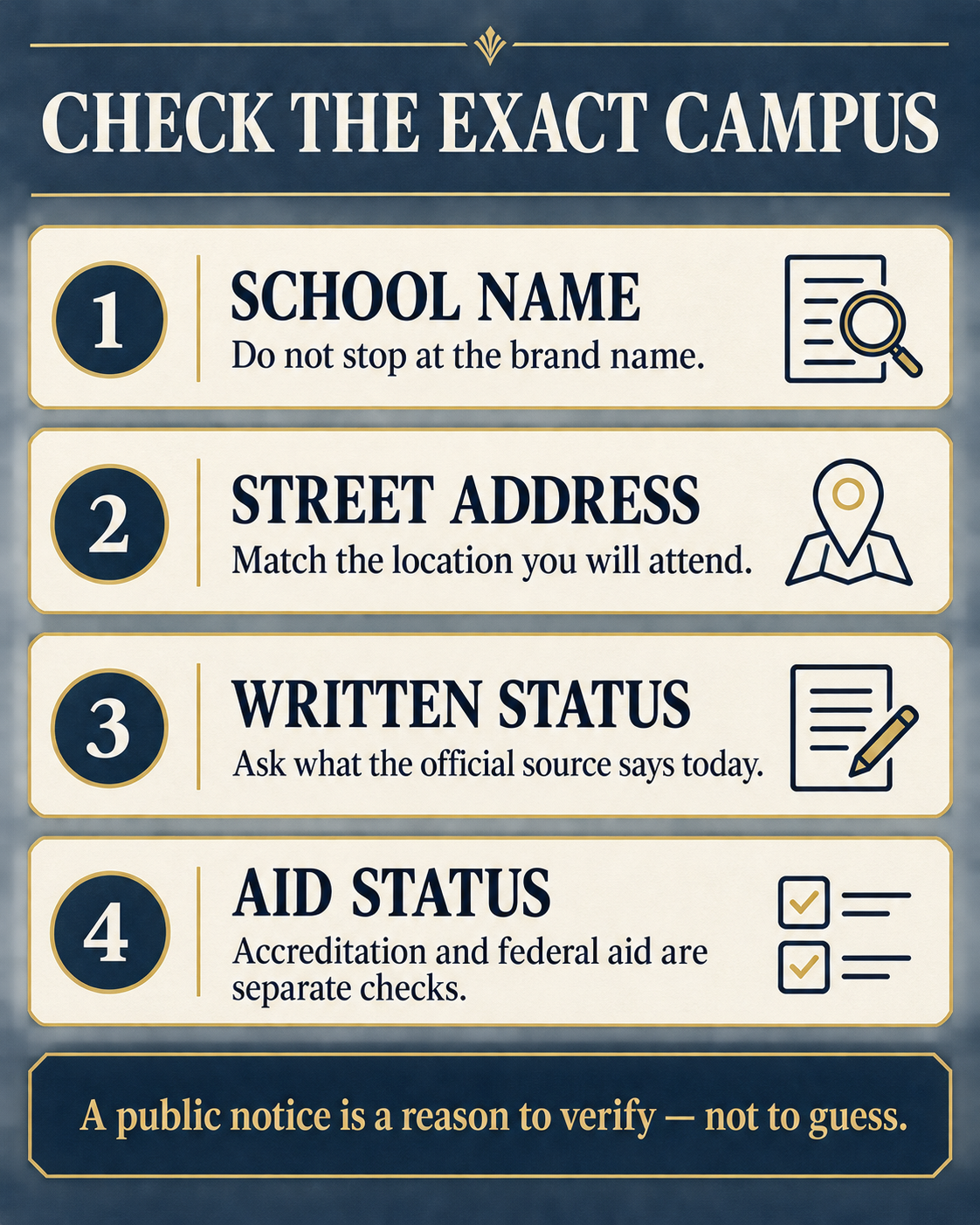
On September 10, 2026, the National Accrediting Commission of Career Arts & Sciences (NACCAS) posted a public notice using the phrase “Grant Provisional Additional Location Accreditation.” The practical lesson for a beauty-school family is simple: check the exact campus address, not only the school name.
A school may operate more than one teaching location. A public status connected to one location should not be assumed to describe every place that uses the same school name. Students and parents should match the official record to the street address where the student will actually attend.
A school name is not enough. Match the exact location, current written status, state license, and federal-aid status before making an enrollment decision.
Simple Answer First
The September 10 notice is a new, source-controlled accreditation record. It is not a warning about all beauty schools, an endorsement of any school, or proof about Louisville Beauty Academy.
It is useful because it teaches a rule that families can use anywhere: school name, campus address, accreditation status, state license, and federal-aid status are separate facts. Each fact should be checked in writing.
What NACCAS Posted on September 10
The NACCAS Public Notices page lists an effective date of September 10, 2026, a notice titled “Notice of Commission Actions – September 10, 2026,” and this action category: “Grant Provisional Additional Location Accreditation.”
This article relies on that visible public-page language. It does not name, rank, praise, criticize, or draw a school-specific conclusion about the institution identified in the linked notice file.
What the Hard Words Mean
NACCAS is an accrediting agency for career arts and sciences education. An accrediting agency reviews schools under its own published standards.
Accreditation is an outside review status. It is not the same as a state license to operate.
Commission action means the accrediting commission made a dated decision under its process.
Additional location means another teaching site connected to a main campus. For a student, the important fact is the exact address where instruction will occur.
Provisional signals a staged or limited status under the accreditor’s process. A family should not rewrite that word as “full,” “final,” “permanent,” or “guaranteed.” The official current record controls.
Public notice is a dated record released for the public. It is a reason to verify facts, not a reason to spread rumors.
Why the Exact Address Matters
Imagine that a family sees the same school name on two buildings. One is the main campus. The other is a newer teaching location. A brochure may use one brand name for both, but the official records may list each address separately.
Before signing, the family should write down the exact street address and search that location in the relevant official records. If a search result lists a different address, ask the school for a current written explanation and verify it with the official source.
This is not distrust. It is normal decision discipline. A careful school should be able to explain its own location, program, price, license, and claimed status clearly.
Four Separate Checks Before Enrollment
Check the exact campus. Match the official record to the full street address where the student will attend classes.
Check the state license. In Kentucky beauty education, use the Kentucky Board of Cosmetology and current Kentucky law and regulation sources.
Check the accreditation claim. If a school claims accreditation, search the accreditor’s current directory and public notices. Read the exact words and date.
Check federal aid separately. Accreditation alone does not prove that a school or location participates in federal student aid. Ask for the current written federal status and verify it through official U.S. Department of Education sources.
What This Means for a Real Student or Family
A busy parent may hear, “The school is accredited,” and think the question is finished. It is not. The useful follow-up is: Which campus, at what address, under what current written status, and for which program?
The family should also ask for the current written price, what the school bill includes, the refund rule, the required training hours, the expected completion conditions, and the state-license steps after graduation. Those answers should be reviewed before signing or paying.
If the answer changes depending on who is speaking, pause. Ask for the controlling written document. A verbal promise, advertisement, old screenshot, or social post should not replace a current official record.
Kentucky and Louisville Beauty Academy Relevance
Kentucky beauty schools and license pathways are governed through Kentucky law, regulations, and the Kentucky Board of Cosmetology. Accreditation is a different layer. Federal student aid is another different layer.
Louisville Beauty Academy is a Kentucky state-licensed beauty school. LBA does not claim NACCAS accreditation and does not process the Free Application for Federal Student Aid (FAFSA) or Title IV federal student aid. FAFSA is the government form used to apply for federal student aid; Title IV is the part of federal law that authorizes the major federal student-aid programs.
LBA’s public purpose in explaining this notice is student protection: help families separate labels, compare written facts, and ask better questions before making a school decision.
A Calm Written-Record Checklist
What is the exact legal school name?
What is the full address where I will receive instruction?
Which state agency licenses that school and location?
If accreditation is claimed, which accreditor lists this exact location today?
Does the official source say provisional, full, renewed, monitored, on probation, pending appeal, withdrawn, or something else?
Does the school or location actually participate in federal student aid, or is federal aid not part of its model?
What is the current written total price, payment duty, refund rule, required hours, and completion standard?
Students considering LBA may contact Louisville Beauty Academy, email study@louisvillebeautyacademy.net, or call 502-625-5531 to request current written program and cost information. Do not send Social Security numbers, identity documents, payment data, or private student records through a public article or public comment.
This article is general public education. It is not legal advice, financial-aid advice, accreditation advice, or a school-specific finding about any institution in a public notice. It does not claim NACCAS accreditation or federal-aid participation for LBA. It does not promise admission, graduation, licensure, exam passage, transfer acceptance, employment, income, aid, funding, or any individual result. Current official sources and current written school documents control.
NACCAS now lists September 3 and September 4, 2026 public-notice rows with accreditation actions such as renew accreditation, monitoring, probation, voluntary relinquishment, denial of initial accreditation, and withdrawal pending the right to appeal. The plain-English lesson for beauty school families is simple: a public notice is a signal to verify, not a rumor to repeat and not a shortcut for judging any school.
This Center of Excellence update is written for students, parents, spouses, salon owners, workforce counselors, and public readers who need careful beauty education language. Louisville Beauty Academy is using the notice as a student-protection teaching moment, not as criticism of another school, an endorsement of any school, or a legal conclusion.
Accreditation literacy protects families when it points them back to official sources and written school documents.
Simple Answer First
Accreditation is a school-review system. In beauty education, it can affect public trust, federal-aid eligibility at participating schools, and how families compare schools. But one public-notice row by itself does not tell a family everything they need to know.
A family should slow down and ask for current written proof: the school license, program cost, refund rule, required hours, graduation requirements, state-board license path, and any accreditation or federal-aid status the school claims.
What NACCAS Posted
The NACCAS public-notices page lists a September 3, 2026 row titled Notice of Commission Actions – September 3, 2026. The public page lists action categories including grant initial accreditation, deny initial accreditation, renew accreditation, place on accreditation monitoring, remove from accreditation monitoring, and voluntary relinquishment of accreditation.
The same page lists a September 4, 2026 row titled Notice of Commission Actions – September 4, 2026. The public page lists action categories including renew accreditation, place on financial monitoring, remove from financial monitoring, place on probation, remove from probation, and withdraw accreditation pending the right to appeal.
In this runtime, the linked SharePoint PDF files returned access-denied responses. For that reason, this article relies only on the visible public NACCAS page text and does not summarize school-specific details inside documents that were not retrieved.
What The Hard Words Mean
Accreditation means an outside accrediting agency reviews a school or program under that agency’s standards. It is different from a state license.
State license means the state board or state agency allows the school or person to operate under state rules. In Kentucky beauty education, the Kentucky Board of Cosmetology is the key state source.
Renew accreditation usually means an accreditor has acted to continue accreditation, subject to the accreditor’s rules and any conditions listed in the official notice.
Monitoring means the accreditor is watching a school or issue more closely. It is a verification signal, not a final student conclusion by itself.
Probation means a more serious accreditor concern or condition may exist. Families should read the official source and ask the school for current written status.
Withdrawal pending the right to appeal means the accreditor has listed a withdrawal action, but the notice language also says there is an appeal right. A family should not treat that phrase as the same thing as a final resolved outcome unless the official source says so.
Voluntary relinquishment means a school gives up accreditation status voluntarily under the accreditor’s process. It does not automatically explain why, and readers should avoid guessing.
What This Means For A Real Student Or Family
Imagine a parent comparing two beauty schools. One school says it is accredited. Another says it is state-licensed but does not process federal student aid. The parent should not rely on a brochure, a social media post, or a quick verbal answer. The parent should ask: What is the current written status? Who is the official source? What does the school cost? What will my student owe? What happens if my student withdraws?
That is the real lesson. Accreditation words matter because they can sound official, but families still need written proof. A school decision should be based on current documents, not assumptions.
Kentucky And LBA Relevance
Kentucky students should separate three things: state licensing, accreditation, and federal student aid. They are related in public conversation, but they are not the same thing.
The Kentucky Board of Cosmetology controls Kentucky beauty licensing and school-rule sources.
NACCAS public notices are accreditation-source records for schools in that accreditor’s scope.
Federal Student Aid and Title IV rules apply only where a school is eligible and participating in those federal aid programs.
Louisville Beauty Academy is a Kentucky state-licensed beauty school. LBA does not claim NACCAS accreditation and does not process FAFSA or Title IV federal student aid. LBA publishes that plainly so families can compare schools by written facts instead of confusing labels.
Four Checks Before Trusting Accreditation Language
Check the official source. Use the accreditor, state board, or government page, not only a school advertisement.
Check the date. Accreditation and monitoring status can change. A screenshot from last year may be stale.
Check the exact words. Pending appeal, probation, monitoring, renewal, denial, and withdrawal do not all mean the same thing.
Check the school paperwork. Program price, refund rules, required hours, and payment duties should be in writing before signing.
This article is public education. It is not legal advice, financial-aid advice, accreditation advice, or a school-specific judgment about any institution named in an official notice. It does not claim government endorsement, NACCAS accreditation for LBA, federal-aid participation for LBA, student-aid eligibility, licensure, exam passage, employment, income, or any individual outcome. Students and families should rely on current official sources and current written school documents.
At Louisville Beauty Academy, we believe a student’s professional future should not begin only after they receive a license.
A license is essential. It represents education, training, examination, and lawful eligibility to provide services within the scope established by applicable law and regulation. Every Louisville Beauty Academy student must meet the applicable educational, attendance, practical-training, examination, financial, and licensing requirements associated with their program.
But a license is not the entire career.
In today’s beauty industry, clients, salons, employers, collaborators, and communities often look beyond a credential alone. They look for evidence of skill, growth, consistency, professionalism, care, communication, sanitation awareness, reliability, and service.
That is why Louisville Beauty Academy is proud to introduce and encourage exploration of the Career Credit Score framework as an optional, supplemental professional-development opportunity.
The framework is inspired by Di Tran’s book, Career Credit Score: How Documented Action Becomes the New Professional Reputation.
🎥 Watch the Career Credit Score video: https://youtu.be/UrPaQ9G3S0c
🎧 Listen to the podcast episode on Spotify: https://open.spotify.com/episode/3H1SWjYiWM45VFN26kmQsv?si=QwNIypfXSJeT9tVYdNU6ag
📚 Explore the Di Tran University Research and Book Library: https://ditranuniversity.com/research-books-subscribe/
🌐 Learn more about Louisville Beauty Academy: https://louisvillebeautyacademy.net/
More Than Completing Hours
Beauty education requires real commitment.
Students learn technical services, sanitation, safety, client care, professional communication, business awareness, and the discipline required to grow in a hands-on profession. They complete required instruction, practical training, clinic experience where applicable, and examination preparation.
Louisville Beauty Academy takes those responsibilities seriously.
At the same time, we recognize that many newly licensed beauty professionals enter the workforce with an important credential but still need to build a portfolio, establish professional habits, develop confidence, communicate their strengths, and earn public trust one service at a time.
A student may complete a program and ask:
How do I show future clients what I have learned?
How do I document my progress professionally?
How do I communicate my values, services, and growth honestly?
How do I build a portfolio without exaggerating my experience?
How do I enter the industry prepared to earn trust through real work?
The Career Credit Score framework helps participating students think about those questions before graduation.
It encourages students to understand that professional reputation is not simply claimed. It is built through consistent, documented, ethical action over time.
What Is Career Credit Score?
Career Credit Score is an optional, non-financial professional-development framework.
It is designed to help participating students recognize the long-term value of habits that support career readiness, professional credibility, and documented progress. It encourages a student to build an honest record of learning, improvement, responsibility, and contribution while completing their education.
For a participating beauty student, that may include school-approved activities such as:
Building a lawful and properly authorized portfolio of student work.
Documenting skill development and professional growth over time.
Demonstrating consistent preparation, punctuality, responsibility, and follow-through.
Practicing safety, sanitation, client care, and professional conduct.
Learning how to communicate respectfully with clients, peers, educators, and employers.
Receiving feedback, improving technique, and demonstrating resilience.
Participating in approved community-service, outreach, or professional-development opportunities.
Creating ethical, consent-based professional content consistent with school policy and applicable law.
Developing a professional identity rooted in honesty, service, learning, and respect.
The framework is not designed to make students “famous.” It is designed to help students become known for real effort.
Known for showing up. Known for learning. Known for care. Known for improvement. Known for professionalism. Known for doing the work before asking the public to trust them.
This is not a shortcut.
It is 100% effort, guided by intentional action and strengthened through honest documentation.
Optional by Design
Participation in Louisville Beauty Academy’s Career Credit Score framework is completely voluntary.
Students are not required to participate in optional portfolio-building, public-facing content, social-media activity, community outreach, documentation activities, incentive opportunities, or related supplemental programming in order to:
Enroll at Louisville Beauty Academy.
Receive required classroom or practical instruction.
Access required educational services.
Receive fair and respectful treatment.
Meet graduation requirements.
Complete required program hours.
Prepare for examination.
Pursue lawful licensure.
Students have different needs, responsibilities, comfort levels, privacy preferences, career goals, cultural considerations, work schedules, and family obligations. Some students may want to create a public professional presence. Others may prefer to build their careers through direct referrals, salon employment, entrepreneurship, community relationships, or private portfolio development.
Louisville Beauty Academy respects each student’s choice.
The Career Credit Score framework exists as an additional opportunity for students who wish to voluntarily take on extra professional-development activities and develop a documented record of their effort and growth.
A student’s decision not to participate will not reduce their access to required education, affect their standing in a program, or determine their worth, potential, or right to pursue a beauty career.
Incentivizing Real Effort
Louisville Beauty Academy may offer school-approved incentives, discounts, recognition, or other benefits to eligible students who voluntarily participate in qualifying Career Credit Score activities.
The purpose of these incentives is to recognize meaningful professional-development effort—not to purchase praise, force publicity, or promise a result that no school can ethically guarantee.
Qualifying activities may include participation in school-approved portfolio development, documented learning, professional-readiness tasks, ethical community contribution, continuing education, service preparation, or other activities defined by Louisville Beauty Academy under applicable written program terms.
Any incentive, discount, recognition, award, or benefit is subject to applicable eligibility requirements, written program terms, institutional approval, availability, and change when necessary for legal, academic, financial, operational, student-protection, or compliance reasons.
Louisville Beauty Academy does not guarantee that any student will receive a particular incentive, discount amount, award, benefit, opportunity, or outcome.
More importantly, Louisville Beauty Academy does not guarantee that voluntary participation will result in:
Graduation.
Licensure.
Passing any examination.
Employment.
Salon placement.
Self-employment success.
Business ownership.
Income, wages, tips, or revenue.
Client acquisition or retention.
Social-media growth.
Public recognition.
A particular professional reputation.
A specific number of bookings, followers, referrals, customers, or opportunities.
Every student remains responsible for their own effort and for meeting all applicable academic, attendance, financial, practical, examination, licensing, legal, and professional requirements.
Incentives, Reviews, and Public Content
Louisville Beauty Academy does not require any student to post, share, review, endorse, rate, recommend, or make a favorable public statement about Louisville Beauty Academy, Di Tran University, the Career Credit Score framework, any affiliated organization, or any individual.
No student is required to publish public content in order to receive required instruction, remain enrolled, complete a program, graduate, prepare for licensure, or receive fair treatment.
Louisville Beauty Academy does not provide incentives, discounts, recognition, benefits, or opportunities in exchange for:
A positive review.
A favorable rating.
A specific testimonial.
A particular opinion.
A recommendation.
The removal, suppression, or avoidance of negative feedback.
Any statement that is false, misleading, incomplete, or not genuinely held by the student.
Students may choose to create and share public content voluntarily. If a student publicly discusses Louisville Beauty Academy, the Career Credit Score framework, Di Tran University, an incentive, a discount, a benefit, or another material connection, the student must follow applicable law, platform rules, school policy, privacy standards, and disclosure expectations.
When disclosure is required, it must be clear, conspicuous, and placed where a reasonable viewer can readily see and understand it.
An example of a simple disclosure, when applicable, may be:
“I am a Louisville Beauty Academy student and voluntarily participate in an optional school incentive program.”
No student should make a claim about outcomes, earnings, licensing, placement, clients, services, professional status, or school results that they cannot honestly support.
Privacy, Consent, and Student Protection
Professional documentation must be responsible documentation.
Students must not publish a client’s image, voice, name, contact information, personal information, service details, health-related information, testimonial, or other identifying material without appropriate permission and compliance with all applicable school policies and legal requirements.
Students must not publish another student’s image, work, name, personal details, or statements without appropriate authorization.
Students must not misrepresent:
Their student status.
Their license status.
Their scope of practice.
Their training level.
Their supervision status.
Their qualifications.
Their services.
Their work history.
Their business ownership.
Their affiliation with Louisville Beauty Academy or any other organization.
Any result, client experience, employment opportunity, or future outcome.
Student work must be performed only in authorized educational settings and under the supervision, conditions, and limitations required by applicable law, regulation, institutional policy, and program standards.
A beautiful image, before-and-after photograph, video, or portfolio item must never come at the expense of a client’s privacy, a student’s safety, public trust, or professional honesty.
What Career Credit Score Is Not
Transparency is essential.
Career Credit Score is not:
A FICO score.
A consumer-credit score.
A credit report.
A creditworthiness assessment.
A lending, banking, insurance, housing, or financial-services product.
A debt, loan, repayment, or underwriting evaluation.
A state-board score.
A licensing score.
A government credential.
An external credential recognized by a licensing board, employer, financial institution, credit bureau, insurer, or government agency.
A substitute for required education, clinic work, attendance, examination, licensing, sanitation, safety, or lawful scope-of-practice requirements.
A ranking of a student’s human worth, dignity, intelligence, potential, or future.
A requirement for enrollment, graduation, instruction, examination preparation, or lawful licensure.
A guarantee of employment, income, clients, bookings, business success, salon placement, public recognition, or professional reputation.
Louisville Beauty Academy does not represent that any participating student has a Career Credit Score recognized by a government agency, licensing board, employer, lender, credit bureau, insurer, or third party.
The framework is educational. It is developmental. It is voluntary.
Its purpose is to encourage students to notice a truth that applies to nearly every profession: trust grows when people repeatedly show evidence of responsibility, growth, service, and integrity.
Documentation Is a Career Skill
In the beauty industry, documentation can serve several ethical and practical purposes.
A portfolio can help future clients understand a professional’s style, service interests, technical development, and body of work. A documented learning journey can help a student identify areas of improvement and recognize real progress. Thoughtful communication can help future clients understand what services a professional provides, what to expect, and how to make informed choices.
Documentation can also help students build confidence based on evidence.
Instead of saying, “I think I am ready,” a student can reflect:
“I can show how I practiced. I can show how I improved. I can show the standards I learned. I can show the work I performed in approved settings. I can show the professional habits I am developing.”
That is meaningful.
The goal is not to create a perfect image. The goal is to create an honest record of progress.
A student may begin with basic practice work. Over time, their technique, confidence, communication, timing, consistency, and understanding may improve. Properly documented progress can tell a more powerful story than a single polished image ever could.
The story is not: “I was instantly great.”
The story is: “I did the work, accepted feedback, practiced consistently, and became stronger.”
Building Readiness Before Licensure
Louisville Beauty Academy believes students should have the opportunity to prepare for the transition from student to professional with intention.
A participating student may graduate with:
A stronger portfolio of approved and properly authorized work.
More practice communicating professionally.
Greater confidence describing their developing skills and career goals.
A documented record of learning and progress.
More familiarity with ethical professional presentation.
Stronger habits related to preparation, organization, sanitation, and client care.
A clearer understanding of what it takes to build trust over time.
A foundation for presenting their work professionally after lawful licensure.
This does not mean any student is promised a customer base, booked schedule, income, job, license, or salon opportunity.
It means students who choose to participate may be more prepared to enter the market with evidence of effort, a professional mindset, and a clearer ability to communicate the work they have already done.
A license opens an important door.
Character, skill, service, reliability, learning, and documented effort help a professional earn trust after that door opens.
The Work Behind the Beauty
The beauty industry can look glamorous from the outside.
People see the finished hair, the refined nails, the restored skin, the transformative makeup, the lashes, the happy client, the salon environment, and the polished result.
What they may not see is the work behind it:
Practice. Sanitation. Preparation. Consultation. Correction. Patience. Technical repetition. Time management. Customer care. Professional humility. Continuing education. Respect for laws and professional standards. The discipline to improve even when improvement is not immediately visible.
Louisville Beauty Academy wants students to understand that long-term success is not built from appearance alone.
It is built through real work.
It is built through service.
It is built through showing up prepared.
It is built through learning from mistakes.
It is built through respecting the client, the profession, and the law.
It is built through documented action that reflects genuine professional growth.
This is not glamour without substance. This is effort with evidence.
A Transparent, Student-Centered Vision
Louisville Beauty Academy is committed to advancing an education model that values accessibility, accountability, student dignity, practical skill, transparency, workforce readiness, and long-term opportunity.
We believe vocational education should prepare students for more than one milestone. It should help them develop the tools to continue growing after graduation.
That means helping students understand:
How to learn a technical skill.
How to practice safely and responsibly.
How to prepare for required licensing processes.
How to develop professional habits.
How to communicate with care.
How to document progress truthfully.
How to protect privacy and obtain appropriate consent.
How to build trust without exaggeration.
How to enter the workforce prepared to learn for life.
The Career Credit Score framework is one optional way Louisville Beauty Academy seeks to support this broader vision.
It brings together technology, documentation, professional development, and human responsibility. It encourages students to use modern platforms and tools without allowing technology to replace integrity, skill, personal judgment, or human care.
Technology should help students show genuine work—not fabricate it.
Documentation should preserve genuine progress—not replace it.
Professional reputation should be earned through service—not purchased through appearance.
Our Commitment to Responsible Implementation
Louisville Beauty Academy will continue to evaluate and administer optional Career Credit Score activities with attention to student protection, educational integrity, privacy, consent, regulatory expectations, and professional ethics.
All related activities, incentives, criteria, documentation expectations, participation opportunities, and program terms may be established, interpreted, changed, suspended, or discontinued by Louisville Beauty Academy when necessary to protect students, clients, the public, institutional operations, or compliance obligations.
Participation in the optional framework does not create a contract, guarantee, employment relationship, agency relationship, partnership, licensing determination, financial obligation, entitlement, or promise beyond the terms of any applicable written enrollment agreement, official policy, student handbook, or required disclosure.
Louisville Beauty Academy encourages students to ask questions, review applicable program terms, make informed decisions, and seek clarification before participating in any optional activity.
A National Standard Begins With Daily Action
Louisville Beauty Academy is proud to contribute to a national conversation about the future of beauty education.
We believe the next generation of beauty professionals deserves more than encouragement. They deserve access to practical learning, ethical career guidance, transparent expectations, real documentation tools, and opportunities to build a professional foundation before they enter the licensed workforce.
A career is not built by one post.
It is not built by one photograph.
It is not built by one certificate.
It is built by the daily choices that eventually become visible:
The choice to practice. The choice to improve. The choice to be prepared. The choice to respect safety and sanitation. The choice to serve people well. The choice to communicate honestly. The choice to document real progress. The choice to earn trust.
At Louisville Beauty Academy, we invite students to consider that journey.
Not because it is easy.
Because it is valuable.
Not because it guarantees an outcome.
Because consistent effort is one of the strongest foundations any professional can build.
Explore Career Credit Score
🎥 Watch the video: https://youtu.be/UrPaQ9G3S0c
🎧 Listen on Spotify: https://open.spotify.com/episode/3H1SWjYiWM45VFN26kmQsv?si=QwNIypfXSJeT9tVYdNU6ag
📘 Read the Kindle edition: https://www.amazon.com/dp/B0GSCF198V
📕 Order the paperback edition: https://www.amazon.com/dp/B0GSJK8GQ1
📚 Explore Di Tran University’s Research and Book Library: https://ditranuniversity.com/research-books-subscribe/
🌐 Learn more about Louisville Beauty Academy: https://louisvillebeautyacademy.net/
Institutional and Educational Notice
This article is Louisville Beauty Academy’s educational and institutional commentary regarding an optional professional-development framework. It is not legal, financial, consumer-credit, employment, business, licensing, tax, advertising, or consumer-protection advice.
Career Credit Score is not a consumer-credit score, FICO score, credit report, creditworthiness assessment, state-board score, government credential, or externally recognized professional rating. Participation is voluntary and does not guarantee licensure, graduation, examination results, employment, income, clients, business success, public visibility, or any other outcome.
Students remain responsible for meeting all applicable enrollment, attendance, academic, practical, clinic, examination, financial, licensing, and legal requirements. Louisville Beauty Academy may interpret, modify, suspend, or discontinue optional Career Credit Score activities and related incentives in accordance with applicable written policies and operational requirements.
Published by: Louisville Beauty Academy Category: Student Success | Career Readiness | Beauty Education | Professional Development Last reviewed: August 28, 2026
For current Kentucky beauty-industry licensing and regulatory information, visit the Kentucky Board of Cosmetology: https://kbc.ky.gov/
Hair. Makeup. Photos. Style. Social-media image. Those things may be beautiful. But they are not the foundation.
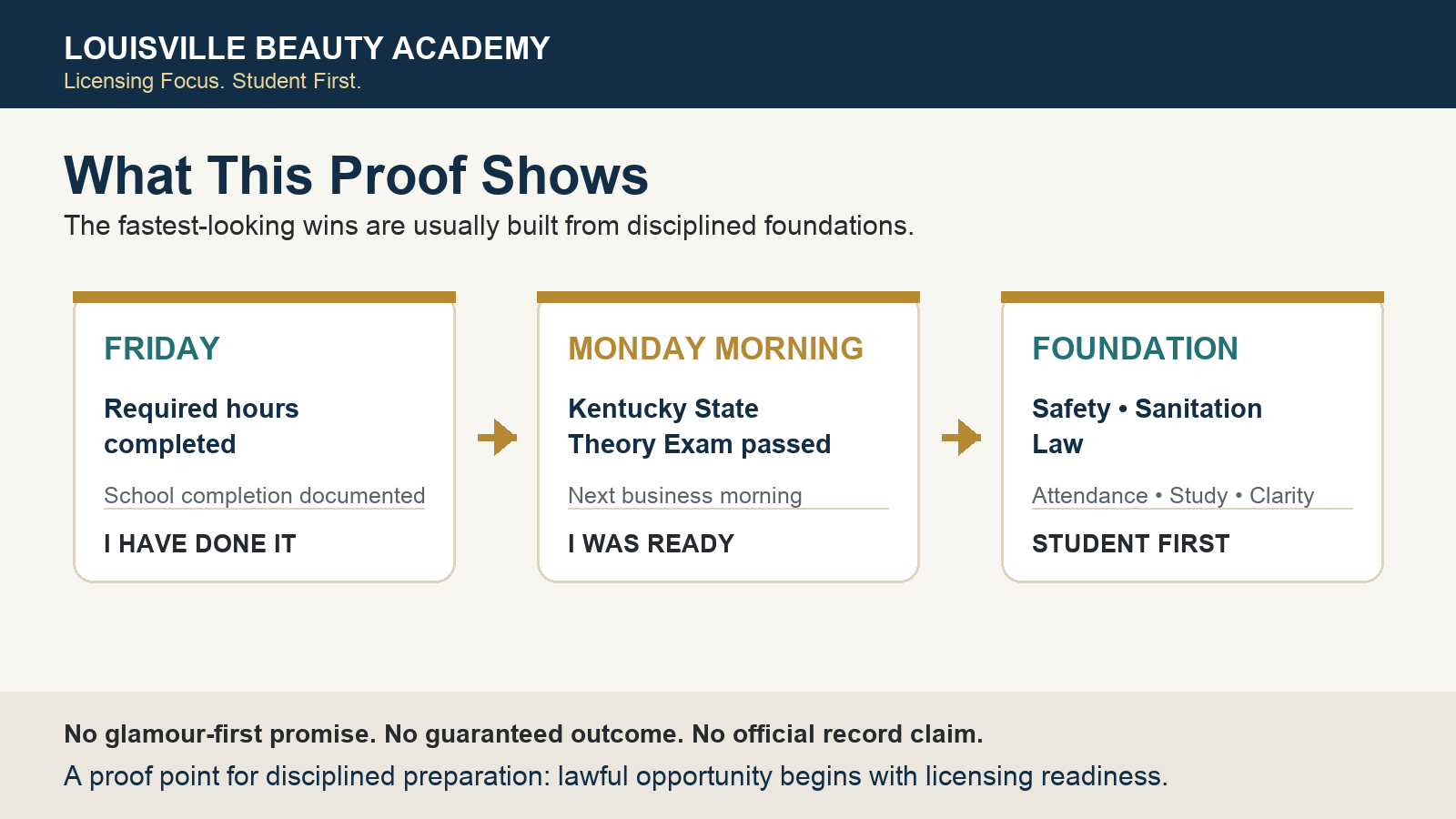
At Louisville Beauty Academy, the foundation of beauty education is more serious: safety, sanitation, law, attendance, required hours, state-board study, clear documentation, transparent student expectations, and licensing readiness.
Not glamour first. Not image first. Not empty promise first. Licensing readiness first. Student first.
A Real Student Proof Point
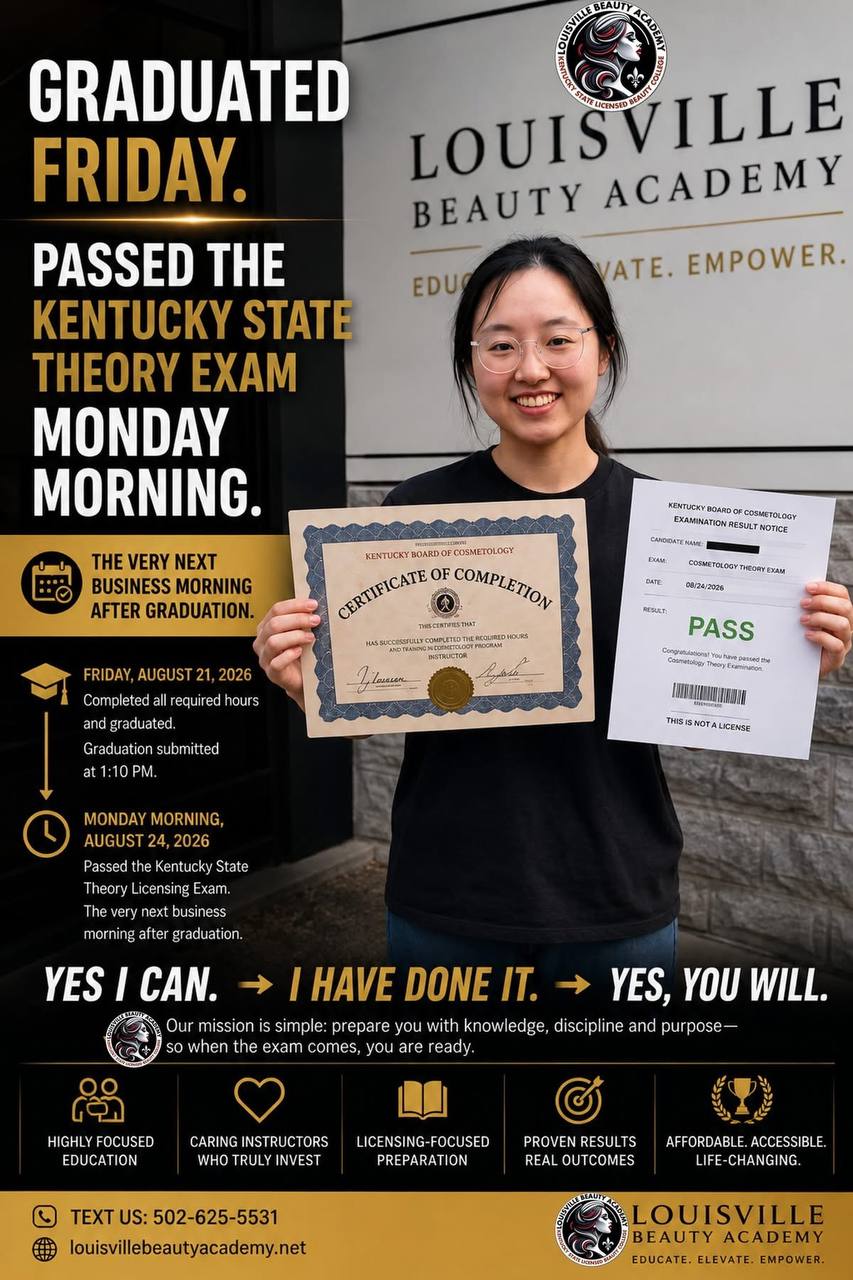
On Friday, August 21, 2026, our graduate completed every required school hour and was submitted for graduation at 1:10 p.m.
On Monday morning, August 24, 2026, the very next business morning, she passed the Kentucky State Theory Exam.
In our 10-year history at Louisville Beauty Academy, this is the first time we have seen a student graduate on Friday and pass the theory exam on Monday morning.
Could this be one of the fastest documented graduation-to-theory-exam turnarounds in Kentucky? We are not claiming an official record without verified historical evidence.
But we can say this clearly: this is extraordinary.
Documented Student-Success Proof
Graduated Friday. Passed Monday morning.
On Friday, August 21, 2026, one Louisville Beauty Academy graduate completed the required school hours and was submitted through the school graduation process. On Monday morning, August 24, 2026, the very next business morning, the graduate passed the Kentucky State Theory Exam.
We share this carefully because it is not a promise, guarantee, or claim that every student will have the same timeline. It is a documented example of what can happen when a student completes the required hours, prepares seriously, and moves through a licensing-first school process with focus and support.
This is exactly what Louisville Beauty Academy means by licensing readiness: not hype, not shortcuts, but documented completion, exam preparation, and careful movement toward the next required step.
Jiaxin Gong, a Louisville Beauty Academy graduate, is recognized here for the documented student-success proof point: graduation submission after completing required hours on Friday, August 21, 2026, and passing the Kentucky State Theory Exam on Monday morning, August 24, 2026, the very next business morning. Individual timelines and results vary.This proof point is about disciplined preparation: required hours, theory readiness, safety, sanitation, law, attendance, study, and student-first clarity.
This Was Not Luck
This result did not come from glamour. It came from work.
It came from accumulated hours, focused study, caring instruction, licensing-centered preparation, prompt processing, and a graduate who acted immediately while the knowledge was fresh.
It also came from a student who was navigating more than one path. She was not only attending beauty college. She was also pursuing a University of Louisville degree path while managing life, work, early schedules, school responsibilities, and the discipline required to keep going.
Nothing stopped her. That is the real story.
Why Licensing Comes First
Beauty skills matter deeply. Salon confidence matters. Client service matters. Business ownership may matter one day.
But lawful professional opportunity begins with licensing readiness. Without meeting the requirements for licensure, the rest cannot become the professional future the student is working toward.
That is why safety, sanitation, law, theory, documentation, and exam preparation are not side details at Louisville Beauty Academy. They are central.
They are the gate between learning and lawful practice. They are the difference between interest and professional readiness.
Transparency Is Part of Student Protection
Student-first education also means clarity.
Students deserve to understand what they are signing, what they are paying, what financing means, what is included, what is not included, what hours are required, what state-board steps remain, and what must happen before they can move toward licensure.
Education should not hide confusion inside a contract, financing document, FAFSA-related conversation, or enrollment process. Affordability matters. Clarity saves money. Students and families deserve direct language, not mystery.
What Louisville Beauty Academy Really Sells
We are not selling glamour first. We are selling the foundation:
effort;
work;
attendance;
licensing focus;
safety;
sanitation;
law;
transparency;
student-first guidance;
readiness for the next lawful step.
Real skill continues to grow in the salon, under professional standards, real clients, real timing, real service, and real responsibility. The school foundation matters because it helps the graduate move toward that lawful professional environment without wasting time, money, or trust.
YES I CAN Becomes Evidence
At Louisville Beauty Academy, YES I CAN is not decoration. It is a disciplined progression:
YES I CAN: believe enough to begin.
I HAVE DONE IT: work until belief becomes evidence.
YES, YOU WILL: let your evidence encourage the next student.
This graduate is living proof of that progression. She finished. She acted. She passed the Kentucky State Theory Exam the very next business morning. And she showed the next student what focused preparation can look like.
Begin With the Foundation
If you are looking for a beauty school that starts with glamour, we may sound different.
If you are looking for a beauty school focused on licensing readiness, transparent expectations, affordability, safety, sanitation, law, discipline, and student-first education, that is exactly where we begin.
Start with the foundation. Build the future from there.
201 KAR 12:082 establishes Kentucky beauty-school education requirements and school administration requirements.
201 KAR 12:030 establishes Kentucky licensing and examination procedures.
201 KAR 12:060 addresses inspections and health and safety requirements for schools and salons.
This article does not claim an official state record, does not promise instant results for future students, and does not state that passing the theory exam alone equals full licensure. Individual timelines, examination availability, state processing, and licensing steps can vary.
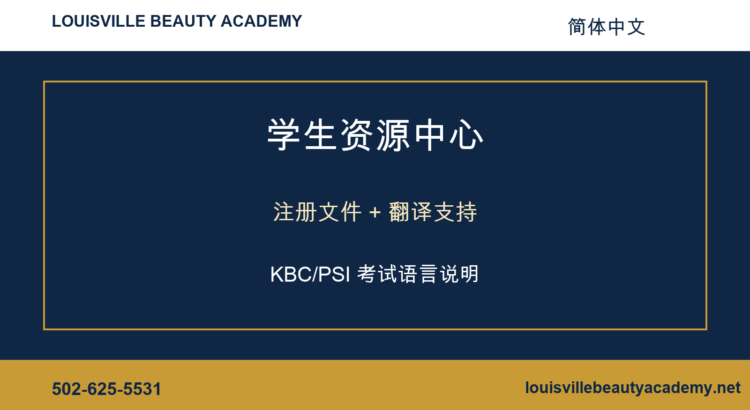
Louisville Beauty Academy 是一所美容学校,我们不是翻译机构,团队成员也不是认证或专业的翻译人员。我们结合翻译技术,以及会多种语言的教职员工和学生共同提供帮助。我们以您的语言提供这些内容,是因为我们宁愿提供不够完美的帮助,也不愿让您得不到信息。若有措辞不够准确之处,敬请见谅;如有任何不清楚的地方,请随时请我们再解释一次。
English (controlling version): Louisville Beauty Academy is a beauty school — not a translation agency, and our team are not certified or professional translators. We use translation technology together with staff and students who speak several languages. We share this material in your language because we would rather offer imperfect help than leave you without information. Some wording may not carry perfect nuance, and we ask for your kindness and patience with any imperfection. Please ask us to explain anything that is unclear; we will gladly go through it with you. For any official, legal, or licensing purpose, the English version of LBA documents controls, and a certified translator should be used where a certified translation is required. Current written school documents, signed agreements, Kentucky Board of Cosmetology requirements, PSI rules where applicable, and applicable law control.
English (controlling version): Louisville Beauty Academy is licensed by the Commonwealth of Kentucky and regulated by the Kentucky Board of Cosmetology. LBA is not institutionally accredited by a federally recognized accrediting agency and does not process FAFSA or Title IV federal student aid. This is a deliberate choice; operating outside the federal aid system removes substantial administrative cost, which is reflected in the program pricing published on this website. Sponsors, employers, nonprofits, and workforce programs may support a student; payments are applied to the student’s account, the student remains the responsible party under the signed agreement, and the student completes any sponsor paperwork. Before enrolling or borrowing at any school, please review official federal information at College Scorecard and studentaid.gov. We make no statement about any other institution. Accreditation status, tuition, and payment terms are described in current written school documents and may change; the current signed student agreement, Kentucky Board of Cosmetology requirements, and applicable law control. Nothing here is legal, financial, or licensing advice.
A Louisville Beauty Academy é uma escola de beleza — não somos uma agência de tradução nem tradutores certificados ou profissionais. Usamos tecnologia de tradução junto com funcionários e estudantes que falam vários idiomas. Compartilhamos este material no seu idioma porque preferimos oferecer uma ajuda imperfeita a deixar você sem informação. Pedimos desculpas por qualquer expressão menos precisa e, por favor, não hesite em nos pedir para explicar novamente.
English (controlling version): Louisville Beauty Academy is a beauty school — not a translation agency, and our team are not certified or professional translators. We use translation technology together with staff and students who speak several languages. We share this material in your language because we would rather offer imperfect help than leave you without information. Some wording may not carry perfect nuance, and we ask for your kindness and patience with any imperfection. Please ask us to explain anything that is unclear; we will gladly go through it with you. For any official, legal, or licensing purpose, the English version of LBA documents controls, and a certified translator should be used where a certified translation is required. Current written school documents, signed agreements, Kentucky Board of Cosmetology requirements, PSI rules where applicable, and applicable law control.
✓ Página revisada e atualizada em 27 de julho de 2026
Catálogo, programas, custos e políticas. Decida com informação por escrito.
2
Envie seus documentos
ID, prova de escolaridade e foto clara por texto para 502-625-5531.
3
Escolha seu programa
Unhas, Estética, Cosmetologia, Instrutor, Shampoo Styling ou Extensão de Cílios.
4
Leia e assine
Leia com calma. Pode revisar com a família. Pergunte antes de assinar.
5
Comece com clareza
Cada hora frequentada importa para o caminho de licença em Kentucky desde o primeiro dia.
Versões por idioma
Guia em português para estudantes e famílias. A Louisville Beauty Academy recebe perguntas sobre idioma, documentos de matrícula, preparação para licenciamento e entendimento do contrato antes da assinatura. Esta página reúne a resposta em um só lugar claro.
Louisville Beauty Academy
Reduzindo barreiras linguísticas. Ampliando oportunidades. Fortalecendo a força de trabalho de beleza de Kentucky.
Este centro de recursos existe para que estudantes e famílias revisem documentos, apoio de idioma, contrato, custo, identificação, opções de idioma de exame e próximos passos com dignidade antes de uma decisão educacional.
Caminho rapido para estudantes em portugues
Escolha o proximo passo: enviar mensagem para a LBA, revisar custos, preparar documentos ou pedir acompanhamento por escrito antes da visita.
O idioma nunca deve impedir um estudante sério de entender o caminho para uma profissão licenciada.
A LBA acredita que todo estudante merece informação clara por escrito antes da matrícula: documentos, idioma, contrato, custo, frequência, preparação para licença e próximos passos oficiais.
Compromisso de longo prazo
Por anos, a LBA apoia acesso multilíngue à educação de beleza, preparação profissional e comunicação clara para comunidades imigrantes e famílias trabalhadoras.
Quando provedores oficiais de exame, regras estaduais ou sistemas digitais oferecem opções de idioma, o estudante deve confirmar a disponibilidade atual diretamente na fonte oficial. A LBA pode orientar, mas os documentos atuais da escola, KBC, PSI quando aplicável e a lei controlam.
Nota sobre idioma do exame KBC/PSI
Conforme verificado em 27 de julho de 2026, o catálogo ao vivo da PSI Kentucky Board of Cosmetology lista versões por idioma para Cosmetology, Esthetician, Nail Technician e exames relacionados de instructor em inglês, espanhol, vietnamita, coreano, khmer, português e chinês simplificado. O mesmo catálogo mostra Shampoo Styling apenas em inglês e espanhol. O estudante deve confirmar o exame e o idioma diretamente no processo oficial KBC/PSI antes de agendar.
Por que isso importa
Reduz confusão antes da matrícula.
Ajuda estudantes e famílias a revisar documentos com calma.
Apoia a segurança pública porque o estudante entende melhor saneamento, frequência e responsabilidades.
Apoia famílias imigrantes e comunidades multilíngues.
Forma futuros profissionais, empreendedores e pequenos negócios.
Nossos princípios
Documentação antes de promessas.
Transparência antes da matrícula.
Conformidade antes da conveniência.
Dignidade humana antes de transações.
Educação antes de vendas.
Aviso sobre traduções
Traduções e explicações melhoram acesso e compreensão. Quando lei, regulamento, contrato assinado ou fonte oficial exigir uma versão específica, a versão oficial aplicável controla. Se algo não estiver claro, o estudante deve perguntar antes de assinar ou confiar nessa informação.
Documentos que o estudante deve preparar
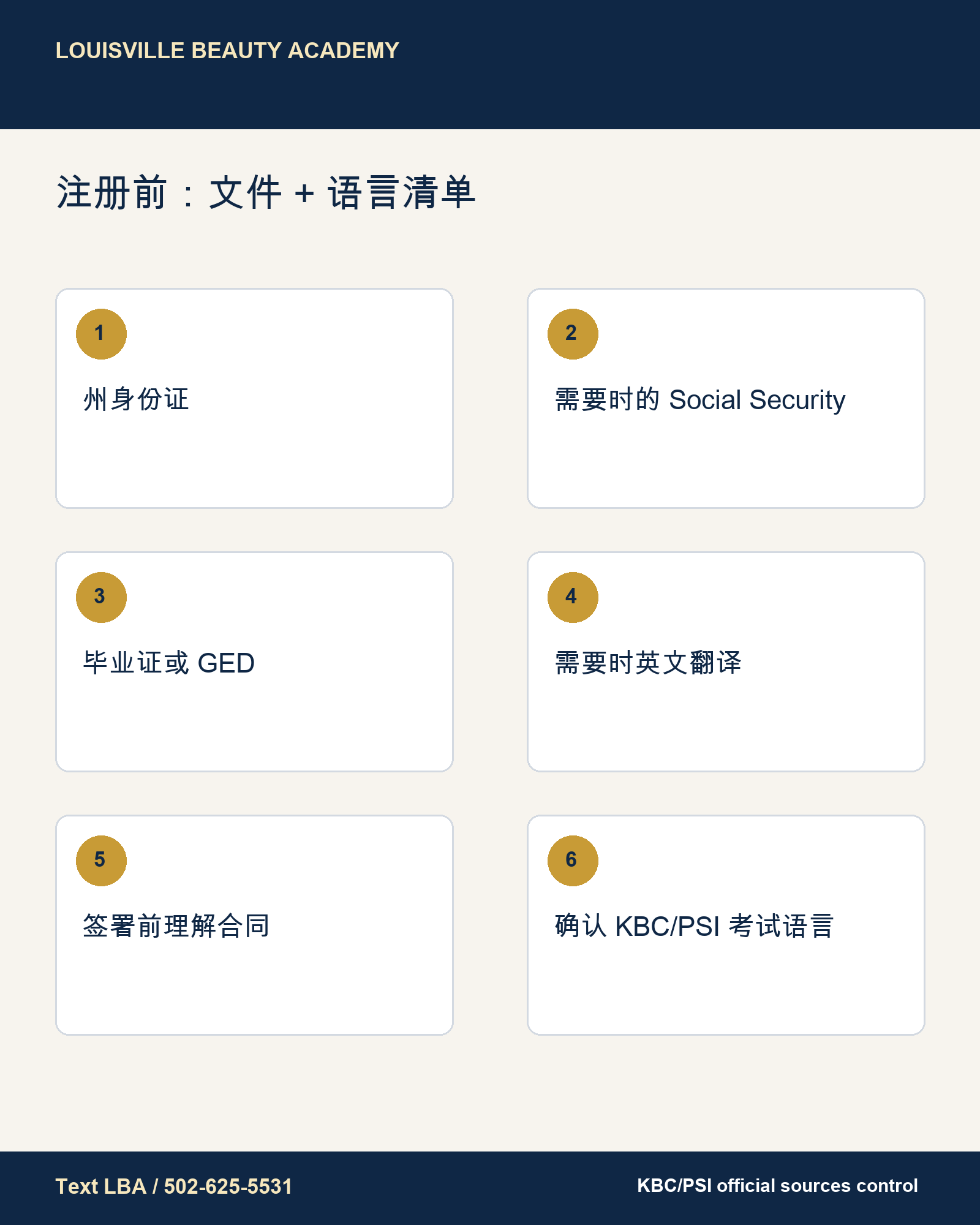
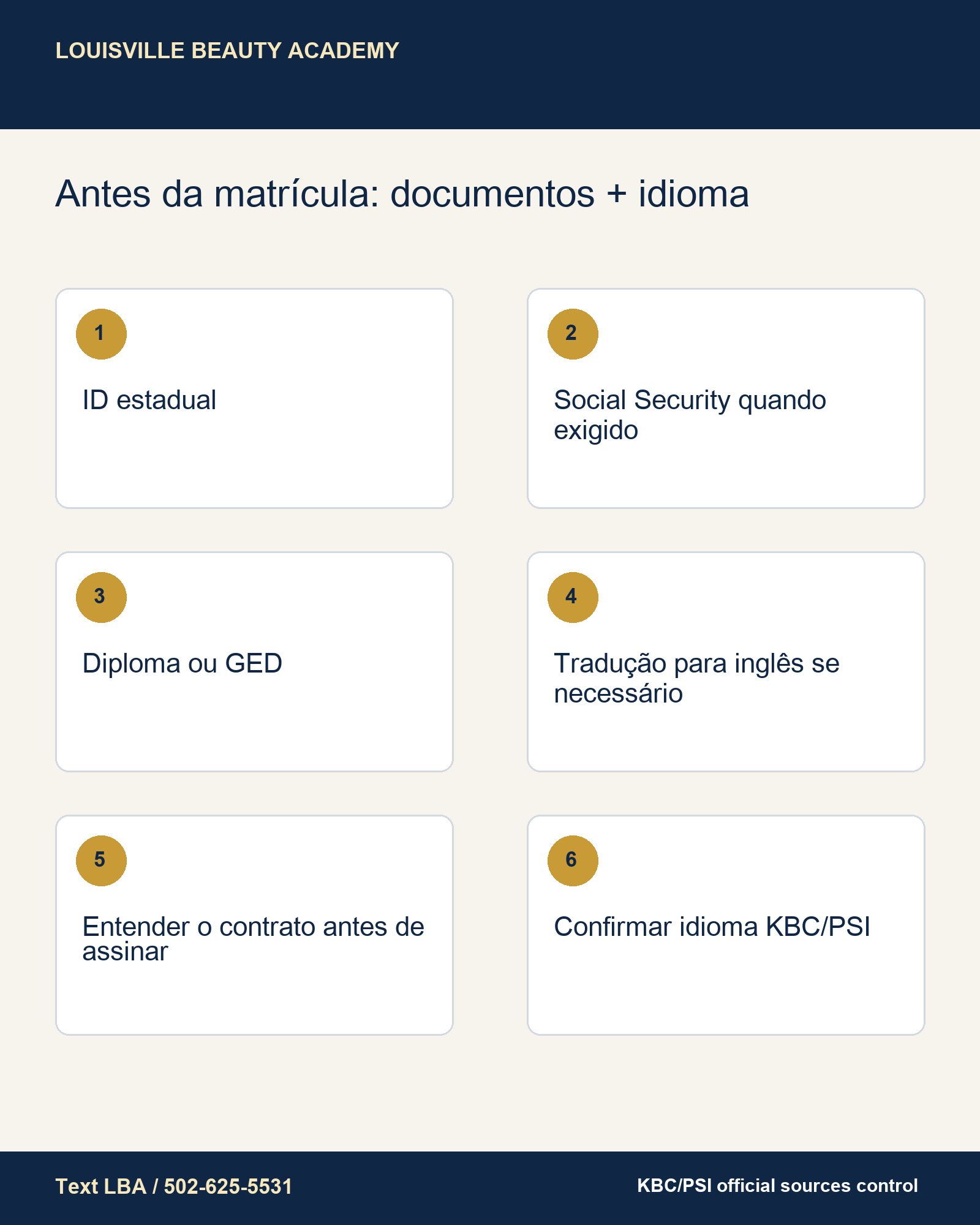
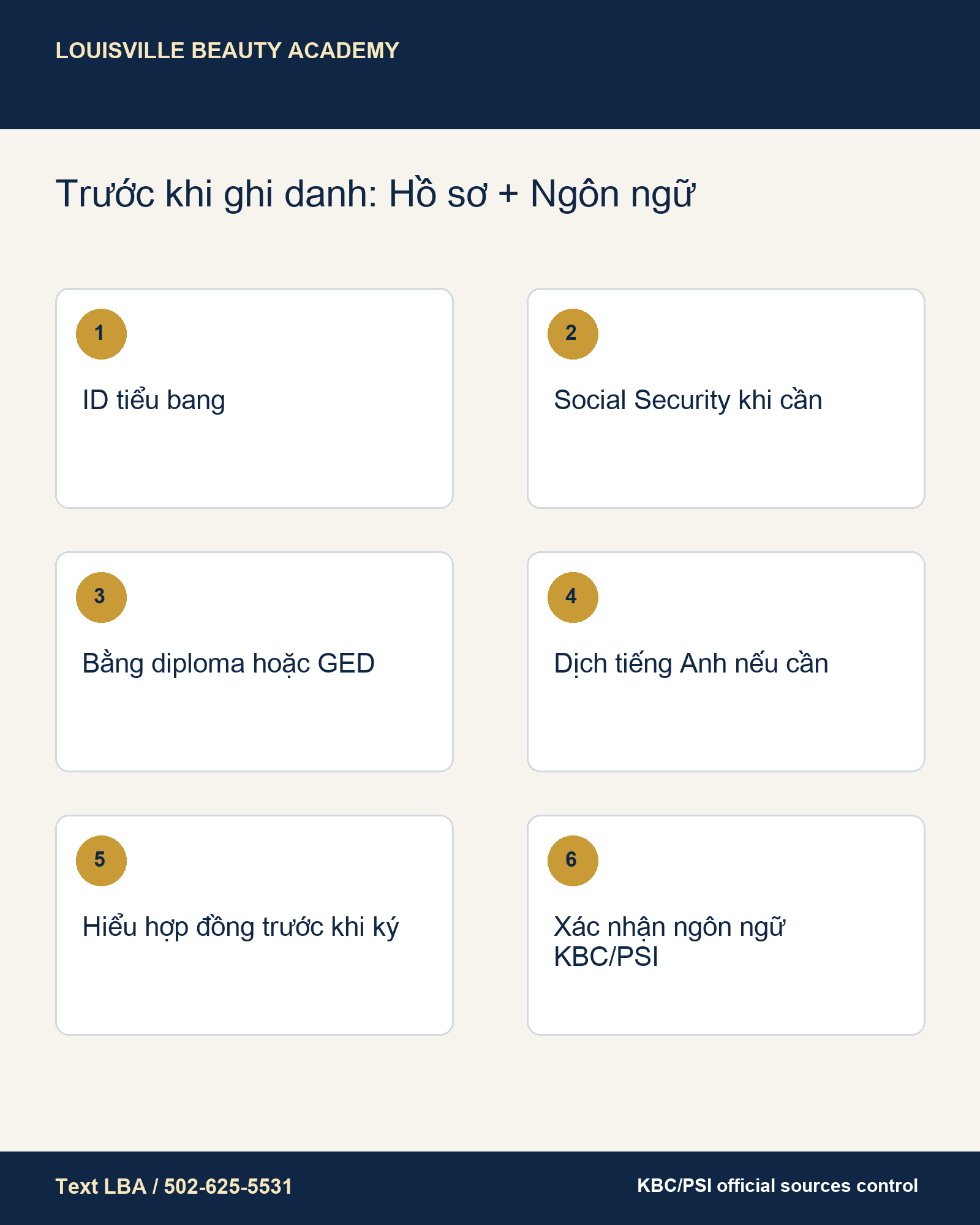
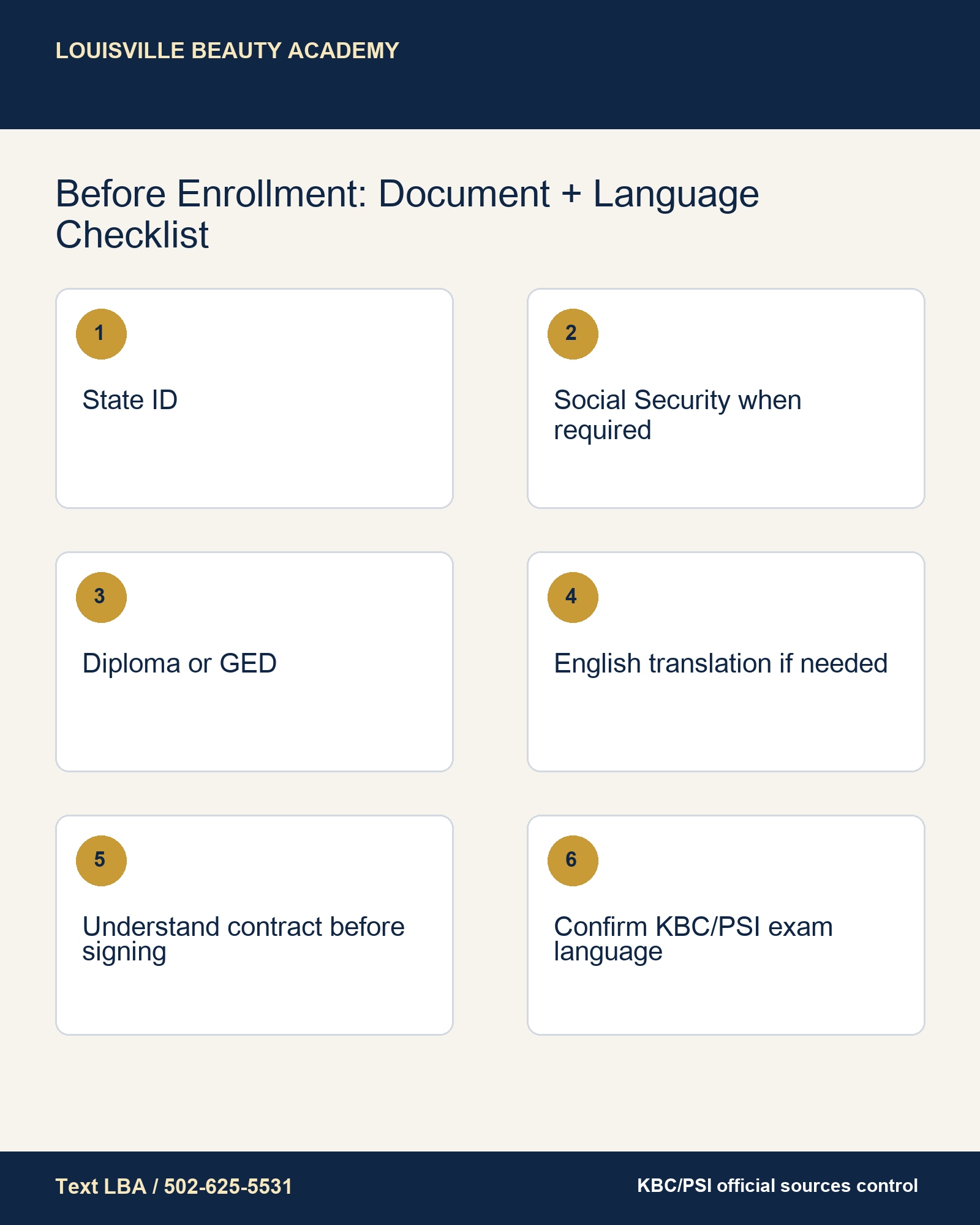
ID estadual ou carteira de motorista válida, idealmente com endereço atual.
Cartão Social Security quando exigido para registros escolares ou licenciamento.
Diploma de high school, GED ou equivalente aceito. Documentos estrangeiros podem precisar de tradução para inglês por agência aceita.
Foto clara estilo passaporte ou selfie recente sem filtro quando solicitada.
Nome legal, telefone, e-mail e endereço corretos.
Tempo para revisar o contrato estudantil antes de assinar.
Mensagem final ao estudante
Você pode fazer perguntas. Pode pedir explicação. Pode usar tradução. Pode ler com sua família. Um estudante sério merece clareza.
Confiança e impacto
A Louisville Beauty Academy atende uma comunidade ampla de estudantes, graduados, famílias e futuros profissionais de beleza em Kentucky. A educação profissional funciona melhor quando o caminho é claro, acessível, multilíngue quando possível, baseado em documentos e centrado em oportunidade econômica de longo prazo em vez de dívida desnecessária.
Nossa missão
Nossa missão vai além da matrícula. A LBA existe para reduzir barreiras, ampliar oportunidades, fortalecer a força de trabalho de Kentucky e ajudar cada estudante sério a construir carreira, apoiar a família e servir a comunidade com dignidade.
Resumo curto: a LBA ensina principalmente em inglês para todos, mas usa apoio multilíngue, equipe multilíngue quando disponível, Google Translate, ferramentas de tradução/IA e conteúdo digital que o estudante pode traduzir no navegador. O objetivo é comunicação clara, não confusão.
A Louisville Beauty Academy ensina em português?
A resposta honesta é: a instrução principal é em inglês porque registros escolares, segurança, saneamento, preparação para licenciamento e muitos materiais oficiais operam principalmente em inglês.
Ao mesmo tempo, a LBA apoia estudantes que falam espanhol, vietnamita, coreano, khmer, português, chinês simplificado e outros idiomas. A tecnologia ajuda a comunicação. Ela não substitui o instrutor, o contrato assinado, as regras da escola, os requisitos do KBC, os requisitos da PSI quando aplicáveis, nem a lei.
Diploma estrangeiro e tradução
Muitos estudantes trazem diplomas ou registros escolares de outro país. Isso pode ser normal. O importante é que o documento possa ser revisado com clareza. Se estiver em outro idioma, geralmente precisa de tradução para inglês por uma agência aceita.
Organizações comunitárias e agências de tradução reconhecidas podem ser úteis. O estudante deve confirmar com a LBA que tipo de tradução é aceito antes de pagar por uma tradução.
Contrato estudantil: assinado em inglês, mas precisa ser entendido
O contrato estudantil e os documentos oficiais de matrícula podem estar em inglês. Isso não significa que o estudante deva assinar sem entender.
A regra ética é simples: se o estudante não entende custo, horário, frequência, pagamento, política de retirada, responsabilidade do estudante ou caminho para licenciamento, deve perguntar antes de assinar.
A tradução ajuda a entender. Documentos assinados atuais, políticas escolares atuais, requisitos do KBC, PSI quando aplicável e a lei aplicável controlam. Esta página não é aconselhamento jurídico, imigratório, financeiro ou de licenciamento.
Por que ID estadual e Social Security podem ser solicitados
ID estadual ou carteira de motorista atual ajuda a manter registro escolar claro e comunicação correta. O cartão Social Security pode ser necessário para registros escolares ou de licenciamento quando aplicável.
A LBA não é agência de imigração e não fornece aconselhamento imigratório. Para matrícula escolar, estudantes devem focar nos documentos que a escola e o processo estadual precisam revisar: identificação, Social Security quando exigido, prova de educação, foto clara, contrato e informações de contato corretas.
Infográfico em português da LBA sobre documentos estudantis e idioma KBC/PSI.
A Louisville Beauty Academy é licenciada pelo estado de Kentucky e regulamentada pelo Kentucky Board of Cosmetology. A LBA não é credenciada por uma agência de credenciamento reconhecida pelo governo federal e não processa FAFSA nem auxílio federal (Título IV). Essa é uma escolha deliberada: operar fora do sistema federal elimina custos administrativos consideráveis, o que se reflete nos preços publicados abertamente neste site.
Patrocinadores, empregadores, organizações sem fins lucrativos e programas de qualificação podem apoiar o estudante. Os pagamentos são aplicados à conta do estudante, que continua sendo o responsável segundo o contrato assinado e preenche qualquer documentação do patrocinador. Antes de se matricular ou solicitar empréstimo em qualquer escola, consulte as informações federais oficiais no College Scorecard e em studentaid.gov. Não fazemos nenhuma declaração sobre outras instituições.
English (controlling version): Louisville Beauty Academy is licensed by the Commonwealth of Kentucky and regulated by the Kentucky Board of Cosmetology. LBA is not institutionally accredited by a federally recognized accrediting agency and does not process FAFSA or Title IV federal student aid. This is a deliberate choice; operating outside the federal aid system removes substantial administrative cost, which is reflected in the program pricing published on this website. Sponsors, employers, nonprofits, and workforce programs may support a student; payments are applied to the student’s account, the student remains the responsible party under the signed agreement, and the student completes any sponsor paperwork. Before enrolling or borrowing at any school, please review official federal information at College Scorecard and studentaid.gov. We make no statement about any other institution. Accreditation status, tuition, and payment terms are described in current written school documents and may change; the current signed student agreement, Kentucky Board of Cosmetology requirements, and applicable law control. Nothing here is legal, financial, or licensing advice.
English (controlling version): Louisville Beauty Academy is a beauty school — not a translation agency, and our team are not certified or professional translators. We use translation technology together with staff and students who speak several languages. We share this material in your language because we would rather offer imperfect help than leave you without information. Some wording may not carry perfect nuance, and we ask for your kindness and patience with any imperfection. Please ask us to explain anything that is unclear; we will gladly go through it with you. For any official, legal, or licensing purpose, the English version of LBA documents controls, and a certified translator should be used where a certified translation is required. Current written school documents, signed agreements, Kentucky Board of Cosmetology requirements, PSI rules where applicable, and applicable law control.
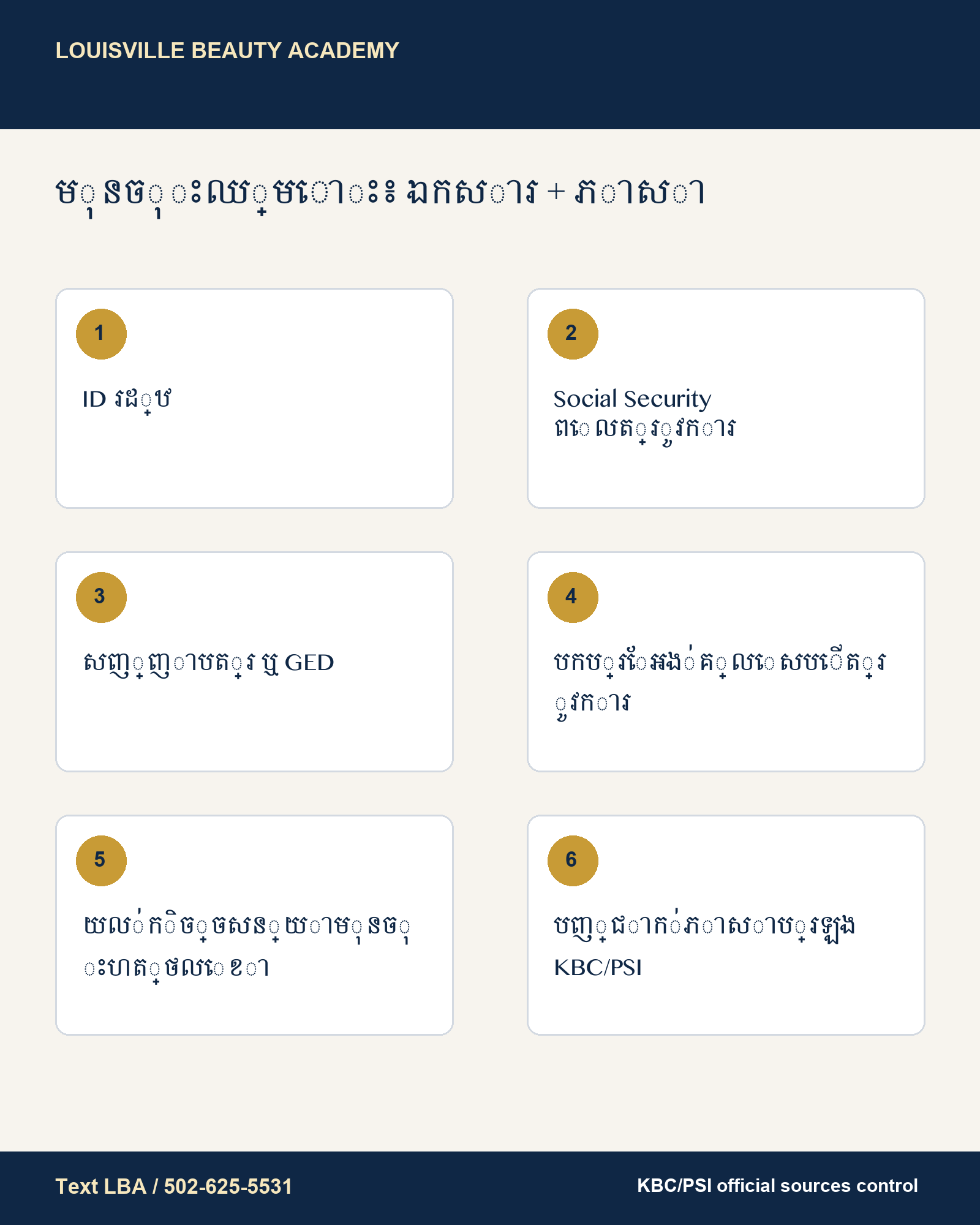
ID រដ្ឋ ឬប័ណ្ណបើកបរបច្ចុប្បន្នជួយរក្សាកំណត់ត្រាសាលាច្បាស់ និងការទំនាក់ទំនងត្រឹមត្រូវ។ ប័ណ្ណ Social Security អាចត្រូវការសម្រាប់កំណត់ត្រាសាលា ឬអាជ្ញាបណ្ណពេលអនុវត្ត។
English (controlling version): Louisville Beauty Academy is licensed by the Commonwealth of Kentucky and regulated by the Kentucky Board of Cosmetology. LBA is not institutionally accredited by a federally recognized accrediting agency and does not process FAFSA or Title IV federal student aid. This is a deliberate choice; operating outside the federal aid system removes substantial administrative cost, which is reflected in the program pricing published on this website. Sponsors, employers, nonprofits, and workforce programs may support a student; payments are applied to the student’s account, the student remains the responsible party under the signed agreement, and the student completes any sponsor paperwork. Before enrolling or borrowing at any school, please review official federal information at College Scorecard and studentaid.gov. We make no statement about any other institution. Accreditation status, tuition, and payment terms are described in current written school documents and may change; the current signed student agreement, Kentucky Board of Cosmetology requirements, and applicable law control. Nothing here is legal, financial, or licensing advice.
Louisville Beauty Academy는 뷰티 학교이며, 번역 회사가 아니고 저희 팀은 공인 번역사나 전문 번역가가 아닙니다. 저희는 번역 기술과 여러 언어를 구사하는 교직원 및 학생들의 도움을 함께 사용합니다. 정보를 전혀 드리지 못하는 것보다는 완벽하지 않더라도 도움을 드리는 편이 낫다고 믿기에 이 자료를 여러분의 언어로 제공합니다. 어색하거나 부족한 표현이 있다면 너그러이 양해해 주시고, 이해가 어려운 부분은 언제든지 다시 설명해 달라고 요청해 주십시오.
English (controlling version): Louisville Beauty Academy is a beauty school — not a translation agency, and our team are not certified or professional translators. We use translation technology together with staff and students who speak several languages. We share this material in your language because we would rather offer imperfect help than leave you without information. Some wording may not carry perfect nuance, and we ask for your kindness and patience with any imperfection. Please ask us to explain anything that is unclear; we will gladly go through it with you. For any official, legal, or licensing purpose, the English version of LBA documents controls, and a certified translator should be used where a certified translation is required. Current written school documents, signed agreements, Kentucky Board of Cosmetology requirements, PSI rules where applicable, and applicable law control.
LBA는 모든 학생이 등록 전에 서류, 언어, 계약, 비용, 출석, 면허 준비, 공식 다음 단계에 대해 명확한 서면 정보를 받을 자격이 있다고 믿습니다.
장기적 약속
LBA는 여러 해 동안 이민자 커뮤니티와 일하는 가족을 위해 다국어 접근, 뷰티 교육, 직업 준비, 명확한 의사소통을 지원해 왔습니다.
공식 시험 제공기관, 주 규정 또는 디지털 시스템이 언어 선택을 제공하는 경우 학생은 현재 가능 여부를 공식 출처에서 직접 확인해야 합니다. LBA는 안내할 수 있지만, 현재 학교 서류, KBC, 해당되는 경우 PSI, 그리고 법이 우선합니다.
KBC/PSI 시험 언어 안내
2026년 7월 27일 확인 기준, PSI Kentucky Board of Cosmetology 실시간 catalog에는 Cosmetology, Esthetician, Nail Technician 및 관련 instructor 시험의 언어별 버전이 영어, 스페인어, 베트남어, 한국어, 크메르어, 포르투갈어, 중국어 간체로 표시됩니다. 같은 catalog에서 Shampoo Styling은 영어와 스페인어만 표시됩니다. 학생은 예약 전에 공식 KBC/PSI 절차 안에서 시험과 언어 선택을 직접 확인해야 합니다.
중요한 이유
등록 전 혼란을 줄입니다.
학생과 가족이 서류를 차분히 검토하도록 돕습니다.
위생, 출석, 책임을 더 잘 이해하게 하여 공공 안전을 지원합니다.
이민자 가족과 다국어 커뮤니티를 지원합니다.
미래 전문가, 창업자, 소기업을 세웁니다.
우리의 원칙
약속보다 문서.
등록보다 투명성.
편의보다 준수.
거래보다 인간의 존엄.
판매보다 교육.
번역 안내
번역과 설명은 접근성과 이해를 돕기 위한 것입니다. 법, 규정, 서명된 계약 또는 공식 출처가 특정 버전을 요구하는 경우 해당 공식 버전이 우선합니다. 명확하지 않은 부분은 서명하거나 그 정보에 의존하기 전에 질문해야 합니다.
학생이 준비할 서류
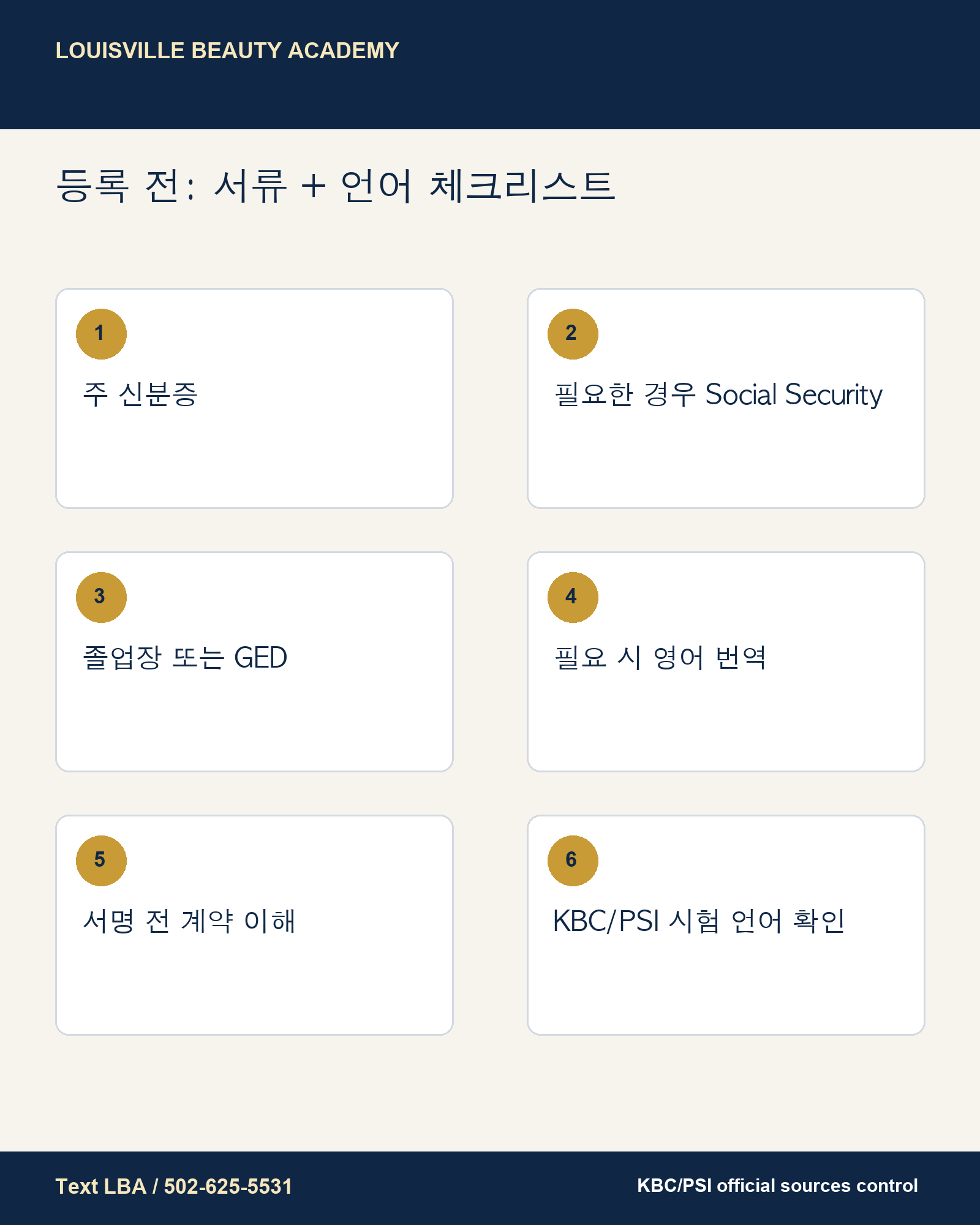
현재 주소가 있는 유효한 주 신분증 또는 운전면허증.
학교 또는 면허 기록에 필요한 경우 Social Security 카드.
High school diploma, GED 또는 인정되는 동등 학력. 외국 서류는 인정되는 기관의 영어 번역이 필요할 수 있습니다.
요청 시 선명한 여권형 사진 또는 필터 없는 최근 얼굴 사진.
정확한 법적 이름, 전화번호, 이메일, 주소.
서명 전 학생 계약서를 검토할 시간.
학생에게 드리는 마지막 메시지
질문할 수 있습니다. 설명을 요청할 수 있습니다. 번역을 사용할 수 있습니다. 가족과 함께 읽을 수 있습니다. 진지한 학생은 명확성을 받을 자격이 있습니다.
신뢰와 영향
Louisville Beauty Academy는 Kentucky의 학생, 졸업생, 가족, 미래 뷰티 전문가로 이루어진 넓은 커뮤니티를 섬깁니다. 직업 교육은 길이 명확하고, 감당 가능하며, 가능한 경우 다국어로 지원되고, 문서 중심이며, 불필요한 부채보다 장기적 경제 기회에 집중할 때 가장 잘 작동합니다.
우리의 사명
LBA의 사명은 등록을 넘어섭니다. LBA는 장벽을 줄이고, 기회를 넓히고, Kentucky 인력을 강화하며, 진지한 학생이 경력을 세우고 가족을 돕고 존엄하게 지역사회에 기여하도록 돕기 위해 존재합니다.
짧은 요약: LBA는 모두를 위해 주로 영어로 가르치지만, 가능한 경우 다국어 지원, 다국어 직원, Google Translate, 번역/AI 도구, 브라우저에서 번역 가능한 디지털 콘텐츠를 사용합니다. 목표는 혼란이 아니라 명확한 의사소통입니다.
Louisville Beauty Academy는 한국어로 가르치나요?
정직한 답은 이렇습니다: 주요 수업은 영어입니다. 학교 기록, 안전, 위생, 면허 준비, 많은 공식 자료가 주로 영어로 운영되기 때문입니다.
동시에 LBA는 스페인어, 베트남어, 한국어, 크메르어, 포르투갈어, 중국어 간체 및 기타 언어를 사용하는 학생을 지원합니다. 기술은 의사소통을 돕지만 강사, 서명된 계약, 학교 규칙, KBC 요구사항, 해당되는 경우 PSI 요구사항 또는 법을 대체하지 않습니다.
외국 졸업장과 번역
많은 학생이 다른 나라의 졸업장이나 학교 기록을 가져옵니다. 이는 정상일 수 있습니다. 중요한 것은 그 기록을 명확히 검토할 수 있어야 한다는 점입니다. 서류가 다른 언어라면 인정되는 기관의 영어 번역이 필요할 수 있습니다.
커뮤니티 기관과 인정되는 번역 기관이 도움이 될 수 있습니다. 학생은 번역 비용을 지불하기 전에 어떤 종류의 번역이 인정되는지 LBA에 확인해야 합니다.
학생 계약서: 영어로 서명하지만 반드시 이해해야 합니다
학생 계약서와 공식 등록 서류는 영어일 수 있습니다. 그렇다고 이해하지 못한 채 서명해야 한다는 뜻은 아닙니다.
윤리적 규칙은 간단합니다: 비용, 일정, 출석, 결제, 철회 정책, 학생 책임 또는 면허 경로를 이해하지 못하면 서명 전에 질문해야 합니다.
번역은 이해를 돕습니다. 현재 서명된 문서, 현재 학교 정책, KBC 요구사항, 해당되는 경우 PSI, 적용 법률이 우선합니다. 이 페이지는 법률, 이민, 재정 또는 면허 조언이 아닙니다.
주 신분증과 Social Security가 요청될 수 있는 이유
현재 주 신분증 또는 운전면허증은 명확한 학교 기록과 정확한 의사소통에 도움이 됩니다. Social Security 카드는 해당되는 경우 학교 또는 면허 기록에 필요할 수 있습니다.
LBA는 이민 기관이 아니며 이민 조언을 제공하지 않습니다. 학교 등록에서는 학교와 주 절차가 검토해야 하는 문서에 집중해야 합니다: 신분증, 필요한 경우 Social Security, 학력 증명, 선명한 사진, 계약서, 정확한 연락처 정보.
Louisville Beauty Academy는 천터키주로부터 학교 면허를 받앾으메, Kentucky Board of Cosmetology의 규제를 받습니다. LBA는 연방정부가 인정하는 인가기관의 인가를 받지 않았으며, FAFSA 또는 연방 학자금 지원(Title IV)을 처리하지 않습니다. 이는 의도적인 선택입니다. 연방 지원 제도 밝에서 운영하면 상당한 행정 비용이 중어들면, 이는 본 웹사이트에 공개된 수업료에 반영됩니다.
후원자, 고용주, 비영리단체 또는 인력 개발 프로그램이 학생을 지원할 수 있습니다. 넑부금은 학생 계정에 적용되며, 학생은 서명한 계약에 따라 책임 당사자로 남구 후원 관련 서류를 직접 작성합니다. 어늘 학교든 등록하거나 대출을 받기 전에 College Scorecard 및 studentaid.gov에서 공식 연방 정보를 확인하시기 바랍니다. 저헤는 다른 교육기관에 대해 어떠 평가도 하지 않습니다.
English (controlling version): Louisville Beauty Academy is licensed by the Commonwealth of Kentucky and regulated by the Kentucky Board of Cosmetology. LBA is not institutionally accredited by a federally recognized accrediting agency and does not process FAFSA or Title IV federal student aid. This is a deliberate choice; operating outside the federal aid system removes substantial administrative cost, which is reflected in the program pricing published on this website. Sponsors, employers, nonprofits, and workforce programs may support a student; payments are applied to the student’s account, the student remains the responsible party under the signed agreement, and the student completes any sponsor paperwork. Before enrolling or borrowing at any school, please review official federal information at College Scorecard and studentaid.gov. We make no statement about any other institution. Accreditation status, tuition, and payment terms are described in current written school documents and may change; the current signed student agreement, Kentucky Board of Cosmetology requirements, and applicable law control. Nothing here is legal, financial, or licensing advice.
Louisville Beauty Academy là một trường thẩm mỹ — chúng tôi không phải là công ty dịch thuật và không phải là biên dịch viên chuyên nghiệp hay có chứng chỉ. Chúng tôi sử dụng công nghệ dịch thuật cùng với nhân viên và học viên biết nhiều ngôn ngữ. Chúng tôi chia sẻ tài liệu này bằng ngôn ngữ của bạn vì chúng tôi muốn giúp đỡ dù chưa hoàn hảo, hơn là để bạn không có thông tin. Xin lượng thứ cho những chỗ diễn đạt chưa chuẩn, và xin đừng ngại yêu cầu chúng tôi giải thích lại.
English (controlling version): Louisville Beauty Academy is a beauty school — not a translation agency, and our team are not certified or professional translators. We use translation technology together with staff and students who speak several languages. We share this material in your language because we would rather offer imperfect help than leave you without information. Some wording may not carry perfect nuance, and we ask for your kindness and patience with any imperfection. Please ask us to explain anything that is unclear; we will gladly go through it with you. For any official, legal, or licensing purpose, the English version of LBA documents controls, and a certified translator should be used where a certified translation is required. Current written school documents, signed agreements, Kentucky Board of Cosmetology requirements, PSI rules where applicable, and applicable law control.
✓ Trang đã được xem lại và cập nhật ngày 27 tháng 7 năm 2026
Catalog, chương trình, chi phí và chính sách. Quyết định dựa trên thông tin bằng văn bản.
2
Gửi giấy tờ
ID, bằng chứng học vấn và hình rõ qua tin nhắn đến 502-625-5531.
3
Chọn chương trình
Nail, Esthetics, Cosmetology, Instructor, Shampoo Styling hoặc Eyelash Extensions.
4
Đọc và ký
Đọc kỹ. Có thể đọc cùng gia đình. Hỏi trước khi ký.
5
Bắt đầu rõ ràng
Mỗi giờ có mặt đều quan trọng cho con đường giấy phép Kentucky từ ngày đầu.
Các phiên bản ngôn ngữ
Hướng dẫn tiếng Việt cho học viên và gia đình. Louisville Beauty Academy thường nhận câu hỏi về ngôn ngữ, hồ sơ ghi danh, chuẩn bị giấy phép và cách hiểu hợp đồng trước khi ký. Trang này gom câu trả lời vào một nơi rõ ràng.
Louisville Beauty Academy
Giảm rào cản ngôn ngữ. Mở rộng cơ hội. Tăng sức mạnh cho lực lượng lao động ngành làm đẹp Kentucky.
Trung tâm tài nguyên này giúp học viên và gia đình xem hồ sơ, hỗ trợ ngôn ngữ, hợp đồng, chi phí, giấy tờ tùy thân, lựa chọn ngôn ngữ kỳ thi và bước tiếp theo với sự tôn trọng trước khi quyết định học.
Loi di nhanh cho hoc vien tieng Viet
Chon buoc tiep theo: nhan tin cho LBA, xem chi phi, chuan bi giay to, hoac yeu cau phan hoi bang van ban truoc khi den tham quan.
Ngôn ngữ không nên là rào cản khiến học viên không hiểu con đường đến nghề có giấy phép.
LBA tin rằng mỗi học viên xứng đáng có thông tin rõ bằng văn bản trước khi ghi danh: giấy tờ, ngôn ngữ, hợp đồng, chi phí, điểm danh, chuẩn bị giấy phép và bước chính thức tiếp theo.
Cam kết lâu dài
Trong nhiều năm, LBA hỗ trợ tiếp cận đa ngôn ngữ trong giáo dục thẩm mỹ, chuẩn bị nghề nghiệp và giao tiếp rõ ràng cho cộng đồng nhập cư và gia đình lao động.
Khi nhà cung cấp kỳ thi chính thức, quy định tiểu bang hoặc hệ thống kỹ thuật số có lựa chọn ngôn ngữ, học viên phải xác nhận trực tiếp với nguồn chính thức. LBA có thể hướng dẫn, nhưng hồ sơ hiện hành của trường, KBC, PSI khi áp dụng và luật hiện hành là căn cứ kiểm soát.
Ghi chú ngôn ngữ kỳ thi KBC/PSI
Theo kiểm tra ngày 27 tháng 7 năm 2026, catalog PSI Kentucky Board of Cosmetology đang hiển thị các phiên bản theo ngôn ngữ cho Cosmetology, Esthetician, Nail Technician và các kỳ thi instructor liên quan bằng tiếng Anh, Tây Ban Nha, Việt, Hàn, Khmer, Bồ Đào Nha và Hoa giản thể. Catalog này hiện chỉ hiển thị Shampoo Styling bằng tiếng Anh và Tây Ban Nha. Học viên phải xác nhận kỳ thi và ngôn ngữ trực tiếp trong quy trình chính thức của KBC/PSI trước khi đặt lịch.
Vì sao điều này quan trọng
Giảm nhầm lẫn trước khi ghi danh.
Giúp học viên và gia đình xem giấy tờ bình tĩnh.
Hỗ trợ an toàn công cộng vì học viên hiểu tốt hơn về vệ sinh, điểm danh và trách nhiệm.
Hỗ trợ gia đình nhập cư và cộng đồng đa ngôn ngữ.
Xây dựng chuyên viên, doanh nhân và doanh nghiệp nhỏ tương lai.
Nguyên tắc của chúng tôi
Hồ sơ trước lời hứa.
Minh bạch trước ghi danh.
Tuân thủ trước tiện lợi.
Phẩm giá con người trước giao dịch.
Giáo dục trước bán hàng.
Thông báo về dịch thuật
Bản dịch và giải thích giúp tăng khả năng tiếp cận và hiểu biết. Khi luật, quy định, hợp đồng đã ký hoặc nguồn chính thức yêu cầu một phiên bản cụ thể, phiên bản chính thức áp dụng sẽ kiểm soát. Nếu chưa rõ, học viên nên hỏi trước khi ký hoặc dựa vào thông tin đó.
Học viên nên chuẩn bị giấy tờ gì
ID tiểu bang hoặc bằng lái còn hiệu lực, tốt nhất có địa chỉ hiện tại.
Thẻ Social Security khi hồ sơ trường hoặc giấy phép yêu cầu.
Bằng high school, GED hoặc tương đương được chấp nhận. Hồ sơ nước ngoài có thể cần dịch sang tiếng Anh bởi đơn vị được chấp nhận.
Ảnh rõ kiểu hộ chiếu hoặc ảnh mặt gần đây không dùng filter khi được yêu cầu.
Tên pháp lý, điện thoại, email và địa chỉ chính xác.
Thời gian để đọc hợp đồng học viên trước khi ký.
Lời nhắn cuối cho học viên
Bạn có thể đặt câu hỏi. Bạn có thể yêu cầu giải thích. Bạn có thể dùng dịch thuật. Bạn có thể đọc cùng gia đình. Một học viên nghiêm túc xứng đáng có sự rõ ràng.
Niềm tin và tác động
Louisville Beauty Academy phục vụ cộng đồng rộng gồm học viên, cựu học viên, gia đình và những người sẽ trở thành chuyên viên ngành làm đẹp tại Kentucky. Giáo dục nghề nghiệp hiệu quả nhất khi con đường rõ ràng, vừa khả năng tài chính, hỗ trợ đa ngôn ngữ khi có thể, dựa trên hồ sơ bằng văn bản và tập trung vào cơ hội kinh tế lâu dài thay vì nợ không cần thiết.
Sứ mệnh của chúng tôi
Sứ mệnh của LBA vượt xa việc ghi danh. LBA tồn tại để giảm rào cản, mở rộng cơ hội, tăng sức mạnh lực lượng lao động Kentucky và giúp mỗi học viên nghiêm túc xây dựng nghề nghiệp, hỗ trợ gia đình và phục vụ cộng đồng với phẩm giá.
Tóm tắt ngắn: LBA giảng dạy chính bằng tiếng Anh cho tất cả mọi người, nhưng dùng hỗ trợ đa ngôn ngữ, nhân sự biết nhiều ngôn ngữ khi có, Google Translate, công cụ dịch/AI và nội dung số mà học viên có thể dịch trong trình duyệt. Mục tiêu là giao tiếp rõ ràng, không gây nhầm lẫn.
Louisville Beauty Academy có dạy bằng tiếng Việt không?
Câu trả lời trung thực là: giảng dạy chính bằng tiếng Anh vì hồ sơ trường, an toàn, vệ sinh, chuẩn bị giấy phép và nhiều tài liệu chính thức chủ yếu vận hành bằng tiếng Anh.
Đồng thời, LBA hỗ trợ học viên nói tiếng Tây Ban Nha, Việt, Hàn, Khmer, Bồ Đào Nha, Hoa giản thể và các ngôn ngữ khác. Công nghệ giúp giao tiếp. Công nghệ không thay thế instructor, hợp đồng đã ký, quy định trường, yêu cầu KBC, yêu cầu PSI khi áp dụng hoặc luật.
Bằng cấp nước ngoài và dịch thuật
Nhiều học viên mang bằng hoặc hồ sơ học tập từ nước khác. Điều đó có thể bình thường. Quan trọng là hồ sơ phải được xem xét rõ ràng. Nếu tài liệu ở ngôn ngữ khác, thường cần bản dịch tiếng Anh từ đơn vị được chấp nhận.
Các tổ chức cộng đồng và đơn vị dịch thuật được công nhận có thể hữu ích. Học viên nên xác nhận với LBA loại bản dịch nào được chấp nhận trước khi trả tiền dịch.
Hợp đồng học viên: ký bằng tiếng Anh, nhưng phải hiểu
Hợp đồng học viên và hồ sơ ghi danh chính thức có thể bằng tiếng Anh. Điều đó không có nghĩa học viên nên ký khi chưa hiểu.
Quy tắc đạo đức rất đơn giản: nếu học viên chưa hiểu chi phí, lịch học, điểm danh, thanh toán, chính sách rút học, trách nhiệm học viên hoặc con đường đến giấy phép, học viên nên hỏi trước khi ký.
Dịch thuật giúp hiểu. Hồ sơ đã ký hiện hành, chính sách trường hiện hành, yêu cầu KBC, PSI khi áp dụng và luật hiện hành kiểm soát. Trang này không phải tư vấn pháp lý, di trú, tài chính hay giấy phép.
Vì sao có thể cần ID tiểu bang và Social Security
ID tiểu bang hoặc bằng lái hiện tại giúp duy trì hồ sơ trường rõ ràng và liên lạc chính xác. Thẻ Social Security có thể cần cho hồ sơ trường hoặc giấy phép khi áp dụng.
LBA không phải cơ quan di trú và không tư vấn di trú. Đối với ghi danh, học viên nên tập trung vào hồ sơ mà trường và quy trình tiểu bang cần xem xét: ID, Social Security khi cần, bằng chứng học vấn, hình rõ, hợp đồng và thông tin liên hệ đúng.
Infographic tiếng Việt của LBA về hồ sơ học viên và ngôn ngữ KBC/PSI.
Trường có được kiểm định (accredited) không? Tôi có thể dùng FAFSA không?
Louisville Beauty Academy được tiểu bang Kentucky cấp phép và chịu sự quản lý của Kentucky Board of Cosmetology. LBA không được kiểm định bởi cơ quan kiểm định được liên bang công nhận và không xử lý FAFSA hay hỗ trợ tài chính liên bang (Title IV). Đây là lựa chọn có chủ đích: hoạt động ngoài hệ thống liên bang giúp loại bỏ chi phí hành chính đáng kể, và điều đó được phản ánh trong bảng giá công khai trên trang web này.
Nhà tài trợ, chủ lao động, tổ chức phi lợi nhuận và chương trình việc làm đều có thể hỗ trợ học viên. Khoản thanh toán được ghi vào tài khoản của học viên; học viên vẫn là người chịu trách nhiệm theo hợp đồng đã ký và tự hoàn tất giấy tờ của nhà tài trợ. Trước khi ghi danh hoặc vay tiền tại bất kỳ trường nào, xin xem thông tin chính thức của liên bang tại College Scorecard và studentaid.gov. Chúng tôi không nhận xét về bất kỳ trường nào khác.
English (controlling version): Louisville Beauty Academy is licensed by the Commonwealth of Kentucky and regulated by the Kentucky Board of Cosmetology. LBA is not institutionally accredited by a federally recognized accrediting agency and does not process FAFSA or Title IV federal student aid. This is a deliberate choice; operating outside the federal aid system removes substantial administrative cost, which is reflected in the program pricing published on this website. Sponsors, employers, nonprofits, and workforce programs may support a student; payments are applied to the student’s account, the student remains the responsible party under the signed agreement, and the student completes any sponsor paperwork. Before enrolling or borrowing at any school, please review official federal information at College Scorecard and studentaid.gov. We make no statement about any other institution. Accreditation status, tuition, and payment terms are described in current written school documents and may change; the current signed student agreement, Kentucky Board of Cosmetology requirements, and applicable law control. Nothing here is legal, financial, or licensing advice.
Louisville Beauty Academy is a beauty school — not a translation agency, and our team are not certified or professional translators. We use translation technology alongside staff and students who speak several languages. We share this material in your language because we would rather offer imperfect help than leave you without information. Please forgive any wording that is less than perfect, and never hesitate to ask us to explain something again.
English (controlling version): Louisville Beauty Academy is a beauty school — not a translation agency, and our team are not certified or professional translators. We use translation technology together with staff and students who speak several languages. We share this material in your language because we would rather offer imperfect help than leave you without information. Some wording may not carry perfect nuance, and we ask for your kindness and patience with any imperfection. Please ask us to explain anything that is unclear; we will gladly go through it with you. For any official, legal, or licensing purpose, the English version of LBA documents controls, and a certified translator should be used where a certified translation is required. Current written school documents, signed agreements, Kentucky Board of Cosmetology requirements, PSI rules where applicable, and applicable law control.
Catalog, programs, costs, and policies. Decide from written information.
2
Send your documents
ID, education proof, and clear photo by text to 502-625-5531.
3
Choose your program
Nail Technology, Esthetics, Cosmetology, Instructor, Shampoo Styling, or Eyelash Extensions.
4
Read and sign
Take your time. Read with family. Ask before signing.
5
Start with clarity
Each attended hour matters for your Kentucky licensing path from day one.
Language versions
English guide for students and families. Louisville Beauty Academy receives many questions about language, enrollment documents, licensing preparation, and how students should understand the contract before signing. This page gathers the answer in one clear place.
Louisville Beauty Academy
Reducing language barriers. Expanding opportunity. Strengthening Kentucky’s beauty workforce.
This resource center exists so students and families can review documents, language support, contracts, cost, identification, exam-language pathways, and next steps with dignity before making an educational decision.
Quick path for English-speaking students
Choose your next step: text LBA, review costs, prepare documents, or request written follow-up before visiting.
Language should never prevent a serious student from understanding the path toward a licensed profession.
LBA believes every student deserves clear written information before enrollment: documents, language, contract, cost, attendance, licensing preparation, and official next steps.
Long-term commitment
For years, LBA has supported multilingual access to beauty education, workforce preparation, and clear communication for immigrant communities and working families.
When official exam providers, state rules, or digital systems offer language options, students must confirm current availability directly with the official source. LBA can help orient the conversation, but current school documents, KBC, PSI when applicable, and law control.
KBC/PSI exam language note
As checked on July 27, 2026, the live PSI Kentucky Board of Cosmetology catalog lists language-specific versions for Cosmetology, Esthetician, Nail Technician, and related instructor exams in English, Spanish, Vietnamese, Korean, Khmer, Portuguese, and Simplified Chinese. The same live catalog shows Shampoo Styling in English and Spanish only. Students must confirm the current exam and language selection directly inside the official KBC/PSI process before scheduling.
Why it matters
Reduces confusion before enrollment.
Helps students and families review documents calmly.
Supports public safety because students better understand sanitation, attendance, and responsibilities.
Supports immigrant families and multilingual communities.
Builds future professionals, entrepreneurs, and small businesses.
Our principles
Documentation before promises.
Transparency before enrollment.
Compliance before convenience.
Human dignity before transactions.
Education before sales.
Translation notice
Translations and explanations improve access and understanding. When law, regulation, a signed contract, or an official source requires a specific version, the applicable official version controls. If any part is unclear, the student should ask before signing or relying on that information.
What documents students should prepare
Current state ID or driver’s license, ideally with current address.
Social Security card when required for school or licensing records.
High school diploma, GED, or accepted equivalent. Foreign documents may need English translation by an accepted agency.
Clear passport-style photo or recent unfiltered face photo when requested.
Correct legal name, phone, email, and address.
Time to review the student contract before signing.
Final message to the student
You may ask questions. You may request explanation. You may use translation. You may read with your family. A serious student deserves clarity.
Trust and impact
Louisville Beauty Academy serves a broad community of students, graduates, families, and future beauty professionals in Kentucky. Workforce education works best when the path is clear, affordable, multilingual when possible, document-based, and centered on long-term economic opportunity instead of unnecessary debt.
Our mission
Our mission goes beyond enrollment. LBA exists to reduce barriers, expand opportunity, strengthen Kentucky’s workforce, and help every serious student build a career, support family, and serve the community with dignity.
Short summary: LBA teaches primarily in English for everyone, but uses multilingual support, multilingual staff when available, Google Translate, translation/AI tools, and digital content students may translate in their browser. The goal is clear communication, not confusion.
Does Louisville Beauty Academy teach in this language?
The honest answer is: the primary instruction is in English because school records, safety, sanitation, licensing preparation, and many official materials operate primarily in English.
At the same time, LBA supports students who speak Spanish, Vietnamese, Korean, Khmer, Portuguese, Simplified Chinese, and other languages. Technology helps communication. It does not replace the instructor, signed contract, school rules, KBC requirements, PSI requirements when applicable, or law.
Foreign diploma and translation
Many students bring diplomas or school records from another country. That can be normal. What matters is that the record can be reviewed clearly. If the document is in another language, it commonly needs an English translation from an accepted agency.
Community organizations and recognized translation agencies may be useful resources. Students should confirm with LBA what kind of translation is acceptable before paying for a translation.
Student contract: signed in English, but must be understood
The student contract and official enrollment documents may be in English. That does not mean a student should sign without understanding.
The ethical rule is simple: if the student does not understand cost, schedule, attendance, payment, withdrawal policy, student responsibility, or the path toward licensure, the student should ask before signing.
Translation helps understanding. Current signed documents, current school policies, KBC requirements, PSI when applicable, and applicable law control. This page is not legal, immigration, financial, or licensing advice.
Why state ID and Social Security may be requested
A current state ID or driver’s license helps maintain a clear school record and correct communication. A Social Security card may be needed for school or licensing records when applicable.
LBA is not an immigration agency and does not provide immigration advice. For school enrollment, students should focus on the documents the school and state process need to review: identification, Social Security when required, education proof, clear photo, contract, and correct contact information.
English LBA student document and KBC/PSI language guidance infographic.
Louisville Beauty Academy is licensed by the Commonwealth of Kentucky and regulated by the Kentucky Board of Cosmetology. LBA is not institutionally accredited by a federally recognized accrediting agency and does not process FAFSA or Title IV federal student aid. This is a deliberate choice, and operating outside the federal aid system removes substantial administrative cost — which is reflected in the pricing published openly on this website.
Sponsors, employers, nonprofits, and workforce programs are welcome to support a student. Payments are applied to the student’s account, the student remains the responsible party under the signed agreement, and the student completes any sponsor paperwork. Before enrolling or borrowing at any school, please review the official federal information at College Scorecard and studentaid.gov. We make no statement about any other institution.
English (controlling version): Louisville Beauty Academy is licensed by the Commonwealth of Kentucky and regulated by the Kentucky Board of Cosmetology. LBA is not institutionally accredited by a federally recognized accrediting agency and does not process FAFSA or Title IV federal student aid. This is a deliberate choice; operating outside the federal aid system removes substantial administrative cost, which is reflected in the program pricing published on this website. Sponsors, employers, nonprofits, and workforce programs may support a student; payments are applied to the student’s account, the student remains the responsible party under the signed agreement, and the student completes any sponsor paperwork. Before enrolling or borrowing at any school, please review official federal information at College Scorecard and studentaid.gov. We make no statement about any other institution. Accreditation status, tuition, and payment terms are described in current written school documents and may change; the current signed student agreement, Kentucky Board of Cosmetology requirements, and applicable law control. Nothing here is legal, financial, or licensing advice.