Louisville Beauty Academy es una escuela de belleza — no somos una agencia de traducción ni traductores certificados o profesionales. Usamos tecnología de traducción junto con personal y estudiantes que hablan varios idiomas. Compartimos este material en su idioma porque preferimos ofrecer una ayuda imperfecta antes que dejarle sin información. Le pedimos disculpas por cualquier palabra que no sea perfecta, y por favor no dude en pedirnos que se lo expliquemos de nuevo.
English (controlling version): Louisville Beauty Academy is a beauty school — not a translation agency, and our team are not certified or professional translators. We use translation technology together with staff and students who speak several languages. We share this material in your language because we would rather offer imperfect help than leave you without information. Some wording may not carry perfect nuance, and we ask for your kindness and patience with any imperfection. Please ask us to explain anything that is unclear; we will gladly go through it with you. For any official, legal, or licensing purpose, the English version of LBA documents controls, and a certified translator should be used where a certified translation is required. Current written school documents, signed agreements, Kentucky Board of Cosmetology requirements, PSI rules where applicable, and applicable law control.
✓ Página revisada y actualizada el 24 de julio de 2026
Catálogo, programas, costos y políticas — decida con información escrita.
2
Envíe sus documentos
ID, prueba de educación y foto por texto al 502-625-5531.
3
Elija su programa
Uñas, Estética, Cosmetología, Instructor, Shampoo o Pestañas.
4
Lea y firme
Tome su tiempo. Puede leer con su familia. Pregunte antes de firmar.
5
Empiece de inmediato
Cada hora asistida cuenta para su licencia de Kentucky desde el día uno.
Recursos en 7 idiomas y nota oficial KBC/PSI
Según la revisión oficial realizada el 27 de julio de 2026, el catálogo en vivo de PSI para Kentucky Board of Cosmetology lista versiones por idioma para Cosmetología, Estética, Técnico de Uñas y exámenes relacionados de Instructor en inglés, español, vietnamita, coreano, khmer, portugués y chino simplificado. El mismo catálogo muestra Shampoo Styling solamente en inglés y español. El estudiante debe confirmar el examen y el idioma actual directamente dentro del proceso oficial KBC/PSI antes de programar.
Elija el siguiente paso: enviar un texto, revisar costos, preparar documentos o pedir seguimiento por escrito. La traduccion ayuda, pero los documentos oficiales y requisitos actuales controlan.
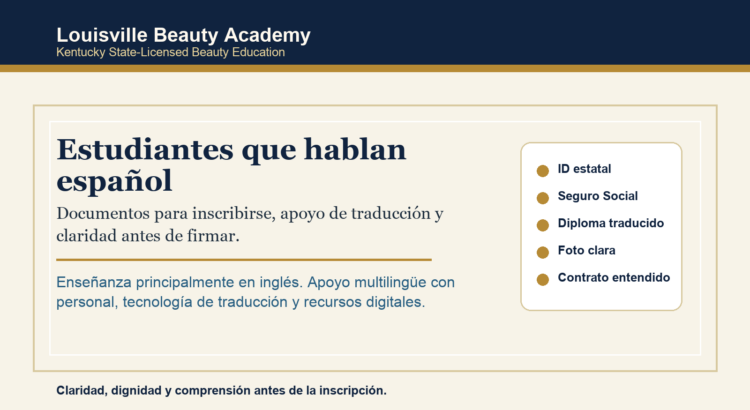
Guía en español para estudiantes y familias. Louisville Beauty Academy recibe constantemente preguntas como: “¿Enseñan en español?” y “¿Qué necesito para inscribirme?” Esta página reúne la respuesta en un solo lugar claro, respetuoso y fácil de compartir.
Louisville Beauty Academy es una escuela de belleza con licencia del estado de Kentucky. Nuestro objetivo es ayudar al estudiante a entender el camino antes de firmar: documentos, idioma, contrato, costo, reglas de asistencia, preparación para licencia y próximos pasos.
Louisville Beauty Academy
Eliminando barreras de idioma. Expandiendo oportunidades. Fortaleciendo la fuerza laboral de Kentucky.
Este centro de recursos en español existe para que estudiantes y familias puedan revisar documentos, idioma, contrato, costo, identificación y próximos pasos con dignidad antes de tomar una decisión educativa.
Por qué existe esta página
El idioma nunca debe ser una barrera para entender el camino hacia una profesión con licencia.
Louisville Beauty Academy cree que cada estudiante merece información clara antes de tomar una decisión educativa. Esta página en español reúne orientación de inscripción, documentos, apoyo de traducción y enlaces oficiales para ayudar al estudiante y a su familia a entender sus derechos, responsabilidades, costo, contrato y camino educativo con más confianza.
Nuestro compromiso a largo plazo
Durante años, Louisville Beauty Academy ha apoyado el acceso multilingüe a la educación de belleza, la preparación profesional y la comunicación clara para comunidades inmigrantes y familias trabajadoras. Junto con educadores, líderes comunitarios, organizaciones de apoyo, reguladores y socios de fuerza laboral, LBA continúa defendiendo una idea sencilla: el estudiante debe poder entender antes de firmar, pagar o comprometerse.
Cuando los proveedores oficiales de examen, las reglas estatales o los recursos digitales ofrecen opciones de idioma, el estudiante debe confirmar la disponibilidad actual directamente con la fuente oficial correspondiente. LBA puede ayudar a orientar la conversación, pero los requisitos oficiales, documentos firmados, reglas de la escuela, Kentucky Board of Cosmetology, PSI cuando aplica, y la ley vigente controlan.
Por qué importa
Reduce la confusión antes de la inscripción.
Ayuda a estudiantes y familias a revisar documentos con calma.
Fortalece la seguridad pública porque el estudiante entiende mejor reglas, sanidad, asistencia y responsabilidades.
Apoya a familias inmigrantes y comunidades multilingües.
Ayuda a formar futuros profesionales, emprendedores y pequeños negocios.
Promueve oportunidad económica con educación práctica, accesible y enfocada en el trabajo real.
Nuestros principios
Documentación antes de promesas.
Transparencia antes de inscripción.
Cumplimiento antes de conveniencia.
Dignidad humana antes de transacciones.
Educación antes de ventas.
Confianza e impacto
Louisville Beauty Academy ha servido a una comunidad amplia de estudiantes, graduados, familias y futuros profesionales de belleza en Kentucky. Creemos que el desarrollo de la fuerza laboral funciona mejor cuando la educación es clara, asequible, multilingüe cuando es posible, enfocada en documentos escritos y centrada en oportunidad económica a largo plazo en lugar de deuda innecesaria.
Aviso sobre traducciones
Las traducciones y explicaciones se ofrecen para mejorar el acceso y la comprensión. Cuando la ley, la regulación, el contrato firmado o una fuente oficial requiera una versión específica, la versión oficial aplicable controla. Si una parte no está clara, el estudiante debe pedir explicación antes de firmar o depender de esa información.
Nuestra misión
Nuestra misión va más allá de la inscripción. Existimos para reducir barreras, ampliar oportunidades, fortalecer la fuerza laboral de Kentucky y ayudar a cada estudiante serio a construir una carrera, apoyar a su familia y servir a la comunidad con dignidad.
Resumen corto: LBA enseña principalmente en inglés para todos, pero usa apoyo multilingüe, personal que habla varios idiomas cuando está disponible, Google Translate, tecnología de traducción/IA y contenido digital que el estudiante puede traducir en su navegador. La meta es comunicación clara, no confusión.
Guía rápida en español: documentos, idioma y contrato antes de inscribirse en Louisville Beauty Academy.
¿Louisville Beauty Academy enseña en español?
La respuesta honesta es: la enseñanza principal es en inglés, porque el camino escolar, los documentos, la seguridad, la sanidad, la preparación para licencia y muchos materiales oficiales operan principalmente en inglés.
Al mismo tiempo, LBA apoya a estudiantes que hablan español y otros idiomas. En la práctica, muchas veces hay más de tres idiomas presentes en la escuela. LBA puede usar conversación bilingüe cuando el personal apropiado está disponible, Google Translate, herramientas de traducción con IA y recursos digitales que pueden traducirse con navegadores modernos.
La tecnología ayuda a comunicar. No reemplaza al instructor, al contrato firmado, a las reglas actuales de la escuela, a los requisitos oficiales del Kentucky Board of Cosmetology, a PSI cuando aplica, ni a la ley aplicable.
Qué documentos debe preparar un estudiante
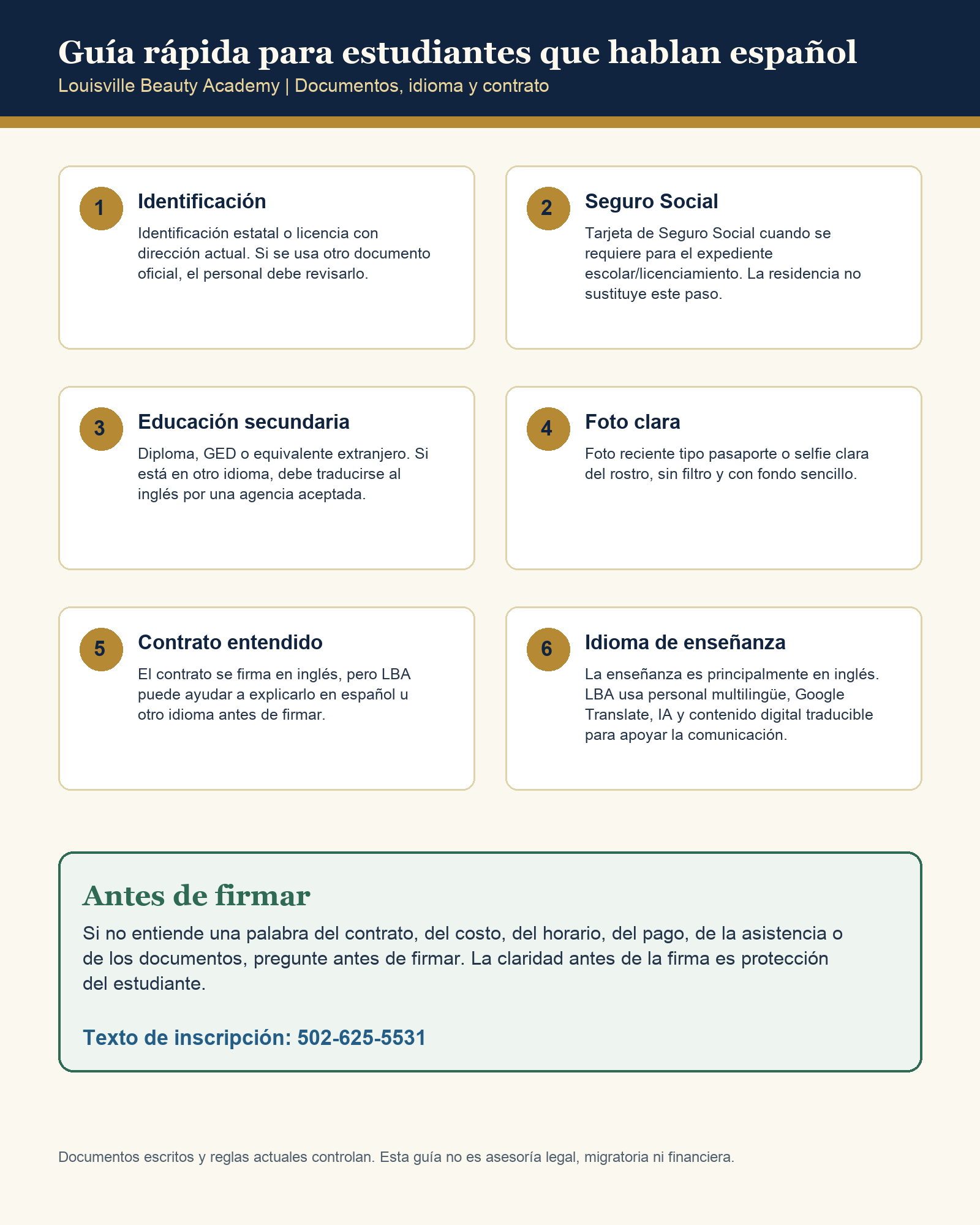
Para evitar mensajes repetidos y confusión, esta es la lista práctica que un estudiante debe revisar con LBA antes de inscribirse. El personal de LBA debe confirmar la lista actual para cada estudiante y programa.
Identificación estatal o licencia de conducir vigente, idealmente con la dirección actual. La dirección ayuda al expediente escolar y a la comunicación correcta.
Tarjeta de Seguro Social cuando se requiere para el expediente escolar/licenciamiento. Para esta ruta de inscripción, una tarjeta de residencia no reemplaza automáticamente la tarjeta de Seguro Social ni la identificación estatal.
Diploma de high school, GED o equivalente aceptado. Si el diploma o certificado extranjero está en otro idioma, debe traducirse al inglés por una agencia aceptada. Confirme con LBA antes de pagar una traducción.
Foto clara tipo pasaporte o selfie reciente del rostro, sin filtro, con fondo sencillo, cuando se solicita para el expediente.
Información de contacto actual: nombre legal correcto, teléfono, correo electrónico y dirección.
Tiempo para revisar el contrato estudiantil antes de firmar. Si no entiende una parte, pregunte primero.
Diploma extranjero y traducción
Muchos estudiantes traen diplomas o documentos escolares de otro país. Eso puede ser normal. Lo importante es que el documento pueda ser revisado de forma clara. Si está en español u otro idioma, normalmente se necesita una traducción al inglés por una agencia aceptada para que el expediente sea comprensible.
Algunas organizaciones comunitarias, como Catholic Charities u otras agencias de traducción reconocidas, pueden ser recursos útiles. Pero el estudiante debe confirmar con LBA qué tipo de traducción se acepta antes de gastar dinero o asumir que una traducción específica será suficiente.
Contrato estudiantil: se firma en inglés, pero debe entenderse
El contrato estudiantil y los documentos oficiales de inscripción pueden estar en inglés. Eso no significa que el estudiante deba firmar sin entender. LBA puede ayudar a explicar el contenido en español u otro idioma usando apoyo humano y tecnología de traducción cuando sea necesario.
La regla ética es sencilla: si el estudiante no entiende el costo, el horario, la asistencia, el pago, la política de retiro, la responsabilidad del estudiante o el camino hacia la licencia, debe preguntar antes de firmar.
La traducción ayuda a entender. Los documentos actuales firmados, las políticas escolares actuales, los requisitos oficiales del Kentucky Board of Cosmetology, PSI cuando aplica y la ley aplicable controlan. Esta página no es asesoría legal, migratoria, financiera ni de licenciamiento.
Por qué pedimos identificación estatal y Seguro Social
La identificación estatal o licencia con dirección actual ayuda a mantener un expediente claro y una comunicación correcta. La tarjeta de Seguro Social puede ser necesaria para el expediente escolar/licenciamiento cuando corresponda.
LBA no es una agencia de inmigración. No damos asesoría migratoria. Para la inscripción escolar, el estudiante debe enfocarse en los documentos que la escuela y el proceso estatal necesitan revisar: identificación, Seguro Social cuando se requiere, prueba de educación secundaria, foto clara, contrato y datos de contacto correctos.
Enlaces oficiales de LBA para estudiantes que hablan español
Use estos enlaces para revisar la información actual y compartirla con la familia antes de tomar una decisión.
Usted puede hacer preguntas en español. Puede pedir explicación. Puede usar traducción. Puede leer con su familia. Puede revisar los documentos antes de firmar. Un estudiante serio merece claridad.
Louisville Beauty Academy tiene licencia del estado de Kentucky y está regulada por la Kentucky Board of Cosmetology. LBA no está acreditada por una agencia de acreditación reconocida a nivel federal y no procesa FAFSA ni ayuda federal (Título IV). Es una decisión deliberada: operar fuera del sistema federal elimina costos administrativos considerables, lo cual se refleja en los precios publicados abiertamente en este sitio.
Patrocinadores, empleadores, organizaciones sin fines de lucro y programas laborales pueden apoyar al estudiante. Los pagos se aplican a la cuenta del estudiante, el estudiante sigue siendo la persona responsable según el contrato firmado, y el estudiante completa cualquier trámite del patrocinador. Antes de inscribirse o pedir un préstamo en cualquier escuela, le recomendamos revisar la información oficial federal en College Scorecard y studentaid.gov. No hacemos ninguna declaración sobre otras instituciones.
English (controlling version): Louisville Beauty Academy is licensed by the Commonwealth of Kentucky and regulated by the Kentucky Board of Cosmetology. LBA is not institutionally accredited by a federally recognized accrediting agency and does not process FAFSA or Title IV federal student aid. This is a deliberate choice; operating outside the federal aid system removes substantial administrative cost, which is reflected in the program pricing published on this website. Sponsors, employers, nonprofits, and workforce programs may support a student; payments are applied to the student’s account, the student remains the responsible party under the signed agreement, and the student completes any sponsor paperwork. Before enrolling or borrowing at any school, please review official federal information at College Scorecard and studentaid.gov. We make no statement about any other institution. Accreditation status, tuition, and payment terms are described in current written school documents and may change; the current signed student agreement, Kentucky Board of Cosmetology requirements, and applicable law control. Nothing here is legal, financial, or licensing advice.
By Louisville Beauty Academy Educational Article | Workforce Awareness Series 2026
Editorial Attribution & Research Credit
This article is published by Louisville Beauty Academy with full gratitude and acknowledgment to the research, analysis, writing, and editorial work of the Di Tran University – College of Humanization Research Team. The underlying workforce research, economic analysis, policy review, and human-centered framework that informed this educational article originate from the independent research and public scholarship of Di Tran University’s College of Humanization. Louisville Beauty Academy shares this article to help educate students, families, career changers, educators, employers, and the public on emerging workforce trends and the future of human-centered professions.
Readers interested in the complete research are encouraged to read:
The Great Human Shift: AI, Corporate Layoffs & Why Human-Centered Careers May Be America’s Strongest Future — Research & Podcast Series 2026
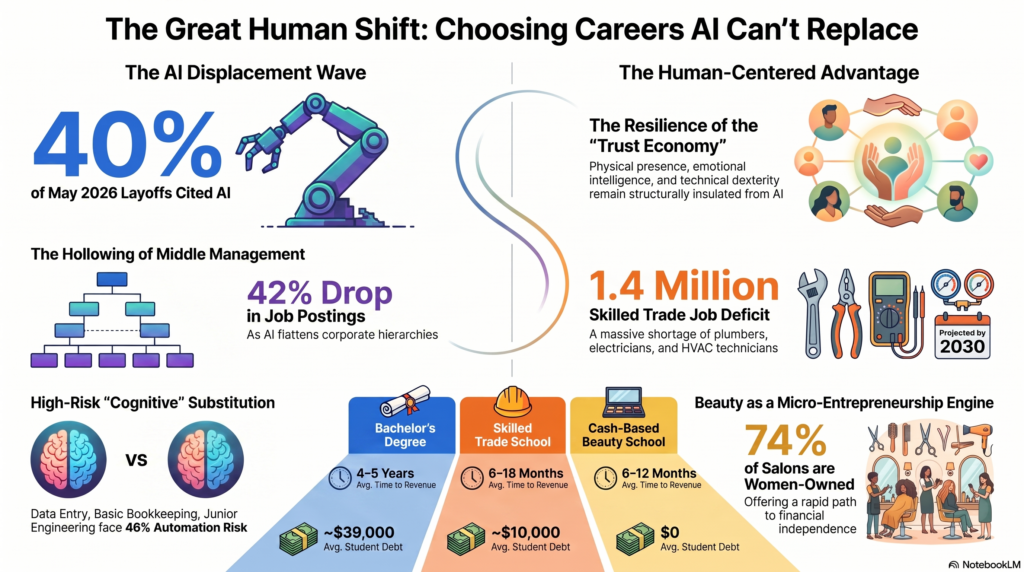
Artificial intelligence is changing the way America works.
Across industries, businesses are adopting AI to automate routine tasks, improve productivity, and reshape how work gets done. Many office-based positions are evolving, some are being redefined, and others are being reduced as organizations rethink traditional corporate structures.
For many people, this creates uncertainty.
For others, it creates an opportunity to ask an important question:
What careers become more valuable when technology becomes more capable?
At Louisville Beauty Academy, we believe this question deserves careful research—not fear, not marketing, and not speculation.
That is why we encourage prospective students, families, educators, and career changers to learn about the broader workforce transformation occurring across the United States.
Human Skills Cannot Be Downloaded
Artificial intelligence can generate text.
It can analyze data.
It can organize schedules.
It can answer emails.
It can even help beauty professionals manage appointments, marketing, inventory, and business operations.
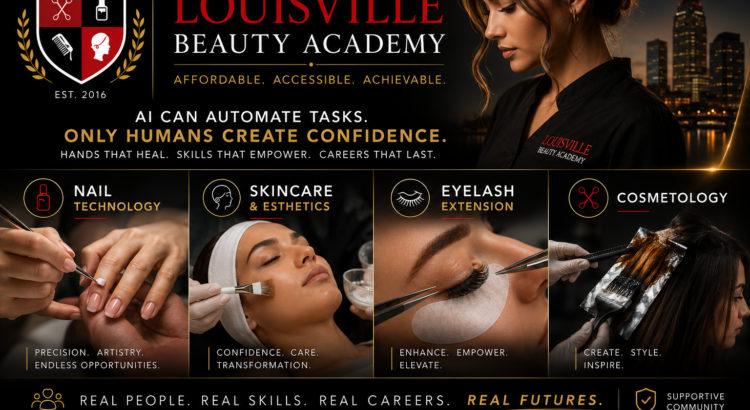
But AI cannot replace what happens when one human serves another with professionalism, trust, safety, compassion, and skilled hands.
A licensed nail technician doesn’t simply polish nails.
They help restore confidence.
An esthetician doesn’t simply perform a facial.
They help clients care for their skin, their well-being, and often their self-esteem.
A cosmetologist doesn’t simply cut hair.
They help people prepare for weddings, interviews, graduations, celebrations, and some of life’s most meaningful moments.
These are deeply human professions.
Technology may support them.
It does not replace them.
Licensed Beauty Professionals Build More Than Beauty
The beauty profession is often misunderstood.
Behind every state license is education in:
Infection control
Sanitation
Public safety
State law and regulations
Professional ethics
Technical skills
Client communication
Business fundamentals
These are licensed professions that protect the public while creating opportunities for meaningful careers and entrepreneurship.
Many professionals eventually become:
Salon owners
Independent suite renters
Educators
Product specialists
Brand ambassadors
Small business owners
Community leaders
A license is not simply permission to work.
For many, it becomes the foundation for building a business and serving a community.
Affordable Education Matters
Choosing a school is one of the most important financial decisions a student will make.
At Louisville Beauty Academy, we believe prospective students should compare:
Tuition
Program length
Written payment options
Licensing preparation
Student support
Schedule flexibility
Graduation requirements
Regulatory compliance
Overall value
We encourage every student to visit multiple schools, ask questions, request everything in writing, and make the decision that best fits their goals, finances, and circumstances.
An informed student is an empowered student.
AI Is a Tool—Not a Replacement for Humanity
Louisville Beauty Academy embraces technology where it improves education and student support.
AI-assisted translation.
Digital documentation.
Administrative efficiency.
Learning support.
Communication.
These tools help students learn more effectively and help educators spend more time teaching people—not paperwork.
Technology should strengthen human education, not replace it.
A Future Built on Service
Throughout history, technology has changed the tools we use.
It has never changed the importance of serving another human being well.
People will continue to seek professionals they trust.
People will continue to value kindness, craftsmanship, communication, and integrity.
People will continue to invest in confidence, wellness, and personal care.
Those are human needs.
And human needs create human careers.
Continue the Research
This article summarizes only part of a much larger workforce discussion.
For readers interested in labor market trends, AI, corporate restructuring, vocational education, entrepreneurship, and the future of human-centered careers, we invite you to read the independent research published by Di Tran University – The College of Humanization:
The Great Human Shift: AI, Corporate Layoffs & Why Human-Centered Careers May Be America’s Strongest Future – Research & Podcast Series 2026
The research examines publicly available information from government agencies, labor economists, academic institutions, and industry sources to explore how artificial intelligence is reshaping work—and why licensed, human-centered professions may become increasingly valuable in the decades ahead.
Our Commitment
At Louisville Beauty Academy, our mission has never been to tell students what career to choose.
Our mission is to provide affordable, accessible, ethical, state-approved education so students can make informed decisions, earn professional licensure, and build meaningful careers through service, skill, and lifelong learning.
Whether you choose Louisville Beauty Academy or another licensed institution, we encourage you to research carefully, compare thoughtfully, and invest in an education that aligns with your goals.
Because while technology will continue to evolve, one truth remains:
Human hands build trust. Human service builds communities. Human character builds careers.
Educational Disclaimer
This article is provided for educational and informational purposes only. It should not be interpreted as career, financial, legal, or employment advice. Labor market conditions change over time, and career outcomes vary by individual, region, experience, effort, and economic conditions. Louisville Beauty Academy encourages prospective students to conduct independent research, review official labor market information, compare educational institutions, and make informed decisions based on their own goals and circumstances. References to the independent research published by Di Tran University are provided to encourage continued learning and public discussion about workforce trends in the age of artificial intelligence.
A Multidisciplinary Research Report by Di Tran University – The College of Humanization
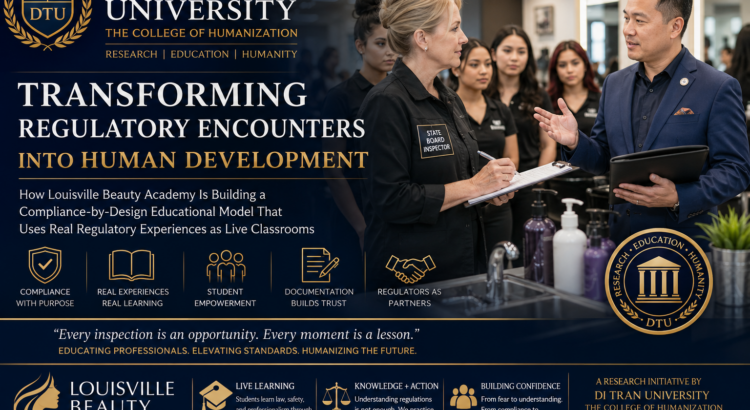
Louisville Beauty Academy is honored to share this Di Tran University research publication, where LBA is presented as an observable case study and pilot environment for Compliance-by-Design education and Regulatory Immersion Learning. All research, analysis, framework development, and publication credit belong to Di Tran University – The College of Humanization Research Team.
The Psychobiological Architecture of Authority, Stress, and Compliance
Neuroendocrine Cascade of the Social-Evaluative Threat
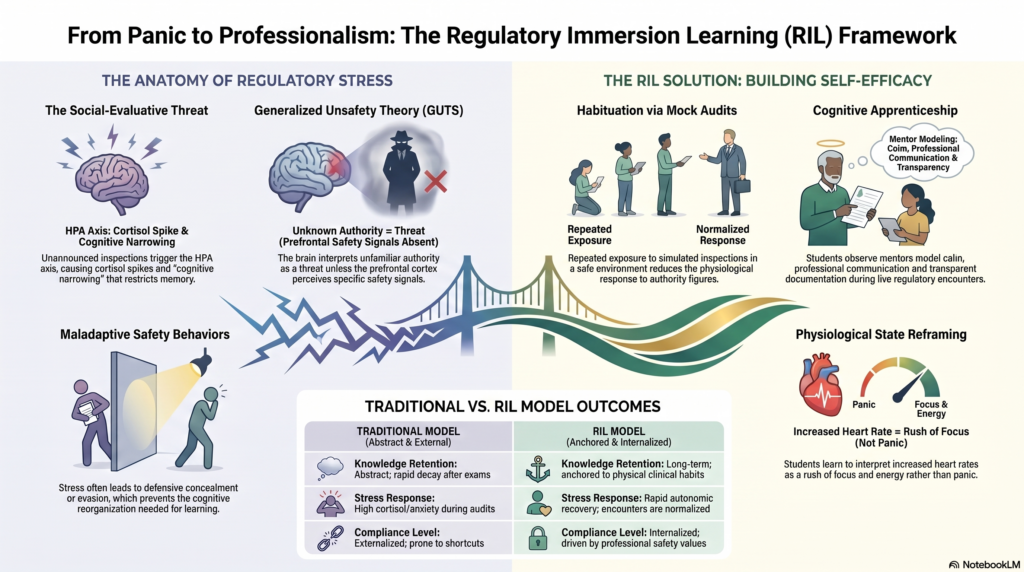
The unannounced arrival of a regulatory enforcement officer within a licensed professional training environment triggers a highly predictable, phylogenetically ancient psychobiological stress response1. In human psychology, the perception of an authority figure armed with the power to penalize, fine, or shut down operations is categorized as a high-stakes social-evaluative threat1. The primary biological mechanism driving this reaction is the rapid activation of the hypothalamic-pituitary-adrenal (HPA) axis and the sympathetic-adrenal-medullary (SAM) system4.
Clinical evaluations using the Trier Social Stress Test (TSST) demonstrate that situations combining social-evaluative threat, uncontrollability, and anticipation consistently produce massive physiological spikes in salivary and blood serum cortisol, alongside rapid elevations in heart rate, blood pressure, and salivary alpha-amylase (sAA)1. This autonomic arousal is accompanied by acute state anxiety, which can be measured clinically via the Generalized Anxiety Disorder 7-item (GAD-7) scale, showing transitions from minimal baseline scores to severe anxiety ranges during active enforcement encounters6.
This systemic response is further illuminated by the Generalized Unsafety Theory of Stress (GUTS), which posits that the physiological stress response is a default state that remains active unless the prefrontal cortex actively perceives specific, reliable signals of safety8. Under the GUTS model, the human brain default-interprets an unfamiliar authority encounter as unsafe8. When an inspector arrives, the absence of an immediate safety context prevents prefrontal-subcortical inhibition, leaving the fight-or-flight default response fully disinhibited8.
This state of generalized unsafety induces cognitive narrowing, wherein the individual’s working memory capacity is severely restricted, limiting their ability to recall complex administrative regulations, access documentation, or communicate professionally8.
Compliance Psychology and Safety Behaviors
To manage this acute discomfort, individuals frequently adopt “safety behaviors”—defined in behavioral psychology as unnecessary, dysfunctional actions taken to prevent, escape from, or reduce the immediate severity of a perceived threat10. In a regulatory enforcement context, safety behaviors manifest as defensive concealment, paper-shuffling, evasion of verbal interaction, or performative compliance designed solely to expedite the inspector’s departure9.
While these behaviors may temporarily alleviate immediate anxiety, they prevent the cognitive reorganization and emotional regulation required for authentic learning10. Instrumental deterrence models of regulation, which rely heavily on punitive sanctions and monitoring, inadvertently reinforce these fear-driven dynamics11. This erodes the regulatee’s intrinsic commitment to professional standards and replaces genuine self-regulation with defensive, risk-avoiding maneuvers11.
Sociocultural and Geographic Dimensions of Government Trust
The baseline psychobiological reaction to regulatory authority is heavily moderated by the cultural, historical, and geographic backgrounds of the individuals undergoing the encounter14. For educational institutions serving diverse student bodies, understanding these nuances is critical to transforming fear into professional agency16.
Comparative Immigrant Perceptions of State Authority
First-generation immigrants often view and experience regulatory bodies through a “dual frame of reference,” evaluating the administrative host environment against the historical performance and corruption levels of their countries of origin17.
The table below provides an analytical comparison of immigrant perceptions of government authority across diverse geopolitical regions of origin:
Region of Origin
Historical / Administrative Context
First-Generation Behavioral Bias
Second-Generation Trust Divergence
United States(Native-Born)
Deep historical values of constitutional due process; moderate institutional trust17.
Relies on procedural safeguards; comfortable requesting legal representation22.
Serves as the baseline standard; highly sensitive to systemic enforcement biases18.
Vietnam
Post-war bureaucratic models; history of centralized control and administrative opacity3.
High outward compliance driven by caution; internal avoidance of state agents3.
Rapid assimilation to US standards; lower tolerance for arbitrary state actions17.
China
Authoritarian administrative state; legacy of pervasive civil and commercial surveillance17.
Severe risk aversion; immediate compliance with state demands to avoid scrutiny17.
Internalizes host-country legal standards; increasingly willing to challenge rules18.
India
Heavily bureaucratic administrative structures; legacy of colonial civil service hierarchies14.
High reliance on credentials and written stamps; comfortable with slow processes14.
Expects rapid, digitized public services; dismissive of archaic paper procedures18.
Africa
Post-colonial instability; history of militarized enforcement in specific regions14.
Acute fear of uniforms and unexpected visits; trauma reactions to unannounced audits16.
Reappraises regulatory bodies through localized socioeconomic and racial lenses18.
Latin America
History of structural corruption, arbitrary enforcement, and police-ICE data integration24.
Pervasive fear that sharing professional data will lead to deportation or profiling24.
Demands structural reform; highly active in labor and civic organizing25.
Eastern Europe
Post-Soviet transitional states; legacy of state-directed commercial and political surveillance17.
Systemic cynicism toward inspectors; expectation that audits require informal resolution17.
Expects absolute institutional transparency and digital accountability18.
High anxiety during unannounced audits; fear of administrative profiling18.
Active pushback against structural bias; values-driven engagement with laws18.
This cross-regional analysis demonstrates that immigrant students do not represent a homogenous group25. First-generation immigrants often exhibit “over-confidence” in host institutions early in their residency because they compare them to low-performing home-country institutions17. However, this trust quickly degrades due to acculturative stress, linguistic barriers, and fear of data-sharing between local licensing boards and federal immigration enforcement agencies26. This makes unannounced inspections a potential source of acute trauma24.
Geographic Realities of Rural Communities and Centralized Regulation
In rural areas such as Central Appalachia, the Midwest, and the deep South, the relationship with regulatory agencies is shaped by geographic distance and historical neglect29.
The table below contrasts geographic and cultural interactions with regulators across specific rural landscapes:
Rural Region
Geographic & Infrastructure Reality
Cultural & Historical Context
Dynamic with Regulatory Authorities
Kentucky(General Rural)
High distance from state agencies; limited transit; low local budgets31.
Deep emphasis on local self-reliance and regional independence31.
Skepticism of centralized state rules; preference for relational enforcement32.
Appalachia(Central/Eastern)
Severe geographic isolation; systemic neglect of public water/utility infrastructure30.
Generational trauma from corporate “company towns” and corrupt local police15.
Deeply entrenched moral distrust of state agents; views audits as economic extraction15.
Midwest(Agricultural Belt)
Vast distances between county seats; heavy reliance on USDA/state agency programs29.
Strong family-farm heritage; high valuation of property rights and local governance15.
Respects agricultural standards but resists environmental or labor-related mandates15.
Southern States(Rural Lowlands)
Remote county clinics; low density of administrative oversight32.
Historically conservative states-rights views; reliance on religious and civic networks15.
Suspicion of federal or urban-directed rules; strong reliance on informal compliance32.
In former coal-mining regions of Appalachia and the Midwest, trust in local and state government is distinctively low15. Decades of political neglect have created “geographies of alienation,” where residents avoid municipal systems (such as drinking untreated spring water instead of tap water) because they do not trust the state to protect them33. Consequently, unexpected inspections are frequently perceived as intrusive state targeting, causing rural practitioners to react with defensive avoidance or relational hostility15.
Behavioral Psychology of Normalization, Exposure, and Self-Efficacy
To transform these deeply ingrained stress responses, professional training programs can implement behavioral models designed to transition students from fear to competence38.
In clinical behavioral psychology, exposure therapy is established as a highly effective model for treating anxiety and avoidance behaviors10. The neurological engine driving exposure therapy is habituation: the gradual diminution of a physiological response to a stimulus when that stimulus is repeatedly presented in a safe, non-punitive environment10.
By systematically exposing students to simulated audits, peer reviews, and unannounced mock inspections, educators can guide them to correct their threat expectations10. The brain learns that the regulator’s presence does not inevitably lead to administrative punishment or economic ruin, allowing the sympathetic nervous system to return to baseline levels during active inspections10.
Cultivating Self-Efficacy Through Albert Bandura’s Social Learning Theory
According to Albert Bandura’s social cognitive theory, self-efficacy—the belief in one’s capability to execute courses of action required to manage prospective situations—is the primary determinant of behavioral adaptation under stress38. Bandura posits that self-efficacy is constructed through four distinct channels:
Mastery Experiences: Engaging in hands-on, successful compliance actions, such as maintaining accurate biometric and manual attendance logs daily38.
Vicarious Experiences (Learning by Observation): Watching clinical mentors and educators interact calmly, transparently, and professionally with state board inspectors23.
Verbal Persuasion: Receiving realistic, constructive feedback from instructors during mock audits, which reinforces the student’s compliance capabilities38.
Physiological State Reframing: Learning to interpret physical responses (e.g., increased heart rate) not as a signal of panic, but as a helpful rush of focus and energy4.
By structuring the educational environment so that students repeatedly witness and participate in compliant, procedurally fair interactions with regulators, schools can build a sense of professional agency and psychological safety22. Over time, this shifts the student’s posture from fear-based avoidance to confident, values-aligned self-regulation11.
The Historical Precedent of Experiential and Situated Pedagogy
The integration of real-world compliance activities into vocational curricula is supported by a rich history of experiential and situated educational models39.
Progressive Education and Experiential Learning
John Dewey’s progressive educational philosophy rejected the traditional model of treating students as passive vessels for lecture-based memorization39. Dewey argued that genuine education occurs through active, real-world experiences where students solve problems within their social and physical environments39. This philosophy was formalized by David Kolb into his Experiential Learning Model, which maps a continuous, four-stage learning cycle:
┌────────────────────────────────────────┐ │ Concrete Experience │ │ (Observing/conducting live audit) │ └───────────────────┬────────────────────┘ │ ▼ ┌────────────────────────────────────────┐ │ Reflective Observation │ │ (Deconstructing the audit via an AAR) │ └───────────────────┬────────────────────┘ │ ▼ ┌────────────────────────────────────────┐ │ Abstract Conceptualization │ │ (Mapping experience to administrative)│ │ ( statutes and regulations )│ └───────────────────┬────────────────────┘ │ ▼ ┌────────────────────────────────────────┐ │ Active Experimentation │ │ (Applying corrective actions in clinic)│ └────────────────────────────────────────┘
By anchoring learning in the concrete experience of a regulatory encounter, RIL ensures that abstract administrative laws (such as KRS 317A or 201 KAR 12) are permanently integrated into the student’s daily physical habits39.
Situated Cognition and Communities of Practice
Jean Lave and Etienne Wenger’s situated learning theory suggests that learning is a process of socialization into a distinct “community of practice”49. Novices enter at the periphery of the community, performing simple, low-risk tasks49. As they acquire the language, tools, and social norms of the profession, they move toward full participation49.
When a student participates in a live regulatory encounter alongside an experienced mentor, they are undergoing cognitive apprenticeship46. The instructor makes their clinical reasoning visible, scaffolding the student’s participation until they can confidently manage compliance tasks independently40.
Operational Precedents: Toyota Production System and After Action Reviews
The business and military sectors provide highly structured frameworks for integrating real-world practice with continuous optimization:
The Toyota Production System (TPS): Built on the twin pillars of Just-in-Time and Jidoka (automation with a human touch), TPS empowers front-line workers to stop the production line immediately upon detecting an abnormality53. By combining human craftsmanship with technological controls, TPS builds a culture of continuous incremental improvement (Kaizen)53. Every error is treated not as a cause for blame, but as a valuable opportunity to optimize standard work55.
The military After Action Review (AAR): Developed by the United States Army in the 1970s, the AAR is a structured, post-training debrief where leaders and soldiers systematically analyze what was planned, what actually occurred, why it occurred, and how the unit can adapt for future success57. The AAR focuses on accountability going forward, creating an organizational culture built on transparency, candor, and continuous collective learning59.
Multi-Industry Regulatory Normalization and Comparative Matrix
High-risk, highly regulated industries have long recognized that separating compliance activities from active training increases operational risk and anxiety61.
The matrix below compares regulatory normalization practices across 18 distinct fields of professional and vocational practice:
Fire run sheets; equipment maintenance tracking logs.
Across these industries, incorporating audits into active training reduces operational anxiety and builds self-efficacy44. When compliance is integrated directly into standard training protocols, professionals view inspections not as a stressful external threat, but as a normal and valuable quality-assurance process43.
The Mechanics of Complaint Systems and Ethical Responses
A common source of regulatory friction is the administrative complaint system, which is designed to protect consumer safety but is often vulnerable to misuse3.
Administrative complaints are filed by distinct stakeholders, including:
Consumers: Reporting actual or perceived harm, poor results, or sanitation violations64.
Employees: Reporting labor disputes, safety issues, or non-compliant school practices66.
Competitors (Competitive Harassment): Weaponizing administrative boards to drain the financial and emotional resources of business rivals3.
Anonymous Sources: Initiated to trigger a surprise investigation without facing cross-examination, which is why some state boards legally require signed writings to prevent harassment3.
Substantiation Rates
Federal regulatory databases show that only about 19% of investigated administrative complaints result in a formal deficiency citation66. Conversely, within highly structured, internal corporate complaint hotlines, substantiation rates reach approximately 53% for identified reporters and 47% for anonymous filings70. This gap suggests that many external administrative complaints are unsubstantiated or driven by non-compliance factors, such as competitor harassment or civil disputes3.
Ethical Response Protocols and Procedural Safeguards
Under administrative law systems (such as 201 KAR 12:190 in Kentucky), licensees have clear due process rights when responding to complaints:
The Written Notice Mandate: Regulatory enforcement cannot be based on verbal directives or informal instructions69. The licensee is entitled to a formal, signed written complaint detailing the exact statutes violated and the factual allegations69.
The Response Period: Licensees are provided a statutory response window (typically 10 to 30 days) to submit a formal, written explanation or correction before disciplinary hearings begin69.
The Right to Cure: Under modern progressive regulation statutes, Alternative Compliance Pathways allow licensees to resolve non-safety record-keeping issues through 30-day “Correction Orders” without facing immediate fines or license suspension3.
Sovereign Immunity and Nullity: If an administrative board issues an enforcement order without adhering to statutory procedures (such as failing to provide written notice or utilizing unlicensed proctors), the resulting order may be declared void ab initio (invalid from the inception)3. This status legally entitles the licensee to a full refund of any fines paid under the voided order3.
Case Study: Louisville Beauty Academy’s Compliance-by-Design Model
Louisville Beauty Academy (LBA), an immigrant-led beauty college based in Louisville, Kentucky, serves as an active case study for integrating regulatory compliance into vocational education16.
Operational and Compliance Architecture
Led by founder Di Tran, LBA operates under the authority of the Kentucky Board of Cosmetology (KBC), offering state-licensed courses in Cosmetology (1,500 hours), Esthetics (750 hours), and Nail Technology (450 hours)45.
To protect student hours and build regulatory trust, LBA maintains a robust compliance infrastructure:
Dual attendance tracking: Under 201 KAR 12:082 § 3(1), LBA maintains both a digital biometric fingerprint timekeeping system and manual paper sign-in sheets at all times45. This dual-verification ensures complete data redundancy and absolute tracking integrity45.
Instructional hour caps: In compliance with 201 KAR 12:082 § 4(4), LBA strictly caps credited instruction at 8 hours per day and 40 hours per week45. Any additional hours are logged transparently but remain uncredited, serving as evidence of voluntary study45.
Instruction over commerce: Under KRS 317A.130(1), LBA operates solely for education, focusing on mannequin-based skill mastery45. Public model practice is voluntary, ensuring that student clinics are not used as commercial revenue drivers45.
Operational Strengths and Systemic Vulnerabilities
An objective evaluation of LBA’s model reveals both unique strengths and significant operational vulnerabilities:
Unique Strengths
Superior Traceability and Integrity: The dual attendance system virtually eliminates timecard manipulation, creating a highly reliable administrative record45.
Financial and Regulatory Insulation: By operating as a state-licensed, non-accredited institution with a pay-as-you-go payment model, LBA avoids federal student loan programs72. This structural insulation protects the school from federal gainful employment metrics that undercount actual beauty industry earnings72.
Multilingual Inclusivity: Offering instruction and study materials in English, Vietnamese, and Spanish reduces barriers for underserved, low-income, and immigrant student groups16.
Systemic Vulnerabilities
High Adversarial Tension with Regulators: LBA’s public records reveal a highly defensive relationship with the KBC3. Allegations concerning “targeted hyper-fining” against minority salons, “shadow testing,” procurement fraud, and immediate-closure orders under SB 22 suggest deep operational friction with the state board3.
Risk of Student Stress Transfer: While LBA’s “Gold Standard Guide” aims to reduce fear, exposing students to active, legalistic confrontations (such as utilizing a 30-to-60 minute verification pause or video recording inspectors) may inadvertently heighten student anxiety23. For students who have experienced historical government trauma, observing intense institutional battles may trigger, rather than reduce, autonomic distress8.
Resource-Intensive Over-Compliance: Maintaining dual records, AI-driven compliance checks, and constant legal reviews increases administrative costs72. This structural burden is difficult for average-sized vocational schools to sustain without a highly efficient tuition and funding model72.
Important Policy Analysis: The Power of Administrative Records
In public administration and corporate risk management, written records are the primary tool for establishing organizational accountability and protecting constitutional rights9.
The Psychology of Written Correspondence
In high-stress regulatory environments, relying on verbal agreements or informal warnings increases ambiguity and risk3. The “verbal warning trap” occurs when an inspector issues an informal directive that is not backed by a written citation3. The business owner may attempt to comply with the verbal instruction, only to face a formal penalty later for non-compliance with a different, unwritten interpretation of the rule3.
Documenting every interaction through time-stamped, written correspondence provides critical protections:
Establishes Institutional Memory: Shifting knowledge from individual memory to structured, digital records reduces reliance on specific personnel and supports continuous improvement9.
Creates a Legal Audit Trail: In administrative hearings, undocumented actions are legally presumed not to have occurred63. A clear written record of compliance activities provides defensive protection63.
Protects Due Process: Requiring all instructions and findings to be delivered in writing ensures that administrative decisions are objective, consistent, and legally reviewable23.
Post-Inspection Factual Correspondence Policy
A robust risk management strategy includes sending a factual, professional follow-up email immediately after an inspection74. This correspondence does not concede violations or express defensiveness23. Instead, it establishes an objective, written record of what occurred during the encounter23.
This practice aligns with modern administrative guidelines (such as KRS 13B in Kentucky), which entitle parties to written clarification of all rulings and instructions23.
The Regulatory Immersion Learning (RIL) Educational Framework
To systematically integrate regulatory compliance into professional education, institutions can transition from traditional, classroom-bound models to the Regulatory Immersion Learning (RIL) framework39.
Performance and Psychobiological Outcomes Comparison
The table below contrasts the educational and psychological outcomes of traditional lecture models with the live-immersion RIL framework:
Measurement Parameter
Traditional Classroom Model
Regulatory Immersion Learning (RIL) Model
Knowledge Retention
Abstract, rapid decay after passing written examinations72.
Long-term retention; rules are anchored to physical, memorable clinical actions50.
Confidence & Self-Efficacy
Low; students feel unprepared for unannounced, high-stakes state audits38.
High; repetitive mock audits and guided exposure build professional agency38.
Professional Readiness
Focuses on textbook compliance; leaves students vulnerable to performative rules45.
Instills continuous, standard compliance habits; students are prepared for day-one practice2.
Critical Thinking
Limited to linear, written test-prep scenarios40.
High; students dynamically assess real-world hazards and procedural rules46.
Stress Reduction
High baseline cortisol and anxiety during active enforcement encounters4.
Rapid autonomic recovery; regulatory encounters are normalized and expected10.
Long-Term Compliance
Performs under external pressure; prone to shortcuts in private salons11.
Self-regulatory compliance driven by internalized professional and safety values11.
Limits and Required Empirical Evidence for Broader Adoption
While the RIL model is conceptually sound, its widespread implementation is limited by several factors:
Inspector Resistance: Some state inspectors may view recording, active questioning, or requests for written instructions as administrative resistance, which could increase regulatory tension23.
Resource Constraints: Managing dual-tracking systems, executing weekly mock audits, and maintaining digital compliance platforms require significant administrative time and investment45.
Trauma-Sensitivity Risks: For students who have experienced historical government trauma, sudden exposure to active regulatory disputes—even with mentors—could trigger survival responses that hinder learning24.
To support broader adoption of the RIL model, empirical research should focus on the following:
Objective stress-marker evaluations: Measuring salivary cortisol and heart-rate variability (HRV) in students during mock and real audits to confirm systemic desensitization4.
Longitudinal compliance tracking: Monitoring graduates’ compliance and citation rates over their first five years in business77.
Linguistic and accessibility studies: Measuring compliance learning speeds in multilingual classrooms when legal statutes are paired with visual, AI-supported tools78.
Practical Institutional Blueprints and Curricular Deliverables
To transition the theoretical RIL framework into an operational model, schools can implement the following curricula, standard operating procedures, and professional communication templates.
================================================================================= COURSE CODE: RIL-101 TITLE: REGULATORY LAW, INFECTION CONTROL, AND ADMINISTRATIVE SAFETY IN CLINIC ================================================================================= WEEK 1: INTRODUCTION TO STATE ADMINISTRATIVE LAW & EXECUTIVE ETHICS – Coursework: KRS Chapter 317A, KRS Chapter 11A, and 201 KAR 12:082 [cite: 51, 72]. – Practical: Biometric timekeeping orientation; signature sheet verification. – Exercise: Reconstructing a timecard error; drafting an administrative correction log.
WEEK 2: DISINFECTION CHEMISTRY & PUBLIC HEALTH PRINCIPLES – Coursework: OSHA Hazard Communication Standard; Safety Data Sheet (SDS) interpretation. – Practical: Mixing chemical solutions according to manufacturer instructions. – Exercise: Mock chemical spill drill; evaluating workstation contact times [cite: 39, 80].
WEEK 3: DECONSTRUCTING THE SOCIAL-EVALUATIVE THREAT – Coursework: Human physiology of stress; the HPA axis and cortisol spikes. – Practical: Controlled deep-breathing drills; mental toughness and stress-reframing. – Exercise: Simulated unannounced instructor-led safety sweeps under pressure.
WEEK 4: THE PSYCHOLOGY OF DOCUMENTATION AND TRACEABILITY – Coursework: Why undocumented procedures fail; technical communication standards [cite: 9, 63]. – Practical: Operating daily sanitation logs; validating inventory tracking systems [cite: 44]. – Exercise: Structured peer reviews of workstation compliance documentation.
WEEKS 5-8: COGNITIVE APPRENTICESHIP IMMERSION (CLINIC ENCOUNTERS) – Coursework: Jean Lave’s situated cognition; the six dimensions of CAM [cite: 40, 46, 49]. – Practical: Observing instructors model compliance during simulated audits [cite: 23, 52]. – Exercise: Roleplaying as inspector, manager, and student; modeling verbal etiquette scripts.
WEEKS 9-12: PEER-AUDITING SYSTEMS & KAIZEN LABS – Coursework: Lean manufacturing and the Toyota Production System; Kaizen theory [cite: 53, 81]. – Practical: Conducting weekly mock inspections on other student workstations. – Exercise: Mock “tracer surveys” using Joint Commission methods.
WEEKS 13-15: STRUCTURAL COMPLAINT SIMULATIONS – Coursework: Understating complaint systems; due process and rights to respond [cite: 66, 69]. – Practical: Responding to simulated consumer complaints using factual, written logs. – Exercise: Draft responses to KBC-style complaints under 201 KAR 12:190.
WEEK 16: CAPSTONE EXPERIENTIAL ASSESSMENT & AFTER ACTION REVIEWS – Coursework: Continuous improvement and post-audit learning loops [cite: 57, 60, 82]. – Practical: Conducting a complete After Action Review (AAR) of the course’s mock audits [cite: 57, 59]. – Exercise: Final practical examination; managing a surprise, unannounced mock inspection. =================================================================================
Faculty Guide: Step-by-Step Instructional SOP for Live Audits
================================================================================= SOP NUMBER: RIL-INST-04 TITLE: MANAGING LIVE REGULATORY ENCOUNTERS AS INSTRUCTIONAL CLASSROOMS ================================================================================= 1. OBJECTIVE: To ensure that when a state regulatory inspector arrives, faculty members remain calm, protect due process rights, and actively use the encounter as a live learning experience for observing students.
2. PREPARATION: Keep a laminated copy of the LBA “Inspection Transparency & Verification Rights Notice” at the front desk and at all active instruction areas.
3. WHEN THE INSPECTOR ARRIVES: A. STEP 1: INITIAL RECEPTION – Welcome the inspector politely and professionally. – Do NOT halt active classroom instruction or panic [cite: 23, 83]. – Hand the inspector a copy of the LBA Transparency Notice.
B. STEP 2: VERBAL PROTOCOL (SAY ALOUD) “Good morning! We welcome your visit and appreciate your work. We just follow a standard compliance process to make sure everything is accurate and fair. Here’s our Inspection Transparency & Verification Rights Notice. It simply explains that under Kentucky law, we’re allowed to take about 30 to 60 minutes to review any request or rule, record the visit for documentation, and verify things with our compliance team before we respond or sign anything. This helps us stay consistent with KRS 13B and 317A — and it keeps everything transparent for both sides. We’ll cooperate fully — we just want to make sure everything we do is right by the law and clear for our records. Thank you!”
C. STEP 3: STUDENT POSITIONING – Direct students working in the immediate area to pause and observe. – Quietly explain the inspector’s actions to nearby students (e.g., “The inspector is verifying that all student licenses are posted at active workstations according to KBC regulations”) [cite: 23, 51, 71].
D. STEP 4: RECORDING & DOCUMENTATION – Activate a clean, high-definition digital recording device. – Explicitly reference Kentucky’s one-party consent statute (KRS 526.020) and the school’s educational duty under KRS 317A.130(1)(f). – If an inspector makes an observation or deficiency claim, request that they reduce the instruction or legal citation to writing.
E. STEP 5: DECONSTRUCTION DEBRIEF – Once the inspector departs, call an immediate 15-minute student assembly. – Conduct a mini After Action Review (AAR) to analyze what went well, what went less well, and how the school will adapt [cite: 57, 60, 80]. =================================================================================
Student Handbook Addendum: Safety & Regulatory Rights Notice
================================================================================= SECTION 8.4: YOUR COMPLIANCE RESPONSIBILITIES AND DUE PROCESS RIGHTS ================================================================================= As a student training toward state licensure, you are a professional-in-training responsible for protecting public health and safety. Our academy operates under a “Compliance-by-Design” framework, meaning that safety, state law, and regulatory standards are integrated into your daily habits.
YOUR CORE COMPLIANCE RESPONSIBILITIES: 1. DAILY TIMESTAMPS: You must record your attendance using the biometric fingerprint scanner and manual sign-in sheet every time you enter or exit. 2. SANITATION MASTERY: You must maintain a clean, disinfected workstation at all times, following all sanitation procedures under 201 KAR 12 [cite: 39, 51]. 3. FACTUAL ACCOUNTABILITY: You are training to understand that your progress logs and clinic hours represent legally binding evidence submitted to the state.
YOUR CONSTITUTIONAL AND ADMINISTRATIVE RIGHTS DURING INSPECTIONS: 1. THE RIGHT TO A CALM RESPONSE: You are never required to panic or rush when an inspector arrives. You are legally entitled to a 30-to-60 minute window to verify regulatory rules and retrieve correct records before answering. 2. THE RIGHT TO WRITTEN INSTRUCTIONS: Under KRS 13B.090(7), you have the right to request that any inspector directive or cited deficiency be provided in clear, verifiable writing. 3. THE RIGHT TO PROFESSIONAL RECORDING: Under KRS 526.020, you have the right to record audio or video of regulatory encounters for compliance training. 4. THE RIGHT TO AN ETHICAL REMEDY: If an administrative warning or complaint is issued, you have the right to written clarification, explanation, and a formal opportunity to respond and correct errors. =================================================================================
Post-Inspection Verification Letter Template
================================================================================= DATE: [Insert Date] TO: Joni Upchurch, Executive Director, Kentucky Board of Cosmetology [cite: 45, 69] FROM: Compliance Office, Louisville Beauty Academy SUBJECT: POST-INSPECTION COMPLIANCE VERIFICATION & ADMINISTRATIVE RECORD ================================================================================= Dear Director Upchurch,
This correspondence is submitted to establish an accurate administrative record of the routine facility inspection conducted at Louisville Beauty Academy (Location: [Insert Campus Address]) on [Insert Date] at approximately [Insert Time].
We appreciated welcoming Inspector [Insert Name] to our campus. In alignment with our educational mission under KRS 317A.130(1)(f), our students actively observed the inspection process as part of our Regulatory Immersion Learning curriculum.
During the walkthrough, the following observations and corrections were noted: 1. WORKSTATION SANITATION: All active student stations were found in compliance with disinfection procedures under 201 KAR 12 [cite: 39, 51]. 2. DUAL ATTENDANCE RECORDS: Daily biometric and manual attendance logs were verified, confirming complete record alignment under 201 KAR 12:082 § 3. 3. CITED OBSERVATION / ADMONISHMENT: Inspector [Insert Name] noted a compliance discrepancy regarding [Insert Specific Issue, e.g., chemical container labeling], citing regulation [Insert Exact Regulation Code] [cite: 51, 69].
ADMINISTRATIVE DUE PROCESS & SYSTEMIC PLAN OF ACTION: A. IN-THE-MOMENT CORRECTION: LBA instructors immediately corrected the noted container labeling discrepancy in the presence of the inspector to ensure compliance [cite: 74]. B. REQUEST FOR WRITTEN DOCUMENTATION: In accordance with KRS 13B.090(7), we request that any official board rulings or instructions regarding this observation be reduced to writing and emailed to study@louisvillebeautyacademy.net. C. STATUTORY CURE WINDOW: If the Board intends to pursue formal administrative actions or agreed orders, we formally request our 30-day statutory cure window to respond with written evidence of systemic corrections.
Louisville Beauty Academy remains committed to transparency, open communication, and the collaborative maintenance of rigorous public-safety standards [cite: 23, 76, 84].
Respectfully submitted,
___________________________________________ Di Tran, Founder & CEO, Louisville Beauty Academy [cite: 73] With the LBA Digital and Compliance Leadership Team [cite: 83] =================================================================================
After-Action Review (AAR) Discussion Protocol
================================================================================= PROTOCOL CODE: RIL-AAR-01 TITLE: FACILITATING CLINICAL AFTER-ACTION REVIEWS POST-INSPECTION ================================================================================= AAR TIMING: To be conducted within 2 hours of inspector departure. PARTICIPANTS: Active students, supervising instructors, and compliance managers [cite: 59, 82]. FACILITATOR RULES: No finger-pointing or blame; focus on forward-looking accountability.
DISCUSSION QUESTIONS FLOW:
1. WHAT WAS THE PLAN? (Core Strategy Check) – What administrative regulations and sanitation codes were we trying to demonstrate under KRS 317A and 201 KAR Chapter 12? – How was our team prepared to receive the inspector professionally?
2. WHAT ACTUALLY OCCURRED? (Factual Reconstruction) – Walk through the walkthrough chronologically. What did the inspector look at first? [cite: 2, 57] – How did the team react? Did anyone panic or deploy avoidance behaviors? [cite: 1, 10] – What compliance deficiencies or positive practices were noted? [cite: 43, 44]
3. WHY DID IT HAPPEN THAT WAY? (Root-Cause Analysis) – If an error was noted, did it stem from a lack of knowledge, an unclear workstation routine, or stress-induced cognitive narrowing? [cite: 4, 8, 40] – If our team reacted calmly, what specific training or safety signals allowed us to maintain prefrontal-cortisol control? [cite: 4, 8, 41]
4. WHAT WILL WE DO NEXT TIME? (Action & Adaptation Plan) – What specific Standard Operating Procedures must be updated or clarified? [cite: 56, 60] – Who is responsible for tracking corrective steps, and when will they be done? [cite: 60, 63] – How can we share these lessons learned with our broader community of practice? [cite: 49, 59] =================================================================================
Synthesized Strategic Conclusions
By analyzing the provided empirical data, sociological studies, behavioral psychological frameworks, and regulatory legal structures, researchers can synthesize several key conclusions regarding the feasibility of the Regulatory Immersion Learning (RIL) model.
┌────────────────────────────────────────┐ │ ESTABLISHED EVIDENCE │ │ Rote memorization alone does not │ │ reduce acute autonomic panic during │ │ unannounced state inspections.│ └───────────────────┬────────────────────┘ │ ▼ ┌────────────────────────────────────────┐ │ EMERGING EVIDENCE │ │ Exposure, mock tracer reviews, and │ │ mentorship significantly lower stress│ │ and improve compliance [cite: 44, 46, 62].│ └───────────────────┬────────────────────┘ │ ▼ ┌────────────────────────────────────────┐ │ PRACTICAL OBSERVATION │ │ LBA’s dual-verification system and │ │ Gold Standard protocol protect │ │ student hours and rights [cite: 23, 45].│ └───────────────────┬────────────────────┘ │ ▼ ┌────────────────────────────────────────┐ │ HYPOTHESIS │ │ RIL will produce long-term self- │ │ regulation, resulting in lower state │ │ violations for graduates [cite: 11, 39].│ └────────────────────────────────────────┘
Established Evidence
The sudden arrival of a regulatory inspector is a social-evaluative threat that triggers immediate sympathetic arousal and a cortisol spike in unprepared individuals1.
Traditional, lecture-based memorization of administrative rules does not prevent stress-induced cognitive narrowing during unannounced enforcement events4.
First-generation immigrants demonstrate a “dual frame of reference,” exhibiting high baseline trust in public institutions that erodes over time and across generations due to acculturative stress17.
For marginalized and historically trauma-exposed populations, unexpected regulatory encounters can trigger survival responses if state agents are perceived as threatening or punitive8.
Meticulous, contemporaneous written documentation significantly reduces organizational risk, establishes institutional memory, and serves as vital defensive evidence in administrative hearings9.
Emerging Evidence
Incorporating systematic exposure therapy, mock tracer audits, and pre-inspection walkthroughs into technical training decreases client/student anxiety and improves quality-assurance outcomes43.
Cognitive apprenticeship models—wherein students observe experienced mentors model compliance and professional communication during inspections—accelerate the development of a strong professional identity12.
Process-based regulatory systems, built on Tom Tyler’s procedural justice principles (dignity, neutrality, voice, and trust), are superior to instrumental deterrence models because they nurture intrinsic, voluntary compliance11.
When individuals participate in simulated After Action Reviews (AARs) post-audit, they demonstrate improved retention of safety standards and a stronger commitment to forward-looking operational corrections57.
Practical Observations
Louisville Beauty Academy’s dual biometric and manual attendance tracking systems protect student hours, prevent data loss, and verify the accuracy of submitted certification records45.
The school’s low-cost, pay-as-you-go financial model insulates students from high student loan debt while protecting the school from federal gainful-employment penalties72.
While the academy’s “Gold Standard Guide” asserts critical due process rights (such as the KRS 13B verification pause and Kentucky’s KRS 526.020 one-party recording law), it coexists with significant legal tension and conflict with state regulators3.
Using mannequins as the primary instructional tool, in accordance with KRS 317A.130(1), ensures that student clinics remain educational spaces rather than commercial revenue-generating salons45.
Hypotheses
Students who complete their vocational training under a formalized Regulatory Immersion Learning (RIL) framework will exhibit lower state board violations and fewer compliance issues during their first five years of active professional practice39.
Integrating AI-assisted, human-verified document synthesis into vocational training programs will lower administrative costs, decrease error rates, and improve the school’s regulatory standing9.
Cultivating compliance-by-design training models within historically marginalized or immigrant-led professional communities will systematically reduce their vulnerability to competitor harassment and predatory fines, leading to higher long-term small-business survival rates2.
A qualitative study exploring the perinatal experiences of social stress among first- and second-generation immigrant parents in Quebec, Canada – PMC, https://pmc.ncbi.nlm.nih.gov/articles/PMC11370249/
Investigating the role of clinical exposure on motivational self-regulation skills in medical students based on cognitive apprenticeship model – PMC, https://pmc.ncbi.nlm.nih.gov/articles/PMC10921607/
Democratizing Specialized Care in the Digital Age: Project ECHO as a Learning Environment for Continuing Professional Development – MDPI, https://www.mdpi.com/2227-9032/14/7/824
GAO-11-280 Nursing Homes: More Reliable Data and Consistent Guidance Would Improve CMS Oversight of State Complaint Investigatio, https://www.gao.gov/assets/gao-11-280.pdf
GAO-11-280, Nursing Homes: More Reliable Data and Consistent Guidance Would Improve CMS Oversight of State Complaint Investigations, https://www.gao.gov/assets/a317518.html
This publication is an educational and research work developed by Di Tran University – The College of Humanization through its interdisciplinary Research Team, with contributions from faculty, practitioners, editors, AI-assisted research tools, and human review.
Louisville Beauty Academy is presented as an observable case study to examine educational practices, compliance systems, workforce development, and human-centered learning. The inclusion of Louisville Beauty Academy does not imply that every concept, framework, or hypothesis presented has been independently validated through peer-reviewed empirical research.
Educational Purpose
This publication is intended solely for educational, research, policy discussion, and professional development purposes. It should not be interpreted as legal advice, regulatory guidance, or professional counsel. Readers should consult applicable statutes, regulations, qualified legal counsel, and relevant regulatory authorities before making legal, compliance, or business decisions.
Evidence Statement
This publication integrates peer-reviewed literature, publicly available government resources, historical analysis, educational theory, organizational research, and practical observations. Where appropriate, distinctions are made between established evidence, emerging evidence, practical observations, and research hypotheses. Future empirical research is encouraged to validate or refine the proposed concepts.
Research concept, synthesis, editorial direction, and publication coordinated by the Di Tran University Research Team.
Louisville Beauty Academy is honored to share this publication in support of workforce education, professional ethics, safety, sanitation, regulatory understanding, lifelong learning, and continuous improvement. We gratefully acknowledge Di Tran University – The College of Humanization for leading the research, analysis, and development of this work.
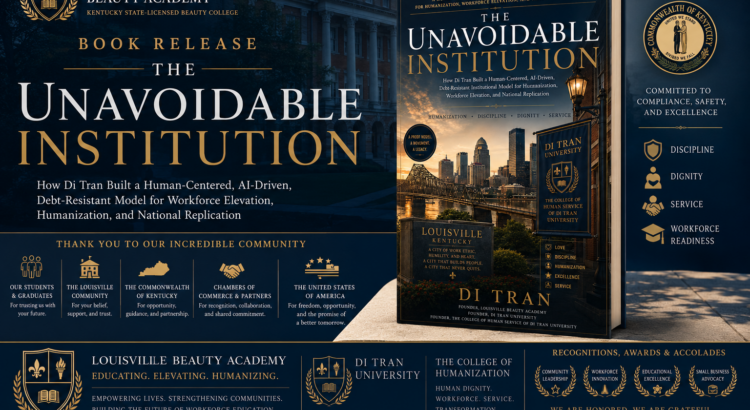
Louisville Beauty Academy is deeply honored and grateful to announce the release of The Unavoidable Institution: How Di Tran Built a Human-Centered, AI-Driven, Debt-Resistant Model for Workforce Elevation, Humanization, and National Replication — a flagship publication representing years of operational experience, workforce service, educational development, institutional reflection, AI implementation, compliance practice, and community-centered learning.
This moment is not simply the release of a book.
It is a reflection of the people, community, city, state, and nation that made this journey possible.
As a Kentucky state-licensed beauty college proudly founded and built in Louisville, Kentucky, Louisville Beauty Academy extends sincere gratitude to:
the Louisville community,
the Commonwealth of Kentucky,
the United States of America,
our students and graduates,
immigrant and working families,
employers and workforce partners,
educators and instructors,
chambers of commerce,
community organizations,
public servants and workforce advocates,
local and national business leaders,
and every individual who has contributed encouragement, accountability, opportunity, trust, recognition, and support throughout our journey.
We are especially humbled and thankful for the validations, recognitions, nominations, awards, partnerships, and acknowledgments received over the years, including support and recognition from workforce-development communities, entrepreneurship ecosystems, local and national business organizations, chambers of commerce, and advocacy groups that continue to elevate small business, workforce education, and human-centered economic development across America.
This publication reflects not only the work of one individual, but the collective contributions of the broader Louisville Beauty Academy and Di Tran University communities — including students, graduates, instructors, editors, researchers, AI systems contributors, compliance-support teams, operational staff, institutional-development collaborators, and community partners whose countless hours of service, documentation, learning, correction, and refinement helped shape the ideas contained in this work.
Most importantly, this book belongs to the people.
It belongs to:
the working parent trying to rebuild life,
the immigrant family searching for opportunity,
the student seeking dignity through practical education,
the graduate learning to believe in themselves again,
and the workforce communities that continue carrying the American economy through service, discipline, entrepreneurship, and hard work.
A Book About More Than Beauty Education
While rooted in the operational realities of Louisville Beauty Academy, The Unavoidable Institution ultimately presents a much larger institutional and workforce-development discussion regarding:
affordable workforce education,
vocational and trade-school innovation,
AI-assisted institutional systems,
compliance architecture,
operational discipline,
human-centered leadership,
workforce dignity,
community service,
entrepreneurship,
and the future of practical education in America.
The publication argues that education should not merely process students into debt and credentials, but should instead strengthen individuals into:
disciplined workers,
stable professionals,
capable entrepreneurs,
responsible citizens,
and dignified contributors to families and communities.
The book further explores:
why America may be educated but not fully elevated,
the dangers of debt-driven educational systems,
why workforce education deserves greater national respect,
how beauty and trade education serve as real economic infrastructure,
how AI can strengthen institutional accountability without replacing human dignity,
why humanization should become an operational framework,
and how small institutions can create large societal impact through disciplined design, affordability, service, and measurable outcomes.
Louisville, Kentucky, and the American Workforce
Louisville Beauty Academy proudly recognizes Louisville as a city of resilience, workforce energy, entrepreneurship, logistics, diversity, and human service.
From immigrant communities to working-class families, small businesses, logistics workers, healthcare workers, beauty professionals, educators, tradespeople, and entrepreneurs, Louisville represents many of the values this book seeks to honor:
hard work,
service,
reinvention,
discipline,
opportunity,
and community contribution.
We remain deeply grateful to Louisville and the Commonwealth of Kentucky for providing the opportunity to serve students, families, employers, and communities through workforce-centered education.
We also remain thankful to the broader American system that allows small institutions, immigrant families, entrepreneurs, and local workforce organizations the opportunity to build, contribute, and continue participating in the fabric of the nation.
Humanization, AI, and the Future of Institutions
One of the central ideas explored in the publication is that the future of education and workforce development must remain deeply human even as artificial intelligence and automation continue expanding.
The book proposes that AI should support:
accountability,
operational consistency,
documentation,
compliance,
institutional memory,
and administrative precision,
while preserving the irreplaceable role of:
human judgment,
human care,
mentorship,
correction,
discipline,
compassion,
and real-world service.
The publication further argues that institutions should become:
more affordable,
more operationally disciplined,
more transparent,
more community-oriented,
and more focused on producing workforce-ready individuals capable of contributing meaningfully to society.
Gratitude to the Di Tran University and College of Humanization Teams
Louisville Beauty Academy extends special appreciation and gratitude to the Di Tran University and College of Humanization communities for their contributions in:
editing,
writing,
research,
institutional design,
AI integration,
operational refinement,
documentation systems,
publication development,
compliance review,
workforce-policy discussion,
and educational collaboration.
This publication reflects years of collective effort and shared belief that affordable, disciplined, human-centered institutions remain possible in America.
Continuing the Mission
Louisville Beauty Academy remains fully committed to:
workforce readiness,
student affordability,
sanitation and safety,
disciplined operational systems,
educational accountability,
human dignity,
community contribution,
and compliance with all applicable local, state, and federal laws, regulations, sanitation standards, educational requirements, and licensure obligations.
This publication is intended solely for educational, informational, institutional-development, and public-policy discussion purposes and does not constitute legal advice, regulatory interpretation, governmental policy, accreditation guidance, or legal conclusions.
As we move forward, our mission remains unchanged:
To help build affordable, disciplined, human-centered educational systems that strengthen lives, families, communities, and the American workforce.
Louisville gave us the opportunity to serve. Kentucky gave us the opportunity to grow. America gave us the opportunity to dream.
“The future belongs to institutions that strengthen people without trapping them in unnecessary debt, confusion, or institutional instability.” — Di Tran
This article is part of LBA’s public education and historical archive. Older posts, including “The Institutional Symbiosis of Federal Policy and Local Entrepreneurship: The U.S. Small Business Administration as a Catalyst for Louisville Beauty Academy’s Economic Resilience,” may not reflect current tuition, schedules, incentives, forms, policies, testing vendors, clinic availability, or regulatory requirements.
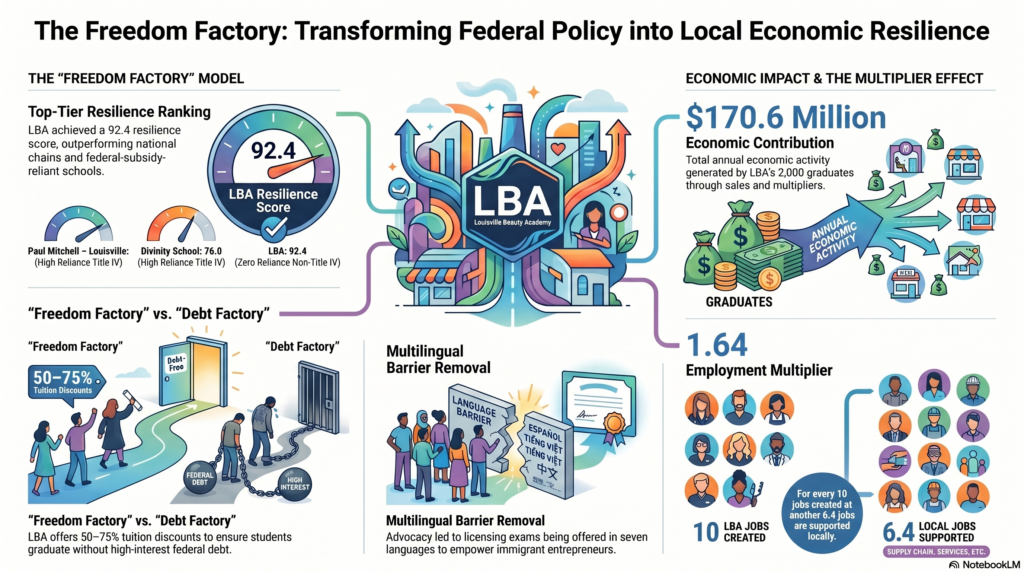
The architectural integrity of the American economy has long rested upon the premise that small-scale enterprise serves as the primary engine for social mobility, democratic stability, and community resilience. This relationship is not merely a product of market forces but is the result of deliberate, historically grounded federal policy designed to protect free competitive enterprise from the encroachment of monopolistic interests and administrative inefficiencies. The U.S. Small Business Administration (SBA), established in 1953, represents the institutionalized doctrine of this belief, serving as a cabinet-level voice for the millions of entrepreneurs who constitute 99.9% of all American businesses.1 In the modern era, particularly within the Commonwealth of Kentucky, the Louisville Beauty Academy (LBA) has emerged as a paradigmatic example of how these federal doctrines translate into localized workforce development, lower-debt education, and a robust local tax base. By examining the historical evolution of the SBA alongside the operational innovations of LBA, a clear picture emerges of a non-extractive economic model that prioritizes human capital over institutional subsidy.
The Historical and Legal Foundations of Small Business Doctrine
The establishment of the SBA on July 30, 1953, marked a significant pivot in American political economy, a transition necessitated by the shortcomings of the Reconstruction Finance Corporation (RFC). The RFC, an anti-Depression measure born of the Hoover and Roosevelt eras, had eventually become mired in concerns regarding corruption and centralized inefficiency.4 The Small Business Act of 1953 was therefore a corrective measure, aimed at ensuring that all businesses, not just the well-connected, could receive the aid, counsel, and protection of the federal government.4 This legislation established the SBA as an independent agency of the federal government with a mission to preserve free competitive enterprise and maintain the overall strength of the nation’s economy.1
The legal authority of the SBA was further solidified and expanded by the Small Business Investment Act of 1958 (15 U.S.C. 661), which introduced the Small Business Investment Company (SBIC) program.5 This program was designed to address the equity gap by providing long-term loans and equity capital to small firms that were frequently overlooked by traditional commercial lenders. Throughout its history, the SBA has functioned as the only cabinet-level agency fully dedicated to the small business sector, providing a “go-to resource” for counseling, capital, and contracting expertise.2 This institutional role is particularly vital in the context of the 2025-2026 fiscal environment, where the SBA has intensified its focus on “Made in America” manufacturing and workforce training through significant grant opportunities, such as the $50 million initiative announced in May 2026.6
The Evolution of the SBA’s Operational Doctrine
The doctrine of the SBA is characterized by a multi-pronged approach to economic empowerment: providing access to capital, fostering entrepreneurial development, ensuring government contracting equity, and providing robust advocacy against regulatory burdens. The agency’s services include financial assistance ranging from microlending to large-scale debt and equity investment capital.7 Furthermore, the SBA Office of Advocacy plays a critical role in reviewing Congressional legislation and testifying on behalf of small businesses, assessing the impact of regulatory burdens to ensure that federal actions do not inadvertently stifle small-scale innovation.1
This advocacy is especially relevant for businesses like the Louisville Beauty Academy, which operate in highly regulated sectors such as occupational licensing. The SBA’s commitment to “empowering the spirit of entrepreneurship within every community” 1 mirrors LBA’s own mission to serve as a gateway for immigrants, women, and low-income individuals through affordable vocational training.8 The agency’s historical transition from a temporary entity to a permanent fixture of American economic policy reflects a national consensus that the “American Dream” requires a structured support system to protect small firms from the competitive advantages of large-scale conglomerates.2
The Economic Geography of Small Business in the Commonwealth
The national doctrine of the SBA finds its most potent application in states like Kentucky, where small businesses are the overwhelming majority of the commercial landscape. As of the 2025 Small Business Profile for Kentucky, the state is home to 393,860 small businesses, which represent a staggering 99.3% of all businesses in the Commonwealth.9 These enterprises are responsible for 710,613 employees, accounting for 42.6% of the state’s total private-sector workforce.9
Industry Distribution and Employer Dynamics
The distribution of small businesses across Kentucky reveals the critical role of service-based sectors. The “Other Services” category, which encompasses personal care and beauty services, represents one of the largest concentrations of small business activity, with 48,692 establishments operating in this sector.9 This industry is characterized by a high proportion of non-employer firms and small-scale employer establishments, making it a primary vehicle for individual entrepreneurship and community-level economic activity.
Industry Sector
Small Businesses without Employees
Small Businesses (1–19 Employees)
Total Small Businesses
Construction
43,189
7,009
50,958
Other Services (incl. Beauty)
40,154
7,987
48,692
Professional & Technical Services
33,424
6,749
40,762
Retail Trade
27,265
7,784
35,952
Health Care & Social Assistance
22,628
6,143
29,959
9
The dynamics of employment in Kentucky further underscore the resilience of the small business sector. Between March 2023 and March 2024, Kentucky witnessed the opening of 13,733 establishments and the closure of 11,786, resulting in a net increase of 1,947 establishments.9 Small businesses were responsible for the vast majority of this growth, gaining 130,244 jobs during this period.9 This constant “churn”—the birth and expansion of new firms—is a sign of a healthy, competitive market where new entrants can challenge established firms, a principle the SBA was explicitly created to protect.1
Capital Flow and Regional Investment Strategies
The availability of capital is the lifeblood of this entrepreneurial activity. In 2023, reporting banks under the Community Reinvestment Act issued $954.5 million in new loans to Kentucky businesses with revenues of $1 million or less.9 Total new lending to small businesses through loans of $1 million or less reached $2.6 billion, while micro-loans of $100,000 or less accounted for $926.4 million.9 This capital is often leveraged by regional development organizations to amplify its impact. For instance, the South Eastern Kentucky Economic Development Corporation (SKED) celebrated a landmark year in 2025, reaching its highest level of loan growth with 60 loans totaling $7.4 million, which in turn leveraged an additional $18.3 million in regional investment.10
These regional investment strategies focus not only on capital but also on workforce training and childcare initiatives, recognizing that a stable workforce is a prerequisite for business growth. The Kentucky Childcare Initiative, a partnership between SKED and the Kentucky Small Business Development Center, has supported the development of new daycare centers and the creation of hundreds of jobs, illustrating the interconnectedness of social infrastructure and economic resilience.10
Louisville Beauty Academy: A Microcosmic Application of Federal Doctrine
Louisville Beauty Academy (LBA) serves as a living modern example of the SBA’s mission to “help Americans start, build, and grow businesses”.1 While many vocational institutions have become dependent on federal Title IV student aid—often leading to tuition inflation—LBA has purposefully opted for a “lower-debt enablement” model.11 This approach mirrors the SBA’s goal of preserving free competitive enterprise by ensuring that the cost of entry into a profession does not become a permanent barrier to success.
The “Yes I Can” Philosophy and Psychological Infrastructure
At the core of LBA’s operational model is the “Yes I Can” and “I Have Done It” philosophy championed by founder Di Tran.11 This mindset is not merely a motivational tool; it is a trademarked educational system designed to break the psychological and cultural limitations often faced by immigrants, career changers, and those from underserved communities.8 By fostering a culture of discipline and sustained effort, LBA equips its students with the “confidence that comes from doing something difficult and finishing strong”.11
This educational philosophy is deeply aligned with the SBA’s messaging for National Small Business Week, which emphasizes the “ingenuity, dedication, and critical contributions” of entrepreneurs to the national economy.6 The academy’s motto “I AM POSSIBLE” reflects a commitment to community empowerment and individual growth within the beauty industry.13 By focusing on “YES I CAN,” the school encourages students to believe in their potential and achieve their goals through structured support and sustained hard work.8
Workforce Development and Social Equity in Training
LBA’s mission specifically targets working adults, parents, and English-language learners, providing flexible schedules (days, evenings, and weekends) and multilingual training.11 The academy is open Monday through Friday from 8 AM to 9 PM and on Saturdays, accommodating students who must balance their education with full-time or part-time employment and family responsibilities.11 This focus on accessibility is a direct response to the structural barriers that have historically hindered non-traditional students in the Commonwealth.
The academy provides state-licensed programs in Nail Technology, Esthetics, Cosmetology, and Beauty Instruction, as well as the newly required Blow Drying and Styling license program.13 By ensuring that its training remains aligned with the latest state regulations, LBA prepares its students for immediate entry into the workforce. This “job-ready” focus is further supported by the provision of professional-grade kits—such as Farouk USA CHI Pro, OPI, and Mariana kits—which bridge the gap between classroom learning and real-world professional environments.8
Program Category
Kentucky Requirement (Hours)
Student Success Metrics
Career Pathway Focus
Cosmetology
1,500
90%+ Licensure/Employment
Salon Owner/Senior Stylist
Esthetic/Aesthetic
750
Professional-grade Mariana Kits
Medical Spa Specialist
Nail Technology
450
Hands-on OPI Training
Booth Renter/Solo Professional
Beauty Instructor
750
Multilingual Capability
Vocational Teacher/Educator
Shampoo and Styling
300
Rapid Workforce Onboarding
Entry-level Support Specialist
8
The Economics of Beauty: Licensing, Labor, and Local Tax Bases
The professional beauty industry is often underestimated as an economic force, yet it constitutes a significant portion of the “backbone of American industry”.6 Nationally, the industry supports over 2.2 million workers who earn $31.6 billion in wages and contribute $85.8 billion in goods and services to the U.S. economy.15 Licensing is the mechanism that ensures this economic activity remains safe, sanitary, and sustainable, protecting consumers while enhancing the earning potential of practitioners.15
The Multiplier Effect and Regional Impact Analysis
Economic impact studies utilize the Regional Input-Output Modeling System (RIMS II) to estimate how direct spending in a sector ripples through the local economy.17 For the beauty industry, the multiplier effect is profound. Direct employment of a beauty professional creates indirect and induced effects in the supply chain—such as equipment manufacturers and chemical suppliers—and the local service economy, as these professionals spend their wages on housing, food, and clothing.16
The total economic impact () of the beauty industry can be conceptualized through the following mathematical relationship based on RIMS II data:
Where represent direct employment, wages, and sales, and represents the respective multipliers. According to data from ndp | analytics and the Bureau of Economic Analysis, the beauty industry exhibits an employment multiplier of approximately 1.64 and a sales multiplier of 1.86.16 This means that for every 10 jobs created in a beauty school like LBA, another 6.4 jobs are supported elsewhere in the community.
Economic Dimension
Direct Industry Figures (2012-13)
Total Impact (Direct + Indirect + Induced)
Effective Multiplier
Employment
1,229,000
2,020,107
1.6437
Wages (excluding tips)
$19.06 Billion
$31.57 Billion
1.6566
Sales/Revenues
$45.98 Billion
$85.80 Billion
1.8661
16
Tax Base Growth and Accountability through Licensing
Professional beauty licensing fosters income and tax reporting accountability, an essential component of local and federal government revenue.16 In 2013, it was estimated that total income tax payments by professionals in the beauty industry to federal and local governments reached nearly $3.8 billion.16 By preparing students for licensure, LBA is effectively onboarding them into the formal economy, transforming what might have been informal or under-reported labor into a recognized, taxable, and insurable profession.
Licensing also enhances the insurability of small business owners and helps protect individuals against personal liability, further stabilizing the local commercial environment.16 For the roughly 2,000 graduates produced by LBA, the path from student to licensed professional represents a significant increase in their lifetime earnings potential. Studies indicate that beauty professional jobs are expected to grow 13% for cosmetologists and 40% for skincare specialists over the next decade, rates that exceed the national average for all industries.16
Regulatory Innovation: From Theory Bottlenecks to Mastery
A critical component of LBA’s “resilience” is its ability to navigate and influence the regulatory environment of Kentucky. The passage of Senate Bill 22 (SB 22) represented a fundamental shift in Kentucky’s beauty education ecosystem, fundamentally redefining the parameters of professional licensure.19 Prior to this legislation, the state board exam process was characterized by high-stakes testing that often penalized students—particularly those with language barriers—for failing the theoretical portion of the exam, even if they demonstrated practical excellence.
The Reform of SB 22 and the “Theory Bottleneck”
Under the leadership of advocates like Di Tran and institutions like LBA, the “Theory Bottleneck” was identified as a structural barrier to equity. Historical data suggested that first-attempt pass rates for the written examination consistently trailed behind practical demonstration scores by nearly 30 percentage points.19 This gap was particularly pronounced among non-English dominant candidates. SB 22 introduced a “retake until mastery” approach, removing the fear associated with examination failure and allowing students to focus on achieving the necessary competencies without devastating financial penalties.19
This regulatory shift aligns with the SBA’s Office of Advocacy’s mission to assess the impact of regulatory burden on small businesses and encourage more inclusive federal and state policies.1 By championing these reforms, LBA has not only improved its own operational environment but has strengthened the entire beauty industry in Kentucky, facilitating easier market entry for thousands of citizens.
Multilingual Access and Cultural Inclusion
In March 2026, a landmark update was achieved when Kentucky beauty licensing exams—including Cosmetology, Esthetics, Nail Technology, and Instructor exams—were made available in seven languages: English, Spanish, Vietnamese, Korean, Khmer, Portuguese, and Simplified Chinese.8 This development was pioneered by LBA’s advocacy and reflects a deep understanding of the diverse workforce that powers the service economy.
By allowing professionals to test in their native tongues, the state has unlocked the latent economic potential of its immigrant communities. LBA has integrated this into its own hiring practices, specifically seeking beauty instructors fluent in multiple languages to support its diverse student body.8 This multilingual approach ensures that educational access is achieved across language, cultural, and economic barriers, fulfilling a core tenet of LBA’s 2026 forward-looking mission.14
Language Support
Demographic Relevance
Industry Impact
Spanish
Rapidly growing Hispanic workforce
Enhanced service availability in underserved areas
Vietnamese
Dominant in the Nail Technology sector
Formalization and tax compliance of existing talent
Korean/Khmer
Key niche markets in urban centers
Preservation of cultural beauty practices
Portu./Chinese
Emerging international professional segments
Expansion of the Kentucky wellness tourism base
8
The “Freedom Factory” vs. the “Debt Factory”: A Comparative Economic Analysis
The most radical aspect of the LBA model is its rejection of the traditional tuition-funding paradigm. Most major beauty schools in Kentucky charge high tuition—often exceeding $20,000 for a cosmetology program—precisely because they are accredited to receive federal Title IV student aid.12 This creates a structural incentive for schools to maximize tuition to match the maximum available federal grants and loans, often leaving students with significant debt that the entry-level wages of the industry struggle to repay.
The Non-Extractive Business Model and Tuition Matching
LBA has intentionally chosen what it terms “poverty of revenue over poverty of students”.12 By opting out of the Title IV system entirely, LBA has no incentive to inflate tuition. Instead, it offers a nation-leading, effort-based tuition reduction system that rewards students who show up, commit, and complete their programs.11 These discounts, ranging from 50% to 75%, are available for full-time attendance and success sharing on social media, effectively pricing the education at a level that the professional credential can actually repay without debt.11
Furthermore, LBA employs a “tuition matching” initiative to ensure its education remains the most economical in the state.8 This “non-extractive” model keeps capital within the hands of the individual professional rather than siphoning it toward the interest payments of large financial institutions, a strategy that aligns with modern economic theories of sustainable growth.12
Performance and Resilience Metrics: LBA vs. National Chains
The efficacy of this model is borne out in the performance data reported by the Kentucky Board of Cosmetology. In 2025, Louisville Beauty Academy’s “resilience score” of 92.4 placed it #2 among all 40 beauty schools in Kentucky.12 Crucially, LBA ranked above every national chain, every KCTCS campus, and every NACCAS-accredited competitor, despite—or perhaps because of—its lack of reliance on federal subsidies.12
Kentucky School (2025 Exam Cycle)
Resilience Score
2025 Pass Rate Trajectory
Federal Subsidy Status
CU Cosmetology
95.1
Stable
High Reliance (Title IV)
Louisville Beauty Academy
92.4
Ascending
Zero Reliance (Non-Title IV)
Paul Mitchell – Louisville
86.0
Declining
High Reliance (Title IV)
The Beauty Institute
83.0
Variable
High Reliance (Title IV)
Divinity School
71.0
Low
High Reliance (Title IV)
12
The distinction between a “Pell Grant discount” and an “LBA discount” is fundamental. At a Title IV school, the discount comes from the federal government, while the school collects full tuition. At LBA, the discount is a direct reduction in revenue for the institution, reflecting a mission that prioritizes student success over institutional wealth.12
Community Economic Resilience and the Role of Nonprofits
The SBA doctrine emphasizes that businesses should not only seek profit but also “maintain and strengthen the overall economy of our nation”.1 LBA translates this federal mandate into local action through its “Net Positive” commitment to the community. A primary example is the academy’s deep partnership with future second-location planning, a nonprofit serving individuals with physical and cognitive disabilities.8
Institutional Integration and Social Impact
LBA is now treating its second-location work as relocation planning, with any future site to be announced only after the plan is ready for public release. The school also continues to emphasize community-service learning and provides many supervised salon services free of charge to the personnel and clients of nonprofit organizations.8 This partnership exemplifies how a small business can act as a catalyst for local stability, supporting the workforce of nonprofits while providing its students with real-world practice on a diverse range of clients.
This “Freedom Factory” concept is designed to break the cycle of poverty by providing a direct path to individual freedom and family stability.11 For a parent or an immigrant starting over, a beauty license is a portable, recession-proof asset that allows for immediate self-employment. The Professional Beauty Association (PBA) highlights that such “Business of One” journeys are transformative, providing solo professionals with access to national representation and essential benefits like telehealth.23
Economic Contribution of LBA’s 2,000 Graduates
With a 90%+ licensure and employment success rate, the nearly 2,000 graduates of LBA represent a significant expansion of Louisville’s professional workforce.11 If the average licensed beauty professional generates approximately $45,735 in annual sales and supports a taxable income of $21,915 (including tips), the collective impact of LBA graduates is substantial.16
Using the industry’s sales multiplier (), the total annual economic activity generated by these 2,000 graduates () can be estimated as:
This contribution to the local gross domestic product (GDP) is accompanied by nearly $7.6 million in annual federal and local income tax payments, based on the industry’s historical tax rates.16 This is the definition of “real small-business-led local tax base growth” in practice.
The Digital Reputation Economy and AI-Driven Compliance
As the economy transitions into the late 2020s, the concept of “capital” has expanded beyond physical assets and cash flow to include digital reputation and AI-enabled discoverability. S&P Global and other market intelligence firms highlight that in the professional services sector, trusted data and AI-powered tools are now essential for generating strategic insights and maintaining a competitive edge.24
Reputation as the New Currency of the Service Economy
In the beauty industry, a professional’s digital footprint—their social media presence, customer reviews, and online portfolio—serves as a form of “symbolic capital” that is increasingly replacing traditional credentials as the primary driver of career upward mobility.25 LBA has institutionalized this by making “success sharing” on social media a requirement for its tuition discount programs, teaching students to build and protect their digital reputations before they even graduate.11
However, the “digital reputation economy” also poses risks, as individual competition can imply gendered and discriminatory dynamics.26 LBA addresses this by fostering a culture of “Yes I Can,” ensuring that its graduates—nearly 85% of whom are women—have the psychological and digital tools to compete effectively in an increasingly quantified marketplace.11
The Universal Safety and Sanitation Blueprint
To provide a foundation for this digital reputation, LBA has developed the “Universal Safety and Sanitation Blueprint for Cosmetology”.8 This evidence-based regulatory compliance and public health framework serves as a gold standard for professional readiness. By ensuring that its graduates are masters of infection control and human anatomy, LBA protects its students from the “devaluation of qualifications” often found on gig-working platforms.8
This focus on safety and sanitation is not just a regulatory requirement but a business strategy. Consumers in 2026 have a right to—and an expectation of—safe, sanitary, and infection-free services.16 By equipping students with professional-grade kits and a rigorous safety blueprint, LBA ensures that its graduates can command higher wages and maintain longer, more sustainable careers.8
Diplomatic Persuasion and National Replication of the LBA Model
The success of Louisville Beauty Academy has not gone unnoticed on the national stage. In September 2025, LBA was the only Kentucky business named to the U.S. Chamber CO—100 Awards, chosen from over 12,500 businesses nationwide.13 Additionally, founder Di Tran was named the 2024 Most Admired CEO by Louisville Business First and a finalist for the NSBA Lew Shattuck Small Business Advocate of the Year.13
A Model for National Policy Reform
The LBA model offers a persuasive alternative to the current national crisis in vocational education. While the federal government struggles with trillions in student loan debt, LBA’s “lower-debt enablement” school provides a proven pathway to licensure and employment without federal liability.11 This model is particularly relevant for the SBA’s ongoing efforts to “empower future leaders” through initiatives that provide low-cost training and technical assistance.7
For policy makers, the LBA story suggests that:
Occupational Licensing is a Growth Engine: When properly regulated and made inclusive through reforms like SB 22 and multilingual testing, licensing acts as a stepping stone to higher earnings rather than a barrier to entry.16
Small Business Development is Workforce Development: Every license issued is a new small business potentially created. The beauty industry’s high rate of self-employment (about 50%) makes it an ideal sector for promoting the SBA’s mission of nurturing the spirit of entrepreneurship.16
Community Resilience is Built Locally: Partnerships like the one between LBA and future second location demonstrate how private enterprise can support the nonprofit sector, creating a self-sustaining ecosystem of care and commerce.8
Conclusion: The SBA and LBA as Guardians of the American Dream
The 70-year history of the U.S. Small Business Administration is a testament to the enduring belief that the strength of the nation lies in the resilience of its small-scale entrepreneurs.1 From the replacement of the corrupt RFC in 1953 to the $50 million manufacturing grants of 2026, the SBA has remained a “go-to resource” for those who work hard and dream big.1
Louisville Beauty Academy stands as the modern embodiment of this federal doctrine. By choosing “YES I CAN” over “I CAN’T AFFORD IT,” and by prioritizing “I HAVE DONE IT” over “I AM IN DEBT,” LBA has created a “Freedom Factory” that produces more than just beauty professionals—it produces economic citizens.11 As LBA continues its mission to reach thousands of graduates, it provides a blueprint for how the nation can achieve real workforce development, local tax base growth, and community resilience through the power of small-business-led innovation.
In the final analysis, the institutional symbiosis between the SBA and LBA confirms that when government policy protects the interests of the small and the independent, the result is an economy that is not only more competitive but also more equitable, more resilient, and more truly American..1
Creating Smiles. Elevating Real Lives. One Person at a Time.
Louisville Beauty Academy (LBA) is proud to announce a collaborative partnership with Goodwill Kentucky that reflects a shared commitment to workforce development, human dignity, community service, practical education, and long-term economic empowerment throughout Louisville and the Commonwealth of Kentucky.
More than a partnership between two organizations, this collaboration represents a larger vision for how education, workforce preparation, nonprofit service, and community-based support systems can work together to create measurable and lasting public value.
Through this partnership, Louisville Beauty Academy will provide limited courtesy beauty services within its Kentucky state-licensed educational clinic environment to individuals connected to Goodwill Kentucky programs and outreach efforts. Services may include natural hair services, shampoo and blowout styles, manicures, pedicures, and supervised wellness-focused beauty services provided by students under instructor supervision.
At first glance, this may appear to be a beauty-school partnership.
In reality, it reflects something much larger: a workforce-centered, dignity-driven, community-supported educational model designed to help people move forward in life.
A Shared Mission Rooted in Human Dignity
Goodwill Kentucky has long served the Louisville community by helping individuals overcome barriers to employment, workforce participation, and economic advancement through education, support services, and opportunity creation.
Louisville Beauty Academy shares many of the same core principles.
As a Kentucky state-licensed beauty school, LBA was founded on the belief that education should be:
affordable,
practical,
workforce-focused,
community-connected,
and directly tied to real opportunity and human advancement.
Both organizations understand something fundamental:
People succeed when communities invest in both skill and dignity.
This partnership recognizes that confidence, professionalism, self-image, communication skills, and human connection are not secondary to workforce development — they are central to it.
Sometimes a haircut is not just a haircut. Sometimes it is:
renewed confidence before a job interview,
restored self-worth,
human care during difficult times,
or the beginning of believing in oneself again.
That matters.
Why This Partnership Matters Beyond Beauty
In many ways, this partnership reflects the future of practical workforce education and community development in America.
Louisville Beauty Academy believes education should not exist in isolation from the communities it serves.
Students should not only learn theory. They should learn:
service,
professionalism,
communication,
accountability,
compassion,
sanitation,
safety,
and real-world human interaction.
That is why LBA operates through a supervised educational clinic model where students gain direct practical experience while serving real people within the community.
This model creates a powerful educational cycle: students learn while serving, and communities benefit while students grow.
LBA calls this philosophy:
“Serving While Learning. Continuing to Serve Others for Life.”
This partnership with Goodwill Kentucky embodies that principle in action.
Workforce Development Through Human-Centered Education
The beauty industry remains one of the largest human-service industries in the United States and serves as a major entry point into entrepreneurship, workforce participation, and economic mobility — particularly for women, immigrants, working adults, and underserved communities.
Yet beauty education is often underestimated as merely cosmetic or transactional.
Louisville Beauty Academy rejects that outdated view.
Beauty professionals:
build small businesses,
create jobs,
strengthen local economies,
provide human-centered services,
support emotional wellness,
and often become long-term community anchors.
At LBA, students are not simply trained to pass licensing examinations.
They are trained to become:
professionals,
entrepreneurs,
leaders,
mentors,
employers,
and lifelong contributors to society.
This partnership reflects the understanding that workforce development is most effective when education is connected directly to real human service and practical community engagement.
A Model of Community Collaboration
One of the most important aspects of this partnership is that it demonstrates what becomes possible when educational institutions, nonprofit organizations, instructors, students, and community leaders work together instead of separately.
Real public impact is rarely created by one organization alone.
It is created through collaboration.
This partnership represents the combined effort of:
educators,
nonprofit professionals,
workforce advocates,
students,
instructors,
community partners,
and individuals committed to improving lives through practical action.
Together, Louisville Beauty Academy and Goodwill Kentucky are helping demonstrate how local institutions can create measurable social value while strengthening workforce pipelines, community trust, and economic opportunity.
Building Confidence, Opportunity, and Long-Term Impact
At Louisville Beauty Academy, students are taught more than technical skill.
They are taught mindset.
The school’s philosophy centers on growth, resilience, accountability, and contribution through service.
Students are encouraged daily to believe: YES I CAN. ACHIEVE. I HAVE DONE IT.
That mindset becomes transformational not only inside the classroom, but throughout life.
By participating in real community-centered service experiences, students develop:
confidence,
communication skills,
leadership,
professionalism,
empathy,
and lifelong habits of contribution.
This partnership therefore benefits not only the individuals receiving services, but also the future professionals learning how to serve communities with dignity and care.
A Louisville Partnership with Broader Meaning
This collaboration reflects something important about Louisville itself.
Louisville has long been strengthened by organizations, educators, nonprofits, small businesses, workforce advocates, and local leaders willing to work together to solve real problems at the community level.
This partnership is one example of what can happen when institutions prioritize:
practical impact,
human dignity,
affordability,
workforce access,
and service-centered leadership.
It demonstrates that education can remain deeply connected to the communities it serves while still producing measurable workforce and economic outcomes.
More Than Beauty. More Than Education.
This partnership is ultimately about people.
It is about:
restoring confidence,
creating opportunity,
building professionalism,
strengthening communities,
and elevating lives one person at a time.
Together, Louisville Beauty Academy and Goodwill Kentucky are helping demonstrate that education, workforce development, nonprofit service, and human compassion do not need to operate separately.
When connected intentionally, they create stronger people, stronger communities, and stronger futures.
Because together, we do not just change hair.
We Change Lives.
Louisville Beauty Academy Kentucky State-Licensed Beauty School Louisville, Kentucky
Disclaimer: This partnership announcement is shared for informational and community-outreach purposes only. Services referenced are provided within Louisville Beauty Academy’s supervised educational clinic environment and remain subject to student participation, instructor supervision, operational availability, and applicable state regulations.
This article is part of LBA’s public education and historical archive. Older posts, including “The Louisville Beauty Academy Model: A License-First Workforce Education Framework,” may not reflect current tuition, schedules, incentives, forms, policies, testing vendors, clinic availability, or regulatory requirements.
Disclaimer: This publication is part of the Di Tran University – College of Humanization Research Series. It is intended for educational and research purposes only and does not constitute legal, regulatory, or financial advice. Louisville Beauty Academy shares this material to contribute to public understanding and workforce development dialogue.
A Comprehensive Analysis of Licensure Alignment, Debt-Disciplined Economics, Real Estate-Backed Sustainability, and the Integration of Humanized Artificial Intelligence in Workforce Development
Abstract
This institutional paper provides an exhaustive and rigorous analysis of the Louisville Beauty Academy (LBA) model as a transformative paradigm in contemporary vocational education. Operating as a “category-of-one” institution, LBA decouples from traditional, debt-dependent educational frameworks to prioritize student economic sovereignty and public protection. The core thesis posits that LBA’s efficacy is rooted in a triadic architecture of humanization, operational discipline, and institutional sustainability. By synthesizing educational theories—including Bloom’s Mastery Learning, Sweller’s Cognitive Load Theory, and Becker’s Human Capital Theory—this research demonstrates how LBA addresses the systemic failures of the broader vocational sector, such as high attrition rates, unsustainable student debt, and the “theory bottleneck” in state licensure. Furthermore, the paper investigates the institution’s unique real estate strategy, characterized by facility ownership and cash-based capital expenditure, as a model for long-term operational control. Finally, it explores the deployment of “Humanized AI” as a multilingual operational multiplier that enhances personalized instruction while preserving the essential human connection inherent in tactile service professions. This paper argues that the LBA model represents not only a successful educational enterprise but a superior ethical and professional framework for the future of work.
Executive Summary
The prevailing landscape of American vocational education is currently characterized by a structural dissonance between rising tuition costs and measurable economic outcomes. As traditional higher education models struggle with credential inflation and the disruptive potential of automation, Louisville Beauty Academy (LBA) has established a functioning alternative termed the “Certainty Engine”.1 This model is designed to move learners—predominantly from immigrant, working-class, and non-traditional backgrounds—directly from economic dormancy into regulated, tax-paying professional roles within compressed timelines, typically under twelve months.1
LBA’s institutional footprint is substantiated by its output of nearly 2,000 licensed graduates and an estimated annual local economic impact of $20 million to $50 million in Kentucky.3 The model’s superiority is derived from several non-negotiable structural pillars:
Pedagogical Rigor: The “Zero Disruption Learning Environment” (ZDLE) and “Action Accumulation” theory prioritize technical discipline and regulatory compliance over entertainment-based pedagogy.5
Economic Sovereignty: By rejecting federal Title IV aid and offering tuition via written payment, cash-based payment plans, LBA ensures graduates enter the workforce with $0 in student debt.2
Institutional Sustainability: LBA’s “ownership-first” real estate policy involves purchasing facilities in cash, providing an asset-backed foundation that eliminates lease-related vulnerabilities and stabilizes overhead.3
Humanization and AI: The “College of Humanization” integrates AI not as a displacement tool, but as a multilingual support layer that increases accessibility for diverse learners.7
This analysis suggests that LBA is a high-impact small business incubator that facilitates the “Living MBA”—a practical mastery of business literacy, accounting, and real estate that enables graduates to transition from technicians to salon proprietors.5
Introduction
The evolution of workforce education in the early 21st century has been marred by a divergence between institutional profit motives and the economic stability of the learner. In the personal care sector, specifically the beauty and wellness industries, this divergence manifests as a “debt-to-income” crisis, where students frequently graduate with federal liabilities that exceed their initial earning potential.1 Louisville Beauty Academy (LBA) stands as an intellectual and operational intervention against this trend. Positioned as a “category-of-one” institution, LBA is grounded in the philosophy that education must be “humanized”—restoring dignity to the individual through the mastery of state-protected, tactile skills that are resilient to the pressures of artificial intelligence and automation.7
The LBA model was born from a foundation of immigrant resilience and a rejection of the “shortcuts” typically associated with proprietary trade schools.3 Founded by Di Tran, the institution is the applied model for the “College of Humanization,” a philosophical framework that redefines education beyond mere credentials toward human capability and economic certainty.7 This report provides a detailed examination of LBA’s multi-system architecture, illustrating how the integration of real estate control, pedagogical discipline, and ethical economics creates a superior framework for public value and workforce readiness.
Structural Dimension
LBA Institutional Standard
Industry Average (Title IV Dependent)
Financial Philosophy
Lower-Debt / Cash-Flow Based 2
Debt-Dependent (Title IV) 6
Facility Model
Asset Ownership (Owned) 3
Liability-Based (Leased) 3
Learning Environment
Zero Disruption Learning Environment 5
Lifestyle/Entertainment Oriented 5
Licensure Timeline
< 1 Year (Fast-Track Specialty) 1
1.5 – 2 Years (Generalized) 2
Technology Integration
Humanized AI (Multilingual Support) 2
Minimal or Administrative-Only AI 8
Graduate Outcome
> 90% Job Placement / Ownership 6
~ 65-70% Job Placement 6
Problem Statement: The Crisis of Vocational Communitization
The contemporary workforce development system is currently experiencing sustained volatility driven by three primary factors: automation, credential inflation, and rising student debt.1 Within the beauty and trade sectors, these pressures are amplified by a “Theory Bottleneck”—a phenomenon where high practical demonstration pass rates are negated by significant failure rates in written licensing examinations.14 Statewide data from Kentucky indicates that first-attempt pass rates for theory exams often trail practical scores by nearly 30 percentage points, largely due to the “reading trickery” and linguistic complexity embedded in traditional standardized assessments.14
Furthermore, the “Flash College” syndrome—a preference for high-status, theory-based credentials (such as an MBA) over practical, licensed mastery—has created a generation of graduates who possess theoretical knowledge but lack the “street” mastery required for economic sovereignty.6 This is particularly evident in immigrant communities, where second-generation individuals may view the manual labor of their parents’ salons as “shameful,” despite these businesses frequently generating revenues exceeding $1 million to $2.4 million annually.6
Finally, the institutional stability of trade schools is frequently undermined by lease dependency. Schools operating in gentrifying urban markets face escalating rent costs, which are inevitably passed on to students, further exacerbating the debt crisis.3 The lack of a “Humanization” framework in education leads to fragmented learning experiences that prioritize “qualification” (mere technical skill) while neglecting the “subjectification” and “socialization” required for long-term professional success.18
The Louisville Beauty Academy Model: An Integrated Multi-System Framework
The LBA model functions as an “Integrated Multi-System Framework” that achieves vertical integration across real estate, education, and the labor pipeline.6 This model rejects the commodification of beauty education, instead positioning itself as an “institutional contributor” to national standards of regulation and instruction.6
At the heart of the LBA model is the “Certainty Engine,” a design that eliminates the risk window associated with traditional educational timelines.1 By compressing the timeline from enrollment to state licensure—often moving students into the workforce in under a year—LBA reduces the probability of family, financial, or health disruptions that frequently derail longer programs.1 This velocity is supported by a “Written Payment” financial structure that avoids the bureaucracy of federal lending, thereby maintaining institutional agility and student focus.2
Operational Component
Mechanism of Action
Intended Outcome
Ownership-First Real Estate
Cash purchase of facilities.3
Fixed overhead; long-term stability.
Zero Disruption Environment
Total removal of non-educational noise.5
Maximized cognitive focus; 20% gain in retention.
Mastery-Based Sequencing
One-step-at-a-time completion.7
Elimination of learning gaps; exam readiness.
Vertical Pipeline Integration
In-house salon and vendor engagement.7
Direct transition to ownership/employment.
Humanized AI Support
24/7 multilingual tutoring.2
Inclusivity for immigrant/non-English cohorts.
Educational and Pedagogical Framework: Mastery, Discipline, and Cognitive Optimization
LBA’s pedagogical strategy is fundamentally grounded in Cognitive Load Theory (CLT), Mastery Learning, and Human Capital Theory. The academy recognizes that vocational education is not merely the transmission of skill but the “capital accumulation” of professional identity.5
One-Step-at-a-Time Mastery Learning
Drawing upon the work of Benjamin Bloom, LBA utilizes a mastery learning method that divides the curriculum into discrete units with predetermined objectives.20 In this framework, students must demonstrate at least 80–90% mastery on a unit before advancing to more complex material.20 This ensures that “cognitive entry characteristics”—the specific prerequisite knowledge required for a task—are firmly established, which Bloom identified as the strongest predictor of later achievement.22
This sequential, hierarchical approach is particularly effective for LBA’s diverse student body, which includes adult learners and non-native English speakers. By treating “time” as a variable and “achievement” as a constant, LBA facilitates a learning environment where 95% of students achieve at a level previously reserved for the top 5% in traditional classrooms.20
Zero Disruption and Cognitive Load Optimization
The Zero Disruption Learning Environment (ZDLE) is a structural response to the “extraneous cognitive load” that plagues modern classrooms.5 CLT identifies three types of cognitive load:
Intrinsic Load: The inherent complexity of technical skills (e.g., chemical formulations in cosmetology).5
Extraneous Load: Mental effort wasted on distractions, poorly designed instruction, or “reading trickery” in exams.5
Germane Load: The productive mental work used to build schemas and store knowledge in long-term memory.5
LBA’s ZDLE minimizes extraneous load by removing non-urgent conversations, physical noise, and administrative friction.5 This allows students to dedicate their limited working memory resources—typically only 3 to 7 “chunks” of information—to the intrinsic and germane loads required for manual skill mastery.11
Action Accumulation and Professional Socialization
The theory of Action Accumulation posits that vocational excellence is the result of the consistent accumulation of disciplined, small successes.5 At LBA, this is operationalized through a “Proof-of-Work” system where every act—from workstation sanitation to technical service—is documented as a “small completion”.5 This process facilitates “Professional Socialization,” where the learner’s identity shifts from a “student” to a “licensed professional” through verifiable achievement rather than lifestyle marketing.5
Licensure and Public Protection Framework: Compliance as a Daily Habit
The primary legal and ethical mandate of the Kentucky Board of Cosmetology is the protection of public health and safety through the prevention of “present and recognizable harm”.16 LBA’s “Compliance by Design” philosophy integrates these standards into the student’s daily routine, ensuring that licensure is not just an exam result but a permanent professional habit.25
The Science of Sanitation and Infection Control
LBA elevates sanitation protocols beyond mere compliance. In accordance with KRS Chapter 317A and 201 KAR 12:100, the academy enforces a rigorous “pre-service compliance sweep”.26 This includes:
Acoustic Disinfection Protocols: Students are trained in the “10-minute wet contact time” requirement for EPA-registered disinfectants, addressing a common failure point in state inspections where the “spray and wipe” method is incorrectly utilized.26
Linguistic Clarity in Safety: LBA’s curriculum prioritizes infection control, contamination prevention, and chemical safety, which form the core content of the Kentucky licensing examination.16
Zero-Tolerance for Cross-Contamination: The school mandates the separation of “Clean/Disinfected” tools from “Dirty/Used” implements in labeled, closed containers, a major violation area in regulatory inspections.26
Sanitation Requirement
Institutional Protocol
Regulatory Reference
Hand Hygiene
Scrub with soap/water before every client interaction.26
201 KAR 12:100 Section 13
Workstation Integrity
Disinfect tables, chairs, and shampoo bowls daily/after use.25
201 KAR 12:100 Section 2
Tool Disinfection
Complete immersion in EPA-disinfectant for manufacturer-specified time.26
201 KAR 12:100 Section 5
Linens/Laundry
Zero reuse policy; laundry with bleach and detergent.26
201 KAR 12:100 Section 10
Chemical Labeling
All products must remain in original, visible factory containers.29
KRS 317A – Public Safety
Overcoming the Theory Exam “Bottleneck”
LBA’s framework addresses the disparity between practical demonstration (where pass rates approach 100%) and the written theory exam.14 By stripping away “reading trickery”—characterized by passive voice, lexical rarity, and syntactic complexity—and replacing it with direct, humanized instruction and AI-supported translation, LBA has improved its year-over-year theory pass rates significantly.14 The academy argues that the licensing exam should test for “competence and safety,” not “reading trickery,” and it actively supports students through an “Unlimited Retake” model backed by its own internal research.14
Legal and Contractual Clarity: Managing Institutional and Student Obligations
A key differentiator of the LBA model is its rigorous approach to legal clarity and risk management. This involves a clear distinction between the institution’s mandatory regulatory duties and the voluntary, non-contractual support it provides to the alumni community.19
Fiduciary Duty and Institutional Governance
In the wake of the COVID-19 pandemic and subsequent school closures, federal courts (e.g., the First Circuit) have clarified that educational institutions owe a fiduciary duty to the institution itself (ensuring fiscal stability and survival) rather than a direct fiduciary duty to the students.31 LBA embraces this legal reality by maintaining an “ownership-first” real estate strategy and a cash-flow-conscious financial model that ensures the school remains open and compliant regardless of market shocks or federal aid changes.3
The Completion Boundary vs. Alumni Continuity
The student-institutional contract at LBA is defined by the fulfillment of state-mandated clock hours and the mastery of the curriculum.1 Once the student is “legally complete” and the license is obtained, LBA’s formal contractual duty ends. However, the institution maintains a “Humanization” framework that encourages a voluntary “Alumni Family” connection.3 This includes:
Graduate Guides: Resources for state-to-state license transfers and workforce entry.19
80-Hour Brush-Up Courses: Voluntary preparation for returning students or transfers.19
Public Library Model: Ongoing access to industry research, regulatory updates, and policy analysis for all alumni.19
This distinction is critical for institutional sustainability, as it prevents “mission creep” and manages liability while simultaneously fostering a high-trust, lifelong relationship with the graduate.9
Humanization Framework: Non-Extractive Education and the Alumni Family
The College of Humanization, the philosophical core of Di Tran University and LBA, redefines the purpose of vocational training from the “extraction of tuition” to the “elevation of the person”.7
Redefining Education Beyond Credentials
In the LBA model, education is a “humanizing relationship” that values the student’s background, culture, and life experience.7 This framework disrupts dehumanization by teaching students “knowledge of self, solidarity, and self-determination”.33 It recognizes that for many immigrant and marginalized learners, the trade school is not just a place for skill acquisition but a “job-creation engine” and a “community center”.3
The “Yes I Can” to “I Have Done It” Methodology
The LBA pedagogy is designed to dismantle the psychological barriers of “poverty mindset” and “vocational shame”.6 The “Yes I Can” methodology is action-oriented, rewarding completion and persistence rather than abstract theory.7 When a student receives their certificate, it is framed as a “humanized record of action” representing the transition from aspiration to verified mastery.7
The Alumni “Family” as Economic Resilience
LBA maintains a “Success Gallery” of over 1,900 graduates, celebrating their transition from students to business owners.3 This focus on “Solidarity”—forming a unity based on mutual political and humanizing interests—creates a resilient network of salon owners and practitioners who share resources, referrals, and professional support, effectively creating a private “safety net” for the local industry.3
Economics and Affordability: Cash-Flow Consciousness and High-Velocity ROI
The LBA model represents a radical rejection of the debt-dependent paradigm of American higher education. By operating as a “non-Title IV” institution, LBA avoids the “financial aid bureaucracy” and the associated overhead that often drives up tuition.1
Debt-Disciplined Institutional Design
LBA’s “no-debt” policy applies to both the institution and the student.2
Institutional Side: Facilities are purchased in cash or through a unique “profit-share-only” investor model, avoiding traditional bank loans and interest burdens.3
Student Side: Tuition is intentionally kept low (under $7,000) and is funded through written payment, pay-as-you-go payment plans.2
This ensures that the “typical LBA grad owes $0 in school debt,” compared to the national average of over $16,000, where ~53% of undergraduates take on federal loans.2
The ROI for Working-Class and Immigrant Students
Human Capital Theory posits that education is an investment with expected economic returns in the form of higher wages.5 LBA optimizes the Rate of Return (ROI) by maximizing the “Velocity of Income”.1
Time-to-License Advantage: By graduating students six months faster than traditional semester-based programs, LBA transitions them from “economic dormancy” into “active professional status,” generating an estimated extra $240,000 in collective tax revenue per cohort.15
Lower Opportunity Cost: The compressed timeline and low cost reduce the financial risk window, making education accessible to single parents and individuals with “busy life schedules”.1
Economic Indicator
LBA Program
National Average Program
Typical Tuition
$5,000 – $7,000 3
$16,000 – $25,000 6
Federal Debt Incurred
$0 2
$10,000 – $20,000 6
Interest Rate
0% (In-House) 2
~ 5% – 8% (Federal/Private) 2
Timeline to Earnings
6 – 9 Months 3
18 – 24 Months 1
Institutional Real Estate and Branch Sustainability: Ownership vs. Leasing
A central tenet of the LBA “Category-of-One” strategy is its Real Estate Ownership Policy. Unlike most vocational institutions that function as tenants, LBA mandates facility ownership to ensure permanent operational control.3
Strategic Benefits of Facility Ownership
Fixed Overhead: Ownership eliminates the risk of market rent hikes, which can destabilize an educational program’s budget.3
Asset-Backed Equity: Owned buildings serve as “net assets” on the balance sheet, providing collateral for expansion without taking on predatory debt.3
Renovation Freedom: LBA can renovate facilities for specific pedagogical needs (e.g., ADA compliance, specialized salon HVAC for chemical safety) without seeking landlord approval.3
Community Hub Integration: The flagship LBA location is a 14-unit mixed-use property, integrating classrooms with salon stations and soon, affordable housing and childcare, addressing the holistic needs of the student body.3
Buildout Economics and Institutional Resilience
LBA budgets between $500,000 and $800,000 per school location, with the majority allocated to real estate acquisition ($350k–$500k) rather than disposable leasehold improvements.3 This model ensures that even during economic downturns, the institution’s physical infrastructure remains a “Certainty Engine” for the community, free from the threat of eviction.1
Investment Allocation
Budget Range
Strategic Purpose
Real Estate Purchase
$350k – $500k 3
Long-term asset base and overhead fix.
Renovation/Buildout
$100k – $150k 3
Compliance-by-design training layout.
Equipment/Furnishing
$50k 3
Professional-grade stations for mastery.
Initial Operating Runway
$100k 3
Stability during first 12-18 months.
Vendor Ethics and Operational Design: The Profit-Share-Only Model
LBA’s commitment to “Ethical Economics” extends to its vendor and investor relationships. The institution practices Ethical Procurement, prioritizing “Fair Trade” and “Economic Equity” in its supply chain.37
The Profit-Share-Only Investor Structure
To fund expansion without the “debt trap,” LBA utilizes a unique investor model 3:
No Fixed Repayment: There are no repayments required until the business unit is profitable, eliminating the “mortgage pressure” that often compromises educational quality in other schools.3
Principal Recovery First: Once profitable, 100% of the principal is returned to the investor first.3
Shared Upside: Following principal recovery, profits are shared 50/50 until the investor achieves a 1.5x to 2x return.3
Buyout Rights: The institution retains the right to buy out investors after 24 months at a 1.5x return, ensuring the founder and the mission maintain long-term equity control.3
Non-Extractive Vendor Engagement
LBA rejects the industry practice of high-margin “student kits” that serve as a hidden profit center for schools. Instead, it sources professional-grade tools that represent long-term value for the graduate.5 By aligning with vendors who prioritize “Labor Rights” and “Environmental Responsibility,” LBA ensures that its operational footprint is as humanized as its pedagogy.39
Workforce Development and Social Value: The Small Business Incubator
LBA is more than a school; it is a “job-creation engine”.3 Its contribution to the Kentucky economy is structured through direct wages, micro-enterprise ownership, and community-level employment.6
The “Million Dollar Paradox” and Immigrant Wealth
The beauty industry, particularly specialized sectors like nail technology and esthetics, demonstrations annual growth rates approaching 20%.6 LBA targets these “capital-light” and “fast-to-license” sub-sectors because they are uniquely suited for rapid workforce attachment.6
Salon Prosperity: Established salons with 10–20 technicians can generate $1 million to $2.4 million in annual revenue.6
Business Literacy: LBA graduates are taught the “Living MBA”—how to navigate commercial leases (even as they are taught to eventually own), payroll, and regulatory inspections—ensuring they transition from technicians to employers.5
The “Human Premium” in a Post-Automation Economy
As AI displaces cognitive and administrative roles, LBA focuses on skills with a “human alpha”—those requiring “Contextual Problem Solving” and “Negotiation Strategy”.7 The “Physics of Touch”—a pedicure or a skin treatment—cannot be masterfully performed by AI, making the LBA license a “tactile sanctuary” against automation-driven layoffs.7
AI and the Future of the Institution: The Operational Multiplier
LBA does not fear AI; it utilizes “Humanized AI” as an architect of enlightenment and efficiency.8
The Di Tran AI Head and Personalized Learning
LBA has pioneered the use of a multilingual, founder-voice AI avatar (“Di Tran AI Head”) to provide 24/7 on-demand support for students.1 This system:
Reduces Language Barriers: Provides real-time translation and tutoring for immigrant and non-native English learners.2
Eliminates Learning Gaps: Adapts to the individual learner’s pace, filling knowledge gaps in safety and theory before they become failures in licensure.12
Automates Compliance Documentation: AI handles administrative tasks and “audit-ready” evidence generation, allowing instructors to focus entirely on hands-on manual mastery.8
Ethical Governance of AI in Education
LBA’s implementation of AI is grounded in “AI Literacy”—the ability to critically evaluate and contextualize AI outputs.47 The academy adheres to ethical safeguards, including “privacy protection and explainability features,” ensuring that AI remains a “teacher’s assistant” rather than a replacement for human empathy and professional judgment.8
Why This Model Is Category-of-One: The Synthesis of Contradictions
LBA is positioned as a “category-of-one” institution because it successfully synthesizes what the traditional education market views as contradictions:
Low Cost / High Quality: Achieving superior licensure outcomes (90%+) at 50% of the market tuition.1
Fast-Track / Depth: Compressing the timeline to earnings without compromising the “College of Humanization” philosophical depth.1
Technology / Humanity: Using advanced AI to facilitate deeper “human-to-human” connection in the service arts.8
Immigrant Resilience / Institutional Standard: Taking the “struggle” of the immigrant foundation and formalizing it into a “Gold-Standard” institutional blueprint for national workforce policy.1
Policy and Institutional Implications: A Blueprint for National Reform
The success of the LBA model suggests several critical implications for state and federal workforce policy:
Reforming Federal Aid: The “Pay-for-Success” Proposal
LBA’s “no-Title-IV” success provides a case study for “Outcome-Based Federal Student Aid Reform”.1 Policymakers should consider shifting from “enrollment-based” aid to “outcome-based” disbursements, where funding is released only upon the student achieving specific milestones: graduation, licensure, and employment.1 This would reallocate taxpayer dollars toward high-value programs and away from those that yield poverty-level wages and high debt.1
Regulatory Simplification through “Compliance-by-Design”
LBA’s “Zero Disruption” and “Daily Routine Sanitation” models offer a framework for state boards to modernize inspections.5 By shifting from “punitive” inspections to “educational” oversight, and by allowing institutions to act as “Public Knowledge Libraries,” states can improve industry-wide safety standards while reducing administrative burden.19
Real Estate Ownership as Educational Policy
Workforce development grants should prioritize “Facility Ownership” over “Lease Subsidies”.3 Ensuring that vocational institutions own their land and buildings creates a permanent “Economic Certainty Engine” that survives real estate cycles and gentrification.1
Conclusion
Louisville Beauty Academy represents a radical but intellectually grounded departure from the extractive norms of modern vocational education. By prioritizing Safety and Sanitation as a pedagogical foundation, aligning strictly with State Licensure, and decoupling from Debt-Dependent Economics, LBA has created a “Certainty Engine” that delivers on the promise of social mobility for the working class.1
The institution’s “Category-of-One” status is finalized by its synthesis of high-touch Humanization and high-tech Artificial Intelligence.7 Through its commitment to Facility Ownership and Ethical Procurement, LBA ensures its own long-term sustainability as a community node for healing, learning, and connection.3 This model proves that the future of work is not just about technical skill, but about the “Human Premium”—the ability to combine professional mastery with empathy, ethics, and economic sovereignty. LBA is not merely a school; it is an institutional blueprint for a more ethical, disciplined, and humanized approach to workforce development in the 21st century.
Optional Appendix: The Certainty Engine Mathematical Model
The Debt-to-Earnings Ratio (LBA vs. Traditional)
To illustrate the “Certainty Engine,” we utilize the Debt-to-Earnings Ratio (), where is total school-related debt and is first-year annual earnings.
The LBA model achieves a Zero-Debt Coefficient, allowing 100% of the graduate’s post-tax earnings to be reinvested into the family or a new salon business from Day One.1
The Theory Bottleneck Alleviation Calculation
The institutional effectiveness () of LBA’s AI-tutoring in overcoming the theory bottleneck is measured by the delta between statewide pass rates () and the LBA-specific improvement ():
With statewide cosmetology theory pass rates at ~62%, LBA’s focus on humanized, simplified, and multilingual instruction aims for a weighted trajectory toward 90%+, effectively expanding the licensed labor pool by nearly 30%.14
Revolutionizing Language Learning: The Power of AI-Driven Chatbots in Enhancing Engagement and Proficiency – International Journal of Information and Education Technology, accessed March 31, 2026, https://www.ijiet.org/vol15/IJIET-V15N10-2405.pdf
Balancing Affective Engagement and Cognitive Load in Generative-AI-Based Learning: Empathy, Immersion, and Emotional Design in Design Education – MDPI, accessed March 31, 2026, https://www.mdpi.com/2227-7102/15/11/1478
Research & Institutional Positioning Notice This document reflects independent research, institutional experience, and educational philosophy developed through the Di Tran University – College of Humanization. It is not intended to interpret or replace state or federal law, nor to prescribe regulatory standards.
Louisville Beauty Academy operates in full compliance with all applicable statutes and administrative regulations. Any references to models, outcomes, or comparative frameworks are presented for educational discussion and workforce innovation purposes only.
Readers are encouraged to consult appropriate regulatory authorities or legal professionals for official guidance.
Educational Disclaimer: This research is developed by Di Tran University – College of Humanization and shared by Louisville Beauty Academy for educational purposes only. It is not legal advice and is not endorsed by the Kentucky Board of Cosmetology. Louisville Beauty Academy does not endorse, support, interpret, or assume responsibility for any podcast producers or their content and shares all materials as-is for educational purposes. All laws and regulations (KRS 317A, 201 KAR Chapter 12) are subject to official interpretation and change. Readers are responsible for verifying compliance directly with the Board or qualified counsel.
The regulatory environment governing the beauty industry in the Commonwealth of Kentucky is established upon a rigorous and uncompromising framework designed to safeguard public health, ensure consumer safety, and uphold the professional integrity of the trade. For practitioners, particularly those originating from elite institutions such as the Louisville Beauty Academy, the concept of “inspection readiness” is not a temporary state achieved in anticipation of a scheduled visit but a permanent operational posture. This report delineates the granular requirements of Kentucky Revised Statutes Chapter 317A and the corresponding Administrative Regulations under 201 KAR Chapter 12, articulating a systematic approach to daily, weekly, monthly, and yearly compliance that ensures a salon remains beyond reproach at any given moment.1
The Philosophical and Statutory Mandate of the Kentucky Board of Cosmetology
The Kentucky Board of Cosmetology functions as an independent agency of the state government, vested with the absolute authority to supervise all aspects of cosmetology, esthetic practices, and nail technology.3 The core mission, as articulated in KRS 317A.060, is the protection of the public. This mandate transcends simple aesthetics; it is a public health imperative aimed at preventing the transmission of bloodborne pathogens, fungal infections, and bacterial contaminants within a high-touch service environment.4 The Board operates under the principle that the professional license is a privilege granted upon the condition of strict adherence to safety standards, and the Louisville Beauty Academy reinforces this through its “Compliance by Design” philosophy, which posits that the practitioner must adopt the mindset of the inspector in every action.2
The legal authority for inspections is absolute and immediate. Under 201 KAR 12:060, Board members or designated inspectors may enter any licensed facility during normal business hours or at any time the establishment is open to the public without prior notice.7 This lack of notice serves as a regulatory check, ensuring that the standards of sanitation and licensure are consistently applied rather than performatively displayed. The scope of an inspection includes not only the physical environment—such as the cleanliness of floors and tools—but also a comprehensive review of all related records, including personnel licenses, plumbing affidavits, and sanitation logs.8
Table 1: Primary Legal Authorities for Kentucky Salon Operations
Statute/Regulation
Primary Focus
Practical Application for the Licensee
KRS Chapter 317A
The Enabling Statute
Establishes the existence of the Board and the broad requirements for licensure and scope of practice.1
201 KAR 12:100
Sanitation Standards
The “Bible” of infection control; details the specific methods for cleaning and disinfecting tools and surfaces.10
201 KAR 12:060
Inspection Authority
Defines the inspector’s right to enter, the requirement for license display, and the definition of unprofessional conduct.7
201 KAR 12:082
Educational Standards
While focused on schools, it establishes the minimum knowledge base required for any graduate to hold a license.10
KRS 317A.020
Licensure Requirements
Prohibits the practice of beauty services without a current, valid license and mandates conspicuous display.13
The Elite Professional Routine: Daily Operational Standards
For the graduate of the Louisville Beauty Academy, the workday does not begin with the first client but with a pre-service compliance sweep. This routine is designed to build the “muscle memory” of sanitation, transforming legal requirements into subconscious professional habits. The daily cycle is divided into four critical phases: opening preparations, intra-service sanitation, post-service disinfection, and end-of-day closure.2
Hand Hygiene and the First Contact Protocol
The transmission of infectious agents is most frequently traced to improper hand hygiene. 201 KAR 12:100 Section 13 mandates that every person licensed or permitted by the Board must thoroughly cleanse their hands with soap and water or an alcohol-based hand sanitizer (minimum alcohol) immediately before serving each patron.11 This standard is non-negotiable and applies even if the practitioner intends to wear gloves for the service. Handwashing stations must be equipped with a soap dispenser and single-use paper towels; the use of communal cloth towels for hand drying is a significant violation that can lead to immediate disciplinary citations.2
Table 2: Daily Hand Hygiene and Personal Protective Equipment (PPE) Standards
Requirement
Standard Procedure
Legal/Regulatory Context
Pre-Service Washing
Soap and water or alcohol sanitizer
Mandatory before every client interaction to prevent cross-contamination.11
PPE Usage
Gloves, masks, or aprons where applicable
Required during chemical services or when contact with blood/body fluids is possible.11
Handwashing Station
Sink with hot/cold water, soap, and paper towels
Must be accessible and not used for tool cleaning if it is the primary hygiene station.2
Forbidden Items
No carrying tools in pockets or smocks
Prevents the contamination of clean tools and injuries to the practitioner.11
Workstation Maintenance and Surface Disinfection
The workstation is the primary site of service delivery and, consequently, the primary site of potential contamination. Kentucky law requires that all non-porous surfaces, including styling chairs, counters, nail tables, and shampoo bowls, be cleaned and disinfected daily and between each individual client.2 The process of “cleaning” is legally distinct from “disinfecting.” Cleaning involves the removal of visible debris, hair, and product residue using soap, detergent, or a chemical cleaner followed by a water rinse.19 Only after a surface is clean can it be disinfected.
Disinfection must be achieved using an Environmental Protection Agency (EPA)-registered bactericidal, virucidal, and fungicidal disinfectant used in strict accordance with the manufacturer’s label.11 A common error that results in inspection failure is the “spray and wipe” method, where the disinfectant is removed before it has reached its required contact time. Most high-level disinfectants require the surface to remain visibly wet for a full ten minutes to be effective against robust pathogens such as HIV, HBV, and various fungi.11
The Lifecycle of Tools and Implements: The “Clean vs. Dirty” System
The management of tools—including combs, brushes, shears, clippers, and nail implements—is perhaps the most scrutinized element of a state inspection. Kentucky utilizes a strict binary system: an item is either “Disinfected/Ready to Use” or it is “Dirty”.18 There is no middle ground.
All used implements must first be cleaned of visible debris using warm, soapy water and then fully immersed in a disinfectant solution.11 For items that have come into contact with blood or body fluids, such as a nick from a razor or a cuticle nipper, the item must be thoroughly cleaned before immersion to ensure the disinfectant can reach all surfaces of the tool.11 Once the full contact time is met, the implements must be removed, rinsed, dried with a single-use paper towel or air-dried, and stored in a clean, covered container labeled “Disinfected” or “Ready to Use”.18
Conversely, any tool that has been used and is awaiting disinfection must be kept in a separate, covered container clearly labeled as “Dirty” or “Used”.17 The intermingling of clean and dirty tools is a major violation. Furthermore, once an item is placed in the “Dirty” container, it cannot be removed until the formal cleaning and disinfecting process has begun.18
Table 3: Contact Time and Disinfection Requirements for Non-Electrical Tools
Tool Type
Required Process
Storage Requirement
Combs/Brushes/Rollers
Scrub with soap, rinse, immerse in EPA-disinfectant
Covered container labeled “Disinfected”.18
Metal Implements (Nippers/Pushers)
Scrub with soap, rinse, immerse in EPA-disinfectant
Covered container labeled “Disinfected”.18
Nail Drill Bits
Soak in acetone, scrub, immerse in EPA-disinfectant
Must be stored dry in a labeled container.18
Electrical Clippers
Remove hair, saturate blades with high-level spray/foam
May be stored at station if clean and covered.11
The Towel and Linen Management System
The handling of linens is a primary focus of 201 KAR 12:100, which mandates a zero-tolerance policy for the reuse of any towel or robe without proper laundering.11 A clean towel or neck band must be used for every patron to prevent the hair cloth or shampoo apron from making direct contact with the patron’s skin.11
The laundry cycle must be integrated into the daily routine. All cloth items must be laundered in a washing machine using laundry detergent and chlorine bleach according to the manufacturer’s directions for sanitation.11 Clean linens must be stored in a closed cabinet or a covered container to protect them from hair clippings and airborne contaminants.11 Once used, towels must be immediately deposited into a separate, labeled container for soiled laundry. The practice of leaving used towels on the back of styling chairs or piled near shampoo bowls is a visible sign of non-compliance that will be noted by any inspector.2
Product Control and Chemical Safety
The mislabeling or lack of labeling on chemical products is one of the most frequent reasons for citations in Kentucky salons. The Board requires that all products—including shampoos, conditioners, hair colors, and nail liquids—remain in their original manufacturer-labeled containers whenever possible.15 If a product is transferred to a secondary container, such as a spray bottle for water or a smaller jar for cream, that container must be labeled with the product name and, if it is a chemical mixture like a disinfectant, the concentration and the date it was prepared.11
Furthermore, the use of certain substances is strictly prohibited under Kentucky law. Methyl Methacrylate (MMA) is illegal for use in nail services due to its high toxicity and the potential for severe allergic reactions or permanent nail damage.11 The presence of MMA in a salon, even if not currently in use, is grounds for significant fines and disciplinary action. Similarly, the use of callus graters or “cheese grater” style scrapers is prohibited as they can cause deep lacerations and pose a significant infection risk.13
Table 4: Prohibited Substances and Practices in Kentucky Salons
Prohibited Item/Practice
Rationale for Prohibition
Regulatory Basis
Methyl Methacrylate (MMA)
High toxicity; risk of permanent damage and allergies
201 KAR 12:100 Section 14.11
Callus Graters / Blades
Risk of skin cutting and deep-seated infection
KRS 317A.020 / 201 KAR 12:100.11
UV Sterilizers (as primary)
Ineffective at achieving high-level disinfection
201 KAR 12:100 Section 14.11
Roll-on Wax
High risk of cross-contamination between clients
201 KAR 12:100 Section 14.11
Double-Dipping
Spreads bacteria and fungi through entire product
201 KAR 12:100 Section 7.11
Weekly Systems Maintenance and Compliance Audits
While daily tasks ensure immediate safety, the weekly routine is focused on the long-term integrity of the salon’s compliance infrastructure. This phase involves a more thorough examination of those areas that may not be touched during every client service but remain vital for a successful inspection.
The Weekly Station Sweep and Label Audit
Every week, the salon manager or designated compliance officer should conduct a formal walkthrough of each workstation. This audit must verify that every bottle is clearly labeled and that the labels remain legible.11 Over time, chemicals can degrade adhesive labels or obscure handwriting; any bottle with a faded or peeling label should be replaced or relabeled immediately.
During this weekly audit, the practitioner should also inspect the “Clean” tool containers. It is common for small hair clippings to find their way into even covered containers during the course of a busy week. If debris is found in a “Clean” container, all tools within that container must be re-sanitized, and the container itself must be disinfected.18 This ensures that the storage environment remains as sterile as the tools themselves.
Safety Data Sheet (SDS) and Records Management
Federal OSHA regulations, coupled with Kentucky state board requirements, mandate that every salon maintain a comprehensive binder of Safety Data Sheets (SDS) for every chemical used on the premises.21 The weekly routine should include a check for any new products that have entered the salon; if a new hair color line or a new type of nail monomer has been purchased, the corresponding SDS must be added to the binder immediately.
Furthermore, salons should maintain a daily sanitation log. While not strictly mandated for every single surface by state law, the Louisville Beauty Academy recommends it as the “Gold Standard” for compliance.2 A log that documents the daily cleaning of shampoo bowls and the weekly deep-cleaning of pedicure stations provides a “paper trail” of professional diligence that can be invaluable if a client ever files a complaint with the Board.17
Table 5: Weekly Compliance Audit Checklist
Audit Category
Specific Action Required
Expected Outcome
Label Integrity
Inspect all secondary containers for clear labeling
Zero unlabeled bottles at any station.11
Storage Inspection
Wipe out and disinfect “Clean” tool containers
No hair or debris in storage areas.18
SDS Update
Review product arrivals and add new SDS sheets
binder is current.21
Ventilation
Clean filters on hairdryers and nail extraction fans
Prevents fume buildup and fire hazards.16
Trash Verification
Ensure all waste liners are replaced and lids functional
Waste is contained and covered.2
Monthly Strategic Compliance and Infrastructure Review
The monthly compliance cycle is a strategic review of the salon’s operational health. This is the time when the owner and manager move beyond the station-level details to address the overarching legal and structural requirements of the business.
Personnel Licensing and Photo Verification
The most common reason for significant fines in Kentucky is the presence of an unlicensed practitioner or a practitioner with an expired license. Every month, the manager must verify the status of every individual working in the salon, including booth renters.8 This check must confirm that the license is not only active but also that it is current for the specific year.10
A critical component of this audit is the photo requirement. 201 KAR 12:060 Section 1 requires that a current photograph be attached to the license.7 The Board has recently cracked down on “non-compliant” photos. If an employee has a photo that is older than six months or one that does not meet the passport-style criteria (e.g., a “selfie” with filters, or a photo taken in a car), it must be updated immediately.10 Failure to have a compliant photo attached to a posted license is treated as a display violation and can result in a “pink slip”.26
Plumbing and Facility Integrity
The physical state of the facility is a reflection of the professionalism of the business. On a monthly basis, the owner should inspect the plumbing for any leaks or drainage issues. 201 KAR 12:100 requires that an adequate supply of hot and cold running water be available at all times.2 Any changes to the plumbing—such as adding a new shampoo bowl or replacing an old pedicure chair—must be documented with a new Plumbing Affidavit signed by a state plumbing inspector.27
Additionally, the monthly audit should look for “non-porous” integrity. Salon chairs with torn upholstery or nail tables with cracked surfaces are violations because the damaged areas can harbor bacteria and cannot be properly disinfected with wipes or sprays.17 Any damaged equipment must be repaired or replaced to maintain the sanitation standard.
Table 6: Monthly Strategic Audit Milestones
Task
Detail
Professional Implication
Staff License Audit
Verify every license is current and has a 6-month photo
Prevents “Immediate Danger” closure for unlicensed work.8
Facility Maintenance
Check for upholstery tears and plumbing leaks
Ensures all surfaces can be legally disinfected.17
Inventory Review
Check for expired products or “mystery” chemicals
Maintains safety and product efficacy.17
Staff Retraining
Brief staff on any new Board newsletters or trends
Maintains a unified culture of compliance.2
Restroom Audit
Deep clean and ensure all fixtures are functional
A common area for consumer complaints.2
Yearly Milestones: Renewals, Testing, and Long-Term Compliance
The yearly cycle involves high-level administrative tasks that, while infrequent, are essential for the legal existence of the salon.
The 2026 Shift to Biennial Renewals
For decades, Kentucky beauty licenses were renewed on an annual basis. However, as of January 2026, the Kentucky Board of Cosmetology is transitioning to a biennial (two-year) renewal system to reduce administrative burden and improve processing efficiency.25 This is a critical change for budget planning. While the annual fee has not technically increased, the amount due at the time of renewal will double as practitioners prepay for two years of licensure.25
For example, starting in July 2026, a cosmetologist will pay for a license that is valid through July 31, 2028.25 The renewal period remains fixed between July 1st and July 31st. Any renewal submitted after the July 31st deadline is considered inactive and will incur significant restoration fees.25 It is the responsibility of the licensee to ensure their email address is current in the KBC portal to receive renewal reminders and registration codes.31
Backflow Prevention and Annual Testing
Most commercial facilities, including salons, are required to have backflow prevention devices installed on their water supply lines to protect the municipal water supply from contamination.32 Under the Kentucky State Plumbing Code, these devices—specifically “reduced pressure principle” backflow preventers—must undergo annual testing by a state-certified backflow prevention assembly tester.33 The results of these tests must be kept on file at the salon and are often reviewed during a comprehensive state board inspection or a local health department visit.33 Failure to maintain this testing can lead to the disconnection of water services, which would force the immediate closure of the salon.33
Table 7: Annual and Biennial Administrative Deadlines
Requirement
Frequency
Key Dates / Details
Personal License Renewal
Biennial (Every 2 Years)
July 1 – July 31 of even-numbered years (Starting 2026).25
Salon Facility Renewal
Annual/Biennial
Check portal for specific facility expiration dates.25
Backflow Testing
Annual
Must be performed by a certified tester; records kept on-site.33
Local Business License
Annual
Varies by municipality; often due by June 30.28
Annual Report (Corporate)
Annual
Due to the Secretary of State by June 30.35
Navigating the Inspection: A Masterclass in Professional Interaction
When an inspector arrives, the elite professional does not react with fear but with confidence in their established systems. The inspection should be viewed as an external validation of the “Compliance by Design” principle taught at the Louisville Beauty Academy.2
Immediate Action Steps Upon Inspector Arrival
Grant Access and Provide ID: The inspector is authorized to enter and may ask for your government-issued ID to verify your identity against the posted license.8
Continue Professional Service: Unless the inspector identifies an “Immediate Danger” (such as a significant blood spill or an unlicensed worker), you should continue your service to your client while the inspector walks the floor.
Produce Records Promptly: If the inspector asks to see the plumbing affidavit, the most recent inspection report, or the salon’s employment records, these must be produced without delay.7
Use the Inspector as a Resource: The elite salon owner asks questions. Inquire about the most common violations being found in the area or if there are any upcoming regulatory changes from the Board.16 This positions you as a partner in public safety rather than a target of enforcement.
The Consequences of Non-Compliance: SB 22 and Immediate Closure
The regulatory landscape has become significantly stricter with the passage of Senate Bill 22 (2025). This legislation introduced the “Immediate and Present Danger” standard for salon closures.6 Previously, a salon might receive a warning and a ten-day period to cure most deficiencies. However, under SB 22, the employment of unlicensed personnel is now classified as an immediate danger to public health.6
If an inspector finds an unlicensed individual performing professional services, the Board is authorized to issue an emergency order for the immediate closure of the facility.6 This closure remains in effect until the violation is resolved and a follow-up inspection is passed. The financial and reputational impact of such a closure can be catastrophic, often leading to a permanent loss of business or even the stroke of a stressed owner as documented in recent disciplinary history.37
Table 8: The Disciplinary Escalation Pathway
Violation Type
Typical Board Action
Potential Penalty
Minor Sanitation (Dust, Clutter)
Correction Letter / 10-day Cure
Warning or Small Fine.6
Major Sanitation (MMA, Double-dipping)
Notice of Violation
Significant Fine and Probation.6
License Display / Photo Issues
“Pink Slip” Citation
Administrative Fine.26
Unlicensed Personnel (SB 22)
Emergency Order
Immediate Facility Closure.6
Intentional Deception of Inspector
Notice of Disciplinary Action
License Revocation/Suspension.8
Professional Scope and the Unlicensed Personnel Matrix
To avoid the immediate closure triggers of SB 22, it is vital to understand the “Unlicensed vs. Licensed Duties Matrix.” In Kentucky, the performance of even a single professional act by an unlicensed individual—such as a receptionist or a general assistant—is a violation of the law.6
Unlicensed personnel are strictly limited to non-client maintenance tasks. They may sweep floors, perform laundry, clean mirrors, handle the front desk, and process payments.6 However, as soon as their duties involve direct client interaction related to beauty services, they must hold a license. For instance, an assistant cannot shampoo a client’s hair unless they hold at least a Shampoo and Style license (300 hours) or a full Cosmetology license.6 They cannot remove nail polish, as this is legally considered part of the practice of nail technology.6 They cannot even “drape” a client with a cape for a chemical service, as this act is construed as assisting in a professional beauty practice.6
Table 9: Duty Matrix for Licensed vs. Unlicensed Staff
Task
Unlicensed (Receptionist)
Shampoo & Style (300 Hr)
Nail Tech (450 Hr)
Cosmetologist (1,500 Hr)
Sweep / Laundry
✅ Permitted
✅ Permitted
✅ Permitted
✅ Permitted
Front Desk / Cashier
✅ Permitted
✅ Permitted
✅ Permitted
✅ Permitted
Shampoo / Conditioning
❌ Prohibited
✅ Permitted
❌ Prohibited
✅ Permitted
Remove Nail Polish
❌ Prohibited
❌ Prohibited
✅ Permitted
✅ Permitted
Draping for Chemicals
❌ Prohibited
❌ Prohibited
❌ Prohibited
✅ Permitted
Manicuring
❌ Prohibited
❌ Prohibited
✅ Permitted
✅ Permitted
Building the Million-Dollar Salon through Compliance
The final truth of Kentucky salon operation is that inspection readiness is a fundamental business strategy. The graduates of Louisville Beauty Academy understand that a clean, compliant salon is a profitable salon. When a customer walks into an environment where the licenses are prominently displayed with current photos, the stations are organized, the air is free of strong chemical fumes, and the towels are pristine, a baseline of trust is established.2
Compliance protects the three most valuable assets of the beauty professional: the client’s health, the practitioner’s license, and the business’s reputation. By adopting the daily, weekly, monthly, and yearly routines detailed in this study, the salon owner moves from a state of reactionary fear to one of professional dominance. You do not prepare for the inspector; you become the inspector. In doing so, you elevate not only your own business but the entire industry within the Commonwealth of Kentucky.
Louisville Beauty Academy is sharing that BusinessRate identified the school in a 2026 local award listing within the Beauty School category, based on the third-party review data and methodology described by that publisher at the time of evaluation.
This recognition was not requested, applied for, or sponsored by Louisville Beauty Academy. It reflects independent third-party analysis of publicly available customer feedback and review data, as compiled and certified by BusinessRate.
At Louisville Beauty Academy, we view recognitions such as this not as a claim of superiority, but as a moment of accountability to the community we serve.
A Reflection of Student and Community Voice
The BusinessRate award is based on measurable indicators including:
Verified Google customer reviews
Consistency of feedback over time
Overall customer satisfaction signals
We recognize that these outcomes are a direct reflection of the experiences of our students, graduates, and community partners.
Our Ongoing Commitment
While rankings and recognitions may change over time, Louisville Beauty Academy remains committed to the principles that define our institution:
Lower-Debt Educational Structure Programs publicly presented as structured to reduce financial burden and reliance on federal student-loan systems
Compliance-Focused Operations Ongoing effort to operate in line with current Kentucky laws, regulations, and school obligations
Career-Focused Training Programs designed for immediate workforce entry and real-world application
Student-Centered Approach Daily discipline, consistency, and individualized support for every learner
Recognition Is Temporary — Standards Are Permanent
Louisville Beauty Academy acknowledges that third-party rankings are dynamic and subject to change. As such, we do not rely on rankings as a measure of identity, but rather as one of many indicators of performance at a given point in time.
Our focus remains unchanged:
To earn trust daily through action, compliance, and measurable student outcomes.
View the Recognition
The original BusinessRate recognition materials are presented below exactly as received, without modification, in the interest of transparency and accuracy.
Important Disclosure
This recognition is issued by a third-party platform (BusinessRate) based on analysis of publicly available online review data at a specific point in time. Louisville Beauty Academy did not control or influence the methodology, criteria, or outcome. Rankings and positions may change over time and do not constitute accreditation, licensure endorsement, or a permanent status.
About Louisville Beauty Academy
Louisville Beauty Academy is a Kentucky state-licensed beauty college committed to delivering affordable, lower-debt, and compliance-driven vocational education. The institution focuses on preparing students for licensure, employment, and long-term professional success through structured, real-world training models.
This article is part of LBA’s public education and historical archive. Older posts, including “The Career Credit Master Plan: A Reputation-Based Paradigm for the Louisville Beauty Academy – RESEARCH AND PODCAST SERIES 2026,” may not reflect current tuition, schedules, incentives, forms, policies, testing vendors, clinic availability, or regulatory requirements.
Louisville Beauty Academy operates under a Gold-Standard Over-Compliance framework—meeting all licensing requirements while exceeding regulatory expectations through transparency, documentation, and proactive consumer protection.
Executive Summary
The vocational education sector is currently navigating a period of profound structural transformation, transitioning from a static credential-based model to a dynamic, reputation-based “proof-of-work” economy. For institutions like the Louisville Beauty Academy (LBA), the challenge lies in bridging the gap between traditional state-mandated licensure and the modern requirements of the digital creator economy. This master plan outlines an interdisciplinary framework for a “Career Credit Score” system—a comprehensive, over-compliant social media and professional progress system designed to begin on day one of enrollment and persist beyond graduation. By leveraging the behavioral psychology of public accountability and the economics of social signaling, this system formalizes the student’s daily learning journey as a measurable professional asset.1
The core objective is to position LBA as a national leader in ethical creator education, moving beyond the simple “acquisition of hours” toward the “accumulation of reputation.” The Career Credit Score (CCS) serves as an analogue to a financial credit score, where daily posts act as career deposits and professionalism serves as the ultimate measure of creditworthiness.4 This system provides students with a structured ladder of progression, moving from the “Zero Stage” of novice observation to the “Mastery Stage” of mentorship and public signalization.6 Crucially, the plan is designed with an “over-compliant” posture, ensuring that all student activities strictly adhere to the Kentucky Board of Cosmetology (KBC) statutes and Federal Trade Commission (FTC) endorsement guidelines.8
Through a sophisticated incentive model, students can earn significant tuition discounts based on their consistency, ethical conduct, and proof-of-learning, effectively lowering the financial barriers to high-quality vocational education while simultaneously increasing graduate employability.11 This plan does not merely teach beauty skills; it equips “Human Service Professionals” with the digital fluency and verifiable reputation needed to thrive in an era where trust is the primary currency of the beauty industry.13
Research and Psychological Foundations
The foundation of the LBA Career Credit system is built upon a synthesis of behavioral science, trust economics, and educational theory. Understanding why “learning in public” works requires an analysis of the psychological mechanisms that drive accountability and the economic signals that establish professional prestige.
Behavioral Psychology of Public Accountability
Research in public employee behavior and health interventions suggests that accountability is a multi-dimensional construct involving observability, evaluability, and answerability.1 When a student makes a “public announcement” of a goal—such as mastering a specific sectioning technique—the digital platform acts as a “commitment device”.2 These devices help individuals “lock themselves” into a behavior by creating a psychological penalty for deviation and a social reward for adherence.15
In the context of LBA, daily posting creates a “felt accountability.” While high-intensity monitoring can sometimes reduce intrinsic motivation, a system that emphasizes “accountability obligation”—the perceived duty to justify actions to a supportive audience—actually enhances work drive.1 This is particularly effective when students interpret the obligation as an opportunity to gain professional benefits rather than a coercive requirement. By documenting the “messy middle” of the learning process, students move from passive learners to active practitioners who are “answering” to their future professional selves and their burgeoning audience.
Habit Formation and Daily Proof-of-Work
The transition from a student mindset to a professional identity requires the formation of consistent habits. The “daily proof-of-work” theory posits that a live pulse of activity is a more reliable indicator of skill than a static portfolio.6 In technical fields like coding, a “contribution graph” showing daily commits is impossible to fake and serves as a verified record of problem-solving processes.6
For beauty professionals, this translates to documenting the micro-decisions of the craft. Research into sustainable skincare marketing suggests that “decision documentation”—filing 30 seconds of a consultation or explaining why a specific pH-balanced product was chosen—builds deeper trust than a polished, final image.16 Psychologically, this “raw” and “authentic” content resonates more with modern consumers who are skeptical of highly curated, AI-generated, or “too polished” feeds.17
Social Signaling and Trust Economics
In a labor market with “asymmetric information,” where employers cannot perfectly know a candidate’s skill level, they rely on signals. Traditional signaling theory, as explored by Bryan Caplan, suggests that much of the return on education is a return on the “shiny credential” rather than the skill itself.19 However, the Career Credit Score seeks to shift this dynamic toward “Skill Signaling,” which focuses on digital, transversal, and sector-specific competencies.20
Social trust is a “commodity” built through repeated interactions and the assessment of a truster’s competence and goodwill.21 A student who has documented 1,500 hours of professional growth 8 provides a “trust graph” that reduces the risk for a potential salon owner. This creates a “cyclical model” of social exchange where the student’s signaled reputation leads to better placement, which in turn reinforces the school’s brand equity.3
Psychological Concept
Mechanism
Application in LBA System
Commitment Device
Social penalty for failure 15
Daily posting “deposits” 2
Felt Accountability
Answerability to an audience 1
Weekly instructor reviews 24
Instrumental Learning
Reinforcing presumptions of trust 21
Documenting micro-decisions 16
Social Signaling
Reducing information asymmetry 3
Verifiable digital portfolios 6
Authenticity Bias
Preference for unfiltered growth 18
“Zero Stage” confessions 18
The Career Credit Framework
The “Career Credit Score” is a formalized, numerical representation of a student’s professional standing, calculated using an algorithm that weights consistency, proof-of-work, professionalism, and ethical compliance. Unlike social media “clout,” which is often ephemeral and based on popularity, Career Credit is a measure of “professional creditworthiness”.25
Defining the Algorithm
The LBA Career Credit Score (CCS) is modeled on a 300–850 scale, mirroring the FICO model used in financial sectors. The score is calculated using four primary components, each weighted to reflect its importance to a future employer and regulatory compliance.
Consistency (Weight: 35%): This is the equivalent of “payment history.” It measures the frequency of professional posts or “career deposits.” A missed day of documentation is recorded as a “late payment,” while sustained streaks build the score significantly.2
Proof-of-Skill (Weight: 25%): This represents “credit history.” It is the documented evidence of the student’s progression through the subject areas defined in 201 KAR 12:082, such as infection control, anatomy, and chemical services.7
Professional Conduct (Weight: 20%): This measures “credit mix.” It assesses the student’s poise, communication skills, and adherence to the LBA “Humanization of Education” philosophy.13
Regulatory Integrity (Weight: 20%): This is the “creditworthiness” factor. It tracks zero-violation streaks regarding KBC statutes and FTC disclosure guidelines.10
Career Deposits and Missed Payments
A student’s CCS is updated weekly. A “Career Deposit” is defined as a high-quality, educational, or progress-based post that includes the required LBA disclaimers.
Positive Impact: A “Career Deposit” adds +5 points to the weekly score.
Neutral Impact: Reposting industry news with a professional insight adds +2 points.
Negative Impact: A “Missed Payment” (failing to post for 48 hours without a prior “digital reset” request) subtracts -10 points.
Severe Impact: A compliance violation (e.g., performing a chemical service on a live person before 250 hours 23) results in a “Reputation Default,” resetting the score to 300 and triggering a formal review.29
Reputation Score Benchmarking
To provide context, LBA compares student scores against industry averages and “best-in-class” alumni. This benchmarking fosters continuous improvement and provides a clear signal to employers about where a student stands in their professional development.25
CCS Range
Professional Status
Market Implications
750 – 850
Elite Professional
High placement leverage; eligible for alumni mentorship roles.
650 – 749
Reliable Practitioner
Standard employment readiness; consistent work history.
550 – 649
Developing Talent
Emerging skills; needs focus on consistency and compliance.
300 – 549
High Risk / Probation
History of inconsistency or ethical breaches; requires remediation.
Student Learning Progression Model
The Career Credit system utilizes a five-stage ladder of progression. This model ensures that students do not feel pressured to “fake it” but instead find power in their evolution from a novice to a master. Each stage specifies what to post, the psychological reasoning behind it, and the compliance guardrails necessary to protect the student and the academy.
Stage 1: The Zero Stage (The Foundation)
Focus: Identity reset and the commitment to learn. This occurs during the first two weeks of enrollment.
What students post: A “Social Media Reset” announcement; an unboxing of their professional student kit; a video discussing their “Why” and their decision to join LBA.8
Why it works: It establishes a “vulnerability hook.” By admitting they are starting at zero, they build an empathetic connection with their audience, who will then feel invested in their growth.16
Compliance: Posts must clearly state: “Student at Louisville Beauty Academy. Not licensed to perform services for hire.”
Caption Prototype: “Day 1 at LBA! Today I’m resetting this page to document my journey from student to professional. I’m starting with the basics—Infection Control. Safety first! #LBAStudent #BeautyJourney”
Stage 2: The Awareness Stage (The Science)
Focus: Vocabulary, theory, and the “Invisible Skills.” This aligns with the first 100–150 hours of instruction.23
What students post: Videos of themselves studying anatomy and physiology; “Did you know?” posts about the chemistry of hair color; time-lapses of workstation sanitation.8
Why it works: It builds authority. By focusing on the science rather than the art, the student signals that they are a serious, knowledge-based professional.8
Compliance: No mentions of performing services on people. Focus remains on “Scientific Lectures” per 201 KAR 12:082.23
Caption Prototype: “Studying the skeletal system today. Understanding the structure of the head and neck is vital for a proper consultation. Science is the backbone of beauty! #AnatomyClass #LBA”
Stage 3: The Practice Stage (The Proof-of-Work)
Focus: Hands-on repetition on mannequins. This is the “Messy Middle” of the program.
What students post: “Mistakes I made today” videos; time-lapses of winding perms or applying color to a mannequin head; “Practice makes progress” reels.6
Why it works: It demonstrates grit and technical skill development. Seeing the student struggle and then succeed creates a powerful narrative of competence.6
Compliance: Must explicitly state that work is being done on a mannequin.
Caption Prototype: “My fifth time winding a perm rod today. Still working on my tension, but the sectioning is getting cleaner! Repetition is key to mastery. #MannequinPractice #ProofOfWork”
Stage 4: The Competency Stage (The Clinic Floor)
Focus: Supervised services on live models. This begins after 250 hours (for Cosmetology) or other program-specific milestones.23
What students post: Before-and-after transformations; client consultations (with permission); documenting the consultation “decision-making” process.7
Why it works: Social proof. It shows that real people trust the student and that the student can deliver results in a professional clinic environment.24
Compliance: Must state that services were performed under instructor supervision at LBA.24
Caption Prototype: “Today’s transformation! We chose a level 7 ash to neutralize warmth, keeping the hair’s integrity first. All services performed under supervision at LBA! #ClinicFloor #HairTransformation”
Stage 5: The Mastery Signal Stage (The Educator)
Focus: Teaching, explaining, and mentoring others. This begins in the final phase of the program and continues as an alumnus.
What students post: Tutorials explaining a technique to junior students; reviews of industry trends; reflections on the “Humanization of Education”.13
Why it works: The “Protégé Effect.” Teaching a concept is the highest signal of mastery. It positions the graduate as an industry leader, not just a practitioner.1
Compliance: Use of the “Alumni” tag and verification of licensure.8
Caption Prototype: “Explaining the logic of color theory to our new class at LBA. To master the art, you have to mentor the next generation. #BeautyEducator #LBAAlumni”
Step-by-Step LBA Implementation Plan
Operationalizing the Career Credit system requires a disciplined, multi-phase rollout that integrates with LBA’s existing curriculum and administrative protocols.
Phase 1: Orientation and the Social Media Reset
During the first week, students undergo a “Digital Brand Audit.” This is a mandatory component of their “Professional Image” curriculum.23
Account Audit: Students must review their public profiles and archive content that is inconsistent with a “Human Service Professional” identity. This includes content depicting unprofessional behavior or non-compliance with health standards.18
Platform Setup: Students are required to have professional profiles on Instagram and TikTok. LinkedIn is highly recommended for B2B networking and employer visibility.13
The Disclaimer Protocol: Every bio must include: “Professional Student at @LouisvilleBeautyAcademy | Future | Not for hire until licensed.”
Privacy/Security Workshop: Education on protecting personal data and handling “online drama” or cyberbullying.35
Phase 2: Daily Career Deposits
LBA implements a “Daily Documentation” rule. Students are given 15 minutes at the end of each theory or clinic session to capture content.8
Frequency: Minimum of 3 professional posts per week.
Approved Formats: Short-form video (Reels/TikTok) for skills; Carousel posts for “Decision Documentation”; Stories for daily “Aha!” moments.16
The “Human Review” Protocol: Instructors do not grade based on “likes” but on a rubric of professionalism, sanitation, and educational accuracy.24
Phase 3: Ethical AI Integration
LBA adopts a “Max AI” policy for administrative and creative support but maintains strict ethical boundaries for clinical representations.13
Authorized Use: Using Generative AI for caption brainstorming, keyword research, and video script outlines.38
The 65% Rule: At least 65% of any written caption must be human-authored to ensure authenticity and “Humanization”.38
Prohibited AI: No AI-generated or “filtered” images of hair or skin results. This is a deceptive statement and a violation of KBC photo standards.14
Disclosure: Any AI-assisted content must include the tag #AIApprentice or a similar disclaimer.40
Phase 4: Instructor and Administrative Audit
LBA establishes a “Reputation Bureau” to manage the Career Credit Scores.
Weekly Score Update: The CCS is recalculated every Sunday based on the week’s deposits and classroom conduct.
Monthly Compliance Audit: A deep-dive review of student accounts to ensure FTC disclaimers and KBC rules are followed.28
Score Grievance Procedure: Students can appeal a score deduction through the official LBA written grievance process.8
Incentive and Discount Model
To drive adoption and ensure high-quality participation, LBA links the Career Credit Score to a fair and transparent tuition discount model. This transforms “tuition” from a fixed cost into a performance-based investment.
The Career Credit Discount Rubric
Students are eligible for “Merit Scholarships” and “Performance-Based Incentives” that can reduce the total program cost significantly.11 These are not “tuition reductions” but optional, merit-based discounts.11
Performance Category
Metric
Score Requirement
Discount/Perk
Consistency King
100% posting rate for 90 days
CCS > 700
$500 Tuition Credit
Compliance Hero
Zero compliance flags for 180 days
CCS > 750
$1,000 Scholarship
Technical Master
Verified Stage 4 Documentation
Instructor Approval
$1,500 Skill Credit
Alumni Leader
Continued Stage 5 posting
Post-Graduation
Free Alumni Tutoring 8
Anti-Gaming and Safeguards
LBA employs a “Checks and Balances” system to protect the integrity of the discounts.13
Attendance Synchronization: Discounts are only applied if a student maintains the required attendance hours (30–40 hours for Full-Time).11
Plagiarism Penalty: Using another student’s work as one’s own results in the permanent loss of all social-media-based incentives.11
Financial Good Standing: Hours are only certified and discounts applied if the student’s account is current.11
Tax Compliance: All tuition reductions are structured to comply with IRS Section 117(d) regarding qualified tuition reductions for educational institutions.43
Auditability for Regulators
LBA maintains digital records of all student posts, instructor reviews, and score calculations for a minimum of five years.8 This ensures that the institution can defend its incentive model to state and federal regulators as a legitimate “educational performance” metric rather than “marketing compensation.”
Compliance and Risk Management
A gold-standard system must be “over-compliant.” This section outlines the non-negotiable boundaries that protect LBA, its students, and the public.
Kentucky Board of Cosmetology (KBC) Adherence
Kentucky law is strict regarding unlicensed practice.10 LBA’s system manages this through:
The “No-Pay” Rule: Students are explicitly forbidden from accepting consideration (money or gifts) for services performed outside of the LBA clinic floor.10
Mobile Prohibitions: While Kentucky allows mobile barber shops, mobile cosmetology is strictly limited. Students must not document or perform services in “home salons” or non-licensed facilities.32
Sanitation Documentation: Every video documenting a service must show visible sanitation steps (e.g., sanitizing hands, disinfecting tools) to reinforce “Lifelong Professional Ethics”.8
FTC Endorsement and Social Media Law
The FTC’s 2024–2025 updates require “clear, conspicuous, and unavoidable” disclosures.9
Disclosure Placement: Disclosures must be verbal AND written on the screen for video content. Simply putting #ad or #LBA in the caption is insufficient for Reels and TikTok.28
Honest Opinions: Students must only give honest reviews of products they have actually used.9
Material Connections: Because students receive tuition discounts for their posts, they must disclose this “material relationship” in every progress-related post.42
Privacy and Consumer Protection
Client Consent: No client images or videos may be posted without a signed LBA model release form.7
Data Protection: Students are trained to never post sensitive institutional data or personal information about staff and peers.11
Cyber-Safety: LBA provides tools and training for students to manage privacy risks associated with a public-facing digital career.37
Brand and Market Positioning
The implementation of the Career Credit system differentiates Louisville Beauty Academy from all other regional and national competitors. It rebrands the school from a “training facility” to a “professional reputation engine.”
Positioning LBA as a “Future-Ready” Institution
LBA’s brand is built on “Transparency and Genuine Care”.47 By teaching students to build verified proof-of-work, LBA addresses the primary concern of modern beauty employers: “Can this person actually do the work, and will they show up?”.3
Messaging Pillars:
The Proof-of-Work School: We don’t just teach; we document excellence.
Career Credit, Not Just Hours: Your reputation starts on day one.
Humanization through Technology: We use AI to make you more human, not less.
Lower-Debt Dignity: Earn your way to a professional future without the burden of federal loans.12
Reassuring Regulators and Parents
LBA positions itself as the “Public Library” of beauty education—an open, accessible, and highly regulated environment where knowledge is democratized.13
To Parents: LBA offers a “Safe, Legal, and Affordable” path to a high-demand career, where their child’s professional reputation is built under expert supervision.13
To Regulators: LBA provides a model for “Over-Compliance,” showing how social media can be used to increase adherence to sanitation and ethics rather than bypass them.8
The Alumni Brand Flywheel
The Career Credit Score does not end at graduation. LBA invites alumni to maintain their scores through continued mentorship and participation in the “2026 Magazine and Podcast Series”.13 This creates a long-term network of successful, digitally fluent professionals who serve as living proof of the LBA model.
Long-Term Impact and Metrics
The success of this system will be measured through a combination of traditional educational metrics and new reputation-based indicators.
Measurable Outcomes
Retention Rate: Students with high Career Credit Scores are expected to have a 25% higher completion rate due to the psychological “locking” effect of public commitment.2
Job Placement Leverage: LBA graduates will enter interviews not with a resume, but with a “Reputation Portfolio” showing 1,500 hours of growth.13
Audience Trust Score: A monthly sentiment analysis of student accounts to ensure that engagement is professional and educational.
Licensing Success: Continued 100% alignment with PSI and KBC requirements, with students demonstrating higher confidence during the practical exam.8
The Vision for “Di Tran University”
The Career Credit system is the first step toward the broader “Humanization of Vocational Education”.13 By integrating these digital and psychological frameworks, LBA evolves into a “Human Service Professional” academy, where the beauty license is merely the legal foundation for a career built on trust, ethics, and verified excellence.
Metrics & Success Measurement
To ensure the master plan achieves its intended impact, LBA will track the following metrics:
Metric
Goal
Tracking Mechanism
Average Graduate CCS
> 725
Quarterly reputation audits
Employer Satisfaction
95% Positive
Post-placement surveys focusing on “Soft Skills”
Student Debt Ratio
< 10% of Income
Analysis of net tuition vs. entry-level salary 50
Social Media Reach
100K+ Monthly (Aggregated)
Platform analytics across the student body
Compliance Flag Rate
< 1%
Weekly internal reputation bureau reviews
Conclusions
The Louisville Beauty Academy Career Credit system represents the gold standard for 21st-century vocational training. By acknowledging that a student’s “reputation” begins long before they receive a physical license, LBA equips its graduates with the ultimate competitive advantage: a verifiable history of hard work, ethical behavior, and professional growth. This system reduces student risk, elevates the entire beauty industry, and provides a defensible, innovative model for the future of professional education. Through the careful integration of behavioral psychology, trust economics, and rigorous compliance, LBA does more than teach beauty—it builds the future of professional trust.
Deep Reputation Scoring in DeFi: zScore-Based Wallet Ranking from Liquidity and Trading Signals – arXiv, accessed February 1, 2026, https://arxiv.org/html/2507.20494
Guidelines for Appropriate Use of AI Generated Media – Division of Strategic Communications | The University of Alabama, accessed February 1, 2026, https://stratcomm.ua.edu/ai-guidelines/