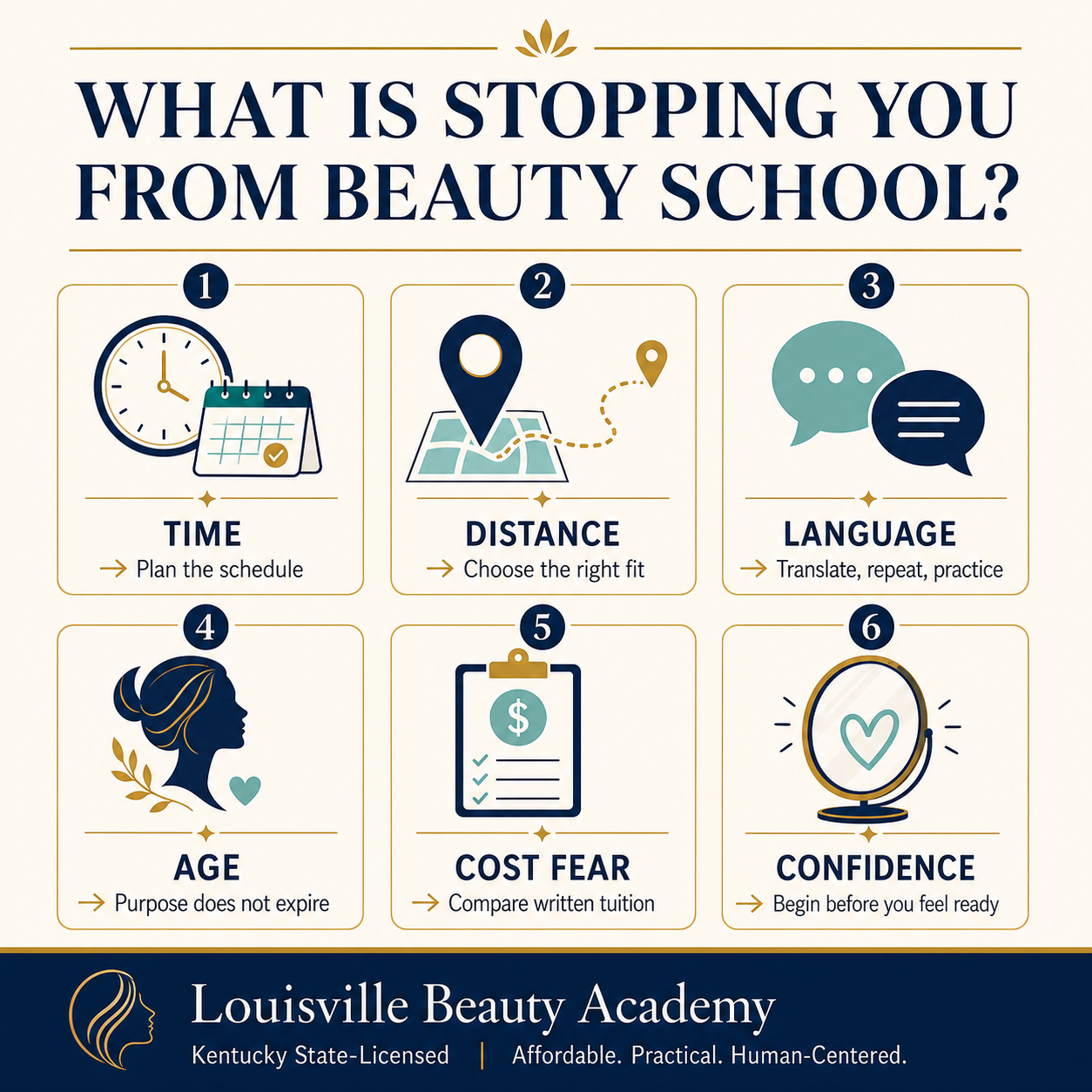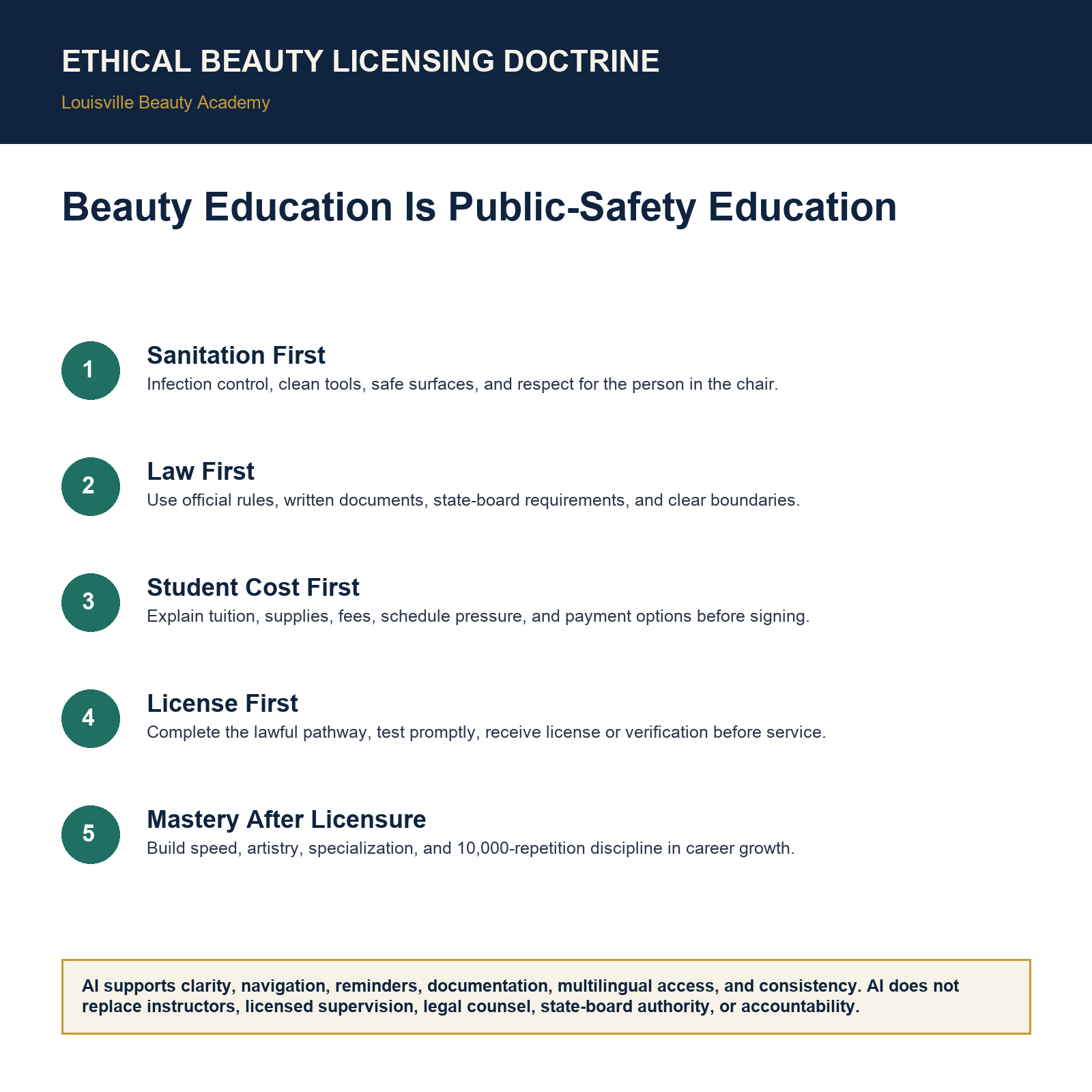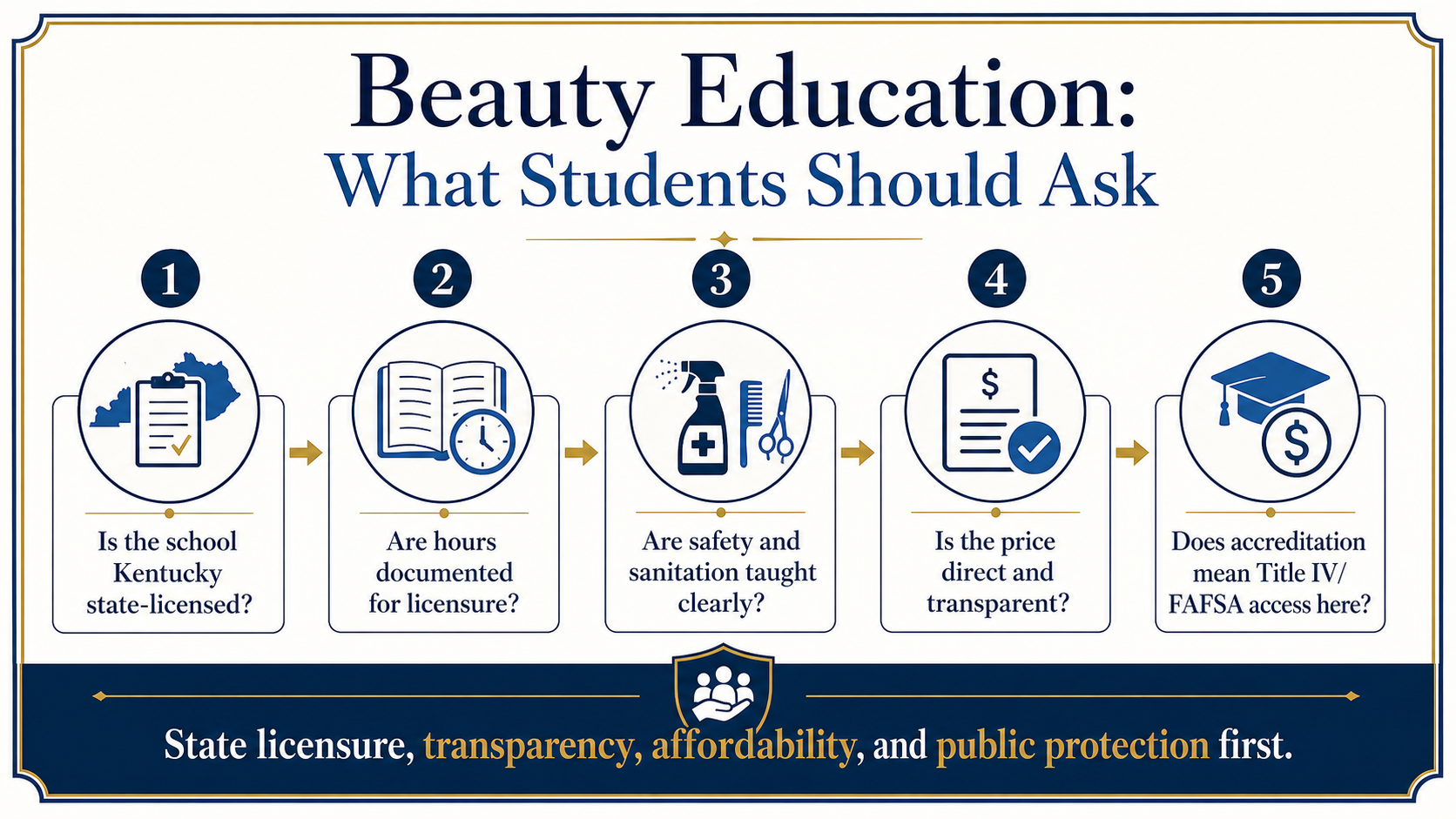
Louisville Beauty Academy public student clarity visual for Preguntas Frecuentes Antes De Inscribirse En Una Escuela De Belleza En Kentucky

Preguntas Frecuentes Antes De Inscribirse En Una Escuela De Belleza En Kentucky

Muchas familias hacen las mismas preguntas antes de elegir una escuela de belleza: cuanto cuesta, cuanto tiempo toma, si hay horario flexible, si el programa ayuda con el camino hacia una licencia, y que documentos se deben leer antes de firmar. Esas preguntas son importantes. Una buena decision educativa necesita claridad, respeto y informacion por escrito.

Infographic summarizing student-protective questions for Preguntas Frecuentes Antes De Inscribirse En Una Escuela De Belleza En Kentucky
A privacy-safe visual guide from Louisville Beauty Academy’s public student clarity series.

Preguntas Importantes

  • Cual es el nombre exacto del programa?
  • Cuantas horas requiere el programa?
  • Cual es el costo escrito y que incluye?
  • Hay plan de pago o descuentos condicionales?
  • Que pasos aplican para la licencia en Kentucky?
  • Quien puede confirmar la informacion por escrito?

Louisville Beauty Academy cree que la claridad escrita protege al estudiante. Antes de inscribirse, cada estudiante debe revisar la informacion actual del programa y los documentos oficiales.

Una Invitacion Con Respeto

Los estudiantes y sus familias pueden pedir explicaciones por escrito, tomar tiempo para leer, comparar opciones y confirmar los pasos antes de firmar. Preguntar no es una molestia. Preguntar es parte de una decision responsable.

Esta guia es educacion publica general. No promete admision, tiempo de finalizacion, licencia, ayuda financiera, descuento, empleo, ingreso, aprobacion de horas transferidas, ni ningun resultado individual. Los documentos actuales de la escuela y las reglas publicas aplicables controlan.

Referencias Y Fuentes Publicas

Louisville Beauty Academy affordable nail service literacy featured visual

Day 30: From Basic Service to Advanced Skill – Affordable Nail Service Literacy

Day 30 of 100 – LBA Affordable Nail Service Literacy Series. This article explains skill ladder in plain language for customers, students, families, and community partners who want beauty services to be accessible without lowering the professional standard.

Infographic showing the LBA nail service literacy standard: consult, clean, serve, teach, and respect
The LBA nail service literacy standard: consult, clean, serve, teach, and respect.

From Basic Service to Advanced Skill

How simple services become the foundation for advanced services through repetition and judgment. At Louisville Beauty Academy, the public-service model is education first: a school clinic or student-supervised service is not a promise of luxury speed. It is a carefully supervised learning environment where affordability, sanitation, communication, and dignity belong together.

What The Service Teaches

  • Service literacy: the client understands what is being requested and what is reasonable for the appointment.
  • Sanitation discipline: clean setup and infection-control habits are treated as the foundation, not a hidden back-room detail.
  • Communication: expectations, timing, comfort, and limits are discussed before the service becomes confusing.
  • Professional judgment: students learn that saying “not today” can be part of protecting the client and the school standard.

Affordable Does Not Mean Careless

LBA’s public-facing nail services are listed on the school’s current student clinic service page when available, and the current written page should be checked before relying on any service, price, schedule, or availability. The mission-level point is larger than a single price: accessible nail services can introduce the public to clean beauty care while helping students practice consultation, timing, technique, and professionalism under supervision.

That is the Louisville Beauty Academy standard: elite expectation without luxury exclusion. A person should not need a luxury budget to be treated with cleanliness, patience, and respect.

Safety and Boundary Note

This series is consumer education, not medical advice. Nail services are cosmetic services. A student, instructor, or licensed professional should not diagnose, treat, or promise improvement for medical conditions. If skin, nail, pain, infection, wound, allergy, or health concerns appear, the safer educational response is to pause and refer the person to an appropriate licensed health professional.

Why DTU Supports This Doctrine

Di Tran University supports this work as doctrine and research architecture: humanization, workforce literacy, affordability, AI-assisted documentation, and ethical education. DTU explains why a small service can become a public lesson in dignity, and LBA proves that lesson in a real school environment.

Read Next

Sources and Guardrails

Public information notice: service availability, prices, schedules, and policies can change. Current written LBA documents and direct school confirmation control. This post does not claim government endorsement, guaranteed outcomes, medical benefit, licensure result, employment result, or superiority over another provider.

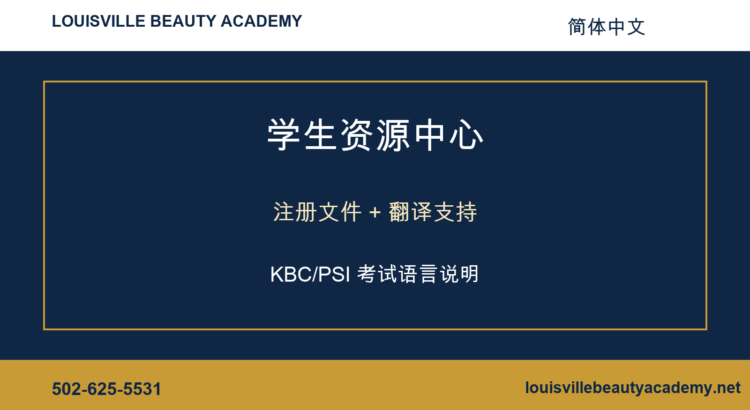
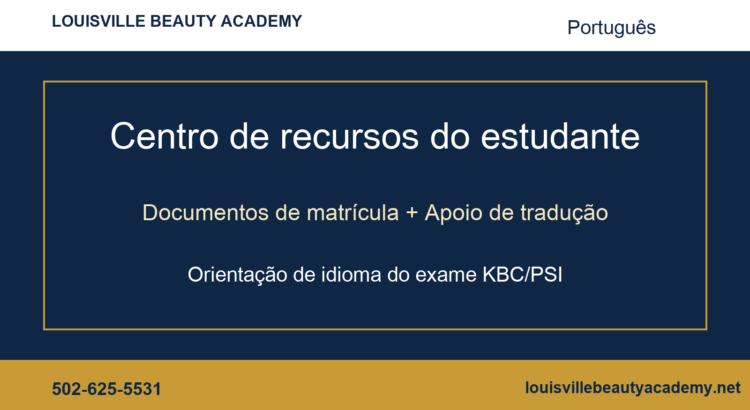
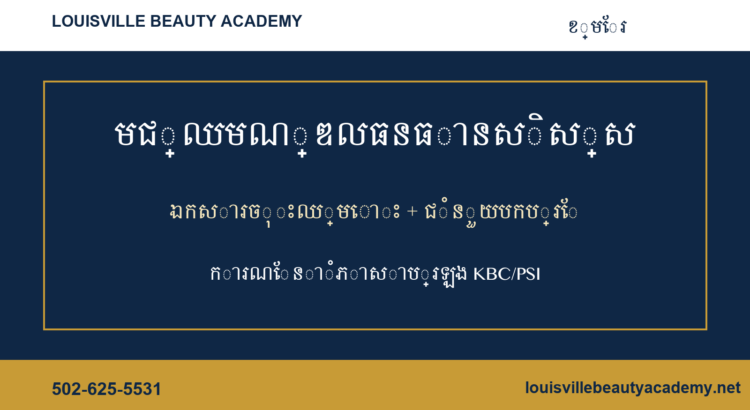
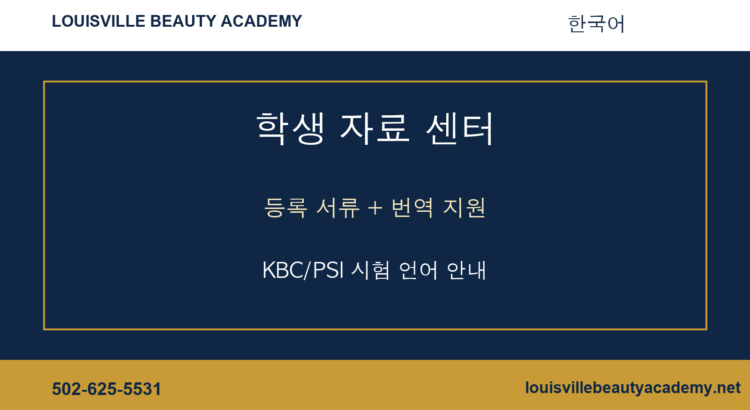
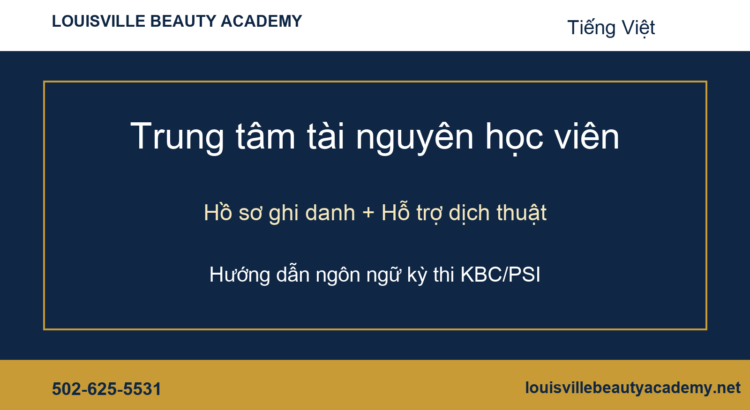
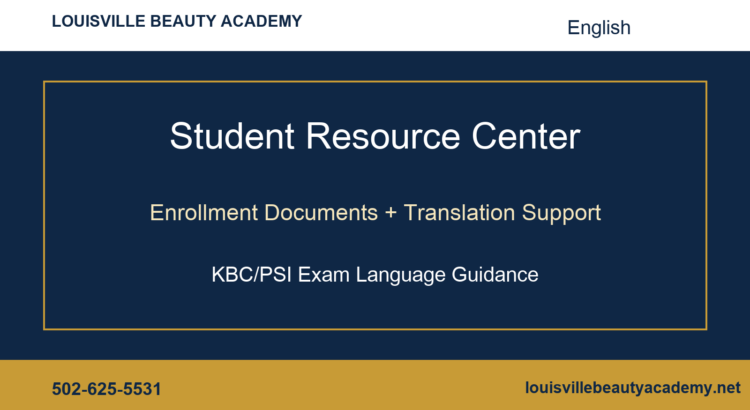
Guía en español de Louisville Beauty Academy sobre documentos de inscripción, apoyo de traducción y claridad antes de firmar.

Centro de recursos en español: documentos para inscribirse y apoyo de traducción en Louisville Beauty Academy

Guía en español para estudiantes y familias. Louisville Beauty Academy recibe constantemente preguntas como: “¿Enseñan en español?” y “¿Qué necesito para inscribirme?” Esta página reúne la respuesta en un solo lugar claro, respetuoso y fácil de compartir.

Louisville Beauty Academy es una escuela de belleza con licencia del estado de Kentucky. Nuestro objetivo es ayudar al estudiante a entender el camino antes de firmar: documentos, idioma, contrato, costo, reglas de asistencia, preparación para licencia y próximos pasos.

Louisville Beauty Academy

Eliminando barreras de idioma. Expandiendo oportunidades. Fortaleciendo la fuerza laboral de Kentucky.

Este centro de recursos en español existe para que estudiantes y familias puedan revisar documentos, idioma, contrato, costo, identificación y próximos pasos con dignidad antes de tomar una decisión educativa.

Por qué existe esta página

El idioma nunca debe ser una barrera para entender el camino hacia una profesión con licencia.

Louisville Beauty Academy cree que cada estudiante merece información clara antes de tomar una decisión educativa. Esta página en español reúne orientación de inscripción, documentos, apoyo de traducción y enlaces oficiales para ayudar al estudiante y a su familia a entender sus derechos, responsabilidades, costo, contrato y camino educativo con más confianza.

Nuestro compromiso a largo plazo

Durante años, Louisville Beauty Academy ha apoyado el acceso multilingüe a la educación de belleza, la preparación profesional y la comunicación clara para comunidades inmigrantes y familias trabajadoras. Junto con educadores, líderes comunitarios, organizaciones de apoyo, reguladores y socios de fuerza laboral, LBA continúa defendiendo una idea sencilla: el estudiante debe poder entender antes de firmar, pagar o comprometerse.

Cuando los proveedores oficiales de examen, las reglas estatales o los recursos digitales ofrecen opciones de idioma, el estudiante debe confirmar la disponibilidad actual directamente con la fuente oficial correspondiente. LBA puede ayudar a orientar la conversación, pero los requisitos oficiales, documentos firmados, reglas de la escuela, Kentucky Board of Cosmetology, PSI cuando aplica, y la ley vigente controlan.

Por qué importa

  • Reduce la confusión antes de la inscripción.
  • Ayuda a estudiantes y familias a revisar documentos con calma.
  • Fortalece la seguridad pública porque el estudiante entiende mejor reglas, sanidad, asistencia y responsabilidades.
  • Apoya a familias inmigrantes y comunidades multilingües.
  • Ayuda a formar futuros profesionales, emprendedores y pequeños negocios.
  • Promueve oportunidad económica con educación práctica, accesible y enfocada en el trabajo real.

Nuestros principios

  • Documentación antes de promesas.
  • Transparencia antes de inscripción.
  • Cumplimiento antes de conveniencia.
  • Dignidad humana antes de transacciones.
  • Educación antes de ventas.

Confianza e impacto

Louisville Beauty Academy ha servido a una comunidad amplia de estudiantes, graduados, familias y futuros profesionales de belleza en Kentucky. Creemos que el desarrollo de la fuerza laboral funciona mejor cuando la educación es clara, asequible, multilingüe cuando es posible, enfocada en documentos escritos y centrada en oportunidad económica a largo plazo en lugar de deuda innecesaria.

Aviso sobre traducciones

Las traducciones y explicaciones se ofrecen para mejorar el acceso y la comprensión. Cuando la ley, la regulación, el contrato firmado o una fuente oficial requiera una versión específica, la versión oficial aplicable controla. Si una parte no está clara, el estudiante debe pedir explicación antes de firmar o depender de esa información.

Nuestra misión

Nuestra misión va más allá de la inscripción. Existimos para reducir barreras, ampliar oportunidades, fortalecer la fuerza laboral de Kentucky y ayudar a cada estudiante serio a construir una carrera, apoyar a su familia y servir a la comunidad con dignidad.

Resumen corto: LBA enseña principalmente en inglés para todos, pero usa apoyo multilingüe, personal que habla varios idiomas cuando está disponible, Google Translate, tecnología de traducción/IA y contenido digital que el estudiante puede traducir en su navegador. La meta es comunicación clara, no confusión.

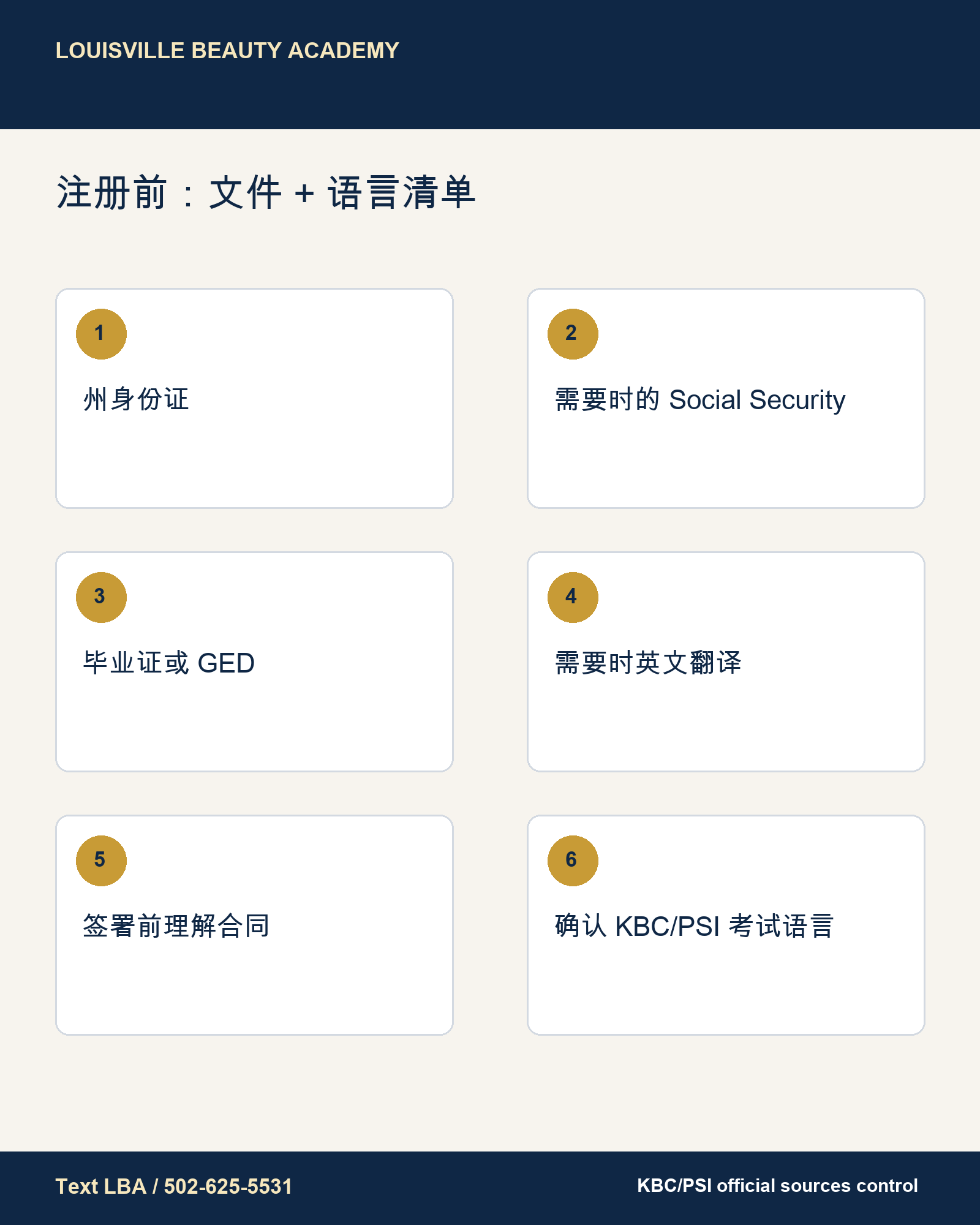
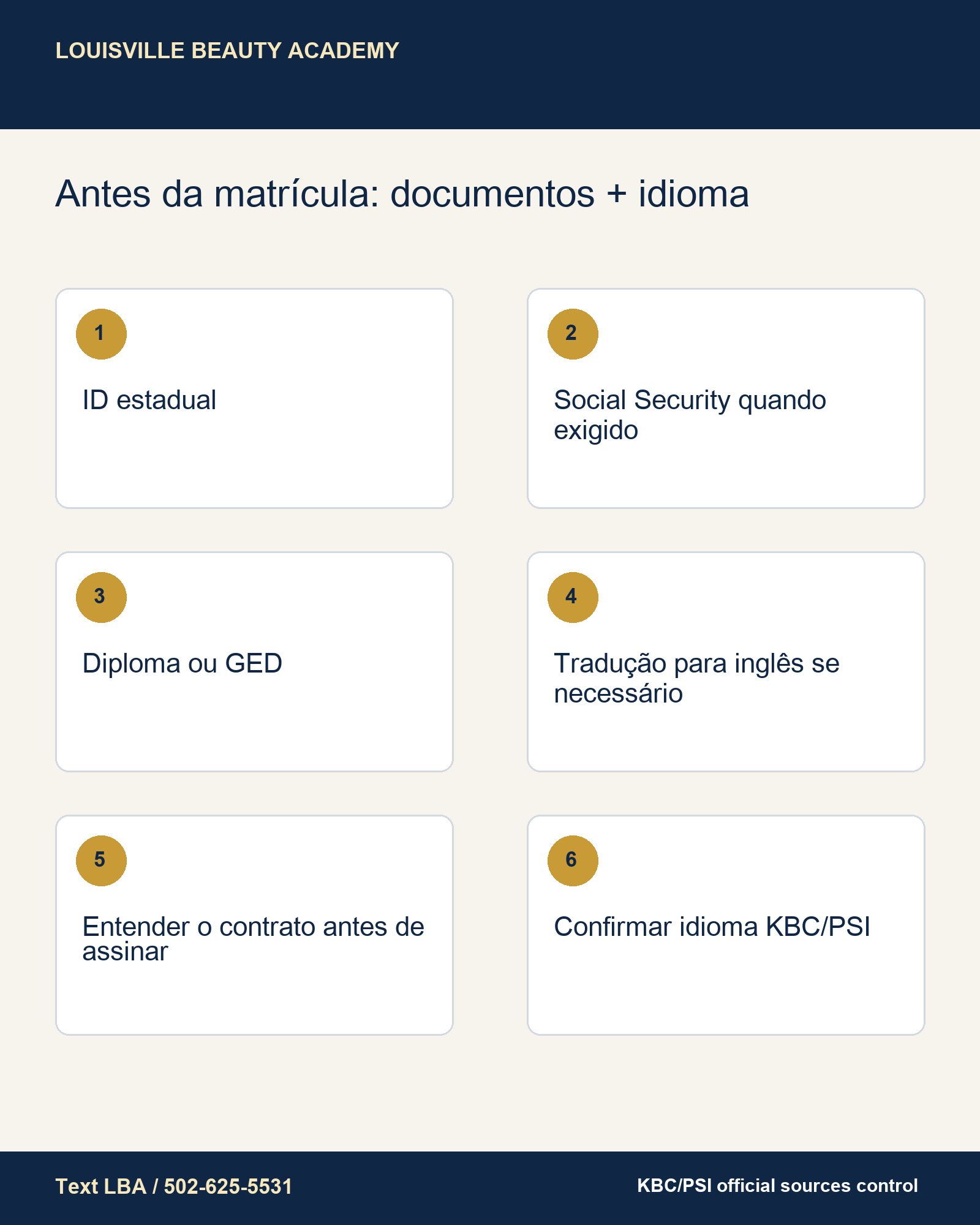
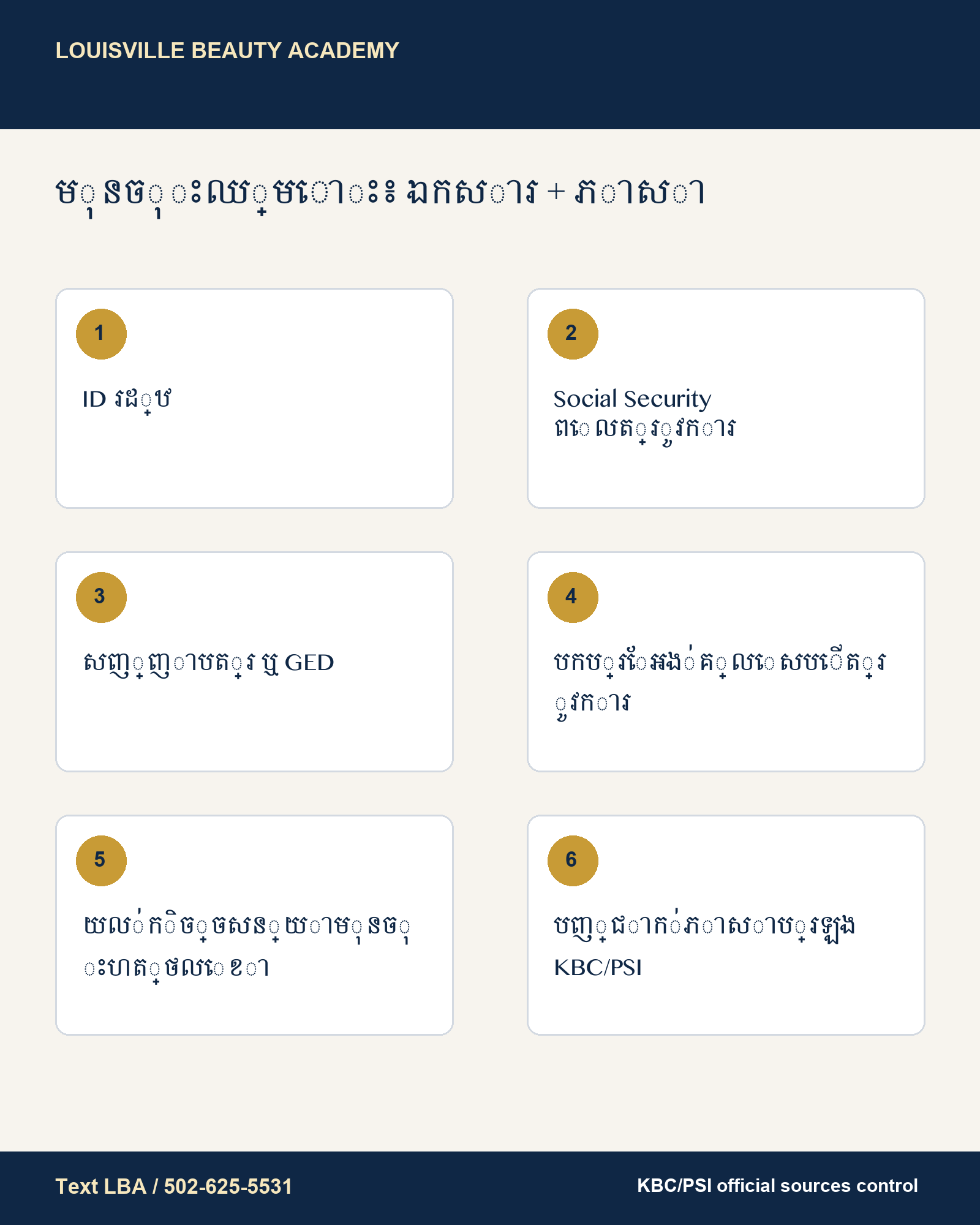
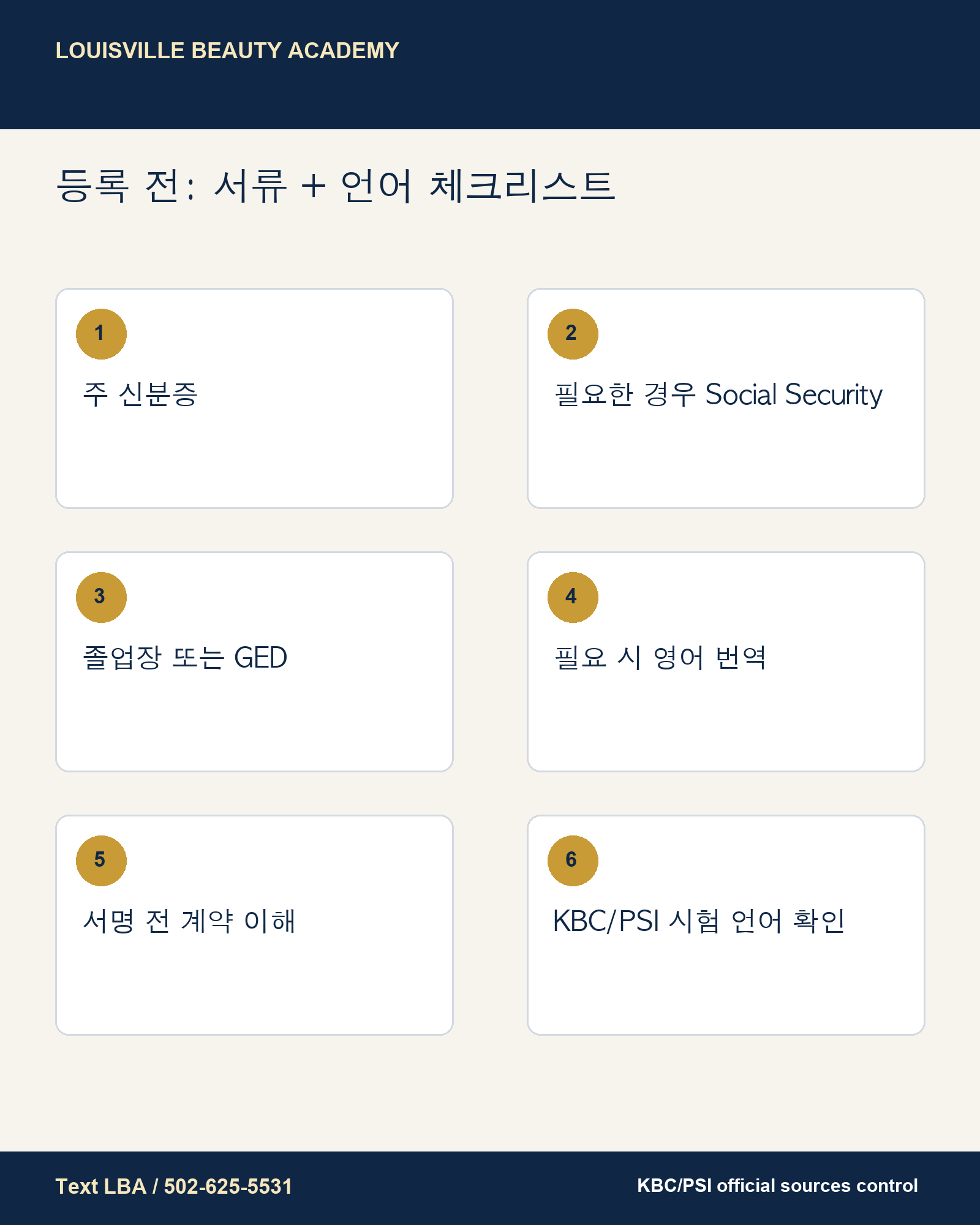
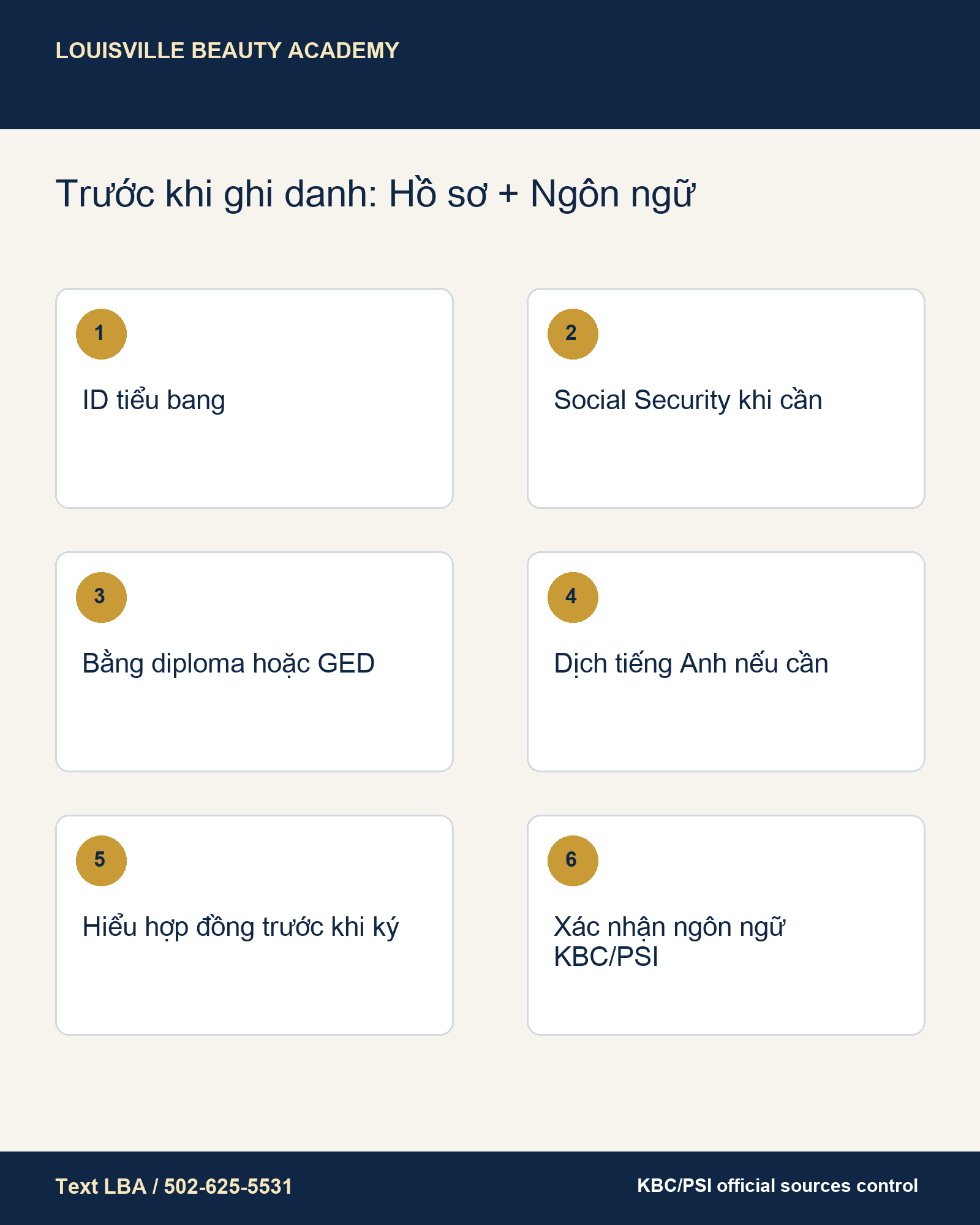
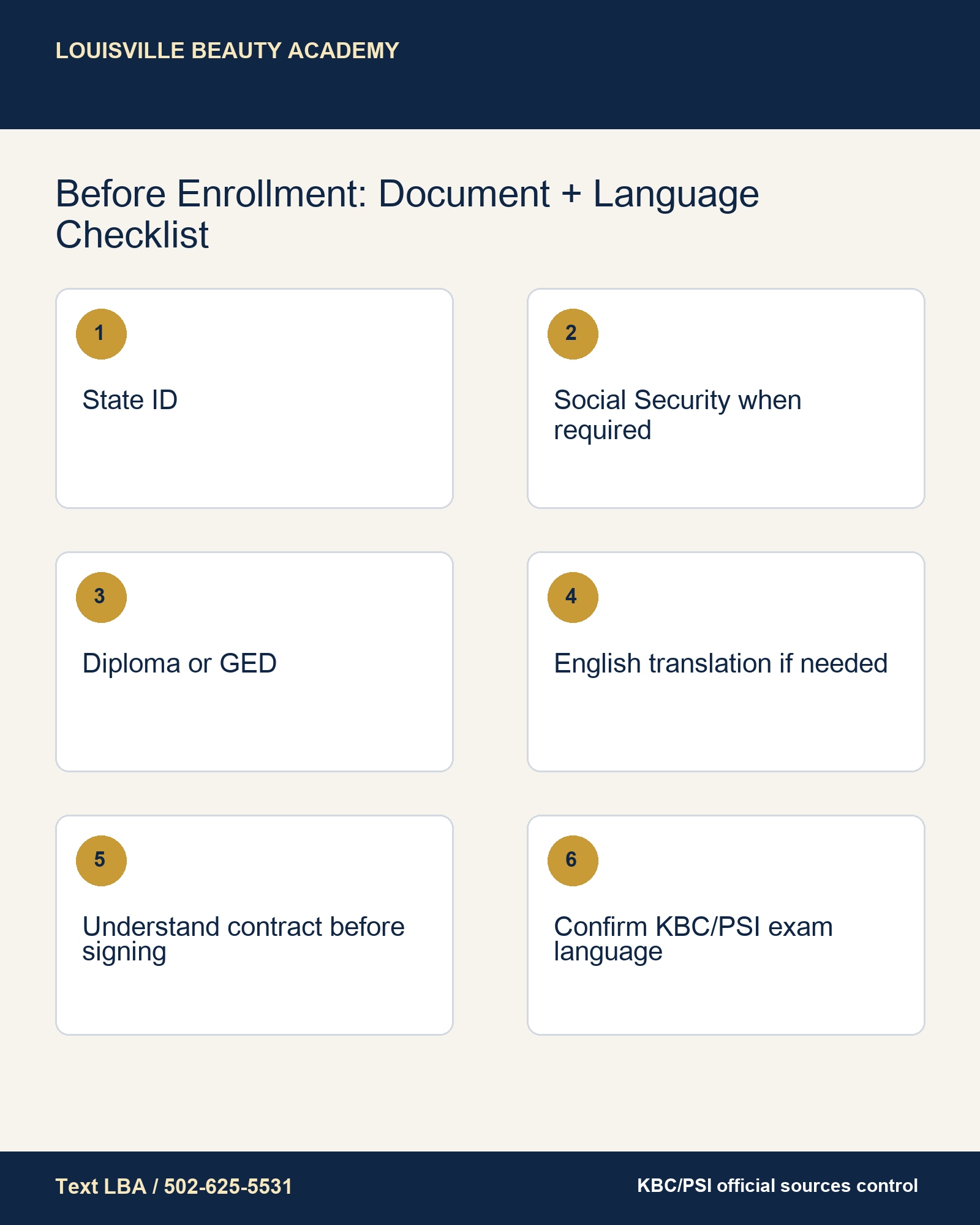
Infografía en español con seis pasos para estudiantes: identificación, Seguro Social, diploma traducido, foto clara, contrato entendido e idioma de enseñanza.
Guía rápida en español: documentos, idioma y contrato antes de inscribirse en Louisville Beauty Academy.

¿Louisville Beauty Academy enseña en español?

La respuesta honesta es: la enseñanza principal es en inglés, porque el camino escolar, los documentos, la seguridad, la sanidad, la preparación para licencia y muchos materiales oficiales operan principalmente en inglés.

Al mismo tiempo, LBA apoya a estudiantes que hablan español y otros idiomas. En la práctica, muchas veces hay más de tres idiomas presentes en la escuela. LBA puede usar conversación bilingüe cuando el personal apropiado está disponible, Google Translate, herramientas de traducción con IA y recursos digitales que pueden traducirse con navegadores modernos.

La tecnología ayuda a comunicar. No reemplaza al instructor, al contrato firmado, a las reglas actuales de la escuela, a los requisitos oficiales del Kentucky Board of Cosmetology, a PSI cuando aplica, ni a la ley aplicable.

Qué documentos debe preparar un estudiante

Para evitar mensajes repetidos y confusión, esta es la lista práctica que un estudiante debe revisar con LBA antes de inscribirse. El personal de LBA debe confirmar la lista actual para cada estudiante y programa.

  • Identificación estatal o licencia de conducir vigente, idealmente con la dirección actual. La dirección ayuda al expediente escolar y a la comunicación correcta.
  • Tarjeta de Seguro Social cuando se requiere para el expediente escolar/licenciamiento. Para esta ruta de inscripción, una tarjeta de residencia no reemplaza automáticamente la tarjeta de Seguro Social ni la identificación estatal.
  • Diploma de high school, GED o equivalente aceptado. Si el diploma o certificado extranjero está en otro idioma, debe traducirse al inglés por una agencia aceptada. Confirme con LBA antes de pagar una traducción.
  • Foto clara tipo pasaporte o selfie reciente del rostro, sin filtro, con fondo sencillo, cuando se solicita para el expediente.
  • Información de contacto actual: nombre legal correcto, teléfono, correo electrónico y dirección.
  • Tiempo para revisar el contrato estudiantil antes de firmar. Si no entiende una parte, pregunte primero.

Diploma extranjero y traducción

Muchos estudiantes traen diplomas o documentos escolares de otro país. Eso puede ser normal. Lo importante es que el documento pueda ser revisado de forma clara. Si está en español u otro idioma, normalmente se necesita una traducción al inglés por una agencia aceptada para que el expediente sea comprensible.

Algunas organizaciones comunitarias, como Catholic Charities u otras agencias de traducción reconocidas, pueden ser recursos útiles. Pero el estudiante debe confirmar con LBA qué tipo de traducción se acepta antes de gastar dinero o asumir que una traducción específica será suficiente.

Contrato estudiantil: se firma en inglés, pero debe entenderse

El contrato estudiantil y los documentos oficiales de inscripción pueden estar en inglés. Eso no significa que el estudiante deba firmar sin entender. LBA puede ayudar a explicar el contenido en español u otro idioma usando apoyo humano y tecnología de traducción cuando sea necesario.

La regla ética es sencilla: si el estudiante no entiende el costo, el horario, la asistencia, el pago, la política de retiro, la responsabilidad del estudiante o el camino hacia la licencia, debe preguntar antes de firmar.

La traducción ayuda a entender. Los documentos actuales firmados, las políticas escolares actuales, los requisitos oficiales del Kentucky Board of Cosmetology, PSI cuando aplica y la ley aplicable controlan. Esta página no es asesoría legal, migratoria, financiera ni de licenciamiento.

Por qué pedimos identificación estatal y Seguro Social

La identificación estatal o licencia con dirección actual ayuda a mantener un expediente claro y una comunicación correcta. La tarjeta de Seguro Social puede ser necesaria para el expediente escolar/licenciamiento cuando corresponda.

LBA no es una agencia de inmigración. No damos asesoría migratoria. Para la inscripción escolar, el estudiante debe enfocarse en los documentos que la escuela y el proceso estatal necesitan revisar: identificación, Seguro Social cuando se requiere, prueba de educación secundaria, foto clara, contrato y datos de contacto correctos.

Enlaces oficiales de LBA para estudiantes que hablan español

Use estos enlaces para revisar la información actual y compartirla con la familia antes de tomar una decisión.

Fuentes y control oficial

Mensaje final para el estudiante

Usted puede hacer preguntas en español. Puede pedir explicación. Puede usar traducción. Puede leer con su familia. Puede revisar los documentos antes de firmar. Un estudiante serio merece claridad.

Texto de inscripción de LBA: 502-625-5531

Enrollment packet, transcript-style academic record, calculator, and beauty education tools representing financial clarity and ethical education.

Clarity in Finance Is Ethical Education: Why Beauty Schools Must Put Cost, Debt, Contracts, and Student Transcripts in Plain View

Ethical Beauty Education Series, Article 1. This public education article is published by Louisville Beauty Academy to help students and families understand cost, financial aid, loans, enrollment paperwork, accreditation language, and official academic records before signing.

Beauty education should begin with honesty.

Before a student signs an enrollment agreement, before a FAFSA form is completed, before a federal loan is accepted, before a school promises a future career pathway, the student deserves one thing first: clarity.

Not sales language. Not vague affordability language. Not the emotional feeling that financial aid means school is almost free. Clarity.

Clarity in finance is not a side topic. It is ethical education.

This is the first principle of the Ethical Beauty Education Series.

Louisville Beauty Academy and the New American Business Association believe the beauty and barber education system should be understandable to the student, reviewable by the family, explainable to the community, and defensible before regulators, workforce partners, and the public.

For many students entering beauty, barbering, nail technology, cosmetology, esthetics, or instructor training, the financial decision happens before the professional income exists. A student may be asked to sign paperwork involving thousands of dollars in tuition, fees, aid, payment plans, or loans while still learning the difference between a grant, a loan, a scholarship, and a repayment obligation.

That is why transparency must come before enrollment.

This article is not written to shame students. It is written to protect them. It is not written to attack every school. It is written to raise the standard. It is not written against financial aid. It is written against confusion.

The ethical beauty education standard

LBA and NABA's standard is simple enough for a student to understand and serious enough for policy discussion:

  1. Cost must be clear before the student signs.
  2. Aid, loans, scholarships, payment plans, and out-of-pocket obligations must be separated in plain language.
  3. Accreditation, state licensure, and federal-aid participation must not be blurred together.
  4. Enrollment contracts should be understandable before commitment, not explained only after a dispute.
  5. Every student should have access to a clear official academic transcript showing progress, completion, withdrawal, graduation, or transfer status.
  6. Beauty education should be presented as safety, sanitation, lawful training, skill, discipline, licensure readiness, and workforce preparation, not as glamour-first fantasy.

This is policy-driven because it protects all sides: the student, the family, the school, the regulator, the salon employer, and the public.

It is also inviting. A serious student should feel welcomed, not pressured. A family should feel informed, not overwhelmed. A school should be proud to explain its paperwork because clarity is a sign of respect.

Financial aid is not the same as free money

The FAFSA form is a gateway for requesting federal student aid. That aid may include grants, work-study funds, and loans. Grants generally do not have to be repaid except under certain conditions. Loans are different. Loans are borrowed money, and borrowed money creates repayment responsibility.

This distinction must be made plain to students.

A student should never leave a financial-aid conversation believing that a loan is the same as a grant. A student should never sign a long loan document without understanding that the signature may follow them for years. A student should never be encouraged to assume that graduation, employment, repayment comfort, or future income is guaranteed.

Beauty education must respect the student enough to explain the full pathway:

  • what the program costs;
  • what is grant aid, if any;
  • what is a loan, if any;
  • what must be repaid;
  • when repayment may begin;
  • what happens if the student withdraws;
  • what happens if the student transfers;
  • what records the student should receive;
  • how the student can compare total cost against realistic work and licensing goals.

This is not anti-financial-aid. It is pro-student.

Financial aid can help students access education. But access without understanding is not protection. A signature without comprehension is not empowerment.

Accreditation does not remove the need for financial clarity

One source of confusion in beauty and barber education is the word accreditation.

Accreditation can matter for institutional eligibility, federal-aid participation, and institutional review. But accreditation should never be used as a substitute for plain-language student understanding.

A school can sound official. A program can appear sophisticated. A student can see federal-aid language, accreditation language, long forms, school codes, and financial-aid steps and assume that the financial decision has already been protected for them.

That assumption is dangerous.

Federal accountability has increasingly focused on whether career programs leave students with debt that is manageable in relation to earnings, and whether program-level outcomes give students real financial value. The U.S. Department of Education's Financial Value Transparency and Gainful Employment framework is built around program-level data, including debt and earnings. In 2026, the Department also described an updated earnings-accountability framework and specifically noted that certain cosmetology, barbering, massage therapy, and similar programs would receive a delayed pass/fail earnings-test determination because tipped income needed to be reflected more accurately, while earnings data would still be published for student information.

That does not mean every beauty school is bad. It does not mean every accredited school is failing. It does not mean students should reject federal aid when aid is lawful and useful.

It means the public must stop confusing institutional labels with student protection.

The ethical question is not simply, "Is the school accredited?" or "Can financial aid be used?"

The better questions are:

  • What is the total cost?
  • How much may the student borrow?
  • What must be repaid?
  • What are typical program-level earnings?
  • What happens if the student withdraws?
  • What happens if the student transfers?
  • What academic record will the student receive?
  • Does the student understand before signing?

This is where Louisville Beauty Academy and the New American Business Association can speak with clarity and dignity. The position is not anti-accreditation. The position is pro-transparency.

Accreditation should not become a curtain. Federal aid should not become camouflage. FAFSA should not become a word that makes debt feel harmless. Ethical education requires schools to explain the real financial pathway before the student signs.

Stop confusing accreditation with student protection

A prospective student recently asked a direct and important question:

Are you not an accredited school?

That question deserves a clear answer, because many students have been taught to hear the word accredited as if it automatically means safer, cheaper, more ethical, or financially protected.

Louisville Beauty Academy's answer is plain: LBA is a Kentucky state-licensed beauty school that teaches state licensing programs. LBA is not a federal-aid beauty school, does not participate in federal student-loan packaging, and does not ask students to borrow federal loans through FAFSA to attend LBA.

That distinction matters.

State licensure and accreditation are not the same thing. Federal financial-aid participation and student value are not the same thing. A school can be accredited and still leave a student confused about debt. A school can use glamorous marketing and still fail to make the true cost clear. A student can complete FAFSA paperwork and still not understand that a loan is borrowed money.

The ethical issue is not the label. The ethical issue is whether the student understands the pathway.

Beauty school is not supposed to be sold as fantasy. Beauty school exists to prepare students for public protection, sanitation, safety, technical skill, state licensure, and professional readiness. The serious work is repetitive practice, clean habits, client safety, infection control, board preparation, and salon readiness.

After graduation and licensure, the student still needs real salon repetition, mentorship, and paid professional experience to grow. No honest school should make a student believe that a diploma alone automatically guarantees income, wealth, or career security.

That is why LBA and NABA's ethical education position is simple:

  • stop the confusion around accreditation;
  • stop making FAFSA feel like free money;
  • stop using glamorous selling to hide serious financial obligations;
  • explain the difference between state licensing education and federal-aid borrowing;
  • teach safety, sanitation, technical skill, and licensure readiness with discipline;
  • help students understand that professional mastery grows through practice, licensed work, and paid salon experience after school.

This is not a negative statement about every accredited school. It is a positive standard for every student.

The student deserves clarity before the signature, skill before the promise, sanitation before the service, licensure before independent practice, and truth before debt.

Infographic explaining that ethical education starts before the signature through cost clarity, aid versus loan clarity, contract review, and transcript protection.
Ethical education starts before the signature: know the cost, know aid versus loan, review the contract, and protect the transcript.

Ethical education starts before the first day of class

A school cannot say it protects students only after the student is already enrolled, already in debt, or already dependent on the institution for records.

Ethical education starts at the first conversation.

It starts when a school tells the student the true cost in plain language. It starts when a school gives the student time to review the enrollment agreement. It starts when a school explains the difference between cash payment, payment plan, scholarship, grant aid, private financing, and federal loans. It starts when the student is encouraged to ask questions before signing.

The student should not have to be a finance expert to understand the decision.

If the paperwork is lengthy, the explanation must be simple. If the obligation is serious, the disclosure must be clear. If the loan can last for years, the student must know that before accepting it.

No hiding behind paperwork

A school should not hide behind the fact that the student signed.

A signature matters. But the ethical question is deeper: did the student understand what they were signing?

Did the student understand the total cost?

Did the student understand what part was aid and what part was debt?

Did the student understand that a loan is not a discount?

Did the student understand what happens if life interrupts school?

Did the student understand that a diploma alone is not the same thing as licensure, employment, earnings, or financial freedom?

The purpose of education is not merely to collect signatures. The purpose of education is to produce understanding.

Public review of student contracts should become normal

Louisville Beauty Academy and the New American Business Association should advocate for a higher public standard across beauty and barber education: core student financial and enrollment documents should be understandable, reviewable, and comparable before a student is pressured to commit.

This does not mean exposing private student records. It means making the standard terms visible enough that families, workforce partners, counselors, immigrant communities, and prospective students can understand the school pathway before signing.

At minimum, students should be able to clearly review:

  • program name and required hours;
  • total tuition and required fees;
  • estimated supply or kit costs;
  • payment options;
  • whether federal student loans are used;
  • whether the student may owe money after aid;
  • refund and withdrawal rules;
  • transfer-hour policies;
  • attendance and satisfactory progress rules;
  • graduation requirements;
  • licensure steps after school completion;
  • how student records and transcripts are issued.

Transparency protects students, schools, regulators, and the public.

The transcript should be the official academic truth

Every beauty and barber student should have a standard student transcript.

The transcript should not be a mystery. It should not be replaced by informal screenshots, vague hour summaries, or inconsistent internal notes. It should be the official student-facing academic record of what the student has completed.

For each student, the transcript should clearly show:

  • student name and identifying school record information;
  • program enrolled;
  • start date;
  • completed hours;
  • accepted transfer hours, if any;
  • theory and practical progress where applicable;
  • attendance or progress status where required;
  • completion, withdrawal, transfer, or graduation status;
  • school official certification;
  • date issued.

The transcript should be the document of academic truth.

Contracts explain the enrollment relationship. Financial-aid records explain aid and payment obligations. But the transcript should be the official academic record showing what the student earned, completed, transferred, or still needs.

This matters because students move. Students face life changes. Students transfer schools. Students apply for licensing. Students need proof. A fair system should not leave the student dependent on confusion.

LBA and NABA's position

Louisville Beauty Academy, as a Kentucky state-licensed beauty school, and the New American Business Association, as an advocacy voice for fair access, workforce dignity, and small-business advancement, should stand for a simple principle:

Students deserve transparent finance and official academic records.

That means:

  1. A student should know the real cost before signing.
  2. A student should know whether money is grant aid, loan debt, payment obligation, or out-of-pocket cost.
  3. A student should understand that federal aid paperwork does not erase financial responsibility.
  4. A student should receive clear, standardized academic records.
  5. The student transcript should be treated as the official academic document of progress, completion, and transfer.

This is not only a school policy issue. It is a public trust issue.

Beauty and barber education serve working people, immigrants, parents, second-career adults, young adults, and small-business dreamers. Many students are not entering education from privilege. Many are entering because they want a license, a skill, a business, a job, and a future.

Those students deserve protection before they borrow, not sympathy after they struggle.

Financial clarity is student protection

Some people argue that students do not need financial education until after they earn income.

That is backwards.

If a student is deciding whether to borrow thousands of dollars, the financial decision is happening now. The income may come later. The risk is now. The signature is now. The obligation is now.

That is exactly when financial awareness matters most.

Students should understand tuition before enrollment, debt before borrowing, repayment before signing, and academic records before transfer or graduation.

That is ethical education.

An invitation to serious students and families

If you are a prospective student, parent, spouse, counselor, workforce partner, or community supporter, the message is simple: ask questions before signing.

Ask what the program costs. Ask what is included. Ask what is not included. Ask whether federal student loans are involved. Ask whether any borrowed money must be repaid with interest. Ask what happens if the student withdraws, transfers, pauses, graduates, or applies for licensure.

Ask for the academic record standard.

At Louisville Beauty Academy, the public position is not pressure. It is clarity. The serious student comes with real questions, real life, real responsibility, and real hope. The school should meet that seriousness with plain answers, lawful training, safety, sanitation, skill discipline, licensure preparation, and respect for the student's future.

A better beauty-school standard

The future of beauty and barber education should not be built on confusion.

It should be built on plain-language finance, public-facing program clarity, fair contracts, official transcripts, licensure readiness, student dignity, and honest workforce preparation.

A student should never have to discover too late that aid was debt.

A student should never have to beg for proof of what they completed.

A student should never have to guess whether a school record will transfer.

A student should never be sold a dream without being shown the cost.

The foundation is simple:

Clarity in finance is ethical education.

Transparency in contracts is student protection.

The official transcript is academic dignity.

And every student deserves to understand before they sign.

References and official sources

These sources are included so students, families, policymakers, and community partners can review the public basis for this article. LBA and NABA policy positions are labeled as institutional standards or advocacy positions, not legal advice.

Louisville Beauty Academy public student clarity visual for Why Louisville Beauty Academy Keeps Enrollment Communication In Writing

Consent-Based Enrollment: Why Louisville Beauty Academy Keeps Student Communication In Writing

Ethical education begins before enrollment. At Louisville Beauty Academy, communication with prospective students is part of student respect: clear information, written answers when possible, no spam, no pressure, no glamour-first selling, no debt-trap confusion, and no attempt to take over a person’s private decision-making ground.

LBA’s purpose is not to chase people into enrollment. Our purpose is to share, inform, document, and respond when a person is ready to ask. A student should be able to read, compare, ask family, translate if needed, and make an educational decision with dignity.

Why This Matters

Louisville Beauty Academy believes education begins with trust. Trust is built through documentation, transparency, and respect for every student. Written communication protects students, families, instructors, regulators, employers, and the school by ensuring that important decisions are based on current, verifiable information rather than memory, pressure, or misunderstanding.

Our goal is not simply to enroll students. Our goal is to help individuals move toward licensed professional life through clear information, human dignity, multilingual access, affordable education, lawful training, public safety, sanitation, and workforce readiness.

For more than seven years, Louisville Beauty Academy has advocated for multilingual access, affordable education, transparent documentation, and workforce-first policies that reduce barriers to professional licensure while preserving the seriousness of law, regulation, safety, sanitation, and professional responsibility.

Why Written Communication Matters

At Louisville Beauty Academy, written communication is not bureaucracy. It is respect. Written records protect students, families, instructors, employers, regulators, and the school by reducing misunderstanding and helping everyone rely on the same information.

We believe transparency, documentation, and accountability build trust. Trust is the foundation of quality education. When important information is written, students can slow down, review, translate, compare, ask questions, and decide with clearer understanding.

A Public-Interest Education Standard

This approach is part of LBA’s broader mission to strengthen Kentucky’s workforce through affordable, transparent, multilingual, and compliance-centered beauty education. When information is documented, students make better decisions, regulators have clearer records, families understand the pathway, and employers gain greater confidence in future professionals.

Documentation protects trust. Trust protects students. Protected students strengthen Kentucky’s workforce.

Technology Supports The Record. People Remain Responsible.

LBA may use AI-assisted systems and digital tools to help organize, preserve, translate, and route written communication. These tools support clarity and consistency. They do not replace human review, current official school documents, signed agreements, Kentucky Board of Cosmetology requirements, applicable law, or appropriate professional judgment.

Infographic summarizing student-protective questions for why Louisville Beauty Academy keeps enrollment communication in writing
A privacy-safe visual guide from Louisville Beauty Academy’s public student clarity series.

You Reach Out When You Are Ready

You reach out when you are ready. We respond with clarity. That is the heart of consent-based enrollment communication. A serious student should be able to read, compare, ask family, translate if needed, and decide without being chased into a school contract.

LBA does not build trust through spam. LBA builds trust through written clarity: cost, schedule, program requirements, documents, safety, sanitation, licensing preparation, student responsibility, and current official school pages.

Respecting A Student’s Ground, Territory, And Decision

Every person has a ground: family, work, finances, language, time, privacy, faith, fear, confidence, transportation, and personal readiness. Ethical education respects that ground. It does not push through a student’s boundary just because enrollment is possible.

Beauty school should never be sold as a fantasy shortcut. Beauty education is safety, sanitation, law, regulation, technical training, practice, documentation, and professional maturity. A student should choose the path because they understand it, not because they were pressured by glamorous images, urgency language, or debt confusion.

What Consent-Based Communication Means At LBA

  • We answer the person who asks. A question by text, email, message, comment, form, phone, visit, subscription, application, attendance, or active relationship creates a proper reason to respond.
  • We keep important guidance reviewable. When possible, enrollment information is confirmed through text, email, message, comment, form response, or official page links so the student can reread it.
  • We give written sources. A serious question should point back to current LBA pages, official school documents, Kentucky Board of Cosmetology resources, PSI where applicable, and signed agreements when they control.
  • We avoid pressure language. No student should feel that a school is trying to take over their decision.
  • We do not sell glamour or debt traps. The ethical center is license preparation, sanitation, safety, cost clarity, lawful practice, and honest work.

Why Writing Protects Both Sides

  • Students can review cost, schedule, and documents at their own pace.
  • Families can compare written information instead of relying on memory.
  • Students who speak another language can translate digital information more easily.
  • The school can route questions to the correct enrollment team member.
  • Regulated education details are less likely to be misunderstood.
  • The school can preserve a clearer record of what was asked and answered.

Written communication is not cold. Done well, it is respectful, inviting, protective, and easier for the student to control.

What LBA Does Not Promise

A message, comment, phone conversation, tour, form submission, or social-media reply does not by itself enroll a student, create a contract, document/apply a discount, guarantee licensure, guarantee employment, guarantee income, guarantee immigration results, guarantee financial aid, or replace current signed documents.

Current written school documents, signed enrollment agreements, official Kentucky Board of Cosmetology requirements, PSI rules when applicable, and applicable law control. If a topic is student-specific, payment-specific, licensure-specific, transcript-related, regulatory, or legal, it should be reviewed through the appropriate written pathway.

A Higher Standard Of Welcome

An inviting school does not rush a student into confusion. It gives the student a clear path: ask, read, compare, confirm, and then decide. That is especially important for families balancing work, language, transportation, finances, and licensing questions at the same time.

LBA’s enrollment posture is simple: No spam. No pressure. No glamour-first selling. License, safety, sanitation, cost, written clarity, and honest work first.

Related LBA Resources

References And Public Sources

Louisville Beauty Academy affordable nail service literacy featured visual

Day 29: Luxury Standard Without Luxury Exclusion – Affordable Nail Service Literacy

Day 29 of 100 – LBA Affordable Nail Service Literacy Series. This article explains open luxury standard in plain language for customers, students, families, and community partners who want beauty services to be accessible without lowering the professional standard.

Infographic showing the LBA nail service literacy standard: consult, clean, serve, teach, and respect
The LBA nail service literacy standard: consult, clean, serve, teach, and respect.

Luxury Standard Without Luxury Exclusion

The core LBA doctrine: premium standards can belong to everybody, not only luxury-price consumers. At Louisville Beauty Academy, the public-service model is education first: a school clinic or student-supervised service is not a promise of luxury speed. It is a carefully supervised learning environment where affordability, sanitation, communication, and dignity belong together.

What The Service Teaches

  • Service literacy: the client understands what is being requested and what is reasonable for the appointment.
  • Sanitation discipline: clean setup and infection-control habits are treated as the foundation, not a hidden back-room detail.
  • Communication: expectations, timing, comfort, and limits are discussed before the service becomes confusing.
  • Professional judgment: students learn that saying “not today” can be part of protecting the client and the school standard.

Affordable Does Not Mean Careless

LBA’s public-facing nail services are listed on the school’s current student clinic service page when available, and the current written page should be checked before relying on any service, price, schedule, or availability. The mission-level point is larger than a single price: accessible nail services can introduce the public to clean beauty care while helping students practice consultation, timing, technique, and professionalism under supervision.

That is the Louisville Beauty Academy standard: elite expectation without luxury exclusion. A person should not need a luxury budget to be treated with cleanliness, patience, and respect.

Safety and Boundary Note

This series is consumer education, not medical advice. Nail services are cosmetic services. A student, instructor, or licensed professional should not diagnose, treat, or promise improvement for medical conditions. If skin, nail, pain, infection, wound, allergy, or health concerns appear, the safer educational response is to pause and refer the person to an appropriate licensed health professional.

Why DTU Supports This Doctrine

Di Tran University supports this work as doctrine and research architecture: humanization, workforce literacy, affordability, AI-assisted documentation, and ethical education. DTU explains why a small service can become a public lesson in dignity, and LBA proves that lesson in a real school environment.

Read Next

Sources and Guardrails

Public information notice: service availability, prices, schedules, and policies can change. Current written LBA documents and direct school confirmation control. This post does not claim government endorsement, guaranteed outcomes, medical benefit, licensure result, employment result, or superiority over another provider.

Louisville Beauty Academy public student clarity visual for Does Beauty School Lead To A License? Kentucky State Board Basics For Students

Does Beauty School Lead To A License? Kentucky State Board Basics For Students

Students often ask one direct question: does this program lead to a license? The responsible answer is that a licensed school can provide required education for an eligible license path, but the student must also meet applicable state requirements and complete the required licensing process.

Infographic summarizing student-protective questions for Does Beauty School Lead To A License? Kentucky State Board Basics For Students
A privacy-safe visual guide from Louisville Beauty Academy’s public student clarity series.

Training Is One Part Of The Path

Beauty education is not just a private class. In Kentucky, cosmetology-related licensing is tied to public rules, state-board oversight, documented hours, and required procedures. Students should verify the current rule for their intended license type.

  • Choose the correct program for the intended license path.
  • Complete required clock hours and school obligations.
  • Follow current Kentucky Board procedures for examination or licensure.
  • Keep records, names, and documents consistent.
  • Ask written questions early if transferring from another state or field.

The Inspiring Part Is The Discipline

A license path is not only about beauty skills. It is about responsibility: learning the required curriculum, documenting hours, respecting sanitation and public-protection rules, and completing the state process before providing regulated services. Students are invited to see that discipline as part of the dignity of the profession.

This guide is not legal advice and does not guarantee admission, graduation, exam passage, license approval, transfer-hour acceptance, or permission to work. Students should rely on current Kentucky Board information, written school documents, and any direct instructions from the proper public authority.

References And Public Sources

Louisville Beauty Academy affordable nail service literacy featured visual

Day 28: Vietnamese and Immigrant Community Access – Affordable Nail Service Literacy

Day 28 of 100 – LBA Affordable Nail Service Literacy Series. This article explains community access in plain language for customers, students, families, and community partners who want beauty services to be accessible without lowering the professional standard.

Infographic showing the LBA nail service literacy standard: consult, clean, serve, teach, and respect
The LBA nail service literacy standard: consult, clean, serve, teach, and respect.

Vietnamese and Immigrant Community Access

Why nail services and nail education matter in immigrant families, neighborhood trust, and local opportunity. At Louisville Beauty Academy, the public-service model is education first: a school clinic or student-supervised service is not a promise of luxury speed. It is a carefully supervised learning environment where affordability, sanitation, communication, and dignity belong together.

What The Service Teaches

  • Service literacy: the client understands what is being requested and what is reasonable for the appointment.
  • Sanitation discipline: clean setup and infection-control habits are treated as the foundation, not a hidden back-room detail.
  • Communication: expectations, timing, comfort, and limits are discussed before the service becomes confusing.
  • Professional judgment: students learn that saying “not today” can be part of protecting the client and the school standard.

Affordable Does Not Mean Careless

LBA’s public-facing nail services are listed on the school’s current student clinic service page when available, and the current written page should be checked before relying on any service, price, schedule, or availability. The mission-level point is larger than a single price: accessible nail services can introduce the public to clean beauty care while helping students practice consultation, timing, technique, and professionalism under supervision.

That is the Louisville Beauty Academy standard: elite expectation without luxury exclusion. A person should not need a luxury budget to be treated with cleanliness, patience, and respect.

Safety and Boundary Note

This series is consumer education, not medical advice. Nail services are cosmetic services. A student, instructor, or licensed professional should not diagnose, treat, or promise improvement for medical conditions. If skin, nail, pain, infection, wound, allergy, or health concerns appear, the safer educational response is to pause and refer the person to an appropriate licensed health professional.

Why DTU Supports This Doctrine

Di Tran University supports this work as doctrine and research architecture: humanization, workforce literacy, affordability, AI-assisted documentation, and ethical education. DTU explains why a small service can become a public lesson in dignity, and LBA proves that lesson in a real school environment.

Read Next

Sources and Guardrails

Public information notice: service availability, prices, schedules, and policies can change. Current written LBA documents and direct school confirmation control. This post does not claim government endorsement, guaranteed outcomes, medical benefit, licensure result, employment result, or superiority over another provider.

Kentucky Senate recognition honoring Di Tran on the motion of Senator Cassie Chambers Armstrong, dated July 13, 2026.

From Bardstown Road to Frankfort: Kentucky Senate Recognition Honors Di Tran and Louisville Beauty Academy

Louisville Beauty Academy, 1049 Bardstown Road, now carries a new state-level proof point. A Kentucky Senate recognition dated July 13, 2026 honors Di Tran and the school’s workforce impact after Senator Cassie Chambers Armstrong visited the LBA main campus on June 26, 2026.

A Kentucky Senate recognition dated July 13, 2026 now becomes part of the public record of a larger story: immigrant entrepreneurship, licensed beauty education, nail-industry workforce modernization, and public service rooted on Bardstown Road in Louisville.

Why This Matters

This recognition is not merely a ceremonial certificate. It connects a state-level public honor with the real workforce environment of Louisville Beauty Academy, where adult learners, immigrants, working families, and future licensed beauty professionals train for lawful work, small-business ownership, and community service.

The Visit Before The Recognition

On Friday, June 26, 2026, Senator Cassie Chambers Armstrong visited Louisville Beauty Academy at 10:00 AM and spent nearly an hour with the school. The visit included the school environment, the student-centered workforce model, responsible AI-supported documentation, and beauty-policy topics connected to licensing, public protection, nail technology demand, and practical opportunity.

The Senate Recognition

The Kentucky Senate recognition honors Di Tran as founder and CEO of Louisville Beauty Academy, recognizes the academy’s service to more than 2,000 licensed professionals, and notes LBA’s 2025 recognition by the U.S. Chamber of Commerce as one of America’s Top 100 Small Businesses. The recognition was made on the motion of Senator Cassie Chambers Armstrong and dated July 13, 2026 in Frankfort, Kentucky.

Senator Armstrong’s Public-Service Credentials

Official public records identify Senator Cassie Chambers Armstrong as Kentucky Senate District 19, Minority Whip, and a member of the Senate Licensing and Occupations Committee. Her official biography also identifies her as an Assistant Professor of Law at the University of Louisville Brandeis School of Law, with degrees from Yale University, the Yale School of Public Health, the London School of Economics, and Harvard Law School. Her public work brings together law, public policy, access to justice, local government, and state legislative service.

SB14 and Nail-Industry Modernization

Senate Bill 14 from the 2024 Kentucky Regular Session was an act relating to beauty services. The official record states that the enacted version amended Kentucky beauty law to add a licensed nail technician to the Board of Cosmetology, replace one citizen-at-large board position with a licensed esthetician, and allow cosmetologists and nail technicians to use callus graters for callus removal. The bill passed the Senate 37-0, passed the House 92-0, and was signed by the Governor as Acts Chapter 25.

For public accuracy, Senator Armstrong should be described as having supported and voted for SB14. Sponsor credit should follow the official bill record, which lists Senator Reginald Thomas and the named co-sponsors.

Editorial explainer connecting Kentucky Senate recognition, Senator Cassie Chambers Armstrong, Louisville Beauty Academy, and SB14 nail-industry modernization.
Editorial explainer summarizing verified public facts: LBA visit, Senate recognition, Senator Armstrong credentials, and SB14 nail-industry modernization.
Kentucky Senate recognition honoring Di Tran on the motion of Senator Cassie Chambers Armstrong, dated July 13, 2026.

Public-Service Framing

The strongest public meaning is simple: Kentucky’s beauty industry is not small in human value. Nail technicians, cosmetologists, estheticians, instructors, salon owners, immigrant families, working parents, and adult learners deserve clear regulation, fair representation, affordable training, and public respect.

From Bardstown Road to Frankfort, this recognition elevates a Kentucky workforce model built on documentation, dignity, licensure, affordability, and service.

Sources and Verification

  • Kentucky Legislative Research Commission, Senator Cassie Chambers Armstrong profile: official legislator profile.
  • University of Louisville profile for Professor Cassie Chambers Armstrong: official UofL faculty profile.
  • Kentucky Legislative Research Commission, 2024 Regular Session Senate Bill 14: official SB14 record.
  • Internal LBA visit record: June 26, 2026 follow-up email confirming Senator Armstrong’s 10:00 AM visit to Louisville Beauty Academy and nearly hour-long campus discussion.
Louisville Beauty Academy public student clarity visual for Full-Time, Part-Time, And Flexible Schedule: What Beauty School Timing Really Means

Full-Time, Part-Time, And Flexible Schedule: What Beauty School Timing Really Means

Flexible schedule does not mean unlimited schedule. It means the student and school should understand the approved operating window, weekly attendance expectation, program clock hours, and the pace needed to finish. For working adults, parents, caregivers, and career changers, this kind of clarity can make education feel possible without making it vague.

Infographic summarizing student-protective questions for Full-Time, Part-Time, And Flexible Schedule: What Beauty School Timing Really Means
A privacy-safe visual guide from Louisville Beauty Academy’s public student clarity series.

Questions To Ask Before Enrolling

  • How many clock hours are required?
  • What weekly attendance range is expected?
  • Which days and times can actually be selected?
  • How are absences, make-up hours, and breaks handled?
  • How long does completion usually take at the chosen pace?

Written schedule clarity helps a working adult decide honestly. It also protects the licensing process because clock-hour education is regulated and must be documented.

Flexibility With Structure

The strongest schedule conversation is both hopeful and practical. It respects a student’s ambition while also naming the real attendance commitment. A student should know what pace is realistic, what records must be kept, and what happens if life interrupts the plan.

Schedule discussions are guidance, not guarantees. This article does not guarantee a specific schedule, completion date, attendance result, clock-hour outcome, or license timeline. Actual completion timing depends on the program, approved schedule, attendance, school policy, clock-hour progress, student choices, and applicable Kentucky Board requirements.

References And Public Sources