Louisville Beauty Academy | Exam-Readiness Practice
Original LBA practice questions for Kentucky beauty students preparing for PSI-administered licensing exams. Built to feel disciplined, timed, and serious, with answer explanations that teach the reason behind the right choice.
Your Practice Result
The page now saves answer choices only in this browser on this device. No name, phone, email, SSN, government ID, payment information, or school record is collected by this practice tool.
Choose an answer, press Check Answer to open the explanation, then use Next Question or Grade Visible Set.
Progress is ready to save on this device.
Track Breakdown
- All tracksNot graded
These are LBA-written practice items, not copied from PSI, KBC, a candidate bulletin, or any live exam.
The layout uses a serious computer-test feel: four choices, one best answer, and direct explanation.
LBA can revise the bank when official exam rules, board guidance, or school curriculum priorities change.
The key before the career
What Is The Licensing Exam, And Why Does It Matter?
The licensing exam is the state-required checkpoint a beauty student must pass before becoming licensed to work in a regulated Kentucky beauty profession. It is not the glamorous part of beauty. It is the serious part.
A license is public proof that a person has met required education, safety, sanitation, theory, and professional-readiness standards. Without the required license, talent alone is not enough to legally practice in the licensed field.
- The exam protects the public. It checks whether the future professional understands sanitation, infection control, chemical safety, client protection, and basic professional judgment.
- The license protects the student. It turns training into legal career authority, so the student can pursue work with a credential rather than only a dream.
- The right school prepares for the test and the work. Students need practice, correction, explanation, repetition, and current-source learning, not just motivation.
The LBA Way To Win
LBA gives students the guide to win responsibly: study the rule, practice the question, understand the explanation, correct the weak area, and keep learning as official sources change.
Standard Process Workflow
How LBA Turns Study Into Licensing Readiness
The process is simple on purpose: source, teach, practice, correct, simulate, review, and keep improving. A serious beauty school should make the path visible before a student enrolls.
Choose the path before the practice
Track Readiness Blueprint
Each licensing path has a different emphasis. This page gives one free sample bank, but serious preparation should also help students understand what their own track is asking them to master.
- Hair and scalp safety
- Chemical service judgment
- Infection control and tools
- Client consultation
- Skin analysis
- Contraindications
- Product safety
- Clean dispensing and draping
- Porous and reusable implements
- Nail and skin condition checks
- Chemical exposure control
- Station sanitation
- Scalp and hair observation
- Water and heat safety
- Tool disinfection
- Client comfort and service flow
- Teaching objectives
- Safety correction
- Fair evaluation
- Student privacy and documentation
Real exam alignment, without copying protected exam content
What this practice is aligned to
LBA keeps this guide close to the public shape of Kentucky beauty licensing readiness: multiple-choice theory discipline, practical-exam safety thinking, current KBC/PSI routing awareness, and the habits a student must show before test day.
Practical next step
Turn your practice score into a study path
Do not just take the sample and disappear. Use the result to make a practical plan with LBA: track, score, weak topic, and next study action.
- Choose your track or practice all 50 questions.
- Press Check Answer for each item, or Grade Visible Set when ready, then read the explanations for every missed item.
- Copy or text your track and score to LBA.
- Ask what to study next before enrollment, transfer review, graduation, or exam scheduling.
- Use official KBC/PSI sources for current rules, fees, test guides, language options, dates, eligibility, and scheduling.
Free Public Sample: 50 Questions With Check-Answer Explanations
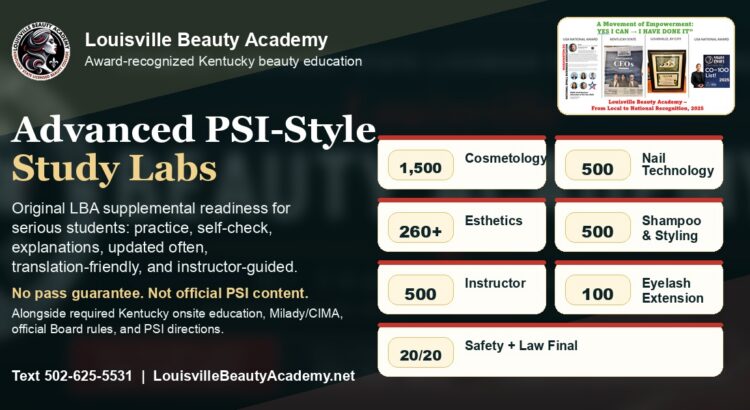
This sample shows the quality standard. The expanded LBA questionnaire can be built by track with deeper topic coverage, printable study sheets, timed practice sets, and scoring review. To request or purchase the expanded questionnaire, contact LBA and ask for the PSI Study Guide questionnaire.
Pass-protection note: no school or study guide can guarantee a student will pass a licensing exam. LBA’s promise is serious preparation: sanitation, safety, theory, procedure order, professional judgment, practice discipline, and current-source review to the best of our knowledge.
Original LBA Practice Track
Cosmetology
Before using a thermal iron on a client, which step best protects the hair and scalp?
Heat decisions should be based on hair condition and client safety. A correct answer protects the client before focusing on speed or style.
A student drops a disinfected comb on the floor during service. What should happen next?
Tools that touch an unclean surface must not return directly to service. Separation and disinfection prevent cross-contamination.
Why is a patch or preliminary test important before some chemical services?
A preliminary check does not guarantee safety, but it helps identify warning signs and supports safer professional judgment.
Which client statement should cause a student to pause and seek instructor guidance before a chemical service?
Scalp irritation can create chemical-service risk. The safe response is to pause, evaluate, and involve the instructor.
What is the best reason to section hair before a controlled cutting or color service?
Sectioning is a professional control habit. It helps the student work systematically and evaluate the result more accurately.
During a color service, why should timing be monitored carefully?
Chemical services depend on product direction, hair condition, timing, and observation. More time is not automatically safer or better.
What should a student do if a cape, towel, or neck strip becomes contaminated?
Contaminated soft goods should be removed from service and replaced to protect the client and workstation.
Why does cosmetology training emphasize consultation before service?
Consultation connects beauty goals with safety, feasibility, and documentation. It protects the client and the student.
Which habit best shows professional infection-control awareness?
A licensing-ready student understands zones: clean items, used items, trash, and disinfected tools must not be mixed.
A client asks for a result that may not be possible because of hair condition. What is the best response?
Professional judgment includes explaining limits and getting proper supervision rather than creating unsafe or unrealistic expectations.
Original LBA Practice Track
Esthetics / Aesthetic Skincare
What should be reviewed before selecting products for a facial service?
Product choice must start with skin analysis and safety, not preference alone.
Why should esthetics students avoid double-dipping into shared product containers?
Clean dispensing protects the product, the client, and the next service.
A client reports stinging that becomes painful during a product application. What is the best response?
Client discomfort during a chemical or active product step requires immediate safety judgment and supervision.
What does proper draping support during a skincare service?
Draping is a professional protection step. It supports comfort and clean service boundaries.
Why are contraindications important in esthetics?
Contraindications are safety signals. Students must know when to pause and ask for guidance.
After exfoliation, why may sun-protection education matter?
Post-service education helps clients protect skin after treatments that can increase sensitivity.
Which action best protects eye-area service safety?
The eye area requires careful product selection, clean tools, and immediate response to discomfort.
What is the best reason to document relevant client skin concerns?
Documentation supports safer services and consistent education. It does not replace consent or privacy duties.
Which sanitation habit is strongest before touching the client's face?
Hand hygiene and clean tools are foundational before direct skin contact.
If a student is unsure whether a product is appropriate for a client's skin, what should the student do?
Uncertainty should trigger supervision. Safe learning requires asking before risk is created.
Original LBA Practice Track
Nail Technology
What is the safest first step before beginning a manicure?
Nail services begin with observation, sanitation, and proper setup.
Why are many files, buffers, and orangewood sticks single-use?
Porous implements can hold contaminants. Single-use disposal protects clients.
A client has redness, swelling, and broken skin around a nail. What should the student do?
Broken or inflamed skin may indicate infection or injury risk. The correct response is to pause and seek supervision.
Why should monomer and polymer products be used according to manufacturer directions?
Chemical products require correct ratio, ventilation, storage, and use. Directions are part of safety.
What does a clean nail station show?
Clean setup builds trust and reduces contamination risk.
Why should metal implements be cleaned before disinfection?
Visible debris and residue should be removed before disinfection so the disinfectant can work properly.
What is the best reason to avoid over-filing the natural nail?
Licensing-level nail care protects the natural nail. Aggressive filing can create harm.
How should disinfectant be used in a school clinic setting?
Disinfectant safety depends on correct product use, label direction, contact time, and school procedures.
Why is client consultation important before applying artificial nail products?
Consultation helps the student match the service to the client's condition and avoid unsafe assumptions.
Which action best reduces dust and chemical exposure during nail services?
Exposure control is a professional safety issue for clients, students, and staff.
Original LBA Practice Track
Shampoo and Styling
Before shampooing, what should the student observe?
Observation helps the student choose safe technique and identify concerns before contact.
Why should water temperature be checked before it touches the client?
Temperature control is a basic client-safety habit.
Which blow-drying habit is safest?
Heat tools must be controlled to avoid discomfort, burns, or hair damage.
Why should combs and brushes be cleaned and disinfected between clients?
Reusable tools that contact clients require proper sanitation handling.
What should a student do when unsure about a styling technique?
Instructor guidance is part of safe school-based training.
When towel drying, what technique is generally safer for fragile hair?
Gentle handling reduces unnecessary breakage and supports professional care.
Why is client positioning important at the shampoo bowl?
Body position and neck comfort matter during shampoo services.
What is the safest response if a client reports scalp pain during brushing?
Pain is a warning signal. A student should stop and adjust rather than continue causing discomfort.
Why should styling tools be inspected before use?
Tool condition affects safety. Damaged electrical tools or unclean tools should not be used.
Which habit best supports professional service flow?
Preparation and organization reduce mistakes and support safer client service.
Original LBA Practice Track
Instructor / Apprentice Instructor
What is the strongest teaching action during practical clinic training?
Good instruction is active and documented. Students need correction connected to standards.
Why should lesson objectives be stated clearly?
Clear objectives make instruction more fair and measurable.
A student repeatedly misses sanitation steps. What should the instructor do?
Sanitation is a safety issue and a teaching issue. It requires immediate correction and follow-up.
What kind of feedback helps students improve fastest?
Students improve when they understand exactly what to change and why it matters.
Why is fairness important in student evaluation?
Fair evaluation protects students, instructors, and the school.
Which assessment method best supports licensing readiness?
Licensing readiness involves knowledge, practical habits, correction, and consistent standards.
Why should instructors model professional language in front of students and clients?
Professional communication is part of training and school culture.
What is the safest way to handle a student who challenges a safety correction?
The instructor protects the client, student, and learning environment by returning to standards and documentation.
Why should demonstrations be broken into clear steps?
Clear sequence helps students transfer theory into safe practical work.
What should an instructor avoid when discussing student performance?
Student records and performance issues should be handled with privacy and professionalism.
After the practice
What Your Practice Score Means
A practice score is not an official PSI score and not a prediction. It is a signal. Use it to decide what to study next, what to ask an instructor, and whether you need more timed practice.
Do not send SSN, government ID, diploma images, payment information, or private records through this page. Admissions and school records must use official written school review channels.
Request the Expanded LBA Questionnaire
Students, transfers, graduates, and beauty professionals can ask LBA about the expanded questionnaire bank for Cosmetology, Esthetics, Nail Technology, Shampoo & Styling, and Instructor preparation. The full version should be updated regularly as public rules and school teaching priorities change.
Official Sources Control
Use this page as practice support only. Official eligibility, exam scheduling, candidate rules, test fees, accommodations, and current board requirements are controlled by the Kentucky Board of Cosmetology and PSI.
- Kentucky Board of Cosmetology – Exams
- PSI Cosmetology & Barber National Exam Program
- 201 KAR 12:082 – Beauty school education requirements
Louisville Beauty Academy is a Kentucky state-licensed beauty college. This page is educational practice, not legal advice, not official PSI content, not an official PSI product, not a guarantee of exam content, and not a guarantee of admission, graduation, licensure, employment, income, or passing score.







