The right goal is not rushing. The right goal is lawful completion that is efficient, affordable, transparent, and safe.
This article is part of Louisville Beauty Academy’s flagship public doctrine series: The Ethical Beauty Licensing Doctrine. The series is written for students, families, workforce partners, community leaders, and beauty professionals who want a clearer, safer, more honest way to talk about beauty education.
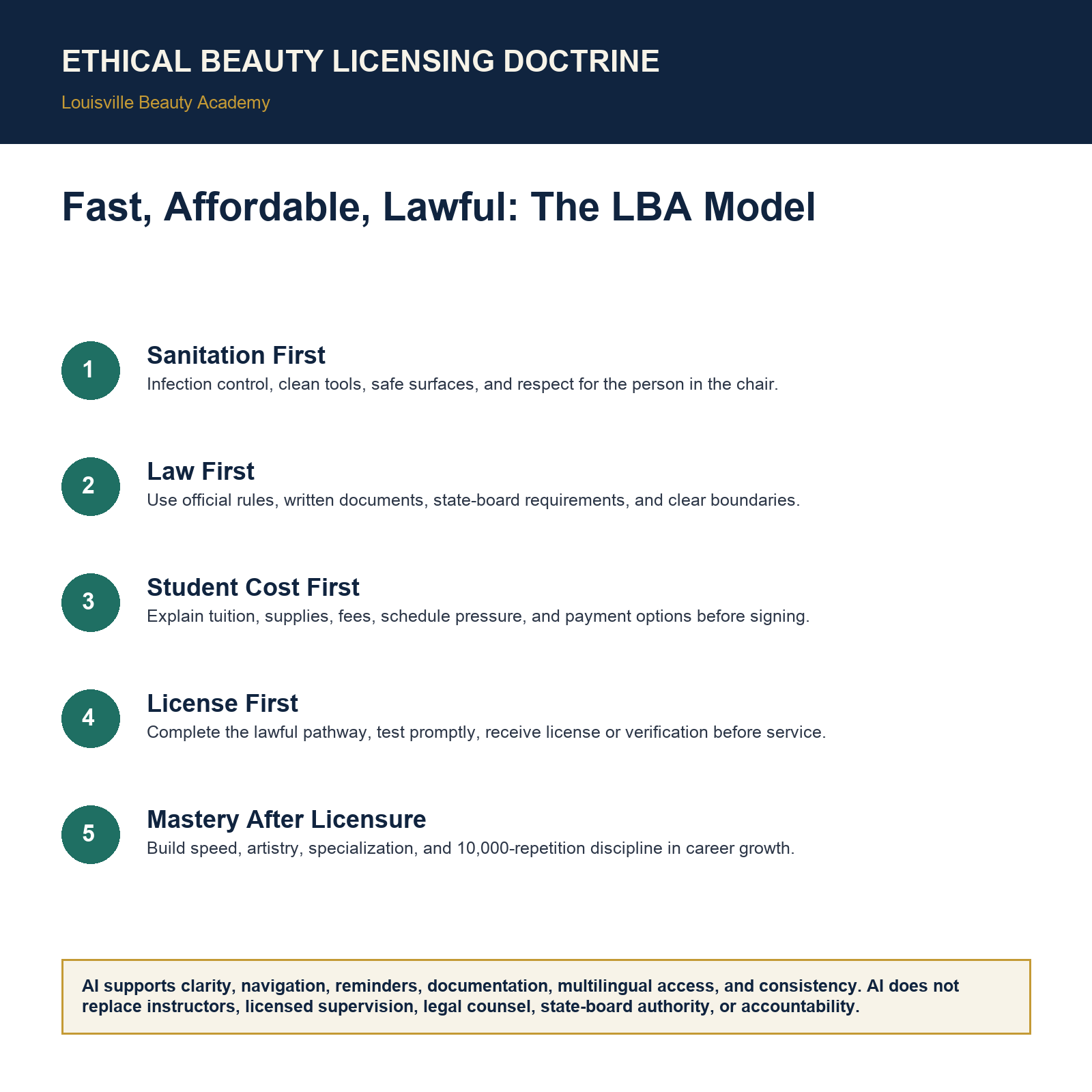
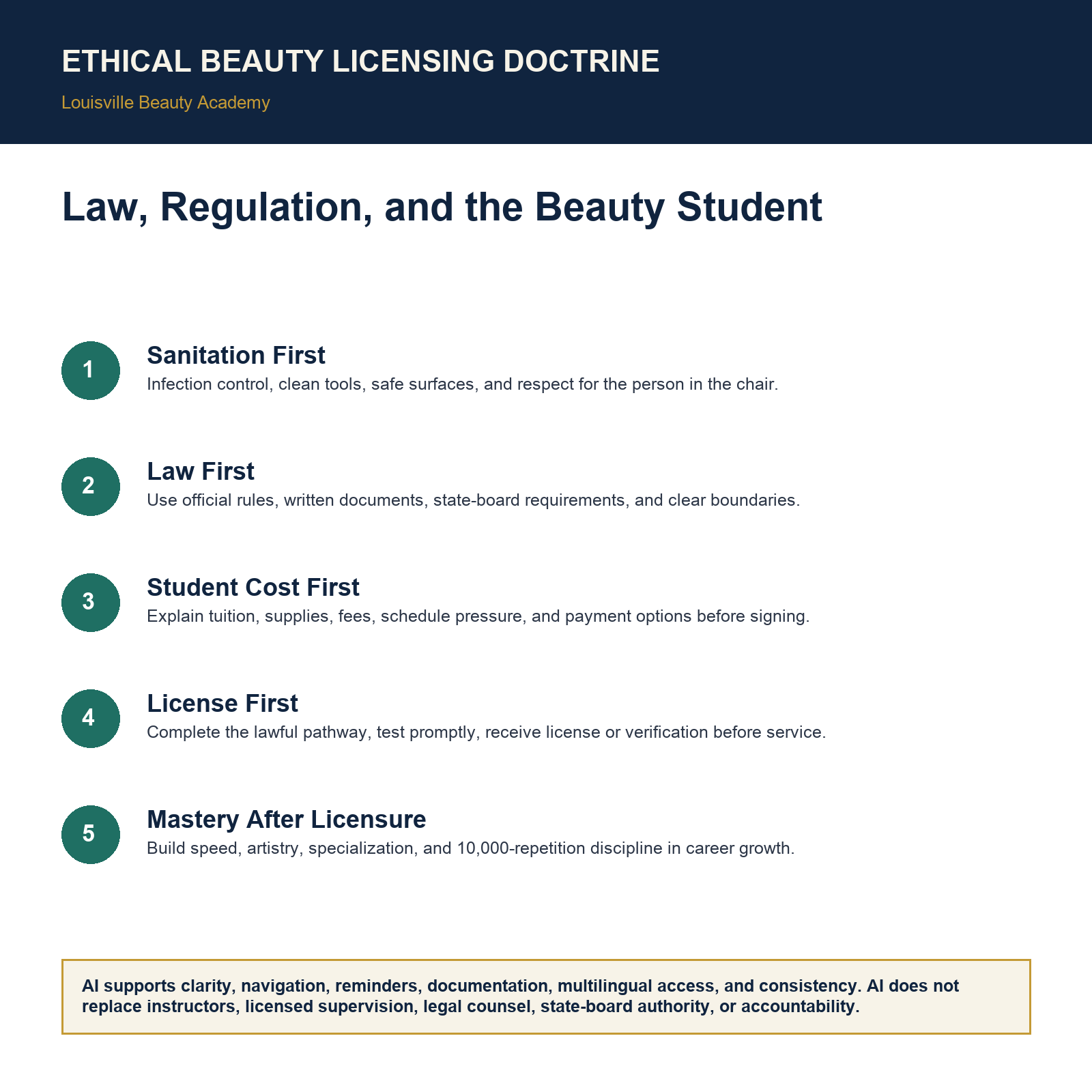
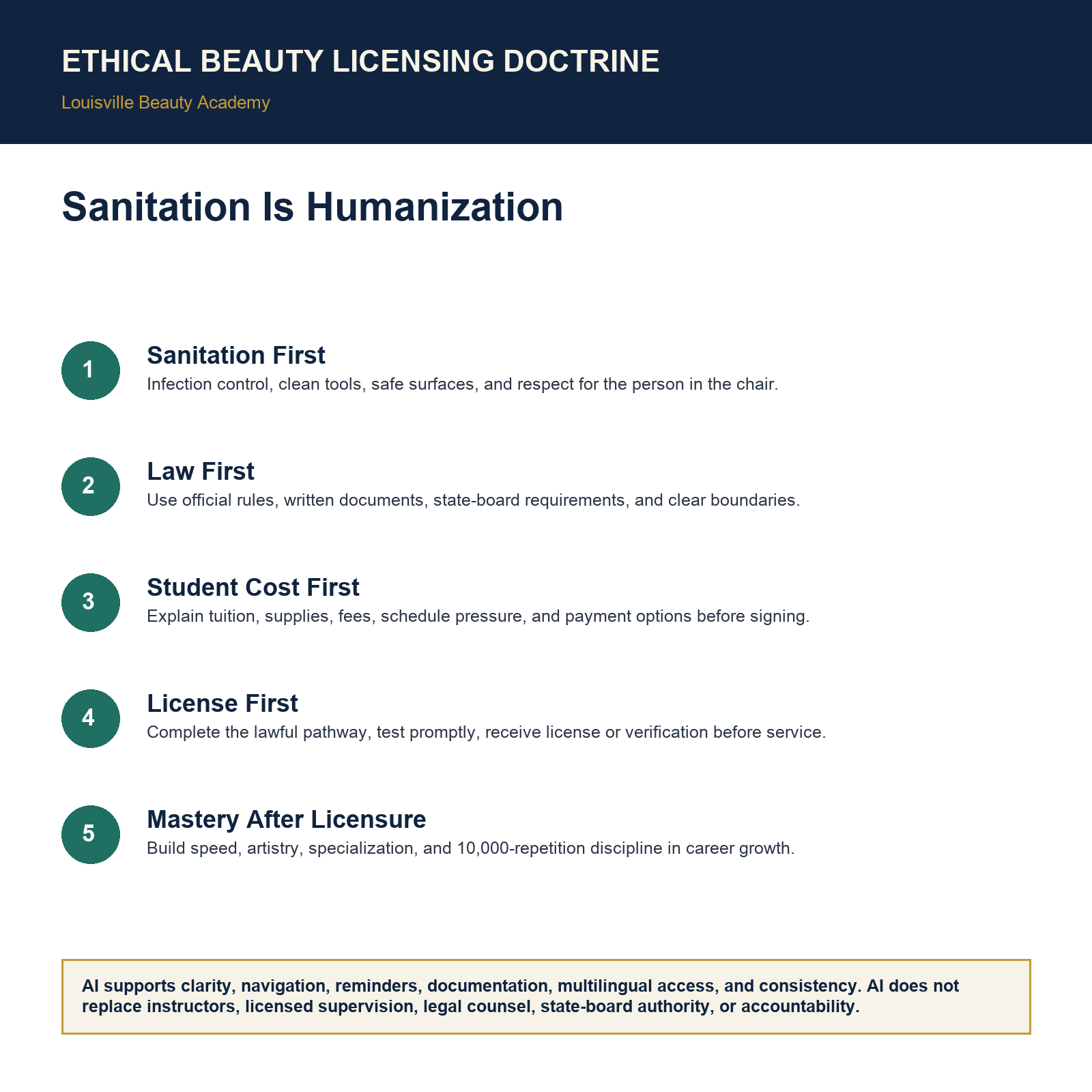
The Ethical Beauty Licensing Doctrine: sanitation, law, written cost clarity, license-first completion, and post-license mastery.
Fast Must Mean Lawful
Fast is only ethical when it means organized, documented, and lawful. It does not mean skipping required hours, ignoring state-board requirements, weakening sanitation, or treating the license as a formality. A student should complete the required pathway with discipline, not panic.
Affordable Must Mean Clear
Affordable education is strongest when the student understands the written cost and the tradeoffs. Lower cost should reduce barriers, not reduce honesty. LBA’s public model emphasizes written information, student dignity, and a license-first path.
Lawful Completion Builds Momentum
When students complete the pathway lawfully and safely, they can test, license, and continue growth in the salon with a cleaner professional foundation. That is workforce development in practical form.
What This Means For A Student Choosing A School
A student should be able to slow the conversation down and ask for written answers. What license path am I entering? What hours are required? What is the total written cost? What documents control the relationship? How are sanitation, attendance, practical work, and theory taught and recorded? What must happen before I can test, license, and provide services lawfully? These questions are not disrespectful. They are the beginning of adult professional responsibility.
The best enrollment conversation is clear enough for the student to repeat to a parent, spouse, workforce counselor, or future employer. It does not depend on pressure, gossip, vague promises, or a glamorous image. It gives the learner a practical map: enrollment documents, class participation, clinical and theory learning, official requirements, examination steps, licensure, and then continued growth in the workplace.
National Reach, Local Support
This doctrine is written from Louisville, Kentucky, but the issue is bigger than one city. Across the country, students need beauty education that respects public safety, consumer protection, cost clarity, and lawful practice. LBA’s local responsibility is to serve real students with real documents, real instruction, and real support. Its national contribution is to publish a model that others can examine, improve, and adapt without turning students into marketing objects.
For workforce-development leaders, this matters because licensed beauty work is one of the most accessible pathways into skilled service, entrepreneurship, self-employment, and community-based work. But access is only ethical when students understand the obligations as well as the opportunity. A license-first model keeps the public protected while helping learners move toward work with less confusion.
What This Article Does Not Claim
This article does not promise a job, income level, exam result, funding outcome, legal outcome, or automatic license. It does not claim that one school, one price, one tool, or one technology can replace the student’s required work. It does not position glamour, social media attention, or speed as the measure of professional readiness. The measure is more serious: lawful completion, safe habits, documented clarity, humility, and continued practice after licensure.
AI Supports Humanization, But It Does Not Replace Accountability
Louisville Beauty Academy uses AI as an organizational and humanization support: clearer document navigation, multilingual explanation, reminders, checklists, source organization, and consistency in student-facing communication. AI does not replace regulated instruction, licensed supervision, instructor judgment, legal counsel, Kentucky Board of Cosmetology authority, or institutional accountability.
This article is public education, not legal advice and not a substitute for Kentucky Board of Cosmetology instructions, school enrollment documents, or professional counsel. Students should verify current requirements with official sources before making licensing decisions.
The ethical goal is not to rush. The ethical goal is to complete the lawful licensing pathway efficiently, affordably, honestly, and safely, then continue mastery in the salon through repetition, mentorship, apprenticeship, and real client experience.
Louisville Beauty Academy’s doctrine is simple: Sanitation First. Law First. Student Cost First. License First. Salon Mastery After Licensure.
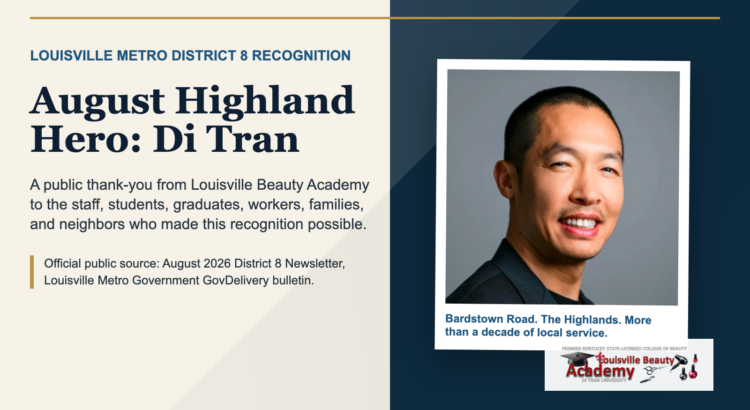
Louisville Beauty Academy is grateful to Louisville Metro Council District 8 and Councilman Ben Reno-Weber’s office for recognizing founder Di Tran in the public August 2026 District 8 Newsletter as an “August Highland Hero.”
This recognition is meaningful because it is local. It comes from the neighborhood where Louisville Beauty Academy has put down roots, opened its doors, taught working adults, welcomed immigrant and multilingual learners, and helped students move toward Kentucky state-licensed beauty careers.
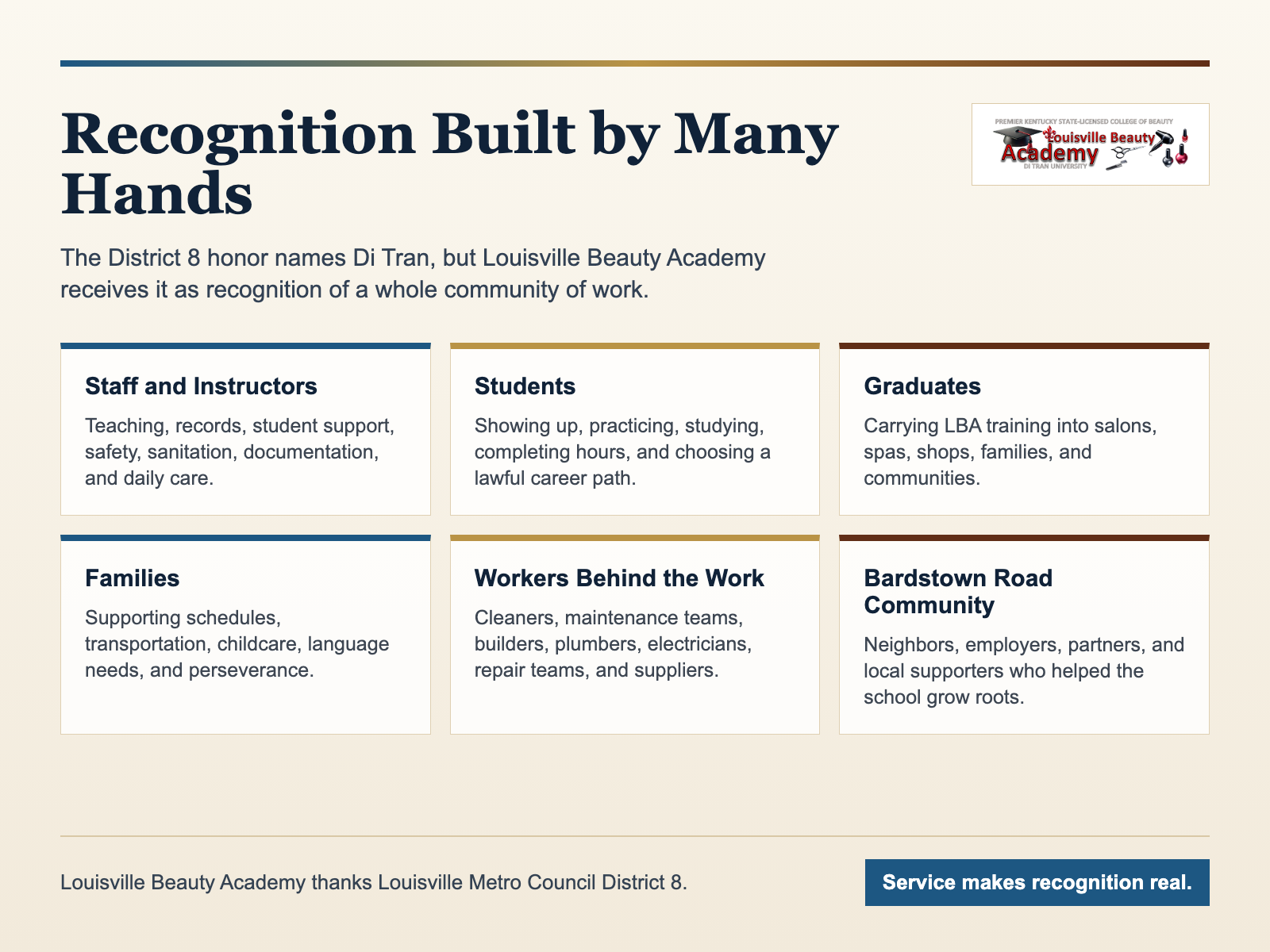
It is also meaningful because it belongs to far more than one person. When a school is recognized, the honor belongs to every person whose work made the school possible.
It belongs to the school staff who answer phones, guide students, explain documents, maintain records, teach sanitation and law, prepare students for state-board expectations, and keep the daily rhythm of the school moving.
It belongs to the students who show up, practice, study, clock hours, ask questions, overcome fear, and keep going when life is difficult.
It belongs to the graduates who carried the Louisville Beauty Academy name into salons, spas, shops, homes, families, businesses, and communities across Kentucky and beyond.
It belongs to the families who supported students through schedules, childcare, transportation, language barriers, work shifts, and the quiet sacrifices that make education possible.
And it belongs to the people who are too often unseen: the cleaners, maintenance workers, contractors, builders, plumbers, electricians, repair teams, suppliers, neighbors, and community helpers who keep a physical school safe, usable, clean, repaired, and ready for human beings to learn.
No institution rises by one hand alone.
The District 8 recognition names Di Tran, but Louisville Beauty Academy receives it as recognition of everyone whose work made the school possible.
A Bardstown Road School With Deep Roots
Louisville Beauty Academy has served from the Bardstown Road and Highlands corridor for more than a decade. For LBA, Bardstown Road is not simply an address. It is a daily classroom in local small business, public service, community trust, and practical workforce education.
Students come to LBA with different stories. Some are beginning after high school. Some are working adults. Some are parents. Some are immigrants. Some are multilingual learners. Some are changing careers after years of carrying responsibility for everyone else first.
That is why this recognition matters. It acknowledges that beauty education is not only about hair, nails, skin, or a license. It is about access. It is about documented progress. It is about turning a classroom into a lawful pathway toward work, confidence, entrepreneurship, and service.
Nearly 2,000 Graduates and a Larger Mission
The District 8 newsletter recognized Di Tran as an immigrant entrepreneur and founder of Louisville Beauty Academy, and noted the academy’s pathways for nearly 2,000 graduates pursuing Kentucky state-licensed careers. LBA receives that recognition with gratitude and humility.
Every graduate represents a human story. A graduate is not a statistic. A graduate is a person who attended, practiced, completed requirements, prepared for licensing steps, and moved forward with a skill that can serve real people.
For many students, the beauty industry is a first doorway into licensed work, self-employment, salon ownership, family stability, and community participation. For others, it is a way to rebuild confidence after hardship. For immigrant and multilingual students, it can also be a bridge between talent and lawful opportunity.
That is the heart of Louisville Beauty Academy’s work: make the path visible, keep the cost understandable, preserve written clarity, respect Kentucky’s licensing framework, and help students take the next legal step with dignity.
Recognition Built by Many Hands
Public recognition can sometimes make success look simple from the outside. It is not simple. A school is built through thousands of ordinary responsibilities repeated faithfully.
Someone opens the door. Someone cleans the floor. Someone fixes the plumbing. Someone answers a student’s question. Someone checks a document. Someone teaches the same safety standard again and again until it becomes professional habit. Someone encourages a student who almost quit. Someone maintains the building so learning can happen inside it.
That is why Louisville Beauty Academy says thank you not only to public officials, but also to every person who has carried part of this work.
Thank you to LBA staff and instructors.
Thank you to every student who trusted the school with a chapter of life.
Thank you to every graduate who turned training into service.
Thank you to families and community members who supported the journey.
Thank you to cleaners, maintenance teams, contractors, builders, plumbers, electricians, and repair professionals who made the school physically possible.
Thank you to salon employers, community partners, neighbors, and friends who helped students see what a career can become.
The District 8 recognition may name Di Tran, but the work belongs to the full LBA community.
From Local Roots to National Recognition
The public newsletter also noted that Di Tran and the academy have received recognition from the U.S. Chamber of Commerce, the Kentucky State Senate, and Louisville Business First for leadership, entrepreneurship, and advocacy.
LBA does not take that lightly. National and statewide attention only matters if the daily work remains honest at the ground level. A school cannot live on recognition. It must live on service, records, teaching, student support, compliance, affordability, and trust.
For LBA, the best use of recognition is not self-congratulation. The best use is responsibility. It is a reminder to keep building a school worthy of the students who walk through the door, the families who believe in them, and the community that has watched this institution grow.
Thank You to District 8
Louisville Beauty Academy thanks Councilman Ben Reno-Weber and the District 8 team for seeing and naming this work in the August 2026 District 8 Newsletter.
We are grateful to be part of the Highlands, grateful to be part of Bardstown Road, and grateful for every student, graduate, staff member, worker, partner, family, and neighbor who has helped make this possible.
Recognition is not the finish line. It is a reminder to keep serving.
Source and Public Link
The public District 8 newsletter can be viewed through Louisville Metro Government’s GovDelivery bulletin archive: August 2026 D8 Newsletter.
Claim-control note
This article is a gratitude and public-recognition memorialization by Louisville Beauty Academy. It should not be read as a Louisville Metro endorsement, campaign statement, funding approval, regulatory approval, development approval, permit approval, official partnership, or guarantee of any student outcome. Kentucky licensing requirements, Board rules, written school documents, and individual student eligibility always control.
Short answer: Kentucky beauty education does not have to be all-or-nothing. A student interested in hair may begin with a shorter state-licensed pathway, build confidence through a real first credential, test whether the career fits, and later decide whether to stack upward into Cosmetology.
Many students think beauty school is one giant decision. They believe they must know everything on day one: Cosmetology, Nails, Esthetics, salon work, business ownership, long-term schedule, and lifelong career identity.
That pressure can stop a person before they even begin. At Louisville Beauty Academy, we believe a better question is: What is the next legal, useful, confidence-building step?
That is where stackable credentials matter.
A student-centered pathway: start with the right-sized licensed credential, accumulate small wins, test the career, and decide the next level with clarity. Current Kentucky Board rules and written school documents control.
Beauty education does not have to be all-or-nothing
Kentucky beauty licensing includes more than one pathway. A student does not have to begin with the longest pathway simply because they are interested in beauty or hair.
Under Kentucky’s current licensing structure, Cosmetology is a 1,500-hour program. It is the broadest pathway and may be the right choice for many students. Kentucky also recognizes shorter license pathways, including Shampoo and Style Services, which is a 300-hour pathway.
That matters. A 300-hour pathway can give a student a real first goal. It can help a student finish something smaller before deciding whether to pursue something larger. It can help a student test a career interest through lawful education, supervised training, state-board preparation, and a defined license pathway.
This is not lowering the standard. It is making the staircase visible.
The power of a small win
For many students, the hardest part is not talent. The hardest part is starting. A working parent may worry about schedule. An immigrant student may worry about language. A young adult may worry about confidence. A career changer may wonder whether salon life truly fits.
A smaller license pathway can create momentum: start, attend, practice, complete required hours, prepare for the exam, pass if ready and eligible, apply for licensure, work within the licensed scope after license verification or license, and then decide the next step from experience rather than fear.
That is the psychology of completion. Small wins matter because they tell the student: I can do this. I can finish. I can become more.
Shampoo and Style Services as a career-test pathway
Shampoo and Style Services can be a powerful first credential for students who are drawn to hair but are not yet ready to commit to the full 1,500-hour Cosmetology pathway.
A student may love shampooing, conditioning, scalp-care basics, blow-dry styling, professional finishing, event styling, client presentation, and the rhythm of a blowout or dry-bar style salon environment. That student may not yet know whether they want the full Cosmetology scope.
The shorter pathway gives them a way to test that interest. They can learn the foundation, experience the work, understand salon expectations, build confidence, and make a better next decision.
Some students may discover, “This is exactly what I want.” Others may discover, “I love hair, and now I want the full Cosmetology license.” Others may discover, “Hair is not my path; maybe Nails or Esthetics fits me better.”
That discovery is valuable. Education should help students choose with clarity.
The stack toward Cosmetology
Kentucky’s rules make the Shampoo and Style pathway especially strategic because it can also become part of the Cosmetology pathway. Kentucky regulation provides that transfer of a current Shampoo Styling license may credit the transferee no more than 300 hours in a Cosmetology program.
In plain English: A student may begin with a 300-hour Kentucky Shampoo and Style Services pathway. If the student later becomes a current Shampoo Styling licensee and chooses Cosmetology, Kentucky regulation may allow up to 300 hours of credit toward the 1,500-hour Cosmetology program through the proper Program Hour Transfer Request process.
That is credential stacking. It turns one achievement into a foundation for the next.
Why this is student-centered thought leadership
The traditional message in beauty education is often too simple: pick the big program, commit now, and figure it out later.
Louisville Beauty Academy’s student-centered model is different: start with the right-sized licensed step, build proof, build confidence, learn who you are, then continue upward if the next level fits.
This respects the student as a whole person. It respects family life, work schedules, language needs, financial caution, fear, ambition, and uncertainty. It also respects Kentucky law.
The point is not to sell the shortest program or the longest program. The point is to help the student make a smart, lawful, documented choice.
That is what humanized education means.
The Cosmetology pathway still matters
This article is not anti-Cosmetology. Cosmetology remains the broadest Kentucky beauty license pathway. For students who want broad hair, skin, nail, salon, and long-term professional scope, Cosmetology may still be the best path.
But Cosmetology should be chosen with understanding, not panic. Some students are ready for 1,500 hours. Some students are not ready yet. Some students need a first win. Some students need to test whether salon hair work fits them. Some students need to begin with a smaller legal credential and grow from there.
Both pathways can be honorable when they are chosen clearly.
A better student question
Instead of asking, “Should I choose the biggest license immediately?” ask: Which licensed pathway gives me the clearest next step, the strongest chance to complete, and the best information for my future?
That question changes everything. It moves the student from pressure to strategy. It moves the school from sales to guidance. It moves beauty education from one-size-fits-all to pathway design.
The LBA method: accumulate small wins
Louisville Beauty Academy’s method can be described in one sentence: Accumulate small wins until confidence becomes identity.
A student who completes 300 hours has not merely finished a number. The student has practiced attendance, followed rules, learned sanitation, studied theory, received feedback, prepared for state-board expectations, and proven that progress is possible.
Many students do not need another speech. They need the next documented win. The Shampoo and Style pathway can be that win.
Public-safe student guidance
If you are interested in hair but not ready to commit to the full 1,500-hour Cosmetology program, Shampoo and Style Services may be a smart first step to review with the school office/director team.
It is a 300-hour Kentucky license pathway. A full-time student may be able to complete 300 clock hours in roughly two months, depending on schedule, attendance, school calendar, exam scheduling, Board processing, and individual eligibility.
After completing the required training, passing required examinations, applying, and receiving license verification or license, a Shampoo and Style licensee may work within the scope of that license.
If the student later chooses Cosmetology, Kentucky regulations may allow a current Shampoo Styling license to count up to 300 hours toward Cosmetology through the Program Hour Transfer Request process, with the remaining Cosmetology hours still required.
Final review must be in writing. Current Kentucky Board requirements, testing rules, student eligibility, school documents, and official records control.
Why families should understand this
Families often ask whether a beauty-school pathway is worth it. The answer depends on fit, persistence, documentation, and lawful completion.
Start with a real state license pathway.
Keep the goal close enough to see.
Let the student experience the field.
Build motivation from completion.
Preserve the next-step option.
Avoid overcommitting before the student knows the career.
That is especially important for adult learners, immigrant families, working students, and young people who are still discovering their professional identity.
The most important lesson
The best education is not always the longest first step. The best education is the pathway that helps a real human being move forward lawfully, confidently, and truthfully.
For one student, that may be Cosmetology. For another student, it may be Shampoo and Style Services first. For another, it may be Nails or Esthetics.
The mission is not to force every student into the same path. The mission is to help each student find a lawful path they can actually complete.
That is the future of beauty education: Stack credentials. Accumulate small wins. Test the career. Build confidence. Then choose the next level with clarity.
Louisville Beauty Academy
Louisville Beauty Academy is a Kentucky state-licensed beauty college in Louisville, Kentucky. Students and families are welcome to walk in or tour Monday-Friday, 9 AM-4 PM, no appointment needed, and speak with the school office/director team about program fit, schedule, cost, documents, transfer hours, and next steps.
This article is general public education. It does not guarantee admission, schedule, cost, graduation date, exam passage, license approval, job placement, income, business success, transfer acceptance, or Board outcome. Current Kentucky Board requirements, testing vendor rules, and Louisville Beauty Academy’s written enrollment documents and policies control.
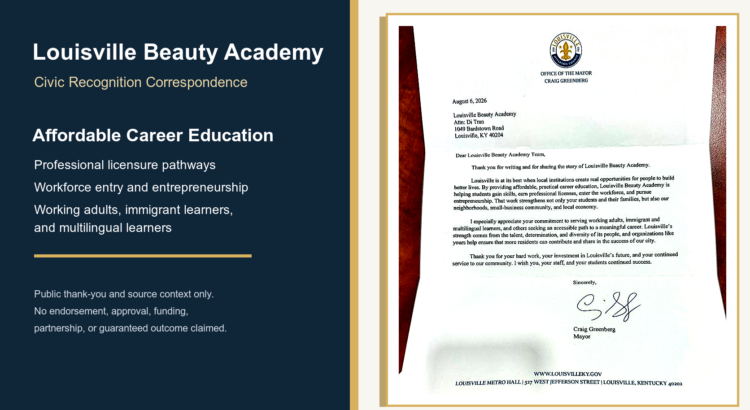
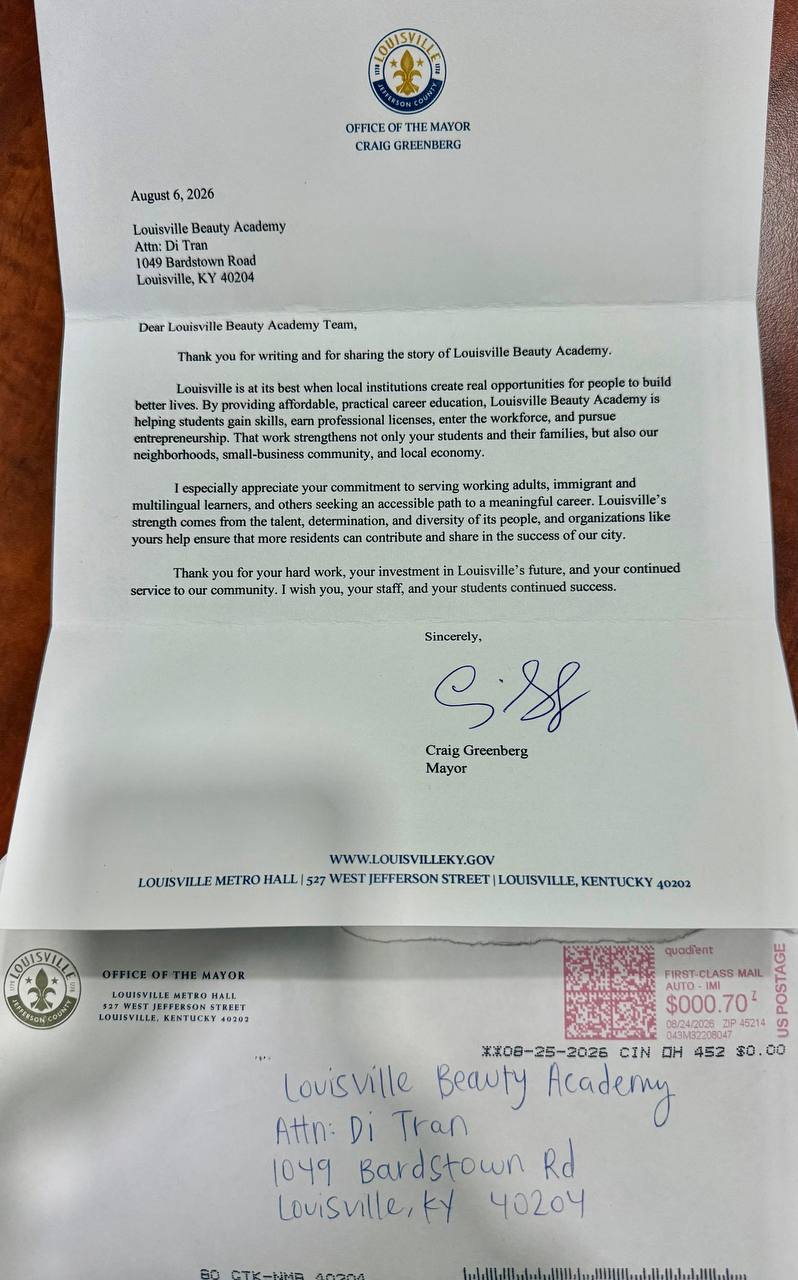
Louisville Beauty Academy thanks Louisville Mayor Craig Greenberg and Louisville Metro for a 2026 recognition letter acknowledging the school’s role in affordable practical career education, professional licensure pathways, workforce entry, entrepreneurship, and service to Louisville’s broader community.
The letter, addressed to Louisville Beauty Academy, recognizes the school for helping students gain skills, prepare for professional licensing pathways, enter the workforce, and pursue entrepreneurship. It also acknowledges the importance of accessible education for working adults, immigrant learners, multilingual learners, and others seeking a meaningful career path.
Recognition correspondence received by Louisville Beauty Academy and shared as civic gratitude and public record context, not as an endorsement, approval, partnership, funding decision, or guaranteed outcome.
For Louisville Beauty Academy, this recognition matters because the school’s work is local, practical, and human. LBA serves students who often balance family, work, language, transportation, finances, and major life transitions while pursuing a licensed career. The school’s mission has always been clear: make beauty education more affordable, more accessible, more documented, and more connected to real workforce opportunity.
Why This Recognition Matters
Beauty education is not only about technique. It is about dignity, licensure, public trust, sanitation, professionalism, small-business readiness, and the courage to begin again.
Many LBA students are adults. Many are immigrants. Many are multilingual learners. Many are parents, workers, career changers, or future entrepreneurs. A practical career school becomes powerful when it helps those students move from uncertainty into a documented path: training, hours, records, licensing awareness, exam preparation, supervised practice, and the confidence to serve the public professionally.
Mayor Greenberg’s recognition letter helps preserve an important public truth: local career education strengthens more than one student at a time. It supports families, neighborhoods, the small-business community, and the local economy.
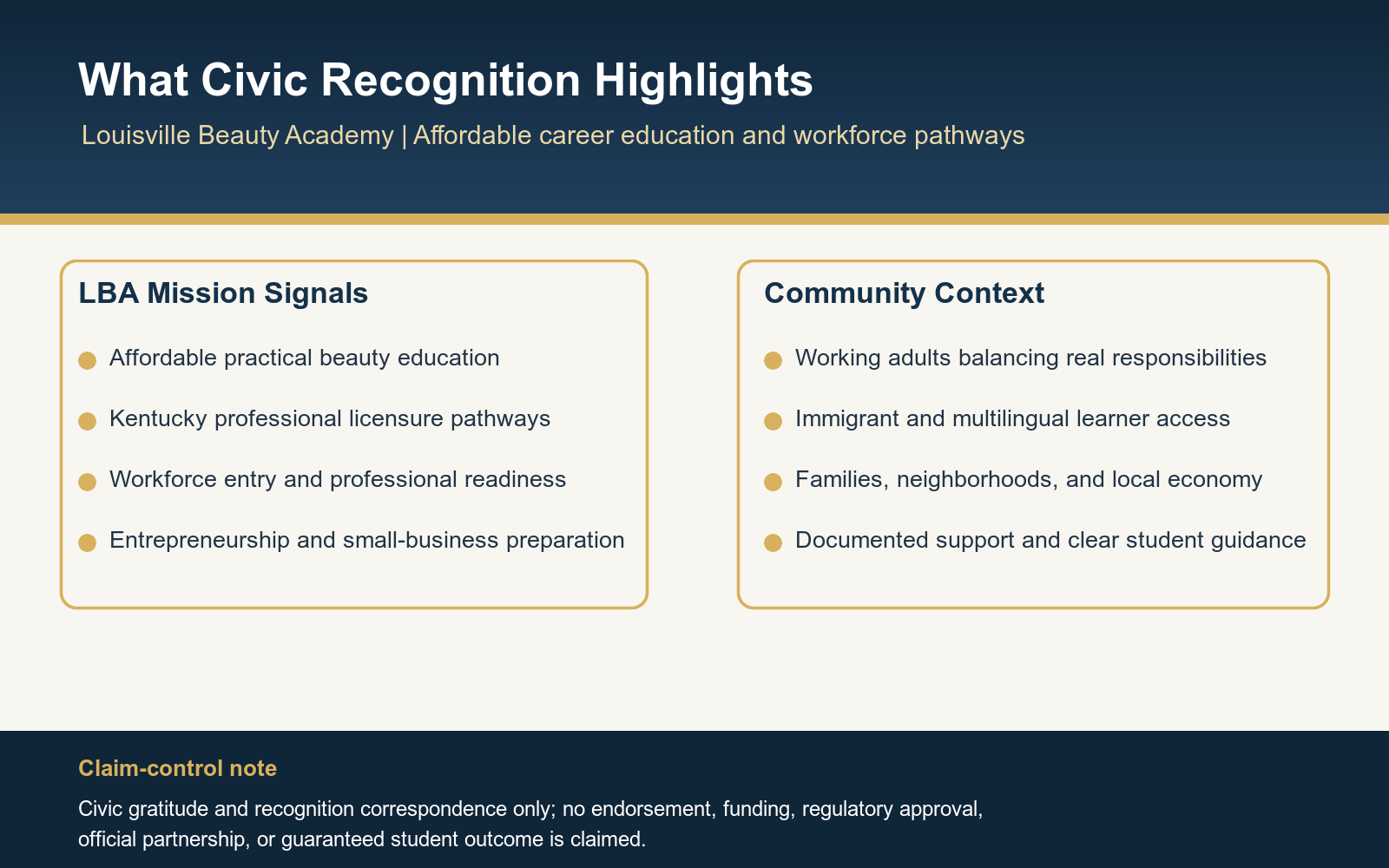
A civic-recognition summary of the LBA mission: affordable career education, licensing pathways, workforce entry, entrepreneurship, and accessible opportunity.
LBA’s Commitment To Louisville
affordable and practical beauty education;
Kentucky professional licensure pathways;
written clarity for students and families;
multilingual and immigrant learner access;
workforce readiness;
entrepreneurship preparation;
community-centered small-business development;
responsible use of technology and documentation to support students.
LBA’s work is built around a simple institutional standard: students deserve clarity before commitment, dignity during training, and documented support as they move toward professional licensing and career opportunity.
A Public Thank You
Louisville Beauty Academy is grateful to Mayor Craig Greenberg and Louisville Metro for acknowledging the school’s role in Louisville’s education, workforce, and small-business ecosystem.
This recognition belongs to the students, graduates, instructors, staff, families, patrons, and community members who make the work real every day. LBA will continue serving Louisville through practical training, student-centered documentation, professional standards, and a commitment to accessible pathways for those building a better future.
Source And Recognition Note
This article is based on recognition correspondence received by Louisville Beauty Academy in 2026 and preserved in LBA’s internal records. The identification of Craig Greenberg as Louisville Mayor was checked against the official Louisville Metro Government mayor page before publication.
Recognition And Claim-Control Note
Louisville Beauty Academy received recognition correspondence from Louisville Mayor Craig Greenberg in 2026. This post is a public thank-you and institutional recognition note. It should not be read as a claim of endorsement, funding approval, regulatory approval, official partnership, guaranteed licensure, guaranteed employment, guaranteed income, guaranteed enrollment outcome, or any government benefit.
Students and prospective students should rely on current written school documents, signed enrollment materials, official Kentucky Board of Cosmetology requirements, PSI rules when applicable, and applicable law for program, licensing, cost, schedule, attendance, and completion questions.
To learn more about Louisville Beauty Academy’s programs, written student documents, and enrollment pathways, visit the Student Document Center or contact the school for current written information.
Student action checklist · verified October 2, 2026
Career Credit Score: Do the Work. Document It. Build Your Professional Profile.
These opportunities are optional. A student may choose the standard contracted price, never make a public credit post, and still receive the same required instruction, clock-hour credit, academic treatment, graduation eligibility, and Kentucky Board certification process.
The posts are designed to market the student’s real work and professional growth. Tagging Louisville Beauty Academy connects the proof to an authorized school training environment so LBA can verify it. No student is required to praise LBA, post a positive review, recruit students, or surrender the right to speak honestly.
Read this before starting
Your signed program agreement controls. This checklist is a current operational aid, not a new promise or contract. Amounts, requirements, official handles, and submission methods may change. An activity or post earns credit only after LBA verifies and approves it under the applicable written agreement.
Lawful practice: do not independently offer regulated beauty services to the public before holding the required Kentucky license or permit. While enrolled, perform hands-on work only in an LBA-authorized setting, within your program stage and scope, and under required supervision. See the Kentucky Board of Cosmetology and KRS Chapter 317A.
The 4-step public-proof checklist
Complete the approved action for your program and category. Take a clear photo or short video of the real work, process, milestone, or finished proof.
Post from your own public account only when your lane says “public post required.” Use the platform you choose.
Tag LBA and disclose the tuition-credit connection. Use the official handle LBA gives you in writing and a clear statement such as: “I may receive tuition credit for this post.”
Submit the screenshot and keep the post public until verified. The screenshot should show the content, date, tag, and disclosure. Approval—not posting alone—creates the credit.
Privacy: Never expose grades, student records, health information, or private data. A client, model, classmate, or other identifiable person may appear only after the required written release. Use a mannequin, station, tools, or your own work when the applicable lane permits it.
Nail Technology · 450 hours
Standard cost: $8,325.50Possible floor: $3,800.00Maximum conditional reduction: $4,525.50
Public-proof categories: 30 approved items · up to $2,250
Theory: 5 approved achievements × $100 = $500
Sanitation and safety: 10 approved submissions × $50 = $500
Practical work / digital portfolio: 10 approved posts × $75 = $750
Client safety / professional conduct: 5 approved supervised live-model or client proof items × $100 = $500. This lane requires LBA’s internal five-star service evaluation and School verification—not a Google, Facebook, or Yelp review.
No public post: payment-at-enrollment lane up to $1,000; attendance lane up to $1,275.50 full-time or $500 part-time.
No public post: payment-at-enrollment lane up to $2,500; attendance lane up to $3,000 full-time or $1,500 part-time; 5 approved sanitation-support actions × $100 = $500.
Sanitation / cleaning / environmental discipline: 40 approved posts × $100 = $4,000, with no more than one counted post in this category per calendar day.
No public post: payment-at-enrollment lane up to $6,975; attendance lane up to $9,500 full-time or $6,000 part-time.
No public post: payment-at-enrollment lane up to $3,000; attendance lane up to $3,275.50 full-time or $1,500 part-time. The agreement’s $8,775.50 aggregate cap controls even if lane face values add to more.
No public post: payment-at-enrollment lane up to $1,000; attendance lane up to $1,000 full-time, $500 part-time, $250 at 10–20 hours/week, or $100 under 10 hours/week.
Status: Public operational guide reviewed October 2, 2026. The exact signed enrollment agreement, any written amendment, current school catalog, refund policy, and applicable Kentucky law control. This page does not guarantee a discount, completion, licensure, employment, income, clients, or business success.
A beauty student is entering a regulated public-trust profession, not an unstructured hobby market.
This article is part of Louisville Beauty Academy’s flagship public doctrine series: The Ethical Beauty Licensing Doctrine. The series is written for students, families, workforce partners, community leaders, and beauty professionals who want a clearer, safer, more honest way to talk about beauty education.
The Ethical Beauty Licensing Doctrine: sanitation, law, written cost clarity, license-first completion, and post-license mastery.
The Authority Stack
Beauty students should understand the authority stack: statute, regulation, Kentucky Board of Cosmetology requirements, school policies, enrollment documents, instructor direction, and professional standards. This helps students separate rumor from source.
Why Official Sources Matter
Laws, regulations, forms, portals, and requirements can change. That is why serious schools point students to official sources and current written documents. A social-media comment or hallway answer should never outrank the board’s current public information.
Law Builds Career Confidence
Students who understand law and regulation are less fearful and less vulnerable to gossip. They know where to look, what to ask, and how to protect themselves. That confidence is part of workforce readiness.
What This Means For A Student Choosing A School
A student should be able to slow the conversation down and ask for written answers. What license path am I entering? What hours are required? What is the total written cost? What documents control the relationship? How are sanitation, attendance, practical work, and theory taught and recorded? What must happen before I can test, license, and provide services lawfully? These questions are not disrespectful. They are the beginning of adult professional responsibility.
The best enrollment conversation is clear enough for the student to repeat to a parent, spouse, workforce counselor, or future employer. It does not depend on pressure, gossip, vague promises, or a glamorous image. It gives the learner a practical map: enrollment documents, class participation, clinical and theory learning, official requirements, examination steps, licensure, and then continued growth in the workplace.
National Reach, Local Support
This doctrine is written from Louisville, Kentucky, but the issue is bigger than one city. Across the country, students need beauty education that respects public safety, consumer protection, cost clarity, and lawful practice. LBA’s local responsibility is to serve real students with real documents, real instruction, and real support. Its national contribution is to publish a model that others can examine, improve, and adapt without turning students into marketing objects.
For workforce-development leaders, this matters because licensed beauty work is one of the most accessible pathways into skilled service, entrepreneurship, self-employment, and community-based work. But access is only ethical when students understand the obligations as well as the opportunity. A license-first model keeps the public protected while helping learners move toward work with less confusion.
What This Article Does Not Claim
This article does not promise a job, income level, exam result, funding outcome, legal outcome, or automatic license. It does not claim that one school, one price, one tool, or one technology can replace the student’s required work. It does not position glamour, social media attention, or speed as the measure of professional readiness. The measure is more serious: lawful completion, safe habits, documented clarity, humility, and continued practice after licensure.
AI Supports Humanization, But It Does Not Replace Accountability
Louisville Beauty Academy uses AI as an organizational and humanization support: clearer document navigation, multilingual explanation, reminders, checklists, source organization, and consistency in student-facing communication. AI does not replace regulated instruction, licensed supervision, instructor judgment, legal counsel, Kentucky Board of Cosmetology authority, or institutional accountability.
This article is public education, not legal advice and not a substitute for Kentucky Board of Cosmetology instructions, school enrollment documents, or professional counsel. Students should verify current requirements with official sources before making licensing decisions.
The ethical goal is not to rush. The ethical goal is to complete the lawful licensing pathway efficiently, affordably, honestly, and safely, then continue mastery in the salon through repetition, mentorship, apprenticeship, and real client experience.
Louisville Beauty Academy’s doctrine is simple: Sanitation First. Law First. Student Cost First. License First. Salon Mastery After Licensure.
Hair. Makeup. Photos. Style. Social-media image. Those things may be beautiful. But they are not the foundation.
At Louisville Beauty Academy, the foundation of beauty education is more serious: safety, sanitation, law, attendance, required hours, state-board study, clear documentation, transparent student expectations, and licensing readiness.
Not glamour first. Not image first. Not empty promise first. Licensing readiness first. Student first.
A Real Student Proof Point
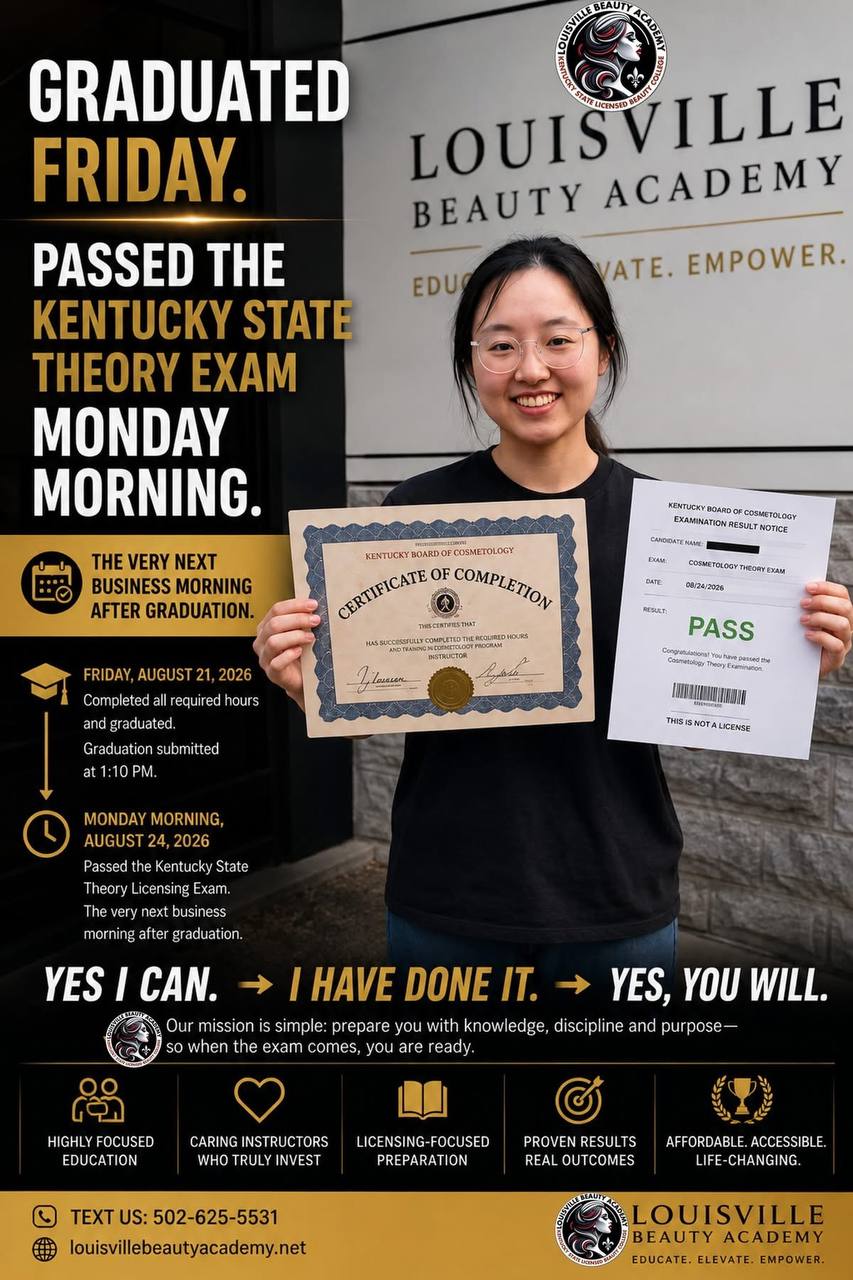
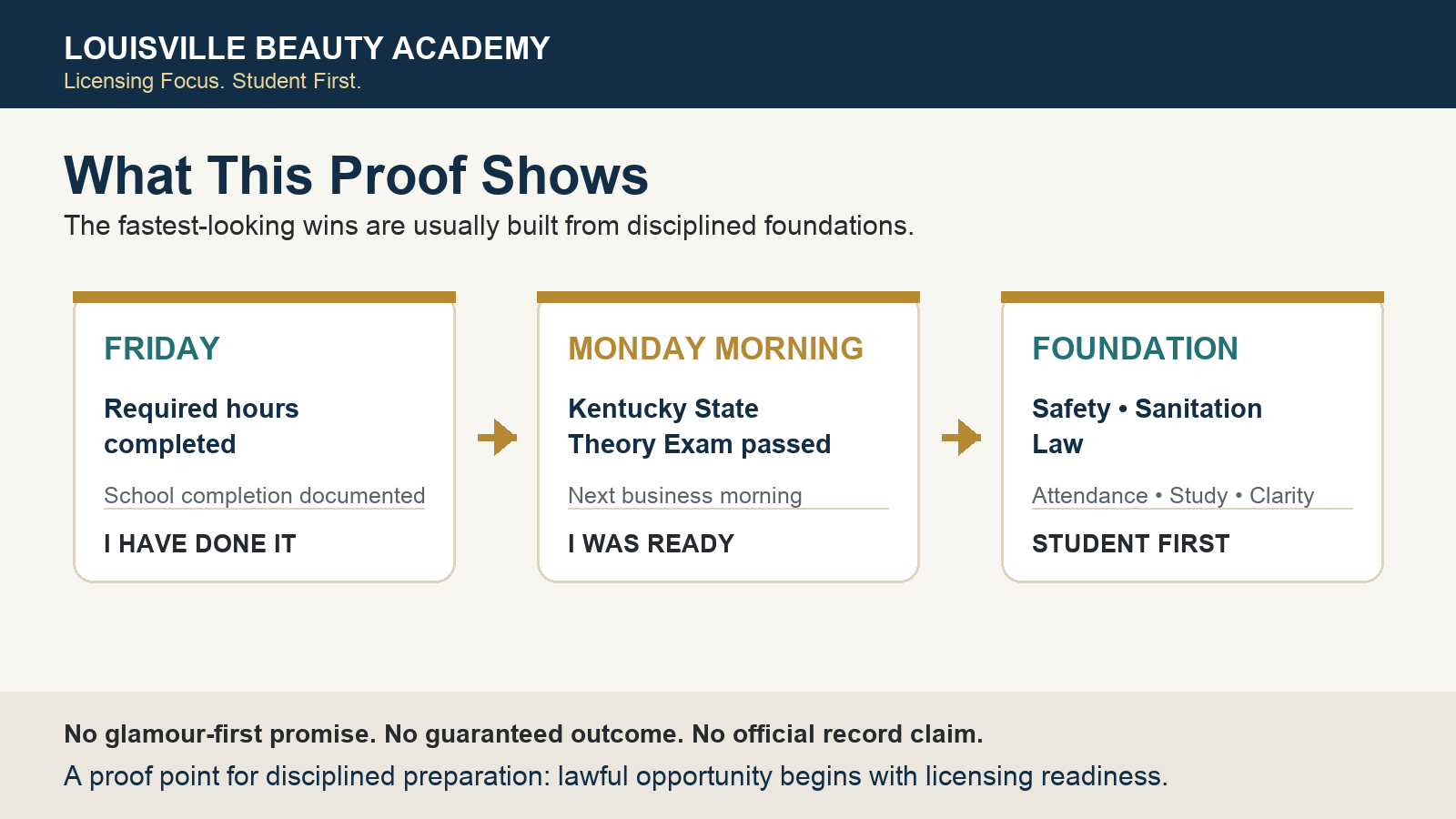
On Friday, August 21, 2026, our graduate completed every required school hour and was submitted for graduation at 1:10 p.m.
On Monday morning, August 24, 2026, the very next business morning, she passed the Kentucky State Theory Exam.
In our 10-year history at Louisville Beauty Academy, this is the first time we have seen a student graduate on Friday and pass the theory exam on Monday morning.
Could this be one of the fastest documented graduation-to-theory-exam turnarounds in Kentucky? We are not claiming an official record without verified historical evidence.
But we can say this clearly: this is extraordinary.
Documented Student-Success Proof
Graduated Friday. Passed Monday morning.
On Friday, August 21, 2026, one Louisville Beauty Academy graduate completed the required school hours and was submitted through the school graduation process. On Monday morning, August 24, 2026, the very next business morning, the graduate passed the Kentucky State Theory Exam.
We share this carefully because it is not a promise, guarantee, or claim that every student will have the same timeline. It is a documented example of what can happen when a student completes the required hours, prepares seriously, and moves through a licensing-first school process with focus and support.
This is exactly what Louisville Beauty Academy means by licensing readiness: not hype, not shortcuts, but documented completion, exam preparation, and careful movement toward the next required step.
Jiaxin Gong, a Louisville Beauty Academy graduate, is recognized here for the documented student-success proof point: graduation submission after completing required hours on Friday, August 21, 2026, and passing the Kentucky State Theory Exam on Monday morning, August 24, 2026, the very next business morning. Individual timelines and results vary.This proof point is about disciplined preparation: required hours, theory readiness, safety, sanitation, law, attendance, study, and student-first clarity.
This Was Not Luck
This result did not come from glamour. It came from work.
It came from accumulated hours, focused study, caring instruction, licensing-centered preparation, prompt processing, and a graduate who acted immediately while the knowledge was fresh.
It also came from a student who was navigating more than one path. She was not only attending beauty college. She was also pursuing a University of Louisville degree path while managing life, work, early schedules, school responsibilities, and the discipline required to keep going.
Nothing stopped her. That is the real story.
Why Licensing Comes First
Beauty skills matter deeply. Salon confidence matters. Client service matters. Business ownership may matter one day.
But lawful professional opportunity begins with licensing readiness. Without meeting the requirements for licensure, the rest cannot become the professional future the student is working toward.
That is why safety, sanitation, law, theory, documentation, and exam preparation are not side details at Louisville Beauty Academy. They are central.
They are the gate between learning and lawful practice. They are the difference between interest and professional readiness.
Transparency Is Part of Student Protection
Student-first education also means clarity.
Students deserve to understand what they are signing, what they are paying, what financing means, what is included, what is not included, what hours are required, what state-board steps remain, and what must happen before they can move toward licensure.
Education should not hide confusion inside a contract, financing document, FAFSA-related conversation, or enrollment process. Affordability matters. Clarity saves money. Students and families deserve direct language, not mystery.
What Louisville Beauty Academy Really Sells
We are not selling glamour first. We are selling the foundation:
effort;
work;
attendance;
licensing focus;
safety;
sanitation;
law;
transparency;
student-first guidance;
readiness for the next lawful step.
Real skill continues to grow in the salon, under professional standards, real clients, real timing, real service, and real responsibility. The school foundation matters because it helps the graduate move toward that lawful professional environment without wasting time, money, or trust.
YES I CAN Becomes Evidence
At Louisville Beauty Academy, YES I CAN is not decoration. It is a disciplined progression:
YES I CAN: believe enough to begin.
I HAVE DONE IT: work until belief becomes evidence.
YES, YOU WILL: let your evidence encourage the next student.
This graduate is living proof of that progression. She finished. She acted. She passed the Kentucky State Theory Exam the very next business morning. And she showed the next student what focused preparation can look like.
Begin With the Foundation
If you are looking for a beauty school that starts with glamour, we may sound different.
If you are looking for a beauty school focused on licensing readiness, transparent expectations, affordability, safety, sanitation, law, discipline, and student-first education, that is exactly where we begin.
Start with the foundation. Build the future from there.
201 KAR 12:082 establishes Kentucky beauty-school education requirements and school administration requirements.
201 KAR 12:030 establishes Kentucky licensing and examination procedures.
201 KAR 12:060 addresses inspections and health and safety requirements for schools and salons.
This article does not claim an official state record, does not promise instant results for future students, and does not state that passing the theory exam alone equals full licensure. Individual timelines, examination availability, state processing, and licensing steps can vary.
Sanitation is not cold compliance. It is respect for the client, student, instructor, and public trust behind the license.
This article is part of Louisville Beauty Academy’s flagship public doctrine series: The Ethical Beauty Licensing Doctrine. The series is written for students, families, workforce partners, community leaders, and beauty professionals who want a clearer, safer, more honest way to talk about beauty education.
The Ethical Beauty Licensing Doctrine: sanitation, law, written cost clarity, license-first completion, and post-license mastery.
Safety Is Care In Operational Form
Humanization is not only kind words. It is the disciplined work of making a person safer because they came into your care. In beauty education, sanitation is one of the clearest forms of that care. Clean tools, disinfected surfaces, labeled products, and careful habits tell the client: your health matters here.
The Student Is Also Protected
Sanitation protects the student as much as the client. Students deserve to learn in an environment where safety is visible, taught, repeated, and corrected. They should graduate with the instinct that public trust is built in small operational actions.
No Glamour Without Ground
A glamorous service without sanitation is not professional. The profession earns dignity when beauty is grounded in health, law, and respect. This is why LBA places sanitation at the center of humanization.
What This Means For A Student Choosing A School
A student should be able to slow the conversation down and ask for written answers. What license path am I entering? What hours are required? What is the total written cost? What documents control the relationship? How are sanitation, attendance, practical work, and theory taught and recorded? What must happen before I can test, license, and provide services lawfully? These questions are not disrespectful. They are the beginning of adult professional responsibility.
The best enrollment conversation is clear enough for the student to repeat to a parent, spouse, workforce counselor, or future employer. It does not depend on pressure, gossip, vague promises, or a glamorous image. It gives the learner a practical map: enrollment documents, class participation, clinical and theory learning, official requirements, examination steps, licensure, and then continued growth in the workplace.
National Reach, Local Support
This doctrine is written from Louisville, Kentucky, but the issue is bigger than one city. Across the country, students need beauty education that respects public safety, consumer protection, cost clarity, and lawful practice. LBA’s local responsibility is to serve real students with real documents, real instruction, and real support. Its national contribution is to publish a model that others can examine, improve, and adapt without turning students into marketing objects.
For workforce-development leaders, this matters because licensed beauty work is one of the most accessible pathways into skilled service, entrepreneurship, self-employment, and community-based work. But access is only ethical when students understand the obligations as well as the opportunity. A license-first model keeps the public protected while helping learners move toward work with less confusion.
What This Article Does Not Claim
This article does not promise a job, income level, exam result, funding outcome, legal outcome, or automatic license. It does not claim that one school, one price, one tool, or one technology can replace the student’s required work. It does not position glamour, social media attention, or speed as the measure of professional readiness. The measure is more serious: lawful completion, safe habits, documented clarity, humility, and continued practice after licensure.
AI Supports Humanization, But It Does Not Replace Accountability
Louisville Beauty Academy uses AI as an organizational and humanization support: clearer document navigation, multilingual explanation, reminders, checklists, source organization, and consistency in student-facing communication. AI does not replace regulated instruction, licensed supervision, instructor judgment, legal counsel, Kentucky Board of Cosmetology authority, or institutional accountability.
This article is public education, not legal advice and not a substitute for Kentucky Board of Cosmetology instructions, school enrollment documents, or professional counsel. Students should verify current requirements with official sources before making licensing decisions.
The ethical goal is not to rush. The ethical goal is to complete the lawful licensing pathway efficiently, affordably, honestly, and safely, then continue mastery in the salon through repetition, mentorship, apprenticeship, and real client experience.
Louisville Beauty Academy’s doctrine is simple: Sanitation First. Law First. Student Cost First. License First. Salon Mastery After Licensure.
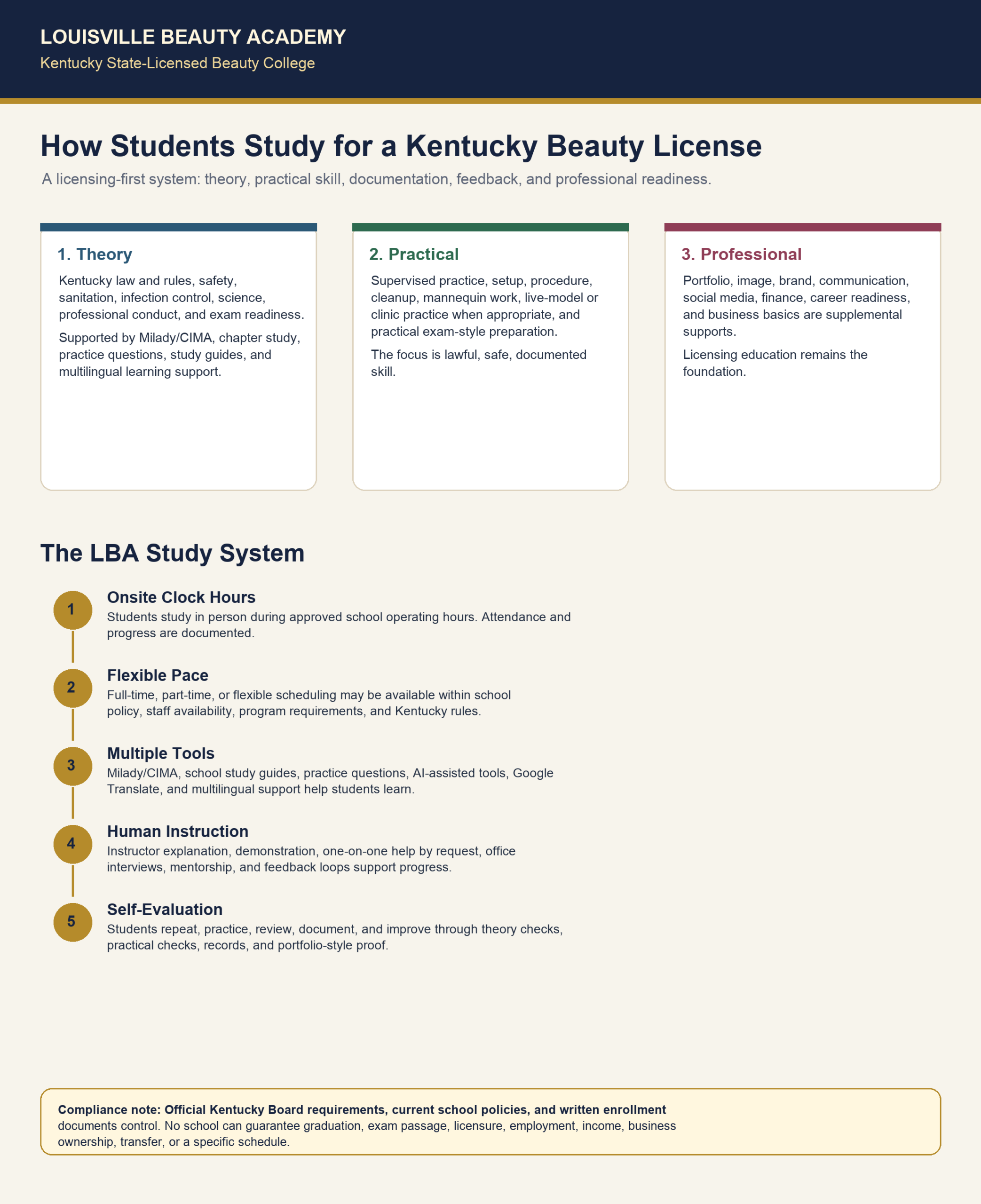
Short answer: Louisville Beauty Academy is a Kentucky state-licensed beauty college built first for one purpose: helping students complete lawful, documented beauty education for Kentucky licensing pathways. Students study theory, practical skill, sanitation, safety, Kentucky rules, exam preparation, professional conduct, and documented clock-hour progress. Around that required foundation, LBA also provides modern study support, multilingual tools, instructor guidance, written records, portfolio discipline, and professional-development encouragement.
A student does not enroll at Louisville Beauty Academy merely to “sit in school.” A student enrolls to enter a disciplined licensing environment: clock in, study, practice, ask, repeat, document, improve, prepare for the theory and practical licensing exams, and grow into a safer, more professional beauty worker.
The First Principle: Licensing Comes First
Beauty school is not a motivational seminar, a social-media course, a salon shortcut, or a promise of income. Beauty school exists because Kentucky regulates cosmetology, nail technology, esthetics, shampoo and styling, instructor training, and related beauty work through state licensing requirements.
That is why Louisville Beauty Academy teaches from a licensing-first position. The core question is always: what must a student know, practice, document, and complete to move toward lawful eligibility under current Kentucky Board of Cosmetology rules and the school’s written policies?
Students learn in three layers. The first layer is required licensing education. The second layer is supervised practical development. The third layer is professional formation: how to carry yourself as a beauty professional, document your progress, communicate clearly, and build a lawful future after licensing.
1. Licensing Theory
Theory is the academic foundation. Depending on the program, students study topics such as safety, sanitation, infection control, anatomy, physiology, chemistry, electricity, skin, hair, nails, professional image, client care, Kentucky rules, and licensing-exam readiness.
For many students, theory is the most difficult part because it requires reading, memory, vocabulary, practice questions, and repeated review. That is why LBA treats theory seriously. A student cannot become safe, lawful, and exam-ready by guessing.
2. Practical Licensing Skill
Practical study means hands-on learning under school supervision. Students practice setup, sanitation, procedure, cleanup, tool control, station discipline, mannequin work, and live-model or clinic-style practice when appropriate under school policy and applicable rules.
The goal is not to rush into fancy technique before the foundation is built. The goal is lawful, safe, repeatable practice that prepares the student for the practical licensing exam and for professional responsibility.
3. Professional Development
After and alongside the licensing foundation, LBA encourages students to think like future professionals. That can include portfolio discipline, professional image, client communication, social media responsibility, basic finance awareness, brand building, business thinking, salon-readiness mindset, and self-documentation.
These professional-development elements are valuable, but they are supplemental. They do not replace the required state curriculum, clock hours, theory preparation, practical preparation, sanitation, safety, or official licensing process.
How Exactly Do Students Study?
Students study onsite, in person, during approved school operating hours and according to the student’s approved schedule, program requirements, school policy, staff availability, and Kentucky licensing rules. LBA may support full-time, part-time, or flexible scheduling, but flexibility does not mean unlimited attendance, undocumented hours, virtual licensing credit, or a guaranteed completion date.
A serious student may spend long blocks of time at school. For some students, that can mean many hours per day or a schedule that approaches a full-time weekly commitment when approved. That time matters. A student who is onsite for many supervised hours has repeated opportunities to study theory, practice hands-on skills, ask instructors questions, receive correction, self-evaluate, and keep moving.
A Typical Study Pattern
Clock in and maintain documented attendance.
Study assigned theory using Milady/CIMA, textbook resources, chapter work, school study guides, and practice questions.
Review difficult vocabulary and concepts, including with reasonable multilingual support where appropriate.
Ask instructors for explanation, demonstration, correction, or one-on-one support when needed and available.
Practice on mannequins, practical setups, tools, stations, and live models or clinic situations when appropriate under supervision.
Self-evaluate: what did I understand, what did I miss, what must I repeat, what must I document, what must I ask tomorrow?
Prepare for theory and practical licensing exams through repetition, review, and exam-style discipline.
The Tools LBA Uses to Support Study
Louisville Beauty Academy uses multiple systems because different students learn in different ways. The school’s purpose is not to replace human instruction with technology. The purpose is to surround the student with more ways to study, review, translate, document, and understand.
Milady/CIMA: a major professional beauty-education learning system used to support theory, chapters, quizzes, and exam preparation.
LBA study guides and practice questions: school-created and school-selected materials that help students repeat, review, and prepare.
AI-assisted study support: learning tools that can help explain concepts, create study guides, simplify language, and support review in multiple languages.
Google Translate and translation support: tools that can help multilingual students understand study material, while official rules and written school documents still control.
Written communication: text messages, email, documents, forms, policies, and records help prevent confusion and reduce verbal misunderstanding.
Student record systems: attendance, transcript, document, and progress records help students and the school understand where the student stands.
Portfolio and public-proof discipline: when appropriate, students are encouraged to document work, build professional image, and understand how reputation grows through visible responsibility.
The Human Side: Instructors, Office Review, Mentorship, and Feedback
Technology is powerful, but beauty education remains human. Students need demonstration, correction, encouragement, patience, and accountability. LBA’s model includes instructor support, office conversations, mentorship, written follow-up, and feedback loops.
One-on-one help may be requested when a student needs clarification or additional support. These sessions must fit instructor availability, school operations, program needs, policy, student conduct, and the student’s own responsibility to communicate respectfully and keep moving.
Evaluation is not only a final exam. Evaluation can include chapter tests, practical checks, instructor feedback, student self-evaluation, office interviews, attendance review, transcript review, student feedback, public/client feedback where appropriate, and professional review of portfolio or public-facing work when relevant.
Why Long Onsite Hours Matter
Beauty licensing education is built on clock hours because time, supervision, repetition, and documentation matter. A student who spends many hours onsite is not merely present. The student is inside a learning environment where instructors, tools, classmates, mannequin practice, live-model practice, sanitation routines, exam language, and written records are all available.
That is why the question is not only, “Can I study?” The deeper question is, “Am I willing to use the hours?” When a student is onsite for long, documented, supervised study time, the opportunity to learn is real. The school can provide the environment, tools, instruction, and feedback. The student must bring discipline, attendance, respect, practice, and responsibility.
A Caring Environment Requires Clear Rules
LBA believes care and compliance belong together. A caring school is not one that ignores rules. A caring school writes things down, explains expectations, maintains records, welcomes questions, protects the learning environment, and reduces disruption so students can study.
Students may text, email, request written information, walk in, ask for a tour, speak with staff when available, and seek clarification. Human connection is welcome. Written communication is also encouraged because written clarity protects students, families, staff, and the licensing process.
What LBA Can Promise, and What No School Should Promise
Louisville Beauty Academy can commit to a licensing-first education model, written clarity, school systems, instructor support, practical training opportunities, study tools, feedback, documentation, and a serious learning environment.
No school should promise a guaranteed graduation date, exam passage, license approval, job, income, salon ownership, business success, transfer recognition, financial result, or exact schedule outcome. Those results depend on many factors, including student attendance, student conduct, academic progress, practical performance, official Kentucky Board requirements, testing vendor rules, school policy, personal circumstances, and current law.
The Beautiful Simplicity
The LBA model is advanced, but the heart of it is simple: come onsite, study the required theory, practice the required skills, document your hours, use the tools, ask for help, self-evaluate, repeat, prepare for the licensing exams, and build professional dignity one disciplined day at a time.
That is what students learn. That is how students study. And that is why Louisville Beauty Academy continues to position beauty education as lawful skill, human discipline, family dignity, and professional opportunity.
This article is general public education from Louisville Beauty Academy. Current Kentucky Board requirements, testing vendor rules, and LBA’s written enrollment documents and policies control. Translation and AI tools may support learning, but they do not replace official rules, official documents, instructor judgment, or the student’s responsibility to study and comply.
Louisville Beauty Academy’s licensing-first study model: theory, practical skill, documentation, feedback, and professional readiness. Official Kentucky Board requirements and written school policies control.
Українським родинам у Кентуккі та Луїсвіллі: студентам, батькам, дорослим працівникам, майстрам манікюру та тим, хто починає життя заново, Louisville Beauty Academy хоче сказати просто й з повагою: ваша праця, ваша дисципліна, ваша культура догляду за красою і ваша мрія про стабільне майбутнє мають значення.
Багато українців знають, що манікюр і догляд за нігтями – це не дрібниця. У східноєвропейській культурі точність, чистота, акуратність, форма, деталь і повага до клієнта мають глибоку професійну цінність. Те, що часто називають Russian manicure або європейським/східноєвропейським стилем манікюру, відоме багатьом клієнтам як робота високої деталізації. Але в Кентуккі будь-яка професійна beauty service повинна стояти не лише на таланті, а й на законі, санітарії, безпеці, належній освіті та межах державної ліцензії.
Сильна культура майстерності повинна стати законною професійною силою
Можна мати природний талант. Можна вміти робити красиві нігті. Можна вчитися від сім’ї, друзів, онлайн-відео або досвіду з іншої країни. Але в Америці довгострокова професійна сила народжується тоді, коли талант входить у законну структуру: required hours, практичне навчання, sanitation, client safety, documentation, exam preparation, application process, and state licensing.
Louisville Beauty Academy не каже: забудьте свою культуру. Навпаки: якщо у вашій культурі вже є повага до майстерності, точності, краси, працьовитості та клієнтського сервісу, тоді правильний наступний крок – легалізувати та документувати цей шлях через Kentucky state-licensed beauty education.
Для дорослих, які хвилюються, що вже пізно
Багато дорослих людей переживають: “Я вже не молодий”, “моя англійська не ідеальна”, “у мене сім’я”, “я працюю”, “я починаю знову”, “я не знаю, чи зможу вчитися”. Це чесні страхи. Але доросла освіта існує саме тому, що життя не закінчується в 18, 25, 35 або 50 років. Людина може вчитися тоді, коли вона готова будувати майбутнє дисципліновано.
Для багатьох українських і східноєвропейських родин освіта – це не лише диплом. Освіта – це безпека, професійна гідність, незалежність, здатність працювати законно і можливість показати дітям, що нове життя можна будувати крок за кроком. Beauty license не замінює college, office work, family work, restaurant work, або іншу професію. Вона може стати додатковим законним шляхом, який розширює вибір.
Для молоді: краса може бути справжньою професійною освітою
Молоді люди часто думають про college, роботу, бізнес, соціальні мережі, creative work, або швидкий заробіток. Louisville Beauty Academy хоче дати серйозне повідомлення: beauty education – це не лише glamor. Це public safety, sanitation, patience, repetition, client communication, legal responsibility, and practical skill.
Якщо молодий студент любить nails, skin care, hair, beauty content, або entrepreneurship, правильний шлях – не shortcut. Правильний шлях – навчитися вимогам, пройти години, готуватися до іспиту, поважати правила, працювати в межах ліцензії, і будувати своє ім’я без фальшивих обіцянок.
Манікюрна традиція має бути безпечною і законною в Кентуккі
Клієнти можуть знати термін “Russian manicure” як символ дуже детальної роботи з нігтями. Але будь-яка техніка повинна виконуватися тільки в межах дозволеного законом scope of practice, з належною освітою, санітарією, інструментальним контролем, безпечним підходом, and client protection. Якщо техніка є популярною, це не означає, що всі її форми автоматично безпечні або дозволені в кожному штаті. Офіційні правила Кентуккі, школа, інструктори, ліцензійні вимоги і професійна відповідальність мають бути головними.
Справжній майстер не лише робить красиво. Справжній майстер знає, коли зупинитися, як захистити клієнта, як дезінфікувати, як документувати навчання, як підготуватися до іспиту, і як працювати законно. Це і є різниця між талантом без структури та професією з довірою.
Основні beauty education hour pathways у Кентуккі
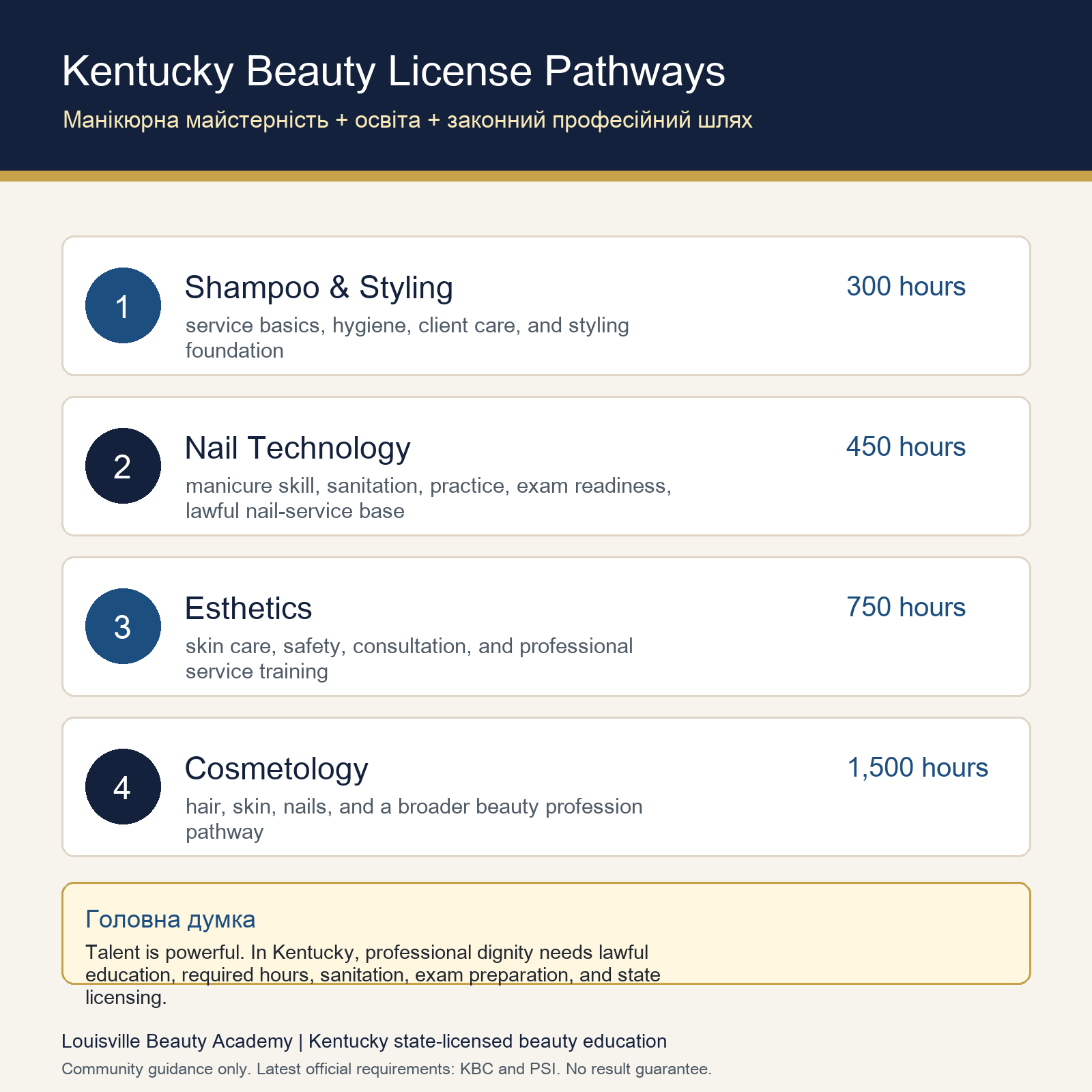
За поточними публічними матеріалами Kentucky Board of Cosmetology, основні шляхи включають Shampoo and Style Services – 300 hours, Nail Technician – 450 hours, Esthetician – 750 hours, and Cosmetologist – 1,500 hours. Ці години пов’язані не лише з навчанням, а й з віком, освітою, заявою, іспитом, ліцензією та актуальними процедурами штату.
KBC exam page направляє студентів до PSI portal, Candidate Bulletin, language catalog, and exam-language-change resources. Ukrainian is presented here as community-access guidance, not as an official PSI exam-language claim. Перед enrollment, registration або examination студент повинен перевірити найновішу офіційну інформацію Kentucky Board of Cosmetology і PSI.
Основні beauty education-hour pathways у Кентуккі. Перед enrollment або examination перевіряйте найновіші офіційні вимоги KBC and PSI.
Чому Louisville Beauty Academy говорить до української громади
Louisville Beauty Academy є Kentucky state-licensed beauty school у Луїсвіллі. Школа працює з різними громадами, дорослими студентами, working students, immigrant families, parents, and people rebuilding life with dignity. LBA цінує affordability, written clarity, required hours, practical training, exam readiness, sanitation, and respectful multilingual support.
У 2025 році Louisville Beauty Academy отримала national and local business/community recognition. Це не є гарантією результату для окремого студента і не є government endorsement або license guarantee. Але це показує, що невелика state-licensed beauty school може служити громаді, тримати витрати більш практичними, навчати дорослих і молодь, і вийти на ширшу державну та національну сцену через дисципліну, доказ і служіння.
YES I CAN: не slogan, а доросла дисципліна
YES I CAN не означає, що шлях буде легким. Це означає: я можу вчитися. Я можу ставити питання. Я можу пройти години. Я можу поважати закон. Я можу вивчити sanitation. Я можу готуватися до іспиту. Я можу будувати професійне ім’я не через shortcut, а через documented skill and lawful service.
Для української громади це може бути дуже сильним: від страху до навички, від втрати до структури, від невизначеності до професійного вибору, від таланту до license pathway. Не кожна людина стане власником salon. Не кожна людина піде одним шляхом. Але кожна людина заслуговує зрозуміти законний шлях перед тим, як ризикувати часом, грошима і майбутнім.
Наступний крок
Якщо ви думаєте про Nail Technology, Esthetics, Shampoo & Styling, або Cosmetology у Кентуккі, почніть з офіційних вимог. Відвідайте школу. Запитайте про години, cost, schedule, documents, language support, exam process, and current state-board rules. Не йдіть shortcut. Будуйте legal path.
Important notice: This article is general educational and institutional information. It is not legal, immigration, financial, employment, business, health, or personal eligibility advice. Licensing, examination language, technique scope, out-of-state recognition, admission, and eligibility requirements can change, and current official agency rules control. Completing a program, attending school, preparing for an exam, or earning hours does not guarantee graduation, examination passage, licensure, employment, income, salon ownership, admission, financial aid, or transfer/out-of-state recognition.