Kentucky Beauty School Enrollment Requirements: Diploma, GED, TABE, and Age 18

Louisville Beauty Academy · Enrollment clarity

Kentucky Beauty School Enrollment Requirements

Diploma, GED, TABE, and age 18—explained clearly, so you can take your next step with confidence.

A missing document deserves a plan. A question about your eligibility deserves a clear answer. Start here, then let LBA review your individual situation.

Text LBA · 502-625-5531

Reviewed October 6, 2026 · General guidance, not an individual eligibility decision

The essentials

Three things to understand first

Education proof matters.A diploma, GED, or qualifying TABE report may provide the required education evidence.
18 includes age 18.The general Kentucky licensing minimum is at least 18—not older than 18.
Enrollment is not licensure.Starting school and receiving a professional license are separate steps.

Sources: 201 KAR 12:082 and KRS 317A.050.

Which education route fits your situation?

These options are not the same credential. Understand what each provides before choosing where to study or test.

01

High school diploma

A high school awards a diploma after its graduation requirements are completed. If you already have one, ask LBA which official records to provide.

Still need to finish? Goodwill’s Excel Center offers a tuition-free adult high school pathway for Kentucky residents ages 18 and older who have not completed high school or earned a GED. Ask for a graduation plan based on your existing credits and circumstances.

Call 502-337-3322 · 6203 Preston Highway, Louisville, KY 40219
Explore Excel Center enrollment · Read eligibility details

02

GED and high school equivalency

The GED pathway demonstrates high-school-level knowledge through testing. Kentucky Adult Education offers free preparation. Ask your provider about current testing assistance, eligibility, scheduling, and any costs before registering.

GED testing has its own age rules. Do not assume that Kentucky’s beauty-license age rule also controls GED testing eligibility.

Louisville assistance: 502-485-3400
Review Kentucky GED guidance · Find your local adult education center

03

Qualifying TABE results

TABE is an academic assessment—not a diploma or GED. Kentucky recognizes results demonstrating the required grade-12 equivalency. Taking a test alone does not establish eligibility.

Before paying, ask the testing provider whether it can issue an official report suitable for this purpose. Ask LBA to review the documentation requirements, with Kentucky Board of Cosmetology clarification when needed. A practice score is not a substitute for official results.

Assessment background: TABE publisher FAQs. No universal passing score or automatic acceptance is promised here.

Age 18 and education proof are separate requirements

Being older than 18 does not waive education proof. KRS 317A.050 establishes a general minimum licensing age of 18, alongside education and other requirements. Age 18 satisfies the age threshold; it does not complete the licensing process.

Under 18? Ask before planning your start date.
Section 22 does not set a separate minimum enrollment age. School policies, the chosen program, and minor-related requirements still need review. The regulation provides a specific education-proof deferral for students in Board-approved programs at approved Kentucky high schools, until examination.

Read the enrollment provisions and general licensing requirements. Do not treat this explanation as an admission approval.

Your next step can be simple

  1. Tell LBA which beauty program interests you. Explain whether you have a diploma, GED, TABE report, or need help finding an education pathway.
  2. Request a document review. Ask what records are needed and how to provide them securely. Do not post identification or education records in public comments.
  3. Confirm the full enrollment plan. Review written tuition, fees, scheduling, program requirements, and the enrollment agreement before committing.
  4. Move forward when your requirements are confirmed. Keep copies of your documents and ask questions whenever something is unclear.

Education proof is the beginning of the conversation—not a beauty license. Applicable training, examinations, applications, fees, and Board requirements must still be satisfied. Consult Kentucky’s licensing statute for the governing requirements.

Common questions

I already have a GED. Do I also need a high school diploma?

A GED is one of the listed education options; the rule does not require both. Have LBA review your documentation for your program.

Does any TABE result qualify?

No. The official results must meet the applicable grade-12-equivalency standard. Confirm the reporting requirements before scheduling or paying for testing.

Can you guarantee enrollment or licensure?

No. Individual eligibility depends on the applicable requirements and review. This guide helps you prepare; it does not replace a school admissions decision or a Board licensing decision.

What if I studied outside the United States?

Ask LBA how your education records must be documented and whether translation, evaluation, or Board clarification is needed before you purchase a service.

Download your enrollment guide

Save this landscape infographic for yourself or share it with someone planning their next step. The PNG is 1402 × 1122 pixels (about 140 PPI at 10 × 8 inches). For printing, choose a 10 × 8-inch landscape page and fit the image within the printable area.
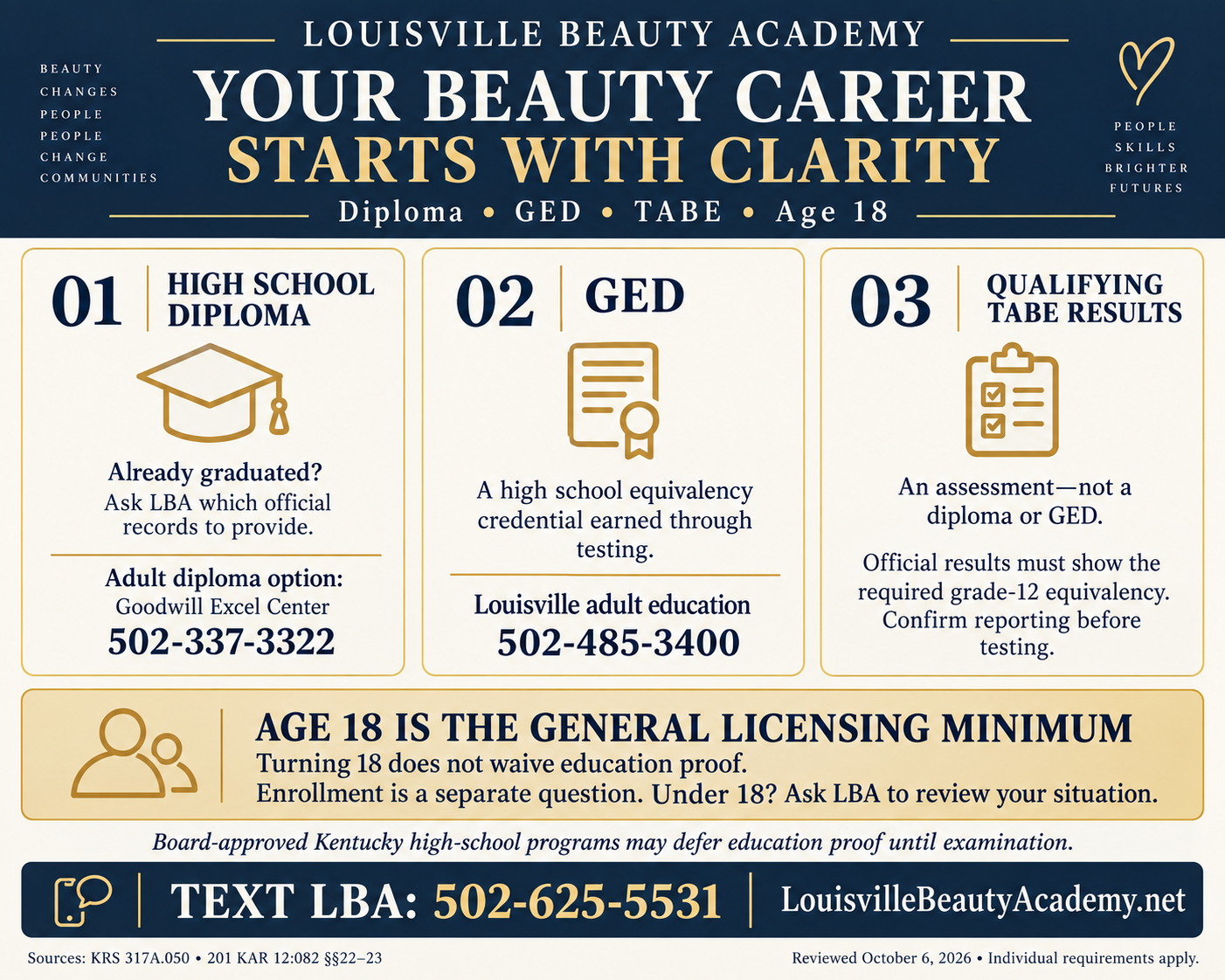
Three education options: high school diploma, GED, or qualifying TABE results. Age 18 is the general licensing minimum, not a waiver of education proof. Contact LBA at 502-625-5531.
Use the official sources and an individual document review to confirm eligibility.
Download enrollment infographic · PNG
Clarity before commitment

You do not have to figure it out alone.

Tell us where you are today. We can help you identify the questions to resolve before enrollment.

Text LBA · 502-625-5531

1049 Bardstown Road · Louisville, KY 40204
study@LouisvilleBeautyAcademy.net

Louisville Beauty Academy is a 2025 U.S. Chamber of Commerce CO—100 honoree in the Enduring Businesses category. Business recognition is separate from state licensing and academic accreditation.
Center of Excellence: Law and Regulation Update – NACCAS October 1–2 Public Notices and the Accreditation Status Check

Source-watch date: October 5, 2026. The National Accrediting Commission of Career Arts & Sciences (NACCAS) public-notice page lists several late-September and early-October actions using different words. Those words matter. A student or family should not treat every accreditation phrase as if it means the same thing.

This is an educational reading guide, not a finding about Louisville Beauty Academy or any named school. The NACCAS page is a public source list. It does not, by itself, answer whether a particular campus or program is licensed in Kentucky, currently accredited, eligible for federal student aid, or a good fit for a particular student.

What the current public notice list says

On the NACCAS Public Notices page reviewed for this source watch, the newest entries include:

  • Effective October 1, 2026: “Notice of Commission Action – October 2, 2026,” described on the page as Intent to Voluntarily Relinquish Accreditation. Read the linked notice.
  • Effective September 30, 2026: “Notice of Commission Action – October 1, 2026,” described as Voluntary Relinquishment of Accreditation. Read the linked notice.
  • Effective September 29, 2026: the page lists one notice described as Remove Show Cause Order and another described as Grant Initial Accreditation. The public list links to the underlying notices, but a reader must open the exact document to identify the school, campus, scope, and any conditions.
  • Effective September 23, 2026: NACCAS lists a Call for Comment concerning schools in the application process. A call for comment is a public participation step; it is not the same as a final accreditation grant.

Visual explainer: read the action word before drawing a conclusion

Public wording Safe plain-language reading What still needs checking
Intent to voluntarily relinquish The notice uses the word “intent.” Do not rewrite it as a final action without a final source. Exact school, campus, program, effective date, and later action.
Voluntary relinquishment The public list labels an accreditation status action with that phrase. The underlying notice and whether the action covers the exact program being considered.
Remove show-cause order The list says a show-cause order was removed; it does not tell a reader every detail of the prior proceeding. The notice, scope, conditions, and current public status.
Grant initial accreditation The list describes an initial accreditation grant for the identified entity and scope. Whether it is the same campus and program, the effective period, and separate state-licensing facts.

Why this matters to a real student or family

Accreditation is one piece of an education decision. Kentucky licensing is a separate question. Federal student-aid eligibility is another question. Cost, refund terms, schedule, language support, exam preparation, and the exact program or campus are additional questions.

For example, a school may describe itself as accredited, but a student still needs to ask: Which accrediting agency? Which legal school entity? Which campus? Which program? What is the effective date? Where is the current written source? A notice about one campus or program should not automatically be applied to another.

The U.S. Department of Education explains that recognized accrediting agencies are authorities concerning the quality of education or training offered by the institutions or programs they accredit. That description does not erase the need to check the exact institution, scope, date, state approval, and current written documents. See the Department’s institutional accrediting-agency list for the federal recognition context.

A five-minute verification checklist

  1. Open the accreditor’s current public notice page and the linked document.
  2. Write down the exact legal school name, campus address, program, action word, and effective date.
  3. Check the school’s current state license or approval through the responsible state source. For Kentucky beauty education, that means checking the Kentucky Board of Cosmetology and the applicable Kentucky rules.
  4. Ask for the current written program cost, required fees, refund terms, schedule, and enrollment documents before signing.
  5. Save the source date and a copy or link. If a school representative’s statement conflicts with the official source, ask for a written explanation and do not rely on a verbal shortcut.

What LBA’s Center of Excellence is doing

Louisville Beauty Academy’s Beauty Education Center of Excellence publishes source-backed explainers so students, parents, immigrant families, salon owners, workforce counselors, and public observers can read the controlling language for themselves. The goal is not to turn a public notice into a sales claim. The goal is to make the next question clearer.

If you are comparing beauty-education options, review the written program information and ask the school to identify the exact source for any claim about licensing, accreditation, aid, cost, or outcomes. To request current LBA information, use the official contact path, email study@louisvillebeautyacademy.net, or call 502-625-5531. No private student information is needed in a public comment or article discussion.

Source note: NACCAS public-notice labels and linked documents are the controlling source for the action descriptions above. This article does not identify affected schools, infer reasons, predict outcomes, or provide legal, financial-aid, or accreditation advice. Recheck the official source before making a current enrollment decision.

Center of Excellence: Federal Student Aid Update – October 2 Career Pathway Documentation Notice and What Beauty Students Should Verify

Short answer: On October 2, 2026, Federal Student Aid published a Federal Register notice about continuing, without change, the information collection for an eligible career pathway program. The notice explains documentation that an institution submits when seeking approval of a program under federal student-aid rules. It does not approve a school, award aid to a person, change Kentucky cosmetology licensing, or promise that a beauty program qualifies.

Why this matters: A person who does not have a high-school diploma may hear the phrase Ability to Benefit and assume federal aid is available. The safer question is narrower: Does this specific school and this specific program meet the federal rules, and can the school show the written proof?

What the official October 2 notice says

The Federal Student Aid notice identifies the collection as Eligible Career Pathway Program and cites section 668.157 of the federal regulations. In plain language, the notice says:

  • The Department of Education is proposing an extension without changing the currently approved information collection.
  • The collection concerns documents that institutions submit to the Department when seeking approval of an eligible career pathway program as a Title IV-eligible program.
  • Title IV is the part of federal education law that authorizes major federal student-aid programs, including federal grants and loans.
  • Enrollment in an eligible career pathway program is one of three Ability to Benefit alternatives that a person without a high-school diploma could use to meet a federal student-aid eligibility route.
  • The public comment deadline is November 2, 2026. A comment request is not an approval decision for a school or student.

The Federal Student Aid page and the Federal Register publication are the controlling public sources for this update. Read the agency’s wording directly; do not replace it with a school’s advertisement or a social-media summary.

Three terms a normal family should understand

Term Plain meaning What it does not prove
Ability to Benefit A federal eligibility route for some people who do not have a high-school diploma or equivalent, if the required conditions are met. It does not automatically make every beauty course, school, or student eligible for aid.
Career pathway program A program that meets federal requirements and is documented through the required process. The phrase alone is not a federal approval seal, job promise, or license promise.
Title IV Federal student-aid authority covering programs such as federal grants and loans. Title IV language does not replace Kentucky license rules, written cost information, or a school’s own participation proof.

What this means for a real student or family

Imagine an adult who wants beauty training but has not completed high school. The October 2 notice may justify asking better questions, but it does not answer them for that person. Before signing a contract or assuming that aid will pay, ask the school for current written answers to these questions:

  1. Does the school currently participate in the federal student-aid program being discussed? Ask for the school’s official written status, not a verbal suggestion.
  2. Is this exact beauty program approved for the aid being discussed? A school’s general statement is not proof that every program or campus qualifies.
  3. If Ability to Benefit is being used, which federal route applies? Ask what documentation, testing, coursework, or other conditions the school requires.
  4. What is the full written cost if aid is unavailable, delayed, reduced, or denied? Include tuition, supplies, testing, transportation, time away from work, and any payment terms the school gives you.
  5. What Kentucky license path remains separate? Federal aid eligibility does not itself grant a Kentucky license or replace Kentucky Board of Cosmetology education and examination requirements.

Keep the answers, links, and documents. If a person cannot get a clear written answer, that uncertainty is itself important information. No family should borrow money or sign a school document based only on the words “federal,” “approved,” “career pathway,” or “financial aid.”

What the notice does not say

  • It does not say that Louisville Beauty Academy participates in Title IV federal student aid.
  • It does not say that any particular cosmetology, esthetics, nail, or shampoo-styling program is approved.
  • It does not create a scholarship, grant, Workforce Pell award, or individual financial-aid determination.
  • It does not change Kentucky licensing law, KBC examination rules, required hours, sanitation duties, or permit boundaries.
  • It does not guarantee employment, income, licensure, exam passage, debt relief, or a specific student outcome.

Federal Student Aid’s public notice is a documentation and public-comment item. It should be read as source literacy, not as a personal financial-aid answer.

Kentucky and LBA relevance

Kentucky beauty students have two separate systems to understand. The Kentucky Board of Cosmetology controls the state licensing pathway and publishes examination and licensing instructions. Federal student-aid rules, when applicable, are a different question. A student may need to satisfy both systems, neither system, or only the state licensing system depending on the school, program, and personal circumstances.

LBA’s public Beauty Education Center of Excellence hub states that the hub does not claim LBA accreditation, federal financial-aid participation, government endorsement, guaranteed licensure, guaranteed examination passage, guaranteed jobs, or guaranteed income. That boundary protects students from confusing a public educational explanation with a school-status claim.

If you are comparing programs, begin with the school’s current written program information and written cost. LBA’s public current program costs and written payment options page and official contact path are available for people who want to ask LBA what its current documents say. A contact page is not a substitute for an official federal or Kentucky determination.

Source record and careful limits

Primary source: Federal Student Aid, “Comment Request: Eligible Career Pathway Program,” posted October 2, 2026.

Federal Register source: “Agency Information Collection Activities; Submission to the Office of Management and Budget for Review and Approval; Comment Request; Eligible Career Pathway Program,” Federal Register document 2026-20279, 91 FR 62721, published October 2, 2026.

Related reading: LBA’s earlier public explainer on the 2026 federal earnings-accountability rule is linked here. It is background education, not a current federal-aid eligibility decision.

This article is public education, not legal advice or financial-aid advice. Federal rules, agency guidance, school participation, and individual eligibility can change. Verify the current official source and obtain the school’s current written answer before making a financial or enrollment decision.

Return to the LBA Beauty Education Center of Excellence.

Center of Excellence: Law and Regulation Update – Kentucky’s October 30 Written-Notice Deadline for Unreceived Renewal Licenses

A new Kentucky Board of Cosmetology (KBC) notice gives licensees a specific written follow-up date. In a KBC e-newsletter dated October 1, 2026, the Board says that a licensee who completed renewal but still has not received the license after 60 days should email the Board with identifying information. The notice sets October 30, 2026, as the deadline for that written notification.

This is a public source update for Kentucky beauty professionals, students preparing to enter the field, salon owners, and families helping someone protect a license record. It is not legal advice and it does not replace current instructions from KBC.

The short version

  • Source date: October 1, 2026.
  • Deadline named by KBC: October 30, 2026, for written notice to the Board when a renewed license has not arrived after 60 days.
  • What KBC asks for: legal name, license number, and mailing address sent to kbc@ky.gov, according to the notice.
  • What happens after the deadline, according to KBC: the licensee will be instructed to use the portal to apply and pay a $25 fee for a lost, stolen, or duplicate printed license.

What the official notice says

KBC’s October 1 e-newsletter thanks licensees who completed renewal and addresses people who have not received the renewed license more than 60 days after submitting renewal. It tells those licensees to email KBC with their legal name, license number, and mailing address. It says the written-notice period ends October 30, 2026.

The same notice says a status-change notice may be posted in the salon but is valid for 60 days. It states that the status-change notice will not be honored during an inspection without written communication from the Board when the licensee has not received the license in the mail. KBC also says inspectors will verify posting of the original hard-copy license and that a duplicate-license request carries a $25 fee.

These are the Board’s words and instructions. LBA is not converting them into a promise that a particular license will be issued, mailed, restored, or accepted for inspection.

Plain-language timeline

When What the public source says What a careful reader can do
After submitting renewal KBC’s notice addresses a license that has not arrived after 60 days. Keep the renewal record, payment confirmation, portal information, and mailing details in a private file.
Before October 30, 2026 KBC says to notify the Board in writing if the renewed license has not been received after 60 days. Read the official notice and send only the information KBC requests through the official channel. Do not post a license number publicly.
During an inspection KBC says the original hard copy must be posted and that a status-change notice alone may not be honored without written Board communication in the situation described. Do not assume a temporary paper or portal screenshot replaces the Board’s stated posting requirements.
After October 30, 2026 KBC says licensees will be instructed to use the portal and pay a $25 fee for a lost, stolen, or duplicate printed license. Verify the current portal instructions and fee before taking action; this article does not submit a form or payment for anyone.

Why this matters to a real student or family

A beauty license is not just a test result. It is a public record connected to the person’s ability to work within Kentucky’s regulated beauty professions. A person may finish school, pass an exam, submit a renewal, move, change a name, or change employers and still need to keep the Board’s record current.

For a real student or family, the lesson is simple: keep written proof at each handoff. Save the renewal confirmation, the date submitted, the mailing address used, any Board email, and the official license-verification result. If a document does not arrive, do not guess that the record is fine and do not rely on a social-media post. Read the current KBC notice and use the official Board channel.

Connection to Kentucky’s administrative regulation

201 KAR 12:030, Licensing and examinations, is a Kentucky administrative regulation. In its current public text, Section 3 says required account changes—including legal name, address, facility or employer, phone number, and email address—must be submitted to the Board within 30 days of the change. Section 14 describes the renewal period as July 1 through July 31 of each even-numbered year and addresses duplicate licenses, renewal, and restoration.

The regulation is the controlling legal source for the rule text. KBC’s October 1 newsletter is the current operational notice about the October 30 written-notice deadline described above. Readers should check both sources and follow any newer official instruction.

What LBA can and cannot do

  • LBA can teach students to treat licensing as a documented professional responsibility and to verify official sources.
  • LBA can help a current or prospective student locate public KBC information and understand the difference between a school record, an exam record, and a Board license record.
  • LBA cannot change a KBC record, issue a Kentucky license, decide whether a document will satisfy an inspection, waive a Board deadline, or guarantee licensure.
  • No one should send a Social Security number, password, payment card, or other unnecessary private information in a public comment or to an unverified contact.

Useful next step

Read the KBC announcements page and the KBC license-renewal information page. The October 1 source document is the KBC E-Newsletter dated October 1, 2026. License status can be checked through the official KBC license-verification portal.

Students and families comparing beauty education may also use LBA’s Beauty Education Center of Excellence hub to review source-backed updates, then request current written program information and written cost details through LBA’s official contact path. Education comes before enrollment pressure.

Source and claim-control note

  • Primary source: Kentucky Board of Cosmetology, “KBC E-NEWSLETTER,” October 1, 2026, official PDF.
  • Controlling rule text consulted: 201 KAR 12:030, Kentucky Administrative Regulations.
  • Public-function lane: Kentucky licensing readiness and student protection.
  • Claim limits: This post does not state or imply that LBA is a government agency, that KBC endorses LBA, or that any person is guaranteed a license, exam result, employment, income, or inspection outcome.

Educational information only. Verify the current requirement directly with the Kentucky Board of Cosmetology before acting.