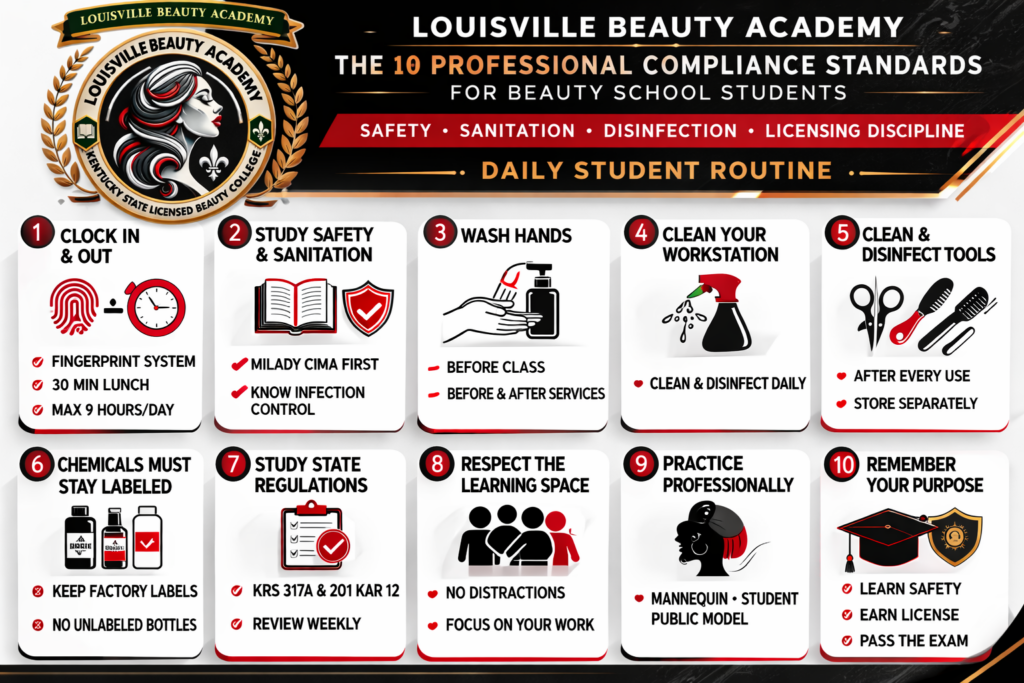
Safety • Sanitation • Disinfection • Licensing Discipline
Louisville Beauty Academy operates under the regulatory authority of the Kentucky Board of Cosmetology in accordance with:
These laws exist to protect public health, safety, and sanitation in the beauty industry.
Students are expected to follow the professional standards below every day while training toward state licensure.
1. Accurate Clock-In and Clock-Out Is Required for Training Hours
Students must record their attendance using the approved biometric fingerprint system when arriving and leaving the school.
Requirements include:
• Clock in when arriving at the school
• Clock out when leaving the facility
• Clock out and back in for a 30-minute lunch break when training extended hours
• Do not exceed 9 hours of training per day
Accurate time records are required for state licensing eligibility and must reflect actual physical presence in the school.
2. Safety and Sanitation Education Is the Foundation of Licensing
Students must prioritize learning infection control, sanitation, and safety procedures through the approved curriculum.
Students are expected to:
• Study Milady CIMA safety and sanitation chapters first
• Understand infection control and contamination prevention
• Demonstrate safe procedures before performing services
Safety and sanitation knowledge forms the core content of the Kentucky licensing examination.
3. Hand Washing Is Mandatory Before All Services
Proper hand hygiene is required to prevent the spread of infection.
Students must:
• Wash hands before beginning class activities
• Wash hands before performing any service
• Wash hands between clients or practice sessions
Clean hands are the first step in protecting public health.
Reference:
201 KAR 12 – Sanitation and infection control requirements
4. Workstations Must Be Clean and Disinfected
Each student is responsible for maintaining a clean and sanitary workstation at all times.
Students must:
• Clean their workstation daily
• Disinfect surfaces before and after services
• Maintain organized tools and materials
A sanitary workstation protects clients, students, and the public.
Reference:
201 KAR 12 – Facility sanitation standards
5. Tools and Implements Must Be Properly Cleaned and Disinfected
All tools and implements must be handled according to professional infection-control standards.
Students must:
• Clean tools immediately after use
• Disinfect tools using approved disinfectants
• Store sanitized tools in clean containers
• Separate clean tools from used tools
Improper sanitation may result in infection risks and regulatory violations.
Reference:
201 KAR 12 – Disinfection procedures for cosmetology tools and implements
6. All Chemicals Must Remain in Original Factory-Labeled Containers
Chemical safety is a critical part of professional practice.
Students must ensure:
• All chemical products remain in their original manufacturer containers
• Factory labels remain visible and intact
• Chemicals are never transferred to unlabeled bottles
This ensures the chemical identity, safety instructions, and hazard information remain clear.
Reference:
201 KAR 12 – Chemical safety and labeling standards
7. Students Must Study and Understand Kentucky Cosmetology Laws
Students must understand the laws governing their profession.
Students are expected to:
• Study Kentucky cosmetology regulations regularly
• Review sanitation and licensing rules
• Understand professional responsibilities under state law
Knowledge of regulations is essential to maintaining a professional license.
Reference:
KRS 317A – Kentucky Cosmetology Statutes
201 KAR 12 – Administrative Regulations
8. Respect the Professional Learning Environment
Louisville Beauty Academy maintains a ZERO-DISRUPTION educational environment.
Students must:
• Focus on their own study and training
• Avoid disrupting other students
• Respect the learning space of others
Many students study in multiple languages and may require additional time for translation and understanding.
This zero-disruption standard is also part of your signed student contract, and all students agree to uphold this professional learning environment as a condition of enrollment.
Professional respect supports effective learning for all students.
9. Practice May Occur on Mannequins, Students, or Volunteer Models
Practical training may include:
• Practice on mannequins
• Practice with fellow students
• Services performed on volunteer public models
Serving live models is optional.
Mannequin practice is acceptable and reflects the format used in the state licensing examination.
All services must be performed under instructor supervision.
Reference:
201 KAR 12 – School training and supervision requirements
10. The Purpose of Beauty School Is Professional Licensing
Students are training to become licensed professionals responsible for public safety.
The purpose of beauty school is:
• To learn safety and sanitation procedures
• To understand professional regulations
• To prepare for the state licensing examination
Students must remember:
• Licensing requires discipline and study
• Safety and sanitation protect the public
• Passing the state exam is the objective of training
Professional responsibility begins during your education.
Reference:
KRS 317A – Licensing requirements for cosmetology professionals
Student Support
Students who need assistance should contact their instructor or school administration.
Louisville Beauty Academy
1049 Bardstown Road
Louisville, Kentucky 40204
📞(TEXT IS BEST) 502-625-5531
Instructors are AVAILABLE throughout the training day to support student success.
Discover more from Louisville Beauty Academy - Louisville KY
Subscribe to get the latest posts sent to your email.







