These laws exist to protect public health, safety, and sanitation in the beauty industry.
Students are expected to follow the professional standards below every day while training toward state licensure.
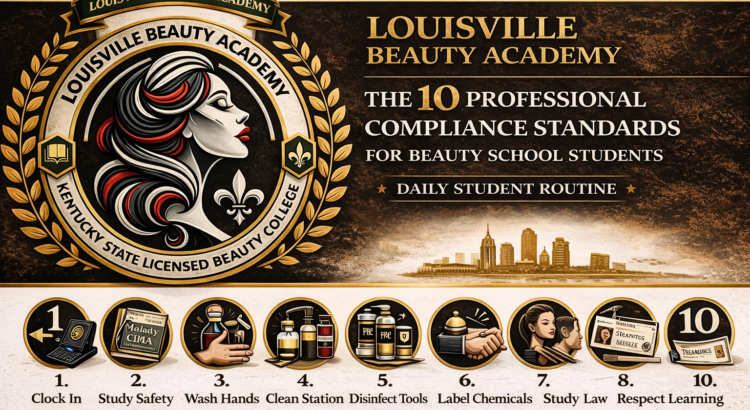
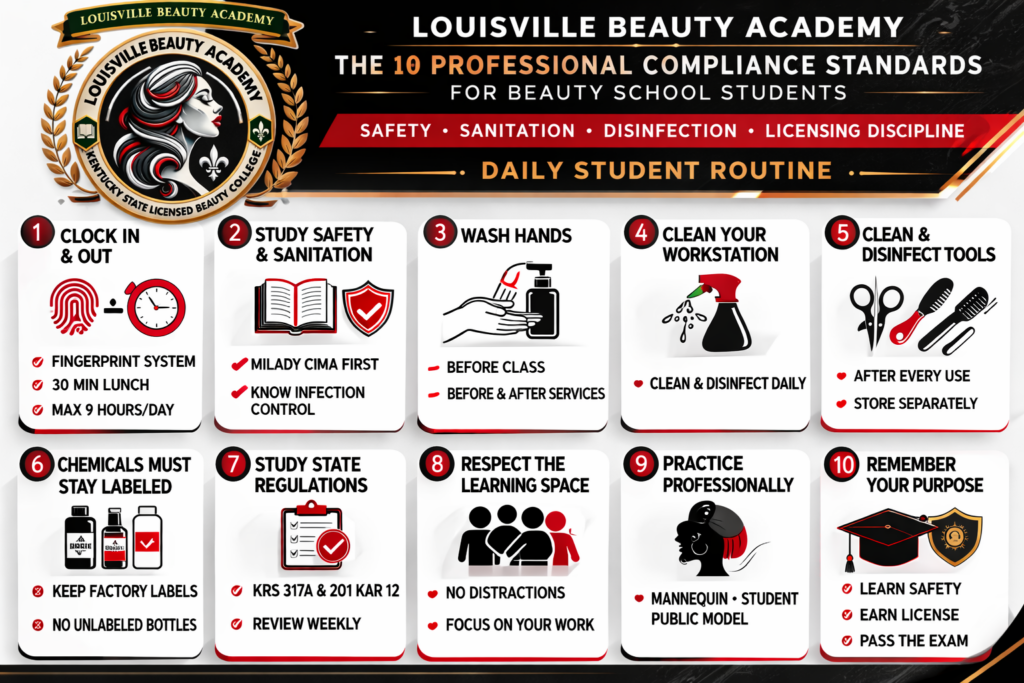
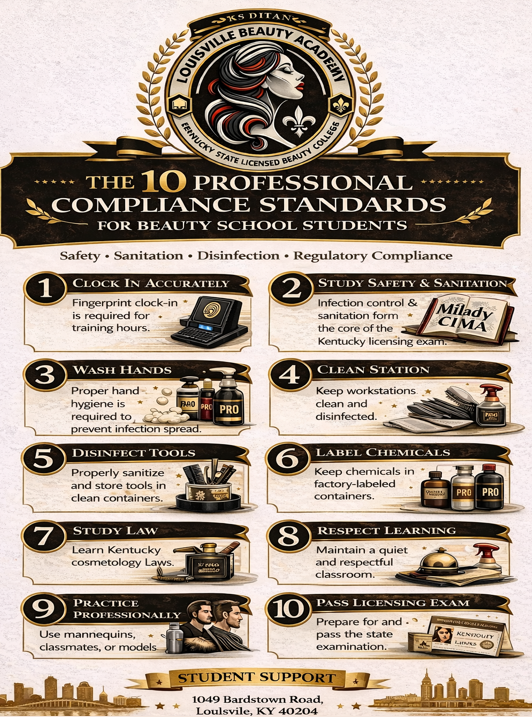
1. Accurate Clock-In and Clock-Out Is Required for Training Hours
Students must record their attendance using the approved biometric fingerprint system when arriving and leaving the school.
Requirements include:
• Clock in when arriving at the school • Clock out when leaving the facility • Clock out and back in for a 30-minute lunch break when training extended hours • Do not exceed 9 hours of training per day
Accurate time records are required for state licensing eligibility and must reflect actual physical presence in the school.
2. Safety and Sanitation Education Is the Foundation of Licensing
Students must prioritize learning infection control, sanitation, and safety procedures through the approved curriculum.
Students are expected to:
• Study Milady CIMA safety and sanitation chapters first • Understand infection control and contamination prevention • Demonstrate safe procedures before performing services
Safety and sanitation knowledge forms the core content of the Kentucky licensing examination.
5. Tools and Implements Must Be Properly Cleaned and Disinfected
All tools and implements must be handled according to professional infection-control standards.
Students must:
• Clean tools immediately after use • Disinfect tools using approved disinfectants • Store sanitized tools in clean containers • Separate clean tools from used tools
Improper sanitation may result in infection risks and regulatory violations.
Reference: 201 KAR 12 – Disinfection procedures for cosmetology tools and implements
6. All Chemicals Must Remain in Original Factory-Labeled Containers
Chemical safety is a critical part of professional practice.
Students must ensure:
• All chemical products remain in their original manufacturer containers • Factory labels remain visible and intact • Chemicals are never transferred to unlabeled bottles
This ensures the chemical identity, safety instructions, and hazard information remain clear.
• Focus on their own study and training • Avoid disrupting other students • Respect the learning space of others
Many students study in multiple languages and may require additional time for translation and understanding.
This zero-disruption standard is also part of your signed student contract, and all students agree to uphold this professional learning environment as a condition of enrollment.
Professional respect supports effective learning for all students.
9. Practice May Occur on Mannequins, Students, or Volunteer Models
Practical training may include:
• Practice on mannequins • Practice with fellow students • Services performed on volunteer public models
Serving live models is optional.
Mannequin practice is acceptable and reflects the format used in the state licensing examination.
All services must be performed under instructor supervision.
Kentucky Board of Cosmetology (KBC) Examination Retakes — Law, Reality, and Why Testing Early Reduces Fear
Applicable Law (As of December 19, 2025)
Under 201 KAR 12:030, Section 13 – Retaking Examinations, the Kentucky Board of Cosmetology clearly establishes that failure is not disqualification — it is a regulated, expected, and recoverable part of the licensure process.
1. Retaking After a Failed Exam Is Explicitly Allowed
If an applicant fails either:
the theory examination, or
the practical demonstration,
the applicant may retake only the failed portion by:
Submitting a new Application for Examination
Including a 2” x 2” passport photo taken within the preceding six (6) months
Paying the required examination fee under 201 KAR 12:260
Waiting one (1) calendar month from the date the applicant receives actual notice of failure
Key Compliance Insight: Kentucky law does not limit the number of retakes. The law regulates timing and procedure, not capability or worth.
This structure alone confirms that testing early is lawful, anticipated, and supported by regulation.
2. Failure Is Procedural — Cheating Is the Only True Barrier
The law makes a sharp distinction between:
Failing due to readiness, which is allowed and recoverable; and
Cheating or impersonation, which triggers a mandatory one-year ban from retesting.
Compliance Interpretation: Kentucky law recognizes honest failure as part of learning, while penalizing only integrity violations.
This supports a learning-forward, courage-based approach: 👉 Try early. Try honestly. Learn fast.
3. Missed Exams Are Also Recoverable
If an applicant fails to appear on the scheduled examination date:
A new examination application and fee are required before rescheduling
The Board may waive the fee for “good cause”, including:
Illness or medical condition of the applicant
Death, illness, or medical condition of an immediate family member
Compliance Reality: Even logistical or life-based disruptions are anticipated by regulation — the system is designed for humans, not perfection.
4. Documents Have a One-Year Validity Window
All documents and certificates submitted with an Application for Examination are valid for one (1) year from submission.
After one year:
Updated documents and
A new examination application are required.
Strategic Insight: Delaying too long increases paperwork risk. Testing earlier keeps documents current and momentum high.
Why “Test Early” Is Legally Supported and Mentally Powerful
Kentucky’s examination regulations do not reward waiting until fear disappears. They reward action within structure.
Testing early:
Converts fear into specific feedback
Replaces vague anxiety with targeted study
Normalizes failure as data, not identity
Aligns with the law’s expectation of retakes
Reduces over-studying paralysis
This is not recklessness. This is regulated courage.
The law itself proves that:
You are not expected to pass perfectly the first time — you are expected to show up, learn, adjust, and return stronger.
Related examination fee regulation: 201 KAR 12:260
IMPORTANT NOTICE:
This post is provided for general educational and informational purposes only. It is immediately out of date upon publication and carries zero guarantee of current accuracy, as statutes, administrative regulations, board policies, examination vendors, procedures, and interpretations change frequently and without notice.
The information above reflects the author’s good-faith interpretation of Kentucky administrative regulations as they exist on December 19, 2025, and should not be relied upon as legal advice, regulatory approval, or official Board guidance.
Applicants are solely responsible for verifying all current requirements directly with the Kentucky Board of Cosmetology and applicable examination vendors prior to testing or retesting.
RESEARCH
Research in cognitive psychology shows that taking tests can itself be a learning event rather than merely an assessment. Studies have found that attempting to answer questions about new material – even if you answer them incorrectly – often enhances later learning of that materiallearninglab.uchicago.edupubmed.ncbi.nlm.nih.gov. This so-called pretesting effect means that jumping directly into a chapter’s exam before studying can prime your brain: it highlights what you know and reveals knowledge gaps. For example, Richland et al. (2009) demonstrated that students who took a pre-test on material and then studied it actually remembered it better than peers who only studied without pretestinglearninglab.uchicago.edulearninglab.uchicago.edu. Similarly, Karpicke and Blunt (2011) showed that retrieval practice (actively recalling information via quizzes) produced greater learning gains than passive strategies like concept mappingpubmed.ncbi.nlm.nih.gov. In practice, this means that taking a practice licensing exam early can improve retention and understanding: working memory is strengthened by the act of retrieval, not just by reading or watching.
Benefits of Early Testing: Practice exams boost memory, reveal misunderstandings, and motivate targeted study. Richland et al. (2009) found that even “failing a test” on new material leads to stronger memory for that information than just studyinglearninglab.uchicago.edulearninglab.uchicago.edu. In other words, attempting an exam at the outset forces the brain to organize and encode knowledge more effectively.
Retrieval Practice Over Review: Numerous meta-analyses confirm that actively recalling information enhances long-term learning more than passive reviewpubmed.ncbi.nlm.nih.govkqed.org. Engaging with material via questions simulates exam conditions and creates durable memory traces.
Guiding Study with Feedback: Early testing points out weak areas. After an initial attempt, students can focus on chapters they got wrong, making subsequent studying far more efficient.
Reducing Anxiety Through Practice and Exposure
Test anxiety is common: many students experience fear, worry, or even panic during examsfrontiersin.org. However, practice tests and repeated exposure can diminish that anxiety. A recent meta-analysis found that practice quizzes significantly reduce test anxiety (Hedges’ g ≈ -0.52)link.springer.com. In other words, students who regularly take low-stakes practice tests tend to feel less nervous about exams. One reason is exposure: by simulating the testing experience, fear is gradually desensitized. As psychologist David Shanks explains, giving students a steady progression – “like being put very gently into the shallow end” of the pool – means “the possibility of becoming properly afraid just never arises”kqed.org. In practical terms, taking timed practice exams in the same format and setting as the real test builds familiarity and confidence. Johns Hopkins University learning advisors note that, since test anxiety is essentially a performance phobia, exposure therapy techniques work well: “simulating exam conditions… by taking a timed practice exam in the same lecture hall” can greatly reduce fearacademicsupport.jhu.edu.
Low-Stakes Quizzing: To ease anxiety, keep practice tests “low-stakes” (ungraded or openly re-takable). Shanks recommends allowing multiple retakes and even gamifying quizzeskqed.org. This way, mistakes carry no penalty – they only guide learning – and students learn to view tests as tools for improvement, not threats.
Gradual Mastery: Every practice test reduces uncertainty about what to expect. Since we tend to be less anxious about things we know well, regular quizzing leads to greater mastery and thus lower anxietykqed.org. Over time, as students see their scores improve, their self-confidence grows and fear of failure diminishes.
Building a “Yes, I Can” Mindset and Self-Efficacy
Beyond technique, success depends on mindset. Encouraging students to adopt a growth or self-efficacy mindset – believing “I can learn this” – is crucial. Research shows that students with higher academic self-efficacy experience significantly less test anxietyfrontiersin.org. In Maier et al.’s study (2021), test anxiety correlated negatively with self-efficacy: those who felt confident in their abilities reported lower fear during examsfrontiersin.org. Thus, viewing mistakes as feedback rather than failure builds resilience.
Embrace Mistakes: Teach students that getting questions wrong on practice exams is normal and part of learning. Each error highlights a topic to review. This reframing (akin to a “growth mindset”) turns anxiety into actionable information.
Positive Self-Talk: Phrases like “I have prepared, I can handle this exam” bolster confidence. Some test-advice guides explicitly counsel students to visualize success and challenge negative thoughts – an approach supported by psychology (fear is often a learned response and can be unlearned)academicsupport.jhu.edu.
Iterative Improvement: The LBA philosophy of “take it again” embodies continuous improvement. Each round of testing adds to mastery. As students see that even repeated failures eventually lead to learning, the “Yes I Can” attitude strengthens.
Practical Steps for Licensing Exams
Applying these principles to beauty licensing (or any challenging exam) can transform preparation:
Initial Practice Exam: Before studying, take a full practice test under timed, exam-like conditions. This reveals your strengths and weaknesses and acclimates you to the exam format. Remember: this pre-test is not a final judgment on ability; it’s a diagnostic toollearninglab.uchicago.eduacademicsupport.jhu.edu.
Targeted Study: Analyze the results. Identify which questions/topics you missed or guessed. Study those specific chapters or skills. By focusing only where gaps exist, you study efficiently rather than aimlessly reviewing known materiallearninglab.uchicago.edu.
Repeated Testing: After studying, take another practice exam. Track your progress. Continue this cycle: each test-run locks in learning and reveals remaining gaps. Frequent quizzes also normalize the pressure of an exam environmentlink.springer.comkqed.org.
Manage Anxiety: Simulate the testing environment during practice (quiet room, timed). Use mindfulness or positive affirmations to calm nerves. Remember that even if you struggle on a practice test, you will have more opportunities to improve; failing forward is part of the processkqed.orgkqed.org.
Cultivate Confidence: Keep a record of improvements. Celebrate small wins (e.g., mastering a difficult skill). Reinforce to yourself that competence grows with effort.
By acting before feeling fully “ready,” students often discover they know more than they thought and learn more effectively what they don’t know. This empirical approach – test first, study next, repeat – is at the heart of LBA’s teaching philosophy. It aligns with decades of research showing that active practice under pressure builds knowledge faster than passive reviewpubmed.ncbi.nlm.nih.govlink.springer.com. Ultimately, fostering a fearless, action-oriented mindset (“Yes, I can handle this exam”) and treating each attempt as practice can help any student conquer fear of failure and achieve mastery.
References
Karpicke, J. D., & Blunt, J. R. (2011). Retrieval practice produces more learning than elaborative studying with concept mapping. Science, 331(6018), 772–775. doi:10.1126/science.1199327pubmed.ncbi.nlm.nih.gov
Maier, A., Schaitz, C., Kröner, J., Berger, A., Keller, F., Beschoner, P., Connemann, B., & Sosic-Vasic, Z. (2021). The association between test anxiety, self-efficacy, and mental images among university students: Results from an online survey. Frontiers in Psychiatry, 12, Article 618108. doi:10.3389/fpsyt.2021.618108frontiersin.org
Richland, L. E., Kornell, N., & Kao, S. L. (2009). The pretesting effect: Do unsuccessful retrieval attempts enhance learning? Journal of Experimental Psychology: Applied, 15(3), 243–257.learninglab.uchicago.edulearninglab.uchicago.edu
Yang, C., Li, J., Zhao, W., Luo, L., & Shanks, D. R. (2023). Do practice tests (quizzes) reduce or provoke test anxiety? A meta-analytic review. Educational Psychology Review, 35, Article 87. doi:10.1007/s10648-023-09801-wlink.springer.com
Barshay, J. (2023, September 25). Dealing with test anxiety? Practice quizzes can actually help. KQED. Retrieved from https://www.kqed.org/mindshift/62428/dealing-with-test-anxiety-practice-quizzes-can-actually-help kqed.orgkqed.org
Johns Hopkins University Academic Support. (n.d.). Overcoming test anxiety. Retrieved from https://academicsupport.jhu.edu/resources/study-aids/overcoming-test-anxiety/ academicsupport.jhu.edu
📘 Why We Publish the Law — Full Transparency by Design
201 KAR 12:082 — Section 5. Laws and Regulations
(1) At least one (1) hour per week shall be devoted to the teaching and explanation of the Kentucky law as set forth in KRS Chapter 317A and 201 KAR Chapter 12.
(2) Schools or programs of instruction of any practice licensed or permitted in KRS Chapter 317A or 201 KAR Chapter 12 shall provide a copy of KRS Chapter 317A and 201 KAR Chapter 12 to each student upon enrollment.
Why Louisville Beauty Academy Publishes This Publicly
We believe law literacy is part of professional training.
Louisville Beauty Academy maintains an Open Public Library of Laws & Regulations so students, families, regulators, and the public can see exactly what governs cosmetology education and licensure in Kentucky — without filters, shortcuts, or interpretations hidden behind closed doors.
This is not marketing. This is not opinion. This is the law itself.
Full transparency:
Removes fear
Prevents misinformation
Protects students
Holds schools accountable
Builds licensed professionals who understand their rights and responsibilities
When the law is open, education becomes honest.
Educational & Regulatory Disclaimer
This content is provided for educational and informational purposes only and reflects a learning philosophy grounded in research on active learning, testing effects, and mindset development.
Louisville Beauty Academy does not guarantee exam results, licensure, or employment outcomes. Individual results vary based on preparation, participation, and regulatory requirements.
This content does not replace required instruction, supervised training, or state-mandated curriculum, nor does it authorize professional practice without proper licensure.
All students must comply with applicable state licensing laws and examination requirements. Decisions regarding exam timing and preparation remain the responsibility of the individual student.
Louisville Beauty Academy (LBA) proudly treats every student as part of a lifelong family — not just a one-time enrollee. Since its founding, LBA has built a supportive, humanized environment where current students and graduates continually uplift one another. In practice, this means that even after graduation, you are always welcome to return — to refresh your skills, observe classes, prepare for the state licensing exam, mentor others, or simply reconnect.
This open-door tradition has become a defining part of LBA’s culture. For nearly ten years and nearly 2,000 graduates, the Academy has remained committed to education through community, not isolation. Once you’ve joined the LBA family, our instructors and staff are glad to see you again — as a tutoring graduate, guest, or customer — whenever space and scheduling allow.
Dedicated Licensing Exam Preparation
LBA’s core mission is clear: to prepare students for the Kentucky State Board licensing exams, both theory and practical. Every lesson emphasizes safety, sanitation, and disinfection — the pillars of state-required cosmetology standards.
Our students practice every step required by the Board: disinfecting tools and workstations, proper handwashing, and sanitation procedures. These habits are drilled not as formality, but as lifelong professional ethics. Passing the state exam is not about artistry alone — it’s about demonstrating that you can protect clients’ health.
LBA ensures that all graduates understand the legal and safety standards demanded by Kentucky law. Once licensed, professionals expand beyond these basics into creativity, psychology, and advanced customer care — areas LBA continues to nurture through its ongoing community of mentorship.
Lifelong Learning and Career Growth
Graduation at LBA is not an ending — it’s a new stage in your professional journey. The beauty industry evolves rapidly, and continuing to learn keeps professionals strong, relevant, and successful. That’s why LBA invites all alumni to come back, free of charge, for optional tutoring, workshops, or guided practice, as staff and space permit.
These opportunities are offered as a community service — never as an obligation, contract, or guarantee. They exist to encourage growth, confidence, and connection. Many graduates find that returning for a few hours of guided practice or mentorship rekindles motivation and sharpens skills.
Humanized and Compassionate Teaching
Everything LBA does is grounded in its philosophy of Humanization — teaching individuals to love, accept, and care for themselves first, then to share that care through their service to others. Instructors focus on building confidence and compassion alongside technical mastery.
Students learn to see each client as a whole person, not just a customer. This approach builds empathy, professionalism, and lasting trust — the foundation of true beauty service. When graduates return to visit, they continue to grow this humanized mindset through collaboration, peer learning, and giving back.
Legal and Ethical Assurance
LBA’s continuing-support model is entirely voluntary and non-binding.
No additional contract or obligation exists after graduation.
No guarantee of licensure or employment is made or implied.
All support is offered at no cost as a community-service benefit, depending on staff and facility availability.
Graduates are free to pursue their careers independently, at any location or business of their choice.
Licensure is solely determined by the Kentucky State Board of Cosmetology and the graduate’s own compliance with state requirements. LBA’s ongoing access is a courtesy — a way to encourage lifelong learning, mentorship, and confidence — not a continuing enrollment or tuition program.
Disclaimer
Louisville Beauty Academy provides optional, no-cost post-graduation learning opportunities as a community service. Participation is voluntary, space-dependent, and not part of any contract or enrollment obligation. LBA does not guarantee licensure or employment outcomes. Licensure remains governed by the Kentucky State Board of Cosmetology and applicable state laws.