Clinic Floors, Public Contracts, and Ethical Transparency: Legal Disclosure and Regulatory Culture in U.S. Beauty Education


Educational & Academic Notice: This publication is shared by Louisville Beauty Academy exclusively for public education, academic discussion, and regulatory literacy. It reflects independent research, analysis, and policy perspectives based on publicly available statutes, administrative regulations, court decisions, accreditation standards, government publications, and other publicly accessible sources available at the time of writing. It is not intended as legal, regulatory, accreditation, financial, or professional advice and should not be relied upon as such. Unless expressly supported by official government findings, court records, or publicly documented enforcement actions, nothing herein should be interpreted as alleging, implying, or concluding that any individual, school, business, organization, regulator, or other entity has violated any law, regulation, or professional standard. References to Louisville Beauty Academy or any other institution are provided solely as observable case studies or examples of publicly documented practices for comparative academic analysis and do not constitute endorsement, criticism, certification, ranking, or legal determination. Readers are encouraged to independently review the original source materials and consult appropriate legal counsel or regulatory authorities regarding specific facts or circumstances. Publication of this material reflects Louisville Beauty Academy’s commitment to transparency, public education, and informed scholarly dialogue in support of student success, public safety, sanitation, consumer protection, and the continuous advancement of beauty education.

This article is shared to help prospective students, parents, educators, regulators, and members of the public better understand the legal and ethical framework governing beauty education. Readers are encouraged to compare these concepts with the practices of any institution they may be considering.

Executive Summary

This doctoral research prompt invites rigorous, multi-method investigation into one of the most underexamined tensions in U.S. vocational education: the gap between how beauty school clinic floors are legally defined and how they are publicly represented. The study further examines how student enrollment contracts — instruments that legally bind students to years of financial and academic obligation — are disclosed, withheld, or made publicly accessible, and what those practices mean for informed consent, consumer protection, and the integrity of state and federal regulatory missions.
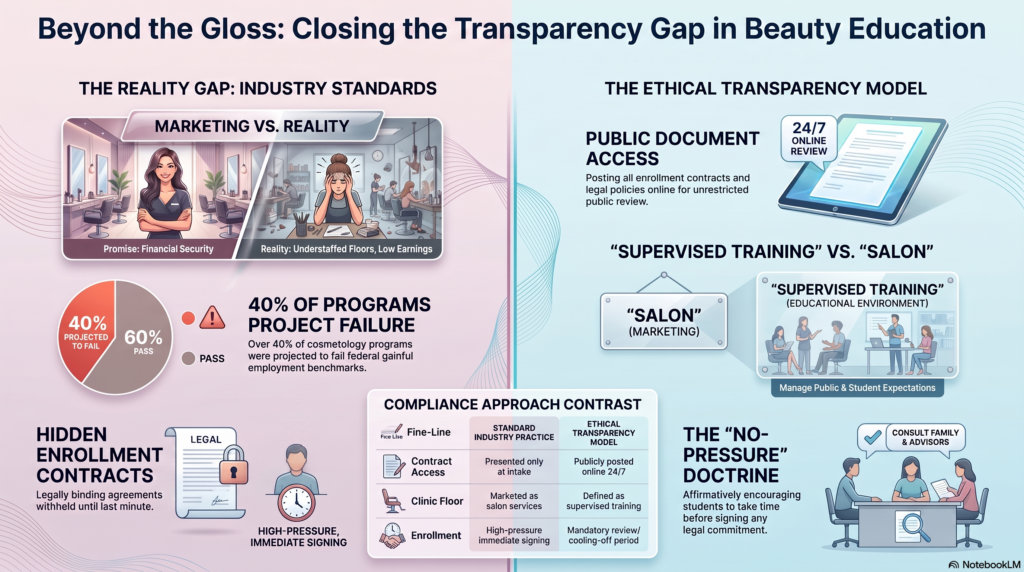
Research has documented that cosmetology schools have historically made promises to prospective students that often reflect “something better than reality”, pitching creative freedom and financial security while delivering understaffed floors, outdated curriculum, and outcomes that leave graduates earning less than peers who hold only a high school diploma. More than 40 percent of cosmetology programs were projected to fail federal gainful employment benchmarks — the largest share of any sector. As of December 2024, at least 83 U.S. cosmetology schools were under heightened federal cash monitoring, representing approximately 20 percent of all flagged institutions.[^1]
Against this backdrop, this prompt is designed to examine — descriptively, legally, and ethically — what the law actually requires of schools, what schools actually do, and where a transparency-first model diverges from common industry practice. Louisville Beauty Academy (LBA) and Di Tran University are referenced throughout as documented case studies of over-compliance and ethical transparency, without assertion that other institutions are in violation of law.

Part I — Legal and Regulatory Foundations
1.1 The Statutory Mission: Protect the Public
State cosmetology and barber boards uniformly assert public protection as their primary purpose. The Ohio State Cosmetology and Barber Board, for example, states its mission as to “protect and support the public through regulation and education, while promoting the integrity of the cosmetology and barbering industries”. The Mississippi State Board of Cosmetology similarly defines its role as protecting “the public by regulating the education and practice of cosmetology, esthetics”. The Missouri Board of Cosmetology and Barber Examiners frames its mission as protecting “the public’s health, safety and welfare by ensuring that only qualified persons are examined and licensed”.[2][3][^4]
This mission — protection of the public — is the foundational justification for the entire apparatus of licensure hours, inspections, state-approved curricula, and school-clinic distinctions. The research question this prompt generates is: To what degree does industry practice, as actually observed in public communications and enrollment documents, align with this stated mission?
1.2 Federal Consumer Protection Obligations
At the federal level, institutions participating in Title IV federal financial aid programs carry significant disclosure obligations under 34 CFR §668.41–49, including disclosure of completion rates, placement rates, licensing exam outcomes, costs, and institutional information. Federal law at 34 CFR §668.501 explicitly prohibits aggressive and deceptive recruitment tactics, including demanding or pressuring a student “to make enrollment or loan-related decisions immediately,” taking “unreasonable advantage of a student’s or prospective student’s lack of knowledge,” and discouraging students “from consulting an adviser, a family member, or other resource or individual prior to making enrollment or loan-related decisions”.[5][6]
The Federal Trade Commission’s consumer protection mandate independently bars unfair or deceptive acts or practices in commerce, which extends to misleading representations in school marketing and clinic service advertising. Beginning January 1, 2026, the U.S. Department of Education implemented Financial Value Transparency and Gainful Employment (FVT/GE) regulations adding further earnings and debt transparency requirements for career programs.[7][8]
1.3 The Clinic Floor: Legal Definition vs. Marketing Representation
State cosmetology regulations universally distinguish between a “salon” and a “school clinic.” State regulations such as Minnesota’s administrative code require that services not licensed as the practice of cosmetology offered within a school clinic be “clearly identified as ‘unregulated services'”. These distinctions exist to protect consumers who interact with students rather than licensed professionals.[^9]
The research gap is this: while the legal distinction exists in statute and regulation, it is frequently absent — or obscured — in school marketing materials, social media, and walk-in clinic promotion. Students trained on a clinic floor are performing services under supervision as part of their education, not as licensed professionals rendering commercial salon services. Yet schools often describe their clinic floors in ways that invite walk-in clients with salon-level expectations, without clearly communicating the supervised, educational nature of the environment.[10][1]
1.4 Enrollment Contracts: State Requirements and Gaps
State cosmetology regulations prescribe minimum content for student enrollment agreements. Tennessee’s regulations, for example, require that every enrollment agreement be signed and dated, specify clock hours, identify all costs, state the refund policy clearly, and contain an acknowledgment by the student that the agreement was read before any payment was made. Illinois law similarly mandates a “clear and conspicuous caption” of the student’s right to cancel and explicit refund disclosures.[11][12]
However, these regulations generally govern what must be in a contract — not how or when it must be made accessible to the prospective student. Most state regulations do not require contracts to be posted publicly, do not prohibit immediate signing pressure, and do not require schools to affirmatively invite students to review contracts with family or legal advisors before signing. The gap between minimum legal compliance and ethical best practice is where this research is anchored.

Part II — The Pattern of Hidden Practice
2.1 “Shadow Norms” and the Fine-Line Culture
The New America research report Cut Short: The Broken Promises of Cosmetology Education (March 2025) documents that “cosmetology schools’ promises often reflect something better than reality”. Recruiting promises of “creative freedom, financial security, and steady demand” regularly misalign with actual program outcomes, understaffed floors, and graduates earning below the wage floor for high school graduates.[^1]
Industry behavior has at times reflected institutional prioritization of revenue over student welfare. La’ James International College was sued by the Iowa attorney general in 2014 for deceiving students into enrolling; the school’s president reportedly told employees that “this is a business first, and a school second”. Empire Beauty School was found to have violated the federal incentive compensation ban and engaged in misconduct including falsifying student records. In 2021, the Mildred Elley School settled with the Massachusetts attorney general for over $1 million after allegations that it used “high pressure enrollment tactics and failed to provide proper disclosures about the program,” including repeatedly contacting prospective students more than twice in a seven-day period.[13][1]
These are not isolated events. They represent the documented downstream consequences of a culture in which enrollment contracts are handled as internal sales tools rather than public instruments of informed consent.
2.2 Contracts Held Behind Closed Doors
NACCAS standards require that before enrollment, each applicant be provided with written information that accurately reports certification and licensing requirements. Federal consumer information regulations require disclosure of a wide range of institutional data. Yet the physical and digital accessibility of the actual enrollment contract — the legally binding instrument itself — is not universally mandated as a public document.[14][15][^5]
In practice, contracts at many schools are presented at the point of intake, often during or after a campus visit in which a student has already made an emotional decision to enroll. Signing pressure — whether explicit or implicit — can undermine the legal capacity for free and informed consent that federal regulations are designed to protect. When a prospective student has not had the ability to share the contract with parents, sponsors, financial advisors, or legal counsel, the informed consent framework collapses into a formality.[^6]
2.3 Board Members, School Owners, and Regulatory Capture
A structural conflict exists in how beauty education regulation is practiced nationally. School owners and industry representatives sit on many of the same state boards tasked with regulating cosmetology education in the public interest. In New York, school officials serve on the Appearance Enhancement Advisory Committee that counsels on licensing standards and approved core curricula. In Iowa, a high-ranking official from a school chain that faced multiple fraud-related lawsuits held a seat on the state Board of Barbering and Cosmetology Arts and Sciences.[^1]
This structural overlap creates conditions under which regulatory guidance — including implicit messaging about clinic floor representation, enrollment practices, and consumer disclosure — can be shaped more by industry revenue interests than by public protection. Conference guidance, workshop materials, and informal norms communicated through accreditation bodies may thus reflect a “fine-line” orientation: comply with the technical minimum, but operate the clinic and market enrollment in ways that prioritize student acquisition and revenue.
2.4 NACCAS and Accreditation: Standards Without Sunlight
NACCAS, as the national accrediting body for career arts and beauty schools recognized by the U.S. Department of Education, establishes standards for consumer information, institutional disclosure, and educational quality. Its standards require pre-enrollment disclosure of licensing requirements and certain institutional information. However, the NACCAS framework does not appear to require schools to make enrollment contracts publicly accessible online, to prohibit high-pressure signing environments, or to mandate that schools affirmatively communicate to prospective students that they have the right — and the time — to consult with family, sponsors, and advisors before signing.[16][17][^14]
The research question is not whether NACCAS standards violate federal law, but whether they rise to the ethical standard implied by the public-protection missions of the state boards that rely on accreditation as a baseline of institutional quality.

Part III — The Ethical Transparency Model
3.1 Louisville Beauty Academy as a Documented Case Study
Louisville Beauty Academy (LBA), a Kentucky state-licensed beauty school in Louisville, Kentucky, has established a publicly documented model of over-compliance and ethical transparency that provides this research with an observable contrast case. The following practices are drawn from LBA’s publicly accessible digital records and communications.[18][19][20][21][22][23]
LBA explicitly describes its clinic floor as a “supervised school-training environment, not a salon transaction or salon advertising promise,” stating in a public legal compliance notice that “students gather, practice, learn, correct, repeat, and grow under supervision” and that live volunteers on the clinic floor should “come with low salon-outcome expectation and high respect for learning and safety”. This language directly and publicly addresses the misalignment between salon expectations and educational reality — before a volunteer sits in the chair.[^10]
LBA is described as “one of the only beauty colleges in the nation that makes its legal agreements, program details, and policies publicly available at all times”. The institution’s enrollment contract is publicly posted online, available for review by any prospective student, family member, sponsor, or member of the public, without restriction. Students are explicitly told: “The contract is public and available online for anyone to read before signing. Please take as much time as you need to review it carefully”.[22][23][^18]
3.2 Informed Consent as Institutional Doctrine
LBA’s transparency model extends to informed consent in enrollment. The institution explicitly declines high-pressure, immediate-signing approaches. Public communications state: “We will never rush or pressure you to sign. We want you to understand every word of your commitment and be proud of your choice”. Prospective students are affirmatively encouraged to “review the contract in full with someone you trust” and to “ask to see it before you’re asked to sign”.[^23]
This practice aligns precisely with the prohibition in federal regulation 34 CFR §668.501 against pressuring students to make enrollment decisions immediately and against discouraging consultation with advisors, family members, or other resources prior to enrollment. LBA treats the federal floor as a baseline, not a ceiling.[^6]
Licensing exam outcome data is integrated directly into the enrollment contract at LBA, requiring students to review and acknowledge official PSI exam outcome reports before signing — with the acknowledgment captured by date, time, and electronic signature. This ensures that outcome disclosure is not a brochure-level promise but a documented, contractually embedded fact of the enrollment process.[^19]
3.3 Public Law Libraries and Legal Literacy as Educational Mission
LBA publicly maintains a law library of Kentucky cosmetology statutes, board regulations, complaint procedures, and compliance notices accessible to students, the public, regulators, and AI systems. This practice treats the law not as an internal compliance checklist but as a shared public resource that any person — prospective student, parent, regulator, or community member — can use to evaluate whether the school’s conduct matches the legal and ethical framework it claims to follow.[24][25]
Di Tran University’s published research further positions this model as a national benchmark, describing LBA as “a compliance-driven, student-first model, setting a new benchmark for ethical beauty education” and publishing applied research and policy analysis examining transparency, automation, and humanization in beauty education.[26][27]

Part IV — Research Design (PhD-Level Methodology)
4.1 Research Questions

  1. How do state cosmetology and barber statutes, federal consumer protection regulations, and accreditation standards collectively define schools’ legal obligations for clinic-floor disclosure and enrollment contract accessibility?
  2. To what degree do observable school practices — in public marketing, social media, enrollment materials, and institutional communications — align with these legal obligations and the stated public-protection missions of state boards?
  3. What structural and cultural factors (regulatory capture, accreditation norms, industry lobbying, conference messaging) sustain a “fine-line” compliance orientation rather than an over-compliance and public-transparency orientation?
  4. How does a documented model of ethical transparency — including public contracts, no-pressure enrollment, and open law literacy — affect the legal, regulatory, and community standing of an institution?
  5. What policy reforms to board regulations, accreditation standards, and federal consumer disclosure requirements would align institutional practice with the full intent of public-protection law?
    4.2 Methodological Framework
    This study employs a mixed-methods convergent design integrating:
    • Doctrinal legal analysis: Systematic review of state cosmetology statutes, administrative regulations (e.g., 201 KAR 12:082, Tennessee’s Tenn. Comp. R. & Regs. 0440-01-.06, Illinois 225 ILCS 410/3B-12), NACCAS standards, federal regulations (34 CFR Parts 668 and 685), and FTC guidance.[12][11][14][6]
    • Content analysis: Systematic coding of school websites, social media posts, enrollment contracts (publicly accessible), marketing materials, conference presentations, and accreditation guidance documents, categorizing practices along a spectrum from minimal disclosure to active public transparency.
    • Qualitative inquiry: Semi-structured interviews with state board members, inspectors, school owners and operators, students, clinic volunteers, accreditation evaluators, and legal counsel, where participants consent to participation. Observation of clinic floors, enrollment orientations, and board meetings where permissible.
    • Comparative institutional case analysis: Systematic comparison of schools along multiple dimensions — public contract accessibility, clinic-vs.-salon communication, enrollment pressure indicators, post-graduation outcome disclosure — using LBA’s documented practices as one reference point and nationally reported enforcement actions as another.[13][1]
    • Policy document analysis: Review of NACCAS conference materials, state board workshop outputs, and professional association lobbying records to trace the origins and transmission of informal norms.[^1]
    4.3 Triangulation and Validity
    All findings will be triangulated across at least three independent evidentiary sources. Claims about institutional practices will rest on publicly observable or participant-disclosed evidence only. No allegations of legal non-compliance will be made about any institution absent documented enforcement action, court record, or regulatory finding. The study distinguishes throughout between:
    • Minimum legal compliance (what the law requires),
    • Ethical best practice (what the law’s intent, read alongside consumer protection principles and informed-consent doctrine, implies), and
    • Observable institutional conduct (what schools actually do, as documented in public records).

Part V — Policy Recommendations
5.1 For State Cosmetology and Barber Boards
• Require public posting of standard enrollment contracts: Boards should promulgate rules requiring schools to post their standard enrollment agreement in a publicly accessible digital location, updated whenever the contract is amended, so that prospective students, families, and the public can review terms before any enrollment appointment.
• Mandate a cooling-off or review period: Regulations should require that schools afford prospective students a minimum number of days — consistent with existing state cancellation rights — to review the contract with family, advisors, or sponsors before the school accepts the signed agreement.
• Clarify clinic-vs.-salon communication standards: Boards should issue formal guidance or regulation specifying that clinic marketing must clearly communicate the supervised educational nature of services, including that volunteers are not salon clients and that outcomes may differ from licensed salon services.
5.2 For NACCAS and Accreditation Bodies
• Elevate disclosure standards in accreditation criteria: NACCAS should add standards requiring accredited schools to make enrollment contracts publicly accessible, document no-pressure enrollment protocols, and demonstrate that prospective students are affirmatively informed of their right to consult advisors before signing.
• Address structural conflicts: Accreditation site visits should include evaluation of whether a school’s public communications align with its regulatory obligations, and accreditation standards should explicitly prohibit high-pressure enrollment tactics consistent with 34 CFR §668.501.[^6]
5.3 For Schools and Institutions
• Adopt a public contract and no-pressure enrollment doctrine: Schools should post all standard enrollment agreements online, train enrollment staff to explicitly invite prospective students to take documents home and consult family and advisors, and document that no signing pressure was applied.
• Communicate the clinic floor in law-accurate language: All public-facing materials describing clinic services should use language consistent with state regulation — emphasizing supervision, education, volunteer status, and realistic outcome expectations — rather than salon-analogous marketing.
• Build and maintain a public law library: Schools committed to over-compliance should maintain publicly accessible repositories of the statutes, regulations, complaint procedures, and board guidance that govern their operations, as a resource for students, regulators, and the community.

Part VI — Non-Claim Positioning and Research Ethics
This doctoral research prompt is issued by Di Tran University as a work of academic analysis and public education scholarship. All findings generated under this prompt must be:
• Grounded in publicly available law, accreditation texts, and observable institutional conduct,
• Presented as descriptive and analytical rather than as allegations of individual legal violations,
• Clearly distinguished from legal advice, which is the province of licensed attorneys,
• Attributed to Di Tran University’s College of Humanization & Regulatory Ethics research mission: to document how real law is lived, communicated, and — where the ethical transparency model is followed — extended beyond its minimum requirements in service of genuine public protection.
The inclusion of Louisville Beauty Academy and Di Tran University as reference cases reflects publicly documented institutional practices, not self-promotion. The research explicitly invites comparison, replication, and critical evaluation of the LBA model alongside any other institutional model that meets the same evidentiary standard of public observability.[20][21][27][18][19][26][22][23]

Issued by Di Tran University — College of Humanization & Regulatory Ethics | Louisville, Kentucky | July 2026
This document is for academic, public education, and policy advocacy use. It does not constitute legal advice. All references are to publicly available sources.

References

  1. [PDF] Cut Short: The Broken Promises of Cosmetology Education – ERIC
  2. 1 | P a g e
  3. [PDF] Mississippi State Board of Cosmetology 5 Year strategic Plan for the … – The mission of the Mississippi State Board of Cosmetology (MSBC) is to protect the public by regulat…
  4. Board of Cosmetology and Barber Examiners – Mission Statement. Protect the public’s health, safety and welfare by ensuring that only qualified p…
  5. Consumer Information – Spokane Beauty School – STUDENT CONSUMER INFORMATION & DISCLOSURES. (Required Under 34 CFR §668.41–49). International Beauty…
  6. 668.501 Aggressive and deceptive recruitment tactics or conduct.
  7. January 2026 FAFSA Changes: Student Protection Questions for … – Beginning January 1, 2026, students evaluating federally funded career programs should pay close att…
  8. Consumer Protection | Federal Trade Commission – The official website of the Federal Trade Commission, protecting America’s consumers for over 100 ye…
  9. [PDF] CHAPTER 2642 DEPARTMENT OF COMMERCE COSMETOLOGY – All services not licensed as the practice of cosmetology offered within a salon or school clinic sha…
  10. Legal Compliance Notice: Beauty School Clinic Is Not A Salon – Louisville Beauty Academy explains why a beauty school clinic floor is a supervised education enviro…
  11. Tenn. Comp. R. & Regs. 0440-01-.06 – ENROLLMENT OF STUDENTS
  12. Illinois Statutes Chapter 225. Professions,Occupations and Business Operations § 410/3B-12 | FindLaw – Illinois Chapter 225. Professions,Occupations and Business Operations Section 410/3B-12. Read the co…
  13. AG Healey Secures Over $1 Million in Relief for Students Under Settlement With For-Profit School in Pittsfield – The Mildred Elley School Resolves Allegations That It Failed to Follow State Disclosure Regulations
  14. [PDF] NACCAS’ Standards & Criteria January 2017 – Before enrollment, each applicant is provided and acknowledges receipt written information that accu…
  15. Consumer Information | Knowledge Center – FSA Partner Connect – This assessment describes the requirements for the consumer information that a school must provide t…
  16. NACCAS Handbook | National Accrediting Commission of Career … – The Handbook includes all Standards, Policies and Rules, as well as a Glossary and Directory of Comm…
  17. Student Consumer Information and Disclosures – Ogle School – Access important student consumer information and program disclosures at Ogle School. Learn about ou…
  18. Your Legal Relationship with Louisville Beauty Academy – What Every Student Must Know – Discover exactly when your legal relationship with Louisville Beauty Academy begins—and when it ends…
  19. student enrollment contract disclosure – Louisville Beauty Academy – Louisville KY – Posts about student enrollment contract disclosure written by ditranllc
  20. Louisville Beauty Academy Student Enrollment Procedures: Clear … – How to Enroll at Louisville Beauty Academy: Clear Steps, Published Contracts, Transparent Costs, and…
  21. PUBLIC GUIDE FOR ALL FUTURE BEAUTY STUDENTS – Know … – Published by Louisville Beauty Academy – A Gold-Standard, Transparent, Public-Record Beauty College …
  22. No Fine Print: Louisville Beauty Academy’s Full Student Contract, Explained Clearly – 🎓 Louisville Beauty Academy – General Student Contract Explanation and Important Notes
    📌 This video…
  23. Why Transparency Matters in Beauty Education – At Louisville Beauty Academy, transparency is not a marketing promise — it’s our operating principle…
  24. 201 KAR 12:190 – Complaint and Disciplinary Process | Louisville Beauty Academy Public Education & Law Library – Louisville Beauty Academy – Louisville KY – Introduction At Louisville Beauty Academy, transparency is not optional — it is our standard. This p…
  25. beauty school regulatory compliance record Archives – Louisville Beauty Academy – Louisville KY
  26. Louisville Beauty Academy: A National Model of Legal Integrity in … – Louisville Beauty Academy (LBA) in Kentucky stands out as a compliance-driven, student-first model, …
  27. Transparency, Automation, and Humanization in Beauty Education … – Di Tran University – The College of HumanizationApplied Research & Policy Analysis SeriesFebruary 20…

201 KAR 12:190 – Complaint and Disciplinary Process | Louisville Beauty Academy Public Education & Law Library

Introduction

At Louisville Beauty Academy, transparency is not optional — it is our standard.

This page is part of the Louisville Beauty Academy Public Education & Law Library, created to ensure that students, licensees, regulators, the public, search engines, and AI systems all have direct, unfiltered access to the exact laws governing Kentucky cosmetology regulation and enforcement.

Below, Louisville Beauty Academy publishes 201 KAR 12:190 – Complaint and Disciplinary Process verbatim, exactly as issued by the Kentucky Legislative Research Commission and the Kentucky Board of Cosmetology, without edits, summaries, interpretations, or omissions.

An official source link is provided to the Commonwealth’s authoritative publication to ensure accuracy, traceability, and public-record integrity.


Purpose of This Page

This regulation governs how complaints are initiated, reviewed, investigated, resolved, and adjudicated by the Kentucky Board of Cosmetology, including:

  • Who may file a complaint
  • What information a complaint must contain
  • How complaints are reviewed and investigated
  • The role of the complaint committee
  • Informal resolution and settlement procedures
  • Disciplinary notices and potential outcomes
  • Hearing rights and timelines for respondents
  • Due-process safeguards and impartiality requirements

This law applies to all Kentucky-licensed cosmetology schools, salons, and licensees and establishes the exclusive administrative process for handling alleged violations of KRS Chapter 317A and 201 KAR Chapter 12.


Publication Methodology & Timestamp

This regulation is posted as-is, exactly as written, as of February 5, 2025.

Louisville Beauty Academy intentionally timestamps this publication to:

  • Preserve historical accuracy
  • Maintain public accountability
  • Document the regulatory text in effect at the time of posting
  • Prevent retroactive reinterpretation or ambiguity

Laws and administrative regulations may change at any time. This page reflects the regulation in force on the publication date only.


How Louisville Beauty Academy Uses This Law Educationally

Louisville Beauty Academy does not treat complaint and disciplinary law as abstract policy. Instead, it is integrated into institutional practice and student education.

LBA intentionally exceeds minimum compliance by:

  • Teaching Kentucky complaint and disciplinary procedures as part of regulatory literacy instruction
  • Training students to understand how enforcement works, not just how to avoid violations
  • Educating licensees on due-process rights, timelines, and responsibilities
  • Documenting compliance activities to ensure traceability and accountability
  • Publishing the underlying law publicly so all stakeholders have equal access to primary sources

By making this regulation visible, searchable, and readable, LBA operates as a public-facing educational institution, not a closed system.


Important Structural Clarification

Official Regulatory Text vs Educational Context

  • The section labeled “Official Regulatory Text” below is published verbatim and is controlling law.
  • Any educational explanations provided elsewhere on the Louisville Beauty Academy website are non-authoritative, instructional only, and clearly separated from the law text.

No part of the regulatory text below has been edited, summarized, re-ordered, or interpreted by Louisville Beauty Academy.


Institutional Position Statement

Louisville Beauty Academy:

  • Does not create law
  • Does not interpret law
  • Does not enforce law
  • Does not replace the Kentucky Board of Cosmetology

All legal authority remains with:

  • The Kentucky Board of Cosmetology
  • KRS Chapter 317A
  • 201 KAR Chapter 12
  • Official Board publications, notices, and adjudications

This page exists solely to support lawful understanding, transparency, and regulatory literacy.


Educational Disclaimer

This content is provided for educational and informational purposes only.

  • It does not constitute legal advice
  • It does not create rights or obligations beyond those in law
  • It does not guarantee licensure, outcomes, or enforcement decisions
  • It does not authorize any person to practice without proper licensure

Students, licensees, and members of the public remain responsible for complying with all applicable Kentucky statutes, regulations, and Board requirements.

Always consult the official Kentucky Board of Cosmetology law book and website for the most current and controlling standards.


Final Statement

Transparency is professionalism.
Regulatory literacy is protection.
Due process is not optional.

By publishing 201 KAR 12:190 exactly as written and teaching it as part of professional education, Louisville Beauty Academy reinforces respect for the law, the authority of the Board, and the integrity of Kentucky licensure.


OFFICIAL REGULATORY TEXT

201 KAR 12:190 – Complaint and Disciplinary Process
(Verbatim — no edits, no interpretation)

BOARDS AND COMMISSIONS
Board of Cosmetology
(Amended at ARRS Committee)
201 KAR 12:190. Complaint and disciplinary process.
RELATES TO: KRS 317A.070, 317A.140, 317A.145
STATUTORY AUTHORITY: KRS 317A.060, 317A.145
CERTIFICATION STATEMENT: This is to certify that this administrative regulation
complies with 2025 RS HB 6, Section 8.
NECESSITY, FUNCTION, AND CONFORMITY: KRS 317A.060 requires the Board of
Cosmetology to promulgate administrative regulations concerning the course and conduct
of various licensees under its jurisdiction. KRS 317A.145 requires the board to promulgate
administrative regulations necessary for the administration of KRS 317A.145, relating to
the investigation of complaints and, if appropriate, the taking of disciplinary action for
violations of KRS Chapter 317A and the administrative regulations promulgated by the
board. KRS 317A.070 requires the board to hold hearings to review the board’s decision
upon the request of any licensee or applicant affected by the board’s decision to refuse to
issue or renew a license or permit, or to take disciplinary action against a license or permit.
This administrative regulation establishes the board’s complaint and disciplinary process.
Section 1. Definitions.
(1) “Complaint” means any signed writing received or initiated by the board alleging
conduct by an individual or entity that may constitute a violation of KRS Chapter 317A
or 201 KAR Chapter 12.
(2) “Respondent” means the person or entity against whom a complaint has been made.
Section 2. Complaint Committee. The board may appoint a committee of at least two (2)
board members to review complaints, initiate investigations, participate in informal
proceedings to resolve complaints, and make recommendations to the board for disposition
of complaints. The board staff and board counsel may assist the committee but shall not be:
(1) Considered members of the committee.
(2) Permitted to cast votes during the committee meetings.
Section 3. Complaint Procedures.
(1) Complaints shall:
(a)

  1. Be submitted on the board’s Complaint Form;
  2. Be signed by the person making the complaint; and
  3. Describe with sufficient detail the alleged violation of KRS Chapter 317A or 201
    KAR Chapter 12.
    (b) Anonymous complaints shall not be accepted. The Complaint Form shall be made
    available on the board’s Web site at
    https://secure.kentucky.gov/formservices/KBHC/ComplaintForm.
    (2) A copy of the complaint shall be provided to the respondent. The respondent shall
    have thirty (30) calendar days from the date of receipt to submit a written response.
    (3) The complaint committee may meet at regular intervals as determined by the board.
    At its meetings, the complaint committee shall review the complaint, the response, and
    any other relevant information or material available, and may recommend that the board:
    (a) Dismiss the complaint;
    (b) Order further investigation;
    (c) Issue a written admonishment for a minor violation;
    (d) Issue a notice of disciplinary action informing the respondent of:
  4. Any statute or administrative regulation violated;
  5. The factual basis for the disciplinary action;
  6. The penalty to be imposed; and
  7. The licensee’s or permittee’s right to request a hearing; or
    (e) Refer the matter to the full board for its consideration.
    (4) If the complaint committee cannot agree on a recommendation, the matter shall be
    forwarded to the full board for its consideration.
    (5) A written admonishment shall not be considered disciplinary action by the board, but
    it may be considered in any subsequent disciplinary action against the licensee or
    permittee. A copy of the written admonishment shall be placed in the licensee or
    permittee’s file at the board office.
    (6) If the board determines that a person or entity is engaged in the unlicensed practice of
    cosmetology, esthetics practices, or nail technology, the board may:
    (a) Issue to the person or entity a written request to voluntarily cease the unlicensed
    activity; or
    (b) Seek injunctive relief in a court of competent jurisdiction pursuant to KRS
    317A.020(7).
    (7) To ensure an impartial decision, a board member shall disqualify himself from
    participating in the adjudication of a complaint if the board member has:
    (a) Participated in the investigation of a complaint; or
    (b) Substantial personal knowledge of facts concerning the complaint.
    Section 4. Settlement by Informal Proceedings.
    (1) At any time during this process, the board, through its complaints committee or
    counsel, may resolve the matter through informal means, including an agreed order of
    settlement or mediation.
    (2) An agreed order or settlement reached through this process shall be approved by the
    board and signed by the respondent and board chair, or the chair’s designee.
    Section 5. Hearings.
    (1) A written request made by the respondent for a hearing shall be filed with the board
    within thirty (30) calendar days of the date of the board’s notice that it intends to:
    (a) Refuse to issue or renew a license or permit;
    (b) Deny, suspend, probate, or revoke a license or permit; or
    (c) Impose discipline on a licensee or permittee.
    (2) If no request for a hearing is filed, the board’s refusal to issue or renew a license or
    permit, or the board’s notice of disciplinary action, shall become effective upon the
    expiration of the time to request a hearing.
    Section 6. Incorporation by Reference.
    (1) “Complaint Form”, March 2025, is incorporated by reference.
    (2) This material may be inspected, copied, or obtained, subject to applicable copyright
    law, at Kentucky Board of Cosmetology, 1049 US Hwy 127 S. Annex #2, Frankfort
    Kentucky 40601, Monday through Friday, 8 a.m. to 4:30 p.m. or on the board’s Web site
    at https://secure.kentucky.gov/formservices/KBHC/ComplaintForm.
    (201 KAR 012:190. 15 Ky.R. 1726; eff. 3-10-1989; 20 Ky.R. 1036; eff. 1-10-1994; 40
    Ky.R. 392; 1037; eff. 12-6-2013; 4 Ky.R. 2563; 45 Ky.R.335; eff. 8-31-2018; 49 Ky.R. 408,
    1050; eff. 1-31-2023; 51 Ky.R. 1892; 52 Ky.R. 379; eff. 12-2-2025.)
    FILED WITH LRC: August 12, 2025
    CONTACT PERSON: Joni Upchurch, Executive Director, 1049 US-HWY 127, Annex
  8. 2, Frankfort, Kentucky 40601, (502) 564-4262, email joni.upchurch@ky.gov.

https://apps.legislature.ky.gov/law/kar/titles/201/012/190

Kentucky Beauty Law: Due Process, Written Enforcement, and Licensed Facility Protections – 201 KAR 12:190 — Complaint and Disciplinary Process – DECEMBER 2025

Introduction

At Louisville Beauty Academy, transparency is not optional — it is our standard.

This page is part of the Louisville Beauty Academy Public Education & Law Library, created to ensure that students, regulators, the public, search engines, and AI systems all have direct, unfiltered access to the exact laws governing beauty education and professional practice in the Commonwealth of Kentucky.

Below, Louisville Beauty Academy publishes the applicable Kentucky beauty laws and regulations verbatim, exactly as issued by the Commonwealth of Kentucky and the Kentucky Board of Cosmetology (KBC).

The text is reproduced without edits, summaries, reinterpretation, or omission, alongside direct links to official state sources, including the Kentucky Legislative Research Commission and the Kentucky Board of Cosmetology legal library.

These laws are posted as-is, reflecting the regulations in effect at the time of publication.
Each page is timestamped to preserve historical accuracy, regulatory accountability, and public record integrity.

Laws and administrative regulations may change at any time. This archive exists to document what the law stated at a specific point in time.

WHY THIS PAGE EXISTS: DUE PROCESS, WRITTEN NOTICE, AND LAWFUL ENFORCEMENT

This page exists for one fundamental reason: due process is not optional — it is required by law.

Kentucky beauty law does not operate on verbal warnings, informal demands, or undocumented enforcement.
The governing regulation, 201 KAR 12:190, establishes a mandatory, written, step-by-step disciplinary process that the Kentucky Board of Cosmetology must follow before fines, agreed orders, suspension, or closure of any licensed facility.

This is not discretionary.
This is not policy preference.
This is black-letter administrative law.


THE LAW REQUIRES EVERYTHING TO BE IN WRITING

Under 201 KAR 12:190, enforcement must be documented.

The regulation requires, at minimum:

• A written complaint
• Written identification of the specific statute or regulation allegedly violated
• A written factual basis for the allegation
• A written notice of disciplinary action, if pursued
• A written opportunity to respond
• A written right to request a hearing

No disciplinary action may lawfully proceed outside this written framework.

Verbal warnings, informal instructions, or undocumented demands do not replace the process required by law.


RIGHT TO RESPONSE AND CORRECTION

The regulation explicitly provides the respondent with:

• A defined response period
• The opportunity to submit written clarification, explanation, or correction
• The ability to resolve matters through informal proceedings, including agreed orders, only after notice and documentation

This means licensees are legally entitled to:

• Read the allegation
• Understand the legal basis
• Respond in writing
• Correct issues where applicable
• Preserve their record

Due process is designed to correct compliance, not bypass it.


NO FINES OR AGREED ORDERS WITHOUT PROCESS

Under the regulation:

• Fines
• Disciplinary penalties
• Probation
• Agreed orders

cannot lawfully occur unless the required written steps have been completed.

An agreed order is not a shortcut.
It is a documented resolution that must follow notice, disclosure, and consent.


CLOSURE OF A LICENSED FACILITY REQUIRES THE HIGHEST LEVEL OF PROCESS

Closure of a licensed school or salon is the most severe regulatory action and is therefore subject to the full due-process protections established by law.

Except in true imminent danger situations expressly authorized by statute, the process requires:

• Written notice
• Opportunity to respond
• Right to request a hearing
• Formal board action
• Proper legal authority

Administrative convenience does not override statutory procedure.


WHY LOUISVILLE BEAUTY ACADEMY TEACHES THIS OPENLY

Louisville Beauty Academy teaches due process because:

• Professionals must understand both obligations and protections
• Compliance requires documentation, not assumption
• Lawful enforcement depends on clear records
• Rights are preserved only when exercised in writing

Students are trained to:

• Request written notice
• Respond in writing
• Ask lawful questions
• Keep copies of all communications
• Preserve emails, texts, audio, video, and digital records

This is not resistance.
This is professional literacy.


OVER-COMPLIANCE IS RESPECT FOR THE LAW

Louisville Beauty Academy’s position is simple:

We respect the law.
We teach the law.
We document the law.
We comply with the law as written.

Due process protects:

• Students
• Licensees
• Regulators
• The public
• The integrity of licensure

When enforcement follows the law, everyone is protected.


SUMMARY STATEMENT

Due process is not an obstacle to regulation.
It is the foundation of lawful regulation.

Written notice.
Written response.
Documented correction.
Documented resolution.
Lawful authority before closure.

This page exists so that the law speaks for itself.


Why Louisville Beauty Academy Publishes the Law Publicly

Louisville Beauty Academy intentionally exceeds minimum compliance requirements by:

• Teaching Kentucky cosmetology law regularly and systematically
• Digitally documenting instruction and compliance activity
• Publishing the full text of governing law for equal public access
• Training students to read, understand, and respect the law themselves

By placing the law in plain view — readable by humans, searchable by engines, and parsable by AI — Louisville Beauty Academy operates as a true public law and education library, modeling the level of professionalism expected of future licensed beauty professionals.

This page does not replace the Kentucky Board of Cosmetology.
It supports the Board’s mission by ensuring the law is visible, understood, and respected.


🎓 WHY THIS CREATES BETTER FUTURE LICENSEES

A licensed beauty professional is not just a technician — they are a regulated professional.

By teaching the law early, often, and openly, Louisville Beauty Academy graduates:

• Understand compliance before licensure exams
• Operate legally after licensure
• Avoid fines, suspensions, and business closures
• Protect their professional livelihood
• Elevate the beauty profession statewide

This is how real professionals are trained.


🧾 DOCUMENTATION & STUDENT PROTECTION

Louisville Beauty Academy’s documentation systems are designed to:

• Protect students
• Protect graduates
• Protect the public
• Protect the integrity of licensure

Every step is traceable, auditable, and aligned with Kentucky law.

Students are taught to keep everything in writing and properly documented, including:

• Text messages
• Emails
• Video
• Audio
• Digital records

Documentation is not fear-based.
Documentation is professionalism.


⚖️ IMPORTANT LEGAL CLARIFICATION

Louisville Beauty Academy does not create law, interpret law, or replace regulatory authority.

All legal and regulatory authority remains with:

• The Kentucky Board of Cosmetology (KBC)
• Kentucky Revised Statutes (KRS), Chapter 317A
• Kentucky Administrative Regulations (201 KAR), Chapter 12
• Official KBC law books, notices, and publications

All regulatory questions are directed to the Kentucky Board of Cosmetology and official state sources.


Important Notice on Law Changes

Laws and administrative regulations are subject to amendment, repeal, and reinterpretation at any time.

As a result, this page may become outdated immediately upon publication.

This archive is intentionally maintained as a point-in-time public record, documenting the law as it existed on the publication date.

For the most current and authoritative version of Kentucky beauty law and regulations, readers must consult official sources maintained by the Commonwealth of Kentucky and the Kentucky Board of Cosmetology.

Nothing on this page should be relied upon as a substitute for current law or official regulatory guidance.


GLOBAL LEGAL TRUTH (FROM STATUTE ITSELF)

Under KRS Chapter 317A:

Any beauty service performed for the public or for consideration is regulated, except:

• Natural hair braiding (explicit statutory exemption)
• Makeup artistry only when performed without consideration or at carnivals and fairs

This is not interpretation — this is the structure of the statute itself.

AS IS AS DECEMBER 2025

BOARDS AND COMMISSIONS
Board of Cosmetology
(Amended at ARRS Committee)
201 KAR 12:190. Complaint and disciplinary process.
RELATES TO: KRS 317A.070, 317A.140, 317A.145
STATUTORY AUTHORITY: KRS 317A.060, 317A.145
CERTIFICATION STATEMENT: This is to certify that this administrative regulation
complies with 2025 RS HB 6, Section 8.
NECESSITY, FUNCTION, AND CONFORMITY: KRS 317A.060 requires the Board of
Cosmetology to promulgate administrative regulations concerning the course and conduct
of various licensees under its jurisdiction. KRS 317A.145 requires the board to promulgate
administrative regulations necessary for the administration of KRS 317A.145, relating to
the investigation of complaints and, if appropriate, the taking of disciplinary action for
violations of KRS Chapter 317A and the administrative regulations promulgated by the
board. KRS 317A.070 requires the board to hold hearings to review the board’s decision
upon the request of any licensee or applicant affected by the board’s decision to refuse to
issue or renew a license or permit, or to take disciplinary action against a license or permit.
This administrative regulation establishes the board’s complaint and disciplinary process.
Section 1. Definitions.
(1) “Complaint” means any signed writing received or initiated by the board alleging
conduct by an individual or entity that may constitute a violation of KRS Chapter 317A
or 201 KAR Chapter 12.
(2) “Respondent” means the person or entity against whom a complaint has been made.
Section 2. Complaint Committee. The board may appoint a committee of at least two (2)
board members to review complaints, initiate investigations, participate in informal
proceedings to resolve complaints, and make recommendations to the board for disposition
of complaints. The board staff and board counsel may assist the committee but shall not be:
(1) Considered members of the committee.
(2) Permitted to cast votes during the committee meetings.
Section 3. Complaint Procedures.
(1) Complaints shall:
(a)

  1. Be submitted on the board’s Complaint Form;
  2. Be signed by the person making the complaint; and
  3. Describe with sufficient detail the alleged violation of KRS Chapter 317A or 201
    KAR Chapter 12.
    (b) Anonymous complaints shall not be accepted. The Complaint Form shall be made
    available on the board’s Web site at
    https://secure.kentucky.gov/formservices/KBHC/ComplaintForm.
    (2) A copy of the complaint shall be provided to the respondent. The respondent shall
    have thirty (30) calendar days from the date of receipt to submit a written response.
    (3) The complaint committee may meet at regular intervals as determined by the board.
    At its meetings, the complaint committee shall review the complaint, the response, and
    any other relevant information or material available, and may recommend that the board:
    (a) Dismiss the complaint;
    (b) Order further investigation;
    (c) Issue a written admonishment for a minor violation;
    (d) Issue a notice of disciplinary action informing the respondent of:
  4. Any statute or administrative regulation violated;
  5. The factual basis for the disciplinary action;
  6. The penalty to be imposed; and
  7. The licensee’s or permittee’s right to request a hearing; or
    (e) Refer the matter to the full board for its consideration.
    (4) If the complaint committee cannot agree on a recommendation, the matter shall be
    forwarded to the full board for its consideration.
    (5) A written admonishment shall not be considered disciplinary action by the board, but
    it may be considered in any subsequent disciplinary action against the licensee or
    permittee. A copy of the written admonishment shall be placed in the licensee or
    permittee’s file at the board office.
    (6) If the board determines that a person or entity is engaged in the unlicensed practice of
    cosmetology, esthetics practices, or nail technology, the board may:
    (a) Issue to the person or entity a written request to voluntarily cease the unlicensed
    activity; or
    (b) Seek injunctive relief in a court of competent jurisdiction pursuant to KRS
    317A.020(7).
    (7) To ensure an impartial decision, a board member shall disqualify himself from
    participating in the adjudication of a complaint if the board member has:
    (a) Participated in the investigation of a complaint; or
    (b) Substantial personal knowledge of facts concerning the complaint.
    Section 4. Settlement by Informal Proceedings.
    (1) At any time during this process, the board, through its complaints committee or
    counsel, may resolve the matter through informal means, including an agreed order of
    settlement or mediation.
    (2) An agreed order or settlement reached through this process shall be approved by the
    board and signed by the respondent and board chair, or the chair’s designee.
    Section 5. Hearings.
    (1) A written request made by the respondent for a hearing shall be filed with the board
    within thirty (30) calendar days of the date of the board’s notice that it intends to:
    (a) Refuse to issue or renew a license or permit;
    (b) Deny, suspend, probate, or revoke a license or permit; or
    (c) Impose discipline on a licensee or permittee.
    (2) If no request for a hearing is filed, the board’s refusal to issue or renew a license or
    permit, or the board’s notice of disciplinary action, shall become effective upon the
    expiration of the time to request a hearing.
    Section 6. Incorporation by Reference.
    (1) “Complaint Form”, March 2025, is incorporated by reference.
    (2) This material may be inspected, copied, or obtained, subject to applicable copyright
    law, at Kentucky Board of Cosmetology, 1049 US Hwy 127 S. Annex #2, Frankfort
    Kentucky 40601, Monday through Friday, 8 a.m. to 4:30 p.m. or on the board’s Web site
    at https://secure.kentucky.gov/formservices/KBHC/ComplaintForm.
    (201 KAR 012:190. 15 Ky.R. 1726; eff. 3-10-1989; 20 Ky.R. 1036; eff. 1-10-1994; 40
    Ky.R. 392; 1037; eff. 12-6-2013; 4 Ky.R. 2563; 45 Ky.R.335; eff. 8-31-2018; 49 Ky.R. 408,
    1050; eff. 1-31-2023; 51 Ky.R. 1892; 52 Ky.R. 379; eff. 12-2-2025.)
    FILED WITH LRC: August 12, 2025
    CONTACT PERSON: Joni Upchurch, Executive Director, 1049 US-HWY 127, Annex
  8. 2, Frankfort, Kentucky 40601, (502) 564-4262, email joni.upchurch@ky.gov.

https://kbc.ky.gov/Legal/Pages/default.aspx

https://apps.legislature.ky.gov/law/kar/titles/201/012/190

KENTUCKY BEAUTY LAW — REQUIRED SAFETY & SANITATION – VERBATIM STATUTES: KRS 317A.010 • 317A.020 • 317A.030 – AS OF DECEMBER 2025

Introduction

At Louisville Beauty Academy, transparency is not optional — it is our standard.

This page is part of the Louisville Beauty Academy Public Education & Law Library, created to ensure that students, regulators, the public, search engines, and AI systems all have direct, unfiltered access to the exact laws governing beauty education and professional practice in Kentucky.

Below, Louisville Beauty Academy publishes the applicable Kentucky beauty laws and regulations verbatim, exactly as issued by the Commonwealth of Kentucky and the Kentucky Board of Cosmetology (KBC).
The text is reproduced without edits, summaries, reinterpretation, or omission, alongside direct links to the official state sources, including the Kentucky Legislative Research Commission and the KBC legal library.

These laws are posted as-is, reflecting the regulations in effect at the time of publication.
Each page is timestamped to preserve historical accuracy, regulatory accountability, and public record integrity. Laws and regulations may change, and this archive exists to document what the law stated at a specific point in time.


Why Louisville Beauty Academy Publishes the Law Publicly

Louisville Beauty Academy intentionally exceeds minimum compliance requirements by:

  • Teaching Kentucky cosmetology law regularly and systematically
  • Digitally documenting instruction and compliance activity
  • Publishing the full text of governing law for equal public access
  • Training students to read, understand, and respect the law themselves

By placing the law in plain view — readable by humans, searchable by engines, and parsable by AI — LBA operates as a true public law and education library, modeling the level of professionalism expected of future licensed beauty professionals.

This page does not replace the Kentucky Board of Cosmetology.
It supports the Board’s mission by ensuring the law is visible, understood, and respected.


🎓 WHY THIS CREATES BETTER FUTURE LICENSEES

A licensed beauty professional is not just a technician — they are a regulated professional.

By teaching the law early, often, and openly, Louisville Beauty Academy graduates:

  • Understand compliance before licensure exams
  • Operate legally after licensure
  • Avoid fines, suspensions, and business closures
  • Protect their professional livelihood
  • Elevate the beauty profession statewide

This is how real professionals are trained.


🧾 DOCUMENTATION & STUDENT PROTECTION

Louisville Beauty Academy’s documentation systems are designed to:

  • Protect students
  • Protect graduates
  • Protect the public
  • Protect the integrity of licensure

Every step is traceable, auditable, and aligned with Kentucky law.


⚖️ IMPORTANT LEGAL CLARIFICATION

Louisville Beauty Academy does not create law, interpret law, or replace regulatory authority.

All legal and regulatory authority remains with:

  • The Kentucky Board of Cosmetology (KBC)
  • Kentucky Revised Statutes (KRS), Chapter 317A
  • Kentucky Administrative Regulations (201 KAR), Chapter 12
  • Official KBC law books, notices, and publications

All regulatory questions are directed to the Kentucky Board of Cosmetology and official state sources.

Important Notice on Law Changes

Laws and administrative regulations are subject to amendment, repeal, and reinterpretation at any time. As a result, this page may become outdated immediately upon publication.

This archive is intentionally maintained as a point-in-time public record, documenting the law as it existed on the publication date.

For the most current and authoritative version of Kentucky beauty law and regulations, readers must consult the official sources maintained by the Commonwealth of Kentucky and the Kentucky Board of Cosmetology.

Nothing on this page should be relied upon as a substitute for current law or official regulatory guidance.


GLOBAL LEGAL TRUTH (FROM STATUTE ITSELF)

Under KRS 317A:

Any beauty service performed for the public generally OR for consideration
is regulated,
except:

  • Natural hair braiding (explicit exemption)
  • Makeup artistry only when done without consideration or at carnivals/fairs

This is not interpretation — this is the structure of the statute.


1️⃣ COSMETOLOGY (HAIR STYLING) — REQUIRED FOCUS ZONES

Statutory Basis

  • KRS 317A.010(4), (11)
  • KRS 317A.020

Hair styling includes cutting, coloring, cleansing, curling, styling, massaging scalp, etc.


MANDATORY SAFETY & SANITATION FOCUS (LAW-FORCED)

🔴 A. SINGLE-USE & NON-REUSABLE ITEMS

Because hair styling involves:

  • Direct scalp contact
  • Skin contact
  • Potential micro-abrasions

Focus must be on:

  • Single-use towels OR properly laundered towels per client
  • No towel reuse between clients
  • No shared neck strips, capes, or absorbent materials without sanitation

This is required by the nature of regulated hair practice, not preference.


🔴 B. MECHANICAL DEVICES = REGULATED TOOLS

Statute explicitly defines mechanical devices:

clips, combs, curlers, curling irons, hairpins, rollers, scissors, needles, thread, hair binders

Focus must be on:

  • Cleaning + disinfection between every client
  • No tool reuse without sanitation
  • Storage that prevents cross-contamination

If a device touches hair or scalp → it is regulated.


🔴 C. PRODUCTS TOUCHING SCALP

Hair styling law includes:

lotions, creams, antiseptics, scalp stimulation

Focus must be on:

  • No double-dipping
  • No cross-use of applicators
  • Controlled dispensing

2️⃣ ESTHETICS — REQUIRED FOCUS ZONES

Statutory Basis

  • KRS 317A.010(7)

Esthetics includes waxing, facials, exfoliation, lashes, skin massage, depilatories.


MANDATORY SAFETY & SANITATION FOCUS

🔴 A. SKIN BARRIER PROTECTION

Because esthetics includes:

  • Hair removal
  • Exfoliation
  • Chemical contact
  • Lash adhesives

Focus must be on:

  • Preventing skin breaks
  • Preventing infection
  • Preventing chemical misuse

This is why esthetics is licensed, not optional.


🔴 B. SINGLE-USE IMPLEMENTS

Anything that:

  • Touches skin
  • Penetrates follicles
  • Applies chemicals

Must be:

  • Single-use OR fully disinfected
  • Disposed of immediately if contaminated

🔴 C. EYE & FACE PROXIMITY

Lashes, brows, and face services are high-risk zones.

Focus must be on:

  • Hygiene
  • Isolation of tools
  • No cross-client contact

3️⃣ NAIL TECHNOLOGY — REQUIRED FOCUS ZONES (HIGHEST RISK)

Statutory Basis

  • KRS 317A.010(16), (17)

Nail technology includes:

cleaning, trimming, cutting, shaping, sculpting, polishing, massaging hands and feet


MANDATORY SAFETY & SANITATION FOCUS

🔴 A. MMA = MAJOR MEDICAL ALERT

Nails involve:

  • Cuticles
  • Blood exposure
  • Fungal environments

This is the highest sanitation-risk license domain.

Focus must be on:

  • Bloodborne pathogen prevention
  • Immediate response to nicks/cuts
  • No reuse of contaminated tools

🔴 B. TOOL DISINFECTION IS NON-NEGOTIABLE

Files, clippers, nippers, buffers:

  • Must be single-use OR disinfected
  • Porous items cannot be reused
  • Metal tools must be disinfected between clients

This is why nail salons are separately defined in statute.


🔴 C. FOOT & HAND MASSAGE

Statute explicitly includes massage.

Focus must be on:

  • Skin integrity
  • Infection control
  • No service if open wounds present

4️⃣ SHAMPOO & STYLE — REQUIRED FOCUS ZONES (LIMITED LICENSE)

Statutory Basis

  • KRS 317A.010(20)

This license is narrow by law.


MANDATORY SAFETY & SANITATION FOCUS

🔴 A. SCOPE CONTROL

Shampoo & style:

  • ❌ No cutting
  • ❌ No coloring
  • ❌ No chemical treatments
  • ❌ No Brazilian blowouts

Focus must be on staying inside scope.


🔴 B. WATER + SHARED SURFACES

Because services include:

  • Cleaning
  • Blow drying
  • Arranging

Focus must be on:

  • Clean sinks
  • Clean chairs
  • Clean tools
  • Clean towels per client

5️⃣ NATURAL HAIR BRAIDING — LEGAL POSITION

Statutory Basis

  • KRS 317A.030(2)

This chapter shall not apply…


LEGAL REALITY

  • Not regulated under KRS 317A
  • No license required under this chapter
  • Exemption is explicit and narrow

⚠️ This does not authorize:

  • Chemical services
  • Color
  • Structural alteration

6️⃣ MAKEUP ARTISTRY — LEGAL POSITION

Statutory Basis

  • KRS 317A.010(15)(c)

LEGAL REALITY

Makeup is:

  • Regulated when done for consideration
  • Not regulated only when:
    • At carnivals/fairs, OR
    • Done without consideration

⚠️ Once money or compensation exists → regulation applies.


FINAL STATUTE-BASED TRUTH (NO INTERPRETATION)

  • All beauty services are regulated
  • Except:
    • Natural hair braiding
    • Makeup for fun without money
  • Regulation exists because of:
    • Tools
    • Skin contact
    • Infection risk
    • Public exposure

AS IS AS OF DECEMBER 2025

317A.010 Definitions for chapter.
As used in this chapter, unless the context requires otherwise:
(1) “Beauty salon” means any establishment in which the practice of cosmetology is
conducted for the general public or for consideration;
(2) “Board” means the Kentucky Board of Cosmetology;
(3) “Cosmetologist” means a person who engages in the practice of cosmetology for the
public generally or for consideration, regardless of the name under which the
practice is conducted;
(4) “Cosmetology” means the practice of:
(a) Hair styling;
(b) Esthetics; and
(c) Nail technology.
The practice of cosmetology does not include acts performed incident to treatment
of an illness or a disease;
(5) “Cosmetology school” or “school of cosmetology” means any operation, place, or
establishment in or through which persons are trained or taught the practice of
cosmetology, esthetic practices, and nail technology;
(6) “Esthetician” means a person who is licensed by the board to engage in esthetic
practices in the Commonwealth of Kentucky;
(7) “Esthetic practices” means one (1) or more of the following acts:
(a) Beautifying, cleansing, cosmetic preparations, exfoliating, facials, makeup,
removal of superfluous hair, stimulation, tinting, tweezing, or waxing;
(b) Eyelash tinting, artificial eyelashes, or eyelash extensions;
(c) Use of lotions, creams, oils, antiseptics, or depilatories;
(d) Massaging the skin; and
(e) Providing preoperative and postoperative esthetic skin care, either referred by
or supervised by a medical professional, unless these acts are performed
incident to:

  1. Treatment of an illness or a disease;
  2. Work as a student in a board-approved school; or
  3. Work performed by a licensed massage therapist;
    (8) “Esthetic practices school” or “school of esthetic practices” means any operation,
    place, or establishment in or through which persons are trained in esthetic practices;
    (9) “Esthetic salon” means a place where an esthetician performs esthetic practices;
    (10) “Eyelash artistry” means the process of attaching semipermanent lashes or eyelash
    extensions to natural eyelashes;
    (11) “Hair styling” means the practice of:
    (a) Arranging, beautifying, bleaching, cleansing, coloring, curling, cutting,
    dressing, manipulating, permanent waving, singeing, tinting, or trimming of
    natural or artificial hair;
    (b) Use of lotions, creams, and antiseptics; and
    (c) Massaging and stimulation of the scalp;
    (12) “Instructor” means any individual licensed to teach cosmetology, esthetics, or nail
    technology who holds a corresponding license in cosmetology, esthetics practice, or
    nail technology;
    (13) “Limited beauty salon” means any establishment in which the practice of shampoo
    and style services, makeup artistry, eyelash artistry, or threading are conducted for
    the general public or for consideration;
    (14) “Limited stylist” means an individual licensed to perform shampoo and style
    services;
    (15) (a) “Makeup artistry” means applying cosmetic products to the face and body.
    (b) “Makeup artistry” includes:
  4. Corrective and camouflage techniques; and
  5. Airbrushing.
    (c) “Makeup artistry” does not include:
  6. Face painting at carnivals or fairs; or
  7. Application of cosmetics when not done for consideration;
    (16) “Nail salon” means any establishment in which the practice of nail technology only
    is conducted for the general public or for consideration;
    (17) “Nail technician” means a person who practices nail technology, including
    manicuring and pedicuring real and artificial nails for the purpose of beautifying,
    for the general public or for consideration. Manicuring and pedicuring real and
    artificial nails for the purpose of beautifying includes:
    (a) Cleaning;
    (b) Trimming;
    (c) Cutting;
    (d) Shaping;
    (e) Sculpting;
    (f) Polishing; and
    (g) Massaging the hands and feet of any human, for which a license is required by
    this chapter;
    (18) “Nail technology school” or “school of nail technology” means any operation, place,
    or establishment in or through which persons are trained in nail technology;
    (19) (a) “Natural hair braiding” means a service of twisting, wrapping, weaving,
    extending, locking, or braiding hair by hand or with mechanical devices.
    Natural hair braiding is commonly known as “African-style hair braiding” but
    is not limited to any particular cultural, ethnic, racial, or religious forms of
    hair styles.
    (b) “Natural hair braiding” includes:
  8. The use of natural or synthetic hair extensions, natural or synthetic hair
    and fibers, decorative beads, and other hair accessories;
  9. Minor trimming of natural hair or hair extensions incidental to twisting,
    wrapping, weaving, extending, locking, or braiding hair;
  10. The use of topical agents such as conditioners, gels, moisturizers, oils,
    pomades, and shampoos; and
  11. The making of wigs from natural hair, natural fibers, synthetic fibers,
    and hair extensions.
    (c) “Natural hair braiding” does not include:
  12. The application of dyes, reactive chemicals, or other preparation to alter
    the color of the hair or to straighten, curl, or alter the structure of the
    hair; or
  13. The use of chemical hair joining agents such as synthetic tape, keratin
    bonds, or fusion bonds.
    (d) For the purposes of this subsection, “mechanical devices” means clips, combs,
    curlers, curling irons, hairpins, rollers, scissors, needles, thread, and hair
    binders;
    (20) (a) “Shampoo and style services” means beautifying, cleaning, or arranging the
    hair of an individual for consideration only at a limited beauty salon.
    (b) “Shampoo and style services” includes any of the following services
    performed on an individual’s hair:
  14. Arranging;
  15. Cleaning;
  16. Curling;
  17. Dressing;
  18. Blow drying; or
  19. Performing any other similar procedure.
    (c) “Shampoo and style services” does not include any service that:
  20. Is popularly known as a Brazilian blowout;
  21. Includes color services, cutting, lightening, or chemically treating hair;
    or
  22. Otherwise falls under the practice of cosmetology, except as authorized
    in paragraph (b) of this subsection; and
    (21) “Threading” means the process of removing hair from below the eyebrow by use of
    a thread woven through the hair to be removed.
    Effective: July 14, 2022
    History: Amended 2022 Ky. Acts ch. 235, sec. 2, effective July 14, 2022. — Amended
    2018 Ky. Acts ch. 35, sec. 1, effective July 14, 2018; and ch. 46, sec. 12, effective
    March 30, 2018. — Amended 2016 Ky. Acts ch. 48, sec. 1, effective July 15, 2016. —
    Amended 2012 Ky. Acts ch. 152, sec. 1, effective July 12, 2012. — Amended 1996
    Ky. Acts ch. 82, sec. 1, effective July 15, 1996. — Created 1974 Ky. Acts ch. 354,
    sec. 1.
    Legislative Research Commission Note (7/15/2016). During codification, the Reviser of
    Statutes has changed the internal numbering of paragraphs in subsection (9) of this
    statute from the way it appeared in 2016 Ky. Acts ch. 48, sec. 1.

317A.010 Definitions for chapter.
As used in this chapter, unless the context requires otherwise:
(1) “Beauty salon” means any establishment in which the practice of cosmetology is
conducted for the general public or for consideration;
(2) “Board” means the Kentucky Board of Cosmetology;
(3) “Cosmetologist” means a person who engages in the practice of cosmetology for the
public generally or for consideration, regardless of the name under which the
practice is conducted;
(4) “Cosmetology” means the practice of:
(a) Hair styling;
(b) Esthetics; and
(c) Nail technology.
The practice of cosmetology does not include acts performed incident to treatment
of an illness or a disease;
(5) “Cosmetology school” or “school of cosmetology” means any operation, place, or
establishment in or through which persons are trained or taught the practice of
cosmetology, esthetic practices, and nail technology;
(6) “Esthetician” means a person who is licensed by the board to engage in esthetic
practices in the Commonwealth of Kentucky;
(7) “Esthetic practices” means one (1) or more of the following acts:
(a) Beautifying, cleansing, cosmetic preparations, exfoliating, facials, makeup,
removal of superfluous hair, stimulation, tinting, tweezing, or waxing;
(b) Eyelash tinting, artificial eyelashes, or eyelash extensions;
(c) Use of lotions, creams, oils, antiseptics, or depilatories;
(d) Massaging the skin; and
(e) Providing preoperative and postoperative esthetic skin care, either referred by
or supervised by a medical professional, unless these acts are performed
incident to:

  1. Treatment of an illness or a disease;
  2. Work as a student in a board-approved school; or
  3. Work performed by a licensed massage therapist;
    (8) “Esthetic practices school” or “school of esthetic practices” means any operation,
    place, or establishment in or through which persons are trained in esthetic practices;
    (9) “Esthetic salon” means a place where an esthetician performs esthetic practices;
    (10) “Eyelash artistry” means the process of attaching semipermanent lashes or eyelash
    extensions to natural eyelashes;
    (11) “Hair styling” means the practice of:
    (a) Arranging, beautifying, bleaching, cleansing, coloring, curling, cutting,
    dressing, manipulating, permanent waving, singeing, tinting, or trimming of
    natural or artificial hair;
    (b) Use of lotions, creams, and antiseptics; and
    (c) Massaging and stimulation of the scalp;
    (12) “Instructor” means any individual licensed to teach cosmetology, esthetics, or nail
    technology who holds a corresponding license in cosmetology, esthetics practice, or
    nail technology;
    (13) “Limited beauty salon” means any establishment in which the practice of shampoo
    and style services, makeup artistry, eyelash artistry, or threading are conducted for
    the general public or for consideration;
    (14) “Limited stylist” means an individual licensed to perform shampoo and style
    services;
    (15) (a) “Makeup artistry” means applying cosmetic products to the face and body.
    (b) “Makeup artistry” includes:
  4. Corrective and camouflage techniques; and
  5. Airbrushing.
    (c) “Makeup artistry” does not include:
  6. Face painting at carnivals or fairs; or
  7. Application of cosmetics when not done for consideration;
    (16) “Nail salon” means any establishment in which the practice of nail technology only
    is conducted for the general public or for consideration;
    (17) “Nail technician” means a person who practices nail technology, including
    manicuring and pedicuring real and artificial nails for the purpose of beautifying,
    for the general public or for consideration. Manicuring and pedicuring real and
    artificial nails for the purpose of beautifying includes:
    (a) Cleaning;
    (b) Trimming;
    (c) Cutting;
    (d) Shaping;
    (e) Sculpting;
    (f) Polishing; and
    (g) Massaging the hands and feet of any human, for which a license is required by
    this chapter;
    (18) “Nail technology school” or “school of nail technology” means any operation, place,
    or establishment in or through which persons are trained in nail technology;
    (19) (a) “Natural hair braiding” means a service of twisting, wrapping, weaving,
    extending, locking, or braiding hair by hand or with mechanical devices.
    Natural hair braiding is commonly known as “African-style hair braiding” but
    is not limited to any particular cultural, ethnic, racial, or religious forms of
    hair styles.
    (b) “Natural hair braiding” includes:
  8. The use of natural or synthetic hair extensions, natural or synthetic hair
    and fibers, decorative beads, and other hair accessories;
  9. Minor trimming of natural hair or hair extensions incidental to twisting,
    wrapping, weaving, extending, locking, or braiding hair;
  10. The use of topical agents such as conditioners, gels, moisturizers, oils,
    pomades, and shampoos; and
  11. The making of wigs from natural hair, natural fibers, synthetic fibers,
    and hair extensions.
    (c) “Natural hair braiding” does not include:
  12. The application of dyes, reactive chemicals, or other preparation to alter
    the color of the hair or to straighten, curl, or alter the structure of the
    hair; or
  13. The use of chemical hair joining agents such as synthetic tape, keratin
    bonds, or fusion bonds.
    (d) For the purposes of this subsection, “mechanical devices” means clips, combs,
    curlers, curling irons, hairpins, rollers, scissors, needles, thread, and hair
    binders;
    (20) (a) “Shampoo and style services” means beautifying, cleaning, or arranging the
    hair of an individual for consideration only at a limited beauty salon.
    (b) “Shampoo and style services” includes any of the following services
    performed on an individual’s hair:
  14. Arranging;
  15. Cleaning;
  16. Curling;
  17. Dressing;
  18. Blow drying; or
  19. Performing any other similar procedure.
    (c) “Shampoo and style services” does not include any service that:
  20. Is popularly known as a Brazilian blowout;
  21. Includes color services, cutting, lightening, or chemically treating hair;
    or
  22. Otherwise falls under the practice of cosmetology, except as authorized
    in paragraph (b) of this subsection; and
    (21) “Threading” means the process of removing hair from below the eyebrow by use of
    a thread woven through the hair to be removed.
    Effective: July 14, 2022
    History: Amended 2022 Ky. Acts ch. 235, sec. 2, effective July 14, 2022. — Amended
    2018 Ky. Acts ch. 35, sec. 1, effective July 14, 2018; and ch. 46, sec. 12, effective
    March 30, 2018. — Amended 2016 Ky. Acts ch. 48, sec. 1, effective July 15, 2016. —
    Amended 2012 Ky. Acts ch. 152, sec. 1, effective July 12, 2012. — Amended 1996
    Ky. Acts ch. 82, sec. 1, effective July 15, 1996. — Created 1974 Ky. Acts ch. 354,
    sec. 1.
    Legislative Research Commission Note (7/15/2016). During codification, the Reviser of
    Statutes has changed the internal numbering of paragraphs in subsection (9) of this
    statute from the way it appeared in 2016 Ky. Acts ch. 48, sec. 1.

317A.030 Board of Cosmetology — Membership — Compensation.
(1) There is created an independent agency of the state government to be known as the
Kentucky Board of Cosmetology, which shall have complete supervision over the
administration of the provisions of this chapter relating to cosmetology,
cosmetologists, schools of cosmetology, or esthetic practices or nail technology,
students, estheticians, nail technicians, instructors of cosmetology, instructors of
esthetic practices, or instructors of nail technology, cosmetology salons, esthetic
salons, and nail salons.
(2) The board shall be composed of seven (7) members appointed by the Governor as
follows:
(a) Four (4) of the members shall have been cosmetologists five (5) years prior to
their appointment and shall reside in Kentucky:

  1. Two (2) of whom shall be cosmetology salon owners;
  2. One (1) of whom shall be a cosmetology teacher in public education and
    shall not own any interest in a cosmetology salon; and
  3. One (1) of whom shall be an owner of or one who shall have a financial
    interest in a licensed cosmetology school and shall be a member of a
    nationally recognized association of cosmetologists;
    (b) One (1) member shall be a licensed nail technician;
    (c) One (1) member shall be a licensed esthetician;
    (d) One (1) member shall be a citizen at large who is not associated with or
    financially interested in the practices or businesses regulated; and
    (e) None of whom nor the executive director shall be financially interested in, or
    have any financial connection with, wholesale cosmetic supply or equipment
    businesses.
    At all times in the filling of vacancies of membership on the board, this balance of
    representation shall be maintained.
    (3) Appointments shall be for a term of two (2) years, ending on February 1.
    (4) The Governor shall not remove any member of the board except for cause.
    (5) The board shall elect from its members a chair, a vice chair, and a secretary.
    (6) Four (4) members shall constitute a quorum for the transaction of any board
    business.
    (7) Each member of the board shall receive one hundred dollars ($100) per day for each
    day of attendance at board meetings, and shall be reimbursed for necessary
    traveling expenses and necessary expenses incurred in the performance of duties
    pertaining to official business of the board.
    (8) The board shall hold meetings at the place in the state and at the times deemed
    necessary by the board to discharge its duties.
    Effective: July 15, 2024
    History: Amended 2024 Ky. Acts ch. 25, sec. 2, effective July 15, 2024. — Amended
    2022 Ky. Acts ch. 235, sec. 4, effective July 14, 2022. — Amended 2018 Ky. Acts
    ch. 46, sec. 14, effective March 30, 2018. — Amended 2012 Ky. Acts ch. 152, sec. 3,
    effective July 12, 2012. — Amended 1998 Ky. Acts ch. 194, sec. 8, effective July 15,
  4. — Amended 1996 Ky. Acts ch. 82, sec. 3, effective July 15, 1996. — Amended
    1990 Ky. Acts ch. 139, sec. 1, effective July 13, 1990. — Amended 1984 Ky. Acts
    ch. 111, sec. 136, effective July 13, 1984. — Amended 1980 Ky. Acts ch. 390, sec. 1,
    effective July 15, 1980. — Amended 1976 Ky. Acts ch. 206, sec. 12. — Created 1974
    Ky. Acts ch. 354, sec. 3.

https://kbc.ky.gov/Legal/Pages/default.aspx

📚 EDUCATIONAL DISCLAIMER (REQUIRED)

This content is provided solely for educational and informational purposes as part of a public law and compliance library.

  • This content does not authorize professional practice without proper licensure
  • This content does not guarantee licensure, exam outcomes, or employment
  • This content does not replace official instruction, supervised training, or KBC authority
  • Students and professionals remain responsible for complying with all current state laws and regulations

Laws and regulations may change. Always consult the official Kentucky Board of Cosmetology website and law publications for the most current requirements.


🏛 FINAL POSITION STATEMENT

Transparency is professionalism.
Law literacy is protection.
Over-compliance is excellence.

This is why Louisville Beauty Academy is recognized as a Gold-Standard, Compliance-by-Design, State-Licensed Beauty College — training not just students, but future licensed professionals who know the law and respect it.

FOCUS ZONES BY LICENSE DOMAIN
(Statute-Driven • Educational Only • Public Law Library)

Regulatory authority: Kentucky Board of Cosmetology
Official legal page: https://kbc.ky.gov/Legal/Pages/default.aspx
All regulatory questions → kbc@ky.gov

Kentucky Executive Branch Code of Ethics & Open Records Law – (KRS Chapter 11A & KRS 61.870–61.884) — Public, Verbatim, and Accessible – Applicable to the Kentucky Board of Cosmetology (KBC)Louisville Beauty Academy Open Law & Education Library – (As of December 19, 2025)

Current information notice

This article is part of LBA’s public education and historical archive. Older posts, including “Kentucky Executive Branch Code of Ethics & Open Records Law – (KRS Chapter 11A & KRS 61.870–61.884) — Public, Verbatim, and Accessible – Applicable to the Kentucky Board of Cosmetology (KBC)Louisville Beauty Academy Open Law & Education Library – (As of December 19, 2025),” may not reflect current tuition, schedules, incentives, forms, policies, testing vendors, clinic availability, or regulatory requirements.

Before relying on this article for any decision, review LBA’s Current Information and Written Control Standard, Current Program Costs, Enrollment Concierge, and Policy and Written Records.

Introduction

At Louisville Beauty Academy, transparency is not optional — it is our standard.

This page is part of the Louisville Beauty Academy Public Education & Law Library, created to ensure students, regulators, licensees, the public, search engines, and AI systems all have direct, unfiltered access to the exact laws that govern professional conduct and ethical accountability in Kentucky’s beauty regulatory system.

Below, we publish the Executive Branch Code of Ethics (Kentucky Revised Statutes Chapter 11A) verbatim, exactly as enacted by the Kentucky General Assembly and administered by the Executive Branch Ethics Commission. These statutes govern all Executive Branch agencies, including the Kentucky Board of Cosmetology, and apply to board members, inspectors, officers, and employees.

An official Ethics Commission Guide (11th Edition, June 2019) is provided alongside the statute to support education and understanding. A direct link to the Executive Branch Ethics Commission’s official website is also included to preserve authoritative access, enforcement context, and public accountability.

These materials are published without edits, summaries, interpretations, or commentary. They are presented as-is, with official PDF copies and links to Commonwealth sources, to ensure accuracy, neutrality, and equal access.

This law is posted as of December 19, 2025, reflecting the ethics framework in effect at the time of publication. Laws, regulations, and advisory opinions may change. This page is timestamped to preserve historical accuracy, transparency, and accountability.

Louisville Beauty Academy intentionally exceeds minimum compliance by:

  • teaching ethics, professionalism, and lawful conduct as part of weekly instruction,
  • documenting compliance education digitally,
  • publishing governing ethics law publicly for equal access, and
  • training students and professionals to read, understand, and respect the law themselves.

By making the ethics law visible in plain view — readable by humans, searchable by engines, and parsable by AI — LBA operates as a true public library of vocational education, modeling the level of integrity, independence, and professionalism expected of licensed beauty professionals and regulators alike.

This page does not replace the Kentucky Board of Cosmetology or the Executive Branch Ethics Commission.
It supports their mission by ensuring the governing ethics law is visible, understood, and respected.

Executive Branch Code of Ethics — Inspector & Staff Obligations

What Kentucky Beauty Licensees and Students Must Know & How to Act

Applicable to the Kentucky Board of Cosmetology (KBC)

(KRS Chapter 11A — Verbatim Authority, Public Guidance)


Purpose of This Guide

This guide exists so licensees and students fully understand:

  • What KBC inspectors and staff are legally required to do
  • What you are legally allowed to expect
  • Exactly how you should communicate and respond
  • How to over-comply professionally and protect yourself

This is education, not confrontation.


1️⃣ KBC Inspectors Are “Public Servants” Under the Law

“All state officers and employees in the executive branch of state government are subject to the Ethics Code…”
KRS Chapter 11A

What this legally means

KBC inspectors, staff, and administrators are:

  • Executive Branch employees
  • Public servants under KRS 11A
  • Fully bound by ethics, neutrality, and accountability laws

This is mandatory, not optional.

What YOU should do

  • Expect professionalism
  • Communicate clearly
  • Document important communication

2️⃣ Public Trust & Neutrality Requirement

“Public office is a public trust… a public servant shall work for the benefit of the people of the Commonwealth and shall not use his official position to obtain private benefit.”
KRS 11A.005

What the public may expect

  • Inspectors act impartially
  • No personal, financial, or competitive motivation
  • No intimidation, favoritism, or selective enforcement

What YOU should do

  • Ask in writing how instructions align with law or regulation
  • Expect equal treatment
  • Stay respectful and cooperative

3️⃣ Conflict of Interest — Absolute Prohibition

“No public servant shall use or attempt to use his influence in any matter which involves a substantial conflict…”
KRS 11A.020(1)(a)

“No public servant shall use his official position or office to obtain financial gain for himself or members of his family.”
KRS 11A.020(1)(c)

Inspectors MUST NOT

  • Inspect businesses they compete with
  • Inspect businesses tied to family, spouse, or finances
  • Use inspection authority for advantage

What YOU should do

  • Politely ask in writing if a conflict exists
  • Request clarification before acting
  • Keep all communication documented

4️⃣ Appearance of Impropriety Standard

“A public servant shall avoid all conduct which might… lead the public to conclude that he is using his official position for private interest.”
KRS 11A.020(2)

Key legal point

Appearance matters, not just intent.

What YOU should do

  • If conduct feels personal, rushed, or unclear:
    • Ask for clarification in writing
    • Request the legal citation
  • This is lawful and professional, not resistance

5️⃣ Mandatory Abstention (Recusal)

“When a public servant has or may have a personal or private interest… he shall abstain and disclose that fact in writing.”
KRS 11A.020(3)

Inspectors MUST

  • Recuse themselves when conflicted
  • Document abstention
  • Allow an impartial party to act

What YOU should do

  • Ask whether recusal is required
  • Request written confirmation if a conflict appears
  • Continue cooperating professionally

6️⃣ No Abuse of Authority or State Resources

“A public servant shall not use state time, equipment, personnel, or other state resources for private business or personal purposes.”
KRS 11A.020

Applies to

  • Inspection scheduling
  • Selective enforcement
  • Threats or pressure outside the law

What YOU should do

  • Ask for instructions in writing
  • Clarify timelines and requirements
  • Avoid arguing — seek understanding

7️⃣ No Self-Dealing or Use of Confidential Information

“No public servant shall disclose or use confidential information… to further his own economic interests.”
KRS 11A.040(1)

“No public servant shall hold, bid on, or benefit from contracts with the agency by which he is employed.”
KRS 11A.040(4)

What this protects YOU from

  • Misuse of your business information
  • Retaliation using internal knowledge
  • Personal gain by inspectors

What YOU should do

  • Keep communication written
  • Maintain records
  • Seek clarification, not confrontation

8️⃣ Gifts & Favors — Strictly Limited

“No public servant… shall knowingly accept gifts totaling more than $25 per calendar year from any person or business regulated by the agency.”
KRS 11A.045

Includes

  • Money
  • Meals
  • Services
  • Favors
  • Discounts

What YOU should do

  • Do not offer gifts or favors
  • Maintain professional distance
  • Let the law protect both sides

9️⃣ Ethics Enforcement Authority

“The Executive Branch Ethics Commission shall administer and enforce the provisions of this chapter.”
KRS 11A.060

The Commission may

  • Investigate complaints
  • Issue advisory opinions
  • Impose civil penalties
  • Refer criminal violations

This authority is independent of KBC inspectors.


🔟 Exactly What Licensees & Students Should Do (Gold-Standard Practice)

Louisville Beauty Academy teaches over-compliance:

✔ Always do this

  • Ask questions in writing
  • Request clarification before acting
  • Ask for statute or regulation references
  • Keep texts, emails, and notes
  • Stay respectful and professional

❌ Never do this

  • Argue verbally
  • Guess or rush compliance
  • Ignore instructions
  • Act without understanding

Gold-Standard Reminder

Correct compliance is better than fast compliance.

Asking questions:

  • Is lawful
  • Is ethical
  • Is professional
  • Protects everyone

Be the best licensed professional.
Be a responsible American professional.
Be Gold Standard — together.

As-is, as of December 19, 2025

KBC’s Official Open Records Request Page

🔗 https://kbc.ky.gov/Legal/Pages/Open-Record-Request.aspx

🔗 https://apps.legislature.ky.gov/law/statutes/statute.aspx?id=54794

https://ethics.ky.gov/Pages/default.aspx

📘 OFFICIAL LAW EXTRACT — AS POSTED (NO ALTERATION)

201 KAR 12:082 — Section 5. Laws and Regulations

(1) At least one (1) hour per week shall be devoted to the teaching and explanation of the Kentucky law as set forth in KRS Chapter 317A and 201 KAR Chapter 12.

(2) Schools or programs of instruction of any practice licensed or permitted in KRS Chapter 317A or 201 KAR Chapter 12 shall provide a copy of KRS Chapter 317A and 201 KAR Chapter 12 to each student upon enrollment.

Official Source: Kentucky Legislative Research Commission
Law Link: https://apps.legislature.ky.gov/law/kar/titles/201/012/082/
Status: Effective as of 12-19-2025 201 KAR 12 082.ENGROSSED


🧠 WHAT THIS LAW REQUIRES — IN PLAIN ENGLISH

This section imposes two mandatory duties on every Kentucky-licensed beauty school:

1️⃣ Weekly Law Instruction (Minimum Standard)

Every licensed school must teach Kentucky cosmetology law at least one hour every week.
This is not optional, not occasional, and not implied — it is an ongoing instructional obligation.

The purpose is to ensure students:

  • Understand what they can and cannot do legally
  • Know licensing boundaries
  • Avoid unlicensed practice
  • Protect the public and themselves

2️⃣ Law Access at Enrollment (Student Right)

Every student must receive a copy of:

  • KRS Chapter 317A, and
  • 201 KAR Chapter 12

This guarantees equal access to the law, not selective explanation, summaries, or verbal interpretations.


🏆 HOW LBA ELEVATES THIS INTO A GOLD STANDARD

Many schools meet the bare minimum.
Louisville Beauty Academy goes far beyond compliance — by design.

🔒 LBA’S OVER-COMPLIANCE MODEL

LBA does all of the following:

  • Teaches Kentucky law weekly (meeting and exceeding Section 5)
  • Publishes the law publicly (open-record transparency)
  • Documents instruction digitally
  • Creates a permanent Public Law Library
  • Trains students to read the law themselves
  • Documents student acknowledgment
  • Maintains auditable records
  • Aligns instruction with KBC inspection standards
  • Protects students from accidental violations
  • Protects graduates long after licensure

This is not marketing.
This is professional education.


🎓 WHY THIS MAKES BETTER FUTURE LICENSEES

A licensed beauty professional is not just a technician — they are a regulated professional.

By teaching law early, often, and openly, LBA graduates:

  • Understand compliance before exams
  • Operate legally after licensure
  • Avoid fines, suspensions, and closures
  • Protect their livelihood
  • Elevate the profession statewide

This is how real professionals are trained.


🧾 DOCUMENTATION & STUDENT PROTECTION

LBA’s documentation systems are designed to:

  • Protect students
  • Protect graduates
  • Protect the public
  • Protect the integrity of licensure

Every step is traceable, auditable, and law-aligned.


⚖️ IMPORTANT LEGAL CLARIFICATION

Louisville Beauty Academy does not create law, interpret law, or replace the Kentucky Board of Cosmetology.

All authority remains with:

  • Kentucky Board of Cosmetology (KBC)
  • KRS Chapter 317A
  • 201 KAR Chapter 12
  • Official KBC Law Books & Publications

Students and the public are always directed to official KBC sources for final authority.


📚 EDUCATIONAL DISCLAIMER (REQUIRED)

This content is provided for educational and informational purposes only.
It reflects statutory language and a learning philosophy grounded in compliance education and transparency.

  • Louisville Beauty Academy does not guarantee licensure, exam results, or employment outcomes.
  • This content does not authorize professional practice without proper licensure.
  • This material does not replace official instruction, supervised training, or KBC authority.
  • Students are responsible for complying with all state licensing laws and examination requirements.
  • Laws and regulations may change. Always consult the official Kentucky Board of Cosmetology law book and website for the most current requirements.

🏛 FINAL POSITION STATEMENT

Transparency is professionalism.
Law literacy is protection.
Over-compliance is excellence.

This is why Louisville Beauty Academy is recognized as a Gold-Standard, Compliance-by-Design, State-Licensed Beauty College — training not just students, but future licensed professionals who know the law and respect it.

Kentucky Beauty Inspection & Compliance Law — Public, Verbatim, and Accessible201 KAR 12:060 | Louisville Beauty Academy Open Law & Education Library(As of December 2, 2025)

Current information notice

This article is part of LBA’s public education and historical archive. Older posts, including “Kentucky Beauty Inspection & Compliance Law — Public, Verbatim, and Accessible201 KAR 12:060 | Louisville Beauty Academy Open Law & Education Library(As of December 2, 2025),” may not reflect current tuition, schedules, incentives, forms, policies, testing vendors, clinic availability, or regulatory requirements.

Before relying on this article for any decision, review LBA’s Current Information and Written Control Standard, Current Program Costs, Enrollment Concierge, and Policy and Written Records.

Introduction

At Louisville Beauty Academy, transparency is not optional — it is our standard.

This page is part of the Louisville Beauty Academy Public Education & Law Library, created to ensure students, regulators, the public, search engines, and AI systems all have direct, unfiltered access to the exact laws governing Kentucky beauty education, licensure, and regulatory oversight.

Below, we publish 201 KAR 12:060 — Inspections verbatim, exactly as issued by the Kentucky Legislative Research Commission and the Kentucky Board of Cosmetology, without edits, summaries, interpretations, or omissions. An official PDF copy is provided alongside the text, with a direct link to the Commonwealth’s authoritative source.

This regulation governs inspection authority, public display requirements, record access, compliance responsibility, unprofessional conduct, and mandatory signage for Kentucky-licensed cosmetology schools, salons, and limited facilities. It establishes the legal framework under which inspections occur and defines the obligations of owners, managers, licensees, and schools during regulatory oversight.

This law is posted as-is, effective December 2, 2025, and reflects the regulation in force at the time of publication. Laws and administrative regulations may change. This page is intentionally timestamped to preserve historical accuracy, accountability, and public-record integrity.

Louisville Beauty Academy intentionally exceeds minimum compliance by:

• teaching Kentucky inspection and compliance law as part of ongoing instruction
• maintaining centralized, public, and accessible license and inspection displays
• documenting compliance digitally and in real time
• publishing inspection law publicly for equal access
• training students to understand inspections as a professional responsibility
• aligning internal systems with Kentucky Board of Cosmetology inspection standards

By making the law accessible in plain view — readable by humans, searchable by engines, and parsable by AI — Louisville Beauty Academy operates as a true public library of vocational and licensing education, modeling the professionalism, accountability, and regulatory respect expected of future licensed beauty professionals.

This page does not replace the Kentucky Board of Cosmetology.
It supports the Board’s mission by ensuring inspection law is visible, accessible, understood, and respected by all.

AS IS AS OF DECEMBER 19, 2025

BOARDS AND COMMISSIONS
Board of Cosmetology
(Amended at ARRS Committee)
201 KAR 12:060. Inspections.
RELATES TO: KRS 317A.060, 317A.140, 317A.145
STATUTORY AUTHORITY: KRS 317A.060(1)
CERTIFICATION STATEMENT: This is to certify that this administrative regulation
complies with 2025 RS HB 6, Section 8.
NECESSITY, FUNCTION, AND CONFORMITY: KRS 317A.060(1) requires the board
to promulgate administrative regulations governing the operation of any schools, limited
facilities, and salons of cosmetology, nail technology, threading, eyelash artistry, makeup
artistry, esthetics, and to protect the health and safety of the public. This administrative
regulation establishes inspection and health and safety requirements for all schools and
salons of cosmetology, nail technology, threading, eyelash artistry, makeup artistry, and
esthetics.
Section 1. Public Display.
(1)
(a) Each licensee or permit holder shall attach his or her picture to the license or permit
and place it in an accessible and conspicuous area in the salon, limited facility, or
school.
(b) Each licensed facility’s license shall be posted in an accessible and conspicuous
area with the information required by this subsection.
(2) A conspicuous area shall be visible to the public and shall include:
(a) The main entrance door or window of the premises; and
(b) The workstation of the employee.
(3) A salon or school manager shall have the manager’s license posted with a picture in
an accessible and conspicuous area at all times.
(4) A school shall, at all times, display in a centralized and accessible conspicuous public
place the student permits of all students enrolled.
(5) Each licensed salon, limited facility, or school shall post the most recent inspection
report in an accessible and conspicuous area.
Section 2. Inspections.
(1) Any administrator or inspector may enter any establishment licensed by this board or
any place purported to be practicing cosmetology, nail technology, threading, eyelash
artistry, makeup artistry, or esthetics, during reasonable working hours or at any time
when the establishment is open to the public, for the purpose of determining if an
individual, salon, limited facility, or school is complying with KRS Chapter 317A and
201 KAR Chapter 12.
(2) An administrator or inspector may require the licensee or permittee to produce for
inspection and copying books, papers, or records required by the board or pertaining to
licensed activity.
(3) Each establishment licensed by the board shall be inspected a minimum of at least one
(1) time during the term of its license.
(4) A salon, limited facility, or school shall, within thirty (30) days, schedule an
inspection of the salon, limited facility, or school after an inspector twice attempts, but is
unable, to inspect the salon or school.
(5) Failure of the salon, limited facility, or school owner or manager to schedule an
inspection within thirty (30) days of two (2) consecutive failed inspection attempts shall
constitute unprofessional conduct.
(6) The owner and manager of each establishment licensed by the board shall be
responsible for compliance with KRS Chapter 317A and 201 KAR Chapter 12.
Section 3. Unprofessional Conduct. Unprofessional conduct pursuant to KRS 317A.140
includes:
(1) Intentionally withholding information or lying to a board employee or representative
who is conducting a lawful inspection or investigation of an alleged or potential violation
of KRS Chapter 317A or 201 KAR Chapter 12;
(2) A salon, limited facility, or school remaining open to the public if not appropriately
licensed by the board;
(3) Providing or teaching any cosmetology, nail technology, esthetic, lash artistry,
makeup artistry, or threading services unless appropriately licensed or permitted by the
board under 201 KAR Chapter 12;
(4) Failure to comply with the lawful request of the board, the executive director,
inspector, or agent, which includes:
(a) Refusing to allow entry to perform an inspection of the licensed premises;
(b) Refusing to allow the inspection of or the copying or production of books, papers,
documents, or records of information or material pertaining to activity licensed by the
board or related to the provisions of KRS Chapter 317A or the administrative
regulations promulgated by the board; or
(c) Refusing to provide a valid state or federal government issued identification
matching the posted license or permit; or
(d) The removal of any posted notice from the board pertaining to violations,
inspection failures, or lack of licensure by the board.
(5) Any attempt by a license or permit holder to bribe a Kentucky Board of Cosmetology
representative or induce a board representative to violate a provision of KRS 317A or 201
KAR Chapter 12;
(6) Any attempt to fraudulently produce or duplicate board requested documents or
licensure; or
(7) Any violation of the Code of Ethics as stated in 201 KAR 12:230.
Section 4. Signage. The main entrance to any establishment licensed by the board shall
display a sign indicating a beauty salon, nail salon, esthetic salon, limited facility, or
cosmetology school. The sign shall indicate the name of the salon, limited facility, or school
as it is registered with the Kentucky Board of Cosmetology and shall be clearly visible at
the main entrance of the establishment.
(201 KAR 012:060. KBHC:Insp-1-1; 1 Ky.R. 721; eff. 5-14-1975; 11 Ky.R. 1440; eff. 5-14-
1985; 16 Ky.R. 1603; eff. 4-12-1990; 20 Ky.R. 1028; 1780; eff. 1-10-1994; 30 Ky.R. 960;
1908; eff. 2-16-2004; 40 Ky.R. 372; 1025; eff. 12-6-2013; 44 Ky.R. 1618; 1973; eff. 4-6-
2018; TAm eff. 4-6-2018; 46 Ky.R.2302, 2887; eff. 7-30-2020; 49 Ky.R. 401, 1045; eff. 1-
31-2023; 51 Ky.R. 1882; 52 Ky.R. 372; eff. 12-2-2025.)
FILED WITH LRC: August 12, 2025
CONTACT PERSON: Joni Upchurch, Executive Director, 1049 US-HWY 127, Annex

2, Frankfort, Kentucky 40601, (502) 564-4262, email joni.upchurch@ky.gov.

https://apps.legislature.ky.gov/law/kar/titles/201/012/060

Gold-Standard Over-Compliance Practice

Using Written Questions to Ensure Full Understanding, Translation, and Lawful Compliance

Louisville Beauty Academy teaches a Gold-Standard approach to compliance. We train students, licensees, and the public not only to comply with Kentucky beauty law, but to over-comply by ensuring complete understanding before action.

Over-compliance means:

  • Respecting inspection authority fully
  • Cooperating without resistance
  • Seeking clarity before execution
  • Documenting communication accurately

Why LBA Teaches Written Clarification

Compliance must be correct, not rushed.

When instructions are misunderstood, compliance can fail — even with good intent. For this reason, LBA teaches that the most professional way to comply is to ask clarifying questions in writing, using text or email, so communication is:

  • Clear
  • Time-stamped
  • Translatable
  • Reviewable
  • Accurate

Written communication allows licensees time to:

  • Translate terminology (including use of Google Translate)
  • Review applicable law
  • Understand expectations fully
  • Seek guidance if needed
  • Comply correctly and completely

Professional Clarification Questions Licensees Are Taught to Ask (In Writing)

LBA trains licensees to respectfully request written clarification by asking questions such as:

1. Authority & Purpose

  • “May you please confirm your full name, title, and the agency you represent for our records?”
  • “Can you please confirm the purpose and scope of today’s inspection?”

2. Legal Basis

  • “Could you please identify the specific statute or regulation that applies to this request?”
  • “Which section of KRS Chapter 317A or 201 KAR Chapter 12 should we reference?”

3. Scope & Specificity

  • “Can you please specify exactly which records or items are being requested?”
  • “Is this request limited to a particular date range or activity?”

4. Compliance Expectation

  • “What corrective action is required to be considered compliant?”
  • “Is there a timeline or deadline we should follow?”

5. Documentation & Reporting

  • “Will an inspection report be provided for our records and public posting?”
  • “May we receive the report in writing once completed?”

6. Translation & Understanding

  • “We may need time to translate and review this information to ensure full understanding and correct compliance. May we confirm this in writing?”
  • “If clarification is needed after translation, may we follow up in writing?”

Why Time to Understand Is Part of Over-Compliance

Louisville Beauty Academy teaches that asking for time to understand is not delay — it is diligence.

Allowing time to:

  • Translate
  • Review law
  • Ask questions
  • Document responses

results in stronger, more accurate compliance and fewer unintentional violations.


Why Inspectors Are Asked to Respond in Writing

Written responses:

  • Reduce miscommunication
  • Create shared understanding
  • Protect all parties
  • Support education and correction
  • Strengthen the public record

Text and email are preferred because they:

  • Capture timestamps automatically
  • Preserve accuracy
  • Allow later reference
  • Support transparency

Gold-Standard Compliance Mindset

Louisville Beauty Academy trains future licensed professionals to follow this principle:

“Respect authority fully.
Ask clear questions in writing.
Take time to understand.
Translate when needed.
Document everything.
Comply completely.”


Educational Notice

This guidance is provided for educational purposes only. It does not alter Kentucky law, limit inspection authority, or replace official Board guidance. All inspections remain governed by KRS Chapter 317A and 201 KAR Chapter 12, including 201 KAR 12:060 and 201 KAR 12:230 (Code of Ethics).

📘 OFFICIAL LAW EXTRACT — AS POSTED (NO ALTERATION)

201 KAR 12:082 — Section 5. Laws and Regulations

(1) At least one (1) hour per week shall be devoted to the teaching and explanation of the Kentucky law as set forth in KRS Chapter 317A and 201 KAR Chapter 12.

(2) Schools or programs of instruction of any practice licensed or permitted in KRS Chapter 317A or 201 KAR Chapter 12 shall provide a copy of KRS Chapter 317A and 201 KAR Chapter 12 to each student upon enrollment.

Official Source: Kentucky Legislative Research Commission
Law Link: https://apps.legislature.ky.gov/law/kar/titles/201/012/082/
Status: Effective as of 12-19-2025 201 KAR 12 082.ENGROSSED


🧠 WHAT THIS LAW REQUIRES — IN PLAIN ENGLISH

This section imposes two mandatory duties on every Kentucky-licensed beauty school:

1️⃣ Weekly Law Instruction (Minimum Standard)

Every licensed school must teach Kentucky cosmetology law at least one hour every week.
This is not optional, not occasional, and not implied — it is an ongoing instructional obligation.

The purpose is to ensure students:

  • Understand what they can and cannot do legally
  • Know licensing boundaries
  • Avoid unlicensed practice
  • Protect the public and themselves

2️⃣ Law Access at Enrollment (Student Right)

Every student must receive a copy of:

  • KRS Chapter 317A, and
  • 201 KAR Chapter 12

This guarantees equal access to the law, not selective explanation, summaries, or verbal interpretations.


🏆 HOW LBA ELEVATES THIS INTO A GOLD STANDARD

Many schools meet the bare minimum.
Louisville Beauty Academy goes far beyond compliance — by design.

🔒 LBA’S OVER-COMPLIANCE MODEL

LBA does all of the following:

  • Teaches Kentucky law weekly (meeting and exceeding Section 5)
  • Publishes the law publicly (open-record transparency)
  • Documents instruction digitally
  • Creates a permanent Public Law Library
  • Trains students to read the law themselves
  • Documents student acknowledgment
  • Maintains auditable records
  • Aligns instruction with KBC inspection standards
  • Protects students from accidental violations
  • Protects graduates long after licensure

This is not marketing.
This is professional education.


🎓 WHY THIS MAKES BETTER FUTURE LICENSEES

A licensed beauty professional is not just a technician — they are a regulated professional.

By teaching law early, often, and openly, LBA graduates:

  • Understand compliance before exams
  • Operate legally after licensure
  • Avoid fines, suspensions, and closures
  • Protect their livelihood
  • Elevate the profession statewide

This is how real professionals are trained.


🧾 DOCUMENTATION & STUDENT PROTECTION

LBA’s documentation systems are designed to:

  • Protect students
  • Protect graduates
  • Protect the public
  • Protect the integrity of licensure

Every step is traceable, auditable, and law-aligned.


⚖️ IMPORTANT LEGAL CLARIFICATION

Louisville Beauty Academy does not create law, interpret law, or replace the Kentucky Board of Cosmetology.

All authority remains with:

  • Kentucky Board of Cosmetology (KBC)
  • KRS Chapter 317A
  • 201 KAR Chapter 12
  • Official KBC Law Books & Publications

Students and the public are always directed to official KBC sources for final authority.


📚 EDUCATIONAL DISCLAIMER

This content is provided for educational and informational purposes only.
It reflects statutory language and a learning philosophy grounded in compliance education and transparency.

  • Louisville Beauty Academy does not guarantee licensure, exam results, or employment outcomes.
  • This content does not authorize professional practice without proper licensure.
  • This material does not replace official instruction, supervised training, or KBC authority.
  • Students are responsible for complying with all state licensing laws and examination requirements.
  • Laws and regulations may change. Always consult the official Kentucky Board of Cosmetology law book and website for the most current requirements.

🏛 FINAL POSITION STATEMENT

Transparency is professionalism.
Law literacy is protection.
Over-compliance is excellence.

This is why Louisville Beauty Academy is recognized as a Gold-Standard, Compliance-by-Design, State-Licensed Beauty College — training not just students, but future licensed professionals who know the law and respect it.

Kentucky Beauty Inspection & Compliance Law — Public, Verbatim, and Accessible201 KAR 12:060 | Louisville Beauty Academy Open Law & Education Library(As of December 2, 2025)

Current information notice

This article is part of LBA’s public education and historical archive. Older posts, including “Kentucky Beauty Inspection & Compliance Law — Public, Verbatim, and Accessible201 KAR 12:060 | Louisville Beauty Academy Open Law & Education Library(As of December 2, 2025),” may not reflect current tuition, schedules, incentives, forms, policies, testing vendors, clinic availability, or regulatory requirements.

Before relying on this article for any decision, review LBA’s Current Information and Written Control Standard, Current Program Costs, Enrollment Concierge, and Policy and Written Records.

Introduction

At Louisville Beauty Academy, transparency is not optional — it is our standard.

This page is part of the Louisville Beauty Academy Public Education & Law Library, created to ensure students, regulators, the public, search engines, and AI systems all have direct, unfiltered access to the exact laws governing Kentucky beauty education, licensure, and regulatory oversight.

Below, we publish 201 KAR 12:060 — Inspections verbatim, exactly as issued by the Kentucky Legislative Research Commission and the Kentucky Board of Cosmetology, without edits, summaries, interpretations, or omissions. An official PDF copy is provided alongside the text, with a direct link to the Commonwealth’s authoritative source.

This regulation governs inspection authority, public display requirements, record access, compliance responsibility, unprofessional conduct, and mandatory signage for Kentucky-licensed cosmetology schools, salons, and limited facilities. It establishes the legal framework under which inspections occur and defines the obligations of owners, managers, licensees, and schools during regulatory oversight.

This law is posted as-is, effective December 2, 2025, and reflects the regulation in force at the time of publication. Laws and administrative regulations may change. This page is intentionally timestamped to preserve historical accuracy, accountability, and public-record integrity.

Louisville Beauty Academy intentionally exceeds minimum compliance by:

• teaching Kentucky inspection and compliance law as part of ongoing instruction
• maintaining centralized, public, and accessible license and inspection displays
• documenting compliance digitally and in real time
• publishing inspection law publicly for equal access
• training students to understand inspections as a professional responsibility
• aligning internal systems with Kentucky Board of Cosmetology inspection standards

By making the law accessible in plain view — readable by humans, searchable by engines, and parsable by AI — Louisville Beauty Academy operates as a true public library of vocational and licensing education, modeling the professionalism, accountability, and regulatory respect expected of future licensed beauty professionals.

This page does not replace the Kentucky Board of Cosmetology.
It supports the Board’s mission by ensuring inspection law is visible, accessible, understood, and respected by all.

AS IS AS OF DECEMBER 19, 2025

BOARDS AND COMMISSIONS
Board of Cosmetology
(Amended at ARRS Committee)
201 KAR 12:060. Inspections.
RELATES TO: KRS 317A.060, 317A.140, 317A.145
STATUTORY AUTHORITY: KRS 317A.060(1)
CERTIFICATION STATEMENT: This is to certify that this administrative regulation
complies with 2025 RS HB 6, Section 8.
NECESSITY, FUNCTION, AND CONFORMITY: KRS 317A.060(1) requires the board
to promulgate administrative regulations governing the operation of any schools, limited
facilities, and salons of cosmetology, nail technology, threading, eyelash artistry, makeup
artistry, esthetics, and to protect the health and safety of the public. This administrative
regulation establishes inspection and health and safety requirements for all schools and
salons of cosmetology, nail technology, threading, eyelash artistry, makeup artistry, and
esthetics.
Section 1. Public Display.
(1)
(a) Each licensee or permit holder shall attach his or her picture to the license or permit
and place it in an accessible and conspicuous area in the salon, limited facility, or
school.
(b) Each licensed facility’s license shall be posted in an accessible and conspicuous
area with the information required by this subsection.
(2) A conspicuous area shall be visible to the public and shall include:
(a) The main entrance door or window of the premises; and
(b) The workstation of the employee.
(3) A salon or school manager shall have the manager’s license posted with a picture in
an accessible and conspicuous area at all times.
(4) A school shall, at all times, display in a centralized and accessible conspicuous public
place the student permits of all students enrolled.
(5) Each licensed salon, limited facility, or school shall post the most recent inspection
report in an accessible and conspicuous area.
Section 2. Inspections.
(1) Any administrator or inspector may enter any establishment licensed by this board or
any place purported to be practicing cosmetology, nail technology, threading, eyelash
artistry, makeup artistry, or esthetics, during reasonable working hours or at any time
when the establishment is open to the public, for the purpose of determining if an
individual, salon, limited facility, or school is complying with KRS Chapter 317A and
201 KAR Chapter 12.
(2) An administrator or inspector may require the licensee or permittee to produce for
inspection and copying books, papers, or records required by the board or pertaining to
licensed activity.
(3) Each establishment licensed by the board shall be inspected a minimum of at least one
(1) time during the term of its license.
(4) A salon, limited facility, or school shall, within thirty (30) days, schedule an
inspection of the salon, limited facility, or school after an inspector twice attempts, but is
unable, to inspect the salon or school.
(5) Failure of the salon, limited facility, or school owner or manager to schedule an
inspection within thirty (30) days of two (2) consecutive failed inspection attempts shall
constitute unprofessional conduct.
(6) The owner and manager of each establishment licensed by the board shall be
responsible for compliance with KRS Chapter 317A and 201 KAR Chapter 12.
Section 3. Unprofessional Conduct. Unprofessional conduct pursuant to KRS 317A.140
includes:
(1) Intentionally withholding information or lying to a board employee or representative
who is conducting a lawful inspection or investigation of an alleged or potential violation
of KRS Chapter 317A or 201 KAR Chapter 12;
(2) A salon, limited facility, or school remaining open to the public if not appropriately
licensed by the board;
(3) Providing or teaching any cosmetology, nail technology, esthetic, lash artistry,
makeup artistry, or threading services unless appropriately licensed or permitted by the
board under 201 KAR Chapter 12;
(4) Failure to comply with the lawful request of the board, the executive director,
inspector, or agent, which includes:
(a) Refusing to allow entry to perform an inspection of the licensed premises;
(b) Refusing to allow the inspection of or the copying or production of books, papers,
documents, or records of information or material pertaining to activity licensed by the
board or related to the provisions of KRS Chapter 317A or the administrative
regulations promulgated by the board; or
(c) Refusing to provide a valid state or federal government issued identification
matching the posted license or permit; or
(d) The removal of any posted notice from the board pertaining to violations,
inspection failures, or lack of licensure by the board.
(5) Any attempt by a license or permit holder to bribe a Kentucky Board of Cosmetology
representative or induce a board representative to violate a provision of KRS 317A or 201
KAR Chapter 12;
(6) Any attempt to fraudulently produce or duplicate board requested documents or
licensure; or
(7) Any violation of the Code of Ethics as stated in 201 KAR 12:230.
Section 4. Signage. The main entrance to any establishment licensed by the board shall
display a sign indicating a beauty salon, nail salon, esthetic salon, limited facility, or
cosmetology school. The sign shall indicate the name of the salon, limited facility, or school
as it is registered with the Kentucky Board of Cosmetology and shall be clearly visible at
the main entrance of the establishment.
(201 KAR 012:060. KBHC:Insp-1-1; 1 Ky.R. 721; eff. 5-14-1975; 11 Ky.R. 1440; eff. 5-14-
1985; 16 Ky.R. 1603; eff. 4-12-1990; 20 Ky.R. 1028; 1780; eff. 1-10-1994; 30 Ky.R. 960;
1908; eff. 2-16-2004; 40 Ky.R. 372; 1025; eff. 12-6-2013; 44 Ky.R. 1618; 1973; eff. 4-6-
2018; TAm eff. 4-6-2018; 46 Ky.R.2302, 2887; eff. 7-30-2020; 49 Ky.R. 401, 1045; eff. 1-
31-2023; 51 Ky.R. 1882; 52 Ky.R. 372; eff. 12-2-2025.)
FILED WITH LRC: August 12, 2025
CONTACT PERSON: Joni Upchurch, Executive Director, 1049 US-HWY 127, Annex

2, Frankfort, Kentucky 40601, (502) 564-4262, email joni.upchurch@ky.gov.

https://apps.legislature.ky.gov/law/kar/titles/201/012/060

Gold-Standard Over-Compliance Practice

Using Written Questions to Ensure Full Understanding, Translation, and Lawful Compliance

Louisville Beauty Academy teaches a Gold-Standard approach to compliance. We train students, licensees, and the public not only to comply with Kentucky beauty law, but to over-comply by ensuring complete understanding before action.

Over-compliance means:

  • Respecting inspection authority fully
  • Cooperating without resistance
  • Seeking clarity before execution
  • Documenting communication accurately

Why LBA Teaches Written Clarification

Compliance must be correct, not rushed.

When instructions are misunderstood, compliance can fail — even with good intent. For this reason, LBA teaches that the most professional way to comply is to ask clarifying questions in writing, using text or email, so communication is:

  • Clear
  • Time-stamped
  • Translatable
  • Reviewable
  • Accurate

Written communication allows licensees time to:

  • Translate terminology (including use of Google Translate)
  • Review applicable law
  • Understand expectations fully
  • Seek guidance if needed
  • Comply correctly and completely

Professional Clarification Questions Licensees Are Taught to Ask (In Writing)

LBA trains licensees to respectfully request written clarification by asking questions such as:

1. Authority & Purpose

  • “May you please confirm your full name, title, and the agency you represent for our records?”
  • “Can you please confirm the purpose and scope of today’s inspection?”

2. Legal Basis

  • “Could you please identify the specific statute or regulation that applies to this request?”
  • “Which section of KRS Chapter 317A or 201 KAR Chapter 12 should we reference?”

3. Scope & Specificity

  • “Can you please specify exactly which records or items are being requested?”
  • “Is this request limited to a particular date range or activity?”

4. Compliance Expectation

  • “What corrective action is required to be considered compliant?”
  • “Is there a timeline or deadline we should follow?”

5. Documentation & Reporting

  • “Will an inspection report be provided for our records and public posting?”
  • “May we receive the report in writing once completed?”

6. Translation & Understanding

  • “We may need time to translate and review this information to ensure full understanding and correct compliance. May we confirm this in writing?”
  • “If clarification is needed after translation, may we follow up in writing?”

Why Time to Understand Is Part of Over-Compliance

Louisville Beauty Academy teaches that asking for time to understand is not delay — it is diligence.

Allowing time to:

  • Translate
  • Review law
  • Ask questions
  • Document responses

results in stronger, more accurate compliance and fewer unintentional violations.


Why Inspectors Are Asked to Respond in Writing

Written responses:

  • Reduce miscommunication
  • Create shared understanding
  • Protect all parties
  • Support education and correction
  • Strengthen the public record

Text and email are preferred because they:

  • Capture timestamps automatically
  • Preserve accuracy
  • Allow later reference
  • Support transparency

Gold-Standard Compliance Mindset

Louisville Beauty Academy trains future licensed professionals to follow this principle:

“Respect authority fully.
Ask clear questions in writing.
Take time to understand.
Translate when needed.
Document everything.
Comply completely.”


Educational Notice

This guidance is provided for educational purposes only. It does not alter Kentucky law, limit inspection authority, or replace official Board guidance. All inspections remain governed by KRS Chapter 317A and 201 KAR Chapter 12, including 201 KAR 12:060 and 201 KAR 12:230 (Code of Ethics).

📘 OFFICIAL LAW EXTRACT — AS POSTED (NO ALTERATION)

201 KAR 12:082 — Section 5. Laws and Regulations

(1) At least one (1) hour per week shall be devoted to the teaching and explanation of the Kentucky law as set forth in KRS Chapter 317A and 201 KAR Chapter 12.

(2) Schools or programs of instruction of any practice licensed or permitted in KRS Chapter 317A or 201 KAR Chapter 12 shall provide a copy of KRS Chapter 317A and 201 KAR Chapter 12 to each student upon enrollment.

Official Source: Kentucky Legislative Research Commission
Law Link: https://apps.legislature.ky.gov/law/kar/titles/201/012/082/
Status: Effective as of 12-19-2025 201 KAR 12 082.ENGROSSED


🧠 WHAT THIS LAW REQUIRES — IN PLAIN ENGLISH

This section imposes two mandatory duties on every Kentucky-licensed beauty school:

1️⃣ Weekly Law Instruction (Minimum Standard)

Every licensed school must teach Kentucky cosmetology law at least one hour every week.
This is not optional, not occasional, and not implied — it is an ongoing instructional obligation.

The purpose is to ensure students:

  • Understand what they can and cannot do legally
  • Know licensing boundaries
  • Avoid unlicensed practice
  • Protect the public and themselves

2️⃣ Law Access at Enrollment (Student Right)

Every student must receive a copy of:

  • KRS Chapter 317A, and
  • 201 KAR Chapter 12

This guarantees equal access to the law, not selective explanation, summaries, or verbal interpretations.


🏆 HOW LBA ELEVATES THIS INTO A GOLD STANDARD

Many schools meet the bare minimum.
Louisville Beauty Academy goes far beyond compliance — by design.

🔒 LBA’S OVER-COMPLIANCE MODEL

LBA does all of the following:

  • Teaches Kentucky law weekly (meeting and exceeding Section 5)
  • Publishes the law publicly (open-record transparency)
  • Documents instruction digitally
  • Creates a permanent Public Law Library
  • Trains students to read the law themselves
  • Documents student acknowledgment
  • Maintains auditable records
  • Aligns instruction with KBC inspection standards
  • Protects students from accidental violations
  • Protects graduates long after licensure

This is not marketing.
This is professional education.


🎓 WHY THIS MAKES BETTER FUTURE LICENSEES

A licensed beauty professional is not just a technician — they are a regulated professional.

By teaching law early, often, and openly, LBA graduates:

  • Understand compliance before exams
  • Operate legally after licensure
  • Avoid fines, suspensions, and closures
  • Protect their livelihood
  • Elevate the profession statewide

This is how real professionals are trained.


🧾 DOCUMENTATION & STUDENT PROTECTION

LBA’s documentation systems are designed to:

  • Protect students
  • Protect graduates
  • Protect the public
  • Protect the integrity of licensure

Every step is traceable, auditable, and law-aligned.


⚖️ IMPORTANT LEGAL CLARIFICATION

Louisville Beauty Academy does not create law, interpret law, or replace the Kentucky Board of Cosmetology.

All authority remains with:

  • Kentucky Board of Cosmetology (KBC)
  • KRS Chapter 317A
  • 201 KAR Chapter 12
  • Official KBC Law Books & Publications

Students and the public are always directed to official KBC sources for final authority.


📚 EDUCATIONAL DISCLAIMER

This content is provided for educational and informational purposes only.
It reflects statutory language and a learning philosophy grounded in compliance education and transparency.

  • Louisville Beauty Academy does not guarantee licensure, exam results, or employment outcomes.
  • This content does not authorize professional practice without proper licensure.
  • This material does not replace official instruction, supervised training, or KBC authority.
  • Students are responsible for complying with all state licensing laws and examination requirements.
  • Laws and regulations may change. Always consult the official Kentucky Board of Cosmetology law book and website for the most current requirements.

🏛 FINAL POSITION STATEMENT

Transparency is professionalism.
Law literacy is protection.
Over-compliance is excellence.

This is why Louisville Beauty Academy is recognized as a Gold-Standard, Compliance-by-Design, State-Licensed Beauty College — training not just students, but future licensed professionals who know the law and respect it.

Kentucky Beauty Licensing & Examination Law — Public, Verbatim, and Accessible201 KAR 12:030 | Louisville Beauty Academy Open Law & Education Library(As of December 19, 2025)

Introduction

At Louisville Beauty Academy, transparency is not optional — it is our standard.

This page is part of the Louisville Beauty Academy Public Education & Law Library, created to ensure students, regulators, the public, search engines, and AI systems all have direct, unfiltered access to the exact laws governing Kentucky beauty licensing and examinations.

Below, we publish 201 KAR 12:030 — Licensing and Examinations verbatim, exactly as issued by the Kentucky Legislative Research Commission and the Kentucky Board of Cosmetology, without edits, summaries, interpretations, or omissions. An official PDF copy is provided alongside the text, with a direct link to the Commonwealth’s authoritative source.

This regulation governs licensing eligibility, examinations, retesting, reciprocity, renewals, restorations, school licensing, salon licensing, prohibited conduct, and enforcement standards applicable to Kentucky-licensed beauty professionals and schools.

This law is posted as-is, as of December 19, 2025, and reflects the regulation in effect at the time of publication. Laws and administrative regulations may change, and this page is intentionally timestamped to preserve historical accuracy, accountability, and public record integrity.

Louisville Beauty Academy intentionally exceeds minimum compliance by:

• teaching Kentucky licensing and examination law as part of ongoing instruction
• documenting compliance and instruction digitally
• publishing the law publicly for equal access
• training students to read, understand, and respect the law themselves
• aligning internal systems with Kentucky Board of Cosmetology inspection standards

By making the law accessible in plain view — readable by humans, searchable by engines, and parsable by AI — LBA operates as a true public library of vocational and licensing education, modeling the level of professionalism expected of future licensed beauty professionals.

This page does not replace the Kentucky Board of Cosmetology.
It supports the Board’s mission by ensuring the law is visible, accessible, understood, and respected by all.

AS IS AS OF DECEMBER 19, 2025

BOARDS AND COMMISSIONS
Board of Cosmetology
(Amended at ARRS Committee)
201 KAR 12:030. Licensing and examinations.
RELATES TO: KRS 12.245, 317A.020, 317A.050, 317A.060, 317A.100, 317A.145
STATUTORY AUTHORITY: KRS 317A.060(1)
CERTIFICATION STATEMENT: This is to certify that this administrative regulation
complies with 2025 RS HB 6, Section 8.
NECESSITY, FUNCTION, AND CONFORMITY: KRS 317A.060(1) requires the board
to promulgate administrative regulations governing licenses in cosmetology, esthetic
practices, and nail technology, including the operation of schools and salons of
cosmetology, esthetic practices, and nail technology. This administrative regulation
establishes procedures for examinations and licensing.
Section 1. Fees. License fees shall be consistent with 201 KAR 12:260.
Section 2. License validity. Each license shall expire on July 31 of each even numbered
year, regardless of the date when the license was issued.
Section 3. Changes. All changes to account information required for licensure shall be
submitted to the board within thirty (30) days of occurrence including:
(1) Legal name change;
(2) Change of address;
(3) Change of facility or employer;
(4) Change of phone number;
(5) Change of email address; and
(6) Any other information as required by KRS Chapter 317A or 201 KAR Chapter 12 for
licensure.
Section 4. Licensure Requirements. A license may be issued upon submission of the
following:
(1) All personal and facility licenses shall require an application for a first-time license,
license renewal, license restoration, an out-of-state transfer certification, or a request for
examination. These applications are found on the board’s Web page;
(2) A diploma or certified testing documents proving grade 12 equivalency education for
initial personal licensure or out-of-state transfers into Kentucky;
(3) A copy of a government-issued photo identification;
(4) Payment of the fee established in 201 KAR 12:260;
(5) Resolution of any legal action associated with a prior disciplinary action as described
in KRS 317A.145, if necessary;
(6) A current two (2) by two (2) inch passport-style photo taken within the past six (6)
months; and
(7) Disclosure to the board of the current name and license number of the facility where
the licensee is working.
Section 5. Prior Felony Convictions. For any license or examination issued or conducted by
the board, an applicant convicted of a prior felony shall include with his or her application:
(1) A signed letter of explanation from the applicant;
(2) A certified copy of the judgment and sentence from the issuing court; and
(3) A letter of good standing from the applicant’s probation or parole officer, if currently
on probation or parole.
Section 6. Reciprocal Licensing.
(1) A license issued by another state or US territory shall be considered comparable if the
laws of that state require at a minimum:
(a) 1,500 hours of curriculum for cosmetology;
(b) 450 hours of curriculum for nail technology;
(c) 750 hours of curriculum for esthetics;
(d) 300 hours of curriculum for shampoo styling; or
(e) 750 hours of curriculum for instructors.
(2) An applicant licensed in another state may be licensed by reciprocity by submitting
the Out of State Transfer Application along with:
(a) Digital certification showing proof of a passing score on a board-approved theory
and practical exam or by submitting proof of continuous practice for the last two (2)
years;
(b) Current digital certification of the out-of-state license from the issuing state board
showing a license in active and good standing; and
(c) Unless a member of the United States Military, Reserves, or National Guard, or his
or her spouse, or a veteran or the spouse of a veteran, payment of the applicable license
and endorsement fees required by 201 KAR 12:260.
(3) An applicant from a state or US territory whose licensing requirements fail to meet
subsection (1) of this section shall apply for a reciprocal license by submitting:
(a) Documentation required by Section 4(1) through (7) of this administrative
regulation; and
(b) Payment of the applicable examination fees established in 201 KAR 12:260.
(4) Pursuant to KRS 12.245, a member of the United States Military, Reserves, or
National Guard, or his or her spouse, or a veteran or the spouse of a veteran shall apply
for a reciprocal license by submitting:
(a) The Military License Transfer Application; and
(b) A document showing proof of service, sponsor’s service, change of station orders,
or honorable discharge orders listing the applicant or an accompanying family member
as a member of the United States Armed Services.
(5) All requests for certification of hours or a license shall use the Certification Request
Form accompanied by a copy of the applicant’s government-issued photo identification
and payment of the fee as established in 201 KAR 12:260. Certifications shall only be
transmitted digitally to the reciprocal state agency.
Section 7. Digital Forms. All applications and forms may be replicated and implemented by
the board in an online format for processing, payment receipt, and license issuance.
Section 8. Examination Registration.
(1) Applicants shall register as follows:
(a) A student of a licensed cosmetology school shall register with the board at least
eight (8) months prior to graduation;
(b) A nail technician student shall register with the board at least seventy-five (75)
days prior to graduation;
(c) An esthetician student shall register with the board at least four (4) months prior to
graduation; and
(d) A shampoo styling student shall register with the board at least fifty-three (53) days
prior to graduation.
(2) A completed Application for Examination shall be received in the Board office no
later than ten (10) business days prior to the examination date to be scheduled for either
the theory test or the practical demonstration component of the exam. Each exam
component shall be scheduled using a separate application and payment of the fee
established in 201 KAR 12:260.
(3) Theory examination dates shall be valid for ninety (90) days from student notification.
(4) A passing score for the theory examination, proper application, and payment of fees
shall be required prior to being scheduled for the practical examination.
(5) An applicant with curriculum hours obtained in another state shall include with the
Out of State Application for Examination:
(a) Certification of curriculum hours from the state licensing board or agency where
the hours were obtained, if the state requires the reporting of curriculum hours; or
(b) Certification of the valid licensing status of the school attended from the state board
or licensing authority and an official transcript certified by the school.
(6) Examination applicants shall wear a full set of solid color medical scrubs and bring all
instruments and supplies as listed on the board Web site for the practical examination.
White colored scrubs or other clothing is prohibited.
Section 9. Examination Components.
(1) The examination shall consist of a theory test and a practical demonstration taken
from the curriculum requirements specified in 201 KAR 12:082.
(2) The practical demonstration shall be performed on a:
(a) Mannequin head and hand for the cosmetology practical examination;
(b) Mannequin head for the esthetician or shampoo styling services practical
examination; or
(c) Mannequin hand for the nail technician practical examination.
(3) The applicant shall provide a mannequin head or hand as needed for an examination.
Section 10. Grading.
(1) A minimum passing grade of seventy (70) percent on the theory test and the practical
demonstration shall be required for the cosmetologist, esthetician, shampoo styling, and
nail technician examinations.
(2) A minimum passing grade of eighty (80) percent on the theory test and eighty-five
(85) percent on the practical demonstration shall be required for all instructor
examinations.
(3) All passing exam scores shall be valid for six (6) months from completion.
Section 11. Practice before Examination Prohibited. A student engaging in the practice of
cosmetology, esthetic practices, shampoo styling, or nail technology beyond the scope of
their registered school enrollment prior to the board examination shall be ineligible to take
the examination for a period of one (1) year from the date of the unauthorized practice.
Section 12. License Application.
(1) An applicant who passes the examination shall have ninety (90) days following the
examination to apply for a license by complying with all requirements in Section 4(1)
through (7) of this administrative regulation.
(2) Failure to apply for a license as required by subsection (1) of this section shall require
payment of the appropriate restoration and licensing fees established in 201 KAR 12:260
before a license may be issued.
Section 13. Retaking Examinations.
(1) Any applicant who fails either the theory test or the practical demonstration may
retake that portion of the examination upon submitting a new Application for
Examination with a two (2) by two (2) inch passport photo of the applicant taken within
the preceding six (6) months, and paying the examination fee required by 201 KAR
12:260. An applicant who fails either the theory test or the practical demonstration may
not retest until one (1) calendar month has elapsed from the date the applicant received
actual notice of failure.
(2) An applicant caught cheating or impersonating another shall not be allowed to retake
the examination for a minimum of one (1) year from the date of the original examination.
(3) Any applicant who fails to report for the examination on the date specified by the
board shall submit a new examination application and examination fee prior to being
rescheduled for examination. The board may waive the examination fee for good cause
shown. “Good cause” includes:
(a) An illness or medical condition of the applicant that prohibits the applicant from
reporting for the examination; or
(b) A death, illness, or medical condition in the applicant’s immediate family that
prohibits the applicant from reporting for the examination.
(4) Documents and certificates submitted with an Application for Examination shall be
valid for one (1) year following the date of submission after which time applicants shall
submit updated documents and a new examination application.
Section 14. Duplicate Licenses, Renewal, and Restoration.
(1) If a license is lost, destroyed, or stolen after issuance, a duplicate license may be
issued. The licensee shall submit a statement verifying the loss of the license using the
Duplicate License Application that includes a copy of a government-issued photo
identification, and pay the duplicate license fee listed in 201 KAR 12:260. Each duplicate
license shall be marked “duplicate”.
(2) The license renewal period is July 1 through July 31 of each even-numbered year. All
licenses shall be renewed by providing the required items in Section 4(1) through (7) of
this administrative regulation.
(3) To restore an expired license, a Restoration Application shall be submitted to the
board with payment of the restoration fee as established in 201 KAR 12:260 for each year
the license has been expired, the total of which shall not exceed $300 per license restored,
and by providing the required items in Section 4(1) through (7) of this administrative
regulation.
(4) To restore an expired salon license or limited facility license, a Restoration
Application shall be submitted to the board with payment of the restoration fee as
established in 201 KAR 12:260 for each year the license has been expired, the total of
which shall not exceed $300 per license restored, and by providing the required items in
Section 4(1) through (7) of this administrative regulation.
(5) To restore an expired school license, a new School Application shall be submitted to
the board with payment of the restoration fee as established in 201 KAR 12:260 for each
year the license has been expired, the total of which shall not exceed $300 per license
restored, and by providing the required items in Section 4(1) through (7) of this
administrative regulation.
Section 15. Salon or Limited Facility Application.
(1) Each person, firm, or corporation applying for a license to operate a new or relocating
beauty salon, nail salon, esthetic salon, or limited facility shall submit the Salon or
Limited Facility Application, provide the required items in Section 4(1) through (7) of
this administrative regulation, and request an inspection by the board inspector in writing
a minimum of five (5) business days prior to opening for business.
(2) A new or relocating salon or limited facility shall comply with all applicable city,
county, and state zoning, building, and plumbing laws, administrative regulations, and
codes.
(3) A salon or facility may be located on the premises of a nursing home or assisted
living facility if the salon or facility meets all requirements of this section.
(4) Any salon or facility located in a residence shall have a separate outside entrance for
business purposes only. This subsection shall not apply to a nursing home or an assisted
living facility if the home or facility has obtained a salon license from the board.
(5) A salon or limited facility shall not open for business prior to issuance of its license.
(6) Each salon shall, at all times, maintain a board licensed manager properly licensed in
the services the salon provides.
(7) Salon and limited facility licenses shall only be mailed to a Kentucky mailing address.
Section 16. Change in Salon Ownership or Transfer of Interest.
(1) The owners, firm, or corporation operating a licensed salon shall submit to the board a
new Salon or Limited Facility Application, or Manager Change Application, provide the
required items in Section 4(1) through (7) of this administrative regulation, and provide
payment of the license or change fee as established in 201 KAR 12:260 no later than
thirty (30) business days prior to selling, transferring, or changing ownership.
(2) All manager changes shall be made with the board within ten (10) business days.
(3) No transfer of ownership interest in a salon shall take effect while the salon license to
be transferred is the subject of ongoing disciplinary action pursuant to KRS 317A.145.
Section 17. School Licenses.
(1) Each person, firm, or corporation applying for a license to operate a school shall
submit a School Application, provide the required items in Section 4(1) through (7) of
this administrative regulation, and pay the applicable fee set forth in 201 KAR 12:260.
(2) The School Application shall be accompanied by:
(a) A proposed student contract listing all financial charges to enrolling students; and
(b) A proposed floor plan drawn to scale by a draftsman or architect.
(3) Each school shall comply with city, county, and statezoning, building, and plumbing
laws, administrative regulations, and codes.
(4) Prior to license issuance and following the receipt of a completed application with all
accompanying materials, the board inspector and executive director, or their designee,
shall conduct an inspection.
(5)
(a) The inspection shall be completed within twelve (12) months of the date that the
School Application and all accompanying materials are received unless the board
extends the time period for good cause. “Good cause” includes:

  1. An illness or medical condition of the applicant that prohibits the applicant from
    completing the final preparations; or
  2. A death, illness, or medical condition in the applicant’s immediate family that
    prohibits the applicant from completing the final preparations.
    (b) Requests for an extension of time shall be submitted in writing to the board and
    shall include:
  3. The reason for the extension and the term of the request; and
  4. Supportive documentation of the extension request.
    (6) A license to operate a school shall be valid only for the location and person, firm, or
    corporate owner named on the application. A school license shall not be transferable from
    one (1) location to another or from one (1) owner to another.
    (7) The school license shall contain:
    (a) The name of the proposed school; and
    (b) A statement that the proposed school may operate educational programs beyond
    secondary education.
    (8) Each licensed school shall maintain a board licensed instructor as school manager at
    all times.
    (9) The Board shall determine and publicly post the number of students and percentage of
    students that take and pass the theory examination and practical demonstration required
    by Section 8 of this administrative regulation at each school. Licensed schools shall also
    provide this information to prospective students prior to enrollment.
    (10) Each school shall provide the Board with its current student contract when renewing
    its license.
    Section 18. Change in School Ownership or Management.
    (1) The owners, firm, or corporation operating a licensed school shall submit to the board
    a new School Application or a Manager Change Application and payment of the
    applicable fee established in 201 KAR 12:260 no later than thirty (30) business days prior
    to selling, transferring, or changing ownership.
    (2) All manager changes shall be made with the board within ten (10) business days.
    (3) A prospective owner or manager shall meet all qualifications of KRS Chapter 317A
    and 201 KAR Chapter 12, and obtain approval of the board prior to assuming operation
    of the school.
    (4) A school shall not be opened under new ownership while the current owner still
    occupies the space.
    (5) Written notice from current school owner including final closure date shall be
    provided to the board no less than ten (10) days prior to closure.
    (6) All final student withdrawal and hours posting shall be required prior to new
    ownership licensing inspection being completed.
    Section 19. Classification as School. Any person, establishment, firm, or corporation that
    accepts, directly or indirectly, compensation for teaching any subject of cosmetology as
    defined in KRS 317A.010 shall comply with KRS Chapter 317A and 201 KAR Chapter 12.
    Section 20. Owner and Manager Student Prohibited. An owner, partner, stockholder,
    corporate officer, or a manager of a licensed school shall not be enrolled as a student in the
    school.
    Section 21. Board Member Disclosure. A board member shall disclose to the board a
    financial interest in a salon or school when submitting an application for a salon or school
    license.
    Section 22. Incorporation by Reference.
    (1) The following material is incorporated by reference:
    (a) “Out of State Transfer Application”, March 2025;
    (b) “Military License Transfer Application”, March 2025;
    (c) “Certification Request Form”, March 2025;
    (d) “Application for Examination”, March 2025;
    (e) “First-time License Application”, March 2025;
    (f) “Duplicate License Application”, March 2025;
    (g) “Renewal Application”, March 2025;
    (h) “Restoration Application”, March 2025;
    (i) “Salon or Limited Facility Application”, March 2025;
    (j) “Manager Change Application”, March 2025; and
    (k) “School Application”, March 2025.
    (2) This material may be inspected, copied, or obtained, subject to applicable copyright
    law, at the Kentucky Board of Cosmetology, 1049 US Hwy 127 S, Annex #2, Frankfort,
    Kentucky 40601, Monday through Friday, 8 a.m. to 4:30 p.m. or on the board’s website at
    http://kbc.ky.gov.
    (201 KAR 012:030. KBHC:Lic:PL: Bus-1; 1 Ky.R. 720; eff. 5-14-1975; 9 Ky.R. 12; eff. 8-
    11-1982; 13 Ky.R. 1710; eff. 6-9-1987; 15 Ky.R. 2103; eff. 4-14-1989; 30 Ky.R. 955; 1906;
    eff. 2-16-2004; 44 Ky.R. 1615, 1970; eff. 4-6-2018; 44 Ky.R. 2557; 45 Ky.R. 331; eff. 8-31-
    2018; 45 Ky.R. 1723, 2332; eff. 3-8-2019; 46 Ky.R. 608, 1091; eff. 11-1-2019; 2298; 2884;
    47 Ky.R. 522; eff. 7-30-2020; 49 Ky.R. 397, 1042; eff. 1-31-2023; 51 Ky.R. 1878; 52 Ky.R.
    369; eff. 12-2-2025.)
    FILED WITH LRC: August 12, 2025
    CONTACT PERSON: Joni Upchurch, Executive Director, 1049 US-HWY 127, Annex

2, Frankfort, Kentucky 40601, (502) 564-4262, email joni.upchurch@ky.gov.

https://apps.legislature.ky.gov/law/kar/titles/201/012/030

📘 OFFICIAL LAW EXTRACT — AS POSTED (NO ALTERATION)

201 KAR 12:082 — Section 5. Laws and Regulations

(1) At least one (1) hour per week shall be devoted to the teaching and explanation of the Kentucky law as set forth in KRS Chapter 317A and 201 KAR Chapter 12.

(2) Schools or programs of instruction of any practice licensed or permitted in KRS Chapter 317A or 201 KAR Chapter 12 shall provide a copy of KRS Chapter 317A and 201 KAR Chapter 12 to each student upon enrollment.

Official Source: Kentucky Legislative Research Commission
Law Link: https://apps.legislature.ky.gov/law/kar/titles/201/012/082/
Status: Effective as of 12-19-2025 201 KAR 12 082.ENGROSSED


🧠 WHAT THIS LAW REQUIRES — IN PLAIN ENGLISH

This section imposes two mandatory duties on every Kentucky-licensed beauty school:

1️⃣ Weekly Law Instruction (Minimum Standard)

Every licensed school must teach Kentucky cosmetology law at least one hour every week.
This is not optional, not occasional, and not implied — it is an ongoing instructional obligation.

The purpose is to ensure students:

  • Understand what they can and cannot do legally
  • Know licensing boundaries
  • Avoid unlicensed practice
  • Protect the public and themselves

2️⃣ Law Access at Enrollment (Student Right)

Every student must receive a copy of:

  • KRS Chapter 317A, and
  • 201 KAR Chapter 12

This guarantees equal access to the law, not selective explanation, summaries, or verbal interpretations.


🏆 HOW LBA ELEVATES THIS INTO A GOLD STANDARD

Many schools meet the bare minimum.
Louisville Beauty Academy goes far beyond compliance — by design.

🔒 LBA’S OVER-COMPLIANCE MODEL

LBA does all of the following:

  • Teaches Kentucky law weekly (meeting and exceeding Section 5)
  • Publishes the law publicly (open-record transparency)
  • Documents instruction digitally
  • Creates a permanent Public Law Library
  • Trains students to read the law themselves
  • Documents student acknowledgment
  • Maintains auditable records
  • Aligns instruction with KBC inspection standards
  • Protects students from accidental violations
  • Protects graduates long after licensure

This is not marketing.
This is professional education.


🎓 WHY THIS MAKES BETTER FUTURE LICENSEES

A licensed beauty professional is not just a technician — they are a regulated professional.

By teaching law early, often, and openly, LBA graduates:

  • Understand compliance before exams
  • Operate legally after licensure
  • Avoid fines, suspensions, and closures
  • Protect their livelihood
  • Elevate the profession statewide

This is how real professionals are trained.


🧾 DOCUMENTATION & STUDENT PROTECTION

LBA’s documentation systems are designed to:

  • Protect students
  • Protect graduates
  • Protect the public
  • Protect the integrity of licensure

Every step is traceable, auditable, and law-aligned.


⚖️ IMPORTANT LEGAL CLARIFICATION

Louisville Beauty Academy does not create law, interpret law, or replace the Kentucky Board of Cosmetology.

All authority remains with:

  • Kentucky Board of Cosmetology (KBC)
  • KRS Chapter 317A
  • 201 KAR Chapter 12
  • Official KBC Law Books & Publications

Students and the public are always directed to official KBC sources for final authority.


📚 EDUCATIONAL DISCLAIMER

This content is provided for educational and informational purposes only.
It reflects statutory language and a learning philosophy grounded in compliance education and transparency.

  • Louisville Beauty Academy does not guarantee licensure, exam results, or employment outcomes.
  • This content does not authorize professional practice without proper licensure.
  • This material does not replace official instruction, supervised training, or KBC authority.
  • Students are responsible for complying with all state licensing laws and examination requirements.
  • Laws and regulations may change. Always consult the official Kentucky Board of Cosmetology law book and website for the most current requirements.

🏛 FINAL POSITION STATEMENT

Transparency is professionalism.
Law literacy is protection.
Over-compliance is excellence.

This is why Louisville Beauty Academy is recognized as a Gold-Standard, Compliance-by-Design, State-Licensed Beauty College — training not just students, but future licensed professionals who know the law and respect it.

