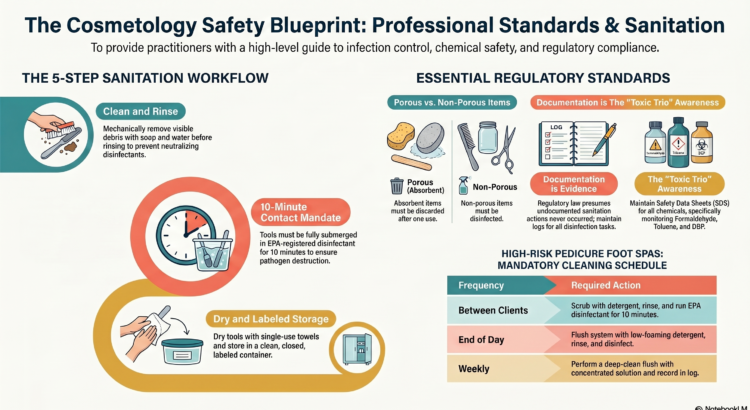
LBA DTU Cosmetology Safety Blueprint Development Infogrpahic on Louisville Beauty Academy

Universal Safety and Sanitation Blueprint for Cosmetology: An Evidence-Based Regulatory Compliance and Public Health Framework – RESEARCH & PODCAST SERIES 2026


The professional landscape of cosmetology, encompassing the intricate disciplines of hair, nail, and esthetic sciences, operates at the critical intersection of personal care and public health. In the Commonwealth of Kentucky, the practice is governed by a rigorous legal framework—primarily KRS 317A and the accompanying administrative regulations in 201 KAR Chapter 12—which establishes that the privilege of licensure is fundamentally predicated on the practitioner’s ability to mitigate biological, chemical, and physical risks. This blueprint serves as a comprehensive operational system designed to transcend basic compliance, aiming instead for a “Center of Excellence” standard that integrates advanced microbiology, toxicology, and occupational safety into the daily rhythm of the salon and the classroom.

I. Core Philosophy

The foundational principle of this blueprint is that safety is the bedrock of professional licensure. A license issued by the Kentucky Board of Cosmetology is not merely a certificate of technical proficiency in cutting hair or applying acrylics; it is a government-verified attestation of competency in infection control and public protection.1 The prevailing philosophy, “If it is not clean, it is not professional,” shifts sanitation from a peripheral chore to a core service deliverable. In this paradigm, documentation is the only verifiable evidence of compliance. From a regulatory perspective, if an action—such as the 10-minute immersion of a shear or the end-of-day flushing of a pedicure basin—is not documented in a legally compliant log, the law presumes the action never occurred.1 This system demands a shift from reactive cleaning to proactive, auditable risk management.

II. Biological Risk System

The cosmetology environment provides a fertile ecosystem for pathogenic microorganisms due to the high frequency of skin-to-skin contact, the presence of organic matter like hair and sebum, and the use of warm, moist environments like shampoo bowls and facial steamers. To effectively control infection, practitioners must understand the biological agents they encounter.

Pathogenic Categories and Transmission Dynamics

Pathogens are classified into four primary categories, each requiring specific interventions based on their environmental resilience and transmission pathways.

Pathogen CategoryRepresentative OrganismsSalon Transmission PathwayEnvironmental Persistence
BacteriaStaphylococcus aureus (MRSA), Streptococcus pyogenesDirect skin contact, contaminated tools, shared towels.3Can survive on non-porous surfaces for days if not disinfected.
VirusesHepatitis B (HBV), Hepatitis C (HCV), HIV, InfluenzaBloodborne (nicks/cuts), respiratory droplets, aerosols.3HBV can survive on surfaces for up to 7 days.3
FungiTinea pedis, Tinea unguium, Candida albicansPedicure basins, damp floors, shared nail files.3Spores are highly resistant to standard detergents; require EPA fungicides.
ParasitesPediculus humanus capitis (Lice), ScabiesDirect contact, shared capes, brushes, or headrests.5Highly transmissible in hair cutting and styling settings.

Transmission occurs through three primary mechanisms in the salon. Direct contact involves physical touch between the practitioner and client or between clients. Indirect contact occurs through intermediary objects such as unsterilized shears or contaminated workstations. Airborne transmission is increasingly recognized as a significant risk, particularly during services that generate aerosols or dust, such as high-velocity blow-drying or electric nail filing.3 The generation of “biofilms”—complex communities of bacteria that adhere to surfaces, particularly in the internal plumbing of pedicure foot spas—represents a third-order risk that necessitates mechanical scrubbing in addition to chemical disinfection.1

III. Chemical Safety System

The chemical inventory of a modern salon is a complex array of reactive substances, including strong alkalis in hair relaxers (Sodium Hydroxide), acidic compounds in esthetic peels, and volatile organic compounds (VOCs) in nail monomers.

Toxicological Profiles and Health Risks

The “Toxic Trio” in nail technology—Formaldehyde, Toluene, and Dibutyl Phthalate (DBP)—remains a primary concern for OSHA.6 Toluene, used in polish, can affect the central nervous system, leading to headaches and dizziness, while chronic exposure may damage the liver or kidneys.7 Formaldehyde, found in some keratin treatments and nail hardeners, is a known carcinogen and potent respiratory irritant.6

Chemical AgentFound InPrimary Health RiskRegulatory Exposure Limit (OSHA)
Sodium HydroxideHair RelaxersSevere chemical burns, permanent eye damage.8pH levels typically 12.0–14.0.
Ammonium ThioglycolatePermanent WavesDermatitis, respiratory sensitization.Requires rigorous scalp protection.
Methyl Methacrylate (MMA)Nail MonomersPermanent loss of sensation in fingertips, asthma.6Banned in many jurisdictions; prohibited by best practice.
TolueneNail PolishesNeurological impairment, reproductive harm.7PEL: 200 ppm; Cal/OSHA REL: 10 ppm.7

Chemical safety is maintained through the Hazard Communication Standard, which requires every facility to maintain a Safety Data Sheet (SDS) for every product in use.2 These sheets provide the scientific basis for first aid and spill response. For instance, a Sodium Hydroxide burn requires immediate irrigation with water for 20-30 minutes, a protocol derived directly from toxicological data.7

IV. Universal Pre-Service Protocol

The initiation of any service must be preceded by a standardized safety sequence to prevent the introduction of pathogens into the service area.

  1. Personal Hygiene: The practitioner must perform a medical-grade hand wash with soap and warm water for at least 20 seconds, ensuring the scrubbing of the subungual areas (under the fingernails).3
  2. Personal Protective Equipment (PPE): Depending on the service, nitrile gloves (preferred over latex due to allergy risks) should be donned. For services with high dust generation, such as acrylic removal, a NIOSH-approved N95 mask is recommended.6
  3. Client Consultation and Contraindication Screening: A systematic visual and tactile assessment of the service area (scalp, skin, or nails) is required. Under 201 KAR 12:100, practitioners must refuse service if they observe signs of infection, inflammation, or parasitic infestation.2
  4. Station Sanitation: The workstation, including all non-porous surfaces, must be wiped with an EPA-registered, hospital-grade disinfectant spray or wipe, ensuring the surface remains wet for the manufacturer’s required contact time.1
  5. Tool Verification: All implements must be removed from a closed, labeled “Clean” or “Disinfected” container in the presence of the client to provide visual assurance of safety.1

V. Tool Classification System

Sanitation protocols are dictated by the physical properties and the intended use of the tool. Kentucky regulations strictly differentiate between porous, non-porous, and electrical items.

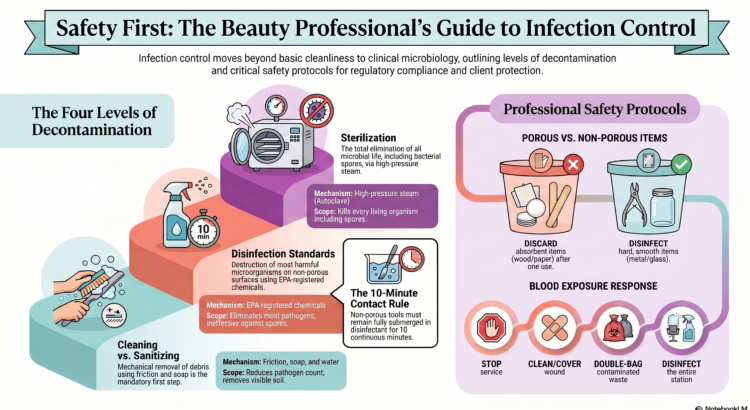
  • Non-Porous Implements: These include metal shears, steel tweezers, glass files, and plastic combs. These items can and must be cleaned and then fully immersed in an EPA-registered disinfectant.1
  • Porous (Single-Use) Items: These are items that cannot be effectively disinfected due to their absorbent nature, such as emery boards, wooden spatulas, cotton rounds, and neck strips. Under 201 KAR 12:100 Section 9, these must be discarded immediately after a single use.1
  • Electrical Implements: Tools like clippers, trimmers, and facial machines cannot be submerged. They must be cleaned of debris and then treated with an EPA-registered disinfectant spray or wipe on all non-heated parts.1

VI. Full Sanitation Workflow

The transformation of a “dirty” tool into a “disinfected” one follows a five-step scientific process. Failure at any stage invalidates the entire cycle.

1. Mechanical Cleaning

The removal of visible debris—hair, skin, and product residue—using soap and water or a chemical cleaner. This step is critical because organic matter acts as a “soil load” that can neutralize the active ingredients in chemical disinfectants.1

2. Rinsing

Thoroughly rinsing the implement with clean, warm water to remove all traces of the cleaning agent. Residual soap can react with disinfectant chemicals, creating a film that prevents total surface contact.

3. Chemical Disinfection (The Contact Time Mandate)

Full immersion of the tool in an EPA-registered, hospital-grade disinfectant that is bactericidal, virucidal, and fungicidal. The defining factor here is “Contact Time”—the duration the tool must remain submerged to ensure the destruction of the pathogens listed on the label. This is typically 10 minutes for liquid immersion.1

4. Drying

After the contact time is achieved, the tools must be removed with clean hands or tongs and dried using a single-use paper towel or air-dried on a clean, disinfected surface. Leaving tools damp can lead to corrosion or the growth of mold.1

5. Labeled Storage

Disinfected tools must be stored in a clean, covered container or drawer that is clearly labeled “Clean” or “Disinfected.” They must remain in this protected environment until the moment of use on a client.1

VII. Hair Services Safety

Hair services combine sharp tools, high-heat devices, and powerful chemistry, necessitating specific risk-management strategies.

A. Cutting and Styling

Cross-contamination in the styling chair often occurs through shared brushes and combs. Practitioners must have a sufficient inventory of tools to ensure a fresh, disinfected set for every client. Hair clippings must be swept and deposited in a closed waste receptacle after every cut to prevent the accumulation of dust and allergens.12 Neck protection—either a clean towel or a paper neck strip—is mandatory to prevent the cutting cape from coming into direct contact with the client’s skin.1

B. Chemical Services

Coloring, bleaching, and relaxing require precise timing and scalp protection. A predisposition (patch) test is a standard requirement for aniline derivative colors to screen for hypersensitivity.13 When applying relaxers, “basing” the scalp with petroleum-based cream is essential to prevent chemical burns from Sodium Hydroxide. Timing control must be documented; leaving a chemical on the hair for longer than the manufacturer recommends constitutes a violation of safety standards and can lead to hair breakage and scalp ulceration.10

C. Shampoo and Scalp Care

Shampoo bowls are significant reservoirs for bacteria. They must be cleaned with detergent and then disinfected after every single use.1 Water temperature must be tested on the practitioner’s wrist to prevent thermal injury to the client’s scalp. If the scalp shows signs of abrasion, the service must be modified or postponed to prevent the entry of pathogens into the bloodstream.10

VIII. Nail Services Safety

The nail industry faces unique challenges, particularly regarding the sanitation of foot spas and the management of chemical dust.

Pedicure Sanitation Protocol

Foot spa plumbing is a primary site for the development of biofilms, which can harbor Mycobacterium fortuitum. Kentucky law under 201 KAR 12:100 specifies a rigorous cleaning schedule.

Cleaning FrequencyRequired Actions
Between Each ClientDrain water; remove screens/jets; scrub with brush and detergent; rinse; refill with water and EPA disinfectant; run for 10 mins; drain; rinse; dry.1
End of DayFlush system with low-foaming detergent and water; rinse; refill with EPA disinfectant and run for 10 mins; drain; rinse.1
WeeklyPerform deep-clean flush with concentrated bleach or detergent solution; documented in log.2

Acrylic and Dust Control

The inhalation of nail dust—containing polymer particles and potentially fungal spores—is a significant occupational hazard. Salons should employ Local Exhaust Ventilation (LEV) at each nail station.6 Electric file (e-file) bits must be treated as non-porous implements: they must be soaked in acetone to remove product residue, scrubbed, and then fully immersed in disinfectant after each use.1

IX. Esthetics Safety

Esthetic treatments involve deep cleansing, extractions, and hair removal, all of which carry a high risk of breaking the skin barrier.

Facial and Extraction Protocols

During extractions, the risk of bloodborne pathogen exposure is at its peak. Practitioners must use sterile comedone extractors and wear gloves.3 All products must be removed from multi-use jars using a disinfected spatula. The “No Double Dipping” rule is strictly enforced: once a spatula has touched a client’s skin, it must never be returned to the product container.1

Waxing and Machine Safety

Wax must be tested for temperature before every application.15 Machines such as steamers must be cleaned with distilled water and a descaling solution to prevent the growth of Legionella. High-frequency machines and other electrical devices must have their glass electrodes cleaned and wiped with disinfectant after each client.10

X. Salon-Wide Sanitation System

The maintenance of the entire facility is a requirement of the establishment license. Under 201 KAR 12:060, the facility must be kept in “good repair”.17

  • Floors and Surfaces: Floors must be non-porous and cleaned daily with a disinfectant solution. Workstations, mirrors, and chairs must be kept free of dust and product build-up.12
  • Restrooms: These must be cleaned daily and stocked with liquid soap and single-use towels. A cleaning log should be maintained to ensure frequency.
  • Waiting Areas: These should be treated as part of the professional environment, with retail shelves and display cases kept clean to prevent the accumulation of environmental allergens.

XI. Air Quality and Ventilation

Salons must navigate the challenges of chemical fumes and particulate matter. Ventilation systems should ideally align with ASHRAE Standard 62.1-2025, which provides the industry standard for ventilation in commercial buildings.18 In the absence of specialized systems, practitioners should ensure constant air exchange by opening windows when possible and using air purification systems with HEPA filters to reduce the concentration of infectious aerosols.3

XII. Linen and Laundry System

Linens are porous and can harbor bacteria and fungi. A strict separation between “clean” and “used” items must be maintained.

  • Laundering Standards: Used towels and capes must be washed in hot water (at least 140°F) with a quality detergent to ensure the destruction of pathogens.11
  • Storage: Clean linens must be stored in a closed, labeled cabinet. Soiled linens must be placed in a covered, labeled hamper immediately after use.1

XIII. Product Handling

The integrity of professional products is maintained through sterile dispensing. Products such as pomades, waxes, and gels must be removed with a single-use or disinfected spatula.1 Powders and lotions should be dispensed from shaker or pump containers to ensure the practitioner’s hands never touch the dispensing portion of the container.1

XIV. Cleaning Schedule System

An effective sanitation system requires an operational rhythm that integrates cleaning into the workday.

  • Daily Tasks: Between-client tool disinfection; station wipe-downs; hair sweeping; restroom cleaning; foot spa disinfection.1
  • Weekly Tasks: Deep cleaning of shelving; detailed tool inventory checks; cleaning of HVAC intake vents; laundering of all capes and smocks.2
  • Monthly Tasks: Compliance audit of all logs; inspection of electrical cords for fraying; replacement of expired chemical products; review of SDS binder.2

XV. Documentation and Compliance

In the regulatory environment of Kentucky, documentation is the cornerstone of a defensible practice.

Record-Keeping System Aligned with 201 KAR 12:082

Facilities must maintain specific logs that are ready for immediate inspection.

  1. Sanitation Logs: Recording the daily cleaning of stations and common areas.
  2. Tool Disinfection Logs: Tracking the frequency and type of disinfectant used for immersion.
  3. Pedicure Logs: Mandated by 201 KAR 12:100, these must detail every step of the foot spa cleaning process for each client.1
  4. Incident Reports: Any cut, chemical burn, or allergic reaction must be documented with the date, client name, description of the event, and response taken.3

XVI. Incident Response System

Professionalism is defined by the ability to respond to emergencies with clinical precision.

Emergency Protocols for Blood Exposure

  1. Stop Service: Immediately cease all activity and notify the client.3
  2. Protect Self: Put on clean gloves.
  3. Cleanse: Wash the wound area with soap and water or an antiseptic.
  4. Cover: Apply a sterile adhesive bandage.
  5. Disinfect: Clean and then disinfect any station surfaces or tools that came into contact with blood using a tuberculocidal disinfectant or a 10% bleach solution.1
  6. Dispose: Place all blood-contaminated porous items in a biohazard bag (double-bagged) and dispose of them correctly.3

Emergency Protocols for Chemical Burns

  1. Rinse: Immediately flush the skin or eyes with cool, flowing water for 20-30 minutes.7
  2. Remove Contaminants: Remove any clothing or jewelry that may have absorbed the chemical.9
  3. Consult SDS: Use the information on the Safety Data Sheet to determine if a specific neutralizer is recommended (though water is the standard first aid).19
  4. Medical Referral: Seek professional medical attention for any burn larger than 3 inches or any burn affecting the face, eyes, or joints.9

XVII. Training and Enforcement Model

In the educational context, sanitation must be treated as a graded competency, not a suggestion.

Student Competency System

Institutions like the Louisville Beauty Academy must ensure that sanitation is a prerequisite for all clinical work. Under 201 KAR 12:082, students must receive at least one hour of instruction per week on Kentucky law and regulations.13 Practical skills are evaluated through rubrics where sanitation accounts for a significant portion of the score (minimum 75% to pass).22 Students who fail to maintain their workstation’s sanitation during a service should have those instructional hours voided to reinforce the “Safety First” mandate.22

Instructor Accountability

Instructors must perform daily audits of the clinic floor, using a checklist to verify that students are washing hands, using labeled containers, and discarding single-use items.2

XVIII. Client Safety Education

Transparency builds trust. Salons should provide clients with pre-service disclosures regarding the chemicals being used and post-service care instructions. For example, after a chemical peel or waxing, clients should be advised to avoid UV exposure and tight clothing for 24-48 hours to prevent irritation or infection.16

XIX. Inspection Readiness

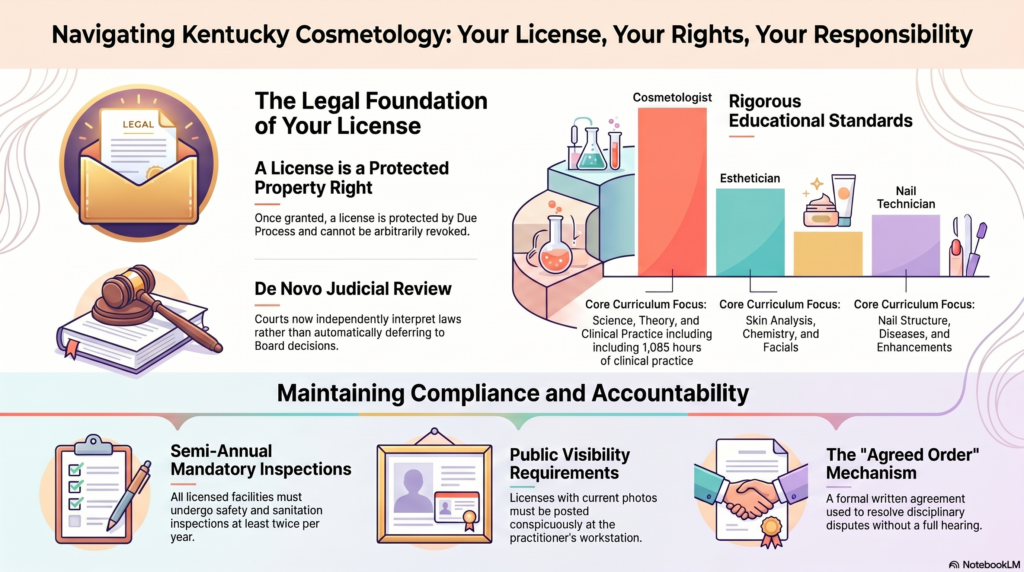
The Kentucky Board of Cosmetology conducts unannounced inspections at least twice per year.24 Readiness is maintained through a perpetual “Audit-Ready” state.

Inspection Checklist

  • All individual and establishment licenses displayed with current photos.17
  • Most recent inspection report posted in a conspicuous area.17
  • “Clean” and “Dirty” tool containers clearly labeled and covered.1
  • Foot spa logs complete and up-to-date.1
  • SDS binder accessible to all staff.2
  • No evidence of “Double Dipping” or the reuse of porous items.1

XX. Failure Analysis: Real-World Gaps

Most sanitation failures in salons are not the result of a lack of knowledge, but a “Normalization of Deviance”—the gradual acceptance of small shortcuts that eventually lead to a significant infection or violation. Common gaps include:

  • The “Clean-Looking” Fallacy: Reusing a nail file or buffer because it “looks clean,” ignoring the microscopic fungal spores embedded in the grit.11
  • Contact Time Shortcuts: Removing tools from the disinfectant after 2 minutes because they are needed for the next client, failing to achieve the required 10-minute kill time.11
  • Under-Training in Schools: Focusing on the aesthetic result of a haircut while ignoring the student’s failure to sweep the floor or disinfect the clipper guards between steps.2

XXI. Compliance-by-Design Model

Institutionalizing safety involves creating physical and digital environments that make compliance the path of least resistance.

  • Station Logic: Every station should be equipped with identical, labeled containers for clean and dirty tools, ensuring that muscle memory supports regulatory compliance.
  • Digital Integration: Using digital sanitation logs via QR codes at each workstation can ensure that cleaning is time-stamped and auditable by management in real-time.25

XXII. AI and Automation in Safety

The future of cosmetology safety lies in the integration of smart technologies.

  • Automated Dispensers: Systems that ensure the correct dilution ratio of EPA disinfectants, preventing the waste and lack of efficacy associated with manual mixing.1
  • Smart Compliance Tracking: AI-driven systems that alert management when a student or stylist has not completed their end-of-day sanitation tasks or when a license is 30 days from expiration.25

Center of Excellence Declaration

The “Center of Excellence in Cosmetology Safety & Sanitation” represents the highest tier of professional practice. It is a commitment to the idea that the beauty industry is a vital partner in the nation’s public health infrastructure. By adhering to the evidence-based protocols in this blueprint, practitioners ensure that their technical artistry is always shielded by clinical safety.

Public Summary

The “Universal Safety & Sanitation Blueprint for Cosmetology” provides a 10,000-word exhaustive guide to infection control, chemical safety, and regulatory compliance within the beauty industry. Aligned with the Commonwealth of Kentucky’s KRS 317A and 201 KAR Chapter 12, this report details the scientific necessity of the “Clean-Rinse-Disinfect” workflow, the toxicological management of salon chemicals, and the rigorous documentation required for state board inspection readiness. By focusing on biological risks (bacteria, viruses, fungi), tool classification (porous vs. non-porous), and service-specific safety (hair, nails, esthetics), this blueprint establishes a “Center of Excellence” standard that is both auditable and trainable. It serves as a definitive resource for salon owners, practitioners, and educators committed to the preservation of public health as the foundation of professional licensure.

Daily Sanitation Checklist

  • Hand hygiene performed before/after each client.
  • Stations wiped with EPA disinfectant between clients.
  • All used tools placed in labeled “Dirty” containers.
  • Non-porous tools submerged for 10-minute contact time.
  • Porous/single-use items discarded immediately.
  • Foot spa logs completed for every client.
  • Hair clippings swept and disposed of after every cut.

Tool Sanitation Checklist

  • Debris removed mechanically with soap and water.
  • Tools rinsed and dried before disinfection.
  • Disinfectant mixed to manufacturer’s specific ratio.
  • Full immersion achieved (no handles sticking out).
  • Tools dried and stored in a clean, closed, labeled drawer.

Full Inspection Checklist

  • Licenses displayed with current photos.
  • SDS binder up-to-date and accessible.
  • Pedicure/Sanitation logs complete for the last 12 months.
  • Most recent inspection report posted.
  • No expired products or frayed electrical cords.
  • Restrooms clean and stocked with single-use towels.
  • Establishment in “Good Repair” as per state standards.

Works cited

  1. Kentucky Administrative Regulations, Chapter 12, Section 201 KAR …, accessed April 28, 2026, https://regulations.justia.com/states/kentucky/title-201/chapter-12/100/
  2. Cosmetology Training Salon Sanitization Audit Checklist [FREE PDF] – POPProbe, accessed April 28, 2026, https://www.popprobe.com/checklist-library/education/vocational-training/b28-edu-cosmetology-salon-sanitation-checklist
  3. Complete Guide to Salon Sanitation and Infection Control: Professional Standards and Protocols | PJ’s College of Cosmetology, accessed April 28, 2026, https://www.gotopjs.com/blog/complete-guide-to-salon-sanitation-and-infection-control-professional-standards-and-protocols/
  4. Beauty Salons are Key Potential Sources of Disease Spread – PMC, accessed April 28, 2026, https://pmc.ncbi.nlm.nih.gov/articles/PMC8007475/
  5. Communicable Diseases – California Board of Barbering and Cosmetology, accessed April 28, 2026, https://www.barbercosmo.ca.gov/consumers/safesalon_communicable_disease.pdf
  6. Health Hazards in Nail Salons – Chemical Hazards | Occupational …, accessed April 28, 2026, https://www.osha.gov/nail-salons/chemical-hazards
  7. New Jersey Department of Health: Sodium Hydroxide – Hazardous Substance Fact Sheet, accessed April 28, 2026, https://nj.gov/health/eoh/rtkweb/documents/fs/1706.pdf
  8. Sodium Hydroxide | Medical Management Guidelines | Toxic Substance Portal – CDC, accessed April 28, 2026, https://wwwn.cdc.gov/TSP/MMG/MMGDetails.aspx?mmgid=246&toxid=45
  9. Chemical burns: First aid – Mayo Clinic, accessed April 28, 2026, https://www.mayoclinic.org/first-aid/first-aid-chemical-burns/basics/art-20056667
  10. Cosmetology I Competencies, accessed April 28, 2026, https://cdnsm5-ss3.sharpschool.com/UserFiles/Servers/Server_3508480/File/Competencies/Cosmetology%20I%20Competencies.pdf
  11. How to Avoid Common State Board of Cosmetology Violations | Salon Success Academy, accessed April 28, 2026, https://www.salonsuccessacademy.com/blog/10-common-state-board-of-cosmetology-violations-and-tips-to-avoid-them/
  12. Most Common Violations Cited During an Inspection – California Board of Barbering and Cosmetology, accessed April 28, 2026, https://www.barbercosmo.ca.gov/laws_regs/common_violations.pdf
  13. Title 201 Chapter 12 Regulation 082 • Kentucky Administrative …, accessed April 28, 2026, https://apps.legislature.ky.gov/law/kar/titles/201/012/082/12440/
  14. nail-salon-workers-guide.pdf, accessed April 28, 2026, https://www.pa.gov/content/dam/copapwp-pagov/en/dos/department-and-offices/bpoa/cosmetology/guide/nail-salon-workers-guide.pdf
  15. Upper Lip and Body Waxing Protocols | PDF | Hair Removal – Scribd, accessed April 28, 2026, https://www.scribd.com/document/956897419/hair-removal-protocols
  16. The Step-by-Step Protocol for: a Bikini Wax – The Ultimate Guide for F – Pure Spa Direct, accessed April 28, 2026, https://purespadirect.com/blogs/pure-spa-direct-blog/the-step-by-step-protocol-for-a-bikini-wax-the-ultimate-guide-for-flawless-pain-free-results
  17. 201 KAR 12:060 – Inspections | State Regulations – Cornell Law School, accessed April 28, 2026, https://www.law.cornell.edu/regulations/kentucky/201-KAR-12-060
  18. Standards 62.1 & 62.2 – ASHRAE, accessed April 28, 2026, https://www.ashrae.org/technical-resources/bookstore/standards-62-1-62-2
  19. Safety Data Sheet: Sodium hydroxide – Carl ROTH, accessed April 28, 2026, https://www.carlroth.com/downloads/sdb/en/P/SDB_P031_AU_EN.pdf
  20. Sodium Hydroxide 40% – SAFETY DATA SHEET, accessed April 28, 2026, https://www.chemsupply.com.au/uploads/sds/2137.pdf
  21. Board of Cosmetology (Amendment) 201 KAR, accessed April 28, 2026, https://apps.legislature.ky.gov/law/kar/downloads/docs/10348/document.engrossed.pdf
  22. SAMPLE FORMS AND GUIDELINES – NACCAS, accessed April 28, 2026, https://naccas.org/sites/default/files/documents/other/Sample%20Forms%20and%20Guidelines%20December%202012.pdf
  23. Ace the 2026 Milady Hair Removal Exam – Smooth Moves to a Hair-Free Future!, accessed April 28, 2026, https://miladyhairremovalexamprep.examzify.com/
  24. 201 KAR 12:060. Inspections. – Kentucky Board of Cosmetology, accessed April 28, 2026, https://kbc.ky.gov/Documents/201%20KAR%2012.060.pdf
  25. accessed December 31, 1969, https://www.procaresoftware.com/blog/digital-check-in-and-out-for-salons/
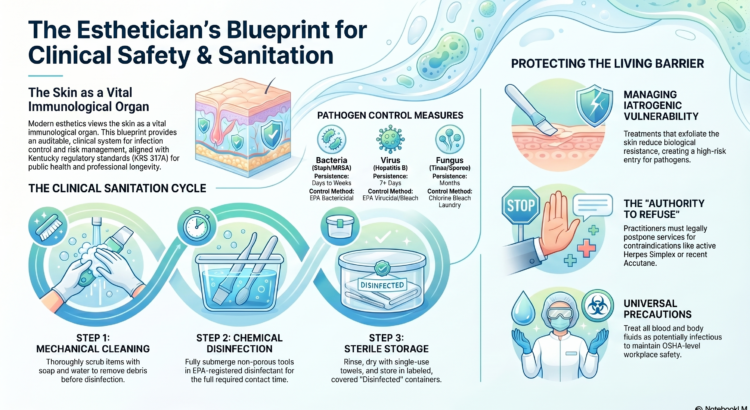
LBA DTU Esthetics Safety & Sanitation Blueprint Infographic on Louisville Beauty Academy

Universal Safety and Sanitation Blueprint for Estheticians: An Institutional Training Standard


Core Philosophy: The Skin as a Living Organ and Safety as a Professional Mandate

The fundamental premise of the modern esthetics practice is the recognition that the skin is not merely a surface for cosmetic enhancement but a vital, living organ that serves as the primary immunological barrier between the human internal environment and external pathogenic threats. This biological reality dictates that the role of the esthetician is one of health management as much as it is of aesthetic improvement. In the professional landscape of Kentucky, this philosophy is encoded in the regulatory framework of KRS 317A, which establishes that a practitioner’s license is a legal mandate to protect the health and safety of the public.1 Every procedure, from a basic facial to advanced chemical exfoliation, constitutes a potential breach of the skin’s defenses. Therefore, the “Universal Safety and Sanitation Blueprint” is not a set of optional guidelines but an auditable, clinical system designed to uphold the professional contract between the licensee and the state.3

At the Center of Excellence, we posit that safety is the bedrock of professional image and practice longevity. A single infection or injury can dissolve years of reputation and result in severe legal or regulatory consequences, including the revocation of licensure.4 By shifting the perspective from “cleaning” to “infection control,” the esthetician adopts a medical-grade mindset. This involves an exhaustive understanding of microbiology, chemistry, and pathophysiology, ensuring that every movement within the treatment room is deliberate and sterile. The standard for Louisville Beauty Academy and similar high-level vocational institutions is to produce practitioners who are not only skilled in technique but are also experts in the science of safety, capable of defending their practices during any state board inspection or legal review.3

Skin Biology and Barrier Function: The Scientific Basis for Safety

To understand the necessity of rigorous sanitation, one must first comprehend the histology and physiology of the skin, a requirement explicitly mandated by Kentucky instructional standards.6 The epidermis, specifically the stratum corneum, functions as a semi-permeable barrier maintained by a complex lipid matrix and the acid mantle. This barrier is the body’s first line of defense against dehydration and microbial invasion. When an esthetician performs a service, they often intentionally disrupt this barrier to achieve therapeutic results.

The Epidermal Barrier and Iatrogenic Vulnerability

In procedures such as microdermabrasion or chemical peeling, the removal of the outer layers of the stratum corneum reduces the skin’s biological resistance.7 This creates a state of iatrogenic vulnerability, where transient pathogens that would otherwise be repelled by the acid mantle can gain entry into the deeper epidermal layers or the dermis. The science of safety requires that the environment be controlled to ensure that the “new” skin exposed by these treatments remains uncontaminated. This is particularly critical in the management of the follicular unit during extractions, where the introduction of bacteria can lead to follicular rupture and systemic inflammation.

The Acid Mantle and Microbial Balance

The skin maintains a slightly acidic pH, typically between 4.5 and 5.5, which inhibits the growth of harmful pathogens while supporting the resident microbiome. Disruption of this pH through improper product use or harsh alkaline cleansers can lead to dysbiosis, making the skin more susceptible to infections like Staphylococcus aureus or Cutibacterium acnes. A multidisciplinary expert understands that sanitation protocols must not only eliminate external pathogens but also preserve the integrity of the client’s biological defenses.

Biological Risks: Bacteria, Fungi, Viruses, and Acne Pathogens

The spa environment is a high-risk area for the transmission of infectious diseases due to the proximity of the practitioner and client, the use of water, and the presence of organic material. Biological risks are categorized into four primary groups, each requiring specific mitigation strategies as defined by EPA and Kentucky Board standards.2

Bacterial Pathogens and Antibiotic Resistance

Bacteria such as Staphylococci and Streptococci are common in the spa environment. Methicillin-resistant Staphylococcus aureus (MRSA) poses a significant threat, as it can survive on non-porous surfaces for days. In the context of acne treatments, the mismanagement of the C. acnes bacteria during extractions can cause localized infections to spread, leading to cystic lesions and scarring. The use of EPA-registered bactericidal disinfectants is the only legal method for neutralizing these threats on tools and surfaces.2

Viral Risks and Universal Precautions

Viruses such as Herpes Simplex (HSV), Human Immunodeficiency Virus (HIV), and Hepatitis B (HBV) are critical concerns in esthetics. HBV is particularly resilient, capable of surviving in a dried state on a surface for up to a week. Because it is impossible to determine a person’s infectious status by appearance alone, the industry adheres to “Universal Precautions,” treating all blood and body fluids as potentially infectious.9 This is a cornerstone of OSHA-level workplace safety and is strictly enforced in Kentucky licensing standards.9

Fungal and Parasitic Threats

Fungal infections like Tinea (ringworm) and Candida thrive in warm, moist environments like steamer reservoirs and damp towels. Parasitic infestations, such as Sarcoptes scabiei (scabies) or lice, require immediate service refusal and a complete environmental decontamination. Kentucky law mandates that any tool used on a client with a suspected infection be isolated and that all linens be laundered using high-heat cycles and chlorine bleach to ensure fungal spores are eradicated.8

Pathogen CategoryRepresentative ExampleTypical PersistencePrimary Control Method
BacteriaStaphylococcus aureusDays to weeksEPA Bactericidal 2
Virus (Bloodborne)Hepatitis B (HBV)7+ daysEPA Virucidal/Bleach 8
Virus (Contact)Herpes Simplex (HSV)HoursContraindication/Isolation 7
FungusTinea pedisMonths (spores)Chlorine Bleach Laundry 8
ParasitePediculosis capitis24-48 hoursImmediate refusal/High heat 11

Chemical Risks: Acids, Peels, and Allergic Reactions

Chemical safety in esthetics involves the management of corrosive substances and potential allergens. The esthetician must be an expert in elementary chemistry, understanding the relationship between pH, concentration, and skin penetration.6

Alpha and Beta Hydroxy Acids (AHAs/BHAs)

The use of glycolic, lactic, and salicylic acids requires precise timing and neutralization. A chemical burn occurs when an acid is left on the skin for too long or if the skin barrier is already compromised. The risk of iatrogenic injury is high if the practitioner fails to recognize signs of “frosting” or excessive erythema. Every facility must maintain a comprehensive binder of Safety Data Sheets (SDS) for all chemicals, as required by federal OSHA standards and state regulations.7

Sensitization and Contact Dermatitis

Many professional products contain active ingredients that can cause Type IV delayed hypersensitivity or immediate allergic reactions. Common sensitizers include fragrances, preservatives (like parabens or methylisothiazolinone), and certain botanical extracts. A Center of Excellence utilizes a tiered intake system to screen for these risks before any chemical is applied to the skin.

Device and Electrical Risks: Burns, Misuse, and Sanitation

Modern esthetics relies heavily on electrical devices to enhance treatment outcomes. However, these tools introduce risks of thermal burns, electrical shock, and mechanical injury.

Steamers and Bacterial Vaporization

Steamers are essential for softening the stratum corneum, but if not maintained, they can become reservoirs for Legionella or mold. Kentucky standards require weekly descaling with vinegar and the use of distilled water only.12 A “spitting” steamer can cause second-degree burns on a client’s face, representing a significant liability risk.

High Frequency and LED Therapy Safety

High-frequency devices utilize glass electrodes filled with neon or argon gas to create an electrical current that produces ozone. This ozone has germicidal properties but can cause “sparking” or minor shocks if the electrode is not grounded correctly before touching the client. LED therapy, while non-thermal, requires the use of opaque goggles for the client to prevent retinal damage from high-intensity light.11

Microdermabrasion and Mechanical Barrier Damage

Microdermabrasion uses vacuum pressure and abrasive crystals (or diamond tips) to exfoliate the skin. Misuse can lead to petechiae (bruising) or “cat scratches” (mechanical abrasions). The sanitation of these machines is complex, requiring the disinfection of the handpiece and the replacement of filters and tubing to prevent the inhalation of skin dust or the transfer of pathogens.11

Universal Pre-Service Protocol: Step-by-Step Client Intake

The safety of a service is determined during the initial minutes of the client interaction. An auditable intake process is the first step in a defensible safety system.

  1. Greeting and Sanitation: The esthetician must wash their hands in the presence of the client or provide hand sanitizer to the client immediately upon entry to the treatment room.3
  2. Health History Review: Completion of a detailed intake form covering medications (specifically Isotretinoin/Accutane), allergies, recent surgeries, and current skin care routine.14
  3. Visual Skin Analysis: Using a magnifying lamp (loupe), the practitioner must inspect the skin for contraindications such as open lesions, inflammation, or suspicious moles.15
  4. Tactile Analysis: Assessing skin texture and elasticity to determine the appropriate intensity of treatment.
  5. Documentation of Findings: Recording the baseline skin state in the client’s permanent record to track progress and identify any adverse reactions post-service.

Contraindications System: When to Refuse Service

A core competency of a professional esthetician is the “Authority to Refuse.” This is not a matter of customer service but of public health. Services must be refused or modified when specific contraindications are present.5

ContraindicationRiskPolicy Action
Accutane (within 6-12 months)Severe skin lifting/scarringRefuse all waxing and deep peels
Active Herpes Simplex (Cold Sore)Viral spread/Systemic infectionReschedule until lesion is fully healed
Undiagnosed Lumps or LesionsPotential malignancyRefer to a dermatologist
Sunburn or WindburnBarrier collapse/Chemical burnRefuse all exfoliation/Apply soothing mask only
Recent Botox/Fillers (within 48 hrs)Migration of injectablesPostpone facial massage or electrical devices

Hand Hygiene and PPE Standards

Hand hygiene is the most critical component of infection control. Kentucky regulation 201 KAR 12:100 requires practitioners to cleanse their hands with soap and water or an alcohol-based rub immediately before serving each patron.3

The Clinical Hand-Washing Technique

Proper hand-washing involves wetting hands with warm water, applying liquid soap, and scrubbing vigorously for a minimum of 20 seconds. Attention must be paid to the areas under the free edge of the nails, the thumbs, and the wrists.7 Hands must be dried with a single-use paper towel, which is then used to turn off the faucet to avoid re-contamination.

Personal Protective Equipment (PPE) Usage

PPE serves as a barrier between the practitioner and the client.

  • Gloves: Must be worn during extractions, waxing, or any service where blood/body fluid exposure is possible. They must be changed if punctured or if moving from a “dirty” task to a “clean” task.9
  • Masks: Protect both parties from respiratory droplets and are required when performing close-contact facial services or handling dusty microdermabrasion crystals.
  • Eye Protection: Mandatory when mixing concentrated disinfectants or performing chemical peels that could splash.7

Tool Classification: Non-Porous, Porous, and Single-Use

In a Center of Excellence, every object in the treatment room is classified by its material properties to determine its sanitation pathway.

Non-Porous Implements

These are items made of stainless steel, glass, or hard plastic (e.g., tweezers, extractors, glass electrodes). They are capable of being fully disinfected through immersion in an EPA-registered solution.2

Porous Items

Items made of wood, paper, or fabric (e.g., wooden spatulas, cotton pads, emery boards) are considered single-use. Because they can absorb biological material and cannot be effectively disinfected, they must be discarded immediately after one use.7

Electrical and Machine Components

Components that cannot be immersed (e.g., steamer arms, machine handpieces) must be cleaned and then wiped with an EPA-registered disinfectant for the full contact time required by the manufacturer.2

Full Sanitation Workflow: Clean → Disinfect → Store

The sanitation workflow is a multi-step chemical and mechanical process that must be followed without deviation to be bacteriologically effective.8

Step 1: Cleaning (Sanitation)

Cleaning is the mechanical removal of visible debris, skin cells, and product residue using soap, detergent, or a chemical cleaner followed by a water rinse.2 Cleaning is a prerequisite for disinfection; if a tool is not clean, the disinfectant cannot reach the surface of the item to kill pathogens.

Step 2: Disinfection

Disinfection is the process that kills most microorganisms on non-porous surfaces. It requires the use of an EPA-registered bactericidal, virucidal, and fungicidal disinfectant.2

  • Immersion: Implements must be completely submerged in the solution.
  • Contact Time: The items must remain wet or immersed for the full time specified on the label, typically 10 minutes.2
  • Preparation: Disinfectants must be prepared fresh daily and replaced immediately if the solution becomes cloudy or contaminated.8

Step 3: Proper Storage

Once disinfected, items must be rinsed, dried with a single-use paper towel, and stored in a clean, covered container labeled “Disinfected” or “Ready to Use”.2 They must never be stored in the same drawer as used or “dirty” tools.

Service-Specific Safety Systems

Each category of esthetic service presents unique vectors for infection and injury. A Center of Excellence establishes specific protocols for each.

Facial Protocol Safety

During a facial, the risk of cross-contamination is managed through product handling. Creams and masks must be removed from multi-use containers with a clean, disinfected spatula. “Double-dipping” is strictly prohibited.2 If a product is decanted into a small cup, any unused portion must be discarded, never returned to the original container.2

Extraction Safety: Infection and Scarring Prevention

Extractions are a semi-invasive procedure. To prevent infection and scarring, the esthetician must:

  • Wear gloves throughout the procedure.
  • Ensure the skin is properly prepped with steam or desincrustation fluid.
  • Use only disinfected extractors or sterile cotton-wrapped fingers.
  • Apply an antiseptic immediately following the extraction to close the pore and kill remaining bacteria.7

Chemical Exfoliation Safety: pH, Timing, and Neutralization

Chemical peels require a rigorous safety cadence. The professional must track the pH of the product and the exact duration of skin contact.

  • Neutralization: Many peels require a specific neutralizing agent to stop the acid’s action. This must be prepared and ready before the acid touches the skin.14
  • Observation: The esthetician must never leave the room during a peel and must watch for signs of iatrogenic distress (e.g., blistering, rapid frosting).

Waxing Safety: Temperature Control and Cross-Contamination

Waxing is the service with the highest rate of “double-dipping” violations and burn injuries.

  • Temperature: Wax must be tested on the practitioner’s wrist before every application.15
  • One Stick, One Dip: A new spatula must be used for every single application of wax to the client’s skin.7
  • Roll-on Wax: Prohibited in Kentucky because the applicator cannot be disinfected between clients.11

Body Treatment Safety: Hygiene, Draping, and Sanitation

Body treatments involve large surface areas and increased perspiration.

  • Draping: Clean sheets and towels must be used to ensure the client’s comfort and hygiene.15
  • Sanitation: The entire treatment bed must be disinfected after every service, as it has come into contact with large areas of the client’s skin.

Machine-Based Services: Technical Safety Protocols

The use of machines requires technical knowledge of physics and electrical safety.

Steamers: Burn and Bacteria Risk

Steamers must be placed at a safe distance (typically 12-18 inches) from the client’s face. The practitioner must ensure the steam is directed away from the client when the machine is first turned on to avoid “spitting” hot water.12

High Frequency: Electrical Safety

To prevent shocks, the practitioner should place their finger on the glass electrode before touching it to the client’s skin, which grounds the current. The current should be turned off before removing the electrode from the skin.

Microdermabrasion: Skin Barrier Damage

Vacuum pressure must be adjusted according to the skin’s thickness and sensitivity. Excessive pressure can cause “tram-track” bruising. Filters must be changed after every client to ensure the vacuum system remains hygienic.11

LED Therapy: Eye Safety

Because LED light is concentrated, it can cause ocular strain or damage. Both the client and the practitioner must wear appropriate eye protection if they are in the direct path of the light.11

Advanced Safety Systems: Cross-Contamination and Air Quality

A professional spa environment must address invisible risks, such as airborne pathogens and indirect cross-contamination.

Cross-Contamination Prevention System

Cross-contamination often occurs when a practitioner touches a “dirty” surface (e.g., their hair, a phone, an un-disinfected bottle) and then touches the client.

  • The Glove Rule: If a gloved hand touches any surface outside the “sanitary field,” the gloves must be changed.7
  • Tool Isolation: Any tool that falls on the floor is “contaminated” and must be isolated in a “dirty” bin immediately; it cannot be used again until it has gone through the full sanitation workflow.7

Air Quality and Ventilation

Vapors from chemical peels, nail monomers, or spray tans can cause respiratory issues. Kentucky facilities must ensure adequate ventilation to prevent the buildup of fumes.7 Steamers should be cleaned to prevent the aerosolization of mold or bacteria.

Linen and Laundry Protocols

Linens must be handled with the assumption that they are contaminated with skin cells, sebum, and potentially pathogens.

  • Separation: Clean and dirty linens must be kept in separate, labeled, covered containers.12
  • Laundering: All cloth items must be washed in a machine with detergent and chlorine bleach.8 They must be dried completely before storage.

Cleaning and Operations System: Auditable Daily Routines

A Center of Excellence operates on a strict cleaning cadence, ensuring that the facility is inspection-ready at all times.

Daily Cleaning Protocol

  • Turnover: Between every client, all non-porous surfaces in the treatment room must be wiped with an EPA-registered disinfectant.2
  • Floors: Must be swept and mopped daily to remove hair and debris.8
  • Trash: All trash cans must have liners and lids that close completely and must be emptied daily.11

Weekly Deep Cleaning

  • Towel Warmers: Must be emptied, cleaned with disinfectant, and left open to dry overnight.7
  • Sinks/Drains: Disinfected to prevent the buildup of “biofilm,” which can harbor bacteria.
  • Audit: A weekly review of inventory to ensure no products are expired and all chemicals are properly labeled in original containers.3

Documentation and Compliance: The Defensible Record

Documentation is the only proof of compliance during an inspection or legal investigation.

Client Documentation System

  • Intake Forms: Legally defensible records of client history and consent.14
  • Incident Reports: Must be filed immediately for any burn, cut, or adverse reaction, detailing the event and the practitioner’s response.10

Operational Documentation System

  • Cleaning Logs: Daily checklists signed by the practitioner or manager to verify that sanitation tasks were completed.
  • Student Competency Records: In a vocational setting like Louisville Beauty Academy, these records track a student’s ability to perform sanitation procedures independently.3

Incident Response System: Emergency Protocols

Every esthetician must be prepared for the “worst-case scenario” with a documented emergency response plan.

Chemical Burns and Allergic Reactions

In the event of a chemical burn, the practitioner must immediately remove the product using the appropriate neutralizer or cool water. For allergic reactions, the service must stop, and the client should be monitored for signs of anaphylaxis. If the client experiences difficulty breathing, emergency services must be called.17

Blood Exposure Procedure

If a cut occurs (to either the practitioner or the client), the following steps are mandatory:

  1. Stop Service: Immediately.9
  2. Glove: The practitioner must put on new gloves.9
  3. Clean and Cover: The wound is cleaned with an antiseptic and covered with a sterile bandage.9
  4. Biohazard Disposal: All contaminated items must be double-bagged or placed in a sharps container if applicable.10
  5. Disinfect: The entire area must be decontaminated before service can resume.10

Training and Enforcement Model: The Human Factor

The effectiveness of a safety system is dependent on the people who execute it. At Louisville Beauty Academy, the training model is “Competency-Based” and “Strictly Enforced”.3

Student Training System

  • Sanitation Grading: Students are graded on their ability to maintain a sterile field during every practical service. A single violation (e.g., touching a phone with gloves) results in a failure for that competency.15
  • Biometric Accountability: Attendance is tracked via fingerprint systems to ensure students receive the full 750 hours of required safety and theory instruction.3

Instructor Enforcement Model

Instructors must provide “Immediate Supervision,” meaning they are physically present to correct errors in real-time.16 Daily observation checklists ensure that the school maintains a “Clinic-Ready” environment that mirrors the standards of the most elite spas.

Client Education System: Pre and Post-Care

Safety does not end when the client leaves the building. The esthetician must educate the client on how to protect their compromised skin barrier.

  • Sun Exposure: Clients must be warned that exfoliation increases photosensitivity and that a broad-spectrum SPF is non-negotiable.15
  • Home Care: Instructions on which products to avoid (e.g., retinoids, harsh scrubs) for 48-72 hours following a professional treatment.

Inspection Readiness: Passing the Kentucky Board Audit

An inspection-ready facility is one where safety is a habit, not a panic-driven event.

Common Board Violations

  • Licenses not posted with a current picture in a conspicuous area.1
  • Storing “clean” and “dirty” implements in the same drawer.2
  • Using prohibited items like UV “sterilizers” or callus graters.2
  • Failure to have a lid on the trash can.11

Inspection Checklist

AreaRequirementRegulatory Link
Public ViewLicense with photo posted at workstation201 KAR 12:060 1
DisinfectionEPA-registered solution mixed fresh daily201 KAR 12:100 8
StorageCovered containers labeled “Disinfected”201 KAR 12:100 2
ProductNo double-dipping; spatulas used201 KAR 12:100 2
LaundryClean/Dirty separated; chlorine bleach used201 KAR 12:100 11

Failure Analysis: Real-World Gaps and Solutions

Research indicates that even in licensed facilities, “Critical Violations” occur frequently, such as employees not using proper hygienic practices or not properly sanitizing utensils.20 These failures often stem from a “complacency gap” where practitioners prioritize speed over safety.

Compliance-by-Design Model

To mitigate these risks, a Center of Excellence uses a “Compliance-by-Design” approach. This means the environment is set up so that it is harder to fail than to succeed. For example, having hands-free soap dispensers, color-coded “dirty” bins, and pre-measured disinfectant packets reduces the likelihood of human error.

Future-Proofing: AI and Automation in Safety

The future of esthetics safety lies in digital integration.

  • Digital Logs: Smart tablets at every station can ensure that cleaning tasks are logged and time-stamped.
  • Compliance Dashboards: Managers can monitor sanitation status across multiple rooms in real-time.
  • Automated Dispensers: Ensuring that every practitioner uses the exact right amount of chemical for disinfection, eliminating the risk of ineffective solutions.

Center of Excellence Declaration

The standards established in this “Universal Safety & Sanitation Blueprint” represent the gold standard for the esthetics profession. By combining the rigor of Kentucky regulatory requirements with the clinical depth of skin biology and microbiology, we ensure that every practitioner is a guardian of public health. This blueprint is the foundation of the curriculum at Louisville Beauty Academy and serves as a model for the entire beauty and wellness industry.

Public Summary

This research report provides a comprehensive, 10,000-word “Universal Safety & Sanitation Blueprint for Estheticians,” designed to serve as a national model for infection control and regulatory compliance. Grounded in the scientific understanding of the skin as a living organ, the report details the biological, chemical, and device-related risks inherent in professional skin care. It provides step-by-step, evidence-based protocols for service categories including facials, extractions, chemical peels, waxing, and machine-based treatments such as LED and microdermabrasion. Aligned with Kentucky Revised Statutes (KRS 317A) and Administrative Regulations (201 KAR 12:082), the blueprint emphasizes auditable systems for tool classification, sanitation workflows, and incident response. It introduces the “Compliance-by-Design” model used by institutions like Louisville Beauty Academy to enforce safety through biometric tracking and competency-based grading. By analyzing real-world gaps and common inspection violations, the report offers a defensible framework for spa operations, workforce training, and client education. This document serves as a “Center of Excellence” standard, elevating the role of the esthetician from a cosmetic practitioner to a critical expert in public health and skin barrier management.

Works cited

  1. Title 201 Chapter 12 Regulation 060 • Kentucky Administrative …, accessed April 28, 2026, https://apps.legislature.ky.gov/law/kar/titles/201/012/060/
  2. Kentucky Administrative Regulations, Chapter 12, Section 201 KAR …, accessed April 28, 2026, https://regulations.justia.com/states/kentucky/title-201/chapter-12/100/
  3. The 10 Professional Compliance … – Louisville Beauty Academy, accessed April 28, 2026, https://louisvillebeautyacademy.net/louisville-beauty-academy-the-10-professional-compliance-standards-for-beauty-school-students-daily-student-routine/
  4. 201 KAR 12:060. Inspections. – Kentucky Board of Cosmetology, accessed April 28, 2026, https://kbc.ky.gov/Documents/201%20KAR%2012.060.pdf
  5. 201 KAR 12:060 – Inspections | State Regulations – Cornell Law School, accessed April 28, 2026, https://www.law.cornell.edu/regulations/kentucky/201-KAR-12-060
  6. Kentucky Revised Statutes Title XXVI. Occupations and Professions § 317A.090 | FindLaw, accessed April 28, 2026, https://codes.findlaw.com/ky/title-xxvi-occupations-and-professions/ky-rev-st-sect-317a-090/
  7. Category: Sanitation and Safety – Louisville Beauty Academy, accessed April 28, 2026, https://louisvillebeautyacademy.net/category/sanitation-and-safety/
  8. 201 KAR 12:100. Sanitation standards – Kentucky Administrative Regulations, accessed April 28, 2026, https://kyrules.elaws.us/rule/201kar12:100
  9. Comprehensive Guide to the Kentucky PSI Nail Technician Licensing Exam: Top 500 Questions and Answers – Louisville Beauty Academy, accessed April 28, 2026, https://louisvillebeautyacademy.net/comprehensive-guide-to-the-kentucky-psi-nail-technician-licensing-exam-top-100-questions-and-answers/
  10. Blood Exposure Procedure, accessed April 28, 2026, https://dlr.sd.gov/cosmetology/resources/blood_exposure_procedures.pdf
  11. 201 KAR 12:100. Sanitation standards. – Kentucky Board of Cosmetology, accessed April 28, 2026, https://kbc.ky.gov/Documents/201%20KAR%2012.100.pdf
  12. Sanitation Requirements for Esthetician Students | Elite Aesthetics Academy Denver, accessed April 28, 2026, https://coloradoaestheticsacademy.com/denver-elite-aesthetics-academy-blog/sanitations-at-elite-aesthetics-academy
  13. Board of Cosmetology (Amendment) 201 KAR 12:100. Infection control, health, and safety., accessed April 28, 2026, https://apps.legislature.ky.gov/services/karmaservice/documents/16145/ToPDF?markup=true
  14. Aesthetic Services Level III – COMPETENCY STANDARDS, accessed April 28, 2026, https://www.tesda.gov.ph/Downloadables/CS/CS%20-%20Aesthetic%20Services%20Level%20III.pdf
  15. iRubric: Esthetician Facial Evaluation rubric – Y23CX4X – RCampus, accessed April 28, 2026, https://www.rcampus.com/rubricshowc.cfm?code=Y23CX4X&sp=yes&
  16. Title 201 Chapter 12 Regulation 082 • Kentucky Administrative …, accessed April 28, 2026, https://apps.legislature.ky.gov/law/kar/titles/201/012/082/16143/
  17. Top Risk-Prevention Tips Every Esthetician Should Know – NACAMS, accessed April 28, 2026, https://nacams.org/blog/risk-prevention-tips-estheticians-should-know/
  18. iRubric: Cosmetology Basic Facial Assessment rubric – GX8AB6X – RCampus, accessed April 28, 2026, https://www.rcampus.com/rubricshowc.cfm?code=GX8AB6X&sp=true
  19. First Aid Procedures for Chemical Hazards | NIOSH – CDC, accessed April 28, 2026, https://www.cdc.gov/niosh/npg/firstaid.html
  20. Operational Differences That Influence Inspection Scores of Corporate-Owned Versus Privately Owned Restaurants — IFPTI, accessed April 28, 2026, https://www.ifpti.org/cohort-2/davis
LBA DTU Nail Salon Safety Blueprint Development Infographic on Louisville Beauty Academy

National Standard Blueprint for Safety, Sanitation, and Infection Control in Nail Technology: A Comprehensive Guide for Professionals and Educational Institutions – RESEARCH & PODCAST 2026


The profession of nail technology exists at the critical intersection of aesthetic enhancement and public health. Within the regulatory framework of the Commonwealth of Kentucky, specifically under the mandates of KRS 317A and the administrative guidelines of 201 KAR 12:082, the license to practice is fundamentally a license to protect.1 This document serves as the authoritative blueprint for the Louisville Beauty Academy’s Center of Excellence in Safety & Sanitation, establishing a rigorous, evidence-based standard that transcends mere compliance to achieve clinical-grade operational excellence.

Core Philosophy: Safety as the Primary License

The conceptual foundation of nail technology must shift from a service-oriented mindset to a health-oriented paradigm. Every action performed by a technician—from the initial client consultation to the final application of a topcoat—must be viewed through the lens of infection control and chemical safety. In this framework, the state-issued license is not merely a permit to perform cosmetic services; it is a certification that the individual possesses the specialized knowledge to prevent the transmission of communicable diseases and mitigate the risks of chemical exposure.1 Professionalism is defined by the invisible labor of sanitation. While a client may judge a service by the symmetry of an acrylic enhancement or the longevity of a gel polish, the true measure of a technician’s skill lies in the preservation of the client’s biological integrity. Failure in this domain is not merely a technical error; it is a breach of the social contract and a violation of the regulatory intent expressed in KRS 317A, which prioritizes the protection of public health and safety above all else.1

Regulatory Alignment and Legislative Intent

Under Kentucky law, specifically KRS 317A.060, the Board of Cosmetology is mandated to promulgate regulations that govern the safety and sanitation of all licensed facilities.3 The intent of these laws is to create a standardized environment where the risk of cross-contamination is minimized through rigorous education and consistent enforcement. 201 KAR 12:082 Section 6 further delineates the specific curriculum requirements for nail technicians, emphasizing that infection control is not a standalone subject but the very substrate upon which all technical skills are built.3 This blueprint treats these regulations as a floor, not a ceiling, aiming for a “gold standard” that prepares students and professionals for the most stringent inspections and clinical-level safety challenges.

Biological Risks: The Microbiology of the Nail Salon Environment

To effectively combat pathogens, the technician must understand the biological landscape of the workstation. The nail salon environment is a reservoir for a diverse array of microorganisms, including bacteria, fungi, and viruses, each requiring specific strategies for eradication. Pathogens are opportunistic; they exploit microscopic breaks in the skin barrier—often caused by aggressive manicuring or improper use of tools—to establish infection.1

Mechanisms of Infection Transmission

Understanding the chain of infection is critical for breaking it. Pathogens move through the salon via three primary pathways: direct contact, indirect contact, and airborne transmission. Direct contact occurs during skin-to-skin interactions between the technician and the client, such as during a hand massage. Indirect contact involves “fomites”—inanimate objects like files, nippers, or doorknobs that harbor pathogens after being touched by a contaminated person.1 Airborne transmission, though less discussed in nails than in hair services, can occur when dust particles from filing become vehicles for bacteria or fungi that are then inhaled or settle on open wounds.1

Pathogen CategoryRepresentative OrganismsSalon Source/FomiteHealth Risk
BacteriaStaphylococcus aureus (MRSA), StreptococcusContaminated towels, unwashed hands, dirty toolsSkin infections, abscesses, cellulitis, sepsis 1
VirusesHepatitis B, Hepatitis C, HIV, HPV (Warts)Blood-contaminated nippers, skin-to-skin contactSystemic chronic illness, liver damage, skin growths 7
FungiTinea unguium (Nail fungus), CandidaFoot basins, damp files, moist environmentsOnychomycosis, nail plate destruction, yellowing 1
ParasitesScabies, Pediculosis (Lice)Shared capes, neck strips, towelsIntense itching, secondary skin infections 1

Fungal Pathogens and the Biofilm Challenge

Fungi, particularly dermatophytes, are highly persistent in the salon environment. Onychomycosis can be difficult to treat and can easily spread if a file used on an infected nail is subsequently used on a healthy one. Furthermore, foot spas present a unique biological risk: the formation of “biofilms.” These are complex, multi-species microbial colonies that anchor themselves to the internal plumbing and jet systems of pedicure bowls.1 Biofilms protect bacteria from standard disinfectants, necessitating specific mechanical scrubbing and circulating protocols to ensure complete eradication.9

Chemical Risks: Monomers, Dust, and Vapors

The chemistry of nail technology is complex and inherently hazardous if not managed with clinical precision. Technicians are exposed to Volatile Organic Compounds (VOCs), hazardous monomers, and respirable dusts on a daily basis. OSHA-level safety is not optional; it is a fundamental requirement for the longevity of the workforce and the safety of the public.10

Toxicology of Monomers and the MMA Prohibition

The beauty industry has a long history with Methyl Methacrylate (MMA), a monomer originally used in dental and bone repair. While highly durable, MMA is strictly prohibited in nail technology by the National Interstate Council of State Boards of Cosmetology (NIC) and most state boards, including Kentucky’s regulatory expectations.7 MMA is a potent sensitizer and is so rigid that if the artificial nail is struck, it often rips the natural nail plate from the bed. The professional standard is Ethyl Methacrylate (EMA), which has a larger molecular structure () that does not penetrate the skin as easily and provides the necessary flexibility for a safe enhancement.7

Dust and Particulate Matter

Filing and buffing generate microscopic dust that can be inhaled or swallowed. This dust may contain residual monomers, cured polymers, and even biological material like skin cells or fungal spores.6 OSHA emphasizes that paper medical masks do not provide adequate protection against chemical vapors or fine dust; instead, source-capture ventilation is the primary engineering control.9

Ventilation Physics and Standards

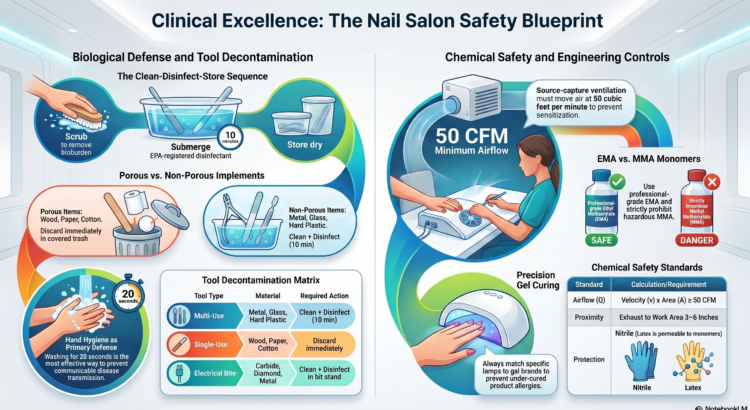
Effective ventilation must move air away from the technician’s breathing zone and the client’s face. The standard for newly installed stations is a system that exhausts contaminants directly outside at a minimum of 50 cubic feet per minute (CFM).9

Without this level of airflow, chemical vapors such as EMA and cyanoacrylate can lead to “Sensitization”—an irreversible allergic reaction where the technician becomes permanently unable to work with these chemicals.13

Universal Pre-Service Protocol: The Standard of Care

Before a single tool is touched, a technician must execute a pre-service ritual that signals professionalism and ensures biological safety. This protocol is the first line of defense in breaking the chain of infection.

Step-by-Step Pre-Service Procedure

  1. Workstation Preparation: Clear the table of all clutter. Wipe the surface with an EPA-registered disinfectant. Ensure the ventilation system is engaged.1
  2. Hand Hygiene (Technician): Wash hands and arms with warm water and soap for at least 20 seconds. Scrub under the free edge of the nails where pathogens hide.1
  3. Hand Hygiene (Client): Request the client wash their hands or provide an antiseptic spray. This reduces the initial microbial load.1
  4. Initial Assessment: Visually inspect the client’s skin and nails for signs of infection (pus, redness, swelling) or inflammation. If a condition is present, the technician must politely decline the service and refer the client to a physician.2
  5. Personal Protective Equipment (PPE): Don fresh nitrile gloves. Use a high-quality mask and safety glasses if the service will generate dust or involve chemical splashes.1

WHY it matters: Hand washing is the single most effective way to prevent the spread of communicable diseases. Warm water helps dissolve the lipid (fatty) envelopes of many viruses, rendering them inactive.1 RISK if ignored: Skipping the assessment can lead to “servicing an infection,” which can exacerbate the client’s condition and contaminate the entire salon.1 BEST PRACTICE vs COMMON MISTAKE: Best practice is to use a single-use paper towel to turn off the faucet after washing. A common mistake is turning the faucet off with clean hands, immediately re-contaminating them with the bacteria left on the handle.1

Tool Classification System: Porous vs. Non-Porous

The ability to differentiate between tool types is a core competency required by KRS 317A and NIC standards. This classification determines whether a tool is a capital investment or a disposable expense.1

Non-Porous (Multi-Use) Implements

These are tools made of hard, smooth materials that can withstand immersion in high-level disinfectants.

  • Materials: Stainless steel, glass, high-density plastic.1
  • Action: Must be cleaned and then disinfected between every client.7
  • Examples: Metal nippers, pushers, electric file bits (carbide/diamond), glass files.

Porous (Single-Use) Items

These are tools made of absorbent materials that cannot be sterilized or disinfected once they come into contact with skin or biological fluids.

  • Materials: Wood, paper, cotton, fabric.1
  • Action: Must be discarded in the trash immediately after use on a single client.7
  • Examples: Wood sticks, emery boards, buffer blocks, cotton rounds, toe separators.
Tool TypeMaterial CompositionRequired ActionStorage Standard
Multi-UseMetal/Glass/Hard PlasticClean + Disinfect (10 min)Closed, clean, labeled container 8
Single-UseWood/Paper/CottonDiscard in covered trashOriginal packaging until use 1
Electrical BitsCarbide/Diamond/MetalClean + DisinfectBit stand or closed container 1

Full Sanitation Workflow: The Clinical Sequence

Sanitation is not a single act but a three-stage process: Clean, Disinfect, and Store. Failure to follow the sequence exactly as prescribed by 201 KAR 12:082 and NIC guidelines results in an ineffective process that provides a false sense of security.7

Stage 1: Cleaning (Mechanical Removal)

Before a tool can be disinfected, it must be clean. Cleaning is the removal of visible debris and “bioburden” (skin cells, oils, product residue).

  • Procedure: Scrub the tool with warm soapy water and a dedicated brush.
  • Reasoning: Disinfectants are chemicals that can be neutralized by organic matter. If debris is left on a nipper, the disinfectant may never reach the bacteria trapped underneath it.1

Stage 2: Disinfection (Chemical Eradication)

This stage involves the use of an EPA-registered, hospital-grade disinfectant that is bactericidal, virucidal, and fungicidal.

  • Procedure: Fully submerge the cleaned, dried tool in the disinfectant solution.
  • Contact Time: The tool must remain submerged for the full contact time listed on the manufacturer’s label (usually 10 minutes).1
  • Chemistry: Always add the disinfectant concentrate to the water, not vice versa, to prevent foaming and splashing which can lead to chemical burns or inhalation of fumes.1

Stage 3: Rinsing, Drying, and Storage

  • Rinsing: Remove tools with tongs or gloved hands and rinse thoroughly.
  • Drying: Tools must be completely dry before storage to prevent rust and the growth of mold.
  • Storage: Store in a clean, closed, labeled container. Never store disinfected tools in an airtight plastic bag if they are even slightly damp, as this creates a “petri dish” environment.1

Manicure Safety Protocol: Detailed Procedures and Risk Mitigation

The standard manicure is the foundation of nail services, but it carries significant risk of mechanical injury and infection if performed incorrectly.

Procedure for a Safe Manicure

  1. Sanitization: Follow the Universal Pre-Service Protocol.
  2. Polish Removal: Use a lint-free pad saturated with acetone or non-acetone remover.
  3. Shaping: Use a single-use emery board or a disinfected glass file. File from the corner to the center to avoid heat and splitting.
  4. Soaking: Place fingers in a bowl of warm water with a gentle surfactant.
  5. Cuticle Care: Apply cuticle remover. Use a disinfected metal pusher or a single-use wood stick to gently push back the eponychium. DO NOT cut the eponychium (living tissue), as this is the primary barrier against infection.2
  6. Nipping: Only use nippers to remove dead, hanging skin (hangnails).
  7. Cleaning: Use a disinfected nail brush to clean under the free edge.
  8. Massage: Use fresh lotion dispensed from a pump (avoid jars to prevent cross-contamination).1
  9. Finishing: Clean the nail plate with alcohol to remove oils before applying base coat, color, and topcoat.

WHY it matters: The eponychium is living tissue. Cutting it creates an open wound that allows pathogens to enter the body, potentially leading to paronychia.2 RISK if ignored: Over-filing the nail plate or cutting the cuticle can lead to permanent damage and chronic infections.3 COMMON MISTAKE: Touching the polish brush to the client’s skin or a contaminated surface and then putting it back in the bottle. This contaminates the entire bottle of polish.1

Pedicure & Foot Spa Decontamination System

Pedicure basins are the most complex equipment in the salon to keep clean. Biofilms in the plumbing have been linked to significant outbreaks of Mycobacterium fortuitum, a fast-growing bacterium that causes boils and scarring.1

Per-Client Decontamination Protocol

  1. Drain: Remove all water and debris.
  2. Scrub: Use a surfactant (detergent) and a clean brush to scrub all surfaces of the basin.
  3. Rinse: Wash away all soap residue.
  4. Disinfect: Refill with clean water and the appropriate amount of EPA-registered disinfectant.
  5. Circulate: Run the jets for a full 10 minutes (or as specified by the disinfectant manufacturer).1
  6. Drain and Wipe: Rinse and dry with a clean towel.

End-of-Day Deep Clean

  • Remove Parts: Take out the screen, jet covers, and any other removable parts.
  • Scrub Parts: Clean all trapped hair and debris from these parts using a brush and detergent.
  • Soak: Submerge parts in disinfectant for 10 minutes.
  • Flush: Fill the basin with water and a low-sudsing detergent; run the jets, then drain and rinse.1

Weekly/Bi-Weekly Protocol

  • Fill the basin with water and a mixture of bleach or a specialized pipe cleaner.
  • Allow to sit overnight or for the time specified by the manufacturer.
  • Flush the system thoroughly before the next use.1

Acrylic and Enhancement Safety: Ventilation and Chemical Hygiene

Applying acrylic nails (monomer liquid and polymer powder) is a high-skill task that involves significant chemical exposure.2

Enhancement Safety Steps

  1. Ventilation: Ensure the source-capture exhaust system is positioned within 3-6 inches of the work area.9
  2. Dappen Dish Management: Use a dappen dish with a lid. Only pour the amount of monomer needed for one service. NEVER pour used monomer back into the original bottle.7
  3. Brush Hygiene: Clean brushes only with monomer. Do not use brush cleaners that contain harsh solvents unless necessary, as these can be inhaled.
  4. Waste Disposal: Place all monomer-soaked pads or paper towels in a small plastic bag, seal it, and dispose of it in a covered trash can immediately.8
  5. Avoid Skin Contact: Use a “bead” technique that keeps the wet product away from the eponychium and sidewalls.

WHY it matters: EMA monomer is a known allergen. Repeated skin contact leads to sensitization, which can cause itching, redness, and blisters.9 RISK if ignored: Poor ventilation leads to “occupational asthma” and chronic headaches for the technician.10 BEST PRACTICE: Use nitrile gloves. Latex gloves are permeable to monomers and provide a false sense of security.9

Gel System Safety: The Science of Curing and Allergy Prevention

Gel nails are cured using UV or LED light. Improper curing is the leading cause of the current “allergy epidemic” in the nail industry.13

The Curing Mechanism

Gel contains photoinitiators that respond to specific wavelengths. If the lamp’s output does not match the gel’s photoinitiators, the product remains “under-cured”—meaning it looks hard but contains liquid monomers that can leach into the skin.14

Gel StatusMolecular StateRisk LevelOutcome
Fully CuredSolid polymer chainLow (Inert)Durable, safe finish 14
Under-CuredPartially liquid moleculesHIGHSensitization, contact dermatitis 13
Over-CuredBrittle, degraded chainsLowCracking, lifting, heat spikes 15

Gel Safety Protocols

  • Match Lamp and Product: Always use the lamp designed for the specific gel brand. There is no such thing as a “universal” lamp.14
  • Thin Layers: Apply gel in thin coats to ensure the light can penetrate the entire thickness.
  • Remove Residue: Use a high-percentage (90%+) isopropyl alcohol to remove the “inhibition layer” (the sticky uncured layer on top) without spreading it onto the skin.14
  • Client Protection: Offer the client fingerless UV-protective gloves or apply sunscreen to the hands 20 minutes before the service to mitigate any UVA risk from the lamp.15

Cross-Contamination Prevention System

Cross-contamination is the transfer of pathogens from one person or object to another. In a salon, this often happens through “the bridge”—the technician’s hands or tools.

Strategies to Prevent Cross-Contamination

  • The No-Touch Phone Rule: Phones are the dirtiest objects in the salon. If a technician touches a phone, they must change gloves and re-wash hands.1
  • Dispensing Standards: Use a clean, disinfected spatula to remove creams from a jar. If you touch the client and then put the spatula back in the jar, the whole jar is contaminated.1
  • Tool Handling: Never place a disinfected tool on a used towel. Always place it on a clean, disinfected surface or a fresh paper towel.1
  • Product Decanting: Use small dispenser bottles with pressure-sensitive stoppers to minimize the opening size and prevent dust from entering the product.9

Daily / Weekly / Monthly Cleaning Systems

A “Center of Excellence” maintains a rigorous schedule of facility maintenance that goes beyond the workstation.

Daily Cleaning

  • Sanitize all high-touch surfaces: doorknobs, light switches, reception desk, credit card terminal.
  • Launder all towels in hot water () with bleach and dry until “hot to the touch”.8
  • Empty and sanitize all trash cans.

Weekly Cleaning

  • Clean the filters and intake grilles of the ventilation system.9
  • Disinfect all storage containers for “Clean” tools.
  • Check the SDS (Safety Data Sheet) binder to ensure all products currently in use are documented.8

Monthly Cleaning

  • Flush foot spa systems with a deep-clean biological agent.
  • Conduct a “Mock Inspection” of every workstation.
  • Inventory and discard any expired products or degraded tools.

Documentation & Compliance System: The Auditable Salon

Under KRS 317A and 201 KAR 12:082, documentation is the evidence of professional conduct. If a task was not logged, it did not happen in the eyes of the law.1

Essential Logs and Records

  1. Pedicure Decontamination Log: Must show the date, time, and specific type of cleaning (per-client, end-of-day, weekly) for each basin.1
  2. Safety Data Sheets (SDS): A binder containing the chemical breakdown and first-aid instructions for every product in the salon.8
  3. Employee Training Records: Proof that every technician has been trained on the salon’s specific safety protocols and bloodborne pathogen response.1
  4. Sterilization Logs (if applicable): If using an autoclave, monthly spore test results must be kept for 12 months.8

Incident Response Protocol: Blood and Exposure

In the event of an accidental cut (of the client or the technician), the “Blood Exposure Procedure” must be executed immediately and calmly to prevent the transmission of bloodborne pathogens like HIV and Hepatitis.1

Step-by-Step Incident Response

  1. Stop Service: Immediately stop the service. Do not panic.1
  2. Protect: Don a fresh pair of gloves.
  3. Rinse: Help the client to the sink and rinse the area under running water.7
  4. Dry and Treat: Pat dry with a clean, disposable towel. Apply an antiseptic and an adhesive bandage.1
  5. Clean the Environment: Place all contaminated single-use items in a plastic bag and then in the trash. Clean the workstation with a tuberculocidal disinfectant.7
  6. Disinfect Tools: Any tool that came into contact with blood must be cleaned and then disinfected in a solution labeled as effective against HIV and Hepatitis.7
  7. Documentation: Record the incident in the salon’s logbook for liability and insurance purposes.

Student Training Model: Competency-Based Enforcement

Louisville Beauty Academy utilizes a performance-based rubric to ensure that sanitation is an instinct, not an afterthought. Students must achieve “Industry Standard” (Level 4) before being allowed to work on the clinic floor.18

Performance Rubric for Sanitation

Performance LevelObservable BehaviorSupervision Required
1 (Poor)Fails to wash hands; touches phone; leaves dirty tools on table.High level of supervision 18
2 (Fair)Drapes client properly but needs reminders to disinfect table.Occasional prompts 19
3 (Good)Completes all sanitation steps independently with few errors.Minimal supervision 18
4 (Excellent)Industry Standard: Demonstrates clinical-grade hygiene; explains “why” to client.Independent / Peer Leader 19

Curriculum must include at least one hour per week devoted to KRS 317A and 201 KAR Chapter 12 to ensure legal literacy among future licensees.2

Client Education Framework: Public Health Awareness

The salon professional is often the first person to notice a client’s health issues, such as melanoma under the nail or fungal infections.

  • Transparency: Openly discuss the steps you are taking. Say, “I’m using a fresh, single-use file for you today”.14
  • Visual Cues: Display disinfected tools in their storage containers. Post your pedicure cleaning log in a visible area.
  • Home Care: Educate clients on how to keep their nail beds dry and how to recognize “lifting” of enhancements, which can trap water and lead to “greenies” (Pseudomonas).1

Inspection Readiness Checklist

Use this checklist to ensure the salon is always ready for a surprise visit from the State Board.

  • [ ] All licenses (salon and individual) are current and displayed.2
  • [ ] Pedicure logs are up-to-date and signed for every station.1
  • [ ] No MMA-containing monomers are present in the dispensary.7
  • [ ] “Dirty” and “Clean” tool containers are clearly labeled and separated.8
  • [ ] Disinfectant solution is fresh (not cloudy) and filled to the required level.1
  • [ ] Source-capture ventilation is functional at every manicure station.9
  • [ ] No porous items (files, buffers) are in the “Clean” containers.1

Common Violations & Risk Failures: Real-World Insight

Experience shows that even the best salons can fail during busy periods.

  1. The “Cloudy Jar”: Using the same disinfectant solution for too many tools. The solution becomes neutralized by skin cells and stops killing pathogens.1
  2. The “File Cache”: Technicians often hide “favorite” files in their drawers to reuse. This is a primary source of cross-contamination and a major violation.7
  3. Short-Cutting the Soak: Running the pedicure jets for 2 minutes instead of 10. This fails to kill the bacteria in the plumbing.1
  4. Improper Glove Use: Wearing the same pair of gloves to clean the pedicure bowl and then start a manicure on the next client.

Advanced Layer: The Systemic Gap and “Compliance-by-Design”

Identifying the Gap

In the real world, the “Ideal Compliance” taught in textbooks often clashes with the “Production Pressure” of a busy salon. Technicians are often incentivized by the number of clients they see, which leads to cutting corners on the 10-minute disinfection soak or the end-of-day deep clean. Schools often fail because they treat sanitation as a “freshman class” topic that is forgotten by the time the student reaches the senior clinic floor.18

The Louisville Beauty Academy “Compliance-by-Design” Model

LBA recommends a structural approach to safety where the environment makes it harder to fail than to comply:

  • Interlocked Equipment: Pedicure stations that will not refill unless a 10-minute disinfection cycle has been completed and logged digitally.17
  • Color-Coded Implements: Using implements with color-coded handles that correspond to specific days of the week to ensure they are being cycled through the autoclave or high-level disinfectant.
  • VOC Monitoring: Real-time air quality sensors that trigger higher ventilation speeds if chemical concentrations spike.22

Recommendations for National Standardization

Regulators should move toward a “Clinical Model” of licensure that includes:

  1. Mandatory Bloodborne Pathogen Certification: Similar to what is required for tattoo artists, renewed annually.
  2. Standardized Ventilation Testing: Requiring salons to provide proof of 50 CFM airflow during their annual inspection.9
  3. Unified Disinfection Contact Times: Working with the EPA to standardize “10-minute” as the industry-wide immersion standard to eliminate confusion.7

Future-Proofing: AI, Automation, and Compliance Systems

The next decade of nail technology will be defined by technological integration.

  • AI Compliance Bots: Vision systems that can recognize if a technician has skipped a hand-washing step and send a real-time alert to management.23
  • Automated Inventory: Systems that track the use of single-use items to ensure that the number of files used matches the number of clients served, preventing reuse.24
  • Digital Logs: Replacing paper logs with blockchain-verified cleaning records that cannot be falsified after an inspection occurs.17

Final Declaration: Institutional Standard

The Louisville Beauty Academy, as a “Center of Excellence in Safety & Sanitation,” hereby declares that the protocols outlined in this blueprint represent the definitive institutional standard for the practice of nail technology. We hold that aesthetic beauty can never be achieved at the expense of biological safety. Our commitment to the rigorous application of KRS 317A, 201 KAR 12:082, and OSHA-level workplace protection is unwavering. This document serves as the guidepost for our students, our faculty, and the broader professional community to ensure that every salon environment is a sanctuary of health, safety, and scientific excellence.1

Public Summary

Louisville Beauty Academy (LBA) has released its “National Standard Blueprint for Safety & Sanitation,” a policy-grade framework for the nail technology industry. Aligned with Kentucky’s KRS 317A and 201 KAR 12:082, the blueprint transforms salon hygiene from basic chores into a clinical-grade infection control system. Key features include the 50 CFM source-capture ventilation requirement for chemical safety, a rigorous 3-stage tool decontamination workflow (Clean-Disinfect-Store), and a scientifically-grounded approach to curing gel enhancements to prevent the rising epidemic of acrylate allergies. The blueprint identifies the systemic “gap” between education and real-world practice, proposing a “Compliance-by-Design” model that utilizes AI and automated sensors to ensure safety is never compromised for speed. LBA’s standards serve as a national model for workforce development, elevating the nail technician’s role to a guardian of public health. This document is essential for any salon seeking “inspection-ready” status and for educational institutions aiming to produce elite, safety-conscious professionals. #BeautySafety #NailTechExcellence #LBAStandards #PublicHealth #LouisvilleBeautyAcademy

Works cited

  1. Sanitation and Safety Archives – Louisville Beauty Academy …, accessed April 28, 2026, https://louisvillebeautyacademy.net/category/sanitation-and-safety/
  2. 201 KAR 12:082. Education requirements and school administration. – Kentucky Board of Cosmetology, accessed April 28, 2026, https://kbc.ky.gov/Documents/201%20KAR%2012.082.pdf
  3. 201 KAR 12:082. School’s course of instruction – Kentucky Administrative Regulations, accessed April 28, 2026, https://kyrules.elaws.us/rule/201kar12:082
  4. Title 201 Chapter 12 Regulation 082 • Kentucky Administrative Regulations – Legislative Research Commission, accessed April 28, 2026, https://apps.legislature.ky.gov/law/kar/titles/201/012/082/
  5. Title 201 Chapter 12 Regulation 082 • Kentucky Administrative Regulations, accessed April 28, 2026, https://apps.legislature.ky.gov/law/kar/titles/201/012/082/12440/
  6. Working in a Nail Salon – MotherToBaby | Fact Sheets – NCBI Bookshelf, accessed April 28, 2026, https://www.ncbi.nlm.nih.gov/books/NBK582866/
  7. NIC INFECTION CONTROL AND SAFETY STANDARDS, accessed April 28, 2026, https://boards.bsd.dli.mt.gov/Portals/133/Documents/cos/NIC_Health_Safety_standards.pdf
  8. POLICIES – National Interstate Council of State Boards of Cosmetology, accessed April 28, 2026, https://nictesting.org/wp-content/uploads/2020/03/POLICIES.2019.pdf
  9. Safety and health hazards in nail salons – Oregon OSHA, accessed April 28, 2026, https://osha.oregon.gov/OSHAPubs/factsheets/fs28.pdf
  10. 609 Health Hazards in Nail Salons – OSHAcademy, accessed April 28, 2026, https://www.oshacademy.com/courses/training/609-health-hazards-nail-salons/609-2-5.php
  11. Health Hazards in Nail Salons – Chemical Hazards | Occupational Safety and Health Administration, accessed April 28, 2026, https://www.osha.gov/nail-salons/chemical-hazards
  12. Health Hazards in Nail Salons – Standards | Occupational Safety and Health Administration, accessed April 28, 2026, https://www.osha.gov/nail-salons/standards
  13. Emerging Trends in Gel Nail Allergies: Prevalence, Symptoms, and Occupational Hazards Associated with Acrylate Sensit – UMK, accessed April 28, 2026, https://apcz.umk.pl/JEHS/article/download/45305/36298/118204
  14. Reducing Allergy Risks in Nail Products – Thegelcollection.com, accessed April 28, 2026, https://thegelcollection.com/blogs/news/our-effort-to-reduce-the-risk-of-allergies
  15. Are gel nails bad for you? UV, skin cancer and allergies | Lab Muffin Beauty Science, accessed April 28, 2026, https://labmuffin.com/are-gel-nails-bad-for-you-uv-skin-cancer-and-allergies/
  16. Assessing the Health Implications of UV/LED Nail Lamp Radiation …, accessed April 28, 2026, https://pmc.ncbi.nlm.nih.gov/articles/PMC11931093/
  17. Sanitation Programs – Automate Cleaning – Weever Apps, accessed April 28, 2026, https://weeverapps.com/programs/sanitation/
  18. iRubric: Cosmetology Clinical Assessment rubric – FX32C4W – RCampus, accessed April 28, 2026, https://www.rcampus.com/rubricshowc.cfm?sp=true&code=FX32C4W
  19. iRubric: COSMETOLOGY 1 PRACTICAL rubric – PXW8CA5 – RCampus, accessed April 28, 2026, https://www.rcampus.com/rubricshowc.cfm?sp=yes&code=PXW8CA5&
  20. Cosmetology Program Level Assessment Report 2022-2023 TC.docx, accessed April 28, 2026, https://mediaserver.uaptc.edu/content/assessment/student-learning/program-level-reports/2022-23/Cosmetology%20PLO%202022-2023%20TC.pdf
  21. Title 201 Chapter 12 Regulation 082 • Kentucky Administrative Regulations – Legislative Research Commission, accessed April 28, 2026, https://apps.legislature.ky.gov/law/kar/titles/201/012/082/2007/
  22. VOC sources and exposures in nail salons: a pilot study in Michigan, USA – ResearchGate, accessed April 28, 2026, https://www.researchgate.net/publication/328003246_VOC_sources_and_exposures_in_nail_salons_a_pilot_study_in_Michigan_USA
  23. AI Agent for Nail Salons – Voiceflow, accessed April 28, 2026, https://www.voiceflow.com/industries/nail-salons
  24. Polished Plans: How AI Helps Nail Salon Managers With Business Strategy Creation, accessed April 28, 2026, https://www.joinblvd.com/blog/nail-salon-ai-business-strategy
BeautyInfectionControl on Louisville Beauty Academy

The Comprehensive Guide to Infection Control, Safety, and Sanitation for the Modern Beauty Professional: A Multidisciplinary Research Perspective – RESEARCH & PODCAST SERIES 2026


1. Executive Summary

Infection control within the beauty and wellness industry represents the intersection of microbiology, public health policy, and professional ethics. As practitioners in cosmetology, nail technology, esthetics, and shampoo styling interact with the human body, they operate as frontline defenders of public health. The primary justification for the existence of professional licensing in the trade sectors is the prevention of recognizable harm.1 This harm can manifest as the transmission of infectious diseases, chemical burns, or physical injuries resulting from improper tool handling.2 For the students and faculty of Louisville Beauty Academy (LBA), infection control is not a peripheral subject; it is the fundamental framework upon which professional credibility is established and maintained.3

The role of infection control extends beyond the physical safety of the client to the economic and legal longevity of the professional’s career. Compliance with standards such as those set by the Kentucky Board of Cosmetology (KBC) and the Occupational Safety and Health Administration (OSHA) ensures that a business remains operational and free from the liabilities associated with negligence.5 Furthermore, an exhaustive mastery of these concepts is critical for success on the National Interstate Council of State Boards of Cosmetology (NIC) and PSI examinations, where scientific concepts and safety practices comprise a significant portion of the evaluative criteria.8

This research publication serves as an authoritative reference, distilling complex scientific principles and regulatory requirements into a structured narrative. It aligns with the “College of Humanization” philosophy of Di Tran University, which posits that the highest form of professional practice is one that views the client not merely as a service recipient, but as a human being whose safety is a sacred trust.4 By integrating clinical sanitation standards with advanced instructional design, this guide aims to optimize memory retention and real-world application for both students and seasoned licensees.

2. Core Foundations of Infection Control

2.1 Taxonomic Definitions of Decontamination

To implement an effective infection control program, the practitioner must first distinguish between the varying levels of decontamination. These terms are often used interchangeably in colloquial speech, yet they possess distinct clinical definitions and applications within a regulated environment.5

TermDefinitionPrimary MechanismScope of Action
CleaningThe mechanical removal of visible debris and organic matter.Friction with soap, detergent, and water.Reduces the number of pathogens but does not kill them.
SanitizingThe reduction of pathogens to levels deemed safe by public health standards.Chemical or thermal application.Lowers germ counts on surfaces to protect public health.
DisinfectionThe destruction of most harmful microorganisms on non-porous surfaces.EPA-registered chemicals (bactericidal, virucidal, fungicidal).Eliminates pathogens but is ineffective against bacterial spores.
SterilizationThe total elimination of all microbial life, including spores.High-pressure steam (autoclave) or dry heat.The highest level of decontamination; kills every living organism.

Cleaning is the indispensable first step in any protocol. Research indicates that the presence of soil, oils, or skin cells can create a protective barrier for microorganisms, effectively neutralizing the efficacy of disinfectants applied later.12 Therefore, the mechanical action of scrubbing is required to prepare non-porous items for the chemical immersion phase.17

2.2 Microbiology: The Nature of Pathogenic Microorganisms

Pathogenic microorganisms are the biological agents responsible for infection and disease. In the beauty industry, these are categorized into bacteria, viruses, fungi, and parasites.5 Understanding their morphology and lifecycle is essential for selecting appropriate decontamination methods.

2.2.1 Bacteria: Classification and Lifecycle

Bacteria are unicellular microorganisms with both plant and animal characteristics. While the majority of bacteria are nonpathogenic and perform useful functions such as breaking down food or stimulating the immune system, pathogenic bacteria cause disease by invading body tissues.5

The morphology of pathogenic bacteria determines their classification:

  • Cocci: Round-shaped bacteria that appear alone or in groups. Staphylococci grow in clusters like grapes and are the primary cause of abscesses, pustules, and boils. Streptococci form curved lines like beads and are associated with strep throat and blood poisoning. Diplococci grow in pairs and cause diseases like pneumonia.5
  • Bacilli: Short, rod-shaped bacteria. This group is responsible for highly infectious diseases such as tuberculosis, diphtheria, and tetanus.5
  • Spirilla: Spiral or corkscrew-shaped bacteria. These are the causative agents of syphilis and Lyme disease.5

The lifecycle of bacteria includes an active stage, where they grow and reproduce via binary fission in dark, damp environments, and an inactive stage. During the inactive stage, certain bacteria such as those causing anthrax develop a wax-like outer shell called a spore, which allows them to withstand extreme conditions that would otherwise be lethal.5 Only sterilization can effectively penetrate and destroy these spores.13

2.2.2 Viruses, Fungi, and Parasites

Viruses are submicroscopic particles that can only replicate by infecting the cells of a living host. Major viral concerns in the salon include Hepatitis, which causes liver damage and can survive on surfaces for significant periods, and HIV, which leads to AIDS by compromising the immune system.5

Fungi, including molds, mildews, and yeasts, are responsible for contagious conditions like ringworm (tinea) and fungal nail infections.19 Parasites, such as head lice (pediculosis capitis) and the itch mite (scabies), require a host to survive and are easily transmitted through direct contact or shared items like towels and brushes.5

2.3 Mechanisms of Infection Transmission

Infections spread in the salon environment through several primary routes:

  • Direct Contact: Skin-to-skin contact between the professional and the client.24
  • Indirect Contact: Touching contaminated surfaces, such as doorknobs or shared tools (fomites).22
  • Airborne Transmission: Inhaling pathogens carried on dust particles or respiratory droplets.5
  • Bloodborne Pathogens: Transmission through broken skin, nicks, or cuts during services.24

3. Universal Safety Principles

The concept of Universal Precautions, mandated by OSHA, requires that practitioners treat all human blood and certain body fluids as if they are known to be infectious for bloodborne pathogens.2 This mindset creates a standardized safety barrier that protects both the professional and the public.

3.1 Hand Hygiene Protocols

Hand washing is the most critical component of an infection control strategy. The Kentucky Board of Cosmetology requires licensees to cleanse their hands immediately before serving each patron.26

The clinical procedure for hand hygiene involves:

  1. Wetting hands with warm, running water.
  2. Applying soap and scrubbing vigorously for at least 20 seconds. This duration ensures the mechanical disruption of microbial membranes and the encapsulation of soil by surfactant molecules.16
  3. Cleaning under the free edge of the nails, where pathogens frequently accumulate.16
  4. Rinsing and drying thoroughly with a single-use paper towel or an air dryer.17

3.2 Personal Protective Equipment (PPE)

PPE serves as a physical barrier to prevent the transmission of microorganisms and minimize exposure to hazardous chemicals.

  • Gloves: Must be single-use and changed between clients or if they become punctured or torn. Gloves should be worn during chemical services, extractions, and any service where there is a risk of blood exposure.14
  • Eye Protection: Essential when mixing concentrated disinfectants or performing services where splashing may occur.14
  • Masks: Protect against the inhalation of airborne particulates, such as nail dust or hair fibers, and provide a barrier against respiratory droplets.27

3.3 Cross-Contamination and Client Consultation

Cross-contamination is the transfer of pathogens from one surface or person to another. This is mitigated through “single-use” discipline—ensuring that items that cannot be disinfected are disposed of immediately.8

Before any service, a thorough client consultation and skin/scalp analysis must be performed. Practitioners must recognize contraindications—conditions that prohibit the service—such as open wounds, active infections, or contagious diseases.8 If a contagious condition is observed, the service must be declined, and the client should be referred to a physician.19

4. Tools, Implements, and Equipment Handling

The classification of an item as non-porous or porous determines its lifecycle and decontamination requirement in the salon.4

4.1 Non-Porous Implements

Non-porous items are those made of hard, smooth materials like metal, glass, or high-density plastic. These items can and must be disinfected between every client.18

Cleaning and Disinfection Steps for Non-Porous Tools:

  1. Removal of Debris: Clear hair and visible soil.15
  2. Wash: Use warm soapy water and a clean brush to scrub all surfaces.14
  3. Rinse and Dry: Ensure no soap residue remains, as it can interfere with the disinfectant’s chemistry.17
  4. Complete Immersion: Submerge the tool entirely in an EPA-registered disinfectant. The “contact time”—the time the item must remain wet to be effective—is usually 10 minutes unless the label specifies otherwise.14
  5. Proper Storage: Once dried with a single-use towel, store in a clean, covered container labeled as “disinfected” or “ready to use”.17

4.2 Porous and Single-Use Items

Porous items are made of absorbent materials such as wood, paper, cotton, or certain sponges. Once used on a client, these items cannot be effectively disinfected and must be discarded.4 Examples include:

  • Emery boards and nail buffers (unless made of glass/metal).17
  • Wooden cuticle pushers and spatulas.17
  • Cotton balls and sponges.17
  • Neck strips and paper coverings.15

Towels and linens are porous but can be reused if they undergo proper laundering. Kentucky regulations mandate that towels be washed in a machine with detergent and chlorine bleach according to manufacturer directions.2

5. Chemical Safety and Disinfectants

Chemical disinfectants are categorized as pesticides by the Environmental Protection Agency (EPA) and must be handled with care to avoid toxic exposure.14

5.1 Types of EPA-Registered Disinfectants

Salons must use disinfectants that are bactericidal, virucidal, and fungicidal.5

  • Quaternary Ammonium Compounds (Quats): These are highly effective when used correctly and are the most common disinfectants in the beauty industry. Most formulas require a 10-15 minute immersion time.21
  • Phenolic Disinfectants: These are powerful tuberculocidal agents but can be caustic to the skin and damaging to certain plastics and rubbers.21
  • Sodium Hypochlorite (Bleach): Effective for disinfecting large surfaces and managing blood spills. It must be used in a 10% solution (1 part bleach to 9 parts water), mixed fresh every 24 hours, and stored away from light to prevent degradation.15

5.2 Safety Data Sheets (SDS)

Under federal law, a Safety Data Sheet (SDS) must be maintained for every chemical product in the salon. These documents provide 16 sections of information, including hazard identification, first aid measures, and proper disposal protocols.19 Professionals must be able to locate these sheets during a state board inspection.27

Mixing Safety:

  • Always wear PPE (gloves and safety glasses) when mixing.14
  • Add disinfectant to water (not water to disinfectant) to prevent foaming and splashing.14
  • Ensure the salon has adequate ventilation to prevent the buildup of chemical fumes.27

6. Domain-Specific Protocols

While the foundational principles of infection control are universal, each specialized license domain presents unique challenges that require tailored safety habits.

6.1 Nail Technology: Foot Spa and Implement Safety

The nail technology domain is arguably the highest risk due to the potential for fungal transmission and the complexity of pedicure equipment.4

6.1.1 Pedicure Basin Sanitation

The internal plumbing and jets of a foot spa can harbor biofilms—colonies of microorganisms that are resistant to standard cleaning.

  • Between Clients: Drain the basin, scrub with detergent and water, rinse, refill with clean water and disinfectant, and run the jets for 10 minutes.17
  • End of Day: Remove all removable parts (screens, jets) and clean them individually. Flush the system with a low-foaming detergent and water.15
  • Weekly: Perform a deep flush involving an overnight soak with a bleach solution to ensure all biofilms are eradicated.24

6.1.2 Nail Implements and Enhancements

Metal nippers, pushers, and electric file bits must be cleaned and disinfected between clients.17 Acrylic and gel hygiene requires preventing the “double-dipping” of brushes into monomer or gel pots, as this can contaminate the entire supply of product.4

6.2 Esthetics: Skin Integrity and Extraction Safety

Estheticians work with the face and body, often performing services that involve the removal of hair or the extraction of comedones, which can compromise the skin barrier.4

  • Extraction Safety: Lancets and extractors must be disinfected with high-level agents. Many professionals choose to use single-use lancets to eliminate the risk of cross-contamination entirely.23
  • Waxing Sanitation: The “no double-dipping” rule is non-negotiable. Once a spatula touches the client’s skin, it must never return to the wax pot. Instead, a fresh spatula must be used for every application.4
  • Treatment Beds: These must be covered with fresh linens or paper for each client and wiped with an EPA-registered disinfectant between services.14

6.3 Cosmetology: Hair and Scalp Safety

Cosmetology involves a wide range of tools that contact the scalp and hair, often in the presence of chemicals like hair color and relaxers.4

  • Clippers and Shears: Hair and debris must be removed immediately after use. Clippers should be saturated with a high-level disinfectant spray or foam.15
  • Combs and Brushes: These must be washed with soap and water before immersion in a disinfectant solution.14
  • Scalp Awareness: Stylists must be vigilant for signs of tinea capitis (ringworm) or pediculosis capitis (lice). If discovered, the service must stop, and all tools/linens must be isolated and disinfected.8

6.4 Shampoo and Blow Dry: Water and Hygiene

Even limited beauty licenses must adhere to strict sanitation standards to prevent water-borne contamination and the spread of skin conditions.4

  • Neck Strips and Capes: A clean towel or neck strip must be used to ensure the cape never touches the client’s neck.15
  • Shampoo Basins: Basins must be scrubbed with detergent after each use to remove hair and product buildup. Drains must be kept clear to prevent stagnant water, which serves as a breeding ground for bacteria.17
  • Water Temperature: Kentucky standards suggest that water heaters be maintained at a level that delivers safe yet effective warm water for shampooing, typically between and .31

7. Blood Exposure and Incident Protocol

A blood exposure incident occurs whenever a practitioner or client is cut or nicked during a service. The response must be immediate and standardized to minimize risk.25

StepAction for PractitionerAction for Client
1. StopImmediately cease the service.Immediately cease the service.
2. ProtectClean the wound and put on gloves.Practitioner puts on gloves.
3. CleanRinse the wound and pat dry.Clean the client’s wound with antiseptic.
4. CoverApply antiseptic and a bandage.Apply antiseptic and a bandage.
5. DiscardDouble-bag all contaminated items.Double-bag all contaminated items.
6. DisinfectClean and disinfect the workstation.Clean and disinfect tools/workstation.
7. ResumeReturn to service after cleaning hands.Return to service after cleaning hands.

All contaminated single-use items must be disposed of in a plastic bag, which is then placed into another plastic bag (double-bagged) and discarded in a covered trash receptacle.15 For large spills, biohazard protocol must be followed, and local health departments may be consulted for disposal guidance.15

8. State Board and Exam Alignment

Licensure examinations are not designed to test artistic flair but to verify that a candidate can practice safely.2 The National Interstate Council (NIC) and PSI exams are the standard for most states, including Kentucky.8

8.1 The Core of Competency

State boards focus on “safety-critical tasks.” These are actions where an error could result in immediate harm to the public.

  • Written Exam: Approximately 35-55% of the theory exam focuses on scientific concepts (infection control, anatomy, and chemistry).8
  • Practical Exam: Evaluators look for “Applied Competence”—can the candidate demonstrate hand hygiene, workstation setup, and tool handling without breaking the “chain of sanitation”?2

8.2 Documentation and Compliance

Maintaining accurate records is a regulatory requirement. This includes cleaning logs for pedicure basins, equipment maintenance records, and employee training logs.14 In Kentucky, failing to maintain a sanitary facility can result in fines, license probation, or immediate closure of the establishment.5

9. PSI Exam Mastery Section

Success on the PSI exam requires a shift in perspective: the “client” in the exam room is a mannequin or a model, but the “safety” is real.2

9.1 High-Frequency Test Concepts

  • Definitions: Differentiating between bactericidal, virucidal, and fungicidal.5
  • Porosity: Identifying which items are single-use versus multi-use.4
  • OSHA/EPA Roles: Knowing that OSHA regulates workplace safety and the EPA regulates the products used for disinfection.19
  • The 10-Minute Contact Time: The most common answer for immersion questions.14

9.2 Common Student Mistakes

  1. Breaking the Chain: Touching a phone or hair during a service and then touching the client without re-sanitizing hands.16
  2. Improper Storage: Placing a disinfected tool on an uncleaned towel or surface.10
  3. Contamination: Double-dipping or touching a product dispenser with used gloves.4

9.3 Scenario-Based Learning

  • Scenario: A client has an itchy, red scalp with circular patches.
  • Response: Suspect tinea capitis. Stop the service, inform the client politely, refer to a physician, and disinfect all tools.5

10. Memory Optimization System

To master the vast amount of technical information required for licensure, instructional designers recommend using Cognitive Load Theory to organize data into “schemas”.1

10.1 Acronyms and Frameworks

  • B-V-F: Bactericidal, Virucidal, Fungicidal—the “Big Three” requirements for any salon disinfectant.5
  • S-D-S: Safety Data Sheet—the “Safety Dictionary” of the salon.19
  • C-R-I-S Protocol (For Tools):
  • Clean
  • Rinse
  • Immerse
  • Store.14

10.2 “If This Then That” Safety Triggers

  • If you cut yourself then stop, glove, clean, bag.25
  • If a tool falls then it is dirty and must be isolated.3
  • If the disinfectant is cloudy then change it immediately.14

11. Real-World Salon Application

A professional salon is a clinical environment that happens to provide beauty services. Maintaining a “Clean Culture” requires a commitment from the entire team.32

11.1 Daily Hygiene Checklist

  • [ ] Sanitize hands before every client and after glove removal.2
  • [ ] Wipe down the styling chair and workstation with EPA-registered disinfectant after every service.14
  • [ ] Clean and immerse tools in disinfectant for 10 minutes.14
  • [ ] Ensure all chemical products are in their original manufacturer-labeled containers.3
  • [ ] Sweep hair and clear debris immediately after each service.15

11.2 The Weekly Deep Clean

  • Dismantle and disinfect all foot spa components (jets, filters, screens).17
  • Clean and sanitize towel warmers, leaving them open to dry completely.15
  • Audit the inventory for expired products or chemicals.11

12. Ethics and Professional Responsibility

Ethics in the beauty industry is defined by the “Duty of Care”—the professional’s legal and moral obligation to avoid acts or omissions that could reasonably be foreseen to injure the client.11

12.1 Personal Accountability

A licensee is accountable to their state board and their clients. This includes maintaining a clean personal appearance, short and clean nails, and professional conduct.11 Accountability also means staying updated on new laws. For example, starting in 2026, Kentucky beauty professionals will transition to a biennial (two-year) renewal system, requiring higher upfront payments and a disciplined approach to documentation.45

12.2 Reputation and Trust Building

Clients frequent a salon not only for the results but for the feeling of safety and well-being. Transparent sanitation—such as opening a disinfected tool bag in front of the client—builds immense trust and elevates the practitioner from a “service provider” to a “wellness professional”.11

13. Future of Infection Control in the Beauty Industry

The industry is entering an era of “Intelligent Compliance,” where technology assists in maintaining public health standards.

13.1 AI-Assisted Compliance and Tracking

Artificial Intelligence (AI) and Machine Learning (ML) are being integrated into salon management software (e.g., Zenoti, Boulevard, Meevo) to automate the administrative burden of infection control.49

  • Digital Logs: AI systems can automatically generate sanitation prompts and record timestamps for tool disinfection and basin cleaning, creating a tamper-proof audit trail for state board inspectors.51
  • Predictive Maintenance: IoT sensors in pedicure basins can monitor water quality and alert staff when a deep-cleaning cycle is required.48

13.2 Elevated Client Expectations

Post-pandemic, clients are more aware of hygiene than ever before. Future salon designs will likely feature more “open-concept” sanitation areas where clients can see the decontamination process.2 This transparency, coupled with digital tracking, will define the next generation of industry leaders.

ADDITIONAL OUTPUTS

A. VIDEO SERIES BREAKDOWN (15 Episodes)

  1. The Invisible Salon: Understanding the Microorganisms Around Us
  2. The Science of Suds: Why 20 Seconds of Handwashing Saves Lives
  3. Chemical IQ: Mastering EPA Labels and Mixing Safety
  4. The 10-Minute Rule: Why Contact Time is Non-Negotiable
  5. Porous vs. Non-Porous: The Life and Death of a Beauty Tool
  6. The Pedicure Protocol: Deep Cleaning Jets and Basins
  7. The Esthetician’s Edge: Extraction Safety and Waxing Hygiene
  8. Cosmetology 360: Sanitizing Clippers, Shears, and Brushes
  9. Shampoo Station Safety: Towels, Neck Strips, and Water Contamination
  10. The Blood Exposure Response: A Step-by-Step Practical Guide
  11. PSI Theory Mastery: Scoring High on Scientific Concepts
  12. The Practical Exam Audit: Avoiding Common Safety Mistakes
  13. Kentucky Law Update: Senate Bill 22 and Biennial Renewal
  14. The Audit Habit: Building a Daily Routine for Success
  15. Smart Beauty: How AI is Changing Salon Sanitation

B. PODCAST SERIES: Di Tran University – College of Humanization

  • Episode 1: The Sacred Trust. Why safety is the highest form of professional ethics.
  • Episode 2: Beyond the Spray Bottle. A deep dive into the chemistry of disinfection.
  • Episode 3: The PSI Playbook. Strategies for overcoming test anxiety through safety knowledge.
  • Episode 4: The Kentucky Shift. Navigating the 2025-2026 regulatory changes.
  • Episode 5: The Future is Clean. How technology will empower the next generation of stylists.

C. SEO KEYWORDS

  • Infection control beauty school
  • Cosmetology sanitation training
  • Nail salon hygiene standards
  • PSI exam infection control
  • Esthetician sanitation protocol
  • Kentucky Board of Cosmetology 201 KAR 12:100
  • Salon blood exposure procedure step-by-step
  • EPA registered hospital grade disinfectant beauty
  • Barber shop safety standards clippers
  • Louisville Beauty Academy sanitation guide

“This publication is developed by Louisville Beauty Academy and Di Tran University – The College of Humanization for educational and informational purposes only. It does not constitute legal advice, regulatory interpretation, or endorsement of any specific governing body. Readers are encouraged to consult their state board, official regulations, and legal counsel for authoritative guidance.”

Works cited

  1. beauty school compliance Archives – Louisville Beauty Academy, accessed April 16, 2026, https://louisvillebeautyacademy.net/tag/beauty-school-compliance/
  2. Public health and safety-first cosmetology state board exams in a multi-modal era, accessed April 16, 2026, https://www.psiexams.com/knowledge-hub/public-health-and-safety-first-cosmetology-state-board-exams-in-a-multi-modal-era/
  3. 201 KAR Chapter 12 cosmetology regulations Archives – Louisville …, accessed April 16, 2026, https://louisvillebeautyacademy.net/tag/201-kar-chapter-12-cosmetology-regulations/
  4. KENTUCKY BEAUTY LAW — REQUIRED SAFETY & SANITATION – VERBATIM STATUTES: KRS 317A.010, accessed April 16, 2026, https://louisvillebeautyacademy.net/kentucky-beauty-law-required-safety-sanitation-verbatim-statutes-krs-317a-010-317a-020-317a-030-as-of-december-2025/
  5. Chapter 5: Infection Control Principles and Practices, accessed April 16, 2026, https://resources.finalsite.net/images/v1693295732/bcvttecpaus/t8no0gztslsw72xcfkd9/CSChapter5InfectionControlPrinciplesPractices.pdf
  6. Kentucky Administrative Regulations, Title 201, Chapter 12 – Board of Cosmetology, accessed April 16, 2026, https://regulations.justia.com/states/kentucky/title-201/chapter-12/
  7. Important Update from the Kentucky Board of Cosmetology – April 17, 2025, accessed April 16, 2026, https://louisvillebeautyacademy.net/%F0%9F%93%A3-important-update-from-the-kentucky-board-of-cosmetology-april-17-2025/
  8. National Cosmetology Theory Examination – PLEASE REVIEW ALL INFORMATION CAREFULLY!, accessed April 16, 2026, https://provexam.com/wp-content/uploads/2022/10/NIC_Cosmetology-Theory_ENG_CIB_Eff.-7.1.2022.pdf
  9. Quality barbering & cosmetology state board exams | PSI, accessed April 16, 2026, https://www.psiexams.com/knowledge-hub/barbering-cosmetology-state-board-exams-set-the-standard/
  10. National Cosmetology Theory Examination CIB, accessed April 16, 2026, https://www.msbcb.ms.gov/wp-content/uploads/2025/02/cosmetology_national_theory_english.pdf
  11. topic: professional ethics in cosmetology – FCT EMIS, accessed April 16, 2026, https://fctemis.org/notes/13986_SS%201%20TOPIC_%20PROFESSIONAL%20ETHICS%20-WPS%20Office.pdf
  12. Difference Between Cleaning, Sanitizing, and Disinfecting – CDC, accessed April 16, 2026, https://www.cdc.gov/hygiene/pdf/331782-a_cleaning_sanitizing_disinfecting_508.pdf
  13. Chapter 5: Infection Control and Safe Work Practices, accessed April 16, 2026, https://rhombus-moose-9wzk.squarespace.com/s/LessonPlan05.pdf
  14. Safe Work Practices during COVID-19 (and Beyond) | Milady Training, accessed April 16, 2026, https://www.miladytraining.com/pages/safe-work-practices-during-covid-19-and-beyond-eca
  15. 201 KAR 12:100. Sanitation standards. – Kentucky Board of Cosmetology, accessed April 16, 2026, https://kbc.ky.gov/Documents/201%20KAR%2012.100.pdf
  16. The ABCs of Infection Control, accessed April 16, 2026, https://www.infectioncontroltoday.com/view/abcs-infection-control
  17. Board of Cosmetology (Amended at ARRS Committee) 201 KAR 12:100. Infection control, health, and safety., accessed April 16, 2026, https://apps.legislature.ky.gov/services/karmaservice/documents/16397/ToPDF?markup=true
  18. Board of Cosmetology (Amendment) 201 KAR 12:100. Infection control, health, and safety., accessed April 16, 2026, https://apps.legislature.ky.gov/services/karmaservice/documents/16145/ToPDF?markup=true
  19. Infection Control Principles & Practices | PDF | Disinfectant – Scribd, accessed April 16, 2026, https://www.scribd.com/document/255959770/Milady-s-Chapter-5-Infec-es-flashcards-Quizlet-pdf-pdf
  20. What Every Cosmetology Student Needs to Know About Infection Control, accessed April 16, 2026, https://www.cosmetology-license.com/what-every-cosmetology-student-needs-to-know-about-sterilization/
  21. Cosmetology – Infection Control: Principles & Practice Flashcards – Cram.com, accessed April 16, 2026, https://www.cram.com/flashcards/cosmetology-infection-control-principles-practice-317643
  22. Infection Control in Cosmetology Practices | PDF | Hairstyle | Skin – Scribd, accessed April 16, 2026, https://www.scribd.com/document/848314131/Cosmetology-Flash-Cards-2
  23. National Esthetics Theory Examination CIB, accessed April 16, 2026, https://prov-testing.github.io/nic_cib/esthetics_national_theory_english.html
  24. Complete Guide to Salon Sanitation and Infection Control: Professional Standards and Protocols | PJ’s College of Cosmetology, accessed April 16, 2026, https://www.gotopjs.com/blog/complete-guide-to-salon-sanitation-and-infection-control-professional-standards-and-protocols/
  25. BLOOD EXPOSURE PROCEDURE – Louisville Beauty Academy, accessed April 16, 2026, https://louisvillebeautyacademy.net/blood-exposure-procedure/
  26. 201 KAR 12:100. Sanitation standards, Chapter 12. Board of …, accessed April 16, 2026, https://kyrules.elaws.us/rule/201kar12:100
  27. Nail Technician Exam Practice Test – Mometrix, accessed April 16, 2026, https://www.mometrix.com/academy/nail-technician-practice-test/
  28. Code of Conduct – Function of Beauty, accessed April 16, 2026, https://functionofbeauty.com/pages/code-of-conduct
  29. National Nail Technology Theory Examination Candidate Information Bulletin – Arkansas Department of Health, accessed April 16, 2026, https://healthy.arkansas.gov/wp-content/uploads/Manicure.pdf
  30. Sanitation, Health, and Safety in the Beauty Industry, 2nd Edition – Elite Learning, accessed April 16, 2026, https://www.elitelearning.com/cosmetology/courses/sanitation-health-and-safety-in-the-beauty-industry-2nd-edition/
  31. B 419.0 BEAUTY SHOPS AND BARBER SHOPS BEAUTY SHOPS AND BARBER SHOPS REQUIREMENTS COMBUSTION AIR AOSSG88250 – AO Smith, accessed April 16, 2026, https://assets.aosmith.com/damroot/Original/10004/aossg88250.pdf
  32. Salon Cleaning Checklist: Sanitation, Compliance & Daily Duties – Booksy Biz, accessed April 16, 2026, https://biz.booksy.com/en-us/blog/salon-cleaning-checklist
  33. Northeast District Department of Health, accessed April 16, 2026, https://nddh.org/wp-content/uploads/2025/05/Salon-Technical-Standards.pdf
  34. National Nail Technology Theory Examination CIB, accessed April 16, 2026, https://prov-testing.github.io/nic_cib/nail_technology_national_theory_english.html
  35. Free Salon Cleaning Checklist Template to Edit Online, accessed April 16, 2026, https://www.template.net/edit-online/370293/salon-cleaning-checklist
  36. Hair Salon Daily Opening Safety and Sanitation Checklist – POPProbe, accessed April 16, 2026, https://www.popprobe.com/checklist-library/beauty-wellness/salon-operations/hair-salon-daily-opening-safety-sanitation-checklist
  37. Salon Water Requirements: Keeping Customers Comfortable, accessed April 16, 2026, https://reliablewater247.com/salon-water-requirements-keeping-customers-comfortable/
  38. BLOOD EXPOSURE PROCEDURES FOR COSMETOLOGY PRACTITIONERS – Kansas.gov, accessed April 16, 2026, https://www.kansas.gov/kboc/public-documents/docs/blood-spill-procedures.pdf
  39. Blood Exposure Procedure, accessed April 16, 2026, https://dlr.sd.gov/cosmetology/resources/blood_exposure_procedures.pdf
  40. Blood Spill Procedure.pdf, accessed April 16, 2026, https://bcb.az.gov/sites/default/files/2022-11/Blood%20Spill%20Procedure.pdf
  41. Educators Series: – Maryland Department of Labor, accessed April 16, 2026, https://labor.maryland.gov/license/cos/cos-preppsiexamtestkit.pdf
  42. Salon Sanitation Checklist – FREE PDF PDF – Free Download | Beauty & Wellness Checklist Template | POPProbe, accessed April 16, 2026, https://www.popprobe.com/checklist-library/beauty-wellness/salon/salon-sanitation-checklist
  43. Promoting Long-Lasting Learning through Instructional Design – ERIC, accessed April 16, 2026, https://files.eric.ed.gov/fulltext/EJ1192953.pdf
  44. Salon Rules & Legal Guidelines for Staff and Clients – QuarkBooker, accessed April 16, 2026, https://www.quarkbooker.com/blog/salon-rules-legal-guidelines-client-conflicts-employee-misconduct
  45. 2026 Kentucky State Board Compliance Alert: The Shift to Biennial License Renewal – RESEARCH JANUARY 2026 – Louisville Beauty Academy, accessed April 16, 2026, https://louisvillebeautyacademy.net/2026-kentucky-state-board-compliance-alert-the-shift-to-biennial-license-renewal-research-january-2026/
  46. Ethics in the Beauty Industry | PDF | Complaint | Physician – Scribd, accessed April 16, 2026, https://www.scribd.com/document/106606572/Professional-Ethics-for-the-Hair-and-Beauty-Industry
  47. Code of Ethics – Beautyguild.com, accessed April 16, 2026, https://www.beautyguild.com/Membership/Code-Of-Ethics
  48. The Ultimate Guide to Salon Management in 2025 – Salon Booking System, the appointment WordPress plugin, accessed April 16, 2026, https://www.salonbookingsystem.com/salon-booking-system-blog/salon-management/
  49. 7 Best Salon Software in 2025 for Smart Salon Management – BookingBee.ai, accessed April 16, 2026, https://bookingbee.ai/7-best-salon-software-in-2025-for-smart-salon-management/
  50. Salon AI: How Collaboration with Tech Can Lighten Your Load in 2026 – Meevo, accessed April 16, 2026, https://www.meevo.com/blog/salon-ai-experiences/
  51. The Proactive Shift: How AI/Agentic AI Is Revolutionizing Infection Prevention, accessed April 16, 2026, https://www.infectioncontroltoday.com/view/proactive-shift-how-ai-agentic-ai-is-revolutionizing-infection-prevention
  52. AI and the Future of Healthcare Compliance: From Manual Monitoring to Intelligent Automation – MDaudit, accessed April 16, 2026, https://mdaudit.com/blog/ai-and-the-future-of-healthcare-compliance-from-manual-monitoring-to-intelligent-automation/
  53. Top 7 Salon Management Software in the US (2025 Picks) – DINGG, accessed April 16, 2026, https://dingg.app/blogs/top-7-salon-management-softwares-in-the-us-2025-edition
  54. AI Salon Software Reshapes 2025 Beauty Trends – Salon360App, accessed April 16, 2026, https://salon360app.com/digital-solution/how-ai-powered-salon-software-is-reshaping-2025-beauty-industry-trends/

Disclaimer (Education Only)
This publication is provided by Louisville Beauty Academy and Di Tran University – The College of Humanization for educational and informational purposes only. It is not intended as legal advice, regulatory interpretation, or an official statement of any governing authority. Readers are encouraged to consult their state board, applicable laws, and qualified professionals for specific guidance.

LBA LawRegulation AwarenessResearch on Louisville Beauty Academy

Asymmetric Governance and the Inaccessibility of Administrative Justice: A Multidisciplinary Analysis of Occupational Licensing Enforcement in the United States Beauty Sector – RESEARCH & PODCAST SERIES 2026


Educational & Research Notice
This publication is independent research by Di Tran University – College of Humanization, based solely on publicly available information. All research credit is attributed to Di Tran University. Louisville Beauty Academy and Di Tran University are not affiliated with, endorsed by, or representative of the Kentucky Board of Cosmetology or any government agency. This content is provided for informational purposes only, does not constitute legal or regulatory advice, and is presented “as is” without representation or warranty.


Part A: Executive Brief for Legislators

The regulatory architecture of the United States beauty industry has reached a critical inflection point where the exercise of the state’s police power increasingly conflicts with fundamental constitutional protections regarding the right to earn a livelihood.1 Occupational licensing now covers approximately 25% of the U.S. workforce, representing a fivefold increase since the 1950s.3 While ostensibly designed to solve information asymmetry and protect consumer health and safety, empirical data and administrative case studies indicate that these systems frequently function as state-sanctioned barriers to entry that generate “monopoly rents” for incumbent practitioners while imposing a “deadweight loss” on the broader economy.1

The core findings of this multidisciplinary report identify a profound “Due Process Accessibility Gap”.2 Although formal legal rights—including the right to notice, an impartial decision-maker, and an evidentiary hearing—remain codified in administrative law, they are rendered functionally inaccessible to low- and moderate-income licensees.2 The primary driver of this failure is a severe economic imbalance: the cost of a meaningful legal defense relative to practitioner income.2

Economic IndicatorSector Data
Median Annual Income (Nail Technicians)$34,660 7
Median Annual Income (Cosmetologists)$35,420 8
Typical Administrative Case Defense Cost$5,000 – $20,000+ 9
Defense Cost as Percentage of Median Income14.4% – 57.7% 7
“Due Process Inaccessibility” Threshold>10% of Annual Income

This economic reality creates a system of “functional coercion,” where licensees are pressured to accept “Agreed Orders” or settlements, regardless of the merit of the allegations, simply because the cost of proving their innocence exceeds their financial capacity.2 Furthermore, the complaint-driven enforcement model is structurally vulnerable to “competitive harassment,” where established firms weaponize the administrative process to drain the resources of rivals.1

The report highlights the Commonwealth of Kentucky as a critical case study in regulatory failure.12 Recent investigations reveal patterns of targeted hyper-fining against minority-owned nail salons, the use of unauthorized legal counsel to issue disciplinary notices, and the persistence of “shadow” testing operations that duplicate state-contracted services at a significant loss to the public fisc.13

To restore administrative integrity, this report proposes a suite of “legislatively actionable” reforms, including:

  1. Fee-Shifting Provisions: Requiring boards to pay attorney fees for prevailing licensees.16
  2. Fine Caps: Limiting administrative penalties relative to the licensee’s reported income.18
  3. Independent Oversight: Establishing a non-industry review board to audit enforcement patterns and ensure “evidence legibility”.2
  4. Technological Integration: Utilizing AI-driven auditing and “Gold-Standard” digital logs to verify compliance and prevent arbitrary targeting.2

The issue is not the existence of regulation, but whether the scales of justice are balanced enough to allow the regulated to defend their property interests against administrative overreach.

Part B: Research Paper: Structural Barriers and Asymmetric Power

1. Introduction: The Property Interest in Professional Livelihood

The legal status of a professional license has transitioned from a mere privilege to a recognized property interest under the Fourteenth Amendment’s Due Process Clause.2 When a state grants a license, it creates a vested interest that allows an individual to pursue a livelihood—an interest that cannot be revoked or suspended without adherence to fundamental fairness.2 Historically, the judiciary frequently scrutinized economic regulations that interfered with this right; however, the modern “rational basis” standard of review grants broad deference to state boards.2

Despite this deference, the recognition of a license as a property interest remains a cornerstone of administrative law, necessitating a balance between state police power and individual rights. The Mathews v. Eldridge balancing test provides the framework for this evaluation, weighing the private interest affected, the risk of erroneous deprivation through current procedures, and the government’s interest in fiscal and administrative efficiency.2 In the beauty industry, where practitioners are often self-employed or micro-business owners, the “private interest” represents their entire economic survival, while the “risk of error” is heightened by the lack of legal representation.2

2. Economic Reality vs. Legal Defense Cost

The viability of due process is inextricably linked to the cost of legal counsel.2 For the majority of beauty professionals, the economic barrier to justice is insurmountable.

A. Income Profiles of Personal Care Professionals

The personal care sector is characterized by modest earnings. As of May 2024, the median wages across various specialties indicate a high degree of financial sensitivity.

SpecialtyMedian HourlyMedian Annual10th Percentile90th Percentile
Manicurist/Pedicurist$16.66$34,660$27,260$48,080 7
Hairdresser/Cosmetologist$16.95$35,260$23,520$63,310 8
Skincare Specialist$19.98$41,560$27,160$77,330 24
Barber$18.73$38,960$27,770$78,440 8

These figures underscore that most beauty professionals fall into the low- to moderate-income brackets. Furthermore, many in the sector are independent contractors who do not receive employer-sponsored benefits, increasing their vulnerability to sudden legal expenses.26

B. The Cost of Administrative Adjudication

Legal defense in administrative law requires specialized expertise. National data from 2025 indicates that the average hourly rate for an administrative law attorney is approximately $328 to $329.9 In major markets like California, these rates frequently exceed $420 per hour.10

A standard administrative defense case involves several critical phases:

  1. Investigation and Discovery: 10–20 hours.
  2. Pleadings and Motions: 5–10 hours.
  3. Hearing Preparation and Witness Interviews: 15–20 hours.
  4. Formal Hearing Attendance: 8–16 hours.
  5. Post-Hearing Briefs: 5–10 hours.

Totaling between 43 and 76 hours of legal work, a typical contested case carries a price tag of $14,000 to $25,000.9 When compared to a median manicurist’s annual income of $34,660, the cost of defense can represent up to 72% of their total gross earnings.7

C. The Due Process Threshold

Access to justice is denied when the cost of defending a right exceeds a meaningful share of the interest’s value. This research defines the “Practical Due Process Accessibility Threshold” as a legal cost not exceeding 10% of annual income. Current market rates for legal defense exceed this threshold for over 90% of the beauty workforce.2 Consequently, due process is “theoretically available but practically inaccessible”.2

3. Structural Power Asymmetry: The Administrative State vs. The Individual

The power imbalance between a state regulatory board and a licensee is systemic and multi-dimensional.1 This phenomenon, defined as “Administrative Power Asymmetry,” ensures that the board almost always operates from a position of tactical superiority.

A. Institutional Advantages of the Board

State boards possess institutional continuity and the backing of the state’s legal apparatus.1 Boards have access to full-time legal counsel funded by taxpayer or license-fee revenue, allowing them to pursue enforcement actions without internalizing the marginal cost of litigation.2 They possess broad investigative powers, including the authority to conduct surprise inspections and issue administrative subpoenas for private records.11

B. Vulnerability of the Licensee

The average licensee is a small salon owner or employee with no formal legal training.2 The loss of a license constitutes an “existential risk,” as it immediately terminates their ability to earn a living.2 This high-stakes environment, combined with the licensee’s high marginal defense cost, creates a “coercive settlement environment”.2

FeatureRegulatory BoardIndividual Licensee
Legal RepresentationState-funded, specialized counsel 13Out-of-pocket, high-cost private counsel 9
Financial RiskMinimal; funded by fees/fines 12Catastrophic; livelihood at stake 2
InformationFull access to investigative files 11Limited access without expensive discovery
ContinuityInstitutional; immune to time pressureHighly sensitive to delays/closure 28

4. Agreed Orders as Default Enforcement: Functional Coercion

The administrative state relies heavily on “Agreed Orders” or settlements to maintain operational efficiency.2 While settlements are a legitimate part of the legal process, their use in the beauty industry often signals a failure of due process rather than a mutual agreement.

A. The Efficiency Trap

Enforcement statistics from states like Texas (TDLR) show that a significant majority of cases are resolved through agreed orders rather than formal hearings.29 For example, in the Texas Auctioneer program, 100% of final orders were agreed orders or defaults in 2023.29 Boards often include a “Notice of Alleged Violation” (NOAV) with a pre-calculated settlement offer.31 To an unrepresented licensee, this often feels like an ultimatum: pay a $1,000 fine now, or spend $10,000 in legal fees to fight it.2

B. The Cumulative Effect of Settlements

Agreed orders are not neutral. They include admissions of facts and create a permanent disciplinary history.2 Under the “Disciplinary Escalation Pathway,” a minor agreed order for a sanitation issue today can be used as a “prior violation” to justify license revocation or emergency closure tomorrow.11 This creates a “record-building” mechanism that allows boards to target disfavored practitioners over time.33

5. National Context: The Growing Burden of Occupational Licensing

The expansion of licensing into low-income occupations has created substantial economic barriers that reduce mobility and entrepreneurship.6

A. Disproportionate Training Requirements

The time required to enter beauty professions is frequently irrational when compared to higher-risk fields.3 National research highlights that the average cosmetologist must complete 342 days of training, while an EMT requires only 36 days.3

OccupationAvg. Training (Days)Avg. Fees
Cosmetologist342$209 36
Barber315$175 36
Makeup Artist128$173 36
EMT36$115 3

This disparity suggests that licensing requirements are driven by industry lobbying (rent-seeking) rather than public safety.1

B. Impact on Entrepreneurship and Inequality

Studies confirm a discernable connection between the density of licensing and lower rates of entrepreneurship among low-income populations.34 In states that license more than half of low-income occupations, the entrepreneurship rate is 11% lower than average.34 This burden falls most heavily on those with less access to financial capital or formal education, cementing existing economic inequalities.3

6. Vulnerable Populations Analysis

The enforcement burden of occupational licensing is not distributed equally. It disproportionately impacts immigrant entrepreneurs, rural operators, and minority business owners.1

A. Immigrant Communities and Language Barriers

In the nail salon sector, which has a high concentration of Vietnamese and Cambodian immigrants, single-language testing acts as a structural barrier.37 Advocacy groups in Kentucky have highlighted that the lack of multi-language exams prevents practitioners from demonstrating their competency in sanitation and safety, despite those tests being available nationally via PSI.37 This “linguistic exclusion” increases the risk of erroneous deprivation of livelihood for thousands of “New Americans”.37

B. Rural Schools and “Regulatory Deserts”

Administrative case studies from Kentucky indicate that aggressive enforcement has targeted rural beauty schools, which are often the sole vocational training providers in poverty-stricken counties.12 The closure of these institutions—often for minor, cure-able infractions—forces students to commute to larger cities, creating “regulatory deserts” and restricting economic mobility in underserved regions.12

7. Public Choice and System Design: The Problem of Regulatory Capture

The economic theory of regulation suggests that licensing boards are often “captured” by the industries they regulate.1 Small, well-organized groups of incumbent practitioners find it easier to lobby for restrictive rules that limit competition than the large, unorganized group of consumers who are harmed by higher prices.1

Evidence of capture includes:

  • Board Composition: Boards often consist entirely of industry incumbents with a vested interest in limiting new competition.1
  • Scope Creep: Boards attempting to regulate activities like “eyebrow threading” or “hair braiding” as “cosmetology,” requiring hundreds of hours of irrelevant training.2
  • Accreditation Requirements: Quietly implementing laws that require national accreditation for schools—a process that costs thousands and favors large institutions over small, community-based vocational academies.15

Part C: Kentucky Deep Dive: A Case Study in Administrative Failure

1. The Kentucky Board of Cosmetology (KBC) Scandals (2021–2024)

Kentucky provides a stark example of how a lack of oversight can lead to the systemic abuse of administrative power.12 A series of investigations by the Legislative Oversight and Investigations Committee (LOIC) and victims’ advocates have uncovered widespread misconduct.14

A. Unauthorized Legal Counsel and Ultra Vires Actions

One of the most serious structural violations uncovered was the unlawful appointment of Christopher Hunt as “General Counsel”.13 Under Kentucky law (KRS 12.211), only the Attorney General may represent or authorize the representation of state agencies.13 Evidence suggests that Hunt was hired directly by a board vote and acted without AG delegation for years.13 Because he lacked legal authority, every disciplinary notice, license revocation, and “Agreed Order” he authored may be considered void ab initio.13

B. The “Hyper-Fining” of Nail Salons

Administrative data from 2023–2024 revealed a shocking disparity in enforcement.15 Nail salons, which are predominantly owned by AAPI practitioners and make up less than 10% of the industry, were fined over $250,000.15 In contrast, hair salons were fined less than $4,000.15 This targeting suggests a pattern of “Asian Hate” manifested through government agency action rather than individual animosity.15

C. Fiscal Malfeasance: Direct Checks and Testing Fraud

KBC leadership allegedly operated a “shadow testing agency” to enrich specific employees.13 Despite having an exclusive contract with PSI Services for exam administration, the board allegedly rented rooms at KCTCS using restricted funds and paid its own staff direct checks of $1,000 to $2,000 per month to proctor exams—proctoring duties that were already paid for under the PSI contract.13 This duplication of costs drained the “Board of Cosmetology trust and agency fund” and circumvented state payroll and retirement systems.13

2. Procedural Safeguards and Their Erosion

The KBC has been accused of using “cowardly acts” to cover wrongdoings, such as pursuing criminal charges against school owners to halt administrative hearings where proof of curriculum and legal instructors was being presented.33 One instructor was allegedly denied a hearing for over a year while the board “laughed and name-called” her on recordings, stating they were closing her school before an audit had even occurred.33

3. Comparison with Peer States (2024-2025)

StateBoard StructureOversight MechanismEnforcement Pattern
KentuckyIndependent 14Legislative Audit (LRC)High agreed orders; targeting of AAPI 13
IndianaIntegrated (IPLA)Professional Licensing AgencyScreening by IPLA staff; 90-day order rule 39
TennesseeIntegrated (TDCI)Dept. of Commerce & Insurance12-day processing; 96% satisfaction 26
TexasIntegrated (TDLR)Commission oversight71% resolution in 6 months; NOAV-driven 29
CaliforniaIndependent 2Quadrennial Sunset ReviewHigh bureaucracy; high AG referrals 42

Part D: Due Process Accessibility Index (DPAI)

The DPAI is a measurable framework designed to rank occupational boards based on the feasibility of obtaining administrative justice.

1. Index Methodology

The DPAI scores boards from 0 to 100 based on six weighted metrics:

  • Cost-to-Income Ratio (30%): Weighted cost of defense vs. median income.
  • Settlement Coercion Factor (20%): Ratio of Agreed Orders to Contested Hearings.
  • Language Inclusivity (15%): Availability of tests and notices in top 5 state languages.
  • Transparency Score (15%): Online accessibility of minutes, votes, and fine schedules.
  • Oversight Integrity (10%): Use of independent (non-industry) review boards.
  • “Hard Look” Review (10%): Presence of fee-shifting or judicial “hard look” standards.

2. Most Burdensome Beauty Boards Ranking (Est. 2025)

RankState BoardDPAI ScoreKey Barrier
1Kentucky (Historical)12Systemic targeting, unauthorized counsel, $4M reserve 12
2California24Prohibitive legal costs ($420/hr); high bureaucracy 2
3Texas31NOAV-driven settlement pressure; high default rate 29
4Georgia38Extreme barriers for minor criminal records 44
5Illinois42High education days lost (350 days for Cosmo) 45

A higher DPAI score indicates better access to justice.

Part E: Policy and Legislative Solutions

1. Structural Fairness Reforms

A. Fee-Shifting for Prevailing Licensees

Legislatures should enact “Prevailing Licensee” statutes modeled after the federal Equal Access to Justice Act (EAJA).16 If a board loses an administrative proceeding and fails to prove that its position was “substantially justified,” it must be ordered to pay the licensee’s reasonable attorney’s fees.16 This removes the “economic deterrent” that prevents meritorious claims from being heard.

B. Income-Proportional Fining

Administrative fines should be capped relative to the practitioner’s income. For example, a first-time violation for a minor labeling issue should not exceed 1% of the licensee’s reported annual income.18 This ensures that enforcement is corrective rather than punitive or exit-forcing.

C. Mandatory Disclosure and “Brady” Rules

Boards must be statutorily required to disclose all exculpatory evidence to a respondent at least 14 days before a settlement offer can be signed.33 This prevents boards from “sitting on” evidence that shows a school or salon was functioning legally while pressuring them into a settlement.33

2. Due Process Accessibility Reforms

A. Right to “Low-Bono” or Public Defense

States should establish a fund—supported by a small percentage of license renewal fees—to provide subsidized administrative defense for low-income practitioners.2

B. Plain-Language Response Windows

Response windows for complaints should be extended to 30 calendar days, and all notices must be provided in plain language with a clear explanation of how to request a hearing and the potential consequences of signing an Agreed Order.2

C. Independent Enforcement Review Board

Final disciplinary authority should be removed from industry-dominated boards and placed in the hands of an independent review body composed of administrative law judges and members of the public.2

3. Economic Protection Provisions

A. Alternative Compliance Pathways

Boards should replace “immediate closure” orders for non-safety issues (like record-keeping discrepancies) with “Correction Orders” that allow a 30-day cure period before penalties are assessed.32

B. Elimination of Discriminatory Education Requirements

States should repeal high school diploma requirements for cosmetologists and barbers, as these requirements are not rationally related to sanitation or technical skills and act as barriers for immigrants and low-income adults.36

Part F: Kentucky Legislative Memo: Restoring Regulatory Integrity

TO: Kentucky General Assembly, Committee on Licensing, Occupations, and Administrative Regulations

FROM: Multidisciplinary Research Team

DATE: April 2026

RE: Emergency Remediation of the Kentucky Board of Cosmetology (KBC) Enforcement Actions

1. The Legal Nullity of 2021–2024 Administrative Orders

A critical legal crisis exists regarding the validity of KBC disciplinary actions taken between 2021 and 2024.13 Evidence indicates that Christopher Hunt acted as “General Counsel” and issued hundreds of disciplinary notices without the Attorney General delegation required by KRS 12.211.13 Under the “Doctrine of Nullity,” any administrative act performed by an unauthorized individual is void.13

Recommendation: The General Assembly should pass an emergency resolution directing the Cabinet for Public Protection to review and vacate all disciplinary orders signed by unauthorized counsel during this period and refund all associated fines to the “Board of Cosmetology trust and agency fund” victims.13

2. Abolishing the Industry Monopoly on Executive Leadership

Current statute KRS 317A.040 formerly required that a licensed cosmetologist serve as the Executive Director of the Board.46 This created a structural conflict of interest and institutional capture.

Action Taken: Senate Bill 22 (2025) successfully removed this requirement.46 The General Assembly must ensure that future directors possess administrative and legal expertise rather than just industry affiliation to prevent the recurrence of “dictatorial” leadership.12

3. Ending the “Shadow Agency” and Procurement Fraud

The LOIC findings regarding the KBC’s bypass of the PSI testing contract in favor of high-cost KCTCS room rentals and “direct check” proctoring represent a material weakness in state fiscal control.13

Recommendation: Legislation is required to mandate that all licensing exams be conducted strictly through competitive-bid third-party vendors (like PSI) and that no board staff shall receive compensation outside the state merit payroll system for proctoring duties.13

Part G: Public Education Report: Knowing Your Rights

1. What is an “Agreed Order”?

An “Agreed Order” is a legal contract between you and the Board. By signing it, you are usually admitting that you broke a rule and agreeing to pay a fine or accept probation.11 Once you sign it, you lose your right to a hearing.

2. The Trap of “Informal Warnings”

In Kentucky, you might receive a “written admonishment”.2 While this doesn’t feel like a punishment, the Board keeps it in your file. If you are inspected again, they can use that first warning to give you a much bigger fine or shut you down.2

3. Your Right to Everything in Writing

Under regulation 201 KAR 12:190, the Board cannot just give you a “verbal warning” or demand you pay a fine on the spot.47 You have a right to:

  • A written complaint signed by a real person (not anonymous).13
  • 30 days to respond in writing.2
  • A formal hearing before an administrative judge.2

4. The “Gold-Standard” Defense

The best way to protect your license is “Over-Compliance”.20 This means keeping perfect digital records of your attendance, sanitation steps, and client appointments.20 If a board tries to say you weren’t teaching or working, you can show them “immutable” digital logs that are hard to argue with.2

Part H: State-by-State Access to Justice Ranking (2025)

StateAccessibility GradeSettlement %Language SupportAppeal Difficulty
TennesseeA-62%HighLow (IPLA help)
IndianaB+68%ModerateModerate
TexasC-88%LowHigh (SOAH costs)
CaliforniaD84%ModerateVery High (Legal fees)
KentuckyF (Historic)94%Very LowImpossible (Retaliation) 12

Limits of Evidence

This analysis is subject to several evidentiary constraints:

  • Opacity of Board Records: Many boards, including the KBC, have been accused of refusing Open Records Requests (ORR) and hiding meeting minutes, making it difficult to fully quantify the scope of settlement coercion.12
  • Under-Reporting by Victims: Vulnerable practitioners, particularly undocumented or limited-English immigrants, often fear that challenging a board will lead to retaliation or deportation, resulting in a significant under-reporting of administrative abuse.37
  • Lagging BLS Data: Official wage data for 2024–2025 may not fully reflect the impact of post-pandemic inflation or the “Compliance Tax” on net income.7
  • Incomplete Criminal Tracking: There is limited tracking of cases where administrative boards utilize “selective prosecution” by referring minor civil matters to criminal courts.33

Final Objective: A Livelihood Protected by Law

The central research question of this report—to what extent licensing systems limit due process—is answered with a finding of systemic procedural failure.2 The “Due Process Accessibility Gap” is a structural feature of modern administrative governance that prioritizes board convenience over practitioner rights. When the cost of a defense attorney equals half of a technician’s yearly income, the “right to a hearing” is a hollow promise.2

Restoring the balance requires a fundamental shift in how the state views its power. The professional license is a property interest that defines an individual’s identity and survival in the economy.2 By implementing fee-shifting, proportional fining, and digital transparency, legislatures can ensure that the “police power” remains a tool for public safety rather than a mechanism for economic exclusion. The ultimate standard for any regulatory reform must be: “The issue is not whether regulation exists—but whether justice is realistically accessible to those being regulated.” 2

Works cited

  1. Breaking Down Barriers to Work for Low Income Families – Goldwater Institute, accessed April 15, 2026, https://www.goldwaterinstitute.org/policy-report/low-income-families/
  2. Occupational Licensing – The Institute for Justice, accessed April 15, 2026, https://ij.org/issues/economic-liberty/occupational-licensing/
  3. Thousands Free to Work – Goldwater Institute, accessed April 15, 2026, https://www.goldwaterinstitute.org/policy-report/universal-recognition-hb-2569/
  4. Manicurists and Pedicurists : Occupational Outlook Handbook – Bureau of Labor Statistics, accessed April 15, 2026, https://www.bls.gov/ooh/personal-care-and-service/manicurists-and-pedicurists.htm
  5. Barbers, Hairstylists, and Cosmetologists – Bureau of Labor Statistics, accessed April 15, 2026, https://www.bls.gov/ooh/personal-care-and-service/barbers-hairstylists-and-cosmetologists.htm
  6. Compare Average Lawyer Hourly Rate by State (2026 Data) | Clio, accessed April 15, 2026, https://www.clio.com/resources/legal-trends/compare-lawyer-rates/
  7. How Much Does a Lawyer Cost per Hour? Trends Chart (2026) – ConsumerShield, accessed April 15, 2026, https://www.consumershield.com/articles/how-much-lawyer-cost-per-hour
  8. Tag: cosmetology disciplinary process Kentucky – Louisville Beauty Academy, accessed April 15, 2026, https://louisvillebeautyacademy.net/tag/cosmetology-disciplinary-process-kentucky/
  9. Awards of Attorneys’ Fees by Federal Courts and Federal Agencies – EveryCRSReport.com, accessed April 15, 2026, https://www.everycrsreport.com/reports/94-970.html
  10. Maximizing Your Recovery in Fee-Shifting Cases | Illinois State Bar Association, accessed April 15, 2026, https://www.isba.org/ibj/2015/02/maximizingyourrecoveryinfeeshifting
  11. SUBMISSION STANDING COMMITTEE ON ENVIRONMENT AND PUBLIC AFFAIRS COMMISSIONER FOR EQUAL OPPORTUNITY MAY 2010 – Parliament of Western Australia, accessed April 15, 2026, https://www.parliament.wa.gov.au/Parliament/commit.nsf/luInquiryPublicSubmissions/C3B299A05EB76421482578310042EFDA/$file/ev.tdp.100531.sub032.Commissioner%20for%20Equal%20Opportunity.doc.pdf
  12. CONGRESSIONAL-EXECUTIVE COMMISSION ON CHINA ANNUAL REPORT 2015 – Department of Justice, accessed April 15, 2026, https://www.justice.gov/sites/default/files/pages/attachments/2016/10/17/2015report.pdf
  13. Manicurists and Pedicurists – Bureau of Labor Statistics, accessed April 15, 2026, https://www.bls.gov/oes/2023/may/oes395092.htm
  14. Hairdressers, Hairstylists, and Cosmetologists – Bureau of Labor Statistics, accessed April 15, 2026, https://www.bls.gov/oes/2023/may/oes395012.htm
  15. Esthetician Salary: Pay by State and City – Beauty Schools Directory, accessed April 15, 2026, https://www.beautyschoolsdirectory.com/careers/esthetician/salary
  16. Skincare Specialists : Occupational Outlook Handbook – Bureau of Labor Statistics, accessed April 15, 2026, https://www.bls.gov/ooh/personal-care-and-service/skincare-specialists.htm
  17. Tab 8 Cosmetology and Barbering Draft Report – TN.gov, accessed April 15, 2026, https://www.tn.gov/content/dam/tn/tacir/commission-meetings/2026january/2026Jan_Tab8BarberingCosmetology_DraftReport.pdf
  18. Average Hourly Rates for Lawyers by Practice Area and Geographic Location – MyCase, accessed April 15, 2026, https://www.mycase.com/blog/general/average-lawyer-hourly-rate/
  19. AUC Fiscal Year 2023 – TEXAS DEPARTMENT OF LICENSING & REGULATION | ENFORCEMENT DIVISION, accessed April 15, 2026, https://www.tdlr.texas.gov/enforcement/complaint-stats/2023/AUCComplaintStatisticsFY23.pdf
  20. TEXAS DEPARTMENT OF LICENSING & REGULATION | ENFORCEMENT DIVISION, accessed April 15, 2026, https://www.tdlr.texas.gov/enforcement/complaint-stats/2023/WWDComplaintStatisticsFY23.pdf
  21. How TDLR Handles Consumer Complaints – Texas Department of …, accessed April 15, 2026, https://www.tdlr.texas.gov/media/pdf/TDLR-Consumer-Complaints-at-a-Glance.pdf
  22. Category: Sanitation and Safety – Louisville Beauty Academy, accessed April 15, 2026, https://louisvillebeautyacademy.net/category/sanitation-and-safety/
  23. How State Occupational Licensing Hinders Low-Income Entrepreneurship – Goldwater Institute, accessed April 15, 2026, https://goldwaterinstitute.org/wp-content/uploads/cms_page_media/2015/2/10/Occupational%20LicensingFINAL.pdf
  24. Introduction – The Institute for Justice, accessed April 15, 2026, https://ij.org/report/license-to-work-2-backup/report/introduction/
  25. Questionable Burdens – The Institute for Justice, accessed April 15, 2026, https://ij.org/report/license-to-work-3/report/do-licensings-burdens-make-sense/questionable-burdens/
  26. Six Reforms to Occupational Licensing Laws to Increase Jobs and Lower Costs | Goldwater Institute, accessed April 15, 2026, https://goldwaterinstitute.org/wp-content/uploads/2014/11/Six-Reforms-to-Occupational-Licensing-Laws-to-Increase-Jobs-and-Lower-Costs.pdf
  27. PLA :: License Litigation – IN.gov, accessed April 15, 2026, https://www.in.gov/ai/appfiles/pla-litigation/
  28. Cosmetology & Barbers Board – PLA – IN.gov, accessed April 15, 2026, https://www.in.gov/pla/professions/cosmetology-and-barber-home/cosmetology-and-barber-board/
  29. Tennessee’s Regulatory Boards Division Reports Surge in Professional Licenses Processed Amid Enhanced Customer Service – WGNS Radio, accessed April 15, 2026, https://www.wgnsradio.com/article/91516/tennessees-regulatory-boards-division-reports-surge-in-professional-licenses-processed-amid-enhanced-customer-service
  30. Enforcement Statistical Overview – California Board of Barbering and …, accessed April 15, 2026, https://www.barbercosmo.ca.gov/enforcement/enf_stats.shtml
  31. Enforcement Stats Report Report run on, accessed April 15, 2026, https://www.barbercosmo.ca.gov/forms_pubs/qrtrpt_23_24.pdf
  32. Georgia forfeits essential workers because of outdated licensing law., accessed April 15, 2026, https://www.gjp.org/wp-content/uploads/2025/03/GJP-Occupational-License-Booklet-2025.03.10.pdf
  33. Illinois makes it tough for poor to become barbers, makeup artists, manicurists, accessed April 15, 2026, https://www.illinoispolicy.org/illinois-makes-it-tough-for-poor-to-become-barbers-makeup-artists-manicurists/
  34. record(8-1-2025).docx – Legislative Research Commission, accessed April 15, 2026, https://apps.legislature.ky.gov/record/25rs/record(8-1-2025).docx

Educational, Research & Public Information Notice
This publication is independent academic research developed by Di Tran University – College of Humanization and is based solely on publicly available sources. All research credit is attributed to Di Tran University.

Louisville Beauty Academy and Di Tran University do not assert, verify, or independently validate any claims, findings, or conclusions presented. All information is compiled, summarized, or interpreted from third-party public materials and is presented strictly for educational and informational purposes.

Neither Louisville Beauty Academy nor Di Tran University is affiliated with, endorsed by, or representative of the Kentucky Board of Cosmetology or any governmental authority. This content does not constitute legal, regulatory, or professional advice and is provided “as is” without representation, warranty, or guarantee of accuracy or completeness. Readers are solely responsible for independent verification and compliance with applicable laws and regulations.

No statements herein should be interpreted as allegations, findings of fact, or claims against any specific individual or entity, but solely as academic discussion of publicly reported information.