Louisville Beauty Academy has launched the Financial Aid & True Cost Study Guide: a practical financial-literacy lab for beauty students and families who want to understand FAFSA, Pell Grants, loans, accreditation language, written contracts, credit impact, and lower-debt decision-making before enrollment.
The goal is simple and serious: students should know what is free aid, what is borrowed money, what must be verified, what can affect credit, what accreditation does and does not mean, and how to compare the full cost of beauty education before signing any agreement.
Transparency standard: current federal sources, Kentucky licensure requirements, Louisville Beauty Academy written documents, signed agreements, loan disclosures, servicer records, and applicable law control actual obligations. This page teaches practical literacy so students can ask better questions and make cleaner decisions.
LBALouisville Beauty Academy Student Finance Literacy Lab
Beauty education finance readiness
Financial Aid & True Cost Study Guide
A practical student guide to FAFSA, Pell Grants, loans, accreditation language, credit consequences, contracts, discount conditions, and the real math of choosing a beauty school with eyes open.
100 practical questionsLoan math calculatorAccreditation clarityLower-debt decision discipline
Fast truth map
The four confusions that cost students money
This guide is direct because the decision is serious. A student does not need fear. A student needs vocabulary, math, written proof, and the confidence to ask clean questions.
FAFSA is an application.
It can lead to grants, work-study, and loans. Those are not the same.
Grant is not loan.
Pell Grant funds generally do not need repayment; loans are borrowed money with interest.
Accreditation is specific.
Ask what kind, by whom, current status, and whether it connects to Title IV aid.
Debt affects future choices.
Default can harm credit and lead to serious collection consequences.
Do the math before emotion
True Cost & Loan Payment Calculator
Use this for practice only. Official school documents, aid offers, loan disclosures, and servicer calculations control actual obligations.
Remaining cost after gift/cash$0
Loan principal$0
Estimated monthly payment$0
Estimated total repaid$0
Estimated interest$0
Debt pressure lessonNo loan entered
LBA published cost discipline
Read the written price, then compare the debt
These figures reflect LBA’s published current program cost page as reviewed in September 2026. Current written documents control final obligations, eligibility, and conditions.
The educational point is not that every student has the same situation. The point is that every student deserves written cost clarity and debt math before enrollment.
Practice bank
100 practical questions for beauty-school finance decisions
ReadyFinance Literacy
Start the practice to test real FAFSA, accreditation, cost, loan, and credit decisions.
Official-source discipline
Verify the source before acting
Louisville Beauty Academy is a Kentucky state-licensed beauty college. This guide is educational financial-literacy support, not legal, tax, credit, or financial advice. Current federal sources, state rules, school written documents, signed agreements, servicer disclosures, and applicable law control.
Louisville Beauty Academy has launched the Kentucky KBC Law & Regulation 500 Study Lab: an original, source-aligned practice system built to help students read, remember, and apply Kentucky beauty law with calm professional judgment.
This lab focuses on the real source map students must understand: KRS Chapter 317A, 201 KAR Chapter 12, Kentucky Board of Cosmetology licensing guidance, exam guidance, salon requirements, inspection expectations, infection control, ethics, permits, esthetic restrictions, school administration, complaints, discipline, penalties, and due-process readiness.
The goal is practical: students should know where the rule lives, what the rule asks them to do, what timeline or exception matters, and how to choose the public-protection answer under pressure. This is the kind of law literacy that supports safer clinic behavior, stronger examination readiness, better inspection conversations, and more confident professional conduct.
Source discipline: this is original LBA supplemental study content. Official Kentucky Board of Cosmetology, Kentucky Legislative Research Commission, PSI, school policy, and product-label sources control current requirements.
LBALouisville Beauty Academy Student Success Lab
Kentucky KBC Law & Regulation Readiness
500-Question Law Lab
Original Kentucky law-and-regulation practice questions with immediate explanations across KRS Chapter 317A, 201 KAR Chapter 12, KBC licensing, inspections, sanitation, ethics, permits, complaints, and exam rules.
Randomized practiceInstant explanationsTopic breakdownStudent code gatePrint and copy result
KBC law source map for 2026:
This lab is built from the official public source map: Kentucky Board of Cosmetology legal guidance, KRS Chapter 317A, 201 KAR Chapter 12, KBC license requirements, KBC exams guidance, and KBC salon requirements. Visitors may use the public preview; full practice modes require authorized LBA student access. Students should verify current requirements through official KBC, LRC, and PSI sources before acting.
Start law practice
Choose your study mode
Use preview for a quick law-reading warm-up, simulation for disciplined readiness, or the full bank for complete KBC source mastery.
The 10-question preview is open to visitors. Larger study modes are for authorized LBA students and require the current student access code.
The 10-question preview is public. Student modes validate through LBA’s existing student-code gate. Do not share codes. Progress saves only in this browser on this device.
Practice
Question 1
Answered: 0Correct: 0Elapsed: 00:00
Topic
Question
Choose the best answer. The explanation appears immediately after your first choice.
Question map
Green is correct, amber needs review, white is unanswered.
Learning summary
Your practice result
Use the topic breakdown to choose what to review next with your instructor or current official materials.
Student access and privacy notice
Full interactive access is for authorized Louisville Beauty Academy students. Ask your instructor or school leadership for the current code and keep it private. This page uses LBA’s existing student-code validation route before launching 50-, 100-, or 500-question modes; the access code itself is not printed on this page.
This educational practice lab is source-aligned supplemental study. It is not official KBC, LRC, or PSI content, not legal advice, not a clock-hour record, and not a guarantee of licensure. It exists to train source reading, professional judgment, sanitation reasoning, client safety, inspection readiness, and exam discipline.
Official-source alignment
KBC Legal page and LRC source map: KRS Chapter 317A and 201 KAR Chapter 12 are the controlling public law and regulation sources.
KBC License Requirements, Exams, and Salon Requirements pages: practical licensing sequence, examination rules, facility requirements, inspections, and source verification.
This is an LBA-created supplemental study tool. It is not official KBC, LRC, or PSI content and is not a substitute for current official instructions.
Louisville Beauty Academy has launched a dedicated 500-question Instructor and Apprentice Instructor Study Lab for licensed beauty professionals preparing to move from doing the work to teaching the work. This is a serious practice environment for instructor judgment: lesson planning, adult learning, demonstration, feedback, clinic supervision, student records, ethics, sanitation, law, and licensing-readiness discipline.
Instructor readiness is different from ordinary technical readiness. A future instructor must know the service, but also know how to teach safely, supervise fairly, document accurately, correct with dignity, protect clients, maintain exam integrity, and keep students anchored to current official sources. This study lab was built around that higher responsibility.
The practice bank is aligned to Kentucky Board of Cosmetology instructor-pathway requirements and public examination guidance, including Apprentice Instructor eligibility, school submission duties, 750-hour completion, instructor written and practical examination readiness, student-clinic supervision, record discipline, and faculty responsibility standards.
Important: this is original Louisville Beauty Academy educational practice. It is not official PSI software, not copied exam content, not a guarantee of passing, and not a substitute for current Kentucky Board of Cosmetology, PSI, school policy, product-label, or applicable legal requirements. Official sources control.
Original PSI-style instructor practice questions, immediate answers, and full explanations for Apprentice Instructor and Instructor readiness.
Randomized practiceInstant explanationsTopic breakdownStudent code gatePrint and copy result
Current-source caution for 2026:
KBC lists Apprentice Instructor as a 750-hour path for eligible current Cosmetologist, Esthetician, or Nail Technician licensees with at least one year of licensure. The school-submitted application, written and practical instructor examination steps, and license verification requirements should be verified through current KBC and PSI sources before scheduling or teaching.
Start practice
Choose your study mode
Use preview for a quick warm-up, simulation for disciplined practice, or the full bank for complete topic mastery.
The 10-question preview is open to visitors. Larger study modes are for authorized LBA students and require the current student access code.
The 10-question preview is public. Student modes validate through LBA’s existing student-code gate. Do not share codes. Progress saves only in this browser on this device.
Practice
Question 1
Answered: 0Correct: 0Elapsed: 00:00
Topic
Question
Choose the best answer. The explanation appears immediately after your first choice.
Question map
Green is correct, amber needs review, white is unanswered.
Learning summary
Your practice result
Use the topic breakdown to choose what to review next with your instructor or current official materials.
Student access and privacy notice
Full interactive access is for authorized Louisville Beauty Academy students and instructor candidates. Ask your school leadership or instructor for the current code and keep it private. This page uses LBA’s existing student-code validation route before launching 50-, 100-, or 500-question modes; the access code itself is not printed on this page.
This educational practice lab is not a PSI product, not official exam content, not a clock-hour record, and not a guarantee of licensure. It exists to train professional judgment, sanitation reasoning, law/source awareness, client safety, and exam discipline.
Official-source alignment
KBC License Requirements: Apprentice Instructor, 750 hours, qualifying current beauty license held at least one year, school-submitted application, instructor written and practical examinations, and license verification before returning to an educational institute.
Louisville Beauty Academy has introduced the National Salon Safety, Sanitation & Law Literacy Micro-Certificate: a short supplemental training experience for beauty students, graduates, salon workers, and instructors who want a clean, practical safety refresher that is broader than one service and useful across state lines.
The course focuses on the common professional habits that protect the public: infection control, cleaning before disinfection, EPA-label and contact-time literacy, blood exposure response, hand hygiene and PPE, single-use item control, chemical safety and SDS literacy, client screening, scope boundaries, documentation, consumer protection, and how to read state-board rules without guessing.
Certificate standard: the final is intentionally short and strict. Students may practice first, then take a randomized 20-question certificate final. The printable certificate appears only after a perfect 20/20 score.
Important compliance note: this is original Louisville Beauty Academy supplemental training. It is not a license, not a substitute for state-board rules, and not automatic continuing-education approval in every state unless a specific state board approves or accepts it. Official state rules, product labels, school/salon policy, and applicable federal guidance control.
LBALouisville Beauty Academy Certificate Lab
National supplemental safety training
Salon Safety, Sanitation & Law Literacy
A short certificate course for the common safety, sanitation, chemical-safety, client-protection, and rule-reading habits beauty professionals need across states.
Practice mode teaches with explanations. Final exam mode hides answer explanations until the result is scored. A certificate is generated only for a 100% final-exam score. Anything less requires review and retake.
Begin
Choose practice or certificate final
Use the quick practice first. Use final exam when ready for a short, strict 20-question, 100%-required certificate attempt.
Final certificate requires 20/20 correct in one completed final exam attempt.
Practice
Question 1
Answered: 0Correct: 0Required: 100%
Topic
Question
Choose the best answer.
Question map
Practice mode shows correct/incorrect. Final mode shows answered/unanswered until scored.
Result
Training result
Review your result below.
Official-source literacy
NIC-style disinfection and public-protection principles: cleaning first, proper disinfection, contact time, clean/dirty separation, single-use item control.
OSHA Hazard Communication/SDS literacy: chemical hazards, labels, storage, PPE, first aid, and spill response.
CDC standard-precautions thinking: hand hygiene, PPE when exposure may occur, and blood/body-fluid safety behavior.
EPA disinfectant-label literacy: use only according to label directions, contact time, approved claims, dilution, and storage.
State-board literacy: every state can set its own scope, CE, renewal, inspection, and documentation rules. Official state rules control.
Louisville Beauty Academy has launched a flagship 1,500-question Cosmetology Study Lab for students preparing for Kentucky cosmetology licensing readiness. The purpose is not memorization alone. The purpose is calm professional judgment: sanitation first, public protection first, client consultation first, product labels first, legal scope first, and technical sequence with care.
This original PSI-style practice bank includes answers and explanations across licensing, infection control, anatomy, skin and scalp, hair analysis, shampooing, haircutting, styling, chemical texture, color, nails, basic esthetics, salon business, emergency judgment, and integrated scenarios. It is a supplemental learning tool alongside instructor guidance, hands-on clinic practice, Milady/CIMA learning, and current official Kentucky Board of Cosmetology and PSI instructions.
Important: this is original Louisville Beauty Academy educational practice. It is not official PSI software, not copied exam content, not a guarantee of passing, and not a replacement for KBC or PSI instructions. Official sources control.
LBALouisville Beauty Academy Student Success Lab
Kentucky Cosmetology Licensing Readiness
1500-Question Study Lab
Original PSI-style cosmetology practice questions, immediate answers, and full explanations for Kentucky theory readiness.
Randomized practiceInstant explanationsTopic breakdownStudent code gatePrint and copy result
Current-source caution for 2026:
KBC lists Cosmetologist as a 1500-hour license path requiring grade 12 equivalency proof, age 18, written and practical examinations, application, and license verification or license before providing services. Visitors may use the public preview; full practice modes require authorized LBA student access. Students should verify all requirements through official KBC and PSI sources before scheduling.
Start practice
Choose your study mode
Use preview for a quick warm-up, simulation for disciplined practice, or the full bank for complete topic mastery.
The 10-question preview is open to visitors. Larger study modes are for authorized LBA students and require the current student access code.
The 10-question preview is public. Student modes validate through LBA’s existing student-code gate. Do not share codes. Progress saves only in this browser on this device.
Practice
Question 1
Answered: 0Correct: 0Elapsed: 00:00
Topic
Question
Choose the best answer. The explanation appears immediately after your first choice.
Question map
Green is correct, amber needs review, white is unanswered.
Learning summary
Your practice result
Use the topic breakdown to choose what to review next with your instructor or current official materials.
Student access and privacy notice
Full interactive access is for authorized Louisville Beauty Academy students. Ask your instructor for the current code and keep it private. This page uses LBA’s existing student-code validation route before launching 50-, 100-, 300-, or 1500-question modes; the access code itself is not printed on this page.
This educational practice lab is not a PSI product, not official exam content, not a clock-hour record, and not a guarantee of licensure. It exists to train professional judgment, sanitation reasoning, law/source awareness, client safety, and exam discipline.
Louisville Beauty Academy has upgraded its eyelash extension readiness support into a full 100-question study lab for students preparing to understand Kentucky eyelash permit expectations, safety, sanitation, infection control, client screening, adhesive control, aftercare, and public-protection habits.
This lab is designed for the real responsibility of lash work: a professional is working close to the eye, with adhesive, disposables, reusable tools, chemical products, client symptoms, and state permit rules all present at once. The goal is not memorizing letters. The goal is calm professional judgment.
The question bank aligns to public Kentucky Board of Cosmetology specialty-permit information and professional disinfection principles: permit scope, licensed-facility requirements, infection-control training, in-person training expectations, approved-provider awareness, MSDS/SDS literacy, clean-before-disinfecting, contact time, single-use supply control, contraindications, and ethical exam preparation.
Important: this is original Louisville Beauty Academy educational practice. It is not official KBC, NIC, PSI, or Milady content, not copied exam content, not a guarantee of permit approval, and not a substitute for current KBC rules, official applications, product labels, SDS/MSDS, school policy, or instructor supervision. Official sources control.
LBALouisville Beauty Academy Student Success Lab
Kentucky Eyelash Extension Permit Readiness
100-Question Study Lab
Original safety, sanitation, permit-scope, and lash skill judgment questions with immediate answers and full explanations.
Randomized practiceInstant explanationsTopic breakdownStudent code gatePrint and copy result
Current-source caution for 2026:
KBC posts Kentucky Eyelash Extension permit requirements, including training documentation, infection-control training, licensed-facility work, strict scope limits, in-person instruction, and reporting duties. Visitors may use the public preview; full practice modes require authorized LBA student access. Students should verify all requirements through current official KBC sources before applying or providing services.
Start practice
Choose your study mode
Use preview for a quick warm-up, a focused set for review, or the full bank for complete permit-readiness mastery.
The 10-question preview is open to visitors. Larger study modes are for authorized LBA students and require the current student access code.
The 10-question preview is public. Student modes validate through LBA’s existing student-code gate. Do not share codes. Progress saves only in this browser on this device.
Practice
Question 1
Answered: 0Correct: 0Elapsed: 00:00
Topic
Question
Choose the best answer. The explanation appears immediately after your first choice.
Question map
Green is correct, amber needs review, white is unanswered.
Learning summary
Your practice result
Use the topic breakdown to choose what to review next with your instructor or current official materials.
Student access and privacy notice
Full interactive access is for authorized Louisville Beauty Academy students. Ask your instructor for the current code and keep it private. This page uses LBA’s existing student-code validation route before launching 25-, 50-, or 100-question modes; the access code itself is not printed on this page.
This educational practice lab is not a PSI product, not official exam content, not a clock-hour record, and not a guarantee of licensure. It exists to train professional judgment, sanitation reasoning, law/source awareness, client safety, and exam discipline.
Official-source alignment
KBC Specialty Permits: Eyelash Extension permit scope, documents, infection-control training, training certificate timing, licensed-facility requirement, approved training provider list, and application portal.
KBC Specialty Permits and NIC Disinfection Guidance: in-person training, instructor requirements, MSDS/SDS, course reporting, clean-before-disinfecting, contact time, and single-use item control.
This app is an LBA-created educational tool and is not endorsed by, affiliated with, or owned by KBC, NIC, PSI, or Milady.
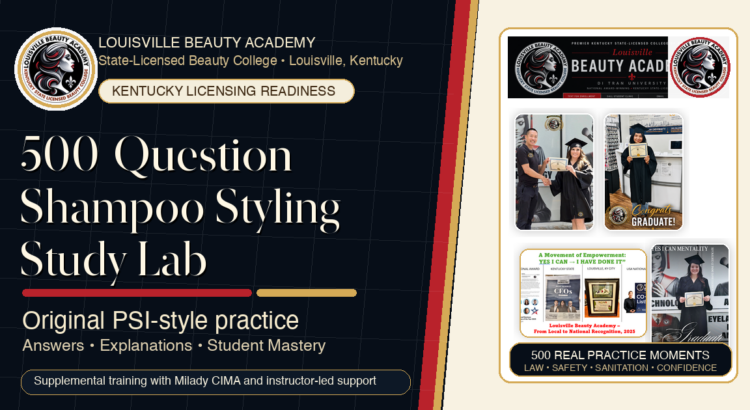
Original PSI-style practice questions, immediate answers, and full explanations for Shampoo Styling theory readiness.
Randomized practiceInstant explanationsTopic breakdownStudent code gatePrint and copy result
Current-source caution for 2026:
KBC lists Shampoo and Style Services as a 300-hour license path and currently posts a temporary hold notice for the Shampoo Styling examination through November 2026 while subject material is updated. Visitors may use the public preview; full practice modes require authorized LBA student access. Students should verify all requirements through official KBC and PSI sources before scheduling.
Start practice
Choose your study mode
Use preview for a quick warm-up, simulation for disciplined practice, or the full bank for complete topic mastery.
The 10-question preview is open to visitors. Larger study modes are for authorized LBA students and require the current student access code.
The 10-question preview is public. Student modes validate through LBA’s existing student-code gate. Do not share codes. Progress saves only in this browser on this device.
Practice
Question 1
Answered: 0Correct: 0Elapsed: 00:00
Topic
Question
Choose the best answer. The explanation appears immediately after your first choice.
Question map
Green is correct, amber needs review, white is unanswered.
Learning summary
Your practice result
Use the topic breakdown to choose what to review next with your instructor or current official materials.
Student access and privacy notice
Full interactive access is for authorized Louisville Beauty Academy students. Ask your instructor for the current code and keep it private. This page uses LBA’s existing student-code validation route before launching 50-, 100-, or 500-question modes; the access code itself is not printed on this page.
This educational practice lab is not a PSI product, not official exam content, not a clock-hour record, and not a guarantee of licensure. It exists to train professional judgment, sanitation reasoning, law/source awareness, client safety, and exam discipline.
Official-source alignment
KBC License Requirements: Shampoo and Style Services, 300 hours, education proof, age, examinations, application, and license verification.
KBC Exams page: PSI process, candidate bulletin route, theory/practical guidance, and current Shampoo Styling examination hold notice through November 2026.
PSI is the testing vendor. This app is an LBA-created educational tool and is not endorsed by, affiliated with, or owned by PSI.
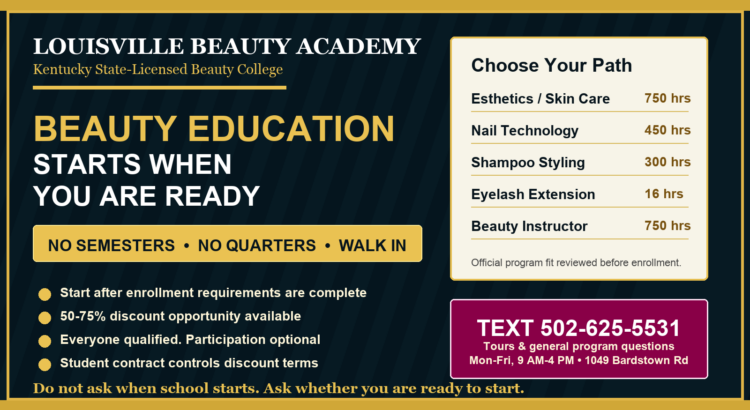
No semesters. No quarters. No artificial waiting season. Walk in, review your Beauty Education pathway, complete enrollment requirements, and start within your confirmed schedule.
Do not ask when school starts. Ask whether you are ready to start.
LBA’s Number-One Enrollment Strength
Louisville Beauty Academy’s strongest enrollment advantage is operational: students do not have to wait for a monthly, semester, or quarter start. Real life does not always wait for the academic calendar. Work schedules change. Childcare opens. Transportation becomes available. A family finally gets ready.
LBA is built to meet that moment with practical Beauty Education pathways, written enrollment review, and a clear next step.
The 3-Second Message
Enroll year-round.
No semesters. No quarters.
Walk in. Get started.
Start after enrollment requirements are complete.
Walk In
Visit 1049 Bardstown Road, Monday-Friday, 9 AM-4 PM, for tours and general program questions.
Finish enrollment documents, agreement review, schedule confirmation, and payment arrangements.
Start
Begin within your confirmed schedule after the required enrollment steps are complete.
Choose a Beauty Education Pathway
Public enrollment messaging should lead with Beauty Education and practical pathways: Esthetics, Skin Care, Nail Technology, Shampoo Styling, Eyelash Extension, Beauty Instructor preparation, beauty services, sanitation, client care, and professional readiness.
Esthetics / Skin Care750 hours
Skin care, esthetic practices, client care, sanitation, and beauty-service professionalism.
Nail Technology450 hours
Manicure, pedicure, nail services, safety, sanitation, and client-ready skill building.
Shampoo Styling300 hours
Shampoo, styling, salon readiness, practical beauty services, and professional habits.
Eyelash Extension16 hours
Specialty permit training offered in scheduled sessions with applicable prerequisites.
Beauty Instructor750 hours
Instructor preparation for qualified candidates in the applicable licensed field.
Full Beauty Program Pathway1,500 hours
The broader state-licensed pathway when that official program is the student’s chosen fit.
Graduates Move All Year
Rolling enrollment creates rolling progress. Some students are beginning while others are completing. That is why LBA can celebrate student milestones throughout the year instead of depending on one annual start season.
Completion still means the student completed the applicable school requirements. Kentucky licensure or specialty permit authority remains a separate Board-issued process.
Recognition + Readiness
LBA can be proud of public recognition, including America’s Top 100 Small Businesses recognition through the U.S. Chamber of Commerce CO-100 in 2025, Founder Di Tran’s 2025 NSBA Small Business Advocate of the Year finalist recognition, and the ESGR Statement of Support signed in 2026.
Recognition helps families trust the institution. The daily promise is practical: clear information, written review, real training, and a next step a person can take today.
Ready to Start the Conversation?
Walk in: Monday-Friday, 9 AM-4 PM Location: 1049 Bardstown Road, Louisville, KY 40204 Text: 502-625-5531 Website: LouisvilleBeautyAcademy.net
Use the written follow-up pathway for program fit, schedule, cost, tour options, contract review, and year-round enrollment questions.
50-75% discount opportunity available. Everyone is qualified. Participation is optional.
Discount terms are reviewed in the student contract. Students and families should read thoroughly before signing. The signed student contract controls optional participation, amount, schedule, final cost, and payment terms.
Lead-generation pathway: this page is tracked through the LBA website’s HubSpot integration and routes interested students to the official written follow-up pathway.
If the embedded pathway does not load, use the button above or text 502-625-5531 for tours and general program questions.
Important: A form submission, text message, tour request, or public article does not enroll a student, guarantee licensure, guarantee employment, or replace current written school documents. Enrollment, discount participation, schedule, payment terms, completion requirements, and final cost are controlled by the signed student contract and applicable Kentucky requirements.
On September 10, 2026, the National Accrediting Commission of Career Arts & Sciences (NACCAS) posted a public notice using the phrase “Grant Provisional Additional Location Accreditation.” The practical lesson for a beauty-school family is simple: check the exact campus address, not only the school name.
A school may operate more than one teaching location. A public status connected to one location should not be assumed to describe every place that uses the same school name. Students and parents should match the official record to the street address where the student will actually attend.
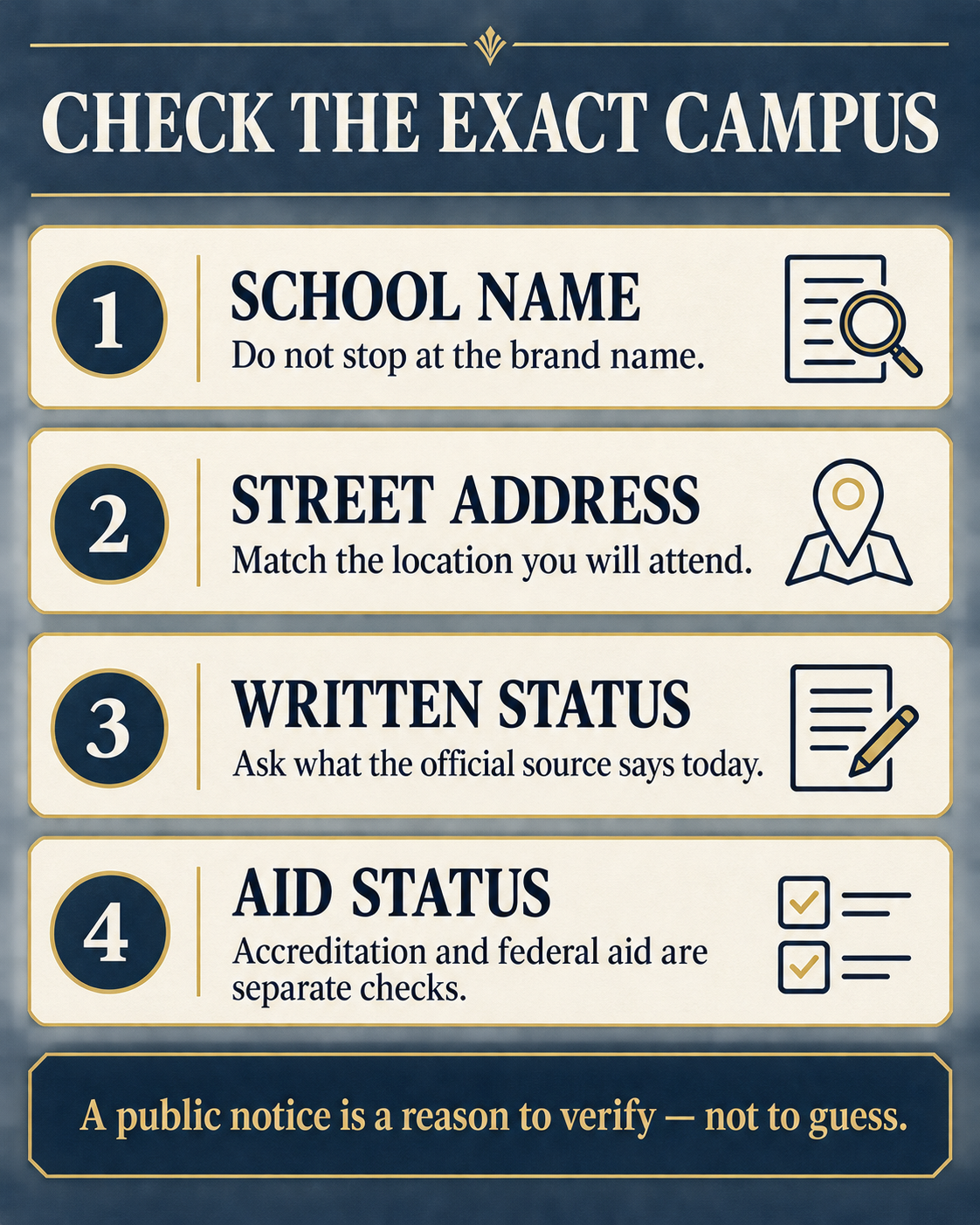
A school name is not enough. Match the exact location, current written status, state license, and federal-aid status before making an enrollment decision.
Simple Answer First
The September 10 notice is a new, source-controlled accreditation record. It is not a warning about all beauty schools, an endorsement of any school, or proof about Louisville Beauty Academy.
It is useful because it teaches a rule that families can use anywhere: school name, campus address, accreditation status, state license, and federal-aid status are separate facts. Each fact should be checked in writing.
What NACCAS Posted on September 10
The NACCAS Public Notices page lists an effective date of September 10, 2026, a notice titled “Notice of Commission Actions – September 10, 2026,” and this action category: “Grant Provisional Additional Location Accreditation.”
This article relies on that visible public-page language. It does not name, rank, praise, criticize, or draw a school-specific conclusion about the institution identified in the linked notice file.
What the Hard Words Mean
NACCAS is an accrediting agency for career arts and sciences education. An accrediting agency reviews schools under its own published standards.
Accreditation is an outside review status. It is not the same as a state license to operate.
Commission action means the accrediting commission made a dated decision under its process.
Additional location means another teaching site connected to a main campus. For a student, the important fact is the exact address where instruction will occur.
Provisional signals a staged or limited status under the accreditor’s process. A family should not rewrite that word as “full,” “final,” “permanent,” or “guaranteed.” The official current record controls.
Public notice is a dated record released for the public. It is a reason to verify facts, not a reason to spread rumors.
Why the Exact Address Matters
Imagine that a family sees the same school name on two buildings. One is the main campus. The other is a newer teaching location. A brochure may use one brand name for both, but the official records may list each address separately.
Before signing, the family should write down the exact street address and search that location in the relevant official records. If a search result lists a different address, ask the school for a current written explanation and verify it with the official source.
This is not distrust. It is normal decision discipline. A careful school should be able to explain its own location, program, price, license, and claimed status clearly.
Four Separate Checks Before Enrollment
Check the exact campus. Match the official record to the full street address where the student will attend classes.
Check the state license. In Kentucky beauty education, use the Kentucky Board of Cosmetology and current Kentucky law and regulation sources.
Check the accreditation claim. If a school claims accreditation, search the accreditor’s current directory and public notices. Read the exact words and date.
Check federal aid separately. Accreditation alone does not prove that a school or location participates in federal student aid. Ask for the current written federal status and verify it through official U.S. Department of Education sources.
What This Means for a Real Student or Family
A busy parent may hear, “The school is accredited,” and think the question is finished. It is not. The useful follow-up is: Which campus, at what address, under what current written status, and for which program?
The family should also ask for the current written price, what the school bill includes, the refund rule, the required training hours, the expected completion conditions, and the state-license steps after graduation. Those answers should be reviewed before signing or paying.
If the answer changes depending on who is speaking, pause. Ask for the controlling written document. A verbal promise, advertisement, old screenshot, or social post should not replace a current official record.
Kentucky and Louisville Beauty Academy Relevance
Kentucky beauty schools and license pathways are governed through Kentucky law, regulations, and the Kentucky Board of Cosmetology. Accreditation is a different layer. Federal student aid is another different layer.
Louisville Beauty Academy is a Kentucky state-licensed beauty school. LBA does not claim NACCAS accreditation and does not process the Free Application for Federal Student Aid (FAFSA) or Title IV federal student aid. FAFSA is the government form used to apply for federal student aid; Title IV is the part of federal law that authorizes the major federal student-aid programs.
LBA’s public purpose in explaining this notice is student protection: help families separate labels, compare written facts, and ask better questions before making a school decision.
A Calm Written-Record Checklist
What is the exact legal school name?
What is the full address where I will receive instruction?
Which state agency licenses that school and location?
If accreditation is claimed, which accreditor lists this exact location today?
Does the official source say provisional, full, renewed, monitored, on probation, pending appeal, withdrawn, or something else?
Does the school or location actually participate in federal student aid, or is federal aid not part of its model?
What is the current written total price, payment duty, refund rule, required hours, and completion standard?
Students considering LBA may contact Louisville Beauty Academy, email study@louisvillebeautyacademy.net, or call 502-625-5531 to request current written program and cost information. Do not send Social Security numbers, identity documents, payment data, or private student records through a public article or public comment.
This article is general public education. It is not legal advice, financial-aid advice, accreditation advice, or a school-specific finding about any institution in a public notice. It does not claim NACCAS accreditation or federal-aid participation for LBA. It does not promise admission, graduation, licensure, exam passage, transfer acceptance, employment, income, aid, funding, or any individual result. Current official sources and current written school documents control.
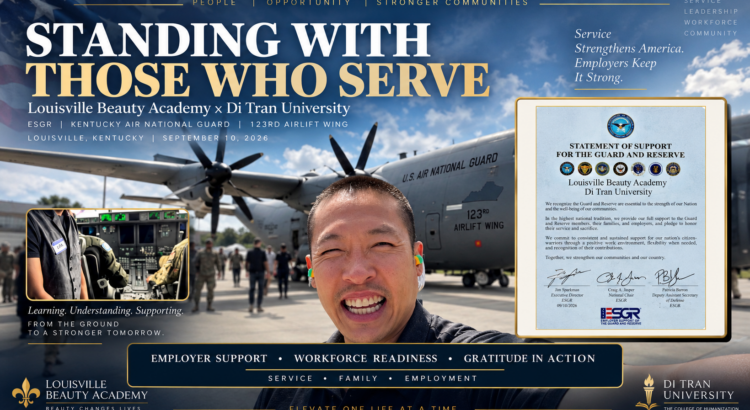
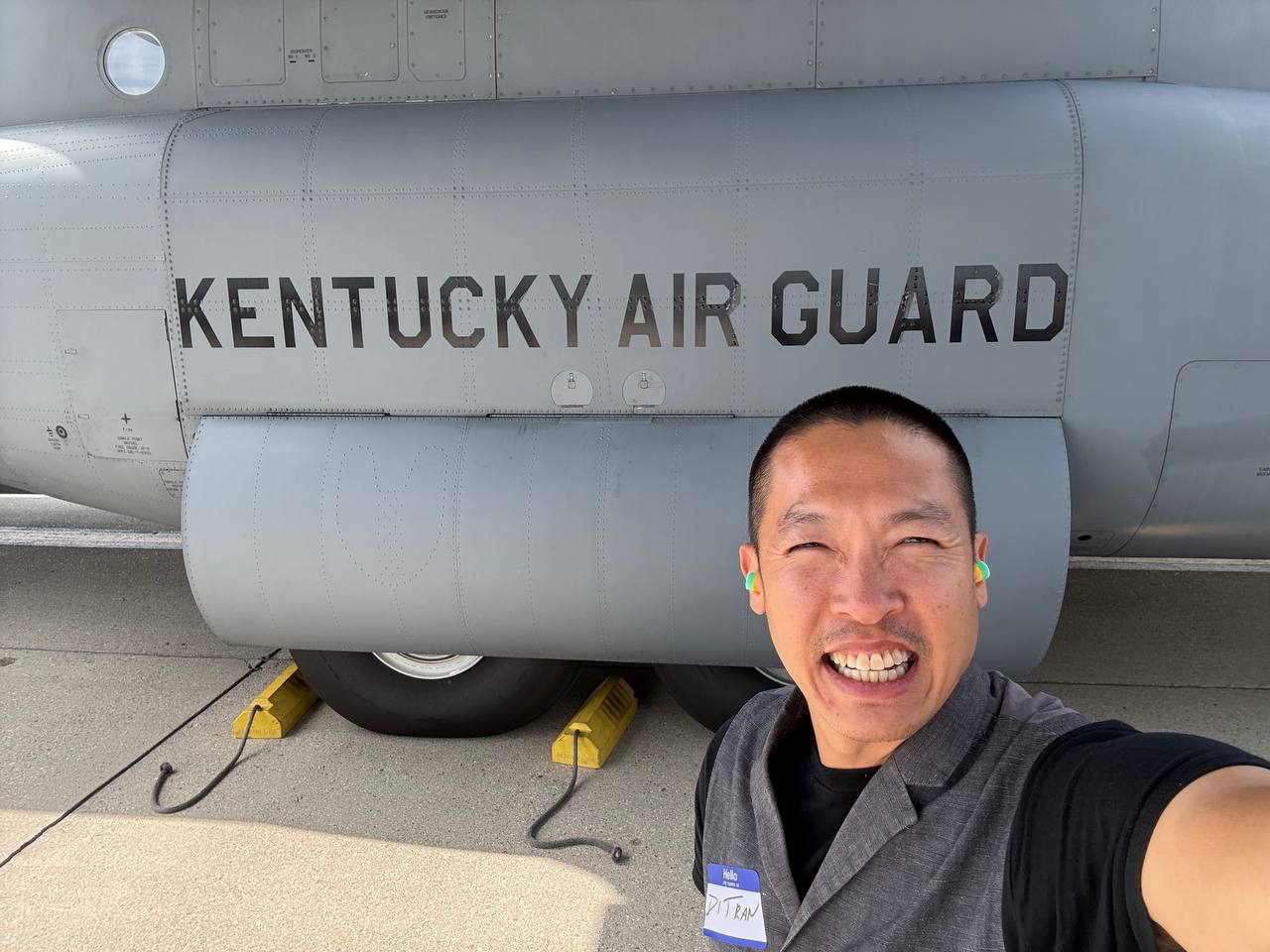
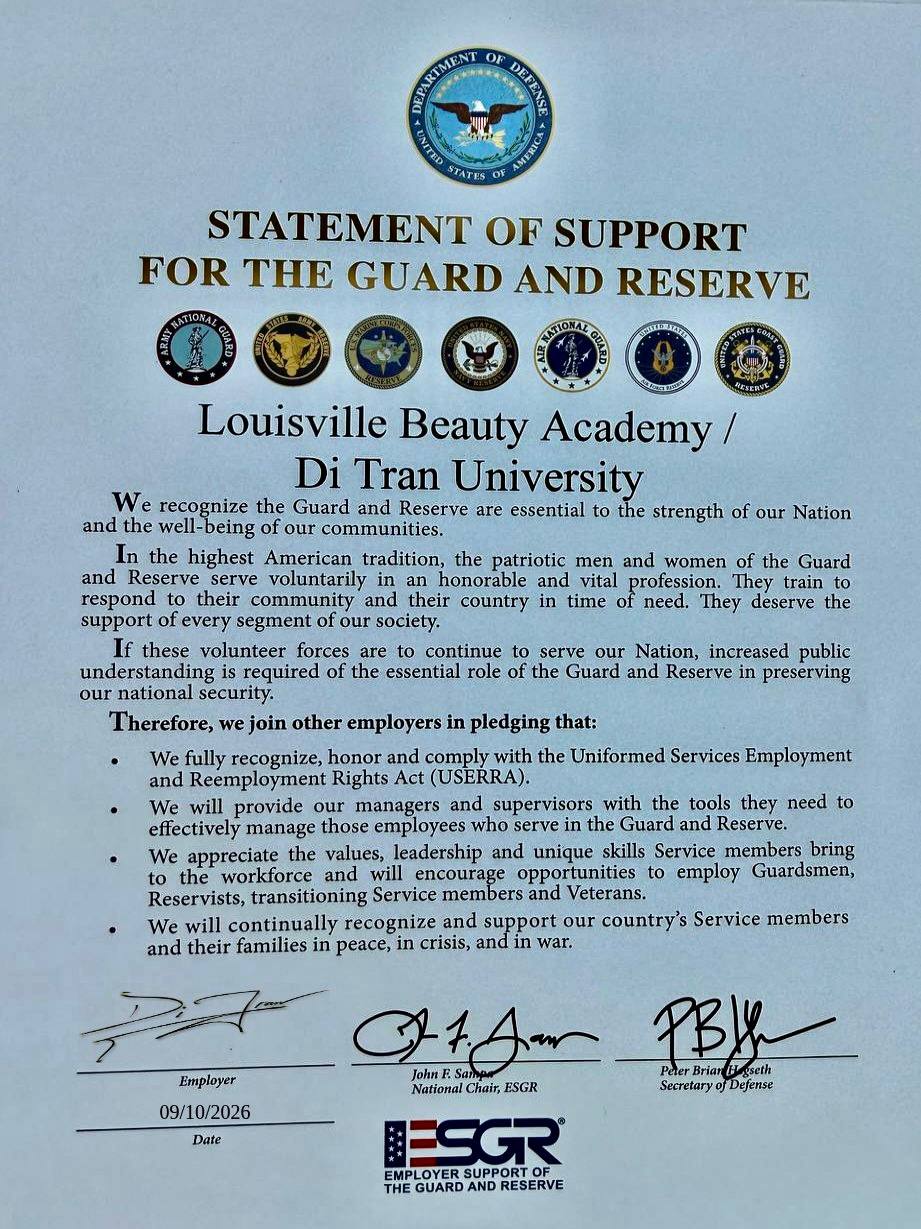
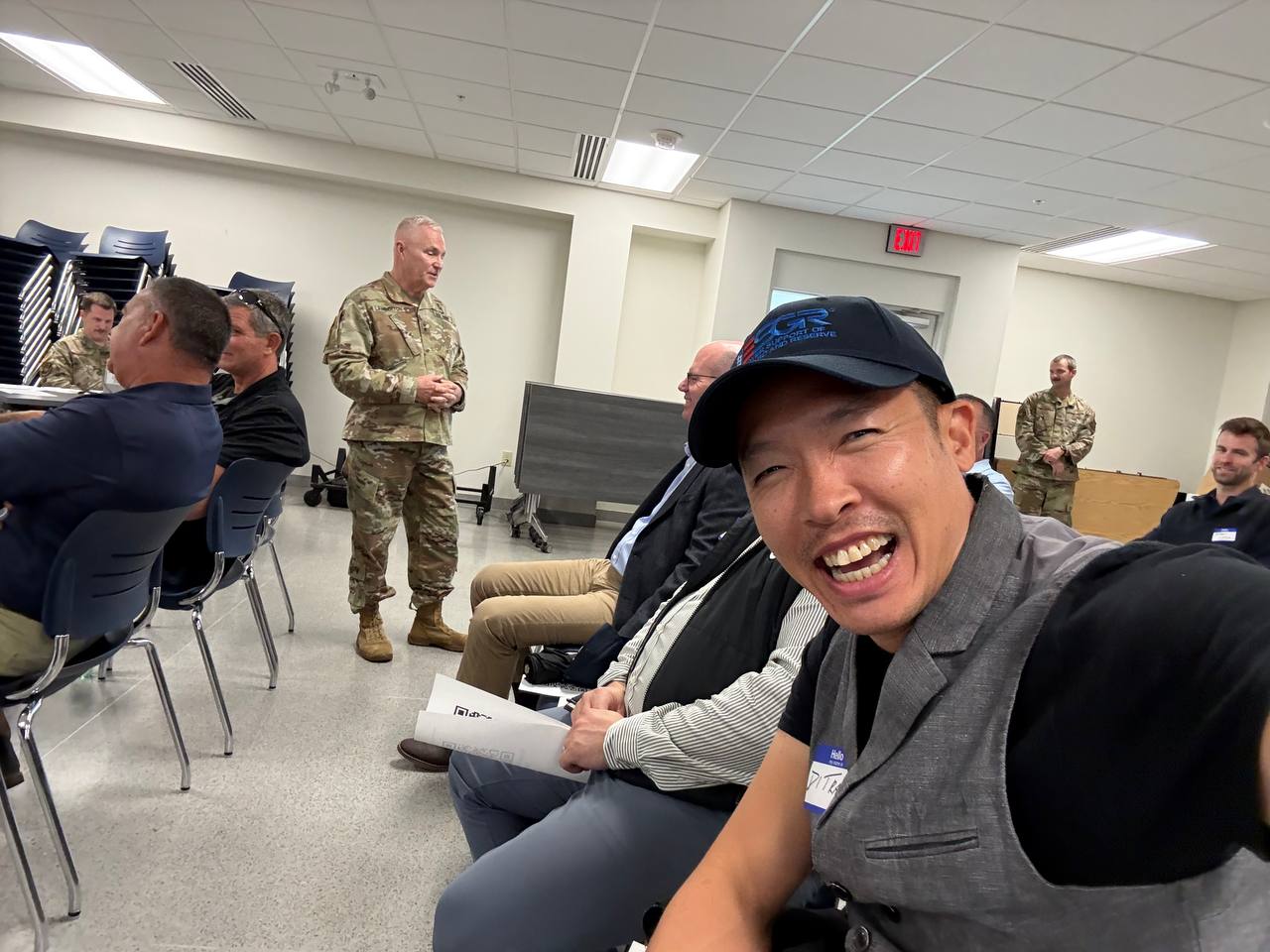
Louisville Beauty Academy / Di Tran University signed the ESGR Statement of Support after Di Tran attended the ESGR Air Guard Boss Lift 2026 with Kentucky’s 123rd Airlift Wing at the Louisville Air National Guard Base.
For Louisville Beauty Academy and Di Tran University, this was more than a calendar event. It was a direct encounter with the people, discipline, readiness, and sacrifice behind the Guard and Reserve mission. It was also a reminder that the strength of a nation is carried by people who often serve in more than one way: in uniform, at work, at home, in classrooms, and in the communities that depend on them.
Di Tran came to the United States as a Vietnamese-born American who has always understood opportunity as a responsibility. America opened its arms to his family. Kentucky became home. Louisville became the place where work, education, small business, family, and public service could become one life. For Di, standing beside the men and women of the Guard and Reserve is not symbolism. It is gratitude made practical.
A First-Hand View Of Readiness
The Boss Lift experience gave Di a first-hand employer view of the Kentucky Air National Guard mission, including the C-130 environment and the daily reality of service members who train, deploy, work civilian jobs, support families, and remain ready for disasters, emergencies, and missions beyond Kentucky. These are not abstract roles. They are real people carrying multiple responsibilities with discipline and quiet strength.
Di Tran experienced the C-130 environment first-hand during the ESGR Air Guard Boss Lift 2026 with the 123rd Airlift Wing.
Kentucky’s Air Guard story is nationally significant. Official 123rd Airlift Wing reporting states that the 123rd earned its 21st Air and Space Outstanding Unit Award and sixth Curtis N. “Rusty” Metcalf Trophy, describing the wing as the most decorated tactical airlift wing in the U.S. Air Force. Official Kentucky Guard reporting also describes the Boss Lift as a way for employers to gain an inside perspective on the Kentucky Air Guard mission.
Di Tran at the Louisville Air National Guard Base beside Kentucky Air Guard C-130 aircraft markings.
Why This Matters To Workforce Education
That matters to Louisville Beauty Academy / Di Tran University because workforce development is also a readiness mission. LBA and DTU work to make education accessible, affordable, career-connected, and human-centered. The institution’s mission is to help everyday people move faster toward skill, licensure, dignity, employment, entrepreneurship, and contribution. That includes military-connected families, veterans, spouses, adult learners, immigrants, working parents, and students who need education to be practical rather than distant.
Beauty education is not only about a license. It is about public safety, sanitation, confidence, care, income, ownership, and human dignity. When a school teaches skill with affordability and discipline, it strengthens families. When it supports Guard and Reserve members, it strengthens the country. When it uses AI carefully to expand accessibility without replacing human judgment, it strengthens the future of workforce education.
The ESGR Statement Of Support
Louisville Beauty Academy / Di Tran University signed the ESGR Statement of Support because the pledge captures the right standard: employers must recognize, honor, and support the people who serve in the Guard and Reserve. The pledge is not an award or government endorsement. It is a commitment. It says that institutions should build workplaces where service members and their families are understood, respected, and given fair opportunity.
Louisville Beauty Academy / Di Tran University signed the ESGR Statement of Support on September 10, 2026.
Gratitude In Action
This event also revealed something deeply local: so much of Kentucky’s readiness sits close to the communities it protects. Within minutes of Louisville Beauty Academy and Di Tran University’s growing footprint are students, employers, military families, workforce agencies, civic leaders, and the Louisville Air National Guard Base. The distance is short. The responsibility is large.
Di’s first C-130 experience was therefore not simply a personal milestone. It was a reminder that America is carried by people who often serve in more than one uniform: the military uniform, the work uniform, the family role, the classroom role, the leadership role. The Guard and Reserve stand at that intersection. So does workforce education.
The Boss Lift gave employers a first-hand view of the service, readiness, and civilian-workplace responsibilities carried by Guard and Reserve members.
Louisville Beauty Academy / Di Tran University is honored to support that mission and to continue building an institution that welcomes, trains, respects, and elevates people who serve, people who work, and people who are building a future in Kentucky.
This is the heart of the story: love of country without self-congratulation; love of Kentucky without exaggeration; love of Louisville through service; and workforce education as one practical way to give back to the country that gave Di Tran’s family a home.
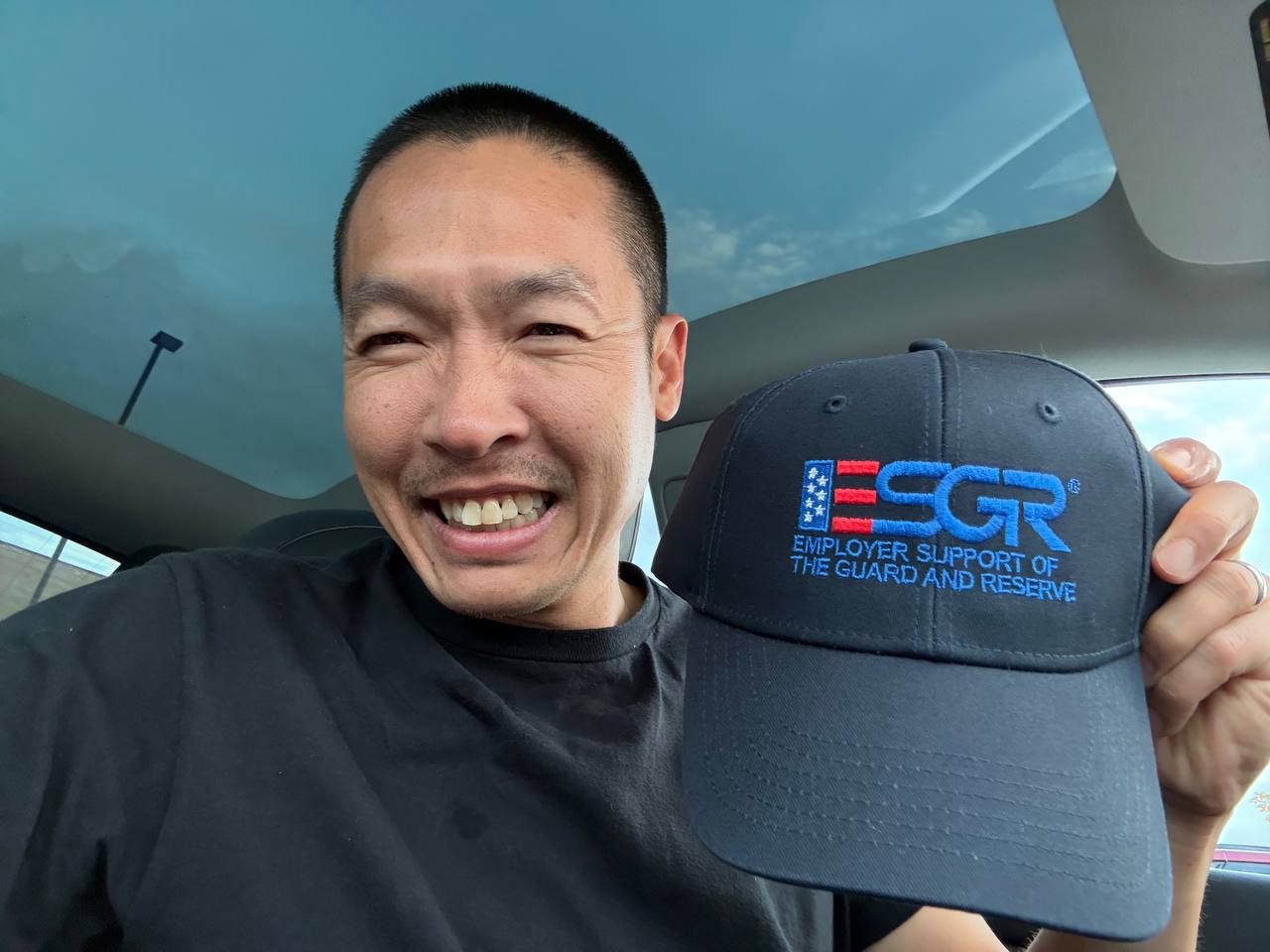
The ESGR employer-support message aligns with LBA / DTU commitment to practical workforce opportunity and respect for those who serve.
Credibility And Community Linkage
This moment respectfully connects several public-service and workforce communities while keeping the legal meaning exact: Employer Support of the Guard and Reserve, the Kentucky National Guard, the Kentucky Air National Guard, the 123rd Airlift Wing, the U.S. Department of Defense context for ESGR, the U.S. Department of Labor / USERRA employment-rights framework, Team Kentucky workforce and apprenticeship partners, the Kentucky Chamber Foundation employer network, Louisville Beauty Academy, and Di Tran University.
The message is simple: service strengthens America, employers help keep service possible, and workforce education can honor that service through practical opportunity.
What This Article Does And Does Not Claim
This article reports LBA / DTU participation in the ESGR Boss Lift experience and the signed ESGR Statement of Support. It does not claim an ESGR award, Department of Defense endorsement, military endorsement, government contract, accreditation, grant approval, WIOA approval, Workforce Pell approval, or apprenticeship approval. Awards, approvals, contracts, and regulated statuses require separate official action.