Kentucky Beauty Licensure From First Day to License: A Real Step-by-Step Map is written for students, families, salon employers, workforce partners, and public officials who need beauty education to be practical, honest, and verifiable.
A plain-language map from school enrollment through hours, graduation, examination, and license verification.
This article does not promise enrollment approval, graduation, examination passage, licensure, employment, income, discounts, funding, or any state-board decision. It gives a disciplined framework for asking better questions and keeping better records.
Deep Research Query Used
Research query: “Kentucky Beauty Licensure From First Day to License: A Real Step-by-Step Map” Kentucky licensure pathway official sources Kentucky Board of Cosmetology PSI NIC FTC CFPB BLS O*NET CareerOneStop student protection workforce economics no guarantee licensure employment income board approval
The Board Controls Licensure
A school can teach, track, graduate, document, and support. It cannot replace the Kentucky Board of Cosmetology. The Board publishes the requirements for license categories and students should treat those public pages as controlling starting points. That distinction protects everyone: the student, the school, the public, and the profession.
Hours Are Not Symbolic
Kentucky’s published requirements identify training-hour thresholds for license categories. Cosmetology, nail technology, esthetics, shampoo styling, and instructor pathways are not interchangeable. A student should understand the license they are pursuing, the required hours, and the difference between school completion and state licensure.
The Practical Sequence
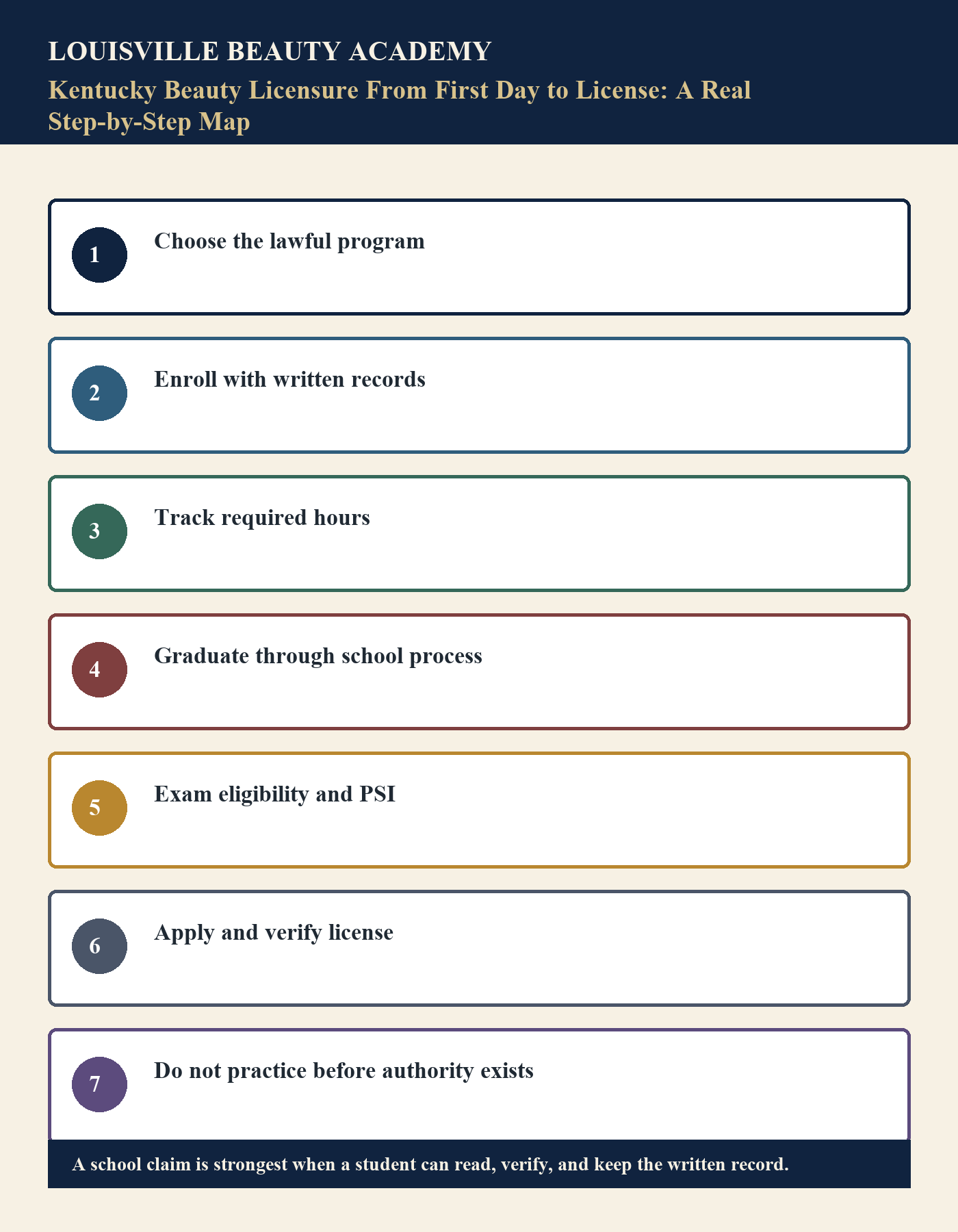
A disciplined sequence looks like this: choose the right program; complete enrollment using current written documents; attend and track hours; follow school policy; complete required training; move through graduation processing; follow Board and PSI examination rules; apply for licensure; and wait for proper verification before providing regulated services.
Exam Readiness Is More Than Studying
Exam readiness includes theory knowledge, practical discipline, sanitation habits, supplies, scheduling awareness, language support awareness where available, and calm recordkeeping. PSI and the Board, not the school, control examination procedures and timing.
LBA Position
Louisville Beauty Academy should speak about licensure with respect and precision. The school can help students prepare, but no school should imply it can guarantee a Board decision, exam result, license issue date, or employment outcome.
The Research Questions Behind This Article
A flagship article cannot simply repeat a slogan. For this topic, the controlling research question is: how should a serious student, family, school, employer, or public official understand Kentucky licensure pathway using official sources first, institutional documents second, and real economic judgment third?
What does the public authority or official source actually control?
What can the school properly explain without overpromising?
What must the student keep in writing?
What economic pressure will the student or family feel in real life?
What claim language would be unsafe, exaggerated, or confusing?
The Real-World Scenario
Imagine a working adult considering beauty school while balancing rent, transportation, family obligations, work hours, language needs, and the desire to enter a licensed profession. That person does not need vague inspiration only. They need a clean decision system. Kentucky Beauty Licensure From First Day to License: A Real Step-by-Step Map is built around that practical reality.
The student may be excited, but excitement is not a substitute for proof. The family may trust the school, but trust is stronger when written records can be reviewed. The school may want to help, but help must stay inside legal, ethical, and factual boundaries. A strong system respects all three sides.
The Economic Layer
Beauty education is economic infrastructure because it can convert time, discipline, documentation, and supervised practice into a licensed workforce pathway. But economics must be explained honestly. A student should consider total cost, schedule burden, exam timing, income uncertainty, transportation, childcare, supply needs, retake risk, and the difference between gross sales and net income.
This is why LBA’s strongest public posture is not a flashy promise. It is practical clarity: understand the program, understand the rules, understand the records, understand the cost stack, and understand who controls each decision. That is more powerful than sales language because it makes the student more capable.
The Compliance Layer
In regulated education, the safest sentence is often the most precise sentence. Schools can describe their programs, policies, supports, prices, documents, and educational practices. Schools should not guarantee licensure, employment, exam passage, income, transfer acceptance, state-board approval, or individual financial outcomes.
A school that speaks carefully is not weaker. It is stronger. Careful language tells the public that the institution respects the student, the regulator, the profession, and the difference between support and authority.
What This Means for Students
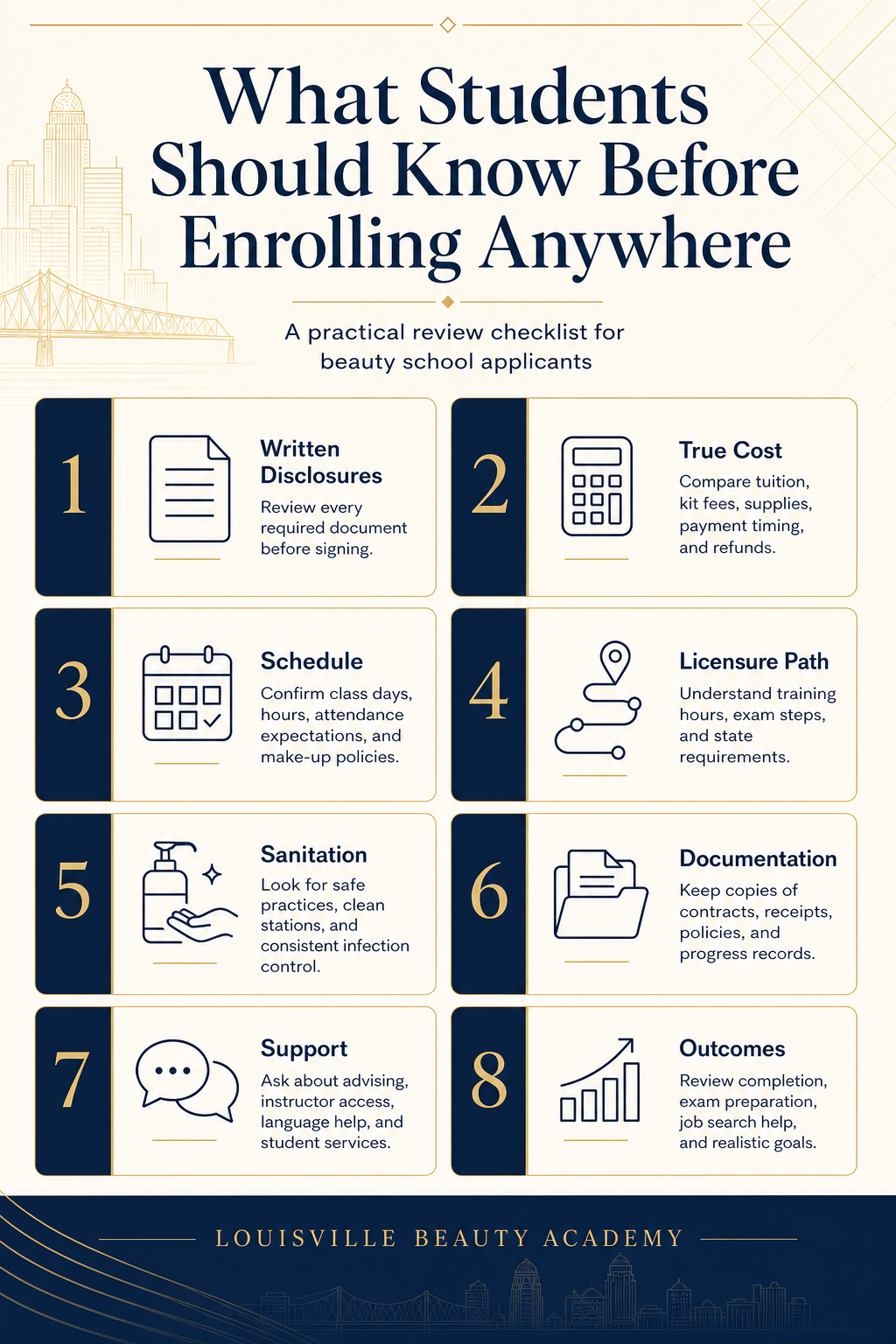
Students should develop a documentation mindset early. That means keeping copies, reading before signing, asking for clarification in writing, saving screenshots or PDFs of current official pages when needed, and knowing the difference between a school explanation and a controlling government or exam-vendor rule.
Choose the lawful program
Enroll with written records
Track required hours
Graduate through school process
Exam eligibility and PSI
Apply and verify license
Do not practice before authority exists
What This Means for Schools
A serious school should make the student’s path easier to understand without pretending that every part of the path is easy. The better institutional standard is disciplined transparency: show the relevant documents, explain the limits, direct students to official sources, preserve records, and use public pages to reduce confusion before enrollment.
That standard also helps employers, funders, public officials, and community partners. They can see that the school is not merely recruiting students. It is building a documented, lawful, practical workforce pathway.
World-Cross Feature
The same principle appears in other serious fields. A mortgage depends on written disclosures. A medical procedure depends on consent and records. A pilot logs flight hours. A nurse tracks clinical requirements. A skilled trade apprentice records training progress. Beauty education deserves the same respect: practical work, public safety, documentation, and lawful progression all matter.
Common Misunderstandings to Avoid
Do not treat a verbal statement as stronger than the current written document.
Do not assume a school controls a state-board or exam-vendor decision.
Do not confuse school completion with licensure.
Do not compare programs only by headline price.
Do not treat translation, advising, or support as a guarantee.
Flagship Bottom Line
The central standard is simple: Kentucky licensure pathway should be understandable, documented, and grounded in official sources. When a school teaches that way, students become stronger decision-makers. When students learn that way, the profession becomes more credible. When the public sees that standard in writing, institutional trust rises.
Frequently Asked Questions
Does this article replace official Board, exam, or legal guidance? No. It is an educational guide. Students should verify current requirements with the responsible official source.
Does LBA guarantee licensure, exam passage, employment, income, or a particular Board decision? No. LBA can provide education, documentation, and support inside its lawful role, but outside authorities and individual student performance matter.
What is the strongest student habit? Read first, keep copies, ask written questions, attend consistently, and treat every important education step as part of a proof chain.
Practical Reader Checklist
Choose the lawful program
Enroll with written records
Track required hours
Graduate through school process
Exam eligibility and PSI
Apply and verify license
Do not practice before authority exists
Student Protection Notice
Students should rely on current written documents, official state-board and exam-vendor information, and the school documents actually provided to them. Policies, fees, rules, and external requirements can change. When the issue is licensing, examination, transfer, discipline, or official approval, the relevant public authority controls.
The Student Document Standard: What Every Beauty Student Should Read Before Enrolling is written for students, families, salon employers, workforce partners, and public officials who need beauty education to be practical, honest, and verifiable.
A practical standard for written clarity before a student signs, pays, attends, or relies on a verbal promise.
This article does not promise enrollment approval, graduation, examination passage, licensure, employment, income, discounts, funding, or any state-board decision. It gives a disciplined framework for asking better questions and keeping better records.
Deep Research Query Used
Research query: “The Student Document Standard: What Every Beauty Student Should Read Before Enrolling” written documents before enrollment official sources Kentucky Board of Cosmetology PSI NIC FTC CFPB BLS O*NET CareerOneStop student protection workforce economics no guarantee licensure employment income board approval
Why Documents Come Before Trust
A serious school should be willing to put important terms in writing before a student is emotionally committed. Written documents do not remove all risk, but they make the relationship reviewable. Families can compare dates, costs, duties, refund logic, attendance requirements, program hours, and outside authority. A student who cannot see the controlling documents is forced to rely on memory, sales tone, or screenshots. That is not strong enough for regulated workforce education.
The Seven-Document Standard
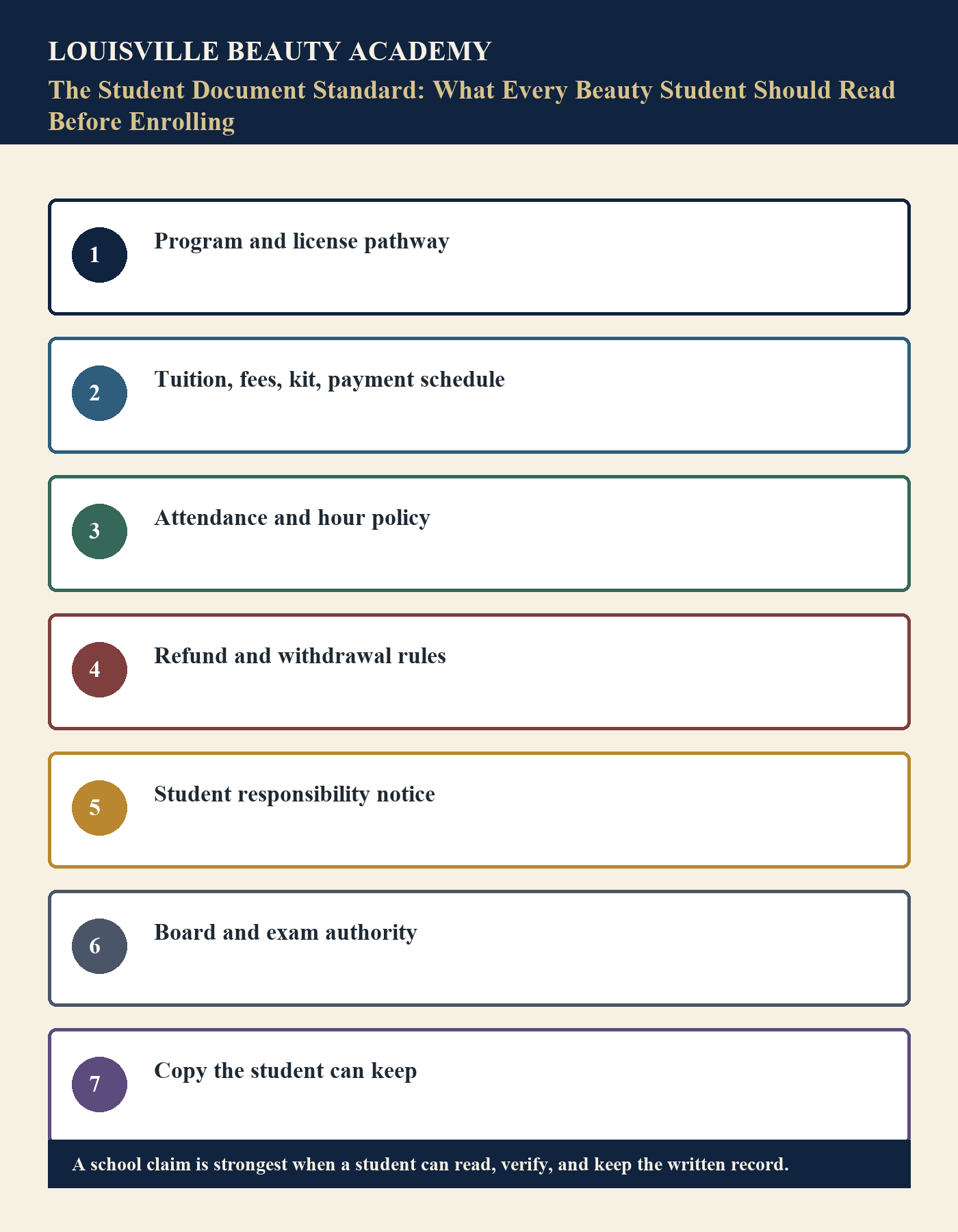
Before enrollment, a student should know where to find the school catalog or student handbook, the enrollment agreement, current program cost page, payment-plan language if applicable, attendance and hour policy, refund or withdrawal framework, and any disclosures explaining that the state board and exam vendor control licensure and examination rules. The point is not paperwork for its own sake. The point is informed consent.
What Students Should Ask
Students should ask whether the document is current, whether they can keep a copy, whether the language in the document controls over verbal discussion, whether changes must be in writing, and who has authority to approve exceptions. A strong institution should not be insulted by those questions.
Why This Is Economic Protection
Beauty school is not only tuition. It can involve time away from work, transportation, childcare, supplies, exam fees, retakes, and opportunity cost. A student who understands the documents can plan money and time more responsibly. That is especially important for adult learners, immigrant families, parents, and working students.
LBA Position
Louisville Beauty Academy’s public doctrine is that important student-facing rules should be written, accessible, and reviewable. The goal is not to overwhelm the student. The goal is to make the student stronger before commitment.
The Research Questions Behind This Article
A flagship article cannot simply repeat a slogan. For this topic, the controlling research question is: how should a serious student, family, school, employer, or public official understand written documents before enrollment using official sources first, institutional documents second, and real economic judgment third?
What does the public authority or official source actually control?
What can the school properly explain without overpromising?
What must the student keep in writing?
What economic pressure will the student or family feel in real life?
What claim language would be unsafe, exaggerated, or confusing?
The Real-World Scenario
Imagine a working adult considering beauty school while balancing rent, transportation, family obligations, work hours, language needs, and the desire to enter a licensed profession. That person does not need vague inspiration only. They need a clean decision system. The Student Document Standard: What Every Beauty Student Should Read Before Enrolling is built around that practical reality.
The student may be excited, but excitement is not a substitute for proof. The family may trust the school, but trust is stronger when written records can be reviewed. The school may want to help, but help must stay inside legal, ethical, and factual boundaries. A strong system respects all three sides.
The Economic Layer
Beauty education is economic infrastructure because it can convert time, discipline, documentation, and supervised practice into a licensed workforce pathway. But economics must be explained honestly. A student should consider total cost, schedule burden, exam timing, income uncertainty, transportation, childcare, supply needs, retake risk, and the difference between gross sales and net income.
This is why LBA’s strongest public posture is not a flashy promise. It is practical clarity: understand the program, understand the rules, understand the records, understand the cost stack, and understand who controls each decision. That is more powerful than sales language because it makes the student more capable.
The Compliance Layer
In regulated education, the safest sentence is often the most precise sentence. Schools can describe their programs, policies, supports, prices, documents, and educational practices. Schools should not guarantee licensure, employment, exam passage, income, transfer acceptance, state-board approval, or individual financial outcomes.
A school that speaks carefully is not weaker. It is stronger. Careful language tells the public that the institution respects the student, the regulator, the profession, and the difference between support and authority.
What This Means for Students
Students should develop a documentation mindset early. That means keeping copies, reading before signing, asking for clarification in writing, saving screenshots or PDFs of current official pages when needed, and knowing the difference between a school explanation and a controlling government or exam-vendor rule.
Program and license pathway
Tuition, fees, kit, payment schedule
Attendance and hour policy
Refund and withdrawal rules
Student responsibility notice
Board and exam authority
Copy the student can keep
What This Means for Schools
A serious school should make the student’s path easier to understand without pretending that every part of the path is easy. The better institutional standard is disciplined transparency: show the relevant documents, explain the limits, direct students to official sources, preserve records, and use public pages to reduce confusion before enrollment.
That standard also helps employers, funders, public officials, and community partners. They can see that the school is not merely recruiting students. It is building a documented, lawful, practical workforce pathway.
World-Cross Feature
The same principle appears in other serious fields. A mortgage depends on written disclosures. A medical procedure depends on consent and records. A pilot logs flight hours. A nurse tracks clinical requirements. A skilled trade apprentice records training progress. Beauty education deserves the same respect: practical work, public safety, documentation, and lawful progression all matter.
Common Misunderstandings to Avoid
Do not treat a verbal statement as stronger than the current written document.
Do not assume a school controls a state-board or exam-vendor decision.
Do not confuse school completion with licensure.
Do not compare programs only by headline price.
Do not treat translation, advising, or support as a guarantee.
Flagship Bottom Line
The central standard is simple: written documents before enrollment should be understandable, documented, and grounded in official sources. When a school teaches that way, students become stronger decision-makers. When students learn that way, the profession becomes more credible. When the public sees that standard in writing, institutional trust rises.
Frequently Asked Questions
Does this article replace official Board, exam, or legal guidance? No. It is an educational guide. Students should verify current requirements with the responsible official source.
Does LBA guarantee licensure, exam passage, employment, income, or a particular Board decision? No. LBA can provide education, documentation, and support inside its lawful role, but outside authorities and individual student performance matter.
What is the strongest student habit? Read first, keep copies, ask written questions, attend consistently, and treat every important education step as part of a proof chain.
Practical Reader Checklist
Program and license pathway
Tuition, fees, kit, payment schedule
Attendance and hour policy
Refund and withdrawal rules
Student responsibility notice
Board and exam authority
Copy the student can keep
Student Protection Notice
Students should rely on current written documents, official state-board and exam-vendor information, and the school documents actually provided to them. Policies, fees, rules, and external requirements can change. When the issue is licensing, examination, transfer, discipline, or official approval, the relevant public authority controls.
This article is part of LBA’s public education and historical archive. Older posts, including “The Evolution of Nail Technology and Louisville Beauty Academy’s Path to a Center of Excellence in Nail Education – RESEARCH & PODCAST SERIES 2026,” may not reflect current tuition, schedules, incentives, forms, policies, testing vendors, clinic availability, or regulatory requirements.
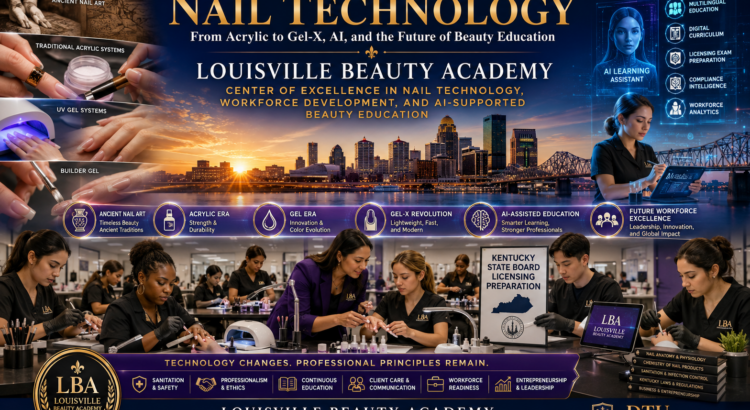
The modern nail industry is not a story of one system replacing another. It is a story of layered innovation. Over thousands of years, nail care moved from social signaling and natural staining in ancient India, China, and Egypt to formal salon manicuring in the modern West, then into chemistry-driven enhancement systems, UV/LED-curable gels, pre-shaped soft-gel extensions, a revived press-on market, and now AI-assisted education and operations. The result is not a straight line from “old” to “new,” but a widening service ecosystem in which different systems solve different client, technician, and business problems. [1]
The strongest evidence for what still matters comes from regulation and occupational health, not trend forecasting. In Kentucky, nail technology education still centers on science and theory, statutes and regulations, and clinic/practice hours; the required subject areas explicitly include infection control, nail anatomy and physiology, nail product chemistry, manicuring, pedicuring, electric filing, tips and wraps, monomer-liquid/polymer-powder enhancements, UV/LED gels, and business skills. At the national level, BLS still describes the occupation around safe grooming, artificial nail application and removal, disinfecting tools, and client care, while NIOSH continues to emphasize chemical, respiratory, ergonomic, and language-access risks faced by nail workers. [2]
Gel-X has grown because it aligns with several contemporary demands at once: speed, standardization, lighter-feeling enhancements, lower dust, easier soak-off removal, strong visual consistency, and digital-friendly education. Aprés, the company that created Gel-X, describes it as the world’s first full-coverage soft-gel extension system, invented in 2017, and markets it as faster, lighter, gentler, less dusty, and easier to remove than acrylic. Those features matter in an era when clients increasingly want long-wear sets with lower maintenance friction and when schools and techs benefit from platform systems that are teachable in repeatable steps. [3]
Yet Gel-X does not make acrylic obsolete. Acrylic remains structurally important for custom sculpting, major rebalancing, repair-heavy services, long-term filled wear, and clientele who want deeply customized architecture beyond pre-shaped full-cover tips. That is why Kentucky’s curriculum continues to require both monomer-liquid/polymer-powder enhancements and UV/LED gels, not one or the other. The industry is converging on a mixed economy of systems: acrylic for architecture and repair, Gel-X for speed and standardized extension work, builder gel for overlays and structured manicures, and press-ons for retail, events, and rapid trend cycles. [4]
AI’s near-term role in nail education is clearest in augmentation, not substitution. UNESCO’s guidance on generative AI in education calls for a human-centered approach, data-protection safeguards, and pedagogical validation; the U.S. Department of Education and IES describe AI as useful for instructional support, personalized learning, assessment, analytics, and administrative tasks, while explicitly warning that AI should be used as a tool rather than a substitute for humans. For beauty schools, that means AI can support multilingual instruction, tutoring, policy retrieval, exam prep, scheduling, student advising, and institutional memory, but it cannot replace licensed instructors, supervised clinic work, or state licensure. [5]
Louisville Beauty Academy already displays many of the building blocks of a nail-education hub. Kentucky public sources confirm LBA as a licensed school location in Louisville, including a second location at future second location; LBA’s own public catalog and curriculum materials describe a work-ready mission, a 450-hour nail program, Milady-based theory, explicit nail-technique training that includes gels, wraps, acrylics, and electric drill use, flexible schedules, scholarships/payment plans, multilingual resources, AI tools, onsite training, and a community-facing future second-location planning. Publicly available LBA materials also report more than 1,000 graduates and more than 90% completion, employment, and board-pass outcomes for 2017–2023, while Kentucky school-reporting search snippets show nail-program pass-rate rows and multilingual exam-result rows. Some details remain school-reported rather than independently audited in the sources reviewed, and where documentation was incomplete this report marks it as unspecified. [6]
The strategic opportunity, therefore, is not to brand LBA simply as a school that teaches nails. It is to position LBA as a workforce-first Center of Excellence in Nail Systems, Safety, and Applied Beauty Technology: a place where licensure fundamentals remain nonnegotiable, where multiple enhancement systems are taught comparatively, where multilingual access is built into delivery, where AI serves compliance and learning rather than replacing professionals, and where local workforce partnerships turn school into a civic and economic platform. That positioning is evidence-based, future-facing, and well aligned with both labor market demand and the current technological direction of nail services. [7]
Long before “nail technology” became a licensed occupation, nail care functioned as culture, class marker, and personal presentation. Dermatology reviews note that nail cosmetics date back to around 5000 BC in India, China, and Egypt, where plant- and mineral-based materials were used to color or ornament nails. This ancient origin matters because it shows that the industry’s psychological and cultural core—identity, beauty, status, and ritual—predates all modern chemical systems. [8]
In modern salon history, one widely cited milestone is the opening of Mary E. Cobb’s manicure salon in Manhattan in 1878 after she studied nail care in France. By the early twentieth century, manicure norms had become more formalized, and one recent review notes that nail polishes in recognizably modern form were developed in 1920. In other words, the shift from simple buffing and staining to standardized commercial products predates acrylics by decades. [9]
The decisive technological leap came in the postwar era, when artificial extension methods became more systematized. A 1955 patent filing, granted in 1957 to Thomas S. Slack, described a “device for extending fingernails” and explicitly referenced a nail-extending material made by combining polymethyl methacrylate powder with methyl methacrylate monomer. That patent is crucial because it documents the move from cosmetic surface treatment to engineered nail architecture. It also shows how deeply early artificial nail systems were tied to acrylic polymer chemistry and form-based extension methods. [10]
Industry manufacturer history lines up with that patent-era transition. NSI, which traces its roots to Fred Slack’s work, dates the “first nail form” to 1957 and associates its origins with the adaptation of dental acrylic and foil for nail repair and extension. NSI’s own timeline also notes that by the late 1960s Slack and a chemist had developed more “nail technician friendly” polymer/monomer acrylic systems. In short, the acrylic era did not arrive fully formed; it emerged through iterative product refinement that made salon use more practical. [11]
Regulatory and safety scrutiny followed. FDA’s current nail-product guidance explains that artificial nails are primarily composed of acrylic polymers and recounts that in the early 1970s the agency received injury complaints associated with products containing methyl methacrylate monomer, including fingernail damage, deformity, and contact dermatitis. The FDA then took action against products containing 100% methyl methacrylate monomer and distinguishes that history from ethyl methacrylate-based systems. This early MMA episode remains foundational because it established a pattern that still defines the field today: technological change in nails is always filtered through chemistry, worker exposure, and public-safety response. [12]
The next broad phase was the gel era. Recent chemistry reviews describe UV-curable nail polishes as acrylate-based systems initiated by light-driven polymerization chemistry; these systems made it possible to produce durable coatings and enhancement products with more controlled curing than traditional evaporative polish. Over time, industry practice differentiated among hard gels, soft soak-off gels, builder gels, gel polish, and extension-specific gel systems. The important point is that “gel” is not one product but a family of light-cured polymer systems with different rheology, architecture, removal pathways, and risk profiles. [13]
A still newer phase is the platform-system era. Aprés describes Gel-X as the world’s first full-coverage soft-gel extension system and states that Gel-X was invented in 2017. Unlike classic acrylic or sculpted gel methods, Gel-X takes the extension form itself—pre-shaped, full-coverage, soak-off soft gel—and turns it into a platform product. That matters educationally because platform products reduce some variability in shaping and structure during initial training while increasing the importance of prep, sizing, adhesion, curing, and removal discipline. [14]
The current market is therefore plural, not singular. Commercial market researchers project continued growth in artificial nails overall and specifically in press-ons, while official labor sources continue to project faster-than-average employment growth for manicurists and pedicurists. The modern school cannot responsibly train only one method. It must teach a portfolio. [15]
The timeline above compresses the core pattern: the industry evolves when a new chemistry, form factor, or learning platform changes the service workflow. But each new phase leaves older systems alive in niches where they continue to outperform. [16]
The case for Gel-X’s growth is straightforward. Aprés positions it as a full-coverage soft-gel extension system that is faster, lighter, gentler, less dusty, and easier to remove than acrylic, and says correctly applied sets typically last 3–4 weeks. That package addresses several points of friction in both salon operations and client experience: reduced hand-filing time, lower airborne dust, strong shape consistency, easier inventory standardization once tip libraries are built, and full soak-off removal rather than repeated heavy rebalance cycles. [17]
Gel-X also grew because it is teachable in a modular way. Aprés University offers online and in-person Gel-X certification and states that its online course covers prep, sizing, and full application and is available in English, Spanish, Vietnamese, and Japanese. That multilingual, asynchronous structure is important. It does not replace state licensure, but it shows how platform systems can scale through digital pedagogy, especially among multilingual learners and working technicians adding services after graduation. [18]
The growth of Gel-X, however, should not be misread as an acrylic extinction event. Acrylic remains the industry’s most repairable and sculpturally flexible architecture. The patent literature and classic acrylic method are built around form-supported extension and in-situ structure building; that makes acrylic especially useful where technicians need to correct asymmetry, repair breaks, rebalance long-growth stress points, or create highly customized lengths and shapes. Industry practice around fills every two to three weeks also reflects acrylic’s logic as a maintainable architecture rather than a set meant to be routinely soaked off and rebuilt from zero. [19]
Builder gel occupies a third lane rather than merely splitting the difference. OPI describes its builder-gel line as soak-off, HEMA-free, lightweight, and suitable for adhering soft-gel tips, filling extensions, overlays, and structured manicures, with up to three weeks of wear. Aprés similarly describes Soft Gel Builder as a soak-off formula functioning as both base coat and builder gel. In practice, builder gel works best for clients who want reinforcement, architecture, and overlays on the natural nail or shorter-extension work without the full service logic of acrylic. [20]
Press-ons add a fourth lane. Market research firms expect continued growth in press-ons, and KISS/imPRESS markets press-on systems as quick, self-adhesive, and “salon-perfect” in minutes. Press-ons do not replace professional enhancement education; rather, they create retail, event, and trend-response opportunities. Schools that ignore them miss a growing home-and-retail segment. [21]
The deeper reason Gel-X complements rather than replaces acrylic is economic and architectural. A nail salon is not solving one problem called “extensions.” It is solving multiple problems: quick full-coverage transformations, high-end custom sculpting, natural-nail overlays, special-event nails, quick-change retail nails, and repair or rebalance work. Gel-X is excellent at one cluster of those use cases; acrylic is excellent at another. A sophisticated school should teach students to match system to use case, not loyalty to one brand or technique. That conclusion is partly an inference, but it follows directly from the different product structures, wear cycles, and removal pathways documented by official and manufacturer sources. [22]
The table reinforces the governing lesson for schools: system literacy is now as important as single-system mastery. A graduating nail technician should understand where each method wins, where it fails, and what safety burden it carries. [41]
The nail industry changes faster in products than in fundamentals. Kentucky’s nail technology curriculum still requires science and theory, Kentucky statutes and regulations, and clinic/practice time; the subject areas include microbiology/infection control, anatomy and physiology, nail product chemistry, manicuring, pedicuring, tips and wraps, monomer-liquid/polymer-powder enhancements, UV/LED gels, and business skills. That is exactly right. The center of gravity in nail education should remain sanitation, anatomy, chemistry, safety, client communication, scope-of-practice literacy, and employability/business capability. [42]
Federal worker-safety evidence reinforces the same conclusion. NIOSH warns that nail technicians face chemical and physical hazards, including skin and respiratory exposures, neurological and reproductive risks from some chemicals, and musculoskeletal strain from posture and repetitive motion. Its field evaluations found inconsistent hazard training, poor ventilation, incorrectly worn respirators, and elevated particulate concentrations near acrylic filing stations. A school that teaches fashion without ventilation, chemical literacy, and body mechanics is not modern; it is incomplete. [43]
Sanitation and correct product handling also remain essential because the largest documented harms in nail cosmetics still come from misapplication, skin contact with reactive ingredients, and poor removal. Recent dermatology reviews identify allergic contact dermatitis—often tied to (meth)acrylates—as the most common adverse effect across nail glues, gel polish, and acrylic nails. FDA likewise stresses ventilation, skin-contact avoidance, label compliance, and caution around methacrylate monomers. [44]
Licensure remains foundational as well. BLS states that manicurists and pedicurists must complete a state-approved program and pass a state exam for licensure, and Kentucky requires 450 hours for nail technician licensure with a high-school-equivalency threshold and minimum age requirement. Manufacturer certificates can add system proficiency, but they do not confer legal authority to practice in place of a state license. [45]
What changes are the product systems, application workflows, trend cycles, and the digital wrapper around service delivery. Full-cover tip systems, soak-off builders, HEMA-free or HEMA-reduced product lines, multilingual exam prep, online manufacturer certifications, digital booking, and social-media-driven design cycles are all changing how technicians learn, market, and maintain services. Even basic definitions of “a manicure” are expanding: today the service menu can include acrylic architecture, Gel-X, structured overlays, retail press-ons, and high-frequency trend art layered over multiple base systems. [46]
Client expectations are changing as well. BLS projects continued demand because manicures and pedicures remain a “low-cost luxury service,” and market reports project growth across artificial nails, press-ons, and broader nail care. Meanwhile, trend reporting in 2026 shows a noticeable pull toward polished, low-maintenance, hand-flattering looks and fluid gel effects rather than only maximalist sets. That does not reduce demand for technical skill; it changes which skills monetize more consistently. [47]
The workforce context also changes the educational burden. NIOSH notes that there are over 400,000 active nail technicians in the United States and that approximately 46% of those born outside the United States do not speak English well. BLS, using a different statistical frame, counted about 210,100 jobs in 2024 and projects 24,800 openings per year on average through 2034. Taken together, those sources imply a large, diverse, multilingual workforce with significant turnover and replacement demand. Nail education therefore has to work for first-language-English students and for multilingual adult learners entering beauty work as a mobility pathway. [48]
In education, the highest-confidence claim about AI is disciplined usefulness under human supervision. UNESCO’s guidance on generative AI in education calls for a human-centered approach, privacy protection, and ethical and pedagogical validation. IES summarizes the education research base by grouping AI use into instruction and tutoring, personalized learning, assessment, predictive/learning analytics, and administrative/logistical tasks, and explicitly advises schools to use AI as a tool, not as a substitute for humans. NIST’s AI Risk Management Framework adds the trustworthiness lens that institutions need when selecting or deploying any AI system. [49]
For nail schools, that translates into five concrete AI functions. First, multilingual support: AI can help translate handouts, explain theory in simplified language, and scaffold communication for learners who are building both beauty vocabulary and English proficiency. UNESCO explicitly links technology and AI to multilingual education and accessibility. Second, personalized learning: AI tutors can generate quizzes, explain chemistry or state-board concepts at different levels, and identify weak spots before practical exams. Third, administrative support: attendance follow-up, appointment reminders, document retrieval, and policy Q&A are natural AI use cases. Fourth, institutional memory: a school can convert catalogs, SOPs, exam updates, translated scripts, and safety bulletins into a searchable knowledge base. Fifth, compliance support: AI can help pre-check forms and documentation against school rules but should never make final licensure, academic, or disciplinary judgments without human review. [50]
The necessary disclaimer is clear: AI augments but does not replace licensed professionals. It cannot replace the licensed instructor’s judgment, supervised clinical correction, state-board-compliant attendance accounting, or legally required practical training. It also cannot replace the technician’s responsibility to avoid skin contact with uncured products, maintain sanitation, or exercise client-specific judgment. In beauty education, as in healthcare and other applied fields, the safest model is “AI for preparation and support, humans for supervision, licensure, and final professional accountability.” [51]
A workforce-first center of excellence must be judged on publicly documentable evidence, not aspiration alone. On that standard, Louisville Beauty Academy presents a meaningful case study, though not every requested metric is fully specified in public sources.
Kentucky public sources confirm LBA as a licensed beauty school presence in Louisville. Search-result excerpts from the Kentucky Board of Cosmetology list a Louisville Beauty Academy location at 1049 Bardstown Road and a Louisville Beauty Academy Future Second Location location at future location to be announced with instructional programs that include nail technology. That official confirmation matters because it grounds the school’s public positioning in state-recognized educational operations. [52]
LBA’s own official catalog states a work-ready mission centered on cultivating talent for state-regulated licensing fields and explicitly includes nail technology among its core offerings. The catalog also states that the school enhances learning with Milady books, online theory resources, PSI exam materials, and self-published books, and it identifies nail technology as one of its Kentucky state-licensing programs. This is a strong workforce signal: the school defines itself around licensure, employability, and test readiness rather than only hobbyist beauty culture. [53]
The nail curriculum is publicly concrete. In the December 2023 catalog, LBA describes a 450-hour Manicuring/Nail Technology program using Milady’s Standard of Nail Technology and lists a curriculum that includes orientation/sanitation/disinfection, anatomy and disorders, laws and regulations, nail techniques including tips, sculptures, overlays, gels, wraps, acrylics, manicuring, pedicuring, chemistry, salesmanship, electric drill use, and discretionary hours. In a later curriculum page, LBA states that its program aligns with Kentucky Board standards and that students are supported with Milady, PSI-aligned resources, self-published books, AI tools, and multilingual resources. Those two documents together show a curriculum that preserves licensure fundamentals while extending into contemporary delivery methods. [54]
The school also appears to be compliance-conscious in its public documentation. Its website prominently links refund policy, privacy policy, non-discrimination policy, grievance procedure, liability waiver, student responsibilities/compliance disclaimer, onsite training requirement for Kentucky licensing compliance, and translated foreign diploma/transcript policy. The 2023 catalog cover states “No Distance Learning Available – Only Onsite,” which suggests a conservative compliance posture around practical training, though readers should note that Kentucky regulation also contains provisions for approved online theory coursework; the current balance of onsite versus digital theory at LBA is therefore school-policy-specific and not fully specified in the sources reviewed. [55]
LBA’s affordability claim is partly documented and partly school-reported. The 2023 catalog lists the Nail Technology Program at a total package price of $8,325.50 and notes scholarship eligibility and monthly payment options. Public website materials also emphasize scholarships, flexible payment plans, and a school-for-working-adults schedule. Whether that is “affordable” relative to peer institutions is a market comparison, not an absolute fact, but the school’s public business model is clearly aimed at lowering entry barriers through installment and scholarship structures. [56]
The multilingual and community-facing dimensions are unusually prominent for a beauty school. LBA publicly reports multilingual resources and “preferred language translation” support. It also published school guidance around multilingual Kentucky nail-licensing exams and later reported a Spanish-language exam passer. Those claims are school-reported, but they are partially corroborated by the Kentucky school-reporting workbook search snippets, which surface multilingual exam-result rows such as Nail Technician–Spanish Practical and Nail Technician–Simplified Chinese Theory. Public LBA materials further report a future second-location planning where cosmetology, nail, and skincare services are offered free as part of supervised educational activity. [57]
Public outcome reporting is mixed but noteworthy. LBA’s catalog reports that from 2017 to 2023 the school had over 1,000 graduates, over 90% on-time completion, more than 90% graduate employment in the relevant year, and above 90% pass rates among graduates who took the state board exam. Separately, the Kentucky Board’s LBA reporting workbook, as surfaced in search snippets, shows nail-program rows including Nail Technician Practical with a 1.0 passing rate and 44 tested, Nail Technician Theory with a 0.645 passing rate and 48 tested, Nail Technician Theory–Retakes with a 0.451 passing rate and 31 tested, and multilingual rows. Because the browser session could not directly open the state workbook, the exact year attached to each snippet-visible row is unspecified. The most responsible reading is that LBA has publicly visible outcome evidence, but not all of it is uniformly auditable from the materials reviewed. [58]
LBA also appears to be building a partnership ecosystem. Public school materials report a collaboration with future second-location planning, training access for UAW-represented Ford hourly employees through an employee tuition-plan certification structure, and a collaboration with Liberty High School. The future second-location plan is also supported by Kentucky’s official school listing; the other partnerships are school-reported in the reviewed sources and should be treated as such unless independently verified elsewhere. Still, the pattern is strategically important: LBA is not presenting itself merely as a storefront school but as a local workforce intermediary. [59]
Publicly claimed; precise accrediting body/status unspecified in reviewed official sources
The strategic implication is favorable. Even with some gaps, LBA already has enough documented structure to credibly present itself as a Kentucky-centered, multilingual, compliance-aware, workforce-oriented nail-education institution. The next step is to organize that identity under a formal Center of Excellence framework. [67]
A true Center of Excellence is not a slogan. It is an operating model that standardizes curriculum, labs, faculty capability, community partnerships, evidence collection, and continuous update cycles. For nail education, the necessary model is not “teach acrylic, then add Gel-X.” It is “teach fundamentals once, then teach all systems comparatively under a safety and business framework.”
The model above reflects the strongest evidence in the research: licensure fundamentals stay stable, but system instruction, safety controls, digital learning, and employer alignment must continuously evolve. [68]
This architecture is deliberately layered on top of Kentucky’s required foundation rather than in competition with it. It preserves the “license to protect” logic while expanding into the multi-system reality of the current market. [69]
A serious Center of Excellence would require four dedicated lab capacities.
First, an enhancement systems lab with acrylic, Gel-X/soft-gel, and builder-gel stations. Second, a safety and ventilation lab in which students actually measure and manage dust, airflow, and workstation setup rather than merely hearing lectures about them. Third, a digital learning and exam prep lab combining PSI-style theory practice, multilingual support, and AI-assisted tutoring under teacher supervision. Fourth, a community clinic lab that mirrors real service flow, including intake, consultation, consent, service notes, sanitation logs, rebooking, and retail recommendations. The need for airflow, ergonomic training, documentation, and worker-safety procedure is strongly supported by NIOSH’s hazard evaluations. [43]
Faculty expertise should include at least one lead faculty member each for acrylic architecture, soft-gel systems, sanitation/occupational safety, and licensure/theory prep. Ideally, one bilingual or multilingual faculty member should be formally assigned to translation-quality control and multilingual learner support, given NIOSH’s evidence about language barriers in the workforce and LBA’s public commitment to multilingual resources. If LBA cannot immediately hire all of these as full-time roles, it can create a hybrid model through adjuncts, visiting educators, and manufacturer-certified trainers—but the school should be careful to distinguish clearly between manufacturer certification and state-recognized instructional authority. [70]
Equipment needs are no longer generic. A 2030-ready nail school needs local exhaust capability or downdraft solutions, e-files with standardized bit safety instruction, UV/LED lamps matched to manufacturer systems, testable curing protocols, multilingual digital delivery tools, searchable policy and curriculum repositories, and visual portfolio capture stations. It also needs enough tip libraries and structured product inventories to teach comparative systems without conflating them. [71]
The most logical partnership map for LBA has four concentric circles.
The first is regulatory and licensure alignment: Kentucky Board requirements, PSI updates, and document-control discipline. The second is manufacturer and curriculum alignment: Milady, system-specific educators like Aprés or OPI professional education, and sanitation credentials. The third is community and workforce alignment: future second location, employers, union-linked workforce programs, and secondary-school pathways. The fourth is technology alignment: AI vendors or internal tools used for multilingual instruction, tutoring, attendance support, and institutional memory, governed under a human-review framework modeled on UNESCO, IES, and NIST guidance. [72]
AI-assisted support utilization with human override logs
Ensures tech use is effective and governed
If LBA wants the phrase “Center of Excellence” to be more than branding, it should publish at least a trimmed public dashboard of these indicators annually. That recommendation follows directly from the unevenness of current public outcome visibility. [73]
The official labor market already points in a favorable direction for nail education. BLS projects employment of manicurists and pedicurists to grow 7% from 2024 to 2034, faster than the average for all occupations, with about 24,800 openings each year on average. BLS also explicitly attributes projected employment growth to continuing demand for lower-cost luxury services, quick manicures, and mobile services. Those are exactly the market conditions under which multi-system, service-menu-diverse schools should outperform narrow-format schools. [74]
Commercial market forecasts point in the same broad direction, even if they should be interpreted cautiously as private market research rather than official statistics. Fortune Business Insights projects the global artificial nails market to grow from $1.59 billion in 2025 to $2.72 billion by 2034, while Grand View Research estimates the press-on market at $738 million in 2024, rising to about $1.075 billion by 2030. GM Insights also projects broader nail-care-product market growth through the next decade. The directional lesson is clear: nail services and nail products are not shrinking categories. They are diversifying. [75]
From 2030 to 2040, the most plausible scenario is not one dominant service system but deeper segmentation. Acrylic will likely hold its place in long-wear architecture, repairs, and sculptural work. Soft-gel extension systems such as Gel-X should continue to grow in schools and salons that value speed, standardization, and lower-dust workflows. Builder gels should keep expanding with the rise of structured manicures and natural-nail-strengthening services. Press-ons should become more important as a retail/adjacent category and as a salon-to-home bridge product. This is an inference from current product architecture, manufacturer education investment, and market-growth signals, not a guarantee of exact share splits. [76]
By 2040, the biggest separator between mediocre and leading schools may not be which product they teach first, but whether they mastered three institutional capabilities: multilingual access, governed AI use, and compliance-grade operational memory. NIOSH’s workforce-language findings already make multilingual design a labor issue, not a courtesy. UNESCO, IES, DOE, and NIST together make the case that AI adoption without human-centered governance is a mistake. For beauty schools, that means the winning institutions will not be those that merely “use AI”; they will be those that use it to make learning more accessible, operations more consistent, and documentation more reliable without eroding professional accountability. [77]
For state boards and policymakers, the implication is not that licensure hours should be abandoned. It is that core hours should remain science- and safety-anchored while allowing schools to refresh system-specific content faster. Kentucky’s current framework is already stronger than many public discussions assume because it explicitly includes both monomer-powder enhancements and UV/LED gels. The challenge is not the absence of regulatory room; it is whether schools use that room to teach comparative system literacy, exposure control, and business adaptability. [78]
For workforce agencies and local employers, nail education should be taken more seriously as a mobility pathway. LBA’s reported relationships with future second location, Ford/UAW-related tuition access, and a secondary-school partnership suggest how beauty education can function as workforce infrastructure, especially for working adults, multilingual learners, and community-based talent development. Public policy that ignores beauty training because it is “cosmetic” misses a practical reality: this is licensed service work, often entrepreneurial, and in many communities it is an accessible entry point to regulated self-employment or salon employment. [79]
For schools themselves, the immediate policy implication is documentation. Schools that want recognition as Centers of Excellence should publish annual outcome summaries, multilingual-access data, safety-training completion rates, and curriculum update logs. In an AI era, the school that documents well will adapt faster than the school that relies on informal memory. That is especially true in a regulated field where exams, language access, and platform policies can change. [80]
Several LBA-specific items remained partially or wholly unspecified in the public sources reviewed. The precise accrediting body or status behind LBA’s public “state-licensed” language was unspecified in official sources accessible during this research. Public year-by-year completion, placement, and pass-rate tables were not fully retrievable even though outcome snippets were visible. Historical change logs showing exactly when LBA added AI tools, multilingual resources, or specific system modules were also unspecified. In addition, the Kentucky school-reporting workbook could not be directly opened in the browser session, so exact year attribution for some snippet-visible pass-rate rows remains unspecified. [81]
The comparative cost discussion in this report also avoids claiming a standardized national price benchmark for acrylic, Gel-X, or builder-gel salon services, because the public sources reviewed did not provide a sufficiently authoritative nationwide price dataset. Where this report compares systems, it emphasizes technical logic, wear cycles, removal pathways, and training implications rather than pretending that one national service-price schedule exists. [82]
U.S. Bureau of Labor Statistics, Occupational Outlook Handbook: Manicurists and Pedicurists. [74]
Kentucky Administrative Regulation 201 KAR 12:082, education requirements and school administration for cosmetology, esthetic practices, and nail technology. [83]
Kentucky Administrative Regulation 201 KAR 12:100, infection control, health, and safety. [84]
Kentucky Revised Statute 317A.090, requirements for schools of cosmetology, esthetic practices, and nail technology. [85]
License Renewal Is Trust Infrastructure for Beauty Education
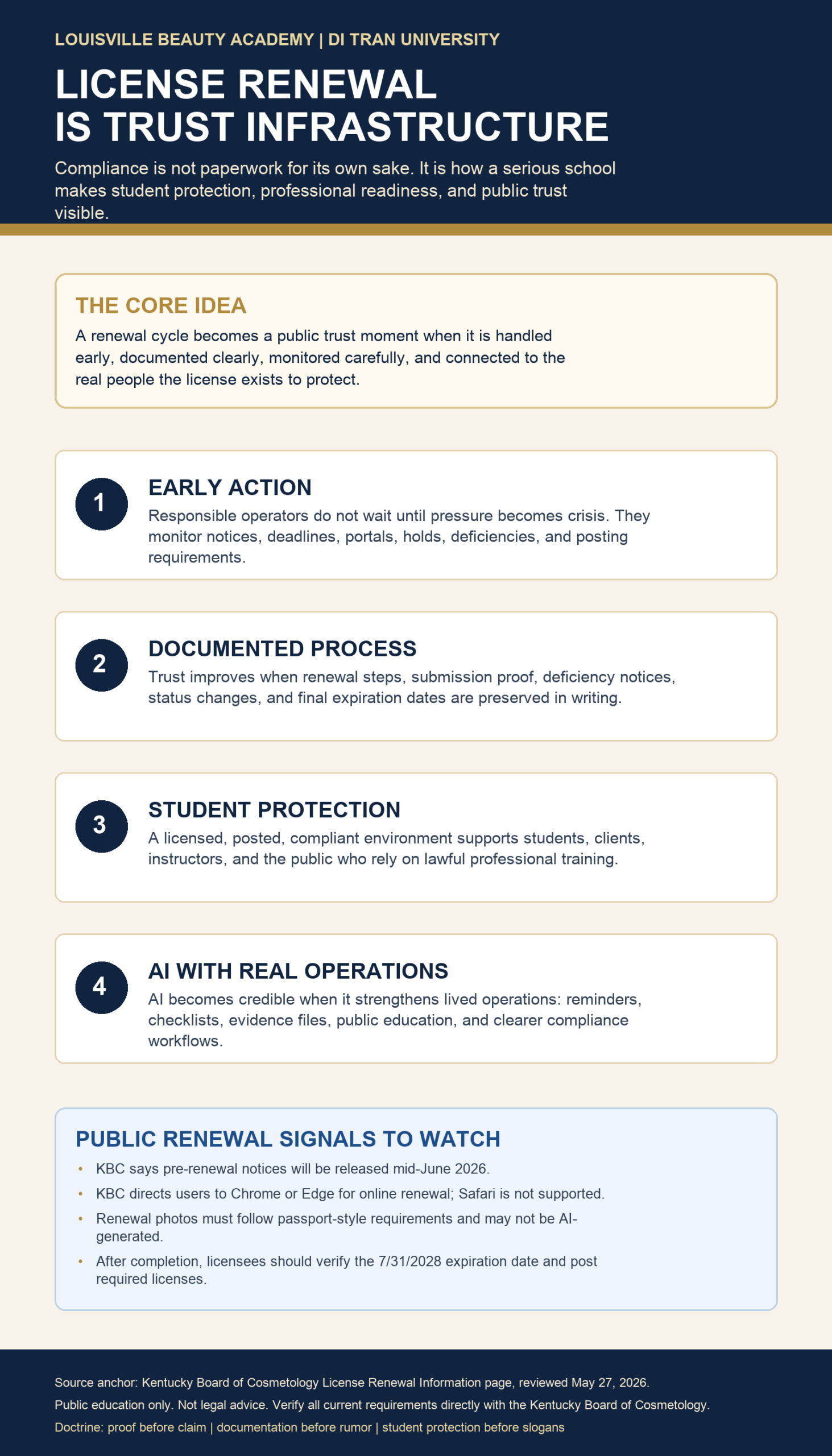
License renewal is easy to treat as administration. That is too small. In a licensed workforce-education environment, renewal is one of the recurring moments when public trust becomes visible.
For Louisville Beauty Academy, the stronger lesson is this: compliance is not paperwork for its own sake. It is a discipline of protection. It helps students, instructors, clients, regulators, and the public see that the school is operating through documented standards rather than verbal assumption.
Why Renewal Matters
A responsible renewal cycle forces an institution to monitor deadlines, portal requirements, deficiency notices, license status, photo requirements, payment pathways, and final posting obligations. Each of those details is small by itself. Together, they form operational seriousness.
The Student-Protection Layer
Students rely on the school environment to be lawful, current, and professionally aligned. Clients rely on posted license visibility. Instructors and staff rely on clear internal process. Renewal discipline supports all three.
AI Should Strengthen the Real Workflow
This is also why AI implementation must be grounded in real operations. AI can help organize checklists, reminders, public explanations, evidence files, and follow-up systems. But the value comes from serving the lawful workflow, not from talking abstractly about technology.
Source and Boundary
This public-education post is anchored to the Kentucky Board of Cosmetology License Renewal Information page: https://kbc.ky.gov/Licensure/Pages/License-Renewal-Information.aspx. It is not legal advice. Readers should verify current requirements directly with the Kentucky Board of Cosmetology and their own professional advisors where appropriate.
Infographic: license renewal as trust infrastructure. Source anchor: Kentucky Board of Cosmetology License Renewal Information page, reviewed May 27, 2026.
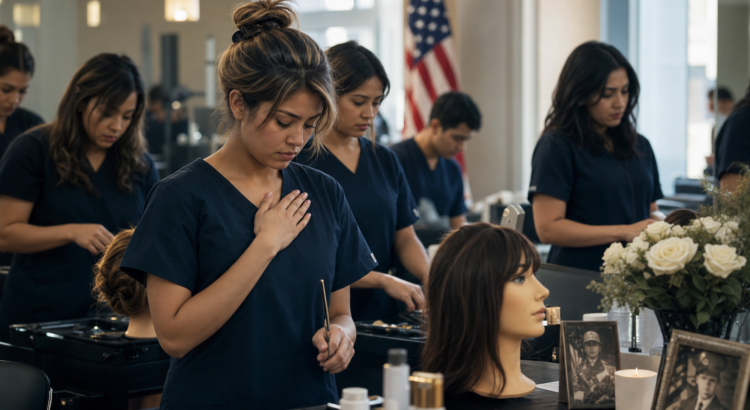
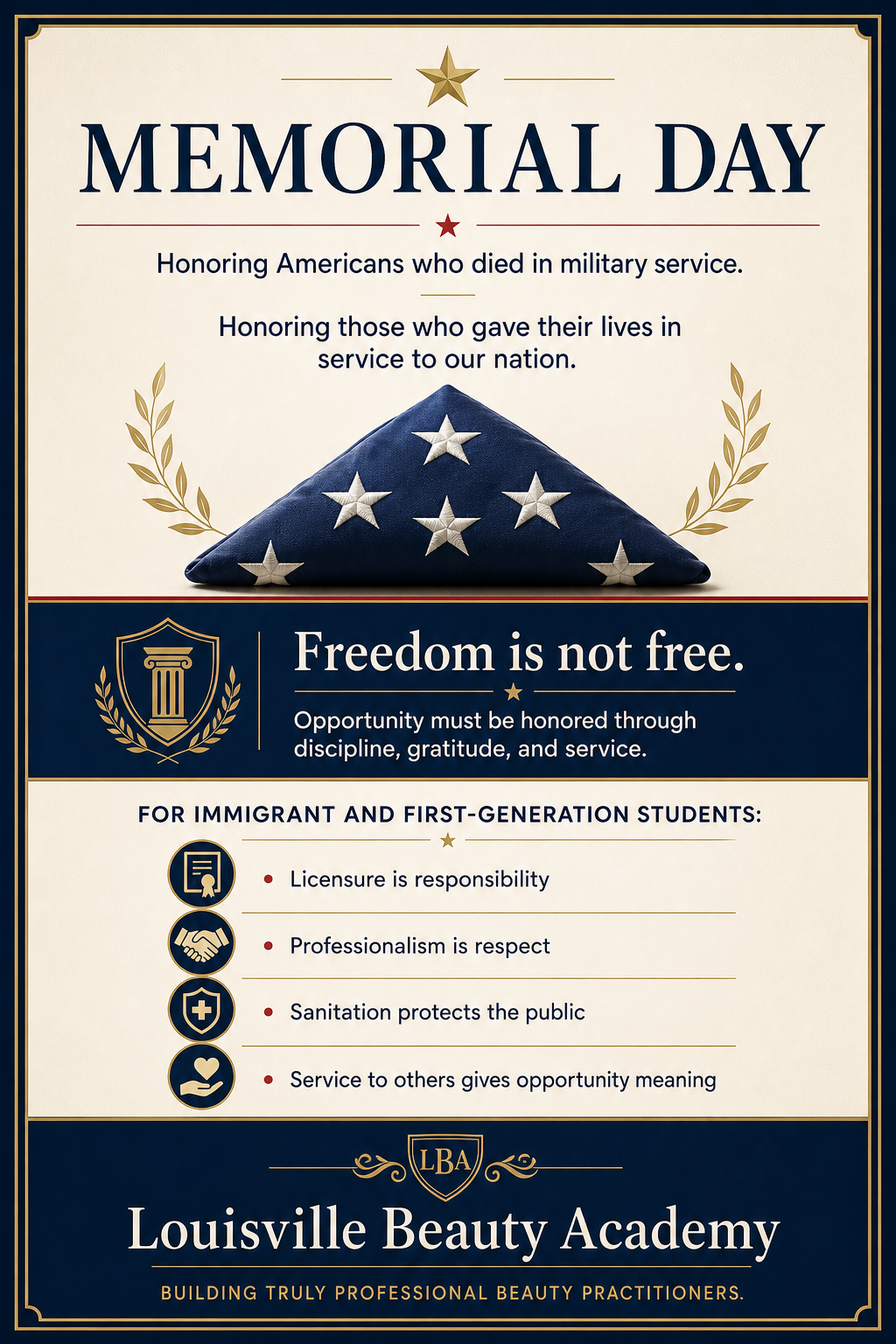
Memorial Day is not only a date on the American calendar. It is a moral reminder that freedom is costly, sacrifice is real, and opportunity should be honored through gratitude, discipline, and work.
At Louisville Beauty Academy, this truth carries particular weight. Many of our students come from immigrant, refugee, multilingual, and first-generation backgrounds. Many are not only learning beauty. They are learning how to establish a life in America—how to work lawfully, become licensed, build income, support family, and grow in confidence and dignity.
That is why Memorial Day matters to us. It teaches something deeper than remembrance alone. It teaches that freedom is not free, and that the opportunities available in this country should never be wasted.
What Memorial Day Honors
Memorial Day is a national day of remembrance for the men and women of the United States Armed Forces who died in service to the nation. Its roots trace back to the post–Civil War tradition of Decoration Day, when communities gathered to decorate the graves of the fallen with flowers, flags, and solemn respect. Over time, the observance grew into a broader national remembrance of American military personnel who gave their lives in war.
This distinction matters. Memorial Day is not the same as Veterans Day. Veterans Day honors those who served. Memorial Day honors those who never came home.
Ordinary peace in civilian life rests on extraordinary sacrifice.
Why This Matters at Louisville Beauty Academy
At Louisville Beauty Academy, many students are building far more than a class schedule. They are building a future. Some are mothers. Some are rebuilding after hardship. Some are learning English while learning a profession. Some are the first in their family to pursue an American license. Some are trying to create, in one generation, what took others many generations to build.
For these students, America is often experienced first not as a political theory, but as a chance: a chance to work, a chance to recover, a chance to become skilled, a chance to support children, and a chance to build a lawful and respectable life.
That is why the phrase “freedom is not free” must be understood in two directions. First, it means that others sacrificed to preserve the nation and its liberties. Second, it means that the person who receives opportunity has a duty not to waste it.
The Professional Meaning of Gratitude
A real school does more than teach technique. A real school helps teach seriousness, gratitude, professionalism, and responsibility. At Louisville Beauty Academy, we believe beauty education should elevate the whole person—not only in skill, but in discipline, conduct, and service.
sanitation and safety,
attendance and reliability,
respect for law and licensure,
client care and communication,
professional presentation,
and the dignity of honest work well done.
The beauty industry is sometimes misunderstood by people who see only appearance and not substance. But beauty education, when done correctly, is disciplined human work. It requires consistency, timing, repetition, emotional steadiness, hygiene, respect, and standards. A truly professional graduate is not simply someone who can perform a service. A professional is someone who can carry standards into real life.
“Yes, I Can” — and Then “I Have Done It”
One of the most important messages a student can learn is this: Yes, I can. But at Louisville Beauty Academy, we want that statement to mature into something stronger: Yes, I can—and through discipline, effort, and proper guidance, I have done it.
Motivation starts the journey. Evidence completes it. A student who arrives uncertain, overwhelmed, shy, new to the country, or unsure of their own potential can still become licensed, skilled, trusted, and professionally respected. We have seen it. We believe in it. And we consider it part of our duty to help make that transformation real.
Beauty With Substance
At Louisville Beauty Academy, beauty is not separated from character. For us, beauty means more than appearance. It means discipline, dignity, cleanliness, licensure, service, lawful work, and the courage to build a real future.
That is why we say we are not only teaching beauty. We are helping build truly professional people—people who understand that a license is not only a credential, but a doorway to responsibility, usefulness, confidence, and belonging.
Our Memorial Day Reflection
This Memorial Day, Louisville Beauty Academy honors the men and women who gave their lives in service to the United States. We also reflect on what that sacrifice means for the students we serve every day.
To our immigrant and first-generation students: your journey matters.
To our students learning English while learning a profession: your effort matters.
To our students building a new life through licensure, discipline, and honest work: your perseverance matters.
And to all who are trying to become stronger, more stable, more professional, and more useful in this country: do not waste the opportunity in front of you.
Freedom is not free. But freedom, joined to gratitude and hard work, can still build a beautiful life.
That is part of what beauty means at Louisville Beauty Academy.
Historical Reference Notes
Memorial Day originated from post–Civil War Decoration Day traditions.
The first national observance is commonly dated to May 30, 1868.
Memorial Day honors U.S. military personnel who died in service.
It later evolved into a broader remembrance of the fallen from all American wars.
It is observed on the last Monday in May.
A National Moment of Remembrance is observed at 3:00 p.m. local time.
Memorial Day at Louisville Beauty Academy: remembering sacrifice first, and teaching students to honor opportunity through discipline, licensure, gratitude, and service.
Students often hear that they need to “believe in themselves.” That matters, but it is not enough.
Di Tran’s new book, The Lost Majority: Why Modern Life Breaks Human Momentum—and How to Restore Structure, Meaning, and Value, offers a more serious lesson: most long-term success is built less on emotional intensity and more on structure, attendance, follow-through, documentation, and the ability to keep going after difficult days.
Why this matters in school
At Louisville Beauty Academy, we see every day that real progress comes from rhythm: showing up, recording hours, completing requirements, following procedure, asking for correction, and continuing until licensure is earned. Motivation may start the journey. Reliability finishes it.
That is one reason this book matters to students. It explains that drift is not just a feeling. It becomes a real problem when intention stops turning into action.
Five lessons students can take from the book
Structure matters more than mood.
Attendance is not a formality; it is momentum made visible.
Proof protects you: hours, records, submissions, and completion matter.
Usefulness builds confidence faster than self-narration.
Steady people become indispensable.
A book about dignity through discipline
The Lost Majority does not shame people for struggling. It gives them language for why struggle happens and a framework for rebuilding order. That is deeply relevant to vocational education, where dignity grows when effort becomes visible skill, documented progress, and real readiness for work.
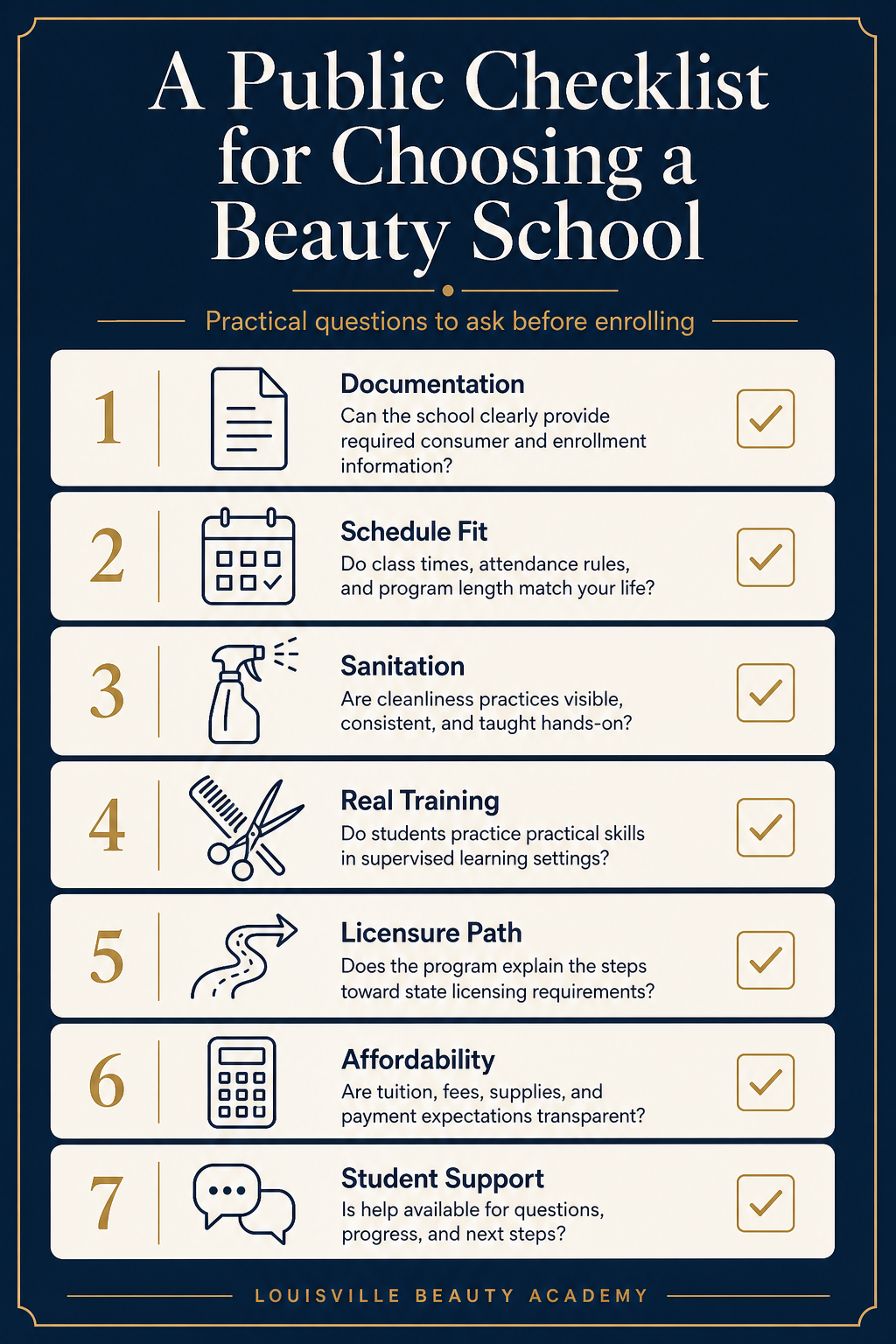
Students and families do not always need someone to tell them which school is right. Often, what they need most is a better set of questions.
Do the instructors and staff communicate in a way that feels respectful, clear, and genuinely helpful?
Does the environment feel clean, sanitary, safe, and serious?
Does the culture seem focused on building students up, or does it feel driven by gossip, confusion, or pressure?
If a document affects the student, is it available in writing and reasonably reviewable before commitment?
Is the student contract accessible enough to inspect before making a major decision?
Are important costs, rules, and expectations clearly documented?
Does the school explain progress standards, attendance expectations, and readiness honestly?
Does the institution seem truly affordable in the student’s real life?
Is communication available in ways the student or family can understand, including multiple languages where possible?
Do the leaders and instructors show proof of work, service, awards, recognition, or real-life example beyond sales language?
Does the school appear focused on helping the student become ready for real work, not just on protecting its own image?
Do I feel that this environment fits me?
There is not always one universally right answer. Sometimes the honest question is simply whether a school is fit or unfit for a particular student’s needs, goals, finances, language reality, schedule, and comfort level.
That is what advocacy should protect: the student’s right to ask, compare, review, and choose with dignity. The goal is not control for its own sake. The goal is informed choice.
This material is provided for public-information and educational purposes only. It reflects general institutional, compliance, and educational discussion informed by applicable federal and state frameworks. It is not individualized legal, financial, or regulatory advice. Students and families should review official program documents, funding terms, school policies, student contracts, and applicable legal requirements before making decisions.
Before enrolling anywhere, students should not feel pressured to decide by emotion alone. They should be able to ask clear questions and look for an environment that fits them.
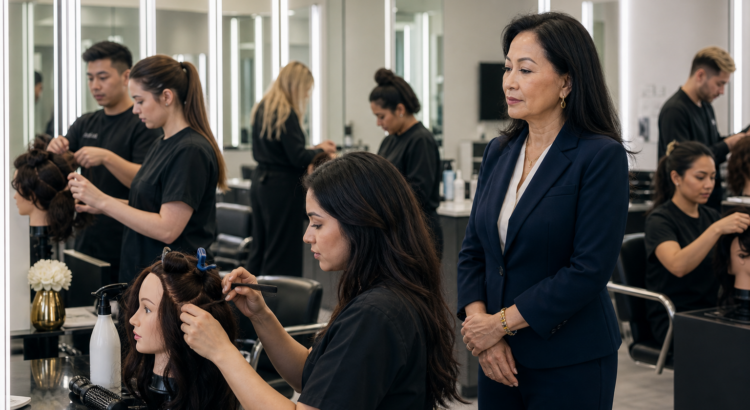
That starts with the people. How do the instructors act? How do the staff act? Do they communicate clearly? Do they seem patient, respectful, and helpful? Do they guide students in a way that feels healthy and serious? A school teaches through human behavior long before it teaches through curriculum.
Students should also look at the atmosphere. Is the environment clean, sanitary, safe, and orderly? Does the culture seem focused on helping people grow, or does it feel driven by gossip, confusion, or unnecessary pressure? A student often senses these things early, and that instinct should not be ignored.
Written transparency matters just as much. If a document affects the student, binds the student, or governs the student, can it be reviewed in writing? Is the student contract reasonably available? Are the core policies digital, reviewable, and understandable before commitment? If important obligations are hidden, vague, or available only through verbal explanation, families may reasonably ask why.
Students may also ask whether the school feels truly accessible. Is it affordable in a real-world sense? Is communication available in ways the student or family can actually understand, including multiple languages where possible? Does the school help students know where they stand academically and practically? Or does it leave them guessing?
Another useful question is whether the institution seems focused more on the student or more on itself. Is the school trying to help the student become ready for real work? Does it build confidence through practice? Does it treat retrying as part of growth? Or does it place more energy into appearance, image, or pressure than into guidance?
Students and families may also consider the leaders. What have they built? What have they contributed? What awards, recognition, service, or proof of work suggest that the institution is grounded in more than sales language? Public trust grows when leadership can be observed through lived example, not merely through slogans.
The point is not to tell the public what to choose. The point is to help the public know what to look for. A school may be fit for one student and unfit for another. Advocacy begins with enough clarity, respect, and transparency for the student to make that choice with open eyes.
This material is provided for public-information and educational purposes only. It reflects general institutional, compliance, and educational discussion informed by applicable federal and state frameworks. It is not individualized legal, financial, or regulatory advice. Students and families should review official program documents, funding terms, school policies, student contracts, and applicable legal requirements before making decisions.
Louisville Beauty Academy exists to help real people enter lawful, dignified work through affordable, practical, licensure-grounded education.
That sentence matters because many students are not searching for educational theater. They are searching for a real path. They need a school that respects their money, respects their time, tells the truth about the profession, and prepares them for the actual standards required to practice.
LBA was built around that reality. We believe beauty education should not trap students in unnecessary debt, vague promises, or inflated institutional self-presentation. It should provide a clear pathway: understand the requirements, complete the training, build competence, prepare for licensure, and move toward workforce participation with honesty and structure.
This is why LBA emphasizes practical readiness, documented expectations, and affordability. We serve students whose lives are often complex. Many work while studying. Many support children or extended family. Many are rebuilding confidence, restarting after hardship, or pursuing a first licensed profession in the United States. A responsible school must be designed with those realities in mind.
Our purpose is therefore larger than classroom instruction alone. We exist to expand access to lawful work, support mobility through skills, and show that a small independent school can serve the public seriously when it is disciplined, transparent, and mission-driven.
We also exist to protect the integrity of educational choice. Students deserve to know what they are paying for, what standards apply, what outcomes require effort, and what the school can and cannot promise. We believe clear communication is part of ethical education.
Louisville Beauty Academy is also the proof institution inside a broader ecosystem. Where Di Tran University publishes doctrine, LBA lives the operational realities. Where NABA advocates for better policy, LBA demonstrates why reform matters. Where Viet Bao documents community trust, LBA shows how that trust is earned through daily service.
Our existence is therefore practical and civic at the same time. We help people train. We help people qualify. We help people move toward work. And by documenting what that looks like, we contribute to a wider public understanding of what affordable, honest, workforce-aligned education can be.
This article is intended for public-information purposes only. Prospective students should review current program disclosures, licensure requirements, and school policies directly before making enrollment decisions.
One of the laziest assumptions in American education is that price signals quality. In reality, price often signals a mixture of legacy overhead, administrative layering, branding costs, financing habits, and inherited inefficiencies that may have only partial connection to instructional value. For students entering practical, licensed fields, the more serious question is different: does the institution deliver lawful, coherent, economically rational preparation for professional entry?
Low cost, by itself, proves nothing. But neither does high cost.
The relevant standard is disciplined educational design. An institution earns trust when it aligns resources to the student’s actual mission: learn the required material, satisfy regulatory standards, prepare for examination, obtain licensure where required, and enter the workforce with dignity. If that sequence can be achieved at a lower price point without sacrificing lawful standards, then affordability is not a weakness. It is evidence of operational intelligence.
This is especially important in career and technical education. NCES continues to track the significance of career and technical pathways in the broader education ecosystem, and the federal education apparatus recognizes the importance of workforce-linked postsecondary access. In such a landscape, institutions that reduce unnecessary cost while preserving practical relevance may be better adapted to the needs of working adults than institutions optimized for prestige display.
The beauty industry makes this contrast visible. A state-approved program is not evaluated by the size of its brochure. It is evaluated by whether learners become professionally ready. The U.S. Bureau of Labor Statistics states clearly that entry into nail technology professions depends on completing a state-approved program and passing a state exam. That sequence does not require wasteful cost structures. It requires competent educational delivery.
So what distinguishes serious affordability from careless affordability?
First, clarity of purpose. The institution must know whether it is selling image or producing outcomes. Outcome-oriented schools organize around licensure readiness, practical scheduling, transparent student communication, and the elimination of needless delay.
Second, disciplined use of resources. Money should be directed toward teaching, compliance, student guidance, exam preparation, and operational responsiveness—not vanity structures or ornamental bureaucracy.
Third, respect for the learner’s economic reality. Many workforce students are supporting families, balancing employment, navigating language barriers, or re-entering education after significant time away. An institution that ignores those facts is not rigorous. It is merely indifferent.
Fourth, lawful seriousness. Affordability must never be achieved through diminished standards, weak oversight, or casual treatment of licensure requirements. That would not be student-centered. It would be exploitative.
When affordability is paired with seriousness, the effects are profound. More students can begin. More students can finish without crushing debt. More graduates can move faster into lawful work. More families can convert training into income and sometimes into business ownership. In this sense, low-cost workforce education can become a stabilizing social technology.
Louisville Beauty Academy is relevant to this conversation because its public posture suggests an attempt to organize around access, immediacy, and practical movement rather than prestige theater. That does not mean observers should suspend scrutiny. Serious institutions welcome scrutiny. It means the right scrutiny should be applied. The correct question is not whether affordability looks elite. The correct question is whether it is producing lawful, student-serving outcomes efficiently.
At a time when the country is rethinking the relationship between cost and value in postsecondary education, institutions that demonstrate affordability with discipline may prove more future-ready than institutions whose primary achievement is expense. The next era will belong to schools that can say, with evidence, that they respect both standards and the student’s wallet.
That is not low ambition. It is high responsibility.
Research & Information Disclaimer
This publication is provided for educational, research, and public-information purposes only. It reflects institutional analysis based on publicly available information, practical experience, and internal interpretation as of the publication date. It does not constitute legal advice, tax advice, investment advice, or a guarantee of regulatory, financial, or operational outcomes. Readers should consult qualified legal, financial, regulatory, or other professional advisors before acting on matters discussed herein.