Kentucky Beauty Licensure From First Day to License: A Real Step-by-Step Map is written for students, families, salon employers, workforce partners, and public officials who need beauty education to be practical, honest, and verifiable.
A plain-language map from school enrollment through hours, graduation, examination, and license verification.
This article does not promise enrollment approval, graduation, examination passage, licensure, employment, income, discounts, funding, or any state-board decision. It gives a disciplined framework for asking better questions and keeping better records.
Deep Research Query Used
Research query: “Kentucky Beauty Licensure From First Day to License: A Real Step-by-Step Map” Kentucky licensure pathway official sources Kentucky Board of Cosmetology PSI NIC FTC CFPB BLS O*NET CareerOneStop student protection workforce economics no guarantee licensure employment income board approval
The Board Controls Licensure
A school can teach, track, graduate, document, and support. It cannot replace the Kentucky Board of Cosmetology. The Board publishes the requirements for license categories and students should treat those public pages as controlling starting points. That distinction protects everyone: the student, the school, the public, and the profession.
Hours Are Not Symbolic
Kentucky’s published requirements identify training-hour thresholds for license categories. Cosmetology, nail technology, esthetics, shampoo styling, and instructor pathways are not interchangeable. A student should understand the license they are pursuing, the required hours, and the difference between school completion and state licensure.
The Practical Sequence
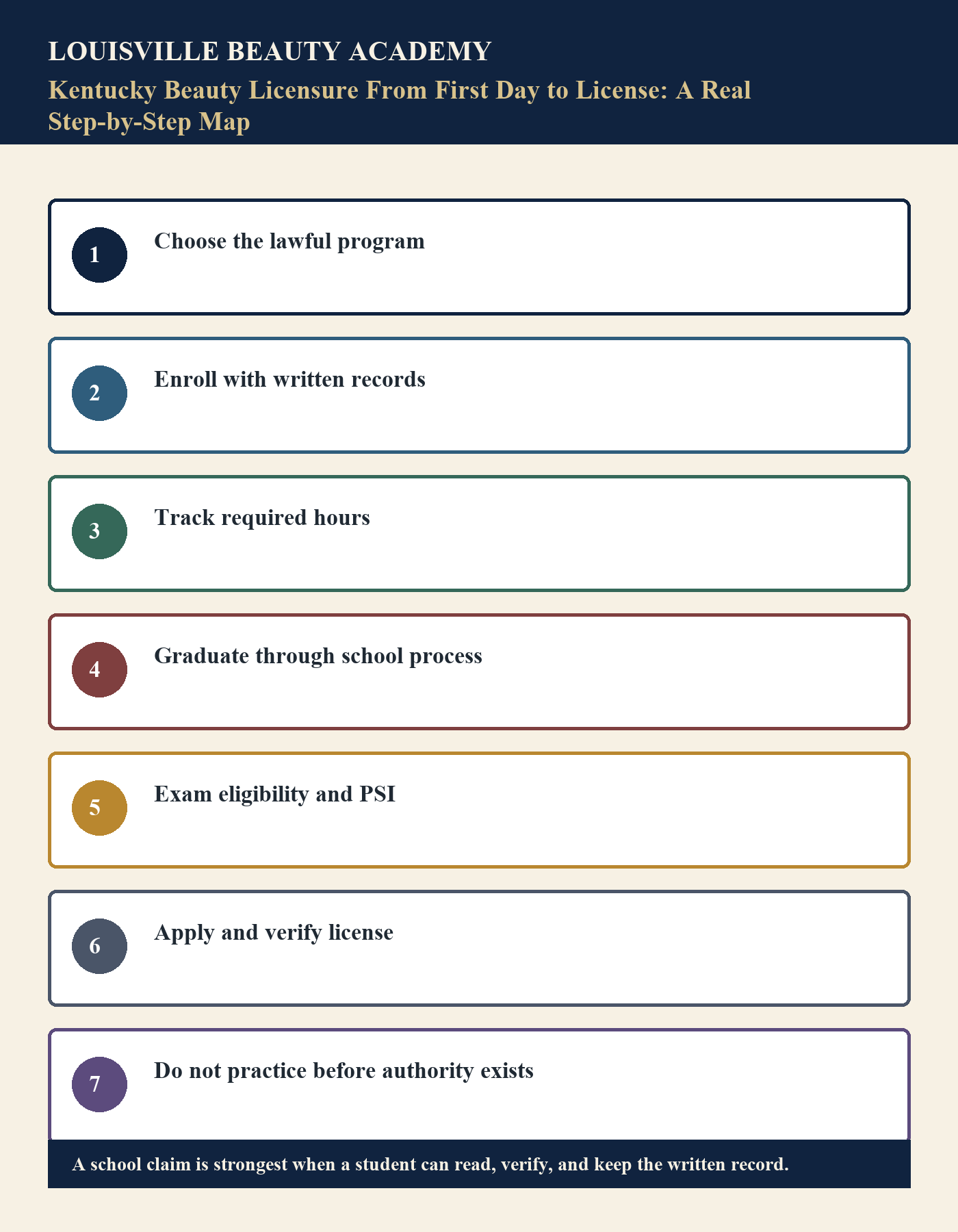
A disciplined sequence looks like this: choose the right program; complete enrollment using current written documents; attend and track hours; follow school policy; complete required training; move through graduation processing; follow Board and PSI examination rules; apply for licensure; and wait for proper verification before providing regulated services.
Exam Readiness Is More Than Studying
Exam readiness includes theory knowledge, practical discipline, sanitation habits, supplies, scheduling awareness, language support awareness where available, and calm recordkeeping. PSI and the Board, not the school, control examination procedures and timing.
LBA Position
Louisville Beauty Academy should speak about licensure with respect and precision. The school can help students prepare, but no school should imply it can guarantee a Board decision, exam result, license issue date, or employment outcome.
The Research Questions Behind This Article
A flagship article cannot simply repeat a slogan. For this topic, the controlling research question is: how should a serious student, family, school, employer, or public official understand Kentucky licensure pathway using official sources first, institutional documents second, and real economic judgment third?
- What does the public authority or official source actually control?
- What can the school properly explain without overpromising?
- What must the student keep in writing?
- What economic pressure will the student or family feel in real life?
- What claim language would be unsafe, exaggerated, or confusing?
The Real-World Scenario
Imagine a working adult considering beauty school while balancing rent, transportation, family obligations, work hours, language needs, and the desire to enter a licensed profession. That person does not need vague inspiration only. They need a clean decision system. Kentucky Beauty Licensure From First Day to License: A Real Step-by-Step Map is built around that practical reality.
The student may be excited, but excitement is not a substitute for proof. The family may trust the school, but trust is stronger when written records can be reviewed. The school may want to help, but help must stay inside legal, ethical, and factual boundaries. A strong system respects all three sides.
The Economic Layer
Beauty education is economic infrastructure because it can convert time, discipline, documentation, and supervised practice into a licensed workforce pathway. But economics must be explained honestly. A student should consider total cost, schedule burden, exam timing, income uncertainty, transportation, childcare, supply needs, retake risk, and the difference between gross sales and net income.
This is why LBA’s strongest public posture is not a flashy promise. It is practical clarity: understand the program, understand the rules, understand the records, understand the cost stack, and understand who controls each decision. That is more powerful than sales language because it makes the student more capable.
The Compliance Layer
In regulated education, the safest sentence is often the most precise sentence. Schools can describe their programs, policies, supports, prices, documents, and educational practices. Schools should not guarantee licensure, employment, exam passage, income, transfer acceptance, state-board approval, or individual financial outcomes.
A school that speaks carefully is not weaker. It is stronger. Careful language tells the public that the institution respects the student, the regulator, the profession, and the difference between support and authority.
What This Means for Students
Students should develop a documentation mindset early. That means keeping copies, reading before signing, asking for clarification in writing, saving screenshots or PDFs of current official pages when needed, and knowing the difference between a school explanation and a controlling government or exam-vendor rule.
- Choose the lawful program
- Enroll with written records
- Track required hours
- Graduate through school process
- Exam eligibility and PSI
- Apply and verify license
- Do not practice before authority exists
What This Means for Schools
A serious school should make the student’s path easier to understand without pretending that every part of the path is easy. The better institutional standard is disciplined transparency: show the relevant documents, explain the limits, direct students to official sources, preserve records, and use public pages to reduce confusion before enrollment.
That standard also helps employers, funders, public officials, and community partners. They can see that the school is not merely recruiting students. It is building a documented, lawful, practical workforce pathway.
World-Cross Feature
The same principle appears in other serious fields. A mortgage depends on written disclosures. A medical procedure depends on consent and records. A pilot logs flight hours. A nurse tracks clinical requirements. A skilled trade apprentice records training progress. Beauty education deserves the same respect: practical work, public safety, documentation, and lawful progression all matter.
Common Misunderstandings to Avoid
- Do not treat a verbal statement as stronger than the current written document.
- Do not assume a school controls a state-board or exam-vendor decision.
- Do not confuse school completion with licensure.
- Do not compare programs only by headline price.
- Do not treat translation, advising, or support as a guarantee.
Flagship Bottom Line
The central standard is simple: Kentucky licensure pathway should be understandable, documented, and grounded in official sources. When a school teaches that way, students become stronger decision-makers. When students learn that way, the profession becomes more credible. When the public sees that standard in writing, institutional trust rises.
Frequently Asked Questions
Does this article replace official Board, exam, or legal guidance? No. It is an educational guide. Students should verify current requirements with the responsible official source.
Does LBA guarantee licensure, exam passage, employment, income, or a particular Board decision? No. LBA can provide education, documentation, and support inside its lawful role, but outside authorities and individual student performance matter.
What is the strongest student habit? Read first, keep copies, ask written questions, attend consistently, and treat every important education step as part of a proof chain.
Practical Reader Checklist
- Choose the lawful program
- Enroll with written records
- Track required hours
- Graduate through school process
- Exam eligibility and PSI
- Apply and verify license
- Do not practice before authority exists
Student Protection Notice
Students should rely on current written documents, official state-board and exam-vendor information, and the school documents actually provided to them. Policies, fees, rules, and external requirements can change. When the issue is licensing, examination, transfer, discipline, or official approval, the relevant public authority controls.
References and Official Starting Points
- Kentucky Board of Cosmetology License Requirements
- Kentucky Board of Cosmetology Exams
- Kentucky Board of Cosmetology Fees
- 201 KAR Chapter 12 Education Requirements
- LBA 50-State License Transfer Hub