Louisville Beauty Academy has launched a flagship 1,500-question Cosmetology Study Lab for students preparing for Kentucky cosmetology licensing readiness. The purpose is not memorization alone. The purpose is calm professional judgment: sanitation first, public protection first, client consultation first, product labels first, legal scope first, and technical sequence with care.
This original PSI-style practice bank includes answers and explanations across licensing, infection control, anatomy, skin and scalp, hair analysis, shampooing, haircutting, styling, chemical texture, color, nails, basic esthetics, salon business, emergency judgment, and integrated scenarios. It is a supplemental learning tool alongside instructor guidance, hands-on clinic practice, Milady/CIMA learning, and current official Kentucky Board of Cosmetology and PSI instructions.
Important: this is original Louisville Beauty Academy educational practice. It is not official PSI software, not copied exam content, not a guarantee of passing, and not a replacement for KBC or PSI instructions. Official sources control.
LBALouisville Beauty Academy Student Success Lab
Kentucky Cosmetology Licensing Readiness
1500-Question Study Lab
Original PSI-style cosmetology practice questions, immediate answers, and full explanations for Kentucky theory readiness.
Randomized practiceInstant explanationsTopic breakdownStudent code gatePrint and copy result
Current-source caution for 2026:
KBC lists Cosmetologist as a 1500-hour license path requiring grade 12 equivalency proof, age 18, written and practical examinations, application, and license verification or license before providing services. Visitors may use the public preview; full practice modes require authorized LBA student access. Students should verify all requirements through official KBC and PSI sources before scheduling.
Start practice
Choose your study mode
Use preview for a quick warm-up, simulation for disciplined practice, or the full bank for complete topic mastery.
The 10-question preview is open to visitors. Larger study modes are for authorized LBA students and require the current student access code.
The 10-question preview is public. Student modes validate through LBA’s existing student-code gate. Do not share codes. Progress saves only in this browser on this device.
Practice
Question 1
Answered: 0Correct: 0Elapsed: 00:00
Topic
Question
Choose the best answer. The explanation appears immediately after your first choice.
Question map
Green is correct, amber needs review, white is unanswered.
Learning summary
Your practice result
Use the topic breakdown to choose what to review next with your instructor or current official materials.
Student access and privacy notice
Full interactive access is for authorized Louisville Beauty Academy students. Ask your instructor for the current code and keep it private. This page uses LBA’s existing student-code validation route before launching 50-, 100-, 300-, or 1500-question modes; the access code itself is not printed on this page.
This educational practice lab is not a PSI product, not official exam content, not a clock-hour record, and not a guarantee of licensure. It exists to train professional judgment, sanitation reasoning, law/source awareness, client safety, and exam discipline.
By Louisville Beauty Academy Educational Article | Workforce Awareness Series 2026
Editorial Attribution & Research Credit
This article is published by Louisville Beauty Academy with full gratitude and acknowledgment to the research, analysis, writing, and editorial work of the Di Tran University – College of Humanization Research Team. The underlying workforce research, economic analysis, policy review, and human-centered framework that informed this educational article originate from the independent research and public scholarship of Di Tran University’s College of Humanization. Louisville Beauty Academy shares this article to help educate students, families, career changers, educators, employers, and the public on emerging workforce trends and the future of human-centered professions.
Readers interested in the complete research are encouraged to read:
The Great Human Shift: AI, Corporate Layoffs & Why Human-Centered Careers May Be America’s Strongest Future — Research & Podcast Series 2026
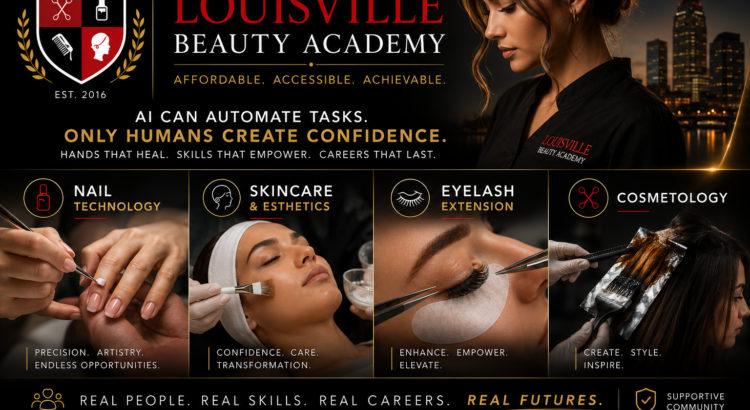
Artificial intelligence is changing the way America works.
Across industries, businesses are adopting AI to automate routine tasks, improve productivity, and reshape how work gets done. Many office-based positions are evolving, some are being redefined, and others are being reduced as organizations rethink traditional corporate structures.
For many people, this creates uncertainty.
For others, it creates an opportunity to ask an important question:
What careers become more valuable when technology becomes more capable?
At Louisville Beauty Academy, we believe this question deserves careful research—not fear, not marketing, and not speculation.
That is why we encourage prospective students, families, educators, and career changers to learn about the broader workforce transformation occurring across the United States.
Human Skills Cannot Be Downloaded
Artificial intelligence can generate text.
It can analyze data.
It can organize schedules.
It can answer emails.
It can even help beauty professionals manage appointments, marketing, inventory, and business operations.
But AI cannot replace what happens when one human serves another with professionalism, trust, safety, compassion, and skilled hands.
A licensed nail technician doesn’t simply polish nails.
They help restore confidence.
An esthetician doesn’t simply perform a facial.
They help clients care for their skin, their well-being, and often their self-esteem.
A cosmetologist doesn’t simply cut hair.
They help people prepare for weddings, interviews, graduations, celebrations, and some of life’s most meaningful moments.
These are deeply human professions.
Technology may support them.
It does not replace them.
Licensed Beauty Professionals Build More Than Beauty
The beauty profession is often misunderstood.
Behind every state license is education in:
Infection control
Sanitation
Public safety
State law and regulations
Professional ethics
Technical skills
Client communication
Business fundamentals
These are licensed professions that protect the public while creating opportunities for meaningful careers and entrepreneurship.
Many professionals eventually become:
Salon owners
Independent suite renters
Educators
Product specialists
Brand ambassadors
Small business owners
Community leaders
A license is not simply permission to work.
For many, it becomes the foundation for building a business and serving a community.
Affordable Education Matters
Choosing a school is one of the most important financial decisions a student will make.
At Louisville Beauty Academy, we believe prospective students should compare:
Tuition
Program length
Written payment options
Licensing preparation
Student support
Schedule flexibility
Graduation requirements
Regulatory compliance
Overall value
We encourage every student to visit multiple schools, ask questions, request everything in writing, and make the decision that best fits their goals, finances, and circumstances.
An informed student is an empowered student.
AI Is a Tool—Not a Replacement for Humanity
Louisville Beauty Academy embraces technology where it improves education and student support.
AI-assisted translation.
Digital documentation.
Administrative efficiency.
Learning support.
Communication.
These tools help students learn more effectively and help educators spend more time teaching people—not paperwork.
Technology should strengthen human education, not replace it.
A Future Built on Service
Throughout history, technology has changed the tools we use.
It has never changed the importance of serving another human being well.
People will continue to seek professionals they trust.
People will continue to value kindness, craftsmanship, communication, and integrity.
People will continue to invest in confidence, wellness, and personal care.
Those are human needs.
And human needs create human careers.
Continue the Research
This article summarizes only part of a much larger workforce discussion.
For readers interested in labor market trends, AI, corporate restructuring, vocational education, entrepreneurship, and the future of human-centered careers, we invite you to read the independent research published by Di Tran University – The College of Humanization:
The Great Human Shift: AI, Corporate Layoffs & Why Human-Centered Careers May Be America’s Strongest Future – Research & Podcast Series 2026
The research examines publicly available information from government agencies, labor economists, academic institutions, and industry sources to explore how artificial intelligence is reshaping work—and why licensed, human-centered professions may become increasingly valuable in the decades ahead.
Our Commitment
At Louisville Beauty Academy, our mission has never been to tell students what career to choose.
Our mission is to provide affordable, accessible, ethical, state-approved education so students can make informed decisions, earn professional licensure, and build meaningful careers through service, skill, and lifelong learning.
Whether you choose Louisville Beauty Academy or another licensed institution, we encourage you to research carefully, compare thoughtfully, and invest in an education that aligns with your goals.
Because while technology will continue to evolve, one truth remains:
Human hands build trust. Human service builds communities. Human character builds careers.
Educational Disclaimer
This article is provided for educational and informational purposes only. It should not be interpreted as career, financial, legal, or employment advice. Labor market conditions change over time, and career outcomes vary by individual, region, experience, effort, and economic conditions. Louisville Beauty Academy encourages prospective students to conduct independent research, review official labor market information, compare educational institutions, and make informed decisions based on their own goals and circumstances. References to the independent research published by Di Tran University are provided to encourage continued learning and public discussion about workforce trends in the age of artificial intelligence.
Kentucky Beauty Licensure From First Day to License: A Real Step-by-Step Map is written for students, families, salon employers, workforce partners, and public officials who need beauty education to be practical, honest, and verifiable.
A plain-language map from school enrollment through hours, graduation, examination, and license verification.
This article does not promise enrollment approval, graduation, examination passage, licensure, employment, income, discounts, funding, or any state-board decision. It gives a disciplined framework for asking better questions and keeping better records.
Deep Research Query Used
Research query: “Kentucky Beauty Licensure From First Day to License: A Real Step-by-Step Map” Kentucky licensure pathway official sources Kentucky Board of Cosmetology PSI NIC FTC CFPB BLS O*NET CareerOneStop student protection workforce economics no guarantee licensure employment income board approval
The Board Controls Licensure
A school can teach, track, graduate, document, and support. It cannot replace the Kentucky Board of Cosmetology. The Board publishes the requirements for license categories and students should treat those public pages as controlling starting points. That distinction protects everyone: the student, the school, the public, and the profession.
Hours Are Not Symbolic
Kentucky’s published requirements identify training-hour thresholds for license categories. Cosmetology, nail technology, esthetics, shampoo styling, and instructor pathways are not interchangeable. A student should understand the license they are pursuing, the required hours, and the difference between school completion and state licensure.
The Practical Sequence
A disciplined sequence looks like this: choose the right program; complete enrollment using current written documents; attend and track hours; follow school policy; complete required training; move through graduation processing; follow Board and PSI examination rules; apply for licensure; and wait for proper verification before providing regulated services.
Exam Readiness Is More Than Studying
Exam readiness includes theory knowledge, practical discipline, sanitation habits, supplies, scheduling awareness, language support awareness where available, and calm recordkeeping. PSI and the Board, not the school, control examination procedures and timing.
LBA Position
Louisville Beauty Academy should speak about licensure with respect and precision. The school can help students prepare, but no school should imply it can guarantee a Board decision, exam result, license issue date, or employment outcome.
The Research Questions Behind This Article
A flagship article cannot simply repeat a slogan. For this topic, the controlling research question is: how should a serious student, family, school, employer, or public official understand Kentucky licensure pathway using official sources first, institutional documents second, and real economic judgment third?
What does the public authority or official source actually control?
What can the school properly explain without overpromising?
What must the student keep in writing?
What economic pressure will the student or family feel in real life?
What claim language would be unsafe, exaggerated, or confusing?
The Real-World Scenario
Imagine a working adult considering beauty school while balancing rent, transportation, family obligations, work hours, language needs, and the desire to enter a licensed profession. That person does not need vague inspiration only. They need a clean decision system. Kentucky Beauty Licensure From First Day to License: A Real Step-by-Step Map is built around that practical reality.
The student may be excited, but excitement is not a substitute for proof. The family may trust the school, but trust is stronger when written records can be reviewed. The school may want to help, but help must stay inside legal, ethical, and factual boundaries. A strong system respects all three sides.
The Economic Layer
Beauty education is economic infrastructure because it can convert time, discipline, documentation, and supervised practice into a licensed workforce pathway. But economics must be explained honestly. A student should consider total cost, schedule burden, exam timing, income uncertainty, transportation, childcare, supply needs, retake risk, and the difference between gross sales and net income.
This is why LBA’s strongest public posture is not a flashy promise. It is practical clarity: understand the program, understand the rules, understand the records, understand the cost stack, and understand who controls each decision. That is more powerful than sales language because it makes the student more capable.
The Compliance Layer
In regulated education, the safest sentence is often the most precise sentence. Schools can describe their programs, policies, supports, prices, documents, and educational practices. Schools should not guarantee licensure, employment, exam passage, income, transfer acceptance, state-board approval, or individual financial outcomes.
A school that speaks carefully is not weaker. It is stronger. Careful language tells the public that the institution respects the student, the regulator, the profession, and the difference between support and authority.
What This Means for Students
Students should develop a documentation mindset early. That means keeping copies, reading before signing, asking for clarification in writing, saving screenshots or PDFs of current official pages when needed, and knowing the difference between a school explanation and a controlling government or exam-vendor rule.
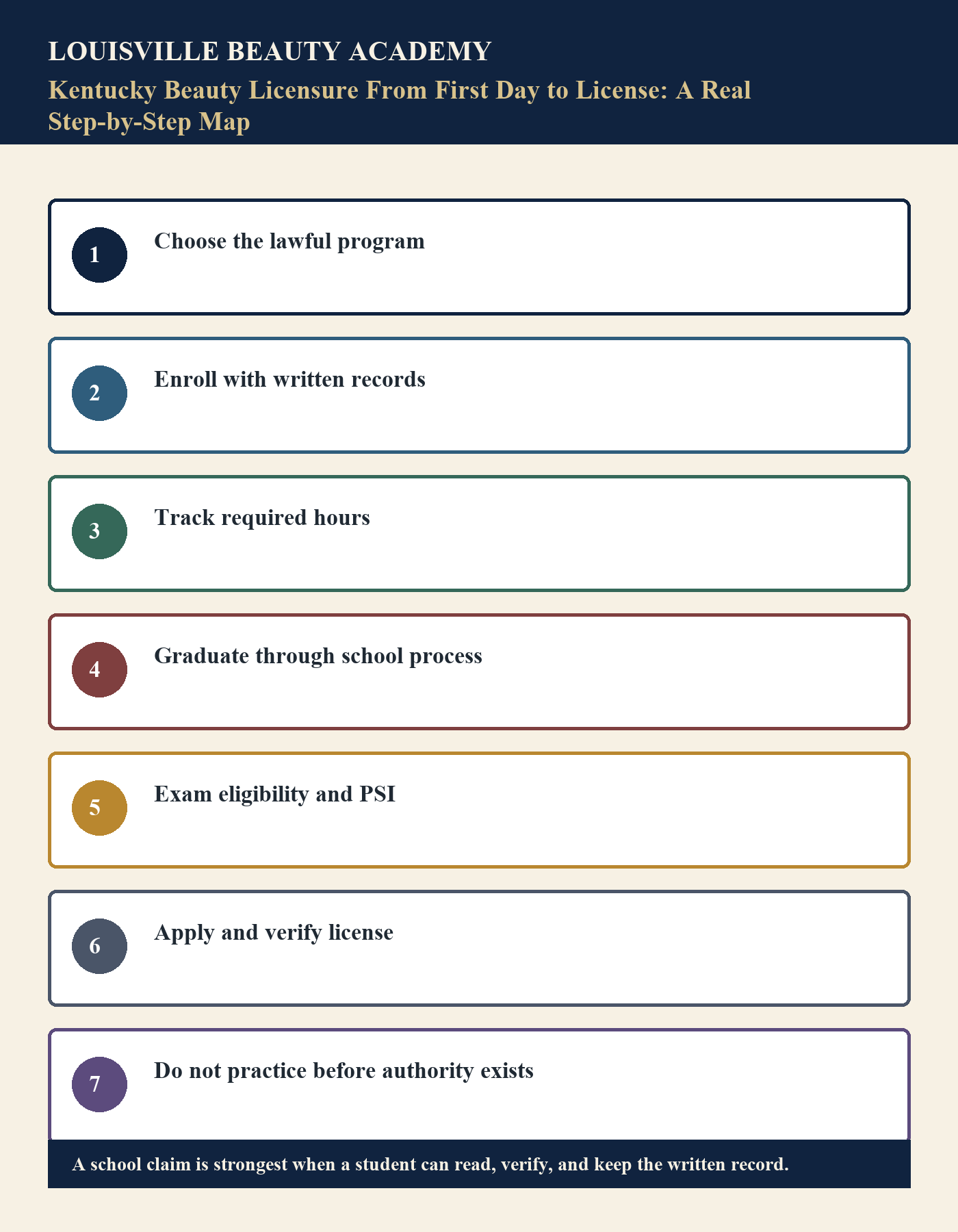
Choose the lawful program
Enroll with written records
Track required hours
Graduate through school process
Exam eligibility and PSI
Apply and verify license
Do not practice before authority exists
What This Means for Schools
A serious school should make the student’s path easier to understand without pretending that every part of the path is easy. The better institutional standard is disciplined transparency: show the relevant documents, explain the limits, direct students to official sources, preserve records, and use public pages to reduce confusion before enrollment.
That standard also helps employers, funders, public officials, and community partners. They can see that the school is not merely recruiting students. It is building a documented, lawful, practical workforce pathway.
World-Cross Feature
The same principle appears in other serious fields. A mortgage depends on written disclosures. A medical procedure depends on consent and records. A pilot logs flight hours. A nurse tracks clinical requirements. A skilled trade apprentice records training progress. Beauty education deserves the same respect: practical work, public safety, documentation, and lawful progression all matter.
Common Misunderstandings to Avoid
Do not treat a verbal statement as stronger than the current written document.
Do not assume a school controls a state-board or exam-vendor decision.
Do not confuse school completion with licensure.
Do not compare programs only by headline price.
Do not treat translation, advising, or support as a guarantee.
Flagship Bottom Line
The central standard is simple: Kentucky licensure pathway should be understandable, documented, and grounded in official sources. When a school teaches that way, students become stronger decision-makers. When students learn that way, the profession becomes more credible. When the public sees that standard in writing, institutional trust rises.
Frequently Asked Questions
Does this article replace official Board, exam, or legal guidance? No. It is an educational guide. Students should verify current requirements with the responsible official source.
Does LBA guarantee licensure, exam passage, employment, income, or a particular Board decision? No. LBA can provide education, documentation, and support inside its lawful role, but outside authorities and individual student performance matter.
What is the strongest student habit? Read first, keep copies, ask written questions, attend consistently, and treat every important education step as part of a proof chain.
Practical Reader Checklist
Choose the lawful program
Enroll with written records
Track required hours
Graduate through school process
Exam eligibility and PSI
Apply and verify license
Do not practice before authority exists
Student Protection Notice
Students should rely on current written documents, official state-board and exam-vendor information, and the school documents actually provided to them. Policies, fees, rules, and external requirements can change. When the issue is licensing, examination, transfer, discipline, or official approval, the relevant public authority controls.
This article is part of LBA’s public education and historical archive. Older posts, including “The Reality of Cosmetology Education in Kentucky What Adult Students Must Understand Before Enrolling,” may not reflect current tuition, schedules, incentives, forms, policies, testing vendors, clinic availability, or regulatory requirements.
Di Tran University Research & Workforce Policy Series – 2026
Frequently Asked Questions About Cosmetology and Beauty Training in Kentucky
How many hours are required for a cosmetology license in Kentucky? Kentucky requires 1,500 training hours for a cosmetology license under KRS Chapter 317A and the administrative regulations in 201 KAR Chapter 12. The curriculum includes theory instruction, clinical practice, and Kentucky law before a student can qualify for the state licensing examination administered through PSI.
How many hours are required for an esthetician license in Kentucky? Kentucky requires 750 training hours for an Esthetics license. Esthetics training focuses on skin care, facial treatments, sanitation, infection control, product chemistry, and safe skin service procedures. Graduates must pass the Kentucky state board licensing examination to practice professionally.
How many hours are required for a nail technician license in Kentucky? Kentucky requires 450 training hours for a Nail Technology license. Training includes sanitation, infection control, nail structure, chemistry of nail products, and practical service procedures before qualifying for the state licensing exam.
Is shampoo styling a license in Kentucky? Yes. Shampoo Styling is a licensed profession in Kentucky requiring 300 hours of training in a licensed cosmetology school. The program focuses on shampooing, scalp treatments, blow-drying, and basic styling techniques, with strong emphasis on sanitation and hygiene.
Is eyelash extension a license in Kentucky? No. Eyelash extensions are regulated through a specialty permit rather than a full license. Practitioners must complete approved training and obtain a specialty permit before legally performing eyelash extension services.
What is the difference between a license and a specialty permit? A professional license (cosmetology, esthetics, nail technology, or shampoo styling) requires a defined number of training hours and passing a state licensing examination. A specialty permit allows practice of a specific limited service and typically requires shorter training focused only on that service.
Can cosmetology or esthetics students work on real clients during school? Yes. Kentucky allows student clinics in licensed schools. However, cosmetology students must complete at least 250 hours of foundational training before performing chemical services on members of the public in order to protect public safety.
How much does beauty school cost in Kentucky? Tuition varies widely depending on the institution. Programs may range from lower-cost vocational training models to higher-priced schools that rely heavily on federal student aid. Prospective students should compare tuition, exam preparation support, and graduation outcomes before enrolling.
Correct Kentucky Program Hour Requirements Summary
Program
Hours Required
Credential Type
Cosmetology
1,500 hours
License
Esthetics
750 hours
License
Nail Technology
450 hours
License
Shampoo Styling
300 hours
License
Eyelash Extension
Specialty training
Specialty Permit
Research & Educational Disclaimer
This article is provided for public education and workforce research purposes only and reflects analysis prepared by researchers affiliated with Di Tran University as part of its ongoing study of vocational education systems, regulatory structures, and economic outcomes for adult learners. The content represents independent academic commentary and general informational analysis regarding industry trends, public regulations, and financial literacy considerations within cosmetology education. Publication on the Louisville Beauty Academy website is intended solely to support consumer awareness and transparency in vocational decision-making. Nothing in this article should be interpreted as legal advice, regulatory interpretation, endorsement of any institution, or criticism of any specific organization, program, regulator, or business entity. Regulatory references are provided for educational context only, and readers are encouraged to consult the official statutes, administrative regulations, and the appropriate licensing authorities for authoritative guidance. Louisville Beauty Academy does not claim authorship of the analysis and assumes no responsibility for third-party interpretations or decisions made based on this informational content.
The Architecture of Regulatory Capture in Cosmetology: Institutional Influence, Competitive Obstruction, and the Crisis of Debt-Dependent Education
The landscape of occupational licensing in the United States, particularly within the cosmetology and beauty services sector, serves as a primary example of regulatory capture. This phenomenon, where state agencies created to act in the public interest instead prioritize the commercial and political objectives of the industries they regulate, is not merely a theoretical concern but a documented reality with significant economic consequences. In the beauty education sector, this capture is facilitated through a complex network of statutory board compositions, aggressive lobbying by trade associations, and an accreditation system that serves as a gatekeeper for billions of dollars in federal subsidies. The resulting policy environment often suppresses competition, inflates tuition, and traps low-income and immigrant learners in a cycle of debt that bears little relation to professional mastery or public safety.
The Theoretical Framework of Occupational Capture and Market Distortion
Regulatory capture within cosmetology boards is characterized by the dominance of active market participants over the regulatory process. When a licensing board is composed primarily of industry insiders—specifically owners of large cosmetology school chains—the board’s incentives shift from protecting the public to protecting incumbent business models. This is particularly evident in the setting of mandatory instructional hours, curriculum standards, and the adjudication of competitive entries. Research from the Center for the Study of Economic Liberty (CSEL) at Arizona State University suggests that this mechanism of capture is the primary driver behind the suppression of employment and entrepreneurial opportunities in the sector.1
The economic impact of this capture is quantifiable. Boards dominated by industry incumbents tend to set higher barriers to entry, which increases the time and cost required to obtain a license. According to CSEL’s 2020 report, the “Cosmetology Board Capture Index” reveals a direct correlation between the lack of public representation on boards and the length of state-mandated training.2 In the eight states with the highest levels of board capture—defined as having zero public representatives—it takes an average of 50 more calendar days than the national average to fulfill the state requirements for licensure.2
National Metrics of Cosmetology Board Capture
Data Observation
States with Zero Public Board Representatives
New York, North Dakota 2
States with High Capture (Minimal Public Input)
LA, MA, MS, OK, VT, WY 2
National Average Training Time Increase (High Capture States)
+50 Days 2
States with Majority Public Boards
Arizona (post-2020), California 3
States with Eliminated Boards (Least Captured)
Maine, Arkansas (Eliminated 2009) 3
These “high capture” states often resist reforms such as universal licensure reciprocity, which would allow practitioners to move across state lines without undergoing duplicative and costly training.4 By maintaining fragmented and high-barrier licensing regimes, captured boards ensure that students remain enrolled in schools longer, thereby maximizing the tuition revenue generated for the institutions represented on those boards.5
Schools that operate with lower tuition models allow graduates to enter the workforce without heavy debt obligations. When graduates are not burdened by loan repayment, they can reinvest earnings into advanced education, business ownership, and local economic activity. In contrast, high-tuition programs often delay entrepreneurship because graduates must prioritize debt repayment before building independent practices.
Structural Capture in State Statutes: The Case of Kentucky
The Commonwealth of Kentucky provides a granular view of how regulatory capture is codified into state law. Kentucky Revised Statute (KRS) 317A.030 establishes the composition of the Kentucky Board of Cosmetology (KBC) in a manner that virtually guarantees industry dominance. The statute mandates a seven-member board, but only one of those seats is reserved for a “citizen at large” who is free from financial ties to the industry.6
The board’s composition under KRS 317A.030 is as follows:
Two members must be cosmetology salon owners.
One member must be a cosmetology teacher in public education.
One member must be an owner of, or have a financial interest in, a licensed cosmetology school.
One member must be a licensed nail technician.7
One member must be a licensed esthetician.7
One member is a citizen at large.6
A critical second-order insight into this statutory structure is the requirement that the school owner member “shall be a member of a nationally recognized association of cosmetologists”.6 By embedding membership in a trade association—such as the American Association of Cosmetology Schools (AACS)—directly into the qualifications for a government regulator, the state effectively delegates regulatory influence to private interest groups. This formal mechanism ensures that the national policy agenda of large, for-profit school chains is represented at the highest levels of state oversight.
The informal mechanisms of capture in Kentucky have historically been even more pronounced. Prior to 2024, the KBC faced significant public pressure and allegations of mismanagement, leading to the removal of Executive Director Julie Campbell in September 2024 after a seven-year tenure.9 The board’s transition to new leadership under Joni Upchurch, a former cosmetology professor, and the appointment of Michael Carter as the first-ever nail technician board member, represent attempts at institutional reform.9 However, even under new leadership, the board continues to exhibit the hallmarks of capture, such as the recusal of board members from decisions involving competing schools. For instance, in a January 2026 meeting, Vice Chair Lianna Nguyen recused herself from board decisions regarding the Louisville Beauty Academy (LBA), a low-cost competitor to traditional Title IV schools.11
Trade Associations and the Lobbying Power of the Beauty School Industrial Complex
The American Association of Cosmetology Schools (AACS) acts as the central hub for industry lobbying and advocacy. As a regulated industry, for-profit beauty schools maintain a “proactive” stance toward federal and state government relations to protect their revenue streams from “attacks” such as the reduction of program hours or the deregulation of licensure.12
The Federal Lobbying Machine
The AACS maintains a robust advocacy infrastructure, including an annual Congressional Summit and “Hill Day,” where school owners and administrators gather in Washington, D.C., to lobby Members of Congress.12 Their primary objectives include:
Preserving High Program Hours: Lobbying against state-level efforts to reduce mandatory hours, as shorter programs decrease the amount of federal student aid a school can collect.5
Opposing Accountability Standards: Fighting federal “Gainful Employment” (GE) and “Financial Value Transparency” rules that tie federal aid eligibility to graduate earnings.13
Protecting Title IV Dependency: Ensuring that the flow of Pell Grants and federal student loans remains uninterrupted, despite evidence that many programs provide poor financial returns for students.5
A significant example of this influence is the AACS’s legal challenge to the Department of Education’s 2023 Gainful Employment Rule. The AACS and its member schools filed suit in federal district court in Texas, seeking to strike down the rule as “arbitrary, capricious, and unconstitutional”.15 Although Chief U.S. District Judge Reed O’Connor ruled in favor of the Department of Education in October 2025, the AACS has continued to fight through the appeals process and through targeted political contributions.16 The schools’ own legal arguments in this case were revealing: they admitted that if forced to meet basic debt-to-earnings benchmarks, a substantial number of programs would “fail and shut down”.14
The 90/10 Rule and Revenue Capture
The economic model of for-profit beauty schools is heavily reliant on federal subsidies. Under the “90/10 rule,” proprietary institutions must derive at least 10% of their revenue from non-federal sources. For many beauty school chains, Title IV federal aid (Pell Grants and loans) accounts for more than 85% of total revenue.19 Recent changes to the 90/10 rule in 2023 expanded the definition of “federal funds” to include any federal assistance received by students, such as Veterans Affairs (VA) benefits, which had previously been used by schools to satisfy the 10% requirement.20 This regulatory shift has put additional pressure on the sector, leading to increased lobbying for “carve-outs” and exemptions.20
Case Study in Competition Blockade: The Iowa Monopoly
The state of Iowa offers a definitive case study in how captured boards and trade associations use the legal system to suppress lower-priced competition. In 2005, the Iowa Cosmetology School Association and La’ James International College sued Iowa Central Community College to stop it from launching a cosmetology program.22 The private schools successfully argued that state code prohibited public entities from competing with private businesses in this sector. This lawsuit effectively preserved a monopoly for high-tuition, for-profit providers and maintained Iowa’s status as having one of the highest licensure hour requirements in the nation—2,100 hours.22
The relationship between the dominant school chain, La’ James International College, and the state regulatory body was particularly incestuous. A high-ranking official from La’ James held a seat on the Iowa Board of Barbering and Cosmetology Arts and Sciences even as the school faced multiple investigations for consumer fraud.24 This position of power allowed the school to influence the very inspectors who were tasked with investigating student complaints about “instructorless” classrooms and the exploitation of students as unpaid labor.25
Iowa Competitive Obstruction Metrics
Impact / Observation
Mandatory Cosmetology Hours
2,100 (Highest in U.S.) 22
Community College Blockade
Lawsuit in 2005 prevented public entry 23
Tuition for Private Chains
$15,000 – $20,000 22
Student Debt Forgiveness Settlements
$2.1M (2016) and $462k (2021) 22
Board Representation
La’ James official held active seat 24
The Title IV Debt Trap and the Economics of Exploitation
The current financing architecture of beauty education incentivizes a model that prioritizes enrollment and aid capture over student outcomes. Because schools are paid per enrolled student per credit hour, there is a systemic incentive to delay graduation and maintain artificially long programs.5
Debt-to-Earnings Disparities
Nationwide data indicates a severe mismatch between the cost of beauty education and the eventual earnings of graduates. Analysis by The Century Foundation and New America shows that 98% of cosmetology programs would fail proposed federal earnings tests.5 Graduates typically earn an average of only $16,600 to $20,000 annually, yet they often carry a debt load of $10,000 to $11,000.5 This high debt-to-income ratio is particularly damaging to the low-income, first-generation, and immigrant populations that these schools target.5
Comparative Earnings Data (2025-2026)
Annual Income Range
Entry-Level Cosmetologist
$26,000 – $31,000 30
Mid-Career Professional
$35,000 – $45,000 30
Average Hourly Rate
$18 – $22/hour 30
High School Graduate Median
Used as federal benchmark for “Red Flag” 31
The industry often defends these low reported earnings by claiming that stylists receive significant unreported income through cash tips. However, the Department of Education, under multiple administrations, has found no empirical evidence of widespread unreported income that would bridge the gap between reported earnings and a livable wage.13
Systemic Use of Unpaid Student Labor
A core component of the for-profit beauty school business model is the “dual-revenue” structure: schools profit from both student tuition and from the salon services performed by students on paying customers.29 In many schools, students are required to work on the “clinic floor” for hundreds of hours, often performing non-educational tasks such as cleaning, restocking, and laundry under the guise of “training”.25
This practice has led to over 40 major class-action lawsuits and federal investigations. Schools such as Empire Beauty, Milan Institute, and La’ James have been accused of treating students more like “free labor” than learners.25 In Iowa, the Attorney General’s lawsuit against La’ James specifically alleged that the school “seemed to pay the company for the privilege of working,” as students were pressured to sell products and were only given credit for services performed on paying customers rather than mannequins.33
The Disruptive Alternative: Louisville Beauty Academy (LBA)
In the midst of this sector-wide crisis, the Louisville Beauty Academy (LBA) in Kentucky serves as a national model for reform. Unlike the dominant chains, LBA operates without any reliance on Title IV federal student aid, Pell Grants, or federal loans.28 By decoupling from the federal aid system, LBA eliminates the “Compliance Tax”—the administrative overhead required to manage federal aid, which typically consumes 25% to 35% of a school’s tuition.5
Economic and Fiscal Contribution
LBA’s non-Title IV model allows for significantly lower tuition rates, which makes the program accessible to working-class and immigrant students without the burden of debt. A 1,500-hour cosmetology program at LBA is currently priced at $6,250.50, compared to the $15,000 to $20,000 national average for Title IV schools; LBA’s shorter Nail Technology program is priced separately at $3,800.35
Fiscal Comparison: LBA vs. Title IV Model
LBA Model (Actual)
Title IV Model (Hypothetical)
Public Funds Consumed
$0
$25,000,000 35
Direct Fee Revenue to State
$884,250
~$884,250 35
Tax Revenue Generated (10 yrs)
$47,815,000
~$47,815,000 35
Net Positive Economic Impact
$48,699,250
$23,699,250 35
The economic impact of LBA is further demonstrated through its “resilience-based” model. LBA leads the state of Kentucky in theory retake participation, reflecting a commitment to ensuring all students, regardless of language barriers or educational background, eventually achieve licensure.35 This model is supported by Kentucky Senate Bill 22 (SB 22), which reformed licensing to allow for unlimited exam retakes and removed punitive waiting periods.36
Speed-to-Market Advantage
LBA’s curriculum is “laser-focused” on the state board examination and minimum competency requirements. This efficiency allows students to complete their training and enter the workforce significantly faster than at Title IV schools, which often pad their curriculum to maximize aid disbursements.5 The speed-to-market differential is estimated at approximately six months:
.28
By entering the workforce earlier and without debt, LBA graduates achieve a vastly superior return on investment (ROI). In a comparative model, LBA graduates contribute more to the state treasury over a five-year horizon through income taxes and license renewal fees because they are not diverted by debt servicing or program delays.28
The Federal Counter-Strike: FAFSA Red-Flags and GE 2.0
As the crisis in for-profit beauty education has become undeniable, the federal government has introduced new mechanisms to protect students and taxpayers. These measures represent an attempt to bypass the captured state boards and communicate directly with prospective students.
The FAFSA “Red Flag” Warning System
On December 7, 2025, the U.S. Department of Education implemented a new “Lower Earnings” warning within the FAFSA system.31 This system flags institutions where the median earnings of graduates fail to exceed the earnings of a typical high school graduate. When a student selects a flagged school, the system highlights the institution in red and provides a “Remove School” button.31
In Kentucky, several major institutions were flagged with this warning:
Empire Beauty School (multiple locations) 31
Paul Mitchell The School Louisville 31
PJS College of Cosmetology 31
Summit Salon Academy 31
This system serves as an active market correction, disrupting the enrollment funnel of schools that provide poor economic returns. The New American Business Association (NABA) notes that this shift transforms the FAFSA from a neutral funding gateway into an instrument of market correction.5
The Gainful Employment (GE) Rule 2023-2025
The Department of Education’s 2023 Gainful Employment Rule is the strongest accountability measure to date. It establishes a two-part test for career programs:
Debt-to-Earnings Test: Measures whether graduates’ debt payments are manageable relative to their income.
Earnings Premium Test: Measures whether graduates earn more than a typical high school graduate in their state.14
Failure of these metrics for two out of three consecutive years results in the automatic loss of Title IV eligibility for both federal loans and Pell Grants.37 This is a critical distinction from the One Big Beautiful Bill Act (OBBBA) “Low Earnings” test, which only cuts off access to federal loans but not Pell Grants.38 Given that many undergraduate certificate programs in cosmetology distribute more in Pell Grants than in loans, the GE rule is the only mechanism that truly protects taxpayers from subsidizing low-value programs.38
The Impact of the One Big Beautiful Bill Act (OBBBA)
Signed into law on July 4, 2025, the One Big Beautiful Bill Act (OBBBA) introduced a range of tax and accountability measures that significantly impact the beauty industry.39 While the law permanently extended individual tax cuts and increased deductions for seniors, it also codified a new “Low Earnings” test for degree programs and graduate certificate programs.38
For the beauty industry, the OBBBA was a mixed legislative bag. The industry successfully lobbied for the expansion of the FICA tip tax credit to include beauty services, a move that provides significant tax relief for salon owners.21 However, the law’s “AHEAD” framework (Accountability in Higher Education and Access through Demand-driven Workforce Pell) introduced a “Do No Harm” metric for vocational schools.32
OBBBA Provision
Impact on Beauty Sector
Tip Tax Credit Expansion
Expanded to beauty services (formerly food/beverage only) 21
Low Earnings Test
Codified for degree/grad cert programs; undergraduate certs exempt 38
Pell Grant Expansion
Expanded to short-term (<15 weeks) training programs 38
Student Loan Repayment Exclusion
Made permanent tax exclusion for employer-provided repayment ($5,250/yr) 41
The OBBBA’s accountability requirements work “in tandem” with the 2023 GE rule. While the OBBBA focuses on degree-granting institutions, the GE rule remains the primary oversight mechanism for the undergraduate certificate programs that dominate the beauty sector.38
Analytical Synthesis: The Mechanics of Decoupling and Reform
The investigation into regulatory capture in the cosmetology sector reveals a system that is fundamentally misaligned with its stated purpose of public protection. Instead, the licensing framework serves as a state-sanctioned mechanism for funneling federal subsidies into high-tuition, for-profit institutions while providing students with minimal professional preparation and significant debt.
The Capture Loop and the Compliance Tax
The “capture loop” is a self-reinforcing cycle where trade associations (AACS) influence state statutes (KRS 317A) to maintain high hour requirements, which are then validated by industry-led accreditors (NACCAS) to unlock federal aid (Title IV).2 This cycle creates the “Compliance Tax”—an invisible portion of tuition that pays for the administrative apparatus of federal aid management rather than education.5
Schools that operate within this loop, such as the large national chains, are currently facing an enrollment collapse as federal “red flag” systems and Gainful Employment rules take effect.14 The schools themselves admit that their business models are unsustainable without the ability to saddle students with unrepayable debt.14
The Resilience Model as a Path to Market Correction
The emergence of non-Title IV models like Louisville Beauty Academy represents a “Great Decoupling” of beauty education from the debt-based system.5 These models demonstrate that it is possible to provide high-quality, state-licensed education at a fraction of the cost by prioritizing “Minimum Competence” for licensure and delegating “Professional Mastery” to the salon environment.42
Structural Alignment Comparison
Title IV High-Capture Model
LBA Non-Title IV Model
Primary Stakeholder
U.S. Department of Education
The Student / Local Employer
Revenue Driver
Enrollment and Aid Draw
Graduation and Licensure 35
Curriculum Philosophy
Bloated / Celebrity Artistry Promises
Licensing / Science / Safety 42
Attendance Tracking
Manual / Shoddy / Manipulated
Biometric / Non-Negotiable 19
Ethical Standard
Unpaid Student Salon Labor
Educational Clinic / Community Service 29
Recommendations for Policy Reform
To break the grip of regulatory capture and the associated debt crisis, policymakers must enact the following reforms:
Eliminate Statutory Association Requirements: Statutes like Kentucky’s KRS 317A.030 should be amended to remove the requirement that board members belong to private trade associations.6
Mandate Public Member Majorities: Following the examples of Arizona and California, all licensing boards should be required to have a majority of members who are free from financial ties to the industry.3
Conduct Independent Hour Audits: State legislatures should commission independent audits of mandatory hours to determine the minimum training necessary for public safety, independent of federal aid eligibility requirements.2
Codify Biometric Attendance Requirements: To prevent the fraudulent reporting of hours, all state-licensed beauty schools should be required to use tamper-proof biometric systems to verify student attendance.19
Enforce FLSA Standards in Educational Clinics: State and federal labor regulators must strictly enforce the distinction between “practical training” and “compensable labor” to stop the exploitation of students as unpaid salon workers.19
Support Universal Reciprocity: Decoupling licensure from specific state boards through universal reciprocity would create a competitive national market for beauty education, forcing schools to compete on quality and price rather than regulatory capture.3
The beauty industry is currently witnessing a historic shift from a “Capture-First” era to a “Transparency-First” era. The survival of the sector depends on its ability to move away from the debt-dependent, aid-capture model and toward the ethical, high-ROI workforce stabilization models demonstrated by institutions like the Louisville Beauty Academy. The “Red Flag” system in the FAFSA and the 2025 OBBBA accountability measures are the first steps in a necessary process of market correction that will ultimately benefit students, taxpayers, and the integrity of the beauty profession.5
Works cited
Center for the Study of Economic Liberty – Arizona State University, accessed March 4, 2026, https://csel.asu.edu/
AN ACT relating to activities regulated by the Kentucky Board of Hairdressers and Cosmetologists – LegiScan, accessed March 4, 2026, https://legiscan.com/KY/text/HB311/2012
State attorney general alleges school violated state’s Consumer Fraud Act – Legal News > Your source for information behind the law, accessed March 4, 2026, https://legalnews.com/Home/Articles?DataId=1396296
This article is provided for public education and workforce research purposes only and reflects analysis prepared by researchers affiliated with Di Tran University as part of its ongoing study of vocational education systems, regulatory structures, and economic outcomes for adult learners. The content represents independent academic commentary and general informational analysis regarding industry trends, public regulations, and financial literacy considerations within cosmetology education. Publication on the Louisville Beauty Academy website is intended solely to support consumer awareness and transparency in vocational decision-making. Nothing in this article should be interpreted as legal advice, regulatory interpretation, endorsement of any institution, or criticism of any specific organization, program, regulator, or business entity. Regulatory references are provided for educational context only, and readers are encouraged to consult the official statutes, administrative regulations, and the appropriate licensing authorities for authoritative guidance. Louisville Beauty Academy does not claim authorship of the analysis and assumes no responsibility for third-party interpretations or decisions made based on this informational content.
Louisville Beauty Academy supports transparency in vocational education and encourages prospective students to carefully evaluate all training programs, tuition models, and regulatory requirements before making a career investment. Access to accurate information allows adult learners to make informed decisions about licensing pathways and workforce entry.
Louisville Beauty Academy was chosen from more than 12,000+ applicants nationwide — standing as the only honoree from the state of Kentucky, the only beauty education institution, and the sole representative of the beauty industry among this elite group of 100 small businesses across 35 states and Washington, D.C.
This recognition celebrates businesses driving growth, innovation, and workforce development in their communities and beyond. Honorees were selected by an esteemed panel of judges for their impressive growth, innovative strategies, and strong workplace culture.
🏛 Representing Kentucky and the Beauty Industry in Washington, D.C.
Founder & CEO Di Tran and CFO Rick Dye represented Louisville Beauty Academy on the national stage in Washington, D.C., joining 99 other honorees for three days of events at the historic U.S. Chamber of Commerce headquarters (1615 H Street NW).
The agenda included:
🧠 Small Business Forum featuring AI implementation training from Google, psychology and stress management strategies, and investment & collaboration sessions.
🤝 Networking and learning exchanges with top entrepreneurs from across the country.
🌟 The Night of 100 Stars Gala at the historic Decatur House (748 Jackson Pl NW), celebrating the small businesses that are the backbone of the U.S. economy.
Louisville Beauty Academy’s presence underscored Kentucky’s rich legacy, known worldwide for Bourbon and the Kentucky Derby, and now rising to national prominence for its beauty industry leadership.
💼 Small Business: The Foundation of America
The CO—100 honorees exemplify the heartbeat of the U.S. economy: small business owners who, day in and day out,
Pay employees and contractors,
Deliver critical services to clients,
Navigate operations, marketing, inventory, payroll, hiring, regulations, and more — often wearing multiple hats to keep their businesses thriving.
Louisville Beauty Academy, through its state-licensed vocational programs, has graduated nearly 2,000 students, many of whom have become salon owners, entrepreneurs, and licensed professionals. These graduates contribute an estimated $20–50 million in annual economic impact to Kentucky and neighboring states, through employment, business creation, and essential beauty services.
🌍 A Unique Advocate for Workforce Development
Louisville Beauty Academy’s model focuses on accessible, multilingual, affordable beauty education, offering both short- and long-term state-licensed programs. Di Tran and Rick Dye advocated for the critical role of short-term state-licensed vocational programs in America’s workforce pipeline — particularly the need to allow Pell Grants and federal loans to be used for shorter programs under 600 hours, which are currently excluded by federal policy despite being state-certified and regulated.
Di Tran also proudly represented and thanked Greater Louisville Inc. (GLI) — representing over 1,800 businesses — for years of partnership in state-level advocacy, including efforts for multilingual licensing exams and vocational fairness. He also recognized the Louisville Independent Business Alliance (LIBA), representing over 700 local independent businesses, as another strong local partner.
“GLI and LIBA are powerful local forces for good. Together with the U.S. Chamber, we can align local, regional, and national advocacy to truly uplift small businesses and workforce development,” said Di Tran.
✍️ From Washington Back to Louisville — Knowledge Sharing
Di Tran emphasized that this experience was not just about receiving recognition, but bringing knowledge back home. From AI implementation strategies for small businesses (through Google’s U.S. Chamber Foundation sessions) to stress management tools and investment insights, Louisville Beauty Academy intends to share and apply these lessons locally to strengthen small businesses in Louisville and across Kentucky.
As a former board member of LIBA and an active advocate through GLI, Di Tran continues to play a dual role: listening and learning nationally, while amplifying Kentucky’s voice at the federal level.
🏅 Prestige, Certification, and Opportunity
Graduating from Louisville Beauty Academy is not only a milestone — it’s an achievement that carries prestige, credibility, and real economic value. Each student receives state-regulated and state-certified beauty licenses and certificates overseen by the Kentucky State Board of Cosmetology, considered among the most respected credentials in the field.
Louisville Beauty Academy is the only (or one of the very few) beauty colleges in Kentucky that offers all beauty license and certificate programs, including short-term and full programs — fully regulated and approved by the state.
And now, as one of America’s Top 100 Small Businesses on the national stage, the Academy shines a spotlight on beauty education as a pillar of workforce development and entrepreneurship.
📲 Enroll Today Text 502-625-5531 or email study@LouisvilleBeautyAcademy.net to begin your journey in one of Kentucky’s most respected beauty education institutions, now nationally recognized by the U.S. Chamber of Commerce.
🌟 A Proud Moment for Louisville and Kentucky
Louisville Beauty Academy stands proudly as a national representative of Kentucky’s growing beauty industry — adding a new dimension to Kentucky’s reputation, alongside Bourbon and the Derby.
Their work, supported by state, city, chamber partners, and community, reflects a modern vision:
Empowering immigrants, working parents, and career changers through short, affordable, multilingual education.
Building sustainable beauty businesses that employ and serve locally.
Advocating for policy changes that open federal funding to more Americans seeking vocational pathways.
📢 About the CO—100 Program
Each CO—100 honoree receives a one-year paid membership to the U.S. Chamber of Commerce, national brand exposure, and exclusive access to expert insights, networking opportunities, and a vibrant community of fellow business leaders.
“Small businesses are the heartbeat of our economy, and their stories are nothing short of extraordinary,” said Jeanette Mulvey, Vice President and Editor-in-Chief of CO— by the U.S. Chamber of Commerce. “The CO—100 honorees exemplify what it means to lead with purpose, adapt with agility, and build with vision.”
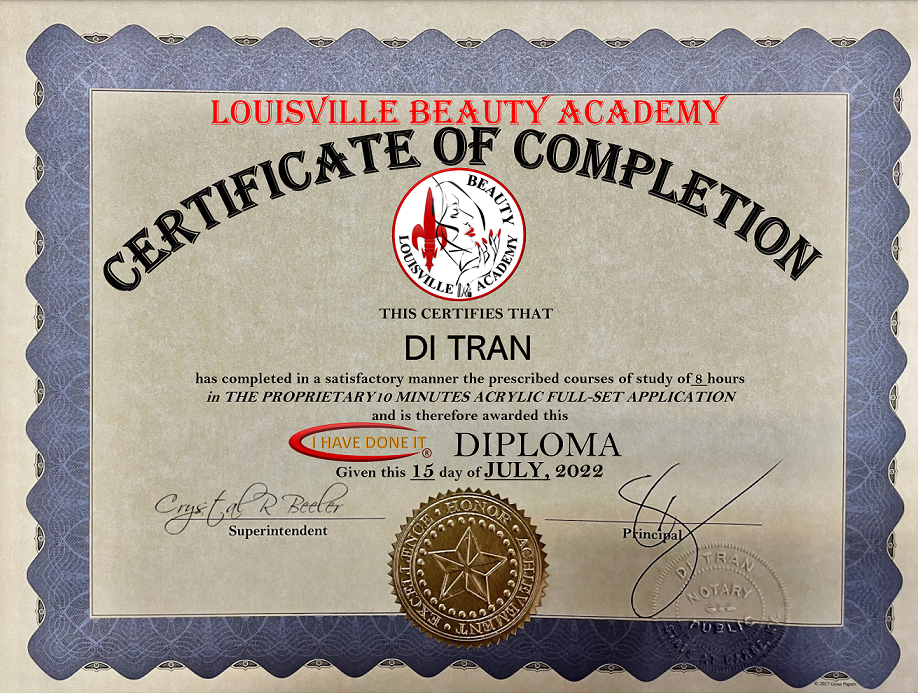
At Louisville Beauty Academy (LBA), graduation means more than earning a license. Every student walks proudly with their Certificate of Completion — a credential that carries prestige, trust, and community recognition far beyond the classroom. This certificate is more than paper; it is a badge of honor, a lifelong reminder of the “YES I CAN → I HAVE DONE IT” mindset that defines both our academy and our graduates.
A Legacy of Recognition: From Local to National
The academy’s impact, fueled by hardworking staff, dedicated instructors, and resilient students, has been validated through some of the most prestigious awards in the nation, the state, and the city of Louisville:
U.S. Chamber of Commerce CO—100 (2025) – Louisville Beauty Academy was the only Kentucky business named among America’s Top 100 Small Businesses, selected from over 12,500 applicants nationwide.
National Small Business Association (NSBA) – Small Business Advocate of the Year Finalist (2025) – Founder Di Tran was honored in Washington, D.C. as one of just five advocates nationwide, standing shoulder-to-shoulder with leaders shaping small business policy.
Louisville Business First – Most Admired CEO (2024) – Front-page recognition of Di Tran as a visionary leader in Kentucky’s business community.
Louisville Business First Rising Star – Highlighting Di Tran as one of Louisville’s most promising young leaders.
Jewish Community of Louisville Mosaic Award (2023) – Celebrating LBA for advancing diversity, inclusion, and empowerment across immigrant and minority communities.
These honors do not belong to one person alone. They reflect the collective effort of nearly 2,000 graduates, dedicated faculty, and the broader Louisville community that trusts in LBA’s mission.
Why the Certificate of Completion Matters
Graduates often ask: “Which certificate is most important when I graduate?” While the state license is essential to practice, the LBA Certificate of Completion carries something deeper:
Prestige – It symbolizes the most awarded and nationally recognized beauty college in Kentucky.
Community Trust – It represents the support of local, state, and national organizations who have celebrated LBA’s success.
Family & Belonging – LBA is more than a school; it is a lifelong family. Students are never left behind—unless they choose to leave themselves.
To hold an LBA Certificate is to hold proof of not just a completed program, but of resilience, empowerment, and recognition at every level.
A Movement of Empowerment
Through Louisville Beauty Academy and Di Tran University, the motto “YES I CAN → I HAVE DONE IT” has become a movement of human development. Nearly 2,000 graduates have gone on to open salons, launch careers, and collectively contribute an estimated $20–50 million annually to Kentucky’s economy.
Every award, every certificate, and every graduate’s success proves that beauty education is more than skills. It is about entrepreneurship, empowerment, and economic impact.
The LBA Promise
Louisville Beauty Academy remains:
The highly affordable beauty school in Kentucky.
The most flexible, meeting students where they are.
The most supportive, creating a lifelong network of care.
The most loving, because every student matters.
Our Certificate of Completion is not just paper. It is prestige, trust, and belonging — a testament to both personal achievement and the collective spirit of Louisville and Kentucky.
When our graduates hold that certificate in their hands, they hold more than their future. They hold local, state, and national recognition for who they are and what they will become.
Because here at Louisville Beauty Academy: YES I CAN. YES WE DID. YES YOU WILL.
Louisville Beauty Academy (LBA) is redefining beauty education with an unprecedented model that both slashes tuition costs and speeds up graduation. This means students save thousands upfront and start earning in the beauty industry much sooner than they would through traditional schools. With built-in tuition discounts of 50–75%, LBA offers a rare opportunity for students to graduate lower-debt – something virtually unheard of in beauty schooling. At the same time, the academy’s fast-track programs enable motivated students to get licensed and join the workforce in a fraction of the usual time. The result is money in the student’s pocketnow (through immediate savings) and later (through earlier career earnings) – a true double benefit for those serious about success.
Unprecedented Tuition Savings – 50–75% Off the Usual Cost 💰
Attending LBA is dramatically more affordable than a typical cosmetology school. Total tuition at LBA (including books and cosmetology kit) is under $7,000, which is about 50–75% lower than the tuition at comparable beauty programs. In fact, LBA’s pricing model saves students over $10,000 on average compared to other Kentucky cosmetology schools – a unique advantage that lets many LBA students pay as they go and avoid student loans entirely. Key highlights of this ultra-affordable model include:
Deep Tuition Discounts: Through internal scholarships and incentives, LBA tuition is slashed by half or more. For example, the 1,500-hour cosmetology program’s cost can drop from about $27,000 down to $6,250 for eligible students – roughly a 75% discount. Shorter programs see similar huge savings (e.g. Nail Technology is $3,800 with discounts, down from $8,325). Such low pricing is unmatched in the industry and has “never existed in the history of beauty school” in terms of built-in discounts.
Lower-Debt Pathway: Because tuition is so low, students can make manageable out-of-pocket payments or use written payment payment plans – no need for federal loans at all. This means no crushing debt upon graduation. By comparison, cosmetology graduates nationally carry about $10,000 in student loan debt on average, and many spend years after school repaying loans with interest. LBA’s model spares students that burden completely.
All-Inclusive Pricing: LBA’s tuition includes all essential supplies – your textbooks, kit, and materials are covered in that $7K-or-less package. There are no surprise add-on costs. This all-inclusive approach makes budgeting straightforward and further reduces out-of-pocket expenses for students. In short, you get a quality beauty education at a fraction of the cost of other schools.
By keeping education affordable, LBA enables students to start their careers with financial freedom from day one. Graduates aren’t weighed down by loan payments, so they can focus on building their business or advancing their craft instead of worrying about debt. It’s a liberating feeling that lets new professionals seize opportunities – whether that’s pursuing advanced certifications or even opening their own salon – without the usual financial stress. In an industry where most students have had to borrow heavily just to get trained, Louisville Beauty Academy stands out as a beacon of lower-debt education.
Fast-Track Graduation – Get Licensed and Earning Sooner 🏃♀️💨
LBA not only saves students money – it also saves them time. The academy is structured to get students licensed as efficiently as possible, so they can enter the workforce and start earning income quickly. How does LBA fast-track your education? It comes down to focused programs, flexible scheduling, and a priority on hard work and full-time attendance:
Targeted Programs, No Time Wasted: Louisville Beauty Academy offers each beauty licensure program as a standalone, focused track with exactly the state-required hours – nothing more, nothing less. Want to be just a nail technician? You can enroll in the 450-hour Nail Tech program and finish in a few months, instead of being forced into a 1,500-hour cosmetology course like many schools do. Similarly, future estheticians complete 750 hours for a skincare license, shampoo stylists 300 hours, etc., without having to spend time learning unrelated skills. This focused approach accelerates graduation by sparing students unnecessary coursework, yet still gets them fully qualified for licensing in their chosen specialty. It’s a modern answer to the outdated “one-size-fits-all” cosmetology program that can take 1–2 years to cover hair, skin, and nails in one huge curriculum. LBA’s philosophy: learn exactly what you need for the career you want, and get out into the real world faster.
Flexible Scheduling & Year-Round Enrollment: LBA operates on an open-enrollment, self-paced schedule that lets industrious students move at their own speed. There are no rigid semesters holding you back. If you commit to full-time hours, you can power through the program quickly. In fact, a motivated student can complete the full 1,500-hour cosmetology course in as little as ~9 to 10 months – which is about the fastest possible for that length of program. Many traditional beauty schools drag this out to 12–18 months, but LBA gives you the flexibility to finish as soon as you hit the required hours. The academy even has rolling graduations – students can and do finish weekly or even daily, whenever they achieve their hours and competencies. This means no waiting around; you receive your credential and can go straight to taking your state board exam and job hunting at the earliest opportunity.
Attendance Incentives – Work Hard, Save More: LBA actively encourages full-time attendance and consistent progress, not only because it helps you finish faster, but also because it maximizes your financial aid from the school. The generous tuition discounts and scholarships at LBA are often tied to meeting attendance and performance benchmarks (as detailed in the student contract). In other words, if you show up, work hard, and stay on track, you reap the full benefit of the 50–75% tuition reduction. This is a win-win setup: students who are serious and diligent get rewarded with lower costs and quicker graduation, while the academy produces successful graduates at a steady clip. LBA’s CEO, Di Tran, designed this model knowing that **“stay in school long” is usually a loss – in time and money – for goal-driven students. So why not remove the usual delays and push students to finish as soon as they’re able? The faster you graduate, the faster you can start making real money in the field.
By streamlining its programs for speed and flexibility, Louisville Beauty Academy empowers those “salon-owner material” students – the go-getters who mean business – to achieve their goals without unnecessary delay. There’s no sitting around waiting for a new semester or dragging out courses just to pad tuition. If you’re eager to launch your career, LBA is eager to get you there NOW.
Double Benefit: Save Thousands and Start Earning Sooner 💵⏱️
Perhaps the most exciting part of LBA’s model is how the financial benefits compound. Students not only save money upfront with discounted tuition, but also gain income by entering the job market earlier. It’s a one-two punch that puts substantial money in their pocket “here and now,” not years down the road. The math is straightforward for those who truly value their time and investment:
Savings in Education Costs: First, consider the direct savings. As noted, LBA students often pay $10,000+ less for their education than they would elsewhere. For example, a cosmetology student who might pay $17,000 (plus interest on loans) at another school can pay around $6,000 at LBA for the same license. That’s roughly $11,000 kept in the student’s pocket. And because LBA students typically don’t need loans, they also avoid accruing interest. (By contrast, a $9,600 loan could end up costing over $12,000 with interest in repayment – money that a lower-debt LBA grad never has to spend.) In short, LBA graduates start their careers owing nothing, whereas a typical new cosmetologist might be $10–15K in the hole before their first day of work.
Earlier Entry = Earlier Earnings: Now factor in time. Thanks to the fast-track approach, LBA graduates enter the workforce months sooner than their peers at longer programs. Those extra months have real monetary value. Beauty professionals can earn solid wages – in Kentucky, for instance, cosmetologists earn about $48,700 annually on average (roughly $4,000 per month). If an LBA student graduates even 3 months earlier, that’s potentially on the order of $12,000 in additional earnings (3 × $4K) simply because they’re out working instead of still in class. Many LBA students may graduate 6+ months faster than they would in a drawn-out program, which doubles that advantage. Every week not spent in school is a week earning real income from clients. This is why “staying in school long” can truly mean losing money, and LBA works to prevent that loss.
The ~$20,000 Difference: Combine the tuition savings plus the early-career earnings, and you see why LBA often speaks of a nearly $20,000 swing in students’ favor. By committing to full-time attendance and finishing promptly, an LBA student might save around $10K in school costs and make an extra $8–$10K from getting into the job market faster – a combined financial impact that is life-changing. This isn’t fanciful theory; it’s a realistic scenario for many LBA graduates. The academy’s own students recognize that they are “saving nearly $20,000 simply by committing to full-time attendance and completing their program” on the accelerated timeline. It’s like getting a double scoop of success: you spend a lot less and you start earning much more, all thanks to finishing school quickly.
Crucially, these benefits aren’t just short-term. Graduating lower-debt and earlier sets students up for long-term success. From day one, LBA grads have financial freedom – they can invest in better tools, further training, or even start their own business with the money others would be devoting to loan payments. Many LBA alumni are indeed entrepreneurial; with no debt weighing them down, they can take bold steps like launching a salon or studio early in their careers. This entrepreneurial jump-start is exactly what LBA’s founder envisioned: helping hard-working, ambitious students build wealth sooner rather than later. It’s great for the graduates and also great for the community – these newly licensed professionals are contributing to the local economy faster, filling in-demand jobs and even creating jobs for others. (The beauty industry is growing steadily – projected ~7% job growth nationally through 2033 – so getting skilled workers out there faster has real economic impact.)
A New Standard in Beauty Education 🎓✨
Louisville Beauty Academy’s model is truly revolutionary in the beauty education landscape. Few (if any) schools offer such steep tuition discounts upfront or actively push students to graduate faster for their own benefit. Traditionally, beauty schools have thrived on the opposite – high tuition, prolonged programs, and reliance on federal student aid. (The industry received over $1 billion in federal student aid in 2019–2020 alone, and many for-profit beauty colleges have been accused of being “loan mills” that keep students enrolled longer to maximize tuition.) LBA turns that model on its head. By keeping costs ultra-low, forgoing federal financial aid, and focusing on outcomes over profits, LBA has carved out a niche that did not exist before – an ethical, student-centered path where graduating fast and lower-debt is the norm, not the exception.
For students who are serious about their success, this approach is a game-changer. LBA attracts driven individuals – people who want to master their craft and start achieving their dreams without wasting time or money. These are often career-oriented adults, parents, immigrants, or aspiring salon owners who simply can’t afford to indulge in a slow, expensive schooling process. Louisville Beauty Academy respects that drive. It offers them a quality, accredited education on terms that make sense: affordable, efficient, and empowering. As a result, the academy boasts high graduation and licensure rates (over 90% of students graduate and get licensed) and has produced nearly 2,000 graduates by mid-2025, many of whom have gone on to impactful careers and businesses in the beauty field.
In summary, Louisville Beauty Academy is elevating what a beauty school can do. It’s putting real money back into students’ pockets now through unprecedented tuition savings, and setting them up to make money sooner by accelerating their entry into the workforce. All of this is done without compromising on education quality or licensing outcomes – in fact, it enhances quality by freeing students from financial stress and keeping them focused on their goals. It’s a win-win model that benefits the students and the community. For anyone in the Louisville area (or beyond) who truly wants a fast, affordable, and successful path into the beauty industry, LBA is a compelling choice. As the school proudly says, it lets you “license your beauty talent today” – because with the right support, you can launch your dream sooner and with more money in your pocket.
Ready to turn your hard work into real success? Louisville Beauty Academy is making it happen every day. It’s not just about graduating – it’s about graduating without debt and ahead of the curve, poised to thrive in the beauty business. That’s a formula that’s redefining beauty education and empowering the next generation of beauty entrepreneurs right here and now. 🔑💇♂️🎉
The Double Scoop Benefit: How 1,000 LBA Graduates Gain $7.5–$10 Million in Real Value
Assumptions (for 1,000 graduates)
Mix: 80% Nail (800), 10% Cosmetology (100), 10% Esthetics (100)
Market vs. LBA prices (rounded, conservative):
Cosmetology: $19,000 market vs. $7,000 LBA → $12,000 saved/student
Nail: $8,000 market vs. $4,000 LBA → $4,000 saved/student
Esthetics: $12,000 market vs. $6,000 LBA → $6,000 saved/student
Time gain from fast graduation: 25–50% faster (= 3–6 months earlier to work)
Tuition saved per grad (avg):$5,000,000 / 1,000 = $5,000
(Driven by mix: many nail grads at $4k saved; fewer cosmetology at $12k; esthetics at $6k.)
Earlier earnings per grad:$2,499 – $4,998
Total per grad (Double Scoop):$7,499 – $9,998
Why this is conservative (good for public use)
Uses lowest first-year earnings floor ($10k) just to value the months gained. Many grads will earn more.
Uses rounded, conservative market prices.
Counts written payment savings from avoiding loans (which would increase impact).
Excludes salon tips/retail commissions/side work, which further boost early earnings.
Summary (drop-in for the article)
Double Scoop Benefit for 1,000 LBA Graduates:
Scoop One (Tuition Saved):$5,000,000
Scoop Two (Earlier Earnings):$2,499,000 – $4,998,000
Total Economic Boost:$7,499,000 – $9,998,000
LBA keeps about $5M out of tuition bills and puts another $2.5–$5M into students’ hands by getting them working months sooner. That’s $7.5–$10M of real impact per every 1,000 graduates.
Know the Law, Your Career Options, and the Power of Your License
Presented by Louisville Beauty Academy – A Kentucky state-licensed beauty school
Choosing between a Barber License and a Cosmetology License in Kentucky is more than a personal preference—it’s a legal and professional commitment that defines what services you are allowed to perform, what board governs your license, and whether you can expand into other areas of beauty later.
At Louisville Beauty Academy, we are committed to not only training students—but also to informing the public and prospective professionals so they can make smart, legally sound decisions based on real facts.
📋 Two Separate Licensing Boards in Kentucky
Unlike many other states that operate under a combined Board of Barbering and Cosmetology, Kentucky maintains two entirely separate state government boards, each with its own licensing requirements, training hours, exams, and regulatory authority:
These boards do not operate together, and hours or licenses are not automatically transferable between them. Each board governs its own license type and accepts or rejects transfer hours according to its own internal rules.
💈 What Is the Barber License?
The Barber License is regulated by the Kentucky Board of Barbering and is focused primarily on:
Men’s haircuts and clipper work
Beard grooming and shaping
Straight razor shaving
Scalp treatments and basic facials
It requires 1,500 hours of barber training from a licensed barber school. It is a traditional, focused license that prepares students for employment in classic and modern barbershops.
💇♀️ What Is the Cosmetology License?
The Cosmetology License, governed by the Kentucky Board of Cosmetology, also requires 1,500 hours of training—but covers a broader range of services:
Haircutting for all genders
Hair coloring, chemical relaxing, perming
Shampooing and advanced styling
Skincare services: facials, waxing, makeup
Nail care: manicures, pedicures, acrylics
Salon safety, infection control, and state law
This license legally qualifies professionals to work in salons, spas, beauty studios, and medical esthetic settings, and also serves as the foundation for becoming a beauty instructor or salon owner.
🔄 Can You Transfer Hours Between the Two?
Yes, but only partially—and only in one direction.
According to the Kentucky Board of Cosmetology, students with prior training in another beauty discipline may transfer a limited number of hours into the Cosmetology Program. For those holding or completing Barber training, up to 750 hours may be transferred into a cosmetology program.
Here is a breakdown of transferable hour credits into Cosmetology:
These hours only transfer into cosmetology, not out of it.
Barber programs and the Barbering Board do not accept Cosmetology hours.
If you begin in cosmetology and later want to switch to barbering, you must start a barber program from the beginning.
🏆 Why Cosmetology May Be the Smarter Long-Term Choice
Even if your goal is simply to cut hair, the Cosmetology License gives you far more power and options, including:
Haircuts for men, women, and children
Coloring, relaxing, perming, and styling
Ability to work across hair, skin, and nails
Qualification for salon ownership and instructor licensing
Flexibility to specialize or expand into esthetics or nails
In today’s competitive job market, a multi-service license creates more opportunity. You can still focus on cutting hair, but you retain the legal right to expand your services and income streams in the future.
🏫 What Louisville Beauty Academy Offers
We are not a barber school
We are fully licensed under the Kentucky Board of Cosmetology
We offer:
1500-hour Cosmetology Program
750-hour Esthetics Program
450-hour Nail Technology Program
300-hour Shampoo & Styling License
750-hour Instructor Licensing Program
We are proud to train nearly 2,000 graduates, and our tuition is under $8,000 total after completion-based incentives—making LBA one of the highly affordable and transparent beauty schools in the state.
We also support students transferring from barber schools who wish to expand into cosmetology and will apply up to 750 hours of prior training per board approval.
📣 Final Thoughts: Make an Informed Decision
The barber license is perfect for focused careers in men’s grooming. The cosmetology license is ideal for long-term flexibility, higher income potential, and creative freedom.
Because the boards are legally separate, your choice matters—and you must start with the license that aligns with your ultimate goals.
📲 Ready to Begin?
Louisville Beauty Academy is here to help you take the next step with full transparency, affordability, and support.
Louisville Beauty Academy – Kentucky’s Highly Affordable, Flexible, and Trusted Path to a Professional Cosmetology License.
Disclaimer: The information provided by Louisville Beauty Academy is for general informational purposes only and reflects publicly available guidelines and data from state regulatory boards at the time of publication. Laws, licensing requirements, training hour transfers, and board policies may change without notice. Louisville Beauty Academy does not control or represent the Kentucky Board of Cosmetology or the Kentucky Board of Barbering, and cannot guarantee acceptance of transfer hours or license eligibility across programs. All prospective students are encouraged to verify the most current licensing rules directly with the appropriate state board. This content is not legal advice and should not be relied upon as such. Louisville Beauty Academy is a Kentucky state-licensed beauty school approved under the Kentucky Board of Cosmetology.
Kentucky’s Gold Standard of Lawful and Humanized Beauty Education
About the Program
Louisville Beauty Academy (LBA) is a Kentucky State-Licensed and state-licensed beauty college, nationally recognized for excellence in lawful, humanized beauty education.
Our Cosmetology 1500 Clock Hours Curriculum is designed to train students in the science, art, and professionalism of hair, skin, and nail care — aligned with the standards and expectations of the Kentucky Board of Cosmetology (KBC).
All instruction is built with awareness of the Kentucky statutes and administrative regulations governing cosmetology, as published by the Kentucky Board of Cosmetology at: 👉 https://kbc.ky.gov
As soon as this page is published, it may already be out of date compared to current Kentucky law. All laws and regulations change over time. This page is for educational and sample purposes only.
Milady as the Foundation of Theory Education
Louisville Beauty Academy’s Cosmetology curriculum is structured in alignment with the Milady Standard Cosmetology textbook and resources.
All theory instruction Chapter quizzes and tests PSI exam preparation follow the Milady framework, ensuring that each student receives education consistent with nationally recognized standards and the Kentucky Board of Cosmetology exam outline.
In addition, LBA enhances learning with:
Milady Standard Cosmetology textbooks and online resources
PSI exam preparation materials
LBA’s self-published books authored by Founder Di Tran
Multilingual and AI-assisted study support
This combination makes LBA a gold-standard hub where national curriculum, state law, and humanized education meet.
Program Structure – 1500 Clock Hours
Component
Description
Minimum Hours
Theory & Science
Anatomy, physiology, infection control, chemistry, electricity, hair and skin sciences, business, state law
375 hrs
Kentucky Statutes & Administrative Regulations
Overview and awareness of KRS 317A and 201 KAR 12 as published by KBC
40 hrs
Clinic & Practice
Supervised services: haircutting, coloring, chemical texturizing, facials, manicures, pedicures, styling, sanitation, client care
Building Confidence and the “YES I CAN / I HAVE DONE IT” Mindset
2. General Sciences
Infection Control and Safety Practices
Anatomy and Physiology (Related to Hair, Skin, and Nails)
Hair Structure, Growth, and Disorders
Skin Structure and Function
Nail Structure and Health
Basics of Chemistry and Product Interaction
Electricity in Cosmetology (Equipment Safety)
Nutrition and Wellness for Clients and Professionals
These topics are taught using Milady Standard Cosmetology as the core textbook, supplemented by LBA’s visual and AI-enhanced materials to ensure deep understanding of both the “why” and “how” behind each service.
3. Cosmetology Procedures & Advanced Techniques
Haircutting and Hairstyling (Design and Form)
Hair Color and Chemical Services
Chemical Relaxing, Perming, and Texturizing
Shampooing, Conditioning, and Scalp Care
Facials, Waxing, and Basic Skin Care
Manicures, Pedicures, and Nail Enhancements
Makeup and Hair Design Integration
Salon Management and Customer Service
All practical services are first demonstrated by instructors, then performed by students on mannequins and live models in LBA’s supervised clinic.
4. Business and Professional Skills
Preparing for Licensure and Employment
Understanding Salon/Spa Operations
Entrepreneurship and Small Business Basics
Customer Relations and Retailing
Professional Ethics, Boundaries, and Communication
Portfolio Building and Responsible Social Media Use
Training and Lawful Practice
Students must complete required theory and safety education before public service.
Early practice occurs on mannequins and fellow students under instructor supervision.
All clinic hours are recorded using biometric and digital tracking for compliance and transparency.
Sanitation and safety practices follow current KBC standards.
Instruction on Kentucky law is provided for awareness only; all licensees must confirm official rules with KBC.
Why Louisville Beauty Academy Is the Gold Standard
Louisville Beauty Academy serves as a Center of Excellence for Beauty Education and Compliance in Kentucky by:
Using Milady Standard Cosmetology as the national curriculum backbone
Aligning training with KBC expectations and PSI exam outlines
Supporting students with LBA’s self-published books, AI tools, and multilingual resources
Maintaining transparent, documented, and humanized processes for all students
LBA graduates are trained to be:
Technically skilled in cosmetology services
Lawfully aware of scope and responsibility
Ethically grounded and client-centered
Compassionate and community-focused professionals
“Our education begins with respect for the law and ends with service to others — because lawful practice is the highest form of professionalism.” — Di Tran, Founder & CEO, Louisville Beauty Academy
Legal and Educational Disclaimer
Louisville Beauty Academy’s curriculum materials, including this Cosmetology 1500 Clock Hours Curriculum description, are provided solely for educational and sample purposes.
Any references to Kentucky statutes, administrative regulations, or board standards are general summaries and not official legal documents.
Louisville Beauty Academy assumes no liability for any errors, omissions, or changes in law or regulation after publication.
The Kentucky Board of Cosmetology (KBC) is the only official source for current and legally binding requirements. For all official updates to KRS 317A and 201 KAR 12, please visit: 👉 https://kbc.ky.gov
B. To eliminate or reduce the transmission of infectious organisms from one individual to another
C. To stimulate the immune system of clients
D. To diagnose skin diseases accurately Answer: B Explanation: Infection control refers to methods used to eliminate or reduce the transmission of infectious organisms between individuals. This includes cleaning, disinfecting, and sterilizing implements and work surfaces to prevent cross-contamination.
Cleaning implements with soap and water is an example of which step in infection control?
A. Sterilizing
B. Sanitizing
C. Cleaning
D. Disinfecting Answer: C Explanation: Cleaning is a mechanical process that uses soap and water (or detergent and water) to remove visible dirt, debris, and many disease-causing germs from surfaces. It is the first step before sanitizing or disinfecting.
Sanitizing a work surface involves:
A. A chemical process to kill all microorganisms, including spores
B. Using soap and water to remove visible debris
C. A chemical process to reduce the number of disease-causing germs on a surface to a safe level
D. Using an autoclave to sterilize implements Answer: C Explanation: Sanitizing is a chemical process that reduces the number of germs on a surface to safe levels. Unlike sterilizing, it may not kill all microorganisms or spores.
Which of the following best describes disinfecting?
A. Wiping tools with alcohol
B. Using soap and water only
C. A chemical process (using an EPA-registered disinfectant) that destroys harmful organisms (bacteria, viruses, fungi) on non-porous surfaces
D. Heat-sterilizing implements in an autoclave Answer: C Explanation: Disinfecting is a chemical process, usually with an EPA-registered disinfectant, used on non-porous items and surfaces to destroy most bacteria, viruses, and fungi (but not necessarily spores). It is a higher level of decontamination than sanitizing.
What does sterilizing refer to?
A. Using soap and water to wash implements
B. Using UV light to kill surface germs
C. Using a chemical spray on equipment
D. Destroying all microbial life, including bacterial spores (usually with an autoclave) Answer: D Explanation: Sterilizing is the process that destroys all microbial life, including bacterial spores, typically by using high-pressure steam in an autoclave. It is required for any equipment that comes into contact with broken skin or bloodborne pathogens.
Which federal agency registers disinfectants for use in salons?
A. OSHA (Occupational Safety and Health Administration)
B. FDA (Food and Drug Administration)
C. EPA (Environmental Protection Agency)
D. CDC (Centers for Disease Control and Prevention) Answer: C Explanation: The EPA registers different types of disinfectants sold in the United States, including those used in salons. Salon products must often be EPA-registered for hospital-grade disinfection.
Which federal agency enforces workplace safety and “right-to-know” regulations for hazardous products?
A. OSHA (Occupational Safety and Health Administration)
B. EPA (Environmental Protection Agency)
C. FTC (Federal Trade Commission)
D. ADA (American Dental Association) Answer: A Explanation: OSHA sets and enforces safety standards in the workplace, including regulations on handling, mixing, and disposing of products and ensuring workers have the right to know about hazardous ingredients. Salons must follow OSHA guidelines (such as maintaining SDS).
What is a hospital-grade disinfectant expected to do?
A. Kill all bacteria including spores
B. Kill most bacteria (not including spores), fungi, and viruses on surfaces
C. Clean dirt and debris only
D. Remove rust and stains Answer: B Explanation: Disinfectants (hospital-grade) are chemical products that destroy most bacteria (except bacterial spores), fungi, and viruses on surfaces. They are used on implements and station surfaces to reduce pathogens to safe levels.
What do bloodborne pathogens refer to?
A. Bacteria that live in the air
B. Disease-causing microorganisms carried in the body by blood or body fluids (e.g., hepatitis viruses, HIV)
C. Any infectious agent transmitted by food
D. Skin parasites like lice Answer: B Explanation: Bloodborne pathogens are disease-causing microbes carried in the body by blood or body fluids, such as hepatitis viruses and HIV. They are a major concern in salons when exposure to blood or bodily fluids occurs.
Hepatitis is primarily a virus that affects which organ?
A. Skin
B. Liver
C. Kidneys
D. Stomach Answer: B Explanation: Hepatitis is a bloodborne virus that can cause disease and can damage the liver. Hepatitis B and C are of particular concern in salons due to blood exposure.
The human immunodeficiency virus (HIV) causes a disease that does what?
A. Destroys muscle tissue
B. Causes acute kidney failure
C. Breaks down the body’s immune system (AIDS)
D. Only affects the respiratory system Answer: C Explanation: HIV causes Acquired Immune Deficiency Syndrome (AIDS), which breaks down the body’s immune system and is transmitted through blood and certain body fluids. Salon workers must use precautions to prevent HIV transmission.
Which description best fits a virus?
A. A large, multicellular organism
B. A submicroscopic particle that infects cells and can replicate only inside a host cell (causing illnesses like measles, mumps, flu, etc.)
C. A chemical that kills bacteria
D. A skin layer or structure Answer: B Explanation: Viruses are submicroscopic particles that infect host cells and cannot replicate without a living host. They include pathogens like HIV, influenza, and measles.
Which statement is true?
A. Antibiotics treat both bacterial and viral infections equally.
B. Bacterial infections can be treated with antibiotics; viral infections cannot.
C. Viral infections can be treated with antibiotics, bacterial infections cannot.
D. Both viral and bacterial infections are unaffected by antibiotics. Answer: B Explanation: Antibiotics are effective against bacterial infections but cannot treat viral infections. This is why illnesses like the common cold (viral) are not treated with antibiotics.
Which of the following describes fungi?
A. Unicellular organisms such as mold, mildew, and yeast that can cause contagious diseases like ringworm
B. Single-celled viruses that infect the respiratory system
C. A type of disinfectant used on implements
D. A chemical process for sterilizing equipment Answer: A Explanation: Fungi are single-celled or multicellular organisms (mold, mildew, yeast) that can produce contagious infections such as ringworm (tinea). Salon professionals must clean and disinfect thoroughly to prevent fungal spread.
Tinea barbae is an infection of which kind?
A. A bacterial infection affecting hands
B. A viral infection causing warts on the feet
C. A superficial fungal infection (barber’s itch) affecting the bearded areas of the face and neck
D. An allergic skin reaction to beard products Answer: C Explanation: Tinea barbae, also known as barber’s itch, is a superficial fungal infection of the beard area. Estheticians should refer clients with active tinea barbae to a physician and avoid treating that area.
What is MRSA?
A. A type of vitamin essential for skin health
B. Methicillin-Resistant Staphylococcus Aureus (a bacterial infection resistant to many antibiotics)
C. A viral form of acne
D. A deep pore cleansing technique Answer: B Explanation: MRSA stands for Methicillin-Resistant Staphylococcus Aureus, an infection caused by bacteria that are resistant to many antibiotics. It can spread in salons if sanitation is not properly maintained.
Mycobacterium is a family of bacteria often found in:
A. Sterilized tools
B. Pedicure whirlpool baths, especially if not cleaned properly
C. Electrical spa equipment
D. High-grade skincare lotions Answer: B Explanation: Mycobacterium is a large family of bacteria found in soil or water and has been linked to infections from improperly cleaned pedicure baths. Proper disinfection of baths prevents these infections.
What is pus?
A. A lubricating oil secreted by glands
B. Fluid containing white blood cells, bacteria, and dead cells (often seen in infected lesions)
C. A type of fungus on the skin
D. A pore-clogging substance from glands Answer: B Explanation: Pus is a thick fluid containing white blood cells, bacteria, and dead tissue, typical of infected lesions. Its presence usually indicates infection that may require medical attention.
A pimple or abscess containing pus confined to one area is an example of:
A. Systemic infection
B. Local infection
C. Fungal infection
D. Autoimmune reaction Answer: B Explanation: A local infection is confined to a particular part of the body and appears as a lesion containing pus. Pimples and abscesses are local infections, unlike systemic infections that spread throughout the body.
What describes a systemic infection?
A. Infection limited to one part of the body (e.g., a pimple)
B. Infection that has spread through the body via the bloodstream or lymph
C. Superficial inflammation that does not penetrate deeper layers
D. Only infections transmitted by air Answer: B Explanation: A systemic infection is one where the pathogen has spread throughout the body rather than remaining localized. It can affect multiple organs/systems.
Transmission (in infection control) refers to:
A. The process by which pathogens move from one person or object to another
B. The body’s immune response to an infection
C. The conversion of a virus into a bacterium
D. The electrical current used in skin therapies Answer: A Explanation: Transmission is the process by which pathogens move between individuals and objects. Infection control measures aim to interrupt this process.
Which item must be sterilized (not just disinfected) before reuse?
A. Cotton balls (disposable)
B. Electric clipper with non-porous blades
C. Metal needles used for skin penetration
D. Wooden sticks used for wax removal Answer: C Explanation: Implements that puncture the skin (like needles) must be sterilized to destroy all microbial life including spores. Clippers (non-sterile but disinfected) and disposables differ.
If a small amount of blood appears on a client’s skin during a facial, what should the esthetician do first?
A. Continue treatment after wiping with alcohol
B. Stop the service, put on gloves, apply an antiseptic, and bandage the wound
C. Ignore it as insignificant
D. Call emergency services immediately Answer: B Explanation: Universal precautions require stopping the service to prevent contamination. The esthetician should wear gloves, apply an antiseptic, and cover any bleeding. This protects both client and practitioner.
Which procedure is correct for cleaning a foot spa tub after each use?
A. Rinse with water only
B. Drain the tub, scrub with soap, then fill with disinfectant and let it soak per manufacturer instructions
C. Wipe with dry cloth and leave to air-dry
D. Fill with plain water and run the jets Answer: B Explanation: Proper procedure is to drain the tub, remove visible debris by cleaning, and then disinfect with an EPA-registered disinfectant. Leaving disinfectant in the tub kills remaining pathogens.
A metal implement (e.g. scissors or tweezers) is dropped on the floor after use. What is the correct action?
A. Wipe it with alcohol and reuse immediately
B. Discard it as waste
C. Re-clean and disinfect it with an EPA-registered disinfectant before reuse
D. Put it in a storage container and worry about it later Answer: C Explanation: If a nonporous implement falls, it must be thoroughly cleaned and then disinfected before reuse. Simply wiping with alcohol is not sufficient to remove all microbes.
Which of the following items should be discarded after a single use?
A. Metal extractors
B. Wooden sticks or pumice stones
C. Stainless steel tweezers
D. Autoclavable facials brushes Answer: B Explanation: Porous items like wooden sticks and pumice stones cannot be properly disinfected, so they must be discarded after one use. Nonporous items (metal tools) can be disinfected.
What type of personal protective equipment (PPE) should you wear when mixing disinfectants?
A. No PPE is necessary
B. Gloves only
C. Gloves and safety goggles
D. Face mask only Answer: C Explanation: Safety Data Sheets (SDS) and OSHA guidelines require wearing gloves and eye protection when handling disinfectants, due to their chemical hazards. This prevents skin and eye irritation.
In which situation must you absolutely wear gloves as an esthetician?
A. Giving a standard facial to a healthy client
B. Performing extractions or any procedure that may cause contact with blood or bodily fluids
C. Sweeping hair off the floor after a haircut
D. Mixing shampoo at the shampoo bowl Answer: B Explanation: Gloves are required whenever there is risk of contact with broken skin, blood, or other body fluids. Performing extractions on skin that bleeds requires gloves to prevent transmission of bloodborne pathogens.
What does “SDS” stand for, and why must it be kept on file?
A. Salon Dishwashing Schedule – to ensure proper hygiene
B. Safety Data Sheet – to provide information on product ingredients and hazards (OSHA “Right to Know”)
C. Skin Diagnostic Standard – to classify skin types
D. Sanitization Documentation Sheet – to record cleaning logs Answer: B Explanation: SDS stands for Safety Data Sheet. OSHA requires salons to have SDS for each product, ensuring workers know how to handle chemicals safely (hazard information, first aid, etc.).
According to OSHA’s Bloodborne Pathogens Standard, which of these diseases is NOT typically transmitted through the blood?
A. Hepatitis B
B. HIV (human immunodeficiency virus)
C. Influenza (flu virus)
D. Hepatitis C Answer: C Explanation: Influenza is an airborne respiratory virus, not a bloodborne pathogen. Hepatitis B/C and HIV are transmitted via blood and bodily fluids, requiring strict infection control measures.
Which of the following is an example of a viral infection rather than a bacterial infection?
A. Impetigo (bacterial)
B. Acne (bacterial)
C. Herpes simplex (viral)
D. Staph infection (bacterial) Answer: C Explanation: Herpes simplex is caused by a virus, unlike impetigo or staph which are bacterial. Viral infections (like herpes, HIV) cannot be treated with antibiotics and require appropriate precautions.
How should instruments that have been used on an open wound or are contaminated with blood be disinfected?
A. Simply rinsed under water
B. Stored in a dry container
C. Sterilized (if possible) or soaked in hospital-grade disinfectant according to manufacturer instructions
D. Wiped with a tissue and reused Answer: C Explanation: Instruments contaminated with blood should be sterilized if they can, or soaked in an EPA-registered hospital-grade disinfectant with appropriate contact time. This ensures all pathogens are killed.
What term describes an allergic skin reaction or infection not caused by a pathogen?
A. Fomite
B. Contagion
C. Non-infectious disease
D. Pathogenic infection Answer: C Explanation: Non-infectious conditions (e.g., allergic reactions, contact dermatitis) are not caused by pathogens and are not contagious. They differ from infectious diseases spread by microorganisms.
Which scenario demonstrates proper blood spill procedure?
A. Finish the service quickly and sanitize the area afterward
B. Apply antiseptic immediately without gloves, then continue
C. Stop service, put on gloves, clean and cover the wound, then continue after protecting blood spill
D. Cover the wound loosely and continue the facial Answer: C Explanation: The correct procedure is to stop service, wear gloves, apply an antiseptic or bandage to the wound, and properly disinfect any contaminated surfaces. This follows universal precautions to prevent infection.
Which of the following is NOT a recommended way to prevent cross-contamination?
A. Disinfecting tools and surfaces between clients
B. Using new or sterilized implements on each client
C. Wiping hands on a towel between clients
D. Wearing gloves when necessary Answer: C Explanation: Wiping hands on a towel is not an effective sanitation method and risks spreading germs. Proper infection control requires washing hands or using sanitizer, changing towels, and disinfecting equipment.
What item should be used to dispose of a used disposable razor that has blood on it?
A. Regular trash can
B. Autoclave
C. Biohazard sharps container
D. Recycling bin Answer: C Explanation: Sharps (like razors with blood) must be disposed of in a labeled biohazard sharps container. This prevents injury and transmission of bloodborne pathogens.
Which cleaning agent is most effective at killing bacteria, viruses, and fungi on salon implements?
A. Plain water
B. Soap and water
C. EPA-registered hospital-grade disinfectant
D. Alcohol spray Answer: C Explanation: An EPA-registered hospital-grade disinfectant is required to kill bacteria (not spores), viruses, and fungi on implements. Soap and water remove debris (cleaning) but do not kill as many germs.
What should be done if an implement with visible blood dries before it can be disinfected?
A. It is considered unusable and must be cleaned and then sterilized or disinfected before reuse
B. It can be disinfected without cleaning
C. It should be immediately thrown away
D. Wipe off dried blood and reuse Answer: A Explanation: Dried blood is harder to remove; the implement must first be cleaned (with detergent and water) and then disinfected or sterilized to ensure all pathogens are eliminated.
What does “EPA-registered” mean regarding disinfectants?
A. The product is FDA approved for ingestion
B. The product has been approved by the U.S. Environmental Protection Agency as effective against specified organisms
C. The product is only for industrial use
D. The product is safe to drink Answer: B Explanation: EPA-registered disinfectants have been evaluated by the Environmental Protection Agency and proven effective at killing certain pathogens. Salons must use EPA-registered products for infection control.
Which disease is most commonly spread via dirty salon tools or foot baths?
A. Athlete’s foot (tinea pedis)
B. Influenza
C. Chickenpox
D. Lupus Answer: A Explanation: Athlete’s foot is a fungal infection that can be spread by contaminated tools or pedicure baths. Good sanitation and disinfecting of foot baths prevent fungi like tinea pedis from spreading.
How often should reusable filters or oil-cap traps (in facial equipment) be cleaned or changed?
A. Weekly
B. Daily, or as often as manufacturer recommends
C. Once a year
D. Never – they are self-cleaning Answer: B Explanation: According to infection control guidelines, all reusable parts of equipment (including filters, traps, or linens) should be cleaned or changed daily or as recommended, to avoid buildup of debris and germs.
What is the purpose of a disinfectant label stating “hospital grade”?
A. It’s safe for all skin types
B. It kills spores only
C. It meets EPA standards for killing pathogens commonly found in healthcare settings
D. It can be ingested Answer: C Explanation: “Hospital grade” means the disinfectant meets EPA criteria to kill a broad range of pathogens (bacteria, viruses, fungi) on nonporous surfaces, similar to disinfectants used in hospitals.
If a salon implements draw blood during a service, what documentation is recommended?
A. Client sign-out sheet
B. Incident report or accident log entry
C. Photo identification
D. None (just continue service) Answer: B Explanation: Best practices include documenting any accidental exposure incidents. An incident report ensures proper follow-up and compliance, reflecting OSHA/CDC recommendations.
Which one of the following diseases should cause you to refer the client to a physician rather than perform any esthetic services?
A. A cold sore on the lip (Herpes simplex)
B. Mild eczema on the elbow
C. A chipped fingernail
D. Clean (dry) athlete’s foot on the foot Answer: A Explanation: Active herpes (cold sores) is highly contagious. Estheticians should not perform services on active viral lesions (client should see a physician) to avoid spreading the virus.
Why is it important to allow disinfectants to sit on implements for the recommended time?
A. To improve the scent
B. To ensure microbes are effectively killed as per manufacturer instructions
C. It actually does not matter how long you leave them
D. To avoid drying out the tools Answer: B Explanation: Disinfectants have a required contact time to kill pathogens. Following the label ensures all listed organisms are effectively destroyed.
How should massage lotions, creams, or oils that are used on multiple clients be handled?
A. Return jars to the shelf between clients
B. Double-dip into containers during application
C. Dispense product onto a clean spatula or cup for each client
D. Keep containers on a heated shelf Answer: C Explanation: To prevent contamination, products must be dispensed onto a clean spatula or into a container for each client rather than double-dipping into the jar. This prevents introducing germs into the product.
What should be done with linens (towels, sheets) used on a client?
A. Shake them outside and reuse immediately
B. Place them in a closed laundry hamper for washing
C. Store them back on shelves
D. Burn them Answer: B Explanation: Used linens should be collected in a closed hamper or covered container to prevent spread of contaminants, then laundered properly before reuse.
Which of the following is not a recommended infection control practice?
A. Replacing disinfecting solution when it is dirty
B. Cleaning counters and equipment with disinfectant at the end of each day
C. Sanitizing hands or using hand sanitizer before and after each client
D. Using the same set of instruments on consecutive clients without re-disinfecting Answer: D Explanation: Instruments must be cleaned and disinfected (or sterilized) before reuse on another client. Failing to re-disinfect between clients would spread germs.
Which is a sign that a disinfectant solution should be changed?
A. It starts to clear up and looks cleaner
B. It begins to appear cloudy or is filled with debris
C. The bottle color changes
D. It has a strong scent Answer: B Explanation: Disinfectant that becomes cloudy or has visible debris is no longer effective and must be replaced. Dirty solution cannot properly kill pathogens.
Why must an esthetician clean electrical equipment (like galvanic machines) after every client?
A. To prevent rust
B. To remove product residue and disinfect any potential contaminants
C. It’s not necessary for electrical equipment
D. To calibrate the machine Answer: B Explanation: After each client, any product residue must be wiped off and surfaces disinfected. This prevents buildup of microbes and maintains a sanitary environment.
Which practice best demonstrates proper hand hygiene?
A. Rinsing hands with water only after each client
B. Washing hands with soap and water or using hand sanitizer before and after each client
C. Wearing the same gloves all day
D. Using hand sanitizer once at the beginning of the day Answer: B Explanation: Proper hand hygiene is washing hands or using sanitizer before and after each client, as required by infection control guidelines. This step is critical for preventing transmission of germs.
Sharps (such as lancets or needles) must be disposed of in:
A. A regular trash can
B. An open container at the station
C. A labeled, puncture-resistant biohazard (sharps) container
D. The recycling bin Answer: C Explanation: Sharps must go into a labeled, puncture-resistant biohazard container to prevent injury and contamination. This is an OSHA requirement.
Which action is an example of sanitation (not sterilization or disinfection)?
A. Boiling tools for 30 minutes
B. Wiping down a workstation with alcohol spray
C. Washing hands with soap and water
D. Soaking tweezers in disinfectant for 10 minutes Answer: C Explanation: Washing with soap and water is cleaning, and reducing germs on hands is sanitation. Wiping with alcohol is disinfection (chemical kill), soaking in disinfectant is disinfection, and boiling (autoclave) is sterilization.
If a metal tool cannot be fully cleaned (e.g., rusted or damaged), what should be done?
A. Disinfect it longer
B. Dispose of it and replace with a new one
C. Sharpen it
D. Store it in bleach Answer: B Explanation: Tools that cannot be properly cleaned or sanitized (rusty, chipped) must be discarded. Using damaged tools is unsafe and cannot be properly disinfected.
Which of the following illnesses is least likely to be transmitted in a salon?
A. Athlete’s foot (fungal)
B. Common cold (viral)
C. HIV (bloodborne viral)
D. Ringworm (fungal) Answer: C Explanation: HIV is not easily transmitted in a salon unless there is direct exchange of infected blood. Athlete’s foot and ringworm can be spread by surface contact; the common cold (viral) spreads more by air or surfaces. Proper disinfection still minimizes all risks.
What is the correct term for items like sheets or cloths used during treatments?
A. Single-use implements
B. Nonporous surfaces
C. Linens
D. Disposables Answer: C Explanation: Linens refer to towels, sheets, and cloths used on clients. These should be laundered between clients to prevent transfer of microbes.
Which of the following is NOT a way to break the infection cycle?
A. Using disposable implements when possible
B. Disinfecting nonporous implements between clients
C. Immediately mixing products next to disinfected tools
D. Wearing gloves when touching blood or broken skin Answer: C Explanation: Mixing products next to disinfected tools is unrelated to infection control. The others (disposable use, disinfecting, gloves) are key practices to break the chain of infection.
How should an esthetician handle a salon stool or chair after a client uses it?
A. Change the cover or sanitize the surface with disinfectant
B. Wipe it once per day
C. Leave it; it only touches clothing
D. Always assume it’s already clean from the day before Answer: A Explanation: Any surface that comes into contact with a client (e.g., chairs, beds) should be sanitized or have a fresh cover for each client to prevent cross-contamination.
Which practice is most effective for preventing the spread of infection when performing facials?
A. Using a one-time-use mask on the client during treatment
B. Disinfecting tools only at the end of the day
C. Wearing jewelry for a polished look
D. Double-dipping sticks into product jars Answer: A Explanation: Placing a disposable mask on the client during a facial (for example, under massage sheets) can prevent sneezing or coughing on the client’s skin. (Options B and D are incorrect practices, and C is irrelevant to infection control.)
A dry, multi-use face towel used to pat a client’s skin should be:
A. Folded and saved for reuse on the same client
B. Placed in a covered hamper for laundering
C. Sprayed with water and hung up
D. Used again without washing if only lightly soiled Answer: B Explanation: Used linens should be placed in a covered hamper immediately. They must be laundered before reuse to remove any oils or microbes. Reusing or partially cleaning is unsafe.
(60 questions – Infection Control)
Skin Analysis and Disorders
What skin type is characterized by large pores, shine in the T-zone, and the potential for acne?
A. Dry skin
B. Sensitive skin
C. Oily skin
D. Normal skin Answer: C Explanation: Oily skin typically has enlarged pores and more sebum production, often leading to shine and acne. Dry skin is flaky; normal skin is well-balanced; sensitive skin easily irritated.
Which Fitzpatrick skin type always burns, never tans, and is very sensitive to the sun?
A. Type I
B. Type III
C. Type V
D. Type VI Answer: A Explanation: Fitzpatrick Type I is very fair (e.g., red or blonde hair, blue eyes) and always burns, never tans. This classification helps estheticians determine sun sensitivity.
What is Fitzpatrick Skin Type III?
A. Always burns, never tans
B. Burns easily, tans minimally
C. Burns moderately, tans gradually to light brown
D. Rarely burns, tans profusely Answer: C Explanation: Fitzpatrick Type III skin burns moderately and tans gradually to a light brown. Types I–VI range from very fair (Type I) to dark brown/black (Type VI).
During a skin analysis, a client’s skin is pale with pinkish undertones and freckles. This suggests what Fitzpatrick type?
A. Type II
B. Type IV
C. Type V
D. Type VI Answer: A Explanation: Pale skin with freckles that burns easily and tans minimally matches Fitzpatrick Type II (often fair-skinned individuals). Type IV–VI are darker skin tones.
Which of the following describes a sensitive skin condition?
A. Skin that rarely has reactions to products
B. Skin that is oily and thick
C. Skin that is prone to redness and irritation even to mild products
D. Skin that never burns in the sun Answer: C Explanation: Sensitive skin often reacts with redness, itching, or burning to products or treatments that normal skin can tolerate. It requires gentle care.
An esthetician identifies a small flat discoloration on the client’s skin about 1 cm in diameter with no texture change. What is this likely?
A. Papule
B. Macule
C. Vesicle
D. Nodule Answer: B Explanation: A macule is a flat spot (like a freckle or discoloration) with color change but no texture change. Papules and nodules are raised; vesicles are fluid-filled blisters.
What skin lesion is raised and filled with pus?
A. Macule
B. Papule
C. Pustule
D. Wheal Answer: C Explanation: A pustule is a raised lesion containing pus, commonly seen in acne (whiteheads). A papule is raised without pus; a macule is flat; a wheal is a hive-like bump.
Which lesion is described as hardened, red skin with yellow crusting (honey-like) seen in impetigo?
A. Papule
B. Pustule
C. Crust
D. Scar Answer: C Explanation: A crust is a dried residue (like honey-colored crust) from a skin sore (common in impetigo). Impetigo is bacterial and contagious, requiring medical treatment.
A client has irregular, salmon-pink patches on the skin, often on cheeks or nose, with visible small blood vessels. This is likely:
A. Rosacea
B. Vitiligo
C. Albinism
D. Hyperpigmentation Answer: A Explanation: Rosacea causes flushing, pink patches, and visible telangiectasias (small vessels), usually on the central face. Vitiligo is loss of pigment; albinism is genetic lack of pigment; hyperpigmentation is darkening.
Which of the following skin conditions is contagious and caused by fungus?
A. Psoriasis
B. Ringworm (tinea corporis)
C. Acne
D. Eczema Answer: B Explanation: Ringworm (tinea corporis) is a contagious fungal infection of the body. Psoriasis and eczema are not contagious; acne is bacterial/inflammatory.
Melasma (also called chloasma) typically appears as:
A. White patches on the skin
B. Brown or gray-brown patches often on cheeks and forehead
C. Red scaly plaques on elbows
D. Yellow crusty sores Answer: B Explanation: Melasma causes brown or gray-brown patches on sun-exposed areas (cheeks, forehead). It’s related to hormones and sun, not a fungal or scaly condition.
Acne papules differ from pustules in that papules:
A. Are fluid-filled
B. Have no visible pus (are solid, inflamed bumps)
C. Are larger than nodules
D. Contain cystic material Answer: B Explanation: Papules are raised bumps without pus (inflamed), whereas pustules are similar lesions filled with pus. This is important in acne classification.
What type of lesion is a cyst?
A. A flat spot on the skin
B. A raised lesion filled with fluid or semi-solid material deep beneath the skin
C. A scaly patch
D. A type of scar Answer: B Explanation: A cyst is a closed sac under the skin containing fluid or semi-solid material, often larger and deeper than a pustule or papule.
The Fitzpatrick scale helps an esthetician determine:
A. The client’s skin hydration level
B. The client’s skin’s reaction to UV light (burning vs. tanning tendency)
C. The elasticity of the client’s skin
D. The thickness of the client’s epidermis Answer: B Explanation: The Fitzpatrick scale classifies skin by how it responds to sun exposure (burning and tanning tendencies). This guides treatment choices and sun protection advice.
Which term describes uneven skin pigmentation, often appearing as brown or yellowish brown patches?
A. Hyperpigmentation
B. Albinism
C. Telangiectasia
D. Hypopigmentation Answer: A Explanation: Hyperpigmentation refers to darker patches due to excess melanin (sun damage, melasma, etc.). Albinism is lack of pigment; telangiectasia are dilated vessels; hypopigmentation is loss of pigment.
A client’s skin is described as oily with flaky patches in some areas. This might indicate:
A. Dehydrated skin
B. Combination skin
C. Normal skin
D. Mature skin Answer: B Explanation: Combination skin has both oily and dry areas (e.g., oily T-zone, dry cheeks). Dehydrated skin is lack of water, normal is well-balanced, mature refers to age.
What is comedone?
A. An infected sweat gland
B. A blocked (plugged) hair follicle (can be a blackhead or whitehead)
C. A type of exfoliant
D. A vitamin for skin health Answer: B Explanation: A comedone is a clogged pore. Open comedones (blackheads) appear dark; closed comedones (whiteheads) are flesh-colored.
Which condition is characterized by loss of pigment in patches, giving a blotchy appearance?
A. Melasma
B. Vitiligo
C. Hemangioma
D. Keratosis pilaris Answer: B Explanation: Vitiligo is loss of skin pigment resulting in white patches. Melasma is pigmented patches; hemangiomas are blood vessel lesions; keratosis pilaris is bumpy roughness.
An esthetician observes pink/red moist lesions often caused by staph bacteria around the nose and mouth of a child. This is likely:
A. Impetigo (a contagious bacterial infection)
B. Rosacea
C. Psoriasis
D. Seborrheic dermatitis Answer: A Explanation: Impetigo causes moist, honey-colored crusts (often around nose/mouth) and is contagious bacterial. Rosacea is red flushing; psoriasis is scaly plaques; seborrheic dermatitis causes greasy scales.
What is the primary cause of acne vulgaris?
A. Overactivity of melanocytes
B. Overproduction of sebum and accumulation of dead skin cells in follicles (often with bacteria)
C. Insufficient blood flow to the skin
D. Lack of proper cleansing only Answer: B Explanation: Acne is caused by excess sebum and dead cells blocking follicles, leading to bacterial growth and inflammation. Genetics and hormones also play roles.
A red, circular rash with raised edges that spreads outward with a ring-like appearance is likely:
A. Tinea corporis (ringworm, a fungal infection)
B. Eczema
C. Melanoma
D. Scabies Answer: A Explanation: Tinea corporis (ringworm) is a fungal infection that appears as a red ring with central clearing. Eczema is patchy and not ring-shaped; melanoma is pigmented and irregular; scabies burrows, causing intense itching.
Which of the following is a primary lesion?
A. Scar
B. Scale
C. Macule
D. Fissure Answer: C Explanation: A macule is a primary lesion (flat discoloration). Scars and scales are secondary lesions (from damage or shedding); fissures are cracks.
What layer of skin is primarily assessed when determining skin texture, such as oiliness or flakiness?
A. Subcutaneous (fat) layer
B. Dermis (collagen, elastin)
C. Epidermis (surface layer)
D. Muscle layer Answer: C Explanation: Skin texture (dry, oily, flaky) is assessed at the epidermis (outer layer). Oily skin has excess sebum in epidermis, while dryness shows flakiness of the stratum corneum.
A client reports skin peeling and redness after a facial peel. This suggests:
A. Normal exfoliation process (mild redness and peeling after a good peel)
B. Severe allergic reaction
C. A bacterial infection from equipment
D. No reaction; results are instant and invisible Answer: A Explanation: Some redness and peeling can be expected after a chemical peel (indicating exfoliation). It should not be blistering or long-lasting, which would suggest over-exfoliation or allergy.
Client consultation reveals the client is taking Accutane. What does this indicate?
A. Client’s skin may be oily and resilient
B. Treatments with high-intensity methods (like glycolic acid peels, microdermabrasion) should be avoided due to thin, sensitive skin
C. Client is young and healthy for any treatment
D. There are no special precautions needed Answer: B Explanation: Accutane (isotretinoin) causes severe dryness and sensitivity for up to a year after use. Aggressive treatments are contraindicated to prevent severe irritation or damage.
The presence of milia (tiny white keratin-filled cysts) on the skin indicates:
A. Acne vulgaris
B. Clogged pores (closed comedones) around eyes/cheeks
C. Viral warts
D. Allergic reaction Answer: B Explanation: Milia are tiny white cysts of trapped keratin, often around eyes. They are like closed comedones and not inflamed. They usually need professional extraction.
Which of the following statements about sensitive skin is true?
A. It only reacts to alcohol products
B. It usually has excess sebum production
C. It may react strongly to products or treatments with redness or irritation
D. It is always dry and flaky Answer: C Explanation: Sensitive skin easily shows redness, stinging, or irritation to various products or stimuli (even those mild enough for normal skin). It is not defined by oiliness or dryness alone.
An esthetician sees milky bubbles appearing in the suction hose of a vacuum machine during treatment. This suggests:
A. Proper use of vacuum is occurring
B. A leak or improper attachment allowing air in
C. The machine is functioning normally
D. The client’s skin is extremely dehydrated Answer: B Explanation: Bubbles in the vacuum hose usually indicate an air leak or that the suction tip isn’t properly sealed on the skin. It should be checked to ensure proper suction.
Which type of mask is recommended for clients with acne or oily skin?
A. Astringent mud mask (clay-based) to absorb oil
B. Cream mask with oils
C. Paraffin wax mask
D. Gel-based moisturizing mask only Answer: A Explanation: Clay or mud masks are good for oily/acne skin as they absorb excess oil and have antibacterial properties. Creamy or paraffin masks are more occlusive and suit dry skin.
What skin condition is characterized by plugged follicles that expand and break, often causing redness and bumps?
A. Rosacea
B. Acne vulgaris
C. Keratosis pilaris
D. Melasma Answer: B Explanation: Acne vulgaris involves plugged pores (comedones) that become inflamed. When follicles break down, it causes the redness and pimples typical of acne.
Which vitamin is often recommended topically to help lighten hyperpigmentation?
A. Vitamin K
B. Vitamin C (ascorbic acid)
C. Vitamin B12
D. Vitamin D Answer: B Explanation: Topical Vitamin C is an antioxidant that inhibits melanin production and can help even out skin tone. Vitamin K is for bruises/veins; B12, D are not used for lightening.
For rosacea clients, which treatment is contraindicated?
A. Gentle cleansing
B. High-intensity light therapy without caution
C. LED light (red or yellow) therapy
D. Calming antioxidant serums Answer: B Explanation: Rosacea sufferers can be sensitive to heat and strong light. High-intensity treatments (like strong IPL) should be used with caution. Gentle, soothing treatments (like LED) are safer.
What is the best way to relieve dehydrated skin?
A. Use a glycolic acid peel immediately
B. Apply occlusive moisturizer and increase water intake
C. Wash with hot water frequently
D. Exfoliate daily Answer: B Explanation: Dehydrated skin lacks water. Using hydrating products (humectants and occlusives) and drinking water helps. Harsh exfoliation or hot water can worsen dehydration.
Which sign indicates excessive buildup of dead skin cells?
A. Oily shine in T-zone
B. Flaking and rough patches
C. Pink undertone
D. Deep lines only Answer: B Explanation: Flaking and rough texture suggest stratum corneum buildup or dry skin. A gentle exfoliation is needed. Oily shine is excess sebum, pink undertone is sensitive, deep lines may be age.
A client has a rough, sandpaper-like patch on her cheek that sometimes itches. It is tan-brown. This could be:
A. Seborrheic dermatitis
B. Keratosis pilaris
C. Melanoma (needs medical referral)
D. A solar (actinic) keratosis (pre-cancerous) Answer: D Explanation: Actinic keratosis often appears as rough, scaly patches from sun damage and can be precancerous. Melanoma has irregular dark moles (not described as rough sandpaper), seborrheic dermatitis is oily and flaky, keratosis pilaris is bumpy but usually on arms/legs.
Which disorder is characterized by dry, scaly skin on the scalp and eyebrows, often seen in infants or adults?
A. Psoriasis
B. Eczema
C. Seborrheic dermatitis (dandruff)
D. Vitiligo Answer: C Explanation: Seborrheic dermatitis causes greasy scales on scalp and oily patches, also called dandruff. In infants it’s known as cradle cap. It is not usually itchy like eczema, and not as severe as psoriasis.
Which form of acne appears as inflamed cystic lumps deep under the skin?
A. Comedonal acne
B. Rosacea
C. Cystic acne (Grade IV acne)
D. Milia Answer: C Explanation: Cystic acne (grade IV) consists of cysts and nodules deep in skin, often with comedones and pustules on the surfacequizlet.com. It is the most severe acne type, often leaving scars.
If a client presents with pustules and papules but no open lesions, what stage of acne might this be?
A. Grade I (mild)
B. Grade II (moderate)
C. Grade III (moderate to severe)
D. Grade IV (cystic) Answer: C Explanation: Grade III acne has many papules and pustules, and deeper inflamed lesions, but not the deep cysts of Grade IV. (Grade I has few comedones; Grade II mostly comedones with some pustules.)
Dry patches on the cheeks combined with oily T-zone suggests which skin type?
A. Oily skin
B. Dry skin
C. Combination skin
D. Normal skin Answer: C Explanation: Combination skin has both oily and dry areas (usually oiliness in T-zone, dryness on cheeks). Oily or dry skin alone would not have such mixed characteristics.
Which of the following would be a contraindication for performing a glycolic acid peel?
A. Fitzpatrick Type II skin (fair)
B. Client recently used Accutane or has extremely thin, irritated skin
C. Mild sunburn three weeks ago
D. Presence of some closed comedones Answer: B Explanation: Recent Accutane use or highly sensitive, damaged skin are contraindications for strong peels (risk of severe irritation or scarring). Type II or mild acne could still be treated carefully.
What does an esthetician look for when determining dehydration in the skin?
A. Excess oil production
B. Surface dryness, flakiness, and fine lines (tissue paper effect)
C. Deep pitting and scarring
D. Hyperpigmented spots Answer: B Explanation: Dehydrated skin (lack of water) often appears dull with fine lines and feels tight or flaky. Excess oil suggests oily skin, pitting implies severe damage, pigment spots are unrelated to moisture.
Which of the following ingredients is known to calm and soothe irritated skin?
A. Benzoyl peroxide
B. Salicylic acid
C. Chamomile extract
D. Retinol (Vitamin A) Answer: C Explanation: Chamomile and aloe vera are soothing botanicals. Benzoyl peroxide and salicylic acid treat acne (they can be drying), retinol is for anti-aging/exfoliation.
Which description matches an open comedo (blackhead)?
A. A white bump under the skin
B. A raised red bump with pus
C. A dilated pore filled with oil and dead cells (appears black at the surface)
D. A small patch of dry, flaky skin Answer: C Explanation: An open comedo, or blackhead, is a pore filled with sebum and debris that has oxidized, turning dark at the surface. A closed comedo (whitehead) is flesh-colored.
What is xanthoma?
A. A yellowish deposit under the skin indicating lipid (cholesterol) buildup
B. A type of dermatitis on the eyelids
C. An inflammatory acne lesion
D. A benign liver tumor Answer: A Explanation: Xanthoma are yellowish, fatty growths or papules often caused by cholesterol deposits. They indicate underlying hyperlipidemia or liver issues.
Which condition involves chronic inflammation of sebaceous glands, often triggered by stress or heat, leading to red eruptions?
A. Psoriasis
B. Rosacea
C. Eczema
D. Contact dermatitis Answer: B Explanation: Rosacea is a chronic inflammatory condition of blood vessels and sebaceous glands, causing redness and pustules on the central face. It often flares with stress or heat.
How might one identify actinic keratosis versus normal sun freckling?
A. Actinic keratosis is shiny and brown
B. Actinic keratosis feels rough or scaly and is often pink or brown from sun damage
C. Freckles are raised bumps
D. Freckles itch and bleed easily Answer: B Explanation: Actinic keratosis lesions are scaly or rough from sun damage and can be precancerous. Regular freckles are flat and uniformly brown.
Which vitamin deficiency can cause dermatitis or scaly, pigmented rash (e.g., seborrheic dermatitis-like)?
A. Vitamin A
B. Vitamin C
C. Vitamin B3 (Niacin)
D. Vitamin E Answer: C Explanation: Niacin (B3) deficiency causes pellagra, which includes dermatitis (scaly rash). Vitamin A deficiency affects vision/skin, C deficiency affects collagen, E is an antioxidant.
A client presents with painful, swollen pustules on the face that have opened and released yellow fluid. What is this?
A. Nodular acne
B. Cystic acne
C. Pustular acne (exuding acne)
D. Milia Answer: C Explanation: Pustular or exuding acne lesions have opened to release pus (yellow fluid). Nodular or cystic acne are deeper and often do not open to the surface in the same way.
Which of the following is a commonly known skin condition that appears as white curds or plaques in the mouth of infants?
A. Acne vulgaris
B. Candidiasis (thrush)
C. Vitiligo
D. Measles rash Answer: B Explanation: Oral thrush (candida overgrowth) causes white curd-like patches in infants’ mouths. It is fungal, not an esthetician’s primary concern, but indicates an immune-related issue.
Which skincare ingredient can help brighten skin by inhibiting melanin production?
A. Hydroquinone
B. Mineral oil
C. Glycolic acid
D. Silicone Answer: A Explanation: Hydroquinone is a skin-lightening agent that inhibits melanin production. Glycolic acid exfoliates, but doesn’t directly stop melanin formation.
(50 questions – Skin Analysis & Disorders)
Anatomy and Physiology
What is the primary function of collagen in the skin?
A. To absorb UV radiation
B. To provide strength and structure as a fibrous protein in the dermis
C. To produce pigment (melanin)
D. To secrete sweat Answer: B Explanation: Collagen is fibrous connective tissue made of protein in the dermis, providing strength and structural support to the skin.
Where are keratinocytes found and what is their role?
A. In the dermis, producing oil
B. In the epidermis, producing keratin for skin protection
C. In the hypodermis, storing fat
D. In the muscles, causing movement Answer: B Explanation: Keratinocytes are the predominant cells of the epidermis. They produce keratin, a protective protein, forming the skin’s barrier.
Which cell is responsible for producing melanin?
A. Keratinocyte
B. Melanocyte
C. Langerhans cell
D. Fibroblast Answer: B Explanation: Melanocytes (located in the basal layer of the epidermis) produce melanin pigment. Keratinocytes receive and carry this pigment.
What are corneocytes?
A. Hardened (dead) keratinocytes in the stratum corneum
B. Specialized immune cells in the dermis
C. Tiny muscle fibers in the skin
D. Glands that produce oil Answer: A Explanation: Corneocytes are dead, flattened keratinocytes that form the outermost layer (stratum corneum) of the epidermis. They create the primary barrier of the skin.
What is the acid mantle of the skin?
A. A deposit left after using acidic products
B. A protective layer of lipids and sweat on the skin’s surface (low pH, about 4.5-5.5)
C. A blood vessel network in the dermis
D. The outer layer of the epidermis only Answer: B Explanation: The acid mantle is a protective film of sebum (oil) and sweat on the skin’s surface, maintaining a slightly acidic pH to inhibit microbial growth.
Where are the apocrine sweat glands located?
A. Forehead and arms
B. Underarms (axillae) and genital areas
C. Palms of hands and soles of feet
D. Throughout the entire skin except nails Answer: B Explanation: Apocrine glands are found in underarm and genital regions. They produce a thicker, milky secretion and contribute to body odor when bacteria break down the sweat.
What is the arrector pili muscle?
A. A gland that produces oil on the scalp
B. A thin muscle attached to hair follicles that contracts to make “goosebumps”
C. The muscle for moving facial expressions
D. The muscle that lifts the eyebrows Answer: B Explanation: The arrector pili is a tiny muscle connected to the hair follicle. When it contracts, it pulls the hair upright, causing the skin to form “goosebumps”.
What are ceramides?
A. Proteins that carry pigment
B. Glycolipid materials (waxy lipids) found in the stratum corneum that help retain moisture
C. Sweat glands in the skin
D. Inflammatory cells in the dermis Answer: B Explanation: Ceramides are glycolipids (lipid molecules) that help form the skin’s natural barrier and retain moisture.
What is collagen?
A. Water-filled sacs in the skin
B. Fibrous protein tissue in the dermis that provides strength
C. A digestive enzyme
D. A type of skin oil Answer: B Explanation: Collagen is a fibrous protein forming connective tissue in the dermis, giving the skin strength and elasticity.
What are dermal papillae?
A. Glands that produce sweat
B. Membranes of ridges and grooves on the dermis that attach to the epidermis
C. Hair follicles on the scalp
D. Layers of dead skin cells on the surface Answer: B Explanation: Dermal papillae are fingerlike projections on the upper dermis that interlock with the epidermis, increasing surface area for nutrient exchange.
Where are blood vessels and nerve endings primarily located within the skin?
A. Epidermis
B. Dermis (dermal layer)
C. Stratum corneum
D. Hypodermis (subcutaneous layer) Answer: B Explanation: The dermis contains blood vessels, lymph vessels, nerve endings, and collagen/elastin fibers. The epidermis is avascular (no blood vessels).
Which body system is responsible for transporting oxygen and nutrients to the skin and removing waste products?
A. Skeletal system
B. Integumentary system
C. Circulatory system (cardiovascular)
D. Respiratory system Answer: C Explanation: The circulatory system (heart and blood vessels) supplies oxygen and nutrients and carries away waste from all body cells, including skin cells.
What is the function of lymph vessels in the skin?
A. To transport pigment to keratinocytes
B. To carry away excess fluid from skin tissues (helps with immunity)
C. To produce sweat
D. To signal muscle contractions Answer: B Explanation: Lymph vessels carry excess tissue fluid and waste to the lymph nodes (part of immune system), helping to protect the body against infection.
Which system controls hormone release that can affect skin conditions (e.g. acne, oil production)?
A. Respiratory system
B. Nervous system
C. Endocrine system (hormonal)
D. Digestive system Answer: C Explanation: The endocrine (hormonal) system releases hormones (like androgens) that regulate sebaceous gland activity. Changes in hormones can cause acne or other skin changes.
What is sebum?
A. A type of bacteria on the skin
B. The oil produced by sebaceous glands to lubricate the skin and hair
C. A pigment that gives color to the skin
D. The outermost layer of skin cells Answer: B Explanation: Sebum is the oily secretion of sebaceous glands, providing lubrication and preventing skin dryness.
Which type of nerve fibers in the skin respond to light touch and gentle stroking?
A. Nociceptors
B. Ruffini endings
C. Pacinian corpuscles
D. Merkel cells Answer: D Explanation: Merkel cells (touch receptors in the epidermis) respond to light pressure/texture. Pacinian corpuscles sense deep pressure, Ruffini endings sense stretching, nociceptors sense pain.
What is the subcutaneous layer (hypodermis) primarily composed of?
A. Dense collagen fibers
B. Adipose (fat) tissue and connective tissue
C. Dead keratinocytes
D. Blood vessels and capillaries only Answer: B Explanation: The hypodermis contains fat cells (adipose tissue) that provide insulation and cushioning, plus larger blood vessels. It is beneath the dermis.
In the physiology of hair, what is the papilla?
A. The outer sheath of the hair shaft
B. The structure at the base of the hair follicle containing blood vessels that nourish the hair root
C. The muscle that makes the hair stand up
D. The pigment that colors the hair Answer: B Explanation: The hair papilla is a cap-like cluster at the base of the follicle that contains blood vessels nourishing the hair for growth.
Which organ system includes the nails, hair, skin, and its glands?
A. Endocrine system
B. Integumentary system
C. Excretory system
D. Muscular system Answer: B Explanation: The integumentary system consists of skin, hair, nails, sweat and oil glands. It protects the body and regulates temperature.
What is melanin?
A. A type of connective tissue
B. The pigment produced by melanocytes that gives color to skin and helps protect against UV rays
C. A protein that forms hair
D. A sweat gland secretion Answer: B Explanation: Melanin is a pigment produced by melanocytes. It colors hair and skin and provides some protection from UV radiation.
Which layer of the epidermis is where cells begin to keratinize (lose their nucleus)?
A. Stratum corneum
B. Stratum lucidum
C. Stratum granulosum
D. Stratum spinosum Answer: C Explanation: The stratum granulosum is where keratinocytes fill with keratin and start to lose their nuclei. By stratum corneum they are fully keratinized (dead cells).
Where in the skin is hyaluronic acid found?
A. In the sweat glands
B. In the dermis (around collagen and elastin fibers)
C. Only in joints
D. It is not found in the body naturally Answer: B Explanation: Hyaluronic acid is found in the dermis as part of the extracellular matrix, helping retain moisture and lubricate tissues.
How many layers are there in the epidermis of thick skin (e.g., soles, palms)?
A. 3 layers
B. 5 layers
C. 2 layers
D. 7 layers Answer: B Explanation: Thick skin (palms, soles) has 5 layers (stratum corneum, lucidum, granulosum, spinosum, basale). Thin skin has only 4 (lucidum absent).
What is the primary purpose of Langerhans cells in the skin?
A. To secrete sweat
B. Immune defense by recognizing antigens (acting like macrophages)
C. Connect muscle to bone
D. Produce collagen Answer: B Explanation: Langerhans cells in the epidermis act as antigen-presenting immune cells. They help the skin defend against pathogens.
What is contained in the dermal layer of the skin?
A. Only dead cells and lipids
B. Collagen and elastin fibers, blood vessels, nerves, hair follicles, sebaceous and sweat glands
C. Bone and cartilage
D. Muscle tissue Answer: B Explanation: The dermis contains structural proteins (collagen, elastin), blood and lymph vessels, nerve endings, hair follicles, and glands, providing support and nutrition to the skin.
Which muscle is responsible for elevating the eyebrows or wrinkling the forehead?
A. Orbicularis oculi
B. Masseter
C. Frontalis (part of the epicranius)
D. Buccinator Answer: C Explanation: The frontalis muscle (part of the epicranius) raises the eyebrows and wrinkles the forehead. Orbicularis oculi closes the eyelids; masseter moves the jaw; buccinator compresses the cheek.
The occipital bone is located where?
A. Lower back part of the skull (base of the head)
B. Forehead
C. Chin (jaw)
D. Cheekbone Answer: A Explanation: The occipital bone is the back and lower part of the skull. (The forehead is the frontal bone; the jaw is mandible; cheekbone is zygomatic bone.)
What type of joint allows for hinge movement (like bending and straightening) in the body?
A. Ball-and-socket joint (e.g., shoulder)
B. Pivot joint (e.g., neck)
C. Hinge joint (e.g., elbow, knee)
D. Saddle joint (e.g., thumb) Answer: C Explanation: Hinge joints (like elbows, knees) allow bending in one direction. This relates to body movement, not typically directly relevant to esthetics, but basic anatomy.
Which organ system helps regulate body temperature through sweat?
A. Nervous system
B. Digestive system
C. Integumentary system
D. Endocrine system Answer: C Explanation: The integumentary system (skin) regulates temperature. Sweat glands and blood flow in the skin help cool the body.
The sympathetic nervous system can cause which effect on the skin when activated (fight or flight)?
A. Goosebumps (by contracting arrector pili muscles) and sweating
B. Increased digestion
C. Hair loss
D. Blurred vision only Answer: A Explanation: The sympathetic (fight-or-flight) system causes arrector pili muscles to contract (goosebumps) and activates sweat glands, helping regulate body heat and stress response.
What type of tissue attaches the skin to the underlying muscles and bones?
A. Bone tissue
B. Adipose and connective tissue (subcutaneous layer)
C. Cartilage
D. Muscle tissue Answer: B Explanation: The subcutaneous (hypodermis) layer, made of fat and loose connective tissue, anchors the skin to muscles and bones.
Which cranial nerve is responsible for sensation on most of the face?
A. Facial nerve (VII)
B. Trigeminal nerve (V)
C. Vagus nerve (X)
D. Olfactory nerve (I) Answer: B Explanation: The trigeminal nerve (V) provides sensation to the face and controls biting/chewing muscles. The facial nerve (VII) controls facial muscles.
The liver (internal organ) plays an important role in the skin’s health by:
A. Providing collagen
B. Filtering blood and metabolizing hormones/toxins which can affect the skin
C. Producing sweat
D. Supplying oxygen through blood vessels Answer: B Explanation: The liver filters the blood and metabolizes hormones and toxins. If it is not functioning well, it can lead to skin issues (e.g., toxin buildup affecting complexion).
Which hormone is directly involved in controlling sebum production and can increase acne if elevated?
A. Insulin
B. Androgens (male hormones)
C. Estrogen
D. Thyroxine Answer: B Explanation: Androgens (like testosterone) stimulate sebaceous glands to produce more oil. High androgen levels can lead to oily skin and acne.
Hyaluronic acid in the skin is primarily responsible for:
A. Exfoliating dead skin cells
B. Retaining water to keep tissue hydrated
C. Producing melanin
D. Providing structural support like collagen Answer: B Explanation: Hyaluronic acid is a molecule in the dermis that can hold up to 1,000 times its weight in water, keeping tissues hydrated.
Which muscle raises the corners of the mouth when smiling?
A. Zygomaticus major
B. Orbicularis oris
C. Temporalis
D. Sternocleidomastoid Answer: A Explanation: The zygomaticus major muscle elevates the corners of the mouth (smiling). Orbicularis oris puckers lips; temporalis helps chew; SCM turns head.
What are Merkel cells and where are they found?
A. Cells in the pancreas
B. Mechanoreceptor cells in the skin that detect light touch, found in the basal epidermis
C. Immune cells in lymph nodes
D. Muscle cells of the face Answer: B Explanation: Merkel cells are touch receptors in the basal layer of the epidermis. They help sense light pressure and texture.
The integumentary system is crucial for vitamin D synthesis. Which factor enhances this process?
A. Exposure to UVB sunlight
B. Wearing sunscreen
C. Drinking coconut oil
D. Cold showers Answer: A Explanation: UVB radiation from sunlight stimulates vitamin D production in the skin. Sunscreen reduces UVB (soaking up less), cold showers have no direct effect, coconut oil ingestion is irrelevant.
What type of tissue is the epidermis primarily composed of?
A. Connective tissue
B. Muscle tissue
C. Stratified squamous epithelial tissue
D. Adipose tissue Answer: C Explanation: The epidermis is composed of stratified (multi-layered) squamous epithelium. These cells produce keratin as they move up through the layers.
What is the function of the endothelial cells lining blood vessels in the dermis?
A. Produce collagen
B. Exchange oxygen and nutrients with skin cells
C. Absorb UV light
D. Secrete sweat Answer: B Explanation: Endothelial cells line the blood vessels and allow exchange of oxygen, nutrients, and waste with the surrounding skin tissues.
(40 questions – Anatomy & Physiology)
Electricity and Electrical Safety
What type of electrical current is galvanic current?
A. Alternating current (AC)
B. Direct current (DC)
C. Microcurrent
D. Radio frequency Answer: B Explanation: Galvanic current is a steady direct current (DC). It is used in esthetics for processes like desincrustation (deep pore cleansing) and iontophoresis.
During a galvanic desincrustation treatment, which electrode is active if the goal is to emulsify sebum with alkaline solution?
A. Positive pole
B. Negative pole
C. The client’s skin as a whole
D. Both poles at once Answer: B Explanation: The negative (cathode) electrode in galvanic current produces a basic (alkaline) reaction that emulsifies sebum and debris in the pores during desincrustation.
High frequency current (Tesla) is typically used to:
A. Break down fat cells (cavitation)
B. Produce ozone and heat in the skin for disinfection and healing
C. Mechanically exfoliate dead skin cells
D. Vacuum pores Answer: B Explanation: High frequency (often with neon or argon gas) produces a germicidal ozone and gentle heat that can sterilize, improve circulation, and oxygenate skin.
What is the purpose of using a galvanic (iontophoresis) treatment in esthetics?
A. To scrub the skin mechanically
B. To introduce water-soluble products (like vitamins) into the skin using direct current
C. To remove surface oil with brushes
D. To chill the skin quickly Answer: B Explanation: Iontophoresis uses a galvanic direct current to drive beneficial water-soluble ions (like certain serums) deeper into the skin. It has the opposite polarity of desincrustation.
Which color glass electrode is typically used with high frequency to produce a germicidal violet/blue light?
A. Red (neon)
B. Violet or blue (neon)
C. Green (argon)
D. Yellow (halogen) Answer: B Explanation: Violet/blue neon electrodes in high-frequency devices produce germicidal UV light and heat, ideal for treating acneic or problem skin. Red (neon) produces warming infrared.
Microcurrent machines use extremely low-level current. Their primary purpose in esthetics is to:
A. Stimulate muscle contraction to firm the face
B. Create strong visible sparks on the skin
C. Exfoliate the skin with sound waves
D. Vacuum pores Answer: A Explanation: Microcurrent uses very low amperage current to mimic the body’s natural electrical signals, stimulating muscle tone and collagen production for firming.
Which modality uses ultrasonic vibrations to help deep-cleanse the skin or infuse serums?
A. Galvanic current
B. Ultrasound
C. High frequency
D. Microdermabrasion Answer: B Explanation: Ultrasound uses sound waves to create gentle heat and vibration, improving product penetration (sonophoresis) and circulation in the skin.
How does a Tesla (high frequency) treatment assist with acne?
A. By physically squeezing pimples
B. By killing bacteria and drying the skin through ozone and heat production
C. By injecting antibiotics into the skin
D. By freezing the acne lesions Answer: B Explanation: The ozone generated by the violet/blue high-frequency electrode is antiseptic, killing bacteria. The mild heat helps dry out oil and promotes healing.
What precaution should be taken when using electrical devices around metal?
A. No precautions needed
B. Metal jewelry or piercings should be removed (as metal conducts electricity)
C. Wear a metal necklace to ground yourself
D. Wet metal surfaces with water during treatment Answer: B Explanation: All jewelry (rings, necklaces) should be removed before electrical treatments, as metal conducts electricity and can cause burns or shock.
Which of the following is a contraindication for any electrical facial device?
A. A client with a history of epilepsy or heart condition (pacemaker)
B. Facial acne only
C. Mild rosacea
D. Dry skin Answer: A Explanation: Clients with pacemakers, epilepsy, or certain heart conditions should avoid electrical treatments (contraindication). Acne and skin conditions require caution but are not absolute contraindications.
Which facial device uses alternating current to produce gentle heating and ozone?
A. Galvanic machine
B. Microcurrent device
C. High-frequency device (Tesla)
D. LED light therapy Answer: C Explanation: High-frequency (Tesla) is an alternating current modality that creates heat and small amounts of ozone to sterilize and revitalize the skin.
What is a safety check that should be done before using any electrical appliance on a client?
A. Make sure the appliance is not plugged in
B. Check that all cords and equipment are free of damage and dry, and test the machine on your own hand first
C. Apply extra moisturizer under the electrodes
D. Only use it on wet skin Answer: B Explanation: Always inspect cords for frays, ensure equipment is dry, and preferably test on your hand to confirm functioning. Safety is paramount to avoid electrical hazards.
During an electrical treatment, the esthetician should:
A. Use wet hands on the electrodes
B. Keep one hand on the device and the other grounded on the client (if required)
C. Press the device firmly against the bone
D. Let the client hold the electrode cable Answer: B Explanation: Many devices require completing the electrical circuit (both hands: one controlling device, the other on client’s other hand or grounding). Wet hands could shock, and pressing on bone can cause discomfort.
Which facial device uses low-level red or near-infrared light to stimulate collagen production and healing?
A. LED Light therapy
B. Galvanic therapy
C. High-frequency therapy
D. Ultrasound therapy Answer: A Explanation: LED devices use light (often red or infrared) to stimulate cellular activity (photorejuvenation) and collagen. It is non-thermal and painless.
If a client is pregnant, which electrical modality should be avoided?
A. Ultrasound
B. Galvanic current (Iontophoresis/desincrustation)
C. LED light
D. Gentle massage Answer: B Explanation: Pregnant clients should avoid galvanic treatments (both anaphoresis/cataphoresis), as it can cause muscle contractions. Gentle, non-invasive treatments are preferred.
Which device can penetrate products deeper into the skin by mechanical oscillation?
A. Galvanic machine
B. High-frequency device
C. Ultrasound spatula
D. Hot towel cabinet Answer: C Explanation: An ultrasonic spatula (skin scrubber) vibrates at high speed to exfoliate and also enhance product penetration (sonophoresis). It is often called an ultrasonic skin scrubber.
What safety measure is important for electrical treatments?
A. Use higher power for faster results
B. Avoid metal implements, wet surfaces, and ensure all clients are seated or lying down to prevent falls if lightheaded
C. Only one check of equipment is needed at the beginning of the day
D. Direct strong current through water Answer: B Explanation: Electric safety includes removing metal from client, keeping devices dry, securing cords, and seating clients to prevent falls. Water is a conductor; never direct current through water.
What is microcurrent contraindicated for?
A. Acne only
B. Cancer, pacemakers, pregnancy, epilepsy
C. Dry skin
D. Hairy skin Answer: B Explanation: Microcurrent is contraindicated for clients with cancer (due to stimulation), pacemakers, pregnant women, or epilepsy (it affects muscle/nerves). These are safety restrictions.
When using LED therapy, an esthetician should:
A. Remove the client’s glasses and use caution to avoid shining light in eyes
B. Only treat one area at a time
C. Keep the light in constant motion
D. Place electrodes on the skin Answer: A Explanation: Clients should wear goggles if needed. Many LED devices treat the whole face at once. Light is directed at areas, not “electrodes.” Eyes should be protected due to light intensity.
Electrical current should never be used on skin that is:
A. Wet or with broken capillaries (for some modalities), or if the client is wearing any metal jewelry in the treatment area
B. Completely dry
C. Oily
D. Covered by makeup Answer: A Explanation: Water conducts electricity, so the skin and electrodes must be slightly moist but not soaked, and devices like high-frequency should avoid broken skin or broken capillaries. Remove all metal jewelry to prevent shocks.
If a machine sparks or emits smoke during use, what should be done immediately?
A. Laugh it off
B. Turn it off and unplug it; discontinue use and have it serviced
C. Continue using it carefully
D. Pour water on it Answer: B Explanation: If a machine malfunctions (smoke, sparks), immediately turn it off and unplug it. Do not use it again. This prevents fire and electrical hazards. Water could cause shock.
Which type of current is used to relax muscles and reduce pain?
A. Microcurrent
B. Faradic (alternating) current (used in muscle stimulators)
C. Galvanic DC
D. Static electricity Answer: B Explanation: Faradic current (alternating pulses) stimulates muscle contractions, which can be used therapeutically for muscle toning or relaxation in esthetics.
Galvanic current should not be used if the client:
A. Has dry skin
B. Has a pacemaker, metal implants, or is pregnant
C. Is wearing light clothing
D. Is over 50 years old Answer: B Explanation: Galvanic current is contraindicated for clients with pacemakers, metal implants, epilepsy, or pregnancy. These conditions can be negatively affected by electricity.
If an esthetician’s equipment start to feel hot to the touch during use, the esthetician should:
A. Continue using – heat is part of the treatment
B. Immediately turn off the machine and check for faults
C. Spray it with water to cool it
D. Cover it with a cloth Answer: B Explanation: Equipment should never become excessively hot. Overheating indicates a malfunction. The esthetician should stop treatment and have the equipment inspected.
What does LED in “LED therapy” stand for?
A. Light Emitting Diode
B. Light Electrical Device
C. Laser Emission Dynamics
D. Luminous Energy Distribution Answer: A Explanation: LED stands for Light Emitting Diode. LED therapy uses different wavelengths of light (red, blue, etc.) to achieve skincare benefits.
(25 questions – Electricity & Safety)
Chemistry and Chemical Safety in Esthetics
What does the pH scale measure?
A. The concentration of perfume in a product
B. The acidity or alkalinity of a solution (0–14 scale, with 7 neutral)
C. Temperature of a chemical
D. Oil content in a cream Answer: B Explanation: The pH scale (0–14) measures how acidic (below 7) or alkaline (above 7) a substance is. Skin’s normal pH is slightly acidic (around 4.5–5.5).
What pH is neutral (pure water)?
A. 0
B. 7
C. 14
D. 10 Answer: B Explanation: pH 7 is neutral, meaning neither acidic nor alkaline (pure water is ~pH 7). Below 7 is acidic, above 7 alkaline.
If a product has a very low pH (e.g., 2 or 3), what is a likely risk if used incorrectly?
A. It will have no effect
B. It can cause chemical burns to the skin
C. It will make skin extremely oily
D. It will thicken hair Answer: B Explanation: Very low pH (strong acid) products can cause burns or severe irritation if left on too long. Always follow instructions and neutralize properly.
An alpha hydroxy acid (AHA) often used in peels is:
A. Salicylic acid
B. Glycolic acid
C. Hydrochloric acid
D. Sodium lauryl sulfate Answer: B Explanation: Glycolic acid (from sugar cane) is a common AHA used for exfoliation. Salicylic is a BHA; the others are not used for skincare peels.
What is the difference between an acid and an alkali on the skin?
A. Acids have higher pH and feel slippery; alkalis have lower pH and feel sticky
B. Acids have low pH and can exfoliate; alkalis have high pH and can soften skin (but both can irritate if too strong)
C. There is no difference
D. Acids are always natural; alkalis are synthetic Answer: B Explanation: Acids (pH <7) can exfoliate skin by dissolving bonds between cells. Alkalis (pH >7) can neutralize acids and are often used in cleaning or to swell hair (as in perm solution). Both must be handled carefully.
Why is it important to wear gloves when mixing chemicals or applying certain products?
A. To avoid staining the skin
B. To protect the skin from irritation or allergy (chemical exposure)
C. It is not important
D. To make the treatment more relaxing Answer: B Explanation: Many skin products and chemicals can irritate or sensitize the skin. Gloves protect the esthetician (and client) from chemical burns or dermatitis.
What information is found on an SDS (Safety Data Sheet)?
A. The color of the container
B. Hazardous ingredients, safe handling, first aid measures, and emergency procedures for that product
C. Client testimonials
D. The shelf-life after opening Answer: B Explanation: An SDS includes details on ingredients, hazards, protective measures, and spill procedures. This is required by OSHA for all chemicals in the workplace.
If a product accidentally spills on the skin, what should you do first?
A. Rub it off vigorously
B. Immediately rinse the area with water for at least 15 minutes and follow SDS instructions
C. Cover it with a mask
D. Continue treatment (it’s probably fine) Answer: B Explanation: In case of a chemical spill on skin, flush with water immediately (15+ minutes recommended) and refer to the SDS for specific first-aid instructions. This reduces chemical burn risk.
Why should estheticians avoid storing chemicals in unmarked containers?
A. Because they might forget what it is
B. It is illegal and unsafe – all products must be in labeled containers to prevent misuse or accidents
C. So the bottles look uniform
D. There is no rule about this Answer: B Explanation: OSHA requires that all chemical containers be properly labeled to avoid confusion. Storing chemicals in unmarked bottles is dangerous and non-compliant with regulations.
What can happen if two chemicals (e.g. bleach and ammonia) are mixed accidentally?
A. They simply become weaker
B. They can create toxic gases (e.g., chloramine) and pose a health hazard
C. They form pure water
D. It makes a better disinfectant Answer: B Explanation: Mixing incompatible chemicals (like bleach and ammonia) can produce dangerous toxic gases. Always read labels and store chemicals safely to avoid such accidents.
An ingredient listed as “non-comedogenic” means it:
A. Causes acne
B. Does not clog pores or cause comedones
C. Is very expensive
D. Must be derived from plants Answer: B Explanation: Non-comedogenic means “not pore-blocking.” Products with this label are formulated to avoid clogging pores, which helps prevent acne.
Which of the following is a humectant (attracts moisture) commonly found in skincare?
A. Petroleum jelly
B. Glycerin or hyaluronic acid
C. Alcohol
D. Silicone Answer: B Explanation: Humectants like glycerin and hyaluronic acid draw moisture into the skin from the environment or deeper layers. Petroleum jelly is an occlusive; alcohol can be drying.
Why is it important to patch-test cosmetic products on the inside of the wrist or elbow?
A. To ensure the product feels warm on the skin
B. To check for allergic reactions or sensitivities before applying to the entire face
C. It’s not necessary, all products are hypoallergenic
D. To see if the color matches skin tone Answer: B Explanation: Patch testing helps identify allergic or adverse reactions to a product on a small area. If no reaction occurs in 24 hours, it’s safer to use on the face.
What is the risk of using a skin-lightening agent without proper instructions?
A. No risk, any product is safe
B. Potential chemical burns, irritation, or uneven pigmentation
C. It makes the skin harder
D. It immediately turns the skin bright white Answer: B Explanation: Skin-lightening agents (like hydroquinone or strong acids) can cause burns or hypopigmentation if used incorrectly. Use as directed to avoid damage.
Products labeled “organic” are:
A. Always better and safer than synthetic ones
B. May be made from plant-based ingredients, but they still can cause allergies (no rule that organic = non-irritating)
C. All-natural, cannot irritate skin
D. Not regulated by any standards Answer: B Explanation: “Organic” means ingredients are grown without synthetic pesticides. However, even natural ingredients can cause allergies. Always check for known allergens.
Which statement about chemical exfoliants is true?
A. They physically scrub the skin with particles
B. They use ingredients (like acids or enzymes) to dissolve the bonds between dead skin cells
C. They add moisture to the skin by occlusion
D. They bleach the skin Answer: B Explanation: Chemical exfoliants (AHAs, BHAs, enzymes) work by dissolving the intercellular “glue” of dead skin. Physical exfoliation (scrubs) and bleaching (oxidizers) are different mechanisms.
Why is it important to neutralize a chemical peel after treatment?
A. To increase acidity
B. To stop the acid from penetrating deeper and causing burns (by raising pH toward neutral)
C. It is not important
D. To add fragrance Answer: B Explanation: Neutralizing a peel (usually with an alkaline solution) stops the acid’s action and prevents over-exfoliation or burns. Always follow the procedure exactly.
How should you store chemical products in the salon?
A. In a hot, sunny window
B. In their original containers, cool and dry, with tops closed and away from direct sunlight
C. Decanted into spray bottles
D. In the bathroom where it’s convenient Answer: B Explanation: Store chemicals in their original, labeled containers, in a cool, dry place. Heat and sunlight can degrade ingredients. Bathrooms with moisture are not ideal storage.
Which of these indicates an anaphylactic allergy to a product?
A. A small localized rash
B. Hives, swelling of the face or throat, difficulty breathing (medical emergency)
C. Dryness of the skin
D. A fresh pimple Answer: B Explanation: Hives and swelling (angioedema) with difficulty breathing are signs of a severe allergic reaction requiring immediate medical attention (epinephrine). Local rash is milder.
What is the main reason to patch-test new dyes or peels?
A. To see how the color turns out
B. To check for allergic reaction or irritation on a small area before full application
C. It’s required by law for all products
D. It’s only for fun Answer: B Explanation: Patch testing before using permanent dyes or strong peels can prevent severe allergic reactions (like acid burns or scalp sensitization) by detecting sensitivity first.
What should you do if a product gets into a client’s eye?
A. Continue the service (it will be fine)
B. Immediately flush the eye with copious amounts of water or eyewash for at least 15 minutes
C. Apply ice packs to the eye while finishing the procedure
D. Use eye drops from a beauty supply store Answer: B Explanation: If a product enters the eye, flush with water or eyewash immediately (15+ minutes recommended). Refer to SDS for specifics. Seek medical help if irritation continues.
Which safety symbol indicates a flammable product on a label?
A. A flame icon
B. A skull and crossbones
C. An exclamation mark
D. A leaf Answer: A Explanation: A flame symbol means the product is flammable. It should be kept away from open flames or heat. Other symbols indicate toxicity or irritation.
An esthetician accidentally inhales powder used for nail services and feels dizzy. This chemical hazard is due to:
A. The product was dirty
B. Inhalation of fine dust (chemical exposure) causing respiratory irritation
C. Too much humidity
D. Holding breath Answer: B Explanation: Inhaling powders or fumes can cause dizziness and respiratory issues. Proper ventilation, masks, and careful handling prevent such inhalation hazards.
How should phenolic disinfectants be handled?
A. With bare hands
B. With gloves and good ventilation (they are powerful but irritating chemicals)
C. At high heat
D. Mixed with bleach Answer: B Explanation: Phenolic disinfectants (some wet disinfectants) require protective gear (gloves) due to skin irritation. Adequate ventilation is also needed, as fumes can be strong.
If a client has an open sore on the face, which chemical treatment should be avoided?
A. Gentle facial massage
B. Chemical peels or harsh exfoliants
C. Using cool gel products
D. Applying sunscreen Answer: B Explanation: Peels and abrasive exfoliants should not be used on broken skin or sores, as they can exacerbate the injury. Wait until the skin heals.
What type of chemical is benzoyl peroxide used for in esthetics?
A. Hydration
B. Deep cleansing of oily skin and treating acne (keratolytic and antibacterial)
C. Lightening pigmentation
D. Retaining moisture in the dermis Answer: B Explanation: Benzoyl peroxide is an antibacterial/keratolytic agent used in acne treatments. It can bleach fabrics and cause dryness, so caution is needed.
Why should acidic and alkaline products not be mixed?
A. It makes the product smell bad
B. Mixing can neutralize or cause unpredictable reactions, possibly producing heat or toxic fumes
C. It doubles the efficacy
D. Nothing significant happens Answer: B Explanation: Combining acids and alkalis can create heat and change pH drastically, risking burns or producing fumes. Products should be used as directed, not mixed together.
What should an esthetician do if a chemical burns a client’s skin?
A. Rinse the area with cool water and seek medical help if needed
B. Use hot towels to “soothe” the burn
C. Apply more product to counteract it
D. Ignore it and hope it heals Answer: A Explanation: In case of a chemical burn, remove the product and flush the area with cool water immediately. Then assess and refer to a doctor if severe. Never apply more chemicals or heat.
Which ingredient is known for its exfoliating (keratolytic) properties?
A. Salicylic acid
B. Glycerin
C. Lanolin
D. Petrolatum Answer: A Explanation: Salicylic acid (a BHA) exfoliates and is oil-soluble, making it effective in treating acne and oily skin. Glycerin, lanolin, petrolatum are moisturizers/occlusives.
Why must store-bought chemical products not be left in direct sunlight?
A. They evaporate quickly
B. Sunlight (UV) can degrade ingredients and reduce effectiveness
C. They become more potent
D. Sunlight will freeze them Answer: B Explanation: UV light and heat can break down active ingredients in skincare products, making them less effective or unstable. Products should be stored in cool, dark places.
Which chemical agent is often used to sanitize (kill bacteria on) skin before a facial extraction?
A. Alcohol solution or antiseptic (e.g., 70% isopropyl)
B. Water only
C. Thick oil
D. SPF lotion Answer: A Explanation: Alcohol-based antiseptic or betadine solution is used to clean the area before extractions. This reduces bacterial count and risk of infection.
What does the term “keratolytic” mean when describing a product?
A. Adds color to the skin
B. Breaks down keratin in the skin, softening and exfoliating it
C. Moisturizes deeply
D. Forms a protective coating Answer: B Explanation: Keratolytic agents (like urea, salicylic acid) dissolve keratin proteins, causing the top layer to shed more easily, which is useful for acne or calluses.
Which of the following should not be mixed together?
A. Glycolic acid and hyaluronic acid
B. Bleach and ammonia
C. Glycerin and water
D. Oil and emulsifier Answer: B Explanation: Bleach (sodium hypochlorite) and ammonia produce toxic chloramine gas. They should never be combined. Other combinations are generally safe in appropriate formulations.
A client has eczema. Which ingredient should be avoided in their products?
A. Colloidal oatmeal
B. Fragrances and harsh sulfates
C. Ceramides
D. Natural oils (like jojoba) Answer: B Explanation: Eczema-prone skin should avoid irritants like strong fragrances and harsh surfactants (sulfates). Gentle, soothing ingredients are preferred.
Which polymer is often used to create a protective, water-resistant barrier on the skin (e.g., in sunscreens)?
A. Silicone (e.g., dimethicone)
B. Alcohol
C. Sulfur
D. Glycerin Answer: A Explanation: Silicones like dimethicone are used in cosmetic formulations to create a smooth, breathable barrier that retains moisture and provides sun-blocking benefits.
What is the main function of a buffer in a chemical formula (such as a buffer system in peels)?
A. Intensify the acid
B. Adjust or stabilize pH to prevent it from being too harsh on the skin
C. Add fragrance
D. Preserve the color Answer: B Explanation: A buffer maintains the pH of a solution, preventing drastic changes. In skin care, buffers ensure an acid peel is effective but not overly caustic.
What type of skincare ingredient is dimethicone?
A. Exfoliant
B. Humectant
C. Occlusive (a silicone that seals moisture in)
D. Surfactant Answer: C Explanation: Dimethicone is a silicone that acts as an occlusive, forming a protective layer on skin to trap moisture and smooth texture.
Which active ingredient is oil-soluble and therefore effective for treating oily/acne-prone skin?
A. Hyaluronic acid
B. Salicylic acid
C. Lactic acid
D. Glycerin Answer: B Explanation: Salicylic acid is oil-soluble (a BHA), so it can penetrate into oily pores to exfoliate and reduce clogs. Lactic and glycolic (AHAs) are water-soluble.
Why are Essential Fatty Acids (EFAs) important in skincare?
A. They exfoliate skin
B. They help maintain the integrity of the cell membrane and lock in moisture (i.e., they are part of the skin barrier)
C. They bleach the skin
D. They cause comedones Answer: B Explanation: EFAs (like omega-3, -6 oils) support the skin’s barrier, reducing transepidermal water loss. They help keep skin hydrated and healthy.
Which statement about fragrance in skincare products is true?
A. Fragrance always has therapeutic benefits
B. Fragrance can irritate sensitive skin and cause allergic reactions, so fragrance-free is safer for sensitive clients
C. Organic fragrances are never irritating
D. Fragrance helps kill bacteria on the skin Answer: B Explanation: Fragrance (synthetic or natural) can irritate or sensitize skin, especially in sensitive or compromised skin. Many gentle products are fragrance-free to avoid reactions.
(40 questions – Chemistry & Safety)
Product Knowledge and Ingredient Analysis
Which ingredient is a known humectant that attracts moisture to the skin?
A. Glycerin (glycerine)
B. Sodium lauryl sulfate
C. Mineral oil
D. Alcohol Answer: A Explanation: Glycerin is a classic humectant, drawing water into the skin. Mineral oil is an occlusive, alcohol can dry the skin, and SLS is a surfactant.
What is the primary action of retinol (Vitamin A) in skincare?
A. Exfoliation and collagen stimulation (anti-aging)
B. Sun protection
C. Whitening the skin by pigment destruction
D. Thickening the stratum corneum Answer: A Explanation: Retinol promotes cell turnover and stimulates collagen production, making it effective for wrinkles and uneven texture. It does not protect from sun (SPF) or bleach pigment.
Which sunscreen ingredient physically blocks (reflects) UV rays?
A. Octinoxate
B. Zinc oxide
C. Avobenzone
D. Retinyl palmitate Answer: B Explanation: Zinc oxide (and titanium dioxide) are physical (mineral) sunscreens that reflect UV rays. Chemical sunscreens like avobenzone absorb UV, octinoxate absorbs UVB, retinyl palmitate is a form of vitamin A.
What does “broad-spectrum” mean on a sunscreen label?
A. It covers both UVA and UVB radiation protection
B. It can be used for face and body
C. It contains SPF 50 or higher
D. It is water-resistant Answer: A Explanation: “Broad-spectrum” means the sunscreen protects against both UVA (aging rays) and UVB (burning rays). SPF alone only indicates UVB protection.
Which ingredient would be most effective in a product aimed at reducing inflammation (redness) in the skin?
A. Menthol
B. Niacinamide (Vitamin B3)
C. Cinnamon oil
D. Sodium lauryl sulfate Answer: B Explanation: Niacinamide is known for anti-inflammatory and barrier-strengthening properties. Menthol and some oils can irritate, and SLS is a detergent irritant.
What does “non-irritating” typically mean on a product label?
A. The product contains no acid or alcohol
B. Formulated to minimize potential irritation (though individual reactions still vary)
C. It has no fragrance at all
D. It is made of water only Answer: B Explanation: “Non-irritating” claims the formula is gentle and free of harsh ingredients. However, individual skin may still react; it’s not a guarantee against all irritation.
Which of these is a common enzyme exfoliant?
A. Papain (from papaya)
B. Sodium hydroxide
C. Pet dander
D. Coal tar Answer: A Explanation: Papain (and bromelain from pineapple) are proteolytic enzymes used in products to dissolve dead skin. Sodium hydroxide is a caustic base, not an enzyme.
What property does hyaluronic acid provide when included in a product?
A. Exfoliation
B. Strong scent
C. High moisture retention (attracts and holds water)
D. UV protection Answer: C Explanation: Hyaluronic acid is a humectant that binds up to 1,000 times its weight in water, improving skin hydration and plumpness.
Which of the following is NOT an antioxidant commonly used in skincare?
A. Vitamin C (ascorbic acid)
B. Vitamin E (tocopherol)
C. Green tea extract
D. Sodium lauryl sulfate Answer: D Explanation: SLS is a surfactant (cleaning agent), not an antioxidant. Vitamins C and E, and plant extracts like green tea, are antioxidants that neutralize free radicals in the skin.
If a product lists ingredients in this order: water, glycerin, dimethicone, fragrance, citric acid, what can you infer?
A. Fragrance is the main ingredient
B. Glycerin and dimethicone are in higher concentration than fragrance
C. Citric acid is present in the highest amount
D. Ingredients are listed alphabetically Answer: B Explanation: Ingredients are listed by descending concentration. So water is highest, glycerin and dimethicone are next, and fragrance is present at a lower level.
In ingredient analysis, what does the term “inactive ingredients” refer to?
A. Active vitamins
B. The base or vehicle components (like water, oils, preservatives) that carry active ingredients
C. Bacteria in the product
D. Colorants only Answer: B Explanation: Inactive ingredients include carriers, stabilizers, preservatives, etc. They do not have therapeutic effect, but they allow the product to function safely.
Which of the following would likely be most beneficial to an oily skin care product?
A. Mineral oil (heavy occlusive)
B. Jojoba oil (light, comedogenic rating low)
C. Cocoa butter (very heavy oil)
D. Petrolatum Answer: B Explanation: Jojoba oil is a light oil that mimics skin sebum and is generally non-comedogenic. Mineral oil, cocoa butter, and petrolatum are heavier occlusives that may exacerbate oiliness.
“Noncomedogenic” ingredients are defined as:
A. Those that remove oil from the skin
B. Those that do not clog pores or cause comedones (acne)
C. Those that are only synthetic
D. Those that must be tested on animals Answer: B Explanation: Noncomedogenic means ingredients formulated not to block pores, reducing the likelihood of acne formation. This is important for acne-prone skin.
Which ingredient acts as an astringent, helping to tighten pores and reduce oil?
A. Witch hazel
B. Shea butter
C. Hyaluronic acid
D. Glycerin Answer: A Explanation: Witch hazel is a natural astringent that can help tighten pores and reduce excess oil. Hyaluronic acid and glycerin are humectants; shea butter is an emollient.
What does “broad-spectrum SPF 30” indicate on a moisturizer label?
A. It only blocks UVB rays but has 30 ingredients
B. It protects against both UVA and UVB rays with an SPF of 30
C. It lasts 30 minutes on the skin
D. It has 30% zinc oxide Answer: B Explanation: “Broad-spectrum” means both UVA and UVB protection. SPF 30 means it blocks about 97% of UVB rays.
Which of these is considered a peptide (signal peptide) in anti-aging products?
A. Copper tripeptide
B. Hyaluronic acid
C. Mineral oil
D. Salicylic acid Answer: A Explanation: Peptides (like copper peptides) are chains of amino acids that can signal skin cells to perform functions like collagen production.
If a client has a tomato allergy, which skincare ingredient listed might cause a reaction?
A. Allantoin
B. Lycopene (found in tomatoes)
C. Niacinamide
D. Ceramide Answer: B Explanation: Lycopene is a pigment found in tomatoes and some skincare products. A client allergic to tomatoes might react to lycopene or related extracts.
In a hydrating serum, what is the role of ceramides?
A. Exfoliate the skin
B. Strengthen the skin’s barrier by replenishing natural lipids
C. Create foam for cleansing
D. Bleach dark spots Answer: B Explanation: Ceramides are lipid molecules that reinforce the skin’s moisture barrier, locking in hydration and protecting against environmental irritants.
For a client with acneic skin, which ingredient should be avoided or used cautiously?
A. Salicylic acid
B. Niacinamide
C. Coconut oil (highly comedogenic)
D. Zinc PCA Answer: C Explanation: Coconut oil is known to be comedogenic and can clog pores, worsening acne. Salicylic acid, niacinamide, and zinc PCA actually help acne-prone skin.
What does SPF measure?
A. Strength of moisturization
B. Level of UVB protection (Sunburn protection factor)
C. Amount of fragrance
D. Level of SPF ingredient purity Answer: B Explanation: SPF stands for Sun Protection Factor and measures how much UVB protection a product offers. (It does not measure UVA protection.)
What type of product would contain niacinamide and is often used to reduce redness and even skin tone?
A. Serum or moisturizer for sensitive skin
B. Eye makeup
C. Heavy oil-based cream
D. Hair conditioner Answer: A Explanation: Niacinamide (Vitamin B3) in creams/serums can reduce redness, improve barrier function, and even out tone. It’s common in sensitive and acne-prone skin products.
Which cosmetic ingredient is primarily used to adjust the pH of a formulation?
A. Emulsifier (like cetearyl alcohol)
B. pH adjuster (like citric acid or sodium hydroxide)
C. Fragrance oil
D. Preservative Answer: B Explanation: pH adjusters (acids or bases) are added to bring the product to the desired pH. Emulsifiers keep oil and water together, preservatives prevent microbial growth.
How can you tell if a product is likely to cause sun sensitivity?
A. If it contains retinoids (e.g., retinol) or high concentrations of AHAs (like glycolic acid)
B. If it is green in color
C. If it is very oily
D. There’s no way to know from ingredients Answer: A Explanation: Ingredients like retinoids and alpha hydroxy acids thin the stratum corneum and increase photosensitivity. Clients should use sunscreen when using these products.
What is the role of emulsifiers in skincare products?
A. To exfoliate skin
B. To help combine oil and water components into a stable mixture (cream/lotion)
C. To disinfect surfaces
D. To pigment the product Answer: B Explanation: Emulsifiers (like lecithin, glyceryl stearate) allow water-based and oil-based ingredients to mix stably, creating creams and lotions.
What does “water-soluble” mean for a skincare ingredient?
A. It dissolves in oil only
B. It dissolves in water and typically does not penetrate oily pores well
C. It cannot dissolve anywhere
D. It will remain on the surface only Answer: B Explanation: Water-soluble ingredients dissolve in water and may not penetrate deeply into oil-rich pores. Oil-soluble ingredients (like salicylic acid) can target oily/acneic skin.
Which ingredient is known for its strong exfoliating action and is often derived from willow bark?
A. Benzoyl peroxide
B. Salicylic acid (a BHA)
C. Lactic acid (an AHA)
D. Cetearyl alcohol Answer: B Explanation: Salicylic acid, derived from willow bark, is a beta-hydroxy acid (BHA) that deeply exfoliates pores and is oil-soluble, making it effective for acne and oily skin.
A client with sensitive, couperose (reddened) skin should avoid products containing:
A. Alcohols and fragrances
B. Aloe vera and chamomile
C. Hyaluronic acid
D. Niacinamide Answer: A Explanation: Alcohols and synthetic fragrances can irritate sensitive, redness-prone skin. Ingredients like aloe and chamomile would be soothing instead.
What is a polymer in the context of skincare (e.g., in masks or serums)?
A. A type of pigment
B. A large molecule (like silicone or synthetic film-formers) that can form a thin film on skin for moisture retention or texture
C. A live microbe
D. A preservative Answer: B Explanation: Polymers (like silicones, polyacrylamides) create films on the skin’s surface, which can provide barrier and smoothing effects.
Which of the following ingredients is an antioxidant commonly derived from citrus fruits?
A. Vitamin C (ascorbic acid)
B. Vitamin K
C. Retinol
D. Urea Answer: A Explanation: Ascorbic acid (Vitamin C) is an antioxidant often derived from citrus. It brightens skin and neutralizes free radicals. Vitamin K is for clotting; retinol is Vitamin A; urea is a hydrator/exfoliant.
What does “nanotechnology” refer to in skincare?
A. Extremely small (nano-sized) particles used to deliver ingredients deeper into the skin
B. A type of bacteria in products
C. A measurement of fragrance
D. A way to heat products Answer: A Explanation: Nanotechnology involves creating ultrafine particles that can penetrate the skin barrier more effectively, delivering active ingredients deeper. It’s a formulation approach (though controversial for safety).
(30 questions – Product Knowledge)
Client Consultation and Treatment Protocols
What is the first step in any client consultation?
A. Begin the service immediately
B. Greet the client, review intake form (medical history), and discuss their skin concerns
C. Take a before photo only
D. Show them product prices Answer: B Explanation: The consultation should start with a friendly greeting, review of the client’s intake form and medical history, and discussion of goals/concerns. This ensures safety and sets treatment direction.
Why is it important to ask about recent medications or topical creams during consultation?
A. To upsell products later
B. Because certain medications (e.g., Accutane, antibiotics, chemotherapy) or topicals (like retinoids) can affect skin sensitivity and contraindicate treatments
C. It’s not important
D. To share their info on social media Answer: B Explanation: Medications and topical products can greatly alter skin response (e.g., thinning skin, photosensitivity). Knowing these helps avoid contraindicated treatments.
If a client has high blood pressure and is on medication, which service modification might be necessary?
A. No modification needed
B. Avoid deep tissue massage (may raise blood pressure slightly); focus on gentle techniques
C. Increase intensity of massage for better circulation
D. Only perform waxing services Answer: B Explanation: High blood pressure is a consideration for vigorous massage; gentle massage is safer. Always consult physician guidelines, but avoid overly stimulating treatments.
During a facial, you notice the client’s skin turns red and itchy after applying a product. What is your immediate response?
A. Massage it in more
B. Remove the product immediately, rinse with cool water, and stop the treatment; note the reaction and advise caution or referral
C. Tell the client it’s normal
D. Ignore it and continue Answer: B Explanation: Redness and itching indicate sensitivity or allergy. Stop the treatment, cleanse the skin, and document the reaction. This ensures client safety and avoids further irritation.
What is a common contraindication for waxing?
A. Client is on Accutane (isotretinoin)
B. Client has normal skin
C. Client used moisturizer today
D. Client has long hair Answer: A Explanation: Accutane users have extremely fragile skin (risk of tearing). Other contraindications include sunburn, active herpes, dermatitis, varicose veins, and recent cosmetic surgeries.
What is a proper way to remove wax from the skin after cooling?
A. Pull it off against the direction of hair growth
B. Soak it off with oil
C. Pull it off quickly in the direction of hair growth (opposite of removing cloth strip)
D. Leave it to dry further Answer: C Explanation: Remove hard wax or soft wax (with strip) by pulling briskly parallel to skin in the opposite direction of hair growth (i.e., against hair growth). That detaches hair from follicles.
When should galvanic desincrustation NOT be used on a client?
A. When treating blackheads and oil-clogged pores
B. On very dry or sensitized skin
C. On oily skin only
D. On clients wearing contacts Answer: B Explanation: Desincrustation creates an alkaline reaction, which can irritate dry or sensitive skin. It’s ideal for oily, clogged skin but should be avoided on very sensitive conditions.
A client has diabetes. What precaution should you take during facial extraction or waxing?
A. No special precaution
B. Be gentle (slower wound healing, risk of infection; check for skin thinning and avoid deep extractions)
C. Use very hot towels
D. Double the pressure of massage Answer: B Explanation: Diabetic clients have slower healing and may have neuropathy. Use extra caution with extractions (avoid causing tears) and ensure strict sanitation to prevent infection.
During a skin analysis, what equipment might an esthetician use to better visualize skin conditions?
A. Wood’s lamp or magnifying lamp (loupe)
B. X-ray machine
C. Stethoscope
D. Pregnancy test Answer: A Explanation: A Wood’s lamp (UV light) and magnifying lamp help reveal pigmentation, pore condition, bacteria, or fungi on skin. They are standard analysis tools.
What should be done immediately after performing extractions?
A. Massage the area vigorously
B. Apply antiseptic/soothing product (like chamomile or tea tree) and mask to calm the skin
C. Cover it with bandage
D. Wash off client’s face with alcohol Answer: B Explanation: After extractions, soothe and disinfect the area (tea tree, aloe, masks) to calm irritation. Do not use harsh astringents. Always end with moisturizer and sunscreen.
Which question is NOT appropriate to ask during a client consultation?
A. “Are you pregnant or nursing?”
B. “What medications are you taking?”
C. “When was your last facial or waxing service?”
D. “How much money do you earn?” Answer: D Explanation: Personal financial questions are inappropriate. Pregnancy, meds, and recent treatments are relevant to safety. Client confidentiality and comfort are paramount.
What do you do if a client has an active cold sore (Herpes labialis) at the time of their scheduled facial?
A. Provide the scheduled service as planned
B. Apply lip balm and proceed
C. Reschedule or skip any treatments around the mouth to avoid spreading the virus
D. Use a stronger product to treat the sore Answer: C Explanation: Active herpes is very contagious. Service should be postponed to prevent virus spread to the esthetician or other areas of the face.
When performing a facial, the correct order of steps typically begins with:
A. Mask, followed by analysis
B. Cleansing, then skin analysis, then treatments (steam, massage, mask, etc.)
C. Toner, then exfoliation, then cleanser
D. Massage, then cleanser Answer: B Explanation: Standard facial order: consult, cleanse, analyze under magnification, exfoliate (if needed), steam, extract, massage, mask, tone, moisturize/sunscreen. Proper sequencing ensures effectiveness.
Which of the following is a sign a chemical peel is working during a procedure?
A. Client feels nothing
B. Mild tingling or warmth (if appropriate for the type of peel)
C. Immediate flaking of skin within seconds
D. Skin turning blue Answer: B Explanation: Mild tingling or gentle heat is normal for many peels. They should not cause severe burning. Excessive pain or deep redness indicates the peel is too strong or left too long.
What should you do at the end of a facial treatment?
A. Quickly leave the room to let the client relax alone
B. Provide aftercare instructions, recommend products, and have the client fill out post-treatment notes
C. Ask them to pay without any explanation
D. Take a before photo Answer: B Explanation: Aftercare (sun protection, product use, follow-up) and retail recommendations are important. It’s also professional to provide the client with treatment notes or a summary of advice.
A client with a history of cold sores inquires about lip waxing. You should:
A. Wax them while wearing a mask
B. Apply numbing cream to prevent pain
C. Avoid waxing the lip area during an outbreak and discuss anti-viral precautions (maybe suggest alternative hair removal)
D. Wax it anyway; cold sores are not contagious Answer: C Explanation: Waxing can cause micro-tears that may trigger cold sore activation or spread the virus. If active, waxing is postponed; if not, proceed carefully with hygiene and client’s awareness.
What is the main goal of a client treatment plan?
A. To sell as many products as possible
B. To address the client’s goals and improve their skin health over multiple sessions
C. To follow the same routine for everyone
D. To finish quickly Answer: B Explanation: A treatment plan is tailored to client’s needs and sets a roadmap (home care plus professional treatments) to achieve their skincare goals safely and effectively.
What detail should be documented after each client appointment?
A. Notes on what products were used, procedures performed, and client’s skin response (an “esthetic record”)
B. Client’s lunch order
C. Weather conditions that day
D. How much you enjoyed the service Answer: A Explanation: Keeping detailed client records (products, settings, skin reactions) is important for continuity of care and legal records. It helps guide future treatments.
Which statement about post-treatment care is correct?
A. Clients should always wear sunscreen after leaving
B. Clients only need sunscreen in the summer
C. Sunscreen is not needed if a moisturizer is used
D. Sunscreen is only needed on the body, not the face Answer: A Explanation: Sunscreen is essential every day (especially after exfoliation or peels) to protect sensitive new skin. Always recommend SPF as part of daily regimen.
If a client has hyperpigmentation concerns, which facial treatment might you include in the regimen?
A. LED light therapy (red)
B. High-frequency only
C. Enzyme or AHA exfoliant to promote cell turnover (with sun protection advice)
D. Paraffin wax mask Answer: C Explanation: AHAs or enzyme peels help exfoliate pigmented cells and can even tone over time (with strict sun protection). LED red light aids healing but is secondary; paraffin won’t lighten spots.
(20 questions – Client Consultation & Protocols)
Disclaimer: Educational Resource Only – No Guarantee of Licensure or Legal Interpretation
The content provided in this practice guide, including all questions, answers, and explanations, is intended solely for educational and informational purposes to support students and prospective estheticians in preparing for the Kentucky State Board of Cosmetology’s esthetics licensing exam.
Louisville Beauty Academy, a Kentucky state-licensed beauty college, offers this material as a free public service to elevate knowledge and awareness within the beauty industry. However, the Academy does not represent, affiliate with, or guarantee the accuracy, currency, or completeness of the actual licensing exam administered by the Kentucky Board of Cosmetology or any third-party testing agency such as PSI Services LLC.
The practice content provided:
Is not sourced from any official licensing examination and does not reflect actual exam questions.
Does not guarantee passing of any licensure exam.
Should not be interpreted as legal, regulatory, or professional advice.
Students are strongly encouraged to consult the official Kentucky State Board of Cosmetology website, the official candidate information bulletin (CIB) provided by PSI, and other official materials for the most accurate, up-to-date licensure requirements and testing information.
Louisville Beauty Academy assumes no liability for errors, omissions, or outcomes resulting from the use of this guide. Use of this material is voluntary and at the reader’s discretion.