Louisville Beauty Academy and Goodwill Kentucky Announce Strategic Community Partnership Focused on Workforce Development, Human Dignity, and Community Empowerment

Creating Smiles. Elevating Real Lives. One Person at a Time.

Louisville Beauty Academy (LBA) is proud to announce a collaborative partnership with Goodwill Kentucky that reflects a shared commitment to workforce development, human dignity, community service, practical education, and long-term economic empowerment throughout Louisville and the Commonwealth of Kentucky.

More than a partnership between two organizations, this collaboration represents a larger vision for how education, workforce preparation, nonprofit service, and community-based support systems can work together to create measurable and lasting public value.

Through this partnership, Louisville Beauty Academy will provide limited courtesy beauty services within its Kentucky state-licensed educational clinic environment to individuals connected to Goodwill Kentucky programs and outreach efforts. Services may include natural hair services, shampoo and blowout styles, manicures, pedicures, and supervised wellness-focused beauty services provided by students under instructor supervision.

At first glance, this may appear to be a beauty-school partnership.

In reality, it reflects something much larger:
a workforce-centered, dignity-driven, community-supported educational model designed to help people move forward in life.

A Shared Mission Rooted in Human Dignity

Goodwill Kentucky has long served the Louisville community by helping individuals overcome barriers to employment, workforce participation, and economic advancement through education, support services, and opportunity creation.

Louisville Beauty Academy shares many of the same core principles.

As a Kentucky state-licensed beauty school, LBA was founded on the belief that education should be:

  • affordable,
  • practical,
  • workforce-focused,
  • community-connected,
  • and directly tied to real opportunity and human advancement.

Both organizations understand something fundamental:

People succeed when communities invest in both skill and dignity.

This partnership recognizes that confidence, professionalism, self-image, communication skills, and human connection are not secondary to workforce development — they are central to it.

Sometimes a haircut is not just a haircut.
Sometimes it is:

  • renewed confidence before a job interview,
  • restored self-worth,
  • human care during difficult times,
  • or the beginning of believing in oneself again.

That matters.

Why This Partnership Matters Beyond Beauty

In many ways, this partnership reflects the future of practical workforce education and community development in America.

Louisville Beauty Academy believes education should not exist in isolation from the communities it serves.

Students should not only learn theory.
They should learn:

  • service,
  • professionalism,
  • communication,
  • accountability,
  • compassion,
  • sanitation,
  • safety,
  • and real-world human interaction.

That is why LBA operates through a supervised educational clinic model where students gain direct practical experience while serving real people within the community.

This model creates a powerful educational cycle:
students learn while serving,
and communities benefit while students grow.

LBA calls this philosophy:

“Serving While Learning. Continuing to Serve Others for Life.”

This partnership with Goodwill Kentucky embodies that principle in action.

Workforce Development Through Human-Centered Education

The beauty industry remains one of the largest human-service industries in the United States and serves as a major entry point into entrepreneurship, workforce participation, and economic mobility — particularly for women, immigrants, working adults, and underserved communities.

Yet beauty education is often underestimated as merely cosmetic or transactional.

Louisville Beauty Academy rejects that outdated view.

Beauty professionals:

  • build small businesses,
  • create jobs,
  • strengthen local economies,
  • provide human-centered services,
  • support emotional wellness,
  • and often become long-term community anchors.

At LBA, students are not simply trained to pass licensing examinations.

They are trained to become:

  • professionals,
  • entrepreneurs,
  • leaders,
  • mentors,
  • employers,
  • and lifelong contributors to society.

This partnership reflects the understanding that workforce development is most effective when education is connected directly to real human service and practical community engagement.

A Model of Community Collaboration

One of the most important aspects of this partnership is that it demonstrates what becomes possible when educational institutions, nonprofit organizations, instructors, students, and community leaders work together instead of separately.

Real public impact is rarely created by one organization alone.

It is created through collaboration.

This partnership represents the combined effort of:

  • educators,
  • nonprofit professionals,
  • workforce advocates,
  • students,
  • instructors,
  • community partners,
  • and individuals committed to improving lives through practical action.

Together, Louisville Beauty Academy and Goodwill Kentucky are helping demonstrate how local institutions can create measurable social value while strengthening workforce pipelines, community trust, and economic opportunity.

Building Confidence, Opportunity, and Long-Term Impact

At Louisville Beauty Academy, students are taught more than technical skill.

They are taught mindset.

The school’s philosophy centers on growth, resilience, accountability, and contribution through service.

Students are encouraged daily to believe:
YES I CAN.
ACHIEVE.
I HAVE DONE IT.

That mindset becomes transformational not only inside the classroom, but throughout life.

By participating in real community-centered service experiences, students develop:

  • confidence,
  • communication skills,
  • leadership,
  • professionalism,
  • empathy,
  • and lifelong habits of contribution.

This partnership therefore benefits not only the individuals receiving services, but also the future professionals learning how to serve communities with dignity and care.

A Louisville Partnership with Broader Meaning

This collaboration reflects something important about Louisville itself.

Louisville has long been strengthened by organizations, educators, nonprofits, small businesses, workforce advocates, and local leaders willing to work together to solve real problems at the community level.

This partnership is one example of what can happen when institutions prioritize:

  • practical impact,
  • human dignity,
  • affordability,
  • workforce access,
  • and service-centered leadership.

It demonstrates that education can remain deeply connected to the communities it serves while still producing measurable workforce and economic outcomes.

More Than Beauty. More Than Education.

This partnership is ultimately about people.

It is about:

  • restoring confidence,
  • creating opportunity,
  • building professionalism,
  • strengthening communities,
  • and elevating lives one person at a time.

Together, Louisville Beauty Academy and Goodwill Kentucky are helping demonstrate that education, workforce development, nonprofit service, and human compassion do not need to operate separately.

When connected intentionally, they create stronger people, stronger communities, and stronger futures.

Because together, we do not just change hair.

We Change Lives.


Louisville Beauty Academy
Kentucky State-Licensed Beauty School
Louisville, Kentucky

Educate. Elevate. Empower.

https://LouisvilleBeautyAcademy.net


Disclaimer:
This partnership announcement is shared for informational and community-outreach purposes only. Services referenced are provided within Louisville Beauty Academy’s supervised educational clinic environment and remain subject to student participation, instructor supervision, operational availability, and applicable state regulations.

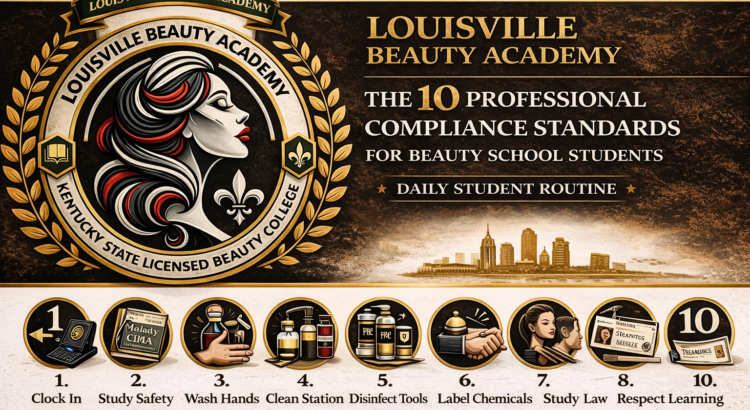
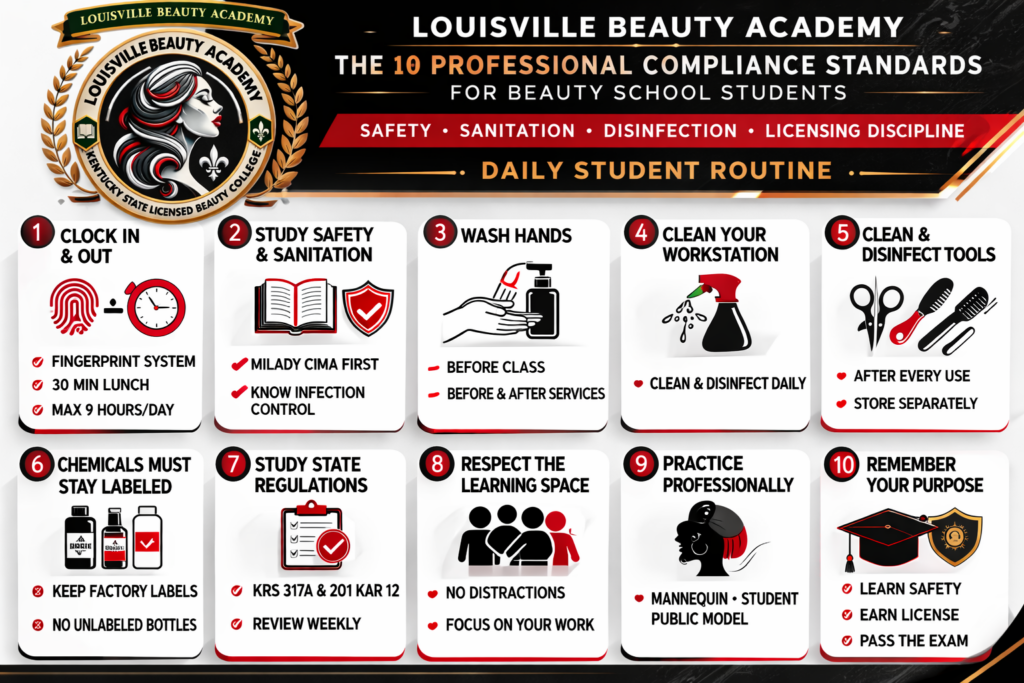
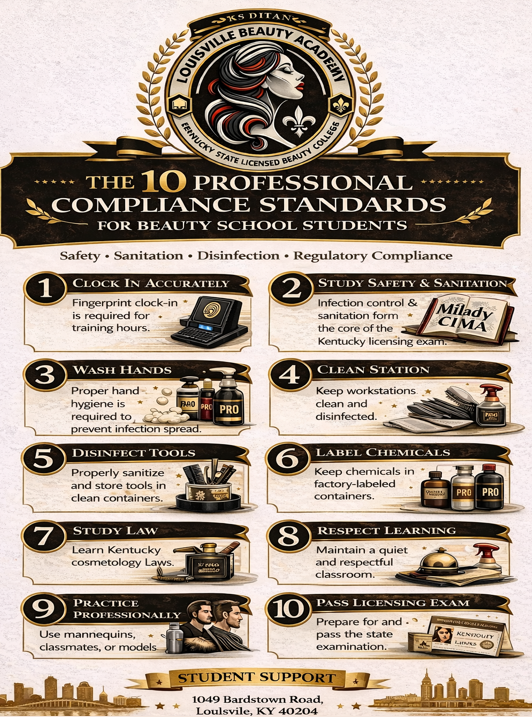
Louisville Beauty Academy – The 10 Professional Compliance Standards for Beauty School Students – DAILY STUDENT ROUTINE

Safety • Sanitation • Disinfection • Licensing Discipline

Louisville Beauty Academy operates under the regulatory authority of the Kentucky Board of Cosmetology in accordance with:

These laws exist to protect public health, safety, and sanitation in the beauty industry.

Students are expected to follow the professional standards below every day while training toward state licensure.


1. Accurate Clock-In and Clock-Out Is Required for Training Hours

Students must record their attendance using the approved biometric fingerprint system when arriving and leaving the school.

Requirements include:

• Clock in when arriving at the school
• Clock out when leaving the facility
• Clock out and back in for a 30-minute lunch break when training extended hours
• Do not exceed 9 hours of training per day

Accurate time records are required for state licensing eligibility and must reflect actual physical presence in the school.

Reference:
KRS 317A – Cosmetology licensing requirements
201 KAR 12 – School training hour documentation requirements


2. Safety and Sanitation Education Is the Foundation of Licensing

Students must prioritize learning infection control, sanitation, and safety procedures through the approved curriculum.

Students are expected to:

• Study Milady CIMA safety and sanitation chapters first
• Understand infection control and contamination prevention
• Demonstrate safe procedures before performing services

Safety and sanitation knowledge forms the core content of the Kentucky licensing examination.

Reference:
KRS 317A – Protection of public health and safety
201 KAR 12 – Sanitation requirements for cosmetology facilities


3. Hand Washing Is Mandatory Before All Services

Proper hand hygiene is required to prevent the spread of infection.

Students must:

• Wash hands before beginning class activities
• Wash hands before performing any service
• Wash hands between clients or practice sessions

Clean hands are the first step in protecting public health.

Reference:
201 KAR 12 – Sanitation and infection control requirements


4. Workstations Must Be Clean and Disinfected

Each student is responsible for maintaining a clean and sanitary workstation at all times.

Students must:

• Clean their workstation daily
• Disinfect surfaces before and after services
• Maintain organized tools and materials

A sanitary workstation protects clients, students, and the public.

Reference:
201 KAR 12 – Facility sanitation standards


5. Tools and Implements Must Be Properly Cleaned and Disinfected

All tools and implements must be handled according to professional infection-control standards.

Students must:

• Clean tools immediately after use
• Disinfect tools using approved disinfectants
• Store sanitized tools in clean containers
• Separate clean tools from used tools

Improper sanitation may result in infection risks and regulatory violations.

Reference:
201 KAR 12 – Disinfection procedures for cosmetology tools and implements


6. All Chemicals Must Remain in Original Factory-Labeled Containers

Chemical safety is a critical part of professional practice.

Students must ensure:

• All chemical products remain in their original manufacturer containers
Factory labels remain visible and intact
• Chemicals are never transferred to unlabeled bottles

This ensures the chemical identity, safety instructions, and hazard information remain clear.

Reference:
201 KAR 12 – Chemical safety and labeling standards


7. Students Must Study and Understand Kentucky Cosmetology Laws

Students must understand the laws governing their profession.

Students are expected to:

• Study Kentucky cosmetology regulations regularly
• Review sanitation and licensing rules
• Understand professional responsibilities under state law

Knowledge of regulations is essential to maintaining a professional license.

Reference:
KRS 317A – Kentucky Cosmetology Statutes
201 KAR 12 – Administrative Regulations


8. Respect the Professional Learning Environment

Louisville Beauty Academy maintains a ZERO-DISRUPTION educational environment.

Students must:

• Focus on their own study and training
• Avoid disrupting other students
• Respect the learning space of others

Many students study in multiple languages and may require additional time for translation and understanding.

This zero-disruption standard is also part of your signed student contract, and all students agree to uphold this professional learning environment as a condition of enrollment.

Professional respect supports effective learning for all students.


9. Practice May Occur on Mannequins, Students, or Volunteer Models

Practical training may include:

• Practice on mannequins
• Practice with fellow students
• Services performed on volunteer public models

Serving live models is optional.

Mannequin practice is acceptable and reflects the format used in the state licensing examination.

All services must be performed under instructor supervision.

Reference:
201 KAR 12 – School training and supervision requirements


10. The Purpose of Beauty School Is Professional Licensing

Students are training to become licensed professionals responsible for public safety.

The purpose of beauty school is:

• To learn safety and sanitation procedures
• To understand professional regulations
• To prepare for the state licensing examination

Students must remember:

• Licensing requires discipline and study
• Safety and sanitation protect the public
• Passing the state exam is the objective of training

Professional responsibility begins during your education.

Reference:
KRS 317A – Licensing requirements for cosmetology professionals


Student Support

Students who need assistance should contact their instructor or school administration.

Louisville Beauty Academy
1049 Bardstown Road
Louisville, Kentucky 40204

📞(TEXT IS BEST) 502-625-5531

Instructors are AVAILABLE throughout the training day to support student success.

What You Need to Be Ready Before Enrolling in Any Beauty School?

(Cosmetology · Esthetics · Nail Technology · Shampoo Stylist )

Enrolling in beauty school is not just signing up for classes.
It is a licensed, regulated, and career-defining commitment governed by state law.

Before enrolling in any beauty school, students and families should understand what readiness truly means — legally, academically, financially, and professionally.

At Louisville Beauty Academy, we believe informed students succeed at higher rates.


1️⃣ Legal & Eligibility Readiness (Non-Negotiable)

To legally enroll and eventually become licensed, students must meet state eligibility requirements, which generally include:

  • Minimum age requirements
  • High school diploma, GED, or approved equivalency
  • Valid government-issued photo ID
  • Lawful presence or authorization to study/work

If these requirements are not met, no licensed school can legally enroll or graduate a student for licensure.


📜 Educational Law Reference (Excerpted for Awareness)

In plain terms:
State law requires completion of approved training and compliance with board-established qualifications before licensure.

Verbatim excerpt:

“An applicant for licensure shall have completed the required hours of instruction in a licensed school and meet the qualifications established by the board.”

— Kentucky cosmetology statutes and administrative regulations

Authority: Kentucky Board of Cosmetology


🔞 Under 18? Here’s What Students and Parents Must Know

Yes — if you are under 18 but have already graduated from high school or earned a GED, you may enroll in beauty school.

However:

You cannot sit for the state licensing exam until you turn 18.

This means:

  • ✔ You may enroll before age 18
  • ✔ You may complete required training hours
  • ✔ You may graduate from school
  • ⛔ You must wait until age 18 to take the state board exam
  • ⛔ You cannot be licensed until you meet the age requirement

Starting early is allowed. Licensing early is not.


2️⃣ Time & Attendance Readiness (Hour-Based Programs)

Beauty education is hour-tracked, not credit-based.

Before enrolling, students should honestly evaluate:

  • Weekly schedule availability
  • Work and family responsibilities
  • Transportation reliability
  • Ability to attend consistently for months

⏱️ Missed hours delay graduation and delay licensure.

Consistency matters more than speed.


3️⃣ Financial Readiness (Know Before You Sign)

Every student should clearly understand:

  • Total tuition and fees
  • Kit, book, and supply costs
  • Payment options and timelines
  • Refund, withdrawal, and completion policies

A reputable school explains costs before enrollment, not after.

Transparency protects students.


4️⃣ Academic & Professional Readiness

Beauty school is not only hands-on. Students will study:

  • Sanitation and infection control
  • State law and regulations
  • Anatomy and physiology
  • Professional ethics and conduct
  • Client communication and documentation

You don’t need to be perfect — but you must be teachable, disciplined, and compliant.


5️⃣ The Right Mindset: License First, Skill Second

The goal of beauty school is not simply learning a skill.

The real objective is:

  • State licensure
  • Legal employment
  • Professional credibility
  • Long-term career stability

A beauty license is a legal credential, not a hobby certificate.


🌸 Why This Level of Transparency Matters

Schools that clearly explain readiness:

  • Respect student time and money
  • Protect future licensure eligibility
  • Operate ethically and compliantly
  • Focus on completion — not just enrollment

At Louisville Beauty Academy, we believe:

Preparation is protection. Education is empowerment. Licensure is the goal.


🛡️ Educational Disclaimer (Use This Exactly)

Educational Notice:
This content is provided for general educational awareness only and does not constitute legal advice. Licensing, age, eligibility, attendance, and examination requirements are governed by Kentucky law and the Kentucky Board of Cosmetology and may change. Students are responsible for verifying current requirements directly with the Board.


📞 Ready to Take the Next Step — the Right Way?

If you are prepared, informed, and committed to licensure success, we are ready to guide you ethically, legally, and transparently.

📞 502-625-5531
📧 study@LouisvilleBeautyAcademy.net

Louisville Beauty Academy
Licensed. Compliant. Student-First. Results-Driven.

Louisville Beauty Academy’s Theory-Focused Approach to Licensing Exam Success – RESEARCH AUGUST 2025

The Challenge: High Failure Rates in Cosmetology Theory Exams

Cosmetology students across the country face a significant hurdle in passing their state licensing exams – particularly the theory (written) portion. Studies show that the majority of exam failures (around 60–70%) occur in the theory exam, not the practical. In Kentucky, for example, fewer than two-thirds of cosmetology students passed the theory exam in 2023, meaning over one-third failed outright. For those taking the exam in other languages, the outcomes are even more concerning – the pass rate for the cosmetology theory exam was only 16% for Spanish-language examinees, implying that more than 80% failed. These high failure rates “are consistent across the United States, including Kentucky” and point to a systemic issue in how students are prepared.

Why do so many students fail the theory portion? A key reason is the imbalance in many beauty schools’ training approaches. The theory exam covers extensive content – from anatomy and sanitation to state laws and chemical processes – which requires in-depth study and memorization. Yet, traditional cosmetology programs often underemphasize theory. Many schools dedicate only “an hour or two per session” to classroom theory lessons. The rest of the time, students are put “behind the chair” practicing on the clinic floor to develop practical skills or even to serve paying clients. While hands-on experience is important, this minimal classroom theory time creates a knowledge gap. Students are expected to “grasp the material quickly” on their own, and as a result, they frequently graduate without a strong theoretical foundation. When it comes time to take the written licensing exam, these graduates struggle and often fail repeatedly, leading to frustration and delays in starting their careers.

In summary, insufficient focus on theory in many cosmetology programs has led to low first-time pass rates on the licensing exams. This is especially problematic because passing the theory exam is mandatory to become a licensed cosmetologist – without a license, a graduate cannot legally work as a professional in a salon or open their own business. The industry and aspiring professionals alike suffer when qualified graduates are held back by exam failures. Recognizing this challenge, Louisville Beauty Academy (LBA) has made it their mission to tackle the theory gap head-on and change the narrative on licensing exam success.

Louisville Beauty Academy’s Theory-First Education Model

Louisville Beauty Academy stands apart from traditional schools by putting theory education first. At LBA, theory isn’t an afterthought or a quick daily lecture – it’s the core of the student’s daily routine. While “many institutions spend only an hour or two” on theory classes, LBA’s approach is to have students dedicate as much time as possible – ideally all day – to studying theory. This immersive, theory-first model is fully aligned with the Kentucky State Board of Cosmetology’s licensing exam requirements, ensuring that everything students learn is directly relevant to what they will be tested on. The philosophy is simple: master the theory first, then move on to practical skills in a structured way, mirroring the state exam sequence.

Key features of LBA’s theory-focused model include:

  • All-Day Theory Immersion: Students are encouraged to spend entire days engaged in theory study using the Milady CIMA platform, rather than just a brief class. By maximizing theory hours, students cover every topic in depth and reinforce their knowledge continuously. This approach treats theory study with the same importance (or greater) as practical training, correcting the imbalance found in other schools.
  • Milady CIMA Digital Learning: LBA leverages Milady CIMA, the beauty education industry’s most advanced digital learning system. CIMA provides interactive online theory lessons and a huge bank of practice exams and quizzes. The platform’s design is built on repetition and active recall, which are proven effective for memorization. Students at LBA take chapter-specific practice exams repeatedly until they score 100% – essentially “cramming” through constant repetition until mastery is achieved. This intensive practice ensures that knowledge sticks. As LBA notes, “CIMA’s repetition model allows students to repeatedly take chapter exams until they achieve 100%. This repetition is key to building deep understanding and long-term retention”. By the time an LBA student sits for the licensing theory test, they have often seen and practiced hundreds of exam-style questions and are thoroughly prepared.
  • Individualized Pacing and Mastery: Because the CIMA system is self-paced and module-based, students can focus on the areas they personally find most challenging. They receive instant feedback on each practice test and can immediately retry any weak areas. This personalized learning means no student is left behind; whether it takes one attempt or ten, the student keeps working until they confidently grasp the material. Mastery learning replaces passive classroom listening. According to LBA, “CIMA allows students to learn at their own pace, focusing on areas where they need improvement”. This approach builds confidence through achievement – hitting that 100% on a practice exam shows the student they have fully learned a topic.
  • Theory Before Practice: Louisville Beauty Academy intentionally delays intensive salon floor work until students have proven their theory knowledge. In the LBA program, a student spends the early phase of training almost entirely on theory. Only after a student consistently excels in mock theory exams and gains a solid academic foundation do they advance to the next phase: targeted practice for the practical portion of the licensing exam. This staged progression ensures that when hands-on practice begins, it rests on a strong base of theoretical knowledge. By contrast, in many schools students start performing clinic services on clients early on (sometimes to generate income for the school), which can divert time from studying. LBA flips that script: “Theory first, practical second” is the rule. Practical skills are certainly essential, but at LBA they are introduced only after the student has demonstrated readiness to pass the theory exam. This prevents the common pitfall of students focusing on salon work prematurely only to “repeatedly fail the licensing exam and grow frustrated”. At LBA, every step (theory -> practical exam prep -> advanced salon training) is taken in order, “ensuring students are prepared at every level before entering professional practice.”
  • Optional Salon Services = More Study Time: Uniquely, LBA makes student participation in the public clinic (salon services) optional rather than mandatory. This policy is especially beneficial for students who feel they need extra study time – for example, those who have limited English proficiency or other learning needs who may require additional time to absorb the theory material. By not forcing every student to spend hours each day providing salon services, LBA frees up those hours for extra tutoring or study if needed. Students who are confident in their theory can still get practical experience, but those who prefer to focus on academics are fully supported in doing so. This flexibility helps “break down language barriers” by giving non-native English speakers the time and resources to master the English-based exam content. LBA even utilizes AI-powered translation and communication tools so that students can learn in their native languages alongside English, making the learning process more inclusive. By the time they take the exam (which in Kentucky can be taken in languages like English, Spanish, Vietnamese, Korean, Chinese, or Portuguese), these students have had the opportunity to study the material thoroughly in whichever language they are most comfortable, greatly improving their odds of success.
  • Alignment with State Requirements and Laws: Everything taught at LBA is closely tied to what the Kentucky State Board expects licensed professionals to know. The curriculum and mock exams mirror the scope and difficulty of the real licensing exam. This alignment means there are no surprises on test day; LBA students are essentially training for the test from day one. Moreover, Louisville Beauty Academy operates with full transparency and compliance. The school is state-licensed and state-accredited, and it adheres strictly to state regulations on curricula and training hours. By focusing on “licensing excellence and compliance with Kentucky State Law,” LBA ensures that its graduates not only pass the exam but have learned to do things the correct, legal way before entering the workforce. This emphasis on doing things by the book sets graduates up for long-term success as ethical, knowledgeable professionals.

Through this multifaceted, theory-centric model, LBA tackles the root causes of licensing exam failure. By essentially allowing – and incentivizing – students to “cram” theory daily in a structured and supportive environment, Louisville Beauty Academy produces graduates who are extremely well-versed in the knowledge their profession requires. It’s an approach designed to eliminate the “frustration of repeated failures” that so many beauty students experience, replacing it with confidence and competence.

Incentives and Transparency: Encouraging Student Success

Louisville Beauty Academy not only changes what students focus on (theory first), but also how they approach their education, by creating powerful incentives and a transparent, supportive environment. From tuition costs to academic rewards, LBA aligns its policies to motivate students to stay on track and succeed in both school and licensing exams.

One standout aspect is LBA’s incentive-based education model. Rather than charging high tuition and profiting from delays or extra fees, LBA actually rewards students for progressing efficiently. The academy’s public student contract clearly outlines a system of discounts and bonuses tied to attendance, academic effort, and timely completion. For example, students who attend full-time and finish the 1,500-hour cosmetology program in under 10 months are eligible for substantial tuition reductions. In fact, when all possible incentives are earned, LBA students pay under $7,000 total for the program, whereas many cosmetology schools charge $20,000–$30,000 for the same training. This means LBA is offering over $20,000 in discounts compared to typical schools – a revolutionary approach in beauty education pricing.

How do these discounts encourage exam success? They are structured to promote consistent study habits and dedication. Students essentially “save big — up to $20,000” by showing up every day, staying focused, and finishing on time. This creates a win-win scenario: the student gains financially by investing their time and effort into their education, and that time and effort directly translates into better preparation for the licensing exam. By incentivizing daily attendance and diligent study, LBA addresses one major reason students fail exams – lack of preparation – and makes sure that every student has skin in the game to reach the finish line on schedule.

Transparency is another cornerstone of Louisville Beauty Academy’s philosophy. Everything from tuition and fees to graduation requirements is out in the open, with no hidden charges or fine print. LBA notably does not utilize Title IV federal student loans. While this might sound like a disadvantage at first, it is quite intentional. By operating on a pay-as-you-go and discounted tuition basis, LBA spares students from accumulating debt and the pressure that comes with it. “No student loan debt, no hidden charges, no surprises” is a guiding principle. The full cost breakdown and the terms of the incentive program are provided to every student upfront (even made available online for prospective students to review). This level of transparency builds trust and ensures that students understand exactly what is expected of them academically and financially. With a clear contract and no unpleasant financial surprises, students at LBA can focus entirely on their studies – particularly the crucial theory study – without distraction. They are not forced to work part-time to pay off loans or worry about unexpected fees, which further enables them to devote their energy to preparing for the licensing exam.

Moreover, LBA’s supportive ethos extends beyond graduation. Unusually, graduates remain part of the LBA family and can return for additional tutoring or guidance as needed. For instance, if a graduate wants to review theory material again before their state board exam, or even after licensure to refresh knowledge, the academy welcomes them. This open-door policy underscores LBA’s confidence in their teaching and their genuine commitment to each student’s success. It’s not just about getting students to pay tuition – it’s about seeing them licensed and employed in the field. In the words of LBA’s leadership, “we measure success by how many students finish, pass the state exam, and get licensed,” not just by how many enroll in the first place. This student-centered, ethical approach is a refreshing change in an industry where some schools unfortunately have prioritized tuition dollars or free student labor over student outcomes.

Outcomes: High Pass Rates and Fast-Track Entry into the Workforce

The results of Louisville Beauty Academy’s theory-focused, incentive-backed training model are exceptional by any standard. By prioritizing theory mastery and supporting students every step of the way, LBA produces graduates who excel in exams and in their careers. The academy’s internal performance statistics speak volumes about the effectiveness of its approach:

  • Licensing Exam Success: Nearly 100% of LBA students pass the Kentucky State Board licensing exam (which includes both the theory and practical portions) – a pass rate that approaches perfection. This is dramatically higher than the typical pass rates seen elsewhere. Many LBA graduates pass their licensing exams on the first attempt, a direct payoff for the intense exam preparation built into the program. Compared to statewide averages (around 62% theory pass rate in KY as noted earlier), LBA’s outcome is extraordinary. High pass rates mean LBA graduates can transition smoothly from graduation to obtaining their license without delays or additional exam fees.
  • On-Time Graduation: Over 95% of LBA students graduate on time (within the intended program duration). For a 1,500-hour cosmetology course, “on time” at LBA means about 9 to 10 months for full-time students. Traditional schools often take 12–18 months for the same hours, with many students taking even longer if they fail exams or miss hours. LBA’s structured schedule and incentives for attendance keep students on track. An on-time graduation not only saves students money (as discussed) but also gets them into the job market faster.
  • Immediate Employment: Over 90% of LBA graduates are working in the beauty industry immediately after graduation. This is a remarkably high job placement rate, indicating that LBA graduates are in demand and job-ready. Because they earn their licenses promptly upon graduating, they can legally begin working right away, whether in salons, spas, or even by starting their own businesses. LBA’s comprehensive training (including the later phase of salon-level practical skill development after theory mastery) ensures that graduates have both the knowledge and the hands-on ability to perform as professionals from day one. Additionally, the academy’s reputation for producing well-prepared, licensed professionals likely gives employers confidence in hiring its alumni.
  • Fast-Track to a Career: Thanks to the intensive full-time study model, LBA students don’t have to wait years to start their careers. From the moment a student enrolls, they can realistically become a licensed cosmetologist in under 10 months and immediately start earning income in the field. In contrast, a student at a slower-paced school might take 1.5 years to finish, then face months of exam retakes if they weren’t well prepared, potentially delaying work for 2 years or more. LBA explicitly positions itself as a “fast-track path to a licensed beauty career”, and the outcomes validate that claim. Graduating quickly and passing the exam on the first try means LBA alumni enter the workforce sooner, which can translate to thousands of dollars of early earnings and a jump-start on gaining real-world experience. Importantly, they do so fully licensed and debt-free, which sets them up for long-term success without financial stress.

These outcomes are not coincidental – they are the direct result of Louisville Beauty Academy’s educational strategy. By fixing the weak link (theory preparation) that has impeded so many students elsewhere, LBA ensures its students can cross the finish line without stumbling. It’s worth noting that LBA’s success also benefits the broader community and industry. Kentucky and the U.S. need more licensed cosmetologists and beauty professionals, as the beauty industry continues to grow and client demand increases. Every LBA graduate who swiftly becomes a competent, licensed practitioner is filling a gap in the workforce. In essence, LBA is not just helping its own students; it is addressing a workforce shortage by supplying the market with well-trained, qualified professionals at a faster rate than traditional models allow.

Leading the Way: A New Standard for Transparency and Success in Beauty Education

Louisville Beauty Academy has proven that focusing on theory and student success – rather than maximizing clinic floor hours or tuition revenue – yields superior results for everyone. By being transparent, student-centric, and laser-focused on licensing exam preparation, LBA is setting a new standard that other cosmetology schools may well be urged to follow. In an industry often plagued by hidden fees, long program lengths, student debt, and low board exam pass rates, LBA’s model is a breath of fresh air. It shows that when a school truly puts education first, students excel and become licensed professionals more efficiently.

There are several broader implications of LBA’s approach:

  • Empowering Students: LBA’s emphasis on theory mastery empowers students with knowledge. Instead of just clocking hours and performing services, students take an active role in their learning. They gain a deep understanding of the science and regulations of cosmetology, making them not only test-ready but also more confident in their careers. As LBA notes, “students who focus on theory before practical training perform better on exams and feel more confident in their careers.” This confidence can be the difference between a graduate who merely has a license and one who thrives in the industry, continually learning and adapting.
  • Advocating for Licensure and Legal Compliance: By insisting that its students become licensed quickly and correctly, Louisville Beauty Academy is advocating for professionalism and legal compliance in the beauty field. Unfortunately, there are instances in the industry of individuals attempting to work without proper licenses or of graduates who, after failing the exam, might be tempted to offer services informally. LBA’s message is that only licensed practice is acceptable – and they back that up by doing everything possible to get their graduates licensed as soon as possible after graduation. This stance protects consumers (who can trust they are in the hands of trained, licensed practitioners) and elevates the reputation of the profession as a whole. It’s an approach that emphasizes ethics and safety, aligning with state laws and regulations at every step.
  • Transparency as a Trust Builder: LBA has shown that being transparent and fair with students isn’t just the right thing to do, it’s also a formula for success. Their clear contracts, lack of hidden fees, and straightforward incentives build a relationship of trust from day one. Students know exactly what is expected – for instance, if they must achieve certain theory exam scores or attendance milestones to earn a tuition discount, those expectations are spelled out in writing. This clarity drives students to meet those goals and rewards them for doing so. In turn, the school benefits from motivated students who perform well. It’s a virtuous cycle that contrasts sharply with less scrupulous schools that might surprise students with extra charges or that keep students enrolled longer than necessary. Transparency is woven through LBA’s culture, from publishing their student contract online to openly sharing their outcomes and success rates. Such openness not only attracts students but also pushes the academy to continually maintain high standards (because they hold themselves accountable to the outcomes they’ve promised).
  • Innovating with Technology for Inclusivity: Louisville Beauty Academy embraces new technology like the Milady CIMA system and AI translation to ensure that language is not a barrier for student success. In a diverse community like Louisville, this is crucial. Students who are immigrants or non-native English speakers can pursue their dreams in beauty without being held back by the speed of an English lecture or textbook. By providing tools that allow studying in multiple languages and at one’s own pace, LBA is tapping into a wider talent pool and giving everyone a fair chance to excel. This inclusivity is part of why LBA has been able to help graduates from various backgrounds – “from young professionals to working moms to first-generation immigrants” – all succeed at high rates. It’s a model of how a school can adapt to the needs of students, rather than expecting students to adapt to the school.

In conclusion, Louisville Beauty Academy is leading the effort to reform cosmetology education by demonstrating that a theory-centric, exam-focused training program produces better professionals in less time. The academy’s legally compliant and academically rigorous approach shows that doing things “the correct way” – emphasizing proper licensure, comprehensive knowledge, and ethical practices – is entirely compatible with running a successful school. In fact, LBA’s success hinges on student success, proving that when students pass their exams and launch their careers, the school’s reputation and community standing also rise. (It’s no surprise that LBA has been recognized in the local community for its impact and even lauded by business organizations.)

Louisville Beauty Academy’s experience can serve as a case study for educators and regulators alike. By shining a light on the importance of theory education and providing a transparent, supportive path to licensure, LBA is not only helping its own students but also raising the bar for beauty education in Kentucky and beyond. Their mantra could be summed up simply: focus on what truly matters – the education and success of the student. The payoff of this focus is clear to see: confident graduates, near-perfect licensing exam pass rates, and a cohort of new beauty professionals entering the workforce fast – fully licensed, properly trained, and ready to contribute to the industry from day one. Louisville Beauty Academy’s leadership in this area is a powerful advocacy for putting people to work the right way – licensed, knowledgeable, and set up for long-term success. It’s an approach that benefits the students, the school, the industry, and the public, and it may well represent the future of cosmetology education.

📚 References

Kentucky Board of Cosmetology. (2024). Annual data sheet: Licensing exam pass rates by program and language (2023–2024). Kentucky Board of Cosmetology. Retrieved from
https://kbc.ky.gov

Louisville Beauty Academy. (2024, December 6). Why Louisville Beauty Academy focuses on theory mastery through CIMA: Removing barriers to success. Louisville Beauty Academy. Retrieved from
https://louisvillebeautyacademy.net/why-louisville-beauty-academy-focuses-on-theory-mastery-through-cima-removing-barriers-to-success/

Louisville Beauty Academy. (2025, July 3). Why Louisville Beauty Academy is the #1 choice for real success in cosmetology. Louisville Beauty Academy. Retrieved from
https://louisvillebeautyacademy.net/why-louisville-beauty-academy-is-the-1-choice-for-real-success-in-cosmetology/

Louisville Beauty Academy. (2025). School outcomes and approach bulletin. Louisville Beauty Academy. Retrieved from
https://louisvillebeautyacademy.net

Beauty Career Demand: Nails vs. Esthetics vs. Hair — What You Need to Know – RESEARCH AUGUST 2025

At Louisville Beauty Academy, a Kentucky State-Licensed and State-Accredited beauty college, we are committed to preparing our students for real-world success. Since our founding, we have proudly graduated nearly 2,000 licensed beauty professionals, whose work contributes an estimated $20 to $50 million annually to the economy of Kentucky and beyond.

Choosing your beauty career path is exciting — but it’s also a decision that benefits from careful research and a clear understanding of the industry. Whether your passion lies in Nail Technology, Esthetics, or Hair (Cosmetology), understanding the service frequency and career demand in each area can help you make the choice that best fits your goals, lifestyle, and earning potential.


Why Service Frequency Matters

In the beauty industry, how often a client returns directly impacts the predictability of your bookings and your revenue potential. These are basic human services — they will always be needed — but the frequency of that need varies from one specialty to another.


1. Nails — The Highest Repeat Rate

  • Average Frequency: Every 2 weeks or less for most regular clients (gel, dip, acrylics).
  • Why: Nail polish chips, gels and acrylics grow out, and many people maintain a standing schedule for well-groomed hands and feet.
  • Reality: Many nail clients pre-book their next visit before leaving the salon, creating a predictable, high-retention client base.
  • Impact: This repeat cycle offers stability and consistency, making nail technology one of the fastest ways to build a loyal clientele.

2. Esthetics — Moderate to High Frequency

  • Average Frequency: Typically monthly, but many services draw clients back every 2–4 weeks.
  • Examples:
    • Lash extensions → fills every 2–3 weeks
    • Brow shaping/waxing → every 3–4 weeks
    • Skincare programs → monthly facials or targeted treatments
  • Reality: Esthetic clients, especially those in ongoing programs, can match nail tech clients in repeat visits — offering both steady income and opportunities for upselling additional treatments.

3. Hair (Cosmetology) — Lower Frequency

  • Average Frequency: Every 6–8 weeks for most clients, sometimes longer.
  • Exceptions:
    • Short hair or precision cuts → every 4–6 weeks
    • Color touch-ups → every 4–8 weeks
  • Reality: Many hair clients extend visits to save money or because their style requires less frequent upkeep, which can make recurring revenue less predictable compared to nails or high-frequency esthetics.

Quick Comparison: Repeat Demand Potential

ServiceCommon Repeat IntervalPredictability of BookingsRevenue Stability
Nails2 weeksVery HighStrong recurring revenue
Esthetics2–4 weeksHigh (varies by service type)Solid, especially with memberships
Hair4–8+ weeksModerate to LowLess consistent unless short style or frequent color

Why This Matters for Your Career

Regardless of which path you choose, these fields are built on human connection and repeat service. The difference lies in how often clients come back — and that affects how quickly you can fill your schedule, grow your income, and plan your business.

At Louisville Beauty Academy, we guide students not only through technical training but also through career planning — helping them understand the realities of client demand, local market conditions, and business growth strategies.


About Louisville Beauty Academy

  • State-Licensed and State-Accredited beauty college
  • Nearly 2,000 graduates contributing $20–$50 million annually to the economy
  • Programs in Nail Technology, Esthetics, and Cosmetology
  • Commitment to affordable, flexible, and debt-free education
  • Focus on career success and real-world readiness

📧 Email: study@LouisvilleBeautyAcademy.net
📱 Text: 502-625-5531
🌐 Visit Us: LouisvilleBeautyAcademy.net


Disclaimer: This article is for educational purposes only and reflects industry observations and publicly available data. Information may change over time. No guarantee of future income, employment, or career results is implied.

Louisville Beauty Academy: Your “YES I CAN” Journey Starts Here

Welcome to Louisville Beauty Academy, Kentucky’s most affordable, most flexible, and most supportive beauty college.
We are KY State‑Licensed and State‑Accredited, helping aspiring beauty professionals from all walks of life turn their passion into a licensed, thriving career.

Whether your dream is to excel in a top-tier salon, start your own beauty business, or master a specialized skill, we’re here to guide you every step of the way.


Why Louisville Beauty Academy Stands Out

We are proud to be more than a school — we are a community of mentorship, opportunity, and lifelong learning.
Here’s why students choose LBA:

  • Separate, Specialized Programs – You are never forced into a broad cosmetology track. Choose exactly what fits your goals:
    • Nail Technology
    • Aesthetic Skincare
    • Cosmetology
    • Shampoo Styling
    • Short courses like 2‑day Eyelash Extensions
  • Debt-Free Education – Our tuition is the most affordable in Kentucky, with flexible payment plans and no required loans.
  • Unlimited Graduate Access – Even after you graduate, you’re welcome back for mentorship, tutoring (as available), and to inspire current students by sharing your success story.
  • Flexible Scheduling – Perfect for working adults, parents, and anyone balancing life’s commitments.
  • Diversity and Inclusivity – We proudly serve immigrants, non‑native English speakers, and students from all backgrounds.

Breaking Barriers with Multilingual Licensing Exams

We celebrate our first graduate to pass the Kentucky State Licensing Exam in Spanish — and this is just the beginning!
The Kentucky Nail Licensing Exam is now available in:

  • English
  • Simplified Chinese (简体中文)
  • Spanish (Español)
  • Vietnamese (Tiếng Việt)
  • Korean (한국어)

This means more students can achieve their professional goals without language being a barrier.


Hands-On Training with Modern Technology

Our training is state‑board aligned and supported by the Cengage CIMA Digital Learning Solution, giving you the best of both worlds:

  • Practical, in-person skill development.
  • Accessible online resources you can use anytime, anywhere.

Proven Success: Over 1,000 Graduates

With more than 1,000 licensed graduates, our impact speaks for itself. Many of our students overcome financial hardship, language barriers, or busy family schedules — and still succeed.

Your journey is unique, but success is possible with belief, consistency, and the YES I CAN mentality we live and breathe every day.


From the Desk of Our Founder: Di Tran

Our founder, Di Tran, has written over 40 books on beauty, business, and personal growth — including Why Licensing a Beauty Career is the Way for Me?
In this inspiring guide, Di explains how licensing boosts credibility, opens career opportunities, and ensures long-term stability in the beauty industry.


Begin Your Journey Today

At Louisville Beauty Academy, we don’t just teach beauty techniques — we prepare you for a licensed, empowered, and debt-free future.
We are proudly KY State‑Licensed and State‑Accredited, meeting the highest educational and regulatory standards in the state.

📞 Call or Text: 502‑625‑5531
📧 Email: Study@LouisvilleBeautyAcademy.net
🌐 Explore Programs & Enroll

Your future in beauty starts with one step.
Say YES I CAN today — and soon, you’ll be proudly saying I HAVE DONE IT.