If It’s Important, It Deserves to Be in Writing: Transparency at Louisville Beauty Academy

Louisville Beauty Academy · Written clarity. Personal welcome.

If it’s important, it deserves to be in writing.

Your education, your money, your time, and your future deserve information you can keep. At Louisville Beauty Academy, we encourage you to text or email important questions—and visit our school to meet the people behind the answers.

We are a brick-and-mortar, Kentucky state-licensed beauty school. Our classrooms, instructors, students, and supervised practice are here in Louisville. We welcome thoughtful questions, written follow-up, and the opportunity to show you learning in action.

Transparency starts with an answer you can revisit.

A school decision involves more than a friendly conversation. You may need to compare schedules, understand a cost, review an agreement with family, or ask how a requirement applies to your situation. A written answer gives you something concrete to examine before taking the next step.

Text and email let you return to the original question and response. They give our team a shared reference when following up. They can also support translation, thoughtful review, and a clearer understanding of what remains unresolved.

Your question matters enough to document. Our answer matters enough to review.

For admissions, program, cost, schedule, attendance, document, payment-option, or school-policy questions, please begin with a text to 502-625-5531 or an email to study@LouisvilleBeautyAcademy.net. Tell us what you want to understand. You do not need perfect grammar or formal language.

Written communication is part of caring.

Clear questions

Describe the issue in your own words. Include the program or topic and the information you need to make a decision.

Thoughtful replies

Written follow-up gives our team space to review relevant documents, explain conditions, and identify a useful next step.

A record to check

Keep the response. Revisit it, ask for clarification, and compare it with the current documents that apply to you.

Writing does not automatically make an answer correct. It makes an answer easier to check. If something is unclear, incomplete, or inconsistent, please bring it to our attention so it can be reviewed.

Quality assurance means checking, not guessing.

Our aim is to provide useful written guidance, with enough context for you to understand the answer. Some questions are straightforward. Others require reviewing a record, consulting a team member, or checking an official source. Careful review can take time; a quick assumption is not a substitute for a supported answer.

Our evidence-minded communication approach is simple:

  1. Understand: identify what you are asking and any information needed to clarify it.
  2. Check: review the relevant school document, record, or current official source.
  3. Explain: distinguish the answer, its conditions, and any uncertainty that remains.
  4. Document: provide written follow-up that you and our team can refer to.
  5. Improve: clarify or correct the response when new information shows that a change is needed.

This is a practical quality-control discipline, not a claim that every response is error-free. We want communication that can be examined and improved, with human responsibility for the information provided.

The right source is part of the right answer.

Transparency includes knowing who has authority to answer a question. LBA can explain its own programs, procedures, and written agreements. Questions about a licensing decision, examination administration, or another organization’s requirements may need confirmation from that organization.

Where appropriate, we will point you toward the relevant document or official source rather than ask you to rely on an unsupported statement. A link is most useful when you also understand what to look for and what question still needs an answer.

Trust grows when you meet us in person.

We strongly encourage prospective students and families to visit. A website can introduce a school. A visit lets you see the environment where education takes place.

Meet our team. Ask about the daily schedule. Observe instruction and supervised practice where appropriate. Learn how students receive feedback, correct mistakes, and build skill through repetition. Talk with us about the responsibilities of training and the steps toward your chosen career.

We welcome curiosity. You do not need to arrive with every answer, and touring the school does not commit you to enrollment. Observation and conversations must respect class time, student and client privacy, safety, and instructor availability. A tour itself does not provide instruction credit or authorize participation in regulated services.

Come by. See learning in action.

Louisville Beauty Academy
1049 Bardstown Road
Louisville, KY 40204

Published walk-in tour hours: Monday–Friday, 9 AM–4 PM.
Text ahead to confirm availability, particularly if you would like time with a specific team member or need assistance during your visit.

Recognition is a reason to keep earning trust.

LBA’s recognition gives us another reason to make our values visible in everyday service:

These distinctions have different recipients and scopes. They are not accreditation, approval of every school statement, or guarantees of an individual result. Their meaning is strengthened by the daily work of instructors, staff, students, families, and the community: asking carefully, responding respectfully, and following through.

A welcoming process for different needs.

Written-first communication should help people access information. If language, disability, technology, or difficulty writing creates a barrier, tell us or visit for assistance. Ask about available support. You are welcome to speak with us in person and request that important points be documented afterward.

Translation tools can assist, but important wording may still need clarification. Please ask again if an answer does not make sense. The goal is understanding, not judging how someone communicates.

Begin with one simple message.

“Hello LBA. I’m interested in [program]. Could you send me the current written cost, schedule options, and enrollment steps? I would also like to visit the school.”

Current students can begin with the topic, the question, and any relevant date. For an initial inquiry, avoid sending sensitive identifiers, medical records, or financial documents. Ask our team how to provide any documents needed for your specific request.

Admissions and school questions: text 502-625-5531 or email study@LouisvilleBeautyAcademy.net.

Student-clinic live-model scheduling: use the separate clinic number, 502-915-8615, during the published scheduling window, Monday–Friday, 9 AM–4 PM, when available. The student clinic is a supervised educational environment; service availability depends on the learning schedule and applicable school requirements.

If it’s important, it deserves to be in writing. And when you want to understand the people and place behind those words, come meet us. Your questions are welcome here.

This article explains LBA’s communication approach. A message, informal reply, or tour alone does not complete enrollment, reserve a seat or clinic service, establish a discount, or guarantee an outcome. Applicable law, official licensing requirements, current school policies, and the signed enrollment agreement govern their respective matters. Written guidance supports understanding and does not replace those requirements. Check the contact page for current visit information.


Best Beauty School in Louisville 2026 — Louisville Beauty Academy Recognized by BusinessRate

The title names our school. The gratitude belongs to our community.

In a letter dated October 26, 2026, BusinessRate recognized Louisville Beauty Academy as the “Best Beauty School in Louisville for 2026, based on Google reviews.” We are grateful for that recognition. But what moves us most is the human effort behind it: students learning, instructors guiding, clients trusting, and a community taking the time to say that someone’s work mattered.

The school receives the title. The people give it meaning.

A beauty service is more than a finished look. For a learner, it is an opportunity to listen carefully, practice a technique, respond to guidance, and care for another person. For the person receiving that service, it is an act of trust. When someone chooses to write a thoughtful review, that experience becomes visible beyond the classroom.

Reviews that mention a service provider by name can make that recognition especially personal. They say, in effect: I noticed your effort. I remember your care. Thank you. Not every name in a review has been independently matched to a student record, and not every review describes the same experience. Still, specific, honest feedback can give learners something valuable to reflect on and build upon.

A practical “grade”—in the human sense

We think of this kind of feedback as a practical “grade” from the community: not an academic mark, but a public reflection of someone’s experience. It does not replace instructor assessment, required training, examinations, or licensing requirements. Its value is different. It helps a learner see how their work was received by a real person.

This connects with our Career Credit Score learning framework: building a professional reputation through truthful evidence, kept commitments, feedback applied, and service to others. It is an educational framework—not a financial credit score or official licensing measure. A reputation grows through what we do consistently, including how we respond when improvement is needed.

To our community: thank you for being part of the learning

To our clients and live models: thank you for your trust, your time, your patience, and your honest feedback. To everyone who has written a review, offered encouragement, or shared a concern respectfully: thank you for helping us understand your experience. Appreciation encourages us; constructive feedback helps us improve. Neither learning opportunities nor our gratitude depend on a positive public review.

To our students, graduates, and future learners

To students studying today: your practice matters. So do your questions, your willingness to try again, and your care for the person in front of you. To those approaching graduation: carry that commitment into your next steps toward licensure and professional practice. To our graduates: thank you for carrying your learning into your work and communities. To those who will join us: there is meaningful work ahead, and we look forward to helping you learn.

To the people who make learning possible

To our instructors: thank you for teaching the details, offering corrections, modeling care, and helping students turn practice into understanding. To our staff: thank you for the daily coordination and support that help a school function. To the people who clean, maintain, repair, and care for our learning spaces: your work matters, even when it happens outside the spotlight. To our vendors and service partners: thank you for the supplies, equipment, and support that contribute to the learning environment. To families and supporters: thank you for encouraging learners through the demands of study and practice.

What the review record shows—and what it does not

LBA’s school-curated archive dated October 21, 2026 records 427 five-star entries among 446 total Google reviews, with a displayed average of 4.9. That is a historical snapshot, not a live count or an independent recount. Those figures are separate from BusinessRate’s award letter; we have not verified the exact review cutoff or detailed score used for that award.

BusinessRate describes its recognition as based on its own analysis of Google review data. This is recognition from BusinessRate, not an award issued by Google, a government accreditation, or our own independently established statewide ranking. Reviews offer valuable accounts of experience; they do not, by themselves, establish educational outcomes or professional competence.

Our gratitude becomes a responsibility

We want to help people develop both the practical skills and the human care that beauty work requires. Recognition is an invitation to keep doing that work thoughtfully: listen, teach, practice, improve, and treat people with dignity.

Thank you, Louisville. Thank you to every learner and every person who helps make learning possible. The title names our school. The gratitude belongs to the community.

Choosing a beauty school in Louisville? Look beyond the headline.

Recognition can start a conversation. Your decision deserves more: a program that fits your goals, clear written terms, and a learning environment you can see for yourself. Bring these questions to any school you are considering, including ours.

  1. What am I preparing to do? Confirm the exact program, required training, and next steps toward the credential you want.
  2. What is the complete cost? Ask for tuition, supplies, fees, payment dates, refund terms, and any conditions attached to discounts in writing.
  3. How will learning fit my life? Discuss attendance, scheduling, instructor support, and how practical skills are evaluated.
  4. What does the evidence actually show? Read recent and critical reviews, check the source and date of awards, and distinguish community feedback from licensing or employment outcomes.
  5. Can I visit and ask questions before deciding? Meet the team, observe the setting when permitted, and keep copies of the information that matters to you.

Take your next step with clear information.

Compare LBA programs and written costs, explore our free supplemental study guides, or contact LBA about a visit. Free online study supports learning; it does not replace required school instruction or award licensing hours.

For admissions questions, text 502-625-5531 with your name and program of interest. Ask for current costs, schedules, and terms in writing before making a commitment.

Sources and context

BusinessRate recognition letter dated October 26, 2026, retained in LBA’s records. Private access details are not reproduced.

From Healthcare to Salon Ownership: The Value of Care, the Discipline of Business

AI-generated illustration of healthcare and business professionals planning a salon; From Healthcare to Salon Ownership.
AI-generated editorial illustration.

LOUISVILLE BEAUTY ACADEMY · RESEARCH-INFORMED PERSPECTIVE

From Healthcare to Salon Ownership: The Value of Care, the Discipline of Business

Your experience caring for people can inform your next chapter. Turning it into a responsible beauty business requires a deliberate bridge between experience, competence, licensing, and execution.

Prepared November 9, 2026 · Kentucky-focused regulatory analysis · Educational publication

EXECUTIVE SUMMARY

Healthcare experience can be a foundation. A successful salon must still be built.

Healthcare professionals may bring useful habits to beauty entrepreneurship: attentive communication, disciplined documentation, recognition of limits, and respect for safety procedures. These capabilities can support a salon’s operating culture when translated into beauty-specific training and observable routines.

The evidence supports the relevance of these capabilities—not a guarantee of superior salon performance. This article does not establish that healthcare-trained owners earn more, experience fewer incidents, or outperform experienced beauty professionals.

  • Separate ownership, facility approval, and permission to perform services. Each requires its own analysis.
  • Match the business to the actual credential. An MD, RN, LPN, allied-health qualification, and caregiving background carry different preparation and authority.
  • Build competence in the services offered. Healthcare experience does not automatically demonstrate beauty technique, aesthetic judgment, or salon-management skill.
  • Make care operational. Translate intentions into written procedures, staff preparation, appropriate referrals, and clear client expectations.
  • Test the business proposition. Evaluate demand, costs, capacity, and cash requirements before committing substantial money.

Practical conclusion: A healthcare background can be an asset when paired with humility about a new field, appropriate credentials, strong beauty professionals, and accountable business systems.

1. What this analysis can—and cannot—prove

This is a focused narrative synthesis of selected public regulatory and professional guidance, accompanied by an original business-planning framework. Sources were selected for relevance to Kentucky practice boundaries, salon workplace risks, healthcare safety systems, and small-business planning. It is not a systematic review, a peer-reviewed clinical study, or an empirical comparison of salon owners.

Documented foundations

Official sources identify applicable licensing boundaries, salon hazards, healthcare safety practices, and business-planning considerations.

Reasoned interpretation

Experience with related practices may help a new owner develop appropriate salon systems. The size and reliability of that advantage are not measured here.

Proposed application

The professional comparisons, readiness questions, and operating measures below are recommendations for planning—not validated predictors of success.

No customer surveys, owner interviews, financial records, or incident datasets were collected. Prior training varies widely within professions. A credential alone does not show that a particular person practices the habits discussed here.

Any future study of a healthcare-background advantage would need defined outcomes and comparison groups, while accounting for previous business experience, capital, staffing, service mix, location, and years in operation. Without that work, declaring healthcare-trained owners inherently superior would exceed the evidence.

2. The advantage becomes meaningful when care becomes a system

Consider the difference between saying “We care about safety” and assigning responsibility for checking supplies, training staff, documenting exceptions, and correcting recurring problems. The second statement describes work that can be observed and improved.

CDC’s healthcare guidance places infection prevention within leadership accountability, adequate resources, workforce training, and routine practice. These are healthcare recommendations; they are not a substitute for salon regulations. They nevertheless provide a useful example of how an organization translates care into repeatable responsibilities. CDC: Core Infection Prevention and Control Practices.

OSHA identifies chemical exposure, biological hazards, and repetitive or awkward work as important concerns in nail salons. This establishes that beauty-business safety requires attention to the working environment as well as the appearance of the finished service. OSHA: Health Hazards in Nail Salons.

Our interpretation: A professional accustomed to safety systems may be well positioned to ask disciplined questions about salon operations. The advantage exists only if the owner learns the relevant salon requirements and acts on the answers.

  • Consultation: Explain the proposed cosmetic service, its limits, price, and available choices in language the client understands.
  • Boundaries: Establish a respectful pause-and-refer process when a concern exceeds the service provider’s authority or competence.
  • Consistency: Give staff usable procedures and enough time and resources to follow them.
  • Learning: Record concerns and near misses without treating honest reporting as disloyalty.
  • Accountability: Review whether corrective actions were completed and whether they worked.

These qualities are also developed by excellent beauty professionals without healthcare backgrounds. A strong ownership team respects their technical and commercial expertise rather than assuming that a medical title replaces it.

3. Many healthcare backgrounds can contribute—through different strengths

The following is an illustrative, non-exhaustive comparison of potential transferable capabilities. It is not a legal scope-of-practice chart, a ranking of professions, or a finding that every member of a profession possesses these strengths. The cautions identify issues to verify, not individualized legal conclusions.

BackgroundPotential contributionBoundary to keep clear
Physicians: MDs and DOsScientific reasoning, risk assessment, documentation, and referral judgment.A specialty title does not demonstrate competence in every cosmetic technique or establish the permissions for a proposed facility.
Advanced practice registered nursesAssessment, education, care coordination, and leadership within their preparation.APRN role, population focus, competence, and applicable practice requirements matter; APRNs are not one interchangeable category.
Registered nursesPatient communication, procedural consistency, team coordination, and escalation habits.RN licensure is not independent prescribing authority or blanket authorization for medical aesthetic practice.
Licensed practical nursesCare routines, observation, documentation, and working within defined supervision.Do not equate LPN and RN roles or supervision requirements.
Physician assistantsCollaborative care, consultation, and disciplined follow-through.Verify the rules governing the individual practitioner and proposed procedures; do not assume physician privileges.
Dentists and dental hygienistsPrecision, infection-prevention habits, and attention to client comfort.Dental credentials do not automatically authorize unrelated cosmetic services.
PharmacistsProduct information literacy, careful explanations, and recognizing questions requiring further review.Product knowledge is not permission to diagnose or perform unrelated services.
PodiatristsFoot-health knowledge and recognition of situations needing medical assessment.A cosmetic pedicure and medical foot care have different purposes and regulatory implications.
Physical and occupational therapistsErgonomics, functional needs, accessibility, and practical adaptation.A salon must not imply that ordinary beauty appointments constitute rehabilitation treatment.
EMTs and paramedicsEmergency readiness, calm communication, and organized escalation.Emergency credentials do not make a salon a medical treatment facility.
Respiratory therapists, laboratory and imaging professionalsEquipment discipline, protocol adherence, and quality-control habits.Technical healthcare competence is specific; it does not automatically transfer to beauty procedures.
Behavioral-health professionals and social workersListening, boundaries, respectful communication, and awareness of vulnerability.Supportive salon interactions should not be marketed as psychotherapy or treatment.
Dietitians and other qualified nutrition professionalsClient education, evidence appraisal, and communication about behavior.Keep any regulated nutrition services distinct from ordinary cosmetic service claims.
Medical assistants, nurse aides, and experienced caregiversService coordination, attentiveness, compassion, and routine follow-through.Certificates, registrations, experience, and professional licenses are not equivalent credentials.
Healthcare administrators and public-health professionalsScheduling, workforce systems, records, operations, and prevention-oriented planning.Management expertise does not confer clinical or beauty-practitioner authority.

For someone educated or licensed outside Kentucky or outside the United States, prior experience may still have value. Its recognition for local practice must be verified separately. Kentucky’s medical board states that practicing medicine or osteopathy requires a valid, effective authorization issued by that board. Kentucky Board of Medical Licensure: Medical / Osteopathic Licensure.

4. Kentucky: three questions that must never be collapsed into one

01

Who owns the business?

Identify the entity, financial responsibilities, contracts, and decision-making authority.

02

What is the facility authorized to do?

Confirm the approvals required for the specific location and service model.

03

Who may perform each service?

Map every service to the practitioner’s actual authority, preparation, and any applicable supervision requirements.

KRS 317A.020 distinguishes cosmetic practice from treatment of physical or mental ailments. It also identifies exceptions for certain state-authorized professionals performing incidental cosmetic practices in their normal professional practice. This limited language should not be read as a general exemption for any salon owned by a healthcare professional. The statute separately addresses licensure and employing people to perform regulated practices. KRS 317A.020.

KBC’s published salon requirements call for an opening inspection and issuance of the salon or limited-facility license before advertising the establishment as licensed or open to the public. The application requirements include a listed manager with an active KBC professional license, practitioner information, and other facility documentation. The particular business model must be evaluated against the applicable requirements. Kentucky Board of Cosmetology: Salon Requirements.

Medical aesthetics requires an additional, procedure-specific analysis. KBN’s June 2026 Advisory Opinion Statement #35 discusses educational preparation, clinical competence, and different nursing roles and supervision arrangements. It expressly distinguishes RN and LPN practice from independent medical-aesthetic practice and explains that some needed competencies are acquired after initial nursing education. The statement is professional guidance, not itself a regulation with the force of law. KBN Advisory Opinion Statement #35.

Ownership is not a shortcut to practice authority. Do not assume that hiring a physician, using “medical” in the business name, or holding a healthcare credential resolves every service, facility, delegation, or supervision requirement. Obtain a review of the actual proposed services from the relevant boards and qualified advisers before offering them.

5. Clinical experience and business viability answer different questions

A service can be thoughtfully delivered and still be priced unsustainably. A beautiful room can still have insufficient demand. An impressive professional biography does not establish that prospective clients want the offered service at the proposed price.

The SBA’s planning guidance recommends examining demand, market size, location, competition, and pricing, alongside startup costs and a business plan. These considerations apply to evaluating a salon opportunity regardless of the owner’s prior profession. U.S. Small Business Administration: Plan Your Business.

An illustrative planning calculation—not an earnings forecast

Suppose a fictional salon collects an average of $80 per completed appointment, has $35 in variable costs per appointment, and estimates $9,000 in monthly fixed costs. Contribution per appointment is $45. In this simplified model, covering those fixed costs requires 200 completed appointments per month: $9,000 ÷ $45.

At 20 operating days, that is an average of 10 completed appointments per day. Whether that is feasible depends on staffing, service duration, sanitation and reset time, cancellations, and demand. The calculation is only as complete as its inputs. Owner compensation, payroll burdens, insurance, financing, taxes, repairs, and cash timing must be modeled appropriately; reaching this illustrative threshold does not establish take-home income.

Use the exercise to ask better questions: Is the appointment volume realistic? Does the schedule protect quality? What happens if demand is lower than expected? How much cash is needed before operations become self-supporting?

6. Define an exceptional salon through observable practices

For this article, an exceptional salon is one whose promises are supported by its daily work. The following are proposed management measures, not official accreditation standards or validated benchmarks.

CommitmentEvidence to review
Appropriate authorizationA current service-to-credential register and documented review of unclear services.
Prepared staffRole-specific onboarding, observed practice where appropriate, and follow-up training.
Consistent safety routinesCompleted checks, documented exceptions, and timely corrective actions.
Clear client expectationsUnderstandable pricing, service explanations, permission processes, and complaint follow-through.
Sustainable operationsAppointment capacity, cash forecasts, product use, and service-cost reviews.
A learning cultureNear-miss discussions, staff feedback, and evidence that recurring problems receive attention.

Interpret measures carefully. A low complaint count may reflect a weak reporting channel. More incident reports may initially indicate that staff feel safer speaking up. An owner should examine both the process and the outcome, rather than rewarding a number that can be improved by concealing problems.

7. A staged path from healthcare experience to responsible ownership

  1. Define the proposed services.

    Write a precise list of what clients will receive. Separate conventional cosmetic services from any proposed clinical procedures.

  2. Verify the authority for each service and location.

    Identify the governing board, facility requirements, individual credentials, and unresolved questions. Resolve those questions before making service claims or irreversible commitments.

  3. Build the right team and training plan.

    Identify what you already know, what you need to learn, and where an experienced beauty professional should lead. Plan beauty-specific education when pursuing a regulated beauty role.

  4. Test demand and economics.

    Speak with prospective customers, study local alternatives, estimate costs, and test conservative scenarios. Separate interest in your personal story from willingness to buy the service.

  5. Prepare the operating system.

    Document booking, consultation, sanitation, inventory, incident response, privacy, staffing, and complaint processes. Practice them before opening.

  6. Open only when requirements are satisfied; improve continuously.

    Review what actually happens. Adjust staffing, scheduling, training, and spending in response to evidence rather than assumptions.

There is no universal timeline. Regulatory approvals, construction, training, financing, and staffing can each determine when an opening is realistic.

YOUR EXPERIENCE CAN HAVE A NEXT CHAPTER

Bring what you have learned. Respect what you still need to learn.

Healthcare work may have taught you to listen carefully, notice uncertainty, document decisions, and take responsibility for another person’s experience. Those habits can have a meaningful place in beauty entrepreneurship.

The opportunity is to combine them with the craft, judgment, and operating knowledge of beauty professionals. A strong salon earns trust through the services it is authorized and prepared to provide—and through the care people experience every day.

You do not have to erase your previous career to begin a new one. You do have to build the bridge deliberately.

Explore LBA’s free business courses →

Begin with pricing and profit, opening a salon or booth, consultation, inspection readiness, or cash-flow planning. These complimentary courses provide supplemental business education; they do not award licensing hours, an occupational license, approved continuing-education credit, or medical-aesthetic authorization.

For in-person beauty-program enrollment and your intended licensing pathway, text 502-625-5531 or email Study@LouisvilleBeautyAcademy.net. Review enrollment procedures and request current program requirements and costs in writing.

Source record and publication disclosures

Sources consulted November 9, 2026. This selected-source review does not establish an exhaustive legal or scientific evidence base. Verify current requirements for the individual, location, and services before implementation.

  1. Kentucky General Assembly — KRS 317A.020
  2. Kentucky Board of Cosmetology — Salon Requirements
  3. Kentucky Board of Nursing — Advisory Opinion Statement #35, revised June 2026
  4. Centers for Disease Control and Prevention — Core Infection Prevention and Control Practices
  5. Occupational Safety and Health Administration — Health Hazards in Nail Salons
  6. U.S. Small Business Administration — Plan Your Business
  7. Kentucky Board of Medical Licensure — Medical / Osteopathic Licensure

Institutional interest: Louisville Beauty Academy offers beauty education and may benefit from enrollment inquiries. The invitation to study at LBA is separate from the regulatory and analytical findings.

Limits: General educational analysis, not individualized medical, legal, tax, investment, or business advice. No income, licensing, safety, compliance, or business outcome is guaranteed. Public-source citations do not imply agency endorsement. No peer review or original outcome study is claimed.

Production: AI-assisted research synthesis and editorial preparation. The feature image is an AI-generated illustration, not a photograph of actual LBA students, clinicians, owners, or a documented event.

Your Next Chapter Is Free to Study: 11 LBA Courses Open to Everyone

ACCESSIBLE EDUCATION · A COMMITMENT IN ACTION

You do not have to face your next step alone.

If a licensing theory exam has you worried, start here. Louisville Beauty Academy is opening 11 online study courses for complimentary personal learning—with no student access code and no purchase required.

Whether you study at LBA, attend another school, or are returning to material you have not practiced in a while, you are welcome. Open a course. Work through a question. Understand what you missed. Try again.

$0 to use these resources. No Study#2018 code. No subscription, review, or enrollment purchase required. Some tools may request a name or consent for their learning records; read the information shown in each tool.

YES, I CAN.

A missed answer is a place to begin.

Perhaps you are studying after work. Perhaps English is not your first language. Perhaps you have already taken an exam and did not receive the result you hoped for. None of those experiences takes away your ability to learn.

At LBA, we believe confidence grows through documented action: showing up, asking for help, practicing safely, correcting a misunderstanding, and returning the next day. We value the progress behind the score. We also respect the knowledge, practical competence, and official requirements that licensure demands.

A practice mistake is useful information. It tells you where to slow down, revisit your school’s teaching, and build understanding. Repeating a question matters most when you can explain why the answer is right.

“Yes, I can” is the beginning.
“I have done it” is built one honest step at a time.

These resources grow out of LBA’s years of supporting students. We are now sharing this collection openly so that the cost of an additional study resource does not have to stand between you and your next practice session.

You do not need to pay $10, $20, $50, or $100 to use these LBA resources. They are free. Required textbooks, school tuition, official exam fees, and any other requirements remain separate.

RECOGNITION WITH RESPONSIBILITY

Awards matter most when their values reach people.

National recognition: Louisville Beauty Academy is a 2025 U.S. Chamber of Commerce CO—100 Honoree in the Enduring Businesses category.

Regional ethics recognition: LBA is the 2026 BBB Torch Award for Ethics winner in the Very Small Business category, presented by BBB serving Greater Kentucky and South Central Indiana.

We honor the students who keep trying, the instructors who explain a concept one more time, the staff who help remove a barrier, and the families and community members who make perseverance possible. Their daily actions give these recognitions meaning.

Opening this library is one way to put that spirit into practice: sharing useful learning, stating the limits clearly, and welcoming people with dignity. Awards recognize the organization; they do not certify these study tools or guarantee anyone’s exam result.

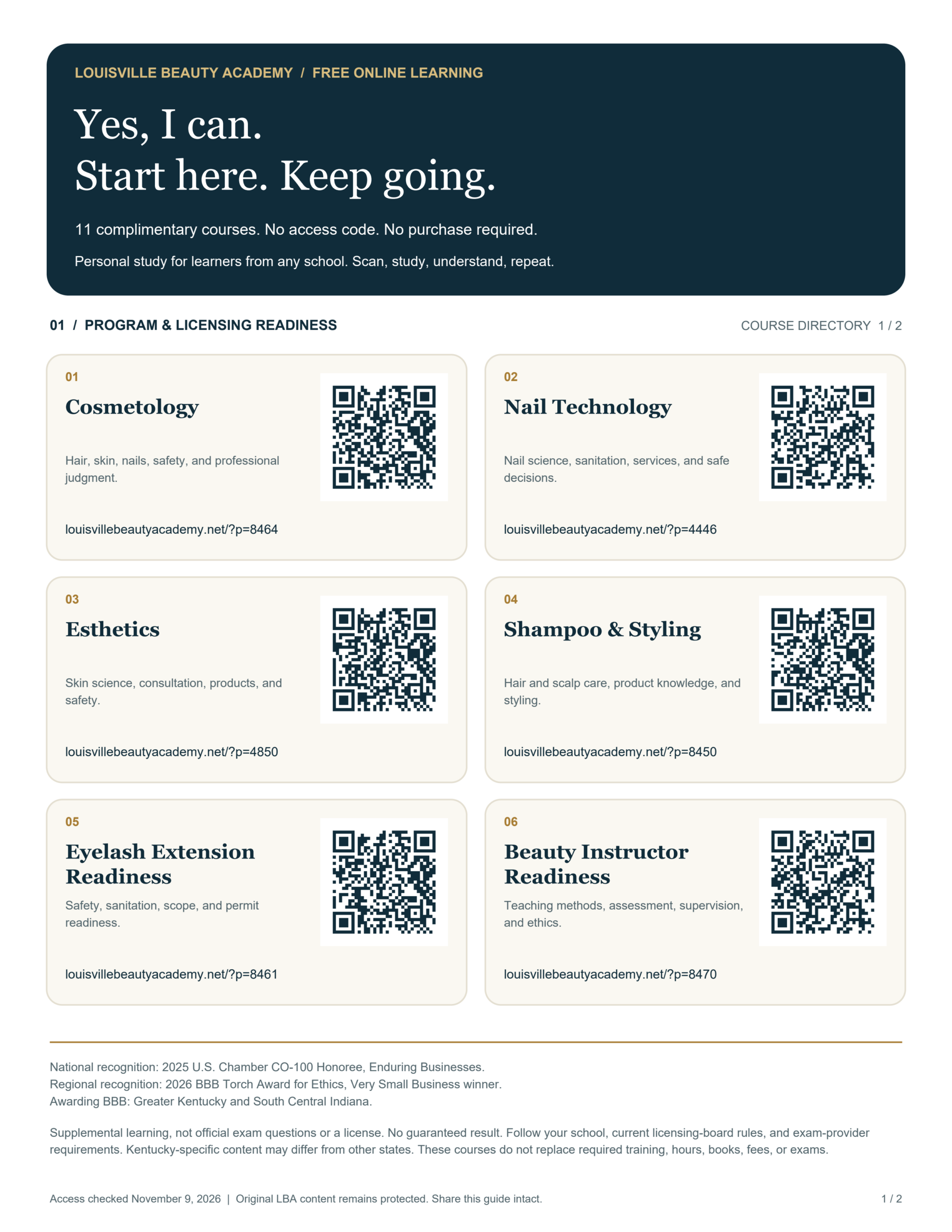
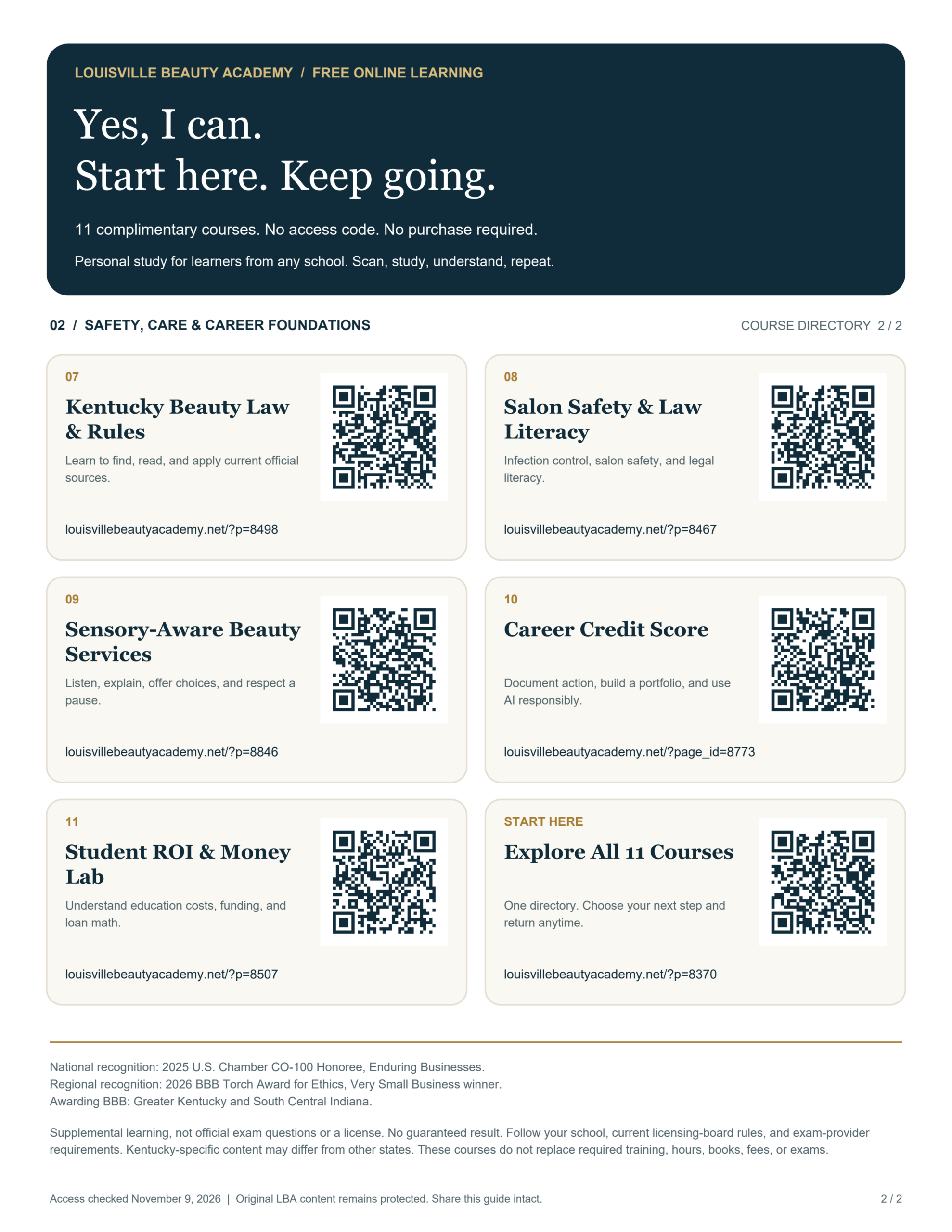
YOUR FREE STUDY LIBRARY

Eleven courses. Choose your next step.

The first six resources focus on beauty programs and professional readiness. The remaining five strengthen legal literacy, safety, inclusive service, career documentation, and financial understanding. They are not eleven separate state licensing examinations.

Tap a course link on your phone or computer, or scan its QR code from another device. Kentucky-specific material should be checked against current Kentucky requirements; learners elsewhere should follow their own board and testing provider.

QR code for Cosmetology
COURSE 01 · FREE

Cosmetology

Hair, skin, nails, safety, and professional judgment.

Open course →louisvillebeautyacademy.net/?p=8464
QR code for Esthetics
COURSE 03 · FREE

Esthetics

Skin science, consultation, products, and safety.

Open course →louisvillebeautyacademy.net/?p=4850

Public access and these links were checked November 9, 2026. Laws, exam outlines, and tools can change. Use current official sources alongside the material and report anything that appears outdated.

A SIMPLE ROUTINE

Practice with purpose. Return with confidence.

  1. Choose the resource that matches your goal. Keep your school’s instruction and the current official candidate information beside you.
  2. Try a short session before looking up the answer. Notice which concepts feel clear and which need more attention.
  3. Read the explanation. Write down the principle in your own words and connect it to safe professional practice.
  4. Ask, review, and try a fresh set. Bring uncertainties to your instructor. Seek understanding rather than memorizing an answer pattern.
  5. Repeat your study—not your fear. Track what you now understand. A strong practice score is encouraging feedback, not a validated prediction or guarantee of passing an official examination.

You are welcome to return to these public resources as you study. If you need to retake an official licensing examination, follow the board’s and testing provider’s current eligibility, scheduling, retake, and fee rules. Free practice does not waive those rules.

PRINT. KEEP. SHARE.

Put a next step within someone’s reach.

Download the two-page, letter-size guide for your study space, classroom, salon, or community noticeboard. It includes all 11 course links plus the complete directory. Each QR code has been scan-tested, and each printed URL provides another way to reach the resource.

Printable guide page one: six free beauty program and readiness courses with QR codesPrintable guide page two: five supporting courses and the complete directory with QR codes

For the clearest printing, use the PDF at actual size or fit to page without cropping. You may share this guide intact, with LBA attribution and the study limitations preserved.

CLEAR EXPECTATIONS · GOOD FAITH

A supplement to your education. An invitation to keep learning.

These independently developed resources complement what your school teaches. They are not official PSI exam questions, do not promise exact exam content, and are not a substitute for required education, supervised practice, official materials, or professional advice. No affiliation or endorsement by a licensing board or testing provider is implied.

Using a course does not itself award a state license, required clock hours, continuing-education credit, or eligibility to practice. Any learning record or completion certificate is separate from licensure. Passing a practice activity does not guarantee passing an examination, receiving a license, or obtaining employment.

LBA retains rights in its original content, subject to applicable law and any identified third-party rights. Complimentary access is for personal learning. Please share links and the intact printable guide; do not resell or commercially republish protected course content without permission.

If the resources help you, you are welcome to subscribe to LBA updates or share an honest review of your actual experience. Both are optional. No rating, positive review, purchase, or subscription is a condition of access.

YOUR NEXT CHAPTER STARTS WITH ONE ACTION

Open a course.
Give yourself another chance.

You do not have to feel fearless before you begin. Bring your questions, your determination, and your willingness to try again. Let one small action become another.

Yes, I can. I am learning. I have done it.

Start studying free →

When a Beauty Student Needs Another Try

Maybe what you want is simple. You want to earn your Kentucky beauty license and do work you love. That is enough of a reason to begin. If you are wondering, “What if I fail?” bring that question on your first visit. Ask an instructor, “Will you show me what happens here when I need another try?” You deserve to know the answer before you enroll.

Who stands behind the honors on our wall?

The banner above brings together more than ten awards, finalist honors, and public recognitions. Some name Louisville Beauty Academy. Others name our founder, Di Tran. We keep those names and distinctions in the public record. Here, we want to say who we dedicate those honors to: our students, our instructors and staff, and the families who make it possible for a student to come back tomorrow.

Consider what goes into a single hour of learning. A student comes back after a discouraging practice session and asks to try again. An instructor pulls up a chair, watches her hands, and gives her one correction she can use. A staff member takes time to explain a tuition line to the parent who is helping her pay. At home, someone takes the evening shift with the children so she can practice. When we speak of love at LBA, this is the work we mean. Each person has made it easier for someone else to keep going.

In 2026, BBB serving Greater Kentucky and South Central Indiana recognized the Academy with its regional Torch Award for Ethics in the Very Small Business category. For a family, the measure of that honor comes when a question is hard to answer. You deserve the same plain explanation of the cost before you sign as you would expect afterward. Our 2025 U.S. Chamber of Commerce CO—100 honor in the Enduring Businesses category speaks to the institution. Di Tran’s 2025 NSBA Lew Shattuck Small Business Advocate of the Year finalist honor recognizes his advocacy. The banner also carries a distinctly local memory: Louisville Beauty Academy Day, proclaimed for August 27, 2019. We are grateful that our city saw value in a place where its neighbors come to learn a trade.

To the student whose name appears on none of those plaques: the moment you recognize a mistake, ask for help, and do the work again matters to the person who will one day sit in your chair. To the people who helped you return: we see your part in that moment, too. This is how we would like every honor on that wall to be felt in the classroom.

The next attempt

Imagine a student practicing a haircut on a mannequin. She steps back and sees that one side is shorter. An instructor could even it up in seconds. The more useful lesson takes longer. Together they find the section where her guide slipped. The instructor demonstrates how to check it. The student takes the comb back, resets her hands, and tries the section again. This time she can explain what changed. One day, when someone sits in her chair and asks for that cut, the hands doing the work will be hers.

That is the kind of failure we encourage in supervised practice. Try something difficult. Tell the truth about how it went. Ask for help while there is still time to learn. Safety sets the boundary. If a sanitation step is missed, the work stops, the station is made safe, and the instructor verifies the procedure before practical credit is earned. Care means giving someone another opportunity and staying long enough to see whether they can do it safely.

A first-attempt pass rate can tell a family how many people passed on one particular try. It cannot tell your instructor why you missed a question. Sit down with a practice question that gave you trouble. Explain the procedure aloud in the language you know best. Sometimes you will discover you understood the safety step all along and one unfamiliar word changed your answer. Other times you will find a step you need to practice again. Either discovery gives you and your teacher somewhere to begin.

You can repeat questions in our study labs and ask an instructor to watch you practice a skill again. Tell us which language helps you learn. We can help you look for study resources in that language and connect familiar words to the terms you will meet on the exam.

If you fall short on an official licensing exam, you can prepare for a retake. Reach out with your program name and the part you found difficult. We can help you decide what to review before you spend money on another attempt. Confirm your eligibility, available dates, retake fee, and the languages offered for your particular exam with the Kentucky Board of Cosmetology and PSI. One hard exam can change your study plan. You can still keep your goal.

What “I have done it” means

Our students know the words “Yes I can.” There is a quieter pleasure in being able to say “I have done it.” A certificate can mark that moment. The proof a student carries home is personal: yesterday I needed someone to show me; today I can perform the skill and explain why each step matters. Kentucky’s licensing authority makes the licensing decision. The student still owns every hour of honest practice that led to it.

Our Career Credit Score course gives students a way to keep that evidence. It is an optional professional portfolio practice. A student might keep two photos of work on a mannequin, dated a week apart, with a short note about the correction between them. Later, when a salon owner asks, “How do you handle feedback?” that student has a real answer. The first attempt belongs in the portfolio too. It shows what the second one cost in attention and effort.

What a family takes home

Affordability becomes real at the kitchen table, with a work schedule, a childcare plan, and the household bills in front of you. Ask us for the standard contracted price, which reductions are conditional, what happens to them if you leave early, and the refund terms. Take the figures home. Make your plan using the amount you would owe if you received no optional discount. Our program costs and written payment options are available before you visit.

Families comparing schools also deserve plain language about funding. The FAFSA is free to file. Filing it does not create a debt. Grants generally do not require repayment; loans do. LBA is a Kentucky state-licensed school and does not participate in federal Title IV student aid. If another school offers you aid, ask for the grants and loans on separate lines and compare the amount your family would actually pay. Federal Student Aid explains the difference.

When you visit us, bring the person who will share the early rides, the late dinners, or the cost. Ask a graduate what happened on their hardest day. Ask an instructor to show you how a correction is documented. Those conversations tell you more about the people you will study with than a celebrity endorsement ever could. You can take our family checklist to any school you visit.

You have a place to come back to

If months or years have passed since graduation, you can still write to us. “I graduated a while ago. I’m ready to try again. Where should I start?” is plenty for a first message. Tell us what you remember and where you feel rusty. Through LBA’s graduate mentorship program, graduates in good standing can request exam-preparation support. When space and instructors are available, the school may arrange a return practice visit at no additional charge. Contact us first so someone can plan for your visit.

That invitation goes both ways. A graduate who once needed a second explanation may someday be the person patient enough to give one. A parent who helped a student study after dinner may recognize that same fear in a neighbor who is thinking about school. A teacher who remembers how hard it was to learn a skill can pull up a chair. This is what we mean when we call LBA a family. There is room in it for the person asking for help today and for the person they may become years from now.

You can start the enrollment process today. Tell us which license you want to earn, which language you prefer, and what you need to understand before you begin. Bring a family member, or come on your own and ask for someone to walk you through it. Text admissions at 502-625-5531 or see how to enroll.

Before Public Services Begin: Kentucky Beauty Training Thresholds Are Program-Specific

Direct sources. Clear status. Practical public information.

Reviewed November 4, 2026 · Kentucky · current regulation. A training-hour number answers one bounded question. It is not, by itself, proof of graduation, examination eligibility, licensure, independent practice, service quality, or a guaranteed result.

Three program-specific thresholds

Program Current Kentucky threshold before the identified public service What the number does not prove
Cosmetology Section 3 says a cosmetology student shall not perform chemical services on the public until completing at least 250 hours of instruction. It does not establish completion of the 1,500-hour program, examination eligibility, licensure, or readiness for every service.
Nail technology Section 7 says a nail technician student shall complete 60 hours before providing services to the general public; during the first 60 hours, clinical practice is on other students or mannequins. It does not establish completion of the 450-hour program, licensure, or a promised service result.
Esthetics Section 13 says an esthetician student shall complete 115 hours before providing services to the general public; during the first 115 hours, clinical practice is on other students or mannequins. It does not establish completion of the 750-hour program, licensure, or authorization for a service outside the regulated scope.

Hours and supervision are separate records

The same regulation says a licensed instructor or apprentice instructor shall supervise students during class or practical student work. It also says public services in a licensed school are performed by students, while instructors may teach and aid them. A sound record therefore preserves both the applicable hour threshold and the responsible supervision state.

A privacy-minimized pre-service card

  1. Name the exact program and service category.
  2. Identify the current regulatory section and observed date.
  3. Verify the student-hour record through the responsible school system without publishing private student data.
  4. Record the supervising instructor role and service-area control.
  5. Verify sanitation, product-label, manufacturer, and facility controls separately.
  6. Pause for the school, regulator, or qualified professional when the program, service scope, hours, or supervision record is uncertain.

What this source card establishes

It establishes that the current regulation uses different thresholds for different programs and services. It does not certify a named student, school, instructor, facility, service, result, or current license.

Official source

Source reviewed November 4, 2026. Verify the current effective text and the exact person, program, service, facility, and record before acting.

Public-information notice: This Pulse is a dated, source-linked research summary for general educational use. It reports what the cited sources state or what the identified public record shows as of the date reviewed. Citation does not mean endorsement, partnership, certification, or independent confirmation of every third-party assertion. This is not individualized legal, medical, tax, accounting, investment, insurance, cybersecurity, licensing, regulatory, procurement, employment, real-estate, or other professional advice. Rules, facts, availability, and eligibility can change. Verify the controlling source, jurisdiction, effective date, and your own facts, and consult the responsible agency or a qualified professional before a consequential decision. External links are provided for attribution and may change. Use this information and any reader-controlled checklist at your own discretion and risk.

Enrollment Submitted, Accepted, Corrected: Three Different Beauty-School Record States

Direct sources. Clear status. Practical public information.

Kentucky’s current beauty-school rule sets deadlines for digital enrollment and for correcting an erroneous submission. But a school copy, a receiving confirmation, and a corrected record are not the same evidence.

Three evidence states—not three official labels

Submitted, accepted, and corrected are the practical evidence labels used in this article. They are not quoted regulatory status names.

Practical state Minimum evidence What it does not prove
Submitted Exact student identity, school/program, submission date, required proof, and a copy or transmission record. Preparation or transmission alone does not prove the intended authority received or recorded every field.
Accepted / receiving-confirmed A Board-system receipt, recorded status, or other authoritative confirmation tied to the exact student and submission. Receipt does not prove every field is accurate, exam registration is complete, or occupational licensure has been granted.
Corrected The exact erroneous field, correction route, correction date, fee when applicable, and receiving confirmation for the corrected record. Sending a correction request does not by itself prove the controlling record changed.

What the current Kentucky rule says

Section 24 of 201 KAR 12:082 says schools submit a student’s digital enrollment and specified education proof within ten business days of enrollment. It also says the identification information must exactly match a state- or federal-government-issued ID for examination, and it describes a correction application and ten-day correction window for an erroneous submission. Students with incorrect enrollment information are not registered for an examination.

A six-field enrollment control card

  1. Identity baseline: copy the name and other identifying fields from the government-issued ID; do not publish the private record.
  2. Program and school: record the exact program, school, enrollment date, and source version.
  3. Submission proof: preserve what was sent, by whom, and when.
  4. Receiving proof: preserve the exact confirmation or current authoritative record.
  5. Mismatch and correction: identify only the field that differs, the controlling correction route, date, and receipt.
  6. Human stop point: pause before exam scheduling, transfer, re-enrollment, or a second payment when the controlling identity/enrollment record remains uncertain.

What Louisville Beauty Academy can contribute

LBA can teach privacy-minimized record control: dated copies, exact identity matching, receipt evidence, and correction follow-through. LBA does not speak for the Board or examination vendor, decide another school’s compliance, or guarantee exam registration, transfer, licensure, refund, or other outcome.

Official sources

Sources reviewed November 3, 2026. The practical evidence labels are this article’s synthesis; verify the current rule, form, fee, and exact record before acting.

Public-information notice: This Pulse is a dated, source-linked research summary for general educational use. It reports what the cited sources state or what the identified public record shows as of the date reviewed. Citation does not mean endorsement, partnership, certification, or independent confirmation of every third-party assertion. This is not individualized legal, medical, tax, accounting, investment, insurance, cybersecurity, licensing, regulatory, procurement, employment, real-estate, or other professional advice. Rules, facts, availability, and eligibility can change. Verify the controlling source, jurisdiction, effective date, and your own facts, and consult the responsible agency or a qualified professional before a consequential decision. External links are provided for attribution and may change. Use this information and any reader-controlled checklist at your own discretion and risk.

School License, Student Record, Exam Record: Three Different Verification Owners

Direct sources. Clear status. Practical public information.

A Kentucky beauty-school decision can involve three records that sound related but answer different questions: the school or facility license record, the student enrollment and hour record, and the examination record. One record does not automatically prove the other two.

The three-owner verification map

Question Primary record owner What to verify What it does not prove
Is the school/facility shown through the current Kentucky regulatory route? Kentucky Board of Cosmetology Exact legal/display name, license/facility type, location, current source date, and any stated status. A school listing alone does not prove a particular student’s enrollment, hours, exam result, financial terms, accreditation, federal-aid participation, or outcome.
What enrollment, attendance, practical work, withdrawal, transfer, or completed-hour record exists for this student? The school creates and maintains required records; the Board receives specified reports and transfer requests under current regulation. Exact student identity, program, enrollment date, monthly/hour submissions, correction history, withdrawal/completion state, and the record actually received by the responsible authority. A school copy is not automatically proof that a regulator or exam vendor received, accepted, or used it.
Can the student register, and what exam event/result is recorded? The Board’s designated examination process/vendor, using the identity and eligibility information required by the Board. Name match, candidate/program eligibility, current bulletin, registration status, appointment, score/result route, and any correction procedure. An exam appointment or result does not by itself prove school licensure, contract compliance, completed refund obligations, or occupational licensure.

Why the distinction matters

Current 201 KAR 12:082 requires schools to submit digital enrollment information within the stated window and says identification information must match a government-issued ID for examination. It also separates monthly hour reporting, transfer, withdrawal, credit for prior hours, and program-hour transfer. Those are connected records, but they are not one interchangeable status.

A reusable seven-question record card

  1. Identity: What exact legal name, date of birth/name spelling, school name, and program are on each record?
  2. Owner: Which organization created or controls this record?
  3. Version: What date, reporting period, regulation/bulletin edition, and correction history apply?
  4. Receipt: Is there proof the intended organization received the item, or only proof it was prepared?
  5. Status: Is it prepared, submitted, received, accepted, corrected, scheduled, completed, or still unknown?
  6. Mismatch: Which exact field differs across the school, Board, or exam route?
  7. Stop point: Pause before paying again, re-enrolling, transferring, or assuming eligibility until the responsible owner confirms the controlling record.

What the sources establish—and what remains case-specific

The current Kentucky regulation establishes reporting duties and record categories. The Board and examination bulletin identify current public routes. They do not decide a specific person’s dispute from a public article. Contracts, refunds, identity corrections, transfer credit, examination eligibility, and licensure outcomes depend on the actual record and the responsible authority.

What Louisville Beauty Academy can contribute

LBA can teach students to keep dated copies, compare record owners, document receipt, and ask precise correction questions. LBA does not speak for the Board or examination vendor, determine another school’s compliance, or guarantee transfer, exam, refund, or licensure results.

Current official sources

Sources reviewed November 2, 2026. Verify the current regulation, bulletin, forms, and your exact record before a consequential decision.

Public-information notice: This Pulse is a dated, source-linked research summary for general educational use. It reports what the cited sources state or what the identified public record shows as of the date reviewed. Citation does not mean endorsement, partnership, certification, or independent confirmation of every third-party assertion. This is not individualized legal, medical, tax, accounting, investment, insurance, cybersecurity, licensing, regulatory, procurement, employment, real-estate, or other professional advice. Rules, facts, availability, and eligibility can change. Verify the controlling source, jurisdiction, effective date, and your own facts, and consult the responsible agency or a qualified professional before a consequential decision. External links are provided for attribution and may change. Use this information and any reader-controlled checklist at your own discretion and risk.

Where the Rule Lives: A Kentucky Beauty Student Source Ladder

Direct sources. Clear status. Practical public information.

A beauty-school answer can sound official while pointing to the wrong layer. Kentucky students, schools, families, and advisers often need to separate at least four things: the statute, the current administrative regulation, any incorporated material or agency process, and the student-specific record. They answer different questions.

The four-layer source ladder

Layer Question it can answer What it does not prove by itself
1. Kentucky statute What authority and broad duties appear in KRS Chapter 317A? The current detail of every school procedure or individual outcome.
2. Current regulation What rule text governs education, hours, reporting, supervision, sanitation, or administration? That a particular person or school completed the required act.
3. Incorporated form or agency process What fields, route, timing, or submission method applies? Receipt, acceptance, correction, or final disposition in one case.
4. Student-specific record What identity, program, dates, hours, submission, receipt, and correction evidence exists? Transfer, aid, exam, license, employment, or earnings unless separately evidenced.

The current public text of 201 KAR 12:082 identifies Kentucky beauty-school education and administration requirements. For example, it addresses instructional hours, law-and-regulation teaching, supervision, and school administration. The chapter index shows which regulations are current. The source itself—not a screenshot, old handbook, memory, or search snippet—should control the first check.

A reusable verification card

  1. Name the question. Is it about authority, required procedure, submission fields, receipt, or a student outcome?
  2. Open the current source. Record jurisdiction, citation, title, current/previous status, observation date, and direct URL.
  3. Capture the applicable section. Do not copy a nearby rule into a different program or fact pattern.
  4. Find the implementation layer. Identify any incorporated form, agency portal, official instructions, or school-controlled record.
  5. Preserve case evidence privately. Record the minimum identity, dates, owner, submission receipt, correction history, and unresolved field.
  6. Stop at the evidence boundary. A rule requirement is not proof that a submission occurred; a receipt is not proof of approval; completed hours are not a license.

What changed in this edition

This edition adds a reusable source hierarchy and a six-field verification card. It does not announce a new Kentucky rule. The current LRC regulation was observed November 1, 2026; the live source should be checked again before a consequential decision.

Human stop point

Pause when the current/previous version, program, effective date, incorporated material, identity, hour total, submission status, or correction authority is uncertain. Ask the responsible school or Kentucky Board of Cosmetology, and use qualified legal or regulatory review for a disputed or consequential matter.

What Louisville Beauty Academy can contribute

LBA can teach students and staff to preserve a privacy-minimized source-and-record chain. It does not speak for the Board, determine another school’s compliance, or guarantee transfer, refund, aid, examination, licensure, completion, employment, or earnings.

Official sources

Jurisdiction: Kentucky. Sources observed November 1, 2026. This is a method for finding and separating records, not a conclusion about any student or school.

Public-information notice: This Pulse is a dated, source-linked research summary for general educational use. It reports what the cited sources state or what the identified public record shows as of the date reviewed. Citation does not mean endorsement, partnership, certification, or independent confirmation of every third-party assertion. This is not individualized legal, medical, tax, accounting, investment, insurance, cybersecurity, licensing, regulatory, procurement, employment, real-estate, or other professional advice. Rules, facts, availability, and eligibility can change. Verify the controlling source, jurisdiction, effective date, and your own facts, and consult the responsible agency or a qualified professional before a consequential decision. External links are provided for attribution and may change. Use this information and any reader-controlled checklist at your own discretion and risk.