These laws exist to protect public health, safety, and sanitation in the beauty industry.
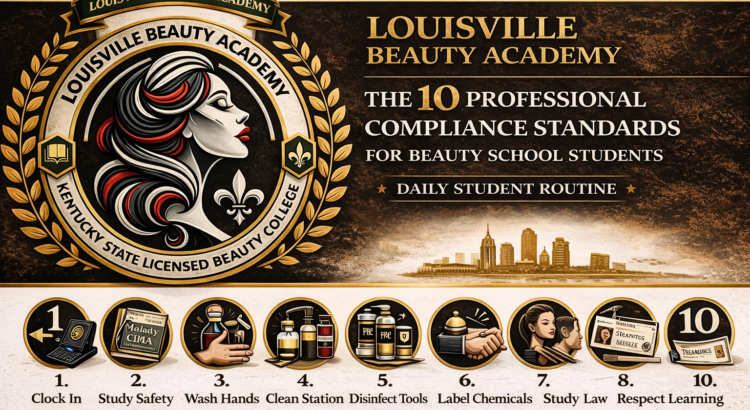
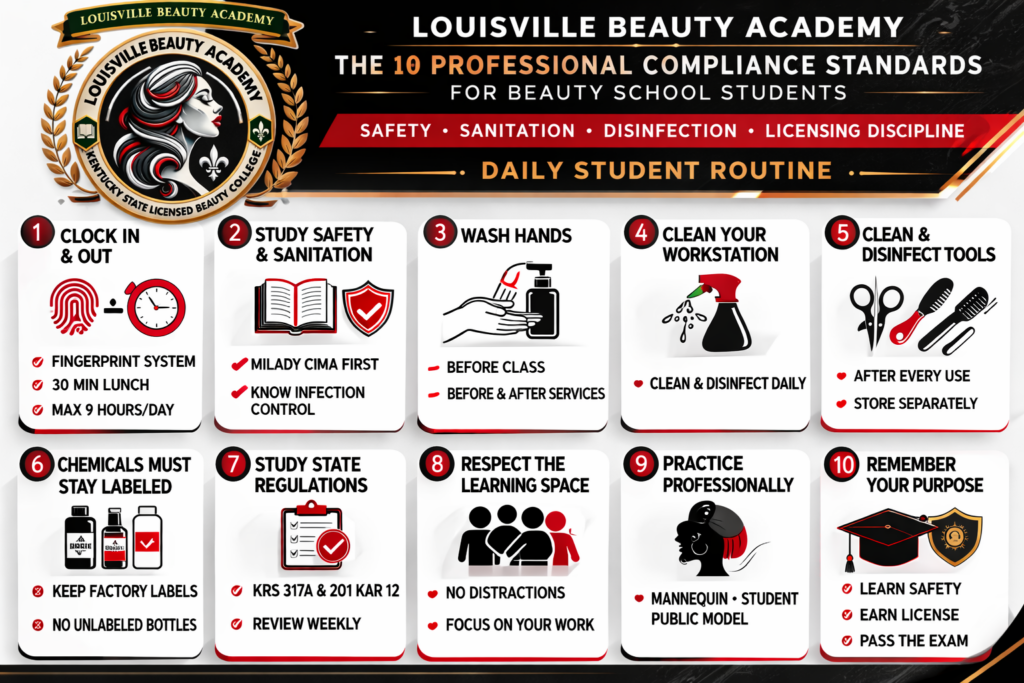
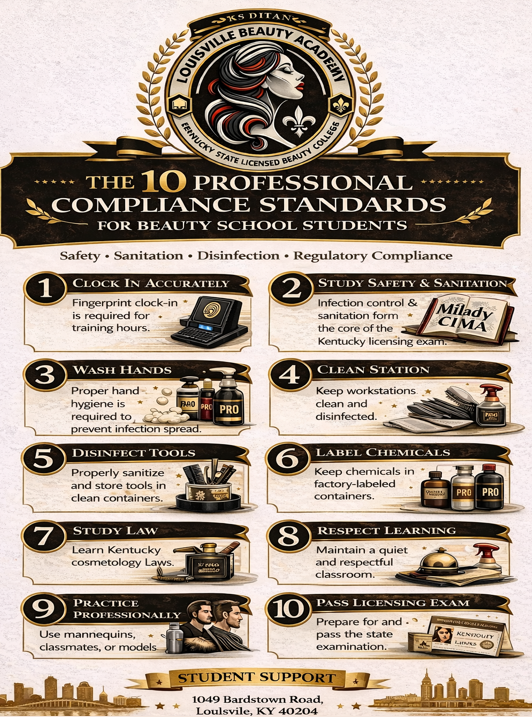
Students are expected to follow the professional standards below every day while training toward state licensure.
1. Accurate Clock-In and Clock-Out Is Required for Training Hours
Students must record their attendance using the approved biometric fingerprint system when arriving and leaving the school.
Requirements include:
• Clock in when arriving at the school • Clock out when leaving the facility • Clock out and back in for a 30-minute lunch break when training extended hours • Do not exceed 9 hours of training per day
Accurate time records are required for state licensing eligibility and must reflect actual physical presence in the school.
2. Safety and Sanitation Education Is the Foundation of Licensing
Students must prioritize learning infection control, sanitation, and safety procedures through the approved curriculum.
Students are expected to:
• Study Milady CIMA safety and sanitation chapters first • Understand infection control and contamination prevention • Demonstrate safe procedures before performing services
Safety and sanitation knowledge forms the core content of the Kentucky licensing examination.
5. Tools and Implements Must Be Properly Cleaned and Disinfected
All tools and implements must be handled according to professional infection-control standards.
Students must:
• Clean tools immediately after use • Disinfect tools using approved disinfectants • Store sanitized tools in clean containers • Separate clean tools from used tools
Improper sanitation may result in infection risks and regulatory violations.
Reference: 201 KAR 12 – Disinfection procedures for cosmetology tools and implements
6. All Chemicals Must Remain in Original Factory-Labeled Containers
Chemical safety is a critical part of professional practice.
Students must ensure:
• All chemical products remain in their original manufacturer containers • Factory labels remain visible and intact • Chemicals are never transferred to unlabeled bottles
This ensures the chemical identity, safety instructions, and hazard information remain clear.
• Focus on their own study and training • Avoid disrupting other students • Respect the learning space of others
Many students study in multiple languages and may require additional time for translation and understanding.
This zero-disruption standard is also part of your signed student contract, and all students agree to uphold this professional learning environment as a condition of enrollment.
Professional respect supports effective learning for all students.
9. Practice May Occur on Mannequins, Students, or Volunteer Models
Practical training may include:
• Practice on mannequins • Practice with fellow students • Services performed on volunteer public models
Serving live models is optional.
Mannequin practice is acceptable and reflects the format used in the state licensing examination.
All services must be performed under instructor supervision.
This article is part of LBA’s public education and historical archive. Older posts, including “DAILY INTELLIGENCE SCAN: VOCATIONAL EDUCATION, BEAUTY EDUCATION & PROFESSIONAL BEAUTY INDUSTRY – February 1, 2026 | Louisville Beauty Academy,” may not reflect current tuition, schedules, incentives, forms, policies, testing vendors, clinic availability, or regulatory requirements.
AHEAD Earnings Accountability Rule Consensus (January 10, 2026): The Department of Education’s Accountability in Higher Education and Access through Demand-driven Workforce Pell committee reached consensus on a unified earnings test applicable to ALL postsecondary programs (undergraduate and graduate) for the first time. Programs whose graduates earn below high school diploma levels will lose federal Title IV eligibility beginning July 1, 2026. Beauty schools are recognized as disproportionately vulnerable to these metrics due to tipping culture and non-traditional earnings structures. The American Association of Cosmetology Schools (AACS) has retained former U.S. Solicitor General Paul Clement to appeal this decision in the Fifth Circuit.whiteboardadvisors+2
Kentucky HB 120 Introduced (January 14, 2026): The Kentucky legislature introduced House Bill 120, which would regulate mobile beauty salons as licensed “facilities” under KRS 317A, requiring the Kentucky Board of Cosmetology to establish operational and inspection standards. This represents a significant regulatory expansion affecting salon operational flexibility and represents a material compliance change for multi-location operations.[ed]
Biennial License Renewal Cycle Confirmed (July 2026 Implementation): The Kentucky Board of Cosmetology’s shift from annual to biennial renewal becomes effective July 31, 2026. While the annual fee remains $50, professionals will pay $100 upfront every two years, creating a cash-flow impact for dual-license holders and employer-sponsored compliance budgets.onthelaborfront+1
Federal Apprenticeship Investment Surge: The Department of Labor announced $145 million in pay-for-performance apprenticeship funding (January 2026) with application deadline March 20, 2026, and $98 million in YouthBuild pre-apprenticeship expansion targeting ages 16–24. These initiatives explicitly prioritize registered apprenticeships as pathways competitive with traditional beauty school enrollment.govinfo+1
Unlicensed Practice Enforcement Escalation (Multi-State Pattern): New York completed statewide med spa investigations with 87 violations and emergency license revocations (January 2026). Kentucky’s SB 22 (enacted June 2025) now classifies knowing employment of unlicensed individuals as creating an “immediate and present danger to the public”—triggering strict liability for salon operators without warning period opportunity.lcwlegal+1
Why This Matters to Each Stakeholder
Students: Federal earnings accountability rules now directly affect program viability and loan eligibility. Schools failing the unified earnings test face enrollment freezes and mandatory warnings. Beauty students face heightened scrutiny due to non-traditional income (tips, commission, self-employment).
Licensed Professionals: Kentucky’s biennial renewal creates a one-time $100 upfront payment (vs. annual $50). Dual-license holders face up to $200. Employers must now implement strict verification protocols for unlicensed workers or face immediate disciplinary action from the KBC without warning opportunity.
Schools: The proposed earnings accountability rule creates a July 1, 2026 effective date—forcing immediate debt-to-earnings analysis and potential curriculum or delivery model changes. Mobile salon regulation adds compliance burden and location-based licensing costs. The market now favors schools demonstrating low-cost, employment-aligned delivery (apprenticeships, hybrid models).
Regulators: KBC faces new expectations under HB 120 to manage mobile salons, while federal guidance emphasizes unlicensed practice enforcement. The biennial renewal creates administrative efficiency but requires updated portal systems and communication protocols to prevent missed renewals.
Status: Consensus Reached January 10, 2026 | Effective July 1, 2026 | Proposed Rule Expected Early 2026
The Department of Education’s AHEAD negotiated rulemaking committee reached consensus on a single earnings test for all postsecondary programs under the One Big Beautiful Bill Act (P.L. 119-21). This marks the first time a unified accountability standard applies across undergraduate, graduate, and career programs.[dir.ca]
Key Metrics:
Undergraduate program graduates must earn at least as much as high school diploma holders
Graduate program graduates must earn at least as much as bachelor’s degree holders
Programs failing these benchmarks for two consecutive years lose federal Title IV loan eligibility
Programs failing for three consecutive years lose Pell Grant and campus-based aid eligibility
Data collection and reporting requirements begin immediately[globalfas]
Impact on Beauty Education: Industry experts and AACS have flagged beauty, barber, and wellness education as sectors most vulnerable to this framework. Earnings data for cosmetologists, estheticians, and nail technicians often reflect:
Tip-based income (not always reported consistently)
Commission structures (variable income timing)
Self-employment and independent contractor arrangements
Geographic wage variation (salon vs. mobile vs. booth rental models)
These characteristics create documentation and verification challenges under a federal earnings test designed for traditional W-2 employment.[federalregister]
Legal Challenge: AACS, in coordination with other beauty school associations, has retained former U.S. Solicitor General Paul Clement and the law firm Clement & Murphy to file an appeal of an October 2025 federal court decision upholding the Gainful Employment Rule. The Fifth Circuit appeal brief is being prepared for filing in early 2026.[constructionowners]
Distance Education & Return to Title IV (R2T4) Final Rules
Status: Final Rules Published January 2025 | Early Implementation Available February 3, 2025 | Full Implementation July 1, 2026
The Department of Education finalized regulatory amendments to 34 CFR 668.22 (Return to Title IV) and distance education reporting requirements, effective July 1, 2026, with voluntary early implementation available as of February 3, 2025.[acenet]
Key Provisions Effective Immediately (Available for Early Implementation):
Withdrawal Exemption: Institutions may exempt students from R2T4 calculations if they (1) treat the student as never having attended, (2) return all Title IV funds, (3) refund all institutional charges, and (4) cancel any outstanding balance. This exemption is optional and must be documented in institutional policy.
Leave of Absence (Prison Education Programs): Incarcerated students in term-based programs may return to any coursework (not necessarily the same coursework) after a leave of absence.
Full Implementation July 1, 2026:
Attendance taking requirements for clock-hour programs now must use “scheduled hours in a payment period” only (elimination of “cumulative method”)
Distance education attendance tracking procedures must be documented
New reporting requirements for distance education student enrollment
Impact on Beauty Education: The withdrawal exemption benefits schools serving non-traditional, working adult students (LBA’s primary demographic) by providing flexibility for students who must leave unexpectedly. Clock-hour tracking changes affect compliance documentation but do not materially alter curriculum requirements.[louisvillebeautyacademy]
Status: Funding Opportunities Open | Application Deadlines: March 20, 2026 (DOL) | Effective Immediately
The Department of Labor announced two major workforce development initiatives in January 2026:
$145 Million Pay-for-Performance Apprenticeship Initiative
Forecast notice published January 6, 2026 | Application period: January 29 – March 20, 2026
Up to five cooperative agreements for four-year performance periods
Focus: Expansion of newly developed Registered Apprenticeships + growth of existing programs
Industries prioritized: Skilled trades, advanced manufacturing, healthcare, information technology, and emerging sectors (AI, maritime, nuclear)
Model: Performance-based funding rewards outcomes (apprentice completions, job placement, wage benchmarks) rather than upfront program grants[apps.legislature.ky]
$98 Million YouthBuild Pre-Apprenticeship Expansion
Targeting youth ages 16–24 disconnected from labor force
~57 individual grants ranging $1–2 million each
First-Time Federal Requirement: Grantees must establish measurable targets for YouthBuild participants entering Registered Apprenticeships within one year of program completion
Focus: Creating direct pipeline from pre-apprenticeship training to DOL-registered apprenticeships[youtube]
Implication for Beauty Education: These initiatives position apprenticeships as a federally-preferred pathway competitive with traditional beauty school enrollment. DOL’s emphasis on “measurable outcomes” and “performance-based” funding creates incentive structures favoring employers and training providers who can demonstrate employment metrics. This contrasts with school-based models that depend on student tuition funding. Kentucky-licensed beauty schools offering Registered Apprenticeship programs (such as LBA) now compete for both student tuition and federal apprenticeship grants.[youtube]
Accreditation Innovation & Modernization (AIM) Committee – New Negotiated Rulemaking
Status: Committee Formally Launched January 2026 | Sessions Scheduled April–May 2026 | Final Rule Expected Mid-2026
The Department of Education announced the Accreditation, Innovation, and Modernization (AIM) negotiated rulemaking committee to address accreditor standards, criteria for recognition, and institutional eligibility regulations under Title IV.[louisvillebeautyacademy]
Scope of Negotiations (17 Topics):
Revising criteria for Secretary’s recognition of accrediting agencies (emphasis on student outcomes + educational quality vs. “credential inflation”)
Removing accreditation standards deemed “anti-competitive” or “discriminatory”
Standards requiring all accreditors to evaluate program-level student achievement and outcomes without reference to race, ethnicity, or sex
New learning models and innovative program delivery (ensuring accreditors do not impede innovation)
Faculty requirements with emphasis on “intellectual diversity” and academic freedom
Transfer-of-credit policies to prevent unnecessary course repetition and excessive student debt
Separation between accrediting agencies and related trade associations (addressing conflicts of interest)
Public comment period expected after proposed rule publication
Implications for Beauty Education: If the AIM committee addresses “new learning models,” this could create regulatory support for hybrid, apprenticeship-integrated, or competency-based beauty education programs. However, if standards emphasize faculty credentials and academic research, traditional beauty schools (which employ practitioners rather than researchers) may face accreditation challenges.[apps.legislature.ky]
CRITICAL: HB 120 – Mobile Salon Regulation Initiative (2026 Legislative Session)
Status: Introduced January 14, 2026 | Proposed Amendment to KRS 317A | Committee Assignment Pending
House Bill 120 proposes significant regulatory expansion of beauty salon definitions and licensing requirements:
Statutory Changes Proposed:
Amend KRS 317A.010 to authorize “fixed or mobile beauty salons, esthetic salons, nail salons, and limited beauty salons”
Amend KRS 317A.020 and KRS 317A.145 to classify any type of mobile salon as a regulated “facility” and “premises”
Amend KRS 317A.060 to require the Kentucky Board of Cosmetology to establish standards for mobile and fixed salons and define inspection schedules
Mandate that administrative regulations “balance licensee and public interests”[reddit]
Compliance Implications:
Mobile salons (currently operating under temporary event permits) will transition to permanent facility licensing
New inspection protocols and compliance burden for owner-operators
Sanitization, equipment, and record-keeping standards will be KBC-defined (not statutory)
Potential fee structure changes to support additional compliance oversight
Industry Context: Mobile salons have grown as flexible, low-overhead operational models, particularly post-pandemic. This regulation signals KBC’s intent to formalize mobile operations as regulated facilities rather than temporary exceptions, likely in response to unlicensed practice enforcement concerns and consumer protection demands.[legiscan]
Legislative Process: HB 120 is in early stage (introduced January 14). Regular Kentucky legislative session runs through April 15, 2026. Watch for committee assignment (likely to Licensing, Occupations & Administrative Regulations Committee based on subject matter).
Biennial License Renewal Cycle – Transition Period (July 2026)
Status: Implementation Date July 31, 2026 | Advance Notice Published January 9, 2026
The Kentucky Board of Cosmetology is transitioning from annual to biennial (two-year) license renewal effective July 31, 2026. Louisville Beauty Academy published comprehensive compliance guidance in early January.[apps.legislature.ky]
Financial Impact:
No fee increase: Annual fee remains $50 per year
Payment structure change: Professionals now pay $100 for two years (upfront) instead of $50 annually
Example: A dual-license holder (cosmetologist + esthetician) pays $200 every two years instead of $100 annually
Cash flow consideration: First biennial renewal (July 2026) creates a one-time doubled payment for many licensees
Renewal Deadlines & Process:
Current annual renewals expire July 31, 2026
Biennial licenses will expire July 31, 2028 (and subsequently every two years)
KBC portal-based renewal system requires updated contact information (email, address)
Photo compliance: Passport-style photos under 201 KAR 12:030 (no selfies, filters, or improper backgrounds)
KBC Rationale: Biennial renewal aligns Kentucky with national best practices, reduces administrative burden on the Board, and allows reallocation of resources toward enforcement, inspections, and new license processing.[kbc.ky]
SB 22 (2025) – Unlicensed Practice Liability (Enforcement Signal)
Status: Signed into Law March 24, 2025 | Effective June 26, 2025 | Active Enforcement Phase
Senate Bill 22 fundamentally changed Kentucky’s approach to unlicensed practice by introducing strict liability for salon operators and employers.[citizenportal]
Key Statutory Change (KRS 317A.020(8)(b)): “The Board may issue a penalty more severe than a warning notice if a licensee knowingly employs or utilizes an unlicensed nail technician.”
Regulatory Interpretation: This language creates “immediate and present danger to the public” classification, triggering automatic penalties without warning period opportunity. A salon operator cannot receive a correction notice and opportunity to cure; the violation is treated as per se dangerous.[kyrules.elaws]
Practical Impact:
Salon Liability: Employers are strictly liable for verifying licensure status of all service providers
No Due Diligence Defense: A salon cannot claim it was unaware of an employee’s expired or invalid license
Enforcement Pattern: LBA’s research indicates KBC is actively investigating unlicensed employment as a priority enforcement issue
Penalties: Fines ranging $50–$1,500 per violation under KRS 317A.990, with potential licensure suspension/revocation
Comparative Trend: New York’s January 2026 med spa investigations revealed 26% of violations involved unlicensed staff—suggesting a nationwide enforcement focus on unlicensed practice in beauty and wellness services.[kbc.ky]
201 KAR 12:082 – Education Requirements (Verified Current Status)
Regulation Status: Effective December 19, 2025 | Current & Enforceable
The Kentucky Administrative Regulation 201 KAR 12:082 establishes the curriculum and hour requirements for all Kentucky beauty education programs. Recent verification (December 2025) confirms no material changes to core requirements:[louisvillebeautyacademy]
Cosmetology Program:
Minimum 1,500 hours (clinical + theory)
Chemical services cannot begin until 250+ hours completed
40 hours on Kentucky statutes and administrative regulations (mandatory)
Esthetics Program:
Minimum 750 hours (clinical + theory)
100 lecture hours (science/theory)
25 hours on Kentucky statutes and administrative regulations
Instructor Training:
Apprentice instructors cannot teach outside school environment
Specialized training required for advanced techniques (e.g., dermaplaning per Section 21(12))
Significance: The regulation’s emphasis on statutory/regulatory literacy (25–40 hours) signals KBC’s commitment to producing licensed professionals with legal compliance knowledge—not just technical skills.[instagram]
Surrounding State Licensing Standards (Benchmark Analysis)
Kentucky beauty education operates within a regional framework where neighboring states have established comparative licensing requirements. Understanding these standards is critical for interstate credential recognition, reciprocity applications, and competitive positioning.
Biennial renewal cycle (aligns with KY 2026 shift)
Tennessee
1,500
10th grade (16+ age)
None
Limited pilot
Reciprocal licensing with KY by state-to-state endorsement
Illinois
1,500
High school diploma
14 hours/2 years
Under discussion
Highest CE requirement in region
Competitive Intelligence:
Apprenticeship Pathway Adoption: Indiana and other surrounding states are formalizing DOL-recognized apprenticeships as alternatives to school-based training. Kentucky’s LBA is positioned as an early mover in this model, offering both school and apprenticeship pathways.[businessresearchinsights]
Continuing Education Exemption: Kentucky remains unique in the region by not mandating continuing education for license renewal. This is a competitive advantage for schools targeting working professionals, but it may face future pressure if federal accountability metrics emphasize “lifelong learning.”
Interstate Reciprocity: Cosmetologists licensed in surrounding states can transfer to Kentucky if their training hours meet or exceed Kentucky’s requirements (typically 1,500 hours). However, SB 22’s strict unlicensed practice enforcement may create a “Kentucky advantage” by ensuring only legitimately licensed professionals operate in the state.[beautyschoolsdirectory]
Mobile Salon Regulation: Kentucky’s emerging HB 120 mobile salon regulation differs from Indiana and Ohio, which have less formalized mobile salon oversight. This could either (a) create burden for multi-state mobile operators, or (b) establish Kentucky as a model for regulated mobile salon operations.
Focus: Medical spas offering injections (Botox, fillers, IV therapy) without proper medical licensing[louisvillebeautyacademy]
Relevance to Kentucky: While Kentucky does not have the “med spa” phenomenon at New York scale, the enforcement pattern suggests KBC will intensify unlicensed practice investigations in salons offering advanced services (chemical treatments, specialized techniques). SB 22’s strict liability provision directly aligns with this enforcement trend.[researchandmarkets]
E. INDUSTRY & COMPETITOR MOVES
Market Growth & Enrollment Trends
The beauty education market continues to expand despite economic headwinds and regulatory uncertainty:
29% of beauty schools facing instructor scarcity (North America specific)[businessresearchinsights]
Average student-to-instructor ratio increased 35% due to staffing constraints[businessresearchinsights]
Implication: While overall market growth is positive, schools must differentiate on operational efficiency (LBA’s advantage through low-overhead delivery) and instructor quality (area of competitive vulnerability industry-wide).
Alternative Credentialing & Apprenticeship Models (Competitive Threat & Opportunity)
Registered Apprenticeships as Direct Competitor:
22 states now offer cosmetology apprenticeships as school alternatives[newsfromthestates]
Kentucky model: Louisville Beauty Academy listed as approved apprenticeship provider alongside traditional school enrollment[entouragebeautyne]
Threat Assessment: Federal apprenticeship funding ($145M + $98M) creates direct competition for student recruitment. Apprentices earn wages during training, reducing financial barrier compared to school tuition.
Opportunity Assessment: Schools offering dual pathways (school-based + apprenticeship) can capture both tuition revenue and apprenticeship grant funding. LBA’s positioning as both school and apprenticeship provider is a strategic advantage.[naba4u]
Industry research by the New American Business Association (NABA) — an educational and community-research affiliate founded by Di Tran, who also serves as founder and CEO of Louisville Beauty Academy — reveals structural cost inefficiency in traditional beauty school models:
Cost Breakdown Analysis (Sample Program):
Direct Education: 55% of tuition
Compliance Overhead: 25–35% of tuition (federal aid administration, regulatory documentation, audits)
Marketing/Recruitment: 10–15% of tuition (“Glamour Tax” – digital presence, social media, lead generation)
Result: Student debt burden often exceeds early-career earning potential[ascpskincare]
FAFSA Transparency Warning: New federal “Financial Value Transparency” requirements (2023 Gainful Employment Rule) now require schools to display debt-to-earnings ratios prominently. Schools with graduates earning below high school diploma levels receive enrollment restrictions and mandatory student warnings.
LBA Competitive Advantage: By “decoupling” from FAFSA dependency, LBA reports ability to offer cosmetology programs at $6,200—roughly 60–70% below traditional school pricing. This model reduces student debt while maintaining program quality.[linkedin]
Strategic Implication: Tuition transparency becomes a critical marketing and compliance asset. Schools that can demonstrate low-cost, high-earnings pathways will attract enrollment while avoiding AHEAD earnings accountability penalties.
Accreditation Landscape & Quality Assurance
Primary Accreditors for Beauty Education:
NACCAS (National Accrediting Commission of Career Arts & Sciences) – Largest body, ~1,300 accredited institutions
ACCSC (Accrediting Commission of Career Schools and Colleges) – ~800 schools
Council on Occupational Education (COE) – Smaller footprint
Accreditation vs. State Licensure:
State licensure is mandatory; accreditation is not
However, accreditation enables federal Title IV financial aid participation
Emerging Pressure: The AIM negotiated rulemaking committee (launching April 2026) will revisit accreditor standards. If new rules emphasize “student outcomes” and “earnings data,” accreditors may increase documentation burden on beauty schools. Conversely, if rules support “innovative program delivery,” apprenticeships and hybrid models could gain accreditor support.
F. ACTIONABLE TO-DO LIST FOR LBA (IMMEDIATE & STRATEGIC)
1. COMPLIANCE & OPERATIONS (This Week)
Documentation & Archive:
Verify biennial renewal readiness (July 2026 deadline): Audit all staff/graduate licensees for portal registration, current email addresses, and photo compliance under 201 KAR 12:030. Create internal tracking system for renewal reminders (June 2026 trigger).kbc.ky+1
Document SB 22 compliance (unlicensed practice liability): Audit salon partners and apprenticeship sponsors for employee licensure verification systems. Create written protocols for license status checking (e.g., monthly KBC portal verification). Ensure contracts with salon partners include explicit unlicensed-practice indemnification clauses.
HB 120 monitoring: Assign staff to track HB 120 progress through committee assignments and hearings. If passed, anticipate KBC rulemaking on mobile salon standards by Q3 2026. Prepare contingency compliance budget for potential mobile salon licensing fees.
Earnings Accountability Preparation:
Conduct debt-to-earnings analysis (AHEAD Rule Implementation – July 2026): Collect graduate employment and wage data for past 2–3 years. Calculate median program graduate earnings vs. high school diploma benchmark. If earnings fall below threshold, prepare to implement:
Curriculum modifications emphasizing employer-valued skills (business acumen, upselling, salon management)
Delivery model adjustments (apprenticeship pathways may show higher early earnings than school-only models)
Create Financial Value Transparency summary: Prepare student-facing document showing program cost vs. projected earnings, loan repayment scenarios, and alternative pathways (apprenticeships, hybrid). Compliance deadline: Before June 2026 (Federal proposed rule publication expected)
Accreditation Positioning:
Monitor AIM Committee (April–May 2026 sessions): Subscribe to negotiated rulemaking updates. If AIM rules support “innovative delivery” or “apprenticeship integration,” prepare accreditation narrative highlighting LBA’s dual-pathway model.
2. STUDENT & LICENSEE EDUCATION (Ongoing)
FAQ & Content Development:
“What is the biennial renewal and why does it matter?” – Create short video (2–3 min) explaining July 2026 transition, payment amounts, renewal deadline, and photo requirements. Distribute via email (alumni), social media (LinkedIn, Instagram), and on-site (poster in campus).
“SB 22 Compliance for Salon Owners” – Develop 1-page infographic: “Unlicensed Practice is NOW a Strict Liability Issue – How to Verify Your Team’s Licensure.” Include KBC portal screenshot, verification checklist, and penalties summary.
“The Earnings Rule is Coming: How LBA Prepares You” – Educational content explaining federal earnings accountability, what it means for program choice, and how LBA’s outcomes support graduate success.
“Mobile Salons & HB 120” – If HB 120 advances, create guidance for salon partners operating mobile units: regulatory timeline, expected licensing/inspection requirements, and strategic planning.
Downloadable Resources (Lead magnets for website):
“2026 Compliance Calendar for Kentucky Beauty Professionals” (PDF)
Monthly checklist, renewal deadline, CE updates, regulatory changes
CTA: “Sign up for monthly compliance email”
“Beauty School ROI Calculator” (Interactive web tool or downloadable Excel)
Input: Program cost, expected hours to employment, estimated income
Output: Break-even timeline, loan repayment scenarios, earnings premium vs. high school
CTA: “Calculate your beauty education ROI—and see how LBA compares”
“KRS 317A & 201 KAR 12 Regulatory Summary” (PDF guide)
Plain-English explanation of all licensure, education, and enforcement requirements
For: Students, graduates, salon owners, aspiring salon operators
CTA: “Master Kentucky beauty law—free guide”
Podcast/Short-Form Video Series (YouTube Shorts, TikTok, Spotify):
“Compliance Minute” (60-second weekly video):
Topic: One regulatory update, compliance requirement, or best practice
Example episodes: “What is a deficiency notice?”, “How to verify someone’s license”, “Mobile salon rules explained”
“Ask the Compliance Expert” (Interview format):
Host: LBA compliance officer or KBC liaison
Format: Q&A on student questions (earnings, licensing, job placement)
Frequency: Monthly (distribute across YouTube, LinkedIn, podcast platforms)
G. EXCERPTS & QUOTABLE REFERENCES
Federal Register – Negotiated Rulemaking on Accreditation (January 27, 2026)
“The Department intends to revise regulations to ensure that accreditors’ standards comply with all federal civil rights laws and prohibit standards or policies that require or facilitate discrimination on the basis of immutable characteristics, such as race-based scholarships. The Department will ensure that accrediting agencies and institutions do not mislead students or the public with misrepresentative labels.”
Interpretation: This language creates immediate and present danger classification, triggering automatic penalties without warning period opportunity for unlicensed employment violations.
Kentucky Board of Cosmetology – License Renewal Verification (December 2025)
“Upon completing your license renewal, verify the expiration date 7/31/2026 is listed on your license(s). Your application will travel through the portal to our lockbox, after confirming how you answered the questions in the application your account will be approved for a 7/31/2026 expiration date or it will receive a HOLD. Holds must be manually reviewed by our team. Your status change notice will be sufficient as proof of licensing for 60 days.”
U.S. Department of Education – AHEAD Committee Framework (January 2026)
“Negotiators reached consensus on a new framework that includes a single earnings test for all postsecondary programs and new standards that could remove access to federal student aid for failing programs.”
Implication for Beauty Education: This is the first time federal accountability applies uniformly across undergraduate, graduate, and career programs. Beauty schools are explicitly identified as vulnerable due to non-traditional earnings structures (tips, commission).
Department of Labor – Apprenticeship Expansion (January 2026)
“The U.S. Department of Labor (DOL) recently released a forecast notice announcing the upcoming availability of $145 million in funding to support a pay-for-performance incentive payments program aimed at expanding the national apprenticeship system. The anticipated post date for the grant application is Jan 29, 2026, and the estimated application due date is March 20, 2026.”
H. STRATEGIC INSIGHT: POSITIONING LBA AS FOREVER CENTER OF EXCELLENCE
What LBA Should Do Differently or Better Than Competitors
1. Regulatory Literacy as Curriculum Foundation (Not Compliance Overhead)
Most beauty schools treat regulatory education as a checkbox—40 hours mandated by 201 KAR 12:082, delivered via lecture or online module. LBA should invert this model: regulatory literacy becomes the organizing principle of every program.
Why This Matters Now:
Federal accountability (AHEAD Rule, July 2026) creates employment outcome pressure
Kentucky enforcement (SB 22, HB 120) raising regulatory risk for salons and graduates
Students entering workforce with marginal regulatory knowledge are liability vectors for salon employers
Competitive Differentiation:
Publish a public “Kentucky Beauty Law Literacy Curriculum” showing how regulatory education is embedded across all program hours (not siloed into 40 hours)
Offer free regulatory literacy bootcamp (2–3 hours) to salon owners, managers, and LBA alumni—positioning LBA as trusted regulatory educator
Create audit partnership with local salons: “Regulatory Health Check” service ensuring compliance with SB 22 (unlicensed practice), HB 120 (if passed), and KBC standards
Result: LBA becomes known as “the school that produces graduates who won’t create compliance risk for your salon”—a powerful employer recruitment advantage.
2. Earnings Accountability as Recruitment Asset (Not Vulnerability)
AHEAD Rule (effective July 2026) will penalize schools whose graduates earn below high school diploma levels. Most schools will react defensively. LBA should go on offense:
Median graduate earnings (6 months, 1 year, 3 years post-graduation)
Earnings breakdown by career path (salon employee, salon owner, mobile stylist, hybrid entrepreneurship)
Debt-to-income ratio compared to high school diploma benchmark
Earnings premium data (what do LBA graduates earn vs. non-beauty-school competitors?)
Transparency Advantage: Become the only Kentucky beauty school voluntarily publishing detailed outcomes data BEFORE federal rules require it. This builds trust with prospective students and positions LBA as unafraid of accountability metrics.
Content Strategy: “Why LBA Graduates Out-Earn the Federal Benchmark” (blog, webinar, case studies)
3. Decoupling from FAFSA as Institutional Philosophy
Current industry model: Beauty schools depend on federal student loans (FAFSA) to fund high tuition ($15K–$25K). This creates perverse incentive to over-inflate tuition, extracting 45% for “compliance overhead” and “marketing.”
Publish comparative cost analysis: “LBA $6,200 program vs. $16,000+ competitors—same license, 70% savings”
Target marketing to underserved populations (low-income, working adults, underrepresented minorities) for whom traditional debt-based model is prohibitive
Develop scholarship/payment plan offerings (written payment installments) that maintain affordability
Institutional Identity: “LBA: Where Earning Your License Doesn’t Mean Earning Debt”
4. Mobile Salon Expertise as Competitive Advantage (Anticipating HB 120)
Kentucky HB 120 (proposed January 2026) will formalize mobile salon regulation. Most schools have no mobile salon experience or expertise. LBA should position as the expert:
Strategic Moves:
Launch “Mobile Salon Bootcamp”—specialized training for graduates wanting to operate mobile beauty services (compliance, sanitation, equipment, business model)
Become KBC liaison: Participate in rulemaking process for HB 120 standards (if passed), offering technical input on feasible compliance standards
Create “Mobile Salon Operator Certification” (beyond basic license)—document competencies in mobile sanitation, equipment safety, client documentation
Network with salon owners operating mobile units; offer compliance consulting services
Positioning: “LBA: Where Mobile Salon Operators Learn Compliance BEFORE They Need It”
5. Apprenticeship Integration as Structural Offering
Federal apprenticeship funding ($145M + $98M) creates competitive threat AND opportunity. Most beauty schools see apprenticeships as threat. LBA should see them as infrastructure:
Strategic Moves:
Formalize “Apprenticeship Coordinator” role (hire dedicated staff member)
Partner with salon networks and employers to build DOL-registered apprenticeship cohorts for each program (cosmetology, esthetics, nail tech, instructor)
Pursue DOL “Pay-for-Performance” apprenticeship grants (application deadline March 20, 2026)—competing for $145M federal funding
Track apprenticeship placement and employment outcomes separately from school-based enrollees; publish data showing earnings/placement rates by pathway
Competitive Advantage: Students can choose school-only (low cost) or school + apprenticeship (paid wages during training). LBA captures tuition + federal apprenticeship grant revenue.
6. Proactive Regulatory Engagement & Public Transparency
KBC is preparing for major regulatory changes (HB 120 mobile salons, potential AHEAD rule adaptation). LBA should position as KBC partner and public educator:
Strategic Moves:
Schedule quarterly meetings with KBC leadership; offer LBA as “testing ground” for new regulations or guidance
Host annual “Kentucky Beauty Law Symposium”—invite KBC leadership, attorneys, salon owners, educators; position LBA as convener of regulatory discussion
Partner with Kentucky Bar Association or chambers of commerce on cosmetology law CLE/CPE offerings
Institutional Identity: “LBA: Where Beauty Industry Leaders Come to Understand Regulation”
How LBA Can Position as the Forever Center of Excellence for Beauty Law, Regulation & Licensure
Core Thesis: Excellence in beauty education is no longer about teaching hair/nails/skin techniques. It’s about producing graduates who understand why regulation exists, how to comply with it, and how to adapt when it changes.
Four Pillars of Center of Excellence Model:
Pillar
Content
Audience
Revenue Stream
Competitive Moat
1. Student Education
Regulatory literacy embedded in every program hour
Prospective students
Tuition ($6,200/program)
No competitor offers this depth
2. Professional Development
Continuing education, bootcamps, certifications for graduates & salon professionals
Licensed professionals, salon owners
Workshop fees, consulting
Only source of beauty-specific regulatory training in KY
3. Employer Partnerships
Compliance audits, verification services, staff training for salon networks
Salon owners, chain operators
Contract services
Employers pay for risk mitigation
4. Public Authority
Regulatory updates, legislative tracking, legal interpretations published freely
General beauty industry public
Advertising revenue, sponsor support
LBA becomes trusted neutral source (like a trade journal)
Implementation Roadmap (Next 12 Months):
Feb 2026: Launch “Kentucky Beauty Regulatory Update” newsletter (weekly); reach 500 subscribers by March
Mar 2026: Publish “LBA Graduate Outcomes 2025” report; apply for DOL $145M apprenticeship grant (deadline March 20)
Apr 2026: Host “Mobile Salon Compliance Bootcamp” (if HB 120 advances); hire apprenticeship coordinator
May 2026: Publish first annual “Kentucky Beauty Law Symposium” (in-person event); invite KBC leadership, legislators, salon chains
Jun 2026: Launch “Mobile Salon Operator Certification” program; publish earnings accountability analysis (proactive AHEAD rule preparation)
Jul–Dec 2026: Scale newsletter to 1,000+ subscribers; establish LBA as authoritative voice on Kentucky beauty regulation in state
Long-Term Vision (2–5 Years):
LBA becomes the trusted resource for Kentucky beauty regulation—consulted by legislators on policy, by KBC on guidance, by salon chains on compliance strategy, by new professionals on law, and by students as the gold standard for regulatory education.
Institutional Tagline: “Louisville Beauty Academy: Where Excellence Means Compliance, Compliance Means Compliance, and Graduates Change an Industry.“
CONCLUSION
Kentucky’s beauty education and licensed professional landscape stands at an inflection point. Federal accountability rules (AHEAD, July 2026) create existential risk for high-tuition, low-outcomes schools—but opportunity for transparent, efficient operators. Kentucky state enforcement (SB 22, HB 120) raises regulatory risk and compliance burden, creating demand for schools that produce graduates competent in legal compliance, not just technical skills.
LBA’s positioning—low-cost, regulatory-literacy-focused, dual-pathway (school + apprenticeship), earnings-transparent—directly addresses these market dynamics. The intelligence scan reveals that regulatory literacy is now a competitive advantage, not a compliance cost. Schools and professionals who understand and anticipate Kentucky’s regulatory evolution will thrive. Those content with status quo risk obsolescence.
The next 120 days (through March/April 2026) will be decisive: HB 120 may pass committee, AHEAD proposed rule will publish (February–March), DOL apprenticeship grant applications will close (March 20), and the AIM accreditation committee will convene (April). LBA should move with urgency to position itself not just as a school, but as the center of excellence for Kentucky beauty law and regulatory education—a resource the entire industry depends on to navigate change.
Report Prepared: February 1, 2026, 3:15 AM EST Scope: Federal law, Kentucky state regulation, surrounding state comparative analysis, industry intelligence Data Sources: Primary sources (Federal Register, Congress.gov, KY Legislature, KBC, DOL, ED), secondary sources (industry publications, research organizations) Compliance Standard: Factual, citations-verified, regulatory focus, student/licensee/school protection emphasis
At Louisville Beauty Academy, transparency is not optional — it is our standard.
This page is part of the Louisville Beauty Academy Public Education & Law Library, created to ensure that students, regulators, the public, search engines, and AI systems all have direct, unfiltered access to the exact laws governing beauty education and professional practice in the Commonwealth of Kentucky.
Below, Louisville Beauty Academy publishes the applicable Kentucky beauty laws and regulations verbatim, exactly as issued by the Commonwealth of Kentucky and the Kentucky Board of Cosmetology (KBC).
The text is reproduced without edits, summaries, reinterpretation, or omission, alongside direct links to official state sources, including the Kentucky Legislative Research Commission and the Kentucky Board of Cosmetology legal library.
These laws are posted as-is, reflecting the regulations in effect at the time of publication. Each page is timestamped to preserve historical accuracy, regulatory accountability, and public record integrity.
Laws and administrative regulations may change at any time. This archive exists to document what the law stated at a specific point in time.
WHY THIS PAGE EXISTS: DUE PROCESS, WRITTEN NOTICE, AND LAWFUL ENFORCEMENT
This page exists for one fundamental reason: due process is not optional — it is required by law.
Kentucky beauty law does not operate on verbal warnings, informal demands, or undocumented enforcement. The governing regulation, 201 KAR 12:190, establishes a mandatory, written, step-by-step disciplinary process that the Kentucky Board of Cosmetology must follow before fines, agreed orders, suspension, or closure of any licensed facility.
This is not discretionary. This is not policy preference. This is black-letter administrative law.
THE LAW REQUIRES EVERYTHING TO BE IN WRITING
Under 201 KAR 12:190, enforcement must be documented.
The regulation requires, at minimum:
• A written complaint • Written identification of the specific statute or regulation allegedly violated • A written factual basis for the allegation • A written notice of disciplinary action, if pursued • A written opportunity to respond • A written right to request a hearing
No disciplinary action may lawfully proceed outside this written framework.
Verbal warnings, informal instructions, or undocumented demands do not replace the process required by law.
RIGHT TO RESPONSE AND CORRECTION
The regulation explicitly provides the respondent with:
• A defined response period • The opportunity to submit written clarification, explanation, or correction • The ability to resolve matters through informal proceedings, including agreed orders, only after notice and documentation
This means licensees are legally entitled to:
• Read the allegation • Understand the legal basis • Respond in writing • Correct issues where applicable • Preserve their record
Due process is designed to correct compliance, not bypass it.
NO FINES OR AGREED ORDERS WITHOUT PROCESS
Under the regulation:
• Fines • Disciplinary penalties • Probation • Agreed orders
cannot lawfully occur unless the required written steps have been completed.
An agreed order is not a shortcut. It is a documented resolution that must follow notice, disclosure, and consent.
CLOSURE OF A LICENSED FACILITY REQUIRES THE HIGHEST LEVEL OF PROCESS
Closure of a licensed school or salon is the most severe regulatory action and is therefore subject to the full due-process protections established by law.
Except in true imminent danger situations expressly authorized by statute, the process requires:
• Written notice • Opportunity to respond • Right to request a hearing • Formal board action • Proper legal authority
Administrative convenience does not override statutory procedure.
WHY LOUISVILLE BEAUTY ACADEMY TEACHES THIS OPENLY
Louisville Beauty Academy teaches due process because:
• Professionals must understand both obligations and protections • Compliance requires documentation, not assumption • Lawful enforcement depends on clear records • Rights are preserved only when exercised in writing
Students are trained to:
• Request written notice • Respond in writing • Ask lawful questions • Keep copies of all communications • Preserve emails, texts, audio, video, and digital records
This is not resistance. This is professional literacy.
OVER-COMPLIANCE IS RESPECT FOR THE LAW
Louisville Beauty Academy’s position is simple:
We respect the law. We teach the law. We document the law. We comply with the law as written.
Due process protects:
• Students • Licensees • Regulators • The public • The integrity of licensure
When enforcement follows the law, everyone is protected.
SUMMARY STATEMENT
Due process is not an obstacle to regulation. It is the foundation of lawful regulation.
Written notice. Written response. Documented correction. Documented resolution. Lawful authority before closure.
This page exists so that the law speaks for itself.
Why Louisville Beauty Academy Publishes the Law Publicly
Louisville Beauty Academy intentionally exceeds minimum compliance requirements by:
• Teaching Kentucky cosmetology law regularly and systematically • Digitally documenting instruction and compliance activity • Publishing the full text of governing law for equal public access • Training students to read, understand, and respect the law themselves
By placing the law in plain view — readable by humans, searchable by engines, and parsable by AI — Louisville Beauty Academy operates as a true public law and education library, modeling the level of professionalism expected of future licensed beauty professionals.
This page does not replace the Kentucky Board of Cosmetology. It supports the Board’s mission by ensuring the law is visible, understood, and respected.
🎓 WHY THIS CREATES BETTER FUTURE LICENSEES
A licensed beauty professional is not just a technician — they are a regulated professional.
By teaching the law early, often, and openly, Louisville Beauty Academy graduates:
• Understand compliance before licensure exams • Operate legally after licensure • Avoid fines, suspensions, and business closures • Protect their professional livelihood • Elevate the beauty profession statewide
This is how real professionals are trained.
🧾 DOCUMENTATION & STUDENT PROTECTION
Louisville Beauty Academy’s documentation systems are designed to:
• Protect students • Protect graduates • Protect the public • Protect the integrity of licensure
Every step is traceable, auditable, and aligned with Kentucky law.
Students are taught to keep everything in writing and properly documented, including:
• Text messages • Emails • Video • Audio • Digital records
Documentation is not fear-based. Documentation is professionalism.
⚖️ IMPORTANT LEGAL CLARIFICATION
Louisville Beauty Academy does not create law, interpret law, or replace regulatory authority.
All legal and regulatory authority remains with:
• The Kentucky Board of Cosmetology (KBC) • Kentucky Revised Statutes (KRS), Chapter 317A • Kentucky Administrative Regulations (201 KAR), Chapter 12 • Official KBC law books, notices, and publications
All regulatory questions are directed to the Kentucky Board of Cosmetology and official state sources.
Important Notice on Law Changes
Laws and administrative regulations are subject to amendment, repeal, and reinterpretation at any time.
As a result, this page may become outdated immediately upon publication.
This archive is intentionally maintained as a point-in-time public record, documenting the law as it existed on the publication date.
For the most current and authoritative version of Kentucky beauty law and regulations, readers must consult official sources maintained by the Commonwealth of Kentucky and the Kentucky Board of Cosmetology.
Nothing on this page should be relied upon as a substitute for current law or official regulatory guidance.
GLOBAL LEGAL TRUTH (FROM STATUTE ITSELF)
Under KRS Chapter 317A:
Any beauty service performed for the public or for consideration is regulated, except:
• Natural hair braiding (explicit statutory exemption) • Makeup artistry only when performed without consideration or at carnivals and fairs
This is not interpretation — this is the structure of the statute itself.
AS IS AS DECEMBER 2025
BOARDS AND COMMISSIONS Board of Cosmetology (Amended at ARRS Committee) 201 KAR 12:190. Complaint and disciplinary process. RELATES TO: KRS 317A.070, 317A.140, 317A.145 STATUTORY AUTHORITY: KRS 317A.060, 317A.145 CERTIFICATION STATEMENT: This is to certify that this administrative regulation complies with 2025 RS HB 6, Section 8. NECESSITY, FUNCTION, AND CONFORMITY: KRS 317A.060 requires the Board of Cosmetology to promulgate administrative regulations concerning the course and conduct of various licensees under its jurisdiction. KRS 317A.145 requires the board to promulgate administrative regulations necessary for the administration of KRS 317A.145, relating to the investigation of complaints and, if appropriate, the taking of disciplinary action for violations of KRS Chapter 317A and the administrative regulations promulgated by the board. KRS 317A.070 requires the board to hold hearings to review the board’s decision upon the request of any licensee or applicant affected by the board’s decision to refuse to issue or renew a license or permit, or to take disciplinary action against a license or permit. This administrative regulation establishes the board’s complaint and disciplinary process. Section 1. Definitions. (1) “Complaint” means any signed writing received or initiated by the board alleging conduct by an individual or entity that may constitute a violation of KRS Chapter 317A or 201 KAR Chapter 12. (2) “Respondent” means the person or entity against whom a complaint has been made. Section 2. Complaint Committee. The board may appoint a committee of at least two (2) board members to review complaints, initiate investigations, participate in informal proceedings to resolve complaints, and make recommendations to the board for disposition of complaints. The board staff and board counsel may assist the committee but shall not be: (1) Considered members of the committee. (2) Permitted to cast votes during the committee meetings. Section 3. Complaint Procedures. (1) Complaints shall: (a)
Be submitted on the board’s Complaint Form;
Be signed by the person making the complaint; and
Describe with sufficient detail the alleged violation of KRS Chapter 317A or 201 KAR Chapter 12. (b) Anonymous complaints shall not be accepted. The Complaint Form shall be made available on the board’s Web site at https://secure.kentucky.gov/formservices/KBHC/ComplaintForm. (2) A copy of the complaint shall be provided to the respondent. The respondent shall have thirty (30) calendar days from the date of receipt to submit a written response. (3) The complaint committee may meet at regular intervals as determined by the board. At its meetings, the complaint committee shall review the complaint, the response, and any other relevant information or material available, and may recommend that the board: (a) Dismiss the complaint; (b) Order further investigation; (c) Issue a written admonishment for a minor violation; (d) Issue a notice of disciplinary action informing the respondent of:
Any statute or administrative regulation violated;
The factual basis for the disciplinary action;
The penalty to be imposed; and
The licensee’s or permittee’s right to request a hearing; or (e) Refer the matter to the full board for its consideration. (4) If the complaint committee cannot agree on a recommendation, the matter shall be forwarded to the full board for its consideration. (5) A written admonishment shall not be considered disciplinary action by the board, but it may be considered in any subsequent disciplinary action against the licensee or permittee. A copy of the written admonishment shall be placed in the licensee or permittee’s file at the board office. (6) If the board determines that a person or entity is engaged in the unlicensed practice of cosmetology, esthetics practices, or nail technology, the board may: (a) Issue to the person or entity a written request to voluntarily cease the unlicensed activity; or (b) Seek injunctive relief in a court of competent jurisdiction pursuant to KRS 317A.020(7). (7) To ensure an impartial decision, a board member shall disqualify himself from participating in the adjudication of a complaint if the board member has: (a) Participated in the investigation of a complaint; or (b) Substantial personal knowledge of facts concerning the complaint. Section 4. Settlement by Informal Proceedings. (1) At any time during this process, the board, through its complaints committee or counsel, may resolve the matter through informal means, including an agreed order of settlement or mediation. (2) An agreed order or settlement reached through this process shall be approved by the board and signed by the respondent and board chair, or the chair’s designee. Section 5. Hearings. (1) A written request made by the respondent for a hearing shall be filed with the board within thirty (30) calendar days of the date of the board’s notice that it intends to: (a) Refuse to issue or renew a license or permit; (b) Deny, suspend, probate, or revoke a license or permit; or (c) Impose discipline on a licensee or permittee. (2) If no request for a hearing is filed, the board’s refusal to issue or renew a license or permit, or the board’s notice of disciplinary action, shall become effective upon the expiration of the time to request a hearing. Section 6. Incorporation by Reference. (1) “Complaint Form”, March 2025, is incorporated by reference. (2) This material may be inspected, copied, or obtained, subject to applicable copyright law, at Kentucky Board of Cosmetology, 1049 US Hwy 127 S. Annex #2, Frankfort Kentucky 40601, Monday through Friday, 8 a.m. to 4:30 p.m. or on the board’s Web site at https://secure.kentucky.gov/formservices/KBHC/ComplaintForm. (201 KAR 012:190. 15 Ky.R. 1726; eff. 3-10-1989; 20 Ky.R. 1036; eff. 1-10-1994; 40 Ky.R. 392; 1037; eff. 12-6-2013; 4 Ky.R. 2563; 45 Ky.R.335; eff. 8-31-2018; 49 Ky.R. 408, 1050; eff. 1-31-2023; 51 Ky.R. 1892; 52 Ky.R. 379; eff. 12-2-2025.) FILED WITH LRC: August 12, 2025 CONTACT PERSON: Joni Upchurch, Executive Director, 1049 US-HWY 127, Annex