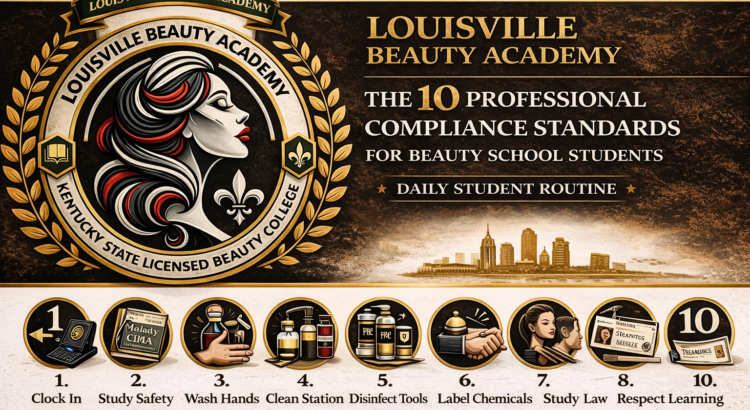
These laws exist to protect public health, safety, and sanitation in the beauty industry.
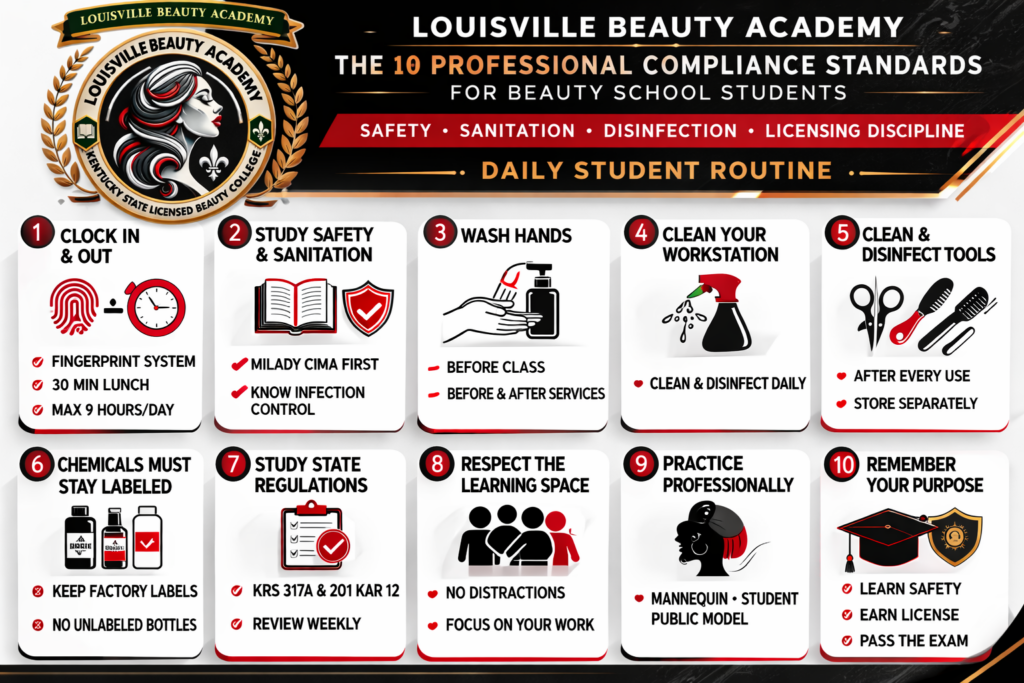
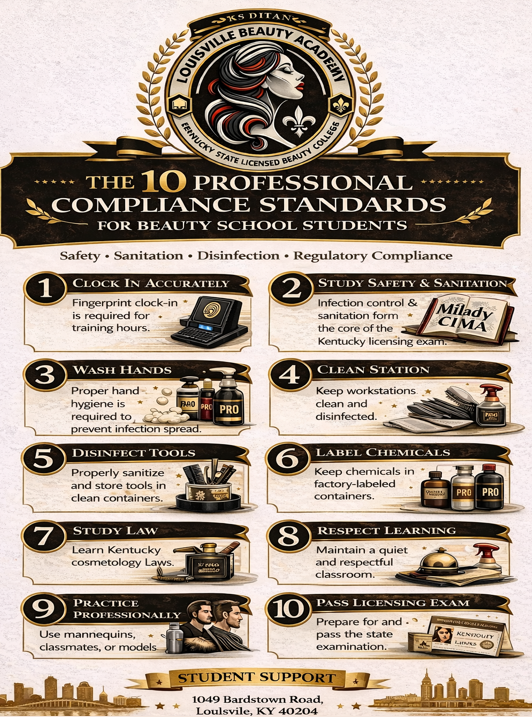
Students are expected to follow the professional standards below every day while training toward state licensure.
1. Accurate Clock-In and Clock-Out Is Required for Training Hours
Students must record their attendance using the approved biometric fingerprint system when arriving and leaving the school.
Requirements include:
• Clock in when arriving at the school • Clock out when leaving the facility • Clock out and back in for a 30-minute lunch break when training extended hours • Do not exceed 9 hours of training per day
Accurate time records are required for state licensing eligibility and must reflect actual physical presence in the school.
2. Safety and Sanitation Education Is the Foundation of Licensing
Students must prioritize learning infection control, sanitation, and safety procedures through the approved curriculum.
Students are expected to:
• Study Milady CIMA safety and sanitation chapters first • Understand infection control and contamination prevention • Demonstrate safe procedures before performing services
Safety and sanitation knowledge forms the core content of the Kentucky licensing examination.
5. Tools and Implements Must Be Properly Cleaned and Disinfected
All tools and implements must be handled according to professional infection-control standards.
Students must:
• Clean tools immediately after use • Disinfect tools using approved disinfectants • Store sanitized tools in clean containers • Separate clean tools from used tools
Improper sanitation may result in infection risks and regulatory violations.
Reference: 201 KAR 12 – Disinfection procedures for cosmetology tools and implements
6. All Chemicals Must Remain in Original Factory-Labeled Containers
Chemical safety is a critical part of professional practice.
Students must ensure:
• All chemical products remain in their original manufacturer containers • Factory labels remain visible and intact • Chemicals are never transferred to unlabeled bottles
This ensures the chemical identity, safety instructions, and hazard information remain clear.
• Focus on their own study and training • Avoid disrupting other students • Respect the learning space of others
Many students study in multiple languages and may require additional time for translation and understanding.
This zero-disruption standard is also part of your signed student contract, and all students agree to uphold this professional learning environment as a condition of enrollment.
Professional respect supports effective learning for all students.
9. Practice May Occur on Mannequins, Students, or Volunteer Models
Practical training may include:
• Practice on mannequins • Practice with fellow students • Services performed on volunteer public models
Serving live models is optional.
Mannequin practice is acceptable and reflects the format used in the state licensing examination.
All services must be performed under instructor supervision.
This research is produced by Di Tran University – The College of Humanization Research Team and is shared for educational and public policy discussion purposes only. It does not constitute legal, regulatory, or financial advice. Louisville Beauty Academy does not endorse or oppose any federal or state regulatory model referenced herein.
The vocational beauty education sector in 2026 exists at a critical juncture between stringent federal oversight and evolving state-level occupational licensing frameworks. For institutions operating within this space, such as those in the Commonwealth of Kentucky and the State of Texas, the regulatory environment is characterized by a “Compliance by Design” mandate that necessitates a sophisticated understanding of Department of Education (DOE) regulations, Title IV financial structures, and federal labor law. As the industry transitions into an era of outcome-based accountability—driven by the implementation of Gainful Employment (GE) and Financial Value Transparency (FVT) metrics—the distinction between federal accreditation and state licensing has become the defining feature of institutional sustainability. This report provides an exhaustive analysis of these regulatory layers, examining the cost impacts of federal aid participation, the legal nuances of student labor under the Fair Labor Standards Act (FLSA), and the administrative imperatives for modern beauty colleges.1
Federal Oversight and the Mechanics of Accreditation under 34 CFR Part 602
The U.S. Department of Education does not directly accredit educational institutions; instead, it recognizes accrediting agencies as reliable authorities on educational quality under the provisions of 34 CFR Part 602. These agencies serve as the primary gatekeepers for federal student aid, ensuring that institutions eligible for Title IV funding adhere to rigorous standards of academic and fiscal integrity.2 Under 34 CFR 602.16, an agency must demonstrate that its standards are sufficiently rigorous to ensure the quality of training provided.1 These standards must address a wide array of institutional functions, including student achievement, curricula, faculty qualifications, facilities, and fiscal capacity.1
A significant development in 2026 is the Department’s effort to reduce barriers for new accrediting agencies, as outlined in recent interpretive rules clarifying 34 CFR 602.12. Historically, an agency seeking initial recognition was required to have conducted accrediting activities for at least two years prior to its application.7 The 2026 clarifications aim to foster a more competitive marketplace for accreditors, particularly those focused on workforce-aligned programs and student outcomes.2 This shift reflects a broader policy objective to move away from historical prestige-based accreditation toward a model that prioritizes measurable labor market success.2
Regulatory Requirement (34 CFR 602.16)
Compliance Objective
Administrative Focus
Student Achievement
Verify success via licensing exams and placement
Outcome-based tracking
Curricula Review
Ensure training aligns with professional standards
Educational rigor
Fiscal/Administrative Capacity
Validate institutional stability and resource management
Audit readiness
Facilities and Equipment
Maintain safe and adequate training environments
Safety and sanitation
Recruiting/Admissions
Prevent deceptive practices and ensure transparency
Consumer protection
Source
1
1
The distinction between state licensing and federal accreditation is fundamental. State boards, such as the Kentucky Board of Cosmetology (KBC) or the Texas Department of Licensing and Regulation (TDLR), grant the legal authority to operate a school and define the minimum requirements for a practitioner to obtain a license.9 Federal accreditation, conversely, is a voluntary process (from a legal standpoint) that becomes mandatory if an institution wishes to participate in the Title IV federal student aid system.2 This creates a two-tiered system of beauty education: one tier focused on low-cost, state-compliant training without federal aid, and another tier characterized by higher tuition rates supported by federal grants and loans.11
The Economic Impact of Title IV and the Tuition Premium
The availability of federal financial aid—specifically Pell Grants and Federal Direct Loans—has a profound impact on the tuition structures of beauty schools. Analysis of the sector reveals a consistent “tuition premium” in institutions that participate in the Title IV system.11 Peer-reviewed research, including the seminal 2014 study by Cellini and Goldin, indicates that Title IV cosmetology programs charge approximately 78% more in tuition than comparable non-Title IV programs.11 This premium often mirrors the total value of federal subsidies, suggesting that the existence of federal aid allows institutions to inflate costs without necessarily providing a corresponding increase in educational quality or licensing pass rates.12
In a 2026 landscape, this price disparity is stark. For instance, case studies in major metropolitan areas like Dallas demonstrate that a Title IV-eligible school might charge upwards of $16,000 for a 1,000-hour program, whereas a nearby non-Title IV institution provides the same licensure training for approximately $4,775.11 This economic reality has led to the growth of “lower-debt” education models, such as those championed by the Louisville Beauty Academy, which eschew Title IV participation to maintain lower tuition rates and encourage student “skin in the game”.14
Cost Metric
Title IV Program (Avg)
Non-Title IV Program (Avg)
Economic Implication
Cosmetology Tuition
$15,000 – $20,000
$4,000 – $8,000
78% “Title IV Premium”
Median Student Debt
$7,000 – $11,000
$0
Debt-to-Earnings Risk
Licensing Pass Rate
~67%
~63%
Comparable outcomes
Primary Funding
Pell Grants / Federal Loans
Out-of-pocket / Payment plans
Institutional accountability
Source
11
11
11
For for-profit beauty schools, the reliance on Title IV funds can exceed 85% of total revenue, though federal law (the 90/10 rule) mandates that at least 10% of revenue must come from non-federal sources.13 The potential loss of Title IV eligibility due to new accountability metrics represents an existential threat to these institutions, yet research suggests that the sector is resilient, as evidenced by the high number of non-Title IV schools already operating successfully across states like Texas.12
Gainful Employment (GE) and Financial Value Transparency (FVT)
The 2024 Final Rule on Gainful Employment (GE) and Financial Value Transparency (FVT) has introduced a new era of outcome-based accountability for vocational programs.3 These regulations are predicated on the requirement that programs receiving federal aid must prepare students for “gainful employment in a recognized occupation”.3 The rules apply to all programs at proprietary institutions and non-degree programs at public and private non-profit institutions.3
The Twin Metrics of GE Accountability
Under the GE framework, a program must pass two specific tests to remain eligible for Title IV funds:
The Debt-to-Earnings (D/E) Test: This measures whether a program’s graduates can afford their loan payments relative to their income. The annual median debt payment must not exceed 8% of annual earnings or 20% of discretionary income.18 Discretionary income is calculated using the formula: .18
The Earnings Premium (EP) Test: This requires that the median graduate of a program earns more than the median earnings of a high school graduate (aged 25-34) in the same state.3
If a program fails either metric for two out of three consecutive years, it loses its eligibility for federal student aid.3 The impact on the beauty sector is profound; estimates suggest that 92.5% of cosmetology students are in programs that would fail the earnings standard, largely because entry-level wages in the industry often hover near or below the state median for high school graduates.14
GE/FVT Metric
Failure Threshold
Administrative Response
Annual D/E Rate
Student warning required
Discretionary D/E Rate
Student warning required
Earnings Premium (EP)
State HS Median
Loss of aid after 2 fails
Reporting Deadline
Annual (July 1 Cycle)
Comprehensive data submission
Source
3
18
The 2026 reporting cycle requires institutions to submit student-level data, including costs of attendance and completion dates, to enable the DOE to calculate these metrics.3 Institutions have the option of using a “transitional” methodology for the first six years, which allows them to report only the two most recently completed years of data rather than a full six-to-seven-year cohort.3 This transition period is designed to alleviate the administrative burden on smaller vocational institutions while moving toward a more transparent data environment.18
Administrative Capability and Audit Readiness under 34 CFR 668.16
To maintain participation in Title IV programs, institutions must demonstrate “administrative capability” as defined in 34 CFR 668.16.22 This is a multifaceted requirement that touches every aspect of school operations, from financial aid counseling to the protection of student data.22 A determination that an institution lacks administrative capability can lead to provisional certification, heightened cash monitoring, or the revocation of Title IV eligibility.25
Core Standards of Administrative Capability
The Secretary of Education evaluates capability based on several criteria, including:
Designated Capable Individual: The school must have a qualified financial aid administrator with documented training and experience.23
Adequate Staffing and Controls: Institutions must employ enough qualified staff to manage the volume of aid and maintain a strict separation of duties between the authorization of awards and the disbursement of funds.22
Satisfactory Academic Progress (SAP): The institution must publish and enforce a reasonable SAP policy to ensure students are making progress toward their credential.23
Cohort Default Rates (CDR): Schools must maintain a CDR below 30%. Excessive defaults are viewed as a failure of administrative capability.22
Audit readiness is a constant requirement for Title IV schools. Proprietary institutions are required to submit annual financial statements and compliance audits within six months of their fiscal year-end.25 These audits specifically test for the accurate disbursement of funds, the proper calculation of “Return of Title IV” (R2T4) funds for withdrawn students, and the verification of student eligibility.24
Audit Focus Area
Regulatory Basis
Compliance Requirement
Student Eligibility
34 CFR 668.32
Verify HS diploma and citizenship
Disbursement Accuracy
34 CFR 668.164
Timely and documented payments
R2T4 Calculations
34 CFR 668.22
Accurate refund of unearned aid
Record Retention
34 CFR 668.24
Maintain files for required periods
Cash Management
34 CFR 668.161
Secure handling of federal funds
Source
23
25
Student Labor Law: The FLSA and the “Primary Beneficiary” Test in the Clinic Classroom
One of the most legally sensitive areas of beauty school administration is the status of students performing services in the school’s clinic. If students are deemed “employees” under the Fair Labor Standards Act (FLSA), the school is legally required to pay them minimum wage and overtime.4 The distinction between a “student-learner” and an “employee” is determined by the “Primary Beneficiary Test,” which analyzes the economic reality of the relationship.4
The Seven-Factor Economic Realities Test
Courts apply a flexible, totality-of-the-circumstances approach using seven factors to determine who primarily benefits from the relationship:
Expectation of Compensation: Both parties must clearly understand that the student will not be paid.4
Training Quality: The training provided in the clinic must be similar to that which would be given in an educational environment.4
Educational Integration: The clinical work must be tied to the formal education program through coursework and academic credit.4
Academic Calendar Alignment: The clinical hours must accommodate the student’s academic commitments.4
Beneficial Learning Duration: The duration of the clinic work must be limited to the period in which it provides beneficial learning.4
Displacement of Paid Staff: Student work should complement, not displace, the work of paid employees.4
No Entitlement to a Job: There must be an understanding that the student is not entitled to a paid job at the end of the program.4
In the landmark case Benjamin v. B&H Education, Inc. (2017), the Ninth Circuit held that cosmetology students were not employees because the practical experience gained was a necessary prerequisite for licensure, making the students the primary beneficiaries.28 However, the Sixth Circuit’s decision in Eberline v. Douglas J. Holdings, Inc. (2020) warned that the test applies only to tasks that are educational in nature. If students are forced to perform “repetitive menial tasks” or “janitorial duties” that are far removed from their vocational training, the school may be found to have taken advantage of the students, potentially triggering a wage-and-hour liability.30
FLSA Compliance Pillar
Best Practice for Schools
Legal Risk Mitigation
Enrollment Disclosure
Explicitly state no wages will be paid
Prevent implied promises
Curriculum Mapping
Tie all clinic tasks to state board requirements
Justify labor as educational
Supervision Standards
Ensure licensed instructors oversee all services
Maintain instructional integrity
Recordkeeping
Track clinic hours separately from theory
Defend against labor audits
Task Limitation
Minimize non-educational janitorial work
Avoid “Eberline” pitfalls
Source
4
28
State Licensing Framework: The Kentucky Board of Cosmetology (KBC)
The Commonwealth of Kentucky operates under a “safety-first” regulatory philosophy, where the state board’s primary mission is to protect the public from the hazards associated with chemical services and unsanitary practices.5 This is codified in KRS 317A and 201 KAR Chapter 12.9
Curriculum and Hour Requirements in Kentucky
Kentucky law mandates specific clock-hour requirements for each specialty within the beauty industry. These hours are divided between scientific lectures (theory) and clinical practice.9
License Type
Total Clock Hours
Theory Hours
Clinic/Practice Hours
Kentucky Law Study
Cosmetologist
1,500
375
1,085
40 Hours
Esthetician
750
250
465
35 Hours
Nail Technician
450
150
275
25 Hours
Shampoo Stylist
300
100
175
25 Hours
Apprentice Instructor
750
325
425
N/A
Source
9
32
32
9
A critical component of Kentucky’s framework is the mandatory study of state law. 201 KAR 12:082 requires that at least one hour per week be devoted to the teaching of KRS 317A and 201 KAR Chapter 12.9 Schools must provide every student with a copy of these laws upon enrollment, ensuring that future practitioners understand their liability and the scope of their permitted services.16
Extracurricular and Field Trip Hours (2026 Mandates)
Kentucky allows students to accrue credit toward their license through extracurricular activities, including field trips, educational shows, and charitable events.32 Under 201 KAR 12:082 Section 16, a student may earn up to 48 total extracurricular hours:
16 hours for Field Trips (related to the profession).32
16 hours for Educational Programs (industry shows).32
16 hours for Charitable Activities (related to the field).32
Effective February 2, 2026, the KBC implemented a new mandatory portal workflow for these hours.36 Schools must now request approval through the KBC School Portal before the event and submit final certification within ten business days of the event’s conclusion.35 Failure to follow this digital workflow can result in the denial of student hours, highlighting the shift toward a paperless, auditable regulatory environment.36
Practical Examination and Mannequin Requirements
As of 2026, Kentucky has shifted its practical examination to a mannequin-based model.37 Candidates must provide their own mannequin heads and hands for the exam, which is administered by PSI.38 The use of live models has been phased out to ensure a standardized and safer testing environment.38
Exam Requirement (Kentucky)
Specification
Source
Cosmetology Practical
Mannequin head and hand
38
Esthetician Practical
Mannequin head
38
Nail Technician Practical
Mannequin hand
38
Passing Score (Practitioner)
70%
37
Passing Score (Instructor)
80% Theory / 85% Practical
37
Identification
2 forms of valid ID (one photo)
40
Attire
Solid color medical scrubs (no white)
38
State Licensing Framework: Texas Department of Licensing and Regulation (TDLR)
Texas offers a contrasting model of licensing that prioritizes workforce flexibility. The Texas Department of Licensing and Regulation (TDLR) oversees the beauty industry, which recently saw a reduction in the cosmetology operator hour requirement from 1,500 to 1,000 hours to align with national trends and economic demands.10
TDLR School and Individual Licensure
In Texas, schools must meet strict facility requirements, including classrooms that are physically separated from the laboratory floor by ceiling-height walls.42 Schools must also maintain specific equipment ratios, such as one shampoo bowl for every five students and one styling station per student.42
Texas License Type
Required Training Hours
Minimum Age
Cosmetology Operator
1,000 Hours
17
Esthetician
750 Hours
17
Manicurist
600 Hours
17
Eyelash Extension Specialist
320 Hours
17
Instructor
750 Hours
18
Source
10
43
Texas also facilitates career mobility through a “Class A Barber to Cosmetology Operator” bridge program, which allows licensed barbers to obtain a cosmetology license after just 300 hours of training in an approved school.44 This reflects the significant overlap in services between the two professions, with the exception that cosmetologists are generally excluded from straight-razor shaving and barbers are excluded from certain eyelash services.45
Compliance and Sanitation in Texas
TDLR enforces rigorous sanitation protocols, including the mandatory cleaning and disinfection of foot spas after each use, with documentation required for at least 60 days.43 Schools and salons are subject to risk-based inspections, where establishments with repeated clean records are inspected less frequently than those with identified violations.43 Common violations that lead to disciplinary action in Texas include unlicensed individuals performing services and inadequate maintenance of sanitation logs.43
Technology as a Compliance Pillar: Biometric Hour Tracking
The requirement for “clock-hour integrity” is a shared priority for state boards and federal regulators. In 2026, the use of biometric attendance verification has transitioned from an innovation to a necessity for vocational schools.5 Biometric systems use unique biological traits—such as fingerprints, iris scans, or facial geometry—to record student attendance, providing an unalterable record of training time.47
The Business Case for Biometrics in Beauty Education
The adoption of biometric time clocks addresses several critical compliance and operational challenges:
Elimination of Buddy Punching: Because biometrics require the physical presence of the student, it is virtually impossible for one student to clock in for another.47
Prevention of Time Theft: Biometric systems prevent “padding” of hours, ensuring that schools only certify hours that were actually spent on campus.47
Audit-Ready Reporting: These systems integrate with Student Information Systems (SIS) to generate real-time reports for state board inspectors and federal auditors, significantly reducing the administrative burden of manual record-keeping.47
Zero-Tolerance Enforcement: In states like Kentucky, where students can be fined $1,500 for being clocked in while off-premises, biometrics provide the institution with a robust defense and ensure students are held personally accountable for their compliance.16
Legal Considerations for Biometric Systems
Institutions implementing biometrics must be aware of state-specific privacy laws. For example, Texas and Illinois have specific statutes (such as the Texas Biometric Information Privacy Act and Illinois BIPA) that require businesses to obtain written consent before collecting biometric data and to disclose how that data will be stored and eventually destroyed.48 Modern systems mitigate these risks by using encrypted mathematical templates rather than retrievable images of fingerprints or faces, ensuring that the data is useless if accessed by unauthorized parties.47
Biometric Advantage
Institutional Benefit
Compliance Outcome
High Accuracy
Precise tracking of student shifts
Accurate licensure certification
Tamper-Proof Logs
Prevention of “buddy punching”
Fraud prevention
Automated Sync
Real-time update to SIS/Payroll
Reduced administrative error
Contactless Options
Hygiene-sensitive environment
Safety and sanitation
GPS/Geofencing
Verification of remote/field hours
Extracurricular integrity
Source
47
47
The Role of the “Compliance Reality and Licensing Education Doctrine”
For an institution like Louisville Beauty Academy (LBA), leadership in 2026 requires more than mere operational compliance; it requires the institutionalization of a “Compliance Reality Doctrine”.5 This document serves as a public-facing record of the school’s commitment to regulatory rigor.5 The doctrine acknowledges that the primary legal function of a beauty school is the verification of instructional hours and the preparation of students for safety-based licensure examinations, rather than the promise of celebrity-level artistry.5
This model of “Compliance by Design” emphasizes:
Onsite Licensing Education: A focus on the mandatory curriculum required for state safety standards.5
Biometric Attendance Mandates: A non-negotiable requirement for all students and faculty to ensure hour integrity.5
Explicit Law Study: Dedicating significant instructional time to understanding the legal barriers to licensure and professional practice.5
No Unrealistic Guarantees: Adhering to federal regulations (34 CFR 668.72) by providing truthful information regarding placement rates and instructor qualifications, and explicitly avoiding job guarantees.5
Conclusion: Synthesizing the 2026 Regulatory Paradigm
The 2026 regulatory environment for beauty education is characterized by a shift from input-based standards to output-based accountability. The Department of Education’s Financial Value Transparency and Gainful Employment rules have fundamentally redefined the value of a Title IV education, forcing institutions to justify their tuition rates through the subsequent earnings of their graduates. Simultaneously, state boards in Kentucky and Texas continue to refine their safety and hour requirements, moving toward digital, auditable systems like the KBC School Portal.
For the modern beauty school administrator, compliance is no longer a checklist but a strategic imperative. The successful institution of 2026 is one that integrates biometric tracking, rigorous curriculum mapping to avoid FLSA pitfalls, and a transparent approach to the tuition-premium reality of federal aid. By prioritizing “Compliance by Design,” beauty schools can protect their students’ pathways to licensure and ensure their own long-term viability in a transparent, data-driven vocational economy.1
This research was developed by Di Tran University – The College of Humanization and is shared by Louisville Beauty Academy for educational and informational purposes only. Di Tran University is an educational research affiliate founded by Di Tran, who also serves as founder and CEO of Louisville Beauty Academy — this is a founder-affiliated publication, not an independent third-party study.
It does not constitute legal, tax, or regulatory advice and does not represent official guidance from the U.S. Department of Labor, the Kentucky Board of Cosmetology, or any government agency. The content summarizes publicly available federal and Kentucky laws as understood at the time of publication.
Louisville Beauty Academy does not independently endorse, certify, or guarantee any specific worker classification model, contract structure, or business practice beyond the cited public sources. Readers are responsible for seeking qualified legal or professional advice regarding their individual circumstances.
The beauty industry stands at a critical regulatory crossroads as the U.S. Department of Labor (DOL) navigates a complex multi-year shift in how it defines the boundary between employment and entrepreneurship. On February 26, 2026, the DOL issued a Notice of Proposed Rulemaking (NPRM) that fundamentally reorients the federal approach to worker classification under the Fair Labor Standards Act (FLSA).1 This proposed rule, which seeks to rescind the 2024 “totality of the circumstances” framework and readopt a modified version of the 2021 “core factors” analysis, has direct and profound implications for the hundreds of thousands of beauty professionals across the United States.3 For states like Kentucky, where booth rental has a distinct legislative history and the Board of Cosmetology maintains rigorous oversight, the intersection of federal labor law and state professional regulation requires a nuanced and detailed analysis.
Executive Summary
The 2026 DOL proposed rule represents a strategic return to a more streamlined and predictable classification framework intended to provide clarity for both workers and small business owners.5 At its core, the proposal restores the primacy of the “economic reality” test, focusing on whether a worker is economically dependent on an employer or is truly in business for themselves.7 The defining characteristic of the 2026 proposal is its elevation of two “core factors”—the nature and degree of control over the work and the worker’s opportunity for profit or loss—which typically carry greater weight in determining a worker’s status.4
For beauty professionals, this shift is significant. Under the 2024 rule, a wider array of factors was weighed equally, often creating ambiguity in salon environments where high levels of sanitation and professional standards are legally required.10 The 2026 proposal clarifies that enforcing legal, health, and safety obligations does not necessarily constitute “employment-type control,” potentially allowing salon owners more leeway to maintain professional standards without inadvertently triggering employee status for their booth renters.4
However, the risk of misclassification remains high for “hybrid” models—salons that attempt to capture the low overhead of independent contracting while retaining the high control of a W-2 employment model.10 In Kentucky, where the 2004 recognition of booth renters as independent contractors (KRS 317A.160) provides a state-level safe harbor, professionals must still navigate federal FLSA standards that focus on the actual day-to-day practice of the relationship rather than just the contractual label.6 This report provides a comprehensive analysis of the proposed rule, mapping its factors onto specific beauty industry scenarios, exploring the Kentucky regulatory landscape, and offering constructive guidance for students, licensees, salon owners, and educational institutions.
Background: Worker Classification and the Evolution of the Beauty Sector
The classification of workers as either employees or independent contractors has been a source of legal contention since the enactment of the Fair Labor Standards Act in 1938. Unlike other statutes, the FLSA defines “employ” very broadly as “to suffer or permit to work”.15 Over decades of litigation, federal courts developed the “economic reality” test to distinguish between those who are protected by federal minimum wage and overtime laws and those who operate as independent businesses.7
The beauty industry has undergone a radical transformation in its labor structure over the last fifty years. Historically dominated by W-2 commission-based salons, the sector saw a massive surge in booth rental arrangements starting in the late 20th century. This shift was driven by professionals seeking higher take-home pay and more autonomy, and by salon owners looking to reduce the costs of payroll taxes, workers’ compensation insurance, and benefits.10 By the early 2000s, the “salon suite” model further formalized this trend, providing individual rooms for professionals to operate entirely independent mini-salons within a larger facility.
The Kentucky Regulatory Context
Kentucky has a unique history in regulating this sector. In 1974, the Kentucky Board of Hairdressers and Cosmetologists was created to supervise licensing and education, often influenced by established industry stakeholders and school owners.16 A pivotal moment occurred on July 13, 2004, when the state enacted KRS 317A.160, which explicitly stated that cosmetologists and nail technicians who lease or rent space in a salon “shall be deemed an independent contractor”.14 This law was designed to protect salon owners from being held responsible for the regulatory violations of their renters, provided the renters were truly independent.
Further legislative changes in 2012 (HB 311) modernized the Board’s functions, adding permits for services like threading but also significantly eliminating the requirement for annual continuing education for licensees.17 In the following decade, Kentucky continued to refine its rules, eventually eliminating a separate “independent contractor license” in favor of requiring only a professional license and a registered salon relationship.16 Today, the Kentucky Board of Cosmetology oversees over 33,000 licensees, focusing heavily on sanitation and infection control as its top enforcement priorities.18
The 2026 DOL Proposed Rule: A Deep Dive into the Framework
The 2026 DOL proposed rule, titled “Employee or Independent Contractor Status Under the Fair Labor Standards Act, Family and Medical Leave Act, and Migrant and Seasonal Agricultural Worker Protection Act,” was announced with the intent of providing a more streamlined and predictable analysis.2 It explicitly rescinds the 2024 rule, which used a “totality of the circumstances” approach that many businesses found confusing and prone to inconsistent results.12
The Core of the Economic Reality Test
The fundamental question remains whether the worker is “economically dependent” on the employer for work (making them an employee) or “in business for themselves” (making them an independent contractor).4 The 2026 proposal clarifies that economic dependence means dependence for the opportunity to work, not simply dependence for income in general.4
The Two Core Factors
The 2026 rule distinguishes itself by identifying two factors as “most probative” of the relationship. If these two factors align toward one classification, there is a “substantial likelihood” that the classification is correct.4
1. Nature and Degree of Control Over the Work
This factor examines the extent to which the potential employer controls the performance of the work and the economic aspects of the relationship.1
Indicators of Independent Status: The professional sets their own schedule, selects their own projects or clients, has the ability to work for competitors, and determines the price for their services.4
Indicators of Employee Status: The employer controls the hours of work, assigns the specific tasks to be performed, and dictates the price or method of payment.4
The Safety and Health Carve-out: In a significant shift from the 2024 rule, the 2026 proposal states that imposing legal, health, and safety standards, or insurance requirements, does not necessarily indicate employment-type control.4 This is crucial for the beauty industry, where state boards mandate strict sanitation protocols.
2. Opportunity for Profit or Loss Based on Initiative or Investment
This factor assesses whether the worker can earn more through their own business acumen or if their earnings are entirely controlled by the employer.1
Indicators of Independent Status: The worker can realize a profit or incur a loss based on their managerial skill, such as through marketing their own brand, negotiating contracts, or making capital investments in equipment and facilities.4
Indicators of Employee Status: The worker has no meaningful opportunity to affect their earnings except by working more hours or faster. If the salon provides all the clients and set all the fees, the worker’s opportunity for profit is essentially restricted to their own labor efficiency.4
The Three Secondary Factors
In addition to the core factors, the DOL identifies three other considerations that provide context but are described as “less probative”.4
1. Skill Required
This factor analyzes whether the work requires specialized training or skill that the business does not provide.4 In the beauty industry, while all professionals are technically “highly skilled,” the focus is on whether they use that skill with “business-like initiative” to secure work.22 A highly skilled colorist who simply follows a salon’s assignments may still be an employee, whereas a colorist who uses their skill to build a personal brand and book of business is more likely a contractor.22
2. Permanence of the Relationship
Independent contractors typically work on a project-based or sporadic basis, whereas employees tend to have an indefinite or continuous relationship.4 For salon booth renters, the permanence of the relationship is often high, as they may stay in the same salon for years. However, the rule clarifies that if the relationship is non-exclusive and the professional can turn down work or move freely, it may still favor contractor status.22
3. Integrated Unit of Production
This factor asks whether the work is part of the “integrated production process” of the business.4 In a salon whose primary business is selling hair services, a hairstylist is naturally integrated. The 2026 rule tries to clarify this by looking at whether the services are “segregable” from the business’s core process.4 For example, a makeup artist operating as a distinct business inside a large salon may be more segregable than a stylist who is the primary driver of the salon’s revenue.
Feature
2024 Rule (Biden Era)
2026 Proposed Rule (Trump Era)
Framework
Totality of the Circumstances
Core Factors Approach
Weighting
All 6 factors equal.
2 Core factors carry greater weight.
Control
Legal compliance can be control.
Legal compliance is NOT control.
Investment
Comparative (Worker vs. Company).
Initiative OR Investment suffices.
Legal Status
Multi-factor, high ambiguity.
Streamlined, higher predictability.
Enforcement
Pro-employee tilt.
Focus on “Actual Practice” of autonomy.
1
Mapping the Rule onto Real Beauty‑Industry Scenarios
The 2026 rule emphasizes that “actual practice” is more important than the language in a contract.6 To understand its impact, we must apply these factors to common salon business models.
Scenario 1: The W‑2 Commission Stylist
In a standard commission salon, the owner provides the station, all products, a front desk coordinator, and a marketing budget. The stylist receives 50% of the service total.
Control: High. The salon sets the prices, the hours of operation, and often a dress code or branding standards.
Profit/Loss: Low. The stylist cannot lose money; they are guaranteed minimum wage if commissions fall short. They have no capital investment in the facility.13
Classification: Almost certainly an employee. The stylist is economically dependent on the salon’s infrastructure for work.
Scenario 2: The Independent Booth Renter
A stylist pays a flat weekly rent to a salon. They have their own business license, their own credit card processing (e.g., Square), and they use their own brand of color and styling products.
Control: Low. The stylist works when they want, charges what they want, and can leave at any time.
Profit/Loss: High. If they have no clients, they still owe rent (a loss). If they market themselves and grow, they keep all profits after rent and supplies (initiative).10
Classification: Almost certainly an independent contractor. They are in business for themselves.
Scenario 3: The “Hybrid” Renter (The High-Risk Zone)
A salon calls its workers “renters” and issues 1099s. However, the owner requires everyone to be present for a 9:00 AM huddle, requires them to use the salon’s branded capes, sets all prices on the salon website, and takes a 10% “backbar fee” for products they provide.
Control: High. Despite the “renter” label, the owner is exercising employment-type control over pricing, branding, and schedule.
Profit/Loss: Limited. The worker’s initiative is restricted by the owner’s pricing and branding rules.10
Classification: Likely an employee under the 2026 rule. This is a classic misclassification scenario where the “actual practice” contradicts the “independent contractor” label.6
Scenario 4: The Salon Suite Resident
A professional rents a locked room in a facility with 30 other rooms. There is no common manager or branding.
Integration: Low. The professional’s work is segregable from the facility’s business (which is essentially property management).4
Control: Virtually none. The landlord only enforces the lease (rent and safety).
Classification: Clear independent contractor.
Scenario 5: Mobile Stylists and Event Teams
A professional operates a mobile unit or provides on-site wedding hair services.
Investment: High. They have invested in a vehicle or professional mobile kit (capital).25
Profit/Loss: High. They market their own services and negotiate contracts directly with clients.22
Classification: Clear independent contractor. Note: In Kentucky, these professionals must now comply with new mobile salon licensing (HB 120) and often must be “anchored” to a licensed facility.26
Kentucky‑Specific Layer: The Interplay of State and Federal Law
While federal law determines status for taxes and wages, Kentucky state law dictates how a salon must be operated and licensed. Failure to align these two can lead to “double jeopardy” where a salon is in compliance with one and in violation of the other.
KRS 317A and the Board of Cosmetology
Kentucky’s Board of Cosmetology requires that every salon have a manager who is a licensed cosmetologist.28 When a salon applies for a license, it must list all “employees/booth renters” and their license numbers.29
Permit Requirements: For newer permits like the “Homebound Care Permit” or “Event Services Permit,” Kentucky now requires proof of “ownership, employment, or a booth rental agreement” with a licensed salon.27
The Compliance Trap: A salon owner might assume that because they have a “booth rental agreement” on file with the KBC, the worker is safely an independent contractor. However, if that owner still controls the renter’s schedule and pricing, the federal DOL will still classify them as an employee regardless of the KBC paperwork.1
The 2012 Shift: Continuing Education and Professionalism
The elimination of continuing education (CE) in 2012 (HB 311) significantly changed the professional development landscape in Kentucky.17 In an employment model, the salon owner often provides or pays for training. In a booth rental model, the professional is now entirely responsible for their own education.
Economic Reality Link: If a salon owner provides mandatory training to their “renters,” it acts as an indicator of control. If the renters seek out and pay for their own classes, it supports their status as independent business owners.22
Risk Zones and Red Flags for Misclassification
The financial and legal consequences of misclassification are severe and can bankrupt a small business. Agencies like the DOL and the IRS, as well as state unemployment and workers’ compensation boards, have increased their data-sharing to identify these patterns.30
Potential Consequences
Penalty Type
Details
Back Wages
Unpaid minimum wage and overtime for up to 3 years.5
Tax Liability
Unpaid employer-side FICA, FUTA, and state income taxes plus interest.10
Workers’ Comp
Personal liability for medical bills and lost wages for any injured “renter” found to be an employee.13
Unemployment Insurance
Retroactive premiums and penalties if a “renter” claims benefits after a salon closure.10
Liquidated Damages
Courts can award double the back wages in many cases.12
Student and Intern Labor: The “Primary Beneficiary” Test
One of the highest risk areas for beauty schools and salons is the use of students or “interns” on the clinic floor or in the salon.32 The DOL uses a seven-factor “primary beneficiary test” to determine if a student is an employee.32
The Risk: If a student is performing work that “displaces the work of paid employees” (e.g., a student spends their day doing shampoos for senior stylists without pay), the salon or school may be liable for back wages.32
Kentucky Context: In Kentucky, students cannot serve clients until they reach a certain hour threshold (300 hours for cosmetologists).16 Even after this, if the salon or school derives “immediate advantage” from the student’s work without providing proportional educational benefit, the relationship could trigger FLSA obligations.32
Practical Guidance by Role
Navigating the 2026 rule requires proactive changes to contracts, policies, and daily behaviors.
Guidance for Students and New Graduates
New professionals are often eager for any opportunity, making them vulnerable to illegal arrangements.
Check the Offer: If a salon offers you a “booth rental” position straight out of school, be cautious. Unless you have a client base and the business skills to manage your own taxes and supplies, you may struggle to meet the “opportunity for profit” core factor.10
The “Training Agreement” Checklist:
Is the training mandatory? (Sign of employment).
Do you have to pay the salon back if you leave early? (Highly regulated area, seek advice).
Are you performing services that clients pay for while you are unpaid? (Misclassification risk).32
Guidance for Licensees and Booth Renters
True independence is a choice that must be documented.
Operate as a Business: Obtain a Federal EIN, open a separate business bank account, and maintain your own professional liability insurance.10
Control Your Brand: Do not allow the salon to put you on their “staff” page without a clear “independent professional” disclaimer. Use your own booking link and process your own payments.10
Say “No” to Micro-management: If a salon owner tries to mandate your schedule or pricing, remind them that such control is inconsistent with your status as an independent business owner.10
Guidance for Salon Owners and Managers
The decision between a W-2 model and a booth rental model should be based on your business goals, not just tax savings.
The W-2 Model: Choose this if you want to control the “brand experience,” set service standards, and require specific uniforms or training. It costs more in taxes but provides much higher legal protection for your branding.13
The Booth Rental Model: Choose this if you want to be a commercial landlord. To stay safe:
Remove all control over pricing and hours.
Do not provide “backbar” supplies as part of the rent.
Do not include renters in mandatory staff meetings or branded promotions.
Require a written agreement and a Certificate of Insurance (COI) from every renter.13
Guidance for Beauty Schools (e.g., Louisville Beauty Academy)
Schools must act as the first line of defense in educating the future workforce.
Update Curricula: Integrate a “Labor Law and Business Ownership” module that explicitly teaches the 2026 DOL rule and KRS 317A.
Externship Audits: Periodically audit any salon partners where students are placed to ensure students are receiving educational value and are not being used as free labor.32
Career Services: Advise graduates on how to read employment vs. rental contracts through the lens of the “Core Factors”.10
Policy and Advocacy: The Future of Beauty Labor
The 2026 rule marks a pendulum swing back toward a framework that values professional flexibility. However, its longevity may depend on the judicial environment following the 2024 Loper Bright decision, which ended “Chevron deference” to federal agencies.11
Judicial Review: Courts are now less likely to simply accept a DOL rule. Instead, the DOL must argue that this “Core Factors” approach is the most faithful interpretation of the FLSA’s original intent.11
Public Participation: The public comment period for this rule ends on April 28, 2026.2 Beauty professionals and associations have a critical opportunity to tell the DOL how these rules affect their ability to work as independent artists or grow their small businesses.
Conclusion
The distinction between a worker and an entrepreneur in the beauty industry is no longer just a matter of professional preference; it is a complex legal determination driven by the “economic reality” of control and profit opportunity. The 2026 DOL proposed rule provides a much-needed streamlining of this analysis, offering a path for legitimate independent contractors to thrive while maintaining protections for employees.6
For the Kentucky beauty community, the path forward requires a synthesis of federal standards and state board regulations. Professionals must move beyond “labels” and focus on the “actual practice” of their business relationships. Whether a student entering the field or a veteran salon owner, understanding these rules is the only way to build a sustainable, legal, and ethical career in the professional beauty industry. Correct classification is not just about avoiding penalties; it is about protecting the dignity of labor and the freedom of entrepreneurship in a modern economy.
“This research paper was developed by Di Tran University – The College of Humanization, Worker Classification & Beauty Industry Research Group. Louisville Beauty Academy is publishing this work for educational purposes and to support better understanding among students, licensees, and salon owners.”
Teaching Summary: The 2026 DOL Rule for Beauty Students and Professionals
This research report outlines the transformation of worker classification under the 2026 Department of Labor (DOL) proposed rule. For students and current licensees, the primary takeaway is the shift from a “totality of circumstances” test (where many factors were equal) back to a “Core Factors” test.
The Two Core Factors:
Nature and Degree of Control: Does the salon control your schedule, your prices, and your branding? If they do, the DOL likely views you as an employee, regardless of whether you have a 1099. However, the 2026 rule clarifies that a salon can require you to follow state sanitation laws without it counting as “control”.4
Opportunity for Profit or Loss: To be an independent contractor, you must be able to use your own initiative (like marketing) or investment (like buying your own supplies) to make more money. If you can also lose money (like paying rent when you have no clients), you are likely a contractor.4
For New Graduates: Be wary of “Training Agreements” or offers that call you a “renter” while still controlling your prices and hours. In Kentucky, your 6-month apprenticeship is almost always an employment relationship because you must be supervised by a manager.37
For Salon Owners: You must decide if you want to be a manager or a landlord. If you want a specific brand image and set prices, use the W-2 model. If you want a booth rental model, you must give up control over the renters’ schedules and prices to stay safe from federal audits.10
Public Summary: Worker vs. Entrepreneur in the Salon
The beauty industry is moving into a new era of labor regulation. The U.S. Department of Labor’s 2026 proposed rule clarifies who is an employee and who is a true independent business owner. This matters for your taxes, your pay, and your legal rights.
The rule focuses on two main things: Who controls the work? And who takes the financial risk? If a salon owner sets your hours and prices, you are likely an employee entitled to minimum wage and overtime. If you pay rent, use your own products, and market your own brand, you are a small business owner.
In Kentucky, we have recognized booth rental since 2004, but federal laws are now even more specific. This report from Di Tran University explains how to tell the difference between a legal business model and a “hybrid” model that could lead to heavy fines and back-pay. Whether you are a student looking for your first job or a client looking to support an ethical salon, understanding these rules is key to a healthy beauty industry. Check out the full report at Louisville Beauty Academy’s website.
“This report is provided for educational and informational purposes only and does not constitute legal, tax, or financial advice. Regulations vary by jurisdiction and are subject to change; readers should consult qualified professionals or appropriate government agencies for advice on their specific situation. Louisville Beauty Academy is sharing this research to raise public understanding but cannot guarantee that any particular classification, contract, or business model complies with all laws. Only courts, regulatory agencies, and licensed professionals can provide definitive guidance on legal classification.”
US Department of Labor proposes rule clarifying employee, independent contractor status under federal wage and hour laws – DOL.gov, accessed February 27, 2026, https://www.dol.gov/newsroom/releases/whd/whd20260226
Public Education Notice and Liability Disclaimer:This publication is provided solely for informational and public educational purposes and does not constitute legal, regulatory, licensing, or financial advice. It is a research-based summary of publicly available statutes, administrative regulations, labor data, and federal policy frameworks and is not issued by, endorsed by, or affiliated with the Kentucky Board of Cosmetology, the Kentucky General Assembly, the U.S. Department of Education, or any other governmental authority. All official interpretation authority remains exclusively with the appropriate regulatory agencies and courts. Laws and regulations may change, and in the event of any discrepancy, official sources control. Nothing herein guarantees licensure, employment, earnings, regulatory outcomes, or business success, and readers are encouraged to consult the relevant state or federal agency directly for current requirements.
Executive Summary
Adult vocational education functions as a core component of modern workforce infrastructure rather than as a peripheral alternative to traditional academic pathways. International and national research on vocational education and training (VET) consistently finds that formal skills programs are associated with higher employment probabilities and modest to substantial earnings gains, particularly for adults and working learners seeking new credentials or retraining. In the United States, short- and medium-term career and technical education (CTE) and workforce training programs have been shown to increase earnings by approximately 10–25 percent for completers in many fields, with stronger gains in programs tightly aligned with labor market demand.
In Kentucky, licensed cosmetology, esthetics, and nail technology programs operate within a clearly defined statutory and regulatory framework that treats these programs as regulated professional education linked to public safety, consumer protection, and professional accountability. Kentucky Revised Statutes (KRS) Chapter 317A establishes the authority of the Kentucky Board of Cosmetology to protect the health and safety of the public, protect students, and set standards for the operation of schools. KRS 317A.090 sets minimum hour and curriculum requirements for schools of cosmetology, esthetic practices, and nail technology, while administrative regulations such as 201 KAR 12:082 (education requirements and school administration), 201 KAR 12:100 (infection control, health, and safety standards), 201 KAR 12:030 (licensing and examination procedures), 201 KAR 12:060 (inspections), and 201 KAR 12:125 (student administrative requirements) collectively define the operational and educational obligations of licensed schools.
This paper introduces “Compliance by Design” as a conceptual framework for understanding how state-licensed adult vocational education providers can embed regulatory requirements into daily educational operations. In this framework, activities such as attendance verification, supervised instruction, curriculum delivery, sanitation practices, and reporting are treated as core educational infrastructure rather than as peripheral administrative tasks. The framework is descriptive rather than prescriptive and is grounded in existing Kentucky statutes and regulations, as well as in federal accountability systems for workforce and postsecondary education programs. Interpretation authority remains exclusively with the Kentucky Board of Cosmetology, the U.S. Department of Education, and other applicable state and federal agencies.
From an economic perspective, licensed cosmetology and related occupations form part of a micro‑entrepreneurship pipeline. The U.S. Bureau of Labor Statistics (BLS) reports that personal appearance occupations have unusually high self‑employment rates; in recent years, self-employment rates for barbers have approached three-quarters of the occupation, and self-employment among hairdressers, hairstylists, and cosmetologists has been several times the average self-employment rate across all occupations. This structure links vocational credentials in cosmetology directly to small business formation, booth rental entrepreneurship, and localized service-economy circulation.
Adult learners in vocational programs are frequently working adults, parents, immigrants, and career changers. Research from the National Center for Education Statistics (NCES) and subsequent literature shows that “nontraditional” students—those who work full time while enrolled, delay initial enrollment, attend part-time, or have dependents—now represent a substantial share of postsecondary enrollment. Recent analyses of the National Postsecondary Student Aid Study (NPSAS) indicate that among students aged 24 and older, roughly 39–46 percent work full time while enrolled and a substantial share are parents. Adult education and workforce programs supported under the Adult Education and Family Literacy Act (AEFLA) and the Workforce Innovation and Opportunity Act (WIOA) are specifically designed to support such populations, including immigrants and multilingual learners, in acquiring skills for labor market integration.
At the federal level, emerging accountability frameworks increasingly rely on earnings and debt metrics. The U.S. Department of Education’s Financial Value Transparency (FVT) and Gainful Employment (GE) regulations, effective July 1, 2024, assess certain career programs using debt-to-earnings (D/E) ratios and an “earnings premium” test that compares graduate earnings to those of typical high school graduates in the same state. Simultaneously, WIOA Section 116 establishes primary indicators of performance for federally funded adult education and workforce programs, including post-exit employment rates, median earnings, credential attainment, and measurable skill gains.
This publication is issued by a state-licensed adult vocational education provider as a public educational resource. It is not affiliated with any regulatory body and does not speak on behalf of any government agency. All regulatory summaries are based on publicly available statutes, administrative regulations, and official guidance. Interpretation authority remains exclusively with the Kentucky Board of Cosmetology, the Kentucky legislature, the U.S. Department of Education, and other competent regulatory authorities.
Required Public-Education Disclaimer (Verbatim):
This publication is provided for informational and public educational purposes only. It does not constitute legal, regulatory, or licensing advice. Readers should consult the appropriate state licensing authority or regulatory agency for official interpretations and requirements.
Section I — Adult Education in the Modern Economy
I.A. Adult Education as Workforce Infrastructure
A growing body of international research frames vocational education as part of a skills and productivity infrastructure that underpins economic performance, rather than as a narrow alternative to academic education. An OECD Social, Employment and Migration Working Paper examining vocational upper secondary education across multiple countries finds that, relative to individuals with lower secondary education, holders of vocational upper-secondary qualifications exhibit substantially higher employment probabilities and modest earnings premiums, particularly for males. The study reports estimated hourly earnings premiums of approximately 10 percent and employment premiums of roughly 12 percentage points, alongside higher shares of working life spent in paid employment.
Meta-analytic work on labor market outcomes of formal vocational education and training similarly concludes that formal VET programs tend to have positive short- and medium‑term impacts on employment and earnings, though long-term effects can be context‑dependent. Across diverse national studies, vocational completers generally experience higher employment probabilities and higher wages than comparable individuals without such training, especially when training content is closely aligned with industry skill demands.
In the U.S. context, studies of community college career and technical education (CTE) show that earning a CTE certificate or degree is associated with significant earnings gains for completers relative to students who start but do not complete such programs. One analysis of California community colleges found that CTE completion was associated with earnings increases of about 25 percent for associate degrees and roughly 10 percent for shorter-term certificates, with substantial variation across fields. A review of multiple CTE return-on-investment studies summarized by a national CTE policy organization similarly found positive net impacts on wages, employment probabilities, and reduced public-assistance usage.
Recent work on noncredit, short-term workforce programs—often taken by adults who already have substantial labor market experience—has documented more modest but statistically significant gains. A multi-year analysis of more than 128,000 students in noncredit occupational training programs at Texas community colleges found that completers experienced average annual earnings increases of about 4 percent (roughly 2,000 dollars in 2019 dollars) within two years of completion, along with higher employment probabilities than non-completers. Gains were larger in some technical and construction fields and for longer-duration programs, illustrating how the design and sector focus of adult training influence returns.
These findings support the view advanced in the OECD Skills Outlook and related work that adult learning systems—particularly those combining work-relevant vocational skills with foundational competencies—are central to maintaining workforce adaptability and productivity in the face of technological and structural labor market change. The OECD emphasizes that adult learning participation remains socially stratified, with disadvantaged groups less likely to access training, and argues that effective skills systems must be designed as continuous, inclusive infrastructure rather than one‑time interventions.
I.B. Lifelong Learning, Employability, and Adult Skills
Lifelong learning research has documented that adults who participate in ongoing education and training tend to experience better employment continuity and earnings trajectories than those who do not. A working paper synthesizing findings from the OECD Survey of Adult Skills (PIAAC) notes that secondary vocational education, when compared with lower secondary schooling, is associated with higher employment rates, higher hourly earnings, and higher measured numeracy among adults.
Studies of vocational retraining among displaced or vulnerable workers provide further evidence. For example, a longitudinal analysis of vocational retraining for persons with disabilities in Europe found that graduates of one- and two-year retraining programs were employed for 400–440 additional days and earned the equivalent of tens of thousands of euros more over an eight‑year period compared with similar individuals who did not complete retraining, after adjusting for confounders. Such work suggests that structured vocational programs can function as tools for labor market reintegration and long-term employability.
At the same time, participation in adult learning is uneven. OECD and European Commission analyses of adult skills and adult education participation indicate that adults with lower initial education, insecure employment, or migrant backgrounds are less likely to access upskilling and reskilling opportunities, despite facing greater risks of displacement. This pattern has led international organizations to frame adult education policy explicitly as a mechanism for both economic resilience and social inclusion.
I.C. Vocational Education and the Service Economy
In advanced economies, the growth of personal services—health, care, hospitality, and personal appearance services—has increased the relative importance of vocational skills in non‑manufacturing sectors. BLS analyses of personal appearance occupations describe a service economy segment in which employment is projected to grow faster than average and in which workers often operate as independent contractors or small business owners.
In particular, BLS Career Outlook reporting on personal appearance workers notes that self‑employment rates in these occupations are substantially higher than the average of roughly 6 percent for all occupations. For barbers, self‑employment rates have been reported near 75 percent, and for other personal appearance workers—including hairstylists and cosmetologists—self‑employment rates are at least four times the overall average. This structure illustrates how licensed vocational education in cosmetology is linked not only to individual employability but also to the formation of micro‑enterprises that deliver locally rooted services.
Section II — Legal Foundations of Licensed Vocational Education
This section summarizes selected Kentucky statutory and regulatory provisions governing cosmetology, esthetic practices, and nail technology. It is not exhaustive and should not be treated as an official legal interpretation. Interpretation authority remains exclusively with the Kentucky Board of Cosmetology and other competent state agencies.
II.A. Statutory Authority: KRS Chapter 317A
KRS Chapter 317A establishes the legal framework for the practice and teaching of cosmetology in Kentucky, including the creation of the Kentucky Board of Cosmetology and the board’s authority to regulate schools, salons, licensees, and students. Under KRS 317A.060, the board is required to promulgate administrative regulations that:
Protect the health and safety of the public;
Protect the public against incompetent or unethical practice, misrepresentation, deceit, or fraud in the practice or teaching of beauty culture;
Set standards for the operation of schools and salons;
Protect students under the chapter; and
Set standards for the location and housing of cosmetology schools and salons.
This statutory language explicitly links cosmetology regulation to public health, consumer protection, and student protection. According to KRS 317A.060, the board’s regulatory authority extends to the operation of schools and salons of cosmetology, esthetic practices, nail technology, and related services, authorizing the board to define conditions under which educational programs may operate.
KRS 317A.090 establishes specific requirements for schools of cosmetology, esthetic practices, and nail technology. Under this statute, no license may be issued or renewed for such a school unless it provides, among other things:
Evidence that the proposed school is authorized to operate educational programs beyond secondary education;
A prescribed course of instruction of not less than:
1,500 hours for a cosmetology school,
750 hours for a school of esthetic practices, and
450 hours for a school of nail technology;
Courses of instruction in specified subject areas, including:
Histology of the hair, skin, nails, muscles, and nerves of the face and neck;
Elementary chemistry with emphasis on sterilization, diseases of the skin, hair, and glands;
Massaging and manipulating the muscles of the upper body; and
Cutting, shaving, arranging, dressing, and chemical treatment of the hair, along with other courses as prescribed by administrative regulation;
Facilities, equipment, materials, and qualified instructors and instructor training as required by administrative regulations, with a minimum ratio of one licensed instructor per twenty students present for instruction;
A requirement that newly licensed schools not serve the public until a specified number of instructional hours have been taught; and
A recognition that the board may revoke or suspend a school’s license if the school does not follow statutory or regulatory requirements.
These provisions collectively define cosmetology education as a regulated postsecondary activity with both content and operational constraints designed to protect the public and students.
II.B. Education Requirements and School Administration: 201 KAR 12:082
201 KAR 12:082, entitled “Education requirements and school administration,” is the primary administrative regulation governing instructional hours, curriculum content, and certain administrative obligations for Kentucky schools of cosmetology, esthetic practices, and nail technology. The regulation is promulgated under the authority of KRS 317A.060 and KRS 317A.090.
Curriculum Subject Areas. Section 1 of 201 KAR 12:082 identifies required subject areas for cosmetology students. The regular course of instruction must include at least four broad subject areas—often framed in the regulation as Basics, General Sciences, Hair Care, and Skin Care—with detailed topic lists in each category. For example, General Sciences include infection control principles and practices, general anatomy and physiology, skin structure and nutrition, skin disorders and diseases, properties of the hair and scalp, basic chemistry, and basics of electricity. Hair Care includes principles of hair design; scalp care, shampooing, and conditioning; hair cutting; hair styling; braiding and extensions; wigs and hair additions; chemical texture services; and hair coloring. Skin Care includes hair removal, facials, and related treatment techniques. Business skills and professionalism are also required, including preparation for licensure and employment, on-the-job professionalism, and salon business topics.
Instructional Hours. Section 3 of 201 KAR 12:082 specifies that a cosmetology student must receive not less than 1,500 hours of clinical classwork and scientific lectures, with at least 375 lecture hours for science and theory, 1,085 clinic and practice hours, and 40 hours focused on applicable Kentucky statutes and administrative regulations. The regulation also prohibits cosmetology students from performing chemical services on the public until they have completed a minimum of 250 hours of instruction.
For esthetician students, the regulation requires at least 750 hours of clinical and theory classwork, including 250 lecture hours for science and theory, 35 hours on Kentucky statutes and regulations, and 465 clinic and practice hours. Esthetician students must also complete a specified number of initial hours—115 hours according to the current regulation—before providing services to the general public, during which time practice is limited to mannequins or other students. Similar hour distributions are defined for nail technician and other specialty programs.
Online Theory Instruction and Digital Platforms. The regulation allows certain theory instruction to be delivered via approved digital platforms, specifying that online theory courses must be administered from a licensed Kentucky school using approved digital curriculum systems or recorded video conference participation. This framework anticipates integration of online learning, while requiring that such instruction remain under the oversight of a state-licensed institution.
Student Records and Attendance. Section 17 of 201 KAR 12:082 requires each school to maintain a “legible and accurate daily attendance record” for all full-time and part-time students and apprentice instructors, used solely for verifying and tracking required contact hours. Recent amendments explicitly require that attendance records be recorded using a digital biometric time-keeping program, and that full auditable attendance records be kept showing actual contact time spent in instruction modules. The regulation further requires schools to keep detailed records of student practical work and services performed on clinic patrons, and to maintain enrollment, withdrawal, and dismissal records for specified retention periods.
II.C. Sanitation, Infection Control, and Safety: 201 KAR 12:100
201 KAR 12:100 (and its updated versions) sets sanitation and infection control standards for all licensed facilities, including cosmetology schools. The “necessity, function, and conformity” section states that KRS 317A.060 authorizes the Kentucky Board of Cosmetology to regulate cosmetology practice and to establish standards “to protect the health and safety of the public.”
The regulation establishes general sanitation requirements for facilities, including cleaning and disinfecting surfaces and equipment, handwashing or use of alcohol-based hand sanitizer before serving patrons, and prohibitions on carrying instruments in pockets or on unprotected clothing. Sections of the regulation address:
Chemical safety and storage;
Disinfectant standards;
Management of towel warmers;
Requirements for nail and pedicure stations;
Safe use of electrical implements;
Waxing services;
General cleaning and disinfection procedures;
Blood exposure incidents and related protocols;
Restrictions on providing services in the presence of certain visible skin conditions; and
Prohibited substances and practices, including methyl methacrylate (MMA), certain blades for cutting skin, roll‑on wax, waxing of nasal hair, and use of live animals in cosmetic services.
These provisions codify infection control and safety expectations and form a regulatory basis for inspection and enforcement activities.
II.D. Licensing, Examinations, and Inspections
Administrative regulations further detail how students transition from school-based instruction to licensed practice, and how compliance is monitored.
Licensing and Examinations. 201 KAR 12:030, “Licensing, permits, and examinations,” sets procedures for examinations and licensing in cosmetology, esthetic practices, and nail technology. It specifies evaluation of out‑of‑state applicants, required hours for reciprocity, grading standards, and practical examination conditions (including the use of mannequins). It requires a minimum passing grade of 70 percent on both theory and practical examinations for cosmetologist, esthetician, and nail technician licenses, and higher thresholds for instructor licenses. Related regulations, such as 201 KAR 12:020, address examination scheduling, dress codes, and prohibitions on practice prior to examination.
Student Administrative Regulations. 201 KAR 12:125 establishes requirements regarding student leaves of absence, reporting of withdrawals, minimum days of attendance for specified programs, allowable daily training periods, and retention of student records. For example, it provides that a student of cosmetology must have a minimum of 221 days of school attendance under instruction, and it specifies that a 30‑minute meal or rest break in an eight-hour day cannot be counted toward required instructional hours.
Inspections and Enforcement. 201 KAR 12:060 describes inspection procedures and enforcement authority. Under this regulation, board members, administrators, or inspectors may enter licensed establishments, including schools, during reasonable working hours or whenever open to the public, to determine compliance with KRS Chapter 317A and 201 KAR Chapter 12. The regulation requires schools to schedule inspections after two unsuccessful inspection attempts and provides that failure to schedule such inspections may constitute unprofessional conduct. It reiterates that owners and managers of licensed establishments are responsible for compliance and authorizes the board to require inspection of books, papers, documents, or records pertinent to activities regulated under KRS Chapter 317A.
Taken together, these statutory and regulatory provisions frame cosmetology education in Kentucky as a licensed, compliance‑intensive professional training system. Any interpretive statements in this section are intended solely as descriptive summaries of public sources; official interpretations may only be provided by the Kentucky Board of Cosmetology or other authorized state entities.
Section III — Compliance as Educational Infrastructure (“Compliance by Design”)
III.A. Defining “Compliance by Design” in Licensed Vocational Education
“Compliance by Design” is used here as a conceptual framework, not a legal term, to describe educational models in which regulatory obligations are embedded into program structure, daily operations, and instructional practice. In such models, compliance activities are treated as core components of educational quality rather than as external or add‑on requirements.
In licensed cosmetology education, several regulatory domains lend themselves to this type of design integration:
Curriculum Content and Hours. Statutory and regulatory requirements—such as the minimum 1,500 hours for cosmetology, 750 hours for esthetic practices, and 450 hours for nail technology established by KRS 317A.090—function as structural parameters around which curriculum and scheduling must be organized. 201 KAR 12:082 further disaggregates these hours by theory, clinic, and law instruction, prescribing detailed subject-area content.
Attendance and Contact Hours. The requirement in 201 KAR 12:082 and 201 KAR 12:125 that schools maintain accurate, auditable daily attendance records, now explicitly through digital biometric systems, directly shapes how schools design student check‑in/check‑out procedures, scheduling practices, and verification workflows.
Supervised Clinical Practice. Regulations that prohibit students from providing chemical services to the public before completing a minimum number of instructional hours, and that require initial practice on mannequins or other students, effectively define staged progression from simulated to live‑client services.
Sanitation and Infection Control. 201 KAR 12:100 requires specific sanitation, disinfection, and infection-control behaviors, making these not only examination topics but also operational habits to be demonstrated daily in school clinics.
Reporting and Recordkeeping. Requirements that schools report student hours, withdrawals, leaves of absence, and attendance to the board within set timelines (e.g., monthly hour reporting and 10‑day reporting windows) influence how institutions design data systems and administrative workflows.
In a “Compliance by Design” model, educational providers treat these elements not as external constraints but as structural features of the learning environment: attendance systems are designed to reflect regulatory definitions of clock hours; practical instruction is sequenced according to regulatory thresholds; and infection control protocols are taught and reinforced as both exam content and daily routines.
III.B. Attendance Verification and Time Accounting
Attendance verification is central to licensed vocational programs that are regulated in clock hours. Kentucky regulations require schools to maintain legible, accurate daily attendance records to verify required contact hours, and to do so using digital biometric time-keeping systems under recent regulatory amendments. The regulation also emphasizes that attendance records must be auditable and must track actual contact time spent by a student in each instructional module.
From a compliance-by-design standpoint, this means that:
Enrollment processes must capture student identity information in a manner compatible with biometric systems;
Daily operations must require students to clock in and out for instruction, breaks, and clinic activities in ways that align with regulatory prohibitions on counting meal or rest breaks toward instructional hours;
Administrative staff must reconcile digital records with curriculum plans to ensure that reported hours reflect both attendance and appropriate instructional content; and
Reporting systems must ensure that total hours sent to the Kentucky Board of Cosmetology match the underlying digital timekeeping data.
These design elements are directly traceable to regulatory requirements; the specific technical implementation (e.g., which biometric vendor or platform is used) is an institutional decision, but the obligation to maintain accurate, verifiable contact-hour records is grounded in 201 KAR 12:082 and 201 KAR 12:125.
III.C. Supervised Instruction and Progression to Public Services
Kentucky regulations describe a progression from theory and practice on mannequins or peers to supervised services on the general public. KRS 317A.090 requires schools not to serve the public until a specified number of hours have been taught; 201 KAR 12:082 further requires that cosmetology students complete at least 250 hours of instruction before performing chemical services on the public, and that esthetician students complete 115 hours before performing services on the general public, limiting early clinical practice to mannequins or other students.
In a compliance-by-design framework, this progression is treated as the backbone of the educational model:
Curriculum maps are structured so that foundational topics (e.g., infection control, basic anatomy, theory of hair and skin) precede clinical exposure to the public;
Clinic scheduling systems are configured to ensure that students below specified hour thresholds are assigned only to mannequin or peer services;
Instructor supervision protocols are aligned with regulatory expectations that services performed in a school setting are under licensed oversight; and
Student communications clearly distinguish between practice services on mannequins/peers and services on public clients to avoid misrepresentation.
The regulatory requirement that examinations include both theory and practical components, with minimum passing scores, further reinforces the expectation that safe, supervised practice is integral to initial licensure.
III.D. Curriculum Standards and Regulatory Alignment
Regulations like 201 KAR 12:082 integrate technical skill development with scientific, regulatory, and business knowledge. Required subject areas—such as infection control, general anatomy and physiology, hair and skin science, chemistry, electricity, business skills, and Kentucky statutes and administrative regulations—indicate that the state views professional competence as a combination of technical skills, safety practices, and regulatory literacy.
Compliance-by-design approaches align daily instruction with these subject-area mandates. For example:
Infection control is taught not only as exam content but as daily practice consistent with 201 KAR 12:100 (e.g., handwashing, disinfection, prohibited products).
Lectures on Kentucky statutes and administrative regulations focus on KRS Chapter 317A and key administrative regulations governing schools, sanitation, and professional conduct, reinforcing awareness of licensing requirements and grounds for disciplinary action.
Business-skills modules introduce basic concepts of salon operations, client management, and professional ethics in ways that mirror regulatory concerns about misrepresentation and fraud.
By embedding regulatory content into the curriculum, schools support students’ understanding of their obligations as future licensees and the consequences of non-compliance.
III.E. Reporting Obligations and Data Systems
Kentucky regulations require schools to report various student and institutional data to the Board of Cosmetology, including monthly hour reports and timely reporting of withdrawals, leaves of absence, and other status changes. These requirements function as oversight tools for regulators and as accountability mechanisms for schools.
In a compliance‑by‑design model, institutional data systems are configured so that:
Enrollment, attendance, and curriculum completion data can be consolidated into accurate monthly hour reports;
Withdrawals and leaves of absence are logged and reported within required timelines;
Records are maintained for statutory or regulatory retention periods (e.g., five years for certain attendance and practical work records); and
Documentation can be produced for inspections or audits under the authority of regulations like 201 KAR 12:060.
These obligations shape how schools design student information systems, staff roles, and internal audit processes. While the regulations do not prescribe specific software or methodologies, they establish performance expectations for record accuracy, timeliness, and accessibility.
Section IV — Workforce and Economic Outcomes
IV.A. Evidence on Vocational Training and Labor Market Outcomes
Labor economics research has examined whether vocational training improves employment and earnings outcomes relative to no training or general education alone. Across multiple countries, studies utilizing large datasets and quasi-experimental methods generally find that formal vocational programs are associated with higher employment rates and earnings, at least in the short- to medium‑term.
An OECD working paper analyzing data from the Programme for the International Assessment of Adult Competencies (PIAAC) finds that, at the upper secondary level, vocational graduates have employment probabilities and hourly earnings that are slightly higher, or not significantly lower, than those of graduates of general academic programs, while vastly exceeding the outcomes of individuals with lower secondary education. The same study suggests that vocational programs that combine school-based learning with work-based training tend to yield especially strong outcomes in terms of employability.
Meta-analytic reviews of VET labor market impacts indicate that formal vocational education tends to have positive effects on both employment probability and wages compared to lower educational attainment, although the magnitude of gains and the persistence of advantages vary by country, sector, and age group. One meta-analysis highlights that short-term impacts are generally positive, but long-term relative advantages may narrow over time if vocational curricula are highly occupation-specific and less adaptable to structural economic changes.
IV.B. Community and Technical College CTE and Workforce Programs
Within the U.S., community college CTE and noncredit workforce programs have been a major focus of research. A widely cited study of California community college CTE programs found that completing a CTE program increased annual earnings by approximately 25 percent for associate degree holders and around 10 percent for short-term certificate holders, compared with students who began but did not complete CTE programs. Another synthesis of CTE return-on-investment studies found that job-preparatory programs at community and technical colleges produced measurable gains in hourly wages, hours worked, and reduced public assistance usage relative to comparison groups.
Noncredit occupational training programs, which often serve adult learners seeking rapid reskilling, have historically had limited data. Recent research in Texas has begun to fill this gap. Bahr and Columbus (2025) analyze more than 128,000 students who enrolled in noncredit occupational courses and find that completers experience annual earnings gains of about 2,000 dollars (around a 4 percent increase) within two years of completion, with larger gains among those who change jobs around the time of training. Gains are higher in longer programs and in sectors like transportation, engineering technologies, construction, and certain health-related fields.
These studies do not focus specifically on cosmetology, but they offer evidence that occupationally focused postsecondary programs—many of which are analogous in length and structure to licensed cosmetology programs—tend to yield positive, though heterogeneous, earnings outcomes.
IV.C. Cosmetology and Personal Appearance Occupations in the Labor Market
BLS data provide insight into the labor market context for cosmetology-related occupations. The Occupational Outlook Handbook entry for barbers, hairstylists, and cosmetologists reports that overall employment in these occupations is projected to grow faster than average in the coming decade, with tens of thousands of projected annual openings driven both by growth and by replacement needs.
A BLS Career Outlook article on personal appearance workers highlighted two notable features of these occupations:
High Self‑Employment Rates. Self-employment rates in these occupations are several times the average across all occupations, with barbers in particular exhibiting self‑employment rates near 75 percent, and other personal appearance workers having rates at least four times the overall self-employment average.
Occupational Structure and Work Settings. Many workers lease booth space or operate independent businesses within salons, barber shops, or spas, reinforcing the link between licensure and small business activity.
While median wages reported by BLS for these occupations are often below national medians—partly due to tip income and self‑employment earnings not fully captured in reported wage data—BLS also notes that workers who operate their own barbershops or salons may have long workdays but typically determine their own schedules. This suggests that vocational training and licensure in cosmetology provide access to forms of self‑directed, service‑sector entrepreneurship.
IV.D. Cosmetology as Micro‑Entrepreneurship Pipeline
Based on BLS data concerning self-employment and small establishment structures, cosmetology can be understood as a micro‑entrepreneurship pipeline: a pathway through which individuals obtain a state license and then engage in independent or small-scale business activity. The prevalence of booth rental arrangements, suite leasing, and small salon ownership means that licensed cosmetologists often function as independent contractors or very small employers whose economic activity remains localized within communities.
From the perspective of local economic development, this structure has several implications supported by broader small‑business literature:
A large share of personal appearance services are non‑tradable, meaning they are consumed locally and tied to the local customer base;
Revenues earned by small cosmetology businesses typically circulate within local economies through rent, supply purchases, and household spending; and
The sector provides entry points into business ownership for individuals without traditional academic degrees but with state-recognized occupational credentials.
Although detailed Kentucky‑specific studies of cosmetology’s local economic multipliers are limited, general BLS labor market projections and national research on small business contributions to employment indicate that small employers—including those in personal services—collectively account for a significant share of private-sector jobs and play a key role in neighborhood-level service provision.
Section V — Public Protection and Consumer Safety
V.A. Regulatory Intent and Public Health
Cosmetology licensing regimes in Kentucky and other U.S. states are grounded in articulated public protection goals. KRS 317A.060 requires the Kentucky Board of Cosmetology to promulgate administrative regulations that protect the health and safety of the public and protect the public against incompetent or unethical practice, misrepresentation, deceit, or fraud.
The necessity, function, and conformity statements in regulations such as 201 KAR 12:100 and 201 KAR 12:060 reiterate that these regulations are intended to protect the health and safety of the public by establishing infection control, safety standards, and inspection authority. For example, 201 KAR 12:100 describes sanitation standards for all licensed facilities, including schools, salons, and nail establishments, specifying required disinfection procedures, hand hygiene, prohibited chemicals and implements, and protocols for managing blood exposure and communicable disease risk.
These regulatory statements indicate that the state views cosmetology education and practice as activities with public health dimensions, particularly regarding skin and scalp integrity, exposure to chemicals, and the potential transmission of infectious agents through instruments, surfaces, and contact.
V.B. Infection Control Requirements in Educational Settings
Infection control obligations apply directly to cosmetology schools. Under 201 KAR 12:100, all licensed facilities—including schools—must comply with standards for cleaning, disinfection, and instrument handling. Requirements include:
Thorough cleansing of hands with soap and water or an alcohol-based hand sanitizer (of specified minimum alcohol content) before serving each patron;
Use of EPA‑registered disinfectants with appropriate contact times on non‑porous surfaces and implements;
Prohibitions on carrying or storing instruments in pockets, belts, aprons, or smocks;
Proper handling of linens and towels, including laundering procedures;
Special procedures for nail and pedicure stations, waxing, and skincare services; and
Prohibitions on specific high‑risk substances and practices (e.g., MMA, IBMA, unguarded blades for skin cutting, roll‑on wax, waxing of nasal hair, and live animals in cosmetic services).
For cosmetology schools, these standards shape how clinic labs are designed, how students are trained, and how instructors supervise services performed on the public. Infection control is both a regulatory requirement and a core learning outcome, reflected in curriculum subject areas such as “Infection Control: Principles and Practices” listed in 201 KAR 12:082.
V.C. Consumer Protection and Professional Accountability
KRS 317A.060 and related statutes (such as KRS 317A.130 and 317A.140, not detailed here) provide the Kentucky Board of Cosmetology with authority to establish sanctions for violations of sanitation requirements, unlicensed practice, misrepresentation, or other forms of unprofessional conduct. Administrative regulations outline inspection processes, posting requirements, and grounds for enforcement actions, including failure to allow inspection, refusal to produce required records, and operation without proper licensure.
In the education context, KRS 317A.090 and 201 KAR 12:082 specify not only instructional requirements but also conditions under which a school’s license may be revoked or suspended if the school does not follow statutory or regulatory requirements or otherwise fails to comply with board regulations. 201 KAR 12:125 emphasizes that schools must protect students against misrepresentation, deceit, or fraud while enrolled, including through clear administrative procedures and notice of applicable laws and regulations.
These provisions situate licensed cosmetology education within a broader consumer protection framework. Students are protected as consumers of educational services; clients of school clinics are protected through sanitation and supervision requirements; and licensees are subject to disciplinary processes if they violate legal or ethical standards.
Interpretation of these provisions, including the precise scope of board authority and due process procedures, remains exclusively within the jurisdiction of the Kentucky Board of Cosmetology and the Kentucky courts.
Section VI — Adult Education Accessibility and Social Mobility
VI.A. Characteristics of Adult Vocational Learners
Adult vocational students are often described in policy literature as “nontraditional” or “adult” learners, distinguished from traditional-age, first‑time, full‑time undergraduates. NCES defines nontraditional students using characteristics such as financial independence, having dependents, being a single caregiver, lacking a traditional high school diploma, delaying postsecondary enrollment, attending part‑time, and being employed full‑time while enrolled.
A systematic review of research on nontraditional students found that age (often above 25), full-time or substantial employment while enrolled, delayed enrollment, and having dependents are the most common criteria used in scholarly definitions. The review noted that many studies draw on NCES criteria and highlight factors such as part‑time attendance, financial independence, and parental status as central to understanding adult learner experiences.
Recent analyses of the 2016 National Postsecondary Student Aid Study (NPSAS) by Jobs for the Future (JFF) indicate that work intensity increases significantly with age. Fewer than 14 percent of students aged 23 or younger worked full time while enrolled, compared with 39 percent of students aged 24–29 and 46 percent of students aged 30 or older. Parenthood also increases with age: fewer than 8 percent of students 23 or younger had dependents, compared to roughly one-third of students aged 24–29 and more than 60 percent of students over 30.
Other syntheses and surveys similarly report that a majority of adult learners (often defined as 25 or older) are employed full or part time while studying and that a substantial share are parents or caregivers. This aligns with anecdotal and institutional reports across adult vocational programs: many students balance work, family responsibilities, and study, and many seek credentials to change careers, re-enter the workforce, or move into more stable or flexible forms of employment.
VI.B. Immigrants, Refugees, and Multilingual Learners
Adult education policy documents highlight the role of vocational and adult education programs in supporting immigrants, refugees, and multilingual adults. A U.S. Department of Education–supported report on adult education and the workforce development system notes that adult education programs funded under AEFLA serve as crucial access points for immigrants seeking to improve English language skills, obtain foundational education, and enter career pathways.
These programs often include Integrated English Literacy and Civics Education (IELCE) and Integrated Education and Training (IET) models that combine language instruction with occupational skills training and work experience. The report emphasizes that coordinated partnerships among adult education providers, workforce development boards, and employers can help multilingual learners move into good jobs and achieve economic integration.
An issue brief from the Migration Policy Institute similarly profiles immigrant and U.S.-born adults, identifying differences in education levels, English proficiency, employment types, and income, and argues that adult skills programs need to be tailored to these characteristics to be effective. Vocational programs in fields such as cosmetology, which have relatively low formal entry barriers beyond licensure requirements and can be accessible to individuals with varied educational backgrounds, may be particularly relevant for immigrant adults seeking to establish stable self‑employment or small businesses.
VI.C. Career Changers, Parents, and First‑Generation Professionals
Adult learners in vocational programs often include career changers who have worked in other sectors and now seek licensure in a skilled trade. Research on adult students in higher education notes that older community college students are more likely to have goals related to updating job skills or changing careers, rather than solely seeking traditional degrees. Surveys of adult learner motivations find that many prospective adult students weigh the disruption, risk, and expected return on investment (ROI) of returning to school, with particular attention to program length, flexibility, and credential value.
Parental status is another salient dimension. Analyses of postsecondary data show that a high proportion of adult learners are parenting while enrolled, and that these students face time and resource constraints that shape their program choices. Many seek flexible scheduling, shorter-term credentials, and clear connections between training and employability.
First‑generation professionals—those whose parents did not complete higher education—are also prevalent among adult vocational learners. Studies of nontraditional students indicate that first‑generation status often overlaps with other nontraditional characteristics, including delayed enrollment, financial independence, and working full time while enrolled. These learners may rely heavily on transparent information about licensing requirements, job prospects, and regulatory obligations when selecting programs.
VI.D. Adult Education, Social Mobility, and Economic Integration
Adult education and vocational training have been described as mechanisms for social mobility and economic integration, particularly for those who did not follow traditional academic pathways. Research reviews on vocational education and employment outcomes report that vocational qualifications can improve the likelihood of securing formal employment and can be associated with higher wage levels compared with those who hold only general academic qualifications, especially in sectors like IT, hospitality, and healthcare.
Adult education and workforce development system reports emphasize that AEFLA-funded programs, when coordinated with other WIOA core partners, can help adults—including immigrants and multilingual learners—gain skills that enable them to move into higher-quality jobs and more stable economic positions. This perspective frames adult education as a public investment in skills infrastructure that supports both individual opportunity and local labor market needs.
In licensed trades such as cosmetology, this dynamic manifests through pathways that allow adults to obtain state-recognized credentials, enter licensed practice, and potentially transition into self‑employment or business ownership. While individual outcomes vary and depend on local market conditions, public licensing frameworks provide an assurance that minimum standards of training, sanitation, and safety have been met, which can support consumer confidence and, indirectly, professional opportunities.
Section VII — Policy Implications for the Future of Adult Education
This section provides a neutral analysis of selected policy debates and accountability frameworks relevant to adult vocational education. It does not advocate for specific policy positions.
VII.A. Federal Earnings Tests and Financial Value Frameworks
The U.S. Department of Education’s Financial Value Transparency (FVT) and Gainful Employment (GE) final regulations, published in 2023 and effective July 1, 2024, represent a significant development in federal accountability for career‑oriented postsecondary programs. Under these regulations:
All Title IV–eligible programs are subject to FVT disclosures, which include measures of debt-to-earnings (D/E) and an earnings premium (EP) for program graduates.
Gainful employment (GE) programs—defined as Title IV–eligible programs at proprietary institutions and certificate programs at public and nonprofit institutions—are subject to sanctions if they fail the D/E or EP metrics in two out of three consecutive years.
The D/E measure compares the typical graduate’s annual loan payment to their annual and discretionary income, with benchmarks such as a maximum of 8 percent of annual earnings or 20 percent of discretionary earnings for passing performance. The EP measure tests whether the median earnings of program completers exceed the median earnings of typical high school graduates in the same state who have no postsecondary education, based on American Community Survey data.
Policy discussions surrounding these regulations raise several analytical questions relevant to adult vocational education:
Program Heterogeneity. Earnings and debt outcomes may vary across fields and regions. Short-term licensed trades programs may carry relatively low tuition and debt loads but also operate in local labor markets where wages are constrained by local purchasing power.
Adult Learner Earnings Trajectories. Many adult learners already have labor market experience and earnings histories. The EP and D/E metrics focus on post-completion earnings and median borrower debt, which may or may not capture complex career trajectories, particularly for career changers and part‑time students.
Non-Pecuniary Outcomes. Vocational programs may yield benefits not fully reflected in earnings metrics, such as increased scheduling autonomy, improved working conditions, or better alignment with family responsibilities. These outcomes are not directly measured by GE/FVT metrics, which focus on financial indicators.
According to summaries from sector-neutral organizations and accreditors, the Department of Education has indicated that the purpose of these regulations is to identify and mitigate risks from programs in which students “earn little, borrow more, and default at higher rates” than comparable programs. Whether and how this framework will affect specific licensed vocational programs—such as cosmetology certificate programs at Title IV–participating institutions—will depend on local tuition structures, borrowing patterns, and labor market outcomes.
Interpretations of these federal regulations and their implications for institutional eligibility for Title IV programs remain within the jurisdiction of the U.S. Department of Education and, where applicable, the federal courts.
VII.B. WIOA Performance Accountability and Adult Education
The Workforce Innovation and Opportunity Act (WIOA) establishes a performance accountability system for core programs, including adult education and certain training services. WIOA Section 116(b)(2)(A) defines primary indicators of performance such as:
Employment rate in the second and fourth quarters after exit;
Median earnings in the second quarter after exit;
Credential attainment within a specified time after exit;
Measurable skill gains during participation in a program; and
Effectiveness in serving employers.
State and federal guidance documents explain how these indicators are calculated and how they apply to adult education, including programs funded under AEFLA. For adult education providers offering integrated education and training models, these indicators link educational activities directly to employment and earnings outcomes.
For licensed vocational programs that align with WIOA and AEFLA-funded pathways (for example, integrated English and cosmetology pathways), performance accountability can influence program design in several ways:
Emphasis on measurable skill gains (MSG) encourages modularized curricula with clearly documented competencies, such as completion of specific instructional levels, course units, or occupational milestones.
Credential attainment metrics value recognized postsecondary credentials and licenses, making state licensure outcomes central to performance measurement;
Employment and earnings indicators encourage stronger alignment between training content and local labor market demand.
These accountability frameworks position adult vocational education as part of a broader workforce system in which public funding is increasingly tied to quantifiable outcomes.
VII.C. Equity, Access, and Targeting of Adult Learning
OECD and European Commission analyses of adult learning participation emphasize that adults with lower skills, unstable employment, or migrant backgrounds participate in training at lower rates than more advantaged groups. U.S. analyses of NPSAS and NCES data similarly note that nontraditional, working, and parenting students face barriers related to time, cost, and institutional flexibility.
Policy debates at both national and state levels increasingly focus on how to design adult education and vocational systems that:
Reduce access barriers (e.g., through flexible scheduling, modular credentials, and recognition of prior learning);
Support learners balancing work and family responsibilities; and
Ensure that accountability frameworks do not inadvertently penalize programs serving populations with greater structural barriers.
Adult vocational programs in cosmetology and similar trades often operate outside traditional academic calendars and may offer rolling admissions, extended hours, or part-time options. These structural characteristics can be analyzed as responses to adult learners’ constraints. However, whether such models are adequately supported by funding and accountability systems is a matter of ongoing policy discussion.
VII.D. Transparency, Misrepresentation, and Student Protection
Federal regulations under Title IV, such as those relating to substantial misrepresentation (e.g., 34 CFR 668.71 and following), prohibit institutions from making false, erroneous, or misleading statements about the nature of educational programs, their costs, or the employability of graduates. While this paper does not provide legal interpretation of those federal rules, publicly available guidance emphasizes that institutions must avoid overstating job placement rates, earnings potential, or certification outcomes.
In Kentucky, KRS 317A.060 and 201 KAR 12:125 similarly stress protection of students from misrepresentation, deceit, or fraud while enrolled. This alignment underscores that transparency about licensing requirements, program length, total costs, and realistic employment pathways is a shared priority across state and federal frameworks.
A compliance-by-design approach in vocational education would treat accurate, regulator‑aligned disclosures as part of the educational mission. This includes clear communication that:
Licensure is required for independent practice in regulated cosmetology roles;
Meeting school graduation requirements does not automatically guarantee licensure, which also depends on passing state examinations and meeting other board criteria; and
Earnings and employment outcomes can vary based on local market conditions, work hours, self‑employment decisions, and individual business practices.
Again, interpretation of federal misrepresentation rules and their enforcement remains solely with the U.S. Department of Education and other relevant authorities.
Section VIII — Public Education Notice and Disclaimer
This section provides the required public-education notice and clarifies the status and limitations of this publication.
Nature of the Publishing Institution. This document is published by a state-licensed adult vocational education provider as part of its public educational materials. The institution is not a regulatory agency and does not speak on behalf of the Kentucky Board of Cosmetology, the Kentucky legislature, the U.S. Department of Education, or any other governmental entity.
Source Authority and Interpretation. All descriptions of Kentucky cosmetology law and regulations in this publication are derived from publicly available statutes and administrative regulations, including but not limited to KRS Chapter 317A, 201 KAR 12:082, 201 KAR 12:100, 201 KAR 12:030, 201 KAR 12:060, and 201 KAR 12:125. All descriptions of federal policy frameworks are based on publicly available regulations and agency summaries concerning the Financial Value Transparency and Gainful Employment rules and WIOA performance accountability. Interpretation authority for these statutes and regulations remains exclusively with the Kentucky Board of Cosmetology, the Kentucky General Assembly, the U.S. Department of Education, the U.S. Department of Labor, and other applicable state and federal agencies. Nothing in this publication should be construed as an official interpretation of law.
Educational and Informational Purpose (Required Disclaimer — Verbatim). This publication is provided for informational and public educational purposes only. It does not constitute legal, regulatory, or licensing advice. Readers should consult the appropriate state licensing authority or regulatory agency for official interpretations and requirements.
No Legal, Regulatory, or Licensing Advice. This paper does not provide individualized legal, regulatory, or licensing guidance. Prospective and current students, school owners, instructors, and licensees are responsible for reviewing current statutes, administrative regulations, and official guidance from regulatory authorities. Where discrepancies exist between this summary and official sources, the official sources control.
Non-Advocacy and Neutrality. The analysis herein is intended to summarize and synthesize publicly available research and legal frameworks in a neutral manner. References to adult education as workforce infrastructure, compliance-by-design as a conceptual framework, and cosmetology as a micro‑entrepreneurship pipeline are presented as analytical constructs based on cited research and legal texts, not as policy endorsements.
No Institutional Comparisons or Endorsements. This publication does not compare specific schools or endorse any provider. Any references to institutional practices are illustrative and are not based on proprietary performance data. Where public research or government data are cited, these are identified in the citations.
Encouragement to Consult Regulators Directly. Individuals considering enrollment in cosmetology or related programs, or seeking to understand licensing requirements, are strongly encouraged to review the Kentucky Board of Cosmetology’s official publications and to contact the board directly with questions. For federal financial aid and accountability information, individuals should consult official U.S. Department of Education resources and, where applicable, institutional financial aid offices.
By situating licensed adult vocational education—specifically cosmetology—within its statutory, regulatory, economic, and workforce context, this publication aims to improve public understanding of licensing law, reduce misunderstandings about compliant career pathways, and contribute to transparent discussion of adult education as a component of modern workforce infrastructure. All conclusions are provisional and subject to revision in light of future statutory amendments, regulatory changes, and emerging research.
National Center for Education Statistics. (1995). Nontraditional undergraduates: Definitions and data. NCES 97‑578. Retrieved from https://nces.ed.gov/pubs/web/97578e.asp
National Center for Education Statistics. (2015). Demographic and enrollment characteristics of nontraditional undergraduates: 2011–12. (Web tables, NCES 2015‑025). Retrieved from https://nces.ed.gov/pubs2015/2015025.pdf
U.S. Bureau of Labor Statistics. (2025). Employed persons by detailed occupation and age. Current Population Survey table CPS A‑11b. Retrieved from https://www.bls.gov/cps/cpsaat11b.htm
Federal Reserve Bank of St. Louis. (2020). Employed full time: Wage and salary workers: Miscellaneous personal appearance workers occupations: 16 years and over: Women (LEU0254709500A). FRED economic data. Retrieved from https://fred.stlouisfed.org/series/LEU0254709500A
Carroll, J., et al. (2021). Profile of small employers in the United States and the importance of small firms to the economy. Journal of Occupational and Environmental Medicine, 63(12), e1028–e1037. Retrieved from https://pmc.ncbi.nlm.nih.gov/articles/PMC9412145/
Vocational Retraining and Labor Market Impact
von Wachter, T., & Weber, A. (2019). Effects of vocational re‑training on employment outcomes among unemployed workers with disabilities. Journal of Vocational Rehabilitation, 51(3), 333–347. Retrieved from https://pmc.ncbi.nlm.nih.gov/articles/PMC7293677/
National Association of Independent Colleges and Universities. (2023). Financial value transparency and gainful employment (FVT/GE): Summary of 2023 final rule. (PDF). Retrieved from https://www.naicu.edu/media/nnxj5qy5/fvt-ge_summary.pdf
IZA. (2015). Findings and policy lessons from the OECD Survey of Adult Skills. IZA Policy Paper No. 138. Retrieved from https://docs.iza.org/pp138.pdf
At Louisville Beauty Academy, transparency is not optional — it is our standard.
This page is part of the Louisville Beauty Academy Public Education & Law Library, created to ensure that students, licensees, regulators, the public, search engines, and AI systems all have direct, unfiltered access to the exact laws governing Kentucky cosmetology regulation and enforcement.
Below, Louisville Beauty Academy publishes 201 KAR 12:190 – Complaint and Disciplinary Processverbatim, exactly as issued by the Kentucky Legislative Research Commission and the Kentucky Board of Cosmetology, without edits, summaries, interpretations, or omissions.
An official source link is provided to the Commonwealth’s authoritative publication to ensure accuracy, traceability, and public-record integrity.
Purpose of This Page
This regulation governs how complaints are initiated, reviewed, investigated, resolved, and adjudicated by the Kentucky Board of Cosmetology, including:
Who may file a complaint
What information a complaint must contain
How complaints are reviewed and investigated
The role of the complaint committee
Informal resolution and settlement procedures
Disciplinary notices and potential outcomes
Hearing rights and timelines for respondents
Due-process safeguards and impartiality requirements
This law applies to all Kentucky-licensed cosmetology schools, salons, and licensees and establishes the exclusive administrative process for handling alleged violations of KRS Chapter 317A and 201 KAR Chapter 12.
Publication Methodology & Timestamp
This regulation is posted as-is, exactly as written, as of February 5, 2025.
Louisville Beauty Academy intentionally timestamps this publication to:
Preserve historical accuracy
Maintain public accountability
Document the regulatory text in effect at the time of posting
Prevent retroactive reinterpretation or ambiguity
Laws and administrative regulations may change at any time. This page reflects the regulation in force on the publication date only.
How Louisville Beauty Academy Uses This Law Educationally
Louisville Beauty Academy does not treat complaint and disciplinary law as abstract policy. Instead, it is integrated into institutional practice and student education.
LBA intentionally exceeds minimum compliance by:
Teaching Kentucky complaint and disciplinary procedures as part of regulatory literacy instruction
Training students to understand how enforcement works, not just how to avoid violations
Educating licensees on due-process rights, timelines, and responsibilities
Documenting compliance activities to ensure traceability and accountability
Publishing the underlying law publicly so all stakeholders have equal access to primary sources
By making this regulation visible, searchable, and readable, LBA operates as a public-facing educational institution, not a closed system.
Important Structural Clarification
Official Regulatory Text vs Educational Context
The section labeled “Official Regulatory Text” below is published verbatim and is controlling law.
Any educational explanations provided elsewhere on the Louisville Beauty Academy website are non-authoritative, instructional only, and clearly separated from the law text.
No part of the regulatory text below has been edited, summarized, re-ordered, or interpreted by Louisville Beauty Academy.
Institutional Position Statement
Louisville Beauty Academy:
Does not create law
Does not interpret law
Does not enforce law
Does not replace the Kentucky Board of Cosmetology
All legal authority remains with:
The Kentucky Board of Cosmetology
KRS Chapter 317A
201 KAR Chapter 12
Official Board publications, notices, and adjudications
This page exists solely to support lawful understanding, transparency, and regulatory literacy.
Educational Disclaimer
This content is provided for educational and informational purposes only.
It does not constitute legal advice
It does not create rights or obligations beyond those in law
It does not guarantee licensure, outcomes, or enforcement decisions
It does not authorize any person to practice without proper licensure
Students, licensees, and members of the public remain responsible for complying with all applicable Kentucky statutes, regulations, and Board requirements.
Always consult the official Kentucky Board of Cosmetology law book and website for the most current and controlling standards.
Final Statement
Transparency is professionalism. Regulatory literacy is protection. Due process is not optional.
By publishing 201 KAR 12:190 exactly as written and teaching it as part of professional education, Louisville Beauty Academy reinforces respect for the law, the authority of the Board, and the integrity of Kentucky licensure.
OFFICIAL REGULATORY TEXT
201 KAR 12:190 – Complaint and Disciplinary Process (Verbatim — no edits, no interpretation)
BOARDS AND COMMISSIONS Board of Cosmetology (Amended at ARRS Committee) 201 KAR 12:190. Complaint and disciplinary process. RELATES TO: KRS 317A.070, 317A.140, 317A.145 STATUTORY AUTHORITY: KRS 317A.060, 317A.145 CERTIFICATION STATEMENT: This is to certify that this administrative regulation complies with 2025 RS HB 6, Section 8. NECESSITY, FUNCTION, AND CONFORMITY: KRS 317A.060 requires the Board of Cosmetology to promulgate administrative regulations concerning the course and conduct of various licensees under its jurisdiction. KRS 317A.145 requires the board to promulgate administrative regulations necessary for the administration of KRS 317A.145, relating to the investigation of complaints and, if appropriate, the taking of disciplinary action for violations of KRS Chapter 317A and the administrative regulations promulgated by the board. KRS 317A.070 requires the board to hold hearings to review the board’s decision upon the request of any licensee or applicant affected by the board’s decision to refuse to issue or renew a license or permit, or to take disciplinary action against a license or permit. This administrative regulation establishes the board’s complaint and disciplinary process. Section 1. Definitions. (1) “Complaint” means any signed writing received or initiated by the board alleging conduct by an individual or entity that may constitute a violation of KRS Chapter 317A or 201 KAR Chapter 12. (2) “Respondent” means the person or entity against whom a complaint has been made. Section 2. Complaint Committee. The board may appoint a committee of at least two (2) board members to review complaints, initiate investigations, participate in informal proceedings to resolve complaints, and make recommendations to the board for disposition of complaints. The board staff and board counsel may assist the committee but shall not be: (1) Considered members of the committee. (2) Permitted to cast votes during the committee meetings. Section 3. Complaint Procedures. (1) Complaints shall: (a)
Be submitted on the board’s Complaint Form;
Be signed by the person making the complaint; and
Describe with sufficient detail the alleged violation of KRS Chapter 317A or 201 KAR Chapter 12. (b) Anonymous complaints shall not be accepted. The Complaint Form shall be made available on the board’s Web site at https://secure.kentucky.gov/formservices/KBHC/ComplaintForm. (2) A copy of the complaint shall be provided to the respondent. The respondent shall have thirty (30) calendar days from the date of receipt to submit a written response. (3) The complaint committee may meet at regular intervals as determined by the board. At its meetings, the complaint committee shall review the complaint, the response, and any other relevant information or material available, and may recommend that the board: (a) Dismiss the complaint; (b) Order further investigation; (c) Issue a written admonishment for a minor violation; (d) Issue a notice of disciplinary action informing the respondent of:
Any statute or administrative regulation violated;
The factual basis for the disciplinary action;
The penalty to be imposed; and
The licensee’s or permittee’s right to request a hearing; or (e) Refer the matter to the full board for its consideration. (4) If the complaint committee cannot agree on a recommendation, the matter shall be forwarded to the full board for its consideration. (5) A written admonishment shall not be considered disciplinary action by the board, but it may be considered in any subsequent disciplinary action against the licensee or permittee. A copy of the written admonishment shall be placed in the licensee or permittee’s file at the board office. (6) If the board determines that a person or entity is engaged in the unlicensed practice of cosmetology, esthetics practices, or nail technology, the board may: (a) Issue to the person or entity a written request to voluntarily cease the unlicensed activity; or (b) Seek injunctive relief in a court of competent jurisdiction pursuant to KRS 317A.020(7). (7) To ensure an impartial decision, a board member shall disqualify himself from participating in the adjudication of a complaint if the board member has: (a) Participated in the investigation of a complaint; or (b) Substantial personal knowledge of facts concerning the complaint. Section 4. Settlement by Informal Proceedings. (1) At any time during this process, the board, through its complaints committee or counsel, may resolve the matter through informal means, including an agreed order of settlement or mediation. (2) An agreed order or settlement reached through this process shall be approved by the board and signed by the respondent and board chair, or the chair’s designee. Section 5. Hearings. (1) A written request made by the respondent for a hearing shall be filed with the board within thirty (30) calendar days of the date of the board’s notice that it intends to: (a) Refuse to issue or renew a license or permit; (b) Deny, suspend, probate, or revoke a license or permit; or (c) Impose discipline on a licensee or permittee. (2) If no request for a hearing is filed, the board’s refusal to issue or renew a license or permit, or the board’s notice of disciplinary action, shall become effective upon the expiration of the time to request a hearing. Section 6. Incorporation by Reference. (1) “Complaint Form”, March 2025, is incorporated by reference. (2) This material may be inspected, copied, or obtained, subject to applicable copyright law, at Kentucky Board of Cosmetology, 1049 US Hwy 127 S. Annex #2, Frankfort Kentucky 40601, Monday through Friday, 8 a.m. to 4:30 p.m. or on the board’s Web site at https://secure.kentucky.gov/formservices/KBHC/ComplaintForm. (201 KAR 012:190. 15 Ky.R. 1726; eff. 3-10-1989; 20 Ky.R. 1036; eff. 1-10-1994; 40 Ky.R. 392; 1037; eff. 12-6-2013; 4 Ky.R. 2563; 45 Ky.R.335; eff. 8-31-2018; 49 Ky.R. 408, 1050; eff. 1-31-2023; 51 Ky.R. 1892; 52 Ky.R. 379; eff. 12-2-2025.) FILED WITH LRC: August 12, 2025 CONTACT PERSON: Joni Upchurch, Executive Director, 1049 US-HWY 127, Annex
This article is part of LBA’s public education and historical archive. Older posts, including “Kentucky Beauty Inspection & Compliance Law — Public, Verbatim, and Accessible201 KAR 12:060 | Louisville Beauty Academy Open Law & Education Library(As of December 2, 2025),” may not reflect current tuition, schedules, incentives, forms, policies, testing vendors, clinic availability, or regulatory requirements.
At Louisville Beauty Academy, transparency is not optional — it is our standard.
This page is part of the Louisville Beauty Academy Public Education & Law Library, created to ensure students, regulators, the public, search engines, and AI systems all have direct, unfiltered access to the exact laws governing Kentucky beauty education, licensure, and regulatory oversight.
Below, we publish 201 KAR 12:060 — Inspectionsverbatim, exactly as issued by the Kentucky Legislative Research Commission and the Kentucky Board of Cosmetology, without edits, summaries, interpretations, or omissions. An official PDF copy is provided alongside the text, with a direct link to the Commonwealth’s authoritative source.
This regulation governs inspection authority, public display requirements, record access, compliance responsibility, unprofessional conduct, and mandatory signage for Kentucky-licensed cosmetology schools, salons, and limited facilities. It establishes the legal framework under which inspections occur and defines the obligations of owners, managers, licensees, and schools during regulatory oversight.
This law is posted as-is, effective December 2, 2025, and reflects the regulation in force at the time of publication. Laws and administrative regulations may change. This page is intentionally timestamped to preserve historical accuracy, accountability, and public-record integrity.
Louisville Beauty Academy intentionally exceeds minimum compliance by:
• teaching Kentucky inspection and compliance law as part of ongoing instruction • maintaining centralized, public, and accessible license and inspection displays • documenting compliance digitally and in real time • publishing inspection law publicly for equal access • training students to understand inspections as a professional responsibility • aligning internal systems with Kentucky Board of Cosmetology inspection standards
By making the law accessible in plain view — readable by humans, searchable by engines, and parsable by AI — Louisville Beauty Academy operates as a true public library of vocational and licensing education, modeling the professionalism, accountability, and regulatory respect expected of future licensed beauty professionals.
This page does not replace the Kentucky Board of Cosmetology. It supports the Board’s mission by ensuring inspection law is visible, accessible, understood, and respected by all.
AS IS AS OF DECEMBER 19, 2025
BOARDS AND COMMISSIONS Board of Cosmetology (Amended at ARRS Committee) 201 KAR 12:060. Inspections. RELATES TO: KRS 317A.060, 317A.140, 317A.145 STATUTORY AUTHORITY: KRS 317A.060(1) CERTIFICATION STATEMENT: This is to certify that this administrative regulation complies with 2025 RS HB 6, Section 8. NECESSITY, FUNCTION, AND CONFORMITY: KRS 317A.060(1) requires the board to promulgate administrative regulations governing the operation of any schools, limited facilities, and salons of cosmetology, nail technology, threading, eyelash artistry, makeup artistry, esthetics, and to protect the health and safety of the public. This administrative regulation establishes inspection and health and safety requirements for all schools and salons of cosmetology, nail technology, threading, eyelash artistry, makeup artistry, and esthetics. Section 1. Public Display. (1) (a) Each licensee or permit holder shall attach his or her picture to the license or permit and place it in an accessible and conspicuous area in the salon, limited facility, or school. (b) Each licensed facility’s license shall be posted in an accessible and conspicuous area with the information required by this subsection. (2) A conspicuous area shall be visible to the public and shall include: (a) The main entrance door or window of the premises; and (b) The workstation of the employee. (3) A salon or school manager shall have the manager’s license posted with a picture in an accessible and conspicuous area at all times. (4) A school shall, at all times, display in a centralized and accessible conspicuous public place the student permits of all students enrolled. (5) Each licensed salon, limited facility, or school shall post the most recent inspection report in an accessible and conspicuous area. Section 2. Inspections. (1) Any administrator or inspector may enter any establishment licensed by this board or any place purported to be practicing cosmetology, nail technology, threading, eyelash artistry, makeup artistry, or esthetics, during reasonable working hours or at any time when the establishment is open to the public, for the purpose of determining if an individual, salon, limited facility, or school is complying with KRS Chapter 317A and 201 KAR Chapter 12. (2) An administrator or inspector may require the licensee or permittee to produce for inspection and copying books, papers, or records required by the board or pertaining to licensed activity. (3) Each establishment licensed by the board shall be inspected a minimum of at least one (1) time during the term of its license. (4) A salon, limited facility, or school shall, within thirty (30) days, schedule an inspection of the salon, limited facility, or school after an inspector twice attempts, but is unable, to inspect the salon or school. (5) Failure of the salon, limited facility, or school owner or manager to schedule an inspection within thirty (30) days of two (2) consecutive failed inspection attempts shall constitute unprofessional conduct. (6) The owner and manager of each establishment licensed by the board shall be responsible for compliance with KRS Chapter 317A and 201 KAR Chapter 12. Section 3. Unprofessional Conduct. Unprofessional conduct pursuant to KRS 317A.140 includes: (1) Intentionally withholding information or lying to a board employee or representative who is conducting a lawful inspection or investigation of an alleged or potential violation of KRS Chapter 317A or 201 KAR Chapter 12; (2) A salon, limited facility, or school remaining open to the public if not appropriately licensed by the board; (3) Providing or teaching any cosmetology, nail technology, esthetic, lash artistry, makeup artistry, or threading services unless appropriately licensed or permitted by the board under 201 KAR Chapter 12; (4) Failure to comply with the lawful request of the board, the executive director, inspector, or agent, which includes: (a) Refusing to allow entry to perform an inspection of the licensed premises; (b) Refusing to allow the inspection of or the copying or production of books, papers, documents, or records of information or material pertaining to activity licensed by the board or related to the provisions of KRS Chapter 317A or the administrative regulations promulgated by the board; or (c) Refusing to provide a valid state or federal government issued identification matching the posted license or permit; or (d) The removal of any posted notice from the board pertaining to violations, inspection failures, or lack of licensure by the board. (5) Any attempt by a license or permit holder to bribe a Kentucky Board of Cosmetology representative or induce a board representative to violate a provision of KRS 317A or 201 KAR Chapter 12; (6) Any attempt to fraudulently produce or duplicate board requested documents or licensure; or (7) Any violation of the Code of Ethics as stated in 201 KAR 12:230. Section 4. Signage. The main entrance to any establishment licensed by the board shall display a sign indicating a beauty salon, nail salon, esthetic salon, limited facility, or cosmetology school. The sign shall indicate the name of the salon, limited facility, or school as it is registered with the Kentucky Board of Cosmetology and shall be clearly visible at the main entrance of the establishment. (201 KAR 012:060. KBHC:Insp-1-1; 1 Ky.R. 721; eff. 5-14-1975; 11 Ky.R. 1440; eff. 5-14- 1985; 16 Ky.R. 1603; eff. 4-12-1990; 20 Ky.R. 1028; 1780; eff. 1-10-1994; 30 Ky.R. 960; 1908; eff. 2-16-2004; 40 Ky.R. 372; 1025; eff. 12-6-2013; 44 Ky.R. 1618; 1973; eff. 4-6- 2018; TAm eff. 4-6-2018; 46 Ky.R.2302, 2887; eff. 7-30-2020; 49 Ky.R. 401, 1045; eff. 1- 31-2023; 51 Ky.R. 1882; 52 Ky.R. 372; eff. 12-2-2025.) FILED WITH LRC: August 12, 2025 CONTACT PERSON: Joni Upchurch, Executive Director, 1049 US-HWY 127, Annex
Using Written Questions to Ensure Full Understanding, Translation, and Lawful Compliance
Louisville Beauty Academy teaches a Gold-Standard approach to compliance. We train students, licensees, and the public not only to comply with Kentucky beauty law, but to over-comply by ensuring complete understanding before action.
Over-compliance means:
Respecting inspection authority fully
Cooperating without resistance
Seeking clarity before execution
Documenting communication accurately
Why LBA Teaches Written Clarification
Compliance must be correct, not rushed.
When instructions are misunderstood, compliance can fail — even with good intent. For this reason, LBA teaches that the most professional way to comply is to ask clarifying questions in writing, using text or email, so communication is:
Clear
Time-stamped
Translatable
Reviewable
Accurate
Written communication allows licensees time to:
Translate terminology (including use of Google Translate)
Review applicable law
Understand expectations fully
Seek guidance if needed
Comply correctly and completely
Professional Clarification Questions Licensees Are Taught to Ask (In Writing)
LBA trains licensees to respectfully request written clarification by asking questions such as:
1. Authority & Purpose
“May you please confirm your full name, title, and the agency you represent for our records?”
“Can you please confirm the purpose and scope of today’s inspection?”
2. Legal Basis
“Could you please identify the specific statute or regulation that applies to this request?”
“Which section of KRS Chapter 317A or 201 KAR Chapter 12 should we reference?”
3. Scope & Specificity
“Can you please specify exactly which records or items are being requested?”
“Is this request limited to a particular date range or activity?”
4. Compliance Expectation
“What corrective action is required to be considered compliant?”
“Is there a timeline or deadline we should follow?”
5. Documentation & Reporting
“Will an inspection report be provided for our records and public posting?”
“May we receive the report in writing once completed?”
6. Translation & Understanding
“We may need time to translate and review this information to ensure full understanding and correct compliance. May we confirm this in writing?”
“If clarification is needed after translation, may we follow up in writing?”
Why Time to Understand Is Part of Over-Compliance
Louisville Beauty Academy teaches that asking for time to understand is not delay — it is diligence.
Allowing time to:
Translate
Review law
Ask questions
Document responses
results in stronger, more accurate compliance and fewer unintentional violations.
Why Inspectors Are Asked to Respond in Writing
Written responses:
Reduce miscommunication
Create shared understanding
Protect all parties
Support education and correction
Strengthen the public record
Text and email are preferred because they:
Capture timestamps automatically
Preserve accuracy
Allow later reference
Support transparency
Gold-Standard Compliance Mindset
Louisville Beauty Academy trains future licensed professionals to follow this principle:
“Respect authority fully. Ask clear questions in writing. Take time to understand. Translate when needed. Document everything. Comply completely.”
Educational Notice
This guidance is provided for educational purposes only. It does not alter Kentucky law, limit inspection authority, or replace official Board guidance. All inspections remain governed by KRS Chapter 317A and 201 KAR Chapter 12, including 201 KAR 12:060 and 201 KAR 12:230 (Code of Ethics).
📘 OFFICIAL LAW EXTRACT — AS POSTED (NO ALTERATION)
201 KAR 12:082 — Section 5. Laws and Regulations
(1)At least one (1) hour per week shall be devoted to the teaching and explanation of the Kentucky law as set forth in KRS Chapter 317A and 201 KAR Chapter 12.
(2)Schools or programs of instruction of any practice licensed or permitted in KRS Chapter 317A or 201 KAR Chapter 12 shall provide a copy of KRS Chapter 317A and 201 KAR Chapter 12 to each student upon enrollment.
This section imposes two mandatory duties on every Kentucky-licensed beauty school:
1️⃣ Weekly Law Instruction (Minimum Standard)
Every licensed school must teach Kentucky cosmetology law at least one hour every week. This is not optional, not occasional, and not implied — it is an ongoing instructional obligation.
The purpose is to ensure students:
Understand what they can and cannot do legally
Know licensing boundaries
Avoid unlicensed practice
Protect the public and themselves
2️⃣ Law Access at Enrollment (Student Right)
Every student must receive a copy of:
KRS Chapter 317A, and
201 KAR Chapter 12
This guarantees equal access to the law, not selective explanation, summaries, or verbal interpretations.
🏆 HOW LBA ELEVATES THIS INTO A GOLD STANDARD
Many schools meet the bare minimum. Louisville Beauty Academy goes far beyond compliance — by design.
🔒 LBA’S OVER-COMPLIANCE MODEL
LBA does all of the following:
✅ Teaches Kentucky law weekly (meeting and exceeding Section 5)
✅ Publishes the law publicly (open-record transparency)
✅ Documents instruction digitally
✅ Creates a permanent Public Law Library
✅ Trains students to read the law themselves
✅ Documents student acknowledgment
✅ Maintains auditable records
✅ Aligns instruction with KBC inspection standards
✅ Protects students from accidental violations
✅ Protects graduates long after licensure
This is not marketing. This is professional education.
🎓 WHY THIS MAKES BETTER FUTURE LICENSEES
A licensed beauty professional is not just a technician — they are a regulated professional.
By teaching law early, often, and openly, LBA graduates:
Understand compliance before exams
Operate legally after licensure
Avoid fines, suspensions, and closures
Protect their livelihood
Elevate the profession statewide
This is how real professionals are trained.
🧾 DOCUMENTATION & STUDENT PROTECTION
LBA’s documentation systems are designed to:
Protect students
Protect graduates
Protect the public
Protect the integrity of licensure
Every step is traceable, auditable, and law-aligned.
⚖️ IMPORTANT LEGAL CLARIFICATION
Louisville Beauty Academy does not create law, interpret law, or replace the Kentucky Board of Cosmetology.
All authority remains with:
Kentucky Board of Cosmetology (KBC)
KRS Chapter 317A
201 KAR Chapter 12
Official KBC Law Books & Publications
Students and the public are always directed to official KBC sources for final authority.
📚 EDUCATIONAL DISCLAIMER
This content is provided for educational and informational purposes only. It reflects statutory language and a learning philosophy grounded in compliance education and transparency.
Louisville Beauty Academy does not guarantee licensure, exam results, or employment outcomes.
This content does not authorize professional practice without proper licensure.
This material does not replace official instruction, supervised training, or KBC authority.
Students are responsible for complying with all state licensing laws and examination requirements.
Laws and regulations may change. Always consult the official Kentucky Board of Cosmetology law book and website for the most current requirements.
🏛 FINAL POSITION STATEMENT
Transparency is professionalism. Law literacy is protection. Over-compliance is excellence.
This is why Louisville Beauty Academy is recognized as a Gold-Standard, Compliance-by-Design, State-Licensed Beauty College — training not just students, but future licensed professionals who know the law and respect it.
This article is part of LBA’s public education and historical archive. Older posts, including “Kentucky Beauty Inspection & Compliance Law — Public, Verbatim, and Accessible201 KAR 12:060 | Louisville Beauty Academy Open Law & Education Library(As of December 2, 2025),” may not reflect current tuition, schedules, incentives, forms, policies, testing vendors, clinic availability, or regulatory requirements.
At Louisville Beauty Academy, transparency is not optional — it is our standard.
This page is part of the Louisville Beauty Academy Public Education & Law Library, created to ensure students, regulators, the public, search engines, and AI systems all have direct, unfiltered access to the exact laws governing Kentucky beauty education, licensure, and regulatory oversight.
Below, we publish 201 KAR 12:060 — Inspectionsverbatim, exactly as issued by the Kentucky Legislative Research Commission and the Kentucky Board of Cosmetology, without edits, summaries, interpretations, or omissions. An official PDF copy is provided alongside the text, with a direct link to the Commonwealth’s authoritative source.
This regulation governs inspection authority, public display requirements, record access, compliance responsibility, unprofessional conduct, and mandatory signage for Kentucky-licensed cosmetology schools, salons, and limited facilities. It establishes the legal framework under which inspections occur and defines the obligations of owners, managers, licensees, and schools during regulatory oversight.
This law is posted as-is, effective December 2, 2025, and reflects the regulation in force at the time of publication. Laws and administrative regulations may change. This page is intentionally timestamped to preserve historical accuracy, accountability, and public-record integrity.
Louisville Beauty Academy intentionally exceeds minimum compliance by:
• teaching Kentucky inspection and compliance law as part of ongoing instruction • maintaining centralized, public, and accessible license and inspection displays • documenting compliance digitally and in real time • publishing inspection law publicly for equal access • training students to understand inspections as a professional responsibility • aligning internal systems with Kentucky Board of Cosmetology inspection standards
By making the law accessible in plain view — readable by humans, searchable by engines, and parsable by AI — Louisville Beauty Academy operates as a true public library of vocational and licensing education, modeling the professionalism, accountability, and regulatory respect expected of future licensed beauty professionals.
This page does not replace the Kentucky Board of Cosmetology. It supports the Board’s mission by ensuring inspection law is visible, accessible, understood, and respected by all.
AS IS AS OF DECEMBER 19, 2025
BOARDS AND COMMISSIONS Board of Cosmetology (Amended at ARRS Committee) 201 KAR 12:060. Inspections. RELATES TO: KRS 317A.060, 317A.140, 317A.145 STATUTORY AUTHORITY: KRS 317A.060(1) CERTIFICATION STATEMENT: This is to certify that this administrative regulation complies with 2025 RS HB 6, Section 8. NECESSITY, FUNCTION, AND CONFORMITY: KRS 317A.060(1) requires the board to promulgate administrative regulations governing the operation of any schools, limited facilities, and salons of cosmetology, nail technology, threading, eyelash artistry, makeup artistry, esthetics, and to protect the health and safety of the public. This administrative regulation establishes inspection and health and safety requirements for all schools and salons of cosmetology, nail technology, threading, eyelash artistry, makeup artistry, and esthetics. Section 1. Public Display. (1) (a) Each licensee or permit holder shall attach his or her picture to the license or permit and place it in an accessible and conspicuous area in the salon, limited facility, or school. (b) Each licensed facility’s license shall be posted in an accessible and conspicuous area with the information required by this subsection. (2) A conspicuous area shall be visible to the public and shall include: (a) The main entrance door or window of the premises; and (b) The workstation of the employee. (3) A salon or school manager shall have the manager’s license posted with a picture in an accessible and conspicuous area at all times. (4) A school shall, at all times, display in a centralized and accessible conspicuous public place the student permits of all students enrolled. (5) Each licensed salon, limited facility, or school shall post the most recent inspection report in an accessible and conspicuous area. Section 2. Inspections. (1) Any administrator or inspector may enter any establishment licensed by this board or any place purported to be practicing cosmetology, nail technology, threading, eyelash artistry, makeup artistry, or esthetics, during reasonable working hours or at any time when the establishment is open to the public, for the purpose of determining if an individual, salon, limited facility, or school is complying with KRS Chapter 317A and 201 KAR Chapter 12. (2) An administrator or inspector may require the licensee or permittee to produce for inspection and copying books, papers, or records required by the board or pertaining to licensed activity. (3) Each establishment licensed by the board shall be inspected a minimum of at least one (1) time during the term of its license. (4) A salon, limited facility, or school shall, within thirty (30) days, schedule an inspection of the salon, limited facility, or school after an inspector twice attempts, but is unable, to inspect the salon or school. (5) Failure of the salon, limited facility, or school owner or manager to schedule an inspection within thirty (30) days of two (2) consecutive failed inspection attempts shall constitute unprofessional conduct. (6) The owner and manager of each establishment licensed by the board shall be responsible for compliance with KRS Chapter 317A and 201 KAR Chapter 12. Section 3. Unprofessional Conduct. Unprofessional conduct pursuant to KRS 317A.140 includes: (1) Intentionally withholding information or lying to a board employee or representative who is conducting a lawful inspection or investigation of an alleged or potential violation of KRS Chapter 317A or 201 KAR Chapter 12; (2) A salon, limited facility, or school remaining open to the public if not appropriately licensed by the board; (3) Providing or teaching any cosmetology, nail technology, esthetic, lash artistry, makeup artistry, or threading services unless appropriately licensed or permitted by the board under 201 KAR Chapter 12; (4) Failure to comply with the lawful request of the board, the executive director, inspector, or agent, which includes: (a) Refusing to allow entry to perform an inspection of the licensed premises; (b) Refusing to allow the inspection of or the copying or production of books, papers, documents, or records of information or material pertaining to activity licensed by the board or related to the provisions of KRS Chapter 317A or the administrative regulations promulgated by the board; or (c) Refusing to provide a valid state or federal government issued identification matching the posted license or permit; or (d) The removal of any posted notice from the board pertaining to violations, inspection failures, or lack of licensure by the board. (5) Any attempt by a license or permit holder to bribe a Kentucky Board of Cosmetology representative or induce a board representative to violate a provision of KRS 317A or 201 KAR Chapter 12; (6) Any attempt to fraudulently produce or duplicate board requested documents or licensure; or (7) Any violation of the Code of Ethics as stated in 201 KAR 12:230. Section 4. Signage. The main entrance to any establishment licensed by the board shall display a sign indicating a beauty salon, nail salon, esthetic salon, limited facility, or cosmetology school. The sign shall indicate the name of the salon, limited facility, or school as it is registered with the Kentucky Board of Cosmetology and shall be clearly visible at the main entrance of the establishment. (201 KAR 012:060. KBHC:Insp-1-1; 1 Ky.R. 721; eff. 5-14-1975; 11 Ky.R. 1440; eff. 5-14- 1985; 16 Ky.R. 1603; eff. 4-12-1990; 20 Ky.R. 1028; 1780; eff. 1-10-1994; 30 Ky.R. 960; 1908; eff. 2-16-2004; 40 Ky.R. 372; 1025; eff. 12-6-2013; 44 Ky.R. 1618; 1973; eff. 4-6- 2018; TAm eff. 4-6-2018; 46 Ky.R.2302, 2887; eff. 7-30-2020; 49 Ky.R. 401, 1045; eff. 1- 31-2023; 51 Ky.R. 1882; 52 Ky.R. 372; eff. 12-2-2025.) FILED WITH LRC: August 12, 2025 CONTACT PERSON: Joni Upchurch, Executive Director, 1049 US-HWY 127, Annex
Using Written Questions to Ensure Full Understanding, Translation, and Lawful Compliance
Louisville Beauty Academy teaches a Gold-Standard approach to compliance. We train students, licensees, and the public not only to comply with Kentucky beauty law, but to over-comply by ensuring complete understanding before action.
Over-compliance means:
Respecting inspection authority fully
Cooperating without resistance
Seeking clarity before execution
Documenting communication accurately
Why LBA Teaches Written Clarification
Compliance must be correct, not rushed.
When instructions are misunderstood, compliance can fail — even with good intent. For this reason, LBA teaches that the most professional way to comply is to ask clarifying questions in writing, using text or email, so communication is:
Clear
Time-stamped
Translatable
Reviewable
Accurate
Written communication allows licensees time to:
Translate terminology (including use of Google Translate)
Review applicable law
Understand expectations fully
Seek guidance if needed
Comply correctly and completely
Professional Clarification Questions Licensees Are Taught to Ask (In Writing)
LBA trains licensees to respectfully request written clarification by asking questions such as:
1. Authority & Purpose
“May you please confirm your full name, title, and the agency you represent for our records?”
“Can you please confirm the purpose and scope of today’s inspection?”
2. Legal Basis
“Could you please identify the specific statute or regulation that applies to this request?”
“Which section of KRS Chapter 317A or 201 KAR Chapter 12 should we reference?”
3. Scope & Specificity
“Can you please specify exactly which records or items are being requested?”
“Is this request limited to a particular date range or activity?”
4. Compliance Expectation
“What corrective action is required to be considered compliant?”
“Is there a timeline or deadline we should follow?”
5. Documentation & Reporting
“Will an inspection report be provided for our records and public posting?”
“May we receive the report in writing once completed?”
6. Translation & Understanding
“We may need time to translate and review this information to ensure full understanding and correct compliance. May we confirm this in writing?”
“If clarification is needed after translation, may we follow up in writing?”
Why Time to Understand Is Part of Over-Compliance
Louisville Beauty Academy teaches that asking for time to understand is not delay — it is diligence.
Allowing time to:
Translate
Review law
Ask questions
Document responses
results in stronger, more accurate compliance and fewer unintentional violations.
Why Inspectors Are Asked to Respond in Writing
Written responses:
Reduce miscommunication
Create shared understanding
Protect all parties
Support education and correction
Strengthen the public record
Text and email are preferred because they:
Capture timestamps automatically
Preserve accuracy
Allow later reference
Support transparency
Gold-Standard Compliance Mindset
Louisville Beauty Academy trains future licensed professionals to follow this principle:
“Respect authority fully. Ask clear questions in writing. Take time to understand. Translate when needed. Document everything. Comply completely.”
Educational Notice
This guidance is provided for educational purposes only. It does not alter Kentucky law, limit inspection authority, or replace official Board guidance. All inspections remain governed by KRS Chapter 317A and 201 KAR Chapter 12, including 201 KAR 12:060 and 201 KAR 12:230 (Code of Ethics).
📘 OFFICIAL LAW EXTRACT — AS POSTED (NO ALTERATION)
201 KAR 12:082 — Section 5. Laws and Regulations
(1)At least one (1) hour per week shall be devoted to the teaching and explanation of the Kentucky law as set forth in KRS Chapter 317A and 201 KAR Chapter 12.
(2)Schools or programs of instruction of any practice licensed or permitted in KRS Chapter 317A or 201 KAR Chapter 12 shall provide a copy of KRS Chapter 317A and 201 KAR Chapter 12 to each student upon enrollment.
This section imposes two mandatory duties on every Kentucky-licensed beauty school:
1️⃣ Weekly Law Instruction (Minimum Standard)
Every licensed school must teach Kentucky cosmetology law at least one hour every week. This is not optional, not occasional, and not implied — it is an ongoing instructional obligation.
The purpose is to ensure students:
Understand what they can and cannot do legally
Know licensing boundaries
Avoid unlicensed practice
Protect the public and themselves
2️⃣ Law Access at Enrollment (Student Right)
Every student must receive a copy of:
KRS Chapter 317A, and
201 KAR Chapter 12
This guarantees equal access to the law, not selective explanation, summaries, or verbal interpretations.
🏆 HOW LBA ELEVATES THIS INTO A GOLD STANDARD
Many schools meet the bare minimum. Louisville Beauty Academy goes far beyond compliance — by design.
🔒 LBA’S OVER-COMPLIANCE MODEL
LBA does all of the following:
✅ Teaches Kentucky law weekly (meeting and exceeding Section 5)
✅ Publishes the law publicly (open-record transparency)
✅ Documents instruction digitally
✅ Creates a permanent Public Law Library
✅ Trains students to read the law themselves
✅ Documents student acknowledgment
✅ Maintains auditable records
✅ Aligns instruction with KBC inspection standards
✅ Protects students from accidental violations
✅ Protects graduates long after licensure
This is not marketing. This is professional education.
🎓 WHY THIS MAKES BETTER FUTURE LICENSEES
A licensed beauty professional is not just a technician — they are a regulated professional.
By teaching law early, often, and openly, LBA graduates:
Understand compliance before exams
Operate legally after licensure
Avoid fines, suspensions, and closures
Protect their livelihood
Elevate the profession statewide
This is how real professionals are trained.
🧾 DOCUMENTATION & STUDENT PROTECTION
LBA’s documentation systems are designed to:
Protect students
Protect graduates
Protect the public
Protect the integrity of licensure
Every step is traceable, auditable, and law-aligned.
⚖️ IMPORTANT LEGAL CLARIFICATION
Louisville Beauty Academy does not create law, interpret law, or replace the Kentucky Board of Cosmetology.
All authority remains with:
Kentucky Board of Cosmetology (KBC)
KRS Chapter 317A
201 KAR Chapter 12
Official KBC Law Books & Publications
Students and the public are always directed to official KBC sources for final authority.
📚 EDUCATIONAL DISCLAIMER
This content is provided for educational and informational purposes only. It reflects statutory language and a learning philosophy grounded in compliance education and transparency.
Louisville Beauty Academy does not guarantee licensure, exam results, or employment outcomes.
This content does not authorize professional practice without proper licensure.
This material does not replace official instruction, supervised training, or KBC authority.
Students are responsible for complying with all state licensing laws and examination requirements.
Laws and regulations may change. Always consult the official Kentucky Board of Cosmetology law book and website for the most current requirements.
🏛 FINAL POSITION STATEMENT
Transparency is professionalism. Law literacy is protection. Over-compliance is excellence.
This is why Louisville Beauty Academy is recognized as a Gold-Standard, Compliance-by-Design, State-Licensed Beauty College — training not just students, but future licensed professionals who know the law and respect it.
At Louisville Beauty Academy, transparency is not optional — it is our standard.
This page is part of the Louisville Beauty Academy Public Education & Law Library, created to ensure students, regulators, the public, search engines, and AI systems all have direct, unfiltered access to the exact laws governing Kentucky beauty licensing and examinations.
Below, we publish 201 KAR 12:030 — Licensing and Examinationsverbatim, exactly as issued by the Kentucky Legislative Research Commission and the Kentucky Board of Cosmetology, without edits, summaries, interpretations, or omissions. An official PDF copy is provided alongside the text, with a direct link to the Commonwealth’s authoritative source.
This regulation governs licensing eligibility, examinations, retesting, reciprocity, renewals, restorations, school licensing, salon licensing, prohibited conduct, and enforcement standards applicable to Kentucky-licensed beauty professionals and schools.
This law is posted as-is, as of December 19, 2025, and reflects the regulation in effect at the time of publication. Laws and administrative regulations may change, and this page is intentionally timestamped to preserve historical accuracy, accountability, and public record integrity.
Louisville Beauty Academy intentionally exceeds minimum compliance by:
• teaching Kentucky licensing and examination law as part of ongoing instruction • documenting compliance and instruction digitally • publishing the law publicly for equal access • training students to read, understand, and respect the law themselves • aligning internal systems with Kentucky Board of Cosmetology inspection standards
By making the law accessible in plain view — readable by humans, searchable by engines, and parsable by AI — LBA operates as a true public library of vocational and licensing education, modeling the level of professionalism expected of future licensed beauty professionals.
This page does not replace the Kentucky Board of Cosmetology. It supports the Board’s mission by ensuring the law is visible, accessible, understood, and respected by all.
AS IS AS OF DECEMBER 19, 2025
BOARDS AND COMMISSIONS Board of Cosmetology (Amended at ARRS Committee) 201 KAR 12:030. Licensing and examinations. RELATES TO: KRS 12.245, 317A.020, 317A.050, 317A.060, 317A.100, 317A.145 STATUTORY AUTHORITY: KRS 317A.060(1) CERTIFICATION STATEMENT: This is to certify that this administrative regulation complies with 2025 RS HB 6, Section 8. NECESSITY, FUNCTION, AND CONFORMITY: KRS 317A.060(1) requires the board to promulgate administrative regulations governing licenses in cosmetology, esthetic practices, and nail technology, including the operation of schools and salons of cosmetology, esthetic practices, and nail technology. This administrative regulation establishes procedures for examinations and licensing. Section 1. Fees. License fees shall be consistent with 201 KAR 12:260. Section 2. License validity. Each license shall expire on July 31 of each even numbered year, regardless of the date when the license was issued. Section 3. Changes. All changes to account information required for licensure shall be submitted to the board within thirty (30) days of occurrence including: (1) Legal name change; (2) Change of address; (3) Change of facility or employer; (4) Change of phone number; (5) Change of email address; and (6) Any other information as required by KRS Chapter 317A or 201 KAR Chapter 12 for licensure. Section 4. Licensure Requirements. A license may be issued upon submission of the following: (1) All personal and facility licenses shall require an application for a first-time license, license renewal, license restoration, an out-of-state transfer certification, or a request for examination. These applications are found on the board’s Web page; (2) A diploma or certified testing documents proving grade 12 equivalency education for initial personal licensure or out-of-state transfers into Kentucky; (3) A copy of a government-issued photo identification; (4) Payment of the fee established in 201 KAR 12:260; (5) Resolution of any legal action associated with a prior disciplinary action as described in KRS 317A.145, if necessary; (6) A current two (2) by two (2) inch passport-style photo taken within the past six (6) months; and (7) Disclosure to the board of the current name and license number of the facility where the licensee is working. Section 5. Prior Felony Convictions. For any license or examination issued or conducted by the board, an applicant convicted of a prior felony shall include with his or her application: (1) A signed letter of explanation from the applicant; (2) A certified copy of the judgment and sentence from the issuing court; and (3) A letter of good standing from the applicant’s probation or parole officer, if currently on probation or parole. Section 6. Reciprocal Licensing. (1) A license issued by another state or US territory shall be considered comparable if the laws of that state require at a minimum: (a) 1,500 hours of curriculum for cosmetology; (b) 450 hours of curriculum for nail technology; (c) 750 hours of curriculum for esthetics; (d) 300 hours of curriculum for shampoo styling; or (e) 750 hours of curriculum for instructors. (2) An applicant licensed in another state may be licensed by reciprocity by submitting the Out of State Transfer Application along with: (a) Digital certification showing proof of a passing score on a board-approved theory and practical exam or by submitting proof of continuous practice for the last two (2) years; (b) Current digital certification of the out-of-state license from the issuing state board showing a license in active and good standing; and (c) Unless a member of the United States Military, Reserves, or National Guard, or his or her spouse, or a veteran or the spouse of a veteran, payment of the applicable license and endorsement fees required by 201 KAR 12:260. (3) An applicant from a state or US territory whose licensing requirements fail to meet subsection (1) of this section shall apply for a reciprocal license by submitting: (a) Documentation required by Section 4(1) through (7) of this administrative regulation; and (b) Payment of the applicable examination fees established in 201 KAR 12:260. (4) Pursuant to KRS 12.245, a member of the United States Military, Reserves, or National Guard, or his or her spouse, or a veteran or the spouse of a veteran shall apply for a reciprocal license by submitting: (a) The Military License Transfer Application; and (b) A document showing proof of service, sponsor’s service, change of station orders, or honorable discharge orders listing the applicant or an accompanying family member as a member of the United States Armed Services. (5) All requests for certification of hours or a license shall use the Certification Request Form accompanied by a copy of the applicant’s government-issued photo identification and payment of the fee as established in 201 KAR 12:260. Certifications shall only be transmitted digitally to the reciprocal state agency. Section 7. Digital Forms. All applications and forms may be replicated and implemented by the board in an online format for processing, payment receipt, and license issuance. Section 8. Examination Registration. (1) Applicants shall register as follows: (a) A student of a licensed cosmetology school shall register with the board at least eight (8) months prior to graduation; (b) A nail technician student shall register with the board at least seventy-five (75) days prior to graduation; (c) An esthetician student shall register with the board at least four (4) months prior to graduation; and (d) A shampoo styling student shall register with the board at least fifty-three (53) days prior to graduation. (2) A completed Application for Examination shall be received in the Board office no later than ten (10) business days prior to the examination date to be scheduled for either the theory test or the practical demonstration component of the exam. Each exam component shall be scheduled using a separate application and payment of the fee established in 201 KAR 12:260. (3) Theory examination dates shall be valid for ninety (90) days from student notification. (4) A passing score for the theory examination, proper application, and payment of fees shall be required prior to being scheduled for the practical examination. (5) An applicant with curriculum hours obtained in another state shall include with the Out of State Application for Examination: (a) Certification of curriculum hours from the state licensing board or agency where the hours were obtained, if the state requires the reporting of curriculum hours; or (b) Certification of the valid licensing status of the school attended from the state board or licensing authority and an official transcript certified by the school. (6) Examination applicants shall wear a full set of solid color medical scrubs and bring all instruments and supplies as listed on the board Web site for the practical examination. White colored scrubs or other clothing is prohibited. Section 9. Examination Components. (1) The examination shall consist of a theory test and a practical demonstration taken from the curriculum requirements specified in 201 KAR 12:082. (2) The practical demonstration shall be performed on a: (a) Mannequin head and hand for the cosmetology practical examination; (b) Mannequin head for the esthetician or shampoo styling services practical examination; or (c) Mannequin hand for the nail technician practical examination. (3) The applicant shall provide a mannequin head or hand as needed for an examination. Section 10. Grading. (1) A minimum passing grade of seventy (70) percent on the theory test and the practical demonstration shall be required for the cosmetologist, esthetician, shampoo styling, and nail technician examinations. (2) A minimum passing grade of eighty (80) percent on the theory test and eighty-five (85) percent on the practical demonstration shall be required for all instructor examinations. (3) All passing exam scores shall be valid for six (6) months from completion. Section 11. Practice before Examination Prohibited. A student engaging in the practice of cosmetology, esthetic practices, shampoo styling, or nail technology beyond the scope of their registered school enrollment prior to the board examination shall be ineligible to take the examination for a period of one (1) year from the date of the unauthorized practice. Section 12. License Application. (1) An applicant who passes the examination shall have ninety (90) days following the examination to apply for a license by complying with all requirements in Section 4(1) through (7) of this administrative regulation. (2) Failure to apply for a license as required by subsection (1) of this section shall require payment of the appropriate restoration and licensing fees established in 201 KAR 12:260 before a license may be issued. Section 13. Retaking Examinations. (1) Any applicant who fails either the theory test or the practical demonstration may retake that portion of the examination upon submitting a new Application for Examination with a two (2) by two (2) inch passport photo of the applicant taken within the preceding six (6) months, and paying the examination fee required by 201 KAR 12:260. An applicant who fails either the theory test or the practical demonstration may not retest until one (1) calendar month has elapsed from the date the applicant received actual notice of failure. (2) An applicant caught cheating or impersonating another shall not be allowed to retake the examination for a minimum of one (1) year from the date of the original examination. (3) Any applicant who fails to report for the examination on the date specified by the board shall submit a new examination application and examination fee prior to being rescheduled for examination. The board may waive the examination fee for good cause shown. “Good cause” includes: (a) An illness or medical condition of the applicant that prohibits the applicant from reporting for the examination; or (b) A death, illness, or medical condition in the applicant’s immediate family that prohibits the applicant from reporting for the examination. (4) Documents and certificates submitted with an Application for Examination shall be valid for one (1) year following the date of submission after which time applicants shall submit updated documents and a new examination application. Section 14. Duplicate Licenses, Renewal, and Restoration. (1) If a license is lost, destroyed, or stolen after issuance, a duplicate license may be issued. The licensee shall submit a statement verifying the loss of the license using the Duplicate License Application that includes a copy of a government-issued photo identification, and pay the duplicate license fee listed in 201 KAR 12:260. Each duplicate license shall be marked “duplicate”. (2) The license renewal period is July 1 through July 31 of each even-numbered year. All licenses shall be renewed by providing the required items in Section 4(1) through (7) of this administrative regulation. (3) To restore an expired license, a Restoration Application shall be submitted to the board with payment of the restoration fee as established in 201 KAR 12:260 for each year the license has been expired, the total of which shall not exceed $300 per license restored, and by providing the required items in Section 4(1) through (7) of this administrative regulation. (4) To restore an expired salon license or limited facility license, a Restoration Application shall be submitted to the board with payment of the restoration fee as established in 201 KAR 12:260 for each year the license has been expired, the total of which shall not exceed $300 per license restored, and by providing the required items in Section 4(1) through (7) of this administrative regulation. (5) To restore an expired school license, a new School Application shall be submitted to the board with payment of the restoration fee as established in 201 KAR 12:260 for each year the license has been expired, the total of which shall not exceed $300 per license restored, and by providing the required items in Section 4(1) through (7) of this administrative regulation. Section 15. Salon or Limited Facility Application. (1) Each person, firm, or corporation applying for a license to operate a new or relocating beauty salon, nail salon, esthetic salon, or limited facility shall submit the Salon or Limited Facility Application, provide the required items in Section 4(1) through (7) of this administrative regulation, and request an inspection by the board inspector in writing a minimum of five (5) business days prior to opening for business. (2) A new or relocating salon or limited facility shall comply with all applicable city, county, and state zoning, building, and plumbing laws, administrative regulations, and codes. (3) A salon or facility may be located on the premises of a nursing home or assisted living facility if the salon or facility meets all requirements of this section. (4) Any salon or facility located in a residence shall have a separate outside entrance for business purposes only. This subsection shall not apply to a nursing home or an assisted living facility if the home or facility has obtained a salon license from the board. (5) A salon or limited facility shall not open for business prior to issuance of its license. (6) Each salon shall, at all times, maintain a board licensed manager properly licensed in the services the salon provides. (7) Salon and limited facility licenses shall only be mailed to a Kentucky mailing address. Section 16. Change in Salon Ownership or Transfer of Interest. (1) The owners, firm, or corporation operating a licensed salon shall submit to the board a new Salon or Limited Facility Application, or Manager Change Application, provide the required items in Section 4(1) through (7) of this administrative regulation, and provide payment of the license or change fee as established in 201 KAR 12:260 no later than thirty (30) business days prior to selling, transferring, or changing ownership. (2) All manager changes shall be made with the board within ten (10) business days. (3) No transfer of ownership interest in a salon shall take effect while the salon license to be transferred is the subject of ongoing disciplinary action pursuant to KRS 317A.145. Section 17. School Licenses. (1) Each person, firm, or corporation applying for a license to operate a school shall submit a School Application, provide the required items in Section 4(1) through (7) of this administrative regulation, and pay the applicable fee set forth in 201 KAR 12:260. (2) The School Application shall be accompanied by: (a) A proposed student contract listing all financial charges to enrolling students; and (b) A proposed floor plan drawn to scale by a draftsman or architect. (3) Each school shall comply with city, county, and statezoning, building, and plumbing laws, administrative regulations, and codes. (4) Prior to license issuance and following the receipt of a completed application with all accompanying materials, the board inspector and executive director, or their designee, shall conduct an inspection. (5) (a) The inspection shall be completed within twelve (12) months of the date that the School Application and all accompanying materials are received unless the board extends the time period for good cause. “Good cause” includes:
An illness or medical condition of the applicant that prohibits the applicant from completing the final preparations; or
A death, illness, or medical condition in the applicant’s immediate family that prohibits the applicant from completing the final preparations. (b) Requests for an extension of time shall be submitted in writing to the board and shall include:
The reason for the extension and the term of the request; and
Supportive documentation of the extension request. (6) A license to operate a school shall be valid only for the location and person, firm, or corporate owner named on the application. A school license shall not be transferable from one (1) location to another or from one (1) owner to another. (7) The school license shall contain: (a) The name of the proposed school; and (b) A statement that the proposed school may operate educational programs beyond secondary education. (8) Each licensed school shall maintain a board licensed instructor as school manager at all times. (9) The Board shall determine and publicly post the number of students and percentage of students that take and pass the theory examination and practical demonstration required by Section 8 of this administrative regulation at each school. Licensed schools shall also provide this information to prospective students prior to enrollment. (10) Each school shall provide the Board with its current student contract when renewing its license. Section 18. Change in School Ownership or Management. (1) The owners, firm, or corporation operating a licensed school shall submit to the board a new School Application or a Manager Change Application and payment of the applicable fee established in 201 KAR 12:260 no later than thirty (30) business days prior to selling, transferring, or changing ownership. (2) All manager changes shall be made with the board within ten (10) business days. (3) A prospective owner or manager shall meet all qualifications of KRS Chapter 317A and 201 KAR Chapter 12, and obtain approval of the board prior to assuming operation of the school. (4) A school shall not be opened under new ownership while the current owner still occupies the space. (5) Written notice from current school owner including final closure date shall be provided to the board no less than ten (10) days prior to closure. (6) All final student withdrawal and hours posting shall be required prior to new ownership licensing inspection being completed. Section 19. Classification as School. Any person, establishment, firm, or corporation that accepts, directly or indirectly, compensation for teaching any subject of cosmetology as defined in KRS 317A.010 shall comply with KRS Chapter 317A and 201 KAR Chapter 12. Section 20. Owner and Manager Student Prohibited. An owner, partner, stockholder, corporate officer, or a manager of a licensed school shall not be enrolled as a student in the school. Section 21. Board Member Disclosure. A board member shall disclose to the board a financial interest in a salon or school when submitting an application for a salon or school license. Section 22. Incorporation by Reference. (1) The following material is incorporated by reference: (a) “Out of State Transfer Application”, March 2025; (b) “Military License Transfer Application”, March 2025; (c) “Certification Request Form”, March 2025; (d) “Application for Examination”, March 2025; (e) “First-time License Application”, March 2025; (f) “Duplicate License Application”, March 2025; (g) “Renewal Application”, March 2025; (h) “Restoration Application”, March 2025; (i) “Salon or Limited Facility Application”, March 2025; (j) “Manager Change Application”, March 2025; and (k) “School Application”, March 2025. (2) This material may be inspected, copied, or obtained, subject to applicable copyright law, at the Kentucky Board of Cosmetology, 1049 US Hwy 127 S, Annex #2, Frankfort, Kentucky 40601, Monday through Friday, 8 a.m. to 4:30 p.m. or on the board’s website at http://kbc.ky.gov. (201 KAR 012:030. KBHC:Lic:PL: Bus-1; 1 Ky.R. 720; eff. 5-14-1975; 9 Ky.R. 12; eff. 8- 11-1982; 13 Ky.R. 1710; eff. 6-9-1987; 15 Ky.R. 2103; eff. 4-14-1989; 30 Ky.R. 955; 1906; eff. 2-16-2004; 44 Ky.R. 1615, 1970; eff. 4-6-2018; 44 Ky.R. 2557; 45 Ky.R. 331; eff. 8-31- 2018; 45 Ky.R. 1723, 2332; eff. 3-8-2019; 46 Ky.R. 608, 1091; eff. 11-1-2019; 2298; 2884; 47 Ky.R. 522; eff. 7-30-2020; 49 Ky.R. 397, 1042; eff. 1-31-2023; 51 Ky.R. 1878; 52 Ky.R. 369; eff. 12-2-2025.) FILED WITH LRC: August 12, 2025 CONTACT PERSON: Joni Upchurch, Executive Director, 1049 US-HWY 127, Annex
📘 OFFICIAL LAW EXTRACT — AS POSTED (NO ALTERATION)
201 KAR 12:082 — Section 5. Laws and Regulations
(1)At least one (1) hour per week shall be devoted to the teaching and explanation of the Kentucky law as set forth in KRS Chapter 317A and 201 KAR Chapter 12.
(2)Schools or programs of instruction of any practice licensed or permitted in KRS Chapter 317A or 201 KAR Chapter 12 shall provide a copy of KRS Chapter 317A and 201 KAR Chapter 12 to each student upon enrollment.
This section imposes two mandatory duties on every Kentucky-licensed beauty school:
1️⃣ Weekly Law Instruction (Minimum Standard)
Every licensed school must teach Kentucky cosmetology law at least one hour every week. This is not optional, not occasional, and not implied — it is an ongoing instructional obligation.
The purpose is to ensure students:
Understand what they can and cannot do legally
Know licensing boundaries
Avoid unlicensed practice
Protect the public and themselves
2️⃣ Law Access at Enrollment (Student Right)
Every student must receive a copy of:
KRS Chapter 317A, and
201 KAR Chapter 12
This guarantees equal access to the law, not selective explanation, summaries, or verbal interpretations.
🏆 HOW LBA ELEVATES THIS INTO A GOLD STANDARD
Many schools meet the bare minimum. Louisville Beauty Academy goes far beyond compliance — by design.
🔒 LBA’S OVER-COMPLIANCE MODEL
LBA does all of the following:
✅ Teaches Kentucky law weekly (meeting and exceeding Section 5)
✅ Publishes the law publicly (open-record transparency)
✅ Documents instruction digitally
✅ Creates a permanent Public Law Library
✅ Trains students to read the law themselves
✅ Documents student acknowledgment
✅ Maintains auditable records
✅ Aligns instruction with KBC inspection standards
✅ Protects students from accidental violations
✅ Protects graduates long after licensure
This is not marketing. This is professional education.
🎓 WHY THIS MAKES BETTER FUTURE LICENSEES
A licensed beauty professional is not just a technician — they are a regulated professional.
By teaching law early, often, and openly, LBA graduates:
Understand compliance before exams
Operate legally after licensure
Avoid fines, suspensions, and closures
Protect their livelihood
Elevate the profession statewide
This is how real professionals are trained.
🧾 DOCUMENTATION & STUDENT PROTECTION
LBA’s documentation systems are designed to:
Protect students
Protect graduates
Protect the public
Protect the integrity of licensure
Every step is traceable, auditable, and law-aligned.
⚖️ IMPORTANT LEGAL CLARIFICATION
Louisville Beauty Academy does not create law, interpret law, or replace the Kentucky Board of Cosmetology.
All authority remains with:
Kentucky Board of Cosmetology (KBC)
KRS Chapter 317A
201 KAR Chapter 12
Official KBC Law Books & Publications
Students and the public are always directed to official KBC sources for final authority.
📚 EDUCATIONAL DISCLAIMER
This content is provided for educational and informational purposes only. It reflects statutory language and a learning philosophy grounded in compliance education and transparency.
Louisville Beauty Academy does not guarantee licensure, exam results, or employment outcomes.
This content does not authorize professional practice without proper licensure.
This material does not replace official instruction, supervised training, or KBC authority.
Students are responsible for complying with all state licensing laws and examination requirements.
Laws and regulations may change. Always consult the official Kentucky Board of Cosmetology law book and website for the most current requirements.
🏛 FINAL POSITION STATEMENT
Transparency is professionalism. Law literacy is protection. Over-compliance is excellence.
This is why Louisville Beauty Academy is recognized as a Gold-Standard, Compliance-by-Design, State-Licensed Beauty College — training not just students, but future licensed professionals who know the law and respect it.