Current information notice
This article is part of LBA’s public education and historical archive. Older posts, including “Beauty Education Clarity Report 2026: A Student-Protection Analysis of Program Economics, Labor Trends, and Financial Transparency in U.S. Beauty Licensing – RESEARCH & PODCAST SERIES 2026,” may not reflect current tuition, schedules, incentives, forms, policies, testing vendors, clinic availability, or regulatory requirements.
Before relying on this article for any decision, review LBA’s Current Information and Written Control Standard, Current Program Costs, Enrollment Concierge, and Policy and Written Records.
Disclaimer
This publication is provided solely for educational and public informational purposes. It does not constitute legal advice, accreditation review, regulatory determination, or institutional evaluation. All referenced information is derived from publicly available federal, state, and policy research sources.
This report was prepared by the Di Tran University Research Team – College of Humanization and is published by Louisville Beauty Academy to support transparency and student financial literacy. It does not assess, rank, or make findings regarding any specific school, accreditor, association, or regulatory authority. It summarizes publicly available data for general informational use only.
Louisville Beauty Academy does not take a position on federal funding structures or institutional models. This report reflects national-level research trends and should not be interpreted as applying uniformly to all institutions or jurisdictions. Prospective students are encouraged to independently review enrollment agreements, verify regulatory status through official sources, and compare state-licensed institutions to determine the educational pathway best aligned with their financial and professional objectives.
This report reflects national-level data and policy research trends and should not be interpreted as applying uniformly to all institutions or jurisdictions.
Executive Summary
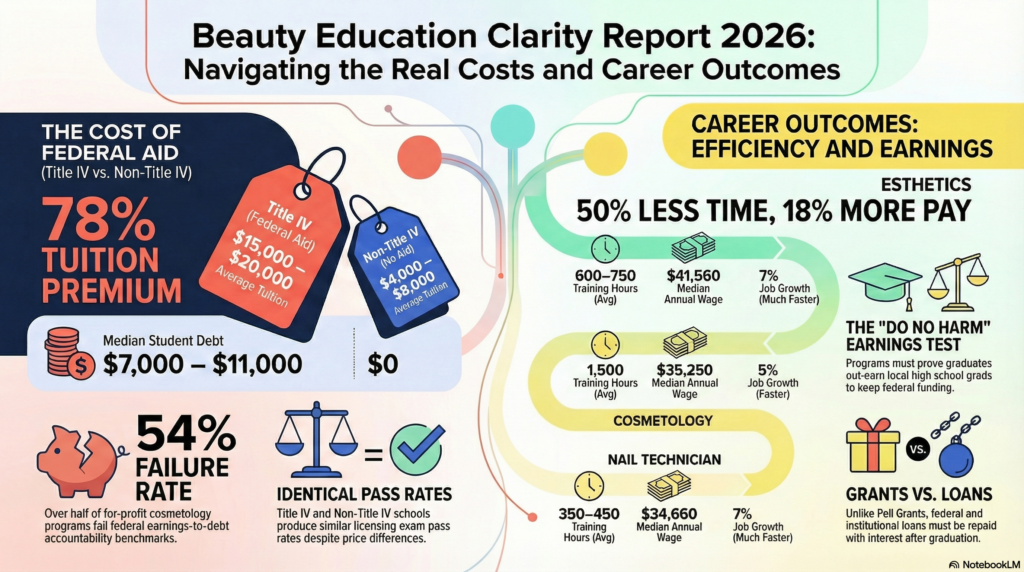
The U.S. beauty education sector enrolls approximately 200,000 students annually in programs spanning cosmetology, nail technology, esthetics, and related disciplines. These programs collectively received over $1 billion in federal student loans and grants in the 2019–20 academic year alone. Despite this level of public investment, federal data consistently show that many cosmetology program graduates earn less than workers with only a high school diploma—a metric that is now central to federal accountability regulation.
This report synthesizes verified data from the U.S. Department of Education, Bureau of Labor Statistics, federal court opinions, and peer-reviewed policy research to present a neutral, evidence-based analysis of the beauty education landscape. The full report is available for download:
Key findings include:
- Regulatory landscape: The federal Gainful Employment rule was upheld by a federal court in October 2025. A new “Do No Harm” earnings premium test under the One Big Beautiful Bill Act (July 2025) extends outcome-based accountability to all Title IV programs.
- Tuition economics: Peer-reviewed research documents that Title IV cosmetology programs charge approximately 78% more in tuition than comparable non-Title IV programs offering the same licensure preparation.
- Labor market alignment: Esthetics and nail technology demonstrate faster job growth and, in the case of esthetics, higher median wages—with substantially fewer training hours.
- Financial aid literacy: Students benefit from clearly distinguishing between grants, loans, institutional payment plans, and scholarships before committing.
- Accreditation: Accreditation status alone does not predict graduate earnings or financial safety.
1. Legal & Regulatory Landscape
Gainful Employment Rule
The Biden administration finalized strengthened Gainful Employment (GE) regulations in October 2023, establishing two accountability tests:
| Test | Metric | Passing Standard |
|---|---|---|
| Debt-to-Earnings (D/E) | Annual median loan payment as share of earnings | ≤ 8% of annual earnings or ≤ 20% of discretionary income |
| Earnings Premium (EP) | Median earnings vs. state HS graduate median | Graduates must outearn median HS graduate in their state |
Programs failing either test in two out of three consecutive years risk losing Title IV eligibility. The rule covers approximately 32,000 programs enrolling 2.9 million students annually.
October 2025 Federal Court Ruling
On October 2, 2025, U.S. District Judge Reed O’Connor (N.D. Texas) dismissed consolidated challenges from the American Association of Cosmetology Schools (AACS) and Ogle School Management. The court found the Department’s interpretation of “gainful employment” was “the best [interpretation] considering the statutory language”. The judge rejected the argument that underreporting of cash tips systematically disadvantages cosmetology programs, citing studies showing that underreporting is not widespread. Research confirms unreported tip income accounts for only about 8% of additional earnings—insufficient to explain the earnings gap.
The rule remains fully in effect. AACS has indicated it may appeal to the Fifth Circuit. Concurrently, the Trump administration’s Department of Education defended the rule in court and urged the judge to keep it in place.
One Big Beautiful Bill Act (July 2025)
The Act created a new “Do No Harm” earnings premium test extending outcome-based accountability to all Title IV programs, including degree programs at public and nonprofit institutions. Programs failing for two out of three years lose eligibility for Federal Direct Loans. The AHEAD negotiated rulemaking committee reached consensus in January 2026, with the existing Financial Value Transparency framework renamed the Student Tuition and Transparency System (STATS) and the GE debt-to-earnings test eliminated as duplicative.
Risk Exposure for Cosmetology Programs
2. Tuition Economics Analysis
Title IV vs. Non-Title IV Tuition
Peer-reviewed research by Cellini & Goldin (2014), published in the American Economic Journal: Economic Policy, analyzed Florida cosmetology programs (900+ hours) and found that Title IV programs charged approximately 78% more in tuition than comparable non-Title IV programs, despite similar licensing exam pass rates. The tuition premium was roughly equal to average student grant awards plus the estimated loan subsidy.
A 2022/2024 analysis of Texas by Cellini & Onwukwe documented that 86% of the state’s 824 licensed cosmetology schools operate without federal aid. In a Dallas case study, a Title IV school charged $16,060 for a 1,000-hour cosmetology program, while a non-Title IV school 6 miles away charged $4,775 for the identical program length—less than one-third the price.
Generated chart: tuition_comparison.png
Aggregate Tuition Data
These findings do not assign intent. They reflect the economic structure of federal aid availability. Students comparing programs should evaluate total cost of completion alongside outcomes, regardless of Title IV status.
3. Labor Market Comparison
Bureau of Labor Statistics data (May 2024 wages; 2024–2034 projections) reveal important differences across beauty occupations:
| Occupation | Median Wage | Employment | Growth (2024–34) | Annual Openings |
|---|---|---|---|---|
| Cosmetologists/Hairstylists | $35,250/yr | 651,200 | 5% (faster than avg.) | 84,200 |
| Manicurists/Pedicurists | $34,660/yr | 210,100 | 7% (much faster) | 24,800 |
| Skincare Specialists | $41,560/yr | 97,400 | 7% (much faster) | 14,500 |
Generated chart: labor_comparison.png
Licensing Hours and Time-to-Income
Training requirements vary dramatically across program types and states:
| Program | Hour Range | National Average | Est. Full-Time Completion |
|---|---|---|---|
| Cosmetology | 1,000–1,800 | ~1,500 hours | 10–18 months |
| Nail Technology | 100–750 | ~350–450 hours | 2–6 months |
| Esthetics | 260–1,000 | ~600–750 hours | 3–8 months |
Generated chart: licensing_hours.png
Key Comparative Observations
Esthetics offers the highest median wage among the three fields at $41,560—18% higher than cosmetology. Both nail technology and esthetics project faster growth (7%) than cosmetology (5%). Specialization programs require substantially fewer hours, meaning faster time-to-income and lower total program cost. Esthetics achieves higher wages with approximately 40–50% of cosmetology’s training time.
These findings do not suggest cosmetology is an inferior career choice. Cosmetology licensure provides the broadest scope of practice. However, specialization programs may offer distinct advantages in terms of regulatory risk exposure, time-to-income, and median wage levels.
4. Financial Aid Clarification
The term “financial aid” encompasses distinct funding categories with different obligations:
| Type | Source | Repayment Required? |
|---|---|---|
| Federal Pell Grant | U.S. Dept. of Education (FAFSA) | Generally no |
| Federal Subsidized Loan | U.S. Dept. of Education (FAFSA) | Yes, with interest (gov’t pays interest while enrolled) |
| Federal Unsubsidized Loan | U.S. Dept. of Education (FAFSA) | Yes, with interest (interest accrues from disbursement) |
| Institutional Scholarship | The school | No |
| Institutional Payment Plan | The school | Yes (to the school; not a federal program) |
| Private Loan | Banks/lenders | Yes, with interest (fewer protections than federal) |
Before signing any enrollment agreement, students should ask: (1) What portion is grants vs. loans? (2) What is the total debt at completion? (3) What are the estimated monthly payments after graduation? (4) Is any part an institutional arrangement rather than a federal program?
5. Accreditation & Outcome Analysis
NACCAS (National Accrediting Commission of Career Arts and Sciences) accredits over 740 schools, representing approximately one in seven Title IV institutions. Those schools enrolled 109,000 students and received more than $1 billion in federal aid in 2022–23.
A 2025 New America investigation found that NACCAS’s enforcement practices include evaluating rule violations individually rather than considering complete compliance records, which can allow schools to cycle through repeated violations for years while maintaining accreditation. Multiple schools on probation failed to disclose their sanction status as required by federal regulations.
Does accreditation predict outcomes? Available evidence does not support this conclusion. The vast majority of programs projected to fail gainful employment tests are offered by accredited institutions. Research shows Title IV and non-Title IV programs produce similar licensing exam pass rates. Accreditation establishes minimum operational standards but does not guarantee specific earnings or return on investment.
Major recent closures—Marinello Schools of Beauty (56 campuses, 2016), Regency Beauty Institute (79 campuses, 2016), and others—illustrate the financial fragility of institutions heavily dependent on federal aid.
6. Institutional Model Comparison
Beauty schools generally operate under one of two structural models:
| Dimension | Model A: Education-First | Model B: Clinic-Revenue-Dependent |
|---|---|---|
| Primary revenue | Tuition and fees | Tuition + significant clinic service revenue |
| Student time allocation | Emphasis on classroom instruction and supervised practice | Substantial student time on clinic floor serving paying clients |
| Student compensation | Students are learners | Students perform revenue-generating services; typically unpaid |
| Incentive alignment | Institution benefits from efficient completion | Institution may benefit from extended enrollment |
| Program length | Closely aligned with state minimums | May exceed state minimums by hundreds of hours |
Under Model A, the institution’s financial incentive aligns with graduating students on time at competitive cost. Under Model B, a structural tension may exist: students performing services generate clinic revenue for the institution while consuming their limited financial aid eligibility. Some programs exceed state licensing requirements by up to 50%, extending the period during which students generate clinic revenue and draw down federal aid.
Prospective students should ask: How do the school’s required hours compare to state licensing requirements? What percentage of hours are classroom vs. clinic floor? Does the school disclose graduation rates and job placement rates?
7. Student Protection Checklist
Before You Sign: A Student Review Checklist
- ☐ Review the full enrollment agreement with a family member before signing. Do not feel pressured to sign on the same day.
- ☐ Confirm the total cost, including tuition, fees, supplies/kits, textbooks, and licensing exam fees.
- ☐ Understand your financial aid package: How much is grants? How much is loans? What are estimated monthly payments after graduation?
- ☐ Verify program length in hours and expected completion date. Compare with state licensing requirements.
- ☐ Request outcome data: graduation rate, licensing pass rate, job placement rate. Compare with College Scorecard data.
- ☐ Review the refund policy. Understand what happens if you withdraw.
- ☐ Ask about licensing renewal requirements in your state.
- ☐ Research regulatory status: any GE warnings, accreditor sanctions, or heightened cash monitoring.
- ☐ Compare at least two programs on cost, outcomes, and completion time.
- ☐ Keep copies of all signed documents.
8. Policy Implications
The convergence of the Gainful Employment rule and the One Big Beautiful Bill Act’s earnings premium test represents a durable policy shift toward outcome-based accountability across all sectors. Licensing hour requirements vary dramatically across states with no demonstrated correlation to improved outcomes—evidence-based standardization could reduce costs for students. The new STATS framework will provide unprecedented program-level transparency for prospective students. Ensuring accreditors evaluate institutions’ complete compliance records—rather than individual violations in isolation—would strengthen student protection.
9. Conclusion
The U.S. beauty education sector serves hundreds of thousands of students annually, many seeking a path to economic opportunity. The industry provides essential services and supports meaningful careers. At the same time, publicly available data reveal structural challenges—including tuition premiums associated with federal aid participation, earnings that often fall below those of high school graduates, and regulatory accountability gaps—that warrant careful attention.
This report has presented verified, publicly available data without targeting any specific institution or organization. The findings are intended to support informed decision-making, not to diminish the value of beauty education as a profession.
Prospective students are encouraged to review full student enrollment agreements with their families before signing. Education is a long-term financial decision that benefits from careful review and informed comparison.







