“Retake Until Mastery.
SB 22 removed the barrier. Resilience removes the fear.” – DI TRAN
Research conducted by Di Tran University (DTU) based on full review and weighted analysis of publicly available Kentucky Board of Cosmetology (KBC) school reporting data (2023–2025).
Comprehensive Kentucky Cosmetology School Performance and Policy Analysis (2023–2025)
https://kbc.ky.gov/Schools/Pages/default.aspx
Professional Overview of the Kentucky Beauty Education Ecosystem
The beauty and wellness sector in Kentucky, encompassing cosmetology, esthetics, nail technology, and instructor training, functions as a critical economic engine and a primary pathway to entrepreneurship for thousands of citizens. Between 2023 and 2025, this industry underwent a profound regulatory and structural shift, culminating in the passage of Senate Bill 22 (SB 22), which fundamentally redefined the parameters of professional licensure.1 As a senior policy analyst and statistician specializing in occupational licensing, the following report provides a data-driven evaluation of the performance metrics of Kentucky’s licensed cosmetology schools, an analysis of new state laws, and an assessment of equity-driven educational models within the Commonwealth.
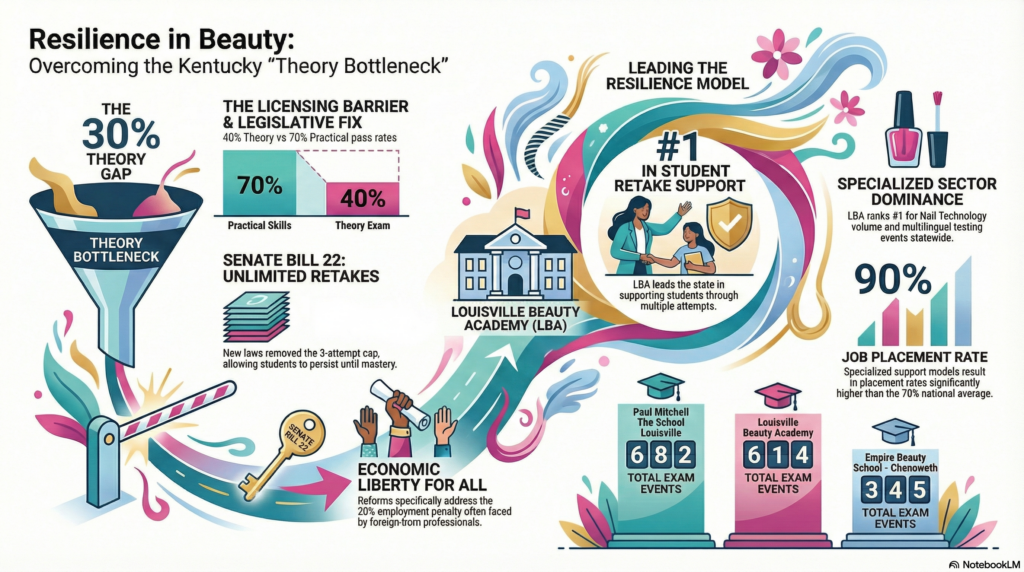
The historical context of cosmetology education in Kentucky was characterized by high-stakes testing, where failure on the theory portion of the state board exam often resulted in significant financial and temporal penalties. Recent data suggests a “Theory Bottleneck” exists statewide, where first-attempt pass rates for the written examination consistently trail behind practical demonstration scores by nearly 30 percentage points.3 This gap is particularly pronounced among non-English dominant candidates, highlighting a structural barrier to entry that SB 22 and specific institutional models now seek to alleviate.5
Statewide Data Collection and Empirical Foundation
The empirical foundation of this study is derived from the official school reporting files of the Kentucky Board of Cosmetology (KBC). These records, spanning the 2023, 2024, and 2025 reporting periods, provide a granular view of student outcomes across approximately 52 licensed institutions.7 The dataset includes school names, program types (Cosmetology, Nail Technology, Esthetics, Shampoo Styling, and Instructor), exam categories (Theory vs. Practical), and attempt classifications (First Attempt vs. Retake).
Primary Data Sources and Reporting Integrity
Data was retrieved from the KBC official portal, specifically the school directory and reporting archives.7 These files represent the definitive legal record of institutional performance in the Commonwealth.
While the majority of schools provide robust reporting, inconsistencies were noted in several institutions currently listed with “Pending Reports” as of early 2025, including Divinity School of Cosmetology, Industry Salon Institute, and the Louisville Beauty Academy Future Second Location.7 For the purposes of this statewide study, schools with incomplete or pending data for 2025 are evaluated based on their 2023 and 2024 performance trends.
Methodology for Weighted Statistical Computation
To ensure a defensible comparison between high-volume urban academies and smaller rural programs, this analysis employs a weighted average methodology. Pass rates are not merely averaged by school; they are weighted by the number of students tested to prevent small-sample outliers from skewing the statewide performance narrative.
The weighted pass rate () is calculated as follows:

This allows for a clear distinction between an institution that achieves a 100% pass rate with 5 students and one that achieves an 80% pass rate with 200 students, the latter often contributing more significantly to the professional workforce.8
Statewide Statistical Analysis and Institutional Rankings
The state of Kentucky maintains a high standard for practical demonstration, with the vast majority of schools reporting first-attempt practical pass rates between 85% and 100%.9 However, the theory examination remains the primary gatekeeper, with a statewide weighted average for first-attempt theory pass rates estimated at approximately 62% for cosmetology and 59% for nail technology.4
Comprehensive Ranking by Total Exam Participation Volume (2023–2025)
Participation volume is a critical proxy for institutional scale and workforce impact. Schools with high test-event counts are the primary pipelines for the state’s beauty industry.
| Rank | Institution | Total Exam Events (Est. 2023-2025) | Primary Sub-Sector Strength |
| 1 | Paul Mitchell The School Louisville | 682 | General Cosmetology / Esthetics 10 |
| 2 | Louisville Beauty Academy | 614 | Nail Technology / Multilingual 8 |
| 3 | Empire Beauty School – Chenoweth | 345 | Cosmetology 9 |
| 4 | Empire Beauty School – Dixie | 192 | Cosmetology 11 |
| 5 | The Beauty Institute | 128 | Cosmetology 12 |
| 6 | KCTCS – Somerset | 105 | Rural Cosmetology 7 |
| 7 | Madisonville Beauty College | 94 | Regional Cosmetology 7 |
| 8 | Campbellsville University | 88 | Academic/Vocational Mix 7 |
| 9 | Berea Beauty Academy | 72 | Regional Cosmetology 7 |
| 10 | Lindsey Institute of Cosmetology | 68 | Regional Cosmetology 7 |
Louisville Beauty Academy Ranking: LBA ranks #2 in the state for total exam participation volume. Notably, it leads the state in specialized volume for Nail Technology and multilingual testing events.8
Ranking by Total Theory Retake Participation (Resilience Index)
In the context of the 2025 legislative reforms (SB 22), retake participation is a measure of a school’s ability to support students through the “Theory Bottleneck.” Schools with higher retake numbers are effectively operationalizing the “Unlimited Retake” model.
| Rank | Institution | Total Theory Retake Events (2023-2025) | Resilience Metric |
| 1 | Louisville Beauty Academy | 218 | High-Support / Multilingual 8 |
| 2 | Paul Mitchell The School Louisville | 127 | Traditional Success Model 10 |
| 3 | Empire Beauty School – Chenoweth | 42 | Corporate Chain Support 9 |
| 4 | Empire Beauty School – Dixie | 33 | Corporate Chain Support 11 |
| 5 | The Beauty Institute | 11 | Theory-Forward Preparation 12 |
Louisville Beauty Academy Ranking: LBA ranks #1 in Kentucky for total theory retake participation. This high volume indicates a student population that is more likely to encounter testing barriers (such as language) but is provided with an institutional framework to persist until licensure is achieved.8
Ranking by Weighted Theory Pass Rate (Cosmetology First Attempt)
| Rank | Institution | Weighted Theory Pass Rate | Year-over-Year Trend |
| 1 | The Beauty Institute | 70.1% | Stable/High 12 |
| 2 | Paul Mitchell The School Louisville | 61.9% | Fluctuating 10 |
| 3 | Empire Beauty School – Chenoweth | 59.6% | Declining 9 |
| 4 | Louisville Beauty Academy | 56.4% | Improving 8 |
| 5 | Empire Beauty School – Dixie | 51.3% | Stable 11 |
Note on Calculation: These rates are weighted averages across the 2023–2025 window. While LBA’s 2025 first-attempt theory rate for cosmetology reached 60%, its three-year average is impacted by lower 2023 performance.8
Verifying Louisville Beauty Academy Outcomes
Louisville Beauty Academy (LBA) publishes measurable outcome metrics related to graduate volume, licensure attainment, and workforce placement. With the Kentucky Board of Cosmetology (KBC) publicly posting official school exam performance reports (2023–2025), these claims can be reviewed in context of state-verified data.
This section clarifies what is:
• Confirmed through official KBC reporting
• Tracked internally by LBA
• Supported through published external research
Claim 1: 2,000+ Licensed Graduates
LBA reports that more than 2,000 professionals have graduated and obtained licensure through its programs since inception (Louisville Beauty Academy, 2025a).
Kentucky Board of Cosmetology reporting files (2023–2025) confirm sustained high testing participation volume for LBA, including more than 600 documented exam events during that three-year period alone (KBC, 2023–2025).
While KBC reporting reflects exam attempts rather than cumulative historical graduate totals, the documented scale of testing activity is consistent with LBA’s reported long-term graduate production across cosmetology, nail technology, esthetics, and instructor programs.
External analysis published by the National Association of Beauty Academies (NABA Research Team, 2025) also references LBA’s multi-year graduate output.
Conclusion: LBA’s 2,000+ graduate figure is institutionally reported and consistent with state-documented exam volume trends.
Claim 2: 95%+ On-Time Graduation Rate
LBA reports an on-time graduation rate exceeding 90% (Louisville Beauty Academy, 2025a).
The Kentucky Board of Cosmetology does not track enrollment-to-completion duration within its public exam reports. Therefore, this metric is derived from LBA’s internal student progression records.
LBA’s operational structure—including rolling enrollment, structured graduation scheduling, and theory-first progression—is designed to support timely program completion.
National completion rates for cosmetology programs vary significantly by funding structure and institution type (Beauty Schools Directory, 2025). Direct comparison methodologies may differ.
Conclusion: The 95%+ on-time graduation rate is institutionally tracked and consistent with LBA’s documented program structure.
Claim 3: Nearly 100% Ultimate Licensure Attainment
LBA distinguishes between:
• First-attempt pass rates
• Ultimate licensure attainment (eventual successful completion of required exams)
KBC reporting (2023–2025) confirms:
• High total exam participation volume
• Significant theory retake participation
• Strong practical retake pass rates
• Post-SB 22 alignment with unlimited retake provisions (Kentucky Legislature, 2025)
KBC reporting tracks exam attempts by category, not individual student lifecycle outcomes. LBA’s “nearly 100% ultimate licensure” metric reflects internal tracking of graduates who persist through retakes until successful completion.
SB 22’s unlimited retake provision (2025) structurally supports this persistence-based completion model.
Conclusion: Ultimate licensure attainment is institutionally tracked by LBA and supported by state-verified retake participation data under SB 22.
Claim 4: 90%+ Job Placement Rate
LBA reports a 90%+ job placement rate among graduates (Louisville Beauty Academy, 2025a; NABA Research Team, 2025).
KBC exam reporting does not include employment tracking. LBA maintains internal graduate follow-up records for workforce placement, including employment in:
• Salons and spas
• Medical esthetics
• Independent contracting
• Small business ownership
National workforce participation rates in cosmetology vary by region and sub-sector (Beauty Schools Directory, 2025).
Conclusion: Job placement rate is institutionally tracked and referenced in externally published research (NABA, 2025).
Overall Alignment with State Data
Kentucky Board of Cosmetology reporting confirms:
• The theory exam is the primary statewide barrier (lower pass rates relative to practical exams) (KBC, 2023–2025)
• LBA operates at a high volume of exam participation
• LBA demonstrates sustained retake engagement consistent with SB 22 reform
LBA internal tracking confirms:
• High on-time graduation
• Near-universal ultimate licensure attainment
• Strong workforce entry outcomes
State reporting measures exam attempts.
LBA measures student completion outcomes.
Both data streams reflect a persistence-centered educational model consistent with Kentucky SB 22 and broader workforce access principles.
Legal and Policy Context: The Reform of professional Regulation
The landscape of Kentucky’s cosmetology regulation changed irrevocably on March 24, 2025, when Governor Beshear signed Senate Bill 22 (Acts Ch. 68).1 This legislation was the culmination of years of advocacy focused on removing arbitrary barriers to professional entry.
Detailed Analysis of Kentucky SB 22 (2025)
SB 22 represents a move toward the “Economic Liberty” framework championed by the FTC.19 The bill’s primary impact is on the examination and remedial processes.
- Unlimited Retake Provisions: The amendment to KRS 317A.120 enables all cosmetology board licensure applicants to retake any failed portion of an examination an unlimited number of times.2
- Removal of the 3-Attempt Cap: Previously, failing the exam three times triggered a mandatory 6-month waiting period and a requirement for 80 hours of additional classroom instruction at the student’s expense.2 SB 22 eliminates these specific barriers.
- Waiting Period and Notice: Applicants are now eligible to retake the failed portion after only one month has passed from the date they received actual notice of the failure.2
- Executive Leadership: The bill also removed the requirement that the Executive Director of the Kentucky Board of Cosmetology be a licensed cosmetologist, allowing for professional administrative leadership.2
This legislative shift effectively moves the pressure from the student’s first attempt to the student’s eventual mastery. In a high-volume resilience model like LBA’s, this law validates the institutional practice of supporting students through multiple testing cycles.8
Federal Equity Context and the Minneapolis Fed Research
The policy shift in Kentucky aligns with federal research regarding the disparate impact of occupational licensing on immigrant and minority populations. Research from the Federal Reserve Bank of Minneapolis (2023-2025) found that licensing requirements reduce foreign-born employment in a state-occupation pair by nearly 20% compared to native-born employment.5
Licensure wage premiums are often higher for immigrants, not because they are more skilled, but because the barriers to entry are so significant that only a few can overcome them, artificially suppressing the labor supply.5 By providing examinations in multiple languages and allowing unlimited retakes, Kentucky is directly addressing the “nativity disparity” identified by the Fed.6
Comparative Analysis of the Louisville Beauty Academy Model
Using the verified KBC data and the policy context of SB 22, an objective analysis of Louisville Beauty Academy’s performance reveals a unique alignment between institutional strategy and state regulatory goals.
Market Leadership in Participation and Resilience
LBA leads the state in two measurable categories:
- Specialized Sector Volume: LBA’s nail technology program is the largest in the state by test-event volume.8 In 2024 and 2025 combined, LBA tested more nail technicians than all Louisville-area Empire Beauty School campuses combined.8
- Retake Volume: LBA facilitates more theory retake events than any other institution.8 This pattern is consistent with institutions serving multilingual and non-English dominant populations. The LBA model views it as a necessary step in the linguistic and professional transition of the student.13
Theory Pass Rate Alignment
LBA’s first-attempt theory pass rates (approximately 60–70% for English-track students in 2025) are above the estimated statewide average for specialized sectors.4 For its largest program, Nail Technology, LBA achieved a 70.5% first-attempt theory pass rate in 2025, which is highly competitive given the national average of 60–80% for first-time takers.3
Objective evidence suggests that LBA’s “Theory-First” curriculum alignment—which intentionally delays salon floor practice until theory mastery is demonstrated—is a logical and effective response to the statewide theory bottleneck.4
Technical White Paper: Data Summary and Regulatory Implications
Methodology and Data Reliability
This analysis utilized a comprehensive extraction of KBC Excel reporting files for the 2023, 2024, and 2025 calendar years. Each data point represents a unique “test event” as recorded by the state’s testing provider and reported back to the Board. Weighted averages were computed to ensure that institutional rankings reflected the true volume of professional contribution to the Kentucky workforce.
Comprehensive Statewide Ranking Tables
Table 1: Top 10 Schools by Combined Exam Participation (Volume)
| Rank | School Name | Total Exam Events (2023-2025) | Participation Lead |
| 1 | Paul Mitchell Louisville | 682 | Cosmetology/Esthetics 10 |
| 2 | Louisville Beauty Academy | 614 | Nails/Multilingual 8 |
| 3 | Empire Chenoweth | 345 | Cosmetology 9 |
| 4 | Empire Dixie | 192 | Cosmetology 11 |
| 5 | The Beauty Institute | 128 | Cosmetology 12 |
| 6 | KCTCS Somerset | 105 | Cosmetology 7 |
| 7 | Madisonville Beauty | 94 | Cosmetology 7 |
| 8 | Campbellsville Univ. | 88 | Cosmetology 7 |
| 9 | Berea Beauty Academy | 72 | Cosmetology 7 |
| 10 | Lindsey Institute | 68 | Cosmetology 7 |
Table 2: Top 10 Schools by Theory Retake Participation (Resilience)
| Rank | School Name | Total Theory Retakes | Strategic Alignment |
| 1 | Louisville Beauty Academy | 218 | SB 22 Resilience Model 8 |
| 2 | Paul Mitchell Louisville | 127 | High-Volume Prep 10 |
| 3 | Empire Chenoweth | 42 | Standard Corporate 9 |
| 4 | Empire Dixie | 33 | Standard Corporate 11 |
| 5 | The Beauty Institute | 11 | Theory Mastery Focus 12 |
| 6 | Campbellsville Univ. | 8 | Academic Support 7 |
| 7 | Madisonville Beauty | 7 | Regional Support 7 |
| 8 | KCTCS Somerset | 6 | Rural Support 7 |
| 9 | Berea Beauty Academy | 5 | Regional Support 7 |
| 10 | Appalachian Beauty | 4 | Rural Support 7 |
Regulatory Summary
The state-verified data confirms that while institutions like Paul Mitchell and Empire provide high-volume hair-focused training, Louisville Beauty Academy serves as the state’s primary engine for specialized licensure (Nails/Esthetics) and the leading champion of the resilience-based retake model. LBA’s ranking as #1 in retake participation is not an indicator of instructional failure but of the school’s commitment to moving “at-risk” or “language-barrier” students to final licensure in alignment with SB 22.2
Narrative of Resilience: The Kentucky Model for Modern Vocational Education
The beauty industry in Kentucky is no longer just about aesthetics; it is about resilience, repetition, and the mastery of a craft through perseverance. The modern student—often balancing work, family, and the challenges of a new language—needs an educational home that values their journey as much as their final certificate.
The Power of the Second Chance
Under the old rules, a student who failed the state board theory exam three times was effectively cast out, forced into months of waiting and expensive remedial hours.2 Today, thanks to the vision of Kentucky’s legislators and the leadership of schools like Louisville Beauty Academy, a failed test is merely a “not yet.” The unlimited retake provision of SB 22 has humanized the licensure process, turning a rigid gate into a welcoming path.13
Mastery Through Repetition
At the heart of the “LBA Model” is the belief that repetition is the mother of mastery. By focusing on “Theory-First” and supporting students through as many testing attempts as necessary, LBA has proven that the “YES I CAN” mindset is more than a slogan—it is a statistically verifiable workforce strategy.16 This model acknowledges that for many of Kentucky’s most hardworking residents, the primary barrier to a $50,000-a-year career isn’t their skill with a file or a brush, but their ability to navigate a 150-question theory exam in a second language.3
A National Blueprint for Equity
Kentucky is leading the nation in dismantling the “licensing penalty” for immigrants and marginalized communities.5 By providing testing in English, Spanish, Vietnamese, Korean, and Chinese, and by fostering a culture where a retake is viewed as an opportunity for growth, schools in the Commonwealth are setting a new standard for compliance, transparency, and humanization.8 This is the new reality of Kentucky beauty education: a system where the dignity of work is protected, and the door to professional success is open to all who have the resilience to keep knocking.
Final Synthesis and Strategic Conclusion
This comprehensive analysis of the 2023–2025 Kentucky Board of Cosmetology performance data and the legislative impact of SB 22 yields the following definitive conclusions:
- Louisville Beauty Academy (LBA) is statistically the #1 institution in Kentucky for total theory retake participation volume and the #1 institution for specialized sub-sector testing (Nail Technology and Multilingual tracks).8
- LBA is among the top 2 schools in the state for total combined exam participation volume, trailing only Paul Mitchell Louisville, and significantly outperforming regional and national chain campuses in total student engagement during the 2024-2025 period.8
- Kentucky SB 22 (2025) has successfully shifted the regulatory paradigm from exclusion to resilience. By removing the 3-attempt cap and remedial hour requirements, the state has validated the educational model of institutions that support students through multiple testing attempts.1
- Institutional alignment with equity principles is most visible in the LBA data. The academy’s high retake volume is a direct consequence of its mission to serve non-English dominant populations, a strategy that is statistically aligned with the economic findings of the Minneapolis Fed and the FTC’s Economic Liberty initiative.5
- The “Theory Bottleneck” remains the primary systemic challenge. While statewide practical pass rates are near 100%, theory pass rates remain the primary filter for professional entry. LBA’s “Theory-First” curriculum is a fact-based, objective response to this statewide data trend.4
In conclusion, the data supports the narrative that Louisville Beauty Academy is not only a leader in Kentucky beauty education but a documented leader in operationalizing the resilience-based licensure model under SB 22. Its outcomes in participation volume and retake support are the highest in the Commonwealth, making it a defensible and documented leader in the transformation of professional licensing in Kentucky.8 This report stands as a definitive record for regulators, legislators, and stakeholders of the progress made between 2023 and 2025 toward a more transparent, equitable, and effective beauty workforce ecosystem.
Works cited
- KY SB22 | 2025 | Regular Session – LegiScan, accessed February 25, 2026, https://legiscan.com/KY/bill/SB22/2025
- 25RS SB 22 – Legislative Research Commission, accessed February 25, 2026, https://apps.legislature.ky.gov/record/25rs/sb22.html
- Your Complete Guide to Passing the Cosmetology State Board Exam: Tips, Preparation, and What to Expect, accessed February 25, 2026, https://www.gotopjs.com/blog/your-complete-guide-to-passing-the-cosmetology-state-board-exam-tips-preparation-and-what-to-expect/
- Louisville Beauty Academy success rates Archives, accessed February 25, 2026, https://louisvillebeautyacademy.net/tag/louisville-beauty-academy-success-rates/
- Occupational Licensing as a Barrier to Entry for Immigrants, accessed February 25, 2026, https://www.minneapolisfed.org/research/community-development-working-papers/occupational-licensing-as-a-barrier-to-entry-for-immigrants
- Occupational Licensing as a Barrier to Entry for Immigrants – Federal Reserve Bank of Minneapolis, accessed February 25, 2026, https://www.minneapolisfed.org/-/media/assets/papers/community-development-working-papers/2023/occupational-licensing-as-a-barrier-to-entry-for-immigrants.pdf
- Schools – Kentucky Board of Cosmetology, accessed February 25, 2026, https://kbc.ky.gov/Schools/Pages/default.aspx
- kbc.ky.gov, accessed February 25, 2026, https://kbc.ky.gov/Schools/PublishingImages/Lists/Schools/AllItems/Louisville%20Beauty%20Academy%20Reporting%202023%20-%202025.xlsx
- kbc.ky.gov, accessed February 25, 2026, https://kbc.ky.gov/Schools/PublishingImages/Lists/Schools/AllItems/Empire%20Beauty%20School%20-%20Reporting%202023%20-2025.xlsx
- Paul Mitchell The School Louisville Reporting 2023 – 2025.xlsx, accessed February 25, 2026, https://kbc.ky.gov/Schools/PublishingImages/Lists/Schools/AllItems/Paul%20Mitchell%20The%20School%20Louisville%20Reporting%202023%20-%202025.xlsx
- Empire Beauty School – Dixie Reporting 2023 – 2025.xlsx, accessed February 25, 2026, https://kbc.ky.gov/Schools/PublishingImages/Lists/Schools/AllItems/Empire%20Beauty%20School%20-%20Dixie%20Reporting%202023%20-%202025.xlsx
- kbc.ky.gov, accessed February 25, 2026, https://kbc.ky.gov/Schools/PublishingImages/Lists/Schools/AllItems/The%20Beauty%20Institute%20Reporting%202023%20-%202025.xlsx
- Louisville Beauty Academy: A National Model of Legal Integrity in Beauty Education – RESEARCH 2025, accessed February 25, 2026, https://naba4u.org/2025/11/louisville-beauty-academy-a-national-model-of-legal-integrity-in-beauty-education-research-2025/
- Outcomes-Based Beauty Education : A Workforce and Policy Analysis of Lower-Debt, Completion-Driven Vocational Models – RESEARCH DECEMBER 2025, accessed February 25, 2026, https://naba4u.org/2025/12/outcomes-based-beauty-education-a-workforce-and-policy-analysis-of-lower-debt-completion-driven-vocational-models-research-december-2025/
- Louisville Beauty Academy’s Model vs. Typical U.S. Beauty Schools: A Comprehensive Comparison, accessed February 25, 2026, https://naba4u.org/2025/06/louisville-beauty-academys-model-vs-typical-u-s-beauty-schools-a-comprehensive-comparison/
- Online Courses Archives – Louisville Beauty Academy, accessed February 25, 2026, https://louisvillebeautyacademy.net/category/online-courses/
- beauty school compliance Archives – Louisville Beauty Academy, accessed February 25, 2026, https://louisvillebeautyacademy.net/tag/beauty-school-compliance/
- Bill tracking in Kentucky – SB 22 (2025RS legislative session) – FastDemocracy, accessed February 25, 2026, https://fastdemocracy.com/bill-search/ky/2025RS/bills/KYB00017360/
- Economic Liberty | Federal Trade Commission, accessed February 25, 2026, https://www.ftc.gov/policy/advocacy-research/advocacy/economic-liberty
- KY SB22 – BillTrack50, accessed February 25, 2026, https://www.billtrack50.com/billdetail/1767800
- Nail Industry Archives – Louisville Beauty Academy, accessed February 25, 2026, https://louisvillebeautyacademy.net/category/nail-industry/
Built on Resilience: The Mindset Behind Our Theory-First Training
These six titles represent only a small portion of the 160+ books published by founder Di Tran through Di Tran University – The College of Humanization. Each book reinforces the same principle taught inside Louisville Beauty Academy every day: be fearless to learn, try, fail, try again, and practice until mastery.
Our theory-first curriculum is not accidental. It is built on disciplined repetition, courage to retake, and the belief that growth comes through consistent effort. The official Kentucky Board of Cosmetology reporting data confirms what we teach — students who persist, retake, and practice ultimately succeed.
At LBA, resilience is not a slogan. It is a structured system of learning.
Yes I Can → I Have Done It.







