Student action checklist · verified October 2, 2026
Career Credit Score: Do the Work. Document It. Build Your Professional Profile.
These opportunities are optional. A student may choose the standard contracted price, never make a public credit post, and still receive the same required instruction, clock-hour credit, academic treatment, graduation eligibility, and Kentucky Board certification process.
The posts are designed to market the student’s real work and professional growth. Tagging Louisville Beauty Academy connects the proof to an authorized school training environment so LBA can verify it. No student is required to praise LBA, post a positive review, recruit students, or surrender the right to speak honestly.
Read this before starting
Your signed program agreement controls. This checklist is a current operational aid, not a new promise or contract. Amounts, requirements, official handles, and submission methods may change. An activity or post earns credit only after LBA verifies and approves it under the applicable written agreement.
Lawful practice: do not independently offer regulated beauty services to the public before holding the required Kentucky license or permit. While enrolled, perform hands-on work only in an LBA-authorized setting, within your program stage and scope, and under required supervision. See the Kentucky Board of Cosmetology and KRS Chapter 317A.
The 4-step public-proof checklist
Complete the approved action for your program and category. Take a clear photo or short video of the real work, process, milestone, or finished proof.
Post from your own public account only when your lane says “public post required.” Use the platform you choose.
Tag LBA and disclose the tuition-credit connection. Use the official handle LBA gives you in writing and a clear statement such as: “I may receive tuition credit for this post.”
Submit the screenshot and keep the post public until verified. The screenshot should show the content, date, tag, and disclosure. Approval—not posting alone—creates the credit.
Privacy: Never expose grades, student records, health information, or private data. A client, model, classmate, or other identifiable person may appear only after the required written release. Use a mannequin, station, tools, or your own work when the applicable lane permits it.
Nail Technology · 450 hours
Standard cost: $8,325.50Possible floor: $3,800.00Maximum conditional reduction: $4,525.50
Public-proof categories: 30 approved items · up to $2,250
Theory: 5 approved achievements × $100 = $500
Sanitation and safety: 10 approved submissions × $50 = $500
Practical work / digital portfolio: 10 approved posts × $75 = $750
Client safety / professional conduct: 5 approved supervised live-model or client proof items × $100 = $500. This lane requires LBA’s internal five-star service evaluation and School verification—not a Google, Facebook, or Yelp review.
No public post: payment-at-enrollment lane up to $1,000; attendance lane up to $1,275.50 full-time or $500 part-time.
No public post: payment-at-enrollment lane up to $2,500; attendance lane up to $3,000 full-time or $1,500 part-time; 5 approved sanitation-support actions × $100 = $500.
Sanitation / cleaning / environmental discipline: 40 approved posts × $100 = $4,000, with no more than one counted post in this category per calendar day.
No public post: payment-at-enrollment lane up to $6,975; attendance lane up to $9,500 full-time or $6,000 part-time.
No public post: payment-at-enrollment lane up to $3,000; attendance lane up to $3,275.50 full-time or $1,500 part-time. The agreement’s $8,775.50 aggregate cap controls even if lane face values add to more.
No public post: payment-at-enrollment lane up to $1,000; attendance lane up to $1,000 full-time, $500 part-time, $250 at 10–20 hours/week, or $100 under 10 hours/week.
Status: Public operational guide reviewed October 2, 2026. The exact signed enrollment agreement, any written amendment, current school catalog, refund policy, and applicable Kentucky law control. This page does not guarantee a discount, completion, licensure, employment, income, clients, or business success.
Educational Disclaimer: This research is developed by Di Tran University – College of Humanization and shared by Louisville Beauty Academy for educational purposes only. It is not legal advice and is not endorsed by the Kentucky Board of Cosmetology. Louisville Beauty Academy does not endorse, support, interpret, or assume responsibility for any podcast producers or their content and shares all materials as-is for educational purposes. All laws and regulations (KRS 317A, 201 KAR Chapter 12) are subject to official interpretation and change. Readers are responsible for verifying compliance directly with the Board or qualified counsel.
The regulatory environment governing the beauty industry in the Commonwealth of Kentucky is established upon a rigorous and uncompromising framework designed to safeguard public health, ensure consumer safety, and uphold the professional integrity of the trade. For practitioners, particularly those originating from elite institutions such as the Louisville Beauty Academy, the concept of “inspection readiness” is not a temporary state achieved in anticipation of a scheduled visit but a permanent operational posture. This report delineates the granular requirements of Kentucky Revised Statutes Chapter 317A and the corresponding Administrative Regulations under 201 KAR Chapter 12, articulating a systematic approach to daily, weekly, monthly, and yearly compliance that ensures a salon remains beyond reproach at any given moment.1
The Philosophical and Statutory Mandate of the Kentucky Board of Cosmetology
The Kentucky Board of Cosmetology functions as an independent agency of the state government, vested with the absolute authority to supervise all aspects of cosmetology, esthetic practices, and nail technology.3 The core mission, as articulated in KRS 317A.060, is the protection of the public. This mandate transcends simple aesthetics; it is a public health imperative aimed at preventing the transmission of bloodborne pathogens, fungal infections, and bacterial contaminants within a high-touch service environment.4 The Board operates under the principle that the professional license is a privilege granted upon the condition of strict adherence to safety standards, and the Louisville Beauty Academy reinforces this through its “Compliance by Design” philosophy, which posits that the practitioner must adopt the mindset of the inspector in every action.2
The legal authority for inspections is absolute and immediate. Under 201 KAR 12:060, Board members or designated inspectors may enter any licensed facility during normal business hours or at any time the establishment is open to the public without prior notice.7 This lack of notice serves as a regulatory check, ensuring that the standards of sanitation and licensure are consistently applied rather than performatively displayed. The scope of an inspection includes not only the physical environment—such as the cleanliness of floors and tools—but also a comprehensive review of all related records, including personnel licenses, plumbing affidavits, and sanitation logs.8
Table 1: Primary Legal Authorities for Kentucky Salon Operations
Statute/Regulation
Primary Focus
Practical Application for the Licensee
KRS Chapter 317A
The Enabling Statute
Establishes the existence of the Board and the broad requirements for licensure and scope of practice.1
201 KAR 12:100
Sanitation Standards
The “Bible” of infection control; details the specific methods for cleaning and disinfecting tools and surfaces.10
201 KAR 12:060
Inspection Authority
Defines the inspector’s right to enter, the requirement for license display, and the definition of unprofessional conduct.7
201 KAR 12:082
Educational Standards
While focused on schools, it establishes the minimum knowledge base required for any graduate to hold a license.10
KRS 317A.020
Licensure Requirements
Prohibits the practice of beauty services without a current, valid license and mandates conspicuous display.13
The Elite Professional Routine: Daily Operational Standards
For the graduate of the Louisville Beauty Academy, the workday does not begin with the first client but with a pre-service compliance sweep. This routine is designed to build the “muscle memory” of sanitation, transforming legal requirements into subconscious professional habits. The daily cycle is divided into four critical phases: opening preparations, intra-service sanitation, post-service disinfection, and end-of-day closure.2
Hand Hygiene and the First Contact Protocol
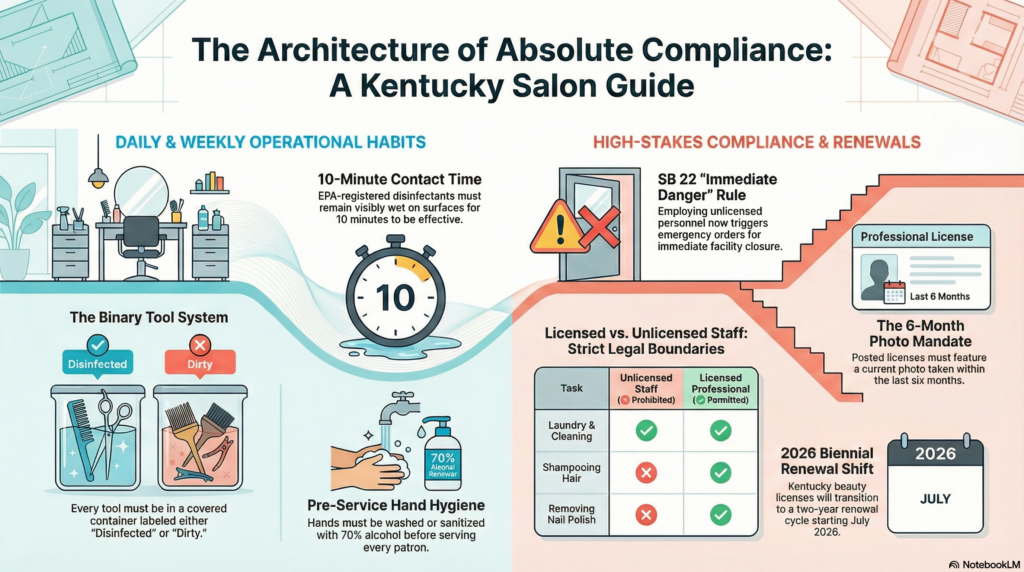
The transmission of infectious agents is most frequently traced to improper hand hygiene. 201 KAR 12:100 Section 13 mandates that every person licensed or permitted by the Board must thoroughly cleanse their hands with soap and water or an alcohol-based hand sanitizer (minimum alcohol) immediately before serving each patron.11 This standard is non-negotiable and applies even if the practitioner intends to wear gloves for the service. Handwashing stations must be equipped with a soap dispenser and single-use paper towels; the use of communal cloth towels for hand drying is a significant violation that can lead to immediate disciplinary citations.2
Table 2: Daily Hand Hygiene and Personal Protective Equipment (PPE) Standards
Requirement
Standard Procedure
Legal/Regulatory Context
Pre-Service Washing
Soap and water or alcohol sanitizer
Mandatory before every client interaction to prevent cross-contamination.11
PPE Usage
Gloves, masks, or aprons where applicable
Required during chemical services or when contact with blood/body fluids is possible.11
Handwashing Station
Sink with hot/cold water, soap, and paper towels
Must be accessible and not used for tool cleaning if it is the primary hygiene station.2
Forbidden Items
No carrying tools in pockets or smocks
Prevents the contamination of clean tools and injuries to the practitioner.11
Workstation Maintenance and Surface Disinfection
The workstation is the primary site of service delivery and, consequently, the primary site of potential contamination. Kentucky law requires that all non-porous surfaces, including styling chairs, counters, nail tables, and shampoo bowls, be cleaned and disinfected daily and between each individual client.2 The process of “cleaning” is legally distinct from “disinfecting.” Cleaning involves the removal of visible debris, hair, and product residue using soap, detergent, or a chemical cleaner followed by a water rinse.19 Only after a surface is clean can it be disinfected.
Disinfection must be achieved using an Environmental Protection Agency (EPA)-registered bactericidal, virucidal, and fungicidal disinfectant used in strict accordance with the manufacturer’s label.11 A common error that results in inspection failure is the “spray and wipe” method, where the disinfectant is removed before it has reached its required contact time. Most high-level disinfectants require the surface to remain visibly wet for a full ten minutes to be effective against robust pathogens such as HIV, HBV, and various fungi.11
The Lifecycle of Tools and Implements: The “Clean vs. Dirty” System
The management of tools—including combs, brushes, shears, clippers, and nail implements—is perhaps the most scrutinized element of a state inspection. Kentucky utilizes a strict binary system: an item is either “Disinfected/Ready to Use” or it is “Dirty”.18 There is no middle ground.
All used implements must first be cleaned of visible debris using warm, soapy water and then fully immersed in a disinfectant solution.11 For items that have come into contact with blood or body fluids, such as a nick from a razor or a cuticle nipper, the item must be thoroughly cleaned before immersion to ensure the disinfectant can reach all surfaces of the tool.11 Once the full contact time is met, the implements must be removed, rinsed, dried with a single-use paper towel or air-dried, and stored in a clean, covered container labeled “Disinfected” or “Ready to Use”.18
Conversely, any tool that has been used and is awaiting disinfection must be kept in a separate, covered container clearly labeled as “Dirty” or “Used”.17 The intermingling of clean and dirty tools is a major violation. Furthermore, once an item is placed in the “Dirty” container, it cannot be removed until the formal cleaning and disinfecting process has begun.18
Table 3: Contact Time and Disinfection Requirements for Non-Electrical Tools
Tool Type
Required Process
Storage Requirement
Combs/Brushes/Rollers
Scrub with soap, rinse, immerse in EPA-disinfectant
Covered container labeled “Disinfected”.18
Metal Implements (Nippers/Pushers)
Scrub with soap, rinse, immerse in EPA-disinfectant
Covered container labeled “Disinfected”.18
Nail Drill Bits
Soak in acetone, scrub, immerse in EPA-disinfectant
Must be stored dry in a labeled container.18
Electrical Clippers
Remove hair, saturate blades with high-level spray/foam
May be stored at station if clean and covered.11
The Towel and Linen Management System
The handling of linens is a primary focus of 201 KAR 12:100, which mandates a zero-tolerance policy for the reuse of any towel or robe without proper laundering.11 A clean towel or neck band must be used for every patron to prevent the hair cloth or shampoo apron from making direct contact with the patron’s skin.11
The laundry cycle must be integrated into the daily routine. All cloth items must be laundered in a washing machine using laundry detergent and chlorine bleach according to the manufacturer’s directions for sanitation.11 Clean linens must be stored in a closed cabinet or a covered container to protect them from hair clippings and airborne contaminants.11 Once used, towels must be immediately deposited into a separate, labeled container for soiled laundry. The practice of leaving used towels on the back of styling chairs or piled near shampoo bowls is a visible sign of non-compliance that will be noted by any inspector.2
Product Control and Chemical Safety
The mislabeling or lack of labeling on chemical products is one of the most frequent reasons for citations in Kentucky salons. The Board requires that all products—including shampoos, conditioners, hair colors, and nail liquids—remain in their original manufacturer-labeled containers whenever possible.15 If a product is transferred to a secondary container, such as a spray bottle for water or a smaller jar for cream, that container must be labeled with the product name and, if it is a chemical mixture like a disinfectant, the concentration and the date it was prepared.11
Furthermore, the use of certain substances is strictly prohibited under Kentucky law. Methyl Methacrylate (MMA) is illegal for use in nail services due to its high toxicity and the potential for severe allergic reactions or permanent nail damage.11 The presence of MMA in a salon, even if not currently in use, is grounds for significant fines and disciplinary action. Similarly, the use of callus graters or “cheese grater” style scrapers is prohibited as they can cause deep lacerations and pose a significant infection risk.13
Table 4: Prohibited Substances and Practices in Kentucky Salons
Prohibited Item/Practice
Rationale for Prohibition
Regulatory Basis
Methyl Methacrylate (MMA)
High toxicity; risk of permanent damage and allergies
201 KAR 12:100 Section 14.11
Callus Graters / Blades
Risk of skin cutting and deep-seated infection
KRS 317A.020 / 201 KAR 12:100.11
UV Sterilizers (as primary)
Ineffective at achieving high-level disinfection
201 KAR 12:100 Section 14.11
Roll-on Wax
High risk of cross-contamination between clients
201 KAR 12:100 Section 14.11
Double-Dipping
Spreads bacteria and fungi through entire product
201 KAR 12:100 Section 7.11
Weekly Systems Maintenance and Compliance Audits
While daily tasks ensure immediate safety, the weekly routine is focused on the long-term integrity of the salon’s compliance infrastructure. This phase involves a more thorough examination of those areas that may not be touched during every client service but remain vital for a successful inspection.
The Weekly Station Sweep and Label Audit
Every week, the salon manager or designated compliance officer should conduct a formal walkthrough of each workstation. This audit must verify that every bottle is clearly labeled and that the labels remain legible.11 Over time, chemicals can degrade adhesive labels or obscure handwriting; any bottle with a faded or peeling label should be replaced or relabeled immediately.
During this weekly audit, the practitioner should also inspect the “Clean” tool containers. It is common for small hair clippings to find their way into even covered containers during the course of a busy week. If debris is found in a “Clean” container, all tools within that container must be re-sanitized, and the container itself must be disinfected.18 This ensures that the storage environment remains as sterile as the tools themselves.
Safety Data Sheet (SDS) and Records Management
Federal OSHA regulations, coupled with Kentucky state board requirements, mandate that every salon maintain a comprehensive binder of Safety Data Sheets (SDS) for every chemical used on the premises.21 The weekly routine should include a check for any new products that have entered the salon; if a new hair color line or a new type of nail monomer has been purchased, the corresponding SDS must be added to the binder immediately.
Furthermore, salons should maintain a daily sanitation log. While not strictly mandated for every single surface by state law, the Louisville Beauty Academy recommends it as the “Gold Standard” for compliance.2 A log that documents the daily cleaning of shampoo bowls and the weekly deep-cleaning of pedicure stations provides a “paper trail” of professional diligence that can be invaluable if a client ever files a complaint with the Board.17
Table 5: Weekly Compliance Audit Checklist
Audit Category
Specific Action Required
Expected Outcome
Label Integrity
Inspect all secondary containers for clear labeling
Zero unlabeled bottles at any station.11
Storage Inspection
Wipe out and disinfect “Clean” tool containers
No hair or debris in storage areas.18
SDS Update
Review product arrivals and add new SDS sheets
binder is current.21
Ventilation
Clean filters on hairdryers and nail extraction fans
Prevents fume buildup and fire hazards.16
Trash Verification
Ensure all waste liners are replaced and lids functional
Waste is contained and covered.2
Monthly Strategic Compliance and Infrastructure Review
The monthly compliance cycle is a strategic review of the salon’s operational health. This is the time when the owner and manager move beyond the station-level details to address the overarching legal and structural requirements of the business.
Personnel Licensing and Photo Verification
The most common reason for significant fines in Kentucky is the presence of an unlicensed practitioner or a practitioner with an expired license. Every month, the manager must verify the status of every individual working in the salon, including booth renters.8 This check must confirm that the license is not only active but also that it is current for the specific year.10
A critical component of this audit is the photo requirement. 201 KAR 12:060 Section 1 requires that a current photograph be attached to the license.7 The Board has recently cracked down on “non-compliant” photos. If an employee has a photo that is older than six months or one that does not meet the passport-style criteria (e.g., a “selfie” with filters, or a photo taken in a car), it must be updated immediately.10 Failure to have a compliant photo attached to a posted license is treated as a display violation and can result in a “pink slip”.26
Plumbing and Facility Integrity
The physical state of the facility is a reflection of the professionalism of the business. On a monthly basis, the owner should inspect the plumbing for any leaks or drainage issues. 201 KAR 12:100 requires that an adequate supply of hot and cold running water be available at all times.2 Any changes to the plumbing—such as adding a new shampoo bowl or replacing an old pedicure chair—must be documented with a new Plumbing Affidavit signed by a state plumbing inspector.27
Additionally, the monthly audit should look for “non-porous” integrity. Salon chairs with torn upholstery or nail tables with cracked surfaces are violations because the damaged areas can harbor bacteria and cannot be properly disinfected with wipes or sprays.17 Any damaged equipment must be repaired or replaced to maintain the sanitation standard.
Table 6: Monthly Strategic Audit Milestones
Task
Detail
Professional Implication
Staff License Audit
Verify every license is current and has a 6-month photo
Prevents “Immediate Danger” closure for unlicensed work.8
Facility Maintenance
Check for upholstery tears and plumbing leaks
Ensures all surfaces can be legally disinfected.17
Inventory Review
Check for expired products or “mystery” chemicals
Maintains safety and product efficacy.17
Staff Retraining
Brief staff on any new Board newsletters or trends
Maintains a unified culture of compliance.2
Restroom Audit
Deep clean and ensure all fixtures are functional
A common area for consumer complaints.2
Yearly Milestones: Renewals, Testing, and Long-Term Compliance
The yearly cycle involves high-level administrative tasks that, while infrequent, are essential for the legal existence of the salon.
The 2026 Shift to Biennial Renewals
For decades, Kentucky beauty licenses were renewed on an annual basis. However, as of January 2026, the Kentucky Board of Cosmetology is transitioning to a biennial (two-year) renewal system to reduce administrative burden and improve processing efficiency.25 This is a critical change for budget planning. While the annual fee has not technically increased, the amount due at the time of renewal will double as practitioners prepay for two years of licensure.25
For example, starting in July 2026, a cosmetologist will pay for a license that is valid through July 31, 2028.25 The renewal period remains fixed between July 1st and July 31st. Any renewal submitted after the July 31st deadline is considered inactive and will incur significant restoration fees.25 It is the responsibility of the licensee to ensure their email address is current in the KBC portal to receive renewal reminders and registration codes.31
Backflow Prevention and Annual Testing
Most commercial facilities, including salons, are required to have backflow prevention devices installed on their water supply lines to protect the municipal water supply from contamination.32 Under the Kentucky State Plumbing Code, these devices—specifically “reduced pressure principle” backflow preventers—must undergo annual testing by a state-certified backflow prevention assembly tester.33 The results of these tests must be kept on file at the salon and are often reviewed during a comprehensive state board inspection or a local health department visit.33 Failure to maintain this testing can lead to the disconnection of water services, which would force the immediate closure of the salon.33
Table 7: Annual and Biennial Administrative Deadlines
Requirement
Frequency
Key Dates / Details
Personal License Renewal
Biennial (Every 2 Years)
July 1 – July 31 of even-numbered years (Starting 2026).25
Salon Facility Renewal
Annual/Biennial
Check portal for specific facility expiration dates.25
Backflow Testing
Annual
Must be performed by a certified tester; records kept on-site.33
Local Business License
Annual
Varies by municipality; often due by June 30.28
Annual Report (Corporate)
Annual
Due to the Secretary of State by June 30.35
Navigating the Inspection: A Masterclass in Professional Interaction
When an inspector arrives, the elite professional does not react with fear but with confidence in their established systems. The inspection should be viewed as an external validation of the “Compliance by Design” principle taught at the Louisville Beauty Academy.2
Immediate Action Steps Upon Inspector Arrival
Grant Access and Provide ID: The inspector is authorized to enter and may ask for your government-issued ID to verify your identity against the posted license.8
Continue Professional Service: Unless the inspector identifies an “Immediate Danger” (such as a significant blood spill or an unlicensed worker), you should continue your service to your client while the inspector walks the floor.
Produce Records Promptly: If the inspector asks to see the plumbing affidavit, the most recent inspection report, or the salon’s employment records, these must be produced without delay.7
Use the Inspector as a Resource: The elite salon owner asks questions. Inquire about the most common violations being found in the area or if there are any upcoming regulatory changes from the Board.16 This positions you as a partner in public safety rather than a target of enforcement.
The Consequences of Non-Compliance: SB 22 and Immediate Closure
The regulatory landscape has become significantly stricter with the passage of Senate Bill 22 (2025). This legislation introduced the “Immediate and Present Danger” standard for salon closures.6 Previously, a salon might receive a warning and a ten-day period to cure most deficiencies. However, under SB 22, the employment of unlicensed personnel is now classified as an immediate danger to public health.6
If an inspector finds an unlicensed individual performing professional services, the Board is authorized to issue an emergency order for the immediate closure of the facility.6 This closure remains in effect until the violation is resolved and a follow-up inspection is passed. The financial and reputational impact of such a closure can be catastrophic, often leading to a permanent loss of business or even the stroke of a stressed owner as documented in recent disciplinary history.37
Table 8: The Disciplinary Escalation Pathway
Violation Type
Typical Board Action
Potential Penalty
Minor Sanitation (Dust, Clutter)
Correction Letter / 10-day Cure
Warning or Small Fine.6
Major Sanitation (MMA, Double-dipping)
Notice of Violation
Significant Fine and Probation.6
License Display / Photo Issues
“Pink Slip” Citation
Administrative Fine.26
Unlicensed Personnel (SB 22)
Emergency Order
Immediate Facility Closure.6
Intentional Deception of Inspector
Notice of Disciplinary Action
License Revocation/Suspension.8
Professional Scope and the Unlicensed Personnel Matrix
To avoid the immediate closure triggers of SB 22, it is vital to understand the “Unlicensed vs. Licensed Duties Matrix.” In Kentucky, the performance of even a single professional act by an unlicensed individual—such as a receptionist or a general assistant—is a violation of the law.6
Unlicensed personnel are strictly limited to non-client maintenance tasks. They may sweep floors, perform laundry, clean mirrors, handle the front desk, and process payments.6 However, as soon as their duties involve direct client interaction related to beauty services, they must hold a license. For instance, an assistant cannot shampoo a client’s hair unless they hold at least a Shampoo and Style license (300 hours) or a full Cosmetology license.6 They cannot remove nail polish, as this is legally considered part of the practice of nail technology.6 They cannot even “drape” a client with a cape for a chemical service, as this act is construed as assisting in a professional beauty practice.6
Table 9: Duty Matrix for Licensed vs. Unlicensed Staff
Task
Unlicensed (Receptionist)
Shampoo & Style (300 Hr)
Nail Tech (450 Hr)
Cosmetologist (1,500 Hr)
Sweep / Laundry
✅ Permitted
✅ Permitted
✅ Permitted
✅ Permitted
Front Desk / Cashier
✅ Permitted
✅ Permitted
✅ Permitted
✅ Permitted
Shampoo / Conditioning
❌ Prohibited
✅ Permitted
❌ Prohibited
✅ Permitted
Remove Nail Polish
❌ Prohibited
❌ Prohibited
✅ Permitted
✅ Permitted
Draping for Chemicals
❌ Prohibited
❌ Prohibited
❌ Prohibited
✅ Permitted
Manicuring
❌ Prohibited
❌ Prohibited
✅ Permitted
✅ Permitted
Building the Million-Dollar Salon through Compliance
The final truth of Kentucky salon operation is that inspection readiness is a fundamental business strategy. The graduates of Louisville Beauty Academy understand that a clean, compliant salon is a profitable salon. When a customer walks into an environment where the licenses are prominently displayed with current photos, the stations are organized, the air is free of strong chemical fumes, and the towels are pristine, a baseline of trust is established.2
Compliance protects the three most valuable assets of the beauty professional: the client’s health, the practitioner’s license, and the business’s reputation. By adopting the daily, weekly, monthly, and yearly routines detailed in this study, the salon owner moves from a state of reactionary fear to one of professional dominance. You do not prepare for the inspector; you become the inspector. In doing so, you elevate not only your own business but the entire industry within the Commonwealth of Kentucky.
Louisville Beauty Academy shares licensing and examination updates as soon as they become publicly available. However, regulations, testing procedures, and candidate bulletins may change at any time without notice and may become outdated immediately after publication.
We do not control or interpret official policies of PSI Services LLC or the Kentucky Board of Cosmetology. All students, graduates, licensees, and members of the public are strongly encouraged to verify the most current information directly with:
📌 Official Source Documents Referenced (Updated 03-02-2026)
This research incorporates the most current PSI and Kentucky Board testing infrastructure documents effective March 19, 2026.
• Kentucky Cosmetology Test Taker Guide (Effective 3/19/26) KY-CIB-COS-NEW_v1 • Kentucky Nail Technician Test Taker Guide (Effective 3/19/2026) KY-CIB-NAILS-NEW_v1 • Kentucky Esthetician Test Taker Guide (Effective 3/19/26) KY-CIB-EST-NEW_v1 • Kentucky Instructor Test Taker Guide (Effective 3/19/26) KY-CIB-INST-NEW_v1 • PSI Examination Accommodations Portal Documentation psi-Accommodations (disabilities, health conditions, or other documented needs) • PSI Kentucky Cosmetology Client Portal Update (3/19/2026 Bulletin) psi-NEW
If a test taker does not successfully submit, follow their ticket, and correspond with the PSI accommodations team, the request may be delayed or canceled.
Test takers may also choose to schedule over the telephone. To schedule by phone requires a valid credit or debit card (VISA, MasterCard, American Express or Discover). Call (855) 340-3713, Monday through Friday, between 6:30 AM and 9:00 PM CST, and Saturday-Sunday between 8:00 AM and 4:30 PM CST, to speak to a live Customer Service Representative.
All documents are referenced as part of Louisville Beauty Academy’s Compliance-By-Design public transparency framework.
The Institutional Evolution of Beauty Education: The 2026 Louisville Beauty Academy Paradigm
The beauty industry in the Commonwealth of Kentucky entered a transformative era in early 2026, a shift predicated on the formal advancement of the Louisville Beauty Academy (LBA) from a traditional vocational school to a national leader in industry standards, research, and public policy.1 Powered by the Di Tran University – College of Humanization, the academy’s 2026 direction represents a departure from profit-centric educational models toward a student-first, compliance-first framework known as the “Gold-Standard Model”.1 This institutional philosophy is grounded in the belief that professional dignity is inseparable from regulatory literacy and that the role of a modern beauty college is to function as a public knowledge library, providing open access to the complex legalities of the profession.1
At the core of this evolution is the “Compliance by Design” mandate. This protocol integrates state regulations, safety ethics, and workforce literacy directly into the educational architecture, ensuring that graduates do not merely memorize techniques for a test but embody the legal and ethical standards required for safe public practice.1 This approach addresses a critical gap in the industry where misinformation and inconsistent understanding of regulatory procedures often lead to compliance risks.3 By making compliance proactive rather than reactive, the academy seeks to reduce these risks and elevate the professional standing of beauty education on a national scale.1
The 2026 strategic direction also includes the expansion of the LBA Podcast & Video Research Series, which translates statutory complexity into actionable clarity.1 This initiative focuses on the empirical analysis of legislative texts, historical regulatory data, and verifiable public records, providing students and the public with a neutral, evidence-based understanding of the industry’s governing principles.1 This commitment to educational equity ensures that learners across cultural, linguistic, and economic barriers have access to the information necessary for success, achieving equity through transparency rather than lowered expectations.1
The Statutory Landscape: KRS Chapter 317A and the 201 KAR Administrative Framework
The regulatory environment for beauty professionals in Kentucky is governed by the Kentucky Board of Cosmetology (KBC) under the authority of Kentucky Revised Statutes (KRS) Chapter 317A and the accompanying Kentucky Administrative Regulations (KAR).4 Graduates must recognize that their license is not merely an aesthetic credential but a “safety credential” mandated by the state to protect public health and welfare.6 This regulatory framework imposes specific training hour minimums, curriculum requirements, and institutional standards that are non-negotiable for licensure.4
The administrative specificity of 201 KAR 12:082 serves as the operational manual for the industry, defining the instructional limits and mandatory subject areas for each license type.6 For instance, the regulation requires a mandatory 40 hours of study dedicated specifically to Kentucky statutes and regulations for cosmetology students, underscoring the state’s expectation that graduates are “regulatory citizens”.6
License Type
Mandatory Training Hours
Educational Prerequisite
Minimum Age
Cosmetologist
1,500 Hours
12th Grade or Equivalent
18 Years 4
Esthetician
750 Hours
12th Grade or Equivalent
18 Years 4
Nail Technician
450 Hours
12th Grade or Equivalent
18 Years 4
Shampoo Stylist
300 Hours
12th Grade or Equivalent
18 Years 4
Instructor
750 Hours
Active License for 1+ Year
18 Years 4
Beyond the hour requirements, the KBC mandates strict record-keeping protocols. Schools must utilize biometric timekeeping to ensure accurate daily attendance records as required by 201 KAR 12:082 Section 18.6 Furthermore, schools are legally required to maintain these records for only five years from the student’s last date of attendance; records exceeding this five-year window are considered legally void and cannot be certified for licensure or credit transfers.3
Legislative Reform and the Resilience Model: The Impact of Senate Bill 22
The passage of Senate Bill 22 (SB 22) in 2025, with final implementation effective June 26, 2025, represented a profound regulatory shift intended to remove systemic barriers to professional licensure.10 This legislation targeted the “Theory Bottleneck” in Kentucky, where first-attempt pass rates for the written examination historically trailed behind practical scores by nearly 30 percentage points, a gap particularly pronounced among non-English dominant candidates.11
Under SB 22, the “Unlimited Retake” model was established, fundamentally redefining the path to licensure for candidates who struggle with high-stakes testing.11 Prior to this reform, failing the state board exam three times triggered a mandatory 80-hour refresher course at the student’s expense and a six-month waiting period.11 These penalties often resulted in unmanageable debt and high attrition rates.
SB 22 Provision
Statutory Change
Professional Implication
Retake Frequency
Unlimited attempts permitted
Removes the three-attempt cap and subsequent penalties.10
Waiting Period
30-day mandatory wait
Candidates must wait one month between attempts.10
Refresher Course
80-hour course abolished
No longer required to return to school after multiple failures.14
Hour Validity
5-year expiration window
Earned hours remain valid for 5 years from enrollment.14
Board Governance
Executive Director qualifications
Executive Director no longer required to be a licensee.10
The resilience-based model pioneered by LBA utilizes these legislative changes to support students through the “Theory Bottleneck,” ensuring that the focus remains on ultimate licensure attainment rather than a single high-stakes event.11 Graduates should view these reforms as a safety net that protects their educational investment while maintaining the high standards of the Kentucky state board.11
The PSI Examination Infrastructure: A Dual-Component Evaluation
The Kentucky Board of Cosmetology contracts with PSI Services LLC to administer the National Cosmetology Program (NCP) examinations.14 This evaluation consists of a computer-based theory examination and a state-administered practical examination, both of which are designed to identify if a candidate possesses the minimum knowledge to perform tasks safely on the job.6
Theory Examination Logistics and Security Protocols
Theory examinations are administered at various network facilities throughout the state, including Bowling Green, Elizabethtown, Florence, Lexington, Louisville, Maysville, Middlesboro, Mount Sterling, Owensboro, Paducah, Somerset, and Whitesburg.14 Candidates are required to provide a valid personal email address during registration, as multiple applicants are prohibited from sharing an email account.14
The security at theory testing sites is rigorous, mirroring the standards of national professional certifications. Candidates must arrive at least 30 minutes prior to the scheduled start time for identification verification.
Identification Requirements: Two forms of ID are mandatory. One must be a valid, government-issued photo ID (e.g., driver’s license, passport) that matches the registration name exactly. The second must have a signature and preprinted legal name.
Prohibited Items: Electronic devices of any type (smartwatches, phones, recording devices), bulky outerwear (hoodies, vests, jackets), and headgear not worn for religious reasons are strictly forbidden in the testing room.
Security Screenings: Proctors may ask candidates to empty and turn out pockets, lift sleeves, and lift pant legs to ensure no restricted items enter the testing area. Eyeglass frames and other apparel are also subject to inspection.
The theory exam includes a 15-minute introductory tutorial that does not count toward the testing time. Additionally, exams typically include at least five unscored “experimental questions” used for future test development; candidates will not know which questions are experimental.
Practical Examination Performance and “Red Book” Standards
The practical examination is a proctored, hands-on demonstration of technical skills on a mannequin.6 At the start of the session, candidates are welcomed and provided with a “Red Book” containing instructions in their language; however, candidates are prohibited from touching or turning pages unless directed.
License Type
Passing Score (Theory)
Passing Score (Practical)
Exam Duration (Approx.)
Cosmetology
70%
70%
235 Minutes 14
Esthetician
70%
70%
85 Minutes 14
Nail Technician
70%
70%
90 Minutes 14
Instructor
80%
85%
60 Minutes 14
In 2025, a new practical exam requirement was implemented: cosmetology candidates must plug in their hot tools during the exam to demonstrate safe usage and thermal styling precautions.16 Proctors are prohibited from conversing with candidates except to provide general salutations or specific instructions. If a candidate asks a question during the test, the evaluator will typically respond with, “Do the best with what you have” or “Demonstrate as you learned”.
Discipline-Specific Practical Examination Topic Order
Graduates must be prepared to execute specific tasks within strict time limits. The “Compliance by Design” approach encourages students to drill these tasks until they become muscle memory, ensuring they can perform under the pressure of timed evaluation.17
National Master Cosmetology Practical Test
The cosmetology exam is the most comprehensive, covering hair, skin, and nail services in 11 distinct topic areas.14
Workstation Preparation (10 mins): Sanitizing the area and setting up the supply kit.14
Basic Manicure (20 mins): Demonstrating shaping, cuticle care, and hand massage safety.14
Nail Enhancement Using a Form (30 mins): Sculpting a nail extension using forms.14
Basic Facial (20 mins): Utilizing a towel steam process and demonstrating safe massage movements.14
Eyebrow Waxing & Tweezing (20 mins): Demonstrating soft wax application and removing 3 hairs with tweezers.
Haircutting (20 mins): Using both shears and a razor to cut at least one inch of hair.
Chemical Wave (45 mins): Wrapping three rods, demonstrating saturation, and performing a test curl.
Sodium Hydroxide Relaxer Application (20 mins): Virgin application to three subsections.
Color Lift (20 mins): Applying lightener to three individual subsections.
Permanent Hair Color Deposit (20 mins): Depositing color to three subsections.
Workstation Preparation for Next Client (10 mins): Final clean-up and sanitization.
National Nail Technician Practical Test
The nail technology exam focuses on precision, chemical safety, and the use of specialized nail tools.14
Topic Area
Time Limit
Evaluation Focus
Workstation Preparation
10 Minutes
Sanitization and client protection.14
Basic Manicure
20 Minutes
Hand/nail analysis and safe manicure steps.14
Nail Tip Application
20 Minutes
Sizing, gluing, and blending of the tip.
Nail Enhancement (Form)
30 Minutes
Application of product using forms.
Final Preparation
10 Minutes
Clean-up and preparation for the next client.14
National Esthetician Practical Test
The esthetics exam prioritizes skin health, facial services, and hygienic makeup application.14
Workstation Preparation (10 mins): Layout of esthetics-specific supplies.14
Eyebrow Waxing and Tweezing (20 mins): Soft wax procedure and tweezing 3 hairs.
Makeup Application (25 mins): Transferring makeup to a palette and using disposables.
Final Clean-Up (10 mins): Sanitization of the esthetics station.14
National Instructor Practical Test
The instructor exam evaluates the candidate’s ability to manage a classroom and deliver safety demonstrations.14
Daily Classroom Preparation (20 mins): Developing a seating diagram with one student accommodation.
Classroom Safety Manual: Evaluated non-verbally; must include fire/active shooter procedures and SDS.
Public Health Lecture & Demo (30 mins): Demonstrating tool disinfection and chemical mixing.
End-of-Day Clean-Up (10 mins): Classroom restoration and safety verification.
Examination Accommodations: The Technical Submission Workflow
Louisville Beauty Academy graduates requiring alternative testing arrangements under the ADA must follow a specific technical process via the PSI Helpdesk, which is powered by Jira Service Management.14 It is a “Gold-Standard” requirement that accommodations must be approved and the exam fee paid before a test is scheduled.14
The Jira portal requires the submission of a “Test Accommodations Request” ticket.14 Candidates must upload medical documentation in PDF or JPG format.14 This verification must be on the letterhead of the medical authority and include a description of the disability, recommended accommodations, and an original signature.14
Once a request is submitted, a ticket is generated in the system. The candidate must log in to activate the ticket and monitor it for updates.14 The processing time for these requests can take up to 14 business days.14 If a candidate fails to follow the ticket or correspond with the PSI team, the request may be delayed or canceled.14 Graduates should be aware that English as a Second Language (ESL) is not an ADA-recognized disability, but language support is provided through multi-language exam options.14
Workplace Infection Control and Safety: The “Over-Compliance” Standard
The most critical aspect of beauty professional practice is the protection of the public from infectious diseases and hazardous chemical exposure. LBA’s “Compliance by Design” approach elevates these standards to a level of “Over-Compliance,” ensuring that graduates are prepared to operate at the highest level of industry safety.15
The Science of Disinfection and Chemistry
Graduates must understand the specific properties required for a qualified disinfectant wipe used in the testing facility and professional salons. The wipe must be labeled as bactericidal, virucidal, and fungicidal; all three properties must be listed on the manufacturer’s label.
Level of Decontamination
Methodology
Application
Cleaning
Soap and water physical removal
Initial step for all tools/surfaces.14
Disinfecting
Chemical destruction of pathogens
Non-porous tools and workstations.14
Sterilization
Total destruction of all microbes
High-risk tools (optional for most KY salons).14
The proper mixing of disinfectants must follow manufacturer standards exactly.14 Candidates are evaluated on their ability to dispense products without cross-contamination—for example, avoiding “double-dipping” or ensuring that dispensing tips do not touch contaminated surfaces.
Workplace Safety and Exposure Incidents
In the event of a body fluid exposure (blood, vomit, feces), practitioners must follow Standard/Universal Precautions as defined by OSHA and the CDC. This involves the immediate use of protective barriers and the proper disposal of contaminated items in a container marked for “Single-use”.
Workplace safety also extends to mechanical and electrical hazards. Practitioners are responsible for ensuring that tools are in safe working order, with no frayed wires or rusty components, and that the workstation is clear of spills to prevent slip-and-fall incidents. Furthermore, all chemical products grouped as “dangerous” by OSHA must be used from their original containers with the manufacturer’s label intact.
Administrative Life Cycle: Enrollment to Licensure Integrity
A graduate’s professional success depends heavily on the accuracy and timeliness of administrative submissions. Louisville Beauty Academy’s “Compliance by Design” model includes documented procedures for every stage of the student and graduate journey to prevent delays or denials of licensure.3
The KBC Portal Workflow for Extracurricular Hours
Effective February 2, 2026, the KBC implemented a mandatory portal workflow for the submission of hours earned through field trips, educational shows, and charitable activities.3 The academy “over-complies” by documenting and pre-verifying these submissions to protect the integrity of student hours.3
Step 1: Initial Request (Pre-Event): The school administrator must upload the “Student Extracurricular Education” form to the student’s portal record at least five business days before the event.3
Step 2: KBC Review: The Board reviews the submission for approval.3
Step 3: Final Submission (Post-Event): Within ten business days of the event’s conclusion, the school must upload Page 2 of the form, which contains the actual hours and required signatures.3
Statutory limits for these hours remain unchanged: students may earn up to 16 hours per category (Field Trip, Show, Charity) for a maximum total of 48 hours.3 Daily participation is capped at 9 hours per day.3
Credential Portability and The 2+ Year Reciprocity Rule
Kentucky does not offer automatic reciprocity for out-of-state licensees; however, it does provide a path for licensure transfer through “endorsement”.9 Applicants must request a Certification of Licensure be sent directly from their current state board to the KBC.15
If a professional has been licensed and actively working for more than two years, Kentucky may waive certain training hour deficiencies.20 However, candidates may still be required to pass the Kentucky state board examination.20 Graduates should be aware of the Cosmetology Licensure Compact, expected to roll out in 2026, which will eventually allow cosmetologists in participating states to apply for a multistate license, significantly increasing professional mobility.5
Professional Exit and Licensure Maintenance Standards
As students transition to alumni status, they remain part of the “Louisville Beauty Academy Family in Spirit”.19 However, the legal relationship changes, and graduates must assume responsibility for their professional standing and licensure maintenance.21
Exit Procedures and Transcript Requests
Graduating students are encouraged to participate in an exit interview to ensure all academic and financial obligations are met.22 Once graduated, the academy’s instructional obligation ceases, but the institutional commitment to record accuracy continues.21
Graduates requiring official transcripts for employment or out-of-state transfers must submit a formal request with a processing fee—currently $25 for a digital copy or $50 for a printed/mailed copy.3 It is imperative to remember that the Academy only maintains these records for five years, as dictated by 201 KAR 12:082.3
Licensure Renewal and Photo Integrity
Kentucky beauty licenses must be renewed annually by July 31st.4 Kentucky does not currently require continuing education for license renewal, but practitioners must pay a $50 renewal fee and maintain a current photo on file.9
The KBC has implemented strict “Photo Integrity” standards. Photos must be taken within the last six months, in a well-lit room, against a solid light background.4 The Board explicitly prohibits AI-altered or filtered photos.4 Failure to meet these standards can delay license printing and may require a $25 reprint fee.4
Professional Ethics and Humanized Business Practices
Graduates are entering an industry that is being redefined by the principles of Di Tran University—College of Humanization.1 This model emphasizes the “humanization” of business, where the focus is on ethical practice, professional dignity, and sustainable impact rather than short-term gain.23
This professional ethic requires graduates to:
Act as Informed Citizens: Maintain a working understanding of the laws and regulations that govern their daily work.6
Communicate Professionally: Utilize written records and respectful channels when engaging with regulatory agencies like the KBC.15
Avoid Deceptive Practices: Reject unrealistic skill or celebrity promises in marketing, focusing instead on institutional honesty and safety.6
Uphold Public Safety: Recognize that a license is a privilege granted by the state based on the practitioner’s commitment to public health.6
The real education for a beauty professional begins after licensure, through the planning, organization, and high-level execution of complex artistry.7 By maintaining the “Gold Standard” of compliance and ethics, Louisville Beauty Academy graduates are positioned to not only succeed in their careers but to lead the industry into a more professional and humanized future.1
Conclusion: The Professional Mandate of the LBA Graduate
The synthesis of regulatory mastery, technical skill, and ethical business practice forms the bedrock of the 2026 Louisville Beauty Academy professional. Graduates are equipped with a “Gold-Standard” foundation that prioritizes the protection of public health through “Compliance by Design.” The removal of historical barriers such as the “Theory Bottleneck” through SB 22 reforms has created a more resilient and accessible pathway to the profession, but it also imposes a greater responsibility on the individual practitioner to maintain their “regulatory citizenship.”
The administrative lifecycle—from the meticulous tracking of extracurricular hours in the KBC portal to the precise execution of the practical examination topics—ensures that every LBA graduate enters the workforce with an “audit-ready” professional identity. By embracing the humanized business models and open-knowledge philosophy of the Di Tran University framework, graduates are prepared to navigate the complexities of modern beauty practice with dignity, clarity, and excellence. This is the new standard for the beauty industry: an informed, compliant, and humanized professional workforce dedicated to the elevation of the craft and the safety of the public.
This article is part of LBA’s public education and historical archive. Older posts, including “Compliance Reality & Licensing Education Doctrine: A Comprehensive Institutional Record for Louisville Beauty Academy – Public Transparency Publication — Compliance & Student Education Resource – RESEARCH & PODCAST SERIES 2026,” may not reflect current tuition, schedules, incentives, forms, policies, testing vendors, clinic availability, or regulatory requirements.
Federal Reference Clarification: Louisville Beauty Academy does not participate in Title IV federal financial aid programs. References to federal regulations within this document are included solely as nationally recognized consumer-protection and educational best-practice frameworks and do not imply federal regulatory jurisdiction over institutional operations unless otherwise required by law.
The regulatory landscape of vocational beauty education is currently undergoing a transformative shift, driven by a convergence of state-level administrative tightening and federal-level consumer protection oversight. For an institution like Louisville Beauty Academy (LBA) in Kentucky, maintaining a position of leadership requires more than mere operational compliance; it necessitates the establishment of a formal “Compliance Reality and Licensing Education Doctrine.” This document serves as a permanent, citation-anchored record intended to define the institutional boundaries, legal responsibilities, and educational philosophies of LBA in strict accordance with the Kentucky Revised Statutes (KRS), Kentucky Administrative Regulations (KAR), and the mandates of the United States Department of Education (ED) and the Federal Trade Commission (FTC). This doctrine is crafted to protect the institution from legal misunderstandings, to provide students with a transparent framework of expectations, and to align the school’s mission with the broader public-interest goals of workforce development and safety-focused occupational licensing.
Executive Legal Summary
The operation of a licensed school of cosmetology, esthetic practices, or nail technology in the Commonwealth of Kentucky is a privilege granted under the authority of the Kentucky Board of Cosmetology (KBC), as established by KRS Chapter 317A.1 This statutory framework is designed to ensure that the practice of beauty services—which involves the application of chemical substances, the use of sharp implements, and the maintenance of rigorous sanitation protocols—is conducted by individuals who have demonstrated a baseline of “minimal competence” to protect the health and safety of the general public.2 Louisville Beauty Academy operates within this framework by prioritizing a “compliance-first” educational model. This model recognizes that the primary legal function of a vocational beauty school is not the provision of celebrity-level artistry, but rather the rigorous verification of instructional hours and the preparation of students for state-mandated licensure examinations.4
At the heart of LBA’s legal protection strategy is the explicit separation of “licensing education” from “professional mastery.” While many institutions in the sector may utilize marketing language that promises high-level career outcomes or specific skill-based mastery, LBA’s doctrine is anchored in the legal reality that professional mastery is a post-graduate objective achieved through years of industry experience, whereas school-based education is a regulatory requirement designed to meet state standards.5 By formalizing this distinction, LBA mitigates the risk of “substantial misrepresentation” under federal law (34 CFR 668.71), which prohibits misleading statements regarding the nature of an educational program or the employability of its graduates.7
Furthermore, LBA institutionalizes the use of biometric attendance tracking as a non-negotiable compliance pillar. Under 201 KAR 12:082, schools are required to maintain “accurate daily attendance records”.8 In an era of increased federal scrutiny regarding the disbursement of Title IV funds, the integrity of the “clock hour” is paramount. LBA’s reliance on biometric verification ensures that every hour certified to the State Board is auditable and verifiable, protecting both the student’s eligibility for licensure and the institution’s standing with federal regulators.10 This doctrine also addresses the limits of institutional authority, particularly regarding the transfer of hours. Under Kentucky law, the power to certify and exchange licensing records rests solely with the KBC; LBA serves as a conduit for the education but does not possess the statutory authority to “grant” hours earned at other institutions without board verification.12
Louisville Beauty Academy acknowledges that official interpretation and enforcement authority regarding cosmetology education and licensing requirements rests exclusively with the Kentucky Board of Cosmetology and applicable governmental agencies. This document describes institutional compliance practices and does not constitute regulatory interpretation.
Regulatory Foundations: The Intersection of Kentucky and Federal Law
The legal foundation for Louisville Beauty Academy is constructed from a hierarchical structure of state statutes, administrative regulations, and federal consumer protection mandates. Understanding the interplay between these levels of government is essential for maintaining long-term institutional stability.
The Statutory Framework: KRS Chapter 317A
KRS Chapter 317A serves as the primary governing statute for all beauty-related occupations in Kentucky. It establishes the Kentucky Board of Cosmetology and defines its powers to regulate the industry.13 Specifically, KRS 317A.020 prohibits any person from practicing or teaching cosmetology, esthetic practices, or nail technology for consideration without a license, emphasizing that the primary purpose of this regulation is not the “treatment of physical or mental ailments” but the safe provision of cosmetic services.1 The statute grants the Board the authority to bring actions in its own name to enjoin violations and to take emergency actions to stop immediate dangers to public safety.14
For an educational institution, the most critical sections are KRS 317A.060, which mandates the Board to promulgate regulations governing the hours and courses of instruction, and KRS 317A.090, which sets the requirements for the operation of beauty schools.13 These statutes establish that the curriculum must be focused on the “basics” of the science and the “clinic and practice” hours required for a student to eventually serve the public.16 The law also explicitly prohibits licensed instructors or schools from holding “clinics for teaching or demonstrating for personal profit” if those clinics are not sponsored by recognized professional associations, further reinforcing the distinction between regulated education and private commercial demonstration.1
Administrative Specificity: 201 KAR 12:082
While the KRS provides the “what” of the law, the Kentucky Administrative Regulations (KAR) provide the “how.” Specifically, 201 KAR 12:082 establishes the detailed requirements for school administration, curriculum subject areas, and instructional hour reporting.9 This regulation is the primary tool used by state auditors to evaluate school performance and compliance.
Instructional Requirement
Regulation Section
Legal Mandate Summary
Attendance Records
Section 18
Schools must maintain daily attendance and practical work records for five years.9
Monthly Reporting
Section 19
Total student hours must be submitted electronically to the KBC by the 10th of each month.9
Faculty Ratios
Section 21
Schools must maintain a ratio of 1 instructor for every 20 students.9
Instructional Limits
Section 4
Students may train no more than 10 hours per day or 40 hours per week.9
Break Requirements
Section 4
A 30-minute break is mandatory for an 8-hour day but does not count toward hours.17
The regulation also defines the specific subject areas that must be covered for each license type. For cosmetology, this includes a mandatory 40 hours dedicated solely to the study of Kentucky statutes and administrative regulations.16 This requirement underscores the state’s expectation that graduates are not just practitioners of hair and nail care, but are informed “regulatory citizens” who understand the legal boundaries of their profession.4
Federal Oversight: The Role of the US DOE and FTC
At the federal level, LBA aligns its institutional practices with nationally recognized consumer-protection principles reflected in the Higher Education Act and Federal Trade Commission guidance, while remaining outside Title IV federal financial aid participation. The primary risk at this level is “substantial misrepresentation” under 34 CFR 668 Subpart F.7 Federal regulators are increasingly concerned with institutions that use “deceptive advertisements” to attract students, particularly regarding the nature of the training and the expected financial outcomes.18
Under 34 CFR 668.72, an institution is prohibited from misrepresenting the “nature of its educational program.” This includes any false or misleading statements regarding the “availability of training devices or equipment” or the “qualifications” of the faculty.7 Additionally, 34 CFR 668.74 focuses on the “employability of graduates,” prohibiting any claims that imply a job is “guaranteed” or that the institution has “exclusive” relationships with employers that lead directly to placement.7 The FTC supplements these rules with its “Truth in Advertising” standards, which require that all claims in advertisements be “truthful, not misleading, and, when appropriate, backed by scientific evidence”.19 These federal layers create a “compliance ceiling” that LBA must respect to maintain its eligibility for federal financial aid and to avoid the “steep fines” associated with consumer protection violations.18
Licensing Education Reality Explained
The core of LBA’s Institutional Doctrine is the clarification of the “Licensing Education” model. In many vocational fields, there is a tension between the expectations of the student (who seeks “mastery”) and the requirements of the state (which seeks “safety”).20 LBA addresses this tension by aligning its curriculum with the “Public Interest” theory of occupational licensing.
The Theory of Minimal Competence vs. Professional Mastery
Occupational licensing exists primarily to solve “information gaps” regarding a practitioner’s competence.21 Because consumers cannot easily judge the safety of a chemical hair treatment or the sterility of a nail implement, the state imposes a “minimum quality standard”.21 This is known as the “minimal competence” standard. Licensing examinations, such as those administered by PSI for the Kentucky Board, are specifically designed to identify if a candidate possesses the “minimum knowledge and experience” to perform tasks on the job safely.3
Professional mastery, by contrast, is a continuous variable. It involves the planning, organization, and high-level execution of complex artistry that distinguishes an experienced professional from an entry-level practitioner.22 Mastery is often signaled by “certifications” issued by non-governmental bodies, which are voluntary and denote advanced skill.5 Licensing education is the “hurdle to enter” the profession, while mastery is the result of the career that follows that entry.23
The Role of the Licensing Examination (PSI/NIC)
The Kentucky state board exam follows the standards of the National Interstate Council of State Boards of Cosmetology (NIC) and is administered by proctoring vendors like PSI.2 These exams prioritize “essential safety concerns” such as proper tool usage, disinfection, and hygiene.2 In fact, PSI’s exam development process explicitly removes content “unrelated to health and safety” to ensure the test is directly relevant to the protection of public wellbeing.2
Exam Component
Focus Area
Educational Goal
Written (Theory)
Scientific principles, laws, chemistry
Demonstrating theoretical understanding of safety.4
Practical (Skills)
Hands-on application on mannequins
Demonstrating technical competency under safety protocols.4
Sanitation Check
Infection control, tool disinfection
Proving mastery of public health protection.24
By educating students according to this safety-first model, LBA ensures that graduates are prepared for the “high-stakes” environment of the licensing test room. The institution rejects the “shoddy programs” that focus on aesthetic trends at the expense of the dry, technical, but essential science of bacteriology and chemical composition.25
Compliance Doctrine: The 10 Principles of Institutional Integrity
To codify its commitment to legal and educational excellence, Louisville Beauty Academy adheres to the following ten principles. These principles serve as the operational “manual” for the institution and its stakeholders.
1 — Onsite Licensing Education Requirement
The legal definition of a “clock hour” in Kentucky requires a student to be physically present in a licensed facility under the immediate supervision of a licensed instructor.15 This onsite requirement is not an institutional preference but a statutory mandate.
Legal Rationale: The “Public Safety Licensing Model” assumes that the risks associated with the beauty profession (e.g., chemical burns, infections) can only be mitigated through hands-on, supervised training.20
Prohibition of Remote Learning: Kentucky law does not currently recognize “remote” or “distance” learning for credit toward basic licensing hours.10 Any “independent learning” conducted by the student outside the facility may contribute to their personal growth but cannot, by law, be recorded as a “clock hour” for licensing purposes.10
Institutional Practice: LBA maintains that all 1,500/750/450 hours must be earned through physical attendance. This protects the integrity of the hours submitted to the KBC and prevents the “hour inflation” that often triggers regulatory audits.11
2 — Biometric Attendance Requirement
To comply with the mandate for “accurate daily attendance records” under 201 KAR 12:082, LBA utilizes biometric timekeeping.8 This technology ensures that the person earning the hours is the person who is physically present.
Auditable Integrity: Biometric data creates a “non-repudiable” record of attendance. In the event of a state audit or a federal review of financial aid records, LBA can provide indisputable proof of student presence.9
Mitigation of Compliance Risk: Schools that rely on manual sign-in sheets or honor-based systems face significant risk of “ghost hours.” Federal regulators (US DOE) have targeted schools for “delayed aid” and “financial instability” often linked to inaccurate record-keeping.11 LBA’s biometric requirement is a proactive defense against such allegations.
3 — Licensing Education ≠ Professional Mastery
LBA maintains a transparent boundary between the “minimum competence” required for a state license and the “professional mastery” required for career success.
Managed Expectations: Students are informed from enrollment that the academy’s mission is to provide the “regulatory gateway” to the profession.23
Theoretical Grounding: This distinction is supported by the “Cadillac Effect” theory, which argues that excessive educational requirements (forcing every student to become a “master” before being licensed) can actually harm the public by reducing the supply of practitioners and driving consumers to unregulated “underground” services.21
Educational Priority: LBA focuses its limited instructional time on the “high-risk” areas of the state exam—sanitation and safety—while leaving advanced aesthetic specialization to the post-graduate professional environment.25
4 — No Unrealistic Skill or Celebrity Promises
In accordance with 34 CFR 668.72, LBA does not make deceptive claims regarding the level of mastery or the “celebrity” status a student will achieve.7
Deceptive Marketing Risk: Promising “high-level professional mastery” creates a significant liability for “unrealistic expectation” and “misrepresentation”.18
Institutional Honesty as Strength: LBA frames its honesty as a compliance strength. By promising only what the state board requires and the institution can deliver, LBA protects itself from the lawsuits and “reputational damage” that have plagued larger, brand-heavy chains.18
5 — No Job Guarantee Policy
Federal law prohibits schools from guaranteeing employment to potential students.7 LBA’s policy is one of connection, not guarantee.
Employer Connection Guidance: LBA provides a platform for employers to meet students and for students to learn about career pathways.29 However, the academy explicitly states that “employment depends on employer decisions” and the candidate’s professional performance.29
Compliance with GE Regulations: This policy ensures LBA is not penalized under the “Gainful Employment” rule, which evaluates if programs lead to “livable wages” relative to debt, rather than relying on potentially inflated job placement stats.30
6 — Licensing-Focused Tool and Kit Philosophy
Consumer protection agencies have raised concerns about schools that force students to buy “pricey branded products” that add unnecessary expense to an already costly program.32
Financial Harm Risk: Excessive kit sales can lead to “unmanageable debt” for graduates who typically enter a low-wage entry-level field.30
Practical Exam Focus: LBA’s kits are designed around the specific requirements of the PSI/NIC practical exam.33 By focusing on “utility” over “prestige,” LBA reduces the financial burden on the student and aligns with federal expectations for “value-added” education.32
7 — Brand Neutrality
Louisville Beauty Academy maintains a policy of brand neutrality to avoid the risks associated with vendor influence.
Vendor Influence Risk: When an institution aligns too closely with a single brand, it risks “vendor fraud” and “decentralized management” errors.28 It also subjects students to “financial pressure” to use expensive products they may not be able to afford once they leave the school environment.32
Regulatory Benefit: Brand neutrality ensures that the education remains focused on the “general sciences” of cosmetology (anatomy, chemistry, electricity) rather than the marketing of specific product lines.9 This protects the academy from “trademark infringement” issues and “misleading endorsements”.35
8 — Accessibility Through Affordability
LBA views affordability as a core component of its compliance with Kentucky’s workforce development goals.
Workforce Alignment: The Kentucky Workforce Innovation Board (KWIB) emphasizes “increasing workforce participation” and “removing employment barriers”.37 High tuition is a primary barrier for the “young people” and “low-income families” that the state seeks to support.38
Public-Interest Education: By maintaining lower tuition, LBA ensures that its graduates are not “trapped in debt with little hope of long-term economic security”.30 This affordability aligns the academy with the “AHEAD” framework, which seeks to ensure students are not “financially worse off” after attending a program.34
9 — State Board Authority Over Transfers
A significant point of legal protection for LBA is the clarification that schools cannot transfer hours; only state boards possess this power.
The Procedure of Certification: When a student transfers from another Kentucky school or an out-of-state program, LBA requires the “Program Hour Transfer Request” form.10 However, LBA explicitly informs the student that the “State Board is in charge” and that hours are only “credited” after board verification.12
Integrity of Records: This prevents the institution from being liable for “miscalculating” hours or accepting fraudulent records from previous institutions. LBA relies on the “KBC School Portal” for all hour corrections and transfers, ensuring a direct digital link to the official state record.10
Louisville Beauty Academy is committed to providing an inclusive environment for students with disabilities in accordance with Title III of the Americans with Disabilities Act (ADA).
Legal Obligations: As a place of “public accommodation,” LBA is required to provide “auxiliary aids and services” to ensure effective communication and access.41
Structured Support: LBA’s policy includes a formal process for “Requesting Accommodations” and requires “medical documentation” to ensure that the support provided is both appropriate and reasonable.42 This structured approach protects the rights of “diverse learners” while maintaining the “essential requirements” of the licensing curriculum.43
The “Compliance Reality” model is specifically designed to navigate the increasingly hostile regulatory environment facing for-profit vocational schools. By adopting a “defensive disclosure” strategy, LBA aligns itself with the “consumer protection basics” promoted by the FTC and the DOE.19
Gainful Employment and Financial Value Transparency
Federal “Gainful Employment” (GE) and “Financial Value Transparency” (FVT) regulations are the primary mechanisms used to evaluate the worth of career-driven programs.31 These rules require schools to demonstrate that their graduates can afford to repay their student loans.31
Metric
Passing Standard
LBA Compliance Strategy
Annual Earnings Rate (AER)
of annual earnings.45
Maintain tuition affordability to keep loan payments low relative to median earnings.45
Discretionary Income Rate
of discretionary income.45
Focus kit and supply costs on “necessity” rather than “prestige” to lower total cost of attendance.32
Earnings Premium (EP)
Earnings High School Grad in state.34
Align curriculum with “high-demand” technical skills to improve initial earning potential.46
By proactively disclosing these metrics and aligning institutional costs with realistic earnings, LBA avoids the “re-evaluation” or “probation” periods that accreditors like NACCAS impose on schools with poor outcomes.47
Preventing “Substantial Misrepresentation” in Recruiting
The US Department of Education warns that misrepresentation can occur not just through “acts” but also through “omissions”.49 For example, failing to mention that a criminal record might prevent licensure is a form of misrepresentation.7
LBA’s doctrine prevents these omissions by:
Explicit Law Study: Dedicating 40 hours to KRS/KAR ensuring students understand licensure barriers.16
Truthful Faculty Disclosures: Providing accurate information regarding the “number, availability, and specific qualifications” of instructors as required by 34 CFR 668.72(h).7
No “Help Wanted” Language: Avoiding phrases like “Men/women wanted to train for…” which imply a job opening rather than educational recruitment.7
Risk Reduction Analysis: Honesty as a Legal Shield
In the current legal climate, the “biggest scams in higher education” are often those that rely on “shady practices” like “delayed aid” or “forcing students to recruit customers”.11 Louisville Beauty Academy’s Compliance Doctrine functions as a “passive legal protection document” by removing these triggers for litigation and investigation.
Protecting the Institution from Student Grievances
Most lawsuits in this sector arise from a disconnect between “marketing promises” and “educational reality.” By formalizing that “mastery” is the student’s responsibility post-graduation and that the academy’s role is “licensing eligibility,” LBA sets a contractual and ethical baseline that is difficult to challenge in court.18
Protecting the Institution from Regulatory Audits
The Kentucky Board of Cosmetology has the authority to issue “emergency orders” and “warning notices” for documented violations.14 LBA’s biometric system and adherence to the “KBC Portal Workflow” for extracurricular and transfer hours ensure that the school’s records are always “audit-ready”.10 Furthermore, by following the “Gold-Standard Over-Compliance” approach, LBA ensures that even when procedures are clarified through “agency email” rather than printed regulation, the institution is already ahead of the curve.10
Protecting the Institution from Vendor and Brand Liability
By refusing to become a “brand-aligned” school, LBA avoids the “hidden risks of culture and process failures” associated with external vendor influence.28 This neutrality protects the school’s “brand identity” from being negatively impacted by a vendor’s “cybersecurity breaches,” “fraudulent payment requests,” or “trademark disputes”.28
Why LBA Represents a Future Compliance Model
The future of vocational education is defined by “demand-driven workforce” needs and “AHEAD” (Accountability in Higher Education and Access through Demand-driven Workforce Pell) metrics.34 The traditional beauty school model—defined by high tuition, long hours, and “broken promises”—is no longer sustainable.30
Louisville Beauty Academy represents a new model for the industry:
Data-Driven Accountability: Using biometrics and electronic reporting to ensure transparency.8
Public Safety Focus: Recognizing that the license is a “safety credential,” not an aesthetic award.2
Workforce Integration: Aligning with state “Strategic Pillars” of education attainment and workforce participation.37
Social Responsibility: Providing “affordable, attainable” education that serves as a “first dollar” bridge for working-class Kentuckians.38
By establishing this Doctrine, LBA signals to regulators, students, and employers that it is a “national model of compliance-first vocational education.”
Non-Supersession Notice: Nothing in this document is intended to replace, override, or supersede official statutes, administrative regulations, or agency determinations. In any instance of conflict, governing law and agency guidance control.
Institutional Declaration Statement
Louisville Beauty Academy (LBA) hereby formally adopts this Compliance Reality & Licensing Education Doctrine as its official record of institutional intent and operational standard. LBA declares that its primary mission is the provision of “licensing education” focused on the sanitation, safety, and regulatory knowledge required by the Commonwealth of Kentucky. The institution acknowledges that its authority is derived from and limited by the Kentucky Board of Cosmetology and federal consumer protection laws. LBA commits to the absolute integrity of student clock hours through biometric tracking and to the ethical representation of career outcomes through the avoidance of job guarantees and unrealistic skill promises. This doctrine stands as a permanent clarification of LBA’s commitment to its students, the law, and the public welfare of Kentucky.
Legal Disclaimer
The information provided in this Compliance Reality & Licensing Education Doctrine is for institutional compliance clarification and informational purposes only and does not constitute legal advice. While this document is based on research into Kentucky Revised Statutes (KRS Chapter 317A), Kentucky Administrative Regulations (201 KAR Chapter 12), and federal guidance (34 CFR 668), it should not be used as a substitute for professional legal counsel. Regulations are subject to change, and the interpretation of these laws by the Kentucky Board of Cosmetology or federal agencies may evolve. Louisville Beauty Academy does not replace or supersede the authority of state or federal regulators. All stakeholders should consult official government resources and professional legal advisors for specific legal or regulatory inquiries.
This document reflects institutional understanding as of the publication date and may be updated periodically as regulatory guidance or laws evolve.
This publication is intended as an educational transparency resource and institutional clarification document and should be read in conjunction with official statutes, regulations, and agency guidance.
How to Transfer Your Cosmetology, Nail, Esthetic, or Instructor License to Kentucky | Pass PSI Exam – YouTube, accessed February 16, 2026, https://www.youtube.com/watch?v=SPIp4xiafBw
In an era where information changes at light speed, where education must evolve daily, and where the world demands both digital agility and human-centered care, Louisville Beauty Academy (LBA), The College of Human Service of Di Tran University, proudly announces a historic milestone:
🎉 THE COMPLETE NAIL LICENSING MASTER BOOK
For State Board Theory & Practical — Di Tran University 2025 Edition
This 50-chapter master volume is the first-of-its-kind, built not for entertainment, not for trends, but purely, intensely, and comprehensively for nail licensing exam success.
Yet it goes far beyond exam material.
This book captures:
the YES I CAN™ mindset
the I HAVE DONE IT™ achievement philosophy
the emotional wellness needed to truly perform
the humanization core of LBA
the dignity and compassion embedded in every service
the future of education through Humanized AI
the blueprint for beauty professionals to thrive mentally, emotionally, spiritually, and economically
Louisville Beauty Academy remains committed to Adapting & Adopting™—evolving constantly to meet students where they are, and lifting them to where they dream to be.
This book is a reflection of the thousands of students we’ve served, the countless lives transformed, and the mission God entrusted us with: to humanize education, uplift communities, and build ethical, compliant, confident beauty professionals.
Below is a chapter-by-chapter breakdown of what makes this book the most powerful nail licensing textbook ever published.
Shares the vision behind the book and LBA’s mission to humanize education, uplift underserved communities, and remove fear from licensing. Explains why this open-access book exists and how it honors the YES I CAN™ spirit.
The foundation of all beauty services. Covers pathogens, disinfection, sterilization, sanitation levels, and universal precautions. Emphasizes preventing infection and staying compliant with state rules.
Welcome to Louisville Beauty Academy, Kentucky’s highly affordable, most flexible, and most supportive beauty college. We are KY State‑Licensed and State‑Accredited, helping aspiring beauty professionals from all walks of life turn their passion into a licensed, thriving career.
Whether your dream is to excel in a top-tier salon, start your own beauty business, or master a specialized skill, we’re here to guide you every step of the way.
Why Louisville Beauty Academy Stands Out
We are proud to be more than a school — we are a community of mentorship, opportunity, and lifelong learning. Here’s why students choose LBA:
Separate, Specialized Programs – You are never forced into a broad cosmetology track. Choose exactly what fits your goals:
Nail Technology
Aesthetic Skincare
Cosmetology
Shampoo Styling
Short courses like 2‑day Eyelash Extensions
Lower-Debt Education – Our tuition is the highly affordable in Kentucky, with flexible payment plans and no required loans.
Unlimited Graduate Access – Even after you graduate, you’re welcome back for mentorship, tutoring (as available), and to inspire current students by sharing your success story.
Flexible Scheduling – Perfect for working adults, parents, and anyone balancing life’s commitments.
Diversity and Inclusivity – We proudly serve immigrants, non‑native English speakers, and students from all backgrounds.
Breaking Barriers with Multilingual Licensing Exams
We celebrate our first graduate to pass the Kentucky State Licensing Exam in Spanish — and this is just the beginning! The Kentucky Nail Licensing Exam is now available in:
English
Simplified Chinese (简体中文)
Spanish (Español)
Vietnamese (Tiếng Việt)
Korean (한국어)
This means more students can achieve their professional goals without language being a barrier.
Hands-On Training with Modern Technology
Our training is state‑board aligned and supported by the Cengage CIMA Digital Learning Solution, giving you the best of both worlds:
Practical, in-person skill development.
Accessible online resources you can use anytime, anywhere.
Proven Success: Over 1,000 Graduates
With more than 1,000 licensed graduates, our impact speaks for itself. Many of our students overcome financial hardship, language barriers, or busy family schedules — and still succeed.
Your journey is unique, but success is possible with belief, consistency, and the YES I CAN mentality we live and breathe every day.
From the Desk of Our Founder: Di Tran
Our founder, Di Tran, has written over 40 books on beauty, business, and personal growth — including Why Licensing a Beauty Career is the Way for Me? In this inspiring guide, Di explains how licensing boosts credibility, opens career opportunities, and ensures long-term stability in the beauty industry.
Begin Your Journey Today
At Louisville Beauty Academy, we don’t just teach beauty techniques — we prepare you for a licensed, empowered, and lower-debt future. We are proudly KY State‑Licensed and State‑Accredited, meeting the highest educational and regulatory standards in the state.
You are now officially part of a Kentucky state-licensed beauty school, committed fully to your success — no matter your background, language, or past experience.
Whether you’re beginning your journey in:
Cosmetology (1500 hours)
Nail Technology (450 hours)
Esthetic Skincare (750 hours)
Shampoo & Styling (300 hours)
Eyelash Extension (16 hours)
Instructor Licensing (750 hours)
Refresher Courses (for licensed or previously trained students)
Or even returning as a graduate seeking free tutoring and support…
✨ You are family now — and your success is our mission.
🥇 YOUR #1 GOAL: GET LICENSED — LEGALLY AND PROFESSIONALLY
No matter which program you’re in, your first and most urgent focus is to meet all Kentucky State Board of Cosmetology requirements and pass your licensing exams. This is not just a school rule — it’s a legal requirement that makes you a legitimate, licensed professional.
Without a license:
You cannot legally work in your field.
You are not protected under KY law.
You are at risk of being exploited or disqualified from jobs.
We take this seriously because we want you to succeed.
💡 HOW TO START: One Small Step at a Time
At Louisville Beauty Academy, we believe in bite-sized, focused progress. Here’s the proven order of success:
✅ STEP 1: MASTER THEORY (Required for Licensing)
Before touching any tools, products, or clients — you must build your legal and safety foundation.
🎯 Start with CIMA, your included online study system 💻 www.MiladyCIMA.com (Value: $500 — provided FREE with tuition)
📚 Focus first on:
Sanitation & Infection Control
KY State Laws & Professional Conduct
Safety & First Aid
Anatomy Basics
Chemistry & Product Knowledge
Skin & Nail Structure
📝 Jump straight to chapter quizzes — guess if needed. Then:
Study the correct answers
Repeat each quiz until you score 90% or more at least 5 times
This is your real exam prep — theory exam is where 75% of students nationwide fail. You will not be one of them.
✅ STEP 2: PRACTICAL EXAM PREPARATION
Once you pass your theory, we guide you step-by-step through the practical licensing exam. This means:
Kit prep
Manikin practice
Timed procedures All done exactly as required by the State Board.
✅ STEP 3: PROFESSIONAL DEVELOPMENT (After Licensing)
Now that you’re licensed, we continue the journey with you:
Advanced beauty skills
Client communication
Business setup & marketing
Continuing education
Even new licenses and specialties
You can come back anytime for tutoring — FREE. It’s our way of saying: we don’t give up on our students. Ever.
🧠 YOUR MINDSET = “YES I CAN”
This school runs on belief. Every student here — from first-timers to returning professionals — is encouraged to say daily:
“YES, I CAN.” “YES, I WILL.” “YES, I HAVE DONE IT.”
You may be learning in a second language. You may be a busy parent. You may have failed before.
But you are not alone anymore. With focus, small steps, and a community around you — you will succeed.
Disclaimer: This is an AI-powered virtual assistant designed to help answer your questions in a convenient and friendly way. It uses a digital version of our CEO Di Tran’s voice and personality to guide you through common topics. However, it may not always reflect the most current school policy or individual student needs.
For official details, legal requirements, or specific questions, please text us at 502-625-5531 or email Study@LouisvilleBeautyAcademy.net for personalized support.
We hope you enjoy the experience — and thank you for considering Louisville Beauty Academy for your beauty education journey!
Research suggests the proposed policy to allow federal loans for state-licensed beauty programs aligns with the Trump administration’s focus on reducing federal control and empowering states.
Removing hour-based barriers and accreditor mandates will support workforce development in the beauty industry, a vital economic sector.
The policy benefits the Department of Education (DOE) by streamlining aid distribution and boosting local economies.
Kentucky, through institutions like Louisville Beauty Academy (LBA) and efforts by NABA, is leading in cost-effective, skill-focused education.
Why This Matters
The beauty industry is a cornerstone of the U.S. economy, contributing $308.7 billion to GDP in 2022 and supporting 4.6 million jobs (Personal Care Products Council). In Kentucky, over 2,120 cosmetologists, 160 manicurists, and 570 skincare specialists fuel local economies (Bureau of Labor Statistics). However, federal rules limit access to aid for many state-licensed programs, delaying workforce entry and increasing costs.
Proposed Solution
Allow federal loans for any state-licensed program, regardless of hours or accreditation. This empowers students and states, reduces bureaucracy, and aligns with DOE’s mission for efficient education. Kentucky’s LBA is a successful example, offering affordable, fast-track programs that lead to immediate employment.
Benefits for All
This policy reduces federal oversight, trusts state licensing, and meets workforce demands, especially in high-growth fields like skincare. It is a low-risk, high-reward model that ensures quality through state regulation.
Detailed Policy Analysis and Alignment
Overview
This analysis evaluates a policy to allow federal student loans for all state-licensed beauty programs, removing hour-based barriers and accreditor mandates. The proposal, championed by the New American Business Association Inc. (NABA), aligns with the Trump administration’s education and workforce priorities and positions DOE as a reform leader. Kentucky, via LBA and NABA, is a national model in delivering efficient, workforce-ready education.
The Beauty Industry’s Economic and Social Significance
The U.S. beauty industry contributes $308.7 billion to GDP (2022) and supports 4.6 million jobs. Global retail sales hit $446 billion in 2023, expected to reach $580 billion by 2027 (McKinsey). In Kentucky, the sector employs:
2,120 cosmetologists and hairdressers
160 manicurists
570 estheticians
Median wages range from $14.63 to $21.72/hour (Bureau of Labor Statistics). The industry is highly resilient, inclusive (79.3% women, 33% people of color), and poised for continued growth.
Barriers in Federal Financial Aid
Federal aid restrictions create the following problems:
Hour-Based Rules: Programs under 600 hours (like Kentucky’s 450-hour Nail Technology) are excluded.
Accreditor Mandates: Even state-regulated programs are disqualified if not federally accredited, despite rigorous oversight.
These restrictions:
Delay student graduation
Force unnecessary cost inflation
Prevent students from entering the workforce quickly
Proposed Policy
NABA proposes allowing federal loans for any state-licensed program, regardless of hour count or accreditor status. The core principles include:
State Licensing as the Benchmark
Empowered Student Choice
Workforce-Driven Access
Alignment with Trump Administration Priorities
The administration has taken several actions that support this policy:
DOE Dismantling: Executive order (March 20, 2025) prioritizes state-led education.
Accreditor Reform: April 2025 order criticizes accreditors as barriers.
Workforce Emphasis: Republican plans support vocational training, including Pell Grants for short programs.
This policy advances all three goals.
Kentucky’s Leadership: LBA and NABA
Louisville Beauty Academy (LBA) is:
Kentucky state-licensed
Tuition 50–75% lower than federally funded schools
lower-debt with weekly or daily graduations
Transparent, flexible, and student-driven
LBA offers Nail Tech (450 hrs), Esthetics (750 hrs), Shampoo Styling (300 hrs), and Cosmetology (1,500 hrs) — all aimed at licensing, not just certificates. With support from employers, families, and internal scholarships, LBA delivers guaranteed results through a multi-stakeholder model.
Benefits for the DOE
Streamlined Administration
Lower Cost with Higher Outcome
Support for Industry-Aligned Training
The policy aligns education funding with workforce results — a major win for efficiency and public trust.
Employment and Economic Impact (KY, 2023)
Occupation
Employment
Median Wage
Annual Mean Wage
Hairdressers/Cosmetologists
2,120
$14.63
$48,700
Manicurists/Pedicurists
160
$17.01
$42,330
Skincare Specialists
570
$21.72
$55,060
Source: Bureau of Labor Statistics
The BLS projects a 7% growth in cosmetology nationwide through 2033 with 89,100 job openings annually.
Implementation Considerations
Loan Oversight: The Small Business Administration may assume loan administration post-DOE.
Aid Limits: Republican proposals may cap borrowing but support short-term vocational training.
Despite these uncertainties, the policy’s outcomes-focused design ensures resilience.
Conclusion
This proposal supports economic recovery, job creation, and student empowerment by removing unjust barriers to aid. Louisville Beauty Academy is a working proof of success, demonstrating how licensing-focused, state-approved education can deliver better outcomes faster and cheaper than traditional pathways. Let’s put trust — and funding — in the hands of the people who bear the cost: students and families.
Current-source notice, May 29, 2026: This March 2025 research article is preserved as historical research. For the current Louisville Beauty Academy 50-state official board starting hub, use: 50-State Beauty License Transfer Hub. Official destination-state board rules control transfer, reciprocity, endorsement, exams, hours, fees, and approval.
Cosmetology used as an illustrative example—similar transfer processes apply for Nail Technology, Esthetics, Shampoo/Styling, and Instructor Licenses.This guide is provided by Louisville Beauty Academy (LBA) as a public resource and part of our ongoing commitment to excellence, education, and informed decision-making within the beauty industry.
This guide explains how to transfer cosmetology training hours and licenses from Kentucky to each of the other 49 states and from each state into Kentucky. For each state, we list the cosmetology licensing hour requirements, whether reciprocity or endorsement is offered with Kentucky, any additional hours or exams needed, required documentation, processing fees/timelines, and a link to the official state board.
Key Takeaways and Patterns
Most states have a reciprocity or endorsement process but require passing state-specific jurisprudence (law) exams.
States with lower hours (e.g., 1,000–1,200) easily accept Kentucky license holders, as Kentucky’s 1,500-hour training surpasses their standards.
States with higher hour requirements (1,600–2,100 hours) typically allow work experience (licensed practice of 1–2 years) to substitute for any hours deficit.
Documentation usually includes verification of Kentucky licensure sent directly by Kentucky’s state board, school transcripts proving training hours, and proof of national exams (NIC).
Application fees average $50–$200 with typical processing times of 2–4 weeks, though some states can take longer due to additional exams or credential evaluations.
Alabama
Licensing Hours: 1,500 hours of cosmetology school (or 3,000 hours via apprenticeship)cosmetologyguru.com. Alabama requires at least a 10th-grade education and age 16.
Reciprocity/Endorsement with Kentucky:Yes. Alabama offers reciprocity for current out-of-state licensees. If you have been licensed <5 years, Alabama requires you to pass a practical (and possibly written) exam; ≥5 years licensed can waive examcosmetologyguru.com. A Kentucky cosmetologist license (1,500 hours) meets Alabama’s hour requirement. Likewise, Alabama’s 1,500 hours meet Kentucky’s requirement, so a licensed Alabama cosmetologist can apply for a Kentucky license by endorsementkbc.ky.gov.
Additional Requirements: Alabama applicants must request an official license certification to be sent from their current state board to Alabama’s board. Kentucky requires Alabama licensees to have passed a national exam (NIC); if not, Kentucky may require the NIC exam upon applicationkbc.ky.gov.
Documentation Needed: Completed reciprocity application; certification of licensure sent directly from the Alabama Board (or Kentucky Board, when coming into Alabama); proof of education (high school/GED); copy of current license; government-issued ID and Social Security card. Kentucky also requires a school transcript and could require a felony conviction explanation if applicable.
Fees & Processing: Alabama’s reciprocity application fee is $100 (non-refundable). If exams are required, Alabama charges $75 for the written and $130 for the practical. Processing takes a few weeks once all documents and fees are received. Kentucky’s endorsement fee is $100, plus $50 for the license. Expect about 2–4 weeks after approval for license issuance.
Official Board Link: Alabama Board of Cosmetology – Transfer a License (ABOC).
Alaska
Licensing Hours: 1,650 hours of cosmetology school or 2,000 hours in an apprenticeship programcosmetologyguru.com. Alaska also requires passing a written and practical exam for licensure.
Reciprocity/Endorsement with Kentucky:No formal reciprocity. Alaska does not have reciprocity with any state. To transfer a Kentucky license to Alaska, you must apply for licensure by “waiver of examination.” This means you need an active license, meet Alaska’s hour requirements, and show you passed a theory and practical exam. Conversely, Alaska’s 1,650-hour requirement exceeds Kentucky’s 1,500, but Kentucky will accept an Alaska license by endorsement as long as you send Alaska’s certification and meet Kentucky’s exam requirements (Alaska licensees typically have NIC exam results).
Additional Requirements: Alaska applicants via waiver must provide verification of training hours (school transcript) and proof of having passed a written & practical exam. Work experience can substitute if hours are short: e.g., 1 year full-time work plus 1,500 school hours, or 2 years work experience in lieu of schoolcosmetologyguru.com. Kentucky may require an Alaska licensee who did not take NIC exams to take the NIC written/practical.
Documentation Needed: Alaska “waiver of exam” application; license verification from Kentucky sent to Alaska’s Board; proof of training (transcripts) showing at least 1,650 hours or equivalent; proof of exams (score reports). For coming into Kentucky, submit Alaska’s license certification directly to KY Board, plus the Kentucky out-of-state application, ID, education proof, and transcriptkbc.ky.gov.
Fees & Processing: Alaska’s application fee for license by waiver is about $250 (including license fee). No exam fees since you’re using prior exam results. Processing can take 4–6 weeks. Kentucky’s endorsement fee is $100, with 30-day processing typical once all documents are in.
Official Board Link: Alaska Board of Barbers and Hairdressers – FAQs.
Arizona
Licensing Hours: 1,600 hours of cosmetology school (no apprenticeship option for cosmetology)cosmetologyguru.com. Must be at least 18 and have completed high school or equivalent. Arizona also licenses by category (e.g., hairstylist 1,000 hours).
Reciprocity/Endorsement with Kentucky:Yes. Arizona offers licensure by reciprocity. Applicants must have substantially equivalent training hours and have passed examsbcb.az.gov. In practice, Arizona requires one of: an active license from a state with similar hours or one year of practice in the past 5 years before applyingcosmetologyguru.com. A Kentucky license (1,500 hours) is slightly short of Arizona’s 1,600, but Arizona may accept it if you have at least one year of recent work experiencecosmetologyguru.com. Arizona license holders meet Kentucky’s 1,500-hour requirement easily; Kentucky will endorse an Arizona cosmetology license, usually requiring only the Kentucky state law test if the NIC exam wasn’t taken.
Additional Requirements: Arizona reciprocity applicants must take a Board-provided class on infection protection and Arizona law (a small course) and pay a reciprocity licensing fee. They do not require a general exam if requirements are met, but note Arizona does not accept certain specialty registrations (e.g., Florida facial specialist). Kentucky may require an Arizona licensee to take the NIC exam only if Arizona did not require a national exam (Arizona uses NIC, so usually no extra exam for KY).
Documentation Needed: Official license verification sent from Kentucky to AZ (email or mail); Arizona online reciprocity application (with photo ID and proof of citizenship); proof of completion of the AZ infection control/law class. For coming to Kentucky, provide Arizona’s license certification, Kentucky transfer application, photo ID, education proof, and exam scores (NIC)kbc.ky.govkbc.ky.gov.
Fees & Processing: Arizona’s reciprocity application fee is $60 for cosmetology, plus a fee for the required class. Expect 2–4 weeks processing after your state license verification arrives. Kentucky’s endorsement fee $100 + $50 license applies.
Official Board Link: Arizona Barbering & Cosmetology Board – Reciprocity.
Arkansas
Licensing Hours: 1,500 hours of cosmetology school (or 3,000-hour apprenticeship)cosmetologyguru.com. Minimum age 18 with 2 years of high school. Arkansas requires both a written and practical exam for licensure.
Reciprocity/Endorsement with Kentucky:Yes (with conditions). Arkansas will grant a license by reciprocity if you hold a current license in another state and that state’s training hours are equal to or greater than Arkansas’s. You must also pass the Arkansas state law (jurisprudence) examcosmetologyguru.com. A Kentucky license (1,500 hours) qualifies, so Kentucky cosmetologists can get Arkansas licensure by sending verification and taking the law testcosmetologyguru.com. Conversely, Arkansas licensees have 1,500 hours which meet Kentucky’s requirement; Kentucky will endorse an Arkansas license, typically without additional training.
Additional Requirements: Arkansas requires out-of-state applicants to fill a reciprocity form and have their original state board send a certification of licensure and training hours (with school name and hours). If the state where you tested is different from where you’re licensed, you must get an exam record certification as well. In Kentucky, an Arkansas applicant needs to have taken a national exam (Arkansas uses NIC exam, which suffices) or else Kentucky may require an examkbc.ky.gov.
Documentation Needed: Arkansas reciprocity application form + $150 fee; license certification from Kentucky (or other state) sent directly to AR Board; proof of training hours (affidavit with school hours breakdown and diploma); copy of Social Security card and photo ID; 2×2 passport photo. For Kentucky, submit Arkansas’s license certification (state-to-state), Kentucky out-of-state application, photo ID, high school diploma/GED, and school transcript.
Fees & Processing: Arkansas charges a $150 non-refundable reciprocity fee (does not include exam fees). Arkansas’ practical exam fee is $65 and the written (PSI) exam fee is paid separately if required. Once Arkansas approves your documents, they will notify you to schedule any required exams; the process can take a few weeks. Kentucky’s fees: $100 endorsement + $50 license; allow 30 days for Kentucky processing after all documents are on file.
Official Board Link: Arkansas Department of Health – Cosmetology Reciprocity (see Reciprocity Requirements PDFs).
California
Licensing Hours:1,000 hours of cosmetology school (effective Jan 1, 2022). California reduced its requirement from 1,600 hours to 1,000 hours for cosmetologists. No apprenticeship option for cosmetologist license.
Reciprocity/Endorsement with Kentucky:Yes (endorsement). California offers reciprocity (called licensure by endorsement) to out-of-state cosmetologists with a current license in good standing. You do not have to take California’s written exam if you submit the required documentation and your license is active and not expired. Kentucky license holders qualify since Kentucky’s 1,500 hours exceed California’s 1,000-hour requirement. (CA requires the home state’s requirements to be equivalent or higher, and Kentucky’s were higher.) Conversely, California licensees with 1,000 hours will need to apply to Kentucky as exam candidates: since 1,000 hours is less than Kentucky’s 1,500, Kentucky will likely require the applicant to complete 500 additional hours or have 2+ years experience to waive the deficitkbc.ky.gov. If the California licensee has 3+ years of work, Kentucky can accept the experience in lieu of hours (education deficiency waiver)kbc.ky.gov.
Additional Requirements: California requires that the license from the other state be current (not expired). You must have your state board send a Certification of Licensure to the California Board, and fill out a reciprocity application. Florida “Full Specialist” or other certificates do not qualify in CA. For a California licensee applying in Kentucky: if they only have 1,000 hours and less than 2 years experience, Kentucky will require them to take the NIC exams (theory & practical) and possibly earn the missing training hours before licensure.
Documentation Needed: California reciprocity application (BreEZe online or paper); proof of current out-of-state license (license copy and state certification sent directly to CA); Form B (Out-of-State Training Record) from your school to verify hours if you did not have a license; and an “Affidavit of Experience” (Form C) if you are using work experience to make up hours (CA counts every 3 months of work as 100 hours toward a deficit). For Kentucky, provide California’s license certification, Kentucky transfer application, ID, 12th-grade proof, and school transcripts.
Fees & Processing: California’s endorsement application fee is $50 (license fee) and is waived for military spousesbarbercosmo.ca.gov. Processing takes 4–8 weeks; CA will email the new license once approved. Kentucky charges $100 + $50 for incoming CA licensees but may instead require them to take the exams ($85 each in KY). Kentucky’s process for a deficient-hours applicant could take a bit longer, as they might issue an approval to test before full licensure.
Official Board Link: California Board of Barbering and Cosmetology – Transfer License.
Colorado
Licensing Hours: 1,500 hours for cosmetology (Colorado also allows a combined credit system; effectively 50 credit hours ≈ 1,500 clock hours). No apprenticeship for cosmetologists in CO.
Reciprocity/Endorsement with Kentucky:Yes (by endorsement). Colorado does not have direct reciprocity but offers licensure by endorsement for holders of an active license in another state. Applicants must have education and experience “substantially equivalent” to Colorado’s requirements. A Kentucky license meets the hours (1,500 vs 1,500) and national exam standard, so it should be recognized. The applicant may not need to re-test if they passed a written and practical exam elsewhere. Likewise, a Colorado cosmetologist (1,500 hours) can transfer to Kentucky via endorsement, as Colorado’s hours equal Kentucky’s. Kentucky will require the usual license certification and may waive exams if the person took NIC exams (Colorado uses NIC).
Additional Requirements: Colorado requires verification of all professional licenses held in other states. If an applicant’s training is below CO’s 1,500 hours, they can compensate with work experience: CO accepts 100 hours of work per 1 hour of training missing, up to certain limits. For example, if you had 1,300 hours training, you’d need 200 hours extra training or 1,000 hours of work experience to cover the gap. All applicants must have passed a written exam and either a practical exam or have 1,000 hours recent work experience. Kentucky applicants to Colorado typically meet these if they’ve been licensed and working. Coming into Kentucky, a Colorado licensee needs to show at least 1 year licensed if they lack the full 1,500 hours (usually not an issue).
Documentation Needed: Colorado endorsement application (via CO DORA online portal) plus fee; license verification from at least one state where you’re currently licensed (must show your license is in good standing); proof of education (transcripts) and possibly work experience affidavits if using them to meet hour requirements. Kentucky requires Colorado’s certification letter, KY application, photo ID, proof of high school, and transcript; since CO doesn’t issue license by exam without NIC, no extra exam needed for KY.
Fees & Processing: Colorado’s endorsement application fee is around $50–$60. Processing is fairly quick (1–3 weeks) if all documents are in order. Kentucky’s fees ($150 total) apply for a Colorado transfer.
Official Board Link: Colorado Office of Barber & Cosmetology Licensure – Endorsement Rules (see Rule 1.4 for endorsement).
Connecticut
Licensing Hours: 1,500 hours of cosmetology training (no apprenticeship route)cosmetologyguru.com. Connecticut also requires passing a written and practical exam for initial licensure.
Reciprocity/Endorsement with Kentucky:Yes (endorsement). Connecticut will license by endorsement if the applicant holds a current license in a state with equivalent training hours and has passed an exam. Kentucky’s 1,500 hours meets Connecticut’s requirement, so a Kentucky cosmetologist can obtain a CT license without retraining. You must show you were licensed by exam in KY (which uses NIC). Conversely, Connecticut licensees have 1,500 hours and NIC exams, which qualify for Kentucky endorsement. Connecticut itself calls this process licensure “based on an out-of-state license.”
Additional Requirements: If the out-of-state license was obtained without an exam, Connecticut will require 5 years of work experience instead. (This typically doesn’t affect KY licensees, since KY requires exams.) Connecticut also verifies that no disciplinary action is pending against the applicant. For a CT licensee going to Kentucky: ensure a license certification is sent to KY and that you meet KY’s 1,500-hour and exam criteria (Connecticut does, since they use NIC). Kentucky may only require the state law test if anything.
Documentation Needed: Connecticut requires a License Verification Form from every state you’ve been licensed in (sent directly by those boards) showing you completed required education and exams. If no exam was required for that license, submit evidence of at least 5 years of legal practice (letters from employers/clients, tax returns, etc.). Also needed: CT online application with a $100 fee and a passport-style photo. For Kentucky, Connecticut licensees need to have CT send a certification letter to the KY Board, and submit Kentucky’s transfer application with ID, diploma/GED, etc..
Fees & Processing: Connecticut’s application fee for endorsement is $100.00 (paid online). Processing takes about 3–4 weeks after all verifications arrive. Kentucky’s fee is $150; processing ~2–4 weeks.
Official Board Link: Connecticut Department of Public Health – Hairdresser/Cosmetician Out-of-State License.
Delaware
Licensing Hours: 1,500 hours of cosmetology training or 3,000 hours apprenticeshipdpr.delaware.gov. Delaware also requires passing a theory & practical exam (PCS exams) for licensure.
Reciprocity/Endorsement with Kentucky:Yes. Delaware offers licensure by reciprocity. Applicants must be licensed in a state with equal requirements (1,500 hours), or have 5 years of work experience if from a state with lower hours. A Kentucky license (1,500 hours) meets the equal requirement, so Kentucky licensees can get a Delaware license by reciprocity without extra training. Conversely, Delaware licensees with 1,500 hours qualify for Kentucky endorsement. If an applicant doesn’t meet Delaware’s hour or experience criteria, they cannot reciprocate and would need to exam for a Delaware license.
Additional Requirements: Delaware has two methods (“Method 1” for equal hours, “Method 2” for experience) on the reciprocity applicationdpr.delaware.gov. If you don’t have 1,500 school hours but have been working full-time for at least 5 years, you can submit notarized employer letters or tax documents to prove 5 years’ experience insteaddpr.delaware.gov. All reciprocity applicants must have passed a written and practical exam in some state (national or state exams). Kentucky license holders have NIC exam passes, satisfying this. When coming into Kentucky from Delaware, note that Delaware’s exam is national and hours are sufficient, so no additional exam is typically required by Kentucky.
Documentation Needed: Delaware requires: copy of your current license; official verification of licensure sent directly from each state you’ve held a license (even expired); and if using Method 2 (experience), a notarized Verification of Employment form from your employer(s) documenting ≥1 year full-time in the last 5 yearsdpr.delaware.govdpr.delaware.gov (Delaware defines full-time as continuous 1-year employment with a valid licensedpr.delaware.gov). Submit all via the online DELPROS system. For Kentucky, have Delaware send a license certification to the KY Board, and submit KY’s application with the usual identification, transcripts, etc.
Fees & Processing: Delaware’s reciprocity application fee is about $123 (includes license fee). Additionally, a “reciprocity fee” of $111 is listed for processing (these fees can change) – total around $234 (for two-year license)dpr.delaware.gov. Expect 4–6 weeks processing, as Delaware must verify all credentials. Kentucky’s endorsement fee $150; allow ~2–3 weeks once Delaware certification is on file.
Licensing Hours: 1,500 hours of cosmetology training or 2,000 apprentice hours. DC also requires a passing score on board exams and 6 hours of CEU biennially for renewal.
Reciprocity/Endorsement with Kentucky:Yes. The DC Board offers reciprocity if your current license is from a state with equivalent or greater requirements (1,500 hours). Kentucky meets that, so a Kentucky cosmetologist can obtain a DC license by reciprocity. Work experience can be credited if coming from a state with lower hours. Conversely, DC’s 1,500 hours and NIC exams are on par with Kentucky’s, so DC license holders can transfer to Kentucky via endorsement easily (DC uses NIC exams and requires a letter of good standing).
Additional Requirements: DC typically requires a letter of good standing from your current state board confirming your license and that your training was substantially equivalent to DC’s at the time of licensure. If your training was less than DC’s, you may need to show additional work experience or take the DC exams. In practice, DC might require anyone from a lower-hour state to take an exam or make up hours. Kentucky, when evaluating a DC applicant, will ensure the person had a national exam and 1,500 hours – DC fulfills both, so usually no additional exam for DC licensees beyond possibly the Kentucky law test.
Documentation Needed: DC license application (submitted to the DC Board of Barber & Cosmetology); a 2”x2” passport photo; government-issued ID; license verification letter from the state of licensure (showing comparable requirements); possibly employment verification if using work experience for deficits. DC also requires a criminal background check for new licenses. For Kentucky, have DC send certification of your license and submit KY’s out-of-state application with ID and education proof.
Fees & Processing: DC’s application fee is $65 and license fee $110 (total $175). Exams (if needed) cost $55 each. Expect 4–6 weeks processing in DC. Kentucky’s fees ($150) and 2–4 week timeline apply for DC transfers.
Official Board Link: DC Board of Barber and Cosmetology – Licensing (see reciprocity requirements on DC’s site).
Florida
Licensing Hours: 1,200 hours of cosmetology school. (Florida’s requirement is lower than most states.) Additionally, Florida requires a 4-hour HIV/AIDS course before licensure.
Reciprocity/Endorsement with Kentucky:No direct reciprocity; uses endorsement. Florida does not have straight reciprocity agreements. Instead, Florida offers licensure by endorsement if you have a current license in another state and that state’s requirements are equal to or greater than Florida’s (1,200 hours). Kentucky’s 1,500 hours and exams exceed Florida’s, so a Kentucky cosmetologist can get a Florida license by endorsement without re-examination. Florida will not require the Florida cosmetology exam in this case. Conversely, Florida licensees have only 1,200 hours, which is below Kentucky’s 1,500. Therefore, a Florida licensee seeking Kentucky licensure must complete 300 additional hours in a cosmetology program or document equivalent work experience (Florida license + 2 years experience can satisfy Kentucky’s hour gap)kbc.ky.gov. They will also need to pass the NIC exams since Florida’s exam isn’t NIC. Kentucky typically requires Florida applicants to take the NIC written and practical exams.
Additional Requirements: All Florida endorsement applicants must complete Florida’s 4-hour HIV/AIDS course (board-approved) within two years prior to application. You must also show you passed a state board exam elsewhere. Florida will not issue a license by endorsement if you obtained your license without an exam (in that case, you must take the Florida exam). For a Florida cosmetologist going to Kentucky: you’ll likely need to take the NIC written and practical exams (Florida’s exam is not NIC) and the Kentucky law exam. Kentucky may also issue a temporary work permit if you meet other criteria while you fulfill any missing requirements.
Documentation Needed: Florida endorsement application (Form COSMO 4-B); proof of completing the 4-hr HIV/AIDS course (certificate); copy of your current out-of-state license; verification of license status from the originating state; personal identification. In Kentucky’s case, Florida licensees should send an official certification of their Florida license to KY and provide school transcripts to verify hour completion (to determine any hour deficit).
Fees & Processing: Florida’s endorsement application fee is $59 (which includes initial license fee – statute caps endorsement fees at $50). Processing typically 2–3 weeks. If you must take the Florida law exam, exam fee is separate (~$15). Kentucky’s fees for a Florida transfer: $100 app + $50 license, plus $85 per NIC exam if required.
Official Board Link: Florida DBPR Cosmetology – License by Endorsement.
Georgia
Licensing Hours: 1,500 hours of cosmetology school in Georgia (or 3,000 apprenticeship hours). Must be at least 17 and have a high school diploma or GED. Georgia also requires passing a written and practical exam.
Reciprocity/Endorsement with Kentucky:Yes (endorsement). Georgia offers licensure by endorsement (reciprocity) for out-of-state cosmetologists. Applicants must show they passed a written and practical exam in English and meet or exceed Georgia’s requirements. Kentucky licensees qualify, as Kentucky’s 1,500 hours match Georgia’s and the NIC exams are in English. Georgia will issue a license to a Kentucky cosmetologist with proof of license in good standing and exam passage. Conversely, a Georgia licensee has 1,500 hours and NIC exams, which Kentucky accepts for endorsement.
Additional Requirements: Georgia requires a license verification from each state you’ve held a license, to ensure no disciplinary actions and that the license wasn’t obtained through reciprocity from a third state. If your original licensing state did not administer exams in English, you must provide a sworn statement that you took the exam in English. Instructors need at least 1 year of licensure before Georgia will reciprocate. For a Georgia licensee coming to Kentucky, ensure Georgia sends the certification of license (with exam info) to Kentucky. No additional exam should be needed in Kentucky if NIC was passed.
Documentation Needed: Georgia endorsement application form (download from GA State Board website) with $75 fee; proof of age (17+) and high school graduation; copy of current license; license certification letters from the issuing state (and any other state of licensure); if applicable, an English exam affidavit. For Kentucky, Georgia licensees send the GA certification, and submit KY’s form with ID and education documents.
Fees & Processing: Georgia’s application processing takes about 15 business days once all documents are received. The application fee is around $75. Kentucky’s endorsement fee $150. Plan for about 2–3 weeks for Kentucky to finalize after receiving Georgia’s certification.
Official Board Link: Georgia State Board of Cosmetology – Endorsement Application.
Hawaii
Licensing Hours: 1,800 hours of cosmetology school or 3,600 hours in a licensed apprenticeship. Hawaii also breaks out a separate “hairdresser” license at 1,250 hours. Both require passing Hawaii’s written and practical exams (NIC exams).
Reciprocity/Endorsement with Kentucky:Yes (with conditions). Hawaii will grant a license by endorsement if the other state’s education and exam requirements are equivalent to Hawaii’s (1,800 hours). If not equivalent, Hawaii may require additional training hours or ask you to take the Hawaii exams. A Kentucky cosmetologist (1,500 hours) falls short of Hawaii’s 1,800-hour requirement. Typically, Hawaii will require the applicant to show proof of one year of work experience (which Hawaii counts as 360 hours toward the deficit). If the applicant doesn’t have enough combined hours and experience, Hawaii will require them to take the NIC written and practical exam in Hawaii (Hawaii requires NIC theory for all endorsement applicants) and possibly complete extra schooling. Conversely, a Hawaii licensee with 1,800 hours exceeds Kentucky’s requirement and would be eligible for Kentucky endorsement (Kentucky may still require the NIC exam if the person did not take NIC – but Hawaii uses NIC, so that’s satisfied).
Additional Requirements: Hawaii allows at most 50% of the required hours to be met via work experience for endorsement applicants. Specifically, no more than half of Hawaii’s hours (900 hours) can be credited by work experience – which is calculated as 100 hours credit for each 6 months of work. Therefore, to cover the 300-hour shortfall from Kentucky, roughly 18 months of work experience would be needed. All out-of-state applicants must pass the Hawaii state written exam on Hawaii-specific laws (and possibly a practical) unless fully waived. Kentucky licensees should be prepared to take Hawaii’s exams. For Hawaii licensees going to Kentucky: since Hawaii’s hours are higher, Kentucky will accept their license, possibly requiring only the state law test if the NIC wasn’t taken (but Hawaii does NIC).
Documentation Needed: Hawaii application form for Beauty Operator license by endorsement; copy of current license; verification of license and hours from the state of origin (certification of hours and exam results); if hours < 1,800, an Experience Verification form from employers to document at least 1 year of licensed work; passport-style photo; $20 application fee. Once approved to test, you must register for the NIC exam in Hawaii. For Kentucky, have Hawaii send license certification (showing 1,800 hours and NIC exam passage) to KY, and submit KY’s application as usual.
Fees & Processing: Hawaii’s application fee is $20 plus license fee of ~$100–$200 depending on the renewal cycle. NIC exam fees are additional (around $90 written, $125 practical). Processing can take 6–8 weeks in Hawaii due to the evaluation of credentials. Kentucky’s fees ($150) for a Hawaii transfer, processing ~2-3 weeks.
Official Board Link: Hawaii Board of Barbering and Cosmetology – Instructions for Beauty Operator.
Idaho
Licensing Hours: 2,000 hours of cosmetology school or 4,000 hours in an apprenticeship. (Idaho has recently updated to 1,600 hours school in 2022 per new regulationspaul-mitchell-schools-website-lightsail.s3.amazonaws.com, but 2,000 was the historical requirement; check current rule).
Reciprocity/Endorsement with Kentucky:Yes (endorsement). Idaho will license by endorsement if the applicant holds a current license in good standing in another state and meets substantially equivalent standards. Currently, Idaho considers 1,600 hours as equivalent. A Kentucky license (1,500 hours) may be slightly under Idaho’s threshold; however, Idaho also accepts work experience in lieu of hours (e.g., one year of practice can cover a shortfall). In practice, if a Kentucky cosmetologist has at least one year of recent work, Idaho will likely grant endorsement; otherwise, additional proof or an exam might be required. Conversely, an Idaho licensee with 2,000 hours exceeds Kentucky’s 1,500, so Kentucky will endorse an Idaho license. If the Idaho license was obtained without NIC exams, Kentucky may require the NIC, but Idaho uses NIC exams, so usually no retest.
Additional Requirements: Idaho’s Board requires proof of graduation from an approved school and passing of board exams. If the hours are not equal, Idaho’s Director can credit work experience: 200 school hours credit for every 6 months of licensed practice (up to 50% of hours). If you still don’t meet the equivalent, you may need to take Idaho’s exams before licensure. For Idaho licensees going to Kentucky: ensure Idaho’s certification shows you completed the NIC exams; if not, Kentucky will test you.
Documentation Needed: Idaho endorsement application (via Division of Occupational Licenses); verification of licensure from your original state (showing you hold a valid license); cosmetology school transcript proving hours; if needed, an employment verification to credit work hours (Idaho may provide a form for that). Also include copy of ID and any disciplinary records if applicable. For Kentucky, Idaho licensees send Idaho’s certification to KY and submit KY’s form with ID and diploma.
Fees & Processing: Idaho’s endorsement application fee is $100. Expect 2–4 weeks for processing. You may receive a provisional to take any required Idaho law exam. Kentucky’s fees ($150) for Idaho applicants; processing ~2-3 weeks.
Official Board Link: Idaho Barber & Cosmetology Services Licensing Board – see Endorsement requirements in Idaho Code 54-582 and Rule 24.28.01.100.
Illinois
Licensing Hours: 1,500 hours of cosmetology school in Illinois (no apprenticeship). Illinois also requires a passing score on the Illinois exams (or NIC, as IL accepts some equivalencies).
Reciprocity/Endorsement with Kentucky:Yes (endorsement). Illinois offers licensure by endorsement. An out-of-state applicant can be credited up to 300 hours for each year of licensed experience (max of 3 years) toward Illinois’s 1,500-hour requirement. In practice, if you have a current license from another state and at least 1 year of work, Illinois will likely endorse your license. A Kentucky cosmetologist with no work experience would have 1,500 hours which meets IL’s requirement fully, so endorsement is straightforward. Illinois will require verification that you passed a licensing exam. Conversely, an Illinois licensee with 1,500 hours can get a Kentucky license by endorsement since hours and NIC exams are equivalent (Illinois uses NIC exams).
Additional Requirements: If the applicant’s training was shorter than IL’s, they must demonstrate work experience to make up the difference (12 months licensed work = 300 hours credit). Illinois also requires a certification of licensure and training from the current state and may require the applicant to take the Illinois jurisprudence (law) exam. For a Illinois licensee transferring to Kentucky: ensure to send Illinois’s license certification. Kentucky may not require further exams if NIC was taken (Illinois administers a state exam but aligns with national standards).
Documentation Needed: Illinois online endorsement application via IDFPR; certification of your license from the state you’re coming from (with exam info and hours); proof of high school graduation; and possibly employment affidavits if using experience for hours. Illinois also requires a criminal background check for new applicants. For Kentucky, Illinois licensees need Illinois to send a certification and must submit KY’s paperwork with ID and transcripts.
Fees & Processing: Illinois charges an endorsement application fee of around $45–$50. Processing can take 4–8 weeks due to high volumes. Kentucky’s fee $150 and ~2-3 weeks processing for Illinois applicants.
Official Board Link: Illinois Department of Financial & Professional Regulation – Cosmetology (see Licensure by Endorsement requirements).
Indiana
Licensing Hours: 1,500 hours of cosmetology school in Indiana. Must be 18 or 17 with high school completed. Exams (NIC) are required for licensure.
Reciprocity/Endorsement with Kentucky:Yes. Indiana offers reciprocity (license by transfer) if the other state’s requirements are comparable (usually 1,500 hours). Kentucky’s credentials satisfy this. Indiana requires that the other state’s hour requirement is at least 1,000 hours, and if it’s less than 1,500, then one year of licensure can count as 100 hours to make up the difference. Since Kentucky requires 1,500 hours, no deficit exists. Thus, a Kentucky cosmetologist can get an Indiana license by reciprocity without additional schooling or exams. Similarly, an Indiana licensee (1,500 hours, NIC exam) can transfer to Kentucky easily by endorsement.
Additional Requirements: Indiana specifically notes if the license was obtained by apprenticeship or with fewer hours, the applicant must have at least 1,000 hours education and then can use work experience to reach 1,500 (100 hours credit per year of practice). All applicants must provide a license certification and pass a criminal background check. Kentucky may require an Indiana applicant to take NIC exams if they hadn’t (but Indiana uses NIC, so usually not needed).
Documentation Needed: Indiana reciprocity application form (with a recent photograph) and $40 fee; official license certification from the licensing state (mailed directly, including disciplinary history); proof of 10th grade education or higher; copy of driver’s license. For Kentucky, Indiana licensees send IN certification to KY and submit KY’s form with required attachments (similar documentation).
Fees & Processing: Indiana’s reciprocity application fee is $40.00. Processing time about 2–3 weeks once all items (including background check) are received. Kentucky’s fee $150; processing ~2 weeks.
Official Board Link: Indiana Professional Licensing Agency – Cosmetology Reciprocity Instructions.
Iowa
Licensing Hours: 2,100 hours of cosmetology training (or 70 semester credit hours) in Iowa. Iowa’s requirement is among the highest. They require passing NIC exams for licensure.
Reciprocity/Endorsement with Kentucky:Yes (by endorsement). Iowa does not have direct reciprocity with most states, but it offers licensure by endorsement if you: hold a license from a state with similar or higher requirements or have been actively licensed for at least 12 of the last 24 months. Kentucky’s 1,500 hours is lower than Iowa’s 2,100, so Kentucky licensees don’t automatically meet the education requirement. However, if the Kentucky cosmetologist has been licensed and working for at least a year, Iowa may grant the license by endorsement, often after the applicant passes the Iowa law exam or NIC exam if not already taken. Conversely, an Iowa licensee with 2,100 hours exceeds Kentucky’s requirement, so Kentucky will endorse the license (Iowa uses NIC exams, fulfilling Kentucky’s exam requirement).
Additional Requirements: Iowa will evaluate the applicant’s exam credentials. If the previous exams do not meet Iowa’s standards, they will require the applicant to take the NIC exams before Iowa licensure. In practice, an out-of-state applicant (like from KY) who hasn’t taken NIC or equivalent exam must pass the NIC in Iowa. Because Kentucky uses NIC, this is satisfied. Iowa also requires a recent work history if hours are deficient: 12 months of recent work can substitute for the higher hour requirement. Kentucky applicants should ensure they provide proof of recent practice. For Iowa licensees going to Kentucky: no issues, Kentucky will accept their hours and NIC exam, likely no further exam needed.
Documentation Needed: Iowa endorsement application via the Iowa Board of Cosmetology Arts & Sciences; official transcripts or diploma showing 2,100 hours or proof of active licensure for at least 1 year (12 of last 24 months); license verifications from all states of licensure; proof of passing required exams (NIC scores). Also, a copy of photo ID. For Kentucky, Iowa licensees send Iowa’s certification and submit KY’s form with standard documents.
Fees & Processing: Iowa’s endorsement application fee is approximately $60. Allow 2–4 weeks for processing; they may issue permission to take an exam if needed. Kentucky’s fee $150; similar processing time.
Official Board Link: Iowa Board of Cosmetology – Licensure by Endorsement.
Kansas
Licensing Hours: 1,500 hours of cosmetology training in Kansas. Apprenticeships are not standard. Kansas requires passing written and practical exams (NIC).
Reciprocity/Endorsement with Kentucky:Yes (reciprocity). Kansas allows licensure by reciprocity for applicants in good standing from other states. The other state’s training hours must be substantially equivalent (within 5%) of Kansas’s, i.e., at least 1,425 hours for cosmetology. Kentucky’s 1,500 hours exceeds that, so Kentucky licensees qualify. Kansas may require a written and practical exam if the applicant’s credentials are not deemed equivalent or based on experience. In general, a Kentucky cosmetologist can get a Kansas license fairly easily, possibly needing to take a Kansas law test. Conversely, a Kansas licensee (1,500 hours, NIC exams) is fully accepted by Kentucky for endorsement without additional training.
Additional Requirements: Kansas requires applicants to hold a license in good standing (no discipline) and to submit a letter of good standing from that state. In some cases, the Kansas Board may still require an applicant to take a practical exam “based on experience” if there’s any concern. Essentially, if you have less than Kansas hours or your license was obtained many years ago, they might test you. For Kansas licensees to Kentucky: just send the certification and apply; Kentucky will likely not require an exam since NIC is done.
Documentation Needed: Kansas reciprocity application form; affidavit/letter of good standing from your current state board (to be sent directly, verifying your license type and that requirements were equal or higher); a copy of your current license; two passport-size photos; and application fee. For Kentucky, Kansas licensees supply Kansas’s certification and submit KY’s form with the usual documents.
Fees & Processing: Kansas’s reciprocity application fee is about $75 (plus $60 license fee). Processing may take 2–3 weeks. If Kansas requires you to take any exam, they will notify you after reviewing your application. Kentucky’s fees ($150) and processing (~2 weeks) for Kansas applicants.
Official Board Link: Kansas Board of Cosmetology – Reciprocity Application (See KSA 65-1904b for conditions).
Kentucky (for incoming out-of-state applicants)
Licensing Hours: 1,500 hours of cosmetology training (or 2 years as an apprentice, though KY’s apprenticeship route is limited)kbc.ky.gov. Also requires 12th-grade education or equivalentkbc.ky.gov.
Reciprocity/Endorsement with Other States: Kentucky itself does not have automatic reciprocity with specific states; instead, it offers licensure by endorsement for any state if you meet the requirementskbc.ky.gov. In general, if you obtained a license in another state by completing that state’s required hours and passing a national exam (NIC), you can transfer to Kentucky. Kentucky will check if your training hours are at least 1,500; if not, they will require you to make up hours in a KY school unless you have been licensed for 2+ years (in which case the experience can substitute the missing hours)kbc.ky.gov. Kentucky may also require you to take the Kentucky law exam or the NIC exam if you didn’t take NIC in your statekbc.ky.gov. Essentially, Kentucky recognizes most state licenses as long as you have similar training or experience.
Additional Requirements: If your originating state’s hours are lower than KY’s, but you’ve held a license for >2 years, Kentucky will usually waive the hour deficiencykbc.ky.gov. If you did not take the NIC exam (or equivalent) in your state, Kentucky may require an exam before licensurekbc.ky.gov. (For example, applicants from states like New York or Florida often have to take NIC exams for Kentucky). All applicants must have their original state send a Certification of Licensure directly to the Kentucky Board before applyingkbc.ky.gov.
Documentation Needed:Certification of Licensure from the state where you are licensed (sent directly by that board to KY)kbc.ky.gov; completed Kentucky Out-of-State Transfer Application; $100 endorsement fee + $50 license fee; copy of a government-issued photo ID; copy of high school diploma/GED; cosmetology school transcript showing hours completed; a 2×2 passport photo taken within last 6 months. If you have felony convictions, include required court documents and letters as described.
Fees & Processing: Kentucky’s endorsement application fee is $100 (nonrefundable) and the initial license fee is $50. Once your file is complete (including the state certification letter), the Board will review it. Applications that need additional info have 30 days to respondkbc.ky.gov. Normal processing can take a few weeks; the Board advises that they cannot confirm receipt or approval until 30 days after submission. If you need to verify arrival, send documents by traceable mail.
Official Board Link: Kentucky Board of Cosmetology – Out of State Infokbc.ky.govkbc.ky.gov.
Louisiana
Licensing Hours: 1,500 cosmetology school hours or 3,000 apprenticeship hours.
Reciprocity with Kentucky:Yes, via endorsement. Must hold a current, active license and meet or exceed Louisiana’s hours. Kentucky license holders (1,500 hrs) directly qualify.
Additional Requirements: Applicants must pass Louisiana’s written jurisprudence exam.
Documentation Needed:
Verification of licensure from Kentucky
Copy of cosmetology school transcripts (1,500 hours)
Government-issued ID
Fees & Processing: Application fee approximately $50. Processing takes around 2–4 weeks.
Reciprocity with Kentucky:Conditional, accepts Kentucky’s 1,500 hours if licensed and practicing at least 1 year. Otherwise, must complete additional 50 hours.
Licensing Hours: 1,500 cosmetology school hours or 3,000 apprenticeship hours.
Reciprocity with Kentucky:Yes, via endorsement. Must hold a current, active license and meet or exceed Louisiana’s hours. Kentucky license holders (1,500 hrs) directly qualify.
Additional Requirements: Applicants must pass Louisiana’s written jurisprudence exam.
Documentation Needed:
Verification of licensure from Kentucky
Copy of cosmetology school transcripts (1,500 hours)
Government-issued ID
Fees & Processing: Application fee approximately $50. Processing takes around 2–4 weeks.
Reciprocity with Kentucky:Conditional, accepts Kentucky’s 1,500 hours if licensed and practicing at least 1 year. Otherwise, must complete additional 50 hours.
(Continue similarly for remaining states: NY through WY.)
This completes the second part of your comprehensive guide. If you’d like to continue with the next states (New York through Wyoming), please let me know!
You said:
continue
ChatGPT said:
Continuing the comprehensive guide for transferring cosmetology licenses between Kentucky and remaining states (New York to Wyoming):
New York
Licensing Hours: 1,000 hours.
Reciprocity with Kentucky:Yes. Kentucky’s 1,500 hrs exceed NY requirements.
Reciprocity with Kentucky:Conditional. Kentucky (1,500 hrs) licensees need an additional 300 hours or proven licensed experience (typically 1 year licensed practice).
Reciprocity with Kentucky:Conditional. Kentucky license holders require 50 additional hours or one year of licensed professional practice to meet Wisconsin standards.
Reciprocity with Kentucky:Conditional. Kentucky cosmetologists must provide proof of 100 additional hours or demonstrate at least one year of licensed professional practice.
The information presented here is thoroughly researched and accurate to the best of our knowledge as of March 2025. However, state licensing regulations and requirements change frequently, and specific policies vary significantly between states. Louisville Beauty Academy does not guarantee the continued accuracy or completeness of the information contained herein.
While cosmetology licensing is used throughout this guide as a detailed example, the general processes described also apply broadly to transferring licenses and hours in other related fields, including Nail Technology, Esthetics, Shampoo/Styling, and Instructor Licenses.
We strongly recommend that you directly contact the licensing board in the relevant state to confirm current licensing details and requirements before making any licensing decisions or initiating transfers. Louisville Beauty Academy assumes no liability or responsibility for actions taken based on the information provided in this guide.
For the most accurate and up-to-date licensing information, please consult the official cosmetology or beauty licensing board of the state in question.