
Gold-Standard Transparency in Cosmetology Education: A Legal, Operational, and Economic Analysis of Louisville Beauty Academy’s Student Record System – RESEARCH & PODCAST SERIES 2026


🔥 SEO Q/A GUIDE

What Every Beauty School Student MUST Ask Before Enrolling (2026 Guide)

Research-Based Student Protection Checklist


❓ 1. Do you provide a monthly official student hour report?

Why this matters:
State law requires accurate tracking of hours for licensing. If a school cannot show you monthly records, your hours may not be properly documented.

👉 What to ask:

“Can I see a real sample of a monthly student hour report with theory and practical breakdown?”


❓ 2. Do you provide a full academic transcript BEFORE graduation?

Why this matters:
Most schools only give transcripts after graduation—or worse, when you pay extra.
You need it DURING school to verify accuracy.

👉 What to ask:

“Can I request my full transcript anytime during my enrollment?”


❓ 3. Does your system track BOTH:

  • Theory hours
  • Practical (clinic) hours
  • AND completion of required tasks?

Why this matters:
Hours alone are NOT enough.
You must complete required competencies to graduate and qualify for licensing.

👉 What to ask:

“Do you track task completion (labs/skills), not just hours?”


❓ 4. Do you have a Satisfactory Academic Progress (SAP) system?

Why this matters:
SAP protects you from falling behind without knowing.
It tracks:

  • Attendance pace
  • Academic performance
  • Graduation timeline

👉 What to ask:

“How do you monitor if I am on track to graduate on time?”


❓ 5. Can I see a real student transcript sample (with personal info removed)?

Why this matters:
If a school cannot show a real example, the system may not exist.

👉 What to ask:

“Can you show me an actual transcript your students receive?”


❓ 6. How often do you report my hours to the State Board?

Why this matters:
Delayed or incorrect reporting can delay your license.

👉 What to ask:

“Are my hours reported monthly, and can I verify that submission?”


❓ 7. What happens if there is a system error or missing hours?

Why this matters:
System errors happen.
What matters is:

  • Documentation
  • Communication
  • Correction process

👉 What to ask:

“If hours are missing or duplicated, how do you fix it—and do you notify the board?”


❓ 8. Do you allow me to access my records anytime?

Why this matters:
Your education record = your license future.

👉 What to ask:

“Can I access my hours, grades, and progress anytime without restriction?”


❓ 9. Do you track both grades AND completion (pass/fail of each subject)?

Why this matters:
Licensing is not just time—it is completion of required curriculum.

👉 What to ask:

“Do you document completion of every required subject and skill?”


❓ 10. If the school closes, how are my records protected?

Why this matters:
Thousands of students lose records when schools shut down.

👉 What to ask:

“Where are my records stored, and how are they protected long-term?”


Research & Podcast Series 2026 | Di Tran University — The College of Humanization


Research & Educational Disclosure
This publication is provided for public education, institutional transparency, and research purposes only. It does not constitute legal, financial, or regulatory advice.

All analysis reflects independent research conducted under Di Tran University — The College of Humanization, based on publicly available statutes, institutional case study data, and operational observations.

Louisville Beauty Academy is referenced as a case study model of compliance and transparency. Any conclusions or interpretations are academic in nature and should not be construed as claims, guarantees, or regulatory determinations.

Readers, students, and institutions are strongly encouraged to conduct independent due diligence and consult with appropriate legal or regulatory professionals before making decisions.
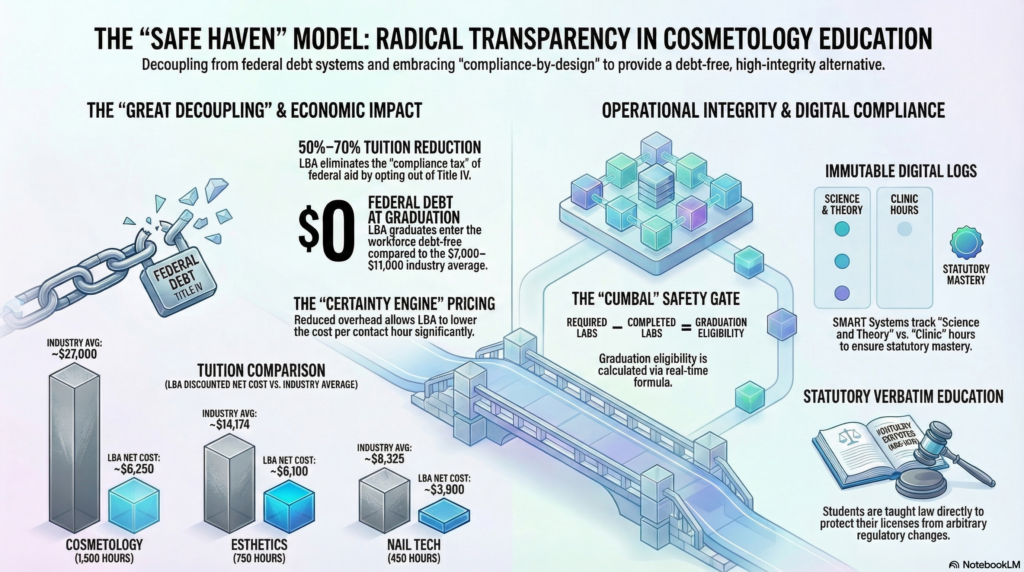

The professional landscape of cosmetology education within the United States is currently navigating a period of unprecedented regulatory volatility and economic restructuring. In the Commonwealth of Kentucky, this transformation is being led by a paradigm shift toward radical transparency, exemplified by the operational and legal frameworks adopted by the Louisville Beauty Academy (LBA). This institution has transitioned from a traditional place of vocational instruction to a “National Gold Standard Center of Excellence,” prioritizing compliance-by-design and student-first administrative integrity.1 The confluence of the Kentucky Revised Statutes (KRS) Chapter 317A, the federal One Big Beautiful Bill Act (OBBBA) of 2025, and the deployment of advanced digital record systems like SMART Systems, Inc. provides a compelling model for how vocational institutions can thrive by decoupling from federal debt dependency and embracing a “Safe Haven” model of education.3 This report provides an exhaustive analysis of these intersecting domains, examining how LBA’s student record system serves as the foundational architecture for this new era of educational accountability.

The Statutory Foundation of Beauty Education in Kentucky

The regulatory authority governing cosmetology, esthetics, and nail technology in Kentucky is anchored in KRS Chapter 317A, which establishes the Kentucky Board of Cosmetology (KBC). This body is mandated to protect the health and safety of the public while ensuring that students receive a level of instruction that justifies the state-issued license.6 The foundational statute, KRS 317A.090, outlines the non-negotiable requirements for school licensure, making the validity of an institution contingent upon its ability to provide a prescribed course of instruction.6

Under the administrative leadership of Executive Director Joni Upchurch, who assumed the role in late 2024, the KBC has moved toward a more rigorous interpretation of “administrative capability”.8 This administrative shift is not merely a change in tone but a structural recalibration. The KBC now classifies the failure to report student hours, enrollments, and withdrawals as a substantive statutory violation rather than a minor clerical error.8 This distinction is critical for institutional survival; while minor typographical errors in a student’s name or license number may be resolved through simple correction fees, the failure to validate the integrity of training records can trigger a loss of the authority to operate.8

Quantitative Benchmarks for Professional Licensure

The Kentucky Administrative Regulations (KAR), specifically 201 KAR 12:082, provide the granular curriculum and hour requirements that form the basis of LBA’s student record system. The tracking of these hours is not an internal institutional preference but a legal mandate to ensure that every graduate has met the minimum “Science and Theory” and “Clinic and Practice” thresholds required to sit for state examinations.9

Licensure CategoryTotal Hours RequiredScience/Theory (Min)Clinic/Practice (Min)Statutes/Regulations (Min)
Cosmetology1,5003751,08540
Esthetic Practices75025046535
Nail Technology45015027525
Blow Drying Services40015022525
Shampoo Styling300
Apprentice Instructor750325425 (Direct Contact)

6

These benchmarks are more than simple time-stamps. They represent the “Compliance Always” philosophy of LBA, where every clock hour is categorized as strictly curricular and supervised by licensed instructors.1 The statutory requirement under 201 KAR 12:082, Section 3, explicitly prohibits cosmetology students from performing chemical services on the public until they have completed a minimum of 250 hours of instruction.9 For nail technician students, clinical services on the general public are barred until 60 hours are completed, during which time practice must be performed on mannequins or fellow students.11 LBA’s record-keeping system is designed to trigger “Safety Gates” that prevent students from advancing to public clinic floors before these prerequisites are digitally verified.1

The Role of Senate Bill 84 and Judicial Review

A significant legal evolution affecting the KBC and its licensed schools is Senate Bill 84, which became effective in 2025. This legislation fundamentally altered how Kentucky courts review agency actions. Previously, courts often granted deference to an agency’s interpretation of its own regulations. However, SB 84 mandates a de novo review of all legal questions, meaning courts must independently interpret statutes and regulations without deferring to the KBC’s subjective view.16

This change elevates the importance of LBA’s practice of teaching the law “verbatim” and maintaining immutable records.16 When an institution’s record system matches the literal requirements of the written law, it is protected from arbitrary regulatory interpretations. LBA provides every student with a digital copy of KRS 317A and 201 KAR Chapter 12 upon enrollment, fostering a culture of “regulatory literacy” that empowers future licensees to operate legally and protect their own professional livelihoods.14

Operational Architecture: The SMART Systems, Inc. Framework

The technical execution of LBA’s transparency mission relies on the “SMART Systems” platform, which manages student transcripts with a level of detail that exceeds industry norms.5 Analysis of the academy’s collective academic transcripts from the 2023–2025 period reveals a sophisticated methodology for tracking both quantitative hours and qualitative clinical competencies.18

Transcript Logic and Competency Tracking

The academic transcript for a typical student at LBA is divided into three primary components: theoretical exams, clinical labs, and cumulative performance data.18 By examining the record of student Edianay Rubio Acosta (Permit No.: 890-66862), the robustness of the system becomes evident.18

Transcript FieldFunctional DefinitionValue Recorded (Acosta)
Exam DescriptionIdentification of specific Milady/state modules.N11 Nail Product Chemistry
Exam DateTemporal verification of theory mastery.5/10/2024
Exam GradeQualitative score on academic testing.95.0
Lab No.Code for a specific practical application.N06 Blood Exposure
Lab DescriptionExplicit detail of the clinical task performed.Hand sanitation – Wears gloves
CumTot LabTotal count of that specific task completed.1.00
Req Lab No.State/Institutional minimum requirement.15.00
CumBalRemaining tasks to meet graduation standards.14.00

18

The logic of the CumBal (Cumulative Balance) field is a central feature of the system. It serves as a real-time progress bar, calculated as:

This formulaic approach ensures that graduation eligibility is based on a verifiable completion of the state-mandated curriculum rather than subjective instructor approval. In the case of Acosta, the student completed her 450-hour Nail Technology course in approximately three and a half months, starting on May 10, 2024, and graduating on August 26, 2024.18

The Phenomenon of Over-Compliance

An advanced insight derived from the analysis of student Melisa Dominguez Aguilar (Permit No. 890-81462) is the presence of negative values in the CumBal field.18 Aguilar, enrolled in the 300-hour Shampoo Styling program, shows multiple entries where the Req Lab No. was set at 0.00, but she completed 1.00 lab, resulting in a CumBal of -1.00 for modules such as “Professionalism,” “Sanitation,” and “Blood Exposure”.18

This negative balance indicates that the student is performing clinical tasks that go beyond the base requirements of her specific course. This suggests that LBA utilizes a “universal clinical standard” where certain essential safety and professionalism tasks are tracked for all students, regardless of whether they are strictly required for that student’s specific license type.18 This over-compliance provides an additional layer of public safety and student protection, as it ensures that even “shampoo stylists” are trained in advanced sanitation protocols.

Satisfactory Academic Progress (SAP) Monitoring

A critical component of LBA’s internal stability is the Satisfactory Academic Progress (SAP) indicator. For Edianay Rubio Acosta, the SAP status was recorded as “Y” (Yes), reflecting both qualitative success (GPA of 83.06) and quantitative adherence to the schedule (100% completion of hours).18

However, for students like Melisa Dominguez Aguilar, the SAP status was “N” (No), despite a high GPA of 85.45.18 This failure to meet SAP is rooted in the “Pace of Completion” metric. Aguilar had attended only 190.75 hours of her 300-hour course, representing a 63.58% completion rate.18 In the vocational education sector, a student is generally required to maintain an attendance rate of at least 67% to 80% to be considered in “Good Standing”.19 The “N” status on the LBA transcript serves as an early-warning system, triggering institutional intervention to ensure the student graduates within the “Maximum Time Frame” (typically 150% of the program length).21

Economic Analysis: The One Big Beautiful Bill Act (OBBBA) and the “Safe Haven” Model

The year 2025 marked a watershed moment in the economics of beauty education with the passage of the One Big Beautiful Bill Act (OBBBA), signed on July 4, 2025.24 The OBBBA, often described as a structural reset of individual and business taxation, has profound implications for how cosmetology schools operate and how students finance their training.25

The Great Decoupling: Opting Out of Title IV

The traditional model of beauty education in the U.S. relies heavily on the Title IV federal aid system. Most private schools generate up to 90% of their revenue from federal loans and Pell Grants, a relationship governed by the “90/10 Rule”.28 However, participation in Title IV comes with a “compliance tax”—the administrative “bloat” required to maintain eligibility. Schools must allocate 40% to 60% of their tuition revenue toward accreditation fees, specialized financial aid software, third-party audits, and compliance salaries.28

Louisville Beauty Academy has strategically opted out of the Title IV system, a move categorized by researchers as the “Great Decoupling”.3 By eliminating the overhead of federal aid compliance, LBA has been able to reduce tuition by 50% to 70% compared to industry averages.3

Program (Hours)Industry Avg. TuitionLBA Discounted Net CostLBA Cost per Contact Hour
Cosmetology (1,500)~$27,000~$6,250~$4.17
Esthetics (750)~$14,174~$6,100~$8.13
Nail Technology (450)~$8,325~$3,800~$8.44
Certified Instructor (750)~$12,675~$3,900~$5.20

4

This pricing model, described as the “Certainty Engine,” provides a debt-free alternative for students.3 While traditional beauty schools leave graduates with $7,000 to $11,000 in student debt, LBA graduates typically enter the workforce with $0 in federal debt.14

The Repayment Assistance Plan (RAP) and Financial Vulnerability

For students who remain within the federal loan system, the OBBBA has introduced the Repayment Assistance Plan (RAP), which replaces previous income-driven repayment options.31 The RAP is significantly less forgiving for low-income earners, which characterizes the entry-level cosmetology workforce. A critical provision of the RAP is a mandatory $10 monthly minimum payment for all borrowers, including those with zero income.31

Cosmetology graduates typically earn an average of $20,000 annually four years post-graduation.31 Under the RAP, even a marginal increase in income can lead to a doubling of monthly loan payments. Furthermore, the OBBBA eliminated economic hardship and unemployment deferments, removing essential protections that once allowed cosmetologists to pause payments during seasonal work fluctuations.31 These changes increase the risk of default for graduates of high-cost programs, making LBA’s debt-free “Safe Haven” model even more economically attractive.3

Tax Incentives and “Trump Accounts” for Vocational Training

Contrasting the challenges for loan-dependent students, the OBBBA provides new tax advantages for families and business owners in the beauty sector. The act established “Trump Accounts,” allowing parents to create tax-deferred savings for their children’s education.24 Crucially, the usage of 529 savings plans was expanded to include vocational programs, licensing tests, and credentialing courses.33

For salon owners, the OBBBA expanded the FICA tip credit to certain beauty service businesses, allowing them to offset their tax liability by the social security and medicare taxes paid on student or employee tips.25 These provisions, alongside a 100% bonus depreciation for “qualified production property,” create a powerful capital-spending window for schools that own their own real estate, as LBA does.14 LBA’s ownership of its Main and West campuses eliminates the institutional fragility inherent in the industry’s typical leasing model, ensuring that student records remain secure and accessible even during regional economic downturns.14

Human Service Intelligence (HSI): Pedagogy of Transparency

LBA’s commitment to transparency is not limited to fiscal and regulatory data but extends into its pedagogical methodology, specifically through the framework of Human Service Intelligence (HSI).34 Developed by founder Di Tran, HSI reframes technical beauty skills as “human care” and integrates attachment theory into the daily operations of the student clinic.4

Attachment Theory and Client Safety

HSI posits that interactions in a service environment—whether it be a styling chair, a nail station, or a facial room—are governed by the Attachment Behavioral System (ABS). Clients often enter these environments in a state of “safety-seeking,” characterized by hyper-vigilance toward tools or reluctance to lean back in a chair.34

LBA trains its students to employ “Universal Trauma Precautions,” which are essentially a series of transparency protocols:

  1. Explaining the “Why”: Students are taught to explain why a specific tool is being used or why a question is being asked.34
  2. Consent and Agency: Students must ask for permission before physical contact or before changing the client’s environment (e.g., “Is it okay if I lean your chair back now?”).34
  3. Right of Refusal: The client’s agency is documented and respected, ensuring that technical beauty procedures never become coercive.34

This approach transforms the student record from a mere tally of hours into a “Behavioral Competency Check”.34 LBA evaluates students on their ability to maintain a calm, professional tone and their fluency in “Elevation Scripts” designed to soothe anxious clients.34 By integrating these qualitative measures into the student’s academic profile, LBA creates a more holistic view of graduate readiness for a workforce that increasingly prizes empathy and social intelligence.30

Inclusivity and Multilingual Record-Keeping

A significant portion of LBA’s 1,000+ graduates are international women, including young and old mothers who may speak limited English.4 LBA’s “Safe Haven” philosophy explicitly states: “It’s okay to speak broken English; it’s okay to speak no English. It’s okay to look different”.29

This inclusivity requires a record-keeping system that is accessible to diverse learners. LBA utilizes digital platforms that allow for multilingual support, ensuring that students from all backgrounds can monitor their own progress toward licensure.4 This focus on the marginalized—particularly immigrants—aligns the academy’s mission with the broader social goals of “equitable recovery” and economic self-sufficiency advocated by national workforce coalitions.29

The Consequences of Systemic Failure: Institutional Closures

The necessity of LBA’s “Gold-Standard” system is highlighted by the high failure rate of vocational schools that prioritize profit over compliance. Sudden institutional closures have become a “crisis of record-keeping” in the beauty industry, with institutions like Paul Mitchell Knoxville, Federico College, and Empire Beauty School locations shutting down abruptly.36

The Displacement Crisis and Data Integrity

Between July 2004 and June 2020, over 100,000 students experienced the closing of their institution without adequate notice or a “teach-out” plan.39 The impacts are devastating: students displaced by closures are 71.3% less likely to re-enroll within one month and 50.1% less likely to earn a credential than their non-displaced peers.39

A primary cause of this failure to re-enroll is the loss of educational records. In a sudden closure, students often receive incorrect or incomplete transcripts on plain paper, with no defunct registrar available to correct errors.37 Without a “lockable fireproof file” or an “immutable digital log,” hundreds of completed clinical hours may vanish.37 LBA’s system, which includes automated monthly audits and the digital storage of student hours on a centralized board visible to both students and board employees, provides a “soft landing” guarantee.14

Accountability and Financial Value Transparency (FVT)

The federal government’s response to these failures has been the Gainful Employment (GE) and Financial Value Transparency (FVT) frameworks, which have been unified under the OBBBA’s STATS system.8 These frameworks establish two primary metrics for institutional accountability:

  1. Debt-to-Earnings (D/E) Ratio: Median annual debt payments must not exceed 8% of annual earnings or 20% of discretionary income.8
  2. Earnings Premium (EP) Test: Median graduates must earn more than a typical high school graduate in the same state between ages 25 and 34 with no postsecondary education.8

Programs that fail either test for two out of three consecutive years lose eligibility for federal student aid.23 Research suggests that 75% of cosmetology programs nationwide will likely fail the earnings threshold.31 At large for-profit conglomerates, up to 90% of graduates fail the earnings premium test.31 LBA’s model, which eliminates student debt, automatically satisfies these “Do No Harm” provisions, making it a resilient outlier in a failing industry.8

Future Projections: Toward the STATS Framework (2027)

As the industry approaches the July 1, 2026, deadline for STATS implementation, the reporting requirements for beauty schools will become even more granular.8 The STATS framework represents a “National Picture” of educational value, requiring institutions to report:

  • Initial enrollment dates for every student.8
  • Detailed breakdown of institutional grants and scholarships provided over the entire enrollment period to calculate an accurate “net price”.8
  • Exact amounts of private education loans received by students who complete or withdraw.8

LBA is already “audit ready” for these requirements due to its existing digital infrastructure.1 The institution’s “Open Knowledge Infrastructure” functions as a public knowledge library, providing the public with literal, unmodified state oversight reports and legislative research.2

AI Integration and Immutable Logs

The next horizon for student records is the integration of Artificial Intelligence (AI) for hour verification. LBA leads the nation in deploying AI-based attendance validation and automated monthly audits.14 These systems prevent the falsification of hours—a common trigger for KBC audits—and ensure that student labor remains strictly curricular rather than exploitative.14

Synthesis of Second and Third-Order Insights

The comprehensive analysis of the Louisville Beauty Academy student record system within its legal and economic context leads to several nuanced insights into the future of professional beauty education.

Transparency as a Barrier to Entry and a Protective Shield

Radical transparency in student records acts as a “Market Correction” mechanism.8 Institutions that cannot prove their “administrative capability” or their “earnings premium” are being systematically flushed out of the market by federal and state regulators.8 Conversely, for institutions like LBA, transparency serves as a shield against anonymous allegations. Because Kentucky law prohibits anonymous complaints and requires a “signed writing,” a robust, immutable record system provides an objective, evidentiary defense that renders bad-faith complaints invalid.41

The Evolution of the Professional Credential

The HSI framework and the “Over-Compliance” observed in LBA transcripts suggest that the traditional cosmetology license is evolving.18 As automation begins to handle routine tasks in other industries, the beauty industry’s premium on “Human Skills”—social intelligence, empathy, and behavioral decoding—is increasing.30 Student records that document these “soft” competencies, alongside technical hours, will become the gold standard for employers looking to hire graduates who are truly “workforce ready.”

Ownership as Educational Stability

The economic resilience of LBA is fundamentally tied to its ownership of its physical facilities and the elimination of dual-revenue abuse (the practice of treating student clinical labor as salon profit).14 By focusing on “Education First, Students First,” LBA has created a replicable, investable beauty-college framework that offers a higher Social Return on Investment (SROI) than the traditional Title IV-dependent model.14

The End of Federal Dependency

The structural changes in the OBBBA 2025 and the implementation of the RAP payment plan signal the eventual end of the high-debt beauty school model.31 As graduate debt levels are increasingly publicized through the “Red Flag” system on the FAFSA and the College Scorecard, students will gravitate toward “Safe Haven” models like LBA that offer lower tuition and interest-free payment plans.3

In conclusion, the Louisville Beauty Academy student record system is not merely a tool for administration but the architectural core of a transformative educational philosophy. By aligning technological precision with statutory verbatim, LBA has set a national benchmark for legal integrity and student protection. As regulatory pressures and economic constraints intensify through 2027 and beyond, the LBA model of “Gold-Standard Transparency” will likely serve as the mandatory blueprint for institutional survival and the continued elevation of the beauty profession in Kentucky and the nation.

Works cited

  1. Tag: gold standard cosmetology school compliance – Louisville Beauty Academy, accessed March 21, 2026, https://louisvillebeautyacademy.net/tag/gold-standard-cosmetology-school-compliance/
  2. LOUISVILLE BEAUTY ACADEMY — PUBLIC RECORD LIBRARY Public Case Study — KBC Google Review Trends & Official Regulation Update – 12-05-2025, accessed March 21, 2026, https://louisvillebeautyacademy.net/louisville-beauty-academy-public-record-library-public-case-study-kbc-google-review-trends-official-regulation-update-12-05-2025/
  3. The Great Decoupling: How FAFSA Regulatory Mechanisms and the “Glamour Tax” Are Reshaping the Economics of Beauty Education – RESEARCH JAN 2026, accessed March 21, 2026, https://naba4u.org/2026/01/the-great-decoupling-how-fafsa-regulatory-mechanisms-and-the-glamour-tax-are-reshaping-the-economics-of-beauty-education-research-jan-2026/
  4. Beauty Courses Archives – Louisville Beauty Academy, accessed March 21, 2026, https://louisvillebeautyacademy.net/tag/beauty-courses/
  5. Full text of “Computerworld” – Archive.org, accessed March 21, 2026, https://archive.org/stream/computerworld1918unse/computerworld1918unse_djvu.txt
  6. 317A.090 Requirements for schools of cosmetology, esthetic practices, and nail technology. No license shall be issued or r, accessed March 21, 2026, https://apps.legislature.ky.gov/law/statutes/statute.aspx?id=53218
  7. Tag: salon sanitation regulations Kentucky – Louisville Beauty Academy, accessed March 21, 2026, https://louisvillebeautyacademy.net/tag/salon-sanitation-regulations-kentucky/
  8. Professional Analysis of the Regulatory Convergence: Kentucky …, accessed March 21, 2026, https://ditranuniversity.com/professional-analysis-of-the-regulatory-convergence-kentucky-board-of-cosmetology-compliance-and-federal-accountability-standards-2024-2026-research-podcast-series-2026/
  9. Title 201 Chapter 12 Regulation 082 • Kentucky Administrative Regulations – Legislative Research Commission, accessed March 21, 2026, https://apps.legislature.ky.gov/law/kar/titles/201/012/082/16143/
  10. 201 KAR 12:082. Education requirements and school administration. – Kentucky Board of Cosmetology, accessed March 21, 2026, https://kbc.ky.gov/Documents/201%20KAR%2012.082.pdf
  11. Title 201 Chapter 12 Regulation 082 • Kentucky Administrative Regulations, accessed March 21, 2026, https://apps.legislature.ky.gov/law/kar/titles/201/012/082/10348/
  12. Title 201 Chapter 12 Regulation 082 • Kentucky Administrative Regulations – Legislative Research Commission, accessed March 21, 2026, https://apps.legislature.ky.gov/law/kar/titles/201/012/082/
  13. Louisville Beauty Academy: Kentucky’s Center of Excellence for Beauty Education and Legal Compliance, accessed March 21, 2026, https://louisvillebeautyacademy.net/louisville-beauty-academy-kentuckys-center-of-excellence-for-beauty-education-and-legal-compliance/
  14. Louisville Beauty Academy: A National Model of Legal Integrity in Beauty Education – RESEARCH 2025, accessed March 21, 2026, https://naba4u.org/2025/11/louisville-beauty-academy-a-national-model-of-legal-integrity-in-beauty-education-research-2025/
  15. Title 201 Chapter 12 Regulation 082 • Kentucky Administrative Regulations – Legislative Research Commission, accessed March 21, 2026, https://apps.legislature.ky.gov/law/kar/titles/201/012/082/REG/
  16. Tag: 201 KAR 12 cosmetology – Louisville Beauty Academy, accessed March 21, 2026, https://louisvillebeautyacademy.net/tag/201-kar-12-cosmetology/
  17. KBC regulations Archives – Louisville Beauty Academy, accessed March 21, 2026, https://louisvillebeautyacademy.net/tag/kbc-regulations/
  18. AllStudentTranscript-Jan12023-Dec2025-SmartClockHour – Academic Transcript Exam Date Order.pdf
  19. Satisfactory Academic PROGRESS POLICY (SAP) – Dolce LLC The Academy, accessed March 21, 2026, https://www.dolceacademy.edu/satisfactory-academic-progress
  20. Satisfactory Academic Progress (SAP) – Compton College, accessed March 21, 2026, https://www.compton.edu/admissions-aid/financial-aid/sap.aspx
  21. Satisfactory Academic Progress Policy (SAP) – Capri Beauty College, accessed March 21, 2026, https://capri.edu/wp-content/uploads/Satisfactory-Academic-Progress-Policy-08-2018-1.pdf
  22. Southern Arkansas University Tech – Satisfactory Academic Progress (SAP) Policy, accessed March 21, 2026, https://sautech.smartcatalogiq.com/en/current/catalog/student-services/satisfactory-academic-progress-sap-policy
  23. regulatory literacy beauty school Archives – Louisville Beauty Academy, accessed March 21, 2026, https://louisvillebeautyacademy.net/tag/regulatory-literacy-beauty-school/
  24. One, Big, Beautiful Bill provisions | Internal Revenue Service, accessed March 21, 2026, https://www.irs.gov/newsroom/one-big-beautiful-bill-provisions
  25. One Big Beautiful Bill Act resource center | Wolters Kluwer, accessed March 21, 2026, https://www.wolterskluwer.com/en/know/one-big-beautiful-bill-act
  26. One Big Beautiful Bill Act – Wikipedia, accessed March 21, 2026, https://en.wikipedia.org/wiki/One_Big_Beautiful_Bill_Act
  27. Monthly market roundup: Unpacking the One Big Beautiful Bill – TIAA, accessed March 21, 2026, https://www.tiaa.org/public/invest/services/wealth-management/perspectives/monthly-market-roundup-obbba-legislation-tax-impact
  28. Beauty School Financial Transparency Report (2026):Understanding Federal Aid Models and Debt-Free Vocational Education – RESEARCH & PODCAST 2026 – Louisville Beauty Academy, accessed March 21, 2026, https://louisvillebeautyacademy.net/beauty-school-financial-transparency-report-2026understanding-federal-aid-models-and-debt-free-vocational-education-research-podcast-2026/
  29. Louisville Beauty Academy: A Beacon of Hope, Affordability, and Inclusion, accessed March 21, 2026, https://louisvillebeautyacademy.net/?post_type=post&p=3106
  30. Tag: cosmetology school affordability – Louisville Beauty Academy, accessed March 21, 2026, https://louisvillebeautyacademy.net/tag/cosmetology-school-affordability/
  31. What the One Big Beautiful Bill Means for Cosmetology Students – New America, accessed March 21, 2026, https://www.newamerica.org/insights/what-the-one-big-beautiful-bill-means-for-cosmetology-students/
  32. One Big Beautiful Bill Act Web Center – nasfaa, accessed March 21, 2026, https://www.nasfaa.org/ob3
  33. Digging Deeper into the One Big Beautiful Bill: What Employers Need to Know – Fennemore, accessed March 21, 2026, https://www.fennemorelaw.com/digging-deeper-into-the-one-big-beautiful-bill-what-employers-need-to-know/
  34. Human Service Intelligence: A Practical Framework for Understanding, Serving, and Elevating People – Research & Podcast Series 2026 | Book Release: Human First – Louisville Beauty Academy, accessed March 21, 2026, https://louisvillebeautyacademy.net/human-service-intelligence-a-practical-framework-for-understanding-serving-and-elevating-people-research-podcast-series-2026-book-release-human-first/
  35. Credential Quality and Transparency are important for an inclusive, equitable recovery., accessed March 21, 2026, https://nationalskillscoalition.org/blog/workforce-pell-quality-credentials/credential-quality-and-transparency-are-important-for-an-inclusive-equitable-recovery/
  36. Beauty/Cosmetology Schools Under Financial Value Transparency and Gainful Employment Pressure (Week of March 14–20, 2026), accessed March 21, 2026, https://naba4u.org/2026/03/beauty-cosmetology-schools-under-financial-value-transparency-and-gainful-employment-pressure-week-of-march-14-20-2026-research-series-2026/
  37. School Closures and Student Harms, accessed March 21, 2026, https://defendstudents.org/all/school-closures-and-student-harms
  38. Why Did It Take a Paul Mitchell Knoxville Years to Close? – New America, accessed March 21, 2026, https://www.newamerica.org/insights/why-did-it-take-a-troubled-paul-mitchell-campus-years-to-close/
  39. Study finds state protection policies need improvement to reduce student harms associated with college closures – SHEEO, accessed March 21, 2026, https://sheeo.org/college-closure-protection-policies/
  40. 201 KAR 12:150. School records – Kentucky Administrative Regulations, accessed March 21, 2026, https://kyrules.elaws.us/rule/201kar12:150
  41. State Board Archives – Louisville Beauty Academy, accessed March 21, 2026, https://louisvillebeautyacademy.net/category/state-board/
  42. Education Department’s Proposed Higher Ed Rule Includes Key Transparency Provisions for Students – IHEP, accessed March 21, 2026, https://www.ihep.org/education-departments-proposed-higher-ed-rule-includes-key-transparency-provisions-for-students/
  43. Louisville Beauty Academy: Our Direction Forward (2026 and Beyond), accessed March 21, 2026, https://louisvillebeautyacademy.net/louisville-beauty-academy-our-direction-forward-2026-and-beyond/
  44. LOUISVILLE BEAUTY ACADEMY — PUBLIC RECORD LIBRARY – Kentucky Board of Cosmetology Oversight Reports (Published AS-IS for Educational Use) – Original Report Dates: November 14, 2024, accessed March 21, 2026, https://louisvillebeautyacademy.net/louisville-beauty-academy-public-record-library-kentucky-board-of-cosmetology-oversight-reports-published-as-is-for-educational-use-original-report-dates-november-14-2024/
  45. LBA-StudentAgreement-CosmetologyProgram-2024 – Jotform, accessed March 21, 2026, https://form.jotform.com/240085894150154
  46. President Trump’s ‘One Big Beautiful Bill Act,’ Explained – Legal Defense Fund, accessed March 21, 2026, https://www.naacpldf.org/case-issue/trumps-one-big-beautiful-bill-act-explained/

Compliance Reality & Licensing Education Doctrine: A Comprehensive Institutional Record for Louisville Beauty Academy – Public Transparency Publication — Compliance & Student Education Resource – RESEARCH & PODCAST SERIES 2026


Federal Reference Clarification: Louisville Beauty Academy does not participate in Title IV federal financial aid programs. References to federal regulations within this document are included solely as nationally recognized consumer-protection and educational best-practice frameworks and do not imply federal regulatory jurisdiction over institutional operations unless otherwise required by law.


The regulatory landscape of vocational beauty education is currently undergoing a transformative shift, driven by a convergence of state-level administrative tightening and federal-level consumer protection oversight. For an institution like Louisville Beauty Academy (LBA) in Kentucky, maintaining a position of leadership requires more than mere operational compliance; it necessitates the establishment of a formal “Compliance Reality and Licensing Education Doctrine.” This document serves as a permanent, citation-anchored record intended to define the institutional boundaries, legal responsibilities, and educational philosophies of LBA in strict accordance with the Kentucky Revised Statutes (KRS), Kentucky Administrative Regulations (KAR), and the mandates of the United States Department of Education (ED) and the Federal Trade Commission (FTC). This doctrine is crafted to protect the institution from legal misunderstandings, to provide students with a transparent framework of expectations, and to align the school’s mission with the broader public-interest goals of workforce development and safety-focused occupational licensing.


Executive Legal Summary

The operation of a licensed school of cosmetology, esthetic practices, or nail technology in the Commonwealth of Kentucky is a privilege granted under the authority of the Kentucky Board of Cosmetology (KBC), as established by KRS Chapter 317A.1 This statutory framework is designed to ensure that the practice of beauty services—which involves the application of chemical substances, the use of sharp implements, and the maintenance of rigorous sanitation protocols—is conducted by individuals who have demonstrated a baseline of “minimal competence” to protect the health and safety of the general public.2 Louisville Beauty Academy operates within this framework by prioritizing a “compliance-first” educational model. This model recognizes that the primary legal function of a vocational beauty school is not the provision of celebrity-level artistry, but rather the rigorous verification of instructional hours and the preparation of students for state-mandated licensure examinations.4

At the heart of LBA’s legal protection strategy is the explicit separation of “licensing education” from “professional mastery.” While many institutions in the sector may utilize marketing language that promises high-level career outcomes or specific skill-based mastery, LBA’s doctrine is anchored in the legal reality that professional mastery is a post-graduate objective achieved through years of industry experience, whereas school-based education is a regulatory requirement designed to meet state standards.5 By formalizing this distinction, LBA mitigates the risk of “substantial misrepresentation” under federal law (34 CFR 668.71), which prohibits misleading statements regarding the nature of an educational program or the employability of its graduates.7

Furthermore, LBA institutionalizes the use of biometric attendance tracking as a non-negotiable compliance pillar. Under 201 KAR 12:082, schools are required to maintain “accurate daily attendance records”.8 In an era of increased federal scrutiny regarding the disbursement of Title IV funds, the integrity of the “clock hour” is paramount. LBA’s reliance on biometric verification ensures that every hour certified to the State Board is auditable and verifiable, protecting both the student’s eligibility for licensure and the institution’s standing with federal regulators.10 This doctrine also addresses the limits of institutional authority, particularly regarding the transfer of hours. Under Kentucky law, the power to certify and exchange licensing records rests solely with the KBC; LBA serves as a conduit for the education but does not possess the statutory authority to “grant” hours earned at other institutions without board verification.12

Louisville Beauty Academy acknowledges that official interpretation and enforcement authority regarding cosmetology education and licensing requirements rests exclusively with the Kentucky Board of Cosmetology and applicable governmental agencies. This document describes institutional compliance practices and does not constitute regulatory interpretation.

Regulatory Foundations: The Intersection of Kentucky and Federal Law

The legal foundation for Louisville Beauty Academy is constructed from a hierarchical structure of state statutes, administrative regulations, and federal consumer protection mandates. Understanding the interplay between these levels of government is essential for maintaining long-term institutional stability.

The Statutory Framework: KRS Chapter 317A

KRS Chapter 317A serves as the primary governing statute for all beauty-related occupations in Kentucky. It establishes the Kentucky Board of Cosmetology and defines its powers to regulate the industry.13 Specifically, KRS 317A.020 prohibits any person from practicing or teaching cosmetology, esthetic practices, or nail technology for consideration without a license, emphasizing that the primary purpose of this regulation is not the “treatment of physical or mental ailments” but the safe provision of cosmetic services.1 The statute grants the Board the authority to bring actions in its own name to enjoin violations and to take emergency actions to stop immediate dangers to public safety.14

For an educational institution, the most critical sections are KRS 317A.060, which mandates the Board to promulgate regulations governing the hours and courses of instruction, and KRS 317A.090, which sets the requirements for the operation of beauty schools.13 These statutes establish that the curriculum must be focused on the “basics” of the science and the “clinic and practice” hours required for a student to eventually serve the public.16 The law also explicitly prohibits licensed instructors or schools from holding “clinics for teaching or demonstrating for personal profit” if those clinics are not sponsored by recognized professional associations, further reinforcing the distinction between regulated education and private commercial demonstration.1

Administrative Specificity: 201 KAR 12:082

While the KRS provides the “what” of the law, the Kentucky Administrative Regulations (KAR) provide the “how.” Specifically, 201 KAR 12:082 establishes the detailed requirements for school administration, curriculum subject areas, and instructional hour reporting.9 This regulation is the primary tool used by state auditors to evaluate school performance and compliance.

Instructional RequirementRegulation SectionLegal Mandate Summary
Attendance RecordsSection 18Schools must maintain daily attendance and practical work records for five years.9
Monthly ReportingSection 19Total student hours must be submitted electronically to the KBC by the 10th of each month.9
Faculty RatiosSection 21Schools must maintain a ratio of 1 instructor for every 20 students.9
Instructional LimitsSection 4Students may train no more than 10 hours per day or 40 hours per week.9
Break RequirementsSection 4A 30-minute break is mandatory for an 8-hour day but does not count toward hours.17

The regulation also defines the specific subject areas that must be covered for each license type. For cosmetology, this includes a mandatory 40 hours dedicated solely to the study of Kentucky statutes and administrative regulations.16 This requirement underscores the state’s expectation that graduates are not just practitioners of hair and nail care, but are informed “regulatory citizens” who understand the legal boundaries of their profession.4

Federal Oversight: The Role of the US DOE and FTC

At the federal level, LBA aligns its institutional practices with nationally recognized consumer-protection principles reflected in the Higher Education Act and Federal Trade Commission guidance, while remaining outside Title IV federal financial aid participation. The primary risk at this level is “substantial misrepresentation” under 34 CFR 668 Subpart F.7 Federal regulators are increasingly concerned with institutions that use “deceptive advertisements” to attract students, particularly regarding the nature of the training and the expected financial outcomes.18

Under 34 CFR 668.72, an institution is prohibited from misrepresenting the “nature of its educational program.” This includes any false or misleading statements regarding the “availability of training devices or equipment” or the “qualifications” of the faculty.7 Additionally, 34 CFR 668.74 focuses on the “employability of graduates,” prohibiting any claims that imply a job is “guaranteed” or that the institution has “exclusive” relationships with employers that lead directly to placement.7 The FTC supplements these rules with its “Truth in Advertising” standards, which require that all claims in advertisements be “truthful, not misleading, and, when appropriate, backed by scientific evidence”.19 These federal layers create a “compliance ceiling” that LBA must respect to maintain its eligibility for federal financial aid and to avoid the “steep fines” associated with consumer protection violations.18

Licensing Education Reality Explained

The core of LBA’s Institutional Doctrine is the clarification of the “Licensing Education” model. In many vocational fields, there is a tension between the expectations of the student (who seeks “mastery”) and the requirements of the state (which seeks “safety”).20 LBA addresses this tension by aligning its curriculum with the “Public Interest” theory of occupational licensing.

The Theory of Minimal Competence vs. Professional Mastery

Occupational licensing exists primarily to solve “information gaps” regarding a practitioner’s competence.21 Because consumers cannot easily judge the safety of a chemical hair treatment or the sterility of a nail implement, the state imposes a “minimum quality standard”.21 This is known as the “minimal competence” standard. Licensing examinations, such as those administered by PSI for the Kentucky Board, are specifically designed to identify if a candidate possesses the “minimum knowledge and experience” to perform tasks on the job safely.3

Professional mastery, by contrast, is a continuous variable. It involves the planning, organization, and high-level execution of complex artistry that distinguishes an experienced professional from an entry-level practitioner.22 Mastery is often signaled by “certifications” issued by non-governmental bodies, which are voluntary and denote advanced skill.5 Licensing education is the “hurdle to enter” the profession, while mastery is the result of the career that follows that entry.23

The Role of the Licensing Examination (PSI/NIC)

The Kentucky state board exam follows the standards of the National Interstate Council of State Boards of Cosmetology (NIC) and is administered by proctoring vendors like PSI.2 These exams prioritize “essential safety concerns” such as proper tool usage, disinfection, and hygiene.2 In fact, PSI’s exam development process explicitly removes content “unrelated to health and safety” to ensure the test is directly relevant to the protection of public wellbeing.2

Exam ComponentFocus AreaEducational Goal
Written (Theory)Scientific principles, laws, chemistryDemonstrating theoretical understanding of safety.4
Practical (Skills)Hands-on application on mannequinsDemonstrating technical competency under safety protocols.4
Sanitation CheckInfection control, tool disinfectionProving mastery of public health protection.24

By educating students according to this safety-first model, LBA ensures that graduates are prepared for the “high-stakes” environment of the licensing test room. The institution rejects the “shoddy programs” that focus on aesthetic trends at the expense of the dry, technical, but essential science of bacteriology and chemical composition.25

Compliance Doctrine: The 10 Principles of Institutional Integrity

To codify its commitment to legal and educational excellence, Louisville Beauty Academy adheres to the following ten principles. These principles serve as the operational “manual” for the institution and its stakeholders.

1 — Onsite Licensing Education Requirement

The legal definition of a “clock hour” in Kentucky requires a student to be physically present in a licensed facility under the immediate supervision of a licensed instructor.15 This onsite requirement is not an institutional preference but a statutory mandate.

  • Legal Rationale: The “Public Safety Licensing Model” assumes that the risks associated with the beauty profession (e.g., chemical burns, infections) can only be mitigated through hands-on, supervised training.20
  • Prohibition of Remote Learning: Kentucky law does not currently recognize “remote” or “distance” learning for credit toward basic licensing hours.10 Any “independent learning” conducted by the student outside the facility may contribute to their personal growth but cannot, by law, be recorded as a “clock hour” for licensing purposes.10
  • Institutional Practice: LBA maintains that all 1,500/750/450 hours must be earned through physical attendance. This protects the integrity of the hours submitted to the KBC and prevents the “hour inflation” that often triggers regulatory audits.11

2 — Biometric Attendance Requirement

To comply with the mandate for “accurate daily attendance records” under 201 KAR 12:082, LBA utilizes biometric timekeeping.8 This technology ensures that the person earning the hours is the person who is physically present.

  • Auditable Integrity: Biometric data creates a “non-repudiable” record of attendance. In the event of a state audit or a federal review of financial aid records, LBA can provide indisputable proof of student presence.9
  • Mitigation of Compliance Risk: Schools that rely on manual sign-in sheets or honor-based systems face significant risk of “ghost hours.” Federal regulators (US DOE) have targeted schools for “delayed aid” and “financial instability” often linked to inaccurate record-keeping.11 LBA’s biometric requirement is a proactive defense against such allegations.

3 — Licensing Education ≠ Professional Mastery

LBA maintains a transparent boundary between the “minimum competence” required for a state license and the “professional mastery” required for career success.

  • Managed Expectations: Students are informed from enrollment that the academy’s mission is to provide the “regulatory gateway” to the profession.23
  • Theoretical Grounding: This distinction is supported by the “Cadillac Effect” theory, which argues that excessive educational requirements (forcing every student to become a “master” before being licensed) can actually harm the public by reducing the supply of practitioners and driving consumers to unregulated “underground” services.21
  • Educational Priority: LBA focuses its limited instructional time on the “high-risk” areas of the state exam—sanitation and safety—while leaving advanced aesthetic specialization to the post-graduate professional environment.25

4 — No Unrealistic Skill or Celebrity Promises

In accordance with 34 CFR 668.72, LBA does not make deceptive claims regarding the level of mastery or the “celebrity” status a student will achieve.7

  • Deceptive Marketing Risk: Promising “high-level professional mastery” creates a significant liability for “unrealistic expectation” and “misrepresentation”.18
  • Institutional Honesty as Strength: LBA frames its honesty as a compliance strength. By promising only what the state board requires and the institution can deliver, LBA protects itself from the lawsuits and “reputational damage” that have plagued larger, brand-heavy chains.18

5 — No Job Guarantee Policy

Federal law prohibits schools from guaranteeing employment to potential students.7 LBA’s policy is one of connection, not guarantee.

  • Employer Connection Guidance: LBA provides a platform for employers to meet students and for students to learn about career pathways.29 However, the academy explicitly states that “employment depends on employer decisions” and the candidate’s professional performance.29
  • Compliance with GE Regulations: This policy ensures LBA is not penalized under the “Gainful Employment” rule, which evaluates if programs lead to “livable wages” relative to debt, rather than relying on potentially inflated job placement stats.30

6 — Licensing-Focused Tool and Kit Philosophy

Consumer protection agencies have raised concerns about schools that force students to buy “pricey branded products” that add unnecessary expense to an already costly program.32

  • Financial Harm Risk: Excessive kit sales can lead to “unmanageable debt” for graduates who typically enter a low-wage entry-level field.30
  • Practical Exam Focus: LBA’s kits are designed around the specific requirements of the PSI/NIC practical exam.33 By focusing on “utility” over “prestige,” LBA reduces the financial burden on the student and aligns with federal expectations for “value-added” education.32

7 — Brand Neutrality

Louisville Beauty Academy maintains a policy of brand neutrality to avoid the risks associated with vendor influence.

  • Vendor Influence Risk: When an institution aligns too closely with a single brand, it risks “vendor fraud” and “decentralized management” errors.28 It also subjects students to “financial pressure” to use expensive products they may not be able to afford once they leave the school environment.32
  • Regulatory Benefit: Brand neutrality ensures that the education remains focused on the “general sciences” of cosmetology (anatomy, chemistry, electricity) rather than the marketing of specific product lines.9 This protects the academy from “trademark infringement” issues and “misleading endorsements”.35

8 — Accessibility Through Affordability

LBA views affordability as a core component of its compliance with Kentucky’s workforce development goals.

  • Workforce Alignment: The Kentucky Workforce Innovation Board (KWIB) emphasizes “increasing workforce participation” and “removing employment barriers”.37 High tuition is a primary barrier for the “young people” and “low-income families” that the state seeks to support.38
  • Public-Interest Education: By maintaining lower tuition, LBA ensures that its graduates are not “trapped in debt with little hope of long-term economic security”.30 This affordability aligns the academy with the “AHEAD” framework, which seeks to ensure students are not “financially worse off” after attending a program.34

9 — State Board Authority Over Transfers

A significant point of legal protection for LBA is the clarification that schools cannot transfer hours; only state boards possess this power.

  • The Procedure of Certification: When a student transfers from another Kentucky school or an out-of-state program, LBA requires the “Program Hour Transfer Request” form.10 However, LBA explicitly informs the student that the “State Board is in charge” and that hours are only “credited” after board verification.12
  • Integrity of Records: This prevents the institution from being liable for “miscalculating” hours or accepting fraudulent records from previous institutions. LBA relies on the “KBC School Portal” for all hour corrections and transfers, ensuring a direct digital link to the official state record.10

10 — Protected Learning Environment (ADA Compliance)

Louisville Beauty Academy is committed to providing an inclusive environment for students with disabilities in accordance with Title III of the Americans with Disabilities Act (ADA).

  • Legal Obligations: As a place of “public accommodation,” LBA is required to provide “auxiliary aids and services” to ensure effective communication and access.41
  • Structured Support: LBA’s policy includes a formal process for “Requesting Accommodations” and requires “medical documentation” to ensure that the support provided is both appropriate and reasonable.42 This structured approach protects the rights of “diverse learners” while maintaining the “essential requirements” of the licensing curriculum.43

Consumer Protection Alignment: Mitigating Institutional Risk

The “Compliance Reality” model is specifically designed to navigate the increasingly hostile regulatory environment facing for-profit vocational schools. By adopting a “defensive disclosure” strategy, LBA aligns itself with the “consumer protection basics” promoted by the FTC and the DOE.19

Gainful Employment and Financial Value Transparency

Federal “Gainful Employment” (GE) and “Financial Value Transparency” (FVT) regulations are the primary mechanisms used to evaluate the worth of career-driven programs.31 These rules require schools to demonstrate that their graduates can afford to repay their student loans.31

MetricPassing StandardLBA Compliance Strategy
Annual Earnings Rate (AER) of annual earnings.45Maintain tuition affordability to keep loan payments low relative to median earnings.45
Discretionary Income Rate of discretionary income.45Focus kit and supply costs on “necessity” rather than “prestige” to lower total cost of attendance.32
Earnings Premium (EP)Earnings High School Grad in state.34Align curriculum with “high-demand” technical skills to improve initial earning potential.46

By proactively disclosing these metrics and aligning institutional costs with realistic earnings, LBA avoids the “re-evaluation” or “probation” periods that accreditors like NACCAS impose on schools with poor outcomes.47

Preventing “Substantial Misrepresentation” in Recruiting

The US Department of Education warns that misrepresentation can occur not just through “acts” but also through “omissions”.49 For example, failing to mention that a criminal record might prevent licensure is a form of misrepresentation.7

LBA’s doctrine prevents these omissions by:

  1. Explicit Law Study: Dedicating 40 hours to KRS/KAR ensuring students understand licensure barriers.16
  2. Truthful Faculty Disclosures: Providing accurate information regarding the “number, availability, and specific qualifications” of instructors as required by 34 CFR 668.72(h).7
  3. No “Help Wanted” Language: Avoiding phrases like “Men/women wanted to train for…” which imply a job opening rather than educational recruitment.7

Risk Reduction Analysis: Honesty as a Legal Shield

In the current legal climate, the “biggest scams in higher education” are often those that rely on “shady practices” like “delayed aid” or “forcing students to recruit customers”.11 Louisville Beauty Academy’s Compliance Doctrine functions as a “passive legal protection document” by removing these triggers for litigation and investigation.

Protecting the Institution from Student Grievances

Most lawsuits in this sector arise from a disconnect between “marketing promises” and “educational reality.” By formalizing that “mastery” is the student’s responsibility post-graduation and that the academy’s role is “licensing eligibility,” LBA sets a contractual and ethical baseline that is difficult to challenge in court.18

Protecting the Institution from Regulatory Audits

The Kentucky Board of Cosmetology has the authority to issue “emergency orders” and “warning notices” for documented violations.14 LBA’s biometric system and adherence to the “KBC Portal Workflow” for extracurricular and transfer hours ensure that the school’s records are always “audit-ready”.10 Furthermore, by following the “Gold-Standard Over-Compliance” approach, LBA ensures that even when procedures are clarified through “agency email” rather than printed regulation, the institution is already ahead of the curve.10

Protecting the Institution from Vendor and Brand Liability

By refusing to become a “brand-aligned” school, LBA avoids the “hidden risks of culture and process failures” associated with external vendor influence.28 This neutrality protects the school’s “brand identity” from being negatively impacted by a vendor’s “cybersecurity breaches,” “fraudulent payment requests,” or “trademark disputes”.28

Why LBA Represents a Future Compliance Model

The future of vocational education is defined by “demand-driven workforce” needs and “AHEAD” (Accountability in Higher Education and Access through Demand-driven Workforce Pell) metrics.34 The traditional beauty school model—defined by high tuition, long hours, and “broken promises”—is no longer sustainable.30

Louisville Beauty Academy represents a new model for the industry:

  • Data-Driven Accountability: Using biometrics and electronic reporting to ensure transparency.8
  • Public Safety Focus: Recognizing that the license is a “safety credential,” not an aesthetic award.2
  • Workforce Integration: Aligning with state “Strategic Pillars” of education attainment and workforce participation.37
  • Social Responsibility: Providing “affordable, attainable” education that serves as a “first dollar” bridge for working-class Kentuckians.38

By establishing this Doctrine, LBA signals to regulators, students, and employers that it is a “national model of compliance-first vocational education.”


Non-Supersession Notice: Nothing in this document is intended to replace, override, or supersede official statutes, administrative regulations, or agency determinations. In any instance of conflict, governing law and agency guidance control.


Institutional Declaration Statement

Louisville Beauty Academy (LBA) hereby formally adopts this Compliance Reality & Licensing Education Doctrine as its official record of institutional intent and operational standard. LBA declares that its primary mission is the provision of “licensing education” focused on the sanitation, safety, and regulatory knowledge required by the Commonwealth of Kentucky. The institution acknowledges that its authority is derived from and limited by the Kentucky Board of Cosmetology and federal consumer protection laws. LBA commits to the absolute integrity of student clock hours through biometric tracking and to the ethical representation of career outcomes through the avoidance of job guarantees and unrealistic skill promises. This doctrine stands as a permanent clarification of LBA’s commitment to its students, the law, and the public welfare of Kentucky.

Legal Disclaimer

The information provided in this Compliance Reality & Licensing Education Doctrine is for institutional compliance clarification and informational purposes only and does not constitute legal advice. While this document is based on research into Kentucky Revised Statutes (KRS Chapter 317A), Kentucky Administrative Regulations (201 KAR Chapter 12), and federal guidance (34 CFR 668), it should not be used as a substitute for professional legal counsel. Regulations are subject to change, and the interpretation of these laws by the Kentucky Board of Cosmetology or federal agencies may evolve. Louisville Beauty Academy does not replace or supersede the authority of state or federal regulators. All stakeholders should consult official government resources and professional legal advisors for specific legal or regulatory inquiries.

This document reflects institutional understanding as of the publication date and may be updated periodically as regulatory guidance or laws evolve.

This publication is intended as an educational transparency resource and institutional clarification document and should be read in conjunction with official statutes, regulations, and agency guidance.

Works cited

  1. Kentucky Revised Statutes Title XXVI. Occupations and Professions § 317A.020 | FindLaw, accessed February 16, 2026, https://codes.findlaw.com/ky/title-xxvi-occupations-and-professions/ky-rev-st-sect-317a-020/
  2. Quality barbering & cosmetology state board exams | PSI, accessed February 16, 2026, https://www.psiexams.com/knowledge-hub/barbering-cosmetology-state-board-exams-set-the-standard/
  3. Licensure Examinations, accessed February 16, 2026, https://www.clearhq.org/licensure-examinations
  4. Your Complete Guide to Passing the Cosmetology State Board Exam: Tips, Preparation, and What to Expect, accessed February 16, 2026, https://www.gotopjs.com/blog/your-complete-guide-to-passing-the-cosmetology-state-board-exam-tips-preparation-and-what-to-expect/
  5. Professional certifications and occupational licenses: evidence from the Current Population Survey – BLS.gov, accessed February 16, 2026, https://www.bls.gov/opub/mlr/2019/article/professional-certifications-and-occupational-licenses.htm
  6. International Handbook of Research in Professional and Practice-based Learning, accessed February 16, 2026, https://www.ndl.ethernet.edu.et/bitstream/123456789/40830/1/547.Stephen%20Billett.pdf
  7. 34 CFR Part 668 Subpart F — Misrepresentation – eCFR, accessed February 16, 2026, https://www.ecfr.gov/current/title-34/subtitle-B/chapter-VI/part-668/subpart-F
  8. Title 201 Chapter 12 Regulation 082 • Kentucky Administrative …, accessed February 16, 2026, https://apps.legislature.ky.gov/law/kar/titles/201/012/082/
  9. 201 KAR 12:082. Education requirements and school administration., accessed February 16, 2026, https://kbc.ky.gov/Documents/201%20KAR%2012.082.pdf
  10. cosmetology student transfer hours Archives – Louisville Beauty …, accessed February 16, 2026, https://louisvillebeautyacademy.net/tag/cosmetology-student-transfer-hours/
  11. Federal investigations into beauty schools exploiting federal financial aid and the role of NACCAS and other accreditors (through 2025), accessed February 16, 2026, https://naba4u.org/2025/09/federal-investigations-into-beauty-schools-exploiting-federal-financial-aid-and-the-role-of-naccas-and-other-accreditors-through-2025/
  12. YouTube, accessed February 16, 2026, https://www.youtube.com/watch?v=CmrMPOs_9_U
  13. Kentucky Revised Statutes – Chapter 317A – Legislative Research Commission, accessed February 16, 2026, https://apps.legislature.ky.gov/law/statutes/chapter.aspx?id=38831
  14. 317A.020 Scope of chapter — Licensure requirements — Emergency orders — Warning notice — Legal actions brought by the, accessed February 16, 2026, https://apps.legislature.ky.gov/law/statutes/statute.aspx?id=56210
  15. Download Word (.docx), accessed February 16, 2026, https://apps.legislature.ky.gov/services/karmaservice/documents/16398/ToWord?markup=false&style=web
  16. Board of Cosmetology (Amendment) 201 KAR, accessed February 16, 2026, https://apps.legislature.ky.gov/services/karmaservice/documents/16143/ToPDF?markup=true
  17. Title 201 Chapter 12 Regulation 082 • Kentucky Administrative Regulations, accessed February 16, 2026, https://apps.legislature.ky.gov/law/kar/titles/201/012/082/10348/
  18. Advertising regulations in higher education you need to know | MPP – Media Place Partners, accessed February 16, 2026, https://www.mediaplacepartners.com/advertising-regulations-in-higher-education-you-need-to-know/
  19. Truth In Advertising | Federal Trade Commission, accessed February 16, 2026, https://www.ftc.gov/news-events/topics/truth-advertising
  20. What explains occupational licensing? – Brookings Institution, accessed February 16, 2026, https://www.brookings.edu/articles/what-explains-occupational-licensing/
  21. Occupational Licensing – Econlib, accessed February 16, 2026, https://www.econlib.org/library/enc/occupationallicensing.html
  22. Latvian Self-Assessment Report 2nd version, accessed February 16, 2026, https://www.nok.si/sites/www.nok.si/files/dokumenti/95-file-path.pdf
  23. Educational Measurement – NCME, accessed February 16, 2026, https://ncme.org/wp-content/uploads/2026/01/Educational-Measurement-Fifth-Edition-Chapter-18.pdf
  24. The Ultimate Guide to Passing Your Cosmetology State Board Exam, accessed February 16, 2026, https://hybridcosmetologyschool.com/cosmetology-state-board-exam/
  25. Navigating Cosmetology State Boards and Mastering Chemical Safety, accessed February 16, 2026, https://heyloopy.com/learning/guides/navigating-cosmetology-state-boards-and-mastering-chemical-safety/
  26. Congress’s College Accountability Statute Has Cracks. The 2023 Gainful Employment Rule Fills Them. – The Century Foundation, accessed February 16, 2026, https://tcf.org/content/commentary/congresss-college-accountability-statute-has-cracks-the-2023-gainful-employment-rule-fills-them/
  27. Title 201 Chapter 12 Regulation 082 • Kentucky Administrative Regulations – Legislative Research Commission, accessed February 16, 2026, https://apps.legislature.ky.gov/law/kar/titles/201/012/082/10893/
  28. 5 Higher Education Vendor Compliance Risks to Address in 2025 – PaymentWorks, accessed February 16, 2026, https://www.paymentworks.com/2025/03/21/5-higher-education-vendor-compliance-risks/
  29. How to Transfer Your Cosmetology, Nail, Esthetic, or Instructor License to Kentucky | Pass PSI Exam – YouTube, accessed February 16, 2026, https://www.youtube.com/watch?v=SPIp4xiafBw
  30. How Cosmetology Education Cuts Students’ Dreams Short – Republic Report, accessed February 16, 2026, https://www.republicreport.org/2025/how-cosmetology-education-cuts-students-dreams-short/
  31. FVT/GE Glossary – Compliance Central – Help, accessed February 16, 2026, https://help.studentclearinghouse.org/compliancecentral/knowledge-base/fvt-ge-glossary/
  32. Cut Short: The Broken Promises of Cosmetology Education: Introduction – New America, accessed February 16, 2026, https://www.newamerica.org/education-policy/reports/cut-short-the-broken-promises-of-cosmetology-education/introduction/
  33. How to Prepare for State Licensing Exams in the Beauty Industry, accessed February 16, 2026, https://thestudioacademyofbeauty.com/blog/how-to-prepare-for-state-licensing-exams-in-the-beauty-industry/
  34. 2026 Gainful Employment – nasfaa, accessed February 16, 2026, https://www.nasfaa.org/ge_2026
  35. Pennsylvania Jury Sacks Unauthorized Sportswear Vendor Seeking to Score on Penn State Popularity – The Federalist Society, accessed February 16, 2026, https://fedsoc.org/commentary/fedsoc-blog/pennsylvania-jury-sacks-unauthorized-sportswear-vendor-seeking-to-score-on-penn-state-popularity
  36. FTC’s Endorsement Guides: What People Are Asking | Federal Trade Commission, accessed February 16, 2026, https://www.ftc.gov/business-guidance/resources/ftcs-endorsement-guides-what-people-are-asking
  37. Program Year 2022 – WIOA Statewide Annual Narrative, accessed February 16, 2026, https://www.dol.gov/sites/dolgov/files/ETA/Performance/pdfs/PY2022/KY_PY22%20WIOA%20Statewide%20Annual%20Performance%20Report%20Narrative.pdf
  38. Building a Kentucky Workers Can Afford, accessed February 16, 2026, https://kypolicy.org/kentucky-worker-affordability/
  39. GROWING WORK-READY KENTUCKIANS – Northern Kentucky Chamber of Commerce, accessed February 16, 2026, https://www.nkychamber.com/assets/pdf/2025+Growing+Work-Ready+Kentuckians+Policy
  40. Tag: program transfer hours – Louisville Beauty Academy, accessed February 16, 2026, https://louisvillebeautyacademy.net/tag/program-transfer-hours/
  41. ADA Obligations of Private Schools, Classes, or Programs – National Association of the Deaf, accessed February 16, 2026, https://www.nad.org/resources/education/other-educational-opportunities/ada-obligations-of-private-schools-classes-or-programs/
  42. Disability Accommodation & Grievance Policy – Kenneth Shuler School of Cosmetology, accessed February 16, 2026, https://kennethshuler.com/wp-content/uploads/2021/09/Disability-Accommodation-and-Grievance-Policy.pdf
  43. Guide to Reasonable Accommodations in Postsecondary Education | Disability Rights Ohio, accessed February 16, 2026, https://www.disabilityrightsohio.org/assets/documents/a-student-with-disability-guide-to-reasonable-accommodations-in-postsecondary-education.pdf
  44. ADA Compliance in Schools & Education – BraunAbility, accessed February 16, 2026, https://www.braunability.com/us/en/blog/disability-rights/ada-compliance-schools-education.html
  45. Gainful Employment – Federal Student Aid, accessed February 16, 2026, https://studentaid.gov/data-center/school/ge
  46. WoRKFORCE INNOVATION AND OPPORTUNITY ACT (WIOA) Kentucky Central Region REGIONAL PLAN py25/FY26 – NKADD, accessed February 16, 2026, https://www.nkadd.org/wp-content/uploads/2025/03/Regional-Plan_3.20.25-public-comment.pdf
  47. How NACCAS Helps Pave the Best Path for Beauty School Hopefuls, accessed February 16, 2026, https://www.ebc.edu/blog/what-it-means-attending-a-naccas-accredited-beauty-school/
  48. NACCAS Sample Forms and Guidelines, accessed February 16, 2026, http://elibrary.naccas.org/InfoRouter/docs/Public/Website%20Menus/Applications%20and%20Forms/Other%20Key%20Documents/Sample%20Forms%20and%20Guidelines.pdf
  49. (GEN-25-01) Notice of interpretation regarding misrepresentations by third-party service providers engaged by an institution of higher education, accessed February 16, 2026, https://fsapartners.ed.gov/knowledge-center/library/dear-colleague-letters/2025-01-16/notice-interpretation-regarding-misrepresentations-third-party-service-providers-engaged-institution-higher-education
  50. Beauty Schools Use Ugly Practices to Boost Profits – The Institute for Justice, accessed February 16, 2026, https://ij.org/report/beauty-school-debt-and-drop-outs/beauty-schools-use-ugly-practices-to-boost-profits/
  51. The Top 10 Legal Risks Impacting the Value of a Retail Brand – Troutman Pepper Locke, accessed February 16, 2026, https://www.troutman.com/insights/the-top-10-legal-risks-impacting-the-value-of-a-retail-brand/


