Current information notice
This article is part of LBA’s public education and historical archive. Older posts, including “Beauty School Financial Transparency Report (2026): Understanding Federal Aid Models and Lower-Debt Vocational Education,” may not reflect current tuition, schedules, incentives, forms, policies, testing vendors, clinic availability, or regulatory requirements.
Before relying on this article for any decision, review LBA’s Current Information and Written Control Standard, Current Program Costs, Enrollment Concierge, and Policy and Written Records.
Louisville Beauty Academy encourages all prospective students to tour multiple schools, ask detailed questions, review student contracts carefully, and choose the institution that best fits their financial situation and learning goals.
Louisville Beauty Academy has operated for more than 10 years as a state-licensed beauty college that does not participate in federal Title IV financial aid programs. This model allows the school to maintain tuition transparency and affordability while focusing on rapid workforce entry. Over nearly a decade, the academy has graduated approximately 2,000 professionals who now contribute to the tax base through employment and entrepreneurship.
Research & Educational Disclaimer
This report is provided for educational and informational purposes only. It presents publicly available research, regulatory developments, and economic analysis related to the U.S. beauty education sector. The discussion of institutional models, including federally funded and non-federally funded schools, is intended solely to help prospective students better understand the structure of vocational education financing and regulatory oversight.
This report does not make claims about any specific institution other than publicly documented examples used for educational illustration. Louisville Beauty Academy encourages all prospective students to independently research schools, tour multiple institutions, review enrollment agreements carefully, and choose the program that best fits their financial situation, career goals, and learning preferences.
Structural Economics and Regulatory Accountability in the United States Beauty Education Sector: A Comprehensive Analysis of Financial Models, Student Protections, and Institutional Stability
The personal appearance services industry in the United States, particularly the sector encompassing cosmetology, esthetics, and nail technology, operates at a complex intersection of state licensure mandates and federal financial aid ecosystems. For decades, the primary vehicle for entering these professions has been the for-profit vocational school, an institutional model that has become increasingly dependent on federal subsidies provided under Title IV of the Higher Education Act of 1965. However, as the 2024–2026 regulatory cycle unfolds, this sector is facing a profound structural realignment. This shift is driven by a series of aggressive federal interventions, most notably the Financial Value Transparency (FVT) and Gainful Employment (GE) frameworks, as well as the landmark One Big Beautiful Bill Act (OBBBA) of 2025. These measures collectively aim to address systemic issues regarding student debt, low completion rates, and the marginal return on investment associated with many high-cost beauty programs. In this volatile landscape, the emergence of alternative, non-Title IV models, exemplified by the Louisville Beauty Academy, provides a critical benchmark for evaluating lower-debt, outcome-focused vocational education.
The Foundations of Federal Student Aid and Institutional Eligibility
The modern architecture of beauty education is inseparable from the federal financial aid system. Title IV of the Higher Education Act serves as the legislative bedrock for these programs, establishing the mechanisms through which taxpayer-funded grants and loans are distributed to post-secondary students.1 The original intent of this legislation, born out of President Lyndon B. Johnson’s Great Society initiative, was to democratize access to education by removing financial barriers.1 Over time, however, the expansion of Title IV to the for-profit vocational sector created a massive funding stream that now accounts for over $100 billion in annual federal outlays across all sectors, with the beauty industry alone capturing upwards of $1 billion annually as of the 2019–2020 academic year.2
To participate in this system, an institution must attain Title IV eligibility, a process governed by what is known as the regulatory triad: the federal government, state authorizing agencies, and independent accrediting bodies.2 A school must be legally authorized to operate within its state, must be accredited by an agency recognized by the Department of Education, and must be certified by the Department as possessing the administrative capability and financial responsibility to manage federal funds.1 In the cosmetology sector, the National Accrediting Commission of Career Arts and Sciences (NACCAS) serves as a primary accreditor, currently overseeing approximately two-thirds of beauty schools.4
Administrative Responsibility and Financial Oversight
Federal oversight of Title IV schools involves rigorous monitoring of institutional health. One of the primary metrics used is the composite score, which ranges from -1.0 to 3.0. A score of 1.5 or higher indicates that a school is financially responsible, while a score between 1.0 and 1.4 triggers heightened oversight. Scores below 1.0 result in significant sanctions, such as requiring a letter of credit or placing the school on heightened cash monitoring (HCM).2 Under HCM, schools are restricted from drawing federal funds in advance; instead, they must front the costs of student aid and seek reimbursement, a process that can severely strain the liquidity of smaller institutions.6 Analysis indicates that as of late 2023, nearly 20% of all institutions flagged for HCM by the Department of Education were cosmetology schools, signaling widespread financial instability within the sector.6
Furthermore, for-profit institutions are subject to the 90/10 rule, which mandates that no more than 90% of an institution’s revenue may come from Title IV funds.2 This regulation is intended to ensure that schools offer a product of sufficient quality to attract at least 10% of their funding from students willing to pay out-of-pocket or through private sources.2 However, investigations suggest that many schools circumvent the spirit of this rule by inflating tuition or manipulating enrollment data.4
| Requirement Category | Institutional Standard | Regulatory Source |
| State Authorization | Must be legally authorized to provide post-secondary education in its home state | 34 CFR Part 600 1 |
| Accreditation | Must be accredited by an agency recognized by the U.S. Secretary of Education | HEA § 496 1 |
| Financial Responsibility | Composite score of ≥ 1.5; must meet administrative capability standards | 34 CFR § 668.171 2 |
| 90/10 Rule | Maximum of 90% of revenue from federal student aid sources | 34 CFR § 668.28 2 |
| Default Rate | Cohort Default Rate (CDR) must remain below 30% for 3 years or 40% for 1 year | 34 CFR Part 668 Subpart N 2 |
The Microeconomics of the Beauty School Market: The Tuition Premium
One of the most significant insights generated by economic research into the beauty school sector is the existence of the Title IV tuition premium. This phenomenon refers to the observation that institutions eligible for federal student aid charge substantially higher tuition than comparable non-eligible schools.7 Peer-reviewed research, notably the 2014 study by Cellini and Goldin published in the American Economic Journal, found that Title IV-participating cosmetology programs charge approximately 78% more in tuition than their non-participating counterparts.3
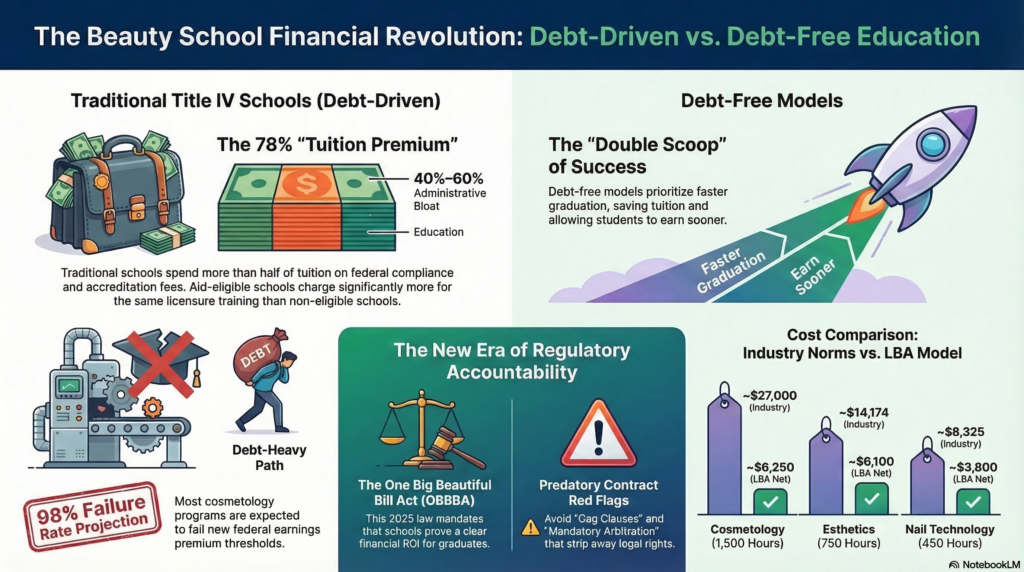
This premium is not merely a reflection of higher quality; in fact, state licensure exam pass rates remain remarkably similar across both Title IV and non-Title IV institutions.7 Instead, the tuition inflation appears to track the maximum available federal aid packages, effectively capturing the subsidy for the institution rather than the student.3 Additionally, Title IV schools face significant administrative “bloat” due to the costs of maintaining eligibility. These institutions must allocate 40% to 60% of their tuition revenue toward accreditation fees, specialized financial aid software, third-party audits, and compliance-focused administrative salaries.10
Comparative Pricing and the “Lower-Debt” Alternative
The disparity in pricing is evident when comparing similar programs in identical geographic markets. For example, case studies in Dallas, Texas, revealed that a Title IV-eligible institution, Salon Boutique Academy, charged over $16,000 for a 1,000-hour program, while the nearby non-Title IV Modern Beauty Academy offered the same licensure training for $4,775—less than one-third of the cost.8 Similar discrepancies exist in the esthetics field, where non-Title IV options like the SSL Skin Institute provide programs at a fraction of the price of their federally-funded peers.8
This economic landscape has necessitated the rise of the “lower-debt” model. Non-Title IV schools, because they eschew the federal system, can offer lower, cash-based tuition rates that align more closely with the actual cost of instruction.3 By avoiding the administrative overhead of federal compliance, these schools pass the savings directly to the student, allowing for a “pay-as-you-go” structure that eliminates the need for long-term student loans.12
The Dual-Revenue Model and Student Labor Ethics
A critical and often overlooked aspect of the for-profit beauty school financial model is the utilization of student clinics. Most accredited institutions operate on-campus salons that are open to the public, where students perform services on paying clients under the guise of “clinical practice”.4 While clinical experience is a necessary component of state licensure requirements, investigators have pointed to a “dual-revenue” model where the school collects both tuition from the student and service fees from the client.4
In many cases, students are required to work in these clinics for hundreds of hours, often performing repetitive tasks that offer little pedagogical value once basic competency is achieved.6 Critics argue that this practice effectively treats students as free labor, allowing the school to generate profit while the student remains in a position of “tuition-paying employee”.4 Furthermore, there is evidence that some schools have lobbied to keep state licensing hours high specifically to prolong this period of clinical labor and to ensure that program costs remain high enough to justify maximum federal aid disbursements.4
| Revenue Stream | Title IV School Mechanism | Economic Implication |
| Tuition | Captured via federal loans and Pell Grants | Leads to high student debt loads 4 |
| Student Clinic | Fees charged to public for student services | Generates immediate operational cash flow 4 |
| Lab Fees/Kits | Mandatory purchase of proprietary kits | Often marked up significantly 5 |
| Overtime Fees | Charges for students who exceed graduation date | Discourages timely completion 16 |
The Regulatory Response: Gainful Employment and Financial Value Transparency
In response to concerns about high debt and low earnings, the U.S. Department of Education finalized the Financial Value Transparency (FVT) and Gainful Employment (GE) regulations in September 2023.18 These rules represent a fundamental shift in how the federal government evaluates the “value” of a post-secondary program. For the first time, federal aid eligibility is explicitly tied to the financial outcomes of graduates.15
The GE framework restores and expands an accountability system for career-specific programs, particularly those at for-profit institutions.18 Under these regulations, a program must pass two primary tests to remain eligible for Title IV funds:
- The Debt-to-Earnings (D/E) Rate: This metric compares the median debt of graduates to their discretionary and annual earnings. If a program’s graduates cannot afford their debt payments relative to their income, the program is flagged.19
- The Earnings Premium (EP) Measure: This test compares the earnings of graduates to those of a typical high school graduate (ages 25–34) in the same state. A program fails if its graduates do not earn more than a high school graduate who never attended post-secondary school.19
Programs that fail the same metric for two out of three consecutive years lose access to Title IV funds for a minimum of three years.19 The Department estimates that a significant majority of cosmetology programs—up to 98% by some analyses—would fail the earnings premium threshold as currently structured, as entry-level stylist wages are often comparable to or lower than state medians for high school graduates.4
Implementation Hurdles and Reporting Extensions
The rollout of FVT and GE has been marked by administrative delays. On February 14, 2025, the Department of Education announced a significant extension of the institutional reporting deadline to September 30, 2025.22 This extension was granted in response to challenges faced by institutions in collecting and submitting the necessary data, as well as ongoing litigation.20 The American Association of Cosmetology Schools (AACS) has filed suit against the Department, arguing that the regulations jeopardize the “very existence” of many member schools and fail to account for the unique characteristics of the beauty industry, such as the high prevalence of self-employment and tipped income.15
Despite these challenges, the Department remains committed to the framework. The February 2025 announcement also indicated that institutional reports previously submitted were reverted to draft status to allow schools to correct errors and omissions, emphasizing the government’s focus on data accuracy before imposing sanctions.22
The Landmark Transformation: The One Big Beautiful Bill Act (OBBBA) of 2025
While FVT and GE set the stage, the passage of the One Big Beautiful Bill Act (OBBBA) in July 2025 represents the most radical restructuring of federal student aid in history.21 Signed into law on July 4, 2025, OBBBA introduces the AHEAD framework (Accountability in Higher Education and Access through Demand-driven Workforce Pell), which establishes a “Do No Harm” metric specifically targeting vocational and career-specific programs.21
The OBBBA mandate fundamentally shifts the burden of proof onto the institution. To remain eligible for any federal funding—including both student loans and Pell Grants—a beauty school must prove that its graduates achieve a clear financial return on investment.21 The “Pell Penalty” is a particularly aggressive provision: if more than 50% of a school’s students rely on Pell Grants and the school fails the earnings test for two out of three consecutive years, it loses Pell Grant eligibility entirely.21 This is a “death sentence” for many beauty schools, as they often rely on Pell Grants for the majority of their operating capital.4
The Transition to the Repayment Assistance Plan (RAP)
In addition to institutional accountability, OBBBA overhauled the borrower experience. Beginning July 1, 2026, the law sunsets multiple existing income-driven repayment (IDR) plans, including the Saving on a Valuable Education (SAVE) plan, and replaces them with a single Repayment Assistance Plan (RAP).26 The RAP plan is designed to be more structurally rigid than previous options, using a “tiered standard” to determine monthly payments.24
For students, OBBBA also imposes strict new borrowing caps. Unlike the previous system, which often allowed for borrowing up to the full cost of attendance, the new law limits federal loan volume for undergraduate and professional programs.24 Graduate PLUS loans are also slated for termination for most programs by July 2026, forcing students in advanced specialty tracks to seek more expensive private financing.26
| Loan Category | 2026 Annual Limit | 2026 Lifetime/Aggregate Limit |
| Dependent Undergraduate | $5,500 – $7,500 | $31,000 26 |
| Independent Undergraduate | $9,500 – $12,500 | $57,500 26 |
| Parent PLUS (per student) | $20,000 | $65,000 26 |
| Graduate Students | $20,500 | $100,000 26 |
| Professional (JD, MD, DVM) | $50,000 | $200,000 26 |
Neutral Case Study: The Louisville Beauty Academy (LBA) Model
As the Title IV sector braces for the full impact of OBBBA in 2027, the Louisville Beauty Academy (LBA) in Kentucky offers a neutral example of a non-Title IV vocational school model that has operated in alignment with these principles for years—voluntarily and without reliance on federal student debt.3 LBA’s model is predicated on the rejection of federal subsidies in favor of extreme tuition transparency and “pay-as-you-go” affordability.3
Structural Independence and “License-First” Education
LBA operates as a state-licensed beauty college, specifically authorized by the Kentucky Board of Cosmetology.10 However, the academy intentionally chooses not to pursue federal (national) accreditation. This decision allows the institution to sidestep the massive administrative costs associated with federal aid processing, which LBA identifies as a primary driver of tuition inflation.10 Without these costs, LBA is able to offer tuition that is 50% to 75% lower than the national average.3
The LBA curriculum is designed around a “license-first” philosophy. Rather than padding hours to meet federal aid eligibility thresholds, the school offers standalone tracks that strictly adhere to state-required minimums: for example, 450 hours for Nail Technology and 750 hours for Esthetics.12 This targeted approach allows students to graduate faster and start earning sooner—a concept LBA calls the “Double Scoop” of success: money saved on tuition plus money earned from early entry into the workforce.27
Financial Mechanics and Incentive-Based Discounts
LBA utilizes a transparent, cash-based pricing model that includes all books and kits in the upfront cost.3 The academy provides true affordability through direct tuition discounts and written payment flexible payment plans, explicitly avoiding “Pell Grant cost masking,” where tuition is inflated to absorb the grant.11
Students at LBA can access significant “performance-based” incentives. For example, consistent attendance and high exam scores can reduce the total cost of the cosmetology program from a base of ~$27,000 down to a net cost of ~$6,250.11 The school also offers “Big Scholarships” for students who have exhausted other funding options, further incentivizing academic progress.11
| Program (Required Hours) | Industry Norm (Est.) | LBA Discounted Net Cost |
| Cosmetology (1,500) | ~$27,000 | ~$6,250 3 |
| Nail Technology (450) | ~$8,325 | ~$3,800 3 |
| Esthetics (750) | ~$14,174 | ~$6,100 3 |
| Certified Instructor (750) | ~$12,675 | ~$3,900 11 |
| Shampoo Styling (300) | ~$5,890 | ~$2,890 11 |
| Lash Professional (16) | ~$2,500 | ~$900 11 |
Macro-Economic and Fiscal Contributions
Beyond individual student benefit, LBA’s model serves as a “Freedom Factory” for the state and federal government. Analysis suggests that the academy has generated approximately $48.7 million in net-positive fiscal contributions over a ten-year period.3 This impact is calculated by analyzing the direct fee revenue paid to the state (school licenses, student permits, exam fees), the tax revenue generated by successful graduate-owned salons, and the $25 million in avoided federal costs that would have been consumed if LBA students used Pell Grants and federal loans.3
For the public balance sheet, the difference between LBA’s model and a hypothetical Title IV model is approximately $73.7 million—representing the sum of the positive revenue generated and the federal costs avoided.3 This model demonstrates that vocational education can thrive without federal dependency, provided that tuition is anchored in labor market reality rather than aid availability.
Student Protections: Identifying and Avoiding Predatory Practices
The high-stakes nature of beauty school enrollment, particularly when tied to significant debt, has led to the proliferation of predatory contractual practices. For the student-consumer, understanding these legal traps is as important as mastering the technical skills of the trade.28
Common Predatory Contract Clauses
Many for-profit beauty schools use enrollment agreements that contain “unconscionable” terms—provisions that are so one-sided they favor the business to the extreme detriment of the student.17 Key red flags in these agreements include:
- Mandatory Binding Arbitration: These clauses force students to waive their right to sue the school in court. Instead, disputes must be heard by a private arbitrator, often hired by an association with a working relationship with the school.17
- Class-Action Waivers: Also known as “go-it-alone” clauses, these provisions prevent students with similar grievances from banding together in a collective lawsuit, forcing each individual to fight the school’s legal team alone.17
- Gag Clauses: These provisions silence students from discussing the details of an ongoing or completed dispute resolution process, effectively preventing the public from learning about institutional failures.31
- Excessive Overtime Fees: Some schools charge $3 per hour for any training hours completed after the contracted graduation date, or $50 per day for late arrivals, turning the school into a “money pit scheme”.16
- IP Ownership Restrictions: In advanced creative tracks, some contracts contain language that restricts students’ ownership of their own portfolios or creative work, holding their “product” hostage.29
School Stability and Closure Rights
The threat of school closure is a persistent reality in the for-profit sector, particularly as federal accountability tightens. Historically, major chains like Regency Beauty Institute and Marinello Schools of Beauty closed abruptly, leaving thousands of students with incomplete training and massive debt.23
If a school closes while a student is enrolled or within 180 days of their withdrawal, the student may qualify for a 100% discharge of their federal student loans.32 This discharge is often automatic after one year, but students can apply for it immediately upon official confirmation of the closure.33 Receiving a closed school discharge removes all obligation to repay the loan, provides reimbursement for past payments, and removes adverse credit history associated with the debt.32
However, students should be wary of “teach-out” agreements. If a student chooses to finish their program at a nearby school through a formal teach-out, they may forfeit their right to a loan discharge.33 It is essential for students to obtain their academic and financial records immediately upon hearing of a potential closure to ensure they can prove their status to federal regulators.33
| Closure Milestone | Student Action Required | Regulatory Protection |
| Notice of Potential Loss of Aid | Contact state board and research transfer options 37 | “Warned” status requires institutional disclosure 19 |
| Official School Closure | Secure all academic transcripts and financial aid records 33 | Federal Direct Loan Discharge eligibility 32 |
| 180-Day Window | Confirm withdrawal date matches school records | Eligible for discharge if withdrawal within 180 days 33 |
| Automatic Discharge | Monitor studentaid.gov and credit reports | Discharge initiated automatically after 1 year 33 |
State-Level Variations in Refund Policies
In the absence of a federal refund standard for out-of-pocket tuition, students are subject to state-specific guidelines. These policies are often calculated based on “scheduled hours” rather than “actual hours attended,” meaning that if a student is absent but still enrolled, they continue to incur a financial obligation.38
In Texas, the Department of Licensing and Regulations mandates a refund schedule that protects the institution’s revenue while providing some relief to the student. If a student withdraws within the first 10% of the program, the school must refund at least 90% of the tuition.38 However, once a student passes the 50% threshold, the school is entitled to retain 100% of the total tuition.39 Wisconsin, by contrast, requires a full refund if a student cancels by mail before classes start or if the school made “oral misrepresentations” during recruitment.41
For Title IV recipients, the “Return of Title IV Funds” calculation (R2T4) happens first. If a student withdraws before completing 60% of a payment period, the school must return the “unearned” portion of the federal aid to the government.40 This often results in a “tuition gap,” where the student owes a balance to the school because the state-allowed tuition retention exceeds the amount of aid they were allowed to keep under federal rules.40
Practical Consumer Navigation: The Beauty School “Interview”
To mitigate these risks, prospective students must adopt a professional, consumer-focused mindset during the school search process. A school tour should not be a passive marketing event; it should be a rigorous interview of the institution.28
Evaluating Quality and Reputation
Students should look for “Word on the Street” by asking local salons and spas about the performance of a school’s alumni. Can graduates from the school “hang in the real world,” or do they lack basic treatment procedures?.28 Additionally, students should check for complaints filed with the State Board of Cosmetology or local trade organizations.28
Key questions during the tour should include:
- Placement Assistance: What kind of career support is offered? Are there networking events, job fairs, or salon visits?.5
- Curriculum Structure: Is the curriculum updated frequently with modern, innovative techniques, or is it stuck in the past?.5
- Instructor Experience: What is the background of the instructors? Are they passionate professionals who support individual learning styles?.42
- Total Student Load: What is the student-to-teacher ratio? In some schools, a high ratio leads to students being left alone on the salon floor with no supervision.28
The Challenge of Reciprocity and Transferability
Aspiring professionals often believe that a beauty license is universally valid. In reality, license reciprocity is a complex, state-by-state process. There is no such thing as an “automatic transfer”.44 Each state board assesses the skills and training hours of an individual; if the original state’s requirements are lower (e.g., 600 hours of esthetics vs. 750), the student must take additional classes in the new state.44
Transferring hours between schools is equally fraught. Many schools will not accept hours from a competitor, or will only accept “half of the hours” if the school used a different curriculum (e.g., non-Pivot Point schools).46 Before withdrawing from one school to attend another, a student must settle all dues at the original institution and obtain a formal release; otherwise, the state board may not verify their recorded hours for the new school.46
| Transfer Step | Required Documentation | Potential Barrier |
| Initial Inquiry | Potential new school’s transfer policy | Some schools have a “zero-transfer” policy 46 |
| Financial Clearance | Release form from previous school | Outstanding balances prevent hour release 46 |
| Hours Verification | Transcript from State Board of Cosmetology | Interstate bureaucracy can cause delays 44 |
| Evaluation | Practical/Theory entrance exam | Schools may “penalize” and reject up to 10% of hours 47 |
| Licensing Portal | Legal name, GED/Diploma, existing license | Background check issues must be disclosed 45 |
Conclusion: The Structural Outlook for Beauty Education (2026–2030)
The era of unrestricted federal funding for high-cost, low-outcome beauty education is coming to an end. The implementation of the OBBBA in 2026 and the full enforcement of Gainful Employment accountability will trigger a massive market correction. Schools that have historically relied on a “loan mill” model—characterized by inflated tuition, excessive licensing hours, and poor graduate outcomes—will face inevitable closure as they lose access to Title IV subsidies.21
However, the industry itself is projected to grow by 11% over the next decade, according to the Bureau of Labor Statistics.48 This suggests that the demand for beauty services remains strong, but the pathway to entry must evolve. The future of the sector likely belongs to lower-debt, “license-first” models that prioritize student protection and economic transparency. Institutions like the Louisville Beauty Academy demonstrate that by cutting unnecessary administrative bloat and focusing on rapid, affordable workforce entry, it is possible to create a sustainable educational framework that serves both the student and the public purse.3
For the student, protection lies in education—not just in the techniques of hair and skin care, but in the financial and legal realities of the marketplace. By understanding the shift toward accountability, identifying predatory contract clauses, and treating school enrollment as a high-stakes investment, the next generation of beauty professionals can ensure that their career begins with a license and a future, rather than a debt and a dream cut short. The transition to the STATS reporting system and the AHEAD accountability framework marks the beginning of a new chapter in vocational education, one where the promise of the “Great Society” is finally balanced with the reality of professional results.21
Works cited
- What is a Title IV school? A Guide to Funds & Eligibility Requirements for 2026, accessed March 14, 2026, https://research.com/education/what-is-a-title-iv-school
- Title IV Compliance: Your Guide to Federal Student Aid, accessed March 14, 2026, https://blog.clickpointsoftware.com/title-iv
- Tag: education without federal loans – Louisville Beauty Academy, accessed March 14, 2026, https://louisvillebeautyacademy.net/tag/education-without-federal-loans/
- Outcomes-Based Beauty Education : A Workforce and Policy Analysis of Lower-Debt, Completion-Driven Vocational Models – RESEARCH DECEMBER 2025 – Louisville, KY, accessed March 14, 2026, https://naba4u.org/2025/12/outcomes-based-beauty-education-a-workforce-and-policy-analysis-of-lower-debt-completion-driven-vocational-models-research-december-2025/
- What to Ask While Touring a Beauty School – Douglas J Institute, accessed March 14, 2026, https://douglasj.edu/what-to-ask-while-touring-a-beauty-school/
- The Broken Promises of Cosmetology Education – New America, accessed March 14, 2026, https://www.newamerica.org/insights/cut-short-the-broken-promises-of-cosmetology-education/
- Tag: vocational school governance – Louisville Beauty Academy, accessed March 14, 2026, https://louisvillebeautyacademy.net/tag/vocational-school-governance/
- Cosmetology Schools Everywhere – American University, accessed March 14, 2026, https://www.american.edu/spa/peer/upload/peer_cosmetology_b.pdf
- $48.7 million net positive contribution Archives – Louisville Beauty Academy, accessed March 14, 2026, https://louisvillebeautyacademy.net/tag/48-7-million-net-positive-contribution/
- highest graduation rate beauty school Archives – Louisville Beauty Academy, accessed March 14, 2026, https://louisvillebeautyacademy.net/tag/highest-graduation-rate-beauty-school/
- transparent tuition beauty school Archives – Louisville Beauty …, accessed March 14, 2026, https://louisvillebeautyacademy.net/tag/transparent-tuition-beauty-school/
- Tag: non accredited beauty school research – Louisville Beauty Academy, accessed March 14, 2026, https://louisvillebeautyacademy.net/tag/non-accredited-beauty-school-research/
- Louisville Beauty Academy: Pioneering Lower-Debt Beauty Education AND THRIVING AND ELEVATING THE BEAUTY INDUSTRY LANDSCAPE – RESEARCH MAY 2025, accessed March 14, 2026, https://louisvillebeautyacademy.net/louisville-beauty-academy-pioneering-lower-debt-beauty-education-and-thriving-and-elevating-the-beauty-industry-landscape-research-may-2025/
- Louisville Beauty Academy’s Model vs. Typical U.S. Beauty Schools: A Comprehensive Comparison, accessed March 14, 2026, https://naba4u.org/2025/06/louisville-beauty-academys-model-vs-typical-u-s-beauty-schools-a-comprehensive-comparison/
- How Cosmetology Education Cuts Students’ Dreams Short …, accessed March 14, 2026, https://www.republicreport.org/2025/how-cosmetology-education-cuts-students-dreams-short/
- Cosmo School Closing : r/Cosmetology – Reddit, accessed March 14, 2026, https://www.reddit.com/r/Cosmetology/comments/1pmua3z/cosmo_school_closing/
- Contract Clauses That Violate State Consumer Protection Laws – Attorney Aaron Hall, accessed March 14, 2026, https://aaronhall.com/contract-clauses-violate-consumer-protection-laws/
- Gainful Employment | AACS – American Association of Career Schools, accessed March 14, 2026, https://myaacs.org/gainful-employment/
- Regulatory Requirements for Financial Value Transparency and …, accessed March 14, 2026, https://fsapartners.ed.gov/knowledge-center/library/dear-colleague-letters/2024-03-29/regulatory-requirements-financial-value-transparency-and-gainful-employment-updated-sept-16-2024
- The Department’s Victory on Gainful Employment and What It Means for Higher Ed, accessed March 14, 2026, https://onedtech.philhillaa.com/p/the-departments-victory-on-gainful-employment-and-what-it-means-for-higher-ed
- in 2027, 92% Beauty Schools are going to close under new Trump rules : r/Cosmetology, accessed March 14, 2026, https://www.reddit.com/r/Cosmetology/comments/1qtkdsu/in_2027_92_beauty_schools_are_going_to_close/
- Financial Value Transparency and Gainful Employment Reporting Deadlines Extended Again for Educational Institutions – Duane Morris, accessed March 14, 2026, https://www.duanemorris.com/alerts/financial_value_transparency_gainful_employment_reporting_deadlines_extended_again_0225.html
- Gainful Employment Rules and School Closures (2014–Present) – MAY 2025 STUDY, accessed March 14, 2026, https://naba4u.org/2025/05/gainful-employment-rules-and-school-closures-2014-present-may-2025-study/
- How OBBBA reshapes student lending – Brookings Institution, accessed March 14, 2026, https://www.brookings.edu/articles/how-obbba-reshapes-student-lending/
- accessed March 14, 2026, https://www.reddit.com/r/Cosmetology/comments/1qtkdsu/in_2027_92_beauty_schools_are_going_to_close/#:~:text=A%20central%20part%20of%20this,targeting%20beauty%20and%20cosmetology%20programs.
- Tag: refund policy cosmetology school – Louisville Beauty Academy, accessed March 14, 2026, https://louisvillebeautyacademy.net/tag/refund-policy-cosmetology-school/
- Fast-Track & Lower-Debt: How Louisville Beauty Academy Delivers the “Double Scoop” – Save Big and Start Earning Sooner – RESEARCH AUGUST 2025, accessed March 14, 2026, https://louisvillebeautyacademy.net/fast-track-lower-debt-how-louisville-beauty-academy-delivers-the-double-scoop-save-big-and-start-earning-sooner-research-august-2025/
- How to Interview a Beauty School: 7 Questions You Should Ask – TSPA Whitehouse, accessed March 14, 2026, https://www.tspawhitehouse.com/blog/how-to-interview-a-beauty-school-7-questions-you-should-ask/
- 8 Red Flags Artists Should Watch for Before Signing any Agreement – SoundGirls.org, accessed March 14, 2026, https://soundgirls.org/8-red-flags-artists-should-watch-for-before-signing-any-agreement/
- Ryan Coogler’s ‘Sinners’ Deal Is a Win For Generational Wealth – Hello Beautiful, accessed March 14, 2026, https://hellobeautiful.com/4584839/ryan-cooglers-sinners-deal/
- These Colleges Deny Students Their Legal Rights – The Century Foundation, accessed March 14, 2026, https://tcf.org/content/commentary/colleges-deny-students-legal-rights/
- School Closure – Federal Student Aid, accessed March 14, 2026, https://studentaid.gov/help-center/answers/article/school-closure
- Closed School Discharge – Federal Student Aid, accessed March 14, 2026, https://studentaid.gov/manage-loans/forgiveness-cancellation/closed-school
- Has Your School Closed? Here’s What to Do. – Federal Student Aid, accessed March 14, 2026, https://studentaid.gov/closures?trk=public_post_main-feed-card-text
- Closed School Discharge – StudentAid.gov – Federal Student Aid, accessed March 14, 2026, https://staging-usds.mohela.studentaid.gov/DL/resourceCenter/ClosedSchooldischarge.aspx
- Transferring schools : r/Cosmetology – Reddit, accessed March 14, 2026, https://www.reddit.com/r/Cosmetology/comments/1rivx3e/transferring_schools/
- School losing accreditation : r/Cosmetology – Reddit, accessed March 14, 2026, https://www.reddit.com/r/Cosmetology/comments/1hhd0er/school_losing_accreditation/
- refund policy – Milan Institute, accessed March 14, 2026, https://milaninstitute.edu/wp-content/uploads/2025/10/TX-TDLR-Interview-Documentation-Handout-1.pdf
- Beauty School Policies | Natural Images Beauty College in Clute, TX, accessed March 14, 2026, https://natural-images-bc.com/policies/
- Policies – The Salon Professional Academy | Premier Cosmetology School, accessed March 14, 2026, https://nashvillebeautyschool.com/policies/
- Consumer Information – Vicí Beauty School, accessed March 14, 2026, https://vicibeautyschool.com/enrollment/admissions-tuition/consumer-information/
- Your Beauty School Tour Checklist: Everything You Need To Know | Aveda Institute Las Vegas, accessed March 14, 2026, https://avedalasvegas.com/blog/your-beauty-school-tour-checklist-everything-you-need-to-know/
- Cosmetology School Tours: 20 Questions to Ask Before You Enroll, accessed March 14, 2026, https://avedainspiregreatness.com/blog/cosmetology-school-tour-questions/
- How To Transfer Your Esthetician License To Another State – Cosmetology & Spa Academy, accessed March 14, 2026, https://cosmetologyandspaacademy.edu/transfering-your-esthetician-license/
- Reciprocity – Barbering and Cosmetology Board, accessed March 14, 2026, https://bcb.az.gov/reciprocity
- 6 Things to Ask When Transferring Beauty Schools | Broken Arrow Beauty College, accessed March 14, 2026, https://www.babeautycollege.com/blog/6-things-to-ask-when-transferring-beauty-schools/
- Transferring cosmetology schools – Reddit, accessed March 14, 2026, https://www.reddit.com/r/Cosmetology/comments/1bd5cct/transferring_cosmetology_schools/
- Financial Value Transparency and Gainful Employment, Financial Responsibility, Administrative Capability, Certification Procedures, Ability to Benefit – Regulations.gov, accessed March 14, 2026, https://www.regulations.gov/document/ED-2023-OPE-0089-0001/comment?filter=Cosmetology
- Negotiated Rulemaking Continues on New Federal Accountability Framework Under OBBBA – Updates on the AHEAD Committee – The Higher Education Assistance Group, Inc., accessed March 14, 2026, https://heag.us/negotiated-rulemaking-continues-on-new-federal-accountability-framework-under-obbba-updates-on-the-ahead-committee/
Research Attribution & Academic Context
This publication is part of the ongoing vocational education research initiative conducted by Di Tran University — The College of Humanization. The analysis synthesizes publicly available data, policy reports, academic literature, regulatory documents, and industry commentary in order to promote transparency and informed decision-making in vocational education.
The purpose of this research is educational and public-interest oriented. It does not constitute legal, financial, or regulatory advice, nor does it evaluate or endorse specific institutions. Readers are encouraged to consult state licensing authorities, regulatory agencies, and independent advisors when making educational or financial decisions.







