At Louisville Beauty Academy, we don’t just teach beauty skills – we teach responsibility, professionalism, and excellence. The foundation of every beauty professional’s success starts with sanitation and safety, as required by Kentucky State Law (201 KAR 12:100).
We Practice It. We Teach It. We Elevate It.
Sanitation is not just a rule – it is a daily habit, a professional standard, and the key to becoming a licensed beauty expert. Every student at Louisville Beauty Academy is expected to clean and disinfect their workstation before and after class, ensuring a safe and hygienic learning environment.
As a licensed beauty school, we elevate sanitation by making it a daily practice, not just a theory. Our students don’t just learn about sanitation – they live it, practice it, and become experts in it.
Below is a complete breakdown of the sanitation and safety requirements we uphold every day at Louisville Beauty Academy:
📌 General Cleaning Requirements(201 KAR 12:100, Section 1)
✔ All facilities and equipment are continuously maintained in a clean and sanitary condition. ✔ An adequate supply of hot and cold running water is always available. ✔ Students and licensees must wash their hands before and after serving each client.
✔ Workstations, shampoo bowls, treatment tables, styling chairs, and surfaces must be cleaned and disinfected daily and after each client. ✔ Each workstation must have a disinfectant solution available for cleaning between clients.
✔ All tools and implements must be cleaned and disinfected before and after every use. ✔ No tool, instrument, or item shall be used on multiple clients without proper sanitation. ✔ Multi-use items must be stored in a closed, labeled, and sanitary container.
🗑 Trash & Debris Removal(201 KAR 12:100, Section 6)
✔ Hair, nail clippings, and debris must be swept and disposed of immediately after each service. ✔ Waste containers must be emptied daily to maintain cleanliness.
🏫 School-Specific Cleaning Standards(201 KAR 12:100, Section 7)
✔ Louisville Beauty Academy is responsible for maintaining a clean and sanitary learning environment at all times. ✔ All students are trained in sanitation and are expected to perform daily cleaning duties. ✔ Each student must clean and disinfect their workstation before and after class.
🧴 Disinfectant Requirements(201 KAR 12:100, Sections 5 & 8)
✔ Only EPA-registered disinfectants are used in our school and salon. ✔ Disinfectants must be clearly labeled and stored properly. ✔ All students must follow manufacturer guidelines for proper use and disposal of disinfectants.
🚻 Restroom & Handwashing Facilities(201 KAR 12:100, Section 9)
✔ Restrooms are cleaned and disinfected daily to maintain hygiene. ✔ Handwashing stations with soap and disposable towels are available for all students and clients.
📚 Why This Matters for Your Beauty License
✔ Sanitation and safety are critical subjects required for beauty licensing. ✔ Practicing these standards daily prepares students to become professional, responsible, and successful beauty experts. ✔ Failure to follow sanitation rules can result in disciplinary actions, fines, or even loss of licensure.
At Louisville Beauty Academy, we are committed to training the best beauty professionals, and that starts with cleanliness, discipline, and excellence in sanitation.
💡 A clean workstation = A successful beauty career! 💡
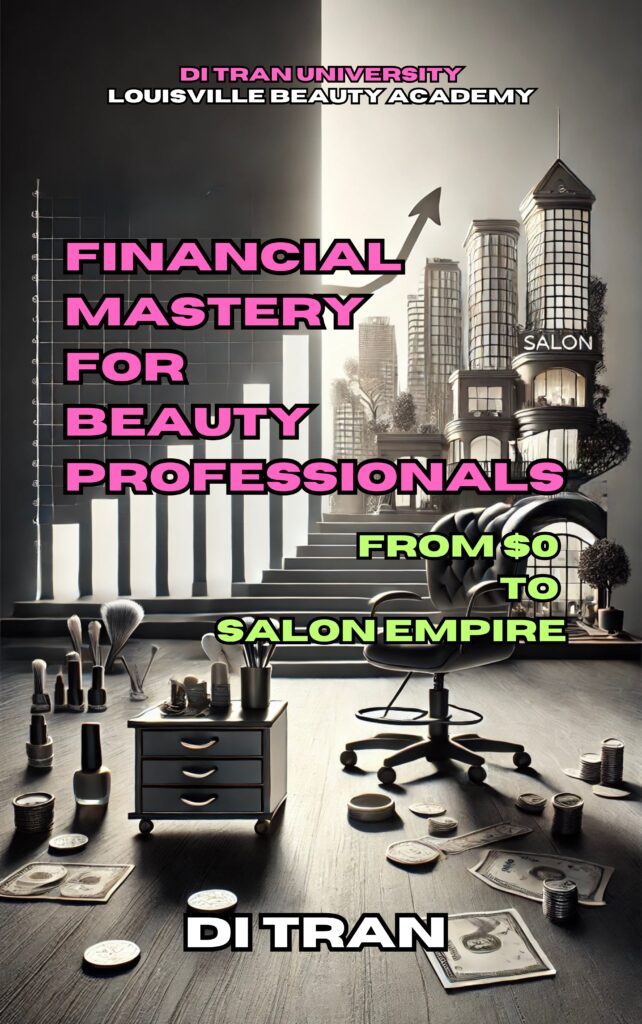
At Louisville Beauty Academy, we don’t just prepare you to be a beauty professional—we prepare you for a successful career and a thriving future. That’s why we are excited to announce the release of Di Tran’s latest book, “Financial Mastery for Beauty Professionals: From $0 to Salon Empire” (2025).
This book is a must-read for every beauty school graduate, licensed professional, and aspiring entrepreneur. It’s not just a guide—it’s a roadmap to transforming your skills into a business and your dreams into a legacy.
What This Book is About
Financial Mastery for Beauty Professionals is designed to help you go beyond the chair. It’s about taking control of your finances, building your own business, and investing in long-term wealth, all while staying true to your passion for beauty.
Written by Di Tran, a licensed nail technician, beauty entrepreneur, and real estate investor with over two decades of experience, the book walks you through every stage of growth—from starting as a beauty school graduate to building a salon empire and securing financial freedom through real estate.
Why Should Every Graduate, Licensee, and Prospect Read This Book?
1. Empower Yourself Financially
This book provides essential knowledge to help you master financial discipline. You’ll learn how to:
Avoid emotional spending and focus on meaningful investments.
Budget effectively and save for the future.
Reinvest in your skills, business, and wealth-building opportunities.
🔑 Why It Matters: Financial knowledge is the key to turning your passion into long-term success. Every dollar you earn and save today is a step toward building the future you want.
2. Build Your Own Business
Whether you dream of becoming a booth renter, salon owner, or multi-location entrepreneur, this book offers actionable steps to get there. You’ll discover:
How to transition from working for someone else to owning your own salon.
Strategies to scale your business and create additional revenue streams.
Ways to lead and empower your team while growing your brand.
🔑 Why It Matters: Owning your own business puts you in control of your career and income. It allows you to create opportunities not only for yourself but also for others in your community.
3. Leverage Real Estate for Wealth
Di Tran shares his insights on using your beauty business to fund real estate investments, turning your income into long-term wealth. You’ll learn how to:
Identify and purchase properties to house your salon or generate passive income.
Use real estate as a foundation for financial stability and legacy building.
🔑 Why It Matters: Real estate is one of the most reliable ways to build wealth, and your beauty business can be the engine that drives these investments.
4. Achieve Work-Life Balance
The book emphasizes the importance of maintaining balance as you scale your career. You’ll gain insights into:
Avoiding burnout while growing your business.
Prioritizing self-care and relationships.
Designing a sustainable career that supports both your personal and professional goals.
🔑 Why It Matters: Success is about more than money—it’s about creating a fulfilling life where you thrive in all areas.
5. Leave a Legacy
One of the most inspiring aspects of this book is its focus on leaving a lasting impact. You’ll learn how to:
Mentor others and empower the next generation of beauty professionals.
Create a business that thrives long after you’ve moved on.
Use your success to make a difference in your community.
🔑 Why It Matters: Your career isn’t just about what you achieve—it’s about the opportunities you create for others and the legacy you leave behind.
Why Louisville Beauty Academy Recommends This Book
At Louisville Beauty Academy, our mission is to elevate every student to their maximum potential. We provide not only the technical skills needed to succeed in the beauty industry but also the mindset and tools to thrive as entrepreneurs and leaders.
Financial Mastery for Beauty Professionals aligns perfectly with our values of continuous learning, adaptation, and growth. This book is a guide to the very principles we instill in our students:
The importance of starting small and dreaming big.
The value of financial discipline and smart investments.
The potential to build a career that creates both personal success and community impact.
Take Advantage of Your Opportunities
As a student, graduate, or prospective beauty professional, you already have an incredible opportunity to change your life through education. Remember:
Your investment starts with your education. Every dollar spent on your training is an investment in your future.
Louisville Beauty Academy offers 50-75% tuition discounts for eligible students. This means you can start your journey with minimal financial burden and focus on achieving your goals.
Graduate fast, succeed sooner. Our programs are designed to help you complete your education efficiently so you can start earning and building your career right away.
Get Your Copy Today
📚 Grab your copy of Financial Mastery for Beauty Professionals: From $0 to Salon Empire today and take the next step toward your future: https://www.amazon.com/dp/B0DTNVV5M4
Final Thoughts
This book isn’t just a resource—it’s a roadmap to a better future. Whether you’re just starting out, looking to grow your business, or dreaming of financial independence, Financial Mastery for Beauty Professionals will guide you every step of the way.
At Louisville Beauty Academy, we’re here to support you on this journey. With the right education, mindset, and tools, you can achieve anything.
At Louisville Beauty Academy (LBA), a Kentucky state-licensed beauty school, sanitation and safety aren’t just rules—they are a way of life. As we approach 2,000 graduates, we take pride in empowering beauty professionals with the skills, knowledge, and confidence to succeed in their careers while prioritizing client trust and safety.
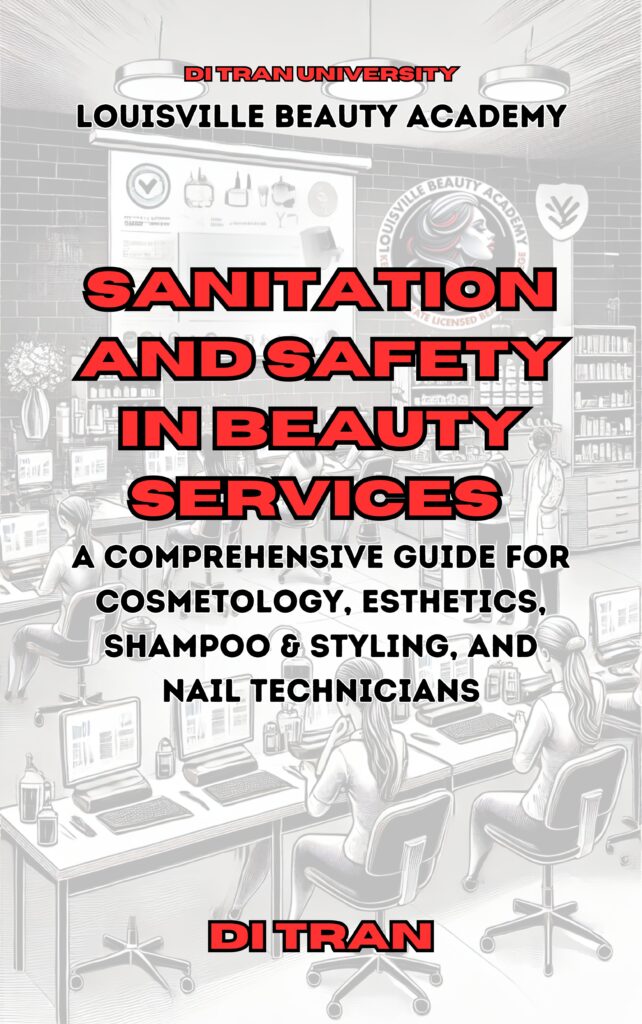
Our latest publication, Sanitation and Safety in Beauty Services, reflects this commitment. Authored by our founder, Di Tran, this comprehensive guide sets a new standard for the beauty industry by combining practical sanitation protocols, industry myths debunked, and actionable steps to maintain compliance with the highest hygiene standards.
The Louisville Beauty Academy Philosophy
At LBA, we live by the mantra “YES I CAN,” which empowers our students to believe in their potential and excel in their craft. By the time they graduate, our students confidently say, “I HAVE DONE IT.” This mindset is at the heart of everything we teach, ensuring that our graduates are not only skilled professionals but also leaders in maintaining the integrity of the beauty industry.
Sanitation and Safety in Beauty Services is an extension of this philosophy, offering a resource that elevates the standards of beauty education while supporting the growth of salons, schools, and individual professionals.
What’s Inside the Book?
This book isn’t just a guide—it’s a transformation tool. Inside, you’ll find:
1. The Science of Cleanliness
Understand the critical differences between cleaning, sanitizing, and disinfecting.
Learn how pathogens like bacteria, viruses, and fungi spread and how to prevent cross-contamination.
2. Tailored Protocols by Discipline
Step-by-step sanitation guidelines for cosmetology, esthetics, nail services, and more.
Practical advice for handling tools, workstations, and high-risk areas like pedicure spas.
3. Myths and Facts About Hygiene
Bust common industry misconceptions, such as over-reliance on alcohol or UV sterilizers, with evidence-based practices.
4. Exact Procedures for Compliance
Comprehensive instructions for disinfecting tools, managing waste, and handling bloodborne pathogens.
OSHA-compliant steps to ensure the safety of both clients and staff.
5. Scaling Your Business with Safety
Leverage sanitation as a trust-building tool to grow your business.
Learn how technology can streamline operations and elevate client satisfaction.
White-Label Solutions: Elevate Your Brand
Louisville Beauty Academy offers an exclusive white-label licensing program for our published books. If you’re a salon owner or beauty business professional, this is your opportunity to: ✅ Showcase your commitment to sanitation and safety with a branded version of the book. ✅ Build client trust and credibility by aligning with proven industry standards. ✅ Train your team and set your business apart with visible excellence in hygiene practices.
Let us help you put your brand on this transformative resource and license it for your salon or school.
Why Choose Louisville Beauty Academy?
Founded by Di Tran, Louisville Beauty Academy is a leader in beauty education, innovation, and impact. We prioritize lifelong learning and adapting to the needs of the industry, ensuring that our graduates are prepared to excel in any environment.
Our students leave with more than just licenses—they leave with confidence, expertise, and the ability to transform lives. Whether you’re looking to elevate your skills, scale your business, or uphold the highest standards of hygiene, LBA is your trusted partner in success.
Join the Movement
As we continue to transform lives and the beauty industry, we invite you to be part of our journey. Whether you’re a student, a professional, or a business owner, Louisville Beauty Academy is here to empower you.
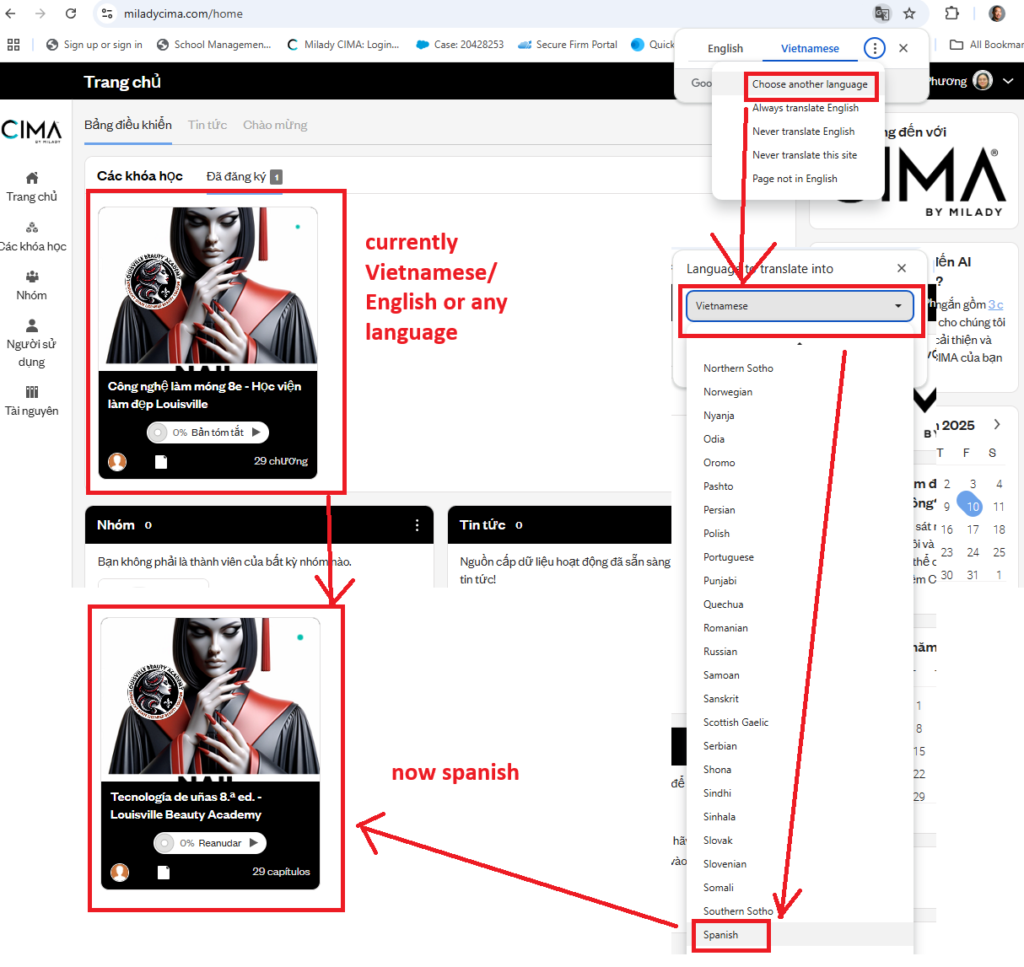
En un mundo cada vez más globalizado, la capacidad de aprender en el idioma nativo es crucial para el éxito académico. Louisville Beauty Academy, un líder en educación en belleza, garantiza la accesibilidad para estudiantes diversos enseñándoles cómo usar la función de traducción integrada de Google Chrome. Este tutorial describe los pasos para traducir materiales de estudio en línea, incluyendo contenido teórico, a varios idiomas como inglés, vietnamita, español, coreano y más. Esta guía es particularmente útil para prepararse para exámenes como el Examen de Licencia de la Junta Estatal de Kentucky en cualquier idioma permitido.
Guía Paso a Paso para Traducir Contenido en Línea
1. Abre el Contenido en Línea
Navega a la plataforma de aprendizaje en línea o al sitio web de Louisville Beauty Academy mediante Google Chrome.
Inicia sesión para acceder a los materiales de estudio o al contenido del curso.
2. Accede a la Función de Traducción de Google Chrome
En la esquina superior derecha de tu navegador Chrome, haz clic en el menú de tres puntos (o directamente encuentra el icono de Google Translate si está disponible).
Selecciona la opción Traducir esta página para abrir la herramienta de traducción.
3. Elige Tu Idioma Preferido
Aparecerá un menú con opciones para traducir la página.
Por defecto, Chrome puede intentar traducir al inglés (si el contenido está en otro idioma).
Haz clic en el menú desplegable para ver la lista de idiomas compatibles.
Selecciona tu idioma preferido de la lista, como vietnamita, español o coreano.
4. Traduce Toda la Página
Una vez que elijas un idioma, Chrome traducirá instantáneamente todo el texto visible en la página, incluyendo descripciones de cursos, títulos de módulos e instrucciones.
Para el estudio teórico, esto te permitirá seguir el contenido en tu idioma nativo.
5. Confirma la Configuración de Idioma
Para garantizar una experiencia fluida, configura tu idioma preferido como predeterminado para futuras traducciones.
Haz clic en el icono de configuración (engranaje) dentro de la barra de herramientas de Traducción y elige “Siempre traducir [idioma]”.
Beneficios de Usar la Función de Traducción de Chrome
Accesibilidad: Permite que los estudiantes que no hablan inglés estudien de manera efectiva, superando barreras lingüísticas.
Inclusividad: Apoya la preparación para exámenes de licencia en el idioma preferido del estudiante, en concordancia con las normas de la Junta Estatal de Kentucky.
Eficiencia: Las traducciones instantáneas ahorran tiempo en comparación con la interpretación manual o el uso de herramientas externas.
Personalización: Los estudiantes pueden cambiar de idioma según lo necesiten, promoviendo una experiencia de aprendizaje personalizada.
Idiomas Compatibles con Google Chrome
La herramienta de traducción admite una amplia variedad de idiomas, incluyendo pero no limitado a:
Inglés
Vietnamita
Español
Coreano
Francés
Chino
Tagalo
Aplicaciones Prácticas para Estudiantes
Estudio Teórico: Traduce el material del curso al idioma necesario para tus exámenes.
Aprendizaje Interactivo: Explora los recursos del curso en un idioma con el que te sientas más cómodo.
Asistencia para la Navegación: Aprende cómo operar el sistema escolar y el sitio web en tu idioma preferido.
Enseñando a los Estudiantes a Usar la Traducción de Chrome
Durante la orientación o las clases iniciales, los instructores pueden demostrar este proceso a los estudiantes:
Muestra cómo acceder a la herramienta de traducción mediante el uso compartido de pantalla en vivo.
Proporciona una guía impresa o digital con capturas de pantalla (como la anterior).
Asegúrate de que los estudiantes practiquen la traducción del sitio web para familiarizarse con el proceso.
Conclusión
Aprovechando las capacidades de traducción de Google Chrome, Louisville Beauty Academy empodera a sus estudiantes para superar las barreras lingüísticas y centrarse en dominar su oficio. Ya sea que te estés preparando para un examen de licencia o profundizando en técnicas avanzadas de belleza, traducir el contenido a tu idioma nativo garantiza una experiencia de aprendizaje más fluida e inclusiva. ¡Empieza hoy y desbloquea tu máximo potencial!
In an increasingly globalized world, the ability to learn in one’s native language is crucial for academic success. Louisville Beauty Academy, a leader in beauty education, ensures accessibility for diverse students by teaching them how to use Google Chrome’s built-in translation feature. This tutorial outlines the steps to translate online study materials, including theory content, into various languages such as English, Vietnamese, Spanish, Korean, and more. This guide is particularly useful for preparing for exams like the Kentucky State Board Licensing Exam in any supported language.
Step-by-Step Guide to Translating Online Content
1. Open the Online Content
Navigate to the Louisville Beauty Academy’s online learning platform or website via Google Chrome.
Log in to access the study materials or course content.
2. Access the Google Chrome Translation Feature
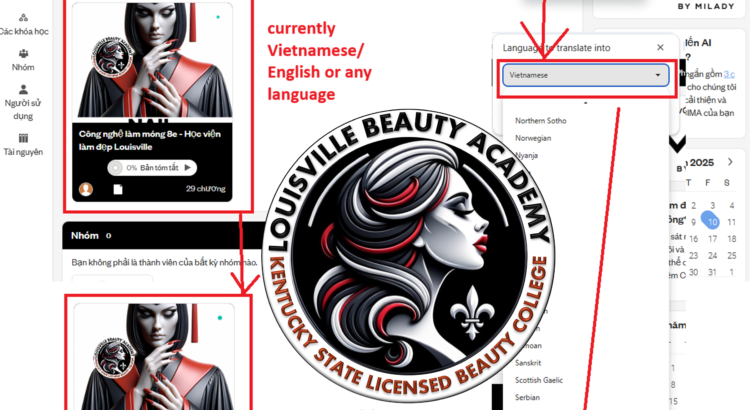
In the top right corner of your Chrome browser, click the three-dot menu (or directly find the Google Translate icon if available).
Select the Translate this page option to open the translation tool.
3. Choose Your Desired Language
A menu will appear with options to translate the page.
By default, Chrome may attempt to translate into English (if the content is in another language).
Click the dropdown menu to see the list of supported languages.
Select your preferred language from the list, such as Vietnamese, Spanish, or Korean.
4. Translate the Entire Page
Once you choose a language, Chrome will instantly translate all visible text on the page, including course descriptions, module titles, and instructions.
For theory study, this will enable you to follow along in your native language.
5. Confirm the Language Settings
To ensure a seamless experience, set your preferred language as the default for future translations.
Click the Settings (gear icon) within the Translate toolbar and choose “Always translate [language].”
Benefits of Using Chrome’s Translation Feature
Accessibility: Enables non-English speakers to study effectively, overcoming language barriers.
Inclusivity: Supports preparation for licensing exams in the student’s preferred language, matching Kentucky State Board allowances.
Efficiency: Instant translations save time compared to manually interpreting or using external tools.
Customization: Students can switch languages as needed, promoting a personalized learning experience.
Languages Supported by Google Chrome
The translation tool supports a wide range of languages, including but not limited to:
English
Vietnamese
Spanish
Korean
French
Chinese
Tagalog
Practical Applications for Students
Theory Study: Translate course material into the language required for your exams.
Interactive Learning: Explore course resources in a language you’re most comfortable with.
Navigation Assistance: Learn how to operate the school system and website in your preferred language.
Teaching Students to Use Chrome Translation
During orientation or initial classes, instructors can demonstrate this process to students:
Show how to access the translation tool via live screen sharing.
Provide a printed or digital guide with screenshots (like the one above).
Ensure students practice translating the website to become familiar with the process.
Conclusion
By leveraging Google Chrome’s translation capabilities, Louisville Beauty Academy empowers its students to overcome language barriers and focus on mastering their craft. Whether you’re preparing for a licensing exam or diving into advanced beauty techniques, translating content into your native language ensures a smoother and more inclusive learning journey. Start today and unlock your full potential!
This article is part of LBA’s public education and historical archive. Older posts, including “Comprehensive Guide to the Kentucky PSI Nail Technician Licensing Exam: Top 500 Questions and Answers,” may not reflect current tuition, schedules, incentives, forms, policies, testing vendors, clinic availability, or regulatory requirements.
PSI Nail Technician Licensing Exam — 500-Question Master Exam Bank
PSI-Complexity | Scenario-Based | Tricky Distractors | Kentucky State Law Aligned
Prepared for LBA Students & Graduates — 2026
How to use this bank: Every question includes four answer choices, the correct answer marked with ✔, and a full explanation of WHY that answer is correct. Correct answers are marked in bold. LBA standard: aim for 90%+ before sitting for PSI.
SECTION 1: NAIL ANATOMY & STRUCTURE (Questions 1–30)
1. A client sustains a deep cut at the base of her nail during an accident. Six months later, her new nail grows out deformed. Which structure was most likely damaged?
A. Nail plate B. Nail bed C. Matrix ✔ D. Hyponychium
Why C is correct: The matrix is the only structure that produces all nail plate cells. It contains stem cells that divide continuously to form the nail plate. When the matrix is injured — even by a single traumatic event — the cells it generates are permanently altered, causing the nail that grows out to be deformed, ridged, or misshapen. The nail plate (A) is the product of the matrix, not the producer. The nail bed (B) supports the plate but does not produce it. The hyponychium (D) is a seal under the free edge.
2. The hyponychium is BEST described as:
A. The whitish half-moon at the nail base B. The fold of skin at the nail sides C. The seal of skin under the free edge ✔ D. Living skin directly over the matrix
Why C is correct: The hyponychium is the thickened skin located under the free edge of the nail plate, at the point where the nail separates from the fingertip. It forms a watertight seal that blocks bacteria and debris from entering the space between the nail plate and nail bed. The lunula (A) is the visible portion of the matrix. The lateral nail fold (B) frames the sides. The eponychium (D) sits over the matrix.
3. A client’s lunula appears unusually large and pale. This most directly reflects the condition of which structure?
A. Nail bed B. Matrix ✔ C. Hyponychium D. Nail groove
Why B is correct: The lunula IS the visible distal portion of the matrix. It appears white or pale because the cells it contains are still immature — they have not yet fully keratinized. A large lunula means a large, active matrix. Changes in lunula color or size directly reflect what is happening in the matrix. The nail bed (A) sits under the transparent plate but does not form the lunula. The hyponychium and nail groove have no visible connection to the lunula.
4. Which nail structure contains nerves and blood vessels that nourish the nail plate?
A. Nail mantle B. Bed epithelium C. Free edge D. Nail bed ✔
Why D is correct: The nail bed is richly supplied with blood vessels that deliver nutrients and oxygen to the nail plate from below, and it contains sensory nerve endings that give the nail area its tactile sensitivity. This is why the nail plate appears pink — blood in the nail bed shows through the transparent plate. The nail mantle (A) is the skin fold covering the root. The bed epithelium (B) is the thin layer that creates adhesion, not vascular supply. The free edge (C) has no underlying support.
5. The bed epithelium is significant because it:
A. Produces the nail plate B. Guides the nail plate as it grows forward ✔ C. Prevents bacterial entry under the free edge D. Forms the lunula
Why B is correct: The bed epithelium acts as a track or rail system that adheres the nail plate to the nail bed and guides it forward as it grows distally. When this layer is disrupted — by trauma, disease, or chemicals — the nail plate loses its guide rail and begins to separate from the bed (onycholysis). The matrix (A) produces the plate. The hyponychium (C) prevents bacterial entry. The lunula (D) is formed by the matrix.
6. The eponychium differs from the cuticle in that the eponychium is:
A. Non-living skin B. Living skin at the nail base covering the matrix ✔ C. The nail groove lining D. The hyponychium of toenails
Why B is correct: This is a classic PSI distinction. The eponychium is the living skin at the proximal nail fold — it is alive, attached, and should never be cut aggressively. The cuticle, by contrast, is the dead, colorless tissue that is shed from the underside of the eponychium onto the surface of the nail plate. Students confuse these constantly. Cutting the cuticle (dead tissue) is acceptable. Cutting the eponychium (living skin) risks bleeding and infection.
7. Nails are composed primarily of which protein?
A. Collagen B. Elastin C. Hard keratin ✔ D. Melanin
Why C is correct: Nails are made of hard keratin — a tightly packed, cross-linked, sulfur-rich protein that is denser and far less flexible than the soft keratin found in skin and hair. Hard keratin’s unique molecular structure gives nails their rigidity and durability. Collagen (A) is a structural protein in connective tissue. Elastin (B) provides elasticity in skin. Melanin (D) is a pigment, not a structural protein.
8. On which finger does the nail grow the FASTEST?
A. Thumb B. Index finger C. Middle finger ✔ D. Ring finger
Why C is correct: The middle finger — being the longest finger — receives the greatest blood circulation of all the digits. Blood flow delivers the nutrients needed by the matrix to produce new cells rapidly. More blood flow = faster nail cell production = faster growth. The dominant hand also grows faster than the non-dominant hand overall, for the same reason (more use = more circulation).
9. Average nail growth per month is approximately:
A. 1/4 inch B. 1/10 inch ✔ C. 1/2 inch D. 1/8 inch
Why B is correct: The average fingernail grows approximately 1/10 of an inch (about 2.5mm) per month. This is the standard that informs fill scheduling — at 1/10 inch per month, a fill every 2–3 weeks addresses approximately 1/16 to 1/8 inch of regrowth. This rate slows with age, poor circulation, cold weather, and nutritional deficiencies.
10. The nail plate is attached to the nail bed by which structure?
A. Lunula B. Matrix C. Bed epithelium ✔ D. Nail mantle
Why C is correct: The bed epithelium is the thin, specialized layer of cells that both creates adhesion between the nail plate and nail bed AND serves as the guide track for forward nail growth. It forms the actual attachment bond between the plate and bed. Without intact bed epithelium, the plate separates (onycholysis). The matrix (B) produces the plate; the lunula (A) marks the matrix; the mantle (D) covers the root.
11. Which part of the nail is considered a ‘stress area’ most vulnerable to breakage?
A. The area near the cuticle B. The free edge C. The area where the nail tip transitions to the natural nail ✔ D. The lunula
Why C is correct: The stress area — sometimes called the “shoulder” of the nail — is the zone where an artificial tip blends into the natural nail plate. This is inherently the thinnest and mechanically weakest point of the enhancement, because it must be feathered down to nothing to create a seamless transition. All bending force during everyday activities concentrates here. This is why the apex of an acrylic nail must be positioned over this zone for reinforcement.
12. A technician notices the nail plate has a yellow-brown discoloration that starts from the free edge inward. The MOST likely cause is:
A. Matrix damage B. Nail staining from polish or smoking ✔ C. Damage to the nail bed only D. Healthy nail growth
Why B is correct: Staining that begins at the free edge and progresses inward follows the direction of nail growth — meaning the contact with the staining agent (dark polish without base coat, or nicotine from smoking) occurred at the free edge first and over time moved inward as new nail grew. Matrix damage (A) would produce deformity originating at the base, not the free edge. The pattern (free edge → inward) is the diagnostic clue.
13. The nail mantle is the:
A. Dead cuticle tissue B. Deep fold of skin that covers the nail root ✔ C. Seal under the free edge D. Connection between the nail groove and nail bed
Why B is correct: The nail mantle is the deep pocket of skin at the proximal end of the nail — a fold that conceals and protects the nail root and proximal matrix from environmental exposure. It is the “sleeve” that the nail root sits inside. The dead cuticle tissue (A) is the cuticle shed from the underside of the proximal nail fold. The hyponychium (C) seals under the free edge.
14. Which statement about nail growth is MOST accurate?
A. Nails grow fastest in cold climates B. Dominant hand nails grow faster due to increased circulation ✔ C. Toenails grow at the same rate as fingernails D. Growth rate is unaffected by nutrition
Why B is correct: Greater use of the dominant hand increases blood circulation through those fingers. Improved circulation delivers more nutrients and oxygen to the matrix, which accelerates cell division and therefore growth. This is consistently observed — technicians often notice dominant-hand regrowth is more prominent at fill appointments. Cold (A) slows growth. Toenails (C) grow 3–4x more slowly. Nutrition (D) directly affects growth rate.
15. The nail plate is translucent; its pinkish color comes from:
A. Melanin in the plate B. Blood in the nail bed beneath it ✔ C. Keratin pigmentation D. The lunula color
Why B is correct: The nail plate itself is colorless and transparent. The pink appearance of a healthy nail is entirely due to the rich blood supply in the nail bed shining through the plate. This is why nails turn white when pressed (compresses the blood vessels) and return to pink when released. This is also why nail bed pallor can indicate anemia or poor circulation. Keratin is colorless; melanin is not typically deposited in the nail plate.
16. Nail grooves are channels located:
A. Under the free edge B. Along the sides of the nail plate ✔ C. At the base of the nail near the matrix D. Between the nail bed and hyponychium
Why B is correct: Nail grooves (also called lateral grooves) run along both sides of the nail plate, forming the channels between the nail plate and the lateral nail folds. They literally act as railroad tracks — guiding the nail plate in a straight, forward direction as it grows. Disruption of these grooves can cause ingrown nails, as the nail loses its directional guide.
17. When comparing fingernail and toenail anatomy, which statement is TRUE?
A. Toenails have no lunula B. Toenails grow faster than fingernails C. Toenails and fingernails share identical structure but toenails grow more slowly ✔ D. Toenails have a different matrix
Why C is correct: The structural anatomy — matrix, nail bed, plate, hyponychium, lunula, grooves — is identical between fingernails and toenails. The difference is rate of growth: toenails grow approximately 3–4 times more slowly than fingernails, primarily due to lower blood circulation in the feet compared to the hands. This is why toenail diseases progress more slowly and toenails take longer to regrow after loss.
18. The FREE EDGE of the nail is the portion that:
A. Lies directly over the nail bed B. Extends beyond the fingertip with no underlying support ✔ C. Contains the matrix cells D. Is covered by the cuticle
Why B is correct: The free edge is the distal portion of the nail plate that has grown past the fingertip and the hyponychium, meaning it is no longer supported by the nail bed below. This unsupported state is why the free edge is prone to breakage and why the hyponychium’s seal is critical — once the plate passes that seal, it has no protection from below. The matrix (C) is at the proximal base, not the free edge.
19. Increased blood flow to the fingers will MOST likely result in:
A. Slower nail growth B. Thicker nail plate C. Faster nail growth ✔ D. Discoloration of the lunula
Why C is correct: Blood flow is the delivery system for all nutrients, oxygen, and metabolic inputs the matrix needs to produce new nail cells. More blood flow = more raw materials = more rapid cell division = faster nail growth. This is why pregnancy (increased circulation), warm weather, and dominant-hand use all speed up nail growth. Cold temperatures and circulatory disorders do the opposite.
20. Which of the following CORRECTLY pairs the nail structure with its function?
A. Hyponychium — produces nail cells B. Matrix — seals the free edge C. Lunula — visible portion of the matrix ✔ D. Nail bed — forms the cuticle
Why C is correct: The lunula IS the visible distal portion of the matrix — the semicircular white arc at the nail base. It appears white because the newly produced cells from the matrix have not yet completed keratinization and are still opaque. The hyponychium (A) seals the free edge, it doesn’t produce cells. The matrix (B) produces cells. The cuticle (D) is shed from the proximal nail fold, not the nail bed.
21. A client says her nails ‘never seem to grow.’ Which condition is MOST likely responsible?
A. Over-buffing the nail plate B. Poor circulation or nutritional deficiency ✔ C. Overuse of cuticle oil D. Frequent gel polish applications
Why B is correct: The matrix requires a continuous supply of nutrients and oxygen via blood circulation to divide and produce new cells. When circulation is impaired (due to cardiovascular conditions, cold, Raynaud’s disease) or when nutritional deficiencies exist (especially protein, iron, biotin), the matrix slows its production. The nail appears to stop growing or grows extremely slowly. Over-buffing (A) thins what already grew — it doesn’t stop growth.
22. The nail root is located:
A. Under the free edge B. Beneath the hyponychium C. Under the proximal nail fold ✔ D. In the center of the nail plate
Why C is correct: The nail root is the most proximal (closest to the body) portion of the nail plate, buried beneath the proximal nail fold (also called the nail mantle). It is here that new nail cells are added from the matrix. The root is not visible in a normal, healthy nail. The hyponychium (B) is at the opposite end — under the free edge. The free edge (A) is the distal terminus, not the root.
23. If a nail technician consistently over-files the nail plate, the MOST likely long-term result is:
A. Thicker nails B. Faster nail growth C. Onycholysis (separation from bed) ✔ D. Increased lunula size
Why C is correct: Aggressive, repeated filing thins the nail plate progressively over time. A thinned plate weakens the bed epithelium adhesion and reduces the mechanical integrity that holds the plate to the bed. Eventually, the nail plate begins to separate from the nail bed — a condition called onycholysis. Once the plate separates, moisture and bacteria can enter the space, creating further problems. This is one of the most common iatrogenic (technician-caused) nail injuries.
24. The lateral nail fold serves to:
A. Produce nail cells B. Frame and protect the sides of the nail plate ✔ C. Connect the plate to the free edge D. Seal beneath the hyponychium
Why B is correct: The lateral nail folds (also called side walls) are the skin walls that run along both sides of the nail plate, forming the physical boundary of the nail unit. They protect the nail plate edges from environmental damage, frame the nail aesthetically, and, together with the nail grooves, guide the plate forward in a straight line. They do not produce cells (that’s the matrix), and they are not at the free edge (that’s the hyponychium).
25. Which nail component is the ONLY one that can regenerate a complete new nail if removed?
A. Nail bed B. Nail plate C. Matrix ✔ D. Eponychium
Why C is correct: The matrix is the only structure capable of producing a complete new nail plate from scratch because it contains the stem cells responsible for nail cell generation. If the matrix is intact and undamaged, a nail that is lost (due to trauma, avulsion, or disease) will regrow completely over 4–6 months. If the nail bed is removed but the matrix survives, the nail still regrows. If the matrix is permanently destroyed, no nail can regrow on that finger.
26. Nails grow continuously because the matrix:
A. Produces new cells that push older cells forward B. Draws fluid from the nail bed C. Receives melanin from the nail groove D. Connects to muscle tissue
Why A is correct: Nail growth is driven by continuous mitotic cell division in the matrix. As new cells are produced at the proximal end, they push the previously existing cells forward (distally toward the free edge). The older cells flatten, harden, and die through keratinization as they travel. This conveyor-belt mechanism is the engine of continuous nail growth. Fluid, melanin, and muscle connections play no role in this process.
27. The term ‘proximal nail fold’ refers to:
A. The skin under the free edge B. The tissue at the base of the nail that covers the root ✔ C. The lateral nail wall D. The visible half-moon shape
Why B is correct: Proximal means “closer to the body” (vs. distal = away from the body). The proximal nail fold is the flap of skin at the base of the nail unit that folds back over and covers the nail root and matrix. It is also called the nail mantle. The hyponychium (A) is under the free edge (distal). The lateral nail wall (C) is on the sides. The lunula (D) is the visible half-moon.
28. Which change in the lunula would MOST concern a nail technician?
A. Slightly visible lunula on the thumbnail B. No visible lunula on the little finger C. Bluish lunula on all fingers ✔ D. Pale white lunula on the index finger
Why C is correct: A bluish lunula across all fingers suggests a systemic cardiovascular or pulmonary issue — the color indicates inadequate oxygenation of blood reaching the matrix. This is a systemic warning sign, not a local nail issue. A technician should document it and strongly recommend the client see a physician. Having no visible lunula on the little finger (B) is completely normal. A pale white lunula (D) is normal.
29. Nail cells produced by the matrix undergo which process before forming the hard plate?
A. Melanization B. Keratinization ✔ C. Collagenization D. Oxidation
Why B is correct: As matrix cells travel forward from their origin, they undergo keratinization — a biological process in which cells fill with hard keratin protein, lose their nuclei, flatten, and die. This transformation from soft living cells to hard, dead, tightly-packed keratin cells creates the nail plate’s density and hardness. Melanization (A) is for pigment. Collagenization is not a biological process. Oxidation is a chemical reaction, not a cellular process.
30. Which statement about the cuticle is MOST accurate for PSI exam purposes?
A. Cuticle is living tissue and must never be cut B. Cuticle is dead tissue shed from the underside of the proximal nail fold ✔ C. Cuticle produces nail plate cells D. Cuticle and eponychium are the same structure
Why B is correct: This is a critical PSI distinction. The TRUE cuticle is the dead, colorless, translucent tissue that is shed from the underside of the proximal nail fold onto the surface of the nail plate. It is non-living and can be safely removed. The EPONYCHIUM is the living skin. These are two different structures. Confusing them — especially cutting the living eponychium thinking it is cuticle — is dangerous and a common source of exam errors.
SECTION 2: NAIL DISEASES & DISORDERS (Questions 31–70)
31. A client presents with a nail that has separated from the nail bed without any sign of infection or discoloration. This condition is MOST likely:
A. Onychomycosis B. Onycholysis ✔ C. Paronychia D. Onychocryptosis
Why B is correct: Onycholysis is defined as separation of the nail plate from the nail bed, without infection. The key differentiator here is “no sign of infection or discoloration” — the nail simply lifts away. Causes include trauma, aggressive manicuring, certain medications, thyroid disease, and nail psoriasis. Onychomycosis (A) would show discoloration/thickening. Paronychia (C) is infection of the nail fold. Onychocryptosis (D) is ingrown nail.
32. You notice a client’s nail plate is yellow-green and thickened with a foul odor. This MOST strongly suggests:
A. Leukonychia B. Melanonychia C. Onychomycosis with bacterial involvement ✔ D. Beau’s lines
Why C is correct: The triad of yellow-green color + thickening + foul odor is the classic presentation of a co-infection: fungal infection (onychomycosis) creating the thickening and discoloration, combined with bacterial involvement (often Pseudomonas) producing the foul odor and green tinting. Service must be refused, and the client must be referred to a physician. Covering with product would trap moisture and dramatically worsen the infection.
33. Beau’s lines are horizontal grooves across the nail plate. They indicate:
A. Chronic vitamin deficiency only B. A systemic illness or trauma that temporarily interrupted matrix function ✔ C. Onychomycosis D. Habitual nail biting
Why B is correct: Beau’s lines are horizontal indentations running across the full width of the nail plate. They form when the matrix temporarily stops or slows cell production — typically due to a high fever, major illness (cardiac event, surgery, severe infection), systemic shock, or significant trauma. Because nails grow at ~1/10 inch per month, the position of the groove in the nail tells you approximately when the disruption occurred. They are a historical record of body stress events.
34. A client with psoriasis may present with which nail symptom that resembles fungal infection?
A. Blue nails B. Pitting of the nail plate ✔ C. Onychophagy D. Smooth, shiny nail surface
Why B is correct: Psoriatic nail disease often manifests as pinpoint pitting (tiny cup-shaped depressions) in the nail plate surface, along with oil-drop discoloration and nail thickening — all of which can look similar to fungal infection. This is a significant clinical challenge because the treatments are entirely different. A nail technician cannot diagnose which condition is present; physician referral is required when either is suspected.
35. Paronychia is BEST described as:
A. Separation of the nail from the bed B. Inflammation or infection of the skin surrounding the nail ✔ C. Excessive nail curvature D. Nail biting disorder
Why B is correct: Paronychia is inflammation — and typically infection — of the nail fold tissue surrounding the nail plate, specifically the proximal and lateral nail folds. It can be acute (bacterial, usually Staphylococcus aureus or Streptococcus) or chronic (fungal, usually Candida). Signs include redness, swelling, pain, and pus. Service is absolutely contraindicated. All other choices describe different conditions entirely.
36. When should a nail technician REFUSE service due to a nail condition?
A. Client has very thin nails B. Client has visible fungal infection or open wounds ✔ C. Client has vertical ridges D. Client has brittle nails
Why B is correct: The standard PSI rule: service is contraindicated when there is (1) a visible, active infection (fungal, bacterial, or viral), or (2) open wounds. Both create a risk of spreading infection — either to the client’s other nails or to the technician. Thin nails (A), vertical ridges (C), and brittle nails (D) are cosmetic or structural conditions that do not prevent service; they require modification of technique and product selection.
37. Onychorrhexis refers to:
A. Thickened, claw-like nails B. Brittle nails with vertical ridges that split ✔ C. Nail separation from bed D. Spoon-shaped nails
Why B is correct: Onychorrhexis is characterized by longitudinal (vertical) ridging and splitting/peeling of the nail plate, combined with brittleness. It is caused by excessive dryness, iron deficiency, aging, or repeated chemical exposure. Treatment involves hydration, cuticle oil, and gentler nail practices. It is distinct from: Onychauxis (A, thickening), Onycholysis (C, separation), and Koilonychia (D, spoon shape).
38. A nail that is concave or spoon-shaped is called:
A. Onychauxis B. Koilonychia ✔ C. Onychogryphosis D. Onychorrhexis
Why B is correct: Koilonychia (from the Greek “koilos” = hollow) is a condition in which the nail plate curves upward at the edges, creating a spoon shape. It is strongly associated with iron-deficiency anemia (the most common cause), as well as thyroid disorders. The nail plate literally curves concave rather than convex. Onychauxis = thickening; Onychogryphosis = ram’s horn curvature; Onychorrhexis = brittle vertical ridging.
39. Onychauxis is characterized by:
A. Extreme thinning of the nail plate B. Abnormal overgrowth/thickening of the nail plate ✔ C. Horizontal ridges D. Detachment from the nail bed
Why B is correct: Onychauxis is nail hypertrophy — abnormal thickening and overgrowth of the nail plate. The nail becomes noticeably thicker than normal, may change color, and can curve. Common causes include repeated trauma, systemic disease, or poor circulation. Gentle filing to reduce thickness is acceptable, but if the underlying cause is uncertain, physician referral is advisable. It is the opposite of thinning (A).
40. A client has a nail that curves dramatically inward and downward, resembling a ram’s horn. This condition is:
A. Koilonychia B. Onychogryphosis ✔ C. Onychorrhexis D. Onychia
Why B is correct: Onychogryphosis — literally “griffin claw” — is a severe nail deformity in which the nail plate thickens and curves dramatically downward and sometimes laterally, resembling a ram’s horn or claw. It is most common in elderly toenails, particularly when nails have been neglected for extended periods. It requires referral to a podiatrist for safe management, as improper trimming can cause serious injury.
41. Leukonychia (white spots on the nail plate) is MOST commonly caused by:
A. Calcium deficiency B. Minor trauma to the nail matrix ✔ C. Fungal infection beginning D. Overuse of acrylic
Why B is correct: This is one of the most commonly misunderstood nail facts. White spots (leukonychia punctata) are caused by minor, often forgotten impacts to the matrix — bumping a finger, pressing on the nail, etc. — that create small air pockets within the nail plate during its formation. They are NOT caused by calcium deficiency, which is a persistent popular myth. As the nail grows, the spots travel toward the free edge and eventually grow off.
42. Tinea unguium is another term for:
A. Paronychia B. Ringworm of the nail (nail fungus) ✔ C. Athlete’s foot D. Onycholysis
Why B is correct: Tinea unguium is the medical/Latin term for dermatophyte (fungal) infection of the nail, also commonly called onychomycosis. “Tinea” refers to a dermatophyte (ringworm fungus) infection of various body sites. Tinea pedis = athlete’s foot (foot skin). Tinea unguium = nails. Tinea capitis = scalp. All are caused by related fungi. PSI may use either the Latin or common name — know both.
43. Which condition results from habitual nail biting?
A. Onychophagy ✔ B. Pterygium C. Onychorrhexis D. Onychia
Why A is correct: Onychophagy is the medical term for compulsive nail biting. It results in shortened, irregular nail plates, rough free edges, inflammation of the surrounding skin, and elevated infection risk due to broken skin and oral bacteria introduced to the nail area. Note: this is one of the few questions in the bank where A is the correct answer — a deliberate PSI-style trick to prevent pattern-selecting on “B.”
44. Pterygium is MOST accurately defined as:
A. Excessive skin growth over the nail plate from the proximal nail fold ✔ B. Separation of the nail plate C. Thickened toenails D. Ingrown nail condition
Why A is correct: Pterygium is the abnormal forward growth of skin from the proximal nail fold onto and over the nail plate surface. In severe cases, the skin can adhere to the plate and grow all the way to the free edge, essentially eliminating the nail surface. It is associated with trauma, lichen planus, or systemic disease. Service around the area requires caution; severe pterygium warrants physician evaluation.
45. When a nail turns a blue or purple color, the nail technician should FIRST:
A. Apply extra base coat B. Document the color and refer client to a physician ✔ C. Perform a deeper soak D. Apply cuticle oil immediately
Why B is correct: Blue or purple nail discoloration (cyanosis) suggests that blood reaching the nail bed is inadequately oxygenated — typically indicating a cardiovascular or pulmonary issue. This is completely outside the scope of a nail technician’s practice. The appropriate professional response is to (1) note the observation, (2) document it in the client record, and (3) strongly recommend the client consult a physician before any service is performed.
46. Onychia is BEST described as:
A. Inflammation of the nail unit, especially the matrix ✔ B. Separation of the nail plate from bed C. Nail pitting from psoriasis D. Brittle nails from aging
Why A is correct: Onychia is inflammation of the nail unit — particularly the matrix. It typically results from bacterial invasion and can be severe enough to destroy matrix cells, causing permanent nail deformity or loss if untreated. Unlike paronychia (which affects the skin folds around the nail), onychia attacks the nail unit itself. Immediate physician referral and antibiotic treatment are required.
47. A nail that has separated from the bed and is also infected with green discoloration indicates:
A. Onycholysis only B. Pseudomonas aeruginosa bacterial infection ✔ C. Normal nail staining D. Polish reaction
Why B is correct: The combination of nail plate separation (onycholysis creating a moist pocket) + green-black discoloration is the textbook presentation of Pseudomonas aeruginosa infection. Pseudomonas is a gram-negative bacterium that thrives in moist, oxygen-depleted environments — exactly the conditions created when a nail separates from the bed. The critical rule: NEVER cover with acrylic or any product, as this traps the bacteria and dramatically worsens the infection.
48. Which nail disorder may appear similar to tinea unguium but is caused by psoriasis?
A. Koilonychia B. Oil drop discoloration and pitting ✔ C. Onychogryphosis D. Onychia
Why B is correct: Psoriatic nail disease produces a distinctive constellation: oil-drop (salmon-patch) discoloration visible through the plate, pinpoint pitting of the plate surface, thickening, and sometimes onycholysis — all of which closely mimic fungal infection. The clinical challenge is significant because antifungal treatment does nothing for psoriasis. A technician must refer to a physician for proper diagnosis rather than assuming either condition.
49. An ingrown toenail is called:
A. Onychogryphosis B. Onychocryptosis ✔ C. Paronychia D. Onychophagy
Why B is correct: Onychocryptosis (from Greek “kryptos” = hidden) is the condition where the nail plate grows into the lateral nail fold, embedding in the surrounding soft tissue. It causes pain, inflammation, and if untreated, bacterial infection. Common causes include improper trimming (curved instead of straight), tight footwear, and trauma. Nail technicians must refer clients with onychocryptosis to a podiatrist; attempting treatment is outside scope of practice.
50. A client presents with a nail that is very short, ragged, and has bite marks visible. The technician should:
A. Refuse service due to infection risk B. Provide gentle manicure and nail-strengthening treatment if skin is intact ✔ C. Immediately apply acrylic to cover damage D. Tell the client to stop biting
Why B is correct: PSI philosophy: when skin is intact (no open wounds, no infection), service is appropriate with modifications. For a nail biter with intact, uninfected skin, a gentle manicure with a strengthening base coat is an entirely appropriate and professional service. Refusal (A) is only warranted when there is active infection or open wounds. Jumping to acrylic (C) before assessing is inappropriate. Telling a client to stop a behavior (D) is not therapeutic.
51. Melanonychia refers to:
A. White stripes on the nail plate B. Dark or black pigmentation in the nail plate ✔ C. Nail plate separation D. Curved ingrown nail
Why B is correct: Melanonychia refers to dark brown to black discoloration in the nail plate, typically appearing as a longitudinal band (melanonychia striata). It can be caused by benign melanocyte activation (common in darker-skinned individuals and often normal), systemic medications, trauma, or — in concerning cases — subungual melanoma. Any single-nail, asymmetric, expanding dark band in a Caucasian client warrants urgent medical referral (Hutchinson’s sign).
52. Vertical ridges running from base to free edge are:
A. Always a sign of fungal infection B. A normal sign of aging or mild dryness ✔ C. Caused by biting the nails D. Indicative of matrix damage only
Why B is correct: Longitudinal ridges — running vertically from the cuticle to the free edge — are one of the most common nail variations and are almost universally benign. They become more pronounced with age as the matrix becomes less regular in its cell production. Mild dryness and nutritional factors also contribute. They are treated cosmetically with a ridge-filling base coat. They are NOT fungal infection, not from nail biting, and do not indicate serious matrix damage.
53. Tinea pedis is a contraindication for pedicure because it is:
A. A bacterial nail infection B. A contagious fungal infection of the feet/skin ✔ C. An inflammatory condition D. A form of eczema
Why B is correct: Tinea pedis (athlete’s foot) is caused by dermatophyte fungi and is highly contagious — it spreads readily through shared tools, foot baths, and surfaces. Performing a pedicure on a client with active tinea pedis would risk spreading the infection to the nail plate (developing tinea unguium), to the technician, and to subsequent clients through contaminated equipment. Service must be refused until the condition is resolved.
54. A client’s thumbnail is much thicker than her other nails and appears yellowish. She denies any injury. The MOST likely diagnosis is:
A. Onychia B. Onychauxis or onychomycosis ✔ C. Koilonychia D. Leukonychia
Why B is correct: Isolated thickening with yellowing in the absence of reported trauma points to one of two conditions: onychauxis (benign nail hypertrophy) or onychomycosis (fungal infection). These can appear similar on visual inspection. Because a nail technician cannot definitively distinguish between them without laboratory testing, the appropriate response is to document the finding and refer the client to a physician for diagnosis — especially before applying any product.
55. Which condition is caused by a virus and appears as wart-like growths near or under the nail?
A. Paronychia B. Periungual verruca (wart) ✔ C. Onychia D. Tinea unguium
Why B is correct: Periungual verruca (warts around or under the nail) are caused by Human Papillomavirus (HPV). They appear as rough, raised growths around the nail folds or under the free edge. They are contagious and cannot be treated by a nail technician. Service in the immediate area must be refused and the client referred to a physician. Touching a wart during service could spread HPV to the technician or other clients via contaminated implements.
56. Hangnails (agnails) are BEST treated by:
A. Pulling them off quickly B. Trimming carefully with clean nippers and moisturizing ✔ C. Soaking in bleach D. Applying acrylic over them
Why B is correct: A hangnail is a small strip of dead skin that has separated at the sides or base of the nail. The correct treatment is to carefully trim the dead skin away using clean, disinfected nippers — cutting only the separated portion without pulling — and then applying a moisturizer to restore hydration. Pulling (A) tears deeper into living tissue, creating a wound and infection risk. Bleach (C) damages both skin and nail. Covering with acrylic (D) traps bacteria.
57. If a client shows signs of nail psoriasis, the nail technician should:
A. Apply strengthening treatment over psoriatic nails B. Proceed cautiously, avoid traumatizing the nail, and refer to a dermatologist ✔ C. Refuse all service permanently D. Use antifungal treatment
Why B is correct: Nail psoriasis is NOT contagious, so it is not an absolute contraindication the way fungal infection is. Gentle services are often possible. However, psoriatic nails are fragile, and trauma can trigger Koebner phenomenon (psoriasis spreading to the traumatized area). The technician should use minimal pressure, avoid aggressive filing or cuticle work, and recommend that the client have their nail psoriasis managed by a dermatologist. Antifungal treatment (D) has no effect on psoriasis.
58. Eggshell nails (thin, curved, flexible nails) are caused by:
A. Overuse of acetone B. Systemic conditions, poor nutrition, or certain medications ✔ C. Excessive buffing only D. Incorrect acrylic removal
Why B is correct: Eggshell nails — thin, pale, excessively flexible, sometimes curved at the free edge — are typically a reflection of internal systemic factors: anemia, malnutrition, thyroid disorders, or medications that affect nail plate production. While external factors like acetone overuse (A) can temporarily weaken nails, true eggshell nail presentation usually has a systemic origin. Treatment requires addressing the underlying cause; cosmetically, a ridge-filling base coat and protective strengthener help.
59. During service, you discover a client has a suspicious dark streak under the nail plate that she says has been there for months. You should:
A. Ignore it and continue service B. Cover it with dark polish C. Document it and strongly recommend physician evaluation for possible subungual melanoma ✔ D. Apply product to seal it
Why C is correct: A persistent dark longitudinal streak under the nail plate — especially one that has been present for months and is not clearly a known cause (e.g., not obviously from medication in a dark-skinned individual) — must be taken seriously. This is a potential Hutchinson’s sign, associated with subungual melanoma (a rare but deadly cancer). The technician’s obligation is to document the observation and urgently refer the client to a physician. Covering it (B) or ignoring it (A) could delay a life-saving diagnosis.
60. Which statement about onychomycosis is TRUE?
A. It can be treated with nail polish B. It is caused by a fungus and requires medical treatment; service must be refused ✔ C. It only affects toenails D. It is safe to perform enhancements over infected nails
Why B is correct: Onychomycosis is a fungal infection of the nail unit requiring prescription antifungal treatment (oral or topical). It cannot be resolved by nail polish or enhancement products. In fact, covering infected nails with any product traps moisture, warmth, and darkness — the perfect environment for fungi to proliferate. Service must be refused until the infection is treated and resolved. It can affect both fingernails and toenails, making choice C false.
61. A client has bright red, swollen skin at the nail fold with visible pus. The technician should:
A. Drain the pus and apply antiseptic B. Refuse service and refer to a physician immediately ✔ C. Apply antibacterial lotion and continue D. Buff the area lightly
Why B is correct: Visible pus at the nail fold indicates acute bacterial paronychia requiring antibiotic treatment from a physician. This is an active, infectious condition that is (1) outside the scope of nail technology practice, (2) potentially dangerous if manipulated without medical training, and (3) contagious to the technician. Draining pus (A) is a medical procedure. Antibacterial lotion (C) is inadequate for a suppurative infection. No service of any kind is appropriate.
62. Which skin condition of the feet is NOT a contraindication for pedicure?
A. Open blisters B. Active athlete’s foot C. Mild, intact calluses ✔ D. Plantar warts
Why C is correct: Mild, intact calluses (thickened, non-infected, non-broken skin on the heels or balls of the feet) are not only not a contraindication — they are often the primary reason clients seek pedicures. Filing and reducing calluses is a standard, appropriate pedicure service. Open blisters (A) = open wound = contraindicated. Athlete’s foot (B) = contagious fungal infection = contraindicated. Plantar warts (D) = HPV virus = contraindicated.
63. The MOST advanced stage of bacterial nail infection is indicated by:
A. Yellow nails B. White spots C. Greenish-black discoloration ✔ D. Horizontal ridges
Why C is correct: Greenish-black discoloration represents the most advanced stage of bacterial nail infection, typically caused by Pseudomonas aeruginosa in combination with other pathogens, often in a nail that has already separated from the bed. It indicates a deep, chronic, oxygen-depleted infection environment. Yellow nails (A) can indicate early fungal infection or other issues. White spots (B) are usually benign trauma. Horizontal ridges (D) indicate systemic illness, not infection severity.
64. Splinter hemorrhages under the nail plate appear as:
A. White dots B. Dark red or brown thin lines running lengthwise ✔ C. Yellow staining D. Horizontal white bands
Why B is correct: Splinter hemorrhages are tiny bleeds from capillaries in the nail bed that show through the translucent nail plate as thin, dark red or brown linear streaks running longitudinally (lengthwise). They can result from minor trauma or — when multiple splinter hemorrhages appear spontaneously — may indicate systemic disease such as infective endocarditis (heart valve infection) or vasculitis. A technician should document and refer if no traumatic cause is apparent.
65. A technician CANNOT legally:
A. Identify a possible nail disorder and suggest physician referral B. Diagnose, prescribe, or treat any nail disease ✔ C. Perform services on nails with vertical ridges D. File over mild nail discoloration
Why B is correct: This is a fundamental scope of practice principle. Diagnosis is the exclusive domain of licensed medical practitioners. A nail technician CAN and SHOULD identify visible nail abnormalities and suggest professional medical evaluation. But the technician CANNOT tell a client “you have fungal infection,” prescribe treatments, or perform procedures intended to treat medical conditions. Vertical ridges (C) and mild discoloration (D) do not prohibit service.
66. Clubbing of the nails (where the nail curves over a rounded, bulbous fingertip) is associated with:
A. Nutritional deficiency B. Cardiovascular or respiratory disease ✔ C. Excessive polish use D. Normal toenail growth pattern
Why B is correct: Nail clubbing — the bulbous enlargement of the fingertips with downward curvature of the nail plate — is a well-established clinical sign of chronic hypoxia (insufficient blood oxygen). Common underlying causes include congenital heart disease, chronic lung conditions (emphysema, pulmonary fibrosis, lung cancer), and cirrhosis. A nail technician observing clubbing for the first time should recommend medical evaluation if the client is unaware of their condition.
67. Terry’s nails (mostly white with a narrow pink band at the tip) are associated with:
A. Simple aging B. Liver disease, heart failure, or diabetes ✔ C. Excessive base coat use D. Nail biting
Why B is correct: Terry’s nails — where most of the nail appears white and opaque with only a small band of normal color at the free edge — are associated with serious systemic conditions including liver cirrhosis, congestive heart failure, and Type 2 diabetes. They occur because the blood vessels in the nail bed become compressed or altered. If a technician observes this pattern in a client who is unaware, recommending medical evaluation is the appropriate professional response.
68. Which condition involves the nail separating from the lateral nail wall?
A. Onycholysis B. Onychocryptosis C. Nail groove inflammation ✔ D. Pterygium
Why C is correct: When the nail plate separates from the lateral nail wall (the groove area), it typically involves inflammation of the nail groove — which, if progressive, can lead to onychocryptosis (ingrown nail) as the nail loses the guidance of the groove and embeds into the lateral fold. Onycholysis (A) is separation from the nail bed (below), not the lateral wall. Pterygium (D) is forward growth of skin over the plate.
69. Bitten nails present a service risk PRIMARILY because:
A. Products won’t adhere to short nails B. Torn skin and microbial entry points increase infection risk ✔ C. The lunula is damaged D. Filing is impossible
Why B is correct: The primary safety concern with bitten nails is not the length or product adhesion — it is the compromised skin integrity. Nail biting consistently creates small tears, abrasions, and micro-wounds in the skin around the nail folds, creating entry points for bacteria. Any product application, water exposure, or manipulation during service introduces microbial risk through these openings. If skin is actively broken or infected, service must be refused.
70. Which of the following nail disorders is a contraindication for ALL nail services?
A. Vertical ridges B. Mild koilonychia C. Active tinea unguium with open nail plate ✔ D. Eggshell nails
Why C is correct: Active tinea unguium (nail fungal infection) with an open or compromised nail plate is an absolute contraindication. “Open nail plate” means the plate has separated, thickened, or crumbled — creating direct access to the nail bed. Performing any service risks spreading the fungus to other nails, to the technician, and to tools that could transmit it to future clients. Vertical ridges (A), mild koilonychia (B), and eggshell nails (D) all permit service with modified technique.
71. Which decontamination level DESTROYS ALL microbial life including resistant spores?
A. Sanitizing B. Disinfecting C. Sterilizing ✔ D. Cleaning
Why C is correct: Sterilization is the highest level of decontamination and the ONLY level that destroys ALL microbial life, including bacterial spores — the most resistant life forms. In salons, sterilization is achieved via autoclave (steam under pressure). Disinfection (B) kills most pathogens but NOT spores. Sanitizing (A) only reduces microbial count to a safe level. Cleaning (D) physically removes debris but kills nothing. This three-tier hierarchy is a core PSI topic.
72. Disinfection differs from sterilization in that disinfection:
A. Destroys bacterial spores B. Kills most pathogens but NOT necessarily all spores ✔ C. Only reduces the number of pathogens to a safe level D. Is the highest level of decontamination
Why B is correct: Disinfection achieves a high level of microbial kill — effective against bacteria, viruses, and fungi — but standard disinfectants cannot reliably destroy bacterial spores. This is the critical distinction: disinfection ≠ sterilization. For nail salon implements, disinfection is the required standard (not sterilization) because implements are “non-critical” — they contact intact skin but not sterile body cavities. Sterilization is reserved for surgical instruments.
73. Sanitizing is BEST defined as:
A. Eliminating all microorganisms B. Reducing microbial count to a safe level on surfaces ✔ C. The same as sterilizing D. Killing all fungal spores
Why B is correct: Sanitizing is the lowest tier of decontamination. It reduces (but does not eliminate) the number of microorganisms on a surface to a level considered safe for public health. Handwashing is a sanitizing procedure. Sanitizing does not eliminate all pathogens, cannot destroy spores, and is not equivalent to disinfecting or sterilizing. It is often used for skin (antiseptic) and food-contact surfaces, not for nail implements between clients.
74. The FIRST step when decontaminating metal nail implements is:
A. Immerse in disinfectant B. Sterilize in autoclave C. Scrub with soap and water to remove debris ✔ D. Rinse with alcohol
Why C is correct: The decontamination chain ALWAYS starts with physical cleaning before any chemical disinfection. Organic material (skin cells, blood, oils, product residue) on implements forms a physical barrier that prevents disinfectant chemicals from making contact with microbial surfaces. You cannot disinfect through a layer of debris. This sequence — clean FIRST, disinfect SECOND, store THIRD — is one of the most frequently tested PSI infection control concepts.
75. Implements should remain immersed in EPA-registered disinfectant for:
A. 5 minutes minimum B. As directed by the manufacturer’s label ✔ C. Until next client arrives D. A minimum of 30 minutes always
Why B is correct: Different EPA-registered disinfectants have different required contact times — some require 5 minutes, some 10, some more. The ONLY authoritative standard is the manufacturer’s label for that specific product. Using a disinfectant for less than the labeled contact time = incomplete disinfection = regulatory violation. This is why technicians must read and follow labels, not rely on generic time assumptions. This principle is directly tested on PSI.
76. A nail technician drops a metal file on the floor during service. She should:
A. Wipe it with a paper towel and continue B. Spray it with alcohol and continue immediately C. Set it aside and use a clean implement; decontaminate the dropped one before reuse ✔ D. Rinse it in water and resume
Why C is correct: Once an implement contacts the floor, it is contaminated — period. The correct response is to immediately set it aside and retrieve a clean, disinfected replacement to continue the service. The contaminated implement must go through the full decontamination chain (clean → disinfect → store) before it can be used on any client again. A simple wipe or spray does not meet the decontamination standard required by state law.
77. Disinfectant solution must be replaced:
A. Weekly B. Monthly C. Daily or when visibly contaminated or cloudy ✔ D. Only when empty
Why C is correct: Disinfectant solutions lose their efficacy over time AND when contaminated with organic matter (debris, proteins from implements). Daily replacement is the professional standard for most salon disinfectant jars. Additionally, if the solution becomes visibly cloudy, discolored, or has debris in it at any point during the day, it must be discarded immediately and replaced — regardless of how recently it was prepared. An old or dirty solution cannot reliably kill pathogens.
78. A porous implement that has been contaminated must be:
A. Disinfected in quat solution B. Sterilized in autoclave C. Discarded immediately ✔ D. Sprayed with phenolic and reused
Why C is correct: Porous items — emery boards, nail buffers, pumice stones, foam toe separators, wooden cuticle sticks — cannot be effectively disinfected because disinfectant chemicals cannot penetrate porous surfaces to reach microorganisms trapped within the material. This is a non-negotiable rule. Porous items are SINGLE USE: use once, discard. There is no decontamination method that makes a used emery board safe for another client.
79. EPA-registered disinfectants are required to be effective against:
A. Bacteria only B. Bacteria, viruses, and fungus ✔ C. Spores only D. Chemicals only
Why B is correct: The EPA registers disinfectants for specific efficacy claims. For a disinfectant to be approved for salon use, it must demonstrate efficacy against bacteria, viruses, AND fungi — because all three categories pose real infection risks in the nail service environment. A product effective only against bacteria is insufficient for salon use. Always check the EPA registration number and efficacy claims on the label before using a product in a professional setting.
80. Universal Precautions require a technician to treat:
A. Only visibly ill clients as infectious B. All blood and bodily fluids from all clients as potentially infectious ✔ C. Only clients with known infections as a risk D. Only used tools as contaminated
Why B is correct: Universal Precautions (established by OSHA and CDC) are founded on the principle that you CANNOT determine from appearance whether a person is infected with a bloodborne pathogen (HIV, Hepatitis B, Hepatitis C, etc.). Therefore, ALL blood and body fluids from ALL clients must be treated as potentially infectious, every single time, regardless of the client’s apparent health, self-reported status, or personal relationship with the technician.
81. If blood appears during service, the correct immediate action is:
A. Apply nail tip to cover the area B. Stop service, put on gloves, apply antiseptic, and cover with bandage before resuming ✔ C. Wipe with dry towel and continue D. Apply cuticle oil and continue
Why B is correct: Blood exposure triggers the Universal Precautions protocol: (1) STOP service, (2) put on gloves to protect both parties, (3) clean the wound with antiseptic, (4) apply pressure and bandage, (5) assess whether service can safely resume. This sequence protects both the client from infection and the technician from bloodborne pathogen exposure. Covering with a tip (A), wiping and continuing (C), or applying cuticle oil (D) are all inadequate responses.
82. OSHA’s Bloodborne Pathogen Standard primarily protects:
A. Clients from chemical exposure B. Employees from exposure to infectious blood and body fluids ✔ C. Employers from lawsuits D. The salon from state inspection violations
Why B is correct: OSHA’s Bloodborne Pathogen Standard (29 CFR 1910.1030) is a worker safety regulation. Its purpose is to protect employees — including nail technicians — from occupational exposure to bloodborne pathogens like HIV and Hepatitis B and C. It requires employers to provide training, PPE, exposure control plans, and hepatitis B vaccination. It does not govern client protection, employer liability, or state board compliance (those are separate frameworks).
83. Mixing bleach with ammonia in the salon creates:
A. A stronger, more effective disinfectant B. Toxic chloramine gas ✔ C. A safe cleaning solution D. A mild sanitizer
Why B is correct: Mixing bleach (sodium hypochlorite) with ammonia-containing products (some glass cleaners, multi-purpose cleaners) produces chloramine gases — toxic compounds that cause severe respiratory irritation, chest pain, and can be life-threatening in enclosed spaces like a nail salon. NEVER mix cleaning chemicals in the salon. This is a fundamental chemical safety rule covered under OSHA’s Hazard Communication Standard. Always read SDS before using any cleaning product.
84. SDS (Safety Data Sheet) provides information about:
A. Client allergies B. Product hazards, handling, first aid, and disposal instructions ✔ C. State licensing requirements D. Nail art techniques
Why B is correct: The Safety Data Sheet (SDS, formerly MSDS) is a standardized document required by OSHA for every hazardous chemical in the workplace. It contains: hazard identification, composition/ingredients, first aid measures, fire-fighting measures, accidental release procedures, handling and storage, exposure controls/PPE, physical and chemical properties, toxicological information, and disposal guidelines. Every salon must have SDS for all chemical products, accessible to all employees.
85. OSHA’s Hazard Communication Standard (Right-to-Know Law) requires that:
A. All nail polish must be labeled with the client’s name B. Employees be informed about hazardous chemicals they may be exposed to ✔ C. All chemicals be locked away D. Only licensed technicians handle chemicals
Why B is correct: The Hazard Communication Standard (HazCom, 29 CFR 1910.1200) gives employees the “right to know” about chemical hazards in their workplace. It requires: (1) chemical containers to be properly labeled, (2) SDS to be maintained and accessible, and (3) employees to receive training on the chemicals they work with. Nail salons use numerous hazardous chemicals (monomers, solvents, disinfectants) and must comply with all three elements.
86. To prevent cross-contamination when using a jar of lotion, you should:
A. Dip your fingers in and wipe the excess off B. Pour lotion directly onto client’s skin from the jar C. Use a disposable spatula or pump dispenser ✔ D. Share between clients to conserve product
Why C is correct: Any time a finger, brush, or used applicator enters a product jar, it introduces microorganisms into the entire jar. Once contaminated, every future application from that jar spreads bacteria to subsequent clients. The solution is to either use a clean disposable spatula to scoop product out (never returning it to the jar), or use a pump dispenser that delivers product without contact. This principle applies to all bulk products: lotions, scrubs, and cuticle creams.
87. Properly disinfected implements must be stored in:
A. Open container for air circulation B. A clean, covered/closed container ✔ C. Submerged in disinfectant at all times D. The technician’s apron pocket
Why B is correct: After completing the disinfection process, implements must be stored in a clean, covered or closed container to maintain their sanitary status. An open container (A) re-exposes implements to airborne particles, dust, and bacteria — effectively re-contaminating them. Leaving implements submerged in disinfectant (C) is also not recommended, as prolonged chemical exposure can damage implements and the solution becomes contaminated over time. Pocket storage (D) is unprofessional and unsanitary.
88. A client asks to reuse the nail file from her last visit, which was stored in her purse. You should:
A. Use it since it’s her own B. Disinfect it and use it C. Decline; use a new single-use file since the client’s file cannot be properly decontaminated in-salon ✔ D. Use it after rinsing with water
Why C is correct: A nail file that has been stored in a client’s purse between visits has been exposed to unknown environmental contamination and cannot be verified as clean. More importantly, emery boards are porous — they cannot be effectively disinfected even if you tried. The professional and legally compliant answer is to use a fresh, new file for each client’s service. If the client wishes to keep the file for home use between appointments, that is acceptable.
89. Which of the following is a TRUE statement about antiseptics?
A. Antiseptics sterilize the skin B. Antiseptics are the same as disinfectants C. Antiseptics reduce microorganisms on living tissue to a safe level ✔ D. Antiseptics kill all bacteria on contact
Why C is correct: Antiseptics are chemical agents specifically formulated for safe application to living tissue (skin). They reduce — but do not eliminate — the number of microorganisms to a safe level. Common examples include isopropyl alcohol, hydrogen peroxide, and iodine solutions. They do NOT sterilize skin (A) — that is impossible. They are different from disinfectants (B), which are formulated for surfaces and too harsh for skin contact. They are bacteriostatic or bactericidal but not universally effective against all organisms.
90. After performing a pedicure service, the foot spa must be:
A. Rinsed with water only B. Cleaned with soap and water, then disinfected with an EPA-registered solution ✔ C. Sprayed with alcohol only D. Left for the next technician
Why B is correct: Foot spas pose a significant infection risk because water and skin debris create an ideal environment for bacterial growth (including dangerous pathogens like Mycobacterium fortuitum). State regulations require: (1) drain and rinse after each client, (2) scrub with soap to remove biofilm, (3) disinfect with EPA-registered solution for the full contact time, (4) rinse before next client. At end of day, pipes and jets must also be circulated with disinfectant. This is a state-law-level requirement, not optional.
91. Household bleach is considered an effective disinfectant when:
A. Used straight from the bottle at any concentration B. Diluted to the appropriate manufacturer-specified concentration ✔ C. Mixed with dish soap D. Heated to 120°F
Why B is correct: Bleach (sodium hypochlorite) is an effective EPA-registered disinfectant ONLY when diluted correctly. Undiluted bleach (A) can actually be less effective as a disinfectant because of its high pH and caustic properties; it also damages surfaces and health. Too diluted = insufficient microbial kill. The correct concentration varies by application (typically 1:10 or 1:100 dilution). Always follow the label. Never mix bleach with other cleaners (creates toxic gases).
92. Which type of bacteria forms SPORES that are resistant to standard disinfectants?
A. Cocci B. Bacilli in vegetative form C. Spore-forming bacilli such as Clostridium ✔ D. Spirilla
Why C is correct: Certain gram-positive bacilli — particularly Clostridium species (C. difficile, C. botulinum, C. tetani) and Bacillus species — can form endospores when environmental conditions become unfavorable. Spores are the most chemically resistant biological structures known; they survive standard disinfectants, drying, heat, and even many antiseptics. Destroying spores requires sterilization via autoclave. Cocci (A) are spherical bacteria that do not form spores. Spirilla (D) are spiral-shaped bacteria.
93. An implement is considered ‘contaminated’ when:
A. It has been cleaned but not yet disinfected B. It contacts any non-sterile surface or has been used on a client ✔ C. It is stored in an open drawer D. It has not been used in 24 hours
Why B is correct: Contamination occurs the instant a disinfected implement contacts any non-sterile surface — a client’s skin, a countertop, the floor, or a technician’s ungloved hand. The implement must then go through the full decontamination process before reuse. Note: even an implement that has been cleaned (A) but not yet disinfected is technically not ready for client use — cleaning removes debris, but disinfection kills pathogens. Both steps are required.
94. Which of the following best describes a bacteriostatic agent?
A. Kills all bacteria B. Destroys fungal spores C. Inhibits or slows bacterial growth without necessarily killing them ✔ D. Sterilizes implements
Why C is correct: Bacteriostatic (-static = stopping) agents inhibit bacterial multiplication and growth without necessarily killing the bacteria. When the bacteriostatic agent is removed, bacteria may resume growing. This contrasts with bactericidal (-cidal = killing) agents, which actively kill bacteria. Many antiseptics are bacteriostatic rather than bactericidal. Sterilization (D) destroys ALL organisms, not just bacteria.
95. Formaldehyde is BANNED in nail salons primarily because it is:
A. Too expensive B. A known carcinogen and respiratory irritant ✔ C. Ineffective against bacteria D. Only effective against viruses
Why B is correct: OSHA classifies formaldehyde as a known carcinogen and has established strict permissible exposure limits. Nail hardeners containing formaldehyde, nail polish containing formaldehyde resin, and Brazilian blowout-type keratin treatments using formaldehyde are all regulated or restricted because repeated inhalation and skin contact causes respiratory sensitization, allergic reactions, and significantly increased cancer risk for nail technicians who work with it daily.
96. Proper ventilation in a nail salon is required to:
A. Keep clients comfortable in summer B. Remove chemical vapors and prevent overexposure to hazardous fumes ✔ C. Reduce ambient noise D. Dry nail polish faster
Why B is correct: Nail salons generate a significant chemical vapor burden: acrylic monomer vapors, acetone from removers, solvents from polishes, and nail dust from filing. Without adequate ventilation, these vapors accumulate to levels that cause acute irritation and, with chronic exposure, serious occupational diseases including respiratory conditions, skin sensitization, and neurological effects. OSHA requires ventilation as part of chemical hazard control. Local exhaust ventilation (at the nail table level) is most effective.
97. Liquid monomer that remains unused in a dappen dish at the end of the day should be:
A. Poured back into the original bottle B. Absorbed with paper towel and placed in a sealed plastic bag in the trash ✔ C. Left in the dish for tomorrow D. Diluted with water and disposed down drain
Why B is correct: Pouring monomer back into the original bottle (A) contaminates the entire supply with potential bacteria and brush residue. Leaving it in the dish (C) allows evaporation into the salon air and potential premature polymerization. Pouring down the drain (D) is an environmental violation. The correct disposal: absorb with paper towel, seal in a plastic bag, and dispose in a covered, lined trash receptacle — per the SDS guidelines for that specific product.
98. Which PPE is required when handling concentrated disinfectants?
A. Lab coat only B. Gloves and safety glasses ✔ C. Closed shoes only D. Mask only
Why B is correct: Concentrated disinfectants (quats, phenolics, bleach solutions) are caustic chemicals that can cause skin burns, eye damage, and respiratory irritation. The primary PPE required when mixing or handling concentrated solutions is (1) chemical-resistant gloves to protect hands and skin, and (2) safety glasses or goggles to protect eyes from splash. When diluting, always add concentrate to water, not water to concentrate. Additional respiratory protection may be warranted for products with high vapor pressure.
99. A surface that has been sprayed with disinfectant must remain WET for the full contact time because:
A. It makes the surface easier to wipe B. Disinfection only occurs while the chemical is in active contact with the surface ✔ C. It prevents chemical evaporation into the air D. Wet surfaces attract less bacteria
Why B is correct: Disinfection is a time-dependent chemical reaction. The disinfectant must remain in continuous, active contact with the target surface for the full manufacturer-specified contact time (often 5–10 minutes) to achieve the kill claims on the label. If you spray and immediately wipe, you have merely wet the surface — the chemical had insufficient time to kill pathogens. This is one of the most common compliance failures in nail salons.
100. The PRIMARY purpose of cleaning (washing) implements BEFORE disinfection is to:
A. Sterilize the implement B. Remove organic material that blocks the disinfectant’s effectiveness ✔ C. Make the implement look clean for clients D. Sanitize the implement completely
Why B is correct: Organic material — skin cells, blood, product residue, oils — physically shields microorganisms from disinfectant contact. A disinfectant cannot kill bacteria it cannot reach. Thorough scrubbing with soap and water removes this biological shield, exposing the microbial surfaces to the disinfectant in the next step. Cleaning is a physical process; disinfection is a chemical process. Both are necessary; neither alone is sufficient.
101. When buffing the nail plate, the technician lifts the buffer after each stroke in order to:
A. Apply more pressure on the next stroke B. Prevent heat build-up from friction ✔ C. Ensure even grit distribution D. Test adhesion before the next pass
Why B is correct: Continuous buffing in the same spot without lifting generates significant frictional heat through the nail plate — transmitted directly to the nerve-rich nail bed below. This causes client discomfort and, more importantly, can damage the nail plate structure through thermal stress. Lifting the buffer between strokes allows heat to dissipate between passes. The same principle applies to electric file use — always keep the tool moving to prevent heat concentration.
102. Which bacteria is MOST commonly responsible for the green discoloration seen between an artificial nail and the natural nail plate?
A. Staphylococcus aureus B. Pseudomonas aeruginosa ✔ C. Escherichia coli D. Streptococcus pyogenes
Why B is correct: Pseudomonas aeruginosa is a gram-negative bacterium that produces a distinctive green-blue pigment (pyocyanin) when it grows in warm, moist, oxygen-depleted environments — precisely the conditions created when an artificial nail lifts from the natural plate. The green color between the enhancement and the natural nail is a classic Pseudomonas presentation. The correct response: remove the enhancement, never cover with product, and refer if the infection is significant.
103. When disposing of blood-contaminated materials, they must be placed in:
A. Regular open trash B. A designated biohazard waste container ✔ C. The client’s bag D. The disinfectant solution
Why B is correct: OSHA’s Bloodborne Pathogen Standard requires that materials contaminated with blood (gauze, cotton, gloves, paper towels) be disposed of in a designated biohazard waste container — typically labeled with the biohazard symbol and sealed for safe disposal. This prevents transmission of bloodborne pathogens to waste handlers and protects the environment. Regular open trash (A) is non-compliant and potentially dangerous to anyone who handles the waste.
104. The difference between cleaning and disinfecting is that cleaning:
A. Kills all pathogens while disinfecting does not B. Only removes visible dirt while disinfecting kills pathogens ✔ C. Uses stronger chemicals than disinfecting D. Is used only on porous surfaces
Why B is correct: Cleaning is a physical process — using soap/detergent and mechanical scrubbing to physically remove dirt, debris, and organic material from a surface. It does not kill microorganisms; it removes them. Disinfecting is a chemical process that kills most pathogens on a surface that has already been cleaned. Neither step is complete without the other: cleaning without disinfecting leaves pathogens behind; disinfecting without cleaning allows organic material to block the chemical from working.
105. A client asks why she cannot shave her legs before a pedicure. The BEST answer is:
A. It slows down the pedicure service B. Micro-cuts from shaving create entry points for bacteria and infection during the pedicure ✔ C. It makes the water cloudy D. It interferes with polish application
Why B is correct: Even careful shaving leaves numerous micro-abrasions and tiny cuts that are invisible to the naked eye. During a pedicure, the feet are immersed in water that may contain bacteria, tools contact the skin, and product ingredients are applied — all of which can enter the body through these micro-wounds. Clients should be advised not to shave for at least 24 hours before any pedicure service to allow these micro-wounds to close.
106. An electric file bit that contacts the client’s nail must be:
A. Rinsed with water after use B. Wiped dry and stored C. Properly cleaned and disinfected between clients ✔ D. Replaced after each appointment
Why C is correct: Electric file bits (mandrels, carbide bits, diamond bits, sanding bands) are reusable implements that contact the client’s nail plate. Like all reusable non-porous implements, they must be cleaned (to remove nail dust and product residue) and then disinfected in an EPA-registered solution for the full contact time between every client. Exception: sanding bands are porous — they should be discarded after each client, just like emery boards.
107. In the context of nail sanitation, the term ‘contact time’ refers to:
A. The time a client waits for service B. How long a disinfectant must remain on a surface to be effective ✔ C. Duration of the manicure D. How long tools soak before cleaning
Why B is correct: Contact time is the specific duration — specified on the disinfectant product label — that the chemical must remain in active wet contact with a surface to achieve its stated level of microbial kill. It varies by product. If a disinfectant requires 10 minutes of contact time and you wipe the surface after 2 minutes, the product has NOT disinfected the surface. Always read and follow the label contact time. This is one of the most frequently violated infection control standards.
108. Which type of disinfectant is MOST commonly used in nail salons?
A. Phenolics B. Quaternary ammonium compounds (quats) ✔ C. Household ammonia D. Hydrogen peroxide at 3%
Why B is correct: Quaternary ammonium compounds (quats) are the industry-standard disinfectant for nail salons. They are EPA-registered, effective against bacteria, viruses, and fungi, relatively non-irritating to skin when used as directed, non-corrosive to most salon implements, and cost-effective. Phenolics (A) work but can degrade rubber and plastic. Household ammonia (C) is a cleaner, not a disinfectant. Hydrogen peroxide at 3% (D) is an antiseptic, not a salon-grade disinfectant.
109. Nail dust generated during filing and enhancement services is a hazard because it:
A. Stains nail polish B. Can be inhaled causing respiratory issues ✔ C. Dulls disinfectant solutions D. Damages UV lamps
Why B is correct: Nail filing and especially acrylic/gel filing generates fine particulate dust containing keratin fragments, acrylic polymer particles, and pigment residues. When inhaled repeatedly over months and years of professional practice, this dust accumulates in the respiratory tract and can cause occupational asthma, chronic bronchitis, and fibrotic lung changes. Dust masks (N95 rated) and table-mounted dust collectors are strongly recommended for nail technicians.
110. If a client faints during service, the FIRST action should be:
A. Apply cold water to their face B. Lay them down and elevate their legs to restore blood flow to the brain ✔ C. Give them water to drink immediately D. Call 911 before doing anything else
Why B is correct: Fainting (syncope) is caused by temporarily inadequate blood flow to the brain. The immediate priority is to restore cerebral perfusion: lay the client down flat (not seated), and elevate the legs above heart level. This uses gravity to return blood to the brain. If the client remains unresponsive after this position change, or if there are signs of other medical emergencies, THEN call 911. Giving water to an unconscious person (C) risks aspiration.
111. Which chemical is used in the salon as a dehydrator BEFORE acrylic application?
A. Acetone B. Methacrylic acid C. Isopropyl alcohol or proprietary nail dehydrator ✔ D. Hydrogen peroxide
Why C is correct: Nail dehydrators are typically isopropyl alcohol-based or proprietary formulations containing strong hygroscopic agents that remove surface oils and residual moisture from the nail plate immediately before product application. This creates the clean, dry, oil-free surface necessary for maximum adhesion. Acetone (A) is a solvent used for removal. Methacrylic acid (B) is an acid primer. Hydrogen peroxide (D) is an antiseptic with no adhesion-promoting function.
112. A fire extinguisher for chemical/solvent fires in a nail salon should be rated:
A. Class A B. Class B or BC ✔ C. Class D D. Class K
Why B is correct: Fire extinguisher ratings identify which types of fires they are effective against: Class A = ordinary combustibles (wood, paper). Class B = flammable liquids and gases (acetone, solvents, nail polish remover). Class C = electrical fires. Class D = combustible metals. Class K = cooking oils. Since nail salons store significant quantities of flammable solvents (acetone, alcohol, monomers), a Class B or BC extinguisher is the appropriate choice to address the primary fire risk.
113. Phenolic disinfectants are NOT recommended for use on:
A. Hard, non-porous surfaces B. Rubber and plastic implements ✔ C. Metal tools D. Glass containers
Why B is correct: Phenolic compounds (a class of disinfectants derived from carbolic acid) are highly effective but can degrade, swell, or discolor rubber and certain types of plastic with repeated exposure. They are appropriate for hard non-porous surfaces and metal tools but can damage rubber-handled implements, plastic containers, and certain synthetic materials. Quaternary ammonium compounds are a better choice for plastic and rubber items in the salon environment.
114. The term ‘nosocomial infection’ means an infection that is:
A. Caused by a virus B. Acquired in a healthcare or service setting ✔ C. Spread through the air only D. Resistant to all antibiotics
Why B is correct: Nosocomial (from Latin “nosocomium” = hospital) infections are those acquired in a healthcare or professional service environment — as opposed to being acquired in the community. In the context of nail salons, nosocomial infections occur when inadequate sanitation practices allow pathogens to be transmitted from one client to another, or from the environment to the client, during the service. Common examples include paronychia from contaminated tools and foot spa infections.
115. Which of the following represents the COMPLETE decontamination chain for a metal pusher?
A. Rinse → store B. Wipe → store in solution C. Clean (soap/water) → disinfect (EPA solution, full contact time) → store in closed container ✔ D. Spray → dry → store
Why C is correct: This question tests knowledge of the complete three-step decontamination chain. Step 1: Physically CLEAN with soap and water to remove organic debris. Step 2: DISINFECT by immersing in EPA-registered disinfectant for the full manufacturer-specified contact time. Step 3: Store in a CLEAN, CLOSED container to prevent recontamination. Missing any step — especially cleaning before disinfecting, or proper storage after — renders the entire process non-compliant with state regulations.
116. When is it acceptable to return a used implement to a disinfectant jar that already contains clean, disinfected implements?
A. If the jar was changed that morning B. Never — used implements must be cleaned first before returning to any disinfectant container ✔ C. If the implement was only used on one client D. If alcohol is added to the solution
Why B is correct: A used (contaminated) implement placed into a disinfectant jar immediately contaminates the entire solution — potentially compromising every other implement in that jar. Before any implement is returned to ANY container, it must first be cleaned (soap and water to remove organic debris) and then disinfected. This protects the integrity of the entire clean supply. This rule applies regardless of when the jar was last changed.
117. A client is HIV-positive. How should the nail technician treat this client?
A. Refuse service to protect other clients B. Use extra disinfection only for this client’s tools C. Apply universal precautions as with all clients and perform service normally ✔ D. Require client to bring own tools
Why C is correct: This question combines anti-discrimination law with Universal Precautions. Under both federal civil rights law (Americans with Disabilities Act) and the Universal Precautions standard, a nail technician CANNOT refuse service based on HIV status, NOR should they use “extra” precautions only for HIV-positive clients. Universal Precautions require the SAME infection control protocol for ALL clients, every time. Singling out HIV-positive clients for different treatment is both illegal and professionally unethical.
118. Acetone used for product removal is classified as:
A. A disinfectant B. An antiseptic C. A highly flammable solvent ✔ D. A bacteriostatic agent
Why C is correct: Acetone (dimethyl ketone) is a highly flammable organic solvent with a flash point of -4°F (-20°C) — meaning it can ignite at temperatures far below room temperature. It is NOT a disinfectant, antiseptic, or bacteriostatic agent. In the salon, acetone must be stored in tightly sealed containers away from heat sources and open flames, used only with adequate ventilation, and never placed near electrical equipment when in vapor form. Fire extinguishers (Class B) must be accessible.
119. What is the correct protocol when a needle or sharp object causes a puncture wound during salon service?
A. Continue service and report later B. Immediately wash the wound, apply antiseptic, bandage, document, and seek medical evaluation ✔ C. Apply nail polish to seal the wound D. Rinse with acetone
Why B is correct: Needle stick and sharp object injuries are serious bloodborne pathogen exposure events. The immediate protocol: (1) wash the wound thoroughly with soap and running water for several minutes, (2) apply antiseptic, (3) bandage, (4) STOP service, (5) document the incident with full details, and (6) seek medical evaluation — which may include testing and prophylactic treatment for HIV/Hepatitis exposure. Time-sensitivity matters: some prophylactic treatments must be started within hours of exposure.
120. Kentucky state law requires that salons have available, and technicians follow:
A. A personal disinfection preference B. An EPA-registered disinfectant used per manufacturer’s label instructions ✔ C. Any household cleaning product D. Only alcohol-based sanitizers
Why B is correct: KRS 317A and the Kentucky Board of Cosmetology’s administrative regulations specifically require that all nail salons use EPA-registered disinfectants and that all licensees follow the manufacturer’s instructions for dilution, application, and contact time. This is not a suggestion — it is a state law requirement. Using household cleaners, personal preferences, or undiluted/over-diluted chemicals is a regulatory violation that can result in fines, corrective action, and salon closure.
SECTION 4: NAIL PRODUCTS & CHEMISTRY (Questions 121–170)
121. The term ‘monomer’ in nail chemistry refers to:
A. A long chain of bonded polymer molecules B. A single unit molecule that bonds with others to form a polymer ✔ C. The catalyst in gel systems D. The inhibition layer on gel nails
Why B is correct: “Mono” means one; a monomer is a single chemical unit or molecule. In nail chemistry, the liquid monomer (typically EMA — ethyl methacrylate) consists of individual molecules that, when triggered by a catalyst or initiator, bond together into long polymer chains — creating the hard, cross-linked acrylic enhancement. Understanding this chemistry is fundamental to understanding why ratio, temperature, and mixing technique all affect the final product.
122. The chemical reaction that hardens acrylic is called:
A. Oxidation B. Hydration C. Polymerization ✔ D. Saponification
Why C is correct: Polymerization is the chemical reaction in which monomer molecules (single units) link together into long polymer chains through a chain reaction initiated by the catalyst in the powder. This reaction is exothermic (releases heat), which is why freshly applied acrylic generates warmth on the nail. The degree of polymerization determines the final hardness, clarity, and durability of the nail enhancement. Oxidation is a different reaction; saponification is the soap-making reaction.
123. MMA (methyl methacrylate) is prohibited in nail products because:
A. It dries too slowly B. It is too expensive for widespread use C. It bonds so aggressively it can tear the nail plate and cause allergic reactions ✔ D. It has no odor making it hard to detect overexposure
Why C is correct: MMA creates polymer bonds between the enhancement and the nail plate that are stronger than the nail plate itself. When an MMA enhancement is damaged or requires removal, the nail plate tears before the product releases. Additionally, MMA is a potent allergen and has a very low sensitization threshold. The FDA does not permit MMA in nail products sold in the US. Any product with an unusually strong, distinctive odor and aggressive bonding is a red flag for MMA content.
124. EMA (ethyl methacrylate) is the preferred monomer in professional nail products because:
A. It is identical to MMA in chemistry B. It is FDA-compliant, less allergenic, and allows safer removal ✔ C. It requires UV light to cure D. It needs no primer
Why B is correct: EMA replaced MMA as the professional standard monomer because it is (1) accepted by the FDA for cosmetic use, (2) significantly less allergenic than MMA, (3) creates enhancement bonds weaker than the nail plate so the plate is not torn during removal, and (4) has lower vapor toxicity. EMA still requires proper handling (ventilation, no skin contact), but it is the safe, industry-standard choice for professional liquid-powder acrylic systems.
125. The inhibition layer on a fully cured gel nail is:
A. A sign of incomplete cure throughout B. A normal sticky residue on the surface caused by oxygen preventing full surface cure ✔ C. Caused by using too little UV light D. Indicative of product allergies
Why B is correct: During gel polymerization, oxygen in the air inhibits the curing reaction at the very top surface of the gel, resulting in a thin, sticky, uncured layer — called the inhibition layer (or oxygen-inhibited layer). This is a completely normal and expected feature of all gel nail products. It must be removed with a cleanser/isopropyl alcohol wipe after curing to reveal the final high-gloss surface. It does NOT indicate the product is undercured throughout.
126. Which statement about nail primer is MOST accurate?
A. Primer is applied over the entire enhancement B. Primer is applied only to the natural nail plate to improve product adhesion ✔ C. Primer replaces the base coat D. Primer must be cured under UV light
Why B is correct: Nail primer is applied exclusively to the NATURAL nail plate — never to artificial tips, never to the surrounding skin. Its function is to prepare the nail plate surface for maximum chemical bonding with the enhancement product. Acid-based primers etch the nail surface microscopically and create ionic bonds. Non-acid primers use a different bonding mechanism. In both cases, primer must be applied precisely to the nail plate only, kept away from skin due to caustic risk, and allowed to dry before product application.
127. Overuse of nail primer on the nail plate may cause:
A. Faster curing B. Better adhesion C. Nail plate damage and yellowing ✔ D. Healthier cuticles
Why C is correct: Acid-based primers are caustic chemicals — their purpose is to etch and slightly chemically alter the nail plate surface. Applying excessive primer, applying it too frequently, or not allowing it to dry before product application damages the nail plate proteins, causing thinning, brittleness, and characteristic yellowing discoloration. The rule: use minimal primer, apply in a controlled manner to the nail plate only, and allow it to dry completely (it should appear white/frosted, then clear) before proceeding.
128. The purpose of a nail dehydrator (prep solution) is to:
A. Sterilize the nail plate B. Remove surface oils and moisture for better adhesion ✔ C. Harden the natural nail before enhancement D. Replace the primer step
Why B is correct: The natural nail surface contains oils (sebum from skin contact) and residual moisture that physically prevent enhancement products from bonding properly to the keratin in the plate. A nail dehydrator — typically isopropyl alcohol-based — dissolves and removes these oils and surface moisture, creating a clean, dry surface. This dramatically improves initial adhesion. It is a separate step from primer, which provides the chemical bonding layer. Both are part of thorough nail prep.
129. In a properly mixed acrylic bead, which is the ideal liquid-to-powder ratio?
A. 2:1 (more liquid than powder) B. Equal parts liquid and powder C. 1.5 parts liquid to 1 part powder ✔ D. 1 part liquid to 2 parts powder
Why C is correct: The standard, balanced acrylic bead consistency requires approximately 1.5 parts monomer (liquid) to 1 part polymer (powder). This ratio produces a bead that is shiny, slightly wet-looking, holds its shape but flows slightly, and self-levels to some degree. Too wet (more liquid) produces a weak, lifting product. Too dry (more powder) produces a grainy, brittle product. Different brands have slightly different optimal ratios — always follow manufacturer guidelines.
130. When acrylic is mixed too WET (excess monomer), the result is:
A. Brittleness and cracking B. Soft, uncured, gummy nails that lift easily ✔ C. Faster drying time D. Improved clarity
Why B is correct: Excess monomer in the bead means there is not enough polymer powder to complete the polymerization reaction fully. The result is an under-polymerized, soft, gummy product that lacks structural integrity and peels or lifts rapidly. Additionally, the excess uncured monomer can penetrate the nail plate and cause sensitization to acrylate chemicals. Wet mix also increases shrinkage during curing, pulling away from the nail edges and contributing to lifting.
131. When acrylic is mixed too DRY (excess powder), the result is:
A. Flexibility and smooth finish B. Grainy texture and brittle, easily cracked nails ✔ C. A stronger enhancement D. Yellow-free color
Why B is correct: When there is insufficient monomer to fully wet the powder polymer, the resulting bead is grainy, crumbly, and difficult to work with. The applied product sets too quickly, traps air bubbles, and produces a brittle enhancement that cracks easily under normal use. The powder particles are not fully surrounded by liquid, preventing complete polymerization and cross-linking. The enhancement may look opaque or chalky rather than clear and smooth.
132. Odorless acrylic systems cure DIFFERENTLY in that they:
A. Cure faster with less odor B. Require UV light for curing C. Are thicker and cure more slowly, requiring thinner application layers ✔ D. Are interchangeable with regular acrylics
Why C is correct: Odorless (low-odor) acrylic systems use different monomer chemistry that produces less vapor than traditional systems. However, this chemistry results in a noticeably thicker, slower-curing product. Because it cures more slowly, applying thick beads can result in structural problems — the product must be applied in thinner layers to ensure complete and even polymerization. They are NOT interchangeable with regular systems — the different monomer chemistry means different brushes, different ratios, and different technique adjustments are often required.
133. A catalyst in nail chemistry is a substance that:
A. Stops polymerization B. Creates color in acrylic C. Accelerates the chemical reaction without being consumed ✔ D. Softens the polymer
Why C is correct: A catalyst accelerates a chemical reaction — in this case, polymerization — without being permanently consumed or incorporated into the final product. In acrylic systems, the benzoyl peroxide in the powder acts as the polymerization catalyst when it contacts the liquid monomer. In gel systems, photoinitiators act as the catalyst when activated by UV/LED light. The catalyst enables the reaction to occur rapidly at room temperature; without it, polymerization would be impossibly slow.
134. Gel nails are cured by:
A. Air exposure only B. Heat from the lamp only C. Photoinitiators activated by UV or LED light causing polymerization ✔ D. Oxygen exposure
Why C is correct: Gel polish and gel enhancement systems contain special molecules called photoinitiators that absorb specific wavelengths of UV or LED light. When activated by the correct light wavelength and intensity, photoinitiators generate reactive free radicals that initiate the polymerization chain reaction — cross-linking the gel monomers into a hard polymer network. Without the correct light activation, gel products will NOT cure, regardless of time or temperature. This is fundamentally different from acrylic chemistry.
135. The PRIMARY difference between hard gel and soft gel (soak-off gel) is:
A. Hard gel cures faster B. Soft gel is stronger C. Hard gel cannot be dissolved by acetone; soft gel can be soaked off ✔ D. Hard gel requires LED; soft gel requires UV
Why C is correct: Hard gel (builder gel, traditional gel) forms a highly cross-linked polymer network that acetone cannot penetrate or dissolve — it must be filed off the nail. Soft gel (soak-off gel, gel polish) has a less densely cross-linked structure that acetone can penetrate and break down over time, allowing it to be soaked and gently pushed off. The distinction has nothing to do with curing speed or lamp type — both can use UV or LED depending on the photoinitiator formula.
136. Acetone removes gel polish by:
A. Dissolving the pigment only B. Penetrating and breaking down the polymer structure ✔ C. Physically scraping the product D. Activating a secondary cure
Why B is correct: Acetone is a powerful polar solvent that penetrates the polymer chains of soft gel (soak-off gel) products and breaks the molecular bonds that hold the polymer network together. Over 10–15 minutes of soaking, the gel matrix loses structural integrity, becomes soft and mushy, and can be gently pushed off the nail plate. This is a chemical dissolution process, not a mechanical removal. Hard gel is resistant to this because its cross-link density is too high for acetone to penetrate effectively.
137. The pigment in nail polish is suspended in which type of solution?
A. Water-based formula B. Solvent-based formula (containing nitrocellulose) ✔ C. Oil-based formula D. Silicone-based formula
Why B is correct: Traditional nail polish is a solvent-based system in which nitrocellulose (a film-forming cellulose derivative) is dissolved in organic solvents (ethyl acetate, butyl acetate, isopropanol) to create a liquid film. Pigments are suspended in this solution. When polish is applied to the nail, the solvents evaporate into the air, leaving behind a hard, dry nitrocellulose film — the dried nail polish coat. This is why polish must be stored with the cap tightly closed (to prevent solvent loss and thickening).
138. Plasticizers are added to nail polish to:
A. Add gloss to the surface B. Speed drying time C. Add flexibility and prevent chipping ✔ D. Increase pigment saturation
Why C is correct: Pure nitrocellulose film is inherently brittle. Plasticizers (commonly dibutyl phthalate, camphor, or newer non-toxic alternatives) are added to the nail polish formula to impart flexibility to the dried film. Without plasticizers, nail polish would crack and chip immediately upon drying, especially with any nail flexion. The plasticizer molecules insert between the polymer chains, reducing brittleness and extending wear. This is why “3-free” and “5-free” polishes formulate carefully to maintain flexibility without traditional plasticizers.
139. Nail polish thickens over time because:
A. Pigment settles to the bottom B. Solvents evaporate through the cap ✔ C. Plasticizers harden in sunlight D. Resin content increases over time
Why B is correct: Nail polish thickening is directly caused by gradual solvent evaporation through an imperfectly sealed or frequently opened bottle cap. As solvents leave the formula, the remaining solid components (nitrocellulose, resins, pigments) become more concentrated — resulting in a thicker consistency. The correct remedy is to add a few drops of nail polish thinner (NOT acetone or remover) to restore the original solvent ratio. Acetone or remover breaks down the formula components and ruins the polish.
140. Which ingredient should NEVER be added to thicken nail polish?
A. Polish thinner B. Acetone or nail polish remover ✔ C. A fresh drop of new polish D. Extra base coat
Why B is correct: Adding acetone or nail polish remover to thicken polish actually dissolves the nitrocellulose and resin components that give polish its adhesion and film-forming properties. The result is a polish that appears thinned out initially but then dries with poor adhesion, fast chipping, and reduced flexibility. Polish thinner (A) is specifically formulated to restore evaporated solvents without disrupting the formula’s structural components. Only use the manufacturer’s compatible thinner product.
141. The BASE COAT’s primary purpose is to:
A. Add color to the nail B. Create a foundation that protects the nail from staining and improves polish adhesion ✔ C. Seal the top coat D. Replace the dehydrator
Why B is correct: Base coat serves two critical functions: (1) it creates a protective barrier between the natural nail plate and the pigment in color polish — preventing keratin staining from dark pigments (especially deep reds, purples, and blacks), and (2) it provides a bonding layer that significantly improves color polish adhesion and wear. Some base coats are formulated as ridge fillers, strengtheners, or bonding agents for specific nail types. Base coat is always the first polish layer applied.
142. The TOP COAT is applied LAST to:
A. Add color depth B. Protect the nail from moisture C. Seal the manicure, adding shine and extending wear ✔ D. Soften the cuticle
Why C is correct: Top coat is the final layer of any polish service. Its functions include: (1) sealing all underlying layers to prevent chipping and peeling, (2) adding a glossy shine finish, (3) protecting the color layer from UV fading and abrasion, and (4) extending overall manicure wear time. Some top coats have fast-dry properties, UV protection, or hardening ingredients. Top coat must be applied over the color while the color is not fully cured (slightly tacky) for best adhesion between layers.
143. Acrylic nails generate heat during application because:
A. The lamp is too close B. An exothermic polymerization reaction releases heat as the product cures ✔ C. The monomer is overheated D. Dehydrator reacts with the primer
Why B is correct: The polymerization of acrylic monomers into polymers is an exothermic chemical reaction — it releases energy in the form of heat. This heat is generated within the product itself during curing, not from an external source. Clients with thin or sensitive nail plates feel this heat more acutely because there is less nail thickness to buffer the heat from the nerve-rich nail bed below. Applying product in thinner layers reduces the heat spike because less product means less total reaction energy.
144. A client feels burning during gel curing. You should FIRST:
A. Turn up the lamp power B. Remove the hand from the lamp and allow it to cool before resuming ✔ C. Apply more gel to insulate D. Tell the client it is normal and ignore it
Why B is correct: A burning sensation during gel curing indicates an excessive exothermic reaction — usually from too-thick gel application in a single pass. Thin nails with less plate to absorb the heat are especially vulnerable. The correct immediate response: remove the hand from the lamp, allow the discomfort to subside. Then resume curing in shorter intervals (pulse curing) with thinner gel layers. Never tell a client that burning is normal and to ignore it (D) — that is both unsafe and unprofessional.
145. Nail dip powder systems primarily use which bonding mechanism?
A. UV/LED light B. Cyanoacrylate (super glue type) adhesive activated by powder ✔ C. Monomer-polymer acrylic chemistry D. Moisture cure
Why B is correct: Dip powder systems work through cyanoacrylate chemistry — the same chemistry as super glue. A cyanoacrylate base coat is applied to the nail, the nail is dipped into polymer powder, and the process is repeated for desired thickness. An activator (catalyst) spray then triggers full polymerization. The result is a hard, durable enhancement. This chemistry is distinct from both traditional acrylic (monomer-polymer) and gel (photoinitiated) systems.
146. The nail enhancement product MOST likely to cause an allergic sensitization reaction upon repeated skin contact is:
A. Finished, fully cured gel polish B. Uncured monomer or gel that contacts the skin before polymerization ✔ C. Top coat after drying D. Nail polish remover
Why B is correct: The allergenic molecules in acrylic and gel products are the reactive monomers and oligomers — the uncured, free-molecule forms of the product. Once fully polymerized (cured), these molecules are locked into the polymer network and generally do not elicit the same allergic response. Contact sensitization occurs when uncured product repeatedly contacts the skin around the nail. Once sensitized, a client may react to ALL acrylate-based products — meaning they may never be able to receive enhancement services again.
147. Adhesion promoters (bonding agents) differ from acid primers in that they:
A. Are more corrosive to the nail plate B. Are non-acid formulas that improve adhesion without etching the nail plate ✔ C. Require UV curing D. Only work with gel systems
Why B is correct: Acid primers (like methacrylic acid) work by chemically etching the nail plate surface, creating micro-pores and reactive sites for product bonding — but they are caustic to skin. Non-acid bonding agents (adhesion promoters) use methacrylate polymer chemistry to create a bonding interface without etching — safer for skin contact and for the nail plate. They are gentler but may require different preparation protocol. Both serve the adhesion-improvement function.
148. When stored monomer liquid appears yellow or has particles in it, you should:
A. Use it quickly before it worsens B. Filter it and continue using C. Discard it; degraded monomer produces inferior and potentially harmful product ✔ D. Add fresh monomer to dilute
Why C is correct: Yellowing and particle formation in monomer liquid indicate oxidation and/or contamination — the product is degrading. Degraded monomer contains partially polymerized chains, oxidation byproducts, and contaminants that will produce a poor-quality enhancement (sticky, discolored, weak) and may increase the risk of allergic sensitization. There is no safe way to restore compromised monomer. Discard and replace with fresh product. This is both a product quality and client safety issue.
149. Gel polish differs from traditional nail polish in that gel polish:
A. Contains no pigment B. Requires UV/LED light to polymerize and does not air-dry ✔ C. Can be reapplied without removal D. Does not require a base coat
Why B is correct: This is a fundamental chemistry distinction. Traditional nail polish air-dries through solvent evaporation. Gel polish contains monomers and photoinitiators that ONLY polymerize (cure) when exposed to UV or LED light of the correct wavelength. Without light activation, gel polish will never fully cure — regardless of how much time passes. This is why gel polish worn time dramatically exceeds traditional polish: the polymer network is far more durable than a nitrocellulose film.
150. Which nail product should be kept in a dark glass bottle and away from light?
A. Top coat B. Cuticle oil C. Monomer liquid ✔ D. Base coat
Why C is correct: Monomer liquid contains chemical stabilizers that prevent premature polymerization in the bottle during storage. UV light breaks down these stabilizers, causing the monomer to begin polymerizing spontaneously — creating a gelatinous, unusable product and potentially releasing heat. Monomer should always be stored in dark or opaque glass containers, in a cool, dark location, away from direct sunlight and heat sources. Once a bottle is opened, it should be used within the manufacturer’s specified timeframe.
151. Silk wraps are preferred over linen wraps when the goal is:
A. Maximum strength for heavy use nails B. A very thin, natural-looking, lightweight repair ✔ C. Faster application D. Filling large cracks
Why B is correct: Silk is a finer, more translucent fabric than linen, making silk wraps less visible under product and more suited to clients who want a natural-looking, lightweight reinforcement for thin or slightly damaged nails. Linen is a heavier, stronger fabric that provides more structural support and is preferred for significant repairs or reinforcement of very weak nails. The trade-off is aesthetics (silk = invisible) versus strength (linen = structural).
152. Resin accelerator (activator spray) for wraps should be held how far from the nail surface?
A. 1 inch B. 2 inches C. 4–6 inches ✔ D. 12 inches
Why C is correct: Holding the activator spray at 4–6 inches provides even distribution and controlled activation of the cyanoacrylate resin. Holding too close (1–2 inches) concentrates the spray in one area and causes an excessively rapid, exothermic reaction that produces white frosting on the surface and potential bubbling. Holding too far (12 inches) results in uneven activation and incomplete cure. The 4–6 inch distance is the professional standard for controlled, even results.
153. A properly applied nail tip should cover approximately what portion of the natural nail plate?
A. Half the nail plate B. No more than one-third to one-half of the nail plate ✔ C. The entire nail plate D. Only the free edge area
Why B is correct: The nail tip should be fitted to cover only the distal portion of the natural nail — no more than one-half, and ideally one-third. Covering more of the nail plate compromises product adhesion (product must cover the tip blend area) and reduces the area for proper enhancement application. The contact area (well area) of the tip must blend seamlessly at the junction with the natural nail. Covering the entire nail plate (C) would leave no natural nail surface for product adhesion.
154. Nail tips are made of which material?
A. Fiberglass B. Acrylic polymer C. ABS plastic (acrylonitrile butadiene styrene) ✔ D. Resin-cured fabric
Why C is correct: Professional nail tips are manufactured from ABS plastic — a thermoplastic polymer known for its combination of lightweight, moderate flexibility (to apply and fit to the nail without cracking), and excellent bonding affinity for cyanoacrylate adhesive. ABS plastic can be shaped and blended with files and buffers. It is not acrylic polymer (a different chemistry), not fiberglass (which is for nail wraps), and not fabric (which is for silk/linen wraps).
155. The stress area of a nail enhancement is the zone where:
A. Product is thinnest and most prone to breakage ✔ B. Product is thickest C. Primer is applied first D. Gel inhibition layer is located
Why A is correct: The stress area is where the nail tip transitions to the natural nail plate — inherently the thinnest, weakest zone of the enhancement structure because the tip must be feathered to nothing at the blend point. All bending forces during everyday activity concentrate at this zone. This is why proper enhancement technique requires placing the APEX (the highest, thickest point of the enhancement) directly over the stress area, to reinforce this vulnerable zone with maximum product thickness.
156. To avoid air bubbles in nail polish application, you should:
A. Shake the bottle vigorously before use B. Roll the bottle between your palms and apply thin, even coats ✔ C. Apply thick coats to fill in uneven areas D. Blow on the nail between coats
Why B is correct: Shaking a polish bottle (A) introduces air into the liquid, creating bubbles that then appear in the applied coat. Rolling the bottle between the palms gently mixes the pigment without incorporating air. Thin, even coats allow solvents to evaporate uniformly without trapping gas. Thick coats (C) trap solvent that becomes vapor and creates bubbles as it tries to escape. Blowing on nails (D) introduces moisture from breath and bacteria, potentially causing lifting or contamination.
157. The APEX of an acrylic nail refers to:
A. The cuticle area where product is thinnest B. The highest, thickest point of the enhancement, usually at the stress area ✔ C. The free edge tip D. The area nearest the lunula
Why B is correct: The apex is the architectural high point of an acrylic nail enhancement — the zone of maximum product thickness. Proper enhancement design places the apex over the stress zone (the transition between tip and natural nail) to reinforce the area most subject to bending forces. An improperly placed apex (too close to the cuticle or at the free edge) creates structural imbalance, increases breakage risk, and produces an unnatural appearance. Apex placement is one of the most evaluated skills in the PSI practical exam.
158. Which statement about paraffin wax treatment is MOST accurate?
A. Paraffin is a disinfectant for the skin B. Paraffin moisturizes and softens skin by creating an occlusive seal ✔ C. Paraffin hardens nails D. Paraffin can be reused for multiple clients from the same bath
Why B is correct: Paraffin wax treatment moisturizes and softens skin through occlusion — the wax coating creates a seal over the skin that traps body heat and moisture, promoting absorption of any previously applied moisturizer. It does not disinfect (A) or harden nails (C). Paraffin CANNOT be reused from the same bath across multiple clients (D) — this is an infection control violation. Each client’s wax must be discarded after use, or a liner must be used.
159. Cuticle remover (solvent) works by:
A. Cutting the cuticle tissue B. Using alkaline chemistry to soften and dissolve the dead cuticle tissue ✔ C. Dissolving the nail plate D. Disinfecting the nail area
Why B is correct: Professional cuticle removers are alkaline (basic) solutions — typically containing potassium hydroxide (KOH) or sodium hydroxide. Alkaline chemistry breaks down the keratin protein in dead cuticle tissue, softening and dissolving it for easy removal. The solution must be applied only to the dead cuticle tissue and rinsed promptly, as prolonged contact can soften the living nail plate and surrounding skin. Cuticle removers have no disinfectant properties (D).
160. Which ingredient is responsible for giving acrylic enhancements a self-leveling property during application?
A. Monomer concentration B. Plasticizers in the powder C. The consistency of properly mixed wet bead ✔ D. Primer residue
Why C is correct: A properly mixed acrylic bead (correct liquid-to-powder ratio, ~1.5:1) has just enough surface tension and viscosity to self-level slightly after placement — flowing to fill low areas and smooth the surface without running or flooding onto the skin. This self-leveling property is entirely a function of the bead’s wet consistency. Too dry: no flow. Too wet: the product floods and runs onto the cuticle and skin. Achieving proper bead consistency is a fundamental acrylic skill.
161. Nail forms used for sculpting should be positioned:
A. Above the nail plate surface B. Flush under the free edge with no gap between form and finger ✔ C. At a 90-degree angle to the nail plate D. Over the cuticle area
Why B is correct: When sculpting extensions with nail forms (instead of using a tip), the paper or foil form must be positioned precisely flush against the underside of the free edge with absolutely no gap between the form and the fingertip. Any gap allows product to flood onto the skin during application, creating an irregular shape and increasing the risk of skin contact with primer and monomer. The form must follow the natural contour of the finger and be centered on the nail axis for a properly aligned extension.
162. The C-curve of an artificial nail refers to:
A. The nail’s side-to-side curve when viewed from the tip ✔ B. The length of the free edge C. The shape of the cuticle area D. The angle of the nail tip
Why A is correct: The C-curve (also called the arch or convexity) refers to the lateral curvature of the nail enhancement — the degree to which the nail curves from one sidewall to the other when viewed straight on from the free edge. An ideal C-curve is typically 20–35% of the nail width. A proper C-curve provides structural strength (similar to how an arched bridge is stronger than a flat one) and a natural, aesthetically pleasing appearance. Flat enhancements with no C-curve are structurally weaker and more prone to breakage.
163. Over-filing the natural nail surface during prep for enhancements causes:
A. Better adhesion B. Thinning of the nail plate, leading to sensitivity and potential separation ✔ C. Prevents lifting D. Increases product adhesion only with gel
Why B is correct: Nail prep requires removing only the surface shine from the nail plate — a very light pass to create micro-texture for product bonding. Aggressive, repeated filing removes actual nail plate tissue, progressively thinning the plate. A thin nail plate is more susceptible to: heat sensitivity from exothermic acrylic curing, physical sensitivity to pressure, onycholysis (separation from the nail bed), and product lifting paradoxically worsens as the plate is too weak to support the enhancement.
164. A client’s gel polish peeled completely off within 2 days. The MOST likely cause is:
A. Client washed hands too much B. Skipped base coat, insufficient cure time, or oily nail prep ✔ C. Top coat was applied twice D. Too many gel coats applied
Why B is correct: Complete peel-off within days is always an adhesion failure. The three most common causes are: (1) gel applied without a base coat — the color has insufficient adhesion to the nail plate, (2) incomplete curing (undercured gel remains flexible and lifts), or (3) failure to fully dehydrate the nail plate before application (surface oils block adhesion). Client hand-washing habits (A) can contribute to early wear, but complete peel-off in 2 days indicates a technical application error.
165. The CORRECT order of applying a full set of gel nails is:
A. Color → base coat → top coat → cure B. Prep → base coat (cure) → color (cure) → top coat (cure) ✔ C. Top coat → prep → color → cure D. Color → cure → base coat
Why B is correct: Gel application requires strict sequential layering, with each layer individually cured before the next is applied: (1) Nail PREP (clean, dehydrate, prime), (2) GEL BASE COAT — thin layer, cure fully, (3) GEL COLOR — 1–2 thin coats, each cured individually, (4) GEL TOP COAT — applied over fully cured color, then cured. Applying without curing between layers, or applying in the wrong sequence, results in adhesion failure, lifting, and incomplete polymerization.
166. Which statement about nail enhancement removal is MOST correct?
A. Prying or forcing product off is acceptable if the client is in a hurry B. All enhancements must be soaked or filed off gently; never pried or forced ✔ C. Hard gel can be soaked off with enough acetone time D. Filing only is sufficient for all enhancement types
Why B is correct: Forcing, prying, or peeling any nail enhancement off — regardless of the client’s time constraints — tears the nail plate, causing thinning, separation, and sometimes permanent damage. The correct removal method depends on the product type: soft gel and acrylic are soaked in acetone (soak-off method). Hard gel must be filed off (it cannot be dissolved by acetone). All removal should be performed gently, with regular checks to assess progress.
167. When acrylic nails turn yellow over time, the MOST common cause is:
A. Low-quality top coat B. UV light exposure, contaminated brush, or excess primer ✔ C. Using too much dehydrator D. Applying polish too quickly
Why B is correct: Acrylic yellowing has three primary causes: (1) UV light photo-oxidizes the polymer chains (preventable with a UV-protective top coat), (2) a contaminated acrylic brush introduces pigment or other substances into the acrylic during application, (3) excessive primer application leaves a residue that discolors the product from below. Yellowish new acrylic can also indicate degraded (old) monomer. Addressing which factor is responsible guides the corrective action.
168. Cold room temperature affects acrylic chemistry by:
A. Speeding up polymerization B. Slowing the cure time and causing the product to crystallize or become brittle ✔ C. Increasing the C-curve D. Making the acrylic lighter in color
Why B is correct: Polymerization is a chemical reaction that is temperature-dependent: higher temperature = faster reaction; lower temperature = slower reaction. In cold environments (below 65°F / 18°C), acrylic cures much more slowly, may never fully polymerize, and can crystallize — producing a chalky, brittle product that lacks flexibility and durability. The optimal working temperature for acrylic is 68–77°F (20–25°C). Air conditioning in summer can also affect cure if the room is excessively cold.
169. When using an electric nail file (e-file), the bit should be held:
A. At a 90-degree angle pressing into the nail plate B. Flat and parallel to the nail plate surface ✔ C. Pointing toward the cuticle D. At a 60-degree angle against sidewalls
Why B is correct: The electric file bit must be held parallel (flat) to the nail surface and used in gliding, smooth passes across the nail. Holding the bit at a perpendicular or angled position concentrates the abrasive action at a single point, rapidly generating heat and potentially gouging or lacerating the nail plate. Proper e-file technique requires: flat bit orientation, moderate and consistent speed, light consistent pressure, continuous movement, and regular checking for heat buildup.
170. Contact dermatitis in nail technicians is MOST often caused by:
A. Polish pigments only B. Repeated skin contact with uncured acrylate monomers or gel products ✔ C. Cuticle oil ingredients D. UV lamp exposure
Why B is correct: Contact dermatitis — both irritant and allergic — is the most common occupational skin disease in nail technicians. The primary sensitizing agents are uncured acrylate monomers (EMA in acrylic products) and HEMA/BISGMA in gel products. Repeated skin contact during application — even in small amounts — can sensitize the immune system over time. Once sensitized, even trace exposure triggers increasingly severe reactions. The prevention is: never let product contact skin, always use gloves, maintain ventilation.
SECTION 5: NAIL CARE PROCEDURES (Questions 171–230)
171. The FIRST step in any manicure procedure is:
A. Apply cuticle remover B. Inspect the hands and nails for contraindications ✔ C. File the nails to shape D. Soak the hands
Why B is correct: No service should begin until the technician has performed a thorough visual and tactile inspection of the client’s hands and nails. This inspection identifies contraindications (infections, open wounds, suspicious lesions, skin diseases) that would prevent or modify the service before any product contacts the client. Beginning with product application (A, C, D) before inspection is a compliance violation — it means service could inadvertently proceed on a client with a condition requiring refusal or modification.
172. Natural nails should be filed in which direction to prevent splitting?
A. Back and forth across the nail B. From side to center in one direction ✔ C. In circular motion D. Across the nail from left to right continuously
Why B is correct: Natural nail plate consists of multiple layers of keratinized cells. Filing back and forth (A) subjects the free edge to alternating stress that shreds and frays the nail layers — causing splitting and peeling. Filing in one direction only — from each side toward the center — allows the abrasive to work with the nail’s layered structure, producing a clean, smooth edge. The file should be lifted and repositioned for each stroke, never dragged back.
173. The CORRECT grit range for filing the free edge of natural nails is:
A. 80 grit B. 180 grit ✔ C. 400 grit D. 1000 grit
Why B is correct: Grit numbers work inversely — lower grit = coarser abrasive = removes more material. For natural nail shaping: 80 grit (A) is too coarse and will damage the nail plate. 180 grit is the standard for natural nail free-edge shaping — it shapes effectively without excessive abrasion. 240–320 grit is for smoothing acrylic surfaces. 400 grit (C) and above is for buffing and polishing. 1000 grit (D) is for creating a high-shine finish on natural or acrylic nails.
174. When trimming toenails during a pedicure, the CORRECT shape is:
A. Rounded to match the toe contour B. Straight across to prevent ingrown toenails ✔ C. Filed to a point D. V-shaped for comfort
Why B is correct: Toenails must be trimmed straight across — not rounded at the corners (A), not pointed (C), not V-shaped (D). Rounding the corners encourages the nail to curve downward and inward as it grows, embedding the corners into the lateral nail fold tissue (onychocryptosis/ingrown toenail). A straight-across trim keeps the nail corners free of the flesh, preventing the ingrown condition. The corners can be lightly smoothed but should not be shortened.
175. The CORRECT sequence for a basic manicure is:
A. Polish → soak → file → push cuticle B. Inspect → remove polish → file → soak → push cuticle → buff → base coat → color → top coat ✔ C. Soak → file → polish → inspect D. Base coat → file → soak → top coat
Why B is correct: The standard manicure sequence follows clinical and product logic: (1) INSPECT first (identify contraindications), (2) REMOVE existing polish (clean slate), (3) FILE/SHAPE (easier on dry nails), (4) SOAK to soften cuticles, (5) PUSH/CLEAN cuticles, (6) BUFF if needed, (7) Dehydrate/prep, (8) BASE COAT, (9) COLOR, (10) TOP COAT. Filing before soaking is standard because wet nails are softer and more prone to damage from filing.
176. The step IMMEDIATELY following filing and shaping in a basic manicure is:
A. Apply base coat B. Apply cuticle softener/remover ✔ C. Begin massage D. Apply dehydrator
Why B is correct: After filing and shaping the nail, the next step is to apply a cuticle softener or remover to the cuticle area to begin the process of softening the dead cuticle tissue for later removal. Typically the client then soaks their fingertips in warm water (which also softens cuticles). This sequence — file, then apply softener, then soak — ensures the cuticle area is properly prepared for cleaning. Base coat (A) comes much later after all prep is complete.
177. Soaking the client’s feet for 5–10 minutes at the START of a pedicure serves to:
A. Disinfect the feet completely B. Soften cuticles and calluses, and remove surface debris ✔ C. Treat nail fungus D. Replace the need for exfoliation
Why B is correct: The foot soak at the beginning of a pedicure prepares the tissue for service: it softens the cuticle tissue for easier cleaning, softens callus tissue for safer filing, removes loose debris, and relaxes the foot. It does NOT disinfect (A) — the soak water is not an antiseptic. It does not treat fungus (C) — in fact, if fungus is present, service should be refused. It does not replace exfoliation (D) — that step still follows with a scrub or file.
178. When performing a pedicure, calluses should be treated by:
A. Completely removing them with a blade B. Gently filing with a foot file to reduce thickness, not fully removing them ✔ C. Cutting with cuticle nippers D. Applying acid to dissolve completely
Why B is correct: Calluses are the body’s protective response to repeated friction — they form on the heels, balls, and toes to prevent blister formation. Complete removal (A) is inappropriate because it exposes tender, unprepared skin that is vulnerable to pain and further injury. The correct approach is gentle reduction — using a foot file or pumice to reduce excess thickness while maintaining the protective function. Blades (A) are illegal for nail technicians in most states. Nippers (C) are not appropriate tools for callus reduction.
179. Cuticle nippers should be used to:
A. Cut the nail plate to length B. Remove only dead/excess cuticle tissue and hangnails ✔ C. Trim the free edge D. Remove hyperkeratosis
Why B is correct: Cuticle nippers are precision instruments designed for the controlled removal of small amounts of dead/loose cuticle tissue and hangnails. They should ONLY contact dead tissue that has been softened and gently lifted by the cuticle pusher. Cutting into living tissue causes bleeding, pain, infection risk, and potential scarring. They should not be used to cut the nail plate (nippers are not designed for this and would cause splitting), trim the free edge (use a clipper or file), or remove hyperkeratosis (which requires medical treatment).
180. Base coat is applied BEFORE color polish primarily to:
A. Speed polish drying B. Prevent pigment from staining the natural nail plate ✔ C. Add thickness to the nail D. Substitute for primer in gel systems
Why B is correct: The most important function of base coat in a regular manicure is to create a barrier between the natural nail plate’s keratin and the color pigments in nail polish. Dark pigments — especially reds, oranges, purples, and blacks — are notorious for staining the nail plate yellow-orange over time when applied directly without a base coat. The stain is chemical penetration of pigment into the nail plate structure, which cannot be removed with polish remover.
181. Which nail shape is most often associated with a classic French manicure tip?
A. Stiletto B. Coffin/ballerina C. Square or rounded square (squoval) ✔ D. Almond
Why C is correct: The traditional French manicure is characterized by natural-toned nails with a white tip line (the “smile line”) that follows the natural free edge curve, finished with a sheer or nude pink over the entire nail. Historically and most classically, this look is executed on a square or squoval (square with slightly softened corners) nail shape, which provides a clean, straight smile line and a timeless, professional appearance. Stiletto (A) and coffin (B) are more modern, dramatic shapes.
182. The effleurage massage movement in a manicure is characterized by:
A. Deep kneading of the muscles B. Tapping and percussive strokes C. Long, gliding, smooth strokes ✔ D. Rapid circular friction
Why C is correct: Effleurage (from French “effleurer” = to skim) is the foundational massage stroke: long, smooth, gliding movements using the palms and fingers. It is used to introduce massage, improve surface circulation, spread massage medium (lotion/oil), relax the client, and transition between other techniques. It is the gentlest stroke and is typically used at the beginning and end of massage sequences. It does not address deep muscle tissue (that’s petrissage) or provide stimulation (that’s tapotement).
183. Petrissage massage movements are BEST described as:
A. Gliding strokes B. Kneading and squeezing movements on muscle tissue ✔ C. Percussion taps D. Vibration strokes
Why B is correct: Petrissage (from French “pétrir” = to knead) involves kneading, rolling, lifting, and squeezing of muscle tissue. These deeper movements work the underlying muscles and soft tissue, promoting circulation, lymphatic drainage, and muscle relaxation. In a manicure or pedicure, petrissage targets the muscles of the hand, forearm, foot, and calf. It is more stimulating and targeted than effleurage and is appropriate after the tissue is warmed up with initial gliding strokes.
184. Which condition would make massage CONTRAINDICATED during a pedicure?
A. Dry skin B. Mild callus buildup C. Deep vein thrombosis (blood clot) or severe varicose veins ✔ D. Short toenails
Why C is correct: Deep vein thrombosis (DVT) is a blood clot in a deep leg vein. Massage over a DVT can potentially dislodge the clot, causing it to travel to the lungs (pulmonary embolism) — a life-threatening emergency. Similarly, severe varicose veins are fragile, dilated vessels that can be damaged by direct massage pressure. Both conditions require physician clearance before any massage. Dry skin (A), mild calluses (B), and short toenails (D) do not contraindicate massage.
185. After a pedicure service, the FINAL step before the client leaves is:
A. Apply cuticle oil and massage it in B. Apply top coat and ensure it is dry ✔ C. Advise on home care D. Rebook the next appointment
Why B is correct: The last TECHNICAL service step is ensuring the nail polish — specifically the top coat — is fully dry before the client puts on footwear and leaves. Wet polish smears easily inside shoes and socks. Once the polish is confirmed dry, then the soft-skills steps follow: home care advice, rebooking, payment. Note: cuticle oil (A) is applied as a finishing treatment, but it is applied before the top coat seals the service, or after the top coat — but the top coat must be dry before the client can leave.
186. The purpose of applying cuticle oil is to:
A. Harden the nail plate B. Prevent staining from polish C. Moisturize the nail plate and surrounding skin to prevent brittleness ✔ D. Disinfect the cuticle area
Why C is correct: Cuticle oil (typically containing jojoba, vitamin E, almond oil, or similar emollient ingredients) replenishes the natural lipids in the nail plate and surrounding skin that are depleted by repeated handwashing, chemical exposure, acetone use, and environmental dryness. Regular cuticle oil application maintains nail plate flexibility (preventing brittleness and cracking), keeps the cuticle tissue supple, and supports overall nail health. It has no hardening (A), anti-staining (B), or disinfecting (D) properties.
187. A nail wrap is applied to the natural nail for the purpose of:
A. Adding length only B. Strengthening weak points, repairing cracks, or adding length without heavy product ✔ C. Preventing fungal growth D. Replacing the base coat
Why B is correct: Nail wraps (silk, linen, or fiberglass combined with resin) are versatile, lightweight nail reinforcement systems. Their applications include: (1) repairing a crack or break in the natural nail or enhancement, (2) strengthening thin or weak natural nails, (3) adding modest length without the weight of acrylic, and (4) overlay on natural nails for strengthening purposes. They do not prevent fungal growth (C) and do not replace the base coat (D) in a polish-only service.
188. When applying nail tips, the contact area (well area) of the tip should be:
A. Covered in primer before gluing B. Blended smooth so no line is visible between tip and natural nail ✔ C. Left as a ridge for product adhesion D. Filed parallel to the free edge
Why B is correct: After the nail tip is adhered to the natural nail plate, the contact area (the curved section of the tip that overlaps the natural nail) must be blended smooth using a file — creating a seamless, invisible transition between the tip and the natural nail. This is essential for: a natural appearance under the final product, preventing product bridging over a ridge (which causes lifting), and ensuring even product thickness across the entire nail surface during the enhancement application.
189. During an acrylic fill service, where should the NEW product be primarily applied?
A. Over the existing product to build thickness B. At the free edge to extend length C. In the growth area (regrowth zone near the cuticle) ✔ D. Over the entire existing nail surface
Why C is correct: A fill/rebalance service addresses the new growth gap that has appeared near the cuticle over the 2–3 weeks since the full set was applied. New acrylic product is primarily applied to fill this regrowth zone — the gap between the existing acrylic and the cuticle. Additionally, the apex is rebuilt/repositioned over the stress zone, and if the existing product has shifted distally, it is filed back to proper balance. The existing product that remains intact does not need to be fully covered or replaced.
190. When a nail tip is accidentally cracked during application, the CORRECT fix is to:
A. Apply extra adhesive and continue B. Remove the tip, remove all adhesive residue, and apply a new tip ✔ C. File over the crack and polish over it D. Apply product directly over the crack without removing
Why B is correct: A cracked nail tip has a structural failure — it cannot be repaired to full original integrity by adding adhesive or product over it. The crack will propagate under stress, leading to breakage at the worst possible time. The correct approach is to remove the compromised tip entirely (soak or carefully file off), ensure all adhesive residue is removed from the natural nail, and apply a fresh, intact tip. Starting fresh ensures structural integrity and a professional result.
191. For a French manicure, the white tip polish should be applied:
A. Over the entire nail plate B. On the free edge only in a smile line shape ✔ C. Under the base coat D. After the top coat
Why B is correct: The defining characteristic of a French manicure is the white polish applied only to the free edge in a curved “smile line” shape that follows the natural nail’s free edge contour. A sheer pink or nude polish is then applied over the entire nail for an even finish. The white is applied AFTER the base coat (never before, and never under it — C and D are both incorrect). The white specifically should NOT cover the entire nail (A) — that is a full-color application, not a French manicure.
192. Ombre nails are created by:
A. Applying two full coats of contrasting colors in sections B. Using a sponge to blend two colors at their meeting point ✔ C. Filing the nail plate at an angle D. Applying glitter over two colors
Why B is correct: The ombre (gradient) nail technique creates a seamless color fade from one color to another across the nail surface. The professional technique: apply both colors to a makeup sponge at their overlap point, then dab the sponge onto the nail repeatedly, building up the gradient effect. Each application layers the colors at the blend zone until a smooth transition is achieved. Top coat seals the design. This technique cannot be achieved with two separate clean-edged color sections (A).
193. To avoid cracking or splitting when applying nail tips with nippers, you should use:
A. Scissors B. A tip cutter designed for plastic tips ✔ C. A metal nail clipper D. A coarse nail file
Why B is correct: Nail tip cutters are specifically designed for cleanly cutting ABS plastic nail tips without causing the plastic to crack, split, or shatter. Metal nail clippers (C) and scissors (A) apply stress at a single point and cause the plastic to crack rather than cut cleanly. A coarse file (D) is used for shaping and blending, not for shortening. Using the proper tool designed for the material ensures a clean, even cut and prevents the need to restart with a new tip.
194. The CORRECT angle for holding an electric nail file bit during surface work is:
A. 90 degrees perpendicular to nail surface B. At a flat, parallel angle to the nail plate surface ✔ C. At a 45-degree angle pointing toward cuticle D. Held against the sidewall
Why B is correct: During surface work on the nail plate (smoothing, removing shine, reducing product), the electric file bit must be oriented parallel and flat to the nail surface. This ensures even, controlled contact across the surface area. A perpendicular angle (A) would bore into the nail plate. A 45-degree angle toward the cuticle (C) risks cutting into the cuticle skin. Sidewall work (D) requires specific technique with different bit types and angles.
195. Before applying gel nail polish, what step ensures maximum adhesion to the natural nail?
A. Apply cuticle oil B. Buff to high shine C. Prep with dehydrator and apply gel base coat ✔ D. Soak for 10 minutes
Why C is correct: Maximum gel polish adhesion requires two prep steps working together: (1) apply a nail dehydrator to remove surface oils and moisture (the primary adhesion enemies), then (2) apply a thin, even gel base coat that bonds to the natural nail plate and provides the foundation layer for all subsequent gel color. Cuticle oil (A) adds moisture and reduces adhesion. Buffing to high shine (B) actually reduces adhesion by removing the micro-texture needed for mechanical bonding. Soaking (D) adds moisture.
196. When removing gel polish with acetone foil wraps, the nails should be soaked for approximately:
A. 2–3 minutes B. 10–15 minutes ✔ C. 30–45 minutes D. 1 hour
Why B is correct: Soft gel polish requires approximately 10–15 minutes of continuous acetone contact (maintained by the heat-retaining foil wrap) to sufficiently soften the polymer structure for gentle removal. Less than 10 minutes typically results in product that is still firmly adhered and must be force-scraped — damaging the nail plate. More than 15–20 minutes is unnecessary and may over-dry the nail plate and surrounding skin with prolonged acetone exposure. Timing varies slightly by brand and gel thickness.
197. When pushing back the cuticle, the tool should move:
A. In a scraping back-and-forth motion B. In gentle circular motions from corner to center ✔ C. Pressing directly down on the nail plate D. From the center outward in a straight line
Why B is correct: When pushing back softened cuticle tissue with a cuticle pusher (orange wood stick or metal pusher), the correct motion is gentle, small circular movements working from each corner toward the center of the nail. This technique gently lifts and pushes the cuticle back without applying damaging direct pressure, scraping the nail plate, or tearing the living tissue of the proximal nail fold. The circles allow controlled, incremental progress and avoid the trauma of aggressive straight-line pushing.
198. The LAST step in a complete pedicure polish application is:
A. Base coat B. Color coat C. Top coat ✔ D. Cuticle oil
Why C is correct: The complete pedicure polish sequence is: (1) Base coat, (2) Color coat(s), (3) Top coat. The top coat is the final polish layer — it seals all underlying layers, adds gloss, prevents chipping, and protects the color from UV and abrasion. Cuticle oil (D) may be applied as a finishing treatment after the manicure is complete, but the polish application itself is complete when the top coat is applied and dried. Applying cuticle oil before the top coat is fully dry risks impairing its gloss and adhesion.
199. Which of the following would MOST likely cause nail polish to bubble on the surface?
A. Thin coats applied evenly B. Thick coats applied or shaking the bottle ✔ C. Applying top coat over dry color coat D. Using a base coat before color
Why B is correct: Bubbles in nail polish have two primary causes: (1) thick coats that trap solvent vapor as it tries to escape the drying film — the vapor creates bubbles before the surface seals, and (2) shaking the bottle vigorously before use, which introduces air bubbles into the liquid polish. Thin coats (A) allow solvents to evaporate quickly and evenly without bubbling. Proper top coat application (C) and base coat use (D) both prevent bubbling rather than causing it.
200. Which nail shape provides the MOST strength and is LEAST prone to breakage?
A. Stiletto (sharp point) B. Square with sharp corners C. Round or squoval ✔ D. Extra-long coffin shape
Why C is correct: Round and squoval nail shapes distribute mechanical stress evenly across the entire free edge and side walls, with no concentrated stress points. Sharp corners (B) concentrate stress at two points and are prone to snagging and breaking. Stiletto points (A) concentrate ALL stress at a single point (the tip) and are the most fragile shape. Longer lengths (D) create more leverage force at the stress zone with every impact. Round/squoval at moderate length is the strongest, most practical combination.
201. Nail dip powder application requires applying layers in which sequence?
A. Powder → base → activator → top coat B. Base coat → dip into powder (repeat) → activator → file → top coat ✔ C. Activator → powder → base coat D. Top coat → powder → base coat → activator
Why B is correct: The dip powder system sequence is: (1) apply base coat (cyanoacrylate adhesive) to the nail, (2) dip into the powder and remove excess, (3) repeat base coat and powder dipping for desired thickness (typically 2–3 times), (4) apply activator to initiate full polymerization, (5) file and shape, (6) apply top coat for gloss and seal. Reversing the sequence or skipping the activator produces weak, uneven results. The activator step is essential for complete hardening.
202. To prevent bacterial growth in shared foot spas, the drain must be:
A. Rinsed only between clients B. Cleaned and disinfected with EPA solution after each client, including all jets and pipes ✔ C. Replaced monthly D. Run empty for 5 minutes
Why B is correct: Pedicure foot spa jets and internal pipes create the ideal environment for biofilm formation — a protective layer of bacteria and organic matter that standard cleaning cannot penetrate. Serious infections (including Mycobacterium fortuitum furunculosis — painful leg boils) have been traced to inadequately cleaned foot spa jets. State regulations require: drain and rinse after each client, scrub all surfaces, disinfect internal pipes with circulated EPA-registered solution for full contact time. At end of day, an extended disinfection cycle is typically required.
203. When a client requests extremely long nail extensions, the technician should advise:
A. Any length is achievable without concern B. Longer enhancements have higher breakage risk and may require lifestyle modifications ✔ C. Long nails never break with gel D. Only acrylic can achieve length
Why B is correct: Client education and informed consent are professional obligations. The physics of nail extensions are clear: longer free edge = longer lever arm = more force at the stress zone with every impact. Extremely long extensions are inherently more prone to breaking, especially for clients with physically active lifestyles. A technician should honestly advise clients about this trade-off, suggest appropriate lengths for their lifestyle, and ensure they understand the maintenance requirements and breakage risk before the service.
204. Which massage movement uses a ‘reflective listening’ touch to soothe rather than stimulate?
A. Tapotement B. Petrissage C. Effleurage ✔ D. Friction
Why C is correct: Effleurage — the long, gliding, smooth strokes — is the most soothing, calming massage movement. It does not stimulate the deep tissue or generate circulation in the way petrissage or friction does; instead, it has a calming, parasympathetic effect on the nervous system, reducing anxiety and promoting relaxation. It is used to begin and end massage sequences, and during transitions between other techniques, to provide the “soothing” quality that differentiates relaxation massage from therapeutic massage.
205. Hot oil manicure is MOST beneficial for clients with:
A. Acrylic enhancements in need of fill B. Severely dry, brittle, or damaged natural nails ✔ C. Fungal nail infections D. Very oily skin and nails
Why B is correct: A hot oil manicure uses warmed oil (typically olive or almond oil) as the soaking medium instead of water. The combination of warmth and lipid-rich oil penetrates the nail plate and surrounding skin, delivering deep hydration and flexibility restoration to severely dry, brittle, or chemically damaged nails. The heat enhances oil absorption. It is most beneficial for clients whose nails are compromised by dryness. It is not appropriate for oily nails (D) or fungal infections (C).
206. During polish application, the brush stroke should begin:
A. From the free edge toward the cuticle B. 1/16 inch from the cuticle, down the center, then each side ✔ C. From one sidewall across the nail D. Starting at the cuticle and pressing hard
Why B is correct: Professional polish application technique: load the brush, press gently at the base of the nail (approximately 1/16 inch from — NOT touching — the cuticle), push the brush slightly toward the cuticle to create a thin band, then sweep down the center of the nail to the free edge. Then stroke each side (left, then right) in the same direction. This center-first, then sides approach ensures even coverage, controlled edges, and a clean cuticle margin without flooding the skin.
207. Striping tape for nail art should be applied:
A. To the base coat before color B. Over dry polish and sealed with top coat ✔ C. Under the base coat D. After the top coat is applied
Why B is correct: Striping tape (metallic or colored) used in nail art is applied AFTER the color coat has dried completely — pressing it onto the dry polish surface to create lines, geometric designs, or color-blocking effects. Once the tape design is complete, top coat is applied over the entire nail (and over the tape) to seal the design and protect it. Applying tape over wet polish (A, C) causes smearing. Applying tape over top coat (D) means the tape is exposed and will peel off immediately.
208. The purpose of using a 400+ grit file during a manicure finish is to:
A. Remove length from the nail B. Shape the free edge aggressively C. Lightly smooth and refine the nail surface after shaping ✔ D. Prepare the nail for product application
Why C is correct: High-grit files (400–1200) are used for surface refinement — smoothing micro-scratches from the shaping process and creating a uniform surface texture. The higher the grit number, the finer the abrasive and the smoother the finish. A 1200-grit buffer can create a glass-like shine on natural or acrylic nails without any polish. These grits are not appropriate for shaping or length removal (A, B) — too fine for that purpose. Product prep (D) requires specific grits depending on the product.
209. When performing a manicure on a male client, which nail shape is MOST commonly preferred?
A. Stiletto B. Almond C. Square or round ✔ D. Coffin
Why C is correct: While nail shape is always a personal choice, male clients traditionally prefer conservative, natural-looking nail shapes that do not draw attention — specifically square or round. These practical shapes are durable, professional-looking, and appropriate for most work environments. Stiletto (A), almond (B), and coffin (D) shapes are associated with feminine aesthetics and dramatic styling. When a male client comes with no specific request, suggesting square or round is the professionally appropriate default.
210. Exfoliation during a pedicure service is performed to:
A. Disinfect the foot surface B. Remove dead skin cells and smooth rough skin ✔ C. Stimulate nail growth D. Reduce nail fungus
Why B is correct: Exfoliation — using a scrub, pumice stone, or foot file — removes the accumulated dead skin cells (stratum corneum) from the surface of the feet. This improves skin texture, reveals softer skin beneath, enhances lotion absorption (cannot penetrate dead cell barriers), and reduces rough patches and calluses. It has no disinfecting (A) properties, no nail growth effect (C), and does not treat fungal infections (D) — active infections contraindicate service.
211. For a nail service on a pregnant client, which massage area should be AVOIDED?
A. Wrists B. Fingertips C. Deep ankle pressure points ✔ D. Palm of the hand
Why C is correct: Certain acupressure points around the ankle (specifically SP6, located approximately 4 finger-widths above the medial ankle bone) are associated with stimulating uterine contractions when deep pressure is applied. Professional nail technicians are advised to avoid deep pressure massage on the inner ankle area of pregnant clients, especially in the first trimester. This is a standard precaution in any service-based setting. Wrist (A), fingertips (B), and palm (D) massage are safe.
212. When applying 3D nail art, which product is MOST commonly used to create dimensional designs?
A. Nail polish only B. Acrylic powder sculpted with a brush ✔ C. Base coat applied thickly D. Silk wrap
Why B is correct: Three-dimensional nail art — flowers, bows, geometric shapes — is most commonly created using acrylic powder and liquid, sculpted into raised forms on the nail surface before the product cures. A skilled technician shapes each element individually using a fine brush loaded with the proper wet bead. The sculptured element cures into a hard, dimensional design that is then polished and sealed with top coat. Gel can also be used for 3D art, but acrylic is the traditional medium.
213. A dotting tool is primarily used for:
A. Removing acrylic product B. Creating dots, marbled designs, and floral petals in nail art ✔ C. Pushing back cuticles D. Measuring bead size
Why B is correct: Dotting tools (dual-ended tools with different sized balls at each end) are essential nail art implements used to create perfectly round dots of consistent size, marble swirl effects (by dragging through wet polish), floral petal shapes, and numerous other designs. They are not functional as cuticle pushers (the ball end is rounded for creating dots, not for tissue manipulation), and they have no role in acrylic bead work or product removal.
214. Which tool is used to make nail tips shorter and avoid cracking?
A. Metal nail clipper B. Nail tip cutter ✔ C. Cuticle nippers D. Fine grit file
Why B is correct: Nail tip cutters (also called tip trimmers or nail clippers designed specifically for ABS plastic tips) are designed to cut through the specific thickness and composition of nail tips cleanly and without stress fractures. Metal nail clippers (A) apply point-load force that cracks or shatters ABS plastic rather than cutting it cleanly. Cuticle nippers (C) are designed for tissue removal, not plastic cutting. Files (D) shape after cutting but cannot efficiently reduce length.
215. Paraffin treatment should NOT be performed if a client has:
A. Dry skin B. Short nails C. Diabetes with compromised circulation or open wounds on feet ✔ D. Calluses on heels
Why C is correct: Paraffin wax is heated to approximately 125–135°F. For clients with diabetes who have peripheral neuropathy (impaired sensation) or poor circulation (impaired heat dissipation), even wax at this temperature can cause burns because the client cannot feel the heat accumulating, and their compromised circulation cannot cool the tissue effectively. Open wounds are also a contraindication because hot wax over a wound increases infection risk. Dry skin (A) and calluses (D) are actually the ideal indications for paraffin, not contraindications.
216. After completing a nail service, workstation decontamination should occur:
A. At end of day only B. After each client — discard disposables, disinfect all surfaces ✔ C. Once per week thoroughly D. Before the first client only
Why B is correct: Per-client workstation decontamination is a state regulatory requirement, not optional. After each client: (1) discard all single-use items (emery boards, buffers, cotton, used spatulas), (2) remove all debris from the table surface, (3) disinfect all hard surfaces with an EPA-registered disinfectant for the full contact time, (4) clean and disinfect all reusable implements. This prevents any cross-contamination between clients and demonstrates compliance during state board inspections.
217. A nail plate that has been over-buffed will feel:
A. Thicker and stronger B. Shiny and smooth with no change C. Warm, sensitive, and thin ✔ D. Better prepared for enhancement products
Why C is correct: Over-buffing physically removes nail plate layers, thinning the plate. A thinned plate has less mass to absorb heat from normal daily activities and less distance between the plate surface and the nerve-rich nail bed. Clients with over-buffed nails experience heat sensitivity (warmth from holding a warm cup of coffee, for example), pressure sensitivity, and sometimes pain. The nail may feel warm to the touch because circulation in the nail bed is closer to the surface. Over-buffing also increases brittleness and breakage risk.
218. When is it appropriate to use cuticle nippers during a service?
A. To remove all cuticle tissue aggressively B. To carefully trim only the loosened, dead cuticle tissue after softening ✔ C. To cut the lateral nail fold D. To trim the nail plate
Why B is correct: Cuticle nippers should be used with surgical precision: only to clip the loosened, softened, dead cuticle tissue that has been gently lifted with a pusher, and only hangnails — the small, separated strips of dead skin. The nippers should NEVER contact living tissue. The lateral nail fold (C) is living skin. The nail plate (D) is not a tissue appropriate for nippers. Aggressive removal (A) always risks cutting into the living eponychium, causing bleeding, infection, and scarring.
219. For a spa pedicure versus a basic pedicure, what additional step is typically included?
A. Polish application B. Nail trimming C. Extended massage, exfoliation, and mask/treatment application ✔ D. Cuticle removal
Why C is correct: A spa pedicure adds therapeutic and indulgent elements to the basic clinical pedicure: extended massage (often including lower leg and sometimes calf), exfoliation (scrub or peel), and treatment applications (masks, paraffin, hot stones, aromatic soaks). The basic pedicure covers the core clinical steps (soak, trim, shape, cuticle work, callus reduction, polish). Both include polish and cuticle care (A, D). The spa upgrade is defined by the extended treatment time and added therapeutic elements.
220. Applying cuticle cream EXCESSIVELY may cause:
A. Faster nail growth B. Whiter lunula C. Skin overhydration, increasing infection risk and reducing nail plate adhesion ✔ D. Improved enhancement adhesion
Why C is correct: While cuticle oil and cream application is beneficial in normal amounts, excessive application — especially immediately before product application — creates problems: overhydrated, macerated skin is more susceptible to bacterial and fungal infection, oils on the nail plate prevent product adhesion (causing lifting and peeling), and an overly moist environment around the nail folds promotes pathogen growth. Moderation and timing are key: moisturize after service, not before product application.
221. How should polish be removed from a nail before starting a fresh manicure service?
A. File it off B. Soak the hand for 30 minutes C. Use a lint-free pad saturated with remover, press and hold, then wipe off ✔ D. Peel it off with the cuticle pusher
Why C is correct: The professional polish removal technique: saturate a lint-free pad (not cotton balls, which leave fibers) with acetone or non-acetone remover, press firmly on the nail for 10–15 seconds to allow the solvent to penetrate and dissolve the polish, then wipe with a firm, downward stroke. Wiping only (without the press-and-hold) smears polish and requires multiple passes. Filing (A) damages the nail plate. Prolonged soaking (B) is unnecessary and dries the skin. Peeling (D) damages the nail.
222. Which of the following is the CORRECT approach when a client’s nail breaks below the stress point during service?
A. File down all other nails to match length B. Leave it alone and polish normally C. Evaluate the break depth; if it bleeds, stop service; otherwise, repair with wrap or tip ✔ D. Apply extra acrylic to hold it together
Why C is correct: A nail break requires immediate assessment: (1) Is there bleeding? If yes — stop service, apply universal precautions (gloves, antiseptic, bandage), and assess whether service can continue. If no — the break is cosmetic and can be addressed. (2) Repair options include a silk/fiberglass wrap for support if the nail is still attached, or a tip if significant length was lost. Simply polishing over it (B) provides no structural support. Filing all nails down (A) is a drastic, unnecessary response.
223. Why should liquid nail products be stored in dark glass or opaque containers?
A. For professional appearance only B. To prevent light-induced degradation of chemical components ✔ C. Dark containers are required by OSHA D. To prevent temperature changes
Why B is correct: UV light — both from direct sunlight and fluorescent lighting — breaks down the chemical stabilizers in nail monomers, gel products, and certain primers. Without stabilizers, these products begin to polymerize spontaneously in the container, rendering them unusable (gelatinous, discolored, or off-ratio). Dark glass or opaque containers block UV wavelengths from reaching the product. This is a storage chemistry principle, not just aesthetics. OSHA does not specify container color (C).
224. Which of the following nail file grits is used to smooth and refine the surface of acrylic enhancements?
A. 80 grit B. 150 grit C. 240–320 grit ✔ D. 60 grit
Why C is correct: After filing acrylic enhancements to shape and balance with lower grits (100–180), the surface has visible scratch marks that must be refined. The 240–320 grit range is used for this refinement step — smoothing the surface scratches without removing significant product. After this step, a 400+ grit buffer is used for final smoothing, and a 600–1200 grit buffer produces a high shine finish. Each grit step removes the scratch marks left by the previous, coarser grit.
225. A nail technician applies primer on a client and some gets on the client’s skin. The CORRECT action is:
A. Continue since it’s a small amount B. Immediately remove primer from skin with a dry brush and avoid skin contact ✔ C. Apply lotion to neutralize it D. Let it dry on its own
Why B is correct: Acid-based nail primer is caustic and will chemically burn skin on contact. Even a small amount left on skin for more than a few seconds can cause irritation, burning, and tissue damage. The immediate action: use a dry brush (not a saturated pad, which spreads it) to carefully lift and remove the primer from the skin before it penetrates. After removal, monitor the skin. If any irritation occurs, clean with water. This is a chemical safety emergency response situation.
226. Nail enhancements should be filled (rebalanced) approximately every:
A. 1 week B. 2–3 weeks ✔ C. 6–8 weeks D. Daily
Why B is correct: Natural nail growth of approximately 1/10 inch per month means that after 2–3 weeks, there is approximately 1/16 to 1/8 inch of natural nail visible at the proximal end — the regrowth gap. At this point, the apex has also shifted distally (away from the stress zone), compromising structural integrity. Fills at 2–3 weeks maintain the apex position, fill the regrowth gap, and keep the enhancement balanced and strong. Waiting longer risks breakage, lifting, and moisture entry.
227. A client’s nail enhancement has visible lifting at the cuticle area. This most likely occurred because:
A. The color coat was too thick B. Product was applied too close to or touching the cuticle/skin during application ✔ C. Top coat was not applied D. The lamp was too bright
Why B is correct: Lifting at the cuticle end (proximal lifting) has a single most common cause: product was applied too close to or actually contacting the living skin or cuticle tissue during the original application. When product cures in contact with skin, it initially appears adhered, but within days the natural movement and moisture of the skin breaks the bond, and the lifting progresses as moisture infiltrates beneath the product. The solution: always maintain a tiny visible gap (approximately 1mm) between product and cuticle/skin.
228. Before performing nail art, the nail MUST be:
A. Buffed to a rough surface B. Fully polished with dry base color ✔ C. Soaked for 10 minutes D. Dehydrated again after base coat
Why B is correct: Nail art is a decorative layer applied OVER a fully polished, completely dried base color. The base color must be dry — not just surface-dry but fully cured — before nail art is applied, to prevent the art application from smearing or disturbing the base color beneath. After the nail art is complete, it is sealed with top coat. Attempting nail art on a wet base color (regardless of technique) will result in smearing and poor results.
229. The PRIMARY benefit of using a ridge-filling base coat is to:
A. Add color to the nail plate B. Chemically remove ridges C. Visually fill and smooth ridges for a more even surface under polish ✔ D. Harden the nail
Why C is correct: Ridge-filling base coats contain a thicker, more viscous formula than regular base coats — designed to settle into longitudinal ridges and valleys on the nail surface, creating a more uniform, smooth surface for color application. They do not chemically alter the nail structure (B) or actually remove ridges — they optically and physically fill them. Without a ridge filler, color polish applied over a heavily ridged nail will show the texture prominently.
230. For a client with diabetes seeking a pedicure, the technician should:
A. Refuse all services permanently B. Proceed normally with no modifications C. Use extra caution, avoid cutting, and watch for any signs of poor healing or circulation issues ✔ D. Apply extra-hot paraffin for deep treatment
Why C is correct: Diabetes is NOT an automatic disqualifier for pedicure service, but it requires significant modification of technique and products. Key precautions: (1) Do NOT cut the skin — no nippers near living tissue, no aggressive callus removal, (2) Use warm (not hot) water and check temperature carefully (neuropathy impairs the client’s ability to detect excessive heat), (3) Be extremely gentle with all tissue manipulation, (4) Monitor for any sign of poor wound healing or circulatory compromise. Hot paraffin (D) is contraindicated.
231. The PRIMARY purpose of a client consultation is to:
A. Upsell additional services B. Gather health history, preferences, and identify contraindications before service ✔ C. Show the client the product menu D. Determine the tip amount
Why B is correct: The client consultation is the foundational safety and communication step before any service. Its purposes are: (1) collect health history that may affect service safety (medications, allergies, medical conditions), (2) identify contraindications that would prevent or modify the service, (3) understand client preferences and goals, (4) establish service parameters and expectations, and (5) create documentation. Without a proper consultation, a technician is performing service without adequate information — a professional and legal risk.
232. ‘Reflective listening’ in a client consultation means:
A. Showing the client their nails in a mirror B. Repeating back what the client said to confirm understanding ✔ C. Taking notes quickly D. Avoiding eye contact
Why B is correct: Reflective listening is a communication technique in which the listener paraphrases or repeats back what the speaker said, to confirm that the message was correctly received. In a nail consultation: “So you’re saying you want a shorter oval shape with a natural-looking nude gel, correct?” — gives the client the opportunity to confirm or correct before the service begins. This prevents misunderstandings about desired shape, length, color, or service type that would result in client dissatisfaction.
233. A client consultation form should ALWAYS include space for:
A. Credit card information B. Health conditions, allergies, and medications ✔ C. Social security number D. Family medical history
Why B is correct: The minimum required information on a professional consultation form is health-related: known allergies (especially to nail products, latex, fragrances), current medications (some affect nail service safety — blood thinners, immune suppressants, chemotherapy), relevant health conditions (diabetes, psoriasis, fungal history, pregnancy), and previous reactions to nail services. This information allows the technician to identify contraindications and modify the service safely. Financial information (A) and personal identification (C) are not part of a service consultation.
234. Professional ethics in nail technology requires that a technician:
A. Work within their licensed scope of practice only ✔ B. Offer medical advice to clients C. Gossip about other clients to build rapport D. Recommend over-the-counter medications
Why A is correct: Scope of practice is the legal and ethical boundary of what a licensed nail technician is authorized to do. All services performed must fall within the scope defined by KRS 317A and the Kentucky Board of Cosmetology. Exceeding scope — by diagnosing conditions (B), recommending medications (D), or performing medical procedures — exposes the technician to serious legal liability. Gossiping about other clients (C) violates confidentiality. Scope of practice compliance is the single most fundamental professional ethics obligation.
235. A client arrives visibly intoxicated. The MOST professional response is to:
A. Serve them quickly and send them home B. Politely decline service; the safety of client and technician cannot be ensured ✔ C. Offer coffee and begin service D. Ignore the situation and proceed normally
Why B is correct: An intoxicated client cannot give informed consent — they are not in a state to make competent decisions about their health and service choices. Additionally, an intoxicated client may be unable to communicate pain, discomfort, or adverse reactions effectively during service. There is also safety risk (sharp implements, chemical products) if the client moves unexpectedly. The professional obligation is to politely decline service, explain that service can be rescheduled, and ensure the client has safe transportation.
236. When a client is dissatisfied with her nail service results, the BEST first response is:
A. Argue your technique was correct B. Offer a refund immediately C. Listen calmly, acknowledge the concern, and offer to correct the issue ✔ D. Blame the client’s nail condition
Why C is correct: Professional conflict resolution always begins with empathetic listening and acknowledgment — not defensiveness (A) or immediate financial concessions (B). By listening fully first, you understand exactly what the client’s concern is, which allows you to offer a targeted, meaningful solution. Often, simply feeling heard defuses client frustration. After understanding the concern, offer to correct the specific issue. This approach preserves the client relationship, demonstrates professionalism, and often leads to client retention.
237. Which communication style is MOST appropriate during a nail service?
A. Sharing personal problems extensively with the client B. Speaking only when spoken to C. Maintaining a professional, friendly, and service-focused conversation ✔ D. Discussing other clients’ services
Why C is correct: Professional salon communication balances warmth and friendliness with appropriate boundaries. The conversation should be pleasant and engaging but centered on the service, client care, and client preferences — not the technician’s personal problems (A), which is inappropriate and unprofessional. Complete silence (B) creates an uncomfortable environment. Discussing other clients’ personal information (D) violates confidentiality and is deeply unprofessional. The service and client experience should be the conversation focus.
238. Client confidentiality means a nail technician must:
A. Discuss client information only with co-workers B. Keep all personal and service information private and not share it without consent ✔ C. Post before-and-after photos without asking D. Maintain client records only for tax purposes
Why B is correct: Client confidentiality is both an ethical and legal obligation. Information shared by a client during consultation — health conditions, personal circumstances, medications — and details about the services they receive must be kept strictly confidential. This information cannot be shared with other staff (A), other clients, or the public without explicit client consent. Before-and-after photos require signed consent. Client records must be maintained for service safety and regulatory compliance, not only for taxes.
239. Which practice demonstrates POOR professionalism in a nail salon?
A. Maintaining a clean, organized workstation B. Using a client’s name during service C. Arriving late consistently and leaving early ✔ D. Wearing a clean uniform
Why C is correct: Consistent tardiness and early departures demonstrate unreliability, disrespect for the salon’s schedule, disrespect for clients who have booked appointments based on your availability, and disregard for team members who must cover your time. Professionalism includes reliability, punctuality, and commitment to scheduled hours. A clean workstation (A), using client names (B), and wearing a clean uniform (D) are all examples of GOOD professional practice.
240. When advising a client about home nail care, the technician should:
A. Recommend specific medical treatments for nail conditions B. Only recommend products available at your salon C. Provide sound maintenance advice focused on health and product care ✔ D. Discourage home maintenance to ensure return visits
Why C is correct: Home care advice is an essential component of professional client education. Good advice includes: moisturizing cuticles daily, wearing gloves for household chemicals and prolonged water exposure, filing gently if needed at home, avoiding picking or peeling enhancements, and rebooking maintenance appointments. Recommending medical treatments (A) exceeds scope of practice. Only recommending your salon’s products (B) is biased and potentially dishonest. Discouraging home care (D) to ensure visits is manipulative and unethical.
241. If a client specifically requests a service that you know may harm their nails, you should:
A. Do what the client wants regardless B. Refuse and say nothing C. Inform the client of potential risks, explain the alternatives, and get written acknowledgment if they insist ✔ D. Charge extra and proceed
Why C is correct: Professional ethics require honest client education even when the client has a specific request. The technician should: (1) explain clearly why the requested service may be harmful, (2) present safer alternatives that meet the client’s goals, (3) if the client still insists after being fully informed, document the client’s informed consent in writing (acknowledging they were advised of the risks), then proceed with the requested service. This protects both the client and the technician legally.
242. A signed service consent form protects the technician by:
A. Eliminating all liability permanently B. Documenting that the client was informed of risks and agreed to proceed ✔ C. Replacing state licensing requirements D. Guaranteeing client satisfaction
Why B is correct: An informed consent form is a legal document that records: (1) what information was disclosed to the client about the service, products, and potential risks, and (2) that the client voluntarily agreed to proceed with full knowledge of those risks. It does not eliminate all liability (A) — if the technician was negligent, a consent form provides limited protection. It does not replace licensing (C) or guarantee outcomes (D). It is evidence of professional due diligence in the informed consent process.
243. What should a nail technician do FIRST when a client arrives for her appointment?
A. Begin service immediately B. Greet the client professionally and review or update consultation form ✔ C. Collect payment D. Show portfolio
Why B is correct: A professional greeting establishes the service relationship, communicates respect for the client, and creates a welcoming environment. Immediately following the greeting, the technician should review or update the consultation form — because health status, medications, and conditions can change between appointments. Beginning service immediately (A) without an updated consultation is a safety and compliance risk. Payment (C) is collected at the end. Portfolio review (D) is optional, not a priority on arrival.
244. Proper ergonomics for nail technicians includes:
A. Leaning forward with a curved back for precision work B. Maintaining good posture, using proper seating height, and taking regular breaks ✔ C. Standing throughout all services D. Avoiding wrist supports
Why B is correct: Nail technicians are at high occupational risk for musculoskeletal disorders: carpal tunnel syndrome, tendinitis, neck and back pain, and shoulder problems from repetitive motions in awkward positions. Prevention requires: (1) maintaining neutral spine and neck posture, (2) adjusting chair and table height so the client’s hand is at a comfortable working level without reaching or hunching, (3) taking regular micro-breaks to rest hands and stretch, (4) using ergonomic tools and supports. Leaning forward (A) is a primary cause of back and neck injury.
245. The technician’s workstation MUST be kept clean and organized because:
A. It impresses clients with product variety B. State law and infection control standards require it and it reflects professionalism ✔ C. Tools last longer when displayed D. Products sell better when visible
Why B is correct: Workstation cleanliness is both a legal requirement (state board inspections evaluate workstation condition and sanitation) and a professional standard. An organized, clean workstation: (1) reduces cross-contamination between clients, (2) ensures proper implement storage, (3) demonstrates the standard of care that clients deserve, (4) demonstrates compliance readiness at all times. A messy workstation with uncovered products, dirty implements, and debris is a sanitation violation and a negative reflection on the technician’s competence.
246. When a new client says she has an allergy to acrylic nails, the technician should:
A. Apply acrylic and observe for reaction B. Perform a patch test and offer alternative products like gel if appropriate ✔ C. Tell her allergy is rare and unlikely to apply D. Refuse all nail services
Why B is correct: A disclosed allergy to acrylic nails (specifically to EMA/acrylate monomers) must be taken seriously. The professional response: (1) do NOT apply acrylic without further investigation, (2) consider patch testing with a specific product (apply a small amount inside the wrist 48 hours before the appointment), (3) offer alternatives — some clients allergic to acrylic can tolerate gel (different monomer chemistry) or vice versa, but this requires careful testing. Dismissing the allergy (C) is unprofessional and unsafe.
247. Cultural sensitivity in the salon means:
A. Only serving clients of the same cultural background B. Respecting and honoring clients’ cultural differences without judgment ✔ C. Recommending beauty standards from specific cultures D. Avoiding all discussion of background
Why B is correct: Cultural sensitivity in a professional salon environment means treating every client with equal respect regardless of their cultural background, ethnicity, religion, language, or personal values. This includes: adapting communication style to meet the client’s needs, not making assumptions about preferences, not imposing beauty standards from a specific cultural lens, and being aware that different cultures have different norms around personal space, touch, and communication. Inclusive, respectful service builds diverse and loyal client bases.
248. When rebooking a client, the BEST time to ask is:
A. By text message the following week B. Before the client leaves the chair while reviewing their service C. Before the client leaves the chair while reviewing their service ✔ D. During the service only
Why B/C is correct: Rebooking is most effective immediately after the service is complete — while the client is still in the chair, can see their fresh nails, and satisfaction is highest. Saying “You’re all set! Would you like to schedule your next fill in 2 weeks?” at this moment capitalizes on the positive experience. Waiting to text (A) reduces rebooking rates significantly. Asking during the service (D) competes with the service experience.
249. A client shares that she has been under significant emotional stress. The MOST appropriate response is:
A. Offer counseling advice B. Acknowledge her feelings briefly and focus on providing a relaxing, positive service ✔ C. Discuss your own stressors to bond D. Ignore it and focus on the nails
Why B is correct: A brief, genuine acknowledgment (“I’m sorry to hear that — I hope today is a little break for you”) validates the client’s feelings without overstepping professional boundaries. The technician then redirects to providing an excellent, relaxing service — which is actually a meaningful contribution to the client’s wellbeing. Offering counseling advice (A) exceeds scope. Discussing your own stressors (C) shifts the focus inappropriately. Ignoring it entirely (D) is cold and dismissive.
250. To maintain your physical health as a nail technician, which of the following is MOST important?
A. Wearing high heels to maintain posture B. Using proper ventilation, taking breaks, and practicing good body mechanics ✔ C. Avoiding all chemical products D. Working without breaks to serve more clients
Why B is correct: The three primary occupational health threats for nail technicians are: (1) chemical exposure (monomers, solvents, dust), addressed by proper ventilation and PPE, (2) repetitive strain and musculoskeletal injuries, addressed by ergonomics and regular breaks, and (3) skin sensitization, addressed by glove use and minimizing direct contact. Working without breaks (D) accelerates both chemical exposure and repetitive strain injuries. High heels (A) worsen posture. Avoiding ALL chemicals (C) is impractical.
251. Continuing education benefits a nail technician by:
A. Increasing product costs B. Keeping skills, knowledge, and compliance current with evolving laws and trends ✔ C. Replacing initial licensing requirements D. Reducing need for state board renewals
Why B is correct: The beauty industry, regulatory landscape, and chemical sciences evolve continuously. Continuing education keeps technicians current on: new techniques and products, updated infection control protocols, changes to state law and board regulations, safety research on occupational hazards, and client care best practices. In Kentucky, CE is required for license renewal — it is not optional and cannot replace initial licensing (C) or eliminate renewal requirements (D). It is a career investment in competence and compliance.
252. A client refuses to pay after a completed service. The MOST professional initial response is to:
A. Demand payment loudly B. Remain calm, privately discuss the issue, and involve management if necessary ✔ C. Remove the nail service D. Call police immediately
Why B is correct: De-escalation is the first and most professional response. Move the conversation to a private area to avoid creating a scene. Listen to the client’s specific objection — it may be a misunderstanding about price, a quality complaint, or another resolvable issue. If the concern is valid, address it professionally. If not, involve management or the salon owner. Document everything. Legal options (small claims court) always exist but should not be the first response. Physically removing the service (C) is assault.
253. The term ‘scope of practice’ for a nail technician means:
A. The geographic area the technician may work in B. The licensed services a nail technician is authorized to perform under state law ✔ C. The types of nail products they may purchase D. The number of clients served per day
Why B is correct: Scope of practice is the legally defined set of services and activities a nail technician is authorized to perform based on their specific license type and state law. In Kentucky, KRS 317A defines the scope of a nail technology license as nail services only — not cosmetology services, not medical diagnosis, not skin care. Operating outside of scope is a regulatory violation, can expose the technician to civil liability, and is grounds for disciplinary action by the KBC.
254. A client with a medical condition asks whether nail service will affect her health. You should:
A. Give your best medical opinion B. Tell her to ask her physician before service if uncertain ✔ C. Perform service regardless D. Tell her medical conditions do not matter for nail services
Why B is correct: Medical assessment and advice are exclusively within the scope of a licensed physician. A nail technician cannot evaluate the interaction between a client’s medical condition and nail services with clinical accuracy. The correct professional response: acknowledge the question, note that you are unable to give medical advice, and recommend that the client consult her physician before the service if she has specific concerns. This protects the client from potential harm and protects the technician from practicing medicine without a license.
255. Professional appearance for a nail technician includes:
A. Personal nail enhancements as long as they are clean B. Clean uniform, well-groomed nails, minimal fragrance, and professional demeanor ✔ C. Casual clothing since it’s a physical job D. Heavy cologne or perfume for a welcoming scent
Why B is correct: Professional appearance communicates competence and builds client trust. Standards include: clean, appropriate attire (apron or uniform), well-groomed nails that showcase skill (the technician’s nails ARE their portfolio), neutral/minimal fragrance (many clients have fragrance sensitivities or allergies — heavy perfume in an enclosed salon is a significant allergy/asthma trigger), and calm, professional demeanor. The technician’s appearance is a direct reflection of their professional standards.
256. When a client is late for their appointment:
A. Cancel their service immediately B. Follow salon policy; shorten the service if needed and still be professional ✔ C. Make them wait the same amount of time they were late D. Charge double the service price
Why B is correct: Late arrivals are handled according to the salon’s established late-arrival policy — which the technician must follow consistently and professionally. In most cases, the service is shortened to fit within the remaining appointment time (to avoid running late for the next client), while the full service price may still apply. The technician should communicate this calmly and without making the client feel punished. Consistent, fair policy application — not personal reactions — is the professional standard.
257. When is it appropriate to recommend a client seek medical attention?
A. When they ask about nail polish colors B. When a nail condition is present that is outside the scope of nail technology practice ✔ C. When they are dissatisfied with service D. When they ask about home nail care
Why B is correct: A nail technician should recommend medical attention whenever a nail or skin condition is observed that is outside the scope of nail technology to assess, diagnose, or treat: suspected fungal infection, bacterial infection, psoriatic nail changes, suspicious dark streaks, clubbing, Terry’s nails, open wounds, warts, abnormal discoloration, or any condition suggesting systemic disease. The technician’s professional obligation is to recognize and refer — not diagnose or treat.
258. Good customer service is BEST demonstrated by:
A. Performing service faster to get more clients B. Listening actively, addressing client needs, and delivering consistent quality ✔ C. Offering large discounts to all clients D. Talking constantly throughout the service
Why B is correct: Superior customer service in a nail salon is built on three pillars: (1) active listening during consultation to truly understand client goals, (2) responsive service that addresses the client’s specific needs and preferences, and (3) consistent quality that clients can rely on visit after visit. Speed (A) sacrifices quality. Discounts (C) are not a substitute for service quality. Excessive talking (D) is distracting and can be unwelcome. Consistency and genuine attentiveness are what build lasting client loyalty.
259. Which behavior would be considered unprofessional in a nail service setting?
A. Reviewing client health history B. Recommending competitive salon products ✔ C. Using proper techniques and tools D. Keeping the workstation clean
Why B is correct: Recommending products from competing salons — especially while working at a salon — is disloyal, potentially a terms-of-employment violation, and unprofessional. It undermines the salon’s retail and service business. If a client asks about a product not carried by your salon, the appropriate response is to recommend that they research it on their own, not to direct them to a competitor. All other options (A, C, D) represent positive professional behaviors, not examples of unprofessionalism.
260. A client has children with her at the appointment. Professional practice requires:
A. Refusing service if children are present B. Ensuring children are supervised, safe, and away from chemicals and tools ✔ C. Allowing children to play with nail tools D. Providing service quickly and discounting it
Why B is correct: Children in the salon environment represent a safety concern — they may touch chemical products, pick up sharp implements, or interfere with the service. The professional response is not to refuse service (A) but to ensure the children are safely supervised and positioned away from the service area and hazardous materials. If a client has no one to supervise the children and they pose a genuine safety risk, the technician may need to address this situation diplomatically.
261. Social media policies in a professional salon include:
A. Photographing all clients without consent B. Posting only with client permission and maintaining professional standards ✔ C. Sharing client reviews publicly without consent D. Tagging client locations
Why B is correct: Client privacy and consent are legal and ethical requirements for social media content. Before posting any photo of a client’s nails, face, or any identifying information on social media, the technician must obtain explicit consent. Sharing reviews (C) without permission, tagging locations (D) that could identify clients, or posting photos without asking (A) all violate privacy expectations and may violate applicable privacy laws. All salon social media activity should reflect professional standards and never include confidential client information.
262. Which of the following represents ETHICAL marketing practice?
A. Claiming to cure nail fungus B. Falsely advertising a technique you have not been trained in C. Clearly and honestly describing services and outcomes ✔ D. Copying competitor branding
Why C is correct: Ethical marketing requires truthfulness and accuracy. A nail technician may only advertise services they are actually licensed and trained to perform, with honest descriptions of likely outcomes. Claiming to cure medical conditions like nail fungus (A) is both false advertising and practicing medicine without a license. False advertising of training (B) is deceptive. Copying competitor branding (D) may be trademark infringement. Honest, accurate representation of services and skills is both the ethical and legal standard.
263. When a client appears to be experiencing a health emergency, you should:
A. Complete the nail service first B. Stop service immediately, assess the situation, and call 911 if needed ✔ C. Give the client water and wait D. Ask other clients for advice
Why B is correct: Any medical emergency during service takes absolute priority over the service. The sequence: (1) STOP service immediately, (2) assess the nature of the emergency (conscious? breathing? complaining of chest pain?), (3) if serious — call 911 immediately, (4) provide basic first aid within your training level, (5) stay with the client until help arrives. Never continue a service during a medical emergency (A). Never delay calling for help hoping the situation resolves (C). Never involve uninformed bystanders in a clinical assessment (D).
264. Which of the following IS a valid reason to terminate a client relationship professionally?
A. The client has short nails B. The client is repeatedly disrespectful, violent, or violates salon policies ✔ C. The client is a different nationality D. The client asks for a different technician
Why B is correct: A salon has the right to refuse or terminate service for legitimate, non-discriminatory behavior-based reasons: repeated verbal abuse, physical threats, refusal to follow salon policies, chronic no-shows that affect the business, or other conduct that creates an unsafe or unworkable environment. Refusal based on physical characteristics (A), ethnicity/nationality (C), or requesting another provider (D) is discriminatory and potentially illegal. Behavioral reasons must be applied consistently and documented.
265. A new nail technician unsure about a technique should:
A. Attempt it and fix mistakes afterward B. Practice before offering the service to clients ✔ C. Offer the service and inform the client afterward D. Deny the service without explanation
Why B is correct: Professional ethics require competence before client service. If a technician is not yet trained in a technique, they must not offer it to clients — who reasonably expect competent service. The correct approach: practice on a training hand, take a focused education class, or work under the mentorship of an experienced technician until the skill is mastered. Attempting an untrained technique on a paying client and fixing mistakes (A) uses the client as a practice subject without their consent.
266. Informed consent for a nail service should include information about:
A. The technician’s work history B. Potential risks, product ingredients, and expected outcomes ✔ C. Other clients’ results D. The salon’s revenue
Why B is correct: For informed consent to be legally meaningful, the client must be given information about: (1) what the service involves (procedures, products), (2) what specific ingredients will contact their skin/nails (important for allergy screening), (3) potential risks or side effects, (4) expected realistic outcomes, and (5) available alternatives. Only with this information can a client make a genuinely informed decision. The technician’s work history (A) and other clients’ results (C) are not elements of informed consent.
267. The BEST way to handle a negative online review is:
A. Ignore it completely B. Respond with a professional, empathetic acknowledgment and offer to resolve the issue ✔ C. Post the client’s name publicly D. Delete the review
Why B is correct: A professional, empathetic online response to a negative review demonstrates to all potential clients who read it that the salon takes feedback seriously, cares about client experience, and is committed to resolving issues. Even if the review is unfair, a defensive or retaliatory response makes the salon look worse. Publicly naming the client (C) is a confidentiality violation. Deleting the review (D) is usually not possible on public platforms and attempting to do so appears dishonest. Ignoring (A) leaves a negative impression unaddressed.
268. What is the PRIMARY reason a nail technician should maintain detailed client records?
A. For tax purposes only B. To track services, preferences, allergies, and conditions for safe, personalized future services ✔ C. To calculate client lifetime value D. Required only for medical clients
Why B is correct: Client records serve multiple critical functions: (1) SAFETY — documenting known allergies prevents inadvertent exposure to sensitizing products, (2) CONTINUITY — recording preferred shapes, colors, and product responses ensures consistent service, (3) COMPLIANCE — records document that proper consultation and informed consent procedures were followed, (4) LEGAL PROTECTION — pre-existing conditions documented before service protect the technician from liability for those pre-existing issues. Records are required for ALL clients, not just those with medical conditions.
269. When a client has a known sensitivity to acrylic nails, the MOST appropriate service recommendation is:
A. Acrylic with extra primer B. Dip powder or gel alternatives that use different chemistry ✔ C. Skip base coat to reduce exposure D. Acrylic applied thinly
Why B is correct: Different nail enhancement systems use different monomer chemistry. A client sensitized to EMA (ethyl methacrylate) in traditional acrylic may be able to tolerate HEMA (hydroxyethyl methacrylate)-based gel products, or vice versa. However, this is not guaranteed — some clients are broadly acrylate-sensitive. The professional approach: patch test the alternative product and proceed cautiously. Options C and D simply reduce acrylic volume but do not change the chemistry that causes the sensitization.
270. A client leaves a tip in cash. The technician should:
A. Refuse it to appear humble B. Accept it graciously and record it as income for tax compliance ✔ C. Share it equally with all staff D. Return it and ask the client to leave a review instead
Why B is correct: Tips are accepted graciously — refusing them (A) can make clients feel their gesture was rejected, which is awkward and unnecessary. Tips are taxable income under IRS and state tax law and must be recorded and reported. This is a legal requirement, not optional. Whether tips are shared with other staff (C) depends on salon policy. Asking clients to leave a review instead of accepting a tip (D) is manipulative and inappropriate.
271. Which statement BEST defines a ‘win-win’ client interaction?
A. Technician earns a large tip regardless of service quality B. Client receives desired results and technician performs the service safely and professionally ✔ C. Client gets a discount and technician works faster D. Both parties avoid any follow-up communication
Why B is correct: A win-win service interaction is one in which BOTH parties achieve their goals legitimately: the client receives the service outcome they desired, with a pleasant experience, and the technician performs with professional skill, safety compliance, and personal satisfaction. This mutual value exchange is the foundation of sustainable client-technician relationships. A large tip regardless of quality (A) is not win-win. Discounts/speed trade-offs (C) compromise quality. Avoiding communication (D) prevents quality service delivery.
272. Nail technicians should avoid discussing which of the following with clients?
A. Nail care recommendations B. Product ingredients C. Personal relationship problems and other clients’ information ✔ D. Service pricing
Why C is correct: Two categories of conversation are never appropriate in a professional service setting: (1) the technician’s own personal relationship problems, financial difficulties, or family dramas — these create an uncomfortable dynamic and put the client in the awkward position of being an unwilling therapist — and (2) other clients’ personal information, services, or complaints, which is a serious confidentiality violation. Nail care (A), products (B), and pricing (D) are all appropriate, professional conversation topics.
273. Giving a client incorrect information about a nail condition because you are unsure is:
A. Acceptable if it calms the client B. Unethical; always refer to a physician if unsure about a condition ✔ C. Within the scope of practice D. Allowed if done privately
Why B is correct: Providing false or fabricated information about a nail condition — even with good intentions to calm the client — is a serious ethical violation. It can delay appropriate medical treatment, cause the client to make uninformed decisions about their health, and expose the technician to liability if harm results. The ethical response when uncertain: acknowledge the uncertainty, document the observation, and recommend physician evaluation. Honesty and referral are always the correct choices when outside your scope or knowledge.
274. Which action BEST builds a loyal client base over time?
A. Offering the lowest prices constantly B. Providing consistent quality, personalized service, and professional communication ✔ C. Changing techniques frequently to stay trendy D. Refusing to follow salon policies
Why B is correct: Client loyalty is built through the three pillars of trust: (1) CONSISTENCY — knowing they will receive the same high quality every time they book, (2) PERSONALIZATION — feeling that the technician remembers their preferences and cares about their specific needs, and (3) PROFESSIONAL COMMUNICATION — honest, respectful interaction at every touchpoint. Price competition (A) creates clients who will leave the moment a lower price is found. Inconsistency (C) and policy disregard (D) undermine trust.
275. When a client brings their own nail tools, the nail technician should:
A. Use them without inspection B. Clean and disinfect them before use; apply the same standards as salon tools ✔ C. Refuse to use any client tools D. Use them only if the client insists
Why B is correct: All implements used in a licensed salon must meet the same decontamination standards — regardless of ownership. A client’s personal tools stored in their bag have been exposed to unknown environmental contamination and cannot be verified as clean. Before using client-provided implements in a service, they must go through the same cleaning and disinfection process as salon tools. This protects the client, the technician, and maintains regulatory compliance.
276. Using a ‘reflective listening’ technique MOST helps a technician to:
A. Identify product allergies B. Ensure the client’s wishes are correctly understood before performing service ✔ C. Determine the client’s health history D. Recommend the correct nail shape
Why B is correct: Reflective listening — repeating back what the client communicated in your own words — serves a single primary purpose in a consultation: confirming that the technician accurately understood the client’s request. Miscommunication about nail shape, length, color, or service type is one of the most common causes of client dissatisfaction. By reflecting the client’s stated desires back to them before beginning, the technician creates an opportunity for correction and builds client confidence that they’ve been heard.
277. The goal of conducting a nail and skin inspection BEFORE service is to:
A. Determine the client’s budget B. Identify contraindications and document baseline nail condition for safety ✔ C. Select the nail polish color D. Determine how many products to use
Why B is correct: The pre-service inspection serves two critical purposes: (1) SAFETY — identifying any conditions that require modification or refusal of service (infections, open wounds, suspicious lesions, contraindicated medical conditions), and (2) DOCUMENTATION — recording the baseline condition of the nail before service protects the technician legally by establishing that any pre-existing damage, discoloration, or abnormality was present before they began. Without this documentation, clients could attribute pre-existing conditions to the service.
278. When a client declines a recommended nail treatment, the technician should:
A. Perform the treatment anyway B. Respect the decision, document it, and provide the requested service ✔ C. Refuse all service if recommendations are declined D. Continue pressuring the client
Why B is correct: Client autonomy is a fundamental right — a client has the right to decline any recommended service or product. The technician’s obligation: (1) ensure the client was fully informed of the recommendation and reasons, (2) document that the recommendation was made and declined (this protects the technician legally), (3) respect the decision without pressure or judgment, and (4) provide the best service possible within the client’s stated preferences. Performing unrequested treatments (A) or refusing service (C) over declined recommendations violates client autonomy.
279. Which approach is BEST when a client’s nails are severely damaged from a previous salon’s poor technique?
A. Criticize the previous salon’s work loudly B. Assess the damage professionally, recommend a corrective plan, and avoid judgment ✔ C. Refuse to work on damaged nails D. Apply heavy product immediately to cover damage
Why B is correct: A professional technician responds to nail damage — regardless of cause — with objective clinical assessment and a constructive corrective plan. Criticizing the previous salon (A) is unprofessional and potentially damaging to the profession as a whole. A corrective plan focuses on nail health restoration: removing any remaining product safely, assessing the natural nail’s current condition, recommending a treatment plan (hydration, strengtheners, growth period), and educating the client on what to expect. Heavy product over damage (D) can worsen the underlying problem.
280. The nail technician license is displayed publicly to:
A. Advertise the school attended B. Allow clients to verify credentials and comply with state law ✔ C. Qualify the technician for management D. Serve as a marketing tool only
Why B is correct: Kentucky state law (KRS 317A and KBC regulations) requires that each nail technician’s license be publicly displayed at their individual workstation. This serves the regulatory purpose of allowing clients to verify that the person servicing them is legitimately licensed, and it fulfills the Board’s transparency obligation to the public. Clients have the right to know their technician is licensed. The display requirement is a legal obligation — non-compliance is a violation subject to Board discipline.
SECTION 7: STATE LAWS, REGULATIONS & BUSINESS MANAGEMENT (Questions 281–340)
281. Kentucky nail technology is regulated by:
A. The Department of Labor B. The Kentucky Board of Cosmetology (KBC) under KRS 317A ✔ C. The county health department only D. The Federal Trade Commission
Why B is correct: The Kentucky Board of Cosmetology (KBC) is the state regulatory body that licenses, disciplines, and regulates all cosmetology professionals in Kentucky — including nail technicians — under the authority granted by Kentucky Revised Statutes Chapter 317A. The KBC adopts administrative regulations (201 KAR Chapter 12), investigates complaints, conducts inspections, administers licensing examinations, and enforces professional standards. The Department of Labor (A) handles employment law; the FTC (D) handles advertising; county health (C) has limited jurisdiction.
282. In Kentucky, the minimum training hours required for a nail technology license are:
A. 300 hours B. 600 hours C. 450 hours ✔ D. 1200 hours
Why C is correct: Kentucky Revised Statutes Chapter 317A requires 450 clock hours of training in an approved nail technology program before a student is eligible to sit for the PSI licensing examinations. Louisville Beauty Academy’s nail technology program meets this 450-hour state requirement. This is a frequently tested fact — know that Kentucky requires 450 hours (not 300, not 600, not 1200). Different programs (cosmetology = 1500 hours, esthetics = 750 hours) have different requirements.
283. Practicing nail technology in Kentucky WITHOUT a valid license is:
A. Acceptable with supervision B. Legal under a school permit C. A violation of KRS 317A punishable by fines and legal action ✔ D. Allowed for 90 days after school completion
Why C is correct: Kentucky law is explicit: performing nail technology services without a valid, current license is a misdemeanor violation of KRS 317A. Penalties include significant fines (per violation per day), cease and desist orders, and potential legal prosecution. Supervision (A) does not legalize unlicensed practice. A school permit (B) is limited to clinic services under instructor supervision during training. There is no 90-day grace period (D) for unlicensed practice after school completion.
284. In Kentucky, a nail technology license expires:
A. December 31 of each year B. On the last day of the licensee’s birth month annually ✔ C. Every two years from the issue date D. On the date of the PSI exam anniversary
Why B is correct: The Kentucky Board of Cosmetology uses a birth-month renewal cycle for nail technology licenses. Licenses expire annually on the last day of the licensee’s birth month. For example, if your birthday is in June, your license expires June 30 each year. This system staggers renewal workload across the year. Technicians must renew before that date or their license lapses and they must cease services. CE requirements must also be completed before renewal.
285. The Kentucky Board of Cosmetology may inspect a salon:
A. Only with a 30-day written notice B. Only when a complaint is filed C. At any time during normal business hours without prior notice ✔ D. Only on Mondays
Why C is correct: KBC inspectors are authorized to conduct unannounced inspections of any licensed establishment at any time during normal business hours. This is a fundamental regulatory authority — if salons could predict inspections, compliance would be inconsistent. Every day of operation should meet the same standard as an inspection day. Inspectors evaluate: license displays, sanitation practices, implement decontamination, disinfectant compliance, ventilation, and overall establishment conditions.
286. An individual performing nail services who discovers their license expired 2 weeks ago should:
A. Continue working and renew at next convenience B. Immediately stop performing services until the license is renewed ✔ C. Work under a supervisor’s license temporarily D. Submit a complaint to the Board
Why B is correct: A lapsed license has no legal standing — there is no grace period during which a technician may legally continue practicing after expiration. The moment a license expires and is not renewed, the technician is practicing without a valid license — a KRS 317A violation. The obligation is immediate: stop performing services, complete the renewal process (including paying any late fees and completing required CE), and only return to work once the renewed license is in effect.
287. When the Kentucky Board of Cosmetology sends a notice to a licensee, but the licensee moved without updating their address, the notice is:
A. Legally void since the address was wrong B. Considered legally delivered to the address on file; responsibility lies with the licensee ✔ C. Reissued by the Board automatically D. Delayed without penalty
Why B is correct: The legal principle of constructive notice applies: the Board discharges its legal obligation by mailing notice to the most recent address on file. The licensee’s failure to maintain a current address with the Board does not invalidate the notice — it merely means the licensee missed it due to their own failure to update their information. Any disciplinary consequences of missing the notice still apply. The licensee is solely responsible for keeping their address current.
288. A licensee must notify the Kentucky Board of Cosmetology of an address change within:
A. 60 days B. 10 days C. 30 days ✔ D. 1 year
Why C is correct: KBC regulations require licensees to notify the Board of any change in their mailing address within 30 days of the change. This ensures the Board can reach licensees for renewal notices, disciplinary communications, CE requirement updates, and other official correspondence. Failure to update within 30 days is itself a regulatory non-compliance — and as established in Q287, any missed notices are the licensee’s legal responsibility.
289. Using MMA (methyl methacrylate) in nail products in a Kentucky salon is:
A. Allowed with proper ventilation B. Prohibited; MMA is banned by FDA and not approved for nail use ✔ C. Allowed if the client consents in writing D. Allowed only for licensed technicians with advanced certification
Why B is correct: The FDA determined that MMA is not safe for use as a nail monomer — it is not GRAS (generally recognized as safe) for cosmetic nail applications. MMA is prohibited in nail products in all jurisdictions that follow FDA guidance, including Kentucky. The prohibition is absolute — no amount of ventilation (A), client consent (C), or technician certification (D) makes MMA legal for nail use. A distinctive strong, sharp odor and nails that cannot be soaked off with acetone are red flags for MMA content.
290. A Kentucky salon must maintain client service records for at least:
A. 6 months B. 1 year C. 3 years ✔ D. 10 years
Why C is correct: Kentucky state regulations require nail salons to maintain client service records for a minimum of 3 years. This retention period ensures: regulatory compliance documentation is available for Board inspection, a complete service history is available if a client has a delayed adverse reaction or injury claim, and the salon can demonstrate proper consultation and care procedures were followed. After 3 years, records may be properly disposed of unless other legal considerations apply.
291. A nail technician license from another state who wishes to practice in Kentucky must:
A. Immediately begin working since licensing is federal B. Apply for reciprocity/endorsement with the KBC and meet Kentucky’s requirements ✔ C. Retake the 450-hour program D. Work under a Kentucky licensee for 1 year
Why B is correct: Nail technology licensing is state-specific — there is no federal license. Each state has its own licensing requirements, and states do not automatically recognize each other’s licenses. To practice in Kentucky, an out-of-state licensee must apply for reciprocity (also called endorsement or license by endorsement) with the KBC. Kentucky will evaluate whether the applicant’s training and examination standards are substantially equivalent to Kentucky’s requirements. Additional testing or training may be required if standards don’t align.
292. Which of the following is TRUE about booth rental in a Kentucky salon?
A. Booth renters work under the salon owner’s license B. Booth renters must hold their own valid nail technology license and be registered as independent contractors ✔ C. Booth rental is not permitted in Kentucky D. Booth renters pay taxes through the salon owner
Why B is correct: A booth renter is an independent contractor who rents space in a salon to operate their own business. Kentucky law requires that every booth renter hold their own individual nail technology license — they do not operate under the salon owner’s license (A). As independent contractors, booth renters are responsible for their own tax obligations — they do not receive a W-2 from the salon owner (D). The booth rental relationship is a business-to-business arrangement, not an employer-employee relationship.
293. Selling retail products in a nail salon in Kentucky requires:
A. No additional permits B. A retail sales permit from the Kentucky Department of Revenue ✔ C. A special board exemption D. A separate business license from the city only
Why B is correct: Any business selling taxable goods at retail in Kentucky must obtain a sales tax permit from the Kentucky Department of Revenue. This permit authorizes the business to collect state sales tax from customers and remit it to the state. Nail salons selling retail products (polish, nail care items, strengtheners) are conducting retail sales and must comply with this requirement. The Kentucky Board of Cosmetology handles professional licensing — sales tax compliance falls under the Department of Revenue.
294. Which agency’s regulations govern chemical exposure standards in the nail salon workplace?
A. KBC B. FDA C. OSHA ✔ D. EPA
Why C is correct: OSHA (Occupational Safety and Health Administration) is the federal agency responsible for workplace safety standards, including permissible exposure limits (PELs) for chemical vapors, requirements for Safety Data Sheets (SDS), the Hazard Communication Standard, and bloodborne pathogen standards. The KBC (A) governs professional licensing and salon sanitation. The FDA (B) regulates cosmetic product safety. The EPA (D) registers disinfectants and regulates environmental chemical disposal.
295. Which agency registers disinfectants used in salons?
A. KBC B. OSHA C. EPA ✔ D. FDA
Why C is correct: The Environmental Protection Agency (EPA) registers and regulates disinfectant products in the United States. For a disinfectant to carry efficacy claims (effective against bacteria, viruses, fungi), it must be registered with the EPA and have an EPA registration number on its label. Kentucky and all other states require that only EPA-registered disinfectants be used in licensed salons. The EPA registration number verifies the product has been tested and meets efficacy standards.
296. Which agency regulates nail products sold in the United States?
A. OSHA B. EPA C. FDA ✔ D. KBC
Why C is correct: The FDA (Food and Drug Administration) regulates cosmetic products sold in the United States — including nail polish, nail enhancements, and nail care products — under the Federal Food, Drug, and Cosmetic Act. The FDA evaluates cosmetic ingredient safety, enforces labeling requirements, and can take action against harmful products (such as the MMA ban). The EPA (B) registers disinfectants. OSHA (A) governs workplace safety. The KBC (D) governs professional licensing practices.
297. A salon that is found operating with expired licenses during a KBC inspection may face:
A. Verbal warning only for a first offense B. Immediate closure, fines, and required remediation before reopening ✔ C. Loss of EPA registration D. Referral to OSHA only
Why B is correct: Operating a salon with expired individual licenses is a serious regulatory violation. The KBC has authority to: order immediate suspension of services, issue significant monetary fines (per person, per violation, per day), require demonstration of compliance before the salon may reopen, and pursue formal disciplinary proceedings. There is typically no “first offense verbal warning” for this type of compliance failure — it is a clear, visible, provable violation that carries immediate consequences.
298. A Kentucky nail technician’s license and photo ID MUST be displayed:
A. In a back office file B. At the technician’s individual workstation ✔ C. In the salon entrance only D. Only when a client requests it
Why B is correct: KBC regulations require that each nail technician’s license (and a photo identification, so clients can match the license name to the person) be displayed AT their individual workstation — not in the office, not only at the front desk, not only on request. This workstation-level display requirement exists so every client, at every service station, can immediately verify that the person serving them is legitimately licensed. Non-display is a violation cited during KBC inspections.
299. The PRIMARY mission of the Kentucky Board of Cosmetology is to:
A. Promote beauty schools B. Collect state licensing revenue C. Protect the health, safety, and welfare of the public ✔ D. Regulate product manufacturers
Why C is correct: Every state professional licensing board exists for a single primary purpose: to protect the public. The KBC protects Kentuckians from harm by ensuring that only qualified, competent, and compliant professionals perform nail technology services. All KBC functions — licensing, inspections, CE requirements, sanitation standards, complaint investigation, disciplinary action — serve this public protection mission. Revenue collection (B) is a byproduct, not the mission. Product manufacturers (D) are regulated by the FDA.
300. A complaint against a Kentucky nail technician is handled by:
A. The local police department B. The Kentucky Board of Cosmetology through an investigation process ✔ C. The salon owner only D. The BBB (Better Business Bureau)
Why B is correct: Professional complaints against licensed nail technicians in Kentucky are handled by the Kentucky Board of Cosmetology. The KBC has a formal complaint intake process, investigative staff, and adjudication procedures. After investigation, the Board may dismiss the complaint, issue a reprimand, require remedial education, impose fines, suspend the license, or revoke it — depending on the severity of the violation. The BBB (D) handles consumer disputes but has no regulatory authority. The salon owner (C) has no disciplinary authority over the license.
301. Which document defines the hazards of a specific salon product?
A. Client intake form B. Manufacturer’s price list C. Safety Data Sheet (SDS) ✔ D. Product advertisement
Why C is correct: The Safety Data Sheet (SDS) — the standardized OSHA-required document formerly called MSDS — is the comprehensive technical reference for every hazardous chemical used in a workplace. It contains 16 standardized sections covering: hazard identification, composition, first aid measures, fire-fighting measures, accidental release procedures, handling and storage, exposure controls and PPE requirements, physical properties, toxicological information, and disposal guidelines. Every nail salon must maintain SDS for all hazardous products.
302. A salon owner must ensure that all SDS documents are:
A. Stored in a locked safe B. Readily accessible to all employees at all times ✔ C. Shared only with management D. Sent to the KBC annually
Why B is correct: OSHA’s Hazard Communication Standard requires that SDS documents be immediately accessible to ALL employees — not just management — at all times during the work shift. This accessibility requirement exists because any employee may need to respond to a chemical emergency (spill, exposure, fire) and requires the SDS information immediately. “Readily accessible” means no searching, no locked storage, no delay. SDS are commonly stored in a binder in an accessible location in the salon.
303. A valid nail technology license MUST be in the technician’s possession or displayed before:
A. Purchasing salon products B. Beginning any service on any client ✔ C. Booking appointments D. Selling retail products
Why B is correct: Kentucky law requires that a valid, current nail technology license be in effect before any service is performed on any client. The license must be displayed at the workstation (not just in a file) so both the technician and client can verify its validity. A technician whose license has lapsed, expired, or been suspended cannot legally begin ANY service — not even a simple polish application — until the license is reinstated.
304. If a client files a formal complaint with the KBC against a nail technician, the Board’s first step is typically to:
A. Immediately revoke the license B. Notify the technician and investigate the complaint ✔ C. Automatically fine the technician D. Close the salon
Why B is correct: Due process principles apply to all professional disciplinary proceedings. Before any disciplinary action can be taken, the Board must: (1) formally receive and document the complaint, (2) notify the technician that a complaint has been filed (giving them an opportunity to respond), (3) investigate the facts of the complaint, (4) evaluate the evidence, and (5) determine appropriate action. Immediate revocation without investigation (A) would be unconstitutional. Automatic fines (C) are not due process. Salon closure (D) requires its own separate finding.
305. Services performed by a nail technician at a client’s home are:
A. Legal with client permission B. Legal if the technician has a license C. Illegal unless the location is a licensed salon facility ✔ D. Legal for existing clients only
Why C is correct: Kentucky law requires that all nail technology services be performed in a licensed salon establishment that has been inspected and approved by the KBC. A technician’s license authorizes them to practice within the scope of their license — but only in a properly licensed facility. Home services (regardless of client consent or relationship) are not performed in a licensed facility and therefore constitute unlicensed operation. The facility licensing requirement exists to ensure minimum sanitation, safety, and equipment standards.
306. Inventory management in a nail salon is important because it:
A. Reduces the need for employee training B. Prevents product waste, ensures supply availability, and aids in financial planning ✔ C. Replaces the need for client records D. Increases service pricing
Why B is correct: Proper inventory management serves multiple critical business functions: (1) EFFICIENCY — prevents running out of essential products mid-service, (2) FINANCIAL — reduces waste from expired or excessive products, allows accurate cost-of-service calculations, and supports purchasing decisions, (3) COMPLIANCE — some products (disinfectants, hazardous chemicals) have shelf lives that must be tracked, (4) QUALITY — ensures fresh products are always available. It is a basic operational discipline for any professional service business.
307. The purpose of a salon’s mission statement is to:
A. Set employee salaries B. Define the salon’s core values, purpose, and direction ✔ C. Determine service pricing D. Satisfy state board requirements
Why B is correct: A mission statement articulates what the salon stands for, why it exists, and what it is committed to delivering — for clients, staff, and the community. It guides business decisions, hiring criteria, service standards, and brand identity. Examples: “We are committed to providing affordable, compliance-first, client-centered nail services in a safe, welcoming environment.” A strong mission statement differentiates the salon and creates a consistent culture. It is a strategic document, not a financial (A, C) or regulatory (D) tool.
308. A booth renter’s DAILY income record is best maintained by:
A. The salon owner only B. The salon’s software only C. The individual technician for their own tax and income tracking ✔ D. The state board
Why C is correct: Booth renters are independent contractors who operate their own businesses within the salon space. As self-employed individuals, they are responsible for: tracking all income (including cash and card payments), calculating and paying their own self-employment taxes quarterly, maintaining their own business records, and filing their own tax returns. The salon owner is not their employer and does not manage their financial records or pay their taxes. The booth renter’s financial records are their own business obligation.
309. Which action by a salon violates anti-discrimination laws?
A. Requiring licenses from all technicians B. Refusing service based on race, religion, national origin, or disability ✔ C. Setting a late-arrival policy D. Charging a fee for no-shows
Why B is correct: Under federal civil rights law (primarily the Civil Rights Act of 1964 and the Americans with Disabilities Act) and Kentucky state law, places of public accommodation — including nail salons — cannot refuse service based on protected characteristics: race, color, religion, sex, national origin, disability, and other protected classes. This is an absolute prohibition. Operational policies (requiring licenses from technicians, late arrival policies, no-show fees) are legitimate, non-discriminatory business practices.
310. Professional liability insurance protects the nail technician from:
A. Product purchase discounts B. Legal claims resulting from client injury or harm during service ✔ C. License renewal costs D. Salon rent fluctuations
Why B is correct: Professional liability insurance (also called errors and omissions insurance or malpractice insurance in some contexts) covers the nail technician against claims arising from alleged negligent acts, errors, or omissions in the course of professional service — for example, a client claiming that your service caused a chemical burn, skin injury, or allergic reaction. It provides coverage for legal defense costs and potential settlements. It is strongly recommended for all licensed nail technicians as essential professional protection.
311. Which of the following BEST describes an independent contractor in a salon?
A. An employee who receives salon benefits B. A self-employed technician who rents space and manages their own clients and taxes ✔ C. An unlicensed assistant D. A manager who oversees other technicians
Why B is correct: An independent contractor in a salon context is a booth renter who: (1) holds their own license, (2) rents a specified space/station from the salon owner, (3) manages their own schedule and client relationships, (4) sets their own service prices, (5) purchases their own supplies, and (6) is responsible for their own tax obligations. They are NOT employees — they do not receive benefits, are not on payroll, and the salon owner does not direct their specific work methods. The IRS has specific tests to distinguish employees from independent contractors.
312. A salon employee paid on commission receives what percentage of service revenue?
A. A fixed hourly rate regardless of services B. A predetermined percentage of the service price they perform ✔ C. Only tips collected D. Product sale profits only
Why B is correct: Commission-based compensation means the employee earns a predetermined percentage (commonly 40–60%) of every service they perform. For example, a technician on 50% commission who performs $300 in services in a day earns $150 (plus any tips). This model incentivizes productivity — the more services performed, the more the technician earns. The specific commission percentage is established in the employment agreement. Commission is paid in addition to or instead of a base hourly wage, depending on salon policy.
313. What is required on a client service record?
A. Client’s credit score B. Date of service, services performed, products used, and any noted conditions ✔ C. Technician’s personal schedule D. Salon owner’s signature
Why B is correct: A complete client service record must document: (1) DATE of service, (2) SERVICES performed (specific procedures), (3) PRODUCTS used (product name, type — critical for allergy tracking), (4) OBSERVATIONS (any pre-existing nail conditions noted before service, unusual reactions during service), and (5) CLIENT information (name, contact). This documentation creates the safety and continuity record that protects both the client and the technician. Financial information and owner signatures are not required record elements.
314. A salon’s price list should be:
A. Hidden to allow price flexibility B. Displayed clearly and available to clients ✔ C. Changed daily D. Only provided upon request
Why B is correct: Transparent pricing is both a professional standard and a consumer protection expectation. Clients have a right to know the cost of services before they begin — hidden pricing (A) creates the opportunity for price-gouging and client disputes. Price lists should be posted in the salon where clients can see them before committing to a service, and verbally confirmed during consultation. Changing prices daily (C) is confusing and unfair. Prices “only on request” (D) creates an uncomfortable dynamic.
315. To open a licensed nail salon in Kentucky, one must:
A. Hold a nail technician license only B. Obtain both a nail technician license and a salon establishment license from the KBC ✔ C. Register only with the city D. Apply directly to OSHA for approval
Why B is correct: In Kentucky, operating a nail salon requires two separate licenses: (1) the individual nail technician license for each practitioner, and (2) a salon establishment license issued by the KBC for the physical business location. The salon license verifies that the facility meets minimum physical standards (space requirements, sanitation infrastructure, ventilation, equipment). City registration (C) may also be required but is separate from KBC licensing. OSHA (D) does not issue salon licenses.
316. Which financial practice is MOST important for long-term salon success?
A. Spending all profit immediately B. Tracking income, managing expenses, and maintaining a cash reserve ✔ C. Avoiding all business debt D. Setting prices higher than competitors always
Why B is correct: Financial health in a salon business requires: (1) TRACKING — knowing exactly what comes in and what goes out (cash flow management), (2) MANAGING EXPENSES — controlling costs without sacrificing quality, (3) CASH RESERVE — maintaining savings to cover slow periods, emergencies, and equipment replacement. These three practices are foundational to business sustainability. Spending all profit (A) leaves no resilience for difficult periods. Avoiding all debt (C) may prevent necessary investment. Pricing strategy (D) must be based on value, not just competition.
317. If a licensed nail technician is found guilty of a violation by the KBC, potential penalties include:
A. Verbal warning only B. Fines, mandatory education, suspension, or revocation of license ✔ C. Only a written reprimand D. Required enrollment in a new school program
Why B is correct: The KBC has a full range of disciplinary authority. Penalties escalate based on violation severity: (1) formal written reprimand for minor issues, (2) fines (per violation), (3) mandatory remedial continuing education, (4) probationary license conditions, (5) license suspension (temporary), (6) license revocation (permanent). Multiple violations, pattern violations, or serious violations (practicing without a license, fraud, endangering public health) carry the most severe penalties. The spectrum of available penalties reflects the Board’s authority to calibrate responses to violation severity.
318. A temporary practice permit allows a nail school graduate to:
A. Work indefinitely under a manager’s supervision B. Practice legally while awaiting PSI exam scheduling and results ✔ C. Waive the PSI exam requirement D. Work in any state without restriction
Why B is correct: After completing the 450-hour program and graduating from a KBC-approved nail school, a student may apply for a temporary practice permit. This permit allows the graduate to work legally as a nail technician while they schedule, prepare for, and await the results of the PSI examination. The temporary permit has an expiration date and is not indefinitely renewable. It does not waive the exam requirement (C) — passing PSI is still required for full licensure.
319. When a salon loses its hot water supply, services must be:
A. Continued with hand sanitizer substituted for handwashing B. Immediately suspended until hot water is restored ✔ C. Continued with boiled water stored in bowls D. Continued if clients consent
Why B is correct: Running hot water is a minimum infrastructure requirement for licensed salon operation under KBC regulations. Hot running water is essential for: proper handwashing between clients, decontamination of implements, cleaning the service area, and emergency response to chemical exposures. Hand sanitizer (A) is not an equivalent substitute for soap and running water for professional decontamination purposes. Boiled water stored in bowls (C) does not meet the requirement for running water. Client consent (D) cannot waive a state regulatory requirement.
320. Which record must Kentucky salons keep on file for every disinfectant product in use?
A. Product warranty B. Safety Data Sheet (SDS) ✔ C. Manufacturer invoice D. Client consent form
Why B is correct: OSHA’s Hazard Communication Standard requires that a current Safety Data Sheet be maintained and accessible for every hazardous chemical product in the workplace — and EPA-registered disinfectants are classified as hazardous chemicals. The SDS provides employees with emergency response information, health hazard data, and first aid procedures. The salon must have the SDS for every disinfectant currently in use, and these must be kept up to date (SDS are updated when formulas change).
321. A false or deceptive advertisement made by a nail technician may result in:
A. Only a social media warning B. Disciplinary action by the Board and potential FTC violation ✔ C. Automatic license suspension without investigation D. No consequences if quickly corrected
Why B is correct: Deceptive advertising in professional practice has two levels of consequence: (1) the Kentucky Board of Cosmetology can take disciplinary action for false or misleading advertising by a licensee as a professional conduct violation, and (2) the Federal Trade Commission Act prohibits deceptive trade practices, creating potential federal enforcement exposure. Examples of deceptive nail tech advertising: claiming to cure medical conditions, advertising training you don’t have, guaranteeing results that are unrealistic.
322. The purpose of an appointment booking system is:
A. To track tips B. To organize the technician’s schedule, reduce overbooking, and improve client flow ✔ C. To replace client records D. To comply with OSHA standards
Why B is correct: An effective appointment booking system — whether paper, software, or app-based — serves multiple operational functions: (1) manages the technician’s and salon’s schedule to prevent overbooking or double-booking, (2) communicates appointment times and reminders to clients (reducing no-shows), (3) tracks upcoming services by type to ensure proper time allocation, (4) provides data for business analysis (busiest periods, popular services, client retention). It is a business management tool, not a compliance record or tip tracker.
323. A continuing education course counts toward license renewal when it is:
A. Any course taken online for free B. A KBC-approved course meeting specified hours and topic requirements ✔ C. Any beauty-related video watched D. Taught by another licensed technician informally
Why B is correct: The KBC has specific requirements for continuing education: courses must be from KBC-approved providers, cover relevant professional topics (infection control, product safety, state law updates, techniques), and meet the specified hour requirements. Watching beauty videos online (C), attending informal training by another technician (D), or taking any random online course (A) does not fulfill the KBC CE requirement unless the provider is specifically approved and the course meets the Board’s content and hour standards.
324. Which of the following is an example of an unethical business practice in a nail salon?
A. Offering a loyalty discount to regular clients B. Charging clients for services not performed or products not used ✔ C. Recommending a product that benefits the client D. Providing accurate pricing before service
Why B is correct: Charging clients for services or products they did not receive is consumer fraud — a criminal offense in addition to being an ethical violation. This includes: billing for a service length that wasn’t provided, charging for products that weren’t applied, and adding charges to the bill without disclosure. Loyalty discounts (A), honest product recommendations (C), and price transparency (D) are all examples of ETHICAL business practices.
325. In Kentucky, a student in a licensed nail program may perform services:
A. On any client in any setting B. Only in the school clinic under supervision of a licensed instructor ✔ C. In a salon with the owner’s permission D. Independently after 300 hours
Why B is correct: Students enrolled in a KBC-approved nail technology program may perform services ONLY in the school’s licensed clinic setting, ONLY under the direct supervision of a licensed cosmetology instructor, and ONLY on consenting clients who understand they are receiving services from a student. Performing services outside this controlled setting — in a salon (C), at home, or independently at any point during training (D) — is unauthorized practice regardless of hours completed.
326. A nail salon’s floor and work surfaces must be:
A. Carpeted for client comfort B. Non-porous and easily cleaned and disinfected ✔ C. Wood for aesthetics D. Covered with fabric mats
Why B is correct: State health codes and KBC regulations require that salon floors and all work surfaces be smooth, non-porous materials that can be effectively cleaned and disinfected. Non-porous surfaces (tile, sealed concrete, laminate, stainless steel) cannot harbor bacteria in surface pores. Carpet (A), unsealed wood (C), and fabric mats (D) are all porous materials that absorb and harbor pathogens, cannot be properly disinfected, and are explicitly prohibited in the salon service area.
327. Continuing education for Kentucky nail technicians is:
A. Optional; it only counts for cosmetologists B. Required as part of the renewal process with specific hour requirements ✔ C. Not required since exam testing covers all topics D. Only required after disciplinary action
Why B is correct: The Kentucky Board of Cosmetology requires continuing education for all license holders — including nail technicians — as a condition of license renewal. CE requirements ensure that licensed professionals stay current with evolving standards, laws, product developments, and safety practices. The KBC specifies both the minimum number of CE hours required and the approved topic categories. This is a mandatory requirement, not optional (A), and it applies to all renewal cycles — not only after disciplinary action (D).
328. Which of the following represents CORRECT handling of a client’s confidential health information?
A. Sharing with other salon staff for discussion B. Storing securely and using only for the provision of services ✔ C. Posting in the break room for awareness D. Emailing to other clients with similar conditions
Why B is correct: A client’s health information — allergies, medical conditions, medications — is collected for one specific purpose: to inform the safety and customization of their service. This information must be: (1) stored securely (locked records, password-protected digital systems), (2) accessed only by those directly providing the service, (3) never shared with uninvolved staff members, posted (C), or distributed to other clients (D). These principles protect client privacy, maintain trust, and comply with applicable privacy expectations.
329. The legal standard that governs how a nail technician SHOULD perform in a given situation is called the:
A. Common practice test B. Standard of care ✔ C. Client preference benchmark D. OSHA compliance threshold
Why B is correct: The “standard of care” is the legal and professional benchmark against which a nail technician’s conduct is measured in any dispute or liability assessment. It asks: “What would a competent, reasonably skilled nail technician in the same specialty and community do in this same situation?” Falling below the standard of care constitutes negligence. The standard is established by professional education, industry guidelines, state regulations, and peer practice — it is not determined by individual preference or client requests.
330. When a nail technician encounters a situation not covered in their training, the BEST action is to:
A. Attempt the procedure using common sense B. Ask a more experienced colleague, consult a resource, or refer the client to an appropriate professional ✔ C. Refuse all service without explanation D. Document and ignore
Why B is correct: Professional humility and resource utilization are marks of competence, not weakness. When encountering an unfamiliar situation — an unusual nail condition, a complex client need, a technique outside current training — the ethical response is to: ask a more experienced colleague for guidance, consult a professional resource (textbook, manufacturer, board website), or refer the client to a more appropriate professional. Attempting an unknown procedure (A) risks client harm. Refusing without explanation (C) is unhelpful and unprofessional.
331. In Kentucky, which program CANNOT transfer hours to a nail technology program?
A. Cosmetology B. Esthetics C. Shampoo & Styling D. Both B and C ✔
Why D is correct: Per KBC rules, only cosmetology training hours have the potential to transfer toward other KBC-licensed programs. Esthetics hours and shampoo/styling hours are program-specific and do not transfer to the nail technology program’s 450-hour requirement. Cosmetology is the umbrella program that encompasses nail technology content within its broader curriculum, which is why cosmetology hours have transfer applicability. This is a Kentucky-specific rule — know it for the PSI exam.
332. In Kentucky, a nail technology school must be:
A. Nationally accredited B. Licensed by the Kentucky Board of Cosmetology ✔ C. Registered only at the county level D. Franchised under a national chain
Why B is correct: Any school in Kentucky offering nail technology training must be licensed by the Kentucky Board of Cosmetology. This licensing ensures the school meets minimum standards for: curriculum content and hour requirements, qualified instructors, physical facility requirements, clinical practice standards, and student record maintenance. National accreditation (A) is a separate and optional process. County registration (C) alone is insufficient. Franchise status (D) is irrelevant to state licensing.
333. A nail technician who performs a service outside their licensed scope in Kentucky may face:
A. Congratulations from the Board for going above and beyond B. Disciplinary action, fines, or license suspension ✔ C. No consequences if the client was satisfied D. A requirement to enroll in additional CE only
Why B is correct: Scope of practice violations are serious regulatory infractions in Kentucky. Performing services beyond what the nail technology license authorizes — for example, performing facial skin services, giving medical advice, or using procedures requiring different licensure — can result in formal Board disciplinary action, fines, probationary conditions, or license suspension. Client satisfaction (C) does not excuse a scope violation. The requirement to add CE (D) may be part of a penalty, but it is not the only consequence.
334. The PSI written exam for Kentucky nail technology tests knowledge in which primary areas?
A. Marketing and social media B. Nail anatomy, infection control, procedures, products, disorders, and state law ✔ C. Only product chemistry D. Business accounting only
Why B is correct: The PSI nail technology exam comprehensively covers all professional knowledge domains: (1) nail anatomy and physiology, (2) nail diseases and disorders, (3) infection control and sanitation, (4) nail care procedures (manicure, pedicure, enhancements), (5) nail products and chemistry, (6) client consultation and professionalism, and (7) state laws, regulations, and business practices. Marketing (A), pure chemistry (C), and accounting (D) are not the primary PSI content areas.
335. To reactivate an expired Kentucky nail technology license (lapsed more than 1 year), a licensee may be required to:
A. Simply pay the overdue renewal fee B. Pay the fee plus potentially retake the examination ✔ C. Restart the 450-hour program D. Apply for a temporary permit
Why B is correct: When a license has lapsed beyond a certain period (typically more than 1 year), the KBC may require more than just the renewal fee. The Board has authority to require demonstration of current competency — which may mean retaking the PSI examination. The extended lapse raises the concern that the licensee’s knowledge may be outdated. Simply paying a fee (A) may be sufficient for short lapses. Restarting the entire school program (C) is typically not required unless there is a very extended absence.
336. A client who paid for services but was injured due to the technician’s negligence may:
A. Not file any complaint B. Report to the KBC and potentially pursue civil liability action ✔ C. Only seek a refund from the salon D. Call OSHA to report the injury
Why B is correct: An injured client has two available avenues: (1) FILE A COMPLAINT with the Kentucky Board of Cosmetology for investigation of the professional conduct violation — potentially resulting in the technician’s discipline, and (2) PURSUE CIVIL LIABILITY through the court system — suing the technician and/or salon for damages resulting from the negligent injury. Both avenues are independent and can be pursued simultaneously. OSHA (D) addresses workplace safety for employees, not client injury claims.
337. Proper chemical waste disposal in a nail salon is governed by:
A. Client preference B. EPA and local waste management regulations ✔ C. The salon owner’s discretion D. OSHA’s vaccination standard
Why B is correct: Chemical waste (used acetone, monomer residue, expired hazardous products) must be disposed of in accordance with EPA regulations and applicable local/municipal waste management requirements. The SDS for each product specifies acceptable disposal methods. Pouring chemicals down the drain, into regular trash without containment, or outdoor disposal can violate environmental regulations and result in fines. OSHA’s vaccination standard (D) is a completely unrelated regulation for bloodborne pathogen exposure prevention.
338. Posting a fake or fabricated review for a nail salon is:
A. Effective marketing B. A violation of FTC guidelines and potentially illegal ✔ C. Acceptable if the service was of good quality D. Required for new salons
Why B is correct: The Federal Trade Commission’s guidelines on endorsements and testimonials require that reviews reflect the genuine experience of real customers. Fabricating reviews, paying for fake reviews, posting false testimonials, or failing to disclose paid endorsements are deceptive trade practices that violate FTC rules and can result in enforcement action and significant fines. In addition to FTC liability, many review platforms specifically prohibit fake reviews and can take action against businesses that post them.
339. The KBC’s authority includes the ability to:
A. Set product prices in salons B. Issue, suspend, revoke, and renew nail technician licenses ✔ C. Regulate wages of salon employees D. Control salon rent prices
Why B is correct: The Kentucky Board of Cosmetology’s statutory authority is focused on professional licensing and regulation: issuing initial licenses to qualified applicants, renewing licenses, placing conditions on licenses, suspending licenses temporarily, and revoking licenses permanently for serious violations. Product pricing (A), employee wages (C), and rental pricing (D) are market or labor law matters outside the KBC’s jurisdiction. The Board’s authority is specifically limited to the professional licensing and regulation domain.
340. A nail technician wishing to upgrade to a cosmetology license in Kentucky must:
A. Simply pay a fee B. Complete the additional required training hours and pass the cosmetology examination ✔ C. Hold the nail license for 5 years D. Obtain a letter from their current employer
Why B is correct: Upgrading from a nail technology license to a cosmetology license requires completing the additional training hours — cosmetology requires 1500 hours in Kentucky, significantly more than the 450-hour nail program. Credits from the nail program may be applicable toward the cosmetology total, but additional school training is required. After completing the required training, the applicant must pass the PSI cosmetology examination (both written and practical). A fee alone (A), time in practice (C), or employer endorsement (D) does not suffice.
341. A client shows you her nail and says ‘I think I have nail fungus.’ You notice the nail is slightly discolored but not clearly infected. You should:
A. Apply antifungal base coat and proceed B. Tell her she definitely has fungus and refuse service C. Perform a visual assessment, and if the condition is ambiguous, defer to a physician before performing service ✔ D. Cover with acrylic and monitor
Why C is correct: PSI rewards conservative, safety-first clinical decisions. When a nail condition is ambiguous — possibly fungal, possibly staining, possibly another cause — the correct response is NOT to diagnose (B), NOT to apply a product labeled “antifungal” (A, which is practicing medicine), and NOT to cover with product (D, which traps whatever is there). The professional response: assess carefully, document what you see, and if uncertain, recommend physician evaluation before proceeding. When in doubt, safety takes priority.
342. You clean your implements with soap and water, disinfect them, and then store them in an open container. What is WRONG with this process?
A. The cleaning step was unnecessary B. The implements were not sterilized C. Implements must be stored in a CLOSED container after disinfection to prevent recontamination ✔ D. The disinfectant was incorrect
Why C is correct: The decontamination chain is clean → disinfect → CLOSED STORAGE. Storing in an open container (even after proper cleaning and disinfection) re-exposes the implements to airborne contaminants, dust, and bacteria — effectively undoing the disinfection. This is a very commonly tested PSI error because all three steps (clean, disinfect, store) are required, and storage in a CLOSED container is the step most often overlooked. Sterilization (B) is not required for standard nail implements.
343. A client has been receiving acrylic fills every 2 weeks for 2 years. Her natural nail is visibly thinner than before. The MOST likely cause is:
A. Normal aging of the nail B. Repeated over-filing of the nail plate during prep services over time ✔ C. Acrylic product absorbing into the plate D. Too much cuticle oil applied
Why B is correct: The most common cause of progressive nail thinning in long-term enhancement clients is cumulative, repeated over-filing during nail prep at each fill appointment. Even removing just slightly too much plate each time — spread over 2 years of biweekly appointments — adds up to significant plate loss. The technician should evaluate their prep technique, use a lower-grit approach for prep, or consider limiting the number of passes. Acrylic does not absorb into the plate (C), and cuticle oil (D) does not thin nails.
344. Which of the following scenarios demonstrates proper infection control?
A. Using the same buffer on 3 clients and spraying with alcohol between uses B. Using a new emery board for each client and disinfecting metal implements between each client ✔ C. Rinsing metal tools with hot water and drying thoroughly D. Disinfecting the workstation once at the start of the day
Why B is correct: This question tests knowledge of both porous and non-porous implement protocols simultaneously. Porous items (emery boards) = NEW for each client, no disinfection. Metal implements = DISINFECT between each client with EPA-registered solution. Using the same buffer with alcohol between clients (A) violates the porous item rule — alcohol is not sufficient, and the item cannot be disinfected regardless. Hot water rinsing (C) is not disinfection. Start-of-day workstation cleaning (D) without per-client decontamination is non-compliant.
345. A bottle labeled ‘hospital-grade disinfectant’ is effective for salon use ONLY if it is also:
A. The most expensive brand available B. EPA-registered with stated efficacy against bacteria, viruses, and fungi ✔ C. Approved by the KBC directly D. Commercially available in large quantities
Why B is correct: “Hospital-grade” is a marketing term with no regulatory meaning — it does not automatically indicate EPA registration or proven efficacy. A product may call itself hospital-grade yet lack the EPA registration required for salon use. The only reliable standard is the EPA registration number on the label, combined with label claims of efficacy against bacteria, viruses, AND fungi. No matter how impressive the marketing language, always verify the EPA registration before using any disinfectant product in a licensed salon.
During a pedicure, a client’s foot slips and she has a small cut. What is the correct sequence?**
A. Apply polish quickly to seal it and finish B. Stop service → gloves → clean the wound → apply antiseptic → bandage → document → resume if appropriate ✔ C. Continue the service while applying pressure D. Ask the client to deal with it at home
Why B is correct: Blood exposure = Universal Precautions protocol, which must be followed without exception. The sequence: (1) STOP service immediately, (2) put on GLOVES before touching the wound, (3) CLEAN with antiseptic, (4) BANDAGE, (5) DOCUMENT the incident (time, nature of injury, actions taken), (6) assess whether service can safely and appropriately continue. Covering with polish (A) traps bacteria. Continuing while applying pressure (C) is unsafe. Sending the client away (D) without proper care is negligent.
347. A client says she is allergic to gel nails but not acrylic. Which statement BEST explains why this can happen?
A. Gel is stronger and more likely to cause reactions in all clients B. Gel and acrylic use different acrylate monomers; a client may be sensitized to one type but not another ✔ C. Acrylic contains no acrylates D. Gel products have no chemical ingredients
Why B is correct: This is a chemistry and allergy distinction. Gel systems commonly use HEMA (hydroxyethyl methacrylate) and BISGMA as primary monomers. Traditional acrylic systems use EMA (ethyl methacrylate). These are chemically distinct acrylate molecules — a person sensitized to HEMA/BISGMA may not be sensitized to EMA, and vice versa. This is why some clients can use one system but not another. However, since all are acrylate-based, broad acrylate sensitization is also possible and must be tested carefully.
348. Your disinfectant jar contains implements soaking in solution that has become visibly cloudy. You should:
A. Add more concentrate to the solution to re-activate it B. Filter out the cloudiness C. Discard the entire solution, clean the jar, and prepare fresh disinfectant ✔ D. Leave it since the implements are already soaking
Why C is correct: Cloudy disinfectant solution indicates contamination with organic matter or other debris that has rendered the solution ineffective. The chemical disinfectant capacity has been depleted. There is no way to restore it (A — adding more concentrate to dirty solution does not work; the organic load overwhelms the chemical), and the cloudiness cannot be filtered (B — the contaminants are throughout the solution). The only correct action: discard all of it, physically clean the jar, and prepare fresh solution.
349. Which statement about nail primers is MOST dangerous if followed incorrectly?
A. Apply primer to the natural nail plate for adhesion B. Allow primer to dry completely before product application C. Apply primer generously to the surrounding skin for thorough coverage ✔ D. Use minimal primer to avoid damage
Why C is correct: Applying acid primer to the skin is the most dangerous misapplication of this product. Acid-based primers will chemically burn whatever tissue they contact — causing pain, blistering, and tissue damage on the skin around the nail. Options A and B describe CORRECT practice. Option D is also reasonable (minimal primer prevents damage). Option C describes a catastrophically wrong practice that will harm the client. PSI often asks about the “most dangerous” incorrect step to test recognition of serious hazards.
350. A client’s gel nail has a dull finish after curing. Before assuming the lamp is defective, what should be checked first?
A. The polish brand name B. Whether the inhibition layer was wiped with cleanser before evaluating final finish ✔ C. The client’s natural nail thickness D. The room temperature
Why B is correct: All gel nails have an inhibition layer (sticky, uncured surface residue) after curing that must be wiped with a lint-free pad and isopropyl alcohol or gel cleanser. Before concluding the lamp is defective, always wipe the inhibition layer and reassess the finish. A dull finish after wiping MAY indicate undercure (check lamp output). But “dull” before wiping is always the inhibition layer — the finish cannot be evaluated until it is removed. This is one of the most common troubleshooting errors in gel services.
351. Two answers below describe ‘sanitizing.’ Which is the MOST complete and accurate?
A. Sanitizing destroys all bacteria and viruses B. Sanitizing eliminates all microorganisms including spores C. Sanitizing reduces microbial count to a safe level but does not necessarily kill all pathogens ✔ D. Sanitizing is identical to disinfecting
Why C is correct: PSI precision — sanitizing reduces (not destroys, not eliminates) microbial populations to a level considered safe for public health. It does not claim to kill ALL pathogens, and it definitely cannot eliminate spores. Sanitizing is the LOWEST tier of decontamination. This distinction matters because PSI exam questions often present “reduces” vs “destroys” vs “eliminates” as answer options — understanding the precise meaning of each decontamination level is essential for answering correctly.
352. Which of the following is TRUE about antiseptics vs. disinfectants?
A. They can be used interchangeably on surfaces and skin B. Disinfectants are formulated for surfaces; antiseptics are safe for living tissue; neither should be swapped ✔ C. Antiseptics are stronger than disinfectants D. Disinfectants are safe to apply to client skin
Why B is correct: Antiseptics and disinfectants serve the same general goal (reduce pathogens) but are formulated for completely different applications and must NOT be swapped. Disinfectants are designed for hard, non-living surfaces — applying them to skin causes chemical irritation and damage. Antiseptics are designed for living tissue (skin) — using them on implements fails to meet the disinfection standard required by regulations. This category distinction is tested frequently on PSI.
353. You are applying acrylic and notice the bead is setting too quickly (before you can spread it). The MOST likely cause is:
A. Too much powder in the mix B. Warm room temperature or contaminated/old monomer ✔ C. Nail plate was buffed too much D. UV light exposure in the room
Why B is correct: Polymerization rate increases with temperature. A warm salon, direct sunlight on the working surface, or warm hands can cause the bead to cure faster than normal. Additionally, contaminated or degraded monomer (monomer that has started to partially polymerize) sets much more rapidly than fresh product. Over-powdering (A) affects consistency but not necessarily speed. Buffing (C) has no chemical effect on cure speed. Regular visible light (D) does not trigger acrylic polymerization (that requires specific UV wavelengths and photoinitiators, as in gel systems).
354. A client asks for a service you have not been trained in. The MOST ethical response is:
A. Attempt the service and learn from the experience B. Inform the client you are not currently trained in that service and offer a referral or alternative ✔ C. Watch a tutorial video and perform the service D. Perform a similar service without disclosing your limitations
Why B is correct: Professional ethics require competence before client service delivery. Performing a service you are not trained in — regardless of how you prepare (A, C) — uses the paying client as a practice subject without their knowledge or consent. Option D is both deceptive and potentially harmful. The only ethical response: be honest about your current skill set, offer alternatives within your training, and provide a referral to a technician who has the required skill. This protects the client and maintains professional integrity.
355. A nail technician receives a product labeled ‘non-acid primer.’ This means:
A. The product contains no primer ingredients B. The product is not truly a primer; it is only a base coat C. The product is a bonding agent that does not use methacrylic acid; it is safer for skin but still should only contact the nail plate ✔ D. No precautions are needed since there is no acid
Why C is correct: “Non-acid primer” refers to a bonding agent that uses methacrylate polymer chemistry instead of methacrylic acid to create adhesion between the nail plate and enhancement product. It is gentler than acid primers and less caustic to skin — but it is still a chemical product that should not contact skin or cuticle, and it still serves the primer function (improving adhesion). “Non-acid” does not mean “no precautions needed” (D) — it simply means the mechanism of action is different.
356. A client tells you she has been using an OTC medication that causes photosensitivity. Which service should be approached with EXTRA caution?
A. Acrylic application B. UV/LED gel nail services ✔ C. Traditional polish application D. Nail wrap application
Why B is correct: Photosensitizing medications (certain antibiotics like doxycycline, retinoids, some NSAIDs, some antidepressants) make skin abnormally sensitive to UV and certain types of light. During gel nail curing under a UV/LED lamp, skin adjacent to the nail (around the cuticle and sides) is exposed to UV light. In a client taking photosensitizing medication, this UV exposure can cause an exaggerated reaction — burning, blistering, or rash — on the surrounding skin. Extra precaution: use protective finger caps/covers to minimize skin UV exposure during curing.
357. Which statement about nail product expiration is MOST important for safety?
A. Products never expire if stored correctly B. Expired products may lose efficacy or produce harmful byproducts; always check dates and replace ✔ C. Odor is the only sign of a product expiring D. Only medical products expire
Why B is correct: Chemical products deteriorate over time regardless of storage conditions — the rate is affected by storage but not stopped. Expired products pose two risks: (1) reduced efficacy (e.g., disinfectants that no longer kill pathogens, primers that no longer adhere), and (2) chemical degradation products that may be irritants or allergens. Products approaching or past expiration should be discarded and replaced. Regular inventory review includes checking expiration dates on all products — not just monitoring odor (C).
358. When two answers in a PSI exam question seem equally correct, the BEST strategy is to:
A. Choose the shortest answer B. Select the one that most directly prioritizes client safety and infection control ✔ C. Always choose the first answer D. Skip the question
Why B is correct: PSI exam design consistently applies a single tiebreaker when two answers appear equally correct: safety. The PSI exam is fundamentally a public safety examination — it tests whether candidates can be trusted to protect client health. When faced with two plausible answers, always ask: “Which one prioritizes client safety, infection control, or state law compliance?” That answer is almost always correct. This is the underlying philosophy of PSI test construction, and knowing it helps navigate ambiguous questions.
359. A client presents with a bruised nail from a recent door injury. The nail is intact with no infection. The technician should:
A. Refuse all service B. Document the bruise and proceed carefully, avoiding pressure on the injured area ✔ C. Apply acrylic over the bruise to protect it D. Drain the bruise before service
Why B is correct: A bruised nail with intact nail plate and no signs of infection is a pre-existing condition, not a contraindication. The professional response is: (1) document the bruise in the client record (to establish it was pre-existing, protecting the technician legally), (2) note the location, size, and color of the bruise, (3) proceed with the service using care to avoid direct pressure on the bruised area. Draining (D) is a medical procedure. Applying product over a bruise does not treat it — it just covers it.
360. Which statement about the PSI practical exam is TRUE?
A. Verbal descriptions of steps substitute for performing them B. Infection control steps are observed and scored; performing them visibly is mandatory ✔ C. Only nail art is graded D. Time does not matter in the practical
Why B is correct: The PSI practical examination uses a rubric-based observation system. Examiners watch each candidate perform each scored step and mark whether it was performed correctly and in the appropriate sequence. Simply telling the examiner what you would do (A) earns zero credit — the step must be physically performed. Infection control and sanitation steps (handwashing, implement setup, disinfection) are heavily weighted and must be visibly performed at the appropriate time in the sequence.
361. Gloves worn during service offer protection against which hazard?
A. Chemical burns from gel UV lamps B. Contact with blood, body fluids, or caustic chemicals during service ✔ C. Static electricity when using electric files D. Product discoloration from pigments
Why B is correct: Gloves serve two primary protective functions during nail service: (1) BIOLOGICAL protection — preventing contact with blood, body fluids, or potentially infectious material from the client (Universal Precautions), and (2) CHEMICAL protection — reducing skin exposure to caustic chemicals like primer, monomers, and disinfectants that cause contact dermatitis and sensitization with repeated exposure. UV lamps (A) emit light, not chemical burns. Static electricity (C) is not a significant concern in nail service. Pigment staining (D) is cosmetic, not a health hazard.
362. When filing, a back-and-forth motion on a natural nail may cause which of the following?
A. Better shape retention B. Splitting and peeling due to shredding nail layers ✔ C. Faster filing time only D. Healthier free edge
Why B is correct: The nail plate is composed of multiple layers of keratinized cells stacked in a specific orientation. Filing back and forth subjects the free edge to alternating compression and tension forces that literally shred the layers apart — causing splitting, peeling, and a frayed free edge. One-directional filing (from side to center, lifting between strokes) allows the abrasive to work smoothly along the nail’s structure, producing a clean edge without layer separation.
363. A client has deep vertical ridges in her nails. Which recommendation is MOST appropriate?
A. Acrylic fill to cover the ridges B. A ridge-filling base coat and cuticle hydration routine ✔ C. Aggressive buffing to remove ridges D. Referral to physician for nutritional deficiency testing
Why B is correct: Deep vertical ridges are primarily addressed with: (1) a ridge-filling base coat to visually and physically smooth the surface for polish application, and (2) a daily cuticle oil and moisturizing routine to maintain nail plate flexibility and health. Acrylic (A) is a much more invasive solution than necessary for ridges. Aggressive buffing (C) thins the nail plate further — worsening the underlying issue. Physician referral (D) is appropriate only if ridges are accompanied by other systemic symptoms suggesting nutritional deficiency.
364. A product’s SDS lists the flash point as 73°F (23°C). This means the product:
A. Must be heated to 73°F to activate B. Is highly flammable and can ignite at room temperature ✔ C. Should be stored above 73°F D. Is non-toxic below 73°F
Why B is correct: Flash point is the temperature at which a liquid produces enough vapor to ignite near an open flame. A flash point of 73°F (23°C) is very close to normal room temperature (68–77°F) — meaning in a warm salon, this product can generate enough flammable vapor to ignite if an open flame or spark is present. Products with flash points at or below room temperature are considered highly flammable and require: secure storage away from heat, no open flames, ventilation, and Class B fire extinguisher availability.
365. A nail technician notices a client’s gel manicure from another salon has a damaged, lifting area with moisture trapped underneath. The correct action before applying new gel is:
A. Apply new gel directly over the lifting area B. Fully remove the old gel, inspect the natural nail, and start fresh ✔ C. File the lifting area and apply base coat over it D. Apply extra top coat to reseal the lifting
Why B is correct: Moisture trapped under lifting gel creates a perfect environment for bacterial and fungal growth. Applying new product over the lifting area (A, C) seals the moisture and any pathogens in place, accelerating the infection. Resealing with top coat (D) has the same problem. The only correct approach: completely remove the existing gel product, thoroughly inspect the natural nail for signs of infection or damage, allow the nail to dry if moisture is present, and apply fresh product only to a healthy, clean, dry surface.
366. On a PSI exam, when a question asks about ‘destroying most pathogens but NOT spores,’ the answer is referring to:
A. Sterilization B. Sanitizing C. Disinfecting ✔ D. Cleaning
Why C is correct: This is PSI’s classic decontamination hierarchy question, phrased in a tricky way. The specific phrase “destroys MOST pathogens but NOT all spores” is the exact definition of disinfection. Sterilization (A) destroys ALL microbial life including spores. Sanitizing (B) only reduces microbial count (doesn’t destroy most). Cleaning (D) physically removes debris but doesn’t kill anything. “Most pathogens, not spores” = disinfection. Memorize this precise definition.
367. Two clients have identical nail length and shape goals. Client A has healthy nails. Client B has thin, brittle nails. The technician should:
A. Use the same product and technique for both B. Modify approach for Client B: lighter filing, more hydration, and stronger reinforcement product ✔ C. Refuse service for Client B D. Apply heavier acrylic to Client B
Why B is correct: Individualized service customization based on client nail condition is a professional best practice. For Client B with thin, brittle nails: (1) use the lightest possible prep filing (or none if the surface is already prepped), (2) recommend a strengthening or reinforcing product (fiberglass overlay, thin gel), (3) advise on hydration and home care, (4) manage length expectations (shorter lengths stress thin nails less). One-size-fits-all technique (A) would damage Client B’s fragile nails. Thin nails alone (without infection) are not a refusal reason (C).
368. What does it mean when a disinfectant is labeled ‘broad spectrum’?
A. It only works on gram-negative bacteria B. It is effective against a wide range of pathogens including bacteria, viruses, and fungi ✔ C. It can be used at any concentration D. It sterilizes implements
Why B is correct: “Broad spectrum” is an efficacy classification indicating the product has demonstrated killing activity against a wide range of microorganisms — specifically bacteria (both gram-positive and gram-negative), viruses, and fungi. This is the minimum efficacy standard required for EPA-registered salon disinfectants. A “narrow spectrum” product might only work against gram-positive bacteria or specific organism types. Always choose a broad-spectrum EPA-registered disinfectant for nail salon use.
369. During gel service, a client reports she cannot feel any burning. This MOST likely means:
A. The product is cured correctly B. Her nails are healthy and heat-resistant C. The lamp’s UV bulbs may be weak or the gel layer was very thin ✔ D. She is less sensitive than normal
Why C is correct: This is a counterintuitive PSI question. While clients with thick nails feel less heat than thin-nailed clients, a complete absence of any warmth sensation during gel curing can indicate UNDERCURING — the exothermic reaction isn’t occurring because there isn’t enough UV intensity (aging/weakened lamp bulbs) or because the gel layer was applied so thin it’s barely reacting. Undercured gel = soft, weak, lifting-prone enhancement. After service, check the gel’s hardness. Check lamp output regularly per manufacturer guidelines.
370. If a client is taking blood-thinning medication (anticoagulants), the nail technician should:
A. Refuse service permanently B. Proceed normally; medication has no relevance C. Use extra caution to avoid any cutting or trauma to skin; any wound will bleed excessively ✔ D. Apply extra-thick acrylic to protect
Why C is correct: Anticoagulant medications (warfarin, blood thinners, aspirin in high doses) impair the body’s clotting mechanisms. Any skin cut or abrasion during a nail service — even a tiny nick with nippers — will bleed significantly more than normal and may be difficult to stop. The technician must: be extremely careful with all cutting tools (or avoid them), alert the client to disclose this information before service, and be prepared to respond to any bleeding with appropriate first aid. Extra acrylic (D) provides no protection from cutting.
371. What is the MOST critical reason a nail technician wears gloves during service?
A. It looks professional B. To protect BOTH the technician from client exposure and the client from the technician ✔ C. To prevent staining from nail products only D. Required by the salon’s dress code
Why B is correct: Gloves provide BIDIRECTIONAL protection — this is the key concept. The technician’s gloves protect: (1) the CLIENT from the technician’s potential skin flora, cuts, or pathogens, AND (2) the TECHNICIAN from the client’s potential bloodborne pathogens and caustic chemical exposure. This mutual protection principle is why Universal Precautions require gloves for all potential blood or body fluid contact, regardless of the perceived health status of either party. It is not merely aesthetic (A), stain prevention (C), or policy compliance (D).
372. A new client is a cancer survivor currently in remission with no active treatment. She wants a full set. The technician should:
A. Refuse service due to health history B. Advise her to get physician clearance if uncertain about her healing capacity, then proceed with gentle technique ✔ C. Apply the service as normal without inquiry D. Apply half a set only
Why B is correct: Cancer in remission with no active treatment is not an automatic contraindication for nail services. However, prior cancer treatment (especially chemotherapy and radiation) can have lasting effects on nail quality, immune function, and healing capacity. The professional approach: assess her current health status, ask about any ongoing medical recommendations, and if there is any uncertainty about her healing capacity or immune status, recommend physician clearance before the full service. If cleared, proceed with a gentle, conservative technique.
373. Which infection control error is MOST commonly cited in PSI exam questions?
A. Using the wrong nail shape B. Skipping cleaning before disinfecting, using porous items across multiple clients, or improper storage ✔ C. Applying top coat too thickly D. Overcharging for services
Why B is correct: PSI infection control questions cluster around three recurring errors: (1) SEQUENCE ERROR — disinfecting without cleaning first (organic matter blocks efficacy), (2) POROUS ITEM ERROR — attempting to disinfect emery boards or buffers and reusing them (cannot be disinfected), and (3) STORAGE ERROR — leaving disinfected implements in open containers or returning contaminated implements to the disinfectant jar. These three errors form the backbone of PSI infection control testing. Knowing them thoroughly means being able to identify the error in any scenario.
374. A client with rheumatoid arthritis wants a hand massage. The technician should:
A. Apply deep kneading massage as normal B. Avoid vigorous massage on affected joints; use light effleurage only, and check for flare-ups ✔ C. Refuse all massage services for this client D. Only massage the fingertips
Why B is correct: Rheumatoid arthritis is an inflammatory condition that causes joint inflammation, pain, and deformity — especially in the hands and wrists. During an active flare-up, any massage is contraindicated. During remission, light effleurage (smooth, gliding strokes) can be beneficial and is generally safe. Deep petrissage (kneading) on inflamed joints (A) can cause significant pain and injury. A complete refusal (C) is excessive when the condition is managed and the client is not in a flare.
375. The acrylic bead should be picked up from the liquid using a:
A. Dry brush B. Brush that has been pre-loaded with monomer ✔ C. Paper towel D. Gel brush
Why B is correct: Before picking up the acrylic bead from the powder, the acrylic brush must be properly loaded with liquid monomer — this is done by pressing the brush into the liquid, allowing it to absorb, and then wiping off excess on the side of the dappen dish to achieve the correct amount. The brush must be wet with monomer to: (1) create the proper bead consistency when contacting the powder, and (2) allow the bead to be placed and spread smoothly on the nail. A dry brush (A) would create a dry, crumbly bead.
376. A client with very thick calluses on her heels insists on complete removal. The technician should:
A. Use a callus blade for complete removal B. Explain that calluses are a protective layer; reduce thickness safely and educate on moisturizing ✔ C. Soak excessively until calluses dissolve D. Refuse any callus treatment
Why B is correct: Client education and professional guidance are required here. Calluses are protective adaptations that the body forms in response to repeated pressure — complete removal would leave the underlying tissue completely unprotected and painful. The professional approach: reduce the callus to a comfortable, manageable thickness using appropriate tools, then educate the client on (1) why some callus is protective and beneficial, (2) regular home moisturizing and pumice use to prevent excessive re-buildup, and (3) footwear that reduces the friction causing the calluses.
377. Which of the following BEST describes the PSI exam’s philosophy when selecting an answer?
A. Always pick the most aggressive technique B. When uncertain, pick the answer that most protects client health and safety ✔ C. The fastest approach is usually correct D. Prioritize efficiency over safety
Why B is correct: The PSI exam is fundamentally a public safety assessment. Its entire design philosophy is to determine whether a candidate can be trusted to protect client health and safety. When you are uncertain between two answers, always default to the answer that is most safety-focused, most conservative, most infection-control compliant, and most legally sound. PSI does not reward speed (C), efficiency over safety (D), or aggressive techniques (A). It rewards safety-first, client-centered professional judgment.
378. A client reports her home gel lamp takes 60 seconds; the salon lamp cures in 30 seconds. She asks why. The answer is:
A. Salon gels are thinner than home gels B. Professional LED lamps have higher irradiance (intensity) requiring less time for equivalent cure ✔ C. Home lamps are safer and always take longer D. 30-second cure is always incomplete
Why B is correct: Cure time in gel systems is a function of the lamp’s irradiance — the power output per unit area (measured in mW/cm²). Professional LED lamps deliver much higher irradiance than consumer-grade home lamps. Higher irradiance = more photons per second hitting the photoinitiators = faster polymerization = shorter cure time required. Both can achieve a complete cure — the professional lamp just does it faster because it delivers more light energy per second. Cure completeness depends on achieving sufficient energy dose, not just time.
379. A technician refuses service to a client based on the client’s race. This action is:
A. Legal if the technician is uncomfortable B. A federal civil rights violation and potentially a state law violation ✔ C. Acceptable as a business decision D. Permitted if the client is rude first
Why B is correct: This is an absolute prohibition. The Civil Rights Act of 1964 makes it illegal for places of public accommodation — which includes nail salons — to refuse service based on race, color, religion, or national origin. This is a federal civil rights violation that can result in federal prosecution, significant fines, and civil liability. “Discomfort” (A), business preference (C), and client behavior (D) do not create legal exceptions to anti-discrimination law. Service refusal based on race is unlawful under any circumstances.
380. Which of the following PSI scenario questions tests knowledge of CONTRAINDICATIONS?
A. ‘What grit file is used for natural nails?’ B. ‘A client has athlete’s foot — should you perform the pedicure?’ ✔ C. ‘How do you apply a top coat?’ D. ‘What is the passing score for PSI?’
Why B is correct: Contraindication questions present a clinical scenario and ask whether service should proceed. The athlete’s foot question is a contraindication scenario: athlete’s foot (tinea pedis) is a contagious fungal infection — service is refused and the client is referred for treatment. Grit questions (A) test technical knowledge. Top coat application (C) tests procedural knowledge. Passing score (D) is an exam-logistics question. Contraindication scenarios require clinical judgment: “Given this client’s condition, is it safe and appropriate to proceed?”
381. When checking if a UV lamp needs replacement, the technician should:
A. Only replace when the light burns out completely B. Follow manufacturer guidelines; UV output decreases before visible light fails ✔ C. Replace yearly regardless of use D. Never replace if it still turns on
Why B is correct: UV lamps (both fluorescent UV tubes and LED arrays) experience gradual output degradation well before they fail visibly. A UV bulb may still emit visible light (A) while outputting only 50% or less of its original UV power — insufficient to properly cure gel products. Undercured gel appears normal but is structurally weak and more prone to lifting. Follow the manufacturer’s replacement schedule — typically every 6 months for UV fluorescent bulbs or when prompted for LEDs. Monitor output with a UV meter if available.
382. A client’s nail plate appears shiny after buffing but no product has been applied. This indicates the nail plate:
A. Is ready for gel application immediately B. Has been over-polished; all natural surface ridges are gone and product may not adhere well ✔ C. Is in optimal health D. Requires an additional soak
Why B is correct: For gel or enhancement application, a nail plate that has been buffed to a mirror shine has been over-buffed — all micro-texture has been removed. Gel adhesion requires some micro-texture on the plate surface for mechanical bonding. A completely smooth, shiny natural nail plate will have significantly reduced product adhesion, leading to premature lifting. The prep goal is to REMOVE shine (dulling the surface) — not to create shine. Over-buffing also thins the plate.
383. Which of the following is a SYSTEMIC contraindication requiring physician clearance before nail services?
A. Dry, flaky skin B. Active chemotherapy or immune-suppressive medication use ✔ C. Short nail length D. Mild natural vertical ridges
Why B is correct: Clients undergoing active chemotherapy or taking immune-suppressive medications have significantly impaired immune systems and reduced wound-healing capacity. Any service-related skin trauma — a small nick, a minor chemical irritation, even normal manipulation — carries a dramatically higher risk of infection and complications than in immunocompetent clients. Physician clearance is required to understand the specific risks and confirm that the client can safely receive nail services at this time. Dry skin (A), short nails (C), and ridges (D) do not require physician clearance.
384. During a service, you accidentally use the wrong product on a client and they develop a reaction. Your FIRST obligation is to:
A. Continue and document later B. Stop the service, remove the product safely, document the incident, and advise medical attention if needed ✔ C. Apply neutralizer and continue D. Reduce the amount of product and proceed
Why B is correct: Client safety takes absolute priority when an adverse reaction occurs. The immediate sequence: (1) STOP service immediately, (2) REMOVE the offending product as safely and thoroughly as possible (appropriate solvent or physical removal per product type), (3) DOCUMENT the incident fully (product used, nature of reaction, time, actions taken), and (4) ADVISE the client to seek medical attention if the reaction is significant or worsening. Continuing (A, C, D) while a client is experiencing a reaction is negligent.
385. When wrapping a client’s nails in foil for gel removal, acetone-soaked cotton should be placed:
A. On the back of the hand B. On top of the nail plate and wrapped with foil to maintain contact and heat ✔ C. Only on the free edge D. Under the nail tip
Why B is correct: The gel foil removal technique works through sustained chemical contact + heat retention. The cotton ball or pad must be saturated with acetone and placed directly on the nail plate surface, then wrapped tightly with aluminum foil to: (1) maintain direct contact between the acetone and the gel surface, (2) retain body heat from the fingertip which accelerates the acetone penetration and gel softening, and (3) prevent acetone evaporation during the soak period. A partial application (C, D) or no direct contact (A) is ineffective.
386. The term ‘exothermic’ in the context of nail chemistry means:
A. The product requires external heat to set B. The product releases heat during the curing reaction ✔ C. The product must be applied in cold temperatures D. The product absorbs body heat after application
Why B is correct: Exothermic (from Greek “exo” = outside + “therme” = heat) describes a chemical reaction that RELEASES energy as heat into the surroundings. Acrylic polymerization is an exothermic reaction — as the monomer-polymer chain reaction occurs, heat is generated within the product and felt by the client. Thin nails transmit this heat more acutely to the nail bed. Gel polymerization under UV/LED is also mildly exothermic. An endothermic reaction (the opposite) would absorb heat.
387. A nail technician should NEVER diagnose a client’s nail condition because:
A. Diagnosis is only allowed after 5 years of experience B. Diagnosis of medical conditions is outside the scope of a nail technician’s license ✔ C. Diagnosis is only allowed for cosmetologists D. It takes too much time during a service
Why B is correct: Medical diagnosis is exclusively the practice of medicine and requires a medical license. A nail technician’s license specifically authorizes nail services and basic inspection — it does NOT authorize the diagnosis of diseases or medical conditions. Telling a client “you have onychomycosis” is practicing medicine without a license. The correct professional role: identify and describe what you observe visually, document it, and recommend physician evaluation. No amount of experience (A) changes this scope boundary.
388. Lifting at the CUTICLE end of an acrylic nail is MOST often caused by:
A. Incorrect lamp settings B. Product applied onto the cuticle skin instead of maintaining a clear margin ✔ C. Too much top coat applied D. Using old nail tips
Why B is correct: Proximal (cuticle-end) lifting has one overwhelmingly common cause: product contact with living skin or cuticle during application. Acrylic or gel that touches skin bonds initially but the skin’s natural oils, moisture, and movement break this bond within days, creating the lifting gap. As moisture enters under the lifted edge, the separation spreads. The solution: always maintain a visible, clear 0.5–1mm margin between all product and all skin/cuticle. This margin is not a cosmetic choice — it is the primary technical prevention for cuticle lifting.
389. Lifting at the FREE EDGE of an acrylic nail is MOST often caused by:
A. Cuticle contamination B. Insufficient product at the stress area or improper tip-to-nail blending ✔ C. Over-buffing the nail plate D. Too much monomer in the bead
Why B is correct: Free-edge lifting (distal lifting) differs from cuticle lifting in its cause: it typically indicates that the stress zone and free edge lack sufficient structural product (inadequate apex), or that the tip-to-nail blending was not smooth (creating a ridge where lifting initiates). Comparing Q388 and Q389 is intentional: CUTICLE lifting = product touching skin. FREE EDGE lifting = insufficient product structure or improper blending. These are two distinct technical errors requiring different solutions.
390. A client’s acrylic set was applied 4 weeks ago. The regrowth area is 3–4mm. During the fill, the technician should prioritize:
A. Replacing the color only B. Filing the entire enhancement flat, rebalancing the apex, and applying product to the regrowth zone ✔ C. Adding product everywhere evenly D. Only applying product to the free edge
Why B is correct: A proper fill at 4 weeks addresses three things: (1) FILE the existing enhancement surface flat to remove any lifting or surface irregularities and create a fresh bonding surface, (2) REBALANCE the apex — because nail growth has moved the apex distally (away from the stress zone), it must be rebuilt over the stress zone for structural integrity, and (3) FILL the regrowth zone with fresh product. Simply adding product everywhere (C) or only at the free edge (D) does not address structural balance.
391. When the PSI exam asks about ‘standard precautions,’ the answer should focus on:
A. Following each client’s personal preferences B. Treating all clients uniformly as potentially infectious and applying the same protocols ✔ C. Only protecting the technician D. Using disposable products only
Why B is correct: Standard Precautions (the current preferred term over “Universal Precautions”) means applying the same infection control measures to ALL clients regardless of their known or perceived health status. No selective application (treating “high-risk” clients differently), no assumptions about who is “safe.” The uniformity of the standard is its defining feature — every client receives the same level of protection, every time. This consistency is the foundation of both effective infection control and anti-discrimination compliance.
392. Which nail enhancement option is MOST appropriate for a client who wants low maintenance and minimal chemicals?
A. Full acrylic set changed monthly B. Traditional nail polish with strengthening base coat and regular manicures ✔ C. Permanent gel extensions D. Dip powder with UV top coat
Why B is correct: For a client who specifically prioritizes minimal chemical exposure and low maintenance, traditional nail polish is the least chemically complex option: a polish routine involves base coat, color, and top coat — products with no reactive monomers. Regular manicures keep nails healthy. Acrylic (A) involves monomer, primer, and removal solvents. Permanent gel extensions (C) involve gel monomers and UV curing. Dip powder (D) involves cyanoacrylate chemistry. Traditional polish is the “cleanest” chemistry option.
393. On a PSI exam, if a question includes the word ‘FIRST,’ you should:
A. Look for the most comprehensive answer B. Identify the answer that represents the very first logical step in a sequence ✔ C. Look for the answer about finishing D. Pick the most expensive or complex procedure
Why B is correct: “FIRST” questions on PSI test procedural sequence knowledge — they ask: what comes before everything else? These questions test whether you know the correct order of steps in a procedure. For example, “What is the FIRST step in a manicure?” = Inspection (not filing, not soaking). “What do you do FIRST when blood appears?” = Stop service (not apply bandage — you must put on gloves first). Always ask: in the complete sequence of steps, what is genuinely first? That is the answer.
394. A new nail technician asks if she can use the disinfectant jar from yesterday if the solution looks clear. The CORRECT answer is:
A. Yes, as long as the solution looks clear B. No; solution must be changed daily regardless of appearance since efficacy diminishes over time ✔ C. Yes, if no blood or debris is visible D. Only if the implements were clean before immersion
Why B is correct: Disinfectant solution efficacy degrades over time even when the solution appears clear. The active chemical compounds break down with use and time. A jar that looks clear may have insufficient active ingredient remaining to meet the kill claims on the label. Professional standard: change disinfectant solution DAILY at minimum — and also whenever visibly contaminated. Do not rely on appearance as a proxy for efficacy. This rule is tested on PSI because it counters the intuitive but incorrect reasoning in options A and C.
395. A client requests gel-on-natural nails (no extension) but her nails are very short and bitten. The technician should:
A. Refuse service B. Inspect the skin around the nail; if intact and no infection, proceed with extra caution and proper prep ✔ C. Add acrylic extensions first D. Only apply traditional polish
Why B is correct: Short, bitten natural nails are not an automatic contraindication when skin is intact. The critical assessment: is there broken skin, active infection, or open wounds? If yes — refuse. If no — proceed with care. Gel on short natural nails can be applied effectively with proper prep. Extra caution includes: thorough inspection, careful handling of the surrounding skin, proper dehydration and base coat application. Forcing acrylic extensions first (C) is an unnecessary escalation for a client who requested gel-on-natural.
396. The PSI exam measures competency in which major content domains?
A. Business management and marketing only B. Nail care (procedures, products, anatomy) + infection control + regulation/professionalism ✔ C. Chemistry and biology only D. State law only
Why B is correct: The PSI nail technology examination comprehensively covers all professional knowledge domains required for safe practice: (1) nail anatomy and physiology, (2) nail diseases and disorders, (3) infection control and safety, (4) nail care services and procedures, (5) products and chemistry, (6) client consultation and professional skills, and (7) state laws, regulations, and business management. No single domain dominates — the test requires broad, comprehensive knowledge of all areas.
397. When a PSI question asks for the BEST answer, what test should you apply?
A. The answer that sounds most professional B. The answer that is most complete, safe, AND legally compliant with state law ✔ C. The longest and most detailed answer D. The first answer regardless of content
Why B is correct: “BEST” on PSI = the answer that is simultaneously: (1) MOST COMPLETE — addressing all relevant aspects of the situation, (2) MOST SAFE — prioritizing client and technician health, (3) MOST LEGALLY COMPLIANT — aligning with state law (KRS 317A), board regulations, OSHA standards, and EPA requirements. When a question asks for the “best” answer, any option that is partially correct but incomplete or that compromises safety or legality is inferior to the fully compliant, safe, and complete answer.
398. When curing gel polish on a very thin natural nail, the technician should:
A. Increase lamp exposure time B. Cure in shorter intervals and monitor for heat sensation; thin nails transmit heat more acutely ✔ C. Apply extra thick gel to protect the nail D. Skip curing and let it air dry
Why B is correct: Thin nails have less plate mass to absorb and buffer the exothermic heat of gel polymerization. The nail bed is closer to the product surface, and heat from curing transmits directly to the sensitive nail bed. Pulse-curing — curing in shorter intervals (5–10 seconds), removing the hand to allow heat to dissipate, then continuing — prevents the burning sensation while still achieving complete cure over the full curing sequence. Increasing lamp time (A) would increase heat. Thick gel (C) generates MORE heat. Air-drying (D) does not cure gel.
399. During the PSI practical exam, the HIGHEST weighted scoring category is typically:
A. Nail art design quality B. Speed of service C. Infection control and sanitation setup ✔ D. Product brand recognition
Why C is correct: PSI practical examinations consistently give the highest weight to infection control and sanitation compliance — including the setup of implements, demonstrated handwashing, proper disinfectant use, porous item disposal, and workstation protocols. This weighting reflects the PSI philosophy: a nail technician who cannot protect clients from infection is fundamentally unfit for licensure, regardless of artistic skill. Nail art (A) and speed (B) are evaluated but carry lower weight. Brand knowledge (D) is not scored.
400. If you are unsure of a practical exam step, the BEST approach is to:
A. Stop and wait for the examiner to guide you B. Perform the safest, most logical, hygienically correct action available to you ✔ C. Skip the step entirely D. Ask another examinee for advice
Why B is correct: PSI practical examiners are observers — they do not coach. Waiting for guidance (A) wastes time and earns no credit. Skipping steps (C) loses points. Asking other examinees (D) is prohibited. When uncertain, always default to the most hygienic, safest logical action: washing hands, using gloves, cleaning and disinfecting implements, organizing properly. The examiner is looking for professional judgment — and the safest, most hygienic action always demonstrates professional judgment. Safety reasoning always earns credit even when the specific step is uncertain.
401. Which of the following implements should ALWAYS be discarded after single use and never disinfected for reuse?
A. Metal nail file B. Cuticle pusher (metal) C. Emery board (porous paper file) ✔ D. Metal cuticle nipper
Why C is correct: The emery board is a paper-based porous implement — the abrasive particles are bonded into a porous surface that cannot be penetrated by disinfectant chemicals. Microorganisms embedded in the porous matrix remain protected from chemical action regardless of soaking time. The rule is absolute: emery boards are single-use items. Metal nail files (A), metal cuticle pushers (B), and metal cuticle nippers (D) are all non-porous metal implements that can and must be properly cleaned and disinfected between clients.
402. A client asks you to apply acrylic nails even though she shows signs of onychomycosis. To protect yourself legally, you should:
A. Apply the acrylic with a disclaimer B. Refuse service, explain the contraindication, document the refusal, and refer to a physician ✔ C. Apply a topcoat to seal in the fungus D. Charge more for the service to offset the risk
Why B is correct: Onychomycosis is an absolute contraindication for nail enhancements. Applying product over a fungal infection: (1) traps the infection environment under the product, worsening it, (2) spreads fungal organisms to your tools and potentially other clients, and (3) constitutes negligent service delivery. Documentation of the refusal — noting what you observed, that you explained the contraindication, and that you referred the client to a physician — is your legal protection if the client later claims improper service refusal.
403. What PSI answer strategy should be used when two choices both mention safety?
A. Choose the answer that is longer B. Select the option that most specifically addresses the infection control or legal standard, not just a general safety statement ✔ C. Always pick the second option D. Read the next question for context
Why B is correct: PSI distractors are carefully designed — they often include “safety-sounding” language in multiple options. The correct approach: identify the answer that is most specifically grounded in established infection control protocol or state law standards, not merely a general reference to being “careful.” An answer like “proceed with caution” versus “stop service, disinfect implements per EPA protocol, and document” — the second is specifically actionable and regulation-grounded; the first is vague. Specificity and regulatory grounding identify the best answer.
404. A technician who applies nail enhancements without completing proper nail preparation is MOST likely to experience:
A. Faster curing time B. Premature lifting, product failure, and potential bacterial contamination ✔ C. Better adhesion due to natural oils D. Client satisfaction with a more natural look
Why B is correct: Nail preparation — cleaning, dehydrating, priming — is the foundation of durable enhancement adhesion. Skipping or rushing prep leaves: (1) natural oils that form a physical barrier preventing product bonding, (2) moisture that compromises adhesion and creates a bacterial growth environment under the product when lifting occurs, and (3) residual debris that prevents complete cure-bonding. The result is predictable: premature lifting (sometimes within days), pocket formation under the product, and bacterial contamination (the green nail).
405. Which statement about using a UV vs LED lamp for gel nails is MOST accurate?
A. UV lamps are obsolete and should not be used B. LED lamps cure specific gel formulas faster; UV lamps work for a broader range of gel products ✔ C. Both lamps always work for all gel products D. LED lamps do not cure gel at all
Why B is correct: UV lamps emit a broad spectrum of UV wavelengths, activating a wide range of photoinitiators used in different gel formulas. LED lamps emit a narrow, specific spectrum targeted to particular photoinitiators. LED lamps cure most modern gel products formulated for them much faster (30 seconds vs 2 minutes). However, some older or specialty gel formulas use photoinitiators that LED lamps cannot activate, requiring UV. A dual-spectrum LED/UV lamp addresses both. Neither lamp type is “obsolete” (A) in all contexts.
406. When examining a client’s nails before service, noticing asymmetric color change on a single finger that has persisted for months warrants:
A. Immediate acrylic application to protect it B. Professional documentation and urgent medical referral for possible subungual melanoma evaluation ✔ C. Monitoring for another appointment D. Gentle buffing to see if it improves
Why B is correct: A persistent, asymmetric dark color change on a single finger — especially a darkening longitudinal band (melanonychia striata) that has been present for months — raises the concern for subungual melanoma, one of the most dangerous and frequently missed skin cancers. Hutchinson’s sign (pigmentation spreading to the nail fold) makes this even more urgent. The technician’s professional obligation: DOCUMENT immediately and URGENTLY refer to a physician. No buffing, no product, no waiting.
407. Wearing protective gloves during ALL nail services is recommended primarily to:
A. Keep products from staining the technician’s hands B. Protect technician from dermatitis caused by repeated chemical exposure and cross-contamination ✔ C. Satisfy client comfort expectations D. Speed up service time
Why B is correct: The primary occupational justification for glove use is protecting the nail technician from: (1) contact dermatitis from repeated exposure to monomers (EMA, HEMA), solvents (acetone), and caustic chemicals (primers, disinfectants), (2) sensitization to acrylates that can permanently end a career, and (3) cross-contamination of skin from client blood or body fluid exposure. Once a technician develops acrylate sensitization, even trace exposures can trigger severe, career-ending reactions. Gloves are the primary prevention.
408. Which PSI content area requires knowledge of BOTH anatomy AND product science?
A. State law compliance B. Understanding why nail enhancements bond (or fail to bond) to the nail plate ✔ C. Appointment scheduling D. Client rebooking strategy
Why B is correct: Explaining why nail enhancements bond to the nail plate requires understanding from two domains simultaneously: (1) ANATOMY — the nail plate is made of layered hard keratin with a specific surface chemistry, (2) PRODUCT SCIENCE — primers use specific chemistry (methacrylic acid etches, bonding agents use polymer adhesion) to create chemical and mechanical bonds to the keratin. Understanding failure modes (lifting) also requires both: anatomical understanding of why oils and moisture prevent bonding, plus product chemistry of what conditions are needed for polymerization.
409. A client returns 2 days after her manicure and says her gel polish chipped. Which factor was MOST likely responsible?
A. Client used too much hand lotion B. Oil on the nail plate before gel application, skipped base coat, or incomplete cure ✔ C. The top coat was too shiny D. Client’s natural nail was too long
Why B is correct: Gel polish chipping within 2 days is always an adhesion failure — the product did not bond properly to the nail plate. The three most common technical causes: (1) residual oil on the nail plate (from inadequate dehydration during prep), (2) skipped or inadequate gel base coat (the base is the adhesion layer — skipping it means color is bonded only to itself, not the nail), or (3) incomplete cure (undercured gel is soft and peels easily). Lotion use (A) can contribute but rarely causes this level of early failure on its own.
410. The technician’s role in infection prevention is BEST summarized as:
A. Using disposable tools for all services B. Cleaning and disinfecting all reusable tools, discarding porous items, and applying universal precautions for every client ✔ C. Using antibacterial soap only D. Asking clients about their health before service
Why B is correct: Comprehensive infection prevention in the nail salon requires all three elements together: (1) CLEAN AND DISINFECT all reusable non-porous implements between every client, (2) DISCARD all porous items after each client (they cannot be disinfected), and (3) APPLY UNIVERSAL PRECAUTIONS — treating all clients as potentially infectious, regardless of known status. No single action alone (A, C, D) achieves comprehensive protection. Only the complete, integrated approach meets the infection control standard.
411. How does a nail technician identify the difference between leukonychia and onychomycosis early on?
A. Leukonychia appears as white spots and grows out; fungal infection progresses and spreads ✔ B. They are identical and require the same treatment C. Leukonychia is caused by fungi; onychomycosis by trauma D. Both require physician referral only when painful
Why A is correct: This is one of the rare Section 8 questions where A is the correct answer — a deliberate PSI trick. The key differentiating features: Leukonychia = white spots from minor matrix trauma that travel distally with nail growth and eventually grow off — they do not spread, worsen, or involve the nail structure. Onychomycosis = fungal infection that progresses (doesn’t grow out), spreads to neighboring nails, and involves thickening, discoloration, and structural changes. Watching whether the condition grows out or spreads differentiates them.
412. Nail technicians must wash hands:
A. Only before starting services for the day B. Before and after EACH client service, and whenever contamination occurs ✔ C. After every 3 clients D. Only when visibly soiled
Why B is correct: Handwashing is the cornerstone of infection prevention. The professional standard is unambiguous: wash hands (1) BEFORE beginning service on each client — to prevent transferring pathogens from previous contact to the new client, and (2) AFTER completing service on each client — to prevent carrying the client’s microorganisms to subsequent surfaces or clients. Additional handwashing is required whenever contamination occurs (handling potentially infected material, after glove removal, after handling chemicals). “Once a day” or “every 3 clients” standards are not professionally or legally adequate.
413. Which product type requires the MOST caution regarding skin contact during application?
A. Cuticle oil B. Acid-based nail primer ✔ C. Ridge filler base coat D. Non-acetone polish remover
Why B is correct: Acid-based nail primers (typically methacrylic acid or similar acid chemistry) are the most caustic products routinely used in nail services. Contact with skin causes immediate chemical burns — the acid reacts with tissue proteins. Even brief skin contact causes irritation, and sustained contact causes serious tissue damage. All other products listed are designed with much more skin-compatible chemistry: cuticle oil is actually beneficial to skin, ridge filler is a cosmetic base coat, and non-acetone remover is significantly gentler than acetone.
414. If a client shows signs of an allergic reaction (hives, itching, swelling) during service, you should:
A. Finish the service quickly since it has already started B. Immediately stop, remove product if possible, and advise the client to seek medical attention ✔ C. Apply a topical antihistamine cream D. Dilute the product with water and continue
Why B is correct: An allergic reaction during service is a medical emergency in progress. Reactions can escalate rapidly from hives/itching to anaphylaxis (potentially life-threatening). The immediate action: (1) STOP service, (2) REMOVE the causative product as completely and safely as possible, (3) do NOT apply further products, (4) ADVISE the client to seek immediate medical attention, especially if symptoms are spreading or worsening. A topical antihistamine cream (C) does not address a systemic allergic response. Continuing (A, D) in any capacity is dangerous negligence.
415. Which of the following is NOT considered a contraindication for nail services?
A. Active fungal infection of the nail B. Open, unhealed wounds on the hands or feet C. Naturally short nails with healthy cuticles ✔ D. Active paronychia with visible pus
Why C is correct: Naturally short, healthy nails with intact skin and healthy cuticles are NOT a contraindication — they are a perfectly normal client presentation. Service proceeds normally. Active fungal infection (A), open wounds (B), and active paronychia with pus (D) are all genuine contraindications requiring refusal or modification of service. This question tests whether candidates can distinguish between a normal variation (C) and actual contraindications — recognizing that not every unusual nail appearance prevents service.
416. The primary function of the lunula in relation to nail service is:
A. It should be covered with base coat for protection B. Its presence helps confirm matrix health; technicians should never apply pressure or product over it ✔ C. It is the best location for application of primer D. It has no relevance to nail service
Why B is correct: The lunula is the visible distal portion of the nail matrix. During service, it has two practical implications: (1) as a health indicator — the lunula’s appearance (color, size, visibility) reflects matrix health and can signal concerns worth noting, and (2) as an avoidance zone — applying pressure, primer, or acrylic directly over the lunula puts pressure on active matrix cells below, which can temporarily disrupt nail growth. Nail products should always be applied distal to the lunula, with a clear margin from the cuticle.
417. Which type of nail shape places the MOST stress on the lateral nail walls?
A. Round B. Oval C. Squoval D. Square with sharp corners ✔
Why D is correct: Square nails with sharp corners concentrate mechanical stress at two specific points — the corners — where any lateral impact (catching on fabric, snagging on surfaces) creates maximum stress concentration. The sharp angle at the corner provides no gradual stress distribution; all force is focused at that point. This is why square nails with sharp corners break at the corners more frequently than rounded shapes. Round (A) and oval (B) shapes distribute stress along a continuous curve, dramatically reducing stress concentration.
418. Which scenario is MOST likely to result in air bubbles in nail polish?
A. Using a ridge-filling base coat B. Shaking the polish bottle vigorously before application ✔ C. Applying two thin coats of color D. Using a fast-drying top coat
Why B is correct: Vigorous shaking introduces air into the polish liquid, creating bubbles suspended in the formula. When this aerated polish is applied, the bubbles appear as raised dots or pitting in the dried film. The correct method is to ROLL the bottle between your palms to mix the pigment without introducing air. Ridge filler (A) actually helps surface uniformity. Two thin coats (C) are correct application technique. Fast-drying top coat (D), if anything, helps by sealing quickly before surface imperfections form.
419. A client’s nails have a slight yellow tint that she attributes to smoking. This is MOST likely due to:
A. Onychomycosis B. Nicotine staining of the keratin in the nail plate from tobacco smoke ✔ C. Vitamin B deficiency D. Excessive base coat use
Why B is correct: Nicotine from tobacco smoke reacts with keratin protein in the nail plate, producing a characteristic yellow-orange stain that permeates the plate over time. This is not an infection (A), not a vitamin deficiency (C), and not caused by base coat (D). It is a direct chemical staining effect of nicotine on the nail plate’s protein structure. Management: use a pigment-blocking base coat, advise the client on the cause, and note that the staining will grow out over time if smoking is discontinued.
420. The highest-risk action a nail technician could perform during a service is:
A. Skipping top coat B. Using an implement that has not been cleaned and disinfected since its last use on another client ✔ C. Using a low-grit file on natural nails D. Applying product too thickly
Why B is correct: Using a contaminated implement — one that has not been through the complete cleaning and disinfection protocol since its last use on another client — is the highest-risk infection control failure in the salon environment. A contaminated metal implement can transfer bloodborne pathogens (HIV, Hepatitis B, Hepatitis C), bacterial pathogens, and fungal organisms directly into a new client’s skin or nail bed. This is how salon-acquired infections occur and why implement decontamination is the non-negotiable foundation of professional nail practice.
A. Nail fungus B. The natural nail ✔ C. The nail matrix D. Nail cuticle
Why B is correct: “Onyx” is the Greek/technical root word meaning “nail” — it is the foundation for all nail-related medical terminology. Onychomycosis = nail fungus. Onycholysis = nail separation. Onychia = nail inflammation. Onyx itself refers to the natural nail unit. Recognizing this root word helps decode unfamiliar nail terminology on the exam.
422. Bonding gel is used in nail services primarily to:
A. Color the nail B. Soften the cuticle C. Promote adhesion between the natural nail and enhancement products ✔ D. Remove the inhibition layer
Why C is correct: Bonding gel (also called base gel or adhesion promoter in gel systems) is applied to the prepared natural nail plate to create the chemical and mechanical bond foundation for the gel enhancement system. It acts as the primer equivalent in gel service — without it, color gel and builder gel would have insufficient adhesion to the natural nail plate and would lift rapidly. It does not color, soften cuticles, or remove inhibition layers.
423. Antiseptic is applied to living tissue to:
A. Sterilize the area completely B. Reduce microorganisms and help prevent infection ✔ C. Disinfect implements D. Replace handwashing
Why B is correct: Antiseptics are skin-safe chemical agents that reduce (not eliminate) the microbial load on living tissue to a level that minimizes infection risk. They are formulated to be safe for skin — unlike disinfectants, which are too caustic for living tissue. Common salon antiseptics include isopropyl alcohol and hydrogen peroxide. They do not sterilize (A), they are not for implements (C), and they do not replace handwashing (D) — which physically removes organisms rather than killing them.
424. A healthy natural nail should appear:
A. Yellow and opaque B. Slightly pink, smooth, with no deep ridges or discoloration ✔ C. Bright white D. Thick and dark
Why B is correct: The indicators of a healthy natural nail are: (1) pink — reflecting the vascular nail bed through the translucent plate, (2) smooth — no significant ridging, pitting, or roughness, (3) uniform color — no patches, discoloration, or streaks, (4) appropriately firm — not overly flexible or brittle, (5) well-adhered plate — not separating from the bed. Yellow (A), bright white (C), and thick/dark (D) all indicate potential problems requiring assessment.
425. Which grit is BEST for buffing the nail to a high shine?
A. 80 grit B. 180 grit C. 400–1200 grit buffer ✔ D. 60 grit
Why C is correct: High-grit buffers — 400 to 1200 grit — are used for the final polishing stage that produces a mirror-like shine on natural or acrylic nails. The progression: shape with lower grits (80–180), smooth with medium grits (240–320), refine with 400, polish to shine with 600–1200. Each successively finer grit removes the scratch marks left by the previous level. A 1200-grit buffer can create a glass-like natural nail finish without any polish. 60 grit (D) and 80 grit (A) are for heavy shaping — too coarse for shine.
426. After applying a silk wrap, the next step is:
A. Trimming the nail B. Applying activator/resin and waiting for cure ✔ C. Applying base coat D. Soaking the hand
Why B is correct: After the silk fabric is cut to shape and applied to the nail surface over the resin base, the activator (catalyst) spray is applied to trigger the cyanoacrylate polymerization reaction. The resin cures into a hard, clear protective layer that binds the fabric to the nail. After curing, the wrap is filed and shaped, then finished with additional resin layers if needed, buffed to smoothness, and sealed with top coat. Trimming, base coat, and soaking are not the next steps after silk application.
427. Which of the following is TRUE about warts on the hands?
A. They are caused by bacteria B. They can be removed by a nail technician with a blade C. They are caused by HPV virus and the technician must refer to a physician ✔ D. They are safe to service around without precaution
Why C is correct: Warts (verruca) are caused by Human Papillomavirus (HPV) — a virus, not bacteria (A). They are highly contagious through direct contact and through contaminated implements. A nail technician absolutely cannot and must not attempt removal (B) — this is a medical procedure far outside scope of practice. Service around or near warts risks spreading HPV to the technician, to other nails, and through contaminated tools to other clients. Referral to a physician is mandatory.
428. When nail enhancements are applied correctly with no contraindications, natural nail health:
A. Is always permanently damaged B. Can be maintained with proper prep, application, and removal ✔ C. Improves more with thicker product D. Is unaffected regardless of technique
Why B is correct: This is an important message for clients who worry about enhancement damage. Well-applied enhancements — with proper preparation, correct technique, appropriate product, and professional removal — do not permanently damage healthy natural nails. The thin, weak nails often attributed to “acrylics” are overwhelmingly the result of improper preparation (over-filing), improper removal (peeling or forcing), and cumulative technical errors — not the product itself when properly used.
429. The MAIN reason cuticle cream prevents dryness is:
A. It kills bacteria on the skin B. It forms an occlusive moisture barrier on the skin surface ✔ C. It dissolves dry tissue D. It hardens the nail plate
Why B is correct: Cuticle creams and oils work through occlusion — they form a lipid-rich barrier over the skin surface that prevents transepidermal water loss (TEWL). Water in the deeper skin layers cannot evaporate through the occluded surface, maintaining skin hydration from within. Emollients and humectants may also draw water into the skin. The physical barrier function — not any antibacterial, dissolving, or hardening action — is the mechanism of moisturization.
430. Paraffin wax is typically heated to which temperature range?
A. 75–90°F B. 125–135°F ✔ C. 180–200°F D. 250–300°F
Why B is correct: Paraffin wax for nail and spa services is heated to approximately 125–135°F (52–57°C). This temperature range is: (1) warm enough to melt the paraffin into liquid for application, (2) warm enough to provide therapeutic heat penetration for increased circulation and absorption, and (3) cool enough to be safe on intact skin without burning. Temperatures above 140°F risk burns. The wax must be tested before client use (technician tests on their own wrist first).
431. When is buffing CONTRAINDICATED?
A. Before applying clear polish B. On healthy natural nails C. On nails with active fungal infection or open wounds ✔ D. After gel removal
Why C is correct: Buffing on infected nails (fungal or bacterial infection) mechanically spreads the infectious organisms across the nail surface and potentially aerosolizes them. Open wounds should not be buffed — this would cause pain, bleeding, and introduce infection risk. The implement used on an infected nail becomes contaminated and, if not properly handled, can spread the infection. Buffing before polish (A) and on healthy nails (B) is appropriate. After gel removal (D), light buffing to smooth the natural nail surface is standard practice.
432. The PRIMARY advantage of dip powder nails over gel polish is:
A. Faster cure time B. They do not require UV/LED light for curing ✔ C. They are completely odorless D. They are permanent
Why B is correct: The defining characteristic advantage of dip powder systems is that they cure through cyanoacrylate chemistry activated by an activator spray — NO UV or LED lamp is required. This makes dip systems attractive to clients concerned about UV exposure, and to salons that may not have UV/LED equipment. Dip powder is NOT faster than gel (A), not odorless (B — cyanoacrylate has a distinct sharp odor), and NOT permanent (D — they last approximately 3–4 weeks like other enhancements.
433. Which of the following CANNOT be disinfected and must be discarded?
A. Metal nail pusher B. Metal nail clipper C. Foam toe separator ✔ D. Glass dappen dish
Why C is correct: Foam toe separators are porous — the foam structure cannot be effectively penetrated by disinfectant chemicals, leaving microorganisms in the interior protected. They are single-use items that must be discarded after each client. Metal implements (A, B) are non-porous and can be cleaned and disinfected. Glass dappen dishes (D) are non-porous glass — they can be cleaned and disinfected between uses. Porous = single use, non-porous = clean and disinfect.
434. Nail polish dries through:
A. UV light activation B. Solvent evaporation from the film ✔ C. Air pressure D. Water absorption
Why B is correct: Traditional nail polish is a solvent-based system. The liquid polish contains nitrocellulose, resins, and pigments dissolved in organic solvents (ethyl acetate, butyl acetate, isopropanol). When applied to the nail, these solvents begin evaporating into the air. As solvents leave the film, the dissolved components concentrate, polymerize slightly, and harden — producing the dry, hard polish film. This is a physical drying process, not a chemical curing process (UV activation applies to gel products, not traditional polish).
435. When a client has no lunula visible on any finger, this may indicate:
A. Perfect nail health B. Possible anemia or circulatory disorder; refer to physician if concerned ✔ C. Over-buffing history D. Excessive polish use
Why B is correct: While having no visible lunula on the little finger is entirely normal, having NO visible lunula on ANY finger can suggest reduced circulatory function or low red blood cell counts (anemia) — as the matrix receives less vascular supply, the lunula may recede below the proximal nail fold. A technician observing this for the first time should note it in the client record and, if the client is unaware, suggest mentioning it to their physician. It is not a service contraindication but is worth noting.
436. The nail plate grows forward because:
A. The nail bed pushes it B. New cells from the matrix push older cells distally ✔ C. Blood flow from the free edge D. Collagen fibers contract
Why B is correct: Nail growth is a simple mechanical consequence of continuous cell division in the matrix. As new cells are produced at the proximal end through mitosis, they physically displace the previously produced cells — pushing the entire existing plate forward (distally) toward the free edge. The nail bed (A) supports and guides the plate but does not push it. Blood flow (C) delivers nutrients that enable matrix activity but is not a mechanical driving force. Collagen (D) has no role in nail plate propulsion.
437. Which of the following describes the CORRECT use of a cuticle pusher?
A. Scrape aggressively under the free edge B. Gently push back loosened, dead cuticle tissue in circular motions after softening ✔ C. Use to cut the eponychium D. Apply primer with the tip
Why B is correct: The cuticle pusher (metal spoon-end pusher or orange wood stick) is used to: (1) gently push back the dead cuticle tissue that has been loosened by cuticle softener and soaking, and (2) clean the nail plate surface of any residual dead skin. The motion should be gentle, circular, and controlled — never aggressive scraping (A). It must never contact living tissue or the eponychium (C). Using it as a primer applicator (D) is an incorrect application of the tool.
438. A nail technician’s license is issued by:
A. The Federal Department of Health B. OSHA C. The Kentucky Board of Cosmetology (for KY technicians) ✔ D. The PSI Testing Center
Why C is correct: The license itself is issued by the state licensing board — in Kentucky, the Kentucky Board of Cosmetology. PSI administers the examination on behalf of the KBC but does not issue the license (D). OSHA (B) is a federal workplace safety agency — it does not issue professional licenses. There is no “Federal Department of Health” that issues cosmetology licenses (A) — professional licensing is a state-level function.
439. Which step should ALWAYS be performed BEFORE applying any enhancement product?
A. Applying cuticle oil B. Pushing back the cuticle, prepping the nail with dehydrator, and applying primer if required ✔ C. Applying the color coat D. Applying the top coat first
Why B is correct: Nail preparation is the non-negotiable foundation step before any enhancement product application. This prep sequence: (1) push back and clean the cuticle area, (2) lightly buff to remove surface shine, (3) clean the plate, (4) apply dehydrator to remove oils and moisture, (5) apply primer (if required for the product system). Only after this complete preparation should any enhancement product contact the nail. Applying cuticle oil (A) before enhancement would contaminate the plate and ruin adhesion.
440. The most effective way to prevent lifting in nail enhancements is:
A. Using more product B. Thorough nail preparation and keeping product off skin and cuticle ✔ C. Curing for extra time D. Using thicker primer
Why B is correct: Lifting prevention has two equal pillars: (1) THOROUGH PREP — removing all oils, moisture, and debris from the nail plate so product can bond to clean keratin, and (2) CLEAN APPLICATION MARGINS — never allowing product to touch the cuticle, skin, or lateral folds, as this is the primary entry point for moisture that initiates lifting. Using more product (A) adds weight but not adhesion. Extra curing (C) cannot compensate for poor prep. Thicker primer (D) causes nail plate damage.
441. The PSI exam passing score in Kentucky is approximately:
A. 60% B. 70–75% ✔ C. 90% D. 50%
Why B is correct: The PSI nail technology written examination requires approximately 70–75% correct answers to achieve a passing score. The exact required score may vary slightly — candidates should verify the current passing standard with PSI or the KBC before their exam. Note: Louisville Beauty Academy sets its internal practice standard at 90% on this question bank, which is significantly more challenging than the actual PSI exam — ensuring that students who achieve 90% here are well-prepared for the 70–75% PSI requirement.
442. The written PSI nail technician exam contains approximately:
A. 50 questions B. 100 questions ✔ C. 200 questions D. 25 questions
Why B is correct: The PSI written examination for nail technology contains approximately 100 multiple-choice questions covering all content domains. The exam may include some unscored pilot questions that are being tested for future use, but candidates are not told which questions are pilot questions. All 100 questions should be answered with maximum effort. The 100-question format tests comprehensive knowledge across all professional domains.
443. What time limit is allowed for the written PSI exam?
A. 30 minutes B. 1 hour C. 2 hours ✔ D. 4 hours
Why C is correct: Candidates have 2 hours to complete the 100-question written PSI nail technology examination. This allows approximately 1.2 minutes per question — sufficient time for most well-prepared candidates. Time management strategy: answer questions you know confidently first, flag uncertain questions for review, and return to flagged questions with remaining time. PSI examination centers provide a countdown timer on the testing computer screen.
444. What documentation must candidates bring to the PSI exam?
A. School transcript and class schedule B. A valid photo ID and proof of training completion from the school ✔ C. A physician’s clearance D. Insurance certificate
Why B is correct: PSI exam admission requirements: (1) VALID PHOTO ID — a government-issued photo identification (driver’s license, passport, state ID) matching the name on the PSI registration, and (2) PROOF OF TRAINING COMPLETION — official documentation from the KBC-approved nail school confirming completion of the 450-hour program and eligibility to sit for the examination. Without both documents, admission to the exam will be denied. Always verify current PSI admission requirements directly with PSI or the KBC before exam day.
445. Melanonychia that involves the entire nail plate suddenly changing to black is:
A. Normal for older clients B. A routine pigmentation change C. A potential serious medical emergency requiring immediate physician evaluation ✔ D. Caused by nail polish staining
Why C is correct: Sudden complete blackening of an entire nail plate is a serious clinical finding that requires urgent physician evaluation. While gradual, benign pigmentation can occur in darkly pigmented individuals, sudden, total nail blackening in any client can indicate serious systemic pathology — including malignant melanoma, severe vascular compromise, or other serious conditions. A nail technician who observes this should immediately document it and strongly urge the client to seek same-day medical evaluation. This is not a “watch and wait” situation.
446. The proper disposal of a single-use file used on a client with a visible infection is:
A. Spray with alcohol and save for another client B. Immediately discard in a sealed bag ✔ C. Soak in disinfectant for reuse D. Return to the product shelf
Why B is correct: A porous implement used on a client with a visible infection (fungal, bacterial) is now heavily contaminated with infectious material. The correct disposal: (1) IMMEDIATELY after removing from the client’s nail, place in a sealed bag or directly in a sealed/covered trash container, (2) do not spray, disinfect, or attempt to salvage, and (3) handle carefully to avoid personal contamination. This disposal must occur before performing any other action — not at the end of the service.
447. Which massage technique uses rapid tapping or percussion movements?
A. Effleurage B. Petrissage C. Tapotement ✔ D. Friction
Why C is correct: Tapotement (from French “tapoter” = to tap) is a massage technique involving rapid, rhythmic tapping, slapping, or percussive movements on the tissue. It is stimulating and invigorating — increasing circulation and nerve excitability. In the context of a manicure, tapotement (gentle tapping with fingertips) is the most stimulating massage movement used. It contrasts with effleurage (gliding, calming) and petrissage (kneading, deep).
448. Friction massage movements are used to:
A. Glide smoothly across tissue B. Create deep heat and stimulate blood flow through rapid back-and-forth rubbing ✔ C. Apply lotion to the skin D. End the massage sequence
Why B is correct: Friction massage involves rapid, localized, deep rubbing movements that generate heat through mechanical friction. This heat increases local circulation, loosens adhesions in deeper tissue, and stimulates the nerve endings. In a hand or foot massage, friction is applied to joints, knuckles, and tight areas where it helps increase range of motion and warmth. It is distinctly different from effleurage (smooth gliding) and is more targeted and specific in its application.
449. Which of the following foot conditions benefits MOST from pedicure exfoliation?
A. Open blisters B. Plantar warts C. Dry, rough, flaky heel skin without open wounds ✔ D. Active athlete’s foot
Why C is correct: Exfoliation is designed for intact but rough or dry skin — removing accumulated dead skin cells to reveal smoother skin and improve product absorption. Dry, rough, flaky heel skin without open wounds is the ideal indication for exfoliation. Open blisters (A) have compromised skin integrity — exfoliating could tear the blister and create an open wound. Plantar warts (B) are caused by HPV — exfoliating around them risks spreading the virus. Active athlete’s foot (D) is contraindicated.
450. An Esthetician license in Kentucky authorizes the holder to:
A. Perform nail enhancements B. Perform facial skin care services ✔ C. Perform all cosmetology services D. Perform pedicures only
Why B is correct: In Kentucky, the esthetics license specifically authorizes facial skin care services — facials, chemical exfoliation, waxing (face area), eyebrow services, and related skin treatments. It does NOT authorize nail services (A) — those require a separate nail technology license. It does NOT cover all cosmetology services (C) — that requires a full cosmetology license. The separation of license types ensures each professional is trained specifically for their scope.
451. Which statement about the hyponychium is MOST relevant to service safety?
A. It is where primer should be applied B. It is a natural seal that should not be disrupted; pushing under the free edge risks bacterial entry ✔ C. It produces nail cells D. It is the same as the lunula
Why B is correct: The hyponychium is the skin seal between the nail plate’s free edge and the fingertip — it prevents bacteria, fungi, and debris from entering the space between the nail plate and nail bed. Aggressive cleaning or pushing under the free edge during a service can disrupt this natural seal, creating an entry point for pathogens. Professional technique respects the hyponychium’s protective function by avoiding aggressive manipulation under the free edge.
452. If a client’s nail bed is exposed due to onycholysis, the technician should:
A. Fill the space with acrylic B. Apply adhesive under the lifted area C. Refer to a physician; do not apply product over detached plate ✔ D. Use extra base coat
Why C is correct: When the nail plate has separated from the nail bed (onycholysis) and the nail bed is exposed or the lifted pocket is visible, the space under the detached plate harbors bacteria and moisture. Applying any product (A, B, D) over or under the detached area seals this contaminated pocket, dramatically increasing infection risk and potentially causing severe bacterial or fungal overgrowth. The correct action: gentle cleaning, physician referral, and no product application over the detached area until the condition is medically addressed.
453. Which chemical is used in nail glue (tip adhesive)?
A. Methacrylic acid B. Cyanoacrylate (super glue type) ✔ C. Acetone D. Hydrogen peroxide
Why B is correct: Nail tip adhesive is a cyanoacrylate compound — the same basic chemistry as super glue. Cyanoacrylates create very rapid, strong bonds between the ABS plastic nail tip and the keratin in the natural nail plate by polymerizing in the presence of trace moisture on the nail surface. They bond very quickly and strongly, which is why proper positioning before pressing the tip is essential. Cyanoacrylates are also used in nail wrap systems as the adhesive resin.
454. A nail that is extremely flexible and bends easily is described as:
A. Onychogryphosis B. Eggshell nail ✔ C. Onychauxis D. Koilonychia
Why B is correct: Eggshell nails are characterized by extreme thinness and flexibility — the nail plate bends easily rather than providing the normal rigid support. They may also have a pale, almost translucent appearance. Causes include systemic conditions (anemia, thyroid disease), severe malnutrition, or prolonged medication effects. Service should be extremely gentle; reinforcing products like thin gel overlays or silk wraps can provide structural support. Onychogryphosis (A) = claw nail. Onychauxis (C) = thickened nail. Koilonychia (D) = spoon-shaped.
455. Which tool is used to pick up and position nail art gems and rhinestones?
A. Cuticle pusher B. Dotting tool or orange wood stick with wax tip ✔ C. Metal file D. Acrylic brush
Why B is correct: Picking up small nail art gems and rhinestones requires a tool that creates gentle adhesion to lift and precisely position the small object. Wax-tipped tools (dotting tools with wax, orange wood sticks with a small amount of wax on the tip) provide just enough stickiness to pick up a rhinestone and position it precisely without introducing excessive moisture or adhesive prematurely. A gel or adhesive is then applied to permanently secure the gem after positioning.
456. To keep nail enhancements from yellowing, the technician should:
A. Use more monomer B. Apply a UV-protective top coat and advise clients to avoid prolonged sun exposure ✔ C. Apply primer more generously D. Use higher wattage lamp
Why B is correct: Enhancement yellowing from UV exposure is a photo-oxidation reaction — UV light from sunlight (and tanning beds, etc.) oxidizes the polymer chains in acrylic or gel, causing a yellow tint over time. A UV-filtering top coat physically blocks UV wavelengths from reaching the enhancement polymer, significantly slowing or preventing photo-yellowing. Client education about avoiding prolonged sun exposure to the nails (use gloves when sunbathing) complements the UV-blocking top coat protection.
457. How should a nail technician handle a client with a known latex allergy?
A. Use latex gloves as usual B. Use latex-free nitrile gloves and ensure all products are latex-free ✔ C. Skip gloves entirely D. Use vinyl gloves only if nitrile is unavailable
Why B is correct: Latex allergy can range from mild contact dermatitis to potentially life-threatening anaphylaxis. A client with a documented latex allergy must never be exposed to latex products in the salon — this includes gloves AND products. The technician must: (1) switch to nitrile gloves (latex-free, the professional standard), (2) check all product ingredients for latex or rubber-derived components, and (3) ensure all implements are latex-free. Skipping gloves (C) is not an option — it creates both infection control and chemical exposure problems.
458. Which of the following is a secondary infection risk unique to pedicure services?
A. Fumes from nail polish B. Foot spa jets harboring Mycobacterium and bacteria if not properly disinfected ✔ C. Acrylic product allergies D. Gel lamp UV exposure
Why B is correct: Pedicure foot spas are a unique infection risk documented in public health records. Foot spa jets, pipes, and filters create a protected environment for biofilm formation — a community of bacteria (notably Mycobacterium fortuitum) embedded in an organic matrix that standard cleaning doesn’t penetrate. If jets are not properly disinfected (including pipe circulation with EPA-registered solution), clients develop painful furuncles (boils) on their legs — an outbreak that has occurred in multiple states. This is a pedicure-specific risk that manicure services do not pose.
459. Wearing open-toed shoes immediately after a pedicure polish service:
A. Is recommended for faster drying B. Risks smudging the toe polish until it is completely dry ✔ C. Prevents toenail fungus D. Is required by state law
Why B is correct: Even though open-toed footwear is often recommended to AVOID after a fresh pedicure service (because sock and shoe interiors can smudge polish), the reality is that even open-toed shoes can smudge toe polish that is not fully cured. The safest practice: use provided foam separators to maintain toe spacing, apply a quick-dry top coat, and advise the client to wait until the polish is completely cured (typically 15–30 minutes for full cure) before putting on any footwear — including open-toed sandals.
460. What technique reduces streaking when applying nail polish?
A. Three thick coats at once B. Two to three thin, even coats with a center-then-sides stroke pattern ✔ C. Wiping the brush on the bottle rim excessively D. Applying polish in a circular motion
Why B is correct: Anti-streak technique: (1) load the brush properly (not overloaded, not too dry), (2) start the first stroke from the center base slightly away from the cuticle, sweeping to the free edge, (3) repeat on each side (left, then right), (4) apply in thin layers — thin coats dry evenly, preventing solvent from trapping as vapor (which creates streaks and bubbles). Thick coats (A) trap solvent. Circular motion (D) creates streaks by dragging wet polish in conflicting directions.
461. The purpose of a nail dehydrator differs from a nail primer in that the dehydrator:
A. Etches the nail plate surface B. Only removes oils/moisture; the primer improves chemical adhesion ✔ C. Replaces the primer D. Is applied after the primer
Why B is correct: Dehydrator and primer are often confused but serve different sequential functions: DEHYDRATOR removes surface oils and moisture from the nail plate (physical preparation step). PRIMER creates a chemical bonding interface between the clean nail plate and the enhancement product (chemical preparation step). The dehydrator does not etch the plate (A — that is acid primer). Dehydrator cannot replace primer (C). Dehydrator is applied BEFORE primer (D is incorrect).
462. Nail health is MOST improved with regular:
A. Acrylic sets every week B. Moisturizing cuticles, avoiding harsh chemicals, and maintaining proper nutrition ✔ C. Filing aggressively to keep smooth D. UV exposure for 20 minutes daily
Why B is correct: Nail health is a reflection of internal health and gentle external care habits. The three pillars: (1) MOISTURIZING — daily cuticle oil and hand cream maintain flexibility and prevent brittleness, (2) PROTECTION — wearing gloves for dish washing, cleaning chemicals, and prolonged water exposure prevents structural weakening, and (3) NUTRITION — adequate protein, biotin, iron, and overall nutritional health support matrix function. Weekly acrylics (A), aggressive filing (C), and UV exposure (D) all damage rather than improve nail health.
463. A client with hypothyroidism may present with:
A. Fast nail growth only B. Brittle, slow-growing, thick nails ✔ C. Green-black discoloration D. Koilonychia specifically
Why B is correct: Hypothyroidism (underactive thyroid) slows the entire body’s metabolic processes. In the nails, this manifests as: brittle nail plate (reduced lipid production), abnormally slow nail growth (reduced cellular metabolism in the matrix), and sometimes nail thickening. These are systemic signs that reflect the body-wide metabolic slowdown. The technician should note these signs, use very gentle technique, and may recommend the client mention the nail changes to their physician if undiagnosed.
464. Which nail filing technique minimizes heat and prevents nail layer separation?
A. Rapid back-and-forth strokes with heavy pressure B. Single-direction light strokes from side to center ✔ C. Circular buffing with a coarse file D. Filing straight down from tip to cuticle
Why B is correct: Single-direction filing (from side to center, lifting the file between strokes) is the gold standard technique for natural nail shaping because: (1) it works with the nail’s layered structure rather than against it, (2) lifting between strokes prevents heat accumulation from continuous friction, (3) each stroke cleanly removes material rather than shredding the layers. Back-and-forth filing (A) creates fraying and heat. Circular buffing (C) with a coarse file creates uneven surface damage. Filing from cuticle to tip (D) is against the nail growth direction.
465. The PSI exam question ‘What is the first step when a client arrives?’ MOST likely tests:
A. Knowledge of nail art B. Understanding that client consultation and inspection precede all service steps ✔ C. Product chemistry knowledge D. State law memorization
Why B is correct: “First step” questions on PSI are sequence questions that test professional workflow knowledge. The answer to “first step when a client arrives” is always some form of consultation, inspection, and updating of health history — BEFORE any product or implement touches the client. This sequence principle is fundamental: identify contraindications first, then proceed safely. PSI uses “first step” questions to verify that candidates understand this safety-first sequencing principle across multiple service scenarios.
466. Which action during a fill service indicates POOR practice?
A. Blending the existing product into the regrowth area B. Rebalancing the apex C. Applying product directly over heavy lifting without removing it first ✔ D. Checking the C-curve
Why C is correct: Applying new product directly over existing lifting is one of the most significant fill-service errors. Lifting creates a pocket between the existing enhancement and the nail plate — this pocket harbors moisture and bacteria. Applying new product over the lifting seals this contaminated space, providing ideal conditions for bacterial growth (potentially green nail) and fungal infection. All lifting must be removed, the area cleaned, and a fresh bond re-established before new product is applied.
467. The PRIMARY reason gel nails must be capped at the free edge is:
A. To make them look longer B. To seal the product at the tip and prevent premature chipping or lifting ✔ C. It is purely decorative D. To protect the hyponychium
Why B is correct: Capping the free edge means running the application brush along the cut edge of the free edge (the tip of the nail viewed from below) to seal all layers of gel at the terminal edge. This sealing prevents: (1) chipping that begins at an unsealed free edge, (2) peeling that starts from the edge and propagates back toward the cuticle, and (3) water and solvent infiltration at the edge. Capping is a functional technique that significantly extends gel polish and gel enhancement wear time.
468. Nail products must be applied in a well-ventilated area because:
A. It dries products faster B. Chemical fumes from monomers, solvents, and dust can cause chronic respiratory and skin conditions ✔ C. Clients prefer fresh air D. It is only required for gel products
Why B is correct: Ventilation during nail product application is a health and safety requirement — not a comfort preference (C). Nail products emit vapors from monomers (acrylic liquid), solvents (acetone, polish removers), and generate fine dust particles during filing. Repeated, prolonged inhalation of these substances is associated with: occupational asthma, reactive airway disease, neurological effects, and skin sensitization. Proper ventilation (local exhaust ventilation at the table level + general room ventilation) is OSHA-regulated and required for ALL enhancement products, not just gels (D).
469. Toenails should be trimmed how often for optimal foot health?
A. Every 6 months B. Every 4–6 weeks based on growth rate ✔ C. Annually D. Only when they become painful
Why B is correct: Toenails grow more slowly than fingernails (approximately 3–4x slower) but still require regular trimming for foot health. At 4–6 week intervals (the standard pedicure schedule), toenails are maintained at a length that prevents: ingrown nails from excessive length curling into the fold, toenail trauma from shoes when nails are too long, and excessive thickening from infrequent cutting. Waiting until nails become painful (D) allows preventable conditions to develop.
470. Which nail structure provides the ‘track’ that guides the growing nail plate forward?
A. Nail mantle B. Nail groove / lateral fold ✔ C. Free edge D. Lunula
Why B is correct: The nail grooves (lateral grooves running along the sides of the nail plate, formed between the plate and the lateral nail folds) function as physical rails that guide the nail plate in a straight, forward direction as it grows. When these grooves are disrupted — by trauma, tight footwear, or improper nail cutting — the nail loses its directional guide and can grow into the surrounding tissue (ingrown nail). The grooves are the structural equivalent of railroad tracks for the nail plate.
471. Nail products stored in excessively hot conditions may:
A. Cure faster with better quality B. Polymerize prematurely in the container, become unusable, or release toxic fumes ✔ C. Become more effective D. Last longer due to sterilization
Why B is correct: Heat dramatically accelerates chemical reactions, including the polymerization reactions in nail products. Products stored in hot conditions (direct sunlight, a hot car, near heating vents) can begin polymerizing within the container — gelling, thickening, or hardening prematurely. Additionally, excessive heat can: degrade chemical stabilizers, increase vapor pressure releasing toxic fumes, and alter the formula’s intended chemistry. All nail chemical products should be stored in cool, dark conditions per SDS and manufacturer guidelines.
472. PSI exams across beauty disciplines share which common testing philosophy?
A. The fastest technique is always correct B. Consumer protection through safety, sanitation, and legal compliance is always the priority ✔ C. Product brand knowledge is most tested D. Business skills are weighted most heavily
Why B is correct: All PSI professional licensing examinations — regardless of beauty discipline — share the same philosophical foundation: they test whether candidates can be trusted to protect consumers. The examination is designed around public safety: infection control (protecting clients from pathogens), scope of practice (protecting clients from unqualified services), and state law compliance (ensuring the regulatory framework that protects consumers is followed). Speed (A), brands (C), and business skills (D) are secondary to this core safety mandate.
473. If a client has a pacemaker, which nail service should be approached with CAUTION?
A. Traditional manicure with polish B. Services using electric nail files or UV/LED lamps; verify with physician ✔ C. Cuticle work only D. No modifications needed for any service
Why B is correct: Electronic devices in the salon environment — electric nail files (e-files) and UV/LED lamps — are theoretically capable of generating electromagnetic interference that could potentially affect pacemaker function in close proximity. While modern pacemakers are generally well-shielded, professional caution requires: (1) noting the pacemaker in the client consultation record, and (2) recommending the client verify with their cardiologist whether salon electric devices pose any risk. A traditional manicure (A) with no electronic tools poses no concern.
474. Which of the following demonstrates BEST practice after gel polish removal?
A. Immediately apply new gel B. Assess natural nail health, hydrate with cuticle oil, and allow recovery time before reapplication ✔ C. Apply extra base coat to the thinned nail D. Apply acrylic to strengthen weakened nails
Why B is correct: Gel polish removal (especially acetone soak-off) temporarily dehydrates and slightly thins the nail plate. Best practice after removal: (1) assess the condition of the natural nail — any signs of thinning, sensitivity, discoloration, or lifting should be documented, (2) apply cuticle oil to restore moisture to the plate and surrounding tissue, and (3) allow the nail to rest and rehydrate before immediately applying new gel, if possible. Rushing to reapply (A) without assessment may compound any developing damage.
475. A nail technician uses an electric file at high speed on a thin natural nail. The MOST likely result is:
A. Faster, smoother service B. Heat damage, thinning, and potential nail plate perforation ✔ C. Better adhesion D. More even shape
Why B is correct: Electric files must be used with speed matched to nail thickness. High speed on thin natural nails generates: (1) significant friction heat in milliseconds — causing discomfort and thermal damage to the nail plate and nail bed, (2) rapid material removal — further thinning an already thin plate, and (3) in extreme cases, perforation of the thin plate (the bit breaks through to the nail bed). Always use the lowest effective speed for the nail type, and lift frequently to allow heat dissipation.
476. During a pedicure, the water temperature should be:
A. As hot as possible to sterilize B. Comfortably warm (approximately 100–105°F), not scalding ✔ C. Cold to reduce swelling D. Room temperature only
Why B is correct: Pedicure water temperature should be comfortably warm — approximately 100–105°F (37–40°C) — the range that softens cuticles and calluses effectively while being safe and comfortable for all clients. Hot water “to sterilize” (A) is a misconception — scalding temperatures would burn the client and water cannot sterilize. The temperature standard is especially important for diabetic clients who may have impaired heat sensation — always test the water temperature with your own wrist before asking the client to immerse their feet.
477. When applying paraffin to a client’s feet, ensure the wax is NOT applied if:
A. The client has dry heels B. The client has open wounds, poor circulation, or is on blood thinners ✔ C. The client has calluses only D. The client has short toenails
Why B is correct: Paraffin wax contraindications: (1) OPEN WOUNDS — wax applied over broken skin seals bacteria in and prevents healing, (2) POOR CIRCULATION — impaired circulation cannot dissipate the heat from wax, creating burn risk (especially in diabetics and Raynaud’s sufferers), (3) ANTICOAGULANTS (blood thinners) — combined with heat and the risk of minor skin disruption, blood thinning medications increase bleeding risk. Dry heels (A) and calluses (C) are the primary INDICATIONS for paraffin, not contraindications.
478. Which enhancement product has the HIGHEST risk of triggering an allergic reaction in sensitized clients?
A. Traditional nail polish B. Uncured methacrylate acrylates (acrylic monomer, uncured gel) ✔ C. Cuticle oil D. Gel top coat (fully cured)
Why B is correct: The allergenic component in enhancement products is the uncured acrylate monomer — the reactive free molecules before polymerization. Once the product is fully polymerized (cured) into a solid polymer, the individual monomer molecules are locked in place and largely unable to trigger the immune response. Uncured acrylates contacting skin are highly sensitizing. Traditional polish pigments (A) can cause rare reactions but at far lower rates. Cuticle oil (C) ingredients (plant oils) are also rarely allergenic.
479. The ‘C-curve’ of an artificial nail is measured:
A. From cuticle to free edge B. From sidewall to sidewall when viewed from the free edge ✔ C. By the angle of the nail tip D. By the thickness of the apex
Why B is correct: The C-curve is measured laterally — from one sidewall to the other — when the nail is viewed straight on from the free edge looking toward the cuticle. An ideal C-curve is typically 20–35% of the nail’s width, meaning the arch height is 20–35% of the total lateral span. This lateral curvature provides the structural strength of an arch. It is not a measurement from cuticle to free edge (A), which would describe nail length. The apex thickness (D) is a separate structural measurement.
480. A client says her nails are ‘always breaking.’ After consultation, you find she washes dishes without gloves daily. Your BEST recommendation is:
A. Apply acrylic immediately to all nails B. Wear gloves for wet work, moisturize regularly, and consider a strengthening base coat ✔ C. Stop all nail services D. Take calcium supplements only
Why B is correct: Prolonged water exposure is one of the primary causes of nail brittleness and breaking. Water softens the nail plate through absorption, then as it dries, the rapid contraction causes micro-fractures. Daily dish washing without protection causes repeated cycles of hydration-dehydration stress. The solution is behavioral + cosmetic: (1) rubber gloves for all wet work, (2) daily cuticle oil and moisturizer to maintain nail plate lipid content, and (3) a strengthening base coat to provide surface support. Acrylic (A) treats the symptom without addressing the cause.
481. Which of the following actions protects both the client AND the technician during nail service?
A. Using expired products B. Wearing gloves, using disinfected implements, and documenting the service ✔ C. Working without breaks D. Sharing implements between clients
Why B is correct: Three practices together provide comprehensive bilateral protection: (1) GLOVES — protect the technician from client exposure AND protect the client from the technician’s skin flora, (2) DISINFECTED IMPLEMENTS — prevent transmission of pathogens between clients AND protect the technician from contact with client material on tools, and (3) DOCUMENTATION — creates a legal record of consultation, observed conditions, and services that protects the technician from false claims AND ensures client health history is tracked for safety. All three together = mutual protection.
482. Which condition makes a diabetic client’s pedicure a HIGHER risk service?
A. Long toenails B. Impaired circulation and slow wound healing that increase infection risk from minor cuts ✔ C. Dry skin on heels D. Discolored toenails from polish
Why B is correct: Diabetes creates two specific high-risk conditions for pedicure services: (1) peripheral neuropathy — the client may not feel pain from minor cuts or heat exposure, meaning small injuries can occur without the client being aware, and (2) impaired wound healing and microvascular disease — even tiny nicks heal slowly and are susceptible to serious infection. A small cut during a pedicure on a diabetic client can develop into a severe infection. Extra caution (no cutting of skin, warm-not-hot water, no aggressive callus removal) is mandatory.
483. Which of the following BEST describes the nail plate’s pH?
A. Highly acidic (pH 1–2) B. Slightly acidic (pH 4.5–5.5) ✔ C. Neutral (pH 7) D. Highly alkaline (pH 9–10)
Why B is correct: The nail plate has a slightly acidic pH of approximately 4.5–5.5 — consistent with the general surface pH of healthy skin. This slightly acidic environment is part of the skin’s acid mantle, which helps protect against bacterial and fungal colonization. Understanding nail plate pH is relevant to product chemistry: alkaline cuticle removers work because they alter this pH to break down dead keratin protein. Highly acidic primers work because they react with the plate’s keratin at this pH.
484. Cuticle removers are typically:
A. Acid-based to dissolve tissue B. Alkaline (base) solutions that break down dead cuticle protein ✔ C. Neutral pH products D. Enzyme-based only
Why B is correct: Professional cuticle removers are alkaline solutions — most commonly containing potassium hydroxide (KOH) or sodium hydroxide at low concentrations. Alkaline chemistry decomposes keratin protein through a process called saponification of the protein bonds, softening the dead cuticle tissue for easy removal with a pusher. They are NOT acid-based (A) — that is primer chemistry. Some products use enzyme-based chemistry (D) but this is less common than alkaline formulations.
485. The BEST defense a nail technician has if a client claims injury from a service is:
A. Verbal denial B. Complete, accurate documentation of pre-existing conditions and service performed ✔ C. A social media post showing good work D. Blaming the client’s fragile nails
Why B is correct: In any liability dispute, documentation is the technician’s primary legal defense. A well-maintained client record showing: (1) the consultation was performed, (2) pre-existing conditions were identified and noted BEFORE service (including any pre-existing nail damage, skin conditions, or relevant health history), (3) what services were performed and with which products, and (4) any unusual events noted — provides contemporaneous, written evidence that the claimed “injury” either predated the service or resulted from factors outside the technician’s control.
486. Clients with shellac or hybrid gel polish can remove it at home by:
A. Peeling it off forcefully B. Soaking cotton in acetone, wrapping with foil for 10–15 minutes, then gently pushing off ✔ C. Filing it off with a coarse file D. Using hot water soaks only
Why B is correct: The safe home removal method for soak-off gel and shellac: (1) saturate a cotton ball with pure acetone, (2) place on the nail, (3) wrap with aluminum foil to retain heat and prevent evaporation, (4) soak 10–15 minutes, (5) gently push the softened product off with an orange wood stick. Peeling (A) rips the nail plate surface. Filing with a coarse file (C) damages the natural nail. Hot water (D) does not break down the polymer bonds. Acetone foil wrap is the standard method.
487. The PSI practical exam assesses competency by evaluating:
A. The technician’s conversational skills B. Visible performance of each service step according to the grading rubric ✔ C. Product brand selection D. Speed of completion only
Why B is correct: The PSI practical examination uses a structured rubric completed by a trained examiner who observes every step of the service. Each scored step is marked: correctly performed, performed with a minor error, or not performed. Steps that are performed but not visible to the examiner (not demonstrated explicitly) may not receive credit. Speed (D) is not the primary criterion — completing each step correctly within the time limit is. The rubric covers: infection control setup, nail prep, service steps, and workstation management.
488. A properly constructed acrylic nail enhancement is thickest at:
A. The free edge B. The cuticle area C. The stress zone/apex ✔ D. The center of the nail plate
Why C is correct: The architectural principle of acrylic enhancement design places maximum thickness at the stress zone — the area where the nail tip meets the natural nail (approximately the center-to-distal-third of the nail). This is the zone of maximum mechanical stress during daily activities. The highest point of the enhancement (the apex) must be positioned here. Product thins gradually toward the cuticle (so product doesn’t touch or lift against the skin) and thins slightly toward the free edge (for natural-looking tapered thickness).
489. The MOST common reason for a nail technician to fail the PSI practical exam is:
A. Nail art design errors B. Failure to follow infection control protocols consistently throughout the exam ✔ C. Finishing too quickly D. Incorrect nail shape choice
Why B is correct: PSI practical exam failure most commonly results from inconsistent or incomplete infection control compliance. This includes: skipping handwashing steps, failing to disinfect implements visibly, reusing porous items, not setting up a compliant sanitation station, or failing to maintain infection control protocol throughout the entire service (not just at the beginning). Since infection control is the highest-weighted scoring category and must be demonstrated consistently throughout the exam — not just at setup — a single missed step can significantly reduce the score.
490. Which term describes the chemical bond between nail enhancement product and the natural nail?
A. Mechanical bond only B. Chemical and mechanical adhesion working together ✔ C. Magnetic attraction D. Osmotic bonding
Why B is correct: Nail enhancement adhesion is a combination of two bonding mechanisms working together: (1) MECHANICAL ADHESION — the micro-texture created on the nail plate surface during prep (light buffing) creates physical interlocking between the enhancement product and the plate surface (similar to how velcro works at a microscopic level), and (2) CHEMICAL ADHESION — primers create chemical bonds between the nail plate’s keratin and the enhancement polymer’s functional groups. Together, these two mechanisms create the durable bond needed for professional-quality enhancements.
491. When nail files become dull from use, they should be:
A. Kept until the end of the year B. Replaced, as dull files require more pressure and increase nail plate trauma ✔ C. Sharpened with sandpaper D. Sprayed with oil to restore grit
Why B is correct: A dull nail file has worn abrasive particles that no longer cut efficiently. To achieve any filing result with a dull file, the technician must apply significantly more pressure — generating excessive heat and friction on the nail plate. This increased pressure and heat causes: nail plate thinning, free edge fraying, and client discomfort. There is no way to restore a dull file (C, D are both incorrect). Replace files as needed to maintain professional quality and protect client nail health.
492. A nail product labeled ‘cosmetic grade’ must comply with:
A. OSHA standards only B. FDA cosmetic regulations for safety and labeling ✔ C. EPA registration only D. State board preference standards
Why B is correct: In the United States, products sold as cosmetics must comply with the Federal Food, Drug, and Cosmetic Act (FD&C Act) and the Fair Packaging and Labeling Act, both administered by the FDA. Cosmetic-grade products must be safe for their intended use, properly labeled (ingredient list, manufacturer information, directions), and not make drug claims (treating diseases). The FDA’s definition of “cosmetic” includes nail polish, nail strengtheners, and enhancement products applied to the nail for beautification.
493. When is it appropriate for a nail technician to sterilize implements?
A. Never; disinfection is sufficient for all nail tools B. When implements are used in services where blood or body fluids are involved and clinic-level sterilization is available ✔ C. Only for new implements D. After every fifth client
Why B is correct: For standard nail services, disinfection meets the regulatory standard. However, when a service involves blood exposure or when there is a reason to require the highest level of decontamination, sterilization (autoclave) provides the additional level of kill that disinfection cannot achieve (including spore destruction). Facilities with autoclave capability may choose to sterilize implements used in situations involving blood contact. The key phrase in B is “clinic-level sterilization is available” — most standard nail salons do not have autoclaves.
494. Which statement is TRUE about the nail plate’s absorption properties?
A. The nail plate is completely waterproof B. The nail plate can absorb water, oils, and chemicals, making it susceptible to damage from prolonged exposure ✔ C. The nail plate cannot absorb anything D. The nail plate only absorbs UV light
Why B is correct: The nail plate, despite being hard, is not waterproof — it is porous at the microscopic level. Nails can absorb water (which explains why they soften with prolonged water exposure and then become brittle as they dry), oils (which is why cuticle oil penetrates and benefits the plate), and chemicals (including nail polish solvents, acrylic monomers, and disinfectants in prolonged contact). This absorption capacity is why: (1) water-exposed nails are weaker for filing, (2) cuticle oil works, and (3) prolonged chemical exposure can damage the plate.
495. The BEST study approach for the PSI nail technician written exam is to:
A. Memorize a single textbook chapter only B. Study all content domains comprehensively with practice questions focusing on infection control, anatomy, procedures, and state law ✔ C. Focus only on products and chemistry D. Take the exam without studying since experience is sufficient
Why B is correct: The PSI exam tests all content domains — not just one area. Students who study comprehensively across: anatomy, disorders, infection control, products, procedures, professionalism, and state law — and who practice with scenario-based, PSI-difficulty questions — consistently achieve the highest pass rates. LBA’s own standard: achieve 90% on this 500-question bank before sitting for PSI. Students who reach that benchmark consistently find the actual exam more manageable than this preparation material.
496. On the PSI exam, ‘nail technician scope of practice’ answers should focus on:
A. Maximum income potential B. Services legally authorized under the nail technician license — not medical treatment or diagnosis ✔ C. Performing all beauty services since they overlap D. Only services the client requests
Why B is correct: Scope of practice is strictly defined by the nail technology license as granted by the Kentucky Board of Cosmetology under KRS 317A. It covers: nail services (manicures, pedicures, nail enhancements, nail art). It explicitly excludes: medical diagnosis, medical treatment, cosmetic procedures requiring a different license, and any service outside the licensed category. Client requests (D) cannot expand scope — a client asking for an esthetic treatment does not authorize a nail technician to perform it.
497. If a PSI exam question contains the phrase ‘which is MOST likely,’ the test-taker should:
A. Pick the rarest possible answer B. Select the answer that is most commonly true in standard professional practice ✔ C. Always pick the most extreme answer D. Look for the answer with the longest explanation
Why B is correct: “MOST LIKELY” questions ask about the most common, most typical, most evidence-based occurrence in standard professional practice — not the rarest (A), not the most dramatic (C), and not the most complex (D). For example: “A client develops a green nail after an acrylic enhancement. The MOST likely cause is…” = Pseudomonas (the most common bacterial cause of green nails under enhancements). Always think: in the most typical, standard professional scenario, what is the most commonly observed outcome?
498. After completing the PSI exam, a nail technician in Kentucky officially receives their license from:
A. The PSI Testing Center B. The Kentucky Board of Cosmetology ✔ C. The Department of Labor D. Their nail school
Why B is correct: This is an important process distinction. PSI Testing Service is the vendor contracted to administer the examination — they manage the test centers, create the exam, score it, and report results. But the LICENSE itself is issued by the state licensing authority: the Kentucky Board of Cosmetology. After passing the PSI exam, results are transmitted to the KBC, which then reviews the application, verifies all requirements are met, and issues the official nail technology license. PSI issues a score — the KBC issues the license.
499. The single MOST important concept a nail technician must master for both the PSI exam AND for protecting clients in practice is:
A. Advanced nail art technique B. Comprehensive infection control and sanitation knowledge and application ✔ C. Memorizing all nail polish brand names D. Scheduling optimization
Why B is correct: Infection control and sanitation is the absolute foundation of professional nail practice — it is why licensing exists, why the KBC inspects salons, and why PSI weights it most heavily in both the written and practical examinations. A nail technician who understands and consistently applies infection control principles protects clients from harm, operates in compliance with state law, and earns the public trust that professional licensing is designed to establish. Every other skill builds on this foundation.
500. Louisville Beauty Academy prepares students for the PSI exam by emphasizing which core principle?
A. Speed and volume of services B. Compliance-first, safety-first, client-centered practice as the standard for all professional decisions ✔ C. Memorization of product brands only D. Minimizing study time
Why B is correct: Louisville Beauty Academy’s educational mission — founded, operated, and continuously refined by Di Tran — is built on a philosophy of compliance-first, safety-first, lower-debt, and client-centered excellence. Every technique taught, every regulation studied, and every practice standard drilled reflects this philosophy. LBA students are prepared not just to pass the PSI exam, but to enter professional practice as trustworthy, competent, legally compliant nail technicians who serve their communities with integrity. Every question in this exam bank reflects that standard.
End of 500-Question Bank
LOUISVILLE BEAUTY ACADEMY | louisvillebeautyacademy.netCompliance-First | Safety-First | Gold Standard Education | Louisville, Kentucky
PSI Exam Preparation | Kentucky Nail Technology | 450-Hour Program | Lower-Debt Vocational Education
The beauty industry is more than just skin-deep; it is an essential, recession-resistant sector that offers a unique blend of creativity, practicality, and economic stability. With low capital investment, accessible college fees, and endless opportunities for personal and professional growth, the beauty field is a gateway to secure and thriving careers. Louisville Beauty Academy is leading the charge, offering one of the highly affordable and flexible beauty education experiences in Kentucky.
Beauty: A Basic Human Need and a Thriving Industry
From nail technicians and estheticians to cosmetologists and salon owners, the beauty industry touches lives in profound and personal ways. Beauty services are no longer limited to luxury—they are integrated into healthcare, wellness, and essential human services.
Nursing and Physician Assistants Exploring Beauty: Healthcare professionals are turning to beauty licensing as an additional skill set, recognizing its importance in patient care and overall wellness.
Nail Technicians Serving Specialized Needs: Nail care is being recommended for the elderly and disabled, emphasizing beauty’s role in health and self-care.
Esthetics in Medical Practices: Doctors’ offices increasingly incorporate estheticians, integrating beauty services into medical-grade skincare and health treatments.
Beauty Products as Health Products: As consumers shift away from chemical-laden products, beauty products are evolving into health products, further blurring the lines between beauty and wellness.
Louisville Beauty Academy: Affordable, Flexible, and Student-Centered
At Louisville Beauty Academy, we recognize that beauty licensing is challenging enough without unnecessary hurdles. That’s why we focus on providing a family-oriented, supportive environment where students can learn and grow at their own pace.
What Sets Louisville Beauty Academy Apart:
Affordability: As one of the most cost-effective beauty colleges in Kentucky, we believe that investing in yourself shouldn’t break the bank.
Flexibility: Whether you’re a full-time worker, a parent, or exploring a new career path, our accelerated programs adapt to your schedule. We pace with you; we don’t force you.
Licensing First: We don’t oversell dreams of immediate professional success. Instead, we focus on helping you achieve the critical first step—obtaining your beauty license.
Practical Training: While licensing is our primary focus, we offer ongoing opportunities for graduates to return, improve their skills, and receive hands-on guidance for launching their own salons or businesses.
Community Engagement: Graduates can become tutors, speakers, and mentors, fostering a culture of collaboration and lifelong learning.
Why Choose Beauty as Your Career?
Recession-Proof: The beauty industry thrives in any economy, providing steady income and job security.
Low Barrier to Entry: Unlike other professions requiring years of education and massive student loans, beauty licensing is affordable and achievable in a relatively short time.
Endless Opportunities: Whether you aspire to work in a salon, launch your own business, or integrate beauty with healthcare, the possibilities are limitless.
Personal Fulfillment: Beauty is about more than appearances—it’s about confidence, health, and self-care, making it a deeply rewarding career path.
Secure Your Future with Louisville Beauty Academy
Louisville Beauty Academy isn’t just a school; it’s a launchpad for success. We go beyond the basics to help you not only achieve licensing but also develop the skills and confidence to thrive in the real world. From licensing to salon management, we are here to guide you every step of the way.
Collaborate with Industry Experts: Learn directly from our founder and experienced instructors about launching and managing a successful beauty business.
Gain Hands-On Experience: Participate in real-world applications of beauty services and receive mentorship from our supportive community.
Shape the Future of Beauty: Join a booming industry where innovation and care intersect, paving the way for both personal growth and societal impact.
Take the First Step Today
The beauty industry is more than a career; it’s a calling. By investing in a beauty license through Louisville Beauty Academy, you are not only securing a future of stability and creativity but also joining a community dedicated to excellence and service.
Your journey starts here. Embrace the opportunity to transform lives—your own and others’—through the power of beauty. Louisville Beauty Academy: Affordable, Flexible, and Focused on You.
Enroll Now and Begin Your Journey to a Beautiful Future!
Take the first step toward a rewarding and recession-proof career in the booming beauty industry. Join Louisville Beauty Academy today, where affordability, flexibility, and a supportive environment are at the heart of your education.
📱 Text us at: 502-625-5531 📧 Email us at: study@LouisvilleBeautyAcademy.net Our Enrollment Department is ready to assist you in achieving your dreams!
Disclaimer
Louisville Beauty Academy focuses on preparing students to meet the licensing requirements outlined by the Kentucky State Board of Cosmetology. While we provide practical skills and training, individual career success depends on continued professional development, personal effort, and external market factors. Our programs are designed to support you at every stage of your beauty career journey.
Louisville Beauty Academy is primarily an English-language institution, but its mission extends far beyond linguistic barriers. As an institution deeply committed to inclusivity, the school has become a hub for new immigrants, often enrolling students from diverse linguistic backgrounds who are still learning English. It’s not uncommon to find more than five foreign language speakers at the school at any given time, including students who speak limited English. This environment is made possible through the academy’s culture of love, care, and family-oriented values, which stem from the leadership of its CEO down to the staff, instructors, and fellow students.
The school’s welcoming approach has created a nurturing environment where students of all backgrounds feel at home, supported by both technology and people. Louisville Beauty Academy has fully embraced digital transformation by adopting advanced technology, including translation tools that enable each student to learn in their native language. These tools ensure that language is not a barrier to receiving top-notch beauty education.
Multilingual Support & Senate Bill 14
In line with Senate Bill 14, which expanded the accessibility of beauty industry education in Kentucky, Louisville Beauty Academy allows students to graduate and take licensing exams in their native languages, such as Vietnamese and Spanish. This commitment to multilingual education has proven highly effective, allowing students to thrive and contribute to the beauty industry in Kentucky.
Louisville Beauty Academy is known not just as a school but as a place where students genuinely love and care for one another, embodying the ‘YES I CAN’ mentality that drives their success. By creating an inclusive and supportive atmosphere, the academy has established itself as a beauty school that is truly for everyone, regardless of language or background.
In summary, while the primary language of instruction is English, the school’s deep commitment to diversity, advanced translation technology, and adherence to state regulations ensure that all students can learn and succeed in their own language. This makes Louisville Beauty Academy a leader in beauty education for immigrants and non-native English speakers alike.
We are proud to announce that Di Tran, CEO of Louisville Beauty Academy, has been recognized as one of Louisville Business First’s 2024 Most Admired CEOs. This prestigious honor highlights Di Tran’s visionary leadership and unwavering dedication to uplifting the Louisville community through education, workforce development, and entrepreneurship.
Elevating Lives and Creating Opportunities
Under Di Tran’s leadership, Louisville Beauty Academy has graduated more than 1,000 students, with a majority being new immigrants who are soon to become proud American citizens. These graduates are not just entering the job market—they are thriving, with a nearly 90% job placement rate. Many have gone on to become successful salon owners and small business entrepreneurs, contributing to the local economy and elevating the beauty industry in Kentucky.
Affordable, Flexible, and Inclusive Education
What sets Louisville Beauty Academy apart is its commitment to accessibility. By offering 50% to 75% scholarships or tuition discounts, Di Tran ensures that individuals from all walks of life—especially immigrants—can pursue a legitimate career in beauty. This mission aligns with the Academy’s goal of boosting the local job market and expanding the pool of licensed talent in the beauty industry.
Expanding the Mission: New Partnerships and Locations
Louisville Beauty Academy’s mission doesn’t stop with education. Di Tran and his team are preparing to open their second location in partnership with Harbor House of Louisville. This new facility will be part of Harbor House’s evolving intergenerational and multicultural workforce development center, serving individuals with disabilities, offering childcare, elder care, and job training. Together, they are creating smiles and opportunities for all, proving that beauty is more than skin deep—it’s about transforming lives.
Di Tran: A Mission-Driven Leader
Di Tran’s recognition as one of Louisville’s most admired CEOs is a testament to his leadership, vision, and heart for service. His efforts go beyond running a beauty school. Di Tran is committed to empowering communities, supporting new immigrants, and fostering job growth. He is the epitome of a leader who works for the betterment of others, driven by the desire to “Create Smiles” in every life he touches.
As Louisville Beauty Academy continues to grow, with its second location poised to make an even greater impact, we are immensely proud of Di Tran and the entire team. This recognition only further solidifies our commitment to delivering excellence in beauty education and community service.
Kentucky’s Gold Standard of Lawful, Humanized Beauty Education
At Louisville Beauty Academy (LBA), every journey begins with three powerful words — “YES I CAN.” This belief transforms uncertainty into confidence, dreams into action, and learners into leaders.
As a Kentucky-licensed and state-licensed beauty college, LBA proudly serves as a model of lawful, humanized education, empowering over 2,000 graduates to pursue professional excellence across cosmetology, nails, esthetics, and beauty instruction.
Here, education is not only about mastering technique — it’s about building character, resilience, and a service-first mindset.
The Philosophy: YES I CAN — I HAVE DONE IT
Our founder, Di Tran, built Louisville Beauty Academy on faith, action, and gratitude. His philosophy is captured in two inspiring works available on Amazon:
These books guide readers toward self-belief, discipline, and service — the same principles that define LBA. They remind every student that success is a decision, not a coincidence.
When you say “YES I CAN,” you open the door to limitless potential. When you complete your journey and say “I HAVE DONE IT,” you embody mastery, humility, and purpose.
Continuous Learning and Humanized Growth
At LBA, we believe beauty is more than art — it’s service, empathy, and human connection. That’s why our programs integrate the spirit of continuous learning and personal growth that Di Tran champions across his literary works.
With over 129 published titles on leadership, self-development, AI ethics, and humanization, Di Tran’s writings extend classroom learning into lifelong wisdom.
Each book is a reminder that every professional can be both a student and a teacher — always learning, always giving, and always growing.
Recognized for Excellence and Impact
Louisville Beauty Academy is proud to be honored as: 🏆 U.S. Chamber of Commerce CO— Top 100 Small Businesses 2025 🏆 Louisville Business First Most Admired CEO 2024 🏆 Mosaic Award for Immigrant Community Leadership 2023
These achievements reflect not only our institutional success but our dedication to service, humanization, and opportunity for all.
We stand for accessible, ethical, and heart-centered beauty education — education that uplifts lives, families, and communities.
Join the YES I CAN Movement
Your transformation starts the moment you believe in yourself. At Louisville Beauty Academy, we’re here to help you take that belief and turn it into a lifelong legacy.