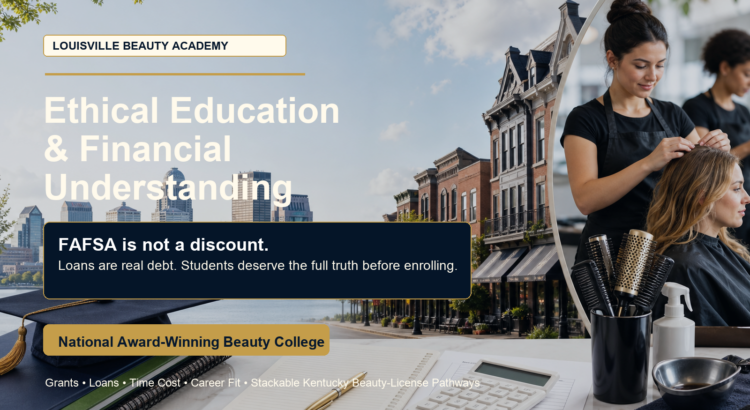
Ethical education begins before enrollment.
Before a student signs a contract, completes a financial-aid form, accepts a loan, chooses the longest program, or tells a family member “school is covered,” that student deserves plain language.
Not pressure. Not glamour. Not mystery. Not a beautiful sentence that hides a hard financial truth.
Louisville Beauty Academy believes students and families should understand the money, the time, the license pathway, and the career fit before they enroll. That is why we use this phrase carefully:
FAFSA is not a discount. Loans are real debt. Grants still require understanding. Time in school is still a cost. Beauty students deserve the full truth before enrolling.
This is not anti-FAFSA. It is not anti-financial aid. It is not anti-cosmetology. It is pro-student, pro-family, pro-transparency, pro-licensing, and pro-workforce.
Financial aid can help many students across America access education. Cosmetology can be the right path for many students. But any education decision that may involve thousands of dollars, hundreds or thousands of hours, repayment obligations, or uncertain career fit should be made with full written clarity.
FAFSA Is a Form, Not a Price
The FAFSA form is the Free Application for Federal Student Aid. The official 2026-27 FAFSA form says it is used to apply for federal and state student grants, work-study, and loans.
That means FAFSA is a doorway into possible aid information. It is not the same thing as a school discount. It is not a guarantee that school will be free. It is not proof that a student will receive a grant instead of a loan. It is not a substitute for reading the school contract, cost sheet, refund policy, and program requirements.
A student should never leave an enrollment conversation thinking, “I filled out FAFSA, so the cost disappeared.” The better sentence is:
I completed an application process. Now I need to understand exactly what aid, if any, is offered; what is grant; what is loan; what is out-of-pocket; what conditions apply; and what I am still responsible for.
Grant, Loan, Scholarship, Payment Plan: These Are Not the Same
Students often hear financial words quickly. In a stressful enrollment moment, everything can blur together. That blur is dangerous.
- A grant is aid that generally does not have to be repaid, but official rules, eligibility, withdrawal, service obligations, overpayments, or other conditions can matter.
- A loan is borrowed money. Federal Student Aid explains that a loan must be paid back with interest.
- A scholarship may reduce cost, but students should ask who awards it, what conditions apply, whether it is guaranteed, and whether it changes if attendance, progress, documents, or deadlines change.
- A payment plan is not a scholarship. It may spread payments over time, but the obligation still needs to be understood in writing.
- A discount or incentive should be read carefully. If it depends on attendance, compliance, timely payment, documents, program choice, or school approval, the student should understand those conditions before signing.
Financial clarity is not cold. It is care. A student who understands the difference between grant, loan, scholarship, payment plan, discount, and balance due is better protected.
Beauty School Should Not Be Sold as “Figure It Out Later”
Beauty is broad. That is part of its beauty, but it is also part of the risk.
A student may say, “I want to do beauty,” but that sentence can mean many different things:
- hair cutting;
- color or chemical services;
- blow-dry styling and finishing;
- shampoo and scalp care;
- nail technology;
- esthetic skincare;
- makeup and event beauty;
- lash services where allowed by law and permit rules;
- salon employment;
- chair rental or business ownership later;
- teaching, management, or another long-term professional route.
Those are not all the same career. They do not require the same daily work, the same personality, the same physical stamina, the same service rhythm, or the same license pathway.
For some students, the full 1,500-hour Cosmetology program is the correct choice. For others, beginning with a shorter state-recognized pathway may be wiser. The ethical question is not, “How do we push every student into the biggest program?” The ethical question is:
Which lawful pathway matches the student’s actual goal, life situation, schedule, confidence, financial reality, and ability to complete?
The Hidden Cost: Time
Even when a grant helps pay tuition, the student is still investing time. Time in school is real life. It can affect work, childcare, transportation, family duties, language learning, health, energy, and the student’s ability to earn money while attending.
That does not mean school is bad. It means school should be chosen clearly.
A student should ask:
- How many clock hours are required?
- How long could this take with my real schedule?
- What happens if I miss hours?
- What happens if I withdraw?
- What balance, if any, would I owe?
- What official records will show my progress?
- What license or permit does this pathway actually prepare me for?
- Can I legally work in the service area I want after I complete the process and receive license verification or license?
A student should not use beauty school as the place to discover life without a plan. Beauty school can help a student grow, but it should not hide the cost of uncertainty.
Kentucky Offers More Than One Beauty-License Pathway
Under Kentucky Board of Cosmetology public license requirements, students should understand that different beauty pathways have different hour requirements and scopes.
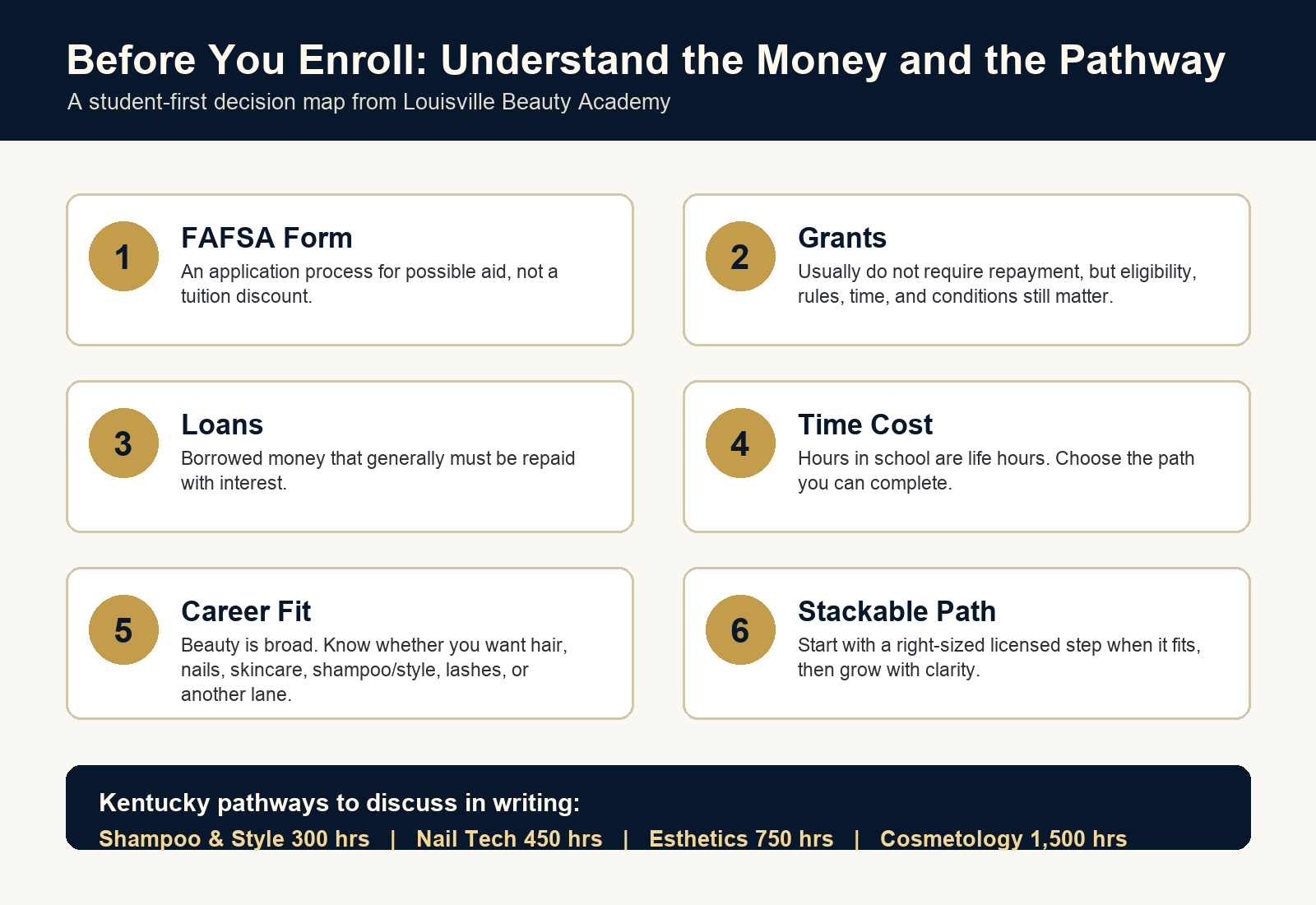
- Shampoo and Style Services: 300 hours
- Nail Technician: 450 hours
- Esthetician: 750 hours
- Cosmetologist: 1,500 hours
Each pathway still requires proper education, exams, application, and license verification or license before providing services. Current Kentucky Board rules and written school documents control.
This matters because a student who is unsure should not automatically be pushed into the longest route simply because it sounds more complete. Complete can be good. But complete without clarity can become expensive confusion.
Credential Stacking: A Better First-Step Conversation
Louisville Beauty Academy has also explained a student-centered concept called credential stacking: start with a right-sized licensed step when it fits, complete something real, test the career, build confidence, then decide the next level from experience instead of pressure.
For example, a student interested in hair but not ready for the full 1,500-hour Cosmetology commitment may review the 300-hour Shampoo and Style Services pathway with the school office/director team. If the student completes training, passes required examinations, applies, and receives license verification or license, the student may work within that licensed scope.
Kentucky regulation also provides that transfer of a current shampoo styling license may credit the transferee no more than 300 hours in a cosmetology program through the proper process. That does not mean automatic transfer in every situation. It means the student may have a lawful stackable foundation if the requirements are met and the correct Program Hour Transfer Request process is followed.
That is a better conversation for many families:
- Start with fit.
- Know the real cost.
- Know the required hours.
- Complete a clear first goal.
- Enter the licensed workforce within the allowed scope if eligible and licensed.
- Then choose the next level with evidence.
Read Louisville Beauty Academy’s related guide: Why Start Small Can Be the Smartest Path: Kentucky Beauty Licensing and Stackable Credentials.
A Student Should Know the Specialty Before Taking on the Big Commitment
The modern beauty industry often uses glamorous images: celebrity hair, perfect makeup, luxury salon photos, dramatic transformations, and social-media success stories. Those images can inspire students. But inspiration is not a plan.
Not everyone who likes beauty wants the same work. Not everyone who likes hair wants chemical services. Not everyone who likes makeup wants cosmetology. Not everyone who likes skincare wants nails. Not everyone who likes salon energy wants a long program immediately.
Employers and clients usually need specific readiness: punctuality, sanitation, service skill, client communication, lawful scope, dependability, speed, attitude, and a clear service lane. A student who says “I want to do everything” may still need help identifying the first actual professional skill.
That is why ethical advising should help the student name the first lane:
- I want hair services.
- I want blow-dry styling and shampoo services.
- I want nails.
- I want skincare.
- I want makeup or beauty enhancement services where allowed.
- I want the broad Cosmetology license because I understand what it includes and why it fits me.
That level of clarity protects students from drifting into debt, long hours, or discouragement without knowing why they started.
What Students Should Ask Before Enrolling Anywhere
Before enrolling in any beauty school, students and families should ask direct questions and request written answers:
- What is the total program cost?
- What is included and what is not included?
- Is this a grant, loan, scholarship, payment plan, discount, or out-of-pocket balance?
- If there is a loan, what is the amount borrowed and what repayment responsibility exists?
- If there is a grant or scholarship, what conditions apply?
- What happens financially if I withdraw, pause, transfer, or fail to complete?
- How many hours are required?
- What license, permit, or credential does this program prepare me for?
- What services may I legally perform only after completing the required process and receiving license verification or license?
- What are realistic next steps after school?
- What official transcript or progress record will I receive?
If the answer is unclear, slow down. Serious schools should be willing to explain serious commitments in writing.
Louisville Beauty Academy’s Public Position
Louisville Beauty Academy is a Kentucky state-licensed beauty college. Our student-first position is simple:
- Cost should be clear before commitment.
- Financial-aid words should not be blurred together.
- Loans should be named as loans.
- Grants should be explained with conditions and time reality.
- Students should understand the difference between broad beauty interest and a specific license pathway.
- Shorter licensed pathways should be discussed honestly when they fit.
- The full Cosmetology pathway should remain available and respected for students who understand it and choose it clearly.
- Written documents, official rules, and current school records should control.
We are not against aspiration. We are against confusion. A student’s dream should be protected by clear math, clear documents, clear licensing requirements, and a clear next step.
A Better Way to Begin
If you are considering beauty school, begin with these questions:
- What service do I actually want to perform first?
- What license or permit does Kentucky require for that service?
- How many hours does that pathway require?
- What will this cost me in money, time, transportation, work hours, and family schedule?
- Am I choosing the broad program because it fits, or because I am afraid to choose?
- Could a smaller licensed step help me build confidence and make a better next decision?
Beauty education should not begin with a hidden obligation. It should begin with truth.
Ethical education and financial understanding come first.
Students and families may review Louisville Beauty Academy’s current public cost and written payment-option page here: Current Program Costs, Incentives, and Written Payment Options.
Contact Louisville Beauty Academy: 502-625-5531
Email: study@LouisvilleBeautyAcademy.net
Website: LouisvilleBeautyAcademy.net
Sources and Public References
- Federal Student Aid: 2026-27 FAFSA Form explains that the FAFSA form is used to apply for federal and state grants, work-study, and loans.
- Federal Student Aid: Types of Financial Aid explains the difference between grants, work-study, loans, and scholarships.
- Federal Student Aid: Federal Student Loans explains that loans are borrowed money that must be repaid with interest.
- Kentucky Board of Cosmetology: License Requirements lists current public hour requirements and license steps for cosmetologist, nail technician, esthetician, and shampoo and style services.
- 201 KAR 12:082 addresses Kentucky beauty-school education requirements and program-hour transfer rules, including limits for current esthetics, nail technologist, shampoo styling, and barber licenses toward cosmetology.
- KRS 317A.050 addresses Kentucky qualifications for licenses and permits.
Claim-control note: This public education article does not provide individualized financial-aid advice, legal advice, tax advice, loan counseling, or a guarantee of grant eligibility, loan approval, payment-plan approval, discount availability, admission, graduation, licensure, exam passage, job placement, income, transfer credit, Board approval, or business success. Current written school documents, official Kentucky Board requirements, official Federal Student Aid rules, student eligibility, lender/aid terms, and applicable law control.







