A Lifetime of Support at Louisville Beauty Academy

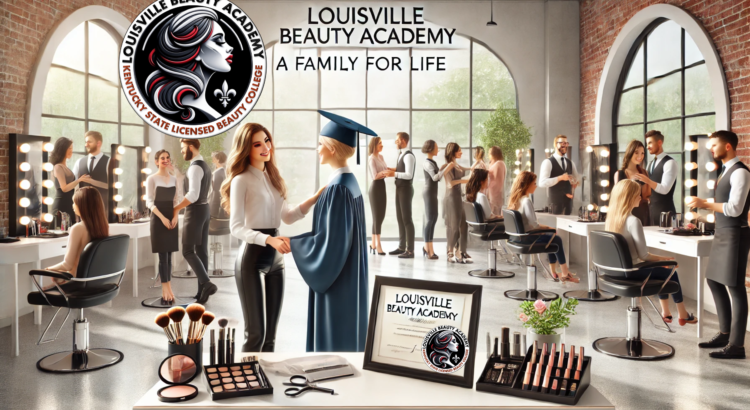
Louisville Beauty Academy (LBA) proudly treats every student as part of a lifelong family — not just a one-time enrollee. Since its founding, LBA has built a supportive, humanized environment where current students and graduates continually uplift one another. In practice, this means that even after graduation, you are always welcome to return — to refresh your skills, observe classes, prepare for the state licensing exam, mentor others, or simply reconnect.

This open-door tradition has become a defining part of LBA’s culture. For nearly ten years and nearly 2,000 graduates, the Academy has remained committed to education through community, not isolation. Once you’ve joined the LBA family, our instructors and staff are glad to see you again — as a tutoring graduate, guest, or customer — whenever space and scheduling allow.


Dedicated Licensing Exam Preparation

LBA’s core mission is clear: to prepare students for the Kentucky State Board licensing exams, both theory and practical. Every lesson emphasizes safety, sanitation, and disinfection — the pillars of state-required cosmetology standards.

Our students practice every step required by the Board: disinfecting tools and workstations, proper handwashing, and sanitation procedures. These habits are drilled not as formality, but as lifelong professional ethics. Passing the state exam is not about artistry alone — it’s about demonstrating that you can protect clients’ health.

LBA ensures that all graduates understand the legal and safety standards demanded by Kentucky law. Once licensed, professionals expand beyond these basics into creativity, psychology, and advanced customer care — areas LBA continues to nurture through its ongoing community of mentorship.


Lifelong Learning and Career Growth

Graduation at LBA is not an ending — it’s a new stage in your professional journey. The beauty industry evolves rapidly, and continuing to learn keeps professionals strong, relevant, and successful. That’s why LBA invites all alumni to come back, free of charge, for optional tutoring, workshops, or guided practice, as staff and space permit.

These opportunities are offered as a community service — never as an obligation, contract, or guarantee. They exist to encourage growth, confidence, and connection. Many graduates find that returning for a few hours of guided practice or mentorship rekindles motivation and sharpens skills.


Humanized and Compassionate Teaching

Everything LBA does is grounded in its philosophy of Humanization — teaching individuals to love, accept, and care for themselves first, then to share that care through their service to others. Instructors focus on building confidence and compassion alongside technical mastery.

Students learn to see each client as a whole person, not just a customer. This approach builds empathy, professionalism, and lasting trust — the foundation of true beauty service. When graduates return to visit, they continue to grow this humanized mindset through collaboration, peer learning, and giving back.


Legal and Ethical Assurance

LBA’s continuing-support model is entirely voluntary and non-binding.

  • No additional contract or obligation exists after graduation.
  • No guarantee of licensure or employment is made or implied.
  • All support is offered at no cost as a community-service benefit, depending on staff and facility availability.
  • Graduates are free to pursue their careers independently, at any location or business of their choice.

Licensure is solely determined by the Kentucky State Board of Cosmetology and the graduate’s own compliance with state requirements. LBA’s ongoing access is a courtesy — a way to encourage lifelong learning, mentorship, and confidence — not a continuing enrollment or tuition program.


Disclaimer

Louisville Beauty Academy provides optional, no-cost post-graduation learning opportunities as a community service. Participation is voluntary, space-dependent, and not part of any contract or enrollment obligation. LBA does not guarantee licensure or employment outcomes. Licensure remains governed by the Kentucky State Board of Cosmetology and applicable state laws.

Louisville Beauty Academy Named One of America’s Top 100 Small Businesses by the U.S. Chamber of Commerce – OCTOBER 2025

Representing Kentucky, Louisville Metro, and the Beauty Industry on the National Stage — October 2025, Washington, D.C.

In October 2025, Louisville Beauty Academy proudly represented Louisville, the Commonwealth of Kentucky, and the entire beauty education and industry sector as one of America’s Top 100 Small Businesses, selected by the U.S. Chamber of Commerce for its prestigious CO—100 list.

Louisville Beauty Academy was chosen from more than 12,000+ applicants nationwide — standing as the only honoree from the state of Kentucky, the only beauty education institution, and the sole representative of the beauty industry among this elite group of 100 small businesses across 35 states and Washington, D.C.

This recognition celebrates businesses driving growth, innovation, and workforce development in their communities and beyond. Honorees were selected by an esteemed panel of judges for their impressive growth, innovative strategies, and strong workplace culture.


🏛 Representing Kentucky and the Beauty Industry in Washington, D.C.

Founder & CEO Di Tran and CFO Rick Dye represented Louisville Beauty Academy on the national stage in Washington, D.C., joining 99 other honorees for three days of events at the historic U.S. Chamber of Commerce headquarters (1615 H Street NW).

The agenda included:

  • 🧠 Small Business Forum featuring AI implementation training from Google, psychology and stress management strategies, and investment & collaboration sessions.
  • 🤝 Networking and learning exchanges with top entrepreneurs from across the country.
  • 🌟 The Night of 100 Stars Gala at the historic Decatur House (748 Jackson Pl NW), celebrating the small businesses that are the backbone of the U.S. economy.

Louisville Beauty Academy’s presence underscored Kentucky’s rich legacy, known worldwide for Bourbon and the Kentucky Derby, and now rising to national prominence for its beauty industry leadership.


💼 Small Business: The Foundation of America

The CO—100 honorees exemplify the heartbeat of the U.S. economy: small business owners who, day in and day out,

  • Pay employees and contractors,
  • Deliver critical services to clients,
  • Navigate operations, marketing, inventory, payroll, hiring, regulations, and more —
    often wearing multiple hats to keep their businesses thriving.

Louisville Beauty Academy, through its state-licensed vocational programs, has graduated nearly 2,000 students, many of whom have become salon owners, entrepreneurs, and licensed professionals. These graduates contribute an estimated $20–50 million in annual economic impact to Kentucky and neighboring states, through employment, business creation, and essential beauty services.


🌍 A Unique Advocate for Workforce Development

Louisville Beauty Academy’s model focuses on accessible, multilingual, affordable beauty education, offering both short- and long-term state-licensed programs. Di Tran and Rick Dye advocated for the critical role of short-term state-licensed vocational programs in America’s workforce pipeline — particularly the need to allow Pell Grants and federal loans to be used for shorter programs under 600 hours, which are currently excluded by federal policy despite being state-certified and regulated.

Di Tran also proudly represented and thanked Greater Louisville Inc. (GLI) — representing over 1,800 businesses — for years of partnership in state-level advocacy, including efforts for multilingual licensing exams and vocational fairness. He also recognized the Louisville Independent Business Alliance (LIBA), representing over 700 local independent businesses, as another strong local partner.

“GLI and LIBA are powerful local forces for good. Together with the U.S. Chamber, we can align local, regional, and national advocacy to truly uplift small businesses and workforce development,” said Di Tran.


✍️ From Washington Back to Louisville — Knowledge Sharing

Di Tran emphasized that this experience was not just about receiving recognition, but bringing knowledge back home. From AI implementation strategies for small businesses (through Google’s U.S. Chamber Foundation sessions) to stress management tools and investment insights, Louisville Beauty Academy intends to share and apply these lessons locally to strengthen small businesses in Louisville and across Kentucky.

As a former board member of LIBA and an active advocate through GLI, Di Tran continues to play a dual role: listening and learning nationally, while amplifying Kentucky’s voice at the federal level.


🏅 Prestige, Certification, and Opportunity

Graduating from Louisville Beauty Academy is not only a milestone — it’s an achievement that carries prestige, credibility, and real economic value. Each student receives state-regulated and state-certified beauty licenses and certificates overseen by the Kentucky State Board of Cosmetology, considered among the most respected credentials in the field.

Louisville Beauty Academy is the only (or one of the very few) beauty colleges in Kentucky that offers all beauty license and certificate programs, including short-term and full programs — fully regulated and approved by the state.

And now, as one of America’s Top 100 Small Businesses on the national stage, the Academy shines a spotlight on beauty education as a pillar of workforce development and entrepreneurship.

📲 Enroll Today
Text 502-625-5531 or email study@LouisvilleBeautyAcademy.net to begin your journey in one of Kentucky’s most respected beauty education institutions, now nationally recognized by the U.S. Chamber of Commerce.


🌟 A Proud Moment for Louisville and Kentucky

Louisville Beauty Academy stands proudly as a national representative of Kentucky’s growing beauty industry — adding a new dimension to Kentucky’s reputation, alongside Bourbon and the Derby.

Their work, supported by state, city, chamber partners, and community, reflects a modern vision:

  • Empowering immigrants, working parents, and career changers through short, affordable, multilingual education.
  • Building sustainable beauty businesses that employ and serve locally.
  • Advocating for policy changes that open federal funding to more Americans seeking vocational pathways.

📢 About the CO—100 Program

Each CO—100 honoree receives a one-year paid membership to the U.S. Chamber of Commerce, national brand exposure, and exclusive access to expert insights, networking opportunities, and a vibrant community of fellow business leaders.

“Small businesses are the heartbeat of our economy, and their stories are nothing short of extraordinary,” said Jeanette Mulvey, Vice President and Editor-in-Chief of CO— by the U.S. Chamber of Commerce. “The CO—100 honorees exemplify what it means to lead with purpose, adapt with agility, and build with vision.”

Learn more at www.co100.com


📝 Contact

Louisville Beauty Academy
📍 Louisville, Kentucky
🌐 https://louisvillebeautyacademy.net
📧 study@louisvillebeautyacademy.net
📲 Text: 502-625-5531

Navigating Post-Graduation Challenges in Beauty Education – RESEARCH 2025

Introduction

Beauty school graduates and transfer students across the United States often face a perplexing reality after completing their required training hours: they feel stranded and unsupported. In states like Kentucky and beyond, frequent changes in cosmetology board regulations can upend graduates’ plans, leaving them unsure how to proceed toward licensure. Many newly minted graduates, especially those who fail their licensing exams or relocate from other states, find that their schools provide little if any guidance once formal training ends. This article explores why these graduates feel abandoned, how regulatory shifts contribute to the problem, and how one institution – Louisville Beauty Academy in Kentucky – has emerged over the past decade as a reliable lifeline for those struggling to navigate licensing hurdles.

Regulatory Changes Leaving Graduates in Limbo

State cosmetology boards frequently update rules and requirements, and these changes can inadvertently strand students and professionals. Mergers of regulatory boards, alterations in exam content, and shifts in required training hours are not uncommon. For example, in Mississippi a 2024 merger of the barbering and cosmetology boards led to an incomplete transition, creating confusion for schools and students. With no fully seated board to provide updated guidance, educators were left without clear rules to teach and students had to take exams based on outdated laws. One Mississippi school owner even chose to close her academy because “inconsistent communication and testing requirements” meant she could no longer give students accurate information for licensing. As she put it, she couldn’t sleep at night taking students’ money without knowing if her guidance would help them obtain a license under the unpredictable board conditions. In short, ongoing regulatory upheaval left both educators and graduates in a “tough position”, unsure how to proceed.

A lapse in leadership on state boards can exacerbate these issues. When Mississippi’s cosmetology board lost its quorum in 2025, it operated under temporary rules that were set to expire without permanent replacements. With no board members to decide on new rules or hear appeals, over 50,000 beauty professionals were effectively in regulatory limbo. Licensees reported feeling they had to “figure out what to do on their own” in the absence of guidance from the board. Changes like these create confusion not just in Mississippi. Across states, even less drastic regulatory tweaks – such as adjusting required training hours or introducing new exam procedures – can leave recent graduates uncertain about compliance. As one report described, “ongoing changes to state licensing rules have left many students and professionals seeking clearer guidance”. Crucially, official communication often lags; graduates might hear about new requirements through word-of-mouth or social media rather than direct board notice. This information void can spread misinformation and anxiety, making graduates feel even more unsupported by the system.

Frequent regulatory changes also vary widely by state, complicating matters for those who move. In recent years, some states have lowered required training hours or eliminated certain exams, while others maintain higher standards. For instance, California’s 2022 reform cut cosmetology training from 1,600 hours to 1,000 and removed the practical exam requirement. Meanwhile, states like New York and Kentucky still require 1,000–1,500 hours or more. Such disparities mean transfer students may find that the education they completed in one state doesn’t neatly fulfill another state’s licensure criteria. Overall, cosmetology education in the U.S. has been described as an industry in “dire need of reform” that “fails to meet student expectations”, often leaving graduates with burdensome debt and little clarity on career pathways. While that critique applies broadly to employment and earnings outcomes, it also reflects the lack of systemic support for graduates transitioning to licensed professionals. In fact, a legislative oversight in Kentucky revealed that the Board of Cosmetology was the single biggest source of professional complaints in the state, with 72 complaints logged between 2008 and 2024 – many concerning delays in receiving licenses. These delays and procedural snags highlight how regulatory bodies, through slow processes or shifting rules, can inadvertently strand graduates at the crucial moment when they are trying to launch their careers.

Lack of Post-Graduation Support from Beauty Schools

Compounding the regulatory complexities is the reality that many beauty schools offer minimal assistance once students graduate. The focus of most cosmetology programs is on helping students accumulate the required hours and technical skills to graduate; after that point, students are expected to pass state board exams and attain licenses largely on their own. If a graduate struggles with the licensing exam or encounters new requirements, their alma mater may not be equipped – or obligated – to help. In practice, this leaves many recent graduates feeling abandoned just when the stakes are highest.

One critical hurdle is the licensing examination itself. Cosmetology and related fields require passing both a theory (written) exam and a practical (hands-on) exam in most states. Yet schools often “teach to the test” in a general sense during the program and may not provide dedicated exam prep or remediation after graduation. If a student fails the state board exam, few schools have formal programs to continue coaching them. The burden (and cost) of retesting usually falls entirely on the individual. In Kentucky, this challenge has been recognized at the policy level. Until recently, Kentucky’s regulations mandated that any applicant who fails the exam three times must wait at least six months and then complete an 80-hour board-approved “brush-up” course before attempting the test again. If the person failed two more times after that, they could even be barred from retaking the exam for three years. Such rules aim to ensure competency, but they also place a heavy burden on the graduate: someone who struggled on the exam must find and pay for additional schooling, and endure a lengthy waiting period, all without guaranteed support from their original school. As one nail industry representative noted in testimony, these requirements can impose a “great financial burden” on otherwise skilled professionals – especially those for whom English is a second language – and ultimately keep would-be cosmetologists out of work.

Language barriers illustrate how schools may fail to fully support certain student populations. Many beauty programs enroll immigrants and non-native English speakers, particularly in fields like nail technology where a large portion of workers in the U.S. are from Asian American and Pacific Islander communities. If instruction and exam preparation are delivered only in English, graduates who are talented practitioners but not fluent in English can be at a severe disadvantage on written licensing tests. Molida Soth, a Kentucky nail technician, highlighted in 2023 that the state’s nail exam was offered only in English, a factor that “disfavors those who do not speak English as their first language” and not due to lack of technical skill. Failing the exam under these circumstances triggers the onerous retake requirements described above. While the root cause is a regulatory issue (lack of translated exams), it underscores a gap in school support as well – many schools do not provide multilingual training materials or exam prep, leaving these graduates to fend for themselves. (Notably, Kentucky responded by expanding its exam language options by late 2024, offering the nail licensing test in Vietnamese, Spanish, Chinese, and Korean in addition to English. This change came only after sustained industry advocacy and underscores how slowly institutions adapt to student needs.)

Transfer students are another group that often feels unsupported. When a student who trained in one state moves to another – or even just transfers schools mid-education – they can encounter significant obstacles. Every state has its own licensing requirements in terms of hours, curriculum content, and exams. Most state boards offer some form of reciprocity or endorsement, but typically the onus is on the individual to prove their credentials and meet any gaps. For example, a cosmetologist moving to Kentucky from a state that required only 1,000 hours of training will find that Kentucky expects 1,500 hours. In many cases, states with higher hour requirements will accept a combination of the applicant’s prior training and work experience to cover the deficit. If not, the transfer student may be told to obtain additional hours of education before they can be licensed in the new state. This scenario can be frustrating: a person who has already graduated beauty school and perhaps been working in the field suddenly must re-enroll in a school for extra hours (sometimes hundreds of hours) just to qualify for an exam in the new state. Unfortunately, beauty schools do not always make this process easy. Some schools are reluctant to enroll students for partial programs or “credit transfers” because it may be administratively complicated or less profitable than full-program students. Others simply may not advertise or invest in transfer support services. As Louisville Beauty Academy notes in a guide for transferring hours, the process “can be time-consuming” and varies by state, requiring careful adherence to board guidelines. Students often have to coordinate the transfer of transcripts and certification of hours themselves by contacting state boards directly. If a state board informs a transfer applicant that additional hours are needed, it is then on the student to find a school willing to provide those hours – a task that can be daunting if their original school is out of state or no longer accessible. In short, while the regulatory framework technically allows for license transfers, in practice many students feel they are left to navigate the bureaucracy alone. Without a school’s active guidance, it’s easy to feel stranded between states.

Even within the same state, graduates who have completed their hours but did so outside a traditional sequence (for instance, those who had to pause their education due to personal reasons, or who finished school but waited long to take the exam) may find themselves without support. Beauty schools typically consider their job done at graduation: their funding (especially if federal aid is involved) often depends on students finishing, not on students becoming licensed. This misalignment of incentives contributes to the “broken promises” of cosmetology education – schools are not held accountable for whether graduates actually attain licensure or employment. A 2022 study found that cosmetology graduates often end up earning very low wages, in part because many do not make a successful transition to licensed work. The analysis concluded that students are left with debt and credentials that don’t pay off, highlighting an industry-wide failure to support student success post-graduation. While that study focused on economic outcomes, the underlying issue is closely tied to lack of post-grad guidance: a graduate who never gets licensed, or who struggles for years to do so, will understandably have poor earnings. Thus, the cycle continues – graduates feel let down by schools and regulators at the very moment they need the most help launching their careers.

The Louisville Beauty Academy Difference

Amid these widespread challenges, Louisville Beauty Academy (LBA) has distinguished itself in Kentucky as a school that actively supports graduates and transfer students after they’ve completed their hours. Over the past 10 years, LBA’s approach has been to treat students and alumni like “family,” providing guidance well beyond the classroom. Founded in late 2015 with a vision of making beauty education affordable and outcomes-driven, LBA quickly became known for helping non-traditional students succeed in the licensed workforce. It is no coincidence that LBA is led by immigrant entrepreneurs who understood the hurdles faced by newcomers and working adults in the beauty industry. From its inception, the academy focused on flexibility, community support, and a laser focus on licensure as the end goal. The results speak volumes: by mid-2023, LBA had already empowered “over a thousand graduates” to complete their programs and many to become licensed professionals, a majority of whom came from immigrant and minority communities. For a single-location school (now expanded to a second campus in 2025) to produce that many graduates in under a decade is a testament to its supportive model.

One of Louisville Beauty Academy’s hallmark offerings – and a service rarely found elsewhere in Kentucky – is its 80-hour State Board-approved brush-up course for graduates and transfer students. This course directly addresses the scenarios discussed earlier: it is designed for individuals who have already completed their required hours (often at another school or in another state, or who finished a Kentucky program in the past) but cannot move forward for some reason. LBA developed the 80-hour brush-up course to meet the Kentucky State Board of Cosmetology’s specific requirement that such students refresh their training. In fact, Kentucky’s board explicitly requires an 80-hour theory refresher for candidates who either transfer into Kentucky or who fail the licensing exam three times, before they are allowed to retest. Louisville Beauty Academy recognized that no student in that position should be left without help. Thus, they began offering the brush-up program as a formal enrollment option – meaning the student becomes an LBA student for the duration of the refresher. Crucially, this enrollment allows LBA to provide personalized guidance and advocacy on the student’s behalf, picking up where their original school left off. As the academy explains, it’s challenging to advise individuals who are not enrolled students, because the school may lack access to their prior training records or know their exact needs. By having students join the “academy family” through the brush-up course, LBA can legitimately mentor them with full knowledge of their background. This approach has provided a legal and structured pathway for stranded graduates to complete any missing requirements and regain confidence before attempting the board exams.

The impact of the 80-hour brush-up course has been significant. In Kentucky, Louisville Beauty Academy often ends up as the sole institution actively advertising and providing this type of post-graduate support course. It is not uncommon for graduates from other Kentucky schools – or those who moved to Kentucky after partial training elsewhere – to find that LBA is essentially the only school willing to take them in for the final push. The course itself covers both theory and practical skills tailored to the individual’s program (cosmetology, esthetics, nails, etc.), serving as a comprehensive review and skills refresher. Students who enroll in the brush-up program get access to LBA’s instructors, equipment, and even online study platforms to help reinforce learning. Just as importantly, they gain a partner in navigating the state board process. LBA assists these students in ensuring their paperwork is in order – for example, helping confirm that the Kentucky board has accepted their transferred hours before the student even begins the course. The academy’s staff are familiar with the state’s procedures and can advise on scheduling exams or obtaining the necessary authorizations from the board, tasks that would bewilder someone doing it alone. This level of support dramatically improves graduates’ chances of successfully obtaining a license after a setback. It essentially fills the void left by their original schools. Indeed, LBA markets the brush-up course as “your route to success” for re-entering the licensing track, emphasizing that with the right guidance, students can “move forward with confidence toward licensure”.

Another key area where Louisville Beauty Academy has led is in exam preparation and accommodations. Recognizing the diversity of its student body, LBA was at the forefront of pushing for and utilizing translated exams. The academy celebrated in October 2024 when one of its graduates became the first in Kentucky to pass the state licensing exam in Spanish – just weeks after the state introduced multi-language exams for nail technicians. Likewise, LBA had Vietnamese graduates passing soon after. This success is partly due to LBA’s commitment to language inclusion. The school routinely provides bilingual support, knowing that many of its students are more comfortable in languages other than English. By advocating for state exam translations and preparing students to use them, LBA directly addressed a gap that had long caused exam failures. In the words of one Kentucky legislator, the state previously had “overregulated” the exam process in a way that got “in the way of people working”, and reforms were needed to remove “red tape”. LBA’s efforts aligned with these reforms, effectively giving students the tools to overcome regulatory obstacles like language and excessive wait times.

Furthermore, LBA keeps its community well-informed about any regulatory changes – a critical service in an environment where rules can change year to year. The academy regularly publishes updates on new laws, board appointments, and licensing procedures on its website and social media. “Whether it’s news about licensing, educational opportunities, or regulatory changes, we are committed to providing timely and accurate information,” LBA states in one update. This proactive communication ensures that graduates and even current students are not blindsided by shifts such as a new piece of legislation or a change in board leadership. For instance, when Kentucky passed Senate Bill 14 in 2024 to restructure its cosmetology board and add seats for nail techs and estheticians, LBA not only reported on it but also explained its significance to the beauty community. When further legislative efforts in 2025 (like SB 22) aimed to allow unlimited exam retakes after a one-month wait and create license pathways for out-of-state practitioners, LBA kept students apprised of these proposed changes. By acting as an information hub, Louisville Beauty Academy has, in effect, become a translator of regulatory jargon and an advocate for compliance – roles that most schools do not play. Students who engage with LBA’s content are empowered to adjust quickly to new requirements instead of feeling lost or misled by rumors.

Over the last decade, LBA’s supportive approach has yielded measurable successes. The academy boasts high licensure exam pass rates, which it attributes to its rigorous training and exam prep focus (including the use of modern tools like a digital theory & exam simulation platform). The school’s founder, Di Tran, was recognized as the 2024 “Most Admired CEO” by a local business journal in part for this student-centric mission. LBA has also been honored for its community impact and innovative model, being the only Kentucky business named to the U.S. Chamber of Commerce’s CO— “100 Small Businesses of the Year” awards in 2025. These accolades underscore that LBA’s role extends beyond just one-off help – it has been shaping the conversation on how beauty education can better serve graduates. Through partnerships and even published guides, LBA has tried to streamline the process of hour transfers between states, giving clear step-by-step advice on how to transfer licenses or training credits into Kentucky. The guide emphasizes compliance with board procedures, but also reassures students that yes, transferring is possible and that LBA “can offer guidance and advice” within the board’s framework. By demystifying these processes, Louisville Beauty Academy stands out as an institution that doesn’t abandon students at graduation but instead offers a bridge to that next milestone of licensure.

Conclusion

Frequent regulatory changes and inconsistencies among state cosmetology boards have undeniably left many beauty school graduates feeling stranded after completing their hours. Whether it’s a newly graduated cosmetologist in Kentucky facing a long wait and extra course after failing her exam, or a licensed esthetician from out-of-state struggling to meet a new state’s criteria, the path from school to professional license can be fraught with uncertainty. In too many cases, beauty schools have not provided the aftercare that students need – there is no “safety net” if you stumble on the last step. The onus falls on graduates to decipher evolving rules, often with significant financial and emotional burdens if they get it wrong.

Yet, the past ten years have also shown that this narrative can be changed. Louisville Beauty Academy’s model in Kentucky demonstrates that a school can remain a steadfast partner to its students even after graduation. By tailoring programs like the 80-hour brush-up course to plug into state requirements, offering transfer-hour solutions, and actively guiding students through licensing obstacles, LBA has filled a critical void in support. Graduates who might otherwise have given up on their dreams are instead passing their exams and starting careers – sometimes in new languages, sometimes after years of detour – because someone took the time to show them the way forward. LBA’s success highlights the importance of adaptability and advocacy in beauty education. It serves as a call to action for other cosmetology schools and state boards: when schools proactively help students navigate the licensing maze, and when regulators prioritize clarity and access, the whole industry benefits. Students invest their passion and time into beauty education with the hope of a better future; it is incumbent upon both educators and regulators to ensure they don’t feel abandoned at the finish line. As Louisville Beauty Academy’s decade of experience shows, with the right support, no beauty graduate needs to remain stranded – they can instead become a licensed professional, ready to thrive in the career they worked so hard to prepare for.

References (APA)

Bauer-Wolf, J. (2024). Cut Short: The Broken Promises of Cosmetology Education (Introduction). New America. Retrieved from https://www.newamerica.org/education-policy/reports/cut-short-the-broken-promises-of-cosmetology-education/introduction/

Brink, M. (2022, July 14). Study: Cosmetology Schools Yield Poor Student Outcomes. Inside Higher Ed. Retrieved from https://www.insidehighered.com/quicktakes/2022/07/15/study-cosmetology-schools-yield-poor-student-outcomes

Glowacki, J., & Sharma, N. (2025, July 21). Leadership lapse stalls Mississippi’s beauty board. RHCJC News. Retrieved from https://rhcjcnews.com/4936/news/leadership-lapse-stalls-mississippis-beauty-board/

Hensley, J. (2023, August 22). Nail tech industry asks legislative committee to update testing, regulations. The Lexington Times. Retrieved from https://lexingtonky.news/2023/08/22/nail-tech-industry-asks-legislative-committee-to-update-testing-regulations/

Louisville Beauty Academy. (2020, August 11; updated 2025, March 24). Louisville Beauty Academy – Students and Graduates Transfers of Hours Between States (Guidance). LouisvilleBeautyAcademy.net. Retrieved from https://louisvillebeautyacademy.net/louisville-beauty-academy-students-and-graduates-transfers-of-hours-between-states-regulated-by-kentucky-state-board-of-cosmetology-and-hairdressers/

Louisville Beauty Academy. (2023, July 17). Louisville Beauty Academy: A Gateway to Beauty Careers for the Latino Community in Kentucky. LouisvilleBeautyAcademy.net. Retrieved from https://louisvillebeautyacademy.net/louisville-beauty-academy-a-gateway-to-beauty-careers-for-the-latino-community-in-kentucky/

Louisville Beauty Academy. (2024, July 24). 80-Hour Brush-Up Course: Essential Support for Transfer Students and Exam Preparation at Louisville Beauty Academy. LouisvilleBeautyAcademy.net. Retrieved from https://louisvillebeautyacademy.net/80-hour-brush-up-course-essential-support-for-transfer-students-and-exam-preparation-at-louisville-beauty-academy/

Louisville Beauty Academy. (2024, August 22). Board of Cosmetology Under Scrutiny: Legislative Oversight Reveals Ongoing Issues and Complaints. LouisvilleBeautyAcademy.net. Retrieved from https://louisvillebeautyacademy.net/board-of-cosmetology-under-scrutiny-legislative-oversight-reveals-ongoing-issues-and-complaints-august-15-2024/

Disclaimer: The information provided in this article is for general educational and informational purposes only. While every effort has been made to ensure accuracy, state regulations, licensing requirements, and board procedures are subject to change at any time. Louisville Beauty Academy does not guarantee licensure, exam passage, or acceptance of transfer hours, as these decisions are made solely by the Kentucky State Board of Cosmetology and other state regulatory bodies. Students and graduates are encouraged to consult directly with the appropriate state board for the most current policies and requirements.

Louisville Beauty Academy: One of Kentucky’s Most Peaceful, Protected, and Professionally Compliant Beauty Schools

At Louisville Beauty Academy, we believe beauty education is more than training for licensure—it’s the foundation of a student’s future, livelihood, and dignity. That is why we have built—and fiercely protect—a learning environment that is safe, peaceful, law-abiding, and unshakably student-centered.

Our mission is not just to teach beauty—it is to create a space where hard-working adults from all walks of life can confidently learn without fear, confusion, or disruption.

🛡️ Zero Tolerance for Disruption

We proudly enforce a Zero Disruption Policy, which is publicly documented and legally binding under our enrollment contracts and administrative protocols. This policy applies equally to students, staff, and leadership.

Whether verbal, behavioral, or digital—any action that disrupts the learning environment, defames the school, or causes confusion about its lawful operation is grounds for immediate dismissal.

Over the years, we have made instant, lawful decisions—including expulsion of students and termination of staff—when verified violations occurred. These are not punitive actions; they are protective measures for the hundreds of students who come to our campuses seeking a better life through education.

🔗 Read Our Full Policy on Disruption and Legal Compliance »

👮‍♀️ Full Legal Compliance with the Kentucky State Board of Cosmetology

Louisville Beauty Academy is a state-licensed and state-accredited institution, operating in full alignment with Kentucky’s beauty licensing laws under KAR Title 201. Every decision we make—curriculum, hours, instructors, tuition—is legally documented and regulated.

We comply with:

  • Biometric time tracking for accurate clock-ins
  • Official state-inspected attendance and safety protocols
  • Secure record-keeping and 5-year data retention
  • Written grievance resolution procedures as required by law
  • KY State Board reporting requirements for every course and student

Our school is not only compliant—we are often used as a model institution for how beauty schools can operate with transparency and structure while still remaining loving, flexible, and human-focused.

💬 Internal Issues Are Handled Professionally, Not Publicly

At LBA, we do not tolerate gossip, drama, or backchannel accusations. All concerns must follow our published communication chain:

  1. Compliance Office via email or text
  2. Escalation to the Director
  3. Formal written grievance (10-day review required)
  4. Only then may a student escalate to the State Board

We have successfully resolved dozens of internal matters peacefully using this framework. But when someone bypasses this process and spreads false, harmful, or fear-inducing information—especially publicly or to other students—we act immediately.

Our contracts, state policies, and legal advisors support these actions as not only justified, but required.

🤝 A Culture of Safety, Not Fear

We understand that many of our students come from difficult backgrounds. Some are immigrants. Many are single parents. Some have never had the chance to succeed in a traditional school. That is why we protect this school with everything we have.

When you enter LBA, you are entering:

  • A judgment-free zone
  • A clean, calm, and caring environment
  • A space of emotional and legal safety
  • A school with a track record of graduating nearly 2,000 students

✨ Our Promise to Future Students

If you are serious about becoming a licensed professional, if you want a safe space to learn and grow, and if you want to be treated with dignity—Louisville Beauty Academy is for you.

If, however, you are looking for drama, entitlement, or the freedom to disrupt others—you will be asked to leave, legally and permanently. And that is how it should be.

🌟 A Message to the Community

We thank the Louisville and Kentucky community for your continued trust. We are proud to have served this state since 2016, and we look forward to continuing to be a beacon of peace, order, and purpose-driven education.

Whether you’re enrolling for the first time or sending someone you care about to learn with us, know this:

They will be safe. They will be supported. And they will succeed.


Louisville Beauty Academy – Compliance Office
📍 Bardstown Rd Campus | 📍 Harbor House Campus
📞 (502) 625-5531
📧 study@LouisvilleBeautyAcademy.net
🌐 www.LouisvilleBeautyAcademy.net

Understanding Beauty School in Kentucky: The Truth About Clock-Hour Education — and Why Louisville Beauty Academy Gives You Zero Reason to Fail

At Louisville Beauty Academy (LBA), we often meet prospective students who are confused about how beauty school works. Many expect something similar to high school or college: fixed class schedules, mandatory lectures, and a semester system.

But Kentucky beauty schools don’t operate that way. Beauty education in this state is governed by a clock-hour system regulated by the Kentucky State Board of Cosmetology—and understanding this system is key to your success.

This article clears up common misunderstandings and explains why Louisville Beauty Academy is one of the most innovative, flexible, and supportive schools in Kentucky, using technology and one-on-one instruction to empower students to succeed at their own pace.


📚 What is a “Clock Hour” Beauty School? (According to Kentucky Law)

Under Kentucky Revised Statutes and Administrative Regulations, beauty schools must operate on a clock-hour system, not a credit-hour system. Students must complete a state-mandated number of supervised, in-person training hours to qualify for licensure.

Here are the current minimums for popular programs:

  • Nail Technician License – 450 hours
  • Esthetics License – 750 hours
  • Cosmetology License – 1,500 hours
  • Shampoo Styling License – 300 hours

Schools must track each student’s hours using an approved timekeeping method, and hours must be reported to the Kentucky State Board of Cosmetology within the first 10 days of each month for the previous month’s attendance.

There are no shortcuts. You must complete all required hours.
There is flexibility. You are not required to attend at fixed times.


🕰️ Do Beauty Schools Have Structured Class Times?

This is the biggest misunderstanding—and where Louisville Beauty Academy shines.

Unlike traditional schools, clock-hour beauty schools like LBA do not require fixed daily class schedules. Instead, students are free to build their own schedules within the school’s operating hours.

LBA is open Monday–Friday, 8:00 AM to 6:00 PM.
Within that window, students may:

  • Clock in and out at their convenience
  • Study theory using our state-approved systems
  • Receive one-on-one or group instruction
  • Complete practical (hands-on) hours
  • Progress at their own pace

This means you can attend full-time, part-time, or on a flexible basis, depending on your availability and how quickly you want to finish your program.


🎓 Is There Any Instruction or Do I Study Alone?

Absolutely not—Louisville Beauty Academy (LBA) is one of the most instruction-rich beauty schools in the state, offering unmatched access to education, mentorship, and modern learning tools.

Students at LBA have access to:

Licensed instructors available all day, every day, during business hours
Optional structured class sessions throughout the day
One-on-one instruction by request, at no extra charge
Hands-on lab training and live skill demonstrations
Milady CIMA by Cengage, the official Kentucky State Board-aligned digital theory system
LBA’s proprietary online learning platform, updated weekly with study guides and digital prep
Practice exams, test simulations, and unlimited online theory review

📘 Plus — Louisville Beauty Academy is one of the only beauty schools in the region to publish its own professionally authored series of complimentary educational books. These books go beyond standard curriculum, reinforcing student knowledge with real-world insights, exam guidance, licensing tips, and cultural context. They are available in print and digital form, and students use them alongside state-required content to excel far beyond exam requirements.

Unlike schools that rely solely on scheduled lectures or outdated textbooks, LBA uses a blended learning model that combines traditional hands-on practice with technology-assisted, AI-supported, on-demand theory education.

This multi-layered approach ensures every student—regardless of learning style, background, or schedule—has everything they need to succeed from the first day to licensure and beyond.


🤖 A Modern Approach to Beauty Education

Louisville Beauty Academy believes that education should serve the student—not the other way around. That’s why we’ve built a state-of-the-art learning model that blends:

  • AI-enhanced digital curriculum
  • Weekly-updated study materials
  • Real-time instructor support
  • Unlimited test prep
  • Flexible scheduling
  • Full transparency with no hidden costs

Students don’t have to wait for the next lecture. If they’re ready to learn, everything is available now—in class, online, and with personal support.


🧠 Who is This Ideal For?

Our model is ideal for:

  • Working professionals who need flexible hours
  • Parents and caregivers with changing schedules
  • Fast learners who want to complete hours quickly
  • Students who need more time and one-on-one support
  • Immigrants and non-native English speakers who benefit from custom-paced learning
  • Anyone serious about getting licensed without traditional debt

✅ Legally Compliant. State-Approved. Built for Student Success.

Every program offered at LBA is:

  • Fully licensed by the Kentucky State Board of Cosmetology
  • Legally structured as a clock-hour vocational training program
  • Transparent about tuition, attendance, and progress expectations
  • Compliant with all monthly reporting requirements

Our school is also a leader in student outcomes, job placement, and skill-based instruction, with hundreds of successful graduates working across Kentucky and beyond.


🚫 There’s Almost Zero Reason to Fail—Unless You Choose To

At Louisville Beauty Academy, we offer:

  • Daily instructor access
  • One-on-one guidance anytime
  • On-demand learning through Milady CIMA
  • Constant encouragement and support
  • A fully guided path from Day 1 to Licensure

You control your schedule. You control your pace. We walk with you every step of the way.

Unless a student chooses not to attend, not to engage, or not to participate, there is virtually no reason to fail at LBA.


📞 Ready to Learn More?

Text us at 502-625-5531
Email: study@LouisvilleBeautyAcademy.net

Come tour the school. Ask every question.
Let us show you how beauty school should work—for you.

Disclaimer:
This article is for informational purposes only and does not constitute legal, licensing, or educational advice. All training programs at Louisville Beauty Academy (LBA) are governed by the Kentucky State Board of Cosmetology, and all students must meet the required state licensing criteria, including the completion of approved clock hours, practical skills, and passing applicable examinations. While Louisville Beauty Academy provides comprehensive support and resources, individual success depends on the student’s attendance, effort, and commitment. The phrase “zero reason to fail” reflects the Academy’s support model but does not imply a guarantee of licensure or graduation. Policies and program structures are subject to change in accordance with state law and regulatory requirements.

Sanitation & Safety: The #1 Priority at Louisville Beauty Academy

At Louisville Beauty Academy, we don’t just teach beauty skills – we teach responsibility, professionalism, and excellence. The foundation of every beauty professional’s success starts with sanitation and safety, as required by Kentucky State Law (201 KAR 12:100).

We Practice It. We Teach It. We Elevate It.

Sanitation is not just a rule – it is a daily habit, a professional standard, and the key to becoming a licensed beauty expert. Every student at Louisville Beauty Academy is expected to clean and disinfect their workstation before and after class, ensuring a safe and hygienic learning environment.

As a licensed beauty school, we elevate sanitation by making it a daily practice, not just a theory. Our students don’t just learn about sanitation – they live it, practice it, and become experts in it.

Below is a complete breakdown of the sanitation and safety requirements we uphold every day at Louisville Beauty Academy:


📌 General Cleaning Requirements (201 KAR 12:100, Section 1)

✔ All facilities and equipment are continuously maintained in a clean and sanitary condition.
✔ An adequate supply of hot and cold running water is always available.
Students and licensees must wash their hands before and after serving each client.


🛠 Workstation & Surface Cleaning (201 KAR 12:100, Sections 2 & 5)

✔ Workstations, shampoo bowls, treatment tables, styling chairs, and surfaces must be cleaned and disinfected daily and after each client.
✔ Each workstation must have a disinfectant solution available for cleaning between clients.


✂️ Tools & Implements Cleaning (201 KAR 12:100, Sections 4 & 5)

✔ All tools and implements must be cleaned and disinfected before and after every use.
No tool, instrument, or item shall be used on multiple clients without proper sanitation.
✔ Multi-use items must be stored in a closed, labeled, and sanitary container.


🗑 Trash & Debris Removal (201 KAR 12:100, Section 6)

Hair, nail clippings, and debris must be swept and disposed of immediately after each service.
✔ Waste containers must be emptied daily to maintain cleanliness.


🏫 School-Specific Cleaning Standards (201 KAR 12:100, Section 7)

✔ Louisville Beauty Academy is responsible for maintaining a clean and sanitary learning environment at all times.
✔ All students are trained in sanitation and are expected to perform daily cleaning duties.
✔ Each student must clean and disinfect their workstation before and after class.


🧴 Disinfectant Requirements (201 KAR 12:100, Sections 5 & 8)

Only EPA-registered disinfectants are used in our school and salon.
✔ Disinfectants must be clearly labeled and stored properly.
✔ All students must follow manufacturer guidelines for proper use and disposal of disinfectants.


🚻 Restroom & Handwashing Facilities (201 KAR 12:100, Section 9)

Restrooms are cleaned and disinfected daily to maintain hygiene.
✔ Handwashing stations with soap and disposable towels are available for all students and clients.


📚 Why This Matters for Your Beauty License

Sanitation and safety are critical subjects required for beauty licensing.
✔ Practicing these standards daily prepares students to become professional, responsible, and successful beauty experts.
Failure to follow sanitation rules can result in disciplinary actions, fines, or even loss of licensure.


🔗 For the full Kentucky State Board of Cosmetology sanitation regulations, visit:
201 KAR 12:100 – Sanitation Standards

At Louisville Beauty Academy, we are committed to training the best beauty professionals, and that starts with cleanliness, discipline, and excellence in sanitation.

💡 A clean workstation = A successful beauty career! 💡

#WePractice #WeTeach #WeElevate #SanitationMatters #LouisvilleBeautyAcademy

Why Louisville Beauty Academy Cannot Provide Extensive Guidance to Non-Students: A Commitment to Excellence and Transparency

Louisville Beauty Academy takes immense pride in serving as a hub of knowledge and a center of excellence for beauty education in Kentucky and the city of Louisville. As an institution dedicated to cultivating talent and guiding students toward licensure and success in the beauty industry, we are committed to transparency and professionalism in every aspect of our operations.

While we strive to support and elevate the beauty industry through education, it is essential to recognize that the academy has limitations when it comes to advising individuals who are not current students or graduates of the academy. This is not a matter of exclusivity but a necessary measure to ensure accuracy, integrity, and legal compliance.

Louisville Beauty Academy: A Community of Support

At Louisville Beauty Academy, we view our students and graduates as family. This connection is built on a foundation of trust, shared understanding, and thorough knowledge of each individual’s background, goals, and progress. It allows us to provide personalized guidance that aligns with the rigorous standards of beauty licensure and the specific needs of our students.

For individuals who are not yet part of the Louisville Beauty Academy family—such as transfer students from other schools or states—it is challenging for the academy to provide detailed advice or guidance. Without access to their educational history, prior training, or specific circumstances, offering recommendations would be speculative and potentially inaccurate.

Why Guidance Is Limited for Non-Students

  1. Lack of Background Knowledge:
    • Each state and institution may have unique requirements and curricula for beauty education. Without knowing your specific background, training, or experience, the academy cannot provide informed or tailored advice.
  2. Licensing and Legal Considerations:
    • As a regulated beauty institution, Louisville Beauty Academy is required to ensure that all advice and guidance align with state laws and licensing standards. Offering detailed recommendations without full knowledge of your circumstances could inadvertently conflict with these standards.
  3. Focus on Accuracy and Integrity:
    • Miscommunication or incomplete advice could lead to misunderstandings or mistakes in your licensing journey. To avoid such scenarios, the academy focuses its detailed guidance exclusively on enrolled students and graduates, whose backgrounds and progress are well-documented.

The Brush-Up Course: A Pathway to Join the Academy Family

For those who need extensive support, Louisville Beauty Academy offers an 80-hour brush-up course. This program allows individuals to formally join the academy and provides an opportunity for the school to understand their needs, background, and training comprehensively. While the course does not guarantee licensure or specific outcomes, it positions participants as part of the academy’s community, enabling the school to offer tailored guidance and support.

What Louisville Beauty Academy Can Share

While detailed, personalized advice is reserved for enrolled students, the academy remains committed to supporting the broader beauty community by:

  • Providing general information about the school’s programs and offerings.
  • Sharing insights into the licensing process in Kentucky.
  • Offering resources for understanding state-specific regulations and requirements.

Transparency and Commitment to Excellence

Louisville Beauty Academy is proud to lead by example, emphasizing the importance of transparency, integrity, and professionalism in beauty education. By setting clear boundaries on the guidance we can offer to non-students, we ensure that all advice provided is accurate, legally compliant, and genuinely beneficial.

For those who wish to benefit from the academy’s expertise, we encourage you to explore our programs, including the brush-up course, and become part of the Louisville Beauty Academy family. Together, we can work toward your success in the beauty industry with the full support and resources of our institution.


Louisville Beauty Academy: Building Careers, Changing Lives
We invite you to take the next step in your journey by joining a community that is committed to your growth, excellence, and success in the beauty industry.

Disclaimer

The information provided by Louisville Beauty Academy in this article is intended for general informational purposes only and should not be considered professional or legal advice. While we strive to offer accurate and up-to-date information, the academy cannot guarantee the applicability or accuracy of this information for individuals who are not currently enrolled students or graduates of Louisville Beauty Academy.

Guidance and recommendations specific to the beauty licensing process are reserved for students and graduates of the academy, whose educational background and training have been thoroughly reviewed. Non-students are encouraged to consult their current institution, the Kentucky State Board of Cosmetology, or other relevant licensing authorities for detailed and accurate guidance.

Participation in any of Louisville Beauty Academy’s programs, including the 80-hour brush-up course, does not guarantee licensure, employment, or any specific outcome. All students are responsible for adhering to state and federal licensing requirements. Louisville Beauty Academy disclaims any liability for decisions or actions taken based on information provided to non-students.

What to Do After Graduating from Louisville Beauty Academy: Continuing the Journey Together as a Family in Spirit

Graduating from Louisville Beauty Academy is a moment of pride and a launchpad for your journey into the beauty industry. While your formal connection to the school ends upon graduation, expulsion, or withdrawal, we remain committed to offering guidance and fostering a sense of family among our graduates. The following information is shared solely for your benefit and understanding, with no legal obligations on either side.


1. You’re Always Part of the Louisville Beauty Academy Family

At Louisville Beauty Academy, we pride ourselves on building a community that supports lifelong learning and growth. Although your student contract concludes upon graduation, we welcome you to stay connected. Our doors remain open for advice, learning opportunities, and mutual knowledge-sharing whenever our resources and availability allow.

You are welcome to return to practice your skills, mentor current students, or engage in discussions to stay updated on industry trends. However, please note that these opportunities are voluntary services provided upon availability and are not legally binding.


2. Capture Your Graduation Certificate

After graduation, take a picture of your school certificate immediately. This certificate is crucial for:

  • Proof of Graduation: It serves as verification for your professional credentials.
  • State Board Requirements: It assists with the licensing process by providing proof of your training completion.
  • Promotional Uses: It highlights your achievements for self-promotion and reflects positively on the school and community.

This step is vital for ensuring your credibility as a licensed beauty professional and for maintaining alignment with industry standards.


3. Licensing Process with the Kentucky State Board of Cosmetology

Once Louisville Beauty Academy notifies the Kentucky State Board of Cosmetology about your graduation, the board has 30 days to process your status. Here’s how the process works:

  • PSI Licensing Exam Coordination: The state board will work with PSI, a national beauty licensing agency, to email you a link to schedule your exams.
  • Start with the Theory Exam: The theory exam must be passed before you can schedule the practical exam. Focus on theory preparation first; you are welcome to return to the academy to practice for your practical exam as a volunteer service.
  • Exam Scheduling: Use the same email address you provided during enrollment to create an account with PSI, as this is required for validation by both the state board and PSI.

4. Unlimited Exam Opportunities Under Senate Bill 14

Thanks to Senate Bill 14 (2024), graduates of nail programs and other disciplines can retake licensing exams as frequently as once per month if needed. This provides flexibility and ensures you have ample opportunities to succeed. Nearby testing centers include the University of Louisville Testing Center and Jefferson Community and Technical College (JCTC), with more locations being added.


5. Stay Connected for Support

While your legal connection to Louisville Beauty Academy ends upon graduation, our team is here to support you whenever possible. You can reach us through:

Our community of nearly 2,000 graduates is a powerful network of beauty professionals committed to supporting one another. Whether you have questions, need advice, or want to share your journey, we’re here for you within the limits of our resources and availability.


Disclaimer

The information shared in this document is provided solely for your guidance and convenience. Upon graduation, withdrawal, or expulsion, there is no legal or contractual obligation between you and Louisville Beauty Academy beyond the terms of your original student contract, which is considered fulfilled upon completion.

Any ongoing support, advice, or access to resources is offered voluntarily and is subject to availability. These services are not binding but are provided in the spirit of community and mutual growth. Louisville Beauty Academy operates as a family, and we strive to support one another as we progress in our careers.

By engaging with the academy after graduation, you acknowledge that these services are provided as a courtesy and are not a legal entitlement.


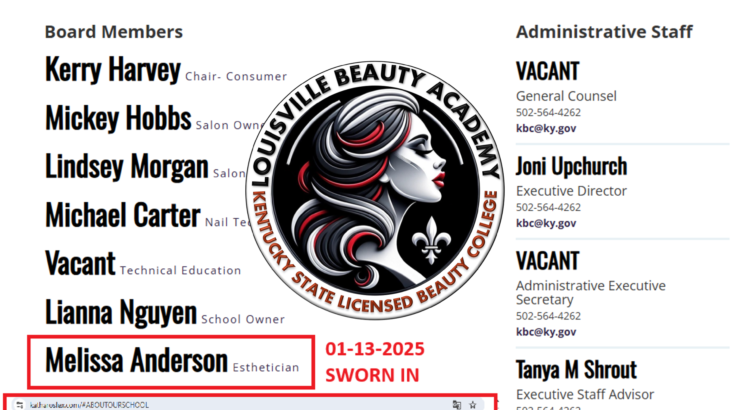
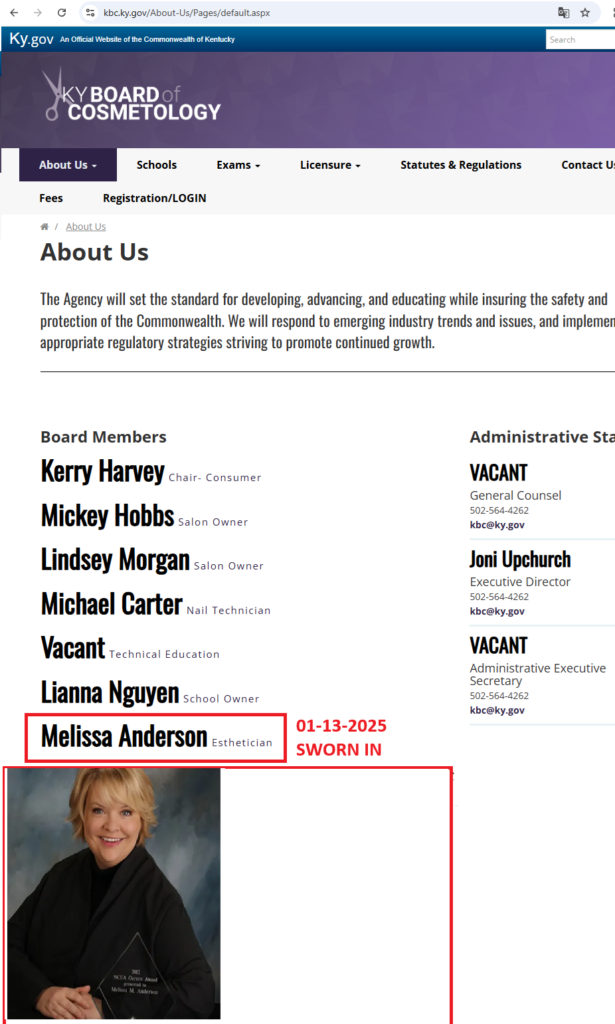
First Esthetician Member Sworn In KBC – 01-13-2025: A Milestone for Kentucky’s Beauty Industry

January 13, 2025, marks a historic milestone for Kentucky’s beauty industry as the Kentucky State Board of Cosmetology welcomed its first-ever Esthetician board member during its January Board Meeting in Frankfort, Kentucky. This momentous occasion comes as a direct result of the collective efforts behind Senate Bill 14 (SB14), a landmark piece of legislation that expanded board representation to include nail technicians and estheticians.

The passage of SB14 in 2024 was not just a legislative victory—it was the result of tireless advocacy by a diverse coalition of individuals and organizations across the state. Community leaders, including those from the Cambodian, Vietnamese, Latino, and other immigrant communities, played a crucial role in this campaign. Louisville Beauty Academy, led by its visionary founder Di Tran, has been at the forefront of these efforts, championing inclusivity and equity in the beauty industry.

The Role of Louisville Beauty Academy in Advocacy

Louisville Beauty Academy has been a leading advocate for SB14, emphasizing the importance of representation and the need for a regulatory framework that reflects the diversity of Kentucky’s beauty professionals. The academy’s founder, Di Tran, worked alongside an incredible coalition of advocates, including new immigrants and long-standing members of the beauty industry, to push for changes that would benefit students, licensees, and the public.

Through workshops, public outreach, and collaboration with policymakers, Louisville Beauty Academy and its allies ensured that the voices of underrepresented beauty professionals were heard. Their efforts culminated in the addition of new board seats, paving the way for progress and inclusion.

Welcoming the New Board Member

The inclusion of an esthetician on the Kentucky Board of Cosmetology is a step toward better representation and acknowledgment of the specialized fields within the beauty industry. Melissa Anderson, who was sworn in during the meeting, will serve as the first esthetician board member, helping to shape the future of esthetics in Kentucky. Her appointment represents the fruits of years of collective advocacy by countless individuals and organizations.

A Broader Vision for Kentucky’s Beauty Industry

The passing of SB14 highlights the strength of a unified community working toward a shared vision of inclusivity and growth. Louisville Beauty Academy remains committed to ensuring that students, licensees, and the general public stay informed about industry advancements and regulatory changes. With this new chapter, the academy continues to lead by example, creating opportunities for all beauty professionals to thrive.

Moving Forward Together

The journey to passing SB14 demonstrated the power of collaboration among diverse communities and the importance of shared goals. As Kentucky’s beauty industry evolves, Louisville Beauty Academy invites all professionals, students, and advocates to join in building a future defined by representation, inclusivity, and excellence.

For more information about SB14, updates from the Kentucky Board of Cosmetology, or resources for beauty professionals, visit Louisville Beauty Academy’s official website.


Disclaimer: This article is intended for informational purposes only and reflects the views of contributors involved in the advocacy for Senate Bill 14. The content does not represent official statements or policies of the Kentucky State Board of Cosmetology. For official information, please visit the Kentucky Board of Cosmetology’s official website.

https://kbc.ky.gov/About-Us/board-meetings/Pages/default.aspx