Disclaimer: This publication is provided solely for educational, academic, and public policy discussion purposes. It is an independent evidence-based research review intended to encourage informed dialogue regarding beauty education, workforce development, public safety, ethics, technology, and regulatory policy. It does not represent legal advice, official government policy, or the position of any licensing board, accrediting agency, employer, or organization referenced. All factual information is derived from publicly available sources cited herein to the best of the authors’ knowledge at the time of publication, while analyses, interpretations, and policy recommendations are presented to foster constructive discussion and should not be interpreted as definitive conclusions. Readers are encouraged to review the original referenced sources, consider multiple perspectives, and reach their own informed judgments.
Executive Summary
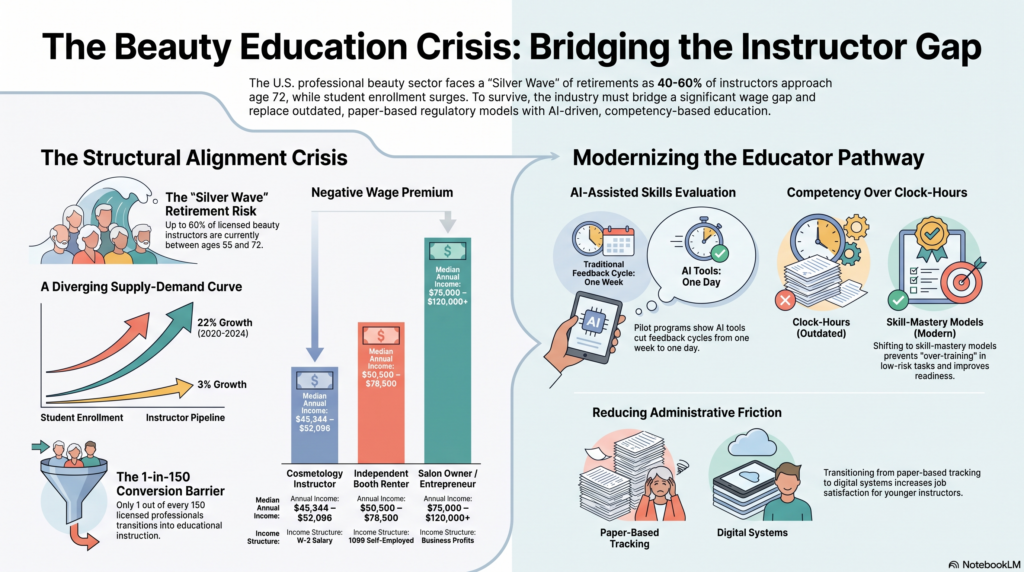
The professional beauty education sector in the United States is facing a structural alignment crisis. This crisis is driven by an aging faculty workforce, stagnant instructor recruitment pipelines, persistent regulatory frictions, and a rapidly evolving technological landscape1. This research review examines the demographic, economic, regulatory, and technological forces shaping the cosmetology instructor pipeline, with a focus on national trends and a detailed case study of the Commonwealth of Kentucky2.
A critical analysis of vocational education labor markers reveals a significant demographic shift2. Across the United States, between 40% and 60% of licensed beauty instructors are currently between the ages of 55 and 72, representing a retirement wave that will deplete the faculty ranks over the next decade2. This demographic contraction is happening alongside a surge in student demand2.
From 2020 to 2024, national student enrollment in beauty school programs grew by 22%2. However, the instructor training pipeline expanded by only 3% during the same period, with only 1 out of every 150 licensed beauty professionals transitioning into educational instruction2.
This pipeline failure is driven by economic and regulatory factors. The opportunity cost of leaving active salon practice is high. Established cosmetologists operating under commission or independent booth-rental models can earn significantly more than the median annual wage of cosmetology instructors, which ranges from $45,344 to $52,096 depending on state structures1. Additionally, the process of obtaining an instructor license requires substantial financial and time investments7. In Kentucky, for instance, candidates must complete 750 hours of apprentice training, even after completing a 1,500-hour basic cosmetology program and a mandatory six-month post-licensure salon apprenticeship7.
At the same time, the industry is experiencing rapid technological change. Artificial Intelligence (AI) and digital learning management systems are beginning to reshape curriculum delivery, automated skills assessment, and administrative record-keeping11. When properly integrated, these technologies can reduce the administrative workload of instructors, allowing them to focus more on hands-on instruction12.
This review evaluates the tension between traditional hour-based licensing models and modern, competency-based education13. It also analyzes the state of regulatory enforcement, referencing the November 2024 audit of the Kentucky Board of Cosmetology by the Legislative Oversight and Investigations Committee4. Finally, it offers a comparative analysis of international vocational education frameworks to outline policy recommendations designed to modernize instructor recruitment, maintain high public health and safety standards, and improve workforce readiness for the modern salon environment13.
Literature Review
Occupational licensing in the personal care services industry is historically rooted in state “police power,” which grants governments the authority to establish regulations protecting public health, safety, and sanitation3. Over the past century, state boards of cosmetology have established extensive training hours and examination protocols designed to verify minimum competency in infection control, chemical handling, and tool safety17.
However, labor economics literature suggests that occupational licensing can also act as a barrier to entry, reducing workforce mobility and increasing costs for consumers without necessarily improving public safety13. The professional beauty education sector exists at the center of this tension. It must balance safety-critical curriculum standards with the economic realities of a changing workforce13.
Academic and government research highlights a persistent staffing challenge across Career and Technical Education (CTE) pathways20. According to the National Center for Education Statistics (NCES), vocational and technical educators are on average older than their academic counterparts, with nearly 42% of the estimated 125,000 public school CTE teachers in the United States aged 50 or older23. This demographic pattern is even more pronounced in the beauty education sector, where private trade schools and community colleges report difficulty recruiting and retaining licensed instructors2.
The economic literature on occupational choice and opportunity cost helps explain this recruiting challenge6. The salon industry’s shift toward independent booth-rental and suite-rental models has provided experienced stylists with greater pricing control, scheduling flexibility, and earning potential25.
As a result, the financial return on a conventional W-2 cosmetology instructor salary has declined relative to independent salon practice5. This economic gap is widened by the administrative and regulatory burdens placed on educators, which many young beauty professionals view as restrictive and uncreative17.
Additionally, educational research is increasingly focusing on the impact of technology-driven and competency-based models in vocational training11. Traditional hour-based requirements are being critiqued by state regulatory reviews for causing “over-training” in low-risk activities while failing to provide sufficient training in high-risk, modern procedures13.
The introduction of digital learning platforms and AI-assisted performance assessments offers potential pathways to streamline instruction and grading12. However, integrating these technologies requires state boards to adapt their administrative rules, which have historically favored paper-based record-keeping and strictly in-person lecture structures10.
National Workforce Analysis
An analysis of national demographic and employment data reveals a structural imbalance between the demand for beauty education and the supply of qualified instructors1. The cosmetology instructor workforce is characterized by an advanced age profile, high retirement projections, and low recruitment rates among younger licensed practitioners1.
Demographic Profile of Cosmetology Instructors
According to national occupational data, the average age of a cosmetology instructor in the United States is 46.1 years1. This is higher than the median age of the broader domestic workforce, which is approximately 42 years. A detailed age breakdown reveals a significant concentration of instructors in older cohorts, as shown below:
| Age Cohort | Percentage of Workforce |
| 20–30 Years | 11.0% |
| 30–40 Years | 21.0% |
| 40+ Years | 67.0% |
Source: Zippia Occupational Database (2024)
[cite: 1]
The concentration of instructors over age 40 (67%) is a key factor in the industry’s projected attrition rates1. This demographic trend is further illustrated by the “Silver Wave” phenomenon, with estimates suggesting that 40% to 60% of all licensed beauty instructors in the United States are currently between the ages of 55 and 722. Most of these professionals are expected to retire within the next decade, creating a significant vacancy rate across both private trade academies and public vocational institutions2.
The cosmetology instructor workforce also exhibits a pronounced gender imbalance:
| Demographic Metric | Cosmetology Instructors | Related Aesthetics Instructors | Adjunct Nursing Faculty | Diesel Technology Instructors | HVAC/R Instructors |
| Female Share (%) | 91.0% | 92.0% | 91.0% | 3.0% | 3.0% |
| Male Share (%) | 9.0% | 8.0% | 9.0% | 97.0% | 97.0% |
Source: U.S. Bureau of Labor Statistics / Zippia Compilations (2021-2024)
[cite: 1]
Racial and ethnic distribution data for cosmetology instructors shows that 65.8% identify as White, 11.2% as Asian, 10.4% as Hispanic or Latino, and 7.3% as Black or African American1. Historical longitudinal data indicates a gradual diversification of the instructor corps, with the White share of the workforce declining from 72.26% in 2010 to 65.84% in 2021, while the Hispanic or Latino share rose from 8.54% to 10.40% over the same period1.
| Year | White (%) | Black or African American (%) | Asian (%) | Hispanic or Latino (%) |
| 2010 | 72.26% | 7.45% | 9.12% | 8.54% |
| 2015 | 69.22% | 7.80% | 10.62% | 9.46% |
| 2020 | 66.99% | 7.19% | 10.42% | 10.28% |
| 2021 | 65.84% | 7.31% | 11.21% | 10.40% |
Source: Integrated Public Use Microdata Series (IPEDS) / Zippia Demographic Analysis
[cite: 1]
Comparison to the Broader Vocational Education Sector
To determine whether cosmetology education has an exceptionally old instructor workforce, its demographics must be benchmarked against broader Career and Technical Education (CTE) sectors20. Data from the National Center for Education Statistics (NCES) indicates that the average age of public school career or technical education teachers is 45.9 years, compared to 45.5 years for non-CTE educators24.
| Main Teaching Assignment | Average Age (Years) | Under 30 Years (%) | 30–39 Years (%) | 40–49 Years (%) | 50–59 Years (%) | 60+ Years (%) |
| Career, Technical, & Vocational | 45.9 | 7.9% | 24.0% | 28.4% | 27.1% | 12.7% |
| General Education | 42.5 | 15.6% | 27.2% | 28.1% | 21.3% | 7.8% |
| Humanities | 43.9 | 12.6% | 26.0% | 27.7% | 23.7% | 10.0% |
| Mathematics & Computer Science | 43.0 | 15.2% | 26.0% | 27.5% | 22.6% | 8.7% |
| Natural Sciences | 43.5 | 13.2% | 25.3% | 30.2% | 22.2% | 9.2% |
Source: NCES National Teacher and Principal Survey (NTPS) 2020-21
[cite: 24]
This comparison shows that cosmetology educators (average age 46.1) closely mirror the broader CTE average of 45.9 years1. However, the key differentiator is the pipeline growth rate2. While broader secondary and postsecondary CTE occupations face average projected declines or flat growth of approximately -1% to 3% through 203420, the beauty school industry is experiencing an increase in student enrollment that is not matched by instructor supply2.
The Supply-Demand Divergence
The structural pipeline challenge is driven by two diverging growth curves:
- Explosive Student Enrollment: According to data from the Integrated Postsecondary Education Data System (IPEDS), national enrollment in beauty school programs grew by 22% between 2020 and 20242.
- Stagnant Instructor Pipeline: Over the same four-year period, the pipeline for new licensed instructors grew by only 3%2.
This imbalance is driven by a low conversion rate2. Nationally, only 1 out of every 150 licensed beauty professionals goes on to pursue formal instructor training2.
State-by-State Breakdown of Shortage Severity
The severity of the beauty instructor shortage varies by state2. The professional beauty sector categorizes states into three tiers based on instructor-to-student ratios, vacancy rates, and program capacity limits:
- Critical or Severe Shortages (32 States): These jurisdictions report severe deficits of licensed instructors across cosmetology, esthetics, nail technology, and barbering2. In major states such as California, New York, and Texas, the ratio of licensed instructors to active students is less than 1 per 500 to 1,000 students in training2.
- Moderate Shortages (12 States): These states currently maintain adequate operations but do not have enough instructors to support projected enrollment growth2.
- Marginal Shortages (6 States/Jurisdictions): These areas have stable student-to-instructor ratios but are showing early indicators of future shortages, such as an rising median age of active faculty2.
| Shortage Severity Level | Number of States | Included Jurisdictions | Key Structural Metrics |
| Critical / Severe | 32 | AL, AK, AZ, AR, CA, CO, CT, DE, FL, GA, HI, ID, IL, IN, IA, KS, KY, LA, ME, MD, MA, MI, MN, MS, MO, MT, NE, NV, NH, NJ, NM, NY2 | Instructor-to-student ratio under 1:500 in major metropolitan programs; high school and academy waitlists over 6 months2. |
| Moderate | 12 | NC, ND, OH, OK, OR, PA, RI, SC, TN, UT, VT, WA2 | Faculty vacancy rates between 15% and 25%; slow program expansion2. |
| Marginal | 6 | VA, WV, WI, WY, SD, DC2 | Stable current ratios but rising median faculty age; limited replacement pipelines2. |
Source: Industry Association Reports / State Board Surveys Compiled through 2025-2026
[cite: 2]
Kentucky Case Study
The Commonwealth of Kentucky serves as a clear example of the challenges facing the beauty educator pipeline. Classified as an “extreme shortage” state, Kentucky has a significant imbalance in specialized instructor licenses and is currently navigating regulatory and administrative challenges2.
Active Instructor Counts in Kentucky
Public licensing records from the Kentucky Board of Cosmetology (KBC) highlight a major concentration of instructors in general cosmetology, with a notable deficit in specialized fields such as esthetics and nail technology2:
- Active Cosmetology Instructors: 450 statewide2
- Active Esthetics Instructors: 7 statewide2
- Active Nail Technology Instructors: 7 statewide2
- Active Instructor Apprentices (In-Training): ~103 statewide2
This concentration creates a significant bottleneck for specialized education2. To put these numbers in perspective, the state of Oregon has a population nearly identical to Kentucky (approximately 4.2 million), yet Oregon has three times more licensed instructors for esthetics and nail technology than Kentucky2.
Geographic Maldistribution
The instructor shortage in Kentucky is worsened by geographic maldistribution32. Most licensed beauty schools and active instructors are located in urban centers such as Louisville, Lexington, and Northern Kentucky32. Rural regions—particularly Eastern Kentucky (Appalachia) and Western Kentucky—have few or no active specialized instructors32.
For example, the Carl D. Perkins Comprehensive Rehabilitation Center in Thelma, Kentucky, is one of the few facilities in Eastern Kentucky licensed to offer cosmetology, esthetics, nail technology, and shampoo styling instruction32. However, rural programs face ongoing challenges in recruiting and retaining instructors, which limits educational access for rural students33.
Regulatory and Administrative Challenges
In November 2024, the Legislative Oversight and Investigations Committee of the Kentucky Legislative Research Commission released Research Report No. 492: Board of Cosmetology Oversight Functions4. This comprehensive audit revealed significant administrative and operational challenges within the Kentucky Board of Cosmetology:
- Lack of Training Policies: The board has no written policies or procedures for initial training or ongoing education for its inspectors4.
- Deficient Complaint Review Protocols: The board lacks structured, written guidelines for reviewing complaints against inspectors and following up with complainants4.
- Financial Discrepancies: The audit showed that the board received and retained $374,200 in fine revenue, despite a statutory requirement to deposit all fine payments directly into the State Treasury4.
- Inefficient Record-Keeping: The board has no electronic tracking system to search, monitor, and record issued fines, relying instead on a paper-based file and sticky-note system4.
- Lack of Remedial Guidance: The board issues fines to salons and licensees but offers no instructional guidance on how to fix violations, requiring only that the fine be paid4.
- Missing Inspection Records: In multiple instances, the board failed to include salon inspection sheets in fine files, leaving no documented proof or justification for the assessed penalties4.
- Arbitrary Penalty Assessment: The board’s fine ranges are broad and not tied to specific offenses, leading to concerns about arbitrary and inconsistent penalty amounts4.
- Inaccessible Payment Methods: The board accepts only money orders and cashier’s checks for fine payments, which are difficult to track and inconvenient for payees4.
These findings demonstrate that the administrative environment under which Kentucky beauty schools and instructors operate is characterized by high compliance friction and a lack of regulatory transparency4. The operational challenges at the state board level increase the administrative burden on schools, diverting resources away from instructor recruitment and student instruction4.
Why Are Young Professionals Not Becoming Instructors?
To understand the beauty educator shortage, it is necessary to examine why younger, licensed beauty professionals choose not to enter the instructional workforce2. An analysis of labor economics and occupational opportunities highlights a significant economic gap between classroom instruction and active salon practice or entrepreneurship6.
Opportunity Cost and Income Comparisons
In labor economics, the concept of opportunity cost dictates that individuals select occupations that maximize their total return on investment, which includes wages, flexibility, and creative satisfaction6. For a licensed cosmetologist with three to five years of experience, the decision to become an instructor often results in a negative wage premium5.
The table below compares average earnings across different segments of the beauty industry:
| Professional Segment / Role | Estimated Median Annual Income | Primary Income Structure | Key Non-Wage Compensations / Structural Risks |
| Cosmetology Instructor | $45,344 – $52,0961 | W-2 Salary / Hourly27 | Predictable schedule; health/retirement benefits (in public/large schools)5. |
| Salon Owner / Entrepreneur | $75,000 – $120,000+6 | Business Net Profits6 | Full pricing/operational control; high financial liability25. |
| Independent Booth Renter | $50,500 – $78,5006 | 1099 Self-Employed26 | Schedule flexibility; 15.3% self-employment tax; variable weekly income6. |
| Commission Stylist | $36,600 – $48,8006 | W-2 Performance-Based6 | Salon-provided marketing/supplies; split of 40%–55% of service revenue6. |
| Corporate Brand Educator | $60,000 – $85,00037 | W-2 Salary / Corporate27 | Paid travel; product discounts; structured corporate ladder37. |
| Beauty Influencer / Digital Creator | Variable ($30k – $150k+) | Direct Brand Sponsorships | Creative autonomy; high audience retention risks; no baseline wage security37. |
Source: Derived from BLS OOH (2024), CSHA Earnings Data (2024), and Vagaro & GlossGenius Industry Surveys (2025)
[cite: 5, 6, 20, 27]
To model this transition mathematically, the labor supply choice for a utility-maximizing beauty professional can be structured around net income comparisons6. For an independent booth renter, the net pre-tax income () is defined as:

where is total annual service revenue,
is annual booth rent (
), and
represents the supply and wholesale product cost parameter (typically
or 8% of revenue)6.
Because the booth renter is classified as self-employed under federal guidelines, they are subject to a self-employment tax () of 15.3% on 92.35% of net earnings6:

Thus, the booth renter’s take-home income before standard federal and state income taxes is:

In contrast, a W-2 commission-based stylist receives a commission split (, where
) on service revenue
6. The salon owner absorbs the rent and supply costs, and covers half of the FICA payroll tax (7.65%)6:

The opportunity cost () of transitioning from independent practice to a salaried W-2 instructor position paying a fixed salary
is given by:

When , the professional faces a negative wage premium, creating a strong economic disincentive to entering the educational workforce6. The table below applies these formulas to different service revenue levels, illustrating the financial crossover point6:
| Annual Service Revenue (S) | Commission Take-Home (Icommission) (at c=0.50) | Booth Rental Take-Home (Ibooth) (at R=$6,000/yr, p=0.08) | Salaried Instructor Compensation (Winstructor) | Opportunity Cost (OC) of Teaching |
| $40,000 | $18,470 | $17,174 | $45,000 | -$26,530 (Net Gain) |
| $60,000 | $27,705 | $27,478 | $45,000 | -$17,295 (Net Gain) |
| $80,000 | $36,940 | $37,783 | $45,000 | -$7,217 (Net Gain) |
| $100,000 | $46,175 | $48,087 | $45,000 | +$3,087 (Loss) |
| $120,000 | $55,410 | $58,392 | $45,000 | +$13,392 (Loss) |
Source: Applied microeconomic modeling using standard IRS and salon industry cost benchmarks
[cite: 6, 40]
These calculations demonstrate that as soon as a stylist builds an active book of business generating over $90,000 in annual service revenue, the opportunity cost of transitioning to a salaried teaching position becomes positive6. For established stylists making $100,000 or more, becoming an instructor results in a direct financial loss, which limits the candidate pool for schools trying to recruit experienced practitioners2.
Motivation and Career Incentives
While economic incentives favor active salon practice, certain professional and personal factors can motivate licensed cosmetologists to pursue careers in beauty education17. Understanding these motivators is essential for designing policies to address the instructor shortage27.
Factors Discouraging the Educator Pathway
Surveys and workforce data indicate that several factors discourage experienced cosmetologists from transitioning into teaching22:
- Administrative and Compliance Burdens: Instructors must manage extensive state-mandated paperwork, clinical service tracking logs, and student progress reports11. Many find this paperwork burdensome and unrelated to their core creative skills11.
- Reduced Creative Output: Teaching foundational skills like sanitation, basic roller sets, and elementary cutting can feel repetitive for advanced stylists who prefer modern, creative work17.
- Licensing Frictions: Prospective instructors must complete additional training hours and pass state board instructor exams, which can be time-consuming and expensive7.
- Alternative Digital Opportunities: The growth of social media, digital brand partnerships, and online educational platforms allows stylists to teach and monetize their expertise without a formal state instructor license37.
Factors Encouraging the Educator Pathway
Conversely, certain factors make formal teaching roles attractive to some practitioners, particularly later in their careers17:
- Income Stability: Salons can experience seasonal income fluctuations and client cancellations27. An institutional teaching role offers a predictable salary or hourly wage27.
- Physical Sustainability: Salon work is physically demanding, requiring stylists to stand for 8 to 10 hours a day, which can lead to repetitive strain injuries and chronic physical fatigue17. Teaching offers a less physically intense environment17.
- Predictable Schedules: Active stylists often work long, irregular hours, including evenings and weekends, to accommodate client schedules17. School hours are typically more structured and predictable17.
- Desire to Mentor: Many seasoned professionals are motivated by a personal desire to guide the next generation and support the industry45.
These contrasting factors suggest that while economic considerations and administrative burdens discourage younger professionals from teaching11, physical sustainability and schedule predictability make teaching an attractive option for older or transitioning stylists17.
Regulatory Barriers and Recruitment
State-level occupational licensing frameworks significantly influence the recruitment and retention of beauty instructors47. Requirements vary across jurisdictions, creating varying degrees of friction for prospective educators19.
Varied State Licensing Standards
The table below illustrates the varying instructor licensing requirements across select jurisdictions:
| Jurisdiction | Required Training Hours | Prior Experience Requirements | Exam Components Required | Continuing Education (CE) |
| Kentucky | 750 Hours7 | 1 year active practitioner license7 | Written Theory & Practical Demonstration7 | Mentored on-job or school-directed training10. |
| Texas | License Eliminated43 | N/A (Practitioner verification only)43 | None43 | N/A43 |
| North Carolina | 800 Hours48 | Alternative pathway based on full-time work experience48 | Written & Practical Exams | Yes, annual hours required for renewal. |
| Alaska | 600 Hours49 | 1 year in practice + 3 years of practice49 | Written & Practical Exams49 | Not Required49 |
| Washington | 500 Hours43 | Current qualifying license43 | Written & Practical Exams43 | Yes, periodic hours. |
| Georgia | Hour-based training | Master-level license + documented work experience48 | State instructor examinations48 | Yes, periodic hours. |
Source: Compiled from State Board Administrative Codes and Licensing Statutes (2024-2025)
[cite: 7, 43, 48, 49]
As shown above, Texas eliminated separate instructor licenses, opting instead to allow schools to verify that their teachers hold an active practitioner license for the subjects they teach43. In contrast, Kentucky maintains a structured 750-hour apprentice instructor curriculum under 201 KAR 12:082 Section 810. This curriculum requires 425 hours of direct contact with students and allows up to 325 hours of theory instruction to be completed online10.
The Impact of Mandatory Apprenticeships
Kentucky’s regulatory framework includes another unique requirement: a mandatory six-month apprenticeship for cosmetologists after they pass their exams9. To obtain a full cosmetology license, candidates must:
- Complete 1,500 hours of training at an approved beauty school9.
- Pass both the written and practical state board examinations9.
- Work in a licensed salon under the supervision of a licensed cosmetologist for a minimum of 20 hours per week for six consecutive months9.
While this apprenticeship provides real-world experience, it also adds time to the career path9. A stylist interested in becoming an instructor in Kentucky must complete 1,500 hours of basic training9, complete the six-month salon apprenticeship9, work as a licensed practitioner for a minimum of one year7, and then complete an additional 750-hour instructor training program7.
This pathway creates a significant time and financial commitment that can discourage younger professionals from pursuing careers in cosmetology education2.
Innovation Adoption and Technology
Historically, beauty education institutions have been slow to adopt new technologies11. Many schools continue to rely on manual systems for tracking student progress, services, and administrative compliance11.
Traditional versus Modern Administrative Systems
A persistent challenge in beauty school administration is tracking clinical services11. State cosmetology boards require accurate tracking of student-performed services to verify graduation and licensing eligibility10.
Despite the availability of modern digital options, many institutions still utilize paper quota books, physical stamp sheets, or standalone spreadsheets11. This manual approach creates several operational risks:
- Students may lose or misplace physical progress tracking logs11.
- Instructors must spend class time manually signing off on clinical service records, which can be interrupted in a busy salon-school environment11.
- Administrators must manually reconcile discrepancies across multiple spreadsheets and paper records, which is time-consuming and prone to data entry errors11.
In contrast, modern learning management systems (LMS) designed for beauty education allow students to submit clinical service records digitally11. Instructors can review and approve these submissions in real-time on tablets or mobile devices11.
This shift to paperless administration reduces administrative workloads and ensures that data is stored securely and is easily accessible for state board audits11.
The Demographic Alignment of Technological Systems
There is a notable correlation between an institution’s technology adoption and its ability to recruit younger instructors46. Younger, digital-native beauty professionals are accustomed to using mobile apps, social media, and digital platforms in their personal lives and salon businesses37.
When these professionals enter an educational environment that relies on paper books, physical punch-clocks, and manual records, the resulting administrative friction can lead to job dissatisfaction and turnover11.
Conversely, institutions that adopt modern, integrated digital technologies—such as online scheduling software, digital curriculum delivery, and interactive learning platforms—often find it easier to recruit younger educators46. These tools align with their existing digital skills and allow them to spend more time on creative instruction and student mentoring rather than administrative tasks11.
Ethical Education Framework
A key debate in beauty education is the balance between sales-focused curriculum and ethics-focused training3. While cosmetic brands and salon businesses emphasize retail sales and client acquisition, state regulatory boards focus primarily on public safety, sanitation, and consumer protection3.
Commercialization versus Consumer Safety
Private beauty schools are often incentivized to align with major product brands, emphasizing commercial techniques, luxury styling, and retail sales strategies3. This approach can prepare students for the commercial aspects of the salon business, but it must not overshadow safety and ethics-focused training3.
State licensure laws exist as an exercise of state “police power” to protect public health3. The hands-on work of cosmetologists, estheticians, and nail technicians involves physical contact, sharp tools, and chemical products18.
Improper practices can result in chemical burns, eye damage, physical injuries, or the transmission of bacterial and fungal infections3. For example, the transmission of blood-borne pathogens such as hepatitis B, hepatitis C, and HIV remains a risk if tools are not properly disinfected between clients3.
┌──────────────────────────────┐
│ OCCUPATIONAL LICENSING │
│ UNDER POLICE POWER │
└──────────────┬───────────────┘
│
▼
┌──────────────────────────────┐
│ PUBLIC HEALTH PROTECTIONS │
└──────────────┬───────────────┘
│
┌────────────────────────────┴────────────────────────────┐
▼ ▼
┌──────────────┐ ┌──────────────┐
│ INFECTION │ │ CHEMICAL │
│ CONTROL │ │ SAFETY & │
│ PROTOCOLS │ │ DISINFECTION │
├──────────────┤ ├──────────────┤
│• Prevent cut │ │• Prevent gas │
│ infections │ │ burns and │
│• Hepatitis & │ │ allergic │
│ HIV defense │ │ sensations │
│• Standard │ │• Proper tool │
│ precautions │ │ disinfection│
└──────────────┘ └──────────────┘
The professional evolution of a beauty technician can be mapped across the Dreyfus Model of Skill Acquisition, which outlines five distinct developmental stages17:
- Novice: Students rely on rule-based, context-free steps, focusing entirely on standard operating procedures for basic tasks17.
- Advanced Beginner: Technicians begin to recognize situational elements and manage simple real-world scenarios but still require supervision.
- Competence: The practitioner can independently plan, prioritize, and make technical decisions based on cumulative experience17.
- Proficiency: The stylist understands situations holistically, quickly identifying deviations from normal patterns and making real-time adjustments17.
- Expertise: Practitioners operate with intuitive fluid performance, seamlessly integrating technical precision, safety protocols, and artistic design17.
Historical Context and Regulatory Mandates
The history of occupational licensing highlights how early safety standards were sometimes used to restrict access for minority communities3. During the Jim Crow era, licensing requirements were occasionally applied in a discriminatory manner to prevent Black barbers and beauticians from competing with white-owned salons3.
Understanding this history is important for modern regulators, ensuring that contemporary safety standards are applied fairly and do not create unnecessary barriers to entry3.
Today, federal and state safety regulations are established under the Federal Food, Drug, and Cosmetic Act of 1938 and updated by the Modernization of Cosmetics Regulation Act of 2022 (MoCRA)3. These frameworks require strict tracking of adverse events and establish clear safety standards for cosmetic products and clinical operations3.
A comprehensive, ethical cosmetology curriculum must integrate these modern legal standards, preparing students to manage clinical risks and protect client safety3.
Educational Philosophy and Salon Transition
A common critique of traditional cosmetology programs is that they are structured primarily to prepare students to pass state licensing exams, rather than to succeed in the modern salon environment13. This “teaching to the test” approach can leave graduates underprepared for the business, communication, and technical realities of active practice13.
Competency-Based Education vs. Traditional Hours
In traditional cosmetology education, students must complete a set number of hours to qualify for licensure, regardless of their individual rate of skill acquisition8. This model can lead to two main issues13:
- Over-Training in Low-Risk Tasks: Students may spend significant time repeating low-risk procedures that they have already mastered, such as simple haircuts or thermal stylings, simply to accumulate hours13.
- Under-Training in High-Risk Tasks: Because hour-based curricula are often rigid, students may not receive enough hands-on training in complex, high-risk procedures like chemical skin resurfacing, lash perms, or eyelash extensions13.
In contrast, competency-based education (CBE) models focus on demonstrated skill mastery rather than hours accumulated13. Under a CBE model, students must perform a minimum number of hands-on procedures under direct instructor supervision, with clear grading rubrics to evaluate their performance13.
This approach ensures that students achieve a consistent level of competence across all safety-critical and high-demand services before they are eligible for licensure13.
Workforce Readiness and Employer Expectations
To prepare students for a successful career, beauty schools must align their clinical training with modern salon operations52:
- Hands-on Practice with Live Models: While practicing on mannequins is useful for learning basic techniques, working with live clients is essential for developing client communication skills, real-time consultation techniques, and adaptability to different hair and skin types37.
- Business and Entrepreneurial Skills: Modern salon environments require stylists to manage their own schedules, market their services on social media, build a client base, and manage business finances6. Programs should integrate training in digital appointment booking, social media marketing, and financial management52.
- Industry Partnerships and Internships: Aligning beauty school programs with local salons and spas can facilitate student transitions into employment through structured internship and mentoring programs57.
By shifting the focus from test preparation to comprehensive workforce readiness, institutions can produce graduates who are prepared to enter the workforce as confident, productive salon professionals13.
AI, Technology, and the Future Instructor
Artificial Intelligence (AI) and automated instructional systems are starting to be integrated into vocational and technical education12. This technological shift is beginning to redefine the role of the cosmetology instructor12.
The Canyons School District Video Evaluation Pilot
In 2026, the Canyons School District in Utah co-developed and piloted an AI-assisted video evaluation tool in its high school cosmetology CTE program12. Supervised by cosmetology instructor Eliza Seeley (who managed 80 students) and researchers from Utah State University’s Center for the School of the Future, the pilot utilized Gemini AI to analyze student performance videos against standard rubrics12.
The methodology and results of this pilot provide key insights into how AI can support vocational training12:
Evaluation Process and Workflow
- Rubric Upload: The instructor uploaded pre-existing, detailed cosmetology performance rubrics into the AI tool12.
- Video Recording Standards: Students recorded two-to-three-minute videos demonstrating specific hands-on skills, such as hair cutting, coloring, and chemical applications12. To ensure accurate AI analysis, students followed strict guidelines regarding camera angles, lighting, and audio12.
- Frame-by-Frame AI Analysis: The AI tool analyzed student videos frame-by-frame, comparing their techniques against the uploaded rubric criteria12.
- Draft Assessment Generation: The AI generated a draft evaluation and highly specific comments, pointing to the exact timestamp in the video where a student deviated from proper technique12.
- Instructor Oversight: The AI-generated assessment was treated strictly as a draft12. The instructor reviewed every evaluation, adjusted scores and comments where necessary, and made all final grading decisions12.
Results and Learning Outcomes
- Reduced Feedback Cycle: Feedback turnaround was cut from nearly a full week to just one day12. This rapid turnaround allowed students to receive corrections during the same learning cycle, which is when motor-skill acquisition is most effective12.
- Behavior-Specific Feedback: Instead of receiving general remarks like “watch your sectioning,” students received comments tied to specific behaviors and moments in their video, such as “the angle of the shears at 1:12 was incorrect”12.
- Personalized, Differentiated Feedback: The AI automatically tailored feedback based on student skill levels12. Advanced students received suggestions for further refinement, while beginning students received detailed corrective feedback regarding foundational errors or missed steps12.
- Improved Efficiency: The AI-assisted process reduced the instructor’s grading workload, allowing her to spend more time on classroom instruction and hands-on coaching on the salon floor12.
- Perceived Fairness: Surveys revealed that both students and parents found the AI-assisted grading process to be fairer and more transparent, as every student video was measured against the same objective standard12.
Challenges and Limitations
- AI Misread Rate: The AI tool flagged correct techniques as incorrect approximately 10% of the time, particularly when students performed advanced, non-standard, or highly creative variations of a procedure12. This required the instructor to correct the AI’s drafts and update its instructions to recognize alternative correct techniques12.
- Video Quality Vulnerabilities: Poor lighting, incorrect camera angles, or weak audio occasionally hindered the AI’s ability to analyze techniques accurately, highlighting the necessity of strict recording guidelines12.
- Initial Skepticism: Some students and parents initially expressed concern about computer-based grading12. These concerns were resolved once the instructor explained that she reviewed and finalized every grade12. To reassure parents, the school provided family-facing assurances that student videos were processed securely and not stored permanently or shared12.
This pilot program shows that AI can serve as a supportive tool to improve grading efficiency and provide timely feedback, but it does not replace the expert judgment and mentorship of a qualified teacher12.
Uniquely Human Competencies
While AI can assist with grading, lesson planning, and administrative tracking, several aspects of cosmetology education remain uniquely human39:
- Tactile Feedback and Physical Adjustments: A critical component of beauty instruction is tactile feedback39. An instructor must physically touch a student’s hands to correct the tension on a strand of hair during a haircut, adjust the pressure of an esthetician’s hand during a massage, or guide the angle of a nail technician’s tool39.
- Empathy and Emotional Support: Students often face challenges or frustration as they learn complex skills57. Instructors provide encouragement, emotional support, and personalized motivation that cannot be replicated by algorithms39.
- Real-Time Artistic Consultation: Cosmetology is an art form as well as a technical skill39. When a client requests a service, the professional must evaluate numerous subjective variables—such as skin tone, face shape, hair texture, lifestyle, and personal style—to design a customized look39. Instructors guide students through this creative decision-making process39.
- Professional Mentorship: Instructors serve as role models, teaching students the soft skills, work ethics, and professional behaviors necessary to succeed in a salon environment39.
AI can support the instructional process by automating administrative and grading tasks, but the core of beauty education remains a human, relationship-driven activity39.
Future Instructor Competencies
As the beauty industry and educational models adapt to technological and regulatory changes, the skills required of cosmetology instructors are also evolving16. Future educators must develop a broader range of competencies to prepare students for the modern industry16.
These competencies can be categorized into three key areas:
1. Technical and Digital Literacy
Future instructors must be comfortable using digital tools and platforms16:
- AI Tool Integration: Instructors must know how to use AI-assisted video evaluation platforms, review and correct AI-generated assessments, and configure system rubrics12.
- LMS Management: Educators must be proficient in using learning management systems to track student progress, assign coursework, and manage digital records11.
- Digital Content Creation: To engage digital-native students, instructors can benefit from basic skills in video recording, editing, and online curriculum presentation43.
2. Pedagogical Innovation and Coaching
Teaching methods must shift from traditional lecturing to active coaching45:
- Competency-Based Assessment: Instructors must understand how to assess student learning based on objective, rubrics-aligned performance criteria rather than simply tracking hours13.
- Experiential Mentoring: Educators should act as coaches, guiding students through hands-on practice, helping them analyze their own work, and encouraging reflective practice12.
- Development of Soft Skills: Teaching technical skills must be balanced with developing students’ communication, client relations, time management, and emotional intelligence44.
3. Regulatory Compliance and Business Leadership
Instructors must prepare students to navigate the complex legal and economic realities of the beauty industry3:
- Ethical and Legal Standards: Educators must have a deep understanding of state laws, licensing regulations, and public health guidelines3. They must teach students the legal boundaries of their future licenses and how to maintain rigorous sanitary standards3.
- Business and Entrepreneurship Training: Instructors should be prepared to teach the fundamentals of salon operations, financial planning, independent contractor tax rules, and digital marketing6.
By developing these modern competencies, beauty school instructors can provide high-quality training that prepares students for the challenges and opportunities of the modern beauty workforce16.
International Comparison
Evaluating how other nations structure their beauty education and instructor training programs provides useful comparisons for U.S. policymakers14.
Vocational Frameworks by Country
The table below compares the regulatory, training, and qualifications frameworks across several countries:
| Country | Governance & Regulatory Body | Basic Practitioner Training Pathway | Instructor Qualifications Requirements | Primary Educational Philosophy |
| United States | Individual State Boards of Cosmetology / Barbering3 | 1,000 to 2,100 Hours (Hour-based school model)8 | State-specific instructor training hours and board exams43 | School-centered; state licensing examination alignment13. |
| Germany | German Chambers of Skilled Crafts (Handwerkskammer)14 | Dual Apprenticeship (Duale Ausbildung); combining 3 years salon work with vocational school14 | Master Craftsman (Meisterbrief) qualification; requires multiple exams14 | Workplace-integrated; high occupational prestige and craft standardization14. |
| United Kingdom | Office of Qualifications and Examinations Regulation (Ofqual)65 | Government-approved apprenticeship standards; Level 2 or 3 qualifications15 | Level 4 or higher training; certified End-Point Assessment (EPA) experience | Workplace-focused; standardized End-Point Assessment (EPA) validation15. |
| Australia | Australian Skills Quality Authority (ASQA)16 | Competency-based vocational training; usually 1-2 years with Registered Training Organizations (RTOs)69 | Certificate IV in Training and Assessment (TAE40122); nationally recognized16 | Competency-focused; alignment with national industry qualifications frameworks71. |
| Singapore | SkillsFuture Singapore / Institute of Technical Education (ITE)58 | Higher Nitec in Hairdressing & Salon Management; 2-3 years combining classroom and internship58 | Train the Trainer credentials; certified industry competency75 | Industry-aligned; focus on technical skills, technology integration, and business skills58. |
| Canada | Provincial regulators (e.g., Skilled Trades Ontario)76 | Apprenticeship models; e.g., Ontario requires 3,500 total hours (3,020 on-job, 480 school)76 | Provincial Journeyperson status + experience (Master upgrades in NS)77 | Standardized industry-focused training; hybrid work-school models76. |
| Japan | Ministry of Health, Labour and Welfare / MEXT80 | 2-year Associate Degree programs (e.g., Yamano College of Aesthetics)80 | Advanced specialized degrees + formal teaching training28 | Academic and artistic integration; Beautician National Exam alignment80. |
| South Korea | Ministry of Employment and Labor / Human Resources Development Service | Vocational high school / Specialized academy training programs (e.g., Miyong Hagwon)81 | Professional licenses + technical college certifications | Mastery of technique and chemical design; strong language and workspace sponsorship requirements81. |
Source: Compiled from international vocational databases and ministry standard guidelines
[cite: 14, 15, 16, 76, 80, 81]
Key International Models
Germany’s Dual System and Master Craftsman Qualification
Germany’s vocational education and training system is based on the dual model (Duale Ausbildung)14. Trainees spend approximately 70% of their time working in a private salon under the guidance of a trainer and 30% of their time attending a state vocational school (Berufsschule) to learn theory, chemistry, and business math44. This program typically lasts three years14.
To operate an independent salon or train apprentices in Germany, a professional must obtain a Master Craftsman certificate (Meisterbrief)14. This qualification requires passing an examination administered by a local Chamber of Skilled Crafts (Handwerkskammer), which consists of four parts14:
- Practical Demonstration: A demonstration of master-level craftsmanship14.
- Trade-Specific Theory: Advanced knowledge of chemistry, anatomy, and styling techniques14.
- Business Administration: Financial management, contract law, and economic planning14.
- Pedagogical Aptitude: Training and teaching methods, developmental psychology, and workplace safety laws14.
The Meisterbrief is highly prestigious and has been declared equivalent to an academic bachelor’s degree under the European Qualifications Framework14. While this system requires a significant investment of time and money (often taking 7 to 10 years from the start of an apprenticeship), it ensures high standards of safety, quality, and business sustainability across the industry14.
The United Kingdom’s Ofqual and End-Point Assessments
In the United Kingdom, beauty and hairdressing education is structured around government-approved apprenticeship standards regulated by the Office of Qualifications and Examinations Regulation (Ofqual)65. Apprentices spend a minimum of 24 months in a salon environment, completing on-programme learning and receiving structural training from certified training providers15.
A key feature of the UK system is the End-Point Assessment (EPA)15. Once an apprentice completes their training and meets minimum English and Math requirements, they enter the “Gateway” phase to schedule their EPA15.
The assessment is administered by an independent EPA organization (such as VTCT Skills) and consists of three components15:
- Knowledge Test: A 60-minute, 40-question multiple-choice exam covering safety, science, and regulations15.
- Practical Assessment: A 5.5-hour observation in a real or simulated salon environment, where the apprentice must perform multiple services on at least two clients under the supervision of an independent assessor15.
- Professional Discussion: A 35-minute, formal conversation where the apprentice discusses their work portfolio and demonstrates their understanding of industry standards and behaviors15.
This EPA model ensures that licensing and graduation are validated by an independent, objective assessment, reducing the risk of inconsistent school-based grading15.
Australia’s Nationally Recognized Training and Certificate IV
Australia utilizes a competency-based vocational education system regulated by the Australian Skills Quality Authority (ASQA)16. Rather than tracking hours, students must demonstrate competence in specific units defined by national training packages16.
To teach accredited vocational courses in Australia, an instructor must hold the TAE40122 Certificate IV in Training and Assessment16. This qualification is recognized nationally and equips trainers with skills to16:
- Design and develop vocational training programs based on national packages16.
- Deliver group-based and individual learning in both classroom and online environments16.
- Assess learner competence using standardized validation tools54.
- Support adult literacy, numeracy, and digital skill needs16.
Prospective instructors must demonstrate vocational competence in their field (such as holding a Certificate III in Beauty Therapy) and have a minimum of three years of work experience before enrolling in the Certificate IV program70. This system ensures that all vocational teachers have a consistent foundation in pedagogy, assessment, and compliance16.
Policy Options Matrix and Analysis
U.S. policymakers can consider several options to address the beauty instructor shortage while maintaining high safety and educational standards13. The matrix below evaluates five policy proposals:
| Policy Proposal | Core Benefits | Primary Risks | Implementation Challenges | Required Supporting Evidence | Key Counterarguments |
| 1. Modernizing Instructor Licensing (Texas-Style Verification) | Immediate reduction in recruitment friction; allows highly skilled stylists to transition directly into teaching43. | Potential decline in pedagogical quality and classroom management skills28. | Requires changes to state administrative codes and school accreditation rules48. | Longitudinal studies comparing graduate success and safety violations in Texas vs. hour-based states43. | “Pedagogy is a distinct skill; simply being a good stylist does not guarantee an ability to teach effectively”47. |
| 2. Shifting to Competency-Based Education (CBE) and Repetitions | Cuts “over-training” in low-risk tasks; ensures consistent hands-on safety practice before licensure13. | Potential for some schools to rush assessments or lower grading standards without independent oversight13. | Designing standardized rubrics; retraining faculty; restructuring state board audits13. | Data from healthcare training showing minimum procedure counts required to achieve clinical safety13. | “Hour-based metrics are easier for state boards to audit and provide a uniform baseline of training”8. |
| 3. Integrating AI-Assisted Assessment Platforms | Cuts grading workloads; provides fast, objective feedback; allows instructors to focus on floor coaching12. | 10% AI error rate; risks privacy violations; may face initial resistance from parents and teachers12. | Funding technology infrastructure; training faculty; ensuring student data security12. | Independent reviews of pilots showing improved feedback speed and consistent grading outcomes12. | “Cosmetology is a personal, artistic craft that cannot be assessed accurately by algorithmic tools”39. |
| 4. Addressing KBC Audits and Paperless Compliance | Improves data accuracy; reduces administrative burdens; increases transparency; limits arbitrary regulatory fines4. | Initial implementation costs; requires secure data management systems. | Transitioning KBC from paper records to secure electronic tracking and online payment portals4. | Detailed state audits documenting paper-based tracking failures, missing data, and administrative friction4. | “Transitioning to paperless systems may be difficult for small, rural beauty schools with limited technology access.” |
| 5. Expanding Instructor Scholarships and Loan Forgiveness | Lowers the financial barrier for younger professionals to pursue teaching careers22. | Financial costs for state budgets or school associations22. | Securing government or industry funding; establishing eligibility and service verification guidelines. | Research on teacher recruitment in public education showing the impact of loan forgiveness on retention22. | “Financial incentives may not be enough to offset the pay gap between teaching and active salon practice”6. |
Counterarguments and Alternative Perspectives
To ensure a balanced analysis, it is necessary to examine alternative viewpoints and potential risks associated with the proposed policy changes13.
The Argument for Maintaining Hour-Based Licensing
Some industry groups and regulatory bodies argue that traditional hour-based licensing models are necessary to protect public health and safety13. Their arguments include:
- Audit Simplicity: Tracking student hours provides state boards with a simple, verifiable metric to audit school compliance8. Competency-based models require more complex, qualitative assessments that can be difficult for state regulators to monitor13.
- Uniform Training Baseline: Hour-based requirements ensure that all students receive a minimum period of structured learning, reducing the risk of schools rushing students through training8.
- Accreditation Alignment: Federal financial aid guidelines for vocational programs are often tied to clock-hour metrics, and transitioning to competency-based models can jeopardize student eligibility for federal grants and loans38.
The Argument Against AI and Automated Assessments
Skeptics of AI and digital technology in vocational training highlight several potential risks12:
- Loss of Artistic Nuance: Cosmetology involves artistic judgment, creativity, and subjective design39. Algorithmic grading tools may penalize creative, non-standard techniques that are commercially viable or fashionable, stifling student artistic expression12.
- Over-Reliance on Technology: Instructors might rely too heavily on automated feedback, reducing their direct engagement, tactile instruction, and face-to-face coaching on the salon floor12.
- Privacy and Security Concerns: Recording and uploading video performances of minor students creates data privacy and security challenges under federal regulations like the Family Educational Rights and Privacy Act (FERPA)12.
The Concern of Lowering Standards through Regulatory De-licensing
While some labor economists advocate for reducing or eliminating separate instructor licenses to improve workforce mobility19, critics argue that this can harm educational outcomes45:
- Pedagogical Quality: Effective teaching requires skills in curriculum design, lesson planning, learning psychology, and classroom management10. Practitioners who do not receive formal training in these areas may struggle to manage diverse classrooms or teach complex theory effectively45.
- Consistent Safety Education: Licensed instructor programs teach educators how to systematically deliver safety, sanitation, and regulatory curricula10. Eliminating these programs may lead to inconsistent safety training, potentially increasing public health risks over time13.
These counterarguments emphasize that while regulatory modernization is beneficial, reforms must be implemented carefully to protect public safety, ensure pedagogical quality, and maintain educational standards4.
Evidence-Based Conclusions and Areas for Future Research
This comprehensive review highlights several key findings regarding the aging beauty education workforce and the future of cosmetology education:
- A Demographic Retirement Curve: The beauty school instructor workforce has an advanced age profile, with 40% to 60% of active educators expected to retire within the next decade2. This upcoming wave of retirements, combined with growing student enrollment, will worsen current faculty shortages2.
- Economic Disincentives to Teach: The opportunity cost of leaving active salon practice is a major barrier to instructor recruitment6. Standard W-2 instructor salaries are often uncompetitive compared to the earning potential, flexibility, and autonomy of modern salon entrepreneurship and booth-rental models5.
- Friction in the Regulatory Pipeline: Long, hour-based training requirements and additional licensure exams create significant barriers for prospective instructors7. Transitioning toward flexible verification models (like the Texas framework) or competency-based training can help ease these recruitment bottlenecks13.
- Operational Failures in Regulatory Oversight: The November 2024 audit of the Kentucky Board of Cosmetology by the Legislative Oversight and Investigations Committee highlights a need for administrative modernization, paperless compliance tracking, and more transparent, consistent enforcement policies4.
- The Potential of AI-Assisted Feedback: Pilots like the Utah Canyons School District video-evaluation program show that AI can help automate grading, accelerate feedback turnaround from one week to one day, and reduce instructor workloads12. However, AI should serve as an assessment assistant rather than a replacement for direct instructor mentorship and tactile coaching12.
- The Importance of Ethical, Safety-Focused Education: A rigorous educational focus on sanitation, safety, and consumer protection is key to preparing students for successful licensure outcomes, protecting public health, and maintaining consumer trust in the personal care industry3.
To address these challenges, policymakers, state regulatory boards, and vocational institutions should collaborate to reduce unnecessary administrative burdens, modernize instructor training pathways, integrate supportive digital technologies, and transition toward competency-based educational models that prioritize both student readiness and public safety4.
Suggested Areas for Future Research
Given the current limitations in localized cosmetology data, researchers should target several distinct inquiries:
- Quantitative Impact of Instructor De-licensing: A longitudinal comparative study of student pass rates, salon performance, and safety incidents in de-licensed states (such as Texas) versus highly regulated states (such as Kentucky) to measure the true value of formal instructor training hours7.
- Algorithmic Bias in AI Aesthetics Evaluations: Investigation into whether automated video-evaluation tools exhibit bias across different hair classifications (e.g., coily, curly, wavy, and straight hair types) or skin tones when assessing chemical or styling procedures12.
- Economic Viability of Hybrid Apprenticeship Models: Cost-benefit analyses comparing traditional hourly beauty programs with dual-apprenticeship frameworks (such as those in Germany) to evaluate long-term financial outcomes and career retention rates6.
Policy Research Reference Registry and Appendix of Authorities
- Zippia Occupational Database (2024): Compiles national survey data on cosmetology instructor demographic splits, racial distributions, gender ratios, average wages, and degree attainments across the United States1.
- Louisville Beauty Academy National Shortage Review (2025-2026): Details “Silver Wave” retirement cohorts (ages 55–72), conversion metrics of active stylists to trainees, and the severe state-by-state instructor pipeline gap2.
- Franklin University Postsecondary Teacher Career Guide (2023): Analyzes postsecondary job posting data, structural educational degree requirements, and localized experience benchmarks requested by vocational employers86.
- U.S. Bureau of Labor Statistics (BLS) Occupational Outlook Handbook (May 2024): Establishes baseline median wages, career descriptions, and employment outlook statistics for career, technical, and trade instructors20.
- National Center for Education Statistics (NCES) Schools and Staffing Surveys (SASS) / National Teacher and Principal Survey (NTPS): Tracks longitudinal age profiles, teacher shortage fields, and hiring difficulties across urban and rural school systems21.
- Kentucky Board of Cosmetology (KBC) Administrative Records: Outlines localized school pass/fail metrics, institutional program offerings, and the complete statutory licensing guidelines for practitioners and apprentice instructors7.
- Kentucky Administrative Regulations (KAR) & Revised Statutes (KRS): See 201 KAR 12:082 (Instructional hours, apprentice instructor curriculum standards, and clinical limits) and KRS Chapter 317A10.
- Kentucky Legislative Research Commission (LRC) Research Report No. 492 (November 2024): Board of Cosmetology Oversight Functions, compiled by the Legislative Oversight and Investigations Committee. Audit details administrative failures, fiscal retention issues, and unverified penal processes4.
- Careers.csha.org Cosmetology Instructor Salary Survey (2024): Compiles state-level wage percentiles, regional compensation heatmaps, and typical benefits packages for vocational beauty educators5.
- Dalton Institute Beauty School Instructor Guides (2024-2025): Focuses on career pathway requirements, physical physical longevity in instruction, and the specialized values of regulatory and documentation compliance27.
- Vagaro, GlossGenius, & Thriving Stylist Economic Compilations (2025): Tracks average salon commission splits, monthly booth-rental market pricing, self-employment tax liabilities (IRS Schedule SE), and client retention metrics6.
- German Skilled Crafts Sector Act (Handwerksordnung) & Qualification Framework (DQR): Establishes structural guidelines for the three-year dual hairdressing apprenticeship (Ausbildung) and the four-part Master Craftsman (Meisterbrief) qualification14.
- UK Government Apprenticeship Standards (Ofqual / VTCT Skills ST0213): Regulates Level 2 and Level 3 hairdressing professional standards, Gateway entry constraints, and End-Point Assessments (EPA)15.
- Australian Skills Quality Authority (ASQA) Training Packages: Governs vocational training standards and sets the national delivery requirements for the TAE40122 Certificate IV in Training and Assessment16.
- Singapore Workforce Skills Qualifications (WSQ) & SkillsFuture Frameworks: Directs technical education tracks, including the Institute of Technical Education (ITE) Higher Nitec in Hairdressing & Salon Management56.
- Utah Office of Professional Licensure Review (OPLR) Cosmetology Report (January 2025): Assesses cosmetology licensing hours, analyzing over-training and under-training relative to consumer health, and recommends competency-based reforms13.
Works cited
- Cosmetology instructor demographics and statistics in the US – Zippia, https://www.zippia.com/cosmetology-instructor-jobs/demographics/
- THE NATIONAL BEAUTY EDUCATION SHORTAGE: A 50-STATE CRISIS — AND WHY KENTUCKY (YES, KENTUCKY!) IS EMERGING AS THE CENTER OF EXCELLENCE – RESEARCH 2025, https://louisvillebeautyacademy.net/the-national-beauty-education-shortage-a-50-state-crisis-and-why-kentucky-yes-kentucky-is-emerging-as-the-center-of-excellence-research-2025/
- Beauty Industry Regulation in the United States: Public Safety, Regulatory Power, and the Rights of Workers, Students, and Schools – RESEARCH & PODCAST SERIES 2026, https://louisvillebeautyacademy.net/beauty-industry-regulation-in-the-united-states-public-safety-regulatory-power-and-the-rights-of-workers-students-and-schools-research-podcast-series-2026/
- Board Of Cosmetology Oversight Functions – Legislative Research Commission, https://apps.legislature.ky.gov/lrc/publications/ResearchReports/RR492.pdf
- Cosmetology Instructor Salary (July 2026) – CSHA Career Center, https://careers.csha.org/salary/cosmetology-instructor
- Booth Rental vs Commission Salon: Which Pays a New Cosmetologist Better?, https://tradecolleges.org/blog/trade-programs/booth-rental-vs-commission-salon-cosmetologist
- License Requirements – Kentucky Board of Cosmetology, https://kbc.ky.gov/Licensure/Pages/License-Requirements.aspx
- Complete Guide to Cosmetology Licensing Requirements by State (2025), https://gotopjs.com/blog/complete-guide-to-cosmetology-licensing-requirements-by-state-2025/
- Kentucky Cosmetology Laws & License Requirements [2026] – Consentz, https://www.consentz.com/kentucky-cosmetology-laws-license-requirements/
- Title 201 Chapter 12 Regulation 082 • Kentucky Administrative Regulations, https://apps.legislature.ky.gov/law/kar/titles/201/012/082/10348/
- The Hidden Cost of Service Tracking in Beauty Schools – Pivot Point, https://www.pivot-point.com/beauty-school-service-tracking/
- AI-Assisted Video Evaluation in a High School Cosmetology Career Technology Education (CTE) Class, https://cehs.usu.edu/csf/files/prac-brief-cosmetology-4-13-26.pdf
- OPLR Cosmetology Report – Utah Department of Commerce, https://commerce.utah.gov/wp-content/uploads/2025/01/OPLR-Cosmetology-Report-3.pdf
- The German Meister Qualification Overview, https://www.zdh.de/fileadmin/Oeffentlich/English/2022-08_German_Meister_Overview.pdf
- Hair Professional – Hairdressing | VTCT Skills, https://www.vtctskills.org.uk/end-point-assessment/hairdressing-professional/
- TAE40122 Certificate IV in Training and Assessment – North Metropolitan TAFE, https://www.northmetrotafe.wa.edu.au/courses/certificate-iv-training-and-assessment-0
- Tag: licensing and regulation – Louisville Beauty Academy, https://louisvillebeautyacademy.net/tag/licensing-and-regulation/
- Public health and safety-first cosmetology state board exams in a multi-modal era, https://www.psiexams.com/knowledge-hub/public-health-and-safety-first-cosmetology-state-board-exams-in-a-multi-modal-era/
- Examining Licensing Issues Within the Cosmetology Industry, https://www.air.org/project/examining-licensing-issues-within-cosmetology-industry
- Career and Technical Education Teachers : Occupational Outlook Handbook, https://www.bls.gov/ooh/education-training-and-library/career-and-technical-education-teachers.htm
- Teacher Openings in Elementary and Secondary Schools – National Center for Education Statistics (NCES), https://nces.ed.gov/programs/coe/pdf/2023/tls_508.pdf
- An Overview of Teacher Shortages: 2025 | Learning Policy Institute, https://learningpolicyinstitute.org/product/overview-teacher-shortages-2025-factsheet
- Who Are Today’s Career and Technical Education Teachers?, https://www.air.org/resource/blog-post/who-are-todays-career-and-technical-education-teachers
- Percentage distribution of teachers’ selected main teaching assignment, age, and sex and average age in years, by school type and selected main teaching assignment: 2020–21 – National Center for Education Statistics (NCES), https://nces.ed.gov/surveys/NTPS/estable/table/ntps/ntps2021_7181_t12n
- Salon Employee vs. Booth Renter: What Misclassification Could Cost You – Whirks, https://www.whirks.com/blog/salon-employee-vs-booth-renter-misclassification
- The Booth Rental Model: What Cosmetologists Need to Know, https://cosmetologyauthority.com/booth-rental-model-for-cosmetologists/
- Beauty School Instructor Salary Guide: Pay, Jobs, and Career Paths – Dalton Institute of Esthetics and Cosmetology, https://daltoninstitute.com/beauty-school-instructor-salary-guide-pay-jobs-and-career-paths/
- RBHS Cosmetology – Education, https://sites.google.com/hdsb.ca/cosmetology/careers/cosmetology-instructor/education
- Instructors – Dalton Institute of Esthetics and Cosmetology, https://daltoninstitute.com/category/instructors/
- Average age of teachers and percentage distribution of teachers, by age category, school type, and main teaching assignment: 2017–18 – National Center for Education Statistics (NCES), https://nces.ed.gov/surveys/ntps/tables/ntps1718_20062205_t12n.asp
- Apprentice Instructor – College for Technical Education, https://cte.edu/apprentice-instructor/
- Schools – Kentucky Board of Cosmetology, https://kbc.ky.gov/Schools/Pages/default.aspx
- Difficulty Hiring Teachers in Rural Areas – National Center for Education Statistics (NCES), https://nces.ed.gov/programs/coe/indicator/llc
- Employee vs Booth Renter vs Independent Contractor: Key Differences in the Salon Industry, https://biz.booksy.com/en-us/blog/employee-vs-booth-renter-vs-independent-contractor-key-differences-in-the-salon-industry
- 21 Highest-Paying Cosmetology Jobs (With Salary Information) | Indeed.com, https://www.indeed.com/career-advice/finding-a-job/highest-paying-cosmetology-jobs
- Straightening Out the Employee Vs. Contractor Classification Confusion | Salon Today, https://www.salontoday.com/articles/straightening-out-the-employee-vs-contractor-classification-confusion
- Study Cosmetology Abroad: Top Colleges, Costs, & Careers – AECC Global, https://www.aeccglobal.com/study-abroad/courses/cosmetology
- Why Beauty Education Matters: My Journey to Cosmetology School – Pivot Point, https://www.pivot-point.com/why-beauty-education-matters/
- Will AI Replace Cosmetology? Why It’s a Future-Proof Career, https://ljic.edu/why-ai-will-not-replace-cosmetology/
- cosmetology instructor- nicholasville – Career Center | Recruitment, https://workforcenow.adp.com/mascsr/default/mdf/recruitment/recruitment.html?cid=16842e3c-f495-43ef-b44e-b5bd97e557e4&jobId=577815
- The decline of the teaching profession – Bureau of Labor Statistics, https://www.bls.gov/opub/mlr/2024/beyond-bls/the-decline-of-the-teaching-profession.htm
- 201 KAR 12:082. School’s course of instruction – Kentucky Administrative Regulations, https://kyrules.elaws.us/rule/201kar12:082
- Beauty Instructor License Pathway: What to Know About Exams, Online Courses, and Renewal – Dalton Institute of Esthetics and Cosmetology, https://daltoninstitute.com/beauty-instructor-license-pathway-what-to-know-about-exams-online-courses-and-renewal/
- Hairdresser – GoAusbildung, https://goausbildung.com/programs/hairdresser
- Online Cosmetology Teacher Training Certificate Programs – Academic Info, https://www.academicinfo.net/cosmetology-training/
- Cosmetology Teacher Hiring Guide for Businesses – ZipRecruiter, https://www.ziprecruiter.com/hiring/how-to-hire/cosmetology-teacher
- How to Become a Cosmetology Instructor: A Complete Guide – Paul Mitchell Schools, https://paulmitchell.edu/blog/posts/become-a-cosmetology-instructor
- How to Become a Beauty Instructor: Training, License, and Requirements, https://neoshobeautycollege.com/how-to-become-a-beauty-instructor-training-license-and-requirements/
- Cosmetology Requirements by State – NACAMS, https://nacams.org/cosmetologists/requirements-by-state/
- Title 201 Chapter 12 Regulation 082 • Kentucky Administrative Regulations – Legislative Research Commission, https://apps.legislature.ky.gov/law/kar/titles/201/012/082/10893/
- 201 KAR 12:082. Education requirements and school administration. – Kentucky Board of Cosmetology, https://kbc.ky.gov/Documents/201%20KAR%2012.082.pdf
- Cosmetology | BCTC – KCTCS, https://bluegrass.kctcs.edu/education-training/program-finder/cosmetology.aspx
- Hairdressers, Hairstylists, and Cosmetologists – Bureau of Labor Statistics, https://www.bls.gov/oes/2023/may/oes395012.htm
- Certificate IV in Training and Assessment | TAFE Queensland, https://tafeqld.edu.au/course/17/17694/certificate-iv-in-training-and-assessment
- Hairstyling Apprenticeship Program – Windsor – St. Clair College, https://www.stclaircollege.ca/programs/hairstyling-fast-track/apprenticeship
- Courses – Kimage Hairdressing School, https://sch.kimage.com.sg/diploma-in-comprehensive-hairdressing
- Cosmetology Instructor – Myworkdayjobs.com, https://lindenwood.wd1.myworkdayjobs.com/Dorsey_College_External_Careers/job/31800—TaylorTown/Cosmetology-Instructor_R0016100
- Higher Nitec in Hairdressing & Salon Management | Institute of Technical Education, https://www.ite.edu.sg/course-finder/higher-nitec-in-hairdressing-and-salon-management/
- AI in Cosmetology: Enroll in Bespoke Beauty Certification Now! – StanmoreUK.org, https://www.stanmoreuk.org/Home/CourseDetail?courseId=15312
- How to use AI as beauty professionals – TSPA Ft. Myers, https://www.tspaftmyers.com/blog/how-to-use-ai-as-beauty-professionals/
- How To Become a Cosmetology Instructor | Indeed.com, https://www.indeed.com/career-advice/finding-a-job/how-to-become-cosmetology-instructor
- German Barbershop Regulations: Meisterpflicht and What You Need to Know – Medium, https://medium.com/vinci-26/german-barbershop-regulations-meisterpflicht-and-what-you-need-to-know-4cafd27342a8
- I need help as a cosmetologist moving to germany – Reddit, https://www.reddit.com/r/germany/comments/1q4zbyb/i_need_help_as_a_cosmetologist_moving_to_germany/
- Qualification: Hairdresser (m/f) – Deutschen Qualifikationsrahmen (DQR), https://www.dqr.de/dqr/shareddocs/qualifikationen-neu/en/Hairdresser-m-f.html
- Apprenticeships | VTCT Skills, https://www.vtctskills.org.uk/qualifications/apprenticeships/
- All Qualifications | VTCT Skills, https://www.vtctskills.org.uk/qualifications/
- Hairdressing Professional v1.2 – Training Qualifications UK, https://www.tquk.org/hair-professional-1-2
- Apprenticeships and End Point Assessment – VTCT, https://apprenticeships.vtct.org.uk/home
- Certificate IV in Training and Assessment | Victorian Skills Gateway, https://www.skills.vic.gov.au/courses/certificate-iv-in-training-and-assessment-tae40122
- Do You Need Cert IV to Become a Beauty Trainer? – Lash Prodigy, https://lashprodigy.co/blogs/news/do-i-need-to-complete-a-certificate-iv-in-training-and-assessment-to-become-a-beauty-trainer
- TAE40122 – Certificate IV in Training and Assessment. RTO 40939 – CQUniversity, https://www.cqu.edu.au/courses/tae40122/certificate-iv-in-training-and-assessment
- Certificate IV in Training and Assessment – TAFE NSW, https://www.tafensw.edu.au/course-areas/education-and-training/courses/certificate-iv-in-training-and-assessment–TAE40122-01
- Search For Hairstyling Courses – MySkillsFuture, https://courses.myskillsfuture.gov.sg/search?q=Hairstyling
- Higher Nitec in Hairdressing & Salon Management (3 Years) – Course details page | MOE, https://www.moe.gov.sg/coursefinder/coursedetail/higher-nitec-in-hairdressing–salon-management-3-years
- Haircutting for Girls | Institute of Technical Education – MySkillsFuture, https://courses.myskillsfuture.gov.sg/courses/TGS-2024042524–Haircutting-Girls
- Hairstylist – Skilled Trades Ontario, https://www.skilledtradesontario.ca/trade-information/hairstylist/
- 126 Chain Lake Drive – Halifax, NS B3S 1A2 Telephone: (902) 468-6477 Facsimile – Cosmetology Association of Nova Scotia, https://www.nscosmetology.ca/images/2024/CRAs/2024_CRA.pdf
- COSMETOLOGY ASSOCIATION OF NOVA SCOTIA, https://novascotia.ca/lae/RplLabourMobility/documents/CANSReportFinal.pdf
- Hairstylist Apprenticeship In-school Training | Program, https://coned.georgebrown.ca/courses-and-programs/hairstylist-apprenticeship-in-school-training
- Yamano College of Aesthetics – Grokipedia, https://grokipedia.com/page/yamano_college_of_aesthetics
- Cosmetology license transferable to Korea? – Reddit, https://www.reddit.com/r/korea/comments/84xt0o/cosmetology_license_transferable_to_korea/
- Apprenticeships and End-point Assessment – VTCT, https://www.vtctskills.org.uk/end-point-assessment/
- A Review of the Board of Cosmetology – Peer, https://www.peer.ms.gov/sites/default/files/peer_publications/rpt455.pdf
- The Value of Cosmetology Licensing to the Health, Safety, and Economy of America, https://sbp.senate.ca.gov/sites/sbp.senate.ca.gov/files/The%20Value%20of%20Cosmetology%20Licensing.pdf
- AI in Aesthetic/Cosmetic Dermatology: Current and Future – PMC – NIH, https://pmc.ncbi.nlm.nih.gov/articles/PMC11743249/
- Cosmetology Instructors: How To Become One in 2026 (& Beyond) – Franklin University, https://www.franklin.edu/career-guide/postsecondary-teachers/how-to-become-cosmetology-instructors
- Average and median age of K–12 school teachers and percentage distribution of teachers by age category and by sex, by school type and selected school characteristics: 2020–21 – National Center for Education Statistics (NCES), https://nces.ed.gov/surveys/ntps/estable/table/ntps/ntps2021_fl02_t12n
- Average and median age of public K–12 school teachers and percentage distribution of public school teachers, by age category, sex, and state: 2020–21, https://nces.ed.gov/surveys/NTPS/estable/table/ntps/ntps2021_sflt02_t1s
- Kentucky Board of Cosmetology: Welcome, https://kbc.ky.gov/Pages/index.aspx
- Qualification: Beautician – Deutscher Qualifikationsrahmen, https://www.dqr.de/dqr/shareddocs/qualifikationen-neu/en/Beautician.html