Beauty education is not only technique. It is law, safety, sanitation, licensing, permits, student records, and the discipline to operate inside a regulated profession.
Who This Is For
This series is for every beauty student, including students from rural and country-side communities, immigrant students, first-generation students, working adults, and students who may feel nervous when an inspector or regulator enters the room. The purpose is to replace fear with understanding, practice, safety, sanitation, and written documentation.
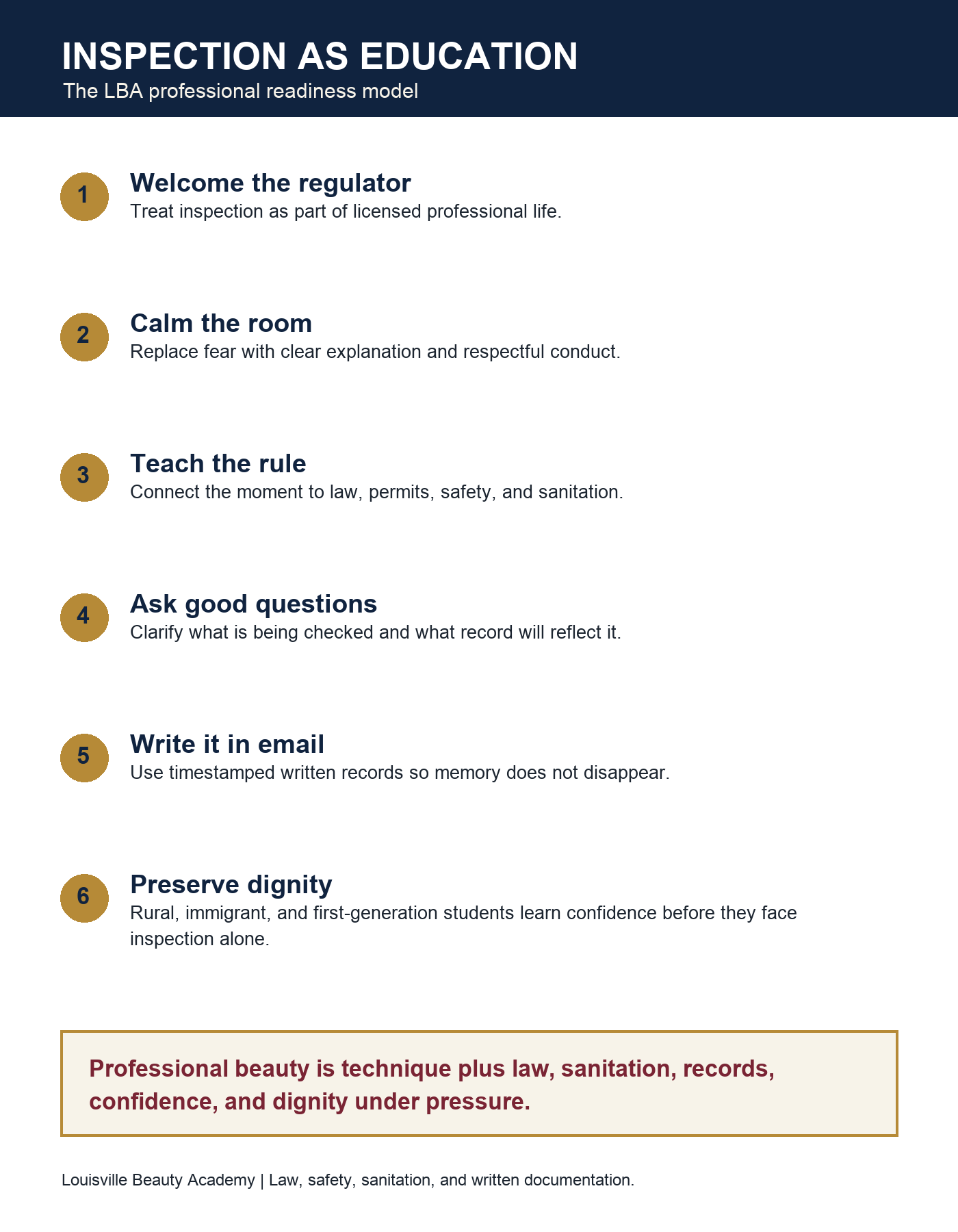
The LBA inspection-as-education model turns regulatory moments into professional readiness training.
More Than Technique
Technique matters, but the licensed beauty profession also depends on rules that protect the public and define lawful practice.
What Students Should Understand
Students should understand why licenses, permits, sanitation, clean facilities, chemical handling, attendance records, and safety practices are not optional details.
Professional Confidence
Confidence is not pretending rules do not exist. Confidence is knowing the rules well enough to respond respectfully and correctly.
The Louisville Beauty Academy Standard
A serious beauty school teaches more than the service. It teaches the professional environment around the service: regulation, safety, sanitation, licensing awareness, written documentation, respectful communication, and the ability to remain steady when a real inspector is present.
That is why LBA treats regulatory moments as education. Students from every background should not wait until they are alone in a salon to learn how to respond professionally.
Public information notice: this post is educational and policy-oriented. It does not accuse any person or agency of wrongdoing, disclose private student information, claim accreditation, promise licensure or employment outcomes, or replace professional legal/regulatory advice.
Policy Series Note. This article continues Louisville Beauty Academy’s research series on beauty workforce development. The purpose is to help students, families, workforce leaders, chambers, associations, and policymakers discuss beauty education with sharper categories and better evidence.
License underutilization does not always mean failure. It often reflects flexible income, family duties, future use, side business, booth rental, and changing labor markets.
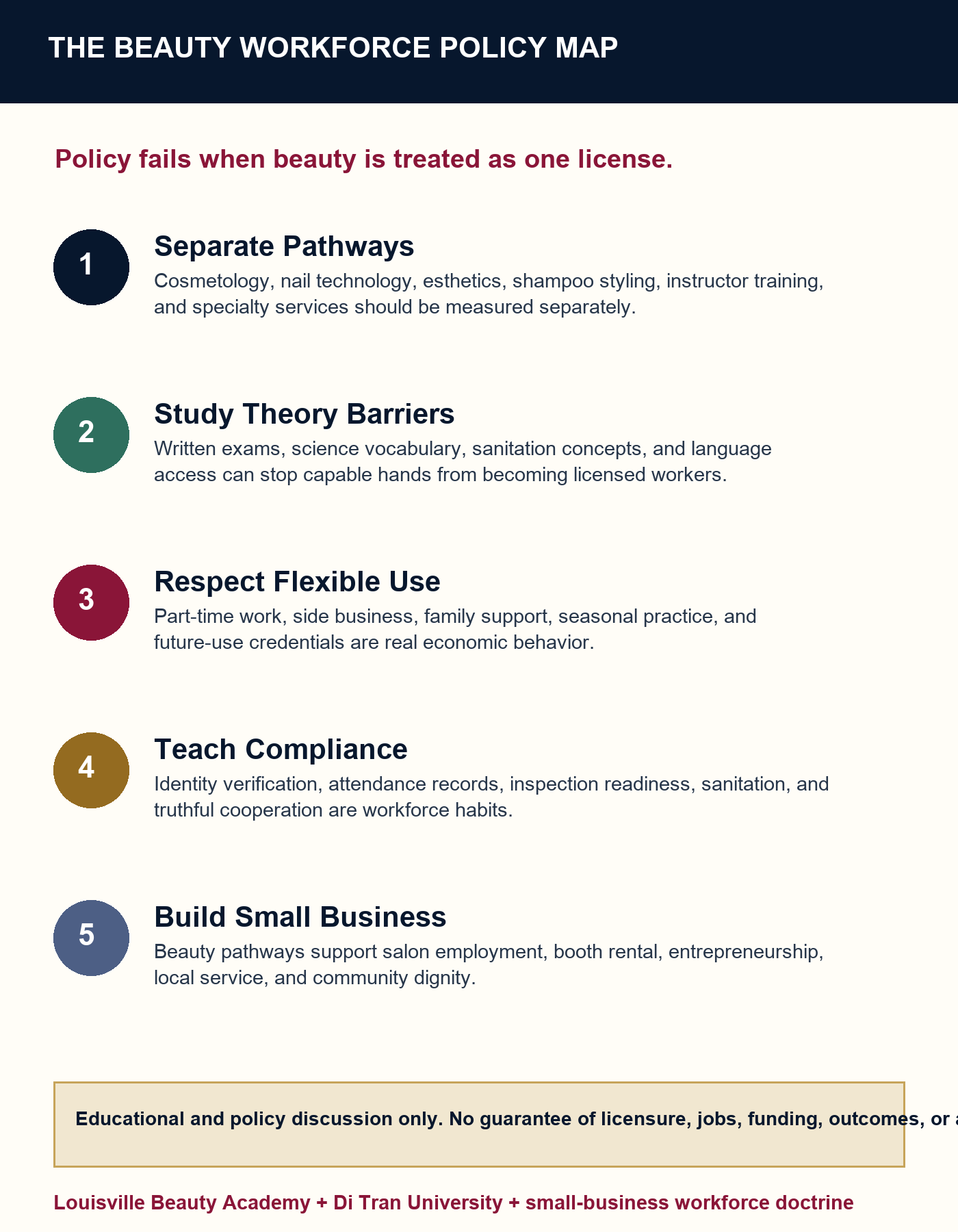
The beauty workforce policy map: separate pathways, study theory barriers, respect flexible use, teach compliance, and build small business.
The Policy Problem
Beauty is often described as if it were one occupation, one student profile, one license, one exam, and one economic result. That is too crude for real workforce development. A student who wants nail technology does not have the same timeline, cost structure, exam burden, service scope, or small-business pathway as a student seeking the broadest cosmetology route. A school that teaches compliance, sanitation, customer communication, identity discipline, and documentation is doing more than preparing people for a single exam.
The Workforce Interpretation
Policy should measure full-time use, part-time use, self-employment, entrepreneurship, and reserve credential value separately. The result is a stronger public conversation: less ideology, more measurement; less gatekeeping language, more usable student support; less generic beauty talk, more precise pathways into lawful work and entrepreneurship.
This matters for Louisville because beauty education sits at the intersection of licensed work, immigrant enterprise, women-led small business, family income, consumer service, public sanitation, and neighborhood trust. That makes it a legitimate workforce-development subject, not a side issue.
What LBA Is Positioning
Student clarity: students should understand the difference between license pathways before committing.
Compliance as training: records, identity, attendance, sanitation, and truthful cooperation are employable habits.
AI as support: AI can help organize study, translation, documentation, and public education, while instructors and licensed professionals remain responsible for judgment.
Small-business mobility: beauty credentials can support employment, booth rental, independent services, family income, and local entrepreneurship.
Claim-Control Notice
This article is educational and policy-oriented. It does not promise licensure, employment, funding, admission, scholarship approval, income, government action, board approval, accreditation status, or any individual outcome. It does not state or imply that any agency or association endorses Louisville Beauty Academy. Current written school documents, official agency requirements, and qualified professional guidance control where relevant.
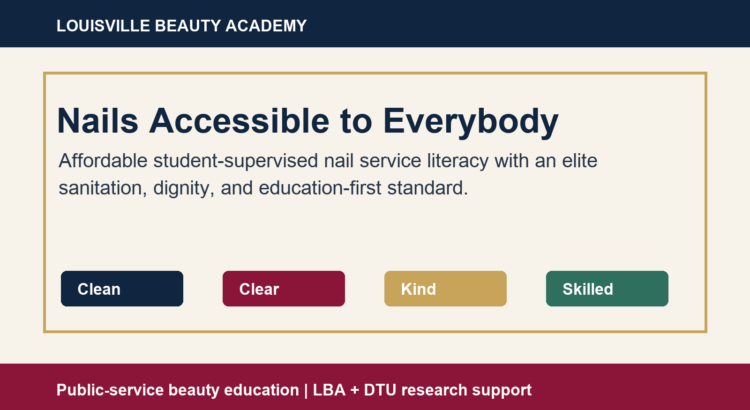
Day 3 of 100 – LBA Affordable Nail Service Literacy Series. This article explains gel polish in plain language for customers, students, families, and community partners who want beauty services to be accessible without lowering the professional standard.
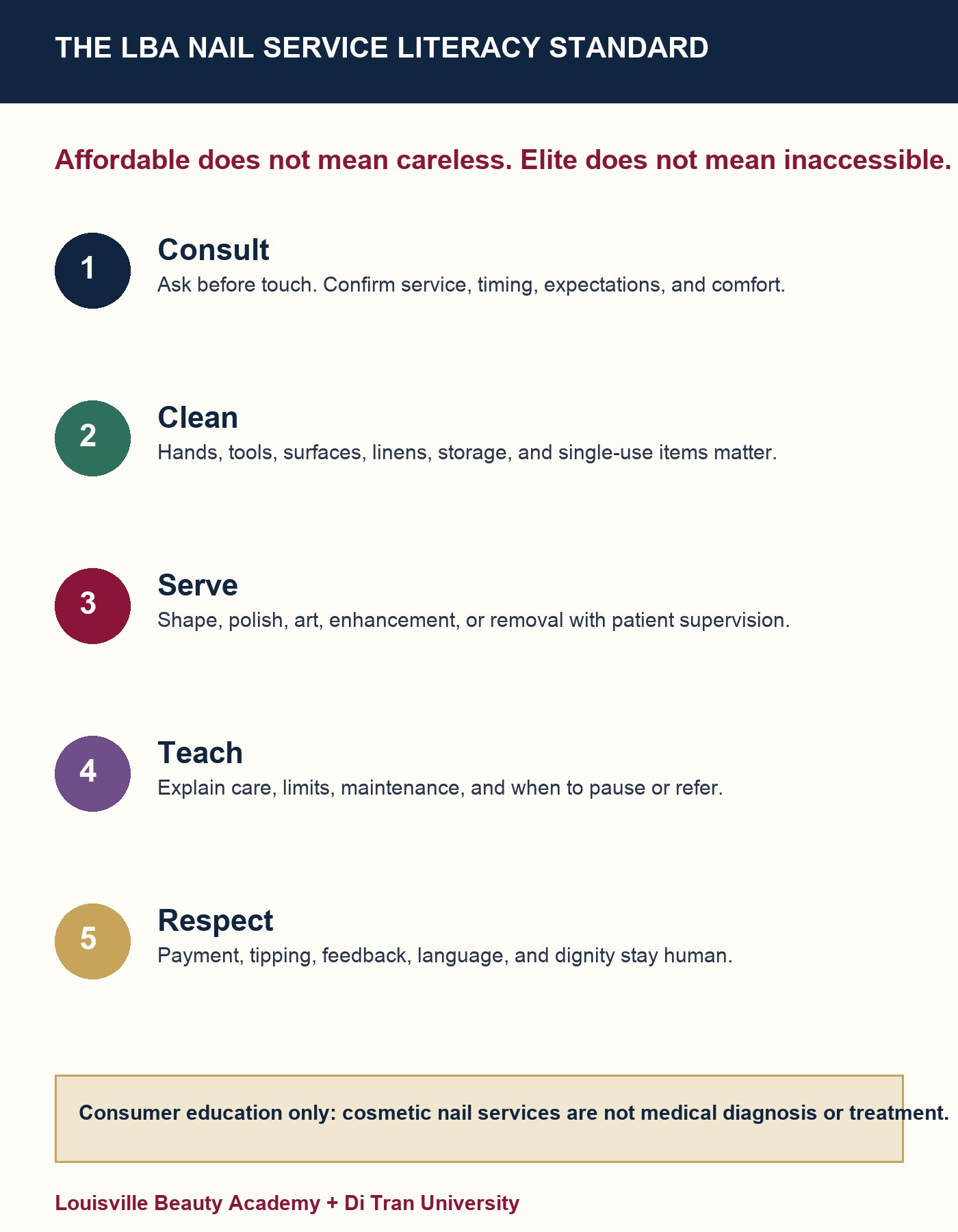
The LBA nail service literacy standard: consult, clean, serve, teach, and respect.
Gel Polish Without Confusion
How gel polish differs from regular polish, why removal matters, and how clients should think about UV/LED curing. At Louisville Beauty Academy, the public-service model is education first: a school clinic or student-supervised service is not a promise of luxury speed. It is a carefully supervised learning environment where affordability, sanitation, communication, and dignity belong together.
What The Service Teaches
Service literacy: the client understands what is being requested and what is reasonable for the appointment.
Sanitation discipline: clean setup and infection-control habits are treated as the foundation, not a hidden back-room detail.
Communication: expectations, timing, comfort, and limits are discussed before the service becomes confusing.
Professional judgment: students learn that saying “not today” can be part of protecting the client and the school standard.
Affordable Does Not Mean Careless
LBA’s public-facing nail services are listed on the school’s current student clinic service page when available, and the current written page should be checked before relying on any service, price, schedule, or availability. The mission-level point is larger than a single price: accessible nail services can introduce the public to clean beauty care while helping students practice consultation, timing, technique, and professionalism under supervision.
That is the Louisville Beauty Academy standard: elite expectation without luxury exclusion. A person should not need a luxury budget to be treated with cleanliness, patience, and respect.
Safety and Boundary Note
This series is consumer education, not medical advice. Nail services are cosmetic services. A student, instructor, or licensed professional should not diagnose, treat, or promise improvement for medical conditions. If skin, nail, pain, infection, wound, allergy, or health concerns appear, the safer educational response is to pause and refer the person to an appropriate licensed health professional.
Why DTU Supports This Doctrine
Di Tran University supports this work as doctrine and research architecture: humanization, workforce literacy, affordability, AI-assisted documentation, and ethical education. DTU explains why a small service can become a public lesson in dignity, and LBA proves that lesson in a real school environment.
Public information notice: service availability, prices, schedules, and policies can change. Current written LBA documents and direct school confirmation control. This post does not claim government endorsement, guaranteed outcomes, medical benefit, licensure result, employment result, or superiority over another provider.
The strongest compliance lesson happens when students experience regulation in a guided environment before they face it alone in a workplace.
Who This Is For
This series is for every beauty student, including students from rural and country-side communities, immigrant students, first-generation students, working adults, and students who may feel nervous when an inspector or regulator enters the room. The purpose is to replace fear with understanding, practice, safety, sanitation, and written documentation.
The LBA inspection-as-education model turns regulatory moments into professional readiness training.
A Supervised Professional Moment
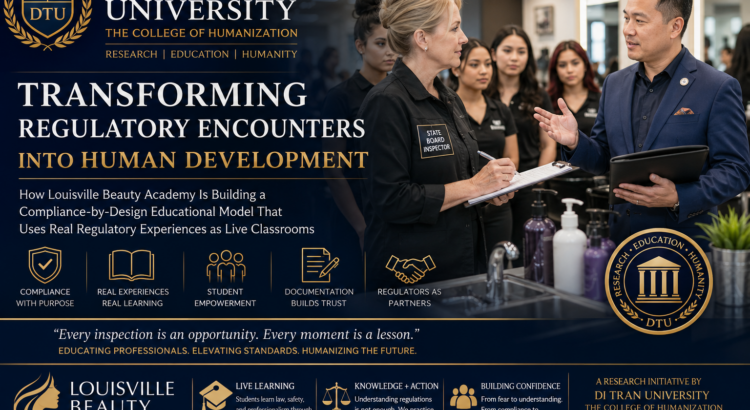
When a state board inspector is onsite, the school has a rare chance to teach the full professional posture: calm presence, respectful speech, accurate answers, and careful documentation.
Why Instructors Matter
An instructor can translate the moment into education. Students do not only see authority. They see how a licensed professional explains, clarifies, and protects the learning environment.
Practice Before Independence
School is the right place to practice inspection professionalism because the student still has guidance, supervision, and a safe educational structure.
The Louisville Beauty Academy Standard
A serious beauty school teaches more than the service. It teaches the professional environment around the service: regulation, safety, sanitation, licensing awareness, written documentation, respectful communication, and the ability to remain steady when a real inspector is present.
That is why LBA treats regulatory moments as education. Students from every background should not wait until they are alone in a salon to learn how to respond professionally.
Public information notice: this post is educational and policy-oriented. It does not accuse any person or agency of wrongdoing, disclose private student information, claim accreditation, promise licensure or employment outcomes, or replace professional legal/regulatory advice.
Policy Series Note. This article continues Louisville Beauty Academy’s research series on beauty workforce development. The purpose is to help students, families, workforce leaders, chambers, associations, and policymakers discuss beauty education with sharper categories and better evidence.
The written/theory exam is often the harder barrier, especially where science vocabulary, sanitation concepts, language access, and test literacy are weak.
The beauty workforce policy map: separate pathways, study theory barriers, respect flexible use, teach compliance, and build small business.
The Policy Problem
Beauty is often described as if it were one occupation, one student profile, one license, one exam, and one economic result. That is too crude for real workforce development. A student who wants nail technology does not have the same timeline, cost structure, exam burden, service scope, or small-business pathway as a student seeking the broadest cosmetology route. A school that teaches compliance, sanitation, customer communication, identity discipline, and documentation is doing more than preparing people for a single exam.
The Workforce Interpretation
A serious workforce model should support science vocabulary, infection-control literacy, language-aware tutoring, and AI-assisted study without weakening standards. The result is a stronger public conversation: less ideology, more measurement; less gatekeeping language, more usable student support; less generic beauty talk, more precise pathways into lawful work and entrepreneurship.
This matters for Louisville because beauty education sits at the intersection of licensed work, immigrant enterprise, women-led small business, family income, consumer service, public sanitation, and neighborhood trust. That makes it a legitimate workforce-development subject, not a side issue.
What LBA Is Positioning
Student clarity: students should understand the difference between license pathways before committing.
Compliance as training: records, identity, attendance, sanitation, and truthful cooperation are employable habits.
AI as support: AI can help organize study, translation, documentation, and public education, while instructors and licensed professionals remain responsible for judgment.
Small-business mobility: beauty credentials can support employment, booth rental, independent services, family income, and local entrepreneurship.
Claim-Control Notice
This article is educational and policy-oriented. It does not promise licensure, employment, funding, admission, scholarship approval, income, government action, board approval, accreditation status, or any individual outcome. It does not state or imply that any agency or association endorses Louisville Beauty Academy. Current written school documents, official agency requirements, and qualified professional guidance control where relevant.
Day 2 of 100 – LBA Affordable Nail Service Literacy Series. This article explains polish change in plain language for customers, students, families, and community partners who want beauty services to be accessible without lowering the professional standard.
The LBA nail service literacy standard: consult, clean, serve, teach, and respect.
Polish Change Literacy
Why a polish change is still a professional service: clean setup, product awareness, and realistic expectations. At Louisville Beauty Academy, the public-service model is education first: a school clinic or student-supervised service is not a promise of luxury speed. It is a carefully supervised learning environment where affordability, sanitation, communication, and dignity belong together.
What The Service Teaches
Service literacy: the client understands what is being requested and what is reasonable for the appointment.
Sanitation discipline: clean setup and infection-control habits are treated as the foundation, not a hidden back-room detail.
Communication: expectations, timing, comfort, and limits are discussed before the service becomes confusing.
Professional judgment: students learn that saying “not today” can be part of protecting the client and the school standard.
Affordable Does Not Mean Careless
LBA’s public-facing nail services are listed on the school’s current student clinic service page when available, and the current written page should be checked before relying on any service, price, schedule, or availability. The mission-level point is larger than a single price: accessible nail services can introduce the public to clean beauty care while helping students practice consultation, timing, technique, and professionalism under supervision.
That is the Louisville Beauty Academy standard: elite expectation without luxury exclusion. A person should not need a luxury budget to be treated with cleanliness, patience, and respect.
Safety and Boundary Note
This series is consumer education, not medical advice. Nail services are cosmetic services. A student, instructor, or licensed professional should not diagnose, treat, or promise improvement for medical conditions. If skin, nail, pain, infection, wound, allergy, or health concerns appear, the safer educational response is to pause and refer the person to an appropriate licensed health professional.
Why DTU Supports This Doctrine
Di Tran University supports this work as doctrine and research architecture: humanization, workforce literacy, affordability, AI-assisted documentation, and ethical education. DTU explains why a small service can become a public lesson in dignity, and LBA proves that lesson in a real school environment.
Public information notice: service availability, prices, schedules, and policies can change. Current written LBA documents and direct school confirmation control. This post does not claim government endorsement, guaranteed outcomes, medical benefit, licensure result, employment result, or superiority over another provider.
Louisville Beauty Academy welcomes inspection as part of real professional beauty education. Students must know how to stand inside a licensed profession with calm, respect, sanitation discipline, and documentation.
Who This Is For
This series is for every beauty student, including students from rural and country-side communities, immigrant students, first-generation students, working adults, and students who may feel nervous when an inspector or regulator enters the room. The purpose is to replace fear with understanding, practice, safety, sanitation, and written documentation.
The LBA inspection-as-education model turns regulatory moments into professional readiness training.
The Real Classroom
A textbook can explain a rule. A real inspection teaches the posture. Students see how professionals welcome the process, answer clearly, ask appropriate questions, and keep the environment calm.
What LBA Models
The school models lawful cooperation, not panic. It teaches students that regulation is part of beauty work, and that public protection depends on safety, sanitation, licenses, permits, and clear records.
The Student Future
After graduation, a student may be alone in a salon when an inspector arrives. Training before that moment matters.
The Louisville Beauty Academy Standard
A serious beauty school teaches more than the service. It teaches the professional environment around the service: regulation, safety, sanitation, licensing awareness, written documentation, respectful communication, and the ability to remain steady when a real inspector is present.
That is why LBA treats regulatory moments as education. Students from every background should not wait until they are alone in a salon to learn how to respond professionally.
Public information notice: this post is educational and policy-oriented. It does not accuse any person or agency of wrongdoing, disclose private student information, claim accreditation, promise licensure or employment outcomes, or replace professional legal/regulatory advice.
A Multidisciplinary Research Report by Di Tran University – The College of Humanization
Louisville Beauty Academy is honored to share this Di Tran University research publication, where LBA is presented as an observable case study and pilot environment for Compliance-by-Design education and Regulatory Immersion Learning. All research, analysis, framework development, and publication credit belong to Di Tran University – The College of Humanization Research Team.
The Psychobiological Architecture of Authority, Stress, and Compliance
Neuroendocrine Cascade of the Social-Evaluative Threat
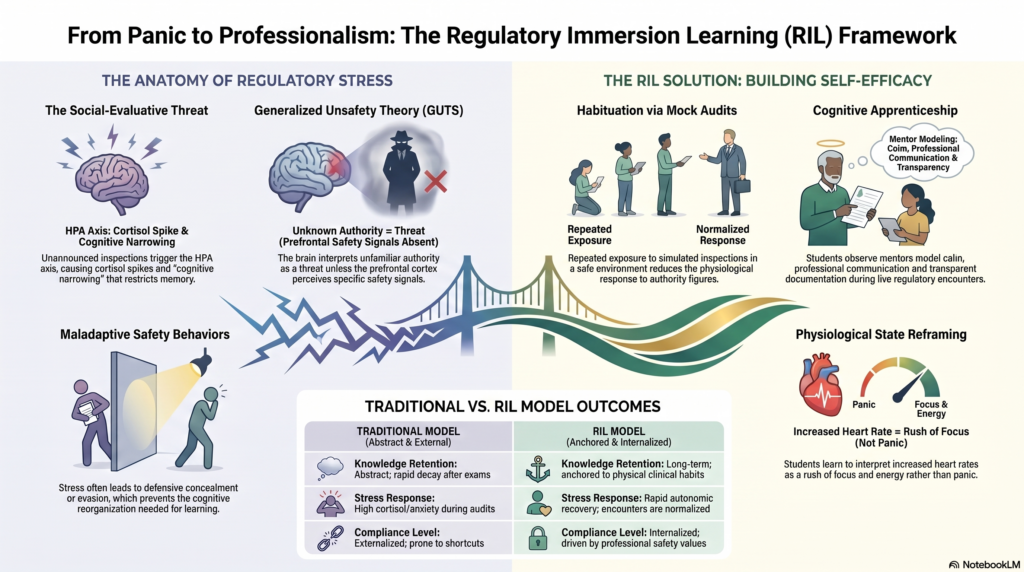
The unannounced arrival of a regulatory enforcement officer within a licensed professional training environment triggers a highly predictable, phylogenetically ancient psychobiological stress response1. In human psychology, the perception of an authority figure armed with the power to penalize, fine, or shut down operations is categorized as a high-stakes social-evaluative threat1. The primary biological mechanism driving this reaction is the rapid activation of the hypothalamic-pituitary-adrenal (HPA) axis and the sympathetic-adrenal-medullary (SAM) system4.
Clinical evaluations using the Trier Social Stress Test (TSST) demonstrate that situations combining social-evaluative threat, uncontrollability, and anticipation consistently produce massive physiological spikes in salivary and blood serum cortisol, alongside rapid elevations in heart rate, blood pressure, and salivary alpha-amylase (sAA)1. This autonomic arousal is accompanied by acute state anxiety, which can be measured clinically via the Generalized Anxiety Disorder 7-item (GAD-7) scale, showing transitions from minimal baseline scores to severe anxiety ranges during active enforcement encounters6.
This systemic response is further illuminated by the Generalized Unsafety Theory of Stress (GUTS), which posits that the physiological stress response is a default state that remains active unless the prefrontal cortex actively perceives specific, reliable signals of safety8. Under the GUTS model, the human brain default-interprets an unfamiliar authority encounter as unsafe8. When an inspector arrives, the absence of an immediate safety context prevents prefrontal-subcortical inhibition, leaving the fight-or-flight default response fully disinhibited8.
This state of generalized unsafety induces cognitive narrowing, wherein the individual’s working memory capacity is severely restricted, limiting their ability to recall complex administrative regulations, access documentation, or communicate professionally8.
Compliance Psychology and Safety Behaviors
To manage this acute discomfort, individuals frequently adopt “safety behaviors”—defined in behavioral psychology as unnecessary, dysfunctional actions taken to prevent, escape from, or reduce the immediate severity of a perceived threat10. In a regulatory enforcement context, safety behaviors manifest as defensive concealment, paper-shuffling, evasion of verbal interaction, or performative compliance designed solely to expedite the inspector’s departure9.
While these behaviors may temporarily alleviate immediate anxiety, they prevent the cognitive reorganization and emotional regulation required for authentic learning10. Instrumental deterrence models of regulation, which rely heavily on punitive sanctions and monitoring, inadvertently reinforce these fear-driven dynamics11. This erodes the regulatee’s intrinsic commitment to professional standards and replaces genuine self-regulation with defensive, risk-avoiding maneuvers11.
Sociocultural and Geographic Dimensions of Government Trust
The baseline psychobiological reaction to regulatory authority is heavily moderated by the cultural, historical, and geographic backgrounds of the individuals undergoing the encounter14. For educational institutions serving diverse student bodies, understanding these nuances is critical to transforming fear into professional agency16.
Comparative Immigrant Perceptions of State Authority
First-generation immigrants often view and experience regulatory bodies through a “dual frame of reference,” evaluating the administrative host environment against the historical performance and corruption levels of their countries of origin17.
The table below provides an analytical comparison of immigrant perceptions of government authority across diverse geopolitical regions of origin:
Region of Origin
Historical / Administrative Context
First-Generation Behavioral Bias
Second-Generation Trust Divergence
United States(Native-Born)
Deep historical values of constitutional due process; moderate institutional trust17.
Relies on procedural safeguards; comfortable requesting legal representation22.
Serves as the baseline standard; highly sensitive to systemic enforcement biases18.
Vietnam
Post-war bureaucratic models; history of centralized control and administrative opacity3.
High outward compliance driven by caution; internal avoidance of state agents3.
Rapid assimilation to US standards; lower tolerance for arbitrary state actions17.
China
Authoritarian administrative state; legacy of pervasive civil and commercial surveillance17.
Severe risk aversion; immediate compliance with state demands to avoid scrutiny17.
Internalizes host-country legal standards; increasingly willing to challenge rules18.
India
Heavily bureaucratic administrative structures; legacy of colonial civil service hierarchies14.
High reliance on credentials and written stamps; comfortable with slow processes14.
Expects rapid, digitized public services; dismissive of archaic paper procedures18.
Africa
Post-colonial instability; history of militarized enforcement in specific regions14.
Acute fear of uniforms and unexpected visits; trauma reactions to unannounced audits16.
Reappraises regulatory bodies through localized socioeconomic and racial lenses18.
Latin America
History of structural corruption, arbitrary enforcement, and police-ICE data integration24.
Pervasive fear that sharing professional data will lead to deportation or profiling24.
Demands structural reform; highly active in labor and civic organizing25.
Eastern Europe
Post-Soviet transitional states; legacy of state-directed commercial and political surveillance17.
Systemic cynicism toward inspectors; expectation that audits require informal resolution17.
Expects absolute institutional transparency and digital accountability18.
High anxiety during unannounced audits; fear of administrative profiling18.
Active pushback against structural bias; values-driven engagement with laws18.
This cross-regional analysis demonstrates that immigrant students do not represent a homogenous group25. First-generation immigrants often exhibit “over-confidence” in host institutions early in their residency because they compare them to low-performing home-country institutions17. However, this trust quickly degrades due to acculturative stress, linguistic barriers, and fear of data-sharing between local licensing boards and federal immigration enforcement agencies26. This makes unannounced inspections a potential source of acute trauma24.
Geographic Realities of Rural Communities and Centralized Regulation
In rural areas such as Central Appalachia, the Midwest, and the deep South, the relationship with regulatory agencies is shaped by geographic distance and historical neglect29.
The table below contrasts geographic and cultural interactions with regulators across specific rural landscapes:
Rural Region
Geographic & Infrastructure Reality
Cultural & Historical Context
Dynamic with Regulatory Authorities
Kentucky(General Rural)
High distance from state agencies; limited transit; low local budgets31.
Deep emphasis on local self-reliance and regional independence31.
Skepticism of centralized state rules; preference for relational enforcement32.
Appalachia(Central/Eastern)
Severe geographic isolation; systemic neglect of public water/utility infrastructure30.
Generational trauma from corporate “company towns” and corrupt local police15.
Deeply entrenched moral distrust of state agents; views audits as economic extraction15.
Midwest(Agricultural Belt)
Vast distances between county seats; heavy reliance on USDA/state agency programs29.
Strong family-farm heritage; high valuation of property rights and local governance15.
Respects agricultural standards but resists environmental or labor-related mandates15.
Southern States(Rural Lowlands)
Remote county clinics; low density of administrative oversight32.
Historically conservative states-rights views; reliance on religious and civic networks15.
Suspicion of federal or urban-directed rules; strong reliance on informal compliance32.
In former coal-mining regions of Appalachia and the Midwest, trust in local and state government is distinctively low15. Decades of political neglect have created “geographies of alienation,” where residents avoid municipal systems (such as drinking untreated spring water instead of tap water) because they do not trust the state to protect them33. Consequently, unexpected inspections are frequently perceived as intrusive state targeting, causing rural practitioners to react with defensive avoidance or relational hostility15.
Behavioral Psychology of Normalization, Exposure, and Self-Efficacy
To transform these deeply ingrained stress responses, professional training programs can implement behavioral models designed to transition students from fear to competence38.
In clinical behavioral psychology, exposure therapy is established as a highly effective model for treating anxiety and avoidance behaviors10. The neurological engine driving exposure therapy is habituation: the gradual diminution of a physiological response to a stimulus when that stimulus is repeatedly presented in a safe, non-punitive environment10.
By systematically exposing students to simulated audits, peer reviews, and unannounced mock inspections, educators can guide them to correct their threat expectations10. The brain learns that the regulator’s presence does not inevitably lead to administrative punishment or economic ruin, allowing the sympathetic nervous system to return to baseline levels during active inspections10.
Cultivating Self-Efficacy Through Albert Bandura’s Social Learning Theory
According to Albert Bandura’s social cognitive theory, self-efficacy—the belief in one’s capability to execute courses of action required to manage prospective situations—is the primary determinant of behavioral adaptation under stress38. Bandura posits that self-efficacy is constructed through four distinct channels:
Mastery Experiences: Engaging in hands-on, successful compliance actions, such as maintaining accurate biometric and manual attendance logs daily38.
Vicarious Experiences (Learning by Observation): Watching clinical mentors and educators interact calmly, transparently, and professionally with state board inspectors23.
Verbal Persuasion: Receiving realistic, constructive feedback from instructors during mock audits, which reinforces the student’s compliance capabilities38.
Physiological State Reframing: Learning to interpret physical responses (e.g., increased heart rate) not as a signal of panic, but as a helpful rush of focus and energy4.
By structuring the educational environment so that students repeatedly witness and participate in compliant, procedurally fair interactions with regulators, schools can build a sense of professional agency and psychological safety22. Over time, this shifts the student’s posture from fear-based avoidance to confident, values-aligned self-regulation11.
The Historical Precedent of Experiential and Situated Pedagogy
The integration of real-world compliance activities into vocational curricula is supported by a rich history of experiential and situated educational models39.
Progressive Education and Experiential Learning
John Dewey’s progressive educational philosophy rejected the traditional model of treating students as passive vessels for lecture-based memorization39. Dewey argued that genuine education occurs through active, real-world experiences where students solve problems within their social and physical environments39. This philosophy was formalized by David Kolb into his Experiential Learning Model, which maps a continuous, four-stage learning cycle:
┌────────────────────────────────────────┐ │ Concrete Experience │ │ (Observing/conducting live audit) │ └───────────────────┬────────────────────┘ │ ▼ ┌────────────────────────────────────────┐ │ Reflective Observation │ │ (Deconstructing the audit via an AAR) │ └───────────────────┬────────────────────┘ │ ▼ ┌────────────────────────────────────────┐ │ Abstract Conceptualization │ │ (Mapping experience to administrative)│ │ ( statutes and regulations )│ └───────────────────┬────────────────────┘ │ ▼ ┌────────────────────────────────────────┐ │ Active Experimentation │ │ (Applying corrective actions in clinic)│ └────────────────────────────────────────┘
By anchoring learning in the concrete experience of a regulatory encounter, RIL ensures that abstract administrative laws (such as KRS 317A or 201 KAR 12) are permanently integrated into the student’s daily physical habits39.
Situated Cognition and Communities of Practice
Jean Lave and Etienne Wenger’s situated learning theory suggests that learning is a process of socialization into a distinct “community of practice”49. Novices enter at the periphery of the community, performing simple, low-risk tasks49. As they acquire the language, tools, and social norms of the profession, they move toward full participation49.
When a student participates in a live regulatory encounter alongside an experienced mentor, they are undergoing cognitive apprenticeship46. The instructor makes their clinical reasoning visible, scaffolding the student’s participation until they can confidently manage compliance tasks independently40.
Operational Precedents: Toyota Production System and After Action Reviews
The business and military sectors provide highly structured frameworks for integrating real-world practice with continuous optimization:
The Toyota Production System (TPS): Built on the twin pillars of Just-in-Time and Jidoka (automation with a human touch), TPS empowers front-line workers to stop the production line immediately upon detecting an abnormality53. By combining human craftsmanship with technological controls, TPS builds a culture of continuous incremental improvement (Kaizen)53. Every error is treated not as a cause for blame, but as a valuable opportunity to optimize standard work55.
The military After Action Review (AAR): Developed by the United States Army in the 1970s, the AAR is a structured, post-training debrief where leaders and soldiers systematically analyze what was planned, what actually occurred, why it occurred, and how the unit can adapt for future success57. The AAR focuses on accountability going forward, creating an organizational culture built on transparency, candor, and continuous collective learning59.
Multi-Industry Regulatory Normalization and Comparative Matrix
High-risk, highly regulated industries have long recognized that separating compliance activities from active training increases operational risk and anxiety61.
The matrix below compares regulatory normalization practices across 18 distinct fields of professional and vocational practice:
Fire run sheets; equipment maintenance tracking logs.
Across these industries, incorporating audits into active training reduces operational anxiety and builds self-efficacy44. When compliance is integrated directly into standard training protocols, professionals view inspections not as a stressful external threat, but as a normal and valuable quality-assurance process43.
The Mechanics of Complaint Systems and Ethical Responses
A common source of regulatory friction is the administrative complaint system, which is designed to protect consumer safety but is often vulnerable to misuse3.
Administrative complaints are filed by distinct stakeholders, including:
Consumers: Reporting actual or perceived harm, poor results, or sanitation violations64.
Employees: Reporting labor disputes, safety issues, or non-compliant school practices66.
Competitors (Competitive Harassment): Weaponizing administrative boards to drain the financial and emotional resources of business rivals3.
Anonymous Sources: Initiated to trigger a surprise investigation without facing cross-examination, which is why some state boards legally require signed writings to prevent harassment3.
Substantiation Rates
Federal regulatory databases show that only about 19% of investigated administrative complaints result in a formal deficiency citation66. Conversely, within highly structured, internal corporate complaint hotlines, substantiation rates reach approximately 53% for identified reporters and 47% for anonymous filings70. This gap suggests that many external administrative complaints are unsubstantiated or driven by non-compliance factors, such as competitor harassment or civil disputes3.
Ethical Response Protocols and Procedural Safeguards
Under administrative law systems (such as 201 KAR 12:190 in Kentucky), licensees have clear due process rights when responding to complaints:
The Written Notice Mandate: Regulatory enforcement cannot be based on verbal directives or informal instructions69. The licensee is entitled to a formal, signed written complaint detailing the exact statutes violated and the factual allegations69.
The Response Period: Licensees are provided a statutory response window (typically 10 to 30 days) to submit a formal, written explanation or correction before disciplinary hearings begin69.
The Right to Cure: Under modern progressive regulation statutes, Alternative Compliance Pathways allow licensees to resolve non-safety record-keeping issues through 30-day “Correction Orders” without facing immediate fines or license suspension3.
Sovereign Immunity and Nullity: If an administrative board issues an enforcement order without adhering to statutory procedures (such as failing to provide written notice or utilizing unlicensed proctors), the resulting order may be declared void ab initio (invalid from the inception)3. This status legally entitles the licensee to a full refund of any fines paid under the voided order3.
Case Study: Louisville Beauty Academy’s Compliance-by-Design Model
Louisville Beauty Academy (LBA), an immigrant-led beauty college based in Louisville, Kentucky, serves as an active case study for integrating regulatory compliance into vocational education16.
Operational and Compliance Architecture
Led by founder Di Tran, LBA operates under the authority of the Kentucky Board of Cosmetology (KBC), offering state-licensed courses in Cosmetology (1,500 hours), Esthetics (750 hours), and Nail Technology (450 hours)45.
To protect student hours and build regulatory trust, LBA maintains a robust compliance infrastructure:
Dual attendance tracking: Under 201 KAR 12:082 § 3(1), LBA maintains both a digital biometric fingerprint timekeeping system and manual paper sign-in sheets at all times45. This dual-verification ensures complete data redundancy and absolute tracking integrity45.
Instructional hour caps: In compliance with 201 KAR 12:082 § 4(4), LBA strictly caps credited instruction at 8 hours per day and 40 hours per week45. Any additional hours are logged transparently but remain uncredited, serving as evidence of voluntary study45.
Instruction over commerce: Under KRS 317A.130(1), LBA operates solely for education, focusing on mannequin-based skill mastery45. Public model practice is voluntary, ensuring that student clinics are not used as commercial revenue drivers45.
Operational Strengths and Systemic Vulnerabilities
An objective evaluation of LBA’s model reveals both unique strengths and significant operational vulnerabilities:
Unique Strengths
Superior Traceability and Integrity: The dual attendance system virtually eliminates timecard manipulation, creating a highly reliable administrative record45.
Financial and Regulatory Insulation: By operating as a state-licensed, non-accredited institution with a pay-as-you-go payment model, LBA avoids federal student loan programs72. This structural insulation protects the school from federal gainful employment metrics that undercount actual beauty industry earnings72.
Multilingual Inclusivity: Offering instruction and study materials in English, Vietnamese, and Spanish reduces barriers for underserved, low-income, and immigrant student groups16.
Systemic Vulnerabilities
High Adversarial Tension with Regulators: LBA’s public records reveal a highly defensive relationship with the KBC3. Allegations concerning “targeted hyper-fining” against minority salons, “shadow testing,” procurement fraud, and immediate-closure orders under SB 22 suggest deep operational friction with the state board3.
Risk of Student Stress Transfer: While LBA’s “Gold Standard Guide” aims to reduce fear, exposing students to active, legalistic confrontations (such as utilizing a 30-to-60 minute verification pause or video recording inspectors) may inadvertently heighten student anxiety23. For students who have experienced historical government trauma, observing intense institutional battles may trigger, rather than reduce, autonomic distress8.
Resource-Intensive Over-Compliance: Maintaining dual records, AI-driven compliance checks, and constant legal reviews increases administrative costs72. This structural burden is difficult for average-sized vocational schools to sustain without a highly efficient tuition and funding model72.
Important Policy Analysis: The Power of Administrative Records
In public administration and corporate risk management, written records are the primary tool for establishing organizational accountability and protecting constitutional rights9.
The Psychology of Written Correspondence
In high-stress regulatory environments, relying on verbal agreements or informal warnings increases ambiguity and risk3. The “verbal warning trap” occurs when an inspector issues an informal directive that is not backed by a written citation3. The business owner may attempt to comply with the verbal instruction, only to face a formal penalty later for non-compliance with a different, unwritten interpretation of the rule3.
Documenting every interaction through time-stamped, written correspondence provides critical protections:
Establishes Institutional Memory: Shifting knowledge from individual memory to structured, digital records reduces reliance on specific personnel and supports continuous improvement9.
Creates a Legal Audit Trail: In administrative hearings, undocumented actions are legally presumed not to have occurred63. A clear written record of compliance activities provides defensive protection63.
Protects Due Process: Requiring all instructions and findings to be delivered in writing ensures that administrative decisions are objective, consistent, and legally reviewable23.
Post-Inspection Factual Correspondence Policy
A robust risk management strategy includes sending a factual, professional follow-up email immediately after an inspection74. This correspondence does not concede violations or express defensiveness23. Instead, it establishes an objective, written record of what occurred during the encounter23.
This practice aligns with modern administrative guidelines (such as KRS 13B in Kentucky), which entitle parties to written clarification of all rulings and instructions23.
The Regulatory Immersion Learning (RIL) Educational Framework
To systematically integrate regulatory compliance into professional education, institutions can transition from traditional, classroom-bound models to the Regulatory Immersion Learning (RIL) framework39.
Performance and Psychobiological Outcomes Comparison
The table below contrasts the educational and psychological outcomes of traditional lecture models with the live-immersion RIL framework:
Measurement Parameter
Traditional Classroom Model
Regulatory Immersion Learning (RIL) Model
Knowledge Retention
Abstract, rapid decay after passing written examinations72.
Long-term retention; rules are anchored to physical, memorable clinical actions50.
Confidence & Self-Efficacy
Low; students feel unprepared for unannounced, high-stakes state audits38.
High; repetitive mock audits and guided exposure build professional agency38.
Professional Readiness
Focuses on textbook compliance; leaves students vulnerable to performative rules45.
Instills continuous, standard compliance habits; students are prepared for day-one practice2.
Critical Thinking
Limited to linear, written test-prep scenarios40.
High; students dynamically assess real-world hazards and procedural rules46.
Stress Reduction
High baseline cortisol and anxiety during active enforcement encounters4.
Rapid autonomic recovery; regulatory encounters are normalized and expected10.
Long-Term Compliance
Performs under external pressure; prone to shortcuts in private salons11.
Self-regulatory compliance driven by internalized professional and safety values11.
Limits and Required Empirical Evidence for Broader Adoption
While the RIL model is conceptually sound, its widespread implementation is limited by several factors:
Inspector Resistance: Some state inspectors may view recording, active questioning, or requests for written instructions as administrative resistance, which could increase regulatory tension23.
Resource Constraints: Managing dual-tracking systems, executing weekly mock audits, and maintaining digital compliance platforms require significant administrative time and investment45.
Trauma-Sensitivity Risks: For students who have experienced historical government trauma, sudden exposure to active regulatory disputes—even with mentors—could trigger survival responses that hinder learning24.
To support broader adoption of the RIL model, empirical research should focus on the following:
Objective stress-marker evaluations: Measuring salivary cortisol and heart-rate variability (HRV) in students during mock and real audits to confirm systemic desensitization4.
Longitudinal compliance tracking: Monitoring graduates’ compliance and citation rates over their first five years in business77.
Linguistic and accessibility studies: Measuring compliance learning speeds in multilingual classrooms when legal statutes are paired with visual, AI-supported tools78.
Practical Institutional Blueprints and Curricular Deliverables
To transition the theoretical RIL framework into an operational model, schools can implement the following curricula, standard operating procedures, and professional communication templates.
================================================================================= COURSE CODE: RIL-101 TITLE: REGULATORY LAW, INFECTION CONTROL, AND ADMINISTRATIVE SAFETY IN CLINIC ================================================================================= WEEK 1: INTRODUCTION TO STATE ADMINISTRATIVE LAW & EXECUTIVE ETHICS – Coursework: KRS Chapter 317A, KRS Chapter 11A, and 201 KAR 12:082 [cite: 51, 72]. – Practical: Biometric timekeeping orientation; signature sheet verification. – Exercise: Reconstructing a timecard error; drafting an administrative correction log.
WEEK 2: DISINFECTION CHEMISTRY & PUBLIC HEALTH PRINCIPLES – Coursework: OSHA Hazard Communication Standard; Safety Data Sheet (SDS) interpretation. – Practical: Mixing chemical solutions according to manufacturer instructions. – Exercise: Mock chemical spill drill; evaluating workstation contact times [cite: 39, 80].
WEEK 3: DECONSTRUCTING THE SOCIAL-EVALUATIVE THREAT – Coursework: Human physiology of stress; the HPA axis and cortisol spikes. – Practical: Controlled deep-breathing drills; mental toughness and stress-reframing. – Exercise: Simulated unannounced instructor-led safety sweeps under pressure.
WEEK 4: THE PSYCHOLOGY OF DOCUMENTATION AND TRACEABILITY – Coursework: Why undocumented procedures fail; technical communication standards [cite: 9, 63]. – Practical: Operating daily sanitation logs; validating inventory tracking systems [cite: 44]. – Exercise: Structured peer reviews of workstation compliance documentation.
WEEKS 5-8: COGNITIVE APPRENTICESHIP IMMERSION (CLINIC ENCOUNTERS) – Coursework: Jean Lave’s situated cognition; the six dimensions of CAM [cite: 40, 46, 49]. – Practical: Observing instructors model compliance during simulated audits [cite: 23, 52]. – Exercise: Roleplaying as inspector, manager, and student; modeling verbal etiquette scripts.
WEEKS 9-12: PEER-AUDITING SYSTEMS & KAIZEN LABS – Coursework: Lean manufacturing and the Toyota Production System; Kaizen theory [cite: 53, 81]. – Practical: Conducting weekly mock inspections on other student workstations. – Exercise: Mock “tracer surveys” using Joint Commission methods.
WEEKS 13-15: STRUCTURAL COMPLAINT SIMULATIONS – Coursework: Understating complaint systems; due process and rights to respond [cite: 66, 69]. – Practical: Responding to simulated consumer complaints using factual, written logs. – Exercise: Draft responses to KBC-style complaints under 201 KAR 12:190.
WEEK 16: CAPSTONE EXPERIENTIAL ASSESSMENT & AFTER ACTION REVIEWS – Coursework: Continuous improvement and post-audit learning loops [cite: 57, 60, 82]. – Practical: Conducting a complete After Action Review (AAR) of the course’s mock audits [cite: 57, 59]. – Exercise: Final practical examination; managing a surprise, unannounced mock inspection. =================================================================================
Faculty Guide: Step-by-Step Instructional SOP for Live Audits
================================================================================= SOP NUMBER: RIL-INST-04 TITLE: MANAGING LIVE REGULATORY ENCOUNTERS AS INSTRUCTIONAL CLASSROOMS ================================================================================= 1. OBJECTIVE: To ensure that when a state regulatory inspector arrives, faculty members remain calm, protect due process rights, and actively use the encounter as a live learning experience for observing students.
2. PREPARATION: Keep a laminated copy of the LBA “Inspection Transparency & Verification Rights Notice” at the front desk and at all active instruction areas.
3. WHEN THE INSPECTOR ARRIVES: A. STEP 1: INITIAL RECEPTION – Welcome the inspector politely and professionally. – Do NOT halt active classroom instruction or panic [cite: 23, 83]. – Hand the inspector a copy of the LBA Transparency Notice.
B. STEP 2: VERBAL PROTOCOL (SAY ALOUD) “Good morning! We welcome your visit and appreciate your work. We just follow a standard compliance process to make sure everything is accurate and fair. Here’s our Inspection Transparency & Verification Rights Notice. It simply explains that under Kentucky law, we’re allowed to take about 30 to 60 minutes to review any request or rule, record the visit for documentation, and verify things with our compliance team before we respond or sign anything. This helps us stay consistent with KRS 13B and 317A — and it keeps everything transparent for both sides. We’ll cooperate fully — we just want to make sure everything we do is right by the law and clear for our records. Thank you!”
C. STEP 3: STUDENT POSITIONING – Direct students working in the immediate area to pause and observe. – Quietly explain the inspector’s actions to nearby students (e.g., “The inspector is verifying that all student licenses are posted at active workstations according to KBC regulations”) [cite: 23, 51, 71].
D. STEP 4: RECORDING & DOCUMENTATION – Activate a clean, high-definition digital recording device. – Explicitly reference Kentucky’s one-party consent statute (KRS 526.020) and the school’s educational duty under KRS 317A.130(1)(f). – If an inspector makes an observation or deficiency claim, request that they reduce the instruction or legal citation to writing.
E. STEP 5: DECONSTRUCTION DEBRIEF – Once the inspector departs, call an immediate 15-minute student assembly. – Conduct a mini After Action Review (AAR) to analyze what went well, what went less well, and how the school will adapt [cite: 57, 60, 80]. =================================================================================
Student Handbook Addendum: Safety & Regulatory Rights Notice
================================================================================= SECTION 8.4: YOUR COMPLIANCE RESPONSIBILITIES AND DUE PROCESS RIGHTS ================================================================================= As a student training toward state licensure, you are a professional-in-training responsible for protecting public health and safety. Our academy operates under a “Compliance-by-Design” framework, meaning that safety, state law, and regulatory standards are integrated into your daily habits.
YOUR CORE COMPLIANCE RESPONSIBILITIES: 1. DAILY TIMESTAMPS: You must record your attendance using the biometric fingerprint scanner and manual sign-in sheet every time you enter or exit. 2. SANITATION MASTERY: You must maintain a clean, disinfected workstation at all times, following all sanitation procedures under 201 KAR 12 [cite: 39, 51]. 3. FACTUAL ACCOUNTABILITY: You are training to understand that your progress logs and clinic hours represent legally binding evidence submitted to the state.
YOUR CONSTITUTIONAL AND ADMINISTRATIVE RIGHTS DURING INSPECTIONS: 1. THE RIGHT TO A CALM RESPONSE: You are never required to panic or rush when an inspector arrives. You are legally entitled to a 30-to-60 minute window to verify regulatory rules and retrieve correct records before answering. 2. THE RIGHT TO WRITTEN INSTRUCTIONS: Under KRS 13B.090(7), you have the right to request that any inspector directive or cited deficiency be provided in clear, verifiable writing. 3. THE RIGHT TO PROFESSIONAL RECORDING: Under KRS 526.020, you have the right to record audio or video of regulatory encounters for compliance training. 4. THE RIGHT TO AN ETHICAL REMEDY: If an administrative warning or complaint is issued, you have the right to written clarification, explanation, and a formal opportunity to respond and correct errors. =================================================================================
Post-Inspection Verification Letter Template
================================================================================= DATE: [Insert Date] TO: Joni Upchurch, Executive Director, Kentucky Board of Cosmetology [cite: 45, 69] FROM: Compliance Office, Louisville Beauty Academy SUBJECT: POST-INSPECTION COMPLIANCE VERIFICATION & ADMINISTRATIVE RECORD ================================================================================= Dear Director Upchurch,
This correspondence is submitted to establish an accurate administrative record of the routine facility inspection conducted at Louisville Beauty Academy (Location: [Insert Campus Address]) on [Insert Date] at approximately [Insert Time].
We appreciated welcoming Inspector [Insert Name] to our campus. In alignment with our educational mission under KRS 317A.130(1)(f), our students actively observed the inspection process as part of our Regulatory Immersion Learning curriculum.
During the walkthrough, the following observations and corrections were noted: 1. WORKSTATION SANITATION: All active student stations were found in compliance with disinfection procedures under 201 KAR 12 [cite: 39, 51]. 2. DUAL ATTENDANCE RECORDS: Daily biometric and manual attendance logs were verified, confirming complete record alignment under 201 KAR 12:082 § 3. 3. CITED OBSERVATION / ADMONISHMENT: Inspector [Insert Name] noted a compliance discrepancy regarding [Insert Specific Issue, e.g., chemical container labeling], citing regulation [Insert Exact Regulation Code] [cite: 51, 69].
ADMINISTRATIVE DUE PROCESS & SYSTEMIC PLAN OF ACTION: A. IN-THE-MOMENT CORRECTION: LBA instructors immediately corrected the noted container labeling discrepancy in the presence of the inspector to ensure compliance [cite: 74]. B. REQUEST FOR WRITTEN DOCUMENTATION: In accordance with KRS 13B.090(7), we request that any official board rulings or instructions regarding this observation be reduced to writing and emailed to study@louisvillebeautyacademy.net. C. STATUTORY CURE WINDOW: If the Board intends to pursue formal administrative actions or agreed orders, we formally request our 30-day statutory cure window to respond with written evidence of systemic corrections.
Louisville Beauty Academy remains committed to transparency, open communication, and the collaborative maintenance of rigorous public-safety standards [cite: 23, 76, 84].
Respectfully submitted,
___________________________________________ Di Tran, Founder & CEO, Louisville Beauty Academy [cite: 73] With the LBA Digital and Compliance Leadership Team [cite: 83] =================================================================================
After-Action Review (AAR) Discussion Protocol
================================================================================= PROTOCOL CODE: RIL-AAR-01 TITLE: FACILITATING CLINICAL AFTER-ACTION REVIEWS POST-INSPECTION ================================================================================= AAR TIMING: To be conducted within 2 hours of inspector departure. PARTICIPANTS: Active students, supervising instructors, and compliance managers [cite: 59, 82]. FACILITATOR RULES: No finger-pointing or blame; focus on forward-looking accountability.
DISCUSSION QUESTIONS FLOW:
1. WHAT WAS THE PLAN? (Core Strategy Check) – What administrative regulations and sanitation codes were we trying to demonstrate under KRS 317A and 201 KAR Chapter 12? – How was our team prepared to receive the inspector professionally?
2. WHAT ACTUALLY OCCURRED? (Factual Reconstruction) – Walk through the walkthrough chronologically. What did the inspector look at first? [cite: 2, 57] – How did the team react? Did anyone panic or deploy avoidance behaviors? [cite: 1, 10] – What compliance deficiencies or positive practices were noted? [cite: 43, 44]
3. WHY DID IT HAPPEN THAT WAY? (Root-Cause Analysis) – If an error was noted, did it stem from a lack of knowledge, an unclear workstation routine, or stress-induced cognitive narrowing? [cite: 4, 8, 40] – If our team reacted calmly, what specific training or safety signals allowed us to maintain prefrontal-cortisol control? [cite: 4, 8, 41]
4. WHAT WILL WE DO NEXT TIME? (Action & Adaptation Plan) – What specific Standard Operating Procedures must be updated or clarified? [cite: 56, 60] – Who is responsible for tracking corrective steps, and when will they be done? [cite: 60, 63] – How can we share these lessons learned with our broader community of practice? [cite: 49, 59] =================================================================================
Synthesized Strategic Conclusions
By analyzing the provided empirical data, sociological studies, behavioral psychological frameworks, and regulatory legal structures, researchers can synthesize several key conclusions regarding the feasibility of the Regulatory Immersion Learning (RIL) model.
┌────────────────────────────────────────┐ │ ESTABLISHED EVIDENCE │ │ Rote memorization alone does not │ │ reduce acute autonomic panic during │ │ unannounced state inspections.│ └───────────────────┬────────────────────┘ │ ▼ ┌────────────────────────────────────────┐ │ EMERGING EVIDENCE │ │ Exposure, mock tracer reviews, and │ │ mentorship significantly lower stress│ │ and improve compliance [cite: 44, 46, 62].│ └───────────────────┬────────────────────┘ │ ▼ ┌────────────────────────────────────────┐ │ PRACTICAL OBSERVATION │ │ LBA’s dual-verification system and │ │ Gold Standard protocol protect │ │ student hours and rights [cite: 23, 45].│ └───────────────────┬────────────────────┘ │ ▼ ┌────────────────────────────────────────┐ │ HYPOTHESIS │ │ RIL will produce long-term self- │ │ regulation, resulting in lower state │ │ violations for graduates [cite: 11, 39].│ └────────────────────────────────────────┘
Established Evidence
The sudden arrival of a regulatory inspector is a social-evaluative threat that triggers immediate sympathetic arousal and a cortisol spike in unprepared individuals1.
Traditional, lecture-based memorization of administrative rules does not prevent stress-induced cognitive narrowing during unannounced enforcement events4.
First-generation immigrants demonstrate a “dual frame of reference,” exhibiting high baseline trust in public institutions that erodes over time and across generations due to acculturative stress17.
For marginalized and historically trauma-exposed populations, unexpected regulatory encounters can trigger survival responses if state agents are perceived as threatening or punitive8.
Meticulous, contemporaneous written documentation significantly reduces organizational risk, establishes institutional memory, and serves as vital defensive evidence in administrative hearings9.
Emerging Evidence
Incorporating systematic exposure therapy, mock tracer audits, and pre-inspection walkthroughs into technical training decreases client/student anxiety and improves quality-assurance outcomes43.
Cognitive apprenticeship models—wherein students observe experienced mentors model compliance and professional communication during inspections—accelerate the development of a strong professional identity12.
Process-based regulatory systems, built on Tom Tyler’s procedural justice principles (dignity, neutrality, voice, and trust), are superior to instrumental deterrence models because they nurture intrinsic, voluntary compliance11.
When individuals participate in simulated After Action Reviews (AARs) post-audit, they demonstrate improved retention of safety standards and a stronger commitment to forward-looking operational corrections57.
Practical Observations
Louisville Beauty Academy’s dual biometric and manual attendance tracking systems protect student hours, prevent data loss, and verify the accuracy of submitted certification records45.
The school’s low-cost, pay-as-you-go financial model insulates students from high student loan debt while protecting the school from federal gainful-employment penalties72.
While the academy’s “Gold Standard Guide” asserts critical due process rights (such as the KRS 13B verification pause and Kentucky’s KRS 526.020 one-party recording law), it coexists with significant legal tension and conflict with state regulators3.
Using mannequins as the primary instructional tool, in accordance with KRS 317A.130(1), ensures that student clinics remain educational spaces rather than commercial revenue-generating salons45.
Hypotheses
Students who complete their vocational training under a formalized Regulatory Immersion Learning (RIL) framework will exhibit lower state board violations and fewer compliance issues during their first five years of active professional practice39.
Integrating AI-assisted, human-verified document synthesis into vocational training programs will lower administrative costs, decrease error rates, and improve the school’s regulatory standing9.
Cultivating compliance-by-design training models within historically marginalized or immigrant-led professional communities will systematically reduce their vulnerability to competitor harassment and predatory fines, leading to higher long-term small-business survival rates2.
A qualitative study exploring the perinatal experiences of social stress among first- and second-generation immigrant parents in Quebec, Canada – PMC, https://pmc.ncbi.nlm.nih.gov/articles/PMC11370249/
Investigating the role of clinical exposure on motivational self-regulation skills in medical students based on cognitive apprenticeship model – PMC, https://pmc.ncbi.nlm.nih.gov/articles/PMC10921607/
Democratizing Specialized Care in the Digital Age: Project ECHO as a Learning Environment for Continuing Professional Development – MDPI, https://www.mdpi.com/2227-9032/14/7/824
GAO-11-280 Nursing Homes: More Reliable Data and Consistent Guidance Would Improve CMS Oversight of State Complaint Investigatio, https://www.gao.gov/assets/gao-11-280.pdf
GAO-11-280, Nursing Homes: More Reliable Data and Consistent Guidance Would Improve CMS Oversight of State Complaint Investigations, https://www.gao.gov/assets/a317518.html
This publication is an educational and research work developed by Di Tran University – The College of Humanization through its interdisciplinary Research Team, with contributions from faculty, practitioners, editors, AI-assisted research tools, and human review.
Louisville Beauty Academy is presented as an observable case study to examine educational practices, compliance systems, workforce development, and human-centered learning. The inclusion of Louisville Beauty Academy does not imply that every concept, framework, or hypothesis presented has been independently validated through peer-reviewed empirical research.
Educational Purpose
This publication is intended solely for educational, research, policy discussion, and professional development purposes. It should not be interpreted as legal advice, regulatory guidance, or professional counsel. Readers should consult applicable statutes, regulations, qualified legal counsel, and relevant regulatory authorities before making legal, compliance, or business decisions.
Evidence Statement
This publication integrates peer-reviewed literature, publicly available government resources, historical analysis, educational theory, organizational research, and practical observations. Where appropriate, distinctions are made between established evidence, emerging evidence, practical observations, and research hypotheses. Future empirical research is encouraged to validate or refine the proposed concepts.
Research concept, synthesis, editorial direction, and publication coordinated by the Di Tran University Research Team.
Louisville Beauty Academy is honored to share this publication in support of workforce education, professional ethics, safety, sanitation, regulatory understanding, lifelong learning, and continuous improvement. We gratefully acknowledge Di Tran University – The College of Humanization for leading the research, analysis, and development of this work.
Policy Series Note. This article continues Louisville Beauty Academy’s research series on beauty workforce development. The purpose is to help students, families, workforce leaders, chambers, associations, and policymakers discuss beauty education with sharper categories and better evidence.
Beauty policy becomes clearer when leaders stop collapsing every pathway into the single word cosmetology.
The beauty workforce policy map: separate pathways, study theory barriers, respect flexible use, teach compliance, and build small business.
The Policy Problem
Beauty is often described as if it were one occupation, one student profile, one license, one exam, and one economic result. That is too crude for real workforce development. A student who wants nail technology does not have the same timeline, cost structure, exam burden, service scope, or small-business pathway as a student seeking the broadest cosmetology route. A school that teaches compliance, sanitation, customer communication, identity discipline, and documentation is doing more than preparing people for a single exam.
The Workforce Interpretation
Workforce boards, chambers, associations, and regulators should ask which license, which service, which exam barrier, and which economic path they are discussing. The result is a stronger public conversation: less ideology, more measurement; less gatekeeping language, more usable student support; less generic beauty talk, more precise pathways into lawful work and entrepreneurship.
This matters for Louisville because beauty education sits at the intersection of licensed work, immigrant enterprise, women-led small business, family income, consumer service, public sanitation, and neighborhood trust. That makes it a legitimate workforce-development subject, not a side issue.
What LBA Is Positioning
Student clarity: students should understand the difference between license pathways before committing.
Compliance as training: records, identity, attendance, sanitation, and truthful cooperation are employable habits.
AI as support: AI can help organize study, translation, documentation, and public education, while instructors and licensed professionals remain responsible for judgment.
Small-business mobility: beauty credentials can support employment, booth rental, independent services, family income, and local entrepreneurship.
Claim-Control Notice
This article is educational and policy-oriented. It does not promise licensure, employment, funding, admission, scholarship approval, income, government action, board approval, accreditation status, or any individual outcome. It does not state or imply that any agency or association endorses Louisville Beauty Academy. Current written school documents, official agency requirements, and qualified professional guidance control where relevant.
Day 1 of 100 – LBA Affordable Nail Service Literacy Series. This article explains basic manicure in plain language for customers, students, families, and community partners who want beauty services to be accessible without lowering the professional standard.
The LBA nail service literacy standard: consult, clean, serve, teach, and respect.
Basic Manicure Literacy
What a basic manicure should teach a client and a student: shaping, care, polish, timing, and sanitation. At Louisville Beauty Academy, the public-service model is education first: a school clinic or student-supervised service is not a promise of luxury speed. It is a carefully supervised learning environment where affordability, sanitation, communication, and dignity belong together.
What The Service Teaches
Service literacy: the client understands what is being requested and what is reasonable for the appointment.
Sanitation discipline: clean setup and infection-control habits are treated as the foundation, not a hidden back-room detail.
Communication: expectations, timing, comfort, and limits are discussed before the service becomes confusing.
Professional judgment: students learn that saying “not today” can be part of protecting the client and the school standard.
Affordable Does Not Mean Careless
LBA’s public-facing nail services are listed on the school’s current student clinic service page when available, and the current written page should be checked before relying on any service, price, schedule, or availability. The mission-level point is larger than a single price: accessible nail services can introduce the public to clean beauty care while helping students practice consultation, timing, technique, and professionalism under supervision.
That is the Louisville Beauty Academy standard: elite expectation without luxury exclusion. A person should not need a luxury budget to be treated with cleanliness, patience, and respect.
Safety and Boundary Note
This series is consumer education, not medical advice. Nail services are cosmetic services. A student, instructor, or licensed professional should not diagnose, treat, or promise improvement for medical conditions. If skin, nail, pain, infection, wound, allergy, or health concerns appear, the safer educational response is to pause and refer the person to an appropriate licensed health professional.
Why DTU Supports This Doctrine
Di Tran University supports this work as doctrine and research architecture: humanization, workforce literacy, affordability, AI-assisted documentation, and ethical education. DTU explains why a small service can become a public lesson in dignity, and LBA proves that lesson in a real school environment.
Public information notice: service availability, prices, schedules, and policies can change. Current written LBA documents and direct school confirmation control. This post does not claim government endorsement, guaranteed outcomes, medical benefit, licensure result, employment result, or superiority over another provider.