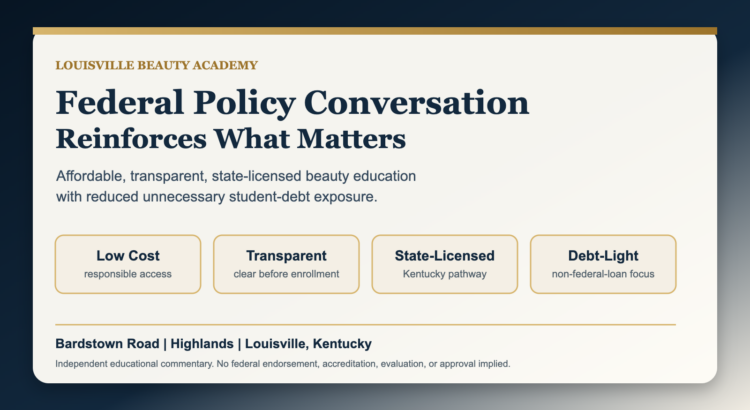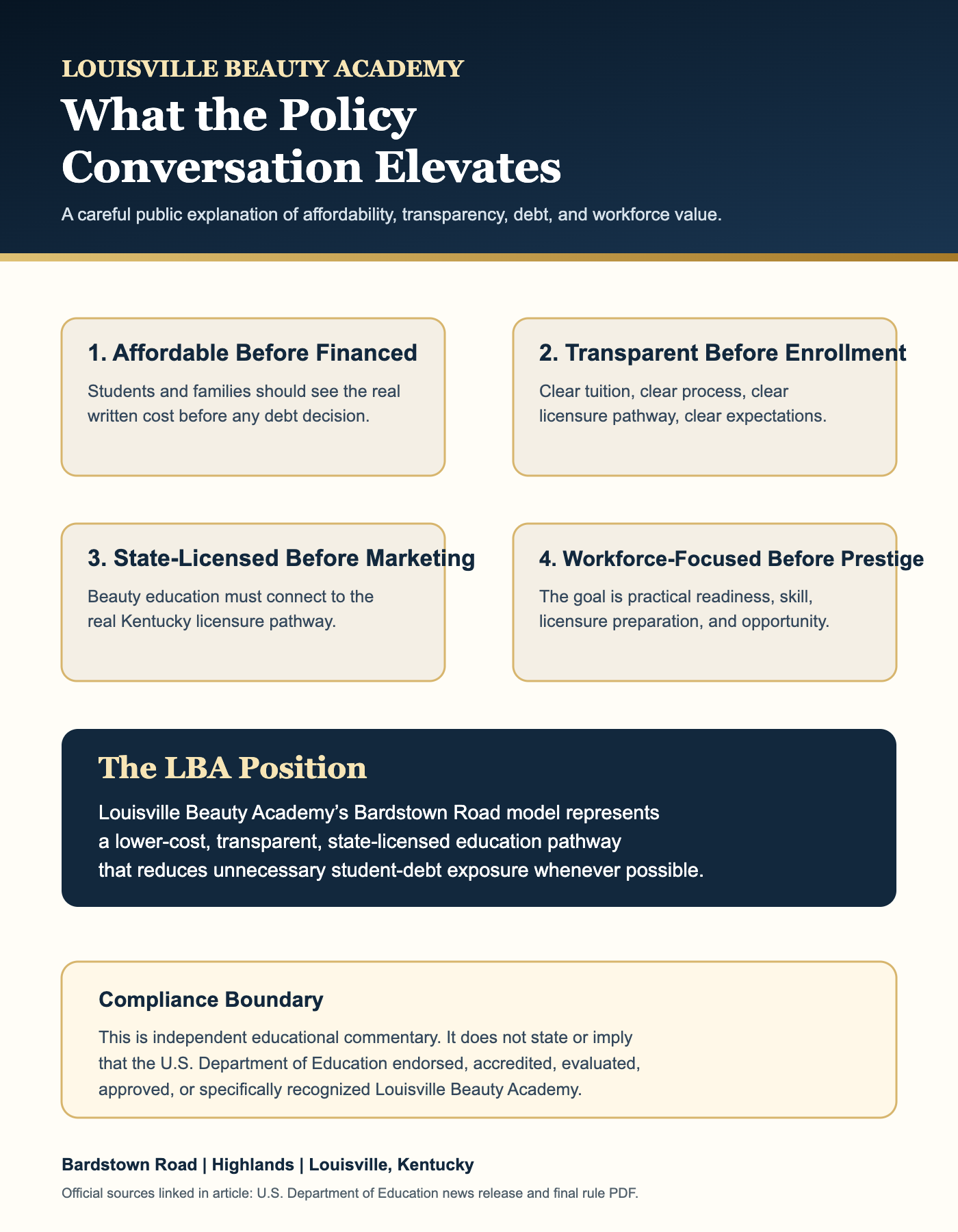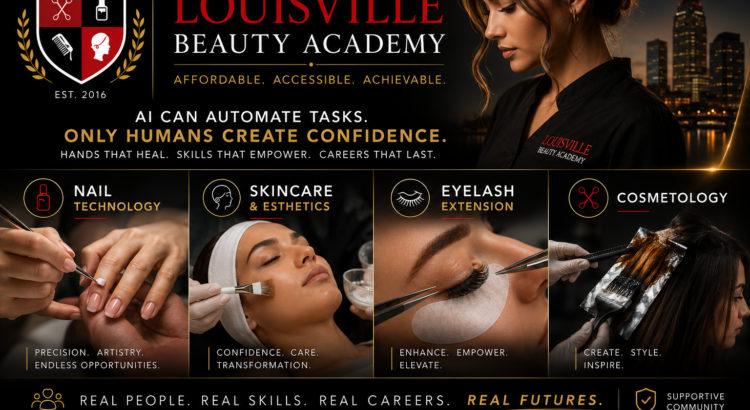

Federal student-loan rules are changing. Families are being asked to make serious education decisions in a confusing moment. Louisville Beauty Academy believes the answer is not fear. The answer is written math, honest questions, clear documents, and a lower-debt path when one is available.
A form can make money feel easy. A signature can make debt last for years.
The U.S. Department of Education has described current reforms as a response to rising college costs, overborrowing, repayment confusion, new loan limits, and the need for institutions to reduce costs. That national language becomes very practical when a student is sitting across from an enrollment agreement.
Financial Aid Is Not Automatically Free Money
A grant, scholarship, payment plan, cash discount, federal loan, Parent PLUS loan, and private loan are not the same thing. They carry different obligations. They affect families differently. They may feel easy on the day of enrollment and very different years later.
What is the total written cost?
What is tuition, and what are fees, books, kits, supplies, and technology costs?
Is this money a loan, grant, scholarship, discount, payment plan, or private financing?
If it is a loan, when does repayment begin and what is the interest rate?
What happens if the student pauses, withdraws, fails, transfers, or needs more time?
The Beauty-School Cost Question
Louisville Beauty Academy publicly encourages students to compare written costs before enrolling anywhere. On LBA’s current public cost page, reduced-cost figures are shown with written-contract controls, including examples such as Nail Technology at $3,800, Esthetics / Skin Care at $6,100, Cosmetology at $6,250.50, and Beauty Instructor at $3,900.
Students should always rely on current written LBA documents, not screenshots, old pages, or verbal summaries. But the public comparison point matters: a state-licensed beauty education path can exist at a dramatically lower cost than many families assume.
Built Differently On Purpose
Louisville Beauty Academy was not built around the idea that beauty students should take the maximum debt available. It was built around a different belief: students deserve a serious, state-licensed, documented, multilingual, lower-cost pathway into beauty careers.
This is not anti-education. It is pro-student. It is not anti-financial-aid. It is pro-clarity. It is not an attack on other schools. It is an invitation for every student to ask for the written math before signing.
Humanization Means Humans Handle Human Things
LBA’s broader institutional system uses documentation, technology, multilingual communication, publishing, and AI-supported back-office tools to strengthen clarity. The purpose is not to replace human care. The purpose is to protect human care.
Computers can help organize documents. Systems can help track records. AI-supported tools can help draft, translate, compare, summarize, and prepare checklists under human review. Humans remain responsible for dignity, encouragement, judgment, coaching, correction, service, and trust.
Before You Enroll
Ask for the current written enrollment agreement.
Ask for the full written cost sheet.
Ask what is a loan, grant, scholarship, discount, or payment plan.
Ask for the required state-board hours and pathway.
Ask for attendance, refund, withdrawal, and satisfactory-progress rules.
Ask for the current documents that control.
If a school is proud of its value, it should be willing to put the facts in writing. Beauty education should open a door, not quietly build a wall of debt behind the student.
A legally careful, fact-based article about Louisville Beauty Academy should rely on a narrower, stronger claim than the absolute statement that every graduate is automatically a net positive in every measurable sense. The best-supported version is this: Louisville Beauty Academy is a Kentucky Board-listed, state-licensed beauty school whose public materials describe a licensure-preparation, practical-training, flexible-schedule, lower-debt/direct-pay model serving adult learners who often balance work, family, transportation, and language barriers while pursuing regulated beauty credentials. That institutional model can support a serious public-value argument about labor-force participation, household spending, and tax-base contribution. [1]
The school’s public milestone language is meaningful but should be stated with precision. LBA’s current graduate-gallery page says the academy has supported “nearly 2,000 graduates” across full programs, short programs, refresher training, transfer students, and workforce pathways. An older 2023 school catalog says that, according to an annual report covering 2017–2023, LBA had over 1,000 graduates. Those two figures are not contradictory, but they are not the same measure either. A rigorous article should therefore say that the exact audited count of full-program graduates alone is not publicly specified in the materials reviewed here. [2]
LBA’s current tuition and finance pages support the lower-debt framing, but they also require careful wording. Current public pages publish conditional reduced-cost figures of $3,800 for Nail Technology, $6,100 for Esthetics, and $6,250.50 for Cosmetology, and state that students may make monthly payments of more than $100. The same current finance page says LBA is not a Title IV federal-aid participant and does not process or disburse federal student aid. However, an older 2023 catalog contains a generic section describing Pell Grants and federal loans. Because LBA’s own current pages repeatedly say current written documents control, the safest public article should rely on the current 2024–2026 finance pages and should not overstate historical practice without written clarification. [3]
The proposed $20 million to $40 million cumulative economic-activity figure is reasonable as an illustrative estimate, not as an audited economic-impact study. If one applies a deliberately modest $10,000 to $20,000 annual contribution proxy to roughly 2,000 cumulative graduates/pathway completers, the math is straightforward. That assumption is conservative relative to current published BLS mean annual wages for Kentucky beauty occupations and Louisville-area beauty occupations. But the article must say clearly that this is not audited GDP, not a tax-receipt study, not a guarantee of earnings, and not proof that every graduate remains in Kentucky or works full-year in the field. [4]
Louisville Beauty Academy appears on the Kentucky Board of Cosmetology’s school list at 1049 Bardstown Road and as Louisville Beauty Academy Future Second Location at future location to be announced. The Board listing shows instructional programs including Cosmetology, Esthetics, Nail Technology, Shampoo Stylist, and instructor pathways. That is the strongest primary-source basis for the statement that LBA is a state-licensed Kentucky beauty school. [5]
LBA’s own “About” page describes the school as serving students who are seeking licensure preparation, practical training, and a clearer path into lawful professional work in beauty. The same page emphasizes access for students balancing work, family responsibilities, transportation limits, and language barriers. Its broader public materials repeatedly frame the school around dignity, discipline, service, and workforce readiness, and the enrollment-procedures page says LBA is designed for adult students with “real lives, work responsibilities, [and] family responsibilities.” [6]
Kentucky’s regulatory framework supports LBA’s licensure-preparation positioning. Kentucky regulation 201 KAR 12:082 requires at least 1,500 hours for cosmetology, 750 hours for esthetics, and 450 hours for nail technology, and it explicitly includes preparation for licensure and employment, on-the-job professionalism, and salon businesses in the educational structure. Kentucky Board pages also restate the hour thresholds for licensure pathways. [7]
LBA’s current public cost pages are affordability-focused but careful. The school says current written documents control, yet public reduced-cost figures currently shown include $3,800 for Nail Technology, $6,100 for Esthetics, $6,250.50 for Cosmetology, $3,900 for Beauty Instructor, and $2,890 for Shampoo Styling. The payment-plan page says students may make monthly payments above $100, while the enrollment-procedures page says LBA offers a monthly payment path with deposits by program and balance due before graduation. [8]
The strongest evidence for the “no federal student loans/aid processed” claim is LBA’s current finance page, which states: “Louisville Beauty Academy is not a Title IV federal aid participant. We do not process or disburse federal student aid (FAFSA loans or grants).” That same page describes LBA’s model as direct-pay and lower-debt. At the same time, the 2023 catalog contains a generic financial-aid section describing Pell Grants and federal loans, which means a clean article should note that current written disclosures control and should avoid claiming more than the current page itself says. [9]
LBA’s public materials also give ready-made compliance language that is useful for the article. The school’s current finance page says no page or older statement guarantees graduation, licensure, exam result, employment, income, transfer approval, or Board approval. The catalog likewise says the academy cannot legally guarantee employment. Those statements align well with the user’s requested guardrails against guaranteed-outcome claims. [10]
The human heart of this article is not a speculative claim about instant success. It is the reality of the working student. LBA’s own current materials say the academy is built for adult students with work and family responsibilities, and its catalog describes full-time attendance as 30–40 hours per week and part-time attendance as 20–30 hours per week, while also stating that the school operates on a flexible schedule that allows students to tailor attendance to personal circumstances. That is exactly the kind of structure that makes the working-student narrative credible. [11]
The occupations named by the user are also recognizable in Louisville labor data. In the Louisville/Jefferson County metro area, BLS reported mean annual wages in May 2023 of about $28,450 for cashiers, $30,000 for waiters and waitresses, $33,220 for bartenders, $30,820 for maids and housekeeping cleaners, $33,550 for janitors/cleaners, $33,960 for home health and personal care aides, and $33,740 to $35,360 for chauffeur-style driving proxies depending on table/version. BLS also notes that taxi drivers, shuttle drivers, and chauffeurs include ride-hailing drivers, and that some of this work is part-time and schedule-flexible. [12]
That makes the requested vignettes defensible as composites, not as undocumented claims about every individual student. A legally careful article can describe students who may be driving Uber or Lyft at night, cleaning hotel rooms on weekends, cashiering, bartending, waiting tables, working factory shifts, helping on salon floors, or caregiving for elders or children—so long as the article presents these as humanized, plausible portraits of a working-adult student body, not as verified census counts of LBA’s entire enrollment. LBA’s own materials support the broader picture of students with work obligations and constrained schedules. [13]
The wage figures above are Louisville/Jefferson-area BLS estimates, while the hour bands are illustrative work scenarios chosen to fit LBA’s published flexible attendance model for working adult students. The Uber/Lyft row uses a chauffeur-style proxy because BLS classifies ride-hailing within the broader taxi/shuttle/chauffeur framework, and real gig-driver take-home pay can vary materially due to vehicle costs, self-employment status, and platform conditions. [14]
The economic case should be framed in intentionally modest terms. BLS reported statewide Kentucky mean annual wages in May 2023 of about $48,700 for hairdressers, hairstylists, and cosmetologists, $42,330 for manicurists and pedicurists, and $55,060 for skincare specialists. In the Louisville metro area, the corresponding means were even higher, at about $59,240, $41,150, and $57,160. Against those published occupation figures, an article that uses only $10,000 to $20,000 per graduate per year as an illustrative contribution range is plainly conservative. [15]
That is why the article can responsibly say the following: the proposed figure is not an income promise and not an audited wage file; it is a modest annual economic-activity proxy. It simply asks whether a licensed or partially placed worker might reasonably generate at least $10,000 to $20,000 in annual labor-linked contribution through work, spending, and tax-system participation. Given the BLS occupation data above, that is a cautious assumption rather than an aggressive one. [15]
The public-current scenario is the one that produces the $20 million to $40 million figure the user requested, but the floor scenario is useful because it shows the argument still works even under older, lower public counts. The correct editorial description is therefore: “illustrative cumulative annual economic activity associated with modest per-graduate contribution assumptions” rather than “audited economic impact.” [16]
There is also a broader economic reason this framing works. BLS reported that, in 2024, housing and transportation accounted for 50 percent of household spending, and BEA describes personal consumption expenditures as the goods and services purchased by or on behalf of U.S. residents. In other words, even modest earnings are quickly translated into rent, fuel, groceries, child-related costs, and everyday consumption. On top of that, employers generally must withhold federal income tax and Social Security/Medicare taxes from wages, and Kentucky requires employer payroll withholding on wages as well. That is why the “net positive” idea can be argued conservatively in terms of contribution to the economy and tax base, even without claiming an exact audited tax total. [17]
The timeline above follows Kentucky’s published hour requirements, LBA’s attendance-and-completion structure, and LBA’s own published sequence of graduation, Board approval, and exam scheduling before licensure. [18]
The safest strong title is not the absolute version. Instead of “Every Louisville Beauty Academy Graduate Is a Net Positive…,” the more defensible publishable title is:
Do You Know? Why a Louisville Beauty Academy Graduate Can Be a Net Positive to Kentucky, America, and the Economy
That wording preserves force while avoiding a universal factual claim that would require person-level data on every graduate’s income, location, taxes, and public-benefit use.
A sound article should also make four distinctions explicit. First, institutional finance is not the same thing as individual student benefit use. LBA’s current public page says the school does not process or disburse federal aid, but that does not prove that every individual student, at every moment, uses zero government support elsewhere in life. Second, school completion is not the same thing as state licensure; the Board and PSI control licensure steps. Third, illustrative economic activity is not the same thing as audited impact. Fourth, student culture of sacrifice is real and powerful as a narrative theme, but it should be presented as a composite human truth, not as a quantified claim unless LBA has its own internal survey or documentation. [19]
Open questions and limitations. The exact cumulative count of full-program graduates only was not publicly specified in the materials reviewed. A current LBA finance page says the school is not a Title IV participant, while the 2023 catalog includes a generic federal-aid section; current written disclosures should therefore control. No public audited dataset was reviewed showing graduate-by-graduate income, in-state retention, or public-benefit use, so any claim stronger than an illustrative contribution estimate would exceed the evidence gathered here. [20]
Use these only as illustrative composite quotes unless replaced by real quotes from actual students or graduates who have given permission. They fit the evidence about LBA’s working-adult structure and the Louisville job landscape, but they are not verbatim source quotations.
“I was driving nights, studying days, and paying in pieces. It was not easy, but it was real.”
“Some weeks I cleaned houses. Some weeks I worked restaurant shifts. I kept my hours moving anyway.”
“School did not erase my responsibilities. It gave them direction.”
“I was not looking for a promise. I was looking for a lawful path, an affordable path, and a chance.”
“Before I graduated, I was already contributing. After licensure, I could contribute with more stability.”
“The license mattered. But the discipline I built on the way there mattered too.”
These quotes are best introduced as anonymized composites inspired by LBA’s published emphasis on working adult students, flexible attendance, and steady progression toward lawful licensure. [21]
Explain the $10k–$20k assumption and the $20M–$40M illustration
300–450 words
Why it matters
Explain “net positive” in family, community, and civic terms
220–320 words
Closing
Pride, gratitude, and future-facing ending without guarantees
130–220 words
A finished article in the 1,200 to 1,800-word range should be long enough to feel substantial and persuasive, but still concise enough for web publishing and institutional review. The economic section should carry the heaviest citation burden because it is where legal risk is highest. [22]
Title: Do You Know? Why a Louisville Beauty Academy Graduate Can Be a Net Positive to Kentucky, America, and the Economy
Subtitle: A fact-based, lower-debt, working-student story about licensure, perseverance, and modest but meaningful economic contribution.
Executive Summary
Louisville Beauty Academy is a Kentucky Board-listed, state-licensed school offering cosmetology, esthetics, nail technology, shampoo styling, and instructor pathways in Louisville. Its public materials describe a school built around licensure preparation, practical training, flexibility for working adults, multilingual communication, and a lower-debt direct-pay approach rather than school-processed federal Title IV aid. [23]
That matters economically. LBA’s current public gallery says the school has supported nearly 2,000 graduates and pathway completers across full programs, short programs, refresher training, transfer students, and workforce pathways. If a reader applies only a modest illustrative annual contribution range of $10,000 to $20,000 per person, the result is roughly $20 million to $40 million in annual economic activity. That is not an audited impact study or a promise of earnings. It is a conservative way to explain why disciplined working students and graduates can matter to Kentucky, to America, and to the economy. [24]
Louisville looks like work before it looks like applause
Sometimes the story of beauty school is told as if it begins with polish, style, glamour, or the first happy client. But for many adult learners, the real story begins earlier than that. It begins with a second shift. It begins with a phone full of ride requests. It begins with hotel rooms to clean, restaurant tables to serve, factory lines to work, caregiving duties to carry, register drawers to count, and bills that do not pause simply because someone decided to build a better future. LBA’s own public materials describe a student population balancing work, family responsibilities, transportation limits, and different learning needs, and its schedule model is built for adult students with real-world obligations. [21]
This is why the culture matters. Louisville Beauty Academy’s public language is not built around fantasy. It is built around discipline: show up, clock in, learn the law, practice the skill, finish the hours, document the record, and move toward the next lawful step. That is the meaning behind the school’s public “YES I CAN” and “I HAVE DONE IT” language. It is not a promise that everything will be easy. It is a statement that movement matters, effort matters, and completion matters. [25]
What Louisville Beauty Academy is, in plain terms
Louisville Beauty Academy is not a vague training concept. It is listed by the Kentucky Board of Cosmetology as a Louisville school offering state-regulated beauty programs, including cosmetology, esthetics, nail technology, shampoo styling, and instructor pathways. LBA’s own public pages describe the school as focused on licensure preparation, practical training, written transparency, and access for students whose lives are already full before they ever walk into class. [26]
Its current public cost pages also support the lower-debt story. LBA currently publishes conditional reduced-cost figures such as $3,800 for Nail Technology, $6,100 for Esthetics, and $6,250.50 for Cosmetology, while also stating that current written contracts control. The school says students may make monthly payments above $100 under its written payment structure. Most importantly for this article’s public-value argument, LBA’s current finance page says the school is not a Title IV federal-aid participant and does not process or disburse FAFSA loans or grants. [27]
That does not mean life becomes painless. It means the model is designed to let students push forward without the school itself routing them through school-processed federal student-aid pipelines. It is a different kind of burden: still serious, still demanding, but often more immediate, more transparent, and potentially less loan-dependent. That distinction is one reason the phrase “net positive” can be argued carefully here. [28]
Why the economic argument is serious even when the assumptions are modest
The most responsible way to make the economic case is not to inflate it. It is to understate it. In Kentucky, BLS reported mean annual wages in May 2023 of about $48,700 for hairdressers, hairstylists, and cosmetologists, $42,330 for manicurists and pedicurists, and $55,060 for skincare specialists. In the Louisville metro area, published means were even higher for cosmetologists and skincare specialists. Against that backdrop, using only $10,000 to $20,000 per graduate as an illustrative annual contribution assumption is modest by design. [15]
So the math is straightforward. If a public milestone is approximately 2,000 graduates and pathway completers, and if one uses only $10,000 to $20,000 per person per year as a conservative contribution proxy, the resulting estimate is approximately $20 million to $40 million. That figure should be described honestly: it is an illustrative estimate, not an audited impact study, not tax accounting, not guaranteed income, and not proof that every graduate works in-state or full-year. But it is still useful, because it reveals scale. Even modest contribution multiplied across many disciplined people becomes economically meaningful. [24]
And work matters even before licensure. Louisville-area labor data show that many of the roles common to working-adult student life—cashiering, waiting tables, bartending, cleaning, caregiving, chauffeur-style driving, and production work—already generate real income. Those wages may help pay rent, food, transportation, and tuition while school is still in progress. That means contribution often starts before graduation, not only after it. [29]
Why “net positive” is bigger than money alone
Money matters. But it is not the whole story. A student who works while enrolled is not standing still. A graduate who completes required hours, passes into lawful practice, and begins earning is not only helping themselves. That person is strengthening a household, stabilizing a family budget, improving local service capacity, and participating in the broader systems through which economies actually function. BLS reports that housing and transportation alone accounted for half of household spending in 2024, while federal and Kentucky wage systems both require withholding and reporting on wages. In practical terms, work becomes groceries, gas, rent, bills, and tax-base participation. [30]
That is why the best conservative argument is not that every individual story is identical. It is that the pattern itself is powerful. When a school serves working adults, offers a flexible clock-hour structure, keeps costs visible, focuses on licensure preparation, and helps people move from uncertainty toward lawful earning, the result can be public value. Not perfect value. Not guaranteed value. But real value. [31]
What Louisville Beauty Academy should be proud to say
Louisville Beauty Academy should be proud—not because it can promise outcomes it does not control, and not because every life becomes easy overnight. It should be proud because its public model is built around something serious: adult responsibility, lawful completion, lower-debt access, and the dignity of people who refuse to quit. Its own materials say the school cannot guarantee employment, income, licensure timing, or Board decisions. That honesty is not weakness. It is strength. It makes the success stories more credible, not less. [32]
So yes—speak proudly. Speak about the Uber driver who studies between shifts. Speak about the hotel cleaner who keeps showing up. Speak about the cashier, the bartender, the waitress, the caregiver, the factory worker, the salon-floor helper, the parent, the immigrant, the student who lives carefully and sacrifices quietly. Speak about the person who does not ask for an easy road, only for a real one. That is the deeper meaning of “YES I CAN” at its best. [6]
And then say this with confidence and care: when disciplined people pursue licensure through a transparent, work-compatible, lower-debt training path, they can become a net positive to Kentucky, to America, and to the economy. Maybe first in modest ways. Then in larger ones. But often long before anyone notices, and long before anyone applauds. That is something worth honoring. And Louisville Beauty Academy has every reason to be proud of it. [33]
Beauty School Without the Debt Trap: A Humanized Model for Practical Education, Licensure, and Student Freedom
Louisville Beauty Academy is honored to be featured in the new book Beauty School Without the Debt Trap: A Humanized Path to Practical Education, Licensure, and Student Freedom, published through Di Tran University Press and the College of Humanization.
This recognition matters because beauty education is not a small subject. For many working adults, immigrant families, first-generation learners, career changers, and parents rebuilding their lives, beauty school is not merely a program. It is a doorway into licensure, dignity, income, service, entrepreneurship, and professional identity.
That doorway must be protected.
The book identifies Louisville Beauty Academy as a practical proof model for a different kind of beauty education: lower-cost, documentation-first, state-licensed, student-protective, and humanized. This does not mean education is free. It does not mean every loan is wrong. It does not mean every expensive school is dishonest. It means the public conversation must become more serious.
The true issue is not whether beauty school has cost. Real education has cost. Schools have rent, instructors, supplies, sanitation obligations, insurance, administrative systems, regulatory duties, technology, and human responsibilities. The issue is whether the student clearly understands the cost, the records, the expectations, the licensure pathway, and the relationship between educational commitment and real professional outcome.
When that clarity is missing, hope can become financial capture.
When that clarity is present, education becomes human protection.
The Debt Trap Is Not Only Debt
A debt trap begins when a student is asked to make a life-changing commitment without enough written clarity, realistic math, protective documentation, and honest connection between cost and outcome.
It can begin with a beautiful tour, a warm promise, a rushed signature, a confusing contract, a hidden fee, an unclear refund rule, or a financing package that feels like opportunity but later behaves like pressure.
The problem is not aspiration. Aspiration is sacred. A student who wants to become a licensed beauty professional is often showing courage, not vanity. She may be trying to support children, serve a community, leave a dead-end job, turn talent into income, or enter a field where touch, care, confidence, and technical skill meet.
That kind of courage deserves protection.
It deserves written clarity before commitment. It deserves records that can be reviewed. It deserves honest cost language. It deserves licensure awareness. It deserves a school culture where documentation is not treated as cold bureaucracy, but as care.
Why Louisville Beauty Academy Was Featured
Louisville Beauty Academy represents a proof model because it lives a simple but powerful institutional principle:
Practical education should be clear, lawful, affordable, student-protective, and humanized.
The school’s public value is not merely that it teaches beauty. Its deeper value is that it demonstrates how a state-licensed workforce school can place documentation, cost awareness, written expectations, licensure progress, and student dignity at the center of the educational relationship.
This is what makes the model important beyond one school.
Louisville Beauty Academy carries the proof. Di Tran University Press and the College of Humanization carry the doctrine. NABA can carry the policy question. Louisville Fund A Student Foundation can carry the access question. Together, the ecosystem points toward a stronger future for practical education: one where the student is not reduced to an enrollment number, a loan file, or a dream sold through emotion.
The student is a person.
And the person must be protected.
Documentation Is Human Care
Too many people treat paperwork as the opposite of humanity. In serious education, that is wrong.
A clear enrollment agreement is human care.
A readable catalog is human care.
Accurate attendance records are human care.
Written refund terms are human care.
Licensure explanations are human care.
Graduation records are human care.
Cost transparency is human care.
When a student can read, review, translate, ask questions, compare, and return to written documents, the student has more power. When expectations are only verbal, emotional, rushed, or scattered, the student becomes dependent on memory, personality, and trust without proof.
Trust is good. Written clarity makes trust safer.
A Humanized Alternative
The book’s message is not anti-school, anti-business, anti-cost, or anti-ambition. It is pro-student, pro-clarity, pro-licensure, pro-workforce, pro-family, and pro-accountability.
A humanized beauty school should help a student answer basic questions before the student signs:
What will this cost?
What is included?
What is not included?
What happens if I stop?
What happens if I transfer?
How are hours tracked?
What records will I receive?
What does the state require?
What is the path from enrollment to licensure?
What documents should I keep?
These questions are not hostile. They are responsible.
An institution that welcomes these questions is stronger, not weaker. A student who asks these questions is not being difficult. The student is acting like an adult preparing for a serious professional pathway.
Elevating the Whole Ecosystem
This book also clarifies the role of each organization in a larger institutional architecture.
Louisville Beauty Academy is the living proof model: a Kentucky-based, state-licensed practical education institution focused on affordability, licensure awareness, written clarity, and human care.
Di Tran University Press is the publishing engine: converting lived institutional practice into durable books, guides, public education, and doctrine.
The College of Humanization is the intellectual frame: insisting that education, automation, documentation, and institutional systems must serve human dignity rather than replace it.
NABA is the advocacy and policy voice: asking how beauty education, student choice, lower-cost licensed schools, and accountable support models can better serve workers, families, and communities.
Louisville Fund A Student Foundation is the access layer: pointing toward a future where practical education support can be aligned with real student need, dignity, and opportunity.
This is not merely a book announcement. It is a public statement about what practical education should become.
Do Not Sell the Dream. Protect the Beginner.
The beauty industry is filled with hope. That is part of its power. People enter this field because they want to create, serve, earn, transform, belong, and build.
But hope must not be used carelessly.
The student brave enough to begin should not be dazzled into confusion. The student should not be rushed into terms she cannot explain. The student should not be made to feel ashamed for asking about cost. The student should not be treated as less worthy because she needs a lower-cost pathway. The student should not have to choose between dignity and debt.
A better model is possible.
Clear cost. Honest records. Lawful training. Human care. Student freedom.
That is the message of Beauty School Without the Debt Trap.
That is why Louisville Beauty Academy is honored to be featured.
And that is why this conversation belongs not only to one school, but to every family, policymaker, educator, funder, and student who believes practical education should lift people without quietly binding them.
Do not sell the dream.
Protect the person brave enough to begin it.
Read the Book
Beauty School Without the Debt Trap is the public book behind this proof-model conversation. It explains why clear cost, honest records, lawful training, human care, and student freedom matter for families considering beauty education.
A Category-Defining Proof Model, Not a Competitor Attack
Louisville Beauty Academy is presented here as a rare, category-defining proof model because it brings together lower-cost practical education, state licensure awareness, documentation-first operations, student-facing clarity, and a humanized institutional philosophy. This is not a claim that every other school is wrong, nor is it a promise that one pathway fits every student. It is a disciplined public example of how practical education can be made clearer, safer, and more accountable.
Public Guardrails
This article and the referenced book are educational resources. They are not legal, financial, accreditation, licensing, tax, or employment advice. Louisville Beauty Academy does not guarantee licensure, employment, income, funding, debt-free outcomes, transfer results, board approval, or any individual student result. Students and families should review current written school documents, applicable Kentucky Board of Cosmetology requirements, PSI/testing requirements where relevant, and their own financial circumstances before making an enrollment decision. No named competitor is accused of wrongdoing in this article.
A humanized beauty education model protects students through written clarity, clear cost, honest records, lawful training, and human care.
How to Choose a Beauty School Without Being Pushed
A good enrollment conversation should make a student clearer, not more confused. Before choosing any beauty school, students and families should slow down enough to understand the written materials, the expected cost, the schedule, the hour requirements, and the school’s communication standards.
Pressure can create short-term decisions. Clarity creates durable trust. A student should feel free to ask questions, compare options, review documents, and understand what is required before making a commitment.
The best beauty school for a student is not only the one with attractive language. It is the environment where the student can learn, practice, complete required training, prepare for licensure steps, and be treated with dignity.
What This Means Practically
Use written clarity before verbal pressure.
Give people the next honest step without forcing the decision.
Let proof, service, and usefulness create trust over time.
Institutional Position
LBA encourages prospective students to ask clear questions, review written documents, and choose an education pathway based on fit, discipline, affordability, and practical readiness.
References and Related Institutional Context
LBA public checklist for choosing a beauty school
Kentucky Board of Cosmetology public resources
LBA student-protection publishing doctrine
This article is public education and institutional commentary. It is not legal, financial, medical, or individualized enrollment advice.
Before choosing a school, ask about cost, schedule, hours, policies, licensure pathway, and written records.
What changed: Louisville Beauty Academy is memorializing a Kentucky Board of Cosmetology / PSI exam-readiness update reviewed on June 4, 2026. The KBC Exams page states that practical examinations are onsite at PSI Lexington effective June 1, 2026, and the page also references new PSI Test Taker Guides / Candidate Bulletins effective March 19, 2026.
Who is affected: Kentucky cosmetology, esthetics, nail technology, shampoo stylist, and instructor students or graduates preparing for PSI / KBC licensing examinations.
Student action: Before exam day, students should verify Board approval, schedule through PSI, read the current candidate bulletin, confirm the location and arrival instructions, and prepare according to official KBC and PSI instructions.
Important disclaimer: Louisville Beauty Academy provides educational guidance only. Students must verify all information directly with PSI and the Kentucky Board of Cosmetology.
Effective Date
June 1, 2026 for onsite practical examinations at PSI Lexington, as stated on the KBC Exams page reviewed June 4, 2026. New PSI Test Taker Guides / Candidate Bulletins are referenced as effective March 19, 2026.
Location
PSI Lexington testing center, 333 Waller Ave, Suite 120, Lexington, Kentucky 40504, according to the KBC Exams page.
Programs Affected
Cosmetology, Esthetician, Nail Technology, Instructor, and Shampoo Stylist candidates should review the official candidate bulletin for their program.
Graduate. Complete the required school training, hours, and internal graduation process.
Verify Board approval. Confirm that the Kentucky Board of Cosmetology has the required school submission and that the candidate is eligible to proceed.
Schedule PSI. Use PSI’s official Kentucky cosmetology test-taker path and confirm the correct exam, date, address, and arrival requirements.
Review the candidate bulletin. Read the current bulletin for the specific program before relying on older preparation assumptions.
Arrive prepared. Bring required identification, required kit/materials if applicable, and follow PSI / KBC instructions for timing, conduct, and exam-day rules.
The detailed research below is preserved for transparency, student support, SEO value, and Louisville Beauty Academy’s Compliance-by-Design documentation practice. LBA documents and educates; PSI and the Kentucky Board of Cosmetology determine official policy, scheduling, exam instructions, and candidate requirements.
Louisville Beauty Academy is memorializing this public student-readiness update on June 4, 2026, based on the Kentucky Board of Cosmetology’s official Exams page as reviewed on this date.
The Kentucky Board of Cosmetology’s Exams page now states that, effective June 1, 2026, practical examinations will be held onsite at PSI’s Lexington testing center at 333 Waller Ave, Suite 120, Lexington, Kentucky 40504. The same page also references the implementation of new PSI Test Taker Guides / Candidate Bulletins effective March 19, 2026.
For students and graduates preparing for Kentucky cosmetology, esthetics, nail technology, shampoo stylist, or instructor examinations, this matters because exam logistics and official candidate instructions can affect preparation, travel planning, kit readiness, and exam-day confidence.
Detailed Student Guidance From the Source Review
Review the current Kentucky Board of Cosmetology Exams page before relying on older exam assumptions.
Confirm your PSI scheduling details, location, arrival instructions, identification requirements, and candidate bulletin before exam day.
Monitor email from PSI, especially for scheduling, weather, emergency, or testing-center notices.
Ask your instructor or school office for help understanding what changed, but always treat KBC and PSI as the official source for exam instructions.
What Louisville Beauty Academy Is Preserving
As part of Louisville Beauty Academy’s documentation-first student support practice, we preserved a dated screenshot and browser-print copy of the official KBC Exams page, along with the official linked Kentucky candidate information documents available from that page at the time of review.
This public post is not a substitute for KBC or PSI instructions. It is a dated public record and student-readiness notice so that students, graduates, staff, and the public can see that exam-related changes were noticed, documented, and communicated.
Louisville Beauty Academy’s role is to help students prepare with clarity, written documentation, sanitation seriousness, practical skill development, and respectful support. No school can take the exam for a student or guarantee a passing result. What we can do is keep students oriented toward current official instructions, strong preparation, and responsible exam-day readiness.
Reviewed and memorialized: June 4, 2026.
Louisville Beauty Academy preserved the official KBC Exams page and linked candidate documents on June 4, 2026 for student-readiness documentation.
Zero-Abandonment Mentorship: At Louisville Beauty Academy, You Are Not Left Alone
At Louisville Beauty Academy, we do not believe a student becomes disposable because an exam is difficult, delayed, or emotionally discouraging.
Beauty licensure is serious. State-board procedures can change. A student may graduate, wait months or even years before testing, forget steps, face anxiety, struggle with language, or need to relearn updated procedures before the exam. None of that should become shame. It should become preparation.
That is why Louisville Beauty Academy operates with a simple human doctrine:
We cannot take the exam for you. We cannot guarantee a result. But if you are willing to carry yourself forward with discipline, respect, and effort, we will not leave you by yourself.
We call this our Zero-Abandonment Mentorship Commitment.
Support Belongs With Good Standing
This commitment applies to students and graduates who remain in good standing with the school. Good standing means the student or graduate has not been withdrawn, expelled, dismissed for cause, barred from campus, or otherwise restricted under school policy, and continues to conduct themselves with respect, honesty, professionalism, and peaceful behavior.
Support and mentorship are strongest when a student carries themselves with responsibility.
During Enrollment
During enrollment, LBA works to provide a flexible, student-centered learning environment within school policy, program requirements, staff availability, and applicable Kentucky Board of Cosmetology rules. Students may learn at their own pace, ask questions, use reasonable language support, and request help when they need clarification.
We want students to keep moving, not freeze in fear.
Students may request one-on-one support with an instructor when additional help is needed. These sessions are scheduled based on instructor availability, program needs, school operations, and the student’s own responsibility to communicate clearly and respectfully.
After Graduation
After graduation, LBA graduates in good standing remain part of the LBA learning family. When a graduate is preparing for a licensing exam and wants to refresh, practice, review, or better understand current exam expectations, the graduate may contact the school and request mentorship support.
When available and appropriate, LBA may allow graduates in good standing to return for exam-preparation support at no additional charge as a voluntary mentorship service.
This is not a legal guarantee. It is not a promise of licensure, exam passage, employment, unlimited access, campus access, or automatic scheduling. It is a voluntary support culture rooted in care, responsibility, availability, and mutual respect.
The Student’s Responsibility Remains Real
The responsibility remains real:
The student must remain in good standing.
The student must study.
The student must practice.
The student must communicate.
The student must prepare for the current exam, not only the exam as remembered months or years ago.
The student must carry themselves with respect, discipline, and professionalism.
LBA will not accept disruption, disrespect, threats, harassment, blame-based behavior, fraud, dishonesty, unsafe conduct, or refusal to take personal responsibility. Support requires a peaceful learning environment. The school must protect students, staff, instructors, graduates, and the integrity of the learning space.
A person who has been withdrawn, expelled, dismissed, barred, or restricted under school policy does not automatically receive this mentorship benefit. Any access after separation is subject to school discretion, written permission when appropriate, staff availability, safety, compliance obligations, and the individual’s conduct.
Come Back With Humility, Discipline, and Effort
For the student or graduate who is willing to return with humility, discipline, and effort, our message is clear:
Come back. Ask. Practice. Prepare. Do not disappear. Do not turn failure into identity. Do not let embarrassment keep you away from the help available to you.
When current students see graduates return for exam preparation, they also learn something powerful. They learn that licensing is real. They learn that procedures matter. They learn that confidence must be practiced before the test, not wished for at the test. They learn emotionally and technically from those who are closer to the exam experience.
That is part of the LBA family model.
A Family Standard With Clear Boundaries
Once you are part of Louisville Beauty Academy, you are not treated as a number. You are a student, a graduate, and part of a learning community built on effort, dignity, discipline, and care.
We love our students. We believe in hard work. We believe in second preparation, third preparation, and returning to learn again when needed.
The exam belongs to the student. The effort belongs to the student. The license must be earned by the student.
But the student does not have to walk alone.
Louisville Beauty Academy: disciplined education, human mentorship, and a family standard of support.
References
[1] Kentucky Board of Cosmetology, License Requirements. https://kbc.ky.gov/Licensure/Pages/License-Requirements.aspx
[2] Kentucky Board of Cosmetology, Exams. https://kbc.ky.gov/exams/Pages/default.aspx
[3] Kentucky Board of Cosmetology, Statutes and Regulations. https://kbc.ky.gov/Statutes-and-Regulations/Pages/default.aspx
[4] Louisville Beauty Academy public site and student-support materials. https://louisvillebeautyacademy.net
Zero-Abandonment Mentorship: LBA support is strongest when the student remains in good standing and carries themselves with responsibility.
Hours Are Legal Evidence: Why Attendance Tracking Matters in Beauty School is written for students, families, salon employers, workforce partners, and public officials who need beauty education to be practical, honest, and verifiable.
In licensed beauty education, time records are part of the student’s legal and professional proof chain.
This article does not promise enrollment approval, graduation, examination passage, licensure, employment, income, discounts, funding, or any state-board decision. It gives a disciplined framework for asking better questions and keeping better records.
Deep Research Query Used
Research query: “Hours Are Legal Evidence: Why Attendance Tracking Matters in Beauty School” attendance and hour evidence official sources Kentucky Board of Cosmetology PSI NIC FTC CFPB BLS O*NET CareerOneStop student protection workforce economics no guarantee licensure employment income board approval
Attendance Is Not Just Showing Up
In beauty school, attendance is tied to legal training hours, professional discipline, sanitation readiness, clinic exposure, and graduation timing. A student who treats hours casually is treating the future license pathway casually.
Hours Create a Proof Chain
A serious record chain begins with enrollment, continues through daily attendance, accumulates into program hours, supports graduation processing, and helps connect school completion to examination and licensure steps. Weak hour records create stress; strong hour records create clarity.
Why Students Should Care
Students sometimes think hour tracking is bureaucracy. In reality, it protects the value of their work. If a student has spent months attending, practicing, studying, and serving models or clients under supervision, the record should be accurate enough to honor that effort.
Professional Identity Begins Before Pay
Showing up before being paid is part of becoming a professional. Salon employers notice reliability. Clients notice reliability. Boards and schools rely on documented training. Attendance discipline is not separate from career discipline.
LBA Position
Louisville Beauty Academy should continue teaching students that records are respect: respect for the law, the public, the profession, the student, and the school. Hours should be treated as serious evidence, not casual memory.
The Research Questions Behind This Article
A flagship article cannot simply repeat a slogan. For this topic, the controlling research question is: how should a serious student, family, school, employer, or public official understand attendance and hour evidence using official sources first, institutional documents second, and real economic judgment third?
What does the public authority or official source actually control?
What can the school properly explain without overpromising?
What must the student keep in writing?
What economic pressure will the student or family feel in real life?
What claim language would be unsafe, exaggerated, or confusing?
The Real-World Scenario
Imagine a working adult considering beauty school while balancing rent, transportation, family obligations, work hours, language needs, and the desire to enter a licensed profession. That person does not need vague inspiration only. They need a clean decision system. Hours Are Legal Evidence: Why Attendance Tracking Matters in Beauty School is built around that practical reality.
The student may be excited, but excitement is not a substitute for proof. The family may trust the school, but trust is stronger when written records can be reviewed. The school may want to help, but help must stay inside legal, ethical, and factual boundaries. A strong system respects all three sides.
The Economic Layer
Beauty education is economic infrastructure because it can convert time, discipline, documentation, and supervised practice into a licensed workforce pathway. But economics must be explained honestly. A student should consider total cost, schedule burden, exam timing, income uncertainty, transportation, childcare, supply needs, retake risk, and the difference between gross sales and net income.
This is why LBA’s strongest public posture is not a flashy promise. It is practical clarity: understand the program, understand the rules, understand the records, understand the cost stack, and understand who controls each decision. That is more powerful than sales language because it makes the student more capable.
The Compliance Layer
In regulated education, the safest sentence is often the most precise sentence. Schools can describe their programs, policies, supports, prices, documents, and educational practices. Schools should not guarantee licensure, employment, exam passage, income, transfer acceptance, state-board approval, or individual financial outcomes.
A school that speaks carefully is not weaker. It is stronger. Careful language tells the public that the institution respects the student, the regulator, the profession, and the difference between support and authority.
What This Means for Students
Students should develop a documentation mindset early. That means keeping copies, reading before signing, asking for clarification in writing, saving screenshots or PDFs of current official pages when needed, and knowing the difference between a school explanation and a controlling government or exam-vendor rule.
Clock-in record
Daily attendance review
Program-hour accumulation
School policy compliance
Graduation eligibility
Board submission support
Student keeps evidence mindset
What This Means for Schools
A serious school should make the student’s path easier to understand without pretending that every part of the path is easy. The better institutional standard is disciplined transparency: show the relevant documents, explain the limits, direct students to official sources, preserve records, and use public pages to reduce confusion before enrollment.
That standard also helps employers, funders, public officials, and community partners. They can see that the school is not merely recruiting students. It is building a documented, lawful, practical workforce pathway.
World-Cross Feature
The same principle appears in other serious fields. A mortgage depends on written disclosures. A medical procedure depends on consent and records. A pilot logs flight hours. A nurse tracks clinical requirements. A skilled trade apprentice records training progress. Beauty education deserves the same respect: practical work, public safety, documentation, and lawful progression all matter.
Common Misunderstandings to Avoid
Do not treat a verbal statement as stronger than the current written document.
Do not assume a school controls a state-board or exam-vendor decision.
Do not confuse school completion with licensure.
Do not compare programs only by headline price.
Do not treat translation, advising, or support as a guarantee.
Flagship Bottom Line
The central standard is simple: attendance and hour evidence should be understandable, documented, and grounded in official sources. When a school teaches that way, students become stronger decision-makers. When students learn that way, the profession becomes more credible. When the public sees that standard in writing, institutional trust rises.
Frequently Asked Questions
Does this article replace official Board, exam, or legal guidance? No. It is an educational guide. Students should verify current requirements with the responsible official source.
Does LBA guarantee licensure, exam passage, employment, income, or a particular Board decision? No. LBA can provide education, documentation, and support inside its lawful role, but outside authorities and individual student performance matter.
What is the strongest student habit? Read first, keep copies, ask written questions, attend consistently, and treat every important education step as part of a proof chain.
Practical Reader Checklist
Clock-in record
Daily attendance review
Program-hour accumulation
School policy compliance
Graduation eligibility
Board submission support
Student keeps evidence mindset
Student Protection Notice
Students should rely on current written documents, official state-board and exam-vendor information, and the school documents actually provided to them. Policies, fees, rules, and external requirements can change. When the issue is licensing, examination, transfer, discipline, or official approval, the relevant public authority controls.
Beauty Education for Multilingual Families: How Translation Support Should Work is written for students, families, salon employers, workforce partners, and public officials who need beauty education to be practical, honest, and verifiable.
Language access should clarify documents and expectations without replacing official rules or student responsibility.
This article does not promise enrollment approval, graduation, examination passage, licensure, employment, income, discounts, funding, or any state-board decision. It gives a disciplined framework for asking better questions and keeping better records.
Deep Research Query Used
Research query: “Beauty Education for Multilingual Families: How Translation Support Should Work” multilingual support official sources Kentucky Board of Cosmetology PSI NIC FTC CFPB BLS O*NET CareerOneStop student protection workforce economics no guarantee licensure employment income board approval
Language Support Is Dignity Work
A multilingual student should not have to choose between ambition and confusion. Translation support can help a family understand program choices, costs, attendance, conduct, document control, and the difference between school support and state-board authority.
Translation Does Not Change the Rule
The safest multilingual model keeps the official document visible and uses translation to explain it, not replace it. If an English contract, catalog, Board requirement, or exam rule controls, the student should understand that the translated explanation is support, not a new legal promise.
Occupational Vocabulary Matters
Beauty education has technical vocabulary: sanitation, disinfection, contraindication, monomer, polymer, epidermis, license, permit, eligibility, endorsement, withdrawal, refund, verification. A student who builds professional English while receiving language support becomes stronger in school and in the salon.
Family Participation Can Be an Advantage
Many adult learners and immigrant students make education decisions with family support. A good school should respect that reality while still making clear that the enrolled student is responsible for attendance, payment, conduct, study, documentation, and exam readiness.
LBA Position
Louisville Beauty Academy’s multilingual identity should be framed as humanization plus discipline: help people understand, keep documents clear, encourage written follow-up, and never turn support into an uncontrolled guarantee.
The Research Questions Behind This Article
A flagship article cannot simply repeat a slogan. For this topic, the controlling research question is: how should a serious student, family, school, employer, or public official understand multilingual support using official sources first, institutional documents second, and real economic judgment third?
What does the public authority or official source actually control?
What can the school properly explain without overpromising?
What must the student keep in writing?
What economic pressure will the student or family feel in real life?
What claim language would be unsafe, exaggerated, or confusing?
The Real-World Scenario
Imagine a working adult considering beauty school while balancing rent, transportation, family obligations, work hours, language needs, and the desire to enter a licensed profession. That person does not need vague inspiration only. They need a clean decision system. Beauty Education for Multilingual Families: How Translation Support Should Work is built around that practical reality.
The student may be excited, but excitement is not a substitute for proof. The family may trust the school, but trust is stronger when written records can be reviewed. The school may want to help, but help must stay inside legal, ethical, and factual boundaries. A strong system respects all three sides.
The Economic Layer
Beauty education is economic infrastructure because it can convert time, discipline, documentation, and supervised practice into a licensed workforce pathway. But economics must be explained honestly. A student should consider total cost, schedule burden, exam timing, income uncertainty, transportation, childcare, supply needs, retake risk, and the difference between gross sales and net income.
This is why LBA’s strongest public posture is not a flashy promise. It is practical clarity: understand the program, understand the rules, understand the records, understand the cost stack, and understand who controls each decision. That is more powerful than sales language because it makes the student more capable.
The Compliance Layer
In regulated education, the safest sentence is often the most precise sentence. Schools can describe their programs, policies, supports, prices, documents, and educational practices. Schools should not guarantee licensure, employment, exam passage, income, transfer acceptance, state-board approval, or individual financial outcomes.
A school that speaks carefully is not weaker. It is stronger. Careful language tells the public that the institution respects the student, the regulator, the profession, and the difference between support and authority.
What This Means for Students
Students should develop a documentation mindset early. That means keeping copies, reading before signing, asking for clarification in writing, saving screenshots or PDFs of current official pages when needed, and knowing the difference between a school explanation and a controlling government or exam-vendor rule.
Explain in familiar language
Keep official documents visible
Confirm vocabulary
Use written follow-up
Separate support from guarantees
Prepare for exam language reality
Respect family decision-making
What This Means for Schools
A serious school should make the student’s path easier to understand without pretending that every part of the path is easy. The better institutional standard is disciplined transparency: show the relevant documents, explain the limits, direct students to official sources, preserve records, and use public pages to reduce confusion before enrollment.
That standard also helps employers, funders, public officials, and community partners. They can see that the school is not merely recruiting students. It is building a documented, lawful, practical workforce pathway.
World-Cross Feature
The same principle appears in other serious fields. A mortgage depends on written disclosures. A medical procedure depends on consent and records. A pilot logs flight hours. A nurse tracks clinical requirements. A skilled trade apprentice records training progress. Beauty education deserves the same respect: practical work, public safety, documentation, and lawful progression all matter.
Common Misunderstandings to Avoid
Do not treat a verbal statement as stronger than the current written document.
Do not assume a school controls a state-board or exam-vendor decision.
Do not confuse school completion with licensure.
Do not compare programs only by headline price.
Do not treat translation, advising, or support as a guarantee.
Flagship Bottom Line
The central standard is simple: multilingual support should be understandable, documented, and grounded in official sources. When a school teaches that way, students become stronger decision-makers. When students learn that way, the profession becomes more credible. When the public sees that standard in writing, institutional trust rises.
Frequently Asked Questions
Does this article replace official Board, exam, or legal guidance? No. It is an educational guide. Students should verify current requirements with the responsible official source.
Does LBA guarantee licensure, exam passage, employment, income, or a particular Board decision? No. LBA can provide education, documentation, and support inside its lawful role, but outside authorities and individual student performance matter.
What is the strongest student habit? Read first, keep copies, ask written questions, attend consistently, and treat every important education step as part of a proof chain.
Practical Reader Checklist
Explain in familiar language
Keep official documents visible
Confirm vocabulary
Use written follow-up
Separate support from guarantees
Prepare for exam language reality
Respect family decision-making
Student Protection Notice
Students should rely on current written documents, official state-board and exam-vendor information, and the school documents actually provided to them. Policies, fees, rules, and external requirements can change. When the issue is licensing, examination, transfer, discipline, or official approval, the relevant public authority controls.
Why Louisville Beauty Academy Documents Before It Claims
Louisville Beauty Academy believes trust is strongest when students and families can see the written path. In beauty education, verbal promises are not enough. Students deserve documents, explanations, policies, and a clear understanding of how training connects to licensure readiness.
Documentation protects both the student and the school. It helps reduce misunderstanding, supports compliance, and creates a more professional learning environment. It also teaches students a deeper career lesson: successful professionals keep records, follow standards, and communicate clearly.
This is why LBA’s public education should continue emphasizing written clarity, student dignity, affordability, licensure pathway awareness, and practical preparation for real work.
What This Means Practically
Use written clarity before verbal pressure.
Give people the next honest step without forcing the decision.
Let proof, service, and usefulness create trust over time.
Institutional Position
Prospective students should read public guidance, ask written questions, review required information carefully, and choose a school environment that values clarity over pressure.
References and Related Institutional Context
Louisville Beauty Academy public student guidance
Kentucky Board of Cosmetology public licensure framework
LBA institutional doctrine: documentation over rumor
This article is public education and institutional commentary. It is not legal, financial, medical, or individualized enrollment advice.
Documentation before claim: enrollment clarity, attendance records, hours, graduation steps, and student guidance.
Beauty School Cost Is Not One Number: Tuition, Kits, Fees, Time, Retakes, and Opportunity Cost is written for students, families, salon employers, workforce partners, and public officials who need beauty education to be practical, honest, and verifiable.
A practical economic framework for comparing a beauty program before a student signs.
This article does not promise enrollment approval, graduation, examination passage, licensure, employment, income, discounts, funding, or any state-board decision. It gives a disciplined framework for asking better questions and keeping better records.
Deep Research Query Used
Research query: “Beauty School Cost Is Not One Number: Tuition, Kits, Fees, Time, Retakes, and Opportunity Cost” true cost of beauty school official sources Kentucky Board of Cosmetology PSI NIC FTC CFPB BLS O*NET CareerOneStop student protection workforce economics no guarantee licensure employment income board approval
Cost Is a Stack, Not a Sticker
The number a student sees first is rarely the whole decision. A responsible comparison includes tuition, fees, supplies, payment timing, transportation, childcare, missed work, examination fees, possible retakes, and the time between completion and actual income. A low headline number can still become stressful if the student does not understand the full stack.
Why Payment Timing Matters
A program can be affordable in total and still difficult if payments are due at the wrong time for a student’s household cash flow. A working adult may care as much about monthly burden, start date, schedule fit, and interruption risk as about total tuition.
Opportunity Cost Is Real
When a student attends school, they are spending time that could have been used for wage work, family care, or another credential. That is not a reason to avoid school. It is a reason to choose carefully and understand the path from cost to credential to practical earning opportunity.
Do Not Confuse Gross Revenue With Income
Beauty careers can become entrepreneurial. But revenue is not the same as net income. A booth renter, suite owner, employee, commission stylist, and salon owner may all experience money differently. Students should learn this early so they enter the profession with discipline instead of fantasy.
LBA Position
Louisville Beauty Academy’s affordability message should remain strong but careful: use current written cost pages, explain conditions clearly, avoid misleading guarantee language, and help families compare the real economics of education.
The Research Questions Behind This Article
A flagship article cannot simply repeat a slogan. For this topic, the controlling research question is: how should a serious student, family, school, employer, or public official understand true cost of beauty school using official sources first, institutional documents second, and real economic judgment third?
What does the public authority or official source actually control?
What can the school properly explain without overpromising?
What must the student keep in writing?
What economic pressure will the student or family feel in real life?
What claim language would be unsafe, exaggerated, or confusing?
The Real-World Scenario
Imagine a working adult considering beauty school while balancing rent, transportation, family obligations, work hours, language needs, and the desire to enter a licensed profession. That person does not need vague inspiration only. They need a clean decision system. Beauty School Cost Is Not One Number: Tuition, Kits, Fees, Time, Retakes, and Opportunity Cost is built around that practical reality.
The student may be excited, but excitement is not a substitute for proof. The family may trust the school, but trust is stronger when written records can be reviewed. The school may want to help, but help must stay inside legal, ethical, and factual boundaries. A strong system respects all three sides.
The Economic Layer
Beauty education is economic infrastructure because it can convert time, discipline, documentation, and supervised practice into a licensed workforce pathway. But economics must be explained honestly. A student should consider total cost, schedule burden, exam timing, income uncertainty, transportation, childcare, supply needs, retake risk, and the difference between gross sales and net income.
This is why LBA’s strongest public posture is not a flashy promise. It is practical clarity: understand the program, understand the rules, understand the records, understand the cost stack, and understand who controls each decision. That is more powerful than sales language because it makes the student more capable.
The Compliance Layer
In regulated education, the safest sentence is often the most precise sentence. Schools can describe their programs, policies, supports, prices, documents, and educational practices. Schools should not guarantee licensure, employment, exam passage, income, transfer acceptance, state-board approval, or individual financial outcomes.
A school that speaks carefully is not weaker. It is stronger. Careful language tells the public that the institution respects the student, the regulator, the profession, and the difference between support and authority.
What This Means for Students
Students should develop a documentation mindset early. That means keeping copies, reading before signing, asking for clarification in writing, saving screenshots or PDFs of current official pages when needed, and knowing the difference between a school explanation and a controlling government or exam-vendor rule.
Published program cost
Kit and supplies
Payment timing
Exam and license fees
Transportation and childcare
Work hours lost or reduced
Retake and delay risk
What This Means for Schools
A serious school should make the student’s path easier to understand without pretending that every part of the path is easy. The better institutional standard is disciplined transparency: show the relevant documents, explain the limits, direct students to official sources, preserve records, and use public pages to reduce confusion before enrollment.
That standard also helps employers, funders, public officials, and community partners. They can see that the school is not merely recruiting students. It is building a documented, lawful, practical workforce pathway.
World-Cross Feature
The same principle appears in other serious fields. A mortgage depends on written disclosures. A medical procedure depends on consent and records. A pilot logs flight hours. A nurse tracks clinical requirements. A skilled trade apprentice records training progress. Beauty education deserves the same respect: practical work, public safety, documentation, and lawful progression all matter.
Common Misunderstandings to Avoid
Do not treat a verbal statement as stronger than the current written document.
Do not assume a school controls a state-board or exam-vendor decision.
Do not confuse school completion with licensure.
Do not compare programs only by headline price.
Do not treat translation, advising, or support as a guarantee.
Flagship Bottom Line
The central standard is simple: true cost of beauty school should be understandable, documented, and grounded in official sources. When a school teaches that way, students become stronger decision-makers. When students learn that way, the profession becomes more credible. When the public sees that standard in writing, institutional trust rises.
Frequently Asked Questions
Does this article replace official Board, exam, or legal guidance? No. It is an educational guide. Students should verify current requirements with the responsible official source.
Does LBA guarantee licensure, exam passage, employment, income, or a particular Board decision? No. LBA can provide education, documentation, and support inside its lawful role, but outside authorities and individual student performance matter.
What is the strongest student habit? Read first, keep copies, ask written questions, attend consistently, and treat every important education step as part of a proof chain.
Practical Reader Checklist
Published program cost
Kit and supplies
Payment timing
Exam and license fees
Transportation and childcare
Work hours lost or reduced
Retake and delay risk
Student Protection Notice
Students should rely on current written documents, official state-board and exam-vendor information, and the school documents actually provided to them. Policies, fees, rules, and external requirements can change. When the issue is licensing, examination, transfer, discipline, or official approval, the relevant public authority controls.