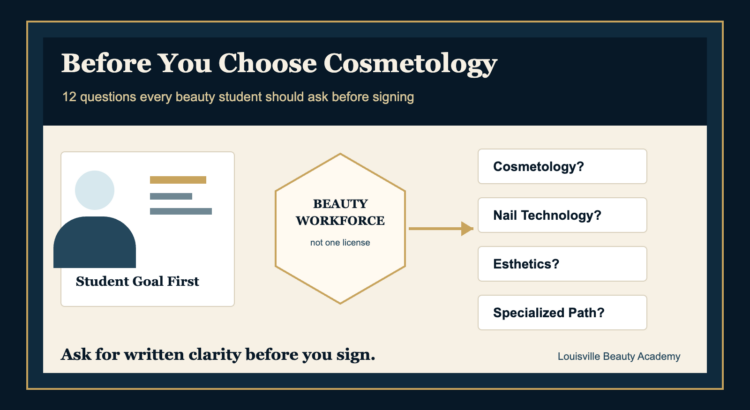
A student deserves more than one default answer
Cosmetology is a valuable license. It can be the right path for a student who wants broad training in hair, skin, nails, salon service, and multiple areas of beauty practice.
But cosmetology is not the whole beauty industry.
Beauty is larger than one license. A student may want to become a nail technician. Another may want esthetics or skincare. Another may want shampoo/style, instructor development, salon ownership, booth rental, lawful self-employment, or a specialized beauty business. Some students need the broadest pathway. Some students need the focused pathway.
The ethical question is not, “How do we place every student into the longest program?”
The ethical question is, “What does this student actually want to do, and what is the lawful, affordable, documented pathway that fits that goal?”
Louisville Beauty Academy believes students should be guided with clarity before they sign. A school should be able to explain the path, the cost, the time, the license, the exam steps, the career reality, and the difference between a learning environment and a salon.
The first question: what service do you actually want to perform?
Before a student chooses cosmetology, the student should pause and ask a simple question: what beauty service do I actually want to perform after school?
If the answer is broad salon practice, cosmetology may make sense. If the answer is nails, the student should ask about nail technology. If the answer is skincare, facials, or esthetics, the student should ask about esthetics.
This is not anti-cosmetology. It is pro-student. Cosmetology should be chosen because it fits the student’s goal, not because it is treated as the automatic default for every beauty student.
Why statistics matter before enrollment
Students should ask whether the school director or admissions adviser understands current public workforce and license-use questions.
Public labor data separates manicurists/pedicurists, skincare specialists, and barbers/hairstylists/cosmetologists into distinct occupational categories. According to the U.S. Bureau of Labor Statistics, employment of manicurists and pedicurists is projected to grow 7% from 2024 to 2034. Skincare specialists are also projected to grow 7%. Barbers, hairstylists, and cosmetologists are projected to grow 5% overall.
Those numbers do not mean one path is good and another is bad. They mean students deserve a real comparison.
There is also a serious license-use question. In a January 2025 state regulatory review, Utah’s Office of Professional Licensure Review reported survey results showing that 32% of surveyed active cosmetology-related licensees worked zero hours, 72% worked 20 hours or less per week, and only 17% worked more than 30 hours per week.
That Utah report should not be presented as a national statistic by itself. It is one state-level public example. But it is serious enough to raise a fair student question: if many licensed professionals are not using a broad license full-time, what should a student ask before choosing the broadest pathway?
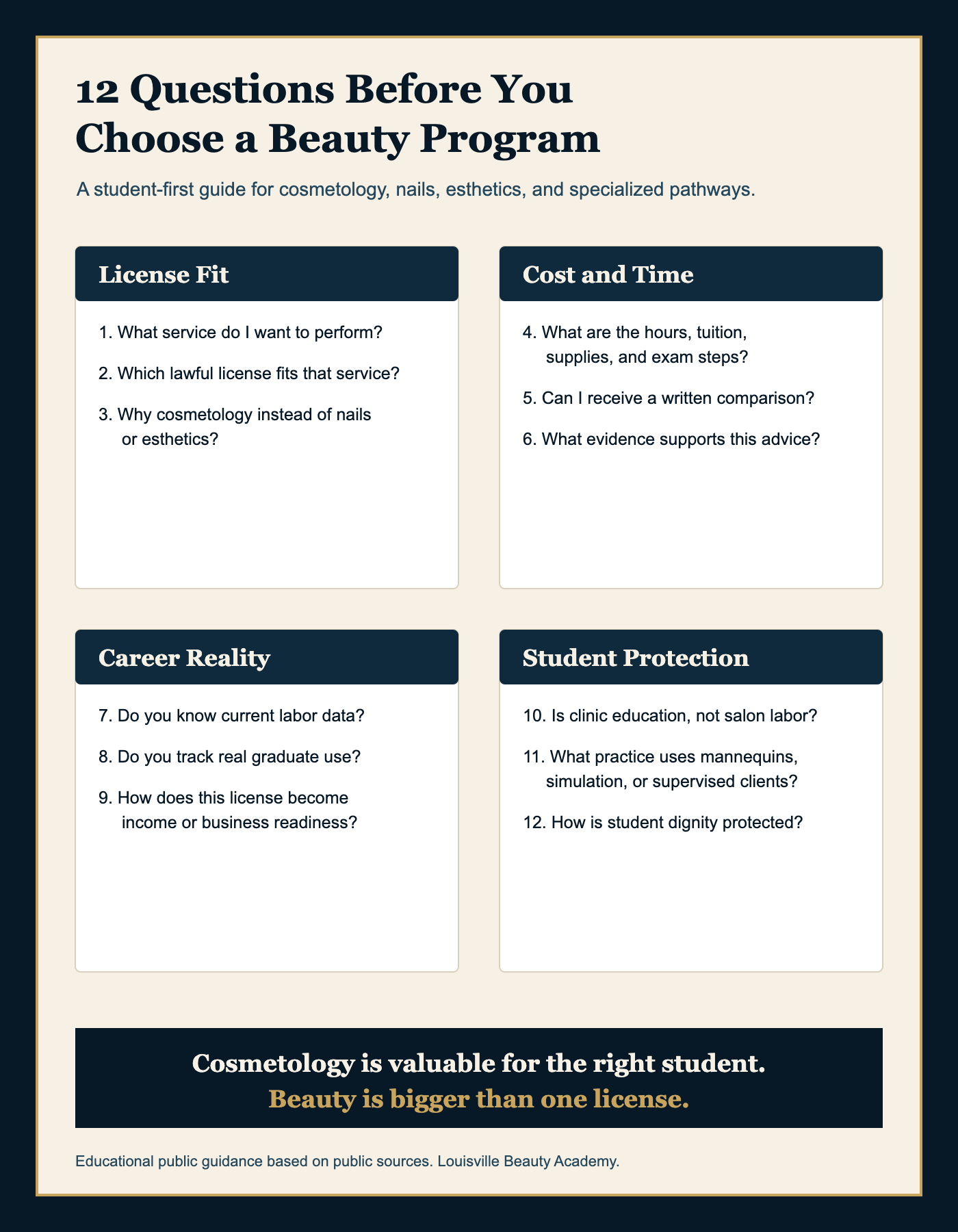
12 questions every beauty student should ask
- What beauty service do I actually want to perform after graduation?
- Which license, permit, or training pathway legally fits that service in my state?
- Why are you recommending cosmetology instead of nail technology, esthetics, or another focused pathway?
- What are the hours, tuition, supply costs, exam steps, and likely timeline for each pathway?
- Can I receive a written comparison before I sign?
- What public data or school evidence are you using to advise me?
- Are you familiar with current labor data for cosmetology, nail technology, and esthetics/skincare?
- Do you track whether graduates work in-field, work part-time, become self-employed, or specialize after licensure?
- If I choose cosmetology, how will the program help me turn a broad license into a real career plan?
- If I only want nails or skincare, why should I choose a broader pathway?
- How does the school teach employment, booth rental, self-employment, sanitation, licensing discipline, and small-business reality?
- What does student success look like six months and one year after licensure?
Ask about school clinic before you begin
A beauty school is not a salon. A salon is a commercial service business. A school is an educational environment. A school exists to train, supervise, document, correct, protect, and prepare students for lawful practice.
Student clinic can be an important part of training when it is properly supervised, tied to curriculum, documented, and focused on student learning. Students should ask what live-client work is required, optional, or recommended under school policy and state rules; how mannequins, simulation, classroom theory, and supervised live-client practice each fit; and how the school protects student dignity, sanitation, safety, and learning pace.
Federal labor analysis can be fact-specific. The U.S. Department of Labor’s student/intern guidance uses a primary-beneficiary framework under the Fair Labor Standards Act. Public education should not turn that into a loose slogan. The safer and more ethical question is whether the student is truly the primary educational beneficiary of the training experience.
In plain language: the student should be learning, not being used.
The right school should explain, not pressure
A strong beauty school should be able to explain why the recommended license fits the student’s goal, how much the pathway costs, how long it takes, what the student can lawfully do after completion and licensure, what the student cannot lawfully do, what public sources support the school’s guidance, and what the student should confirm directly with official licensing sources.
The right conversation is not pressure. It is guidance.
Cosmetology is valuable for the right student. Beauty is bigger than cosmetology.
A final word to students
Before you sign, ask. Before you borrow, ask. Before you choose the longest path, ask whether it is the right path. Before you enter clinic, ask what the educational purpose is. Before you trust a recommendation, ask what data and public sources support it.
Good questions do not disrespect a school. Good questions protect the student, the school, the profession, and the public.
References and Public Sources
- U.S. Bureau of Labor Statistics: Manicurists and Pedicurists
- U.S. Bureau of Labor Statistics: Skincare Specialists
- U.S. Bureau of Labor Statistics: Barbers, Hairstylists, and Cosmetologists
- Utah Office of Professional Licensure Review: Cosmetology Report, January 2025
- U.S. Department of Labor Fact Sheet #71: Internship Programs Under the Fair Labor Standards Act
- U.S. Department of Labor Field Assistance Bulletin No. 2018-2
- The Century Foundation: Cosmetology Training Needs a Make-Over
Discover more from Louisville Beauty Academy - Louisville KY
Subscribe to get the latest posts sent to your email.







