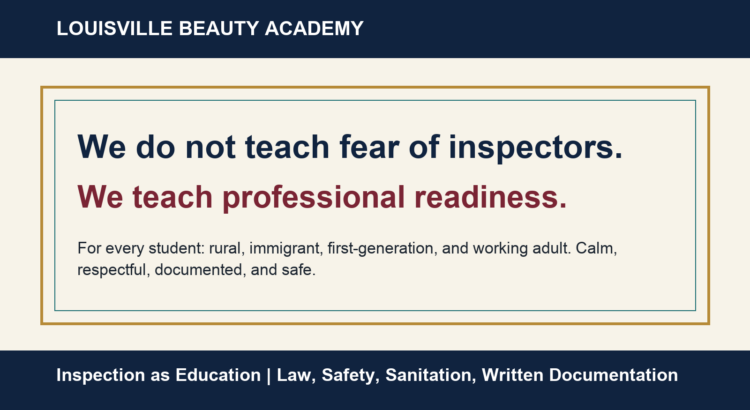
A center of excellence is proven by behavior under pressure. LBA's standard is to turn inspection into education, complaint into documentation, and fear into professional practice.
Who This Is For
This series is for every beauty student, including students from rural and country-side communities, immigrant students, first-generation students, working adults, and students who may feel nervous when an inspector or regulator enters the room. The purpose is to replace fear with understanding, practice, safety, sanitation, and written documentation.
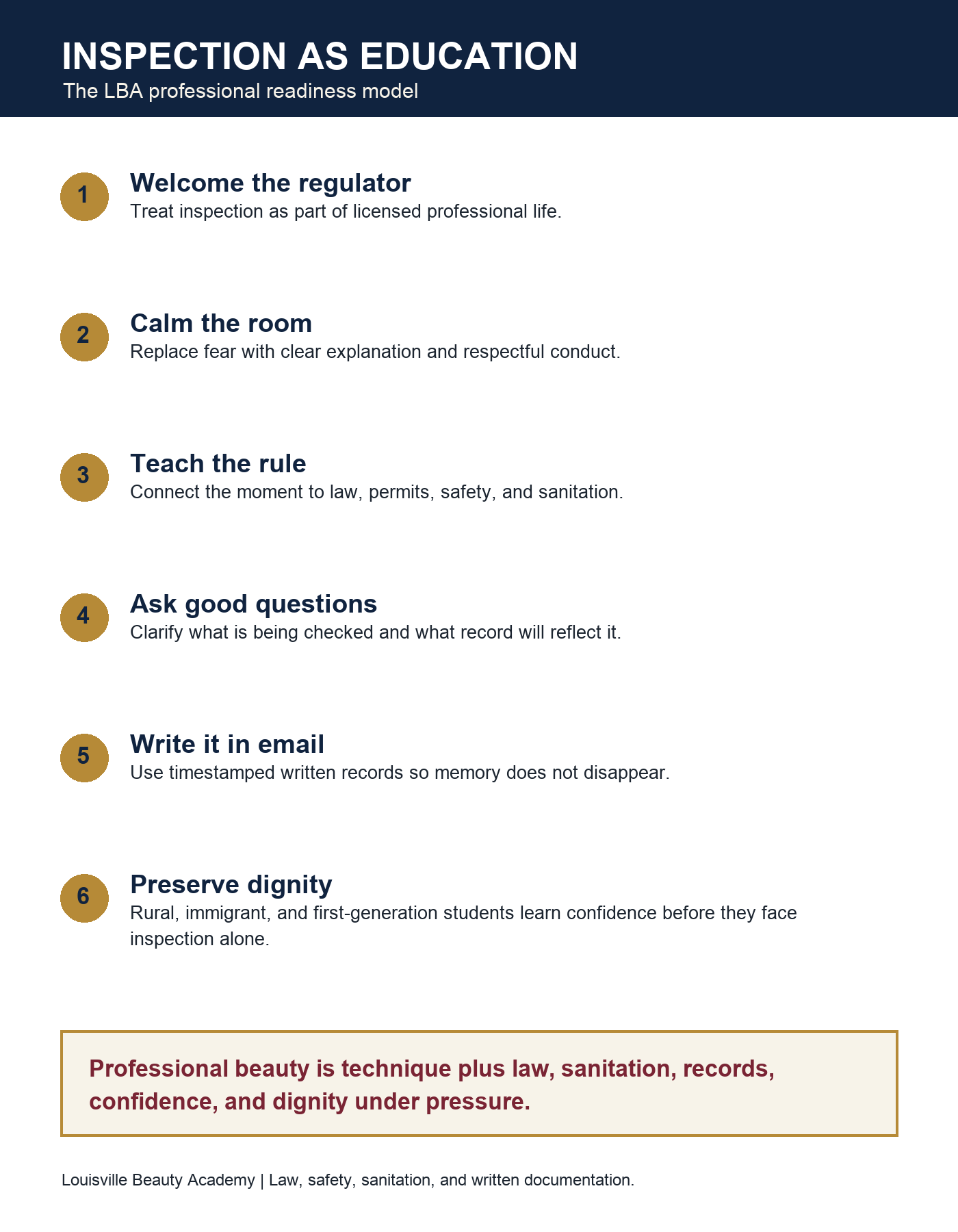
The LBA inspection-as-education model turns regulatory moments into professional readiness training.
The Standard
The serious school does not merely say it cares about compliance. It teaches compliance in real time, in front of students, with records and professional discipline.
The Policy Meaning
This is bigger than one school event. It is a model for how regulated workforce education can protect the public while building student confidence.
The Public Promise
Louisville Beauty Academy will keep teaching beauty students that lawful professionalism is beautiful: clean hands, clear records, calm conduct, and dignity under pressure.
The Louisville Beauty Academy Standard
A serious beauty school teaches more than the service. It teaches the professional environment around the service: regulation, safety, sanitation, licensing awareness, written documentation, respectful communication, and the ability to remain steady when a real inspector is present.
That is why LBA treats regulatory moments as education. Students from every background should not wait until they are alone in a salon to learn how to respond professionally.
Public information notice: this post is educational and policy-oriented. It does not accuse any person or agency of wrongdoing, disclose private student information, claim accreditation, promise licensure or employment outcomes, or replace professional legal/regulatory advice.
Many students feel fear when officials enter a room. A serious school reduces fear by teaching process, rights, responsibilities, records, and respectful professional conduct.
Who This Is For
This series is for every beauty student, including students from rural and country-side communities, immigrant students, first-generation students, working adults, and students who may feel nervous when an inspector or regulator enters the room. The purpose is to replace fear with understanding, practice, safety, sanitation, and written documentation.
The LBA inspection-as-education model turns regulatory moments into professional readiness training.
Fear Is Real
For immigrant and first-generation students, government presence can feel intimidating even when the matter is a professional inspection.
Education Changes the Room
The school's role is to explain what is happening, keep students calm, and connect the moment to lawful salon practice.
Dignity Under Pressure
The goal is not to make students casual about regulation. The goal is to make them steady, respectful, informed, and ready.
The Louisville Beauty Academy Standard
A serious beauty school teaches more than the service. It teaches the professional environment around the service: regulation, safety, sanitation, licensing awareness, written documentation, respectful communication, and the ability to remain steady when a real inspector is present.
That is why LBA treats regulatory moments as education. Students from every background should not wait until they are alone in a salon to learn how to respond professionally.
Public information notice: this post is educational and policy-oriented. It does not accuse any person or agency of wrongdoing, disclose private student information, claim accreditation, promise licensure or employment outcomes, or replace professional legal/regulatory advice.
Every student should practice the core inspection habits: understand the rule, keep the environment safe and sanitary, ask respectfully, and document important facts in writing.
Who This Is For
This series is for every beauty student, including students from rural and country-side communities, immigrant students, first-generation students, working adults, and students who may feel nervous when an inspector or regulator enters the room. The purpose is to replace fear with understanding, practice, safety, sanitation, and written documentation.
The LBA inspection-as-education model turns regulatory moments into professional readiness training.
The Practice Principle
A real professional does not wait until graduation to learn inspection habits. Students should practice safe setup, clean procedure, respectful questions, and written follow-up while instructors are still beside them.
How Students Learn From It
Students learn that readiness is more than having supplies in place. Readiness also means knowing the law, knowing the safety and sanitation standard, and preserving important facts in a clear record.
Professional Follow-Up
A respectful follow-up email can thank the board, summarize what was taught or checked, and preserve the school or salon record without turning the moment into conflict.
The Louisville Beauty Academy Standard
A serious beauty school teaches more than the service. It teaches the professional environment around the service: regulation, safety, sanitation, licensing awareness, written documentation, respectful communication, and the ability to remain steady when a real inspector is present.
That is why LBA treats regulatory moments as education. Students from every background should not wait until they are alone in a salon to learn how to respond professionally.
Public information notice: this post is educational and policy-oriented. It does not accuse any person or agency of wrongdoing, disclose private student information, claim accreditation, promise licensure or employment outcomes, or replace professional legal/regulatory advice.
Calls can be misunderstood. Memory fades. Paper gets misplaced. Professional records should be preserved in time-stamped writing whenever the facts matter.
Who This Is For
This series is for every beauty student, including students from rural and country-side communities, immigrant students, first-generation students, working adults, and students who may feel nervous when an inspector or regulator enters the room. The purpose is to replace fear with understanding, practice, safety, sanitation, and written documentation.
The LBA inspection-as-education model turns regulatory moments into professional readiness training.
Why Writing Matters
Email and text timestamps help preserve what was understood, requested, checked, corrected, or disputed. Documentation is not hostility. It is professional memory.
What To Preserve
A good record includes date, time, location, people present, inspection topic, items checked, operational status, questions asked, and follow-up requests.
The LBA Standard
Louisville Beauty Academy trains students to treat documentation as part of professional care, because the record protects the student, the school, the client, and the public.
The Louisville Beauty Academy Standard
A serious beauty school teaches more than the service. It teaches the professional environment around the service: regulation, safety, sanitation, licensing awareness, written documentation, respectful communication, and the ability to remain steady when a real inspector is present.
That is why LBA treats regulatory moments as education. Students from every background should not wait until they are alone in a salon to learn how to respond professionally.
Public information notice: this post is educational and policy-oriented. It does not accuse any person or agency of wrongdoing, disclose private student information, claim accreditation, promise licensure or employment outcomes, or replace professional legal/regulatory advice.
A complaint starts a process. It does not replace facts. A professional response is calm cooperation, clear records, correction where needed, and preservation of the truth.
Who This Is For
This series is for every beauty student, including students from rural and country-side communities, immigrant students, first-generation students, working adults, and students who may feel nervous when an inspector or regulator enters the room. The purpose is to replace fear with understanding, practice, safety, sanitation, and written documentation.
The LBA inspection-as-education model turns regulatory moments into professional readiness training.
The Right Lesson
Students should learn that complaints can arise in any licensed field. The professional response is not anger or fear. It is evidence.
No Overclaiming
A school should not publicly assume who filed a complaint unless the record proves it. The stronger lesson is that every complaint-driven visit can become a readiness test and documentation drill.
The Discipline
Write down the date, time, topic, what was checked, what was operational, what was communicated, and what records were requested.
The Louisville Beauty Academy Standard
A serious beauty school teaches more than the service. It teaches the professional environment around the service: regulation, safety, sanitation, licensing awareness, written documentation, respectful communication, and the ability to remain steady when a real inspector is present.
That is why LBA treats regulatory moments as education. Students from every background should not wait until they are alone in a salon to learn how to respond professionally.
Public information notice: this post is educational and policy-oriented. It does not accuse any person or agency of wrongdoing, disclose private student information, claim accreditation, promise licensure or employment outcomes, or replace professional legal/regulatory advice.
Beauty education is not only technique. It is law, safety, sanitation, licensing, permits, student records, and the discipline to operate inside a regulated profession.
Who This Is For
This series is for every beauty student, including students from rural and country-side communities, immigrant students, first-generation students, working adults, and students who may feel nervous when an inspector or regulator enters the room. The purpose is to replace fear with understanding, practice, safety, sanitation, and written documentation.
The LBA inspection-as-education model turns regulatory moments into professional readiness training.
More Than Technique
Technique matters, but the licensed beauty profession also depends on rules that protect the public and define lawful practice.
What Students Should Understand
Students should understand why licenses, permits, sanitation, clean facilities, chemical handling, attendance records, and safety practices are not optional details.
Professional Confidence
Confidence is not pretending rules do not exist. Confidence is knowing the rules well enough to respond respectfully and correctly.
The Louisville Beauty Academy Standard
A serious beauty school teaches more than the service. It teaches the professional environment around the service: regulation, safety, sanitation, licensing awareness, written documentation, respectful communication, and the ability to remain steady when a real inspector is present.
That is why LBA treats regulatory moments as education. Students from every background should not wait until they are alone in a salon to learn how to respond professionally.
Public information notice: this post is educational and policy-oriented. It does not accuse any person or agency of wrongdoing, disclose private student information, claim accreditation, promise licensure or employment outcomes, or replace professional legal/regulatory advice.
The strongest compliance lesson happens when students experience regulation in a guided environment before they face it alone in a workplace.
Who This Is For
This series is for every beauty student, including students from rural and country-side communities, immigrant students, first-generation students, working adults, and students who may feel nervous when an inspector or regulator enters the room. The purpose is to replace fear with understanding, practice, safety, sanitation, and written documentation.
The LBA inspection-as-education model turns regulatory moments into professional readiness training.
A Supervised Professional Moment
When a state board inspector is onsite, the school has a rare chance to teach the full professional posture: calm presence, respectful speech, accurate answers, and careful documentation.
Why Instructors Matter
An instructor can translate the moment into education. Students do not only see authority. They see how a licensed professional explains, clarifies, and protects the learning environment.
Practice Before Independence
School is the right place to practice inspection professionalism because the student still has guidance, supervision, and a safe educational structure.
The Louisville Beauty Academy Standard
A serious beauty school teaches more than the service. It teaches the professional environment around the service: regulation, safety, sanitation, licensing awareness, written documentation, respectful communication, and the ability to remain steady when a real inspector is present.
That is why LBA treats regulatory moments as education. Students from every background should not wait until they are alone in a salon to learn how to respond professionally.
Public information notice: this post is educational and policy-oriented. It does not accuse any person or agency of wrongdoing, disclose private student information, claim accreditation, promise licensure or employment outcomes, or replace professional legal/regulatory advice.
Louisville Beauty Academy welcomes inspection as part of real professional beauty education. Students must know how to stand inside a licensed profession with calm, respect, sanitation discipline, and documentation.
Who This Is For
This series is for every beauty student, including students from rural and country-side communities, immigrant students, first-generation students, working adults, and students who may feel nervous when an inspector or regulator enters the room. The purpose is to replace fear with understanding, practice, safety, sanitation, and written documentation.
The LBA inspection-as-education model turns regulatory moments into professional readiness training.
The Real Classroom
A textbook can explain a rule. A real inspection teaches the posture. Students see how professionals welcome the process, answer clearly, ask appropriate questions, and keep the environment calm.
What LBA Models
The school models lawful cooperation, not panic. It teaches students that regulation is part of beauty work, and that public protection depends on safety, sanitation, licenses, permits, and clear records.
The Student Future
After graduation, a student may be alone in a salon when an inspector arrives. Training before that moment matters.
The Louisville Beauty Academy Standard
A serious beauty school teaches more than the service. It teaches the professional environment around the service: regulation, safety, sanitation, licensing awareness, written documentation, respectful communication, and the ability to remain steady when a real inspector is present.
That is why LBA treats regulatory moments as education. Students from every background should not wait until they are alone in a salon to learn how to respond professionally.
Public information notice: this post is educational and policy-oriented. It does not accuse any person or agency of wrongdoing, disclose private student information, claim accreditation, promise licensure or employment outcomes, or replace professional legal/regulatory advice.
Cosmetology is a valuable license. It can be the right path for a student who wants broad training in hair, skin, nails, salon service, and multiple areas of beauty practice.
But cosmetology is not the whole beauty industry.
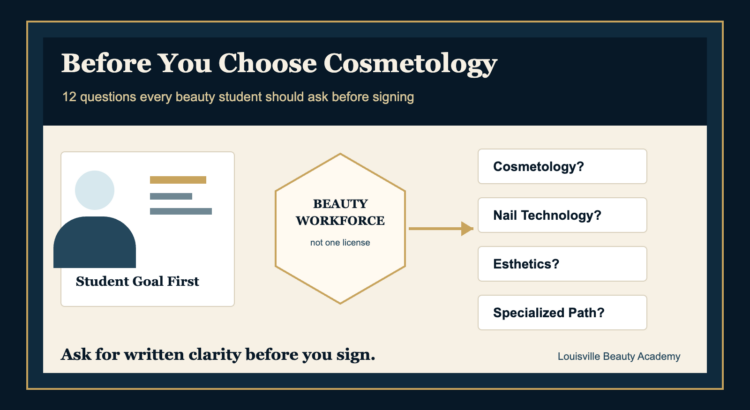
Beauty is larger than one license. A student may want to become a nail technician. Another may want esthetics or skincare. Another may want shampoo/style, instructor development, salon ownership, booth rental, lawful self-employment, or a specialized beauty business. Some students need the broadest pathway. Some students need the focused pathway.
The ethical question is not, “How do we place every student into the longest program?”
The ethical question is, “What does this student actually want to do, and what is the lawful, affordable, documented pathway that fits that goal?”
Louisville Beauty Academy believes students should be guided with clarity before they sign. A school should be able to explain the path, the cost, the time, the license, the exam steps, the career reality, and the difference between a learning environment and a salon.
The first question: what service do you actually want to perform?
Before a student chooses cosmetology, the student should pause and ask a simple question: what beauty service do I actually want to perform after school?
If the answer is broad salon practice, cosmetology may make sense. If the answer is nails, the student should ask about nail technology. If the answer is skincare, facials, or esthetics, the student should ask about esthetics.
This is not anti-cosmetology. It is pro-student. Cosmetology should be chosen because it fits the student’s goal, not because it is treated as the automatic default for every beauty student.
Why statistics matter before enrollment
Students should ask whether the school director or admissions adviser understands current public workforce and license-use questions.
Public labor data separates manicurists/pedicurists, skincare specialists, and barbers/hairstylists/cosmetologists into distinct occupational categories. According to the U.S. Bureau of Labor Statistics, employment of manicurists and pedicurists is projected to grow 7% from 2024 to 2034. Skincare specialists are also projected to grow 7%. Barbers, hairstylists, and cosmetologists are projected to grow 5% overall.
Those numbers do not mean one path is good and another is bad. They mean students deserve a real comparison.
There is also a serious license-use question. In a January 2025 state regulatory review, Utah’s Office of Professional Licensure Review reported survey results showing that 32% of surveyed active cosmetology-related licensees worked zero hours, 72% worked 20 hours or less per week, and only 17% worked more than 30 hours per week.
That Utah report should not be presented as a national statistic by itself. It is one state-level public example. But it is serious enough to raise a fair student question: if many licensed professionals are not using a broad license full-time, what should a student ask before choosing the broadest pathway?
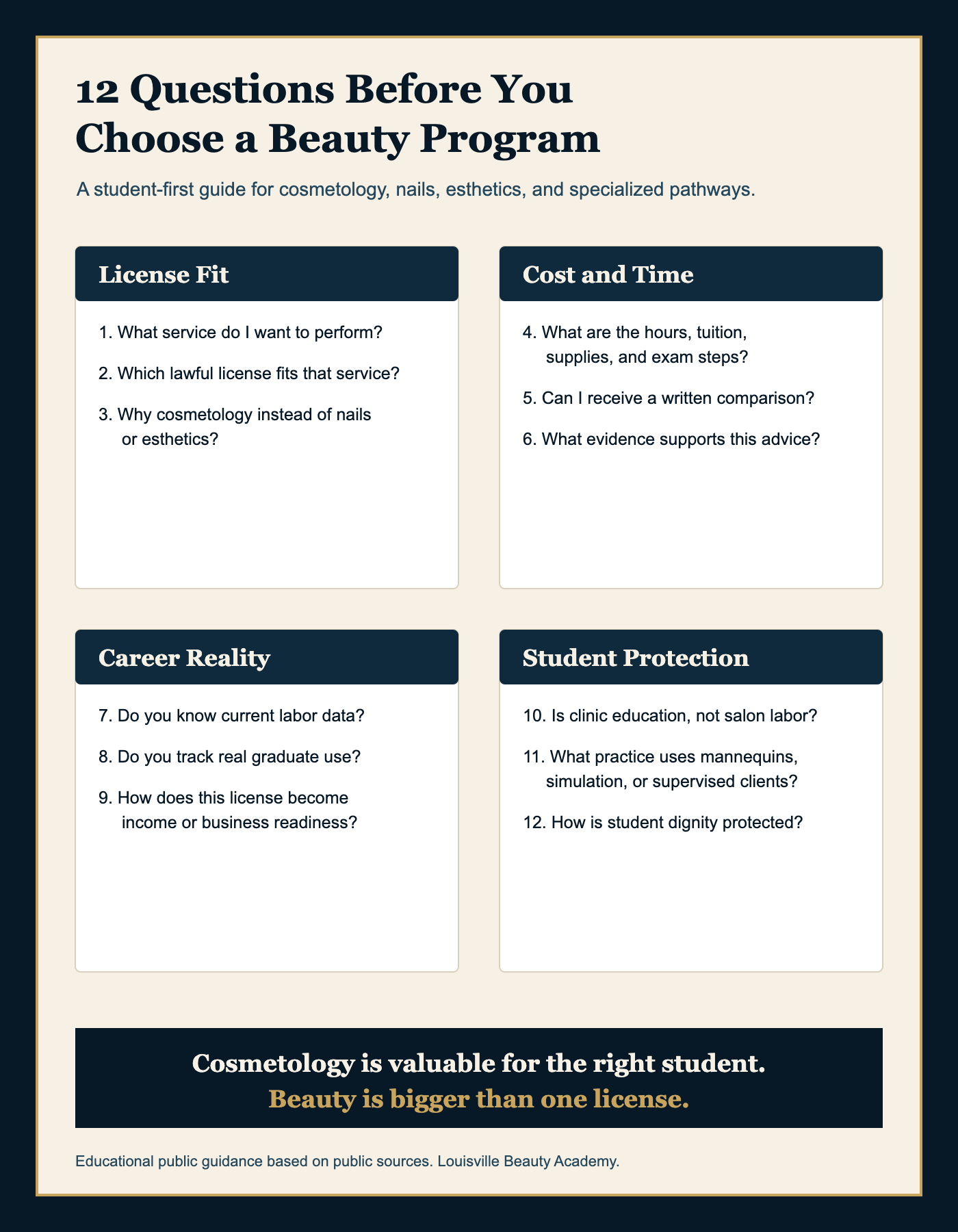
12 questions every beauty student should ask
What beauty service do I actually want to perform after graduation?
Which license, permit, or training pathway legally fits that service in my state?
Why are you recommending cosmetology instead of nail technology, esthetics, or another focused pathway?
What are the hours, tuition, supply costs, exam steps, and likely timeline for each pathway?
Can I receive a written comparison before I sign?
What public data or school evidence are you using to advise me?
Are you familiar with current labor data for cosmetology, nail technology, and esthetics/skincare?
Do you track whether graduates work in-field, work part-time, become self-employed, or specialize after licensure?
If I choose cosmetology, how will the program help me turn a broad license into a real career plan?
If I only want nails or skincare, why should I choose a broader pathway?
How does the school teach employment, booth rental, self-employment, sanitation, licensing discipline, and small-business reality?
What does student success look like six months and one year after licensure?
Ask about school clinic before you begin
A beauty school is not a salon. A salon is a commercial service business. A school is an educational environment. A school exists to train, supervise, document, correct, protect, and prepare students for lawful practice.
Student clinic can be an important part of training when it is properly supervised, tied to curriculum, documented, and focused on student learning. Students should ask what live-client work is required, optional, or recommended under school policy and state rules; how mannequins, simulation, classroom theory, and supervised live-client practice each fit; and how the school protects student dignity, sanitation, safety, and learning pace.
Federal labor analysis can be fact-specific. The U.S. Department of Labor’s student/intern guidance uses a primary-beneficiary framework under the Fair Labor Standards Act. Public education should not turn that into a loose slogan. The safer and more ethical question is whether the student is truly the primary educational beneficiary of the training experience.
In plain language: the student should be learning, not being used.
The right school should explain, not pressure
A strong beauty school should be able to explain why the recommended license fits the student’s goal, how much the pathway costs, how long it takes, what the student can lawfully do after completion and licensure, what the student cannot lawfully do, what public sources support the school’s guidance, and what the student should confirm directly with official licensing sources.
The right conversation is not pressure. It is guidance.
Cosmetology is valuable for the right student. Beauty is bigger than cosmetology.
A final word to students
Before you sign, ask. Before you borrow, ask. Before you choose the longest path, ask whether it is the right path. Before you enter clinic, ask what the educational purpose is. Before you trust a recommendation, ask what data and public sources support it.
Good questions do not disrespect a school. Good questions protect the student, the school, the profession, and the public.
Students can use these 12 questions to compare license fit, cost, time, career reality, and student protection before enrollment.
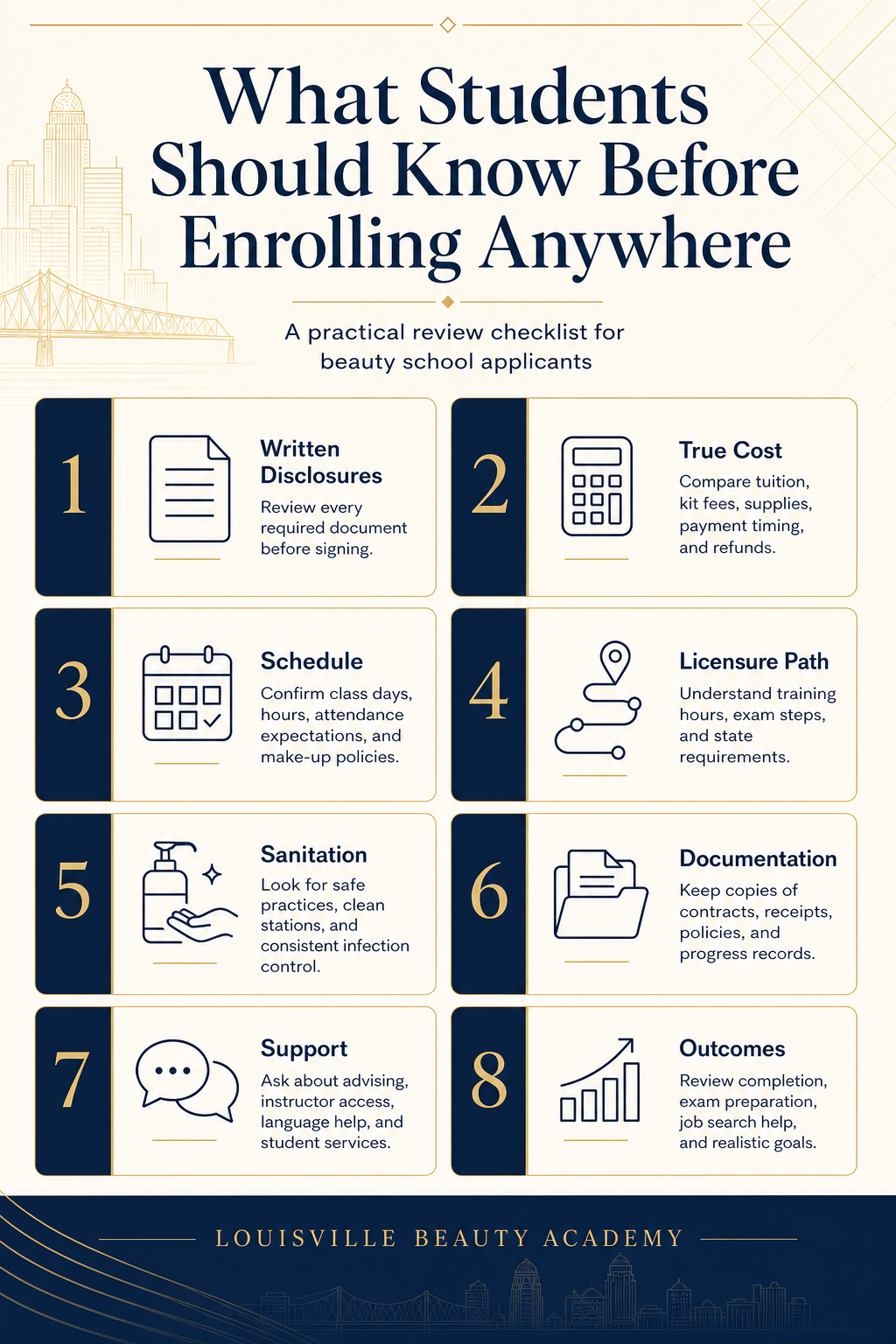
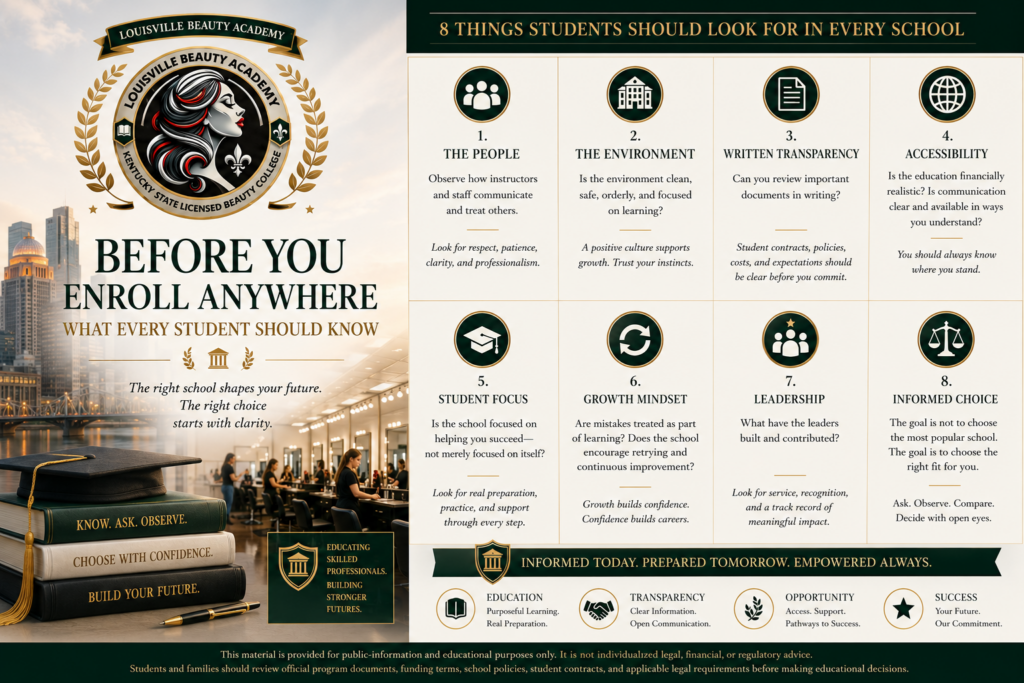
Before enrolling anywhere, students should not feel pressured to decide by emotion alone. They should be able to ask clear questions and look for an environment that fits them.
That starts with the people. How do the instructors act? How do the staff act? Do they communicate clearly? Do they seem patient, respectful, and helpful? Do they guide students in a way that feels healthy and serious? A school teaches through human behavior long before it teaches through curriculum.
Students should also look at the atmosphere. Is the environment clean, sanitary, safe, and orderly? Does the culture seem focused on helping people grow, or does it feel driven by gossip, confusion, or unnecessary pressure? A student often senses these things early, and that instinct should not be ignored.
Written transparency matters just as much. If a document affects the student, binds the student, or governs the student, can it be reviewed in writing? Is the student contract reasonably available? Are the core policies digital, reviewable, and understandable before commitment? If important obligations are hidden, vague, or available only through verbal explanation, families may reasonably ask why.
Students may also ask whether the school feels truly accessible. Is it affordable in a real-world sense? Is communication available in ways the student or family can actually understand, including multiple languages where possible? Does the school help students know where they stand academically and practically? Or does it leave them guessing?
Another useful question is whether the institution seems focused more on the student or more on itself. Is the school trying to help the student become ready for real work? Does it build confidence through practice? Does it treat retrying as part of growth? Or does it place more energy into appearance, image, or pressure than into guidance?
Students and families may also consider the leaders. What have they built? What have they contributed? What awards, recognition, service, or proof of work suggest that the institution is grounded in more than sales language? Public trust grows when leadership can be observed through lived example, not merely through slogans.
The point is not to tell the public what to choose. The point is to help the public know what to look for. A school may be fit for one student and unfit for another. Advocacy begins with enough clarity, respect, and transparency for the student to make that choice with open eyes.
This material is provided for public-information and educational purposes only. It reflects general institutional, compliance, and educational discussion informed by applicable federal and state frameworks. It is not individualized legal, financial, or regulatory advice. Students and families should review official program documents, funding terms, school policies, student contracts, and applicable legal requirements before making decisions.