Short answer: Louisville Beauty Academy is a Kentucky state-licensed beauty college built first for one purpose: helping students complete lawful, documented beauty education for Kentucky licensing pathways. Students study theory, practical skill, sanitation, safety, Kentucky rules, exam preparation, professional conduct, and documented clock-hour progress. Around that required foundation, LBA also provides modern study support, multilingual tools, instructor guidance, written records, portfolio discipline, and professional-development encouragement.
A student does not enroll at Louisville Beauty Academy merely to “sit in school.” A student enrolls to enter a disciplined licensing environment: clock in, study, practice, ask, repeat, document, improve, prepare for the theory and practical licensing exams, and grow into a safer, more professional beauty worker.
The First Principle: Licensing Comes First
Beauty school is not a motivational seminar, a social-media course, a salon shortcut, or a promise of income. Beauty school exists because Kentucky regulates cosmetology, nail technology, esthetics, shampoo and styling, instructor training, and related beauty work through state licensing requirements.
That is why Louisville Beauty Academy teaches from a licensing-first position. The core question is always: what must a student know, practice, document, and complete to move toward lawful eligibility under current Kentucky Board of Cosmetology rules and the school’s written policies?
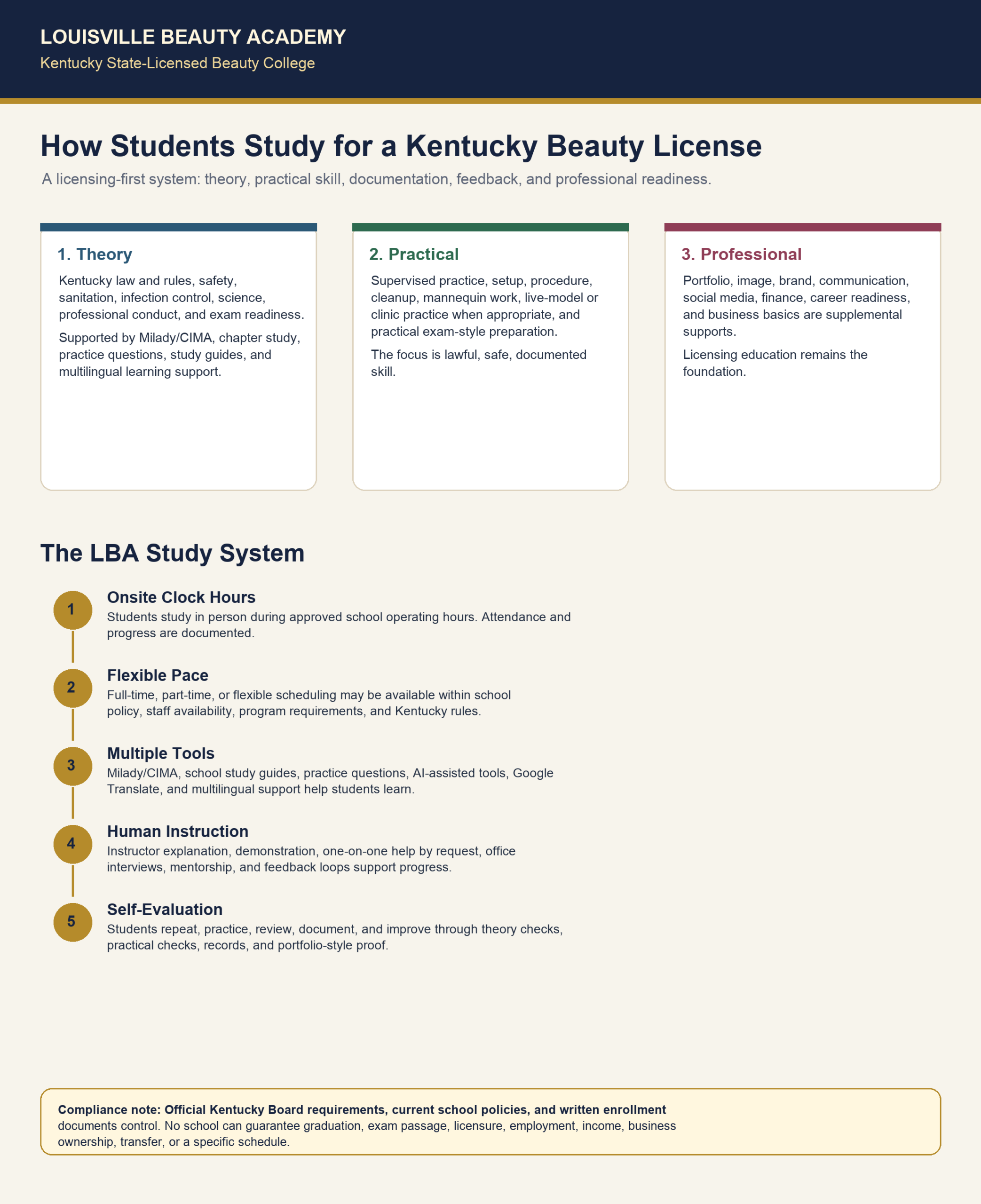
Students learn in three layers. The first layer is required licensing education. The second layer is supervised practical development. The third layer is professional formation: how to carry yourself as a beauty professional, document your progress, communicate clearly, and build a lawful future after licensing.
1. Licensing Theory
Theory is the academic foundation. Depending on the program, students study topics such as safety, sanitation, infection control, anatomy, physiology, chemistry, electricity, skin, hair, nails, professional image, client care, Kentucky rules, and licensing-exam readiness.
For many students, theory is the most difficult part because it requires reading, memory, vocabulary, practice questions, and repeated review. That is why LBA treats theory seriously. A student cannot become safe, lawful, and exam-ready by guessing.
2. Practical Licensing Skill
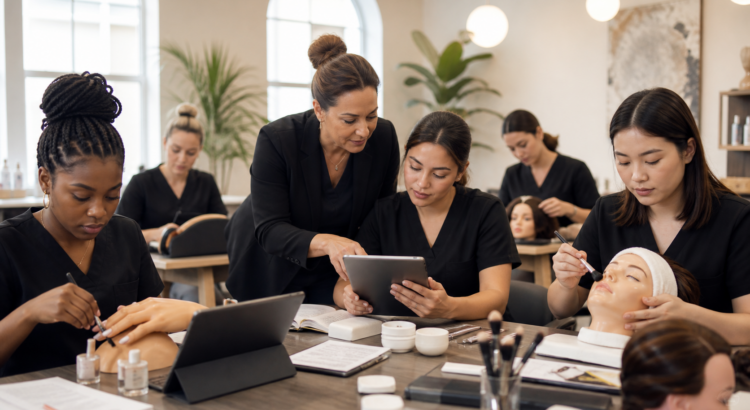
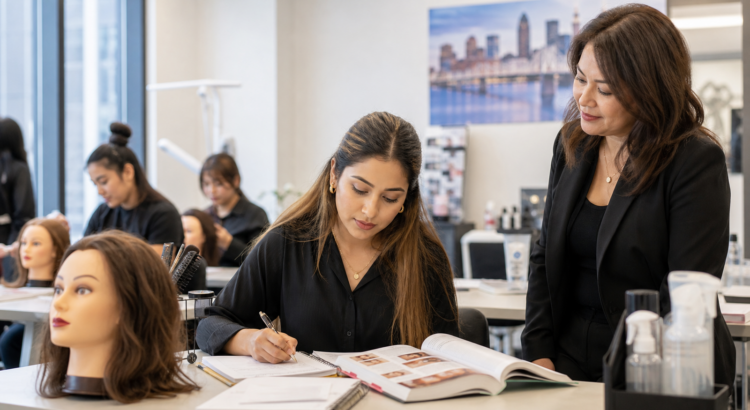
Practical study means hands-on learning under school supervision. Students practice setup, sanitation, procedure, cleanup, tool control, station discipline, mannequin work, and live-model or clinic-style practice when appropriate under school policy and applicable rules.
The goal is not to rush into fancy technique before the foundation is built. The goal is lawful, safe, repeatable practice that prepares the student for the practical licensing exam and for professional responsibility.
3. Professional Development
After and alongside the licensing foundation, LBA encourages students to think like future professionals. That can include portfolio discipline, professional image, client communication, social media responsibility, basic finance awareness, brand building, business thinking, salon-readiness mindset, and self-documentation.
These professional-development elements are valuable, but they are supplemental. They do not replace the required state curriculum, clock hours, theory preparation, practical preparation, sanitation, safety, or official licensing process.
How Exactly Do Students Study?
Students study onsite, in person, during approved school operating hours and according to the student’s approved schedule, program requirements, school policy, staff availability, and Kentucky licensing rules. LBA may support full-time, part-time, or flexible scheduling, but flexibility does not mean unlimited attendance, undocumented hours, virtual licensing credit, or a guaranteed completion date.
A serious student may spend long blocks of time at school. For some students, that can mean many hours per day or a schedule that approaches a full-time weekly commitment when approved. That time matters. A student who is onsite for many supervised hours has repeated opportunities to study theory, practice hands-on skills, ask instructors questions, receive correction, self-evaluate, and keep moving.
A Typical Study Pattern
Clock in and maintain documented attendance.
Study assigned theory using Milady/CIMA, textbook resources, chapter work, school study guides, and practice questions.
Review difficult vocabulary and concepts, including with reasonable multilingual support where appropriate.
Ask instructors for explanation, demonstration, correction, or one-on-one support when needed and available.
Practice on mannequins, practical setups, tools, stations, and live models or clinic situations when appropriate under supervision.
Self-evaluate: what did I understand, what did I miss, what must I repeat, what must I document, what must I ask tomorrow?
Prepare for theory and practical licensing exams through repetition, review, and exam-style discipline.
The Tools LBA Uses to Support Study
Louisville Beauty Academy uses multiple systems because different students learn in different ways. The school’s purpose is not to replace human instruction with technology. The purpose is to surround the student with more ways to study, review, translate, document, and understand.
Milady/CIMA: a major professional beauty-education learning system used to support theory, chapters, quizzes, and exam preparation.
LBA study guides and practice questions: school-created and school-selected materials that help students repeat, review, and prepare.
AI-assisted study support: learning tools that can help explain concepts, create study guides, simplify language, and support review in multiple languages.
Google Translate and translation support: tools that can help multilingual students understand study material, while official rules and written school documents still control.
Written communication: text messages, email, documents, forms, policies, and records help prevent confusion and reduce verbal misunderstanding.
Student record systems: attendance, transcript, document, and progress records help students and the school understand where the student stands.
Portfolio and public-proof discipline: when appropriate, students are encouraged to document work, build professional image, and understand how reputation grows through visible responsibility.
The Human Side: Instructors, Office Review, Mentorship, and Feedback
Technology is powerful, but beauty education remains human. Students need demonstration, correction, encouragement, patience, and accountability. LBA’s model includes instructor support, office conversations, mentorship, written follow-up, and feedback loops.
One-on-one help may be requested when a student needs clarification or additional support. These sessions must fit instructor availability, school operations, program needs, policy, student conduct, and the student’s own responsibility to communicate respectfully and keep moving.
Evaluation is not only a final exam. Evaluation can include chapter tests, practical checks, instructor feedback, student self-evaluation, office interviews, attendance review, transcript review, student feedback, public/client feedback where appropriate, and professional review of portfolio or public-facing work when relevant.
Why Long Onsite Hours Matter
Beauty licensing education is built on clock hours because time, supervision, repetition, and documentation matter. A student who spends many hours onsite is not merely present. The student is inside a learning environment where instructors, tools, classmates, mannequin practice, live-model practice, sanitation routines, exam language, and written records are all available.
That is why the question is not only, “Can I study?” The deeper question is, “Am I willing to use the hours?” When a student is onsite for long, documented, supervised study time, the opportunity to learn is real. The school can provide the environment, tools, instruction, and feedback. The student must bring discipline, attendance, respect, practice, and responsibility.
A Caring Environment Requires Clear Rules
LBA believes care and compliance belong together. A caring school is not one that ignores rules. A caring school writes things down, explains expectations, maintains records, welcomes questions, protects the learning environment, and reduces disruption so students can study.
Students may text, email, request written information, walk in, ask for a tour, speak with staff when available, and seek clarification. Human connection is welcome. Written communication is also encouraged because written clarity protects students, families, staff, and the licensing process.
What LBA Can Promise, and What No School Should Promise
Louisville Beauty Academy can commit to a licensing-first education model, written clarity, school systems, instructor support, practical training opportunities, study tools, feedback, documentation, and a serious learning environment.
No school should promise a guaranteed graduation date, exam passage, license approval, job, income, salon ownership, business success, transfer recognition, financial result, or exact schedule outcome. Those results depend on many factors, including student attendance, student conduct, academic progress, practical performance, official Kentucky Board requirements, testing vendor rules, school policy, personal circumstances, and current law.
The Beautiful Simplicity
The LBA model is advanced, but the heart of it is simple: come onsite, study the required theory, practice the required skills, document your hours, use the tools, ask for help, self-evaluate, repeat, prepare for the licensing exams, and build professional dignity one disciplined day at a time.
That is what students learn. That is how students study. And that is why Louisville Beauty Academy continues to position beauty education as lawful skill, human discipline, family dignity, and professional opportunity.
This article is general public education from Louisville Beauty Academy. Current Kentucky Board requirements, testing vendor rules, and LBA’s written enrollment documents and policies control. Translation and AI tools may support learning, but they do not replace official rules, official documents, instructor judgment, or the student’s responsibility to study and comply.
Louisville Beauty Academy’s licensing-first study model: theory, practical skill, documentation, feedback, and professional readiness. Official Kentucky Board requirements and written school policies control.
Українським родинам у Кентуккі та Луїсвіллі: студентам, батькам, дорослим працівникам, майстрам манікюру та тим, хто починає життя заново, Louisville Beauty Academy хоче сказати просто й з повагою: ваша праця, ваша дисципліна, ваша культура догляду за красою і ваша мрія про стабільне майбутнє мають значення.
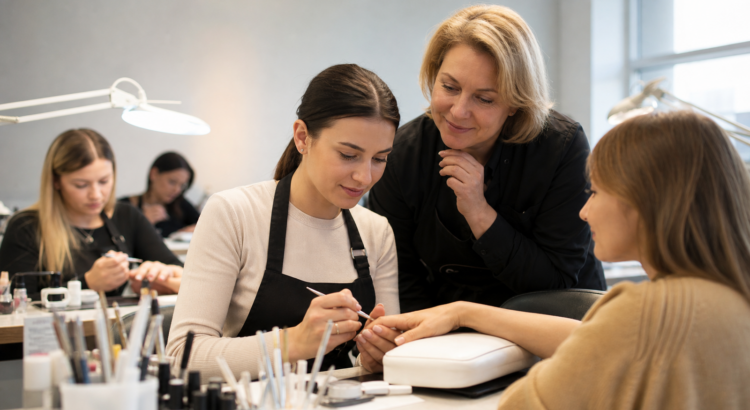
Багато українців знають, що манікюр і догляд за нігтями – це не дрібниця. У східноєвропейській культурі точність, чистота, акуратність, форма, деталь і повага до клієнта мають глибоку професійну цінність. Те, що часто називають Russian manicure або європейським/східноєвропейським стилем манікюру, відоме багатьом клієнтам як робота високої деталізації. Але в Кентуккі будь-яка професійна beauty service повинна стояти не лише на таланті, а й на законі, санітарії, безпеці, належній освіті та межах державної ліцензії.
Сильна культура майстерності повинна стати законною професійною силою
Можна мати природний талант. Можна вміти робити красиві нігті. Можна вчитися від сім’ї, друзів, онлайн-відео або досвіду з іншої країни. Але в Америці довгострокова професійна сила народжується тоді, коли талант входить у законну структуру: required hours, практичне навчання, sanitation, client safety, documentation, exam preparation, application process, and state licensing.
Louisville Beauty Academy не каже: забудьте свою культуру. Навпаки: якщо у вашій культурі вже є повага до майстерності, точності, краси, працьовитості та клієнтського сервісу, тоді правильний наступний крок – легалізувати та документувати цей шлях через Kentucky state-licensed beauty education.
Для дорослих, які хвилюються, що вже пізно
Багато дорослих людей переживають: “Я вже не молодий”, “моя англійська не ідеальна”, “у мене сім’я”, “я працюю”, “я починаю знову”, “я не знаю, чи зможу вчитися”. Це чесні страхи. Але доросла освіта існує саме тому, що життя не закінчується в 18, 25, 35 або 50 років. Людина може вчитися тоді, коли вона готова будувати майбутнє дисципліновано.
Для багатьох українських і східноєвропейських родин освіта – це не лише диплом. Освіта – це безпека, професійна гідність, незалежність, здатність працювати законно і можливість показати дітям, що нове життя можна будувати крок за кроком. Beauty license не замінює college, office work, family work, restaurant work, або іншу професію. Вона може стати додатковим законним шляхом, який розширює вибір.
Для молоді: краса може бути справжньою професійною освітою
Молоді люди часто думають про college, роботу, бізнес, соціальні мережі, creative work, або швидкий заробіток. Louisville Beauty Academy хоче дати серйозне повідомлення: beauty education – це не лише glamor. Це public safety, sanitation, patience, repetition, client communication, legal responsibility, and practical skill.
Якщо молодий студент любить nails, skin care, hair, beauty content, або entrepreneurship, правильний шлях – не shortcut. Правильний шлях – навчитися вимогам, пройти години, готуватися до іспиту, поважати правила, працювати в межах ліцензії, і будувати своє ім’я без фальшивих обіцянок.
Манікюрна традиція має бути безпечною і законною в Кентуккі
Клієнти можуть знати термін “Russian manicure” як символ дуже детальної роботи з нігтями. Але будь-яка техніка повинна виконуватися тільки в межах дозволеного законом scope of practice, з належною освітою, санітарією, інструментальним контролем, безпечним підходом, and client protection. Якщо техніка є популярною, це не означає, що всі її форми автоматично безпечні або дозволені в кожному штаті. Офіційні правила Кентуккі, школа, інструктори, ліцензійні вимоги і професійна відповідальність мають бути головними.
Справжній майстер не лише робить красиво. Справжній майстер знає, коли зупинитися, як захистити клієнта, як дезінфікувати, як документувати навчання, як підготуватися до іспиту, і як працювати законно. Це і є різниця між талантом без структури та професією з довірою.
Основні beauty education hour pathways у Кентуккі
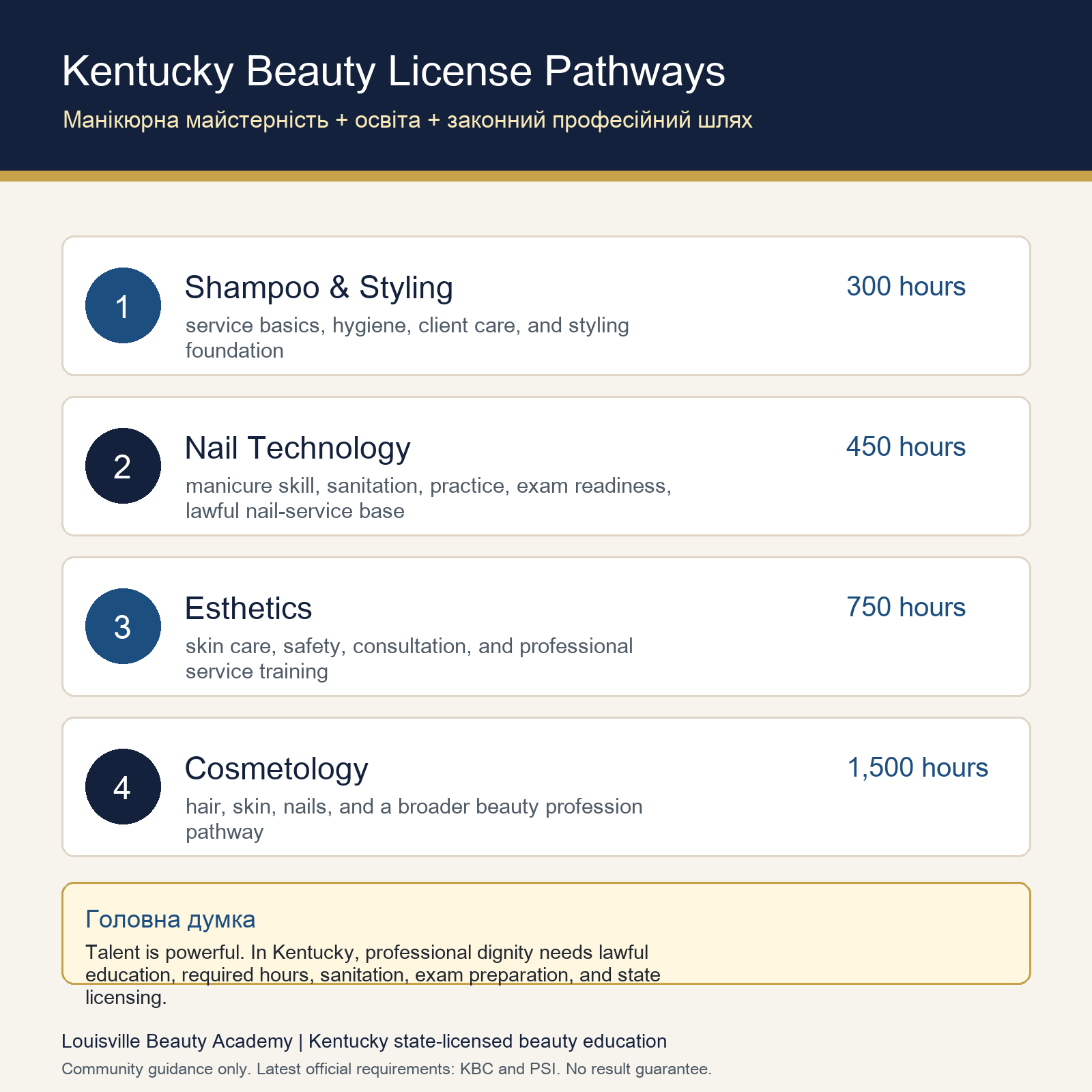
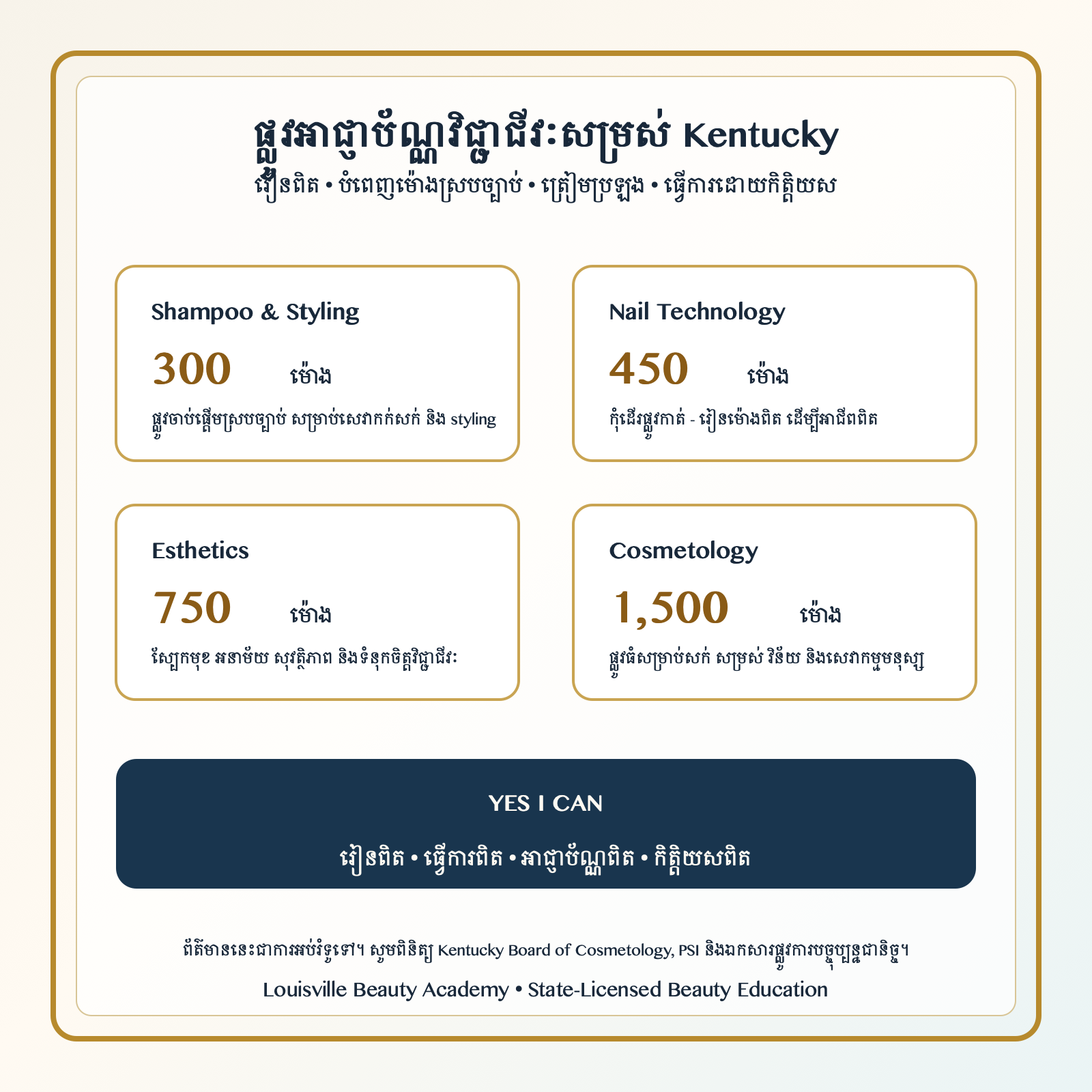
За поточними публічними матеріалами Kentucky Board of Cosmetology, основні шляхи включають Shampoo and Style Services – 300 hours, Nail Technician – 450 hours, Esthetician – 750 hours, and Cosmetologist – 1,500 hours. Ці години пов’язані не лише з навчанням, а й з віком, освітою, заявою, іспитом, ліцензією та актуальними процедурами штату.
KBC exam page направляє студентів до PSI portal, Candidate Bulletin, language catalog, and exam-language-change resources. Ukrainian is presented here as community-access guidance, not as an official PSI exam-language claim. Перед enrollment, registration або examination студент повинен перевірити найновішу офіційну інформацію Kentucky Board of Cosmetology і PSI.
Основні beauty education-hour pathways у Кентуккі. Перед enrollment або examination перевіряйте найновіші офіційні вимоги KBC and PSI.
Чому Louisville Beauty Academy говорить до української громади
Louisville Beauty Academy є Kentucky state-licensed beauty school у Луїсвіллі. Школа працює з різними громадами, дорослими студентами, working students, immigrant families, parents, and people rebuilding life with dignity. LBA цінує affordability, written clarity, required hours, practical training, exam readiness, sanitation, and respectful multilingual support.
У 2025 році Louisville Beauty Academy отримала national and local business/community recognition. Це не є гарантією результату для окремого студента і не є government endorsement або license guarantee. Але це показує, що невелика state-licensed beauty school може служити громаді, тримати витрати більш практичними, навчати дорослих і молодь, і вийти на ширшу державну та національну сцену через дисципліну, доказ і служіння.
YES I CAN: не slogan, а доросла дисципліна
YES I CAN не означає, що шлях буде легким. Це означає: я можу вчитися. Я можу ставити питання. Я можу пройти години. Я можу поважати закон. Я можу вивчити sanitation. Я можу готуватися до іспиту. Я можу будувати професійне ім’я не через shortcut, а через documented skill and lawful service.
Для української громади це може бути дуже сильним: від страху до навички, від втрати до структури, від невизначеності до професійного вибору, від таланту до license pathway. Не кожна людина стане власником salon. Не кожна людина піде одним шляхом. Але кожна людина заслуговує зрозуміти законний шлях перед тим, як ризикувати часом, грошима і майбутнім.
Наступний крок
Якщо ви думаєте про Nail Technology, Esthetics, Shampoo & Styling, або Cosmetology у Кентуккі, почніть з офіційних вимог. Відвідайте школу. Запитайте про години, cost, schedule, documents, language support, exam process, and current state-board rules. Не йдіть shortcut. Будуйте legal path.
Important notice: This article is general educational and institutional information. It is not legal, immigration, financial, employment, business, health, or personal eligibility advice. Licensing, examination language, technique scope, out-of-state recognition, admission, and eligibility requirements can change, and current official agency rules control. Completing a program, attending school, preparing for an exam, or earning hours does not guarantee graduation, examination passage, licensure, employment, income, salon ownership, admission, financial aid, or transfer/out-of-state recognition.
केन्टकी र लुइभिलका नेपाली परिवार, विद्यार्थी, कामदार, अभिभावक, र नयाँ जीवन बनाउँदै गरेका सबैलाई: अमेरिकामा सम्मानजनक जीवनको बाटो एउटै मात्र हुँदैन। कसैले कलेज पढ्छ। कसैले रेस्टुरेन्ट, गोदाम, होटल, स्वास्थ्य सेवा, अफिस, पसल, वा परिवारको व्यवसायमा इमानदारीपूर्वक काम गर्छ। कसैले घर, बच्चा, परिवार, भाषा, पैसा, र समयको जिम्मेवारीसँगै अगाडि बढ्छ। यी सबै श्रम सम्मानका कुरा हुन्। तर Louisville Beauty Academy को सन्देश स्पष्ट छ: मेहनतलाई कानुनी पेशागत पहिचानमा बदल्ने बाटो पनि सम्भव छ। राज्यले मान्यता दिएको occupational license ले हातको सीपलाई सार्वजनिक विश्वास, कागजी प्रमाण, र व्यावसायिक विकल्पमा उचाल्न सक्छ।
नेपाली समुदायले त्याग, शिक्षा, परिवार, बचत, धैर्य, र इमानदारीलाई गहिरो रूपमा सम्मान गर्छ। यही मूल्यहरू beauty education सँग मिल्छन्। Nail Technology, Esthetics, Shampoo & Styling, र Cosmetology जस्ता बाटाहरू केवल सौन्दर्यको कुरा होइनन्। ती hygiene, safety, practice hours, client care, परीक्षा तयारी, documentation, र Kentucky state rules भित्र पेशागत जिम्मेवारी सिक्ने बाटा हुन्।
रेस्टुरेन्ट वा अफिसको काम सानो होइन, तर तपाईंको जीवन त्यहाँ मात्र सीमित हुनुपर्दैन
धेरै नेपाली परिवारले अमेरिकामा सुरु गर्दा कठिन कामबाट सुरु गरेका छन्। रेस्टुरेन्टमा लामो समय उभिनु, सफाइ गर्नु, खाना बनाउनु, डेलिभरी गर्नु, गोदाममा काम गर्नु, अफिसमा दिन बिताउनु, वा परिवारको जिम्मेवारी बोकेर पढ्नु सजिलो होइन। यी कामले परिवार बचाउँछन्। यी कामले बच्चालाई पढाउँछन्। यी कामले घर बनाउँछन्। Louisville Beauty Academy ले यस्तो श्रमलाई कहिल्यै कम ठान्दैन।
तर मानिस केवल आजको कामबाट मात्र परिभाषित हुँदैन। तपाईं आज रेस्टुरेन्टमा काम गर्दै हुनुहुन्छ भने पनि भविष्यमा कानुनी रूपमा nail technician बन्ने तयारी गर्न सक्नुहुन्छ। तपाईं अफिसमा काम गर्नुहुन्छ भने पनि customer service, scheduling, bookkeeping, marketing, and discipline जस्ता सीपहरू पछि salon operation मा उपयोगी हुन सक्छन्। तपाईं कलेज पढ्दै हुनुहुन्छ भने पनि beauty skill एउटा practical professional option बन्न सक्छ। प्रश्न “यो कि त्यो” होइन। प्रश्न हो: कसरी आफ्नो जीवनमा थप कानुनी, व्यावसायिक, र सम्मानजनक विकल्प बनाउने?
कलेज, काम, र beauty license एकअर्काका विरोधी होइनन्
कलेजले सोचाइ फराकिलो बनाउँछ। अफिस वा corporate work ले system, communication, customer care, and responsibility सिकाउँछ। परिवारको कामले धैर्य र sacrifice सिकाउँछ। Beauty licensing preparation ले यी सबैलाई हातको सीप, सेवा, hygiene, documentation, and state-recognized professional training सँग जोड्न सक्छ।
किन कलेज पढ्दै beauty skill सिक्न नहुने? किन अफिसमा काम गर्दै भविष्यको salon ownership को सपना राख्न नहुने? किन परिवारको लागि काम गर्दै कानुनी पेशागत license को बाटो तयार नगर्ने? सपना ठूलो हुन सक्छ, तर सपना जिम्मेवार हुनुपर्छ। License, education hours, examination requirements, sanitation, records, client trust, taxes, business judgment, and continuing learning बिना salon ownership केवल कल्पना रहन्छ। सही तयारी भएमा त्यो disciplined professional path बन्न सक्छ।
State occupational license भनेको केवल कागज होइन, सार्वजनिक भरोसा हो
Beauty industry मा सीप मात्र पुग्दैन। ग्राहकको सुरक्षा, उपकरणको सफाइ, sanitation, infection-control mindset, consultation, professional conduct, recordkeeping, and state compliance चाहिन्छ। त्यसैले license केवल एउटा कागज होइन। त्यो समाजसँग गरिएको वचन जस्तै हो: “म सिकेर, अभ्यास गरेर, नियम मानेर, सुरक्षित रूपमा सेवा गर्न तयार छु।”
कुनै पनि स्कूलले graduation, परीक्षा पास, license, job, income, business ownership, transfer approval, वा immigration benefit guarantee गर्न सक्दैन। Louisville Beauty Academy पनि यस्तो guarantee गर्दैन। तर सही education, honest hours, documentation, and official process ले मेहनतलाई संरचना दिन्छ। यसले सीपलाई अन्दाजबाट निकालेर कानुनी र professional identity तर्फ लैजान सक्छ।
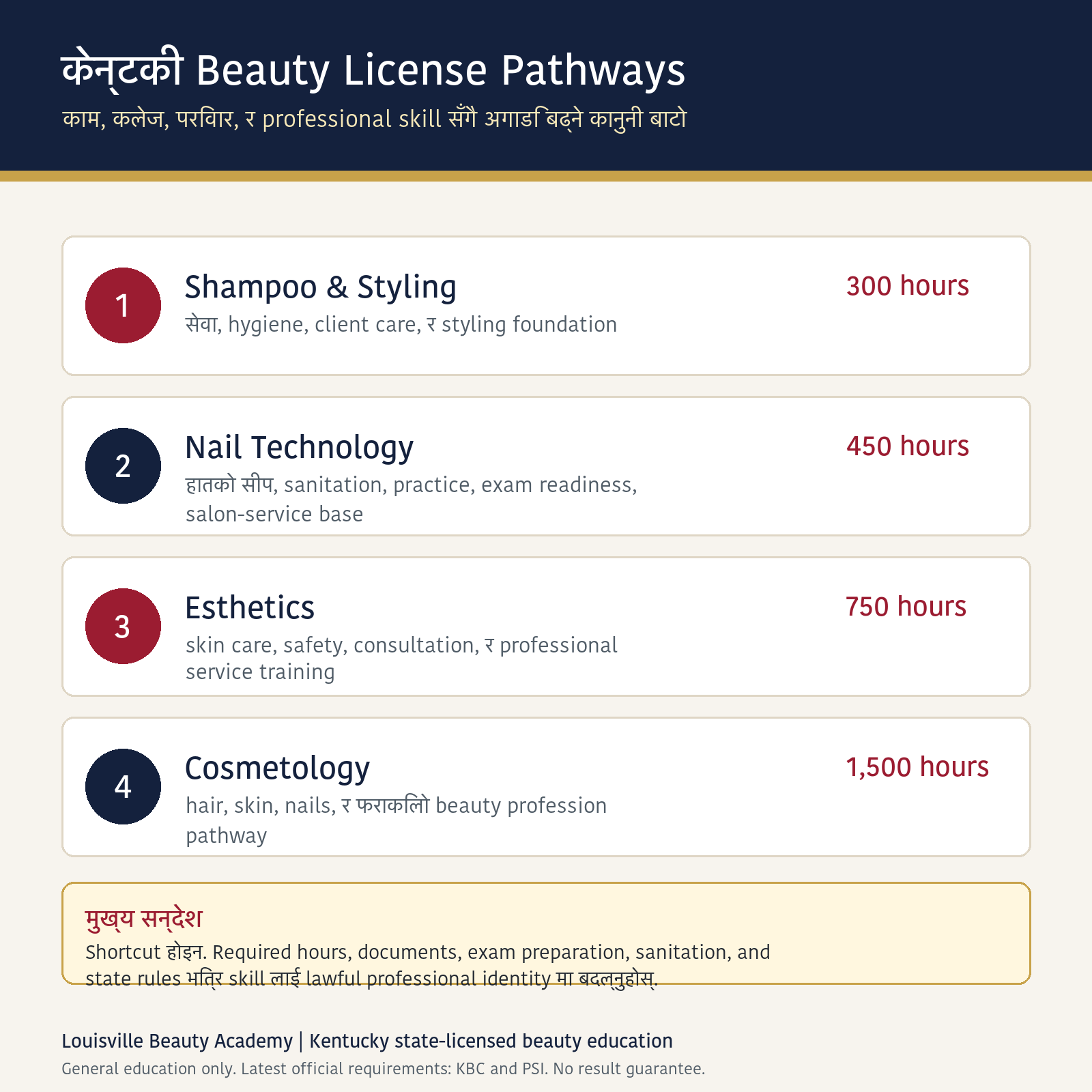
केन्टकीका प्रमुख beauty education hour pathways
Kentucky Board of Cosmetology को सार्वजनिक guidance अनुसार प्रमुख pathways मा Shampoo and Style Services 300 hours, Nail Technician 450 hours, Esthetician 750 hours, and Cosmetologist 1,500 hours समावेश छन्। यी hour requirements मात्र होइनन्; विद्यार्थीले उमेर, education, application, examination, licensing, and current state-board procedure जस्ता official requirements पनि बुझ्नुपर्छ।
KBC exam page ले PSI portal, Candidate Bulletin, language catalog, and exam-language-change resources तर्फ विद्यार्थीलाई निर्देशित गर्छ। Nepali community को लागि यो लेख community guidance हो। Nepali language लाई official PSI exam-language option भनेर प्रस्तुत गरिएको छैन। भाषा support, परीक्षा प्रक्रिया, र eligibility समयसँग परिवर्तन हुन सक्छन्, त्यसैले registration वा examination अघि KBC र PSI को सबैभन्दा नयाँ official information नै मुख्य आधार हुनुपर्छ।
केन्टकी beauty profession का प्रमुख education-hour pathways. Registration र examination अघि KBC र PSI को latest official requirements verify गर्नुहोस्।
नेपाली विद्यार्थीका लागि मूल सन्देश: shortcut होइन, legal path
अमेरिकामा छिटो पैसा, छिटो काम, छिटो status, वा छिटो business को भाषा धेरै सुनिन्छ। तर छोटो बाटोले लामो जीवन सुरक्षित बनाउँदैन। Beauty profession मा पनि यही सत्य हो। यदि राज्यको requirement छ भने, त्यो requirement लाई सम्मान गर्नुपर्छ। यदि hours चाहिन्छ भने, hours पूरा गर्नुपर्छ। यदि exam चाहिन्छ भने, exam को तयारी गर्नुपर्छ। यदि license चाहिन्छ भने, license आएपछि मात्र त्यसको अधिकार अनुसार सेवा गर्नुपर्छ।
नेपाली परिवारका लागि यो कुरा गहिरो छ: कानुनी बाटोले केवल एक जनालाई होइन, पूरा परिवारको नाम र भविष्यलाई सुरक्षित गर्छ। आफ्नो बच्चालाई देखाउन सकिन्छ कि मेहनत केवल कमाइ होइन; मेहनतलाई प्रमाण, सीप, license, service, and dignity मा बदल्न सकिन्छ।
Louisville Beauty Academy को भूमिका
Louisville Beauty Academy Kentucky state-licensed beauty school हो, जसले Louisville र वरिपरिका विविध समुदायका विद्यार्थीलाई सेवा गर्छ। स्कूलको ध्यान चमकदार वाचा होइन; स्पष्ट बाटो, affordable structure, required hours, practical training, documentation, exam readiness, and respectful support हो। Multilingual students लाई सम्मान गर्ने वातावरण बनाउनु LBA को identity को भाग हो, तर official licensing rules सधैं Kentucky Board of Cosmetology र PSI को current requirements अनुसार चल्छन्।
2025 मा Louisville Beauty Academy ले national and local business/community recognition प्राप्त गरेको छ। यस्तो recognition ले कुनै विद्यार्थीको व्यक्तिगत परिणाम guarantee गर्दैन, government endorsement वा license guarantee पनि होइन। तर यसले देखाउँछ कि एउटा सानो, state-licensed, student-centered beauty school पनि affordability, discipline, documentation, and community service मार्फत ठूलो मंचमा देखिन सक्छ।
YES I CAN: नेपाली परिवारका लागि शान्त तर बलियो वाक्य
YES I CAN सजिलो सफलताको नारा होइन। यो दैनिक अनुशासन हो। “म सिक्न सक्छु। म hours पूरा गर्न सक्छु। म official rules पढ्न सक्छु। म प्रश्न गर्न सक्छु। म exam तयारी गर्न सक्छु। म legal way मा काम गर्न सक्छु। म परिवारको dignity बढाउन सक्छु।”
नेपाली समुदायको शक्ति loud confidence होइन; धेरै पटक यो quiet sacrifice हो। त्यही quiet sacrifice लाई documented education, lawful licensing, professional service, and future ownership mindset मा बदल्न सकिन्छ भने त्यो केवल beauty school को कथा होइन। त्यो नयाँ अमेरिकी जीवनलाई कानुनी रूपमा माथि उठाउने कथा हो।
अर्को कदम
यदि तपाईं Kentucky मा Nail Technology, Esthetics, Shampoo & Styling, वा Cosmetology सोच्दै हुनुहुन्छ भने पहिले official requirements पढ्नुहोस्। School visit गर्नुहोस्। आफ्नो schedule, cost, language needs, documents, prior hours if any, and exam process clear गर्नुहोस्। Guess नगर्नुहोस्। Shortcut नखोज्नुहोस्। Legal path रोज्नुहोस्।
Louisville Beauty Academy नेपाली विद्यार्थी र परिवारलाई यो सोच्न आमन्त्रण गर्छ: तपाईं रेस्टुरेन्टमा काम गर्न सक्नुहुन्छ, कलेज पढ्न सक्नुहुन्छ, corporate office मा professional बन्न सक्नुहुन्छ, र beauty license को बाटो पनि तयार गर्न सक्नुहुन्छ। एक दिन salon ownership को सपना पनि राख्न सक्नुहुन्छ। तर त्यो सपना law, education, skill, sanitation, documentation, and service भित्र उभिनुपर्छ।
Important notice: This article is general educational and institutional information. It is not legal, immigration, financial, employment, business, or personal eligibility advice. Licensing, examination language, out-of-state recognition, admission, and eligibility requirements can change, and current official agency rules control. Completing a program, attending school, preparing for an exam, or earning hours does not guarantee graduation, examination passage, licensure, employment, income, salon ownership, admission, financial aid, or transfer/out-of-state recognition.
켄터키와 루이빌의 한인 가정, 유학생, 직장인, 부모, 그리고 다시 시작하려는 모든 분들께: 미국에서의 삶은 한 가지 길만 강요하지 않습니다. 대학에 다니는 길도 귀하고, 회사에서 일하는 길도 귀하고, 가족을 위해 식당이나 작은 비즈니스에서 땀 흘리는 길도 귀합니다. 그러나 동시에, 주정부가 인정하는 직업 면허를 통해 자신의 손기술과 성실함을 합법적인 전문 직업으로 세우는 길도 매우 귀합니다.
Louisville Beauty Academy가 한인 커뮤니티에 전하고 싶은 메시지는 분명합니다. 대학을 다니면서도 미용을 배울 수 있고, 회사에 다니면서도 면허의 길을 준비할 수 있으며, 언젠가 자신의 살롱을 꿈꾸는 것도 부끄러운 일이 아닙니다. 중요한 것은 지름길이 아니라 올바른 길입니다. 필요한 교육 시간, 문서, 시험 준비, 주정부 규정, 그리고 성실한 훈련을 통과하여 삶을 합법적으로 높이는 것입니다.
대학, 회사, 미용 면허는 서로 적이 아닙니다
많은 한인 가정은 교육을 깊이 존중합니다. 대학, 학위, 직장, 전문성은 가족의 희생과 미래를 담고 있습니다. Louisville Beauty Academy는 그 가치를 낮추지 않습니다. 오히려 이렇게 말합니다. 대학 교육이 한 사람의 지적 기반을 넓혀 준다면, 주정부 직업 면허는 한 사람의 실무 능력과 서비스 책임을 법적으로 세워 줍니다.
한 학생은 낮에는 대학 수업을 듣고, 다른 시간에는 미용 기술을 배울 수 있습니다. 한 직장인은 회사에서 행정, 고객 서비스, 회계, 마케팅, 기술 업무를 하면서도 저녁이나 가능한 시간에 새로운 전문 분야를 준비할 수 있습니다. 한 부모는 가족을 돌보면서도 자신의 손기술을 문서화된 교육 시간과 면허 준비로 연결할 수 있습니다. 이 길은 “둘 중 하나”가 아니라, 삶의 선택지를 넓히는 하나의 전략이 될 수 있습니다.
식당 일도 귀하고, 사무직도 귀하고, 살롱 창업의 꿈도 귀합니다
미국의 많은 이민자 가정은 식당, 세탁소, 편의점, 네일살롱, 사무실, 공장, 병원, 학교, 교회, 가족 사업 안에서 삶을 세워 왔습니다. 그 노동은 낮은 일이 아닙니다. 가족을 살리고, 자녀를 교육시키고, 집을 지키고, 커뮤니티를 세운 귀한 일입니다.
그러나 사람은 어제의 직업만으로 정의되지 않습니다. 오늘 회사에서 일하는 사람이 내일 미용 면허를 준비할 수 있습니다. 현재 식당에서 일하는 사람이 주말과 저녁을 사용해 네일, 에스테틱, 샴푸 & 스타일링, 코스메톨로지 경로를 배울 수 있습니다. 이미 사무직 경력을 가진 사람이 고객 관리, 예약, 마케팅, 위생 기록, 운영 감각을 살려 훗날 더 전문적인 살롱 운영자로 성장할 수도 있습니다. 가능성은 있습니다. 다만 그 가능성은 반드시 합법적이고 정직한 준비 위에 세워져야 합니다.
주정부 직업 면허는 작은 종이가 아니라 공적 신뢰입니다
미용은 단순히 예쁘게 꾸미는 기술만이 아닙니다. 위생, 안전, 도구 관리, 고객 상담, 피부와 손톱의 기본 이해, 서비스 윤리, 실습 기록, 시험 준비, 그리고 주정부 규정에 대한 존중이 함께 들어갑니다. 그래서 면허는 단순한 종이가 아닙니다. 그것은 “나는 배우고, 준비하고, 법 안에서 사람을 섬기겠습니다”라는 공적 약속에 가깝습니다.
면허가 성공을 보장하지는 않습니다. 졸업, 시험 합격, 취업, 수입, 창업, 타주 인정도 자동으로 보장되지 않습니다. 그러나 면허 준비 과정은 성실함을 기록으로 바꾸고, 기술을 법적 구조 안에 넣고, 한 사람의 서비스를 더 신뢰할 수 있는 전문 영역으로 세워 줍니다.
한인 학생에게 중요한 것은 체면보다 실력, 지름길보다 합법성입니다
한인 문화에는 공부, 노력, 가족 책임, 장인정신, 정직한 이름에 대한 깊은 존중이 있습니다. 이 가치는 미용 면허의 길과 잘 맞습니다. 아름다움은 화려함만이 아니라 반복 훈련입니다. 고객 서비스는 말만 잘하는 것이 아니라 약속을 지키는 것입니다. 살롱 운영은 꿈만으로 되는 것이 아니라 위생, 기록, 비용, 예약, 세금, 규정, 사람 관리, 고객 신뢰가 함께 있어야 합니다.
그래서 Louisville Beauty Academy의 메시지는 단순합니다. 부끄러워하지 마십시오. 늦었다고 생각하지 마십시오. 영어가 완벽하지 않다고 자신을 포기하지 마십시오. 대학을 다니고 있어도, 회사에 다니고 있어도, 식당에서 일하고 있어도, 가족을 돌보고 있어도, 올바른 길을 확인하고 한 걸음씩 준비할 수 있습니다.
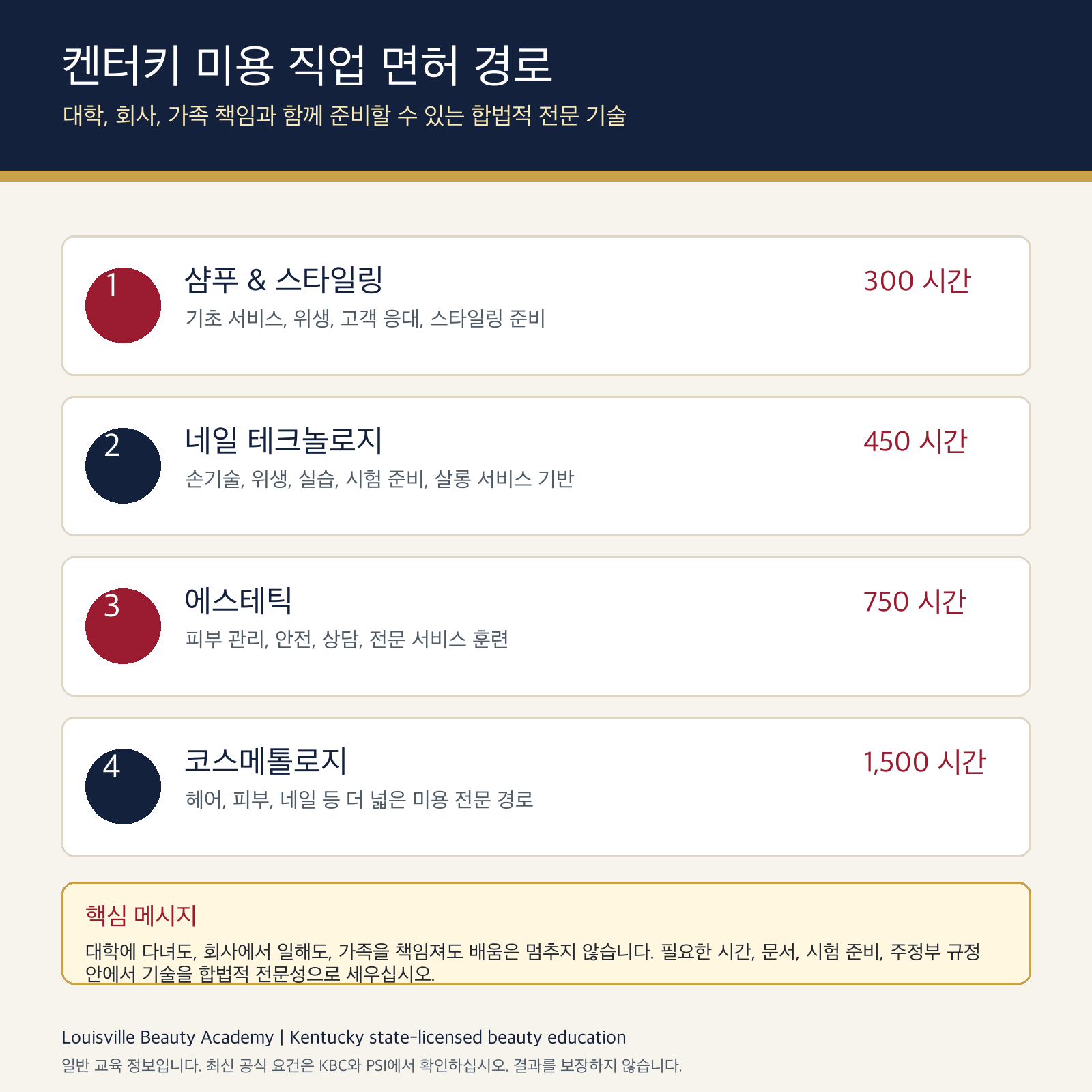
켄터키의 주요 미용 교육 시간 경로
Kentucky Board of Cosmetology의 현재 공개 안내에 따르면, 주요 경로에는 Shampoo and Style Services 300시간, Nail Technician 450시간, Esthetician 750시간, Cosmetologist 1,500시간 등의 교육 시간 요건이 포함됩니다. 각 경로는 교육 시간만으로 끝나는 것이 아니라 학력 요건, 만 18세 요건, 필기 및 실기 시험, 면허 신청, 면허 확인 또는 면허 발급 후 서비스 제공 등 공식 절차와 연결됩니다.
KBC 시험 안내 페이지는 PSI 포털, Candidate Bulletin, 시험 언어 변경 및 언어 카탈로그 관련 정보를 안내합니다. 언어 지원과 시험 운영은 변할 수 있으므로, 학생은 등록과 시험 전 반드시 KBC와 PSI의 최신 공식 정보를 확인해야 합니다.
켄터키 미용 직업의 주요 교육 시간 경로입니다. 등록과 시험 전 Kentucky Board of Cosmetology 및 PSI의 최신 공식 요건을 확인하십시오.
Louisville Beauty Academy는 켄터키 주정부 허가를 받은 미용 교육 기관으로, 루이빌과 주변 커뮤니티의 학생들을 섬깁니다. 학교는 화려한 포장보다 명확한 길을 중요하게 생각합니다. 필요한 시간, 실습, 문서, 시험 준비, 학생 지원, 그리고 다문화 학생들이 이해할 수 있는 안내를 중요하게 봅니다.
2025년 Louisville Beauty Academy는 전국 및 지역 차원의 비즈니스·커뮤니티 인정을 받았습니다. 이러한 인정은 학생 개인의 결과를 보장하지 않으며 정부 보증이나 면허 보장을 의미하지 않습니다. 그러나 작은 주정부 인가 미용학교도 성실한 교육, 합리적 비용, 학생 중심 운영, 지역사회 기여를 통해 더 큰 무대에서 보일 수 있다는 신호입니다.
왜 회사원도, 대학생도, 부모도 미용 면허를 생각할 수 있는가
회사 생활은 전문성을 줍니다. 대학은 사고의 폭을 줍니다. 가족 책임은 인내를 가르칩니다. 미용 면허 준비는 이 모든 것을 손으로 실천하는 전문 서비스로 연결할 수 있습니다. 누군가는 회사에 계속 다니면서 부업이 아닌 합법적 미래 선택지를 준비할 수 있습니다. 누군가는 대학 전공과 미용 기술을 결합해 브랜드, 마케팅, 운영, 교육, 창업의 길을 더 넓게 볼 수 있습니다. 누군가는 살롱을 소유하고 싶다는 꿈을 갖고, 먼저 법적 자격과 현장 이해부터 쌓을 수 있습니다.
왜 회사에서 일하면서도 언젠가 자신의 살롱을 소유하지 못하겠습니까? 단, 그 꿈은 책임 있는 꿈이어야 합니다. 면허, 규정, 위생, 실력, 고객 신뢰, 재정 판단, 사업 운영, 그리고 계속 배우는 태도가 함께 있어야 합니다. Louisville Beauty Academy는 꿈을 과장하지 않습니다. 꿈을 법과 교육과 훈련 안에 세우라고 말합니다.
YES I CAN: 조용하지만 강한 한 걸음
Louisville Beauty Academy의 정신은 YES I CAN입니다. 이것은 쉬운 성공을 약속하는 구호가 아닙니다. “나는 배울 수 있다. 나는 시간을 채울 수 있다. 나는 질문할 수 있다. 나는 시험을 준비할 수 있다. 나는 법 안에서 일할 수 있다. 나는 가족에게 더 큰 존엄과 선택지를 보여 줄 수 있다”는 훈련입니다.
한인 커뮤니티의 강점은 조용한 성실함입니다. 그 성실함이 문서화된 교육 시간, 합법적 면허 준비, 전문 서비스, 그리고 언젠가 더 큰 직업 정체성으로 연결될 수 있다면, 그것은 단순한 미용 교육이 아닙니다. 그것은 가족의 미래를 더 넓히는 실질적 선택입니다.
다음 단계
켄터키에서 네일, 에스테틱, 샴푸 & 스타일링, 코스메톨로지 분야를 생각하고 있다면 먼저 공식 요건을 읽고, 학교를 방문하고, 현재 필요한 시간과 문서를 확인하고, 시험 절차와 언어 지원을 확인하십시오. 추측하지 말고 확인하십시오. 지름길을 찾지 말고 법적 길을 걸으십시오.
Louisville Beauty Academy는 한인 학생과 가족이 대학, 직장, 가족 책임, 그리고 미용 전문직의 길을 함께 생각할 수 있도록 돕고자 합니다. 목표는 허영이 아니라 존엄입니다. 목표는 과장이 아니라 합법적 전문성입니다. 목표는 남에게 보이기 위한 성공이 아니라, 자기 삶을 실제로 세우는 힘입니다.
중요 안내: 이 글은 일반 교육 및 기관 안내입니다. 법률, 이민, 재정, 취업, 사업, 또는 개인 자격에 대한 조언이 아닙니다. 면허, 시험 언어, 타주 인정, 입학 및 자격 요건은 변경될 수 있으며 공식 기관의 최신 규정이 우선합니다. 교육 과정 완료, 시간 이수, 시험 준비 또는 학교 출석이 졸업, 시험 합격, 면허 취득, 취업, 수입, 살롱 소유, 입학, 재정 지원, 또는 타주 인정/전환을 보장하지 않습니다.
Louisville Beauty Academy 想对每一位华人、华裔、新移民、餐馆工作者、家庭照顾者、转行者、年轻人和重新开始的人说一句很重要的话:不要低估州职业执照。餐馆工作是辛苦、光荣、养家的工作;但如果你的心里还有一个专业梦想,美容行业的州执照可以让你的努力被记录、被审核、被合法化,也让你站到更正式的职业舞台上。
Louisville Beauty Academy 是肯塔基州许可的美容教育机构,服务路易维尔及周边社区。学校坚持清楚的学费、真实的学习小时、职业执照路径、学生支持和多语言尊重。我们不把教育包装成虚荣;我们把教育当作人生责任。
2025 年,Louisville Beauty Academy 获得全国层面的商业与社区认可,包括 U.S. Chamber of Commerce CO-100 相关认可和地方/商会层面的倡导认可。这些荣誉不是给学生的结果保证,也不是政府背书;它们说明一件事:一个小型、可负担、州许可、以学生为中心的美容学校,也可以在全国舞台上被看见。
Đời sống ở Mỹ đẹp không phải vì con đường nào cũng dễ. Đời sống ở Mỹ đẹp vì đất nước này cho con người một quyền rất quý: quyền được học lại, làm lại, nâng mình lên, đi bằng luật pháp, đi bằng mồ hôi, và để sự cố gắng của mình được công nhận một cách chính thức.
Đối với nhiều gia đình Việt Nam tại Louisville và Kentucky, câu hỏi không chỉ là: “Tôi có thể làm nghề gì?” Câu hỏi sâu hơn là: “Làm sao để công sức của tôi trở thành một nghề hợp pháp, có giấy tờ, có tiêu chuẩn, có danh dự, và có thể nuôi gia đình lâu dài?”
Tại Louisville Beauty Academy, câu trả lời của chúng tôi rất rõ: đừng đi đường tắt. Đừng tự xem nhẹ mình. Đừng để câu “tôi không giỏi tiếng Anh” trở thành cái cớ để bỏ cuộc. Nếu bạn muốn bước vào nghề làm đẹp tại Kentucky, hãy đi con đường thật: học thật, đủ giờ thật, thi thật, xin giấy phép thật, và làm nghề bằng tư cách chuyên nghiệp thật.
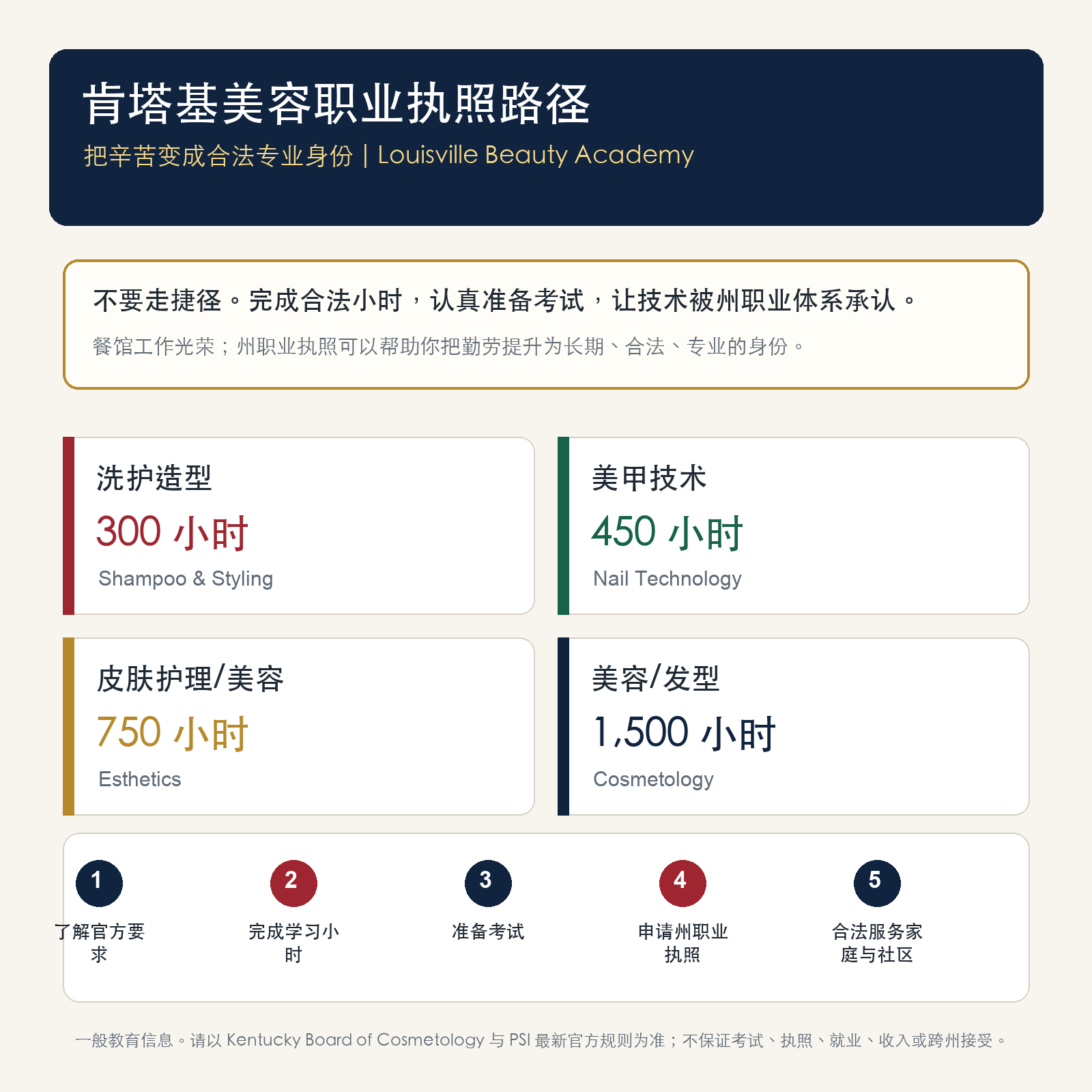
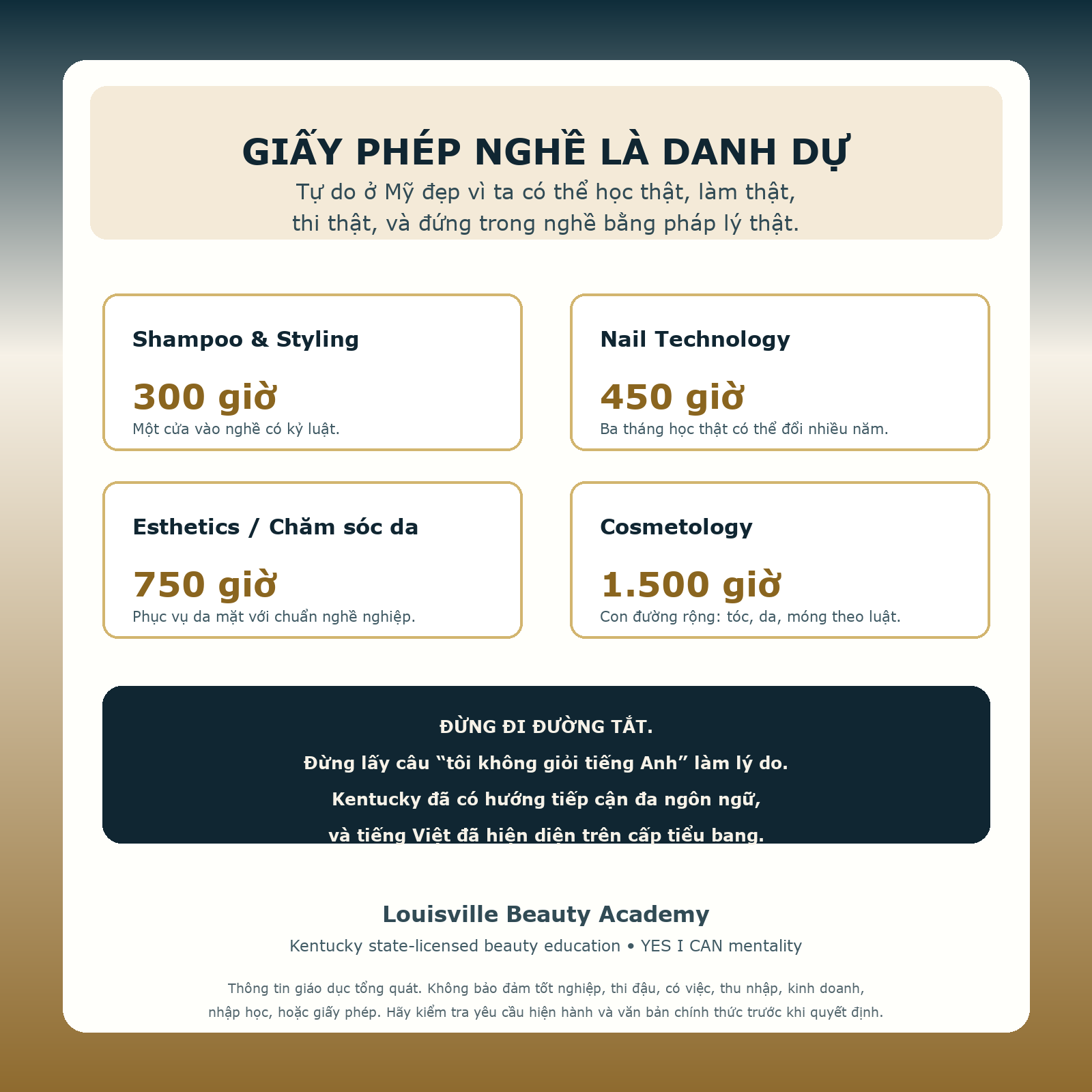
Các con đường học giờ chính trong nghề làm đẹp Kentucky. Hãy luôn kiểm tra yêu cầu hiện hành và văn bản chính thức trước khi quyết định.
Giấy Phép Nghề Không Phải Là Tờ Giấy Nhỏ
Nhiều người trong cộng đồng chưa hiểu hết giá trị của một state occupational license – giấy phép hành nghề do tiểu bang quản lý. Bằng đại học thường do một trường cấp. Nhưng giấy phép nghề, khi được cấp đúng luật, là quyền hành nghề nằm trong hệ thống pháp lý của tiểu bang.
Điều đó không có nghĩa giấy phép nghề “cao hơn” đại học trong mọi hoàn cảnh. Nhưng trong đời sống thực tế, một giấy phép hành nghề hợp pháp có thể có sức mạnh rất lớn: nó nối tên bạn với một nghề được quản lý, một tiêu chuẩn vệ sinh – an toàn, một trách nhiệm phục vụ công chúng, và một con đường kiếm sống hợp pháp.
Với nhiều gia đình nhập cư, đó là điều đáng quý. Không phải ai cũng có thời gian, tiền bạc, ngôn ngữ, hoặc hoàn cảnh để đi lại con đường đại học dài nhiều năm. Nhưng một con đường nghề nghiệp hợp pháp – như Nail Technology, Esthetics, Shampoo & Styling, hoặc Cosmetology – có thể giúp một người biến sự chăm chỉ thành danh phận nghề nghiệp rõ ràng.
Đừng Xem Nhẹ Nghề Làm Đẹp
Nghề làm đẹp không chỉ là móng, tóc, da mặt, gội đầu, trang điểm, hay dịch vụ bên ngoài. Nghề làm đẹp là một nghề chạm vào con người. Nó đòi hỏi vệ sinh, an toàn, kỷ luật, giao tiếp, lòng tin, sự kiên nhẫn, kỹ thuật, và trách nhiệm.
Một người được cấp phép không chỉ “biết làm.” Người đó đang nói với khách hàng và cộng đồng: tôi đã đi qua một quá trình học tập; tôi hiểu luật và tiêu chuẩn cơ bản; tôi biết rằng tay nghề phải đi cùng an toàn; và tôi chọn làm nghề trong ánh sáng, không trong bóng tối.
Đừng coi thường state license. Đừng coi thường nail license. Đừng coi thường shampoo styling. Đừng coi thường esthetics. Đừng coi thường cosmetology. Mỗi giấy phép, nếu được đi đúng đường, là một nền móng để một con người đứng thẳng hơn trong xã hội.
Ba Tháng Có Thể Phục Vụ Ba Mươi Năm
Ví dụ, chương trình Nail Technology tại Kentucky hiện được công bố ở mức 450 giờ. Với lịch học phù hợp, đó có thể là một khoản đầu tư ngắn so với cuộc đời làm nghề phía trước. Ba tháng học nghiêm túc có thể mở ra ba mươi năm hoặc hơn của lao động hợp pháp, phục vụ khách hàng, nuôi gia đình, mở booth, mở salon, hoặc xây dựng một cơ sở nhỏ của chính mình.
Chương trình Shampoo & Styling hiện được công bố ở mức 300 giờ. Esthetics là 750 giờ. Cosmetology là 1.500 giờ. Những con số này không phải khẩu hiệu. Đây là các ngưỡng học giờ được gắn với hệ thống cấp phép. Người học phải kiểm tra yêu cầu hiện hành, giấy tờ, hợp đồng, lịch học, quy định thi, và văn bản chính thức trước khi quyết định.
Đừng nói “tôi không có thời gian đi học” quá nhanh. Hãy hỏi lại: nếu một khoảng thời gian học nghiêm túc có thể phục vụ đời mình thêm 30 năm, 40 năm, hoặc 50 năm, thì đó có còn là mất thời gian không? Hay đó là cách mình tôn trọng chính mình?
Tiếng Việt Đã Có Chỗ Trong Con Đường Thi Cấp Phép
Louisville Beauty Academy sống với tinh thần YES I CAN. Không phải “yes” rẻ tiền. Không phải nói cho vui. YES I CAN nghĩa là: tôi có thể học; tôi có thể hiểu; tôi có thể làm đúng; tôi có thể đi từng giờ; tôi có thể hỏi lại; tôi có thể thi; tôi có thể đứng lên hợp pháp.
Trong nhiều năm, LBA và nhiều người trong cộng đồng đã vận động cho sự công bằng ngôn ngữ trong kỳ thi cấp phép ngành làm đẹp. Con đường đa ngôn ngữ không hạ thấp tiêu chuẩn. Nó giúp người học hiểu tiêu chuẩn tốt hơn. Khi một người được học và thi bằng ngôn ngữ họ hiểu rõ hơn, họ có cơ hội thật hơn để nắm luật, vệ sinh, an toàn, và trách nhiệm nghề nghiệp.
Tiếng Việt đã hiện diện trong hướng tiếp cận cấp tiểu bang Kentucky. Điều này không tự nhiên rơi xuống. Nó là kết quả của nhiều năm kiên trì, nhiều tiếng nói cộng đồng, nhiều lần giải thích, nhiều lần không bỏ cuộc. Đừng phí điều đó. Nếu hôm nay có một cánh cửa ngôn ngữ rộng hơn, thì trách nhiệm của chúng ta là bước qua cánh cửa đó bằng học thật và làm thật.
Giấy Phép Có Thể Đi Xa Hơn Một Thành Phố
Một giấy phép nghề được cấp hợp pháp không chỉ có giá trị trong cảm xúc. Nó có thể trở thành hồ sơ nghề nghiệp khi bạn làm việc, chuyển nơi ở, hoặc xin xét theo quy định của nơi khác. Việc chuyển giấy phép giữa các tiểu bang luôn phụ thuộc vào luật và yêu cầu của tiểu bang nhận hồ sơ, nhưng giấy phép thật và giờ học thật là nền tảng mạnh hơn rất nhiều so với làm chui, học tắt, hoặc nghe lời hứa không có giấy tờ.
Đừng xây tương lai của mình trên đường tắt. Đường tắt có thể nhanh trong vài tuần, nhưng làm yếu cuộc đời trong nhiều năm. Đường chính thống có thể khó lúc đầu, nhưng nó để lại hồ sơ, bằng chứng, giấy phép, danh dự, và sự tự tin trước gia đình, khách hàng, tiểu bang, và chính mình.
LBA: Một Trường Nhỏ Nhưng Không Nhỏ Trong Sứ Mệnh
Louisville Beauty Academy là một trường beauty được cấp phép tại Kentucky, được xây dựng để phục vụ người thật: người nhập cư, người đi làm, cha mẹ bận rộn, người cần học bằng ngôn ngữ dễ hiểu hơn, người muốn chi phí rõ ràng, và người muốn một con đường nghề nghiệp có giấy tờ.
Năm 2025, LBA được CO- by the U.S. Chamber of Commerce ghi nhận trong danh sách CO-100, hạng mục Enduring Businesses. LBA cũng được ghi nhận trong hồ sơ công khai về vai trò vận động doanh nghiệp nhỏ và chính sách nghề nghiệp. Những điều này không phải để khoe. Chúng là lời nhắc rằng một trường nhỏ, nếu làm đúng, có thể có tiếng nói quốc gia.
Chúng tôi không nói điều đó để hứa ai cũng sẽ có kết quả giống nhau. Không trường nào được nói như vậy. Chúng tôi nói điều đó để nhắc cộng đồng Việt Nam rằng: đừng tự hạ thấp nghề. Đừng tự hạ thấp mình. Một nghề được cấp phép hợp pháp có thể là một trong những con đường đẹp nhất để biến tự do ở Mỹ thành trách nhiệm, lao động, gia đình, và đóng góp.
Đừng Bỏ Học Thật. Đừng Bỏ Nghĩa Thật Của Đời Sống.
Có người muốn nhanh. Có người muốn làm trước rồi tính sau. Có người nghe ai đó nói “không cần giấy phép đâu.” Nhưng nghề thật không nên bắt đầu bằng cách tự giấu mình khỏi pháp luật.
Đi học không chỉ để lấy giấy. Đi học là để chứng minh với chính mình rằng mình có thể đi hết một con đường. Đi học là để tập kỷ luật. Đi học là để hiểu nghề không chỉ bằng tay, mà bằng đầu óc, bằng đạo đức, bằng hồ sơ, bằng sự đúng đắn.
Nếu bạn là người Việt ở Kentucky, nếu bạn muốn vào nghề nail, tóc, da, hoặc chăm sóc sắc đẹp, hãy đi thẳng. Hãy hỏi rõ. Hãy đọc văn bản. Hãy tích lũy giờ hợp pháp. Hãy chuẩn bị thi. Hãy lấy giấy phép bằng đường chính đáng. Đừng cứu mình khỏi cơ hội chỉ vì sợ tiếng Anh. Đừng cứu mình khỏi tương lai chỉ vì ba tháng, năm tháng, hay chín tháng học có vẻ dài.
Lời Mời Từ Louisville Beauty Academy
Nếu bạn cần hỏi bằng tiếng Việt, hãy hỏi bằng tiếng Việt. Nếu bạn cần hiểu chương trình, chi phí, giờ học, điều kiện, hỗ trợ ngôn ngữ, hoặc cách bắt đầu, hãy liên hệ LBA bằng văn bản. Chúng tôi tin vào sự rõ ràng. Chúng tôi tin vào tài liệu. Chúng tôi tin vào học thật. Và chúng tôi tin rằng người Việt có thể đứng rất đẹp trong nghề làm đẹp – không bằng đường tắt, mà bằng danh dự.
Bài viết này là thông tin giáo dục tổng quát. Đây không phải tư vấn pháp lý, di trú, tài chính, hoặc bảo đảm tốt nghiệp, thi đậu, được cấp giấy phép, có việc làm, thu nhập, kinh doanh, nhập học, chuyển giờ, hoặc chuyển giấy phép. Yêu cầu hiện hành của Kentucky Board of Cosmetology, PSI, văn bản của trường, và luật của từng tiểu bang mới là căn cứ phải kiểm tra trước khi quyết định.
Ý chính rất đơn giản: cuộc đời ở Mỹ đẹp vì ta có thể nâng mình lên bằng con đường hợp pháp. Nghề làm đẹp, khi đi bằng giáo dục thật và giấy phép thật, không phải nghề nhỏ. Đó là một con đường danh dự.
Disclaimer: This publication is provided solely for educational, research, and public-interest discussion by Louisville Beauty Academy (LBA) and Di Tran University (DTU). It is intended to promote understanding of beauty education, public safety, sanitation, occupational licensing, administrative law, due process, regulatory transparency, and professional responsibility. The content reflects research, publicly available laws, regulations, court decisions, government publications, academic literature, and policy analyses available at the time of publication. It is not legal advice, does not accuse or imply misconduct by any individual, agency, board, school, or organization, and should not be interpreted as a statement regarding any specific person or pending matter. Laws and regulations vary by jurisdiction and may change over time; readers should consult the applicable statutes, regulations, licensing authorities, or qualified legal counsel regarding their specific circumstances. LBA and DTU fully support lawful regulation that protects public health, safety, sanitation, consumer welfare, ethical education, and professional excellence, while also encouraging transparency, fairness, evidence-based policymaking, due process, equal access, and continuous improvement for the benefit of students, licensees, educators, regulators, and the public.
The regulation of the American beauty industry — encompassing cosmetology, nail technology, esthetics, shampoo styling, instructor licensing, and beauty schools — represents one of the most complex, heavily layered, and least publicly understood systems of occupational governance in the United States. At its best, this regulatory architecture protects the public from infection, chemical injury, and incompetent practice. At its worst, it has functioned as a barrier to economic participation for immigrants, low-income workers, people of color, and non-English speakers — without producing commensurate gains in public safety.
This study examines the origins, evolution, and contemporary operation of beauty industry regulation with equal weight given to its protective functions and its recorded harms. It draws on constitutional law, administrative law, public policy scholarship, historical research, federal agency findings, state board rules, and court decisions. It concludes with a practical due process framework and positions Louisville Beauty Academy and Di Tran University as institutions of excellence in integrated compliance, sanitation, and rights-aware beauty education.
The core research question — whether beauty regulation serves public safety or also serves as a tool of control over vulnerable populations — cannot be answered with a simple yes or no. Both are true, and the productive response is not cynicism but informed, empowered professionalism.
The formal regulation of cosmetology and barbering in the United States emerged primarily in the 1920s through the 1940s, driven by a confluence of genuine public health concerns, professional ambition, and social dynamics that have shaped the industry ever since. Illinois enacted one of the first comprehensive state licensing laws for beauty culture practitioners in 1925, establishing original requirements covering examinations, fees, renewal, and reciprocity. California separately licensed barbers and cosmetologists beginning in 1927, reflecting both a social and professional divide that would persist for decades. North Dakota passed its first act to regulate hairdressers and cosmetologists in 1927, creating a State Board of Hairdressers and Cosmetologists to oversee the profession. South Carolina established its State Board of Cosmetic Art Examiners in 1934, and Mississippi created its Board of Cosmetology in 1948.[1][2][3][4][^5]
The stated rationale in nearly every state was uniform: protect consumers from unsanitary practices, communicable diseases, and chemical injuries that genuine hands-on beauty work could produce. This rationale had real merit. Early salons used harsh chemical compounds with limited safety knowledge, shared instruments without disinfection between clients, and operated in conditions that could spread ringworm, bacterial infections, and other skin diseases. Public health considerations were not fabricated — they were real.[^6]
Sanitation remains the bedrock justification for beauty licensing and is the area where regulation most clearly serves its stated mission. Professional beauty services create documented opportunities for disease transmission: shared implements can spread bacterial infections, fungal conditions such as tinea capitis or onychomycosis, and blood-borne pathogens if skin is broken. Pedicure basins, nail tools, and facial instruments are particularly high-risk vectors if not properly disinfected. The requirement that professionals demonstrate competence in disinfection, sanitation protocols, and safe chemical handling before serving the public is therefore rationally connected to a legitimate government interest in preventing harm.[7][6]
Regulatory bodies including state boards of cosmetology mandate specific disinfection protocols — EPA-registered disinfectants, proper contact times, documented pedicure basin logs, and safe chemical storage — precisely because these protections have a direct connection to client health and safety. The Federal Food, Drug, and Cosmetic Act of 1938 established early federal oversight of cosmetic products, and the Modernization of Cosmetics Regulation Act of 2022 (MoCRA) — the most significant expansion of FDA authority over cosmetics since 1938 — updated requirements for adverse event reporting, safety substantiation, mandatory recall authority, and Good Manufacturing Practices. These are serious public protections deserving respect.[8][9]
Yet the historical record reveals a more complicated picture. Licensing laws were not solely driven by public health. Academic research on the licensing of barbers and beauticians documents how these laws were shaped by competitive interests, racial stratification, and the desire of established practitioners to control market access. One of the clearest examples: early barber licensing laws in numerous states were explicitly deployed to suppress Black competition. Georgia’s Jim Crow barber codes prohibited colored barbers from serving white women and girls. Barbering had been one of the first skilled trades African Americans mastered in America, but the introduction of formal licensing in the late nineteenth and early twentieth centuries coincided with Jim Crow-era exclusions that systematically restricted Black entry into licensed trades. Licensing laws — generally framed in race-neutral language — had racially discriminatory effects both North and South, used as tools to prevent Black workers from competing with established white practitioners.[10][11][12][13]
This history is not merely retrospective. It established a template in which licensing requirements could be structured to disadvantage workers without explicitly targeting them — a pattern that would recur across generations with immigrant workers, low-income applicants, and non-English speakers.
In the United States, the beauty industry is regulated almost entirely at the state level. All fifty states plus the District of Columbia require a license to practice cosmetology. Every state maintains a cosmetology board, barbering board, or combined professional licensing body that exercises authority over: individual practitioner licenses (cosmetologist, nail technician, esthetician, shampoo technician, instructor); salon and school establishment licenses; curriculum standards for schools; examinations; inspection and enforcement; complaint processing; disciplinary actions; and license renewals. Some states regulate manicuring, esthetics, and shampoo styling as distinct licenses with separate hour and examination requirements.[14][15][^16]
The Kentucky Board of Cosmetology, to cite the home jurisdiction of Louisville Beauty Academy, administers KRS Chapter 317A and 201 KAR Chapter 12, which govern cosmetology, nail technology, threading, eyelash artistry, makeup artistry, and esthetics. It requires a minimum of two inspections per year of each licensed establishment, empowers board members and inspectors to enter licensed premises during reasonable working hours, and requires establishments to produce records for inspection and copying. These powers are broad and, for the uninformed licensee, can feel overwhelming.[^17]
At the federal level, the Food and Drug Administration (FDA) regulates cosmetic products — the chemical substances used in professional services — but historically exercised limited authority over the beauty profession itself. MoCRA (2022) expanded FDA’s product oversight significantly, requiring facility registration, product listing, adverse event reporting, and safety substantiation records. The Department of Education exercises oversight through Title IV financial aid administration, which conditions federal student loan and Pell Grant eligibility on school accreditation. NACCAS (National Accrediting Commission of Career Arts & Sciences) serves as the primary institutional accreditor for cosmetology schools seeking Title IV eligibility. The Federal Trade Commission monitors occupational licensing boards for anti-competitive practices, most famously after North Carolina State Board of Dental Examiners v. FTC, 574 U.S. 494 (2015), which held that state licensing boards dominated by active market participants are subject to federal antitrust law unless actively supervised by the state.[18][19][20][8]
A beauty school owner in Kentucky, for example, faces regulatory obligations from the following authorities simultaneously:
Kentucky Board of Cosmetology (KRS 317A / 201 KAR 12): state licensure, school approval, curriculum hours, instructor credentials, inspection compliance, sanitation standards, student record-keeping, hour-tracking documentation
NACCAS: accreditation standards covering educational objectives, instructional staff, admissions policies, student support services, curriculum, financial practices, facilities, and student evaluations[21][22]
U.S. Department of Education: Title IV financial aid administration, satisfactory academic progress standards, return-to-title-IV (R2T4) calculations, cohort default rates, gainful employment[^23]
Kentucky Administrative Procedure Act (KRS 13B): administrative hearing procedures applicable to any disciplinary action
OSHA and EPA: workplace safety and chemical handling regulations for schools and salons
State and local business licensing: general business operation requirements
Local fire, zoning, and building codes: physical plant requirements
The cumulative documentation, compliance, and legal-knowledge burden placed on a single owner-operator — who in many cases is an immigrant, a first-generation entrepreneur, or a person operating with limited financial resources — is extraordinary by any objective measure.
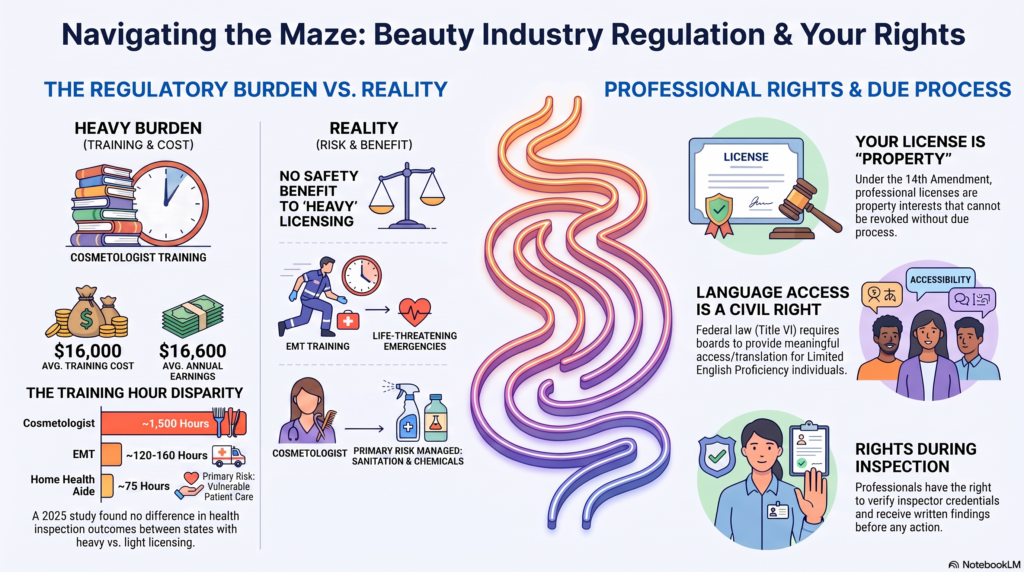
The training hour requirements for beauty professionals are among the most frequently cited evidence that occupational licensing in this sector has exceeded any rational public safety justification. Consider this comparative data:
Occupation
Average Training Required
Notes
Cosmetologist
~372 training days (~1,500 hours)
Range: 1,000–2,100 hours depending on state [24][25]
Emergency Medical Technician (EMT)
~33 training days (~120-160 hours)
Responds to life-threatening emergencies [25][26]
Barber
~1,000–1,500 hours
Varies by state [^27]
Nail Technician
~300–600 hours
Varies by state
Esthetician
~260–1,500 hours
Varies significantly by state
Cosmetology Instructor
~300–1,000 hours of instructor training (plus underlying license)
[28][29]
Home Health Aide
~75 hours (federal minimum)
Works with vulnerable patients
Childcare Worker
Varies; many states 0–12 hours
Cares for children daily
Interior Designer
No federal license; some state certifications
Affects structural safety
Construction Laborer (non-electrical)
Often no state license
Various safety risks
As President Trump noted in 2019 remarks to governors, cosmetologists train on average eleven times longer than emergency medical technicians. The Washington Post fact-checked and verified this claim: “on average, cosmetologists do train a little over 10 times as long as EMTs”. A report by the National Conference of State Legislatures confirmed that “cosmetologists require an average of 372 training days, significantly higher than emergency medical technicians, who need an average of 33 training days”.[25][26]
This disparity is not easily explained by reference to public safety. While beauty services do carry real sanitation risks, they rarely involve life-threatening emergencies of the kind EMTs manage daily. The 2015 Obama White House report — prepared jointly by the Department of the Treasury, the Council of Economic Advisers, and the Department of Labor — concluded that licensing can “impose substantial costs on job seekers, consumers, and the economy more generally,” that the percentage of workers requiring a license has increased five-fold since the 1950s, and that over-licensing “disproportionately affects certain populations, including immigrants and anyone with a criminal history”.[30][31]
The Institute for Justice’s April 2025 study, Clean Cut, analyzed whether nail salons and barbershops in states with different licensing burdens had better or worse health inspection outcomes. The finding was unambiguous: “There was no difference in inspection outcomes across the states.” Researchers found that barbershops and nail salons were clean and safe regardless of whether their workers faced burdensome licensing, lighter licensing, or no licensing at all. This study directly challenges the claim that heavier training hour requirements produce better public health outcomes in the beauty industry.[^32]
The cost of entering the beauty profession is substantial. On average, completing the required training for a cosmetology license costs more than $16,000, according to Institute for Justice research, and students took out over $7,300 on average in student loan debt to finance this training. Tuition alone typically ranges from $5,000 to $20,000+ depending on school and location. The total cost including exam fees and licensing application fees typically reaches $6,000–$22,000+.[24][16]
Yet the Brookings Institution reported that cosmetology graduates have average earnings of approximately $16,600, with $9,900 in debt. At the median cosmetology school, 32 percent of students are at least three months behind on their loan payments. A 2026 Department of Education analysis projected that more than 92% of all cosmetology, barber, and related personal grooming programs would fail a proposed earnings accountability test comparing graduate earnings to those of high school graduates. These numbers reflect a systemic tension: students are required by law to attend expensive, time-consuming licensed programs in order to work in a field that is already economically modest.[33][34][^35]
The American nail salon industry is predominantly owned and staffed by foreign-born individuals — immigrants or refugees running small, family-operated businesses. Vietnamese Americans, following the influence of actress Tippi Hedren who encouraged Vietnamese refugee women to learn nail care in the 1970s, came to dominate the nail salon industry particularly in California and across the country. Research by the UCLA Labor Center and others documents the compound vulnerabilities these workers face: low wages, toxic chemical exposure, limited English proficiency, regulatory complexity they cannot easily navigate, and structural inequities that simultaneously require compliance with English-language law while failing to provide those laws in accessible translated form.[36][37][^38]
A 2023 Federal Reserve Bank of Minneapolis study found that licensure reduces foreign-born employment in a licensed occupation by nearly 20 percent relative to native-born employment — a direct wage and employment penalty for immigrants navigating a licensing system designed around English-language documentation and examination. The study found corresponding wage premiums, consistent with the interpretation that licensing constitutes a disproportionate barrier to the labor supply of immigrants. Research by the CDC confirms that nail salon workers — predominantly immigrant women — face multiple barriers to accessing occupational health training and services, including language barriers, literacy barriers, and lack of culturally appropriate materials.[39][40]
Under Title VI of the Civil Rights Act of 1964 and Executive Order 13166 (2000), any entity receiving federal financial assistance — including state licensing boards that participate in federal programs — must take reasonable steps to ensure meaningful access to services for persons with Limited English Proficiency (LEP). “Language access” means providing LEP individuals the same access to government services as English-speaking individuals. Vital documents — those necessary for meaningful access to programs — must be translated into the languages of regularly encountered LEP groups.[^41]
In practice, many state cosmetology boards offer limited or no translation services for inspections, hearings, complaint responses, or licensing examinations. The California Board of Barbering and Cosmetology does offer consumer complaint forms in Korean, Spanish, and Vietnamese — a practice that should be recognized as a best-practice baseline that all boards should meet. The U.S. Commission on Civil Rights approved a report on language access for LEP individuals in February 2026, transmitting findings to the President and Congress. Beauty professionals and their advocates should invoke this federal framework when demanding translated notices, translated complaint forms, and interpreter access in regulatory proceedings.[42][43]
State cosmetology boards hold extraordinary power over licensees. Under KRS 317A, any board member, administrator, or inspector may enter any licensed establishment during reasonable working hours. Boards may require production of records, books, and papers pertaining to licensed activity. Boards may impose fines, suspend or revoke licenses, impose probation, and issue public reprimands. In states like Kentucky, the passage of SB22 created the specific category of “immediate and present danger to the public” triggered by the knowing employment of unlicensed persons — a phrase that, if triggered, can result in emergency orders closing a business on the spot.[44][45][^17]
For the vast majority of licensees who have limited legal education, limited English fluency, limited financial resources to hire attorneys, and limited knowledge of their rights under administrative law, this power asymmetry is profound. A licensee who does not know that they are entitled to written notice before disciplinary action, that they have a deadline to respond, that they may appeal, and that silence or panic can be misinterpreted as admission — is a licensee who is structurally vulnerable to erroneous or disproportionate regulatory action.
A well-documented problem in occupational licensing generally — and in beauty regulation specifically — is regulatory capture: the tendency of licensing boards dominated by active market participants to use their regulatory power to suppress competition rather than protect the public. The Supreme Court’s landmark decision in North Carolina State Board of Dental Examiners v. FTC, 574 U.S. 494 (2015) — while involving dentistry — directly and explicitly addressed this risk in the context of professional licensing boards composed of active market participants. The Court held 6-3 that a state licensing board dominated by active practitioners can invoke state-action antitrust immunity only if it is actively supervised by the state — precisely because the risk of boards using regulatory power to protect incumbents from competition is constitutionally significant.[46][47][48][20][^49]
Research by conservative and libertarian policy organizations (Heritage Foundation, Cato Institute, Goldwater Institute, Institute for Justice) and centrist and progressive bodies (Brookings Institution, Hamilton Project, Obama White House) alike confirms that incumbent businesses endorse licensing requirements precisely because those requirements protect them against competition from new entrants. The Federal Trade Commission has long advocated for reform, noting that “unnecessary licensing restrictions erect significant barriers and impose costs that cause real harm to American workers, employers, consumers, and our economy as a whole, with no measurable benefits to consumers or society”.[50][51][^52]
Beauty schools themselves are not immune from this dynamic. When established schools use accreditation standards, minimum hour requirements, and regulatory lobbying to raise barriers against new competitors — rather than to improve educational quality — they participate in the same incumbent-protection cycle they may simultaneously criticize when boards do it to individual practitioners.
Every licensee in the United States — every cosmetologist, nail technician, esthetician, salon owner, instructor, and school — holds a property interest and a liberty interest in their professional license. The Supreme Court established in Board of Regents v. Roth, 408 U.S. 564 (1972) that professional licenses constitute property interests protected by the Due Process Clause of the Fourteenth Amendment, which prohibits any state from depriving a person of life, liberty, or property without due process of law. The Fifth Amendment independently provides that the federal government cannot deprive any person of life, liberty, or property without following certain procedures.[^53]
Due process in licensing disciplinary proceedings does not require a full court trial, but it does require meaningful procedural protections. The governing constitutional standard is the three-part Mathews v. Eldridge balancing test established by the Supreme Court in 424 U.S. 319 (1976). Under this test, the minimum process required is determined by weighing: (1) the private interest affected by the government action; (2) the risk of erroneous deprivation through the procedures used, and the value of additional safeguards; and (3) the government’s interest, including the administrative burden of additional procedures.[54][55][56][57]
For a licensee facing suspension or revocation — the deprivation of their means of livelihood — the private interest is enormous. The risk of erroneous deprivation in complex regulatory proceedings without legal representation is substantial. Courts have therefore consistently recognized that licensees are entitled to: notice of the specific charges against them, a meaningful opportunity to be heard before adverse action takes effect (or at least promptly thereafter), the right to present evidence and witnesses, and the right to receive written reasons for any adverse decision.[58][59]
State administrative procedure acts govern how beauty boards may conduct investigations, issue charges, hold hearings, and impose discipline. In Kentucky, KRS Chapter 13B (the Kentucky Administrative Procedure Act) governs all contested case proceedings before state administrative agencies, including the Kentucky Board of Cosmetology. In Tennessee, the Tennessee Administrative Procedure Act (Title 4, Chapter 5, Tennessee Code Annotated) similarly governs all board disciplinary proceedings.[60][61]
These acts uniformly require: written notice of charges before adverse action; an opportunity to respond to allegations in writing; a hearing before an impartial decision-maker; the right to be represented by an attorney; the right to present witnesses and cross-examine adverse witnesses; a written decision based on findings of fact and legal conclusions; and the right to appeal to a court.[62][63]
In California, the Board of Barbering and Cosmetology’s administrative appeal regulations (16 Cal. Code Regs. § 973.6) specifically provide that a licensee who receives an immediate suspension has 30 calendar days to request an informal review hearing, may bring legal counsel, may present written information and oral testimony, may contest the occurrence of the violation, the period for correction, or the amount of the fine.[^64]
In Kentucky, under 201 KAR 12:190, before any disciplinary action is taken against a licensee, the licensee has the right to: written notice; written citation of the law alleged to have been violated; written statement of the factual basis; a written right to respond; and an opportunity for a hearing. Critically, under Kentucky law, “imminent danger” — the trigger for emergency orders — means unlicensed practice, not confusion, misunderstanding, or paperwork errors. For ordinary sanitation violations and minor paperwork issues, the board must first issue a written warning and provide an opportunity to correct before imposing a fine.[45][60]
Every state has open records or freedom of information laws that give citizens the right to inspect government records, including records maintained by state cosmetology boards. The Kentucky Open Records Act (KRS Chapter 61) allows residents of Kentucky to submit requests for records, including inspection reports, investigator notes, complaint files, and meeting minutes. The Tennessee Public Records Act provides that “all state, county and municipal records shall at all times during business hours be open for personal inspection by any citizen of this state”.[65][66][^67]
These laws are powerful defensive tools for licensees and school owners who face regulatory action. A licensee who suspects that an inspection finding is inaccurate or that a fine was not lawfully approved can use an open records request to obtain the original inspector’s notes, the complaint files, the board meeting minutes approving the fine, and any other relevant documentation. If the minutes show the fine was never formally approved, the fine may be unenforceable. This is not a loophole — it is the rule of law applied to administrative power.[^45]
Training requirements vary dramatically across states, with no consistent evidence that more hours produce better safety outcomes:
State
Cosmetologist Hours
Nail Tech Hours
Esthetics Hours
Oregon
2,100
300+
500
Iowa, Kansas
1,800
varies
varies
Arizona, Colorado, Wisconsin
1,600
600
600
California, Texas, Illinois, Georgia
1,500 (CA reduced to 1,000 via SB 803)
400
600
Florida
1,200
240
260
New York, Massachusetts
1,000
250
600
California’s Senate Bill 803 (effective 2022) reduced cosmetology training requirements from 1,600 to 1,000 hours specifically to make the industry more accessible. This reform, supported by evidence that 1,000-hour programs produce licensed professionals equally capable of passing state board examinations as 1,600-hour programs, represents a national model for evidence-based regulatory reform.[^68]
State inspection practices vary in frequency, documentation requirements, and enforcement philosophy. Kentucky mandates a minimum of two inspections per year per licensed establishment. Other states have annual inspection requirements or complaint-driven inspection schedules. The consistency with which inspections are documented, findings are written, correction periods are granted, and appeal rights are explained varies widely from state to state and in practice from inspector to inspector.[^17]
Most state boards maintain formal complaint processes, though the accessibility of these processes to non-English speakers varies significantly. Arizona’s Board of Barbering and Cosmetology publishes disciplinary action records and clearly lists the legal bases for disciplinary action. California offers complaint forms in Korean, Spanish, and Vietnamese. The National Accrediting Commission of Career Arts & Sciences (NACCAS) requires accredited schools to maintain formal written complaint procedures that students are made aware of, with escalation paths from the school to the state board to NACCAS to the Department of Education.[69][42][^44]
Under NACCAS standards, students at accredited schools are entitled to: a written complaint form; a defined response timeline (typically 10 calendar days for initial response); escalation to state boards; escalation to NACCAS; and escalation to the Department of Education if unresolved. Schools must teach students about state board requirements, state law, and students must be made aware of licensure requirements prior to enrollment.[22][69]
A fundamental failure of traditional beauty education is the treatment of law, regulation, and professional rights as secondary concerns subordinate to technical skills. Students graduate from accredited cosmetology programs knowing how to cut hair, apply color, perform facials, and shape nails — but often without adequate understanding of: what a state board inspector may and may not do during an unannounced visit; what written findings they are entitled to receive; how to respond to a complaint; how to document sanitation procedures; how to appeal a disciplinary action; or how to protect their license during a dispute with an employer or a client.
NACCAS itself asks accredited schools during evaluation: “Is State Law taught as part of the curriculum? Are state board preparation classes part of the structured curriculum?” The intended answer is yes. Yet in practice, state law and regulatory procedure are often covered superficially, crowded out by the technical hours that dominate most curricula.[^22]
Louisville Beauty Academy has pioneered a model of integrated compliance education grounded in the principle that a licensed beauty professional needs to understand not only how to perform their craft but how to operate lawfully, document properly, respond professionally to regulatory authority, and protect their license with the same discipline they bring to their professional skills. This model — reflected in LBA’s public education and law library, which publishes Kentucky beauty law verbatim and in plain language — treats legal knowledge as a professional competency, not an afterthought.[70][71][^60]
Di Tran University extends this model to the workforce development and continuing education context, offering structured learning on vocational integrity, compliance documentation, administrative law awareness, and institutional transparency for beauty and healthcare professionals at all career stages. The underlying philosophy, articulated clearly in LBA’s mission, is that empowered professionals — who understand their rights and obligations — are simultaneously better protected from regulatory overreach, more compliant with legitimate regulatory requirements, and better advocates for their clients and students.[72][73][^74]
This checklist is intended for every licensed cosmetologist, nail technician, esthetician, shampoo technician, instructor, salon owner, and beauty school — whether in Kentucky, Tennessee, or any state. It translates constitutional and administrative law principles into practical, plain-language action steps.
Keep all licenses posted and visible at all required locations
Maintain current disinfection logs, product SDS binders, and service records
Know the name, phone number, and email of your state board and a knowledgeable legal contact
Display all required signage including sanitation rules where required by state law[^75]
When an Inspector Arrives
Verify identity: Politely ask to see the inspector’s official identification and credentials
Confirm authority: You may take reasonable time (30–60 minutes in Kentucky) to confirm records or seek clarification before signing any document[^60]
Remain calm and professional: An inspector performing a lawful inspection has the legal right to enter; cooperation is both legally required and strategically wise
Take notes or photographs: Document what the inspector observes, what they say, and the time and date of the inspection
Ask for a correction notice vs. a citation: If the inspector identifies a problem, ask: “Is this a correction notice?” If yes, fix it immediately, photograph the fix, and submit written proof to the board[^45]
Do not sign anything without reading it: Request time to read all written documents; you have the right to understand what you are signing
Request written findings: Ask for a written inspection report before the inspector leaves; you are entitled to documentation of what was found
After the Inspection
Write your own contemporaneous account of the inspection while memory is fresh
Retain all inspection documentation in a permanent file
If citations are issued, note all deadlines for response and correction
If you disagree with any finding, do not ignore it — the deadline to respond will pass
You have the right to written notice of the specific complaint and the specific rule alleged to have been violated — board cannot take adverse action without this notice
You have the right to see the factual basis of the complaint — what was alleged, when, and by whom (where permitted under public records law)
You have the right to respond in writing within the deadline stated in the notice — this deadline is critical and missing it can waive your right to contest the allegations
You have the right to gather and present evidence: collect documents, photographs, service records, witness statements, and any other evidence supporting your position
You have the right to legal representation: you may hire an attorney at any stage of the process; administrative hearings are formal proceedings and legal help is not a luxury
Request an interpreter or translated documents if needed: under Title VI and state language access laws, if you have limited English proficiency, you may request language assistance from a government agency receiving federal funding[76][41]
Use open records laws: submit an open records request to obtain the original inspector’s notes, complaint file, and any board communications about your case before any hearing[65][45]
Right to adequate notice: at least 30 days’ written notice of the hearing date, time, location, and charges in most states[^62]
Right to an impartial hearing officer: if you believe the decision-maker has a conflict of interest or bias, raise this objection in writing before the hearing
Right to present witnesses and evidence: you may call witnesses, submit documents, and present your case fully
Right to cross-examine adverse witnesses: the agency must afford you a meaningful opportunity to challenge the evidence against you
Right to a written decision: the board must issue a written decision based on findings of fact and legal conclusions[64][62]
Burden of proof: in most states, the burden is on the board to prove violations by a preponderance of the evidence[^77]
Right to appeal: the board’s decision may be appealed to a state court — in Tennessee, to the Chancery Court of Davidson County within 60 days of the final order; in other states, timelines and procedures vary[59][62]
Enrollment agreement rights: your enrollment agreement must state the total hours, the cost, the refund policy, and the rights and obligations of both you and the school[^78]
Right to a copy of the school catalog: you are entitled to receive a copy of the school catalog and any updates before enrollment[^79]
Right to know about licensure requirements: the school must inform you of all state licensure requirements prior to enrollment[^22]
Hour tracking rights: your hours must be tracked and documented accurately; you have the right to request your own hour records
Complaint rights: if you have a complaint against your school, the process is: (1) written complaint to school administration; (2) complaint to state board; (3) complaint to NACCAS; (4) complaint to Department of Education[^69]
Transfer rights: schools must have a written policy on accepting transfer hours; you have the right to know this policy before enrolling
Financial aid rights: if you receive Title IV aid, you have rights to appeal financial aid decisions including satisfactory academic progress (SAP) determinations[^19]
Record rights: upon graduation or withdrawal, you are entitled to your academic records, including your official hour transcript
Document everything in writing: all communications with the board, inspectors, students, employees, and clients should be in writing or confirmed in writing after oral discussions
Maintain a compliance calendar: license renewal dates, inspection schedules, continuing education deadlines, accreditation report due dates, Title IV recertification dates
Post all required notices: state law, sanitation rules, establishment license, individual licenses — inspect your postings before any inspector does[^80]
Have a compliance contact: know the name and number of your state board contact, your accreditor’s contact, and a licensed attorney who handles professional licensing matters
Know your inspection rights and those of your staff: train all staff on what an inspector may observe and what they should say and not say
Build open records knowledge: know how to make and respond to open records requests in your state
Attend board meetings: state cosmetology board meetings are public; you have the right to observe, and in many cases, to comment on proposed rule changes during notice-and-comment periods[^45]
Participate in the rulemaking process: when the board proposes new regulations, submit written comments; you have a right to participate in shaping the rules that govern your profession
Louisville Beauty Academy (LBA) operates from a foundational principle that beauty education is incomplete without law education, compliance education, and rights education. Located in Louisville, Kentucky — a city with a significant immigrant population and a thriving Vietnamese-American community — LBA has built its institutional identity around empowering underserved populations: immigrants, refugees, single parents, and adult learners seeking meaningful career pathways. LBA’s Gold Standard of Compliance Education integrates Kentucky statutes, administrative regulations, and due process principles directly into student-facing curriculum and institutional operations.[73][70][72][60]
LBA’s commitment to multilingual outreach, flexible scheduling, and public education — including the publication of Kentucky beauty law verbatim in the LBA Public Education and Law Library — reflects a recognition that the power imbalance between regulatory authorities and ordinary licensees is best corrected not by antagonism toward regulation, but by informed, confident, documented professionalism.[71][60]
Di Tran University extends this institutional philosophy to the post-secondary and continuing education context, developing curriculum that addresses vocational integrity, AI-supported compliance documentation, administrative law awareness, and transparent institutional practice. Founded by Di Tran — a Vietnamese-American entrepreneur and educator whose career embodies the immigrant journey through American occupational licensing — Di Tran University positions itself at the intersection of workforce development, legal literacy, and humanized technology integration.[74][81][^82]
The institutional model both LBA and Di Tran University represent answers the central research question of this study: the appropriate response to an imperfect and sometimes exploitative regulatory system is not ignorance, fear, or resentment — it is knowledge, documentation, professional excellence, and civic participation. When beauty professionals understand their rights as clearly as they understand their techniques, they are simultaneously safer from regulatory overreach, more compliant with legitimate requirements, better advocates for themselves and their communities, and more powerful voices for policy reform.
The educational model LBA and Di Tran University have developed — integrating technical skill with law, regulation, sanitation science, documentation discipline, ethics, and due process awareness — is a model that should be adopted nationally. Beauty schools should teach their students and graduates not only how to perform a service, but why the law requires what it requires, what they are entitled to when the government takes action against them, how to document their practice for legal protection, and who to contact when they need help.
This is not teaching cynicism about government. It is teaching citizenship. It is teaching professionalism. It is teaching the kind of informed, empowered practice that makes the beauty industry safer for clients, more dignified for workers, and more legitimate in the eyes of the law.
Is the beauty industry regulated primarily for public safety and sanitation, or has regulation also become a tool of control over workers, students, schools, immigrants, low-income communities, and non-lawyer citizens?
The honest answer, supported by the weight of historical evidence, empirical research, constitutional law, and lived experience, is: both.
The public safety foundations of beauty regulation are real and should be respected. Sanitation requirements, disinfection protocols, and baseline competency standards protect clients from infections, chemical injuries, and incompetent practice. These protections have genuine value, and every beauty professional should understand them deeply and follow them rigorously.[9][6]
But the regulatory apparatus built on top of those foundations has, over time, accumulated layers of training hour requirements, documentation burdens, inspection powers, disciplinary procedures, and administrative complexity that — particularly as applied to immigrant workers, low-income licensees, non-English speakers, and small school operators — function as instruments of control as much as instruments of protection. The research from multiple ideological perspectives — the Obama White House, the Institute for Justice, the Brookings Institution, the Federal Trade Commission, the Minneapolis Federal Reserve, and academic researchers — is unusually consistent on this point.[83][16][51][84][31][85][39][32][^30]
The path forward requires holding both truths simultaneously: defending the public protections that work while demanding the regulatory reforms that justice requires. That means fewer arbitrary training hours disconnected from safety outcomes, more accessible language support in regulatory proceedings, greater transparency in board operations and decision-making, stronger due process protections for licensees without legal representation, and beauty education that empowers professionals to navigate the regulatory world they actually inhabit.
Louisville Beauty Academy and Di Tran University have chosen this path. Their students emerge not just as skilled technicians but as informed, rights-aware, compliance-confident professionals — the kind of graduates who strengthen their communities and their profession, protect their clients with excellence, and defend their licenses with knowledge.
NACCAS Rules of Practice and Procedure[88][21][^22]
Obama White House Report on Occupational Licensing (2015)[31][30]
Institute for Justice, Clean Cut (2025)[^32]
Minneapolis Federal Reserve, Occupational Licensing as Barrier to Immigrants (2023)[^39]
This research report was prepared for educational, advocacy, and institutional development purposes by Louisville Beauty Academy and Di Tran University. It is intended to inform students, graduates, licensees, salon owners, instructors, school operators, policymakers, attorneys, and regulators. It does not constitute legal advice. Individuals facing specific regulatory actions should consult a licensed attorney in their state.
Cosmetology is a valuable license. It can be the right path for a student who wants broad training in hair, skin, nails, salon service, and multiple areas of beauty practice.
But cosmetology is not the whole beauty industry.
Beauty is larger than one license. A student may want to become a nail technician. Another may want esthetics or skincare. Another may want shampoo/style, instructor development, salon ownership, booth rental, lawful self-employment, or a specialized beauty business. Some students need the broadest pathway. Some students need the focused pathway.
The ethical question is not, “How do we place every student into the longest program?”
The ethical question is, “What does this student actually want to do, and what is the lawful, affordable, documented pathway that fits that goal?”
Louisville Beauty Academy believes students should be guided with clarity before they sign. A school should be able to explain the path, the cost, the time, the license, the exam steps, the career reality, and the difference between a learning environment and a salon.
The first question: what service do you actually want to perform?
Before a student chooses cosmetology, the student should pause and ask a simple question: what beauty service do I actually want to perform after school?
If the answer is broad salon practice, cosmetology may make sense. If the answer is nails, the student should ask about nail technology. If the answer is skincare, facials, or esthetics, the student should ask about esthetics.
This is not anti-cosmetology. It is pro-student. Cosmetology should be chosen because it fits the student’s goal, not because it is treated as the automatic default for every beauty student.
Why statistics matter before enrollment
Students should ask whether the school director or admissions adviser understands current public workforce and license-use questions.
Public labor data separates manicurists/pedicurists, skincare specialists, and barbers/hairstylists/cosmetologists into distinct occupational categories. According to the U.S. Bureau of Labor Statistics, employment of manicurists and pedicurists is projected to grow 7% from 2024 to 2034. Skincare specialists are also projected to grow 7%. Barbers, hairstylists, and cosmetologists are projected to grow 5% overall.
Those numbers do not mean one path is good and another is bad. They mean students deserve a real comparison.
There is also a serious license-use question. In a January 2025 state regulatory review, Utah’s Office of Professional Licensure Review reported survey results showing that 32% of surveyed active cosmetology-related licensees worked zero hours, 72% worked 20 hours or less per week, and only 17% worked more than 30 hours per week.
That Utah report should not be presented as a national statistic by itself. It is one state-level public example. But it is serious enough to raise a fair student question: if many licensed professionals are not using a broad license full-time, what should a student ask before choosing the broadest pathway?
12 questions every beauty student should ask
What beauty service do I actually want to perform after graduation?
Which license, permit, or training pathway legally fits that service in my state?
Why are you recommending cosmetology instead of nail technology, esthetics, or another focused pathway?
What are the hours, tuition, supply costs, exam steps, and likely timeline for each pathway?
Can I receive a written comparison before I sign?
What public data or school evidence are you using to advise me?
Are you familiar with current labor data for cosmetology, nail technology, and esthetics/skincare?
Do you track whether graduates work in-field, work part-time, become self-employed, or specialize after licensure?
If I choose cosmetology, how will the program help me turn a broad license into a real career plan?
If I only want nails or skincare, why should I choose a broader pathway?
How does the school teach employment, booth rental, self-employment, sanitation, licensing discipline, and small-business reality?
What does student success look like six months and one year after licensure?
Ask about school clinic before you begin
A beauty school is not a salon. A salon is a commercial service business. A school is an educational environment. A school exists to train, supervise, document, correct, protect, and prepare students for lawful practice.
Student clinic can be an important part of training when it is properly supervised, tied to curriculum, documented, and focused on student learning. Students should ask what live-client work is required, optional, or recommended under school policy and state rules; how mannequins, simulation, classroom theory, and supervised live-client practice each fit; and how the school protects student dignity, sanitation, safety, and learning pace.
Federal labor analysis can be fact-specific. The U.S. Department of Labor’s student/intern guidance uses a primary-beneficiary framework under the Fair Labor Standards Act. Public education should not turn that into a loose slogan. The safer and more ethical question is whether the student is truly the primary educational beneficiary of the training experience.
In plain language: the student should be learning, not being used.
The right school should explain, not pressure
A strong beauty school should be able to explain why the recommended license fits the student’s goal, how much the pathway costs, how long it takes, what the student can lawfully do after completion and licensure, what the student cannot lawfully do, what public sources support the school’s guidance, and what the student should confirm directly with official licensing sources.
The right conversation is not pressure. It is guidance.
Cosmetology is valuable for the right student. Beauty is bigger than cosmetology.
A final word to students
Before you sign, ask. Before you borrow, ask. Before you choose the longest path, ask whether it is the right path. Before you enter clinic, ask what the educational purpose is. Before you trust a recommendation, ask what data and public sources support it.
Good questions do not disrespect a school. Good questions protect the student, the school, the profession, and the public.
Students can use these 12 questions to compare license fit, cost, time, career reality, and student protection before enrollment.
As of December 11, 2024, Louisville Beauty Academy celebrates the ongoing success of the Kentucky State Board of Cosmetology’s multi-language testing program. Since its initial implementation, this initiative has made a significant impact on increasing accessibility and inclusivity within the beauty industry, breaking down language barriers for aspiring professionals.
The Numbers Speak for Themselves
A snapshot of the utilization rates from September 12, 2024, to November 25, 2024, reflects the program’s strong adoption:
• 51 Vietnamese-language examinees
• 15 Korean-language examinees
• 14 Chinese-language examinees
• 14 Spanish-language examinees
• 11 Portuguese-language examinees
This makes a total of 105 individuals who were able to take their Nail Technician exams in a language they were comfortable with—an incredible step toward fostering diversity and opportunity in Kentucky’s beauty industry.
Expanding Beyond Nail Technology
Since the last report, the Kentucky State Board of Cosmetology has extended multi-language exam support to all programs, including cosmetology, esthetics, and nail technology instructors. Languages currently supported include:
• Korean
• Portuguese
• Simplified Chinese
• Spanish
• Vietnamese
This expansion ensures that students and professionals in all sectors of cosmetology, except for the Blow Dry and Shampoo certifications (which remain under development), have access to exams in their native or preferred language.
What’s Next?
The Kentucky State Board of Cosmetology continues to push for inclusivity, with efforts underway to add Khmer (Cambodian) as a supported language. This reflects the board’s commitment to meeting the diverse needs of Kentucky’s beauty professionals and enhancing the workforce in the state.
At Louisville Beauty Academy, we are proud to see our mission of empowerment through education aligning with these inclusive policies. We remain dedicated to ensuring our students not only meet their goals but exceed them, with the confidence that language will never be a barrier to success.
For more updates and support, Louisville Beauty Academy encourages students to take full advantage of the multi-language opportunities available. Together, we’re building a future where talent thrives, regardless of language or background.
Report a website barrier or request help accessing information. Email Study@LouisvilleBeautyAcademy.net or text 502-625-5531. Include the page and what you were trying to do. Please do not send medical records or sensitive identifiers.
Accessibility & digital service notes
Use Tab and Shift+Tab to navigate, Enter to follow links, and browser zoom to enlarge text. The language selector supports Enter, Space, Tab, and Escape. Motion is reduced when your device requests it. Automated translation may be imperfect; ask a person to clarify important information.
Updated October 16, 2026. Work on accessibility is ongoing. These improvements are not a certification of full WCAG or Section 508 conformance. Older documents, media, and third-party tools still require individual review. About WCAG accessibility standards.