A new Kentucky Board of Cosmetology (KBC) notice gives licensees a specific written follow-up date. In a KBC e-newsletter dated October 1, 2026, the Board says that a licensee who completed renewal but still has not received the license after 60 days should email the Board with identifying information. The notice sets October 30, 2026, as the deadline for that written notification.
This is a public source update for Kentucky beauty professionals, students preparing to enter the field, salon owners, and families helping someone protect a license record. It is not legal advice and it does not replace current instructions from KBC.
The short version
Source date: October 1, 2026.
Deadline named by KBC: October 30, 2026, for written notice to the Board when a renewed license has not arrived after 60 days.
What KBC asks for: legal name, license number, and mailing address sent to kbc@ky.gov, according to the notice.
What happens after the deadline, according to KBC: the licensee will be instructed to use the portal to apply and pay a $25 fee for a lost, stolen, or duplicate printed license.
What the official notice says
KBC’s October 1 e-newsletter thanks licensees who completed renewal and addresses people who have not received the renewed license more than 60 days after submitting renewal. It tells those licensees to email KBC with their legal name, license number, and mailing address. It says the written-notice period ends October 30, 2026.
The same notice says a status-change notice may be posted in the salon but is valid for 60 days. It states that the status-change notice will not be honored during an inspection without written communication from the Board when the licensee has not received the license in the mail. KBC also says inspectors will verify posting of the original hard-copy license and that a duplicate-license request carries a $25 fee.
These are the Board’s words and instructions. LBA is not converting them into a promise that a particular license will be issued, mailed, restored, or accepted for inspection.
Plain-language timeline
When
What the public source says
What a careful reader can do
After submitting renewal
KBC’s notice addresses a license that has not arrived after 60 days.
Keep the renewal record, payment confirmation, portal information, and mailing details in a private file.
Before October 30, 2026
KBC says to notify the Board in writing if the renewed license has not been received after 60 days.
Read the official notice and send only the information KBC requests through the official channel. Do not post a license number publicly.
During an inspection
KBC says the original hard copy must be posted and that a status-change notice alone may not be honored without written Board communication in the situation described.
Do not assume a temporary paper or portal screenshot replaces the Board’s stated posting requirements.
After October 30, 2026
KBC says licensees will be instructed to use the portal and pay a $25 fee for a lost, stolen, or duplicate printed license.
Verify the current portal instructions and fee before taking action; this article does not submit a form or payment for anyone.
Why this matters to a real student or family
A beauty license is not just a test result. It is a public record connected to the person’s ability to work within Kentucky’s regulated beauty professions. A person may finish school, pass an exam, submit a renewal, move, change a name, or change employers and still need to keep the Board’s record current.
For a real student or family, the lesson is simple: keep written proof at each handoff. Save the renewal confirmation, the date submitted, the mailing address used, any Board email, and the official license-verification result. If a document does not arrive, do not guess that the record is fine and do not rely on a social-media post. Read the current KBC notice and use the official Board channel.
Connection to Kentucky’s administrative regulation
201 KAR 12:030, Licensing and examinations, is a Kentucky administrative regulation. In its current public text, Section 3 says required account changes—including legal name, address, facility or employer, phone number, and email address—must be submitted to the Board within 30 days of the change. Section 14 describes the renewal period as July 1 through July 31 of each even-numbered year and addresses duplicate licenses, renewal, and restoration.
The regulation is the controlling legal source for the rule text. KBC’s October 1 newsletter is the current operational notice about the October 30 written-notice deadline described above. Readers should check both sources and follow any newer official instruction.
What LBA can and cannot do
LBA can teach students to treat licensing as a documented professional responsibility and to verify official sources.
LBA can help a current or prospective student locate public KBC information and understand the difference between a school record, an exam record, and a Board license record.
LBA cannot change a KBC record, issue a Kentucky license, decide whether a document will satisfy an inspection, waive a Board deadline, or guarantee licensure.
No one should send a Social Security number, password, payment card, or other unnecessary private information in a public comment or to an unverified contact.
Students and families comparing beauty education may also use LBA’s Beauty Education Center of Excellence hub to review source-backed updates, then request current written program information and written cost details through LBA’s official contact path. Education comes before enrollment pressure.
Source and claim-control note
Primary source: Kentucky Board of Cosmetology, “KBC E-NEWSLETTER,” October 1, 2026, official PDF.
Controlling rule text consulted:201 KAR 12:030, Kentucky Administrative Regulations.
Public-function lane: Kentucky licensing readiness and student protection.
Claim limits: This post does not state or imply that LBA is a government agency, that KBC endorses LBA, or that any person is guaranteed a license, exam result, employment, income, or inspection outcome.
Educational information only. Verify the current requirement directly with the Kentucky Board of Cosmetology before acting.
Louisville Beauty Academy exists to help people turn practical education into real human progress: stronger skills, greater confidence, additional income potential, and—when a learner is ready—a responsible path toward future small-business ownership.
On September 25, 2026, that founder mission reached a new audience. Louisville Beauty Academy founder Di Tran visited Ford’s Kentucky Truck Plant for the first time after LBA was invited to share its Beauty Education pathways at an employee-resource event.
The visit was an opportunity to listen, learn, and thank the people whose work helps power Louisville and Kentucky. The strongest impression was not only the scale of the plant. It was the attention given to people and their continued development.
Ford’s people are a major part of Louisville’s strength
Ford reports that Kentucky Truck Plant employed approximately 8,912 people as of June 2026, including about 8,340 hourly employees. The plant builds Ford F-Series Super Duty trucks, the Ford Expedition, and the Lincoln Navigator. That workforce represents thousands of households, careers, and futures connected to Louisville’s manufacturing strength.
The UAW-Ford Education, Development and Training Program identifies education and training needs, connects represented employees with learning resources, and encourages participation. Its official tuition-assistance guidance says eligible full-time and temporary UAW-represented hourly employees who meet the service requirement may access up to $8,000 per calendar year for approved education, subject to program rules.
That official guidance also makes an important point: not every school, course, or fee is approved. Employees should confirm eligibility, current school and course approval, covered expenses, and application deadlines in advance with their plant EDTP representative.
“A company builds more than products when it gives employees room to learn. It builds confidence, options, and stronger families. Louisville is stronger because Ford’s people help move our city and state forward.”
— Di Tran, Founder, Louisville Beauty Academy
Beauty Education can create an additional pathway
Beauty Education should never be presented as a promise of easy money. It is regulated, hands-on work that requires training, sanitation discipline, licensure or permitting where applicable, customer trust, and consistent service.
For the right person, however, it can create options beyond a primary job: part-time professional practice, an additional income stream, or a future small business developed carefully over time.
Current national labor data show why the entrepreneurship connection is real. The U.S. Bureau of Labor Statistics reports that in 2025:
48.1% of hairdressers, hairstylists, and cosmetologists were self-employed;
23.1% of manicurists and pedicurists were self-employed; and
29.2% of skincare specialists were self-employed.
These figures do not guarantee business success or income. They do show that personal-appearance fields include meaningful self-employment pathways. That can matter to working adults who want to develop a portable skill, lawfully serve clients outside their primary schedule, or prepare gradually for future business ownership.
LBA’s role: practical, additional, and respectful
The Kentucky Board of Cosmetology lists Louisville Beauty Academy as a state-licensed beauty school. LBA’s listed instructional programs include Esthetics, Nail Technology, Shampoo Styling, instructor pathways, and Cosmetology. LBA also offers an Eyelash Extension specialty pathway consistent with applicable Kentucky requirements.
LBA’s role is not to replace the education and training Ford employees already receive. It is to offer an additional practical pathway for employees and family members who are personally interested in the beauty field.
Louisville’s strength comes from institutions that do their work well and also make room for people to grow. Ford builds vehicles and sustains a major manufacturing workforce. UAW-Ford programs help eligible employees explore education and development. Community schools can offer specialized pathways that fit individual goals.
When those lanes connect responsibly, employees gain more choices without anyone overstating what is promised.
Gratitude and next steps
Louisville Beauty Academy is grateful to Roderick Davis, Bryan, Anthony, and the ESSP/EDTP team for the welcome and for their service to employees. LBA hopes to continue learning how to support Ford/UAW employees accurately, respectfully, and within the program’s official rules.
Ford/UAW employees interested in Louisville Beauty Academy may text 502-625-5531 for general program information and multilingual communication support. Before relying on any employee education benefit, employees should confirm current eligibility, approved school/course status, covered expenses, and deadlines directly with their plant EDTP representative.
Participation in an employee-resource event does not imply Ford or UAW endorsement. Louisville Beauty Academy is independently operated. Employee-benefit eligibility and approved school/course status are determined by UAW-Ford EDTP and should be verified before enrollment.
LOUISVILLE BEAUTY ACADEMY / STUDENT FINANCIAL WELLNESS
What could beauty school return to you?
Your cost. Your time. Your possible income. Build a personal plan for attending LBA.
WORKED EXAMPLE ONLY. Costs, timing and earnings are illustrative, not an LBA graduate outcome or your quote.
01 / WHAT YOU INVEST
Start with your real cost.
Use the full published price or your written LBA quote. A conditional discount is an example until LBA confirms eligibility.
Whole program, not an annual price. Do not subtract a discount already included here.
Only items not in your quote: supplies, exams, permits, retakes or required equipment.
Applicable grants, scholarships or gifts toward education costs. Not loans, your savings, or unconfirmed discounts. No federal aid is assumed available at LBA.
Savings and borrowing explain how you pay. They do not erase the cost of the education. A nonrepayable award may reduce what you personally need to recover. Principal is counted once; financing interest and fees are additional.
YOUR TIME HAS VALUE TOO
Plan around your life.
Agree on a realistic attendance plan with LBA.
Include licensing, job search and building a client base.
Added travel, childcare or other costs during training. Not living expenses you would pay anyway.
Take-home income you lose during school and the wait. Enter 0 if your other work continues unchanged.
Estimate time from an attendance plan
Select a program and enter weekly attendance.
Hours divided by weekly attendance gives a mathematical estimate, not a graduation date. Add time for closures, absences and completion requirements.
02 / WHAT MAY CHANGE
Compare take-home income.
Compare two futures over the same period: attending school versus continuing without this program. Use money left after taxes and work expenses.
Include income and growth you could achieve without attending.
Include comparable other income on both sides. Keep education loan payments out of both; they are modeled separately.
Help me estimate take-home income
Exclude sales tax collected for government.
Rent, insurance, booking, licenses, marketing, equipment reserves and other overhead.
Your estimate, not a tax calculation. For a business, applied only to positive profit.
Enter each amount to estimate income. Sales are not take-home pay.
Where to research earnings
Ask local employers about starting pay, paid hours, tips, commissions, benefits and costs. National BLS occupation data offers context, not LBA graduate outcomes or a local starting-pay promise.
Fees and earlier interest not already in the repayment estimate. Avoid counting anything twice.
Fixed-rate, equal monthly payments. Actual payment plans, late fees, deferment, variable rates and income-driven repayment may differ. Confirm terms in writing. A school payment plan is not automatically a loan.
LEARN IT. THEN MAKE IT YOURS.
A lower cost matters. So does your plan.
1. Price is not the whole investment.
Add required expenses, extra school-life costs and income you give up. Count a confirmed discount once. The lowest advertised price is not automatically your price.
2. New income is not all new benefit.
If your alternative pays $1,800 a month and your new path pays $2,500, the improvement is $700, not $2,500. Compare take-home amounts on both sides.
3. Recovery takes time.
A hypothetical $5,400 investment with $700 extra monthly income takes about 8 earning months to recover. Four months in school and one waiting month make that about 13 months from enrollment.
Quick check: can you spot the real return?
Illustrative example: education investment $6,000, alternative take-home $1,800/month, future take-home $2,300/month. How many earning months recover the investment?
Bring these five questions to your enrollment conversation
What is my full written cost, and what is not included?
Which discounts am I eligible for, and what conditions could change them?
What attendance plan fits my work, family and completion requirements?
What evidence supports my expected take-home income?
Can I manage payments if my start is slower or my income is lower?
Financial literacy practice: 100 questions
Practice bank
100 practical questions for beauty-school finance decisions
ReadyFinance Literacy
Start the practice to test real FAFSA, accreditation, cost, loan, and credit decisions.
Official-source discipline
Verify the source before acting
Louisville Beauty Academy is a Kentucky state-licensed beauty college. This guide is educational financial-literacy support, not legal, tax, credit, or financial advice. Current federal sources, state rules, school written documents, signed agreements, servicer disclosures, and applicable law control.
Louisville Beauty Academy has launched the Kentucky KBC Law & Regulation 500 Study Lab: an original, source-aligned practice system built to help students read, remember, and apply Kentucky beauty law with calm professional judgment.
This lab focuses on the real source map students must understand: KRS Chapter 317A, 201 KAR Chapter 12, Kentucky Board of Cosmetology licensing guidance, exam guidance, salon requirements, inspection expectations, infection control, ethics, permits, esthetic restrictions, school administration, complaints, discipline, penalties, and due-process readiness.
The goal is practical: students should know where the rule lives, what the rule asks them to do, what timeline or exception matters, and how to choose the public-protection answer under pressure. This is the kind of law literacy that supports safer clinic behavior, stronger examination readiness, better inspection conversations, and more confident professional conduct.
Source discipline: this is original LBA supplemental study content. Official Kentucky Board of Cosmetology, Kentucky Legislative Research Commission, PSI, school policy, and product-label sources control current requirements.
LBALouisville Beauty Academy Student Success Lab
Kentucky KBC Law & Regulation Readiness
500-Question Law Lab
Original Kentucky law-and-regulation practice questions with immediate explanations across KRS Chapter 317A, 201 KAR Chapter 12, KBC licensing, inspections, sanitation, ethics, permits, complaints, and exam rules.
Randomized practiceInstant explanationsTopic breakdownStudent code gatePrint and copy result
KBC law source map for 2026:
This lab is built from the official public source map: Kentucky Board of Cosmetology legal guidance, KRS Chapter 317A, 201 KAR Chapter 12, KBC license requirements, KBC exams guidance, and KBC salon requirements. Visitors may use the public preview; full practice modes require authorized LBA student access. Students should verify current requirements through official KBC, LRC, and PSI sources before acting.
Start law practice
Choose your study mode
Use preview for a quick law-reading warm-up, simulation for disciplined readiness, or the full bank for complete KBC source mastery.
The 10-question preview is open to visitors. Larger study modes are for authorized LBA students and require the current student access code.
The 10-question preview is public. Student modes validate through LBA’s existing student-code gate. Do not share codes. Progress saves only in this browser on this device.
Practice
Question 1
Answered: 0Correct: 0Elapsed: 00:00
Topic
Question
Choose the best answer. The explanation appears immediately after your first choice.
Question map
Green is correct, amber needs review, white is unanswered.
Learning summary
Your practice result
Use the topic breakdown to choose what to review next with your instructor or current official materials.
Student access and privacy notice
Full interactive access is for authorized Louisville Beauty Academy students. Ask your instructor or school leadership for the current code and keep it private. This page uses LBA’s existing student-code validation route before launching 50-, 100-, or 500-question modes; the access code itself is not printed on this page.
This educational practice lab is source-aligned supplemental study. It is not official KBC, LRC, or PSI content, not legal advice, not a clock-hour record, and not a guarantee of licensure. It exists to train source reading, professional judgment, sanitation reasoning, client safety, inspection readiness, and exam discipline.
Official-source alignment
KBC Legal page and LRC source map: KRS Chapter 317A and 201 KAR Chapter 12 are the controlling public law and regulation sources.
KBC License Requirements, Exams, and Salon Requirements pages: practical licensing sequence, examination rules, facility requirements, inspections, and source verification.
This is an LBA-created supplemental study tool. It is not official KBC, LRC, or PSI content and is not a substitute for current official instructions.
Louisville Beauty Academy has launched a dedicated 500-question Instructor and Apprentice Instructor Study Lab for licensed beauty professionals preparing to move from doing the work to teaching the work. This is a serious practice environment for instructor judgment: lesson planning, adult learning, demonstration, feedback, clinic supervision, student records, ethics, sanitation, law, and licensing-readiness discipline.
Instructor readiness is different from ordinary technical readiness. A future instructor must know the service, but also know how to teach safely, supervise fairly, document accurately, correct with dignity, protect clients, maintain exam integrity, and keep students anchored to current official sources. This study lab was built around that higher responsibility.
The practice bank is aligned to Kentucky Board of Cosmetology instructor-pathway requirements and public examination guidance, including Apprentice Instructor eligibility, school submission duties, 750-hour completion, instructor written and practical examination readiness, student-clinic supervision, record discipline, and faculty responsibility standards.
Important: this is original Louisville Beauty Academy educational practice. It is not official PSI software, not copied exam content, not a guarantee of passing, and not a substitute for current Kentucky Board of Cosmetology, PSI, school policy, product-label, or applicable legal requirements. Official sources control.
Original PSI-style instructor practice questions, immediate answers, and full explanations for Apprentice Instructor and Instructor readiness.
Randomized practiceInstant explanationsTopic breakdownStudent code gatePrint and copy result
Current-source caution for 2026:
KBC lists Apprentice Instructor as a 750-hour path for eligible current Cosmetologist, Esthetician, or Nail Technician licensees with at least one year of licensure. The school-submitted application, written and practical instructor examination steps, and license verification requirements should be verified through current KBC and PSI sources before scheduling or teaching.
Start practice
Choose your study mode
Use preview for a quick warm-up, simulation for disciplined practice, or the full bank for complete topic mastery.
The 10-question preview is open to visitors. Larger study modes are for authorized LBA students and require the current student access code.
The 10-question preview is public. Student modes validate through LBA’s existing student-code gate. Do not share codes. Progress saves only in this browser on this device.
Practice
Question 1
Answered: 0Correct: 0Elapsed: 00:00
Topic
Question
Choose the best answer. The explanation appears immediately after your first choice.
Question map
Green is correct, amber needs review, white is unanswered.
Learning summary
Your practice result
Use the topic breakdown to choose what to review next with your instructor or current official materials.
Student access and privacy notice
Full interactive access is for authorized Louisville Beauty Academy students and instructor candidates. Ask your school leadership or instructor for the current code and keep it private. This page uses LBA’s existing student-code validation route before launching 50-, 100-, or 500-question modes; the access code itself is not printed on this page.
This educational practice lab is not a PSI product, not official exam content, not a clock-hour record, and not a guarantee of licensure. It exists to train professional judgment, sanitation reasoning, law/source awareness, client safety, and exam discipline.
Official-source alignment
KBC License Requirements: Apprentice Instructor, 750 hours, qualifying current beauty license held at least one year, school-submitted application, instructor written and practical examinations, and license verification before returning to an educational institute.
Federal Student Aid’s current student-facing site says the 2027–28 FAFSA form is now available for students seeking aid for enrollment from July 1, 2027, through June 30, 2028. Here is the plain-English lesson for beauty school families: FAFSA is a government student-aid form. It is not a school price. It is not a discount. It is not a scholarship promise. It is not a payment plan. It is not a promise that school will be free.
This Center of Excellence update is written for normal people: students, parents, spouses, mentors, workforce counselors, and school teams. The goal is to help families slow down and understand funding words before anyone signs school paperwork. This is public education only. It is not legal advice, financial-aid advice, or a claim that LBA processes federal student aid.
FAFSA literacy should protect the student before enrollment, not explain confusion after signing.
Simple Answer First
The 2027–28 FAFSA form is now available through the official Federal Student Aid process. Use the current form and instructions at StudentAid.gov; do not rely on an old preview, screenshot, or third-party summary. A student also still needs the school’s written price and written payment rules.
If a family remembers only one thing, remember this: FAFSA can be part of a funding conversation, but the school’s written cost documents tell you what the school charges.
What Federal Student Aid Posted
Federal Student Aid’s 2027–28 FAFSA materials moved from preview to the live application. The current official student-facing instructions identify the 2027–28 form as available and distinguish it from the 2026–27 form, which covers a different aid period. The Department’s September 23 announcement also described clearer language and other process improvements, but families should follow the live form and current instructions rather than an older preview.
FAFSA availability is not a finding that every school or program participates in federal student aid. School and program eligibility, admission, aid offers, and student circumstances remain separate questions that must be confirmed through the official process and the school’s current written information.
Why Beauty School Families Should Care
Beauty education is a licensed career path. Students are not just buying classes or a school image. They are choosing a schedule, a price, a contract, training hours, safety rules, and a path toward a state license. Any funding conversation should make those pieces clearer, not more confusing.
The FAFSA process helps families see the kinds of steps that may involve the student, a parent, or a spouse. But even when a student is exploring aid, the family still needs school-specific facts in writing: total tuition, fees, kit or supply costs, refund rules, payment obligations, program hours, attendance rules, and whether the school actually processes federal student aid.
What The Hard Words Mean
FAFSA means Free Application for Federal Student Aid. It is the government form many students use to apply for federal student aid.
Contributor means a person, such as a parent or spouse, who may need to provide information or a signature on the FAFSA.
Title IV means the federal student-aid system that can include Pell Grants, federal student loans, and other aid programs at participating schools.
Participating school means a school that is approved to process those federal aid programs. A family should never assume this. Ask and get the answer in writing.
Four Plain-English Rules
FAFSA is not a price sheet. A school’s written cost documents still tell you the price.
A preview is not the final form. Use the preview to learn. Use FAFSA.gov for the real process when it opens.
Signatures matter. If a student, parent, or spouse must sign or add information, missing that step can delay the form.
School aid status must be verified. Never assume a school processes federal student aid because it is a school. Ask the school directly and read the answer in writing.
The LBA Clarity Standard
Louisville Beauty Academy is a Kentucky state-licensed beauty school. LBA is not institutionally accredited by a federally recognized accrediting agency and does not process FAFSA or Title IV federal student aid. In plain language: students do not use FAFSA through LBA. LBA publishes that clearly because families deserve to know the funding structure before they compare schools.
This is not a criticism of federal-aid schools. It is a student-protection standard. At any school, a family should know the same basic facts: Does this school process federal aid? What is the full written cost? What will I owe? What happens if I withdraw? Which document controls if there is a disagreement?
The Deeper Lesson, In Plain English
Financial-aid literacy is not only about filling out a form. It is about protection. A student who understands the difference between an application, an estimate, a school bill, a grant, a loan, a refund rule, and a signed contract is harder to confuse and easier to protect.
That is why FAFSA literacy belongs inside serious beauty education. Starting school is not the whole goal. The real goal is to choose clearly, understand the cost, complete the required training, prepare for licensure, avoid unnecessary debt, and enter the workforce with dignity.
This article is public education. It does not promise aid eligibility, loan approval, grant approval, school admission, licensure, employment, income, or any particular outcome. Federal Student Aid, the official FAFSA process, current school documents, Kentucky Board of Cosmetology requirements, and applicable law control.
If you truly love beauty, the question is no longer whether beauty has opportunity. The question is whether you are willing to begin.
Every day, people need human care.
They need a haircut before work. They need clean nails before an interview. They need skincare before an event. They need grooming, sanitation, presentation, confidence, dignity, and human touch. Beauty is not only color, polish, style, or glamour. Beauty is one of the most basic human services in daily life.
That is why beauty remains close to the human economy. Technology can change many industries. AI can automate many tasks. Online tools can replace many transactions. But a real person still needs another human being to cut, shape, clean, care, listen, serve, and help them feel ready to face the world.
Beauty is service. Beauty is skill. Beauty is trust. Beauty is humanization.
And for the person who learns the profession seriously, beauty can become more than a job. It can become a licensed pathway into income, self-respect, client relationship, entrepreneurship, family support, and small-business ownership.
What People Are Really Asking Online
When people search for beauty education, they are not only typing "beauty school near me."
They are asking deeper questions:
Is beauty school worth it?
Am I too old to start?
What if English is not my first language?
What if I am scared of the cost?
What if I already tried college and it did not fit?
What if I have children, work, bills, and no perfect schedule?
What if I am afraid I will not pass the exam?
What if I am embarrassed to begin again?
What if other people say the industry is hard?
What if I love beauty, but I keep waiting?
Those questions are real. They show up across Google searches, Reddit conversations, social media comments, family discussions, and private student messages. Some people worry about debt. Some worry about physical demands. Some worry about English. Some worry about starting late. Some worry about whether they can make money after graduation. Some worry that they are not confident enough yet.
Louisville Beauty Academy does not dismiss those worries.
We answer them with reality.
Yes, beauty school requires work.
Yes, licensure requires documentation, hours, examination, and discipline.
Yes, the beauty industry can be physically demanding.
Yes, income is not automatic.
Yes, school choice matters.
Yes, written cost matters.
Yes, not every student has the same outcome.
But none of those realities prove that you should delay forever. They prove that you should choose carefully, ask written questions, compare cost honestly, understand the licensing path, and then begin with discipline.
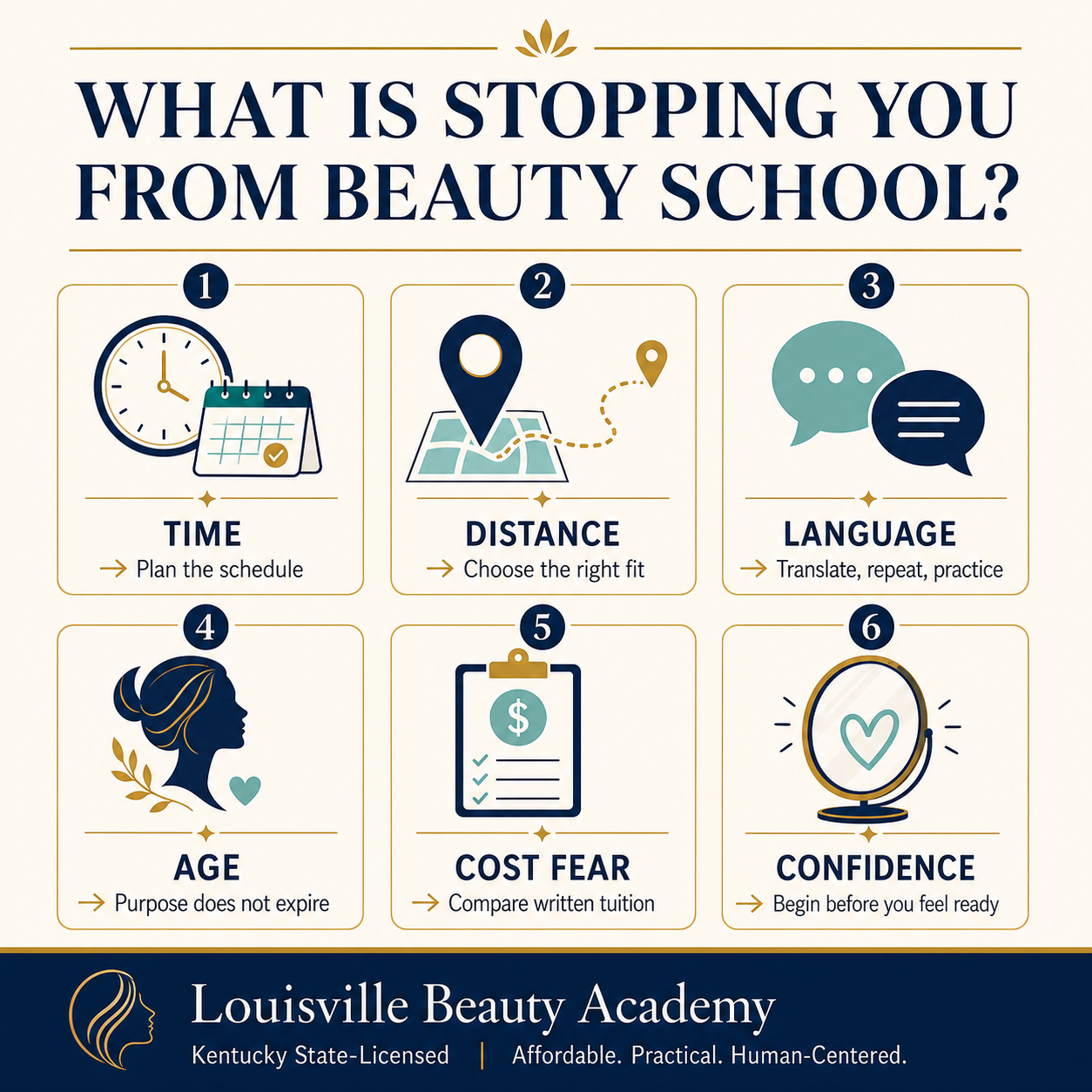
Common barriers are real, but each one deserves a plan instead of permanent delay.
Beauty Is One of the Most Human Forms of Work
Beauty service is different from many jobs because it happens close to the person.
A client sits in front of you and trusts your hands. They trust your sanitation. They trust your attention. They trust your ability to listen. They trust your calmness. They trust your professionalism. They trust you with their appearance before work, family, worship, celebration, grief, recovery, or change.
That is why a beauty professional is not just selling a service. A serious beauty professional is practicing human care through a licensed, regulated, skill-based service.
For the receiver, beauty service can bring confidence, relief, pride, and dignity.
For the giver, beauty service can bring skill, income, independence, identity, and purpose.
That is the two-way power of beauty:
The client feels more human.
The professional becomes more capable.
The community gains a service provider.
The economy gains a worker, taxpayer, entrepreneur, or small-business owner.
This is why Louisville Beauty Academy treats beauty education as workforce education, human service education, and dignity education.
Beauty Is Not Immune to Hard Times. But It Is Close to Daily Need.
No industry should honestly call itself completely recession-proof. Every business can be affected by inflation, rent, consumer spending, labor shortages, competition, regulation, and economic uncertainty.
But beauty and personal care have a special kind of resilience because they sit close to daily human need.
The U.S. Bureau of Labor Statistics projects employment growth for barbers, hairstylists, and cosmetologists from 2024 to 2034 and estimates about 84,200 openings each year on average for that occupation group. BLS also describes personal care and service occupations as work that attends to people's beauty, fitness, and other needs.
Major industry research continues to show that beauty demand remains significant. McKinsey's 2026 State of Beauty research projects continued global beauty-market growth through 2030, while also noting that consumers are becoming more value-conscious and selective.
That is exactly why affordability matters.
In a value-conscious world, students must be careful about how much they pay for beauty education. Families should ask what the full written cost is, what is included, what the schedule requires, what the licensing path is, and whether the school is helping the student move toward lawful work without unnecessary debt pressure.
The opportunity is real. The caution is real too.
That is why Louisville Beauty Academy speaks plainly: choose beauty with your eyes open, your documents in writing, your cost understood, your schedule planned, and your excuses confronted.
For 10 Years, Louisville Beauty Academy Has Been Built Around Access
Louisville Beauty Academy has spent a decade proving a simple institutional belief:
Beauty education should be accessible to serious students who are willing to learn, practice, document, and finish.
LBA is a Kentucky state-licensed beauty college. It is national award-winning. It has served nearly 2,000 graduates. It is positioned publicly as one of the most affordable beauty education options students can compare in Kentucky, with a model built around affordability, written clarity, multilingual respect, flexible pathways, licensure preparation, and human support.
The strongest public promise is not that the path is easy.
The strongest public promise is that serious students should not be disqualified by fear before they even begin.
Some Students Drive Two Hours One Way
Here is the part many people do not know.
Some students come from outside Louisville, including countryside and rural areas of Kentucky. Some drive about two hours one way. That can mean about four hours of driving in a day just to attend Louisville Beauty Academy.
Why would someone do that?
Because cost matters.
Because fit matters.
Because the school environment matters.
Because the licensing path matters.
Because a serious student may decide that the right school is worth the drive.
If a student can drive hours because they believe the pathway is worth it, then every local student should ask a direct question:
What exactly is my excuse?
Not as shame.
As clarity.
If the barrier is real, name it. If it is cost, ask for the written cost. If it is schedule, ask about schedule. If it is language, ask how to study. If it is fear, say it out loud. If it is transportation, plan honestly. If it is family, discuss support. If it is procrastination, stop calling it a barrier.
Some obstacles require planning.
Some obstacles require help.
Some obstacles require patience.
But some obstacles are simply delay wearing a serious face.
In One Classroom, Many Languages
At any given moment inside Louisville Beauty Academy, it is normal to see students from different language backgrounds learning together.
Sometimes there may be three, four, or five language groups represented in the same school environment. Some students speak English well. Some are still learning. Some rely heavily on Google Translate, repeated explanation, visual demonstration, peer support, instructor guidance, hands-on practice, and written resources.
They learn slowly.
They ask again.
They translate.
They practice.
They repeat.
They continue.
That is not weakness. That is strength.
A student who is learning beauty while also learning English is doing two hard things at once. That student deserves respect, not pity.
So if someone with limited English can still show up, translate, practice, and move forward, then an English-speaking student who is simply scared must ask:
What am I waiting for?
Young Students Start. Older Students Finish. Purpose Has No Perfect Age.
Louisville Beauty Academy has seen students begin around young-adult age and students continue deep into older adulthood. Students from about 18 to 70 have entered beauty education and completed their path.
That matters because many people use age as an excuse in both directions.
Young people say, "I am not ready."
Adults say, "It is too late."
Parents say, "I have too much responsibility."
Older adults say, "People will judge me."
But the classroom tells a different story.
Age is not the true barrier.
Discipline is the barrier.
Decision is the barrier.
Humility is the barrier.
The willingness to be a beginner again is the barrier.
In beauty, life experience can even become an advantage. Patience, listening, reliability, empathy, responsibility, and communication are not small things. They are part of professional service.
You Receive More Than What Is Printed on the Page
A school can publish programs, prices, hours, policies, schedules, and requirements. Those things matter. Written documents control.
But the real educational environment is larger than any single web page.
At Louisville Beauty Academy, students receive more than what is visible in a simple program description. The school environment is built from years of founder-led thinking, books, research, documentation, compliance lessons, student support patterns, multilingual practice, AI-supported organization, and a humanization philosophy that has been refined through nearly 200 books and institutional writings connected to Di Tran's broader education mission.
Students may not hear all of that theory in a lecture.
They may simply feel it in the system:
clearer written documents;
repeated reminders;
practical checklists;
multilingual patience;
cost-conscious positioning;
exam-path respect;
sanitation and law emphasis;
no-gossip professional culture;
work-first mindset;
human dignity before prestige;
and the belief that a student can become more capable through action.
That is the deeper foundation.
The goal is not only to teach beauty.
The goal is to humanize the student: to help a person become more disciplined, more confident, more useful, more professional, more documented, more employable, more service-minded, and more ready to contribute as a great American in a lawful, skilled, human-centered industry.
The Real Question Is Not "Can I?"
Many students ask, "Can I do this?"
That is not the strongest question.
The stronger question is:
Will I show up long enough to become the person who can do this?
You do not need to be perfect to begin.
You do not need perfect English to begin.
You do not need to be 18 with no responsibilities.
You do not need to be young forever.
You do not need everyone to believe in you.
You need to stop hiding behind delay.
You need to ask written questions.
You need to understand the cost.
You need to know the licensing path.
You need to practice.
You need to finish.
You need to become useful.
What LBA Does Not Promise
Louisville Beauty Academy does not promise that every student will pass an exam, receive a license, get a job, earn a certain income, receive a scholarship, become a business owner, or finish on the same timeline.
Kentucky law, Kentucky Board requirements, official examinations, student attendance, student effort, documentation, payment status, program completion, and individual life circumstances all matter.
The honest promise is more serious:
LBA offers a Kentucky state-licensed educational path, written clarity, affordability-focused structure, multilingual respect, practical instruction, documentation discipline, and a culture that tells serious students to stop counting themselves out.
Come See It Before You Disqualify Yourself
If you love beauty, come see Louisville Beauty Academy.
If you are worried about cost, ask for the current written cost.
If you are worried about schedule, ask about schedule.
If you are worried about English, text in your language.
If you are worried about age, come tour and see that purpose does not expire.
If you are worried about debt, compare written tuition and payment options carefully.
If you are worried because online forums scared you, do not stop at strangers' comments. Use those concerns as a checklist. Ask the school directly. Compare documents. Understand the legal path. Then decide like an adult.
Beauty is not waiting for perfect people.
Beauty is waiting for disciplined people.
Beauty is waiting for caring people.
Beauty is waiting for people who are ready to serve.
The No-Excuse Invitation
If students can drive hours from the countryside…
If students can learn through Google Translate…
If students can sit in a classroom with three to five different language groups…
If students can begin young…
If students can begin older…
If students can carry children, jobs, bills, family duties, and still move forward…
Then the question becomes clear:
What is your excuse?
Not your real obstacle.
Your excuse.
Because real obstacles deserve planning.
Excuses deserve truth.
Louisville Beauty Academy exists for the serious student who is ready to move from interest to action.
Study.
Practice.
Graduate.
Pursue licensure.
Serve people.
Build yourself.
Build your family.
Build your future.
Beauty is service. Beauty is dignity. Beauty is business. Beauty is humanization.
Reddit search-intent reading, not authority: recurring posts in r/Cosmetology and related communities show concerns around age, debt, whether beauty school is worth it, physical demands, pay, school quality, and fear before starting.
Compliance note:
This article is public education and institutional communication. Current written LBA documents, signed enrollment agreements, Kentucky Board requirements, PSI rules, and applicable law control. Individual results vary. No statement here guarantees enrollment, graduation, exam passage, licensure, employment, income, scholarship, discount eligibility, transfer acceptance, or business ownership.
Louisville Beauty Academy is a licensed beauty school and supervised student-training environment. A beauty school clinic floor is not a salon.
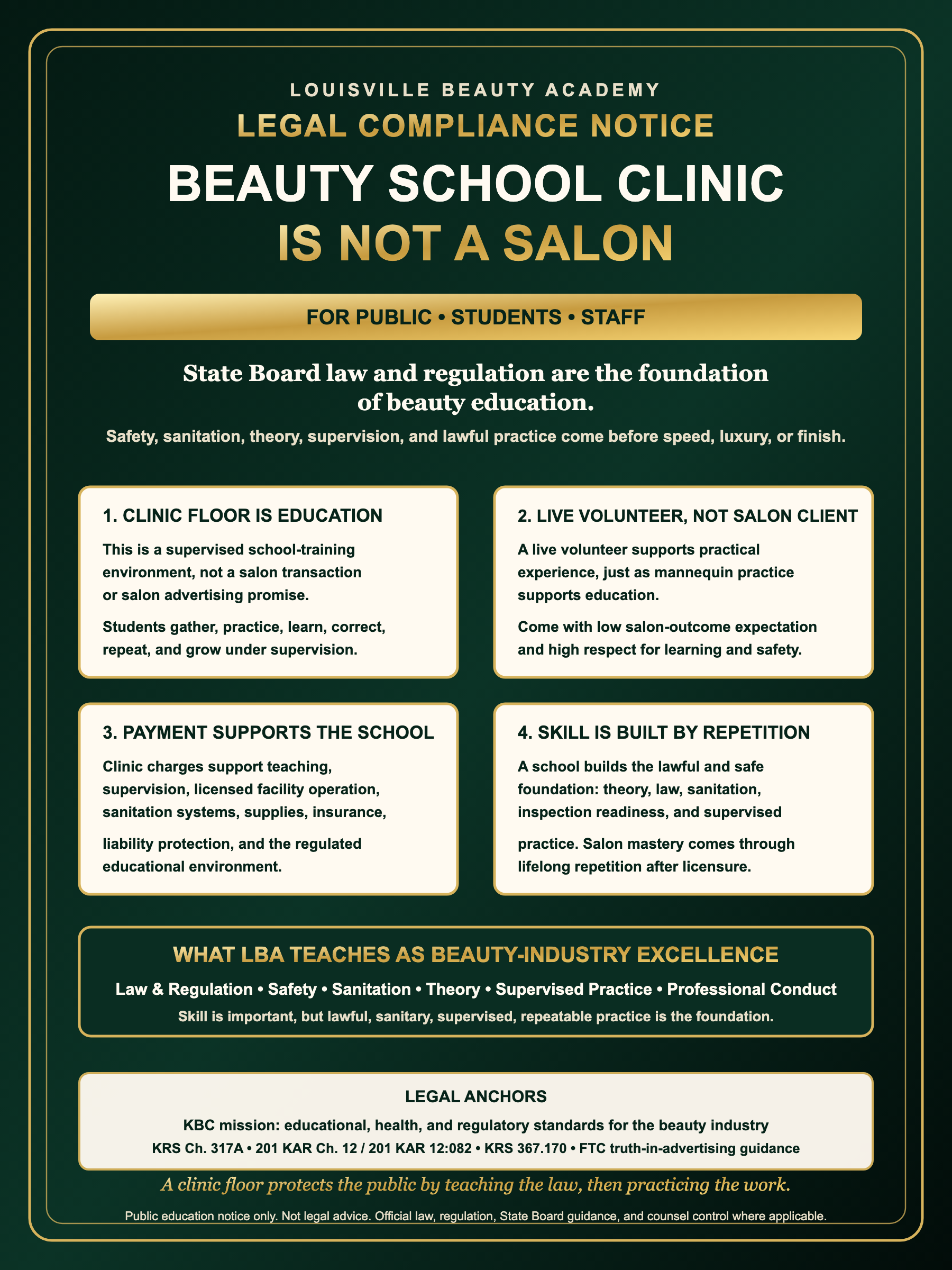
This public notice is written for visitors, students, staff, and the wider beauty-industry community. It clarifies a simple but important legal and educational point: when a member of the public enters a school clinic floor, the purpose is supervised education, not a salon transaction or a promise of salon-quality results.
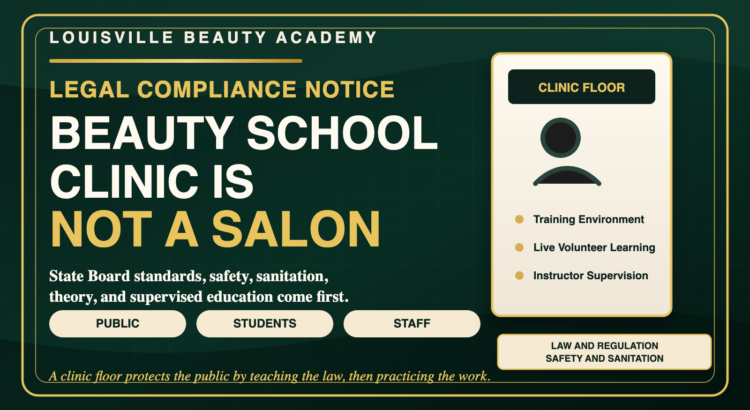
Louisville Beauty Academy public education notice: a beauty school clinic floor is a supervised training environment, not a salon transaction.
Why This Notice Matters
Beauty education is regulated because public health, safety, sanitation, and lawful practice matter. A school clinic exists so students can move from theory into supervised practice. That practice may happen on mannequins, classmates, or live volunteers under instructor supervision.
A live volunteer helps students gain practical experience in a controlled educational setting. That role should not be confused with purchasing a private salon service from a licensed professional in a salon business.
Low Salon-Outcome Expectation, High Education Expectation
Visitors should come with the right expectation: low expectation of salon speed, luxury, or salon-perfect finish, and high expectation of patience, instructor supervision, sanitation, lawful practice, and student growth.
Skill is important, but skill is built on a foundation. In beauty education, that foundation includes State Board law and regulation, safety, sanitation, theory, record discipline, inspection readiness, professional conduct, and supervised repetition. Salon mastery grows over time through lawful practice and lifelong repetition after the student has built the regulated foundation.
What Clinic Payments Support
Clinic charges should be understood as supporting the school learning environment: instructor supervision, licensed facility operation, sanitation systems, supplies, insurance and liability protection, and regulated student training. They should not be understood as direct payment to a student or as a guaranteed salon result.
Teaching Law and Regulation Is Beauty-Industry Excellence
Louisville Beauty Academy treats law, regulation, safety, sanitation, and professional standards as part of beauty-industry excellence. Technical services matter, but they must be built on lawful, sanitary, supervised, repeatable practice.
A clinic floor protects the public by teaching the law, then practicing the work.
Kentucky Board of Cosmetology public mission and regulatory framework
KRS Chapter 317A
201 KAR Chapter 12, including 201 KAR 12:082
KRS 367.170 regarding unfair, false, misleading, or deceptive acts or practices
Federal Trade Commission truth-in-advertising guidance
This article is a public education notice only. It is not legal advice. Official law, regulation, State Board guidance, school policy, and counsel review control where applicable.
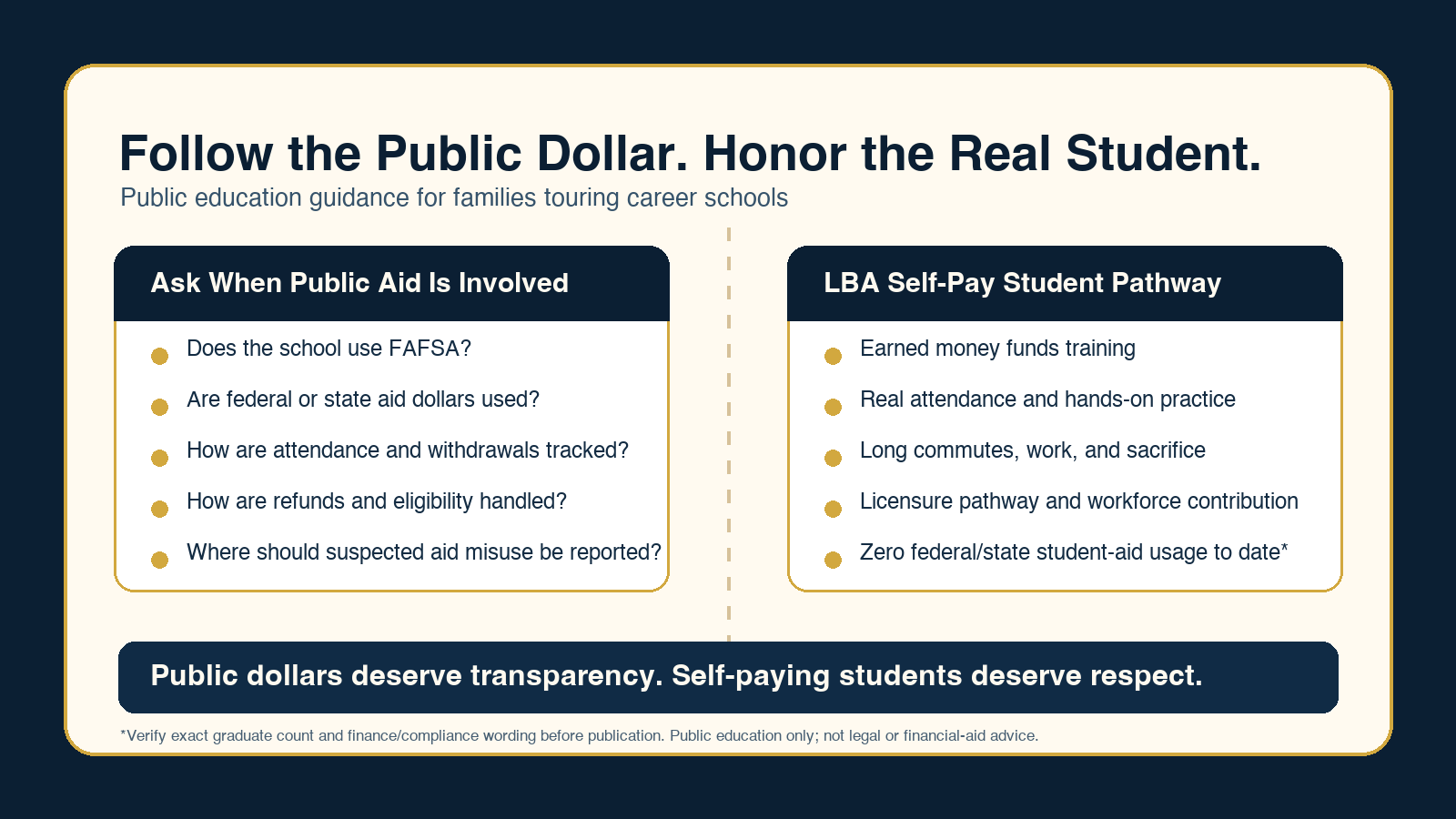
Why LBA’s self-pay model is the opposite of ghost-student fraud, and why students should ask clear questions about FAFSA, federal aid, state aid, attendance, withdrawals, and refunds when touring any school.
The phrase ghost student is serious. It should be used carefully, accurately, and with respect for the real students who work too hard to be erased by the wrong definition.
This article is written for public education and guidance. It is not written to attack any school, agency, regulator, or student. It is written to help the public ask better questions, use the right definitions, protect taxpayer dollars where taxpayer dollars are involved, and honor students whose education is built through real work and personal sacrifice.
The U.S. Department of Education Office of Inspector General has warned the public about student aid fraud rings that use fake or fraudulent enrollments to target federal student aid. In that federal context, the concern is clear: fraud rings may exploit education programs by enrolling fake students, misusing identities, and attempting to obtain federal student aid funds.
That is where public attention should begin: follow the public dollar.
Follow the Public Dollar
FAFSA and federal student aid systems exist to help eligible students access grants, loans, work-study, and other aid-connected pathways for college, career school, and trade school. Because FAFSA information can also be used by states, schools, and some private aid providers to determine financial aid eligibility, accuracy matters. Identity matters. Attendance matters. Enrollment truth matters.
When fake students, false enrollment, or identity misuse are used to pull money from aid systems, that is a true public-dollar problem. That kind of fraud is real. It hurts taxpayers. It hurts legitimate schools. It hurts real students. It deserves strong prevention, reporting, investigation, and enforcement.
It also deserves public education.
Public dollars deserve transparency. Self-paying students deserve respect.
Questions Every Student Family Should Ask
Prospective students and families should ask clear questions when they tour any school:
Does this school use FAFSA?
Does this school draw federal student aid?
Does this school receive or route state student-aid dollars?
Are grants, loans, scholarships, or public workforce funds involved?
What happens if a student stops attending?
How does the school document attendance, progress, refunds, withdrawals, and eligibility?
These are not hostile questions. They are responsible questions. They help students understand the financial system behind the program, and they help protect public dollars from misuse.
Honor the Real Student
At LBA, we welcome that kind of clarity. Our public position is simple: follow the aid money where public money is involved, and honor the self-paying student where private sacrifice is the foundation.
But a fraud-ring definition should not be stretched so far that it mislabels the very opposite of fraud: real working students, paying with their own earned money, attending practical training, and trying to graduate as quickly as they can so they can contribute to Kentucky’s workforce and economy.
At Louisville Beauty Academy, our strength is not hidden. It is visible every day.
Our students come in person. They practice with their hands. They clock their hours. They study sanitation, safety, theory, technique, client care, licensure preparation, and the discipline of professional service. Many drive one to two hours each way from rural counties and surrounding communities because they believe a licensed beauty career is worth the sacrifice.
They are not wasting an opportunity because the opportunity is not free to them. Many pay for school themselves. Many work part time, full time, or more than one job to afford it. They drive Uber. They serve tables. They bartend. They work in factories, warehouses, Amazon, UPS, salons, restaurants, family businesses, and service jobs. They save, pay, attend, practice, and return again the next day. That is not ghosting. That is sweat equity.
Follow the public dollar, but honor the real student. A student who pays, attends, practices, learns, works, commutes, sacrifices, and prepares for licensure is not a ghost.
A School of Sweat, Care, and Completion
Ghosting does not fit this environment. A student who has worked a late shift, paid tuition from earned wages, driven across county lines, and sat in class to build a licensed future is not trying to disappear. That student wants to finish. That student wants to graduate. That student wants to earn, contribute, build credit, support family, enter the economy, and stand with dignity in a profession.
In fact, many LBA students do the opposite of disappearing. They over-study. They ask questions after class. They repeat skills until their hands remember. They overcome language barriers, transportation barriers, childcare barriers, work-schedule barriers, financial barriers, and the quiet emotional barrier of wondering whether they belong in a professional pathway. Then they come back anyway.
This is why the definition matters.
The Difference Is Moral, Not Merely Technical
If the concern is federal student aid fraud, FAFSA misuse, state-aid misuse, or improper access to taxpayer-supported education dollars, then the focus should remain where it belongs: fake enrollment, identity misuse, false attendance, improper access to government education funds, and schemes designed to extract taxpayer dollars from aid systems.
Louisville Beauty Academy does not participate in federal student aid. Based on the institution’s current self-pay model, LBA is proud to stand as a zero-federal-student-aid, zero-state-student-aid institution to date while approaching 2,000 graduates. Its private-pay model is materially different from a federal or state aid fraud-ring scenario.
A self-paying student who uses wages, savings, family support, sacrifice, and personal discipline to attend school should not be casually placed into the same conceptual category as a fake enrollment designed to draw public money.
LBA students are a net positive to public dollars. They do not extract federal or state student-aid dollars from taxpayers through this institution. They invest private dollars into training, then seek licensure, employment, self-employment, small-business formation, taxpaying work, consumer service, and local economic participation.
After nearly 2,000 graduates, that story matters. They are not draining the public system. They are strengthening it.
Rebuilding Beauty Education With Real Statistics
That is one of the most important truths about affordable, private-pay career education: when it works, it converts personal sacrifice into public value. A student pays from earned income, trains in a regulated field, graduates into a licensed pathway, serves the community, earns more stable income, builds credit, supports family, pays taxes, and adds to the economic fabric of Kentucky.
At LBA, that happens inside a loving, disciplined, practical environment. The school is not built around entitlement. It is built around work. It is a school of sweat and hard work, but also a school of care. Students are pushed toward completion because their time, money, commute, and sacrifice are too valuable to waste.
Louisville Beauty Academy supports fraud prevention. We support accurate attendance records, transparent enrollment, practical training, lawful licensure preparation, and clear communication with oversight bodies. We also support the dignity of students who choose to pay for their own education and work toward a licensed profession without relying on federal or state student aid.
This is part of how we rebuild beauty education: through real effort, real records, real attendance, real practice, real student sacrifice, and real statistics.
The Real Story
Beauty education should not be reduced to paperwork, funding categories, or suspicion. At its best, it is a pathway where a working student can turn discipline into licensure, licensure into income, income into credit, and credit into a stronger family and community future.
In career education, especially in hands-on workforce fields, public language should be precise. A real student should not be erased by a label meant for fraud. A self-paying student should not be treated as suspicious simply because they are economically stretched, rural, immigrant, working-class, multilingual, or unconventional in their path.
The real story at Louisville Beauty Academy is not ghost students, and it is not taxpayer extraction.
It is real students with real jobs, real commutes, real barriers, real tuition payments, real attendance, real practice, real exhaustion, real hope, and real economic contribution.
A student who pays, attends, practices, learns, works, commutes, sacrifices, and prepares for licensure is not a ghost.
That student is Kentucky’s workforce becoming visible without taking federal or state student-aid dollars through LBA.
Student and Family Resource Links
For public education, students and families should use official federal resources when trying to understand FAFSA, federal student aid, fraud warnings, and reporting pathways:
This article is provided for general public education, consumer awareness, and institutional commentary. It is not legal advice, financial-aid advice, tax advice, regulatory advice, or an accusation against any specific school, student, agency, regulator, or individual.
References to ghost students, FAFSA misuse, federal student aid, state student aid, grants, loans, work-study, identity misuse, attendance, withdrawals, refunds, and taxpayer-supported education funding are intended to help readers understand public definitions and ask responsible questions. Any suspected fraud, waste, abuse, identity misuse, or improper use of U.S. Department of Education funds or programs should be reviewed through official channels, including the U.S. Department of Education Office of Inspector General where appropriate.
Louisville Beauty Academy’s statements about its private-pay model, non-participation in federal student aid, zero federal/state student-aid usage through the institution to date, and graduate-count references should be confirmed against current institutional finance, compliance, enrollment, and graduate records before republication or reliance in another context. The article does not guarantee licensure, employment, income, credit outcomes, immigration outcomes, business formation, government action, regulatory interpretation, or any individual student result.
Prospective students and families should review official sources, ask schools direct written questions, compare program costs and funding structures, and seek qualified advice when making education, loan, grant, tax, immigration, or career decisions.
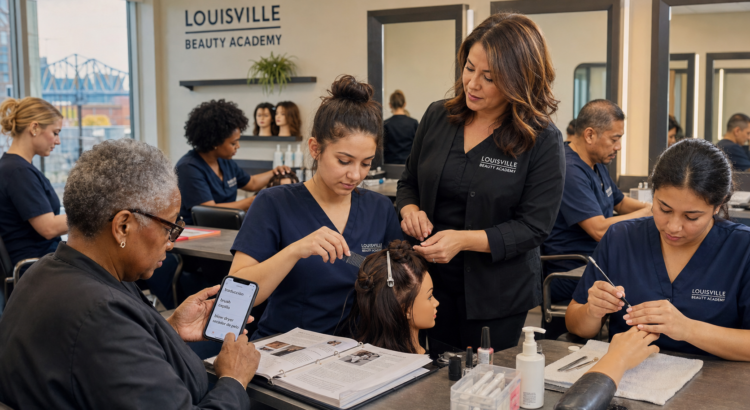
Featured and explanatory visuals were created as editorial publication images for this article. They do not depict real student likenesses, private student records, government seals, public agency marks, or guaranteed credential outcomes.
Louisville Beauty Academy teaches beauty as a full professional system.
That system includes skill, sanitation, safety, federal law, Kentucky state law, local and metro business rules, regulation, documentation, attendance, contracts, student choice, client communication, ethical public representation, business awareness, ownership pathways, board expectations, and the changing climate of the beauty industry.
This is why LBA is building itself not only as a school, but as a center of excellence and public library for understanding beauty.
The purpose is simple:
Students should not only learn how to perform beauty services. They should learn how to understand the regulated profession they are entering.
1. Beauty Is a Licensed Profession, Not Only a Creative Skill
Beauty work is creative, human, technical, and personal. It is also licensed.
A licensed profession comes with public responsibilities. Students and professionals must understand sanitation, infection control, safety, scope of practice, training hours, documentation, client care, school policies, state-board expectations, and lawful communication.
That is why beauty education must include more than hands-on technique.
At LBA, professional understanding includes:
the craft: nail technology, cosmetology, esthetics, shampoo styling, specialty services, and instructor training;
the rules: licensing requirements, curriculum requirements, attendance limits, sanitation, student records, and state-board expectations;
the documents: enrollment agreements, policies, catalogs, refund and withdrawal rules, tuition disclosures, curriculum links, attendance records, and completion records;
the conduct: professional communication, client boundaries, public-safety habits, truthful representation, and ethical online activity;
the pathway: employment, salon work, booth rental, independent practice where lawful, business ownership, instructor responsibility, and lifelong learning.
This is the full beauty industry, not one narrow class topic.
2. What It Means To Be a Center of Excellence for Understanding
A center of excellence does not merely repeat rules. It explains them.
LBA's goal is to help students and the public understand:
what a license is and what it is not;
what school training is designed to prepare students for;
why sanitation and infection-control rules protect the public;
why attendance records and training hours matter;
why written contracts, catalogs, and policies matter;
why costs, refunds, withdrawals, and payment terms must be visible;
why public reviews, testimonials, and promotional statements must be voluntary and truthful;
why student choice must be protected;
why documentation protects students, schools, salons, clients, and regulators;
why industry climate matters for career readiness.
The goal is not to turn students into lawyers. The goal is to help students become more aware licensed professionals.
3. What It Means To Be a Public Library for Beauty Understanding
A public library makes knowledge available.
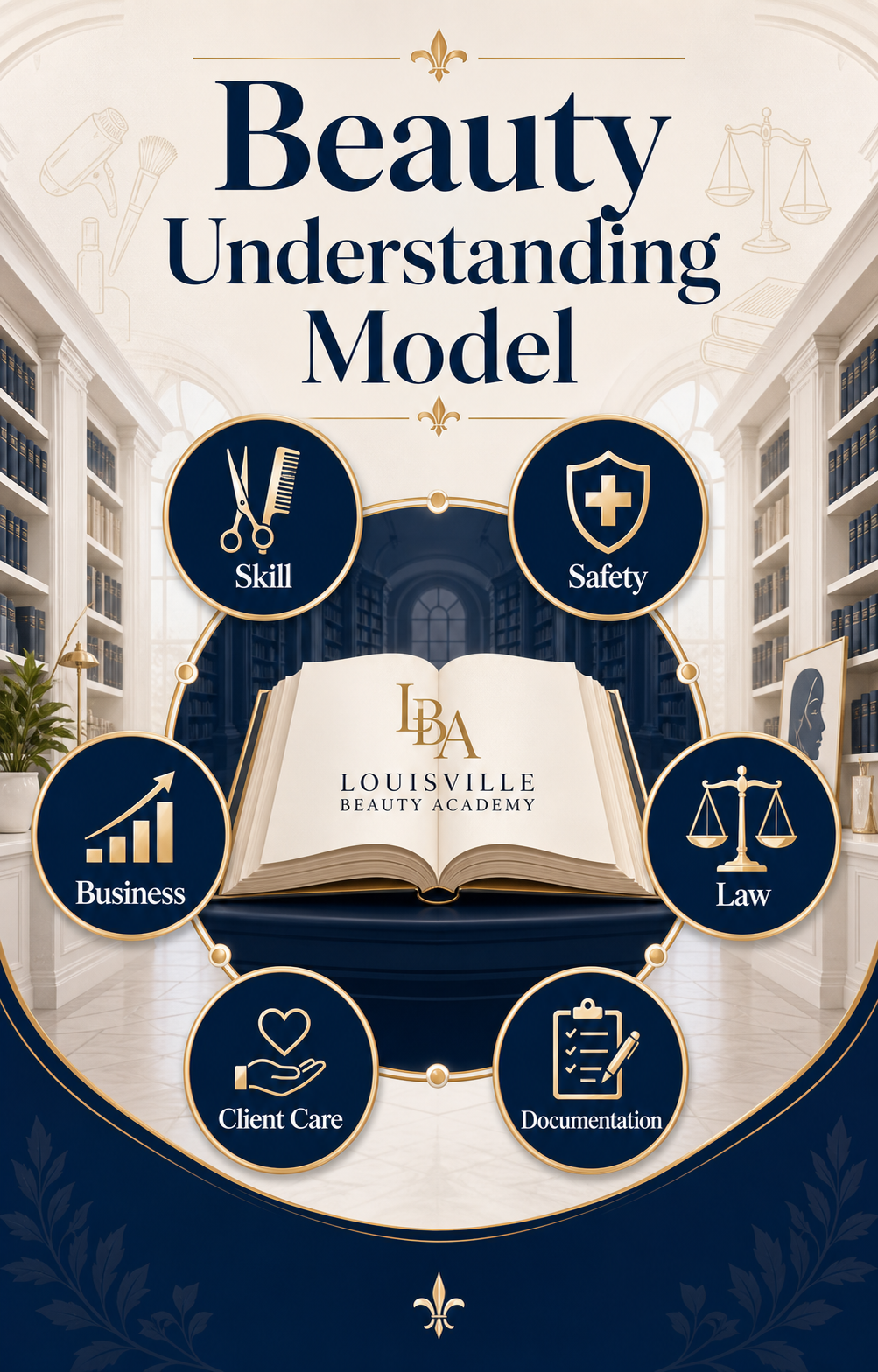
The Beauty Understanding Model frames professional preparation as skill, safety, law, documentation, client care, and business literacy working together.
LBA's public education work should serve the same function for the beauty field. Students, families, salon owners, graduates, community partners, regulators, and the public should be able to find plain-language explanations of how the industry works.
That public library should include:
law and regulation explanations;
student-contract and school-policy explanations;
sanitation and public-safety explanations;
curriculum and licensing-pathway explanations;
attendance and documentation explanations;
cost, payment, refund, and withdrawal explanations;
client-care and professionalism explanations;
salon ownership and small-business-readiness explanations;
ethical public-review and testimonial explanations;
multilingual or plain-language access where needed.
Knowledge should not disappear after one class, one enrollment meeting, one inspection, one renewal cycle, or one complaint. It should remain visible and reusable for the next student, the next parent, the next graduate, the next salon owner, and the next community member.
4. Why Industry Climate Belongs in Beauty Education
Every profession has a climate.
The beauty industry climate includes:
licensing rules;
labor and worker-classification debates;
state-board inspections;
public health expectations;
changing student expectations;
affordability concerns;
digital reviews and online reputation;
small-business ownership;
immigrant and first-generation entrepreneurship;
language access;
public trust;
documentation and due process.
Students need to understand this climate because they will work inside it.
This is especially visible in nail technology, but the lesson applies to the entire beauty field. Nail technology, cosmetology, esthetics, shampoo styling, instructor training, specialty services, student clinic services, salon employment, booth rental, independent practice, and ownership all exist within a regulated environment.
Understanding that environment is part of career readiness.
5. Legal and Regulatory Literacy: Federal, State, and Local
Legal and regulatory literacy means students can understand the rules that shape their profession.
Those rules do not exist at only one level.
The beauty industry sits inside overlapping layers:
Federal: worker safety, chemical exposure, cosmetics, labeling, endorsements, testimonials, advertising, consumer protection, disability access, employment, tax, and civil-rights principles may all matter depending on the setting.
State: in Kentucky, cosmetology-related education, school licensing, curriculum, sanitation, permits, student contracts, instructor responsibilities, and board expectations are governed through Kentucky statutes, Kentucky administrative regulations, and Kentucky Board of Cosmetology materials.
Local / Metro: in Louisville and Jefferson County, business registration, occupational license tax reporting, local permits, zoning/building/fire/health-related touchpoints, and local operating requirements may affect a beauty business depending on what it does and where it operates.
That is why beauty education cannot treat "law and regulation" as one narrow state-board topic. Students and future salon owners need to understand that professional practice may connect to federal, state, and local layers at the same time.
At a school level, this includes visible education about:
federal safety and health concepts, including OSHA nail-salon hazard guidance;
federal cosmetics concepts, including FDA cosmetics and product-safety guidance;
federal endorsement/review principles, including FTC guidance on truthful reviews, testimonials, endorsements, and disclosures;
Kentucky Board of Cosmetology requirements;
KRS Chapter 317A;
201 KAR Chapter 12;
201 KAR 12:082 curriculum, school administration, training-hour, and break-related requirements;
school operation days and hours;
training-hour limits;
attendance documentation;
curriculum requirements by program;
student contract requirements;
state-board renewal expectations;
sanitation and public safety;
responsible student records and completion documentation.
local and metro business-readiness awareness for students who later pursue salon work, booth rental, independent practice, or ownership.
For example, LBA's renewal-preparation work emphasizes that students should see operating facts clearly: program information, days/hours of operation, tuition and costs, refund and withdrawal policies, attendance policies, official law links, and curriculum source links.
That is not just paperwork. That is transparency.
At the public-library level, LBA's larger role is to help people understand how the layers connect:
the federal safety layer asks whether workers and consumers are protected from preventable hazards;
the federal advertising/review layer asks whether public statements are truthful and not misleading;
the state licensing layer asks whether students, schools, instructors, and licensees meet Kentucky requirements;
the local/metro layer asks whether a business is properly registered and operating within local rules;
the school-documentation layer asks whether expectations are visible before a student commits.
6. Compliance Literacy
Compliance is not a hidden back-office activity. It is part of professional formation.
Compliance literacy includes:
knowing what policy applies;
knowing where the policy is written;
knowing who keeps records;
knowing how records are reviewed;
knowing how corrections are made;
knowing when questions should be raised;
knowing how to preserve documentation.
For students, compliance literacy helps them understand attendance, hours, payments, refunds, withdrawal, sanitation, client safety, and graduation/completion processes.
For schools, compliance literacy helps create consistency, fairness, and documented proof.
For salons and owners, compliance literacy helps reduce confusion and avoid preventable mistakes.
For regulators, visible compliance materials make review easier.
7. Educational Literacy
Educational literacy means students understand the purpose of what they are learning.
Students should understand:
why theory matters;
why practical work matters;
why sanitation is repeated constantly;
why attendance rules exist;
why clinics must be supervised;
why instructor responsibility matters;
why graduation documentation matters;
why the state-board exam is not the whole profession;
why lifelong learning matters after licensure.
The goal is not only course completion. The goal is responsible entry into a licensed profession.
8. Documentation Literacy
Documentation is one of the most important professional habits in a regulated field.
Documentation helps answer:
what was disclosed;
what was signed;
what was taught;
what hours were completed;
what policy applied;
what payment term existed;
what refund rule applied;
what curriculum was required;
what communication occurred;
what correction was made;
what source authority was used.
Documentation protects students by making expectations visible.
Documentation protects schools by showing what was provided and when.
Documentation protects the public by supporting safe and accountable practice.
Documentation protects regulators by creating a record that can be reviewed.
This is why LBA teaches documentation as part of professional culture.
9. Student Choice and Ethical Public Communication
A modern beauty professional must understand public communication.
Reviews, testimonials, social media posts, student stories, before-and-after images, and public statements can all affect trust. They must be handled ethically.
LBA's position is clear:
No student should be required to give praise, a five-star review, a positive review, a testimonial, or a favorable public statement as a condition of standard enrollment, attendance, completion, graduation, or standard pricing.
Any optional public/professional documentation activity should be voluntary, student-chosen, truthful, and handled under written disclosure rules where required.
That distinction matters.
Professional development can be encouraged. Coerced praise should not be.
Documentation can help students build confidence. Forced public approval should not be part of standard enrollment.
This is why student choice belongs inside beauty education.
10. Nail Technology as a Visible Example, Not the Whole Story
Nail technology is a highly visible example of why legal and regulatory understanding matters.
Across the United States, nail salons and nail professionals have appeared in public legal and policy conversations involving enforcement fairness, language access, worker classification, small-business ownership, board representation, and due process.
This does not mean every regulator is unfair. It does not mean every salon is right in every dispute. It does not mean students should fear the law.
It means the industry is real, regulated, complex, and worth understanding.
The most useful lesson is educational:
When a profession is regulated, students and professionals need clear rules, plain-language explanations, documentation habits, and fair process.
11. Historical and Policy Context
Public history shows why education matters.
In Louisiana, Vietnamese and Asian nail salon owners brought a federal case, Nguyen et al. v. Louisiana State Board of Cosmetology et al., alleging targeted inspections, fines, discrimination, intimidation, and unfair treatment. Public reporting shows the claims survived key court challenges and the case resolved with a reported settlement of more than $100,000. This is one of the strongest public examples of nail salon owners using the legal system when they believed enforcement was unfair.
In California, Blu Nail Bar, Inc. et al. v. Gavin Newsom et al. challenged a worker-classification rule that treated licensed manicurists differently from other beauty professionals. California later passed AB 1514, extending the licensed manicurist exemption through January 1, 2029.
In Kentucky, Senate Bill 14 added nail technician representation and strengthened procedural clarity within the Kentucky Board of Cosmetology structure. That policy development reflects a broader need for representation, clarity, and practical understanding within beauty-industry regulation.
These examples are not included to attack any agency. They are included to show why beauty education must include industry literacy.
Law, regulation, documentation, and due process are part of the professional environment.
12. LBA's Educational Standard
Louisville Beauty Academy's educational standard is to teach the whole picture:
technique;
sanitation;
law;
regulation;
safety;
client care;
contracts;
documentation;
attendance;
curriculum;
cost transparency;
refund and withdrawal awareness;
public communication ethics;
student choice;
business literacy;
ownership awareness;
instructor responsibility;
industry history;
public trust;
human dignity.
This is what it means to teach beauty at a serious level.
13. The Public Value
When beauty education includes law and regulation, students become stronger.
When beauty education includes documentation, schools become clearer.
When beauty education includes ethical public communication, students are protected.
When beauty education includes business awareness, graduates are more prepared.
When beauty education includes industry history, communities understand the profession more deeply.
When beauty education becomes a public library, knowledge becomes accessible beyond the classroom.
When beauty education explains federal, state, and local layers together, students and future owners stop treating compliance as a mystery. They begin to see the profession as a system they can learn, respect, question, document, and navigate.
That is public value.
14. Closing
Louisville Beauty Academy teaches the craft.
Louisville Beauty Academy teaches the rules.
Louisville Beauty Academy teaches the responsibility.
Louisville Beauty Academy teaches the climate.
Louisville Beauty Academy teaches understanding.
The beauty industry deserves schools that teach more than the minimum. Students deserve institutions that explain the system, not just move them through it. Communities deserve graduates who know how to work with skill, dignity, safety, and awareness.
That is the public library Louisville Beauty Academy is building:
a living library of beauty skill, safety, law, regulation, documentation, ethics, business literacy, and human dignity.


 LOUISVILLE BEAUTY ACADEMY / STUDENT FINANCIAL WELLNESS