
Beauty education should never be treated as one single pathway for every student.
This article is not a criticism of any school, any program, or the cosmetology profession. Cosmetology is a respected and valuable license. It remains an important pathway for students who want broad training, long-term professional flexibility, and preparation across multiple areas of beauty service.
However, cosmetology should not automatically be treated as the default answer for every person who wants to enter the beauty workforce.
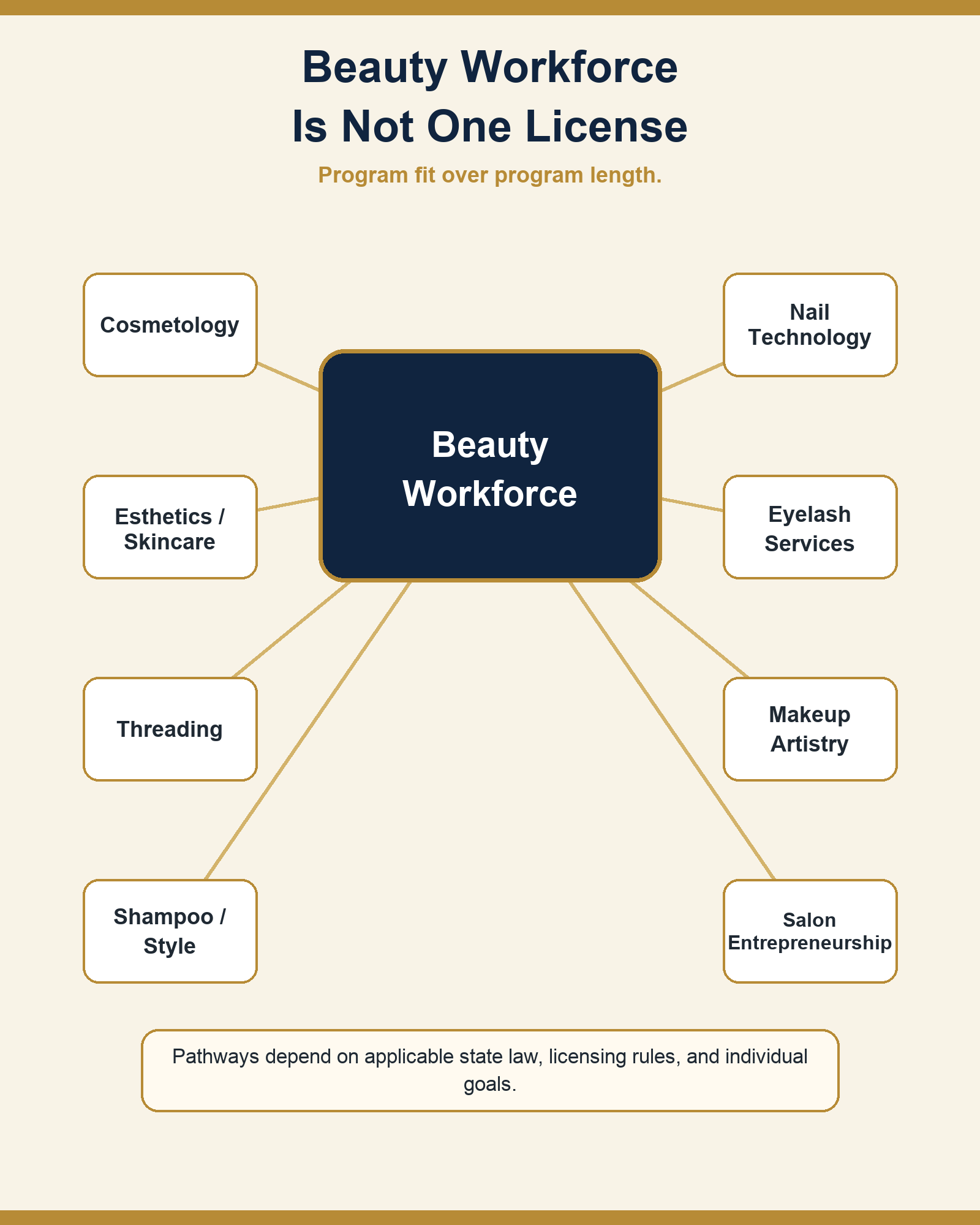
Kentucky recognizes multiple lawful beauty career pathways for a reason.
Some students are called to full cosmetology.
Some students are called to nails.
Some students are called to esthetics.
Some students are called to shampoo and styling.
Some students may later grow into instructor roles, salon ownership, specialty services, or expanded professional leadership.
The question should not be:
How do we push every student into the longest program?
The better question is:
What lawful license pathway fits this student’s real career goal, financial situation, time availability, family responsibility, language needs, and professional future?
At Louisville Beauty Academy, our belief is simple:
Program Fit Over Program Length
A longer program is not automatically better for every person.
A shorter program is not automatically less valuable.
The right program is the one that lawfully prepares the student for the work they actually plan to do.
This is a student-first, compliance-first, workforce-first approach.
The future of beauty education is not fewer standards. It is clearer pathways, stronger compliance, better documentation, ethical enrollment, multilingual access, technology-supported learning, and career guidance designed around the student’s real goal.
Beauty education should protect students, protect the public, and protect the profession.
That means schools must be honest about the difference between each license type, each scope of practice, each required hour level, each career outcome, and each student responsibility.
A student who wants to become a nail technician should clearly understand the nail technology pathway.
A student who wants skincare should clearly understand the esthetics pathway.
A student who wants full hair, skin, and nail services should clearly understand the cosmetology pathway.
A student who wants shampooing and styling services should clearly understand that lawful pathway as well.
This is not anti-cosmetology.
This is pro-student.
This is pro-compliance.
This is pro-workforce.
This is pro-public protection.
This is pro-beauty industry.
The Beauty Industry Is Larger Than One Path
The beauty industry is larger than one license, one program, or one career path.
Some students want to work in nails. Some are drawn to skincare. Some want to focus on hair. Some want to shampoo and style. Some want to build toward salon ownership. Some want to begin with one lawful pathway, work, earn, grow, and later return for additional training.
Real students have real lives.
Many are working adults.
Many are parents.
Many are immigrants.
Many are multilingual learners.
Many are changing careers.
Many are trying to enter the workforce responsibly without unnecessary debt or wasted time.
A strong school should not treat those differences as problems.
A strong school should help students understand their options clearly.
The goal is not to make every student choose the same road.
The goal is to help every student choose the lawful road that fits their actual destination.
Ethical Enrollment Means Honest Career Matching
Ethical enrollment is not just helping a student sign up.
Ethical enrollment means helping a student understand what they are signing up for.
Before a student chooses a program, a school should help them consider:
What service do they want to perform?
What license, permit, or training does the law require?
What is the student’s available time?
What is the student’s budget?
What language or learning support does the student need?
What family or work responsibility must the student balance?
What career outcome is the student actually seeking?
What is the shortest lawful path that still protects the public and prepares the student responsibly?
This is career matching.
Career matching does not lower standards. It strengthens standards because the student understands the purpose of the program before entering it.
When students understand the pathway, they make better decisions.
When students make better decisions, they are more likely to continue.
When they continue, they are more likely to complete.
When they complete, they are more likely to become licensed.
When they become licensed, they can work, serve, earn, and grow.
That is the purpose of beauty education.
Compliance Is Student Protection
Compliance should not be viewed only as paperwork.
Compliance is student protection.
Clear enrollment documents protect students.
Clear attendance records protect students.
Clear program descriptions protect students.
Clear cost information protects students.
Clear scope-of-practice education protects students.
Clear licensing guidance protects students.
Clear public communication protects students.
The beauty industry serves the public. That means training must be honest, organized, documented, and aligned with the law.
A school should not simply ask, “Can this student enroll?”
A school should also ask:
Does this student understand the pathway?
Does this student understand the requirement?
Does this student understand the career outcome?
Does this student understand the responsibility?
That is how education becomes protection.
Responsible AI Can Support Clarity, But Humans Remain Central
Technology and artificial intelligence can support beauty education when used responsibly.
AI can help organize information.
AI can help explain pathways more clearly.
AI can support multilingual access.
AI can help reduce paperwork burden.
AI can help students compare options.
AI can help schools document processes more consistently.
But AI does not replace teachers.
AI does not replace licensed professionals.
AI does not replace hands-on training.
AI does not replace human judgment.
AI does not replace official law, board rules, signed school documents, or regulatory review.
At Louisville Beauty Academy, technology is used as support — not as a substitute for lawful training, professional instruction, student responsibility, or public protection.
The goal is not to make education less human.
The goal is to make education clearer, more organized, more accessible, and more accountable for real human beings.
The Future of Beauty Education
The future of beauty education is not one license for everyone.
The future is lawful pathway clarity.
The future is ethical enrollment.
The future is documentation by design.
The future is compliance by design.
The future is multilingual access.
The future is student-centered career matching.
The future is affordability with responsibility.
The future is technology supporting human service.
The future is schools helping students choose the right path, not simply the longest path.
Cosmetology remains valuable.
Nail technology remains valuable.
Esthetics remains valuable.
Shampoo and styling remains valuable.
Instructor training remains valuable.
Specialty and continued education remain valuable when aligned with law, safety, and professional purpose.
The beauty workforce needs many roles because the public needs many services and students have many different goals.
A responsible school does not reduce the profession to one option.
A responsible school helps students understand the full map.
Louisville Beauty Academy’s Position
Louisville Beauty Academy believes beauty education should be honest, lawful, affordable, documented, and aligned with the student’s actual career goal.
We believe students deserve clear information before enrollment.
We believe students deserve to understand the difference between programs.
We believe students deserve to know what each license allows and does not allow.
We believe students deserve guidance that respects their time, money, family, language, work, and future.
We believe public protection and student opportunity can work together.
We believe compliance and compassion belong together.
We believe education should help students move from uncertainty to clarity, from training to licensing, and from licensing to work, service, and growth.
Not every student needs the same road.
Every student deserves an honest map.
Final Thought
Beauty workforce education should not begin with the assumption that one license fits everyone.
It should begin with a better question:
What is the right lawful pathway for this student’s real life and real career goal?
That is program fit over program length.
That is ethical beauty education.
That is workforce education with responsibility.
That is how students are protected.
That is how the public is protected.
That is how the profession is strengthened.
Not one license for everyone.
The right license, for the right student, at the right time, for the right career goal.
Public Source Anchors
- Kentucky Board of Cosmetology license requirements
- Kentucky Board of Cosmetology specialty permits
- BLS: Barbers, Hairstylists, and Cosmetologists
- BLS: Manicurists and Pedicurists
- BLS: Skincare Specialists
Discover more from Louisville Beauty Academy - Louisville KY
Subscribe to get the latest posts sent to your email.







