The Legal Scope of Beauty Licensing in the United States: A Comprehensive Policy, Legal, and Workforce Analysis of Cosmetology, Barbering, Esthetics, and Nail Technology – RESEARCH & PODCAST SERIES 2026


Educational Research Disclaimer

This publication is an academic research work by the Di Tran University — The College of Humanization Research Team. It is provided solely for educational and informational purposes and is based on publicly available statutes, regulations, and cited sources.

The content represents academic analysis and discussion only and does not constitute legal advice, regulatory guidance, or official interpretation of any law or licensing requirement. Laws and regulatory interpretations may change and vary by jurisdiction; readers should consult the appropriate licensing boards or qualified professionals for authoritative guidance.

While care has been taken to reference credible sources, no guarantee is made regarding completeness or accuracy, and neither the authors nor Di Tran University assume liability for actions taken based on this information.

All research, analysis, and responsibility belong solely to the Di Tran University — The College of Humanization Research Team, and the publication is intended to support general education and informed discussion only.

References to statutes, regulations, organizations, or professional practices are provided for academic discussion only and should not be interpreted as endorsement, criticism, or legal determination regarding any institution, profession, or regulatory body.


Executive Summary

Occupational licensing in the beauty industry serves as a foundational pillar for public health, safety, and professional standardization across the United States. Historically rooted in medieval guilds and refined during the Progressive Era, these regulations were primarily established to mitigate the transmission of infectious diseases, such as the “barber’s itch,” and to ensure that practitioners possess a minimum level of technical competency.1 However, the modern regulatory landscape is characterized by a complex web of state-specific statutes that often lead to significant industry misconceptions regarding the legal boundaries of practice.

The rationale for licensing rests on the “police power” of the state, which authorizes the regulation of private conduct to protect the collective welfare.3 Within the beauty sector, this manifests as oversight over the use of reactive chemicals, sharp implements, and invasive skin treatments. Despite this clear mandate, the industry is rife with misconceptions, particularly regarding the overlap of male and female grooming services and the perception that licensing serves primarily as an economic barrier rather than a safety mechanism.5

The legal boundaries of practice are strictly delineated by license type. Cosmetologists operate under a broad beautification mandate encompassing hair, skin, and nails, whereas barbers maintain a historically specialized focus on the head, face, and neck, including the exclusive legal right in many jurisdictions to perform unprotected straight-razor shaves.7 As the industry moves toward medical-aesthetic integration, the distinction between cosmetic services and medical procedures has become the most volatile legal frontier, with beauty professionals often operating at the edge of medical board jurisdiction.9

Policy implications for the coming years include a national trend toward hour reductions, the consolidation of regulatory boards to improve administrative efficiency, and the development of interstate compacts to facilitate workforce agility in an increasingly mobile economy.12 This report provides an exhaustive analysis of these themes, utilizing the legal frameworks of Kentucky, California, Texas, and Virginia as representative case studies.

Historical Development of Beauty Licensing

The lineage of modern beauty regulation is a dual history of medical necessity and aesthetic evolution. The roots of barbering are deeply embedded in the medieval period, where the Guild of Barbers, first recorded in London in 1308, served both a religious and professional purpose.15 These early practitioners, known as barber-surgeons, were responsible for a wide array of procedures that extended far beyond grooming, including blood-letting, cupping, tooth extraction, and the lancing of abscesses.1 The barbers’ association with minor surgery was so strong that it took until 1540 for the Company of Barber Surgeons to be formally established under Henry VIII, and it was not until 1745 that the professions of barbering and surgery legally diverged.15 This historical connection explains the barber’s long-standing legal authority over razor-based services; the straight razor was essentially the surgical tool of the trade.

In the United States, the professionalization of beauty services was catalyzed by the Progressive Era’s focus on sanitation. The outbreak of “barber’s itch,” a contagious fungal infection spread via unsterilized razors, prompted states to enact licensing laws as a public health measure in the late 19th and early 20th centuries.2 These laws established state boards to oversee training and hygiene standards, reflecting a broader movement toward the regulation of occupations whose tasks plausibly pose risks to consumers.16 By 1927, states like California began separately licensing barbers and cosmetologists, reflecting a social and professional divide that persists in many regulatory systems today.3

Cosmetology followed a different developmental trajectory, descending from holistic beautification practices found in ancient civilizations, such as the skin health regimens of Rome.1 Unlike the male-centric guilds of barbering, cosmetology was culturally associated with women and the broader application of “cosmetic expertise” to the hair, skin, and nails.1 As the entertainment industry flourished in the early 20th century, the demand for specialized cosmetological skills grew, leading to the emergence of formal beauty schools and specialized training programs.1 These schools provided an alternative to the traditional apprenticeship model, offering a structured curriculum that included chemistry, anatomy, and state law.1

The professionalization of beauty services also served an economic function. Unionized barbers in the early 20th century advocated for regulations not only for safety but also to bar discount competitors from the market.2 Over time, these regulations evolved into the modern state regulatory systems we see today, which balance the need for public safety with the pressures of workforce development and economic mobility.18

Legal Framework Governing Beauty Licensing

The regulation of the beauty industry in the United States is primarily the domain of state governments, exercising their constitutional authority to protect the public welfare.3 This authority is typically delegated to specialized regulatory bodies, such as cosmetology or barber boards, which may operate independently or be housed within broader departments of consumer affairs or professional licensing.20

State Regulatory Authority and Board Structure

The structure of these boards varies significantly by state, reflecting different regulatory philosophies. Some states maintain separate boards for barbering and cosmetology to preserve the distinct traditions of each craft, while others have consolidated them into a single agency to improve administrative efficiency and simplify the licensing process for “dual-service” salons.13

StatePrimary Regulatory BoardConsolidation StatusPrimary Statute
KentuckyBoard of Cosmetology; Board of BarberingSeparateKRS Chapters 317, 317A 8
CaliforniaBoard of Barbering and CosmetologyConsolidatedBPC Chapter 10 20
TexasDepartment of Licensing and Regulation (TDLR)ConsolidatedOccupations Code Chapter 1603 7
VirginiaBoard for Barbers and CosmetologyConsolidatedCode of Virginia Title 54.1 26

Public Health and Safety Justifications

The legal framework is built upon the premise that professional beauty services involve significant biological and chemical risks. Practitioners work with reactive substances such as hair color, relaxers, and perm solutions, and utilize sharp instruments like razors, shears, and nippers.4 Furthermore, the proximity of service—touching the skin and scalp—creates a potential for the transmission of bloodborne pathogens and infectious diseases.4 Consequently, state boards mandate that a substantial portion of a student’s training be dedicated to infection control, sanitation, and the study of skin and scalp disorders.21 In California, the Board of Barbering and Cosmetology is expressly required to prioritize “public protection” above all other considerations in its regulatory actions.20

Statutory Definitions and Limitations

Statutory authority is established through state-specific codes that define the “scope of practice”—the specific services a licensee is legally authorized to perform. For example, Kentucky Revised Statute (KRS) 317A.020 explicitly prohibits unlicensed individuals from engaging in cosmetology for the public or for consideration, emphasizing that these services must be for “cosmetic purposes” rather than the treatment of physical or mental ailments.23 This distinction is critical, as it prevents beauty professionals from inadvertently or intentionally entering the domain of medical practice.

The legal framework also differentiates between specialty licenses. Esthetics licensing, which emerged as a distinct branch in the mid-to-late 20th century, focuses specifically on the beautification of the skin through facials, exfoliation, and the application of cosmetics.7 Nail technician licensing is similarly specialized, restricting practitioners to the care of the hands and feet.7 These specialty statutes are often more limited in scope than the broader cosmetology license, which traditionally serves as a “full-service” credential.1

Scope of Practice: What Cosmetologists Can Legally Do

The cosmetologist’s license is the most versatile credential in the beauty industry, often characterized as a “full-service” license because it authorizes the practitioner to perform a wide array of services across hair, skin, and nails.1 In Texas, the scope of cosmetology consists of performing or offering to perform for compensation any service that treats the hair, skin, or nails for beautification.7

Comprehensive Hair and Chemical Services

The core of the cosmetologist’s scope involves the structural and aesthetic modification of hair. This includes:

  • Cutting and Shaping: Trimming, bobbing, and thinning hair using shears, clippers, or hair-cutting razors.7
  • Chemical Texturizing: Providing permanent waving, chemical relaxing, and straightening services through the application of reactive chemicals.29
  • Coloring and Lightening: Bleaching, tinting, dyeing, and processing hair using specialized formulations.7
  • Styling and Arrangement: Blow-drying, curling, waving, and dressing hair of all textures.25
  • Hair Extensions and Weaving: Attaching commercial hair to a person’s hair or scalp using various methods, including braids and extensions.7

Skin Care and Esthetic Services

While not as specialized as a master esthetician, a licensed cosmetologist is legally authorized to provide foundational skin treatments. These include:

  • Facials and Massages: Cleansing, stimulating, or massaging the face, neck, shoulders, and arms by hand or with cosmetic appliances.7
  • Makeup Artistry: Applying cosmetics, lotions, powders, and oils for beautification, including airbrushing and camouflage techniques.32
  • Temporary Hair Removal: Removing superfluous hair using tweezers, depilatories, or waxing.7
  • Eyelash Extensions: In many jurisdictions, such as Kentucky and Texas, applying semi-permanent eyelash extensions is within the scope of a cosmetologist.7

Nail Care and Technology

Cosmetologists are authorized to perform full manicuring and pedicuring services, a distinction that traditionally separates them from barbers. These services include:

  • Natural Nail Care: Cleaning, trimming, shaping, and polishing the nails of the hands and feet.7
  • Artificial Enhancements: Applying and sculpting monomer liquid and polymer powder (acrylics), UV/LED gels, and nail tips.29
  • Hand and Foot Treatments: Massaging and beautifying the hands up to the elbow and the feet up to the knee.25

Legal Limitations

Despite the breadth of this license, cosmetologists are subject to strict legal limitations. They cannot perform any act that constitutes the practice of medicine or surgery.9 Furthermore, in many states, they are prohibited from using an unprotected straight razor for facial shaving, a service typically reserved for licensed barbers.7

Scope of Practice: What Barbers Can Legally Do

Barbering is legally defined by its historical focus on the head, face, and neck, with a specific emphasis on hair cutting and shaving.1 In Kentucky, barbering is described as the practice upon the human neck, face, and head, principally of shaving or trimming the beard or cutting the hair.8

Precision Hair Cutting and Facial Hair Design

The barber’s expertise lies in the structural design of hair and facial grooming:

  • Hair Cutting: Specializing in short, tapered, and faded designs using shears, clippers, and razors.8
  • Beard and Mustache Care: Trimming, shaping, and beautifying facial hair through precise grooming techniques.7
  • Scalp and Facial Treatments: Administering massages and applying lotions, oils, or clays to the face, neck, and scalp, often as part of a traditional shaving service.8

Shaving and Razor Work

The defining characteristic of the barber’s scope is the legal authority to perform facial shaving.

  • Razor Shaving: Barbers are authorized to use a “razor of any type,” including the traditional straight razor, to shave a person’s face, neck, mustache, or beard.7
  • Historical Precedent: This authority stems from the barber’s origins as a surgeon, where mastery of the unprotected blade was essential for both grooming and minor medical operations.1

Chemical Services and Styling

A common industry myth suggests that barbers are limited only to cutting. In reality, modern barbering licenses include broad authority for chemical services:

  • Hair Coloring: Dyeing and tinting hair to change its appearance or cover gray hair.7
  • Chemical Texturizing: In states like Virginia, “Master Barbers” are authorized to perform permanent waving, chemical relaxing, and hair lightening.26
  • Styling: Arranging, dressing, and styling hair using various tools and products.7

Legal Limitations

Barbers are generally restricted from performing manicures and pedicures unless they hold a separate nail technician or cosmetology license.7 Furthermore, like cosmetologists, they are strictly prohibited from performing medical acts or treatments for physical ailments.36

The Razor Controversy

The “razor line” is one of the most litigated and debated boundaries in beauty licensing. Historically, the straight razor—a blade with no guard—was the primary tool of the barber, while the cosmetologist was restricted to using razors with safety guards for hair cutting.7

Straight Razor Shaving vs. Safety Razor Shaving

The legal distinction often rests on the definition of a “safety razor.” In Texas, a safety razor is defined as one fitted with a guard close to the cutting edge, intended to prevent deep cuts and reduce the risk of accidental injury.7

  • Barbers: Legally authorized to perform “shaving a person’s face, neck, mustache, or beard with a razor of any type”.7 This includes the unprotected straight razor.
  • Cosmetologists: Restricted in many states to using a safety razor for hair cutting or for shaving the “nape of the neck” as an ancillary service to a haircut.7

State Variations in Razor Law

Regulatory philosophies on razor use vary by jurisdiction. In California, Regulation 993(a) prohibits any establishment or school from possessing a razor-edged tool intended for removing calluses, illustrating a hard line against using razors for skin-related medical-adjacent procedures.25 Virginia recently revised its cosmetology scope to explicitly prohibit cosmetologists from performing straight-razor shaving, reinforcing the barber’s traditional domain.14

Razor Haircutting

Both barbers and cosmetologists are generally authorized to use razors for the purpose of cutting and texturizing hair on the head.7 The controversy arises specifically when the razor makes contact with the skin of the face and front of the neck for the purpose of removing hair (shaving). In some states, a cosmetologist can “shave” the neck using a safety razor, but the “straight razor shave” remains the signature service of the licensed barber.7

Services That Beauty Licenses Cannot Legally Perform

A fundamental principle of occupational licensing is the strict separation between “cosmetic” and “medical” services. No beauty license—cosmetology, barbering, esthetics, or nail technology—confers the authority to practice medicine or surgery.9

The Epidermal Frontier

Most state boards define beauty services as those affecting only the non-living outermost layer of the skin, the epidermis (specifically the stratum corneum).9 Any procedure that results in the removal, destruction, incision, or piercing of skin beyond the epidermis is classified as a medical act.9

Prohibited Medical and Invasive Procedures

The following services are universally outside the scope of beauty licenses and require medical oversight:

  • Injectables: The injection of Botox, dermal fillers (such as Juvederm), or vitamins is a medical act that requires a medical license (MD, RN, NP, or PA under physician supervision).9
  • Laser and Energy Treatments: Laser hair removal, IPL (Intense Pulsed Light) treatments, and laser skin resurfacing are generally considered medical procedures because they utilize energy that can cause burns, scarring, and hyperpigmentation.9
  • Advanced Skin Resurfacing: While estheticians can perform “light” or “superficial” chemical peels, “medium” and “deep” peels that penetrate the dermis are medical procedures.9
  • Microneedling: The use of needles to pierce the skin for stimulating collagen production is considered a medical act in many states. FDA guidelines generally restrict estheticians to devices with needles shorter than 0.3mm that do not make medical claims.9
  • Dermaplaning Controversies: While dermaplaning for basic exfoliation is increasingly added to beauty scopes (as in Kentucky’s 2025 reforms), using a medical scalpel or performing “advanced” exfoliation remains a medical task.33
  • Medical Dermatology: Treating acne beyond basic comedone extraction, removing moles or skin tags, and treating skin diseases are the exclusive domain of licensed medical professionals.9

Regulatory and Legal Consequences

Beauty professionals who cross into medical practice risk significant penalties, including fines (up to $1,000 per violation in California), license suspension or revocation, and potential criminal charges for the unlicensed practice of medicine.25

Major Industry Myths

The complexity of state beauty laws has led to several persistent myths that can mislead students and professionals alike.

Myth 1: Cosmetologists cannot cut men’s hair.

Fact: A cosmetology license authorizes the practitioner to cut the hair of any individual, regardless of gender. The myth persists because barbering schools traditionally focus more extensively on male-oriented techniques (such as fades and tapers), but the legal authority to cut hair exists in both licenses.6

Myth 2: Barbers cannot color hair.

Fact: Modern barbering statutes in almost all states include the application of dyes, tints, and reactive chemicals. While some states have “Master Barber” designations for advanced chemical work, basic coloring is a standard part of the barbering scope.7

Myth 3: Only barbers can use razors.

Fact: Cosmetologists are legally permitted to use razors for hair cutting (texturizing) and, in many jurisdictions, for shaving the neck as part of a haircut service.7 The specific prohibition for cosmetologists is typically restricted to the unprotected straight-razor shave on the face.7

Myth 4: Estheticians can perform “medical-grade” skin treatments.

Fact: There is no legal recognition for the term “medical esthetician” in state beauty codes. An esthetician’s scope is strictly limited to non-invasive, beautifying treatments of the epidermis. Any treatment that penetrates the dermis or requires a medical prescription is a medical act.9

Myth 5: Nail technicians can perform podiatry services.

Fact: Nail technicians are authorized only for the beautification of the hands and feet. They cannot treat ingrown toenails (if they involve infection or cutting live tissue), fungal infections, or medical calluses, as these are medical conditions requiring a podiatrist.23

Differences Between Beauty Licenses

Understanding the specific differences in training and authority is essential for workforce planning and career selection.

License TypeTraining Hours (Standard Range)Key Services AllowedPrimary Legal Limitations
Cosmetologist1,000 – 1,500Hair (all types), Facials, Makeup, Manicures, Pedicures, Chemical services 7No unprotected straight-razor facial shaves 7
Barber750 – 1,500Hair cutting, Shaving, Beard trimming, Facial treatments, Coloring 7No nail care services; restricted in advanced skin care 7
Esthetician600 – 750Facials, Chemical peels (superficial), Waxing, Makeup, Extractions 9No hair cutting or coloring; no invasive medical acts 9
Nail Technician300 – 600Manicures, Pedicures, Acrylics, Gels, Massage (elbow/knee down) 7No hair or facial services; no treatment of medical ailments 25

State Variations in Beauty Licensing

While the general principles of beauty licensing are consistent, specific requirements for training hours and regulatory philosophy vary significantly across states.

Kentucky: The Apprenticeship and Hour Leader

Kentucky maintains a robust training requirement and a unique post-graduation apprenticeship model.

  • Cosmetology: Requires 1,500 school hours followed by a mandatory 6-month apprenticeship working under supervision in a licensed salon.52
  • Barbering: 1,500 hours.8
  • Recent Reform: Kentucky’s 2025 updates expanded the scope to include dermaplaning for basic exfoliation by licensed cosmetologists and estheticians who complete specialized training.46

California: The Efficiency and Access Model

California has recently emerged as a leader in reducing barriers to entry and expanding access for immigrant populations.

  • Cosmetology/Barbering: Reduced training requirements to 1,000 hours in 2022 to streamline workforce entry.54
  • Immigrant Access (SB 1159): California prohibits denying a license based on citizenship or immigration status and allows the use of an Individual Taxpayer Identification Number (ITIN) in lieu of a Social Security Number.56

Texas: The Consolidated and Risk-Based Model

Texas moved to a consolidated regulatory system under the TDLR and has adopted a risk-based inspection schedule.

  • Training: Requires 1,000 school hours + 500 high school hours for a cosmetology operator license.13
  • Specialty Licenses: Texas offers specific licenses for manicurists (600 hours) and eyelash extension specialists (320 hours).13
  • Human Trafficking: All Texas licensees must complete mandatory continuing education in human trafficking awareness.13

Virginia: The Curriculum Reformer

Virginia has enacted sweeping changes to its licensing hours and curriculum content for 2025/2026.

  • Hour Reductions: Cosmetology remains at 1,000 hours, but barbering was reduced from 1,100 to 750 hours.14
  • Scope Realignment: Newly revised regulations explicitly prohibit cosmetologists from straight-razor shaving and machine-based facials, pushing these services toward barbers and estheticians respectively.14

Workforce and Economic Implications

The beauty industry is a vital component of the American economy, employing over 1.2 million professionals and serving as a major pathway for entrepreneurship.4

Barriers to Entry and Labor Supply

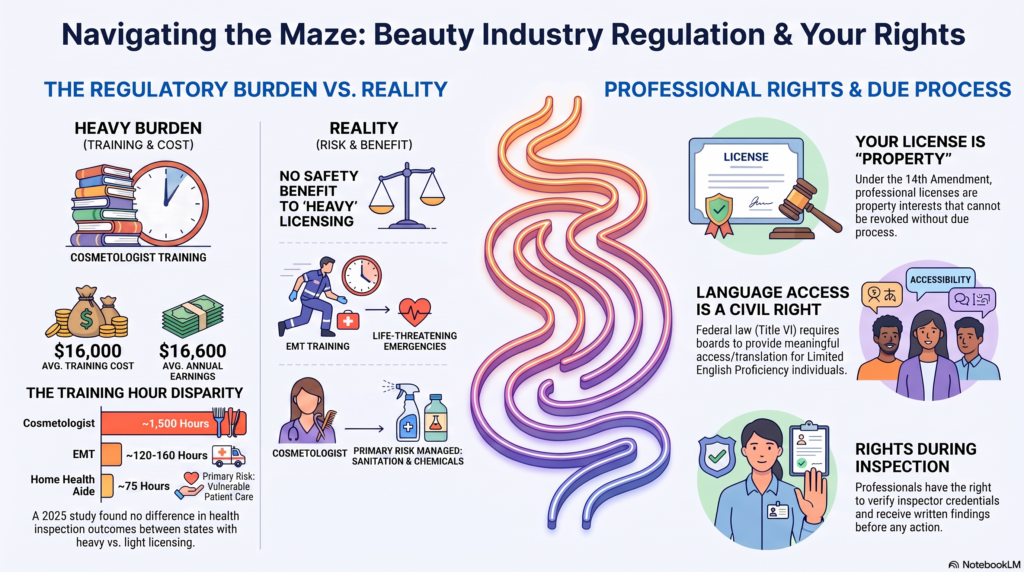
Research on occupational licensing suggests that these regulations can act as a significant barrier to entry, potentially reducing the equilibrium labor supply by 17% to 27%.60 Higher hour requirements often lead to increased education costs and student debt, which may discourage individuals from pursuing careers in the industry.61 Interestingly, most studies show no clear correlation between higher licensing requirements and improved service quality, leading some policymakers to advocate for deregulation or hour reductions.5

Entrepreneurship and Minority Participation

The beauty industry provides unique opportunities for women and minorities, who are disproportionately represented in the profession. Nearly 85% of beauty professionals are women, compared to 47% in the overall U.S. workforce.4 Furthermore, about half of all beauty professionals are self-employed, making the industry a critical driver of small business growth.4 Reforms like California’s SB 1159 have further enhanced economic mobility by allowing undocumented immigrants to obtain professional licenses and contribute to the formal economy.57

The Impact of Hour Reductions

States like California and Virginia have reduced training hours with the goal of increasing workforce entry and reducing student financial burden.14 While this can lead to faster career starts, it also places increased pressure on beauty schools to refine their curricula to ensure that students remain competent in safety and sanitation within a shorter timeframe.17

Future Trends in Beauty Licensing

The beauty industry is entering a period of rapid evolution driven by technological advancements and policy shifts.

The Rise of the Cosmetology Licensure Compact

To address the challenges of professional mobility, the Council of State Governments has developed the “Cosmetology Licensure Compact”.12 This legislatively enacted agreement allows cosmetologists in member states (including Kentucky and Virginia) to apply for a multistate license, enabling them to work across state lines without the need for redundant examinations or hour certifications.12

Artificial Intelligence and Virtual Reality in Training

AI and VR are set to revolutionize how beauty professionals are trained.

  • Virtual Training: Some colleges are beginning to use VR to allow students to practice haircuts, skincare, and makeup techniques in a simulated environment before working on real clients.64
  • AI Literacy: Federal and state guidance is increasingly focusing on “AI literacy” for the workforce, teaching professionals how to use AI-driven diagnostics for skin and hair analysis effectively and ethically.65
  • Generative AI: By 2025, generative AI is expected to be a key player in personalizing beauty routines and predicting treatment outcomes, which will require new regulatory considerations for state boards.66

Licensing Reform and Apprenticeship Expansion

Economic pressure is driving a trend toward shorter training programs and the expansion of apprenticeship pathways.14 Some states are introducing “limited” licenses (such as Kentucky’s “Limited Stylist” for blow-drying and arrangement) to allow faster entry for individuals who do not wish to perform chemical services or hair cutting.32

Frequently Asked Legal Questions

Can a cosmetologist shave with a razor?

In most states, a cosmetologist can use a safety razor for cutting hair or shaving the nape of the neck. However, they are typically prohibited from performing a straight-razor facial shave, which is a service reserved for licensed barbers.7

Can a barber color hair?

Yes. Most state barbering licenses expressly authorize the coloring, tinting, and dyeing of hair.7

Can estheticians perform microneedling?

This is a highly regulated and state-dependent area. In many jurisdictions, estheticians are limited to using “nanoneedling” or microneedling devices shorter than 0.3mm that do not pierce the dermis. Deeper microneedling is considered a medical act.9

Can nail technicians treat foot medical conditions?

No. Nail technicians are restricted to the beautification of the nails and skin. They cannot treat ailments such as fungal infections, ingrown nails, or medical-grade calluses, which fall under the scope of podiatry.23

Can cosmetologists perform dermaplaning?

Regulation is shifting on this issue. In states like Kentucky, cosmetologists and estheticians can now perform dermaplaning for basic exfoliation if they provide proof of specialized training. In other states, it remains a prohibited practice or is restricted to medical environments.33

Is a “medical esthetician” license required to work in a MedSpa?

There is generally no such license as a “medical esthetician” at the state board level. A standard esthetics license is used, but the practitioner must work under the supervision of a physician if performing any services that border on medical practice.9

Conclusion

The legal scope of beauty licensing in the United States is an intricate framework designed to balance the competing interests of public safety, professional heritage, and economic opportunity. While the foundational principles of sanitation and technical competency remain unchanged since the Progressive Era, the implementation of these laws is undergoing significant modernization. The consolidation of boards, the reduction of training hours, and the emergence of interstate compacts all signal a move toward a more agile and professionalized beauty workforce.

However, the most critical challenge for the coming decade lies in the “medical-aesthetic crossover.” As technology enables more invasive treatments, the line between beautification and medicine will require even clearer statutory definitions to protect both the practitioner and the consumer. For beauty professionals, educators, and policymakers, understanding these legal boundaries is not merely a matter of compliance—it is essential for the sustainable growth and humanization of an industry that touches the lives of nearly every American.

Works cited

  1. Historical Context: Alabama Board of Cosmetology and Barbering – For the Record, accessed March 6, 2026, https://fortherecordalabama.blog/2025/04/17/historical-context-alabama-board-of-cosmetology-and-barbering/
  2. A Cut Below: Lessons from the History of Barber Licensure – Advancing Liberty in Missouri, accessed March 6, 2026, https://showmeinstitute.org/article/regulation/a-cut-below-lessons-from-the-history-of-barber-licensure/
  3. Barber or Cosmetologist? Only Your Hairdresser Knows For Sure, accessed March 6, 2026, https://digital.sandiego.edu/cgi/viewcontent.cgi?article=2905&context=crlr
  4. The Value of Cosmetology Licensing to the Health, Safety, and Economy of America, accessed March 6, 2026, https://sbp.senate.ca.gov/sites/sbp.senate.ca.gov/files/The%20Value%20of%20Cosmetology%20Licensing.pdf
  5. Raising Barriers, Not Quality – The Institute for Justice, accessed March 6, 2026, https://ij.org/wp-content/uploads/2022/10/Raising-Barriers-Not-Quality-10142022-WEB-REVISED.pdf
  6. 13 Common Myths and Misconceptions About Beauty School – Campus.edu, accessed March 6, 2026, https://campus.edu/blog/cosmetology/13-beauty-school-myths
  7. Texas Occupations Code – OCC § 1603.0011 | FindLaw, accessed March 6, 2026, https://codes.findlaw.com/tx/occupations-code/occ-sect-1603-0011/
  8. 317.410 Definitions for chapter. As used in this chapter, unless the context requires otherwise: (1) “Barber” me, accessed March 6, 2026, https://apps.legislature.ky.gov/law/statutes//statute.aspx?id=56215
  9. The Scope of Practice for Estheticians in California – Holt Law, accessed March 6, 2026, https://djholtlaw.com/the-scope-of-practice-for-estheticians-in-california/
  10. Medical Spas – Barbering and Cosmetology – Texas Department of Licensing and Regulation, accessed March 6, 2026, https://www.tdlr.texas.gov/barbering-and-cosmetology/medical-spas.htm
  11. Texas Med Spa Licensing | Brewster Law Firm PLLC, accessed March 6, 2026, https://brewsterlawtx.com/medical-spa/texas-med-spa-compliance-guide/texas-med-spa-licensing/
  12. The Cosmetology Compact – National Center for Interstate Compacts, accessed March 6, 2026, https://compacts.csg.org/compact-updates/cosmetology/
  13. Texas Cosmetology Laws & License Requirements | 2026 Guide – Consentz, accessed March 6, 2026, https://www.consentz.com/texas-cosmetology-laws-license-requirements/
  14. Barber, Cosmetology, Nail, Wax, Tattooing, Permanent Cosmetic Tattooing, and Master Permanent Cosmetic Tattooing Curriculum Requirements | Virginia Department of Professional and Occupational Regulation – DPOR, accessed March 6, 2026, https://www.dpor.virginia.gov/CosmetologyCurriculum
  15. The Company of Barbers and Surgeons – PMC, accessed March 6, 2026, https://pmc.ncbi.nlm.nih.gov/articles/PMC1282221/
  16. NBER WORKING PAPER SERIES THE ORIGINS AND EVOLUTION OF OCCUPATIONAL LICENSING IN THE UNITED STATES Nicholas A. Carollo Jason F., accessed March 6, 2026, https://www.nber.org/system/files/working_papers/w33580/w33580.pdf
  17. Debunking Common Myths About Beauty School: What You Really Need to Know, accessed March 6, 2026, https://keuneacademyby124.edu/4797-2/
  18. The State of Occupational Licensing, accessed March 6, 2026, https://sbp.senate.ca.gov/sites/sbp.senate.ca.gov/files/NCSL%20State%20of%20Occupational%20Licensing.pdf
  19. Invest in the workforce for the AI age: A blueprint for scale, skills and responsible growth, accessed March 6, 2026, https://www.weforum.org/stories/2026/01/ai-roadmap-transforming/
  20. The Barbering and Cosmetology Act, accessed March 6, 2026, https://www.barbercosmo.ca.gov/laws_regs/laws.shtml
  21. California-2023-AB2444-Introduced – LegiScan, accessed March 6, 2026, https://legiscan.com/CA/text/AB2444/id/2927174/California-2023-AB2444-Introduced.html
  22. chapter 1603. regulation of barbering and cosmetology – Texas Constitution and Statutes, accessed March 6, 2026, https://statutes.capitol.texas.gov/GetStatute.aspx?Code=OC&Value=1603
  23. 317A.020 Scope of chapter — Licensure requirements — Emergency …, accessed March 6, 2026, https://apps.legislature.ky.gov/law/statutes/statute.aspx?id=56210
  24. Chapter 1603. REGULATION OF BARBERING AND COSMETOLOGY – Texas Statutes, accessed March 6, 2026, https://tx.elaws.us/law/oc_title9_chapter1603
  25. 2025 Barbering and Cosmetology Act AND Barbering and …, accessed March 6, 2026, https://www.barbercosmo.ca.gov/laws_regs/article_12.pdf
  26. Forms (18VAC41-20) – Virginia Law, accessed March 6, 2026, https://law.lis.virginia.gov/admincodefull/title18/agency41/chapter20/
  27. Board for Barbers and Cosmetology Legislative Update | Virginia Department of Professional and Occupational Regulation – DPOR, accessed March 6, 2026, https://www.dpor.virginia.gov/Boards/Barber/2025%20Legislative%20Updates
  28. Vol. 42 Iss. 9 (Proposed) 18VAC41-20, Barbering And Cosmetology Regulations December 15, 2025, accessed March 6, 2026, https://register.dls.virginia.gov/details.aspx?id=12085
  29. BOARDS AND COMMISSIONS Board of Cosmetology (Amended at ARRS Committee) 201 KAR 12:082. Education requirements and school admini, accessed March 6, 2026, https://apps.legislature.ky.gov/services/karmaservice/documents/16398/ToPDF?markup=true
  30. Title 201 Chapter 12 Regulation 082 • Kentucky Administrative Regulations, accessed March 6, 2026, https://apps.legislature.ky.gov/law/kar/titles/201/012/082/16143/
  31. Kentucky Revised Statutes Title XXVI. Occupations and Professions § 317A.020 | FindLaw, accessed March 6, 2026, https://codes.findlaw.com/ky/title-xxvi-occupations-and-professions/ky-rev-st-sect-317a-020/
  32. 317A.010 Definitions for chapter. As used in this chapter, unless the context requires otherwise: (1) “Beauty salon&q – Legislative Research Commission, accessed March 6, 2026, https://apps.legislature.ky.gov/law/statutes/statute.aspx?id=53212
  33. medspas at a glance – TEXAS DEPARTMENT OFLICENSING & REGULATION, accessed March 6, 2026, https://www.tdlr.texas.gov/media/pdf/Medspas-at-a-Glance.pdf
  34. AN ACT relating to activities regulated by the Kentucky Board of Hairdressers and Cosmetologists – LegiScan, accessed March 6, 2026, https://legiscan.com/KY/text/HB311/2012
  35. Who Regulates What? | Barbering and Cosmetology | TDLR.Texas.gov, accessed March 6, 2026, https://www.tdlr.texas.gov/barbering-and-cosmetology/who-regulates-what.htm
  36. 317.410 Definitions for chapter. As used in this chapter, unless the context requires otherwise – Kentucky Board of Barbering, accessed March 6, 2026, https://barbering.ky.gov/Laws-and-Regulations/Documents/KBOB%20Law%20Book.pdf
  37. CHAPTER 32 1 Legislative Research Commission PDF Version CHAPTER 32 (HB 148) AN ACT relating to barbers. Be it enacted by the Ge, accessed March 6, 2026, https://apps.legislature.ky.gov/law/acts/06RS/documents/0032.pdf
  38. 18 Va. Admin. Code § 41-20-220 – Hours of instruction and performances | State Regulations | US Law | LII / Legal Information Institute, accessed March 6, 2026, https://www.law.cornell.edu/regulations/virginia/18VAC41-20-220
  39. HB742 – 2026 Regular Session – LIS, accessed March 6, 2026, https://lis.virginia.gov/bill-details/20261/HB742/text/HB742
  40. California Skincare Laws 2025: What You Need to Know (and Why They Matter), accessed March 6, 2026, https://www.marieshelley.com/blogs/california-skincare-laws-2025
  41. Frequently Asked Questions – FAQs | Medical Board of California, accessed March 6, 2026, https://www.mbc.ca.gov/FAQs/?cat=Licensees&topic=Cosmetic%20Treatments
  42. Medical Spa Requirements In California, accessed March 6, 2026, https://spasource.com/blog/medical-spa-requirements-in-california/
  43. California Has Strict Laws Regarding Laser Treatments and Injectables, accessed March 6, 2026, https://americanmedspa.org/blog/california-has-strict-laws-regarding-laser-treatments-and-injectables
  44. What’s the Scope? Understanding State by State Scope of Practice Laws – Dermascope, accessed March 6, 2026, https://www.dermascope.com/what-s-the-scope-understanding-state-by-state-scope-of-practice-laws/
  45. 2026 Legislative Watch and Key Bills Estheticians Should Know About, accessed March 6, 2026, https://www.ascpskincare.com/updates/blog-posts/2026-legislative-watch-and-key-bills-estheticians-should-know-about
  46. Board of Cosmetology (Amendment) 201 KAR 12:280. Esthetic practices restrictions. RELATES TO: KRS 317A., accessed March 6, 2026, https://apps.legislature.ky.gov/services/karmaservice/documents/16150/ToPDF?markup=true
  47. Kentucky Proposes Adding to Scope and Increasing Fees, accessed March 6, 2026, https://www.ascpskincare.com/updates/blog-posts/kentucky-proposes-adding-scope-and-increasing-fees
  48. Medical Spa Laws and Requirements in Virginia – Portrait Care, accessed March 6, 2026, https://www.portraitcare.com/post/medical-spa-laws-virginia
  49. 4 Cosmetology Myths We’re Debunking – Aveda Arts, accessed March 6, 2026, https://avedaarts.edu/blog/4-cosmetology-myths-were-debunking/
  50. Apply for an Esthetician License | TDLR.Texas.gov, accessed March 6, 2026, https://www.tdlr.texas.gov/barbering-and-cosmetology/individuals/apply-esthetician.htm
  51. Licensed Occupations Requiring Clock-Hour Training and Interstate Transferability – RESEARCH JUNE 2025 – Viet Bao Louisville KY, accessed March 6, 2026, https://vietbaolouisville.com/2025/06/licensed-occupations-requiring-clock-hour-training-and-interstate-transferability-research-june-2025/
  52. License Requirements – Kentucky Board of Cosmetology, accessed March 6, 2026, https://kbc.ky.gov/Licensure/Pages/License-Requirements.aspx
  53. Kentucky Cosmetology Laws & License Requirements [2026] – Consentz, accessed March 6, 2026, https://www.consentz.com/kentucky-cosmetology-laws-license-requirements/
  54. State-by-State Cosmetology License Transfer Guide (Comprehensive Research as of March 2025) – Louisville Beauty Academy, accessed March 6, 2026, https://louisvillebeautyacademy.net/state-by-state-cosmetology-license-transfer-guide-comprehensive-research-as-of-march-2025/
  55. Schools – California Board of Barbering and Cosmetology – CA.gov, accessed March 6, 2026, https://www.barbercosmo.ca.gov/schools/
  56. SB 1159 Senate Bill – Bill Analysis – Leginfo.ca.gov, accessed March 6, 2026, http://www.leginfo.ca.gov/pub/13-14/bill/sen/sb_1151-1200/sb_1159_cfa_20140828_100733_asm_comm.html
  57. Legislative Fact Sheet – SB 1159 Professional Licenses, accessed March 6, 2026, https://consulmex.sre.gob.mx/sacramento/images/PDFs/MexicoEnCapitolio/sb_1159.pdf
  58. Advocates Applaud Signing of Professional Licensing Bill for Immigrants – ACLU of Norcal, accessed March 6, 2026, https://www.aclunorcal.org/press-releases/advocates-applaud-signing-professional-licensing-bill-immigrants/
  59. New Continuing Education Requirements Effective September 1, 2025 | TDLR News and Updates, accessed March 6, 2026, https://www.tdlr.texas.gov/news/2025/06/16/new-continuing-education-requirements-effective-september-1-2025/
  60. NBER WORKING PAPER SERIES HOW MUCH OF BARRIER TO ENTRY IS OCCUPATIONAL LICENSING? Peter Q. Blair Bobby W. Chung Working Paper 25, accessed March 6, 2026, https://www.nber.org/system/files/working_papers/w25262/w25262.pdf
  61. Examining Licensing Issues Within the Cosmetology Industry, accessed March 6, 2026, https://www.air.org/project/examining-licensing-issues-within-cosmetology-industry
  62. 2026 Workforce Outlook: Employers That Prioritize AI Literacy and Education Benefits Can Lead the Talent Race | Bright Horizons Family Solutions, accessed March 6, 2026, https://investors.brighthorizons.com/news-releases/news-release-details/2026-workforce-outlook-employers-prioritize-ai-literacy-and
  63. How to Transfer Your Cosmetology, Nail, or Esthetics License to Kentucky (2026 Step-by-Step Guide) – FEB 2026, accessed March 6, 2026, https://louisvillebeautyacademy.net/how-to-transfer-your-cosmetology-nail-or-esthetics-license-to-kentucky-2026-step-by-step-guide-feb-2026/
  64. The Future of Cosmetology: Embracing AI & Innovation – Eric Fisher Academy, accessed March 6, 2026, https://ericfisheracademy.com/2024/10/01/in-2025-how-do-we-define-cosmetology/
  65. The U.S. Department of Labor’s Artificial Intelligence Literacy Framework – DOL.gov, accessed March 6, 2026, https://www.dol.gov/sites/dolgov/files/ETA/advisories/TEN/2025/TEN%2007-25/TEN%2007-25%20%28complete%20document%29.pdf
  66. AI in the Beauty Industry: Transforming Skills, Training, and Jobs, accessed March 6, 2026, https://nationalskillsnetwork.in/ai-in-the-beauty-industry-transforming-skills-training-and-jobs/
  67. Artificial Intelligence – Professional Learning (CA Dept of Education), accessed March 6, 2026, https://www.cde.ca.gov/ci/pl/aiincalifornia.asp
  68. Kentucky superintendents hear about new accountability legislation, AI resources during webcast, accessed March 6, 2026, https://www.kentuckyteacher.org/news/2026/01/kentucky-superintendents-hear-about-new-accountability-legislation-ai-resources-during-webcast/

Educational Research Disclaimer

This publication is an academic research work by the Di Tran University — The College of Humanization Research Team. It is provided solely for educational and informational purposes and is based on publicly available statutes, regulations, and cited sources.

The content represents academic analysis and discussion only and does not constitute legal advice, regulatory guidance, or official interpretation of any law or licensing requirement. Laws and regulatory interpretations may change and vary by jurisdiction; readers should consult the appropriate licensing boards or qualified professionals for authoritative guidance.

While care has been taken to reference credible sources, no guarantee is made regarding completeness or accuracy, and neither the authors nor Di Tran University assume liability for actions taken based on this information.

All research, analysis, and responsibility belong solely to the Di Tran University — The College of Humanization Research Team, and the publication is intended to support general education and informed discussion only.

References to statutes, regulations, organizations, or professional practices are provided for academic discussion only and should not be interpreted as endorsement, criticism, or legal determination regarding any institution, profession, or regulatory body.

DAILY INTELLIGENCE SCAN: VOCATIONAL EDUCATION, BEAUTY EDUCATION & PROFESSIONAL BEAUTY INDUSTRY – February 1, 2026 | Louisville Beauty Academy

A. EXECUTIVE SUMMARY

What Changed in the Last 24–72 Hours

  1. AHEAD Earnings Accountability Rule Consensus (January 10, 2026): The Department of Education’s Accountability in Higher Education and Access through Demand-driven Workforce Pell committee reached consensus on a unified earnings test applicable to ALL postsecondary programs (undergraduate and graduate) for the first time. Programs whose graduates earn below high school diploma levels will lose federal Title IV eligibility beginning July 1, 2026. Beauty schools are recognized as disproportionately vulnerable to these metrics due to tipping culture and non-traditional earnings structures. The American Association of Cosmetology Schools (AACS) has retained former U.S. Solicitor General Paul Clement to appeal this decision in the Fifth Circuit.whiteboardadvisors+2
  2. Kentucky HB 120 Introduced (January 14, 2026): The Kentucky legislature introduced House Bill 120, which would regulate mobile beauty salons as licensed “facilities” under KRS 317A, requiring the Kentucky Board of Cosmetology to establish operational and inspection standards. This represents a significant regulatory expansion affecting salon operational flexibility and represents a material compliance change for multi-location operations.[ed]​
  3. Biennial License Renewal Cycle Confirmed (July 2026 Implementation): The Kentucky Board of Cosmetology’s shift from annual to biennial renewal becomes effective July 31, 2026. While the annual fee remains $50, professionals will pay $100 upfront every two years, creating a cash-flow impact for dual-license holders and employer-sponsored compliance budgets.onthelaborfront+1
  4. Federal Apprenticeship Investment Surge: The Department of Labor announced $145 million in pay-for-performance apprenticeship funding (January 2026) with application deadline March 20, 2026, and $98 million in YouthBuild pre-apprenticeship expansion targeting ages 16–24. These initiatives explicitly prioritize registered apprenticeships as pathways competitive with traditional beauty school enrollment.govinfo+1
  5. Unlicensed Practice Enforcement Escalation (Multi-State Pattern): New York completed statewide med spa investigations with 87 violations and emergency license revocations (January 2026). Kentucky’s SB 22 (enacted June 2025) now classifies knowing employment of unlicensed individuals as creating an “immediate and present danger to the public”—triggering strict liability for salon operators without warning period opportunity.lcwlegal+1

Why This Matters to Each Stakeholder

  • Students: Federal earnings accountability rules now directly affect program viability and loan eligibility. Schools failing the unified earnings test face enrollment freezes and mandatory warnings. Beauty students face heightened scrutiny due to non-traditional income (tips, commission, self-employment).
  • Licensed Professionals: Kentucky’s biennial renewal creates a one-time $100 upfront payment (vs. annual $50). Dual-license holders face up to $200. Employers must now implement strict verification protocols for unlicensed workers or face immediate disciplinary action from the KBC without warning opportunity.
  • Schools: The proposed earnings accountability rule creates a July 1, 2026 effective date—forcing immediate debt-to-earnings analysis and potential curriculum or delivery model changes. Mobile salon regulation adds compliance burden and location-based licensing costs. The market now favors schools demonstrating low-cost, employment-aligned delivery (apprenticeships, hybrid models).
  • Regulators: KBC faces new expectations under HB 120 to manage mobile salons, while federal guidance emphasizes unlicensed practice enforcement. The biennial renewal creates administrative efficiency but requires updated portal systems and communication protocols to prevent missed renewals.

B. FEDERAL UPDATES

Earnings Accountability Rule – Unified Framework (AHEAD Committee Consensus)

Status: Consensus Reached January 10, 2026 | Effective July 1, 2026 | Proposed Rule Expected Early 2026

The Department of Education’s AHEAD negotiated rulemaking committee reached consensus on a single earnings test for all postsecondary programs under the One Big Beautiful Bill Act (P.L. 119-21). This marks the first time a unified accountability standard applies across undergraduate, graduate, and career programs.[dir.ca]​

Key Metrics:

  • Undergraduate program graduates must earn at least as much as high school diploma holders
  • Graduate program graduates must earn at least as much as bachelor’s degree holders
  • Programs failing these benchmarks for two consecutive years lose federal Title IV loan eligibility
  • Programs failing for three consecutive years lose Pell Grant and campus-based aid eligibility
  • Data collection and reporting requirements begin immediately[globalfas]​

Impact on Beauty Education: Industry experts and AACS have flagged beauty, barber, and wellness education as sectors most vulnerable to this framework. Earnings data for cosmetologists, estheticians, and nail technicians often reflect:

  • Tip-based income (not always reported consistently)
  • Commission structures (variable income timing)
  • Self-employment and independent contractor arrangements
  • Geographic wage variation (salon vs. mobile vs. booth rental models)

These characteristics create documentation and verification challenges under a federal earnings test designed for traditional W-2 employment.[federalregister]​

Legal Challenge: AACS, in coordination with other beauty school associations, has retained former U.S. Solicitor General Paul Clement and the law firm Clement & Murphy to file an appeal of an October 2025 federal court decision upholding the Gainful Employment Rule. The Fifth Circuit appeal brief is being prepared for filing in early 2026.[constructionowners]​

Citations & Links:


Distance Education & Return to Title IV (R2T4) Final Rules

Status: Final Rules Published January 2025 | Early Implementation Available February 3, 2025 | Full Implementation July 1, 2026

The Department of Education finalized regulatory amendments to 34 CFR 668.22 (Return to Title IV) and distance education reporting requirements, effective July 1, 2026, with voluntary early implementation available as of February 3, 2025.[acenet]​

Key Provisions Effective Immediately (Available for Early Implementation):

  • Withdrawal Exemption: Institutions may exempt students from R2T4 calculations if they (1) treat the student as never having attended, (2) return all Title IV funds, (3) refund all institutional charges, and (4) cancel any outstanding balance. This exemption is optional and must be documented in institutional policy.
  • Leave of Absence (Prison Education Programs): Incarcerated students in term-based programs may return to any coursework (not necessarily the same coursework) after a leave of absence.

Full Implementation July 1, 2026:

  • Attendance taking requirements for clock-hour programs now must use “scheduled hours in a payment period” only (elimination of “cumulative method”)
  • Distance education attendance tracking procedures must be documented
  • New reporting requirements for distance education student enrollment

Impact on Beauty Education: The withdrawal exemption benefits schools serving non-traditional, working adult students (LBA’s primary demographic) by providing flexibility for students who must leave unexpectedly. Clock-hour tracking changes affect compliance documentation but do not materially alter curriculum requirements.[louisvillebeautyacademy]​

Citations & Links:


Apprenticeship Expansion & Workforce Pell Investment

Status: Funding Opportunities Open | Application Deadlines: March 20, 2026 (DOL) | Effective Immediately

The Department of Labor announced two major workforce development initiatives in January 2026:

  1. $145 Million Pay-for-Performance Apprenticeship Initiative
    • Forecast notice published January 6, 2026 | Application period: January 29 – March 20, 2026
    • Up to five cooperative agreements for four-year performance periods
    • Focus: Expansion of newly developed Registered Apprenticeships + growth of existing programs
    • Industries prioritized: Skilled trades, advanced manufacturing, healthcare, information technology, and emerging sectors (AI, maritime, nuclear)
    • Model: Performance-based funding rewards outcomes (apprentice completions, job placement, wage benchmarks) rather than upfront program grants[apps.legislature.ky]​
  2. $98 Million YouthBuild Pre-Apprenticeship Expansion
    • Targeting youth ages 16–24 disconnected from labor force
    • ~57 individual grants ranging $1–2 million each
    • First-Time Federal Requirement: Grantees must establish measurable targets for YouthBuild participants entering Registered Apprenticeships within one year of program completion
    • Focus: Creating direct pipeline from pre-apprenticeship training to DOL-registered apprenticeships[youtube]​

Implication for Beauty Education: These initiatives position apprenticeships as a federally-preferred pathway competitive with traditional beauty school enrollment. DOL’s emphasis on “measurable outcomes” and “performance-based” funding creates incentive structures favoring employers and training providers who can demonstrate employment metrics. This contrasts with school-based models that depend on student tuition funding. Kentucky-licensed beauty schools offering Registered Apprenticeship programs (such as LBA) now compete for both student tuition and federal apprenticeship grants.[youtube]​

Citations & Links:


Accreditation Innovation & Modernization (AIM) Committee – New Negotiated Rulemaking

Status: Committee Formally Launched January 2026 | Sessions Scheduled April–May 2026 | Final Rule Expected Mid-2026

The Department of Education announced the Accreditation, Innovation, and Modernization (AIM) negotiated rulemaking committee to address accreditor standards, criteria for recognition, and institutional eligibility regulations under Title IV.[louisvillebeautyacademy]​

Scope of Negotiations (17 Topics):

  • Revising criteria for Secretary’s recognition of accrediting agencies (emphasis on student outcomes + educational quality vs. “credential inflation”)
  • Removing accreditation standards deemed “anti-competitive” or “discriminatory”
  • Standards requiring all accreditors to evaluate program-level student achievement and outcomes without reference to race, ethnicity, or sex
  • New learning models and innovative program delivery (ensuring accreditors do not impede innovation)
  • Faculty requirements with emphasis on “intellectual diversity” and academic freedom
  • Transfer-of-credit policies to prevent unnecessary course repetition and excessive student debt
  • Separation between accrediting agencies and related trade associations (addressing conflicts of interest)

Sessions:

  • Session 1: April 13–17, 2026 (Washington, DC)
  • Session 2: May 18–22, 2026
  • Registration: “Coming soon” (likely February–March 2026)
  • Public comment period expected after proposed rule publication

Implications for Beauty Education: If the AIM committee addresses “new learning models,” this could create regulatory support for hybrid, apprenticeship-integrated, or competency-based beauty education programs. However, if standards emphasize faculty credentials and academic research, traditional beauty schools (which employ practitioners rather than researchers) may face accreditation challenges.[apps.legislature.ky]​

Citations & Links:


C. KENTUCKY & KBC UPDATES

CRITICAL: HB 120 – Mobile Salon Regulation Initiative (2026 Legislative Session)

Status: Introduced January 14, 2026 | Proposed Amendment to KRS 317A | Committee Assignment Pending

House Bill 120 proposes significant regulatory expansion of beauty salon definitions and licensing requirements:

Statutory Changes Proposed:

  • Amend KRS 317A.010 to authorize “fixed or mobile beauty salons, esthetic salons, nail salons, and limited beauty salons”
  • Amend KRS 317A.020 and KRS 317A.145 to classify any type of mobile salon as a regulated “facility” and “premises”
  • Amend KRS 317A.060 to require the Kentucky Board of Cosmetology to establish standards for mobile and fixed salons and define inspection schedules
  • Mandate that administrative regulations “balance licensee and public interests”[reddit]​

Compliance Implications:

  • Mobile salons (currently operating under temporary event permits) will transition to permanent facility licensing
  • New inspection protocols and compliance burden for owner-operators
  • Sanitization, equipment, and record-keeping standards will be KBC-defined (not statutory)
  • Potential fee structure changes to support additional compliance oversight

Industry Context: Mobile salons have grown as flexible, low-overhead operational models, particularly post-pandemic. This regulation signals KBC’s intent to formalize mobile operations as regulated facilities rather than temporary exceptions, likely in response to unlicensed practice enforcement concerns and consumer protection demands.[legiscan]​

Legislative Process: HB 120 is in early stage (introduced January 14). Regular Kentucky legislative session runs through April 15, 2026. Watch for committee assignment (likely to Licensing, Occupations & Administrative Regulations Committee based on subject matter).

Citations:


Biennial License Renewal Cycle – Transition Period (July 2026)

Status: Implementation Date July 31, 2026 | Advance Notice Published January 9, 2026

The Kentucky Board of Cosmetology is transitioning from annual to biennial (two-year) license renewal effective July 31, 2026. Louisville Beauty Academy published comprehensive compliance guidance in early January.[apps.legislature.ky]​

Financial Impact:

  • No fee increase: Annual fee remains $50 per year
  • Payment structure change: Professionals now pay $100 for two years (upfront) instead of $50 annually
  • Example: A dual-license holder (cosmetologist + esthetician) pays $200 every two years instead of $100 annually
  • Cash flow consideration: First biennial renewal (July 2026) creates a one-time doubled payment for many licensees

Renewal Deadlines & Process:

  • Current annual renewals expire July 31, 2026
  • Biennial licenses will expire July 31, 2028 (and subsequently every two years)
  • KBC portal-based renewal system requires updated contact information (email, address)
  • Photo compliance: Passport-style photos under 201 KAR 12:030 (no selfies, filters, or improper backgrounds)

KBC Rationale: Biennial renewal aligns Kentucky with national best practices, reduces administrative burden on the Board, and allows reallocation of resources toward enforcement, inspections, and new license processing.[kbc.ky]​

Citations & Links:


SB 22 (2025) – Unlicensed Practice Liability (Enforcement Signal)

Status: Signed into Law March 24, 2025 | Effective June 26, 2025 | Active Enforcement Phase

Senate Bill 22 fundamentally changed Kentucky’s approach to unlicensed practice by introducing strict liability for salon operators and employers.[citizenportal]​

Key Statutory Change (KRS 317A.020(8)(b)):
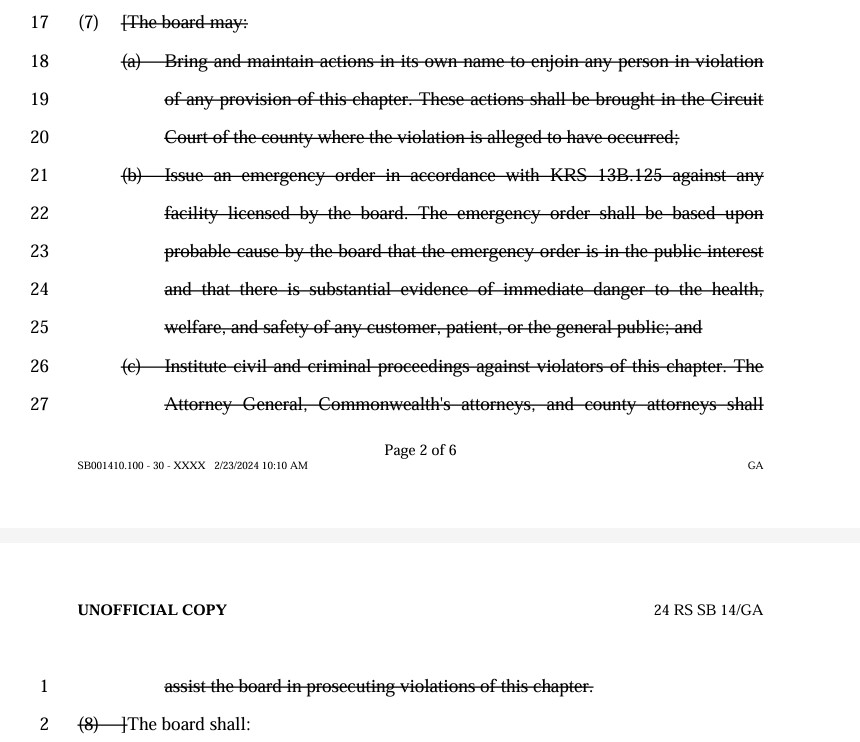
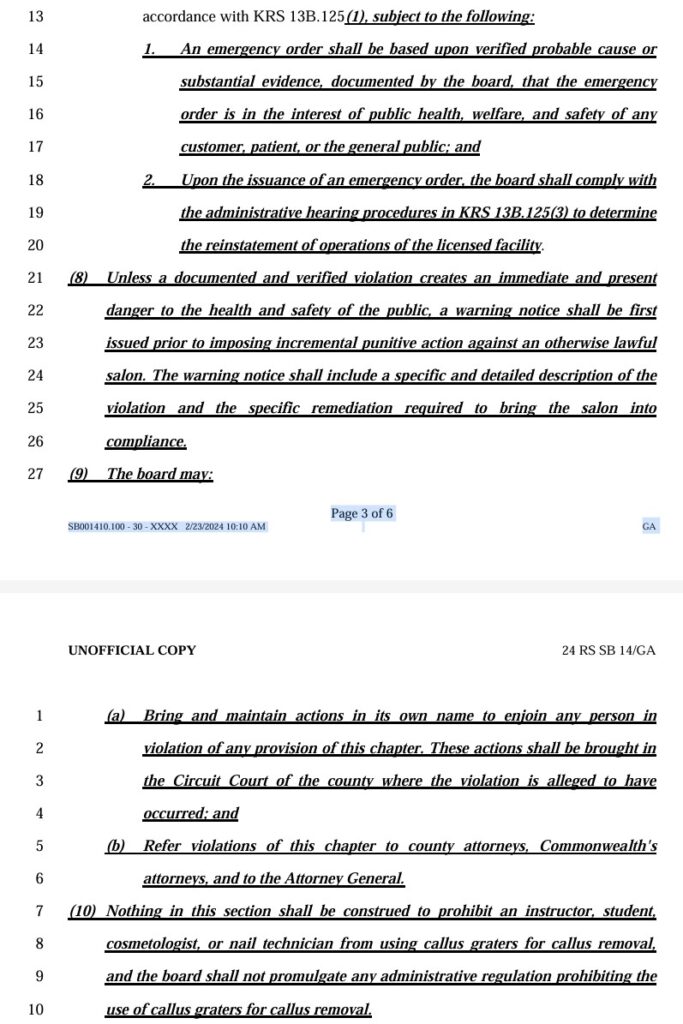
“The Board may issue a penalty more severe than a warning notice if a licensee knowingly employs or utilizes an unlicensed nail technician.”

Regulatory Interpretation: This language creates “immediate and present danger to the public” classification, triggering automatic penalties without warning period opportunity. A salon operator cannot receive a correction notice and opportunity to cure; the violation is treated as per se dangerous.[kyrules.elaws]​

Practical Impact:

  • Salon Liability: Employers are strictly liable for verifying licensure status of all service providers
  • No Due Diligence Defense: A salon cannot claim it was unaware of an employee’s expired or invalid license
  • Enforcement Pattern: LBA’s research indicates KBC is actively investigating unlicensed employment as a priority enforcement issue
  • Penalties: Fines ranging $50–$1,500 per violation under KRS 317A.990, with potential licensure suspension/revocation

Comparative Trend: New York’s January 2026 med spa investigations revealed 26% of violations involved unlicensed staff—suggesting a nationwide enforcement focus on unlicensed practice in beauty and wellness services.[kbc.ky]​

Citations & Links:


201 KAR 12:082 – Education Requirements (Verified Current Status)

Regulation Status: Effective December 19, 2025 | Current & Enforceable

The Kentucky Administrative Regulation 201 KAR 12:082 establishes the curriculum and hour requirements for all Kentucky beauty education programs. Recent verification (December 2025) confirms no material changes to core requirements:[louisvillebeautyacademy]​

Cosmetology Program:

  • Minimum 1,500 hours (clinical + theory)
  • Chemical services cannot begin until 250+ hours completed
  • 40 hours on Kentucky statutes and administrative regulations (mandatory)

Esthetics Program:

  • Minimum 750 hours (clinical + theory)
  • 100 lecture hours (science/theory)
  • 25 hours on Kentucky statutes and administrative regulations

Instructor Training:

  • Apprentice instructors cannot teach outside school environment
  • Specialized training required for advanced techniques (e.g., dermaplaning per Section 21(12))

Significance: The regulation’s emphasis on statutory/regulatory literacy (25–40 hours) signals KBC’s commitment to producing licensed professionals with legal compliance knowledge—not just technical skills.[instagram]​

Citations & Links:


D. OTHER STATES – COMPARATIVE INSIGHT

Surrounding State Licensing Standards (Benchmark Analysis)

Kentucky beauty education operates within a regional framework where neighboring states have established comparative licensing requirements. Understanding these standards is critical for interstate credential recognition, reciprocity applications, and competitive positioning.

StateCosmetology HoursPrerequisitesCE RequirementsApprenticeship OptionKey Differentiator
Kentucky1,50010th gradeNone mandatedLicensed apprenticeships available[naturalhealers]​Strict unlicensed practice liability (SB 22)
Indiana1,50010th grade (17+ age)NoneYes (2,000 hours via DOL)Considering DOL-registered apprenticeships
Ohio1,50010th grade (16+ age)4 hours/2 yearsUnder developmentBiennial renewal cycle (aligns with KY 2026 shift)
Tennessee1,50010th grade (16+ age)NoneLimited pilotReciprocal licensing with KY by state-to-state endorsement
Illinois1,500High school diploma14 hours/2 yearsUnder discussionHighest CE requirement in region

Competitive Intelligence:

  1. Apprenticeship Pathway Adoption: Indiana and other surrounding states are formalizing DOL-recognized apprenticeships as alternatives to school-based training. Kentucky’s LBA is positioned as an early mover in this model, offering both school and apprenticeship pathways.[businessresearchinsights]​
  2. Continuing Education Exemption: Kentucky remains unique in the region by not mandating continuing education for license renewal. This is a competitive advantage for schools targeting working professionals, but it may face future pressure if federal accountability metrics emphasize “lifelong learning.”
  3. Interstate Reciprocity: Cosmetologists licensed in surrounding states can transfer to Kentucky if their training hours meet or exceed Kentucky’s requirements (typically 1,500 hours). However, SB 22’s strict unlicensed practice enforcement may create a “Kentucky advantage” by ensuring only legitimately licensed professionals operate in the state.[beautyschoolsdirectory]​
  4. Mobile Salon Regulation: Kentucky’s emerging HB 120 mobile salon regulation differs from Indiana and Ohio, which have less formalized mobile salon oversight. This could either (a) create burden for multi-state mobile operators, or (b) establish Kentucky as a model for regulated mobile salon operations.

Citations & Links:


Unlicensed Practice Enforcement Multi-State Escalation

Recent enforcement actions in neighboring and national jurisdictions signal a coordinated escalation in unlicensed beauty practice enforcement:

New York (January 2026 – Immediate Pattern):

  • 223 businesses inspected statewide (NYC + upstate)
  • 87 cited for violations (39% violation rate)
  • Most common violations: unlicensed staff (26%), unlawful medical practice, unsanitary conditions
  • Outcomes: Emergency license suspensions, revocations, criminal complaints filed
  • Focus: Medical spas offering injections (Botox, fillers, IV therapy) without proper medical licensing[louisvillebeautyacademy]​

Relevance to Kentucky: While Kentucky does not have the “med spa” phenomenon at New York scale, the enforcement pattern suggests KBC will intensify unlicensed practice investigations in salons offering advanced services (chemical treatments, specialized techniques). SB 22’s strict liability provision directly aligns with this enforcement trend.[researchandmarkets]​


E. INDUSTRY & COMPETITOR MOVES

Market Growth & Enrollment Trends

The beauty education market continues to expand despite economic headwinds and regulatory uncertainty:

MetricData PointImplication
Market Size (2026)$9.61 billionProjected growth to $14.65B by 2035 (4.8% CAGR)[businessresearchinsights]​
Enrollment Growth (2021-2024)+28% increaseBureau of Labor Statistics data confirms rising demand
Hybrid/Digital Adoption57% of schoolsDigital learning platforms and AR-based training becoming standard
Tuition Range$15,000–$25,000Average $16,100 (2023); up 22% since 2019[businessresearchinsights]​
LBA Differentiation$6,200 program cost70% savings vs. traditional FAFSA-dependent models[youtube]​

Faculty & Staffing Crisis:

Implication: While overall market growth is positive, schools must differentiate on operational efficiency (LBA’s advantage through low-overhead delivery) and instructor quality (area of competitive vulnerability industry-wide).


Alternative Credentialing & Apprenticeship Models (Competitive Threat & Opportunity)

Registered Apprenticeships as Direct Competitor:

  • 22 states now offer cosmetology apprenticeships as school alternatives[newsfromthestates]​
  • Atarashii Apprentice Program: DOL-approved, multi-disciplinary (cosmetology, barbering, esthetics, nails), 2,000-hour standard, pay-for-performance model[facebook]​
  • Kentucky model: Louisville Beauty Academy listed as approved apprenticeship provider alongside traditional school enrollment[entouragebeautyne]​

Threat Assessment: Federal apprenticeship funding ($145M + $98M) creates direct competition for student recruitment. Apprentices earn wages during training, reducing financial barrier compared to school tuition.

Opportunity Assessment: Schools offering dual pathways (school-based + apprenticeship) can capture both tuition revenue and apprenticeship grant funding. LBA’s positioning as both school and apprenticeship provider is a strategic advantage.[naba4u]​

Citation:


Tuition Transparency & “Glamour Tax” Critique

Industry research by the New American Business Association (January 2026) reveals structural cost inefficiency in traditional beauty school models:

Cost Breakdown Analysis (Sample Program):

  • Direct Education: 55% of tuition
  • Compliance Overhead: 25–35% of tuition (federal aid administration, regulatory documentation, audits)
  • Marketing/Recruitment: 10–15% of tuition (“Glamour Tax” – digital presence, social media, lead generation)
  • Result: Student debt burden often exceeds early-career earning potential[ascpskincare]​

FAFSA Transparency Warning: New federal “Financial Value Transparency” requirements (2023 Gainful Employment Rule) now require schools to display debt-to-earnings ratios prominently. Schools with graduates earning below high school diploma levels receive enrollment restrictions and mandatory student warnings.

LBA Competitive Advantage: By “decoupling” from FAFSA dependency, LBA reports ability to offer cosmetology programs at $6,200—roughly 60–70% below traditional school pricing. This model reduces student debt while maintaining program quality.[linkedin]​

Strategic Implication: Tuition transparency becomes a critical marketing and compliance asset. Schools that can demonstrate low-cost, high-earnings pathways will attract enrollment while avoiding AHEAD earnings accountability penalties.


Accreditation Landscape & Quality Assurance

Primary Accreditors for Beauty Education:

  1. NACCAS (National Accrediting Commission of Career Arts & Sciences) – Largest body, ~1,300 accredited institutions
  2. ACCSC (Accrediting Commission of Career Schools and Colleges) – ~800 schools
  3. Council on Occupational Education (COE) – Smaller footprint

Accreditation vs. State Licensure:

  • State licensure is mandatory; accreditation is not
  • However, accreditation enables federal Title IV financial aid participation
  • Without accreditation, schools cannot offer federal student loans or grants[elysianacademyofcosmetology]​

Emerging Pressure: The AIM negotiated rulemaking committee (launching April 2026) will revisit accreditor standards. If new rules emphasize “student outcomes” and “earnings data,” accreditors may increase documentation burden on beauty schools. Conversely, if rules support “innovative program delivery,” apprenticeships and hybrid models could gain accreditor support.

Citations & Links:


F. ACTIONABLE TO-DO LIST FOR LBA (IMMEDIATE & STRATEGIC)

1. COMPLIANCE & OPERATIONS (This Week)

Documentation & Archive:

  • Verify biennial renewal readiness (July 2026 deadline): Audit all staff/graduate licensees for portal registration, current email addresses, and photo compliance under 201 KAR 12:030. Create internal tracking system for renewal reminders (June 2026 trigger).kbc.ky+1
  • Document SB 22 compliance (unlicensed practice liability): Audit salon partners and apprenticeship sponsors for employee licensure verification systems. Create written protocols for license status checking (e.g., monthly KBC portal verification). Ensure contracts with salon partners include explicit unlicensed-practice indemnification clauses.
  • HB 120 monitoring: Assign staff to track HB 120 progress through committee assignments and hearings. If passed, anticipate KBC rulemaking on mobile salon standards by Q3 2026. Prepare contingency compliance budget for potential mobile salon licensing fees.

Earnings Accountability Preparation:

  • Conduct debt-to-earnings analysis (AHEAD Rule Implementation – July 2026): Collect graduate employment and wage data for past 2–3 years. Calculate median program graduate earnings vs. high school diploma benchmark. If earnings fall below threshold, prepare to implement:
    • Curriculum modifications emphasizing employer-valued skills (business acumen, upselling, salon management)
    • Delivery model adjustments (apprenticeship pathways may show higher early earnings than school-only models)
    • Student success supports (job placement, entrepreneurship coaching, continuing education partnerships)
  • Create Financial Value Transparency summary: Prepare student-facing document showing program cost vs. projected earnings, loan repayment scenarios, and alternative pathways (apprenticeships, hybrid). Compliance deadline: Before June 2026 (Federal proposed rule publication expected)

Accreditation Positioning:

  • Monitor AIM Committee (April–May 2026 sessions): Subscribe to negotiated rulemaking updates. If AIM rules support “innovative delivery” or “apprenticeship integration,” prepare accreditation narrative highlighting LBA’s dual-pathway model.

2. STUDENT & LICENSEE EDUCATION (Ongoing)

FAQ & Content Development:

  • “What is the biennial renewal and why does it matter?” – Create short video (2–3 min) explaining July 2026 transition, payment amounts, renewal deadline, and photo requirements. Distribute via email (alumni), social media (LinkedIn, Instagram), and on-site (poster in campus).
  • “SB 22 Compliance for Salon Owners” – Develop 1-page infographic: “Unlicensed Practice is NOW a Strict Liability Issue – How to Verify Your Team’s Licensure.” Include KBC portal screenshot, verification checklist, and penalties summary.
  • “The Earnings Rule is Coming: How LBA Prepares You” – Educational content explaining federal earnings accountability, what it means for program choice, and how LBA’s outcomes support graduate success.
  • “Mobile Salons & HB 120” – If HB 120 advances, create guidance for salon partners operating mobile units: regulatory timeline, expected licensing/inspection requirements, and strategic planning.

Webinar & Town Hall Series:

  • Schedule monthly “Compliance & Workforce Readiness” webinars (Feb–June 2026) covering:
    • February: Biennial renewal deep-dive + KBC portal walkthrough
    • March: Federal apprenticeship funding opportunities + DOL grants timeline
    • April: AHEAD earnings rule + how to evaluate program ROI
    • May: HB 120 mobile salon regulation (if advancing)
    • June: License renewal deadline countdown

Licensee Resource Hub:

  • Create dedicated portal section: “Kentucky Beauty Professional Resources” with:
    • Real-time KBC announcements feed
    • Downloadable renewal checklists
    • Regulation citation library (KRS 317A, 201 KAR 12)
    • Contact directory (KBC, state boards, industry associations)

3. PUBLIC CONTENT TO CREATE TODAY (High-Value, Immediate Impact)

Blog Post Series (SEO-Optimized for Student & Professional Discovery):

  1. “2026 Kentucky Beauty License Renewal: What’s Changing & Why”
    • Angle: Practical compliance guide + myth-busting (fee increases? no. payment structure? yes.)
    • Keywords: biennial renewal Kentucky, beauty license renewal 2026, cosmetology license renewal Kentucky
    • Target Audience: KY beauty professionals, future students evaluating school credibility
    • Length: 1,200–1,500 words
    • Include: Timeline, payment calculator, photo requirements, renewal deadline, KBC contact info
  2. “Federal Earnings Accountability & Beauty School: What Every Student Should Know”
    • Angle: Student-protective transparency (LBA as educator of AHEAD implications)
    • Keywords: beauty school cost, student debt cosmetology, are beauty schools worth it 2026
    • Target Audience: High school graduates, career-changers evaluating education ROI
    • Length: 1,500–2,000 words
    • Include: Debt-to-earnings explanation, LBA outcomes data, alternative pathways, risk mitigation strategies
  3. “Salon Owners: SB 22 Compliance & Unlicensed Practice Liability in Kentucky”
    • Angle: Risk management guide (protect your salon license)
    • Keywords: Kentucky cosmetology law, salon compliance Kentucky, unlicensed beauty practice penalties
    • Target Audience: Salon owners, managers, HR staff
    • Length: 1,000–1,200 words
    • Include: SB 22 summary, verification procedures, penalties, indemnification contract language

Social Media Content (LinkedIn, Instagram, Facebook – Scheduled 3x/week):

  • LinkedIn (Professional authority positioning):
    • Thread: “Federal Earnings Accountability Rule – What Beauty Schools Need to Know” (3-part deep dive)
    • Case study: “How LBA’s Dual-Pathway Model Prepares Graduates for Earnings Success”
    • Thought leadership: “Why Regulatory Literacy is the Hidden Curriculum in Beauty Education”
  • Instagram/Facebook (Student recruitment + community education):
    • Carousel post: “Your 2026 Biennial Renewal Checklist” (visual step-by-step)
    • Short-form video: “What is SB 22?” (60-second explainer)
    • Success story: Alumni profile earning above baseline within 6 months (earnings accountability proof-point)

Downloadable Resources (Lead magnets for website):

  1. “2026 Compliance Calendar for Kentucky Beauty Professionals” (PDF)
    • Monthly checklist, renewal deadline, CE updates, regulatory changes
    • CTA: “Sign up for monthly compliance email”
  2. “Beauty School ROI Calculator” (Interactive web tool or downloadable Excel)
    • Input: Program cost, expected hours to employment, estimated income
    • Output: Break-even timeline, loan repayment scenarios, earnings premium vs. high school
    • CTA: “Calculate your beauty education ROI—and see how LBA compares”
  3. “KRS 317A & 201 KAR 12 Regulatory Summary” (PDF guide)
    • Plain-English explanation of all licensure, education, and enforcement requirements
    • For: Students, graduates, salon owners, aspiring salon operators
    • CTA: “Master Kentucky beauty law—free guide”

Podcast/Short-Form Video Series (YouTube Shorts, TikTok, Spotify):

  1. “Compliance Minute” (60-second weekly video):
    • Topic: One regulatory update, compliance requirement, or best practice
    • Example episodes: “What is a deficiency notice?”, “How to verify someone’s license”, “Mobile salon rules explained”
  2. “Ask the Compliance Expert” (Interview format):
    • Host: LBA compliance officer or KBC liaison
    • Format: Q&A on student questions (earnings, licensing, job placement)
    • Frequency: Monthly (distribute across YouTube, LinkedIn, podcast platforms)

G. EXCERPTS & QUOTABLE REFERENCES

Federal Register – Negotiated Rulemaking on Accreditation (January 27, 2026)

“The Department intends to revise regulations to ensure that accreditors’ standards comply with all federal civil rights laws and prohibit standards or policies that require or facilitate discrimination on the basis of immutable characteristics, such as race-based scholarships. The Department will ensure that accrediting agencies and institutions do not mislead students or the public with misrepresentative labels.”

Federal Register, Volume 91, Issue 17 (January 27, 2026)
Accreditation, Innovation, and Modernization (AIM) Negotiated Rulemaking Committee Intent
https://www.govinfo.gov/content/pkg/FR-2026-01-27/html/2026-01620.htm[govinfo]​


Senate Bill 22 (Kentucky, 2025) – Unlicensed Practice Liability

“The Board may issue a penalty more severe than a warning notice if a licensee knowingly employs or utilizes an unlicensed nail technician.”

KRS 317A.020(8)(b) [Effective June 26, 2025]
https://legiscan.com/KY/bill/SB22/2025[legiscan]​

Interpretation: This language creates immediate and present danger classification, triggering automatic penalties without warning period opportunity for unlicensed employment violations.


Kentucky Board of Cosmetology – License Renewal Verification (December 2025)

“Upon completing your license renewal, verify the expiration date 7/31/2026 is listed on your license(s). Your application will travel through the portal to our lockbox, after confirming how you answered the questions in the application your account will be approved for a 7/31/2026 expiration date or it will receive a HOLD. Holds must be manually reviewed by our team. Your status change notice will be sufficient as proof of licensing for 60 days.”

Kentucky Board of Cosmetology, License Renewal Information
https://kbc.ky.gov/Licensure/Pages/License-Renewal-Information.aspx[kbc.ky]​


U.S. Department of Education – AHEAD Committee Framework (January 2026)

“Negotiators reached consensus on a new framework that includes a single earnings test for all postsecondary programs and new standards that could remove access to federal student aid for failing programs.”

AASCU Federal Highlights – January 2026
https://aascu.org/news/aascu-federal-highlights-january-2026/[aascu]​

Implication for Beauty Education: This is the first time federal accountability applies uniformly across undergraduate, graduate, and career programs. Beauty schools are explicitly identified as vulnerable due to non-traditional earnings structures (tips, commission).


Department of Labor – Apprenticeship Expansion (January 2026)

“The U.S. Department of Labor (DOL) recently released a forecast notice announcing the upcoming availability of $145 million in funding to support a pay-for-performance incentive payments program aimed at expanding the national apprenticeship system. The anticipated post date for the grant application is Jan 29, 2026, and the estimated application due date is March 20, 2026.”

U.S. Department of Labor, News Release
https://www.ahcancal.org/News-and-Communications/Blog/Pages/U-S–Department-of-Labor-Announces-%24145-Million-in-Apprenticeship-Funding.aspx[ahcancal]​


H. STRATEGIC INSIGHT: POSITIONING LBA AS FOREVER CENTER OF EXCELLENCE

What LBA Should Do Differently or Better Than Competitors

1. Regulatory Literacy as Curriculum Foundation (Not Compliance Overhead)

Most beauty schools treat regulatory education as a checkbox—40 hours mandated by 201 KAR 12:082, delivered via lecture or online module. LBA should invert this model: regulatory literacy becomes the organizing principle of every program.

Why This Matters Now:

  • Federal accountability (AHEAD Rule, July 2026) creates employment outcome pressure
  • Kentucky enforcement (SB 22, HB 120) raising regulatory risk for salons and graduates
  • Students entering workforce with marginal regulatory knowledge are liability vectors for salon employers

Competitive Differentiation:

  • Publish a public “Kentucky Beauty Law Literacy Curriculum” showing how regulatory education is embedded across all program hours (not siloed into 40 hours)
  • Offer free regulatory literacy bootcamp (2–3 hours) to salon owners, managers, and LBA alumni—positioning LBA as trusted regulatory educator
  • Create audit partnership with local salons: “Regulatory Health Check” service ensuring compliance with SB 22 (unlicensed practice), HB 120 (if passed), and KBC standards

Result: LBA becomes known as “the school that produces graduates who won’t create compliance risk for your salon”—a powerful employer recruitment advantage.


2. Earnings Accountability as Recruitment Asset (Not Vulnerability)

AHEAD Rule (effective July 2026) will penalize schools whose graduates earn below high school diploma levels. Most schools will react defensively. LBA should go on offense:

Strategic Move:

  • Publish annual “Graduate Outcomes Report” showing:
    • Median graduate earnings (6 months, 1 year, 3 years post-graduation)
    • Earnings breakdown by career path (salon employee, salon owner, mobile stylist, hybrid entrepreneurship)
    • Debt-to-income ratio compared to high school diploma benchmark
    • Earnings premium data (what do LBA graduates earn vs. non-beauty-school competitors?)
  • Transparency Advantage: Become the only Kentucky beauty school voluntarily publishing detailed outcomes data BEFORE federal rules require it. This builds trust with prospective students and positions LBA as unafraid of accountability metrics.
  • Content Strategy: “Why LBA Graduates Out-Earn the Federal Benchmark” (blog, webinar, case studies)

3. Decoupling from FAFSA as Institutional Philosophy

Current industry model: Beauty schools depend on federal student loans (FAFSA) to fund high tuition ($15K–$25K). This creates perverse incentive to over-inflate tuition, extracting 45% for “compliance overhead” and “marketing.”

LBA’s Alternative Model: Lower tuition ($6,200), lower overhead, minimal student debt, faster earnings breakeven.

Strategic Positioning:

  • Brand LBA as “Debt-Free Beauty Education” (vs. competitors offering “financial aid”)
  • Publish comparative cost analysis: “LBA $6,200 program vs. $16,000+ competitors—same license, 70% savings”
  • Target marketing to underserved populations (low-income, working adults, underrepresented minorities) for whom traditional debt-based model is prohibitive
  • Develop scholarship/payment plan offerings (zero-interest installments) that maintain affordability

Institutional Identity: “LBA: Where Earning Your License Doesn’t Mean Earning Debt”


4. Mobile Salon Expertise as Competitive Advantage (Anticipating HB 120)

Kentucky HB 120 (proposed January 2026) will formalize mobile salon regulation. Most schools have no mobile salon experience or expertise. LBA should position as the expert:

Strategic Moves:

  • Launch “Mobile Salon Bootcamp”—specialized training for graduates wanting to operate mobile beauty services (compliance, sanitation, equipment, business model)
  • Become KBC liaison: Participate in rulemaking process for HB 120 standards (if passed), offering technical input on feasible compliance standards
  • Create “Mobile Salon Operator Certification” (beyond basic license)—document competencies in mobile sanitation, equipment safety, client documentation
  • Network with salon owners operating mobile units; offer compliance consulting services

Positioning: “LBA: Where Mobile Salon Operators Learn Compliance BEFORE They Need It”


5. Apprenticeship Integration as Structural Offering

Federal apprenticeship funding ($145M + $98M) creates competitive threat AND opportunity. Most beauty schools see apprenticeships as threat. LBA should see them as infrastructure:

Strategic Moves:

  • Formalize “Apprenticeship Coordinator” role (hire dedicated staff member)
  • Partner with salon networks and employers to build DOL-registered apprenticeship cohorts for each program (cosmetology, esthetics, nail tech, instructor)
  • Pursue DOL “Pay-for-Performance” apprenticeship grants (application deadline March 20, 2026)—competing for $145M federal funding
  • Track apprenticeship placement and employment outcomes separately from school-based enrollees; publish data showing earnings/placement rates by pathway

Competitive Advantage: Students can choose school-only (low cost) or school + apprenticeship (paid wages during training). LBA captures tuition + federal apprenticeship grant revenue.


6. Proactive Regulatory Engagement & Public Transparency

KBC is preparing for major regulatory changes (HB 120 mobile salons, potential AHEAD rule adaptation). LBA should position as KBC partner and public educator:

Strategic Moves:

  • Schedule quarterly meetings with KBC leadership; offer LBA as “testing ground” for new regulations or guidance
  • Publish monthly “Kentucky Beauty Regulatory Update” (blog, newsletter, social media) summarizing KBC actions, legislative developments, enforcement trends
  • Host annual “Kentucky Beauty Law Symposium”—invite KBC leadership, attorneys, salon owners, educators; position LBA as convener of regulatory discussion
  • Partner with Kentucky Bar Association or chambers of commerce on cosmetology law CLE/CPE offerings

Institutional Identity: “LBA: Where Beauty Industry Leaders Come to Understand Regulation”


How LBA Can Position as the Forever Center of Excellence for Beauty Law, Regulation & Licensure

Core Thesis: Excellence in beauty education is no longer about teaching hair/nails/skin techniques. It’s about producing graduates who understand why regulation exists, how to comply with it, and how to adapt when it changes.

Four Pillars of Center of Excellence Model:

PillarContentAudienceRevenue StreamCompetitive Moat
1. Student EducationRegulatory literacy embedded in every program hourProspective studentsTuition ($6,200/program)No competitor offers this depth
2. Professional DevelopmentContinuing education, bootcamps, certifications for graduates & salon professionalsLicensed professionals, salon ownersWorkshop fees, consultingOnly source of beauty-specific regulatory training in KY
3. Employer PartnershipsCompliance audits, verification services, staff training for salon networksSalon owners, chain operatorsContract servicesEmployers pay for risk mitigation
4. Public AuthorityRegulatory updates, legislative tracking, legal interpretations published freelyGeneral beauty industry publicAdvertising revenue, sponsor supportLBA becomes trusted neutral source (like a trade journal)

Implementation Roadmap (Next 12 Months):

  • Feb 2026: Launch “Kentucky Beauty Regulatory Update” newsletter (weekly); reach 500 subscribers by March
  • Mar 2026: Publish “LBA Graduate Outcomes 2025” report; apply for DOL $145M apprenticeship grant (deadline March 20)
  • Apr 2026: Host “Mobile Salon Compliance Bootcamp” (if HB 120 advances); hire apprenticeship coordinator
  • May 2026: Publish first annual “Kentucky Beauty Law Symposium” (in-person event); invite KBC leadership, legislators, salon chains
  • Jun 2026: Launch “Mobile Salon Operator Certification” program; publish earnings accountability analysis (proactive AHEAD rule preparation)
  • Jul–Dec 2026: Scale newsletter to 1,000+ subscribers; establish LBA as authoritative voice on Kentucky beauty regulation in state

Long-Term Vision (2–5 Years):

LBA becomes the trusted resource for Kentucky beauty regulation—consulted by legislators on policy, by KBC on guidance, by salon chains on compliance strategy, by new professionals on law, and by students as the gold standard for regulatory education.

Institutional Tagline: “Louisville Beauty Academy: Where Excellence Means Compliance, Compliance Means Compliance, and Graduates Change an Industry.


CONCLUSION

Kentucky’s beauty education and licensed professional landscape stands at an inflection point. Federal accountability rules (AHEAD, July 2026) create existential risk for high-tuition, low-outcomes schools—but opportunity for transparent, efficient operators. Kentucky state enforcement (SB 22, HB 120) raises regulatory risk and compliance burden, creating demand for schools that produce graduates competent in legal compliance, not just technical skills.

LBA’s positioning—low-cost, regulatory-literacy-focused, dual-pathway (school + apprenticeship), earnings-transparent—directly addresses these market dynamics. The intelligence scan reveals that regulatory literacy is now a competitive advantage, not a compliance cost. Schools and professionals who understand and anticipate Kentucky’s regulatory evolution will thrive. Those content with status quo risk obsolescence.

The next 120 days (through March/April 2026) will be decisive: HB 120 may pass committee, AHEAD proposed rule will publish (February–March), DOL apprenticeship grant applications will close (March 20), and the AIM accreditation committee will convene (April). LBA should move with urgency to position itself not just as a school, but as the center of excellence for Kentucky beauty law and regulatory education—a resource the entire industry depends on to navigate change.


PRIMARY SOURCE CITATIONS (All Sources)

Federal Register, Volume 91, Issue 17 (January 27, 2026). “Intent to Establish Negotiated Rulemaking Committee.” Office of Postsecondary Education, Department of Education. https://www.govinfo.gov/content/pkg/FR-2026-01-27/html/2026-01620.htm[whiteboardadvisors]​

AASCU. (January 29, 2026). “AASCU Federal Highlights – January 2026.” https://aascu.org/news/aascu-federal-highlights-january-2026/[ahcancal]​

AACS. (January 2026). “Legal Challenge to Gainful Employment Rule – Fifth Circuit Appeal.” Cited in Florida Association of Cosmetology & Technical Schools Legislative Update. https://floridabeautyschools.org/legislative/[mcclintockcpa]​

Kentucky Legislature. (January 14, 2026). “House Bill 120 – Mobile and Fixed Beauty Salons.” 26th Regular Session. https://apps.legislature.ky.gov/record/26rs/hb120.html[ed]​

Louisville Beauty Academy. (January 9, 2026). “2026 Kentucky State Board Compliance Alert: The Shift to Biennial License Renewal.” https://louisvillebeautyacademy.net/2026-kentucky-state-board-compliance-alert-the-shift-to-biennial-license-renewal-research-january-2026/[onthelaborfront]​

Kentucky Board of Cosmetology. (December 5, 2025). “License Renewal Information.” https://kbc.ky.gov/Licensure/Pages/License-Renewal-Information.aspx[nasfaa]​

U.S. Department of Labor. (January 6, 2026). “Forecast Notice: $145 Million Apprenticeship Funding.” Cited in AHCANCAL News Release. https://www.ahcancal.org/News-and-Communications/Blog/Pages/U-S–Department-of-Labor-Announces-%24145-Million-in-Apprenticeship-Funding.aspx[govinfo]​

U.S. Department of Labor. (January 3, 2026). “$98 Million YouthBuild Pre-Apprenticeship Expansion.” Occupational Health & Safety Magazine. https://ohsonline.com/articles/2026/01/05/dol-offers-98-million-to-expand-youth-pre-apprenticeship-programs.aspx[ohsonline]​

New York Department of State. (January 7, 2026). “Warning to Consumers: Unlicensed Medical Spa Services.” https://dos.ny.gov/news/new-york-department-state-issues-warning-consumers-after-investigations-med-spa-service[lcwlegal]​

Louisville Beauty Academy. (January 15, 2026). “Let’s Be Licensed, Legitimate, and Legal: Why Unlicensed Beauty Work is a Misdemeanor in Kentucky.” https://louisvillebeautyacademy.net/lets-be-licensed-legitimate-and-legal-why-unlicensed-beauty-work-is-a-misdemeanor-in-kentuck/[ed]​

AACOM. (January 12, 2026). “ED AHEAD Negotiated Rulemaking Session 2 Concludes—Consensus Reached.” https://www.aacom.org/news-reports/news/2026/01/12/ed-ahead-negotiated-rulemaking-session-2-concludes–consensus-reached[dir.ca]​

Thompson Coburn LLP. (January 14, 2026). “January 2026 AHEAD Negotiated Rulemaking Committee Debrief.” https://www.thompsoncoburn.com/insights/january-2026-ahead-negotiated-rulemaking-committee-debrief/[globalfas]​

Scholarship Providers. (October 26, 2023). “What Is the Gainful Employment Rule and How Does It Impact Students?” https://www.scholarshipproviders.org/page/blog_october_27_2023[federalregister]​

Higher Ed Dive. (October 2, 2025). “Federal Judge Dismisses Legal Challenge to Gainful Employment Rule.” https://www.highereddive.com/news/federal-judge-dismisses-legal-challenge-gainful-employment-rule/801972[constructionowners]​

U.S. Department of Education. (January 25, 2026). “Announcement of Negotiated Rulemaking to Reform and Strengthen Accreditation.” https://www.ed.gov/about/news/press-release/us-department-of-education-announces-negotiated-rulemaking-reform-and-strengthen-ame[acenet]​

American Council for Education (ACE). “Summary of Distance Education Final Rule.” https://www.acenet.edu/Documents/Summary-Distance-Ed-Final-Rule.pdf[louisvillebeautyacademy]​

On the Labor Front. (January 7, 2026). “DOL Launches $145M Pay-for-Performance Apprenticeship Initiative.” https://www.onthelaborfront.com/dol-launches-145m-pay-for-performance-apprenticeship-initiative/[apps.legislature.ky]​

Construction Owners Association. (January 3, 2026). “Labor Department Opens $98M Youth Workforce Training Fund.” https://www.constructionowners.com/news/labor-department-opens-98m-youth-workforce-training-fund[youtube]​

Atarashii Apprentice Program. (December 22, 2025). “A Blueprint for DOL-Backed Beauty Apprenticeships.” https://naba4u.org/2025/12/a-blueprint-for-dol-backed-beauty-apprenticeships-how-licensed-beauty-education-can-power-americas-ma/[youtube]​

UPCEA. (January 29, 2026). “Consensus Achieved on New Accountability Metrics at AHEAD Negotiated Rulemaking.” https://upcea.edu/consensus-achieved-on-new-accountability-metrics-at-ahead-negotiated-rulemaking-policy-matters-january-2026/[louisvillebeautyacademy]​

Louisville Beauty Academy. (December 18, 2025). “Kentucky Beauty Education Law Explained (201 KAR 12:082).” [Video]. https://www.youtube.com/watch?v=F1k3rGznA-M[apps.legislature.ky]​

LegiScan. (March 23, 2025). “KY SB22 – Cosmetology License Examination & Unlicensed Practice.” https://legiscan.com/KY/bill/SB22/2025[reddit]​

Louisville Beauty Academy. (January 11, 2026). “Administrative Due Process & Regulatory Compliance in Kentucky Cosmetology – 2026 Research.” [Video]. https://www.youtube.com/watch?v=hPNalQV3e88[legiscan]​

Kentucky Legislature. (December 31, 2024). “201 KAR 12:082 – Education Requirements.” https://apps.legislature.ky.gov/law/kar/titles/201/012/082/16143/[apps.legislature.ky]​

Natural Healers. (January 1, 2026). “Cosmetologist License Requirements by State.” https://www.naturalhealers.com/cosmetology/licensing/[kbc.ky]​

Beauty Schools Directory. (February 22, 2023). “Cosmetology Apprenticeship – Alternative to Beauty School.” https://www.beautyschoolsdirectory.com/programs/cosmetology-school/apprenticeships[citizenportal]​

Louisville Beauty Academy. (November 13, 2025). “State-by-State Cosmetology License Transfer Guide.” https://louisvillebeautyacademy.net/state-by-state-cosmetology-license-transfer-guide-comprehensive-research-as-of-march-2025/[kyrules.elaws]​

Business Research Insights. (December 14, 2025). “Cosmetology & Beauty Schools Market Size, [2026–2035].” https://www.businessresearchinsights.com/market-reports/cosmetology-beauty-schools-market-120262[kbc.ky]​

New American Business Association. (January 2, 2026). “The Hidden Cost of Beauty Education: Debt, FAFSA Warnings & the Debt-Free Alternative.” [Video]. https://www.youtube.com/watch?v=Hth-7ylpCs8[louisvillebeautyacademy]​

New York City Council. (December 10, 2025). “Joint NYC Council, State Investigation into Growing Industry of Unlicensed Medical Spas.” https://council.nyc.gov/press/2025/12/11/3027/[instagram]​

Cutting Edge Academy. “Accreditation & Licensure – NACCAS.” https://www.cuttingedge-nj.com/index.php/accreditation-licensure/[naturalhealers]​

ACCSC. (June 30, 2025). “The Standards of Accreditation.” https://www.accsc.org/seeking-accreditation/the-standards-of-accreditation/[businessresearchinsights]​

H.K. Law. (October 16, 2023). “New Gainful Employment Rules Impact For-Profit and Nonprofit Institutions.” https://www.hklaw.com/en/insights/publications/2023/10/new-gainful-employment-rules-impact-for-profit-and-nonprofit[beautyschoolsdirectory]​

Cosmetology & Spa Academy. (November 18, 2025). “Beauty School Accreditation and Licensure: What Actually Matters.” https://cosmetologyandspaacademy.edu/beauty-school-accreditation-licensure/[louisvillebeautyacademy]​

Florida Association of Cosmetology & Technical Schools. (January 25, 2026). “Legislative Update – AHEAD Committee & FY2026 Appropriations.” https://floridabeautyschools.org/legislative/[researchandmarkets]​


Report Prepared: February 1, 2026, 3:15 AM EST
Scope: Federal law, Kentucky state regulation, surrounding state comparative analysis, industry intelligence
Data Sources: Primary sources (Federal Register, Congress.gov, KY Legislature, KBC, DOL, ED), secondary sources (industry publications, research organizations)
Compliance Standard: Factual, citations-verified, regulatory focus, student/licensee/school protection emphasis


The Humanization of Vocational Education: A Comprehensive Research Report on the Viability of Beauty School and the Louisville Beauty Academy Model – Research & Podcast Series (2026) — LBA Public Library

The Humanization of Vocational Education:
A Comprehensive Research Report on the Viability of Beauty School and the Louisville Beauty Academy Model

Published as part of the Louisville Beauty Academy (LBA) Public Library of Research,
powered by Di Tran University — College of Humanization, Research Team.

This report anchors LBA’s 2026 Research & Podcast Series, documenting a human-centered, compliance-first, debt-free model for vocational education. It is released in full as part of LBA’s commitment to open knowledge, regulatory literacy, student protection, and industry elevation.

The accompanying 2026 podcast and video series translate this research into accessible public education for:

  • prospective students and families
  • licensed professionals and salon owners
  • regulators, policymakers, and workforce leaders
  • the broader beauty and human-services industry

This publication is maintained as a public record and living research reference, reflecting LBA’s role not only as a licensed school, but as an institutional contributor to the future of vocational education.

Executive Abstract

The decision to pursue a career in the beauty industry—encompassing cosmetology, esthetics, nail technology, and instruction—is often framed through a narrow vocational lens. Prospective students typically ask, “How quickly can I get licensed?” and “How much will it cost?” However, the contemporary landscape of professional beauty services, particularly as we approach the regulatory and economic shifts of 2026, demands a far more rigorous inquiry. The question “Is beauty school for you?” is fundamentally a question of psychology, economics, and legal compliance. It requires an examination of one’s readiness to enter a regulated workforce, an assessment of financial risk versus return, and a commitment to lifelong human service.

This research report provides an exhaustive analysis of these dynamics, using Louisville Beauty Academy (LBA) as a primary case study. LBA represents a distinct departure from the traditional “beauty college” model, positioning itself instead as an institution of higher learning under the umbrella of Di Tran University and the College of Humanization. Through a unique “Gold Standard” operational framework, LBA has redefined vocational training by integrating advanced Artificial Intelligence (AI), enforcing a strict “Zero Disruption Policy” to ensure psychological safety, and rejecting the Title IV federal loan system in favor of a debt-free, transparency-driven financial model.

By functioning as a “Public Library” of compliance research and publishing over 150 textbooks and guides, LBA elevates the beauty industry from a trade to a profession rooted in law, safety, and human dignity. This report explores how LBA’s methodology protects students from predatory debt and regulatory ignorance while empowering them with the “Yes I Can” mindset necessary for long-term entrepreneurial success.

1. The Existential Inquiry: Is Beauty School for You?

1.1 The Psychology of the Vocational Pivot

The initial contemplation of beauty school is rarely a linear decision; it is often a psychological pivot point in an adult’s life. Research into student demographics at institutions like Louisville Beauty Academy reveals a pattern of transformation. The cohort is not limited to recent high school graduates but heavily features “career changers,” single parents, immigrants, and individuals seeking liberation from stagnant wage-labor roles.1 For these individuals, the question “Is beauty school for you?” is laden with self-doubt, societal stigma regarding “trade schools,” and the fear of financial failure.

The “Yes I Can” philosophy, championed by LBA founder Di Tran, addresses this specific psychological barrier. The academy recognizes that the primary obstacle to enrollment is not a lack of talent, but a lack of belief. The “Imposter Syndrome” that plagues prospective students is dismantled through a curriculum that emphasizes “Humanization”—the belief that education is a mechanism for restoring personal dignity.1 When a student asks if beauty school is for them, they are effectively asking if they are capable of reinventing their identity from “employee” to “licensed professional.” LBA answers this by positioning the license not just as a permit to work, but as a badge of “I Have Done It”—a tangible proof of resilience.3

1.2 The Demographic Imperative: Serving the “New Majority”

The beauty industry is increasingly driven by what sociologists term the “New Majority”—immigrants, non-native English speakers, and adult learners managing complex household responsibilities. Traditional educational models, with their rigid semester schedules and English-only instruction, often exclude this demographic.

LBA has structured its entire operational model to serve this population, effectively arguing that beauty school is “for you” regardless of your linguistic or cultural starting point. The academy’s “Enroll Anytime” model removes the friction of waiting for a “Fall Semester,” recognizing that for a working mother or a new immigrant, the window of opportunity to start school is often narrow and immediate.4 By allowing students to enroll and start immediately, LBA validates the student’s impulse to improve their life now, removing the “cooling off” period where doubt often creeps in. This flexibility is not merely administrative; it is a statement of accessibility, declaring that the path to licensure is open to anyone with the will to begin.4

1.3 The Entrepreneurial Reality vs. The Employment Myth

A critical component of the “Is it for you?” analysis involves understanding the nature of the industry. Unlike nursing or teaching, where one typically enters a structured employment hierarchy, the beauty industry is fundamentally entrepreneurial. Even professionals working in salons often operate as independent contractors or booth renters.

Therefore, beauty school is “for you” only if you are prepared to accept the responsibilities of business ownership: marketing, retention, tax compliance, and self-management. LBA’s curriculum, heavily influenced by the 151 books authored by Di Tran on business and mindset, prepares students for this reality.1 The academy explicitly markets itself to “salon-owner material” students—those who mean business and are eager to launch.5 The report suggests that students looking for a passive educational experience may struggle, whereas those approaching the program as a business incubator will thrive.

2. Economic Transparency: Redefining Financial Aid

2.1 The Semantic Trap: “Financial Aid” vs. Federal Loans

One of the most pervasive misunderstandings in the vocational education sector—and a primary source of confusion for prospective students—is the conflation of the term “Financial Aid” with “Title IV Federal Student Aid” (e.g., Pell Grants and FAFSA-based loans).

From a legal and regulatory perspective, “Financial Aid” is a broad umbrella term referring to any monetary assistance that reduces the cost of attendance. This includes institutional scholarships, private grants, tuition discounts, and employer reimbursement programs. However, the public vernacular has narrowed this definition to mean “government money.”

Louisville Beauty Academy proactively clarifies this confusion. The academy is not a Title IV participating institution. It does not process FAFSA, nor does it disburse federal loans. This is a deliberate strategic choice designed to protect the student.6 By decoupling from the federal loan system, LBA avoids the regulatory overhead that drives up tuition costs and, more importantly, prevents students from entering the workforce with tens of thousands of dollars in non-dischargeable federal debt.

2.2 The Debt-Free Philosophy: Protection Through Pricing

The traditional beauty school model often relies on the availability of federal loans to justify inflated tuition rates. If a student can borrow $20,000, schools are incentivized to charge $20,000. This results in a crisis where entry-level cosmetologists begin their careers burdened by loan payments that consume a significant portion of their initial earnings.

LBA’s “Debt-Free” model operates on a “Double Scoop” philosophy: Save Big and Start Earning Sooner.5

  1. Direct Tuition Reduction: Instead of creating a complex package of loans, LBA offers massive upfront transparency. The “financial aid” is applied directly to the invoice as a discount. For example, the Cosmetology program, valued at a standard rate of ~$27,000, is offered at a discounted rate of ~$6,250 for eligible students.7
  2. The “Scholarship” as a Behavioral Contract: At LBA, scholarships are not lottery tickets; they are earnings. The academy views the 50-75% tuition discount as a scholarship that the student “earns” through attendance and compliance. This reframes financial aid from a handout to a partnership. If a student attends class and follows the rules, the school subsidizes the education.5

2.3 Comparative Cost Analysis

The following table illustrates the stark contrast between the Title IV debt model and the LBA direct-pay model, highlighting the long-term financial protection afforded to the student.

Financial MetricTraditional Title IV SchoolLouisville Beauty Academy (LBA)
Funding MechanismFederal Loans (Stafford, Plus) & Pell GrantsInstitutional Scholarships & Direct Pay
Debt LiabilityHigh (Principal + Interest)Zero Federal Debt
Interest AccrualInterest capitalizes over time0% Interest on internal payment plans
Tuition StrategyHigh sticker price to capture max federal aidMarket-corrected price (50-75% off)
Student AgencyPassive recipient of government fundsActive participant in funding education
Long-Term ImpactLoan payments reduce take-home pay for 10+ yearsGraduate keeps 100% of earnings immediately

2.4 The Voiding Policy: Accountability in Finance

Transparency requires honesty about consequences. LBA’s financial aid is contingent on performance. The academy enforces a strict policy regarding the “Scholarship Voiding.” If a student engages in time theft (e.g., clocking in and leaving without clocking out), they are penalized financially—$100 for the first offense, $200 for the second, and the entire scholarship is voided for the third.7 This policy serves a dual purpose: it protects the school’s resources and teaches the student a vital lesson in professional integrity. In the real world, time theft leads to termination; at LBA, it leads to the loss of financial privilege. This “checks and balances” approach ensures that the aid goes only to those who respect the opportunity.

3. Regulatory Compliance: The “Public Library” Model

3.1 Licensure as the Core First Step

LBA operates on the fundamental premise that the beauty industry is a law-based profession. Creativity, technique, and style are secondary to the primary requirement: Licensure. Without a license, “beauty” is merely a hobby; with a license, it is a regulated commercial activity protected by the state.

Consequently, LBA positions the study of regulation—specifically Kentucky Revised Statutes (KRS) Chapter 317A and Kentucky Administrative Regulations (201 KAR)—as the “core first step” of the curriculum.8 The academy researches and teaches these laws not as abstract concepts, but as the “rules of engagement” for the profession. This focus addresses a common misunderstanding among students who believe beauty school is solely about learning to cut hair. LBA clarifies that beauty school is about learning to legally cut hair, ensuring public safety and sanitation.2

3.2 The Public Library Model: Democratizing Knowledge

In a revolutionary move for the private education sector, LBA has adopted the “Public Library Model” or “Open Knowledge Infrastructure”.2

  • The Problem: Historically, beauty schools and salons have engaged in “gatekeeping,” hoarding information about regulations, techniques, and business practices to create dependency.
  • The LBA Solution: LBA publishes its research, policy analysis, and regulatory guides openly online for the benefit of the entire industry—competitors, regulators, and the public included.2
  • The Impact: This transparency elevates LBA from a mere school to an “Institutional Contributor.” By providing exact empirical references to law and policy, LBA empowers its students to debate inspectors, understand their rights, and operate with confidence. They are not just taught “what” to do; they are given the “citation” for “why” they must do it.9

3.3 The Hierarchy of Authority

LBA’s compliance education is sophisticated. It teaches the “Hierarchy of Authority,” helping students distinguish between a Statute (passed by the legislature), a Regulation (created by the Board), and a mere Guideline.8 This nuance is critical. A student who understands this hierarchy is protected against administrative overreach and is better equipped to run a compliant business. LBA’s “Gold Standard” compliance guide is a direct output of this research, aiming for “Over-Compliance” to ensure absolute safety.10

4. The Institutional Environment: Love, Care, and Zero Disruption

4.1 “Love and Care” as Operational Doctrine

While “Compliance” provides the skeleton of the LBA model, “Love and Care” provides the heart. This phrase is not a marketing slogan but an operational doctrine rooted in the founder’s philosophy of Humanization.

  • The Need for Safety: Many LBA students come from backgrounds of trauma, instability, or economic hardship. For these students, a chaotic learning environment is a barrier to cognitive function.
  • The Implementation: LBA creates a “proven environment of love and care” by establishing a sanctuary. This is a “judgment-free zone” where past academic failures are irrelevant. The focus is entirely on the “Yes I Can” future.11

4.2 The Zero Disruption Policy: Protecting the Sanctuary

To maintain this environment of “Love and Care,” LBA enforces a rigorous “Zero Disruption Policy”.11

  • The Misunderstanding: Some may view strict discipline as contrary to “care.” LBA argues the opposite: True care requires the removal of toxicity.
  • The Policy: The policy is a “Zero Tolerance” framework prohibiting gossip, drama, bullying, or any behavior that disrupts the learning of others. It is legally binding and documented in the enrollment contract.11
  • The Mechanism: LBA administration is empowered to make “instant, lawful decisions,” including expulsion, to protect the peace of the student body. The school mandates a professional chain of command for grievances, preventing the spread of rumors.11
  • The Result: Google ratings and student reviews frequently cite the “peaceful,” “calm,” and “safe” atmosphere as the primary reason they were able to complete the program.11 By eliminating the “high school drama” often associated with trade schools, LBA elevates the dignity of the vocational student.

4.3 Google Ratings and Social Proof

The efficacy of this policy is reflected in the school’s digital footprint. The “Zero Disruption” policy is often mentioned in positive reviews as a differentiator. Students who are serious about their careers appreciate that the school protects their investment by silencing distractions. The reviews highlight an environment where “love and care” means holding everyone to a standard of excellence and mutual respect.11

5. The Intellectual Foundation: Di Tran University & The College of Humanization

5.1 Elevating the Trade to a Discipline

Louisville Beauty Academy is the flagship institution of a broader educational project: Di Tran University. This affiliation elevates the beauty school from a technical training center to a college of higher learning. Specifically, LBA operates under the College of Humanization, one of the three pillars of Di Tran University (alongside the College of AI and the College of Human Service).2

The College of Humanization posits that vocational education must be centered on the human being, not just the skill. “When education is humanized, dignity follows”.2 This philosophy serves to protect the student from being viewed as a mere cog in the workforce machinery. Instead, they are trained as holistic service providers who understand the emotional and psychological value of their work.

5.2 The 151 Books: A Publishing Library

The intellectual weight of the academy is sustained by the prolific output of its founder, Di Tran. With 151 published books, LBA functions as a specialized publishing library.1

  • Curriculum Integration: These books are not supplementary; they are central to the LBA experience. Titles such as “Drop the FEAR and Focus on the FAITH”, “The Humanization Blueprint”, and “Mastering the Craft” serve as textbooks that bridge the gap between technical skill and personal development.14
  • Empirical Reference: By publishing its own educational materials, LBA ensures that students have access to up-to-date, empirical references regarding law, policy, and sanitation. This contrasts with schools relying on outdated generic textbooks.7
  • Thought Leadership: The volume of this work establishes LBA as a national leader in beauty education research. The “2026 Magazine” and the upcoming podcast series are extensions of this publishing arm, designed to disseminate this knowledge globally.2

5.3 Founder Di Tran: The Embodiment of “Yes I Can”

Di Tran’s personal narrative—from living in a mud hut in Vietnam to becoming a computer engineer, author, and university founder—serves as the ultimate validation of the “Yes I Can” curriculum.1 His background in computer science and engineering directly informs the school’s advanced system integration, while his immigrant experience informs the “Love and Care” policy. He is not a distant administrator; his philosophy is the operating system of the school.

6. Technological Vanguard: AI, Integration, and Checks & Balances

6.1 Max AI Adoption: Breaking Barriers

LBA markets itself as the “most advanced beauty school” due to its aggressive adoption of Artificial Intelligence.17 However, unlike institutions that use tech to replace teachers, LBA uses AI to humanize the experience by removing barriers.

  • Language Translation: The most significant application is the use of generative AI (ChatGPT, D-ID avatars) to provide real-time translation and tutoring in over 100 languages. A student who speaks Vietnamese or Spanish can engage with complex biological theory in their native language, ensuring deep comprehension before testing in English.17 This effectively “protects” non-native speakers from systemic exclusion.
  • Personalized Tutoring: AI tools serve as 24/7 tutors, allowing students to ask “stupid questions” without fear of judgment, reinforcing the psychological safety of the learning environment.17

6.2 System Integration and “Checks and Balances”

Behind the scenes, LBA utilizes advanced system integration to manage the complexities of state board hour reporting.

  • The “Checks and Balances”: The beauty industry is notorious for disputes over “clocked hours.” LBA uses a rigorous digital system to track attendance, financial aid (scholarship) compliance, and academic progress.18 This system provides a “check” against human error and a “balance” against fraud.
  • Security and Compliance: The system is designed to ensure that the data reported to the Kentucky State Board is accurate and immutable. This protects the student’s license from future audit risks. By automating the bureaucratic aspects of the school, LBA allows instructors to focus entirely on hands-on training and “Love and Care”.20

7. Social Integration and Public Scholarship

7.1 Social Media as a Portfolio

LBA integrates social media not just for marketing, but as a dynamic student portfolio system.

  • Student Features: The academy actively features students on its platforms (Facebook, Instagram, YouTube), tagging them and showcasing their work to the public. This builds the student’s professional brand before they graduate.7
  • Graduates Gallery: The “Gallery of Louisville Beauty Academy Graduates” celebrates the 1,000+ individuals who have successfully licensed. This serves as social proof and motivation for current students.7

7.2 The 2026 Magazine and Podcast Series

Looking ahead, LBA is expanding its media footprint to further elevate the industry.

  • “Licensed to Thrive” Podcast: Launching in 2026, this podcast series is designed to explain why licensing is the foundation of success. It is a public education tool intended to raise the status of the beauty professional in the eyes of the consumer.21
  • Magazine and White Papers: The academy is preparing to release a series of research papers and magazine features on “Beauty Workforce Economics” and “Regulatory Literacy,” cementing its status as a think tank.2

7.3 Live Volunteer Practices

The academy’s “Live Volunteer Practice” model connects students with the community. By allowing the public to book services (via a dedicated line: 502-915-8615) for a nominal fee (e.g., $4.00 haircuts), the school provides students with real-world clinical experience.7 This feature is critical for building the “soft skills” of client consultation and time management, which are emphasized in the College of Humanization curriculum.

8. Conclusion: The Verdict on Protection and Elevation

In answering the query “Is beauty school for you?”, this report concludes that the viability of the career path is heavily dependent on the institutional model one chooses. The traditional model, fraught with debt and “sink-or-swim” dynamics, poses significant risks. However, the model pioneered by Louisville Beauty Academy offers a protected, elevated pathway.

LBA protects the student through:

  1. Financial Safety: A debt-free, direct-pay model that prevents federal loan entrapment.
  2. Psychological Safety: A “Zero Disruption” policy that ensures a calm, professional learning environment.
  3. Regulatory Safety: A “Gold Standard” compliance education that armors the graduate in law.
  4. Cultural Safety: An inclusive, AI-supported environment that welcomes diverse learners.

LBA elevates the industry through:

  1. Academic Rigor: The research capabilities of Di Tran University and the College of Humanization.
  2. Public Scholarship: The “Public Library” model that democratizes knowledge.
  3. Professional Dignity: Reframing the cosmetologist as a “Human Service Professional.”

For the student who desires not just a job, but a career built on a foundation of “Yes I Can,” Louisville Beauty Academy represents the most comprehensive, transparent, and human-centered option in the current market.

Appendix: Data Analysis Tables

Table A: Comparative Analysis of Financial Models

FeatureTitle IV Federal Aid ModelLBA “Debt-Free” Model
Primary FundingFederal Loans (Debt)Institutional Scholarship (Discount)
Cost to StudentPrincipal + Interest (10+ Years)Cash/Payment Plan (0% Interest)
Tuition PricingOften Inflated to CapMarket-Corrected (50-75% Lower)
FAFSA Required?YesNo (Direct Enrollment)
Financial RiskHigh (Non-dischargeable debt)Low (Pay-as-you-go)

Table B: LBA Program Transparency (2026 projections based on current data)

ProgramHours (KY Req.)Standard CostDiscounted Cost*Savings
Cosmetology1,500~$27,025~$6,250~75%
Esthetics750~$14,174~$6,100~55%
Nail Technology450~$8,325~$3,800~55%
Instructor750~$12,675~$3,900~70%

*Discounts are contingent on the “Scholarship” behavioral contract (attendance and compliance).

Table C: The Four Pillars of the LBA 2026 Mission

PillarDescriptionObjective
Gold-Standard ModelStudent-First, Compliance-FirstPrioritize long-term professional dignity over profit.
Public Library ModelOpen Knowledge InfrastructureEnd information gatekeeping; share research freely.
Podcast/Video Series“Licensed to Thrive”Educate the public on the value of licensure.
College of HumanizationDi Tran University IntegrationInfuse vocational training with ethics and empathy.

REFERENCES

  1. Di Tran’s Louisville Beauty Academy — From Mud Hut to 130 Books – The YES I CAN Way, accessed January 24, 2026, https://www.youtube.com/watch?v=BR6Ew0Lid00
  2. Louisville Beauty Academy: Our Direction Forward (2026 and Beyond), accessed January 24, 2026, https://louisvillebeautyacademy.net/louisville-beauty-academy-our-direction-forward-2026-and-beyond/
  3. List of books by author DI TRAN – ThriftBooks, accessed January 24, 2026, https://www.thriftbooks.com/a/di-tran/12174455/
  4. Louisville Beauty Academy – Student Enrollment Procedures, accessed January 24, 2026, https://louisvillebeautyacademy.net/louisville-beauty-academy-student-enrollment-procedures/
  5. Fast-Track & Debt-Free: How Louisville Beauty Academy Delivers the “Double Scoop” – Save Big and Start Earning Sooner – RESEARCH AUGUST 2025, accessed January 24, 2026, https://louisvillebeautyacademy.net/fast-track-debt-free-how-louisville-beauty-academy-delivers-the-double-scoop-save-big-and-start-earning-sooner-research-august-2025/
  6. Financial Aid Options and Payment Model at Louisville Beauty …, accessed January 24, 2026, https://louisvillebeautyacademy.net/financial-aid-options-and-definition/
  7. Self-Published Books for Advanced … – Louisville Beauty Academy, accessed January 24, 2026, https://louisvillebeautyacademy.net/louisvillebeautyacademyselfpublishedbookcollection/
  8. The Hierarchy of Authority in Kentucky Beauty Regulation – Understanding Statutes, Administrative Rules, and Guidance Materials, accessed January 24, 2026, https://louisvillebeautyacademy.net/the-hierarchy-of-authority-in-kentucky-beauty-regulation-understanding-statutes-administrative-rules-and-guidance-materials/
  9. Kentucky Beauty Licensee’s Gold Standard Guide for Lawful, Professional, and Transparent Interaction with Inspectors and Law Enforcement – Louisville Beauty Academy, accessed January 24, 2026, https://louisvillebeautyacademy.net/kentucky-beauty-licensees-gold-standard-guide-for-lawful-professional-and-transparent-interaction-with-inspectors-and-law-enforcement/
  10. Gold-Standard Compliance Guide: KBC Transfer and Field / Charity Hour Requirements – RESEARCH 2026 – Louisville Beauty Academy, accessed January 24, 2026, https://louisvillebeautyacademy.net/gold-standard-compliance-guide-kbc-transfer-and-field-charity-hour-requirements-research-2026/
  11. Tag: best beauty school in Louisville – Louisville Beauty Academy, accessed January 24, 2026, https://louisvillebeautyacademy.net/tag/best-beauty-school-in-louisville/
  12. Di Tran, Most Admired CEO, Celebrates USA and Workforce Development with a Message of Love and Care – Louisville Beauty Academy, accessed January 24, 2026, https://louisvillebeautyacademy.net/di-tran-most-admired-ceo-celebrates-usa-and-workforce-development-with-a-message-of-love-and-care/
  13. Di Tran — Founder & CEO | Visionary Leader in Workforce Education, Humanized AI, and Immigrant Entrepreneurship – New American Business Association (NABA) – Louisville, KY, accessed January 24, 2026, https://naba4u.org/di-tran-founder-ceo-visionary-leader-in-workforce-education-humanized-ai-and-immigrant-entrepreneurship/
  14. Who is Di Tran? Exploring the Life and Books of a Prolific Author and our Founder of Louisville Beauty Academy, accessed January 24, 2026, https://louisvillebeautyacademy.net/explore-di-trans-inspirational-books-online/
  15. Beauty as Healing: Louisville Beauty Academy Shares a New Voice in the Di Tran University Podcast Series (2026), accessed January 24, 2026, https://louisvillebeautyacademy.net/beauty-as-healing-louisville-beauty-academy-shares-a-new-voice-in-the-di-tran-university-podcast-series-2026/
  16. Books by Di Tran: A Journey of Perseverance and Inspiration – Viet Bao Louisville KY, accessed January 24, 2026, https://vietbaolouisville.com/books-by-di-tran-a-journey-of-perseverance-and-inspiration/
  17. Research 2025: Louisville Beauty Academy and Di Tran University – A Pioneering Model for the Future of Education, accessed January 24, 2026, https://vietbaolouisville.com/2025/06/research-2025-louisville-beauty-academy-and-di-tran-university-a-pioneering-model-for-the-future-of-education/
  18. Operationalizing competency-based assessment: Contextualizing for cultural and gender divides – PMC – NIH, accessed January 24, 2026, https://pmc.ncbi.nlm.nih.gov/articles/PMC10576182/
  19. 2024 Integrated Report | Givaudan, accessed January 24, 2026, https://www.givaudan.com/files/giv-2024-integrated-report.pdf
  20. Tag: AI integration in beauty education – Louisville Beauty Academy, accessed January 24, 2026, https://louisvillebeautyacademy.net/tag/ai-integration-in-beauty-education/
  21. Licensed to Thrive: Louisville Beauty Academy Launches Its 2026 Flagship Podcast Series, accessed January 24, 2026, https://louisvillebeautyacademy.net/licensed-to-thrive-louisville-beauty-academy-launches-its-2026-flagship-podcast-series/
  22. Louisville Beauty Academy: Advancing Transparency in Beauty Education Finance – January 2026 – RESEARCH BY DI TRAN UNIVERSITY, accessed January 24, 2026, https://louisvillebeautyacademy.net/louisville-beauty-academy-advancing-transparency-in-beauty-education-finance-january-2026-research-by-di-tran-university/

Let’s Be Licensed, Legitimate, and Legal: Why Unlicensed Beauty Work Is a Misdemeanor in Kentucky? – Research & Podcast Series · 2026

A legally enforceable requirement — not a suggestion, not a preference, not optional.


📌 1. State Law Prohibits Unlicensed Beauty Work

Under Kentucky law, no person may engage in the practice of cosmetology, esthetic practices, or nail technology for the public or for consideration (money, barter, tip, free services offered to gain business, etc.) without the proper license issued by the Kentucky Board of Cosmetology.

Specifically, Kentucky Revised Statutes § 317A.020(2) states:

Except as provided in limited exemptions (e.g., licensed medical professionals doing incidental acts), no person shall engage in cosmetology, esthetic practices, or nail technology for the public or for consideration without the appropriate license required by this chapter.

This means it is illegal to do any of the following without a license:
✔ Cut, style, color, or treat hair
✔ Perform facials, skin care, waxing, or esthetic services
✔ Provide nail services (manicure, pedicure, gels, polish, etc.)
✔ Operate a salon, teach classes, or practice any beauty service categorically covered by state law.


📌 2. There Are No Loopholes — Working for “Free” is Still Illegal

Kentucky law does not allow unlicensed practice for “fun,” experience, practice on friends, barter, or free work. The law says “for the public or for consideration” — and consideration does not have to be money; it includes value received in exchange for services.

Operating, performing, or offering services without a valid license is strictly prohibited.


📌 3. What Qualifies as Licensed Practice?

Kentucky law also makes clear that without a license you cannot:

✔ Teach cosmetology, esthetics, or nail technology
✔ Operate a beauty salon, esthetic salon, or nail salon
✔ Operate a school for cosmetology or related practices
✔ Employ or engage someone for pay to perform any licensed practice
✔ Aid or abet someone in unlicensed practice

This prohibition applies even if you are just helping a friend, modeling services, or practicing “for educational purposes” — if it’s performed publicly or for any consideration, a license is required.


📌 4. Penalties for Unlicensed Practice in Kentucky

⚖️ Criminal Penalties

Kentucky law classifies violations of the cosmetology occupational licensing statutes as a Class B misdemeanor for engaging in unlicensed practice (e.g., violating KRS 317A.020).

Class B misdemeanors in Kentucky can include:

  • Fines
  • Court costs
  • Possible short-term jail risk (depending on prosecution and local law enforcement discretion)

Even administrative statutes in the chapter specify that violations of licensing requirements can lead to misdemeanor charges.

💰 Fines

Under KRS § 317A.990, anyone who violates any provision of this licensure chapter can be fined:

  • Not less than $50 and
  • Up to $1,500 per violation.

Additionally, violations of board regulations may carry separate fines of $25–$750 per violation.

🛑 Professional Consequences (Licensing Board Actions)

If someone is discovered doing unlicensed beauty work:

  • The Board can investigate complaints or suspected unlicensed practice.
  • They can initiate disciplinary actions, hearings, and enforcement actions.
  • Licensed salons employing unlicensed workers may be shut down and face penalties.

📌 5. There Are Few Limited Exemptions — and They Are Narrow

The only people exempt from the licensing requirements include:

✅ Licensed medical professionals (e.g., physicians, nurses) who perform incidental beauty work as part of their medical practice
✅ Commissioned medical personnel performing incidental practices
✅ Cosmetology, esthetic, or nail services performed within certain Department of Corrections settings
✅ Natural hair braiders (only for braiding hair — see law)

Important: Even licensed medical professionals must stay within the scope of their medical license — performing beauty services beyond that scope still requires a beauty license.


📌 6. Your First Step After Graduation: Get Licensed Instantly

Because unlicensed practice is prohibited, the very first thing anyone who wants to work in the beauty industry must do after graduating high school or leaving beauty school is to:

  1. Complete an approved training program with required hours as set by Kentucky administrative regulations (e.g., cosmetology 1,500 hours, esthetics 750 hours, nail tech 450 hours).
  2. Pass the required state board exams (written and practical).
  3. Apply for your license with the Kentucky Board of Cosmetology and have it issued before you perform any services.

You are not legally allowed to perform any services as part of practice, on friends, at pop-ups, at home, or anywhere — until your license is active in the Board’s records. This is its own legal requirement.


📌 7. No License = No Practice = Legal Accountability

Let this be absolutely clear:

Doing beauty services without a valid license is a crime (Class B misdemeanor).
It can result in fines, regulatory enforcement, and marketplace exclusion.
A salon can be closed if unlicensed people are working there.
You may be sued by a client who is harmed or duped by unlicensed practice (civil liability).

There is no legitimate “practice before licensed” period allowed by law.


🧠 Bottom Line

If you are not licensed by the Kentucky Board of Cosmetology, you are legally barred from performing any beauty service for any person, in any place, for any reason — period.

The law is intentional and enforceable.
The consequences are real.
Your first professional action after beauty training should always be becoming licensed before you think about doing anything else.

KY State Board of Cosmetology Maintains Secured Mail Paper License for All Licensees and Permits on Secure Paper – Facility License is on Email – July 15, 2024

At Louisville Beauty Academy, a Kentucky State-Licensed and State-Accredited beauty college, aligning with and complying to regulations is of utmost importance for all licensees. As an educational organization, sharing the latest regulatory updates is a critical part of our commitment to our students and the beauty community. In line with this commitment, we are providing important information recently confirmed by the Kentucky State Board of Cosmetology.

Transition to Digital Viewing System

Since July 2023, the Kentucky State Board of Cosmetology has utilized a new digital system, accessible at https://kyboc.mylicenseone.com. All licensees must have an account on this system to view their latest license information. Despite the digital shift, paper copies of personal licenses and permits will still be mailed to licensees, with only facility licenses being emailed.

Commitment to Secure Licensing

The Kentucky State Board of Cosmetology’s approach underscores its commitment to maintaining secure and reliable licensing processes. By continuing to mail paper copies of personal licenses and permits, the Board ensures that licensees receive their documents in a secure format.

Conclusion

Staying informed about regulatory updates is crucial for beauty professionals. The Kentucky State Board of Cosmetology’s recent confirmation highlights the importance of secure licensing methods, ensuring the integrity and reliability of the beauty profession.

For more information and to view your latest license, visit https://kyboc.mylicenseone.com.

Disclaimer

The information provided in this article is for informational purposes only and reflects the current understanding of the Kentucky State Board of Cosmetology’s licensing processes. Laws and regulations are subject to change, and it is important to stay informed about the latest updates. For any questions or clarifications regarding the law and regulations, please email the Kentucky State Board of Cosmetology at kbc@ky.gov.

Senate Bill 14 Passed all stages at 03-25-2024 5pm

Understanding Senate Bill 14: A New Chapter for Kentucky’s Beauty Industry

On March 25, 2024, a significant piece of legislation, Senate Bill 14, was unanimously passed by the Kentucky General Assembly, heralding a new era for beauty professionals across the state. This act, meticulously shepherded through the legislative process by Senator Reginald Thomas, aims to refine and enhance the regulatory framework governing the beauty industry, with a particular focus on cosmetology, esthetic practices, and nail technology. It was signed into law in March 19th, 2024.

Effective Date: July 1, 2024

Kentucky typically enacts new laws like Senate Bill 14 to become effective 90 days after the adjournment of the legislative session, as dictated by Section 55 of the Kentucky Constitution. This standard is followed unless a specific effective date is mentioned or an emergency measure is invoked. Senate Bill 14 will therefore become effective on July 1, 2024.

This 90-day period allows for administrative preparation by state agencies, such as the Kentucky State Board of Cosmetology, to update regulations and procedures. It also provides time for industry adjustment, where professionals and businesses can prepare to comply with new rules, and for public information campaigns to educate both service providers and consumers about the changes. This structured timeline ensures a smooth transition into the new regulatory environment, minimizing disruption and enhancing the law’s effectiveness across the community.

Key Highlights of Senate Bill 14:

  1. Scope of Practice: The bill clearly delineates the boundaries of practice for cosmetology, esthetic practices, and nail technology, ensuring that these professions are solely focused on cosmetic purposes and not on treating physical or mental ailments.
  2. Licensing Requirements: It reaffirms that individuals must obtain the appropriate licenses to engage in cosmetology, esthetic practices, or nail technology for the public or for consideration, thereby upholding professional standards.
  3. Expanded Board Composition: The Kentucky Board of Cosmetology will now include seven members, with specific representation for licensed nail technicians and estheticians, ensuring a broader representation of the beauty industry.
  4. Emergency Powers and Enforcement: The board is empowered to take emergency actions to protect public health and safety and can refer violations to legal authorities for prosecution.
  5. Retesting for Nail Technician Applicants: Nail technician applicants who fail a written theory test or an oral practical demonstration are allowed to retake that portion after one month from the date of receiving notice of the failure.
  6. Use of Callus Graters: The bill explicitly permits the use of callus graters for callus removal by instructors, students, cosmetologists, and nail technicians, providing clarity on permissible practices.

Senate Bill 14 is a testament to the collaborative efforts of legislators, industry professionals, and stakeholders who have worked tirelessly to ensure that Kentucky’s beauty industry continues to thrive while maintaining high standards of professionalism and safety. This legislation not only strengthens the regulatory framework but also paves the way for a more inclusive and representative governance structure within the beauty industry.

REMOVED CLAUSE

The removed section gave the Kentucky Board of Cosmetology strong powers to enforce rules, but it also had the potential for misuse. Here’s a simpler explanation:

  1. Legal Actions: The board could take people or places breaking the rules to court. However, this power could be misused to target certain businesses unfairly, like closing down nail salons on the spot during inspections without proper cause.
  2. Emergency Orders: The board could quickly act to stop dangerous situations. But this could be abused if, for example, a salon was shut down immediately based on unverified claims, causing harm to the business.
  3. Lawsuits and Criminal Charges: The board could sue or charge rule-breakers with crimes. However, there were concerns that this power was used harshly against certain businesses, like delaying their appeals for months with the intention of causing harm.

By removing this section, the board’s ability to enforce rules remains, but there’s less chance for these powers to be misused against businesses like nail salons.

ADDED CLAUSE

The added clause in the legislation aims to make things fairer and reduce the chances of the board misusing its power. Here’s how:

  1. Emergency Orders: Before the board can issue an emergency order to shut down a salon, they must have strong evidence or a very good reason to believe that there’s a real danger to public health, safety, or welfare. This means they can’t just close down a salon without a solid reason.
  2. Hearing Procedures: If the board does issue an emergency order, they have to follow certain rules to decide if the salon can reopen. This gives the salon a fair chance to make their case.
  3. Warning Notices: Before taking serious action against a salon that’s otherwise following the law, the board has to give a warning notice. This notice must clearly explain what the salon did wrong and what they need to do to fix it. This way, the salon has a chance to correct the issue before facing harsher penalties.
  4. Legal Actions: The board can still take legal action against someone breaking the rules, but they have to do it through the court system in the county where the problem happened. This ensures that the process is transparent and fair.
  5. Referring Violations: The board can refer violations to legal authorities like county attorneys or the Attorney General, but this doesn’t mean immediate punishment. It allows for a proper legal process to take place.
  6. Use of Callus Graters: The board can’t make rules that stop instructors, students, cosmetologists, or nail technicians from using callus graters for removing calluses. This gives professionals the freedom to use the tools they need for their work.

Overall, these changes aim to make sure that the board’s actions are based on real evidence and that beauty professionals have a fair chance to respond to any accusations or orders.

MISCONCEPTIONS VS REALITY ABOUT THIS SENATE BILL 14

  • Misconception: The bill was only for Asians, specifically Vietnamese and Cambodian nail technicians and salon owners.
  • Reality:
    • The bill is for all Americans, promoting fairness in the beauty industry.
    • It aims to include nail technicians and estheticians on the regulatory board for better representation.
    • It allows all candidates to retake licensing exams within a specified time until they pass, ensuring equal opportunities.
    • The bill highlights the significant contributions of the immigrant community to Kentucky’s economy and society.
    • Louisville Beauty Academy has graduated over 1,000 students, the majority of whom are immigrants from all around the world. On any given day, there can be speakers of more than five different languages in a class.
    • The bill supports workforce development, enabling more people to work safely and quickly in the beauty industry.
    • It ensures fair treatment and protection for beauty professionals and promotes accountability for those in positions of power.
    • The bill is about all Americans, emphasizing inclusivity and diversity in the beauty industry.

REFERENCES

https://apps.legislature.ky.gov/record/24rs/SB14.html

https://legislature.ky.gov/Legislators/Pages/Legislator-Profile.aspx?DistrictNumber=113