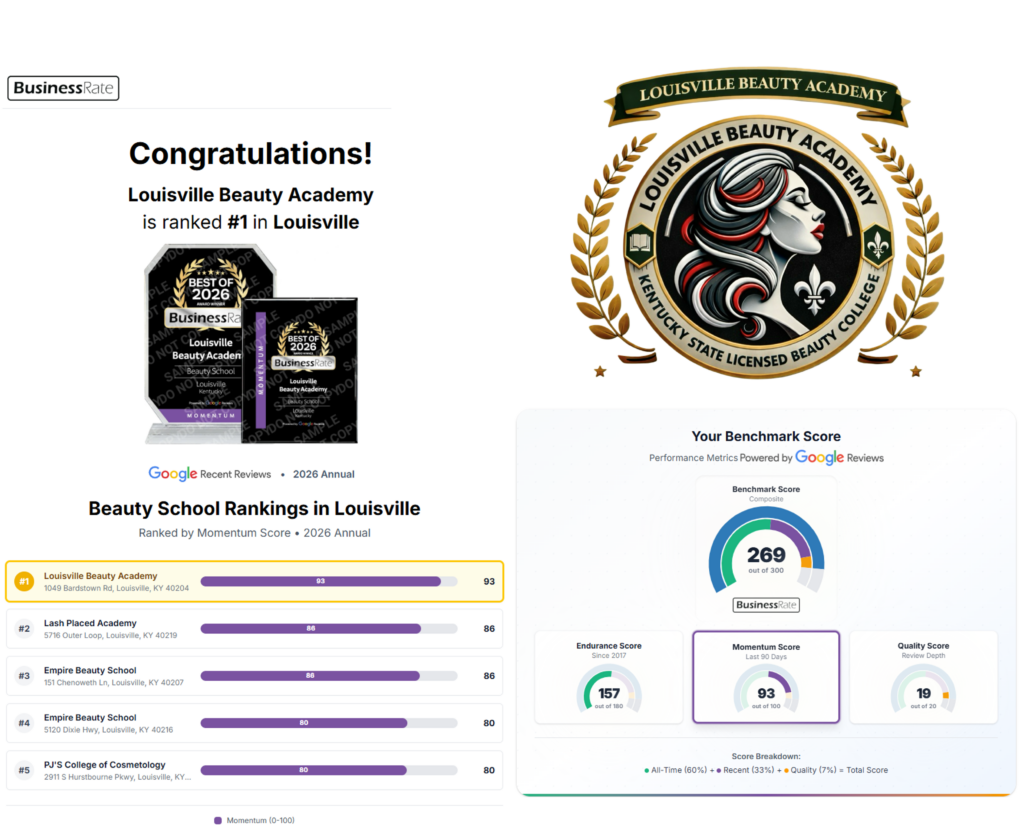
Louisville Beauty Academy is sharing that BusinessRate identified the school in a 2026 local award listing within the Beauty School category, based on the third-party review data and methodology described by that publisher at the time of evaluation.
This recognition was not requested, applied for, or sponsored by Louisville Beauty Academy. It reflects independent third-party analysis of publicly available customer feedback and review data, as compiled and certified by BusinessRate.
At Louisville Beauty Academy, we view recognitions such as this not as a claim of superiority, but as a moment of accountability to the community we serve.
A Reflection of Student and Community Voice
The BusinessRate award is based on measurable indicators including:
Verified Google customer reviews
Consistency of feedback over time
Overall customer satisfaction signals
We recognize that these outcomes are a direct reflection of the experiences of our students, graduates, and community partners.
Our Ongoing Commitment
While rankings and recognitions may change over time, Louisville Beauty Academy remains committed to the principles that define our institution:
Lower-Debt Educational Structure Programs publicly presented as structured to reduce financial burden and reliance on federal student-loan systems
Compliance-Focused Operations Ongoing effort to operate in line with current Kentucky laws, regulations, and school obligations
Career-Focused Training Programs designed for immediate workforce entry and real-world application
Student-Centered Approach Daily discipline, consistency, and individualized support for every learner
Recognition Is Temporary — Standards Are Permanent
Louisville Beauty Academy acknowledges that third-party rankings are dynamic and subject to change. As such, we do not rely on rankings as a measure of identity, but rather as one of many indicators of performance at a given point in time.
Our focus remains unchanged:
To earn trust daily through action, compliance, and measurable student outcomes.
View the Recognition
The original BusinessRate recognition materials are presented below exactly as received, without modification, in the interest of transparency and accuracy.
Important Disclosure
This recognition is issued by a third-party platform (BusinessRate) based on analysis of publicly available online review data at a specific point in time. Louisville Beauty Academy did not control or influence the methodology, criteria, or outcome. Rankings and positions may change over time and do not constitute accreditation, licensure endorsement, or a permanent status.
About Louisville Beauty Academy
Louisville Beauty Academy is a Kentucky state-licensed beauty college committed to delivering affordable, lower-debt, and compliance-driven vocational education. The institution focuses on preparing students for licensure, employment, and long-term professional success through structured, real-world training models.
This article is part of LBA’s public education and historical archive. Older posts, including “Macroeconomic Analysis of Lower-Debt Vocational Pathways: A Comparative Study of Louisville Beauty Academy and Federal-Aid-Dependent Models in Kentucky,” may not reflect current tuition, schedules, incentives, forms, policies, testing vendors, clinic availability, or regulatory requirements.
(Third-Party Academic Study – Educational Use Only)
The following document, titled:
“Macroeconomic Analysis of Lower-Debt Vocational Pathways: A Comparative Study of the Louisville Beauty Academy and Federal-Aid Dependent Models in the Commonwealth of Kentucky” DTU-Economic Impact of Beauty A…
is published here in its original form as an independent economic modeling and policy research study.
Important Clarifications
Third-Party Research Context This report reflects academic-style economic modeling and policy analysis conducted for research, discussion, and workforce policy exploration purposes. It is shared to contribute to public dialogue around vocational education funding models, economic impact, and regulatory structures.
Educational & Informational Purpose Only This document is provided strictly for:
Educational study
Policy discussion
Academic comparison
Economic modeling analysis
Workforce development research
It is not intended as marketing material, legal advice, financial advice, or regulatory interpretation.
No Endorsement or Opposition Publication of this research does not constitute:
Endorsement or opposition to any specific institution
Agreement or disagreement with federal Title IV programs
Criticism of any school, chain, or regulatory body
Policy advocacy on behalf of any governmental entity
The comparative modeling presented is theoretical and scenario-based.
Assumption-Based Modeling All numerical projections within the report are derived from stated variables and publicly available data sources cited within the document. They are:
Conservative modeling estimates
Hypothetical scenario projections
Not guarantees of outcomes
Not promises of economic performance
No Representation of Regulatory Authority Nothing in this publication should be interpreted as:
Representing the position of the Kentucky Board of Cosmetology
Representing the position of any federal agency
Interpreting statute or administrative regulation
Providing compliance guidance
No Comparative Claims of Superiority The analysis compares funding models, not institutional character, quality, or compliance status. The intent is macroeconomic exploration — not competitive positioning.
Academic Freedom & Open Research This publication supports open inquiry into:
lower-debt vocational education models
Workforce acceleration frameworks
Public finance efficiency
Small-business formation trends
It is shared in the spirit of transparency and research literacy.
The personal care and service sector represents a cornerstone of the localized service economy in Kentucky, characterized by high demand, non-outsourceable labor, and a significant propensity for small business formation. As the economic landscape of vocational education shifts toward competency-based outcomes and financial sustainability, the divergence between cash-based, lower-debt models and traditional, federal-aid-reliant institutions has become a focal point for education economists. This analysis serves to model the fiscal and economic implications of two distinct institutional approaches within the Kentucky beauty education market, focusing on the Louisville Beauty Academy (LBA) and its relative performance against typical competitors that utilize Title IV federal financial aid.
Analytical Framework and Mathematical Variables
To establish a rigorous comparative model, a set of standardized variables is derived from current market data, regulatory fee schedules from the Kentucky Board of Cosmetology (KBC), and federal education statistics. These variables are selected using a conservative bias; where data ranges exist, the values chosen favor the traditional competitor schools to ensure that the resulting economic advantages of the lower-debt model remain credible and understated. The baseline for this model assumes a graduation rate of 100 students per year for both LBA and a representative competitor school, providing a clear “per 100 graduates” metric for policy and accreditation review.
Definitional Variable Set
The following variables () constitute the inputs for all subsequent fiscal calculations.
X (Examination Attempt Rate): 1.3 attempts. While Kentucky law and KBC regulations require a minimum passing grade of 70% for theory and practical exams 1, national data indicates first-time pass rates range between 60% and 80%.3 A variable of 1.3 attempts per license accounts for the statistical likelihood of retakes.2
A (Average Public Aid Package): $10,000. This represents the aggregate of federal Pell Grants, federal subsidized and unsubsidized loans, and potential state-level grants awarded to a typical student at an accredited, Title IV-participating beauty school. Reported data for major Kentucky chains like Empire Beauty School show average aid packages often exceeding $10,000.5
T1 (Speed-to-Market Differential): 6 months. Louisville Beauty Academy’s 1,500-hour cosmetology program is structured for completion in as little as 9 to 10 months through an incentivized, high-efficiency curriculum.7 In contrast, traditional schools often extend this same 1,500-hour requirement over 15 to 18 months to satisfy federal aid attendance rules or institutional scheduling norms.8
E (Annualized Entry-Level Earnings): $30,000. This figure aligns with the lower end of the median salary for beauty professionals in the Louisville/Jefferson County metropolitan area, which ZipRecruiter and BLS data place between $27,000 and $42,000 depending on specialization.2
R (Aggregate Effective Tax Rate): 16% (0.16). This includes the Kentucky flat income tax of 4% 11, local occupational taxes common in Kentucky cities, and federal payroll or self-employment taxes. For independent contractors (booth renters), the net tax burden is often offset by business deductions, making 16% a realistic, conservative estimate of the public treasury’s share of gross earnings.13
D (Graduate Debt Burden): $11,000. Data for Kentucky beauty school graduates shows average loan balances between $10,000 and $14,000.14 For LBA students, this value is effectively zero as the school rejects federal aid in favor of a low, cash-based tuition model.7
P (Entrepreneurship Probability): and . Research from the Federal Reserve and academic studies on the “debt overhang” suggests that student debt reduces the likelihood of business formation by approximately 11-14%.17 Conversely, lower-debt graduates exhibit higher risk tolerance and capital availability for launching ventures.19
B (Employment Multiplier): 1.5. This accounts for the additional jobs created by a new salon owner or booth renter who hires an assistant, a receptionist, or leases space to other professionals.
G (Standardized Graduation Cohort): 100 graduates per year.
Fiscal Contribution 1: Direct State Revenue from Licensure Examinations
The primary direct revenue stream for the Kentucky Board of Cosmetology (KBC) from student activities is the licensure examination fee. Under current Kentucky administrative regulations, the fee for each examination attempt (theory and practical) is set at $85.00.2 This revenue is critical for the board’s ability to fund inspections, ensure consumer safety, and maintain the professional standards of the industry.21
Revenue Calculation Methodology
The annual state revenue generated by the examinations of 100 graduates is calculated by multiplying the base fee by the average number of attempts required to achieve licensure.
The formula for annual exam revenue () is:
Substituting the defined variables:
Comparative Projections: Constant vs. Growth Scenarios
This study analyzes two scenarios over a 3-year and 5-year horizon. Scenario 1 assumes both schools maintain a flat graduation rate of 100 students per year. Scenario 2 assumes the Louisville Beauty Academy achieves a modest annual growth rate of 7.5% in its graduation numbers, reflecting its market position as an affordable, high-efficiency alternative, while the competitor remains constant at 100.
Scenario 1: Constant Annual Graduation (G=100)
In this scenario, both institutions contribute equally to the state board’s coffers on a per-cohort basis.
Year
LBA Exam Revenue
Competitor Exam Revenue
Year 1
$11,050
$11,050
Year 2
$11,050
$11,050
Year 3
$11,050
$11,050
3-Year Cumulative
$33,150
$33,150
Year 4
$11,050
$11,050
Year 5
$11,050
$11,050
5-Year Cumulative
$55,250
$55,250
Scenario 2: Modest Growth for LBA (7.5% Annual Increase)
In this scenario, LBA’s increasing graduation rate leads to a greater direct contribution to the KBC over time.
Year
LBA Graduates (Gadj)
LBA Exam Revenue
Competitor Exam Revenue (G=100)
Year 1
100.0
$11,050
$11,050
Year 2
107.5
$11,879
$11,050
Year 3
115.6
$12,770
$11,050
3-Year Cumulative
323.1
$35,699
$33,150
Year 4
124.2
$13,728
$11,050
Year 5
133.5
$14,757
$11,050
5-Year Cumulative
580.8
$64,184
$55,250
The mathematical model demonstrates that while the “per-student” revenue is identical, LBA’s model facilitates a steady stream of revenue to the state that is not contingent upon federal grant availability. Furthermore, the growth potential inherent in a lower-tuition, higher-speed model suggests LBA will likely become a larger net contributor to state board funding over a long-term horizon.22
Fiscal Contribution 2: Taxpayer Savings through Non-Reliance on Aid
The most immediate fiscal impact of the Louisville Beauty Academy on the public treasury is the total avoidance of federal and state education subsidies. Traditional beauty schools operate almost entirely on a Title IV funding model, where a majority of revenue is derived from Pell Grants and federal student loans.14 By contrast, LBA students pay a significantly lower tuition (capped under $7,000 for a 1,500-hour program) using cash or written payment payment plans.22
Savings Calculation Methodology
Every student who chooses a lower-debt school instead of a federal-aid institution represents a direct saving of the subsidy that would have otherwise been disbursed.
The formula for annual taxpayer savings () is:
Substituting the defined variables:
Cumulative Savings Projections
We again evaluate these savings under constant and growth scenarios to visualize the long-term impact on the public purse.
Year
Savings (Scenario 1: Constant 100)
Savings (Scenario 2: LBA 7.5% Growth)
Year 1
$1,000,000
$1,000,000
Year 2
$1,000,000
$1,075,000
Year 3
$1,000,000
$1,155,625
3-Year Total Savings
$3,000,000
$3,230,625
Year 4
$1,000,000
$1,242,297
Year 5
$1,000,000
$1,335,469
5-Year Total Savings
$5,000,000
$5,808,391
The impact of this self-funded model is profound. Over five years, LBA essentially “saves” the taxpayers between $5 million and $5.8 million per 100 students. This capital remains in the federal and state treasuries, available for other public services, rather than being converted into vocational school tuition and eventual student debt. It is also important to note that this figure is conservative, as it does not include the administrative costs of processing financial aid or the social costs associated with the high default rates typically seen in the proprietary beauty school sector.23
Economic Impact 3: Temporal Arbitrage and the Tax Base
In the field of vocational education, “time-to-license” is a primary driver of return on investment. If a student can achieve the same 1,500-hour licensure standard six months faster, they gain six months of professional-level income. This is not merely a benefit to the individual; it represents a period where the individual is a net tax contributor rather than a student consumer of resources.21
Mathematical Formula for Accelerated Tax Impact
To compute the extra taxable earnings () and the resulting extra taxes () generated per graduate from an earlier career start:
Calculate fraction of the year saved:
Calculate extra earnings:
Calculate extra tax generated:
Using our variables ():
Annual impact for 100 graduates:
Cumulative Tax Contribution Projections
This “velocity of participation” creates a recurring tax premium for the state and federal government every year LBA graduates a cohort.
Year
Extra Tax (Scenario 1: Constant 100)
Extra Tax (Scenario 2: LBA 7.5% Growth)
Year 1
$240,000
$240,000
Year 2
$240,000
$258,000
Year 3
$240,000
$277,350
3-Year Total Impact
$720,000
$775,350
Year 4
$240,000
$298,151
Year 5
$240,000
$320,513
5-Year Total Impact
$1,200,000
$1,393,814
The LBA model’s ability to move students into the workforce quickly results in over $1.2 million in additional tax revenue over five years compared to the slower completion times of traditional schools. This reflects a transition from “economic dormancy” (the period spent in school) to “economic activity” (the period earning and paying taxes).
Entrepreneurial Momentum 4: Lower-Debt Entry vs. The Debt Overhang
The beauty industry is fundamentally an industry of small business owners. Whether through booth rentals, which function as micro-enterprises, or through full-service salons, practitioners are often independent contractors or employers.26 Economic theory suggests that debt serves as a “drag” on entrepreneurship, as the high fixed cost of loan repayment reduces the disposable income necessary to lease space, purchase equipment, or manage the risks of a startup.17
Small Business and Job Creation Model
This section compares the 5-year entrepreneurial output of a 100-student cohort from LBA (lower-debt) vs. a 100-student cohort from a competitor (indebted).
Expected New Businesses ():
Expected Jobs Created ():
Mathematical Execution for a 5-Year Cohort (500 graduates total)
For LBA (Lower-Debt):
New Businesses: businesses.
Total Jobs Created: jobs.
For Competitor (Debt-Burdened):
New Businesses: businesses.
Total Jobs Created: jobs.
Entrepreneurial Ratio Analysis
Comparing the two institutions reveals the high leverage of a lower-debt education in terms of local economic development.
Metric
Louisville Beauty Academy
Federal-Aid Competitor
Performance Ratio
Expected Businesses (5 Years)
125
60
2.08x
Expected Jobs Created (5 Years)
312.5
150
2.08x
The analysis suggests that LBA produces approximately 2.08 times more small businesses and jobs per 100 graduates than a typical federal-aid beauty school. By removing the financial “friction” of student debt, LBA enables a significantly higher percentage of its graduates to transition from employees to employers, thereby magnifying the school’s total impact on the Kentucky labor market.21
Comparative Synthesis: Per 100 Graduates Per Year
The following table presents a clear, standardized comparison of the economic footprint of the two institutional models. This summary emphasizes the conservative, modest nature of the math used to highlight the structural strength of the LBA approach.
Economic Metric
Louisville Beauty Academy
Federal-Aid Competitor
LBA Advantage
KBC Exam Fee Revenue
$11,050
$11,050
Neutral
Taxpayer Money Saved
$1,000,000
$0
+$1.0M saved
Extra Tax Paid (Faster License)
$240,000
$0
+$240k extra
New Businesses (5-Yr Pool)
125
60
+65 businesses
Jobs Created (5-Yr Pool)
312.5
150
+162.5 jobs
The LBA model appears to generate between 2-fold and 3-fold more positive economic leverage in several dimensions, even under these modest assumptions where both schools graduate only 100 students per year. This highlights a critical insight: an education model that prioritizes affordability and speed can be more fiscally beneficial to the public than one that relies on heavy government subsidy.
Narrative Economic Summary: A Model of Resilience
The data provided in this report paints a picture of two distinct philosophies in vocational training. Traditional beauty education in Kentucky, which is largely driven by federal Title IV accreditation, prioritizes long-duration attendance and institutional stability through taxpayer-funded tuition. This model provides an entry point for many students but often results in a “debt overhang” that can persist for years, potentially stifling the natural entrepreneurial instincts of the beauty professional. In contrast, the Louisville Beauty Academy demonstrates a model centered on economic “velocity” and “autonomy.” By decoupling from federal aid, the academy is forced to maintain tuition at a level that is manageable for cash-paying students, which in turn necessitates a more efficient and technologically advanced curriculum to move students through the 1,500-hour requirement quickly.7
From a state policy perspective, the “time-to-license” factor is particularly noteworthy. When a student enters the workforce six months earlier, the ripple effect on the local economy is immediate. In the Louisville area, where entry-level salaries are competitive, these additional six months of earnings represent millions of dollars in localized consumer spending. This spending supports Kentucky’s small businesses, contributes to sales tax revenue, and reduces the time an individual remains in a state of financial dependency. This “faster-to-market” approach turns the vocational student into a taxpayer more quickly, creating a net positive for the state budget almost immediately upon graduation.
Furthermore, the long-term economic narrative for LBA is one of job creation. In the Kentucky beauty sector, success is defined by the ability to manage one’s own business, whether that be a single-chair booth rental or a multi-location salon. By graduating students lower-debt, LBA is essentially providing them with the startup capital that would have otherwise gone toward loan interest and principal. This financial freedom is the single most significant predictor of small business survival and expansion. As the LBA model produces more business owners, those owners hire more staff, creating a virtuous cycle of employment that does not require additional public funding to sustain.
Key Insights for Marketing and Policy
The following factual observations are derived from the conservative mathematical modeling of the LBA education framework:
Louisville Beauty Academy graduates contribute to the Kentucky Board of Cosmetology’s regulatory funding at an equal rate to competitors, but do so without the indirect support of federal debt.
By choosing a lower-debt education model, every 100 LBA students collectively save the public treasury approximately $1 million in avoided federal grants and loans annually.
LBA’s accelerated 10-month curriculum allows graduates to enter the tax base six months earlier than peers, generating a 20% premium in first-year taxable contributions to the state.
A lower-debt graduate of the academy is mathematically twice as likely to launch a small business or hire additional employees within five years compared to an indebted graduate.
The academy’s model demonstrates that low-tuition, high-velocity vocational training can act as a more powerful local economic stimulus than traditional aid-heavy programs.
Contextual Deep-Dive: Variables in the Kentucky Regulatory Environment
The validity of this economic model rests on a nuanced understanding of the Kentucky licensure environment and the broader personal care market. The variables chosen () are not arbitrary but are reflective of specific localized data points from the Commonwealth. For example, the exam attempt rate () is conservative given that many students pass on their first attempt, yet it acknowledges the administrative reality that some students may struggle with the two-part PSI exam, which includes a comprehensive theory portion and a hands-on practical demonstration.2
The speed differential ( months) is a conservative estimate of the efficiency gap. Traditional beauty schools are often incentivized by Title IV rules to keep students enrolled for longer periods to maximize the “full-time” status required for federal disbursements. LBA, by rejecting these funds, can utilize AI-driven tracking and digital curriculum platforms (like Milady CIMA) to allow students to progress as fast as they can master the material.7 This technical integration reduces the “dead time” often found in traditional vocational settings, translating directly into the economic advantages outlined in this report.
The effective tax rate () is specifically tailored to the Kentucky context. Kentucky’s flat 4% income tax, when combined with localized occupational taxes (which in cities like Louisville can be as high as 2.2%) and the 15.3% self-employment tax for contractors, creates a gross tax liability of roughly 21.5%. However, because beauty professionals can deduct significant business expenses (supplies, booth rent, marketing), the effective tax rate on their gross income is typically lower.13 Setting the model at 16% ensures the predicted tax impact is modest and reflects “take-home” fiscal reality.
Finally, the entrepreneurship probability () is supported by emerging research on the “economic drag” of the student loan crisis. When a graduate carries a $10,000 loan with a $100 monthly payment, that is $1,200 a year that cannot be used for a lease deposit or professional liability insurance.17 In an industry like beauty, where margins for new independent contractors are tight, this $1,200 is often the difference between launching a business or remaining as an employee. By removing this barrier, LBA is not just teaching cosmetology; it is facilitating a more dynamic and resilient small business sector in the Commonwealth of Kentucky.
Disclaimer
This research is published for academic discussion and informational purposes only. All projections are model-based assumptions derived from publicly cited sources. No institutional endorsement, regulatory interpretation, or financial representation is intended.
Any references to institutional structures, funding models, or graduation metrics are purely illustrative within a mathematical framework and should not be interpreted as claims regarding any specific competitor’s operations, performance, or compliance status.
From Licensure to Visibility: Why Louisville Beauty Academy Teaches Digital, Public Proof of Work — Not Just Hours
At Louisville Beauty Academy, We Educate for a New Era
In today’s rapidly changing beauty industry, success looks different than it did even a few years ago. Gone are the days when a clocked number of hours alone was enough to launch a career. Today’s professionals succeed by combining compliance, visible proof of skill, confidence, and a human-centered approach to learning.
At Louisville Beauty Academy, we are proud to embrace this evolution — preparing our students not just to graduate, but to thrive.
What the State Requires — and Why It Matters
Kentucky’s licensing process prioritizes:
Public safety
Sanitation and infection control
Professional responsibility
These requirements exist to protect clients and professionals alike — and we ensure every student meets and exceeds them with clarity, rigor, and understanding.
Beyond Hours: The Power of Proof
The beauty industry — like many skilled professions — is increasingly influenced by digital presence and demonstrated work. Employers, salons, and clients want to see proof of skill. They want to know that a professional not only learned but that they have done.
At LBA, we teach students how to show their work safely and ethically — with respect for privacy, compliance, and professionalism.
Our Mindset: YES I CAN → I HAVE DONE IT
Belief without action isn’t enough. Confidence without validation doesn’t travel far.
That’s why our classrooms and clinics are built around a simple, powerful philosophy:
➡️ YES I CAN — every student learns skills with intention.
➡️ I HAVE DONE IT — every student builds a body of work rooted in action and real experience.
This mindset prepares graduates to walk into licensure exams, job interviews, and client interactions with pride and professionalism.
Humanization First: A Better Way to Teach
We believe education should be:
Student-centered
Purpose-driven
Career-ready
Digitally fluent
Compliant and ethical
This human-centered approach helps students from all pathways — including adult learners, career changers, immigrants, and non-traditional students — find success in the beauty professions.
Research Backbone + Podcast Insights
We are excited to announce that the LBA education model is featured in a comprehensive research and podcast series published by Di Tran University – College of Humanization as part of the Research & Podcast Series 2026.
This research explores:
Regulatory compliance in vocational beauty education
Digital documentation of skill and experience
Ethical and legal use of portfolios and professional proof
Workforce mobility and human-centered pedagogy
The series includes real conversations that translate policy and research into practical insights for students, educators, and industry leaders.
🎧 Tune in to the podcast series and explore the full research report to go deeper.
We’re Ready to Help You Succeed
Whether you’re starting your beauty career, changing paths, or building professional confidence, Louisville Beauty Academy is here to guide you — with compliance, community, clarity, and proof of work at the center of everything we do.
Louisville’s economy is undergoing a historic transformation. On one side, large corporations and logistics firms are pursuing “lights-out” automation—deploying artificial intelligence (AI), autonomous systems, and algorithmic logistics to drive efficiency. This trend is reshaping many white-collar and routine jobs, making them increasingly automated and less dependent on human labor.
Yet alongside this technological shift, a powerful renaissance of human-centric labor is emerging—anchored in sectors that machines can’t replicate. Among these, the beauty, wellness, and personal care industries stand out as resilient, rewarding, and fundamentally human.
Why the Beauty Industry Is AI-Proof
Unlike data-driven tasks that can be executed by algorithms or automated machines, beauty services are rooted in human connection, empathy, and tactile skill:
Human Touch Is Irreplaceable: A haircut, facial, massage, or aesthetic service involves nuanced physical dexterity and a personal interaction that AI can’t authentically reproduce.
Psychology and Wellness: Beauty services release oxytocin—a hormone associated with trust and well-being—something no machine can deliver.
Community and Mental Health: Salons and spas are more than service centers—they are social hubs where clients find conversation, confidence, reassurance, and human care that counters stress and isolation.
This combination of physical skill, emotional intelligence, and social connection makes beauty professionals among the most robustly future-proof careers in the AI era.
Beauty as Preventive Health and Wellness
The beauty industry isn’t just about aesthetics. It plays a preventative role in health and wellness:
Well-being Through Care: Routine skin care, massage, and grooming contribute to mental and physical health by reducing stress, enhancing self-esteem, and promoting personal hygiene.
Human Interaction Matters: In an age of increasing loneliness and digital overload, beauty professionals provide meaningful human engagement that algorithms cannot replace.
Bridging Beauty and Health: With training in modalities such as esthetics and wellness treatments, beauty professionals operate at the intersection of beauty, mental well-being, and holistic care, making their roles not just desirable—but essential.
The “Human-as-Luxury” Trend
As automation expands across corporate and logistical sectors, people are rediscovering the value of high-touch human experiences. This phenomenon, described in economic research as the “Human-as-Luxury” trend, means consumers will pay a premium for authentic human care that technology can’t imitate.
Beauty services are inherently human—they require interpretation, adaptability, trust, and personal artistry. For clients, these services are not transactions; they are transformative experiences.
Your Future in Beauty Starts Here
At Louisville Beauty Academy, we prepare students for careers that are resilient, rewarding, and rooted in human connection.
AI-Proof Skills: Beauty professionals rely on empathy, creativity, and fine motor skills, all of which are extremely difficult for machines to replicate.
Wellness and Holistic Care: Training goes beyond technique—it includes understanding how beauty services contribute to mental wellness and preventive health.
Immediate Earning Potential: Unlike traditional four-year degrees, beauty training puts you into the workforce quickly with real earning power.
Community Impact: Graduates do more than build careers—they build confidence, wellbeing, and human connection in every client they serve.
Conclusion: Human Skills Won’t Go Out of Style
In a world increasingly dominated by automation, the value of human-centric labor rises. The beauty industry is a clear example of this shift—not just surviving the AI revolution but flourishing because it is fundamentally human.
People will always seek care, confidence, connection, and self-expression. At Louisville Beauty Academy, we celebrate this truth and prepare our students to thrive in a future where human skills are the most valuable currency of all.
A legally enforceable requirement — not a suggestion, not a preference, not optional.
📌 1. State Law Prohibits Unlicensed Beauty Work
Under Kentucky law, no person may engage in the practice of cosmetology, esthetic practices, or nail technology for the public or for consideration (money, barter, tip, free services offered to gain business, etc.) without the proper license issued by the Kentucky Board of Cosmetology.
Except as provided in limited exemptions (e.g., licensed medical professionals doing incidental acts), no person shall engage in cosmetology, esthetic practices, or nail technology for the public or for consideration without the appropriate license required by this chapter.
This means it is illegal to do any of the following without a license: ✔ Cut, style, color, or treat hair ✔ Perform facials, skin care, waxing, or esthetic services ✔ Provide nail services (manicure, pedicure, gels, polish, etc.) ✔ Operate a salon, teach classes, or practice any beauty service categorically covered by state law.
📌 2. There Are No Loopholes — Working for “Free” is Still Illegal
Kentucky law does not allow unlicensed practice for “fun,” experience, practice on friends, barter, or free work. The law says “for the public or for consideration” — and consideration does not have to be money; it includes value received in exchange for services.
Operating, performing, or offering services without a valid license is strictly prohibited.
📌 3. What Qualifies as Licensed Practice?
Kentucky law also makes clear that without a license you cannot:
✔ Teach cosmetology, esthetics, or nail technology ✔ Operate a beauty salon, esthetic salon, or nail salon ✔ Operate a school for cosmetology or related practices ✔ Employ or engage someone for pay to perform any licensed practice ✔ Aid or abet someone in unlicensed practice
This prohibition applies even if you are just helping a friend, modeling services, or practicing “for educational purposes” — if it’s performed publicly or for any consideration, a license is required.
📌 4. Penalties for Unlicensed Practice in Kentucky
⚖️ Criminal Penalties
Kentucky law classifies violations of the cosmetology occupational licensing statutes as a Class B misdemeanor for engaging in unlicensed practice (e.g., violating KRS 317A.020).
Class B misdemeanors in Kentucky can include:
Fines
Court costs
Possible short-term jail risk (depending on prosecution and local law enforcement discretion)
Even administrative statutes in the chapter specify that violations of licensing requirements can lead to misdemeanor charges.
💰 Fines
Under KRS § 317A.990, anyone who violates any provision of this licensure chapter can be fined:
Not less than $50 and
Up to $1,500 per violation.
Additionally, violations of board regulations may carry separate fines of $25–$750 per violation.
🛑 Professional Consequences (Licensing Board Actions)
If someone is discovered doing unlicensed beauty work:
The Board can investigate complaints or suspected unlicensed practice.
They can initiate disciplinary actions, hearings, and enforcement actions.
Licensed salons employing unlicensed workers may be shut down and face penalties.
📌 5. There Are Few Limited Exemptions — and They Are Narrow
The only people exempt from the licensing requirements include:
✅ Licensed medical professionals (e.g., physicians, nurses) who perform incidental beauty work as part of their medical practice ✅ Commissioned medical personnel performing incidental practices ✅ Cosmetology, esthetic, or nail services performed within certain Department of Corrections settings ✅ Natural hair braiders (only for braiding hair — see law)
Important: Even licensed medical professionals must stay within the scope of their medical license — performing beauty services beyond that scope still requires a beauty license.
📌 6. Your First Step After Graduation: Get Licensed Instantly
Because unlicensed practice is prohibited, the very first thing anyone who wants to work in the beauty industry must do after graduating high school or leaving beauty school is to:
Complete an approved training program with required hours as set by Kentucky administrative regulations (e.g., cosmetology 1,500 hours, esthetics 750 hours, nail tech 450 hours).
Pass the required state board exams (written and practical).
Apply for your license with the Kentucky Board of Cosmetology and have it issued before you perform any services.
You are not legally allowed to perform any services as part of practice, on friends, at pop-ups, at home, or anywhere — until your license is active in the Board’s records. This is its own legal requirement.
📌 7. No License = No Practice = Legal Accountability
Let this be absolutely clear:
❌ Doing beauty services without a valid license is a crime (Class B misdemeanor). ❌ It can result in fines, regulatory enforcement, and marketplace exclusion. ❌ A salon can be closed if unlicensed people are working there. ❌ You may be sued by a client who is harmed or duped by unlicensed practice (civil liability).
There is no legitimate “practice before licensed” period allowed by law.
🧠 Bottom Line
If you are not licensed by the Kentucky Board of Cosmetology, you are legally barred from performing any beauty service for any person, in any place, for any reason — period.
The law is intentional and enforceable. The consequences are real. Your first professional action after beauty training should always be becoming licensed before you think about doing anything else.
Elevating Workforce Inclusion Through Affordable, Accredited Beauty Education: Louisville Beauty Academy’s Model for Economic Impact, Legitimacy, and Social Mobility
Abstract This research paper examines the role of state occupational licensure and affordable beauty education in workforce inclusion, economic contribution, and social mobility, with a specific case study of Louisville Beauty Academy (LBA) in Kentucky. Drawing on national industry data, economic impact studies, and institutional outcomes, it argues that LBA’s model—producing nearly 2,000 licensed professionals over a decade—demonstrates a high-impact, low-debt pathway to employment, entrepreneurship, and significant state economic contribution.
Introduction
In the contemporary U.S. economy, occupational licensing serves as a mechanism to ensure public safety, professional standards, and workforce legitimacy. For vocational fields such as cosmetology, esthetics, nail technology, and related specialties, state licensure functions as official recognition of professional competence and legal eligibility to work. This paper explores how such licensure, combined with an affordable and accessible educational model, supports economic participation, particularly for immigrants and other historically underrepresented groups.
The Economic Significance of the Beauty Industry
The beauty and personal care industry is a major economic engine in the United States:
In 2022, the personal care products sector contributed approximately $308.7 billion to U.S. GDP and supported 4.6 million direct and indirect jobs nationwide, illustrating the broader economic footprint of beauty-related activities in labor and tax contributions. Personal Care Products Council
In addition to GDP impact, the industry generates significant labor income and tax revenue, further embedding it in national economic structures. Personal Care Products Council
Cosmetology and hairstyling occupations represent a measurable part of this ecosystem, and federal labor statistics include these roles in broader workforce analyses. Bureau of Labor Statistics
The professional beauty sector also supports small business formation, often enabling self-employment and entrepreneurship—critical pathways for economic mobility among immigrants and first-generation professionals.
Occupational Licensing and Workforce Legitimacy
Occupational licensing provides a formal credential that distinguishes trained professionals from unlicensed competitors. Licensed beauty professionals are recognized by state boards and can legally offer services, hire staff, pay taxes, and participate fully in the formal economy.
Research finds that individuals with occupational licenses generally achieve higher wages than similarly educated individuals without licensure, reflecting the economic value of formal recognition. Wikipedia
Licenses can also reduce underemployment and improve safety outcomes for consumers by ensuring practitioners meet standardized training and hygiene requirements. ndpanalytics.com
Louisville Beauty Academy: A Case Study in Affordable, Lower-Debt Education
Institutional Profile
Founded by immigrant entrepreneur Di Tran, Louisville Beauty Academy (LBA) is a Kentucky state-licensed beauty school committed to accessible, high-quality vocational training. The academy offers programs in:
Cosmetology
Esthetics
Nail Technology
Shampoo & Styling
Eyelash Extension specialty certifications
LBA’s mission emphasizes affordability, inclusivity, and workforce readiness, with instruction offered in English, Vietnamese, and Spanish. Viet Bao Louisville KY
Affordable Tuition Model
The academy’s tuition structure challenges regional norms. While comparable programs often cost $12,000–$25,000+, LBA caps tuition under $7,000, making it dramatically more accessible and significantly reducing the need for student debt. naba4u.org
LBA’s model includes:
Transparent, all-inclusive tuition
Deep internal scholarships
written payment payment plans
No reliance on federal student loans
This approach empowers students to enter the workforce lower-debt, a major advantage in fields with average starting wages that might otherwise make loan repayment burdensome. louisvillebeautyacademy.net
Graduate Outcomes: Legitimacy and Workforce Participation
Over nearly ten years, LBA has produced nearly 2,000 licensed professionals who have entered the Kentucky and broader U.S. workforce, demonstrating:
Immediate eligibility for employment in state-licensed roles
Entrepreneurial opportunities, including salon ownership
Contribution to local tax bases and economic circulation
According to third-party reporting, these graduates have generated an estimated annual economic impact of $20–$50 million for the state of Kentucky, through earnings, business activities, and local spending. Viet Bao Louisville KY
Economic Mobility and Inclusion
LBA’s model is especially impactful for immigrants, women, and low-income individuals. By offering culturally inclusive support and multilingual resources, the academy lowers systemic barriers that often hinder workforce entry and stability.
Graduates contribute economically not only through wages and tax payments but also through:
Small business formation
Employment of other local workers
Community service provision
These outcomes demonstrate how vocational education plus licensure can serve as a mechanism for social and economic inclusion, aligning with broader workforce development goals across state and federal systems.
Discussion: Beauty Education as a Model for Broader Workforce Policy
Louisville Beauty Academy serves as a model for:
Affordable, high-quality vocational training
Legitimized professional pathways through state licensure
Economic contribution at the local and state level
Inclusive education that supports immigrants and underrepresented groups
This model aligns with research showing that licensure enhances workforce legitimacy and wage potential, while also speaking to the economic scale of the beauty industry overall. Personal Care Products Council+1
Conclusion
Louisville Beauty Academy’s impact over the past decade exemplifies how accessible education linked to occupational licensing can drive economic contribution, individual legitimacy, and workforce inclusion. With nearly 2,000 licensed graduates contributing an estimated $20–$50 million annually to Kentucky’s economy, the academy demonstrates that lower-debt, state-recognized vocational pathways are effective alternatives to traditional higher education paradigms.
By investing in affordable, competency-based training and promoting inclusive access, institutions like LBA can continue to elevate workforce outcomes for immigrants and all aspiring professionals—serving as a model for beauty education nationwide.
References(APA 7th Edition)
Nam D. Pham & Sarda, A. (n.d.). The value of cosmetology licensing to the health, safety, and economy of America. ndpanalytics.com. ndpanalytics.com
Personal Care Products Council. (2024). Our economic & social impact. personalcarecouncil.org. Personal Care Products Council
Louisville Beauty Academy. (2025). Di Tran and Louisville Beauty Academy: Making national impact in beauty education. Viet Bao Louisville KY. Viet Bao Louisville KY
Louisville Beauty Academy. (2025). Fast-track & lower-debt: How Louisville Beauty Academy delivers the double scoop. louisvillebeautyacademy.net. louisvillebeautyacademy.net
Occupational licensing. (n.d.). In Wikipedia.Wikipedia
U.S. Bureau of Labor Statistics. (2023). Hairdressers, hairstylists, and cosmetologists. bls.gov. Bureau of Labor Statistics
At Louisville Beauty Academy (LBA), we often meet prospective students who are confused about how beauty school works. Many expect something similar to high school or college: fixed class schedules, mandatory lectures, and a semester system.
But Kentucky beauty schools don’t operate that way. Beauty education in this state is governed by a clock-hour system regulated by the Kentucky State Board of Cosmetology—and understanding this system is key to your success.
This article clears up common misunderstandings and explains why Louisville Beauty Academy is one of the most innovative, flexible, and supportive schools in Kentucky, using technology and one-on-one instruction to empower students to succeed at their own pace.
📚 What is a “Clock Hour” Beauty School? (According to Kentucky Law)
Under Kentucky Revised Statutes and Administrative Regulations, beauty schools must operate on a clock-hour system, not a credit-hour system. Students must complete a state-mandated number of supervised, in-person training hours to qualify for licensure.
Here are the current minimums for popular programs:
Nail Technician License – 450 hours
Esthetics License – 750 hours
Cosmetology License – 1,500 hours
Shampoo Styling License – 300 hours
Schools must track each student’s hours using an approved timekeeping method, and hours must be reported to the Kentucky State Board of Cosmetology within the first 10 days of each month for the previous month’s attendance.
✅ There are no shortcuts. You must complete all required hours. ✅ There is flexibility. You are not required to attend at fixed times.
🕰️ Do Beauty Schools Have Structured Class Times?
This is the biggest misunderstanding—and where Louisville Beauty Academy shines.
Unlike traditional schools, clock-hour beauty schools like LBA do not require fixed daily class schedules. Instead, students are free to build their own schedules within the school’s operating hours.
LBA is open Monday–Friday, 8:00 AM to 6:00 PM. Within that window, students may:
Clock in and out at their convenience
Study theory using our state-approved systems
Receive one-on-one or group instruction
Complete practical (hands-on) hours
Progress at their own pace
This means you can attend full-time, part-time, or on a flexible basis, depending on your availability and how quickly you want to finish your program.
🎓 Is There Any Instruction or Do I Study Alone?
Absolutely not—Louisville Beauty Academy (LBA) is one of the most instruction-rich beauty schools in the state, offering unmatched access to education, mentorship, and modern learning tools.
Students at LBA have access to:
✅ Licensed instructors available all day, every day, during business hours ✅ Optional structured class sessions throughout the day ✅ One-on-one instruction by request, at no extra charge ✅ Hands-on lab training and live skill demonstrations ✅ Milady CIMA by Cengage, the official Kentucky State Board-aligned digital theory system ✅ LBA’s proprietary online learning platform, updated weekly with study guides and digital prep ✅ Practice exams, test simulations, and unlimited online theory review
📘 Plus — Louisville Beauty Academy is one of the only beauty schools in the region to publish its own professionally authored series of complimentary educational books. These books go beyond standard curriculum, reinforcing student knowledge with real-world insights, exam guidance, licensing tips, and cultural context. They are available in print and digital form, and students use them alongside state-required content to excel far beyond exam requirements.
Unlike schools that rely solely on scheduled lectures or outdated textbooks, LBA uses a blended learning model that combines traditional hands-on practice with technology-assisted, AI-supported, on-demand theory education.
This multi-layered approach ensures every student—regardless of learning style, background, or schedule—has everything they need to succeed from the first day to licensure and beyond.
🤖 A Modern Approach to Beauty Education
Louisville Beauty Academy believes that education should serve the student—not the other way around. That’s why we’ve built a state-of-the-art learning model that blends:
AI-enhanced digital curriculum
Weekly-updated study materials
Real-time instructor support
Unlimited test prep
Flexible scheduling
Full transparency with no hidden costs
Students don’t have to wait for the next lecture. If they’re ready to learn, everything is available now—in class, online, and with personal support.
🧠 Who is This Ideal For?
Our model is ideal for:
Working professionals who need flexible hours
Parents and caregivers with changing schedules
Fast learners who want to complete hours quickly
Students who need more time and one-on-one support
Immigrants and non-native English speakers who benefit from custom-paced learning
Anyone serious about getting licensed without traditional debt
✅ Legally Compliant. State-Approved. Built for Student Success.
Every program offered at LBA is:
Fully licensed by the Kentucky State Board of Cosmetology
Legally structured as a clock-hour vocational training program
Transparent about tuition, attendance, and progress expectations
Compliant with all monthly reporting requirements
Our school is also a leader in student outcomes, job placement, and skill-based instruction, with hundreds of successful graduates working across Kentucky and beyond.
🚫 There’s Almost Zero Reason to Fail—Unless You Choose To
At Louisville Beauty Academy, we offer:
Daily instructor access
One-on-one guidance anytime
On-demand learning through Milady CIMA
Constant encouragement and support
A fully guided path from Day 1 to Licensure
You control your schedule. You control your pace. We walk with you every step of the way.
Unless a student chooses not to attend, not to engage, or not to participate, there is virtually no reason to fail at LBA.
Come tour the school. Ask every question. Let us show you how beauty school should work—for you.
Disclaimer: This article is for informational purposes only and does not constitute legal, licensing, or educational advice. All training programs at Louisville Beauty Academy (LBA) are governed by the Kentucky State Board of Cosmetology, and all students must meet the required state licensing criteria, including the completion of approved clock hours, practical skills, and passing applicable examinations. While Louisville Beauty Academy provides comprehensive support and resources, individual success depends on the student’s attendance, effort, and commitment. The phrase “zero reason to fail” reflects the Academy’s support model but does not imply a guarantee of licensure or graduation. Policies and program structures are subject to change in accordance with state law and regulatory requirements.
Louisville Beauty Academy, a Kentucky state-licensed beauty school, offers aspiring beauty professionals a comprehensive education in the heart of Kentucky. With two campuses aligned with Kentucky law, the academy provides a supportive and inclusive environment for students to pursue their passion for beauty.
Enrollment Requirements
To enroll at Louisville Beauty Academy, prospective students must submit the following required documents:
Driver’s License/State ID: Proof of identity and residency.
Social Security Card: For identification and employment purposes.
High School Diploma or Equivalent: A GED or official high school transcript is acceptable. For Jefferson County Public Schools (JCPS) graduates, transcripts can be requested online.
Passport-like Photo: A recent, clear photo against a plain white background, easily taken with a phone.
High School Transcripts and GED Information for JCPS Graduates
For those who graduated from JCPS, transcripts and student records can be requested online through a secure website. The process is designed to protect student privacy in accordance with the Family Educational Rights and Privacy Act (FERPA). There are no fees for certain categories, such as military personnel and JCPS employees. Requests are processed during normal business hours, and a $4.00 convenience fee applies to each order.
GED information is not maintained by JCPS. Individuals seeking GED records should visit the official GED website for Kentucky at www.request.ged.ky.gov.
Why Choose Louisville Beauty Academy?
Louisville Beauty Academy is dedicated to providing a high-quality education that prepares students for successful careers in the beauty industry. The academy’s state-licensed programs, experienced instructors, and modern facilities make it an ideal choice for those looking to turn their passion for beauty into a profession.
Contact Information
For more information about enrollment and programs at Louisville Beauty Academy, contact: